<?xml version="1.0" encoding="ISO-8859-1"?><article xmlns:mml="http://www.w3.org/1998/Math/MathML" xmlns:xlink="http://www.w3.org/1999/xlink" xmlns:xsi="http://www.w3.org/2001/XMLSchema-instance">
<front>
<journal-meta>
<journal-id>0012-7353</journal-id>
<journal-title><![CDATA[DYNA]]></journal-title>
<abbrev-journal-title><![CDATA[Dyna rev.fac.nac.minas]]></abbrev-journal-title>
<issn>0012-7353</issn>
<publisher>
<publisher-name><![CDATA[Universidad Nacional de Colombia]]></publisher-name>
</publisher>
</journal-meta>
<article-meta>
<article-id>S0012-73532014000400006</article-id>
<article-id pub-id-type="doi">10.15446/dyna.v81n186.37953</article-id>
<title-group>
<article-title xml:lang="en"><![CDATA[Service quality management based on the application of the ITIL standard]]></article-title>
<article-title xml:lang="es"><![CDATA[Gestión de la calidad de servicios apoyados en la aplicación del estándar ITIL]]></article-title>
</title-group>
<contrib-group>
<contrib contrib-type="author">
<name>
<surname><![CDATA[Gil-Gómez]]></surname>
<given-names><![CDATA[Hermenegildo]]></given-names>
</name>
<xref ref-type="aff" rid="A01"/>
</contrib>
<contrib contrib-type="author">
<name>
<surname><![CDATA[Oltra-Badenes]]></surname>
<given-names><![CDATA[Raúl]]></given-names>
</name>
<xref ref-type="aff" rid="A02"/>
</contrib>
<contrib contrib-type="author">
<name>
<surname><![CDATA[Adarme-Jaimes]]></surname>
<given-names><![CDATA[Wilson]]></given-names>
</name>
<xref ref-type="aff" rid="A03"/>
</contrib>
</contrib-group>
<aff id="A01">
<institution><![CDATA[,Universitat Politècnica de Valencia Instituto de Automática e Informática Industrial Dpto. de Administración]]></institution>
<addr-line><![CDATA[ ]]></addr-line>
<country>España</country>
</aff>
<aff id="A02">
<institution><![CDATA[,Universitat Politècnica de Valencia  ]]></institution>
<addr-line><![CDATA[ ]]></addr-line>
<country>España</country>
</aff>
<aff id="A03">
<institution><![CDATA[,Universidad Nacional de Colombia Departamento de Industrial ]]></institution>
<addr-line><![CDATA[ ]]></addr-line>
</aff>
<pub-date pub-type="pub">
<day>00</day>
<month>08</month>
<year>2014</year>
</pub-date>
<pub-date pub-type="epub">
<day>00</day>
<month>08</month>
<year>2014</year>
</pub-date>
<volume>81</volume>
<numero>186</numero>
<fpage>51</fpage>
<lpage>56</lpage>
<copyright-statement/>
<copyright-year/>
<self-uri xlink:href="http://www.scielo.org.co/scielo.php?script=sci_arttext&amp;pid=S0012-73532014000400006&amp;lng=en&amp;nrm=iso"></self-uri><self-uri xlink:href="http://www.scielo.org.co/scielo.php?script=sci_abstract&amp;pid=S0012-73532014000400006&amp;lng=en&amp;nrm=iso"></self-uri><self-uri xlink:href="http://www.scielo.org.co/scielo.php?script=sci_pdf&amp;pid=S0012-73532014000400006&amp;lng=en&amp;nrm=iso"></self-uri><abstract abstract-type="short" xml:lang="en"><p><![CDATA[The modern world has led companies to become increasingly competitive, highlighting the customer as the core element of commercialization processes, and also recognizing the need to treat all internal activities as customers in the delivery of products/services to final consumers. An important element to ensure an adequate level of customer satisfaction is the need to properly manage the required services inside business processes, where the management of technology services becomes an imperative in almost every company. This paper presents the ITIL standard, which is a framework that allows the delivery of technology services to be efficiently managed, in order to improve internal business processes and obtain other benefits such as better internal communication. After that, the use of ITIL as a frame of reference for enhancing quality is proposed, focused not only on IT but on any type of service in general.]]></p></abstract>
<abstract abstract-type="short" xml:lang="es"><p><![CDATA[El mundo moderno ha llevado a las empresas a ser cada vez más competitivas, volviendo al cliente el eje central de los procesos de comercialización, pero evidenciando la necesidad de tratar todas las actividades internas como clientes parciales en el proceso de entrega del producto o servicio a los consumidores finales. Un elemento necesario para asegurar un adecuado nivel de satisfacción a los clientes radica en la necesidad de gestionar adecuadamente los servicios requeridos en los procesos empresariales, donde la gestión de los servicios de tecnología se vuelve un imperativo en casi todas las empresas. Este artículo presenta el estándar ITIL, el cual es un marco de referencia que permite administrar de manera eficiente la prestación de servicios de tecnología, de cara a mejorar los procesos internos de las empresas y obtener otros beneficios, como potencializar la comunicación interna. Tras ello, se propone el uso de ITIL como marco de referencia para la mejora de la calidad, no solo centrado en las TI, sino de cualquier tipo de servicio en general.]]></p></abstract>
<kwd-group>
<kwd lng="en"><![CDATA[Services]]></kwd>
<kwd lng="en"><![CDATA[Information Technology (IT)]]></kwd>
<kwd lng="en"><![CDATA[Systems]]></kwd>
<kwd lng="en"><![CDATA[ITIL]]></kwd>
<kwd lng="en"><![CDATA[Customer]]></kwd>
<kwd lng="es"><![CDATA[Servicios]]></kwd>
<kwd lng="es"><![CDATA[Tecnologías de la Información (TI)]]></kwd>
<kwd lng="es"><![CDATA[Sistemas]]></kwd>
<kwd lng="es"><![CDATA[ITIL]]></kwd>
<kwd lng="es"><![CDATA[Cliente]]></kwd>
</kwd-group>
</article-meta>
</front><body><![CDATA[ <p><font size="2" face="Verdana, Arial, Helvetica, sans-serif"><a href="http://dx.doi.org/10.15446/dyna.v81n186.37953" target="_blank">http://dx.doi.org/10.15446/dyna.v81n186.37953</a></font></p>     <p align="center"><font size="4" face="Verdana, Arial, Helvetica, sans-serif"><b>Service quality   management based on the application of the ITIL standard</b></font></p>     <p align="center"><i><font size="3"><b><font face="Verdana, Arial, Helvetica, sans-serif">Gesti&oacute;n   de la calidad de servicios apoyados en la aplicaci&oacute;n del est&aacute;ndar ITIL</font></b></font></i></p>     <p align="center">&nbsp;</p>     <p align="center"><font size="2" face="Verdana, Arial, Helvetica, sans-serif"><b>Hermenegildo Gil-G&oacute;mez<sup> a</sup>,   Ra&uacute;l Oltra-Badenes<sup> b</sup> &amp; Wilson Adarme-Jaimes<sup> c</sup></b><sup></sup></font></p>     <p align="center">&nbsp;</p>     <p align="center"><font size="2" face="Verdana, Arial, Helvetica, sans-serif"><sup><i>a </i></sup><i>Dpto.   de Administraci&oacute;n, Instituto de Autom&aacute;tica e Inform&aacute;tica Industrial (ai2),   Universitat Politècnica de Valencia - UPV, Espa&ntilde;a. <a href="mailto:hgil@ai2.upv.es">hgil@ai2.upv.es</a>    <br>   <sup>b </sup>Universitat   Politècnica de València (UPV) y Universitat Jaume I, Espa&ntilde;a. <a href="mailto:rauloltra@doe.upv.es">rauloltra@doe.upv.es</a>    <br>   <sup>c </sup>Departamento de Industrial Universidad Nacional   de Colombia. <a href="mailto:wadarmej@unal.edu.co">wadarmej@unal.edu.co</a></i></font></p>     <p align="center">&nbsp;</p>     ]]></body>
<body><![CDATA[<p align="center"><font size="2" face="Verdana, Arial, Helvetica, sans-serif"><b>Received: April 26<sup>th</sup>, 2013. Received in revised form:   February 27<sup>th</sup>, 2014. Accepted: June 5<sup>th</sup>, 2014</b></font></p>     <p align="center">&nbsp;</p> <hr>     <p><font size="2" face="Verdana, Arial, Helvetica, sans-serif"><b>Abstract    <br>   </b></font><font size="2" face="Verdana, Arial, Helvetica, sans-serif">The modern world has led companies to become increasingly   competitive, highlighting the customer as the core element of commercialization   processes, and also recognizing the need to treat all internal activities as   customers in the delivery of products/services to final consumers. An important   element to ensure an adequate level of customer satisfaction is the need to   properly manage the required services inside business processes, where the   management of technology services becomes an imperative in almost every   company. This paper presents the ITIL standard, which is a framework that   allows the delivery of technology services to be efficiently managed, in order   to improve internal business processes and obtain other benefits such as better   internal communication. After that, the use of ITIL as a frame of reference for   enhancing quality is proposed, focused not only on IT but on any type of   service in general.</font></p>     <p><font size="2" face="Verdana, Arial, Helvetica, sans-serif"><i>Keywords:</i> Services; Information Technology (IT); Systems; ITIL; Customer</font></p>     <p><font size="2" face="Verdana, Arial, Helvetica, sans-serif"><b>Resumen    <br>   </b></font><font size="2" face="Verdana, Arial, Helvetica, sans-serif">El mundo   moderno ha llevado a las empresas a ser cada vez m&aacute;s competitivas, volviendo al   cliente el eje central de los procesos de comercializaci&oacute;n, pero evidenciando   la necesidad de tratar todas las actividades internas como clientes parciales   en el proceso de entrega del producto o servicio a los consumidores finales. Un   elemento necesario para asegurar un adecuado nivel de satisfacci&oacute;n a los   clientes radica en la necesidad de gestionar adecuadamente los servicios   requeridos en los procesos empresariales, donde la gesti&oacute;n de los servicios de   tecnolog&iacute;a se vuelve un imperativo en casi todas las empresas. Este art&iacute;culo   presenta el est&aacute;ndar ITIL, el cual es un marco de referencia que permite   administrar de manera eficiente la prestaci&oacute;n de servicios de tecnolog&iacute;a, de   cara a mejorar los procesos internos de las empresas y obtener otros   beneficios, como potencializar la comunicaci&oacute;n interna. Tras ello, se propone   el uso de ITIL como marco de referencia para la mejora de la calidad, no solo   centrado en las TI, sino de cualquier tipo de servicio en general.</font></p>     <p><font size="2" face="Verdana, Arial, Helvetica, sans-serif"><i>Palabras clave:</i> Servicios; Tecnolog&iacute;as de la Informaci&oacute;n (TI);   Sistemas; ITIL; Cliente.</font></p> <hr>     <p>&nbsp;</p>     <p><font size="3" face="Verdana, Arial, Helvetica, sans-serif"><b>1.  Introduction</b></font></p>     ]]></body>
<body><![CDATA[<p><font size="2" face="Verdana, Arial, Helvetica, sans-serif">In the current environment, in which companies must seek   maximum competitiveness, services are becoming increasingly important as a   means to provide customer value and competitive advantage.</font></p>     <p><font size="2" face="Verdana, Arial, Helvetica, sans-serif">Therefore, the quality of service as perceived by   customers, and their evaluation, in order to seek continual improvement in a   strategy of continuous quality improvement, is one of the priorities for   organizations.</font></p>     <p><font size="2" face="Verdana, Arial, Helvetica, sans-serif">In the search for competitiveness and customer value   delivery, managing different areas of organizations relies heavily on   information technology (IT), which is essential to properly manage the business   processes of companies.</font></p>     <p><font size="2" face="Verdana, Arial, Helvetica, sans-serif">It is for this reason that in every organization, an IT   organization exists (either internal or external) that generates and provides   IT services. Those services are provided to a group of customers of that IT   organization, a group that demands services with value, and expects their   timely delivery with quality.</font></p>     <p><font size="2" face="Verdana, Arial, Helvetica, sans-serif">In this exchange, the   relations and communications between the IT service provider and IT customers   must be channeled through a system that ensures the optimization of the   processes of service delivery and support of IT. It is in this environment   where the discipline of &quot;IT Service Management&quot; appears.</font></p>     <p><font size="2" face="Verdana, Arial, Helvetica, sans-serif">In this paper, the   authors present the IT Service Management and ITIL standard as a framework for   the management of all the processes needed in the lifecycle of IT services. The   use of this framework ensures that these IT services and the organizations that   provide them are aligned all the time with the business processes they support,   and with their objectives.</font></p>     <p><font size="2" face="Verdana, Arial, Helvetica, sans-serif">However, this is not only applicable to IT service   management but to any type of service in general. For this reason, the use of   ITIL good practices could serve as a reference frame for enhancing service   quality. </font></p>     <p>&nbsp;</p>     <p><font size="3" face="Verdana, Arial, Helvetica, sans-serif"><b>2.  State of the   art</b></font></p>     <p><font size="2" face="Verdana, Arial, Helvetica, sans-serif">In the society of the 21st century, services throughout   the entire set of exchange processes that occur between the different agents   that make up the market are increasingly critical and vital. In this sense, the   quality of service and its assessment are some of the priorities that   organizations should consider in order to adapt their management, and respond   effectively and efficiently to the demands of the market. This circumstance   makes it necessary for a better understanding of the concept of quality of   service, its extent and the implications arising from studying it &#91;1&#93;.</font></p>     ]]></body>
<body><![CDATA[<p><font size="2" face="Verdana, Arial, Helvetica, sans-serif">Quality of service   received a strong boost for its application in the management of organizations   from the work developed since the middle of the 80's by Parasuraman et al.   &#91;2-5&#93;. These authors proposed a conceptual model which defines quality of   service as a global judgement concerning its superiority, which is obtained   from the comparison between the expectations about the service to be received   and the perceptions of performance of the service provider organizations   (paradigm unconfirmed).</font></p>     <p><font size="2" face="Verdana, Arial, Helvetica, sans-serif">These authors developed a measuring instrument identified   as SERVQUAL (SERViceQUALity) for its evaluation &#91;3-6&#93;. Specifically, assuming   the multidimensional nature of the construct, these authors propose that   service quality can be estimated from five dimensions, identified as tangible   elements, reliability, responsiveness, security and empathy.</font></p>     <p><font size="2" face="Verdana, Arial, Helvetica, sans-serif">Further studies &#91;5-7&#93;   focused research of quality of service especially on the attitude of the   consumer towards the service provided, i.e. from an attitude that is generated   from the perception of the consumer with respect to the provision of the   service. This fact allows the quality of service to be studied from a   prominently psychological approach.</font></p>     <p><font size="2" face="Verdana, Arial, Helvetica, sans-serif">Quality of service has   been defined both from an objective approach as well as from a subjective one.   While the objective quality of service relates to fitting service to the   specifications defined by the providers &#91;8&#93;, the subjective quality of service   moves towards the client, being defined as a &quot;global judgment or attitude,   relative to the superiority of the service&quot; &#91;3&#93;.</font></p>     <p><font size="2" face="Verdana, Arial, Helvetica, sans-serif">Mentzer et al. &#91;9&#93; focus on the logistics of quality of   service and identify its critical components such as the amount of orders   placed, the quality of the information, the procedure, accuracy, conditions,   and quality of the order, management of discrepancies with the order,   punctuality and personal contact quality.</font></p>     <p><font size="2" face="Verdana, Arial, Helvetica, sans-serif">On the other hand,   McDougall and L&eacute;vesque &#91;10&#93; and Brady et al. &#91;11&#93; deal with these more complex   classifications by simplifying the components of the quality of service based   on two dimensions; the technical capacity or reliability and personal   relationship.</font></p>     <p><font size="2" face="Verdana, Arial, Helvetica, sans-serif">In the literature of   service marketing, quality of service has been linked to satisfaction. Customer   satisfaction has been defined as an attitude (loyalty), which has been linked   with buying behaviour &#91;12&#93;, as well as with the probability that the consumer   returns to the establishment and provides good references and publicity to his   acquaintances &#91;13&#93;. </font></p>     <p><font size="2" face="Verdana, Arial, Helvetica, sans-serif">Different studies have   pointed out the influence of technology on the components of the quality of   service &#91;14-16&#93;. In particular, it has been observed that the higher the level   of progress and the adaptation of the technology to the needs of the client,   the greater the efficiency perceived in distribution activities &#91;17&#93;.</font></p>     <p><font size="2" face="Verdana, Arial, Helvetica, sans-serif">The concept of service is considered in different areas of   the organization to refer to different things, such as marketing, operations   management, software engineering and information systems &#91;18&#93;. For example, in   the discipline of marketing, services refer to the provision of intangible   assets which are valued and traded on the market. In software engineering, this   term designates a useful abstraction for deploying software for open   environments, productively and scalably &#91;19&#93;. In Information Systems this   concept can be found in different contexts, either to refer to electronic or   digital services, or to the infrastructure layer of organizations providing   computing capabilities that help organizations achieve their goals &#91;18&#93;.</font></p>     <p><font size="2" face="Verdana, Arial, Helvetica, sans-serif">Many authors agree   that services have been the core of economic activity in recent years &#91;20-23&#93;.   This phenomenon certainly requires the support and consideration of Information   Technology and Communications (ICT) and its evolution in recent years.</font></p>     ]]></body>
<body><![CDATA[<p><font size="2" face="Verdana, Arial, Helvetica, sans-serif">The recognition of the   growing importance of services in the world today and the interdisciplinary and   complex nature of today's services led to the emergence of a new discipline:   Service Management Science and Engineering - SMSE &#91;22&#93;. This new research   discipline aims to address emerging issues in services with an   interdisciplinary approach, and is expected to grow as a meeting place and   forum for discussion of issues related to service, regardless of the original   field of study of researchers and practitioners &#91;18&#93;.</font></p>     <p><font size="2" face="Verdana, Arial, Helvetica, sans-serif">Organizations and   businesses are changing, largely due to the impact of IT. In particular, the   Internet, known as &quot;the great vehicle of service&quot; &#91;24&#93;, is altering   the ways to provide and manage products and services, and the relationships   between organizations and customers, which is leading to a redefinition of   their value chains.</font></p>     <p><font size="2" face="Verdana, Arial, Helvetica, sans-serif">In the service field,   significant changes have occurred due to the rapid increase of communication   networks and the Internet. ICT offer significant opportunities for service   innovation in customer service and efficiency improvements.</font></p>     <p><font size="2" face="Verdana, Arial, Helvetica, sans-serif">Although technology   transforms the interaction between organization and customer, expectations for   the quality of service received are immutable. In many cases, customers and   employees are not always receptive to what technology has to offer, nor do they   recognize its associated value. Self-help technologies (self-help) allow   customers to get the service independently and participate in the process of   acquiring goods. The challenges of introducing IT to provide online services   (on-line) are also very important &#91;24&#93;.</font></p>     <p><font size="2" face="Verdana, Arial, Helvetica, sans-serif">The rapid evolution of   ICT and e-business has created a situation in which services can evolve in   their access strategy, and organizations see the increased value of offering   services through the Internet. These services through Internet and other IT   services are based on the knowledge provided by experts in information   technologies and systems, who offer these services to their customers &#91;25&#93;.</font></p>     <p><font size="2" face="Verdana, Arial, Helvetica, sans-serif">The process of IT   service delivery involves deep knowledge sharing between service providers and   customers. Therefore, communication between customers and IT experts is a   critical component of the quality of IT services.</font></p>     <p><font size="2" face="Verdana, Arial, Helvetica, sans-serif">However, in many cases,   due to lack of expertise in ICT customers, IT service is one of the professional   services that demand high credibility; therefore, it is not easy for customers   to evaluate the quality of service, even after it has been delivered &#91;26&#93;.</font></p>     <p><font size="2" face="Verdana, Arial, Helvetica, sans-serif">Different studies of IT services identify quality of   service as a critical factor in the effectiveness of communication and trust   between the parties &#91;27, 28&#93;.</font></p>     <p><font size="2" face="Verdana, Arial, Helvetica, sans-serif">Jia and Reich &#91;29&#93; conducted an investigation whose   objective was to reduce the gap between the perceptions of customer service and   management actions. In this research they introduced the concept of IT service   climate and a survey instrument that can be used to evaluate it.</font></p>     <p><font size="2" face="Verdana, Arial, Helvetica, sans-serif">Jia and Reich &#91;29&#93;   define &quot;IT Service Climate&quot; as a shared perception of IT employees,   practices and behaviours in the workplace that support the provision of IT   services to business customers. These authors show that the climate of service   is closely related to customer satisfaction and quality of service.</font></p>     ]]></body>
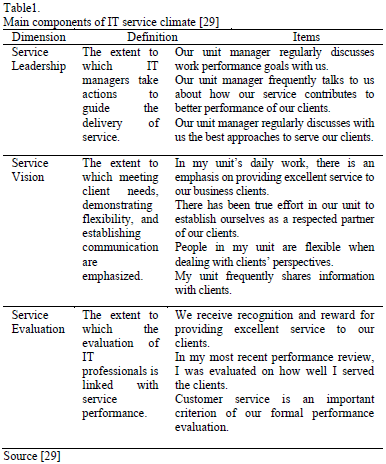
<body><![CDATA[<p><font size="2" face="Verdana, Arial, Helvetica, sans-serif">There are three main components of the IT Service Climate &#91;29&#93;,   as shown in <a href="#tab01">Table 1</a>:</font></p> <ul>       <li><font size="2" face="Verdana, Arial, Helvetica, sans-serif">Service Leadership</font></li>       <li><font size="2" face="Verdana, Arial, Helvetica, sans-serif">Service Vision</font></li>       <li><font size="2" face="Verdana, Arial, Helvetica, sans-serif">Service Evaluation</font></li>     </ul>     <p align="center"><font size="2" face="Verdana, Arial, Helvetica, sans-serif"><a name="tab01"></a></font><img src="/img/revistas/dyna/v81n186/v81n186a06tab01.gif"></p>     <p><font size="2" face="Verdana, Arial, Helvetica, sans-serif">The urgent need to create an enabling environment to   improve service, its quality and customer satisfaction is pointed out.</font></p>     <p><font size="2" face="Verdana, Arial, Helvetica, sans-serif">Furthermore Lepmets et al. &#91;30&#93; assess the impact of   process improvement in the quality of IT services by performing a series of   studies of the IT service industry.</font></p>     <p><font size="2" face="Verdana, Arial, Helvetica, sans-serif">From a business   perspective, the shift to process-oriented organizations, the growing   importance of business processes cut across the organization, as well as the   increased focus on the quality of IT services perceived by end users, emphasize   the need for information systems to provide an effective and versatile support   for business processes and to meet the needs of the organization &#91;31, 32&#93;.</font></p>     <p><font size="2" face="Verdana, Arial, Helvetica, sans-serif">IT services are   increasingly complex, their regulatory levels are increased, there are frequent   deviations in time or costs in their life cycle, there are continuous   technological advances, etc.; all of which makes their management more   necessary so they continue to be efficient, but at the same time more complex   &#91;33&#93;.</font></p>     ]]></body>
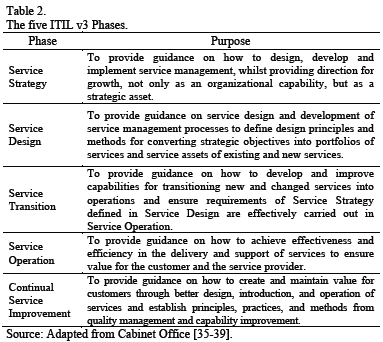
<body><![CDATA[<p><font size="2" face="Verdana, Arial, Helvetica, sans-serif">If their management is   effective, changes are achieved which proactively adapt to the business   strategy &#91;41&#93;.</font></p>     <p>&nbsp;</p>     <p><font size="3" face="Verdana, Arial, Helvetica, sans-serif"><b>3.  ITIL standard   application approach on service management (SM)</b></font></p>     <p><font size="2" face="Verdana, Arial, Helvetica, sans-serif">Information Technology Service Management (ITSM) deals   with the management of IT services through the use and coordination of people,   workflows and information technology &#91;34&#93;. These three components are the core   business processes in IT management.</font></p>     <p><font size="2" face="Verdana, Arial, Helvetica, sans-serif">Business processes can be classified as: strategic   business processes, main business processes and business support processes. IT   processes are included in the support process category, providing outputs in   terms of the business' required services &#91;34&#93;.</font></p>     <p><font size="2" face="Verdana, Arial, Helvetica, sans-serif">ITSM seeks to support the implementation and management of   high quality IT services, and this is carried out by IT service providers. ITSM   mainly differs from traditional IT management with regard to the fact that it   does not focus on technology but rather looks at IT and its services from a   business perspective.</font></p>     <p><font size="2" face="Verdana, Arial, Helvetica, sans-serif">This article proposes   the use of the best practices in IT Service Management through the ITIL   standard (Information Technology Infrastructure Library) for service   management, not only of IT services but also of all types of service. </font></p>     <p><font size="2" face="Verdana, Arial, Helvetica, sans-serif">ITIL &quot;is a framework that describes the best   practices for service management in information technology&quot; and it has an   approach based on a set of processes that are grouped in five phases of the   service life cycle &#91;35=39&#93;. In fact, ITIL is the most used standard in the ITSM   environment &#91;34&#93;.</font></p>     <p><font size="2" face="Verdana, Arial, Helvetica, sans-serif"><a href="#tab02">Table 2</a> provides a brief description of ITIL cycle phases   presented in its latest version (v3).</font></p>     <p align="center"><font size="2" face="Verdana, Arial, Helvetica, sans-serif"><a name="tab02"></a></font><img src="/img/revistas/dyna/v81n186/v81n186a06tab02.gif"></p>     ]]></body>
<body><![CDATA[<p><font size="2" face="Verdana, Arial, Helvetica, sans-serif">ITIL offers   organizations a set of strategies for continuous process monitoring, providing   an organizational culture that generates greater benefits in service quality   &#91;40&#93;. This approach can be applied to any organization, regardless of size,   sector or service. The result should be a reliable, safe and consistent service   with the expected costs &#91;41&#93;.</font></p>     <p><font size="2" face="Verdana, Arial, Helvetica, sans-serif">However, even though   originally ITIL is conceived for service management only, it is clear that any   other type of service, either IT or non-IT, can obtain a benefit from the focus   by processes and from the phases and processes presented by it. It can be   argued that the five phases of the ITIL life cycle, which are shown in <a href="#tab02">Table 2</a> (Strategy, Design, Transition, Operation, and Continuous Improvement), are   common in any service type, whether IT, Marketing, Logistics, Consulting or any   other kind of service.  Accordingly, the   use of ITIL standard as a reference frame for the management of any service   type is proposed. </font></p>     <p>&nbsp;</p>     <p><font size="3" face="Verdana, Arial, Helvetica, sans-serif"><b>4.  The Service   Desk: The key in service management using TIL</b></font></p>     <p><font size="2" face="Verdana, Arial, Helvetica, sans-serif">Service Desk is an   ITIL function located in the service operation phase. Service Desk is &quot;the   main contact point when users face a service interruption, when there is a   request, or even when some changes are required. The Service Desk provides a   communication point with users, and a coordination point for several IT groups   and processes&quot; &#91;38&#93;.</font></p>     <p><font size="2" face="Verdana, Arial, Helvetica, sans-serif">The implementation of an appropriate Service Desk is   crucial in organizations because many companies consider it as the first step   to achieve ITSM &#91;42&#93;.</font></p>     <p><font size="2" face="Verdana, Arial, Helvetica, sans-serif">Service Desk generates the following benefits &#91;38&#93;: </font></p> <ul>       <li><font size="2" face="Verdana, Arial, Helvetica, sans-serif">Improves customer service, perception and     satisfaction.</font></li>       <li><font size="2" face="Verdana, Arial, Helvetica, sans-serif">Increases accessibility, communication and     information through a single contact point.</font></li>       <li><font size="2" face="Verdana, Arial, Helvetica, sans-serif">Increases quality and response time to customer     or user requests.</font></li>       ]]></body>
<body><![CDATA[<li><font size="2" face="Verdana, Arial, Helvetica, sans-serif">Provides better teamwork and communication.</font></li>       <li><font size="2" face="Verdana, Arial, Helvetica, sans-serif">Increases the focus and proactive approaches to     service delivery.</font></li>       <li><font size="2" face="Verdana, Arial, Helvetica, sans-serif">Reduces the negative impact of business.</font></li>       <li><font size="2" face="Verdana, Arial, Helvetica, sans-serif">Offers a better management and control of     infrastructure.</font></li>       <li><font size="2" face="Verdana, Arial, Helvetica, sans-serif">Gives a better use of IT support resources and     increased productivity of business people.</font></li>       <li><font size="2" face="Verdana, Arial, Helvetica, sans-serif">Improves the information management process and     supports decision making.</font></li>     </ul>     <p><font size="2" face="Verdana, Arial, Helvetica, sans-serif">To do this, the Service Desk must assume some   responsibilities, such as the following:</font></p> <ul>       <li><font size="2" face="Verdana, Arial, Helvetica, sans-serif">Register all relevant incident / requested     service details, assigning codes to prioritization and categorization</font></li>       <li><font size="2" face="Verdana, Arial, Helvetica, sans-serif">Provide investigation and diagnosis</font></li>       ]]></body>
<body><![CDATA[<li><font size="2" face="Verdana, Arial, Helvetica, sans-serif">Resolve incidents / customers' requests</font></li>       <li><font size="2" face="Verdana, Arial, Helvetica, sans-serif">Escalate incidents / service requests that     cannot be resolved within the agreed deadlines</font></li>       <li><font size="2" face="Verdana, Arial, Helvetica, sans-serif">Keep users informed about the process's progress</font></li>       <li><font size="2" face="Verdana, Arial, Helvetica, sans-serif">Close all resolved incidents, requests and other     calls</font></li>       <li><font size="2" face="Verdana, Arial, Helvetica, sans-serif">Apply surveys or calls to customers/users to     verify satisfaction</font></li>       <li><font size="2" face="Verdana, Arial, Helvetica, sans-serif">Communicate with the users, continuously,     updating them about the process's progress, changes, commitments, etc. </font></li>       <li><font size="2" face="Verdana, Arial, Helvetica, sans-serif">Update the Configuration Management System (CMS)     under the direction and approval of the Service Desk management, if it is     agreed.</font></li>     </ul>     <p><font size="2" face="Verdana, Arial, Helvetica, sans-serif">A Service Desk has helped many companies to improve their   processes, and its implementation is a high priority objective when an   organization wants to follow ITIL best practices. </font></p>     <p><font size="2" face="Verdana, Arial, Helvetica, sans-serif">For this reason, the authors propose that in order for an   IT or non-IT organization to be able to introduce a service management based on   the ITIL standard, one of the critical points will be the implementation of a   Service Desk. </font></p>     ]]></body>
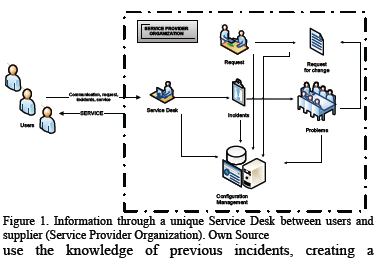
<body><![CDATA[<p><font size="2" face="Verdana, Arial, Helvetica, sans-serif">The primary but not only objective of Service Desk is to   serve as a contact point between users and service management. This   relationship is depicted in <a href="#fig01">Fig. 1</a>.</font></p>     <p align="center"><font size="2" face="Verdana, Arial, Helvetica, sans-serif"><a name="fig01"></a></font><img src="/img/revistas/dyna/v81n186/v81n186a06fig01.gif"></p>     <p><font size="2" face="Verdana, Arial, Helvetica, sans-serif">A Service Desk is the central hub in the management of   incidents and therefore it is (more or less) directly related with other   processes such as problem management and change and configuration management.   Thus, a suitable Service Desk, and a proper management of it, will manage the   related processes more efficiently.</font></p>     <p><font size="2" face="Verdana, Arial, Helvetica, sans-serif">By having centralized and controlled information, it is   possible to extract critical information from any event and</font> <font size="2" face="Verdana, Arial, Helvetica, sans-serif">use the knowledge of previous   incidents, creating a continuous improvement dynamic. </font></p>     <p><font size="2" face="Verdana, Arial, Helvetica, sans-serif">As a consequence, an organization that implements a   Service Desk based on ITIL will generate an added value in the following   aspects:</font></p> <ul>       <li><font size="2" face="Verdana, Arial, Helvetica, sans-serif">Efficient maintenance management of services by     improving troubleshooting time response and the completion of client requests </font></li>       <li><font size="2" face="Verdana, Arial, Helvetica, sans-serif"> Efficient relationship management with the     customers and users, and their satisfaction</font></li>       <li><font size="2" face="Verdana, Arial, Helvetica, sans-serif"> Efficient service delivery management, from the     point of view of availability, continuity and process capability, as well as     improvement of the changing management process</font></li>     </ul>     <p><font size="2" face="Verdana, Arial, Helvetica, sans-serif">The latter allows service managers to offer higher service   quality to customers and/or users.</font></p>     ]]></body>
<body><![CDATA[<p>&nbsp;</p>     <p><font size="3" face="Verdana, Arial, Helvetica, sans-serif"><b>5.  Conclusions</b></font></p>     <p><font size="2" face="Verdana, Arial, Helvetica, sans-serif">The changes in the way companies offer their products   and/or services, driven by technological changes, have led to the need of   developing new processes to ensure the proper management of activities within   firms, aiming to provide the highest possible customer satisfaction level. </font></p>     <p><font size="2" face="Verdana, Arial, Helvetica, sans-serif">IT services must be managed properly since they bring a   good number of benefits that improve businesses and provide higher levels of   customer satisfaction, which leads to improved companies' competitiveness. This   management process can be efficiently developed by using the ITIL standard, which   is one of the most widely used frameworks for this purpose.</font></p>     <p><font size="2" face="Verdana, Arial, Helvetica, sans-serif">But the ITIL approach can also be used for any kind of   services, not only for the IT service management, its original objective. Any   type of service can be managed in function of the five phases of the life cycle   proposed by ITIL (Strategy, Design, Transition, Operation, and Continuous   Improvement). </font></p>     <p><font size="2" face="Verdana, Arial, Helvetica, sans-serif">In the service provision, it is imperative to have a   Service Desk, which is an outstanding mechanism that allows communication   between users and coordination points for groups and IT processes. Therefore,   it is vital to allocate resources for the operation of this Service Desk, due   to its relevance in improving communication and the other benefits that it can   generate for organizations. </font></p>     <p>&nbsp;</p>     <p><font size="3" face="Verdana, Arial, Helvetica, sans-serif"><b>References</b></font></p>     <!-- ref --><p><font size="2" face="Verdana, Arial, Helvetica, sans-serif"><b>&#91;1&#93;</b> Pascual, M., Pascual, J., Fr&iacute;as, M.D. and Rosel, J.F., Calidad de servicio en los supermercados: Una propuesta de medici&oacute;n. Psicothema 18, pp. 661-667, 2006.    &nbsp;&nbsp;&nbsp;&nbsp;&nbsp;&nbsp;&nbsp;&nbsp;[&#160;<a href="javascript:void(0);" onclick="javascript: window.open('/scielo.php?script=sci_nlinks&ref=000121&pid=S0012-7353201400040000600001&lng=','','width=640,height=500,resizable=yes,scrollbars=1,menubar=yes,');">Links</a>&#160;]<!-- end-ref --></font></p>     ]]></body>
<body><![CDATA[<!-- ref --><p> <font size="2" face="Verdana, Arial, Helvetica, sans-serif"><b>&#91;2&#93;</b> Parasuraman, A., Zeithaml, V.A. and Berry, L.L., A conceptual model of service quality and its implications for future research. Journal of Marketing, 49 (4), pp. 41-50, 1985.    &nbsp;&nbsp;&nbsp;&nbsp;&nbsp;&nbsp;&nbsp;&nbsp;[&#160;<a href="javascript:void(0);" onclick="javascript: window.open('/scielo.php?script=sci_nlinks&ref=000123&pid=S0012-7353201400040000600002&lng=','','width=640,height=500,resizable=yes,scrollbars=1,menubar=yes,');">Links</a>&#160;]<!-- end-ref --></font></p>     <!-- ref --><p> <font size="2" face="Verdana, Arial, Helvetica, sans-serif"><b>&#91;3&#93;</b> Parasuraman, A., Zeithaml, V. A. and Berry, L.L., SERVQUAL: A multiple-item scale for measuring consumer perceptions of service quality. Journal of Retailing, 64 (1), pp. 12-40, 1998.    &nbsp;&nbsp;&nbsp;&nbsp;&nbsp;&nbsp;&nbsp;&nbsp;[&#160;<a href="javascript:void(0);" onclick="javascript: window.open('/scielo.php?script=sci_nlinks&ref=000125&pid=S0012-7353201400040000600003&lng=','','width=640,height=500,resizable=yes,scrollbars=1,menubar=yes,');">Links</a>&#160;]<!-- end-ref --></font></p>     <!-- ref --><p> <font size="2" face="Verdana, Arial, Helvetica, sans-serif"><b>&#91;4&#93;</b> Parasuraman, A., Zeithaml, V. and Berry, L., Calidad total en la gesti&oacute;n de servicio. Madrid: D&iacute;az de Santos, 1993.    &nbsp;&nbsp;&nbsp;&nbsp;&nbsp;&nbsp;&nbsp;&nbsp;[&#160;<a href="javascript:void(0);" onclick="javascript: window.open('/scielo.php?script=sci_nlinks&ref=000127&pid=S0012-7353201400040000600004&lng=','','width=640,height=500,resizable=yes,scrollbars=1,menubar=yes,');">Links</a>&#160;]<!-- end-ref --></font></p>     <!-- ref --><p> <font size="2" face="Verdana, Arial, Helvetica, sans-serif"><b>&#91;5&#93;</b> Parasuraman, A., Zeithaml, V.A. and Berry, L., Reassessment of expectations as a comparison standard in measuring service quality: implications for further research. Journal of Marketing, 58 (1), pp. 111-124, 1994.    &nbsp;&nbsp;&nbsp;&nbsp;&nbsp;&nbsp;&nbsp;&nbsp;[&#160;<a href="javascript:void(0);" onclick="javascript: window.open('/scielo.php?script=sci_nlinks&ref=000129&pid=S0012-7353201400040000600005&lng=','','width=640,height=500,resizable=yes,scrollbars=1,menubar=yes,');">Links</a>&#160;]<!-- end-ref --></font></p>     <!-- ref --><p> <font size="2" face="Verdana, Arial, Helvetica, sans-serif"><b>&#91;6&#93;</b> Coulthard, L.J.M., Measuring service quality. A review and critique of research using. International Journal of Market Research, 46 (4), pp. 479-497, 2004.    &nbsp;&nbsp;&nbsp;&nbsp;&nbsp;&nbsp;&nbsp;&nbsp;[&#160;<a href="javascript:void(0);" onclick="javascript: window.open('/scielo.php?script=sci_nlinks&ref=000131&pid=S0012-7353201400040000600006&lng=','','width=640,height=500,resizable=yes,scrollbars=1,menubar=yes,');">Links</a>&#160;]<!-- end-ref --></font></p>     ]]></body>
<body><![CDATA[<!-- ref --><p> <font size="2" face="Verdana, Arial, Helvetica, sans-serif"><b>&#91;7&#93;</b> Marzo, J,C., Mart&iacute;nez-Tur, V., Ramos, J. and Peir&oacute;, J., La satisfacci&oacute;n del usuario desde el modelo de la confirmaci&oacute;n de expectativas. Respuestas a algunos interrogantes. Psicothema, 14 (4), pp. 765-770, 2002.    &nbsp;&nbsp;&nbsp;&nbsp;&nbsp;&nbsp;&nbsp;&nbsp;[&#160;<a href="javascript:void(0);" onclick="javascript: window.open('/scielo.php?script=sci_nlinks&ref=000133&pid=S0012-7353201400040000600007&lng=','','width=640,height=500,resizable=yes,scrollbars=1,menubar=yes,');">Links</a>&#160;]<!-- end-ref --></font></p>     <!-- ref --><p> <font size="2" face="Verdana, Arial, Helvetica, sans-serif"><b>&#91;8&#93;</b> Crosby, P., La calidad no cuesta. El arte de cercionarse de la calidad. CECSA, M&eacute;jico, 1991.    &nbsp;&nbsp;&nbsp;&nbsp;&nbsp;&nbsp;&nbsp;&nbsp;[&#160;<a href="javascript:void(0);" onclick="javascript: window.open('/scielo.php?script=sci_nlinks&ref=000135&pid=S0012-7353201400040000600008&lng=','','width=640,height=500,resizable=yes,scrollbars=1,menubar=yes,');">Links</a>&#160;]<!-- end-ref --></font></p>     <!-- ref --><p> <font size="2" face="Verdana, Arial, Helvetica, sans-serif"><b>&#91;9&#93;</b> Mentzer, J.T.; Flint, D.J. y Hult, G.T.M., Logistics service quality as a segment-customized process, Journal of Marketing, 65 (4), pp. 82-104, 2001.    &nbsp;&nbsp;&nbsp;&nbsp;&nbsp;&nbsp;&nbsp;&nbsp;[&#160;<a href="javascript:void(0);" onclick="javascript: window.open('/scielo.php?script=sci_nlinks&ref=000137&pid=S0012-7353201400040000600009&lng=','','width=640,height=500,resizable=yes,scrollbars=1,menubar=yes,');">Links</a>&#160;]<!-- end-ref --></font></p>     <!-- ref --><p> <font size="2" face="Verdana, Arial, Helvetica, sans-serif"><b>&#91;10&#93;</b> McDougall, G.H.G. and Levesque, T., Customer satisfaction with services: Putting perceived value into the equation, Journal of Services Marketing, 14, (5), pp. 392-410, 2000.    &nbsp;&nbsp;&nbsp;&nbsp;&nbsp;&nbsp;&nbsp;&nbsp;[&#160;<a href="javascript:void(0);" onclick="javascript: window.open('/scielo.php?script=sci_nlinks&ref=000139&pid=S0012-7353201400040000600010&lng=','','width=640,height=500,resizable=yes,scrollbars=1,menubar=yes,');">Links</a>&#160;]<!-- end-ref --></font></p>     <!-- ref --><p> <font size="2" face="Verdana, Arial, Helvetica, sans-serif"><b>&#91;11&#93;</b> Brady, M.K., Robertson, C.J. and Cronin, J.J., Managing behavioral intentions in diverse cultural environments: An investigation of service quality, service value, and satisfaction for American and Ecuadorian fast-food customers, Journal of International Marketing, 7 (2), pp 129-149, 2001.    &nbsp;&nbsp;&nbsp;&nbsp;&nbsp;&nbsp;&nbsp;&nbsp;[&#160;<a href="javascript:void(0);" onclick="javascript: window.open('/scielo.php?script=sci_nlinks&ref=000141&pid=S0012-7353201400040000600011&lng=','','width=640,height=500,resizable=yes,scrollbars=1,menubar=yes,');">Links</a>&#160;]<!-- end-ref --></font></p>     ]]></body>
<body><![CDATA[<!-- ref --><p> <font size="2" face="Verdana, Arial, Helvetica, sans-serif"><b>&#91;12&#93;</b> Griffin, J., The Internet's expanding role in building customer royalty, Direct Marketing: Garden City, 59 (7), pp.50-53, 1996.    &nbsp;&nbsp;&nbsp;&nbsp;&nbsp;&nbsp;&nbsp;&nbsp;[&#160;<a href="javascript:void(0);" onclick="javascript: window.open('/scielo.php?script=sci_nlinks&ref=000143&pid=S0012-7353201400040000600012&lng=','','width=640,height=500,resizable=yes,scrollbars=1,menubar=yes,');">Links</a>&#160;]<!-- end-ref --></font></p>     <!-- ref --><p> <font size="2" face="Verdana, Arial, Helvetica, sans-serif"><b>&#91;13&#93;</b> Bowen, J. T. and Shoemaker, S., Loyalty: A strategic commitment, Cornell Hotel and Restaurant Administration Quarterly, 39 (1), pp.12-25, 1998.    &nbsp;&nbsp;&nbsp;&nbsp;&nbsp;&nbsp;&nbsp;&nbsp;[&#160;<a href="javascript:void(0);" onclick="javascript: window.open('/scielo.php?script=sci_nlinks&ref=000145&pid=S0012-7353201400040000600013&lng=','','width=640,height=500,resizable=yes,scrollbars=1,menubar=yes,');">Links</a>&#160;]<!-- end-ref --></font></p>     <!-- ref --><p> <font size="2" face="Verdana, Arial, Helvetica, sans-serif"><b>&#91;14&#93;</b> Kaynama, S.A., Black, C.I., and Keesling, G., Impact of the Internet on internal service quality factors: The travel industry case, Journal of Applied Business Research, 19 (1), pp. 135-45, 2003.    &nbsp;&nbsp;&nbsp;&nbsp;&nbsp;&nbsp;&nbsp;&nbsp;[&#160;<a href="javascript:void(0);" onclick="javascript: window.open('/scielo.php?script=sci_nlinks&ref=000147&pid=S0012-7353201400040000600014&lng=','','width=640,height=500,resizable=yes,scrollbars=1,menubar=yes,');">Links</a>&#160;]<!-- end-ref --></font></p>     <!-- ref --><p> <font size="2" face="Verdana, Arial, Helvetica, sans-serif"><b>&#91;15&#93;</b> Weijters, B., Rangarajan, D., Falk, T. and Schillewaert, N., Determinants and outcomes of customers' use of self-service technology in a retail setting, Journal of Service Research, 10 (1), pp. 3-21, 2007.    &nbsp;&nbsp;&nbsp;&nbsp;&nbsp;&nbsp;&nbsp;&nbsp;[&#160;<a href="javascript:void(0);" onclick="javascript: window.open('/scielo.php?script=sci_nlinks&ref=000149&pid=S0012-7353201400040000600015&lng=','','width=640,height=500,resizable=yes,scrollbars=1,menubar=yes,');">Links</a>&#160;]<!-- end-ref --></font></p>     <!-- ref --><p> <font size="2" face="Verdana, Arial, Helvetica, sans-serif"><b>&#91;16&#93;</b> Shamdasani, P., Mukherjee, A. and Malhotra, N., Antecedents and consequences of service quality in consumer evaluation of self-service internet technologies, Service Industries Journal, 28 (1), pp. 117-138, 2008.    &nbsp;&nbsp;&nbsp;&nbsp;&nbsp;&nbsp;&nbsp;&nbsp;[&#160;<a href="javascript:void(0);" onclick="javascript: window.open('/scielo.php?script=sci_nlinks&ref=000151&pid=S0012-7353201400040000600016&lng=','','width=640,height=500,resizable=yes,scrollbars=1,menubar=yes,');">Links</a>&#160;]<!-- end-ref --></font></p>     ]]></body>
<body><![CDATA[<!-- ref --><p> <font size="2" face="Verdana, Arial, Helvetica, sans-serif"><b>&#91;17&#93;</b> Wu, F., Yeniyurt, S., Kim, D. and Cavusgil, S.T., The impact of information technology on supply chain capabilities and firm performance: A resource-based view, Industrial Marketing Management, 35 (4), pp. 493-504, 2006.    &nbsp;&nbsp;&nbsp;&nbsp;&nbsp;&nbsp;&nbsp;&nbsp;[&#160;<a href="javascript:void(0);" onclick="javascript: window.open('/scielo.php?script=sci_nlinks&ref=000153&pid=S0012-7353201400040000600017&lng=','','width=640,height=500,resizable=yes,scrollbars=1,menubar=yes,');">Links</a>&#160;]<!-- end-ref --></font></p>     <!-- ref --><p> <font size="2" face="Verdana, Arial, Helvetica, sans-serif"><b>&#91;18&#93;</b> Cardoso, A., Ferreira, I., Carvalho, J.&Aacute;. and Santos, L., What Service?, in: Cruz-Cunha, M.M., Varajão, J., Powell, P., Martinho, R. (Eds.), Enterprise Information Systems, Communications in Computer and Information Science. Springer Berlin Heidelberg, 2011 pp. 315-324.    &nbsp;&nbsp;&nbsp;&nbsp;&nbsp;&nbsp;&nbsp;&nbsp;[&#160;<a href="javascript:void(0);" onclick="javascript: window.open('/scielo.php?script=sci_nlinks&ref=000155&pid=S0012-7353201400040000600018&lng=','','width=640,height=500,resizable=yes,scrollbars=1,menubar=yes,');">Links</a>&#160;]<!-- end-ref --></font></p>     <!-- ref --><p> <font size="2" face="Verdana, Arial, Helvetica, sans-serif"><b>&#91;19&#93;</b> Huhns, M., and Singh, M., Service-Oriented Computing: Key Concepts and Principles. IEEE Internet Computing. 9 (1), pp. 75-81, 2005.    &nbsp;&nbsp;&nbsp;&nbsp;&nbsp;&nbsp;&nbsp;&nbsp;[&#160;<a href="javascript:void(0);" onclick="javascript: window.open('/scielo.php?script=sci_nlinks&ref=000157&pid=S0012-7353201400040000600019&lng=','','width=640,height=500,resizable=yes,scrollbars=1,menubar=yes,');">Links</a>&#160;]<!-- end-ref --></font></p>     <!-- ref --><p> <font size="2" face="Verdana, Arial, Helvetica, sans-serif"><b>&#91;20&#93;</b> Bitner, M.J. and Brown, S.W., The service imperative. Business. Horizonts. 51 (1), pp. 39-46, 2008.    &nbsp;&nbsp;&nbsp;&nbsp;&nbsp;&nbsp;&nbsp;&nbsp;[&#160;<a href="javascript:void(0);" onclick="javascript: window.open('/scielo.php?script=sci_nlinks&ref=000159&pid=S0012-7353201400040000600020&lng=','','width=640,height=500,resizable=yes,scrollbars=1,menubar=yes,');">Links</a>&#160;]<!-- end-ref --></font></p>     <!-- ref --><p> <font size="2" face="Verdana, Arial, Helvetica, sans-serif"><b>&#91;21&#93;</b> Chesbrough, H. and Spohrer, J., A research manifesto for services science. Communications of the ACM 49 (7), pp. 35-40, 2006.    &nbsp;&nbsp;&nbsp;&nbsp;&nbsp;&nbsp;&nbsp;&nbsp;[&#160;<a href="javascript:void(0);" onclick="javascript: window.open('/scielo.php?script=sci_nlinks&ref=000161&pid=S0012-7353201400040000600021&lng=','','width=640,height=500,resizable=yes,scrollbars=1,menubar=yes,');">Links</a>&#160;]<!-- end-ref --></font></p>     ]]></body>
<body><![CDATA[<!-- ref --><p> <font size="2" face="Verdana, Arial, Helvetica, sans-serif"><b>&#91;22&#93;</b> Spohrer, J. and Maglio, P.P., The emergence of service science: Toward systematic service innovations to accelerate co-creation of value. Production Operations Management. 17 83), pp. 238-246, 2008.    &nbsp;&nbsp;&nbsp;&nbsp;&nbsp;&nbsp;&nbsp;&nbsp;[&#160;<a href="javascript:void(0);" onclick="javascript: window.open('/scielo.php?script=sci_nlinks&ref=000163&pid=S0012-7353201400040000600022&lng=','','width=640,height=500,resizable=yes,scrollbars=1,menubar=yes,');">Links</a>&#160;]<!-- end-ref --></font></p>     <!-- ref --><p> <font size="2" face="Verdana, Arial, Helvetica, sans-serif"><b>&#91;23&#93;</b> Spohrer, J., Maglio, P.P., Bailey, J. and Gruhl, D., Steps toward a science of service systems. Computer, 40 (1), pp. 71-77, 2007.    &nbsp;&nbsp;&nbsp;&nbsp;&nbsp;&nbsp;&nbsp;&nbsp;[&#160;<a href="javascript:void(0);" onclick="javascript: window.open('/scielo.php?script=sci_nlinks&ref=000165&pid=S0012-7353201400040000600023&lng=','','width=640,height=500,resizable=yes,scrollbars=1,menubar=yes,');">Links</a>&#160;]<!-- end-ref --></font></p>     <!-- ref --><p> <font size="2" face="Verdana, Arial, Helvetica, sans-serif"><b>&#91;24&#93;</b> Hirschheim, R., Offshoring and the new world order. Communications of the ACM 52 (11), pp. 132-135, 2009.    &nbsp;&nbsp;&nbsp;&nbsp;&nbsp;&nbsp;&nbsp;&nbsp;[&#160;<a href="javascript:void(0);" onclick="javascript: window.open('/scielo.php?script=sci_nlinks&ref=000167&pid=S0012-7353201400040000600024&lng=','','width=640,height=500,resizable=yes,scrollbars=1,menubar=yes,');">Links</a>&#160;]<!-- end-ref --></font></p>     <!-- ref --><p> <font size="2" face="Verdana, Arial, Helvetica, sans-serif"><b>&#91;25&#93;</b> Park, J., Lee, J., Lee, H. and Truex, D., Exploring the impact of communication effectiveness on service quality, trust and relationship commitment in IT services. International Journal of Information Management 32 (5), pp. 459-468, 2012.    &nbsp;&nbsp;&nbsp;&nbsp;&nbsp;&nbsp;&nbsp;&nbsp;[&#160;<a href="javascript:void(0);" onclick="javascript: window.open('/scielo.php?script=sci_nlinks&ref=000169&pid=S0012-7353201400040000600025&lng=','','width=640,height=500,resizable=yes,scrollbars=1,menubar=yes,');">Links</a>&#160;]<!-- end-ref --></font></p>     <!-- ref --><p> <font size="2" face="Verdana, Arial, Helvetica, sans-serif"><b>&#91;26&#93;</b> Sharma, N. and Patterson, P.G., The impact of communication effectiveness and service quality on relationship commitment in consumer, professional services. Journal of Service Marketing, 13 (2), pp. 151-170, 1999.    &nbsp;&nbsp;&nbsp;&nbsp;&nbsp;&nbsp;&nbsp;&nbsp;[&#160;<a href="javascript:void(0);" onclick="javascript: window.open('/scielo.php?script=sci_nlinks&ref=000171&pid=S0012-7353201400040000600026&lng=','','width=640,height=500,resizable=yes,scrollbars=1,menubar=yes,');">Links</a>&#160;]<!-- end-ref --></font></p>     ]]></body>
<body><![CDATA[<!-- ref --><p> <font size="2" face="Verdana, Arial, Helvetica, sans-serif"><b>&#91;27&#93;</b> Carr, C. L., Reciprocity: The golden rule of IS-user service relationship quality and cooperation. Communication of the ACM, 49 (6), pp. 77-83, 2006.    &nbsp;&nbsp;&nbsp;&nbsp;&nbsp;&nbsp;&nbsp;&nbsp;[&#160;<a href="javascript:void(0);" onclick="javascript: window.open('/scielo.php?script=sci_nlinks&ref=000173&pid=S0012-7353201400040000600027&lng=','','width=640,height=500,resizable=yes,scrollbars=1,menubar=yes,');">Links</a>&#160;]<!-- end-ref --></font></p>     <!-- ref --><p> <font size="2" face="Verdana, Arial, Helvetica, sans-serif"><b>&#91;28&#93;</b> Lee, J.-N., and Kim, Y.-G., Effect of partnership quality on IS outsourcing success: Conceptual framework and empirical validation. Journal of Management Information Systems, 15 (4), pp. 29-62, 1999.    &nbsp;&nbsp;&nbsp;&nbsp;&nbsp;&nbsp;&nbsp;&nbsp;[&#160;<a href="javascript:void(0);" onclick="javascript: window.open('/scielo.php?script=sci_nlinks&ref=000175&pid=S0012-7353201400040000600028&lng=','','width=640,height=500,resizable=yes,scrollbars=1,menubar=yes,');">Links</a>&#160;]<!-- end-ref --></font></p>     <!-- ref --><p> <font size="2" face="Verdana, Arial, Helvetica, sans-serif"><b>&#91;29&#93;</b> Jia, R. and Reich, B.H., IT Service Climate - An essential managerial tool to improve client satisfaction with it service quality. Information Systems Management 28 (1), pp. 174-179, 2011.    &nbsp;&nbsp;&nbsp;&nbsp;&nbsp;&nbsp;&nbsp;&nbsp;[&#160;<a href="javascript:void(0);" onclick="javascript: window.open('/scielo.php?script=sci_nlinks&ref=000177&pid=S0012-7353201400040000600029&lng=','','width=640,height=500,resizable=yes,scrollbars=1,menubar=yes,');">Links</a>&#160;]<!-- end-ref --></font></p>     <!-- ref --><p> <font size="2" face="Verdana, Arial, Helvetica, sans-serif"><b>&#91;30&#93;</b> Lepmets, M., Ras, E., and Renault, A., Impact analysis of process improvement on it service quality, in: Snene, M., Ralyt&eacute;, J., Morin, J.-H. (Eds.), Exploring services science, Lecture notes in Business Information Processing. Springer Berlin Heidelberg, pp. 227-231, 2011.    &nbsp;&nbsp;&nbsp;&nbsp;&nbsp;&nbsp;&nbsp;&nbsp;[&#160;<a href="javascript:void(0);" onclick="javascript: window.open('/scielo.php?script=sci_nlinks&ref=000179&pid=S0012-7353201400040000600030&lng=','','width=640,height=500,resizable=yes,scrollbars=1,menubar=yes,');">Links</a>&#160;]<!-- end-ref --></font></p>     <!-- ref --><p> <font size="2" face="Verdana, Arial, Helvetica, sans-serif"><b>&#91;31&#93;</b> Schlosser, F., Wagner, H.T., Beimborn, D. and Weitzel, T., The role of internal business/IT alignment and IT governance for service quality in IT outsourcing arrangements, in: 2010 43rd Hawaii International Conference on System Sciences (HICSS). Presented at the 2010 43rd Hawaii International Conference on System Sciences (HICSS), 2010, pp. 1-10.    &nbsp;&nbsp;&nbsp;&nbsp;&nbsp;&nbsp;&nbsp;&nbsp;[&#160;<a href="javascript:void(0);" onclick="javascript: window.open('/scielo.php?script=sci_nlinks&ref=000181&pid=S0012-7353201400040000600031&lng=','','width=640,height=500,resizable=yes,scrollbars=1,menubar=yes,');">Links</a>&#160;]<!-- end-ref --></font></p>     ]]></body>
<body><![CDATA[<!-- ref --><p> <font size="2" face="Verdana, Arial, Helvetica, sans-serif"><b>&#91;32&#93;</b> Longo, A. and Bochicchio, M., Modelling SLAs check points along multiple service chains, in: 23rd International Workshop on Database and Expert Systems Applications (DEXA). Presented at the 2012 23rd International Workshop on Database and Expert Systems Applications (DEXA), 2012, pp. 73-77.    &nbsp;&nbsp;&nbsp;&nbsp;&nbsp;&nbsp;&nbsp;&nbsp;[&#160;<a href="javascript:void(0);" onclick="javascript: window.open('/scielo.php?script=sci_nlinks&ref=000183&pid=S0012-7353201400040000600032&lng=','','width=640,height=500,resizable=yes,scrollbars=1,menubar=yes,');">Links</a>&#160;]<!-- end-ref --></font></p>     <!-- ref --><p> <font size="2" face="Verdana, Arial, Helvetica, sans-serif"><b>&#91;33&#93;</b> Bauset, M.C. and Rodenes, M., Gesti&oacute;n de los servicios de tecnolog&iacute;as de la informaci&oacute;n: Modelo de aporte de valor basado en ITIL e ISO/IEC 20000. El Profesional de la Informaci&oacute;n. 22 (1), pp. 54-61, 2013.    &nbsp;&nbsp;&nbsp;&nbsp;&nbsp;&nbsp;&nbsp;&nbsp;[&#160;<a href="javascript:void(0);" onclick="javascript: window.open('/scielo.php?script=sci_nlinks&ref=000185&pid=S0012-7353201400040000600033&lng=','','width=640,height=500,resizable=yes,scrollbars=1,menubar=yes,');">Links</a>&#160;]<!-- end-ref --></font></p>     <!-- ref --><p> <font size="2" face="Verdana, Arial, Helvetica, sans-serif"><b>&#91;34&#93;</b> Hoerbst, A., Hackl, W.O., Blomer, R. and Ammenwerth, E., The status of IT service management in health care - ITIL® in selected European countries. BMC Medical Informatics and Decission Makers. 11 (1), 76, 2011.    &nbsp;&nbsp;&nbsp;&nbsp;&nbsp;&nbsp;&nbsp;&nbsp;[&#160;<a href="javascript:void(0);" onclick="javascript: window.open('/scielo.php?script=sci_nlinks&ref=000187&pid=S0012-7353201400040000600034&lng=','','width=640,height=500,resizable=yes,scrollbars=1,menubar=yes,');">Links</a>&#160;]<!-- end-ref --></font></p>     <!-- ref --><p> <font size="2" face="Verdana, Arial, Helvetica, sans-serif"><b>&#91;35&#93;</b> Cabinet Office (a). ITIL Service Strategy. TSO (The Stationery Office).United Kingdom, 2011.    &nbsp;&nbsp;&nbsp;&nbsp;&nbsp;&nbsp;&nbsp;&nbsp;[&#160;<a href="javascript:void(0);" onclick="javascript: window.open('/scielo.php?script=sci_nlinks&ref=000189&pid=S0012-7353201400040000600035&lng=','','width=640,height=500,resizable=yes,scrollbars=1,menubar=yes,');">Links</a>&#160;]<!-- end-ref --></font></p>     <!-- ref --><p> <font size="2" face="Verdana, Arial, Helvetica, sans-serif"><b>&#91;36&#93;</b> Cabinet Office (b). ITIL Service Design. TSO (The Stationery Office).United Kingdom, 2011.    &nbsp;&nbsp;&nbsp;&nbsp;&nbsp;&nbsp;&nbsp;&nbsp;[&#160;<a href="javascript:void(0);" onclick="javascript: window.open('/scielo.php?script=sci_nlinks&ref=000191&pid=S0012-7353201400040000600036&lng=','','width=640,height=500,resizable=yes,scrollbars=1,menubar=yes,');">Links</a>&#160;]<!-- end-ref --> </font></p>     ]]></body>
<body><![CDATA[<!-- ref --><p> <font size="2" face="Verdana, Arial, Helvetica, sans-serif"><b>&#91;37&#93;</b> Cabinet Office (c). ITIL Service Transition. TSO (The Stationery Office).United Kingdom, 2011.    &nbsp;&nbsp;&nbsp;&nbsp;&nbsp;&nbsp;&nbsp;&nbsp;[&#160;<a href="javascript:void(0);" onclick="javascript: window.open('/scielo.php?script=sci_nlinks&ref=000193&pid=S0012-7353201400040000600037&lng=','','width=640,height=500,resizable=yes,scrollbars=1,menubar=yes,');">Links</a>&#160;]<!-- end-ref --> </font></p>     <!-- ref --><p> <font size="2" face="Verdana, Arial, Helvetica, sans-serif"><b>&#91;38&#93;</b> Cabinet Office (d). ITIL Service Operation. TSO (The Stationery Office).United Kingdom, 2011.    &nbsp;&nbsp;&nbsp;&nbsp;&nbsp;&nbsp;&nbsp;&nbsp;[&#160;<a href="javascript:void(0);" onclick="javascript: window.open('/scielo.php?script=sci_nlinks&ref=000195&pid=S0012-7353201400040000600038&lng=','','width=640,height=500,resizable=yes,scrollbars=1,menubar=yes,');">Links</a>&#160;]<!-- end-ref --> </font></p>     <!-- ref --><p> <font size="2" face="Verdana, Arial, Helvetica, sans-serif"><b>&#91;39&#93;</b> Cabinet Office (e). ITIL Continual Service Improvement. TSO (The Stationery Office).United Kingdom, 2011.    &nbsp;&nbsp;&nbsp;&nbsp;&nbsp;&nbsp;&nbsp;&nbsp;[&#160;<a href="javascript:void(0);" onclick="javascript: window.open('/scielo.php?script=sci_nlinks&ref=000197&pid=S0012-7353201400040000600039&lng=','','width=640,height=500,resizable=yes,scrollbars=1,menubar=yes,');">Links</a>&#160;]<!-- end-ref --> </font></p>     <!-- ref --><p> <font size="2" face="Verdana, Arial, Helvetica, sans-serif"><b>&#91;40&#93;</b> Barafort, B., Renzo, B. Di. and Olivier, M., Benefits resulting from the combined use of ISO/IEC 15504 with the Information Technology Infrastructure Library (ITIL). 4th International Conference Product Focus. Software. Process Improvement. Heidelberg. Germany. Springer Berlin. 2002, pp. 314 -325.    &nbsp;&nbsp;&nbsp;&nbsp;&nbsp;&nbsp;&nbsp;&nbsp;[&#160;<a href="javascript:void(0);" onclick="javascript: window.open('/scielo.php?script=sci_nlinks&ref=000199&pid=S0012-7353201400040000600040&lng=','','width=640,height=500,resizable=yes,scrollbars=1,menubar=yes,');">Links</a>&#160;]<!-- end-ref --></font></p>     <!-- ref --><p> <font size="2" face="Verdana, Arial, Helvetica, sans-serif"><b>&#91;41&#93;</b> Cando, N L., Cruz, J D. and Paredes, N.J., Sistema para la gesti&oacute;n de configuraciones y cambios (ITIL v3), Disertaci&oacute;n para el Departamento de Administraci&oacute;n y Desarrollo de Tecnolog&iacute;as de Informaci&oacute;n y Comunicaci&oacute;n de la Universidad Central del Ecuador, Ecuador.    &nbsp;&nbsp;&nbsp;&nbsp;&nbsp;&nbsp;&nbsp;&nbsp;[&#160;<a href="javascript:void(0);" onclick="javascript: window.open('/scielo.php?script=sci_nlinks&ref=000201&pid=S0012-7353201400040000600041&lng=','','width=640,height=500,resizable=yes,scrollbars=1,menubar=yes,');">Links</a>&#160;]<!-- end-ref --> </font></p>     ]]></body>
<body><![CDATA[<!-- ref --><p><font size="2" face="Verdana, Arial, Helvetica, sans-serif"><b>&#91;42&#93;</b>&nbsp; Keller, A. and Midboe, T., Implementing a service desk:   A practitioner's perspective, in: Kiriha, Y., Granville, L.Z., Medhi, D.,   Tonouchi, T., Kim, M.S. (Eds.), Proceedings of the 2010 IEEE-IFIP Network   Operations and Management Symposium. IEE, New York, 2010, pp. 685-696.    &nbsp;&nbsp;&nbsp;&nbsp;&nbsp;&nbsp;&nbsp;&nbsp;[&#160;<a href="javascript:void(0);" onclick="javascript: window.open('/scielo.php?script=sci_nlinks&ref=000203&pid=S0012-7353201400040000600042&lng=','','width=640,height=500,resizable=yes,scrollbars=1,menubar=yes,');">Links</a>&#160;]<!-- end-ref --></font></p>     <p>&nbsp;</p>     <p><font size="2" face="Verdana, Arial, Helvetica, sans-serif"><b>H. Gil-G&oacute;mez</b>,   received the Bs. Eng in Telecomunications in 1997 and the PhD degree in   Telecomunications Engineering in 2003, all off them from the Universitat   Politècnica de València (UPV) in Spain. Currently, he is a Full Professor in   the Business Administration Department at UPV and Full Researcher at the ai2   Institute in UPV (www.ai2.upv.es). His research interests include: Innovation   at multisectorial organizations, Marketing and customer behavior and Integration   of Information Technologies (IT) in Public and Private Organizations with a   special interest in Low Cost technology for Health.</font></p>     <p><font size="2" face="Verdana, Arial, Helvetica, sans-serif"><b>R. Oltra-Badenes</b>,   has the PhD degree in Industrial Engineering. He has been partner and director   of operations at companies' of information systems (IS) consulting, and   currently he is professor at the Universitat Politècnica de València (UPV) and   Universitat Jaume I. He has participated in research projects and has published   in various areas of IS an IT. Is Specialist degree in &quot;Integration of IT   in Organizations&quot; by the UPV, and in &quot;Business Administration&quot;   and &quot;Business Management in the Digital Age&quot;, by the Universidad   Polit&eacute;cnica de Madrid. In addition, he is certified as ITIL Expert and ISO   20,000. His research interests include: Information Systems, IT Service   Management, Innovation at multisectorial organizations, and Operations and   Logistics.</font></p>     <p><font size="2" face="Verdana, Arial, Helvetica, sans-serif"><b>W. Adarme-Jaimes</b>,   received the Bs. Eng in Industrial Engineering in 1992, the MSc degree in   Engineering - logistics in 2007 and the PhD degree in Engineering   Industry/Organization in 2012. Currently, he is a Full Professor in the Industrial   Department at Universidad Nacional de Colombia and Full Researcher at the SEPRO   - LOGISTICS Group (www.seprologistica.unal.edu.co). His research interests   include: Logistics and Supply Chain Managemet in Public and Private   Organizations.</font></p>      ]]></body><back>
<ref-list>
<ref id="B1">
<label>1</label><nlm-citation citation-type="journal">
<person-group person-group-type="author">
<name>
<surname><![CDATA[Pascual]]></surname>
<given-names><![CDATA[M.]]></given-names>
</name>
<name>
<surname><![CDATA[Pascual]]></surname>
<given-names><![CDATA[J.]]></given-names>
</name>
<name>
<surname><![CDATA[Frías]]></surname>
<given-names><![CDATA[M.D.]]></given-names>
</name>
<name>
<surname><![CDATA[Rosel]]></surname>
<given-names><![CDATA[J.F.]]></given-names>
</name>
</person-group>
<article-title xml:lang="es"><![CDATA[Calidad de servicio en los supermercados: Una propuesta de medición]]></article-title>
<source><![CDATA[Psicothema]]></source>
<year>2006</year>
<numero>18</numero>
<issue>18</issue>
<page-range>661-667</page-range></nlm-citation>
</ref>
<ref id="B2">
<label>2</label><nlm-citation citation-type="journal">
<person-group person-group-type="author">
<name>
<surname><![CDATA[Parasuraman]]></surname>
<given-names><![CDATA[A.]]></given-names>
</name>
<name>
<surname><![CDATA[Zeithaml]]></surname>
<given-names><![CDATA[V.A.]]></given-names>
</name>
<name>
<surname><![CDATA[Berry]]></surname>
<given-names><![CDATA[L.L.]]></given-names>
</name>
</person-group>
<article-title xml:lang="en"><![CDATA[A conceptual model of service quality and its implications for future research]]></article-title>
<source><![CDATA[Journal of Marketing]]></source>
<year>1985</year>
<volume>49</volume>
<numero>4</numero>
<issue>4</issue>
<page-range>41-50</page-range></nlm-citation>
</ref>
<ref id="B3">
<label>3</label><nlm-citation citation-type="journal">
<person-group person-group-type="author">
<name>
<surname><![CDATA[Parasuraman]]></surname>
<given-names><![CDATA[A.]]></given-names>
</name>
<name>
<surname><![CDATA[Zeithaml]]></surname>
<given-names><![CDATA[V. A.]]></given-names>
</name>
<name>
<surname><![CDATA[Berry]]></surname>
<given-names><![CDATA[L.L.]]></given-names>
</name>
</person-group>
<article-title xml:lang="en"><![CDATA[SERVQUAL: A multiple-item scale for measuring consumer perceptions of service quality]]></article-title>
<source><![CDATA[Journal of Retailing]]></source>
<year>1998</year>
<volume>64</volume>
<numero>1</numero>
<issue>1</issue>
<page-range>12-40</page-range></nlm-citation>
</ref>
<ref id="B4">
<label>4</label><nlm-citation citation-type="book">
<person-group person-group-type="author">
<name>
<surname><![CDATA[Parasuraman]]></surname>
<given-names><![CDATA[A.]]></given-names>
</name>
<name>
<surname><![CDATA[Zeithaml]]></surname>
<given-names><![CDATA[V.]]></given-names>
</name>
<name>
<surname><![CDATA[Berry]]></surname>
<given-names><![CDATA[L.]]></given-names>
</name>
</person-group>
<source><![CDATA[Calidad total en la gestión de servicio]]></source>
<year>1993</year>
<publisher-loc><![CDATA[Madrid ]]></publisher-loc>
<publisher-name><![CDATA[Díaz de Santos]]></publisher-name>
</nlm-citation>
</ref>
<ref id="B5">
<label>5</label><nlm-citation citation-type="journal">
<person-group person-group-type="author">
<name>
<surname><![CDATA[Parasuraman]]></surname>
<given-names><![CDATA[A.]]></given-names>
</name>
<name>
<surname><![CDATA[Zeithaml]]></surname>
<given-names><![CDATA[V.A.]]></given-names>
</name>
<name>
<surname><![CDATA[Berry]]></surname>
<given-names><![CDATA[L.]]></given-names>
</name>
</person-group>
<article-title xml:lang="en"><![CDATA[Reassessment of expectations as a comparison standard in measuring service quality: implications for further research]]></article-title>
<source><![CDATA[Journal of Marketing]]></source>
<year>1994</year>
<volume>58</volume>
<numero>1</numero>
<issue>1</issue>
<page-range>111-124</page-range></nlm-citation>
</ref>
<ref id="B6">
<label>6</label><nlm-citation citation-type="journal">
<person-group person-group-type="author">
<name>
<surname><![CDATA[Coulthard]]></surname>
<given-names><![CDATA[L.J.M.]]></given-names>
</name>
</person-group>
<article-title xml:lang="en"><![CDATA[Measuring service quality: A review and critique of research using]]></article-title>
<source><![CDATA[International Journal of Market Research]]></source>
<year>2004</year>
<volume>46</volume>
<numero>4</numero>
<issue>4</issue>
<page-range>479-497</page-range></nlm-citation>
</ref>
<ref id="B7">
<label>7</label><nlm-citation citation-type="journal">
<person-group person-group-type="author">
<name>
<surname><![CDATA[Marzo]]></surname>
<given-names><![CDATA[J,C.]]></given-names>
</name>
<name>
<surname><![CDATA[Martínez-Tur]]></surname>
<given-names><![CDATA[V.]]></given-names>
</name>
<name>
<surname><![CDATA[Ramos]]></surname>
<given-names><![CDATA[J.]]></given-names>
</name>
<name>
<surname><![CDATA[Peiró]]></surname>
<given-names><![CDATA[J.]]></given-names>
</name>
</person-group>
<article-title xml:lang="es"><![CDATA[La satisfacción del usuario desde el modelo de la confirmación de expectativas: Respuestas a algunos interrogantes]]></article-title>
<source><![CDATA[Psicothema]]></source>
<year>2002</year>
<volume>14</volume>
<numero>4</numero>
<issue>4</issue>
<page-range>765-770</page-range></nlm-citation>
</ref>
<ref id="B8">
<label>8</label><nlm-citation citation-type="book">
<person-group person-group-type="author">
<name>
<surname><![CDATA[Crosby]]></surname>
<given-names><![CDATA[P.]]></given-names>
</name>
</person-group>
<source><![CDATA[La calidad no cuesta: El arte de cercionarse de la calidad]]></source>
<year>1991</year>
<publisher-name><![CDATA[CECSA]]></publisher-name>
</nlm-citation>
</ref>
<ref id="B9">
<label>9</label><nlm-citation citation-type="journal">
<person-group person-group-type="author">
<name>
<surname><![CDATA[Mentzer]]></surname>
<given-names><![CDATA[J.T.]]></given-names>
</name>
<name>
<surname><![CDATA[Flint]]></surname>
<given-names><![CDATA[D.J.]]></given-names>
</name>
<name>
<surname><![CDATA[Hult]]></surname>
<given-names><![CDATA[G.T.M.]]></given-names>
</name>
</person-group>
<article-title xml:lang="en"><![CDATA[Logistics service quality as a segment-customized process]]></article-title>
<source><![CDATA[Journal of Marketing]]></source>
<year>2001</year>
<volume>65</volume>
<numero>4</numero>
<issue>4</issue>
<page-range>82-104</page-range></nlm-citation>
</ref>
<ref id="B10">
<label>10</label><nlm-citation citation-type="journal">
<person-group person-group-type="author">
<name>
<surname><![CDATA[McDougall]]></surname>
<given-names><![CDATA[G.H.G.]]></given-names>
</name>
<name>
<surname><![CDATA[Levesque]]></surname>
<given-names><![CDATA[T.]]></given-names>
</name>
</person-group>
<article-title xml:lang="en"><![CDATA[Customer satisfaction with services: Putting perceived value into the equation]]></article-title>
<source><![CDATA[Journal of Services Marketing]]></source>
<year>2000</year>
<volume>14</volume>
<numero>5</numero>
<issue>5</issue>
<page-range>392-410</page-range></nlm-citation>
</ref>
<ref id="B11">
<label>11</label><nlm-citation citation-type="journal">
<person-group person-group-type="author">
<name>
<surname><![CDATA[Brady]]></surname>
<given-names><![CDATA[M.K.]]></given-names>
</name>
<name>
<surname><![CDATA[Robertson]]></surname>
<given-names><![CDATA[C.J.]]></given-names>
</name>
<name>
<surname><![CDATA[Cronin]]></surname>
<given-names><![CDATA[J.J.]]></given-names>
</name>
</person-group>
<article-title xml:lang="en"><![CDATA[Managing behavioral intentions in diverse cultural environments: An investigation of service quality, service value, and satisfaction for American and Ecuadorian fast-food customers]]></article-title>
<source><![CDATA[Journal of International Marketing]]></source>
<year>2001</year>
<volume>7</volume>
<numero>2</numero>
<issue>2</issue>
<page-range>129-149</page-range></nlm-citation>
</ref>
<ref id="B12">
<label>12</label><nlm-citation citation-type="journal">
<person-group person-group-type="author">
<name>
<surname><![CDATA[Griffin]]></surname>
<given-names><![CDATA[J.]]></given-names>
</name>
</person-group>
<article-title xml:lang="en"><![CDATA[The Internet's expanding role in building customer royalty]]></article-title>
<source><![CDATA[Direct Marketing: Garden City]]></source>
<year>1996</year>
<volume>59</volume>
<numero>7</numero>
<issue>7</issue>
<page-range>50-53</page-range></nlm-citation>
</ref>
<ref id="B13">
<label>13</label><nlm-citation citation-type="journal">
<person-group person-group-type="author">
<name>
<surname><![CDATA[Bowen]]></surname>
<given-names><![CDATA[J. T.]]></given-names>
</name>
<name>
<surname><![CDATA[Shoemaker]]></surname>
<given-names><![CDATA[S.]]></given-names>
</name>
</person-group>
<article-title xml:lang="en"><![CDATA[Loyalty: A strategic commitment]]></article-title>
<source><![CDATA[Cornell Hotel and Restaurant Administration Quarterly]]></source>
<year>1998</year>
<volume>39</volume>
<numero>1</numero>
<issue>1</issue>
<page-range>12-25</page-range></nlm-citation>
</ref>
<ref id="B14">
<label>14</label><nlm-citation citation-type="journal">
<person-group person-group-type="author">
<name>
<surname><![CDATA[Kaynama]]></surname>
<given-names><![CDATA[S.A.]]></given-names>
</name>
<name>
<surname><![CDATA[Black]]></surname>
<given-names><![CDATA[C.I.]]></given-names>
</name>
<name>
<surname><![CDATA[Keesling]]></surname>
<given-names><![CDATA[G.]]></given-names>
</name>
</person-group>
<article-title xml:lang="en"><![CDATA[Impact of the Internet on internal service quality factors: The travel industry case]]></article-title>
<source><![CDATA[Journal of Applied Business Research]]></source>
<year>2003</year>
<volume>19</volume>
<numero>1</numero>
<issue>1</issue>
<page-range>135-45</page-range></nlm-citation>
</ref>
<ref id="B15">
<label>15</label><nlm-citation citation-type="journal">
<person-group person-group-type="author">
<name>
<surname><![CDATA[Weijters]]></surname>
<given-names><![CDATA[B.]]></given-names>
</name>
<name>
<surname><![CDATA[Rangarajan]]></surname>
<given-names><![CDATA[D.]]></given-names>
</name>
<name>
<surname><![CDATA[Falk]]></surname>
<given-names><![CDATA[T.]]></given-names>
</name>
<name>
<surname><![CDATA[Schillewaert]]></surname>
<given-names><![CDATA[N.]]></given-names>
</name>
</person-group>
<article-title xml:lang="en"><![CDATA[Determinants and outcomes of customers' use of self-service technology in a retail setting]]></article-title>
<source><![CDATA[Journal of Service Research]]></source>
<year>2007</year>
<volume>10</volume>
<numero>1</numero>
<issue>1</issue>
<page-range>3-21</page-range></nlm-citation>
</ref>
<ref id="B16">
<label>16</label><nlm-citation citation-type="journal">
<person-group person-group-type="author">
<name>
<surname><![CDATA[Shamdasani]]></surname>
<given-names><![CDATA[P.]]></given-names>
</name>
<name>
<surname><![CDATA[Mukherjee]]></surname>
<given-names><![CDATA[A.]]></given-names>
</name>
<name>
<surname><![CDATA[Malhotra]]></surname>
<given-names><![CDATA[N.]]></given-names>
</name>
</person-group>
<article-title xml:lang="en"><![CDATA[Antecedents and consequences of service quality in consumer evaluation of self-service internet technologies]]></article-title>
<source><![CDATA[Service Industries Journal]]></source>
<year>2008</year>
<volume>28</volume>
<numero>1</numero>
<issue>1</issue>
<page-range>117-138</page-range></nlm-citation>
</ref>
<ref id="B17">
<label>17</label><nlm-citation citation-type="journal">
<person-group person-group-type="author">
<name>
<surname><![CDATA[Wu]]></surname>
<given-names><![CDATA[F.]]></given-names>
</name>
<name>
<surname><![CDATA[Yeniyurt]]></surname>
<given-names><![CDATA[S.]]></given-names>
</name>
<name>
<surname><![CDATA[Kim]]></surname>
<given-names><![CDATA[D.]]></given-names>
</name>
<name>
<surname><![CDATA[Cavusgil]]></surname>
<given-names><![CDATA[S.T.]]></given-names>
</name>
</person-group>
<article-title xml:lang="en"><![CDATA[The impact of information technology on supply chain capabilities and firm performance: A resource-based view]]></article-title>
<source><![CDATA[Industrial Marketing Management]]></source>
<year>2006</year>
<volume>35</volume>
<numero>4</numero>
<issue>4</issue>
<page-range>493-504</page-range></nlm-citation>
</ref>
<ref id="B18">
<label>18</label><nlm-citation citation-type="book">
<person-group person-group-type="author">
<name>
<surname><![CDATA[Cardoso]]></surname>
<given-names><![CDATA[A.]]></given-names>
</name>
<name>
<surname><![CDATA[Ferreira]]></surname>
<given-names><![CDATA[I.]]></given-names>
</name>
<name>
<surname><![CDATA[Carvalho]]></surname>
<given-names><![CDATA[J.Á.]]></given-names>
</name>
<name>
<surname><![CDATA[Santos]]></surname>
<given-names><![CDATA[L.]]></given-names>
</name>
</person-group>
<article-title xml:lang="en"><![CDATA[What Service?]]></article-title>
<person-group person-group-type="editor">
<name>
<surname><![CDATA[Cruz-Cunha]]></surname>
<given-names><![CDATA[M.M.]]></given-names>
</name>
<name>
<surname><![CDATA[Varajão]]></surname>
<given-names><![CDATA[J.]]></given-names>
</name>
<name>
<surname><![CDATA[Powell]]></surname>
<given-names><![CDATA[P.]]></given-names>
</name>
<name>
<surname><![CDATA[Martinho]]></surname>
<given-names><![CDATA[R.]]></given-names>
</name>
</person-group>
<source><![CDATA[Enterprise Information Systems: Communications in Computer and Information Science]]></source>
<year>2011</year>
<page-range>315-324</page-range><publisher-name><![CDATA[Springer Berlin Heidelberg]]></publisher-name>
</nlm-citation>
</ref>
<ref id="B19">
<label>19</label><nlm-citation citation-type="journal">
<person-group person-group-type="author">
<name>
<surname><![CDATA[Huhns]]></surname>
<given-names><![CDATA[M.]]></given-names>
</name>
<name>
<surname><![CDATA[Singh]]></surname>
<given-names><![CDATA[M.]]></given-names>
</name>
</person-group>
<article-title xml:lang="en"><![CDATA[Service-Oriented Computing: Key Concepts and Principles]]></article-title>
<source><![CDATA[IEEE Internet Computing]]></source>
<year>2005</year>
<volume>9</volume>
<numero>1</numero>
<issue>1</issue>
<page-range>75-81</page-range></nlm-citation>
</ref>
<ref id="B20">
<label>20</label><nlm-citation citation-type="journal">
<person-group person-group-type="author">
<name>
<surname><![CDATA[Bitner]]></surname>
<given-names><![CDATA[M.J.]]></given-names>
</name>
<name>
<surname><![CDATA[Brown]]></surname>
<given-names><![CDATA[S.W.]]></given-names>
</name>
</person-group>
<article-title xml:lang="en"><![CDATA[The service imperative]]></article-title>
<source><![CDATA[Business. Horizonts]]></source>
<year>2008</year>
<volume>51</volume>
<numero>1</numero>
<issue>1</issue>
<page-range>39-46</page-range></nlm-citation>
</ref>
<ref id="B21">
<label>21</label><nlm-citation citation-type="journal">
<person-group person-group-type="author">
<name>
<surname><![CDATA[Chesbrough]]></surname>
<given-names><![CDATA[H.]]></given-names>
</name>
<name>
<surname><![CDATA[Spohrer]]></surname>
<given-names><![CDATA[J.]]></given-names>
</name>
</person-group>
<article-title xml:lang="en"><![CDATA[A research manifesto for services science.]]></article-title>
<source><![CDATA[Communications of the ACM]]></source>
<year>2006</year>
<volume>49</volume>
<numero>7</numero>
<issue>7</issue>
<page-range>35-40</page-range></nlm-citation>
</ref>
<ref id="B22">
<label>22</label><nlm-citation citation-type="journal">
<person-group person-group-type="author">
<name>
<surname><![CDATA[Spohrer]]></surname>
<given-names><![CDATA[J.]]></given-names>
</name>
<name>
<surname><![CDATA[Maglio]]></surname>
<given-names><![CDATA[P.P.]]></given-names>
</name>
</person-group>
<article-title xml:lang="en"><![CDATA[The emergence of service science: Toward systematic service innovations to accelerate co-creation of value]]></article-title>
<source><![CDATA[Production Operations Management]]></source>
<year>2008</year>
<volume>17</volume>
<numero>83</numero>
<issue>83</issue>
<page-range>238-246</page-range></nlm-citation>
</ref>
<ref id="B23">
<label>23</label><nlm-citation citation-type="journal">
<person-group person-group-type="author">
<name>
<surname><![CDATA[Spohrer]]></surname>
<given-names><![CDATA[J.]]></given-names>
</name>
<name>
<surname><![CDATA[Maglio]]></surname>
<given-names><![CDATA[P.P.]]></given-names>
</name>
<name>
<surname><![CDATA[Bailey]]></surname>
<given-names><![CDATA[J.]]></given-names>
</name>
<name>
<surname><![CDATA[Gruhl]]></surname>
<given-names><![CDATA[D.]]></given-names>
</name>
</person-group>
<article-title xml:lang="en"><![CDATA[Steps toward a science of service systems]]></article-title>
<source><![CDATA[Computer]]></source>
<year>2007</year>
<volume>40</volume>
<numero>1</numero>
<issue>1</issue>
<page-range>71-77</page-range></nlm-citation>
</ref>
<ref id="B24">
<label>24</label><nlm-citation citation-type="journal">
<person-group person-group-type="author">
<name>
<surname><![CDATA[Hirschheim]]></surname>
<given-names><![CDATA[R.]]></given-names>
</name>
</person-group>
<article-title xml:lang="en"><![CDATA[Offshoring and the new world order]]></article-title>
<source><![CDATA[Communications of the ACM 52]]></source>
<year>2009</year>
<numero>11</numero>
<issue>11</issue>
<page-range>132-135</page-range></nlm-citation>
</ref>
<ref id="B25">
<label>25</label><nlm-citation citation-type="journal">
<person-group person-group-type="author">
<name>
<surname><![CDATA[Park]]></surname>
<given-names><![CDATA[J.]]></given-names>
</name>
<name>
<surname><![CDATA[Lee]]></surname>
<given-names><![CDATA[J.]]></given-names>
</name>
<name>
<surname><![CDATA[Lee]]></surname>
<given-names><![CDATA[H.]]></given-names>
</name>
<name>
<surname><![CDATA[Truex]]></surname>
<given-names><![CDATA[D.]]></given-names>
</name>
</person-group>
<article-title xml:lang="en"><![CDATA[Exploring the impact of communication effectiveness on service quality, trust and relationship commitment in IT services]]></article-title>
<source><![CDATA[International Journal of Information Management]]></source>
<year>2012</year>
<volume>32</volume>
<numero>5</numero>
<issue>5</issue>
<page-range>459-468</page-range></nlm-citation>
</ref>
<ref id="B26">
<label>26</label><nlm-citation citation-type="journal">
<person-group person-group-type="author">
<name>
<surname><![CDATA[Sharma]]></surname>
<given-names><![CDATA[N.]]></given-names>
</name>
<name>
<surname><![CDATA[Patterson]]></surname>
<given-names><![CDATA[P.G.]]></given-names>
</name>
</person-group>
<article-title xml:lang="en"><![CDATA[The impact of communication effectiveness and service quality on relationship commitment in consumer, professional services]]></article-title>
<source><![CDATA[Journal of Service Marketing]]></source>
<year>1999</year>
<volume>13</volume>
<numero>2</numero>
<issue>2</issue>
<page-range>151-170</page-range></nlm-citation>
</ref>
<ref id="B27">
<label>27</label><nlm-citation citation-type="journal">
<person-group person-group-type="author">
<name>
<surname><![CDATA[Carr]]></surname>
<given-names><![CDATA[C. L.]]></given-names>
</name>
</person-group>
<article-title xml:lang="en"><![CDATA[Reciprocity: The golden rule of IS-user service relationship quality and cooperation]]></article-title>
<source><![CDATA[Communication of the ACM]]></source>
<year>2006</year>
<volume>49</volume>
<numero>6</numero>
<issue>6</issue>
<page-range>77-83</page-range></nlm-citation>
</ref>
<ref id="B28">
<label>28</label><nlm-citation citation-type="journal">
<person-group person-group-type="author">
<name>
<surname><![CDATA[Lee]]></surname>
<given-names><![CDATA[J.-N.]]></given-names>
</name>
<name>
<surname><![CDATA[Kim]]></surname>
<given-names><![CDATA[Y.-G.]]></given-names>
</name>
</person-group>
<article-title xml:lang="en"><![CDATA[Effect of partnership quality on IS outsourcing success: Conceptual framework and empirical validation]]></article-title>
<source><![CDATA[Journal of Management Information Systems]]></source>
<year>1999</year>
<volume>15</volume>
<numero>4</numero>
<issue>4</issue>
<page-range>29-62</page-range></nlm-citation>
</ref>
<ref id="B29">
<label>29</label><nlm-citation citation-type="journal">
<person-group person-group-type="author">
<name>
<surname><![CDATA[Jia]]></surname>
<given-names><![CDATA[R.]]></given-names>
</name>
<name>
<surname><![CDATA[Reich]]></surname>
<given-names><![CDATA[B.H.]]></given-names>
</name>
</person-group>
<article-title xml:lang="en"><![CDATA[IT Service Climate: An essential managerial tool to improve client satisfaction with it service quality]]></article-title>
<source><![CDATA[Information Systems Management]]></source>
<year>2011</year>
<volume>28</volume>
<numero>1</numero>
<issue>1</issue>
<page-range>174-179</page-range></nlm-citation>
</ref>
<ref id="B30">
<label>30</label><nlm-citation citation-type="book">
<person-group person-group-type="author">
<name>
<surname><![CDATA[Lepmets]]></surname>
<given-names><![CDATA[M.]]></given-names>
</name>
<name>
<surname><![CDATA[Ras]]></surname>
<given-names><![CDATA[E.]]></given-names>
</name>
<name>
<surname><![CDATA[Renault]]></surname>
<given-names><![CDATA[A.]]></given-names>
</name>
</person-group>
<article-title xml:lang="en"><![CDATA[Impact analysis of process improvement on it service quality]]></article-title>
<person-group person-group-type="editor">
<name>
<surname><![CDATA[Snene]]></surname>
<given-names><![CDATA[M.]]></given-names>
</name>
<name>
<surname><![CDATA[Ralyté]]></surname>
<given-names><![CDATA[J.]]></given-names>
</name>
<name>
<surname><![CDATA[Morin]]></surname>
<given-names><![CDATA[J.-H.]]></given-names>
</name>
</person-group>
<source><![CDATA[Exploring services science: Lecture notes in Business Information Processing]]></source>
<year>2011</year>
<page-range>227-231</page-range><publisher-name><![CDATA[Springer Berlin Heidelberg]]></publisher-name>
</nlm-citation>
</ref>
<ref id="B31">
<label>31</label><nlm-citation citation-type="confpro">
<person-group person-group-type="author">
<name>
<surname><![CDATA[Schlosser]]></surname>
<given-names><![CDATA[F.]]></given-names>
</name>
<name>
<surname><![CDATA[Wagner]]></surname>
<given-names><![CDATA[H.T.]]></given-names>
</name>
<name>
<surname><![CDATA[Beimborn]]></surname>
<given-names><![CDATA[D.]]></given-names>
</name>
<name>
<surname><![CDATA[Weitzel]]></surname>
<given-names><![CDATA[T.]]></given-names>
</name>
</person-group>
<article-title xml:lang="en"><![CDATA[The role of internal business/IT alignment and IT governance for service quality in IT outsourcing arrangements]]></article-title>
<source><![CDATA[]]></source>
<year>2010</year>
<conf-name><![CDATA[43rd Hawaii International Conference on System Sciences]]></conf-name>
<conf-loc> </conf-loc>
<page-range>1-10</page-range></nlm-citation>
</ref>
<ref id="B32">
<label>32</label><nlm-citation citation-type="confpro">
<person-group person-group-type="author">
<name>
<surname><![CDATA[Longo]]></surname>
<given-names><![CDATA[A.]]></given-names>
</name>
<name>
<surname><![CDATA[Bochicchio]]></surname>
<given-names><![CDATA[M.]]></given-names>
</name>
</person-group>
<article-title xml:lang="en"><![CDATA[Modelling SLAs check points along multiple service chains]]></article-title>
<source><![CDATA[]]></source>
<year>2012</year>
<conf-name><![CDATA[23rd International Workshop on Database and Expert Systems Applications]]></conf-name>
<conf-loc> </conf-loc>
<page-range>73-77</page-range></nlm-citation>
</ref>
<ref id="B33">
<label>33</label><nlm-citation citation-type="journal">
<person-group person-group-type="author">
<name>
<surname><![CDATA[Bauset]]></surname>
<given-names><![CDATA[M.C.]]></given-names>
</name>
<name>
<surname><![CDATA[Rodenes]]></surname>
<given-names><![CDATA[M.]]></given-names>
</name>
</person-group>
<article-title xml:lang="es"><![CDATA[Gestión de los servicios de tecnologías de la información: Modelo de aporte de valor basado en ITIL e ISO/IEC 20000]]></article-title>
<source><![CDATA[El Profesional de la Información]]></source>
<year>2013</year>
<volume>22</volume>
<numero>1</numero>
<issue>1</issue>
<page-range>54-61</page-range></nlm-citation>
</ref>
<ref id="B34">
<label>34</label><nlm-citation citation-type="journal">
<person-group person-group-type="author">
<name>
<surname><![CDATA[Hoerbst]]></surname>
<given-names><![CDATA[A.]]></given-names>
</name>
<name>
<surname><![CDATA[Hackl]]></surname>
<given-names><![CDATA[W.O.]]></given-names>
</name>
<name>
<surname><![CDATA[Blomer]]></surname>
<given-names><![CDATA[R.]]></given-names>
</name>
<name>
<surname><![CDATA[Ammenwerth]]></surname>
<given-names><![CDATA[E.]]></given-names>
</name>
</person-group>
<article-title xml:lang="en"><![CDATA[The status of IT service management in health care - ITIL® in selected European countries]]></article-title>
<source><![CDATA[BMC Medical Informatics and Decission Makers]]></source>
<year>2011</year>
<volume>11</volume>
<numero>1</numero>
<issue>1</issue>
<page-range>76</page-range></nlm-citation>
</ref>
<ref id="B35">
<label>35</label><nlm-citation citation-type="book">
<collab>Cabinet Office</collab>
<source><![CDATA[ITIL Service Strategy]]></source>
<year>2011</year>
<publisher-name><![CDATA[TSO (The Stationery Office)]]></publisher-name>
</nlm-citation>
</ref>
<ref id="B36">
<label>36</label><nlm-citation citation-type="book">
<collab>Cabinet Office</collab>
<source><![CDATA[ITIL Service Design]]></source>
<year>2011</year>
<publisher-name><![CDATA[TSO (The Stationery Office)]]></publisher-name>
</nlm-citation>
</ref>
<ref id="B37">
<label>37</label><nlm-citation citation-type="book">
<collab>Cabinet Office</collab>
<source><![CDATA[ITIL Service Transition]]></source>
<year>2011</year>
<publisher-name><![CDATA[TSO (The Stationery Office)]]></publisher-name>
</nlm-citation>
</ref>
<ref id="B38">
<label>38</label><nlm-citation citation-type="book">
<collab>Cabinet Office</collab>
<source><![CDATA[ITIL Service Operation]]></source>
<year>2011</year>
<publisher-name><![CDATA[TSO (The Stationery Office)]]></publisher-name>
</nlm-citation>
</ref>
<ref id="B39">
<label>39</label><nlm-citation citation-type="book">
<collab>Cabinet Office</collab>
<source><![CDATA[ITIL Continual Service Improvement]]></source>
<year>2011</year>
<publisher-name><![CDATA[TSO (The Stationery Office)]]></publisher-name>
</nlm-citation>
</ref>
<ref id="B40">
<label>40</label><nlm-citation citation-type="confpro">
<person-group person-group-type="author">
<name>
<surname><![CDATA[Barafort]]></surname>
<given-names><![CDATA[B.]]></given-names>
</name>
<name>
<surname><![CDATA[Renzo]]></surname>
<given-names><![CDATA[B. Di.]]></given-names>
</name>
<name>
<surname><![CDATA[Olivier]]></surname>
<given-names><![CDATA[M.]]></given-names>
</name>
</person-group>
<article-title xml:lang="en"><![CDATA[Benefits resulting from the combined use of ISO/IEC 15504 with the Information Technology Infrastructure Library (ITIL)]]></article-title>
<source><![CDATA[]]></source>
<year>2002</year>
<conf-name><![CDATA[4th International Conference Product Focus. Software. Process Improvement]]></conf-name>
<conf-loc>Heidelberg </conf-loc>
<page-range>314 -325</page-range><publisher-name><![CDATA[Springer Berlin]]></publisher-name>
</nlm-citation>
</ref>
<ref id="B41">
<label>41</label><nlm-citation citation-type="">
<person-group person-group-type="author">
<name>
<surname><![CDATA[Cando]]></surname>
<given-names><![CDATA[N L.]]></given-names>
</name>
<name>
<surname><![CDATA[Cruz]]></surname>
<given-names><![CDATA[J D.]]></given-names>
</name>
<name>
<surname><![CDATA[Paredes]]></surname>
<given-names><![CDATA[N.J.]]></given-names>
</name>
</person-group>
<source><![CDATA[Sistema para la gestión de configuraciones y cambios (ITIL v3)]]></source>
<year></year>
</nlm-citation>
</ref>
<ref id="B42">
<label>42</label><nlm-citation citation-type="confpro">
<person-group person-group-type="author">
<name>
<surname><![CDATA[Keller]]></surname>
<given-names><![CDATA[A.]]></given-names>
</name>
<name>
<surname><![CDATA[Midboe]]></surname>
<given-names><![CDATA[T.]]></given-names>
</name>
</person-group>
<article-title xml:lang="en"><![CDATA[Implementing a service desk: A practitioner's perspective]]></article-title>
<person-group person-group-type="editor">
<name>
<surname><![CDATA[Kiriha]]></surname>
<given-names><![CDATA[Y.]]></given-names>
</name>
<name>
<surname><![CDATA[Granville]]></surname>
<given-names><![CDATA[L.Z.]]></given-names>
</name>
<name>
<surname><![CDATA[Medhi]]></surname>
<given-names><![CDATA[D.]]></given-names>
</name>
<name>
<surname><![CDATA[Tonouchi]]></surname>
<given-names><![CDATA[T.]]></given-names>
</name>
<name>
<surname><![CDATA[Kim]]></surname>
<given-names><![CDATA[M.S.]]></given-names>
</name>
</person-group>
<source><![CDATA[]]></source>
<year>2010</year>
<conf-name><![CDATA[ 2010 IEEE-IFIP Network Operations and Management Symposium]]></conf-name>
<conf-loc>New York </conf-loc>
<page-range>685-696</page-range></nlm-citation>
</ref>
</ref-list>
</back>
</article>