<?xml version="1.0" encoding="ISO-8859-1"?><article xmlns:mml="http://www.w3.org/1998/Math/MathML" xmlns:xlink="http://www.w3.org/1999/xlink" xmlns:xsi="http://www.w3.org/2001/XMLSchema-instance">
<front>
<journal-meta>
<journal-id>0012-7353</journal-id>
<journal-title><![CDATA[DYNA]]></journal-title>
<abbrev-journal-title><![CDATA[Dyna rev.fac.nac.minas]]></abbrev-journal-title>
<issn>0012-7353</issn>
<publisher>
<publisher-name><![CDATA[Universidad Nacional de Colombia]]></publisher-name>
</publisher>
</journal-meta>
<article-meta>
<article-id>S0012-73532014000400007</article-id>
<article-id pub-id-type="doi">10.15446/dyna.v81n186.38101</article-id>
<title-group>
<article-title xml:lang="en"><![CDATA[Photorealistic simulated modelling from fractals applied to mined-out pit restoration]]></article-title>
<article-title xml:lang="es"><![CDATA[Modelo de simulación fotorrealística a partir de fractales aplicados a la restauración de entornos mineros]]></article-title>
</title-group>
<contrib-group>
<contrib contrib-type="author">
<name>
<surname><![CDATA[Rosario-Amado]]></surname>
<given-names><![CDATA[Iván de]]></given-names>
</name>
</contrib>
<contrib contrib-type="author">
<name>
<surname><![CDATA[Pozo-Antonio]]></surname>
<given-names><![CDATA[José Santiago]]></given-names>
</name>
</contrib>
<contrib contrib-type="author">
<name>
<surname><![CDATA[Lorenzo-Salgueiro]]></surname>
<given-names><![CDATA[Gabriel]]></given-names>
</name>
</contrib>
<contrib contrib-type="author">
<name>
<surname><![CDATA[Feijoo-Conde]]></surname>
<given-names><![CDATA[Jorge]]></given-names>
</name>
</contrib>
<contrib contrib-type="author">
<name>
<surname><![CDATA[Taboada-Castro]]></surname>
<given-names><![CDATA[Javier]]></given-names>
</name>
</contrib>
</contrib-group>
<aff id="A01">
<institution><![CDATA[,Universidad de Vigo Escuela de Ingenieros de Minas ]]></institution>
<addr-line><![CDATA[ ]]></addr-line>
<country>España</country>
</aff>
<aff id="A02">
<institution><![CDATA[,Universidad de Vigo Escuela de Ingenieros de Minas ]]></institution>
<addr-line><![CDATA[ ]]></addr-line>
<country>España</country>
</aff>
<aff id="A03">
<institution><![CDATA[,General de Hormigones S.A.  ]]></institution>
<addr-line><![CDATA[ ]]></addr-line>
<country>España</country>
</aff>
<aff id="A04">
<institution><![CDATA[,Universidad de Vigo Escuela de Ingenieros de Minas ]]></institution>
<addr-line><![CDATA[ ]]></addr-line>
<country>España</country>
</aff>
<aff id="A05">
<institution><![CDATA[,Universidad de Vigo Escuela de Ingenieros de Minas ]]></institution>
<addr-line><![CDATA[ ]]></addr-line>
<country>España</country>
</aff>
<pub-date pub-type="pub">
<day>00</day>
<month>08</month>
<year>2014</year>
</pub-date>
<pub-date pub-type="epub">
<day>00</day>
<month>08</month>
<year>2014</year>
</pub-date>
<volume>81</volume>
<numero>186</numero>
<fpage>57</fpage>
<lpage>64</lpage>
<copyright-statement/>
<copyright-year/>
<self-uri xlink:href="http://www.scielo.org.co/scielo.php?script=sci_arttext&amp;pid=S0012-73532014000400007&amp;lng=en&amp;nrm=iso"></self-uri><self-uri xlink:href="http://www.scielo.org.co/scielo.php?script=sci_abstract&amp;pid=S0012-73532014000400007&amp;lng=en&amp;nrm=iso"></self-uri><self-uri xlink:href="http://www.scielo.org.co/scielo.php?script=sci_pdf&amp;pid=S0012-73532014000400007&amp;lng=en&amp;nrm=iso"></self-uri><abstract abstract-type="short" xml:lang="en"><p><![CDATA[3D modelling has been used to simulate the restoration of mining environments, mainly due to ease of use. However, this technique poorly models natural structures, such as leaves, coastlines, mountain systems, etc. Recent digital technology innovations have led to the development of fractal geometry software that reiterates geometric objects at different scales. Below we describe how this geometry can be used for environmental restoration and rehabilitation. We present a case study describing an application of fractal geometry to the restoration of a mined-out open pit. We conclude with a discussion of the advantages - mainly realism and the rapid execution time - of using this type of geometry versus 3D modelling for mining restorations.]]></p></abstract>
<abstract abstract-type="short" xml:lang="es"><p><![CDATA[A la hora de realizar las restauraciones de entornos mineros, se ha empleado la modelización 3D debido fundamentalmente a su facilidad de manejo. Sin embargo, esta técnica no obtiene buenos resultados cuando genera estructuras naturales, como hojas de árboles, bordes de costa o sistemas montañosos. Gracias al desarrollo de la tecnología digital en los últimos años, nace el empleo de software informáticos basados en la geometría fractal, basada en la repetición continua de diversos objetos geométricos en diferentes escalas. Este trabajo está constituido por dos secciones diferenciadas. La primera presenta el fundamento de esta geometría orientada a restauraciones y rehabilitaciones medioambientales. La segunda parte presenta un caso práctico de restauración de una corta minera. Finalmente se presentan las ventajas del empleo de este tipo de geometría frente a la modelización 3D en el ámbito de las restauraciones mineras, destacando su realismo y bajo tiempo de ejecución.]]></p></abstract>
<kwd-group>
<kwd lng="en"><![CDATA[Euclidean geometry]]></kwd>
<kwd lng="en"><![CDATA[Fractal geometry]]></kwd>
<kwd lng="en"><![CDATA[Landscape]]></kwd>
<kwd lng="en"><![CDATA[Mining]]></kwd>
<kwd lng="en"><![CDATA[Open-pit mine]]></kwd>
<kwd lng="en"><![CDATA[Landscape integration]]></kwd>
<kwd lng="es"><![CDATA[Geometría euclidiana]]></kwd>
<kwd lng="es"><![CDATA[Geometría fractal]]></kwd>
<kwd lng="es"><![CDATA[Paisaje]]></kwd>
<kwd lng="es"><![CDATA[Minería]]></kwd>
<kwd lng="es"><![CDATA[Corta minera]]></kwd>
<kwd lng="es"><![CDATA[Integración paisajística]]></kwd>
</kwd-group>
</article-meta>
</front><body><![CDATA[ <p><font size="2" face="Verdana, Arial, Helvetica, sans-serif"><a href="http://dx.doi.org/10.15446/dyna.v81n186.38101" target="_blank">http://dx.doi.org/10.15446/dyna.v81n186.38101</a></font></p>     <p align="center"><font size="4" face="Verdana, Arial, Helvetica, sans-serif"><b>Photorealistic simulated modelling from fractals   applied to mined-out pit restoration</b></font></p>     <p align="center"><i><b><font size="3" face="Verdana, Arial, Helvetica, sans-serif">Modelo   de simulaci&oacute;n fotorreal&iacute;stica a partir de fractales aplicados a la restauraci&oacute;n   de entornos mineros</font></b></i></p>     <p align="center">&nbsp;</p>     <p align="center"><b><font size="2" face="Verdana, Arial, Helvetica, sans-serif">Iv&aacute;n de Rosario-Amado <sup>a</sup>, Jos&eacute;   Santiago Pozo-Antonio <sup>b</sup>, Gabriel Lorenzo-Salgueiro <sup>c</sup>,   Jorge Feijoo-Conde <sup>d</sup> &amp; Javier Taboada-Castro<sup>e</sup>.</font></b><font size="2" face="Verdana, Arial, Helvetica, sans-serif"></font></p>     <p align="center">&nbsp;</p>     <p align="center"><font size="2" face="Verdana, Arial, Helvetica, sans-serif"><sup><i>a</i></sup><i> Escuela de Ingenieros de Minas, Universidad de Vigo, Espa&ntilde;a. <a href="mailto:ivanderosario@gmail.com">ivanderosario@gmail.com</a>.    <br>   <sup>b </sup>Escuela de Ingenieros de Minas, Universidad de Vigo, Espa&ntilde;a. <a href="mailto:ipozo@uvigo.es">ipozo@uvigo.es</a>    <br>   <sup>c </sup>General de Hormigones S.A., Espa&ntilde;a. <a href="mailto:glorenzos@gedhosa.masaveu.com">glorenzos@gedhosa.masaveu.com</a>    <br>   <sup>d </sup>Escuela de Ingenieros de Minas, Universidad de Vigo, Espa&ntilde;a. <a href="mailto:jorgefeijooconde@gmail.com">jorgefeijooconde@gmail.com</a>.    ]]></body>
<body><![CDATA[<br>   <sup>e </sup>Escuela de Ingenieros de Minas, Universidad de Vigo, Espa&ntilde;a. <a href="mailto:jtaboada@uvigo.es">jtaboada@uvigo.es</a>.</i></font></p>     <p align="center">&nbsp;</p>     <p align="center"><font size="2" face="Verdana, Arial, Helvetica, sans-serif"><b>Received: May   13<sup>th</sup>, de 2013. Received in revised form: July 14<sup>th</sup>, 2014. Accepted: July 25<sup>th</sup>,   2014</b></font></p>     <p align="center">&nbsp;</p> <hr>     <p><font size="2" face="Verdana, Arial, Helvetica, sans-serif"><b>Abstract    <br>   </b></font><font size="2" face="Verdana, Arial, Helvetica, sans-serif">3D modelling has been used to simulate the restoration of   mining environments, mainly due to ease of use. However, this technique poorly   models natural structures, such as leaves, coastlines, mountain systems, etc.   Recent digital technology innovations have led to the development of fractal   geometry software that reiterates geometric objects at different scales. Below   we describe how this geometry can be used for environmental restoration and   rehabilitation. We present a case study describing an application of fractal   geometry to the restoration of a mined-out open pit. We conclude with a   discussion of the advantages - mainly realism and the rapid execution time - of   using this type of geometry versus 3D modelling for mining restorations.</font></p>     <p><font size="2" face="Verdana, Arial, Helvetica, sans-serif"><i>Keywords</i>:   Euclidean geometry, Fractal geometry, Landscape, Mining, Open-pit mine,   Landscape integration.</font></p>     <p><font size="2" face="Verdana, Arial, Helvetica, sans-serif"><b>Resumen    <br>   </b></font><font size="2" face="Verdana, Arial, Helvetica, sans-serif">A la hora de   realizar las restauraciones de entornos mineros, se ha empleado la modelizaci&oacute;n   3D debido fundamentalmente a su facilidad de manejo. Sin embargo, esta t&eacute;cnica   no obtiene buenos resultados cuando genera estructuras naturales, como hojas de   &aacute;rboles, bordes de costa o sistemas monta&ntilde;osos. Gracias al desarrollo de la   tecnolog&iacute;a digital en los &uacute;ltimos a&ntilde;os, nace el empleo de software inform&aacute;ticos   basados en la geometr&iacute;a fractal, basada en la repetici&oacute;n continua de diversos   objetos geom&eacute;tricos en diferentes escalas. </font></p>     <p><font size="2" face="Verdana, Arial, Helvetica, sans-serif">Este trabajo   est&aacute; constituido por dos secciones diferenciadas. La primera presenta el   fundamento de esta geometr&iacute;a orientada a restauraciones y rehabilitaciones   medioambientales. La segunda parte presenta un caso pr&aacute;ctico de restauraci&oacute;n de   una corta minera. Finalmente se presentan las ventajas del empleo de este tipo   de geometr&iacute;a frente a la modelizaci&oacute;n 3D en el &aacute;mbito de las restauraciones   mineras, destacando su realismo y bajo tiempo de ejecuci&oacute;n.</font></p>     ]]></body>
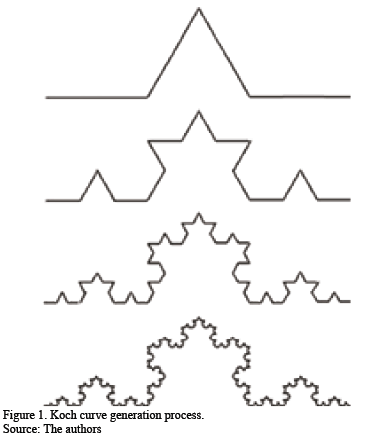
<body><![CDATA[<p><font size="2" face="Verdana, Arial, Helvetica, sans-serif"><i>Palabras clave</i>: Geometr&iacute;a euclidiana; Geometr&iacute;a fractal;   Paisaje; Miner&iacute;a; Corta minera; Integraci&oacute;n paisaj&iacute;stica.</font></p> <hr>     <p>&nbsp;</p>     <p><font size="3" face="Verdana, Arial, Helvetica, sans-serif"><b>1.  Introduction</b></font></p>     <p><font size="2" face="Verdana, Arial, Helvetica, sans-serif">Landscape is understood to be the perception or set of   sensations (visual, auditory and olfactory) produced by a natural setting in   which humans have or have not intervened &#91;18&#93;. Landscape protection policies   exist at the European level whose origins lie in two conferences in particular:   the 1972 UNESCO World Heritage Convention held in Paris and the 2000 Council of   Europe European Landscape Convention held in Florence. Both declare the   landscape to play an important public interest role in the cultural,   ecological, environmental and social fields &#91;26&#93;. Nonetheless, the lack of   reliable and up-to-date information from the European Union related to the   type, location, size and conservation status of natural and semi-natural   habitats is an obstacle to implementing the Pan-European Biological and   Landscape Diversity Strategy &#91;19&#93;.</font></p>     <p><font size="2" face="Verdana, Arial, Helvetica, sans-serif">Skãlos and Kašparov&aacute; &#91;21&#93; discuss - in relation to the European   Landscape Convention &#91;26,12&#93; and the case of mining - the issues of identifying   and quantifying the values of what are called &quot;ordinary cultural   landscapes&quot; and the associated loss of cultural memory, drawing   comparisons with the landscapes resulting from farming activities. Uncontrolled   and disordered growth of mining infrastructures and operations has altered the   landscape resource, greatly affecting perceptions of mine surroundings. As a   result of this habitat destruction &#91;7&#93;, visual unity is fragmented in small   regions isolated from each other &#91;6&#93;. A number of indicators have been   developed aimed at assessing the quality of the landscape and quantify its   ecological importance &#91;19,26&#93;.</font></p>     <p><font size="2" face="Verdana, Arial, Helvetica, sans-serif"><b>1.1.  Simulation of   mined-out open pits restoration: 3D modelling and fractal geometry</b>    <br>   </font><font size="2" face="Verdana, Arial, Helvetica, sans-serif">The social and political pressures to restore mined-out   open pits has been growing in recent years. 3D modelling has been the technique   of choice for simulating the appearance of an area in different seasons of the   year through variations in the sun's position and atmospheric conditions,   determining how far water would rise in a flood situation and verifying that   the restored orography and vegetation would be integrated in the landscape &#91;8,   20&#93;. 3D modelling is also used to study the behaviour of structures that are   still in the exploitation-place over time. &#91;32&#93;. However, 3D models represent   natural forms (coastlines, tree branches, rocks, mountains, etc.) using   Euclidean geometry and so require vast amounts of data for detailed description   and representation, not to mention the substantial processing time needed.</font></p>     <p><font size="2" face="Verdana, Arial, Helvetica, sans-serif">Another type of geometry that would simulate more   realistic models more rapidly is fractal geometry &#91;4,13&#93;, by means of which the   structure of objects is repeated in different scales (called fractals). This   structure is generated by a recursive or iterative process that is capable of   producing similar structures regardless of the viewing scale &#91;16&#93;. An irregular   or fragmented geometric element can be subdivided into parts, each of which is   approximately a smaller copy of the set &#91;24&#93;. General characteristics of   fractals include the following: they have detail at all scales, they are   self-similar, they have a simple algorithmic definition and the topological   dimension is less than the Hausdorff dimension, which is an extended   non-negative real number associated with any metric space. The Hausdorff   dimension of an n-dimensional inner product space equals n. This means that the   Hausdorff dimension of a point is zero, the Hausdorff dimension of a line is one   and the Hausdorff dimension of the plane is two &#91;14&#93;.</font></p>     <p><font size="2" face="Verdana, Arial, Helvetica, sans-serif">A number of works   describe the use of fractal geometry to describe contours and surfaces in   disciplines as diverse as biology, geology, physics, etc., to describe or   analyse hydrological systems &#91;15&#93;, buildings &#91;22&#93;, landscapes &#91;23&#93;, etc.</font></p>     <p><font size="2" face="Verdana, Arial, Helvetica, sans-serif">Euclidean geometry,   typically used for 3D representation of manmade objects (buildings, rooms,   etc.), is based on the measurement of elements such as points, lines, planes   and volumes that combine to form specific figures or shapes &#91;17&#93;. 3D modelling   can represent coordinates forming meshed structures wrapped by a texture. More   complex objects are built from other predefined shapes such as cones, spheres,   cylinders, tubes, ring, pyramids etc. via non-uniform rational basis spline   (NURBS) curves &#91;28-30&#93;. This geometry is not able to accurately represent forms   of nature, however. Natural phenomena like mountains, coastlines, river   systems, clouds, leaves, snowflakes, etc. are best described and illustrated by   objects whose dimensions are not expressed as integers but as fractions   (fractal dimensions). Thus, a straight line has dimension 1, whereas a fractal   curve has a dimension whose value lies between 1 and 2, depending on the space   occupied in the plane and their relative behaviour &#91;24&#93;. </font></p>     ]]></body>
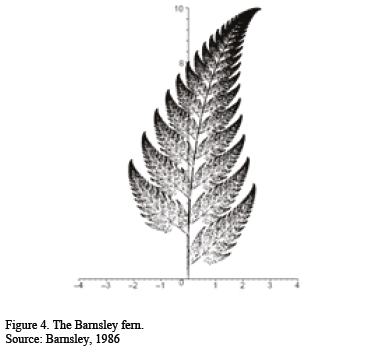
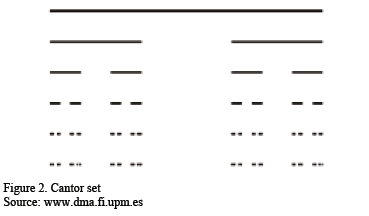
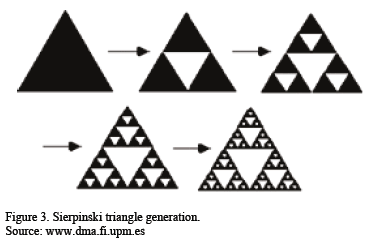
<body><![CDATA[<p><font size="2" face="Verdana, Arial, Helvetica, sans-serif">The Koch curve is one of the most common deterministic   fractals &#91;5&#93;. Introduced by Helge von Koch in 1904, it is an example of a curve   that has no tangent at any point. <a href="#fig01">Figure 1</a> shows how the Koch curve is   constructed, starting from the unit interval (initiator). The central interval   of length 1/3 is replaced by two segments of the same length at an angle of 60   degrees so that the generator length is increased to 4/3. This growth factor is   associated with each iteration, with the operation repeated in each of the 4   intervals formed, and so on. The Koch curve is the limit of this infinite   process. The mathematical expression for calculating the dimension of a fractal   is as follows:</font></p>     <p><img src="/img/revistas/dyna/v81n186/v81n186a07eq01.gif"></p>     <p><font size="2" face="Verdana, Arial, Helvetica, sans-serif">where D is the fractal dimension, Nn is the number of   fragments of size rn (the scale).</font></p>     <p align="center"><font size="2" face="Verdana, Arial, Helvetica, sans-serif"><a name="fig01"></a></font><img src="/img/revistas/dyna/v81n186/v81n186a07fig01.gif"></p>     <p><font size="2" face="Verdana, Arial, Helvetica, sans-serif">If the fractal is definite, the length of the line   approaches infinity while its area continues to be 0. The Hausdorff dimension   for the Koch curve is D = log(4)/log(3)=1.26185, as it is self-similar, with 4   parts similar to the total on the scale 1/3.</font></p>     <p><font size="2" face="Verdana, Arial, Helvetica, sans-serif">The Cantor set (<a href="#fig02">Figure 2</a>) is a subset of points in the   interval &#91;0, 1&#93;. Removed from the unit interval Io is the central open interval   of length 1/3, where the intervals are I11=&#91;0,1/3&#93; and I21=&#91;2/3,1&#93;,  and so on successively, until, in the nth   step  we have 2n intervals I1n, I2n,...,   I2nn of length 1/3n. Reducing the Cantor set by the factor r=1/3 leaves just   two equal parts, each measuring 1/2 of the measurement of the Cantor set. The   dimension D of a combined set on the scale 1/3 is the number that holds that   1/3D=1/2, i.e. the dimension of similarity (and also the Hausdorff dimension)   of the Cantor set is D= log (2)/log(3)=0.6309297.</font></p>     <p align="center"><font size="2" face="Verdana, Arial, Helvetica, sans-serif"><a name="fig02"></a></font><img src="/img/revistas/dyna/v81n186/v81n186a07fig02.gif"></p>     <p><font size="2" face="Verdana, Arial, Helvetica, sans-serif">Another example is the Sierpinski triangle (<a href="#fig03">Figure   3</a>).  Removed from an equilateral triangle   T is a (borderless) triangle resulting from joining the midpoints of the sides   of the original triangle. In this first step three new triangles T1, T2 and T3   are obtained, each of which undergoes the same process. Thus, obtained   successively are 3, 9, 27, 81, etc. triangles, each a copy at scale 1/2 of the   previous stage's triangle, with D=log(3)/log(2)=1.584962.</font></p>     <p align="center"><font size="2" face="Verdana, Arial, Helvetica, sans-serif"><a name="fig03"></a></font><img src="/img/revistas/dyna/v81n186/v81n186a07fig03.gif"></p>     <p><font size="2" face="Verdana, Arial, Helvetica, sans-serif">By varying, in each iteration, the points of   approximation, the distance (not necessarily 1/2) and the assigned probability   in order to choose the apex, different fractals can be obtained, such as the   Barnsley fern shown in <a href="#fig04">Figure 4</a> &#91;2&#93;.</font></p>     ]]></body>
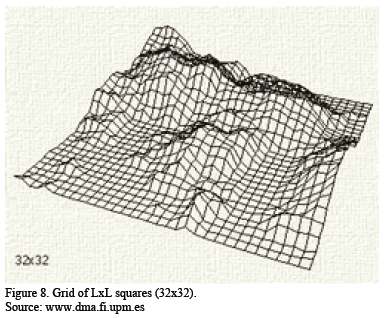
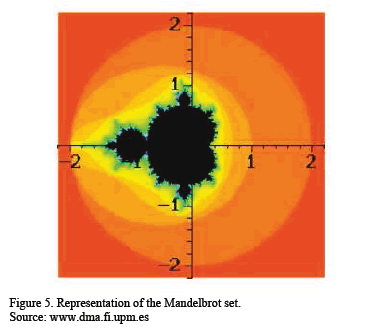
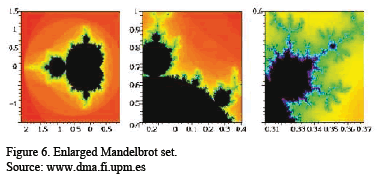
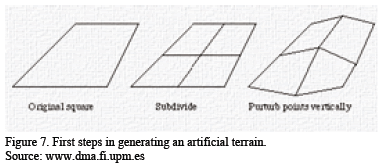
<body><![CDATA[<p align="center"><font size="2" face="Verdana, Arial, Helvetica, sans-serif"><a name="fig04"></a></font><img src="/img/revistas/dyna/v81n186/v81n186a07fig04.gif"></p>     <p><font size="2" face="Verdana, Arial, Helvetica, sans-serif">It could be said that fractal geometry is the language of   nature. Through the repetition of simple instructions (squeezing, stretching,   removing, folding, etc.) complex forms and structures are generated whose   dimensions do not have to be integers &#91;9,10&#93;. </font></p>     <p><font size="2" face="Verdana, Arial, Helvetica, sans-serif">Undoubtedly, the most famous fractal is the Mandelbrot set   M, defined as the set of complex numbers c of the complex plane C, for which   the associated Julia set of fc is connected (<a href="#fig05">Figure 5</a>). Small perturbation of   Julia set values, can cause drastic changes in the sequence of iterated   function values.</font></p>     <p align="center"><font size="2" face="Verdana, Arial, Helvetica, sans-serif"><a name="fig05"></a></font><img src="/img/revistas/dyna/v81n186/v81n186a07fig05.gif"></p>     <p><font size="2" face="Verdana, Arial, Helvetica, sans-serif">The escape-time algorithm is the tool used to   computationally apply fractals. To obtain computer images of the Mandelbrot   set, considered is a number N of order 100. For each c of the window to be   drawn - choosing increasingly smaller windows with greater zoom, as shown in <a href="#fig06">Figure 6</a> - the terms of the sequence fck (0) are computed. If the N first terms   all confirm that |fck(0)|&lt;2, i.e. they do not leave the circle with center 0   and radius 2, then c belongs to the Mandelbrot set and is painted black. If, however,   there exists k&le;N with |fck(0)|&gt;2, then the computation is halted for   this c as it is outside the </font></p>     <p align="center"><font size="2" face="Verdana, Arial, Helvetica, sans-serif"><a name="fig06"></a></font><img src="/img/revistas/dyna/v81n186/v81n186a07fig06.gif"></p>     <p><font size="2" face="Verdana, Arial, Helvetica, sans-serif">Mandelbrot set, i.e. it has   &quot;escaped&quot; from the previous circle. If each number K between 0 and N   is assigned a colour and if each number c is represented in the colour   corresponding to the first K such that |fck(0)|&gt;2 - i.e. the moment of   escape from the enclosed area - then we obtain the typical images of the   Mandelbrot set. The escape-time algorithm is used in   the fractal image generation &#91;31&#93;.</font></p>     <p><font size="2" face="Verdana, Arial, Helvetica, sans-serif">Random fractals also exist, characterized by the random   elements involved in their construction &#91;25&#93;. This kind of fractal enables   simulation of natural phenomena. A fractal landscape is a representation of a   real or imagined landscape produced by fractals &#91;1&#93;. Several approaches can be   used to build this type of landscape, but one of the easiest is basically to   divide the square where the landscape will be restored into 4 equal parts and   then randomly displace the shared central point. This process is repeated   recursively in each square until the desired level of detail is obtained. </font></p>     <p><font size="2" face="Verdana, Arial, Helvetica, sans-serif">This operation produces 5 new intersections, each assigned   a random perturbance over the initial zero height (<a href="#fig07">Figure 7</a>). The process is   iterated until a total of LxL squares is obtained (<a href="#fig08">Figure 8</a>). For each   iteration the absolute value of the perturbance over the newly generated points   is reduced. This is the factor that regulates terrain roughness; thus, larger   reduction factors produce smoother surfaces and smaller reduction factors   produce rougher surfaces.</font></p>     <p align="center"><font size="2" face="Verdana, Arial, Helvetica, sans-serif"><a name="fig07"></a></font><img src="/img/revistas/dyna/v81n186/v81n186a07fig07.gif"></p>     ]]></body>
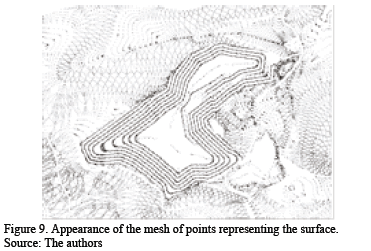
<body><![CDATA[<p align="center"><font size="2" face="Verdana, Arial, Helvetica, sans-serif"><a name="fig08"></a></font><img src="/img/revistas/dyna/v81n186/v81n186a07fig08.gif"></p>     <p><font size="2" face="Verdana, Arial, Helvetica, sans-serif">It is normal practice in landscape generation programs to   set a threshold (sea level).</font></p>     <p><font size="2" face="Verdana, Arial, Helvetica, sans-serif">The aim of this research was to determine whether this new   modelling technique could represent an effective alternative to conventional 3D   modelling for mining environments, in terms both of the realism of the   simulation and the time investment. For this purpose, we performed fractal   simulations of the restoration of a mined-out open pit.</font></p>     <p>&nbsp;</p>     <p><b><font size="3" face="Verdana, Arial, Helvetica, sans-serif">2.  Methodology</font></b></p>     <p><font size="2" face="Verdana, Arial, Helvetica, sans-serif">The goal was to visualize the restoration of a mined-out   open-pit mine and to verify whether the restoration would suit the terrain and   flora of the surroundings and minimize impact on both the environment and the   people living in the vicinity. For this purpose, the topographical map of the   open-pit mine in .dwg format (Autodesk) was used.</font></p>     <p><font size="2" face="Verdana, Arial, Helvetica, sans-serif">Using the AutoCAD Civil computer code we created a 3D   surface bounded by the outer limits of the .dwg topographical map and   configuring a square mesh. With the UTM coordinates of the surface correctly   georeferenced and scaled, the points of the surface were extracted in a mesh   with a stipulated distance between contour lines, in this case 5 m, and an   angle between lines of 3.125o.  The   procedure is described below for Autocad Civil 2010 and summarized in chart   form in <a href="#fig11">Figure 11</a>.</font></p> <ol>       <li><font size="2" face="Verdana, Arial, Helvetica, sans-serif">Topographic map: Start with the     contour lines (.dwg) for the mined area in UTM coordinates (x,y,z).</font></li>       <li><font size="2" face="Verdana, Arial, Helvetica, sans-serif">Generate the surface: </font>     <ol type="a">           <li><font size="2" face="Verdana, Arial, Helvetica, sans-serif"> Extract         contour line points in ASCII code using the &quot;ExtractPoints&quot; tool.</font></li>           ]]></body>
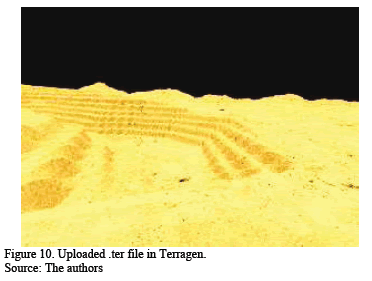
<body><![CDATA[<li><font size="2" face="Verdana, Arial, Helvetica, sans-serif"> Increase         the number of contours by linear interpolation.</font></li>           <li><font size="2" face="Verdana, Arial, Helvetica, sans-serif">Save         the set of points representing the surface mesh (<a href="#fig09">Figure 9</a>) as an ENZ formatted         file.</font></li>         </ol>   </li>     </ol>     <p align="center"><font size="2" face="Verdana, Arial, Helvetica, sans-serif"><a name="fig09"></a></font><img src="/img/revistas/dyna/v81n186/v81n186a07fig09.gif"></p> <ol start="3">       <li><font size="2" face="Verdana, Arial, Helvetica, sans-serif">Convert     to .txt format: Applying a geostatistical code, process the ENZ file further to     improve surface definition using an algorithm for matrix smoothing between the     points, with a number n (with a value between 0 and 100) inserted between     points. </font></li>       <li><font size="2" face="Verdana, Arial, Helvetica, sans-serif">Transform     from .txt to .ter format using Global Mapper software, so as to be able to work     with fractal mathematics in Terragen 2 Deep Edition (<a href="#fig10">Figure 10</a>).</font></li>     </ol>     <p align="center"><font size="2" face="Verdana, Arial, Helvetica, sans-serif"><a name="fig10"></a></font><img src="/img/revistas/dyna/v81n186/v81n186a07fig10.gif"></p>     <p><font size="2" face="Verdana, Arial, Helvetica, sans-serif">Processing in Terragen started with the loading of the   terrain data (.ter) in the workspace.  The &quot;node network&quot; tool lists environment variables as follows:</font></p> <ul>       ]]></body>
<body><![CDATA[<li><font size="2" face="Verdana, Arial, Helvetica, sans-serif">Terrain height, colour and texture of vegetation     cover.</font></li>       <li><font size="2" face="Verdana, Arial, Helvetica, sans-serif">Terrain slope: stony, angles of over 75 degrees,     gneiss hue and texture.</font></li>       <li><font size="2" face="Verdana, Arial, Helvetica, sans-serif">Shading: moss shades and textures depending on     terrain orientation and slope.</font></li>       <li><font size="2" face="Verdana, Arial, Helvetica, sans-serif">Substrate: mechanical erosion areas with gneiss     texture.</font></li>       <li><font size="2" face="Verdana, Arial, Helvetica, sans-serif">Water: behaviour based on slope and relative     heights.</font></li>     </ul>     <p><font size="2" face="Verdana, Arial, Helvetica, sans-serif"><b>Flora    <br>   </b></font><font size="2" face="Verdana, Arial, Helvetica, sans-serif">To correctly assign the flora the application meshes had   to be taken into account. Populations of various types of tree, shrub and   flower species were inserted through application meshes that could be modified   in terms of plant size and density. These objects had certain textures and   colours characteristic of the vegetation they represented, so the layer of base   colours (called shaders) was not modified. All the flora was taken from the   Xfrog library &#91;27&#93; which has an extensive range of trees, plants and flowers   that can be uploaded to Terragen. The native species <i>Betula lenta</i>, <i>Abies grandis</i> and <i>Galium aparin</i> were the main   species chosen. The slopes of the pit were also planted with native species to   improve integration with the landscape.</font></p>     <p><font size="2" face="Verdana, Arial, Helvetica, sans-serif"><b>Atmosphere    <br>   </b></font><font size="2" face="Verdana, Arial, Helvetica, sans-serif">To define   the atmosphere visual field parameters can be added referring to fog density   and height, sky line height and ambient light. Obtaining meteorological   parameters for a particular period in the past (year, month, day, hour) enables   the atmosphere for that particular day to be reproduced. The atmosphere   introduced in our case was fog and, in another simulation, altocumulus. </font></p>     ]]></body>
<body><![CDATA[<p><font size="2" face="Verdana, Arial, Helvetica, sans-serif"><b>Lighting    <br>   </b></font><font size="2" face="Verdana, Arial, Helvetica, sans-serif">For   lighting, which depends directly on the position of the sun, defined were the   sun's declination for day d and elevation with respect to the zenith for hour   h.</font></p>     <p><font size="2" face="Verdana, Arial, Helvetica, sans-serif"><b>Water    <br>   </b></font><font size="2" face="Verdana, Arial, Helvetica, sans-serif">The water   behaviour parameters are level, light effects, relative depth, penetrating   light attenuation, roughness and wave effect.</font></p>     <p><font size="2" face="Verdana, Arial, Helvetica, sans-serif">Given the   characteristics of the mined-out pit, a convenient restoration solution from   technical, environmental and socioeconomic perspectives was to create a lake,   as water table characteristics permitted this quick restoration solution for a   very small investment while equipping the area with a recreational facility:</font></p> <ul>       <li><font size="2" face="Verdana, Arial, Helvetica, sans-serif">Water level 250 m</font></li>       <li><font size="2" face="Verdana, Arial, Helvetica, sans-serif">Maximum radius: 300 m</font></li>       <li><font size="2" face="Verdana, Arial, Helvetica, sans-serif">Reflections: 75%</font></li>       <li><font size="2" face="Verdana, Arial, Helvetica, sans-serif">Transparency 10%</font></li>     </ul>     ]]></body>
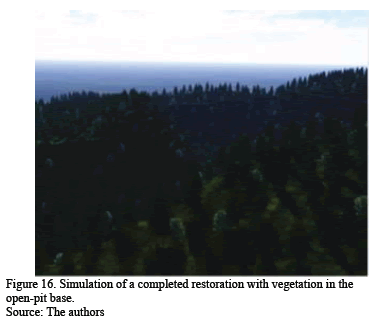
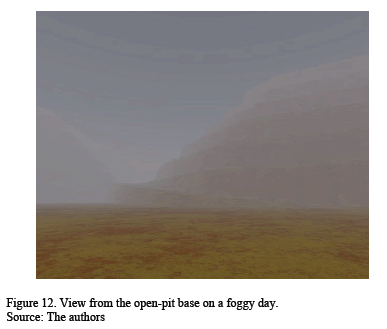
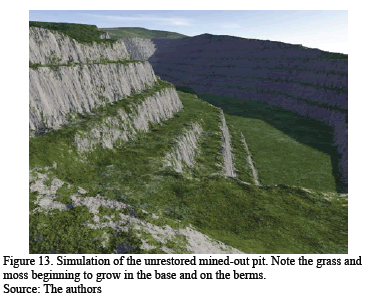
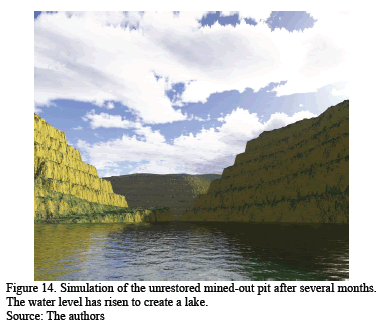
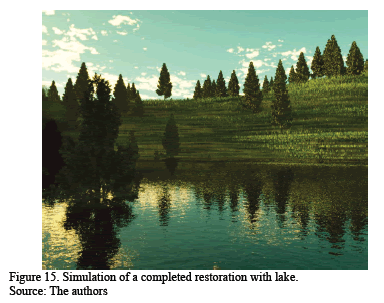
<body><![CDATA[<p><font size="2" face="Verdana, Arial, Helvetica, sans-serif">Once all the environmental variables and objects were   introduced, a point of view was selected so as to render and create the image   of the terrain from that point.</font></p>     <p>&nbsp;</p>     <p><font size="3" face="Verdana, Arial, Helvetica, sans-serif"><b>3.  Results</b></font></p>     <p><font size="2" face="Verdana, Arial, Helvetica, sans-serif">Specific weather and environmental conditions were   simulated according to different sets of initial parameters. </font></p>     <p><font size="2" face="Verdana, Arial, Helvetica, sans-serif">The renderings resulted in a high degree of realism in the   simulations. Furthermore, starting with just the contour lines for the   mined-out open pit, the time required was under 30 minutes, including a   rendering time of 6 minutes (Pentium (R) Dual-Core CPU T4500 2.3 GHzRAM 3GB and   Terragen 2.0 software).</font></p>     <p><font size="2" face="Verdana, Arial, Helvetica, sans-serif">Different simulations of the restoration are reproduced   below: a foggy day (<a href="#fig12">Figure 12</a>); if left abandoned (<a href="#fig13">Figures 13</a> and <a href="#fig14">14</a>); with a   lake (<a href="#fig15">Figure 15</a>); with vegetation at the base (<a href="#fig16">Figure 16</a>). The last two   alternatives offered the best landscape integration.</font></p>     <p align="center"><font size="2" face="Verdana, Arial, Helvetica, sans-serif"><a name="fig12"></a></font><img src="/img/revistas/dyna/v81n186/v81n186a07fig12.gif"></p>     <p align="center"><font size="2" face="Verdana, Arial, Helvetica, sans-serif"><a name="fig13"></a></font><img src="/img/revistas/dyna/v81n186/v81n186a07fig13.gif"></p>     <p align="center"><font size="2" face="Verdana, Arial, Helvetica, sans-serif"><a name="fig14"></a></font><img src="/img/revistas/dyna/v81n186/v81n186a07fig14.gif"></p>     <p align="center"><font size="2" face="Verdana, Arial, Helvetica, sans-serif"><a name="fig15"></a></font><img src="/img/revistas/dyna/v81n186/v81n186a07fig15.gif"></p>     ]]></body>
<body><![CDATA[<p align="center"><font size="2" face="Verdana, Arial, Helvetica, sans-serif"><a name="fig16"></a></font><img src="/img/revistas/dyna/v81n186/v81n186a07fig16.gif"></p>     <p>&nbsp;</p>     <p><font size="3" face="Verdana, Arial, Helvetica, sans-serif"><b>4.  Discussion</b></font></p>     <p><font size="2" face="Verdana, Arial, Helvetica, sans-serif">The main advantages of fractal versus 3D modelling are   summarizes as follows:</font></p> <ol>       <li><font size="2" face="Verdana, Arial, Helvetica, sans-serif">Rendering time is shorter.</font></li>       <li><font size="2" face="Verdana, Arial, Helvetica, sans-serif">Natural objects are better represented.</font></li>       <li><font size="2" face="Verdana, Arial, Helvetica, sans-serif">Recursive procedures rather than equations are used to     model fractal objects.</font></li>       <li><font size="2" face="Verdana, Arial, Helvetica, sans-serif">Detail is good for all scales of observation.</font></li>       <li><font size="2" face="Verdana, Arial, Helvetica, sans-serif">Models are easily generated with computers.</font></li>       <li><font size="2" face="Verdana, Arial, Helvetica, sans-serif">Numerous parameters can be entered and varied rapidly     and easily:</font></li>     ]]></body>
<body><![CDATA[</ol> <ol>   <ul>         <li><font size="2" face="Verdana, Arial, Helvetica, sans-serif">Terrain: roughness, colour, texture etc.</font></li>         <li><font size="2" face="Verdana, Arial, Helvetica, sans-serif">Water: level, roughness, wave effect,       transparency, etc.</font></li>         <li><font size="2" face="Verdana, Arial, Helvetica, sans-serif">Clouds: size, distribution, density, etc.</font></li>         <li><font size="2" face="Verdana, Arial, Helvetica, sans-serif">Atmosphere: decay, colour, mean density, etc.</font></li>         <li><font size="2" face="Verdana, Arial, Helvetica, sans-serif">Lighting: direction, intensity, position of the       sun, height, colour, etc.</font></li>         <li><font size="2" face="Verdana, Arial, Helvetica, sans-serif">Colour (for any variable).</font></li>       </ul>     </ol> <ol start="7">       <li><font size="2" face="Verdana, Arial, Helvetica, sans-serif">Photorealism or hyperrealism is achieved, provided all     the parameters are well combined.</font></li>     ]]></body>
<body><![CDATA[</ol>     <p>&nbsp;</p>     <p><font size="3" face="Verdana, Arial, Helvetica, sans-serif"><b>5.  Conclusions</b></font></p>     <p><font size="2" face="Verdana, Arial, Helvetica, sans-serif">Fractals are apparently complicated geometrical sets but   actually require very little information for their description, construction   and exploration. The main characteristic of fractal structures is the infinite   iteration of a simple process to create an object.  They are usually viewed as similar at all   levels of magnification, whereas natural objects like clouds, mountains,   lightning, shorelines, tree branches, etc. approximate fractals.</font></p>     <p><font size="2" face="Verdana, Arial, Helvetica, sans-serif">Fractal mathematics applied using computer software can be   used to simulate different mining environments rapidly and easily. The software   allows many variables to be added to the model, resulting in high-resolution   images that preserve the real forms of the terrain. This kind of simulation   would not be feasible with 3D modelling due to the time required to introduce   variables and the lower realism resulting from geometric shapes.</font></p>     <p><font size="2" face="Verdana, Arial, Helvetica, sans-serif">Fractal geometry offers an effective and promising way to   model quarries, open-pit mines and other mining environments and restored   landscapes.</font></p>     <p>&nbsp;</p>     <p><font size="3" face="Verdana, Arial, Helvetica, sans-serif"><b>Acknowledgments</b></font></p>     <p><font size="2" face="Verdana, Arial, Helvetica, sans-serif">Jos&eacute; Santiago Pozo wants to thank to University of Vigo   for the financial support given.</font></p>     <p>&nbsp;</p>     ]]></body>
<body><![CDATA[<p><font size="3" face="Verdana, Arial, Helvetica, sans-serif"><b>References</b></font></p>     <!-- ref --><p> <font size="2" face="Verdana, Arial, Helvetica, sans-serif"><b>&#91;1&#93;</b> Anhaia, T.R.S., Luiz, A.M.E., Leitão, K. and Moro, R.S., Pitagui's river upper course landscape in the Parana first Plateau, Brazil. RA'E GA-O Espaco Geografico en Analise, 24, pp. 134-148, 2012.    &nbsp;&nbsp;&nbsp;&nbsp;&nbsp;&nbsp;&nbsp;&nbsp;[&#160;<a href="javascript:void(0);" onclick="javascript: window.open('/scielo.php?script=sci_nlinks&ref=000134&pid=S0012-7353201400040000700001&lng=','','width=640,height=500,resizable=yes,scrollbars=1,menubar=yes,');">Links</a>&#160;]<!-- end-ref --></font></p>     <!-- ref --><p> <font size="2" face="Verdana, Arial, Helvetica, sans-serif"><b>&#91;2&#93;</b> Barnsley, M.F., Fractal functions and interpolation. Constructive Approximation, 2 (1), pp. 303-329, 1986.    &nbsp;&nbsp;&nbsp;&nbsp;&nbsp;&nbsp;&nbsp;&nbsp;[&#160;<a href="javascript:void(0);" onclick="javascript: window.open('/scielo.php?script=sci_nlinks&ref=000136&pid=S0012-7353201400040000700002&lng=','','width=640,height=500,resizable=yes,scrollbars=1,menubar=yes,');">Links</a>&#160;]<!-- end-ref --></font></p>     <!-- ref --><p> <font size="2" face="Verdana, Arial, Helvetica, sans-serif"><b>&#91;3&#93;</b> Barnsley, M.F., Massopust, P., Strickland, H. and Sloan, A.D., Fractal modeling of biological structures. Annals of the New York, Academy of Sciences, 504, pp. 179-194, 1987.    &nbsp;&nbsp;&nbsp;&nbsp;&nbsp;&nbsp;&nbsp;&nbsp;[&#160;<a href="javascript:void(0);" onclick="javascript: window.open('/scielo.php?script=sci_nlinks&ref=000138&pid=S0012-7353201400040000700003&lng=','','width=640,height=500,resizable=yes,scrollbars=1,menubar=yes,');">Links</a>&#160;]<!-- end-ref --></font></p>     <!-- ref --><p> <font size="2" face="Verdana, Arial, Helvetica, sans-serif"><b>&#91;4&#93;</b> Bogachev, M.I., Eichner, J.F. and Bunde, A., Effect of nonlinear correlations on the statics of return intervals in multifractal data sets. Physical Review Letters, 99 (24), pp. 1-4, 2007.    &nbsp;&nbsp;&nbsp;&nbsp;&nbsp;&nbsp;&nbsp;&nbsp;[&#160;<a href="javascript:void(0);" onclick="javascript: window.open('/scielo.php?script=sci_nlinks&ref=000140&pid=S0012-7353201400040000700004&lng=','','width=640,height=500,resizable=yes,scrollbars=1,menubar=yes,');">Links</a>&#160;]<!-- end-ref --></font></p>     <!-- ref --><p> <font size="2" face="Verdana, Arial, Helvetica, sans-serif"><b>&#91;5&#93;</b> Bunde, A. and Havlin, S., A brief introduction of fractal geometry, Fractals in science. Springer Verlag, 1994.    &nbsp;&nbsp;&nbsp;&nbsp;&nbsp;&nbsp;&nbsp;&nbsp;[&#160;<a href="javascript:void(0);" onclick="javascript: window.open('/scielo.php?script=sci_nlinks&ref=000142&pid=S0012-7353201400040000700005&lng=','','width=640,height=500,resizable=yes,scrollbars=1,menubar=yes,');">Links</a>&#160;]<!-- end-ref --></font></p>     <!-- ref --><p> <font size="2" face="Verdana, Arial, Helvetica, sans-serif"><b>&#91;6&#93;</b> Chrabra, A., Geist, H.J., Houghton, R.A., Haberl, H., Braimoh, A.K. and Vlek, P.I., Multiple impacts of land-use/cover change. In: Lambin, E.F. and Geist, H.J., Land-use and land-cover change. Local Processes and Global Impacts, Berlin, Sringer-Verlag, 2006, pp. 71-116.    &nbsp;&nbsp;&nbsp;&nbsp;&nbsp;&nbsp;&nbsp;&nbsp;[&#160;<a href="javascript:void(0);" onclick="javascript: window.open('/scielo.php?script=sci_nlinks&ref=000144&pid=S0012-7353201400040000700006&lng=','','width=640,height=500,resizable=yes,scrollbars=1,menubar=yes,');">Links</a>&#160;]<!-- end-ref --></font></p>     <!-- ref --><p> <font size="2" face="Verdana, Arial, Helvetica, sans-serif"><b>&#91;7&#93;</b> Dirzo, R. and Raven, P.H., Global state of biodiversity and loss. Annual Review of Environmental and Resources, 28, pp. 137-167, 2003.    &nbsp;&nbsp;&nbsp;&nbsp;&nbsp;&nbsp;&nbsp;&nbsp;[&#160;<a href="javascript:void(0);" onclick="javascript: window.open('/scielo.php?script=sci_nlinks&ref=000146&pid=S0012-7353201400040000700007&lng=','','width=640,height=500,resizable=yes,scrollbars=1,menubar=yes,');">Links</a>&#160;]<!-- end-ref --></font></p>     <!-- ref --><p> <font size="2" face="Verdana, Arial, Helvetica, sans-serif"><b>&#91;8&#93;</b> Fadda, S., Fiori, M. and Matzuzzi, C., Developing rehabilitation design for the abandoned mine excavations in central Sardinia. International Journal of Mining, Reclamation and Environment, 24 (4), pp. 286-306, 2010.    &nbsp;&nbsp;&nbsp;&nbsp;&nbsp;&nbsp;&nbsp;&nbsp;[&#160;<a href="javascript:void(0);" onclick="javascript: window.open('/scielo.php?script=sci_nlinks&ref=000148&pid=S0012-7353201400040000700008&lng=','','width=640,height=500,resizable=yes,scrollbars=1,menubar=yes,');">Links</a>&#160;]<!-- end-ref --></font></p>     <!-- ref --><p> <font size="2" face="Verdana, Arial, Helvetica, sans-serif"><b>&#91;9&#93;</b> Falconer, K.J., The Hausdorff dimension of some fractals and attractors of overlapping construction. Journal of Statistical Physics, . 47 (1-2), pp. 123-132, 1987.    &nbsp;&nbsp;&nbsp;&nbsp;&nbsp;&nbsp;&nbsp;&nbsp;[&#160;<a href="javascript:void(0);" onclick="javascript: window.open('/scielo.php?script=sci_nlinks&ref=000150&pid=S0012-7353201400040000700009&lng=','','width=640,height=500,resizable=yes,scrollbars=1,menubar=yes,');">Links</a>&#160;]<!-- end-ref --></font></p>     <!-- ref --><p> <font size="2" face="Verdana, Arial, Helvetica, sans-serif"><b>&#91;10&#93;</b> Falconer, K.J. and Howroyd, J.D., Packing dimensions of projections and dimension profiles. Mathematical Proceedings of the Cambridge Philosophical Society, 121 (2), pp. 269-286, 1997.    &nbsp;&nbsp;&nbsp;&nbsp;&nbsp;&nbsp;&nbsp;&nbsp;[&#160;<a href="javascript:void(0);" onclick="javascript: window.open('/scielo.php?script=sci_nlinks&ref=000152&pid=S0012-7353201400040000700010&lng=','','width=640,height=500,resizable=yes,scrollbars=1,menubar=yes,');">Links</a>&#160;]<!-- end-ref --></font></p>     <!-- ref --><p> <font size="2" face="Verdana, Arial, Helvetica, sans-serif"><b>&#91;11&#93;</b> Falconer, K.J. and Hu, J., Nonlinear diffusion equations on unbounded fractal domains. Journal of Mathematical Analysis and Applications, 256 (2), pp. 606-624, 2001.    &nbsp;&nbsp;&nbsp;&nbsp;&nbsp;&nbsp;&nbsp;&nbsp;[&#160;<a href="javascript:void(0);" onclick="javascript: window.open('/scielo.php?script=sci_nlinks&ref=000154&pid=S0012-7353201400040000700011&lng=','','width=640,height=500,resizable=yes,scrollbars=1,menubar=yes,');">Links</a>&#160;]<!-- end-ref --></font></p>     <!-- ref --><p> <font size="2" face="Verdana, Arial, Helvetica, sans-serif"><b>&#91;12&#93;</b> Farina, A. and Bergrano, A., The eco-field hypothesis, toward a cognitive landscape. Landscape Ecology 21, pp. 5-17, 2005.    &nbsp;&nbsp;&nbsp;&nbsp;&nbsp;&nbsp;&nbsp;&nbsp;[&#160;<a href="javascript:void(0);" onclick="javascript: window.open('/scielo.php?script=sci_nlinks&ref=000156&pid=S0012-7353201400040000700012&lng=','','width=640,height=500,resizable=yes,scrollbars=1,menubar=yes,');">Links</a>&#160;]<!-- end-ref --></font></p>     <!-- ref --><p> <font size="2" face="Verdana, Arial, Helvetica, sans-serif"><b>&#91;13&#93;</b> Lennartz, S. and Bunde, A., Distribution of natural trends in long-term correlated records, A scaling approach. Physical Review E 84, 021129, 2011.    &nbsp;&nbsp;&nbsp;&nbsp;&nbsp;&nbsp;&nbsp;&nbsp;[&#160;<a href="javascript:void(0);" onclick="javascript: window.open('/scielo.php?script=sci_nlinks&ref=000158&pid=S0012-7353201400040000700013&lng=','','width=640,height=500,resizable=yes,scrollbars=1,menubar=yes,');">Links</a>&#160;]<!-- end-ref --> </font></p>     <!-- ref --><p> <font size="2" face="Verdana, Arial, Helvetica, sans-serif"><b>&#91;14&#93;</b> Li, J-J., Wang, X-R., Wang, X-J., Ma, W-C. and Zhang, H., Remote sensing evaluation of urban heat island and its spatial pattern of the Shangai metropolitan area, China. Ecological Complexity, 6 (4), pp. 413-420, 2009.    &nbsp;&nbsp;&nbsp;&nbsp;&nbsp;&nbsp;&nbsp;&nbsp;[&#160;<a href="javascript:void(0);" onclick="javascript: window.open('/scielo.php?script=sci_nlinks&ref=000160&pid=S0012-7353201400040000700014&lng=','','width=640,height=500,resizable=yes,scrollbars=1,menubar=yes,');">Links</a>&#160;]<!-- end-ref --></font></p>     <!-- ref --><p> <font size="2" face="Verdana, Arial, Helvetica, sans-serif"><b>&#91;15&#93;</b> Livina, V., Kizner, Z., Braun, P., Molnar, T., Bunde, A. and Havlin, S. Temporal scaling comparison of real hydrological data and model runoff records. Journal of Hydrology, vol. 336, pp. 186-198, 2007.    &nbsp;&nbsp;&nbsp;&nbsp;&nbsp;&nbsp;&nbsp;&nbsp;[&#160;<a href="javascript:void(0);" onclick="javascript: window.open('/scielo.php?script=sci_nlinks&ref=000162&pid=S0012-7353201400040000700015&lng=','','width=640,height=500,resizable=yes,scrollbars=1,menubar=yes,');">Links</a>&#160;]<!-- end-ref --></font></p>     <!-- ref --><p> <font size="2" face="Verdana, Arial, Helvetica, sans-serif"><b>&#91;16&#93;</b> Mandelbrot, B.B., The fractal geometry of nature. W.H. Freman and Co. 1977.    &nbsp;&nbsp;&nbsp;&nbsp;&nbsp;&nbsp;&nbsp;&nbsp;[&#160;<a href="javascript:void(0);" onclick="javascript: window.open('/scielo.php?script=sci_nlinks&ref=000164&pid=S0012-7353201400040000700016&lng=','','width=640,height=500,resizable=yes,scrollbars=1,menubar=yes,');">Links</a>&#160;]<!-- end-ref --> </font></p>     <!-- ref --><p> <font size="2" face="Verdana, Arial, Helvetica, sans-serif"><b>&#91;17&#93;</b> Mandelbrot, B.B., Gefen, Y., Aharony, A. and Peyriere, J., Fractals, their transfer matrices and their eigen-dimensional sequences. Journal of Physics A, Mathematical and General, 18 (2), pp. 335-354, 1985.    &nbsp;&nbsp;&nbsp;&nbsp;&nbsp;&nbsp;&nbsp;&nbsp;[&#160;<a href="javascript:void(0);" onclick="javascript: window.open('/scielo.php?script=sci_nlinks&ref=000166&pid=S0012-7353201400040000700017&lng=','','width=640,height=500,resizable=yes,scrollbars=1,menubar=yes,');">Links</a>&#160;]<!-- end-ref --></font></p>     <!-- ref --><p> <font size="2" face="Verdana, Arial, Helvetica, sans-serif"><b>&#91;18&#93;</b> Mar&iacute;-Costa, V., Ecohistory of the agrarian landscape. An application for the Pituso field, pp. 240-250, 2003.    &nbsp;&nbsp;&nbsp;&nbsp;&nbsp;&nbsp;&nbsp;&nbsp;[&#160;<a href="javascript:void(0);" onclick="javascript: window.open('/scielo.php?script=sci_nlinks&ref=000168&pid=S0012-7353201400040000700018&lng=','','width=640,height=500,resizable=yes,scrollbars=1,menubar=yes,');">Links</a>&#160;]<!-- end-ref --></font></p>     <!-- ref --><p> <font size="2" face="Verdana, Arial, Helvetica, sans-serif"><b>&#91;19&#93;</b> Mart&iacute;nez, S., Ramil, P. and Chuvieco, E., Monitoring loss of biodiversity in cultural landscapes. New methodology based on satellite data. Landscape and Urban Planning, 94, pp. 127-140, 2010.    &nbsp;&nbsp;&nbsp;&nbsp;&nbsp;&nbsp;&nbsp;&nbsp;[&#160;<a href="javascript:void(0);" onclick="javascript: window.open('/scielo.php?script=sci_nlinks&ref=000170&pid=S0012-7353201400040000700019&lng=','','width=640,height=500,resizable=yes,scrollbars=1,menubar=yes,');">Links</a>&#160;]<!-- end-ref --></font></p>     <!-- ref --><p> <font size="2" face="Verdana, Arial, Helvetica, sans-serif"><b>&#91;20&#93;</b> Pacina, J., Nov&aacute;k, K. and Weiss, L., 3D modeling as a tool for landscape restoration and analysis, IFIP Advances in Information and Communication Technology, 359 AICT, pp. 123-138, 2011.    &nbsp;&nbsp;&nbsp;&nbsp;&nbsp;&nbsp;&nbsp;&nbsp;[&#160;<a href="javascript:void(0);" onclick="javascript: window.open('/scielo.php?script=sci_nlinks&ref=000172&pid=S0012-7353201400040000700020&lng=','','width=640,height=500,resizable=yes,scrollbars=1,menubar=yes,');">Links</a>&#160;]<!-- end-ref --></font></p>     <!-- ref --><p> <font size="2" face="Verdana, Arial, Helvetica, sans-serif"><b>&#91;21&#93;</b> Skãlos J. and Käsparova, I., Landscape memory and landscape change in relation to mining, Ecological Engineering, 43, pp. 60-69.    &nbsp;&nbsp;&nbsp;&nbsp;&nbsp;&nbsp;&nbsp;&nbsp;[&#160;<a href="javascript:void(0);" onclick="javascript: window.open('/scielo.php?script=sci_nlinks&ref=000174&pid=S0012-7353201400040000700021&lng=','','width=640,height=500,resizable=yes,scrollbars=1,menubar=yes,');">Links</a>&#160;]<!-- end-ref --></font></p>     <!-- ref --><p> <font size="2" face="Verdana, Arial, Helvetica, sans-serif"><b>&#91;22&#93;</b> Taketomi, T., Sato, T. and Yokoya, N., Real-time and accurate extrinsic camera parameter estimation using feature landmark database for augmented reality, Computer and Graphics, 35, pp. 768-777, 2011.    &nbsp;&nbsp;&nbsp;&nbsp;&nbsp;&nbsp;&nbsp;&nbsp;[&#160;<a href="javascript:void(0);" onclick="javascript: window.open('/scielo.php?script=sci_nlinks&ref=000176&pid=S0012-7353201400040000700022&lng=','','width=640,height=500,resizable=yes,scrollbars=1,menubar=yes,');">Links</a>&#160;]<!-- end-ref --></font></p>     <!-- ref --><p> <font size="2" face="Verdana, Arial, Helvetica, sans-serif"><b>&#91;23&#93;</b> Tannier, C., Foltête, J.C. and Girardet, X., Assessing the capacity of different urban forms to preserve the connectivity of ecological habitats, Landscape and Urban Planning, 105, pp. 128-139, 2012.    &nbsp;&nbsp;&nbsp;&nbsp;&nbsp;&nbsp;&nbsp;&nbsp;[&#160;<a href="javascript:void(0);" onclick="javascript: window.open('/scielo.php?script=sci_nlinks&ref=000178&pid=S0012-7353201400040000700023&lng=','','width=640,height=500,resizable=yes,scrollbars=1,menubar=yes,');">Links</a>&#160;]<!-- end-ref --></font></p>     <!-- ref --><p> <font size="2" face="Verdana, Arial, Helvetica, sans-serif"><b>&#91;24&#93;</b> Thomas, I., Frankhauser, P. and Biernacki, C., The morphology of built-up landscapes in Wallonia (Belgium). A classification using fractal indices, Landscape and Urban Planning, 84, pp. 99-115, 2008.    &nbsp;&nbsp;&nbsp;&nbsp;&nbsp;&nbsp;&nbsp;&nbsp;[&#160;<a href="javascript:void(0);" onclick="javascript: window.open('/scielo.php?script=sci_nlinks&ref=000180&pid=S0012-7353201400040000700024&lng=','','width=640,height=500,resizable=yes,scrollbars=1,menubar=yes,');">Links</a>&#160;]<!-- end-ref --></font></p>     <!-- ref --><p> <font size="2" face="Verdana, Arial, Helvetica, sans-serif"><b>&#91;25&#93;</b> Vlad, M.O., Schönfish, B. and Mackey, M.C., Self-similar potentials in random media, fractal evolutionary landscapes and Kimura's neutral theory of molecular evolution, Physica A, 229, pp. 343-364, 1996.    &nbsp;&nbsp;&nbsp;&nbsp;&nbsp;&nbsp;&nbsp;&nbsp;[&#160;<a href="javascript:void(0);" onclick="javascript: window.open('/scielo.php?script=sci_nlinks&ref=000182&pid=S0012-7353201400040000700025&lng=','','width=640,height=500,resizable=yes,scrollbars=1,menubar=yes,');">Links</a>&#160;]<!-- end-ref --></font></p>     <!-- ref --><p> <font size="2" face="Verdana, Arial, Helvetica, sans-serif"><b>&#91;26&#93;</b> D&eacute;jeant-Pons, M., The European landscape convention. Spatial Planning and Landscape Division, Council of Europe, Europe, France, Landscape Research, 31 (4), pp. 363-384, 2006.    &nbsp;&nbsp;&nbsp;&nbsp;&nbsp;&nbsp;&nbsp;&nbsp;[&#160;<a href="javascript:void(0);" onclick="javascript: window.open('/scielo.php?script=sci_nlinks&ref=000184&pid=S0012-7353201400040000700026&lng=','','width=640,height=500,resizable=yes,scrollbars=1,menubar=yes,');">Links</a>&#160;]<!-- end-ref --></font></p>     <!-- ref --><p> <font size="2" face="Verdana, Arial, Helvetica, sans-serif"><b>&#91;27&#93;</b> Xfrog. Manual. Xfrog Corporation, 2011.    &nbsp;&nbsp;&nbsp;&nbsp;&nbsp;&nbsp;&nbsp;&nbsp;[&#160;<a href="javascript:void(0);" onclick="javascript: window.open('/scielo.php?script=sci_nlinks&ref=000186&pid=S0012-7353201400040000700027&lng=','','width=640,height=500,resizable=yes,scrollbars=1,menubar=yes,');">Links</a>&#160;]<!-- end-ref --></font></p>     <!-- ref --><p> <font size="2" face="Verdana, Arial, Helvetica, sans-serif"><b>&#91;28&#93;</b> Yue, Y. and Jia, J., Computing offsets of NURBS curve and surface. In: Tan,R., Sun, J. and Liu, Q., Automatic Manufacturing Systems II, Advanced Materials Research, 542-543, pp. 537-540, 2012.    &nbsp;&nbsp;&nbsp;&nbsp;&nbsp;&nbsp;&nbsp;&nbsp;[&#160;<a href="javascript:void(0);" onclick="javascript: window.open('/scielo.php?script=sci_nlinks&ref=000188&pid=S0012-7353201400040000700028&lng=','','width=640,height=500,resizable=yes,scrollbars=1,menubar=yes,');">Links</a>&#160;]<!-- end-ref --></font></p>     <!-- ref --><p> <font size="2" face="Verdana, Arial, Helvetica, sans-serif"><b>&#91;29&#93;</b> Zhang, D., Qu, S. and Kang, B., A new digital image hiding approach using multi-image fusion, Proceedings 1st International Workshop on Knowledge Discovery and Data Mining, WKDD, Art. No. 4470458, pp. 553-557, 2008.    &nbsp;&nbsp;&nbsp;&nbsp;&nbsp;&nbsp;&nbsp;&nbsp;[&#160;<a href="javascript:void(0);" onclick="javascript: window.open('/scielo.php?script=sci_nlinks&ref=000190&pid=S0012-7353201400040000700029&lng=','','width=640,height=500,resizable=yes,scrollbars=1,menubar=yes,');">Links</a>&#160;]<!-- end-ref --></font></p>     <!-- ref --><p> <font size="2" face="Verdana, Arial, Helvetica, sans-serif"><b>&#91;30&#93;</b> Zhang, L-L., Estimation of box dimension for fractal image based on escape time algorithm. Fangzhi Gaoxiao Jichukexue Xuebao, vol. 21 (3), pp. 364-367, 2008.    &nbsp;&nbsp;&nbsp;&nbsp;&nbsp;&nbsp;&nbsp;&nbsp;[&#160;<a href="javascript:void(0);" onclick="javascript: window.open('/scielo.php?script=sci_nlinks&ref=000192&pid=S0012-7353201400040000700030&lng=','','width=640,height=500,resizable=yes,scrollbars=1,menubar=yes,');">Links</a>&#160;]<!-- end-ref --></font></p>     <!-- ref --><p> <font size="2" face="Verdana, Arial, Helvetica, sans-serif"><b>&#91;31&#93;</b> Zhang, G., Lu, J., Song, K., Zhan, S. and Liang, Y., The change of landscape pattern in Zhenlai Xian, Jilin Province in recent ten years, Shengtai Xuebao/ Acta Ecologica Sinica, 32 (12), pp. 3958-3965, 2012.    &nbsp;&nbsp;&nbsp;&nbsp;&nbsp;&nbsp;&nbsp;&nbsp;[&#160;<a href="javascript:void(0);" onclick="javascript: window.open('/scielo.php?script=sci_nlinks&ref=000194&pid=S0012-7353201400040000700031&lng=','','width=640,height=500,resizable=yes,scrollbars=1,menubar=yes,');">Links</a>&#160;]<!-- end-ref --> </font></p>     <!-- ref --><p> <font size="2" face="Verdana, Arial, Helvetica, sans-serif"><b>&#91;32&#93;</b> Rojas-Sola, J.I., Montalvo-Gil, J.M. and Castro-Garc&iacute;a, M., 3D modelling and functional analysis of a head frame for mineral extraction. DYNA, 80 (181), pp. 118-125, 2013.    &nbsp;&nbsp;&nbsp;&nbsp;&nbsp;&nbsp;&nbsp;&nbsp;[&#160;<a href="javascript:void(0);" onclick="javascript: window.open('/scielo.php?script=sci_nlinks&ref=000196&pid=S0012-7353201400040000700032&lng=','','width=640,height=500,resizable=yes,scrollbars=1,menubar=yes,');">Links</a>&#160;]<!-- end-ref --> </font></p>     <p>&nbsp;</p>     <p><font size="2" face="Verdana, Arial, Helvetica, sans-serif"><b>I. De Rosario-Amado,</b> received a Bs. Eng in Mining in 2009, a MSc. degree   in Environmental Technology in 2011, all of them from the University of Vigo,   Espa&ntilde;a. From 2012 to 2013, he worked in the Department of Natural Resources   Engineering and Environment in University of Vigo in several projects related   with mining and Conservation and Restoration of Built Heritage.</font></p>     <p><font size="2" face="Verdana, Arial, Helvetica, sans-serif"><b>S. Pozo-Antonio,</b> received a Bs. Eng in Mining in   2009, a MSc. degree in Environmental Technology in 2010, and his PhD. degree in   Environmental Technology in 2013, all of them from the University of Vigo,   Espa&ntilde;a. From 2010 to 2013, he worked in the Department of Natural Resources   Engineering and Environment in University of Vigo in several projects related   with mining and Conservation and Restoration of Built Heritage. From 2013-2014   he got an internship in Getty Conservation Institute in Los Angeles (USA). His   research interests include: cultural built heritage, mining techniques,   landscape management and landscape assessment.</font></p>     <p><font size="2" face="Verdana, Arial, Helvetica, sans-serif"><b>G. Lorenzo-Salgueiro</b>, received a Bs. Eng. in Mining in   2009, a MSc. degree in Environmental Technology, all of them from the   University of Vigo, Pontevedra, Spain. In 2007 he presented the first   photorealistic simulation modelling process with fractals technology in Vigo's   University. From 2009 to 2010, he worked in Explotaciones Mineras del Morrazo,   S.L (Spain) on developing environmental projects in opencast mines applying   fractal mathematics in 3D designs. In 2010, he worked in a consultory    developing european projects over security in mines of Finland, Italy and   Spain. From 2011 to actually, he is Technical Lead of quarries and concrete   plants in General de Hormigones, S.A. (Masaveu Corporation - Spain). His   research interest include: photorealistic simulation, landscape design and   environmental restoration and conservation in mining.</font></p>     <p><font size="2" face="Verdana, Arial, Helvetica, sans-serif"><b>J. Feijoo-Conde,</b> finished his university studies in   Mining Engineering in 2008, and later a MSc. degree in Environmental Technology   in 2011, all of them from the University of Vigo (Espa&ntilde;a), University in which   currently he is developing his PhD. degree in Environmental Technology. From   2009 to present day, he works in the Department of Natural Resources   Engineering and Environment in University of Vigo in several projects related   with mining and Conservation and Restoration of Built Heritage. Currently he is   doing a research stay in the Technical University of Denmark (DTU). His   research interests include: cultural built heritage, mining techniques,   landscape management and landscape assessment.</font></p>     ]]></body>
<body><![CDATA[<p><font size="2" face="Verdana, Arial, Helvetica, sans-serif"><b>J. Taboada-Castro</b>, received in 1993 the PhD. degree   in Mining Engineering from the University of Oviedo, Spain, for a thesis on the   design of underground coal mines. After working in the petroleum and the slates   sectors, in 1993 he started working at the University of Vigo, where he is   currently a professor. He has more than 60 articles in JCR journals and more   than 50 international congresses.</font></p>      ]]></body><back>
<ref-list>
<ref id="B1">
<label>1</label><nlm-citation citation-type="journal">
<person-group person-group-type="author">
<name>
<surname><![CDATA[Anhaia]]></surname>
<given-names><![CDATA[T.R.S.]]></given-names>
</name>
<name>
<surname><![CDATA[Luiz]]></surname>
<given-names><![CDATA[A.M.E.]]></given-names>
</name>
<name>
<surname><![CDATA[Leitão]]></surname>
<given-names><![CDATA[K.]]></given-names>
</name>
<name>
<surname><![CDATA[Moro]]></surname>
<given-names><![CDATA[R.S.]]></given-names>
</name>
</person-group>
<article-title xml:lang="en"><![CDATA[Pitagui's river upper course landscape in the Parana first Plateau, Brazil]]></article-title>
<source><![CDATA[RA'E GA-O Espaco Geografico en Analise]]></source>
<year>2012</year>
<numero>24</numero>
<issue>24</issue>
<page-range>134-148</page-range></nlm-citation>
</ref>
<ref id="B2">
<label>2</label><nlm-citation citation-type="journal">
<person-group person-group-type="author">
<name>
<surname><![CDATA[Barnsley]]></surname>
<given-names><![CDATA[M.F.]]></given-names>
</name>
</person-group>
<article-title xml:lang="en"><![CDATA[Fractal functions and interpolation]]></article-title>
<source><![CDATA[Constructive Approximation]]></source>
<year>1986</year>
<volume>2</volume>
<numero>1</numero>
<issue>1</issue>
<page-range>303-329</page-range></nlm-citation>
</ref>
<ref id="B3">
<label>3</label><nlm-citation citation-type="journal">
<person-group person-group-type="author">
<name>
<surname><![CDATA[Barnsley]]></surname>
<given-names><![CDATA[M.F.]]></given-names>
</name>
<name>
<surname><![CDATA[Massopust]]></surname>
<given-names><![CDATA[P.]]></given-names>
</name>
<name>
<surname><![CDATA[Strickland]]></surname>
<given-names><![CDATA[H.]]></given-names>
</name>
<name>
<surname><![CDATA[Sloan]]></surname>
<given-names><![CDATA[A.D.]]></given-names>
</name>
</person-group>
<article-title xml:lang="en"><![CDATA[Fractal modeling of biological structures]]></article-title>
<source><![CDATA[Annals of the New York, Academy of Sciences]]></source>
<year>1987</year>
<numero>504</numero>
<issue>504</issue>
<page-range>179-194</page-range></nlm-citation>
</ref>
<ref id="B4">
<label>4</label><nlm-citation citation-type="journal">
<person-group person-group-type="author">
<name>
<surname><![CDATA[Bogachev]]></surname>
<given-names><![CDATA[M.I.]]></given-names>
</name>
<name>
<surname><![CDATA[Eichner]]></surname>
<given-names><![CDATA[J.F.]]></given-names>
</name>
<name>
<surname><![CDATA[Bunde]]></surname>
<given-names><![CDATA[A.]]></given-names>
</name>
</person-group>
<article-title xml:lang="en"><![CDATA[Effect of nonlinear correlations on the statics of return intervals in multifractal data sets]]></article-title>
<source><![CDATA[Physical Review Letters]]></source>
<year>2007</year>
<volume>99</volume>
<numero>24</numero>
<issue>24</issue>
<page-range>1-4</page-range></nlm-citation>
</ref>
<ref id="B5">
<label>5</label><nlm-citation citation-type="book">
<person-group person-group-type="author">
<name>
<surname><![CDATA[Bunde]]></surname>
<given-names><![CDATA[A.]]></given-names>
</name>
<name>
<surname><![CDATA[Havlin]]></surname>
<given-names><![CDATA[S.]]></given-names>
</name>
</person-group>
<source><![CDATA[A brief introduction of fractal geometry, Fractals in science]]></source>
<year>1994</year>
<publisher-name><![CDATA[Springer Verlag]]></publisher-name>
</nlm-citation>
</ref>
<ref id="B6">
<label>6</label><nlm-citation citation-type="book">
<person-group person-group-type="author">
<name>
<surname><![CDATA[Chrabra]]></surname>
<given-names><![CDATA[A.]]></given-names>
</name>
<name>
<surname><![CDATA[Geist]]></surname>
<given-names><![CDATA[H.J.]]></given-names>
</name>
<name>
<surname><![CDATA[Houghton]]></surname>
<given-names><![CDATA[R.A.]]></given-names>
</name>
<name>
<surname><![CDATA[Haberl]]></surname>
<given-names><![CDATA[H.]]></given-names>
</name>
<name>
<surname><![CDATA[Braimoh]]></surname>
<given-names><![CDATA[A.K.]]></given-names>
</name>
<name>
<surname><![CDATA[Vlek]]></surname>
<given-names><![CDATA[P.I.]]></given-names>
</name>
</person-group>
<article-title xml:lang="en"><![CDATA[Multiple impacts of land-use/cover change]]></article-title>
<person-group person-group-type="editor">
<name>
<surname><![CDATA[Lambin]]></surname>
<given-names><![CDATA[E.F.]]></given-names>
</name>
<name>
<surname><![CDATA[Geist]]></surname>
<given-names><![CDATA[H.J.]]></given-names>
</name>
</person-group>
<source><![CDATA[Land-use and land-cover change: Local Processes and Global Impacts]]></source>
<year>2006</year>
<page-range>71-116</page-range><publisher-loc><![CDATA[Berlin ]]></publisher-loc>
<publisher-name><![CDATA[Sringer-Verlag]]></publisher-name>
</nlm-citation>
</ref>
<ref id="B7">
<label>7</label><nlm-citation citation-type="journal">
<person-group person-group-type="author">
<name>
<surname><![CDATA[Dirzo]]></surname>
<given-names><![CDATA[R.]]></given-names>
</name>
<name>
<surname><![CDATA[Raven]]></surname>
<given-names><![CDATA[P.H.]]></given-names>
</name>
</person-group>
<article-title xml:lang="en"><![CDATA[Global state of biodiversity and loss]]></article-title>
<source><![CDATA[Annual Review of Environmental and Resources]]></source>
<year>2003</year>
<numero>28</numero>
<issue>28</issue>
<page-range>137-167</page-range></nlm-citation>
</ref>
<ref id="B8">
<label>8</label><nlm-citation citation-type="journal">
<person-group person-group-type="author">
<name>
<surname><![CDATA[Fadda]]></surname>
<given-names><![CDATA[S.]]></given-names>
</name>
<name>
<surname><![CDATA[Fiori]]></surname>
<given-names><![CDATA[M.]]></given-names>
</name>
<name>
<surname><![CDATA[Matzuzzi]]></surname>
<given-names><![CDATA[C.]]></given-names>
</name>
</person-group>
<article-title xml:lang="en"><![CDATA[Developing rehabilitation design for the abandoned mine excavations in central Sardinia]]></article-title>
<source><![CDATA[International Journal of Mining, Reclamation and Environment]]></source>
<year>2010</year>
<volume>24</volume>
<numero>4</numero>
<issue>4</issue>
<page-range>286-306</page-range></nlm-citation>
</ref>
<ref id="B9">
<label>9</label><nlm-citation citation-type="journal">
<person-group person-group-type="author">
<name>
<surname><![CDATA[Falconer]]></surname>
<given-names><![CDATA[K.J.]]></given-names>
</name>
</person-group>
<article-title xml:lang="en"><![CDATA[The Hausdorff dimension of some fractals and attractors of overlapping construction]]></article-title>
<source><![CDATA[Journal of Statistical Physics]]></source>
<year>1987</year>
<volume>47</volume>
<numero>1-2</numero>
<issue>1-2</issue>
<page-range>123-132</page-range></nlm-citation>
</ref>
<ref id="B10">
<label>10</label><nlm-citation citation-type="journal">
<person-group person-group-type="author">
<name>
<surname><![CDATA[Falconer]]></surname>
<given-names><![CDATA[K.J.]]></given-names>
</name>
<name>
<surname><![CDATA[Howroyd]]></surname>
<given-names><![CDATA[J.D.]]></given-names>
</name>
</person-group>
<article-title xml:lang="en"><![CDATA[Packing dimensions of projections and dimension profiles]]></article-title>
<source><![CDATA[Mathematical Proceedings of the Cambridge Philosophical Society]]></source>
<year>1997</year>
<volume>121</volume>
<numero>2</numero>
<issue>2</issue>
<page-range>269-286</page-range></nlm-citation>
</ref>
<ref id="B11">
<label>11</label><nlm-citation citation-type="journal">
<person-group person-group-type="author">
<name>
<surname><![CDATA[Falconer]]></surname>
<given-names><![CDATA[K.J.]]></given-names>
</name>
<name>
<surname><![CDATA[Hu]]></surname>
<given-names><![CDATA[J.]]></given-names>
</name>
</person-group>
<article-title xml:lang="en"><![CDATA[Nonlinear diffusion equations on unbounded fractal domains]]></article-title>
<source><![CDATA[Journal of Mathematical Analysis and Applications]]></source>
<year>2001</year>
<volume>256</volume>
<numero>2</numero>
<issue>2</issue>
<page-range>606-624</page-range></nlm-citation>
</ref>
<ref id="B12">
<label>12</label><nlm-citation citation-type="journal">
<person-group person-group-type="author">
<name>
<surname><![CDATA[Farina]]></surname>
<given-names><![CDATA[A.]]></given-names>
</name>
<name>
<surname><![CDATA[Bergrano]]></surname>
<given-names><![CDATA[A.]]></given-names>
</name>
</person-group>
<article-title xml:lang="en"><![CDATA[The eco-field hypothesis, toward a cognitive landscape]]></article-title>
<source><![CDATA[Landscape Ecology]]></source>
<year>2005</year>
<numero>21</numero>
<issue>21</issue>
<page-range>5-17</page-range></nlm-citation>
</ref>
<ref id="B13">
<label>13</label><nlm-citation citation-type="journal">
<person-group person-group-type="author">
<name>
<surname><![CDATA[Lennartz]]></surname>
<given-names><![CDATA[S.]]></given-names>
</name>
<name>
<surname><![CDATA[Bunde]]></surname>
<given-names><![CDATA[A.]]></given-names>
</name>
</person-group>
<article-title xml:lang="en"><![CDATA[Distribution of natural trends in long-term correlated records, A scaling approach]]></article-title>
<source><![CDATA[Physical Review]]></source>
<year>2011</year>
<numero>84</numero>
<issue>84</issue>
<page-range>021129</page-range></nlm-citation>
</ref>
<ref id="B14">
<label>14</label><nlm-citation citation-type="journal">
<person-group person-group-type="author">
<name>
<surname><![CDATA[Li]]></surname>
<given-names><![CDATA[J-J.]]></given-names>
</name>
<name>
<surname><![CDATA[Wang]]></surname>
<given-names><![CDATA[X-R.]]></given-names>
</name>
<name>
<surname><![CDATA[Wang]]></surname>
<given-names><![CDATA[X-J.]]></given-names>
</name>
<name>
<surname><![CDATA[Ma]]></surname>
<given-names><![CDATA[W-C.]]></given-names>
</name>
<name>
<surname><![CDATA[Zhang]]></surname>
<given-names><![CDATA[H.]]></given-names>
</name>
</person-group>
<article-title xml:lang="en"><![CDATA[Remote sensing evaluation of urban heat island and its spatial pattern of the Shangai metropolitan area, China]]></article-title>
<source><![CDATA[Ecological Complexity]]></source>
<year>2009</year>
<volume>6</volume>
<numero>4</numero>
<issue>4</issue>
<page-range>413-420</page-range></nlm-citation>
</ref>
<ref id="B15">
<label>15</label><nlm-citation citation-type="journal">
<person-group person-group-type="author">
<name>
<surname><![CDATA[Livina]]></surname>
<given-names><![CDATA[V.]]></given-names>
</name>
<name>
<surname><![CDATA[Kizner]]></surname>
<given-names><![CDATA[Z.]]></given-names>
</name>
<name>
<surname><![CDATA[Braun]]></surname>
<given-names><![CDATA[P.]]></given-names>
</name>
<name>
<surname><![CDATA[Molnar]]></surname>
<given-names><![CDATA[T.]]></given-names>
</name>
<name>
<surname><![CDATA[Bunde]]></surname>
<given-names><![CDATA[A.]]></given-names>
</name>
<name>
<surname><![CDATA[Havlin]]></surname>
<given-names><![CDATA[S.]]></given-names>
</name>
</person-group>
<article-title xml:lang="en"><![CDATA[Temporal scaling comparison of real hydrological data and model runoff records]]></article-title>
<source><![CDATA[Journal of Hydrology]]></source>
<year>2007</year>
<volume>336</volume>
<page-range>186-198</page-range></nlm-citation>
</ref>
<ref id="B16">
<label>16</label><nlm-citation citation-type="book">
<person-group person-group-type="author">
<name>
<surname><![CDATA[Mandelbrot]]></surname>
<given-names><![CDATA[B.B.]]></given-names>
</name>
</person-group>
<source><![CDATA[The fractal geometry of nature]]></source>
<year>1977</year>
<publisher-name><![CDATA[W.H. Freman and Co.]]></publisher-name>
</nlm-citation>
</ref>
<ref id="B17">
<label>17</label><nlm-citation citation-type="journal">
<person-group person-group-type="author">
<name>
<surname><![CDATA[Mandelbrot]]></surname>
<given-names><![CDATA[B.B.]]></given-names>
</name>
<name>
<surname><![CDATA[Gefen]]></surname>
<given-names><![CDATA[Y.]]></given-names>
</name>
<name>
<surname><![CDATA[Aharony]]></surname>
<given-names><![CDATA[A.]]></given-names>
</name>
<name>
<surname><![CDATA[Peyriere]]></surname>
<given-names><![CDATA[J.]]></given-names>
</name>
</person-group>
<article-title xml:lang="en"><![CDATA[Fractals, their transfer matrices and their eigen-dimensional sequences]]></article-title>
<source><![CDATA[Journal of Physics A, Mathematical and General]]></source>
<year>1985</year>
<volume>18</volume>
<numero>2</numero>
<issue>2</issue>
<page-range>335-354</page-range></nlm-citation>
</ref>
<ref id="B18">
<label>18</label><nlm-citation citation-type="">
<person-group person-group-type="author">
<name>
<surname><![CDATA[Marí-Costa]]></surname>
<given-names><![CDATA[V.]]></given-names>
</name>
</person-group>
<source><![CDATA[Ecohistory of the agrarian landscape: An application for the Pituso field]]></source>
<year>2003</year>
<page-range>240-250</page-range></nlm-citation>
</ref>
<ref id="B19">
<label>19</label><nlm-citation citation-type="journal">
<person-group person-group-type="author">
<name>
<surname><![CDATA[Martínez]]></surname>
<given-names><![CDATA[S.]]></given-names>
</name>
<name>
<surname><![CDATA[Ramil]]></surname>
<given-names><![CDATA[P.]]></given-names>
</name>
<name>
<surname><![CDATA[Chuvieco]]></surname>
<given-names><![CDATA[E.]]></given-names>
</name>
</person-group>
<article-title xml:lang="en"><![CDATA[Monitoring loss of biodiversity in cultural landscapes: New methodology based on satellite data]]></article-title>
<source><![CDATA[Landscape and Urban Planning]]></source>
<year>2010</year>
<numero>94</numero>
<issue>94</issue>
<page-range>127-140</page-range></nlm-citation>
</ref>
<ref id="B20">
<label>20</label><nlm-citation citation-type="journal">
<person-group person-group-type="author">
<name>
<surname><![CDATA[Pacina]]></surname>
<given-names><![CDATA[J.]]></given-names>
</name>
<name>
<surname><![CDATA[Novák]]></surname>
<given-names><![CDATA[K.]]></given-names>
</name>
<name>
<surname><![CDATA[Weiss]]></surname>
<given-names><![CDATA[L.]]></given-names>
</name>
</person-group>
<article-title xml:lang="en"><![CDATA[3D modeling as a tool for landscape restoration and analysis]]></article-title>
<source><![CDATA[IFIP Advances in Information and Communication Technology]]></source>
<year>2011</year>
<numero>359</numero>
<issue>359</issue>
<page-range>123-138</page-range></nlm-citation>
</ref>
<ref id="B21">
<label>21</label><nlm-citation citation-type="journal">
<person-group person-group-type="author">
<name>
<surname><![CDATA[Skãlos]]></surname>
<given-names><![CDATA[J.]]></given-names>
</name>
<name>
<surname><![CDATA[Käsparova]]></surname>
<given-names><![CDATA[I.]]></given-names>
</name>
</person-group>
<article-title xml:lang="en"><![CDATA[Landscape memory and landscape change in relation to mining]]></article-title>
<source><![CDATA[Ecological Engineering]]></source>
<year></year>
<numero>43</numero>
<issue>43</issue>
<page-range>60-69</page-range></nlm-citation>
</ref>
<ref id="B22">
<label>22</label><nlm-citation citation-type="journal">
<person-group person-group-type="author">
<name>
<surname><![CDATA[Taketomi]]></surname>
<given-names><![CDATA[T.]]></given-names>
</name>
<name>
<surname><![CDATA[Sato]]></surname>
<given-names><![CDATA[T.]]></given-names>
</name>
<name>
<surname><![CDATA[Yokoya]]></surname>
<given-names><![CDATA[N.]]></given-names>
</name>
</person-group>
<article-title xml:lang="en"><![CDATA[Real-time and accurate extrinsic camera parameter estimation using feature landmark database for augmented reality]]></article-title>
<source><![CDATA[Computer and Graphics]]></source>
<year>2011</year>
<numero>35</numero>
<issue>35</issue>
<page-range>768-777</page-range></nlm-citation>
</ref>
<ref id="B23">
<label>23</label><nlm-citation citation-type="journal">
<person-group person-group-type="author">
<name>
<surname><![CDATA[Tannier]]></surname>
<given-names><![CDATA[C.]]></given-names>
</name>
<name>
<surname><![CDATA[Foltête]]></surname>
<given-names><![CDATA[J.C.]]></given-names>
</name>
<name>
<surname><![CDATA[Girardet]]></surname>
<given-names><![CDATA[X.]]></given-names>
</name>
</person-group>
<article-title xml:lang="en"><![CDATA[Assessing the capacity of different urban forms to preserve the connectivity of ecological habitats]]></article-title>
<source><![CDATA[Landscape and Urban Planning]]></source>
<year>2012</year>
<numero>105</numero>
<issue>105</issue>
<page-range>128-139</page-range></nlm-citation>
</ref>
<ref id="B24">
<label>24</label><nlm-citation citation-type="journal">
<person-group person-group-type="author">
<name>
<surname><![CDATA[Thomas]]></surname>
<given-names><![CDATA[I.]]></given-names>
</name>
<name>
<surname><![CDATA[Frankhauser]]></surname>
<given-names><![CDATA[P.]]></given-names>
</name>
<name>
<surname><![CDATA[Biernacki]]></surname>
<given-names><![CDATA[C.]]></given-names>
</name>
</person-group>
<article-title xml:lang="en"><![CDATA[The morphology of built-up landscapes in Wallonia (Belgium): A classification using fractal indices]]></article-title>
<source><![CDATA[Landscape and Urban Planning]]></source>
<year>2008</year>
<numero>84</numero>
<issue>84</issue>
<page-range>99-115</page-range></nlm-citation>
</ref>
<ref id="B25">
<label>25</label><nlm-citation citation-type="journal">
<person-group person-group-type="author">
<name>
<surname><![CDATA[Vlad]]></surname>
<given-names><![CDATA[M.O.]]></given-names>
</name>
<name>
<surname><![CDATA[Schönfish]]></surname>
<given-names><![CDATA[B.]]></given-names>
</name>
<name>
<surname><![CDATA[Mackey]]></surname>
<given-names><![CDATA[M.C.]]></given-names>
</name>
</person-group>
<article-title xml:lang="en"><![CDATA[Self-similar potentials in random media, fractal evolutionary landscapes and Kimura's neutral theory of molecular evolution]]></article-title>
<source><![CDATA[Physica A]]></source>
<year>1996</year>
<numero>229</numero>
<issue>229</issue>
<page-range>343-364</page-range></nlm-citation>
</ref>
<ref id="B26">
<label>26</label><nlm-citation citation-type="journal">
<person-group person-group-type="author">
<name>
<surname><![CDATA[Déjeant-Pons]]></surname>
<given-names><![CDATA[M.]]></given-names>
</name>
</person-group>
<article-title xml:lang="en"><![CDATA[The European landscape convention]]></article-title>
<source><![CDATA[Landscape Research]]></source>
<year>2006</year>
<volume>31</volume>
<numero>4</numero>
<issue>4</issue>
<page-range>363-384</page-range></nlm-citation>
</ref>
<ref id="B27">
<label>27</label><nlm-citation citation-type="book">
<person-group person-group-type="author">
<name>
<surname><![CDATA[Xfrog]]></surname>
</name>
</person-group>
<source><![CDATA[Manual]]></source>
<year>2011</year>
<publisher-name><![CDATA[Xfrog Corporation]]></publisher-name>
</nlm-citation>
</ref>
<ref id="B28">
<label>28</label><nlm-citation citation-type="">
<person-group person-group-type="author">
<name>
<surname><![CDATA[Yue]]></surname>
<given-names><![CDATA[Y.]]></given-names>
</name>
<name>
<surname><![CDATA[Jia]]></surname>
<given-names><![CDATA[J.]]></given-names>
</name>
</person-group>
<article-title xml:lang="en"><![CDATA[Computing offsets of NURBS curve and surface]]></article-title>
<person-group person-group-type="editor">
<name>
<surname><![CDATA[Tan]]></surname>
<given-names><![CDATA[R.]]></given-names>
</name>
<name>
<surname><![CDATA[Sun]]></surname>
<given-names><![CDATA[J.]]></given-names>
</name>
<name>
<surname><![CDATA[Liu]]></surname>
<given-names><![CDATA[Q.]]></given-names>
</name>
</person-group>
<source><![CDATA[Automatic Manufacturing Systems II: Advanced Materials Research]]></source>
<year>2012</year>
<page-range>542-543</page-range></nlm-citation>
</ref>
<ref id="B29">
<label>29</label><nlm-citation citation-type="confpro">
<person-group person-group-type="author">
<name>
<surname><![CDATA[Zhang]]></surname>
<given-names><![CDATA[D.]]></given-names>
</name>
<name>
<surname><![CDATA[Qu]]></surname>
<given-names><![CDATA[S.]]></given-names>
</name>
<name>
<surname><![CDATA[Kang]]></surname>
<given-names><![CDATA[B.]]></given-names>
</name>
</person-group>
<article-title xml:lang="en"><![CDATA[A new digital image hiding approach using multi-image fusion]]></article-title>
<source><![CDATA[]]></source>
<year>2008</year>
<conf-name><![CDATA[1st International Workshop on Knowledge Discovery and Data Mining]]></conf-name>
<conf-loc> </conf-loc>
<page-range>553-557</page-range></nlm-citation>
</ref>
<ref id="B30">
<label>30</label><nlm-citation citation-type="journal">
<person-group person-group-type="author">
<name>
<surname><![CDATA[Zhang]]></surname>
<given-names><![CDATA[L-L.]]></given-names>
</name>
</person-group>
<article-title xml:lang="en"><![CDATA[Estimation of box dimension for fractal image based on escape time algorithm]]></article-title>
<source><![CDATA[Fangzhi Gaoxiao Jichukexue Xuebao]]></source>
<year>2008</year>
<volume>21</volume>
<numero>3</numero>
<issue>3</issue>
<page-range>364-367</page-range></nlm-citation>
</ref>
<ref id="B31">
<label>31</label><nlm-citation citation-type="journal">
<person-group person-group-type="author">
<name>
<surname><![CDATA[Zhang]]></surname>
<given-names><![CDATA[G.]]></given-names>
</name>
<name>
<surname><![CDATA[Lu]]></surname>
<given-names><![CDATA[J.]]></given-names>
</name>
<name>
<surname><![CDATA[Song]]></surname>
<given-names><![CDATA[K.]]></given-names>
</name>
<name>
<surname><![CDATA[Zhan]]></surname>
<given-names><![CDATA[S.]]></given-names>
</name>
<name>
<surname><![CDATA[Liang]]></surname>
<given-names><![CDATA[Y.]]></given-names>
</name>
</person-group>
<article-title xml:lang="en"><![CDATA[The change of landscape pattern in Zhenlai Xian, Jilin Province in recent ten years]]></article-title>
<source><![CDATA[Shengtai Xuebao/ Acta Ecologica Sinica]]></source>
<year>2012</year>
<volume>32</volume>
<numero>12</numero>
<issue>12</issue>
<page-range>3958-3965</page-range></nlm-citation>
</ref>
<ref id="B32">
<label>32</label><nlm-citation citation-type="journal">
<person-group person-group-type="author">
<name>
<surname><![CDATA[Rojas-Sola]]></surname>
<given-names><![CDATA[J.I.]]></given-names>
</name>
<name>
<surname><![CDATA[Montalvo-Gil]]></surname>
<given-names><![CDATA[J.M.]]></given-names>
</name>
<name>
<surname><![CDATA[Castro-García]]></surname>
<given-names><![CDATA[M.]]></given-names>
</name>
</person-group>
<article-title xml:lang="en"><![CDATA[3D modelling and functional analysis of a head frame for mineral extraction]]></article-title>
<source><![CDATA[DYNA]]></source>
<year>2013</year>
<volume>80</volume>
<numero>181</numero>
<issue>181</issue>
<page-range>118-125</page-range></nlm-citation>
</ref>
</ref-list>
</back>
</article>