<?xml version="1.0" encoding="ISO-8859-1"?><article xmlns:mml="http://www.w3.org/1998/Math/MathML" xmlns:xlink="http://www.w3.org/1999/xlink" xmlns:xsi="http://www.w3.org/2001/XMLSchema-instance">
<front>
<journal-meta>
<journal-id>0012-7353</journal-id>
<journal-title><![CDATA[DYNA]]></journal-title>
<abbrev-journal-title><![CDATA[Dyna rev.fac.nac.minas]]></abbrev-journal-title>
<issn>0012-7353</issn>
<publisher>
<publisher-name><![CDATA[Universidad Nacional de Colombia]]></publisher-name>
</publisher>
</journal-meta>
<article-meta>
<article-id>S0012-73532014000400009</article-id>
<article-id pub-id-type="doi">10.15446/dyna.v81n186.38436</article-id>
<title-group>
<article-title xml:lang="en"><![CDATA[Techniques to correct and prevent acid mine drainage: A review]]></article-title>
<article-title xml:lang="es"><![CDATA[Técnicas correctoras y preventivas de las aguas ácidas de mina: Una revisión]]></article-title>
</title-group>
<contrib-group>
<contrib contrib-type="author">
<name>
<surname><![CDATA[Pozo-Antonio]]></surname>
<given-names><![CDATA[Santiago]]></given-names>
</name>
<xref ref-type="aff" rid="A01"/>
</contrib>
<contrib contrib-type="author">
<name>
<surname><![CDATA[Puente-Luna]]></surname>
<given-names><![CDATA[Iván]]></given-names>
</name>
<xref ref-type="aff" rid="A02"/>
</contrib>
<contrib contrib-type="author">
<name>
<surname><![CDATA[Lagüela-López]]></surname>
<given-names><![CDATA[Susana]]></given-names>
</name>
<xref ref-type="aff" rid="A03"/>
</contrib>
<contrib contrib-type="author">
<name>
<surname><![CDATA[Veiga-Ríos]]></surname>
<given-names><![CDATA[María]]></given-names>
</name>
<xref ref-type="aff" rid="A04"/>
</contrib>
</contrib-group>
<aff id="A01">
<institution><![CDATA[,Universidad de Vigo Departamento de Ingeniería de los Recursos Naturales y Medio Ambiente ]]></institution>
<addr-line><![CDATA[ ]]></addr-line>
<country>España</country>
</aff>
<aff id="A02">
<institution><![CDATA[,Universidad de Vigo Departamento de Ingeniería de los Recursos Naturales y Medio Ambiente ]]></institution>
<addr-line><![CDATA[ ]]></addr-line>
<country>España</country>
</aff>
<aff id="A03">
<institution><![CDATA[,Universidad de Vigo Departamento de Ingeniería de los Recursos Naturales y Medio Ambiente ]]></institution>
<addr-line><![CDATA[ ]]></addr-line>
<country>España</country>
</aff>
<aff id="A04">
<institution><![CDATA[,Universidad de Vigo Departamento de Ingeniería de los Recursos Naturales y Medio Ambiente ]]></institution>
<addr-line><![CDATA[ ]]></addr-line>
<country>España</country>
</aff>
<pub-date pub-type="pub">
<day>00</day>
<month>08</month>
<year>2014</year>
</pub-date>
<pub-date pub-type="epub">
<day>00</day>
<month>08</month>
<year>2014</year>
</pub-date>
<volume>81</volume>
<numero>186</numero>
<fpage>73</fpage>
<lpage>80</lpage>
<copyright-statement/>
<copyright-year/>
<self-uri xlink:href="http://www.scielo.org.co/scielo.php?script=sci_arttext&amp;pid=S0012-73532014000400009&amp;lng=en&amp;nrm=iso"></self-uri><self-uri xlink:href="http://www.scielo.org.co/scielo.php?script=sci_abstract&amp;pid=S0012-73532014000400009&amp;lng=en&amp;nrm=iso"></self-uri><self-uri xlink:href="http://www.scielo.org.co/scielo.php?script=sci_pdf&amp;pid=S0012-73532014000400009&amp;lng=en&amp;nrm=iso"></self-uri><abstract abstract-type="short" xml:lang="en"><p><![CDATA[Acid mine drainage (AMD) from mining wastes is one of the current environmental problems in the field of mining pollution that requires most action measures. This term describes the drainage generated by natural oxidation of sulfide minerals when they are exposed to the combined action of water and atmospheric oxygen. AMD is characterized by acidic effluents with a high content of sulfate and heavy metal ions in solution, which can contaminate both groundwater and surface water. Minerals responsible for AMD generation are iron sulfides (pyrite, FeS2, and to a lesser extent pyrrhotite, Fe1-X S), which are stable and insoluble while not in contact with water and atmospheric oxygen. However, as a result of mining activities, both sulfides are exposed to oxidizing ambient conditions. In order to prevent AMD formation, a great number of extensive research studies have been devoted to the mechanisms of oxidation and its prevention. In this work, we present an explanation and theoretical valuation of the pyrite oxidation process and a compendium on the measures most frequently employed for its prevention and correction.]]></p></abstract>
<abstract abstract-type="short" xml:lang="es"><p><![CDATA[En la actualidad uno de los problemas medioambientales con mayor necesidad de actuación es la contaminación por la formación de drenajes ácidos de mina (AMD: "Acid Mine Drainage") procedentes de estériles de mina. Este es el término utilizado para describir el drenaje generado por la oxidación natural de sulfuros minerales que son expuestos a la acción combinada de agua y oxígeno atmosférico. Los minerales responsables de la generación de AMD son los sulfuros de hierro (pirita, FeS2 y en menor medida la pirrotita, Fe1-X S), los cuales son estables e insolubles mientras no se encuentren en contacto con agua y oxígeno atmosférico. Sin embargo, como consecuencia de la actividad minera, estos dos sulfuros son expuestos a condiciones ambientales oxidantes. La necesidad de prevenir la formación de AMD ha desarrollado numerosas investigaciones sobre los mecanismos de oxidación y su prevención. En el presente trabajo además de realizar una explicación y valoración teórica del proceso de oxidación de la pirita también se realiza un compendio de las medidas preventivas y correctoras más empleadas.]]></p></abstract>
<kwd-group>
<kwd lng="en"><![CDATA[Acid Mine Drainage]]></kwd>
<kwd lng="en"><![CDATA[mining]]></kwd>
<kwd lng="en"><![CDATA[oxidation]]></kwd>
<kwd lng="en"><![CDATA[pyrite]]></kwd>
<kwd lng="en"><![CDATA[prevention]]></kwd>
<kwd lng="en"><![CDATA[pollution]]></kwd>
<kwd lng="es"><![CDATA[Aguas Ácidas de Mina]]></kwd>
<kwd lng="es"><![CDATA[minería]]></kwd>
<kwd lng="es"><![CDATA[oxidación]]></kwd>
<kwd lng="es"><![CDATA[pirita]]></kwd>
<kwd lng="es"><![CDATA[prevención]]></kwd>
<kwd lng="es"><![CDATA[contaminación]]></kwd>
</kwd-group>
</article-meta>
</front><body><![CDATA[ <p><font size="2" face="Verdana, Arial, Helvetica, sans-serif"><a href="http://dx.doi.org/10.15446/dyna.v81n186.38436" target="_blank">http://dx.doi.org/10.15446/dyna.v81n186.38436</a></font></p>     <p align="center"><font size="4" face="Verdana, Arial, Helvetica, sans-serif"><b>Techniques to correct   and prevent acid mine drainage: A review</b></font></p>     <p align="center"><i><b><font size="3" face="Verdana, Arial, Helvetica, sans-serif">T&eacute;cnicas correctoras y preventivas de las aguas   &aacute;cidas de mina: Una revisi&oacute;n</font></b></i></p>     <p align="center">&nbsp;</p>     <p align="center"><b><font size="2" face="Verdana, Arial, Helvetica, sans-serif">Santiago Pozo-Antonio <sup>a</sup>, Iv&aacute;n   Puente-Luna <sup>b</sup>, Susana Lagüela-L&oacute;pez <sup>c</sup> &amp; Mar&iacute;a   Veiga-R&iacute;os <sup>d</sup></font></b></p>     <p align="center">&nbsp;</p>     <p align="center"><font size="2" face="Verdana, Arial, Helvetica, sans-serif"><sup><i>a </i></sup><i>Departamento de Ingenier&iacute;a de los Recursos Naturales y Medio   Ambiente, Universidad de Vigo, Espa&ntilde;a. <a href="mailto:ipozo@uvigo.es">ipozo@uvigo.es</a>    <br>   <sup>b </sup>Departamento de Ingenier&iacute;a de los Recursos Naturales y Medio   Ambiente, Universidad de Vigo, Espa&ntilde;a.. <a href="mailto:ipuente@uvigo.es">ipuente@uvigo.es</a>    <br>   <sup>c </sup>Departamento de Ingenier&iacute;a de los Recursos Naturales y Medio   Ambiente, Universidad de Vigo, Espa&ntilde;a. <a href="mailto:susiminas@uvigo.es">susiminas@uvigo.es</a>    <br>   <sup>d </sup>Departamento de Ingenier&iacute;a de los Recursos Naturales y Medio   Ambiente, Universidad de Vigo, Espa&ntilde;a. <a href="mailto:mveigarios@gmail.com">mveigarios@gmail.com</a></i></font></p>     ]]></body>
<body><![CDATA[<p align="center">&nbsp;</p>     <p align="center"><font size="2" face="Verdana, Arial, Helvetica, sans-serif"><b>Received: June   14<sup>th</sup>, de 2013. Received in revised form: March 10<sup>th</sup>, 2014. Accepted: March 31<sup>th</sup>,   2014</b></font></p>     <p>&nbsp;</p> <hr>     <p><font size="2" face="Verdana, Arial, Helvetica, sans-serif"><b>Abstract    <br>   </b></font><font size="2" face="Verdana, Arial, Helvetica, sans-serif">Acid mine drainage (AMD) from mining wastes is one of the   current environmental problems in the field of mining pollution that requires   most action measures. This term describes the drainage generated by natural   oxidation of sulfide minerals when they are exposed to the combined action of   water and atmospheric oxygen. AMD is characterized by acidic effluents with a   high content of sulfate and heavy metal ions in solution, which can contaminate   both groundwater and surface water. Minerals responsible for AMD generation are   iron sulfides (pyrite, FeS<sub>2</sub>, and to a lesser extent pyrrhotite, Fe<sub>1-X</sub>S),   which are stable and insoluble while not in contact with water and atmospheric   oxygen. However, as a result of mining activities, both sulfides are exposed to   oxidizing ambient conditions. In order to prevent AMD formation, a great number   of extensive research studies have been devoted to the mechanisms of oxidation   and its prevention. In this work, we present an explanation and theoretical   valuation of the pyrite oxidation process and a compendium on the measures most   frequently employed for its prevention and correction.</font></p>     <p><font size="2" face="Verdana, Arial, Helvetica, sans-serif"><i>Keywords</i>: Acid   Mine Drainage, mining, oxidation, pyrite, prevention, pollution.</font></p>     <p><font size="2" face="Verdana, Arial, Helvetica, sans-serif"><b>Resumen    <br>   </b></font><font size="2" face="Verdana, Arial, Helvetica, sans-serif">En   la actualidad uno de los problemas medioambientales con mayor necesidad de   actuaci&oacute;n es la contaminaci&oacute;n por la formaci&oacute;n de drenajes &aacute;cidos de mina (AMD:   &quot;Acid Mine Drainage&quot;) procedentes de est&eacute;riles de mina. Este es el t&eacute;rmino   utilizado para describir el drenaje generado por la oxidaci&oacute;n natural de   sulfuros minerales que son expuestos a la acci&oacute;n combinada de agua y ox&iacute;geno   atmosf&eacute;rico. Los minerales responsables de la generaci&oacute;n de AMD son los   sulfuros de hierro (pirita, FeS<sub>2</sub> y en menor medida la pirrotita, Fe<sub>1-X</sub>S),   los cuales son estables e insolubles mientras no se encuentren en contacto con   agua y ox&iacute;geno atmosf&eacute;rico. Sin embargo, como consecuencia de la actividad   minera, estos dos sulfuros son expuestos a condiciones ambientales oxidantes.   La necesidad de prevenir la formaci&oacute;n de AMD ha desarrollado numerosas   investigaciones sobre los mecanismos de oxidaci&oacute;n y su prevenci&oacute;n. En el   presente trabajo adem&aacute;s de realizar una explicaci&oacute;n y valoraci&oacute;n te&oacute;rica del   proceso de oxidaci&oacute;n de la pirita tambi&eacute;n se realiza un compendio de las   medidas preventivas y correctoras m&aacute;s empleadas.</font></p>     <p><font size="2" face="Verdana, Arial, Helvetica, sans-serif"><i>Palabras clave</i>: Aguas &Aacute;cidas de Mina; miner&iacute;a; oxidaci&oacute;n;   pirita; prevenci&oacute;n; contaminaci&oacute;n.</font></p> <hr>     <p>&nbsp;</p>     ]]></body>
<body><![CDATA[<p><font size="3" face="Verdana, Arial, Helvetica, sans-serif"><b>1.  Introduction</b></font></p>     <p><font size="2" face="Verdana, Arial, Helvetica, sans-serif">Acid mine drainage (AMD) formation has been widely   recognized as one of the major environmental problems caused by mining   worldwide, as evidenced by numerous studies &#91;1-6&#93;.</font></p>     <p><font size="2" face="Verdana, Arial, Helvetica, sans-serif">Minerals responsible for the generation of AMD are iron   sulfides (pyrite, FeS<sub>2</sub>, and pyrrhotite, Fe<sub>1-X</sub>S), which   are stable and insoluble while not in contact with water and atmospheric oxygen   &#91;7&#93;. Effective AMD management and correction of its impacts can be achieved   only if the processes that influence the release and transport of trace metals   are known &#91;8&#93;.</font></p>     <p><font size="2" face="Verdana, Arial, Helvetica, sans-serif">Contamination occurs when these acidic waters reach surface   or ground water systems used for human or industrial consumption &#91;9&#93; and as a   result, many river courses worldwide have metal contamination from sulfide   oxidation processes taking place in surface mining.</font></p>     <p><font size="2" face="Verdana, Arial, Helvetica, sans-serif">The need to prevent AMD formation has led to the   development of numerous studies on the oxidation mechanisms and their   prevention &#91;9&#93;. Notwithstanding the wide variety of existing studies, sulfides   oxidation is very complex and its effects vary greatly between different places   and conditions, so a proper AMD management requires the understanding of the   various processes that control spatio-temporal variations in the sulfide   oxidation.</font></p>     <p><font size="2" face="Verdana, Arial, Helvetica, sans-serif">Most oxidation processes that occur in natural   environments produce a simultaneous modification of the acid-base properties of   the system, generally increasing acidity &#91;6&#93;.</font></p>     <p><font size="2" face="Verdana, Arial, Helvetica, sans-serif">As a first approximation, steps that give rise to   degradation of water quality by introducing dissolved heavy metals are &#91;1-10&#93;:</font></p> <ol type="a">       <li><font size="2" face="Verdana, Arial, Helvetica, sans-serif">Oxidation of pyrite, in oxidizing atmosphere conditions, when active mining.</font></li>       <li><font size="2" face="Verdana, Arial, Helvetica, sans-serif">Oxidation of the remaining sulfides, with a lower susceptibility to oxidation     than that of the pyrite.</font></li>       <li><font size="2" face="Verdana, Arial, Helvetica, sans-serif"> Leaching     of clays, carbonates and feldspars of the host rock due to the action of the     acid waters formed.</font></li>       ]]></body>
<body><![CDATA[<li><font size="2" face="Verdana, Arial, Helvetica, sans-serif">Deposition of the dissolved ions as sulfates resulting Epsom salt crusts     (magnesium), gypsum (calcium), melanterite (iron), jarosite (iron and     potassium), alunite (sodium) and others. These sulfates are re-dissolved when     AMD penetrate the floor or when pure water input occurs. In the latter, water     soon becomes contaminated. The final acidic water has a high concentration of     sulfates, alkali cations and both heavy and transition metals.</font></li>     </ol>     <p><font size="2" face="Verdana, Arial, Helvetica, sans-serif">The oxidation of metal sulfides is a complex process, that   includes various types of reactions (oxidation-reduction, hydrolysis, ionic   complex formation, solution, precipitation, etc.) giving rise to some oxidized   iron forms, sulfate anions and a strong acidity.</font></p>     <p><font size="2" face="Verdana, Arial, Helvetica, sans-serif">The acid production is greatly favored by the pyrite grain   fineness and influenced by temperature, porosity that allows oxygen   penetration, moisture, hydrogeological characteristics of the site, etc.</font></p>     <p><font size="2" face="Verdana, Arial, Helvetica, sans-serif">There are two mechanisms of oxidation &#91;11-13&#93;:</font></p>     <p><font size="2" face="Verdana, Arial, Helvetica, sans-serif">1<sup>st</sup>) Direct reaction of oxygen with the pyrite   to produce sulfate ions and acidity, Eq. (1). </font></p>     <p><img src="/img/revistas/dyna/v81n186/v81n186a09eq01.gif"></p>     <p><font size="2" face="Verdana, Arial, Helvetica, sans-serif">This is an inorganic mechanism, where oxygen acts as the   oxidizing agent. This reaction is clearly limited by the oxygen availability,   which is usually low due to the difficulties to diffuse presented by this   element, and its kinetics is dependent on the speed at which molecular oxygen   reduces &#91;14&#93;. Thus, no reaction takes place when the O<sub>2</sub> concentration in the medium is low (Eh&lt;300 mV). The diffusion rate depends   on the physical relationships between the solid and fluid phases, mainly on the   solid porosity and liquid water content. Bornstein et al. observed that the   diffusion rate in soil, subsoil and sand was a maximum for water content   between 10 and 20%, relative to dry weight, and percentages of air filled pores   between 30 and to 70% &#91;15&#93;. Moreover, the H<sup>+</sup>, Fe<sup>2+</sup> and SO<sub>4</sub><sup>2-</sup> concentrations also affect the speed of the reaction, which decreases as these   concentrations increase. Furthermore, the temperature has a great influence on   the oxidation rate as its value doubles every 10°C increase.</font></p>     <p><font size="2" face="Verdana, Arial, Helvetica, sans-serif">2<sup>nd</sup>) Oxygen replacement by the ferric ion, Eq. (2):</font></p>     <p><img src="/img/revistas/dyna/v81n186/v81n186a09eq02.gif"></p>     ]]></body>
<body><![CDATA[<p><font size="2" face="Verdana, Arial, Helvetica, sans-serif">In this inorganic mechanism,   Fe<sup>3+</sup> acts as the oxidizing agent. The concentration of Fe<sup>3+</sup> depends on the reduction potential Eh, pH and the nature of the most soluble   phase of the system that, below pH = 4.5, is the amorphous Fe(OH)<sub>3</sub>.   Although this is not the most stable phase, it seems that this product controls   the concentration of Fe<sup>3+</sup> because, as it has been demonstrated   experimentally, this product is formed in the initial stages of oxidation &#91;16&#93;.   The pH has a dual effect: on the one hand, the solubility of the iron solid   phase depends strongly on this parameter, increasing around one thousand times   per each unit that the pH decreases, and on the other hand, when the pH is   greater than 4, the concentration of Fe<sup>3+ </sup>in solution becomes too   low (less than 10<sup>-8</sup>M when considering the balance with the amorphous   Fe(OH)<sub>3</sub>).</font></p>     <p><font size="2" face="Verdana, Arial, Helvetica, sans-serif">For this reaction to occur, the prior oxidation of the   ferrous ion in situ, Eq. (3), is necessary: </font></p>     <p><img src="/img/revistas/dyna/v81n186/v81n186a09eq03.gif"></p>     <p><font size="2" face="Verdana, Arial, Helvetica, sans-serif">The oxidation of ferrous ion to ferric is an essential   step in triggering the formation of AMD, which occurs at a low speed in normal   conditions. Some bacteria act as catalysts, accelerating this reaction from 4   to 50 times, consequently increasing water acidity &#91;10&#93;. Thus, this is a pH-   and Eh- dependent mechanism that is performed by acidophilic chemolithotrophic   bacteria populations of the genus <i>Thiobacillus,</i> although other groups such as <i>Metallogeniun</i> and <i>Sulfolobus</i> can also contribute   &#91;17&#93;. Bacteria population of the genus <i>Metallgenium</i> (an acid tolerant filamentous bacteria) were found at pH values between 3.5 and   4.5, and these bacteria carry the pH to values below 4. That is when the   bacteria of the genus <i>Thiobacillus   ferrooxidans</i> perform their catalytic works. <i>Sphaerotilus natans</i> and <i>Gallionella   ferruginea</i> bacteria species were isolated at pH between 6 and 9 &#91;18&#93;.   Although in this case the bacterial oxidation is unclear, the inorganic   oxidation contribution is high. Even though the oxidation of the ferrous ion is   a thermodynamically favorable process, the kinetics is very slow at pH values   of about 4 or greater. However, the <i>Thiobacillus   ferrooxidans</i> oxidizing bacteria can significantly increase the rate of   oxidation by providing a mechanism involving a different transition state and   lower activation energy to achieve the oxidation.</font></p>     <p><font size="2" face="Verdana, Arial, Helvetica, sans-serif">Due to the complexity of the process, the predominant   reaction per pH is not clearly known, which are the reactants and products and   how they evolve, therein lies the difficulty to perform kinetic studies and the   variability in the data found &#91;19&#93;. </font></p>     <p><font size="2" face="Verdana, Arial, Helvetica, sans-serif">Oxidation of a pyrite fragment depends both on the   kinetics of the chemical reaction and on the diffusion of the oxidant (either   Fe<sup>3+</sup> or O<sub>2</sub>) and the products.</font></p>     <p><font size="2" face="Verdana, Arial, Helvetica, sans-serif">As a result of oxidation, a number of precipitates with   different crystallinity are obtained; these are combinations of iron with   oxygen or sulfate. Sulfates can evolve by dehydration and oxidation towards   ferrihydrite or goethite, which are the most stable compounds in most natural   environments. Jarosite is only stable in strongly acidic media (pH less than 4)   and very high reduction potential (Eh), with high sulfate concentrations &#91;20&#93;.</font></p>     <p><font size="2" face="Verdana, Arial, Helvetica, sans-serif">Throughout the entire pyrite oxidation process, the acid   production is continuous, albeit its amount varies depending on the iron   oxidation degree, the oxidation mechanism and the reaction products &#91;21,22&#93;.</font></p>     <p>&nbsp;</p>     <p><font size="3" face="Verdana, Arial, Helvetica, sans-serif"><b>2.  Preventive and   corrective techniques of acid mine drainage</b></font></p>     ]]></body>

<body><![CDATA[<p><font size="2" face="Verdana, Arial, Helvetica, sans-serif">Preventive techniques are those whose objective is to   prevent the production of acid effluents from the mine. On the other hand,   corrective techniques are designed to treat the acidic waters produced by   mining, so that they stop being a threat to the environment &#91;10&#93;.</font></p>     <p><font size="2" face="Verdana, Arial, Helvetica, sans-serif">It is easy to   understand that when planning the mine abandonment, priority should be given to   suitable preventive techniques. The use of corrective techniques is only   justified for the most serious and unforeseen cases of acid water pollution.   Therefore, the mine waste treatment must be included in the mining project in   order to minimize the exposure of these materials to inclement weather and to   reduce the mine waste volume to be processed and stored &#91;19&#93;.</font></p>     <p><font size="2" face="Verdana, Arial, Helvetica, sans-serif"><b>2.1.  Preventive   techniques for acid mine drainage</b>    <br>   </font><font size="2" face="Verdana, Arial, Helvetica, sans-serif">In mining areas with high concentrations of pollutants,   AMD treatment costs can have a significant impact on the economic performance,   even to compromise the project viability, so that, AMD formation should be   prevented.</font></p>     <p><font size="2" face="Verdana, Arial, Helvetica, sans-serif">Preventive techniques act on any of the three elements   that are essential in the formation of acidic waters: oxygen, water and <i>Thiobacillus ferrooxidans</i> bacteria.</font></p>     <p><font size="2" face="Verdana, Arial, Helvetica, sans-serif">Next subsections show the currently employed techniques   and some still in development.</font></p>     <p><font size="2" face="Verdana, Arial, Helvetica, sans-serif"><b>2.1.1.  Surface   water diversion    <br>   </b></font><font size="2" face="Verdana, Arial, Helvetica, sans-serif">This technique tries to   reduce the water supply to those potentially acid-generating materials, by   using safeguarding channels, pipes, waterproofed channels, slope changes around   the material area, etc. The application of this technique should be preceded by   accurate hydrological and hydrogeological studies, and it is precisely the lack   of these which sometimes causes the unsuccessful application of this method &#91;23,24&#93;.</font></p>     <p><font size="2" face="Verdana, Arial, Helvetica, sans-serif">The systematic   application of this technique can be erroneous, because an effort (which can be   costly in time and money) to divert the surface water to reduce large masses of   water supply to areas where subsequent acid production is not extremely high,   can lead to the reduction of the quantities of water entering areas that a   priori are most dangerous as they can have an extremely high production of   acid. Even so, this is a cheap technique, easy to apply and that works well in   conjunction with other techniques.</font></p>     <p><font size="2" face="Verdana, Arial, Helvetica, sans-serif"><b>2.1.2.  Soil   compaction</b>    ]]></body>
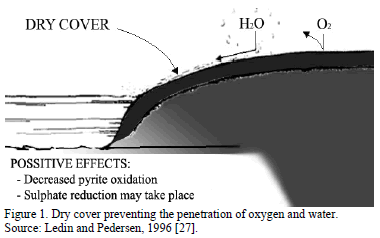
<body><![CDATA[<br>   </font><font size="2" face="Verdana, Arial, Helvetica, sans-serif">Compaction of the mining wastes decreases their   permeability. This compaction achieves on the one hand the reduction of water   flow, which remains longer in the tailings, hindering the oxidation of the   materials and therefore the rate of acid production, and on the other, the   decrease of oxygen diffusion, which slows down pyrite oxidation and makes the   tailings less habitable for ferro-oxidant bacteria.</font></p>     <p><font size="2" face="Verdana, Arial, Helvetica, sans-serif">A decrease of the porosity means a decrease of both the   hydraulic conductivity and oxygen diffusion. Thus, the oxygen diffusion   decreases by 3 to 4 orders of magnitude when the degree of saturation, i.e.   water content, reaches 85% &#91;25&#93;.</font></p>     <p><font size="2" face="Verdana, Arial, Helvetica, sans-serif">Although this is not itself a restoration method, it works   effectively with any other put in practice.</font></p>     <p><font size="2" face="Verdana, Arial, Helvetica, sans-serif"><b>2.1.3.  Dry covers</b>    <br>   </font><font size="2" face="Verdana, Arial, Helvetica, sans-serif">The application of dry covers can be done with the aim at   different objectives: (1) mining waste stabilization to prevent erosion by wind   and water, (2) aesthetic appearance improvement and (3) both prevention and inhibition   of pollutant release. The latter can be achieved with methods that prevent   waste penetration by oxygen and water (<a href="#fig01">Fig. 1</a>). Without oxygen, chemical and   microbial oxidation of sulfide minerals decreases. A minimized water flow   causes a reduction in the drainage water production so that the metals are   spread very slowly, resulting in a &quot;dilution with time&quot; &#91;26&#93;.</font></p>     <p align="center"><font size="2" face="Verdana, Arial, Helvetica, sans-serif"><a name="fig01"></a></font><img src="/img/revistas/dyna/v81n186/v81n186a09fig01.gif"></p>     <p><font size="2" face="Verdana, Arial, Helvetica, sans-serif">There are a multitude of cover designs that cover the   waste with soil or rock and use cementitious materials to form a crust. The   effectiveness of the method increases when choosing a high and dry location for   the dump.</font></p>     <p><font size="2" face="Verdana, Arial, Helvetica, sans-serif">The cover should be stable and provide long-term protection.   This generally requires at least two layers of different materials, as it is   rare that the required properties are found together in the same material.   First, a bottom sealing layer with low-permeability is required to decrease the   oxygen diffusion and to hold large amounts of water, acting as a barrier to   oxygen. Suitable materials for this layer are clays, especially bentonite.   However, these clay barriers are particularly prone to breaking during dry   conditions letting in oxygen and water. Organic materials may be a good   substitute to clay provided that the layer is </font></p>     <p><font size="2" face="Verdana, Arial, Helvetica, sans-serif">thick enough. Covers rich in   organic materials have been used to act as a radon barrier &#91;28&#93;. Some   artificial materials, as plastic membranes, have higher impenetrability than   natural materials. However, care must be taken to prevent membranes from   physical damage. There are also doubts about how long it will last before the   chemical and microbial degradation appears &#91;29&#93;. Above the low permeability   layer, a drainage layer can be placed to protect it from destruction by   erosion, drying, freezing, influence of man, animals and plants and microbial   destruction &#91;26&#93;. This drainage layer can also act to prevent the upward   capillary migration of metals and salts. Additionally to this physical cover,   there are chemical covers where materials that react with small-sized minerals   are added to form an impermeable crust. Furthermore, additional measures can be   taken to increase the reduction in the flow of oxygen as the addition of oxygen   consuming microorganisms or the compaction of the mining wastes &#91;30&#93;.</font></p>     <p><font size="2" face="Verdana, Arial, Helvetica, sans-serif">The typical sequence of operations starts with the   flattening and leveling of the site, creating a backup channel to prevent the   runoff effects on the dump. Later, the surface is compacted and the impermeable   material extended and compacted if necessary. Above this, a layer of permeable   material with at least 50 cm width is placed, and on top of it the soil is   extended to sow. The plants selection must be done taking into account the   potential threat that deep-rooted vegetation poses especially in the long term.</font></p>     ]]></body>
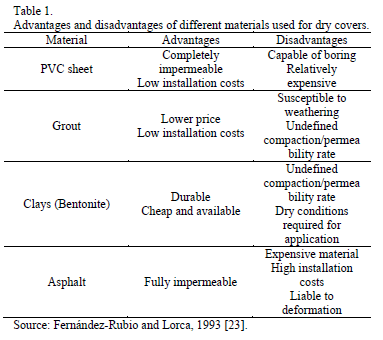
<body><![CDATA[<p><font size="2" face="Verdana, Arial, Helvetica, sans-serif"><a href="#tab01">Table 1</a> shows the materials that nowadays are used and   their advantages and disadvantages &#91;23&#93;.</font></p>     <p align="center"><font size="2" face="Verdana, Arial, Helvetica, sans-serif"><a name="tab01"></a></font><img src="/img/revistas/dyna/v81n186/v81n186a09tab01.gif"></p>     <p><font size="2" face="Verdana, Arial, Helvetica, sans-serif"><b>2.1.4.  Covers with   sludge</b>    <br>   </font><font size="2" face="Verdana, Arial, Helvetica, sans-serif">Sludge as a cover insulating material has been studied in   Sweden since 1989 &#91;31&#93;. In this study, the mud used to cover the residue from a   treatment plant in a nearby factory, was stabilized by the addition of fly ash   produced by the combustion of coal and wood from factories. As fly ash contains   calcium oxide, it can therefore increase the pH. Furthermore, a protective   layer composed of tree bark waste overlaps on the layers of sludge.</font></p>     <p><font size="2" face="Verdana, Arial, Helvetica, sans-serif">Other studies have highlighted the importance of sludge   use on roof tops or directly on the tailings to improve the establishment of   vegetation. Studies have been conducted in different lithology dumps and even   in areas devastated by toxic gases &#91;32&#93;. The use of sludge is often combined   with lime supplements to increase the pH &#91;33-34&#93;. In most cases, productivity   and fertility of the soil disturbed by mining have been substantially improved   by sludge applications and the yields are generally higher than when using   inorganic fertilizers. The use of sewage sludge to recover a coal mine spoil in   Colorado resulted in significant increases in biomass of the soil surface layer   &#91;35&#93;. This treatment gave better results than any other treatment with   inorganic fertilizers (nitrogen, phosphorus). Recovery of places using chemical   fertilizers and lime can produce the initial establishment of vegetation, but   later the vegetation cover deteriorates due to poor physical conditions &#91;4&#93;.</font></p>     <p><font size="2" face="Verdana, Arial, Helvetica, sans-serif">Covering with sludge improves some of the soil properties   which help the establishment of life on the ground. The most important factor   is the content of organic matter that improves the physical conditions of   landfills, as it is an energy source for soil microorganisms &#91;36&#93;. The sludge   contains nutrients and neutralizing components that increase the landfill pH   and improve its fertility. Sometimes, a considerable extra input of nitrogen   and phosphorus is required, but rarely potassium, while the need for additional   calcium, magnesium and sulfur changes with the sludge composition.</font></p>     <p><font size="2" face="Verdana, Arial, Helvetica, sans-serif">In brief, mine waste covers can decrease oxygen and water   penetration, and thus reduce the oxidation of sulfide minerals and/or the   transport of hazardous compounds. Inorganic covers can be combined with sludges   to improve sealing properties and soil physical conditions and to promote   vegetation cover, which is essential to prevent erosion and to improve the aesthetic   appearance of the area &#91;31&#93;.</font></p>     <p><font size="2" face="Verdana, Arial, Helvetica, sans-serif"><b>2.1.5.  Sealing   with clay    <br>   </b></font><font size="2" face="Verdana, Arial, Helvetica, sans-serif">Often, mining transfer acidity is produced through   groundwater discharge slopes. Then it is convenient to coat them with clay as   the mine hole is filled, thereby reducing the water input through the mining   wastes.</font></p>     <p><font size="2" face="Verdana, Arial, Helvetica, sans-serif">This is a very common phenomenon in abandoned mine pits where   an inland lake can be formed, if this circumstance were not taken into account.   This lake becomes an acidic water reservoir, therefore, it is also desirable to   seal the abandoned mine workings.</font></p>     ]]></body>
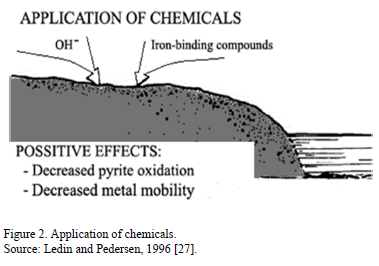
<body><![CDATA[<p><font size="2" face="Verdana, Arial, Helvetica, sans-serif"><b>2.1.6.  Handling   tailings    <br>   </b></font><font size="2" face="Verdana, Arial, Helvetica, sans-serif">Material stacking order in the dump has a fundamental   influence on the generated acidity, this being maximal when sulfides are   situated on the top and minimum if a layer of neutralizing materials, such as   carbonates, is placed on top above the pyrite &#91;19&#93;.</font></p>     <p><font size="2" face="Verdana, Arial, Helvetica, sans-serif">Sometimes there are some materials with a particularly   high potential to generate acidity within the tailings, so if they can be   stored in a waterproof trap, the amount of drained acidic water will be   considerably reduced. This is precisely the basis of this technique that, while   expensive mainly due to the large number of analyses to be performed prior to   the preparation of the waste, usually gives very good results &#91;23&#93;.</font></p>     <p><font size="2" face="Verdana, Arial, Helvetica, sans-serif">To properly isolate   the materials with higher acid generation rates, they should be located well   below the surface but always above the water table in the area. They must also   have a sufficiently compacted waterproof coverage (usually clay or plastic)   that must be umbrella shaped to prevent water from coming in contact with the   mining wastes.</font></p>     <p><font size="2" face="Verdana, Arial, Helvetica, sans-serif"><b>2.1.7.  Application   of chemicals</b>    <br>   Addition of chemicals that interact with the tailings   reduces the release of acid, iron and other heavy metals into the reservoir   since their solubility decreases as the pH increases (<a href="#fig02">Fig. 2</a>). There are some   accessible and inexpensive alkaline chemicals that can be added to the mining   wastes to neutralize the acid pH in the drainage. However, this method does not   always prevent the re-acidification after a few years &#91;26&#93;.</font></p>     <p align="center"><font size="2" face="Verdana, Arial, Helvetica, sans-serif"><a name="fig02"></a></font><img src="/img/revistas/dyna/v81n186/v81n186a09fig02.gif"></p>     <p><font size="2" face="Verdana, Arial, Helvetica, sans-serif">Placing a lime layer   near the surface allows achieving an alkaline environment which inhibits   bacteria proliferation and that neutralizes partly the generated acid. Because   of this and its low cost, it has become a common practice in almost all   restorations of tailings potentially generating acidic waters.</font></p>     <p><font size="2" face="Verdana, Arial, Helvetica, sans-serif">Several studies and   case studies have concluded that this is an effective method to prevent acidic   water in non-established systems, i.e., those that have not yet generated   acidic water, while in established systems the improvement is temporary and   insignificant, so another restitution method must be found. This phenomenon is   due to the low neutralizing power of the lime as it is interrupted, in the case   of very acidic water, once a layer of iron hydroxide that inhibits   neutralization is deposited on its surface &#91;1&#93;. Frequently, requirements are   both very large amounts of lime that can cause an imbalance in Ca/Mg ratio, and   phosphate availability, with the consequent impairment of plant growth in the   area. Liming is often used in combination with other methods, like another covering   method.</font></p>     <p><font size="2" face="Verdana, Arial, Helvetica, sans-serif">Due to the key role played by iron in leaching, some   chemical treatments seek to interfere with the chemistry of </font></p>     ]]></body>
<body><![CDATA[<p><font size="2" face="Verdana, Arial, Helvetica, sans-serif">iron   in the dump. The removal of iron from solution by precipitation is achieved by   applying neutral ores or siliceous materials such as fly ash, blast furnace   slag and Portland cement or by the complexation of iron either in active or   reactive form, which inhibits oxidation. (Fe<sub>3</sub>(PO<sub>4</sub>)<sub>2 </sub>and   FePO<sub>4</sub>) which diminish the amount of ferric iron that can react with   pyrite. Subsequent laboratory </font></p>     <p><font size="2" face="Verdana, Arial, Helvetica, sans-serif">Furthermore,   phosphate and phosphate clay inhibit pyrite oxidation by creating a cover   around sulfuric mineral grains. The actuation mechanism goes through the   formation of relatively insoluble iron phosphates studies showed that the   addition of crushed apatite (Ca<sub>5</sub>(OH, F)(PO<sub>4</sub>)<sub>3</sub>)   reduced the production of acidic water by 96% at doses below 3 ppt &#91;44&#93;. A   field experiment subsequently performed by the same authors indicated that the   addition of a 3 ppt amount of phosphate slowed the acid production from materials   such as coal and slate for around a year from when they were added, but this   inhibitory effect seemed to decrease in the second year &#91;38&#93;.</font></p>     <p><font size="2" face="Verdana, Arial, Helvetica, sans-serif">Meanwhile, organic material is a suitable pH buffer   that can eliminate iron chelation. A specific technique is called alkaline   injection. In any mine dump, AMD flows through specific areas. If they can be   neutralized by injecting some bases such as soda, lime or sodium carbonate   where the waters circulate, then more restoration work on the surface of the   waste can be avoided, while reducing costs &#91;1&#93;. Among others, the injection   advantages would be the pH increase, which leads some metals to precipitate   over the pyrite inside the mine tailings, stopping the pyrite oxidation, and   the alkalization of the medium, which inhibits oxidizing bacteria and thus   contributes to the improvement of water quality. Moreover, as a temporary   technique it can be very suitable for abandoned tailings.</font></p>     <p><font size="2" face="Verdana, Arial, Helvetica, sans-serif"><b><i>2.2  Corrective techniques for acid mine drainage    <br>   </i></b></font><font size="2" face="Verdana, Arial, Helvetica, sans-serif">These are techniques   that can be used to purify the acidic waters produced by a mine. They are   conceptually opposed to the preventive techniques whose main objective is to   avoid the formation of those acid waters. Corrective techniques are applied   without distinction to underground or surface mines.</font></p>     <p><font size="2" face="Verdana, Arial, Helvetica, sans-serif">Many developed countries have recently enacted the   adoption of some type of environmental legislation, which has led mining to   install treatment plants for their effluents. This creates serious problems for   the operating companies, but they often become critical when planning mine   abandonment. In countries with the most restrictive laws, mining operators face   the dilemma of implementing effective preventive measures or being forced to   pay the effluent's treatment for years, after the mine is abandoned.</font></p>     <p><font size="2" face="Verdana, Arial, Helvetica, sans-serif">The most prevalent   method for treating AMD contamination is the addition of alkaline reagents such   as lime, limestone, sodium carbonate or sodium hydroxide. This treatment aims   at neutralizing acidic water and the precipitation of heavy metals. However,   maintenance requirements are high and large sludge amounts are produced that   are mainly composed of calcium sulfate and some metal hydroxides. In an   oxidizing environment, limestone is coated with reaction products until it   becomes ineffective. This </font><font size="2" face="Verdana, Arial, Helvetica, sans-serif">problem is solved by   using passive anoxic limestone drains (ALDs) &#91;39&#93;, which consist of shallow   sealed trenches excavated in the spoil and filled with limestone.</font></p>     <p><font size="2" face="Verdana, Arial, Helvetica, sans-serif">The most used techniques will be described in the next   sections.</font></p>     <p><font size="2" face="Verdana, Arial, Helvetica, sans-serif"><b>2.2.1.  Chemical   neutralization plants</b>    <br>   </font><font size="2" face="Verdana, Arial, Helvetica, sans-serif">In these plants, the water recovery takes place in three   phases: neutralization, oxidation and precipitation, as    follows &#91;1&#93;:</font></p> <ul>       ]]></body>
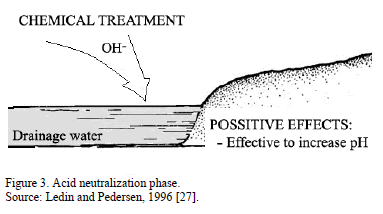
<body><![CDATA[<li><font size="2" face="Verdana, Arial, Helvetica, sans-serif">Acid neutralization with lime, (Eq. 4) limestone (Eq. 5)     or other bases:</font></li>     </ul>     <blockquote>       <p><img src="/img/revistas/dyna/v81n186/v81n186a09eq0405.gif"></p> </blockquote> <ul>       <li><font size="2" face="Verdana, Arial, Helvetica, sans-serif">Oxidation from ferrous to ferric in aeration tanks     (Eq. 6, 7), the latter being easier to precipitate:</font></li>     </ul>     <blockquote>       <p><img src="/img/revistas/dyna/v81n186/v81n186a09eq0607.gif"></p> </blockquote> <ul>       <li><font size="2" face="Verdana, Arial, Helvetica, sans-serif">Precipitation (<a href="#fig03">Fig. 3</a>).</font></li>     </ul>     ]]></body>
<body><![CDATA[<p align="center"><font size="2" face="Verdana, Arial, Helvetica, sans-serif"><a name="fig03"></a></font><img src="/img/revistas/dyna/v81n186/v81n186a09fig03.gif"></p>     <p><font size="2" face="Verdana, Arial, Helvetica, sans-serif"><b>2.2.2.  &quot;In-line   system&quot; plants</b>    <br>   </font><font size="2" face="Verdana, Arial, Helvetica, sans-serif">They are based on a simple and low maintenance method that   simultaneously neutralizes and aerates the water, using the energy of water   impulsed by two parallel injection pumps and a static mixer &#91;40&#93;.</font></p>     <p><font size="2" face="Verdana, Arial, Helvetica, sans-serif">Injection pumps suck in   air while collecting the mine acid waters, causing water aeration. After   leaving the pump, the water goes to a static mixer consisting of a series of   propylene resin tubes where liquid is kept in a turbulent regime by using a   propeller that promote mixing and reactivity. </font></p>     <p><font size="2" face="Verdana, Arial, Helvetica, sans-serif">In-line system plants have been successfully tested to   treat effluents with an input content of 200 mgl<sup>-1</sup> Fe<sup>+2</sup>,   which were reduced to an output concentration of around 3 mgl<sup>-1</sup>. At   an industry level, in-line system plants are cheaper than conventional ones,   and as they have no moving parts, their maintenance is simpler and more   economical &#91;41&#93;.</font></p>     <p><font size="2" face="Verdana, Arial, Helvetica, sans-serif"><b>2.2.3.  Treatment   plants by ion exchange    <br>   </b></font><font size="2" face="Verdana, Arial, Helvetica, sans-serif">This technology is based on the property of certain   substances to make reversible ion exchanges within saturated solutions. These   substances may be different in nature, synthetic resins with high molecular   weight being the most commonly used.</font></p>     <p><font size="2" face="Verdana, Arial, Helvetica, sans-serif">This method is applicable to the acid mine drainage   treatment with metal ions according to the reaction expressed in Eq. 8 &#91;23&#93;:</font></p>     <p><img src="/img/revistas/dyna/v81n186/v81n186a09eq08.gif"></p>     <p><font size="2" face="Verdana, Arial, Helvetica, sans-serif">Subsequently, the resin is regenerated using alkaline   solutions and then it is reused.</font></p>     ]]></body>
<body><![CDATA[<p><font size="2" face="Verdana, Arial, Helvetica, sans-serif">Among the main advantages of this method are, according to   Fern&aacute;ndez-Rubio and Lorca, the sludge susceptibility to be dried, the low   hardness and amount of the dissolved solids in the final effluents and the low   lime consumption &#91;23&#93;. The greatest disadvantages are the handling difficulty   and toxicity of the sludge obtained.</font></p>     <p><font size="2" face="Verdana, Arial, Helvetica, sans-serif">Nowadays there are several systems to perform this   technique such as: the continuous upward washing system in multi-chamber   adsorption columns, the continuous descending washing system in mobile packed   bed adsorption columns, upward washing in open tank adsorption columns, etc. &#91;42&#93;.</font></p>     <p><font size="2" face="Verdana, Arial, Helvetica, sans-serif">Further studies have been conducted where separation   techniques were designed for copper and zinc in the Iberian pyritic belt. These   studies showed the possibility to apply resins with carboxyl groups for the   selective separation of both metals &#91;43&#93;.</font></p>     <p><font size="2" face="Verdana, Arial, Helvetica, sans-serif"><b>2.2.4.  Neutralization   plants by reverse osmosis    <br>   </b></font><font size="2" face="Verdana, Arial, Helvetica, sans-serif">This technique employs   semipermeable membranes that allow the passage of water while retaining   dissolved or suspended particles. The typical membranes, spongy and porous,   have a 100 microns thickness, are made of modified cellulose acetate with one   side covered with a dense layer &#91;23&#93;.</font></p>     <p><font size="2" face="Verdana, Arial, Helvetica, sans-serif">One of the most important consequences of the experiments   performed so far is the ease with which the membranes become obstructed,   however, this is easy to fix by using sodium thiosulfate.</font></p>     <p><font size="2" face="Verdana, Arial, Helvetica, sans-serif">Although recoveries of up to 80% are obtained, this is an   expensive method.</font></p>     <p><font size="2" face="Verdana, Arial, Helvetica, sans-serif"><b>2.2.5. Natural neutralization with river waters.   &quot;Synergistic&quot; solutions</b>    <br>   </font><font size="2" face="Verdana, Arial, Helvetica, sans-serif">Synergistic solutions are very attractive and low cost   methods to easily neutralize acidic waters. The entire development that will be   exposed below is based on a description of the particular case of the   &quot;Dober Mine&quot; using the &quot;Iron&quot; river waters in Michigan   (USA), summarized and generalized by Fern&aacute;ndez-Rubio and Lorca &#91;23&#93;.</font></p>     <p><font size="2" face="Verdana, Arial, Helvetica, sans-serif">The method uses the neutralizing capacity of a river, so   that if the river flow is much larger than the strictly necessary to neutralize   the mining acid drainage of the area, a portion of the flow can be diverted   into a branch constituted by a set of ponds arranged in series to occur the   precipitation of the metals and the subsequent neutralization of the water in a   controlled manner.</font></p>     ]]></body>
<body><![CDATA[<p><font size="2" face="Verdana, Arial, Helvetica, sans-serif">The process then consists in driving the acidic water   coming from the mine to a circuit of staggered settling ponds, through which   water circulates by gravity. In these ponds, if the flow is slow enough, the   iron sulfate will precipitate and a slow increase of the water pH will   gradually take place. The system is designed so that water is clean and   properly neutral in the pond before its discharge to the river (located   downstream of the inlet), so that the riverbed will remain untainted in its   entire course.</font></p>     <p><font size="2" face="Verdana, Arial, Helvetica, sans-serif">This is not a universally applicable technique, being this   perhaps its most important limitation, as there are many drawbacks that prevent   its application in many cases. The necessary conditions for the application of   this method are:</font></p> <ul>       <li><font size="2" face="Verdana, Arial, Helvetica, sans-serif">River flow     must be large enough to withstand the diversion of a portion of it in order to     neutralize the acid drainage.</font></li>       <li><font size="2" face="Verdana, Arial, Helvetica, sans-serif">Materials     and slope of the terrain must be appropriate for the construction of the     settling basins.</font></li>       <li><font size="2" face="Verdana, Arial, Helvetica, sans-serif">Ponds     should be designed so that there is no imbalance depending of maximum and     minimum periods of precipitation and/or temperature, since the first of them     definitely influences on the flow, and low temperatures make neutralization     less effective.</font></li>       <li><font size="2" face="Verdana, Arial, Helvetica, sans-serif">Another     constraint is the size of the mine to deposit the deposed metal hydroxides,     which should be removed from the ponds periodically so that the system remains     effective.</font></li>     </ul>     <p><font size="2" face="Verdana, Arial, Helvetica, sans-serif">In any case, the conclusions to be drawn are not for a   particular case but they depend on the specific problem that occurs. Therefore,   the natural neutralizing action of river waters can help and even resolve the   problem of the acidic water if the control of some key parameters is achieved   and the initial conditions are adequate.</font></p>     <p>&nbsp;</p>     <p><font size="3" face="Verdana, Arial, Helvetica, sans-serif"><b>3.  Conclusions</b></font></p> <ol>       ]]></body>
<body><![CDATA[<li><font size="2" face="Verdana, Arial, Helvetica, sans-serif">Acid mine drainage (AMD) greatly influences water     quality and has high environmental and ecological impacts. It is therefore     required to solve this worldwide problem at the earliest opportunity. </font></li>       <li><font size="2" face="Verdana, Arial, Helvetica, sans-serif"> There are several preventive techniques to avoid the     generation of AMD, each of them effective for a different situation. Among     them, dry covers and covers with sludge are the more general ones, applicable     to most situations.</font></li>       <li><font size="2" face="Verdana, Arial, Helvetica, sans-serif">Although it would be perfect to prevent the generation     of AMD, many times it is not completely possible, requiring corrective     techniques to reduce or remove contamination from water. In this case, &quot;in-line     systems&quot; plants are the most effective solution, both in economic and recovery     percentage aspects, in contrast with highly effective but expensive techniques     such as treatment plants by ion exchange of by reverse osmosis. </font></li>     </ol>     <p>&nbsp;</p>     <p><font size="3" face="Verdana, Arial, Helvetica, sans-serif"><b>Acknowledgments</b></font></p>     <p><font size="2" face="Verdana, Arial, Helvetica, sans-serif">The authors want to give thanks to the Spanish Ministries   of Economy and Competitiveness, Education, Culture and Sport and University of   Vigo for the financial support given; Human Resources programs (BES-2010-034106   and FPU AP2009-1144) and project BIA2009-08012. </font></p>     <p>&nbsp;</p>     <p><font size="3" face="Verdana, Arial, Helvetica, sans-serif"><b>References</b></font></p>     <!-- ref --><p> <font size="2" face="Verdana, Arial, Helvetica, sans-serif"><b>&#91;1&#93;</b> Kalin, M., Fyson, A. and Wheeler, W.N. The chemistry of conventional and alternative systems for the neutralization of acid mine drainage. The Science of the Total Environment, 366 (2-3), pp.395-408, 2006.    &nbsp;&nbsp;&nbsp;&nbsp;&nbsp;&nbsp;&nbsp;&nbsp;[&#160;<a href="javascript:void(0);" onclick="javascript: window.open('/scielo.php?script=sci_nlinks&ref=000152&pid=S0012-7353201400040000900001&lng=','','width=640,height=500,resizable=yes,scrollbars=1,menubar=yes,');">Links</a>&#160;]<!-- end-ref --></font></p>     <!-- ref --><p> <font size="2" face="Verdana, Arial, Helvetica, sans-serif"><b>&#91;2&#93;</b> Klapper, H. and Geller, W., Water quality management of mining lakes- a new field of applied hydrobiology. Acta Hydroch. Hydrob, 29, pp. 363-374, 2002.    &nbsp;&nbsp;&nbsp;&nbsp;&nbsp;&nbsp;&nbsp;&nbsp;[&#160;<a href="javascript:void(0);" onclick="javascript: window.open('/scielo.php?script=sci_nlinks&ref=000154&pid=S0012-7353201400040000900002&lng=','','width=640,height=500,resizable=yes,scrollbars=1,menubar=yes,');">Links</a>&#160;]<!-- end-ref --></font></p>     <!-- ref --><p> <font size="2" face="Verdana, Arial, Helvetica, sans-serif"><b>&#91;3&#93;</b> Doup&eacute;, R.G. and Lymbery, A.J., Environmental risks associated with beneficial end uses of mine lakes in southwestern Australia. Mine Water and the Environment, 24 (3), pp. 134-138, 2005.    &nbsp;&nbsp;&nbsp;&nbsp;&nbsp;&nbsp;&nbsp;&nbsp;[&#160;<a href="javascript:void(0);" onclick="javascript: window.open('/scielo.php?script=sci_nlinks&ref=000156&pid=S0012-7353201400040000900003&lng=','','width=640,height=500,resizable=yes,scrollbars=1,menubar=yes,');">Links</a>&#160;]<!-- end-ref --></font></p>     <!-- ref --><p> <font size="2" face="Verdana, Arial, Helvetica, sans-serif"><b>&#91;4&#93;</b> McCullough, C.D. and Lund, M.A., Opportunities for sustainable mining pit lakes in Australia. Mine Water Environ, 25, pp. 220-226, 2006.    &nbsp;&nbsp;&nbsp;&nbsp;&nbsp;&nbsp;&nbsp;&nbsp;[&#160;<a href="javascript:void(0);" onclick="javascript: window.open('/scielo.php?script=sci_nlinks&ref=000158&pid=S0012-7353201400040000900004&lng=','','width=640,height=500,resizable=yes,scrollbars=1,menubar=yes,');">Links</a>&#160;]<!-- end-ref --></font></p>     <!-- ref --><p> <font size="2" face="Verdana, Arial, Helvetica, sans-serif"><b>&#91;5&#93;</b> McDonald, D.M., Webb, J.A. and Taylor, J., Chemical stability of acid rock drainage treatment sludge and implications for sludge management. Environ. Sci. Technol. 40 (6), pp. 1984-1990, 2006.    &nbsp;&nbsp;&nbsp;&nbsp;&nbsp;&nbsp;&nbsp;&nbsp;[&#160;<a href="javascript:void(0);" onclick="javascript: window.open('/scielo.php?script=sci_nlinks&ref=000160&pid=S0012-7353201400040000900005&lng=','','width=640,height=500,resizable=yes,scrollbars=1,menubar=yes,');">Links</a>&#160;]<!-- end-ref --></font></p>     <!-- ref --><p> <font size="2" face="Verdana, Arial, Helvetica, sans-serif"><b>&#91;6&#93;</b> Saarinen, T., Mohämmadighävam, S., Marttila, H. and Klove, B., Impact of peatland forestry on runnof water quality in areas with sulphide- bering sediments: How to prevent acid surges. Forest Ecology and Management, 293, pp. 17-28, 2013.    &nbsp;&nbsp;&nbsp;&nbsp;&nbsp;&nbsp;&nbsp;&nbsp;[&#160;<a href="javascript:void(0);" onclick="javascript: window.open('/scielo.php?script=sci_nlinks&ref=000162&pid=S0012-7353201400040000900006&lng=','','width=640,height=500,resizable=yes,scrollbars=1,menubar=yes,');">Links</a>&#160;]<!-- end-ref --></font></p>     <!-- ref --><p> <font size="2" face="Verdana, Arial, Helvetica, sans-serif"><b>&#91;7&#93;</b> Cruz, R. and Monroy, M., Evaluation of the reactivity of iron sulfides and mining wastes. A methodology based on the application of cyclic voltammetry. Quim. Nova, 29 (3), pp.510-519, 2006.    &nbsp;&nbsp;&nbsp;&nbsp;&nbsp;&nbsp;&nbsp;&nbsp;[&#160;<a href="javascript:void(0);" onclick="javascript: window.open('/scielo.php?script=sci_nlinks&ref=000164&pid=S0012-7353201400040000900007&lng=','','width=640,height=500,resizable=yes,scrollbars=1,menubar=yes,');">Links</a>&#160;]<!-- end-ref --></font></p>     <!-- ref --><p> <font size="2" face="Verdana, Arial, Helvetica, sans-serif"><b>&#91;8&#93;</b> Monterroso, C. and Mac&iacute;as, F., Drainage waters affected by pyrite oxidation in a coal mine in Galicia (NW Spain): Composition and mineral stability. Science of the Total Environment, 216 (1), pp.121-132, 1998.    &nbsp;&nbsp;&nbsp;&nbsp;&nbsp;&nbsp;&nbsp;&nbsp;[&#160;<a href="javascript:void(0);" onclick="javascript: window.open('/scielo.php?script=sci_nlinks&ref=000166&pid=S0012-7353201400040000900008&lng=','','width=640,height=500,resizable=yes,scrollbars=1,menubar=yes,');">Links</a>&#160;]<!-- end-ref --></font></p>     <!-- ref --><p> <font size="2" face="Verdana, Arial, Helvetica, sans-serif"><b>&#91;9&#93;</b> Younger, P.L., Coulton, R.H. and Froggatt, E.C., The contribution of science to risk-based decision-making: lessons from the development of full-scale treatment measures for acid mine waters at Wheal Jane, UK. Science of the Total Environment, 338, pp.137-154, 2005.    &nbsp;&nbsp;&nbsp;&nbsp;&nbsp;&nbsp;&nbsp;&nbsp;[&#160;<a href="javascript:void(0);" onclick="javascript: window.open('/scielo.php?script=sci_nlinks&ref=000168&pid=S0012-7353201400040000900009&lng=','','width=640,height=500,resizable=yes,scrollbars=1,menubar=yes,');">Links</a>&#160;]<!-- end-ref --></font></p>     <!-- ref --><p> <font size="2" face="Verdana, Arial, Helvetica, sans-serif"><b>&#91;10&#93;</b> Johnson, D.B. and Hallberg, K.B., Acid mine drainage remediation options: a review. Science of the Total Environment, 338 (1-2), pp. 3-14, 2005.    &nbsp;&nbsp;&nbsp;&nbsp;&nbsp;&nbsp;&nbsp;&nbsp;[&#160;<a href="javascript:void(0);" onclick="javascript: window.open('/scielo.php?script=sci_nlinks&ref=000170&pid=S0012-7353201400040000900010&lng=','','width=640,height=500,resizable=yes,scrollbars=1,menubar=yes,');">Links</a>&#160;]<!-- end-ref --></font></p>     <!-- ref --><p> <font size="2" face="Verdana, Arial, Helvetica, sans-serif"><b>&#91;11&#93;</b> Nordstrom, D.K., Mine waters: Acidic to circumneutral. Elements, 7 (6), pp. 393-398, 2011.    &nbsp;&nbsp;&nbsp;&nbsp;&nbsp;&nbsp;&nbsp;&nbsp;[&#160;<a href="javascript:void(0);" onclick="javascript: window.open('/scielo.php?script=sci_nlinks&ref=000172&pid=S0012-7353201400040000900011&lng=','','width=640,height=500,resizable=yes,scrollbars=1,menubar=yes,');">Links</a>&#160;]<!-- end-ref --></font></p>     <!-- ref --><p> <font size="2" face="Verdana, Arial, Helvetica, sans-serif"><b>&#91;12&#93;</b> Stumm, W. and Morgan, J.J., Aquatic chemistry: An introduction emphasizing chemical equilibria in natural waters. NY, Wiley-Interscience; 1981.    &nbsp;&nbsp;&nbsp;&nbsp;&nbsp;&nbsp;&nbsp;&nbsp;[&#160;<a href="javascript:void(0);" onclick="javascript: window.open('/scielo.php?script=sci_nlinks&ref=000174&pid=S0012-7353201400040000900012&lng=','','width=640,height=500,resizable=yes,scrollbars=1,menubar=yes,');">Links</a>&#160;]<!-- end-ref --></font></p>     <!-- ref --><p> <font size="2" face="Verdana, Arial, Helvetica, sans-serif"><b>&#91;13&#93;</b> Urrutia, M., Gra&ntilde;a, J., Garc&iacute;a-Rodeja, E. and Mac&iacute;as, F., Pyrite oxidation processes in surface systems: Acidifying potential and its interest in minesoils reclamation). Caderno do Laboratorio Xeol&oacute;xico de Laxe, 1987.    &nbsp;&nbsp;&nbsp;&nbsp;&nbsp;&nbsp;&nbsp;&nbsp;[&#160;<a href="javascript:void(0);" onclick="javascript: window.open('/scielo.php?script=sci_nlinks&ref=000176&pid=S0012-7353201400040000900013&lng=','','width=640,height=500,resizable=yes,scrollbars=1,menubar=yes,');">Links</a>&#160;]<!-- end-ref --></font></p>     <!-- ref --><p> <font size="2" face="Verdana, Arial, Helvetica, sans-serif"><b>&#91;14&#93;</b> S&aacute;ez-Navarrete, C., Rodr&iacute;guez-C&oacute;rdova, L., Baraza, X., Gelmi, C. and Herrera, L., Hydrogen kinetics limitation of an autotrophic sulphate reduction reactor, DYNA, 172, pp. 126-132, 2012.    &nbsp;&nbsp;&nbsp;&nbsp;&nbsp;&nbsp;&nbsp;&nbsp;[&#160;<a href="javascript:void(0);" onclick="javascript: window.open('/scielo.php?script=sci_nlinks&ref=000178&pid=S0012-7353201400040000900014&lng=','','width=640,height=500,resizable=yes,scrollbars=1,menubar=yes,');">Links</a>&#160;]<!-- end-ref --></font></p>     <!-- ref --><p> <font size="2" face="Verdana, Arial, Helvetica, sans-serif"><b>&#91;15&#93;</b> Bornstein, J., Hedstrom, W.E and Scott, F.R., Oxygen diffusion rate relationships under three soil conditions. Life Sciences and agriculture experiment station technical bulletin 98. 1980</font>&nbsp;&nbsp;&nbsp;&nbsp;&nbsp;&nbsp;&nbsp;&nbsp;[&#160;<a href="javascript:void(0);" onclick="javascript: window.open('/scielo.php?script=sci_nlinks&ref=000180&pid=S0012-7353201400040000900015&lng=','','width=640,height=500,resizable=yes,scrollbars=1,menubar=yes,');">Links</a>&#160;]<!-- end-ref --><!-- ref --><p> <font size="2" face="Verdana, Arial, Helvetica, sans-serif"><b>&#91;16&#93;</b> Wiegand, U., Schreck, P., Schreiter, P., Lerche, I. and Glaesser, W., Restoration of open pit lignite mining in the former GDR: Lessons to be learnt from Zwenkau. Energy and Environment, 14 (4), pp.437-449, 2003.    &nbsp;&nbsp;&nbsp;&nbsp;&nbsp;&nbsp;&nbsp;&nbsp;[&#160;<a href="javascript:void(0);" onclick="javascript: window.open('/scielo.php?script=sci_nlinks&ref=000181&pid=S0012-7353201400040000900016&lng=','','width=640,height=500,resizable=yes,scrollbars=1,menubar=yes,');">Links</a>&#160;]<!-- end-ref --></font></p>     ]]></body>
<body><![CDATA[<!-- ref --><p> <font size="2" face="Verdana, Arial, Helvetica, sans-serif"><b>&#91;17&#93;</b> Nancucheo, I. and Johnson, D.B., Selective removal of transition metals from acidic mine waters by novel consortia of acidophilic sulfidogenic bacteria. Microbial Biotechnology, 5 (1), pp.34-44, 2012.    &nbsp;&nbsp;&nbsp;&nbsp;&nbsp;&nbsp;&nbsp;&nbsp;[&#160;<a href="javascript:void(0);" onclick="javascript: window.open('/scielo.php?script=sci_nlinks&ref=000183&pid=S0012-7353201400040000900017&lng=','','width=640,height=500,resizable=yes,scrollbars=1,menubar=yes,');">Links</a>&#160;]<!-- end-ref --></font></p>     <!-- ref --><p> <font size="2" face="Verdana, Arial, Helvetica, sans-serif"><b>&#91;18&#93;</b> Umrania, V.V., Role of acidothermophilic autrotrophs in bioleaching of mineral sulphides ores. Indian Journal of Biotechnology, 2 (3), pp. 451-464, 2003.    &nbsp;&nbsp;&nbsp;&nbsp;&nbsp;&nbsp;&nbsp;&nbsp;[&#160;<a href="javascript:void(0);" onclick="javascript: window.open('/scielo.php?script=sci_nlinks&ref=000185&pid=S0012-7353201400040000900018&lng=','','width=640,height=500,resizable=yes,scrollbars=1,menubar=yes,');">Links</a>&#160;]<!-- end-ref --></font></p>     <!-- ref --><p> <font size="2" face="Verdana, Arial, Helvetica, sans-serif"><b>&#91;19&#93;</b> Kontopoulos, A., Acid Mine Drainage Control. In: Castro, S.H., Vergara, F., S&aacute;nchez, M.A. (Eds.), Effluent treatment in the mining industry. University of Concepci&oacute;n, 1998, pp. 57-118.    &nbsp;&nbsp;&nbsp;&nbsp;&nbsp;&nbsp;&nbsp;&nbsp;[&#160;<a href="javascript:void(0);" onclick="javascript: window.open('/scielo.php?script=sci_nlinks&ref=000187&pid=S0012-7353201400040000900019&lng=','','width=640,height=500,resizable=yes,scrollbars=1,menubar=yes,');">Links</a>&#160;]<!-- end-ref --></font></p>     <!-- ref --><p> <font size="2" face="Verdana, Arial, Helvetica, sans-serif"><b>&#91;20&#93;</b> Silva, L.F.O., Fdez-Ortiz de Vallejuelo, S., Mart&iacute;nez-Arkarazo, I., Castro, K., (...), Madariaga, J.M. Study of environmental pollution and mineralogical characterization of sediment rivers from Brazilian coal mining acid drainage. Science of the Total Environment, 447, pp.169-178, 2013.    &nbsp;&nbsp;&nbsp;&nbsp;&nbsp;&nbsp;&nbsp;&nbsp;[&#160;<a href="javascript:void(0);" onclick="javascript: window.open('/scielo.php?script=sci_nlinks&ref=000189&pid=S0012-7353201400040000900020&lng=','','width=640,height=500,resizable=yes,scrollbars=1,menubar=yes,');">Links</a>&#160;]<!-- end-ref --></font></p>     <!-- ref --><p> <font size="2" face="Verdana, Arial, Helvetica, sans-serif"><b>&#91;21&#93;</b> Millero, F.J. and Pierrot, D., A chemical equilibrium model for natural waters. Aquatic Geochemistry, 4 (1), pp.153-199, 1998.    &nbsp;&nbsp;&nbsp;&nbsp;&nbsp;&nbsp;&nbsp;&nbsp;[&#160;<a href="javascript:void(0);" onclick="javascript: window.open('/scielo.php?script=sci_nlinks&ref=000191&pid=S0012-7353201400040000900021&lng=','','width=640,height=500,resizable=yes,scrollbars=1,menubar=yes,');">Links</a>&#160;]<!-- end-ref --></font></p>     ]]></body>
<body><![CDATA[<!-- ref --><p> <font size="2" face="Verdana, Arial, Helvetica, sans-serif"><b>&#91;22&#93;</b> Christov, C. and Moller, N., A chemical equilibrium model of solution behavior and solubility in the H-Na-K-Ca-OH-Cl-HSO4-SO4-H2O system to high concentration and temperature. Geochimica et Cosmochimica Acta, 68 (18), pp.3717-3739, 2004.    &nbsp;&nbsp;&nbsp;&nbsp;&nbsp;&nbsp;&nbsp;&nbsp;[&#160;<a href="javascript:void(0);" onclick="javascript: window.open('/scielo.php?script=sci_nlinks&ref=000193&pid=S0012-7353201400040000900022&lng=','','width=640,height=500,resizable=yes,scrollbars=1,menubar=yes,');">Links</a>&#160;]<!-- end-ref --> </font></p>     <!-- ref --><p> <font size="2" face="Verdana, Arial, Helvetica, sans-serif"><b>&#91;23&#93;</b> Fern&aacute;ndez-Rubio, R. and Lorca, D.F., Mine water drainage. Mine Water and the Environment, 12, pp.107-130, 1993.    &nbsp;&nbsp;&nbsp;&nbsp;&nbsp;&nbsp;&nbsp;&nbsp;[&#160;<a href="javascript:void(0);" onclick="javascript: window.open('/scielo.php?script=sci_nlinks&ref=000195&pid=S0012-7353201400040000900023&lng=','','width=640,height=500,resizable=yes,scrollbars=1,menubar=yes,');">Links</a>&#160;]<!-- end-ref --></font></p>     <!-- ref --><p> <font size="2" face="Verdana, Arial, Helvetica, sans-serif"><b>&#91;24&#93;</b> Grande, J.A., Impact of AMD processes on the public water supply: Hydrochemical variations and application of a classification model to a river in the Iberian Pyritic Belt, SW Spain. Hydrology Research, 42 (6), pp.472-478, 2011.    &nbsp;&nbsp;&nbsp;&nbsp;&nbsp;&nbsp;&nbsp;&nbsp;[&#160;<a href="javascript:void(0);" onclick="javascript: window.open('/scielo.php?script=sci_nlinks&ref=000197&pid=S0012-7353201400040000900024&lng=','','width=640,height=500,resizable=yes,scrollbars=1,menubar=yes,');">Links</a>&#160;]<!-- end-ref --></font></p>     <!-- ref --><p> <font size="2" face="Verdana, Arial, Helvetica, sans-serif"><b>&#91;25&#93;</b> Molson, J.W., Fala, O., Aubertin, M. and Bussière, B., Numerical simulations of pyrite oxidation and acid mine drainage in unsaturated waste rock piles. Journal of Contaminant Hydrology, 78 (4), pp.343-371, 2005.    &nbsp;&nbsp;&nbsp;&nbsp;&nbsp;&nbsp;&nbsp;&nbsp;[&#160;<a href="javascript:void(0);" onclick="javascript: window.open('/scielo.php?script=sci_nlinks&ref=000199&pid=S0012-7353201400040000900025&lng=','','width=640,height=500,resizable=yes,scrollbars=1,menubar=yes,');">Links</a>&#160;]<!-- end-ref --></font></p>     <!-- ref --><p> <font size="2" face="Verdana, Arial, Helvetica, sans-serif"><b>&#91;26&#93;</b> Swedish Environmental Protection Agency, SNV PM 4202, Solna, Sweden, 1993.    &nbsp;&nbsp;&nbsp;&nbsp;&nbsp;&nbsp;&nbsp;&nbsp;[&#160;<a href="javascript:void(0);" onclick="javascript: window.open('/scielo.php?script=sci_nlinks&ref=000201&pid=S0012-7353201400040000900026&lng=','','width=640,height=500,resizable=yes,scrollbars=1,menubar=yes,');">Links</a>&#160;]<!-- end-ref --></font></p>     ]]></body>
<body><![CDATA[<!-- ref --><p> <font size="2" face="Verdana, Arial, Helvetica, sans-serif"><b>&#91;27&#93;</b> Ledin, M. and Pedersen K., The environmental impact of mine wastes - Roles of microorganisms and their significance in treatment of mine wastes. Earth-Science Reviews, 41, pp. 67-108, 1996.    &nbsp;&nbsp;&nbsp;&nbsp;&nbsp;&nbsp;&nbsp;&nbsp;[&#160;<a href="javascript:void(0);" onclick="javascript: window.open('/scielo.php?script=sci_nlinks&ref=000203&pid=S0012-7353201400040000900027&lng=','','width=640,height=500,resizable=yes,scrollbars=1,menubar=yes,');">Links</a>&#160;]<!-- end-ref --></font></p>     <!-- ref --><p> <font size="2" face="Verdana, Arial, Helvetica, sans-serif"><b>&#91;28&#93;</b> Landa, E.R., Microbial biogeochemistry of uranium mill tailings, Advances in Applied Microbiology, 57, pp.113-130, 2005.    &nbsp;&nbsp;&nbsp;&nbsp;&nbsp;&nbsp;&nbsp;&nbsp;[&#160;<a href="javascript:void(0);" onclick="javascript: window.open('/scielo.php?script=sci_nlinks&ref=000205&pid=S0012-7353201400040000900028&lng=','','width=640,height=500,resizable=yes,scrollbars=1,menubar=yes,');">Links</a>&#160;]<!-- end-ref --></font></p>     <!-- ref --><p> <font size="2" face="Verdana, Arial, Helvetica, sans-serif"><b>&#91;29&#93;</b> Palmer, C. and Young, P.J., Protecting water resources from the effects of landfill sites: Foxhall landfill site. Water and Environmental, 5 (6), pp.682-696, 1991.    &nbsp;&nbsp;&nbsp;&nbsp;&nbsp;&nbsp;&nbsp;&nbsp;[&#160;<a href="javascript:void(0);" onclick="javascript: window.open('/scielo.php?script=sci_nlinks&ref=000207&pid=S0012-7353201400040000900029&lng=','','width=640,height=500,resizable=yes,scrollbars=1,menubar=yes,');">Links</a>&#160;]<!-- end-ref --></font></p>     <!-- ref --><p> <font size="2" face="Verdana, Arial, Helvetica, sans-serif"><b>&#91;30&#93;</b> Pulford, I.D., A review of methods to control acid generation of pyritic coal mine waste, In Davies MCR, Land Reclamation: an end to dereliction? Elsevier, London, 1991. pp.269-278.    &nbsp;&nbsp;&nbsp;&nbsp;&nbsp;&nbsp;&nbsp;&nbsp;[&#160;<a href="javascript:void(0);" onclick="javascript: window.open('/scielo.php?script=sci_nlinks&ref=000209&pid=S0012-7353201400040000900030&lng=','','width=640,height=500,resizable=yes,scrollbars=1,menubar=yes,');">Links</a>&#160;]<!-- end-ref --></font></p>     <!-- ref --><p> <font size="2" face="Verdana, Arial, Helvetica, sans-serif"><b>&#91;31&#93;</b> Broman, P.G, Haglund, P. and Mattson, E., Use of sludge for sealing purposes in dry covers- development and field experiences, In Proc. 2nd Int. Conf. Abatement of Acidic Drainage, Ottawa, Canada, 1991. pp. 515-527.    &nbsp;&nbsp;&nbsp;&nbsp;&nbsp;&nbsp;&nbsp;&nbsp;[&#160;<a href="javascript:void(0);" onclick="javascript: window.open('/scielo.php?script=sci_nlinks&ref=000211&pid=S0012-7353201400040000900031&lng=','','width=640,height=500,resizable=yes,scrollbars=1,menubar=yes,');">Links</a>&#160;]<!-- end-ref --></font></p>     ]]></body>
<body><![CDATA[<!-- ref --><p> <font size="2" face="Verdana, Arial, Helvetica, sans-serif"><b>&#91;32&#93;</b> Neculita, C.M., Zagury, G.J. and Bussière, B., Passive treatment of acid mine drainage in bioreactors using sulfate-reducing bacteria: Critical review and research needs. Journal of Environmental Quality, 36, pp. 1-16, 2007.    &nbsp;&nbsp;&nbsp;&nbsp;&nbsp;&nbsp;&nbsp;&nbsp;[&#160;<a href="javascript:void(0);" onclick="javascript: window.open('/scielo.php?script=sci_nlinks&ref=000213&pid=S0012-7353201400040000900032&lng=','','width=640,height=500,resizable=yes,scrollbars=1,menubar=yes,');">Links</a>&#160;]<!-- end-ref --></font></p>     <!-- ref --><p> <font size="2" face="Verdana, Arial, Helvetica, sans-serif"><b>&#91;33&#93;</b> Beauchemin, S., Fiset, J.F., Poirier, G. and Ablett, J.M., Arsenic in an alkaline AMD treatment sludge: Characterization and stability under prolonged anoxic conditions, Applied Geochemistry, 25 (10), pp.1487-1499, 2012.    &nbsp;&nbsp;&nbsp;&nbsp;&nbsp;&nbsp;&nbsp;&nbsp;[&#160;<a href="javascript:void(0);" onclick="javascript: window.open('/scielo.php?script=sci_nlinks&ref=000215&pid=S0012-7353201400040000900033&lng=','','width=640,height=500,resizable=yes,scrollbars=1,menubar=yes,');">Links</a>&#160;]<!-- end-ref --></font></p>     <!-- ref --><p> <font size="2" face="Verdana, Arial, Helvetica, sans-serif"><b>&#91;34&#93;</b> Kuyucak, N., Effective passive water treatment systems in extremely cold Canadian climatic conditions, SME Annual Meeting and Exhibit, 2010, pp. 50-54.    &nbsp;&nbsp;&nbsp;&nbsp;&nbsp;&nbsp;&nbsp;&nbsp;[&#160;<a href="javascript:void(0);" onclick="javascript: window.open('/scielo.php?script=sci_nlinks&ref=000217&pid=S0012-7353201400040000900034&lng=','','width=640,height=500,resizable=yes,scrollbars=1,menubar=yes,');">Links</a>&#160;]<!-- end-ref --></font></p>     <!-- ref --><p> <font size="2" face="Verdana, Arial, Helvetica, sans-serif"><b>&#91;35&#93;</b> Paschke, S.S., Banta, E.R., Dupree, J.A. and Capesius, J.P., Introduction, conceptual model, hydrogeologic framework, and predevelopment groundwater availability of the Denver Basin aquifer system, Colorado, US Geological Survey Professional Paper 2011, pp. 1-93.    &nbsp;&nbsp;&nbsp;&nbsp;&nbsp;&nbsp;&nbsp;&nbsp;[&#160;<a href="javascript:void(0);" onclick="javascript: window.open('/scielo.php?script=sci_nlinks&ref=000219&pid=S0012-7353201400040000900035&lng=','','width=640,height=500,resizable=yes,scrollbars=1,menubar=yes,');">Links</a>&#160;]<!-- end-ref --></font></p>     <!-- ref --><p> <font size="2" face="Verdana, Arial, Helvetica, sans-serif"><b>&#91;36&#93;</b> Peppas, A., Komnitsas, K. and Halikia, I., Use of organic covers for acid mine drainage control. Minerals Engineering, 13 (5), pp. 563-574, 2000.    &nbsp;&nbsp;&nbsp;&nbsp;&nbsp;&nbsp;&nbsp;&nbsp;[&#160;<a href="javascript:void(0);" onclick="javascript: window.open('/scielo.php?script=sci_nlinks&ref=000221&pid=S0012-7353201400040000900036&lng=','','width=640,height=500,resizable=yes,scrollbars=1,menubar=yes,');">Links</a>&#160;]<!-- end-ref --></font></p>     ]]></body>
<body><![CDATA[<!-- ref --><p> <font size="2" face="Verdana, Arial, Helvetica, sans-serif"><b>&#91;37&#93;</b> Coulton, R., Bullen, C. and Hallett, C., The design and optimisation of active mine water treatment plants. Land Contamination and Reclamation, 11 (2), pp. 273-280, 2003.    &nbsp;&nbsp;&nbsp;&nbsp;&nbsp;&nbsp;&nbsp;&nbsp;[&#160;<a href="javascript:void(0);" onclick="javascript: window.open('/scielo.php?script=sci_nlinks&ref=000223&pid=S0012-7353201400040000900037&lng=','','width=640,height=500,resizable=yes,scrollbars=1,menubar=yes,');">Links</a>&#160;]<!-- end-ref --></font></p>     <!-- ref --><p> <font size="2" face="Verdana, Arial, Helvetica, sans-serif"><b>&#91;38&#93;</b> Kleinmann, R., At-source control of acid mine drainage. International Journal of Mine Water, 9 (1-4), pp.85-96, 1990.    &nbsp;&nbsp;&nbsp;&nbsp;&nbsp;&nbsp;&nbsp;&nbsp;[&#160;<a href="javascript:void(0);" onclick="javascript: window.open('/scielo.php?script=sci_nlinks&ref=000225&pid=S0012-7353201400040000900038&lng=','','width=640,height=500,resizable=yes,scrollbars=1,menubar=yes,');">Links</a>&#160;]<!-- end-ref --></font></p>     <!-- ref --><p> <font size="2" face="Verdana, Arial, Helvetica, sans-serif"><b>&#91;39&#93;</b> Brodie, G.A., Staged, aerobic constructed wetlands to treat acid drainage: Case history of Fabius Impoundment 1 and overview of the Tennessee Valley Authority's program. In Moshiri G.A., Constructed Wetlands for Water Quality Improvement, Boca Raton, FL: Lewis Publishers, 1993, pp.157-165.    &nbsp;&nbsp;&nbsp;&nbsp;&nbsp;&nbsp;&nbsp;&nbsp;[&#160;<a href="javascript:void(0);" onclick="javascript: window.open('/scielo.php?script=sci_nlinks&ref=000227&pid=S0012-7353201400040000900039&lng=','','width=640,height=500,resizable=yes,scrollbars=1,menubar=yes,');">Links</a>&#160;]<!-- end-ref --></font></p>     <!-- ref --><p> <font size="2" face="Verdana, Arial, Helvetica, sans-serif"><b>&#91;40&#93;</b> Bott, T.L., Jackson, J.K., Mctammany, M.E., Newbold, J.D., Rier, S.T., Sweeney, B.W. and Battle, J.M., Abandoned coal mine drainage and its remediation: Impacts on stream ecosystem structure and function. Ecological Applications, 22 (8), pp. 2144-2163, 2012.    &nbsp;&nbsp;&nbsp;&nbsp;&nbsp;&nbsp;&nbsp;&nbsp;[&#160;<a href="javascript:void(0);" onclick="javascript: window.open('/scielo.php?script=sci_nlinks&ref=000229&pid=S0012-7353201400040000900040&lng=','','width=640,height=500,resizable=yes,scrollbars=1,menubar=yes,');">Links</a>&#160;]<!-- end-ref --></font></p>     <!-- ref --><p> <font size="2" face="Verdana, Arial, Helvetica, sans-serif"><b>&#91;41&#93;</b> Ackman T. and Erickson, P., In-Line Aeration and Neutralization (ILS)-Summary of Eight Field Tests. In AIME/SME/TMS 115th Annual Meeting. New Orleans, LA., 1986. 34 P.    &nbsp;&nbsp;&nbsp;&nbsp;&nbsp;&nbsp;&nbsp;&nbsp;[&#160;<a href="javascript:void(0);" onclick="javascript: window.open('/scielo.php?script=sci_nlinks&ref=000231&pid=S0012-7353201400040000900041&lng=','','width=640,height=500,resizable=yes,scrollbars=1,menubar=yes,');">Links</a>&#160;]<!-- end-ref --></font></p>     ]]></body>
<body><![CDATA[<!-- ref --><p> <font size="2" face="Verdana, Arial, Helvetica, sans-serif"><b>&#91;42&#93;</b> Himsley, A. and Bennett, JA., New continuous packed-bed ion exchange system applied to treatment of mine water. Ion Exch Technol 1984, pp.144-152.    &nbsp;&nbsp;&nbsp;&nbsp;&nbsp;&nbsp;&nbsp;&nbsp;[&#160;<a href="javascript:void(0);" onclick="javascript: window.open('/scielo.php?script=sci_nlinks&ref=000233&pid=S0012-7353201400040000900042&lng=','','width=640,height=500,resizable=yes,scrollbars=1,menubar=yes,');">Links</a>&#160;]<!-- end-ref --></font></p>     <!-- ref --><p> <font size="2" face="Verdana, Arial, Helvetica, sans-serif"><b>&#91;43&#93;</b> Valiente, M., Diez, S., Masana, A., Fr&iacute;as, C. and Muhammed, M., Separation of copper and zinc from waste acidic mine effluents of R&iacute;o Tinto area. Mine Water and the Environment, 10 (1), pp.17-27, 1991.    &nbsp;&nbsp;&nbsp;&nbsp;&nbsp;&nbsp;&nbsp;&nbsp;[&#160;<a href="javascript:void(0);" onclick="javascript: window.open('/scielo.php?script=sci_nlinks&ref=000235&pid=S0012-7353201400040000900043&lng=','','width=640,height=500,resizable=yes,scrollbars=1,menubar=yes,');">Links</a>&#160;]<!-- end-ref --></font></p>     <!-- ref --><p> <font size="2" face="Verdana, Arial, Helvetica, sans-serif"><b>&#91;44&#93;</b> Egiebor, N.O., Oni, B., Acid rock drainage formation and treatment: A review, Asia-Pacific Journal of Chemical Engineering, 2 (1), pp. 47-62, 2007.    &nbsp;&nbsp;&nbsp;&nbsp;&nbsp;&nbsp;&nbsp;&nbsp;[&#160;<a href="javascript:void(0);" onclick="javascript: window.open('/scielo.php?script=sci_nlinks&ref=000237&pid=S0012-7353201400040000900044&lng=','','width=640,height=500,resizable=yes,scrollbars=1,menubar=yes,');">Links</a>&#160;]<!-- end-ref --> </font>     <p>     <p>&nbsp;</p>     <p><font size="2" face="Verdana, Arial, Helvetica, sans-serif"><b>Santiago   Pozo-Antonio</b> received a Bs. Eng in Mining in 2009, an MSc degree in Environmental   Technology in 2010, and a PhD degree in Environmental Technology in 2013, all   of them from the University of Vigo, Espa&ntilde;a. From 2010 to 2013, he worked in   the Department of Natural Resources Engineering and Environment in the   University of Vigo in several projects related with Mining and Conservation and   Restoration of Built Heritage. From 2013-2014 he received an internship in the   Getty Conservation Institute in Los Angeles (USA). His research interests   include: cultural built heritage, mining techniques, landscape management and   landscape assessment. </font></p>     <p><font size="2" face="Verdana, Arial, Helvetica, sans-serif"><b>Iv&aacute;n Puente-Luna</b> graduated in 2009 in Mining Engineering from the University of Vigo, and   received his MSc. in Environmental Technology in 2010. Soon afterwards, he   joined the Applied Geotechnologies research group, where he is currently   enrolled in a PhD program about the applications of terrestrial and mobile   LiDAR technology to infrastructure inspection and management. He was a visiting   researcher in Carnegie Mellon University (USA, 2012) and Delft University of   Technology (The Netherlands, 2013). </font></p>     ]]></body>
<body><![CDATA[<p><font size="2" face="Verdana, Arial, Helvetica, sans-serif"><b>Susana   Lagüela-L&oacute;pez. </b>PhD in 3D thermography in 2014 from the University of Vigo,   during which she had research stays at the University of California Berkeley   and the ITC-CNR in Italy. She is author of more than 15 papers, and received   the Prize for Young Researchers in New Technologies from the Council of   Pontevedra, Spain (2011), and the Prize &quot;Ermanno Grinzato&quot; to Researchers under   30 from the International Conference in Thermography, AITA2013. Her research   interests are the combination of thermography with geometry obtained with   geomatic techniques for applications such as evaluation of energy efficiency in   buildings, water management, land uses.</font></p>     <p><font size="2" face="Verdana, Arial, Helvetica, sans-serif"><b>Mar&iacute;a Veiga-R&iacute;os</b> received a Bs. Eng in Mining in 2009, an MSc degree in Environmental Technology   in 2010, and a PhD degree in Environmental Technology in 2011, all of them from   the University of Vigo. Her research interests include: rock science, mining   techniques, landscape management and landscape assessment.</font></p>      ]]></body><back>
<ref-list>
<ref id="B1">
<label>1</label><nlm-citation citation-type="journal">
<person-group person-group-type="author">
<name>
<surname><![CDATA[Kalin]]></surname>
<given-names><![CDATA[M.]]></given-names>
</name>
<name>
<surname><![CDATA[Fyson]]></surname>
<given-names><![CDATA[A.]]></given-names>
</name>
<name>
<surname><![CDATA[Wheeler]]></surname>
<given-names><![CDATA[W.N.]]></given-names>
</name>
</person-group>
<source><![CDATA[The Science of the Total Environment]]></source>
<year>2006</year>
<volume>366</volume>
<numero>2-3</numero>
<issue>2-3</issue>
<page-range>395-408</page-range></nlm-citation>
</ref>
<ref id="B2">
<label>2</label><nlm-citation citation-type="journal">
<person-group person-group-type="author">
<name>
<surname><![CDATA[Klapper]]></surname>
<given-names><![CDATA[H.]]></given-names>
</name>
<name>
<surname><![CDATA[Geller]]></surname>
<given-names><![CDATA[W.]]></given-names>
</name>
</person-group>
<article-title xml:lang="en"><![CDATA[Water quality management of mining lakes- a new field of applied hydrobiology]]></article-title>
<source><![CDATA[Acta Hydroch. Hydrob]]></source>
<year>2002</year>
<numero>29</numero>
<issue>29</issue>
<page-range>363-374</page-range></nlm-citation>
</ref>
<ref id="B3">
<label>3</label><nlm-citation citation-type="journal">
<person-group person-group-type="author">
<name>
<surname><![CDATA[Doupé]]></surname>
<given-names><![CDATA[R.G.]]></given-names>
</name>
<name>
<surname><![CDATA[Lymbery]]></surname>
<given-names><![CDATA[A.J.]]></given-names>
</name>
</person-group>
<article-title xml:lang="en"><![CDATA[Environmental risks associated with beneficial end uses of mine lakes in southwestern Australia]]></article-title>
<source><![CDATA[Mine Water and the Environment]]></source>
<year>2005</year>
<volume>24</volume>
<numero>3</numero>
<issue>3</issue>
<page-range>134-138</page-range></nlm-citation>
</ref>
<ref id="B4">
<label>4</label><nlm-citation citation-type="journal">
<person-group person-group-type="author">
<name>
<surname><![CDATA[McCullough]]></surname>
<given-names><![CDATA[C.D.]]></given-names>
</name>
<name>
<surname><![CDATA[Lund]]></surname>
<given-names><![CDATA[M.A.]]></given-names>
</name>
</person-group>
<article-title xml:lang="en"><![CDATA[Opportunities for sustainable mining pit lakes in Australia]]></article-title>
<source><![CDATA[Mine Water Environ]]></source>
<year>2006</year>
<numero>25</numero>
<issue>25</issue>
<page-range>220-226</page-range></nlm-citation>
</ref>
<ref id="B5">
<label>5</label><nlm-citation citation-type="journal">
<person-group person-group-type="author">
<name>
<surname><![CDATA[McDonald]]></surname>
<given-names><![CDATA[D.M.]]></given-names>
</name>
<name>
<surname><![CDATA[Webb]]></surname>
<given-names><![CDATA[J.A.]]></given-names>
</name>
<name>
<surname><![CDATA[Taylor]]></surname>
<given-names><![CDATA[J.]]></given-names>
</name>
</person-group>
<article-title xml:lang="en"><![CDATA[Chemical stability of acid rock drainage treatment sludge and implications for sludge management]]></article-title>
<source><![CDATA[Environ. Sci. Technol.]]></source>
<year>2006</year>
<volume>40</volume>
<numero>6</numero>
<issue>6</issue>
<page-range>1984-1990</page-range></nlm-citation>
</ref>
<ref id="B6">
<label>6</label><nlm-citation citation-type="journal">
<person-group person-group-type="author">
<name>
<surname><![CDATA[Saarinen]]></surname>
<given-names><![CDATA[T.]]></given-names>
</name>
<name>
<surname><![CDATA[Mohämmadighävam]]></surname>
<given-names><![CDATA[S.]]></given-names>
</name>
<name>
<surname><![CDATA[Marttila]]></surname>
<given-names><![CDATA[H.]]></given-names>
</name>
<name>
<surname><![CDATA[Klove]]></surname>
<given-names><![CDATA[B.]]></given-names>
</name>
</person-group>
<article-title xml:lang="en"><![CDATA[Impact of peatland forestry on runnof water quality in areas with sulphide- bering sediments: How to prevent acid surges]]></article-title>
<source><![CDATA[Forest Ecology and Management]]></source>
<year>2013</year>
<numero>293</numero>
<issue>293</issue>
<page-range>17-28</page-range></nlm-citation>
</ref>
<ref id="B7">
<label>7</label><nlm-citation citation-type="journal">
<person-group person-group-type="author">
<name>
<surname><![CDATA[Cruz]]></surname>
<given-names><![CDATA[R.]]></given-names>
</name>
<name>
<surname><![CDATA[Monroy]]></surname>
<given-names><![CDATA[M.]]></given-names>
</name>
</person-group>
<article-title xml:lang="en"><![CDATA[Evaluation of the reactivity of iron sulfides and mining wastes: A methodology based on the application of cyclic voltammetry]]></article-title>
<source><![CDATA[Quim. Nova]]></source>
<year>2006</year>
<volume>29</volume>
<numero>3</numero>
<issue>3</issue>
<page-range>510-519</page-range></nlm-citation>
</ref>
<ref id="B8">
<label>8</label><nlm-citation citation-type="journal">
<person-group person-group-type="author">
<name>
<surname><![CDATA[Monterroso]]></surname>
<given-names><![CDATA[C.]]></given-names>
</name>
<name>
<surname><![CDATA[Macías]]></surname>
<given-names><![CDATA[F.]]></given-names>
</name>
</person-group>
<article-title xml:lang="en"><![CDATA[Drainage waters affected by pyrite oxidation in a coal mine in Galicia (NW Spain): Composition and mineral stability]]></article-title>
<source><![CDATA[Science of the Total Environment]]></source>
<year>1998</year>
<volume>216</volume>
<numero>1</numero>
<issue>1</issue>
<page-range>121-132</page-range></nlm-citation>
</ref>
<ref id="B9">
<label>9</label><nlm-citation citation-type="journal">
<person-group person-group-type="author">
<name>
<surname><![CDATA[Younger]]></surname>
<given-names><![CDATA[P.L.]]></given-names>
</name>
<name>
<surname><![CDATA[Coulton]]></surname>
<given-names><![CDATA[R.H.]]></given-names>
</name>
<name>
<surname><![CDATA[Froggatt]]></surname>
<given-names><![CDATA[E.C.]]></given-names>
</name>
</person-group>
<article-title xml:lang="en"><![CDATA[The contribution of science to risk-based decision-making: lessons from the development of full-scale treatment measures for acid mine waters at Wheal Jane, UK.]]></article-title>
<source><![CDATA[Science of the Total Environment]]></source>
<year>2005</year>
<numero>338</numero>
<issue>338</issue>
<page-range>137-154</page-range></nlm-citation>
</ref>
<ref id="B10">
<label>10</label><nlm-citation citation-type="journal">
<person-group person-group-type="author">
<name>
<surname><![CDATA[Johnson]]></surname>
<given-names><![CDATA[D.B.]]></given-names>
</name>
<name>
<surname><![CDATA[Hallberg]]></surname>
<given-names><![CDATA[K.B.]]></given-names>
</name>
</person-group>
<article-title xml:lang="en"><![CDATA[Acid mine drainage remediation options: a review]]></article-title>
<source><![CDATA[Science of the Total Environment]]></source>
<year>2005</year>
<volume>338</volume>
<numero>1-2</numero>
<issue>1-2</issue>
<page-range>3-14</page-range></nlm-citation>
</ref>
<ref id="B11">
<label>11</label><nlm-citation citation-type="journal">
<person-group person-group-type="author">
<name>
<surname><![CDATA[Nordstrom]]></surname>
<given-names><![CDATA[D.K.]]></given-names>
</name>
</person-group>
<article-title xml:lang="en"><![CDATA[Mine waters: Acidic to circumneutral]]></article-title>
<source><![CDATA[Elements]]></source>
<year>2011</year>
<volume>7</volume>
<numero>6</numero>
<issue>6</issue>
<page-range>393-398</page-range></nlm-citation>
</ref>
<ref id="B12">
<label>12</label><nlm-citation citation-type="book">
<person-group person-group-type="author">
<name>
<surname><![CDATA[Stumm]]></surname>
<given-names><![CDATA[W.]]></given-names>
</name>
<name>
<surname><![CDATA[Morgan]]></surname>
<given-names><![CDATA[J.J.]]></given-names>
</name>
</person-group>
<source><![CDATA[Aquatic chemistry: An introduction emphasizing chemical equilibria in natural waters]]></source>
<year>1981</year>
<publisher-loc><![CDATA[^eNY NY]]></publisher-loc>
<publisher-name><![CDATA[Wiley-Interscience]]></publisher-name>
</nlm-citation>
</ref>
<ref id="B13">
<label>13</label><nlm-citation citation-type="journal">
<person-group person-group-type="author">
<name>
<surname><![CDATA[Urrutia]]></surname>
<given-names><![CDATA[M.]]></given-names>
</name>
<name>
<surname><![CDATA[Graña]]></surname>
<given-names><![CDATA[J.]]></given-names>
</name>
<name>
<surname><![CDATA[García-Rodeja]]></surname>
<given-names><![CDATA[E.]]></given-names>
</name>
<name>
<surname><![CDATA[Macías]]></surname>
<given-names><![CDATA[F.]]></given-names>
</name>
</person-group>
<article-title xml:lang="en"><![CDATA[Pyrite oxidation processes in surface systems: Acidifying potential and its interest in minesoils reclamation)]]></article-title>
<source><![CDATA[Caderno do Laboratorio Xeolóxico de Laxe]]></source>
<year>1987</year>
</nlm-citation>
</ref>
<ref id="B14">
<label>14</label><nlm-citation citation-type="journal">
<person-group person-group-type="author">
<name>
<surname><![CDATA[Sáez-Navarrete]]></surname>
<given-names><![CDATA[C.]]></given-names>
</name>
<name>
<surname><![CDATA[Rodríguez-Córdova]]></surname>
<given-names><![CDATA[L.]]></given-names>
</name>
<name>
<surname><![CDATA[Baraza]]></surname>
<given-names><![CDATA[X.]]></given-names>
</name>
<name>
<surname><![CDATA[Gelmi]]></surname>
<given-names><![CDATA[C.]]></given-names>
</name>
<name>
<surname><![CDATA[Herrera]]></surname>
<given-names><![CDATA[L.]]></given-names>
</name>
</person-group>
<article-title xml:lang="en"><![CDATA[Hydrogen kinetics limitation of an autotrophic sulphate reduction reactor]]></article-title>
<source><![CDATA[DYNA]]></source>
<year>2012</year>
<numero>172</numero>
<issue>172</issue>
<page-range>126-132</page-range></nlm-citation>
</ref>
<ref id="B15">
<label>15</label><nlm-citation citation-type="journal">
<person-group person-group-type="author">
<name>
<surname><![CDATA[Bornstein]]></surname>
<given-names><![CDATA[J.]]></given-names>
</name>
<name>
<surname><![CDATA[Hedstrom]]></surname>
<given-names><![CDATA[W.E]]></given-names>
</name>
<name>
<surname><![CDATA[Scott]]></surname>
<given-names><![CDATA[F.R.]]></given-names>
</name>
</person-group>
<article-title xml:lang="en"><![CDATA[Oxygen diffusion rate relationships under three soil conditions]]></article-title>
<source><![CDATA[Life Sciences and agriculture experiment station technical bulletin]]></source>
<year>1980</year>
<numero>98</numero>
<issue>98</issue>
</nlm-citation>
</ref>
<ref id="B16">
<label>16</label><nlm-citation citation-type="journal">
<person-group person-group-type="author">
<name>
<surname><![CDATA[Wiegand]]></surname>
<given-names><![CDATA[U.]]></given-names>
</name>
<name>
<surname><![CDATA[Schreck]]></surname>
<given-names><![CDATA[P.]]></given-names>
</name>
<name>
<surname><![CDATA[Schreiter]]></surname>
<given-names><![CDATA[P.]]></given-names>
</name>
<name>
<surname><![CDATA[Lerche]]></surname>
<given-names><![CDATA[I.]]></given-names>
</name>
<name>
<surname><![CDATA[Glaesser]]></surname>
<given-names><![CDATA[W.]]></given-names>
</name>
</person-group>
<article-title xml:lang="en"><![CDATA[Restoration of open pit lignite mining in the former GDR: Lessons to be learnt from Zwenkau]]></article-title>
<source><![CDATA[Energy and Environment]]></source>
<year>2003</year>
<volume>14</volume>
<numero>4</numero>
<issue>4</issue>
<page-range>437-449</page-range></nlm-citation>
</ref>
<ref id="B17">
<label>17</label><nlm-citation citation-type="journal">
<person-group person-group-type="author">
<name>
<surname><![CDATA[Nancucheo]]></surname>
<given-names><![CDATA[I.]]></given-names>
</name>
<name>
<surname><![CDATA[Johnson]]></surname>
<given-names><![CDATA[D.B.]]></given-names>
</name>
</person-group>
<article-title xml:lang="en"><![CDATA[Selective removal of transition metals from acidic mine waters by novel consortia of acidophilic sulfidogenic bacteria]]></article-title>
<source><![CDATA[Microbial Biotechnology]]></source>
<year>2012</year>
<volume>5</volume>
<numero>1</numero>
<issue>1</issue>
<page-range>34-44</page-range></nlm-citation>
</ref>
<ref id="B18">
<label>18</label><nlm-citation citation-type="journal">
<person-group person-group-type="author">
<name>
<surname><![CDATA[Umrania]]></surname>
<given-names><![CDATA[V.V.]]></given-names>
</name>
</person-group>
<article-title xml:lang="en"><![CDATA[Role of acidothermophilic autrotrophs in bioleaching of mineral sulphides ores]]></article-title>
<source><![CDATA[Indian Journal of Biotechnology]]></source>
<year>2003</year>
<volume>2</volume>
<numero>3</numero>
<issue>3</issue>
<page-range>451-464</page-range></nlm-citation>
</ref>
<ref id="B19">
<label>19</label><nlm-citation citation-type="book">
<person-group person-group-type="author">
<name>
<surname><![CDATA[Kontopoulos]]></surname>
<given-names><![CDATA[A.]]></given-names>
</name>
</person-group>
<article-title xml:lang="en"><![CDATA[Acid Mine Drainage Control]]></article-title>
<person-group person-group-type="editor">
<name>
<surname><![CDATA[Castro]]></surname>
<given-names><![CDATA[S.H.]]></given-names>
</name>
<name>
<surname><![CDATA[Vergara]]></surname>
<given-names><![CDATA[F.]]></given-names>
</name>
<name>
<surname><![CDATA[Sánchez]]></surname>
<given-names><![CDATA[M.A.]]></given-names>
</name>
</person-group>
<source><![CDATA[Effluent treatment in the mining industry]]></source>
<year>1998</year>
<page-range>57-118</page-range><publisher-name><![CDATA[University of Concepción]]></publisher-name>
</nlm-citation>
</ref>
<ref id="B20">
<label>20</label><nlm-citation citation-type="journal">
<person-group person-group-type="author">
<name>
<surname><![CDATA[Silva]]></surname>
<given-names><![CDATA[L.F.O.]]></given-names>
</name>
<name>
<surname><![CDATA[Fdez-Ortiz de Vallejuelo]]></surname>
<given-names><![CDATA[S.]]></given-names>
</name>
<name>
<surname><![CDATA[Martínez-Arkarazo]]></surname>
<given-names><![CDATA[I.]]></given-names>
</name>
<name>
<surname><![CDATA[Castro]]></surname>
<given-names><![CDATA[K.]]></given-names>
</name>
<name>
<surname><![CDATA[Madariaga]]></surname>
<given-names><![CDATA[J.M.]]></given-names>
</name>
</person-group>
<article-title xml:lang="en"><![CDATA[Study of environmental pollution and mineralogical characterization of sediment rivers from Brazilian coal mining acid drainage]]></article-title>
<source><![CDATA[Science of the Total Environment]]></source>
<year>2013</year>
<numero>447</numero>
<issue>447</issue>
<page-range>169-178</page-range></nlm-citation>
</ref>
<ref id="B21">
<label>21</label><nlm-citation citation-type="journal">
<person-group person-group-type="author">
<name>
<surname><![CDATA[Millero]]></surname>
<given-names><![CDATA[F.J.]]></given-names>
</name>
<name>
<surname><![CDATA[Pierrot]]></surname>
<given-names><![CDATA[D.]]></given-names>
</name>
</person-group>
<article-title xml:lang="en"><![CDATA[A chemical equilibrium model for natural waters]]></article-title>
<source><![CDATA[Aquatic Geochemistry]]></source>
<year>1998</year>
<volume>4</volume>
<numero>1</numero>
<issue>1</issue>
<page-range>153-199</page-range></nlm-citation>
</ref>
<ref id="B22">
<label>22</label><nlm-citation citation-type="journal">
<person-group person-group-type="author">
<name>
<surname><![CDATA[Christov]]></surname>
<given-names><![CDATA[C.]]></given-names>
</name>
<name>
<surname><![CDATA[Moller]]></surname>
<given-names><![CDATA[N.]]></given-names>
</name>
</person-group>
<article-title xml:lang="en"><![CDATA[A chemical equilibrium model of solution behavior and solubility in the H-Na-K-Ca-OH-Cl-HSO4-SO4-H2O system to high concentration and temperature]]></article-title>
<source><![CDATA[Geochimica et Cosmochimica Acta]]></source>
<year>2004</year>
<volume>68</volume>
<numero>18</numero>
<issue>18</issue>
<page-range>3717-3739</page-range></nlm-citation>
</ref>
<ref id="B23">
<label>23</label><nlm-citation citation-type="journal">
<person-group person-group-type="author">
<name>
<surname><![CDATA[Fernández-Rubio]]></surname>
<given-names><![CDATA[R.]]></given-names>
</name>
<name>
<surname><![CDATA[Lorca]]></surname>
<given-names><![CDATA[D.F.]]></given-names>
</name>
</person-group>
<article-title xml:lang="en"><![CDATA[Mine water drainage]]></article-title>
<source><![CDATA[Mine Water and the Environment]]></source>
<year>1993</year>
<numero>12</numero>
<issue>12</issue>
<page-range>107-130</page-range></nlm-citation>
</ref>
<ref id="B24">
<label>24</label><nlm-citation citation-type="journal">
<person-group person-group-type="author">
<name>
<surname><![CDATA[Grande]]></surname>
<given-names><![CDATA[J.A.]]></given-names>
</name>
</person-group>
<article-title xml:lang="en"><![CDATA[Impact of AMD processes on the public water supply: Hydrochemical variations and application of a classification model to a river in the Iberian Pyritic Belt, SW Spain]]></article-title>
<source><![CDATA[Hydrology Research]]></source>
<year>2011</year>
<volume>42</volume>
<numero>6</numero>
<issue>6</issue>
<page-range>472-478</page-range></nlm-citation>
</ref>
<ref id="B25">
<label>25</label><nlm-citation citation-type="journal">
<person-group person-group-type="author">
<name>
<surname><![CDATA[Molson]]></surname>
<given-names><![CDATA[J.W.]]></given-names>
</name>
<name>
<surname><![CDATA[Fala]]></surname>
<given-names><![CDATA[O.]]></given-names>
</name>
<name>
<surname><![CDATA[Aubertin]]></surname>
<given-names><![CDATA[M.]]></given-names>
</name>
<name>
<surname><![CDATA[Bussière]]></surname>
<given-names><![CDATA[B.]]></given-names>
</name>
</person-group>
<article-title xml:lang="en"><![CDATA[Numerical simulations of pyrite oxidation and acid mine drainage in unsaturated waste rock piles]]></article-title>
<source><![CDATA[Journal of Contaminant Hydrology]]></source>
<year>2005</year>
<volume>78</volume>
<numero>4</numero>
<issue>4</issue>
<page-range>343-371</page-range></nlm-citation>
</ref>
<ref id="B26">
<label>26</label><nlm-citation citation-type="">
<collab>Swedish Environmental Protection Agency</collab>
<source><![CDATA[SNV PM 4202]]></source>
<year>1993</year>
<publisher-loc><![CDATA[Solna ]]></publisher-loc>
</nlm-citation>
</ref>
<ref id="B27">
<label>27</label><nlm-citation citation-type="journal">
<person-group person-group-type="author">
<name>
<surname><![CDATA[Ledin]]></surname>
<given-names><![CDATA[M.]]></given-names>
</name>
<name>
<surname><![CDATA[Pedersen]]></surname>
<given-names><![CDATA[K.]]></given-names>
</name>
</person-group>
<article-title xml:lang="en"><![CDATA[The environmental impact of mine wastes: Roles of microorganisms and their significance in treatment of mine wastes]]></article-title>
<source><![CDATA[Earth-Science Reviews]]></source>
<year>1996</year>
<numero>41</numero>
<issue>41</issue>
<page-range>67-108</page-range></nlm-citation>
</ref>
<ref id="B28">
<label>28</label><nlm-citation citation-type="journal">
<person-group person-group-type="author">
<name>
<surname><![CDATA[Landa]]></surname>
<given-names><![CDATA[E.R.]]></given-names>
</name>
</person-group>
<article-title xml:lang="en"><![CDATA[Microbial biogeochemistry of uranium mill tailings]]></article-title>
<source><![CDATA[Advances in Applied Microbiology]]></source>
<year>2005</year>
<numero>57</numero>
<issue>57</issue>
<page-range>113-130</page-range></nlm-citation>
</ref>
<ref id="B29">
<label>29</label><nlm-citation citation-type="journal">
<person-group person-group-type="author">
<name>
<surname><![CDATA[Palmer]]></surname>
<given-names><![CDATA[C.]]></given-names>
</name>
<name>
<surname><![CDATA[Young]]></surname>
<given-names><![CDATA[P.J.]]></given-names>
</name>
</person-group>
<article-title xml:lang="en"><![CDATA[Protecting water resources from the effects of landfill sites: Foxhall landfill site]]></article-title>
<source><![CDATA[Water and Environmental]]></source>
<year>1991</year>
<volume>5</volume>
<numero>6</numero>
<issue>6</issue>
<page-range>682-696</page-range></nlm-citation>
</ref>
<ref id="B30">
<label>30</label><nlm-citation citation-type="book">
<person-group person-group-type="author">
<name>
<surname><![CDATA[Pulford]]></surname>
<given-names><![CDATA[I.D.]]></given-names>
</name>
</person-group>
<article-title xml:lang="en"><![CDATA[A review of methods to control acid generation of pyritic coal mine waste]]></article-title>
<person-group person-group-type="editor">
<name>
<surname><![CDATA[Davies]]></surname>
<given-names><![CDATA[MCR]]></given-names>
</name>
</person-group>
<source><![CDATA[Land Reclamation: an end to dereliction?]]></source>
<year>1991</year>
<page-range>269-278</page-range><publisher-loc><![CDATA[London ]]></publisher-loc>
<publisher-name><![CDATA[Elsevier]]></publisher-name>
</nlm-citation>
</ref>
<ref id="B31">
<label>31</label><nlm-citation citation-type="confpro">
<person-group person-group-type="author">
<name>
<surname><![CDATA[Broman]]></surname>
<given-names><![CDATA[P.G]]></given-names>
</name>
<name>
<surname><![CDATA[Haglund]]></surname>
<given-names><![CDATA[P.]]></given-names>
</name>
<name>
<surname><![CDATA[Mattson]]></surname>
<given-names><![CDATA[E.]]></given-names>
</name>
</person-group>
<article-title xml:lang="en"><![CDATA[Use of sludge for sealing purposes in dry covers: development and field experiences]]></article-title>
<source><![CDATA[]]></source>
<year></year>
<conf-name><![CDATA[2nd Int. Conf. Abatement of Acidic Drainage]]></conf-name>
<conf-date>1991</conf-date>
<conf-loc>Ottawa </conf-loc>
<page-range>515-527</page-range></nlm-citation>
</ref>
<ref id="B32">
<label>32</label><nlm-citation citation-type="journal">
<person-group person-group-type="author">
<name>
<surname><![CDATA[Neculita]]></surname>
<given-names><![CDATA[C.M.]]></given-names>
</name>
<name>
<surname><![CDATA[Zagury]]></surname>
<given-names><![CDATA[G.J.]]></given-names>
</name>
<name>
<surname><![CDATA[Bussière]]></surname>
<given-names><![CDATA[B.]]></given-names>
</name>
</person-group>
<article-title xml:lang="en"><![CDATA[Passive treatment of acid mine drainage in bioreactors using sulfate-reducing bacteria: Critical review and research needs]]></article-title>
<source><![CDATA[Journal of Environmental Quality]]></source>
<year>2007</year>
<numero>36</numero>
<issue>36</issue>
<page-range>1-16</page-range></nlm-citation>
</ref>
<ref id="B33">
<label>33</label><nlm-citation citation-type="journal">
<person-group person-group-type="author">
<name>
<surname><![CDATA[Beauchemin]]></surname>
<given-names><![CDATA[S.]]></given-names>
</name>
<name>
<surname><![CDATA[Fiset]]></surname>
<given-names><![CDATA[J.F.]]></given-names>
</name>
<name>
<surname><![CDATA[Poirier]]></surname>
<given-names><![CDATA[G.]]></given-names>
</name>
<name>
<surname><![CDATA[Ablett]]></surname>
<given-names><![CDATA[J.M.]]></given-names>
</name>
</person-group>
<article-title xml:lang="en"><![CDATA[Arsenic in an alkaline AMD treatment sludge: Characterization and stability under prolonged anoxic conditions]]></article-title>
<source><![CDATA[Applied Geochemistry]]></source>
<year>2012</year>
<volume>25</volume>
<numero>10</numero>
<issue>10</issue>
<page-range>1487-1499</page-range></nlm-citation>
</ref>
<ref id="B34">
<label>34</label><nlm-citation citation-type="confpro">
<person-group person-group-type="author">
<name>
<surname><![CDATA[Kuyucak]]></surname>
<given-names><![CDATA[N.]]></given-names>
</name>
</person-group>
<article-title xml:lang="en"><![CDATA[Effective passive water treatment systems in extremely cold Canadian climatic conditions]]></article-title>
<source><![CDATA[]]></source>
<year></year>
<conf-name><![CDATA[ SME Annual Meeting and Exhibit]]></conf-name>
<conf-date>2010</conf-date>
<conf-loc> </conf-loc>
<page-range>50-54</page-range></nlm-citation>
</ref>
<ref id="B35">
<label>35</label><nlm-citation citation-type="book">
<person-group person-group-type="author">
<name>
<surname><![CDATA[Paschke]]></surname>
<given-names><![CDATA[S.S.]]></given-names>
</name>
<name>
<surname><![CDATA[Banta]]></surname>
<given-names><![CDATA[E.R.]]></given-names>
</name>
<name>
<surname><![CDATA[Dupree]]></surname>
<given-names><![CDATA[J.A.]]></given-names>
</name>
<name>
<surname><![CDATA[Capesius]]></surname>
<given-names><![CDATA[J.P.]]></given-names>
</name>
</person-group>
<source><![CDATA[Introduction, conceptual model, hydrogeologic framework, and predevelopment groundwater availability of the Denver Basin aquifer system]]></source>
<year>2011</year>
<page-range>1-93</page-range><publisher-loc><![CDATA[Colorado ]]></publisher-loc>
<publisher-name><![CDATA[US Geological Survey]]></publisher-name>
</nlm-citation>
</ref>
<ref id="B36">
<label>36</label><nlm-citation citation-type="journal">
<person-group person-group-type="author">
<name>
<surname><![CDATA[Peppas]]></surname>
<given-names><![CDATA[A.]]></given-names>
</name>
<name>
<surname><![CDATA[Komnitsas]]></surname>
<given-names><![CDATA[K.]]></given-names>
</name>
<name>
<surname><![CDATA[Halikia]]></surname>
<given-names><![CDATA[I.]]></given-names>
</name>
</person-group>
<article-title xml:lang="en"><![CDATA[Use of organic covers for acid mine drainage control]]></article-title>
<source><![CDATA[Minerals Engineering]]></source>
<year>2000</year>
<volume>13</volume>
<numero>5</numero>
<issue>5</issue>
<page-range>563-574</page-range></nlm-citation>
</ref>
<ref id="B37">
<label>37</label><nlm-citation citation-type="journal">
<person-group person-group-type="author">
<name>
<surname><![CDATA[Coulton]]></surname>
<given-names><![CDATA[R.]]></given-names>
</name>
<name>
<surname><![CDATA[Bullen]]></surname>
<given-names><![CDATA[C.]]></given-names>
</name>
<name>
<surname><![CDATA[Hallett]]></surname>
<given-names><![CDATA[C.]]></given-names>
</name>
</person-group>
<article-title xml:lang="en"><![CDATA[The design and optimisation of active mine water treatment plants]]></article-title>
<source><![CDATA[Land Contamination and Reclamation]]></source>
<year>2003</year>
<volume>11</volume>
<numero>2</numero>
<issue>2</issue>
<page-range>273-280</page-range></nlm-citation>
</ref>
<ref id="B38">
<label>38</label><nlm-citation citation-type="journal">
<person-group person-group-type="author">
<name>
<surname><![CDATA[Kleinmann]]></surname>
<given-names><![CDATA[R.]]></given-names>
</name>
</person-group>
<article-title xml:lang="en"><![CDATA[At-source control of acid mine drainage]]></article-title>
<source><![CDATA[International Journal of Mine Water]]></source>
<year>1990</year>
<volume>9</volume>
<numero>1-4</numero>
<issue>1-4</issue>
<page-range>85-96</page-range></nlm-citation>
</ref>
<ref id="B39">
<label>39</label><nlm-citation citation-type="book">
<person-group person-group-type="author">
<name>
<surname><![CDATA[Brodie]]></surname>
<given-names><![CDATA[G.A.]]></given-names>
</name>
</person-group>
<article-title xml:lang="en"><![CDATA[Staged, aerobic constructed wetlands to treat acid drainage: Case history of Fabius Impoundment 1 and overview of the Tennessee Valley Authority's program]]></article-title>
<person-group person-group-type="editor">
<name>
<surname><![CDATA[Moshiri]]></surname>
<given-names><![CDATA[G.A.]]></given-names>
</name>
</person-group>
<source><![CDATA[Constructed Wetlands for Water Quality Improvement]]></source>
<year>1993</year>
<page-range>157-165</page-range><publisher-loc><![CDATA[Boca Raton^eFL FL]]></publisher-loc>
<publisher-name><![CDATA[Lewis Publishers]]></publisher-name>
</nlm-citation>
</ref>
<ref id="B40">
<label>40</label><nlm-citation citation-type="journal">
<person-group person-group-type="author">
<name>
<surname><![CDATA[Bott]]></surname>
<given-names><![CDATA[T.L.]]></given-names>
</name>
<name>
<surname><![CDATA[Jackson]]></surname>
<given-names><![CDATA[J.K.]]></given-names>
</name>
<name>
<surname><![CDATA[Mctammany]]></surname>
<given-names><![CDATA[M.E.]]></given-names>
</name>
<name>
<surname><![CDATA[Newbold]]></surname>
<given-names><![CDATA[J.D.]]></given-names>
</name>
<name>
<surname><![CDATA[Rier]]></surname>
<given-names><![CDATA[S.T.]]></given-names>
</name>
<name>
<surname><![CDATA[Sweeney]]></surname>
<given-names><![CDATA[B.W.]]></given-names>
</name>
<name>
<surname><![CDATA[Battle]]></surname>
<given-names><![CDATA[J.M.]]></given-names>
</name>
</person-group>
<article-title xml:lang="en"><![CDATA[Abandoned coal mine drainage and its remediation: Impacts on stream ecosystem structure and function]]></article-title>
<source><![CDATA[Ecological Applications]]></source>
<year>2012</year>
<volume>22</volume>
<numero>8</numero>
<issue>8</issue>
<page-range>2144-2163</page-range></nlm-citation>
</ref>
<ref id="B41">
<label>41</label><nlm-citation citation-type="confpro">
<person-group person-group-type="author">
<name>
<surname><![CDATA[Ackman]]></surname>
<given-names><![CDATA[T.]]></given-names>
</name>
<name>
<surname><![CDATA[Erickson]]></surname>
<given-names><![CDATA[P.]]></given-names>
</name>
</person-group>
<article-title xml:lang="en"><![CDATA[In-Line Aeration and Neutralization (ILS)-Summary of Eight Field Tests]]></article-title>
<source><![CDATA[]]></source>
<year></year>
<conf-name><![CDATA[115 AIME/SME/TMS]]></conf-name>
<conf-date>1986</conf-date>
<conf-loc>New Orleans LA</conf-loc>
</nlm-citation>
</ref>
<ref id="B42">
<label>42</label><nlm-citation citation-type="journal">
<person-group person-group-type="author">
<name>
<surname><![CDATA[Himsley]]></surname>
<given-names><![CDATA[A.]]></given-names>
</name>
<name>
<surname><![CDATA[Bennett]]></surname>
<given-names><![CDATA[JA.]]></given-names>
</name>
</person-group>
<article-title xml:lang="en"><![CDATA[New continuous packed-bed ion exchange system applied to treatment of mine water]]></article-title>
<source><![CDATA[Ion Exch Technol]]></source>
<year>1984</year>
<page-range>144-152</page-range></nlm-citation>
</ref>
<ref id="B43">
<label>43</label><nlm-citation citation-type="journal">
<person-group person-group-type="author">
<name>
<surname><![CDATA[Valiente]]></surname>
<given-names><![CDATA[M.]]></given-names>
</name>
<name>
<surname><![CDATA[Diez]]></surname>
<given-names><![CDATA[S.]]></given-names>
</name>
<name>
<surname><![CDATA[Masana]]></surname>
<given-names><![CDATA[A.]]></given-names>
</name>
<name>
<surname><![CDATA[Frías]]></surname>
<given-names><![CDATA[C.]]></given-names>
</name>
<name>
<surname><![CDATA[Muhammed]]></surname>
<given-names><![CDATA[M.]]></given-names>
</name>
</person-group>
<article-title xml:lang="en"><![CDATA[Separation of copper and zinc from waste acidic mine effluents of Río Tinto area]]></article-title>
<source><![CDATA[Mine Water and the Environment]]></source>
<year>1991</year>
<volume>10</volume>
<numero>1</numero>
<issue>1</issue>
<page-range>17-27</page-range></nlm-citation>
</ref>
<ref id="B44">
<label>44</label><nlm-citation citation-type="journal">
<person-group person-group-type="author">
<name>
<surname><![CDATA[Egiebor]]></surname>
<given-names><![CDATA[N.O.]]></given-names>
</name>
<name>
<surname><![CDATA[Oni]]></surname>
<given-names><![CDATA[B.]]></given-names>
</name>
</person-group>
<article-title xml:lang="en"><![CDATA[Acid rock drainage formation and treatment: A review]]></article-title>
<source><![CDATA[Asia-Pacific Journal of Chemical Engineering]]></source>
<year>2007</year>
<volume>2</volume>
<numero>1</numero>
<issue>1</issue>
<page-range>47-62</page-range></nlm-citation>
</ref>
</ref-list>
</back>
</article>