<?xml version="1.0" encoding="ISO-8859-1"?><article xmlns:mml="http://www.w3.org/1998/Math/MathML" xmlns:xlink="http://www.w3.org/1999/xlink" xmlns:xsi="http://www.w3.org/2001/XMLSchema-instance">
<front>
<journal-meta>
<journal-id>0012-7353</journal-id>
<journal-title><![CDATA[DYNA]]></journal-title>
<abbrev-journal-title><![CDATA[Dyna rev.fac.nac.minas]]></abbrev-journal-title>
<issn>0012-7353</issn>
<publisher>
<publisher-name><![CDATA[Universidad Nacional de Colombia]]></publisher-name>
</publisher>
</journal-meta>
<article-meta>
<article-id>S0012-73532014000400010</article-id>
<article-id pub-id-type="doi">10.15446/dyna.v81n186.38700</article-id>
<title-group>
<article-title xml:lang="en"><![CDATA[The influence of osmotic pretreatments on melon (Cucumis melo L.) quality during frozen storage]]></article-title>
<article-title xml:lang="es"><![CDATA[Influencia de pretratamientos osmóticos sobre la calidad de muestras de melón (Cucumis melo L.) durante almacenamiento en congelación]]></article-title>
</title-group>
<contrib-group>
<contrib contrib-type="author">
<name>
<surname><![CDATA[Ayala-Aponte]]></surname>
<given-names><![CDATA[Alfredo]]></given-names>
</name>
<xref ref-type="aff" rid="A01"/>
</contrib>
<contrib contrib-type="author">
<name>
<surname><![CDATA[Cadena-G.]]></surname>
<given-names><![CDATA[Martha Isabel]]></given-names>
</name>
<xref ref-type="aff" rid="A02"/>
</contrib>
</contrib-group>
<aff id="A01">
<institution><![CDATA[,Universidad del Valle Escuela de Ingeniería de Alimentos ]]></institution>
<addr-line><![CDATA[Cali ]]></addr-line>
<country>Colombia</country>
</aff>
<aff id="A02">
<institution><![CDATA[,Universidad del Valle  ]]></institution>
<addr-line><![CDATA[ ]]></addr-line>
<country>Colombia</country>
</aff>
<pub-date pub-type="pub">
<day>00</day>
<month>08</month>
<year>2014</year>
</pub-date>
<pub-date pub-type="epub">
<day>00</day>
<month>08</month>
<year>2014</year>
</pub-date>
<volume>81</volume>
<numero>186</numero>
<fpage>81</fpage>
<lpage>86</lpage>
<copyright-statement/>
<copyright-year/>
<self-uri xlink:href="http://www.scielo.org.co/scielo.php?script=sci_arttext&amp;pid=S0012-73532014000400010&amp;lng=en&amp;nrm=iso"></self-uri><self-uri xlink:href="http://www.scielo.org.co/scielo.php?script=sci_abstract&amp;pid=S0012-73532014000400010&amp;lng=en&amp;nrm=iso"></self-uri><self-uri xlink:href="http://www.scielo.org.co/scielo.php?script=sci_pdf&amp;pid=S0012-73532014000400010&amp;lng=en&amp;nrm=iso"></self-uri><abstract abstract-type="short" xml:lang="en"><p><![CDATA[The aim of work was to evaluate the influence of using osmotic dehydration (OD) on drip loss (DL), volume (V), total color change (deltaE), and firmness of Cucumis melo L. samples (Cantaloupe variety), stored under freezing conditions. The samples were dehydrated up to two humidity levels (75 and 85%, w.b.), using an osmotic sucrose solution with 55ºBrix, at 27± 0.2ºC. The dehydrated samples were frozen at -40ºC and then stored at -18ºC for 1, 15 and 30 days. Fresh fruit samples (non-osmotic treatment) were used as control duringthe frozen storage time. The results showed that the treated samples had significantly (p<0.05) lower DL, V, and deltaE, compared to the untreated ones along the freezing process. The firmness was significantly (p<0.05) greater in treated samples. The quality of osmotic-treated samples was higher than non-treated ones. However, treated samples with a lower content of humidity (75%, w.b.) showed greater firmness and lower loss in color and volume.]]></p></abstract>
<abstract abstract-type="short" xml:lang="es"><p><![CDATA[El objetivo de este trabajo fue evaluar la influencia de la aplicación de deshidratación osmótica (OD) previa a la congelación sobre la pérdida de fase líquida (DL), volumen (V), cambio total de color (deltaE) y firmeza de muestras de melón (variedad Cantaloupe) almacenado en congelación. Las muestras fueron deshidratadas hasta dos niveles de humedad (85 y 75%, w.b) empleando solución osmótica de sacarosa con 55ºBrix a 27+0.2ºC. Las muestras deshidratadas fueron congeladas a -40ºC y posteriormente almacenadas a -18ºC durante 1, 15 y 30 días. Fruta fresca (no tratada osmóticamente) fue empleada como muestra control durante el almacenamiento en congelación. Los resultados mostraron significativamente (p<0.05) que las muestras tratadas presentaron menores DL, V y deltaE respecto a las muestras no tratadas durante el almacenamiento en congelación. La firmeza fue significativamente (p<0.05) mayor en las muestras tratadas. Sin embargo, las muestras tratadas hasta el menor contenido de humedad (75%. w.b.) presentaron mayor firmeza y menor pérdida de color y de volumen.]]></p></abstract>
<kwd-group>
<kwd lng="en"><![CDATA[Freezing]]></kwd>
<kwd lng="en"><![CDATA[Osmotic dehydration]]></kwd>
<kwd lng="en"><![CDATA[Cantaloupe melon]]></kwd>
<kwd lng="en"><![CDATA[osmodehydrofreezing]]></kwd>
<kwd lng="es"><![CDATA[Congelación]]></kwd>
<kwd lng="es"><![CDATA[deshidratación osmótica]]></kwd>
<kwd lng="es"><![CDATA[melón Cantaloupe]]></kwd>
<kwd lng="es"><![CDATA[osmocongelación]]></kwd>
</kwd-group>
</article-meta>
</front><body><![CDATA[ <p><font size="2" face="Verdana, Arial, Helvetica, sans-serif"><a href="http://dx.doi.org/10.15446/dyna.v81n186.38700" target="_blank">http://dx.doi.org/10.15446/dyna.v81n186.38700</a></font></p>     <p align="center"><font size="4" face="Verdana, Arial, Helvetica, sans-serif"><b>The influence of   osmotic pretreatments on melon (<i>Cucumis   melo L.</i>) quality during frozen storage</b></font></p>     <p align="center"><i><font size="3"><b><font face="Verdana, Arial, Helvetica, sans-serif">Influencia de pretratamientos osm&oacute;ticos sobre la   calidad de muestras de mel&oacute;n (Cucumis   melo L.) durante almacenamiento en congelaci&oacute;n</font></b></font></i></p>     <p align="center">&nbsp;</p>     <p align="center"><b><font size="2" face="Verdana, Arial, Helvetica, sans-serif">Alfredo Ayala-Aponte <sup>a </sup>&amp;   Martha Isabel Cadena-G.<sup>b</sup></font></b><font size="2" face="Verdana, Arial, Helvetica, sans-serif"></font></p>     <p align="center">&nbsp;</p>     <p align="center"><font size="2" face="Verdana, Arial, Helvetica, sans-serif"><sup><i>a</i></sup><i> Escuela de Ingenier&iacute;a de Alimentos Universidad del Valle Cali,   Colombia, <a href="mailto:alfredo.ayala@correounivalle.edu.co">alfredo.ayala@correounivalle.edu.co</a>    <br>   <sup>b</sup> Universidad del Valle sede Zarzal, Colombia, <a href="mailto:martha.cadena@correounivalle.edu.co">martha.cadena@correounivalle.edu.co</a></i></font></p>     <p align="center">&nbsp;</p>     <p align="center"><font size="2" face="Verdana, Arial, Helvetica, sans-serif"><b>Received: July   10<sup>th</sup>, de 2013. Received in revised form: September 20<sup>th</sup>, 2013. Accepted:   October 22<sup>th</sup>, 2013</b></font></p>     ]]></body>
<body><![CDATA[<p>&nbsp;</p> <hr>     <p><font size="2" face="Verdana, Arial, Helvetica, sans-serif"><b>Abstract    <br>   </b></font><font size="2" face="Verdana, Arial, Helvetica, sans-serif">The aim of work was to evaluate the influence of using   osmotic dehydration (OD) on drip loss (DL), volume (V), total color change   (<font face="symbol">D</font>E), and firmness of <i>Cucumis melo L</i>.   samples (Cantaloupe variety), stored under freezing conditions. The samples   were dehydrated up to two humidity levels (75 and 85%, w.b.), using an osmotic   sucrose solution with 55ºBrix, at 27± 0.2ºC. The dehydrated samples were frozen   at -40ºC and then stored at -18ºC for 1, 15 and 30 days. Fresh fruit samples   (non-osmotic treatment) were used as control duringthe frozen storage time. The   results showed that the treated samples had significantly (p&lt;0.05) lower DL,   V, and <font face="symbol">D</font>E, compared to the untreated ones along the freezing process. The   firmness was significantly (p&lt;0.05) greater in treated samples. The quality   of osmotic-treated samples was higher than non-treated ones. However, treated   samples with a lower content of humidity (75%, w.b.) showed greater firmness   and lower loss in color and volume.</font></p>     <p><font size="2" face="Verdana, Arial, Helvetica, sans-serif"><i>Keywords</i>:   Freezing, Osmotic dehydration; Cantaloupe melon; osmodehydrofreezing.</font></p>     <p><font size="2" face="Verdana, Arial, Helvetica, sans-serif"><b>Resumen    <br>   </b></font><font size="2" face="Verdana, Arial, Helvetica, sans-serif">El objetivo de este trabajo fue evaluar la influencia de la aplicaci&oacute;n   de deshidrataci&oacute;n osm&oacute;tica (OD) previa a la congelaci&oacute;n sobre la p&eacute;rdida de   fase l&iacute;quida (DL), volumen (V), cambio total de color (<font face="symbol">D</font>E) y firmeza de muestras de mel&oacute;n (variedad <i>Cantaloupe</i>) almacenado en   congelaci&oacute;n.  Las muestras fueron   deshidratadas hasta dos niveles de humedad (85 y 75%, w.b) empleando soluci&oacute;n   osm&oacute;tica de sacarosa con 55ºBrix a 27<u>+</u>0.2ºC. Las muestras deshidratadas   fueron congeladas a -40ºC y posteriormente almacenadas a -18ºC durante 1, 15 y   30 d&iacute;as.  Fruta fresca (no tratada   osm&oacute;ticamente) fue empleada como muestra control durante el almacenamiento en   congelaci&oacute;n. Los resultados mostraron significativamente (p&lt;0.05) que las   muestras tratadas presentaron menores DL, V y <font face="symbol">D</font>E respecto a las muestras no tratadas durante el almacenamiento en   congelaci&oacute;n. La firmeza fue significativamente (p&lt;0.05) mayor en las   muestras tratadas. Sin embargo, las muestras tratadas hasta el menor contenido   de humedad (75%. w.b.) presentaron mayor firmeza y menor p&eacute;rdida de color y de volumen.</font></p>     <p><font size="2" face="Verdana, Arial, Helvetica, sans-serif"><i>Palabras</i> <i>clave</i>:   Congelaci&oacute;n; deshidrataci&oacute;n osm&oacute;tica; mel&oacute;n Cantaloupe; osmocongelaci&oacute;n.</font></p> <hr>     <p>&nbsp;</p>     <p><font size="3" face="Verdana, Arial, Helvetica, sans-serif"><b>1.  Introduction</b></font></p>     <p><font size="2" face="Verdana, Arial, Helvetica, sans-serif">Melon (<i>Cucumis melo L.</i>) is a creeping-stem   herbaceous plant, whose fruit can have an oval, elliptical, or round shape. It   bears a rough skin with orange, sweet pulp. This fruit basically is composed of   water, at its maturity has a soluble solids content between 7 and 12ºBrix.   Several varieties exist, including the Spanish, the Yellow, the Written or   Reticular, the Frog-like skin, and the Cantaloupe varieties, among others. The   most representative variety in Colombia, in terms of production and   commercialization (national and international), is Cantaloupe &#91;1&#93;. Cantaloupe   melon production is growing in national and international markets; in Colombia   the production has increased from 20.1 tonnes in 2001 to 43.8 tonnes in 2011,   while international production grew in 2100 tonnes during this period &#91;2&#93;.</font></p>     ]]></body>
<body><![CDATA[<p><font size="2" face="Verdana, Arial, Helvetica, sans-serif">Like any other fruit, melon is highly perishable, due to   its high moisture content (MC). Therefore, it is important to seek alternative   ways to preserve and store it. Freezing is one the most commonly used food   preservation processes and it is considered one of the best food conservation   methods. According to Wu <i>et al</i>., &#91;3&#93; freezing helps keep food taste, and nutritional value, better than any other   conservation technology. However, after freezing-thawing, food presents some   drastic changes and cumulative, gradual, and irreversible quality loss, mainly   shown in drip loss (which is due to cell damage) &#91;4&#93;, texture alteration (loss   of turgor during thawing, thus resulting in flaccidity and shrinking) &#91;5,6&#93;,   lower volume &#91;7&#93; and, in some cases, change in color &#91;4&#93;, taste and aroma &#91;8&#93;.   During freezing, part of the aqueous content is frozen, thus creating ice   crystals which damage cell tissues. As a result, the structure of the cell   membrane weakens causing the cells to lose their osmotic state and their   semi-permeability &#91;9&#93;.</font></p>     <p><font size="2" face="Verdana, Arial, Helvetica, sans-serif">Osmodehydrofreezing   (ODF) is considered an alternative technique to avoid substantial quality loss   in fruit and vegetables during frozen storage. It minimizes texture loss &#91;6&#93;,   structural collapse, and drip loss &#91;10&#93;, among other benefits. ODF consists in   osmotic dehydration (OD) of the product, prior to the freezing process &#91;9&#93;. This   technique has been reported as a tool in fruit conservation, mainly due to the   reduction of freezable water content &#91;11&#93;. Partial reduction of the product's   freezable water results in fewer ice crystals duringthe freezing time &#91;8&#93;.   Therefore, using OD reduces the content of freezable water in the product, a   process consisting in the extraction of water in the product, by submerging it   in a hyper-tonic osmotic solution (OS), along a specific time period and   temperature rate &#91;12&#93;. This OS must be a highly-concentrated solute, like salt   or sugar &#91;4&#93;. </font></p>     <p><font size="2" face="Verdana, Arial, Helvetica, sans-serif">OD has been used with   different fruits and vegetables, including apples &#91;4, 9&#93;, kiwis &#91;4,6&#93;, pears   &#91;4&#93;, eggplant &#91;3&#93;, and carrots &#91;13&#93;. Research on melon is scarce &#91;14,15&#93;, with   a few studies on varieties others than Cantaloupe, using sucrose concentrations   different from the ones reported here (55ºBrix).</font></p>     <p><font size="2" face="Verdana, Arial, Helvetica, sans-serif">The objective of this work was to study the effect of   osmotic pre-treatment on the drip loss (DL),  volume change (<font face="symbol">D</font>V), total color change (<font face="symbol">D</font>E), and texture of melon   (Cucumismelo L.) tissue, stored under freezing  for 1, 15 and 30 days.</font></p>     <p>&nbsp;</p>     <p><font size="3" face="Verdana, Arial, Helvetica, sans-serif"><b>2.  Materials and   methods</b></font></p>     <p><b><font size="2" face="Verdana, Arial, Helvetica, sans-serif">2.1.  Sample   preparation    <br>   </font></b><font size="2" face="Verdana, Arial, Helvetica, sans-serif">Melons having similar ripeness degree 7.75±0.7ºBrix,   moisture content (MC) of 92.5<u>+</u>0.5% (w.b), and bearing the <i>extra</i> category, according to NTC 5207 standards &#91;16&#93; were used. The fruit was   purchased at a local store in Cali, Colombia. Fruits were washed, peeled (using   a stainless steel knife) and cut in halves, in order to remove these eds. Each   half was cut into 20mm-high and 15mm-diameter cylinders, using a stainless   cylindrical steel hollow punch.</font></p>     <p><font size="2" face="Verdana, Arial, Helvetica, sans-serif"><b>2.2.  Osmotic pretreatment</b>    <br>   </font><font size="2" face="Verdana, Arial, Helvetica, sans-serif">The samples were submerged in a commercial sucrose OS at 55% w/w, in a plastic container. The OS was kept   at 27.0<u>+</u>0.2ºC and constantly stirred at 1000 rpm, using a mechanical   stirrer (Kika Labor Technik Pol Col, US), in order to avoid crusting resulting   from the presence of sugar on the samples' surface. </font></p>     ]]></body>
<body><![CDATA[<p><font size="2" face="Verdana, Arial, Helvetica, sans-serif">The OS to fruit ratio was 1:20 (w/w), in order to   guarantee the OS concentration along OD &#91;17-20&#93; and avoid reduction of the   impulse force during the process &#91;21&#93;. At two time periods of OD 35 and 98 min,   samples were taken out of the OS so as to achieve two MC levels of 85.00<u>+</u>0.18   and 75.00<u>+</u>0.21% (w.b.) respectively. The times required to reach MC   levels were previously calculated in melon OD kinetics &#91;22&#93;. These MC levels   were chosen in order to reduce the content of freezable water melon. The   osmo-dehydrated samples were placed on humid paper towels to eliminate OS   excess on their surface. The MC of the treated and non-treated samples was determined   by using the 934.06 Method of the AOAC &#91;23&#93; and the MC of the soluble solids   (°Brix) was calculated by means of a refractometer (Abbe Atago 1T, Zeiss,   thermostated at 20ºC).</font></p>     <p><font size="2" face="Verdana, Arial, Helvetica, sans-serif"><b>2.3.  Freezing,   storage and thawing    <br>   </b></font><font size="2" face="Verdana, Arial, Helvetica, sans-serif">Both the treated and non-treated samples were stored in   resealable plastic bag sin a commercial freezer at 8ºC for 12 hours, in order   to enhance the internal equilibrium of the concentration &#91;6, 24&#93;. Then, the   samples were frozen at -40ºC (Revco, USA) at a rate of 1.3ºC/min and stored in   a commercial freezer at -18ºC, along 1, 15 and 30 days. For each storage time,   the samples were thawed at 8ºC in a commercial freezer, for 14 hours to ensure   complete thawing &#91;8,25,26&#93;. The physical properties (DL, V, color, and texture)   of the samples were measured after thawing.</font></p>     <p><font size="2" face="Verdana, Arial, Helvetica, sans-serif"><b>2.4.  Physical  properties</b>    <br>   </font><font size="2" face="Verdana, Arial, Helvetica, sans-serif">DL was calculated   considering the weight differences of the samples before and after the   freezing-thawing process &#91;6, 26&#93;, using an analytic balance (Mettler Toledo   AE200, Switzerland), with a 0.001g precision. DL was calculated using eq. (1).</font></p>     <p><img src="/img/revistas/dyna/v81n186/v81n186a10eq01.gif"></p>     <p><font size="2" face="Verdana, Arial, Helvetica, sans-serif">Where m<sub>o</sub> and m<sub>f</sub> correspond to the   weight of the sample before and after freezing-thawing respectively.</font></p>     <p><font size="2" face="Verdana, Arial, Helvetica, sans-serif">The volume of each sample before and after   freezing-thawing was calculated by measuring its diameter and height at three   120º separate points on one of the cylinder's circular sides, using a digital   caliper (Bull Tols, USA). The <font face="symbol">D</font>V or shrinking was calculated with eq. (2).</font></p>     <p><img src="/img/revistas/dyna/v81n186/v81n186a10eq02.gif"></p>     <p><font size="2" face="Verdana, Arial, Helvetica, sans-serif">Where <i>V<sub>o</sub></i> <i>and V<sub>f </sub></i> are volume of the sample before and after   freezing, respectively.</font></p>     ]]></body>
<body><![CDATA[<p><font size="2" face="Verdana, Arial, Helvetica, sans-serif">The color coordinates CIEL*a*b* were calculated between 400-700 nm, based on the reflexion spectra of the   samples, using a spectrocolorimeter (Hunterlab Reston, Virginia USA).   Illuminant D65 and Observer 10º were used as referents. Total color change   (<font face="symbol">D</font>E) was calculated with eq. (3).</font></p>     <p><img src="/img/revistas/dyna/v81n186/v81n186a10eq03.gif"></p>     <p><font size="2" face="Verdana, Arial, Helvetica, sans-serif">Where:</font></p>     <p><font size="2" face="Verdana, Arial, Helvetica, sans-serif">L*: Lightness    <br>   </font><font size="2" face="Verdana, Arial, Helvetica, sans-serif">a*: Green - red color axis    <br>   </font><font size="2" face="Verdana, Arial, Helvetica, sans-serif">b*: Blue - yellow color axis    <br>   </font><font size="2" face="Verdana, Arial, Helvetica, sans-serif"><font face="symbol">D</font>L*, <font face="symbol">D</font>a* y <font face="symbol">D</font>b* were calculated following:    <br>   </font><font size="2" face="Verdana, Arial, Helvetica, sans-serif"><font face="symbol">D</font>L*=L*<sub>at</sub>-L*<sub>bf</sub>,  <font face="symbol">D</font>a*=a*<sub>at</sub>-a*<sub>bf</sub>, <font face="symbol">D</font>b*=b*<sub>at</sub>-b*<sub>bf</sub></font></p>     <p><font size="2" face="Verdana, Arial, Helvetica, sans-serif">Where:</font></p>     <blockquote>       ]]></body>
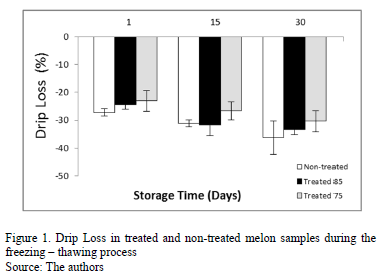
<body><![CDATA[<p><font size="2" face="Verdana, Arial, Helvetica, sans-serif">at: after     freezing-thawing    <br>     </font><font size="2" face="Verdana, Arial, Helvetica, sans-serif">bf: before     freezing </font></p> </blockquote>     <p><font size="2" face="Verdana, Arial, Helvetica, sans-serif">The texture (in terms of firmness, N) of the treated and   non-treated samples was evaluated by using a uniaxial compression test. A texturometer   (EZ-Test model, Shimadzu, Somerset, New Jersey), adapted with a 40mm diameter   cylindrical plate was used for this purpose. The plate was lubricated, in order   to avoid sample-plate friction &#91;27&#93;. The samples were compressed to 75% of   their initial height, at 30mm/min speed. The firmness was calculated by means   of the maximum force peak.</font></p>     <p><font size="2" face="Verdana, Arial, Helvetica, sans-serif"><b>2.5.  Experimental   design</b>    <br>   </font><font size="2" face="Verdana, Arial, Helvetica, sans-serif">A factor 3x3 design was used, with two factors chosen at   random:</font></p>     <p><font size="2" face="Verdana, Arial, Helvetica, sans-serif">Humidity content of the fruit at three levels: 92% (fresh), 85% (OD) and 75% (OD), and frozen storage   time: 1, 15 and 30 days.</font></p>     <p><font size="2" face="Verdana, Arial, Helvetica, sans-serif">Each treatment was   carried out in triplicate. The results were analyzed using analysis of variance   (ANOVA), with a confidence level of 95%, using Minitab 16 (Minitab,   Inc., State College, Pennsylvania, 2009).</font></p>     <p>&nbsp;</p>     <p><font size="3" face="Verdana, Arial, Helvetica, sans-serif"><b>3.  Results and   discussion</b></font></p>     <p><b><font size="2" face="Verdana, Arial, Helvetica, sans-serif">3.1.  Drip loss   evaluation</font></b></p>     ]]></body>
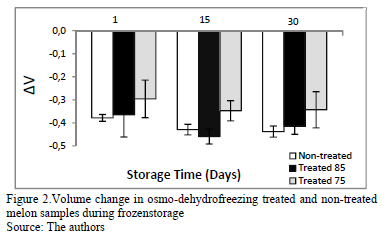
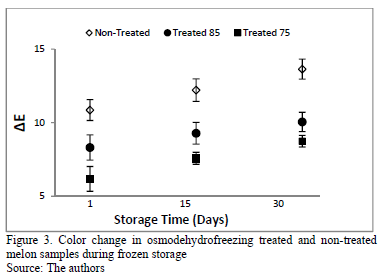
<body><![CDATA[<p><font size="2" face="Verdana, Arial, Helvetica, sans-serif">Drip loss of the treated and non-treated samples are shown   in <a href="#fig01">Fig.1</a>.</font></p>     <p align="center"><font size="2" face="Verdana, Arial, Helvetica, sans-serif"><a name="fig01"></a></font><img src="/img/revistas/dyna/v81n186/v81n186a10fig01.gif"></p>     <p><font size="2" face="Verdana, Arial, Helvetica, sans-serif">It can be noticed that in all the treatments (treated and   non-treated samples) DL of the samples increases as the storage time period   increases, which may be due to ice re-crystallization during the storage   period, thus resulting in loss of cell content and loss of cell water retention   capacity &#91;28&#93;. Recrystallization is the change in size, shape and number of ice   crystals during frozen storage &#91;29,30&#93;. These findings are similar to those   reported for kiwi &#91;29,30&#93;, strawberry &#91;25&#93;, apple, and pear &#91;4&#93;. It can also be   noticed that during frozen storage, treated samples show lower DL than non-treated samples. This is an indication of   the cryoprotecting effect of osmotic treatment, previous to the freezing   process. Similar findings have been   reported for different fruits and vegetables &#91;4,13&#93;. As to the humidity   levels in the treated samples, the treatment with lower MC level (75%) showed   lower DL value in each storage time period (23.02+0.32, 26.68 + 0.13 and   30.36+0.14 % for 1, 15 and 30 days,   respectively). This may be due to lower</font> <font size="2" face="Verdana, Arial, Helvetica, sans-serif">ice recrystallization because of   less freezable water content, which leads to less structural collapse. A   similar behavior has been found for Kiwi &#91;6&#93;. ANOVA showed a significant   (p&lt;0.05) effect of the factors frozen storage time and WC level on the DL of   cantaloupe samples.</font></p>     <p><font size="2" face="Verdana, Arial, Helvetica, sans-serif"><b>3.2.  Volume loss    <br>   </b></font><font size="2" face="Verdana, Arial, Helvetica, sans-serif"><a href="#fig02">Fig. 2</a> shows the volume loss (<font face="symbol">D</font>V) for treated and non-treated samples during frozen storage. It   can be noticed that in all the treatments there was <font face="symbol">D</font>V along the freezing   storing time period. However, the non-treated samples show higher <font face="symbol">D</font>V, with   37.80<u>+</u>0.21, 42.90<u>+</u>0.43 and 43.80<u>+</u>0.29% for 1, 15 and 30   days, respectively. As to the treated samples, those with lower MC (75%) show   lower <font face="symbol">D</font>V, with 29.6<u>+</u>0.40, 34.8<u>+</u>0.18 and 37.3<u>+</u>0.26%   for days 1, 15 and 30, respectively. These higher <font face="symbol">D</font>V in non-treated   samples are associated with higher drip loss in the freezing-thawing process,   due to higher freezable water content. According to Koc and Eren&#91;31&#93;,   water loss in food leads to structural damage, which causes shrinking and   microstructure changes in the product.</font></p>     <p align="center"><font size="2" face="Verdana, Arial, Helvetica, sans-serif"><a name="fig02"></a></font><img src="/img/revistas/dyna/v81n186/v81n186a10fig02.gif"></p>     <p><font size="2" face="Verdana, Arial, Helvetica, sans-serif">The statistical analysis (ANOVA) showed significant   differences (p&lt;0.05) for the storing time period and for the MC in   connection with the volume of the samples.</font></p>     <p><font size="2" face="Verdana, Arial, Helvetica, sans-serif"><b>3.2.  Color change</b>    <br>   </font><font size="2" face="Verdana, Arial, Helvetica, sans-serif"><a href="#fig03">Fig. 3</a> shows the total   color change (<font face="symbol">D</font>E) for the different treatments during frozen storage. High <font face="symbol">D</font>E values indicate greater color changes. Total color change increased in   all the treatments during the freezing time. However, the osmo-dehydrated   samples show significantly (p&lt;0.05) less color changes (values lower than   10). There were no significant (p&gt;0.05) <font face="symbol">D</font>E in the osmo-dehydrated   samples in the two MC levels (75 and 85%). These <font face="symbol">D</font>E were mainly influenced   by L* coordinate, which indicates clarity or luminosity in the color space, and   is indicative of the degree of browning of the food &#91;3,32&#93;.  The non-treated samples showed greater <font face="symbol">D</font>L* (%) during the storing time period (from day 1 to 30 day), varying   from13.92<u>+</u>0.88 to 16.39<u>+</u>0.93%, while the osmo-dehydrated samples   (75 y 85%) varied from 4.32<u>+</u>0.22 to 6.33<u>+</u>0.37% and from 8.53<u>+</u>0.39   to 10.15<u>+</u>0.76%, respectively. These results indicate that non-treated   samples experienced greater brownness, compared to that of the osmo-dehydrated   samples. These findings further explain the cryoprotecting effect of osmotic   treatments in frozen fruit color. This effect may be due to lower freezable   water content, which plays a role in the decrease of the number of reactions   leading to the brownness of the fruit tissues &#91;3&#93;. Another explanation may be   the presence of sugar on the surface of the treated samples,</font><font size="2" face="Verdana, Arial, Helvetica, sans-serif"> which   prevents oxygen transfer to the fruit, consequently reducing enzymatic   brownness &#91;33, 34&#93;. These findings are similar to those reported in research   studies dealing with kiwi, apple &#91;4&#93; and eggplant &#91;3&#93;.</font></p>     <p align="center"><font size="2" face="Verdana, Arial, Helvetica, sans-serif"><a name="fig03"></a></font><img src="/img/revistas/dyna/v81n186/v81n186a10fig03.gif"></p>     ]]></body>
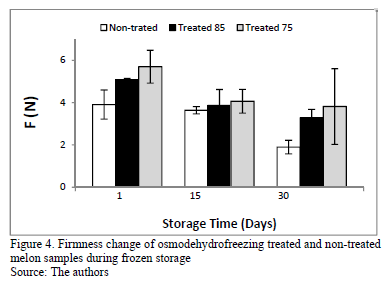
<body><![CDATA[<p><font size="2" face="Verdana, Arial, Helvetica, sans-serif"><b>3.4.  Firmness</b>    <br>   </font><font size="2" face="Verdana, Arial, Helvetica, sans-serif"><a href="#fig04">Fig. 4</a><b> s</b>hows   the values for texture of treated and non-treated melon samples. It can be   noticed that in both types of treatments the fruit's firmness significantly   (p&lt;0.05) decreased during the storage time period, possibly due to ice   crystal  formation during storage, which   can cause structural cell damage in the fruit. However, the treated samples   (75% and 85%) showed significantly (p&lt;0.05) higher compression force values   (higher firmness) when compared to the non-treated samples, which may be a   result of less structural damage, since they contain less freezable water. This   result is in accordance the ones found in mango &#91;24&#93; and tomato &#91;35&#93;. Thus, the   cryoprotecting effect of OD on the fruit texture during frozen storage is   evident.</font></p>     <p align="center"><font size="2" face="Verdana, Arial, Helvetica, sans-serif"><a name="fig04"></a></font><img src="/img/revistas/dyna/v81n186/v81n186a10fig04.gif"></p>     <p><font size="2" face="Verdana, Arial, Helvetica, sans-serif">When comparing the texture of the treated samples (75 y   85%), it was noticed that the treatment with lower water volume (75%) showed   the highest firmness values, that is, 5.7±0.8, 4.1±0.6 y 3.8±1.8 N, for 1, 15   and 30 days, respectively. Similar results were found for papaya   osmo-dehydrofreezing treatment &#91;36&#93;. A possible reason for this is that the   most dehydrated cell structure (less freezable water content) was least   affected, because of lower ice recrystallization &#91;13&#93;. According to Moncayo et   al., &#91;35&#93;, an OD time period increment (lower humidity content) results into   greater firmness of the osmo-dehydrated product, a consequence of its solids   gain and water loss.</font></p>     <p>&nbsp;</p>     <p><font size="3" face="Verdana, Arial, Helvetica, sans-serif"><b>4.  Conclusions</b></font></p>     <p><font size="2" face="Verdana, Arial, Helvetica, sans-serif">The use of the osmo-dehydrofreezing technique, before the   freezing of melon samples had a cryoprotecting effect (drip loss, color, volume   and firmness reduction), compared to non-treated samples during frozen storage.   In the first case, the treatment using lower humidity level (75%) showed lower   quality loss (higher firmness, lower DL, <font face="symbol">D</font>V and <font face="symbol">D</font>E) than the   non-treated samples, probably because of their lower freezable water content   and, consequently, lower cell damage in the product. The frozen storage time   period significantly (p&lt;0.05) influenced the fruit's quality loss, perhaps   because of ice recrystallization during storage, which led to cell content   loss. These results show that the osmo-dehydrofreezing technique is effective   in reducing quality loss in melon samples during frozen storage.</font></p>     <p>&nbsp;</p>     <p><font size="3" face="Verdana, Arial, Helvetica, sans-serif"><b>References</b></font></p>     <!-- ref --><p> <font size="2" face="Verdana, Arial, Helvetica, sans-serif"><b>&#91;1&#93;</b> CCI. Corporaci&oacute;n Colombiana Internacional. C&oacute;mo apostarle al mel&oacute;n. Sembramos, 2. pp. 4-7, 2007.    &nbsp;&nbsp;&nbsp;&nbsp;&nbsp;&nbsp;&nbsp;&nbsp;[&#160;<a href="javascript:void(0);" onclick="javascript: window.open('/scielo.php?script=sci_nlinks&ref=000082&pid=S0012-7353201400040001000001&lng=','','width=640,height=500,resizable=yes,scrollbars=1,menubar=yes,');">Links</a>&#160;]<!-- end-ref --></font></p>     <!-- ref --><p> <font size="2" face="Verdana, Arial, Helvetica, sans-serif"><b>&#91;2&#93;</b> FAO. Food and Agriculture Organization of the United Nations.Roma, Italia. Available: <a href="http://faostat3.fao.org/faostat-gateway/go/to/download/ Q/QC/S" target="_blank">http://faostat3.fao.org/faostat-gateway/go/to/download/ Q/QC/S</a> &#91;Citado 10 de Octubre de 2013&#93;    &nbsp;&nbsp;&nbsp;&nbsp;&nbsp;&nbsp;&nbsp;&nbsp;[&#160;<a href="javascript:void(0);" onclick="javascript: window.open('/scielo.php?script=sci_nlinks&ref=000084&pid=S0012-7353201400040001000002&lng=','','width=640,height=500,resizable=yes,scrollbars=1,menubar=yes,');">Links</a>&#160;]<!-- end-ref -->.</font></p>     <!-- ref --><p> <font size="2" face="Verdana, Arial, Helvetica, sans-serif"><b>&#91;3&#93;</b> Wu, L., Orikasa, T., Tokuyasu, K., Shiina, T. and Tagawa, A., Applicability of vacuum-dehydrofreezing technique for the long-term preservation of fresh-cuteggplant: Effects of process conditions on the quality attribute of the samples. Journal of Food Engineering, 91 (4), pp. 560-565, 2009.    &nbsp;&nbsp;&nbsp;&nbsp;&nbsp;&nbsp;&nbsp;&nbsp;[&#160;<a href="javascript:void(0);" onclick="javascript: window.open('/scielo.php?script=sci_nlinks&ref=000086&pid=S0012-7353201400040001000003&lng=','','width=640,height=500,resizable=yes,scrollbars=1,menubar=yes,');">Links</a>&#160;]<!-- end-ref --></font></p>     <!-- ref --><p> <font size="2" face="Verdana, Arial, Helvetica, sans-serif"><b>&#91;4&#93;</b> Marani, C. M., Agnelli, M. E. and Mascheroni, R. H., Osmo-frozenfruits: Mass transfer and quality evaluation. Journal of Food Engineering, 79 (4), pp. 1122-1130, 2007.    &nbsp;&nbsp;&nbsp;&nbsp;&nbsp;&nbsp;&nbsp;&nbsp;[&#160;<a href="javascript:void(0);" onclick="javascript: window.open('/scielo.php?script=sci_nlinks&ref=000088&pid=S0012-7353201400040001000004&lng=','','width=640,height=500,resizable=yes,scrollbars=1,menubar=yes,');">Links</a>&#160;]<!-- end-ref --></font></p>     <!-- ref --><p> <font size="2" face="Verdana, Arial, Helvetica, sans-serif"><b>&#91;5&#93;</b> Chassagne-Berces, S., Poirier, C., Devaux, M. F., Fonseca, F., Lahaye, M., Pigorini, G., Girault, C., Marin, M. and Guilon, F., Changes in texture, cellular structure and cell wall composition in apple tissue as a result of freezing. Food Research International, 42 (7), pp. 788-797, 2009.    &nbsp;&nbsp;&nbsp;&nbsp;&nbsp;&nbsp;&nbsp;&nbsp;[&#160;<a href="javascript:void(0);" onclick="javascript: window.open('/scielo.php?script=sci_nlinks&ref=000090&pid=S0012-7353201400040001000005&lng=','','width=640,height=500,resizable=yes,scrollbars=1,menubar=yes,');">Links</a>&#160;]<!-- end-ref --></font></p>     <!-- ref --><p> <font size="2" face="Verdana, Arial, Helvetica, sans-serif"><b>&#91;6&#93;</b> Talens, P., Mart&iacute;nez, N., Fito, P. and Chiralt, A., Changes in optical and mechanical properties during osmodehydrofreezing of kiwi fruit. Innovative Food Science & Emerging Technologies, 3 (2), pp. 191-199, 2002.    &nbsp;&nbsp;&nbsp;&nbsp;&nbsp;&nbsp;&nbsp;&nbsp;[&#160;<a href="javascript:void(0);" onclick="javascript: window.open('/scielo.php?script=sci_nlinks&ref=000092&pid=S0012-7353201400040001000006&lng=','','width=640,height=500,resizable=yes,scrollbars=1,menubar=yes,');">Links</a>&#160;]<!-- end-ref --></font></p>     <!-- ref --><p> <font size="2" face="Verdana, Arial, Helvetica, sans-serif"><b>&#91;7&#93;</b> Koç, B, Eren, I., Kaymak, Ertekin F., Modelling bulk density, porosity and shrinkage of quince during drying: The effect of drying method. Journal of Food Engineering, 85 (3), pp. 340-349, 2008.    &nbsp;&nbsp;&nbsp;&nbsp;&nbsp;&nbsp;&nbsp;&nbsp;[&#160;<a href="javascript:void(0);" onclick="javascript: window.open('/scielo.php?script=sci_nlinks&ref=000094&pid=S0012-7353201400040001000007&lng=','','width=640,height=500,resizable=yes,scrollbars=1,menubar=yes,');">Links</a>&#160;]<!-- end-ref --></font></p>     <!-- ref --><p> <font size="2" face="Verdana, Arial, Helvetica, sans-serif"><b>&#91;8&#93;</b> Talens, P., Escriche, I., Martinez, N. and Chiralt, A., Influence of osmotic dehydration and freezing on the volatile profile of kiwi fruit. Food Research International, 36 (6), pp. 635-642, 2003.    &nbsp;&nbsp;&nbsp;&nbsp;&nbsp;&nbsp;&nbsp;&nbsp;[&#160;<a href="javascript:void(0);" onclick="javascript: window.open('/scielo.php?script=sci_nlinks&ref=000096&pid=S0012-7353201400040001000008&lng=','','width=640,height=500,resizable=yes,scrollbars=1,menubar=yes,');">Links</a>&#160;]<!-- end-ref --></font></p>     <!-- ref --><p> <font size="2" face="Verdana, Arial, Helvetica, sans-serif"><b>&#91;9&#93;</b> Tregunno, N. B. and Goff, H. D., Osmodehy-drofreezing of apples: Structural and textural effects. Food Research International, 29 (5-6), pp. 471-479, 1996.    &nbsp;&nbsp;&nbsp;&nbsp;&nbsp;&nbsp;&nbsp;&nbsp;[&#160;<a href="javascript:void(0);" onclick="javascript: window.open('/scielo.php?script=sci_nlinks&ref=000098&pid=S0012-7353201400040001000009&lng=','','width=640,height=500,resizable=yes,scrollbars=1,menubar=yes,');">Links</a>&#160;]<!-- end-ref --></font></p>     <!-- ref --><p> <font size="2" face="Verdana, Arial, Helvetica, sans-serif"><b>&#91;10&#93;</b> Forni, E., Torreggiani, D., Crivelli, G., Maestrelli, A., Bertolo, G. and Santelli F., Influence of osmosis time on the quality of dehydrofrozen kiwi fruit. Acta Horticulturae. 282, pp. 425-434, 1990.    &nbsp;&nbsp;&nbsp;&nbsp;&nbsp;&nbsp;&nbsp;&nbsp;[&#160;<a href="javascript:void(0);" onclick="javascript: window.open('/scielo.php?script=sci_nlinks&ref=000100&pid=S0012-7353201400040001000010&lng=','','width=640,height=500,resizable=yes,scrollbars=1,menubar=yes,');">Links</a>&#160;]<!-- end-ref --></font></p>     <!-- ref --><p> <font size="2" face="Verdana, Arial, Helvetica, sans-serif"><b>&#91;11&#93;</b> Crowe J. H., Clegg J. S. and Crowe L. M. Ž., Anhydrobiosis: The water replacement hypothesis. En David S.R. The properties of water in foods ISOPOW 6. 1a ed., London, 1998. pp. 440-453.    &nbsp;&nbsp;&nbsp;&nbsp;&nbsp;&nbsp;&nbsp;&nbsp;[&#160;<a href="javascript:void(0);" onclick="javascript: window.open('/scielo.php?script=sci_nlinks&ref=000102&pid=S0012-7353201400040001000011&lng=','','width=640,height=500,resizable=yes,scrollbars=1,menubar=yes,');">Links</a>&#160;]<!-- end-ref --></font></p>     <!-- ref --><p> <font size="2" face="Verdana, Arial, Helvetica, sans-serif"><b>&#91;12&#93;</b> Ayala-Aponte, A. A., Serna-Cock, L. y Giraldo-Cuartas, C. J., Efecto de la agitaci&oacute;n sobre la deshidrataci&oacute;n osm&oacute;tica de pitahaya amarilla (<i>Selenicereus Megalanthus </i>S.) empleando soluciones de sacarosa. Interciencia, 34 (7), pp. 492-496, 2009.    &nbsp;&nbsp;&nbsp;&nbsp;&nbsp;&nbsp;&nbsp;&nbsp;[&#160;<a href="javascript:void(0);" onclick="javascript: window.open('/scielo.php?script=sci_nlinks&ref=000104&pid=S0012-7353201400040001000012&lng=','','width=640,height=500,resizable=yes,scrollbars=1,menubar=yes,');">Links</a>&#160;]<!-- end-ref --></font></p>     <!-- ref --><p> <font size="2" face="Verdana, Arial, Helvetica, sans-serif"><b>&#91;13&#93;</b> Van-Buggenhout, S., Lille, M., Messagie, I., Van-Loey, A. and Hendricks, M., Impact of pretreatment and freezing conditions on the microstructure of frozen carrots: qualification and relation to texture loss. European Food Research and Technology, 222 (5-6), pp. 543-553, 2006.    &nbsp;&nbsp;&nbsp;&nbsp;&nbsp;&nbsp;&nbsp;&nbsp;[&#160;<a href="javascript:void(0);" onclick="javascript: window.open('/scielo.php?script=sci_nlinks&ref=000106&pid=S0012-7353201400040001000013&lng=','','width=640,height=500,resizable=yes,scrollbars=1,menubar=yes,');">Links</a>&#160;]<!-- end-ref --></font></p>     <!-- ref --><p> <font size="2" face="Verdana, Arial, Helvetica, sans-serif"><b>&#91;14&#93;</b> Maestrelli, A., Lo-Scalzo, R., Lupi, D., Bertolo, G. and Torreggiani, D., Partial removal of water before freezing: Cultivar and pre-treatments as quality factors of frozen muskmelon (Cucumis melo, cv reticulates Naud). Journal of Food Engineering, 49 (2-3), pp. 255-260, 2001.    &nbsp;&nbsp;&nbsp;&nbsp;&nbsp;&nbsp;&nbsp;&nbsp;[&#160;<a href="javascript:void(0);" onclick="javascript: window.open('/scielo.php?script=sci_nlinks&ref=000108&pid=S0012-7353201400040001000014&lng=','','width=640,height=500,resizable=yes,scrollbars=1,menubar=yes,');">Links</a>&#160;]<!-- end-ref --></font></p>     <!-- ref --><p> <font size="2" face="Verdana, Arial, Helvetica, sans-serif"><b>&#91;15&#93;</b> Bianchi, M., Guamaschelli, A. y Milisenda, P., Dehidrocongelaci&oacute;n de frutas: Estudio de los par&aacute;metros de calidad. INVENIO, 14 (26), pp. 117-132, 2011.    &nbsp;&nbsp;&nbsp;&nbsp;&nbsp;&nbsp;&nbsp;&nbsp;[&#160;<a href="javascript:void(0);" onclick="javascript: window.open('/scielo.php?script=sci_nlinks&ref=000110&pid=S0012-7353201400040001000015&lng=','','width=640,height=500,resizable=yes,scrollbars=1,menubar=yes,');">Links</a>&#160;]<!-- end-ref --></font></p>     <!-- ref --><p> <font size="2" face="Verdana, Arial, Helvetica, sans-serif"><b>&#91;16&#93;</b> ICONTEC, NTC 5207, Frutas frescas, Mel&oacute;n variedad Cantaloupe. Especificaciones. Instituto Colombiano de NormasT&eacute;cnicas y Certificaci&oacute;n, 2003.    &nbsp;&nbsp;&nbsp;&nbsp;&nbsp;&nbsp;&nbsp;&nbsp;[&#160;<a href="javascript:void(0);" onclick="javascript: window.open('/scielo.php?script=sci_nlinks&ref=000112&pid=S0012-7353201400040001000016&lng=','','width=640,height=500,resizable=yes,scrollbars=1,menubar=yes,');">Links</a>&#160;]<!-- end-ref --></font></p>     <!-- ref --><p> <font size="2" face="Verdana, Arial, Helvetica, sans-serif"><b>&#91;17&#93;</b> Corzo, O. and G&oacute;mez, E. R., Optimization of osmotic dehydration of cantaloupe using desired function methodology, Journal of Food Engineering, 2 (2), pp. 213-219, 2004.    &nbsp;&nbsp;&nbsp;&nbsp;&nbsp;&nbsp;&nbsp;&nbsp;[&#160;<a href="javascript:void(0);" onclick="javascript: window.open('/scielo.php?script=sci_nlinks&ref=000114&pid=S0012-7353201400040001000017&lng=','','width=640,height=500,resizable=yes,scrollbars=1,menubar=yes,');">Links</a>&#160;]<!-- end-ref --></font></p>     <!-- ref --><p> <font size="2" face="Verdana, Arial, Helvetica, sans-serif"><b>&#91;18&#93;</b> Derossi, A., De Pilli, T., Severini, C. and McCarthy, M. J., Mass transfer during osmotic dehydration of apples, Journal of Food Engineering, 86 (4), pp. 519-528, 2008.    &nbsp;&nbsp;&nbsp;&nbsp;&nbsp;&nbsp;&nbsp;&nbsp;[&#160;<a href="javascript:void(0);" onclick="javascript: window.open('/scielo.php?script=sci_nlinks&ref=000116&pid=S0012-7353201400040001000018&lng=','','width=640,height=500,resizable=yes,scrollbars=1,menubar=yes,');">Links</a>&#160;]<!-- end-ref --></font></p>     <!-- ref --><p> <font size="2" face="Verdana, Arial, Helvetica, sans-serif"><b>&#91;19&#93;</b> Mayor, L., Cunha, R. L. and Sereno, A. M., Relation between mechanical properties and structural changes during osmotic dehydration of pumpkin, Food Research International, 40 (4), pp. 448-460, 2007.    &nbsp;&nbsp;&nbsp;&nbsp;&nbsp;&nbsp;&nbsp;&nbsp;[&#160;<a href="javascript:void(0);" onclick="javascript: window.open('/scielo.php?script=sci_nlinks&ref=000118&pid=S0012-7353201400040001000019&lng=','','width=640,height=500,resizable=yes,scrollbars=1,menubar=yes,');">Links</a>&#160;]<!-- end-ref --></font></p>     <!-- ref --><p> <font size="2" face="Verdana, Arial, Helvetica, sans-serif"><b>&#91;20&#93;</b> R&oacute;zek, A., Achaerandio, I., Güell, C., L&oacute;pez, F. and Ferrando, M., Grape phenolic impregnation by osmotic treatment: Influence of osmotic agent on mass transfer and product characteristics. Journal of Food Engineering, 94 (1), pp. 59-68, 2009.    &nbsp;&nbsp;&nbsp;&nbsp;&nbsp;&nbsp;&nbsp;&nbsp;[&#160;<a href="javascript:void(0);" onclick="javascript: window.open('/scielo.php?script=sci_nlinks&ref=000120&pid=S0012-7353201400040001000020&lng=','','width=640,height=500,resizable=yes,scrollbars=1,menubar=yes,');">Links</a>&#160;]<!-- end-ref --></font></p>     <!-- ref --><p> <font size="2" face="Verdana, Arial, Helvetica, sans-serif"><b>&#91;21&#93;</b> Ayse, I. and Inci, T., Osmotic dehydration of apricot: Kinetics and the effect of process parameters. Chemical Engineering Research and Design, 87 (2), pp. 166-180, 2009.    &nbsp;&nbsp;&nbsp;&nbsp;&nbsp;&nbsp;&nbsp;&nbsp;[&#160;<a href="javascript:void(0);" onclick="javascript: window.open('/scielo.php?script=sci_nlinks&ref=000122&pid=S0012-7353201400040001000021&lng=','','width=640,height=500,resizable=yes,scrollbars=1,menubar=yes,');">Links</a>&#160;]<!-- end-ref --></font></p>     <!-- ref --><p> <font size="2" face="Verdana, Arial, Helvetica, sans-serif"><b>&#91;22&#93;</b> Cadena-G&oacute;mez, M. I., Aplicaci&oacute;n de la t&eacute;cnica de osmo-congelaci&oacute;n en la conservaci&oacute;n de mel&oacute;n Cantaloupe (<i>Cucumis melo</i> L.) MSc. Thesis, Escuela de Ingenier&iacute;a de Alimentos, Universidad del Valle, Cali, Colombia, 2012.    &nbsp;&nbsp;&nbsp;&nbsp;&nbsp;&nbsp;&nbsp;&nbsp;[&#160;<a href="javascript:void(0);" onclick="javascript: window.open('/scielo.php?script=sci_nlinks&ref=000124&pid=S0012-7353201400040001000022&lng=','','width=640,height=500,resizable=yes,scrollbars=1,menubar=yes,');">Links</a>&#160;]<!-- end-ref --></font></p>     <!-- ref --><p> <font size="2" face="Verdana, Arial, Helvetica, sans-serif"><b>&#91;23&#93;</b> AOAC, Official methods of analysis of the Association of Official Analytical Chemists International. Moisture in dried fruits. Method 934.06. Airlington, USA. 1990, pp. 911-912.    &nbsp;&nbsp;&nbsp;&nbsp;&nbsp;&nbsp;&nbsp;&nbsp;[&#160;<a href="javascript:void(0);" onclick="javascript: window.open('/scielo.php?script=sci_nlinks&ref=000126&pid=S0012-7353201400040001000023&lng=','','width=640,height=500,resizable=yes,scrollbars=1,menubar=yes,');">Links</a>&#160;]<!-- end-ref --></font></p>     <!-- ref --><p> <font size="2" face="Verdana, Arial, Helvetica, sans-serif"><b>&#91;24&#93;</b> Chiralt, A., Mart&iacute;nez-Navarrete, N., Mart&iacute;nez-Monz&oacute;, J., Talens, P., Moraga, G., Ayala, A. and Fito, P., Changes in mechanical properties throughout osmotic processes: Cryoprotectant effect. Journal Food Engineering, 49 (2-3), pp. 129-135, 2001.    &nbsp;&nbsp;&nbsp;&nbsp;&nbsp;&nbsp;&nbsp;&nbsp;[&#160;<a href="javascript:void(0);" onclick="javascript: window.open('/scielo.php?script=sci_nlinks&ref=000128&pid=S0012-7353201400040001000024&lng=','','width=640,height=500,resizable=yes,scrollbars=1,menubar=yes,');">Links</a>&#160;]<!-- end-ref --></font></p>     <!-- ref --><p> <font size="2" face="Verdana, Arial, Helvetica, sans-serif"><b>&#91;25&#93;</b> Moraga, G., Mart&iacute;nez-Navarrete, N. and Chiralt, A., Compositional changes of strawberry due to dehydration, cold storage and freezing-thawing processes, Journal of Food Processing and Preservation, 30 (4), pp. 458-474, 2006.    &nbsp;&nbsp;&nbsp;&nbsp;&nbsp;&nbsp;&nbsp;&nbsp;[&#160;<a href="javascript:void(0);" onclick="javascript: window.open('/scielo.php?script=sci_nlinks&ref=000130&pid=S0012-7353201400040001000025&lng=','','width=640,height=500,resizable=yes,scrollbars=1,menubar=yes,');">Links</a>&#160;]<!-- end-ref --></font></p>     <!-- ref --><p> <font size="2" face="Verdana, Arial, Helvetica, sans-serif"><b>&#91;26&#93;</b> Sriwimon, W. and Boonsupthip, W., Utilization of partially ripe mangoes for freezing preservation by impregnation of mango juice and sugars. LWT Food Science and Technology, 44 (2), pp. 375-383, 2011.    &nbsp;&nbsp;&nbsp;&nbsp;&nbsp;&nbsp;&nbsp;&nbsp;[&#160;<a href="javascript:void(0);" onclick="javascript: window.open('/scielo.php?script=sci_nlinks&ref=000132&pid=S0012-7353201400040001000026&lng=','','width=640,height=500,resizable=yes,scrollbars=1,menubar=yes,');">Links</a>&#160;]<!-- end-ref --></font></p>     <!-- ref --><p> <font size="2" face="Verdana, Arial, Helvetica, sans-serif"><b>&#91;27&#93;</b> Rao, V. N. M., Classification, description and measurement of viscoelastic properties of solid foods. En Rao, M. & J. F Steffe. Viscoelastic properties of foods, 1a ed., London, Elsevier Applied Science, 1992. pp. 3-47. 3-47.    &nbsp;&nbsp;&nbsp;&nbsp;&nbsp;&nbsp;&nbsp;&nbsp;[&#160;<a href="javascript:void(0);" onclick="javascript: window.open('/scielo.php?script=sci_nlinks&ref=000134&pid=S0012-7353201400040001000027&lng=','','width=640,height=500,resizable=yes,scrollbars=1,menubar=yes,');">Links</a>&#160;]<!-- end-ref --></font></p>     <!-- ref --><p> <font size="2" face="Verdana, Arial, Helvetica, sans-serif"><b>&#91;28&#93;</b> Goncalves, E. M., Abreu, M., Brandao, T. R. and Silva, C. L., Degradation kinetics of colour, vitamin C and drip loss in frozen broccoli (<i>Brassica oleracea</i>L.ssp.) during storage at isothermal and non-isothermal conditions. International Journal of Refrigeration, 34 (8), pp. 2136-2144, 2011.    &nbsp;&nbsp;&nbsp;&nbsp;&nbsp;&nbsp;&nbsp;&nbsp;[&#160;<a href="javascript:void(0);" onclick="javascript: window.open('/scielo.php?script=sci_nlinks&ref=000136&pid=S0012-7353201400040001000028&lng=','','width=640,height=500,resizable=yes,scrollbars=1,menubar=yes,');">Links</a>&#160;]<!-- end-ref --></font></p>     <!-- ref --><p> <font size="2" face="Verdana, Arial, Helvetica, sans-serif"><b>&#91;29&#93;</b> Fennema, O. R., Nature of the freezing process. In: Low temperature preservation of foods and living matter. Citado por: Hagiwara T., Wang H., Suzuki T., Takai R., Fractal analysis of ice Crystals in Frozen Food. Journal of Agricultural and Food Chemistry, 50 (11), pp. 3085-3089, 2002.    &nbsp;&nbsp;&nbsp;&nbsp;&nbsp;&nbsp;&nbsp;&nbsp;[&#160;<a href="javascript:void(0);" onclick="javascript: window.open('/scielo.php?script=sci_nlinks&ref=000138&pid=S0012-7353201400040001000029&lng=','','width=640,height=500,resizable=yes,scrollbars=1,menubar=yes,');">Links</a>&#160;]<!-- end-ref --></font></p>     <!-- ref --><p> <font size="2" face="Verdana, Arial, Helvetica, sans-serif"><b>&#91;30&#93;</b> Sutton, R. L. and Wilcox, J., Recrystallization in model ice cream solutions as affected by stabilizer concentration. Journal of Food Science, 63 (2), pp. 9-11, 1998.    &nbsp;&nbsp;&nbsp;&nbsp;&nbsp;&nbsp;&nbsp;&nbsp;[&#160;<a href="javascript:void(0);" onclick="javascript: window.open('/scielo.php?script=sci_nlinks&ref=000140&pid=S0012-7353201400040001000030&lng=','','width=640,height=500,resizable=yes,scrollbars=1,menubar=yes,');">Links</a>&#160;]<!-- end-ref --></font></p>     <!-- ref --><p> <font size="2" face="Verdana, Arial, Helvetica, sans-serif"><b>&#91;31&#93;</b> Koç, B., Eren, I. and Kaymak, Ertekin F., Modelling bulk density, porosity and shrinkage of quince during drying: The effect of drying method, Journal of Food Engineering, 85 (3), pp. 340 - 349, 2008.    &nbsp;&nbsp;&nbsp;&nbsp;&nbsp;&nbsp;&nbsp;&nbsp;[&#160;<a href="javascript:void(0);" onclick="javascript: window.open('/scielo.php?script=sci_nlinks&ref=000142&pid=S0012-7353201400040001000031&lng=','','width=640,height=500,resizable=yes,scrollbars=1,menubar=yes,');">Links</a>&#160;]<!-- end-ref --></font></p>     <!-- ref --><p> <font size="2" face="Verdana, Arial, Helvetica, sans-serif"><b>&#91;32&#93;</b> Moreno, A., Leon, D., Giraldo, G. y R&iacute;os, E., Estudio de la cin&eacute;tica fisicoqu&iacute;mica del mango. (<i>Mangifera indica</i> L. Var. Tommy Atkins) tratado por m&eacute;todos combinados de secado. Dyna, 77 (162), pp. 75-84, 2010.    &nbsp;&nbsp;&nbsp;&nbsp;&nbsp;&nbsp;&nbsp;&nbsp;[&#160;<a href="javascript:void(0);" onclick="javascript: window.open('/scielo.php?script=sci_nlinks&ref=000144&pid=S0012-7353201400040001000032&lng=','','width=640,height=500,resizable=yes,scrollbars=1,menubar=yes,');">Links</a>&#160;]<!-- end-ref --></font></p>     <!-- ref --><p> <font size="2" face="Verdana, Arial, Helvetica, sans-serif"><b>&#91;33&#93;</b> Lenart, A., Osmo-convective drying of fruits and vegetables: Technology and application. Drying Technology, 14 (2), pp. 391-413, 1996.    &nbsp;&nbsp;&nbsp;&nbsp;&nbsp;&nbsp;&nbsp;&nbsp;[&#160;<a href="javascript:void(0);" onclick="javascript: window.open('/scielo.php?script=sci_nlinks&ref=000146&pid=S0012-7353201400040001000033&lng=','','width=640,height=500,resizable=yes,scrollbars=1,menubar=yes,');">Links</a>&#160;]<!-- end-ref --></font></p>     <!-- ref --><p> <font size="2" face="Verdana, Arial, Helvetica, sans-serif"><b>&#91;34&#93;</b> Krokida, M. and Maroulis, Z., Quality changes during drying of foods materials. En Mujumdar A.S. Drying Technology in Agricultural and Food Sciences, 1ra Ed., India, 2001. 61 P.    &nbsp;&nbsp;&nbsp;&nbsp;&nbsp;&nbsp;&nbsp;&nbsp;[&#160;<a href="javascript:void(0);" onclick="javascript: window.open('/scielo.php?script=sci_nlinks&ref=000148&pid=S0012-7353201400040001000034&lng=','','width=640,height=500,resizable=yes,scrollbars=1,menubar=yes,');">Links</a>&#160;]<!-- end-ref --></font></p>     <!-- ref --><p> <font size="2" face="Verdana, Arial, Helvetica, sans-serif"><b>&#91;35&#93;</b> Olatidoye, O. P., Sobowale, S. S. and Akinlua, O., Effect of osmodehydrofreezing on the quality attributes of frozen tomato. Electronic Journal of Environmental, Agricultural and Food Chemistry &#91;Online&#93;. 9(4), 2010. &#91;date of reference March 2013&#93;. Available at: <a href="http://cabdirect.org/abstracts/20103324179.html;jsessionid=73175BA291D4BCC7F3904941ECAA1541" target="_blank">http://cabdirect.org/abstracts/20103324179.html;jsessionid=73175BA291D4BCC7F3904941ECAA1541</a>.    &nbsp;&nbsp;&nbsp;&nbsp;&nbsp;&nbsp;&nbsp;&nbsp;[&#160;<a href="javascript:void(0);" onclick="javascript: window.open('/scielo.php?script=sci_nlinks&ref=000150&pid=S0012-7353201400040001000035&lng=','','width=640,height=500,resizable=yes,scrollbars=1,menubar=yes,');">Links</a>&#160;]<!-- end-ref --></font></p>     <!-- ref --><p> <font size="2" face="Verdana, Arial, Helvetica, sans-serif"><b>&#91;36&#93;</b> Moyano, P. C., Vega, R. E., Bunger, A., Garret&oacute;n, J. and Osorio, F. A., Effect of combined processes of osmotic dehydration and freezing on papaya preservation. Food Science and Technology International, 8 (5), pp. 295-301, 2002.    &nbsp;&nbsp;&nbsp;&nbsp;&nbsp;&nbsp;&nbsp;&nbsp;[&#160;<a href="javascript:void(0);" onclick="javascript: window.open('/scielo.php?script=sci_nlinks&ref=000152&pid=S0012-7353201400040001000036&lng=','','width=640,height=500,resizable=yes,scrollbars=1,menubar=yes,');">Links</a>&#160;]<!-- end-ref --> </font> </p>     <p>&nbsp;</p>     <p><font size="2" face="Verdana, Arial, Helvetica, sans-serif"><b>Alfredo Ayala-Aponte., </b>received the   Bs. Eng in Agricultural Engineering in 1993 (Universidad del Valle, Cali,   Colombia), and the PhD degree in    Science and Food Technology in 2011 (Universidad Polit&eacute;cnica de Valencia, Espa&ntilde;a).   He is a professor in the area of Food   Technology and Engineering, Universidad del Valle. His research interests   include: preservation and food processing.</font></p>     <p><font size="2" face="Verdana, Arial, Helvetica, sans-serif"><b>Martha Isabel Cadena-G&oacute;mez.,</b> received the Bs. Eng in Food Engineering in   2005 (UNAD, CEAD Palmira, Colombia), the MSc degree in Food Engineering in 2012   (Universidad del Valle, Cali, Colombia). She is a professor in the area of Food   Technology, Universidad del Valle. Her research interests include: Food   preservation and functional foods.</font></p>      ]]></body><back>
<ref-list>
<ref id="B1">
<label>1</label><nlm-citation citation-type="">
<collab>CCI</collab>
<article-title xml:lang="es"><![CDATA[Cómo apostarle al melón]]></article-title>
<source><![CDATA[]]></source>
<year></year>
</nlm-citation>
</ref>
<ref id="B2">
<label>2</label><nlm-citation citation-type="">
<collab>Food and Agriculture Organization of the United Nations</collab>
<source><![CDATA[]]></source>
<year></year>
<publisher-loc><![CDATA[Roma ]]></publisher-loc>
</nlm-citation>
</ref>
<ref id="B3">
<label>3</label><nlm-citation citation-type="journal">
<person-group person-group-type="author">
<name>
<surname><![CDATA[Wu]]></surname>
<given-names><![CDATA[L.]]></given-names>
</name>
<name>
<surname><![CDATA[Orikasa]]></surname>
<given-names><![CDATA[T.]]></given-names>
</name>
<name>
<surname><![CDATA[Tokuyasu]]></surname>
<given-names><![CDATA[K.]]></given-names>
</name>
<name>
<surname><![CDATA[Shiina]]></surname>
<given-names><![CDATA[T.]]></given-names>
</name>
<name>
<surname><![CDATA[Tagawa]]></surname>
<given-names><![CDATA[A.]]></given-names>
</name>
</person-group>
<article-title xml:lang="en"><![CDATA[Applicability of vacuum-dehydrofreezing technique for the long-term preservation of fresh-cuteggplant: Effects of process conditions on the quality attribute of the samples]]></article-title>
<source><![CDATA[Journal of Food Engineering]]></source>
<year>2009</year>
<volume>91</volume>
<numero>4</numero>
<issue>4</issue>
<page-range>560-565</page-range></nlm-citation>
</ref>
<ref id="B4">
<label>4</label><nlm-citation citation-type="journal">
<person-group person-group-type="author">
<name>
<surname><![CDATA[Marani]]></surname>
<given-names><![CDATA[C. M.]]></given-names>
</name>
<name>
<surname><![CDATA[Agnelli]]></surname>
<given-names><![CDATA[M. E.]]></given-names>
</name>
<name>
<surname><![CDATA[Mascheroni]]></surname>
<given-names><![CDATA[R. H.]]></given-names>
</name>
</person-group>
<article-title xml:lang="en"><![CDATA[Osmo-frozenfruits: Mass transfer and quality evaluation]]></article-title>
<source><![CDATA[Journal of Food Engineering]]></source>
<year>2007</year>
<volume>79</volume>
<numero>4</numero>
<issue>4</issue>
<page-range>1122-1130</page-range></nlm-citation>
</ref>
<ref id="B5">
<label>5</label><nlm-citation citation-type="journal">
<person-group person-group-type="author">
<name>
<surname><![CDATA[Chassagne-Berces]]></surname>
<given-names><![CDATA[S.]]></given-names>
</name>
<name>
<surname><![CDATA[Poirier]]></surname>
<given-names><![CDATA[C.]]></given-names>
</name>
<name>
<surname><![CDATA[Devaux]]></surname>
<given-names><![CDATA[M. F.]]></given-names>
</name>
<name>
<surname><![CDATA[Fonseca]]></surname>
<given-names><![CDATA[F.]]></given-names>
</name>
<name>
<surname><![CDATA[Lahaye]]></surname>
<given-names><![CDATA[M.]]></given-names>
</name>
<name>
<surname><![CDATA[Pigorini]]></surname>
<given-names><![CDATA[G.]]></given-names>
</name>
<name>
<surname><![CDATA[Girault]]></surname>
<given-names><![CDATA[C.]]></given-names>
</name>
<name>
<surname><![CDATA[Marin]]></surname>
<given-names><![CDATA[M.]]></given-names>
</name>
<name>
<surname><![CDATA[Guilon]]></surname>
<given-names><![CDATA[F.]]></given-names>
</name>
</person-group>
<article-title xml:lang="en"><![CDATA[Changes in texture, cellular structure and cell wall composition in apple tissue as a result of freezing]]></article-title>
<source><![CDATA[Food Research International]]></source>
<year>2009</year>
<volume>42</volume>
<numero>7</numero>
<issue>7</issue>
<page-range>788-797</page-range></nlm-citation>
</ref>
<ref id="B6">
<label>6</label><nlm-citation citation-type="journal">
<person-group person-group-type="author">
<name>
<surname><![CDATA[Talens]]></surname>
<given-names><![CDATA[P.]]></given-names>
</name>
<name>
<surname><![CDATA[Martínez]]></surname>
<given-names><![CDATA[N.]]></given-names>
</name>
<name>
<surname><![CDATA[Fito]]></surname>
<given-names><![CDATA[P.]]></given-names>
</name>
<name>
<surname><![CDATA[Chiralt]]></surname>
<given-names><![CDATA[A.]]></given-names>
</name>
</person-group>
<article-title xml:lang="en"><![CDATA[Changes in optical and mechanical properties during osmodehydrofreezing of kiwi fruit]]></article-title>
<source><![CDATA[Innovative Food Science & Emerging Technologies]]></source>
<year>2002</year>
<volume>3</volume>
<numero>2</numero>
<issue>2</issue>
<page-range>191-199</page-range></nlm-citation>
</ref>
<ref id="B7">
<label>7</label><nlm-citation citation-type="journal">
<person-group person-group-type="author">
<name>
<surname><![CDATA[Koç]]></surname>
<given-names><![CDATA[B]]></given-names>
</name>
<name>
<surname><![CDATA[Eren]]></surname>
<given-names><![CDATA[I.]]></given-names>
</name>
<name>
<surname><![CDATA[Kaymak]]></surname>
</name>
<name>
<surname><![CDATA[Ertekin]]></surname>
<given-names><![CDATA[F.]]></given-names>
</name>
</person-group>
<article-title xml:lang="en"><![CDATA[Modelling bulk density, porosity and shrinkage of quince during drying: The effect of drying method]]></article-title>
<source><![CDATA[Journal of Food Engineering]]></source>
<year>2008</year>
<volume>85</volume>
<numero>3</numero>
<issue>3</issue>
<page-range>340-349</page-range></nlm-citation>
</ref>
<ref id="B8">
<label>8</label><nlm-citation citation-type="journal">
<person-group person-group-type="author">
<name>
<surname><![CDATA[Talens]]></surname>
<given-names><![CDATA[P.]]></given-names>
</name>
<name>
<surname><![CDATA[Escriche]]></surname>
<given-names><![CDATA[I.]]></given-names>
</name>
<name>
<surname><![CDATA[Martinez]]></surname>
<given-names><![CDATA[N.]]></given-names>
</name>
<name>
<surname><![CDATA[Chiralt]]></surname>
<given-names><![CDATA[A.]]></given-names>
</name>
</person-group>
<article-title xml:lang="en"><![CDATA[Influence of osmotic dehydration and freezing on the volatile profile of kiwi fruit]]></article-title>
<source><![CDATA[Food Research International]]></source>
<year>2003</year>
<volume>36</volume>
<numero>6</numero>
<issue>6</issue>
<page-range>635-642</page-range></nlm-citation>
</ref>
<ref id="B9">
<label>9</label><nlm-citation citation-type="journal">
<person-group person-group-type="author">
<name>
<surname><![CDATA[Tregunno]]></surname>
<given-names><![CDATA[N. B.]]></given-names>
</name>
<name>
<surname><![CDATA[Goff]]></surname>
<given-names><![CDATA[H. D.]]></given-names>
</name>
</person-group>
<article-title xml:lang="en"><![CDATA[Osmodehy-drofreezing of apples: Structural and textural effects]]></article-title>
<source><![CDATA[Food Research International]]></source>
<year>1996</year>
<volume>29</volume>
<numero>5-6</numero>
<issue>5-6</issue>
<page-range>471-479</page-range></nlm-citation>
</ref>
<ref id="B10">
<label>10</label><nlm-citation citation-type="journal">
<person-group person-group-type="author">
<name>
<surname><![CDATA[Forni]]></surname>
<given-names><![CDATA[E.]]></given-names>
</name>
<name>
<surname><![CDATA[Torreggiani]]></surname>
<given-names><![CDATA[D.]]></given-names>
</name>
<name>
<surname><![CDATA[Crivelli]]></surname>
<given-names><![CDATA[G.]]></given-names>
</name>
<name>
<surname><![CDATA[Maestrelli]]></surname>
<given-names><![CDATA[A.]]></given-names>
</name>
<name>
<surname><![CDATA[Bertolo]]></surname>
<given-names><![CDATA[G.]]></given-names>
</name>
<name>
<surname><![CDATA[Santelli]]></surname>
<given-names><![CDATA[F.]]></given-names>
</name>
</person-group>
<article-title xml:lang="en"><![CDATA[Influence of osmosis time on the quality of dehydrofrozen kiwi fruit]]></article-title>
<source><![CDATA[Acta Horticulturae]]></source>
<year>1990</year>
<numero>282</numero>
<issue>282</issue>
<page-range>425-434</page-range></nlm-citation>
</ref>
<ref id="B11">
<label>11</label><nlm-citation citation-type="">
<person-group person-group-type="author">
<name>
<surname><![CDATA[Crowe]]></surname>
<given-names><![CDATA[J. H.]]></given-names>
</name>
<name>
<surname><![CDATA[Clegg]]></surname>
<given-names><![CDATA[J. S.]]></given-names>
</name>
<name>
<surname><![CDATA[Crowe]]></surname>
<given-names><![CDATA[L. M. Ž.]]></given-names>
</name>
</person-group>
<article-title xml:lang="en"><![CDATA[Anhydrobiosis: The water replacement hypothesis]]></article-title>
<person-group person-group-type="editor">
<name>
<surname><![CDATA[David]]></surname>
<given-names><![CDATA[S.R.]]></given-names>
</name>
</person-group>
<source><![CDATA[The properties of water in foods ISOPOW 6]]></source>
<year>1998</year>
<edition>1</edition>
<page-range>440-453</page-range><publisher-loc><![CDATA[London ]]></publisher-loc>
</nlm-citation>
</ref>
<ref id="B12">
<label>12</label><nlm-citation citation-type="journal">
<person-group person-group-type="author">
<name>
<surname><![CDATA[Ayala-Aponte]]></surname>
<given-names><![CDATA[A. A.]]></given-names>
</name>
<name>
<surname><![CDATA[Serna-Cock]]></surname>
<given-names><![CDATA[L.]]></given-names>
</name>
<name>
<surname><![CDATA[Giraldo-Cuartas]]></surname>
<given-names><![CDATA[C. J.]]></given-names>
</name>
</person-group>
<article-title xml:lang="en"><![CDATA[Efecto de la agitación sobre la deshidratación osmótica de pitahaya amarilla (Selenicereus Megalanthus S.) empleando soluciones de sacarosa]]></article-title>
<source><![CDATA[Interciencia]]></source>
<year>2009</year>
<volume>34</volume>
<numero>7</numero>
<issue>7</issue>
<page-range>492-496</page-range></nlm-citation>
</ref>
<ref id="B13">
<label>13</label><nlm-citation citation-type="journal">
<person-group person-group-type="author">
<name>
<surname><![CDATA[Van-Buggenhout]]></surname>
<given-names><![CDATA[S.]]></given-names>
</name>
<name>
<surname><![CDATA[Lille]]></surname>
<given-names><![CDATA[M.]]></given-names>
</name>
<name>
<surname><![CDATA[Messagie]]></surname>
<given-names><![CDATA[I.]]></given-names>
</name>
<name>
<surname><![CDATA[Van-Loey]]></surname>
<given-names><![CDATA[A.]]></given-names>
</name>
<name>
<surname><![CDATA[Hendricks]]></surname>
<given-names><![CDATA[M.]]></given-names>
</name>
</person-group>
<article-title xml:lang="en"><![CDATA[Impact of pretreatment and freezing conditions on the microstructure of frozen carrots: qualification and relation to texture loss]]></article-title>
<source><![CDATA[European Food Research and Technology]]></source>
<year>2006</year>
<volume>222</volume>
<numero>5-6</numero>
<issue>5-6</issue>
<page-range>543-553</page-range></nlm-citation>
</ref>
<ref id="B14">
<label>14</label><nlm-citation citation-type="journal">
<person-group person-group-type="author">
<name>
<surname><![CDATA[Maestrelli]]></surname>
<given-names><![CDATA[A.]]></given-names>
</name>
<name>
<surname><![CDATA[Lo-Scalzo]]></surname>
<given-names><![CDATA[R.]]></given-names>
</name>
<name>
<surname><![CDATA[Lupi]]></surname>
<given-names><![CDATA[D.]]></given-names>
</name>
<name>
<surname><![CDATA[Bertolo]]></surname>
<given-names><![CDATA[G.]]></given-names>
</name>
<name>
<surname><![CDATA[Torreggiani]]></surname>
<given-names><![CDATA[D.]]></given-names>
</name>
</person-group>
<article-title xml:lang="en"><![CDATA[Partial removal of water before freezing: Cultivar and pre-treatments as quality factors of frozen muskmelon (Cucumis melo, cv reticulates Naud)]]></article-title>
<source><![CDATA[Journal of Food Engineering]]></source>
<year>2001</year>
<volume>49</volume>
<numero>2-3</numero>
<issue>2-3</issue>
<page-range>255-260</page-range></nlm-citation>
</ref>
<ref id="B15">
<label>15</label><nlm-citation citation-type="journal">
<person-group person-group-type="author">
<name>
<surname><![CDATA[Bianchi]]></surname>
<given-names><![CDATA[M.]]></given-names>
</name>
<name>
<surname><![CDATA[Guamaschelli]]></surname>
<given-names><![CDATA[A.]]></given-names>
</name>
<name>
<surname><![CDATA[Milisenda]]></surname>
<given-names><![CDATA[P.]]></given-names>
</name>
</person-group>
<article-title xml:lang="es"><![CDATA[Dehidrocongelación de frutas: Estudio de los parámetros de calidad]]></article-title>
<source><![CDATA[INVENIO]]></source>
<year>2011</year>
<volume>14</volume>
<numero>26</numero>
<issue>26</issue>
<page-range>117-132</page-range></nlm-citation>
</ref>
<ref id="B16">
<label>16</label><nlm-citation citation-type="book">
<collab>ICONTEC</collab>
<source><![CDATA[NTC 5207: Frutas frescas, Melón variedad Cantaloupe. Especificaciones]]></source>
<year>2003</year>
<publisher-name><![CDATA[Instituto Colombiano de NormasTécnicas y Certificación]]></publisher-name>
</nlm-citation>
</ref>
<ref id="B17">
<label>17</label><nlm-citation citation-type="journal">
<person-group person-group-type="author">
<name>
<surname><![CDATA[Corzo]]></surname>
<given-names><![CDATA[O.]]></given-names>
</name>
<name>
<surname><![CDATA[Gómez]]></surname>
<given-names><![CDATA[E. R.]]></given-names>
</name>
</person-group>
<article-title xml:lang="en"><![CDATA[Optimization of osmotic dehydration of cantaloupe using desired function methodology]]></article-title>
<source><![CDATA[Journal of Food Engineering]]></source>
<year>2004</year>
<volume>2</volume>
<numero>2</numero>
<issue>2</issue>
<page-range>213-219</page-range></nlm-citation>
</ref>
<ref id="B18">
<label>18</label><nlm-citation citation-type="journal">
<person-group person-group-type="author">
<name>
<surname><![CDATA[Derossi]]></surname>
<given-names><![CDATA[A.]]></given-names>
</name>
<name>
<surname><![CDATA[De Pilli]]></surname>
<given-names><![CDATA[T.]]></given-names>
</name>
<name>
<surname><![CDATA[Severini]]></surname>
<given-names><![CDATA[C.]]></given-names>
</name>
<name>
<surname><![CDATA[McCarthy]]></surname>
<given-names><![CDATA[M. J.]]></given-names>
</name>
</person-group>
<article-title xml:lang="en"><![CDATA[Mass transfer during osmotic dehydration of apples]]></article-title>
<source><![CDATA[Journal of Food Engineering]]></source>
<year>2008</year>
<volume>86</volume>
<numero>4</numero>
<issue>4</issue>
<page-range>519-528</page-range></nlm-citation>
</ref>
<ref id="B19">
<label>19</label><nlm-citation citation-type="journal">
<person-group person-group-type="author">
<name>
<surname><![CDATA[Mayor]]></surname>
<given-names><![CDATA[L.]]></given-names>
</name>
<name>
<surname><![CDATA[Cunha]]></surname>
<given-names><![CDATA[R. L.]]></given-names>
</name>
<name>
<surname><![CDATA[Sereno]]></surname>
<given-names><![CDATA[A. M.]]></given-names>
</name>
</person-group>
<article-title xml:lang="en"><![CDATA[Relation between mechanical properties and structural changes during osmotic dehydration of pumpkin]]></article-title>
<source><![CDATA[Food Research International]]></source>
<year>2007</year>
<volume>40</volume>
<numero>4</numero>
<issue>4</issue>
<page-range>448-460</page-range></nlm-citation>
</ref>
<ref id="B20">
<label>20</label><nlm-citation citation-type="journal">
<person-group person-group-type="author">
<name>
<surname><![CDATA[Rózek]]></surname>
<given-names><![CDATA[A.]]></given-names>
</name>
<name>
<surname><![CDATA[Achaerandio]]></surname>
<given-names><![CDATA[I.]]></given-names>
</name>
<name>
<surname><![CDATA[Güell]]></surname>
<given-names><![CDATA[C.]]></given-names>
</name>
<name>
<surname><![CDATA[López]]></surname>
<given-names><![CDATA[F.]]></given-names>
</name>
<name>
<surname><![CDATA[Ferrando]]></surname>
<given-names><![CDATA[M.]]></given-names>
</name>
</person-group>
<article-title xml:lang="en"><![CDATA[Grape phenolic impregnation by osmotic treatment: Influence of osmotic agent on mass transfer and product characteristics]]></article-title>
<source><![CDATA[Journal of Food Engineering]]></source>
<year>2009</year>
<volume>94</volume>
<numero>1</numero>
<issue>1</issue>
<page-range>59-68</page-range></nlm-citation>
</ref>
<ref id="B21">
<label>21</label><nlm-citation citation-type="journal">
<person-group person-group-type="author">
<name>
<surname><![CDATA[Ayse]]></surname>
<given-names><![CDATA[I.]]></given-names>
</name>
<name>
<surname><![CDATA[Inci]]></surname>
<given-names><![CDATA[T.]]></given-names>
</name>
</person-group>
<article-title xml:lang="en"><![CDATA[Osmotic dehydration of apricot: Kinetics and the effect of process parameters]]></article-title>
<source><![CDATA[Chemical Engineering Research and Design]]></source>
<year>2009</year>
<volume>87</volume>
<numero>2</numero>
<issue>2</issue>
<page-range>166-180</page-range></nlm-citation>
</ref>
<ref id="B22">
<label>22</label><nlm-citation citation-type="">
<person-group person-group-type="author">
<name>
<surname><![CDATA[Cadena-Gómez]]></surname>
<given-names><![CDATA[M. I.]]></given-names>
</name>
</person-group>
<source><![CDATA[Aplicación de la técnica de osmo-congelación en la conservación de melón Cantaloupe (Cucumis melo L.)]]></source>
<year></year>
</nlm-citation>
</ref>
<ref id="B23">
<label>23</label><nlm-citation citation-type="">
<collab>AOAC</collab>
<source><![CDATA[Official methods of analysis of the Association of Official Analytical Chemists International: Moisture in dried fruits. Method 934.06.]]></source>
<year>1990</year>
<page-range>911-91</page-range><publisher-loc><![CDATA[Airlington ]]></publisher-loc>
</nlm-citation>
</ref>
<ref id="B24">
<label>24</label><nlm-citation citation-type="journal">
<person-group person-group-type="author">
<name>
<surname><![CDATA[Chiralt]]></surname>
<given-names><![CDATA[A.]]></given-names>
</name>
<name>
<surname><![CDATA[Martínez-Navarrete]]></surname>
<given-names><![CDATA[N.]]></given-names>
</name>
<name>
<surname><![CDATA[Martínez-Monzó]]></surname>
<given-names><![CDATA[J.]]></given-names>
</name>
<name>
<surname><![CDATA[Talens]]></surname>
<given-names><![CDATA[P.]]></given-names>
</name>
<name>
<surname><![CDATA[Moraga]]></surname>
<given-names><![CDATA[G.]]></given-names>
</name>
<name>
<surname><![CDATA[Ayala]]></surname>
<given-names><![CDATA[A.]]></given-names>
</name>
<name>
<surname><![CDATA[Fito]]></surname>
<given-names><![CDATA[P.]]></given-names>
</name>
</person-group>
<article-title xml:lang="en"><![CDATA[Changes in mechanical properties throughout osmotic processes: Cryoprotectant effect]]></article-title>
<source><![CDATA[Journal Food Engineering]]></source>
<year>2001</year>
<volume>49</volume>
<numero>2-3</numero>
<issue>2-3</issue>
<page-range>129-135</page-range></nlm-citation>
</ref>
<ref id="B25">
<label>25</label><nlm-citation citation-type="journal">
<person-group person-group-type="author">
<name>
<surname><![CDATA[Moraga]]></surname>
<given-names><![CDATA[G.]]></given-names>
</name>
<name>
<surname><![CDATA[Martínez-Navarrete]]></surname>
<given-names><![CDATA[N.]]></given-names>
</name>
<name>
<surname><![CDATA[Chiralt]]></surname>
<given-names><![CDATA[A.]]></given-names>
</name>
</person-group>
<article-title xml:lang="en"><![CDATA[Compositional changes of strawberry due to dehydration, cold storage and freezing-thawing processes]]></article-title>
<source><![CDATA[Journal of Food Processing and Preservation]]></source>
<year>2006</year>
<volume>30</volume>
<numero>4</numero>
<issue>4</issue>
<page-range>458-474</page-range></nlm-citation>
</ref>
<ref id="B26">
<label>26</label><nlm-citation citation-type="journal">
<person-group person-group-type="author">
<name>
<surname><![CDATA[Sriwimon]]></surname>
<given-names><![CDATA[W.]]></given-names>
</name>
<name>
<surname><![CDATA[Boonsupthip]]></surname>
<given-names><![CDATA[W.]]></given-names>
</name>
</person-group>
<article-title xml:lang="en"><![CDATA[Utilization of partially ripe mangoes for freezing preservation by impregnation of mango juice and sugars]]></article-title>
<source><![CDATA[LWT Food Science and Technology]]></source>
<year>2011</year>
<volume>44</volume>
<numero>2</numero>
<issue>2</issue>
<page-range>375-383</page-range></nlm-citation>
</ref>
<ref id="B27">
<label>27</label><nlm-citation citation-type="book">
<person-group person-group-type="author">
<name>
<surname><![CDATA[Rao]]></surname>
<given-names><![CDATA[V. N. M.]]></given-names>
</name>
</person-group>
<article-title xml:lang="en"><![CDATA[Classification, description and measurement of viscoelastic properties of solid foods]]></article-title>
<person-group person-group-type="editor">
<name>
<surname><![CDATA[Rao]]></surname>
<given-names><![CDATA[M.]]></given-names>
</name>
<name>
<surname><![CDATA[Steffe]]></surname>
<given-names><![CDATA[J. F]]></given-names>
</name>
</person-group>
<source><![CDATA[Viscoelastic properties of foods]]></source>
<year>1992</year>
<edition>1a</edition>
<page-range>3-47. 3-47</page-range><publisher-loc><![CDATA[London ]]></publisher-loc>
<publisher-name><![CDATA[Elsevier Applied Science]]></publisher-name>
</nlm-citation>
</ref>
<ref id="B28">
<label>28</label><nlm-citation citation-type="journal">
<person-group person-group-type="author">
<name>
<surname><![CDATA[Goncalves]]></surname>
<given-names><![CDATA[E. M.]]></given-names>
</name>
<name>
<surname><![CDATA[Abreu]]></surname>
<given-names><![CDATA[M.]]></given-names>
</name>
<name>
<surname><![CDATA[Brandao]]></surname>
<given-names><![CDATA[T. R.]]></given-names>
</name>
<name>
<surname><![CDATA[Silva]]></surname>
<given-names><![CDATA[C. L.]]></given-names>
</name>
</person-group>
<article-title xml:lang="en"><![CDATA[Degradation kinetics of colour, vitamin C and drip loss in frozen broccoli (Brassica oleraceaL.ssp.) during storage at isothermal and non-isothermal conditions]]></article-title>
<source><![CDATA[International Journal of Refrigeration]]></source>
<year>2011</year>
<volume>34</volume>
<numero>8</numero>
<issue>8</issue>
<page-range>2136-2144</page-range></nlm-citation>
</ref>
<ref id="B29">
<label>29</label><nlm-citation citation-type="journal">
<person-group person-group-type="author">
<name>
<surname><![CDATA[Fennema]]></surname>
<given-names><![CDATA[O. R.]]></given-names>
</name>
</person-group>
<article-title xml:lang="en"><![CDATA[Nature of the freezing process]]></article-title>
<source><![CDATA[Journal of Agricultural and Food Chemistry]]></source>
<year>2002</year>
<volume>50</volume>
<numero>11</numero>
<issue>11</issue>
<page-range>3085-3089</page-range></nlm-citation>
</ref>
<ref id="B30">
<label>30</label><nlm-citation citation-type="journal">
<person-group person-group-type="author">
<name>
<surname><![CDATA[Sutton]]></surname>
<given-names><![CDATA[R. L.]]></given-names>
</name>
<name>
<surname><![CDATA[Wilcox]]></surname>
<given-names><![CDATA[J.]]></given-names>
</name>
</person-group>
<article-title xml:lang="en"><![CDATA[Recrystallization in model ice cream solutions as affected by stabilizer concentration]]></article-title>
<source><![CDATA[Journal of Food Science]]></source>
<year>1998</year>
<volume>63</volume>
<numero>2</numero>
<issue>2</issue>
<page-range>9-11</page-range></nlm-citation>
</ref>
<ref id="B31">
<label>31</label><nlm-citation citation-type="journal">
<person-group person-group-type="author">
<name>
<surname><![CDATA[Koç]]></surname>
<given-names><![CDATA[B.]]></given-names>
</name>
<name>
<surname><![CDATA[Eren]]></surname>
<given-names><![CDATA[I.]]></given-names>
</name>
<name>
<surname><![CDATA[Kaymak]]></surname>
<given-names><![CDATA[Ertekin F.]]></given-names>
</name>
</person-group>
<article-title xml:lang="en"><![CDATA[Modelling bulk density, porosity and shrinkage of quince during drying: The effect of drying method]]></article-title>
<source><![CDATA[Journal of Food Engineering]]></source>
<year>2008</year>
<volume>85</volume>
<numero>3</numero>
<issue>3</issue>
<page-range>340 - 349</page-range></nlm-citation>
</ref>
<ref id="B32">
<label>32</label><nlm-citation citation-type="journal">
<person-group person-group-type="author">
<name>
<surname><![CDATA[Moreno]]></surname>
<given-names><![CDATA[A.]]></given-names>
</name>
<name>
<surname><![CDATA[Leon]]></surname>
<given-names><![CDATA[D.]]></given-names>
</name>
<name>
<surname><![CDATA[Giraldo]]></surname>
<given-names><![CDATA[G.]]></given-names>
</name>
<name>
<surname><![CDATA[Ríos]]></surname>
<given-names><![CDATA[E.]]></given-names>
</name>
</person-group>
<article-title xml:lang="es"><![CDATA[Estudio de la cinética fisicoquímica del mango. (Mangifera indica L. Var. Tommy Atkins) tratado por métodos combinados de secado]]></article-title>
<source><![CDATA[Dyna]]></source>
<year>2010</year>
<volume>77</volume>
<numero>162</numero>
<issue>162</issue>
<page-range>75-84</page-range></nlm-citation>
</ref>
<ref id="B33">
<label>33</label><nlm-citation citation-type="journal">
<person-group person-group-type="author">
<name>
<surname><![CDATA[Lenart]]></surname>
<given-names><![CDATA[A.]]></given-names>
</name>
</person-group>
<article-title xml:lang="en"><![CDATA[Osmo-convective drying of fruits and vegetables: Technology and application]]></article-title>
<source><![CDATA[Drying Technology]]></source>
<year>1996</year>
<volume>14</volume>
<numero>2</numero>
<issue>2</issue>
<page-range>391-413</page-range></nlm-citation>
</ref>
<ref id="B34">
<label>34</label><nlm-citation citation-type="">
<person-group person-group-type="author">
<name>
<surname><![CDATA[Krokida]]></surname>
<given-names><![CDATA[M.]]></given-names>
</name>
<name>
<surname><![CDATA[Maroulis]]></surname>
<given-names><![CDATA[Z.]]></given-names>
</name>
</person-group>
<article-title xml:lang="en"><![CDATA[Quality changes during drying of foods materials]]></article-title>
<person-group person-group-type="editor">
<name>
<surname><![CDATA[Mujumdar]]></surname>
<given-names><![CDATA[A.S.]]></given-names>
</name>
</person-group>
<source><![CDATA[Drying Technology in Agricultural and Food Sciences]]></source>
<year>2001</year>
<edition>1ra</edition>
</nlm-citation>
</ref>
<ref id="B35">
<label>35</label><nlm-citation citation-type="journal">
<person-group person-group-type="author">
<name>
<surname><![CDATA[Olatidoye]]></surname>
<given-names><![CDATA[O. P.]]></given-names>
</name>
<name>
<surname><![CDATA[Sobowale]]></surname>
<given-names><![CDATA[S. S.]]></given-names>
</name>
<name>
<surname><![CDATA[Akinlua]]></surname>
<given-names><![CDATA[O.]]></given-names>
</name>
</person-group>
<article-title xml:lang="en"><![CDATA[Effect of osmodehydrofreezing on the quality attributes of frozen tomato]]></article-title>
<source><![CDATA[Electronic Journal of Environmental, Agricultural and Food Chemistry]]></source>
<year>2010</year>
<volume>9</volume>
<numero>4</numero>
<issue>4</issue>
</nlm-citation>
</ref>
<ref id="B36">
<label>36</label><nlm-citation citation-type="journal">
<person-group person-group-type="author">
<name>
<surname><![CDATA[Moyano]]></surname>
<given-names><![CDATA[P. C.]]></given-names>
</name>
<name>
<surname><![CDATA[Vega]]></surname>
<given-names><![CDATA[R. E.]]></given-names>
</name>
<name>
<surname><![CDATA[Bunger]]></surname>
<given-names><![CDATA[A.]]></given-names>
</name>
<name>
<surname><![CDATA[Garretón]]></surname>
<given-names><![CDATA[J.]]></given-names>
</name>
<name>
<surname><![CDATA[Osorio]]></surname>
<given-names><![CDATA[F. A.]]></given-names>
</name>
</person-group>
<article-title xml:lang="en"><![CDATA[Effect of combined processes of osmotic dehydration and freezing on papaya preservation]]></article-title>
<source><![CDATA[Food Science and Technology International]]></source>
<year>2002</year>
<volume>8</volume>
<numero>5</numero>
<issue>5</issue>
<page-range>295-301</page-range></nlm-citation>
</ref>
</ref-list>
</back>
</article>