<?xml version="1.0" encoding="ISO-8859-1"?><article xmlns:mml="http://www.w3.org/1998/Math/MathML" xmlns:xlink="http://www.w3.org/1999/xlink" xmlns:xsi="http://www.w3.org/2001/XMLSchema-instance">
<front>
<journal-meta>
<journal-id>0012-7353</journal-id>
<journal-title><![CDATA[DYNA]]></journal-title>
<abbrev-journal-title><![CDATA[Dyna rev.fac.nac.minas]]></abbrev-journal-title>
<issn>0012-7353</issn>
<publisher>
<publisher-name><![CDATA[Universidad Nacional de Colombia]]></publisher-name>
</publisher>
</journal-meta>
<article-meta>
<article-id>S0012-73532014000400011</article-id>
<article-id pub-id-type="doi">10.15446/dyna.v81n186.38834</article-id>
<title-group>
<article-title xml:lang="en"><![CDATA[Coal acid mine drainage treatment using cement kiln dust]]></article-title>
<article-title xml:lang="es"><![CDATA[Tratamiento de drenaje ácido de minería de carbón usando polvo de horno de cemento]]></article-title>
</title-group>
<contrib-group>
<contrib contrib-type="author">
<name>
<surname><![CDATA[Martínez]]></surname>
<given-names><![CDATA[Edgar Alberto]]></given-names>
</name>
<xref ref-type="aff" rid="A01"/>
</contrib>
<contrib contrib-type="author">
<name>
<surname><![CDATA[Tobón]]></surname>
<given-names><![CDATA[Jorge Iván]]></given-names>
</name>
<xref ref-type="aff" rid="A02"/>
</contrib>
<contrib contrib-type="author">
<name>
<surname><![CDATA[Morales]]></surname>
<given-names><![CDATA[Juan Guillermo]]></given-names>
</name>
<xref ref-type="aff" rid="A03"/>
</contrib>
</contrib-group>
<aff id="A01">
<institution><![CDATA[,Cementos Argos S.A.  ]]></institution>
<addr-line><![CDATA[ ]]></addr-line>
<country>Colombia</country>
</aff>
<aff id="A02">
<institution><![CDATA[,Universidad Nacional de Colombia Facultad de Minas Grupo del Cemento y Materiales de Construcción]]></institution>
<addr-line><![CDATA[ ]]></addr-line>
</aff>
<aff id="A03">
<institution><![CDATA[,Cementos Argos S.A.  ]]></institution>
<addr-line><![CDATA[ ]]></addr-line>
<country>Colombia</country>
</aff>
<pub-date pub-type="pub">
<day>00</day>
<month>08</month>
<year>2014</year>
</pub-date>
<pub-date pub-type="epub">
<day>00</day>
<month>08</month>
<year>2014</year>
</pub-date>
<volume>81</volume>
<numero>186</numero>
<fpage>87</fpage>
<lpage>93</lpage>
<copyright-statement/>
<copyright-year/>
<self-uri xlink:href="http://www.scielo.org.co/scielo.php?script=sci_arttext&amp;pid=S0012-73532014000400011&amp;lng=en&amp;nrm=iso"></self-uri><self-uri xlink:href="http://www.scielo.org.co/scielo.php?script=sci_abstract&amp;pid=S0012-73532014000400011&amp;lng=en&amp;nrm=iso"></self-uri><self-uri xlink:href="http://www.scielo.org.co/scielo.php?script=sci_pdf&amp;pid=S0012-73532014000400011&amp;lng=en&amp;nrm=iso"></self-uri><abstract abstract-type="short" xml:lang="en"><p><![CDATA[Sulphurs are present in different rocks. During mining activities and the sulphur removal processes Acid Mine Drainage (AMD) may be produced, by sulphate ions (SO4(2-)) in solution. AMDs are the main source of pollution from mining operations and in Colombia their discharge into natural bodies of water must comply with national environmental regulations (pH between 5 and 9). Cement Kiln Dust (CKD), with calcium carbonate as its main component, from a Cementos Argos S.A. plant was used to neutralize an AMD generated through a coal bio-desulphurization process. Neutralized AMDs had pH values between 7.72 - 8.05 and the sulphates removal ranged from 67% to 70%. Precipitated sludge was dried and analyzed in order to determine its chemical and mineralogical composition. Moisture content was between 69% and 81%; this precipitated material was composed of gypsum with approximately 50% purity, as well as calcium carbonate. This composition makes it suitable for use in cement production.]]></p></abstract>
<abstract abstract-type="short" xml:lang="es"><p><![CDATA[Los sulfuros están presentes en distintas rocas. Durante las actividades mineras y el proceso de remoción de sulfuros se pueden producir Drenajes Ácidos de Minería (DAM), con iones de sulfato (SO4-2). Los DAMs son fuente de polución en las actividades mineras y en Colombia su descarga en los cuerpos de agua debe cumplir las regulaciones nacionales (pH entre 5 y 9). Polvo de horno cementero (CKD), con carbonato de calcio principalmente, de una planta de Cementos Argos S.A. fue usado para neutralizar un DAM generado en la biodesulfurización de carbón. Los DAMs neutralizados tuvieron pHs entre 7,72 y 8,05 y la eliminación de sulfatos entre 67% a 70%. El precipitado se secó y analizó para determinar su composición química y mineralógica. Se encontró humedad entre 69% y 81%; yeso con un 50% de pureza aproximadamente y carbonato de calcio. Esta composición lo hace adecuado para uso en la producción de cemento.]]></p></abstract>
<kwd-group>
<kwd lng="en"><![CDATA[Acid Mine Drainage]]></kwd>
<kwd lng="en"><![CDATA[Sulphate Removal]]></kwd>
<kwd lng="en"><![CDATA[Cement Kiln Dust]]></kwd>
<kwd lng="en"><![CDATA[Synthetic Gypsum]]></kwd>
<kwd lng="es"><![CDATA[Drenaje Ácido de Minería]]></kwd>
<kwd lng="es"><![CDATA[Remoción de Sulfatos]]></kwd>
<kwd lng="es"><![CDATA[Polvo de Horno de Cemento]]></kwd>
<kwd lng="es"><![CDATA[Yeso Sintético]]></kwd>
</kwd-group>
</article-meta>
</front><body><![CDATA[ <p><font size="2" face="Verdana, Arial, Helvetica, sans-serif"><a href="http://dx.doi.org/10.15446/dyna.v81n186.38834" target="_blank">http://dx.doi.org/10.15446/dyna.v81n186.38834</a></font></p>     <p align="center"><font size="4" face="Verdana, Arial, Helvetica, sans-serif"><b>Coal acid mine drainage treatment   using cement kiln dust</b></font></p>     <p align="center"><i><font size="3"><b><font face="Verdana, Arial, Helvetica, sans-serif">Tratamiento   de drenaje &aacute;cido de miner&iacute;a de carb&oacute;n usando polvo de horno de cemento</font></b></font></i></p>     <p align="center">&nbsp;</p>     <p align="center"><b><font size="2" face="Verdana, Arial, Helvetica, sans-serif">Edgar Alberto Mart&iacute;nez <sup>a</sup>,   Jorge Iv&aacute;n Tob&oacute;n <sup>b</sup> &amp; Juan Guillermo Morales <sup>c</sup></font></b></p>     <p align="center">&nbsp;</p>     <p align="center"><font size="2" face="Verdana, Arial, Helvetica, sans-serif"><sup><i>a </i></sup><i>Research and Development, Cementos Argos S.A. Colombia. <a href="mailto:emartinez@argos.com.co">emartinez@argos.com.co</a>    <br>   <sup>b</sup> Grupo del Cemento y Materiales de Construcci&oacute;n, Facultad de   Minas, Universidad Nacional de Colombia. <a href="mailto:jitobon@unal.edu.co">jitobon@unal.edu.co</a>    <br>   <sup>c </sup>Research and Development, Cementos Argos S.A.,   Colombia. <a href="mailto:jmorales@argos.com.co">jmorales@argos.com.co</a></i></font></p>     <p align="center">&nbsp;</p>     ]]></body>
<body><![CDATA[<p align="center"><font size="2" face="Verdana, Arial, Helvetica, sans-serif"><b>Received: July   19<sup>th</sup>, de 2013. Received in revised form: February 2<sup>th</sup>, 2014. Accepted: February   28<sup>th</sup>, 2014</b></font></p>     <p align="center">&nbsp;</p> <hr>     <p><font size="2" face="Verdana, Arial, Helvetica, sans-serif"><b>Abstract    <br>   </b></font><font size="2" face="Verdana, Arial, Helvetica, sans-serif">Sulphurs   are present in different rocks. During mining activities and the sulphur   removal processes Acid Mine Drainage (AMD) may be produced, by sulphate ions   (SO<sub>4</sub><sup>2-</sup>) in solution. AMDs are the main source of   pollution from mining operations and in Colombia their discharge into natural   bodies of water must comply with national environmental regulations (pH between   5 and 9). Cement Kiln Dust (CKD), with calcium carbonate as its main   component, from a Cementos Argos S.A. plant was used to neutralize an AMD   generated through a coal bio-desulphurization process. Neutralized AMDs had pH   values between 7.72 - 8.05 and the sulphates removal ranged from 67% to 70%.   Precipitated sludge was dried and analyzed in order to determine its chemical   and mineralogical composition. Moisture content was between 69% and 81%; this   precipitated material was composed of gypsum with approximately 50% purity, as   well as calcium carbonate. This composition makes it suitable for use in cement   production.</font></p>     <p><font size="2" face="Verdana, Arial, Helvetica, sans-serif"><i>Keywords</i>: Acid   Mine Drainage; Sulphate Removal; Cement Kiln Dust; Synthetic Gypsum.</font></p>     <p><font size="2" face="Verdana, Arial, Helvetica, sans-serif"><b>Resumen    <br>   </b></font><font size="2" face="Verdana, Arial, Helvetica, sans-serif">Los sulfuros est&aacute;n presentes en distintas rocas.   Durante las actividades mineras y el proceso de remoci&oacute;n de sulfuros se pueden   producir Drenajes &Aacute;cidos de Miner&iacute;a (DAM), con iones de sulfato (SO<sub>4</sub><sup>-2</sup>).   Los DAMs son fuente de poluci&oacute;n en las actividades mineras y en Colombia su   descarga en los cuerpos de agua debe cumplir las regulaciones nacionales (pH   entre 5 y 9). Polvo de horno cementero (CKD), con carbonato de calcio   principalmente, de una planta de Cementos Argos S.A. fue usado para neutralizar   un DAM generado en la biodesulfurizaci&oacute;n de carb&oacute;n. Los DAMs neutralizados   tuvieron pHs entre 7,72 y 8,05 y la eliminaci&oacute;n de sulfatos entre 67% a 70%. El   precipitado se sec&oacute; y analiz&oacute; para determinar su composici&oacute;n qu&iacute;mica y   mineral&oacute;gica. Se encontr&oacute; humedad entre 69% y 81%; yeso con un 50% de pureza   aproximadamente y carbonato de calcio. Esta composici&oacute;n lo hace adecuado para   uso en la producci&oacute;n de cemento.</font></p>     <p><font size="2" face="Verdana, Arial, Helvetica, sans-serif"><i>Palabras clave</i>: Drenaje &Aacute;cido de Miner&iacute;a; Remoci&oacute;n de Sulfatos;   Polvo de Horno de Cemento; Yeso Sint&eacute;tico.</font></p> <hr>     <p>&nbsp;</p>     <p><font size="3" face="Verdana, Arial, Helvetica, sans-serif"><b>1.  Introduction</b></font></p>     ]]></body>
<body><![CDATA[<p><font size="2" face="Verdana, Arial, Helvetica, sans-serif">Acid Mine Drainage (AMD) generated during coal mining   operations is normally the result of the oxidation of metallic sulphur   compounds, such as pyrite, which are present as impurities in coal &#91;1&#93;. This   process may occur naturally when coal comes into contact with water and oxygen   or through anthropogenic processes, i.e. desulphurization &#91;2, 3&#93;, and can   affect different parties as stated by Rahmatian &#91;4&#93; such as: life in water   sources, the possibility of using water for human and animal consumption or   irrigation, recreation, and the coal industry itself to be increased taxes to   pay. </font></p>     <p><font size="2" face="Verdana, Arial, Helvetica, sans-serif">High sulphur content in coal and limestone can lead to   undesirable issues in the cement production process, such as the formation of   rings inside the clinker kiln &#91;5&#93;.  Moreover after combustion it may be transformed into sulphur dioxide (SO<sub>2</sub>),   which is itself an acid rain precursor gas &#91;6&#93;. </font></p>     <p><font size="2" face="Verdana, Arial, Helvetica, sans-serif">In a research project   conducted by Cementos Argos S.A. (in cooperation with Universidad Nacional de   Colombia - Sede Medell&iacute;n and Servicio Nacional de Aprendizaje, SENA) which   aimed to bio-desulphurize coal with high sulphur content, it was discovered   that the leachates that were generated had high sulphate content and low pH   values, and will require treatment before being discharged into any body of   water.</font></p>     <p><font size="2" face="Verdana, Arial, Helvetica, sans-serif">The search for   adequate AMD treatment methods has been the subject of various research   initiatives. The results of this research demonstrated that limestone and/or   quicklime can be used to neutralize the AMD, while removing sulphates and   precipitating synthetic gypsum (CaSO<sub>4</sub>. 2H<sub>2</sub>O) &#91;7-9&#93; at a   low cost. Most recently, some researchers have started using microorganisms to   treat AMD, alkaline by-products from coal combustion &#91;10-11&#93; and natural   zeolites &#91;12&#93;. Yet quicklime still remains as the most popular neutralizer,   however its use comes at a high environmental cost as CO<sub>2</sub> is   released during the production process.</font></p>     <p><font size="2" face="Verdana, Arial, Helvetica, sans-serif">Cement kiln dust (CKD)   is a powder collected in electrostatic precipitators after the clinkerization   process. In many cement plants it is considered to be a waste material, as its   reintroduction to the kiln can increase the alkali content of cement. Furthermore   such re-introduction can lead to rheological changes inside the kiln, which can   have an adverse effect on the clinker burning process &#91;5&#93;. Due to these   limitations the CKD is often disposed of in abandoned mines, open pits or   landfills. The large volumes produced, as well as its fine particle size, make   it difficult to handle. Over the years different methods have been proposed for   the use of CKD, the most common of which include soil stabilization, its use as   an additive for blended cement and as fertilizer, the   solidification/stabilization of hazardous wastes and municipal bio-solids and,   as a raw material used in the production of calcium hydroxide (Ca(OH)<sub>2</sub>)   slurries to be used as neutralizer in the treatment of acidic wastewater &#91;13&#93;.   In many of these applications, it has been found that sulphate ions contained   in the CKD have the potential to negatively affect its performance by reacting   with the calcium contained within it &#91;14&#93;.</font></p>     <p><font size="2" face="Verdana, Arial, Helvetica, sans-serif">The current research   focuses primarily on solving two environmental problems: neutralizing AMDs and   reusing CKDs. In addition, potential ways of utilizing gypsum precipitated   during the neutralization process were also explored.</font></p>     <p>&nbsp;</p>     <p><font size="3" face="Verdana, Arial, Helvetica, sans-serif"><b>2.  Materials and   methods</b></font></p>     <p><b><font size="2" face="Verdana, Arial, Helvetica, sans-serif">2.1.  Materials   used    <br>   </font></b><font size="2" face="Verdana, Arial, Helvetica, sans-serif">Several samples of a   clear, unfiltered AMD were obtained from the coal bio-desulphurization process.   A CKD sample from an Argos Cement plant located in the north of the Colombia   was also obtained. A clinker sample from the same cement plant, gypsum mined in   the Dominican Republic (YD), water and normalized Ottawa sand were also used.</font></p>     ]]></body>
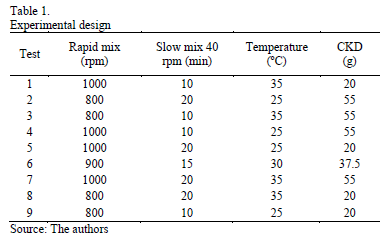
<body><![CDATA[<p><font size="2" face="Verdana, Arial, Helvetica, sans-serif"><b>2.2.  Analytical   methods</b>    <br>   </font><font size="2" face="Verdana, Arial, Helvetica, sans-serif">A pH meter was   employed to determine the pH of the AMD and the neutralized samples (Schott Handylab   pH 11). Neutralization tests were conducted using a magnetic stirrer with   heating elements and thermocouple temperature control (Corning PC-420D). A   spectrophotometer (Thermo Genesis 10 UV) was used to measure the sulphates'   concentration in AMD before and after the treatment. An analytical balance   (Lexus Mix-H) was used to measure the weight of the samples. Different   techniques were used to determine the chemical and mineralogical composition of   the precipitated material and the CKD, such as X-Ray Diffraction (XRD), which   was carried out using a PANalytical X'Pert PRO equipment, in a 2<font face="Symbol">q</font> interval   between 4° and 70° with a step of 0.02 ° and an accumulation time of 30 s to   room temperature, with copper lamp. Fourier Transform Infra-Red Spectroscopy was   carried out using a Shimadzu 8400S. X-Ray Fluorescence was carried out using a   Philips XCEM 1660. Scanning Electronic Microscopy with Energy Dispersive X-Ray   Spectroscopy was carried out using a JEOL JSM 5910LV to 15kV, and Thermo   Gravimetric Analysis (TGA) that was carried out using a Hi-Res TGA 2950 Netchz   equipment, using an alumina crucible, N2 atmosphere and a heating rate of 20   °C/min up to 950 °C. </font></p>     <p><font size="2" face="Verdana, Arial, Helvetica, sans-serif">The ASTM standard ASTM C 150 / C150M - 12 &#91;15&#93; was   followed in order to compare cement samples that had been prepared at the   laboratory level, using the precipitated material to assess the behavior of the   cement.</font></p>     <p><font size="2" face="Verdana, Arial, Helvetica, sans-serif"><b>2.3.  Bench-scale   experiments    <br>   </b></font><font size="2" face="Verdana, Arial, Helvetica, sans-serif">Tests to neutralize   the AMD with CKD were conducted based on an experimental design (two level   fractional factorial design 2<sup>4-1</sup> with a central point) &#91;16&#93; that   included four factors in two levels each: rapid mix (800-1000 rpm), slow mix at   40 rpm (10-20 min), temperature (25-35 °C), and amount of CKD (20-55 g). The   experimental plan was composed of nine tests to assess the sulphates'   concentration in the AMD, which had been treated with CKD (<a href="#tab01">Table 1</a>). </font></p>     <p align="center"><font size="2" face="Verdana, Arial, Helvetica, sans-serif"><a name="tab01"></a></font><img src="/img/revistas/dyna/v81n186/v81n186a11tab01.gif"></p>     <p><font size="2" face="Verdana, Arial, Helvetica, sans-serif">Initially AMD samples   were homogenized in the magnetic stirrer, followed by measurements of pH values   and sulphate content to establish the baseline parameters. Subsequently, 500 mL   of the sample were placed in each of nine beakers before neutralization. Every   beaker was then placed on the magnetic stirrer for one minute on rapid mix   cycle (800-1000 rpm) to mix the CKD according to the experimental design. A   slow mix at 40 rpm was then held for 10 or 20 minutes, depending on each test,   in order to allow the material resulting from the neutralization process to   precipitate. The beakers were covered with a plastic film to prevent dust from   entering and pH was measured twice during the test: once at the end of the slow   mixing cycle and once again after 192 hours. </font></p>     <p><font size="2" face="Verdana, Arial, Helvetica, sans-serif">At this point two phases were clearly identifiable in each   beaker: precipitated and clarified. Sulphates and pH where measured in the   clarified water after being drained from each beaker, and the excess water from   the precipitated </font><font size="2" face="Verdana, Arial, Helvetica, sans-serif">sludge was evaporated at a   temperature of 45 &deg;C, so as to avoid mineralogical changes in the precipitated   material &#91;17-18&#93;, until its weight remained constant (less than 0.1% weight variation), in order to determine the moisture of   the precipitated material. This material was then characterized following the   methods mentioned in section 2.2. Finally, two types of cement were prepared in   the laboratory (one with the precipitate and the other using   Dominican gypsum) in order to compare them and to preliminarily   assess their performance based on the ASTM standards mentioned before.</font></p>     <p>&nbsp;</p>     <p><font size="3" face="Verdana, Arial, Helvetica, sans-serif"><b>3.  Results and discussion</b></font></p>     ]]></body>
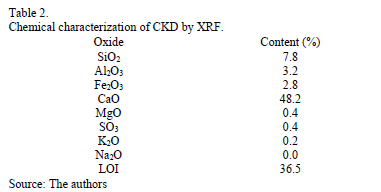
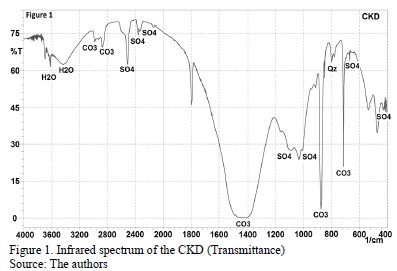
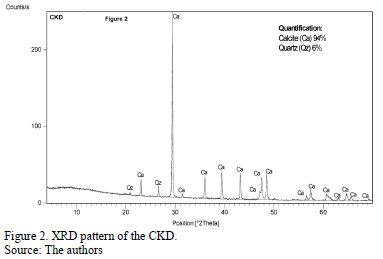
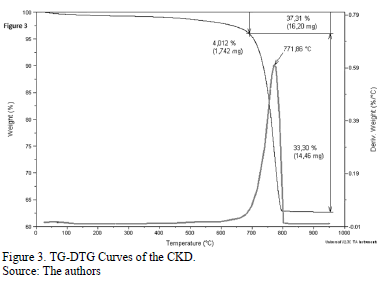
<body><![CDATA[<p><font size="2" face="Verdana, Arial, Helvetica, sans-serif"><b>3.1.  CKD   composition</b>    <br>   </font><font size="2" face="Verdana, Arial, Helvetica, sans-serif">The chemical   characterization of CKD by XRF showed that the highest weight percentage in the   sample was found in calcium oxide (CaO), which falls within the range reported   by Mackie <i>et al.</i> &#91;14&#93;. Loss on   ignition (LOI) is related to the CO<sub>2</sub> that is released and, taking   into account that CKD was dry, it may be deduced that this material still   contains unreacted limestone (CaCO<sub>3</sub>) after leaving the clinker kiln,   which in turn indicates that this material has neutralizing potential (<a href="#tab02">Table   2</a>).</font></p>     <p align="center"><font size="2" face="Verdana, Arial, Helvetica, sans-serif"><a name="tab02"></a></font><img src="/img/revistas/dyna/v81n186/v81n186a11tab02.gif"></p>     <p><font size="2" face="Verdana, Arial, Helvetica, sans-serif">The FTIR analysis of the CKD is shown in <a href="#fig01">Fig.1</a>. The most   representative bands correspond to carbonate vibrations (labeled as CO3). The   strongest of these bands is over 1400 cm<sup>-1</sup>, and there is also a   narrow band around of 873 cm<sup>-1</sup>, as well as a weak band with two   peaks between 2875 cm<sup>-1</sup> and 2990 cm<sup>-1</sup>. These values are   similar to those reported by different authors &#91;19-21&#93;. A small amount of   sulphur, represented by sulphate bands (labeled as SO4) and a minor quantity of   quartz (labeled as Qz) were also found.</font></p>     <p align="center"><font size="2" face="Verdana, Arial, Helvetica, sans-serif"><a name="fig01"></a></font><img src="/img/revistas/dyna/v81n186/v81n186a11fig01.gif"></p>     <p><font size="2" face="Verdana, Arial, Helvetica, sans-serif">The semi-qualitative XRD result, based on a comparative   analysis with X'Pert HighScore<sup>®</sup> database (<a href="#fig02">Fig. 2</a>), confirmed that   calcium carbonate was the main component of the CKD (shown as calcite). Two   small quartz peaks are also visible in the XRD pattern, however, there were no   peaks detected for minerals containing sulphates, which may have been masked by   the major peaks, especially, if they are at low percentages (1 to 3%).</font></p>     <p align="center"><font size="2" face="Verdana, Arial, Helvetica, sans-serif"><a name="fig02"></a></font><img src="/img/revistas/dyna/v81n186/v81n186a11fig02.gif"></p>     <p><font size="2" face="Verdana, Arial, Helvetica, sans-serif">The TG-DTG curves are shown in <a href="#fig03">Fig. 3</a>. In the TG curve a   mass loss between 600 °C and 800 °C can be observed, whereas in the DTG curve a   peak representing a maximum of 771.86 °C can be seen. It is approximately at   this temperature that carbon dioxide is volatilized from the calcium carbonate   sample &#91;18&#93;. Therefore, using loss percentages, calcium carbonate content was   calculated, confirming that it is a main component of the CKD.</font></p>     <p align="center"><font size="2" face="Verdana, Arial, Helvetica, sans-serif"><a name="fig03"></a></font><img src="/img/revistas/dyna/v81n186/v81n186a11fig03.gif"></p>     <p><font size="2" face="Verdana, Arial, Helvetica, sans-serif"><b>3.2.  AMD   neutralization    ]]></body>
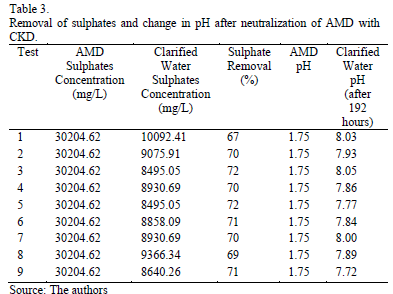
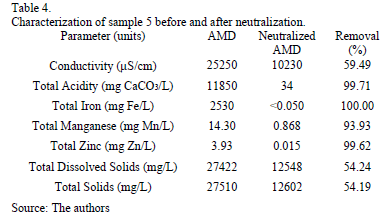
<body><![CDATA[<br>   </b>After the mixing stage, and before the addition of CKD,   sulphate concentrations were measured in the initial AMD samples. The   concentration obtained in each beaker was used to calculate the removal of   sulphates (<a href="#tab03">Table 3</a>), along with the corresponding pH values, which were   measured before and after neutralization.</font></p>     <p align="center"><font size="2" face="Verdana, Arial, Helvetica, sans-serif"><a name="tab03"></a></font><img src="/img/revistas/dyna/v81n186/v81n186a11tab03.gif"></p>     <p><font size="2" face="Verdana, Arial, Helvetica, sans-serif">After 192 hours the pH remained   within the permissible range (5 - 9 units), as dictated by Colombian   environmental regulations. There was sulphate removal of over 67% in all   samples. Samples 3 and 5 had higher removal (72%) and sample 5 was closer than   sample 3 to the neutral pH values. Sample 5 was chosen to be characterized   along with the original AMD in an external laboratory in order to determine additional   environmental parameters, such as conductivity, acidity, solid content and the   presence of iron, manganese and zinc (<a href="#tab04">Table 4</a>).</font></p>     <p align="center"><font size="2" face="Verdana, Arial, Helvetica, sans-serif"><a name="tab04"></a></font><img src="/img/revistas/dyna/v81n186/v81n186a11tab04.gif"></p>     <p><font size="2" face="Verdana, Arial, Helvetica, sans-serif">Conductivity decreased after neutralization, which could   be related to the removal of solids and metals from the AMD. As can be seen in <a href="#tab03">Table 3</a>, the biggest fraction of the Total Solids corresponded to Dissolved   Solids, before and after neutralization. There was more than 93% precipitation   in manganese, zinc and iron, which is similar to the findings of Mackie and   Walsh &#91;22&#93;.</font></p>     <p><font size="2" face="Verdana, Arial, Helvetica, sans-serif"><b>3.3.  Precipitate   composition</b>    <br>   </font><font size="2" face="Verdana, Arial, Helvetica, sans-serif">The hypothesis of this   research aimed to demonstrate that precipitated material could be considered   synthetic gypsum, since the reaction occurred in an aqueous solution. Thus the   analyses of properties such as Moisture content, XRD, TG, FTIR, XRF and SEM   were conducted to verify this claim.</font></p>     <p><font size="2" face="Verdana, Arial, Helvetica, sans-serif"><b>3.3.1.  Moisture   content    <br>   </b></font><font size="2" face="Verdana, Arial, Helvetica, sans-serif">After dehydration at 45°C the moisture content of   precipitated sludge ranged between 69% and 81%. According to Aub&eacute;'s findings   &#91;7&#93; these percentages may vary between approximately 70% and 99%, which is   consistent with the findings of this research.</font></p>     <p><font size="2" face="Verdana, Arial, Helvetica, sans-serif"><b>3.3.2.  X Ray   Diffraction (XRD)</b>    ]]></body>
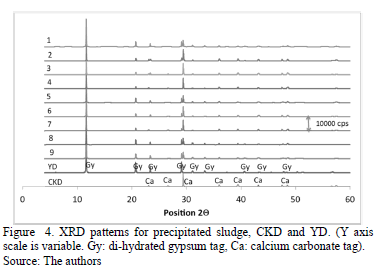
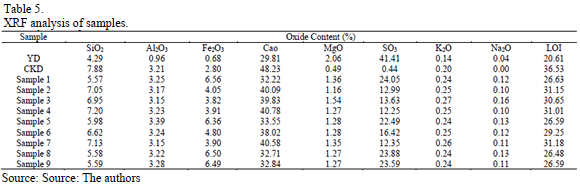
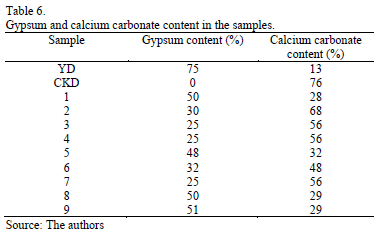
<body><![CDATA[<br>   <a href="#fig04">Fig. 4</a> shows diffraction patterns (XRD) for the nine   samples, previously sieved between -200 and +325 meshes. CKD and Dominican   gypsum (YD) patterns were also included in order to compare the representative   peaks of the gypsum and calcium with the peaks of the precipitate. </font></p>     <p align="center"><font size="2" face="Verdana, Arial, Helvetica, sans-serif"><a name="fig04"></a></font><img src="/img/revistas/dyna/v81n186/v81n186a11fig04.gif"></p>     <p><font size="2" face="Verdana, Arial, Helvetica, sans-serif">Dominican   gypsum (YD) showed four main peaks on the 2<font face="Symbol">q</font> axis. The position of these   peaks was similar to those reported in the X'Pert HighScore® software database   for di-hydrated gypsum. Diffraction patterns for the nine samples matched the   positions of the di-hydrated gypsum, and calcium carbonate peaks were also   found to match the positions reported in the literature &#91;23&#93;. The precipitated   samples showed two double peaks at the gypsum and calcium carbonate positions,   one smaller between 23° and 24° 2<font face="Symbol">q</font> positions and the more representative   pair between 29° and 30° 2<font face="Symbol">q</font> positions. This demonstrates that gypsum was   produced but there is still some unreacted calcium carbonate. From <a href="#fig04">Fig. 4</a> it   can be deduced that the highest peaks of gypsum are related to the lowest peaks   of calcite in the precipitated material (samples 1, 5, 8 and 9). After   comparing each sample against the X'Pert HighScore® database, it was discovered   that samples 5 and 9 had the highest percentage of gypsum, however the   difference between them was the absence of quartz in sample 5.</font></p>     <p><font size="2" face="Verdana, Arial, Helvetica, sans-serif"><b>3.3.3.  X Ray   Fluorescence (XRF)    <br>   </b></font><font size="2" face="Verdana, Arial, Helvetica, sans-serif">Results obtained by XRF showed that samples 1, 5, 8 and 9   had the higher sulphur percentages, shown in <a href="#tab05">Table 5</a> as SO<sub>3</sub>, which   confirms the information obtained through XRD analysis. Compared to CKD the   precipitated samples showed an increase in SO<sub>3</sub> percentage and a   decrease in CaO, which could indicate that sulphur reacted with calcium and in   turn precipitated as gypsum. There was an increase in iron and magnesium oxide   content in the precipitated material after the neutralization process,   affirming that the metals were removed with the addition of CKD.</font></p>     <p align="center"><font size="2" face="Verdana, Arial, Helvetica, sans-serif"><a name="tab05"></a></font><img src="/img/revistas/dyna/v81n186/v81n186a11tab05.gif"></p>     <p><font size="2" face="Verdana, Arial, Helvetica, sans-serif"><b>3.3.4 Thermo Gravimetric   Analysis (TG)</b>    <br>   </font><font size="2" face="Verdana, Arial, Helvetica, sans-serif">This method was used to determine   the percentage of gypsum in the precipitated material. Previous studies have demonstrated that when gypsum is dehydrated to   hemihydrate    there is an initial mass loss of 15% close to 150° C. There is then a mass loss   of 5% in the dehydration of the hemihydrate at around 200° C &#91;24&#93;. Dominican   gypsum showed a mass loss of 15.68% around 150° C and precipitated samples 1,   5, 8 and 9 presented close to a 10% mass loss   at that temperature. The other samples exhibited a loss in mass of less than   6%. At around 750° C there was further loss of mass when carbon dioxide is   released through volatilization, thus confirming the presence of Calcium   Carbonate after neutralization in the precipitated material (<a href="#tab06">Table 6</a>).</font></p>     <p align="center"><font size="2" face="Verdana, Arial, Helvetica, sans-serif"><a name="tab06"></a></font><img src="/img/revistas/dyna/v81n186/v81n186a11tab06.gif"></p>     <p><font size="2" face="Verdana, Arial, Helvetica, sans-serif"><b>3.3.5.  Fourier   Transform Infrared Spectrometry (FTIR)</b>    ]]></body>
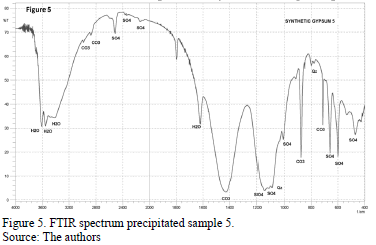
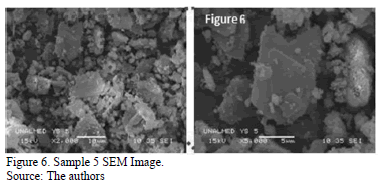
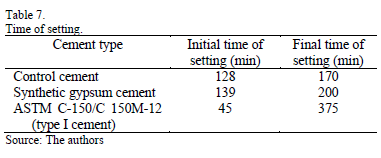
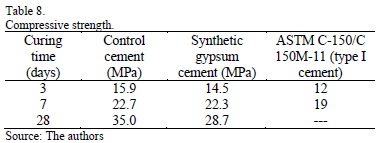
<body><![CDATA[<br>   </font><font size="2" face="Verdana, Arial, Helvetica, sans-serif">This technique was used to   qualitatively complement the XRD, XRF and TG analyses. Precipitated samples 1,   5, 8 and 9 showed representative bands in the vibration spectrum in the normal   positions for carbonates, sulphates and quartz. These bands were labeled as follows:   calcium carbonate vibrations as <i>CO3</i>,   di-hydrated gypsum vibrations as <i>SO4</i>,   di-hydrated gypsum water molecule vibrations as <i>H2O</i> and quartz vibrations as <i>Qz</i>. <a href="#fig05">Fig. 5</a> shows the spectrum obtained for precipitated sample 5.</font></p>     <p align="center"><font size="2" face="Verdana, Arial, Helvetica, sans-serif"><a name="fig05"></a></font><img src="/img/revistas/dyna/v81n186/v81n186a11fig05.gif"></p>     <p><font size="2" face="Verdana, Arial, Helvetica, sans-serif"><b>3.3.6.  Scanning   Electron Microscopy (SEM)</b>    <br>   As can be seen in <a href="#fig06">Fig.   6</a>, precipitated samples showed mainly crystals with a tabular habit, and there   is also a crystal that could match the description of crystal twinning (simple twin),   as described by Nesse &#91;17&#93;.&nbsp; One can   observe in the enlarged image how gypsum accumulates on the same crystal to   increase its size. With regards to size, synthetic gypsum crystals were smaller   than those in mined gypsum, which may be related to their origin.</font></p>     <p align="center"><font size="2" face="Verdana, Arial, Helvetica, sans-serif"><a name="fig06"></a></font><img src="/img/revistas/dyna/v81n186/v81n186a11fig06.gif"></p>     <p><font size="2" face="Verdana, Arial, Helvetica, sans-serif"><b>3.3.7.  Clinker   blended with synthetic gypsum</b>    <br>   <a href="#tab07">Table 7</a> shows the time   of setting for the two cement types prepared in the laboratory, the first using   clinker and Dominican gypsum (control cement) and the second using clinker and   synthetic gypsum. These results complied with ASTM C 150/C 150M-12 minimum and   maximum time of setting standards for Type I cement. </font></p>     <p align="center"><font size="2" face="Verdana, Arial, Helvetica, sans-serif"><a name="tab07"></a></font><img src="/img/revistas/dyna/v81n186/v81n186a11tab07.gif"></p>     <p><font size="2" face="Verdana, Arial, Helvetica, sans-serif"><a href="#tab08">Table 8</a> shows the compressive strength found in mortars   that were prepared with the two cements.  The standards are the minimum permitted values.</font></p>     <p align="center"><font size="2" face="Verdana, Arial, Helvetica, sans-serif"><a name="tab08"></a></font><img src="/img/revistas/dyna/v81n186/v81n186a11tab08.gif"></p>     ]]></body>
<body><![CDATA[<p><font size="2" face="Verdana, Arial, Helvetica, sans-serif">Synthetic gypsum caused a slight delay in both times of   setting and developed very similar values for compressive strength. This could   be related to its reactivity and also to the effect of contaminants that   precipitated with it. The delay could also allow a time increase for   workability. We can therefore say that the synthetic gypsum obtained in this   process can be used in the manufacture of Portland cement, replacing gypsum   obtained through mining activities.</font></p>     <p>&nbsp;</p>     <p><font size="3" face="Verdana, Arial, Helvetica, sans-serif"><b>4.  Conclusions </b></font></p>     <p><font size="2" face="Verdana, Arial, Helvetica, sans-serif">Characterization by   XRF, FTIR, XRD, and TG-DTG showed that CaO and CaCO3 were the main components   in CKD, which indicates that this material has neutralizing potential and can   be used to treat AMD. This confirms earlier studies in which this material is   proposed for the treatment of acidic waste water, including metals such as Iron   and Zinc. </font></p>     <p><font size="2" face="Verdana, Arial, Helvetica, sans-serif">It was confirmed that   higher turbulence improves the neutralization reaction between AMD and CKD and,   consequently, the precipitation of synthetic gypsum can occur.</font></p>     <p><font size="2" face="Verdana, Arial, Helvetica, sans-serif">Under the conditions   of this project, approximately 1.5 g of CKD were required to react with 1.0 g   of sulphates in an AMD sample, producing synthetic gypsum that can be exploited   industrially. It is important to highlight that these quantities are not a definitive   recipe, as they correspond to the specific conditions of this research. It is   possible that CKD can also be used to treat acid effluents from other   industrial processes in an economically efficient way. </font></p>     <p><font size="2" face="Verdana, Arial, Helvetica, sans-serif">Although acidity   removal and pH increase to neutral values proved to be effective, it is   recommended that a combination of CKD and lime could be tested in future   researches, and which could potentially improve AMD neutralization.</font></p>     <p><font size="2" face="Verdana, Arial, Helvetica, sans-serif">Results showed that   synthetic gypsum obtained under these research conditions can be used to   produce cement, and the values found for time of setting and compressive   strength complied with ASTM standard specifications.</font></p>     <p><font size="2" face="Verdana, Arial, Helvetica, sans-serif">As a general   conclusion to this research, it can be stated that there are many possibilities   to prevent environmental pollution through the manipulation and optimization of   industrial processes, in order to find new uses for the by-products and   residues from the intermediate and end stages.</font></p>     <p>&nbsp;</p>     ]]></body>
<body><![CDATA[<p><font size="3" face="Verdana, Arial, Helvetica, sans-serif"><b>Acknowledgements </b></font></p>     <p><font size="2" face="Verdana, Arial, Helvetica, sans-serif">The authors would like to thank Cementos Argos S.A. for   funding this project. </font></p>     <p>&nbsp;</p>     <p><font size="3" face="Verdana, Arial, Helvetica, sans-serif"><b>References</b></font></p>     <!-- ref --><p><font size="2" face="Verdana, Arial, Helvetica, sans-serif"><b>&#91;1&#93;</b> Marcello, R.R., Galato, S., Peterson, M., Riella, H.G. and Bernardin, A.M., Inorganic pigments made from the recycling of coal mine drainage treatment sludge. Journal of environmental management, 88, pp. 1280-1284, 2008.    &nbsp;&nbsp;&nbsp;&nbsp;&nbsp;&nbsp;&nbsp;&nbsp;[&#160;<a href="javascript:void(0);" onclick="javascript: window.open('/scielo.php?script=sci_nlinks&ref=000097&pid=S0012-7353201400040001100001&lng=','','width=640,height=500,resizable=yes,scrollbars=1,menubar=yes,');">Links</a>&#160;]<!-- end-ref --></font></p>     <!-- ref --><p> <font size="2" face="Verdana, Arial, Helvetica, sans-serif"><b>&#91;2&#93;</b> Cara, J., The biodesulphurization of a semianthracite coal in a packed-bed system. Fuel, 82, pp. 2065-2068, 2003.    &nbsp;&nbsp;&nbsp;&nbsp;&nbsp;&nbsp;&nbsp;&nbsp;[&#160;<a href="javascript:void(0);" onclick="javascript: window.open('/scielo.php?script=sci_nlinks&ref=000099&pid=S0012-7353201400040001100002&lng=','','width=640,height=500,resizable=yes,scrollbars=1,menubar=yes,');">Links</a>&#160;]<!-- end-ref --></font></p>     <!-- ref --><p> <font size="2" face="Verdana, Arial, Helvetica, sans-serif"><b>&#91;3&#93;</b> Evangelou, V., Pyrite microencapsulation technologies: Principles and potential field application. Ecological Engineering, 17, pp. 165-178, 2001.    &nbsp;&nbsp;&nbsp;&nbsp;&nbsp;&nbsp;&nbsp;&nbsp;[&#160;<a href="javascript:void(0);" onclick="javascript: window.open('/scielo.php?script=sci_nlinks&ref=000101&pid=S0012-7353201400040001100003&lng=','','width=640,height=500,resizable=yes,scrollbars=1,menubar=yes,');">Links</a>&#160;]<!-- end-ref --></font></p>     ]]></body>
<body><![CDATA[<!-- ref --><p> <font size="2" face="Verdana, Arial, Helvetica, sans-serif"><b>&#91;4&#93;</b> Rahmatian, M., The incidence of environmental degradation: A case study of acid mine drainage. Journal of environmental management, 30, pp. 145-155, 1990.    &nbsp;&nbsp;&nbsp;&nbsp;&nbsp;&nbsp;&nbsp;&nbsp;[&#160;<a href="javascript:void(0);" onclick="javascript: window.open('/scielo.php?script=sci_nlinks&ref=000103&pid=S0012-7353201400040001100004&lng=','','width=640,height=500,resizable=yes,scrollbars=1,menubar=yes,');">Links</a>&#160;]<!-- end-ref --></font></p>     <!-- ref --><p> <font size="2" face="Verdana, Arial, Helvetica, sans-serif"><b>&#91;5&#93;</b> Peray, K.E., The Rotary Cement Kiln, Second. Ed. Chemical Publishing Co., Inc., New York, USA, 1986.    &nbsp;&nbsp;&nbsp;&nbsp;&nbsp;&nbsp;&nbsp;&nbsp;[&#160;<a href="javascript:void(0);" onclick="javascript: window.open('/scielo.php?script=sci_nlinks&ref=000105&pid=S0012-7353201400040001100005&lng=','','width=640,height=500,resizable=yes,scrollbars=1,menubar=yes,');">Links</a>&#160;]<!-- end-ref --></font></p>     <!-- ref --><p> <font size="2" face="Verdana, Arial, Helvetica, sans-serif"><b>&#91;6&#93;</b> Dom&eacute;nech, X., Qu&iacute;mica atmosf&eacute;rica, origen y efectos de la contaminaci&oacute;n. Miraguano ediciones, Madrid, Espa&ntilde;a, 1991.    &nbsp;&nbsp;&nbsp;&nbsp;&nbsp;&nbsp;&nbsp;&nbsp;[&#160;<a href="javascript:void(0);" onclick="javascript: window.open('/scielo.php?script=sci_nlinks&ref=000107&pid=S0012-7353201400040001100006&lng=','','width=640,height=500,resizable=yes,scrollbars=1,menubar=yes,');">Links</a>&#160;]<!-- end-ref --></font></p>     <!-- ref --><p> <font size="2" face="Verdana, Arial, Helvetica, sans-serif"><b>&#91;7&#93;</b> Aub&eacute;, B. and Zinck, J., Lime Treatment of Acid Mine Drainage in Canad&aacute;, in: Brazil-Canada Seminar on Mine Rehabilitation. Brazil-Canada Seminar on Mine Rehabilitation, Florian&oacute;polis, 2003, pp. 1-12.    &nbsp;&nbsp;&nbsp;&nbsp;&nbsp;&nbsp;&nbsp;&nbsp;[&#160;<a href="javascript:void(0);" onclick="javascript: window.open('/scielo.php?script=sci_nlinks&ref=000109&pid=S0012-7353201400040001100007&lng=','','width=640,height=500,resizable=yes,scrollbars=1,menubar=yes,');">Links</a>&#160;]<!-- end-ref --></font></p>     <!-- ref --><p> <font size="2" face="Verdana, Arial, Helvetica, sans-serif"><b>&#91;8&#93;</b> Cravotta III, C., Limestone drains to increase pH and remove dissolved metals from acidic mine drainage. Applied Geochemistry, 14, pp. 581-606, 1999.    &nbsp;&nbsp;&nbsp;&nbsp;&nbsp;&nbsp;&nbsp;&nbsp;[&#160;<a href="javascript:void(0);" onclick="javascript: window.open('/scielo.php?script=sci_nlinks&ref=000111&pid=S0012-7353201400040001100008&lng=','','width=640,height=500,resizable=yes,scrollbars=1,menubar=yes,');">Links</a>&#160;]<!-- end-ref --></font></p>     ]]></body>
<body><![CDATA[<!-- ref --><p> <font size="2" face="Verdana, Arial, Helvetica, sans-serif"><b>&#91;9&#93;</b> Kalin, M. and Harris, B., Chemical precipitation within pyritic waste rock. Hydrometallurgy 78, 209-225, 2005.    &nbsp;&nbsp;&nbsp;&nbsp;&nbsp;&nbsp;&nbsp;&nbsp;[&#160;<a href="javascript:void(0);" onclick="javascript: window.open('/scielo.php?script=sci_nlinks&ref=000113&pid=S0012-7353201400040001100009&lng=','','width=640,height=500,resizable=yes,scrollbars=1,menubar=yes,');">Links</a>&#160;]<!-- end-ref --></font></p>     <!-- ref --><p> <font size="2" face="Verdana, Arial, Helvetica, sans-serif"><b>&#91;10&#93;</b> Bulusu, S., Aydilek, A.H. and Rustagi, N., CCB-based encapsulation of pyrite for remediation of acid mine drainage. Journal of hazardous materials, 143, pp. 609-619, 2007.    &nbsp;&nbsp;&nbsp;&nbsp;&nbsp;&nbsp;&nbsp;&nbsp;[&#160;<a href="javascript:void(0);" onclick="javascript: window.open('/scielo.php?script=sci_nlinks&ref=000115&pid=S0012-7353201400040001100010&lng=','','width=640,height=500,resizable=yes,scrollbars=1,menubar=yes,');">Links</a>&#160;]<!-- end-ref --></font></p>     <!-- ref --><p> <font size="2" face="Verdana, Arial, Helvetica, sans-serif"><b>&#91;11&#93;</b> Sheoran, A.S. and Sheoran, V., C.R.P. Bioremediation of acid-rock drainage by sulphate-reducing prokaryotes: A review. Minerals Engineering, 23, pp. 1073-1100, 2010.    &nbsp;&nbsp;&nbsp;&nbsp;&nbsp;&nbsp;&nbsp;&nbsp;[&#160;<a href="javascript:void(0);" onclick="javascript: window.open('/scielo.php?script=sci_nlinks&ref=000117&pid=S0012-7353201400040001100011&lng=','','width=640,height=500,resizable=yes,scrollbars=1,menubar=yes,');">Links</a>&#160;]<!-- end-ref --></font></p>     <!-- ref --><p> <font size="2" face="Verdana, Arial, Helvetica, sans-serif"><b>&#91;12&#93;</b> Calvo, B., Canoira, L., Morante, F., Mart&iacute;nez-Bedia, J.M., Vinagre, C., Garc&iacute;a-Gonz&aacute;lez, J.E., Elsen, J. and Alcantara, R., Continuous elimination of Pb2+, Cu2+, Zn2+, H+ and NH4+ from acidic waters by ionic exchange on natural zeolites. Journal of hazardous materials, 166, pp. 619-627, 2009.    &nbsp;&nbsp;&nbsp;&nbsp;&nbsp;&nbsp;&nbsp;&nbsp;[&#160;<a href="javascript:void(0);" onclick="javascript: window.open('/scielo.php?script=sci_nlinks&ref=000119&pid=S0012-7353201400040001100012&lng=','','width=640,height=500,resizable=yes,scrollbars=1,menubar=yes,');">Links</a>&#160;]<!-- end-ref --></font></p>     <!-- ref --><p> <font size="2" face="Verdana, Arial, Helvetica, sans-serif"><b>&#91;13&#93;</b> Bhatty, J.I., Alternative Uses of Cement Kiln Dust. 1995.    &nbsp;&nbsp;&nbsp;&nbsp;&nbsp;&nbsp;&nbsp;&nbsp;[&#160;<a href="javascript:void(0);" onclick="javascript: window.open('/scielo.php?script=sci_nlinks&ref=000121&pid=S0012-7353201400040001100013&lng=','','width=640,height=500,resizable=yes,scrollbars=1,menubar=yes,');">Links</a>&#160;]<!-- end-ref --></font></p>     ]]></body>
<body><![CDATA[<!-- ref --><p> <font size="2" face="Verdana, Arial, Helvetica, sans-serif"><b>&#91;14&#93;</b> Mackie, A., Boilard, S., Walsh, M.E. and Lake, C.B., Physicochemical characterization of cement kiln dust for potential reuse in acidic wastewater treatment. Journal of hazardous materials, 173, pp. 283-291, 2010.    &nbsp;&nbsp;&nbsp;&nbsp;&nbsp;&nbsp;&nbsp;&nbsp;[&#160;<a href="javascript:void(0);" onclick="javascript: window.open('/scielo.php?script=sci_nlinks&ref=000123&pid=S0012-7353201400040001100014&lng=','','width=640,height=500,resizable=yes,scrollbars=1,menubar=yes,');">Links</a>&#160;]<!-- end-ref --></font></p>     <!-- ref --><p> <font size="2" face="Verdana, Arial, Helvetica, sans-serif"><b>&#91;15&#93;</b> ASTM International. ASTM C 150 / C150M - 12 Standard Specification for Portland Cement. USA, 2012.    &nbsp;&nbsp;&nbsp;&nbsp;&nbsp;&nbsp;&nbsp;&nbsp;[&#160;<a href="javascript:void(0);" onclick="javascript: window.open('/scielo.php?script=sci_nlinks&ref=000125&pid=S0012-7353201400040001100015&lng=','','width=640,height=500,resizable=yes,scrollbars=1,menubar=yes,');">Links</a>&#160;]<!-- end-ref --></font></p>     <!-- ref --><p> <font size="2" face="Verdana, Arial, Helvetica, sans-serif"><b>&#91;16&#93;</b> Guti&eacute;rrez, H. y De La Vara, R., An&aacute;lisis y dise&ntilde;o de experimentos, Segunda ed. McGraw-Hill/Interamericana Editores S.A. de C.V., M&eacute;xico D.F., 2008.    &nbsp;&nbsp;&nbsp;&nbsp;&nbsp;&nbsp;&nbsp;&nbsp;[&#160;<a href="javascript:void(0);" onclick="javascript: window.open('/scielo.php?script=sci_nlinks&ref=000127&pid=S0012-7353201400040001100016&lng=','','width=640,height=500,resizable=yes,scrollbars=1,menubar=yes,');">Links</a>&#160;]<!-- end-ref --></font></p>     <!-- ref --><p> <font size="2" face="Verdana, Arial, Helvetica, sans-serif"><b>&#91;17&#93;</b> Nesse, W.D., Introduction to mineralogy. Oxford University Press, New York, USA, 2000.    &nbsp;&nbsp;&nbsp;&nbsp;&nbsp;&nbsp;&nbsp;&nbsp;[&#160;<a href="javascript:void(0);" onclick="javascript: window.open('/scielo.php?script=sci_nlinks&ref=000129&pid=S0012-7353201400040001100017&lng=','','width=640,height=500,resizable=yes,scrollbars=1,menubar=yes,');">Links</a>&#160;]<!-- end-ref --></font></p>     <!-- ref --><p> <font size="2" face="Verdana, Arial, Helvetica, sans-serif"><b>&#91;18&#93;</b> Ramachandran, V.S., Paroli, R.M., Beaudoin, J.J. and Delgado, A.H., Handbook of Thermal Analysis of Construction Materials. Noyes Publications/William Andrew Publishing, New York, USA, 2002.    &nbsp;&nbsp;&nbsp;&nbsp;&nbsp;&nbsp;&nbsp;&nbsp;[&#160;<a href="javascript:void(0);" onclick="javascript: window.open('/scielo.php?script=sci_nlinks&ref=000131&pid=S0012-7353201400040001100018&lng=','','width=640,height=500,resizable=yes,scrollbars=1,menubar=yes,');">Links</a>&#160;]<!-- end-ref --></font></p>     ]]></body>
<body><![CDATA[<!-- ref --><p> <font size="2" face="Verdana, Arial, Helvetica, sans-serif"><b>&#91;19&#93;</b> Anbalagan, G., Mukundakumari, S., Murugesan, K.S. and Gunasekaran, S., Infrared, optical absorption, and EPR spectroscopic studies on natural gypsum. Vibrational Spectroscopy, 50, pp. 226-230, 2009.    &nbsp;&nbsp;&nbsp;&nbsp;&nbsp;&nbsp;&nbsp;&nbsp;[&#160;<a href="javascript:void(0);" onclick="javascript: window.open('/scielo.php?script=sci_nlinks&ref=000133&pid=S0012-7353201400040001100019&lng=','','width=640,height=500,resizable=yes,scrollbars=1,menubar=yes,');">Links</a>&#160;]<!-- end-ref --></font></p>     <!-- ref --><p> <font size="2" face="Verdana, Arial, Helvetica, sans-serif"><b>&#91;20&#93;</b> Böke, H., Quantification of CaCO3-CaSO3.0,5H2O-CaSO4.2H2O mixtures by FTIR analysis and its ANN model. Materials Letters, 58, pp. 723-726, 2004.    &nbsp;&nbsp;&nbsp;&nbsp;&nbsp;&nbsp;&nbsp;&nbsp;[&#160;<a href="javascript:void(0);" onclick="javascript: window.open('/scielo.php?script=sci_nlinks&ref=000135&pid=S0012-7353201400040001100020&lng=','','width=640,height=500,resizable=yes,scrollbars=1,menubar=yes,');">Links</a>&#160;]<!-- end-ref --></font></p>     <!-- ref --><p> <font size="2" face="Verdana, Arial, Helvetica, sans-serif"><b>&#91;21&#93;</b> Jun Chu, K., Seun Yoo, K. and Tae Kim, K., Characteristics of gypsum crystal growth over calcium-based slurry in desulfurization reactions. Materials Research Bulletin, 32, pp. 197-204, 1997.    &nbsp;&nbsp;&nbsp;&nbsp;&nbsp;&nbsp;&nbsp;&nbsp;[&#160;<a href="javascript:void(0);" onclick="javascript: window.open('/scielo.php?script=sci_nlinks&ref=000137&pid=S0012-7353201400040001100021&lng=','','width=640,height=500,resizable=yes,scrollbars=1,menubar=yes,');">Links</a>&#160;]<!-- end-ref --></font></p>     <!-- ref --><p> <font size="2" face="Verdana, Arial, Helvetica, sans-serif"><b>&#91;22&#93;</b> Mackie, A.L. and Walsh, M.E., Bench-scale study of active mine water treatment using cement kiln dust (CKD) as a neutralization agent. Water research, 46, pp. 327-334, 2012.    &nbsp;&nbsp;&nbsp;&nbsp;&nbsp;&nbsp;&nbsp;&nbsp;[&#160;<a href="javascript:void(0);" onclick="javascript: window.open('/scielo.php?script=sci_nlinks&ref=000139&pid=S0012-7353201400040001100022&lng=','','width=640,height=500,resizable=yes,scrollbars=1,menubar=yes,');">Links</a>&#160;]<!-- end-ref --></font></p>     <!-- ref --><p> <font size="2" face="Verdana, Arial, Helvetica, sans-serif"><b>&#91;23&#93;</b> Santagata, M., Sreekrishnavilasam, A. and King, S., Characterization of fresh and landfilled cement kiln dust for reuse in construction applications. Engineering Geology, 85, pp. 165-173, 2006.    &nbsp;&nbsp;&nbsp;&nbsp;&nbsp;&nbsp;&nbsp;&nbsp;[&#160;<a href="javascript:void(0);" onclick="javascript: window.open('/scielo.php?script=sci_nlinks&ref=000141&pid=S0012-7353201400040001100023&lng=','','width=640,height=500,resizable=yes,scrollbars=1,menubar=yes,');">Links</a>&#160;]<!-- end-ref --></font></p>     ]]></body>
<body><![CDATA[<!-- ref --><p> <font size="2" face="Verdana, Arial, Helvetica, sans-serif"><b>&#91;24&#93;</b> Pay&aacute;, J., Borrachero, M. V., Bonilla, M. and Monz&oacute;, J., The use of thermogravimetric analysis technique for the characterization of construction materials, the gypsum case. Journal of Thermal Analysis and Calorimetry, 91, pp. 503-509, 2008.    &nbsp;&nbsp;&nbsp;&nbsp;&nbsp;&nbsp;&nbsp;&nbsp;[&#160;<a href="javascript:void(0);" onclick="javascript: window.open('/scielo.php?script=sci_nlinks&ref=000143&pid=S0012-7353201400040001100024&lng=','','width=640,height=500,resizable=yes,scrollbars=1,menubar=yes,');">Links</a>&#160;]<!-- end-ref --> </font></p>     <p>&nbsp;</p>     <p><font size="2" face="Verdana, Arial, Helvetica, sans-serif"><b>E. A.   Mart&iacute;nez-Londo&ntilde;o</b>, received the Bs. Eng. in Sanitary Engineering in 2000   from Universidad de Antioquia (Colombia), a MSc degree in Management and Environmental   Audits in 2006 from Universidad de Las Palmas de Gran Canaria (Spain), and a   MSc degree in Engineering - Materials and Processes in 2010 from Universidad   Nacional de Colombia (Colombia). From 2001 to 2003, he worked for a consulting   company as a Field Engineer in the oil extraction sector and since 2003 for   Cementos Argos. Currently, he is a Projects Leader in the Research and   Development Department in Cementos Argos. His research interests include:   sustainable processes, alternative fuels, bioenergy, energy crops, climate   change and life cycle assessment.</font></p>     <p><font size="2" face="Verdana, Arial, Helvetica, sans-serif"><b>J. I. Tob&oacute;n</b>,   received the Bs. Eng in Geological Engineering in 1992, the MS degree in   Engineering in 2003, and the PhD degree in Science and Technology of Materials   in 2011, all of them from the Universidad Nacional de Colombia. Medellin,   Colombia. From 1992 to 1995, he worked for different companies in mining and   oil; from 1995 to 1999 he worked for Cementos Argos S.A., at the same time from   1993 to 1999 he worked for the Universidad Nacional de Colombia as part time   Professor and since 1999 for the Universidad Nacional de Colombia at full time.   Currently, he is a Full Professor in the Materials and Minerals Department,   Facultad de Minas, Universidad Nacional de Colombia. His research interests   include: industrial application of minerals and rocks, chemistry and mineralogy   of cements, nanotechnology in construction materials, alternative cementitious   materials, and high performance cements and concretes.</font></p>     <p><font size="2" face="Verdana, Arial, Helvetica, sans-serif"><b>J.G. Morales Rend&oacute;n</b>, received the Bs. Eng in   Chemical Engineering in 1994 from the Universidad de Antioquia, the MS degree   in Engineering Science and Technology of Materials and Process in 2007 from the   Universidad Nacional de Colombia sede Medell&iacute;n. Nowadays he is a PhD (c) in the   program of Engineering Science and Technology of Materials at the Universidad   Nacional de Colombia sede Medell&iacute;n. He has worked since 1994 in the cement   company Cementos Argos S.A. where he has occupied different charges in cement   production process. Currently, he is working in the R&amp;D area as a Senior   Leader of the process and technology program conducting several projects with   the orientation toward the application of the knowledge &nbsp;in the solution   of problems or new developments.</font></p>      ]]></body><back>
<ref-list>
<ref id="B1">
<label>1</label><nlm-citation citation-type="journal">
<person-group person-group-type="author">
<name>
<surname><![CDATA[Marcello]]></surname>
<given-names><![CDATA[R.R.]]></given-names>
</name>
<name>
<surname><![CDATA[Galato]]></surname>
<given-names><![CDATA[S.]]></given-names>
</name>
<name>
<surname><![CDATA[Peterson]]></surname>
<given-names><![CDATA[M.]]></given-names>
</name>
<name>
<surname><![CDATA[Riella]]></surname>
<given-names><![CDATA[H.G.]]></given-names>
</name>
<name>
<surname><![CDATA[Bernardin]]></surname>
<given-names><![CDATA[A.M.]]></given-names>
</name>
</person-group>
<article-title xml:lang="en"><![CDATA[Inorganic pigments made from the recycling of coal mine drainage treatment sludge]]></article-title>
<source><![CDATA[Journal of environmental management]]></source>
<year>2008</year>
<numero>88</numero>
<issue>88</issue>
<page-range>1280-1284</page-range></nlm-citation>
</ref>
<ref id="B2">
<label>2</label><nlm-citation citation-type="journal">
<person-group person-group-type="author">
<name>
<surname><![CDATA[Cara]]></surname>
<given-names><![CDATA[J.]]></given-names>
</name>
</person-group>
<article-title xml:lang="en"><![CDATA[The biodesulphurization of a semianthracite coal in a packed-bed system]]></article-title>
<source><![CDATA[Fuel]]></source>
<year>2003</year>
<numero>82</numero>
<issue>82</issue>
<page-range>2065-2068</page-range></nlm-citation>
</ref>
<ref id="B3">
<label>3</label><nlm-citation citation-type="journal">
<person-group person-group-type="author">
<name>
<surname><![CDATA[Evangelou]]></surname>
<given-names><![CDATA[V.]]></given-names>
</name>
</person-group>
<article-title xml:lang="en"><![CDATA[Pyrite microencapsulation technologies: Principles and potential field application]]></article-title>
<source><![CDATA[Ecological Engineering]]></source>
<year>2001</year>
<numero>17</numero>
<issue>17</issue>
<page-range>165-178</page-range></nlm-citation>
</ref>
<ref id="B4">
<label>4</label><nlm-citation citation-type="journal">
<person-group person-group-type="author">
<name>
<surname><![CDATA[Rahmatian]]></surname>
<given-names><![CDATA[M.]]></given-names>
</name>
</person-group>
<article-title xml:lang="en"><![CDATA[The incidence of environmental degradation: A case study of acid mine drainage]]></article-title>
<source><![CDATA[Journal of environmental management]]></source>
<year>1990</year>
<numero>30</numero>
<issue>30</issue>
<page-range>145-155</page-range></nlm-citation>
</ref>
<ref id="B5">
<label>5</label><nlm-citation citation-type="book">
<person-group person-group-type="author">
<name>
<surname><![CDATA[Peray]]></surname>
<given-names><![CDATA[K.E.]]></given-names>
</name>
</person-group>
<source><![CDATA[The Rotary Cement Kiln]]></source>
<year>1986</year>
<edition>Second</edition>
<publisher-loc><![CDATA[New York ]]></publisher-loc>
<publisher-name><![CDATA[Chemical Publishing Co., Inc.]]></publisher-name>
</nlm-citation>
</ref>
<ref id="B6">
<label>6</label><nlm-citation citation-type="book">
<person-group person-group-type="author">
<name>
<surname><![CDATA[Doménech]]></surname>
<given-names><![CDATA[X.]]></given-names>
</name>
</person-group>
<source><![CDATA[Química atmosférica, origen y efectos de la contaminación]]></source>
<year>1991</year>
<publisher-loc><![CDATA[Madrid ]]></publisher-loc>
<publisher-name><![CDATA[Miraguano ediciones]]></publisher-name>
</nlm-citation>
</ref>
<ref id="B7">
<label>7</label><nlm-citation citation-type="confpro">
<person-group person-group-type="author">
<name>
<surname><![CDATA[Aubé]]></surname>
<given-names><![CDATA[B.]]></given-names>
</name>
<name>
<surname><![CDATA[Zinck]]></surname>
<given-names><![CDATA[J.]]></given-names>
</name>
</person-group>
<article-title xml:lang="en"><![CDATA[Lime Treatment of Acid Mine Drainage in Canadá]]></article-title>
<source><![CDATA[]]></source>
<year></year>
<conf-name><![CDATA[ Brazil-Canada Seminar on Mine Rehabilitation]]></conf-name>
<conf-date>2003</conf-date>
<conf-loc>Florianópolis </conf-loc>
</nlm-citation>
</ref>
<ref id="B8">
<label>8</label><nlm-citation citation-type="journal">
<person-group person-group-type="author">
<name>
<surname><![CDATA[Cravotta III]]></surname>
<given-names><![CDATA[C.]]></given-names>
</name>
</person-group>
<article-title xml:lang="en"><![CDATA[Limestone drains to increase pH and remove dissolved metals from acidic mine drainage]]></article-title>
<source><![CDATA[Applied Geochemistry]]></source>
<year>1999</year>
<numero>14</numero>
<issue>14</issue>
<page-range>581-606</page-range></nlm-citation>
</ref>
<ref id="B9">
<label>9</label><nlm-citation citation-type="journal">
<person-group person-group-type="author">
<name>
<surname><![CDATA[Kalin]]></surname>
<given-names><![CDATA[M.]]></given-names>
</name>
<name>
<surname><![CDATA[Harris]]></surname>
<given-names><![CDATA[B.]]></given-names>
</name>
</person-group>
<article-title xml:lang="en"><![CDATA[Chemical precipitation within pyritic waste rock]]></article-title>
<source><![CDATA[Hydrometallurgy]]></source>
<year>2005</year>
<numero>78</numero>
<issue>78</issue>
<page-range>209-225</page-range></nlm-citation>
</ref>
<ref id="B10">
<label>10</label><nlm-citation citation-type="journal">
<person-group person-group-type="author">
<name>
<surname><![CDATA[Bulusu]]></surname>
<given-names><![CDATA[S.]]></given-names>
</name>
<name>
<surname><![CDATA[Aydilek]]></surname>
<given-names><![CDATA[A.H.]]></given-names>
</name>
<name>
<surname><![CDATA[Rustagi]]></surname>
<given-names><![CDATA[N.]]></given-names>
</name>
</person-group>
<article-title xml:lang="en"><![CDATA[CCB-based encapsulation of pyrite for remediation of acid mine drainage]]></article-title>
<source><![CDATA[Journal of hazardous materials]]></source>
<year>2007</year>
<numero>143</numero>
<issue>143</issue>
<page-range>609-619</page-range></nlm-citation>
</ref>
<ref id="B11">
<label>11</label><nlm-citation citation-type="journal">
<person-group person-group-type="author">
<name>
<surname><![CDATA[Sheoran]]></surname>
<given-names><![CDATA[A.S.]]></given-names>
</name>
<name>
<surname><![CDATA[Sheoran]]></surname>
<given-names><![CDATA[V.]]></given-names>
</name>
</person-group>
<article-title xml:lang="en"><![CDATA[C.R.P. Bioremediation of acid-rock drainage by sulphate-reducing prokaryotes: A review]]></article-title>
<source><![CDATA[Minerals Engineering]]></source>
<year>2010</year>
<numero>23</numero>
<issue>23</issue>
<page-range>1073-1100</page-range></nlm-citation>
</ref>
<ref id="B12">
<label>12</label><nlm-citation citation-type="journal">
<person-group person-group-type="author">
<name>
<surname><![CDATA[Calvo]]></surname>
<given-names><![CDATA[B.]]></given-names>
</name>
<name>
<surname><![CDATA[Canoira]]></surname>
<given-names><![CDATA[L.]]></given-names>
</name>
<name>
<surname><![CDATA[Morante]]></surname>
<given-names><![CDATA[F.]]></given-names>
</name>
<name>
<surname><![CDATA[Martínez-Bedia]]></surname>
<given-names><![CDATA[J.M.]]></given-names>
</name>
<name>
<surname><![CDATA[Vinagre]]></surname>
<given-names><![CDATA[C.]]></given-names>
</name>
<name>
<surname><![CDATA[García-González]]></surname>
<given-names><![CDATA[J.E.]]></given-names>
</name>
<name>
<surname><![CDATA[Elsen]]></surname>
<given-names><![CDATA[J.]]></given-names>
</name>
<name>
<surname><![CDATA[Alcantara]]></surname>
<given-names><![CDATA[R.]]></given-names>
</name>
</person-group>
<article-title xml:lang="en"><![CDATA[Continuous elimination of Pb2+, Cu2+, Zn2+, H+ and NH4+ from acidic waters by ionic exchange on natural zeolites]]></article-title>
<source><![CDATA[Journal of hazardous materials]]></source>
<year>2009</year>
<numero>166</numero>
<issue>166</issue>
<page-range>619-627</page-range></nlm-citation>
</ref>
<ref id="B13">
<label>13</label><nlm-citation citation-type="">
<person-group person-group-type="author">
<name>
<surname><![CDATA[Bhatty]]></surname>
<given-names><![CDATA[J.I.]]></given-names>
</name>
</person-group>
<source><![CDATA[Alternative Uses of Cement Kiln Dust]]></source>
<year>1995</year>
</nlm-citation>
</ref>
<ref id="B14">
<label>14</label><nlm-citation citation-type="journal">
<person-group person-group-type="author">
<name>
<surname><![CDATA[Mackie]]></surname>
<given-names><![CDATA[A.]]></given-names>
</name>
<name>
<surname><![CDATA[Boilard]]></surname>
<given-names><![CDATA[S.]]></given-names>
</name>
<name>
<surname><![CDATA[Walsh]]></surname>
<given-names><![CDATA[M.E.]]></given-names>
</name>
<name>
<surname><![CDATA[Lake]]></surname>
<given-names><![CDATA[C.B.]]></given-names>
</name>
</person-group>
<article-title xml:lang="en"><![CDATA[Physicochemical characterization of cement kiln dust for potential reuse in acidic wastewater treatment]]></article-title>
<source><![CDATA[Journal of hazardous materials]]></source>
<year>2010</year>
<numero>173</numero>
<issue>173</issue>
<page-range>283-291</page-range></nlm-citation>
</ref>
<ref id="B15">
<label>15</label><nlm-citation citation-type="">
<collab>ASTM International</collab>
<source><![CDATA[ASTM C 150 / C150M - 12 Standard Specification for Portland Cement]]></source>
<year>2012</year>
</nlm-citation>
</ref>
<ref id="B16">
<label>16</label><nlm-citation citation-type="book">
<person-group person-group-type="author">
<name>
<surname><![CDATA[Gutiérrez]]></surname>
<given-names><![CDATA[H.]]></given-names>
</name>
<name>
<surname><![CDATA[De La Vara]]></surname>
<given-names><![CDATA[R.]]></given-names>
</name>
</person-group>
<source><![CDATA[Análisis y diseño de experimentos]]></source>
<year>2008</year>
<edition>Segunda</edition>
<publisher-loc><![CDATA[^eMéxico D.F. México D.F.]]></publisher-loc>
<publisher-name><![CDATA[McGraw-Hill/Interamericana Editores S.A. de C.V.]]></publisher-name>
</nlm-citation>
</ref>
<ref id="B17">
<label>17</label><nlm-citation citation-type="book">
<person-group person-group-type="author">
<name>
<surname><![CDATA[Nesse]]></surname>
<given-names><![CDATA[W.D.]]></given-names>
</name>
</person-group>
<source><![CDATA[Introduction to mineralogy]]></source>
<year>2000</year>
<publisher-loc><![CDATA[New York ]]></publisher-loc>
<publisher-name><![CDATA[Oxford University Press]]></publisher-name>
</nlm-citation>
</ref>
<ref id="B18">
<label>18</label><nlm-citation citation-type="book">
<person-group person-group-type="author">
<name>
<surname><![CDATA[Ramachandran]]></surname>
<given-names><![CDATA[V.S.]]></given-names>
</name>
<name>
<surname><![CDATA[Paroli]]></surname>
<given-names><![CDATA[R.M.]]></given-names>
</name>
<name>
<surname><![CDATA[Beaudoin]]></surname>
<given-names><![CDATA[J.J.]]></given-names>
</name>
<name>
<surname><![CDATA[Delgado]]></surname>
<given-names><![CDATA[A.H.]]></given-names>
</name>
</person-group>
<source><![CDATA[Handbook of Thermal Analysis of Construction Materials]]></source>
<year>2002</year>
<publisher-loc><![CDATA[New York ]]></publisher-loc>
<publisher-name><![CDATA[Noyes Publications/William Andrew Publishing]]></publisher-name>
</nlm-citation>
</ref>
<ref id="B19">
<label>19</label><nlm-citation citation-type="journal">
<person-group person-group-type="author">
<name>
<surname><![CDATA[Anbalagan]]></surname>
<given-names><![CDATA[G.]]></given-names>
</name>
<name>
<surname><![CDATA[Mukundakumari]]></surname>
<given-names><![CDATA[S.]]></given-names>
</name>
<name>
<surname><![CDATA[Murugesan]]></surname>
<given-names><![CDATA[K.S.]]></given-names>
</name>
<name>
<surname><![CDATA[Gunasekaran]]></surname>
<given-names><![CDATA[S.]]></given-names>
</name>
</person-group>
<article-title xml:lang="en"><![CDATA[Infrared, optical absorption, and EPR spectroscopic studies on natural gypsum]]></article-title>
<source><![CDATA[Vibrational Spectroscopy]]></source>
<year>2009</year>
<numero>50</numero>
<issue>50</issue>
<page-range>226-230</page-range></nlm-citation>
</ref>
<ref id="B20">
<label>20</label><nlm-citation citation-type="journal">
<person-group person-group-type="author">
<name>
<surname><![CDATA[Böke]]></surname>
<given-names><![CDATA[H.]]></given-names>
</name>
</person-group>
<article-title xml:lang="en"><![CDATA[Quantification of CaCO3-CaSO3.0,5H2O-CaSO4.2H2O mixtures by FTIR analysis and its ANN model]]></article-title>
<source><![CDATA[Materials Letters]]></source>
<year>2004</year>
<numero>58</numero>
<issue>58</issue>
<page-range>723-726</page-range></nlm-citation>
</ref>
<ref id="B21">
<label>21</label><nlm-citation citation-type="journal">
<person-group person-group-type="author">
<name>
<surname><![CDATA[Jun Chu]]></surname>
<given-names><![CDATA[K.]]></given-names>
</name>
<name>
<surname><![CDATA[Seun Yoo]]></surname>
<given-names><![CDATA[K.]]></given-names>
</name>
<name>
<surname><![CDATA[Tae Kim]]></surname>
<given-names><![CDATA[K.]]></given-names>
</name>
</person-group>
<article-title xml:lang="en"><![CDATA[Characteristics of gypsum crystal growth over calcium-based slurry in desulfurization reactions]]></article-title>
<source><![CDATA[Materials Research Bulletin]]></source>
<year>1997</year>
<numero>32</numero>
<issue>32</issue>
<page-range>197-204</page-range></nlm-citation>
</ref>
<ref id="B22">
<label>22</label><nlm-citation citation-type="journal">
<person-group person-group-type="author">
<name>
<surname><![CDATA[Mackie]]></surname>
<given-names><![CDATA[A.L.]]></given-names>
</name>
<name>
<surname><![CDATA[Walsh]]></surname>
<given-names><![CDATA[M.E.]]></given-names>
</name>
</person-group>
<article-title xml:lang="en"><![CDATA[Bench-scale study of active mine water treatment using cement kiln dust (CKD) as a neutralization agent]]></article-title>
<source><![CDATA[Water research]]></source>
<year>2012</year>
<numero>46</numero>
<issue>46</issue>
<page-range>327-334</page-range></nlm-citation>
</ref>
<ref id="B23">
<label>23</label><nlm-citation citation-type="journal">
<person-group person-group-type="author">
<name>
<surname><![CDATA[Santagata]]></surname>
<given-names><![CDATA[M.]]></given-names>
</name>
<name>
<surname><![CDATA[Sreekrishnavilasam]]></surname>
<given-names><![CDATA[A.]]></given-names>
</name>
<name>
<surname><![CDATA[King]]></surname>
<given-names><![CDATA[S.]]></given-names>
</name>
</person-group>
<article-title xml:lang="en"><![CDATA[Characterization of fresh and landfilled cement kiln dust for reuse in construction applications]]></article-title>
<source><![CDATA[Engineering Geology]]></source>
<year>2006</year>
<numero>85</numero>
<issue>85</issue>
<page-range>165-173</page-range></nlm-citation>
</ref>
<ref id="B24">
<label>24</label><nlm-citation citation-type="journal">
<person-group person-group-type="author">
<name>
<surname><![CDATA[Payá]]></surname>
<given-names><![CDATA[J.]]></given-names>
</name>
<name>
<surname><![CDATA[Borrachero]]></surname>
<given-names><![CDATA[M. V.]]></given-names>
</name>
<name>
<surname><![CDATA[Bonilla]]></surname>
<given-names><![CDATA[M.]]></given-names>
</name>
<name>
<surname><![CDATA[Monzó]]></surname>
<given-names><![CDATA[J.]]></given-names>
</name>
</person-group>
<article-title xml:lang="en"><![CDATA[The use of thermogravimetric analysis technique for the characterization of construction materials, the gypsum case]]></article-title>
<source><![CDATA[Journal of Thermal Analysis and Calorimetry]]></source>
<year>2008</year>
<numero>91</numero>
<issue>91</issue>
<page-range>503-509</page-range></nlm-citation>
</ref>
</ref-list>
</back>
</article>