<?xml version="1.0" encoding="ISO-8859-1"?><article xmlns:mml="http://www.w3.org/1998/Math/MathML" xmlns:xlink="http://www.w3.org/1999/xlink" xmlns:xsi="http://www.w3.org/2001/XMLSchema-instance">
<front>
<journal-meta>
<journal-id>0012-7353</journal-id>
<journal-title><![CDATA[DYNA]]></journal-title>
<abbrev-journal-title><![CDATA[Dyna rev.fac.nac.minas]]></abbrev-journal-title>
<issn>0012-7353</issn>
<publisher>
<publisher-name><![CDATA[Universidad Nacional de Colombia]]></publisher-name>
</publisher>
</journal-meta>
<article-meta>
<article-id>S0012-73532014000400012</article-id>
<article-id pub-id-type="doi">10.15446/dyna.v81n186.39121</article-id>
<title-group>
<article-title xml:lang="en"><![CDATA[Carbon nitride films grown by cathodic vacuum arc for hemocompatibility applications]]></article-title>
<article-title xml:lang="es"><![CDATA[Películas de nitruro de carbono crecidas por arco catódico en vacío para aplicaciones en hemocompatibilidad]]></article-title>
</title-group>
<contrib-group>
<contrib contrib-type="author">
<name>
<surname><![CDATA[Galeano-Osorio]]></surname>
<given-names><![CDATA[Diana Shirley]]></given-names>
</name>
<xref ref-type="aff" rid="A01"/>
</contrib>
<contrib contrib-type="author">
<name>
<surname><![CDATA[Vargas]]></surname>
<given-names><![CDATA[Santiago]]></given-names>
</name>
<xref ref-type="aff" rid="A01"/>
</contrib>
<contrib contrib-type="author">
<name>
<surname><![CDATA[Ospina-Ospina]]></surname>
<given-names><![CDATA[Rogelio]]></given-names>
</name>
<xref ref-type="aff" rid="A02"/>
</contrib>
<contrib contrib-type="author">
<name>
<surname><![CDATA[Restrepo-Parra]]></surname>
<given-names><![CDATA[Elisabeth]]></given-names>
</name>
<xref ref-type="aff" rid="A02"/>
</contrib>
<contrib contrib-type="author">
<name>
<surname><![CDATA[Arango]]></surname>
<given-names><![CDATA[Pedro José]]></given-names>
</name>
<xref ref-type="aff" rid="A02"/>
</contrib>
</contrib-group>
<aff id="A01">
<institution><![CDATA[,Universidad Nacional de Colombia Facultad de Minas ]]></institution>
<addr-line><![CDATA[ ]]></addr-line>
</aff>
<aff id="A02">
<institution><![CDATA[,Universidad Nacional de Colombia Facultad de Ciencias Exactas y Naturales Laboratorio de Física del Plasma]]></institution>
<addr-line><![CDATA[ ]]></addr-line>
</aff>
<pub-date pub-type="pub">
<day>00</day>
<month>08</month>
<year>2014</year>
</pub-date>
<pub-date pub-type="epub">
<day>00</day>
<month>08</month>
<year>2014</year>
</pub-date>
<volume>81</volume>
<numero>186</numero>
<fpage>94</fpage>
<lpage>101</lpage>
<copyright-statement/>
<copyright-year/>
<self-uri xlink:href="http://www.scielo.org.co/scielo.php?script=sci_arttext&amp;pid=S0012-73532014000400012&amp;lng=en&amp;nrm=iso"></self-uri><self-uri xlink:href="http://www.scielo.org.co/scielo.php?script=sci_abstract&amp;pid=S0012-73532014000400012&amp;lng=en&amp;nrm=iso"></self-uri><self-uri xlink:href="http://www.scielo.org.co/scielo.php?script=sci_pdf&amp;pid=S0012-73532014000400012&amp;lng=en&amp;nrm=iso"></self-uri><abstract abstract-type="short" xml:lang="en"><p><![CDATA[Amorphous carbon nitride films have been obtained by pulsed cathodic arc at substrate temperatures of 20, 100, 150 and 200 °C. Film structure was investigated by Fourier Transformed infrared spectroscopy (FTIR) and Raman spectroscopy. Nitrile bands at approximately 2200 cm-1 were identified in all films. As the temperature increased a reduction in the concentration of sp³ bonds and a decrease in the structure disorder were observed. The relative intensity ratio of Raman D and G bands increased as the substrate temperature increased from 20 to 100°C. Nevertheless, at a critical temperature of 150°C, this trend was broken, and the film became amorphous. A peak at approximately 1610 cm-1 of films grown at 100°C, 150°C and 200 °C suggests that CNx is dominated by a relatively ordered graphite ring like glassy carbon. Moreover, the film grown at 150 °C presented the lowest roughness and the highest hardness and hemocompatibility]]></p></abstract>
<abstract abstract-type="short" xml:lang="es"><p><![CDATA[Se obtuvieron películas delgadas de nitruro de carbono amorfo empleando arco pulsado y variando la temperatura del sustrato a temperatura ambiente, 100, 150 y 200 °C. Los enlaces de las estructuras se investigaron empleando la técnica de espectroscopía infrarroja por transformada de Fourier (FTIR) y espectroscopía Raman. Se identificaron bandas de nitrilos en aproximadamente 2200 cm-1. Se observó una reducción en la concentración de los enlaces sp³ y del desorden estructural de las películas. La relación entre las intensidades de las bandas D y G aumentó con la temperatura del sustrato desde temperatura ambiente hasta 100°C; sin embargo, a una temperatura crítica de 150°C, esta tendencia desapareció y las películas se tornaron amorfas. Se observó un pico ubicado en aproximadamente 1610 cm-1 en las películas crecidas a 100°C, 150°C y 200 °C; además, las películas crecidas a 150 °C presentaron la rugosidad más baja y mayores durezas y hemocompatibilidad.]]></p></abstract>
<kwd-group>
<kwd lng="en"><![CDATA[Carbon nitride films]]></kwd>
<kwd lng="en"><![CDATA[Raman spectroscopy]]></kwd>
<kwd lng="en"><![CDATA[FTIR spectroscopy]]></kwd>
<kwd lng="en"><![CDATA[substrate temperature]]></kwd>
<kwd lng="es"><![CDATA[Películas de nitruro de carbono]]></kwd>
<kwd lng="es"><![CDATA[Espectroscopía Raman]]></kwd>
<kwd lng="es"><![CDATA[Espectroscopía FTIR]]></kwd>
<kwd lng="es"><![CDATA[Temperatura del sustrato]]></kwd>
</kwd-group>
</article-meta>
</front><body><![CDATA[ <p><font size="2" face="Verdana, Arial, Helvetica, sans-serif"><a href="http://dx.doi.org/10.15446/dyna.v81n186.39121" target="_blank">http://dx.doi.org/10.15446/dyna.v81n186.39121</a></font></p>     <p align="center"><font size="4" face="Verdana, Arial, Helvetica, sans-serif"><b>Carbon nitride films   grown by cathodic vacuum arc for hemocompatibility applications</b></font></p>     <p align="center"><i><b><font size="3" face="Verdana, Arial, Helvetica, sans-serif">Pel&iacute;culas   de nitruro de carbono crecidas por arco cat&oacute;dico en vac&iacute;o para aplicaciones en hemocompatibilidad</font></b></i></p>     <p align="center">&nbsp;</p>     <p align="center"><b><font size="2" face="Verdana, Arial, Helvetica, sans-serif">Diana Shirley Galeano-Osorio <sup>a</sup>,   Santiago Vargas <sup>a</sup>, Rogelio Ospina-Ospina <sup>b</sup>, Elisabeth Restrepo-Parra <sup>b</sup> &amp; Pedro Jos&eacute; Arango <sup>b</sup></font></b></p>     <p align="center">&nbsp;</p>     <p align="center"><font size="2" face="Verdana, Arial, Helvetica, sans-serif"><sup><i>a </i></sup><i>Facultad de Minas, Universidad Nacional de Colombia. <a href="mailto:dsgaleanoo@unal.edu.co">dsgaleanoo@unal.edu.co</a>    <br>   <sup>b </sup>Facultad de Ciencias Exactas y Naturales, Laboratorio de F&iacute;sica   del Plasma Universidad Nacional de Colombia. <a href="mailto:erestrepopa@unal.edu.co">erestrepopa@unal.edu.co</a></i></font></p>     <p align="center">&nbsp;</p>     <p align="center"><font size="2" face="Verdana, Arial, Helvetica, sans-serif"><b>Received: July   30<sup>th</sup>, de 2013. Received in revised form: March 27<sup>th</sup>, 2014. Accepted: April 21<sup>th</sup>,   2014</b></font></p>     ]]></body>
<body><![CDATA[<p align="center">&nbsp;</p> <hr>     <p><font size="2" face="Verdana, Arial, Helvetica, sans-serif"><b>Abstract    <br>   </b></font><font size="2" face="Verdana, Arial, Helvetica, sans-serif">Amorphous carbon   nitride films have been obtained by pulsed cathodic arc at substrate   temperatures of 20, 100, 150 and    200   °C. Film structure was investigated by Fourier   Transformed infrared spectroscopy (FTIR) and Raman spectroscopy. Nitrile bands   at approximately 2200 cm<sup>-1</sup> were identified in all films. As the   temperature increased a reduction in the concentration of sp<sup>3</sup> bonds   and a decrease in the structure disorder were observed. The relative intensity   ratio of Raman D and G bands increased as the substrate temperature increased   from  20 to    100°C. Nevertheless, at a   critical temperature of    150°C,   this trend was broken, and the film became amorphous. A peak at approximately   1610 cm<sup>-1</sup> of films grown at    100°C,    150°C and    200 °C suggests that CNx is   dominated by a relatively ordered graphite ring like glassy carbon. Moreover,   the film grown at    150 °C   presented the lowest roughness and the highest hardness and hemocompatibility.</font></p>     <p><font size="2" face="Verdana, Arial, Helvetica, sans-serif"><i>Keywords</i>:   Carbon nitride films; Raman spectroscopy; FTIR spectroscopy; substrate   temperature.</font></p>     <p><font size="2" face="Verdana, Arial, Helvetica, sans-serif"><b>Resumen    <br>   </b></font><font size="2" face="Verdana, Arial, Helvetica, sans-serif">Se   obtuvieron pel&iacute;culas delgadas de nitruro de carbono amorfo empleando arco   pulsado y variando la temperatura del sustrato a temperatura ambiente, 100, 150   y 200 °C. Los enlaces de las estructuras se investigaron empleando la t&eacute;cnica   de espectroscop&iacute;a infrarroja por transformada de Fourier (FTIR) y   espectroscop&iacute;a Raman. Se identificaron bandas de nitrilos en aproximadamente   2200 cm<sup>-1</sup>. Se observ&oacute; una reducci&oacute;n en la concentraci&oacute;n de los   enlaces sp<sup>3</sup> y del desorden estructural de las pel&iacute;culas. La relaci&oacute;n   entre las intensidades  de las bandas D y   G aument&oacute; con la temperatura del sustrato desde temperatura ambiente hasta   100°C; sin embargo, a una temperatura cr&iacute;tica de 150°C, esta tendencia desapareci&oacute;   y las pel&iacute;culas se tornaron amorfas. Se observ&oacute; un pico ubicado en   aproximadamente 1610 cm<sup>-1</sup> en las pel&iacute;culas crecidas a 100°C, 150°C y   200 °C; adem&aacute;s, las pel&iacute;culas crecidas a 150 °C presentaron la rugosidad m&aacute;s   baja y mayores durezas y hemocompatibilidad.</font></p>     <p><font size="2" face="Verdana, Arial, Helvetica, sans-serif"><i>Palabras clave</i>: Pel&iacute;culas de nitruro de carbono; Espectroscop&iacute;a Raman; Espectroscop&iacute;a   FTIR; Temperatura del sustrato.</font></p> <hr>     <p>&nbsp;</p>     <p><font size="3" face="Verdana, Arial, Helvetica, sans-serif"><b>1.  Introduction</b></font></p>     <p><font size="2" face="Verdana, Arial, Helvetica, sans-serif">Surface coating is an   effective method to improve the durability of materials used in aggressive   environments &#91;1-3&#93;. The search for hard materials has pointed to carbon nitride   films because investigations have predicted that the hardness of the <font face="Symbol">b</font>-C3N4 structure is high, even comparable to that reported for diamond   &#91;4&#93;. In fact, studies of this hard structure have been extended to amorphous   carbon nitride films. Amorphous carbon nitride coatings exhibit optimal   biocompatibility &#91;5&#93;, electronic &#91;6&#93; and mechanical properties &#91;7&#93;; therefore,   these films are very attractive for many applications. Several deposition   methods have been used to prepare carbon nitride (a-C:N) films, such as   sputtering and arc deposition &#91;8,9&#93;, among others. Using continuous or pulsed   arc discharges, a-C:N films are easy to grow because arc discharges are an   efficient way to ionize nitrogen gas to produce free N+ such that nitrides can   be easily formed. One problem commonly faced when producing films by vacuum arc   discharge is the generation of nanoparticles. Hakovirta et al. &#91;10&#93; carried out   a study on carbon-based thin films with a pulsed vacuum arc system with and   without particle filtering. In their final remarks, the researchers concluded   that the surface of the coatings produced with the unfiltered system is quite   rough, but in many applications, the original surface of the sample is even   rougher. Moreover, the high production rate and simplicity of the system   without filtering relative to the characteristics of the filtered system are   great advantages. On the other hand, substrate temperature, <i>T<sub>S</sub></i>,   is recognized as a key parameter influencing the composition of CN<sub>x</sub> films and also the bonds   within such films &#91;11&#93;; several investigations have shown that high substrate   temperatures encourage the formation of a crystalline phase, whereas low   temperatures could cause amorphous structures to develop in the films. The results   obtained by Chen et al. indicated that higher substrate temperatures could   promote the formation of a C<sub>3</sub>N<sub>4</sub> phase &#91;12&#93;. Fuge et al. observed that CN<sub>x</sub> films deposited at low <i>T<sub>S</sub></i> are amorphous, and CN<sub>x </sub>films   grown at higher <i>T<sub>S</sub></i> tend to be increasingly nanocrystalline &#91;11&#93;. In general, some properties such   as stress and roughness were found to be strongly dependent on the deposition   temperature, changing the film structure (sp<sup>2</sup> and sp<sup>3</sup> bonds) above a certain transition temperature. This critical temperature normally   depends on the deposition system. For instance, Zhou et al. &#91;13,14&#93; produced   CNx coatings by the vacuum cathodic arc method varying the substrate   temperature. They found that at 200°C, the films properties changed   drastically.  One of the main goals of   this study was to find the most suitable deposition conditions, particularly   the optimal substrate temperature, for producing CN<sub>x</sub> coatings with   the highest sp<sup>3</sup>/sp<sup>2</sup> bond ratio, keeping in mind further   applications of these films as hard coatings or biocompatible coatings. To this   end, the coating structures were analyzed as a function of substrate   temperature. Spectroscopic characterization techniques such as Fourier   transform infrared spectroscopy and Raman scattering can provide valuable   information about the structural properties &#91;15&#93;.</font></p>     ]]></body>
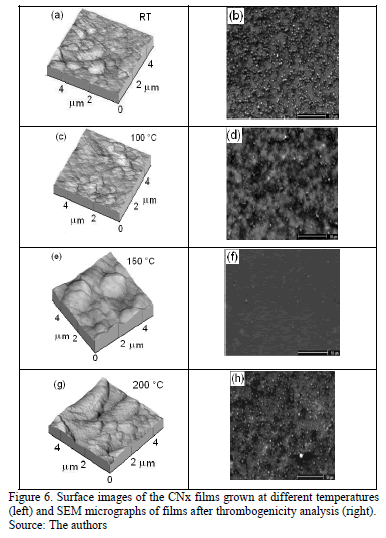
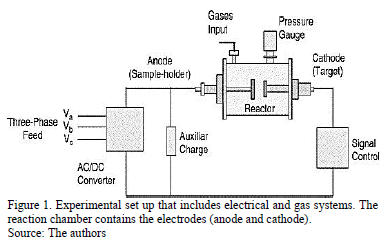
<body><![CDATA[<p><font size="2" face="Verdana, Arial, Helvetica, sans-serif">Thus, the aim of the   present paper is to report the growth of a-CN<sub>x</sub> films prepared by the   unfiltered pulsed vacuum cathodic arc technique. Moreover, studies on the   effects of substrate temperature on the structure of carbon nitride thin films   were conducted.  Spectroscopic techniques   were used to characterize chemical bonds and the modifications to the films'   microstructure.</font></p>     <p>&nbsp;</p>     <p><b><font size="3" face="Verdana, Arial, Helvetica, sans-serif">2.  Experimental   setup</font></b></p>     <p><font size="2" face="Verdana, Arial, Helvetica, sans-serif">The experimental setup is   presented in <a href="#fig01">Fig. 1</a>. The equipment used to produce the coatings was a   non-commercial reaction chamber made of stainless steel.  </font></p>     <p align="center"><font size="2" face="Verdana, Arial, Helvetica, sans-serif"><a name="fig01"></a></font><img src="/img/revistas/dyna/v81n186/v81n186a12fig01.gif"></p>     <p><font size="2" face="Verdana, Arial, Helvetica, sans-serif">Double-sided electrodes were placed in this   chamber.  A high-power supply designed to   generate pulses with  different active   and passive times was used to produce an arc discharge between the electrodes.   The inter-electrode pulsed voltage can be varied from 0 to 280 Vrms (root mean square   voltage) with a 150 A maximum working current, depending on the experiment. In this case the work voltage   used was 240 <i>V<sub>rms</sub></i>. The   active time is limited by the minimum necessary value for arc ignition under   given working conditions, such as target material, working gas and pressure.   The inactive arc time can take any theoretical value; nevertheless, it is   necessary to take into account that the minimum value is subjected to the arc   extinction time under the given working conditions (mainly the target material   and the working gas) &#91;16&#93;. The heating system was placed inside the anode to   make it possible to heat the substrate in-situ. Carbon nitride films were   produced using a graphite target of 99.999% purity that measured 2.00 cm in   diameter and 0.250 mm in thickness.  The   deposition conditions were as follows: four arcs, 1 s active time, 2 s inactive   time, 11.7 mm distance between electrodes.  Nitrogen was used as the working gas at a pressure of 260 Pa. The   substrates were 316L stainless steel disks that measured 2 mm in thickness and   12.7 mm in diameter. These substrates were previously polished using sandpaper   with grit sizes ranging from 60 to 1500. Finally, acetone was used to eliminate   impurities. Additionally, a KCl crystal measuring 2 mm in thickness and 12.7 in   mm diameter was used as the substrate where coatings were grown to carry out   the FTIR analysis.</font></p>     <p><font size="2" face="Verdana, Arial, Helvetica, sans-serif">The substrate holder   (anode) was heated by a resistance coil below the holder.  During the deposition, the substrate   temperature was maintained at RT, 100 °C, 150 °C and 200 °C. This range of   temperature was chosen according to a previous work reported by our group,   where at values close to these, coatings presented a good performance &#91;17&#93;.   After deposition, a vacuum pressure up to approximately 10<sup>-2</sup> Pa was   reached, allowing the sample to cool until reaching room temperature. The   system is well described in previous works &#91;16&#93;.</font></p>     <p><font size="2" face="Verdana, Arial, Helvetica, sans-serif">IR transmission   measurements were performed using a Perkin Elmer BXII FTIR spectrometer over the   wave number range 400-4000 cm<sup>-1</sup>. A 4-cm<sup>-1</sup> spectral   resolution was used for all measurements under normal conditions.  Raman scattering measurements were carried   out using the 473-nm line of a DPSS laser operating at 5.5 mW in the   900-1900-cm<sup>-1</sup> region with a LabRam HR800 Horiba Jobin Yvon   instrument.  The spectra were   deconvoluted with the Grams 32 program.</font></p>     <p><font size="2" face="Verdana, Arial, Helvetica, sans-serif">For   structural characterization, scanning probe microscopy (SPM) was used in the   atomic force microscopy (AFM) mode. For this characterization, a Park   Scientific Instruments Autoprobe CP with probes made of silicon and ProScan   image-processing software were used. To obtain topographic images of the films   in AFM mode, a cantilever probe of silicon nitride (Si<sub>3</sub>N<sub>4</sub>)   with a spring constant of 0.16 N/m was used under environmental conditions with   a scanning speed of 1 Hz and image resolution of 256×256 pixels. The   measurements were taken at 60% relative humidity and 24 °C. These analyses were   performed by capturing five images from different sites on each coating and   averaging them. The films' hardness was also obtained with the SPM equipment.   Small forces (applied over distances on the order of nanometers) with a   precision of 0.2 nN were used.</font></p>     <p><font size="2" face="Verdana, Arial, Helvetica, sans-serif">Platelet-adhesion in   vitro tests were performed on the CNx films obtained at various TS. Blood was   taken from a healthy adult and collected in sodium citrate as an anticoagulant.   First, the blood was centrifuged for 6 min at 5500 rpm, and approximately 1 ml   of lighter substances was separated from the blood plasma. Then, the remaining   material was centrifuged again for 5 min at 2400 rpm, allowing for the   extraction of the platelet-rich plasma (PRP). Samples were immersed in the PRP   and incubated at 37°C for 120 min; afterward, the samples were rinsed with a   0.9% NaCl solution to remove weakly adherent platelets and then fixed in 2%   glutaraldehyde.</font></p>     ]]></body>
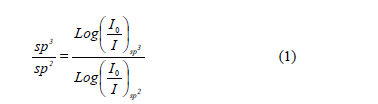
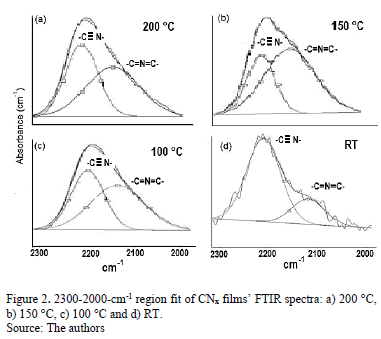
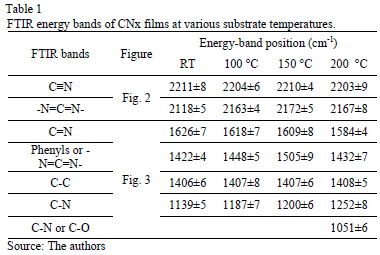
<body><![CDATA[<p><font size="2" face="Verdana, Arial, Helvetica, sans-serif">Environmental scanning electron microscopy (ESEM) was used   to study the quantity and morphology of the adherent platelets, after which the   films' thrombogenicity was evaluated. Photographs of the platelets were taken   randomly and the thrombogenicity results were correlated with the films'   roughness and microstructure.</font></p>     <p>&nbsp;</p>     <p><font size="3" face="Verdana, Arial, Helvetica, sans-serif"><b>3.  Results and   Discussion</b></font></p>     <p><b><font size="2" face="Verdana, Arial, Helvetica, sans-serif">3.1.  FTIR Analysis    <br>   </font></b><font size="2" face="Verdana, Arial, Helvetica, sans-serif">In <a href="#fig02">Fig. 2</a>, the FTIR spectra show bands between 2000 and 2300   cm<sup>-1</sup>. These bands were curve-fitted, and two Gaussian contributions   were found. The results obtained are summarized in <a href="#tab01">Table 1</a>. </font></p>     <p><img src="/img/revistas/dyna/v81n186/v81n186a12eq01.gif"></p>     <p align="center"><font size="2" face="Verdana, Arial, Helvetica, sans-serif"><a name="fig02"></a></font><img src="/img/revistas/dyna/v81n186/v81n186a12fig02.gif"></p>     <p align="center"><font size="2" face="Verdana, Arial, Helvetica, sans-serif"><a name="tab01"></a></font><img src="/img/revistas/dyna/v81n186/v81n186a12tab01.gif"></p>     <p><font size="2" face="Verdana, Arial, Helvetica, sans-serif">High-energy   contributions attributed to nitrile terminal groups -C&equiv;N &#91;18&#93; and   low-energy vibration modes involving terminal groups such as carbodiimides,   -N=C=N-&#91;19&#93; can be seen. In addition, the low-energy vibrations also induce a   stretching phase located in the spectral range</font> <font size="2" face="Verdana, Arial, Helvetica, sans-serif">between 1460 and 1500 cm<sup>-1</sup> &#91;20&#93;. In order to calculate the relative concentration of sp<sup>3</sup>, sp<sup>2 </sup>and sp<sup>1</sup> bonds from FTIR spectra, the next equation is   employed.</font></p>     <p><font size="2" face="Verdana, Arial, Helvetica, sans-serif">For this method Io is approximately obtained drawing a   straight line between the points of lower transmission placed at each side of   the maximum, and I is the intensity of the maximum &#91;21&#93;.</font></p>     ]]></body>
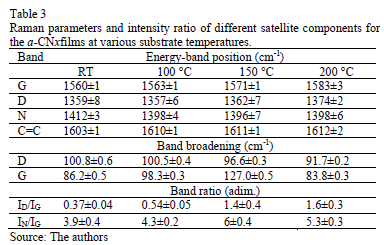
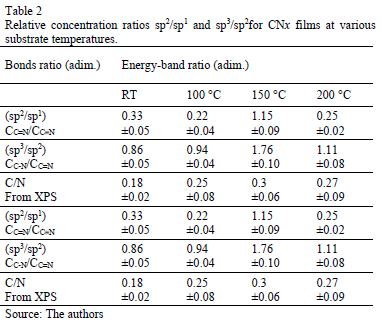
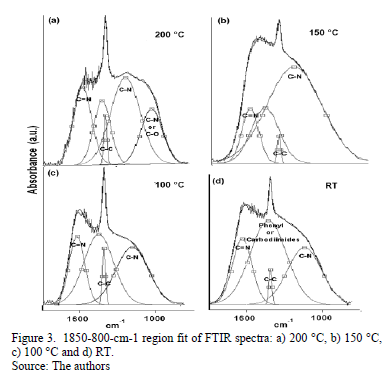
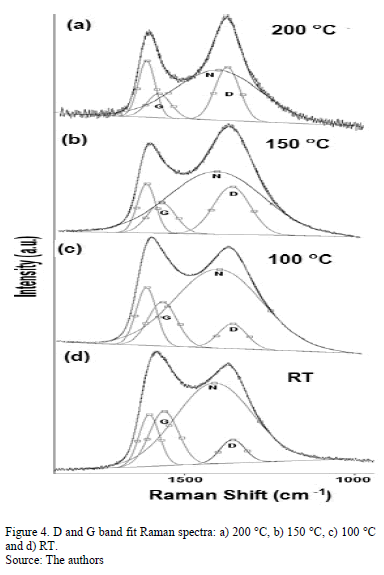
<body><![CDATA[<p><font size="2" face="Verdana, Arial, Helvetica, sans-serif"><a href="#tab02">Table 2</a> presents the relative concentration of sp2 (C=N)   and sp1 (C&equiv;N) bonds as the sp2/sp1 ratio. At low temperatures, sp1 bonds   prevail over sp2(sp2/sp1&lt;1) because the total energy of the structure after   a single N substitution for sp2 formation is, on average, 1 eV higher than that   for sp1 formation &#91;22&#93;; nevertheless, this tendency ceases at TS=150 °C,   possibly because TS provides sufficient energy for sp2 formation, producing an   increase in the sp2/sp1 ratio; however, at 200 °C, the sp2/sp1 ratio decreases   again because the adatoms mobility increased. </font></p>     <p align="center"><font size="2" face="Verdana, Arial, Helvetica, sans-serif"><a name="tab02"></a></font><img src="/img/revistas/dyna/v81n186/v81n186a12tab02.gif"></p>     <p><font size="2" face="Verdana, Arial, Helvetica, sans-serif">A great part of the   energy is expended in moving the adatoms and not in forming sp2 bonds. The   spectral region between 1850 and 850 cm-1 reveals C-C, C=C, C-N and C=N bond   contributions. <a href="#fig03">Fig. 3</a> shows the spectra for this region with varying TS. A   Gaussian deconvolution with a linear background was carried out in this region,   and the energy-band positions are listed in <a href="#tab01">Table 1</a>. Several spectral </font></p>     <p align="center"><font size="2" face="Verdana, Arial, Helvetica, sans-serif"><a name="fig03"></a></font><img src="/img/revistas/dyna/v81n186/v81n186a12fig03.gif"></p>     <p><font size="2" face="Verdana, Arial, Helvetica, sans-serif">differences   depending on TS can be highlighted. At RT, 100 °C and 150 °C, a well-defined   fit can be achieved using four Gaussian contributions. Nevertheless, for the   sample grown at 200 °C, one more peak is added to attain a suitable   deconvolution. The bands ranging between 1650 and 1600 cm-1 have been   attributed to C=N stretching &#91;23&#93;. According to Hammer et al., these   configurations are bonded mainly to the aromatic cluster edges &#91;23&#93;.   They may also be associated with pyridine vibrational modes, with bands around   1620-1560 cm<sup>-1</sup> &#91;24&#93;.</font></p>     <p><font size="2" face="Verdana, Arial, Helvetica, sans-serif">The decrease in the   energy as the temperature increases is attributed to changes in the films'   microstructure caused by the heating process. The band at approximately 1407   cm-1 may have been produced by sp3 C-C &#91;25&#93;. The bands ranging from 1300 to   1139 cm-1 are reported to be due to C-N simple bonds &#91;26&#93;. An increase in the   vibrational energy as Ts increased was observed. These results are consistent   with an increase in the degree of ordering of the C-N clusters &#91;27&#93;. For films   grown at 200 °C, the band located at approximately 1050 cm-1 could be   attributed to C-N vibrations &#91;16&#93; or C-O stretching, which can be found in the   range between approximately 1160 and 1080 cm-1 &#91;28&#93;.</font></p>     <p><font size="2" face="Verdana, Arial, Helvetica, sans-serif">Moreover, an analysis   of the relative concentration of sp3 (C-N) and sp2 (C=N) bonds in the films as   a function of TS was carried out. These values are shown in <a href="#tab02">Table 2</a>. In this   table, an increase in the concentration of sp3 C-N bonds in the case of the film   grown at 150 °C was observed. At this temperature, aromatic amines and C-N   bonds are formed, which are more thermodynamically favorable. This increase   could explain the shift of the phenyl radical toward high energies with respect   to the phenyl species in the other films. </font></p>     <p><font size="2" face="Verdana, Arial, Helvetica, sans-serif"><b>3.2.  Raman   Analysis</b>    <br>   </font><font size="2" face="Verdana, Arial, Helvetica, sans-serif"><a href="#fig04">Fig. 4</a> shows the Raman spectra   of the CNx films with varying TS. Gaussian deconvolution with a linear   background for frequencies between 1000 and 1850 cm-1 was carried out. To   attain a better fit, four bands were employed. The positions of the D   (disorder) and G (graphite) bands, their broadening and their intensity ratio   ID/IG for each film are summarized in <a href="#tab03">Table 3</a>. The increase in the ID/IG ratio   as the temperature increases suggests graphitization by heating, including an   increase in disorder in the ring angles and lengths. Because the shift in the G   band toward higher frequencies is accompanied by an increase in the ID/IG   ratio. There may have been an increase in the size or number of sp2 domains.   This shift is only observed when six-fold aromatic rings are present &#91;29&#93;. The   shift in the D toward higher frequencies suggests the densification of the sp2   ringed structure in the lattices. The increase in the ID/IG ratio, widening of   the D-peak and narrowing of the G-peak are caused by increase of the   graphite-like component in the amorphous carbon films &#91;30&#93;. Capelli &#91;31&#93;   demonstrated that higher I<sub>D</sub>/I<sub>G</sub> ratio and narrower G are   associated to the carbon configuration changes from an amorphous mixture of sp<sup>3</sup>/sp<sup>2</sup> configuration to a locally ordered sp<sup>2 </sup>nano-graphite structure. The   widening of the D band is related to the presence of more sp<sup>2</sup> carbon   bond angle distortion &#91;32&#93;. This behavior increases the disorder and decrease   the graphite-like structure in the crystalline region of the film.</font></p>     <p align="center"><font size="2" face="Verdana, Arial, Helvetica, sans-serif"><a name="fig04"></a></font><img src="/img/revistas/dyna/v81n186/v81n186a12fig04.gif"></p>     ]]></body>
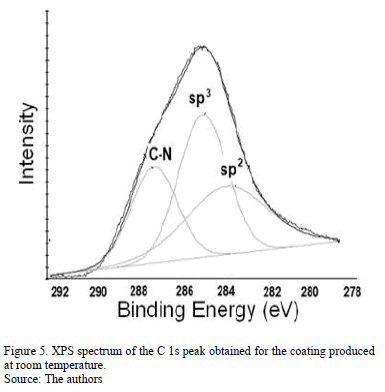
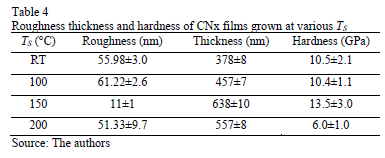
<body><![CDATA[<p align="center"><font size="2" face="Verdana, Arial, Helvetica, sans-serif"><a name="tab03"></a></font><img src="/img/revistas/dyna/v81n186/v81n186a12tab03.gif"></p>     <p><font size="2" face="Verdana, Arial, Helvetica, sans-serif">The N peak is visualized between   the D and G bands as shown in <a href="#fig04">Fig. 4</a>. This peak is due to N=N stretching   vibrations when N is bonded to a carbon ring, particularly one of the C-N=N-C   benzene type &#91;33&#93;. The N=N stretching frequencies vary between 1400 and 1500 cm<sup>-1</sup> depending on the site replaced by carbon. This is also correlated with the   degree of symmetry breaking &#91;34&#93;. An increase in the I<sub>N</sub>/I<sub>G</sub> area ratio was observed as a function of the substrate temperature, as is shown   in <a href="#tab02">Table 2</a>. The N incorporation in films grown at RT, 100°C and 200°C could   benefit the formation of aromatic clusters. Nevertheless, the increase in the   nitrogen content of the films produced at 150°C could favor the formation of   pyridine rings, which blocks cluster growth. Furthermore, an increase in the   number of -C&equiv;N nitrile bonds may occur at 150°C because as terminal   groups, they prevent the growth of graphitic clusters. This assertion is   supported by the relative concentration ratio C<sub>C&equiv;N</sub>/C<sub>C=N</sub> shown in <a href="#tab02">Table 2</a>. The increase in the number of N=N bonds may indicate that the   films contain large amounts of nitrogen, implying that as the substrate   temperature rises, the nitrogen concentration increases. The substrate   temperature favors the atomic surface migration of C and N species, accelerating chemical reactions between different   species and increasing the nitrogen concentration &#91;35&#93;. The nitrogen   concentration decreases again at 200 °C. This behavior can be attributed to the   fact the C and N species can be desorbed at this <i>T<sub>S</sub></i>. The   subsequent drop in nitrogen content at 200°C, as shown in <a href="#tab01">Table 1</a>, may   be due to an increase in the desorption of some volatile species, such as C<sub>2</sub>N<sub>2</sub> and nitriles &#91;35&#93;. Moreover, higher substrate temperatures are   unfavorable for the incorporation of more-volatile species such as CN &#91;36&#93;. The transition to a more crystalline phase   as the substrate temperature increases may be caused by a relaxation process in   the film structure provoked by the heating treatment. This relaxation may also   be related to the desorption of N species observed in this film because the   desorption of N atoms from the rings   can cause C atoms to take their place, thereby stabilizing and relaxing the   structure. Each spectrum contains a peak beyond1600 cm<sup>-1</sup>.   This finding may be related to the D peak of glassy carbon, which corresponds   to C=C stretching in aromatic rings &#91;37&#93;, indicating that the films have a   higher tendency toward graphitization. The increase in the <i>T<sub>S</sub></i> caused the   frequencies to shift toward higher values due to changes in the films'   microstructure because of the heat</font> <font size="2" face="Verdana, Arial, Helvetica, sans-serif">treatment. <a href="#fig05">Fig. 5</a> shows the XPS   C1s spectra of the CNx film grown at TS=150 &deg;C, presenting several components.   This spectrum was decomposed into three components fitted with Gaussian   functions by approximating the background contribution using Shirley's method. </font></p>     <p align="center"><font size="2" face="Verdana, Arial, Helvetica, sans-serif"><a name="fig05"></a></font><img src="/img/revistas/dyna/v81n186/v81n186a12fig05.gif"></p>     <p><font size="2" face="Verdana, Arial, Helvetica, sans-serif">The first component peaked at 284.6 eV corresponds to sp<sup>2</sup> carbon bonds, the second one at 285.5 eV is related to sp<sup>3</sup> carbon   bonds and the fourth component at 287.5 eV comes from C-N bonds &#91;38&#93;. This   result corroborates the presence of carbon linked nitrogen. N/C  atomic percentage depending on <i>T<sub>S</sub></i> was included in <a href="#tab02">Table 2</a>.   Similar to Raman spectroscopy results, the nitrogen percentage increases as the   substrate temperature rises.</font></p>     <p><font size="2" face="Verdana, Arial, Helvetica, sans-serif"><b>3.3.  AFM Analysis</b>    <br>   </font><font size="2" face="Verdana, Arial, Helvetica, sans-serif">AFM images were obtained for various <i>T<sub>S</sub></i>, as shown in <a href="#fig06">Fig. 6</a>. Irregular surfaces with poor   uniformity and agglomerations were observed. The film thicknesses remained   within the same order of magnitude (approximately 450 nm). According to <a href="#fig06">Figs. 6</a> (a) and (c), the films grown at RT and 100 °C presented small grain sizes, in   the order of 300 nm, compared with the films produced at 150 °C and 200 °C that   exhibit values of around 800 nm, as is shown in <a href="#fig06">Figs 6</a>(e) and (g). Although   CNx-coating morphologies characterized by small grains have been reported by   several authors &#91;39&#93;, the coatings produced in this work exhibited different   behavior because the films' morphology depends on many factors, such as the   growth parameters and technique and the chemical composition.</font></p>     <p align="center"><font size="2" face="Verdana, Arial, Helvetica, sans-serif"><a name="fig06"></a></font><img src="/img/revistas/dyna/v81n186/v81n186a12fig06.gif"></p>     <p><font size="2" face="Verdana, Arial, Helvetica, sans-serif">The roughness and thickness of films grown at different <i>T<sub>S</sub></i> were measured and are   listed in <a href="#tab04">Table 4</a>. Films grown at RT, 100 °C and 200 °C presented high   roughness and low thickness, in agreement with values reported by other   researchers &#91;36&#93;.</font></p>     <p align="center"><font size="2" face="Verdana, Arial, Helvetica, sans-serif"><a name="tab04"></a></font><img src="/img/revistas/dyna/v81n186/v81n186a12tab04.gif"></p>     <p><font size="2" face="Verdana, Arial, Helvetica, sans-serif">Studies carried out by A. Stanishevsky regarding the   morphology of CNx films deposited at different pressures revealed non-uniform   surfaces due to large graphitic domains and a CN polymeric component. A large   polymeric component results in low roughness, whereas a greater number of   graphitic clusters induce the formation of more or larger agglomerations &#91;40&#93;.</font></p>     ]]></body>
<body><![CDATA[<p><font size="2" face="Verdana, Arial, Helvetica, sans-serif"><b>3.4.  Hardness</b>    <br>   </font><font size="2" face="Verdana, Arial, Helvetica, sans-serif">On the other hand, there is a relationship between the   chemical composition and the nano-hardness of the films. The results presented   in <a href="#tab04">Table 4</a> show that the film grown at 150 °C exhibited the highest hardness   and the highest sp<sup>3</sup>/sp<sup>2</sup> bond ratio.</font></p>     <p><font size="2" face="Verdana, Arial, Helvetica, sans-serif">According to the literature, the hardness of carbon-based   films is determined by the existence of sp<sup>3</sup>-hybridized C bonds. The   highest hardness, which was exhibited by the film grown at 150 °C, can be   explained by the disorder induced by the sp<sup>3</sup> bonds between the   aromatic layers. These bonds can exist if the distance between the layers is   shorter than the interplanar distance of graphite, as dictated by van der Waals   interactions. These bonds produce structure densification, compaction and   ultimately greater hardness &#91;41&#93;.</font></p>     <p><font size="2" face="Verdana, Arial, Helvetica, sans-serif"><b>3.5.  ESEM Analysis</b>    <br>   </font><font size="2" face="Verdana, Arial, Helvetica, sans-serif">Platelet adhesion on the CNx films obtained at various <i>T<sub>S</sub></i> was analyzed by the ESEM technique, as shown in <a href="#fig06">Figs. 6</a> (b), (d), (f) and (h).   On films grown at RT, 100 °C and 200 °C, the platelets showed a high degree of   spreading and attained activation. They linked together and formed   aggregations. However, the coating obtained at 150 °C showed poor platelet   adherence. Moreover, on this coating, the platelets remained inactivated,   without exhibiting pseudopodia, and they remained almost isolated. The   hemocompatibility was observed to improve as the films tended toward   graphitization, as shown for the film grown at 150°C (the highest I<sub>D</sub>/I<sub>G</sub> ratio and nitrogen concentration).   High N content delays clotting and defers platelet activation. This film was   the most blood-compatible, presenting the fewest adherent blood platelets and   lowest level of platelet aggregation &#91;42&#93;. Among the plasma proteins,   fibrinogen is regarded as the key protein that triggers platelet adhesion,   activation and aggregation. Subsequently, coagulation factors are released,   initiating the coagulation cascade and the eventual formation of a thrombus. In   addition, the hemoglobin, platelet and a few plasma proteins in blood tend to   be negatively charged. Usually the material surface with more unsaturated bonds   in electronegativity has better thromboresistance according to the principle of   same electric charge mutual repulsion. In the case of CNx coatings, they   include sp<sup>2</sup>C\N and sp<sup>3</sup>C\N bonds at the surface and   polarize the surface due to the difference in electronegativity between carbon   and nitrogen &#91;43&#93;.</font></p>     <p>&nbsp;</p>     <p><font size="3"><b><font face="Verdana, Arial, Helvetica, sans-serif">4.  Conclusions</font></b></font></p>     <p><font size="2" face="Verdana, Arial, Helvetica, sans-serif">The CNx films were obtained with the pulsed cathodic vacuum arc method at several substrate temperature.   FTIR spectroscopy analysis indicated the formation of carbon-nitrogen bonds   with sp<sup>3</sup>, sp<sup>2</sup> and sp<sup>1</sup> hybridization. The   results obtained from Raman spectroscopy suggest that the deposited amorphous carbon nitride films have a   graphitic structure. However, at the critical substrate temperature, 150°C, the   structure became more amorphous, perhaps due to the increase in the N   concentration inside the lattice. At   150 °C, films exhibited the highest hardness and the highest sp<sup>3</sup>/sp<sup>2</sup> bond ratio. </font></p>     <p><font size="2" face="Verdana, Arial, Helvetica, sans-serif">The hemocompatibility was observed to improve as the films   tended toward graphitization, as shown for the film grown at 150°C. This film   was the most blood-compatible, showing the fewest adherent blood platelets and   lowest level of platelet aggregation.</font></p>     <p>&nbsp;</p>     ]]></body>
<body><![CDATA[<p><font size="3" face="Verdana, Arial, Helvetica, sans-serif"><b>Acknowledgments</b></font></p>     <p><font size="2" face="Verdana, Arial, Helvetica, sans-serif">The authors gratefully acknowledge the financial support   of the Divisi&oacute;n para la Investigaci&oacute;n de la Universidad Nacional de Colombia   Sede Manizales (DIMA). </font></p>     <p>&nbsp;</p>     <p><b><font size="3" face="Verdana, Arial, Helvetica, sans-serif">References</font></b></p>     <!-- ref --><p><font size="2" face="Verdana, Arial, Helvetica, sans-serif"><b>&#91;1&#93;</b> Ruden, A., Gonz&aacute;lez Carmona, J.M., Restrepo, J.S., Cano, M.F. and Sequeda, F., Tribolog&iacute;a de recubrimientos de ZrN, CrN y TiAlN obtenidos por magnetron sputtering reactivo, DYNA, 80 (178), pp. 95-100, 2013.    &nbsp;&nbsp;&nbsp;&nbsp;&nbsp;&nbsp;&nbsp;&nbsp;[&#160;<a href="javascript:void(0);" onclick="javascript: window.open('/scielo.php?script=sci_nlinks&ref=000077&pid=S0012-7353201400040001200001&lng=','','width=640,height=500,resizable=yes,scrollbars=1,menubar=yes,');">Links</a>&#160;]<!-- end-ref --></font></p>     <!-- ref --><p> <font size="2" face="Verdana, Arial, Helvetica, sans-serif"><b>&#91;2&#93;</b> Mu&ntilde;oz, J.E. and Coronado J.J. An&aacute;lisis mec&aacute;nico y tribol&oacute;gico de los recubrimientos Fe-Cr-Ni-C y Ni-Al-Mo, DYNA, 74 (153), pp. 111-118, 2007.    &nbsp;&nbsp;&nbsp;&nbsp;&nbsp;&nbsp;&nbsp;&nbsp;[&#160;<a href="javascript:void(0);" onclick="javascript: window.open('/scielo.php?script=sci_nlinks&ref=000079&pid=S0012-7353201400040001200002&lng=','','width=640,height=500,resizable=yes,scrollbars=1,menubar=yes,');">Links</a>&#160;]<!-- end-ref --></font></p>     <!-- ref --><p> <font size="2" face="Verdana, Arial, Helvetica, sans-serif"><b>&#91;3&#93;</b> Copete H., L&oacute;pez, E., Vargas Galvis F., Echavarr&iacute;a A. and R&iacute;os T., Evaluaci&oacute;n del comportamiento in vitro de recubrimientos de hidroxiapatita depositados mediante proyecci&oacute;n t&eacute;rmica por combusti&oacute;n oxiacetil&eacute;nica sobre un sustrato de Ti6Al4V, DYNA 80 (177), 101-107, 2013.    &nbsp;&nbsp;&nbsp;&nbsp;&nbsp;&nbsp;&nbsp;&nbsp;[&#160;<a href="javascript:void(0);" onclick="javascript: window.open('/scielo.php?script=sci_nlinks&ref=000081&pid=S0012-7353201400040001200003&lng=','','width=640,height=500,resizable=yes,scrollbars=1,menubar=yes,');">Links</a>&#160;]<!-- end-ref --></font></p>     ]]></body>
<body><![CDATA[<!-- ref --><p> <font size="2" face="Verdana, Arial, Helvetica, sans-serif"><b>&#91;4&#93;</b> Liu, A.Y. and Cohen, M.L., Prediction of new low compressibility solids, Science, 245 (4920), pp. 841-842, 1989. DOI:10.1126/science.245.4920.841</font>&nbsp;&nbsp;&nbsp;&nbsp;&nbsp;&nbsp;&nbsp;&nbsp;[&#160;<a href="javascript:void(0);" onclick="javascript: window.open('/scielo.php?script=sci_nlinks&ref=000083&pid=S0012-7353201400040001200004&lng=','','width=640,height=500,resizable=yes,scrollbars=1,menubar=yes,');">Links</a>&#160;]<!-- end-ref --><!-- ref --><p> <font size="2" face="Verdana, Arial, Helvetica, sans-serif"><b>&#91;5&#93;</b> Wei, S., Shao, T. and Ding, P., Study of CNx films on 316L stainless steel for orthodontic application, Diamond. and Related Materials, 19 (5-6), pp. 648-653, 2010.    &nbsp;&nbsp;&nbsp;&nbsp;&nbsp;&nbsp;&nbsp;&nbsp;[&#160;<a href="javascript:void(0);" onclick="javascript: window.open('/scielo.php?script=sci_nlinks&ref=000084&pid=S0012-7353201400040001200005&lng=','','width=640,height=500,resizable=yes,scrollbars=1,menubar=yes,');">Links</a>&#160;]<!-- end-ref --></font></p>     <!-- ref --><p> <font size="2" face="Verdana, Arial, Helvetica, sans-serif"><b>&#91;6&#93;</b> Cappelli, E., Trucchi, D.M, Kaciulis, S., Orlando S., Zanza, A. and Mezzi A., Effect of deposition temperature on chemical composition and electronic properties of amorphous carbon nitride (a-CNx) thin films grown by plasma assisted pulsed laser deposition, Thin Solid Films, 519, pp. 4059-4063, 2011.    &nbsp;&nbsp;&nbsp;&nbsp;&nbsp;&nbsp;&nbsp;&nbsp;[&#160;<a href="javascript:void(0);" onclick="javascript: window.open('/scielo.php?script=sci_nlinks&ref=000086&pid=S0012-7353201400040001200006&lng=','','width=640,height=500,resizable=yes,scrollbars=1,menubar=yes,');">Links</a>&#160;]<!-- end-ref --></font></p>     <!-- ref --><p> <font size="2" face="Verdana, Arial, Helvetica, sans-serif"><b>&#91;7&#93;</b> Zhang, K., Wen, M., Meng, Q.N., Zeng, Y., Hu C.Q., Liu C. and Zheng W.T., Structure, mechanical property, and tribological behavior of c-NbN/CNx multilayers grown by magnetron sputtering, Surface and Coatings Technology, 206, pp. 4040-4045, 2012.    &nbsp;&nbsp;&nbsp;&nbsp;&nbsp;&nbsp;&nbsp;&nbsp;[&#160;<a href="javascript:void(0);" onclick="javascript: window.open('/scielo.php?script=sci_nlinks&ref=000088&pid=S0012-7353201400040001200007&lng=','','width=640,height=500,resizable=yes,scrollbars=1,menubar=yes,');">Links</a>&#160;]<!-- end-ref --></font></p>     <!-- ref --><p> <font size="2" face="Verdana, Arial, Helvetica, sans-serif"><b>&#91;8&#93;</b> Mishra, S.K., Shekhar, Ch. and Rupa, P.K.P. and Pathak, L.C., Effect of pressure and substrate temperature on the deposition of nano-structured silicon-carbon-nitride superhard coatings by magnetron sputtering, Thin Solid Films, 515, pp. 4738-4744, 2007.    &nbsp;&nbsp;&nbsp;&nbsp;&nbsp;&nbsp;&nbsp;&nbsp;[&#160;<a href="javascript:void(0);" onclick="javascript: window.open('/scielo.php?script=sci_nlinks&ref=000090&pid=S0012-7353201400040001200008&lng=','','width=640,height=500,resizable=yes,scrollbars=1,menubar=yes,');">Links</a>&#160;]<!-- end-ref --></font></p>     <!-- ref --><p> <font size="2" face="Verdana, Arial, Helvetica, sans-serif"><b>&#91;9&#93;</b> Hsieh, W.-J., Shih, P.-S., Lin, Ch.-Ch., Wang, Ch.-Y. and Shih H.C., Structure and optical property of the a-C:N films synthesized by filtered cathode vacuum arc, Surface Coating Technology, 200, pp. 3175-3178, 2006.    &nbsp;&nbsp;&nbsp;&nbsp;&nbsp;&nbsp;&nbsp;&nbsp;[&#160;<a href="javascript:void(0);" onclick="javascript: window.open('/scielo.php?script=sci_nlinks&ref=000092&pid=S0012-7353201400040001200009&lng=','','width=640,height=500,resizable=yes,scrollbars=1,menubar=yes,');">Links</a>&#160;]<!-- end-ref --></font></p>     <!-- ref --><p> <font size="2" face="Verdana, Arial, Helvetica, sans-serif"><b>&#91;10&#93;</b> Hakovirta, M., Salo, J., Lappalainen, R. and Antitila A., Correlation of carbon ion energy with sp<sup>2</sup>/sp<sup>3</sup> ratio in amorphous diamond films produced with a mass-separated ion beam, Physics Letter A, 205 (49), pp. 287-289, 1995.    &nbsp;&nbsp;&nbsp;&nbsp;&nbsp;&nbsp;&nbsp;&nbsp;[&#160;<a href="javascript:void(0);" onclick="javascript: window.open('/scielo.php?script=sci_nlinks&ref=000094&pid=S0012-7353201400040001200010&lng=','','width=640,height=500,resizable=yes,scrollbars=1,menubar=yes,');">Links</a>&#160;]<!-- end-ref --></font></p>     <!-- ref --><p> <font size="2" face="Verdana, Arial, Helvetica, sans-serif"><b>&#91;11&#93;</b> Fuge, G. M., Rennick, Ch.J., Pearce, S.R.J., May, P.W., Ashfold, M.N.R., Structural characterisation of CNx thin films deposited by pulsed laser ablation, Diamond Related Materials, 12, pp. 1049-1054, 2003.    &nbsp;&nbsp;&nbsp;&nbsp;&nbsp;&nbsp;&nbsp;&nbsp;[&#160;<a href="javascript:void(0);" onclick="javascript: window.open('/scielo.php?script=sci_nlinks&ref=000096&pid=S0012-7353201400040001200011&lng=','','width=640,height=500,resizable=yes,scrollbars=1,menubar=yes,');">Links</a>&#160;]<!-- end-ref --></font></p>     <!-- ref --><p> <font size="2" face="Verdana, Arial, Helvetica, sans-serif"><b>&#91;12&#93;</b> Chen, Z.Y., Zhao, J.P., Yano T., Ooie, T., and Sakakibara, M.J., Effect of temperature on carbon nitride films synthesized by ion-beam-assisted pulsed laser deposition, Journal of Applied Physics, 88, pp. 7060-7066, 2000.    &nbsp;&nbsp;&nbsp;&nbsp;&nbsp;&nbsp;&nbsp;&nbsp;[&#160;<a href="javascript:void(0);" onclick="javascript: window.open('/scielo.php?script=sci_nlinks&ref=000098&pid=S0012-7353201400040001200012&lng=','','width=640,height=500,resizable=yes,scrollbars=1,menubar=yes,');">Links</a>&#160;]<!-- end-ref --></font></p>     <!-- ref --><p> <font size="2" face="Verdana, Arial, Helvetica, sans-serif"><b>&#91;13&#93;</b> Zhou Z., Xia L. and Sun M., Carbon nitride films prepared at various substrate temperatures by vacuum cathodic arc method, Diamond Related Material, 13 (1). pp. 14-21, 2004.    &nbsp;&nbsp;&nbsp;&nbsp;&nbsp;&nbsp;&nbsp;&nbsp;[&#160;<a href="javascript:void(0);" onclick="javascript: window.open('/scielo.php?script=sci_nlinks&ref=000100&pid=S0012-7353201400040001200013&lng=','','width=640,height=500,resizable=yes,scrollbars=1,menubar=yes,');">Links</a>&#160;]<!-- end-ref --> </font></p>     <!-- ref --><p> <font size="2" face="Verdana, Arial, Helvetica, sans-serif"><b>&#91;14&#93;</b> Zhou Z., Xia L., Sun M., The investigation of carbon nitride films deposited at various substrate temperatures and N2/Ar flow ratios by vacuum cathodic arc method, Applied Surface Science, vol. 222 (14-), pp. 327-337, 2004.    &nbsp;&nbsp;&nbsp;&nbsp;&nbsp;&nbsp;&nbsp;&nbsp;[&#160;<a href="javascript:void(0);" onclick="javascript: window.open('/scielo.php?script=sci_nlinks&ref=000102&pid=S0012-7353201400040001200014&lng=','','width=640,height=500,resizable=yes,scrollbars=1,menubar=yes,');">Links</a>&#160;]<!-- end-ref --></font></p>     <!-- ref --><p> <font size="2" face="Verdana, Arial, Helvetica, sans-serif"><b>&#91;15&#93;</b> Lejeune, M., Durand-Drouhin, O., Charvet, S., Zeinert, A. and Benlahsen, M., On the induced microstructure changes of the amorphous carbon nitride films during annealing, Journal of Applied Physics, 101 (12), pp. 123501, 2007.    &nbsp;&nbsp;&nbsp;&nbsp;&nbsp;&nbsp;&nbsp;&nbsp;[&#160;<a href="javascript:void(0);" onclick="javascript: window.open('/scielo.php?script=sci_nlinks&ref=000104&pid=S0012-7353201400040001200015&lng=','','width=640,height=500,resizable=yes,scrollbars=1,menubar=yes,');">Links</a>&#160;]<!-- end-ref --></font></p>     <!-- ref --><p> <font size="2" face="Verdana, Arial, Helvetica, sans-serif"><b>&#91;16&#93;</b> Ospina R., Castillo, H.A., Benavides, V., Restrepo, E., Arango, Y.C., Arias, D.F. and Devia, A., Influence of the annealing temperature on a crystal phase of W/WC bilayers grown by pulsed arc discharge, Vacuum, 81 (3), pp. 373-377, 2006.    &nbsp;&nbsp;&nbsp;&nbsp;&nbsp;&nbsp;&nbsp;&nbsp;[&#160;<a href="javascript:void(0);" onclick="javascript: window.open('/scielo.php?script=sci_nlinks&ref=000106&pid=S0012-7353201400040001200016&lng=','','width=640,height=500,resizable=yes,scrollbars=1,menubar=yes,');">Links</a>&#160;]<!-- end-ref --></font></p>     <!-- ref --><p> <font size="2" face="Verdana, Arial, Helvetica, sans-serif"><b>&#91;17&#93;</b> Ospina R., Escobar D., Restrepo-Parra, E. Arango, P.J. and Jurado, J.F., Substrate temperature influence on W/WCNx bilayers grown by pulsed vacuum arc discharge, Applied Surface Science, 258 (12), pp. 5100-5104, 2012.    &nbsp;&nbsp;&nbsp;&nbsp;&nbsp;&nbsp;&nbsp;&nbsp;[&#160;<a href="javascript:void(0);" onclick="javascript: window.open('/scielo.php?script=sci_nlinks&ref=000108&pid=S0012-7353201400040001200017&lng=','','width=640,height=500,resizable=yes,scrollbars=1,menubar=yes,');">Links</a>&#160;]<!-- end-ref --></font></p>     <!-- ref --><p> <font size="2" face="Verdana, Arial, Helvetica, sans-serif"><b>&#91;18&#93;</b> Chalmers, J.M., Griffiths, P.R., Eds. Handbook of vibrational spectroscopy, Vol. 1, Theory and Instrumentation, John Wiley & Sons, Inc., 2003</font>&nbsp;&nbsp;&nbsp;&nbsp;&nbsp;&nbsp;&nbsp;&nbsp;[&#160;<a href="javascript:void(0);" onclick="javascript: window.open('/scielo.php?script=sci_nlinks&ref=000110&pid=S0012-7353201400040001200018&lng=','','width=640,height=500,resizable=yes,scrollbars=1,menubar=yes,');">Links</a>&#160;]<!-- end-ref --><!-- ref --><p> <font size="2" face="Verdana, Arial, Helvetica, sans-serif"><b>&#91;19&#93;</b> Lejeune, M., Charvet, S., Zeinert, A. and Benlahsen, M., Optical behavior of reactive sputtered carbon nitride films during annealing, Journal Applied Physics, 103 (1), pp. 013507, 2008.    &nbsp;&nbsp;&nbsp;&nbsp;&nbsp;&nbsp;&nbsp;&nbsp;[&#160;<a href="javascript:void(0);" onclick="javascript: window.open('/scielo.php?script=sci_nlinks&ref=000111&pid=S0012-7353201400040001200019&lng=','','width=640,height=500,resizable=yes,scrollbars=1,menubar=yes,');">Links</a>&#160;]<!-- end-ref --></font></p>     ]]></body>
<body><![CDATA[<!-- ref --><p> <font size="2" face="Verdana, Arial, Helvetica, sans-serif"><b>&#91;20&#93;</b> Bouchet-Fabre B., Marino, E., Lazar, G., Zellama, K., Clin, M., Ballutaud, D., Abel, F. and Godet C., Spectroscopic study using FTIR, Raman, XPS and NEXAFS of carbon nitride thin films deposited by RF magnetron sputtering, Thin Solid Films, 482 (1-2), pp. 167-171, 2005.    &nbsp;&nbsp;&nbsp;&nbsp;&nbsp;&nbsp;&nbsp;&nbsp;[&#160;<a href="javascript:void(0);" onclick="javascript: window.open('/scielo.php?script=sci_nlinks&ref=000113&pid=S0012-7353201400040001200020&lng=','','width=640,height=500,resizable=yes,scrollbars=1,menubar=yes,');">Links</a>&#160;]<!-- end-ref --></font></p>     <!-- ref --><p> <font size="2" face="Verdana, Arial, Helvetica, sans-serif"><b>&#91;21&#93;</b> Segura-Giraldo, B., Restrepo-Parra, E. and Arango-Arango P.J., On the influence of a TiN interlayer on DLC coatings produced by pulsed vacuum arc discharge: Compositional and morphological study, Applied Surface Science, vol. 256 (1), pp. 136-141, 2009.    &nbsp;&nbsp;&nbsp;&nbsp;&nbsp;&nbsp;&nbsp;&nbsp;[&#160;<a href="javascript:void(0);" onclick="javascript: window.open('/scielo.php?script=sci_nlinks&ref=000115&pid=S0012-7353201400040001200021&lng=','','width=640,height=500,resizable=yes,scrollbars=1,menubar=yes,');">Links</a>&#160;]<!-- end-ref --></font></p>     <!-- ref --><p> <font size="2" face="Verdana, Arial, Helvetica, sans-serif"><b>&#91;22&#93;</b> Bouchet-Fabre, B., Fernandez, V., Gohier, A., Parent, P., Laffon, C., Angleraud, B., Tessier, P.Y. and Minea, T.M., Temperature effect on the nitrogen insertion in carbon nitride films deposited by ECR, Diamond Related Materials, 18 (9), pp. 1091-1097, 2009.    &nbsp;&nbsp;&nbsp;&nbsp;&nbsp;&nbsp;&nbsp;&nbsp;[&#160;<a href="javascript:void(0);" onclick="javascript: window.open('/scielo.php?script=sci_nlinks&ref=000117&pid=S0012-7353201400040001200022&lng=','','width=640,height=500,resizable=yes,scrollbars=1,menubar=yes,');">Links</a>&#160;]<!-- end-ref --></font></p>     <!-- ref --><p> <font size="2" face="Verdana, Arial, Helvetica, sans-serif"><b>&#91;23&#93;</b> Hammer, P., Baker, M.A., Lenardi, C. and Gissler, W., Synthesis of carbon nitride films at low temperatures, Journal of Vacuum Science Technology A, 15 (1), pp. 107-112, 1997.    &nbsp;&nbsp;&nbsp;&nbsp;&nbsp;&nbsp;&nbsp;&nbsp;[&#160;<a href="javascript:void(0);" onclick="javascript: window.open('/scielo.php?script=sci_nlinks&ref=000119&pid=S0012-7353201400040001200023&lng=','','width=640,height=500,resizable=yes,scrollbars=1,menubar=yes,');">Links</a>&#160;]<!-- end-ref --></font></p>     <!-- ref --><p> <font size="2" face="Verdana, Arial, Helvetica, sans-serif"><b>&#91;24&#93;</b> Zhao, X.-A., Ong, C.W., Tsang, Y.C., Chan, K.F., Choy, C., Chan, P.W. and Kwok, R.W.M., Relationship between the structure and the optical and electrical properties of ion beam deposited CNx films, Thin Solid Films, 322 81-2), pp. 245-253, 1998.    &nbsp;&nbsp;&nbsp;&nbsp;&nbsp;&nbsp;&nbsp;&nbsp;[&#160;<a href="javascript:void(0);" onclick="javascript: window.open('/scielo.php?script=sci_nlinks&ref=000121&pid=S0012-7353201400040001200024&lng=','','width=640,height=500,resizable=yes,scrollbars=1,menubar=yes,');">Links</a>&#160;]<!-- end-ref --></font></p>     ]]></body>
<body><![CDATA[<!-- ref --><p> <font size="2" face="Verdana, Arial, Helvetica, sans-serif"><b>&#91;25&#93;</b> Zhang J., Liu, W., Li, X., Zhan, B., Cui, Q. and Zou, G., Well-crystallized nitrogen-rich graphitic carbon nitride nanocrystallites prepared via solvothermal route at low temperature, Materials Research Bulleting, 44, pp. 294, 2009.    &nbsp;&nbsp;&nbsp;&nbsp;&nbsp;&nbsp;&nbsp;&nbsp;[&#160;<a href="javascript:void(0);" onclick="javascript: window.open('/scielo.php?script=sci_nlinks&ref=000123&pid=S0012-7353201400040001200025&lng=','','width=640,height=500,resizable=yes,scrollbars=1,menubar=yes,');">Links</a>&#160;]<!-- end-ref --></font></p>     <!-- ref --><p> <font size="2" face="Verdana, Arial, Helvetica, sans-serif"><b>&#91;26&#93;</b> Li, Z., Zhou, J., Zhang, J., Chen, T. and Yuan, J., Carbon nitrides synthesized by glow discharge method, Journal of Alloys and Compounds, 346 (1-2), pp. 230-234, 2002.    &nbsp;&nbsp;&nbsp;&nbsp;&nbsp;&nbsp;&nbsp;&nbsp;[&#160;<a href="javascript:void(0);" onclick="javascript: window.open('/scielo.php?script=sci_nlinks&ref=000125&pid=S0012-7353201400040001200026&lng=','','width=640,height=500,resizable=yes,scrollbars=1,menubar=yes,');">Links</a>&#160;]<!-- end-ref --></font></p>     <!-- ref --><p> <font size="2" face="Verdana, Arial, Helvetica, sans-serif"><b>&#91;27&#93;</b> Lazar, G., Clin, M., Charvet, S., Therasse, M., Godet, C. and Zellama, K., Effect of the RF power and deposition temperature on the electrical and vibrational properties of carbon nitride films, Diamond Related Materials, 12 (2), pp. 201-207, 2003.    &nbsp;&nbsp;&nbsp;&nbsp;&nbsp;&nbsp;&nbsp;&nbsp;[&#160;<a href="javascript:void(0);" onclick="javascript: window.open('/scielo.php?script=sci_nlinks&ref=000127&pid=S0012-7353201400040001200027&lng=','','width=640,height=500,resizable=yes,scrollbars=1,menubar=yes,');">Links</a>&#160;]<!-- end-ref --></font></p>     <!-- ref --><p> <font size="2" face="Verdana, Arial, Helvetica, sans-serif"><b>&#91;28&#93;</b> Majumdar, A., Schäfer, J., Mishra, P., Ghose, D., Meichsner J., and Hippler R., Chemical composition and bond structure of carbon-nitride films deposited by CH<sub>4</sub>/N<sub>2</sub> dielectric barrier discharge, Surface and Coatings Technology, 201, pp. 6437-6444, 2007.    &nbsp;&nbsp;&nbsp;&nbsp;&nbsp;&nbsp;&nbsp;&nbsp;[&#160;<a href="javascript:void(0);" onclick="javascript: window.open('/scielo.php?script=sci_nlinks&ref=000129&pid=S0012-7353201400040001200028&lng=','','width=640,height=500,resizable=yes,scrollbars=1,menubar=yes,');">Links</a>&#160;]<!-- end-ref --></font></p>     <!-- ref --><p> <font size="2" face="Verdana, Arial, Helvetica, sans-serif"><b>&#91;29&#93;</b> Kov&aacute;cs, G., Veres, M., Ko&oacute;s, M. and Radn&oacute;czi, G. Raman spectroscopic study of magnetron sputtered carbon-nickel and carbon nitride-nickel composite films: the effect of nickel on the atomic structure of the C/CNx matrix, Thin Solid Films, 516, pp. 7910-7915, 2008.    &nbsp;&nbsp;&nbsp;&nbsp;&nbsp;&nbsp;&nbsp;&nbsp;[&#160;<a href="javascript:void(0);" onclick="javascript: window.open('/scielo.php?script=sci_nlinks&ref=000131&pid=S0012-7353201400040001200029&lng=','','width=640,height=500,resizable=yes,scrollbars=1,menubar=yes,');">Links</a>&#160;]<!-- end-ref --></font></p>     ]]></body>
<body><![CDATA[<!-- ref --><p> <font size="2" face="Verdana, Arial, Helvetica, sans-serif"><b>&#91;30&#93;</b> Wang, J., Huang, N., Pan, C.J., Kwok, S.C.H., Yang, P., Leng, Y.X., Chen, J.Y., Sun, H., Wan, G.J., Liu, Z.Y. and Chu, P.K., Bacterial repellence from polyethylene terephthalate surface modified by acetylene plasma immersion ion implantation-deposition, Surface and Coatings Technology, 186 (1-2), pp. 299-304, 2004.    &nbsp;&nbsp;&nbsp;&nbsp;&nbsp;&nbsp;&nbsp;&nbsp;[&#160;<a href="javascript:void(0);" onclick="javascript: window.open('/scielo.php?script=sci_nlinks&ref=000133&pid=S0012-7353201400040001200030&lng=','','width=640,height=500,resizable=yes,scrollbars=1,menubar=yes,');">Links</a>&#160;]<!-- end-ref --></font></p>     <!-- ref --><p> <font size="2" face="Verdana, Arial, Helvetica, sans-serif"><b>&#91;31&#93;</b> Cappelli, E., Scilletta, C., Orlando, S., Valentini, V. and Servidori, M., Laser annealing of amorphous carbon films, Applied Surface Science, 255, pp. 5620-5625, 2009.    &nbsp;&nbsp;&nbsp;&nbsp;&nbsp;&nbsp;&nbsp;&nbsp;[&#160;<a href="javascript:void(0);" onclick="javascript: window.open('/scielo.php?script=sci_nlinks&ref=000135&pid=S0012-7353201400040001200031&lng=','','width=640,height=500,resizable=yes,scrollbars=1,menubar=yes,');">Links</a>&#160;]<!-- end-ref --></font></p>     <!-- ref --><p> <font size="2" face="Verdana, Arial, Helvetica, sans-serif"><b>&#91;32&#93;</b> Marcinauskas, L., Grigonis, A., Valatkevicius, P. and Medvid, A. Irradiation of the graphite-like carbon films by ns-laser pulse, Applied Surface Science, 261, pp. 488-492, 2012.    &nbsp;&nbsp;&nbsp;&nbsp;&nbsp;&nbsp;&nbsp;&nbsp;[&#160;<a href="javascript:void(0);" onclick="javascript: window.open('/scielo.php?script=sci_nlinks&ref=000137&pid=S0012-7353201400040001200032&lng=','','width=640,height=500,resizable=yes,scrollbars=1,menubar=yes,');">Links</a>&#160;]<!-- end-ref --></font></p>     <!-- ref --><p> <font size="2" face="Verdana, Arial, Helvetica, sans-serif"><b>&#91;33&#93;</b> Colthup, N.B., Daly, L.H. and Wiberly, S.E., Introduction to infrared and raman spectroscopy, 3rd Ed., Academic Press, New York, 1990.    &nbsp;&nbsp;&nbsp;&nbsp;&nbsp;&nbsp;&nbsp;&nbsp;[&#160;<a href="javascript:void(0);" onclick="javascript: window.open('/scielo.php?script=sci_nlinks&ref=000139&pid=S0012-7353201400040001200033&lng=','','width=640,height=500,resizable=yes,scrollbars=1,menubar=yes,');">Links</a>&#160;]<!-- end-ref --></font></p>     <!-- ref --><p> <font size="2" face="Verdana, Arial, Helvetica, sans-serif"><b>&#91;34&#93;</b> Chowdhury, A., Cameron, D. and Hashmi, M., Vibrational properties of carbon nitride films by Raman spectroscopy, Thin Solid Films, 332 (1-2), pp. 62-68, 1998.    &nbsp;&nbsp;&nbsp;&nbsp;&nbsp;&nbsp;&nbsp;&nbsp;[&#160;<a href="javascript:void(0);" onclick="javascript: window.open('/scielo.php?script=sci_nlinks&ref=000141&pid=S0012-7353201400040001200034&lng=','','width=640,height=500,resizable=yes,scrollbars=1,menubar=yes,');">Links</a>&#160;]<!-- end-ref --></font></p>     ]]></body>
<body><![CDATA[<!-- ref --><p> <font size="2" face="Verdana, Arial, Helvetica, sans-serif"><b>&#91;35&#93;</b> Wang, X., Li, Z., Wu, P., Jiang, E. and Bai, H., Annealing effects on the microstructure of amorphous carbon nitride films, Applied Surface Science, 253 (4), pp. 2087-2092, 2006.    &nbsp;&nbsp;&nbsp;&nbsp;&nbsp;&nbsp;&nbsp;&nbsp;[&#160;<a href="javascript:void(0);" onclick="javascript: window.open('/scielo.php?script=sci_nlinks&ref=000143&pid=S0012-7353201400040001200035&lng=','','width=640,height=500,resizable=yes,scrollbars=1,menubar=yes,');">Links</a>&#160;]<!-- end-ref --></font></p>     <!-- ref --><p> <font size="2" face="Verdana, Arial, Helvetica, sans-serif"><b>&#91;36&#93;</b> Sebald, T., Kaltofen, R. and Weise, G. Reactively r.f. magnetron sputtered carbon nitride films, Surface and Coatings Technology, 98 (1-3), pp. 1280-1285, 1998.    &nbsp;&nbsp;&nbsp;&nbsp;&nbsp;&nbsp;&nbsp;&nbsp;[&#160;<a href="javascript:void(0);" onclick="javascript: window.open('/scielo.php?script=sci_nlinks&ref=000145&pid=S0012-7353201400040001200036&lng=','','width=640,height=500,resizable=yes,scrollbars=1,menubar=yes,');">Links</a>&#160;]<!-- end-ref --></font></p>     <!-- ref --><p> <font size="2" face="Verdana, Arial, Helvetica, sans-serif"><b>&#91;37&#93;</b> McCulloch, D., Prawer, S. and Hoffman, A., Structural investigation of xenon-ion-beam-irradiated glassy carbon, Physical Review B, 50, pp. 5905-5917, 1994.    &nbsp;&nbsp;&nbsp;&nbsp;&nbsp;&nbsp;&nbsp;&nbsp;[&#160;<a href="javascript:void(0);" onclick="javascript: window.open('/scielo.php?script=sci_nlinks&ref=000147&pid=S0012-7353201400040001200037&lng=','','width=640,height=500,resizable=yes,scrollbars=1,menubar=yes,');">Links</a>&#160;]<!-- end-ref --></font></p>     <!-- ref --><p> <font size="2" face="Verdana, Arial, Helvetica, sans-serif"><b>&#91;38&#93;</b> Khun, N.W. and Liu, E., Effect of substrate temperature on corrosion performance of nitrogen doped amorphous carbon thin films in NaCl solution, Thin Solid Films, 517 (17), pp. 4762-4767, 2009.    &nbsp;&nbsp;&nbsp;&nbsp;&nbsp;&nbsp;&nbsp;&nbsp;[&#160;<a href="javascript:void(0);" onclick="javascript: window.open('/scielo.php?script=sci_nlinks&ref=000149&pid=S0012-7353201400040001200038&lng=','','width=640,height=500,resizable=yes,scrollbars=1,menubar=yes,');">Links</a>&#160;]<!-- end-ref --></font></p>     <!-- ref --><p> <font size="2" face="Verdana, Arial, Helvetica, sans-serif"><b>&#91;39&#93;</b> Zemek, J., M. Jelinek, M., Vorlicek, V., Trchova, M., Lancok, J., Carbon nitride layers created by laser deposition combined with RF discharge, Diamond and Related Materials, vol. 9 (3), pp. 548-551, 2000.    &nbsp;&nbsp;&nbsp;&nbsp;&nbsp;&nbsp;&nbsp;&nbsp;[&#160;<a href="javascript:void(0);" onclick="javascript: window.open('/scielo.php?script=sci_nlinks&ref=000151&pid=S0012-7353201400040001200039&lng=','','width=640,height=500,resizable=yes,scrollbars=1,menubar=yes,');">Links</a>&#160;]<!-- end-ref --></font></p>     ]]></body>
<body><![CDATA[<!-- ref --><p> <font size="2" face="Verdana, Arial, Helvetica, sans-serif"><b>&#91;40&#93;</b> Stanishevsky, A., On the surface morphology of C:N films deposited by pulsed cathodic arc discharge method, Materials Letter, 37 (3), pp. 162-167, 1998.    &nbsp;&nbsp;&nbsp;&nbsp;&nbsp;&nbsp;&nbsp;&nbsp;[&#160;<a href="javascript:void(0);" onclick="javascript: window.open('/scielo.php?script=sci_nlinks&ref=000153&pid=S0012-7353201400040001200040&lng=','','width=640,height=500,resizable=yes,scrollbars=1,menubar=yes,');">Links</a>&#160;]<!-- end-ref --></font></p>     <!-- ref --><p> <font size="2" face="Verdana, Arial, Helvetica, sans-serif"><b>&#91;41&#93;</b> Huang, Z., Yang, B., Liu, C., Guo, L., Fan, X. and Fu, D., Effect of annealing on the composition, structure and mechanical properties of carbon nitride films deposited by middle-frequency magnetron sputtering, Materials Letter, 61 (3), pp. 3443-3445, 2007.    &nbsp;&nbsp;&nbsp;&nbsp;&nbsp;&nbsp;&nbsp;&nbsp;[&#160;<a href="javascript:void(0);" onclick="javascript: window.open('/scielo.php?script=sci_nlinks&ref=000155&pid=S0012-7353201400040001200041&lng=','','width=640,height=500,resizable=yes,scrollbars=1,menubar=yes,');">Links</a>&#160;]<!-- end-ref --></font></p>     <!-- ref --><p> <font size="2" face="Verdana, Arial, Helvetica, sans-serif"><b>&#91;42&#93;</b> Galeano-Osorio, D.S., Vargas, S., L&oacute;pez-C&oacute;rdoba, L.M., Ospina, R., Restrepo-Parra, E., Arango, P.J., Substrate temperature influence on the trombogenicity in amorphous carbon nitride thin coatings, Applied Surface Science, 256 (24), pp. 7484, 2010.    &nbsp;&nbsp;&nbsp;&nbsp;&nbsp;&nbsp;&nbsp;&nbsp;[&#160;<a href="javascript:void(0);" onclick="javascript: window.open('/scielo.php?script=sci_nlinks&ref=000157&pid=S0012-7353201400040001200042&lng=','','width=640,height=500,resizable=yes,scrollbars=1,menubar=yes,');">Links</a>&#160;]<!-- end-ref --></font></p>     <!-- ref --><p> <font size="2" face="Verdana, Arial, Helvetica, sans-serif"><b>&#91;43&#93;</b> Zhao, M.L., Li D.J., Guo, M.X., Zhang, Y.T., Gu, H.Q., Deng, X.Y., Wan, R.X., Sun, X., The different N concentrations induced cytocompatibility and hemocompatibility of MWCNTs with CNx coatings, Surface and Coatings Technology, 229, pp. 90-96, 2013.    &nbsp;&nbsp;&nbsp;&nbsp;&nbsp;&nbsp;&nbsp;&nbsp;[&#160;<a href="javascript:void(0);" onclick="javascript: window.open('/scielo.php?script=sci_nlinks&ref=000159&pid=S0012-7353201400040001200043&lng=','','width=640,height=500,resizable=yes,scrollbars=1,menubar=yes,');">Links</a>&#160;]<!-- end-ref --> </font></p>     <p>&nbsp;</p>     <p><font size="2" face="Verdana, Arial, Helvetica, sans-serif"><b>D. S   Galeano-Osorio,</b> received a Bs. Eng in Physical Engineering in 2006, an MSc   degree in Physics in 2009, and she is studying for a PhD in Engineering,   science and technology of materials since 2011, all of them from the   Universidad Nacional de Colombia. Her research interests include: production   and characterization of materials by plasma assisted techniques for   applications in hemocompatibility.</font></p>     ]]></body>
<body><![CDATA[<p><font size="2" face="Verdana, Arial, Helvetica, sans-serif"><b>S.   Vargas-Giraldo,</b> received a Bs. Eng in Physical Engineering in 2005. He has   worked in several industries in Colombia dedicated to the material processing   by plasma assisted techniques. He is an expert in plasma reactors instruments   for industrial applications.</font></p>     <p><font size="2" face="Verdana, Arial, Helvetica, sans-serif"><b>R.   Ospina-Ospina,</b> received a Bs. Eng in Physical Engineering in 2005, an MSc   degree in Physics in 2010, and a PhD degree in Engineering, science and technology   of materials in 2011. Currently, he is carrying out his second posdoc in the   Centro Brasileiro de Pesquisa Fisica. His research interests include: Materials   processing by plasma assisted techniques, materials characterization by SEM,   XRD, TEM among others and new materials production. </font></p>     <p><font size="2" face="Verdana, Arial, Helvetica, sans-serif"><b>E.   Restrepo-Parra,</b> received a Bs. Eng in Electrical Engineering in 1990 from   the Universidad Tecnol&oacute;gica de Pereira, an MSc degree in Physics in 2000, and a   PhD degree in Engineering - automation in 2009, the last two from the Universidad   Nacional de Colombia, sede Manizales. From 1991 to 1995, she worked in the   Colombian electrical sector and since 1996 for the Universidad Nacional de   Colombia. Currently, she is a senior Professor in the Physics and Chemistry   Department, Facultad de Ciencias Exactas y Naturales, Universidad Nacional de   Colombia - sede Manizales. Her research interests include: simulation and   modeling of materials properties by several methods; Materials processing by   plasma assisted techniques and materials characterization.  She is currently Director of Laboratories   Sede Manizales, Universidad Nacional de Colombia.</font></p>     <p><font size="2" face="Verdana, Arial, Helvetica, sans-serif"><b>P.J. Arango-Arango,</b> received a Bs. in Physics in 1982, an MSc degree in Physics in 1987, all of   them from the Universidad de Valle, Colombia. Currently, he is a full Professor   in the Physics and Chemistry Department, Facultad de Ciencias Exactas y   Naturales, Universidad Nacional de Colombia - sede Manizales. His research   interests include: Materials processing by plasma assisted techniques and   materials characterization.  He is currently Director of the   Laboratorio de F&iacute;sica del Plasma, Universidad Nacional de Colombia.</font></p>      ]]></body><back>
<ref-list>
<ref id="B1">
<label>1</label><nlm-citation citation-type="journal">
<person-group person-group-type="author">
<name>
<surname><![CDATA[Ruden]]></surname>
<given-names><![CDATA[A.]]></given-names>
</name>
<name>
<surname><![CDATA[González Carmona]]></surname>
<given-names><![CDATA[J.M.]]></given-names>
</name>
<name>
<surname><![CDATA[Restrepo]]></surname>
<given-names><![CDATA[J.S.]]></given-names>
</name>
<name>
<surname><![CDATA[Cano]]></surname>
<given-names><![CDATA[M.F.]]></given-names>
</name>
<name>
<surname><![CDATA[Sequeda]]></surname>
<given-names><![CDATA[F.]]></given-names>
</name>
</person-group>
<article-title xml:lang="es"><![CDATA[Tribología de recubrimientos de ZrN, CrN y TiAlN obtenidos por magnetron sputtering reactivo]]></article-title>
<source><![CDATA[DYNA]]></source>
<year>2013</year>
<volume>80</volume>
<numero>178</numero>
<issue>178</issue>
<page-range>95-100</page-range></nlm-citation>
</ref>
<ref id="B2">
<label>2</label><nlm-citation citation-type="journal">
<person-group person-group-type="author">
<name>
<surname><![CDATA[Muñoz]]></surname>
<given-names><![CDATA[J.E.]]></given-names>
</name>
<name>
<surname><![CDATA[Coronado]]></surname>
<given-names><![CDATA[J.J.]]></given-names>
</name>
</person-group>
<article-title xml:lang="es"><![CDATA[Análisis mecánico y tribológico de los recubrimientos Fe-Cr-Ni-C y Ni-Al-Mo]]></article-title>
<source><![CDATA[DYNA]]></source>
<year>2007</year>
<volume>74</volume>
<numero>153</numero>
<issue>153</issue>
<page-range>111-118</page-range></nlm-citation>
</ref>
<ref id="B3">
<label>3</label><nlm-citation citation-type="journal">
<person-group person-group-type="author">
<name>
<surname><![CDATA[Copete]]></surname>
<given-names><![CDATA[H.]]></given-names>
</name>
<name>
<surname><![CDATA[López]]></surname>
<given-names><![CDATA[E.]]></given-names>
</name>
<name>
<surname><![CDATA[Vargas Galvis]]></surname>
<given-names><![CDATA[F.]]></given-names>
</name>
<name>
<surname><![CDATA[Echavarría]]></surname>
<given-names><![CDATA[A.]]></given-names>
</name>
<name>
<surname><![CDATA[Ríos]]></surname>
<given-names><![CDATA[T.]]></given-names>
</name>
</person-group>
<article-title xml:lang="es"><![CDATA[Evaluación del comportamiento in vitro de recubrimientos de hidroxiapatita depositados mediante proyección térmica por combustión oxiacetilénica sobre un sustrato de Ti6Al4V]]></article-title>
<source><![CDATA[DYNA]]></source>
<year>2013</year>
<volume>80</volume>
<numero>177</numero>
<issue>177</issue>
<page-range>101-107</page-range></nlm-citation>
</ref>
<ref id="B4">
<label>4</label><nlm-citation citation-type="journal">
<person-group person-group-type="author">
<name>
<surname><![CDATA[Liu]]></surname>
<given-names><![CDATA[A.Y.]]></given-names>
</name>
<name>
<surname><![CDATA[Cohen]]></surname>
<given-names><![CDATA[M.L.]]></given-names>
</name>
</person-group>
<article-title xml:lang="en"><![CDATA[Prediction of new low compressibility solids]]></article-title>
<source><![CDATA[Science]]></source>
<year>1989</year>
<volume>245</volume>
<numero>4920</numero>
<issue>4920</issue>
<page-range>841-842</page-range></nlm-citation>
</ref>
<ref id="B5">
<label>5</label><nlm-citation citation-type="journal">
<person-group person-group-type="author">
<name>
<surname><![CDATA[Wei]]></surname>
<given-names><![CDATA[S.]]></given-names>
</name>
<name>
<surname><![CDATA[Shao]]></surname>
<given-names><![CDATA[T.]]></given-names>
</name>
<name>
<surname><![CDATA[Ding]]></surname>
<given-names><![CDATA[P.]]></given-names>
</name>
</person-group>
<article-title xml:lang="en"><![CDATA[Study of CNx films on 316L stainless steel for orthodontic application]]></article-title>
<source><![CDATA[Diamond. and Related Materials]]></source>
<year>2010</year>
<volume>19</volume>
<numero>5-6</numero>
<issue>5-6</issue>
<page-range>648-653</page-range></nlm-citation>
</ref>
<ref id="B6">
<label>6</label><nlm-citation citation-type="journal">
<person-group person-group-type="author">
<name>
<surname><![CDATA[Cappelli]]></surname>
<given-names><![CDATA[E.]]></given-names>
</name>
<name>
<surname><![CDATA[Trucchi]]></surname>
<given-names><![CDATA[D.M]]></given-names>
</name>
<name>
<surname><![CDATA[Kaciulis]]></surname>
<given-names><![CDATA[S.]]></given-names>
</name>
<name>
<surname><![CDATA[Orlando]]></surname>
<given-names><![CDATA[S.]]></given-names>
</name>
<name>
<surname><![CDATA[Zanza]]></surname>
<given-names><![CDATA[A.]]></given-names>
</name>
<name>
<surname><![CDATA[Mezzi]]></surname>
<given-names><![CDATA[A.]]></given-names>
</name>
</person-group>
<article-title xml:lang="en"><![CDATA[Effect of deposition temperature on chemical composition and electronic properties of amorphous carbon nitride (a-CNx) thin films grown by plasma assisted pulsed laser deposition]]></article-title>
<source><![CDATA[Thin Solid Films]]></source>
<year>2011</year>
<numero>519</numero>
<issue>519</issue>
<page-range>4059-4063</page-range></nlm-citation>
</ref>
<ref id="B7">
<label>7</label><nlm-citation citation-type="journal">
<person-group person-group-type="author">
<name>
<surname><![CDATA[Zhang]]></surname>
<given-names><![CDATA[K.]]></given-names>
</name>
<name>
<surname><![CDATA[Wen]]></surname>
<given-names><![CDATA[M.]]></given-names>
</name>
<name>
<surname><![CDATA[Meng]]></surname>
<given-names><![CDATA[Q.N.]]></given-names>
</name>
<name>
<surname><![CDATA[Zeng]]></surname>
<given-names><![CDATA[Y.]]></given-names>
</name>
<name>
<surname><![CDATA[Hu]]></surname>
<given-names><![CDATA[C.Q.]]></given-names>
</name>
<name>
<surname><![CDATA[Liu]]></surname>
<given-names><![CDATA[C.]]></given-names>
</name>
<name>
<surname><![CDATA[Zheng]]></surname>
<given-names><![CDATA[W.T.]]></given-names>
</name>
</person-group>
<article-title xml:lang="en"><![CDATA[Structure, mechanical property, and tribological behavior of c-NbN/CNx multilayers grown by magnetron sputtering]]></article-title>
<source><![CDATA[Surface and Coatings Technology]]></source>
<year>2012</year>
<numero>206</numero>
<issue>206</issue>
<page-range>4040-4045</page-range></nlm-citation>
</ref>
<ref id="B8">
<label>8</label><nlm-citation citation-type="journal">
<person-group person-group-type="author">
<name>
<surname><![CDATA[Mishra]]></surname>
<given-names><![CDATA[S.K.]]></given-names>
</name>
<name>
<surname><![CDATA[Shekhar]]></surname>
<given-names><![CDATA[Ch.]]></given-names>
</name>
<name>
<surname><![CDATA[Rupa]]></surname>
<given-names><![CDATA[P.K.P.]]></given-names>
</name>
<name>
<surname><![CDATA[Pathak]]></surname>
<given-names><![CDATA[L.C.]]></given-names>
</name>
</person-group>
<article-title xml:lang="en"><![CDATA[Effect of pressure and substrate temperature on the deposition of nano-structured silicon-carbon-nitride superhard coatings by magnetron sputtering]]></article-title>
<source><![CDATA[Thin Solid Films]]></source>
<year>2007</year>
<numero>515</numero>
<issue>515</issue>
<page-range>4738-4744</page-range></nlm-citation>
</ref>
<ref id="B9">
<label>9</label><nlm-citation citation-type="journal">
<person-group person-group-type="author">
<name>
<surname><![CDATA[Hsieh]]></surname>
<given-names><![CDATA[W.-J.]]></given-names>
</name>
<name>
<surname><![CDATA[Shih]]></surname>
<given-names><![CDATA[P.-S.]]></given-names>
</name>
<name>
<surname><![CDATA[Lin]]></surname>
<given-names><![CDATA[Ch.-Ch.]]></given-names>
</name>
<name>
<surname><![CDATA[Wang]]></surname>
<given-names><![CDATA[Ch.-Y.]]></given-names>
</name>
<name>
<surname><![CDATA[Shih]]></surname>
<given-names><![CDATA[H.C.]]></given-names>
</name>
</person-group>
<article-title xml:lang="en"><![CDATA[Structure and optical property of the a-C:N films synthesized by filtered cathode vacuum arc]]></article-title>
<source><![CDATA[Surface Coating Technology]]></source>
<year>2006</year>
<numero>200</numero>
<issue>200</issue>
<page-range>3175-3178</page-range></nlm-citation>
</ref>
<ref id="B10">
<label>10</label><nlm-citation citation-type="journal">
<person-group person-group-type="author">
<name>
<surname><![CDATA[Hakovirta]]></surname>
<given-names><![CDATA[M.]]></given-names>
</name>
<name>
<surname><![CDATA[Salo]]></surname>
<given-names><![CDATA[J.]]></given-names>
</name>
<name>
<surname><![CDATA[Lappalainen]]></surname>
<given-names><![CDATA[R.]]></given-names>
</name>
<name>
<surname><![CDATA[Antitila]]></surname>
<given-names><![CDATA[A.]]></given-names>
</name>
</person-group>
<article-title xml:lang="en"><![CDATA[Correlation of carbon ion energy with sp²/sp³ ratio in amorphous diamond films produced with a mass-separated ion beam]]></article-title>
<source><![CDATA[Physics Letter A]]></source>
<year>1995</year>
<volume>205</volume>
<numero>49</numero>
<issue>49</issue>
<page-range>287-289</page-range></nlm-citation>
</ref>
<ref id="B11">
<label>11</label><nlm-citation citation-type="journal">
<person-group person-group-type="author">
<name>
<surname><![CDATA[Fuge]]></surname>
<given-names><![CDATA[G. M.]]></given-names>
</name>
<name>
<surname><![CDATA[Rennick]]></surname>
<given-names><![CDATA[Ch.J.]]></given-names>
</name>
<name>
<surname><![CDATA[Pearce]]></surname>
<given-names><![CDATA[S.R.J.]]></given-names>
</name>
<name>
<surname><![CDATA[May]]></surname>
<given-names><![CDATA[P.W.]]></given-names>
</name>
<name>
<surname><![CDATA[Ashfold]]></surname>
<given-names><![CDATA[M.N.R.]]></given-names>
</name>
</person-group>
<article-title xml:lang="en"><![CDATA[Structural characterisation of CNx thin films deposited by pulsed laser ablation]]></article-title>
<source><![CDATA[Diamond Related Materials]]></source>
<year>2003</year>
<numero>12</numero>
<issue>12</issue>
<page-range>1049-1054</page-range></nlm-citation>
</ref>
<ref id="B12">
<label>12</label><nlm-citation citation-type="journal">
<person-group person-group-type="author">
<name>
<surname><![CDATA[Chen]]></surname>
<given-names><![CDATA[Z.Y.]]></given-names>
</name>
<name>
<surname><![CDATA[Zhao]]></surname>
<given-names><![CDATA[J.P.]]></given-names>
</name>
<name>
<surname><![CDATA[Yano]]></surname>
<given-names><![CDATA[T.]]></given-names>
</name>
<name>
<surname><![CDATA[Ooie]]></surname>
<given-names><![CDATA[T.]]></given-names>
</name>
<name>
<surname><![CDATA[Sakakibara]]></surname>
<given-names><![CDATA[M.J.]]></given-names>
</name>
</person-group>
<article-title xml:lang="en"><![CDATA[Effect of temperature on carbon nitride films synthesized by ion-beam-assisted pulsed laser deposition]]></article-title>
<source><![CDATA[Journal of Applied Physics]]></source>
<year>2000</year>
<numero>88</numero>
<issue>88</issue>
<page-range>7060-7066</page-range></nlm-citation>
</ref>
<ref id="B13">
<label>13</label><nlm-citation citation-type="journal">
<person-group person-group-type="author">
<name>
<surname><![CDATA[Zhou]]></surname>
<given-names><![CDATA[Z.]]></given-names>
</name>
<name>
<surname><![CDATA[Xia]]></surname>
<given-names><![CDATA[L.]]></given-names>
</name>
<name>
<surname><![CDATA[Sun]]></surname>
<given-names><![CDATA[M.]]></given-names>
</name>
</person-group>
<article-title xml:lang="en"><![CDATA[Carbon nitride films prepared at various substrate temperatures by vacuum cathodic arc method]]></article-title>
<source><![CDATA[Diamond Related Material]]></source>
<year>2004</year>
<volume>13</volume>
<numero>1</numero>
<issue>1</issue>
<page-range>14-21</page-range></nlm-citation>
</ref>
<ref id="B14">
<label>14</label><nlm-citation citation-type="journal">
<person-group person-group-type="author">
<name>
<surname><![CDATA[Zhou]]></surname>
<given-names><![CDATA[Z.]]></given-names>
</name>
<name>
<surname><![CDATA[Xia]]></surname>
<given-names><![CDATA[L.]]></given-names>
</name>
<name>
<surname><![CDATA[Sun]]></surname>
<given-names><![CDATA[M.]]></given-names>
</name>
</person-group>
<article-title xml:lang="en"><![CDATA[The investigation of carbon nitride films deposited at various substrate temperatures and N2/Ar flow ratios by vacuum cathodic arc method]]></article-title>
<source><![CDATA[Applied Surface Science]]></source>
<year>2004</year>
<volume>222</volume>
<numero>14</numero>
<issue>14</issue>
<page-range>327-337</page-range></nlm-citation>
</ref>
<ref id="B15">
<label>15</label><nlm-citation citation-type="journal">
<person-group person-group-type="author">
<name>
<surname><![CDATA[Lejeune]]></surname>
<given-names><![CDATA[M.]]></given-names>
</name>
<name>
<surname><![CDATA[Durand-Drouhin]]></surname>
<given-names><![CDATA[O.]]></given-names>
</name>
<name>
<surname><![CDATA[Charvet]]></surname>
<given-names><![CDATA[S.]]></given-names>
</name>
<name>
<surname><![CDATA[Zeinert]]></surname>
<given-names><![CDATA[A.]]></given-names>
</name>
<name>
<surname><![CDATA[Benlahsen]]></surname>
<given-names><![CDATA[M.]]></given-names>
</name>
</person-group>
<article-title xml:lang="en"><![CDATA[On the induced microstructure changes of the amorphous carbon nitride films during annealing]]></article-title>
<source><![CDATA[Journal of Applied Physics]]></source>
<year>2007</year>
<volume>101</volume>
<numero>12</numero>
<issue>12</issue>
<page-range>123501</page-range></nlm-citation>
</ref>
<ref id="B16">
<label>16</label><nlm-citation citation-type="journal">
<person-group person-group-type="author">
<name>
<surname><![CDATA[Ospina]]></surname>
<given-names><![CDATA[R.]]></given-names>
</name>
<name>
<surname><![CDATA[Castillo]]></surname>
<given-names><![CDATA[H.A.]]></given-names>
</name>
<name>
<surname><![CDATA[Benavides]]></surname>
<given-names><![CDATA[V.]]></given-names>
</name>
<name>
<surname><![CDATA[Restrepo]]></surname>
<given-names><![CDATA[E.]]></given-names>
</name>
<name>
<surname><![CDATA[Arango]]></surname>
<given-names><![CDATA[Y.C.]]></given-names>
</name>
<name>
<surname><![CDATA[Arias]]></surname>
<given-names><![CDATA[D.F.]]></given-names>
</name>
<name>
<surname><![CDATA[Devia]]></surname>
<given-names><![CDATA[A.]]></given-names>
</name>
</person-group>
<article-title xml:lang="en"><![CDATA[Influence of the annealing temperature on a crystal phase of W/WC bilayers grown by pulsed arc discharge]]></article-title>
<source><![CDATA[Vacuum]]></source>
<year>2006</year>
<volume>81</volume>
<numero>3</numero>
<issue>3</issue>
<page-range>373-377</page-range></nlm-citation>
</ref>
<ref id="B17">
<label>17</label><nlm-citation citation-type="journal">
<person-group person-group-type="author">
<name>
<surname><![CDATA[Ospina]]></surname>
<given-names><![CDATA[R.]]></given-names>
</name>
<name>
<surname><![CDATA[Escobar]]></surname>
<given-names><![CDATA[D.]]></given-names>
</name>
<name>
<surname><![CDATA[Restrepo-Parra]]></surname>
<given-names><![CDATA[E.]]></given-names>
</name>
<name>
<surname><![CDATA[Arango]]></surname>
<given-names><![CDATA[P.J.]]></given-names>
</name>
<name>
<surname><![CDATA[Jurado]]></surname>
<given-names><![CDATA[J.F.]]></given-names>
</name>
</person-group>
<article-title xml:lang="en"><![CDATA[Substrate temperature influence on W/WCNx bilayers grown by pulsed vacuum arc discharge]]></article-title>
<source><![CDATA[Applied Surface Science]]></source>
<year>2012</year>
<volume>258</volume>
<numero>12</numero>
<issue>12</issue>
<page-range>5100-5104</page-range></nlm-citation>
</ref>
<ref id="B18">
<label>18</label><nlm-citation citation-type="book">
<person-group person-group-type="author">
<name>
<surname><![CDATA[Chalmers]]></surname>
<given-names><![CDATA[J.M.]]></given-names>
</name>
<name>
<surname><![CDATA[Griffiths]]></surname>
<given-names><![CDATA[P.R.]]></given-names>
</name>
</person-group>
<source><![CDATA[Handbook of vibrational spectroscopy]]></source>
<year>2003</year>
<volume>1</volume>
<publisher-name><![CDATA[John Wiley & Sons, Inc.]]></publisher-name>
</nlm-citation>
</ref>
<ref id="B19">
<label>19</label><nlm-citation citation-type="journal">
<person-group person-group-type="author">
<name>
<surname><![CDATA[Lejeune]]></surname>
<given-names><![CDATA[M.]]></given-names>
</name>
<name>
<surname><![CDATA[Charvet]]></surname>
<given-names><![CDATA[S.]]></given-names>
</name>
<name>
<surname><![CDATA[Zeinert]]></surname>
<given-names><![CDATA[A.]]></given-names>
</name>
<name>
<surname><![CDATA[Benlahsen]]></surname>
<given-names><![CDATA[M.]]></given-names>
</name>
</person-group>
<article-title xml:lang="en"><![CDATA[Optical behavior of reactive sputtered carbon nitride films during annealing]]></article-title>
<source><![CDATA[Journal Applied Physics]]></source>
<year>2008</year>
<volume>103</volume>
<numero>1</numero>
<issue>1</issue>
<page-range>013507</page-range></nlm-citation>
</ref>
<ref id="B20">
<label>20</label><nlm-citation citation-type="journal">
<person-group person-group-type="author">
<name>
<surname><![CDATA[Bouchet-Fabre]]></surname>
<given-names><![CDATA[B.]]></given-names>
</name>
<name>
<surname><![CDATA[Marino]]></surname>
<given-names><![CDATA[E.]]></given-names>
</name>
<name>
<surname><![CDATA[Lazar]]></surname>
<given-names><![CDATA[G.]]></given-names>
</name>
<name>
<surname><![CDATA[Zellama]]></surname>
<given-names><![CDATA[K.]]></given-names>
</name>
<name>
<surname><![CDATA[Clin]]></surname>
<given-names><![CDATA[M.]]></given-names>
</name>
<name>
<surname><![CDATA[Ballutaud]]></surname>
<given-names><![CDATA[D.]]></given-names>
</name>
<name>
<surname><![CDATA[Abel]]></surname>
<given-names><![CDATA[F.]]></given-names>
</name>
<name>
<surname><![CDATA[Godet]]></surname>
<given-names><![CDATA[C.]]></given-names>
</name>
</person-group>
<article-title xml:lang="en"><![CDATA[Spectroscopic study using FTIR, Raman, XPS and NEXAFS of carbon nitride thin films deposited by RF magnetron sputtering]]></article-title>
<source><![CDATA[Thin Solid Films]]></source>
<year>2005</year>
<volume>482</volume>
<numero>1-2</numero>
<issue>1-2</issue>
<page-range>167-171</page-range></nlm-citation>
</ref>
<ref id="B21">
<label>21</label><nlm-citation citation-type="journal">
<person-group person-group-type="author">
<name>
<surname><![CDATA[Segura-Giraldo]]></surname>
<given-names><![CDATA[B.]]></given-names>
</name>
<name>
<surname><![CDATA[Restrepo-Parra]]></surname>
<given-names><![CDATA[E.]]></given-names>
</name>
<name>
<surname><![CDATA[Arango-Arango]]></surname>
<given-names><![CDATA[P.J.]]></given-names>
</name>
</person-group>
<article-title xml:lang="en"><![CDATA[On the influence of a TiN interlayer on DLC coatings produced by pulsed vacuum arc discharge: Compositional and morphological study]]></article-title>
<source><![CDATA[Applied Surface Science]]></source>
<year>2009</year>
<volume>256</volume>
<numero>1</numero>
<issue>1</issue>
<page-range>136-141</page-range></nlm-citation>
</ref>
<ref id="B22">
<label>22</label><nlm-citation citation-type="journal">
<person-group person-group-type="author">
<name>
<surname><![CDATA[Bouchet-Fabre]]></surname>
<given-names><![CDATA[B.]]></given-names>
</name>
<name>
<surname><![CDATA[Fernandez]]></surname>
<given-names><![CDATA[V.]]></given-names>
</name>
<name>
<surname><![CDATA[Gohier]]></surname>
<given-names><![CDATA[A.]]></given-names>
</name>
<name>
<surname><![CDATA[Parent]]></surname>
<given-names><![CDATA[P.]]></given-names>
</name>
<name>
<surname><![CDATA[Laffon]]></surname>
<given-names><![CDATA[C.]]></given-names>
</name>
<name>
<surname><![CDATA[Angleraud]]></surname>
<given-names><![CDATA[B.]]></given-names>
</name>
<name>
<surname><![CDATA[Tessier]]></surname>
<given-names><![CDATA[P.Y.]]></given-names>
</name>
<name>
<surname><![CDATA[Minea]]></surname>
<given-names><![CDATA[T.M.]]></given-names>
</name>
</person-group>
<article-title xml:lang="en"><![CDATA[Temperature effect on the nitrogen insertion in carbon nitride films deposited by ECR]]></article-title>
<source><![CDATA[Diamond Related Materials]]></source>
<year>2009</year>
<volume>18</volume>
<numero>9</numero>
<issue>9</issue>
<page-range>1091-1097</page-range></nlm-citation>
</ref>
<ref id="B23">
<label>23</label><nlm-citation citation-type="journal">
<person-group person-group-type="author">
<name>
<surname><![CDATA[Hammer]]></surname>
<given-names><![CDATA[P.]]></given-names>
</name>
<name>
<surname><![CDATA[Baker]]></surname>
<given-names><![CDATA[M.A.]]></given-names>
</name>
<name>
<surname><![CDATA[Lenardi]]></surname>
<given-names><![CDATA[C.]]></given-names>
</name>
<name>
<surname><![CDATA[Gissler]]></surname>
<given-names><![CDATA[W.]]></given-names>
</name>
</person-group>
<article-title xml:lang="en"><![CDATA[Synthesis of carbon nitride films at low temperatures]]></article-title>
<source><![CDATA[Journal of Vacuum Science Technology A]]></source>
<year>1997</year>
<volume>15</volume>
<numero>1</numero>
<issue>1</issue>
<page-range>107-112</page-range></nlm-citation>
</ref>
<ref id="B24">
<label>24</label><nlm-citation citation-type="journal">
<person-group person-group-type="author">
<name>
<surname><![CDATA[Zhao]]></surname>
<given-names><![CDATA[X.-A.]]></given-names>
</name>
<name>
<surname><![CDATA[Ong]]></surname>
<given-names><![CDATA[C.W.]]></given-names>
</name>
<name>
<surname><![CDATA[Tsang]]></surname>
<given-names><![CDATA[Y.C.]]></given-names>
</name>
<name>
<surname><![CDATA[Chan]]></surname>
<given-names><![CDATA[K.F.]]></given-names>
</name>
<name>
<surname><![CDATA[Choy]]></surname>
<given-names><![CDATA[C.]]></given-names>
</name>
<name>
<surname><![CDATA[Chan]]></surname>
<given-names><![CDATA[P.W.]]></given-names>
</name>
<name>
<surname><![CDATA[Kwok]]></surname>
<given-names><![CDATA[R.W.M.]]></given-names>
</name>
</person-group>
<article-title xml:lang="en"><![CDATA[Relationship between the structure and the optical and electrical properties of ion beam deposited CNx films]]></article-title>
<source><![CDATA[Thin Solid Films]]></source>
<year>1998</year>
<volume>322</volume>
<numero>81-2</numero>
<issue>81-2</issue>
<page-range>245-253</page-range></nlm-citation>
</ref>
<ref id="B25">
<label>25</label><nlm-citation citation-type="journal">
<person-group person-group-type="author">
<name>
<surname><![CDATA[Zhang]]></surname>
<given-names><![CDATA[J.]]></given-names>
</name>
<name>
<surname><![CDATA[Liu]]></surname>
<given-names><![CDATA[W.]]></given-names>
</name>
<name>
<surname><![CDATA[Li]]></surname>
<given-names><![CDATA[X.]]></given-names>
</name>
<name>
<surname><![CDATA[Zhan]]></surname>
<given-names><![CDATA[B.]]></given-names>
</name>
<name>
<surname><![CDATA[Cui]]></surname>
<given-names><![CDATA[Q.]]></given-names>
</name>
<name>
<surname><![CDATA[Zou]]></surname>
<given-names><![CDATA[G.]]></given-names>
</name>
</person-group>
<article-title xml:lang="en"><![CDATA[Well-crystallized nitrogen-rich graphitic carbon nitride nanocrystallites prepared via solvothermal route at low temperature]]></article-title>
<source><![CDATA[Materials Research Bulleting]]></source>
<year>2009</year>
<numero>44</numero>
<issue>44</issue>
<page-range>294</page-range></nlm-citation>
</ref>
<ref id="B26">
<label>26</label><nlm-citation citation-type="journal">
<person-group person-group-type="author">
<name>
<surname><![CDATA[Li]]></surname>
<given-names><![CDATA[Z.]]></given-names>
</name>
<name>
<surname><![CDATA[Zhou]]></surname>
<given-names><![CDATA[J.]]></given-names>
</name>
<name>
<surname><![CDATA[Zhang]]></surname>
<given-names><![CDATA[J.]]></given-names>
</name>
<name>
<surname><![CDATA[Chen]]></surname>
<given-names><![CDATA[T.]]></given-names>
</name>
<name>
<surname><![CDATA[Yuan]]></surname>
<given-names><![CDATA[J.]]></given-names>
</name>
</person-group>
<article-title xml:lang="en"><![CDATA[Carbon nitrides synthesized by glow discharge method]]></article-title>
<source><![CDATA[Journal of Alloys and Compounds]]></source>
<year>2002</year>
<volume>346</volume>
<numero>1-2</numero>
<issue>1-2</issue>
<page-range>230-234</page-range></nlm-citation>
</ref>
<ref id="B27">
<label>27</label><nlm-citation citation-type="journal">
<person-group person-group-type="author">
<name>
<surname><![CDATA[Lazar]]></surname>
<given-names><![CDATA[G.]]></given-names>
</name>
<name>
<surname><![CDATA[Clin]]></surname>
<given-names><![CDATA[M.]]></given-names>
</name>
<name>
<surname><![CDATA[Charvet]]></surname>
<given-names><![CDATA[S.]]></given-names>
</name>
<name>
<surname><![CDATA[Therasse]]></surname>
<given-names><![CDATA[M.]]></given-names>
</name>
<name>
<surname><![CDATA[Godet]]></surname>
<given-names><![CDATA[C.]]></given-names>
</name>
<name>
<surname><![CDATA[Zellama]]></surname>
<given-names><![CDATA[K.]]></given-names>
</name>
</person-group>
<article-title xml:lang="en"><![CDATA[Effect of the RF power and deposition temperature on the electrical and vibrational properties of carbon nitride films]]></article-title>
<source><![CDATA[Diamond Related Materials]]></source>
<year>2003</year>
<volume>12</volume>
<numero>2</numero>
<issue>2</issue>
<page-range>201-207</page-range></nlm-citation>
</ref>
<ref id="B28">
<label>28</label><nlm-citation citation-type="journal">
<person-group person-group-type="author">
<name>
<surname><![CDATA[Majumdar]]></surname>
<given-names><![CDATA[A.]]></given-names>
</name>
<name>
<surname><![CDATA[Schäfer]]></surname>
<given-names><![CDATA[J.]]></given-names>
</name>
<name>
<surname><![CDATA[Mishra]]></surname>
<given-names><![CDATA[P.]]></given-names>
</name>
<name>
<surname><![CDATA[Ghose]]></surname>
<given-names><![CDATA[D.]]></given-names>
</name>
<name>
<surname><![CDATA[Meichsner]]></surname>
<given-names><![CDATA[J.]]></given-names>
</name>
<name>
<surname><![CDATA[Hippler]]></surname>
<given-names><![CDATA[R.]]></given-names>
</name>
</person-group>
<article-title xml:lang="en"><![CDATA[Chemical composition and bond structure of carbon-nitride films deposited by CH4/N2 dielectric barrier discharge]]></article-title>
<source><![CDATA[Surface and Coatings Technology]]></source>
<year>2007</year>
<numero>201</numero>
<issue>201</issue>
<page-range>6437-6444</page-range></nlm-citation>
</ref>
<ref id="B29">
<label>29</label><nlm-citation citation-type="journal">
<person-group person-group-type="author">
<name>
<surname><![CDATA[Kovács]]></surname>
<given-names><![CDATA[G.]]></given-names>
</name>
<name>
<surname><![CDATA[Veres]]></surname>
<given-names><![CDATA[M.]]></given-names>
</name>
<name>
<surname><![CDATA[Koós]]></surname>
<given-names><![CDATA[M.]]></given-names>
</name>
<name>
<surname><![CDATA[Radnóczi]]></surname>
<given-names><![CDATA[G.]]></given-names>
</name>
</person-group>
<article-title xml:lang="en"><![CDATA[Raman spectroscopic study of magnetron sputtered carbon-nickel and carbon nitride-nickel composite films: the effect of nickel on the atomic structure of the C/CNx matrix]]></article-title>
<source><![CDATA[Thin Solid Films]]></source>
<year>2008</year>
<volume>516</volume>
<page-range>7910-7915</page-range></nlm-citation>
</ref>
<ref id="B30">
<label>30</label><nlm-citation citation-type="journal">
<person-group person-group-type="author">
<name>
<surname><![CDATA[Wang]]></surname>
<given-names><![CDATA[J.]]></given-names>
</name>
<name>
<surname><![CDATA[Huang]]></surname>
<given-names><![CDATA[N.]]></given-names>
</name>
<name>
<surname><![CDATA[Pan]]></surname>
<given-names><![CDATA[C.J.]]></given-names>
</name>
<name>
<surname><![CDATA[Kwok]]></surname>
<given-names><![CDATA[S.C.H.]]></given-names>
</name>
<name>
<surname><![CDATA[Yang]]></surname>
<given-names><![CDATA[P.]]></given-names>
</name>
<name>
<surname><![CDATA[Leng]]></surname>
<given-names><![CDATA[Y.X.]]></given-names>
</name>
<name>
<surname><![CDATA[Chen]]></surname>
<given-names><![CDATA[J.Y.]]></given-names>
</name>
<name>
<surname><![CDATA[Sun]]></surname>
<given-names><![CDATA[H.]]></given-names>
</name>
<name>
<surname><![CDATA[Wan]]></surname>
<given-names><![CDATA[G.J.]]></given-names>
</name>
<name>
<surname><![CDATA[Liu]]></surname>
<given-names><![CDATA[Z.Y.]]></given-names>
</name>
<name>
<surname><![CDATA[Chu]]></surname>
<given-names><![CDATA[P.K.]]></given-names>
</name>
</person-group>
<article-title xml:lang="en"><![CDATA[Bacterial repellence from polyethylene terephthalate surface modified by acetylene plasma immersion ion implantation-deposition]]></article-title>
<source><![CDATA[Surface and Coatings Technology]]></source>
<year>2004</year>
<volume>186</volume>
<numero>1-2</numero>
<issue>1-2</issue>
<page-range>299-304</page-range></nlm-citation>
</ref>
<ref id="B31">
<label>31</label><nlm-citation citation-type="journal">
<person-group person-group-type="author">
<name>
<surname><![CDATA[Cappelli]]></surname>
<given-names><![CDATA[E.]]></given-names>
</name>
<name>
<surname><![CDATA[Scilletta]]></surname>
<given-names><![CDATA[C.]]></given-names>
</name>
<name>
<surname><![CDATA[Orlando]]></surname>
<given-names><![CDATA[S.]]></given-names>
</name>
<name>
<surname><![CDATA[Valentini]]></surname>
<given-names><![CDATA[V.]]></given-names>
</name>
<name>
<surname><![CDATA[Servidori]]></surname>
<given-names><![CDATA[M.]]></given-names>
</name>
</person-group>
<article-title xml:lang="en"><![CDATA[Laser annealing of amorphous carbon films]]></article-title>
<source><![CDATA[Applied Surface Science]]></source>
<year>2009</year>
<numero>255</numero>
<issue>255</issue>
<page-range>5620-5625</page-range></nlm-citation>
</ref>
<ref id="B32">
<label>32</label><nlm-citation citation-type="journal">
<person-group person-group-type="author">
<name>
<surname><![CDATA[Marcinauskas]]></surname>
<given-names><![CDATA[L.]]></given-names>
</name>
<name>
<surname><![CDATA[Grigonis]]></surname>
<given-names><![CDATA[A.]]></given-names>
</name>
<name>
<surname><![CDATA[Valatkevicius]]></surname>
<given-names><![CDATA[P.]]></given-names>
</name>
<name>
<surname><![CDATA[Medvid]]></surname>
<given-names><![CDATA[A.]]></given-names>
</name>
</person-group>
<article-title xml:lang="en"><![CDATA[Irradiation of the graphite-like carbon films by ns-laser pulse]]></article-title>
<source><![CDATA[Applied Surface Science]]></source>
<year>2012</year>
<numero>261</numero>
<issue>261</issue>
<page-range>488-492</page-range></nlm-citation>
</ref>
<ref id="B33">
<label>33</label><nlm-citation citation-type="book">
<person-group person-group-type="author">
<name>
<surname><![CDATA[Colthup]]></surname>
<given-names><![CDATA[N.B.]]></given-names>
</name>
<name>
<surname><![CDATA[Daly]]></surname>
<given-names><![CDATA[L.H.]]></given-names>
</name>
<name>
<surname><![CDATA[Wiberly]]></surname>
<given-names><![CDATA[S.E.]]></given-names>
</name>
</person-group>
<source><![CDATA[Introduction to infrared and raman spectroscopy]]></source>
<year>1990</year>
<edition>3rd</edition>
<publisher-loc><![CDATA[New York ]]></publisher-loc>
<publisher-name><![CDATA[Academic Press]]></publisher-name>
</nlm-citation>
</ref>
<ref id="B34">
<label>34</label><nlm-citation citation-type="journal">
<person-group person-group-type="author">
<name>
<surname><![CDATA[Chowdhury]]></surname>
<given-names><![CDATA[A.]]></given-names>
</name>
<name>
<surname><![CDATA[Cameron]]></surname>
<given-names><![CDATA[D.]]></given-names>
</name>
<name>
<surname><![CDATA[Hashmi]]></surname>
<given-names><![CDATA[M.]]></given-names>
</name>
</person-group>
<article-title xml:lang="en"><![CDATA[Vibrational properties of carbon nitride films by Raman spectroscopy]]></article-title>
<source><![CDATA[Thin Solid Films]]></source>
<year>1998</year>
<volume>332</volume>
<numero>1-2</numero>
<issue>1-2</issue>
<page-range>62-68</page-range></nlm-citation>
</ref>
<ref id="B35">
<label>35</label><nlm-citation citation-type="journal">
<person-group person-group-type="author">
<name>
<surname><![CDATA[Wang]]></surname>
<given-names><![CDATA[X.]]></given-names>
</name>
<name>
<surname><![CDATA[Li]]></surname>
<given-names><![CDATA[Z.]]></given-names>
</name>
<name>
<surname><![CDATA[Wu]]></surname>
<given-names><![CDATA[P.]]></given-names>
</name>
<name>
<surname><![CDATA[Jiang]]></surname>
<given-names><![CDATA[E.]]></given-names>
</name>
<name>
<surname><![CDATA[Bai]]></surname>
<given-names><![CDATA[H.]]></given-names>
</name>
</person-group>
<article-title xml:lang="en"><![CDATA[Annealing effects on the microstructure of amorphous carbon nitride films]]></article-title>
<source><![CDATA[Applied Surface Science]]></source>
<year>2006</year>
<volume>253</volume>
<numero>4</numero>
<issue>4</issue>
<page-range>2087-2092</page-range></nlm-citation>
</ref>
<ref id="B36">
<label>36</label><nlm-citation citation-type="journal">
<person-group person-group-type="author">
<name>
<surname><![CDATA[Sebald]]></surname>
<given-names><![CDATA[T.]]></given-names>
</name>
<name>
<surname><![CDATA[Kaltofen]]></surname>
<given-names><![CDATA[R.]]></given-names>
</name>
<name>
<surname><![CDATA[Weise]]></surname>
<given-names><![CDATA[G.]]></given-names>
</name>
</person-group>
<article-title xml:lang="en"><![CDATA[Reactively r.f. magnetron sputtered carbon nitride films]]></article-title>
<source><![CDATA[Surface and Coatings Technology]]></source>
<year>1998</year>
<volume>98</volume>
<numero>1-3</numero>
<issue>1-3</issue>
<page-range>1280-1285</page-range></nlm-citation>
</ref>
<ref id="B37">
<label>37</label><nlm-citation citation-type="journal">
<person-group person-group-type="author">
<name>
<surname><![CDATA[McCulloch]]></surname>
<given-names><![CDATA[D.]]></given-names>
</name>
<name>
<surname><![CDATA[Prawer]]></surname>
<given-names><![CDATA[S.]]></given-names>
</name>
<name>
<surname><![CDATA[Hoffman]]></surname>
<given-names><![CDATA[A.]]></given-names>
</name>
</person-group>
<article-title xml:lang="en"><![CDATA[Structural investigation of xenon-ion-beam-irradiated glassy carbon]]></article-title>
<source><![CDATA[Physical Review B]]></source>
<year>1994</year>
<numero>50</numero>
<issue>50</issue>
<page-range>5905-5917</page-range></nlm-citation>
</ref>
<ref id="B38">
<label>38</label><nlm-citation citation-type="journal">
<person-group person-group-type="author">
<name>
<surname><![CDATA[Khun]]></surname>
<given-names><![CDATA[N.W.]]></given-names>
</name>
<name>
<surname><![CDATA[Liu]]></surname>
<given-names><![CDATA[E.]]></given-names>
</name>
</person-group>
<article-title xml:lang="en"><![CDATA[Effect of substrate temperature on corrosion performance of nitrogen doped amorphous carbon thin films in NaCl solution]]></article-title>
<source><![CDATA[Thin Solid Films]]></source>
<year>2009</year>
<volume>517</volume>
<numero>17</numero>
<issue>17</issue>
<page-range>4762-4767</page-range></nlm-citation>
</ref>
<ref id="B39">
<label>39</label><nlm-citation citation-type="journal">
<person-group person-group-type="author">
<name>
<surname><![CDATA[Zemek]]></surname>
<given-names><![CDATA[J., M.]]></given-names>
</name>
<name>
<surname><![CDATA[Jelinek]]></surname>
<given-names><![CDATA[M.]]></given-names>
</name>
<name>
<surname><![CDATA[Vorlicek]]></surname>
<given-names><![CDATA[V.]]></given-names>
</name>
<name>
<surname><![CDATA[Trchova]]></surname>
<given-names><![CDATA[M.]]></given-names>
</name>
<name>
<surname><![CDATA[Lancok]]></surname>
<given-names><![CDATA[J.]]></given-names>
</name>
</person-group>
<article-title xml:lang="en"><![CDATA[Carbon nitride layers created by laser deposition combined with RF discharge]]></article-title>
<source><![CDATA[Diamond and Related Materials]]></source>
<year>2000</year>
<volume>9</volume>
<numero>3</numero>
<issue>3</issue>
<page-range>548-551</page-range></nlm-citation>
</ref>
<ref id="B40">
<label>40</label><nlm-citation citation-type="journal">
<person-group person-group-type="author">
<name>
<surname><![CDATA[Stanishevsky]]></surname>
<given-names><![CDATA[A.]]></given-names>
</name>
</person-group>
<article-title xml:lang="en"><![CDATA[On the surface morphology of C:N films deposited by pulsed cathodic arc discharge method]]></article-title>
<source><![CDATA[Materials Letter]]></source>
<year>1998</year>
<volume>37</volume>
<numero>3</numero>
<issue>3</issue>
<page-range>162-167</page-range></nlm-citation>
</ref>
<ref id="B41">
<label>41</label><nlm-citation citation-type="journal">
<person-group person-group-type="author">
<name>
<surname><![CDATA[Huang]]></surname>
<given-names><![CDATA[Z.]]></given-names>
</name>
<name>
<surname><![CDATA[Yang]]></surname>
<given-names><![CDATA[B.]]></given-names>
</name>
<name>
<surname><![CDATA[Liu]]></surname>
<given-names><![CDATA[C.]]></given-names>
</name>
<name>
<surname><![CDATA[Guo]]></surname>
<given-names><![CDATA[L.]]></given-names>
</name>
<name>
<surname><![CDATA[Fan]]></surname>
<given-names><![CDATA[X.]]></given-names>
</name>
<name>
<surname><![CDATA[Fu]]></surname>
<given-names><![CDATA[D.]]></given-names>
</name>
</person-group>
<article-title xml:lang="en"><![CDATA[Effect of annealing on the composition, structure and mechanical properties of carbon nitride films deposited by middle-frequency magnetron sputtering]]></article-title>
<source><![CDATA[Materials Letter]]></source>
<year>2007</year>
<volume>61</volume>
<numero>3</numero>
<issue>3</issue>
<page-range>3443-3445</page-range></nlm-citation>
</ref>
<ref id="B42">
<label>42</label><nlm-citation citation-type="journal">
<person-group person-group-type="author">
<name>
<surname><![CDATA[Galeano-Osorio]]></surname>
<given-names><![CDATA[D.S.]]></given-names>
</name>
<name>
<surname><![CDATA[Vargas]]></surname>
<given-names><![CDATA[S.]]></given-names>
</name>
<name>
<surname><![CDATA[López-Córdoba]]></surname>
<given-names><![CDATA[L.M.]]></given-names>
</name>
<name>
<surname><![CDATA[Ospina]]></surname>
<given-names><![CDATA[R.]]></given-names>
</name>
<name>
<surname><![CDATA[Restrepo-Parra]]></surname>
<given-names><![CDATA[E.]]></given-names>
</name>
<name>
<surname><![CDATA[Arango]]></surname>
<given-names><![CDATA[P.J.]]></given-names>
</name>
</person-group>
<article-title xml:lang="en"><![CDATA[Substrate temperature influence on the trombogenicity in amorphous carbon nitride thin coatings]]></article-title>
<source><![CDATA[Applied Surface Science]]></source>
<year>2010</year>
<volume>256</volume>
<numero>24</numero>
<issue>24</issue>
<page-range>7484</page-range></nlm-citation>
</ref>
<ref id="B43">
<label>43</label><nlm-citation citation-type="journal">
<person-group person-group-type="author">
<name>
<surname><![CDATA[Zhao]]></surname>
<given-names><![CDATA[M.L.]]></given-names>
</name>
<name>
<surname><![CDATA[Li]]></surname>
<given-names><![CDATA[D.J.]]></given-names>
</name>
<name>
<surname><![CDATA[Guo]]></surname>
<given-names><![CDATA[M.X.]]></given-names>
</name>
<name>
<surname><![CDATA[Zhang]]></surname>
<given-names><![CDATA[Y.T.]]></given-names>
</name>
<name>
<surname><![CDATA[Gu]]></surname>
<given-names><![CDATA[H.Q.]]></given-names>
</name>
<name>
<surname><![CDATA[Deng]]></surname>
<given-names><![CDATA[X.Y.]]></given-names>
</name>
<name>
<surname><![CDATA[Wan]]></surname>
<given-names><![CDATA[R.X.]]></given-names>
</name>
<name>
<surname><![CDATA[Sun]]></surname>
<given-names><![CDATA[X.]]></given-names>
</name>
</person-group>
<article-title xml:lang="en"><![CDATA[The different N concentrations induced cytocompatibility and hemocompatibility of MWCNTs with CNx coatings]]></article-title>
<source><![CDATA[Surface and Coatings Technology]]></source>
<year>2013</year>
<numero>229</numero>
<issue>229</issue>
<page-range>90-96</page-range></nlm-citation>
</ref>
</ref-list>
</back>
</article>