<?xml version="1.0" encoding="ISO-8859-1"?><article xmlns:mml="http://www.w3.org/1998/Math/MathML" xmlns:xlink="http://www.w3.org/1999/xlink" xmlns:xsi="http://www.w3.org/2001/XMLSchema-instance">
<front>
<journal-meta>
<journal-id>0012-7353</journal-id>
<journal-title><![CDATA[DYNA]]></journal-title>
<abbrev-journal-title><![CDATA[Dyna rev.fac.nac.minas]]></abbrev-journal-title>
<issn>0012-7353</issn>
<publisher>
<publisher-name><![CDATA[Universidad Nacional de Colombia]]></publisher-name>
</publisher>
</journal-meta>
<article-meta>
<article-id>S0012-73532014000400013</article-id>
<article-id pub-id-type="doi">10.15446/dyna.v81n186.39190</article-id>
<title-group>
<article-title xml:lang="en"><![CDATA[Molecular dynamics simulation of nanoindentation in Cr, Al layers and Al/Cr bilayers, using a hard spherical nanoindenter]]></article-title>
<article-title xml:lang="es"><![CDATA[Simulación del proceso de nanoindentación con dinámica molecular en capas de Cr y Al y bicapas de Al/Cr, empleando un nanoindentador esférico]]></article-title>
</title-group>
<contrib-group>
<contrib contrib-type="author">
<name>
<surname><![CDATA[Amaya-Roncancio]]></surname>
<given-names><![CDATA[Sebastián]]></given-names>
</name>
<xref ref-type="aff" rid="A01"/>
</contrib>
<contrib contrib-type="author">
<name>
<surname><![CDATA[Restrepo-Parra]]></surname>
<given-names><![CDATA[Elisabeth]]></given-names>
</name>
<xref ref-type="aff" rid="A02"/>
</contrib>
<contrib contrib-type="author">
<name>
<surname><![CDATA[Devia-Narvaez]]></surname>
<given-names><![CDATA[Diana Marcela]]></given-names>
</name>
<xref ref-type="aff" rid="A03"/>
</contrib>
<contrib contrib-type="author">
<name>
<surname><![CDATA[Arias- Mateus]]></surname>
<given-names><![CDATA[Diego Fernando]]></given-names>
</name>
<xref ref-type="aff" rid="A04"/>
</contrib>
<contrib contrib-type="author">
<name>
<surname><![CDATA[Gómez-Hermida]]></surname>
<given-names><![CDATA[Mónica María]]></given-names>
</name>
<xref ref-type="aff" rid="A04"/>
</contrib>
</contrib-group>
<aff id="A01">
<institution><![CDATA[,Universidad Nacional de San Luis  ]]></institution>
<addr-line><![CDATA[ ]]></addr-line>
<country>Argentina</country>
</aff>
<aff id="A02">
<institution><![CDATA[,Universidad Nacional de Colombia sede Manizales ]]></institution>
<addr-line><![CDATA[ ]]></addr-line>
<country>Colombia</country>
</aff>
<aff id="A03">
<institution><![CDATA[,Universidad Tecnológica de Pereira  ]]></institution>
<addr-line><![CDATA[ ]]></addr-line>
<country>Colombia</country>
</aff>
<aff id="A04">
<institution><![CDATA[,Universidad Católica de Pereira  ]]></institution>
<addr-line><![CDATA[ ]]></addr-line>
<country>Colombia</country>
</aff>
<pub-date pub-type="pub">
<day>00</day>
<month>08</month>
<year>2014</year>
</pub-date>
<pub-date pub-type="epub">
<day>00</day>
<month>08</month>
<year>2014</year>
</pub-date>
<volume>81</volume>
<numero>186</numero>
<fpage>102</fpage>
<lpage>107</lpage>
<copyright-statement/>
<copyright-year/>
<self-uri xlink:href="http://www.scielo.org.co/scielo.php?script=sci_arttext&amp;pid=S0012-73532014000400013&amp;lng=en&amp;nrm=iso"></self-uri><self-uri xlink:href="http://www.scielo.org.co/scielo.php?script=sci_abstract&amp;pid=S0012-73532014000400013&amp;lng=en&amp;nrm=iso"></self-uri><self-uri xlink:href="http://www.scielo.org.co/scielo.php?script=sci_pdf&amp;pid=S0012-73532014000400013&amp;lng=en&amp;nrm=iso"></self-uri><abstract abstract-type="short" xml:lang="en"><p><![CDATA[Three-dimensional molecular dynamics (MD) simulations of a nanoindentation technique using the hard sphere method for Cr (bcc) and Al (fcc) thin films and (Cr/Al)n (n=1,2) systems were carried out. For the model implementation, Morse interatomic potential was used for describing the single crystal interaction and the contact between Cr and Al structures. On the other hand, fixed boundary conditions were used and the repulsive radial potential was employed for modeling the spherical tip, and ideal mechanical properties at 0 K were obtained by simulating load-unload curves. Bilayers presented higher hardness and Young's modulus than Cr and Al layers. Moreover, the region of atoms movement after the unload process shows a continuous parabolic boundary for Al and Cr layers and a discontinuous boundary for the bilayers caused by the interfaces.]]></p></abstract>
<abstract abstract-type="short" xml:lang="es"><p><![CDATA[En este trabajo se realizaron simulaciones empleando dinámica molecular tridimensional aplicada a la técnica de nanoindentación, usando el método de la esfera dura en películas de Cr (bcc), Al (fcc) y sistemas (Cr/Al)n (n=1,2). Se empleó un potencial interatómico de Morse con el fin de describir la interacción en cada cristal y el contacto entre las estructuras de Cr y Al. Se emplearon condiciones de frontera fijas y un potencial radial repulsivo para modelar la punta esférica del indentador. Con estas condiciones se obtuvieron las propiedades mecánicas ideales a 0 K, simulando curvas de carga-descarga. Las bicapas presentaron dureza y módulo de Young altos, comparados con valores obtenidos en capas de Cr y Al. Además, la región de los átomos en movimiento después del proceso de descarga muestra un límite parabólico continuo en las capas de Al y Cr, y limites discontinuos en las bicapas, causados por las interfaces.]]></p></abstract>
<kwd-group>
<kwd lng="en"><![CDATA[Hardness]]></kwd>
<kwd lng="en"><![CDATA[Interface]]></kwd>
<kwd lng="en"><![CDATA[Morse potential]]></kwd>
<kwd lng="en"><![CDATA[Nanoindentation]]></kwd>
<kwd lng="en"><![CDATA[Young's modulus]]></kwd>
<kwd lng="es"><![CDATA[Dureza]]></kwd>
<kwd lng="es"><![CDATA[Interfase]]></kwd>
<kwd lng="es"><![CDATA[Modulo de Young]]></kwd>
<kwd lng="es"><![CDATA[Nanoindentación]]></kwd>
<kwd lng="es"><![CDATA[Potencial de Morse]]></kwd>
</kwd-group>
</article-meta>
</front><body><![CDATA[ <p><font size="2" face="Verdana, Arial, Helvetica, sans-serif"><a href="http://dx.doi.org/10.15446/dyna.v81n186.39190" target="_blank">http://dx.doi.org/10.15446/dyna.v81n186.39190</a></font></p>     <p align="center"><font size="4" face="Verdana, Arial, Helvetica, sans-serif"><b>Molecular dynamics   simulation of nanoindentation in Cr, Al layers and Al/Cr bilayers, using a hard   spherical nanoindenter</b></font></p>     <p align="center"><i><b><font size="3" face="Verdana, Arial, Helvetica, sans-serif">Simulaci&oacute;n   del proceso de nanoindentaci&oacute;n con din&aacute;mica molecular en capas de Cr y Al y   bicapas de Al/Cr, empleando un nanoindentador esf&eacute;rico</font></b></i></p>     <p align="center">&nbsp;</p>     <p align="center"><b><font size="2" face="Verdana, Arial, Helvetica, sans-serif">Sebasti&aacute;n Amaya-Roncancio <sup>a</sup>,   Elisabeth Restrepo-Parra<sup> b</sup>, Diana Marcela Devia-Narvaez<sup> b,c</sup>,    Diego Fernando Arias- Mateus<sup> d</sup> &amp; M&oacute;nica Mar&iacute;a G&oacute;mez-Hermida <sup>d</sup></font></b><font size="2" face="Verdana, Arial, Helvetica, sans-serif"></font></p>     <p align="center">&nbsp;</p>     <p align="center"><font size="2" face="Verdana, Arial, Helvetica, sans-serif"><sup><i>a </i></sup><i>Universidad Nacional de San Luis , Argentina. <a href="mailto:sebastianamayaroncancio@gmail.com">sebastianamayaroncancio@gmail.com</a>    <br>   <sup>b </sup>Universidad Nacional de Colombia-sede Manizales, Colombia. <a href="mailto:erestrepopa@unal.edu.co">erestrepopa@unal.edu.co</a>    <br>   <sup>c </sup>Universidad Tecnol&oacute;gica de Pereira, Colombia. <a href="mailto:dianadevia@gmail.com">dianadevia@gmail.com</a>    <br>   <sup>d </sup> Universidad Cat&oacute;lica de   Pereira, Colombia. <a href="mailto: diegomas@gmail.com">diegomas@gmail.com</a>, <a href="mailto:monica.gomez@ucp.edu.co">monica.gomez@ucp.edu.co</a></i></font></p>     ]]></body>
<body><![CDATA[<p align="center">&nbsp;</p>     <p align="center"><font size="2" face="Verdana, Arial, Helvetica, sans-serif"><b>Received: August   2<sup>th</sup>, de 2013. Received in revised form: March 10<sup>th</sup>, 2014. Accepted: April 4<sup>th</sup>,   2014</b></font></p>     <p>&nbsp;</p> <hr>     <p><font size="2" face="Verdana, Arial, Helvetica, sans-serif"><b>Abstract    <br>   </b></font><font size="2" face="Verdana, Arial, Helvetica, sans-serif">Three-dimensional molecular dynamics (MD) simulations of   a nanoindentation technique using the hard sphere method for Cr (bcc)  and Al (fcc) thin films and (Cr/Al)<sub>n</sub> (n=1,2) systems were carried out.  For   the model implementation, Morse interatomic potential was used for describing   the single crystal interaction and the contact between Cr and Al structures. On   the other hand, fixed boundary conditions were used and the repulsive radial   potential was employed for modeling the spherical tip, and ideal mechanical   properties at 0 K were obtained by simulating load-unload curves. Bilayers   presented higher hardness and Young's modulus than Cr and Al layers. Moreover,   the region of atoms movement after the unload process shows a continuous   parabolic boundary for Al and Cr layers and a discontinuous boundary for the   bilayers caused by the interfaces.</font></p>     <p><font size="2" face="Verdana, Arial, Helvetica, sans-serif"><i>Keywords</i>:   Hardness; Interface; Morse potential; Nanoindentation; Young's modulus.</font></p>     <p><font size="2" face="Verdana, Arial, Helvetica, sans-serif"><b>Resumen    <br>   </b></font><font size="2" face="Verdana, Arial, Helvetica, sans-serif">En este   trabajo se realizaron simulaciones empleando din&aacute;mica molecular tridimensional   aplicada a la t&eacute;cnica de nanoindentaci&oacute;n, usando el m&eacute;todo de la esfera dura en pel&iacute;culas de Cr (bcc), Al (fcc) y sistemas (Cr/Al)<sub>n</sub> (n=1,2). Se emple&oacute; un   potencial interat&oacute;mico de Morse con el fin de describir la interacci&oacute;n en cada   cristal y el contacto entre las estructuras de Cr y Al. Se emplearon   condiciones de frontera fijas&nbsp; y un potencial radial repulsivo para modelar   la punta esf&eacute;rica del indentador. Con   estas condiciones se obtuvieron las propiedades mec&aacute;nicas ideales a 0 K,   simulando curvas de carga-descarga. Las bicapas presentaron dureza y m&oacute;dulo de   Young altos, comparados con valores obtenidos en capas de Cr y Al. Adem&aacute;s, la   regi&oacute;n de los &aacute;tomos en movimiento despu&eacute;s del proceso de descarga muestra un   l&iacute;mite parab&oacute;lico continuo en las capas de Al y Cr, y limites discontinuos en   las bicapas, causados por las interfaces.</font></p>     <p><font size="2" face="Verdana, Arial, Helvetica, sans-serif"><i>Palabras clave</i>: Dureza; Interfase; Modulo de Young;   Nanoindentaci&oacute;n; Potencial de Morse</font></p> <hr>     <p>&nbsp;</p>     ]]></body>
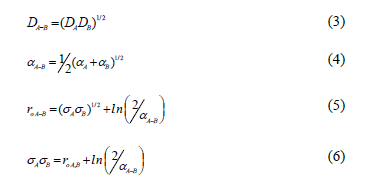
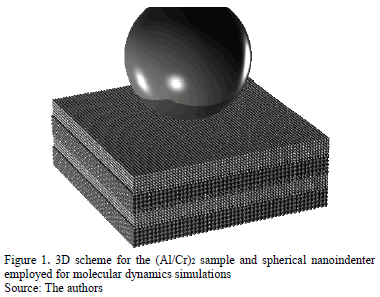
<body><![CDATA[<p><font size="3" face="Verdana, Arial, Helvetica, sans-serif"><b>1.  Introduction</b></font></p>     <p><font size="2" face="Verdana, Arial, Helvetica, sans-serif">Thin films have been   widely used for improving contact surfaces' performance for applications such   as magnetic storage devices, hard coatings, microelectromagnetics mechanisms   among others &#91;1-4&#93;. Nevertheless, there is a remarkable difference between   mechanical properties of materials in bulk and thin films. This difference is   higher when films are produced as single thin films and multilayers, the latter   presenting better mechanical behavior because of the interface presence. On the   other hand, the most useful technique for measuring mechanical properties in   systems with low dimensions such as thin films is nanoindentation, as it uses   very small loads, in the order of nanonewtons (nN) &#91;5&#93;. This method uses an   indenter with a known geometry that comes into contact in a specific place of   the surface applying a load. For this type of tests on the nanometer scale,   complex and expensive equipment and a long time for analysis are needed. One alternative   for studying mechanical properties at a nanometer scale is the use of modeling   and simulation techniques that allow understanding the materials behavior in a   deeper way. For example, molecular dynamics (MD) is one of the most used   methods for this kind of studies &#91;6&#93;. MD simulations are a powerful tool for   studying material properties in different fields such as bioscience, chemistry   and material science among others &#91;7&#93;. Because of the computational   technological developments, now simulations including a hundred million atoms   can be developed. </font></p>     <p><font size="2" face="Verdana, Arial, Helvetica, sans-serif">Recently, several works employing MD for simulating the   nanoindentation process for studying mechanical properties of thin films and   multilayers using different interatomic potentials have been reported. For   example A. Ritcher et al. &#91;8&#93; compared experimental and theoretical results of   mechanical properties for a nanoindentation method applied to several forms of   carbon materials with different mechanical properties, namely diamond, graphite   and fullerite films. Molecular dynamics simulations of the indentation process   have been performed. Although results were not in the same magnitude because of   computing power limitations, the simulations capture the main experimental   features of the nanoindentation process showing the elastic deformation that   takes place in both materials. In the case of thin films, P. Peng et al. &#91;9&#93;   investigated the nanoindentation of aluminum thin film on a silicon substrate   by three-dimensional MD simulation, combined with the Lennard-Jones (LJ)   potential for describing the interaction at the film-substrate interface.   Results showed that the hardness of the film increased with the loading rate.   A. K. Nair et al &#91;10&#93; studied the indentation response of Ni thin films of   nanoscale thicknesses using molecular dynamics simulations with the embedded   atom method (EAM) interatomic potentials. The simulation results for single   crystal films show that the contact stress necessary to emit the first   dislocation under the indenter is nearly independent of film thickness. In the   literature, there are other works showing similar studies to those presented   before &#91;11-13&#93;. Regarding multilayers simulation, the literature reports   several works that include the influence of the interface presence. T-H Fang et   al. &#91;14&#93; applied MD simulations combined with the tight-binding second-moment   approximation and Morse potentials for studying the effects of indention   deformation, contact, and adhesion on Al, Ni, and Al/Ni multilayered films.   Results show that when the indention depth of the sample increased, the maximum   load, plastic energy, and adhesion increased. L. Ming-Liang et al. &#91;15&#93; carried   out molecular dynamics simulation to investigate the nanoindentation behavior   of a Cu(100)/Cu(110) bilayered thin film. It was found that at the indenting   stage, the maximum indentation load of the bilayered thin film is lower than   that of its constituents; however, they have nearly the same maximum   indentation load. Similar studies were carried out by Y. Cao et al. &#91;16&#93;. In these   works the indenter was assumed to be a rigid probe with a great number of   carbon atoms; nevertheless, considering that the indenter does not present any   deformation, it could be considered as a perfect rigid and structureless sphere   capable of repulsion of all atoms in contact with it. The spherical shape is   not far from the real case, because although in experimental measurements the   most used shape of indenter is a pyramid, the indenter vertex has always a   finite curvature radius of several tens of nanometers; therefore, it would be   reasonable to consider it a spherical indenter, taking into account the scale   of MD simulations. This type of indenter has been used by A. V. Bolesta and   V.M. Fomin &#91;17&#93; for Cu thin films using the DM code LAMMPS. Nevertheless, this   method has not been used for multilayer coatings. In this work we present   similarities between mechanical properties in a study of Al, Cr and Al/Cr   coatings obtained by MD simulations, combined with Morse potential, and a   simple indenter with a spherical shape, and experimental results.  </font></p>     <p>&nbsp;</p>     <p><font size="3" face="Verdana, Arial, Helvetica, sans-serif"><b>2.  Model   Description</b></font></p>     <p><font size="2" face="Verdana, Arial, Helvetica, sans-serif">Molecular dynamics   simulations for carrying out nanoindentation tests were carried out for Cr, Al,   Al/Cr and (Al/Cr)<sub>2</sub> coatings. The indenter was assumed to be a   totally rigid and structureless sphere of diamond with diameter of 12 nm   &#91;14&#93;.  The sample was considered to be   films with well-defined atoms in thermal equilibrium at 0 K, orientation in the   plane (100) and of equal thickness. The samples size was <i>L</i>x<i>L</i>x<i>d</i> = 20x20x8 nm<sup>3</sup> (where <i>L</i> is the dimension in the <i>x</i>-<i>y</i> plane and <i>d</i> is the thickness of each layer). The system construction for the   case of two Al/Cr bilayers is present in <a href="#fig01">Fig. 1</a>. </font></p>     <p align="center"><font size="2" face="Verdana, Arial, Helvetica, sans-serif"><a name="fig01"></a></font><img src="/img/revistas/dyna/v81n186/v81n186a13fig01.gif"></p>     <p><font size="2" face="Verdana, Arial, Helvetica, sans-serif">Fixed boundary conditions were   considered, but the <i>x-y</i> dimensions   were large enough in order to avoid the edges influence on the results   obtained. Movement equations combined with the Verlet algorithm with a time   interval of 0.92 fs &#91;18&#93; were used. The maximum penetration depth of the tip is   2 nm at a speed of 4.3 m/s, in order to guarantee a The nanoindentation was   carried out controlling the spherical indenter position, simulated by means of   a repulsive potential with the atoms of the sample surface. The repulsive   potential for the indenter is described by: time relaxation between two   consecutive simulation steps. </font></p>     <p><img src="/img/revistas/dyna/v81n186/v81n186a13eq01.gif"></p>     <p><font size="2" face="Verdana, Arial, Helvetica, sans-serif">Where <i>A</i> is a   constant related to the indenter effective stiffness, <i>R</i> is the indenter radius and <i>r<sub>i</sub></i> is the distance between the center of the indenter and the <i>i</i>-<i>th</i> atom belonging to   the sample. Values used in this simulation for <i>A</i> and <i>R</i> are 44.14 eV/Å<sup>3</sup> and 6 nm respectively. These values were taken evaluated from the work carried   out by Lilleodden et al. &#91;19&#93;. </font></p>     ]]></body>

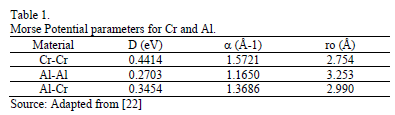
<body><![CDATA[<p><font size="2" face="Verdana, Arial, Helvetica, sans-serif">The load acting on each   individual atom was obtaining by adding two contributions: the first part   considers the interaction between the atom and its neighbors; the second part   represents the repulsive potential between the atom and the indenter.  The Morse potential (Eq. 2) was selected for   this simulation because it is computationally simpler and according to several   author including Ziegenhain et al. &#91;20&#93; its results are similar to those   obtained by using a EAM potential </font></p>     <p><img src="/img/revistas/dyna/v81n186/v81n186a13eq02.gif"></p>     <p><font size="2" face="Verdana, Arial, Helvetica, sans-serif">Where <i>D</i> is the   dimmer energy, <i>r<sub>o</sub></i> is the   equilibrium distance and <i>a</i> is the fit of the bulk   material modulus and <i>r<sub>ij</sub></i> is the distance between two atoms in the sample. The interatomic energies for   Cr-Cr, Al-Al and Cr-Al were obtained from the Lorentz-Berthelot mixing rule   &#91;21&#93;:</font></p>     <p><img src="/img/revistas/dyna/v81n186/v81n186a13eq0306.gif"></p>     <p><font size="2" face="Verdana, Arial, Helvetica, sans-serif">Where <i>D<sub>A-B</sub>,</i> <font face="Symbol"><i>a</i></font><i><sub>A-B</sub></i> and <i>r<sub><font face="Symbol">a</font>A-B</sub></i>,  are the fit energy, lattice constant and   equilibrium distance for A-B compound and <i>D<sub>A</sub></i><sub>, </sub><i>D<sub>B</sub></i>, <i><font face="Symbol">a</font><sub>A</sub></i>, <i><font face="Symbol">a</font><sub>A</sub></i>, <i>r<sub><font face="Symbol">a</font>A</sub></i> and <i>r<sub><font face="Symbol">a</font>B</sub></i> are the same parameters for A and B elements   respectively. The Morse potential parameters for Cr and Al are listed in <a href="#tab01">table   1</a>.</font></p>     <p align="center"><font size="2" face="Verdana, Arial, Helvetica, sans-serif"><a name="tab01"></a></font><img src="/img/revistas/dyna/v81n186/v81n186a13tab01.gif"></p>     <p><font size="2" face="Verdana, Arial, Helvetica, sans-serif">The reduced Young's modulus (E*) is obtained from Eq. (7)   which takes into account the combination of the tip and film elastic effects   &#91;23&#93;.</font></p>     <p><img src="/img/revistas/dyna/v81n186/v81n186a13eq07.gif"></p>     <p><font size="2" face="Verdana, Arial, Helvetica, sans-serif">Where <i>b = 1</i> for a spherical   indenter, <i>S</i> is the slope o</font> <font size="2" face="Verdana, Arial, Helvetica, sans-serif">f the unload curve initial part and <i>A<sub>c</sub></i> is the projected contact area at a maximum load. The   Young's modulus of the sample <i>E<sub>s</sub></i> is obtained from the expression:</font></p>     <p><img src="/img/revistas/dyna/v81n186/v81n186a13eq08.gif"></p>     ]]></body>

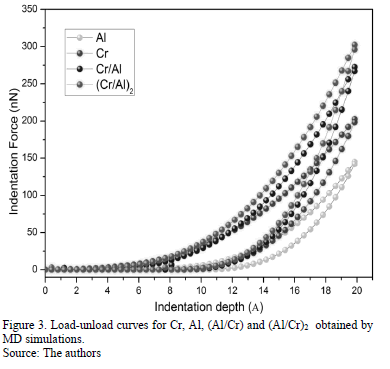
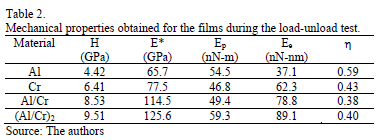
<body><![CDATA[<p><font size="2" face="Verdana, Arial, Helvetica, sans-serif">Where <i>E<sub>i</sub></i> and <i>E<sub>s</sub></i> are the indenter and sample Young's moduli, <i>u<sub>i</sub></i> and <i>u<sub>s</sub></i> are Poisson   coefficients of the indenter and sample respectively. The contact area, <i>A<sub>c</sub></i>, depends on the indenter   radius <i>R</i> and the contact depth <i>h<sub>c</sub></i>, and is given by</font></p>     <p><img src="/img/revistas/dyna/v81n186/v81n186a13eq09.gif"></p>     <p><font size="2" face="Verdana, Arial, Helvetica, sans-serif">Where <i>h<sub>c</sub></i> can be expressed as:</font></p>     <p><img src="/img/revistas/dyna/v81n186/v81n186a13eq10.gif"></p>     <p><font size="2" face="Verdana, Arial, Helvetica, sans-serif">hmax being the maximum penetration depth, Pmax the maximum   load and Smax the maximum slope of the unload curve. The material hardness H is   defined as the local resistance to the plastic deformation; then, it is   determined from the indentation maximum load divided by the contact project   area, according to: </font></p>     <p><img src="/img/revistas/dyna/v81n186/v81n186a13eq11.gif"></p>     <p>&nbsp;</p>     <p><font size="3" face="Verdana, Arial, Helvetica, sans-serif"><b>3.  Results and   Discussion</b></font></p>     <p><font size="2" face="Verdana, Arial, Helvetica, sans-serif"><a href="#fig03">Fig. 3</a> shows the load-unload curve   obtained from indentation simulations for Cr, Al Al/Cr and (Al/Cr)<sub>2</sub> at a temperature of 0 K. the maximum   load reached by the indentation depth at approximately 2 nm is 144 nN and 202   nN for Al and Cr respectively. For samples with one and two bilayers, the load   was increased being 272 nN and 302 nN, respectively.</font></p>     <p align="center"><font size="2" face="Verdana, Arial, Helvetica, sans-serif"><a name="fig02"></a></font><img src="/img/revistas/dyna/v81n186/v81n186a13fig02.gif"></p>     ]]></body>

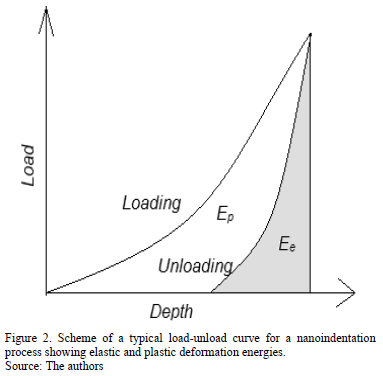
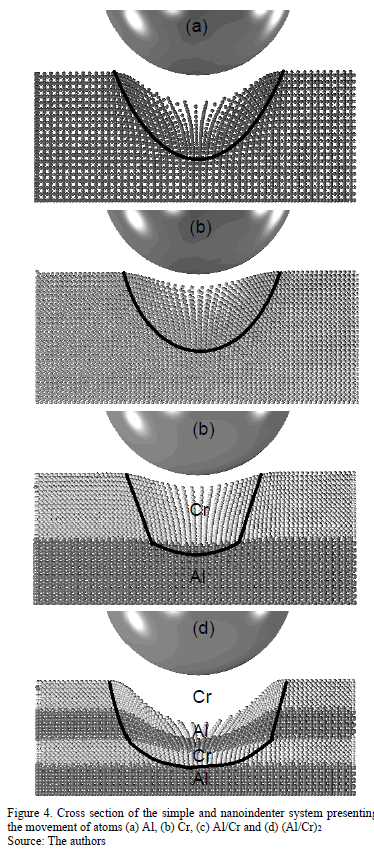
<body><![CDATA[<p align="center"><font size="2" face="Verdana, Arial, Helvetica, sans-serif"><a name="fig03"></a></font><img src="/img/revistas/dyna/v81n186/v81n186a13fig03.gif"></p>     <p><font size="2" face="Verdana, Arial, Helvetica, sans-serif">From the load-unload curves of <a href="#fig03">Fig. 3</a>, values of hardness   (<i>H</i>), effective Young's modulus (<i>E<sup>*</sup>=E<sub>s</sub>/(1-u<sub>s</sub><sup>2</sup>)</i>),   plastic deformation energy (<i>E<sub>p</sub></i>)   and elastic deformation energy (<i>E<sub>e</sub></i>)   were obtained. The coefficient of energy dispersion (<i>h</i>), is calculated from the   expression <i>h = E<sub>p</sub> /(E<sub>e</sub>+ E<sub>p</sub>)</i>.  These values are listed in <a href="#tab02">Table 2</a>. Similar   results were shown by Saraev and Miller &#91;25&#93;.</font></p>     <p align="center"><font size="2" face="Verdana, Arial, Helvetica, sans-serif"><a name="tab02"></a></font><img src="/img/revistas/dyna/v81n186/v81n186a13tab02.gif"></p>     <p><font size="2" face="Verdana, Arial, Helvetica, sans-serif">The hardness value for Al is similar to that reported by   Peng et al. &#91;9&#93; using MD. Experimental studies report hardness for Cr of 7 GPa   &#91;26&#93;, similar to that obtained in this work. Results show higher hardness for   Cr than for Al in the case of one and two bilayers, the hardness is increased   above the values obtained for single thin films, even greater than the value   obtained from the mixing rule (5.41 GPa). This hardness evolution is in   agreement with that reported in the literature by using nanoindentation   experimental tests for Ag/Ni &#91;27&#93; and Cu/Ni &#91;28&#93; systems. There is a   semi-coherent interface generated between the Al substrate and the Cr thin film   due to the large mismatch of lattice parameters (fcc-bcc), and misfit   dislocation networks formed at the interface accommodating this mismatch. The   interface, caused by mismatch of lattice parameters, applies a repulsive force   to prevent continuous dislocation slip. With successive emission of   dislocations from the indented free surface, more dislocations are propagated   toward the interface. It causes a pile up of dislocations on the interface,   leading to significant work-hardening of Al/Cr coatings &#91;16&#93;. </font></p>     <p><font size="2" face="Verdana, Arial, Helvetica, sans-serif">The Young's   modulus of Al obtained was 70 GPa, similar to that reported by Fang et al. &#91;6&#93;.   In the case of Cr,</font> <font size="2" face="Verdana, Arial, Helvetica, sans-serif">no reports for Young's modulus obtained by simulation were found. In   experimental tests, a value of 300 GPa was determined, different to the value   obtained in our simulations, possibly because in the experimental studies the   sample is polycrystalline. The value of <i>h</i> that is associated to the tendency for   plastic deformation of the films &#91;29&#93;, shows a greater value for Al compared to   the other films. The response to the plastic deformation is greater in single   layers than in multilayers. The interface creation generates a reduction in the   coefficient of energy dissipation; then, multilayer interfaces act as a barrier   for the plastic deformation. In other words, interfaces are considered as zones   of dissipation energy &#91;30&#93;. In the case of two bilayers, <i>h</i> is also higher than it for one bilayer,   possibly because the shear modulus between the materials in contact is similar.</font></p>     <p><font size="2" face="Verdana, Arial, Helvetica, sans-serif"><a href="#fig04">Fig. 4</a> shows the   movement of the atoms driven by dislocations and gliding mechanisms for   different samples. The line in the images describes the boundaries of this   movement. In <a href="#fig04">Fig. 4</a> (a) and (b), the movements for Al and Cr layers are   presented respectively, describing a parabolic boundary without any   discontinuity. On the contrary, For Al/Cr and (Al/Cr)<sub>2</sub> (<a href="#fig04">Fig. 4</a> (c)   and (d) respectively) the continuity of the parabola is interrupted by the   presence of interfaces, indicating that the atoms' movement decreases as the   interfaces appear. </font></p>     <p align="center"><font size="2" face="Verdana, Arial, Helvetica, sans-serif"><a name="fig04"></a></font><img src="/img/revistas/dyna/v81n186/v81n186a13fig04.gif"></p>     <p><font size="2" face="Verdana, Arial, Helvetica, sans-serif">The Cr atoms try   to recover their positions after the unload process; nevertheless, the plastic   behavior of Al produces dislocations as is shown in <a href="#fig04">Fig. 4</a> (d).</font></p>     <p>&nbsp;</p>     <p><font size="3" face="Verdana, Arial, Helvetica, sans-serif"><b>4.  Conclusions</b></font></p>     ]]></body>
<body><![CDATA[<p><font size="2" face="Verdana, Arial, Helvetica, sans-serif">A nanoindentation study for films in single layers, (Al   and Cr) and (Al/Cr and (Al/Cr)2), was carried out using molecular dynamics   simulations, combined with Morse potential, and using a totally rigid and   structureless spherical tip as an indenter. Mechanical properties were   evaluated from the load-unload curves, determining the hardness and Young's   modulus. The influence of the interface between two different materials on mechanical   properties was evaluated. The coefficient of energy dissipation is greater for   Al than for other films. The region of atom movement after the unload process   describes a parabolic volume for single thin films. In the case of bilayers   this zone presents discontinuities caused by the interfaces.</font></p>     <p>&nbsp;</p>     <p><font size="3" face="Verdana, Arial, Helvetica, sans-serif"><b>Acknowledgment</b></font></p>     <p><font size="2" face="Verdana, Arial, Helvetica, sans-serif">The authors   gratefully acknowledge the financial support of the Direcci&oacute;n Nacional de   Investigaciones of the Universidad Nacional de Colombia, during the course of   this research, under projects 18780  and   10719. This work was supported also in part by the Oficina de Investigaci&oacute;n   de  la Universidad Cat&oacute;lica de Pereira.</font> </p>     <p>&nbsp;</p>     <p><font size="3" face="Verdana, Arial, Helvetica, sans-serif"><b>References</b></font></p>     <!-- ref --><p> <font size="2" face="Verdana, Arial, Helvetica, sans-serif"><b>&#91;1&#93;</b> Nieto, J., Caicedo, J., Amaya, C., Moreno, H., Aperador, W., Tirado, L. and Bejarano, G., Evaluaci&oacute;n de la influencia del voltaje bias sobre la resistencia a la corrosi&oacute;n de pel&iacute;culas delgadas de A1-Nb-N. Dyna, 77 (162), p.p. 161-168, 2010.    &nbsp;&nbsp;&nbsp;&nbsp;&nbsp;&nbsp;&nbsp;&nbsp;[&#160;<a href="javascript:void(0);" onclick="javascript: window.open('/scielo.php?script=sci_nlinks&ref=000069&pid=S0012-7353201400040001300001&lng=','','width=640,height=500,resizable=yes,scrollbars=1,menubar=yes,');">Links</a>&#160;]<!-- end-ref --></font></p>     <!-- ref --><p> <font size="2" face="Verdana, Arial, Helvetica, sans-serif"><b>&#91;2&#93;</b> Mu&ntilde;oz, J. E and Coronado, J. J., An&aacute;lisis mec&aacute;nico y tribol&oacute;gico de los recubrimientos Fe-Cr-Ni-C Y Ni-Al-Mo. Dyna, vol. 74 (153), p.p. 111-118, 2007.    &nbsp;&nbsp;&nbsp;&nbsp;&nbsp;&nbsp;&nbsp;&nbsp;[&#160;<a href="javascript:void(0);" onclick="javascript: window.open('/scielo.php?script=sci_nlinks&ref=000071&pid=S0012-7353201400040001300002&lng=','','width=640,height=500,resizable=yes,scrollbars=1,menubar=yes,');">Links</a>&#160;]<!-- end-ref --></font></p>     ]]></body>
<body><![CDATA[<!-- ref --><p> <font size="2" face="Verdana, Arial, Helvetica, sans-serif"><b>&#91;3&#93;</b> Radhakrishnan G., Robertson R. E., Adams P. M. and Cole R. C., Integrated TiC coatings for moving MEMS, Thin Solid Films, vol. 420-421, p.p. 553-564, 2002.    &nbsp;&nbsp;&nbsp;&nbsp;&nbsp;&nbsp;&nbsp;&nbsp;[&#160;<a href="javascript:void(0);" onclick="javascript: window.open('/scielo.php?script=sci_nlinks&ref=000073&pid=S0012-7353201400040001300003&lng=','','width=640,height=500,resizable=yes,scrollbars=1,menubar=yes,');">Links</a>&#160;]<!-- end-ref --> </font></p>     <!-- ref --><p> <font size="2" face="Verdana, Arial, Helvetica, sans-serif"><b>&#91;4&#93;</b> Ashurst, W. R., Carraro, C., Maboudian, R. and Frey, W., Wafer Level Anti-Stiction Coatings for MEMS. Sensors Actuators A, 104, pp. 213-221, 2003.    &nbsp;&nbsp;&nbsp;&nbsp;&nbsp;&nbsp;&nbsp;&nbsp;[&#160;<a href="javascript:void(0);" onclick="javascript: window.open('/scielo.php?script=sci_nlinks&ref=000075&pid=S0012-7353201400040001300004&lng=','','width=640,height=500,resizable=yes,scrollbars=1,menubar=yes,');">Links</a>&#160;]<!-- end-ref --></font></p>     <!-- ref --><p> <font size="2" face="Verdana, Arial, Helvetica, sans-serif"><b>&#91;5&#93;</b> Meza, J. M., Chaves, C. A. and V&eacute;lez, J. M., T&eacute;cnicas de indentaci&oacute;n: Medici&oacute;n de propiedades mec&aacute;nicas en cer&aacute;micas. Dyna, 73 (149), p.p. 81-93, 2006.    &nbsp;&nbsp;&nbsp;&nbsp;&nbsp;&nbsp;&nbsp;&nbsp;[&#160;<a href="javascript:void(0);" onclick="javascript: window.open('/scielo.php?script=sci_nlinks&ref=000077&pid=S0012-7353201400040001300005&lng=','','width=640,height=500,resizable=yes,scrollbars=1,menubar=yes,');">Links</a>&#160;]<!-- end-ref --></font></p>     <!-- ref --><p> <font size="2" face="Verdana, Arial, Helvetica, sans-serif"><b>&#91;6&#93;</b> Fang, T.-H. Chang, W.-J. and Weng, C.-I., Nanoindentation and nanomachining characteristics of gold and platinum thin films. Materials Science and Engineering: A, 430, p.p. 332-340, 2006.    &nbsp;&nbsp;&nbsp;&nbsp;&nbsp;&nbsp;&nbsp;&nbsp;[&#160;<a href="javascript:void(0);" onclick="javascript: window.open('/scielo.php?script=sci_nlinks&ref=000079&pid=S0012-7353201400040001300006&lng=','','width=640,height=500,resizable=yes,scrollbars=1,menubar=yes,');">Links</a>&#160;]<!-- end-ref --></font></p>     <!-- ref --><p> <font size="2" face="Verdana, Arial, Helvetica, sans-serif"><b>&#91;7&#93;</b> Hale, J. M., Molecular Dynamics Simulation: Elementary Methods. Wiley-Interscience Publication, 1997.    &nbsp;&nbsp;&nbsp;&nbsp;&nbsp;&nbsp;&nbsp;&nbsp;[&#160;<a href="javascript:void(0);" onclick="javascript: window.open('/scielo.php?script=sci_nlinks&ref=000081&pid=S0012-7353201400040001300007&lng=','','width=640,height=500,resizable=yes,scrollbars=1,menubar=yes,');">Links</a>&#160;]<!-- end-ref --></font></p>     ]]></body>
<body><![CDATA[<!-- ref --><p> <font size="2" face="Verdana, Arial, Helvetica, sans-serif"><b>&#91;8&#93;</b> Richter, A., Ries, R., Smith, R., Henkel, M. and Wolf, B., Nanoindentation of diamond, graphite and fullerene films. Diamond and Related Materials, 9, p.p. 170-184, 2000.    &nbsp;&nbsp;&nbsp;&nbsp;&nbsp;&nbsp;&nbsp;&nbsp;[&#160;<a href="javascript:void(0);" onclick="javascript: window.open('/scielo.php?script=sci_nlinks&ref=000083&pid=S0012-7353201400040001300008&lng=','','width=640,height=500,resizable=yes,scrollbars=1,menubar=yes,');">Links</a>&#160;]<!-- end-ref --> </font></p>     <!-- ref --><p> <font size="2" face="Verdana, Arial, Helvetica, sans-serif"><b>&#91;9&#93;</b> Peng, P., Liao, G., Shi, T., Tanga, Z. and Gao, Y., Molecular dynamic simulations of nanoindentation in aluminum thin film on silicon substrate. Applied Surface Science, 256, p.p. 6284-6290, 2010.    &nbsp;&nbsp;&nbsp;&nbsp;&nbsp;&nbsp;&nbsp;&nbsp;[&#160;<a href="javascript:void(0);" onclick="javascript: window.open('/scielo.php?script=sci_nlinks&ref=000085&pid=S0012-7353201400040001300009&lng=','','width=640,height=500,resizable=yes,scrollbars=1,menubar=yes,');">Links</a>&#160;]<!-- end-ref --> </font></p>     <!-- ref --><p> <font size="2" face="Verdana, Arial, Helvetica, sans-serif"><b>&#91;10&#93;</b> Nair, A. K., Parker, E., Gaudreau, P., Farkas, D. and Kriz, R. D., Size effects in indentation response of thin films at the nanoscale: A molecular dynamics study. International Journal of Plasticity, 24, p.p. 2016-2031, 2008.    &nbsp;&nbsp;&nbsp;&nbsp;&nbsp;&nbsp;&nbsp;&nbsp;[&#160;<a href="javascript:void(0);" onclick="javascript: window.open('/scielo.php?script=sci_nlinks&ref=000087&pid=S0012-7353201400040001300010&lng=','','width=640,height=500,resizable=yes,scrollbars=1,menubar=yes,');">Links</a>&#160;]<!-- end-ref --> </font></p>     <!-- ref --><p> <font size="2" face="Verdana, Arial, Helvetica, sans-serif"><b>&#91;11&#93;</b> Gao, Y., Lu, C., Huynh, N. N., Michal, G., Zhu, H. T. and Tieu, A. K., Molecular dynamics simulation of effect of indenter shape on nanoscratch of Ni. Wear, 267, p.p. 1998-2002, 2009.    &nbsp;&nbsp;&nbsp;&nbsp;&nbsp;&nbsp;&nbsp;&nbsp;[&#160;<a href="javascript:void(0);" onclick="javascript: window.open('/scielo.php?script=sci_nlinks&ref=000089&pid=S0012-7353201400040001300011&lng=','','width=640,height=500,resizable=yes,scrollbars=1,menubar=yes,');">Links</a>&#160;]<!-- end-ref --> </font></p>     <!-- ref --><p> <font size="2" face="Verdana, Arial, Helvetica, sans-serif"><b>&#91;12&#93;</b> Shi, Y. and Falk, M. L., Simulations of nanoindentation in a thin amorphous metal film, Thin Solid Films, 515, p.p. 3179-3182, 2007.    &nbsp;&nbsp;&nbsp;&nbsp;&nbsp;&nbsp;&nbsp;&nbsp;[&#160;<a href="javascript:void(0);" onclick="javascript: window.open('/scielo.php?script=sci_nlinks&ref=000091&pid=S0012-7353201400040001300012&lng=','','width=640,height=500,resizable=yes,scrollbars=1,menubar=yes,');">Links</a>&#160;]<!-- end-ref --></font></p>     ]]></body>
<body><![CDATA[<!-- ref --><p> <font size="2" face="Verdana, Arial, Helvetica, sans-serif"><b>&#91;13&#93;</b> Wang, C.-T., Jian, S.-R., Jang, J. S.-C., Lai, Y.-S. and Yang, P.-F., Multiscale simulation of nanoindentation on Ni (1 0 0) thin film. Applied Surface Science, 255, p.p. 3240-3250, 2008.    &nbsp;&nbsp;&nbsp;&nbsp;&nbsp;&nbsp;&nbsp;&nbsp;[&#160;<a href="javascript:void(0);" onclick="javascript: window.open('/scielo.php?script=sci_nlinks&ref=000093&pid=S0012-7353201400040001300013&lng=','','width=640,height=500,resizable=yes,scrollbars=1,menubar=yes,');">Links</a>&#160;]<!-- end-ref --></font></p>     <!-- ref --><p> <font size="2" face="Verdana, Arial, Helvetica, sans-serif"><b>&#91;14&#93;</b> Fang, T.-H. and Wu, J.-H., Molecular dynamics simulations on nanoindentation mechanisms of multilayered films. Computational Materials Science, 43, p.p. 785-790, 2008.    &nbsp;&nbsp;&nbsp;&nbsp;&nbsp;&nbsp;&nbsp;&nbsp;[&#160;<a href="javascript:void(0);" onclick="javascript: window.open('/scielo.php?script=sci_nlinks&ref=000095&pid=S0012-7353201400040001300014&lng=','','width=640,height=500,resizable=yes,scrollbars=1,menubar=yes,');">Links</a>&#160;]<!-- end-ref --> </font></p>     <!-- ref --><p> <font size="2" face="Verdana, Arial, Helvetica, sans-serif"><b>&#91;15&#93;</b> Liao, M.-L., Weng, M.-H., Ju, S. P., Chiang, H. J., Molecular Dynamics Simulation on the Nanoindentation Behavior of a Copper Bilayered Thin Film. Chinese Journal of Catalysis, 29, p.p.1122-1126, 2009.    &nbsp;&nbsp;&nbsp;&nbsp;&nbsp;&nbsp;&nbsp;&nbsp;[&#160;<a href="javascript:void(0);" onclick="javascript: window.open('/scielo.php?script=sci_nlinks&ref=000097&pid=S0012-7353201400040001300015&lng=','','width=640,height=500,resizable=yes,scrollbars=1,menubar=yes,');">Links</a>&#160;]<!-- end-ref --> </font></p>     <!-- ref --><p> <font size="2" face="Verdana, Arial, Helvetica, sans-serif"><b>&#91;16&#93;</b> Cao, Y., Zhang, J., Liang, Y., Yu, F. and Sun, T., Mechanical and tribological properties of Ni/Al multilayers-A molecular dynamics study. Applied Surface Science, 257, p.p. 847-851, 2010.    &nbsp;&nbsp;&nbsp;&nbsp;&nbsp;&nbsp;&nbsp;&nbsp;[&#160;<a href="javascript:void(0);" onclick="javascript: window.open('/scielo.php?script=sci_nlinks&ref=000099&pid=S0012-7353201400040001300016&lng=','','width=640,height=500,resizable=yes,scrollbars=1,menubar=yes,');">Links</a>&#160;]<!-- end-ref --> </font></p>     <!-- ref --><p> <font size="2" face="Verdana, Arial, Helvetica, sans-serif"><b>&#91;17&#93;</b> Bolesta, A. V., Fomin, V.M., Molecular dynamics simulation of sphere indentation in a thin copper film. Physical Mesomechanics, 12, p.p. 117-123, 2009.    &nbsp;&nbsp;&nbsp;&nbsp;&nbsp;&nbsp;&nbsp;&nbsp;[&#160;<a href="javascript:void(0);" onclick="javascript: window.open('/scielo.php?script=sci_nlinks&ref=000101&pid=S0012-7353201400040001300017&lng=','','width=640,height=500,resizable=yes,scrollbars=1,menubar=yes,');">Links</a>&#160;]<!-- end-ref --> </font></p>     ]]></body>
<body><![CDATA[<!-- ref --><p> <font size="2" face="Verdana, Arial, Helvetica, sans-serif"><b>&#91;18&#93;</b> Haile, J. M., Molecular Dynamics Simulation: Elementary Methods, Wiley, New York, 1992.    &nbsp;&nbsp;&nbsp;&nbsp;&nbsp;&nbsp;&nbsp;&nbsp;[&#160;<a href="javascript:void(0);" onclick="javascript: window.open('/scielo.php?script=sci_nlinks&ref=000103&pid=S0012-7353201400040001300018&lng=','','width=640,height=500,resizable=yes,scrollbars=1,menubar=yes,');">Links</a>&#160;]<!-- end-ref --></font></p>     <!-- ref --><p> <font size="2" face="Verdana, Arial, Helvetica, sans-serif"><b>&#91;19&#93;</b> Lilleodden, E. T., Zimmerman, J. A., Foiles, S. M. and Nix, W. D., Atomistic simulations of elastic deformation and dislocation nucleation during nanoindentation. Journal of the Mechanics and Physics of Solids, 51, p.p. 901-920, 2003.    &nbsp;&nbsp;&nbsp;&nbsp;&nbsp;&nbsp;&nbsp;&nbsp;[&#160;<a href="javascript:void(0);" onclick="javascript: window.open('/scielo.php?script=sci_nlinks&ref=000105&pid=S0012-7353201400040001300019&lng=','','width=640,height=500,resizable=yes,scrollbars=1,menubar=yes,');">Links</a>&#160;]<!-- end-ref --> </font></p>     <!-- ref --><p> <font size="2" face="Verdana, Arial, Helvetica, sans-serif"><b>&#91;20&#93;</b> Ziegenhain, G., Hartmaier, A. and Urbassek, H. M., Pair vs many-body potentials: Influence on elastic and plastic behavior in nanoindentation of fcc metals. Journal of the Mechanics and Physics of Solids, 57,p.p. 1514-1526, 2009.    &nbsp;&nbsp;&nbsp;&nbsp;&nbsp;&nbsp;&nbsp;&nbsp;[&#160;<a href="javascript:void(0);" onclick="javascript: window.open('/scielo.php?script=sci_nlinks&ref=000107&pid=S0012-7353201400040001300020&lng=','','width=640,height=500,resizable=yes,scrollbars=1,menubar=yes,');">Links</a>&#160;]<!-- end-ref --> </font></p>     <!-- ref --><p> <font size="2" face="Verdana, Arial, Helvetica, sans-serif"><b>&#91;21&#93;</b> Imafuku, M., Sasajima, Y., Yamamoto, R. and Doyama, M., Computer simulations of the structures of the metallic superlattices Au/Ni and Cu/Ni and their elastic moduli. Journal of Physics F: Metal Physics, 16, p.p. 823-829, 1986.    &nbsp;&nbsp;&nbsp;&nbsp;&nbsp;&nbsp;&nbsp;&nbsp;[&#160;<a href="javascript:void(0);" onclick="javascript: window.open('/scielo.php?script=sci_nlinks&ref=000109&pid=S0012-7353201400040001300021&lng=','','width=640,height=500,resizable=yes,scrollbars=1,menubar=yes,');">Links</a>&#160;]<!-- end-ref --></font></p>     <!-- ref --><p> <font size="2" face="Verdana, Arial, Helvetica, sans-serif"><b>&#91;22&#93;</b> Komanduri, R., Chandrasekaran, N. and Raff, L. M., Molecular dynamics (MD) simulation of uniaxial tension of some single-crystal cubic metals at nanolevel. International Journal of Mechanical Sciences, 43, p.p. 2237-2260, 2001.    &nbsp;&nbsp;&nbsp;&nbsp;&nbsp;&nbsp;&nbsp;&nbsp;[&#160;<a href="javascript:void(0);" onclick="javascript: window.open('/scielo.php?script=sci_nlinks&ref=000111&pid=S0012-7353201400040001300022&lng=','','width=640,height=500,resizable=yes,scrollbars=1,menubar=yes,');">Links</a>&#160;]<!-- end-ref --> </font></p>     ]]></body>
<body><![CDATA[<!-- ref --><p> <font size="2" face="Verdana, Arial, Helvetica, sans-serif"><b>&#91;23&#93;</b> Oliver, W. C. and Pharr, G. M., An improved technique for determining hardness and elastic modulus using load and displacement sensing indentation experiments. Journal of Materials Research, 7, pp 1564-1583, 1992.    &nbsp;&nbsp;&nbsp;&nbsp;&nbsp;&nbsp;&nbsp;&nbsp;[&#160;<a href="javascript:void(0);" onclick="javascript: window.open('/scielo.php?script=sci_nlinks&ref=000113&pid=S0012-7353201400040001300023&lng=','','width=640,height=500,resizable=yes,scrollbars=1,menubar=yes,');">Links</a>&#160;]<!-- end-ref --></font></p>     <!-- ref --><p> <font size="2" face="Verdana, Arial, Helvetica, sans-serif"><b>&#91;24&#93;</b> Du, J., Höschen, T., Rasinski, M. and You, J.-H., Interfacial fracture behavior of tungsten wire/tungsten matrix composites with copper-coated interfaces. Materials Science and Engineering: A, 527, p.p. 1623-1629, 2010.    &nbsp;&nbsp;&nbsp;&nbsp;&nbsp;&nbsp;&nbsp;&nbsp;[&#160;<a href="javascript:void(0);" onclick="javascript: window.open('/scielo.php?script=sci_nlinks&ref=000115&pid=S0012-7353201400040001300024&lng=','','width=640,height=500,resizable=yes,scrollbars=1,menubar=yes,');">Links</a>&#160;]<!-- end-ref --> </font></p>     <!-- ref --><p> <font size="2" face="Verdana, Arial, Helvetica, sans-serif"><b>&#91;25&#93;</b> Saraev, D. and Miller, R. E. Atomistic simulation of nanoindentation into copper multilayers. Modelling and Simulation in Materials Science and Engineering, 13, p.p. 1089-1099, 2005.    &nbsp;&nbsp;&nbsp;&nbsp;&nbsp;&nbsp;&nbsp;&nbsp;[&#160;<a href="javascript:void(0);" onclick="javascript: window.open('/scielo.php?script=sci_nlinks&ref=000117&pid=S0012-7353201400040001300025&lng=','','width=640,height=500,resizable=yes,scrollbars=1,menubar=yes,');">Links</a>&#160;]<!-- end-ref --></font></p>     <!-- ref --><p> <font size="2" face="Verdana, Arial, Helvetica, sans-serif"><b>&#91;26&#93;</b> Romero, J., Esteve, J. and Lousa, A. Period dependence of hardness and microstructure on nanometric Cr/CrN multilayers. Surface and Coatings Technology, 188-189, p.p. 338-343, 2004.    &nbsp;&nbsp;&nbsp;&nbsp;&nbsp;&nbsp;&nbsp;&nbsp;[&#160;<a href="javascript:void(0);" onclick="javascript: window.open('/scielo.php?script=sci_nlinks&ref=000119&pid=S0012-7353201400040001300026&lng=','','width=640,height=500,resizable=yes,scrollbars=1,menubar=yes,');">Links</a>&#160;]<!-- end-ref --></font></p>     <!-- ref --><p> <font size="2" face="Verdana, Arial, Helvetica, sans-serif"><b>&#91;27&#93;</b> Wen, S.P., Zong, R.L., Zeng, F., Guo, S. and Pan, F. Nanoindentation and nanoscratch behaviors of Ag/Ni multilayers. Applied Surface Science, 255, p.p. 4558-4562, 2009.    &nbsp;&nbsp;&nbsp;&nbsp;&nbsp;&nbsp;&nbsp;&nbsp;[&#160;<a href="javascript:void(0);" onclick="javascript: window.open('/scielo.php?script=sci_nlinks&ref=000121&pid=S0012-7353201400040001300027&lng=','','width=640,height=500,resizable=yes,scrollbars=1,menubar=yes,');">Links</a>&#160;]<!-- end-ref --></font></p>     ]]></body>
<body><![CDATA[<!-- ref --><p> <font size="2" face="Verdana, Arial, Helvetica, sans-serif"><b>&#91;28&#93;</b> Zhu, X.Y., Liua, X.J., Zong, R.L., Zeng, F. and Pan, F., Microstructure and mechanical properties of nanoscale Cu/Ni multilayers. Materials Science and Engineering: A, 527, p.p. 1243-1248, 2010.    &nbsp;&nbsp;&nbsp;&nbsp;&nbsp;&nbsp;&nbsp;&nbsp;[&#160;<a href="javascript:void(0);" onclick="javascript: window.open('/scielo.php?script=sci_nlinks&ref=000123&pid=S0012-7353201400040001300028&lng=','','width=640,height=500,resizable=yes,scrollbars=1,menubar=yes,');">Links</a>&#160;]<!-- end-ref --> </font></p>     <!-- ref --><p> <font size="2" face="Verdana, Arial, Helvetica, sans-serif"><b>&#91;29&#93;</b> Kikuchi, N., Kitagawa, M., Sato, A., Kusano, E., Nanto, H. and Kinbara, A., Elastic and plastic energies in sputtered multilayered Ti-TiN films estimated by nanoindentation. Surface and Coatings Technology, 126, p.p. 131-135, 2000.    &nbsp;&nbsp;&nbsp;&nbsp;&nbsp;&nbsp;&nbsp;&nbsp;[&#160;<a href="javascript:void(0);" onclick="javascript: window.open('/scielo.php?script=sci_nlinks&ref=000125&pid=S0012-7353201400040001300029&lng=','','width=640,height=500,resizable=yes,scrollbars=1,menubar=yes,');">Links</a>&#160;]<!-- end-ref --></font></p>     <!-- ref --><p> <font size="2" face="Verdana, Arial, Helvetica, sans-serif"><b>&#91;30&#93;</b> Stueber, M., Holleck, H., Leiste, H., Seemann, K., Ulrich, S. and Ziebert, C., Concepts for the design of advanced nanoscale PVD multilayer protective thin films. Journal of Alloys and Compounds, 483, p.p. 321-333, 2009.    &nbsp;&nbsp;&nbsp;&nbsp;&nbsp;&nbsp;&nbsp;&nbsp;[&#160;<a href="javascript:void(0);" onclick="javascript: window.open('/scielo.php?script=sci_nlinks&ref=000127&pid=S0012-7353201400040001300030&lng=','','width=640,height=500,resizable=yes,scrollbars=1,menubar=yes,');">Links</a>&#160;]<!-- end-ref --> </font></p>     <p>&nbsp;</p>     <p><font size="2" face="Verdana, Arial, Helvetica, sans-serif"><b>Sebastian Amaya-Roncancio, </b>received   a Bs. Eng. in Physical Engineering in 2007, and MSc. degree in Physics in 2011. Currently he is   a PhD student in Physics at the Universidad Nacional in San Luis, and is a member of the group GEMA of the   Universidad Cat&oacute;lica de Pereira and PCM Computational Applications of the   Universidad Nacional de Colombia sedeManizales.  His research interests include: simulation of mechanical   properties of materials and physical chemical properties of surfaces</font></p>     <p><font size="2" face="Verdana, Arial, Helvetica, sans-serif"><b>Elisabeth Restrepo-Parra</b>, received a Bs. Eng. in   Electrical Engineering in 1990, an MSc degree in Physics in 2000, and her PhD degree in Engineering in 2010. She is a senior professor of the   Physics and Chemistry Department, Universidad Nacional de Colombia Sede   Manizales and member of the   groups: Laboratorio de F&iacute;sica del Plasma and PCM Computational Applications.   Her main research areas are: materials processing by plasma assisted   techniques, structural, mechanical and morphological characterization of   materials and modeling and simulation of physical properties of materials.</font></p>     <p><font size="2" face="Verdana, Arial, Helvetica, sans-serif"><b>Diana Marcela Devia-Narvaez</b>, received her Bs. Eng in   Physical Engineering in 2005, an MSc degree in Physics in 2010, and her PhD degree in Engineering in 2012. Currently she is a professor of   mathematics in the Universidad Tecnol&oacute;gica de Pereira-UTP, and member of the   group Laboratorio de plasma of the Universidad Nacional de Colombia sede   Manizales, and Non-linear differential equations &quot;GEDNOL&quot; of  the Universidad Tecnol&oacute;gica de Pereira. Her   fields of work include: materials processing by plasma assisted techniques,   structural, mechanical and morphological characterization of materials and   modeling and simulation of physical properties of materials.</font></p>     ]]></body>
<body><![CDATA[<p><font size="2" face="Verdana, Arial, Helvetica, sans-serif"><b>Diego Fernando Arias-Mateus, </b>received   a Bs. Eng in Chemical Engineering in 1993, an MSc degree in Physics in 2003, and his PhD   degree in Engineering in   2012. Currently he is a   professor of chemistry, physics and mathematics at the Universidad Cat&oacute;lica de   Pereira. He is a member of the group GEMA of the Universidad Cat&oacute;lica de   Pereira and the Laboratorio de plasma of the Universidad Nacional de Colombia,   sede Manizales. His fields of work include: materials processing by plasma   assisted techniques, structural, mechanical and morphological characterization   of materials and simulation of mechanical properties of materials.</font></p>     <p><font size="2" face="Verdana, Arial, Helvetica, sans-serif"><b>Monica Maria G&oacute;mez-Hermida, </b>received   her Bs. Eng in Physical Engineering in 2004 and MSc degree in Physics in 2009.   She is a PhD student in Engineer at the Universidad Nacional de Colombia sede   Medell&iacute;n. Currently she is a professor of physics at the Universidad Cat&oacute;lica   de Pereira, and member of the group GEMA of the Universidad Cat&oacute;lica de Pereira.   Her main research areas are: growth of magnetic materials, education   pedagogies, study of thermal properties of materials, study of magnetic   properties of materials, mathematical simulation and modeling. </font></p>      ]]></body><back>
<ref-list>
<ref id="B1">
<label>1</label><nlm-citation citation-type="journal">
<person-group person-group-type="author">
<name>
<surname><![CDATA[Nieto]]></surname>
<given-names><![CDATA[J.]]></given-names>
</name>
<name>
<surname><![CDATA[Caicedo]]></surname>
<given-names><![CDATA[J.]]></given-names>
</name>
<name>
<surname><![CDATA[Amaya]]></surname>
<given-names><![CDATA[C.]]></given-names>
</name>
<name>
<surname><![CDATA[Moreno]]></surname>
<given-names><![CDATA[H.]]></given-names>
</name>
<name>
<surname><![CDATA[Aperador]]></surname>
<given-names><![CDATA[W.]]></given-names>
</name>
<name>
<surname><![CDATA[Tirado]]></surname>
<given-names><![CDATA[L.]]></given-names>
</name>
<name>
<surname><![CDATA[Bejarano]]></surname>
<given-names><![CDATA[G.]]></given-names>
</name>
</person-group>
<article-title xml:lang="es"><![CDATA[Evaluación de la influencia del voltaje bias sobre la resistencia a la corrosión de películas delgadas de A1-Nb-N.]]></article-title>
<source><![CDATA[Dyna]]></source>
<year>2010</year>
<volume>77</volume>
<numero>162</numero>
<issue>162</issue>
<page-range>161-168</page-range></nlm-citation>
</ref>
<ref id="B2">
<label>2</label><nlm-citation citation-type="journal">
<person-group person-group-type="author">
<name>
<surname><![CDATA[Muñoz]]></surname>
<given-names><![CDATA[J. E]]></given-names>
</name>
<name>
<surname><![CDATA[Coronado]]></surname>
<given-names><![CDATA[J. J.]]></given-names>
</name>
</person-group>
<article-title xml:lang="es"><![CDATA[Análisis mecánico y tribológico de los recubrimientos Fe-Cr-Ni-C Y Ni-Al-Mo]]></article-title>
<source><![CDATA[Dyna]]></source>
<year>2007</year>
<volume>74</volume>
<numero>153</numero>
<issue>153</issue>
<page-range>111-118</page-range></nlm-citation>
</ref>
<ref id="B3">
<label>3</label><nlm-citation citation-type="journal">
<person-group person-group-type="author">
<name>
<surname><![CDATA[Radhakrishnan]]></surname>
<given-names><![CDATA[G.]]></given-names>
</name>
<name>
<surname><![CDATA[Robertson]]></surname>
<given-names><![CDATA[R. E.]]></given-names>
</name>
<name>
<surname><![CDATA[Adams]]></surname>
<given-names><![CDATA[P. M.]]></given-names>
</name>
<name>
<surname><![CDATA[Cole]]></surname>
<given-names><![CDATA[R. C.]]></given-names>
</name>
</person-group>
<article-title xml:lang="en"><![CDATA[Integrated TiC coatings for moving MEMS]]></article-title>
<source><![CDATA[Thin Solid Films]]></source>
<year>2002</year>
<volume>420-421</volume>
<page-range>553-564</page-range></nlm-citation>
</ref>
<ref id="B4">
<label>4</label><nlm-citation citation-type="journal">
<person-group person-group-type="author">
<name>
<surname><![CDATA[Ashurst]]></surname>
<given-names><![CDATA[W. R.]]></given-names>
</name>
<name>
<surname><![CDATA[Carraro]]></surname>
<given-names><![CDATA[C.]]></given-names>
</name>
<name>
<surname><![CDATA[Maboudian]]></surname>
<given-names><![CDATA[R.]]></given-names>
</name>
<name>
<surname><![CDATA[Frey]]></surname>
<given-names><![CDATA[W.]]></given-names>
</name>
</person-group>
<article-title xml:lang="en"><![CDATA[Wafer Level Anti-Stiction Coatings for MEMS]]></article-title>
<source><![CDATA[Sensors Actuators A]]></source>
<year>2003</year>
<numero>104</numero>
<issue>104</issue>
<page-range>213-221</page-range></nlm-citation>
</ref>
<ref id="B5">
<label>5</label><nlm-citation citation-type="journal">
<person-group person-group-type="author">
<name>
<surname><![CDATA[Meza]]></surname>
<given-names><![CDATA[J. M.]]></given-names>
</name>
<name>
<surname><![CDATA[Chaves]]></surname>
<given-names><![CDATA[C. A.]]></given-names>
</name>
<name>
<surname><![CDATA[Vélez]]></surname>
<given-names><![CDATA[J. M.]]></given-names>
</name>
</person-group>
<article-title xml:lang="es"><![CDATA[Técnicas de indentación: Medición de propiedades mecánicas en cerámicas]]></article-title>
<source><![CDATA[Dyna]]></source>
<year>2006</year>
<volume>73</volume>
<numero>149</numero>
<issue>149</issue>
<page-range>81-93</page-range></nlm-citation>
</ref>
<ref id="B6">
<label>6</label><nlm-citation citation-type="journal">
<person-group person-group-type="author">
<name>
<surname><![CDATA[Fang]]></surname>
<given-names><![CDATA[T.-H.]]></given-names>
</name>
<name>
<surname><![CDATA[Chang]]></surname>
<given-names><![CDATA[W.-J.]]></given-names>
</name>
<name>
<surname><![CDATA[Weng]]></surname>
<given-names><![CDATA[C.-I.]]></given-names>
</name>
</person-group>
<article-title xml:lang="en"><![CDATA[Nanoindentation and nanomachining characteristics of gold and platinum thin films]]></article-title>
<source><![CDATA[Materials Science and Engineering: A]]></source>
<year>2006</year>
<numero>430</numero>
<issue>430</issue>
<page-range>332-340</page-range></nlm-citation>
</ref>
<ref id="B7">
<label>7</label><nlm-citation citation-type="book">
<person-group person-group-type="author">
<name>
<surname><![CDATA[Hale]]></surname>
<given-names><![CDATA[J. M.]]></given-names>
</name>
</person-group>
<source><![CDATA[Molecular Dynamics Simulation: Elementary Methods]]></source>
<year>1997</year>
<publisher-name><![CDATA[Wiley-Interscience Publication]]></publisher-name>
</nlm-citation>
</ref>
<ref id="B8">
<label>8</label><nlm-citation citation-type="journal">
<person-group person-group-type="author">
<name>
<surname><![CDATA[Richter]]></surname>
<given-names><![CDATA[A.]]></given-names>
</name>
<name>
<surname><![CDATA[Ries]]></surname>
<given-names><![CDATA[R.]]></given-names>
</name>
<name>
<surname><![CDATA[Smith]]></surname>
<given-names><![CDATA[R.]]></given-names>
</name>
<name>
<surname><![CDATA[Henkel]]></surname>
<given-names><![CDATA[M.]]></given-names>
</name>
<name>
<surname><![CDATA[Wolf]]></surname>
<given-names><![CDATA[B.]]></given-names>
</name>
</person-group>
<article-title xml:lang="en"><![CDATA[Nanoindentation of diamond, graphite and fullerene films]]></article-title>
<source><![CDATA[Diamond and Related Materials]]></source>
<year>2000</year>
<numero>9</numero>
<issue>9</issue>
<page-range>170-184</page-range></nlm-citation>
</ref>
<ref id="B9">
<label>9</label><nlm-citation citation-type="journal">
<person-group person-group-type="author">
<name>
<surname><![CDATA[Peng]]></surname>
<given-names><![CDATA[P.]]></given-names>
</name>
<name>
<surname><![CDATA[Liao]]></surname>
<given-names><![CDATA[G.]]></given-names>
</name>
<name>
<surname><![CDATA[Shi]]></surname>
<given-names><![CDATA[T.]]></given-names>
</name>
<name>
<surname><![CDATA[Tanga]]></surname>
<given-names><![CDATA[Z.]]></given-names>
</name>
<name>
<surname><![CDATA[Gao]]></surname>
<given-names><![CDATA[Y.]]></given-names>
</name>
</person-group>
<article-title xml:lang="en"><![CDATA[Molecular dynamic simulations of nanoindentation in aluminum thin film on silicon substrate]]></article-title>
<source><![CDATA[Applied Surface Science]]></source>
<year>2010</year>
<numero>256</numero>
<issue>256</issue>
<page-range>6284-6290</page-range></nlm-citation>
</ref>
<ref id="B10">
<label>10</label><nlm-citation citation-type="journal">
<person-group person-group-type="author">
<name>
<surname><![CDATA[Nair]]></surname>
<given-names><![CDATA[A. K.]]></given-names>
</name>
<name>
<surname><![CDATA[Parker]]></surname>
<given-names><![CDATA[E.]]></given-names>
</name>
<name>
<surname><![CDATA[Gaudreau]]></surname>
<given-names><![CDATA[P.]]></given-names>
</name>
<name>
<surname><![CDATA[Farkas]]></surname>
<given-names><![CDATA[D.]]></given-names>
</name>
<name>
<surname><![CDATA[Kriz]]></surname>
<given-names><![CDATA[R. D.]]></given-names>
</name>
</person-group>
<article-title xml:lang="en"><![CDATA[Size effects in indentation response of thin films at the nanoscale: A molecular dynamics study]]></article-title>
<source><![CDATA[International Journal of Plasticity]]></source>
<year>2008</year>
<numero>24</numero>
<issue>24</issue>
<page-range>2016-2031</page-range></nlm-citation>
</ref>
<ref id="B11">
<label>11</label><nlm-citation citation-type="journal">
<person-group person-group-type="author">
<name>
<surname><![CDATA[Gao]]></surname>
<given-names><![CDATA[Y.]]></given-names>
</name>
<name>
<surname><![CDATA[Lu]]></surname>
<given-names><![CDATA[C.]]></given-names>
</name>
<name>
<surname><![CDATA[Huynh]]></surname>
<given-names><![CDATA[N. N.]]></given-names>
</name>
<name>
<surname><![CDATA[Michal]]></surname>
<given-names><![CDATA[G.]]></given-names>
</name>
<name>
<surname><![CDATA[Zhu]]></surname>
<given-names><![CDATA[H. T.]]></given-names>
</name>
<name>
<surname><![CDATA[Tieu]]></surname>
<given-names><![CDATA[A. K.]]></given-names>
</name>
</person-group>
<article-title xml:lang="en"><![CDATA[Molecular dynamics simulation of effect of indenter shape on nanoscratch of Ni]]></article-title>
<source><![CDATA[Wear]]></source>
<year>2009</year>
<numero>267</numero>
<issue>267</issue>
<page-range>1998-2002</page-range></nlm-citation>
</ref>
<ref id="B12">
<label>12</label><nlm-citation citation-type="journal">
<person-group person-group-type="author">
<name>
<surname><![CDATA[Shi]]></surname>
<given-names><![CDATA[Y.]]></given-names>
</name>
<name>
<surname><![CDATA[Falk]]></surname>
<given-names><![CDATA[M. L.]]></given-names>
</name>
</person-group>
<article-title xml:lang="en"><![CDATA[Simulations of nanoindentation in a thin amorphous metal film]]></article-title>
<source><![CDATA[Thin Solid Films]]></source>
<year>2007</year>
<numero>515</numero>
<issue>515</issue>
<page-range>3179-3182</page-range></nlm-citation>
</ref>
<ref id="B13">
<label>13</label><nlm-citation citation-type="journal">
<person-group person-group-type="author">
<name>
<surname><![CDATA[Wang]]></surname>
<given-names><![CDATA[C.-T.]]></given-names>
</name>
<name>
<surname><![CDATA[Jian]]></surname>
<given-names><![CDATA[S.-R.]]></given-names>
</name>
<name>
<surname><![CDATA[Jang]]></surname>
<given-names><![CDATA[J. S.-C.]]></given-names>
</name>
<name>
<surname><![CDATA[Lai]]></surname>
<given-names><![CDATA[Y.-S.]]></given-names>
</name>
<name>
<surname><![CDATA[Yang]]></surname>
<given-names><![CDATA[P.-F.]]></given-names>
</name>
</person-group>
<article-title xml:lang="en"><![CDATA[Multiscale simulation of nanoindentation on Ni (1 0 0) thin film]]></article-title>
<source><![CDATA[Applied Surface Science]]></source>
<year>2008</year>
<numero>255</numero>
<issue>255</issue>
<page-range>3240-3250</page-range></nlm-citation>
</ref>
<ref id="B14">
<label>14</label><nlm-citation citation-type="journal">
<person-group person-group-type="author">
<name>
<surname><![CDATA[Fang]]></surname>
<given-names><![CDATA[T.-H.]]></given-names>
</name>
<name>
<surname><![CDATA[Wu]]></surname>
<given-names><![CDATA[J.-H.]]></given-names>
</name>
</person-group>
<article-title xml:lang="en"><![CDATA[Molecular dynamics simulations on nanoindentation mechanisms of multilayered films]]></article-title>
<source><![CDATA[Computational Materials Science]]></source>
<year>2008</year>
<numero>43</numero>
<issue>43</issue>
<page-range>785-790</page-range></nlm-citation>
</ref>
<ref id="B15">
<label>15</label><nlm-citation citation-type="journal">
<person-group person-group-type="author">
<name>
<surname><![CDATA[Liao]]></surname>
<given-names><![CDATA[M.-L.]]></given-names>
</name>
<name>
<surname><![CDATA[Weng]]></surname>
<given-names><![CDATA[M.-H.]]></given-names>
</name>
<name>
<surname><![CDATA[Ju]]></surname>
<given-names><![CDATA[S. P.]]></given-names>
</name>
<name>
<surname><![CDATA[Chiang]]></surname>
<given-names><![CDATA[H. J.]]></given-names>
</name>
</person-group>
<article-title xml:lang="en"><![CDATA[Molecular Dynamics Simulation on the Nanoindentation Behavior of a Copper Bilayered Thin Film]]></article-title>
<source><![CDATA[Chinese Journal of Catalysis]]></source>
<year>2009</year>
<numero>29</numero>
<issue>29</issue>
<page-range>1122-1126</page-range></nlm-citation>
</ref>
<ref id="B16">
<label>16</label><nlm-citation citation-type="journal">
<person-group person-group-type="author">
<name>
<surname><![CDATA[Cao]]></surname>
<given-names><![CDATA[Y.]]></given-names>
</name>
<name>
<surname><![CDATA[Zhang]]></surname>
<given-names><![CDATA[J.]]></given-names>
</name>
<name>
<surname><![CDATA[Liang]]></surname>
<given-names><![CDATA[Y.]]></given-names>
</name>
<name>
<surname><![CDATA[Yu]]></surname>
<given-names><![CDATA[F.]]></given-names>
</name>
<name>
<surname><![CDATA[Sun]]></surname>
<given-names><![CDATA[T.]]></given-names>
</name>
</person-group>
<article-title xml:lang="en"><![CDATA[Mechanical and tribological properties of Ni/Al multilayers-A molecular dynamics study]]></article-title>
<source><![CDATA[Applied Surface Science]]></source>
<year>2010</year>
<volume>257</volume>
<page-range>847-851</page-range></nlm-citation>
</ref>
<ref id="B17">
<label>17</label><nlm-citation citation-type="journal">
<person-group person-group-type="author">
<name>
<surname><![CDATA[Bolesta]]></surname>
<given-names><![CDATA[A. V.]]></given-names>
</name>
<name>
<surname><![CDATA[Fomin]]></surname>
<given-names><![CDATA[V.M.]]></given-names>
</name>
</person-group>
<article-title xml:lang="en"><![CDATA[Molecular dynamics simulation of sphere indentation in a thin copper film]]></article-title>
<source><![CDATA[Physical Mesomechanics]]></source>
<year>2009</year>
<numero>12</numero>
<issue>12</issue>
<page-range>117-123</page-range></nlm-citation>
</ref>
<ref id="B18">
<label>18</label><nlm-citation citation-type="book">
<person-group person-group-type="author">
<name>
<surname><![CDATA[Haile]]></surname>
<given-names><![CDATA[J. M.]]></given-names>
</name>
</person-group>
<source><![CDATA[Molecular Dynamics Simulation: Elementary Methods]]></source>
<year>1992</year>
<publisher-loc><![CDATA[New York ]]></publisher-loc>
<publisher-name><![CDATA[Wiley]]></publisher-name>
</nlm-citation>
</ref>
<ref id="B19">
<label>19</label><nlm-citation citation-type="journal">
<person-group person-group-type="author">
<name>
<surname><![CDATA[Lilleodden]]></surname>
<given-names><![CDATA[E. T.]]></given-names>
</name>
<name>
<surname><![CDATA[Zimmerman]]></surname>
<given-names><![CDATA[J. A.]]></given-names>
</name>
<name>
<surname><![CDATA[Foiles]]></surname>
<given-names><![CDATA[S. M.]]></given-names>
</name>
<name>
<surname><![CDATA[Nix]]></surname>
<given-names><![CDATA[W. D.]]></given-names>
</name>
</person-group>
<article-title xml:lang="en"><![CDATA[Atomistic simulations of elastic deformation and dislocation nucleation during nanoindentation]]></article-title>
<source><![CDATA[Journal of the Mechanics and Physics of Solids]]></source>
<year>2003</year>
<numero>51</numero>
<issue>51</issue>
<page-range>901-920</page-range></nlm-citation>
</ref>
<ref id="B20">
<label>20</label><nlm-citation citation-type="journal">
<person-group person-group-type="author">
<name>
<surname><![CDATA[Ziegenhain]]></surname>
<given-names><![CDATA[G.]]></given-names>
</name>
<name>
<surname><![CDATA[Hartmaier]]></surname>
<given-names><![CDATA[A.]]></given-names>
</name>
<name>
<surname><![CDATA[Urbassek]]></surname>
<given-names><![CDATA[H. M.]]></given-names>
</name>
</person-group>
<article-title xml:lang="en"><![CDATA[Pair vs many-body potentials: Influence on elastic and plastic behavior in nanoindentation of fcc metals]]></article-title>
<source><![CDATA[Journal of the Mechanics and Physics of Solids]]></source>
<year>2009</year>
<numero>57</numero>
<issue>57</issue>
<page-range>1514-1526</page-range></nlm-citation>
</ref>
<ref id="B21">
<label>21</label><nlm-citation citation-type="journal">
<person-group person-group-type="author">
<name>
<surname><![CDATA[Imafuku]]></surname>
<given-names><![CDATA[M.]]></given-names>
</name>
<name>
<surname><![CDATA[Sasajima]]></surname>
<given-names><![CDATA[Y.]]></given-names>
</name>
<name>
<surname><![CDATA[Yamamoto]]></surname>
<given-names><![CDATA[R.]]></given-names>
</name>
<name>
<surname><![CDATA[Doyama]]></surname>
<given-names><![CDATA[M.]]></given-names>
</name>
</person-group>
<article-title xml:lang="en"><![CDATA[Computer simulations of the structures of the metallic superlattices Au/Ni and Cu/Ni and their elastic moduli]]></article-title>
<source><![CDATA[Journal of Physics F: Metal Physics]]></source>
<year>1986</year>
<numero>16</numero>
<issue>16</issue>
<page-range>823-829</page-range></nlm-citation>
</ref>
<ref id="B22">
<label>22</label><nlm-citation citation-type="journal">
<person-group person-group-type="author">
<name>
<surname><![CDATA[Komanduri]]></surname>
<given-names><![CDATA[R.]]></given-names>
</name>
<name>
<surname><![CDATA[Chandrasekaran]]></surname>
<given-names><![CDATA[N.]]></given-names>
</name>
<name>
<surname><![CDATA[Raff]]></surname>
<given-names><![CDATA[L. M.]]></given-names>
</name>
</person-group>
<article-title xml:lang="en"><![CDATA[Molecular dynamics (MD) simulation of uniaxial tension of some single-crystal cubic metals at nanolevel]]></article-title>
<source><![CDATA[International Journal of Mechanical Sciences]]></source>
<year>2001</year>
<numero>43</numero>
<issue>43</issue>
<page-range>2237-2260</page-range></nlm-citation>
</ref>
<ref id="B23">
<label>23</label><nlm-citation citation-type="journal">
<person-group person-group-type="author">
<name>
<surname><![CDATA[Oliver]]></surname>
<given-names><![CDATA[W. C.]]></given-names>
</name>
<name>
<surname><![CDATA[Pharr]]></surname>
<given-names><![CDATA[G. M.]]></given-names>
</name>
</person-group>
<article-title xml:lang="en"><![CDATA[An improved technique for determining hardness and elastic modulus using load and displacement sensing indentation experiments]]></article-title>
<source><![CDATA[Journal of Materials Research]]></source>
<year>1992</year>
<numero>7</numero>
<issue>7</issue>
<page-range>1564-1583</page-range></nlm-citation>
</ref>
<ref id="B24">
<label>24</label><nlm-citation citation-type="journal">
<person-group person-group-type="author">
<name>
<surname><![CDATA[Du]]></surname>
<given-names><![CDATA[J.]]></given-names>
</name>
<name>
<surname><![CDATA[Höschen]]></surname>
<given-names><![CDATA[T.]]></given-names>
</name>
<name>
<surname><![CDATA[Rasinski]]></surname>
<given-names><![CDATA[M.]]></given-names>
</name>
<name>
<surname><![CDATA[You]]></surname>
<given-names><![CDATA[J.-H.]]></given-names>
</name>
</person-group>
<article-title xml:lang="en"><![CDATA[Interfacial fracture behavior of tungsten wire/tungsten matrix composites with copper-coated interfaces]]></article-title>
<source><![CDATA[Materials Science and Engineering: A]]></source>
<year>2010</year>
<numero>527</numero>
<issue>527</issue>
<page-range>1623-1629</page-range></nlm-citation>
</ref>
<ref id="B25">
<label>25</label><nlm-citation citation-type="journal">
<person-group person-group-type="author">
<name>
<surname><![CDATA[Saraev]]></surname>
<given-names><![CDATA[D.]]></given-names>
</name>
<name>
<surname><![CDATA[Miller]]></surname>
<given-names><![CDATA[R. E.]]></given-names>
</name>
</person-group>
<article-title xml:lang="en"><![CDATA[Atomistic simulation of nanoindentation into copper multilayers]]></article-title>
<source><![CDATA[Modelling and Simulation in Materials Science and Engineering]]></source>
<year>2005</year>
<numero>13</numero>
<issue>13</issue>
<page-range>1089-1099</page-range></nlm-citation>
</ref>
<ref id="B26">
<label>26</label><nlm-citation citation-type="journal">
<person-group person-group-type="author">
<name>
<surname><![CDATA[Romero]]></surname>
<given-names><![CDATA[J.]]></given-names>
</name>
<name>
<surname><![CDATA[Esteve]]></surname>
<given-names><![CDATA[J.]]></given-names>
</name>
<name>
<surname><![CDATA[Lousa]]></surname>
<given-names><![CDATA[A.]]></given-names>
</name>
</person-group>
<article-title xml:lang="en"><![CDATA[Period dependence of hardness and microstructure on nanometric Cr/CrN multilayers]]></article-title>
<source><![CDATA[Surface and Coatings Technology]]></source>
<year>2004</year>
<numero>188-189</numero>
<issue>188-189</issue>
<page-range>338-343</page-range></nlm-citation>
</ref>
<ref id="B27">
<label>27</label><nlm-citation citation-type="journal">
<person-group person-group-type="author">
<name>
<surname><![CDATA[Wen]]></surname>
<given-names><![CDATA[S.P.]]></given-names>
</name>
<name>
<surname><![CDATA[Zong]]></surname>
<given-names><![CDATA[R.L.]]></given-names>
</name>
<name>
<surname><![CDATA[Zeng]]></surname>
<given-names><![CDATA[F.]]></given-names>
</name>
<name>
<surname><![CDATA[Guo]]></surname>
<given-names><![CDATA[S.]]></given-names>
</name>
<name>
<surname><![CDATA[Pan]]></surname>
<given-names><![CDATA[F.]]></given-names>
</name>
</person-group>
<article-title xml:lang="en"><![CDATA[Nanoindentation and nanoscratch behaviors of Ag/Ni multilayers]]></article-title>
<source><![CDATA[Applied Surface Science]]></source>
<year>2009</year>
<numero>255</numero>
<issue>255</issue>
<page-range>4558-4562</page-range></nlm-citation>
</ref>
<ref id="B28">
<label>28</label><nlm-citation citation-type="journal">
<person-group person-group-type="author">
<name>
<surname><![CDATA[Zhu]]></surname>
<given-names><![CDATA[X.Y.]]></given-names>
</name>
<name>
<surname><![CDATA[Liua]]></surname>
<given-names><![CDATA[X.J.]]></given-names>
</name>
<name>
<surname><![CDATA[Zong]]></surname>
<given-names><![CDATA[R.L.]]></given-names>
</name>
<name>
<surname><![CDATA[Zeng]]></surname>
<given-names><![CDATA[F.]]></given-names>
</name>
<name>
<surname><![CDATA[Pan]]></surname>
<given-names><![CDATA[F.]]></given-names>
</name>
</person-group>
<article-title xml:lang="en"><![CDATA[Microstructure and mechanical properties of nanoscale Cu/Ni multilayers]]></article-title>
<source><![CDATA[Materials Science and Engineering: A]]></source>
<year>2010</year>
<numero>527</numero>
<issue>527</issue>
<page-range>1243-1248</page-range></nlm-citation>
</ref>
<ref id="B29">
<label>29</label><nlm-citation citation-type="journal">
<person-group person-group-type="author">
<name>
<surname><![CDATA[Kikuchi]]></surname>
<given-names><![CDATA[N.]]></given-names>
</name>
<name>
<surname><![CDATA[Kitagawa]]></surname>
<given-names><![CDATA[M.]]></given-names>
</name>
<name>
<surname><![CDATA[Sato]]></surname>
<given-names><![CDATA[A.]]></given-names>
</name>
<name>
<surname><![CDATA[Kusano]]></surname>
<given-names><![CDATA[E.]]></given-names>
</name>
<name>
<surname><![CDATA[Nanto]]></surname>
<given-names><![CDATA[H.]]></given-names>
</name>
<name>
<surname><![CDATA[Kinbara]]></surname>
<given-names><![CDATA[A.]]></given-names>
</name>
</person-group>
<article-title xml:lang="en"><![CDATA[Elastic and plastic energies in sputtered multilayered Ti-TiN films estimated by nanoindentation]]></article-title>
<source><![CDATA[Surface and Coatings Technology]]></source>
<year>2000</year>
<numero>126</numero>
<issue>126</issue>
<page-range>131-135</page-range></nlm-citation>
</ref>
<ref id="B30">
<label>30</label><nlm-citation citation-type="journal">
<person-group person-group-type="author">
<name>
<surname><![CDATA[Stueber]]></surname>
<given-names><![CDATA[M.]]></given-names>
</name>
<name>
<surname><![CDATA[Holleck]]></surname>
<given-names><![CDATA[H.]]></given-names>
</name>
<name>
<surname><![CDATA[Leiste]]></surname>
<given-names><![CDATA[H.]]></given-names>
</name>
<name>
<surname><![CDATA[Seemann]]></surname>
<given-names><![CDATA[K.]]></given-names>
</name>
<name>
<surname><![CDATA[Ulrich]]></surname>
<given-names><![CDATA[S.]]></given-names>
</name>
<name>
<surname><![CDATA[Ziebert]]></surname>
<given-names><![CDATA[C.]]></given-names>
</name>
</person-group>
<article-title xml:lang="en"><![CDATA[Concepts for the design of advanced nanoscale PVD multilayer protective thin films]]></article-title>
<source><![CDATA[Journal of Alloys and Compounds]]></source>
<year>2009</year>
<numero>483</numero>
<issue>483</issue>
<page-range>321-333</page-range></nlm-citation>
</ref>
</ref-list>
</back>
</article>