<?xml version="1.0" encoding="ISO-8859-1"?><article xmlns:mml="http://www.w3.org/1998/Math/MathML" xmlns:xlink="http://www.w3.org/1999/xlink" xmlns:xsi="http://www.w3.org/2001/XMLSchema-instance">
<front>
<journal-meta>
<journal-id>0012-7353</journal-id>
<journal-title><![CDATA[DYNA]]></journal-title>
<abbrev-journal-title><![CDATA[Dyna rev.fac.nac.minas]]></abbrev-journal-title>
<issn>0012-7353</issn>
<publisher>
<publisher-name><![CDATA[Universidad Nacional de Colombia]]></publisher-name>
</publisher>
</journal-meta>
<article-meta>
<article-id>S0012-73532014000400016</article-id>
<article-id pub-id-type="doi">10.15446/dyna.v81n186.39554</article-id>
<title-group>
<article-title xml:lang="en"><![CDATA[Apparent molar volume and modeling of volumetric properties of ionic liquid aqueous solutions 1-butyl-3-metilmidazolium chloride &#91;Bmim+&#93;&#91;Cl-&#93; at various temperatures]]></article-title>
<article-title xml:lang="es"><![CDATA[Volumen molar aparente y modelamiento de propiedades volumétricas de soluciones acuosas del líquido iónico cloruro de 1-butil-3-metilmidazolio &#91;Bmim+&#93;&#91;Cl-&#93; a varias temperaturas]]></article-title>
</title-group>
<contrib-group>
<contrib contrib-type="author">
<name>
<surname><![CDATA[Páez-Meza]]></surname>
<given-names><![CDATA[Manuel]]></given-names>
</name>
<xref ref-type="aff" rid="A01"/>
</contrib>
<contrib contrib-type="author">
<name>
<surname><![CDATA[Pérez-Sierra]]></surname>
<given-names><![CDATA[Omar]]></given-names>
</name>
<xref ref-type="aff" rid="A02"/>
</contrib>
<contrib contrib-type="author">
<name>
<surname><![CDATA[Cuello-Delgado]]></surname>
<given-names><![CDATA[Yeris]]></given-names>
</name>
<xref ref-type="aff" rid="A03"/>
</contrib>
</contrib-group>
<aff id="A01">
<institution><![CDATA[,Universidad de Córdoba Facultad de Ciencias ]]></institution>
<addr-line><![CDATA[ ]]></addr-line>
<country>Colombia</country>
</aff>
<aff id="A02">
<institution><![CDATA[,Universidad de Córdoba Facultad de Ingeniería ]]></institution>
<addr-line><![CDATA[ ]]></addr-line>
<country>Colombia</country>
</aff>
<aff id="A03">
<institution><![CDATA[,Universidad de Córdoba Facultad de Ciencias ]]></institution>
<addr-line><![CDATA[ ]]></addr-line>
<country>Colombia</country>
</aff>
<pub-date pub-type="pub">
<day>00</day>
<month>08</month>
<year>2014</year>
</pub-date>
<pub-date pub-type="epub">
<day>00</day>
<month>08</month>
<year>2014</year>
</pub-date>
<volume>81</volume>
<numero>186</numero>
<fpage>120</fpage>
<lpage>125</lpage>
<copyright-statement/>
<copyright-year/>
<self-uri xlink:href="http://www.scielo.org.co/scielo.php?script=sci_arttext&amp;pid=S0012-73532014000400016&amp;lng=en&amp;nrm=iso"></self-uri><self-uri xlink:href="http://www.scielo.org.co/scielo.php?script=sci_abstract&amp;pid=S0012-73532014000400016&amp;lng=en&amp;nrm=iso"></self-uri><self-uri xlink:href="http://www.scielo.org.co/scielo.php?script=sci_pdf&amp;pid=S0012-73532014000400016&amp;lng=en&amp;nrm=iso"></self-uri><abstract abstract-type="short" xml:lang="en"><p><![CDATA[Densities of the aqueous solutions of ionic liquid 1-butyl-3 metilmidazolium chloride &#91;Bmim+&#93;&#91;Cl-&#93; were determined using a vibrating tube densitometer Anton Paar DMA 5000 at a temperature range between (283.15 - 218.15) K. The apparent molar volumes <img src="/img/revistas/dyna/v81n186/v81n186a16eq002.gif">of aqueous chloride1-butyl-3-methylimidazolium were calculated and adjusted to the Pitzer ion interaction model, obtaining the limiting apparent molar volumes <img src="/img/revistas/dyna/v81n186/v81n186a16eq002.gif">and Pitzer volumetric parameters <img src="/img/revistas/dyna/v81n186/v81n186a16eq004.gif"> at temperatures of 283.15, 288.15, 293.15, 298.15, 303.15, 313.15 and 318.15K, proving that this model adequately represents the experimental volumetric data below an ionic strength of 0.6018 mol / kg. Finally the limiting apparent molar expansibilities <img src="/img/revistas/dyna/v81n186/v81n186a16eq006.gif"> were calculated from the limiting apparent molar volumes at various temperatures and the results are discussed in terms of the interactions occurring in solution.]]></p></abstract>
<abstract abstract-type="short" xml:lang="es"><p><![CDATA[Se determinaron las densidades de las soluciones acuosas del líquido iónico Cloruro 1-butil-3 metilmidazolio &#91;Bmim+&#93;&#91;Cl-&#93; utilizando un densímetro de tubo vibrador Anton Paar DMA 5000 entre 283,15 y 218,15 K. Se calcularon y ajustaron los volúmenes molares aparentes <img src="/img/revistas/dyna/v81n186/v81n186a16eq008.gif"> del cloruro de 1-butil-3-metilimidazolio acuoso al modelo de interacción iónica de Pitzer y se obtuvieron los volúmenes molares aparentes límites <img src="/img/revistas/dyna/v81n186/v81n186a16eq010.gif">y los parámetros volumétricos de Pitzer <img src="/img/revistas/dyna/v81n186/v81n186a16eq012.gif"> a las temperaturas de (283.15, 288.15, 293.15, 298.15, 303.15, 313.15 y 318.15)K; comprobándose que este modelo representa adecuadamente los datos volumétricos experimentales por debajo de una fuerza iónica de 0,6018 mol/kg. Finalmente a partir del volumen molar aparente límite determinado a varias temperaturas, se calcularon las expansibilidades molares aparentes límites <img src="/img/revistas/dyna/v81n186/v81n186a16eq014.gif">y los resultados se discutieron en términos de las interacciones que ocurren en solución.]]></p></abstract>

<kwd-group>
<kwd lng="en"><![CDATA[apparent molar volume]]></kwd>
<kwd lng="en"><![CDATA[Pitzer parameters]]></kwd>
<kwd lng="en"><![CDATA[density]]></kwd>
<kwd lng="en"><![CDATA[limiting expansibilities]]></kwd>
<kwd lng="en"><![CDATA[ionic liquid]]></kwd>
<kwd lng="es"><![CDATA[Volumen molar aparente]]></kwd>
<kwd lng="es"><![CDATA[parámetros de Pitzer]]></kwd>
<kwd lng="es"><![CDATA[densidad]]></kwd>
<kwd lng="es"><![CDATA[expansibilidades límites]]></kwd>
<kwd lng="es"><![CDATA[liquido iónico]]></kwd>
</kwd-group>
</article-meta>
</front><body><![CDATA[ <p><font size="2" face="Verdana, Arial, Helvetica, sans-serif"><a href="http://dx.doi.org/10.15446/dyna.v81n186.39554" target="_blank">http://dx.doi.org/10.15446/dyna.v81n186.39554</a></font></p>     <p align="center"><font size="4" face="Verdana, Arial, Helvetica, sans-serif"><b>Apparent molar volume   and modeling of volumetric properties of ionic liquid aqueous solutions   1-butyl-3-metilmidazolium chloride &#91;Bmim<sup>+</sup>&#93;&#91;Cl<sup>-</sup>&#93; at   various temperatures</b></font></p>     <p align="center"><i><font size="3"><b><font face="Verdana, Arial, Helvetica, sans-serif">Volumen molar aparente y   modelamiento de propiedades volum&eacute;tricas de soluciones acuosas del l&iacute;quido   i&oacute;nico cloruro de 1-butil-3-metilmidazolio &#91;Bmim<sup>+</sup>&#93;&#91;Cl<sup>-</sup>&#93; a   varias temperaturas</font></b></font></i></p>     <p align="center">&nbsp;</p>     <p align="center"><font size="2" face="Verdana, Arial, Helvetica, sans-serif"><b>Manuel P&aacute;ez-Meza<sup>a</sup>, Omar   P&eacute;rez-Sierra<sup>b</sup> &amp; Yeris Cuello-Delgado<sup>c</sup></b></font></p>     <p align="center">&nbsp;</p>     <p align="center"><font size="2" face="Verdana, Arial, Helvetica, sans-serif"><sup><i>a </i></sup><i>Facultad de Ciencias, Universidad de C&oacute;rdoba, Colombia. <a href="mailto:mspaezm@gmail.com">mspaezm@gmail.com</a>    <br>   </i></font><i><font size="2" face="Verdana, Arial, Helvetica, sans-serif"><sup>b </sup>Facultad de Ingenier&iacute;a, Universidad de C&oacute;rdoba, Colombia. <a href="mailto:omiel25@hotmail.com">omiel25@hotmail.com</a>    <br>   </font></i><i><font size="2" face="Verdana, Arial, Helvetica, sans-serif"><sup>c</sup> Facultad de Ciencias, Universidad de C&oacute;rdoba, Colombia. <a href="mailto:yeriscuello@gmail.com">yeriscuello@gmail.com</a></font></i></p>     <p align="center">&nbsp;</p>     ]]></body>
<body><![CDATA[<p align="center"><font size="2" face="Verdana, Arial, Helvetica, sans-serif"><b>Received: August   20<sup>th</sup>, de 2013. Received in revised form: May 5<sup>th</sup>, 2014. Accepted: May 26<sup>th</sup>,   2014</b></font></p>     <p>&nbsp;</p> <hr>     <p><font size="2" face="Verdana, Arial, Helvetica, sans-serif"><b>Abstract    <br>   </b></font><font size="2" face="Verdana, Arial, Helvetica, sans-serif">Densities of the   aqueous solutions of ionic liquid 1-butyl-3 metilmidazolium chloride &#91;Bmim<sup>+</sup>&#93;&#91;Cl<sup>-</sup>&#93;   were determined using a vibrating tube densitometer Anton Paar DMA 5000 at a   temperature range between (283.15 - 218.15) K. The apparent molar volumes <img src="/img/revistas/dyna/v81n186/v81n186a16eq002.gif">of aqueous chloride1-butyl-3-methylimidazolium   were calculated and adjusted to the Pitzer ion interaction model, obtaining the   limiting apparent molar volumes <img src="/img/revistas/dyna/v81n186/v81n186a16eq002.gif">and Pitzer volumetric parameters <img src="/img/revistas/dyna/v81n186/v81n186a16eq004.gif"> at temperatures of 283.15, 288.15, 293.15, 298.15, 303.15, 313.15 and   318.15K, proving that this model adequately represents the experimental   volumetric data below an ionic strength of 0.6018 mol / kg. Finally the   limiting apparent molar expansibilities <img src="/img/revistas/dyna/v81n186/v81n186a16eq006.gif"> were calculated from the limiting apparent molar volumes at various   temperatures and the results are discussed in terms of the interactions   occurring in solution.</font></p>     <p><font size="2" face="Verdana, Arial, Helvetica, sans-serif"><i>Keywords</i>: apparent   molar volume, Pitzer parameters, density, limiting expansibilities, ionic   liquid.</font></p>     <p><font size="2" face="Verdana, Arial, Helvetica, sans-serif"><b>Resumen    <br>   </b></font><font size="2" face="Verdana, Arial, Helvetica, sans-serif">Se determinaron las   densidades de las soluciones acuosas del l&iacute;quido i&oacute;nico Cloruro 1-butil-3 metilmidazolio &#91;Bmim<sup>+</sup>&#93;&#91;Cl<sup>-</sup>&#93;  utilizando un dens&iacute;metro de tubo vibrador Anton Paar DMA 5000 entre 283,15 y 218,15 K. Se calcularon y ajustaron los vol&uacute;menes   molares aparentes <img src="/img/revistas/dyna/v81n186/v81n186a16eq008.gif"> del cloruro de 1-butil-3-metilimidazolio acuoso al modelo de interacci&oacute;n i&oacute;nica de Pitzer y se obtuvieron los vol&uacute;menes molares aparentes l&iacute;mites <img src="/img/revistas/dyna/v81n186/v81n186a16eq010.gif">y los par&aacute;metros volum&eacute;tricos de Pitzer <img src="/img/revistas/dyna/v81n186/v81n186a16eq012.gif"> a las   temperaturas de (283.15, 288.15, 293.15, 298.15, 303.15, 313.15 y 318.15)K; comprob&aacute;ndose que este modelo representa adecuadamente los datos volum&eacute;tricos experimentales   por debajo de una fuerza i&oacute;nica de 0,6018 mol/kg. Finalmente a   partir del volumen molar aparente l&iacute;mite  determinado a varias temperaturas, se calcularon las expansibilidades molares aparentes l&iacute;mites <img src="/img/revistas/dyna/v81n186/v81n186a16eq014.gif">y los resultados se discutieron en t&eacute;rminos de las   interacciones que ocurren en soluci&oacute;n. </font></p>     <p><font size="2" face="Verdana, Arial, Helvetica, sans-serif"><i>Palabras clave</i>: Volumen molar aparente, par&aacute;metros de Pitzer,   densidad, expansibilidades l&iacute;mites,  liquido i&oacute;nico.</font></p> <hr>     <p>&nbsp;</p>     <p><font size="3" face="Verdana, Arial, Helvetica, sans-serif"><b>1.  Introduction</b></font></p>     ]]></body>
<body><![CDATA[<p><font size="2" face="Verdana, Arial, Helvetica, sans-serif">Although the   scientific literature and patents reserve the term &quot;Ionic Liquid&quot; to designate   the compounds that are exclusively composed of ions that are liquid at moderate   temperatures (e.g. lower than 100°C) &#91;1&#93;, some of them, as is the case of   1-butyl-3-metilimidazolium chloride &#91;Bmim+&#93; &#91;Cl-&#93;, are solid at room   temperature.</font></p>     <p><font size="2" face="Verdana, Arial, Helvetica, sans-serif">It is well known that   the liquid mixtures of different compounds form solutions that do not usually   behave ideally. The interpretation of no ideality is a very interesting topic,   therefore, nowadays a large number of contributions have been made, especially   related to the modeling of volumetric properties.</font></p>     <p><font size="2" face="Verdana, Arial, Helvetica, sans-serif">However, there is a   compelling reason for studying mixed ionic liquids, this is due to the fact   that these individual compounds tend not to show, at the same time, a greater   selectivity and extraction capacity compared to that of conventional organic   solvents &#91;2-7&#93; in several processes such as: The recovery of solvents (acetone,   ethanol, and butanol) from fermentation broth &#91;2-4&#93;, the extraction of   antibiotics &#91;2-5&#93;, and the elimination of organic pollutants from aqueous waste   streams &#91;5&#93;.</font></p>     <p><font size="2" face="Verdana, Arial, Helvetica, sans-serif">It has been   established that the volumetric behavior of solutions of electrolytes and   non-electrolytes may provide useful information about the solute-solvent and   solute-solute interactions.  In this   sense and because ionic liquids can be considered ionic compounds; since they   exhibit a similar behavior to the inorganic salts in aqueous solutions, they   dissociate partially or completely in water, and are exclusively formed by   hydrophobic or hydrophilic ions depending on the structure of the cation and/or   anion; their mixtures with other substances are attractive systems for such   analysis. That is why expansibilities of solute, partial molar volumes and apparent   molar volumes have shown to be very useful tools in the interpretation of   molecular interactions occurring in solution &#91;8&#93;. </font></p>     <p><font size="2" face="Verdana, Arial, Helvetica, sans-serif">On the other hand, it   is well known that due to their structure and ionic interactions, ionic liquids   and their mixtures exhibit unique properties.  Strong ion-ion interactions present in ionic liquids lead to highly   organized three-dimensional supramolecular polymer networks of cations and   anions joined by hydrogen bonds and/or Coulomb interactions; where the force of   ion-ion interaction depends on the structure of ionic liquid and can greatly   affect the ability of the individual components (anions or cations) to interact   with dissolved species &#91;9&#93;.</font></p>     <p><font size="2" face="Verdana, Arial, Helvetica, sans-serif">However, despite its   interest and importance, the information about the physico-chemical properties   of mixtures of ionic liquids with molecular solvents is very limited, even   though this information is extremely important for different technological   processes, such as the design of solvents and other processes previously   mentioned in the preceding paragraphs &#91;10&#93;. </font></p>     <p><font size="2" face="Verdana, Arial, Helvetica, sans-serif">The present work is   oriented towards obtaining a set of precise measurements of density and   apparent molar volumes of &#91;Bmim +&#93; &#91;Cl-&#93; in an aqueous environment, the   allowable range of solubility and the range of temperature (283.15-318.15) K   every 5 degrees.  At the same time we   seek to predict and correlate these volumes with the model of the Pitzer ion   interaction.</font></p>     <p>&nbsp;</p>     <p><font size="3" face="Verdana, Arial, Helvetica, sans-serif"><b>2.  Experimental   part</b></font></p>     <p><font size="2" face="Verdana, Arial, Helvetica, sans-serif">Reagents used were: 1-butyl-3-methylimidazolium chloride   (fraction of mass&gt;0.99), purchased from the trading house Across Organic   (99% purity) and doubly distilled and deionized water (conductivity less than   2<font face="Symbol">m</font>S) in accordance with the recommendations of the literature &#91;11, 12&#93;.</font></p>     ]]></body>
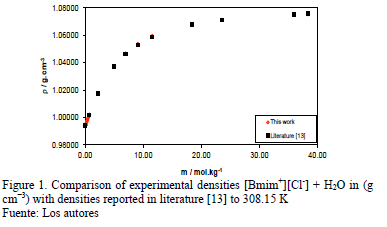
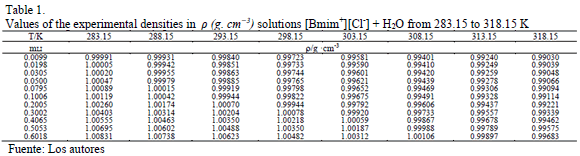
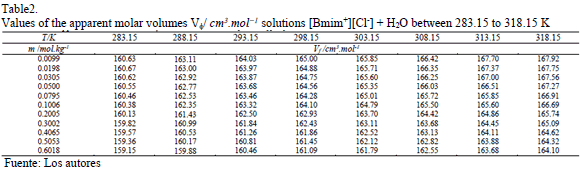
<body><![CDATA[<p><font size="2" face="Verdana, Arial, Helvetica, sans-serif">The solutions were   prepared gravimetrically using a balance (OHAUS Explorer model) with a   sensitivity of ±1x10⁻⁴ g, in tightly closed bottles to prevent loss by   evaporation of some of the components. The experimental uncertainty estimate   for the molalities was ± 0.0002. Experimental densities in the diluted region   of aqueous solutions of &#91;Bmim+&#93;&#91;Cl-&#93; were measured using a vibrating tube   digital densimeter Anton Paar DMA 5000, in the range of temperature   (283.15-318.15) K and at an atmospheric pressure of 0.10 MPa. The cell of the   DMA was calibrated with dry air and ultra-pure water at atmospheric pressure.   The samples were thermostated and controlled at ± 0.001 K. The uncertainty   values of certain densities were ± 0.2 x 10⁻⁵ g/cm3.</font></p>     <p><font size="2" face="Verdana, Arial, Helvetica, sans-serif">Since the &#91;Bmim+&#93;&#91;Cl-&#93; is a solid at the conditions of   temperature and pressure in which the data were taken, it was impossible to   obtain densities and viscosity information about this pure IL.  Therefore  densities of the binary mixtures &#91;Bmim<sup>+</sup>&#93;&#91;Cl<sup>-</sup>&#93; + H<sub>2</sub>O   at 308.15 K were compared to the density data previously reported in literature   &#91;13&#93;, which showed to be similar, as shown in <a href="#fig01">Fig. 1</a>.</font></p>     <p align="center"><font size="2" face="Verdana, Arial, Helvetica, sans-serif"><a name="fig01"></a></font><img src="/img/revistas/dyna/v81n186/v81n186a16fig01.gif"></p>     <p>&nbsp;</p>     <p><font size="3" face="Verdana, Arial, Helvetica, sans-serif"><b>3.  Results and   discussion</b></font></p>     <p><font size="2" face="Verdana, Arial, Helvetica, sans-serif">The experimental values of densities, <font face="Symbol">r</font> (.cm-3 g),   measured at different temperatures and molalities, (mol &bull; kg-1), are shown in <a href="#tab01">Table 1</a>.</font></p>     <p align="center"><font size="2" face="Verdana, Arial, Helvetica, sans-serif"><a name="tab01"></a></font><img src="/img/revistas/dyna/v81n186/v81n186a16tab01.gif"></p>     <p><font size="2" face="Verdana, Arial, Helvetica, sans-serif">The values obtained for the <img src="/img/revistas/dyna/v81n186/v81n186a16eq016.gif"> apparent molar volumes and molal   concentrations (<img src="/img/revistas/dyna/v81n186/v81n186a16eq018.gif">) &#91;Bmim+&#93; &#91;Cl-&#93; ranging from 283.15 to 318.15 K are shown in <a href="#tab02">Table   2</a>.</font></p>     <p align="center"><font size="2" face="Verdana, Arial, Helvetica, sans-serif"><a name="tab02"></a></font><img src="/img/revistas/dyna/v81n186/v81n186a16tab02.gif"></p>     <p><font size="2" face="Verdana, Arial, Helvetica, sans-serif">The apparent molar volume <img src="/img/revistas/dyna/v81n186/v81n186a16eq016.gif"> (cm3. mol-1) of a solute with molar mass, M<sub>2</sub> (g&bull;mol<sup>-1</sup>),   is given by</font></p>     ]]></body>
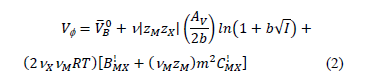
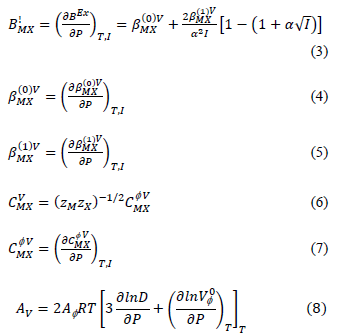
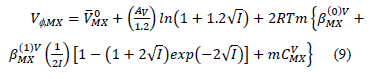
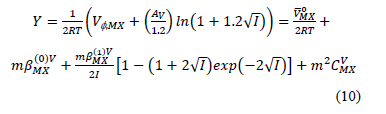
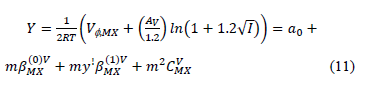
<body><![CDATA[<p><img src="/img/revistas/dyna/v81n186/v81n186a16eq01.gif"></p>     <p><font size="2" face="Verdana, Arial, Helvetica, sans-serif">Where r<sub>0</sub> is the density of pure water and <i>m</i> is   the molality of &#91;Bmim<sup>+</sup>&#93;&#91;Cl<sup>-</sup>&#93; in (mol&bull;kg<sup>-1</sup>) </font></p>     <p><font size="2" face="Verdana, Arial, Helvetica, sans-serif">The apparent molar   volume of &#91; Bmim +&#93;&#91;Cl-&#93; in an aqueous solution, can be expressed by the Pitzer   ion interaction model, which is an extension of the theory limit of   Debye-Hückel which applies to very low concentrations; according to this model,   ions of the same charge tend to stay away from each other and therefore short   range forces would have very few consequences. Contrary to ions of opposite   charge, which approach as close as possible, being affected by short range   forces. This model is described by the following equations. &#91;14-17&#93;</font></p>     <p><img src="/img/revistas/dyna/v81n186/v81n186a16eq02.gif"></p>     <p><font size="2" face="Verdana, Arial, Helvetica, sans-serif">Where the Ionic interaction parameters, are given by</font></p>     <p><img src="/img/revistas/dyna/v81n186/v81n186a16eq0308.gif"></p>     <p><font size="2" face="Verdana, Arial, Helvetica, sans-serif">The numerical values recommended for coefficients b and a are   as follows: b=1.2 kg½ mol-1/2 for electrolytes of all types of charge; a1=2.0   kg½ mol-1/2 type 1:1 1:2 and 2:1 electrolytes; a1=1.4 kg½ mol-1/2 y a2=12   kg½ mol-1/2 for type 2:2 electrolytes; the coefficient <img src="/img/revistas/dyna/v81n186/v81n186a16eq040.gif">is   assumed to be equal to zero for electrolytes of all charges, except type 2:2   electrolytes. The coefficients a1, a2 y b, are accepted as independent of temperature, which   leads to equation 2 to be expressed in the following way for the &#91;Bmim<sup>+</sup>&#93;&#91;Cl<sup>-</sup>&#93;.</font></p>     <p><img src="/img/revistas/dyna/v81n186/v81n186a16eq09.gif"></p>     <p><font size="2" face="Verdana, Arial, Helvetica, sans-serif">Rearranging the equation above, we obtain the right work   equation for the system under study.</font></p>     <p><img src="/img/revistas/dyna/v81n186/v81n186a16eq10.gif"></p>     ]]></body>
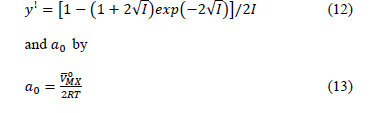
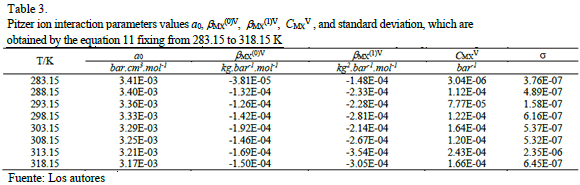
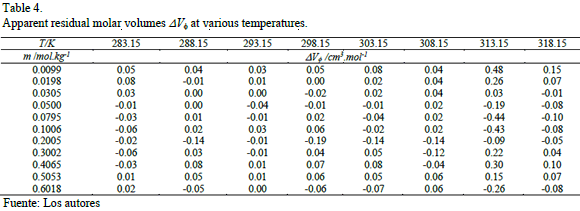
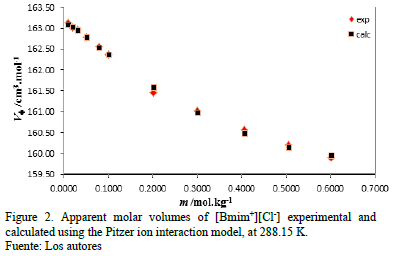
<body><![CDATA[<p><font size="2" face="Verdana, Arial, Helvetica, sans-serif">Or by the following way </font></p>     <p><img src="/img/revistas/dyna/v81n186/v81n186a16eq11.gif"></p>     <p><font size="2" face="Verdana, Arial, Helvetica, sans-serif">Where Y is the function to correlate from   experimental data, and it is given by:</font></p>     <p><font size="2" face="Verdana, Arial, Helvetica, sans-serif"><img src="/img/revistas/dyna/v81n186/v81n186a16eq1213.gif"></font></p>     <p><font size="2" face="Verdana, Arial, Helvetica, sans-serif">According   to this model, it is clear that the molar volume apparent pressure and constant   temperature of each Ionic liquid in diluted solutions will depend only on the   properties of the solvent and of the total concentration or the ionic strength   of the solution.</font></p>     <p><font size="2" face="Verdana, Arial, Helvetica, sans-serif">Parameters, carry out a similar role to the first, second   and third virial coefficients, that is why they characterize the forces of   interaction of short range between the anion and cation of the ionic liquid.   Both parameters of the molar volume of apparent limit shown in <a href="#tab03">Table 3</a>, were   obtained by minimization of the function.</font></p>     <p><img src="/img/revistas/dyna/v81n186/v81n186a16eq14.gif"></p>     <p><font size="2" face="Verdana, Arial, Helvetica, sans-serif">Where n is the number   of experimental points and  p  is the number of adjustable parameters.  The correlated and predicted results from   experimental data measured in this study are presented as the residual, DV<sub>f</sub> = V<sub>f</sub><sup>exp</sup>-V<sub>f</sub><sup>cal</sup> in <a href="#tab04">Table 4</a>. An example of the behavior is illustrated in <a href="#fig02">Fig. 2</a>, the correlated   and predicted results at temperature of 288.15 K.  As previously observed, both results agree   presenting a good precision.<sub>  </sub></font></p>     <p><img src="/img/revistas/dyna/v81n186/v81n186a16eq15.gif"></p>     <p><font size="2" face="Verdana, Arial, Helvetica, sans-serif">Where <i>T</i> is the   temperature in Kelvin degrees, and where <i>a</i>, <i>b</i>, and <i>c</i> are empirical   constants dependent on the solute and solvent.</font></p>     ]]></body>
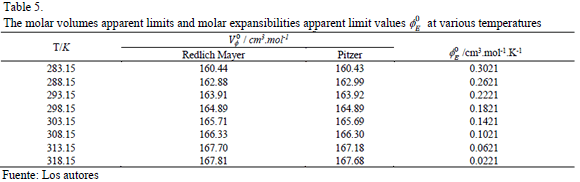
<body><![CDATA[<p align="center"><font size="2" face="Verdana, Arial, Helvetica, sans-serif"><a name="tab03"></a></font><img src="/img/revistas/dyna/v81n186/v81n186a16tab03.gif"></p>     <p align="center"><font size="2" face="Verdana, Arial, Helvetica, sans-serif"><a name="tab04"></a></font><img src="/img/revistas/dyna/v81n186/v81n186a16tab04.gif"></p>     <p align="center"><font size="2" face="Verdana, Arial, Helvetica, sans-serif"><a name="fig02"></a></font><img src="/img/revistas/dyna/v81n186/v81n186a16fig02.gif"></p>     <p><font size="2" face="Verdana, Arial, Helvetica, sans-serif">The partial molar expansibilities limits are obtained by   differentiation of the above equation with respect to temperature</font></p>     <p><img src="/img/revistas/dyna/v81n186/v81n186a16eq16.gif"></p>     <p><font size="2" face="Verdana, Arial, Helvetica, sans-serif">In <a href="#tab05">Table 5</a>, the values of limiting apparent molar volumes<img src="/img/revistas/dyna/v81n186/v81n186a16eq060.gif"><sub> </sub>obtained by the methods of   Redlich Meyer and Pitzer were reported:</font></p>     <p align="center"><font size="2" face="Verdana, Arial, Helvetica, sans-serif"><a name="tab05"></a></font><img src="/img/revistas/dyna/v81n186/v81n186a16tab05.gif"></p>     <p><font size="2" face="Verdana, Arial, Helvetica, sans-serif">Where the first ones   were obtained by correlating the defined term using the relation <img src="/img/revistas/dyna/v81n186/v81n186a16eq062.gif"> in   function of <i>m<sub>2</sub></i>, which is in accordance with the equation of   Redlich Mayer.</font></p>     <p><img src="/img/revistas/dyna/v81n186/v81n186a16eq17.gif"></p>     <p><font size="2" face="Verdana, Arial, Helvetica, sans-serif">Here<i> b<sub>V</sub></i> is an empirical   parameter characteristic of ionic liquid and <i>m<sub>2</sub></i> is the molality of   the ionic liquid and <i>S<sub>V</sub></i> is   the theoretical slope limit of Debye Hückel, which depending on the temperature <i>t</i> (°C) is given by the expression   &#91;18&#93;.</font></p>     ]]></body>

<body><![CDATA[<p><img src="/img/revistas/dyna/v81n186/v81n186a16eq18.gif"></p>     <p><font size="2" face="Verdana, Arial, Helvetica, sans-serif">The reason for using the equation of Redlich-Mayer is   essentially the same one that the Pitzer ion interaction model used, i.e., it is   applied to analyze volumetric data of diluted electrolyte solutions.</font></p>     <p><font size="2" face="Verdana, Arial, Helvetica, sans-serif">While the second ones are obtained as a result of the   correlation of the Pitzer ion interaction model, which are implicitly contained   in the setting parameter ao, previously determined by this model.</font></p>     <p><font size="2" face="Verdana, Arial, Helvetica, sans-serif">The analysis of the results displayed in <a href="#tab05">Table 5</a> shows   that both results are very similar; the reason for this is possibly due to the   fact that the SV term of the Redlich Mayer equation depends on a variable of   the Debye Hückel limiting law, which is characteristic of aqueous solvents and is   also contained in the Pitzer ion interaction model, this makes both methods to   converge at the same limit.</font></p>     <p><font size="2" face="Verdana, Arial, Helvetica, sans-serif">It can be verified that the values of the apparent ionic   liquid <img src="/img/revistas/dyna/v81n186/v81n186a16eq076.gif"> limiting expansibility coefficient &#91;&#91;Bmim<sup>+</sup>&#93;&#91;Cl<sup>-</sup>&#93;   according to <a href="#tab05">Table 5</a>, decrease linearly with the increase of temperature with a   slope equal to, </font></p>     <p><img src="/img/revistas/dyna/v81n186/v81n186a16eq19.gif"></p>     <p><font size="2" face="Verdana, Arial, Helvetica, sans-serif">The fact that <img src="/img/revistas/dyna/v81n186/v81n186a16eq080.gif"> linearly decreases with a temperature increase   means that the second derivative of <img src="/img/revistas/dyna/v81n186/v81n186a16eq082.gif"> with respect to temperature is also   negative.  In concordance with Hepler   &#91;18&#93;, it is evident that the studied ionic liquid behaves as a substance capable   of disrupting the three-dimensional structure of water in the studied   temperature range. </font></p>     <p>&nbsp;</p>     <p><font size="3" face="Verdana, Arial, Helvetica, sans-serif"><b>4.  Conclusions</b></font></p>     <p><font size="2" face="Verdana, Arial, Helvetica, sans-serif">Densities of the binary system &#91;Bmim<sup>+</sup>&#93;&#91;Cl<sup>-</sup>&#93;   + H<sub>2</sub>O were determined using a vibrating tube densitometer Anton Paar   DMA 5000 at temperatures of K (283.15, 288.15, 293.15, 298.15, 303.15, 313.15,   and 318.15). The experimental data were correlated and predicted through the   use of the Pitzer ion interaction model.  A good correlation can be observed between the predicted values and those   measured experimentally in working conditions. Small standard deviations, s,   show that the Pitzer ion interaction model is appropriate for the   representation of the volumetric properties of aqueous solutions of ionic   liquids.</font></p>     ]]></body>
<body><![CDATA[<p>&nbsp;</p>     <p><font size="3" face="Verdana, Arial, Helvetica, sans-serif"><b>Acknowledgments</b></font></p>     <p><font size="2" face="Verdana, Arial, Helvetica, sans-serif">The authors thank the Universidad de C&oacute;rdoba for the   support provided for the realization of this work.</font></p>     <p>&nbsp;</p>     <p><font size="3" face="Verdana, Arial, Helvetica, sans-serif"><b>References</b></font></p>     <!-- ref --><p> <font size="2" face="Verdana, Arial, Helvetica, sans-serif"><b>&#91;1&#93;</b> Romero, A. S., Ionic Liquids at environmental temperature: A new solution for chemical reactions. (Esp) Rev.r.acad.cienc.exact.fis.nat., 102, pp. 79-90, 2008.    &nbsp;&nbsp;&nbsp;&nbsp;&nbsp;&nbsp;&nbsp;&nbsp;[&#160;<a href="javascript:void(0);" onclick="javascript: window.open('/scielo.php?script=sci_nlinks&ref=000088&pid=S0012-7353201400040001600001&lng=','','width=640,height=500,resizable=yes,scrollbars=1,menubar=yes,');">Links</a>&#160;]<!-- end-ref --></font></p>     <!-- ref --><p> <font size="2" face="Verdana, Arial, Helvetica, sans-serif"><b>&#91;2&#93;</b> Smirnova, V. S., Torocheshnikova, I. I., Formanovsky, A. A. and Pletnev, I., Solvent extraction of amino acids into a room temperature ionic liquid with dicyclohexano-18-crown-6. V, Anal. Bioanal. Chem., 378, pp. 1369-1375, 2004.    &nbsp;&nbsp;&nbsp;&nbsp;&nbsp;&nbsp;&nbsp;&nbsp;[&#160;<a href="javascript:void(0);" onclick="javascript: window.open('/scielo.php?script=sci_nlinks&ref=000090&pid=S0012-7353201400040001600002&lng=','','width=640,height=500,resizable=yes,scrollbars=1,menubar=yes,');">Links</a>&#160;]<!-- end-ref --> </font></p>     <!-- ref --><p> <font size="2" face="Verdana, Arial, Helvetica, sans-serif"><b>&#91;3&#93;</b> Huddleston, J. G., Willauer, H. D., Swatloski, R. P., Visser, A. E. and Rogers, R. D., Room Temperature Ionic Liquids as Novel Media for 'Clean' Liquid-Liquid Extraction. Chem. Commun., 16, pp. 1765-1766, 1998.    &nbsp;&nbsp;&nbsp;&nbsp;&nbsp;&nbsp;&nbsp;&nbsp;[&#160;<a href="javascript:void(0);" onclick="javascript: window.open('/scielo.php?script=sci_nlinks&ref=000092&pid=S0012-7353201400040001600003&lng=','','width=640,height=500,resizable=yes,scrollbars=1,menubar=yes,');">Links</a>&#160;]<!-- end-ref --></font></p>     <!-- ref --><p> <font size="2" face="Verdana, Arial, Helvetica, sans-serif"><b>&#91;4&#93;</b> Fadeev, A. G. and Meagher, M. M., Opportunities for ionic liquids in recovery of biofuels. Chem. Commun., pp. 295-296, 2001.    &nbsp;&nbsp;&nbsp;&nbsp;&nbsp;&nbsp;&nbsp;&nbsp;[&#160;<a href="javascript:void(0);" onclick="javascript: window.open('/scielo.php?script=sci_nlinks&ref=000094&pid=S0012-7353201400040001600004&lng=','','width=640,height=500,resizable=yes,scrollbars=1,menubar=yes,');">Links</a>&#160;]<!-- end-ref --></font></p>     <!-- ref --><p> <font size="2" face="Verdana, Arial, Helvetica, sans-serif"><b>&#91;5&#93;</b> McFarlane, J., Ridenour, W. B; Luo, H., Hunt, R. D., DePaoli, D. W. and Ren, R. X., Room temperature ionic liquids for separating organics from produd water. Sep. Sci. Technol., 40, pp. 1245-1265, 2005.    &nbsp;&nbsp;&nbsp;&nbsp;&nbsp;&nbsp;&nbsp;&nbsp;[&#160;<a href="javascript:void(0);" onclick="javascript: window.open('/scielo.php?script=sci_nlinks&ref=000096&pid=S0012-7353201400040001600005&lng=','','width=640,height=500,resizable=yes,scrollbars=1,menubar=yes,');">Links</a>&#160;]<!-- end-ref --></font></p>     <!-- ref --><p> <font size="2" face="Verdana, Arial, Helvetica, sans-serif"><b>&#91;6&#93;</b> Soto, A., Arce, A. and Khoskbarchi, M. K., Partitioning of antibiotics in a two-liquid phase system formed by water and a room temperature ionic liquid. Sep. Purif. Technol., 44, pp. 242-246, 2005.    &nbsp;&nbsp;&nbsp;&nbsp;&nbsp;&nbsp;&nbsp;&nbsp;[&#160;<a href="javascript:void(0);" onclick="javascript: window.open('/scielo.php?script=sci_nlinks&ref=000098&pid=S0012-7353201400040001600006&lng=','','width=640,height=500,resizable=yes,scrollbars=1,menubar=yes,');">Links</a>&#160;]<!-- end-ref --></font></p>     <!-- ref --><p> <font size="2" face="Verdana, Arial, Helvetica, sans-serif"><b>&#91;7&#93;</b> Ventura, S. P. M., Neves, C. M. S. S., Freire, M. G., Marrucho, I. M., Oliveira, J. and Coutinho, J. A. P., Evaluation of Anion influence on the formation and extraction capacity of Ionic-Liquid-Based Aqueous biphasic systems. J. Phys. Chem B., 113, pp. 9304-9310, 2009.    &nbsp;&nbsp;&nbsp;&nbsp;&nbsp;&nbsp;&nbsp;&nbsp;[&#160;<a href="javascript:void(0);" onclick="javascript: window.open('/scielo.php?script=sci_nlinks&ref=000100&pid=S0012-7353201400040001600007&lng=','','width=640,height=500,resizable=yes,scrollbars=1,menubar=yes,');">Links</a>&#160;]<!-- end-ref --></font></p>     <!-- ref --><p> <font size="2" face="Verdana, Arial, Helvetica, sans-serif"><b>&#91;8&#93;</b> Cveto, K., Jaka, H., and Darja, Rudan-T., Apparent Molar volume and Apparent molar expansibility of sodium saccharin, potassium Acesulfame and aspartame, Acta Chim. Slov., 53, pp. 274-283, 2006.    &nbsp;&nbsp;&nbsp;&nbsp;&nbsp;&nbsp;&nbsp;&nbsp;[&#160;<a href="javascript:void(0);" onclick="javascript: window.open('/scielo.php?script=sci_nlinks&ref=000102&pid=S0012-7353201400040001600008&lng=','','width=640,height=500,resizable=yes,scrollbars=1,menubar=yes,');">Links</a>&#160;]<!-- end-ref --></font></p>     <!-- ref --><p> <font size="2" face="Verdana, Arial, Helvetica, sans-serif"><b>&#91;9&#93;</b> Chiappe, C., Malvaldi, M., and Pomelli, C. S., Ionic liquids: Solvation ability and polarity. Pure Appl. Chem., 81, pp. 767-776, 2009.    &nbsp;&nbsp;&nbsp;&nbsp;&nbsp;&nbsp;&nbsp;&nbsp;[&#160;<a href="javascript:void(0);" onclick="javascript: window.open('/scielo.php?script=sci_nlinks&ref=000104&pid=S0012-7353201400040001600009&lng=','','width=640,height=500,resizable=yes,scrollbars=1,menubar=yes,');">Links</a>&#160;]<!-- end-ref --></font></p>     <!-- ref --><p> <font size="2" face="Verdana, Arial, Helvetica, sans-serif"><b>&#91;10&#93;</b> Vercher, E., Orchille's, A. V., Miguel P. J., and Mart&iacute;nez, A., Volumetric and Ultrasonic studies of 1-Ethyl-3 methylimidazolium Trifluoromethanesulfonate Ionic liquid with methanol, ethanol, 1propanol, and water at several temperaturas. J. Chem. Eng. Data., 52, pp. 1468-1482, 2007.    &nbsp;&nbsp;&nbsp;&nbsp;&nbsp;&nbsp;&nbsp;&nbsp;[&#160;<a href="javascript:void(0);" onclick="javascript: window.open('/scielo.php?script=sci_nlinks&ref=000106&pid=S0012-7353201400040001600010&lng=','','width=640,height=500,resizable=yes,scrollbars=1,menubar=yes,');">Links</a>&#160;]<!-- end-ref --></font></p>     <!-- ref --><p> <font size="2" face="Verdana, Arial, Helvetica, sans-serif"><b>&#91;11&#93;</b> Weissberger A., Tecniques of Chemistry, Vol I, Parte 4: Methods of Chemistry, Wiley Intercience New York.    &nbsp;&nbsp;&nbsp;&nbsp;&nbsp;&nbsp;&nbsp;&nbsp;[&#160;<a href="javascript:void(0);" onclick="javascript: window.open('/scielo.php?script=sci_nlinks&ref=000108&pid=S0012-7353201400040001600011&lng=','','width=640,height=500,resizable=yes,scrollbars=1,menubar=yes,');">Links</a>&#160;]<!-- end-ref --></font></p>     <!-- ref --><p> <font size="2" face="Verdana, Arial, Helvetica, sans-serif"><b>&#91;12&#93;</b> Weissberg, A., Rositer, B., Physical Methods of Chemistry. New York: Willey - Interscience, 1957.    &nbsp;&nbsp;&nbsp;&nbsp;&nbsp;&nbsp;&nbsp;&nbsp;[&#160;<a href="javascript:void(0);" onclick="javascript: window.open('/scielo.php?script=sci_nlinks&ref=000110&pid=S0012-7353201400040001600012&lng=','','width=640,height=500,resizable=yes,scrollbars=1,menubar=yes,');">Links</a>&#160;]<!-- end-ref --></font></p>     <!-- ref --><p> <font size="2" face="Verdana, Arial, Helvetica, sans-serif"><b>&#91;13&#93;</b> Yang, Q., Zhang, Hai., Su, B., Yang, Y., Ren, Qilong., and Xing, H., Volumetric properties of binary mixtures of 1-butyl-3-methylimidazolium Chloride + water or hydrophilic solvents at different temperatures. J. Chem. Eng. Data., 55, pp. 1750-1754, 2010.    &nbsp;&nbsp;&nbsp;&nbsp;&nbsp;&nbsp;&nbsp;&nbsp;[&#160;<a href="javascript:void(0);" onclick="javascript: window.open('/scielo.php?script=sci_nlinks&ref=000112&pid=S0012-7353201400040001600013&lng=','','width=640,height=500,resizable=yes,scrollbars=1,menubar=yes,');">Links</a>&#160;]<!-- end-ref --></font></p>     <!-- ref --><p> <font size="2" face="Verdana, Arial, Helvetica, sans-serif"><b>&#91;14&#93;</b> Yang, J., Tong, Jing., Li J., Study of the Volumetric properties of the aqueous ionic liquid 1-methyl-3-pentylimidazolium Tetrafluoroborate. J Solution Chem., 36, pp. 573-582, 2007.    &nbsp;&nbsp;&nbsp;&nbsp;&nbsp;&nbsp;&nbsp;&nbsp;[&#160;<a href="javascript:void(0);" onclick="javascript: window.open('/scielo.php?script=sci_nlinks&ref=000114&pid=S0012-7353201400040001600014&lng=','','width=640,height=500,resizable=yes,scrollbars=1,menubar=yes,');">Links</a>&#160;]<!-- end-ref --></font></p>     <!-- ref --><p> <font size="2" face="Verdana, Arial, Helvetica, sans-serif"><b>&#91;15&#93;</b> Song, G. J., Properties of room temperature ionic liquid 3-ethyl-1-methylimidazolium ethyl sulfate, &#1046;&#1059;&#1056;&#1053;&#1040;&#1051; &#1060;&#1048;&#1047;&#1048;&#1063;&#1045;&#1057;&#1050;&#1054;&#1049; &#1061;&#1048;&#1052;&#1048;&#1048;., 84, pp. 859-864, 2010.    &nbsp;&nbsp;&nbsp;&nbsp;&nbsp;&nbsp;&nbsp;&nbsp;[&#160;<a href="javascript:void(0);" onclick="javascript: window.open('/scielo.php?script=sci_nlinks&ref=000116&pid=S0012-7353201400040001600015&lng=','','width=640,height=500,resizable=yes,scrollbars=1,menubar=yes,');">Links</a>&#160;]<!-- end-ref --> </font></p>     <!-- ref --><p> <font size="2" face="Verdana, Arial, Helvetica, sans-serif"><b>&#91;16&#93;</b> Kenneth, S., Pitzer, J,. Peiper C., and Busey, R. H., Thermodynamic Properties of aqueous sodium chloride solutions. J. Phys. Chem. 13(1), 1984.    &nbsp;&nbsp;&nbsp;&nbsp;&nbsp;&nbsp;&nbsp;&nbsp;[&#160;<a href="javascript:void(0);" onclick="javascript: window.open('/scielo.php?script=sci_nlinks&ref=000118&pid=S0012-7353201400040001600016&lng=','','width=640,height=500,resizable=yes,scrollbars=1,menubar=yes,');">Links</a>&#160;]<!-- end-ref --></font></p>     <!-- ref --><p> <font size="2" face="Verdana, Arial, Helvetica, sans-serif"><b>&#91;17&#93;</b> Krumgalz, B. S., Pogorelskii, R., Sokolov, A. and Pitzer K.S., Volumetric ion interaction parameters for single- solute aqueous electrolyte solutions at various temperatures. J. Phys. Chem., 29 (5), 2000.    &nbsp;&nbsp;&nbsp;&nbsp;&nbsp;&nbsp;&nbsp;&nbsp;[&#160;<a href="javascript:void(0);" onclick="javascript: window.open('/scielo.php?script=sci_nlinks&ref=000120&pid=S0012-7353201400040001600017&lng=','','width=640,height=500,resizable=yes,scrollbars=1,menubar=yes,');">Links</a>&#160;]<!-- end-ref --> </font></p>     <!-- ref --><p> <font size="2" face="Verdana, Arial, Helvetica, sans-serif"><b>&#91;18&#93;</b> Hepler, L. G., Thermal expansion and structure in water and aqueous solutions. Can. J. Chem., 47, pp. 4613-4617, 1969.    &nbsp;&nbsp;&nbsp;&nbsp;&nbsp;&nbsp;&nbsp;&nbsp;[&#160;<a href="javascript:void(0);" onclick="javascript: window.open('/scielo.php?script=sci_nlinks&ref=000122&pid=S0012-7353201400040001600018&lng=','','width=640,height=500,resizable=yes,scrollbars=1,menubar=yes,');">Links</a>&#160;]<!-- end-ref --> </font></p>     <p>&nbsp;</p>     <p><font size="2" face="Verdana, Arial, Helvetica, sans-serif"><b>M. S. P&aacute;ez-Meza</b>, graduated in 1987 with a Bs in Chemistry from   the Universidad de C&oacute;rdoba, Colombia.  In   1996 he graduated as Sp. in Physical Sciences; in 2001 he graduated as a MSc in   Chemical Sciences; in 2007 he graduated with a Dr. in Chemical Sciences from   the Universidad Nacional de Colombia. Since 1996, he serves as a full professor   at the Universidad de C&oacute;rdoba, in both: undergraduate and postgraduate   programs. He also serves as leader of the research group: Physical Chemistry of   Mixed Liquids in the Universidad de C&oacute;rdoba, Colombia.</font></p>     <p><font size="2" face="Verdana, Arial, Helvetica, sans-serif"><b>Y. Del C.   Cuello-Delgado</b>, graduated in 2007 in Chemistry and received a MSc in   Chemical Sciences in 2013, both titles from the Universidad de C&oacute;rdoba,   Colombia. She is currently teaching at the Universidad de C&oacute;rdoba, in   undergraduate programs. Also she serves as a student researcher in the study   group: Physical Chemistry of Mixed Liquid in the Universidad de C&oacute;rdoba,   Colombia.</font></p>     <p><font size="2" face="Verdana, Arial, Helvetica, sans-serif"><b>O. A. P&eacute;rez-Sierra</b>, graduated a Bs. Eng in   Chemical Engineering in 1994 from the Universidad de Atl&aacute;ntico, in   Barranquilla, Colombia, obtained a MSc in Chemical Engineering in 1997 from the   Universidad Industrial de Santander (UIS), in Bucaramanga, Colombia, and a Dr.   of Science and Food Technology from the Federal University of Viçosa, in   Viçosa, Brazil.  He has been part of the   Universidad de C&oacute;rdoba teaching staff since 1997. He is a full professor in the   Department of Food Engineering of the Universidad de C&oacute;rdoba. His research   interests include: Modeling and simulation of processes, bio-separations and   unit operations.</font></p>      ]]></body><back>
<ref-list>
<ref id="B1">
<label>1</label><nlm-citation citation-type="journal">
<person-group person-group-type="author">
<name>
<surname><![CDATA[Romero]]></surname>
<given-names><![CDATA[A. S.]]></given-names>
</name>
</person-group>
<article-title xml:lang="en"><![CDATA[Ionic Liquids at environmental temperature: A new solution for chemical reactions]]></article-title>
<source><![CDATA[Rev.r.acad.cienc.exact.fis.nat.]]></source>
<year>2008</year>
<numero>102</numero>
<issue>102</issue>
<page-range>79-90</page-range></nlm-citation>
</ref>
<ref id="B2">
<label>2</label><nlm-citation citation-type="journal">
<person-group person-group-type="author">
<name>
<surname><![CDATA[Smirnova]]></surname>
<given-names><![CDATA[V. S.]]></given-names>
</name>
<name>
<surname><![CDATA[Torocheshnikova]]></surname>
<given-names><![CDATA[I. I.]]></given-names>
</name>
<name>
<surname><![CDATA[Formanovsky]]></surname>
<given-names><![CDATA[A. A.]]></given-names>
</name>
<name>
<surname><![CDATA[Pletnev]]></surname>
<given-names><![CDATA[I.]]></given-names>
</name>
</person-group>
<article-title xml:lang="en"><![CDATA[Solvent extraction of amino acids into a room temperature ionic liquid with dicyclohexano-18-crown-6. V]]></article-title>
<source><![CDATA[Anal. Bioanal. Chem.]]></source>
<year>2004</year>
<numero>378</numero>
<issue>378</issue>
<page-range>1369-1375</page-range></nlm-citation>
</ref>
<ref id="B3">
<label>3</label><nlm-citation citation-type="journal">
<person-group person-group-type="author">
<name>
<surname><![CDATA[Huddleston]]></surname>
<given-names><![CDATA[J. G.]]></given-names>
</name>
<name>
<surname><![CDATA[Willauer]]></surname>
<given-names><![CDATA[H. D.]]></given-names>
</name>
<name>
<surname><![CDATA[Swatloski]]></surname>
<given-names><![CDATA[R. P.]]></given-names>
</name>
<name>
<surname><![CDATA[Visser]]></surname>
<given-names><![CDATA[A. E.]]></given-names>
</name>
<name>
<surname><![CDATA[Rogers]]></surname>
<given-names><![CDATA[R. D.]]></given-names>
</name>
</person-group>
<article-title xml:lang="en"><![CDATA[Room Temperature Ionic Liquids as Novel Media for 'Clean' Liquid-Liquid Extraction]]></article-title>
<source><![CDATA[Chem. Commun.]]></source>
<year>1998</year>
<numero>16</numero>
<issue>16</issue>
<page-range>1765-1766</page-range></nlm-citation>
</ref>
<ref id="B4">
<label>4</label><nlm-citation citation-type="journal">
<person-group person-group-type="author">
<name>
<surname><![CDATA[Fadeev]]></surname>
<given-names><![CDATA[A. G.]]></given-names>
</name>
<name>
<surname><![CDATA[Meagher]]></surname>
<given-names><![CDATA[M. M.]]></given-names>
</name>
</person-group>
<article-title xml:lang="en"><![CDATA[Opportunities for ionic liquids in recovery of biofuels]]></article-title>
<source><![CDATA[Chem. Commun.]]></source>
<year>2001</year>
<page-range>295-296</page-range></nlm-citation>
</ref>
<ref id="B5">
<label>5</label><nlm-citation citation-type="journal">
<person-group person-group-type="author">
<name>
<surname><![CDATA[McFarlane]]></surname>
<given-names><![CDATA[J.]]></given-names>
</name>
<name>
<surname><![CDATA[Ridenour]]></surname>
<given-names><![CDATA[W. B]]></given-names>
</name>
<name>
<surname><![CDATA[Luo]]></surname>
<given-names><![CDATA[H.]]></given-names>
</name>
<name>
<surname><![CDATA[Hunt]]></surname>
<given-names><![CDATA[R. D.]]></given-names>
</name>
<name>
<surname><![CDATA[DePaoli]]></surname>
<given-names><![CDATA[D. W.]]></given-names>
</name>
<name>
<surname><![CDATA[Ren]]></surname>
<given-names><![CDATA[R. X.]]></given-names>
</name>
</person-group>
<article-title xml:lang="en"><![CDATA[Room temperature ionic liquids for separating organics from produd water]]></article-title>
<source><![CDATA[Sep. Sci. Technol.]]></source>
<year>2005</year>
<numero>40</numero>
<issue>40</issue>
<page-range>1245-1265</page-range></nlm-citation>
</ref>
<ref id="B6">
<label>6</label><nlm-citation citation-type="journal">
<person-group person-group-type="author">
<name>
<surname><![CDATA[Soto]]></surname>
<given-names><![CDATA[A.]]></given-names>
</name>
<name>
<surname><![CDATA[Arce]]></surname>
<given-names><![CDATA[A.]]></given-names>
</name>
<name>
<surname><![CDATA[Khoskbarchi]]></surname>
<given-names><![CDATA[M. K.]]></given-names>
</name>
</person-group>
<article-title xml:lang="en"><![CDATA[Partitioning of antibiotics in a two-liquid phase system formed by water and a room temperature ionic liquid]]></article-title>
<source><![CDATA[Sep. Purif. Technol.]]></source>
<year>2005</year>
<numero>44</numero>
<issue>44</issue>
<page-range>242-246</page-range></nlm-citation>
</ref>
<ref id="B7">
<label>7</label><nlm-citation citation-type="journal">
<person-group person-group-type="author">
<name>
<surname><![CDATA[Ventura]]></surname>
<given-names><![CDATA[S. P. M.]]></given-names>
</name>
<name>
<surname><![CDATA[Neves]]></surname>
<given-names><![CDATA[C. M. S. S.]]></given-names>
</name>
<name>
<surname><![CDATA[Freire]]></surname>
<given-names><![CDATA[M. G.]]></given-names>
</name>
<name>
<surname><![CDATA[Marrucho]]></surname>
<given-names><![CDATA[I. M.]]></given-names>
</name>
<name>
<surname><![CDATA[Oliveira]]></surname>
<given-names><![CDATA[J.]]></given-names>
</name>
<name>
<surname><![CDATA[Coutinho]]></surname>
<given-names><![CDATA[J. A. P.]]></given-names>
</name>
</person-group>
<article-title xml:lang="en"><![CDATA[Evaluation of Anion influence on the formation and extraction capacity of Ionic-Liquid-Based Aqueous biphasic systems]]></article-title>
<source><![CDATA[J. Phys. Chem B.]]></source>
<year>2009</year>
<numero>113</numero>
<issue>113</issue>
<page-range>9304-9310</page-range></nlm-citation>
</ref>
<ref id="B8">
<label>8</label><nlm-citation citation-type="journal">
<person-group person-group-type="author">
<name>
<surname><![CDATA[Cveto]]></surname>
<given-names><![CDATA[K.]]></given-names>
</name>
<name>
<surname><![CDATA[Jaka]]></surname>
<given-names><![CDATA[H.]]></given-names>
</name>
<name>
<surname><![CDATA[Darja]]></surname>
<given-names><![CDATA[Rudan-T.]]></given-names>
</name>
</person-group>
<article-title xml:lang="en"><![CDATA[Apparent Molar volume and Apparent molar expansibility of sodium saccharin, potassium Acesulfame and aspartame]]></article-title>
<source><![CDATA[Acta Chim. Slov.]]></source>
<year>2006</year>
<volume>53</volume>
<page-range>274-283</page-range></nlm-citation>
</ref>
<ref id="B9">
<label>9</label><nlm-citation citation-type="journal">
<person-group person-group-type="author">
<name>
<surname><![CDATA[Chiappe]]></surname>
<given-names><![CDATA[C.]]></given-names>
</name>
<name>
<surname><![CDATA[Malvaldi]]></surname>
<given-names><![CDATA[M.]]></given-names>
</name>
<name>
<surname><![CDATA[Pomelli]]></surname>
<given-names><![CDATA[C. S.]]></given-names>
</name>
</person-group>
<article-title xml:lang="en"><![CDATA[Ionic liquids: Solvation ability and polarity]]></article-title>
<source><![CDATA[Pure Appl. Chem.]]></source>
<year>2009</year>
<numero>81</numero>
<issue>81</issue>
<page-range>767-776</page-range></nlm-citation>
</ref>
<ref id="B10">
<label>10</label><nlm-citation citation-type="journal">
<person-group person-group-type="author">
<name>
<surname><![CDATA[Vercher]]></surname>
<given-names><![CDATA[E.]]></given-names>
</name>
<name>
<surname><![CDATA[Orchille's]]></surname>
<given-names><![CDATA[A. V.]]></given-names>
</name>
<name>
<surname><![CDATA[Miguel]]></surname>
<given-names><![CDATA[P. J.]]></given-names>
</name>
<name>
<surname><![CDATA[Martínez]]></surname>
<given-names><![CDATA[A.]]></given-names>
</name>
</person-group>
<article-title xml:lang="en"><![CDATA[Volumetric and Ultrasonic studies of 1-Ethyl-3 methylimidazolium Trifluoromethanesulfonate Ionic liquid with methanol, ethanol, 1propanol, and water at several temperaturas]]></article-title>
<source><![CDATA[J. Chem. Eng. Data.]]></source>
<year>2007</year>
<numero>52</numero>
<issue>52</issue>
<page-range>1468-1482</page-range></nlm-citation>
</ref>
<ref id="B11">
<label>11</label><nlm-citation citation-type="book">
<person-group person-group-type="author">
<name>
<surname><![CDATA[Weissberger]]></surname>
<given-names><![CDATA[A.]]></given-names>
</name>
</person-group>
<source><![CDATA[Tecniques of Chemistry: Parte 4: Methods of Chemistry]]></source>
<year></year>
<publisher-loc><![CDATA[New York ]]></publisher-loc>
<publisher-name><![CDATA[Wiley Intercience]]></publisher-name>
</nlm-citation>
</ref>
<ref id="B12">
<label>12</label><nlm-citation citation-type="book">
<person-group person-group-type="author">
<name>
<surname><![CDATA[Weissberg]]></surname>
<given-names><![CDATA[A.]]></given-names>
</name>
<name>
<surname><![CDATA[Rositer]]></surname>
<given-names><![CDATA[B.]]></given-names>
</name>
</person-group>
<source><![CDATA[Physical Methods of Chemistry]]></source>
<year>1957</year>
<publisher-loc><![CDATA[New York ]]></publisher-loc>
<publisher-name><![CDATA[Willey - Interscience]]></publisher-name>
</nlm-citation>
</ref>
<ref id="B13">
<label>13</label><nlm-citation citation-type="journal">
<person-group person-group-type="author">
<name>
<surname><![CDATA[Yang]]></surname>
<given-names><![CDATA[Q.]]></given-names>
</name>
<name>
<surname><![CDATA[Zhang]]></surname>
<given-names><![CDATA[Hai.]]></given-names>
</name>
<name>
<surname><![CDATA[Su]]></surname>
<given-names><![CDATA[B.]]></given-names>
</name>
<name>
<surname><![CDATA[Yang]]></surname>
<given-names><![CDATA[Y.]]></given-names>
</name>
<name>
<surname><![CDATA[Ren]]></surname>
<given-names><![CDATA[Qilong]]></given-names>
</name>
<name>
<surname><![CDATA[Xing]]></surname>
<given-names><![CDATA[H.]]></given-names>
</name>
</person-group>
<article-title xml:lang="en"><![CDATA[Volumetric properties of binary mixtures of 1-butyl-3-methylimidazolium Chloride + water or hydrophilic solvents at different temperatures]]></article-title>
<source><![CDATA[J. Chem. Eng. Data.]]></source>
<year>2010</year>
<numero>55</numero>
<issue>55</issue>
<page-range>1750-1754</page-range></nlm-citation>
</ref>
<ref id="B14">
<label>14</label><nlm-citation citation-type="journal">
<person-group person-group-type="author">
<name>
<surname><![CDATA[Yang]]></surname>
<given-names><![CDATA[J.]]></given-names>
</name>
<name>
<surname><![CDATA[Tong]]></surname>
<given-names><![CDATA[Jing]]></given-names>
</name>
<name>
<surname><![CDATA[Li]]></surname>
<given-names><![CDATA[J.]]></given-names>
</name>
</person-group>
<article-title xml:lang="en"><![CDATA[Study of the Volumetric properties of the aqueous ionic liquid 1-methyl-3-pentylimidazolium Tetrafluoroborate]]></article-title>
<source><![CDATA[J Solution Chem.]]></source>
<year>2007</year>
<numero>36</numero>
<issue>36</issue>
<page-range>573-582</page-range></nlm-citation>
</ref>
<ref id="B15">
<label>15</label><nlm-citation citation-type="journal">
<person-group person-group-type="author">
<name>
<surname><![CDATA[Song]]></surname>
<given-names><![CDATA[G. J.]]></given-names>
</name>
</person-group>
<article-title xml:lang="en"><![CDATA[Properties of room temperature ionic liquid 3-ethyl-1-methylimidazolium ethyl sulfate]]></article-title>
<source><![CDATA[&#1046;&#1059;&#1056;&#1053;&#1040;&#1051; &#1060;&#1048;&#1047;&#1048;&#1063;&#1045;&#1057;&#1050;&#1054;&#1049; &#1061;&#1048;&#1052;&#1048;&#1048;]]></source>
<year>2010</year>
<numero>84</numero>
<issue>84</issue>
<page-range>859-864</page-range></nlm-citation>
</ref>
<ref id="B16">
<label>16</label><nlm-citation citation-type="journal">
<person-group person-group-type="author">
<name>
<surname><![CDATA[Kenneth]]></surname>
<given-names><![CDATA[S.]]></given-names>
</name>
<name>
<surname><![CDATA[Pitzer]]></surname>
<given-names><![CDATA[J]]></given-names>
</name>
<name>
<surname><![CDATA[Peiper]]></surname>
<given-names><![CDATA[C.]]></given-names>
</name>
<name>
<surname><![CDATA[Busey]]></surname>
<given-names><![CDATA[R. H.]]></given-names>
</name>
</person-group>
<article-title xml:lang="en"><![CDATA[Thermodynamic Properties of aqueous sodium chloride solutions]]></article-title>
<source><![CDATA[J. Phys. Chem.]]></source>
<year>1984</year>
<volume>13</volume>
<numero>1</numero>
<issue>1</issue>
</nlm-citation>
</ref>
<ref id="B17">
<label>17</label><nlm-citation citation-type="journal">
<person-group person-group-type="author">
<name>
<surname><![CDATA[Krumgalz]]></surname>
<given-names><![CDATA[B. S.]]></given-names>
</name>
<name>
<surname><![CDATA[Pogorelskii]]></surname>
<given-names><![CDATA[R.]]></given-names>
</name>
<name>
<surname><![CDATA[Sokolov]]></surname>
<given-names><![CDATA[A.]]></given-names>
</name>
<name>
<surname><![CDATA[Pitzer]]></surname>
<given-names><![CDATA[K.S.]]></given-names>
</name>
</person-group>
<article-title xml:lang="en"><![CDATA[Volumetric ion interaction parameters for single- solute aqueous electrolyte solutions at various temperatures]]></article-title>
<source><![CDATA[J. Phys. Chem.]]></source>
<year>2000</year>
<volume>29</volume>
<numero>5</numero>
<issue>5</issue>
</nlm-citation>
</ref>
<ref id="B18">
<label>18</label><nlm-citation citation-type="journal">
<person-group person-group-type="author">
<name>
<surname><![CDATA[Hepler]]></surname>
<given-names><![CDATA[L. G.]]></given-names>
</name>
</person-group>
<article-title xml:lang="en"><![CDATA[Thermal expansion and structure in water and aqueous solutions]]></article-title>
<source><![CDATA[Can. J. Chem.]]></source>
<year>1969</year>
<numero>47</numero>
<issue>47</issue>
<page-range>4613-4617</page-range></nlm-citation>
</ref>
</ref-list>
</back>
</article>