<?xml version="1.0" encoding="ISO-8859-1"?><article xmlns:mml="http://www.w3.org/1998/Math/MathML" xmlns:xlink="http://www.w3.org/1999/xlink" xmlns:xsi="http://www.w3.org/2001/XMLSchema-instance">
<front>
<journal-meta>
<journal-id>0012-7353</journal-id>
<journal-title><![CDATA[DYNA]]></journal-title>
<abbrev-journal-title><![CDATA[Dyna rev.fac.nac.minas]]></abbrev-journal-title>
<issn>0012-7353</issn>
<publisher>
<publisher-name><![CDATA[Universidad Nacional de Colombia]]></publisher-name>
</publisher>
</journal-meta>
<article-meta>
<article-id>S0012-73532014000400030</article-id>
<article-id pub-id-type="doi">10.15446/dyna.v81n186.40252</article-id>
<title-group>
<article-title xml:lang="en"><![CDATA[Damage detection in ACSR cables based on ultrasonic guided waves]]></article-title>
<article-title xml:lang="es"><![CDATA[Detección de daño en cables ACSR basada en ondas guiadas ultrasónicas]]></article-title>
</title-group>
<contrib-group>
<contrib contrib-type="author">
<name>
<surname><![CDATA[Mijarez]]></surname>
<given-names><![CDATA[Rito]]></given-names>
</name>
<xref ref-type="aff" rid="A01"/>
</contrib>
<contrib contrib-type="author">
<name>
<surname><![CDATA[Baltazar]]></surname>
<given-names><![CDATA[Arturo]]></given-names>
</name>
<xref ref-type="aff" rid="A02"/>
</contrib>
<contrib contrib-type="author">
<name>
<surname><![CDATA[Rodríguez-Rodríguez]]></surname>
<given-names><![CDATA[Joaquín]]></given-names>
</name>
<xref ref-type="aff" rid="A01"/>
</contrib>
<contrib contrib-type="author">
<name>
<surname><![CDATA[Ramírez-Niño]]></surname>
<given-names><![CDATA[José]]></given-names>
</name>
<xref ref-type="aff" rid="A01"/>
</contrib>
</contrib-group>
<aff id="A01">
<institution><![CDATA[,Instituto de Investigaciones Eléctricas Gerencia de Control, Electrónica y Comunicaciones ]]></institution>
<addr-line><![CDATA[Morelos ]]></addr-line>
<country>México</country>
</aff>
<aff id="A02">
<institution><![CDATA[,Centro de Investigación y Estudios Avanzados del IPN  ]]></institution>
<addr-line><![CDATA[Coahuila ]]></addr-line>
<country>México</country>
</aff>
<pub-date pub-type="pub">
<day>00</day>
<month>08</month>
<year>2014</year>
</pub-date>
<pub-date pub-type="epub">
<day>00</day>
<month>08</month>
<year>2014</year>
</pub-date>
<volume>81</volume>
<numero>186</numero>
<fpage>226</fpage>
<lpage>233</lpage>
<copyright-statement/>
<copyright-year/>
<self-uri xlink:href="http://www.scielo.org.co/scielo.php?script=sci_arttext&amp;pid=S0012-73532014000400030&amp;lng=en&amp;nrm=iso"></self-uri><self-uri xlink:href="http://www.scielo.org.co/scielo.php?script=sci_abstract&amp;pid=S0012-73532014000400030&amp;lng=en&amp;nrm=iso"></self-uri><self-uri xlink:href="http://www.scielo.org.co/scielo.php?script=sci_pdf&amp;pid=S0012-73532014000400030&amp;lng=en&amp;nrm=iso"></self-uri><abstract abstract-type="short" xml:lang="en"><p><![CDATA[The use of ultrasonic guided waves is growing as a non-destructive testing technique of multi-wire cables used in civil engineering structures. Wave propagation characteristics in these types of structures have been challenging to investigate owing to the load-dependent inter-wire contact and the helical geometry of the peripheral wires. In this work, experiments of guided waves propagated in a 0.9m Aluminum Conductor Steel Reinforced (ACSR) cable were conducted employing two longitudinal piezoelectric transducers attached to the ends of the cable in a through transmission configuration. Longitudinal L(0,1) and flexural F(1,1) modes were identified at 500 kHz via dispersion curves and Wavelet Transforms (WT). Experiments included artificial damage introduced in the middle of the cable by cutting and gradually increasing the cut depth from 1mm to 9mm. The attained results suggest a change of guided modes excitation and reception from F(1,1) to L(0,1) due to reduced friction contact among individual wires. This change of guided waves modes in response to damage variations, associated with the transmitted ultrasonic energy, was identified and discussed as potential mean of damage monitoring.]]></p></abstract>
<abstract abstract-type="short" xml:lang="es"><p><![CDATA[El uso de ondas guiadas ultrasónicas está creciendo como una técnica de pruebas no destructivas de cables multi-conductores utilizados en estructuras de ingeniería civil. Las características de propagación de ondas en estos tipos de estructuras han sido difíciles de investigar debido al contacto entre conductores y a la geometría helicoidal de sus alambres periféricos. En este estudio, la propagación de ondas guiadas ultrasónicas se realizó experimentalmente usando un cable multi-conductor de aluminio con acero reforzado (ACSR) de 0.9 m empleando dos transductores piezoeléctricos longitudinales adheridos a los extremos del cable en una configuración de transmisión ultrasónica. La identificación de los modos de propagación, de flexión F(1,1) y longitudinales L(0,1), a 500 kHz se llevó a cabo vía las curvas de dispersión y la transformada Wavelet. Los experimentos incluyen daño artificial a la mitad del cable, introduciendo un corte y aumentando gradualmente la profundidad de corte de 1 mm a 9 mm. Los resultados obtenidos sugieren un cambio de los modos de excitación y recepción de F(1,1) a L(0,1) debido a la disminución del contacto de fricción entre conductores. Este cambio de modos susceptibles a las variaciones de daños, asociados con la energía ultrasónica transmitida, se identificó y analizó como medio potencial para el monitoreo de daño.]]></p></abstract>
<kwd-group>
<kwd lng="en"><![CDATA[Ultrasonic guided waves]]></kwd>
<kwd lng="en"><![CDATA[wavelet transform]]></kwd>
<kwd lng="en"><![CDATA[ACSR cables inspection]]></kwd>
<kwd lng="es"><![CDATA[Ondas guiadas ultrasónicas]]></kwd>
<kwd lng="es"><![CDATA[transformada wavelet]]></kwd>
<kwd lng="es"><![CDATA[inspección de cables ACSR]]></kwd>
</kwd-group>
</article-meta>
</front><body><![CDATA[ <p><font size="2" face="Verdana, Arial, Helvetica, sans-serif"><a href="http://dx.doi.org/10.15446/dyna.v81n186.40252" target="_blank">http://dx.doi.org/10.15446/dyna.v81n186.40252</a></font></p>     <p align="center"><font size="4" face="Verdana, Arial, Helvetica, sans-serif"><b>Damage detection in   ACSR cables based on ultrasonic guided waves</b></font></p>     <p align="center"><font size="3"><b><font face="Verdana, Arial, Helvetica, sans-serif"><i>Detecci&oacute;n   de da&ntilde;o en cables ACSR basada en ondas guiadas ultras&oacute;nicas</i></font></b></font></p>     <p align="center">&nbsp;</p>     <p align="center"><b><font size="2" face="Verdana, Arial, Helvetica, sans-serif">Rito Mijarez <sup>a</sup>, Arturo   Baltazar <sup>b</sup>, Joaqu&iacute;n Rodr&iacute;guez-Rodr&iacute;guez <sup>a</sup> &amp; Jos&eacute;   Ram&iacute;rez-Ni&ntilde;o <sup>a</sup></font></b><font size="2" face="Verdana, Arial, Helvetica, sans-serif"></font></p>     <p align="center">&nbsp;</p>     <p align="center"><font size="2" face="Verdana, Arial, Helvetica, sans-serif"><sup><i>a </i></sup><i>Gerencia de Control, Electr&oacute;nica y Comunicaciones- Instituto de   Investigaciones El&eacute;ctricas, Cuernavaca, Morelos, M&eacute;xico. <a href="mailto:rmijarez@iie.org.mx">rmijarez@iie.org.mx</a>    <br>   <sup>b </sup>Centro de Investigaci&oacute;n y Estudios Avanzados del IPN, Unidad   Saltillo, Ramos Arizpe, Coahuila, M&eacute;xico. <a href="mailto:arturo.baltazar@cinvestav.edu.mx">arturo.baltazar@cinvestav.edu.mx</a></i></font><a href="mailto:arturo.baltazar@cinvestav.edu.mx"></a></p>     <p align="center">&nbsp;</p>     <p align="center"><font size="2" face="Verdana, Arial, Helvetica, sans-serif"><b>Received: October   15<sup>th</sup>, de 2013. Received in revised form: May 8<sup>th</sup>, 2014. Accepted: May 28<sup>th</sup>,   2014</b></font></p>     ]]></body>
<body><![CDATA[<p align="center">&nbsp;</p> <hr>     <p><font size="2" face="Verdana, Arial, Helvetica, sans-serif"><b>Abstract    <br>   </b></font><font size="2" face="Verdana, Arial, Helvetica, sans-serif">The use of ultrasonic   guided waves is growing as a non-destructive testing technique of multi-wire   cables used in civil engineering structures. Wave propagation characteristics   in these types of structures have been challenging to investigate owing to the   load-dependent inter-wire contact and the helical geometry of the peripheral   wires. In this work, experiments of guided waves propagated in a 0.9m Aluminum   Conductor Steel Reinforced (ACSR) cable were conducted employing two   longitudinal piezoelectric transducers attached to the ends of the cable in a   through transmission configuration. Longitudinal L(0,1) and flexural F(1,1)   modes were identified at 500 kHz via dispersion curves and Wavelet Transforms   (WT). Experiments included artificial damage introduced in the middle of the   cable by cutting and gradually increasing the cut depth from 1mm to 9mm. The   attained results suggest a change of guided modes excitation and reception from   F(1,1) to L(0,1) due to reduced friction contact among individual wires. This   change of guided waves modes in response to damage variations, associated with   the transmitted ultrasonic energy, was identified and discussed as potential   mean of damage monitoring.</font></p>     <p><font size="2" face="Verdana, Arial, Helvetica, sans-serif"><i>Keywords</i>: Ultrasonic   guided waves; wavelet transform; ACSR cables inspection.</font></p>     <p><font size="2" face="Verdana, Arial, Helvetica, sans-serif"><b>Resumen    <br>   </b></font><font size="2" face="Verdana, Arial, Helvetica, sans-serif">El uso de ondas guiadas ultras&oacute;nicas est&aacute; creciendo   como una t&eacute;cnica de pruebas no destructivas de cables multi-conductores   utilizados en estructuras de ingenier&iacute;a civil. Las caracter&iacute;sticas de   propagaci&oacute;n de ondas en estos tipos de estructuras han sido dif&iacute;ciles de   investigar debido al contacto entre conductores y a la geometr&iacute;a helicoidal de   sus alambres perif&eacute;ricos. En este estudio, la propagaci&oacute;n de ondas guiadas   ultras&oacute;nicas se realiz&oacute; experimentalmente usando un cable multi-conductor de   aluminio con acero reforzado (ACSR) de 0.9 m empleando dos transductores   piezoel&eacute;ctricos longitudinales adheridos a los extremos del cable en una   configuraci&oacute;n de transmisi&oacute;n ultras&oacute;nica. La identificaci&oacute;n de los modos de propagaci&oacute;n,   de flexi&oacute;n F(1,1) y  longitudinales   L(0,1), a 500 kHz se llev&oacute; a cabo v&iacute;a las curvas de dispersi&oacute;n y la   transformada Wavelet. Los experimentos incluyen da&ntilde;o artificial a la mitad del   cable, introduciendo un corte y aumentando gradualmente la profundidad de corte   de 1 mm a 9 mm. Los resultados obtenidos sugieren un cambio de los modos de   excitaci&oacute;n y recepci&oacute;n de F(1,1) a L(0,1) debido a la disminuci&oacute;n del contacto   de fricci&oacute;n entre conductores. Este cambio de modos susceptibles a las   variaciones de da&ntilde;os, asociados con la energ&iacute;a ultras&oacute;nica transmitida, se   identific&oacute; y analiz&oacute; como medio potencial para el monitoreo de da&ntilde;o.</font></p>     <p><font size="2" face="Verdana, Arial, Helvetica, sans-serif"><i>Palabras clave</i>: Ondas guiadas ultras&oacute;nicas, transformada   wavelet, inspecci&oacute;n de cables ACSR.</font></p> <hr>     <p>&nbsp;</p>     <p><font size="3" face="Verdana, Arial, Helvetica, sans-serif"><b>1.  Introduction</b></font></p>     <p><font size="2" face="Verdana, Arial, Helvetica, sans-serif">Aluminum Conductor   Steel Reinforced (ACSR) cables are multi-wire cables commonly used as power   transmission lines by electricity companies. These structures are generally   exposed to environmental degradation such as corrosion, static loads,   wind-induced vibrations and temperature changes.  As a consequence, their reliability is a   major concern in each application and monitoring their structural integrity   becomes progressively more important as the cables age.</font></p>     ]]></body>
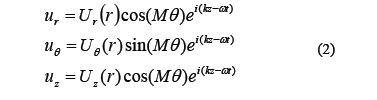
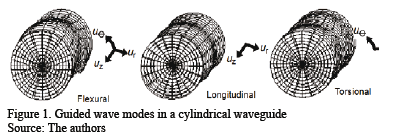
<body><![CDATA[<p><font size="2" face="Verdana, Arial, Helvetica, sans-serif">Guided waves in rods, single wires and multiple wires have   been anticipated as an attractive and effective technique for damage monitoring   of materials, since they can interrogate large structures and propagate over   long distances compared with traditional body waves &#91;1&#93;. However, guided waves   propagation in rods possess an infinite number of vibration modes. These   vibration modes depend on material properties and characteristic geometrical   parameters of the waveguide, e.g. diameter of the rod, and are dispersive in   nature, which complicate its analysis. Wave propagation characteristics in   multi-wire cables are even more difficult to investigate due to the   load-dependency of inter-wire contact and the twisted geometry of the   peripheral wires. Hence, the use of guided waves in these complex structures as   a non-destructive testing (NDT) technique, and its inclusion for damage   monitoring, is very challenging and requires a firm understanding of wave   propagation.</font></p>     <p><font size="2" face="Verdana, Arial, Helvetica, sans-serif">Propagation of waves   in rods and cable structures has been investigated theoretically and   experimentally by many researchers for over fifty years. Even though the cables   in civil structures do not consist of single cylindrical wires, initial   numerical and experimental investigations of guided wave propagation have been   performed on single cylindrical structures. This course of work has been used   as an approximation to study the wave propagation in multi-wire cables and has   established its fundamental basis &#91;2-7&#93;. In general, the multimodal behavior   and the dispersive nature of guided waves in solid cylinders indicate the   simultaneous propagation of various types of waves, stated as modes, and the   superposition of different modes with distinct velocities &#91;8&#93;. Furthermore,   mode conversion has been reported to occur when waves encounter discontinuities   or bended structures &#91;9,10&#93;. Researchers have therefore been driven to   implement sophisticated digital signal processing (DSP) techniques in time and   frequency-time domains to analyze and identify the measured signals; some of   these DSP techniques used are the Short Time Fourier Transform (STFT), the   Wigner-Ville transform and the Wavelet Transform (WT) &#91;11-14&#93;.</font></p>     <p><font size="2" face="Verdana, Arial, Helvetica, sans-serif">The twisted geometry   and the contact between adjacent wires make the modeling of the multi-wire   cables difficult &#91;13,15&#93;. Finite element modeling (FEM) techniques have been   used to gain insight into ultrasonic wave propagation; nevertheless, as   reported by some investigators, modeling of an entire multiple-wire cable is   computationally highly demanding &#91;16&#93;. Experimentally, several wave propagation   results have been obtained on single wires and entire multiple-wire cables   using piezoelectric transducers, electromagnetic acoustic transducers (EMAT)   and lasers &#91;11, 17-19&#93;. Piezoelectric elements with a ring shape and EMAT   transducers have been used to excite guided waves in complete multiple-strands   cables. The analysis of ultrasonic signals received in these structures has   demonstrated the feasibility of using guided waves to determine damage.   Nevertheless, guided wave propagation in long range inter-wired cylindrical   structures is complicated, and many aspects have to be considered in order to   develop a pragmatic implementation for damage monitoring &#91;20&#93;.</font></p>     <p><font size="2" face="Verdana, Arial, Helvetica, sans-serif">In this work, wave propagation of longitudinal and   flexural guided waves modes at 500 kHz in a 0.9m ACSR cable has been studied   using longitudinal transducers in a through transmission configuration. The   first part presents experimental results obtained using dispersion curves and   time-frequency analysis based on the WT for identifying guided wave modes. The   second part includes experimental results of artificial gradually increased   damage made at the middle of the cable, which were correlated to the change of   modes excited and received from F(1,1) to L(0,1). Discussions and conclusions   complete this article.</font></p>     <p>&nbsp;</p>     <p><font size="3" face="Verdana, Arial, Helvetica, sans-serif"><b>2.  Theoretical   aspects</b></font></p>     <p><b><font size="2" face="Verdana, Arial, Helvetica, sans-serif">2.1.  Wave propagation in rods    <br>   </font></b><font size="2" face="Verdana, Arial, Helvetica, sans-serif">ACSR cables consist of several individual aluminum and   steel rods that work as waveguides for ultrasonic waves. However, due to the   complicated characteristics such as inter-wire coupling, dispersive nature,   multi-mode presence and mode coupling, to the authors' knowledge, an analytical   solution that can describe the wave propagation in these multi-wire cables does   not exist. The approach taken to gain insight into the wave propagation in   multiple-wire cables is to investigate wave propagation in single wires using a   formulation based on the so-called Pochhammer frequency equation of a solid,   isotropic, homogenous and traction-free cylindrical rod, which has been   discussed in detail by Graff and recently by Rose &#91;21,22&#93;.</font></p>     <p><font size="2" face="Verdana, Arial, Helvetica, sans-serif">In general, there are three principal types of guided   waves modes that can exist in a cylindrical waveguide: the longitudinal, L(0,   m), the torsional, T(0, m), and the flexural, F(M, m) as illustrated in <a href="#fig01">Fig. 1</a>.</font></p>     <p align="center"><font size="2" face="Verdana, Arial, Helvetica, sans-serif"><a name="fig01"></a></font><img src="/img/revistas/dyna/v81n186/v81n186a30fig01.gif"></p>     ]]></body>
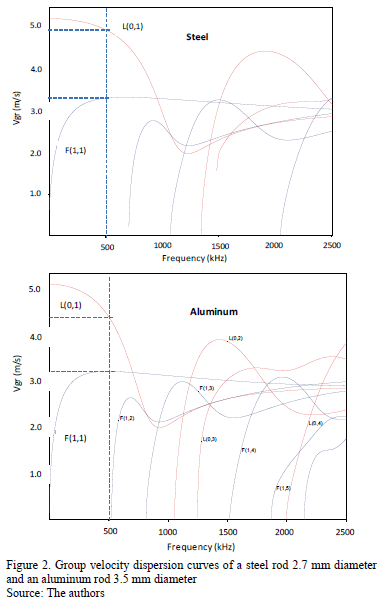
<body><![CDATA[<p><font size="2" face="Verdana, Arial, Helvetica, sans-serif">In theory, there are an infinite number of individual   modes within each principal mode, whose phase velocities, V<sub>ph</sub>, for a   given frequency-diameter product, <i>f<sub>d</sub></i>,   represent permissible solutions to an implicit transcendental equation of the   form</font></p>     <p><img src="/img/revistas/dyna/v81n186/v81n186a30eq01.gif"></p>     <p><font size="2" face="Verdana, Arial, Helvetica, sans-serif">Where d stands for the diameter of the rod and <font face="Symbol">l</font> and <font face="Symbol">m</font> represent its Lam&eacute; constants. The index M determines the manner in which the   fields generated by the guided wave modes vary with the angular coordinate <font face="Symbol">q</font> in the cylinder cross-section. Each field component can be considered to   vary as</font></p>     <p><img src="/img/revistas/dyna/v81n186/v81n186a30eq02.gif"></p>     <p><font size="2" face="Verdana, Arial, Helvetica, sans-serif">where the circumferential order M = 0, 1, 2, 3, ... The   terms <i>u<sub>r</sub></i>, <i>u<sub><font face="Symbol">q</font></sub></i>, <i>u<sub>z</sub></i> are the displacement components in the radial,   circumferential and axial directions, respectively; the terms <i>U<sub>r</sub></i>, <i>U<sub><font face="Symbol">q</font></sub></i>, <i>U<sub>z</sub></i> are the displacement amplitudes composed of Bessel or modified Bessel   functions, depending on the argument. All of the modes propagate in the axial   direction of a cylindrical waveguide. The acoustic </font><font size="2" face="Verdana, Arial, Helvetica, sans-serif">fields (i.e. displacement, stress,   etc) of the modes when M = 0 are axially symmetric along a cylinder   circumference and are independent of the angular coordinate <font face="Symbol">q</font>. The other   modes are non-axisymmetric and have fields which do vary with the angular   coordinate <font face="Symbol">q</font>. The axisymmetric modes comprise both the longitudinal modes,   L(0, n), and the torsional modes, T(0, n); the non-axisymmetric modes are   represented by the flexural modes, F(M, n).</font></p>     <p><font size="2" face="Verdana, Arial, Helvetica, sans-serif">Classifications of   velocity dispersion curves, which characterize the solutions to equation (1),   are achieved, pragmatically, in terms of a frequency-diameter product, <i>f<sub>d</sub></i>, of the waveguide. By   solving the equations, via the commercial package Disperse© &#91;23&#93;, for these   vibration modes with known frequencies, the dispersion curves can be obtained.   The dispersion curves relate the velocity, phase velocity (<i>V</i><sub>ph</sub>) or group velocity (<i>V</i><sub>gr</sub>), of the guided wave propagation to the frequency of   the wave and the diameter of the cylinder. Dispersion curves for an aluminum   rod (3.5mm diameter) and a steel rod (2.7mm diameter), respectively, are   plotted in <a href="#fig02">Fig. 2</a>.</font></p>     <p align="center"><font size="2" face="Verdana, Arial, Helvetica, sans-serif"><a name="fig02"></a></font><img src="/img/revistas/dyna/v81n186/v81n186a30fig02.gif"></p>     <p><font size="2" face="Verdana, Arial, Helvetica, sans-serif">Longitudinal modes are   the easiest to generate using conventional wedge type longitudinal transducers   and gel coupling, compared to torsional modes, which can only be generated by   applying shear forces. In this study, piezoelectric </font><font size="2" face="Verdana, Arial, Helvetica, sans-serif">longitudinal   transducers, which discard the generation of torsional modes, were used to   excite longitudinal and/or flexural modes, depending on the pressure   distribution applied to the surface of the cable, for monitoring damage in an   ACSR cable. The fundamental longitudinal mode, L(0,1), and the lowest order   flexural mode, F(1,1), are the subject of the experimental investigation.</font></p>     <p><font size="2" face="Verdana, Arial, Helvetica, sans-serif">An important and complicated aspect of guided waves in   multiple-wires cables, due to their multi-mode nature, is to carry out the   analysis and identification of the measured signals and their correlation with   damage. In this work, a DSP technique using frequency-time analysis, in form of   the WT, was employed during the experiments.</font></p>     <p><font size="2" face="Verdana, Arial, Helvetica, sans-serif"><b>2.2.  Frequency-time   analysis</b>    ]]></body>

<body><![CDATA[<br>   </font><font size="2" face="Verdana, Arial, Helvetica, sans-serif">The Fourier transform   spectrum allows determining which frequencies are present in a signal; however,   it is limited to stationary signals &#91;24&#93;. A serious shortcoming in transforming   a signal into the frequency domain is that time information is lost. When   looking at a Fourier transform of a signal, it is impossible to resolve when a   particular occurrence took place. The continuous wavelet transform (CWT)   addresses the general problem of time-frequency analysis and provides the means   to analyse non-stationary signals &#91;25&#93;. The CWT evolved as an alternative   approach to the short time Fourier transforms (STFT) to overcome the resolution   problem. Wavelet analysis is performed in a similar way to the STFT analysis,   since the signal is multiplied with a function, i.e. the wavelet, similar to   the window function in the STFT, and the transform is computed separately for   different segments of the time-domain signal. Nevertheless, the width of the   window in the CWT, as opposed to the STFT where the width of this window is   constant, is changed as the transform is computed for every spectral component.</font></p>     <p><font size="2" face="Verdana, Arial, Helvetica, sans-serif">In general, wavelets are   functions defined over a finite interval that possess an average value of zero.   The CWT is a tool for dividing functions into components of different   frequency, which permit studying each component separately. The basic idea of   the CWT is to represent any arbitrary function as a superposition of a set of   such wavelets. These wavelets are derived from a single prototype wavelet   called the mother wavelet, by dilating or contracting (scaling) the mother   wavelet and translating it (shifting). The Continuous Wavelet Transform is   defined as the sum over all time of the signal multiplied by scaled, shifted   version of the wavelet function, <font face="Symbol">Y</font><sub>s,<font face="Symbol"><i>t</i></font>(t)</sub> </font></p>     <p><img src="/img/revistas/dyna/v81n186/v81n186a30eq03.gif"></p>     <p><font size="2" face="Verdana, Arial, Helvetica, sans-serif">where * denotes complex conjugation. The wavelets are   obtained from a single basic wavelet, the so-called mother wavelet:</font></p>     <p><img src="/img/revistas/dyna/v81n186/v81n186a30eq04.gif"></p>     <p><font size="2" face="Verdana, Arial, Helvetica, sans-serif">Where s is the scale   factor, <font face="Symbol"> <i>t</i></font> is the translation   factor and the factor s-<sup>1/2</sup> is for energy normalization across the   different scales. In this work, the mother Gabor wavelet based on the Gaussian   function was used to identify the guided wave modes generated in the   experiments and ascertain the manner they correlate with damage by using broad   band ultrasonic transducers excited at 500 kHz. The Gabor wavelet formulae and   descriptions have been discussed in detail by Suzuki et al. &#91;26&#93;. </font></p>     <p><font size="2" face="Verdana, Arial, Helvetica, sans-serif">Continuous time signals   that are uniformly sampled at intervals <i>N<sup>-</sup></i><sup>1 </sup>over &#91;0, 1&#93;, where <i>N</i> is the period   of the signals, conduce to the discretization of wavelets. The discrete   counterpart of equation 3 is obtained by making the scale parameter, <i>s</i>, the translation parameter,<font face="Symbol"> t</font> , and the time, <i>t</i>,  discrete and setting s<sub>0</sub>=2 and <font face="Symbol"><i>t</i></font><i><sub>0=1</sub></i>, where s<sub>0</sub> and<font face="Symbol"><i>t</i></font><i><sub>0</sub></i> are the sampling   intervals of s and <font face="Symbol"><i>t</i></font> respectively. The   discrete wavelet transform (DWT) is thereby given by</font></p>     <p><img src="/img/revistas/dyna/v81n186/v81n186a30eq05.gif"></p>     <p><font size="2" face="Verdana, Arial, Helvetica, sans-serif">where m and n are   integer numbers that scale and shift, respectively, the function <i>y</i>, indicating the width   (scale) and position of the wavelet correspondingly. As a result, the wavelets   are stretched (or contracted) in powers of 2 and shifted as integers. Mallat   (1989) presented a work which showed that it is possible to design filters,   provided that s=2<sup>m</sup> and <font face="Symbol"><i>t</i></font>=2<sup>m</sup>n.   These filters are arranged in the form of a transformation matrix, which uses   two patterns: one acting as smoothing, low pass, filter and the other providing   detail information, as a high pass filter. This is referred to as   Multiresolution analysis, and may be implemented using the DWT; detailed   information is given by Mallat &#91;25&#93;.</font></p>     <p><font size="2" face="Verdana, Arial, Helvetica, sans-serif">Multiresolution is based   on partitioning a sampled signal into a number of frequency bands using low and   high pass filters; the inverse procedure is also possible, which permits signal   reconstruction. The partitioning process can be iterated, with successive   approximations being decomposed in turn, so that one signal is broken down into   many lower resolution components. Therefore, wavelets can be used for noise   suppression by means of a technique named the thresholding method. Using   multiresolution analysis the wavelets operate as filters, which decompose a   signal into approximation, low frequency components, and details, high   frequency components. If the amplitudes of the detail components are very low,   they can be removed, reducing the noise level without losing significant   information. The thresholding method works based on the elimination of the   detail components located below a given threshold. These components are used in   the inverse matrix transformation that reconstructs the signal, which permits   noise removal without smoothing peaks and discontinuities. In this work, signal   de-noising was performed via the DWT, to increase the signal to noise ratio   (SNR) of guided wave signals transmitted through an ACSR cable.</font></p>     ]]></body>
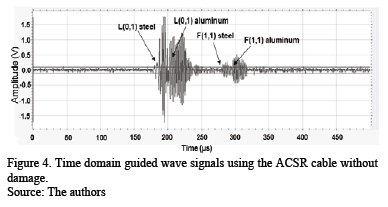
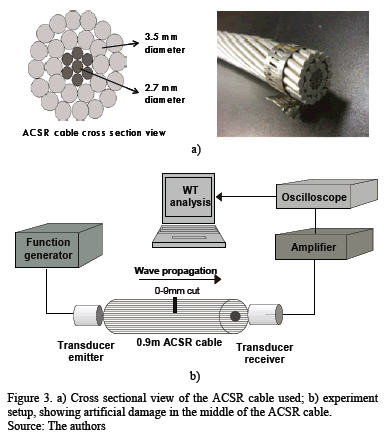
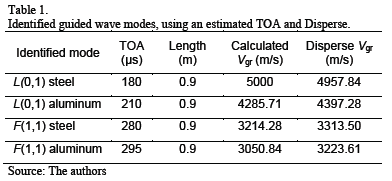
<body><![CDATA[<p>&nbsp;</p>     <p><font size="3" face="Verdana, Arial, Helvetica, sans-serif"><b>3.  Experiments and   results</b></font></p>     <p><b><font size="2" face="Verdana, Arial, Helvetica, sans-serif">3.1.  Experiment   setup    <br>   </font></b><font size="2" face="Verdana, Arial, Helvetica, sans-serif">A multi-wire ACSR cable commonly found in overhead power   transmission lines was used in the experiments. This cable is a concentric   conductor configured in strands consisting of a core of seven straight steel   wires and twenty six stranded aluminum wires in two layers. <a href="#fig03">Fig. 3a</a> illustrates   this with a photograph and a cross-sectional view of the multi-wire cable. The   diameter of each aluminum wire is 3.4mm, and the diameter of each steel wire is   2.7mm. Hence, the total diameter of the cable is approximately 22 mm with a   length of 0.9 m. The experiment setup is depicted in <a href="#fig03">Fig. 3b</a>. Pulse-echo   arrangements have been widely studied by several authors &#91;16,17,21&#93;, hence, a   pitch and catch arrangement was applied in this approach.</font></p>     <p align="center"><font size="2" face="Verdana, Arial, Helvetica, sans-serif"><a name="fig03"></a></font><img src="/img/revistas/dyna/v81n186/v81n186a30fig03.gif"></p>     <p><font size="2" face="Verdana, Arial, Helvetica, sans-serif">Frequency selection,   based on dispersion curves of individual aluminum and steel rods that comprise   the ACSR cable, was a compromise between damage resolution and the abundance of   modes at high frequencies. On the one hand, damage resolution can be increased   by operating at high frequencies, but it also reduces the range of propagation   due to the increased attenuation and scattering. On the other hand, as shown in <a href="#fig02"> Fig. 2</a>, at high frequencies, the profusion of modes increase and it is possible   to have several guided wave modes with a single frequency and all of them with   different velocities, which complicate its analysis. It can be observed that   the only guided wave modes that could be excited below 500 kHz are the   longitudinal L(0,1) and the flexural F(1,1) modes. Therefore, with the rods   having a constant diameter, the selection of a low <i>f<sub>d</sub></i> value, where the number of guided wave modes is   reduced, depends on a low frequency. In </font></p>     <p><font size="2" face="Verdana, Arial, Helvetica, sans-serif">practice,   a frequency of 500 kHz was selected during the experiments. Initial trials were   carried out to identify the excited guided wave modes. In subsequent   experiments, artificial damage was made on the cable by transverse cut (notch)   with increasing depth using a handsaw. The notch was made at the middle of the   cable, approximately 0.45m, from the transmitter transducer. Cut depth was   increased from 1 to 9mm and the width was about 1.77mm; the latter is related   to the handsaw thickness. The maximum cross-section area reduction of the cable   for the 9mm cut was approximately 40%.</font></p>     <p><font size="2" face="Verdana, Arial, Helvetica, sans-serif">The approach taken in this work for guided wave modes   identification involved time domain analysis using individual dispersion curves   of rods of aluminum and steel 3.5mm and 2.7mm of diameter, respectively, and   frequency-time analysis using spectrograms via the CWT and superimposing   dispersion curves. Signal de-noising by means of the DWT was also used to   enhance SNR and correlate guided wave modes to damage.</font></p>     <p><font size="2" face="Verdana, Arial, Helvetica, sans-serif"><b>3.2.  Results in the   time domain    <br>   </b></font><font size="2" face="Verdana, Arial, Helvetica, sans-serif"><a href="#fig04">Fig. 4</a> shows the time-domain guided wave received signals   from undamaged ACSR cable. Time-domain analysis allows estimation of the time   of arrival (TOA) of the signal. Considering a 0.9m length of the ACSR cable and   estimating the TOA, it was possible to recognize the excited guided wave   modes.  These are shown in <a href="#fig04">Fig. 4</a>. </font></p>     ]]></body>
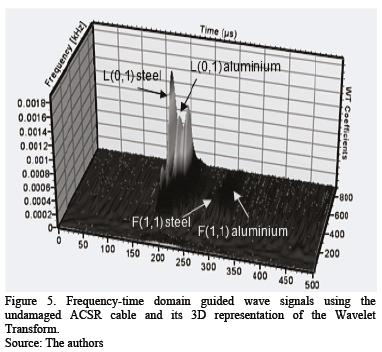
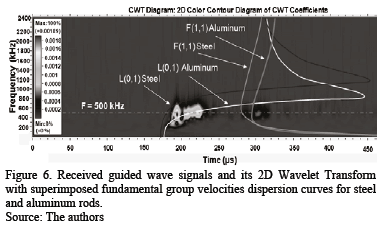
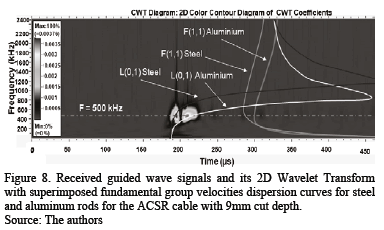
<body><![CDATA[<p align="center"><a name="fig04"></a><img src="/img/revistas/dyna/v81n186/v81n186a30fig04.gif"></p>     <p><font size="2" face="Verdana, Arial, Helvetica, sans-serif">The group velocities   yielded by the software Disperse at 500 kHz for L(0,1) in steel and aluminum   rods are 4957.84 m/s and 4397.28 m/s, respectively, and for F(1,1) are 3313.50   m/s and 3223.61 m/s, correspondently. The group velocities obtained using the   estimated TOA and its comparison with the group velocities obtained by Disperse   allowed the guided wave modes to be identified as shown in <a href="#tab01">Table 1</a>.</font></p>     <p align="center"><font size="2" face="Verdana, Arial, Helvetica, sans-serif"><a name="tab01"></a></font><img src="/img/revistas/dyna/v81n186/v81n186a30tab01.gif"></p>     <p><font size="2" face="Verdana, Arial, Helvetica, sans-serif">The identified received modes were predominantly L(0,1).   However, some energy was discerned with lower group velocities, most likely   F(1,1). It is observed that L(0,1) aluminum signals show more dispersion and   lower amplitude, than the L(0,1) signals of steel, which agrees with its   dispersion curves. On the other hand, F(1,1) modes exhibit more energy in the   aluminum.</font></p>     <p><font size="2" face="Verdana, Arial, Helvetica, sans-serif"><b>3.3.  Results in the   frequency domain</b>    <br>   </font><font size="2" face="Verdana, Arial, Helvetica, sans-serif">A CWT with the mother Gabor wavelet based on the Gaussian   function was performed using AGU-Vallen© software to obtain the   time-frequency-domain signals &#91;27&#93;.</font></p>     <p><font size="2" face="Verdana, Arial, Helvetica, sans-serif"><a href="#fig05">Figs. 5</a> and <a href="#fig06">6</a> show the   frequency-time domain signals  of the   guided waves in the undamaged ACSR cable in 3D and 2D respectively. <a href="#fig05">Fig.5</a> shows   the 3D representation of the wavelet coefficients that allow identification of   the guided wave modes found in the time domain. The CWT depicts the modes that   carry significant energy and the areas where this energy is present within a   mode. </font></p>     <p align="center"><font size="2" face="Verdana, Arial, Helvetica, sans-serif"><a name="fig05"></a></font><img src="/img/revistas/dyna/v81n186/v81n186a30fig05.gif"></p>     <p align="center"><font size="2" face="Verdana, Arial, Helvetica, sans-serif"><a name="fig06"></a></font><img src="/img/revistas/dyna/v81n186/v81n186a30fig06.gif"></p>     <p><font size="2" face="Verdana, Arial, Helvetica, sans-serif"><a href="#fig06">Fig. 6</a> shows the frequency-time signals with fundamental   group velocity dispersion curves for steel and aluminum rods superimposed. The   group velocities have been changed to a time axis using the propagation   distance of the guided wave signals. The wavelet contour plot of <a href="#fig06">Fig. 6</a> shows   that most of the guided wave energy is located in two main areas centred at 500   kHz. The former corresponds to generated L(0,1) longitudinal modes, first the   L(0,1) mode for steel that is irradiated with the highest energy, and secondly   the L(0,1) mode is irradiated for aluminum.  The latter corresponds to the two F(1,1) flexural modes;  first, the F(1,1) mode for steel that is   irradiated with the lowest energy, and afterwards the irradiated F(1,1) mode   for aluminum.</font></p>     ]]></body>
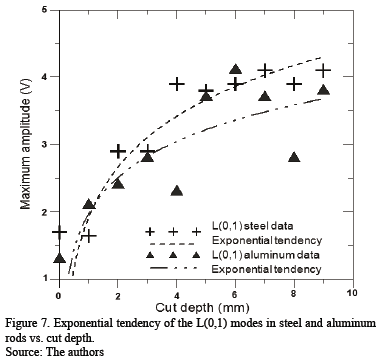
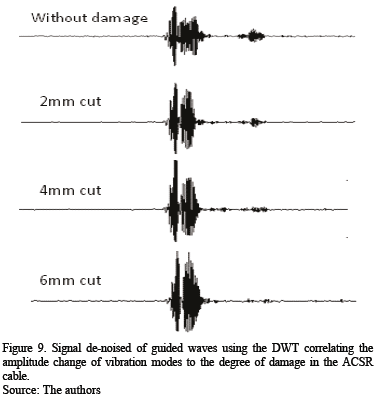
<body><![CDATA[<p><font size="2" face="Verdana, Arial, Helvetica, sans-serif">The CWT results follow   with good agreement the theoretical dispersion curves of individual wires,   indicating that the L(0,1) mode exhibits more energy for the steel rod, while   the F(1,1) reveals more energy for the aluminum rod.</font></p>     <p><font size="2" face="Verdana, Arial, Helvetica, sans-serif"><b>3.4.  Results for   an ACSR cable with artificial damage    <br>   </b>In the experiment, artificially induced damage was created   at the middle of the ACSR cable by gradually increasing the cut depth from 1mm   to 9mm. Experimental results show a relationship between the degree of damage   and the received amplitude of the guided wave modes. This relationship,   however, shows that an increase in the cut depth produces an increase in   amplitude of the L(0,1) modes and a decrease in amplitude of the F(1,1) modes.   The energy increase of the L(0,1) modes possess an exponential tendency as   shown in <a href="#fig07">Fig. 7</a>. This trend stops at approximately the 9mm cut depth. After   that point, the amplitude of the guided wave modes decays as the steel wires   are partially being cut off.</font></p>     <p align="center"><font size="2" face="Verdana, Arial, Helvetica, sans-serif"><a name="fig07"></a></font><img src="/img/revistas/dyna/v81n186/v81n186a30fig07.gif"></p>     <p><font size="2" face="Verdana, Arial, Helvetica, sans-serif">Received guided wave signals and their 2D CWT with   superimposed fundamental group velocity dispersion curves in steel and aluminum   rods within the ACSR cable with a 9mm cut depth, is shown in <a href="#fig08">Fig. 8</a>. </font></p>     <p align="center"><font size="2" face="Verdana, Arial, Helvetica, sans-serif"><a name="fig08"></a></font><img src="/img/revistas/dyna/v81n186/v81n186a30fig08.gif"></p>     <p><font size="2" face="Verdana, Arial, Helvetica, sans-serif">his CWT result displays a dramatic decrease in the flexural F(1,1) modes and   an increase of the longitudinal</font><font size="2" face="Verdana, Arial, Helvetica, sans-serif"> </font><font size="2" face="Verdana, Arial, Helvetica, sans-serif">L(0,1) modes, suggesting a mode change excitation and   reception from F(1,1) to L(0,1).  In the   preceding experiments, the SNR at the receiver transducer permitted unambiguous   identification of the transmitted signals. Nevertheless, in order to further   enhance the SNR of the transmitted guided wave signals, wavelet processing was   employed as a technique for removing noise from signals &#91;25&#93;. The reduction of   coherent noise using the DWT was implemented using Mallat's fast algorithm in   Matlab© &#91;28&#93;. The processing parameters employed were multilevel decomposition   of the signal (level 3), global soft thresholding and Daubechies (db1) wavelet   type. <a href="#fig09">Fig. 9</a> depicts the de-noised signal of the guided waves using the DWT,   correlating the amplitude change of vibration modes to the degree of damage in   the ACSR cable.</font></p>     <p align="center"><font size="2" face="Verdana, Arial, Helvetica, sans-serif"><a name="fig09"></a></font><img src="/img/revistas/dyna/v81n186/v81n186a30fig09.gif"></p>     <p><font size="2" face="Verdana, Arial, Helvetica, sans-serif">It is observed that after a cut depth of 6 mm, the two   F(1,1) modes practically disappear and only the two L(0,1) modes are excited,   suggesting a mode change excitation.</font></p>     <p><font size="2" face="Verdana, Arial, Helvetica, sans-serif">The energy in both L(0,1) modes increase with cut depth.   However, the increment of energy of L(0,1) in aluminum coming from the F(1,1)   mode in aluminum is more conspicuous than it is for its steel counterpart as   shown in <a href="#fig08">figures 8</a> and <a href="#fig09">9</a> &#91;29&#93;. </font></p>     ]]></body>
<body><![CDATA[<p><font size="2" face="Verdana, Arial, Helvetica, sans-serif">The mode change effect is attributed to cutting depth of   the cable, which not only introduces a discontinuity in the wave propagation,   but also produces a loss of tightness in the individual wires that constitute   the ACSR cable. </font></p>     <p>&nbsp;</p>     <p><font size="3" face="Verdana, Arial, Helvetica, sans-serif"><b>4.  Discussion and   conclusions</b></font></p>     <p><font size="2" face="Verdana, Arial, Helvetica, sans-serif">In this work, damage detection based on guided wave modes   conversion in a multi-wire ACSR cable commonly used in transmission lines by   electric utilities was investigated, and is proffered as a potential monitoring   technique. Frequency selection based on dispersion curves of the individual   aluminum and steel rods that comprise the ACSR cable was a tradeoff between   damage resolution, which increases with frequency, and the abundance of modes   at high frequencies that complicate its analysis and mode identification. From   this, a frequency of 500 kHz was selected. Experiments were performed using an   ACSR cable 0.9m in length and longitudinal ultrasonic transducer in a through   transmission configuration. Guided mode identification was based on dispersion   curves and the CWT. The CWT allowed identifying, with good agreement, the   excited L(0,1) and F(1,1) modes in time-frequency domain with superimposed   fundamental group velocities dispersion curves for steel and aluminum rods.   L(0,1) modes were identified with more energy than its F(1,1) counterpart.   Artificial damage was introduced at the middle of the ACSR cable by gradually   increasing the cut depth from 1mm to 9mm. Using the CWT it was observed that   cut depth produces an exponential increase in amplitude of the L(0,1) modes and   a decrease of the F(1,1) modes that stops approximately at the 9mm cut depth,   when steel wires of the ACSR cable are being cut off. These results suggest a   change of excitation modes and reception from F(1,1) to L(0,1) modes. The DWT   was also employed to enhance guided wave SNR, correlating the amplitude change   of vibration modes to the degree of damage in the ACSR cable. The energy in   L(0,1) modes for steel and aluminum rods  increased with cut depth. Nevertheless, it was observed that the energy   increment in the L(0,1) in aluminum, coming from the F(1,1) mode in aluminum,   is more evident than in its steel equivalent.  This effect is attributed to the cutting depth of the cable, which not   only introduces a discontinuity in the wave propagation, but as the external   wires were cut off, the cable structure lost tightness, modifying the degree of   mechanical contact among the single wires.   Consequently, it could influence how the energy transfers along the   cable and among the wires. The trials carried out in this investigation provide   substantiation that the change of modes from F(1,1) mode to L(0,1) can be   correlated to damage in early stages, and could serve as basis for structural   monitoring of this type of cable structures in civil engineering applications.</font></p>     <p>&nbsp;</p>     <p><font size="3" face="Verdana, Arial, Helvetica, sans-serif"><b>Acknowledgements </b></font></p>     <p><font size="2" face="Verdana, Arial, Helvetica, sans-serif">The authors wish to express their thanks to the Instituto   de Investigaciones El&eacute;ctricas (IIE), in Cuernavaca, Morelos, M&eacute;xico, for   supporting this work.</font></p>     <p>&nbsp;</p>     <p><font size="3" face="Verdana, Arial, Helvetica, sans-serif"><b>References</b></font></p>     <!-- ref --><p><font size="2" face="Verdana, Arial, Helvetica, sans-serif"><b>&#91;1&#93;</b> Chang,   F.K., Structural Health Monitoring: Current Status and Perspectives, Lancaster,   PA: CRC Press, 1998.    &nbsp;&nbsp;&nbsp;&nbsp;&nbsp;&nbsp;&nbsp;&nbsp;[&#160;<a href="javascript:void(0);" onclick="javascript: window.open('/scielo.php?script=sci_nlinks&ref=000092&pid=S0012-7353201400040003000001&lng=','','width=640,height=500,resizable=yes,scrollbars=1,menubar=yes,');">Links</a>&#160;]<!-- end-ref --></font></p>     <!-- ref --><p><font size="2" face="Verdana, Arial, Helvetica, sans-serif"><b>&#91;2&#93;</b> Meitzler,   A.H., Mode coupling occurring in the propagation of elastic pulses in wires. J.Acoust.   Soc. Am. 33 (4), pp. 435-45, 1961.    &nbsp;&nbsp;&nbsp;&nbsp;&nbsp;&nbsp;&nbsp;&nbsp;[&#160;<a href="javascript:void(0);" onclick="javascript: window.open('/scielo.php?script=sci_nlinks&ref=000094&pid=S0012-7353201400040003000002&lng=','','width=640,height=500,resizable=yes,scrollbars=1,menubar=yes,');">Links</a>&#160;]<!-- end-ref --></font></p>     <!-- ref --><p><font size="2" face="Verdana, Arial, Helvetica, sans-serif"><b>&#91;3&#93;</b> Zemanek,   J., An experimental and theoretical investigation of elastic wave propagation   in a cylinder.J.Acoust. Soc. Am. 51(1B), pp. 265-83, 1972.    &nbsp;&nbsp;&nbsp;&nbsp;&nbsp;&nbsp;&nbsp;&nbsp;[&#160;<a href="javascript:void(0);" onclick="javascript: window.open('/scielo.php?script=sci_nlinks&ref=000096&pid=S0012-7353201400040003000003&lng=','','width=640,height=500,resizable=yes,scrollbars=1,menubar=yes,');">Links</a>&#160;]<!-- end-ref --></font></p>     <!-- ref --><p><font size="2" face="Verdana, Arial, Helvetica, sans-serif"><b>&#91;4&#93;</b> Kwun,   H. and Bartels, K.A., Experimental observation of elastic-wave dispersion in   bounded solids of various configurations. J. Acoust. Soc. Am.  99 (2), pp.962-8, 1966.    &nbsp;&nbsp;&nbsp;&nbsp;&nbsp;&nbsp;&nbsp;&nbsp;[&#160;<a href="javascript:void(0);" onclick="javascript: window.open('/scielo.php?script=sci_nlinks&ref=000098&pid=S0012-7353201400040003000004&lng=','','width=640,height=500,resizable=yes,scrollbars=1,menubar=yes,');">Links</a>&#160;]<!-- end-ref --></font></p>     <!-- ref --><p><font size="2" face="Verdana, Arial, Helvetica, sans-serif"><b>&#91;5&#93;</b> Puckett,   A.D. and Peterson, M.L., A semi-analytical model for predicting multiple   propagating axially symmetric modes in cylindrical wave guides. Ultrasonics 43 (3),   pp. 197-207, 2005.    &nbsp;&nbsp;&nbsp;&nbsp;&nbsp;&nbsp;&nbsp;&nbsp;[&#160;<a href="javascript:void(0);" onclick="javascript: window.open('/scielo.php?script=sci_nlinks&ref=000100&pid=S0012-7353201400040003000005&lng=','','width=640,height=500,resizable=yes,scrollbars=1,menubar=yes,');">Links</a>&#160;]<!-- end-ref --></font></p>     <!-- ref --><p><font size="2" face="Verdana, Arial, Helvetica, sans-serif"><b>&#91;6&#93;</b> Castaings,   M. and Lowe, M., Finite element for wave guided along solid systems of   arbitrary section coupled to infinite media. J. Acoust. Soc. Am. 123 (2), pp.   696-708, 2008.    &nbsp;&nbsp;&nbsp;&nbsp;&nbsp;&nbsp;&nbsp;&nbsp;[&#160;<a href="javascript:void(0);" onclick="javascript: window.open('/scielo.php?script=sci_nlinks&ref=000102&pid=S0012-7353201400040003000006&lng=','','width=640,height=500,resizable=yes,scrollbars=1,menubar=yes,');">Links</a>&#160;]<!-- end-ref --></font></p>     <!-- ref --><p><font size="2" face="Verdana, Arial, Helvetica, sans-serif"><b>&#91;7&#93;</b> Franco,   E, Lowe, M., Meza, J. and Buiochi F., Measurement of elastic properties of   materials by the ultrasonic through-transmission technique, Dyna 78 (168), pp.   58-64, 2011.    &nbsp;&nbsp;&nbsp;&nbsp;&nbsp;&nbsp;&nbsp;&nbsp;[&#160;<a href="javascript:void(0);" onclick="javascript: window.open('/scielo.php?script=sci_nlinks&ref=000104&pid=S0012-7353201400040003000007&lng=','','width=640,height=500,resizable=yes,scrollbars=1,menubar=yes,');">Links</a>&#160;]<!-- end-ref --></font></p>     <!-- ref --><p><font size="2" face="Verdana, Arial, Helvetica, sans-serif"><b>&#91;8&#93;</b> Wilcox,   P.D., Lowe, M. and Cawley, P., The effect of dispersion on long-range   inspection using ultrasonic guided waves, NDT &amp; E International 34 (1), pp.   1-9, 2001.    &nbsp;&nbsp;&nbsp;&nbsp;&nbsp;&nbsp;&nbsp;&nbsp;[&#160;<a href="javascript:void(0);" onclick="javascript: window.open('/scielo.php?script=sci_nlinks&ref=000106&pid=S0012-7353201400040003000008&lng=','','width=640,height=500,resizable=yes,scrollbars=1,menubar=yes,');">Links</a>&#160;]<!-- end-ref --></font></p>     <!-- ref --><p><font size="2" face="Verdana, Arial, Helvetica, sans-serif"><b>&#91;9&#93;</b> Demma,   A., Lowe, M.J.S., Cawley, P. and Pavlakovic, B.N., The effect of bends on the   propagation of guided waves in pipes, Journal of Pressure Vessel Technology 127   (3), pp. 328-335, 2005.    &nbsp;&nbsp;&nbsp;&nbsp;&nbsp;&nbsp;&nbsp;&nbsp;[&#160;<a href="javascript:void(0);" onclick="javascript: window.open('/scielo.php?script=sci_nlinks&ref=000108&pid=S0012-7353201400040003000009&lng=','','width=640,height=500,resizable=yes,scrollbars=1,menubar=yes,');">Links</a>&#160;]<!-- end-ref --></font></p>     <!-- ref --><p><font size="2" face="Verdana, Arial, Helvetica, sans-serif"><b>&#91;10&#93;</b> Lowe,   M.J.S., Alleyne, D.N. and Cawley, P., The mode conversion of a guided wave by a   part-circumferential notch in a pipe. J. Appl. Mech. 65 (9), pp. 649-656, 1998.    &nbsp;&nbsp;&nbsp;&nbsp;&nbsp;&nbsp;&nbsp;&nbsp;[&#160;<a href="javascript:void(0);" onclick="javascript: window.open('/scielo.php?script=sci_nlinks&ref=000110&pid=S0012-7353201400040003000010&lng=','','width=640,height=500,resizable=yes,scrollbars=1,menubar=yes,');">Links</a>&#160;]<!-- end-ref --></font></p>     <!-- ref --><p><font size="2" face="Verdana, Arial, Helvetica, sans-serif"><b>&#91;11&#93;</b> Rizzo,   P. and Di-Scalea, F.L., Wave propagation in multiwire strands by wavelet- based   laser ultrasound. Exp. Mech. 44 (4), pp. 407-15, 2004.    &nbsp;&nbsp;&nbsp;&nbsp;&nbsp;&nbsp;&nbsp;&nbsp;[&#160;<a href="javascript:void(0);" onclick="javascript: window.open('/scielo.php?script=sci_nlinks&ref=000112&pid=S0012-7353201400040003000011&lng=','','width=640,height=500,resizable=yes,scrollbars=1,menubar=yes,');">Links</a>&#160;]<!-- end-ref --></font></p>     <!-- ref --><p><font size="2" face="Verdana, Arial, Helvetica, sans-serif"><b>&#91;12&#93;</b> Chen,   H-L. and Wissawapaisal, K., Application of Wigner-Ville Transform to evaluate   tensile forces in seven-wire prestressing strands. J Eng. Mech. 128 (11),   pp.1206-14, 2002.    &nbsp;&nbsp;&nbsp;&nbsp;&nbsp;&nbsp;&nbsp;&nbsp;[&#160;<a href="javascript:void(0);" onclick="javascript: window.open('/scielo.php?script=sci_nlinks&ref=000114&pid=S0012-7353201400040003000012&lng=','','width=640,height=500,resizable=yes,scrollbars=1,menubar=yes,');">Links</a>&#160;]<!-- end-ref --></font></p>     <!-- ref --><p><font size="2" face="Verdana, Arial, Helvetica, sans-serif"><b>&#91;13&#93;</b> Rizzo,   P. and, Di-Scalea, F.L., Ultrasonic inspection of multiwire steel strands with   the aid of the wavelet transform. Smart Mater. Struct. 14 (4), pp. 685-95,   2005.    &nbsp;&nbsp;&nbsp;&nbsp;&nbsp;&nbsp;&nbsp;&nbsp;[&#160;<a href="javascript:void(0);" onclick="javascript: window.open('/scielo.php?script=sci_nlinks&ref=000116&pid=S0012-7353201400040003000013&lng=','','width=640,height=500,resizable=yes,scrollbars=1,menubar=yes,');">Links</a>&#160;]<!-- end-ref --></font></p>     <!-- ref --><p><font size="2" face="Verdana, Arial, Helvetica, sans-serif"><b>&#91;14&#93;</b> Baltazar,   A., Hern&aacute;ndez, C. and Manzanares-Martinez, B., Study of wave propagation in a   multiwire cable to determine structural damage. NDT&amp; E International 43 (8),   pp. 726-732, 2010.    &nbsp;&nbsp;&nbsp;&nbsp;&nbsp;&nbsp;&nbsp;&nbsp;[&#160;<a href="javascript:void(0);" onclick="javascript: window.open('/scielo.php?script=sci_nlinks&ref=000118&pid=S0012-7353201400040003000014&lng=','','width=640,height=500,resizable=yes,scrollbars=1,menubar=yes,');">Links</a>&#160;]<!-- end-ref --></font></p>     <!-- ref --><p><font size="2" face="Verdana, Arial, Helvetica, sans-serif"><b>&#91;15&#93;</b> Treyssède,   F., Numerical investigation of elastic modes of propagation in helical   waveguides. J. Acoust. Soc. Am. 121 (6), pp. 3398-3408, 2007.    &nbsp;&nbsp;&nbsp;&nbsp;&nbsp;&nbsp;&nbsp;&nbsp;[&#160;<a href="javascript:void(0);" onclick="javascript: window.open('/scielo.php?script=sci_nlinks&ref=000120&pid=S0012-7353201400040003000015&lng=','','width=640,height=500,resizable=yes,scrollbars=1,menubar=yes,');">Links</a>&#160;]<!-- end-ref --></font></p>     <!-- ref --><p><font size="2" face="Verdana, Arial, Helvetica, sans-serif"><b>&#91;16&#93;</b> Kulkarni,   S. and Hurlebaus, S., Nondestructive testing of overhead transmission lines -   numerical and experimental investigation, QNDE Chicago, Il, USA, 2008.    &nbsp;&nbsp;&nbsp;&nbsp;&nbsp;&nbsp;&nbsp;&nbsp;[&#160;<a href="javascript:void(0);" onclick="javascript: window.open('/scielo.php?script=sci_nlinks&ref=000122&pid=S0012-7353201400040003000016&lng=','','width=640,height=500,resizable=yes,scrollbars=1,menubar=yes,');">Links</a>&#160;]<!-- end-ref --></font></p>     <!-- ref --><p><font size="2" face="Verdana, Arial, Helvetica, sans-serif"><b>&#91;17&#93;</b> Rizzo,   P. and, Di-Scalea, F.L., Monitoring steel strands via ultrasonic measurements. Proc   SPIE 4696, Smart Structures and Materials, pp. 62-73, 2002.    &nbsp;&nbsp;&nbsp;&nbsp;&nbsp;&nbsp;&nbsp;&nbsp;[&#160;<a href="javascript:void(0);" onclick="javascript: window.open('/scielo.php?script=sci_nlinks&ref=000124&pid=S0012-7353201400040003000017&lng=','','width=640,height=500,resizable=yes,scrollbars=1,menubar=yes,');">Links</a>&#160;]<!-- end-ref --></font></p>     <!-- ref --><p><font size="2" face="Verdana, Arial, Helvetica, sans-serif"><b>&#91;18&#93;</b> Wilson,   M. and Hurlebaus, S., Power line monitoring. In: Proceedings of the American   control conference, 2007, pp. 231-5.    &nbsp;&nbsp;&nbsp;&nbsp;&nbsp;&nbsp;&nbsp;&nbsp;[&#160;<a href="javascript:void(0);" onclick="javascript: window.open('/scielo.php?script=sci_nlinks&ref=000126&pid=S0012-7353201400040003000018&lng=','','width=640,height=500,resizable=yes,scrollbars=1,menubar=yes,');">Links</a>&#160;]<!-- end-ref --></font></p>     <!-- ref --><p><font size="2" face="Verdana, Arial, Helvetica, sans-serif"><b>&#91;19&#93;</b> Laguerre,   L., Aime, J.C. and Brissaud, M., Magnetostrictive pulse-echo device for non-   destructive evaluation of cylindrical steel materials using longitudinal guided   waves. Ultrasonics 39 (7), pp. 503-14, 2002.    &nbsp;&nbsp;&nbsp;&nbsp;&nbsp;&nbsp;&nbsp;&nbsp;[&#160;<a href="javascript:void(0);" onclick="javascript: window.open('/scielo.php?script=sci_nlinks&ref=000128&pid=S0012-7353201400040003000019&lng=','','width=640,height=500,resizable=yes,scrollbars=1,menubar=yes,');">Links</a>&#160;]<!-- end-ref --></font></p>     <!-- ref --><p><font size="2" face="Verdana, Arial, Helvetica, sans-serif"><b>&#91;20&#93;</b> Gaul,   L., Sprenger, H., Schaal, C. and Bischoff, S., Structural health monitoring of   cylindrical structures using guided ultrasonic waves. Acta Mech. 223, pp.   1669-1680, 2012.    &nbsp;&nbsp;&nbsp;&nbsp;&nbsp;&nbsp;&nbsp;&nbsp;[&#160;<a href="javascript:void(0);" onclick="javascript: window.open('/scielo.php?script=sci_nlinks&ref=000130&pid=S0012-7353201400040003000020&lng=','','width=640,height=500,resizable=yes,scrollbars=1,menubar=yes,');">Links</a>&#160;]<!-- end-ref --></font></p>     <!-- ref --><p><font size="2" face="Verdana, Arial, Helvetica, sans-serif"><b>&#91;21&#93;</b> Graff,   K.F., Wave motion in elastic solids. New York: Dover Publications, 1975.    &nbsp;&nbsp;&nbsp;&nbsp;&nbsp;&nbsp;&nbsp;&nbsp;[&#160;<a href="javascript:void(0);" onclick="javascript: window.open('/scielo.php?script=sci_nlinks&ref=000132&pid=S0012-7353201400040003000021&lng=','','width=640,height=500,resizable=yes,scrollbars=1,menubar=yes,');">Links</a>&#160;]<!-- end-ref --></font></p>     <!-- ref --><p><font size="2" face="Verdana, Arial, Helvetica, sans-serif"><b>&#91;22&#93;</b> Rose,   J.L., Ultrasonic waves in solid media. England: Cambridge University Press, 1999.    &nbsp;&nbsp;&nbsp;&nbsp;&nbsp;&nbsp;&nbsp;&nbsp;[&#160;<a href="javascript:void(0);" onclick="javascript: window.open('/scielo.php?script=sci_nlinks&ref=000134&pid=S0012-7353201400040003000022&lng=','','width=640,height=500,resizable=yes,scrollbars=1,menubar=yes,');">Links</a>&#160;]<!-- end-ref --></font></p>     <!-- ref --><p><font size="2" face="Verdana, Arial, Helvetica, sans-serif"><b>&#91;23&#93;</b> Pavlakovic,   B. and Lowe, M., Disperse User Manual: A System for generating dispersion   curves, Copyright B Pavlakovic, M Lowe © 2003.    &nbsp;&nbsp;&nbsp;&nbsp;&nbsp;&nbsp;&nbsp;&nbsp;[&#160;<a href="javascript:void(0);" onclick="javascript: window.open('/scielo.php?script=sci_nlinks&ref=000136&pid=S0012-7353201400040003000023&lng=','','width=640,height=500,resizable=yes,scrollbars=1,menubar=yes,');">Links</a>&#160;]<!-- end-ref --></font></p>     <!-- ref --><p><font size="2" face="Verdana, Arial, Helvetica, sans-serif"><b>&#91;24&#93;</b> Flandrin,   P. and Auger, F. E., Chassande-Mottin Time-frequency reassignment: From   principles to algorithms, in Applications in Time Frequency Signal Processing,   Suppappola, Antonia, CRC Press LLC © 2003.    &nbsp;&nbsp;&nbsp;&nbsp;&nbsp;&nbsp;&nbsp;&nbsp;[&#160;<a href="javascript:void(0);" onclick="javascript: window.open('/scielo.php?script=sci_nlinks&ref=000138&pid=S0012-7353201400040003000024&lng=','','width=640,height=500,resizable=yes,scrollbars=1,menubar=yes,');">Links</a>&#160;]<!-- end-ref --></font></p>     <!-- ref --><p><font size="2" face="Verdana, Arial, Helvetica, sans-serif"><b>&#91;25&#93;</b> Mallat,   S., A Wavelet tour of signal processing, Academic Press, Boston, 1998.    &nbsp;&nbsp;&nbsp;&nbsp;&nbsp;&nbsp;&nbsp;&nbsp;[&#160;<a href="javascript:void(0);" onclick="javascript: window.open('/scielo.php?script=sci_nlinks&ref=000140&pid=S0012-7353201400040003000025&lng=','','width=640,height=500,resizable=yes,scrollbars=1,menubar=yes,');">Links</a>&#160;]<!-- end-ref --></font></p>     <!-- ref --><p><font size="2" face="Verdana, Arial, Helvetica, sans-serif"><b>&#91;26&#93;</b> Suzuki,   H., Kinjo, T., Hayashi, Y., Takemoto, M. and Ono, K., Appendix by Hayashi Y.,   Wavelet Transform of Acoustic Emission Signals, Journal of Acoustic Emission 14   (2), pp. 69-84, 1996.    &nbsp;&nbsp;&nbsp;&nbsp;&nbsp;&nbsp;&nbsp;&nbsp;[&#160;<a href="javascript:void(0);" onclick="javascript: window.open('/scielo.php?script=sci_nlinks&ref=000142&pid=S0012-7353201400040003000026&lng=','','width=640,height=500,resizable=yes,scrollbars=1,menubar=yes,');">Links</a>&#160;]<!-- end-ref --></font></p>     <!-- ref --><p><font size="2" face="Verdana, Arial, Helvetica, sans-serif"><b>&#91;27&#93;</b> AGU-Vallen   wavelet, Vallen systeme GmbH © 1986-2005.    &nbsp;&nbsp;&nbsp;&nbsp;&nbsp;&nbsp;&nbsp;&nbsp;[&#160;<a href="javascript:void(0);" onclick="javascript: window.open('/scielo.php?script=sci_nlinks&ref=000144&pid=S0012-7353201400040003000027&lng=','','width=640,height=500,resizable=yes,scrollbars=1,menubar=yes,');">Links</a>&#160;]<!-- end-ref --></font></p>     <!-- ref --><p><font size="2" face="Verdana, Arial, Helvetica, sans-serif"><b>&#91;28&#93;</b> MATLAB   version 7.10.0. © The MathWorks Inc., 2010.    &nbsp;&nbsp;&nbsp;&nbsp;&nbsp;&nbsp;&nbsp;&nbsp;[&#160;<a href="javascript:void(0);" onclick="javascript: window.open('/scielo.php?script=sci_nlinks&ref=000146&pid=S0012-7353201400040003000028&lng=','','width=640,height=500,resizable=yes,scrollbars=1,menubar=yes,');">Links</a>&#160;]<!-- end-ref --></font></p>     <!-- ref --><p><font size="2" face="Verdana, Arial, Helvetica, sans-serif"><b>&#91;29&#93;</b> Mijarez,   R. and Baltazar, A., Phenomena investigation of guided waves propagation in a   multiple-wire cable with gradually increasing cut depths, nondestructive   testing of materials and structures RILEM, Book series Volume 6, © RILEM 2013, pp   155-160.    &nbsp;&nbsp;&nbsp;&nbsp;&nbsp;&nbsp;&nbsp;&nbsp;[&#160;<a href="javascript:void(0);" onclick="javascript: window.open('/scielo.php?script=sci_nlinks&ref=000148&pid=S0012-7353201400040003000029&lng=','','width=640,height=500,resizable=yes,scrollbars=1,menubar=yes,');">Links</a>&#160;]<!-- end-ref --></font></p>     <p>&nbsp;</p>     <p><font size="2" face="Verdana, Arial, Helvetica, sans-serif"><b>Rito Mijarez</b>.   Received a B.Sc. in Electronics and Communication Engineering in 1990 from the   Universidad Autonoma de Zacatecas, Mexico, an M,Sc. in Instruments design and   application in 1996 from the University of Manchester Institute of Science and   Technology (UMIST) in the UK, and his PhD in Electrical and Electronic   Engineering in 2006 from the University of Manchester, in the UK. Currently he   is a full-time researcher in the Control, Electronica y Comunicaciones   Department, at the Instituto de Investigaciones El&eacute;ctricas (IIE) and a   part-time professor at the Instituto Tecnologico y de Estudios Superiores de   Monterrey (ITESM), both located in Cuernavaca Morelos, Mexico. As part of his   professional experience, he has worked in a Defence Science and Technology   Laboratory (DSTL) project in the UK designing a device for manipulating   microparticles using ultrasound; and in Mexico, he has worked in several   projects related to the design and implementation of instruments for energy   measurements and control.  His research   interests include: embedded systems and instrumentation, digital signal   processing, smart sensors and ultrasonic guided waves. He has published many   technical papers and participated in national and international technical   conferences; he has    published a technical text book and he has four patents granted. He is   recognized as a National Researcher in Mexico by the National Research System   (SNI). </font></p>     <p><font size="2" face="Verdana, Arial, Helvetica, sans-serif"><b>Arturo   Baltazar</b>. Received a BSc. in Mechanical Engineering and an MSc. in Materials   Science from the Universidad Michoacana, Mexico, and his PhD in Industrial Welding   and System Engineering from the Ohio State University, in the USA. Currently,   he is researcher-professor 3B in the Divisi&oacute;n de Rob&oacute;tica y Manufactura   Avanzada at the CINVESTAV-Saltillo, Mexico. As part of his professional   experience, he has participated in several multi-universities international   projects related to Nondestructive Evaluation (NDE) of materials using   ultrasound and artificial intelligence algorithms. He has published many   technical papers and participated in national and international technical   conferences. He is recognized as a National Researcher in Mexico by the   National Research System (SNI).</font></p>     ]]></body>
<body><![CDATA[<p><font size="2" face="Verdana, Arial, Helvetica, sans-serif"><b>Joaquin H.   Rodr&iacute;guez-Rodr&iacute;guez.</b> Received the Mechanical and Electrical Engineer degree   from the University of Nuevo Leon at Monterrey, Mexico in 1974, and obtained a   MSc. degree in Electrical Engineering from the University of Toronto, Canada in   1980, and his PhD. degree in advanced technology from the Centro de   Investigaci&oacute;n e Innovaci&oacute;n tecnol&oacute;gica CIITEC of IPN in 2011. As part of his   professional experience, he worked as a research engineer for Trench Electric   Ltd. of Toronto, Canada from 1979 to 1981. He joined the Electrical Research   Institute in Mexico as a researcher and head of the telecommunications   laboratory, where he developed projects related to electronics, optical fibers   and telecommunications systems for the electrical utilities in Mexico from 1982   to 1988. In the last four years, he has been working on MEMS Applications and   optical fiber sensors for on-line monitoring of electrical power apparatus. He   was professor at ITESM, the Universidad de  Morelos and the Center for Research and   Technological Development, all in Mexico. He has published many technical   papers and participated in national and international technical meetings. He is   recognized as a National Researcher in Mexico by the National Research System   (SNI). </font></p>     <p><font size="2" face="Verdana, Arial, Helvetica, sans-serif"><b>Jos&eacute; Ram&iacute;rez-Ni&ntilde;o</b>.   He received a BSc. in Mechanical Engineering in 1974 and an MSc. in Electrical   and Electronics Engineering in 1980, both from the Universidad Autonoma de   Mexico. He began his research activity in 1981 in the Department of   Communications of the Division of Control Systems at the Instituto de   Investigaciones El&eacute;ctricas in Cuernavaca Morelos Mexico. Initially he worked in   the signal processing and analysis area, and later in the development of fiber   optic terminal equipment area for both carrying the signal and for measuring   physical parameters. His specialty is electronic design, instrumentation and signal   analysis. He is recognized as a National Researcher in Mexico by the National   Research System (SNI). He has been responsible for numerous projects contracted   with companies like Comision Federal de Electricidad (CFE), Condumex , SA de   CV, Public Transport System (METRO). He received his PhD in Science and   Materials Engineering at the Universidad Autonoma de Morelos in 1998. Currently   he works in the Unit of Power Equipment in the Division of Electrical Systems   and he is responsible for the development of electronic Instrumentation for   diagnosis of electrical equipment. He has written twelve international patents   and articles, whose technology is currently applied in monitoring over forty   power generators of the CFE, the biggest electrical utility in Mexico.</font></p>      ]]></body><back>
<ref-list>
<ref id="B1">
<label>1</label><nlm-citation citation-type="book">
<person-group person-group-type="author">
<name>
<surname><![CDATA[Chang]]></surname>
<given-names><![CDATA[F.K.]]></given-names>
</name>
</person-group>
<source><![CDATA[Structural Health Monitoring: Current Status and Perspectives]]></source>
<year>1998</year>
<publisher-loc><![CDATA[^ePA PA]]></publisher-loc>
<publisher-name><![CDATA[CRC Press]]></publisher-name>
</nlm-citation>
</ref>
<ref id="B2">
<label>2</label><nlm-citation citation-type="journal">
<person-group person-group-type="author">
<name>
<surname><![CDATA[Meitzler]]></surname>
<given-names><![CDATA[A.H.]]></given-names>
</name>
</person-group>
<article-title xml:lang="en"><![CDATA[Mode coupling occurring in the propagation of elastic pulses in wires]]></article-title>
<source><![CDATA[J.Acoust. Soc. Am.]]></source>
<year>1961</year>
<volume>33</volume>
<numero>4</numero>
<issue>4</issue>
<page-range>435-45</page-range></nlm-citation>
</ref>
<ref id="B3">
<label>3</label><nlm-citation citation-type="journal">
<person-group person-group-type="author">
<name>
<surname><![CDATA[Zemanek]]></surname>
<given-names><![CDATA[J.]]></given-names>
</name>
</person-group>
<article-title xml:lang="en"><![CDATA[An experimental and theoretical investigation of elastic wave propagation in a cylinder]]></article-title>
<source><![CDATA[J.Acoust. Soc. Am.]]></source>
<year>1972</year>
<volume>51</volume>
<numero>1B</numero>
<issue>1B</issue>
<page-range>265-83</page-range></nlm-citation>
</ref>
<ref id="B4">
<label>4</label><nlm-citation citation-type="journal">
<person-group person-group-type="author">
<name>
<surname><![CDATA[Kwun]]></surname>
<given-names><![CDATA[H.]]></given-names>
</name>
<name>
<surname><![CDATA[Bartels]]></surname>
<given-names><![CDATA[K.A.]]></given-names>
</name>
</person-group>
<article-title xml:lang="en"><![CDATA[Experimental observation of elastic-wave dispersion in bounded solids of various configurations]]></article-title>
<source><![CDATA[J. Acoust. Soc. Am.]]></source>
<year>1966</year>
<volume>99</volume>
<numero>2</numero>
<issue>2</issue>
<page-range>962-8</page-range></nlm-citation>
</ref>
<ref id="B5">
<label>5</label><nlm-citation citation-type="journal">
<person-group person-group-type="author">
<name>
<surname><![CDATA[Puckett]]></surname>
<given-names><![CDATA[A.D.]]></given-names>
</name>
<name>
<surname><![CDATA[Peterson]]></surname>
<given-names><![CDATA[M.L.]]></given-names>
</name>
</person-group>
<article-title xml:lang="en"><![CDATA[A semi-analytical model for predicting multiple propagating axially symmetric modes in cylindrical wave guides]]></article-title>
<source><![CDATA[Ultrasonics]]></source>
<year>2005</year>
<volume>43</volume>
<numero>3</numero>
<issue>3</issue>
<page-range>197-207</page-range></nlm-citation>
</ref>
<ref id="B6">
<label>6</label><nlm-citation citation-type="journal">
<person-group person-group-type="author">
<name>
<surname><![CDATA[Castaings]]></surname>
<given-names><![CDATA[M.]]></given-names>
</name>
<name>
<surname><![CDATA[Lowe]]></surname>
<given-names><![CDATA[M.]]></given-names>
</name>
</person-group>
<article-title xml:lang="en"><![CDATA[Finite element for wave guided along solid systems of arbitrary section coupled to infinite media]]></article-title>
<source><![CDATA[J. Acoust. Soc. Am.]]></source>
<year>2008</year>
<volume>123</volume>
<numero>2</numero>
<issue>2</issue>
<page-range>696-708</page-range></nlm-citation>
</ref>
<ref id="B7">
<label>7</label><nlm-citation citation-type="journal">
<person-group person-group-type="author">
<name>
<surname><![CDATA[Franco]]></surname>
<given-names><![CDATA[E]]></given-names>
</name>
<name>
<surname><![CDATA[Lowe]]></surname>
<given-names><![CDATA[M.]]></given-names>
</name>
<name>
<surname><![CDATA[Meza]]></surname>
<given-names><![CDATA[J.]]></given-names>
</name>
<name>
<surname><![CDATA[Buiochi]]></surname>
<given-names><![CDATA[F.]]></given-names>
</name>
</person-group>
<article-title xml:lang="en"><![CDATA[Measurement of elastic properties of materials by the ultrasonic through-transmission technique]]></article-title>
<source><![CDATA[Dyna]]></source>
<year>2011</year>
<volume>78</volume>
<numero>168</numero>
<issue>168</issue>
<page-range>58-64</page-range></nlm-citation>
</ref>
<ref id="B8">
<label>8</label><nlm-citation citation-type="journal">
<person-group person-group-type="author">
<name>
<surname><![CDATA[Wilcox]]></surname>
<given-names><![CDATA[P.D.]]></given-names>
</name>
<name>
<surname><![CDATA[Lowe]]></surname>
<given-names><![CDATA[M.]]></given-names>
</name>
<name>
<surname><![CDATA[Cawley]]></surname>
<given-names><![CDATA[P.]]></given-names>
</name>
</person-group>
<article-title xml:lang="en"><![CDATA[The effect of dispersion on long-range inspection using ultrasonic guided waves]]></article-title>
<source><![CDATA[NDT & E International]]></source>
<year>2001</year>
<volume>34</volume>
<numero>1</numero>
<issue>1</issue>
<page-range>1-9</page-range></nlm-citation>
</ref>
<ref id="B9">
<label>9</label><nlm-citation citation-type="journal">
<person-group person-group-type="author">
<name>
<surname><![CDATA[Demma]]></surname>
<given-names><![CDATA[A.]]></given-names>
</name>
<name>
<surname><![CDATA[Lowe]]></surname>
<given-names><![CDATA[M.J.S.]]></given-names>
</name>
<name>
<surname><![CDATA[Cawley]]></surname>
<given-names><![CDATA[P.]]></given-names>
</name>
<name>
<surname><![CDATA[Pavlakovic]]></surname>
<given-names><![CDATA[B.N.]]></given-names>
</name>
</person-group>
<article-title xml:lang="en"><![CDATA[The effect of bends on the propagation of guided waves in pipes]]></article-title>
<source><![CDATA[Journal of Pressure Vessel Technology]]></source>
<year>2005</year>
<volume>127</volume>
<numero>3</numero>
<issue>3</issue>
<page-range>328-335</page-range></nlm-citation>
</ref>
<ref id="B10">
<label>10</label><nlm-citation citation-type="journal">
<person-group person-group-type="author">
<name>
<surname><![CDATA[Lowe]]></surname>
<given-names><![CDATA[M.J.S.]]></given-names>
</name>
<name>
<surname><![CDATA[Alleyne]]></surname>
<given-names><![CDATA[D.N.]]></given-names>
</name>
<name>
<surname><![CDATA[Cawley]]></surname>
<given-names><![CDATA[P.]]></given-names>
</name>
</person-group>
<article-title xml:lang="en"><![CDATA[The mode conversion of a guided wave by a part-circumferential notch in a pipe]]></article-title>
<source><![CDATA[J. Appl. Mech.]]></source>
<year>1998</year>
<volume>65</volume>
<numero>9</numero>
<issue>9</issue>
<page-range>649-656</page-range></nlm-citation>
</ref>
<ref id="B11">
<label>11</label><nlm-citation citation-type="journal">
<person-group person-group-type="author">
<name>
<surname><![CDATA[Rizzo]]></surname>
<given-names><![CDATA[P.]]></given-names>
</name>
<name>
<surname><![CDATA[Di-Scalea]]></surname>
<given-names><![CDATA[F.L.]]></given-names>
</name>
</person-group>
<article-title xml:lang="en"><![CDATA[Wave propagation in multiwire strands by wavelet- based laser ultrasound]]></article-title>
<source><![CDATA[Exp. Mech.]]></source>
<year>2004</year>
<volume>44</volume>
<numero>4</numero>
<issue>4</issue>
<page-range>407-15</page-range></nlm-citation>
</ref>
<ref id="B12">
<label>12</label><nlm-citation citation-type="journal">
<person-group person-group-type="author">
<name>
<surname><![CDATA[Chen]]></surname>
<given-names><![CDATA[H-L.]]></given-names>
</name>
<name>
<surname><![CDATA[Wissawapaisal]]></surname>
<given-names><![CDATA[K.]]></given-names>
</name>
</person-group>
<article-title xml:lang="en"><![CDATA[Application of Wigner-Ville Transform to evaluate tensile forces in seven-wire prestressing strands]]></article-title>
<source><![CDATA[J Eng. Mech.]]></source>
<year>2002</year>
<volume>128</volume>
<numero>11</numero>
<issue>11</issue>
<page-range>1206-14</page-range></nlm-citation>
</ref>
<ref id="B13">
<label>13</label><nlm-citation citation-type="journal">
<person-group person-group-type="author">
<name>
<surname><![CDATA[Rizzo]]></surname>
<given-names><![CDATA[P.]]></given-names>
</name>
<name>
<surname><![CDATA[Di-Scalea]]></surname>
<given-names><![CDATA[F.L.]]></given-names>
</name>
</person-group>
<article-title xml:lang="en"><![CDATA[Ultrasonic inspection of multiwire steel strands with the aid of the wavelet transform]]></article-title>
<source><![CDATA[Smart Mater. Struct.]]></source>
<year>2005</year>
<volume>14</volume>
<numero>4</numero>
<issue>4</issue>
<page-range>685-95</page-range></nlm-citation>
</ref>
<ref id="B14">
<label>14</label><nlm-citation citation-type="journal">
<person-group person-group-type="author">
<name>
<surname><![CDATA[Baltazar]]></surname>
<given-names><![CDATA[A.]]></given-names>
</name>
<name>
<surname><![CDATA[Hernández]]></surname>
<given-names><![CDATA[C.]]></given-names>
</name>
<name>
<surname><![CDATA[Manzanares-Martinez]]></surname>
<given-names><![CDATA[B.]]></given-names>
</name>
</person-group>
<article-title xml:lang="en"><![CDATA[Study of wave propagation in a multiwire cable to determine structural damage]]></article-title>
<source><![CDATA[NDT& E International]]></source>
<year>2010</year>
<volume>43</volume>
<numero>8</numero>
<issue>8</issue>
<page-range>726-732</page-range></nlm-citation>
</ref>
<ref id="B15">
<label>15</label><nlm-citation citation-type="journal">
<person-group person-group-type="author">
<name>
<surname><![CDATA[Treyssède]]></surname>
<given-names><![CDATA[F.]]></given-names>
</name>
</person-group>
<article-title xml:lang="en"><![CDATA[Numerical investigation of elastic modes of propagation in helical waveguides]]></article-title>
<source><![CDATA[J. Acoust. Soc. Am.]]></source>
<year>2007</year>
<volume>121</volume>
<numero>6</numero>
<issue>6</issue>
<page-range>3398-3408</page-range></nlm-citation>
</ref>
<ref id="B16">
<label>16</label><nlm-citation citation-type="book">
<person-group person-group-type="author">
<name>
<surname><![CDATA[Kulkarni]]></surname>
<given-names><![CDATA[S.]]></given-names>
</name>
<name>
<surname><![CDATA[Hurlebaus]]></surname>
<given-names><![CDATA[S.]]></given-names>
</name>
</person-group>
<source><![CDATA[Nondestructive testing of overhead transmission lines: numerical and experimental investigation]]></source>
<year>2008</year>
<publisher-loc><![CDATA[Chicago^eIl Il]]></publisher-loc>
<publisher-name><![CDATA[QNDE]]></publisher-name>
</nlm-citation>
</ref>
<ref id="B17">
<label>17</label><nlm-citation citation-type="">
<person-group person-group-type="author">
<name>
<surname><![CDATA[Rizzo]]></surname>
<given-names><![CDATA[P.]]></given-names>
</name>
<name>
<surname><![CDATA[Di-Scalea]]></surname>
<given-names><![CDATA[F.L.]]></given-names>
</name>
</person-group>
<article-title xml:lang="en"><![CDATA[Monitoring steel strands via ultrasonic measurements]]></article-title>
<source><![CDATA[Smart Structures and Materials]]></source>
<year>2002</year>
<page-range>62-73</page-range></nlm-citation>
</ref>
<ref id="B18">
<label>18</label><nlm-citation citation-type="confpro">
<person-group person-group-type="author">
<name>
<surname><![CDATA[Wilson]]></surname>
<given-names><![CDATA[M.]]></given-names>
</name>
<name>
<surname><![CDATA[Hurlebaus]]></surname>
<given-names><![CDATA[S.]]></given-names>
</name>
</person-group>
<article-title xml:lang="en"><![CDATA[Power line monitoring]]></article-title>
<source><![CDATA[]]></source>
<year></year>
<conf-name><![CDATA[ American control conference]]></conf-name>
<conf-date>2007</conf-date>
<conf-loc> </conf-loc>
<page-range>231-5</page-range></nlm-citation>
</ref>
<ref id="B19">
<label>19</label><nlm-citation citation-type="journal">
<person-group person-group-type="author">
<name>
<surname><![CDATA[Laguerre]]></surname>
<given-names><![CDATA[L.]]></given-names>
</name>
<name>
<surname><![CDATA[Aime]]></surname>
<given-names><![CDATA[J.C.]]></given-names>
</name>
<name>
<surname><![CDATA[Brissaud]]></surname>
<given-names><![CDATA[M.]]></given-names>
</name>
</person-group>
<article-title xml:lang="en"><![CDATA[Magnetostrictive pulse-echo device for non- destructive evaluation of cylindrical steel materials using longitudinal guided waves]]></article-title>
<source><![CDATA[Ultrasonics]]></source>
<year>2002</year>
<volume>39</volume>
<numero>7</numero>
<issue>7</issue>
<page-range>503-14</page-range></nlm-citation>
</ref>
<ref id="B20">
<label>20</label><nlm-citation citation-type="journal">
<person-group person-group-type="author">
<name>
<surname><![CDATA[Gaul]]></surname>
<given-names><![CDATA[L.]]></given-names>
</name>
<name>
<surname><![CDATA[Sprenger]]></surname>
<given-names><![CDATA[H.]]></given-names>
</name>
<name>
<surname><![CDATA[Schaal]]></surname>
<given-names><![CDATA[C.]]></given-names>
</name>
<name>
<surname><![CDATA[Bischoff]]></surname>
<given-names><![CDATA[S.]]></given-names>
</name>
</person-group>
<article-title xml:lang="en"><![CDATA[Structural health monitoring of cylindrical structures using guided ultrasonic waves]]></article-title>
<source><![CDATA[Acta Mech]]></source>
<year>2012</year>
<volume>223</volume>
<page-range>1669-1680</page-range></nlm-citation>
</ref>
<ref id="B21">
<label>21</label><nlm-citation citation-type="book">
<person-group person-group-type="author">
<name>
<surname><![CDATA[Graff]]></surname>
<given-names><![CDATA[K.F.]]></given-names>
</name>
</person-group>
<source><![CDATA[Wave motion in elastic solids]]></source>
<year>1975</year>
<publisher-loc><![CDATA[New York ]]></publisher-loc>
<publisher-name><![CDATA[Dover Publications]]></publisher-name>
</nlm-citation>
</ref>
<ref id="B22">
<label>22</label><nlm-citation citation-type="book">
<person-group person-group-type="author">
<name>
<surname><![CDATA[Rose]]></surname>
<given-names><![CDATA[J.L.]]></given-names>
</name>
</person-group>
<source><![CDATA[Ultrasonic waves in solid media]]></source>
<year>1999</year>
<publisher-name><![CDATA[Cambridge University Press]]></publisher-name>
</nlm-citation>
</ref>
<ref id="B23">
<label>23</label><nlm-citation citation-type="">
<person-group person-group-type="author">
<name>
<surname><![CDATA[Pavlakovic]]></surname>
<given-names><![CDATA[B.]]></given-names>
</name>
<name>
<surname><![CDATA[Lowe]]></surname>
<given-names><![CDATA[M.]]></given-names>
</name>
</person-group>
<source><![CDATA[Disperse User Manual: A System for generating dispersion curves]]></source>
<year>2003</year>
</nlm-citation>
</ref>
<ref id="B24">
<label>24</label><nlm-citation citation-type="book">
<person-group person-group-type="author">
<name>
<surname><![CDATA[Flandrin]]></surname>
<given-names><![CDATA[P.]]></given-names>
</name>
<name>
<surname><![CDATA[Auger]]></surname>
<given-names><![CDATA[F. E.]]></given-names>
</name>
</person-group>
<source><![CDATA[Chassande-Mottin Time-frequency reassignment: From principles to algorithms, in Applications in Time Frequency Signal Processing]]></source>
<year>2003</year>
<publisher-loc><![CDATA[Suppappola^eAntonia Antonia]]></publisher-loc>
<publisher-name><![CDATA[CRC Press LLC ©]]></publisher-name>
</nlm-citation>
</ref>
<ref id="B25">
<label>25</label><nlm-citation citation-type="book">
<person-group person-group-type="author">
<name>
<surname><![CDATA[Mallat]]></surname>
<given-names><![CDATA[S.]]></given-names>
</name>
</person-group>
<source><![CDATA[A Wavelet tour of signal processing]]></source>
<year>1998</year>
<publisher-loc><![CDATA[Boston ]]></publisher-loc>
<publisher-name><![CDATA[Academic Press]]></publisher-name>
</nlm-citation>
</ref>
<ref id="B26">
<label>26</label><nlm-citation citation-type="journal">
<person-group person-group-type="author">
<name>
<surname><![CDATA[Suzuki]]></surname>
<given-names><![CDATA[H.]]></given-names>
</name>
<name>
<surname><![CDATA[Kinjo]]></surname>
<given-names><![CDATA[T.]]></given-names>
</name>
<name>
<surname><![CDATA[Hayashi]]></surname>
<given-names><![CDATA[Y.]]></given-names>
</name>
<name>
<surname><![CDATA[Takemoto]]></surname>
<given-names><![CDATA[M.]]></given-names>
</name>
<name>
<surname><![CDATA[Ono]]></surname>
<given-names><![CDATA[K.]]></given-names>
</name>
</person-group>
<article-title xml:lang="en"><![CDATA[Wavelet Transform of Acoustic Emission Signals]]></article-title>
<source><![CDATA[Journal of Acoustic Emission]]></source>
<year>1996</year>
<volume>14</volume>
<numero>2</numero>
<issue>2</issue>
<page-range>69-84</page-range></nlm-citation>
</ref>
<ref id="B27">
<label>27</label><nlm-citation citation-type="book">
<source><![CDATA[AGU-Vallen wavelet: Vallen systeme]]></source>
<year></year>
<publisher-name><![CDATA[GmbH ©]]></publisher-name>
</nlm-citation>
</ref>
<ref id="B28">
<label>28</label><nlm-citation citation-type="book">
<source><![CDATA[MATLAB version 7.10.0.]]></source>
<year>2010</year>
<publisher-name><![CDATA[The MathWorks Inc.]]></publisher-name>
</nlm-citation>
</ref>
<ref id="B29">
<label>29</label><nlm-citation citation-type="book">
<person-group person-group-type="author">
<name>
<surname><![CDATA[Mijarez]]></surname>
<given-names><![CDATA[R.]]></given-names>
</name>
<name>
<surname><![CDATA[Baltazar]]></surname>
<given-names><![CDATA[A.]]></given-names>
</name>
</person-group>
<source><![CDATA[Phenomena investigation of guided waves propagation in a multiple-wire cable with gradually increasing cut depths, nondestructive testing of materials and structures RILEM]]></source>
<year>2013</year>
<volume>6</volume>
<page-range>155-160</page-range><publisher-name><![CDATA[RILEM]]></publisher-name>
</nlm-citation>
</ref>
</ref-list>
</back>
</article>