<?xml version="1.0" encoding="ISO-8859-1"?><article xmlns:mml="http://www.w3.org/1998/Math/MathML" xmlns:xlink="http://www.w3.org/1999/xlink" xmlns:xsi="http://www.w3.org/2001/XMLSchema-instance">
<front>
<journal-meta>
<journal-id>0012-7353</journal-id>
<journal-title><![CDATA[DYNA]]></journal-title>
<abbrev-journal-title><![CDATA[Dyna rev.fac.nac.minas]]></abbrev-journal-title>
<issn>0012-7353</issn>
<publisher>
<publisher-name><![CDATA[Universidad Nacional de Colombia]]></publisher-name>
</publisher>
</journal-meta>
<article-meta>
<article-id>S0012-73532014000400031</article-id>
<article-id pub-id-type="doi">10.15446/dyna.v81n186.40388</article-id>
<title-group>
<article-title xml:lang="en"><![CDATA[Numerical and experimental preliminary study of temperature distribution in an electric resistance tube furnace for hot compression tests]]></article-title>
<article-title xml:lang="es"><![CDATA[Estudio preliminar numérico y experimental de la distribución de temperatura en un horno tubular de resistencia eléctrica para ensayos de compresión en caliente]]></article-title>
</title-group>
<contrib-group>
<contrib contrib-type="author">
<name>
<surname><![CDATA[Torrente-Prato]]></surname>
<given-names><![CDATA[Gabriel]]></given-names>
</name>
<xref ref-type="aff" rid="A01"/>
</contrib>
<contrib contrib-type="author">
<name>
<surname><![CDATA[Torres-Rodríguez]]></surname>
<given-names><![CDATA[Mary]]></given-names>
</name>
<xref ref-type="aff" rid="A02"/>
</contrib>
</contrib-group>
<aff id="A01">
<institution><![CDATA[,Universidad Simón Bolívar Departamento de Mecánica ]]></institution>
<addr-line><![CDATA[ ]]></addr-line>
<country>Venezuela</country>
</aff>
<aff id="A02">
<institution><![CDATA[,Universidad Simón Bolívar Departamento de Mecánica ]]></institution>
<addr-line><![CDATA[ ]]></addr-line>
<country>Venezuela</country>
</aff>
<pub-date pub-type="pub">
<day>00</day>
<month>08</month>
<year>2014</year>
</pub-date>
<pub-date pub-type="epub">
<day>00</day>
<month>08</month>
<year>2014</year>
</pub-date>
<volume>81</volume>
<numero>186</numero>
<fpage>234</fpage>
<lpage>241</lpage>
<copyright-statement/>
<copyright-year/>
<self-uri xlink:href="http://www.scielo.org.co/scielo.php?script=sci_arttext&amp;pid=S0012-73532014000400031&amp;lng=en&amp;nrm=iso"></self-uri><self-uri xlink:href="http://www.scielo.org.co/scielo.php?script=sci_abstract&amp;pid=S0012-73532014000400031&amp;lng=en&amp;nrm=iso"></self-uri><self-uri xlink:href="http://www.scielo.org.co/scielo.php?script=sci_pdf&amp;pid=S0012-73532014000400031&amp;lng=en&amp;nrm=iso"></self-uri><abstract abstract-type="short" xml:lang="en"><p><![CDATA[Hot compression tests are performed when jaws, each one with a jacketed section to cool a part of its length, move through a tube furnace at elevated temperatures to compress a metal sample between them, changing the boundary conditions and the temperature distribution inside the furnace during the test. This paper presents a preliminary study about the variation of temperature inside a furnace for hot compression tests, when the jaws are positioned inside it. It also proposes a theoretical simulation to determine the temperature profile in the furnace, which is compared with experimental measurements. Both experimental measurement and simulation showed that the temperature inside the tube furnace for hot compression tests is not uniform. By comparing the simulated values with experimental measurements, it can be concluded that the simulation proposed in this paper is a useful tool which estimates the temperature inside a tube furnace in hot compression tests with an acceptable approximation (error less than 4.73%).]]></p></abstract>
<abstract abstract-type="short" xml:lang="es"><p><![CDATA[Los ensayos de compresión en caliente se realizan cuando mordazas, refrigeradas en una parte de su longitud, avanzan a través del interior de un horno tubular a temperatura elevada para comprimir una muestra metálica dentro de ellas, ocasionando que las condiciones de frontera y la distribución de temperatura dentro del horno cambien durante el ensayo. Este trabajo presenta un estudio preliminar acerca de la variación de temperatura en el interior de un horno para ensayos de compresión en caliente a medida que las mordazas se posicionan en su interior. Se propone una simulación para determinar teóricamente el perfil de temperatura en el horno, el cual se compara con mediciones experimentales. Los valores experimentales y simulados mostraron que la temperatura dentro del horno para ensayos de compresión en caliente no es uniforme, con una aproximación aceptable (error menor del 4,73%). Se concluye que la simulación propuesta en este trabajo representa una herramienta útil para estimar la temperatura dentro del horno en los ensayos de compresión en caliente.]]></p></abstract>
<kwd-group>
<kwd lng="en"><![CDATA[hot compression tests]]></kwd>
<kwd lng="en"><![CDATA[electric resistance tube furnaces]]></kwd>
<kwd lng="en"><![CDATA[temperature distribution]]></kwd>
<kwd lng="en"><![CDATA[heat balance]]></kwd>
<kwd lng="en"><![CDATA[convection]]></kwd>
<kwd lng="en"><![CDATA[radiation]]></kwd>
<kwd lng="es"><![CDATA[ensayos de compresión en caliente]]></kwd>
<kwd lng="es"><![CDATA[horno tubular de resistencia eléctrica]]></kwd>
<kwd lng="es"><![CDATA[distribución de temperatura]]></kwd>
<kwd lng="es"><![CDATA[balance de calor]]></kwd>
<kwd lng="es"><![CDATA[convección]]></kwd>
<kwd lng="es"><![CDATA[radiación]]></kwd>
</kwd-group>
</article-meta>
</front><body><![CDATA[ <p><font size="2" face="Verdana, Arial, Helvetica, sans-serif"><a href="http://dx.doi.org/10.15446/dyna.v81n186.40388" target="_blank">http://dx.doi.org/10.15446/dyna.v81n186.40388</a></font></p>     <p align="center"><font size="4" face="Verdana, Arial, Helvetica, sans-serif"><b>Numerical and experimental preliminary study of   temperature distribution in an electric resistance tube furnace for hot   compression tests</b></font></p>     <p align="center"><b><font size="3" face="Verdana, Arial, Helvetica, sans-serif"><i>Estudio   preliminar num&eacute;rico y experimental de la distribuci&oacute;n de temperatura en un   horno tubular de resistencia el&eacute;ctrica para ensayos de compresi&oacute;n en caliente</i></font></b></p>     <p align="center">&nbsp;</p>     <p align="center"><b><font size="2" face="Verdana, Arial, Helvetica, sans-serif">Gabriel Torrente-Prato <sup>a</sup> &amp; Mary Torres-Rodr&iacute;guez <sup>b</sup></font></b><font size="2" face="Verdana, Arial, Helvetica, sans-serif"></font></p>     <p align="center">&nbsp;</p>     <p align="center"><font size="2" face="Verdana, Arial, Helvetica, sans-serif"><sup><i>a </i></sup><i>Departamento de Mec&aacute;nica, Universidad Sim&oacute;n Bol&iacute;var, Venezuela, <a href="mailto:gtorrente@usb.ve">gtorrente@usb.ve</a>    <br>   <sup>b </sup>Departamento de Mec&aacute;nica, Universidad Sim&oacute;n Bol&iacute;var, Venezuela, <a href="mailto:matorres@usb.ve">matorres@usb.ve</a></i></font></p>     <p align="center">&nbsp;</p>     <p align="center"><font size="2" face="Verdana, Arial, Helvetica, sans-serif"><b>Received: October 19<sup>th</sup>, de 2013. Received in revised form:   January 24<sup>th</sup>, 2014. Accepted: February 25<sup>th</sup>, 2014</b></font></p>     ]]></body>
<body><![CDATA[<p align="center">&nbsp;</p> <hr>     <p><font size="2" face="Verdana, Arial, Helvetica, sans-serif"><b>Abstract    <br>   </b></font><font size="2" face="Verdana, Arial, Helvetica, sans-serif">Hot compression tests are performed when jaws, each one   with a jacketed section to cool a part of its length, move through a tube   furnace at elevated temperatures to compress a metal sample between them,   changing the boundary conditions and the temperature distribution inside the   furnace during the test. This paper presents a preliminary study about the   variation of temperature inside a furnace for hot compression tests, when the   jaws are positioned inside it. It also proposes a theoretical simulation to   determine the temperature profile in the furnace, which is compared with   experimental measurements. Both experimental measurement and simulation showed   that the temperature inside the tube furnace for hot compression tests is not   uniform. By comparing the simulated values with experimental measurements, it   can be concluded that the simulation proposed in this paper is a useful tool   which estimates the temperature inside a tube furnace in hot compression tests   with an acceptable approximation (error less than 4.73%).</font></p>     <p><font size="2" face="Verdana, Arial, Helvetica, sans-serif"><i>Keywords:</i> hot   compression tests, electric resistance tube furnaces, temperature distribution,   heat balance, convection, radiation.</font></p>     <p><font size="2" face="Verdana, Arial, Helvetica, sans-serif"><b>Resumen    <br>   </b></font><font size="2" face="Verdana, Arial, Helvetica, sans-serif">Los   ensayos de compresi&oacute;n en caliente se realizan cuando mordazas, refrigeradas en   una parte de su longitud, avanzan a trav&eacute;s del interior de un horno tubular a   temperatura elevada para comprimir una muestra met&aacute;lica dentro de ellas,   ocasionando que las condiciones de frontera y la distribuci&oacute;n de temperatura   dentro del horno cambien durante el ensayo. Este trabajo presenta un estudio   preliminar acerca de la variaci&oacute;n de temperatura en el interior de un horno   para ensayos de compresi&oacute;n en caliente a medida que las mordazas se posicionan   en su interior. Se propone una simulaci&oacute;n para determinar te&oacute;ricamente el   perfil de temperatura en el horno, el cual se compara con mediciones   experimentales. Los valores experimentales y simulados mostraron que la   temperatura dentro del horno para ensayos de compresi&oacute;n en caliente no es   uniforme, con una aproximaci&oacute;n aceptable (error menor del 4,73%). Se concluye   que la simulaci&oacute;n propuesta en este trabajo representa una herramienta &uacute;til   para estimar la temperatura dentro del horno en los ensayos de compresi&oacute;n en   caliente.</font></p>     <p><font size="2" face="Verdana, Arial, Helvetica, sans-serif"><i>Palabras clave:</i> ensayos de compresi&oacute;n en caliente, horno tubular   de resistencia el&eacute;ctrica, distribuci&oacute;n de temperatura, balance de calor,   convecci&oacute;n, radiaci&oacute;n.</font></p> <hr>     <p>&nbsp;</p>     <p><font size="3" face="Verdana, Arial, Helvetica, sans-serif"><b>1.  Introduction</b></font></p>     <p><font size="2" face="Verdana, Arial, Helvetica, sans-serif">Most industrial hot   forming processes are developing during the cooling of the material being   worked. It is not possible to completely insulate the working material,   therefore the forming cannot be performed under adiabatic conditions &#91;1, 2&#93;.</font></p>     ]]></body>
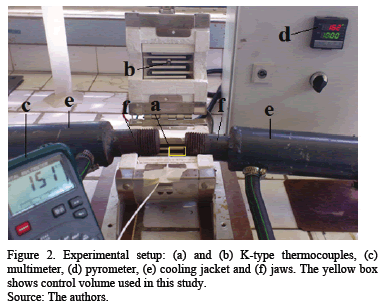
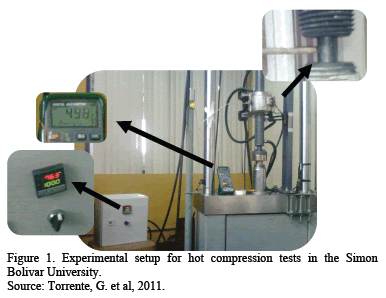
<body><![CDATA[<p><font size="2" face="Verdana, Arial, Helvetica, sans-serif">Extensive studies of hot forming processes, like rolling,   wire drawing, and extrusion show that the temperature is one of the process   variables that most affect the mechanical behavior of metals and alloys &#91;3, 4&#93;.</font></p>     <p><font size="2" face="Verdana, Arial, Helvetica, sans-serif">Hot compression test<u>s</u> can better describe the   mechanical behavior of metals and alloys during hot forming operations &#91;4&#93;.   This has increased the interest in the study of these tests, for example, those   made by Kolmogorov &#91;5&#93; in 1937 and Lutton and Sellar &#91;6&#93; in 1969,   and more recently those by Cabrera <i>et al</i>. &#91;7&#93; in 1997, Garcia <i>et al</i>.   &#91;8&#93; in 2001, Omar <i>et al</i>. &#91;9&#93; in 2006 and Torrente <i>et al</i>.   &#91;2&#93; in 2011. As a result of their studies, they all agree that temperature   plays an important role in the mechanical behavior of hot formed materials;   therefore, it is  of interest to understand   the thermal behavior inside furnaces used in hot compression tests. This test   involves compressing a sample or metallic specimen between the flat faces of   two jaws subjected to a test press. During compression, both the specimen and   the uncooled portion of the length the jaws, are   inside of tube furnace. To perform the test at high temperatures, the furnace   is turned so that the sample reaches the desired temperature, but there are   discrepancies between the furnace temperature and that of the specimen, making   it difficult to establish a value for the temperature when evaluating the   behavior of the compressed   metal. Therefore, it is important to use numerical simulation to   establish and to predict the variation of the temperature inside the furnace,   particularly in the region between the jaws. <a href="#fig01">Fig. 1</a> shows the experimental   setup for hot compression tests in the mechanical properties laboratory of the   Simon Bolivar University &#91;2,10&#93;.</font></p>     <p align="center"><font size="2" face="Verdana, Arial, Helvetica, sans-serif"><a name="fig01"></a></font><img src="/img/revistas/dyna/v81n186/v81n186a31fig01.gif"></p>     <p><font size="2" face="Verdana, Arial, Helvetica, sans-serif">The study of the temperature profiles inside furnaces has   been of interest since they began to be used in the Roman era, but only   recently, with the popularization of computers, it has been possible to   simulate numerically these profiles. Thesis and articles have developed several   numerical simulations to clarify thermal profiles in different furnaces, such   as the studies presented by Zhaoa <i>et al</i>. &#91;11&#93;, Paulsen <i>et al.</i> &#91;12&#93;, Ahanj <i>et al</i>.   &#91;13&#93;, Cawley <i>et al.</i> &#91;14&#93;, and Obregon <i>et al.</i> &#91;15&#93; and the theses of   Gomez &#91;16&#93;, Lee &#91;17&#93; and Courtin &#91;18&#93;. These works developed numerical and experimental   studies on different types of natural convection furnaces used for various   applications, none of them used for compression tests. The main difference is   that in&nbsp;the present work, refrigerated jaws enter the furnace, modifying   the temperature profile inside it. This paper presents a preliminary numerical   analysis which aims to study the effect of the distance between the jaws in the   temperature distribution inside an electric resistance tube furnace for   compression tests. The results are compared with some experimental measurements   to validate their approach.</font></p>     <p>&nbsp;</p>     <p><font size="3" face="Verdana, Arial, Helvetica, sans-serif"><b>2.  Experimental measurements</b></font></p>     <p><font size="2" face="Verdana, Arial, Helvetica, sans-serif">Equipment for performing hot compression tests is shown in <a href="#fig01">Fig. 1</a> and the experimental setup to measure the temperature, at different   points in the furnace for hot compression tests, is shown in <a href="#fig02">Fig. 2</a>.</font></p>     <p align="center"><font size="2" face="Verdana, Arial, Helvetica, sans-serif"><a name="fig02"></a></font><img src="/img/revistas/dyna/v81n186/v81n186a31fig02.gif"></p>     <p><font size="2" face="Verdana, Arial, Helvetica, sans-serif">The experimental setup in <a href="#fig02">Fig. 2</a> shows an electric   resistance furnace ATS ® 2961, with a cylindrical body of 25 mm internal radius   (R) and 80 mm length (L), whose temperature profile is desired to be   established in this work. Also, it shows a detail of the opened furnace and the   jaws inside it; these last are solid cylinders of steel AISI H-30 of </font></p>     <p><font size="2" face="Verdana, Arial, Helvetica, sans-serif">15 mm radius and 200 mm length and are used in order to   compress metallic samples. These jaws are cooled in order to maintain the   temperature in the load cell within its operating range. Therefore, each jaw   has a jacketed section of 150 mm length refrigerated with ethylene glycol (<a href="#fig02">Fig.   2</a>-e) and a non-jacketed section of 50 mm length (<a href="#fig02">Fig. 2</a>-f); the last section   has a radius of 15 mm which can be introduced inside the furnace.</font></p>     ]]></body>
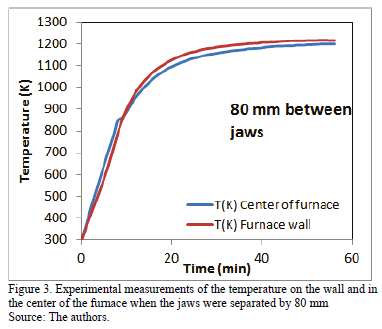
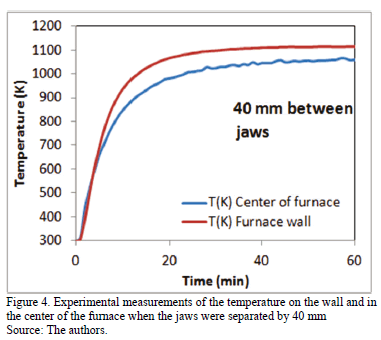
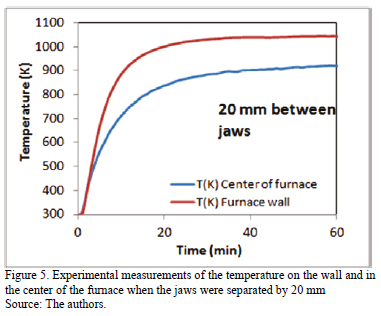
<body><![CDATA[<p><font size="2" face="Verdana, Arial, Helvetica, sans-serif">Experimental temperature measurements were carried out at   two points inside the furnace: in the center of the furnace (<a href="#fig02">Fig. 2</a>-a) and on   furnace wall (<a href="#fig02">Fig. 2</a>-b) with a type K Thermocouple, recording the temperature   of the furnace center with a multimeter MASTECH ® MAS-345 (<a href="#fig02">Fig. 2</a>-c), and on   the furnace wall with a pyrometer TAIE ® FY400 (<a href="#fig02">Fig. 2</a>-d).</font></p>     <p><font size="2" face="Verdana, Arial, Helvetica, sans-serif">The Saws areare centered   inside the furnace in order to perform the temperature measurements (<a href="#fig02">Fig. 2</a>-f)   with specific separations between them of 80, 60, 40, 20 and 0 mm. Once   centered, the furnace is closed and the temperature is set to 1273 K. Then the   registration of temperatures is carried out with the multimeter and the   pyrometer (<a href="#fig02">Figs. 2</a>-a and <a href="#fig02">2</a>-d, respectively) for the necessary time until they   stabilize at a value. The ambient temperature and that registered at the   beginning of the test were both 298 K. Forty measurements were recorded of the   temperature in the center and on the furnace wall, for each distance between   the jaws, performing each experiment in triplicate.</font></p>     <p><font size="2" face="Verdana, Arial, Helvetica, sans-serif">The graphs in <a href="#fig03">Figs. 3</a> to <a href="#fig05">5</a> illustrate some of the curves   obtained from experimental temperature measurements made in the center and on   the furnace wall when the jaws were separated from each other a distance of 80   mm, 40 mm and 20 mm, respectively. In all of them it is observed a similar   behavior, with a rapid rise in temperature to reach the steady state. </font></p>     <p><font size="2" face="Verdana, Arial, Helvetica, sans-serif"><a href="#fig03">Fig. 3</a> shows the results of the tests when the jaws were   80 mm apart. This figure shows the temperature values in the center and on the   furnace wall are similar during heating, the temperature on the furnace wall   was only 15 degrees higher.</font></p>     <p align="center"><font size="2" face="Verdana, Arial, Helvetica, sans-serif"><a name="fig03"></a></font><img src="/img/revistas/dyna/v81n186/v81n186a31fig03.gif"></p>     <p><font size="2" face="Verdana, Arial, Helvetica, sans-serif"><a href="#fig04">Figs. 4</a> and <a href="#fig05">5</a>, show that the difference in temperature   between the center and the furnace wall increases and that this difference   increases as the jaws move closer. For the curves in <a href="#fig04">Fig. 4</a>, the temperature of   the furnace wall is 58 K higher than the temperature in the center, while for <a href="#fig05">Fig. 5</a> this difference increases to 118 K. </font></p>     <p align="center"><font size="2" face="Verdana, Arial, Helvetica, sans-serif"><a name="fig04"></a></font><img src="/img/revistas/dyna/v81n186/v81n186a31fig04.gif"></p>     <p align="center"><font size="2" face="Verdana, Arial, Helvetica, sans-serif"><a name="fig05"></a></font><img src="/img/revistas/dyna/v81n186/v81n186a31fig05.gif"></p>     <p><font size="2" face="Verdana, Arial, Helvetica, sans-serif">All of the experimental measurements (<a href="#fig03">Figs. 3</a>, <a href="#fig04">4</a> and <a href="#fig05">5</a>)   show that at the beginning of the test, the temperature in the center of the   furnace is slightly higher than that of the wall. Later on, the temperature on   the wall is higher than in the center, and this remains so, even in steady   state. This interesting unsteady behavior was not studied numerically, but is   worth noticing that it is possibly due to heat transfer to the still cold wall   of the furnace being greater than the heat transfer toward the center of the   furnace. </font></p>     <p>&nbsp;</p>     ]]></body>
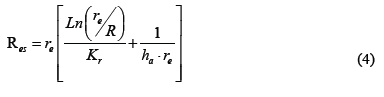
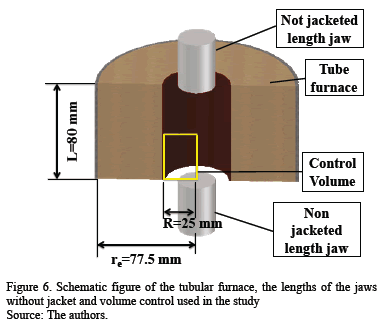
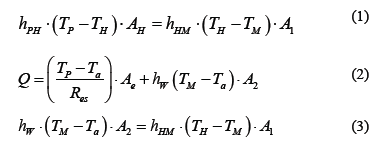
<body><![CDATA[<p><font size="3" face="Verdana, Arial, Helvetica, sans-serif"><b>3.  Governing   equations </b></font></p>     <p><font size="2" face="Verdana, Arial, Helvetica, sans-serif">The finite difference method is used to perform the   simulation of the temperature profile, using equations of heat transfer. The   simulation was carried out in a control volume of cylindrical geometry, defined   by the inner walls of the furnace and half the distance between the jaws   (yellow box, <a href="#fig02">Figs. 2</a> and <a href="#fig06">6</a>). The <a href="#fig06">Figs. 3</a>, <a href="#fig04">4</a>, and <a href="#fig05">5</a> show that at steady state,   after 40 minutes, the distance between the jaws changes the temperature in the   center and in the wall of the furnace. In order to clarify how changes the   temperature profile inside the furnace with the distance between the jaws, we   proposed a numerical simulation. To do this, we used equations to evaluate the   values of temperature inside the furnace.</font></p>     <p align="center"><font size="2" face="Verdana, Arial, Helvetica, sans-serif"><a name="fig06"></a></font><img src="/img/revistas/dyna/v81n186/v81n186a31fig06.gif"></p>     <p><font size="2" face="Verdana, Arial, Helvetica, sans-serif"><b>3.1.  Heat Balance</b>    <br>   </font><font size="2" face="Verdana, Arial, Helvetica, sans-serif">To determine the temperatures on the boundary of the   furnace, we assumed that: 1) the furnace has reached steady state, 2) the   interaction of the system with the environment is closed, 3) the temperature of   the furnace wall is uniform, and 4) the&nbsp;environment&nbsp;is a heat   reservoir, and its temperature is ambient. The temperatures of the furnace wall <i>T<sub>P</sub></i>, the average temperature in the furnace <i>T<sub>H</sub></i>,   and the jaws temperature <i>T<sub>M</sub></i>, were determined according to the   eq. (1)-(3). </font></p>     <p><img src="/img/revistas/dyna/v81n186/v81n186a31eq0103.gif"></p>     <p><font size="2" face="Verdana, Arial, Helvetica, sans-serif">Eq. (1) means that the heat transmitted from the inner   walls of the furnace toward its center, escapes through the jaws.</font></p>     <p><font size="2" face="Verdana, Arial, Helvetica, sans-serif">In Eq. (2) heat generated by the resistance of the furnace   travels to the environment by the outer walls of the furnace and by the cooling   system of the jaws.</font></p>     <p><font size="2" face="Verdana, Arial, Helvetica, sans-serif">Eq. (3) means that heat transmitted to the jaws is the   same exiting the jacketed length of the jaws.</font></p>     <p><font size="2" face="Verdana, Arial, Helvetica, sans-serif">We assume that <i>Q</i> is equal to the energy consumed by the resistance (value provided by the   manufacturer and is equal to 550 watts), <i>A<sub>e</sub></i>is the equivalent area of heat loss in the furnace walls defined by <i>2pr<sub>e</sub>L</i>; the coefficient of   forced convection between the jaw and coolant is <i>h<sub>W</sub></i>and the thermal resistance of the walls of the   furnace is R<sub>es</sub>:</font></p>     ]]></body>
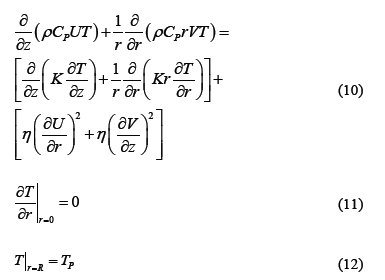
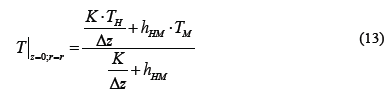
<body><![CDATA[<p><img src="/img/revistas/dyna/v81n186/v81n186a31eq04.gif"></p>     <p><font size="2" face="Verdana, Arial, Helvetica, sans-serif">R and r<sub>e</sub> are shown in <a href="#fig06">Fig. 6</a>.</font></p>     <p><font size="2" face="Verdana, Arial, Helvetica, sans-serif">To determine the coefficients of effective convection, we   assumed the same values for <i>h<sub>HM</sub></i> and <i>h<sub>PH</sub></i>, and we perform   the next iteration inside the furnace: we calculate the three temperatures, <i>T<sub>P</sub></i>, <i>T<sub>H</sub></i> and <i>T<sub>M</sub></i> with eq. (1)-(3), </font><font size="2" face="Verdana, Arial, Helvetica, sans-serif">and then the values of <i>h<sub>HM</sub></i> and <i>h<sub>PH</sub></i> were recomputed according to eq. (5)-(9) listed   below. The three temperatures were recomputed with the new values of<i> h<sub>HM</sub></i> and <i>h<sub>PH</sub></i>, until that the temperature values do not change   with further calculation.</font></p>     <p><font size="2" face="Verdana, Arial, Helvetica, sans-serif"><b>3.2.  Temperature   profile</b>    <br>   </font><font size="2" face="Verdana, Arial, Helvetica, sans-serif">After determining the   temperatures on the jaws and the walls of furnace, we proceeded to simulate the   temperature profile inside the furnace by means of the balance of heat, eq.   (10), and its boundary conditions, eq. (11)-(12). In this heat balance, it was   assumed that the system is closed, with axial symmetry, without variation in   the angular direction and steady state. The control volume considered is the   space confined by the inner wall of the tubular furnace and half the height   between the jaws (z = Z/2). The origin is considered to be at the center of one   of the jaws (see the yellow box in <a href="#fig02">Figs. 2</a> y <a href="#fig06">6</a>). The system of equations (eq.   10-12) is solved by finite difference, applying the algorithm of Thomas, where <i>T<sub>P</sub></i>, <i>T<sub>M</sub></i>, and <i>T<sub>H</sub></i>were already calculated with the   eq. (1)-(3) and <i>T<sub>|Z = 0</sub></i>was determined with eq. (13).</font></p>     <p><img src="/img/revistas/dyna/v81n186/v81n186a31eq0509.gif"></p>     <p><font size="2" face="Verdana, Arial, Helvetica, sans-serif"><i>K </i>is the thermal conductivity of the air inside the   furnace, according to Kreith &#91;19&#93;. </font></p>     <p><font size="2" face="Verdana, Arial, Helvetica, sans-serif">Petter et al. &#91;20&#93;, Torrent et al. &#91;21&#93; and Obregon et al. &#91;15&#93; have already used the eq.   (10), heat balance, to determine the profile of temperature of a gas confined   in a cylindrical geometry.</font></p>     <p><font size="2" face="Verdana, Arial, Helvetica, sans-serif">The values considered for the boundary conditions were:   along the axis of the furnace the temperature takes the minimum values (eq. 11)   and the temperature in the vicinity of the wall of the furnace is approximate   to the temperature on the furnace wall (eq. 12).&nbsp;</font></p>     <p><img src="/img/revistas/dyna/v81n186/v81n186a31eq1012.gif"></p>     ]]></body>
<body><![CDATA[<p><font size="2" face="Verdana, Arial, Helvetica, sans-serif">The temperature inside the furnace, when the jaws are   closed (Z = 0), was determined by the balance of eq. (13). </font></p>     <p><img src="/img/revistas/dyna/v81n186/v81n186a31eq13.gif"></p>     <p><font size="2" face="Verdana, Arial, Helvetica, sans-serif">The heat balance (eq. 10) takes into account the transfer   of heat due to velocity and temperature profiles inside furnace.</font></p>     <p><font size="2" face="Verdana, Arial, Helvetica, sans-serif">The velocity profile inside the furnace was determined   using the relationship of Navier-Stokes (eq. 14) in cylindrical coordinates,   the state equation of an ideal gas and as a boundary condition it was assumed   that the velocity is zero at the walls of the furnace, and it presents a   maximum on the axis. This boundary condition has been used by Torrente <i>et al</i>. &#91;2&#93; and Cuadrado <i>et al.</i> &#91;26&#93;.</font></p>     <p><img src="/img/revistas/dyna/v81n186/v81n186a31eq14.gif"></p>     <p><font size="2" face="Verdana, Arial, Helvetica, sans-serif">The value considered for viscosity, h, in the   equations (10) and 14, is 0.0000175 &#91;g/mm*s&#93;.</font></p>     <p><font size="2" face="Verdana, Arial, Helvetica, sans-serif">The Navier-Stokes   Equation (eq. 14) has been used to determine velocity in free convection   furnaces, for example, in research conducted by Gomez et al. &#91;16&#93;, Courtin et   al. &#91;18&#93;, Lee et al.   &#91;17&#93;, Cawley et al. &#91;14&#93;, and   Obreg&oacute;n et al. &#91;15&#93; .</font></p>     <p><font size="2" face="Verdana, Arial, Helvetica, sans-serif">To solve the differential equation (eq. 14) we used the   finite difference method and with the state equation of ideal gas and its   boundary condition, we obtained three tridiagonal matrices. These three   tridiagonal matrices were resolved simultaneously with the Thomas Algorithm to   obtain the three components of the velocity profile.</font></p>     <p>&nbsp;</p>     <p><font size="3" face="Verdana, Arial, Helvetica, sans-serif"><b>4.  Simulation   results </b></font></p>     ]]></body>
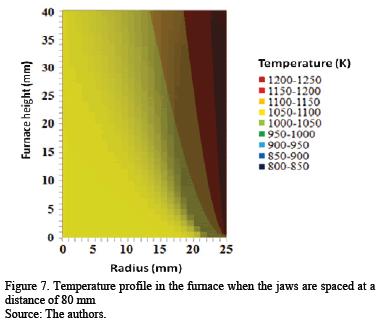
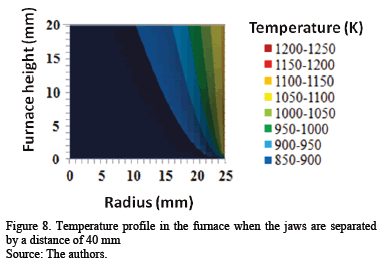
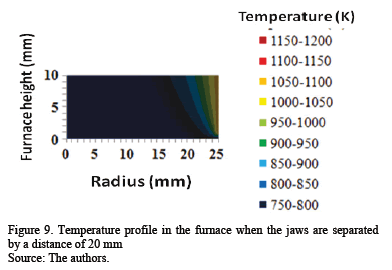
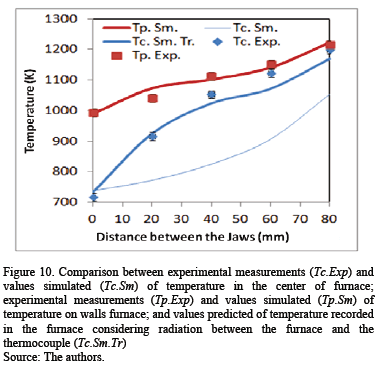
<body><![CDATA[<p><font size="2" face="Verdana, Arial, Helvetica, sans-serif">The results of the simulation in <a href="#fig07">Figs. 7</a>, <a href="#fig08">8</a> and <a href="#fig09">9</a> show   that the temperature inside the furnace is not uniform, being colder near the   refrigerated jaws (height = 0 mm) and at the axis of the furnace (radius=0 mm)   and warmer near the walls of the furnace (radius=25 mm).</font></p>     <p align="center"><font size="2" face="Verdana, Arial, Helvetica, sans-serif"><a name="fig07"></a></font><img src="/img/revistas/dyna/v81n186/v81n186a31fig07.gif"></p>     <p align="center"><font size="2" face="Verdana, Arial, Helvetica, sans-serif"><a name="fig08"></a></font><img src="/img/revistas/dyna/v81n186/v81n186a31fig08.gif"></p>     <p align="center"><font size="2" face="Verdana, Arial, Helvetica, sans-serif"><a name="fig09"></a></font><img src="/img/revistas/dyna/v81n186/v81n186a31fig09.gif"></p>     <p><font size="2" face="Verdana, Arial, Helvetica, sans-serif"><a href="#fig07">Fig. 7</a> shows that the highest temperature of the furnace   is recorded at a height of 40 mm and a radius of 25 mm, just right on the inner   wall of the furnace. This same figure also shows that at a height of 40 mm,   right in the middle of the two jaws, there is a difference in temperature of   119 K between the center (around 1113 K) and the wall of the furnace   (approximately 1232 K); in the vicinity of the jaws it is observed that the   difference in temperature between the same points is similar. The difference   observed between the furnace inner walls toward its interior becomes more   abrupt in the vicinity of the jaws (height = 0 mm), because the temperature on   walls of the furnace was assumed to be constant and the jaws are refrigerated.</font></p>     <p><font size="2" face="Verdana, Arial, Helvetica, sans-serif">When the jaws move towards the inner of the furnace, the   temperature inside it decreases as might be expected, since a cooled body is   being introduced inside the furnace (<a href="#fig08">Figs. 8</a> and 9).</font></p>     <p><font size="2" face="Verdana, Arial, Helvetica, sans-serif">Another feature that can be seen by comparing <a href="#fig08">Figs. 8</a> and <a href="#fig09">9</a> with Fig. <a href="#fig07">7</a>, is that as the jaws advance towards the inside of the furnace,   the difference in temperature between the furnace wall and the center   increases, from a difference of 119 K, with 80 mm clearance between the jaws,   to 350 K and 400 K, for 40 mm and 20 mm of separation, respectively; this is   also appreciated in experimental measurements, although in lesser magnitude   (see <a href="#fig03">Figs. 3</a>, <a href="#fig04">4</a> and <a href="#fig05">5</a>). This discrepancy is because the simulation determines   the temperature of the furnace and not the temperature measured by the   thermocouple, for which the heating by radiation experimented by the   thermocouple must be considered; this correction can be seen in eq. (15).</font></p>     <p><font size="2" face="Verdana, Arial, Helvetica, sans-serif">Boundary conditions similar to those used in this work,   were used by Paulsen <i>et al</i>. &#91;12&#93; in   their investigation, in which the temperature of the wall of the heating   cylinder was 100°C and the temperature the gas at the entrance of the heating   cylinder was at room temperature. It is worth noting that their heating system   was used for a different function, as an organic particle nebulizer. Without   neglecting the differences in the magnitudes of temperature between the work of   Paulsen <i>et al.</i> &#91;12&#93; and this study,   the behavior of temperature profiles determined in both studies (<a href="#fig07">Figs. 7</a>, <a href="#fig08">8</a> and <a href="#fig09">9</a>) are very similar.&nbsp;</font></p>     <p><font size="2" face="Verdana, Arial, Helvetica, sans-serif">Hipolito &#91;22&#93; in his thesis also presented two-dimensional   temperature profiles, this time for a cylindrical furnace used in pyrolysis for   biomasses. The behavior of the temperature profile in his work is also similar   to those obtained in this work, with the difference that the furnace of   Hipolito &#91;22&#93; was considered opened, with a slight current of ambient   temperature air entering the furnace. His conclusions are consistent with the   results obtained in this work: as it moving away from the ends of the furnace,   the decrease of the temperature in the radial direction is less abrupt.   Hipolito &#91;22&#93; determined these profiles using ANSYS FLUENT CFD®. In this work   the simulation was conducted in finite difference, generating the mesh with the   Thomas algorithm and using Visual Basic.</font></p>     <p>&nbsp;</p>     ]]></body>
<body><![CDATA[<p><b><font size="3" face="Verdana, Arial, Helvetica, sans-serif">5.  Experimental   comparisons</font></b></p>     <p><font size="2" face="Verdana, Arial, Helvetica, sans-serif">To compare the simulated values of temperature inside the   furnace with those measured experimentally, it was necessary to estimate the   temperature that the thermocouple should have registered, <i>T<sub>Tr</sub></i> (<i>Tc.Sm.Tr</i> in <a href="#fig10">Fig. 10</a>), due to radiation between the furnace and the thermocouple,   with <i>T<sub>c</sub>= T<sub>|z=L/2, r=0</sub></i>, from eq. (15)   &#91;19&#93;.</font></p>     <p align="center"><font size="2" face="Verdana, Arial, Helvetica, sans-serif"><a name="fig10"></a></font><img src="/img/revistas/dyna/v81n186/v81n186a31fig10.gif"></p>     <p><img src="/img/revistas/dyna/v81n186/v81n186a31eq15.gif"></p>     <p><font size="2" face="Verdana, Arial, Helvetica, sans-serif">The value considered for emissivity, <i>e</i>, in the eq. (15),   is 0.7. This value for oxidized steel is between 0.6 and 0.95 &#91;24&#93;</font></p>     <p><font size="2" face="Verdana, Arial, Helvetica, sans-serif">The simulated values of the temperature in the center of   furnace (<i>Tc.Sm) </i>were compared with the corrected values of temperature (<i>T<sub>Tr</sub></i> in eq. 15) that should be   recorded by the thermocouple (<i>Tc.Sm.Tr</i>)   and those measured experimentally (<i>Tc.Exp</i>).   These values are presented in <a href="#fig10">Fig. 10</a>.</font></p>     <p><font size="2" face="Verdana, Arial, Helvetica, sans-serif">It is important to   note that theoretically the temperature in the center of the furnace (<i>T|<sub>z=L/2;r=0</sub>=Tc.Sm.</i>) is not the same that can   be registered with a thermocouple (<i>Tc.Sm.Tr</i>), and this difference   increases with the separation between jaws. This difference is minor when the   jaws are in the center of the furnace (see <a href="#fig10">Fig. 10</a>).  The differences between the simulated values   and the experimental measurements of temperatures inside the furnace were   expected, because in the simulation we calculated only the temperature of the   air inside the furnace (<i>T</i> in eq. 10).   However, the thermocouple inside the furnace is heated by radiation from the   electric resistance at the furnace wall, therefore, the temperature of the   thermocouple is higher than the air inside the furnace, (eq. 15).</font></p>     <p><font size="2" face="Verdana, Arial, Helvetica, sans-serif"><a href="#fig10">Fig. 10</a> shows that the difference between the temperatures   simulated in the center (<i>Tc.Sm) </i>and on the wall (<i>Tp.Sm.) </i>of the furnace is greater when the   jaws are separated from each other.  </font></p>     <p><font size="2" face="Verdana, Arial, Helvetica, sans-serif">The temperature values obtained from the simulation are   close to experimental measurements (see <a href="#fig10">Fig. 10</a>), taking into account the   assumptions that were used to simplify calculations in the simulation: steady   state, closed system, continuous power of 550 Watts to the resistance, and that   the temperature of the jaws and the coefficient of effective convection are   uniform.</font></p>     <p><font size="2" face="Verdana, Arial, Helvetica, sans-serif">When comparing the values of temperature of the furnace   wall measured experimentally (<i>Tp.Exp.</i> <a href="#fig10">Fig. 10</a>) with those obtained theoretically in the simulation (<i>Tp.Sm.</i> <a href="#fig10">Fig. 10</a>), it can be seen that   only at a point, at 20 mm separation between the jaws, the results of the   simulation are 33.11 K above the value measured experimentally, which   represents an error of 3.18%; in all other cases, the simulation results   predict satisfactorily the experimental values.</font></p>     ]]></body>
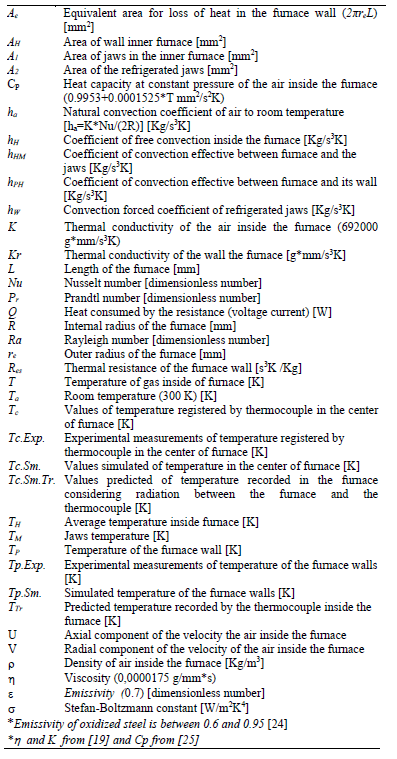
<body><![CDATA[<p><font size="2" face="Verdana, Arial, Helvetica, sans-serif">In the case of temperatures in the center of the furnace,   the prediction of the simulations, when radiation between the furnace and the   thermocouple is considered, is satisfactory up to 40 mm separation of the jaws,   from there, the difference between the experimental and simulated values (which   the thermocouple should register) increases. Over 40 mm of clearance between   the jaws, the maximum discrepancy was found to be as 60 mm of separation, the   temperature recorded experimentally (<i>Tc.Exp</i>. <a href="#fig10">Fig. 10</a>) being 50.76 K greater than what the thermocouple should register (<i>Tc.Sm.Tr</i> <a href="#fig10">Fig. 10</a>), which is equivalent   to a maximum error of 4.73%.</font></p>     <p><font size="2" face="Verdana, Arial, Helvetica, sans-serif">Based on these results, the proposed simulation could be a   useful tool to predict, with an acceptable approximation, the temperature of   compression test specimens up to 40 mm length and diameters smaller to 26.67   mm, according to the standard ASTM E209 &#91;23&#93;.</font></p>     <p>&nbsp;</p>     <p><font size="3" face="Verdana, Arial, Helvetica, sans-serif"><b>6.  Conclusions</b></font></p>     <p><font size="2" face="Verdana, Arial, Helvetica, sans-serif">In the heating system for hot compression testing, jaws   should be refrigerated in order to maintain the temperature in the load cell   within its operating range. This produces heat loss by the jaws and makes the   values of temperature in their vicinity lower than in the rest of the furnace.   This behavior generates a peculiar temperature profile inside the furnace, the   temperature being lower in the center than on the walls. When the jaws are   farther from the center of the furnace, the temperature in its interior will be   greater and the decrease in temperature in the radial direction will be less.</font></p>     <p><font size="2" face="Verdana, Arial, Helvetica, sans-serif">The simulation that is proposed in this paper represents a   useful tool which can be used to estimate, with an acceptable approximation   (less than the 4.73% error), the temperature inside the furnace during hot   compression tests.&nbsp;</font></p>     <p>&nbsp;</p>     <p><font face="Verdana, Arial, Helvetica, sans-serif"><b><font size="3">Nomenclature</font></b></font></p>     <p><img src="/img/revistas/dyna/v81n186/v81n186a31nom01.gif"></p>     <p>&nbsp;</p>     ]]></body>
<body><![CDATA[<p><font size="3" face="Verdana, Arial, Helvetica, sans-serif"><b>Acknowledgment&nbsp;</b></font></p>     <p><font size="2" face="Verdana, Arial, Helvetica, sans-serif">The authors would like to thank the Dean of Research and   Development of the Universidad Simon Bolivar (DID), the Laboratory E, Eng. Luis Sanoja and Prof. Armando Blanco.</font></p>     <p>&nbsp;</p>     <p><font size="3" face="Verdana, Arial, Helvetica, sans-serif"><b>References</b></font></p>     <!-- ref --><p><font size="2" face="Verdana, Arial, Helvetica, sans-serif"><b>&#91;1&#93;</b> Kalpakjian, S. y Schimd S. R., Manufactura, ingenier&iacute;a y tecnolog&iacute;a, Mexico, Pearson Educaci&oacute;n, 2008.    &nbsp;&nbsp;&nbsp;&nbsp;&nbsp;&nbsp;&nbsp;&nbsp;[&#160;<a href="javascript:void(0);" onclick="javascript: window.open('/scielo.php?script=sci_nlinks&ref=000107&pid=S0012-7353201400040003100001&lng=','','width=640,height=500,resizable=yes,scrollbars=1,menubar=yes,');">Links</a>&#160;]<!-- end-ref --></font></p>     <!-- ref --><p><font size="2" face="Verdana, Arial, Helvetica, sans-serif"><b>&#91;2&#93;</b> Torrente,   G., Torres, M. y Sanoja, L., Efecto de la velocidad de deformaci&oacute;n en la recristalizaci&oacute;n   dinamica de un cobre ETP durante su compresi&oacute;n en caliente con temperatura   descendente, Rev. Metal. Madrid., 47 (6), pp 485-496, 2011.    &nbsp;&nbsp;&nbsp;&nbsp;&nbsp;&nbsp;&nbsp;&nbsp;[&#160;<a href="javascript:void(0);" onclick="javascript: window.open('/scielo.php?script=sci_nlinks&ref=000109&pid=S0012-7353201400040003100002&lng=','','width=640,height=500,resizable=yes,scrollbars=1,menubar=yes,');">Links</a>&#160;]<!-- end-ref --></font></p>     <!-- ref --><p><font size="2" face="Verdana, Arial, Helvetica, sans-serif"><b>&#91;3&#93;</b> Wang,   Y., Zhou, Y. and Xia, Y., A constitutive description of   tensile behavior for brass over a wide range of strain rates. Mater. Sci.   Eng. A., 372, pp. 186-190, 2004.    &nbsp;&nbsp;&nbsp;&nbsp;&nbsp;&nbsp;&nbsp;&nbsp;[&#160;<a href="javascript:void(0);" onclick="javascript: window.open('/scielo.php?script=sci_nlinks&ref=000111&pid=S0012-7353201400040003100003&lng=','','width=640,height=500,resizable=yes,scrollbars=1,menubar=yes,');">Links</a>&#160;]<!-- end-ref --></font></p>     ]]></body>
<body><![CDATA[<!-- ref --><p><font size="2" face="Verdana, Arial, Helvetica, sans-serif"><b>&#91;4&#93;</b> Jin,   N., Zhang, H., Han, Y., Wu, W., and Chen, J., Hot deformation behavior of 7150 aluminum alloy   during compression at elevated temperature, Mater. Charact., 60, pp. 530-536, 2009.    &nbsp;&nbsp;&nbsp;&nbsp;&nbsp;&nbsp;&nbsp;&nbsp;[&#160;<a href="javascript:void(0);" onclick="javascript: window.open('/scielo.php?script=sci_nlinks&ref=000113&pid=S0012-7353201400040003100004&lng=','','width=640,height=500,resizable=yes,scrollbars=1,menubar=yes,');">Links</a>&#160;]<!-- end-ref --></font></p>     <!-- ref --><p><font size="2" face="Verdana, Arial, Helvetica, sans-serif"><b>&#91;5&#93;</b> Kolmogorov, A., A statistical theory for the recrystallisation of metals, Izv Akad Nauk SSSR, Ser.   Matem., 3, pp. 355-359, 1937.    &nbsp;&nbsp;&nbsp;&nbsp;&nbsp;&nbsp;&nbsp;&nbsp;[&#160;<a href="javascript:void(0);" onclick="javascript: window.open('/scielo.php?script=sci_nlinks&ref=000115&pid=S0012-7353201400040003100005&lng=','','width=640,height=500,resizable=yes,scrollbars=1,menubar=yes,');">Links</a>&#160;]<!-- end-ref --></font></p>     <!-- ref --><p><font size="2" face="Verdana, Arial, Helvetica, sans-serif"><b>&#91;6&#93;</b> Luton, M. and Sellar, C., Dynamic recrystallization in nickel and nickel-iron   alloys during high temperature deformation, Acta. Metall., 17, pp. 1033-1043, 1969.    &nbsp;&nbsp;&nbsp;&nbsp;&nbsp;&nbsp;&nbsp;&nbsp;[&#160;<a href="javascript:void(0);" onclick="javascript: window.open('/scielo.php?script=sci_nlinks&ref=000117&pid=S0012-7353201400040003100006&lng=','','width=640,height=500,resizable=yes,scrollbars=1,menubar=yes,');">Links</a>&#160;]<!-- end-ref --></font></p>     <!-- ref --><p><font size="2" face="Verdana, Arial, Helvetica, sans-serif"><b>&#91;7&#93;</b> Cabrera, J. M., Omar, A. y Prack, J., Simulaci&oacute;n de la fluencia en caliente de un acero microaleado con un   contenido medio de carbono. II parte. Recristalizaci&oacute;n din&aacute;mica: Inicio y   cin&eacute;tica, Rev. Metal. Madrid, 33, (3), pp. 143-152, 1997.    &nbsp;&nbsp;&nbsp;&nbsp;&nbsp;&nbsp;&nbsp;&nbsp;[&#160;<a href="javascript:void(0);" onclick="javascript: window.open('/scielo.php?script=sci_nlinks&ref=000119&pid=S0012-7353201400040003100007&lng=','','width=640,height=500,resizable=yes,scrollbars=1,menubar=yes,');">Links</a>&#160;]<!-- end-ref --></font></p>     <!-- ref --><p><font size="2" face="Verdana, Arial, Helvetica, sans-serif"><b>&#91;8&#93;</b> Garc&iacute;a, V., Wahabi, M., Cabrera, J.M., Riera, L. y   Prado, J. M., Modelizaci&oacute;n   de la deformaci&oacute;n en caliente de un cobre puro comercial, Rev. Metal. Madrid, 37, 2001, pp. 177-183.    &nbsp;&nbsp;&nbsp;&nbsp;&nbsp;&nbsp;&nbsp;&nbsp;[&#160;<a href="javascript:void(0);" onclick="javascript: window.open('/scielo.php?script=sci_nlinks&ref=000121&pid=S0012-7353201400040003100008&lng=','','width=640,height=500,resizable=yes,scrollbars=1,menubar=yes,');">Links</a>&#160;]<!-- end-ref --></font></p>     ]]></body>
<body><![CDATA[<!-- ref --><p><font size="2" face="Verdana, Arial, Helvetica, sans-serif"><b>&#91;9&#93;</b> Omar, A.,   Chenaoui, A., Dkiouak, R. y Prado, J. M., Aproximaci&oacute;n al control de la microestructura   de dos aceros microaleados con contenido medio de carbono en condiciones de   conformado en caliente, Rev. Metal. Madrid,   42, pp. 103-113, 2006.    &nbsp;&nbsp;&nbsp;&nbsp;&nbsp;&nbsp;&nbsp;&nbsp;[&#160;<a href="javascript:void(0);" onclick="javascript: window.open('/scielo.php?script=sci_nlinks&ref=000123&pid=S0012-7353201400040003100009&lng=','','width=640,height=500,resizable=yes,scrollbars=1,menubar=yes,');">Links</a>&#160;]<!-- end-ref --></font></p>     <!-- ref --><p><font size="2" face="Verdana, Arial, Helvetica, sans-serif"><b>&#91;10&#93;</b> Sanoja, L., Estudio experimental de la recristalizaci&oacute;n din&aacute;mica   del cobre durante compresi&oacute;n en caliente, Tesis, Departamento   de Ciencia de los Materiales, Universidad Sim&oacute;n Bol&iacute;var, 2011.    &nbsp;&nbsp;&nbsp;&nbsp;&nbsp;&nbsp;&nbsp;&nbsp;[&#160;<a href="javascript:void(0);" onclick="javascript: window.open('/scielo.php?script=sci_nlinks&ref=000125&pid=S0012-7353201400040003100010&lng=','','width=640,height=500,resizable=yes,scrollbars=1,menubar=yes,');">Links</a>&#160;]<!-- end-ref --></font></p>     <!-- ref --><p><font size="2" face="Verdana, Arial, Helvetica, sans-serif"><b>&#91;11&#93;</b> Zhao, X.L., Ghojel, J., Grundy, P.   and Han, L. H., Behavior   of grouted sleeve connections at elevated temperatures, Thin-Walled Struc., 44 (7),   pp. 751-758, 2006.    &nbsp;&nbsp;&nbsp;&nbsp;&nbsp;&nbsp;&nbsp;&nbsp;[&#160;<a href="javascript:void(0);" onclick="javascript: window.open('/scielo.php?script=sci_nlinks&ref=000127&pid=S0012-7353201400040003100011&lng=','','width=640,height=500,resizable=yes,scrollbars=1,menubar=yes,');">Links</a>&#160;]<!-- end-ref --></font></p>     <!-- ref --><p><font size="2" face="Verdana, Arial, Helvetica, sans-serif"><b>&#91;12&#93;</b> Paulsen,   D., Weingartner, E., Alfarra, M.R. and Baltensperger, U.,   Volatility measurements of photochemically and nebulizer-generated organic   aerosol particles, J. Aerosol Sci., 37 (9), pp. 1025-1051, 2006.    &nbsp;&nbsp;&nbsp;&nbsp;&nbsp;&nbsp;&nbsp;&nbsp;[&#160;<a href="javascript:void(0);" onclick="javascript: window.open('/scielo.php?script=sci_nlinks&ref=000129&pid=S0012-7353201400040003100012&lng=','','width=640,height=500,resizable=yes,scrollbars=1,menubar=yes,');">Links</a>&#160;]<!-- end-ref --></font></p>     <!-- ref --><p><font size="2" face="Verdana, Arial, Helvetica, sans-serif"><b>&#91;13&#93;</b> Ahanj,   M., Rahimi, M. and Alsairafi., A., Heat   Mass Transfer, CFD   modeling of a radiant tube heater, Inter. Commun., 39 (3), pp. 432-438, 2012.    &nbsp;&nbsp;&nbsp;&nbsp;&nbsp;&nbsp;&nbsp;&nbsp;[&#160;<a href="javascript:void(0);" onclick="javascript: window.open('/scielo.php?script=sci_nlinks&ref=000131&pid=S0012-7353201400040003100013&lng=','','width=640,height=500,resizable=yes,scrollbars=1,menubar=yes,');">Links</a>&#160;]<!-- end-ref --></font></p>     ]]></body>
<body><![CDATA[<!-- ref --><p><font size="2" face="Verdana, Arial, Helvetica, sans-serif"><b>&#91;14&#93;</b> Cawley,   M. and Mcbride, P., Flow visualization of free   convection in a vertical cylinder of water in the vicinity of the density   maximum, Inter. J. Heat Mass Transfer, 47, pp. 1175-1186, 2004.    &nbsp;&nbsp;&nbsp;&nbsp;&nbsp;&nbsp;&nbsp;&nbsp;[&#160;<a href="javascript:void(0);" onclick="javascript: window.open('/scielo.php?script=sci_nlinks&ref=000133&pid=S0012-7353201400040003100014&lng=','','width=640,height=500,resizable=yes,scrollbars=1,menubar=yes,');">Links</a>&#160;]<!-- end-ref --></font></p>     <!-- ref --><p><font size="2" face="Verdana, Arial, Helvetica, sans-serif"><b>&#91;15&#93;</b> Obregon, S., Molina, V. y Salvo, N., Simulaci&oacute;n de conveccion natural en recintos cerrados, Av. Energ. Renov.   Medio Ambient., 9, pp. 885-890, 2005.    &nbsp;&nbsp;&nbsp;&nbsp;&nbsp;&nbsp;&nbsp;&nbsp;[&#160;<a href="javascript:void(0);" onclick="javascript: window.open('/scielo.php?script=sci_nlinks&ref=000135&pid=S0012-7353201400040003100015&lng=','','width=640,height=500,resizable=yes,scrollbars=1,menubar=yes,');">Links</a>&#160;]<!-- end-ref --></font></p>     <!-- ref --><p><font size="2" face="Verdana, Arial, Helvetica, sans-serif"><b>&#91;16&#93;</b> Gomez, R., Determinaci&oacute;n de un perfil de temperatura de un horno de mufla mediante   COMSOL 3.2, Tesis, Universidad Aut&oacute;noma del Estado de   Hidalgo, Mexico, 2007.    &nbsp;&nbsp;&nbsp;&nbsp;&nbsp;&nbsp;&nbsp;&nbsp;[&#160;<a href="javascript:void(0);" onclick="javascript: window.open('/scielo.php?script=sci_nlinks&ref=000137&pid=S0012-7353201400040003100016&lng=','','width=640,height=500,resizable=yes,scrollbars=1,menubar=yes,');">Links</a>&#160;]<!-- end-ref --></font></p>     <!-- ref --><p><font size="2" face="Verdana, Arial, Helvetica, sans-serif"><b>&#91;17&#93;</b> Lee,   A., Numerical investigation of the temperature   distribution in a industrial oven, Thesis, Faculty of Enginnering and Surveying, University of   Southern Queensland, Australia, 2004.    &nbsp;&nbsp;&nbsp;&nbsp;&nbsp;&nbsp;&nbsp;&nbsp;[&#160;<a href="javascript:void(0);" onclick="javascript: window.open('/scielo.php?script=sci_nlinks&ref=000139&pid=S0012-7353201400040003100017&lng=','','width=640,height=500,resizable=yes,scrollbars=1,menubar=yes,');">Links</a>&#160;]<!-- end-ref --></font></p>     <!-- ref --><p><font size="2" face="Verdana, Arial, Helvetica, sans-serif"><b>&#91;18&#93;</b> Courtin, S., Simulacion bidimencional de la conveccion natural en cavidades cuadradas   de paredes horizontales perfectamente conductoras con alto numero de rayleigh, Tesis, Facultad de Ciencias F&iacute;sicas y   Matem&aacute;ticas, Universidad de Chile, Chile, 2006.    &nbsp;&nbsp;&nbsp;&nbsp;&nbsp;&nbsp;&nbsp;&nbsp;[&#160;<a href="javascript:void(0);" onclick="javascript: window.open('/scielo.php?script=sci_nlinks&ref=000141&pid=S0012-7353201400040003100018&lng=','','width=640,height=500,resizable=yes,scrollbars=1,menubar=yes,');">Links</a>&#160;]<!-- end-ref --></font></p>     ]]></body>
<body><![CDATA[<!-- ref --><p><font size="2" face="Verdana, Arial, Helvetica, sans-serif"><b>&#91;19&#93;</b> Kreith, F., Principios de Transferencia de calor, Herrero Hermanos Sucesores   S. A., Mexico, 1970.    &nbsp;&nbsp;&nbsp;&nbsp;&nbsp;&nbsp;&nbsp;&nbsp;[&#160;<a href="javascript:void(0);" onclick="javascript: window.open('/scielo.php?script=sci_nlinks&ref=000143&pid=S0012-7353201400040003100019&lng=','','width=640,height=500,resizable=yes,scrollbars=1,menubar=yes,');">Links</a>&#160;]<!-- end-ref --></font></p>     <!-- ref --><p><font size="2" face="Verdana, Arial, Helvetica, sans-serif"><b>&#91;20&#93;</b> Kaczmarski,   K., Kostka, J., Zapat;a, W. and Guiochon, G., Modeling   of thermal processes in high pressure liquid chromatography: I. Low pressure   onset of thermal heterogeneity, J. Chromatogr. A, 1216 (38), pp. 6560-6574, 2009.    &nbsp;&nbsp;&nbsp;&nbsp;&nbsp;&nbsp;&nbsp;&nbsp;[&#160;<a href="javascript:void(0);" onclick="javascript: window.open('/scielo.php?script=sci_nlinks&ref=000145&pid=S0012-7353201400040003100020&lng=','','width=640,height=500,resizable=yes,scrollbars=1,menubar=yes,');">Links</a>&#160;]<!-- end-ref --></font></p>     <!-- ref --><p><font size="2" face="Verdana, Arial, Helvetica, sans-serif"><b>&#91;21&#93;</b> Torrente,   G., Puerta, J. and Labrador, N., Two-temperature single flow modelo of a   thermal plasma reactor in fluidized bed sisted by magnetic mirror, Phy. Scr., T131, pp. 1-5,   2008. Available at: <a href="http://iopscience.iop.org/1402-4896/2008/T131/014010/pdf/1402-4896_2008_T131_014010.pdf" target="_blank">http://iopscience.iop.org/1402-4896/2008/T131/014010/pdf/1402-4896_2008_T131_014010.pdf</a></font>&nbsp;&nbsp;&nbsp;&nbsp;&nbsp;&nbsp;&nbsp;&nbsp;[&#160;<a href="javascript:void(0);" onclick="javascript: window.open('/scielo.php?script=sci_nlinks&ref=000147&pid=S0012-7353201400040003100021&lng=','','width=640,height=500,resizable=yes,scrollbars=1,menubar=yes,');">Links</a>&#160;]<!-- end-ref --><!-- ref --><p><font size="2" face="Verdana, Arial, Helvetica, sans-serif"><b>&#91;22&#93;</b> Hip&oacute;lito, H., Caracterizaci&oacute;n y   modeloamiento del perfil de temperatura al interior de un horno de pirolisis   para biomasa, Tesis, Facultad de Minas,Universidad Nacional de Colombia, Sede   Medellin, Colombia, 2009.    &nbsp;&nbsp;&nbsp;&nbsp;&nbsp;&nbsp;&nbsp;&nbsp;[&#160;<a href="javascript:void(0);" onclick="javascript: window.open('/scielo.php?script=sci_nlinks&ref=000148&pid=S0012-7353201400040003100022&lng=','','width=640,height=500,resizable=yes,scrollbars=1,menubar=yes,');">Links</a>&#160;]<!-- end-ref --></font></p>     <!-- ref --><p><font size="2" face="Verdana, Arial, Helvetica, sans-serif"><b>&#91;23&#93;</b> ASTM, Standard E-209-00, Standard practice for compression tests of   metallic materials at elevated temperatures with conventional or rapid heating   rates and strain rates, 03.01, ASTM International, 2010.    &nbsp;&nbsp;&nbsp;&nbsp;&nbsp;&nbsp;&nbsp;&nbsp;[&#160;<a href="javascript:void(0);" onclick="javascript: window.open('/scielo.php?script=sci_nlinks&ref=000150&pid=S0012-7353201400040003100023&lng=','','width=640,height=500,resizable=yes,scrollbars=1,menubar=yes,');">Links</a>&#160;]<!-- end-ref --></font></p>     <!-- ref --><p><font size="2" face="Verdana, Arial, Helvetica, sans-serif"><b>&#91;24&#93;</b> RAYTEC, Emissivity values for metals &#91;view,   02/04/2014&#93;. Available at: <a href="http://www.raytek.com/Raytek/enr0/IREducation/EmissivityTableMetals.htm" target="_blank">http://www.raytek.com/Raytek/enr0/IREducation/EmissivityTableMetals.htm</a> </font>&nbsp;&nbsp;&nbsp;&nbsp;&nbsp;&nbsp;&nbsp;&nbsp;[&#160;<a href="javascript:void(0);" onclick="javascript: window.open('/scielo.php?script=sci_nlinks&ref=000152&pid=S0012-7353201400040003100024&lng=','','width=640,height=500,resizable=yes,scrollbars=1,menubar=yes,');">Links</a>&#160;]<!-- end-ref --><!-- ref --><p><font size="2" face="Verdana, Arial, Helvetica, sans-serif"><b>&#91;25&#93;</b> DeHoff,   R, Thermodynamics in materials science, Second Edition, Taylor and Francis Group, 2006.    &nbsp;&nbsp;&nbsp;&nbsp;&nbsp;&nbsp;&nbsp;&nbsp;[&#160;<a href="javascript:void(0);" onclick="javascript: window.open('/scielo.php?script=sci_nlinks&ref=000153&pid=S0012-7353201400040003100025&lng=','','width=640,height=500,resizable=yes,scrollbars=1,menubar=yes,');">Links</a>&#160;]<!-- end-ref --></font></p>     <!-- ref --><p><font size="2" face="Verdana, Arial, Helvetica, sans-serif"><b>&#91;26&#93;</b> Cuadrado, I., Cadavid, F., Agudelo, J. y S&aacute;nchez,   C., Modelado de flujo compresible unidimensional y homoentropico por el m&eacute;todo   de vol&uacute;menes finitos, DYNA, 75 (155), pp. 199-210, 2008</font>&nbsp;&nbsp;&nbsp;&nbsp;&nbsp;&nbsp;&nbsp;&nbsp;[&#160;<a href="javascript:void(0);" onclick="javascript: window.open('/scielo.php?script=sci_nlinks&ref=000155&pid=S0012-7353201400040003100026&lng=','','width=640,height=500,resizable=yes,scrollbars=1,menubar=yes,');">Links</a>&#160;]<!-- end-ref --><p>&nbsp;</p>     <p><font size="2" face="Verdana, Arial, Helvetica, sans-serif"><b>G. J.   Torrente-Prato,</b> received the Bs. Eng in Material Engineering in 2000, the   MSc degree in Material Engineering in 2004, and the PhD degree in Engineering   in 2009, all of them from the Universidad Simon Bolivar. Caracas, Venezuela. He   is Professor in the Mechanical Department, Universidad Sim&oacute;n Bol&iacute;var. His   research interests include: simulation and modeling of fluids and solids. </font></p>     <p><font size="2" face="Verdana, Arial, Helvetica, sans-serif"><b>M.   Torres-Rodr&iacute;guez,</b> received the Bs. Eng in Material Engineering in 1986 and   the MSc degree in Material Engineering in 1991, all of them from the   Universidad Simon Bolivar. Caracas, Venezuela. She is a Full Professor in   Mechanical Department of the Universidad Simon Bolivar. Her research interests   include mechanical properties and manufacturing processes.</font></p>      ]]></body><back>
<ref-list>
<ref id="B1">
<label>1</label><nlm-citation citation-type="book">
<person-group person-group-type="author">
<name>
<surname><![CDATA[Kalpakjian]]></surname>
<given-names><![CDATA[S.]]></given-names>
</name>
<name>
<surname><![CDATA[Schimd]]></surname>
<given-names><![CDATA[S. R.]]></given-names>
</name>
</person-group>
<source><![CDATA[Manufactura, ingeniería y tecnología]]></source>
<year>2008</year>
<publisher-name><![CDATA[Pearson Educación]]></publisher-name>
</nlm-citation>
</ref>
<ref id="B2">
<label>2</label><nlm-citation citation-type="journal">
<person-group person-group-type="author">
<name>
<surname><![CDATA[Torrente]]></surname>
<given-names><![CDATA[G.]]></given-names>
</name>
<name>
<surname><![CDATA[Torres]]></surname>
<given-names><![CDATA[M.]]></given-names>
</name>
<name>
<surname><![CDATA[Sanoja]]></surname>
<given-names><![CDATA[L.]]></given-names>
</name>
</person-group>
<article-title xml:lang="es"><![CDATA[Efecto de la velocidad de deformación en la recristalización dinamica de un cobre ETP durante su compresión en caliente con temperatura descendente]]></article-title>
<source><![CDATA[Rev. Metal. Madrid.]]></source>
<year>2011</year>
<volume>47</volume>
<numero>6</numero>
<issue>6</issue>
<page-range>485-496</page-range></nlm-citation>
</ref>
<ref id="B3">
<label>3</label><nlm-citation citation-type="journal">
<person-group person-group-type="author">
<name>
<surname><![CDATA[Wang]]></surname>
<given-names><![CDATA[Y.]]></given-names>
</name>
<name>
<surname><![CDATA[Zhou]]></surname>
<given-names><![CDATA[Y.]]></given-names>
</name>
<name>
<surname><![CDATA[Xia]]></surname>
<given-names><![CDATA[Y.]]></given-names>
</name>
</person-group>
<article-title xml:lang="en"><![CDATA[A constitutive description of tensile behavior for brass over a wide range of strain rates]]></article-title>
<source><![CDATA[Mater. Sci. Eng. A.]]></source>
<year>2004</year>
<numero>372</numero>
<issue>372</issue>
<page-range>186-190</page-range></nlm-citation>
</ref>
<ref id="B4">
<label>4</label><nlm-citation citation-type="journal">
<person-group person-group-type="author">
<name>
<surname><![CDATA[Jin]]></surname>
<given-names><![CDATA[N.]]></given-names>
</name>
<name>
<surname><![CDATA[Zhang]]></surname>
<given-names><![CDATA[H.]]></given-names>
</name>
<name>
<surname><![CDATA[Han]]></surname>
<given-names><![CDATA[Y.]]></given-names>
</name>
<name>
<surname><![CDATA[Wu]]></surname>
<given-names><![CDATA[W.]]></given-names>
</name>
<name>
<surname><![CDATA[Chen]]></surname>
<given-names><![CDATA[J.]]></given-names>
</name>
</person-group>
<article-title xml:lang="en"><![CDATA[Hot deformation behavior of 7150 aluminum alloy during compression at elevated temperature]]></article-title>
<source><![CDATA[Mater. Charact.]]></source>
<year>2009</year>
<numero>60</numero>
<issue>60</issue>
<page-range>530-536</page-range></nlm-citation>
</ref>
<ref id="B5">
<label>5</label><nlm-citation citation-type="journal">
<person-group person-group-type="author">
<name>
<surname><![CDATA[Kolmogorov]]></surname>
<given-names><![CDATA[A.]]></given-names>
</name>
</person-group>
<article-title xml:lang="en"><![CDATA[A statistical theory for the recrystallisation of metals]]></article-title>
<source><![CDATA[Izv Akad Nauk SSSR, Ser. Matem.]]></source>
<year>1937</year>
<numero>3</numero>
<issue>3</issue>
<page-range>355-359</page-range></nlm-citation>
</ref>
<ref id="B6">
<label>6</label><nlm-citation citation-type="journal">
<person-group person-group-type="author">
<name>
<surname><![CDATA[Luton]]></surname>
<given-names><![CDATA[M.]]></given-names>
</name>
<name>
<surname><![CDATA[Sellar]]></surname>
<given-names><![CDATA[C.]]></given-names>
</name>
</person-group>
<article-title xml:lang="en"><![CDATA[Dynamic recrystallization in nickel and nickel-iron alloys during high temperature deformation]]></article-title>
<source><![CDATA[Acta. Metall.]]></source>
<year>1969</year>
<numero>17</numero>
<issue>17</issue>
<page-range>1033-1043</page-range></nlm-citation>
</ref>
<ref id="B7">
<label>7</label><nlm-citation citation-type="journal">
<person-group person-group-type="author">
<name>
<surname><![CDATA[Cabrera]]></surname>
<given-names><![CDATA[J. M.]]></given-names>
</name>
<name>
<surname><![CDATA[Omar]]></surname>
<given-names><![CDATA[A.]]></given-names>
</name>
<name>
<surname><![CDATA[Prack]]></surname>
<given-names><![CDATA[J.]]></given-names>
</name>
</person-group>
<article-title xml:lang="es"><![CDATA[Simulación de la fluencia en caliente de un acero microaleado con un contenido medio de carbono: II parte. Recristalización dinámica: Inicio y cinética]]></article-title>
<source><![CDATA[Rev. Metal. Madrid]]></source>
<year>1997</year>
<volume>33</volume>
<numero>3</numero>
<issue>3</issue>
<page-range>143-152</page-range></nlm-citation>
</ref>
<ref id="B8">
<label>8</label><nlm-citation citation-type="journal">
<person-group person-group-type="author">
<name>
<surname><![CDATA[García]]></surname>
<given-names><![CDATA[V.]]></given-names>
</name>
<name>
<surname><![CDATA[Wahabi]]></surname>
<given-names><![CDATA[M.]]></given-names>
</name>
<name>
<surname><![CDATA[Cabrera]]></surname>
<given-names><![CDATA[J.M.]]></given-names>
</name>
<name>
<surname><![CDATA[Riera]]></surname>
<given-names><![CDATA[L.]]></given-names>
</name>
<name>
<surname><![CDATA[Prado]]></surname>
<given-names><![CDATA[J. M.]]></given-names>
</name>
</person-group>
<article-title xml:lang="es"><![CDATA[Modelización de la deformación en caliente de un cobre puro comercial]]></article-title>
<source><![CDATA[Rev. Metal. Madrid]]></source>
<year>2001</year>
<numero>37</numero>
<issue>37</issue>
<page-range>177-183</page-range></nlm-citation>
</ref>
<ref id="B9">
<label>9</label><nlm-citation citation-type="journal">
<person-group person-group-type="author">
<name>
<surname><![CDATA[Omar]]></surname>
<given-names><![CDATA[A.]]></given-names>
</name>
<name>
<surname><![CDATA[Chenaoui]]></surname>
<given-names><![CDATA[A.]]></given-names>
</name>
<name>
<surname><![CDATA[Dkiouak]]></surname>
<given-names><![CDATA[R.]]></given-names>
</name>
<name>
<surname><![CDATA[Prado]]></surname>
<given-names><![CDATA[J. M.]]></given-names>
</name>
</person-group>
<article-title xml:lang="es"><![CDATA[Aproximación al control de la microestructura de dos aceros microaleados con contenido medio de carbono en condiciones de conformado en caliente]]></article-title>
<source><![CDATA[Rev. Metal. Madrid]]></source>
<year>2006</year>
<volume>42</volume>
<page-range>103-113</page-range></nlm-citation>
</ref>
<ref id="B10">
<label>10</label><nlm-citation citation-type="">
<person-group person-group-type="author">
<name>
<surname><![CDATA[Sanoja]]></surname>
<given-names><![CDATA[L.]]></given-names>
</name>
</person-group>
<source><![CDATA[Estudio experimental de la recristalización dinámica del cobre durante compresión en caliente]]></source>
<year></year>
</nlm-citation>
</ref>
<ref id="B11">
<label>11</label><nlm-citation citation-type="journal">
<person-group person-group-type="author">
<name>
<surname><![CDATA[Zhao]]></surname>
<given-names><![CDATA[X.L.]]></given-names>
</name>
<name>
<surname><![CDATA[Ghojel]]></surname>
<given-names><![CDATA[J.]]></given-names>
</name>
<name>
<surname><![CDATA[Grundy]]></surname>
<given-names><![CDATA[P.]]></given-names>
</name>
<name>
<surname><![CDATA[Han]]></surname>
<given-names><![CDATA[L. H.]]></given-names>
</name>
</person-group>
<article-title xml:lang="en"><![CDATA[Behavior of grouted sleeve connections at elevated temperatures]]></article-title>
<source><![CDATA[Thin-Walled Struc.]]></source>
<year>2006</year>
<volume>44</volume>
<numero>7</numero>
<issue>7</issue>
<page-range>751-758</page-range></nlm-citation>
</ref>
<ref id="B12">
<label>12</label><nlm-citation citation-type="journal">
<person-group person-group-type="author">
<name>
<surname><![CDATA[Paulsen]]></surname>
<given-names><![CDATA[D.]]></given-names>
</name>
<name>
<surname><![CDATA[Weingartner]]></surname>
<given-names><![CDATA[E.]]></given-names>
</name>
<name>
<surname><![CDATA[Alfarra]]></surname>
<given-names><![CDATA[M.R.]]></given-names>
</name>
<name>
<surname><![CDATA[Baltensperger]]></surname>
<given-names><![CDATA[U.]]></given-names>
</name>
</person-group>
<article-title xml:lang="en"><![CDATA[Volatility measurements of photochemically and nebulizer-generated organic aerosol particles]]></article-title>
<source><![CDATA[J. Aerosol Sci.]]></source>
<year>2006</year>
<volume>37</volume>
<numero>9</numero>
<issue>9</issue>
<page-range>1025-1051</page-range></nlm-citation>
</ref>
<ref id="B13">
<label>13</label><nlm-citation citation-type="journal">
<person-group person-group-type="author">
<name>
<surname><![CDATA[Ahanj]]></surname>
<given-names><![CDATA[M.]]></given-names>
</name>
<name>
<surname><![CDATA[Rahimi]]></surname>
<given-names><![CDATA[M.]]></given-names>
</name>
<name>
<surname><![CDATA[Alsairafi]]></surname>
<given-names><![CDATA[A.]]></given-names>
</name>
</person-group>
<article-title xml:lang="en"><![CDATA[Heat Mass Transfer, CFD modeling of a radiant tube heater]]></article-title>
<source><![CDATA[Inter. Commun.]]></source>
<year>2012</year>
<volume>39</volume>
<numero>3</numero>
<issue>3</issue>
<page-range>432-438</page-range></nlm-citation>
</ref>
<ref id="B14">
<label>14</label><nlm-citation citation-type="journal">
<person-group person-group-type="author">
<name>
<surname><![CDATA[Cawley]]></surname>
<given-names><![CDATA[M.]]></given-names>
</name>
<name>
<surname><![CDATA[Mcbride]]></surname>
<given-names><![CDATA[P.]]></given-names>
</name>
</person-group>
<article-title xml:lang="en"><![CDATA[Flow visualization of free convection in a vertical cylinder of water in the vicinity of the density maximum]]></article-title>
<source><![CDATA[Inter. J. Heat Mass Transfer]]></source>
<year>2004</year>
<volume>47</volume>
<page-range>1175-1186</page-range></nlm-citation>
</ref>
<ref id="B15">
<label>15</label><nlm-citation citation-type="journal">
<person-group person-group-type="author">
<name>
<surname><![CDATA[Obregon]]></surname>
<given-names><![CDATA[S.]]></given-names>
</name>
<name>
<surname><![CDATA[Molina]]></surname>
<given-names><![CDATA[V.]]></given-names>
</name>
<name>
<surname><![CDATA[Salvo]]></surname>
<given-names><![CDATA[N.]]></given-names>
</name>
</person-group>
<article-title xml:lang="es"><![CDATA[Simulación de conveccion natural en recintos cerrados]]></article-title>
<source><![CDATA[Av. Energ. Renov. Medio Ambient.]]></source>
<year>2005</year>
<numero>9</numero>
<issue>9</issue>
<page-range>885-890</page-range></nlm-citation>
</ref>
<ref id="B16">
<label>16</label><nlm-citation citation-type="">
<person-group person-group-type="author">
<name>
<surname><![CDATA[Gomez]]></surname>
<given-names><![CDATA[R.]]></given-names>
</name>
</person-group>
<source><![CDATA[Determinación de un perfil de temperatura de un horno de mufla mediante COMSOL 3.2]]></source>
<year></year>
</nlm-citation>
</ref>
<ref id="B17">
<label>17</label><nlm-citation citation-type="">
<person-group person-group-type="author">
<name>
<surname><![CDATA[Lee]]></surname>
<given-names><![CDATA[A.]]></given-names>
</name>
</person-group>
<source><![CDATA[Numerical investigation of the temperature distribution in a industrial oven]]></source>
<year></year>
</nlm-citation>
</ref>
<ref id="B18">
<label>18</label><nlm-citation citation-type="">
<person-group person-group-type="author">
<name>
<surname><![CDATA[Courtin]]></surname>
<given-names><![CDATA[S.]]></given-names>
</name>
</person-group>
<source><![CDATA[Simulacion bidimencional de la conveccion natural en cavidades cuadradas de paredes horizontales perfectamente conductoras con alto numero de rayleigh]]></source>
<year></year>
</nlm-citation>
</ref>
<ref id="B19">
<label>19</label><nlm-citation citation-type="book">
<person-group person-group-type="author">
<name>
<surname><![CDATA[Kreith]]></surname>
<given-names><![CDATA[F.]]></given-names>
</name>
</person-group>
<source><![CDATA[Principios de Transferencia de calor]]></source>
<year>1970</year>
<publisher-name><![CDATA[Herrero Hermanos Sucesores S. A.]]></publisher-name>
</nlm-citation>
</ref>
<ref id="B20">
<label>20</label><nlm-citation citation-type="journal">
<person-group person-group-type="author">
<name>
<surname><![CDATA[Kaczmarski]]></surname>
<given-names><![CDATA[K.]]></given-names>
</name>
<name>
<surname><![CDATA[Kostka]]></surname>
<given-names><![CDATA[J.]]></given-names>
</name>
<name>
<surname><![CDATA[Zapata]]></surname>
<given-names><![CDATA[W.]]></given-names>
</name>
<name>
<surname><![CDATA[Guiochon]]></surname>
<given-names><![CDATA[G.]]></given-names>
</name>
</person-group>
<article-title xml:lang="en"><![CDATA[Modeling of thermal processes in high pressure liquid chromatography: I. Low pressure onset of thermal heterogeneity]]></article-title>
<source><![CDATA[J. Chromatogr. A]]></source>
<year>2009</year>
<volume>1216</volume>
<numero>38</numero>
<issue>38</issue>
<page-range>6560-6574</page-range></nlm-citation>
</ref>
<ref id="B21">
<label>21</label><nlm-citation citation-type="journal">
<person-group person-group-type="author">
<name>
<surname><![CDATA[Torrente]]></surname>
<given-names><![CDATA[G.]]></given-names>
</name>
<name>
<surname><![CDATA[Puerta]]></surname>
<given-names><![CDATA[J.]]></given-names>
</name>
<name>
<surname><![CDATA[Labrador]]></surname>
<given-names><![CDATA[N.]]></given-names>
</name>
</person-group>
<article-title xml:lang="en"><![CDATA[Two-temperature single flow modelo of a thermal plasma reactor in fluidized bed sisted by magnetic mirror]]></article-title>
<source><![CDATA[Phy. Scr.]]></source>
<year>2008</year>
<numero>T131</numero>
<issue>T131</issue>
<page-range>1-5</page-range></nlm-citation>
</ref>
<ref id="B22">
<label>22</label><nlm-citation citation-type="">
<person-group person-group-type="author">
<name>
<surname><![CDATA[Hipólito]]></surname>
<given-names><![CDATA[H.]]></given-names>
</name>
</person-group>
<source><![CDATA[Caracterización y modeloamiento del perfil de temperatura al interior de un horno de pirolisis para biomasa]]></source>
<year></year>
</nlm-citation>
</ref>
<ref id="B23">
<label>23</label><nlm-citation citation-type="book">
<collab>ASTM</collab>
<source><![CDATA[Standard E-209-00: Standard practice for compression tests of metallic materials at elevated temperatures with conventional or rapid heating rates and strain rates, 03.01]]></source>
<year>2010</year>
<publisher-name><![CDATA[ASTM International]]></publisher-name>
</nlm-citation>
</ref>
<ref id="B24">
<label>24</label><nlm-citation citation-type="">
<collab>RAYTEC</collab>
<source><![CDATA[Emissivity values for metals]]></source>
<year></year>
</nlm-citation>
</ref>
<ref id="B25">
<label>25</label><nlm-citation citation-type="book">
<person-group person-group-type="author">
<name>
<surname><![CDATA[DeHoff]]></surname>
<given-names><![CDATA[R]]></given-names>
</name>
</person-group>
<source><![CDATA[Thermodynamics in materials science]]></source>
<year>2006</year>
<edition>Second</edition>
<publisher-name><![CDATA[Taylor and Francis Group]]></publisher-name>
</nlm-citation>
</ref>
<ref id="B26">
<label>26</label><nlm-citation citation-type="journal">
<person-group person-group-type="author">
<name>
<surname><![CDATA[Cuadrado]]></surname>
<given-names><![CDATA[I.]]></given-names>
</name>
<name>
<surname><![CDATA[Cadavid]]></surname>
<given-names><![CDATA[F.]]></given-names>
</name>
<name>
<surname><![CDATA[Agudelo]]></surname>
<given-names><![CDATA[J.]]></given-names>
</name>
<name>
<surname><![CDATA[Sánchez]]></surname>
<given-names><![CDATA[C.]]></given-names>
</name>
</person-group>
<article-title xml:lang="es"><![CDATA[Modelado de flujo compresible unidimensional y homoentropico por el método de volúmenes finitos]]></article-title>
<source><![CDATA[DYNA]]></source>
<year>2008</year>
<volume>7</volume>
<numero>155</numero>
<issue>155</issue>
<page-range>199-210</page-range></nlm-citation>
</ref>
</ref-list>
</back>
</article>