<?xml version="1.0" encoding="ISO-8859-1"?><article xmlns:mml="http://www.w3.org/1998/Math/MathML" xmlns:xlink="http://www.w3.org/1999/xlink" xmlns:xsi="http://www.w3.org/2001/XMLSchema-instance">
<front>
<journal-meta>
<journal-id>0012-7353</journal-id>
<journal-title><![CDATA[DYNA]]></journal-title>
<abbrev-journal-title><![CDATA[Dyna rev.fac.nac.minas]]></abbrev-journal-title>
<issn>0012-7353</issn>
<publisher>
<publisher-name><![CDATA[Universidad Nacional de Colombia]]></publisher-name>
</publisher>
</journal-meta>
<article-meta>
<article-id>S0012-73532014000500003</article-id>
<article-id pub-id-type="doi">10.15446/dyna.v81n186.39555</article-id>
<title-group>
<article-title xml:lang="en"><![CDATA[Characterization of the supply and value chains of Colombian cocoa]]></article-title>
<article-title xml:lang="es"><![CDATA[Caracterización de las cadenas de abastecimiento y valor del cacao en Colombia]]></article-title>
</title-group>
<contrib-group>
<contrib contrib-type="author">
<name>
<surname><![CDATA[García-Cáceres]]></surname>
<given-names><![CDATA[Rafael G.]]></given-names>
</name>
<xref ref-type="aff" rid="A01"/>
</contrib>
<contrib contrib-type="author">
<name>
<surname><![CDATA[Perdomo]]></surname>
<given-names><![CDATA[Alejandra]]></given-names>
</name>
<xref ref-type="aff" rid="A02"/>
</contrib>
<contrib contrib-type="author">
<name>
<surname><![CDATA[Ortiz]]></surname>
<given-names><![CDATA[Oscar]]></given-names>
</name>
<xref ref-type="aff" rid="A03"/>
</contrib>
<contrib contrib-type="author">
<name>
<surname><![CDATA[Beltrán]]></surname>
<given-names><![CDATA[Paulina]]></given-names>
</name>
<xref ref-type="aff" rid="A04"/>
</contrib>
<contrib contrib-type="author">
<name>
<surname><![CDATA[López]]></surname>
<given-names><![CDATA[Karen]]></given-names>
</name>
<xref ref-type="aff" rid="A05"/>
</contrib>
</contrib-group>
<aff id="A01">
<institution><![CDATA[,Escuela Colombiana de Ingeniería Julio Garavito  ]]></institution>
<addr-line><![CDATA[ ]]></addr-line>
<country>Colombia</country>
</aff>
<aff id="A02">
<institution><![CDATA[,Pontificia Universidad Javeriana Department of Industrial Engineering ]]></institution>
<addr-line><![CDATA[Bogotá ]]></addr-line>
<country>Colombia</country>
</aff>
<aff id="A03">
<institution><![CDATA[,Universidad de Pamplona Industrial Engineering School ]]></institution>
<addr-line><![CDATA[ ]]></addr-line>
<country>Colombia</country>
</aff>
<aff id="A04">
<institution><![CDATA[,Instituto Tecnológico de los Mochis Department of Industrial Engineering ]]></institution>
<addr-line><![CDATA[Sinaloa ]]></addr-line>
<country>Mexico</country>
</aff>
<aff id="A05">
<institution><![CDATA[,Instituto Tecnológico de los Mochis Department of Industrial Engineering ]]></institution>
<addr-line><![CDATA[Sinaloa ]]></addr-line>
<country>Mexico</country>
</aff>
<pub-date pub-type="pub">
<day>00</day>
<month>10</month>
<year>2014</year>
</pub-date>
<pub-date pub-type="epub">
<day>00</day>
<month>10</month>
<year>2014</year>
</pub-date>
<volume>81</volume>
<numero>187</numero>
<fpage>30</fpage>
<lpage>40</lpage>
<copyright-statement/>
<copyright-year/>
<self-uri xlink:href="http://www.scielo.org.co/scielo.php?script=sci_arttext&amp;pid=S0012-73532014000500003&amp;lng=en&amp;nrm=iso"></self-uri><self-uri xlink:href="http://www.scielo.org.co/scielo.php?script=sci_abstract&amp;pid=S0012-73532014000500003&amp;lng=en&amp;nrm=iso"></self-uri><self-uri xlink:href="http://www.scielo.org.co/scielo.php?script=sci_pdf&amp;pid=S0012-73532014000500003&amp;lng=en&amp;nrm=iso"></self-uri><abstract abstract-type="short" xml:lang="en"><p><![CDATA[This paper introduces the supply and value chains of the Colombian cocoa agribusiness. For such purpose, we have identified not only the agents, phases, stages and factors influencing the planting and harvesting of the product, but also the chocolate and confection production process, as well as the final consumption. Finally, the national production is described in the context provided by the international market.]]></p></abstract>
<abstract abstract-type="short" xml:lang="es"><p><![CDATA[El presente artículo presenta la cadena de abastecimiento y de valor del sector agroindustrial cacaotero en Colombia. Para ello identifica los agentes, fases, eslabones y factores que influyen en la siembra y cosecha del grano, así como en el procesamiento del mismo hacia la producción de chocolates y confites, hasta llegar a las manos del consumidor final. Igualmente, se describe la producción nacional en el contexto del mercado mundial.]]></p></abstract>
<kwd-group>
<kwd lng="en"><![CDATA[value chain]]></kwd>
<kwd lng="en"><![CDATA[supply chain]]></kwd>
<kwd lng="en"><![CDATA[cocoa agribusiness]]></kwd>
<kwd lng="es"><![CDATA[cadena de valor]]></kwd>
<kwd lng="es"><![CDATA[cadena de abastecimiento]]></kwd>
<kwd lng="es"><![CDATA[agroindustria del cacao]]></kwd>
</kwd-group>
</article-meta>
</front><body><![CDATA[ <p><font size="2" face="Verdana, Arial, Helvetica, sans-serif"><a href="http://dx.doi.org/10.15446/dyna.v81n187.39555" target="_blank">http://dx.doi.org/10.15446/dyna.v81n187.39555</a></font></p>     <p align="center"><font size="4" face="Verdana, Arial, Helvetica, sans-serif"><b>Characterization of the supply and value chains of  Colombian cocoa</b></font></p>     <p align="center"><font size="3"><b><font face="Verdana, Arial, Helvetica, sans-serif"><i>Caracterizaci&oacute;n de las cadenas de abastecimiento y valor del cacao en Colombia</i></font></b></font></p>     <p align="center">&nbsp;</p>     <p align="center"><font size="2" face="Verdana, Arial, Helvetica, sans-serif"><b>Rafael G. Garc&iacute;a-C&aacute;ceres <sup>a</sup>,  Alejandra Perdomo <sup>b</sup>, Oscar Ortiz <sup>c,</sup> Paulina Beltr&aacute;n <sup>d</sup> &amp; Karen L&oacute;pez <sup>e</sup></b></font></p>     <p align="center">&nbsp;</p>     <p align="center"><font size="2" face="Verdana, Arial, Helvetica, sans-serif"><sup><i>a </i></sup><i>Escuela Colombiana de Ingenier&iacute;a &quot;Julio Garavito&quot;, Colombia,  <a href="../../../../../Users/Cristian/Desktop/Auxiliar/rafael.garcia@escuelaing.edu.co" target="_blank">rafael.garcia@escuelaing.edu.co</a>    <br>       <sup>b </sup>Department of  Industrial Engineering, Pontificia Universidad Javeriana, Bogot&aacute;, Colombia <a href="../../../../../Users/Cristian/Desktop/Auxiliar/perdomo-maria@javeriana.edu.co" target="_blank">perdomo-maria@javeriana.edu.co</a>    <br>  <sup>c </sup>Industrial  Engineering School, Universidad de Pamplona, Colombia, <a href="../../../../../Users/Cristian/Desktop/Auxiliar/oscarortiz@unipamplona.edu.co" target="_blank">oscarortiz@unipamplona.edu.co</a>    <br>  <sup>d</sup> Department of Industrial Engineering,  Instituto Tecnol&oacute;gico de los Mochis, Sinaloa, Mexico    ]]></body>
<body><![CDATA[<br>  <sup>e</sup> Department of Industrial Engineering, Instituto Tecnol&oacute;gico de los Mochis, Sinaloa, Mexico</i></font></p>     <p align="center">&nbsp;</p>     <p align="center"><font size="2" face="Verdana, Arial, Helvetica, sans-serif"><b>Received: August 13<sup>th</sup>, 2013. Received in revised form:  April 12<sup>th</sup>, 2014. Accepted: June 27<sup>th</sup>, 2014.</b></font></p>     <p align="center">&nbsp;</p> <hr>     <p><font size="2" face="Verdana, Arial, Helvetica, sans-serif"><b>Abstract    <br> </b></font><font size="2" face="Verdana, Arial, Helvetica, sans-serif">This paper introduces the supply and value chains of the Colombian cocoa  agribusiness. For such purpose, we have identified not only the agents, phases,  stages and factors influencing the planting and harvesting of the product, but  also the chocolate and confection production process, as well as the final  consumption. Finally, the national production is described in the context provided by the international market.</font></p>     <p><font size="2" face="Verdana, Arial, Helvetica, sans-serif"><i>Keywords</i>: value chain, supply chain, cocoa agribusiness.</font></p>     <p><font size="2" face="Verdana, Arial, Helvetica, sans-serif"><b>Resumen    <br> </b></font><font size="2" face="Verdana, Arial, Helvetica, sans-serif">El presente  art&iacute;culo presenta la cadena de abastecimiento y de valor del sector  agroindustrial cacaotero en Colombia. Para ello identifica los agentes, fases,  eslabones y factores que influyen en la siembra y cosecha del grano, as&iacute; como  en el procesamiento del mismo hacia la producci&oacute;n de chocolates y confites,  hasta llegar a las manos del consumidor final. Igualmente, se describe la producci&oacute;n nacional en el contexto del mercado mundial.</font></p>     <p><font size="2" face="Verdana, Arial, Helvetica, sans-serif"><i>Palabras clave</i>: cadena de valor, cadena de abastecimiento,  agroindustria del cacao.</font></p> <hr>     ]]></body>
<body><![CDATA[<p>&nbsp;</p>     <p><font size="3" face="Verdana, Arial, Helvetica, sans-serif"><b>1.  Introduction </b></font></p>     <p><font size="2" face="Verdana, Arial, Helvetica, sans-serif">As a basic contribution to the development of the cocoa  sector, the current paper is aimed at characterizing the supply chain (SC) and  value chain (VC) of this commodity. This type of characterization allows  companies to identify the value added by a given unit or function, in order to  satisfy customer needs. Framed in the search for competitiveness, value is the  amount that the customer is willing to pay for a product or service supplied by  a company. Based on previous developments of the concept &#91;1&#93;, the definition of  VC proposed in this work highlights the fact that SC dynamics integrates  several companies, together with their activities and interrelations. The SC  comprises all activities involved in the flow and transformation of goods, from  raw materials to final consumers, including information flow &#91;2, 3&#93;. In this  work, &quot;Supply Chain Management is defined as the systematic, strategic and  tactical coordination of traditional company interactive functions aimed at  improving the individual performance of organizations within the chain as a  whole&quot; (ibid).</font></p>     <p><font size="2" face="Verdana, Arial, Helvetica, sans-serif">Colombia has been making sustained progress in  agribusiness chains such as those of sugar and confections, coffee and instant  products, milk and dairy products, meat and derivatives, oils and oleaginous  materials, cereals, poultry and pig farming, among others; all of which has had  a significant overall impact on exports.</font></p>     <p><font size="2" face="Verdana, Arial, Helvetica, sans-serif">Taken together,  agriculture and agroforestry are ranked fifth in the Colombian economy, thus  constituting one of its most important sectors, contributing 9% of the Gross  Domestic Product (GDP), 21% of total exports in the sector, 19% of its  employment at the national level and 66% in rural areas &#91;4&#93;. During the 2004 -  2009 period, this sector's GDP grew by 2.3% real annual average, reaching  levels of 3.9% in 2006 and 2007. This favorable behavior is explained both by a  rise in exports (from three to six thousand million US$ between 2004 and 2009)  and an expansion of the internal market &#91;5&#93;. In addition, the Cocoa Market Review  2012 foresees a 100,000 tonne deficit, the satisfaction of which constitutes a  good business opportunity. </font></p>     <p><font size="2" face="Verdana, Arial, Helvetica, sans-serif">The importance of this  supply chain in Colombia lies on its economic and social impact, since cocoa  (Theobroma cacao L.) is grown by approximately 25,000 families, 90% of  production being carried out by smallholders &#91;4&#93;. Yet, the export potential is  just marginal, as far it is only accounted for by the few producers that are  able to fulfill certification requirements such as those of Good Agricultural  Practices (GAP) and Rainforest Alliance, among others. The 2012 - 2021 National  Cocoa Plan &#91;4&#93; contemplates the modernization of 130 thousand hectares by a  transition in which the old and less productive plants are substituted by the  so called clones in order to guarantee the productivity of world quality cocoa.  In general, the efforts of the farmers, the National Government and  international agribusiness development entities have made cocoa a good  alternative for illegal crop substitution. </font></p>     <p><font size="2" face="Verdana, Arial, Helvetica, sans-serif">Therefore, the current  paper is structured as follows. First, a literature review is presented,  followed by the identification of the agents and interactions involved in this  chain and of the product flow and value adding processes at each step. Finally,  upon discussing the data, we draw conclusions and highlight future challenges.  The particular value of the current contribution lies on its contextualizing  the gray literature on the topic, complemented by information obtained through  interviews with different agents of the SC.</font></p>     <p>&nbsp;</p>     <p><font size="3" face="Verdana, Arial, Helvetica, sans-serif"><b>2.  Background</b></font></p>     <p><font size="2" face="Verdana, Arial, Helvetica, sans-serif">A series of different standpoints, namely strategic &#91;6&#93;  marketing &#91;7&#93;, and supply chain management &#91;8&#93; have clearly recognized how the  competitive development of organizations is strongly affected by the way they  interact to exchange goods and services. In this sense, the supply chain  structure has a two-fold effect, comprising both cost reduction &#91;9, 10&#93; and  generation of added value &#91;10&#93;. </font></p>     ]]></body>
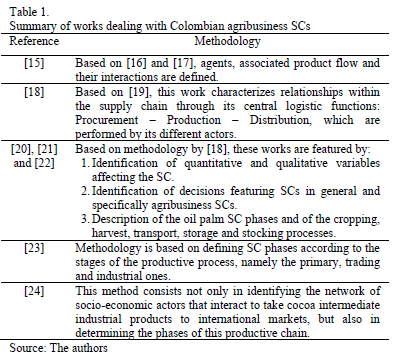
<body><![CDATA[<p><font size="2" face="Verdana, Arial, Helvetica, sans-serif">The work of &#91;11&#93; focuses on the cost performance of the  SC, taking into account final customer delivery times under a centralized  administration and integrating the performance level of the SC into its quality  management processes. </font></p>     <p><font size="2" face="Verdana, Arial, Helvetica, sans-serif">For its part, the contribution of &#91;12&#93; analyzes the  modularization of the SC's processes, which allows increased flexibility. This  is usually done when very similar products change their form after assembly, or  when the chain incorporates outsourcing and postponement, which means that the  products differentiate more and more as they approach the final consumer. This  allows reducing uncertainty in the predictions about the operation of the  chain, thus improving the overall performance of the company. These authors  state that low input modularization levels are associated to vertically  integrated supply chains; while the opposite case corresponds to SCs with  elevated levels of decentralization through outsourcing. On the other hand,  elevated output postponement indicates a make-to-order SC environment in which  the products differentiate towards the last stages of the process; whereas low  postponement levels identify a make-to-stock environment in which demand  satisfaction is guaranteed through abundant inventories.</font></p>     <p><font size="2" face="Verdana, Arial, Helvetica, sans-serif">In turn, &#91;13&#93; take an Activity-Based-Cost (ABC) approach  to Supply Chain Management (SCM), taking into consideration monetary expense  and value appreciation on the part of the client, and proposing production  volume improvements according to costs, by identifying value adding activities  and eliminating those that reduce or do not add any value to the process.  Featuring a cause-effect relation between costs and demand, this approach is  based on identifying those processes that promote a better performance in the  organization, thus allowing a complete control of production and manufacturing  costs and of the company's general expenses.</font></p>     <p><font size="2" face="Verdana, Arial, Helvetica, sans-serif">In the study conducted by &#91;14&#93;, time is considered to be a  SC performance measure that allows the identification of those activities which  do not generate any value within the chain, together with their associated  costs, finally integrated into the total costs of the system. This facilitates  identifying the relation between time and cost within SC processes, as well as  the adequate combination of both parameters when it comes to decision-making.</font></p>     <p><font size="2" face="Verdana, Arial, Helvetica, sans-serif">As to SC characterization &#91;15,18, 20-22&#93; it has been  mainly oriented to agribusiness, namely biodiesel, oil palm upstream and middlestream  phases and, specifically regarding cocoa, the performance of its different SCs  from 2003 to 2012 (<a href="#tab01">Table 1</a>). In addition, we researched general market aspects  and the position of Colombia in the international context.</font></p>     <p align="center"><font size="2" face="Verdana, Arial, Helvetica, sans-serif"><a name="tab01"></a></font><img src="/img/revistas/dyna/v81n187/v81n187a03tab01.gif"></p>     <p>&nbsp;</p>     <p><font size="3" face="Verdana, Arial, Helvetica, sans-serif"><b>3.  Methodology</b></font></p>     <p><font size="2" face="Verdana, Arial, Helvetica, sans-serif">Inspired by Stone  &#91;16,17&#93;, we followed the methodology detailed in &#91;15-22, 18&#93;, which is  apparently the only one developed so far to characterize SCs. It has been  frequently used in agribusiness SCs such as those of coffee and oil palm, which  facilitates future comparisons between Colombian agribusiness SCs. Hence, the  method in question comprises the following steps: 0. Providing the local and  global contexts of the studied SC. 1. Determining and describing its links and  stages. 2. Describing the value added by the chain's agents and links. 3.  Describing performance specificities. 4. Diagnose and conclusion about the SC.  This methodology does not include data collection specific procedures, which is  understandable if we take into account that SC characterization requires both  primary and secondary information that, in turn, demands a broad and diverse  series of procedures. In the current work we maximized the information  available in the literature, which we complemented with primary information  obtained through 29 interviews with key actors of the SC, namely personnel from  FEDECACAO, cocoa growers, and agents from the chocolate industry, among others.  The interviewed organizations are detailed under &quot;acknowledgments&quot;.</font></p>     <p><font size="2" face="Verdana, Arial, Helvetica, sans-serif"><b><i>3.1.  Global and  national markets</i></b></font></p>     ]]></body>
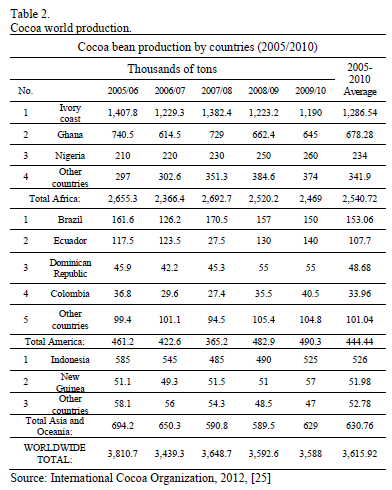
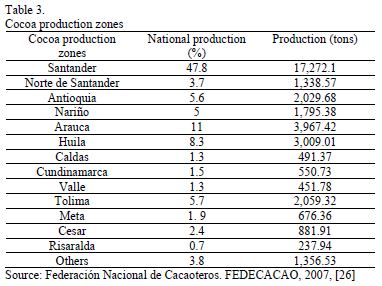
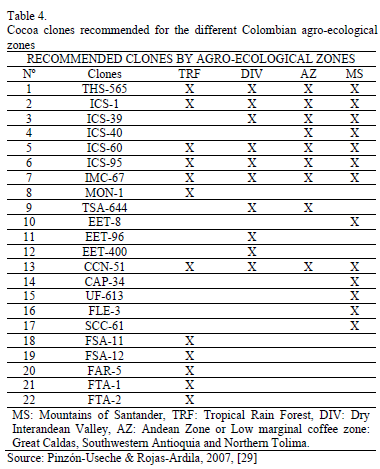
<body><![CDATA[<p><font size="2" face="Verdana, Arial, Helvetica, sans-serif">The International Cocoa Organization presents statistical   data on the major cocoa importing and exporting countries along a yearly   production cycle which, in Colombia, goes from October 1st to September 30   &#91;25&#93;. Cocoa is mainly cultivated in Western Africa, Central America, South   America and Asia. Colombia is the fourth Latin American producer after Brazil,   Ecuador and the Dominican Republic, as it can be seen in the following <a href="#tab02">Table 2</a>.</font></p>     <p align="center"><font size="2" face="Verdana, Arial, Helvetica, sans-serif"><a name="tab02"></a></font><img src="/img/revistas/dyna/v81n187/v81n187a03tab02.gif"></p>     <p><font size="2" face="Verdana, Arial, Helvetica, sans-serif">Currently, Colombian cocoa plantations cover an area of  147,000 ha with a domestic production of 36,118.10 tonnes harvested from  common, hybrid and cloned trees. As it can be observed in <a href="#tab03">Table 3</a>, the  department of Santander accounts for half the national production (mainly  through common germplasm), while the rest is broadly distributed over the  country.</font></p>     <p align="center"><font size="2" face="Verdana, Arial, Helvetica, sans-serif"><a name="tab03"></a></font><img src="/img/revistas/dyna/v81n187/v81n187a03tab03.gif"></p>     <p><font size="2" face="Verdana, Arial, Helvetica, sans-serif">Cocoa production in Colombia is generally featured by  several decade old, hybrid material plantations with low planting densities  (600 to 700 trees per hectare) &#91;27&#93; and low technological levels, all of which  considerably hampers productivity and competitiveness (Ministry of Agriculture  and Rural Development - MADR, 2010).</font></p>     <p><font size="2" face="Verdana, Arial, Helvetica, sans-serif">CORPOICA, FEDECACAO and the MADR &#91;28&#93; conducted a zoning  study on land suitability for cocoa cropping, which estimated that in Colombia  there are 2 million ha very suitable for cocoa production (2003). Of this area,  662,669 ha have no restrictions (they do not require any soil adjustment for  cultivation) and 1.3 million present moderate restrictions.</font></p>     <p><font size="2" face="Verdana, Arial, Helvetica, sans-serif">A recent study on the cocoa SC &#91;23&#93; reports that the  Colombian production is completely absorbed by the national chocolate industry,  which pays lower prices than international markets. Nevertheless, this industry  has had to import part of their raw material because the national production  has been decreasing lately, mainly because of a) low grain local price, which  leads the farmers to quit plantation improvement processes and simply assume a  harvesting attitude; and b) the growing attack of the crop by pests and  diseases, in turn associated with poorly trained personnel in charge of  technology transfer, finally resulting in the hindrance of necessary productive  increases.  </font></p>     <p><font size="2" face="Verdana, Arial, Helvetica, sans-serif">Productivity drop is expressed through lesser yields in  areas where the crop has not been traditionally grown and through the aging of  plantations in the most suitable areas, thus determining the need to import the  product in order to supply local market requirements. This situation takes  place in spite of the availability of adequate clones (<a href="#tab04">Table 4</a>), and probably  due to lack of adequate promotion strategies.</font></p>     <p align="center"><font size="2" face="Verdana, Arial, Helvetica, sans-serif"><a name="tab04"></a></font><img src="/img/revistas/dyna/v81n187/v81n187a03tab04.gif"></p>     <p><font size="2" face="Verdana, Arial, Helvetica, sans-serif"><b><i>3.2.  Characterization of the Colombian cocoa supply  chain</i></b></font></p>     ]]></body>
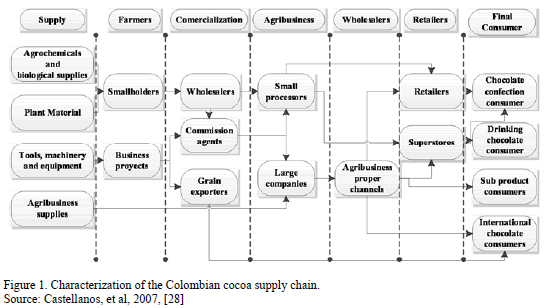
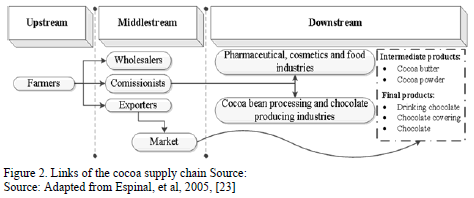
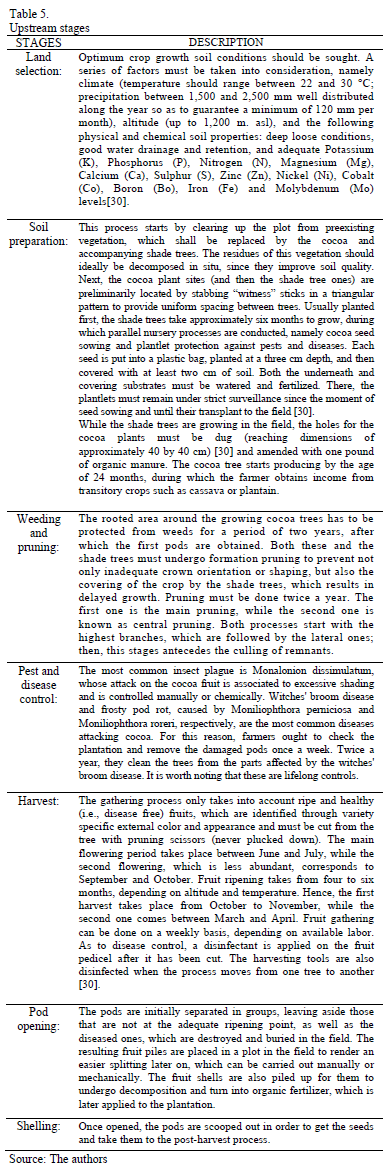
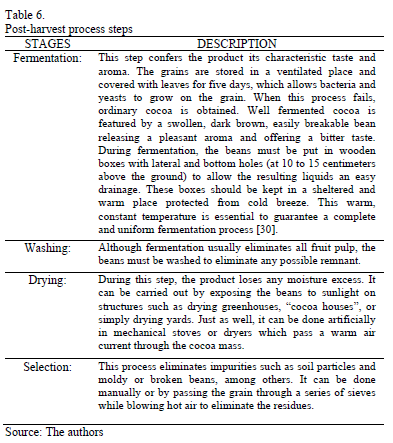
<body><![CDATA[<p><font size="2" face="Verdana, Arial, Helvetica, sans-serif">Cocoa beans are the major raw material for the     confectionery, chocolate, cosmetic and pharmaceutical industries. The characterization     of this SC goes from agricultural supply providers to final consumers &#91;28&#93;.</font></p>     <p align="center"><font size="2" face="Verdana, Arial, Helvetica, sans-serif"><a name="fig01"></a></font><img src="/img/revistas/dyna/v81n187/v81n187a03fig01.gif"></p>     <p><font size="2" face="Verdana, Arial, Helvetica, sans-serif">According to its  industrial process, this SC is divided in three phases: Upstream, Middlestream  and Downstream. Comprising plantation set up, maintenance and harvest, the  Upstream phase groups all farmers, land owners and supply manufacturers.  Middlestream consists in grain commercialization both at the national and  international levels, from the moment it is bought by wholesalers to its  selling to the factories. Finally, the Downstream phase covers the industrial  processing of the beans to obtain liquors, pasta, cocoa butter, cocoa powder,  and chocolates and confections containing chocolate, all of which is carried  out by the cocoa processing and chocolate industries, as well as by those  producing confections containing chocolate. <a href="#fig02">Fig. 2</a> illustrates the cocoa SC  from cropping to final consumption.</font></p>     <p align="center"><font size="2" face="Verdana, Arial, Helvetica, sans-serif"><a name="fig02"></a></font><img src="/img/revistas/dyna/v81n187/v81n187a03fig02.gif"></p>     <p><font size="2" face="Verdana, Arial, Helvetica, sans-serif"><b>3.2.1.  Upstream</b></font></p>     <p><font size="2" face="Verdana, Arial, Helvetica, sans-serif">After harvest, which is carried out with pruning scissors,     the cocoa beans are extracted from the pod, which is commonly known as <i>mazorca</i> in Colombia. Next, the beans     undergo a post-harvest process known as <i>beneficio</i>,     after which they are ready to be commercialized for industrial transformation     purposes that depend on market needs. The stages of the upstream phase are     detailed in <a href="#tab05">Table 5</a>:</font></p>     <p align="center"><font size="2" face="Verdana, Arial, Helvetica, sans-serif"><a name="tab05"></a></font><img src="/img/revistas/dyna/v81n187/v81n187a03tab05.gif"></p>     <p><font size="2" face="Verdana, Arial, Helvetica, sans-serif"><a href="#tab06">Table 6</a> details the steps of the post-harvest process.</font></p>     <p align="center"><font size="2" face="Verdana, Arial, Helvetica, sans-serif"><a name="tab06"></a></font><img src="/img/revistas/dyna/v81n187/v81n187a03tab06.gif"></p>     <p><font size="2" face="Verdana, Arial, Helvetica, sans-serif"><b>3.2.2.  Middlestream</b></font></p>     ]]></body>
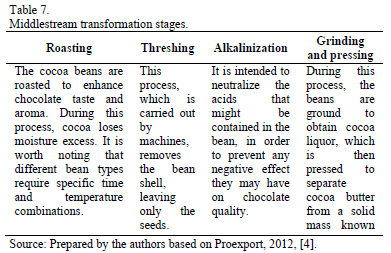
<body><![CDATA[<p><font size="2" face="Verdana, Arial, Helvetica, sans-serif">This phase includes the commercialization of the product     from wholesalers to commission agents, who act as quality inspectors by     checking the grain for its necessary aroma, color and moisture. The minimum     trading cocoa qualifications have been established by Colombian Technical Norm     1252 (Norma T&eacute;cnica Colombiana - NTC 1252). </font></p>     <p><font size="2" face="Verdana, Arial, Helvetica, sans-serif">Cocoa commercialization is carried out among associations  of farmers, wholesalers, commission agents (who trade at the national level)  and exporters. Exports depend on whether there is an internal market surplus  and on attractive international prices. Seventy five percent of the national  cocoa production goes to the cocoa processing and chocolate and confectionery  industries; the remaining 25% is absorbed by small drinking chocolate  manufacturers &#91;31&#93;. </font></p>     <p><font size="2" face="Verdana, Arial, Helvetica, sans-serif">Wholesalers operate in  local towns, where they have direct contact with farmers and frequently sell  the product they get to commission agents &#91;23&#93;. This product has low quality,  since it is stored with other merchandise goods for prolonged periods. The  price is fixed according to moisture and spoiled bean content. Wholesalers  frequently omit applying NTC 1252 because the elevated national demand  currently leads them to stock huge amounts of product at the expense of  quality, thus paying the same for different product qualities. In face of this,  many farmers dismiss complete fermentation in wooden boxes, instead resorting  to grain fermentation in plastic fiber bags. The commercialization of this  product, which is known as cacao en baba (pulpy cocoa), has a negative effect  on grain quality. </font></p>     <p><font size="2" face="Verdana, Arial, Helvetica, sans-serif">Representing the cocoa processing companies, commission  agents operate in small towns, where they purchase and stock huge amounts of  beans. The price they pay depends on bean size, number of grains in 100 grams,  fermentation degree, moisture, impurities, spoiled bean content and presence of  plagues. They usually receive bonuses for their purchase work from the  companies they represent. When the commission agent is too far from the  factory, the beans are sold to wholesalers &#91;23&#93;.</font></p>     <p><font size="2" face="Verdana, Arial, Helvetica, sans-serif">Both wholesalers and commission agents sell the purchased  product to the processing industry. The national market is under the influence  of two economic signals, namely importing and exporting bean prices &#91;27&#93;. </font></p>     <p><font size="2" face="Verdana, Arial, Helvetica, sans-serif">Regulation: cocoa regulation is assumed by entities taking  action in both internal and external markets. The objective pursued by these organisms  is to promote product consumption and regulate its price, offer and demand.</font></p>     <p><font size="2" face="Verdana, Arial, Helvetica, sans-serif">Within the Middlestream phase, <a href="#tab07">Table 7</a> presents the most  value adding processes of the cocoa SC, namely the transformation ones, which  are carried out by the trading and processing companies.</font></p>     <p align="center"><font size="2" face="Verdana, Arial, Helvetica, sans-serif"><a name="tab07"></a></font><img src="/img/revistas/dyna/v81n187/v81n187a03tab07.gif"></p>     <p><font size="2" face="Verdana, Arial, Helvetica, sans-serif">After these processes, the resulting products split the  SC: cocoa butter goes to chocolate, ice-cream, cosmetic and pharmaceutical  production; while cocoa cake is employed for powdered cocoa or drinking  chocolate.</font></p>     <p><font size="2" face="Verdana, Arial, Helvetica, sans-serif"><b>3.2.3.  Downstream</b></font></p>     ]]></body>
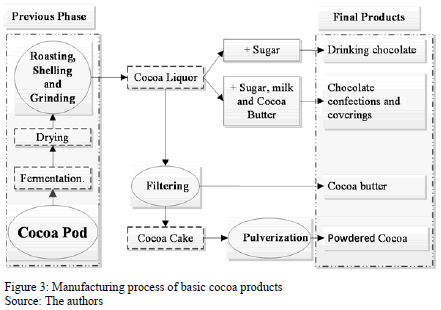
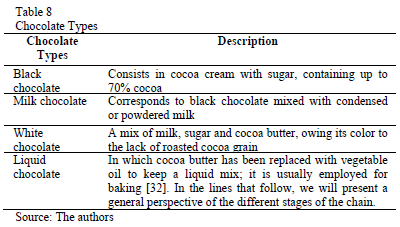
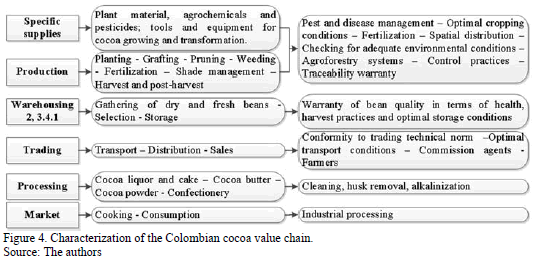
<body><![CDATA[<p><font size="2" face="Verdana, Arial, Helvetica, sans-serif">This phase comprises the manufacturing and trading of the   different final products obtained from the cocoa basic products resulting from   the previous phase (<a href="#fig03">Fig. 3</a>).</font></p>     <p align="center"><font size="2" face="Verdana, Arial, Helvetica, sans-serif"><a name="fig03"></a></font><img src="/img/revistas/dyna/v81n187/v81n187a03fig03.gif"></p>     <p><font size="2" face="Verdana, Arial, Helvetica, sans-serif">In the International Standard Industrial Classification of  all Economic Activities (ISIC), the two sub-sectors involved in this part of  the SC are:</font></p>     <p><font size="2" face="Verdana, Arial, Helvetica, sans-serif">31191: manufacturing of chocolates and cocoa derivatives.    <br> </font><font size="2" face="Verdana, Arial, Helvetica, sans-serif">31192: manufacturing of chocolate confections.</font></p>     <p><font size="2" face="Verdana, Arial, Helvetica, sans-serif">The processing industry  does the roasting, shelling and grinding of the grain &#91;23&#93;. An important  portion of the resulting cocoa liquor goes to chocolate production. Drinking  chocolate elaboration constitutes a lesser value adding process in which ground  cocoa is mixed with sugar. For its part, the chocolate confectionery and  covering industry mixes cocoa liquor with sugar, milk and cocoa butter. The  cocoa liquor that is not employed in either of these processes is filtered to  separate cocoa cake, which is solid, from cocoa butter, which is liquid. Cocoa  cake is pulverized to obtain powdered cocoa, while cocoa butter is centrifuged,  crystallized, molded and packed. </font></p>     <p><font size="2" face="Verdana, Arial, Helvetica, sans-serif">The great variety of existing chocolate products results  from the various ingredients that are combined with four basic raw materials  differentiated by their cocoa content (<a href="#tab08">Table 8</a>).</font></p>     <p align="center"><font size="2" face="Verdana, Arial, Helvetica, sans-serif"><a name="tab08"></a></font><img src="/img/revistas/dyna/v81n187/v81n187a03tab08.gif"></p>     <p><font size="2" face="Verdana, Arial, Helvetica, sans-serif">Both at the local and global levels, the stages of the  cocoa SC differentiate through the activities, processes and market types they  involve. At the national level, this chain comprises agricultural production,  post-harvest processing, industrial transformation and end point  commercialization of the manufactured goods. The agents of the VC are presented  next.</font></p>     <p align="center"><font size="2" face="Verdana, Arial, Helvetica, sans-serif"><a name="fig04"></a></font><img src="/img/revistas/dyna/v81n187/v81n187a03fig04.gif"></p>     ]]></body>
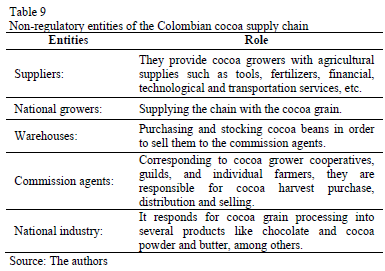
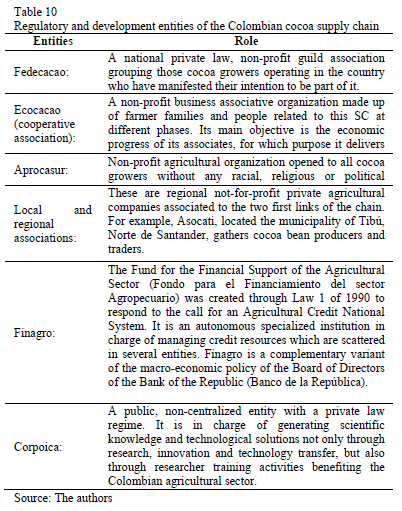
<body><![CDATA[<p><font size="2" face="Verdana, Arial, Helvetica, sans-serif"><b><i>3.3.  Description  of the local supply chain</i></b></font></p>     <p><font size="2"><b><font face="Verdana, Arial, Helvetica, sans-serif">3.3.1.  Non-regulatory  entities</font></b></font></p>     <p><font size="2" face="Verdana, Arial, Helvetica, sans-serif"><a href="#tab09">Table 9</a> shows the     Non-regulatory entities of the local SC:</font></p>     <p align="center"><font size="2" face="Verdana, Arial, Helvetica, sans-serif"><a name="tab09"></a></font><img src="/img/revistas/dyna/v81n187/v81n187a03tab09.gif"></p>     <p><font size="2" face="Verdana, Arial, Helvetica, sans-serif"><b>3.3.2.  Regulatory  and development entities</b></font></p>     <p><font size="2" face="Verdana, Arial, Helvetica, sans-serif">  These are guild and government institutions intended to   provide technical or financial support to cocoa growers in order to promote and   regulate the issues related to this commodity. The Colombian organizations in   this category are introduced in <a href="#tab10">Table 10</a>.</font></p>     <p align="center"><font size="2" face="Verdana, Arial, Helvetica, sans-serif"><a name="tab10"></a></font><img src="/img/revistas/dyna/v81n187/v81n187a03tab10.gif"></p>     <p><font size="2" face="Verdana, Arial, Helvetica, sans-serif"><b><i>3.4.  Considerations about information and material  flow</i></b></font></p>     <p><font size="2" face="Verdana, Arial, Helvetica, sans-serif">Regarding the flow of materials, Colombian logistics is     considered to be one of the most important limitations for SC competitiveness     due to its considerable dependence on road transportation, the latter being     particularly sensitive to climate change which, in turn, produces a stronger     impact in tropical countries. In addition, the Colombian public servants in     charge of transport infrastructure and maintenance are constantly criticized. </font></p>     <p><font size="2" face="Verdana, Arial, Helvetica, sans-serif">The Colombian cocoa SC is oriented to the local market. In  this respect, during upstream and middlestream, materials are transported along  a variety of roads that go from the farms themselves through country paths to  tertiary and secondary roads, most of which are unsurfaced, thus bringing about  costly technical difficulties that affect both farmers and traders. During  downstream, transport is done along primary roads, where productivity is  significantly improved, although it is far from the standards of the competing  countries in the region. </font></p>     ]]></body>
<body><![CDATA[<p><font size="2" face="Verdana, Arial, Helvetica, sans-serif">For its part, information flow might constitute a larger  difficulty because lack of communication and redundant flows take a  considerable tall on upstream (and especially downstream) product quality and  profitability as a consequence of middlestream expansion, which is basically  devoted to transport and has created an unnecessary commercial link with  speculative hues. Upstream and downstream are the most value-adding stages  within the chain. Yet, a more thorough communication between them is necessary  to guarantee profit quality and equality, which are considerably precarious for  the upstream stage, thus urgently calling for price improvement.</font></p>     <p>&nbsp;</p>     <p><font size="3" face="Verdana, Arial, Helvetica, sans-serif"><b>4.  Analysis of   results</b></font></p>     <p><font size="2" face="Verdana, Arial, Helvetica, sans-serif">In the lines that follow we synthesize the fieldwork  employed to confirm information and identify the sector's problems. This  activity was carried out in plantations of the departments of Santander and  Norte de Santander, where we researched cocoa cropping and commercial details;  and in FEDECACAO (Bogota), where we conducted meetings with guild leaders about  specific features and competitiveness of this SC.</font></p>     <p><font size="2" face="Verdana, Arial, Helvetica, sans-serif">Cocoa cultivation in Colombia has comparative advantages  arising from favorable natural conditions for production determined by climate,  humidity and environmental conservation due to agroforestry. Development  agencies of the cocoa sector can take advantage of these conditions to develop  strategies for future grain exports. However, most lands are located on sloppy  areas that prevent mechanized work and make cultivation excessively labor  demanding, thus raising logistic costs and hindering productivity and  profitability.</font></p>     <p><font size="2" face="Verdana, Arial, Helvetica, sans-serif">An important part of cocoa production is classified as  fine flavor cocoa, which is mainly used for the production of high-quality  chocolates. But unlike the commercial policy of other countries such as  Ecuador, there has been no proper promotion of the brand &quot;Colombia&quot; in terms of  developing a quality culture among cocoa farmers. Sustainability strategies are  required to achieve this goal.</font></p>     <p><font size="2" face="Verdana, Arial, Helvetica, sans-serif">Cocoa growing in Colombia is featured by abandonment and  recovery of the plantation by the farmer. The reason for this are prolonged  periods of unfavorable prices resulting in no income for the farmer, who finds  it difficult to invest in crop maintenance. As a result, plantations receive  only minimum or simply no attention. This leads to cycles of low national  production and, consequently, to the importation of this commodity by the  processing industry.</font></p>     <p><font size="2" face="Verdana, Arial, Helvetica, sans-serif">The presence of wholesalers in towns and country  settlements comes to be a Colombian specific feature, inasmuch as they operate  as credit agents for the farmers, who finally pay their debts with coming  production. Government strategies intended for value adding, in situ processing  of the grain (i.e., local agribusiness activity) should be implemented and  evaluated. Such a strategy would not only strengthen cooperation and  association among cocoa growers in the municipalities that concentrate  production, but also improve, by adding value, the quality of life of the  farmers and their families, who, after all, constitute the main agents of the  cocoa-chocolate chain in Colombia. </font></p>     <p><font size="2" face="Verdana, Arial, Helvetica, sans-serif">From an economic standpoint, upstream is the most  vulnerable phase, but also the one that produces the strongest social impact.  The government should ideally develop downstream strategies, labor unions and  business initiatives, which would position the brand &quot;Colombia&quot; as an icon of  quality culture and first-rate production. For such purpose, it is important to  implement in situ transformation processes and local performance controls and  evaluations so as to strengthen cooperation and partnership between farmers in  cocoa producing municipalities. This is likely to bring about a series of  advantages: a) balanced production across regions at the national level, thus  opening the possibility of a common front negotiation before the chocolate  industry; b) value added increase throughout the chain, thus enhancing the  quality of raw materials and final products and optimizing final prices; c)  improved life quality of the cocoa growing families, thus advancing this  activity as an effective alternative against the proliferation of illegal  crops; and d) product and process innovation, which confers international  prestige to the middlestream and downstream phases.</font></p>     <p><font size="2" face="Verdana, Arial, Helvetica, sans-serif">According to the latest Cocoa World Conference &#91;33&#93;,  greater cooperation is necessary among all actors in the chain in order to  foster sustainability. Those efforts that help growers perceive more benefits  from the wealth generated by the chain are likely to improve their quality of life,  especially when children are involved. As well, it is important to move towards  a more innovative, qualified, clean and environmentally friendly chain also  taking food security, biodiversity and conservation of existing ecosystems into  account. In this sense, Nutresa, a food industry trust operating in the  department of Antioquia and its surroundings, has been conducting an important  effort through which they supply cocoa growers with cropping resources from a  specific fund for such purpose, without claiming any property on the farmers'  lands. This is not only a more egalitarian way of sharing risks and benefits  with all chain links, but also a value adding strategy for stakeholders.</font></p>     ]]></body>
<body><![CDATA[<p><font size="2" face="Verdana, Arial, Helvetica, sans-serif">From the current  results it can be said that both the state and the sector should: a) conduct  further analyses to determine how much land should be dedicated to this crop,  looking forward to reducing subsidies to a minimum; b) ensure training that  generates a quality culture as supported by Good Agricultural Practices; and c)  facilitate soft credit and affordable extension services, which become more  important in face of the risk associated to this activity, especially under the  adverse effects of climate change. In turn, the cocoa guild ought to implement  not only an observatory of best practices in all phases of this supply chain in  order to ensure the quality of the brand &quot;Colombia&quot;, but also a series of  policies promoting the consumption of cocoa in Colombia, the penetration of  emerging markets and the consolidation of those already in operation.</font></p>     <p>&nbsp;</p>     <p><font size="3" face="Verdana, Arial, Helvetica, sans-serif"><b>5.  Conclusions and  research perspectives</b></font></p>     <p><font size="2" face="Verdana, Arial, Helvetica, sans-serif">The current study presents a clear perspective of the  logistical processes involved in the cocoa SC and VC. It summarizes key local  and global aspects of this chain, looking forward both to supporting future  studies and aiding in the establishment of policies, strategies, tactics and  operational possibilities for its different stages and processes. The  methodology applied to characterize the chain provides an organized and  detailed description of the stages through which cocoa and its derivatives are  processed, thus identifying value added at each step.</font></p>     <p><font size="2" face="Verdana, Arial, Helvetica, sans-serif">Efforts should be made to render the chain as short as  possible, in order to improve coordination, efficiency and flow traceability.  Moreover, the current global cocoa agenda should be followed. In this respect,  Colombia did not participate in the World Cocoa Conference in 2012, which  followed the International Cocoa Agreement 2010.</font></p>     <p><font size="2" face="Verdana, Arial, Helvetica, sans-serif">The case of the cocoa growers of the department of  Santander constitutes a reference standard in the sense that they are  associated, which allows solving two important upstream aspects, namely quality  assurance and price management. Unfortunately, this case seems to be an  exception, since cocoa growers in the rest of the country certainly face a  survival economy. </font></p>     <p><font size="2" face="Verdana, Arial, Helvetica, sans-serif">In summary, crop  quality and crop productivity are the key aspects to generate the welfare of  the chain, especially in the upstream phase. This involves investing in  research for the development of new species and the renewal of crops.</font></p>     <p><font size="2" face="Verdana, Arial, Helvetica, sans-serif">Research perspectives relate to government and sector gray  literature making use of the results of this work in search of policies and  actions aimed at improving the chain. From the scientific point of view, it  would be desirable to characterize other important agribusiness chains such as  that of floriculture.</font></p>     <p>&nbsp;</p>     <p><font size="3" face="Verdana, Arial, Helvetica, sans-serif"><b>Acknowledgements</b></font></p>     ]]></body>
<body><![CDATA[<p><font size="2" face="Verdana, Arial, Helvetica, sans-serif">Research work was supported by the project &quot;Sustainability  of cocoa production in the departments of Santander, Norte de Santander,  Antioquia and Cundinamarca by means of life cycle assessment&quot;. This work has  been fully funded by the Administrative Department of Science, Technology, and  Innovation (COLCIENCIAS) of Colombia, Inter-American Development Bank (IDB) and  World Bank (WB) BIRF, Project Reference  0371- 2012.</font></p>     <p><font size="2" face="Verdana, Arial, Helvetica, sans-serif">We express our gratitude to agronomic engineer Joshua  Rangel for helpful collaboration in the development of this work. Just as well,  we want to thank several agents of the Colombian cocoa supply chain for their  contributions to our understanding of the sector's condition and troubleshooting,  as listed below:</font></p> <ul>       <li><font size="2" face="Verdana, Arial, Helvetica, sans-serif">   Santa Isabel farm, locality of Llana Fr&iacute;a,     municipality of San Vicente de Chucur&iacute;, Santander.</font></li>       <li><font size="2" face="Verdana, Arial, Helvetica, sans-serif">   El Placer farm, locality of Hojarasco,     municipality of El Carmen de Chucur&iacute;, Santander.</font></li>       <li><font size="2" face="Verdana, Arial, Helvetica, sans-serif">   Venecia farm, locality of Palmira, municipality     of San Vicente de Chucur&iacute;, Santander.</font></li>       <li><font size="2" face="Verdana, Arial, Helvetica, sans-serif">   Los Samanes farm, locality of San Nicol&aacute;s Bajo,     municipality of Lebrija, Santander.</font></li>       <li><font size="2" face="Verdana, Arial, Helvetica, sans-serif">   Lomalinda farm, locality of Honduras Bajo,     municipality of Rionegro, Santander.</font></li>       <li><font size="2" face="Verdana, Arial, Helvetica, sans-serif">   Santa In&eacute;s farm, locality of El Quinal Alto,     municipality of El Carmen, Santander.</font></li>       <li><font size="2" face="Verdana, Arial, Helvetica, sans-serif">   Parcela 4 farm, locality of Manzanares,     municipality of El Tarra, Norte de Santander.</font></li>       <li><font size="2" face="Verdana, Arial, Helvetica, sans-serif">   Sabanalarga farm, locality of La Perla,     municipality of Tib&uacute;, Norte de Santander.</font></li>       ]]></body>
<body><![CDATA[<li><font size="2" face="Verdana, Arial, Helvetica, sans-serif">   El Porvenir farm, locality of La Miel,     municipality of Sardinata, Norte de Santander.</font></li>       <li><font size="2" face="Verdana, Arial, Helvetica, sans-serif">   La Siberia farm, Locality of Nueva Frontera,     municipality of C&uacute;cuta, Norte de Sder.</font></li>       <li><font size="2" face="Verdana, Arial, Helvetica, sans-serif">   La Fortuna farm, locality of Ca&ntilde;o Victoria,     municipality of Tib&uacute;, Norte de Santander.</font></li>       <li><font size="2" face="Verdana, Arial, Helvetica, sans-serif">   Parcela     2 farm &quot;Luz de la Verdad&quot;, locality of Ca&ntilde;o Victoria, municipality of     Tib&uacute;, Norte de Santander.</font></li>       <li><font size="2" face="Verdana, Arial, Helvetica, sans-serif">   Parcela     7 farm, locality of Venecia, municipality of Tib&uacute;, Norte de Santander.</font></li>       <li><font size="2" face="Verdana, Arial, Helvetica, sans-serif">   San     Antonio farm, locality of La Fortuna, municipality of Sardinata, Norte de     Santander.</font></li>       <li><font size="2" face="Verdana, Arial, Helvetica, sans-serif">   El     Diamante farm, locality of Bellavista, municipality of Sardinata, Norte de     Santander.</font></li>       <li><font size="2" face="Verdana, Arial, Helvetica, sans-serif">   Hogar     Juvenil Campesino (Youth Farming Project), locality of El Caim&aacute;n, municipality     of Teorama, Norte de Santander.</font></li>       <li><font size="2" face="Verdana, Arial, Helvetica, sans-serif">   Las     Mar&iacute;as farm, locality of Vijagual, municipality of Teorama, Norte de Santander.</font></li>       <li><font size="2" face="Verdana, Arial, Helvetica, sans-serif">   La     Trinidad farm, locality of Nueva Victoria, municipality of C&uacute;cuta, Norte de     Sder.</font></li>       ]]></body>
<body><![CDATA[<li><font size="2" face="Verdana, Arial, Helvetica, sans-serif">   Sincelejo farm, locality of Venecia Guamalito,     municipality of Tib&uacute;, Norte de Santander.</font></li>       <li><font size="2" face="Verdana, Arial, Helvetica, sans-serif">   Villahermosa farm, locality of Campoeyuca,     municipality of Tib&uacute;, Norte de Santander.</font></li>       <li><font size="2" face="Verdana, Arial, Helvetica, sans-serif">   La     Arenosa farm, locality of El Llano, municipality of El Tarra, Norte de     Santander.</font></li>       <li><font size="2" face="Verdana, Arial, Helvetica, sans-serif">   El     Limoncito farm, locality of Los Curos, municipality of Sardinata, Norte de     Santander.</font></li>       <li><font size="2" face="Verdana, Arial, Helvetica, sans-serif">   La     So&ntilde;ada farm, locality of La Pita, municipality of Sardinata, Norte de     Santander.</font></li>       <li><font size="2" face="Verdana, Arial, Helvetica, sans-serif">   Villa     Antigua farm, locality of Astilleros, municipality of El Zulia, Norte de     Santander.</font></li>       <li><font size="2" face="Verdana, Arial, Helvetica, sans-serif">   La     Nacional farm (Nutresa Group), municipality of T&aacute;mesis, Antioquia.</font></li>       <li><font size="2" face="Verdana, Arial, Helvetica, sans-serif">   El silencio farm, locality of C&aacute;mbulos, (in the     small town of Aguaclara), municipality of C&uacute;cuta, Norte de Santander.</font></li>       <li><font size="2" face="Verdana, Arial, Helvetica, sans-serif">   Las Acacias farm, locality of C&aacute;mbulos,     municipality of C&uacute;cuta, Norte de Santander.</font></li>       <li><font size="2" face="Verdana, Arial, Helvetica, sans-serif">   El Horizonte farm, locality of Bracitos,     municipality of El Tarra, Norte de Santander.</font></li>       ]]></body>
<body><![CDATA[<li><font size="2" face="Verdana, Arial, Helvetica, sans-serif">   El Diviso farm, locality of Ca&ntilde;o Victoria Norte,     municipality of Tib&uacute;, Norte de Santander.</font></li>     </ul>     <p>&nbsp;</p>     <p><font size="3" face="Verdana, Arial, Helvetica, sans-serif"><b>References</b></font></p>     <!-- ref --><p><font size="2" face="Verdana, Arial, Helvetica, sans-serif"><b>&#91;1&#93;</b>    Porter,  M.E., Managing Value: From competitive advantage to corporate strategy. Harvard Business Review, 65 (3), pp. 43-60. 1987.    &nbsp;&nbsp;&nbsp;&nbsp;&nbsp;&nbsp;&nbsp;&nbsp;[&#160;<a href="javascript:void(0);" onclick="javascript: window.open('/scielo.php?script=sci_nlinks&ref=000147&pid=S0012-7353201400050000300001&lng=','','width=640,height=500,resizable=yes,scrollbars=1,menubar=yes,');">Links</a>&#160;]<!-- end-ref --></font></p>     <!-- ref --><p><font size="2" face="Verdana, Arial, Helvetica, sans-serif"><b>&#91;2&#93;</b>    Handfield,  R.B and Nichols Jr., E.L., Introduction to supply chain management. Upper Saddle River, NJ: Prentice-Hall, 1999.    &nbsp;&nbsp;&nbsp;&nbsp;&nbsp;&nbsp;&nbsp;&nbsp;[&#160;<a href="javascript:void(0);" onclick="javascript: window.open('/scielo.php?script=sci_nlinks&ref=000149&pid=S0012-7353201400050000300002&lng=','','width=640,height=500,resizable=yes,scrollbars=1,menubar=yes,');">Links</a>&#160;]<!-- end-ref --></font></p>     <!-- ref --><p><font size="2" face="Verdana, Arial, Helvetica, sans-serif"><b>&#91;3&#93;</b> Ballou, R.H., Log&iacute;stica Administraci&oacute;n de la Cadena de Suministro (Vol. 5ta Edici&oacute;n), M&eacute;xico, 2004.    &nbsp;&nbsp;&nbsp;&nbsp;&nbsp;&nbsp;&nbsp;&nbsp;[&#160;<a href="javascript:void(0);" onclick="javascript: window.open('/scielo.php?script=sci_nlinks&ref=000151&pid=S0012-7353201400050000300003&lng=','','width=640,height=500,resizable=yes,scrollbars=1,menubar=yes,');">Links</a>&#160;]<!-- end-ref --></font></p>     ]]></body>
<body><![CDATA[<!-- ref --><p><font size="2" face="Verdana, Arial, Helvetica, sans-serif"><b>&#91;4&#93;</b>    Proexport,  Cacao Colombiano fino y de aroma, &#91;Online&#93;, 2012, &#91;date of reference August of 2012&#93;, Available at: <a href="http://www.inviertaencolombia.com.co/images/Perfil%20Cacao%202012.pdf" target="_blank">http://www.inviertaencolombia.com.co/images/Perfil%20Cacao%202012.pdf</a></font>&nbsp;&nbsp;&nbsp;&nbsp;&nbsp;&nbsp;&nbsp;&nbsp;[&#160;<a href="javascript:void(0);" onclick="javascript: window.open('/scielo.php?script=sci_nlinks&ref=000153&pid=S0012-7353201400050000300004&lng=','','width=640,height=500,resizable=yes,scrollbars=1,menubar=yes,');">Links</a>&#160;]<!-- end-ref --><!-- ref --><p><font size="2" face="Verdana, Arial, Helvetica, sans-serif"><b>&#91;5&#93;</b> Departamento Administrativo Nacional de Estad&iacute;stica (DANE), Resultados generales Base 2005., 2011.    &nbsp;&nbsp;&nbsp;&nbsp;&nbsp;&nbsp;&nbsp;&nbsp;[&#160;<a href="javascript:void(0);" onclick="javascript: window.open('/scielo.php?script=sci_nlinks&ref=000154&pid=S0012-7353201400050000300005&lng=','','width=640,height=500,resizable=yes,scrollbars=1,menubar=yes,');">Links</a>&#160;]<!-- end-ref --></font></p>     <!-- ref --><p><font size="2" face="Verdana, Arial, Helvetica, sans-serif"><b>&#91;6&#93;</b>    Williamson,  O.E., Comparative economic organization: The analysis of discrete structural alternatives. Administrative Science Quarterly, 36 (2), pp. 269-296. 1991.    &nbsp;&nbsp;&nbsp;&nbsp;&nbsp;&nbsp;&nbsp;&nbsp;[&#160;<a href="javascript:void(0);" onclick="javascript: window.open('/scielo.php?script=sci_nlinks&ref=000156&pid=S0012-7353201400050000300006&lng=','','width=640,height=500,resizable=yes,scrollbars=1,menubar=yes,');">Links</a>&#160;]<!-- end-ref --></font></p>     <!-- ref --><p><font size="2" face="Verdana, Arial, Helvetica, sans-serif"><b>&#91;7&#93;</b>    Dwyer,  F.R., Schurr, P. and Oh, S., Developing buyer-seller relationships, Journal of Marketing, 51 (2), pp. 11-27.1987.    &nbsp;&nbsp;&nbsp;&nbsp;&nbsp;&nbsp;&nbsp;&nbsp;[&#160;<a href="javascript:void(0);" onclick="javascript: window.open('/scielo.php?script=sci_nlinks&ref=000158&pid=S0012-7353201400050000300007&lng=','','width=640,height=500,resizable=yes,scrollbars=1,menubar=yes,');">Links</a>&#160;]<!-- end-ref --></font></p>     <!-- ref --><p><font size="2" face="Verdana, Arial, Helvetica, sans-serif"><b>&#91;8&#93;</b> Grover,  V. and Malhotra, M.K., Transaction cost framework in operations and supply  Chain management research - Theory and measurement, Journal of Operations Management, 21 (4), pp. 457-473. 2003.    &nbsp;&nbsp;&nbsp;&nbsp;&nbsp;&nbsp;&nbsp;&nbsp;[&#160;<a href="javascript:void(0);" onclick="javascript: window.open('/scielo.php?script=sci_nlinks&ref=000160&pid=S0012-7353201400050000300008&lng=','','width=640,height=500,resizable=yes,scrollbars=1,menubar=yes,');">Links</a>&#160;]<!-- end-ref --></font></p>     <!-- ref --><p><font size="2" face="Verdana, Arial, Helvetica, sans-serif"><b>&#91;9&#93;</b>    Brennan,  C.D., Integrating the healthcare supply chain, Healthcare Financial Management, 52 (1), pp. 31-34. 1998.    &nbsp;&nbsp;&nbsp;&nbsp;&nbsp;&nbsp;&nbsp;&nbsp;[&#160;<a href="javascript:void(0);" onclick="javascript: window.open('/scielo.php?script=sci_nlinks&ref=000162&pid=S0012-7353201400050000300009&lng=','','width=640,height=500,resizable=yes,scrollbars=1,menubar=yes,');">Links</a>&#160;]<!-- end-ref --></font></p>     <!-- ref --><p><font size="2" face="Verdana, Arial, Helvetica, sans-serif"><b>&#91;10&#93;</b>   McKone-Sweet,  K., Hamilton, P. and Willis, S., The ailing healthcare supply Chain: A  prescription for change, Journal of Supply Chain Management, 40 (1), pp. 4-17. 2005.    &nbsp;&nbsp;&nbsp;&nbsp;&nbsp;&nbsp;&nbsp;&nbsp;[&#160;<a href="javascript:void(0);" onclick="javascript: window.open('/scielo.php?script=sci_nlinks&ref=000164&pid=S0012-7353201400050000300010&lng=','','width=640,height=500,resizable=yes,scrollbars=1,menubar=yes,');">Links</a>&#160;]<!-- end-ref --></font></p>     <!-- ref --><p><font size="2" face="Verdana, Arial, Helvetica, sans-serif"><b>&#91;11&#93;</b>   Guiffrida,  A. and Nagi, R., Cost characterizations of supply chain delivery performance, International Journal of Production Economics, 102, pp. 22-36. 2006.    &nbsp;&nbsp;&nbsp;&nbsp;&nbsp;&nbsp;&nbsp;&nbsp;[&#160;<a href="javascript:void(0);" onclick="javascript: window.open('/scielo.php?script=sci_nlinks&ref=000166&pid=S0012-7353201400050000300011&lng=','','width=640,height=500,resizable=yes,scrollbars=1,menubar=yes,');">Links</a>&#160;]<!-- end-ref --></font></p>     <!-- ref --><p><font size="2" face="Verdana, Arial, Helvetica, sans-serif"><b>&#91;12&#93;</b>   Ernst,  R. and Kamrad, B., Evaluation of supply chain structures through modularization  and postponement. European Journal of Operational Research, 124, pp. 495-510. 2000.    &nbsp;&nbsp;&nbsp;&nbsp;&nbsp;&nbsp;&nbsp;&nbsp;[&#160;<a href="javascript:void(0);" onclick="javascript: window.open('/scielo.php?script=sci_nlinks&ref=000168&pid=S0012-7353201400050000300012&lng=','','width=640,height=500,resizable=yes,scrollbars=1,menubar=yes,');">Links</a>&#160;]<!-- end-ref --></font></p>     <!-- ref --><p><font size="2" face="Verdana, Arial, Helvetica, sans-serif"><b>&#91;13&#93;</b>   Askarany, D.,  Yazdifar, H. and Askary, S., Supply chain management, activity-based costing  and organizational factors, International Journal of Production Economics, 127, pp. 238-248. 2010.    &nbsp;&nbsp;&nbsp;&nbsp;&nbsp;&nbsp;&nbsp;&nbsp;[&#160;<a href="javascript:void(0);" onclick="javascript: window.open('/scielo.php?script=sci_nlinks&ref=000170&pid=S0012-7353201400050000300013&lng=','','width=640,height=500,resizable=yes,scrollbars=1,menubar=yes,');">Links</a>&#160;]<!-- end-ref --></font></p>     <!-- ref --><p><font size="2" face="Verdana, Arial, Helvetica, sans-serif"><b>&#91;14&#93;</b>   Whicker, L.,  Bernon, M., Templar, S. and Mena, C., Understanding the relationships between  time and cost to improve supply chain performance, International Journal of Production Economics, 121, pp 641-650. 2009.    &nbsp;&nbsp;&nbsp;&nbsp;&nbsp;&nbsp;&nbsp;&nbsp;[&#160;<a href="javascript:void(0);" onclick="javascript: window.open('/scielo.php?script=sci_nlinks&ref=000172&pid=S0012-7353201400050000300014&lng=','','width=640,height=500,resizable=yes,scrollbars=1,menubar=yes,');">Links</a>&#160;]<!-- end-ref --></font></p>     <!-- ref --><p><font size="2" face="Verdana, Arial, Helvetica, sans-serif"><b>&#91;15&#93;</b> Garc&iacute;a-C&aacute;ceres, R.G. and Olaya, E.S.,  Caracterizaci&oacute;n de las cadenas de valor y abastecimiento del sector  Agroindustrial del Caf&eacute;, Cuadernos de Administraci&oacute;n, 19 (31), pp. 197-217. 2007.    &nbsp;&nbsp;&nbsp;&nbsp;&nbsp;&nbsp;&nbsp;&nbsp;[&#160;<a href="javascript:void(0);" onclick="javascript: window.open('/scielo.php?script=sci_nlinks&ref=000174&pid=S0012-7353201400050000300015&lng=','','width=640,height=500,resizable=yes,scrollbars=1,menubar=yes,');">Links</a>&#160;]<!-- end-ref --></font></p>     <!-- ref --><p><font size="2" face="Verdana, Arial, Helvetica, sans-serif"><b>&#91;16&#93;</b>   Stone,  R.B. and Wood, K.L., Development of a functional basis for design, Journal of Mechanical Design, 122 (1), pp. 61-69. 2000.    &nbsp;&nbsp;&nbsp;&nbsp;&nbsp;&nbsp;&nbsp;&nbsp;[&#160;<a href="javascript:void(0);" onclick="javascript: window.open('/scielo.php?script=sci_nlinks&ref=000176&pid=S0012-7353201400050000300016&lng=','','width=640,height=500,resizable=yes,scrollbars=1,menubar=yes,');">Links</a>&#160;]<!-- end-ref --></font></p>     <!-- ref --><p><font size="2" face="Verdana, Arial, Helvetica, sans-serif"><b>&#91;17&#93;</b>   Stone,  R.B., Kurfman, M.A., Rajan, J.R. and Wood K.L., Functional modelling  experimental studies, Design Engineering Technical Conferences, Pittsburgh (USA), 2001.    &nbsp;&nbsp;&nbsp;&nbsp;&nbsp;&nbsp;&nbsp;&nbsp;[&#160;<a href="javascript:void(0);" onclick="javascript: window.open('/scielo.php?script=sci_nlinks&ref=000178&pid=S0012-7353201400050000300017&lng=','','width=640,height=500,resizable=yes,scrollbars=1,menubar=yes,');">Links</a>&#160;]<!-- end-ref --></font></p>     <!-- ref --><p><font size="2" face="Verdana, Arial, Helvetica, sans-serif"><b>&#91;18&#93;</b> Garc&iacute;a-C&aacute;ceres, R.G.,  Olaya, E.S., Torres, S., D&iacute;az, H.B. and Castro, H.F., Creaci&oacute;n de valor en la cadena de  abastecimiento del sector salud en Colombia, Cuadernos de Administraci&oacute;n, 22 (39), pp. 235-256. 2009.    &nbsp;&nbsp;&nbsp;&nbsp;&nbsp;&nbsp;&nbsp;&nbsp;[&#160;<a href="javascript:void(0);" onclick="javascript: window.open('/scielo.php?script=sci_nlinks&ref=000180&pid=S0012-7353201400050000300018&lng=','','width=640,height=500,resizable=yes,scrollbars=1,menubar=yes,');">Links</a>&#160;]<!-- end-ref --></font></p>     <!-- ref --><p><font size="2" face="Verdana, Arial, Helvetica, sans-serif"><b>&#91;19&#93;</b> Carrillo, J., Gantiva, J.C., Nieto, E and Y&aacute;&ntilde;ez,  E., Implementaci&oacute;n de buenas pr&aacute;cticas operativas. Lecture presented at IX  Reuni&oacute;n T&eacute;cnica de Palma de Aceite. Colombia &#91;Online&#93;, 2010. &#91;date of reference June of 2012&#93;. Avalilable  at: <a href="http://www.cenipalma.org/sites/ default/files/Implementaci%C3%B3n%20beunas%20pr%C3%A1cticas%20operativas%20Frupalma.pdf" target="_blank">http://www.cenipalma.org/sites/ default/files/Implementaci%C3%B3n%20beunas%20pr%C3%A1cticas%20operativas%20Frupalma.pdf</a>.    &nbsp;&nbsp;&nbsp;&nbsp;&nbsp;&nbsp;&nbsp;&nbsp;[&#160;<a href="javascript:void(0);" onclick="javascript: window.open('/scielo.php?script=sci_nlinks&ref=000182&pid=S0012-7353201400050000300019&lng=','','width=640,height=500,resizable=yes,scrollbars=1,menubar=yes,');">Links</a>&#160;]<!-- end-ref --></font></p>     <!-- ref --><p><font size="2" face="Verdana, Arial, Helvetica, sans-serif"><b>&#91;20&#93;</b> Garc&iacute;a-C&aacute;ceres, R.G., N&uacute;&ntilde;ez, A.L., Ram&iacute;rez, T.A.  and Jaimes, S.A., Caracterizaci&oacute;n de la etapa Upstream de las cadenas de valor  y de abastecimiento de palma de aceite en Colombia, DYNA, 80 (179), pp. 79-89. 2013.    &nbsp;&nbsp;&nbsp;&nbsp;&nbsp;&nbsp;&nbsp;&nbsp;[&#160;<a href="javascript:void(0);" onclick="javascript: window.open('/scielo.php?script=sci_nlinks&ref=000184&pid=S0012-7353201400050000300020&lng=','','width=640,height=500,resizable=yes,scrollbars=1,menubar=yes,');">Links</a>&#160;]<!-- end-ref --></font></p>     <!-- ref --><p><font size="2" face="Verdana, Arial, Helvetica, sans-serif"><b>&#91;21&#93;</b> Garc&iacute;a-C&aacute;ceres, R.G., N&uacute;&ntilde;ez, A.L., Ram&iacute;rez, T.A.  and Ortiz, O.O., Caracterizaci&oacute;n de la etapa Middlestream de las cadenas de  valor y de abastecimiento de palma de aceite en Colombia, Reporte de  investigaci&oacute;n 02. Centro de investigaciones en Manufactura y Servicios CIMSER, 2012.    &nbsp;&nbsp;&nbsp;&nbsp;&nbsp;&nbsp;&nbsp;&nbsp;[&#160;<a href="javascript:void(0);" onclick="javascript: window.open('/scielo.php?script=sci_nlinks&ref=000186&pid=S0012-7353201400050000300021&lng=','','width=640,height=500,resizable=yes,scrollbars=1,menubar=yes,');">Links</a>&#160;]<!-- end-ref --></font></p>     <!-- ref --><p><font size="2" face="Verdana, Arial, Helvetica, sans-serif"><b>&#91;22&#93;</b> Garc&iacute;a-C&aacute;ceres, R.G. and Jaimes, S.A.,  Caracterizaci&oacute;n de las cadenas de valor y de abastecimiento del biodiesel en  Colombia. Reporte de investigaci&oacute;n 03, Centro de investigaciones en Manufactura y Servicios CIMSER 2012.    &nbsp;&nbsp;&nbsp;&nbsp;&nbsp;&nbsp;&nbsp;&nbsp;[&#160;<a href="javascript:void(0);" onclick="javascript: window.open('/scielo.php?script=sci_nlinks&ref=000188&pid=S0012-7353201400050000300022&lng=','','width=640,height=500,resizable=yes,scrollbars=1,menubar=yes,');">Links</a>&#160;]<!-- end-ref --></font></p>     <!-- ref --><p><font size="2" face="Verdana, Arial, Helvetica, sans-serif"><b>&#91;23&#93;</b> Espinal, C., Mart&iacute;nez, H. and Ortiz, L., La  cadena de cacao en Colombia: Una mirada global de su estructura y din&aacute;mica  1991-2005. Documento de trabajo No.92. Ministerio de Agricultura y Desarrollo  Rural. Observatorio de  Agrocadenas Colombia, &#91;Online&#93;</b> 2005. &#91;date of reference August of 2012&#93;. Available at: <a href="http://www.agronet.gov.co/www/docs_agronet/2005112145659_caracterizacion_cacao.pdf" target="_blank">http://www.agronet.gov.co/www/docs_agronet/2005112145659_caracterizacion_cacao.pdf</a></font>&nbsp;&nbsp;&nbsp;&nbsp;&nbsp;&nbsp;&nbsp;&nbsp;[&#160;<a href="javascript:void(0);" onclick="javascript: window.open('/scielo.php?script=sci_nlinks&ref=000190&pid=S0012-7353201400050000300023&lng=','','width=640,height=500,resizable=yes,scrollbars=1,menubar=yes,');">Links</a>&#160;]<!-- end-ref --><!-- ref --><p><font size="2" face="Verdana, Arial, Helvetica, sans-serif"><b>&#91;24&#93;</b> Alvarado, E., L&iacute;nea base para la Caracterizaci&oacute;n  de la cadena productiva de cacao y diagn&oacute;stico de la cooperaci&oacute;n entre actores.  Informe de consultor&iacute;a para Aprocacaho-Catie. Project Cacao Centroam&eacute;rica.  Cortes, Honduras. &#91;Online&#93; 2006. &#91;date of reference March 25<sup>th</sup> of 2012&#93;. Available at: <a href="http://www.catie.ac.cr/BancoMedios/Documentos%20PDF/informe%20final%20cadena%20productiva%20honduras.pdf" target="_blank">http://www.catie.ac.cr/BancoMedios/Documentos%20PDF/informe%20final%20cadena%20productiva%20honduras.pdf</a></font>&nbsp;&nbsp;&nbsp;&nbsp;&nbsp;&nbsp;&nbsp;&nbsp;[&#160;<a href="javascript:void(0);" onclick="javascript: window.open('/scielo.php?script=sci_nlinks&ref=000191&pid=S0012-7353201400050000300024&lng=','','width=640,height=500,resizable=yes,scrollbars=1,menubar=yes,');">Links</a>&#160;]<!-- end-ref --><!-- ref --><p><font size="2" face="Verdana, Arial, Helvetica, sans-serif"><b>&#91;25&#93;</b>   International  Cocoa Organization (ICCO), Growing Cocoa - Origins of Cocoa and its spread  around the world. &#91;Online&#93;</b> 2012. &#91;date of reference July of 2012&#93;. Available at: <a href="http://www.icco.org/about-cocoa/growing-cocoa.html" target="_blank">http://www.icco.org/about-cocoa/growing-cocoa.html</a></font>&nbsp;&nbsp;&nbsp;&nbsp;&nbsp;&nbsp;&nbsp;&nbsp;[&#160;<a href="javascript:void(0);" onclick="javascript: window.open('/scielo.php?script=sci_nlinks&ref=000192&pid=S0012-7353201400050000300025&lng=','','width=640,height=500,resizable=yes,scrollbars=1,menubar=yes,');">Links</a>&#160;]<!-- end-ref --><!-- ref --><p><font size="2" face="Verdana, Arial, Helvetica, sans-serif"><b>&#91;26&#93;</b> Federaci&oacute;n Nacional de Cacaoteros. FEDECACAO,  Producci&oacute;n Nacional de cacao en grano por municipio 2008-2009. &#91;Online&#93;</b> 2007. &#91;date of reference July of 2012&#93;. Available at: <a href="http://www.fedecacao.com.co/cw/index.php?secinfo=15" target="_blank">http://www.fedecacao.com.co/cw/index.php?secinfo=15</a></font>&nbsp;&nbsp;&nbsp;&nbsp;&nbsp;&nbsp;&nbsp;&nbsp;[&#160;<a href="javascript:void(0);" onclick="javascript: window.open('/scielo.php?script=sci_nlinks&ref=000193&pid=S0012-7353201400050000300026&lng=','','width=640,height=500,resizable=yes,scrollbars=1,menubar=yes,');">Links</a>&#160;]<!-- end-ref --><!-- ref --><p><font size="2" face="Verdana, Arial, Helvetica, sans-serif"><b>&#91;27&#93;</b> Ministry  of Agriculture and Rural Development. Fondo de estabilizaci&oacute;n de  precios del cacao. Federaci&oacute;n  Nacional de Cacaoteros (FEDECACAO). &#91;Online&#93;</b> 2010. &#91;date of reference September of 2012&#93;</b> Available at: <a href="http://es.scribd.com/doc/210143086/Fedecacao-2007-Guia-tecnica-para-el-cultivo-del-cacao-2%C2%AA-ed" target="_blank">http://es.scribd.com/doc/210143086/Fedecacao-2007-Guia-tecnica-para-el-cultivo-del-cacao-2%C2%AA-ed</a></font>&nbsp;&nbsp;&nbsp;&nbsp;&nbsp;&nbsp;&nbsp;&nbsp;[&#160;<a href="javascript:void(0);" onclick="javascript: window.open('/scielo.php?script=sci_nlinks&ref=000194&pid=S0012-7353201400050000300027&lng=','','width=640,height=500,resizable=yes,scrollbars=1,menubar=yes,');">Links</a>&#160;]<!-- end-ref --><!-- ref --><p><font size="2" face="Verdana, Arial, Helvetica, sans-serif"><b>&#91;28&#93;</b> Castellanos, O.F., Torres, L.M, Fonseca, S.L., Monta&ntilde;ez,  V.M. and S&aacute;nchez, A. Agenda Prospectiva de investigaci&oacute;n y desarrollo  tecnol&oacute;gico para la cadena productiva de cacao-chocolate en Colombia In:  Ministerio de Agricultura y Desarrollo Rural. Universidad Nacional de Colombia.  Grupo de investigaci&oacute;n y desarrollo en gesti&oacute;n, productividad y competitividad BioGesti&oacute;n. &#91;Online&#93;</b> 2007. &#91;date of reference July of 2012&#93;. Available at: <a href="http://www.corpoica.org.co/SitioWeb/Archivos/Publicaciones/PublicableFinalCacao.pdf" target="_blank">http://www.corpoica.org.co/SitioWeb/Archivos/Publicaciones/PublicableFinalCacao.pdf</a></font>&nbsp;&nbsp;&nbsp;&nbsp;&nbsp;&nbsp;&nbsp;&nbsp;[&#160;<a href="javascript:void(0);" onclick="javascript: window.open('/scielo.php?script=sci_nlinks&ref=000195&pid=S0012-7353201400050000300028&lng=','','width=640,height=500,resizable=yes,scrollbars=1,menubar=yes,');">Links</a>&#160;]<!-- end-ref --><!-- ref --><p><font size="2" face="Verdana, Arial, Helvetica, sans-serif"><b>&#91;29&#93;</b> Pinz&oacute;n-Useche, J.M. and Rojas-Ardila, J., Gu&iacute;a t&eacute;cnica para el cultivo del cacao. 2nd edition, FEDECACAO, 2007.    &nbsp;&nbsp;&nbsp;&nbsp;&nbsp;&nbsp;&nbsp;&nbsp;[&#160;<a href="javascript:void(0);" onclick="javascript: window.open('/scielo.php?script=sci_nlinks&ref=000196&pid=S0012-7353201400050000300029&lng=','','width=640,height=500,resizable=yes,scrollbars=1,menubar=yes,');">Links</a>&#160;]<!-- end-ref --></font></p>     <!-- ref --><p><font size="2" face="Verdana, Arial, Helvetica, sans-serif"><b>&#91;30&#93;</b> Ministerio de Agricultura y Federaci&oacute;n Nacional  de Cacaoteros (Fondo Nacional del Cacao - FEDECACAO), Gu&iacute;a Ambiental para el  cultivo del cacao. &#91;Online&#93; 2013. &#91;date of reference June of 2013&#93;. Available at: <a href="http://www.fedecacao.com.co/site/images/recourses/pub_doctecnicos/fedecacao-pub-doc_05B.pdf" target="_blank">http://www.fedecacao.com.co/site/images/recourses/pub_doctecnicos/fedecacao-pub-doc_05B.pdf</a></font>&nbsp;&nbsp;&nbsp;&nbsp;&nbsp;&nbsp;&nbsp;&nbsp;[&#160;<a href="javascript:void(0);" onclick="javascript: window.open('/scielo.php?script=sci_nlinks&ref=000198&pid=S0012-7353201400050000300030&lng=','','width=640,height=500,resizable=yes,scrollbars=1,menubar=yes,');">Links</a>&#160;]<!-- end-ref --><!-- ref --><p><font size="2" face="Verdana, Arial, Helvetica, sans-serif"><b>&#91;31&#93;</b> Gil-Vallejo, L.F., Gu&iacute;a de campo para la  identificaci&oacute;n y manejo de enfermedades y plagas en el cultivo de mango.  Corporaci&oacute;n Colombiana de Investigaci&oacute;n agropecuaria. CORPOICA. &#91;Online&#93;</b> 2013. &#91;date of reference July of 2012&#93;. Available at: <a href="http://www.corpoica.org.co/SitioWeb/Corpoica/Corpoica.asp" target="_blank">http://www.corpoica.org.co/SitioWeb/Corpoica/Corpoica.    &nbsp;&nbsp;&nbsp;&nbsp;&nbsp;&nbsp;&nbsp;&nbsp;[&#160;<a href="javascript:void(0);" onclick="javascript: window.open('/scielo.php?script=sci_nlinks&ref=000199&pid=S0012-7353201400050000300031&lng=','','width=640,height=500,resizable=yes,scrollbars=1,menubar=yes,');">Links</a>&#160;]<!-- end-ref -->asp</a></font></p>     <!-- ref --><p><font size="2" face="Verdana, Arial, Helvetica, sans-serif"><b>&#91;32&#93;</b> Olvieras. J.M., La elaboraci&oacute;n del chocolate, una t&eacute;cnica dulce y ecol&oacute;gica, Technical Industrial &#91;Online&#93;</b> 268, March-April, 2007. &#91;date of reference October of 2012&#93;. Available at: <a href="http://www.tecnicaindustrial.es/tiadmin/numeros/28/37/a37.pdf" target="_blank">http://www.tecnicaindustrial.es/tiadmin/numeros/28/37/a37.pdf</a></font>&nbsp;&nbsp;&nbsp;&nbsp;&nbsp;&nbsp;&nbsp;&nbsp;[&#160;<a href="javascript:void(0);" onclick="javascript: window.open('/scielo.php?script=sci_nlinks&ref=000201&pid=S0012-7353201400050000300032&lng=','','width=640,height=500,resizable=yes,scrollbars=1,menubar=yes,');">Links</a>&#160;]<!-- end-ref --><!-- ref --><p><font size="2" face="Verdana, Arial, Helvetica, sans-serif"><b>&#91;33&#93;</b>   Cocoa  World Conference, Organized by the International Cocoa Organization, Abidjan, Republic of Ivory Coast, 2012.    &nbsp;&nbsp;&nbsp;&nbsp;&nbsp;&nbsp;&nbsp;&nbsp;[&#160;<a href="javascript:void(0);" onclick="javascript: window.open('/scielo.php?script=sci_nlinks&ref=000202&pid=S0012-7353201400050000300033&lng=','','width=640,height=500,resizable=yes,scrollbars=1,menubar=yes,');">Links</a>&#160;]<!-- end-ref --></font></p>      <p>&nbsp;</p>     <p><font size="2" face="Verdana, Arial, Helvetica, sans-serif"><b>R.G.   Garc&iacute;a-C&aacute;ceres, </b>received the Bs Eng. Industrial Engineering in 1998 from the Universidad Pedag&oacute;gica y Tecnol&oacute;gica de   Colombia (UPTC), Colombia; MSc. in Industrial Eng. in 1999 from the Universidad de los Andes, Colombia; PhD. in 2007 from the Universidad de los Andes, Colombia. Since 2010 is Associate   Professor at Escuela Colombiana de Ingenier&iacute;a &quot;Julio Garavito&quot;,   Colombia; director of the Centre for Research on Optimization   and Logistics (CIOL) and the Research Center on Manufacture   &amp;Services (CIMSER). Main research interests correspond   to operations research, decision making support systems and logistics.</font></p>     <p><font size="2" face="Verdana, Arial, Helvetica, sans-serif"><b>A. Perdomo, </b>received the Bs Eng.  Industrial Engineering in 2013, from the Pontificia Universidad Javeriana,  Colombia.</font></p>     <p><font size="2" face="Verdana, Arial, Helvetica, sans-serif"><b>O. Ortiz, </b>received the Bs Eng.  Industrial Engineering, from the Universidad Libre de Colombia, Cucuta campus,  Colombia; the MSc of Engineering Management in 2002 from the Queensland  University of Technology, Australia; the MSc in Environmental Engineering in  2007, from the Universidad Rovira i Virgili, Spain; the PhD in Chemical  Environmental and Process Engineering in 2009 from the Universidad Rovira i  Virgili, Spain. Is Associate Professor at Universidad de Pamplona, Colombia. Main  research interests associated  to Life cycle analysis and  sustainability.</font></p>     <p><font size="2" face="Verdana, Arial, Helvetica, sans-serif"><b>P. Beltr&aacute;n</b>,  received the Bs Eng.  Industrial Engineering in 2013, from the Instituto Tecnol&oacute;gico de los Mochism M&eacute;xico.</font></p>     <p><font size="2" face="Verdana, Arial, Helvetica, sans-serif"><b>K. L&oacute;pez</b>.  received the Bs Eng.  Industrial Engineering in 2013, from the Instituto Tecnol&oacute;gico de los Mochism  M&eacute;xico.</font></p>     <p>&nbsp;</p>      ]]></body><back>
<ref-list>
<ref id="B1">
<label>1</label><nlm-citation citation-type="journal">
<person-group person-group-type="author">
<name>
<surname><![CDATA[Porter]]></surname>
<given-names><![CDATA[M.E.]]></given-names>
</name>
</person-group>
<article-title xml:lang="en"><![CDATA[Managing Value: om competitive advantage to corporate strategy]]></article-title>
<source><![CDATA[Harvard Business Review]]></source>
<year>1987</year>
<volume>65</volume>
<numero>3</numero>
<issue>3</issue>
<page-range>43-60</page-range></nlm-citation>
</ref>
<ref id="B2">
<label>2</label><nlm-citation citation-type="book">
<person-group person-group-type="author">
<name>
<surname><![CDATA[Handfield]]></surname>
<given-names><![CDATA[R.B]]></given-names>
</name>
<name>
<surname><![CDATA[Nichols Jr.]]></surname>
<given-names><![CDATA[E.L.]]></given-names>
</name>
</person-group>
<source><![CDATA[Introduction to supply chain management.]]></source>
<year>1999</year>
<publisher-loc><![CDATA[Upper Saddle River^eNJ NJ]]></publisher-loc>
<publisher-name><![CDATA[Prentice-Hall]]></publisher-name>
</nlm-citation>
</ref>
<ref id="B3">
<label>3</label><nlm-citation citation-type="">
<person-group person-group-type="author">
<name>
<surname><![CDATA[Ballou]]></surname>
<given-names><![CDATA[R.H.]]></given-names>
</name>
</person-group>
<source><![CDATA[Logística Administración de la Cadena de Suministro]]></source>
<year>2004</year>
<edition>5ta</edition>
</nlm-citation>
</ref>
<ref id="B4">
<label>4</label><nlm-citation citation-type="">
<collab>Proexport</collab>
<source><![CDATA[Cacao Colombiano fino y de aroma]]></source>
<year>2012</year>
</nlm-citation>
</ref>
<ref id="B5">
<label>5</label><nlm-citation citation-type="">
<collab>Departamento Administrativo Nacional de Estadística</collab>
<source><![CDATA[Resultados generales Base 2005]]></source>
<year>2011</year>
</nlm-citation>
</ref>
<ref id="B6">
<label>6</label><nlm-citation citation-type="journal">
<person-group person-group-type="author">
<name>
<surname><![CDATA[Williamson]]></surname>
<given-names><![CDATA[O.E.]]></given-names>
</name>
</person-group>
<article-title xml:lang="en"><![CDATA[Comparative economic organization: The analysis of discrete structural alternatives]]></article-title>
<source><![CDATA[Administrative Science Quarterly]]></source>
<year>1991</year>
<volume>36</volume>
<numero>2</numero>
<issue>2</issue>
<page-range>269-296</page-range></nlm-citation>
</ref>
<ref id="B7">
<label>7</label><nlm-citation citation-type="journal">
<person-group person-group-type="author">
<name>
<surname><![CDATA[Dwyer]]></surname>
<given-names><![CDATA[F.R.]]></given-names>
</name>
<name>
<surname><![CDATA[Schurr]]></surname>
<given-names><![CDATA[P.]]></given-names>
</name>
<name>
<surname><![CDATA[Oh]]></surname>
<given-names><![CDATA[S.]]></given-names>
</name>
</person-group>
<article-title xml:lang="en"><![CDATA[Developing buyer-seller relationships]]></article-title>
<source><![CDATA[Journal of Marketing]]></source>
<year>1987</year>
<volume>51</volume>
<numero>2</numero>
<issue>2</issue>
<page-range>11-27</page-range></nlm-citation>
</ref>
<ref id="B8">
<label>8</label><nlm-citation citation-type="journal">
<person-group person-group-type="author">
<name>
<surname><![CDATA[Grover]]></surname>
<given-names><![CDATA[V.]]></given-names>
</name>
<name>
<surname><![CDATA[Malhotra]]></surname>
<given-names><![CDATA[M.K.]]></given-names>
</name>
</person-group>
<article-title xml:lang="en"><![CDATA[Transaction cost framework in operations and supply Chain management research: Theory and measurement]]></article-title>
<source><![CDATA[Journal of Operations Management]]></source>
<year>2003</year>
<volume>21</volume>
<numero>4</numero>
<issue>4</issue>
<page-range>457-473</page-range></nlm-citation>
</ref>
<ref id="B9">
<label>9</label><nlm-citation citation-type="journal">
<person-group person-group-type="author">
<name>
<surname><![CDATA[Brennan]]></surname>
<given-names><![CDATA[C.D.]]></given-names>
</name>
</person-group>
<article-title xml:lang="en"><![CDATA[Integrating the healthcare supply chain]]></article-title>
<source><![CDATA[Healthcare Financial Management]]></source>
<year>1998</year>
<volume>52</volume>
<numero>1</numero>
<issue>1</issue>
<page-range>31-34</page-range></nlm-citation>
</ref>
<ref id="B10">
<label>10</label><nlm-citation citation-type="journal">
<person-group person-group-type="author">
<name>
<surname><![CDATA[McKone-Sweet]]></surname>
<given-names><![CDATA[K.]]></given-names>
</name>
<name>
<surname><![CDATA[Hamilton]]></surname>
<given-names><![CDATA[P.]]></given-names>
</name>
<name>
<surname><![CDATA[Willis]]></surname>
<given-names><![CDATA[S.]]></given-names>
</name>
</person-group>
<article-title xml:lang="en"><![CDATA[The ailing healthcare supply Chain: A prescription for change]]></article-title>
<source><![CDATA[Journal of Supply Chain Management]]></source>
<year>2005</year>
<volume>40</volume>
<numero>1</numero>
<issue>1</issue>
<page-range>4-17</page-range></nlm-citation>
</ref>
<ref id="B11">
<label>11</label><nlm-citation citation-type="journal">
<person-group person-group-type="author">
<name>
<surname><![CDATA[Guiffrida]]></surname>
<given-names><![CDATA[A.]]></given-names>
</name>
<name>
<surname><![CDATA[Nagi]]></surname>
<given-names><![CDATA[R.]]></given-names>
</name>
</person-group>
<article-title xml:lang="en"><![CDATA[Cost characterizations of supply chain delivery performance]]></article-title>
<source><![CDATA[International Journal of Production Economics]]></source>
<year>2006</year>
<numero>102</numero>
<issue>102</issue>
<page-range>22-36</page-range></nlm-citation>
</ref>
<ref id="B12">
<label>12</label><nlm-citation citation-type="journal">
<person-group person-group-type="author">
<name>
<surname><![CDATA[Ernst]]></surname>
<given-names><![CDATA[R.]]></given-names>
</name>
<name>
<surname><![CDATA[Kamrad]]></surname>
<given-names><![CDATA[B.]]></given-names>
</name>
</person-group>
<article-title xml:lang="en"><![CDATA[Evaluation of supply chain structures through modularization and postponement.]]></article-title>
<source><![CDATA[European Journal of Operational Research]]></source>
<year>2000</year>
<numero>124</numero>
<issue>124</issue>
<page-range>495-510</page-range></nlm-citation>
</ref>
<ref id="B13">
<label>13</label><nlm-citation citation-type="journal">
<person-group person-group-type="author">
<name>
<surname><![CDATA[Askarany]]></surname>
<given-names><![CDATA[D.]]></given-names>
</name>
<name>
<surname><![CDATA[Yazdifar]]></surname>
<given-names><![CDATA[H.]]></given-names>
</name>
<name>
<surname><![CDATA[Askary]]></surname>
<given-names><![CDATA[S.]]></given-names>
</name>
</person-group>
<article-title xml:lang="en"><![CDATA[Supply chain management, activity-based costing and organizational factors]]></article-title>
<source><![CDATA[International Journal of Production Economics]]></source>
<year>2010</year>
<numero>127</numero>
<issue>127</issue>
<page-range>238-248</page-range></nlm-citation>
</ref>
<ref id="B14">
<label>14</label><nlm-citation citation-type="journal">
<person-group person-group-type="author">
<name>
<surname><![CDATA[Whicker]]></surname>
<given-names><![CDATA[L.]]></given-names>
</name>
<name>
<surname><![CDATA[Bernon]]></surname>
<given-names><![CDATA[M.]]></given-names>
</name>
<name>
<surname><![CDATA[Templar]]></surname>
<given-names><![CDATA[S.]]></given-names>
</name>
<name>
<surname><![CDATA[Mena]]></surname>
<given-names><![CDATA[C.]]></given-names>
</name>
</person-group>
<article-title xml:lang="en"><![CDATA[Understanding the relationships between time and cost to improve supply chain performance]]></article-title>
<source><![CDATA[International Journal of Production Economics]]></source>
<year>2009</year>
<numero>121</numero>
<issue>121</issue>
<page-range>641-650</page-range></nlm-citation>
</ref>
<ref id="B15">
<label>15</label><nlm-citation citation-type="journal">
<person-group person-group-type="author">
<name>
<surname><![CDATA[García-Cáceres]]></surname>
<given-names><![CDATA[R.G.]]></given-names>
</name>
<name>
<surname><![CDATA[Olaya]]></surname>
<given-names><![CDATA[E.S.]]></given-names>
</name>
</person-group>
<article-title xml:lang="es"><![CDATA[Caracterización de las cadenas de valor y abastecimiento del sector Agroindustrial del Café]]></article-title>
<source><![CDATA[Cuadernos de Administración]]></source>
<year>2007</year>
<volume>19</volume>
<numero>31</numero>
<issue>31</issue>
<page-range>197-217</page-range></nlm-citation>
</ref>
<ref id="B16">
<label>16</label><nlm-citation citation-type="journal">
<person-group person-group-type="author">
<name>
<surname><![CDATA[Stone]]></surname>
<given-names><![CDATA[R.B.]]></given-names>
</name>
<name>
<surname><![CDATA[Wood]]></surname>
<given-names><![CDATA[K.L.]]></given-names>
</name>
</person-group>
<article-title xml:lang="en"><![CDATA[Development of a functional basis for design]]></article-title>
<source><![CDATA[Journal of Mechanical Design]]></source>
<year>2000</year>
<volume>122</volume>
<numero>1</numero>
<issue>1</issue>
<page-range>61-69</page-range></nlm-citation>
</ref>
<ref id="B17">
<label>17</label><nlm-citation citation-type="confpro">
<person-group person-group-type="author">
<name>
<surname><![CDATA[Stone]]></surname>
<given-names><![CDATA[R.B.]]></given-names>
</name>
<name>
<surname><![CDATA[Kurfman]]></surname>
<given-names><![CDATA[M.A.]]></given-names>
</name>
<name>
<surname><![CDATA[Rajan]]></surname>
<given-names><![CDATA[J.R.]]></given-names>
</name>
<name>
<surname><![CDATA[Wood]]></surname>
<given-names><![CDATA[K.L.]]></given-names>
</name>
</person-group>
<article-title xml:lang="en"><![CDATA[Functional modelling experimental studies]]></article-title>
<source><![CDATA[]]></source>
<year></year>
<conf-name><![CDATA[ Design Engineering Technical Conferences]]></conf-name>
<conf-date>2001</conf-date>
<conf-loc>Pittsburgh </conf-loc>
</nlm-citation>
</ref>
<ref id="B18">
<label>18</label><nlm-citation citation-type="journal">
<person-group person-group-type="author">
<name>
<surname><![CDATA[García-Cáceres]]></surname>
<given-names><![CDATA[R.G.]]></given-names>
</name>
<name>
<surname><![CDATA[Olaya]]></surname>
<given-names><![CDATA[E.S.]]></given-names>
</name>
<name>
<surname><![CDATA[Torres]]></surname>
<given-names><![CDATA[S.]]></given-names>
</name>
<name>
<surname><![CDATA[Díaz]]></surname>
<given-names><![CDATA[H.B.]]></given-names>
</name>
<name>
<surname><![CDATA[Castro]]></surname>
<given-names><![CDATA[H.F.]]></given-names>
</name>
</person-group>
<article-title xml:lang="es"><![CDATA[Creación de valor en la cadena de abastecimiento del sector salud en Colombia]]></article-title>
<source><![CDATA[Cuadernos de Administración]]></source>
<year>2009</year>
<volume>22</volume>
<numero>39</numero>
<issue>39</issue>
<page-range>235-256</page-range></nlm-citation>
</ref>
<ref id="B19">
<label>19</label><nlm-citation citation-type="confpro">
<person-group person-group-type="author">
<name>
<surname><![CDATA[Carrillo]]></surname>
<given-names><![CDATA[J.]]></given-names>
</name>
<name>
<surname><![CDATA[Gantiva]]></surname>
<given-names><![CDATA[J.C.]]></given-names>
</name>
<name>
<surname><![CDATA[Nieto]]></surname>
<given-names><![CDATA[E]]></given-names>
</name>
<name>
<surname><![CDATA[Yáñez]]></surname>
<given-names><![CDATA[E.]]></given-names>
</name>
</person-group>
<source><![CDATA[Implementación de buenas prácticas operativas]]></source>
<year></year>
<conf-name><![CDATA[IX Reunión Técnica de Palma de Aceite]]></conf-name>
<conf-loc> </conf-loc>
</nlm-citation>
</ref>
<ref id="B20">
<label>20</label><nlm-citation citation-type="journal">
<person-group person-group-type="author">
<name>
<surname><![CDATA[García-Cáceres]]></surname>
<given-names><![CDATA[R.G.]]></given-names>
</name>
<name>
<surname><![CDATA[Núñez]]></surname>
<given-names><![CDATA[A.L.]]></given-names>
</name>
<name>
<surname><![CDATA[Ramírez]]></surname>
<given-names><![CDATA[T.A.]]></given-names>
</name>
<name>
<surname><![CDATA[Jaimes]]></surname>
<given-names><![CDATA[S.A.]]></given-names>
</name>
</person-group>
<article-title xml:lang="es"><![CDATA[Caracterización de la etapa Upstream de las cadenas de valor y de abastecimiento de palma de aceite en Colombia]]></article-title>
<source><![CDATA[DYNA]]></source>
<year>2013</year>
<volume>80</volume>
<numero>179</numero>
<issue>179</issue>
<page-range>79-89</page-range></nlm-citation>
</ref>
<ref id="B21">
<label>21</label><nlm-citation citation-type="book">
<person-group person-group-type="author">
<name>
<surname><![CDATA[García-Cáceres]]></surname>
<given-names><![CDATA[R.G.]]></given-names>
</name>
<name>
<surname><![CDATA[Núñez]]></surname>
<given-names><![CDATA[A.L.]]></given-names>
</name>
<name>
<surname><![CDATA[Ramírez]]></surname>
<given-names><![CDATA[T.A.]]></given-names>
</name>
<name>
<surname><![CDATA[Ortiz]]></surname>
<given-names><![CDATA[O.O.]]></given-names>
</name>
</person-group>
<source><![CDATA[Caracterización de la etapa Middlestream de las cadenas de valor y de abastecimiento de palma de aceite en Colombia: Reporte de investigación 02]]></source>
<year>2012</year>
<publisher-name><![CDATA[Centro de investigaciones en Manufactura y Servicios CIMSER]]></publisher-name>
</nlm-citation>
</ref>
<ref id="B22">
<label>22</label><nlm-citation citation-type="book">
<person-group person-group-type="author">
<name>
<surname><![CDATA[García-Cáceres]]></surname>
<given-names><![CDATA[R.G.]]></given-names>
</name>
<name>
<surname><![CDATA[Jaimes]]></surname>
<given-names><![CDATA[S.A.]]></given-names>
</name>
</person-group>
<source><![CDATA[Caracterización de las cadenas de valor y de abastecimiento del biodiesel en Colombia: Reporte de investigación 03]]></source>
<year>2012</year>
<publisher-name><![CDATA[Centro de investigaciones en Manufactura y Servicios CIMSER]]></publisher-name>
</nlm-citation>
</ref>
<ref id="B23">
<label>23</label><nlm-citation citation-type="book">
<person-group person-group-type="author">
<name>
<surname><![CDATA[Espinal]]></surname>
<given-names><![CDATA[C.]]></given-names>
</name>
<name>
<surname><![CDATA[Martínez]]></surname>
<given-names><![CDATA[H.]]></given-names>
</name>
<name>
<surname><![CDATA[Ortiz]]></surname>
<given-names><![CDATA[L.]]></given-names>
</name>
</person-group>
<source><![CDATA[La cadena de cacao en Colombia: Una mirada global de su estructura y dinámica 1991-2005]]></source>
<year>2005</year>
<publisher-name><![CDATA[Observatorio de Agrocadenas Colombia]]></publisher-name>
</nlm-citation>
</ref>
<ref id="B24">
<label>24</label><nlm-citation citation-type="">
<person-group person-group-type="author">
<name>
<surname><![CDATA[Alvarado]]></surname>
<given-names><![CDATA[E.]]></given-names>
</name>
</person-group>
<source><![CDATA[Línea base para la Caracterización de la cadena productiva de cacao y diagnóstico de la cooperación entre actores: Informe de consultoría para Aprocacaho-Catie. Project Cacao Centroamérica]]></source>
<year>2006</year>
<publisher-loc><![CDATA[Cortes ]]></publisher-loc>
</nlm-citation>
</ref>
<ref id="B25">
<label>25</label><nlm-citation citation-type="">
<collab>International Cocoa Organization</collab>
<source><![CDATA[Growing Cocoa: Origins of Cocoa and its spread around the world]]></source>
<year>2012</year>
</nlm-citation>
</ref>
<ref id="B26">
<label>26</label><nlm-citation citation-type="">
<collab>Federación Nacional de Cacaoteros</collab>
<source><![CDATA[Producción Nacional de cacao en grano por municipio 2008-2009]]></source>
<year>2007</year>
</nlm-citation>
</ref>
<ref id="B27">
<label>27</label><nlm-citation citation-type="">
<collab>Ministry of Agriculture and Rural Development</collab>
<collab>Federación Nacional de Cacaoteros^dFondo de estabilización de precios del cacao</collab>
<source><![CDATA[]]></source>
<year>2010</year>
</nlm-citation>
</ref>
<ref id="B28">
<label>28</label><nlm-citation citation-type="">
<person-group person-group-type="author">
<name>
<surname><![CDATA[Castellanos]]></surname>
<given-names><![CDATA[O.F.]]></given-names>
</name>
<name>
<surname><![CDATA[Torres]]></surname>
<given-names><![CDATA[L.M]]></given-names>
</name>
<name>
<surname><![CDATA[Fonseca]]></surname>
<given-names><![CDATA[S.L.]]></given-names>
</name>
<name>
<surname><![CDATA[Montañez]]></surname>
<given-names><![CDATA[V.M.]]></given-names>
</name>
<name>
<surname><![CDATA[Sánchez]]></surname>
<given-names><![CDATA[A.]]></given-names>
</name>
</person-group>
<article-title xml:lang="es"><![CDATA[Agenda Prospectiva de investigación y desarrollo tecnológico para la cadena productiva de cacao-chocolate en Colombia]]></article-title>
<collab>Ministerio de Agricultura y Desarrollo Rural</collab>
<collab>Universidad Nacional de Colombia^dGrupo de investigación y desarrollo en gestión, productividad y competitividad</collab>
<source><![CDATA[]]></source>
<year>2007</year>
</nlm-citation>
</ref>
<ref id="B29">
<label>29</label><nlm-citation citation-type="book">
<person-group person-group-type="author">
<name>
<surname><![CDATA[Pinzón-Useche]]></surname>
<given-names><![CDATA[J.M.]]></given-names>
</name>
<name>
<surname><![CDATA[Rojas-Ardila]]></surname>
<given-names><![CDATA[J.]]></given-names>
</name>
</person-group>
<source><![CDATA[Guía técnica para el cultivo del cacao]]></source>
<year>2007</year>
<edition>2nd</edition>
<publisher-name><![CDATA[FEDECACAO]]></publisher-name>
</nlm-citation>
</ref>
<ref id="B30">
<label>30</label><nlm-citation citation-type="">
<collab>Ministerio de Agricultura y Federación Nacional de Cacaoteros^dFondo Nacional del Cacao</collab>
<source><![CDATA[Guía Ambiental para el cultivo del cacao.]]></source>
<year>2013</year>
</nlm-citation>
</ref>
<ref id="B31">
<label>31</label><nlm-citation citation-type="book">
<person-group person-group-type="author">
<name>
<surname><![CDATA[Gil-Vallejo]]></surname>
<given-names><![CDATA[L.F.]]></given-names>
</name>
</person-group>
<source><![CDATA[Guía de campo para la identificación y manejo de enfermedades y plagas en el cultivo de mango]]></source>
<year>2013</year>
<publisher-name><![CDATA[Corporación Colombiana de Investigación agropecuaria]]></publisher-name>
</nlm-citation>
</ref>
<ref id="B32">
<label>32</label><nlm-citation citation-type="journal">
<person-group person-group-type="author">
<name>
<surname><![CDATA[Olvieras]]></surname>
<given-names><![CDATA[J.M.]]></given-names>
</name>
</person-group>
<article-title xml:lang="es"><![CDATA[La elaboración del chocolate, una técnica dulce y ecológica]]></article-title>
<source><![CDATA[Technical Industrial]]></source>
<year>Marc</year>
<month>h-</month>
<day>Ap</day>
<numero>268</numero>
<issue>268</issue>
</nlm-citation>
</ref>
<ref id="B33">
<label>33</label><nlm-citation citation-type="confpro">
<source><![CDATA[]]></source>
<year></year>
<conf-name><![CDATA[ Cocoa World Conference]]></conf-name>
<conf-date>2012</conf-date>
<conf-loc>Abidjan </conf-loc>
</nlm-citation>
</ref>
</ref-list>
</back>
</article>