<?xml version="1.0" encoding="ISO-8859-1"?><article xmlns:mml="http://www.w3.org/1998/Math/MathML" xmlns:xlink="http://www.w3.org/1999/xlink" xmlns:xsi="http://www.w3.org/2001/XMLSchema-instance">
<front>
<journal-meta>
<journal-id>0012-7353</journal-id>
<journal-title><![CDATA[DYNA]]></journal-title>
<abbrev-journal-title><![CDATA[Dyna rev.fac.nac.minas]]></abbrev-journal-title>
<issn>0012-7353</issn>
<publisher>
<publisher-name><![CDATA[Universidad Nacional de Colombia]]></publisher-name>
</publisher>
</journal-meta>
<article-meta>
<article-id>S0012-73532014000500009</article-id>
<article-id pub-id-type="doi">10.15446/dyna.v81n186.40475</article-id>
<title-group>
<article-title xml:lang="en"><![CDATA[Automatic detection of bumblebees using video analysis]]></article-title>
<article-title xml:lang="es"><![CDATA[Detección automática de abejorros usando análisis de video]]></article-title>
</title-group>
<contrib-group>
<contrib contrib-type="author">
<name>
<surname><![CDATA[Azarcoya-Cabiedes]]></surname>
<given-names><![CDATA[Willy]]></given-names>
</name>
<xref ref-type="aff" rid="A01"/>
</contrib>
<contrib contrib-type="author">
<name>
<surname><![CDATA[Vera-Alfaro]]></surname>
<given-names><![CDATA[Pablo]]></given-names>
</name>
<xref ref-type="aff" rid="A01"/>
</contrib>
<contrib contrib-type="author">
<name>
<surname><![CDATA[Torres-Ruiz]]></surname>
<given-names><![CDATA[Alfonso]]></given-names>
</name>
<xref ref-type="aff" rid="A02"/>
</contrib>
<contrib contrib-type="author">
<name>
<surname><![CDATA[Salas-Rodríguez]]></surname>
<given-names><![CDATA[Joaquín]]></given-names>
</name>
<xref ref-type="aff" rid="A01"/>
</contrib>
</contrib-group>
<aff id="A01">
<institution><![CDATA[,Instituto Politécnico Nacional  ]]></institution>
<addr-line><![CDATA[ ]]></addr-line>
<country>México</country>
</aff>
<aff id="A02">
<institution><![CDATA[,Koppert de México S. A.  ]]></institution>
<addr-line><![CDATA[ ]]></addr-line>
<country>México</country>
</aff>
<pub-date pub-type="pub">
<day>00</day>
<month>10</month>
<year>2014</year>
</pub-date>
<pub-date pub-type="epub">
<day>00</day>
<month>10</month>
<year>2014</year>
</pub-date>
<volume>81</volume>
<numero>187</numero>
<fpage>81</fpage>
<lpage>84</lpage>
<copyright-statement/>
<copyright-year/>
<self-uri xlink:href="http://www.scielo.org.co/scielo.php?script=sci_arttext&amp;pid=S0012-73532014000500009&amp;lng=en&amp;nrm=iso"></self-uri><self-uri xlink:href="http://www.scielo.org.co/scielo.php?script=sci_abstract&amp;pid=S0012-73532014000500009&amp;lng=en&amp;nrm=iso"></self-uri><self-uri xlink:href="http://www.scielo.org.co/scielo.php?script=sci_pdf&amp;pid=S0012-73532014000500009&amp;lng=en&amp;nrm=iso"></self-uri><abstract abstract-type="short" xml:lang="en"><p><![CDATA[In this document, we explore and develop techniques to automatically detect bumblebees flying freely inside a greenhouse, where illumination conditions are left unconstrained, and no artifact is used on their bodies. Specifically, we compare a Viola-Jones classifier and a Support Vector Machine (SVM) classifier to detect the presence of bumblebees. Our results show that the latter has a better classification performance.]]></p></abstract>
<abstract abstract-type="short" xml:lang="es"><p><![CDATA[En este documento exploramos y desarrollamos técnicas para la detección de abejorros que vuelan libremente dentro de un invernadero, en donde las condiciones de iluminación no son controladas y ningún artefacto es colocado en sus cuerpos. En particular, comparamos clasificadores Viola-Jones y Máquinas de Soporte Vectorial (SVM) en su uso para la detección de abejorros. Nuestros datos muestran que el SVM ofrece mejores resultados de clasificación.]]></p></abstract>
<kwd-group>
<kwd lng="en"><![CDATA[Support Vector Machine classifier]]></kwd>
<kwd lng="en"><![CDATA[Viola-Jones classifier]]></kwd>
<kwd lng="en"><![CDATA[bumblebee detection]]></kwd>
<kwd lng="es"><![CDATA[Clasificador tipo Support Vector Machine]]></kwd>
<kwd lng="es"><![CDATA[Clasificador tipo Viola-Jones]]></kwd>
<kwd lng="es"><![CDATA[detección de abejorros]]></kwd>
</kwd-group>
</article-meta>
</front><body><![CDATA[ <p><font size="2" face="Verdana, Arial, Helvetica, sans-serif"><a href="http://dx.doi.org/10.15446/dyna.v81n187.40475" target="_blank">http://dx.doi.org/10.15446/dyna.v81n187.40475</a></font></p>     <p align="center"><font size="4" face="Verdana, Arial, Helvetica, sans-serif"><b>Automatic detection of bumblebees using video  analysis</b></font></p>     <p align="center"><b><font size="3" face="Verdana, Arial, Helvetica, sans-serif"><i>Detecci&oacute;n autom&aacute;tica de abejorros usando an&aacute;lisis de video</i></font></b></p>     <p align="center">&nbsp;</p>     <p align="center"><font size="2" face="Verdana, Arial, Helvetica, sans-serif"><b>Willy Azarcoya-Cabiedes <i><sup>a</sup></i>, Pablo Vera-Alfaro <i><sup>a</sup></i>, Alfonso Torres-Ruiz <i><sup>b</sup></i> &amp; Joaqu&iacute;n Salas-Rodr&iacute;guez<sup> <i>a</i></sup></b></font></p>     <p align="center">&nbsp;</p>     <p align="center"><font size="2" face="Verdana, Arial, Helvetica, sans-serif"><sup><i>a </i></sup><i>Instituto Polit&eacute;cnico Nacional,   M&eacute;xico, <a href="mailto:wazarcoyac1300@alumno.ipn.mx">wazarcoyac1300@alumno.ipn.mx</a>    <br>   <sup>b </sup>Koppert de M&eacute;xico S. A. De  C. V., M&eacute;xico</i></font></p>     <p align="center">&nbsp;</p>     <p align="center"><font size="2" face="Verdana, Arial, Helvetica, sans-serif"><b>Received: October   14<sup>th</sup>, de 2013. Received in revised form: May 21<sup>th</sup>, 2014. Accepted: June 3<sup>th</sup>,   2014</b></font></p>     ]]></body>
<body><![CDATA[<p align="center">&nbsp;</p> <hr>     <p><font size="2" face="Verdana, Arial, Helvetica, sans-serif"><b>Abstract    <br> </b></font><font size="2" face="Verdana, Arial, Helvetica, sans-serif">In this document, we explore and develop techniques to  automatically detect bumblebees flying freely inside a greenhouse, where  illumination conditions are left unconstrained, and no artifact is used on  their bodies. Specifically, we compare a Viola-Jones classifier and a Support  Vector Machine (SVM) classifier to detect the presence of bumblebees. Our results show that the latter has a better classification performance. </font></p>     <p><font size="2" face="Verdana, Arial, Helvetica, sans-serif"><i>Keywords</i>:  Support Vector Machine classifier; Viola-Jones classifier; bumblebee detection.</font></p>     <p><font size="2" face="Verdana, Arial, Helvetica, sans-serif"><b>Resumen    <br> </b></font><font size="2" face="Verdana, Arial, Helvetica, sans-serif">En  este documento exploramos y desarrollamos t&eacute;cnicas para la detecci&oacute;n de  abejorros que vuelan libremente dentro de un invernadero, en donde las  condiciones de iluminaci&oacute;n no son controladas y ning&uacute;n artefacto es colocado en  sus cuerpos. En particular, comparamos clasificadores Viola-Jones y M&aacute;quinas de  Soporte Vectorial (SVM) en su uso para la detecci&oacute;n de abejorros. Nuestros datos muestran que el SVM ofrece mejores resultados de clasificaci&oacute;n.</font></p>     <p><font size="2" face="Verdana, Arial, Helvetica, sans-serif"><i>Palabras clave</i>: Clasificador tipo Support Vector Machine;  Clasificador tipo Viola-Jones; detecci&oacute;n de abejorros.</font></p> <hr>     <p>&nbsp;</p>     <p><font size="3" face="Verdana, Arial, Helvetica, sans-serif"><b>1.  Introduction</b></font></p>     <p><font size="2" face="Verdana, Arial, Helvetica, sans-serif">Pollination is a  critical ecosystem service in agriculture &#91;10&#93;. It has been estimated that 75%  of human food crops require pollination by insects for adequate production  &#91;6,11&#93;, bees (Hymenoptera: Apoidea) and bumblebees being the most used in  managed pollination programs. To date, bumblebees are used as managed  pollinators on more than 40,000 hectares of greenhouses tomato crop in the  world &#91;15&#93;. Therefore, monitoring their activity is important from the  perspective of ecological research, and when there is the need to know their  patterns of activity and how they are affected by greenhouses management  practices &#91;5&#93;. Currently, the study of pollination is based fundamentally on  direct observations of plant-pollination relationships &#91;8&#93;, on offline video  monitoring &#91;9,13&#93;, and also with the aid of special tags attached to the  bumblebees' bodies &#91;3&#93;. Overall, the trend is toward the use of automatic  techniques that facilitate biology studies. </font></p>     ]]></body>
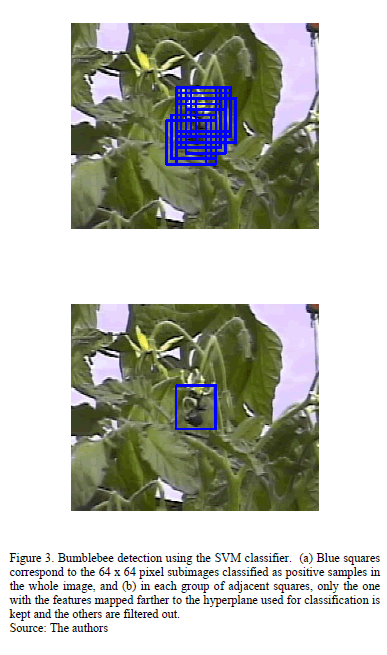
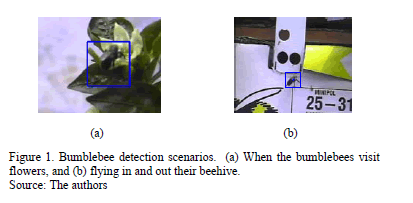
<body><![CDATA[<p><font size="2" face="Verdana, Arial, Helvetica, sans-serif">The objective of the  present document is to report the use of computer vision algorithms to  automatically detect the presence of bumblebees, for extended periods of time,  and without the need to engineer the environment. To that end, the rest of the  document is developed as follow. In Section 2, we survey the related  literature. Then in Section 3, we describe the materials and methods used to  perform the evaluation. Next, in Section 4, we describe our experimental  results. Finally, in Section 5, we conclude the document summarizing our  findings and describing potential lines for future research.</font></p>     <p>&nbsp;</p>     <p><font size="3" face="Verdana, Arial, Helvetica, sans-serif"><b>2.  Related Works</b></font></p>     <p><font size="2" face="Verdana, Arial, Helvetica, sans-serif">Automatic visual  recognition of insects has been used when it has been possible to study static  insects, with enough resolution, and in controlled lighting conditions. For  instance, Larios <i>et al.</i> &#91;7&#93; represent  insects by features based on the curvature of their profiles, analyzed on both  local and global scales. On the  other hand static and adaptive appearance templates for handling appearance  change, and geometry-constrained resampling of particles for handling  unreliable features has been used in the past &#91;19&#93;.  At their end, Yuefang <i>et al.</i>&#91;4&#93; identify insects by describing their wings with a  combination of moment invariants. In addition, the interaction between insects  and the environment can facilitate the use of clustering techniques based on  color or intensity, as reported by Jinhui <i>et   al.</i> &#91;17&#93;. Furthermore, insects can be identified by their traces &#91;12&#93;.  Nonetheless, there is a pressing need to increase our understanding for  situations where the bumblebees interact freely with their environment.</font></p>     <p><font size="2" face="Verdana, Arial, Helvetica, sans-serif">Detecting and tracking  at the beehive entrance has been done in the past making use of computer vision  technics in 3D.&#91;20&#93; In our investigation  we focus only on the detection of insects either at the entrance of the  beehive or at the time of pollination in the flower. Toward that objective, we  compare the performance of a Viola-Jones classifier &#91;16&#93; and a Support Vector  Machine classifier (SVM) &#91;2&#93;. This work further enhance a previous work &#91;23&#93;,  where we explored the use of tracking by detection to analyze the arrival of bumblebees  to flowers and their motion around beehives.</font></p>     <p>&nbsp;</p>     <p><font size="3" face="Verdana, Arial, Helvetica, sans-serif"><b>3.  Materials and  Methods </b></font></p>     <p><font size="2" face="Verdana, Arial, Helvetica, sans-serif">A flying cage (6m x 3m x 3m) was covered with an antiaphid net. Inside we  placed five tomato (<i>Solanum lycopersicum</i>)  and Serrano chili (<i>Capsicum annuun</i>)  flowering plants. A MINIPOL&trade; (Koppert)  hive, containing 30 <i>Bombus impatiens</i> (Hymenoptera: Apidae) workers was introduced into the cage two  hours before the experiment began.  The bumblebees were free to fly inside the cage and a JAI camera model CV-S3200  with an analog interface connected to a National Instrument NI PCI 1411  acquisition board was used to obtain images at a 640 x 480 resolution and a  frame rate of 30 fps.  Acquisition was  done during the day making use of direct sunlight as illumination. The camera  was mounted on a metallic support focused at times on a tomato flower as well  as to the hive (see <a href="#fig01">Fig. 1</a>). In order to analyze the performance of each  classifier, 2,082 images with bumblebees were selected as positive samples and  3,483 without bumblebees as negative samples employing cross-validation. The  images included the natural changes of illumination caused by the apparent Sun  movement and the occasional Sun occlusion due to clouds. To train the  classifiers, we selected 80% of the samples at random using the rest for  testing. To construct the Viola-Jones classifier, we used the Open CV library  &#91;1&#93;, which uses Haar-like features. To construct the SVM classifier, we used  the implementation provided by Matlab with a linear kernel, with Histogram of  Oriented Gradients (HOG) as features &#91;18&#93;. We constructed Viola-Jones  classifiers for 24 x 24 pixel  subimages, with 10, 15, 18, 20, and 22 stages. Their corresponding training  time was around 4, 8, 12, 18, and 24 hours, respectively. For the HOG features,  we used 64 x 64 pixel  images, with 8 x 8 pixel  cells, and 2 x 2 cell  blocks, as seen in <a href="#fig03">Fig. 3</a>. The SVM works by constructing a feature space where  the classes to be distinguished are separated using a certain type of kernel.  The search for a bumblebee in a particular image takes place using a  hierarchical search of a pyramid structure, where each level has twice the  resolution &#91;24&#93;. We accepted bumblebee detection when the Viola-Jones  classifier gave a positive response and when the margin of the SVM classifier  was positive. We use the Receiver Operating Characteristic (ROC) curve &#91;14&#93; to  verify the performance of the classifiers. The computer used for these  experiments has an Intel i5 microprocessor with four cores, operating at  3.33GHz, with 8 GB of RAM and running on the Windows 7, 64 bit, operating  system.</font></p>     <p>&nbsp;</p>     <p><font size="3" face="Verdana, Arial, Helvetica, sans-serif"><b>4.  Experimental   Results</b></font></p>     ]]></body>
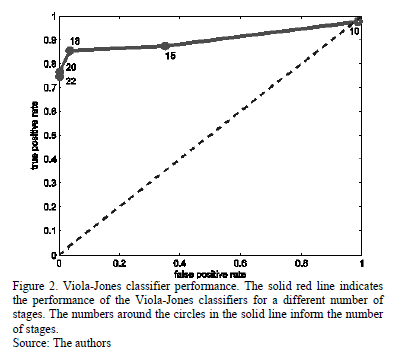
<body><![CDATA[<p><font size="2" face="Verdana, Arial, Helvetica, sans-serif">For the Viola-Jones  classifier, as the number of stages was varied in the classifier, the  performance improved. <a href="#fig02">Fig. 2</a> illustrates the results as a ROC curve &#91;14&#93;. The  reduction of the False Positive Rate (FPR) after the addition of just a few  stages in the classifier is remarkable. For instance, the FPR is reduced from ~1.0 to ~0.4 upon  changing from a 10-stages classifier to a 15-stages classifier. In fact, the  FPR for the 18-stages classifier is 0.04, while the True Positive Rate (TPR) is  0.85. Of course, the TPR decreases accordingly but it does so at a smaller  rate. Note that while the TPR is 0.99 with the 10-stages classifier, it is 0.87  and 0.85 with the 15 and 18-stages classifiers, respectively. Similarly, the  FPR is below 0.01 for the 20- and 22-stages classifiers, while the TPR is ~0.75. With the SVM classifier, the TPR is 0.98 and  the FPR 0.003. These results show a superior performance of the SVM classifier.</font></p>     <p>&nbsp;</p>     <p><font size="3" face="Verdana, Arial, Helvetica, sans-serif"><b>5.  Conclusion</b></font></p>     <p><font size="2" face="Verdana, Arial, Helvetica, sans-serif">In this document, we  applied Viola-Jones and SVM classifiers to the problem of detecting bumblebees  in an unconstrained,green-house-like environment. Furthermore, our results show  that the Support Vector Machine classifier, with HOG features, outperforms the  Viola-Jones classifier. Managed pollinators like bumblebees are frequently  monitored at the hive entrance to determine the foraging activity rate by  counting the number of bees coming in or out the hive &#91;21&#93;. This activity rate  is an important element of practical pollination studies in greenhouses &#91;22&#93;. A  system counting automatically the number of bees flying in and out of the hive  or the number of bumblebees arriving to a flower with high accuracy would be  very informative. However, in some computer vision systems the illumination  changes could affect the outcome of the detection.   HOG features are less affected by possible  illumination changes, because they are based on the orientation of gradients and  the normalization of image blocks. Keeping the natural illumination conditions  is important in order not to disturb the behavior of bumblebees. More research  should increase the performance of the detectors, highlight other aspects of  the insect-pollinators activity, and lead the development of more flexible  monitoring tools. For instance, a possible way to increase the performance of  either one of the classifiers could involve the use of a detection-and-tracking  strategy. Such strategy could be used in combination to fill the gaps whenever  a bumblebee is not detected.</font></p>     <p>&nbsp;</p>     <p><font size="3" face="Verdana, Arial, Helvetica, sans-serif"><b>6.  Figures</b></font></p>     <p align="center"><font size="2" face="Verdana, Arial, Helvetica, sans-serif"><a name="fig01"></a></font><img src="/img/revistas/dyna/v81n187/v81n187a09fig01.gif"></p>     <p align="center"><font size="2" face="Verdana, Arial, Helvetica, sans-serif"><a name="fig02"></a></font><img src="/img/revistas/dyna/v81n187/v81n187a09fig02.gif"></p>     <p align="center"><font size="2" face="Verdana, Arial, Helvetica, sans-serif"><a name="fig03"></a></font><img src="/img/revistas/dyna/v81n187/v81n187a09fig03.gif"></p>     <p>&nbsp;</p>     ]]></body>
<body><![CDATA[<p><font size="3" face="Verdana, Arial, Helvetica, sans-serif"><b>Acknowledgements </b></font></p>     <p><font size="2" face="Verdana, Arial, Helvetica, sans-serif">This research was partially funded through research grant  number SIP-IPN/201325.  We thank Paul  Riley for his comments to improve this document.</font></p>     <p>&nbsp;</p>     <p><font size="3" face="Verdana, Arial, Helvetica, sans-serif"><b>References </b></font></p>     <!-- ref --><p><font size="2" face="Verdana, Arial, Helvetica, sans-serif"><b>&#91;1&#93;</b>    Gary, B. and Adrian, K., Learning OpenCV: Computer  vision with the OpenCV library.  1<sup>ra</sup>. Ed. California, U. S.: Editor O'Reilly  Media, 2008.    &nbsp;&nbsp;&nbsp;&nbsp;&nbsp;&nbsp;&nbsp;&nbsp;[&#160;<a href="javascript:void(0);" onclick="javascript: window.open('/scielo.php?script=sci_nlinks&ref=000047&pid=S0012-7353201400050000900001&lng=','','width=640,height=500,resizable=yes,scrollbars=1,menubar=yes,');">Links</a>&#160;]<!-- end-ref --></font></p>     <!-- ref --><p><font size="2" face="Verdana, Arial, Helvetica, sans-serif"><b>&#91;2&#93;</b>    Nello, C. and Shawe-Taylor, J., An introduction to  support vector machines and other kernel-based learning methods. 1<sup>ra</sup>.  Ed. United Kingdom, Cambridge University Press, 2000.    &nbsp;&nbsp;&nbsp;&nbsp;&nbsp;&nbsp;&nbsp;&nbsp;[&#160;<a href="javascript:void(0);" onclick="javascript: window.open('/scielo.php?script=sci_nlinks&ref=000049&pid=S0012-7353201400050000900002&lng=','','width=640,height=500,resizable=yes,scrollbars=1,menubar=yes,');">Links</a>&#160;]<!-- end-ref --></font></p>     <!-- ref --><p><font size="2" face="Verdana, Arial, Helvetica, sans-serif"><b>&#91;3&#93;</b>    Chiu, C., En-Cheng, Y., Joe-Air, J. and Ta-Te, L., An  imaging system for monitoring the In-and-out activity of honey bees. Computers and Electronics in Agriculture, pp. 100-109, 2012.    &nbsp;&nbsp;&nbsp;&nbsp;&nbsp;&nbsp;&nbsp;&nbsp;[&#160;<a href="javascript:void(0);" onclick="javascript: window.open('/scielo.php?script=sci_nlinks&ref=000051&pid=S0012-7353201400050000900003&lng=','','width=640,height=500,resizable=yes,scrollbars=1,menubar=yes,');">Links</a>&#160;]<!-- end-ref --></font></p>     ]]></body>
<body><![CDATA[<!-- ref --><p><font size="2" face="Verdana, Arial, Helvetica, sans-serif"><b>&#91;4&#93;</b>    Yuefang, G., Hongzhi, S., Xuhong, T. and Yan, C.,  Identification algorithm of winged insects based on hybrid moment  invariants,  Proceedings of International Conference on Bioinformatics and Biomedical Engineering, pp. 531-534, 2007.    &nbsp;&nbsp;&nbsp;&nbsp;&nbsp;&nbsp;&nbsp;&nbsp;[&#160;<a href="javascript:void(0);" onclick="javascript: window.open('/scielo.php?script=sci_nlinks&ref=000053&pid=S0012-7353201400050000900004&lng=','','width=640,height=500,resizable=yes,scrollbars=1,menubar=yes,');">Links</a>&#160;]<!-- end-ref --></font></p>     <!-- ref --><p><font size="2" face="Verdana, Arial, Helvetica, sans-serif"><b>&#91;5&#93;</b> Cama-Pinto, A., Gil-Montoya, F., G&oacute;mez-L&oacute;pez, J., Garc&iacute;a-Cruz,  A. and Manzano-Agugliaro, F., Wireless surveillance system for greenhouse crops  , DYNA (Colombia), 81 (184), pp. 164-170, 2014.    &nbsp;&nbsp;&nbsp;&nbsp;&nbsp;&nbsp;&nbsp;&nbsp;[&#160;<a href="javascript:void(0);" onclick="javascript: window.open('/scielo.php?script=sci_nlinks&ref=000055&pid=S0012-7353201400050000900005&lng=','','width=640,height=500,resizable=yes,scrollbars=1,menubar=yes,');">Links</a>&#160;]<!-- end-ref --></font></p>     <!-- ref --><p><font size="2" face="Verdana, Arial, Helvetica, sans-serif"><b>&#91;6&#93;</b> Klein, A.-M.,  Vaissière, B.-E., Cane, J.-H., Steffan-Dewenter, I., Cunningham, S., Kremen, C.  and Tscharntke, T., Importance of pollinators in changing landscapes for world crops. Proc. R. Soc. B., pp. 303-313, 2007.    &nbsp;&nbsp;&nbsp;&nbsp;&nbsp;&nbsp;&nbsp;&nbsp;[&#160;<a href="javascript:void(0);" onclick="javascript: window.open('/scielo.php?script=sci_nlinks&ref=000057&pid=S0012-7353201400050000900006&lng=','','width=640,height=500,resizable=yes,scrollbars=1,menubar=yes,');">Links</a>&#160;]<!-- end-ref --></font></p>     <!-- ref --><p><font size="2" face="Verdana, Arial, Helvetica, sans-serif"><b>&#91;7&#93;</b>    Larios, N., Deng, H., Zhang, W., Sarpola, N., Yuen,  J., Paasch, R., Moldenke, A., Lytle, D., Correa, S., Mortensen, E., Shapiro, L.  and Dietterich, T., Automated insect identification through concatenated  histograms of local appearance features: Feature vector generation and region  detection for deformable objects, Machine Vision and Applications, 19, pp. 105-123, 2007.    &nbsp;&nbsp;&nbsp;&nbsp;&nbsp;&nbsp;&nbsp;&nbsp;[&#160;<a href="javascript:void(0);" onclick="javascript: window.open('/scielo.php?script=sci_nlinks&ref=000059&pid=S0012-7353201400050000900007&lng=','','width=640,height=500,resizable=yes,scrollbars=1,menubar=yes,');">Links</a>&#160;]<!-- end-ref --></font></p>     <!-- ref --><p><font size="2" face="Verdana, Arial, Helvetica, sans-serif"><b>&#91;8&#93;</b>    Lingren, B. and Lenker, D.-H., Insect trap and assembly for capturing and monitoring insects, US Patent, 6,516,558, February, 2003.    &nbsp;&nbsp;&nbsp;&nbsp;&nbsp;&nbsp;&nbsp;&nbsp;[&#160;<a href="javascript:void(0);" onclick="javascript: window.open('/scielo.php?script=sci_nlinks&ref=000061&pid=S0012-7353201400050000900008&lng=','','width=640,height=500,resizable=yes,scrollbars=1,menubar=yes,');">Links</a>&#160;]<!-- end-ref --></font></p>     ]]></body>
<body><![CDATA[<!-- ref --><p><font size="2" face="Verdana, Arial, Helvetica, sans-serif"><b>&#91;9&#93;</b>    Lortie, C.-J., Budden, A.-E. and Reid, A.-M., From  birds to bees: Applying video observation techniques to invertebrate pollinators, Journal of Pollination Ecology, 6, pp. 125, 2012.    &nbsp;&nbsp;&nbsp;&nbsp;&nbsp;&nbsp;&nbsp;&nbsp;[&#160;<a href="javascript:void(0);" onclick="javascript: window.open('/scielo.php?script=sci_nlinks&ref=000063&pid=S0012-7353201400050000900009&lng=','','width=640,height=500,resizable=yes,scrollbars=1,menubar=yes,');">Links</a>&#160;]<!-- end-ref --></font></p>     <!-- ref --><p><font size="2" face="Verdana, Arial, Helvetica, sans-serif"><b>&#91;10&#93;</b>   Nabhan, G.-P. and  Buchmann, S.-L., Services supplied by pollinators, In Nature's Services, Societal Dependence on Natural Ecosystems, Island Press, pp. 133-150, 1997</font>&nbsp;&nbsp;&nbsp;&nbsp;&nbsp;&nbsp;&nbsp;&nbsp;[&#160;<a href="javascript:void(0);" onclick="javascript: window.open('/scielo.php?script=sci_nlinks&ref=000065&pid=S0012-7353201400050000900010&lng=','','width=640,height=500,resizable=yes,scrollbars=1,menubar=yes,');">Links</a>&#160;]<!-- end-ref --><!-- ref --><p><font size="2" face="Verdana, Arial, Helvetica, sans-serif"><b>&#91;11&#93;</b>   Potts, S.-G., Biesmeijer, J.-C., Kremen, C., Neumann, P., Schweiger, O.  and Kunin, W., Global pollinator declines: Trends, impacts and drivers, Trends in Ecology and Evolution Cell Press, 25, pp. 345-353, 2010.    &nbsp;&nbsp;&nbsp;&nbsp;&nbsp;&nbsp;&nbsp;&nbsp;[&#160;<a href="javascript:void(0);" onclick="javascript: window.open('/scielo.php?script=sci_nlinks&ref=000066&pid=S0012-7353201400050000900011&lng=','','width=640,height=500,resizable=yes,scrollbars=1,menubar=yes,');">Links</a>&#160;]<!-- end-ref --></font></p>     <!-- ref --><p><font size="2" face="Verdana, Arial, Helvetica, sans-serif"><b>&#91;12&#93;</b>   Bok-Suk, S., Eui-Young, C., Kwang-Baek, K., Kyoung-Won,  C., Reinhard, K. and Woon, W., Effective feature extraction by trace transform  for insect footprint recognition, in 3<sup>rd</sup> International Conference on  Bio-Inspired Computing: Theories and Applications, pp. 97-102, 2008.    &nbsp;&nbsp;&nbsp;&nbsp;&nbsp;&nbsp;&nbsp;&nbsp;[&#160;<a href="javascript:void(0);" onclick="javascript: window.open('/scielo.php?script=sci_nlinks&ref=000068&pid=S0012-7353201400050000900012&lng=','','width=640,height=500,resizable=yes,scrollbars=1,menubar=yes,');">Links</a>&#160;]<!-- end-ref --></font></p>     <!-- ref --><p><font size="2" face="Verdana, Arial, Helvetica, sans-serif"><b>&#91;13&#93;</b>   Steen, R., Aase, O. and Thorsdatter, A., Portable  digital video surveillance system for monitoring flower-visiting bumblebees, Journal of Pollination Ecology, 5, pp. 90-94, 2011.    &nbsp;&nbsp;&nbsp;&nbsp;&nbsp;&nbsp;&nbsp;&nbsp;[&#160;<a href="javascript:void(0);" onclick="javascript: window.open('/scielo.php?script=sci_nlinks&ref=000070&pid=S0012-7353201400050000900013&lng=','','width=640,height=500,resizable=yes,scrollbars=1,menubar=yes,');">Links</a>&#160;]<!-- end-ref --></font></p>     <!-- ref --><p><font size="2" face="Verdana, Arial, Helvetica, sans-serif"><b>&#91;14&#93;</b>   Swets, J.-A., Dawes, R.-M. and Monahan, J., Better decisions through science, Scientific American, 283, pp. 82-87, 2000.    &nbsp;&nbsp;&nbsp;&nbsp;&nbsp;&nbsp;&nbsp;&nbsp;[&#160;<a href="javascript:void(0);" onclick="javascript: window.open('/scielo.php?script=sci_nlinks&ref=000072&pid=S0012-7353201400050000900014&lng=','','width=640,height=500,resizable=yes,scrollbars=1,menubar=yes,');">Links</a>&#160;]<!-- end-ref --></font></p>     <!-- ref --><p><font size="2" face="Verdana, Arial, Helvetica, sans-serif"><b>&#91;15&#93;</b>   Velthuis, H.-W.  and Van Doorn, A., A century of advances on bumblebee domestication and the  economic and environmental aspect of its commercialization for pollination, Apidologie, 37, pp. 421-451, 2006.    &nbsp;&nbsp;&nbsp;&nbsp;&nbsp;&nbsp;&nbsp;&nbsp;[&#160;<a href="javascript:void(0);" onclick="javascript: window.open('/scielo.php?script=sci_nlinks&ref=000074&pid=S0012-7353201400050000900015&lng=','','width=640,height=500,resizable=yes,scrollbars=1,menubar=yes,');">Links</a>&#160;]<!-- end-ref --></font></p>     <!-- ref --><p><font size="2" face="Verdana, Arial, Helvetica, sans-serif"><b>&#91;16&#93;</b>   Viola, P. and Jones, M., Rapid Object detection using  a boosted cascade of simple features, in Proceedings of the Conference on Computer Vision and Pattern Recgnition (CVPR), Kauai, Hawaii, Vol. 1, pp. 511-518, 2001.    &nbsp;&nbsp;&nbsp;&nbsp;&nbsp;&nbsp;&nbsp;&nbsp;[&#160;<a href="javascript:void(0);" onclick="javascript: window.open('/scielo.php?script=sci_nlinks&ref=000076&pid=S0012-7353201400050000900016&lng=','','width=640,height=500,resizable=yes,scrollbars=1,menubar=yes,');">Links</a>&#160;]<!-- end-ref --></font></p>     <!-- ref --><p><font size="2" face="Verdana, Arial, Helvetica, sans-serif"><b>&#91;17&#93;</b>   Jinhui, Z., Muhua, L.  and Mingyin, Y., Study on image recognition of insect pest of sugarcane cotton  aphis based on rough set and fuzzy C-means clustering, in: Intelligent Information Technology  Application, IITA 2009, Third International Symposium on Vol. 2, pp. 553-555. 2009.    &nbsp;&nbsp;&nbsp;&nbsp;&nbsp;&nbsp;&nbsp;&nbsp;[&#160;<a href="javascript:void(0);" onclick="javascript: window.open('/scielo.php?script=sci_nlinks&ref=000078&pid=S0012-7353201400050000900017&lng=','','width=640,height=500,resizable=yes,scrollbars=1,menubar=yes,');">Links</a>&#160;]<!-- end-ref --></font></p>     <!-- ref --><p><font size="2" face="Verdana, Arial, Helvetica, sans-serif"><b>&#91;18&#93;</b>   Dalal,  N. and Triggs, B., Histograms of oriented gradients for human detection, In  Proceedings of the Conference on Computer Vision and Pattern Recognition, San Diego, California, USA, pp. 886-893, 2005.    &nbsp;&nbsp;&nbsp;&nbsp;&nbsp;&nbsp;&nbsp;&nbsp;[&#160;<a href="javascript:void(0);" onclick="javascript: window.open('/scielo.php?script=sci_nlinks&ref=000080&pid=S0012-7353201400050000900018&lng=','','width=640,height=500,resizable=yes,scrollbars=1,menubar=yes,');">Links</a>&#160;]<!-- end-ref --></font></p>     <!-- ref --><p><font size="2" face="Verdana, Arial, Helvetica, sans-serif"><b>&#91;19&#93;</b>   Maitra,  P., Schneider, S. and Shin, M., Robust bee tracking with adaptive appearance  template and geometry-constrained resampling, in Applications of Computer Vision (WACV), 2009 Workshop IEEE 2009.    &nbsp;&nbsp;&nbsp;&nbsp;&nbsp;&nbsp;&nbsp;&nbsp;[&#160;<a href="javascript:void(0);" onclick="javascript: window.open('/scielo.php?script=sci_nlinks&ref=000082&pid=S0012-7353201400050000900019&lng=','','width=640,height=500,resizable=yes,scrollbars=1,menubar=yes,');">Links</a>&#160;]<!-- end-ref --></font></p>     <!-- ref --><p><font size="2" face="Verdana, Arial, Helvetica, sans-serif"><b>&#91;20&#93;</b> Chiron,  G., Gomez-Krämer, P., M&eacute;nard, M, and Requier, F., 3D tracking of honeybees  enhanced by environmental context, International Conference on Image Analysis and Processing, Springer, pp. 702-711, 2013.    &nbsp;&nbsp;&nbsp;&nbsp;&nbsp;&nbsp;&nbsp;&nbsp;[&#160;<a href="javascript:void(0);" onclick="javascript: window.open('/scielo.php?script=sci_nlinks&ref=000084&pid=S0012-7353201400050000900020&lng=','','width=640,height=500,resizable=yes,scrollbars=1,menubar=yes,');">Links</a>&#160;]<!-- end-ref --></font></p>     <!-- ref --><p><font size="2" face="Verdana, Arial, Helvetica, sans-serif"><b>&#91;21&#93;</b>   Kevan,  G.-P., Cooper, E., Morse, A., Kapongo, P.J., Shipp, L. and Khosla, S.,  Measuring foraging activity in bumblebee nests: A simple pest-entrance trip recorder, Journal of Applied Entomology, 133, pp. 222-228, 2009.    &nbsp;&nbsp;&nbsp;&nbsp;&nbsp;&nbsp;&nbsp;&nbsp;[&#160;<a href="javascript:void(0);" onclick="javascript: window.open('/scielo.php?script=sci_nlinks&ref=000086&pid=S0012-7353201400050000900021&lng=','','width=640,height=500,resizable=yes,scrollbars=1,menubar=yes,');">Links</a>&#160;]<!-- end-ref --></font></p>     <!-- ref --><p><font size="2" face="Verdana, Arial, Helvetica, sans-serif"><b>&#91;22&#93;</b>   Torres-Ruiz,  A. and Jones, R.W., Bombus impatiens and bombus ephippiatus (Hymenoptera:  Apidea) as pollinators of tomato in greenhouses, Journal of Economic Entomology, 105 (6), pp. 1871-1877, 2012.    &nbsp;&nbsp;&nbsp;&nbsp;&nbsp;&nbsp;&nbsp;&nbsp;[&#160;<a href="javascript:void(0);" onclick="javascript: window.open('/scielo.php?script=sci_nlinks&ref=000088&pid=S0012-7353201400050000900022&lng=','','width=640,height=500,resizable=yes,scrollbars=1,menubar=yes,');">Links</a>&#160;]<!-- end-ref --></font></p>     <!-- ref --><p><font size="2" face="Verdana, Arial, Helvetica, sans-serif"><b>&#91;23&#93;</b>   Miranda,  B., Salas, J. and Vera, P., Bumblebees detection and tracking, workshop vis. Observational Anal. Anim. Insect Behav. ICPR. 2012.    &nbsp;&nbsp;&nbsp;&nbsp;&nbsp;&nbsp;&nbsp;&nbsp;[&#160;<a href="javascript:void(0);" onclick="javascript: window.open('/scielo.php?script=sci_nlinks&ref=000090&pid=S0012-7353201400050000900023&lng=','','width=640,height=500,resizable=yes,scrollbars=1,menubar=yes,');">Links</a>&#160;]<!-- end-ref --></font></p>     <!-- ref --><p><font size="2" face="Verdana, Arial, Helvetica, sans-serif"><b>&#91;24&#93;</b>   Crowley, J.-L., A representation for visual  information, Report CMU-RI-TR-82-07, Robotics Institute, Carnegie-Mellon  University, 1981.    &nbsp;&nbsp;&nbsp;&nbsp;&nbsp;&nbsp;&nbsp;&nbsp;[&#160;<a href="javascript:void(0);" onclick="javascript: window.open('/scielo.php?script=sci_nlinks&ref=000092&pid=S0012-7353201400050000900024&lng=','','width=640,height=500,resizable=yes,scrollbars=1,menubar=yes,');">Links</a>&#160;]<!-- end-ref --></font></p>     <p>&nbsp;</p>     <p><font size="2" face="Verdana, Arial, Helvetica, sans-serif"><b>W. Azarcoya-Cabiedes, </b>received a Bs. on Communications and Electronics in 2006, from the Instituto  Polit&eacute;cnico Nacional - IPN, M&eacute;xico; an MSc. in Distributed Software Engineering  in 2012, from Quer&eacute;taro State University - UAQ, M&eacute;xico; he is currently a PhD  student in Computer Vision at IPN, M&eacute;xico.</font></p>     <p><font size="2" face="Verdana, Arial, Helvetica, sans-serif"><b>A. Torres-Ruiz</b> received a Bs. in Biology in 1999 from the Queretaro  State University - UAQ, M&eacute;xico; an MSc.  degree in Biological Science in 2002 from the Institute of Ecology at the  National University of Mexico - UNAM, M&eacute;xico; and  his PhD. degree in Management of Natural Resources in 2013, from the UAQ,  M&eacute;xico. His areas of research interest include: pollination ecology, biological  control and mass rearing of insects. He is currently Production and Research  and Develop manager at Koppert M&eacute;xico.</font></p>     <p><font size="2" face="Verdana, Arial, Helvetica, sans-serif"><b>P. Vera-Alfaro,</b> received a Bs. in Communications and Electronics and an MSc. degree on Advanced  Technology in 2007, all of them from Instituto Polit&eacute;cnico Nacional - IPN,  M&eacute;xico.  Currently he is working in IPN,  as an associate professor in the area of computer vision. </font></p>     <p><font size="2" face="Verdana, Arial, Helvetica, sans-serif"><b>J. Salas, </b>received a Bs. degree in Computer Science in 1989 from the  ITESM, M&eacute;xico; an MSc. degree in Electrical Engineering in 1991 from CINVESTAV,  M&eacute;xico and a PhD. degree in Informatics in 1996, also from ITESM, M&eacute;xico. He is  a full-time professor at IPN. His areas of research include, computer vision,  pattern recognition, and artificial intelligence.</font></p>      ]]></body><back>
<ref-list>
<ref id="B1">
<label>1</label><nlm-citation citation-type="book">
<person-group person-group-type="author">
<name>
<surname><![CDATA[Gary]]></surname>
<given-names><![CDATA[B.]]></given-names>
</name>
<name>
<surname><![CDATA[Adrian]]></surname>
<given-names><![CDATA[K.]]></given-names>
</name>
</person-group>
<source><![CDATA[Learning OpenCV: Computer vision with the OpenCV library]]></source>
<year>2008</year>
<edition>1ra</edition>
<publisher-loc><![CDATA[California ]]></publisher-loc>
<publisher-name><![CDATA[O'Reilly Media]]></publisher-name>
</nlm-citation>
</ref>
<ref id="B2">
<label>2</label><nlm-citation citation-type="book">
<person-group person-group-type="author">
<name>
<surname><![CDATA[Nello]]></surname>
<given-names><![CDATA[C.]]></given-names>
</name>
<name>
<surname><![CDATA[Shawe-Taylor]]></surname>
<given-names><![CDATA[J.]]></given-names>
</name>
</person-group>
<source><![CDATA[An introduction to support vector machines and other kernel-based learning methods]]></source>
<year>2000</year>
<edition>1ra</edition>
<publisher-name><![CDATA[Cambridge University Press]]></publisher-name>
</nlm-citation>
</ref>
<ref id="B3">
<label>3</label><nlm-citation citation-type="journal">
<person-group person-group-type="author">
<name>
<surname><![CDATA[Chiu]]></surname>
<given-names><![CDATA[C.]]></given-names>
</name>
<name>
<surname><![CDATA[En-Cheng]]></surname>
<given-names><![CDATA[Y.]]></given-names>
</name>
<name>
<surname><![CDATA[Joe-Air]]></surname>
<given-names><![CDATA[J.]]></given-names>
</name>
<name>
<surname><![CDATA[Ta-Te]]></surname>
<given-names><![CDATA[L.]]></given-names>
</name>
</person-group>
<article-title xml:lang="en"><![CDATA[An imaging system for monitoring the In-and-out activity of honey bees]]></article-title>
<source><![CDATA[Computers and Electronics in Agriculture]]></source>
<year>2012</year>
<page-range>100-109</page-range></nlm-citation>
</ref>
<ref id="B4">
<label>4</label><nlm-citation citation-type="confpro">
<person-group person-group-type="author">
<name>
<surname><![CDATA[Yuefang]]></surname>
<given-names><![CDATA[G.]]></given-names>
</name>
<name>
<surname><![CDATA[Hongzhi]]></surname>
<given-names><![CDATA[S.]]></given-names>
</name>
<name>
<surname><![CDATA[Xuhong]]></surname>
<given-names><![CDATA[T.]]></given-names>
</name>
<name>
<surname><![CDATA[Yan]]></surname>
<given-names><![CDATA[C.]]></given-names>
</name>
</person-group>
<article-title xml:lang="en"><![CDATA[Identification algorithm of winged insects based on hybrid moment invariants]]></article-title>
<source><![CDATA[]]></source>
<year>2007</year>
<conf-name><![CDATA[ International Conference on Bioinformatics and Biomedical Engineering]]></conf-name>
<conf-loc> </conf-loc>
<page-range>531-534</page-range></nlm-citation>
</ref>
<ref id="B5">
<label>5</label><nlm-citation citation-type="journal">
<person-group person-group-type="author">
<name>
<surname><![CDATA[Cama-Pinto]]></surname>
<given-names><![CDATA[A.]]></given-names>
</name>
<name>
<surname><![CDATA[Gil-Montoya]]></surname>
<given-names><![CDATA[F.]]></given-names>
</name>
<name>
<surname><![CDATA[Gómez-López]]></surname>
<given-names><![CDATA[J.]]></given-names>
</name>
<name>
<surname><![CDATA[García-Cruz]]></surname>
<given-names><![CDATA[A.]]></given-names>
</name>
<name>
<surname><![CDATA[Manzano-Agugliaro]]></surname>
<given-names><![CDATA[F.]]></given-names>
</name>
</person-group>
<article-title xml:lang="en"><![CDATA[Wireless Surveillance system for greenhouse crops]]></article-title>
<source><![CDATA[DYNA]]></source>
<year>2014</year>
<volume>81</volume>
<numero>184</numero>
<issue>184</issue>
<page-range>164-170</page-range></nlm-citation>
</ref>
<ref id="B6">
<label>6</label><nlm-citation citation-type="journal">
<person-group person-group-type="author">
<name>
<surname><![CDATA[Klein]]></surname>
<given-names><![CDATA[A.-M.]]></given-names>
</name>
<name>
<surname><![CDATA[Vaissière]]></surname>
<given-names><![CDATA[B.-E.]]></given-names>
</name>
<name>
<surname><![CDATA[Cane]]></surname>
<given-names><![CDATA[J.-H.]]></given-names>
</name>
<name>
<surname><![CDATA[Steffan-Dewenter]]></surname>
<given-names><![CDATA[I.]]></given-names>
</name>
<name>
<surname><![CDATA[Cunningham]]></surname>
<given-names><![CDATA[S.]]></given-names>
</name>
<name>
<surname><![CDATA[Kremen]]></surname>
<given-names><![CDATA[C.]]></given-names>
</name>
<name>
<surname><![CDATA[Tscharntke]]></surname>
<given-names><![CDATA[T.]]></given-names>
</name>
</person-group>
<article-title xml:lang="en"><![CDATA[Importance of pollinators in changing landscapes for world crops]]></article-title>
<source><![CDATA[Proc. R. Soc. B.]]></source>
<year>2007</year>
<page-range>303-313</page-range></nlm-citation>
</ref>
<ref id="B7">
<label>7</label><nlm-citation citation-type="journal">
<person-group person-group-type="author">
<name>
<surname><![CDATA[Larios]]></surname>
<given-names><![CDATA[N.]]></given-names>
</name>
<name>
<surname><![CDATA[Deng]]></surname>
<given-names><![CDATA[H.]]></given-names>
</name>
<name>
<surname><![CDATA[Zhang]]></surname>
<given-names><![CDATA[W.]]></given-names>
</name>
<name>
<surname><![CDATA[Sarpola]]></surname>
<given-names><![CDATA[N.]]></given-names>
</name>
<name>
<surname><![CDATA[Yuen]]></surname>
<given-names><![CDATA[J.]]></given-names>
</name>
<name>
<surname><![CDATA[Paasch]]></surname>
<given-names><![CDATA[R.]]></given-names>
</name>
<name>
<surname><![CDATA[Moldenke]]></surname>
<given-names><![CDATA[A.]]></given-names>
</name>
<name>
<surname><![CDATA[Lytle]]></surname>
<given-names><![CDATA[D.]]></given-names>
</name>
<name>
<surname><![CDATA[Correa]]></surname>
<given-names><![CDATA[S.]]></given-names>
</name>
<name>
<surname><![CDATA[Mortensen]]></surname>
<given-names><![CDATA[E.]]></given-names>
</name>
<name>
<surname><![CDATA[Shapiro]]></surname>
<given-names><![CDATA[L.]]></given-names>
</name>
<name>
<surname><![CDATA[Dietterich]]></surname>
<given-names><![CDATA[T.]]></given-names>
</name>
</person-group>
<article-title xml:lang="en"><![CDATA[Automated insect identification through concatenated histograms of local appearance features: Feature vector generation and region detection for deformable objects]]></article-title>
<source><![CDATA[Machine Vision and Applications]]></source>
<year>2007</year>
<numero>19</numero>
<issue>19</issue>
<page-range>105-123</page-range></nlm-citation>
</ref>
<ref id="B8">
<label>8</label><nlm-citation citation-type="">
<person-group person-group-type="author">
<name>
<surname><![CDATA[Lingren]]></surname>
<given-names><![CDATA[B.]]></given-names>
</name>
<name>
<surname><![CDATA[Lenker]]></surname>
<given-names><![CDATA[D.-H.]]></given-names>
</name>
</person-group>
<source><![CDATA[Insect trap and assembly for capturing and monitoring insects]]></source>
<year>Febr</year>
<month>ua</month>
<day>ry</day>
</nlm-citation>
</ref>
<ref id="B9">
<label>9</label><nlm-citation citation-type="journal">
<person-group person-group-type="author">
<name>
<surname><![CDATA[Lortie]]></surname>
<given-names><![CDATA[C.-J.]]></given-names>
</name>
<name>
<surname><![CDATA[Budden]]></surname>
<given-names><![CDATA[A.-E.]]></given-names>
</name>
<name>
<surname><![CDATA[Reid]]></surname>
<given-names><![CDATA[A.-M.]]></given-names>
</name>
</person-group>
<article-title xml:lang="en"><![CDATA[From birds to bees: Applying video observation techniques to invertebrate pollinators]]></article-title>
<source><![CDATA[Journal of Pollination Ecology]]></source>
<year>2012</year>
<numero>6</numero>
<issue>6</issue>
<page-range>125</page-range></nlm-citation>
</ref>
<ref id="B10">
<label>10</label><nlm-citation citation-type="book">
<person-group person-group-type="author">
<name>
<surname><![CDATA[Nabhan]]></surname>
<given-names><![CDATA[G.-P.]]></given-names>
</name>
<name>
<surname><![CDATA[Buchmann]]></surname>
<given-names><![CDATA[S.-L.]]></given-names>
</name>
</person-group>
<collab>Societal Dependence on Natural Ecosystems^dNature's Services</collab>
<source><![CDATA[Services supplied by pollinators]]></source>
<year>1997</year>
<page-range>133-150</page-range><publisher-name><![CDATA[Island Press]]></publisher-name>
</nlm-citation>
</ref>
<ref id="B11">
<label>11</label><nlm-citation citation-type="journal">
<person-group person-group-type="author">
<name>
<surname><![CDATA[Potts]]></surname>
<given-names><![CDATA[S.-G.]]></given-names>
</name>
<name>
<surname><![CDATA[Biesmeijer]]></surname>
<given-names><![CDATA[J.-C.]]></given-names>
</name>
<name>
<surname><![CDATA[Kremen]]></surname>
<given-names><![CDATA[C.]]></given-names>
</name>
<name>
<surname><![CDATA[Neumann]]></surname>
<given-names><![CDATA[P.]]></given-names>
</name>
<name>
<surname><![CDATA[Schweiger]]></surname>
<given-names><![CDATA[O.]]></given-names>
</name>
<name>
<surname><![CDATA[Kunin]]></surname>
<given-names><![CDATA[W.]]></given-names>
</name>
</person-group>
<article-title xml:lang="en"><![CDATA[Global pollinator declines: Trends, impacts and drivers]]></article-title>
<source><![CDATA[Trends in Ecology and Evolution Cell Press]]></source>
<year>2010</year>
<numero>25</numero>
<issue>25</issue>
<page-range>345-353</page-range></nlm-citation>
</ref>
<ref id="B12">
<label>12</label><nlm-citation citation-type="confpro">
<person-group person-group-type="author">
<name>
<surname><![CDATA[Bok-Suk]]></surname>
<given-names><![CDATA[S.]]></given-names>
</name>
<name>
<surname><![CDATA[Eui-Young]]></surname>
<given-names><![CDATA[C.]]></given-names>
</name>
<name>
<surname><![CDATA[Kwang-Baek]]></surname>
<given-names><![CDATA[K.]]></given-names>
</name>
<name>
<surname><![CDATA[Kyoung-Won]]></surname>
<given-names><![CDATA[C.]]></given-names>
</name>
<name>
<surname><![CDATA[Reinhard]]></surname>
<given-names><![CDATA[K.]]></given-names>
</name>
<name>
<surname><![CDATA[Woon]]></surname>
<given-names><![CDATA[W.]]></given-names>
</name>
</person-group>
<article-title xml:lang="en"><![CDATA[Effective feature extraction by trace transform for insect footprint recognition]]></article-title>
<source><![CDATA[]]></source>
<year>2008</year>
<conf-name><![CDATA[3rd International Conference on Bio-Inspired Computing: Theories and Applications]]></conf-name>
<conf-loc> </conf-loc>
<page-range>97-102</page-range></nlm-citation>
</ref>
<ref id="B13">
<label>13</label><nlm-citation citation-type="journal">
<person-group person-group-type="author">
<name>
<surname><![CDATA[Steen]]></surname>
<given-names><![CDATA[R.]]></given-names>
</name>
<name>
<surname><![CDATA[Aase]]></surname>
<given-names><![CDATA[O.]]></given-names>
</name>
<name>
<surname><![CDATA[Thorsdatter]]></surname>
<given-names><![CDATA[A.]]></given-names>
</name>
</person-group>
<article-title xml:lang="en"><![CDATA[Portable digital video surveillance system for monitoring flower-visiting bumblebees]]></article-title>
<source><![CDATA[Journal of Pollination Ecology]]></source>
<year>2011</year>
<numero>5</numero>
<issue>5</issue>
<page-range>90-94</page-range></nlm-citation>
</ref>
<ref id="B14">
<label>14</label><nlm-citation citation-type="journal">
<person-group person-group-type="author">
<name>
<surname><![CDATA[Swets]]></surname>
<given-names><![CDATA[J.-A.]]></given-names>
</name>
<name>
<surname><![CDATA[Dawes]]></surname>
<given-names><![CDATA[R.-M.]]></given-names>
</name>
<name>
<surname><![CDATA[Monahan]]></surname>
<given-names><![CDATA[J.]]></given-names>
</name>
</person-group>
<article-title xml:lang="en"><![CDATA[Better decisions through science]]></article-title>
<source><![CDATA[Scientific American]]></source>
<year>2000</year>
<numero>283</numero>
<issue>283</issue>
<page-range>82-87</page-range></nlm-citation>
</ref>
<ref id="B15">
<label>15</label><nlm-citation citation-type="journal">
<person-group person-group-type="author">
<name>
<surname><![CDATA[Velthuis]]></surname>
<given-names><![CDATA[H.-W.]]></given-names>
</name>
<name>
<surname><![CDATA[Van Doorn]]></surname>
<given-names><![CDATA[A.]]></given-names>
</name>
</person-group>
<article-title xml:lang="en"><![CDATA[A century of advances on bumblebee domestication and the economic and environmental aspect of its commercialization for pollination]]></article-title>
<source><![CDATA[Apidologie]]></source>
<year>2006</year>
<numero>37</numero>
<issue>37</issue>
<page-range>421-451</page-range></nlm-citation>
</ref>
<ref id="B16">
<label>16</label><nlm-citation citation-type="confpro">
<person-group person-group-type="author">
<name>
<surname><![CDATA[Viola]]></surname>
<given-names><![CDATA[P.]]></given-names>
</name>
<name>
<surname><![CDATA[Jones]]></surname>
<given-names><![CDATA[M.]]></given-names>
</name>
</person-group>
<article-title xml:lang="en"><![CDATA[Rapid Object detection using a boosted cascade of simple features]]></article-title>
<source><![CDATA[]]></source>
<year>2001</year>
<volume>1</volume>
<conf-name><![CDATA[ Conference on Computer Vision and Pattern Recgnition]]></conf-name>
<conf-loc>Kauai Hawaii</conf-loc>
<page-range>511-518</page-range></nlm-citation>
</ref>
<ref id="B17">
<label>17</label><nlm-citation citation-type="confpro">
<person-group person-group-type="author">
<name>
<surname><![CDATA[Jinhui]]></surname>
<given-names><![CDATA[Z.]]></given-names>
</name>
<name>
<surname><![CDATA[Muhua]]></surname>
<given-names><![CDATA[L.]]></given-names>
</name>
<name>
<surname><![CDATA[Mingyin]]></surname>
<given-names><![CDATA[Y.]]></given-names>
</name>
</person-group>
<article-title xml:lang="en"><![CDATA[Study on image recognition of insect pest of sugarcane cotton aphis based on rough set and fuzzy C-means clustering]]></article-title>
<source><![CDATA[]]></source>
<year>2009</year>
<volume>2</volume>
<conf-name><![CDATA[Third Intelligent Information Technology Application, IITA 2009]]></conf-name>
<conf-loc> </conf-loc>
<page-range>553-555</page-range></nlm-citation>
</ref>
<ref id="B18">
<label>18</label><nlm-citation citation-type="confpro">
<person-group person-group-type="author">
<name>
<surname><![CDATA[Dalal]]></surname>
<given-names><![CDATA[N.]]></given-names>
</name>
<name>
<surname><![CDATA[Triggs]]></surname>
<given-names><![CDATA[B.]]></given-names>
</name>
</person-group>
<article-title xml:lang="en"><![CDATA[Histograms of oriented gradients for human detection]]></article-title>
<source><![CDATA[]]></source>
<year>2005</year>
<conf-name><![CDATA[ Conference on Computer Vision and Pattern Recognition]]></conf-name>
<conf-loc>San Diego California</conf-loc>
<page-range>886-893</page-range></nlm-citation>
</ref>
<ref id="B19">
<label>19</label><nlm-citation citation-type="confpro">
<person-group person-group-type="author">
<name>
<surname><![CDATA[Maitra]]></surname>
<given-names><![CDATA[P.]]></given-names>
</name>
<name>
<surname><![CDATA[Schneider]]></surname>
<given-names><![CDATA[S.]]></given-names>
</name>
<name>
<surname><![CDATA[Shin]]></surname>
<given-names><![CDATA[M.]]></given-names>
</name>
</person-group>
<article-title xml:lang="en"><![CDATA[Robust bee tracking with adaptive appearance template and geometry-constrained resampling]]></article-title>
<source><![CDATA[]]></source>
<year></year>
<conf-name><![CDATA[ Applications of Computer Vision (WACV), 2009 Workshop IEEE]]></conf-name>
<conf-date>2009</conf-date>
<conf-loc> </conf-loc>
</nlm-citation>
</ref>
<ref id="B20">
<label>20</label><nlm-citation citation-type="confpro">
<person-group person-group-type="author">
<name>
<surname><![CDATA[Chiron]]></surname>
<given-names><![CDATA[G.]]></given-names>
</name>
<name>
<surname><![CDATA[Gomez-Krämer]]></surname>
<given-names><![CDATA[P.]]></given-names>
</name>
<name>
<surname><![CDATA[Ménard]]></surname>
<given-names><![CDATA[M]]></given-names>
</name>
<name>
<surname><![CDATA[Requier]]></surname>
<given-names><![CDATA[F.]]></given-names>
</name>
</person-group>
<article-title xml:lang="en"><![CDATA[3D tracking of honeybees enhanced by environmental context]]></article-title>
<source><![CDATA[]]></source>
<year>2013</year>
<conf-name><![CDATA[ International Conference on Image Analysis and Processing]]></conf-name>
<conf-loc> </conf-loc>
<page-range>702-711</page-range><publisher-name><![CDATA[Springer]]></publisher-name>
</nlm-citation>
</ref>
<ref id="B21">
<label>21</label><nlm-citation citation-type="journal">
<person-group person-group-type="author">
<name>
<surname><![CDATA[Kevan]]></surname>
<given-names><![CDATA[G.-P.]]></given-names>
</name>
<name>
<surname><![CDATA[Cooper]]></surname>
<given-names><![CDATA[E.]]></given-names>
</name>
<name>
<surname><![CDATA[Morse]]></surname>
<given-names><![CDATA[A.]]></given-names>
</name>
<name>
<surname><![CDATA[Kapongo]]></surname>
<given-names><![CDATA[P.J.]]></given-names>
</name>
<name>
<surname><![CDATA[Shipp]]></surname>
<given-names><![CDATA[L.]]></given-names>
</name>
<name>
<surname><![CDATA[Khosla]]></surname>
<given-names><![CDATA[S.]]></given-names>
</name>
</person-group>
<article-title xml:lang="en"><![CDATA[Measuring foraging activity in bumblebee nests: A simple pest-entrance trip recorder]]></article-title>
<source><![CDATA[Journal of Applied Entomology]]></source>
<year>2009</year>
<numero>133</numero>
<issue>133</issue>
<page-range>222-228</page-range></nlm-citation>
</ref>
<ref id="B22">
<label>22</label><nlm-citation citation-type="journal">
<person-group person-group-type="author">
<name>
<surname><![CDATA[Torres-Ruiz]]></surname>
<given-names><![CDATA[A.]]></given-names>
</name>
<name>
<surname><![CDATA[Jones]]></surname>
<given-names><![CDATA[R.W.]]></given-names>
</name>
</person-group>
<article-title xml:lang="en"><![CDATA[Bombus impatiens and bombus ephippiatus (Hymenoptera: Apidea) as pollinators of tomato in greenhouses]]></article-title>
<source><![CDATA[Journal of Economic Entomology]]></source>
<year>2012</year>
<volume>105</volume>
<numero>6</numero>
<issue>6</issue>
<page-range>1871-1877</page-range></nlm-citation>
</ref>
<ref id="B23">
<label>23</label><nlm-citation citation-type="book">
<person-group person-group-type="author">
<name>
<surname><![CDATA[Miranda]]></surname>
<given-names><![CDATA[B.]]></given-names>
</name>
<name>
<surname><![CDATA[Salas]]></surname>
<given-names><![CDATA[J.]]></given-names>
</name>
<name>
<surname><![CDATA[Vera]]></surname>
<given-names><![CDATA[P.]]></given-names>
</name>
</person-group>
<source><![CDATA[Bumblebees detection and tracking]]></source>
<year>2012</year>
<publisher-name><![CDATA[ICPR]]></publisher-name>
</nlm-citation>
</ref>
<ref id="B24">
<label>24</label><nlm-citation citation-type="">
<person-group person-group-type="author">
<name>
<surname><![CDATA[Crowley]]></surname>
<given-names><![CDATA[J.-L.]]></given-names>
</name>
</person-group>
<collab>Carnegie-Mellon University^dRobotics Institute</collab>
<source><![CDATA[A representation for visual information]]></source>
<year>1981</year>
</nlm-citation>
</ref>
</ref-list>
</back>
</article>