<?xml version="1.0" encoding="ISO-8859-1"?><article xmlns:mml="http://www.w3.org/1998/Math/MathML" xmlns:xlink="http://www.w3.org/1999/xlink" xmlns:xsi="http://www.w3.org/2001/XMLSchema-instance">
<front>
<journal-meta>
<journal-id>0012-7353</journal-id>
<journal-title><![CDATA[DYNA]]></journal-title>
<abbrev-journal-title><![CDATA[Dyna rev.fac.nac.minas]]></abbrev-journal-title>
<issn>0012-7353</issn>
<publisher>
<publisher-name><![CDATA[Universidad Nacional de Colombia]]></publisher-name>
</publisher>
</journal-meta>
<article-meta>
<article-id>S0012-73532014000500011</article-id>
<article-id pub-id-type="doi">10.15446/dyna.v81n186.40520</article-id>
<title-group>
<article-title xml:lang="en"><![CDATA[Detection of explosive atmospheres using the software AtmosXp V2.0]]></article-title>
<article-title xml:lang="es"><![CDATA[Detección de atmosferas explosivas usando el software AtmosXp V2.0]]></article-title>
</title-group>
<contrib-group>
<contrib contrib-type="author">
<name>
<surname><![CDATA[Álvarez-Álvarez]]></surname>
<given-names><![CDATA[Carlos Mauricio]]></given-names>
</name>
<xref ref-type="aff" rid="A01"/>
</contrib>
<contrib contrib-type="author">
<name>
<surname><![CDATA[Zapata-Montoya]]></surname>
<given-names><![CDATA[Angélica María]]></given-names>
</name>
<xref ref-type="aff" rid="A02"/>
</contrib>
<contrib contrib-type="author">
<name>
<surname><![CDATA[Montoya-Cañola]]></surname>
<given-names><![CDATA[Sandra Marcela]]></given-names>
</name>
<xref ref-type="aff" rid="A03"/>
</contrib>
<contrib contrib-type="author">
<name>
<surname><![CDATA[Ordoñez-Carmona]]></surname>
<given-names><![CDATA[Oswaldo]]></given-names>
</name>
<xref ref-type="aff" rid="A04"/>
</contrib>
<contrib contrib-type="author">
<name>
<surname><![CDATA[Zapata-Madrigal]]></surname>
<given-names><![CDATA[German Darío]]></given-names>
</name>
<xref ref-type="aff" rid="A05"/>
</contrib>
</contrib-group>
<aff id="A01">
<institution><![CDATA[,Universidad Nacional de Colombia Facultad de Minas ]]></institution>
<addr-line><![CDATA[ ]]></addr-line>
<country>Colombia</country>
</aff>
<aff id="A02">
<institution><![CDATA[,Universidad Nacional de Colombia Facultad de Minas ]]></institution>
<addr-line><![CDATA[ ]]></addr-line>
<country>Colombia</country>
</aff>
<aff id="A03">
<institution><![CDATA[,Universidad Nacional de Colombia Facultad de Minas ]]></institution>
<addr-line><![CDATA[ ]]></addr-line>
<country>Colombia</country>
</aff>
<aff id="A04">
<institution><![CDATA[,Universidad Nacional de Colombia Facultad de Minas ]]></institution>
<addr-line><![CDATA[ ]]></addr-line>
<country>Colombia</country>
</aff>
<aff id="A05">
<institution><![CDATA[,Universidad Nacional de Colombia Facultad de Minas ]]></institution>
<addr-line><![CDATA[ ]]></addr-line>
<country>Colombia</country>
</aff>
<pub-date pub-type="pub">
<day>00</day>
<month>10</month>
<year>2014</year>
</pub-date>
<pub-date pub-type="epub">
<day>00</day>
<month>10</month>
<year>2014</year>
</pub-date>
<volume>81</volume>
<numero>187</numero>
<fpage>91</fpage>
<lpage>95</lpage>
<copyright-statement/>
<copyright-year/>
<self-uri xlink:href="http://www.scielo.org.co/scielo.php?script=sci_arttext&amp;pid=S0012-73532014000500011&amp;lng=en&amp;nrm=iso"></self-uri><self-uri xlink:href="http://www.scielo.org.co/scielo.php?script=sci_abstract&amp;pid=S0012-73532014000500011&amp;lng=en&amp;nrm=iso"></self-uri><self-uri xlink:href="http://www.scielo.org.co/scielo.php?script=sci_pdf&amp;pid=S0012-73532014000500011&amp;lng=en&amp;nrm=iso"></self-uri><abstract abstract-type="short" xml:lang="en"><p><![CDATA[The conditions of explosive atmospheres and accumulation of gases within underground coal mines require a detailed analysis and the development of models and mechanisms that allow their detection. For this purpose we have developed the software AtmosXp V2.0 which includes the diagram of Coward for the analysis of these explosive mixtures.]]></p></abstract>
<abstract abstract-type="short" xml:lang="es"><p><![CDATA[Las condiciones de atmósferas explosivas y acumulación de gases dentro de las minas subterráneas de carbón requieren un análisis detallado y el desarrollo de modelos y mecanismos que permitan su detección. Para tal fin se ha desarrollado el software AtmosXp V2.0 que incluye el diagrama de Coward para el análisis de estas mezclas explosivas.]]></p></abstract>
<kwd-group>
<kwd lng="en"><![CDATA[Atmospheres]]></kwd>
<kwd lng="en"><![CDATA[Underground Mining]]></kwd>
<kwd lng="en"><![CDATA[Coward's diagram]]></kwd>
<kwd lng="en"><![CDATA[Coal]]></kwd>
<kwd lng="en"><![CDATA[Explosive]]></kwd>
<kwd lng="es"><![CDATA[Atmósferas]]></kwd>
<kwd lng="es"><![CDATA[Minería Subterránea]]></kwd>
<kwd lng="es"><![CDATA[diagrama de Coward]]></kwd>
<kwd lng="es"><![CDATA[Carbón]]></kwd>
<kwd lng="es"><![CDATA[Explosividad]]></kwd>
</kwd-group>
</article-meta>
</front><body><![CDATA[ <p><font size="2" face="Verdana, Arial, Helvetica, sans-serif"><a href="http://dx.doi.org/10.15446/dyna.v81n187.40520" target="_blank">http://dx.doi.org/10.15446/dyna.v81n187.40520</a></font></p>     <p align="center"><font size="4" face="Verdana, Arial, Helvetica, sans-serif"><b>Detection of  explosive atmospheres using the software AtmosXp V2.0</b></font></p>     <p align="center"><i><b><font size="3" face="Verdana, Arial, Helvetica, sans-serif">Detecci&oacute;n de atmosferas explosivas usando el software AtmosXp V2.0</font></b></i></p>     <p align="center">&nbsp;</p>     <p align="center"><b><font size="2" face="Verdana, Arial, Helvetica, sans-serif">Carlos Mauricio &Aacute;lvarez-&Aacute;lvarez <i><sup>a</sup></i>, Ang&eacute;lica Mar&iacute;a   Zapata-Montoya <i><sup>b</sup></i>, Sandra   Marcela Montoya-Ca&ntilde;ola <i><sup>c</sup></i>,   Oswaldo Ordo&ntilde;ez-Carmona <i><sup>d </sup></i>&amp;   German Dar&iacute;o Zapata-Madrigal <i><sup>e</sup></i></font></b></p>     <p align="center">&nbsp;</p>     <p align="center"><font size="2" face="Verdana, Arial, Helvetica, sans-serif"><sup><i>a </i></sup><i>Facultad de Minas, Universidad Nacional de Colombia, Colombia.       <a href="mailto:camalvarezal@unal.edu.co">camalvarezal@unal.edu.co</a>    <br>   <sup>b </sup>Facultad de Minas, Universidad Nacional de Colombia, Colombia. <a href="mailto:amzapatamo@unal.edu.co">amzapatamo@unal.edu.co</a>    <br>   <sup>c </sup>Facultad de Minas, Universidad Nacional de Colombia, Colombia. <a href="mailto:smmontoyac@unal.edu.co">smmontoyac@unal.edu.co</a>    <br>   <sup>d </sup>Facultad de Minas, Universidad Nacional de Colombia, Colombia. <a href="mailto:oswaldo.geologo@gmail.com">oswaldo.geologo@gmail.com</a>    ]]></body>
<body><![CDATA[<br>   <sup>e </sup>Facultad de Minas, Universidad Nacional de Colombia, Colombia.        <a href="mailto:gdzapata@unal.edu.co">gdzapata@unal.edu.co</a></i></font></p>     <p align="center">&nbsp;</p>     <p align="center"><font size="2" face="Verdana, Arial, Helvetica, sans-serif"><b>Received: October 28<sup>th</sup>, 2013. Received in revised form:  March 10<sup>th</sup>, 2014. Accepted: July 22<sup>th</sup>, 2014.</b></font></p>     <p align="center">&nbsp;</p> <hr>     <p><font size="2" face="Verdana, Arial, Helvetica, sans-serif"><b>Abstract    <br> </b></font><font size="2" face="Verdana, Arial, Helvetica, sans-serif">The conditions of  explosive atmospheres and accumulation of gases within underground coal mines  require a detailed analysis and the development of models and mechanisms that  allow their detection. For this purpose we have developed the software AtmosXp  V2.0 which includes the diagram of Coward for the analysis of these explosive mixtures.</font></p>     <p><font size="2" face="Verdana, Arial, Helvetica, sans-serif"><i>Keywords</i>: Atmospheres, Underground Mining, Coward's diagram, Coal, Explosive</font></p>     <p><font size="2" face="Verdana, Arial, Helvetica, sans-serif"><b>Resumen    <br> </b></font><font size="2" face="Verdana, Arial, Helvetica, sans-serif">Las condiciones de atm&oacute;sferas explosivas y acumulaci&oacute;n de  gases dentro de las minas subterr&aacute;neas de carb&oacute;n requieren un an&aacute;lisis  detallado y el desarrollo de modelos y mecanismos que permitan su detecci&oacute;n.  Para tal fin se ha desarrollado el software AtmosXp V2.0 que incluye el diagrama de Coward para el an&aacute;lisis de estas mezclas explosivas.</font></p>     <p><font size="2" face="Verdana, Arial, Helvetica, sans-serif"><i>Palabras clave</i>: Atm&oacute;sferas, Miner&iacute;a Subterr&aacute;nea, diagrama de  Coward, Carb&oacute;n, Explosividad.</font></p> <hr>     ]]></body>
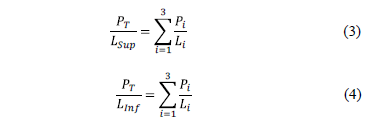
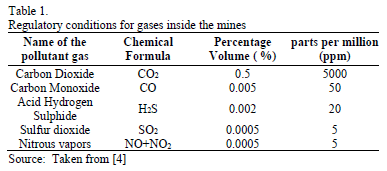
<body><![CDATA[<p>&nbsp;</p>     <p><font size="3" face="Verdana, Arial, Helvetica, sans-serif"><b>1.  Introduction</b></font></p>     <p><font size="2" face="Verdana, Arial, Helvetica, sans-serif">Within the most important hazards to which persons dedicated to the work  of underground mining of coal are exposed, it highlights the exposure to high  concentrations of gases, oxygen deficiency, explosive atmospheres and  landslides that occurred inside the mines. In spite of the efforts made by  companies, government and individuals responsible for the safety and hygiene in  mining, there are not practical mechanisms that can effectively minimize these  dangers.</font></p>     <p><font size="2" face="Verdana, Arial, Helvetica, sans-serif">Colombia has a record of 51 accidents submitted between 2005 and July 31  of 2011 which were caused by explosions and toxic and explosive gases  accumulation such as methane (CH<sub>4</sub>) like the one that occurred on  February 1, 2011 at the Escondida mine, located on the sidewalk Penalties of  Boquer&oacute;n, municipality of Sutatausa (Cundinamarca), where there was an  explosion of methane accumulation and that left a balance of five deceased  persons&#91;1&#93;, also on 16 June 2010 in the San Joaquin mine, located in the municipality  of fakes (Antioquia), where 73 miners were killed by an explosion caused by the  accumulation of methane gas &#91;2&#93;. The country also has a record of 61 accidents caused by  oxygen's deficiency (O<sub>2</sub>) within underground coal mines &#91;3&#93;.</font></p>     <p><font size="2" face="Verdana, Arial, Helvetica, sans-serif">The active regulations  in Colombia for the hygiene and safety in mining, set out in the decree 1335 of  1987 &#91;4&#93; the minimum conditions of concentrations to toxic gases and  explosives, (<a href="#tab01">Table 1</a>), but many of underground coal mines do not count with  devices or methods for determining these conditions.</font></p>     <p align="center"><font size="2" face="Verdana, Arial, Helvetica, sans-serif"><a name="tab01"></a></font><img src="/img/revistas/dyna/v81n187/v81n187a11tab01.gif"></p>     <p><font size="2" face="Verdana, Arial, Helvetica, sans-serif">Within underground coal mines are conditions of  temperature, concentrations of gases and use of machinery that facilitates the  generation and production of fires and explosions. To minimize and prevent this  tragic events inside the mines have been implemented mechanisms, which in a  nutshell, minimize the factors of explosion, as the case of the use of inerting  gases and efficient ventilation systems designs. In many cases, these  mechanisms are not sufficient, since in practice the conditions, concentrations  of gases and explosive mixtures are very changeable<b>.</b></font></p>     <p>&nbsp;</p>     <p><b><font size="3" face="Verdana, Arial, Helvetica, sans-serif">2.  Explosive   mixtures</font></b></p>     <p><font size="2" face="Verdana, Arial, Helvetica, sans-serif">The interior of the coal mines generates large quantities  of gases with different chemical properties and behaviors, so it is necessary  to make a classification of them as asphyxiating gases, toxic gases and  flammable gases. For the generation of explosions and fires, the toxic and  flammable gases There have the utmost importance. Flammable gases: Methane and  Hydrogen. Toxic gases: Carbon monoxide and hydrogen sulphide.</font></p>     ]]></body>
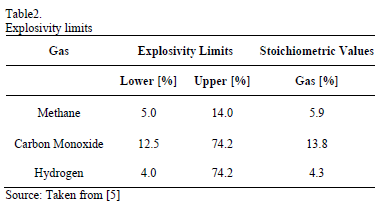
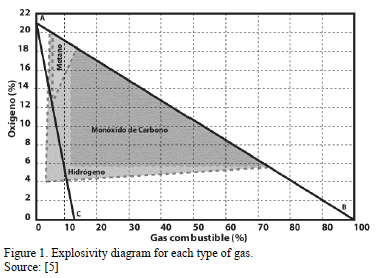
<body><![CDATA[<p><font size="2" face="Verdana, Arial, Helvetica, sans-serif">The combination of these gases at the underground  environment of the coal mines can generate explosive atmospheres, rather than  relying on the percentages of participation and concentration of each gas, they  can be explosive when mixed with air or non-explosive &#91;5&#93;. The conditions and  explosive concentration's limits for the gases that can be found in the  environment of the coal mines are shown in <a href="#tab02">Table 2</a></font></p>     <p align="center"><font size="2" face="Verdana, Arial, Helvetica, sans-serif"><a name="tab02"></a></font><img src="/img/revistas/dyna/v81n187/v81n187a11tab02.gif"></p>     <p><font size="2" face="Verdana, Arial, Helvetica, sans-serif">Within the requirements of the Colombian legislation in  force, in particular the Decree 1335 of 1987, the conditions for concentrations  of toxic gases and explosives are dealt with separately and individually. But  in practice due to the behavior and gassing-dynamic, mixtures are impossible to  avoid and control, so the strategy is to design and implement a model or  mechanism that allows the detection of these explosive mixtures to the interior  of the coal mines.</font></p>     <p>&nbsp;</p>     <p><font size="3" face="Verdana, Arial, Helvetica, sans-serif"><b>3.  Coward's   triangle</b></font></p>     <p><font size="2" face="Verdana, Arial, Helvetica, sans-serif">Within  the methods that exists for the detection and characterization of explosive  atmospheres the method of the diagrams or triangles of Coward stands out as one  effective and simply way of illustrate the gases mixture behaviour. It was  published by Coward and Jones in 1952 and is considered as a fast and easy way  to determine the  explosiveness of a mixture of gas &#91;6&#93;. The method involves those gases  that can cause a deflagration or an explosion, as the toxic and flammable  gases.</font></p>     <p><font size="2" face="Verdana, Arial, Helvetica, sans-serif">The diagram of  explosiveness only involves three combustible gases, which are the methane (CH<sub>4</sub>),  hydrogen (H<sub>2</sub>) and carbon monoxide (CO) and two inert gases covered  by the excess of nitrogen (N<sub>2</sub>) and carbon dioxide (CO<sub>2</sub>).  In accordance with the proportions of all these, an atmosphere can be explosive  or not &#91;5, 6&#93;. For each fuel gas, individually, it is possible to construct a  triangle defined by three explosive points as shown in <a href="#fig01">Fig.1</a>.</font></p>     <p align="center"><font size="2" face="Verdana, Arial, Helvetica, sans-serif"><a name="fig01"></a></font><img src="/img/revistas/dyna/v81n187/v81n187a11fig01.gif"></p>     <p><font size="2" face="Verdana, Arial, Helvetica, sans-serif">There are studies  and modifications concerning the use of Coward's Triangles like the ones  presented in &#91;8&#93;. Such modifications consider the mixture interaction with some  other gases in order to enhace the explosivity risk calculation of the mixture.  This interaction requires a recalibration of the Coward's method presented in  this work, wich is why it would be complex to integrate the algorithm with some  other platforms.</font></p>     <p><font size="2" face="Verdana, Arial, Helvetica, sans-serif">To determine the condition and state of the mixture of  gases, and be able to determine the explosiveness or not of the same, it is  necessary to carry out the following calculations:</font></p>     ]]></body>
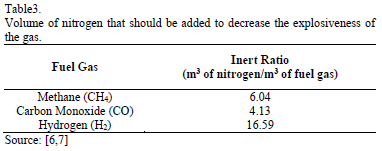
<body><![CDATA[<p><font size="2" face="Verdana, Arial, Helvetica, sans-serif"><b><i>3.1.  Determine the  percentage of total fuel gases</i></b></font></p>     <p><font size="2" face="Verdana, Arial, Helvetica, sans-serif">If the CH<sub>4,</sub> CO and H<sub>2</sub> have a     concentration (in percentage) of P<sub>1</sub>, P<sub>2 </sub>and P<sub>3</sub>,     respectively, and they do not react chemically between each other. The total     concentration of combustible gases (P<sub>T</sub>) is calculated as the sum of     the concentration of each:</font></p>     <p><img src="/img/revistas/dyna/v81n187/v81n187a11eq01.gif"></p>     <p><font size="2" face="Verdana, Arial, Helvetica, sans-serif"><b><i>3.2.  Calculate the limit of explosiveness to the  mixture of gases</i></b></font></p>     <p><font size="2" face="Verdana, Arial, Helvetica, sans-serif">By means of the     Chatelier's principle, the boundary of explosiveness of the mixture of     combustible gases CH<sub>4</sub>, CO  </font><font size="2" face="Verdana, Arial, Helvetica, sans-serif">and H<sub>2</sub> is obtained       using the equation 2. Where L<sub>1</sub>, L<sub>2</sub>, L<sub>3</sub> correspond to the limits of stoichiometric value determined in <a href="#tab02">Table 2</a> for each       of the gases, methane, carbon monoxide and hydrogen.</font></p>     <p><img src="/img/revistas/dyna/v81n187/v81n187a11eq02.gif"></p>     <p><font size="2" face="Verdana, Arial, Helvetica, sans-serif">The same equation 2 is used to determine the value of the  upper and lower limits, only by changing for the upper or lower limit for each  particular gas given in <a href="#tab03">Table 3</a>, the values of L<sub>1</sub>, L<sub>2</sub>, L<sub>3</sub>.</font></p>     <p><img src="/img/revistas/dyna/v81n187/v81n187a11eq0304.gif"></p>     <p align="center"><font size="2" face="Verdana, Arial, Helvetica, sans-serif"><a name="tab03"></a></font><img src="/img/revistas/dyna/v81n187/v81n187a11tab03.gif"></p>     <p><font size="2" face="Verdana, Arial, Helvetica, sans-serif"><b><i>3.3.  Determine the  concentration of nitrogen required by mixing to decrease its explosiveness</i></b></font></p>     ]]></body>
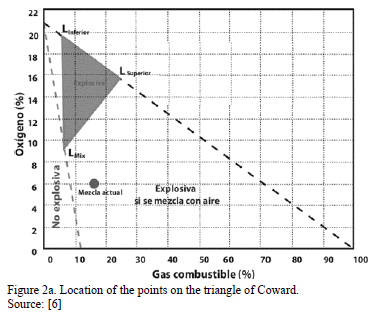
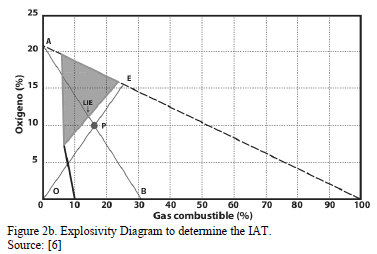
<body><![CDATA[<p><font size="2" face="Verdana, Arial, Helvetica, sans-serif">This value lets     you know the amount of nitrogen that should be added to the mixture of gases     for which these become not explosive. It is also used to determine the minimum     content of oxygen from which a mixture begins to be explosive and that is     calculated using equation 6.</font></p>     <p><img src="/img/revistas/dyna/v81n187/v81n187a11eq05.gif"></p>     <p><font size="2" face="Verdana, Arial, Helvetica, sans-serif">Where Lmix  is the percentage of fuel mix (calculated  from the equation 2), PT is the total concentration of fuel ( %) and N+ is the  volume of excess nitrogen must be added to argon the explosive gases (also  called the Radio Inert). The values of nitrogen required for stabilizing the  gases presented above can be seen in <a href="#tab03">Table 3</a>.</font></p>     <p><font size="2" face="Verdana, Arial, Helvetica, sans-serif"><b><i>3.4.  Determine the  minimum oxygen content from which the mixture becomes explosive</i></b></font></p>     <p><font size="2" face="Verdana, Arial, Helvetica, sans-serif">The minimum     content of oxygen (in percentage) is regularly the amount of oxygen content in     the atmosphere, which, in surface depends on the height. In an underground mine     this value depends on the ventilation &#91;5, 7&#93; and it is estimated as follows:</font></p>     <p><img src="/img/revistas/dyna/v81n187/v81n187a11eq06.gif"></p>     <p><font size="2" face="Verdana, Arial, Helvetica, sans-serif">The Coward's  diagram is useful in the follow-up to the gas mixtures, although this requires  plotting the analysis of each of the samples, because every time the  corresponding triangle changes shape and position, the same as the point that  represents the mixture &#91;5&#93;</font></p>     <p><font size="2" face="Verdana, Arial, Helvetica, sans-serif">The location of  the point of mixing within the Coward's diagram is done by mapping the position  with the coordinates obtained using the values of total concentration of  combustible gases and the total concentration of oxygen in the mixture.</font></p>     <p><font size="2" face="Verdana, Arial, Helvetica, sans-serif">Due to the method  of Coward only indicates whether a given mixture of gases is explosive or not,  it is necessary to implement an early-warning Index (IAT), to monitor the  movement of the point of mixing and provide an early warning in case of  possible explosiveness.</font></p>     <p><font size="2" face="Verdana, Arial, Helvetica, sans-serif"><a href="#fig02a">Fig.2</a> shows a  point for mixing implicated P, this point will move through the line AB  dilution as fresh air is mixed in the atmosphere underground, on the other  hand, if what is mixture is more content of combustible gases the point P will  move through the line OE, for both cases, zooms in or out of the area of  explosiveness; With this basis the IAT will be determined by  the ratio of distances between the y-axis to the point of mixing (PB), measured  in the AB line and the distance of the X-axis until the lower explosive limit (LIE).</font></p>     ]]></body>

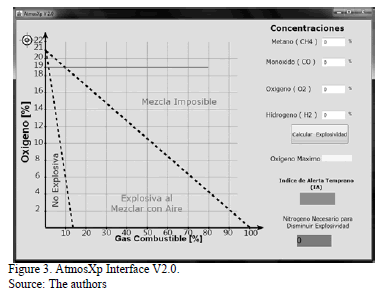
<body><![CDATA[<p><img src="/img/revistas/dyna/v81n187/v81n187a11eq07.gif"></p>     <p align="center"><font size="2" face="Verdana, Arial, Helvetica, sans-serif"><a name="fig02a"></a></font><img src="/img/revistas/dyna/v81n187/v81n187a11fig02a.gif"></p>     <p align="center"><font size="2" face="Verdana, Arial, Helvetica, sans-serif"><a name="fig02b"></a></font><img src="/img/revistas/dyna/v81n187/v81n187a11fig02b.gif"></p>     <p>&nbsp;</p>     <p><font size="3" face="Verdana, Arial, Helvetica, sans-serif"><b>4.  Design and  implementation of AtmosXp V2.0</b></font></p>     <p><font size="2" face="Verdana, Arial, Helvetica, sans-serif">Knowing the great  need to perform an analysis of the conditions and state of the atmospheres  within underground coal mines, in this work, it has been designed the software  AtmosXp V2.0 as a rapid and comprehensive solution that involves the method of  Coward as a basis for its operation. The design of the  software AtmosXp V2.0 is done in compliance with the requirements of speed and  efficiency which are required to have a system for real-time monitoring, and  that can be integrated to obtain faster decision-making and control actions  determination, when an alarm or status of an explosive atmosphere.</font></p>     <p><font size="2" face="Verdana, Arial, Helvetica, sans-serif">AtmosXp V2.0 was  designed with Visual Studio and Microsoft Expression Blend 3, allowing them to  develop a user-friendly interface and easy to understand for the user. In the <a href="#fig03">Fig.3</a> shows a view of the main panel of AtmosXp V2.0.</font></p>     <p align="center"><font size="2" face="Verdana, Arial, Helvetica, sans-serif"><a name="fig03"></a></font><img src="/img/revistas/dyna/v81n187/v81n187a11fig03.gif"></p>     <p><font size="2" face="Verdana, Arial, Helvetica, sans-serif">The presented software , accounts with several details that improve their  performance in comparison with other software, this is the case of the use of a  detailed scale for the oxygen concentrations and highlights the value of 19%  oxygen concentration that must be met by legislation &#91;4&#93;. It is important in  practice, to know all the values mentioned above as are the IAT, the maximum  oxygen from which the mixture becomes explosive, and the nitrogen needed to  decrease its explosion by enabling you to take decisions and actions of control  to prevent tragedies.</font></p>     <p><font size="2" face="Verdana, Arial, Helvetica, sans-serif">For the efficient use of the software must have data for  the concentrations of the gases involved in the method of Coward. To make a  brief introduction fees an illustrative example to show the operation of the  software and the manner of operation of the same.</font></p>     ]]></body>
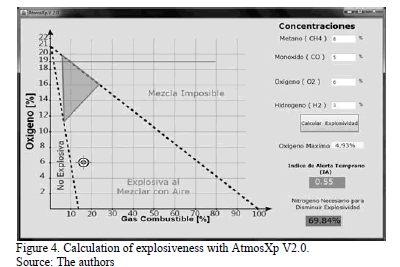
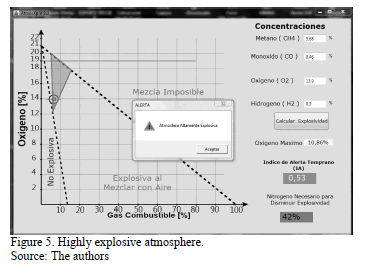
<body><![CDATA[<p>&nbsp;</p>     <p><font size="3" face="Verdana, Arial, Helvetica, sans-serif"><b>5.  Case study with  AtmosXp V2.0</b></font></p>     <p><font size="2" face="Verdana, Arial, Helvetica, sans-serif"><b><i>5.1.  Atmosphere  Explosive when mixed with air</i></b></font></p>     <p><font size="2" face="Verdana, Arial, Helvetica, sans-serif">Knowing the values     of concentrations of gases, you get a mixture of gases with a content of 8% of     CH<sub>4</sub>, 3% of H<sub>2</sub>, 5% CO, 6% O<sub>2</sub>, item is to enter     them into the appropriate box for each one in the AtmosXP V2.0 software and     select the option Calculate Explosiveness, are shown in <a href="#fig04">Fig.4</a> in AtmosXP V2.0     data obtained.</font></p>     <p align="center"><font size="2" face="Verdana, Arial, Helvetica, sans-serif"><a name="fig04"></a></font><img src="/img/revistas/dyna/v81n187/v81n187a11fig04.gif"></p>     <p><font size="2" face="Verdana, Arial, Helvetica, sans-serif">The point of mixing is  determined by the pointer which has the shape of two circles of color black and  that contains two lines in the form of red cross. In more detail we can then  observe the minimum level of oxygen content from which the mixture becomes  explosive 4.93 %, the IAT is 0.55 and the value for the concentration of  nitrogen required to decrease the explosiveness is 69.84 %. Within the analysis of explosive atmospheres when  mixed with air the value of the IAT throws an important value that helps to  determine the proximity and possibility that the atmosphere becomes highly  explosive.</font></p>     <p><font size="2" face="Verdana, Arial, Helvetica, sans-serif">The red area represents the triangle formed by the limits  of mixture, upper limit and lower limit which is calculated using equation 2  and which, in the case of the lower limit and upper limit is determined by  placing on the shaft of Fuel Gas &#91;%&#93; the value obtained with equation 2 and  intercepting with the dotted line as shown in <a href="#fig02">Fig.2</a>.</font></p>     <p><font size="2" face="Verdana, Arial, Helvetica, sans-serif"><b><i>5.2.  Highly  explosive atmosphere</i></b></font></p>     <p><font size="2" face="Verdana, Arial, Helvetica, sans-serif">Due to the use     that is expected to be the software AtmosXp V2.0 it account with warning signs     and pop-up windows when conditions can arise from a highly explosive     atmosphere, the values of concentrations that could generate this condition are &#91;8&#93; 5.68 % of CH<sub>4</sub>, 0.3% of H<sub>2</sub>,     3.25% of CO, 13.9% O<sub>2</sub>, as shown in <a href="#fig05">Fig.5</a><b>.</b></font></p>     <p align="center"><font size="2" face="Verdana, Arial, Helvetica, sans-serif"><a name="fig05"></a></font><img src="/img/revistas/dyna/v81n187/v81n187a11fig05.gif"></p>     ]]></body>
<body><![CDATA[<p><font size="2" face="Verdana, Arial, Helvetica, sans-serif">When you have the  condition of a highly explosive atmosphere, AtmosXp V2.0 issues an alert and  delivery the values of nitrogen needed to decrease the explosiveness and the  minimum oxygen. For this case the value of minimum oxygen allowed in order to  make the mixture explosive has a value of -10.67% as can be seen in <a href="#fig05">Fig.5</a>, in  the section of Maximum Oxygen, indicating that it is required to remove oxygen  from the atmosphere or add nitrogen<b>.</b></font></p>     <p>&nbsp;</p>     <p><font size="3" face="Verdana, Arial, Helvetica, sans-serif"><b>6.  Conclusions</b></font></p>     <p><font size="2" face="Verdana, Arial, Helvetica, sans-serif">The preventive  measures taken in accordance with the current Colombian legislation does not  include the analysis of mixtures and conditions of explosive atmospheres.</font></p>     <p><font size="2" face="Verdana, Arial, Helvetica, sans-serif">It is important to  have detection systems within the coal mines because they facilitate the  decision-making and helps to prevent tragedies. With the help of AtmosXp V2.0  you can get immediate results of the explosiveness of the underground mining  environment<b>.</b></font></p>     <p><font size="2" face="Verdana, Arial, Helvetica, sans-serif">AtmosXp V2.0 can  be coupled to data acquisition systems in real time to ensure the safety and  conditions within the coal mines<b>.</b></font></p>     <p><font size="2" face="Verdana, Arial, Helvetica, sans-serif">The development  and application of methods, such as the diagram of Coward via computer tools  allows the advancement of technologies in the field of underground  mining of coal.</font></p>     <p><font size="2" face="Verdana, Arial, Helvetica, sans-serif">AtmosXp software  V2.0 is a quick and easy mechanism to determine the potential for formation of  explosive atmospheres by gas, and allows its use in devices with Windows  platform. The software does not have large requirements of memory or hard disk  space on the device to be installed.</font></p>     <p><font size="2" face="Verdana, Arial, Helvetica, sans-serif">The answer of the  alarms is fast, which allows you to perform actions and make decisions early in  order to prevent accidents. </font></p>     <p><font size="2" face="Verdana, Arial, Helvetica, sans-serif">The good software  design AtmosXp V2.0 allows you to observe the methods in detail and without  errors in formation of the graphics triangles and the method of Coward.</font></p>     ]]></body>
<body><![CDATA[<p>&nbsp;</p>     <p><font size="3" face="Verdana, Arial, Helvetica, sans-serif"><b>Agradecimientos</b></font></p>     <p><font size="2" face="Verdana, Arial, Helvetica, sans-serif">Los autores  Expresan el agradecimiento a la Universidad Nacional de Colombia - Sede  Medell&iacute;n y su Sistema de Informaci&oacute;n de la Investigaci&oacute;n HERMES, al Grupo de  Estudio en Georrecursos, Miner&iacute;a y Medio Ambiente-GEMMA, al Grupo de  Investigaci&oacute;n en Teleinform&aacute;tica y Teleautom&aacute;tica T&amp;T, al Grupo de  Autom&aacute;tica GAUNAL.</font></p>     <p><font size="2" face="Verdana, Arial, Helvetica, sans-serif">Este  trabajo tambi&eacute;n se hace con el apoyo de COLCIENCIAS, en el marco del  proyecto &quot;Sistema Inteligente y Automatizado para el Monitoreo de Atm&oacute;sferas  Explosivas en Miner&iacute;a Subterr&aacute;nea de Carb&oacute;n&quot;</font></p>     <p>&nbsp;</p>     <p><font size="3" face="Verdana, Arial, Helvetica, sans-serif"><b>References</b></font></p>     <!-- ref --><p><font size="2" face="Verdana, Arial, Helvetica, sans-serif"><b>&#91;1&#93;</b> Instituto  Colombiano de Geolog&iacute;a y Miner&iacute;a. Comunicado de prensa 003 de 2011. Servicio  Geol&oacute;gico Colombiano &#91;Online&#93;. 2011. &#91;date of reference May 17<sup>th</sup> of 2014&#93;. Available at:  <a href="https://www.sgc.gov.co/Noticias/Comunicados/Comunicado-003-de-2011---Emergencia-minera-en-Suta.aspx" target="_blank">https://www.sgc.gov.co/Noticias/Comunicados/Comunicado-003-de-2011---Emergencia-minera-en-Suta.aspx</a>.    &nbsp;&nbsp;&nbsp;&nbsp;&nbsp;&nbsp;&nbsp;&nbsp;[&#160;<a href="javascript:void(0);" onclick="javascript: window.open('/scielo.php?script=sci_nlinks&ref=000099&pid=S0012-7353201400050001100001&lng=','','width=640,height=500,resizable=yes,scrollbars=1,menubar=yes,');">Links</a>&#160;]<!-- end-ref --></font></p>     <!-- ref --><p><font size="2" face="Verdana, Arial, Helvetica, sans-serif"><b>&#91;2&#93;</b> Instituto  Colombiano de Geolog&iacute;a y Miner&iacute;a. Comunicado de prensa 038 de 2011. Servicio  Geol&oacute;gico Colombiano &#91;Online&#93;. 2011. &#91;date of reference May 17<sup>th</sup> of 2014&#93;. Available at:  <a href="http://www.sgc.gov.co/Noticias/Comunicados/Comunicado-de-prensa-038-de-2011.aspx" target="_blank">http://www.sgc.gov.co/Noticias/Comunicados/Comunicado-de-prensa-038-de-2011.aspx</a>.    &nbsp;&nbsp;&nbsp;&nbsp;&nbsp;&nbsp;&nbsp;&nbsp;[&#160;<a href="javascript:void(0);" onclick="javascript: window.open('/scielo.php?script=sci_nlinks&ref=000101&pid=S0012-7353201400050001100002&lng=','','width=640,height=500,resizable=yes,scrollbars=1,menubar=yes,');">Links</a>&#160;]<!-- end-ref --></font></p>     ]]></body>
<body><![CDATA[<!-- ref --><p><font size="2" face="Verdana, Arial, Helvetica, sans-serif"><b>&#91;3&#93;</b> Ministerio  de Minas y Energ&iacute;a. Pol&iacute;tica Nacional de Seguridad Minera, Bogot&aacute; D.C.,  Colombia, Direcci&oacute;n de Minas, 2011, 54P.    &nbsp;&nbsp;&nbsp;&nbsp;&nbsp;&nbsp;&nbsp;&nbsp;[&#160;<a href="javascript:void(0);" onclick="javascript: window.open('/scielo.php?script=sci_nlinks&ref=000103&pid=S0012-7353201400050001100003&lng=','','width=640,height=500,resizable=yes,scrollbars=1,menubar=yes,');">Links</a>&#160;]<!-- end-ref --></font></p>     <!-- ref --><p><font size="2" face="Verdana, Arial, Helvetica, sans-serif"><b>&#91;4&#93;</b> Ministerio de Minas y Energ&iacute;a, Decreto 1335 de  Julio 15 de 1987 Mediante el cual se expide el reglamento de seguridad en las  labores subterr&aacute;neas, Bogot&aacute; D.C., Colombia, 1987, 49p.    &nbsp;&nbsp;&nbsp;&nbsp;&nbsp;&nbsp;&nbsp;&nbsp;[&#160;<a href="javascript:void(0);" onclick="javascript: window.open('/scielo.php?script=sci_nlinks&ref=000105&pid=S0012-7353201400050001100004&lng=','','width=640,height=500,resizable=yes,scrollbars=1,menubar=yes,');">Links</a>&#160;]<!-- end-ref --></font></p>     <!-- ref --><p><font size="2" face="Verdana, Arial, Helvetica, sans-serif"><b>&#91;5&#93;</b> Castro-Mar&iacute;n, P. y Mart&iacute;nez ,G., Explosividad de  gases desprendidos en los incendios subterr&aacute;neos en minas de carb&oacute;n. DYNA 67 (129),  pp. 51-58, 2000.    &nbsp;&nbsp;&nbsp;&nbsp;&nbsp;&nbsp;&nbsp;&nbsp;[&#160;<a href="javascript:void(0);" onclick="javascript: window.open('/scielo.php?script=sci_nlinks&ref=000107&pid=S0012-7353201400050001100005&lng=','','width=640,height=500,resizable=yes,scrollbars=1,menubar=yes,');">Links</a>&#160;]<!-- end-ref --></font></p>     <!-- ref --><p><font size="2" face="Verdana, Arial, Helvetica, sans-serif"><b>&#91;6&#93;</b>    Cheng, J. and Yang, S., Improved coward  explosive triangle for determining explosibility of mixture gas, Process Safety  and Environmental Protection, 89 (2), pp. 89-94, 2010.    &nbsp;&nbsp;&nbsp;&nbsp;&nbsp;&nbsp;&nbsp;&nbsp;[&#160;<a href="javascript:void(0);" onclick="javascript: window.open('/scielo.php?script=sci_nlinks&ref=000109&pid=S0012-7353201400050001100006&lng=','','width=640,height=500,resizable=yes,scrollbars=1,menubar=yes,');">Links</a>&#160;]<!-- end-ref --></font></p>     <!-- ref --><p><font size="2" face="Verdana, Arial, Helvetica, sans-serif"><b>&#91;7&#93;</b> McPherson, M.J. and Hinsley, F.B.n  Subsurface Ventilation and Environmental Engineering. Chapman &amp; Hall, cop,  1993.    &nbsp;&nbsp;&nbsp;&nbsp;&nbsp;&nbsp;&nbsp;&nbsp;[&#160;<a href="javascript:void(0);" onclick="javascript: window.open('/scielo.php?script=sci_nlinks&ref=000111&pid=S0012-7353201400050001100007&lng=','','width=640,height=500,resizable=yes,scrollbars=1,menubar=yes,');">Links</a>&#160;]<!-- end-ref --></font></p>     ]]></body>
<body><![CDATA[<!-- ref --><p><font size="2" face="Verdana, Arial, Helvetica, sans-serif"><b>&#91;8&#93;</b>    Cheng, J. and Luo, Y., Modified explosive  diagram for determining gas-mixture explosivity, Journal of Loss Prevention in  the Process Industries, 26 (4), pp 714-722, 2013.    &nbsp;&nbsp;&nbsp;&nbsp;&nbsp;&nbsp;&nbsp;&nbsp;[&#160;<a href="javascript:void(0);" onclick="javascript: window.open('/scielo.php?script=sci_nlinks&ref=000113&pid=S0012-7353201400050001100008&lng=','','width=640,height=500,resizable=yes,scrollbars=1,menubar=yes,');">Links</a>&#160;]<!-- end-ref --></font></p>     <p>&nbsp;</p>     <p><font size="2" face="Verdana, Arial, Helvetica, sans-serif"><b>C.M. Alvarez-Alvarez</b>, He finished his school in Pedro Justo  Berrio school, Colombia, and Bs. in Control Engineer in 2014, from the  Universidad Nacional de Colombia, sede Medell&iacute;n, Colombia. He is working on the  company Zitron.</font></p>     <p><font size="2" face="Verdana, Arial, Helvetica, sans-serif"><b>A.M. Zapata-Montoya</b>, received the Bs. Eng in Geological  Engineering in 2013 from the Universidad Nacional de Colombia, sede Medell&iacute;n,  Colombia. While she was a student, she worked at the laboratories of Physical  Geology and Mineralogy of reflected light optics. She also participated as a  research student in the GTI-Monitoring Explosive Atmospheres project in the  Mining District of Northern Boyac&aacute;-Colombia. At the moment, she works as a  geological engineer for the private sector.</font></p>     <p><font size="2" face="Verdana, Arial, Helvetica, sans-serif"><b>S.M. Montoya-Ca&ntilde;ola</b>, received the Bs. Eng in Geological  Engineering in 2014, from the Universidad Nacional de Colombia, sede Medell&iacute;n,  Colombia. She is currently working as a researcher at the Universidad Nacional  de Colombia in agreement with the Geological Service of Colombia (SGC) in a  geomorphological mapping project applied to the zoning of landslide threat.</font></p>     <p><font size="2" face="Verdana, Arial, Helvetica, sans-serif"><b>O. Ord&oacute;&ntilde;ez-Carmona</b>, received the Bs. in Geology in 1993 from  the Universidad Nacional de Colombia, sede Medell&iacute;n, Colombia, the MSc. degree  in Geosciences in 1997, and the PhD degree in Geosciences in 2001, both from  the Brasilia University, Brazil. From 1999 until now, he is a Full time  Professor in the School of Mines of the Universidad Nacional de Colombia. His  research interests include: regional geology, geochronology, exploration,  minning and economic geology.</font></p>     <p><font size="2" face="Verdana, Arial, Helvetica, sans-serif"><b>G.D. Zapata-Madrigal</b>, received the Bs in Electrical  Engineering in 1991, from the Universidad Nacional de Colombia, sede Medell&iacute;n,  Colombia, the Sp. degree in Management with emphasis in Quality in 1999, from  the Universidad de Antioquia, Colombia; the MSc. in Automatic in 2003, from the  Universidad del Valle, Colombia, and a PhD. in Applied Sciences in 2012, from the  Universidad de los Andes, M&eacute;rida , Venezuela. Since 1992 work as a Professor  Associated in the School of Mines in the Universidad Nacional de Colombia in  Medell&iacute;n, currently is a Director of the Research group of Teleinformatica and  Teleutomatica, Director of Cisco Academy Training Center and.  His research has revolve around the lines of  integrated Intelligent Autonomation, Industrial Communications, Modeling and  simulation of systems and teleinformatics.</font></p>      ]]></body><back>
<ref-list>
<ref id="B1">
<label>1</label><nlm-citation citation-type="book">
<collab>Instituto Colombiano de Geología y Minería</collab>
<source><![CDATA[Comunicado de prensa 003 de 2011]]></source>
<year>2011</year>
<publisher-name><![CDATA[Servicio Geológico Colombiano]]></publisher-name>
</nlm-citation>
</ref>
<ref id="B2">
<label>2</label><nlm-citation citation-type="book">
<collab>Instituto Colombiano de Geología y Minería</collab>
<source><![CDATA[Comunicado de prensa 038 de 2011]]></source>
<year>2011</year>
<publisher-name><![CDATA[Servicio Geológico Colombiano]]></publisher-name>
</nlm-citation>
</ref>
<ref id="B3">
<label>3</label><nlm-citation citation-type="book">
<collab>Ministerio de Minas y Energía</collab>
<source><![CDATA[Política Nacional de Seguridad Minera]]></source>
<year>2011</year>
<publisher-loc><![CDATA[Bogotá^eD.C. D.C.]]></publisher-loc>
<publisher-name><![CDATA[Dirección de Minas]]></publisher-name>
</nlm-citation>
</ref>
<ref id="B4">
<label>4</label><nlm-citation citation-type="">
<collab>Ministerio de Minas y Energía</collab>
<source><![CDATA[Decreto 1335 de Julio 15 de 1987: Mediante el cual se expide el reglamento de seguridad en las labores subterráneas]]></source>
<year>1987</year>
<publisher-loc><![CDATA[Bogotá ]]></publisher-loc>
</nlm-citation>
</ref>
<ref id="B5">
<label>5</label><nlm-citation citation-type="journal">
<person-group person-group-type="author">
<name>
<surname><![CDATA[Castro-Marín]]></surname>
<given-names><![CDATA[P.]]></given-names>
</name>
<name>
<surname><![CDATA[Martínez]]></surname>
<given-names><![CDATA[G.]]></given-names>
</name>
</person-group>
<article-title xml:lang="es"><![CDATA[Explosividad de gases desprendidos en los incendios subterráneos en minas de carbón]]></article-title>
<source><![CDATA[DYNA]]></source>
<year>2000</year>
<volume>67</volume>
<numero>129</numero>
<issue>129</issue>
<page-range>51-58</page-range></nlm-citation>
</ref>
<ref id="B6">
<label>6</label><nlm-citation citation-type="journal">
<person-group person-group-type="author">
<name>
<surname><![CDATA[Cheng]]></surname>
<given-names><![CDATA[J.]]></given-names>
</name>
<name>
<surname><![CDATA[Yang]]></surname>
<given-names><![CDATA[S.]]></given-names>
</name>
</person-group>
<article-title xml:lang="en"><![CDATA[Improved coward explosive triangle for determining explosibility of mixture gas]]></article-title>
<source><![CDATA[Process Safety and Environmental Protection]]></source>
<year>2010</year>
<volume>89</volume>
<numero>2</numero>
<issue>2</issue>
<page-range>89-94</page-range></nlm-citation>
</ref>
<ref id="B7">
<label>7</label><nlm-citation citation-type="book">
<person-group person-group-type="author">
<name>
<surname><![CDATA[McPherson]]></surname>
<given-names><![CDATA[M.J.]]></given-names>
</name>
<name>
<surname><![CDATA[Hinsley]]></surname>
<given-names><![CDATA[F.B.n]]></given-names>
</name>
</person-group>
<source><![CDATA[Subsurface Ventilation and Environmental Engineering]]></source>
<year>1993</year>
<publisher-name><![CDATA[Chapman & Hall]]></publisher-name>
</nlm-citation>
</ref>
<ref id="B8">
<label>8</label><nlm-citation citation-type="journal">
<person-group person-group-type="author">
<name>
<surname><![CDATA[Cheng]]></surname>
<given-names><![CDATA[J.]]></given-names>
</name>
<name>
<surname><![CDATA[Luo]]></surname>
<given-names><![CDATA[Y.]]></given-names>
</name>
</person-group>
<article-title xml:lang="en"><![CDATA[Modified explosive diagram for determining gas-mixture explosivity]]></article-title>
<source><![CDATA[Journal of Loss Prevention in the Process Industries]]></source>
<year></year>
<volume>26</volume>
<numero>4</numero>
<issue>4</issue>
<page-range>714-722</page-range><page-range>2013</page-range></nlm-citation>
</ref>
</ref-list>
</back>
</article>