<?xml version="1.0" encoding="ISO-8859-1"?><article xmlns:mml="http://www.w3.org/1998/Math/MathML" xmlns:xlink="http://www.w3.org/1999/xlink" xmlns:xsi="http://www.w3.org/2001/XMLSchema-instance">
<front>
<journal-meta>
<journal-id>0012-7353</journal-id>
<journal-title><![CDATA[DYNA]]></journal-title>
<abbrev-journal-title><![CDATA[Dyna rev.fac.nac.minas]]></abbrev-journal-title>
<issn>0012-7353</issn>
<publisher>
<publisher-name><![CDATA[Universidad Nacional de Colombia]]></publisher-name>
</publisher>
</journal-meta>
<article-meta>
<article-id>S0012-73532014000500016</article-id>
<article-id pub-id-type="doi">10.15446/dyna.v81n186.40758</article-id>
<title-group>
<article-title xml:lang="en"><![CDATA[Electrodes friendly with the environment for detect heavy metal]]></article-title>
<article-title xml:lang="es"><![CDATA[Electrodos amistosos con el medio ambiente para detectar metales pesados]]></article-title>
</title-group>
<contrib-group>
<contrib contrib-type="author">
<name>
<surname><![CDATA[Barón-Jaimez]]></surname>
<given-names><![CDATA[Jairo Alberto]]></given-names>
</name>
<xref ref-type="aff" rid="A01"/>
</contrib>
<contrib contrib-type="author">
<name>
<surname><![CDATA[Marulanda-Arévalo]]></surname>
<given-names><![CDATA[José Luddey]]></given-names>
</name>
<xref ref-type="aff" rid="A02"/>
</contrib>
<contrib contrib-type="author">
<name>
<surname><![CDATA[Barba-Ortega]]></surname>
<given-names><![CDATA[José José]]></given-names>
</name>
<xref ref-type="aff" rid="A03"/>
</contrib>
</contrib-group>
<aff id="A01">
<institution><![CDATA[,Universidad Nacional Autónoma de México  ]]></institution>
<addr-line><![CDATA[ ]]></addr-line>
<country>México</country>
</aff>
<aff id="A02">
<institution><![CDATA[,Universidad Tecnológica de Pereira Grupo GIMAV ]]></institution>
<addr-line><![CDATA[ ]]></addr-line>
<country>Colombia</country>
</aff>
<aff id="A03">
<institution><![CDATA[,Universidad Nacional de Colombia Departamento de Física ]]></institution>
<addr-line><![CDATA[Bogotá ]]></addr-line>
<country>Colombia</country>
</aff>
<pub-date pub-type="pub">
<day>00</day>
<month>10</month>
<year>2014</year>
</pub-date>
<pub-date pub-type="epub">
<day>00</day>
<month>10</month>
<year>2014</year>
</pub-date>
<volume>81</volume>
<numero>187</numero>
<fpage>122</fpage>
<lpage>128</lpage>
<copyright-statement/>
<copyright-year/>
<self-uri xlink:href="http://www.scielo.org.co/scielo.php?script=sci_arttext&amp;pid=S0012-73532014000500016&amp;lng=en&amp;nrm=iso"></self-uri><self-uri xlink:href="http://www.scielo.org.co/scielo.php?script=sci_abstract&amp;pid=S0012-73532014000500016&amp;lng=en&amp;nrm=iso"></self-uri><self-uri xlink:href="http://www.scielo.org.co/scielo.php?script=sci_pdf&amp;pid=S0012-73532014000500016&amp;lng=en&amp;nrm=iso"></self-uri><abstract abstract-type="short" xml:lang="en"><p><![CDATA[In the last centuries, heavy metals have been extracted and processed industrially; today, they are part of our food chain and their detection has generated great international interest due to adverse effects, beyond allowed amounts for humans. For many years, mercury electrodes have been used to detect heavy metals; however, due to the new regulations and its high toxicity, new alternatives for its replacement as electrode in electroanalytical techniques have been investigated. Bismuth electrodes have been positioned as an alternative to this type of activity because of its many features similar to mercury and low toxicity. This paper provides an overview of this new type of electrode, along with different parameters to consider in order to obtain better results]]></p></abstract>
<abstract abstract-type="short" xml:lang="es"><p><![CDATA[Los últimos siglos, los metales pesados han sido extraídos y procesados industrialmente; hoy en día, hacen parte de nuestra cadena alimenticia y su detección ha generado gran interés a nivel internacional debido a los efectos adversos, en cantidades más allá de las permitidas para el ser humano. Por muchos años, los electrodos de mercurio han sido utilizados para detectar metales pesados; sin embargo, debido a las nuevas regulaciones y su alta toxicidad, nuevas alternativas para su reemplazo como electrodo en las técnicas electroanalíticas han sido investigadas. Los electrodos de Bismuto se han situado como una alternativa para este tipo de actividad debido a sus múltiples características semejantes a las del mercurio y su baja toxicidad, en este documento se presenta un panorama de este nuevo tipo de electrodo, junto con diferentes parámetros a tener en cuenta para obtener mejores resultados.]]></p></abstract>
<kwd-group>
<kwd lng="en"><![CDATA[Bismuth]]></kwd>
<kwd lng="en"><![CDATA[Electrodes]]></kwd>
<kwd lng="en"><![CDATA[Voltammetry]]></kwd>
<kwd lng="en"><![CDATA[Heavy Metals]]></kwd>
<kwd lng="es"><![CDATA[Bismuto]]></kwd>
<kwd lng="es"><![CDATA[Electrodos]]></kwd>
<kwd lng="es"><![CDATA[Voltamperometría]]></kwd>
<kwd lng="es"><![CDATA[Metales Pesados]]></kwd>
</kwd-group>
</article-meta>
</front><body><![CDATA[ <p><font size="2" face="Verdana, Arial, Helvetica, sans-serif"><a href="http://dx.doi.org/10.15446/dyna.v81n187.40758" target="_blank">http://dx.doi.org/10.15446/dyna.v81n187.40758</a></font></p>     <p align="center"><font size="4" face="Verdana, Arial, Helvetica, sans-serif"><b>Electrodes friendly with the environment for  detect heavy metal</b></font></p>     <p align="center"><i><font size="4"><b><font size="3" face="Verdana, Arial, Helvetica, sans-serif">Electrodos amistosos con el medio ambiente para detectar metales pesados</font></b></font></i></p>     <p align="center">&nbsp;</p>     <p align="center"><font size="2" face="Verdana, Arial, Helvetica, sans-serif"><b>Jairo Alberto Bar&oacute;n-Jaimez <i><sup>a</sup></i>, Jos&eacute; Luddey Marulanda-Ar&eacute;valo <i><sup>b</sup></i> &amp; Jos&eacute; Jos&eacute; Barba-Ortega <i><sup>c</sup></i><sup>.</sup></b></font></p>     <p align="center">&nbsp;</p>     <p align="center"><font size="2" face="Verdana, Arial, Helvetica, sans-serif"><sup><i>a </i></sup><i>Universidad Nacional Aut&oacute;noma de M&eacute;xico, M&eacute;xico.    <br>       <sup>b </sup>Grupo GIMAV, Universidad Tecnol&oacute;gica de Pereira, Colombia. <a href="mailto:jlmarulanda@utp.edu.co">jlmarulanda@utp.edu.co</a>    <br>       <sup>c </sup>Departamento de F&iacute;sica, Universidad Nacional de Colombia, Bogot&aacute;, Colombia.       <a href="mailto:jjbarbao@unal.edu.co">jjbarbao@unal.edu.co</a></i></font></p>     <p align="center">&nbsp;</p>     ]]></body>
<body><![CDATA[<p align="center"><font size="2" face="Verdana, Arial, Helvetica, sans-serif"><b>Received: November 9<sup>th</sup>, 2013. Received in revised form:   June 3<sup>th</sup>, 2014. Accepted: June 9<sup>th</sup>, 2014.</b></font></p>     <p align="center">&nbsp;</p> <hr>     <p><font size="2" face="Verdana, Arial, Helvetica, sans-serif"><b>Abstract    <br> </b></font><font size="2" face="Verdana, Arial, Helvetica, sans-serif">In the last centuries, heavy metals have been extracted and  processed industrially; today, they are part of our food chain and their  detection has generated great international interest due to adverse effects,  beyond allowed amounts for humans. For many years, mercury electrodes have been  used to detect heavy metals; however, due to the new regulations and its high  toxicity, new  alternatives for its replacement as electrode in electroanalytical techniques  have been investigated. Bismuth electrodes have been positioned as an  alternative to this type of activity because of its many features similar to  mercury and low toxicity. This paper provides an overview of this new type of  electrode, along with different parameters to consider in order to obtain better results</font></p>     <p><font size="2" face="Verdana, Arial, Helvetica, sans-serif"><i>Keywords</i>:  Bismuth, Electrodes, Voltammetry, Heavy Metals.</font></p>     <p><font size="2" face="Verdana, Arial, Helvetica, sans-serif"><b>Resumen    <br> </b></font><font size="2" face="Verdana, Arial, Helvetica, sans-serif">Los &uacute;ltimos siglos, los metales pesados  han sido extra&iacute;dos y procesados industrialmente; hoy en d&iacute;a, hacen parte de  nuestra cadena alimenticia y su detecci&oacute;n ha generado gran inter&eacute;s a nivel  internacional debido a los efectos adversos, en cantidades m&aacute;s all&aacute; de las  permitidas para el ser humano. Por muchos a&ntilde;os, los electrodos de mercurio han  sido utilizados para detectar metales pesados; sin embargo, debido a las nuevas  regulaciones y su alta toxicidad, nuevas alternativas para su reemplazo como  electrodo en las t&eacute;cnicas electroanal&iacute;ticas han sido investigadas. Los  electrodos de Bismuto se han situado como una alternativa para este tipo de  actividad debido a sus m&uacute;ltiples caracter&iacute;sticas semejantes a las del mercurio  y su baja toxicidad,  en este documento se  presenta un panorama de este nuevo tipo de electrodo, junto con diferentes par&aacute;metros a tener en cuenta para obtener mejores resultados.</font></p>     <p><font size="2" face="Verdana, Arial, Helvetica, sans-serif"><i>Palabras clave</i>: Bismuto, Electrodos, Voltamperometr&iacute;a, Metales Pesados</font></p> <hr>     <p>&nbsp;</p>     <p><font size="3" face="Verdana, Arial, Helvetica, sans-serif"><b>1.  Introduction</b></font></p>     ]]></body>
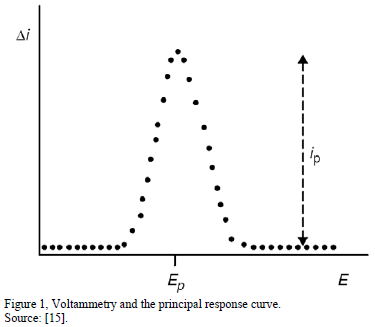
<body><![CDATA[<p><font size="2" face="Verdana, Arial, Helvetica, sans-serif">Heavy metals are natural components of the Earth's crust.  They cannot be degraded or destroyed. Their trace elements are considered to be one of the main sources of  pollution in the environment. To a small extent they enter our bodies  via food, drinking water and air. As trace elements, some heavy metals (e.g.  copper, zinc) are essential to maintain the metabolism of the human body;  However, even at low concentrations some of them can be toxic, for this reason  they are recognized as highly toxic and dangerous contaminants, only pesticides  outweigh their danger and toxicity &#91;1,2,3,4&#93;. </font></p>     <p><font size="2" face="Verdana, Arial, Helvetica, sans-serif">Increasing  industrialization has been accompanied throughout the world by the extraction  and distribution of mineral substances from their natural deposits. Many of  these have undergone chemical changes through technical processes and finally,  they stay finely dispersed through effluent into water, earth, air and thus  into the food chain, It is unlikely that they can be removed, by washing (e.g.  lead and cadmium contamination). Besides, the contamination by fertilizers and  insecticides is becoming an increasing problem, their widespread use results in  their frequent appearance in the environment and foods &#91;2,4,5&#93;. The importance of controlling the levels of these pollutants  in natural waters, drinking water, sediments and industrial waste has become an  international political topic, so it has generated great interest in the  development of new analytical methodologies for pollution level determination &#91;2,6&#93;. </font></p>     <p><font size="2" face="Verdana, Arial, Helvetica, sans-serif">Different techniques and methods have been developed for trace metals  determination, atomic absorption spectrometry (AAS), electrothermal atomic  absorption spectrometry (ETAAS), Neutron activation techniques, flame atomic absorption spectrometry (FAAS),  inductively coupled plasma atomic emission spectrometry (ICP-AES), inductively  coupled plasma mass spectrometry (ICP-MS), and inductively coupled plasma  optical emission spectrometry (ICP-OES), but they are not used frequently because of  the specialized techniques, long time, high cost, and are unsuitable for applications in the field.  In addition, the analysis must be performed in a specialized laboratory by  skilled personnel &#91;1,4,6,7&#93;. Electrochemical stripping analysis has long  been recognized as a powerful technique for trace metals owing to its  remarkable sensitivity, relatively inexpensive instrumentation, ability for  multi-element determination and capacity to determine elements accurately at  trace and ultra-trace levels &#91;4&#93;, and is beginning to be considered the most sensitive electro-analytical  technique for the determination of trace metals in samples of environmental,  clinical and industrial origin &#91;8,9,10&#93;. Its extraordinary  sensitivity is attributed to its effective step of pre-concentration &quot;this  step generates a best sensitivity, with an increase of 2 or 3 orders of  magnitude&quot; together with advances in electrochemical measurements of  accumulated analyte &#91;3,11,12&#93;. In this review, we provide  an overview of different works related to Bi electrodes and their applications  for the detection of heavy metals and other substances in environmental, food  and clinical samples.</font></p>     <p>&nbsp;</p>     <p><font size="3" face="Verdana, Arial, Helvetica, sans-serif"><b>2.  Stripping voltammetry </b></font></p>     <p><font size="2" face="Verdana, Arial, Helvetica, sans-serif">Among of different  voltammetric techniques, stripping voltammetry (SV) has been receiving  considerable attention since it is the most sensitive electroanalytical  technique, <font face="Symbol">m</font>gL<sup>-1</sup> (ppb) and even ngL<sup>-1</sup> (ppt) detection  limits have been reported, and over the last decade it has evolved into a very  versatile and powerful analytical technique. This electrochemical method  encompasses a variety of electroanalytical procedures having a common  characteristic initial step. In all these procedures; the analyte of interest  is accumulated on a working electrode by controlled potential electrolysis,  while the solution is stirred. After a short rest period (a few seconds), this  preconcentration step is followed by the stripping step, which involves the  dissolution of the deposit when a potential sweep is applied to the electrode.  Thus, a detectable current is produced at the electrode surface following the  oxidation or reduction of the analyte at a characteristic potential &#91;13-16&#93;.</font></p>     <p><font size="2" face="Verdana, Arial, Helvetica, sans-serif">By careful interpretation of the resulted peak shape from  current-potential voltammogram recorded during the stripping step, important  and desired analytical information is readily obtained. The peak potential  (position of Ep) is characteristic of the given substance and thus it can be  used for qualitative identification, whereas the peak current Ip is  proportional to the concentration of the corresponding analyte in the test  solution. This analytical quantitative information can be obtained from the  height or area of the stripping voltammetric peak. Since stripping curves/peaks  for various analytes occur at characteristic potentials, hence several species  can often be determined simultaneously. &#91;3,14-16&#93;.</font></p>     <p align="center"><font size="2" face="Verdana, Arial, Helvetica, sans-serif"><a name="fig01"></a></font><img src="/img/revistas/dyna/v81n187/v81n187a16fig01.gif"></p>     <p>&nbsp;</p>     <p><font size="3" face="Verdana, Arial, Helvetica, sans-serif"><b>3.  Potential   window</b></font></p>     ]]></body>
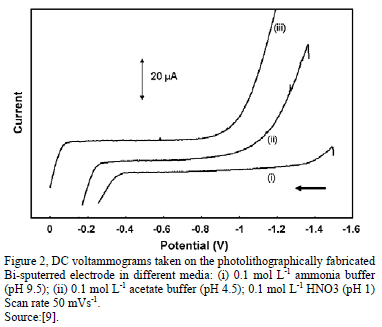
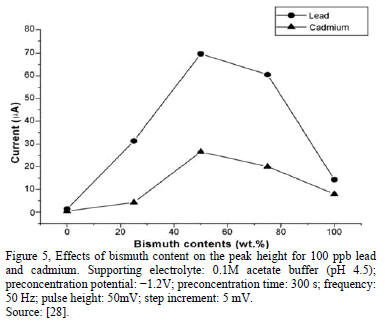
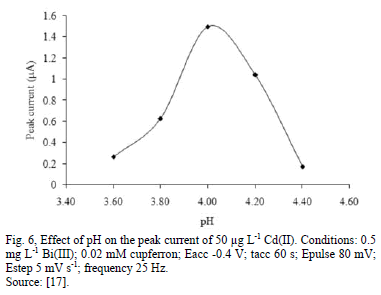
<body><![CDATA[<p><font size="2" face="Verdana, Arial, Helvetica, sans-serif">All voltammograms  of Bismuth displayed a wide flat middle potential region called &quot;potential  window&quot;, which is ubicated between -1.2 to -0.2 V vs. SCE (Saturated  Calomel Electrodes) approximately &#91;11&#93;. This potential window can be moved to more  negative or positive potentials in accordance with the pH; for high pH, the  potential window is displaced to more negative potentials and for low pH the  contrary. However, it should be contemplated that for more negative potentials  (cathodic side) the reduction of hydrogen ions caused an increase in the  background current. This also happened at more positive potentials (anodic  side) caused by the oxidation of bismuth &#91;9&#93;. In  some studies, it has been described that the peak current is affected by the  pH, for example, the peak current of cadmium was at maximum value, the  reduction of peak current were decreasing both at lower and higher pH values  due to the protonation of coordination sites of the ligand and the hydrolysis  of the Cd(II), respectively &#91;17&#93;.</font></p>     <p align="center"><font size="2" face="Verdana, Arial, Helvetica, sans-serif"><a name="fig02"></a></font><img src="/img/revistas/dyna/v81n187/v81n187a16fig02.gif"></p>     <p><font size="2" face="Verdana, Arial, Helvetica, sans-serif">Generally, for the determination of Cd(II) and Pb(II), strongly acidic  media are avoided to prevent excessive hydrogen evolution that could interfere  with the deposition process and alkaline media are avoided because of the  limited anodic range that would cause difficulties in the determination of Pb  (since in alkaline media bismuth oxidizes at a more negative potential) &#91;9&#93;.</font></p>     <p>&nbsp;</p>     <p><font size="3" face="Verdana, Arial, Helvetica, sans-serif"><b>4.  Bismuth   electrodes</b></font></p>     <p><font size="2" face="Verdana, Arial, Helvetica, sans-serif">Since the invention of polarography by Heyrovsky &#91;3,18&#93;; Mercury in the form of the hanging mercury drop  electrode (HMDE) or the mercury-film electrode (MFE) has been the most common  electrode material in electroanalysis &#91;8-11,18-21&#93;.  The advantages of mercury based electrodes are numerous, such as the high  hydrogen overpotential allowing its use at useful negative potentials, the  sensitivity and reproducibility; however, because of the toxicity of mercury, and  recent and future regulations, occupational health considerations may severely  restrict the use of mercury. It is important to develop environmental friendly  electrodes for stripping voltammetric determination of heavy metals &#91;9-12, 16-23&#93;.</font></p>     <p><font size="2" face="Verdana, Arial, Helvetica, sans-serif">Metals such as Au, Ag,  Sb, Ir, W as well as bare and coated carbon electrodes have all been  investigated for stripping analysis of metals but none of these materials was  found to be an acceptable replacement for common mercury electrodes &#91;10,11,18&#93;. In 2000, a new type of  electrode, the BiFEs (Bismuth Film Electrodes), was proposed as an alternative  to MFEs (Mercury Film Electrodes) &#91;8,9,18,19,23&#93;. In particular, its inherent  low toxicity, the property of bismuth to form &quot;fused alloys&quot; with heavy metals  at low temperature, facilitating the nucleation process during accumulation of  heavy metal ions, insensitivity to dissolved oxygen (essential characteristic  for onsite Monitoring), relatively large applicable negative potential window,  well-defined and undistorted stripping signal, excellent resolution of  neighboring peaks together with high sensitivity and simple preparation suggest  wider practical application of bismuth-based electrodes &#91;10-12,19-21,23,24&#93;. Bismuth film electrodes (BiFEs) consisting of a  &quot;film&quot; of bismuth on a suitable substrate, among the various substrate  materials for BiFEs, are gold, platinum, silicon, glassy carbon, carbon fiber,  bored doped diamond, screen printed carbon ink, wax impregnated graphite,  pencil-lead, carbon paste electrode (CPE), the choice is determined by costs,  commercial availability, easy preparation,  renewable surface and stability in various solvents &#91;3,8,12,13,17,22,26&#93;. These electrodes are  applicable for measurements of electroplated elements with standard potentials  more negative than bismuth. In some instances, it may be possible to apply the  bismuth electrode for measuring metals with more positive potentials. One  example involves trace measurements of copper &#91;10&#93;.</font></p>     <p><font size="2" face="Verdana, Arial, Helvetica, sans-serif">Research has been focused on the measurement of trace lead,  cadmium, and zinc, copper, indium, tin, thallium, nickel, uranium, aluminum and  cobalt, in some cases assessment of the formation and prevention of  intermetallic compounds, showing new insights into the performance of  bismuth-coated electrodes &#91;10,11&#93;.</font></p>     <p><font size="2" face="Verdana, Arial, Helvetica, sans-serif">Different parameters should be considered in ASV with this  kind of electrodes, among others:</font></p>     <p align="center"><font size="2" face="Verdana, Arial, Helvetica, sans-serif"><a name="fig03"></a></font><img src="/img/revistas/dyna/v81n187/v81n187a16fig03.gif"></p>     ]]></body>
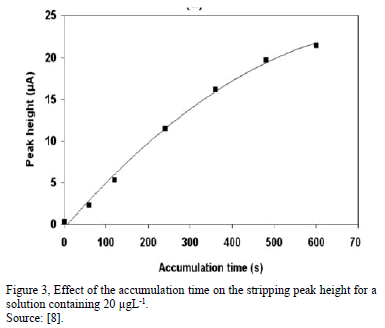
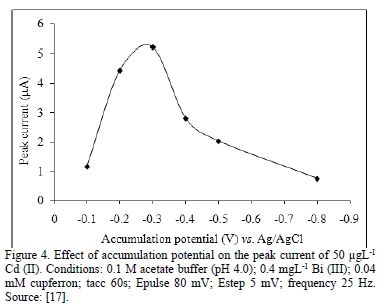
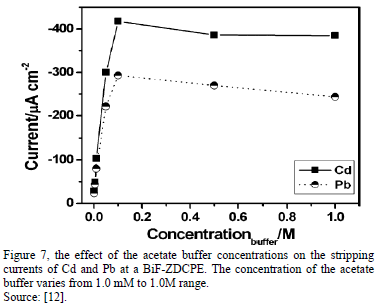
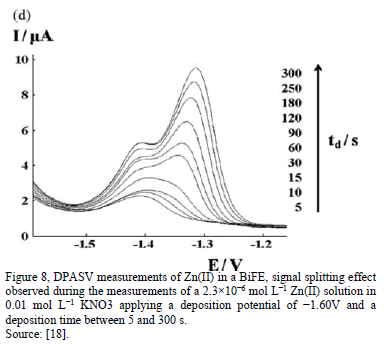
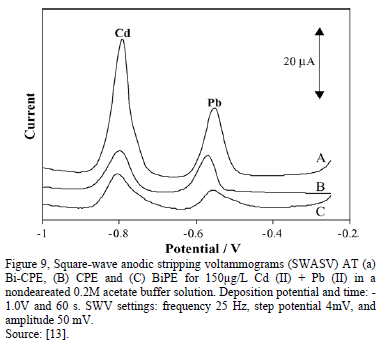
<body><![CDATA[<p><font size="2" face="Verdana, Arial, Helvetica, sans-serif">The deposition time and its effect, is an important factor  on the stripping peak heights of different elements to be detected, the  responses of the metals increases &quot;lineally&quot; with increasing the deposition  time in a first zone. When the deposition time exceed the optimum time, the  peak currents became almost constant &quot;second zone&quot;, indicating that the amount  of element to detect on the electrode surface achieves saturation &#91;20,21,23&#93;.</font></p>     <p><font size="2" face="Verdana, Arial, Helvetica, sans-serif">Accumulation potential  is another important parameter that influences the sensitivity of the  determination of element in stripping techniques, when accumulation potentials  shift to more negative potential than the optimum; the peak currents became  poor, because hydrogen reduction is beginning to be significant at such  negative potentials. The hydrogen bubbles might damage the metal alloys deposited  on the electrode surface and lead to decrease in current signals at very  negative potentials. In addition, some other chemicals may be reduced, which  can affect the selectivity of the electrode and interfere in the determination.  For potentials more positive than the optimum potential, the background current  became higher &#91;12,17,21,23&#93;.</font></p>     <p align="center"><font size="2" face="Verdana, Arial, Helvetica, sans-serif"><a name="fig04"></a></font><img src="/img/revistas/dyna/v81n187/v81n187a16fig04.gif"></p>     <p><font size="2" face="Verdana, Arial, Helvetica, sans-serif">When stripping voltammetry is carried out in situ, it is  important to know the effect of the bismuth concentration, although the  thickness of the film not affected by the peak position of any metals, at lower  concentrations that the optimum concentration of Bi, there is not sufficient to  form a multicomponent of Bi with the metals; in contrast, when the Bi  concentration is higher, bismuth will hold back the target metals, and affect  the peak currents of metals &#91;21,23,27,28&#93;.</font></p>     <p align="center"><font size="2" face="Verdana, Arial, Helvetica, sans-serif"><a name="fig05"></a></font><img src="/img/revistas/dyna/v81n187/v81n187a16fig05.gif"></p>     <p align="center"><font size="2" face="Verdana, Arial, Helvetica, sans-serif"><a name="fig06"></a></font><img src="/img/revistas/dyna/v81n187/v81n187a16fig06.gif"></p>     <p><font size="2" face="Verdana, Arial, Helvetica, sans-serif">The pH affects the  peak current &#91;17,20,21&#93;, the peak current decreases  both at lower and higher than optimum pH values due to the protonation of  coordination sites of the ligand and the hydrolysis to the Cd(II) &#91;17&#93;.</font></p>     <p><font size="2" face="Verdana, Arial, Helvetica, sans-serif">The effect of the concentrations of the acetate  buffer was studied too, &quot;BiF-ZDCPE electrodes&quot;. The results show that the  stripping currents for Cd and Pb increased rapidly with the increase of the  buffer concentrations from 1.0mM to 0.10 M. At high concentration of acetate  buffer (&gt;0.10 M), the stripping signals of both Cd and Pb decreased  slightly. This indicates that the metal-Bi alloy formation under the </font><font size="2" face="Verdana, Arial, Helvetica, sans-serif">applied conditions strongly depends on the ionic strength of the  solution, clearly &#91;12&#93;. In most of the work, the  form of current peak is isometric, evidencing a unique peak; however, in some  case, the voltammgrams can produce two overlapping peaks, the reasons for such  peak splitting are unclear and to know which peak will predominant, too (first or second signal); however, it should  be related with the deposition step, one possible explanation is that two  layers (or two different association mechanisms) are present in the electrode &#91;3,19&#93;.</font></p>     <p align="center"><font size="2" face="Verdana, Arial, Helvetica, sans-serif"><a name="fig07"></a></font><img src="/img/revistas/dyna/v81n187/v81n187a16fig07.gif"></p>     <p align="center"><font size="2" face="Verdana, Arial, Helvetica, sans-serif"><a name="fig08"></a></font><img src="/img/revistas/dyna/v81n187/v81n187a16fig08.gif"></p>     ]]></body>
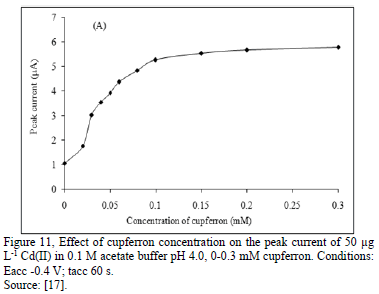
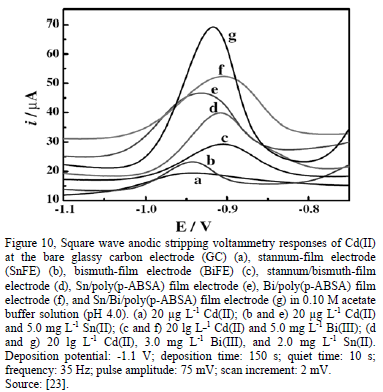
<body><![CDATA[<p><font size="2" face="Verdana, Arial, Helvetica, sans-serif">The  formation of intermetallic compounds is considered a serious interference in  the determination of some heavy metals by ASV on BiFEs. The well-known  interference of Cu (II) in the determination of Pb and Cd has been reported  previously on electroplated BiFEs, both cadmium and lead do not compete with the  bismuth for the surface site; the stripping behavior of copper at the bismuth  coated electrode is different and this affects the current peak of Bi.  The </font><font size="2" face="Verdana, Arial, Helvetica, sans-serif">interference of Cu (II) has been  attributed both to the formation of mixed compounds &quot;Example Cu-Zn&quot; and to the  undesired deposition of Cu instead of Bi. Some works show how this interference  can be alleviated by the addition of element different (Ga, ferrocyanide) in  the sample solution &#91;9,10,27&#93;.</font></p>     <p align="center"><font size="2" face="Verdana, Arial, Helvetica, sans-serif"><a name="fig09"></a></font><img src="/img/revistas/dyna/v81n187/v81n187a16fig09.gif"></p>     <p>&nbsp;</p>     <p><font size="3" face="Verdana, Arial, Helvetica, sans-serif"><b>5.  Modified Bi  electrodes </b></font></p>     <p><font size="2" face="Verdana, Arial, Helvetica, sans-serif">Several methods for the generation of the bismuth film  have been reported including modified electrode of bismuth powder, bismuth  precursor compounds (such as Bi<sub>2</sub>O<sub>3</sub> or BiPO<sub>4</sub>),  disposable bismuth-coated porous screen-printed carbon electrode (Bi-P-SPCE),  bismuth-enriched alloys and ultrasound-facilitated bismuth film formation.  Bismuth-powder modified with carbon paste results in a convenient and reliable  electrochemical sensor for trace heavy metal detection in conjunction with  stripping electroanalysis, which has favorable properties with respect to other  bismuth-based electrodes. The most common methods for the generation involves  in situ or ex situ electrochemical plating by reduction of Bi (III) ions to  metallic bismuth on a suitable supporting material &#91;13,22, 28-30&#93;.</font></p>     <p><font size="2" face="Verdana, Arial, Helvetica, sans-serif">Different  kinds of modified Bi electrodes have been studied to improve the  electroanalytical characteristics in accordance with the mechanical and  electrochemical properties of the new component. Polymeric membranes can  protect the bismuth surface against abrasion, adsorption of surface-active  compounds and formation of intermetallic compounds; offering a well-defined  stripping peak with favorable signal-to-background characteristics, not prone  to oxygen interference and enhance the sensitivity of the bismuth film for  determining heavy metals. Modified Bismuth electrodes with membranes such as  overoxidized poly-1-naphtylamine, poly (sodium 4-styrenesulfonate),  bismuth/poly (aniline) and poly (paminobenzene sulfonic acid) (poly(p-ABSA))  can avoid the interference and stabilize the thin film at the substrate surface  by creating a </font><font size="2" face="Verdana, Arial, Helvetica, sans-serif">framework for mechanical support  and strong adherence to the electrode surface, this is very attractive for  practical stripping applications, but by far the most widespread studied  coating films are composed of Nafion. Nafion is chemically and thermally inert,  non-electroactive, conductive and insoluble in water and is, therefore,  particularly suitable for the modification of electrodes. In addition to its  protective properties, Nafion acts as an ion-exchanger facilitating the  preconcentration of cationic target analytes, helps to mechanically stabilize  the underlying bismuth layer and, under certain circumstances, can improve the  detection sensitivity &#91;21,23,27,31&#93;. </font></p>     <p align="center"><font size="2" face="Verdana, Arial, Helvetica, sans-serif"><a name="fig10"></a></font><img src="/img/revistas/dyna/v81n187/v81n187a16fig10.gif"></p>     <p><font size="2" face="Verdana, Arial, Helvetica, sans-serif">The sensitivity of the modified electrodes can improve  significantly with the incorporation of metallic stannum &#91;23&#93;. In recent years,  the antimony-film electrode (SbFE) has been reported to perform similar to the  BiFE in ASV; this newly proposed electrode offers a remarkable performance in  more acidic solutions (pH&le;2), which can be advantageous in  electrochemical analysis of trace heavy metals &#91;20&#93;. </font></p>     <p><font size="2" face="Verdana, Arial, Helvetica, sans-serif">Some works show how the addition of an analytical reagent  in a small amount, can enhance the current peak in the determination of some  heavy metals. Cupferron in the range 0.0 to 0.1 Mm improve electrochemical  signal of Cd (II) about two times.  This  enhancement of the electrochemical signal for Cd (II) can be improved when the  concentration of Nafion increases in small percentage &#91;17&#93;. </font></p>     <p><font size="2" face="Verdana, Arial, Helvetica, sans-serif">Other material have been added to the Bismuth electrodes  such as Zeolite, the increase of zeolite content up to 5% in the carbon paste  improves the stripping currents of Cd, Pb, and Bi. This can be attributed to the  good ion exchange properties of zeolite. However, when the content of zeolite  in the carbon paste was higher than 5%, all the peak currents of the metals  decreased. The reasons may be attributed to zeolite being an insulator &#91;12&#93;. </font></p>     ]]></body>
<body><![CDATA[<p align="center"><font size="2" face="Verdana, Arial, Helvetica, sans-serif"><a name="fig11"></a></font><img src="/img/revistas/dyna/v81n187/v81n187a16fig11.gif"></p>     <p>&nbsp;</p>     <p><font size="3" face="Verdana, Arial, Helvetica, sans-serif"><b>6.  Important of   the research </b></font></p>     <p><font size="2" face="Verdana, Arial, Helvetica, sans-serif">Heavy metals have become a focus of public interest since  analytical techniques have made it possible to detect them even in very small  traces. Lead has been mined since ancient times and has been processed in many  ways. Cadmium exists in low concentrations in all soils and today is regarded  as the most serious contaminant of the modern age, because is absorbed by many  plants, sea creatures and, because of its toxicity, it presents a major problem  for foodstuffs. Similarly the contamination by fertilizers and insecticides  become an increasing problem, the widespread use result in their frequent  appearance in the environment and foods, such as nitroguianidine neonicotinoid &#91;2,5&#93;. </font></p>     <p><font size="2" face="Verdana, Arial, Helvetica, sans-serif">Bismuth electrodes have  been applied to detect heavy metals in different samples such as biological  sample (hair, urine, sweat, saliva &#91;20&#93; and  blood &#91;3&#93;, environment samples (air &#91;3&#93;, tap water &#91;3,12,13, 19-21, 23&#93; sewage water &#91;3,12, 13&#93; river water &#91;3,9,21&#93; lake water &#91;31&#93;, soils &#91;3,20&#93;,  foods (Cabbage, Lettuce, Celery, spinach &#91;27&#93;, tea,  wine and tomato sauce&#91;3&#93;), marine algae &#91;17&#93;, plant extracts &#91;20&#93; and  gasoline&#91;3&#93;.  Other interesting applications of Bismuth Electrodes have begun to draw  attention such as the determination of daunomycin, an effective drug used for  cancer chemotherapy &#91;11&#93;. For the last thirteen years,  studies of different Bi and modified Bi electrodes have shown that they can be  considered an important environmental opportunity to voltammetry. Lead and  cadmium are some of the metals most referenced in these works with Bismuth  electrodes, maximum safe limits defined by the World Health Organization (WHO)  for Lead are 10 <font face="Symbol">m</font>g/L for drinking water, 0.3 <font face="Symbol">m</font>g/g for vegetables and  0.2 <font face="Symbol">m</font>g/g for maize and bean. Similarly, for Cadmium, the maximum content  recommended in tap water is 3.0 <font face="Symbol">m</font>g/L &#91;20,32,33&#93;, these  values  can be detected according  to the detection limits presented in the different investigations. Bi  electrodes are emerging as one of the best potential replacements for mercury  electrodes in order to implement the new stringent regulations for heavy metals  (Hg, Cadmium, Lead, etc.) due to their multiple electroanalytical  characteristics.</font></p>     <p>&nbsp;</p>     <p><font size="3" face="Verdana, Arial, Helvetica, sans-serif"><b>References</b> </font></p>     <!-- ref --><p><font size="2" face="Verdana, Arial, Helvetica, sans-serif"><b>&#91;1&#93;</b>    Suwannasom,  P. and Ruangviriyachai, C., Simultaneous quantification of Cd, Cu, Pb and Zn in  Thai fermented food by DPASV with a microwave digestion, International Food  Research Journal, 18, pp. 803-808, 2011.    &nbsp;&nbsp;&nbsp;&nbsp;&nbsp;&nbsp;&nbsp;&nbsp;[&#160;<a href="javascript:void(0);" onclick="javascript: window.open('/scielo.php?script=sci_nlinks&ref=000070&pid=S0012-7353201400050001600001&lng=','','width=640,height=500,resizable=yes,scrollbars=1,menubar=yes,');">Links</a>&#160;]<!-- end-ref --></font></p>     <!-- ref --><p><font size="2" face="Verdana, Arial, Helvetica, sans-serif"><b>&#91;2&#93;</b>    Auroville,  Innovative Urban Management IND-015, Heavy metals and pesticides residue in the  foodstuff, Final Report, Annexes, 2003, pp. 1-9.    &nbsp;&nbsp;&nbsp;&nbsp;&nbsp;&nbsp;&nbsp;&nbsp;[&#160;<a href="javascript:void(0);" onclick="javascript: window.open('/scielo.php?script=sci_nlinks&ref=000072&pid=S0012-7353201400050001600002&lng=','','width=640,height=500,resizable=yes,scrollbars=1,menubar=yes,');">Links</a>&#160;]<!-- end-ref --></font></p>     <!-- ref --><p><font size="2" face="Verdana, Arial, Helvetica, sans-serif"><b>&#91;3&#93;</b> Bar&oacute;n-Jaimez J.A., Electrodos de Bismuto para Detectar  Metales Pesados, MSc. Tesis, Universidad Nacional Aut&oacute;noma de M&eacute;xico UNAM,  M&eacute;xico, 2012.    &nbsp;&nbsp;&nbsp;&nbsp;&nbsp;&nbsp;&nbsp;&nbsp;[&#160;<a href="javascript:void(0);" onclick="javascript: window.open('/scielo.php?script=sci_nlinks&ref=000074&pid=S0012-7353201400050001600003&lng=','','width=640,height=500,resizable=yes,scrollbars=1,menubar=yes,');">Links</a>&#160;]<!-- end-ref --></font></p>     <!-- ref --><p><font size="2" face="Verdana, Arial, Helvetica, sans-serif"><b>&#91;4&#93;</b> He, X.,  Liping, Z., Dekun, H., Yuezhong, X. and Litong, J., A Nafion-coated bismuth  film electrode for the determination of heavy metals in vegetable using  differential pulse anodic stripping voltammetry: An alternative to  mercury-based electrodes, Food Chemistry, 109, pp. 834-839, 2008.    &nbsp;&nbsp;&nbsp;&nbsp;&nbsp;&nbsp;&nbsp;&nbsp;[&#160;<a href="javascript:void(0);" onclick="javascript: window.open('/scielo.php?script=sci_nlinks&ref=000076&pid=S0012-7353201400050001600004&lng=','','width=640,height=500,resizable=yes,scrollbars=1,menubar=yes,');">Links</a>&#160;]<!-- end-ref --></font></p>     <!-- ref --><p><font size="2" face="Verdana, Arial, Helvetica, sans-serif"><b>&#91;5&#93;</b> Guzsv&aacute;ny,  V., Papp, Z., Zbilji&#263;, J., Vajdle, O. and Rodi&#263;, M., Bismuth modified  Carbon-Based electrodes for the determination of selected neonicotinoid  insecticides, Molecules, 16, pp. 4451-4466, 2011.    &nbsp;&nbsp;&nbsp;&nbsp;&nbsp;&nbsp;&nbsp;&nbsp;[&#160;<a href="javascript:void(0);" onclick="javascript: window.open('/scielo.php?script=sci_nlinks&ref=000078&pid=S0012-7353201400050001600005&lng=','','width=640,height=500,resizable=yes,scrollbars=1,menubar=yes,');">Links</a>&#160;]<!-- end-ref --></font></p>     <!-- ref --><p><font size="2" face="Verdana, Arial, Helvetica, sans-serif"><b>&#91;6&#93;</b> IFCS, Metales pesados: ¿Necesidad de m&aacute;s acciones  globales?, 5<sup>ta</sup> Reuni&oacute;n del Foro Interguvernamental de Seguridad  Qu&iacute;mica, Budapest, Hungr&iacute;a, pp. 1-16, 2006.    &nbsp;&nbsp;&nbsp;&nbsp;&nbsp;&nbsp;&nbsp;&nbsp;[&#160;<a href="javascript:void(0);" onclick="javascript: window.open('/scielo.php?script=sci_nlinks&ref=000080&pid=S0012-7353201400050001600006&lng=','','width=640,height=500,resizable=yes,scrollbars=1,menubar=yes,');">Links</a>&#160;]<!-- end-ref --></font></p>     <!-- ref --><p><font size="2" face="Verdana, Arial, Helvetica, sans-serif"><b>&#91;7&#93;</b> Est&eacute;vez-Hern&aacute;ndez,  O.L., Furoiltioureas: Naturaleza de sus complejos con CdCl2 y HgCl2 y su  utilizaci&oacute;n en sensores electroqu&iacute;micos, Tesis, Universidad de C&aacute;diz,  Espa&ntilde;a, 2006.    &nbsp;&nbsp;&nbsp;&nbsp;&nbsp;&nbsp;&nbsp;&nbsp;[&#160;<a href="javascript:void(0);" onclick="javascript: window.open('/scielo.php?script=sci_nlinks&ref=000082&pid=S0012-7353201400050001600007&lng=','','width=640,height=500,resizable=yes,scrollbars=1,menubar=yes,');">Links</a>&#160;]<!-- end-ref --></font></p>     <!-- ref --><p><font size="2" face="Verdana, Arial, Helvetica, sans-serif"><b>&#91;8&#93;</b>    Kokkinos,  C., Raptis, L. and Economou, A., Disposable  micro-fabricated electrochemical bismuth sensors for the determination of Tl(I)  by stripping voltammetry Speliotis T., Procedia Chemistry, I, pp. 1039  -1042, 2009.    &nbsp;&nbsp;&nbsp;&nbsp;&nbsp;&nbsp;&nbsp;&nbsp;[&#160;<a href="javascript:void(0);" onclick="javascript: window.open('/scielo.php?script=sci_nlinks&ref=000084&pid=S0012-7353201400050001600008&lng=','','width=640,height=500,resizable=yes,scrollbars=1,menubar=yes,');">Links</a>&#160;]<!-- end-ref --></font></p>     <!-- ref --><p><font size="2" face="Verdana, Arial, Helvetica, sans-serif"><b>&#91;9&#93;</b>    Kokkinos, C., Economou, A., Raptis, I. and Efstathioua,  C., Lithographically fabricated disposable bismuth-film electrodes for the  trace determination of Pb(II) and Cd(II) by anodic stripping voltammetry, Electrochimica  Acta, pp. 5294-5299, 2008.    &nbsp;&nbsp;&nbsp;&nbsp;&nbsp;&nbsp;&nbsp;&nbsp;[&#160;<a href="javascript:void(0);" onclick="javascript: window.open('/scielo.php?script=sci_nlinks&ref=000086&pid=S0012-7353201400050001600009&lng=','','width=640,height=500,resizable=yes,scrollbars=1,menubar=yes,');">Links</a>&#160;]<!-- end-ref --></font></p>     <!-- ref --><p><font size="2" face="Verdana, Arial, Helvetica, sans-serif"><b>&#91;10&#93;</b> Wang, J.,  Lu, J., Kirgöz, U., Hocevar, S. and Ogorevc, B.,  Insights into the anodic stripping voltammetric behavior of bismuth film  electrodes, Analytical chimical Acta, 434 pp. 29-34, 2001.    &nbsp;&nbsp;&nbsp;&nbsp;&nbsp;&nbsp;&nbsp;&nbsp;[&#160;<a href="javascript:void(0);" onclick="javascript: window.open('/scielo.php?script=sci_nlinks&ref=000088&pid=S0012-7353201400050001600010&lng=','','width=640,height=500,resizable=yes,scrollbars=1,menubar=yes,');">Links</a>&#160;]<!-- end-ref --></font></p>     <!-- ref --><p><font size="2" face="Verdana, Arial, Helvetica, sans-serif"><b>&#91;11&#93;</b>   Duwensee,  H., Adamovski, M. and Flechsig, G.U., Adsorptive  stripping voltammetric detection of daunomycin at mercury and bismuth alloy  electrodes, International Journal of Electrochemical Science, 2, pp.  498-507, 2007.    &nbsp;&nbsp;&nbsp;&nbsp;&nbsp;&nbsp;&nbsp;&nbsp;[&#160;<a href="javascript:void(0);" onclick="javascript: window.open('/scielo.php?script=sci_nlinks&ref=000090&pid=S0012-7353201400050001600011&lng=','','width=640,height=500,resizable=yes,scrollbars=1,menubar=yes,');">Links</a>&#160;]<!-- end-ref --></font></p>     <!-- ref --><p><font size="2" face="Verdana, Arial, Helvetica, sans-serif"><b>&#91;12&#93;</b>   Caoa, L.,  Jia, J. and Wang, Z., Sensitive determination of Cd and Pb by differential  pulse stripping voltammetry with in situ bismuth-modified zeolite doped carbon  paste electrodes, Electrochimica Acta, 53, pp. 2177-2182, 2008.    &nbsp;&nbsp;&nbsp;&nbsp;&nbsp;&nbsp;&nbsp;&nbsp;[&#160;<a href="javascript:void(0);" onclick="javascript: window.open('/scielo.php?script=sci_nlinks&ref=000092&pid=S0012-7353201400050001600012&lng=','','width=640,height=500,resizable=yes,scrollbars=1,menubar=yes,');">Links</a>&#160;]<!-- end-ref --></font></p>     <!-- ref --><p><font size="2" face="Verdana, Arial, Helvetica, sans-serif"><b>&#91;13&#93;</b>   Hocevar,  S., Svancara, I., Vytras, K. and Ogorevc, B., Novel electrode for  electrochemical stripping analysis based on carbon paste modified with bismuth  powder, Electrochimica Acta, 51, pp. 706-710, 2005.    &nbsp;&nbsp;&nbsp;&nbsp;&nbsp;&nbsp;&nbsp;&nbsp;[&#160;<a href="javascript:void(0);" onclick="javascript: window.open('/scielo.php?script=sci_nlinks&ref=000094&pid=S0012-7353201400050001600013&lng=','','width=640,height=500,resizable=yes,scrollbars=1,menubar=yes,');">Links</a>&#160;]<!-- end-ref --></font></p>     <!-- ref --><p><font size="2" face="Verdana, Arial, Helvetica, sans-serif"><b>&#91;14&#93;</b>   Alghamdi,  A.H., Applications of stripping voltammetric techniques in food analysis,  Arabian Journal of Chemistry, 3, pp. 1-7, 2010.    &nbsp;&nbsp;&nbsp;&nbsp;&nbsp;&nbsp;&nbsp;&nbsp;[&#160;<a href="javascript:void(0);" onclick="javascript: window.open('/scielo.php?script=sci_nlinks&ref=000096&pid=S0012-7353201400050001600014&lng=','','width=640,height=500,resizable=yes,scrollbars=1,menubar=yes,');">Links</a>&#160;]<!-- end-ref --></font></p>     <!-- ref --><p><font size="2" face="Verdana, Arial, Helvetica, sans-serif"><b>&#91;15&#93;</b>   Cornelis,  R., Crews, H., Caruso, J. and Heumann, K., Handbook of elemental speciation:  Techniques and methodology, Chapter 5.9 Speciation Analysis by Electrochemical  Methods, 2003.    &nbsp;&nbsp;&nbsp;&nbsp;&nbsp;&nbsp;&nbsp;&nbsp;[&#160;<a href="javascript:void(0);" onclick="javascript: window.open('/scielo.php?script=sci_nlinks&ref=000098&pid=S0012-7353201400050001600015&lng=','','width=640,height=500,resizable=yes,scrollbars=1,menubar=yes,');">Links</a>&#160;]<!-- end-ref --></font></p>     <!-- ref --><p><font size="2" face="Verdana, Arial, Helvetica, sans-serif"><b>&#91;16&#93;</b>   Baron,  J., Silva-Bermudez, P. and Rodil, S.E., Sputtered Bismuth thin films as trace  metal electrochemical sensors. Materials Research Society. Symp. Proc., Vol.  1477, 2012.    &nbsp;&nbsp;&nbsp;&nbsp;&nbsp;&nbsp;&nbsp;&nbsp;[&#160;<a href="javascript:void(0);" onclick="javascript: window.open('/scielo.php?script=sci_nlinks&ref=000100&pid=S0012-7353201400050001600016&lng=','','width=640,height=500,resizable=yes,scrollbars=1,menubar=yes,');">Links</a>&#160;]<!-- end-ref --></font></p>     <!-- ref --><p><font size="2" face="Verdana, Arial, Helvetica, sans-serif"><b>&#91;17&#93;</b>   Meepun,  N., Siriket, S. and, Dejmanee, S., Adsorptive  stripping voltammetry for determination of Cadmium in the presence of Cupferron  on a Nafion-coated Bismuth film electrode, International Journal of  electrochemical Science, 7, pp. 10582-10591, 2012.    &nbsp;&nbsp;&nbsp;&nbsp;&nbsp;&nbsp;&nbsp;&nbsp;[&#160;<a href="javascript:void(0);" onclick="javascript: window.open('/scielo.php?script=sci_nlinks&ref=000102&pid=S0012-7353201400050001600017&lng=','','width=640,height=500,resizable=yes,scrollbars=1,menubar=yes,');">Links</a>&#160;]<!-- end-ref --></font></p>     <!-- ref --><p><font size="2" face="Verdana, Arial, Helvetica, sans-serif"><b>&#91;18&#93;</b> Serrano,  N., Alberich, A., D&iacute;az-Cruz, J.M., Ari&ntilde;o, C. and Esteban, M., Signal splitting  in the stripping analysis of heavy metals using bismuth film electrodes:  Influence of concentration range and deposition parameters, Electrochimica  Acta, 53, pp. 6616-6622, 2008.    &nbsp;&nbsp;&nbsp;&nbsp;&nbsp;&nbsp;&nbsp;&nbsp;[&#160;<a href="javascript:void(0);" onclick="javascript: window.open('/scielo.php?script=sci_nlinks&ref=000104&pid=S0012-7353201400050001600018&lng=','','width=640,height=500,resizable=yes,scrollbars=1,menubar=yes,');">Links</a>&#160;]<!-- end-ref --></font></p>     <!-- ref --><p><font size="2" face="Verdana, Arial, Helvetica, sans-serif"><b>&#91;19&#93;</b>   Prior,  C., Lenehan, C. and Stewart-Walker, G., Utilising gallium for enhanced  electrochemical copper analysis at the bismuth film electrode, Analytical  Chimica Acta, 598, pp. 65-73, 2007.    &nbsp;&nbsp;&nbsp;&nbsp;&nbsp;&nbsp;&nbsp;&nbsp;[&#160;<a href="javascript:void(0);" onclick="javascript: window.open('/scielo.php?script=sci_nlinks&ref=000106&pid=S0012-7353201400050001600019&lng=','','width=640,height=500,resizable=yes,scrollbars=1,menubar=yes,');">Links</a>&#160;]<!-- end-ref --></font></p>     <!-- ref --><p><font size="2" face="Verdana, Arial, Helvetica, sans-serif"><b>&#91;20&#93;</b> Jiao,  Y.W., Li, Y., Ran, G., Qun, L.H. and Bing, L.N., Determination of cadmium (II)  by square wave anodic stripping voltammetry using bismuth-antimony film  electrode, Sensor and Actuators B, 166-167, pp. 544-548, 2012.    &nbsp;&nbsp;&nbsp;&nbsp;&nbsp;&nbsp;&nbsp;&nbsp;[&#160;<a href="javascript:void(0);" onclick="javascript: window.open('/scielo.php?script=sci_nlinks&ref=000108&pid=S0012-7353201400050001600020&lng=','','width=640,height=500,resizable=yes,scrollbars=1,menubar=yes,');">Links</a>&#160;]<!-- end-ref --></font></p>     <!-- ref --><p><font size="2" face="Verdana, Arial, Helvetica, sans-serif"><b>&#91;21&#93;</b>   Wu, Y.,  Bing, L.N. and Qun, L.H., Simultaneous measurement of Pb, Cd and Zn using  differential pulse anodic stripping voltammetry at a bismuth / poly  (p-aminobenzene sulfonic acid) film electrode, Sensor and Actuators B, 133, pp.  677-681, 2008.    &nbsp;&nbsp;&nbsp;&nbsp;&nbsp;&nbsp;&nbsp;&nbsp;[&#160;<a href="javascript:void(0);" onclick="javascript: window.open('/scielo.php?script=sci_nlinks&ref=000110&pid=S0012-7353201400050001600021&lng=','','width=640,height=500,resizable=yes,scrollbars=1,menubar=yes,');">Links</a>&#160;]<!-- end-ref --></font></p>     <!-- ref --><p><font size="2" face="Verdana, Arial, Helvetica, sans-serif"><b>&#91;22&#93;</b>   Kokkinos,  C., Economou, A, Raptis, I., Efstathiou, C. and Speliotis, T., Novel disposable  bismuth-sputtered electrodes for the determination of trace metals by stripping  voltammetry, Electrochemistry communications, 9 (12), pp. 2795-2800, 2007.    &nbsp;&nbsp;&nbsp;&nbsp;&nbsp;&nbsp;&nbsp;&nbsp;[&#160;<a href="javascript:void(0);" onclick="javascript: window.open('/scielo.php?script=sci_nlinks&ref=000112&pid=S0012-7353201400050001600022&lng=','','width=640,height=500,resizable=yes,scrollbars=1,menubar=yes,');">Links</a>&#160;]<!-- end-ref --></font></p>     <!-- ref --><p><font size="2" face="Verdana, Arial, Helvetica, sans-serif"><b>&#91;23&#93;</b>   Xiong,  Ch.H., Luo, H.Q. and, Li, B.N., A stannum/bismuth/poly(p-aminobenzene sulfonic  acid) film electrode for measurement of Cd (II) using square wave anodic  stripping voltammetry, Journal of Electroanalytical Chemistry, 651 (1), pp.  19-23, 2011.    &nbsp;&nbsp;&nbsp;&nbsp;&nbsp;&nbsp;&nbsp;&nbsp;[&#160;<a href="javascript:void(0);" onclick="javascript: window.open('/scielo.php?script=sci_nlinks&ref=000114&pid=S0012-7353201400050001600023&lng=','','width=640,height=500,resizable=yes,scrollbars=1,menubar=yes,');">Links</a>&#160;]<!-- end-ref --></font></p>     <!-- ref --><p><font size="2" face="Verdana, Arial, Helvetica, sans-serif"><b>&#91;24&#93;</b> Bedoya,  C.M., Pinz&oacute;n, M.J., Alfonso, J.E., Restrepo, E. and Olaya, J.J.,  Physical-Chemical Properties of Bismuth and Bismuth Oxides: Synthesis,  Characterization and Applications, DYNA, 79 (176), pp. 139-148, 2012.    &nbsp;&nbsp;&nbsp;&nbsp;&nbsp;&nbsp;&nbsp;&nbsp;[&#160;<a href="javascript:void(0);" onclick="javascript: window.open('/scielo.php?script=sci_nlinks&ref=000116&pid=S0012-7353201400050001600024&lng=','','width=640,height=500,resizable=yes,scrollbars=1,menubar=yes,');">Links</a>&#160;]<!-- end-ref --></font></p>     <!-- ref --><p><font size="2" face="Verdana, Arial, Helvetica, sans-serif"><b>&#91;25&#93;</b>   Kokkinos,  C., Raptis, I., Economou, A. and Speliotis, T., Disposable micro-fabricated  electrochemical bismuth sensor for the determination of Tlv(I) by stripping  voltammetr, Procedia Chemistry I, pp. 1039-1042, 2009.    &nbsp;&nbsp;&nbsp;&nbsp;&nbsp;&nbsp;&nbsp;&nbsp;[&#160;<a href="javascript:void(0);" onclick="javascript: window.open('/scielo.php?script=sci_nlinks&ref=000118&pid=S0012-7353201400050001600025&lng=','','width=640,height=500,resizable=yes,scrollbars=1,menubar=yes,');">Links</a>&#160;]<!-- end-ref --></font></p>     <!-- ref --><p><font size="2" face="Verdana, Arial, Helvetica, sans-serif"><b>&#91;26&#93;</b>   Economou,  A., Bismuth-film electrodes: Recent developments and potentialities for  electroanalysis, TrAC Trends in Analytical Chemistry, 24 (4), pp. 334-340,  2005.    &nbsp;&nbsp;&nbsp;&nbsp;&nbsp;&nbsp;&nbsp;&nbsp;[&#160;<a href="javascript:void(0);" onclick="javascript: window.open('/scielo.php?script=sci_nlinks&ref=000120&pid=S0012-7353201400050001600026&lng=','','width=640,height=500,resizable=yes,scrollbars=1,menubar=yes,');">Links</a>&#160;]<!-- end-ref --></font></p>     <!-- ref --><p><font size="2" face="Verdana, Arial, Helvetica, sans-serif"><b>&#91;27&#93;</b>   Xu, H.,  Zeng, L., Huang, D., Xian, Y. and Jin, L. A Nafion-coated bismuth film  electrode for the determination of heavy metals in vegetable using differential  pulse anodic stripping voltammetry: An alternative to mercury-based electrodes, Food  Chemistry, 109, pp. 834-839, 2008.    &nbsp;&nbsp;&nbsp;&nbsp;&nbsp;&nbsp;&nbsp;&nbsp;[&#160;<a href="javascript:void(0);" onclick="javascript: window.open('/scielo.php?script=sci_nlinks&ref=000122&pid=S0012-7353201400050001600027&lng=','','width=640,height=500,resizable=yes,scrollbars=1,menubar=yes,');">Links</a>&#160;]<!-- end-ref --></font></p>     <!-- ref --><p><font size="2" face="Verdana, Arial, Helvetica, sans-serif"><b>&#91;28&#93;</b> Hwang,  G.H., Han, W.K., Hong, S.J., Park, J.S. and Kang, S.G., Determination of trace  amounts of lead and cadmium using a bismuth/glassy carbon composite electrode,  Talanta, 77, pp. 1432-1436, 2009.    &nbsp;&nbsp;&nbsp;&nbsp;&nbsp;&nbsp;&nbsp;&nbsp;[&#160;<a href="javascript:void(0);" onclick="javascript: window.open('/scielo.php?script=sci_nlinks&ref=000124&pid=S0012-7353201400050001600028&lng=','','width=640,height=500,resizable=yes,scrollbars=1,menubar=yes,');">Links</a>&#160;]<!-- end-ref --></font></p>     <!-- ref --><p><font size="2" face="Verdana, Arial, Helvetica, sans-serif"><b>&#91;29&#93;</b> Kadara,  R. and Tothill, I., Development of disposable bulk-modified screen-printed  electrode based on bismuth oxide for stripping chronopotentiometric analysis of  lead (II) and cadmium (II) in soil and water samples, Analytica Chimica Acta,  623, pp. 76-81, 2008.    &nbsp;&nbsp;&nbsp;&nbsp;&nbsp;&nbsp;&nbsp;&nbsp;[&#160;<a href="javascript:void(0);" onclick="javascript: window.open('/scielo.php?script=sci_nlinks&ref=000126&pid=S0012-7353201400050001600029&lng=','','width=640,height=500,resizable=yes,scrollbars=1,menubar=yes,');">Links</a>&#160;]<!-- end-ref --></font></p>     <!-- ref --><p><font size="2" face="Verdana, Arial, Helvetica, sans-serif"><b>&#91;30&#93;</b> Chen, C.,  Niu, X., Chai, Y., Zhao, H. and Lan, M., Bismuth-based porous screen-printed  carbon electrode with enhanced sensitivity for trace heavy metal detection by  stripping voltammetry, Sensors and Actuators B, 178, pp. 339- 342, 2013.    &nbsp;&nbsp;&nbsp;&nbsp;&nbsp;&nbsp;&nbsp;&nbsp;[&#160;<a href="javascript:void(0);" onclick="javascript: window.open('/scielo.php?script=sci_nlinks&ref=000128&pid=S0012-7353201400050001600030&lng=','','width=640,height=500,resizable=yes,scrollbars=1,menubar=yes,');">Links</a>&#160;]<!-- end-ref --></font></p>     <!-- ref --><p><font size="2" face="Verdana, Arial, Helvetica, sans-serif"><b>&#91;31&#93;</b>   Kokkinos,  C., Economou, A., Disposable Nafion-modified micro-fabricated bismuth-film  sensors for voltammetric stripping analysis of trace metals in the presence of  surfactants, Talanta 84 (3), pp. 696-701, 2011.    &nbsp;&nbsp;&nbsp;&nbsp;&nbsp;&nbsp;&nbsp;&nbsp;[&#160;<a href="javascript:void(0);" onclick="javascript: window.open('/scielo.php?script=sci_nlinks&ref=000130&pid=S0012-7353201400050001600031&lng=','','width=640,height=500,resizable=yes,scrollbars=1,menubar=yes,');">Links</a>&#160;]<!-- end-ref --></font></p>     <!-- ref --><p><font size="2" face="Verdana, Arial, Helvetica, sans-serif"><b>&#91;32&#93;</b>   European  Commission, Lead Standard in Drinking Water. 11th plenary, of 11 January 2011.    &nbsp;&nbsp;&nbsp;&nbsp;&nbsp;&nbsp;&nbsp;&nbsp;[&#160;<a href="javascript:void(0);" onclick="javascript: window.open('/scielo.php?script=sci_nlinks&ref=000132&pid=S0012-7353201400050001600032&lng=','','width=640,height=500,resizable=yes,scrollbars=1,menubar=yes,');">Links</a>&#160;]<!-- end-ref --></font></p>     <!-- ref --><p><font size="2" face="Verdana, Arial, Helvetica, sans-serif"><b>&#91;33&#93;</b>   Makokha,  A., Mghweno, L., Magoha, H., Nakajugo, A. and Wekesa, J., Environmental lead  pollution and contamination in food around Lake Victoria, Kisumu, Kenya,  African Journal of Environmental Science and Technology, 2 (10), pp. 349-353,2008.    &nbsp;&nbsp;&nbsp;&nbsp;&nbsp;&nbsp;&nbsp;&nbsp;[&#160;<a href="javascript:void(0);" onclick="javascript: window.open('/scielo.php?script=sci_nlinks&ref=000134&pid=S0012-7353201400050001600033&lng=','','width=640,height=500,resizable=yes,scrollbars=1,menubar=yes,');">Links</a>&#160;]<!-- end-ref --></font></p>       <p>&nbsp;</p>     <p><font size="2" face="Verdana, Arial, Helvetica, sans-serif"><b>J. A. Bar&oacute;n-Jaimez,</b> received the Bs. Eng. in Metallurgical Engineering in 2000 from the  Universidad Industrial de Santander, Colomba. In 2012, he obtained a MSc. in  Science and Materials Engineering from the Universidad Nacional Autonoma de  Mexico, Mexico. Currently, he is a failure analysis Engineer in the oil and gas  area. His research interests include detection of heavy metals in solutions and  foods using electrochemical techniques.</font></p>     <p><font size="2" face="Verdana, Arial, Helvetica, sans-serif"><b>J. L. Marulanda-Ar&eacute;valo,</b> received the Bs. Eng. in Metallurgical Engineering in  1999 and an MSc. in Metallurgical Engineering in 2002 from the Universidad  Industrial de Santander, Colombia. In 2012 obtained his PhD. degree in Advanced  Chemistry from the Complutense University of Madrid, Spain. Since 2006,  he works as a professor at the Universidad Tecnol&oacute;gica de Pereira in the Faculty  of Mechanical Engineering. His research interests include corrosion, welding,  coatings, tribology and electrochemistry.</font></p>     <p><font size="2" face="Verdana, Arial, Helvetica, sans-serif"><b>J. J.  Barba-Ortega, </b>received a BSc. In Physics in 2000 and an MSc. in Physics in 2003,  from the Universidad Industrial de Santander, Colombia. He received his PhD  degree in Physics in 2007, and from 2007 to 2009, he obtained Post-doctoral  experience from the Universidade Federal de Pernambuco, Recife, Brasil.  Currently, he is a Full Professor in the Physics Department in the Universidad  Nacional de Colombia, Bogot&aacute;. His research interests include computational  simulations in superconducting mesoscopics and low dimension semiconducting  systems including numerical methods.</font></p>      ]]></body><back>
<ref-list>
<ref id="B1">
<label>1</label><nlm-citation citation-type="journal">
<person-group person-group-type="author">
<name>
<surname><![CDATA[Suwannasom]]></surname>
<given-names><![CDATA[P.]]></given-names>
</name>
<name>
<surname><![CDATA[Ruangviriyachai]]></surname>
<given-names><![CDATA[C.]]></given-names>
</name>
</person-group>
<article-title xml:lang="en"><![CDATA[Simultaneous quantification of Cd, Cu, Pb and Zn in Thai fermented food by DPASV with a microwave digestion]]></article-title>
<source><![CDATA[International Food Research Journal]]></source>
<year>2011</year>
<numero>18</numero>
<issue>18</issue>
<page-range>803-808</page-range></nlm-citation>
</ref>
<ref id="B2">
<label>2</label><nlm-citation citation-type="">
<collab>Auroville</collab>
<source><![CDATA[Innovative Urban Management IND-015, Heavy metals and pesticides residue in the foodstuff: Final Report]]></source>
<year>2003</year>
<page-range>1-9</page-range></nlm-citation>
</ref>
<ref id="B3">
<label>3</label><nlm-citation citation-type="">
<person-group person-group-type="author">
<name>
<surname><![CDATA[Barón-Jaimez]]></surname>
<given-names><![CDATA[J.A.]]></given-names>
</name>
</person-group>
<source><![CDATA[Electrodos de Bismuto para Detectar Metales Pesados]]></source>
<year></year>
</nlm-citation>
</ref>
<ref id="B4">
<label>4</label><nlm-citation citation-type="journal">
<person-group person-group-type="author">
<name>
<surname><![CDATA[He]]></surname>
<given-names><![CDATA[X.]]></given-names>
</name>
<name>
<surname><![CDATA[Liping]]></surname>
<given-names><![CDATA[Z.]]></given-names>
</name>
<name>
<surname><![CDATA[Dekun]]></surname>
<given-names><![CDATA[H.]]></given-names>
</name>
<name>
<surname><![CDATA[Yuezhong]]></surname>
<given-names><![CDATA[X.]]></given-names>
</name>
<name>
<surname><![CDATA[Litong]]></surname>
<given-names><![CDATA[J.]]></given-names>
</name>
</person-group>
<article-title xml:lang="en"><![CDATA[A Nafion-coated bismuth film electrode for the determination of heavy metals in vegetable using differential pulse anodic stripping voltammetry: An alternative to mercury-based electrodes]]></article-title>
<source><![CDATA[Food Chemistry]]></source>
<year>2008</year>
<numero>109</numero>
<issue>109</issue>
<page-range>834-839</page-range></nlm-citation>
</ref>
<ref id="B5">
<label>5</label><nlm-citation citation-type="journal">
<person-group person-group-type="author">
<name>
<surname><![CDATA[Guzsvány]]></surname>
<given-names><![CDATA[V.]]></given-names>
</name>
<name>
<surname><![CDATA[Papp]]></surname>
<given-names><![CDATA[Z.]]></given-names>
</name>
<name>
<surname><![CDATA[Zbilji&#263;]]></surname>
<given-names><![CDATA[J.]]></given-names>
</name>
<name>
<surname><![CDATA[Vajdle]]></surname>
<given-names><![CDATA[O.]]></given-names>
</name>
<name>
<surname><![CDATA[Rodi&#263;]]></surname>
<given-names><![CDATA[M.]]></given-names>
</name>
</person-group>
<article-title xml:lang="en"><![CDATA[Bismuth modified Carbon-Based electrodes for the determination of selected neonicotinoid insecticides]]></article-title>
<source><![CDATA[Molecules]]></source>
<year>2011</year>
<numero>16</numero>
<issue>16</issue>
<page-range>4451-4466</page-range></nlm-citation>
</ref>
<ref id="B6">
<label>6</label><nlm-citation citation-type="confpro">
<collab>IFCS</collab>
<article-title xml:lang="es"><![CDATA[Metales pesados: ¿Necesidad de más acciones globales?]]></article-title>
<source><![CDATA[]]></source>
<year>2006</year>
<conf-name><![CDATA[5ta Reunión del Foro Interguvernamental de Seguridad Química]]></conf-name>
<conf-loc>Budapest </conf-loc>
<page-range>1-16</page-range></nlm-citation>
</ref>
<ref id="B7">
<label>7</label><nlm-citation citation-type="">
<person-group person-group-type="author">
<name>
<surname><![CDATA[Estévez-Hernández]]></surname>
<given-names><![CDATA[O.L.]]></given-names>
</name>
</person-group>
<source><![CDATA[Furoiltioureas: Naturaleza de sus complejos con CdCl2 y HgCl2 y su utilización en sensores electroquímicos]]></source>
<year></year>
</nlm-citation>
</ref>
<ref id="B8">
<label>8</label><nlm-citation citation-type="journal">
<person-group person-group-type="author">
<name>
<surname><![CDATA[Kokkinos]]></surname>
<given-names><![CDATA[C.]]></given-names>
</name>
<name>
<surname><![CDATA[Raptis]]></surname>
<given-names><![CDATA[L.]]></given-names>
</name>
<name>
<surname><![CDATA[Economou]]></surname>
<given-names><![CDATA[A.]]></given-names>
</name>
</person-group>
<article-title xml:lang="en"><![CDATA[Disposable micro-fabricated electrochemical bismuth sensors for the determination of Tl(I) by stripping voltammetry Speliotis T.]]></article-title>
<source><![CDATA[Procedia Chemistry]]></source>
<year>2009</year>
<numero>I</numero>
<issue>I</issue>
<page-range>1039 -1042</page-range></nlm-citation>
</ref>
<ref id="B9">
<label>9</label><nlm-citation citation-type="journal">
<person-group person-group-type="author">
<name>
<surname><![CDATA[Kokkinos]]></surname>
<given-names><![CDATA[C.]]></given-names>
</name>
<name>
<surname><![CDATA[Economou]]></surname>
<given-names><![CDATA[A.]]></given-names>
</name>
<name>
<surname><![CDATA[Raptis]]></surname>
<given-names><![CDATA[I.]]></given-names>
</name>
<name>
<surname><![CDATA[Efstathioua]]></surname>
<given-names><![CDATA[C.]]></given-names>
</name>
</person-group>
<article-title xml:lang="en"><![CDATA[Lithographically fabricated disposable bismuth-film electrodes for the trace determination of Pb(II) and Cd(II) by anodic stripping voltammetry]]></article-title>
<source><![CDATA[Electrochimica Acta]]></source>
<year>2008</year>
<page-range>5294-5299</page-range></nlm-citation>
</ref>
<ref id="B10">
<label>10</label><nlm-citation citation-type="journal">
<person-group person-group-type="author">
<name>
<surname><![CDATA[Wang]]></surname>
<given-names><![CDATA[J.]]></given-names>
</name>
<name>
<surname><![CDATA[Lu]]></surname>
<given-names><![CDATA[J.]]></given-names>
</name>
<name>
<surname><![CDATA[Kirgöz]]></surname>
<given-names><![CDATA[U.]]></given-names>
</name>
<name>
<surname><![CDATA[Hocevar]]></surname>
<given-names><![CDATA[S.]]></given-names>
</name>
<name>
<surname><![CDATA[Ogorevc]]></surname>
<given-names><![CDATA[B.]]></given-names>
</name>
</person-group>
<article-title xml:lang="en"><![CDATA[Insights into the anodic stripping voltammetric behavior of bismuth film electrodes]]></article-title>
<source><![CDATA[Analytical chimical Acta]]></source>
<year>2001</year>
<numero>434</numero>
<issue>434</issue>
<page-range>29-34</page-range></nlm-citation>
</ref>
<ref id="B11">
<label>11</label><nlm-citation citation-type="journal">
<person-group person-group-type="author">
<name>
<surname><![CDATA[Duwensee]]></surname>
<given-names><![CDATA[H.]]></given-names>
</name>
<name>
<surname><![CDATA[Adamovski]]></surname>
<given-names><![CDATA[M.]]></given-names>
</name>
<name>
<surname><![CDATA[Flechsig]]></surname>
<given-names><![CDATA[G.U.]]></given-names>
</name>
</person-group>
<article-title xml:lang="en"><![CDATA[Adsorptive stripping voltammetric detection of daunomycin at mercury and bismuth alloy electrodes]]></article-title>
<source><![CDATA[International Journal of Electrochemical Science]]></source>
<year>2007</year>
<numero>2</numero>
<issue>2</issue>
<page-range>498-507</page-range></nlm-citation>
</ref>
<ref id="B12">
<label>12</label><nlm-citation citation-type="journal">
<person-group person-group-type="author">
<name>
<surname><![CDATA[Caoa]]></surname>
<given-names><![CDATA[L.]]></given-names>
</name>
<name>
<surname><![CDATA[Jia]]></surname>
<given-names><![CDATA[J.]]></given-names>
</name>
<name>
<surname><![CDATA[Wang]]></surname>
<given-names><![CDATA[Z.]]></given-names>
</name>
</person-group>
<article-title xml:lang="en"><![CDATA[Sensitive determination of Cd and Pb by differential pulse stripping voltammetry with in situ bismuth-modified zeolite doped carbon paste electrodes]]></article-title>
<source><![CDATA[Electrochimica Acta]]></source>
<year>2008</year>
<numero>53</numero>
<issue>53</issue>
<page-range>2177-2182</page-range></nlm-citation>
</ref>
<ref id="B13">
<label>13</label><nlm-citation citation-type="journal">
<person-group person-group-type="author">
<name>
<surname><![CDATA[Hocevar]]></surname>
<given-names><![CDATA[S.]]></given-names>
</name>
<name>
<surname><![CDATA[Svancara]]></surname>
<given-names><![CDATA[I.]]></given-names>
</name>
<name>
<surname><![CDATA[Vytras]]></surname>
<given-names><![CDATA[K.]]></given-names>
</name>
<name>
<surname><![CDATA[Ogorevc]]></surname>
<given-names><![CDATA[B.]]></given-names>
</name>
</person-group>
<article-title xml:lang="en"><![CDATA[Novel electrode for electrochemical stripping analysis based on carbon paste modified with bismuth powder]]></article-title>
<source><![CDATA[Electrochimica Acta]]></source>
<year>2005</year>
<numero>51</numero>
<issue>51</issue>
<page-range>706-710</page-range></nlm-citation>
</ref>
<ref id="B14">
<label>14</label><nlm-citation citation-type="journal">
<person-group person-group-type="author">
<name>
<surname><![CDATA[Alghamdi]]></surname>
<given-names><![CDATA[A.H.]]></given-names>
</name>
</person-group>
<article-title xml:lang="en"><![CDATA[Applications of stripping voltammetric techniques in food analysis]]></article-title>
<source><![CDATA[Arabian Journal of Chemistry]]></source>
<year>2010</year>
<numero>3</numero>
<issue>3</issue>
<page-range>1-7</page-range></nlm-citation>
</ref>
<ref id="B15">
<label>15</label><nlm-citation citation-type="">
<person-group person-group-type="author">
<name>
<surname><![CDATA[Cornelis]]></surname>
<given-names><![CDATA[R.]]></given-names>
</name>
<name>
<surname><![CDATA[Crews]]></surname>
<given-names><![CDATA[H.]]></given-names>
</name>
<name>
<surname><![CDATA[Caruso]]></surname>
<given-names><![CDATA[J.]]></given-names>
</name>
<name>
<surname><![CDATA[Heumann]]></surname>
<given-names><![CDATA[K.]]></given-names>
</name>
</person-group>
<source><![CDATA[Handbook of elemental speciation: Techniques and methodology: Chapter 5.9 Speciation Analysis by Electrochemical Methods]]></source>
<year>2003</year>
</nlm-citation>
</ref>
<ref id="B16">
<label>16</label><nlm-citation citation-type="confpro">
<person-group person-group-type="author">
<name>
<surname><![CDATA[Baron]]></surname>
<given-names><![CDATA[J.]]></given-names>
</name>
<name>
<surname><![CDATA[Silva-Bermudez]]></surname>
<given-names><![CDATA[P.]]></given-names>
</name>
<name>
<surname><![CDATA[Rodil]]></surname>
<given-names><![CDATA[S.E.]]></given-names>
</name>
</person-group>
<article-title xml:lang="en"><![CDATA[Sputtered Bismuth thin films as trace metal electrochemical sensors]]></article-title>
<source><![CDATA[]]></source>
<year></year>
<conf-name><![CDATA[ Symp. Proc.]]></conf-name>
<conf-date>2012</conf-date>
<conf-loc> </conf-loc>
</nlm-citation>
</ref>
<ref id="B17">
<label>17</label><nlm-citation citation-type="journal">
<person-group person-group-type="author">
<name>
<surname><![CDATA[Meepun]]></surname>
<given-names><![CDATA[N.]]></given-names>
</name>
<name>
<surname><![CDATA[Siriket]]></surname>
<given-names><![CDATA[S.]]></given-names>
</name>
<name>
<surname><![CDATA[Dejmanee]]></surname>
<given-names><![CDATA[S.]]></given-names>
</name>
</person-group>
<article-title xml:lang="en"><![CDATA[Adsorptive stripping voltammetry for determination of Cadmium in the presence of Cupferron on a Nafion-coated Bismuth film electrode]]></article-title>
<source><![CDATA[International Journal of electrochemical Science]]></source>
<year>2012</year>
<numero>7</numero>
<issue>7</issue>
<page-range>10582-10591</page-range></nlm-citation>
</ref>
<ref id="B18">
<label>18</label><nlm-citation citation-type="journal">
<person-group person-group-type="author">
<name>
<surname><![CDATA[Serrano]]></surname>
<given-names><![CDATA[N.]]></given-names>
</name>
<name>
<surname><![CDATA[Alberich]]></surname>
<given-names><![CDATA[A.]]></given-names>
</name>
<name>
<surname><![CDATA[Díaz-Cruz]]></surname>
<given-names><![CDATA[J.M.]]></given-names>
</name>
<name>
<surname><![CDATA[Ariño]]></surname>
<given-names><![CDATA[C.]]></given-names>
</name>
<name>
<surname><![CDATA[Esteban]]></surname>
<given-names><![CDATA[M.]]></given-names>
</name>
</person-group>
<article-title xml:lang="en"><![CDATA[Signal splitting in the stripping analysis of heavy metals using bismuth film electrodes: Influence of concentration range and deposition parameters]]></article-title>
<source><![CDATA[Electrochimica Acta]]></source>
<year>2008</year>
<numero>53</numero>
<issue>53</issue>
<page-range>6616-6622</page-range></nlm-citation>
</ref>
<ref id="B19">
<label>19</label><nlm-citation citation-type="journal">
<person-group person-group-type="author">
<name>
<surname><![CDATA[Prior]]></surname>
<given-names><![CDATA[C.]]></given-names>
</name>
<name>
<surname><![CDATA[Lenehan]]></surname>
<given-names><![CDATA[C.]]></given-names>
</name>
<name>
<surname><![CDATA[Stewart-Walker]]></surname>
<given-names><![CDATA[G.]]></given-names>
</name>
</person-group>
<article-title xml:lang="en"><![CDATA[Utilising gallium for enhanced electrochemical copper analysis at the bismuth film electrode]]></article-title>
<source><![CDATA[Analytical Chimica Acta]]></source>
<year>2007</year>
<numero>598</numero>
<issue>598</issue>
<page-range>65-73</page-range></nlm-citation>
</ref>
<ref id="B20">
<label>20</label><nlm-citation citation-type="journal">
<person-group person-group-type="author">
<name>
<surname><![CDATA[Jiao]]></surname>
<given-names><![CDATA[Y.W.]]></given-names>
</name>
<name>
<surname><![CDATA[Li]]></surname>
<given-names><![CDATA[Y.]]></given-names>
</name>
<name>
<surname><![CDATA[Ran]]></surname>
<given-names><![CDATA[G.]]></given-names>
</name>
<name>
<surname><![CDATA[Qun]]></surname>
<given-names><![CDATA[L.H.]]></given-names>
</name>
<name>
<surname><![CDATA[Bing]]></surname>
<given-names><![CDATA[L.N.]]></given-names>
</name>
</person-group>
<article-title xml:lang="en"><![CDATA[Determination of cadmium (II) by square wave anodic stripping voltammetry using bismuth-antimony film electrode]]></article-title>
<source><![CDATA[Sensor and Actuators B]]></source>
<year>2012</year>
<numero>166-167</numero>
<issue>166-167</issue>
<page-range>544-548</page-range></nlm-citation>
</ref>
<ref id="B21">
<label>21</label><nlm-citation citation-type="journal">
<person-group person-group-type="author">
<name>
<surname><![CDATA[Wu]]></surname>
<given-names><![CDATA[Y.]]></given-names>
</name>
<name>
<surname><![CDATA[Bing]]></surname>
<given-names><![CDATA[L.N.]]></given-names>
</name>
<name>
<surname><![CDATA[Qun]]></surname>
<given-names><![CDATA[L.H.]]></given-names>
</name>
</person-group>
<article-title xml:lang="en"><![CDATA[Simultaneous measurement of Pb, Cd and Zn using differential pulse anodic stripping voltammetry at a bismuth / poly (p-aminobenzene sulfonic acid) film electrode]]></article-title>
<source><![CDATA[Sensor and Actuators B]]></source>
<year>2008</year>
<numero>133</numero>
<issue>133</issue>
<page-range>677-681</page-range></nlm-citation>
</ref>
<ref id="B22">
<label>22</label><nlm-citation citation-type="journal">
<person-group person-group-type="author">
<name>
<surname><![CDATA[Kokkinos]]></surname>
<given-names><![CDATA[C.]]></given-names>
</name>
<name>
<surname><![CDATA[Economou]]></surname>
<given-names><![CDATA[A]]></given-names>
</name>
<name>
<surname><![CDATA[Raptis]]></surname>
<given-names><![CDATA[I.]]></given-names>
</name>
<name>
<surname><![CDATA[Efstathiou]]></surname>
<given-names><![CDATA[C.]]></given-names>
</name>
<name>
<surname><![CDATA[Speliotis]]></surname>
<given-names><![CDATA[T.]]></given-names>
</name>
</person-group>
<article-title xml:lang="en"><![CDATA[Novel disposable bismuth-sputtered electrodes for the determination of trace metals by stripping voltammetry]]></article-title>
<source><![CDATA[Electrochemistry communications]]></source>
<year>2007</year>
<volume>9</volume>
<numero>12</numero>
<issue>12</issue>
<page-range>2795-2800</page-range></nlm-citation>
</ref>
<ref id="B23">
<label>23</label><nlm-citation citation-type="journal">
<person-group person-group-type="author">
<name>
<surname><![CDATA[Xiong]]></surname>
<given-names><![CDATA[Ch.H.]]></given-names>
</name>
<name>
<surname><![CDATA[Luo]]></surname>
<given-names><![CDATA[H.Q.]]></given-names>
</name>
<name>
<surname><![CDATA[Li]]></surname>
<given-names><![CDATA[B.N.]]></given-names>
</name>
</person-group>
<article-title xml:lang="en"><![CDATA[A stannum/bismuth/poly(p-aminobenzene sulfonic acid) film electrode for measurement of Cd (II) using square wave anodic stripping voltammetry]]></article-title>
<source><![CDATA[Journal of Electroanalytical Chemistry]]></source>
<year>2011</year>
<volume>651</volume>
<numero>1</numero>
<issue>1</issue>
<page-range>19-23</page-range></nlm-citation>
</ref>
<ref id="B24">
<label>24</label><nlm-citation citation-type="journal">
<person-group person-group-type="author">
<name>
<surname><![CDATA[Bedoya]]></surname>
<given-names><![CDATA[C.M.]]></given-names>
</name>
<name>
<surname><![CDATA[Pinzón]]></surname>
<given-names><![CDATA[M.J.]]></given-names>
</name>
<name>
<surname><![CDATA[Alfonso]]></surname>
<given-names><![CDATA[J.E.]]></given-names>
</name>
<name>
<surname><![CDATA[Restrepo]]></surname>
<given-names><![CDATA[E.]]></given-names>
</name>
<name>
<surname><![CDATA[Olaya]]></surname>
<given-names><![CDATA[J.J.]]></given-names>
</name>
</person-group>
<article-title xml:lang="en"><![CDATA[Physical-Chemical Properties of Bismuth and Bismuth Oxides: Synthesis, Characterization and Applications]]></article-title>
<source><![CDATA[DYNA]]></source>
<year>2012</year>
<volume>79</volume>
<numero>176</numero>
<issue>176</issue>
<page-range>139-148</page-range></nlm-citation>
</ref>
<ref id="B25">
<label>25</label><nlm-citation citation-type="journal">
<person-group person-group-type="author">
<name>
<surname><![CDATA[Kokkinos]]></surname>
<given-names><![CDATA[C.]]></given-names>
</name>
<name>
<surname><![CDATA[Raptis]]></surname>
<given-names><![CDATA[I.]]></given-names>
</name>
<name>
<surname><![CDATA[Economou]]></surname>
<given-names><![CDATA[A.]]></given-names>
</name>
<name>
<surname><![CDATA[Speliotis]]></surname>
<given-names><![CDATA[T.]]></given-names>
</name>
</person-group>
<article-title xml:lang="en"><![CDATA[Disposable micro-fabricated electrochemical bismuth sensor for the determination of Tlv(I) by stripping voltammetr]]></article-title>
<source><![CDATA[Procedia Chemistry I]]></source>
<year>2009</year>
<page-range>1039-1042</page-range></nlm-citation>
</ref>
<ref id="B26">
<label>26</label><nlm-citation citation-type="journal">
<person-group person-group-type="author">
<name>
<surname><![CDATA[Economou]]></surname>
<given-names><![CDATA[A.]]></given-names>
</name>
</person-group>
<article-title xml:lang="en"><![CDATA[Bismuth-film electrodes: Recent developments and potentialities for electroanalysis]]></article-title>
<source><![CDATA[TrAC Trends in Analytical Chemistry]]></source>
<year>2005</year>
<volume>24</volume>
<numero>4</numero>
<issue>4</issue>
<page-range>334-340</page-range></nlm-citation>
</ref>
<ref id="B27">
<label>27</label><nlm-citation citation-type="journal">
<person-group person-group-type="author">
<name>
<surname><![CDATA[Xu]]></surname>
<given-names><![CDATA[H.]]></given-names>
</name>
<name>
<surname><![CDATA[Zeng]]></surname>
<given-names><![CDATA[L.]]></given-names>
</name>
<name>
<surname><![CDATA[Huang]]></surname>
<given-names><![CDATA[D.]]></given-names>
</name>
<name>
<surname><![CDATA[Xian]]></surname>
<given-names><![CDATA[Y.]]></given-names>
</name>
<name>
<surname><![CDATA[Jin]]></surname>
<given-names><![CDATA[L.]]></given-names>
</name>
</person-group>
<article-title xml:lang="en"><![CDATA[A Nafion-coated bismuth film electrode for the determination of heavy metals in vegetable using differential pulse anodic stripping voltammetry: An alternative to mercury-based electrodes]]></article-title>
<source><![CDATA[Food Chemistry]]></source>
<year>2008</year>
<numero>109</numero>
<issue>109</issue>
<page-range>834-839</page-range></nlm-citation>
</ref>
<ref id="B28">
<label>28</label><nlm-citation citation-type="journal">
<person-group person-group-type="author">
<name>
<surname><![CDATA[Hwang]]></surname>
<given-names><![CDATA[G.H.]]></given-names>
</name>
<name>
<surname><![CDATA[Han]]></surname>
<given-names><![CDATA[W.K.]]></given-names>
</name>
<name>
<surname><![CDATA[Hong]]></surname>
<given-names><![CDATA[S.J.]]></given-names>
</name>
<name>
<surname><![CDATA[Park]]></surname>
<given-names><![CDATA[J.S.]]></given-names>
</name>
<name>
<surname><![CDATA[Kang]]></surname>
<given-names><![CDATA[S.G.]]></given-names>
</name>
</person-group>
<article-title xml:lang="en"><![CDATA[Determination of trace amounts of lead and cadmium using a bismuth/glassy carbon composite electrode]]></article-title>
<source><![CDATA[Talanta]]></source>
<year>2009</year>
<volume>77</volume>
<page-range>1432-1436</page-range></nlm-citation>
</ref>
<ref id="B29">
<label>29</label><nlm-citation citation-type="journal">
<person-group person-group-type="author">
<name>
<surname><![CDATA[Kadara]]></surname>
<given-names><![CDATA[R.]]></given-names>
</name>
<name>
<surname><![CDATA[Tothill]]></surname>
<given-names><![CDATA[I.]]></given-names>
</name>
</person-group>
<article-title xml:lang="en"><![CDATA[Development of disposable bulk-modified screen-printed electrode based on bismuth oxide for stripping chronopotentiometric analysis of lead (II) and cadmium (II) in soil and water samples]]></article-title>
<source><![CDATA[Analytica Chimica Acta]]></source>
<year>2008</year>
<numero>623</numero>
<issue>623</issue>
<page-range>76-81</page-range></nlm-citation>
</ref>
<ref id="B30">
<label>30</label><nlm-citation citation-type="journal">
<person-group person-group-type="author">
<name>
<surname><![CDATA[Chen]]></surname>
<given-names><![CDATA[C.]]></given-names>
</name>
<name>
<surname><![CDATA[Niu]]></surname>
<given-names><![CDATA[X.]]></given-names>
</name>
<name>
<surname><![CDATA[Chai]]></surname>
<given-names><![CDATA[Y.]]></given-names>
</name>
<name>
<surname><![CDATA[Zhao]]></surname>
<given-names><![CDATA[H.]]></given-names>
</name>
<name>
<surname><![CDATA[Lan]]></surname>
<given-names><![CDATA[M.]]></given-names>
</name>
</person-group>
<article-title xml:lang="en"><![CDATA[Bismuth-based porous screen-printed carbon electrode with enhanced sensitivity for trace heavy metal detection by stripping voltammetry]]></article-title>
<source><![CDATA[Sensors and Actuators B]]></source>
<year>2013</year>
<numero>178</numero>
<issue>178</issue>
<page-range>339- 342</page-range></nlm-citation>
</ref>
<ref id="B31">
<label>31</label><nlm-citation citation-type="journal">
<person-group person-group-type="author">
<name>
<surname><![CDATA[Kokkinos]]></surname>
<given-names><![CDATA[C.]]></given-names>
</name>
<name>
<surname><![CDATA[Economou]]></surname>
<given-names><![CDATA[A.]]></given-names>
</name>
</person-group>
<article-title xml:lang="en"><![CDATA[Disposable Nafion-modified micro-fabricated bismuth-film sensors for voltammetric stripping analysis of trace metals in the presence of surfactants]]></article-title>
<source><![CDATA[Talanta]]></source>
<year>2011</year>
<volume>84</volume>
<numero>3</numero>
<issue>3</issue>
<page-range>696-701</page-range></nlm-citation>
</ref>
<ref id="B32">
<label>32</label><nlm-citation citation-type="">
<collab>European Commission</collab>
<source><![CDATA[Lead Standard in Drinking Water]]></source>
<year></year>
</nlm-citation>
</ref>
<ref id="B33">
<label>33</label><nlm-citation citation-type="journal">
<person-group person-group-type="author">
<name>
<surname><![CDATA[Makokha]]></surname>
<given-names><![CDATA[A.]]></given-names>
</name>
<name>
<surname><![CDATA[Mghweno]]></surname>
<given-names><![CDATA[L.]]></given-names>
</name>
<name>
<surname><![CDATA[Magoha]]></surname>
<given-names><![CDATA[H.]]></given-names>
</name>
<name>
<surname><![CDATA[Nakajugo]]></surname>
<given-names><![CDATA[A.]]></given-names>
</name>
<name>
<surname><![CDATA[Wekesa]]></surname>
<given-names><![CDATA[J.]]></given-names>
</name>
</person-group>
<article-title xml:lang="en"><![CDATA[Environmental lead pollution and contamination in food around Lake Victoria, Kisumu, Kenya]]></article-title>
<source><![CDATA[African Journal of Environmental Science and Technology]]></source>
<year>2008</year>
<volume>2</volume>
<numero>10</numero>
<issue>10</issue>
<page-range>349-353</page-range></nlm-citation>
</ref>
</ref-list>
</back>
</article>