<?xml version="1.0" encoding="ISO-8859-1"?><article xmlns:mml="http://www.w3.org/1998/Math/MathML" xmlns:xlink="http://www.w3.org/1999/xlink" xmlns:xsi="http://www.w3.org/2001/XMLSchema-instance">
<front>
<journal-meta>
<journal-id>0012-7353</journal-id>
<journal-title><![CDATA[DYNA]]></journal-title>
<abbrev-journal-title><![CDATA[Dyna rev.fac.nac.minas]]></abbrev-journal-title>
<issn>0012-7353</issn>
<publisher>
<publisher-name><![CDATA[Universidad Nacional de Colombia]]></publisher-name>
</publisher>
</journal-meta>
<article-meta>
<article-id>S0012-73532014000500027</article-id>
<article-id pub-id-type="doi">10.15446/dyna.v81n186.41333</article-id>
<title-group>
<article-title xml:lang="en"><![CDATA[Application of Bayesian techniques for the identification of accident-prone road sections]]></article-title>
<article-title xml:lang="es"><![CDATA[Aplicación de técnicas Bayesianas en la identificación de tramos viales propensos a accidentes]]></article-title>
</title-group>
<contrib-group>
<contrib contrib-type="author">
<name>
<surname><![CDATA[Guerrero-Barbosa]]></surname>
<given-names><![CDATA[Thomas Edison]]></given-names>
</name>
<xref ref-type="aff" rid="A01"/>
</contrib>
<contrib contrib-type="author">
<name>
<surname><![CDATA[Amarís-Castro]]></surname>
<given-names><![CDATA[Gloria Estefany]]></given-names>
</name>
<xref ref-type="aff" rid="A02"/>
</contrib>
</contrib-group>
<aff id="A01">
<institution><![CDATA[,Universidad Francisco de Paula Santander Ocaña  ]]></institution>
<addr-line><![CDATA[ ]]></addr-line>
<country>Colombia</country>
</aff>
<aff id="A02">
<institution><![CDATA[,Universidad del Norte Barranquilla  ]]></institution>
<addr-line><![CDATA[ ]]></addr-line>
<country>Colombia</country>
</aff>
<pub-date pub-type="pub">
<day>00</day>
<month>10</month>
<year>2014</year>
</pub-date>
<pub-date pub-type="epub">
<day>00</day>
<month>10</month>
<year>2014</year>
</pub-date>
<volume>81</volume>
<numero>187</numero>
<fpage>209</fpage>
<lpage>214</lpage>
<copyright-statement/>
<copyright-year/>
<self-uri xlink:href="http://www.scielo.org.co/scielo.php?script=sci_arttext&amp;pid=S0012-73532014000500027&amp;lng=en&amp;nrm=iso"></self-uri><self-uri xlink:href="http://www.scielo.org.co/scielo.php?script=sci_abstract&amp;pid=S0012-73532014000500027&amp;lng=en&amp;nrm=iso"></self-uri><self-uri xlink:href="http://www.scielo.org.co/scielo.php?script=sci_pdf&amp;pid=S0012-73532014000500027&amp;lng=en&amp;nrm=iso"></self-uri><abstract abstract-type="short" xml:lang="en"><p><![CDATA[The use of Bayesian techniques for the identification of accident-prone road sections has become very important in recent years. The objective of this investigation consisted of identifying accident-prone road sections in the Municipality of Ocaña (Colombia) using the Bayesian Method (BM); the modeling approach developed involved the creation of a database of accidents that occurred between the years 2007 (January) and 2013 (August) and the application of the methodology on 15 sections of urban road. The final analyses show that the BM is an original and fast tool that is easily implemented, it provides results in which 4 accident-prone or dangerous road sections were identified and ranked them in order of danger, establishing a danger ranking that provides a prioritization for investments and the implementation of preventive and/or corrective policies that will maximize benefits associated with road safety.]]></p></abstract>
<abstract abstract-type="short" xml:lang="es"><p><![CDATA[El uso de técnicas bayesianas para la identificación de tramos de carretera propensos a accidentes ha llegado a ser muy importante en los últimos años. El objetivo de esta investigación consistió en identificar los tramos de carretera propensos a accidentes en el municipio de Ocaña (Colombia), utilizando el método bayesiano (BM); el enfoque de modelación desarrollado consistió en la conformación de una base de datos de accidentes ocurridos entre los años 2007 (enero) y 2013 (agosto) y la aplicación de la metodología en 15 tramos de carreteras urbanas. Los análisis finales muestran que el BM es una herramienta poderosa y rápida de fácil implementación, que proporciona resultados en los que se identificaron 4 tramos de carretera propensos a los accidentes o peligrosos y los clasificó por orden de peligro, el establecimiento de un ranking de peligro proporciona un orden de prioridades para las inversiones y la aplicación de políticas preventivas y / o correctivas que maximicen los beneficios asociados con la seguridad vial.]]></p></abstract>
<kwd-group>
<kwd lng="en"><![CDATA[Bayesian Method]]></kwd>
<kwd lng="en"><![CDATA[accident-prone sections]]></kwd>
<kwd lng="en"><![CDATA[hazard ranking]]></kwd>
<kwd lng="en"><![CDATA[road safety]]></kwd>
<kwd lng="es"><![CDATA[Método Bayesiano]]></kwd>
<kwd lng="es"><![CDATA[tramos propensos a accidentes]]></kwd>
<kwd lng="es"><![CDATA[ranking de peligrosidad]]></kwd>
<kwd lng="es"><![CDATA[seguridad vial]]></kwd>
</kwd-group>
</article-meta>
</front><body><![CDATA[ <p><font size="2" face="Verdana, Arial, Helvetica, sans-serif"><a href="http://dx.doi.org/10.15446/dyna.v81n187.41333" target="_blank">http://dx.doi.org/10.15446/dyna.v81n187.41333</a></font></p>     <p align="center"><font size="4" face="Verdana, Arial, Helvetica, sans-serif"><b>Application of Bayesian techniques for the  identification of accident-prone road sections</b></font></p>     <p align="center"><font size="3"><i><b><font face="Verdana, Arial, Helvetica, sans-serif">Aplicaci&oacute;n  de t&eacute;cnicas Bayesianas en la identificaci&oacute;n de tramos viales propensos a  accidentes</font></b></i></font></p>     <p align="center">&nbsp;</p>     <p align="center"><font size="2" face="Verdana, Arial, Helvetica, sans-serif"><b>Thomas Edison Guerrero-Barbosa <i><sup>a</sup></i> &amp; Gloria Estefany   Amar&iacute;s-Castro <i><sup>b</sup></i></b></font></p>     <p align="center">&nbsp;</p>     <p align="center"><font size="2" face="Verdana, Arial, Helvetica, sans-serif"><sup><i>a </i></sup><i>Universidad Francisco de Paula Santander Oca&ntilde;a, Colombia.       <a href="mailto:teguerrerob@ufpso.edu.co">teguerrerob@ufpso.edu.co</a>    <br>   <sup>b </sup>Universidad del Norte Barranquilla, Colombia. <a href="mailto:gloriacastro-18@hotmail.com">gloriacastro-18@hotmail.com</a></i></font></p>     <p align="center">&nbsp;</p>     <p align="center"><font size="2" face="Verdana, Arial, Helvetica, sans-serif"><b>Received: December 28<sup>th</sup>, 2013.Received in revised form:  May 29<sup>th</sup>, 2014.Accepted: November 5<sup>th</sup>, 2014</b></font></p>     ]]></body>
<body><![CDATA[<p align="center">&nbsp;</p> <hr>     <p><font size="2" face="Verdana, Arial, Helvetica, sans-serif"><b>Abstract    <br> </b></font><font size="2" face="Verdana, Arial, Helvetica, sans-serif">The use of Bayesian techniques for the identification of  accident-prone road sections has become very important in recent years. The  objective of this investigation consisted of identifying accident-prone road  sections in the Municipality of Oca&ntilde;a (Colombia) using the Bayesian Method  (BM); the modeling approach developed involved the creation of a database of  accidents that occurred between the years 2007 (January) and 2013 (August) and  the application of the methodology on 15 sections of urban road. The final analyses  show that the BM is an original and fast tool that is easily implemented, it  provides results in which 4 accident-prone or dangerous road sections were  identified and ranked them in order of danger, establishing a danger ranking  that provides a prioritization for investments and the implementation of  preventive and/or corrective policies that will maximize benefits associated with road safety.</font></p>     <p><font size="2" face="Verdana, Arial, Helvetica, sans-serif"><i>Keywords</i>: Bayesian  Method, accident-prone sections, hazard ranking, road safety.</font></p>     <p><font size="2" face="Verdana, Arial, Helvetica, sans-serif"><b>Resumen    <br> </b></font><font size="2" face="Verdana, Arial, Helvetica, sans-serif">El  uso de t&eacute;cnicas bayesianas para la identificaci&oacute;n de tramos de carretera  propensos a accidentes ha llegado a ser muy importante en los &uacute;ltimos a&ntilde;os. El  objetivo de esta investigaci&oacute;n consisti&oacute; en identificar los tramos de carretera  propensos a accidentes en el municipio de Oca&ntilde;a (Colombia), utilizando el  m&eacute;todo bayesiano (BM); el enfoque de modelaci&oacute;n desarrollado consisti&oacute; en la conformaci&oacute;n  de una base de datos de accidentes ocurridos entre los a&ntilde;os 2007 (enero) y 2013  (agosto) y la aplicaci&oacute;n de la metodolog&iacute;a en 15 tramos de carreteras urbanas.  Los an&aacute;lisis finales muestran que el BM es una herramienta poderosa y r&aacute;pida de  f&aacute;cil implementaci&oacute;n, que proporciona resultados en los que se identificaron 4  tramos de carretera propensos a los accidentes o peligrosos y los clasific&oacute; por  orden de peligro, el establecimiento de un ranking de peligro proporciona un  orden de prioridades para las inversiones y la aplicaci&oacute;n de pol&iacute;ticas  preventivas y / o correctivas que maximicen los beneficios asociados con la seguridad vial.</font></p>     <p><font size="2" face="Verdana, Arial, Helvetica, sans-serif"><i>Palabras clave</i>: M&eacute;todo Bayesiano, tramos propensos a  accidentes, ranking de peligrosidad, seguridad vial.</font></p> <hr>     <p>&nbsp;</p>     <p><font size="3" face="Verdana, Arial, Helvetica, sans-serif"><b>1.  Introduction</b></font></p>     <p><font size="2" face="Verdana, Arial, Helvetica, sans-serif">Accident rates are  alarmingly high in Colombia, and this has become a public health problem with  great economic impact. Official statistics show that the vulnerable groups are  primarily pedestrians and motorcycle riders, which collectively account for 70%  of deaths in road accidents. Statistics also show that between the years 2005  and 2010 there was an increase in deaths from traffic accidents, from 5.418 to  5.502, and in 2010 over 39.275 seriously injured persons were registered  according to the National Institute of Legal Medicine and Forensic Sciences  (INML), with traffic accidents becoming the number-one cause of death for  children between five and 14 years of age, and the second leading cause of  death for people between 15 and 24 years of age. According to data provided by  the INML, 2.044 people under the age of 30 died in traffic accidents in  Colombia in the 2010 &#91;1&#93;.</font></p>     ]]></body>
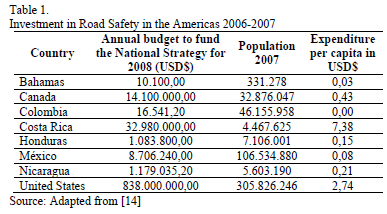
<body><![CDATA[<p><font size="2" face="Verdana, Arial, Helvetica, sans-serif">The  identification of the accident-prone sections is one of the alternatives  available to properly address the problem, and tends to be the first step in  the investigation and implementation of road safety programs. This is because  once these sections have been defined as high-risk, possible factors associated  with the frequency of accidents are determined (e.g. volume of vehicles,  environmental factors, </font></p>     <p><font size="2" face="Verdana, Arial, Helvetica, sans-serif">geometric characteristics of road  infrastructure, and speed), and preventive and/or corrective policies are then  proposed to decrease the indicators associated with the accidents. Evidence  reports the effect of factors associated with road geometry &#91;2-4&#93;, vehicle  volumes &#91;5,6&#93;, environmental conditions &#91;3,7&#93; and speed &#91;8,9&#93; on the occurrence  of accidents, which is estimated with Poisson regression, negative binomial,  generalized linear models. Likewise, the assessment of the effectiveness of  road safety measures using the Bayesian empirical approach has also been  reported in other studies &#91;10-12&#93;.</font></p>     <p><font size="2" face="Verdana, Arial, Helvetica, sans-serif">According to &#91;13&#93;, an  element that is part of road infrastructure (sections of highways,  intersections, curves, among others) may experience a high number of accidents  due to two conditions: high random variations of traffic accidents during  periods of observation and safety problems associated with the surroundings  (high vehicular traffic, nature of the site, inappropriate geometric road  design). The study and identification of accident-prone sites (also called  hotspots, blackspots, sites with promise, high-risk locations, accident-prone  locations) can suffer from two types of common effects. The first effect,  termed a false negative, corresponds to an unsafe site that does not show high  rates of accidents. It is also possible to observe high accident rates in a  relatively safe site, which is referred to as a false positive. The two  situations above need to be taken into account in determining where to invest  in road safety, because, in a bureaucracy such as that of Colombia, investments  in road safety are restricted and limited (as shown in <a href="#tab01">Table 1</a>, which shows  marked differences in investment in road safety in terms of per capita spending  by country). False negatives lead to the loss of opportunities for effective  road safety investments. As is to be expected, correct determinations of the  safety of a site is essential, including the identification of a safe site as   &quot;safe&quot; and an unsafe site as  &quot;unsafe.&quot; For the purposes of this research, we  sought accident-prone sections that produced the lowest proportion of false  negatives and false positives using the BM.</font></p>     <p align="center"><font size="2" face="Verdana, Arial, Helvetica, sans-serif"><a name="tab01"></a></font><img src="/img/revistas/dyna/v81n187/v81n187a27tab01.gif"></p>     <p><font size="2" face="Verdana, Arial, Helvetica, sans-serif">In reviewing the available research, it was found that  there is evidence of other techniques parallel to the BM with which it is  possible to identify accident-prone sections; these include the Classification  Method &#91;15,16&#93; and the Confidence Interval Method &#91;17&#93;, which use different  approaches for the analysis and determination of accident-prone sections. It  was concluded that in some cases a large number of false positives are produced  using these methods, while in other situations, when dealing with sites with  relatively few accidents and low exposure, significant improvements cannot be  evaluated and/or experienced &#91;13&#93;. Another method that has been used in the  last few years as a reliable method providing pertinent results is the Quantile  Regression Method &#91;18&#93;. The BM has greater credibility and better results in  the identification of accident-prone sections, for which reason it is the  subject of study in this research. Other studies &#91;13, 19-23&#93; have demonstrated  that the BM offers a greater capacity to determine highly hazardous or risky  sites in terms of safety. With regard to the hazard ranking of the  accident-prone sections found, there are studies that report how prioritization  for efficient investments can be achieved using the BM &#91;24&#93;.</font></p>     <p>&nbsp;</p>     <p><font size="3" face="Verdana, Arial, Helvetica, sans-serif"><b>2.  Methodological  bases</b></font></p>     <p><b><font size="2" face="Verdana, Arial, Helvetica, sans-serif"><i>2.1.  The Bayesian  Method (BM)</i></font></b></p>     <p><font size="2" face="Verdana, Arial, Helvetica, sans-serif">The use of the BM in  the identification of accident-prone sections is based on relating n random  variables (Y<sub>1</sub>, ..., Y<sub>n</sub>) corresponding to i sections (i =  1,..., n) under study, where a current ratio of accidents (<font face="Symbol">l</font><sub>i</sub>)  occurs during a specific time period. We assume that <font face="Symbol">l</font><sub>i</sub> is  distributed in accordance with a law of probability with a function of density  f(<font face="Symbol">l</font><sub>i</sub> | <font face="Symbol">q</font><sub>i</sub>), where <font face="Symbol">q</font><sub>i</sub> represents  the mean number of accidents in section i (parameter of interest). The Bayesian  approach, assuming a distribution with density <font face="Symbol">p</font>(<font face="Symbol">q</font><sub>i</sub>) in  <font face="Symbol">q</font><sub>i</sub>, allows the incorporation of prior knowledge regarding the  behavior of <font face="Symbol">q</font><sub>i</sub>. This prior information is combined with the  information presented by the sample in the subsequent distribution, represented  by p(<font face="Symbol">q</font><sub>i</sub> | <font face="Symbol">l</font><sub>i</sub>). The subsequent distribution of  <font face="Symbol">q</font><sub>i</sub> is a direct application of Bayes' theorem and has the form  of the eq. (1) &#91;25&#93;:</font></p>     <p><img src="/img/revistas/dyna/v81n187/v81n187a27eq01.gif"></p>     ]]></body>
<body><![CDATA[<p><font size="2" face="Verdana, Arial, Helvetica, sans-serif">Where m(<font face="Symbol">l</font><sub>i</sub>) represents the function of  unconditional marginal density of <font face="Symbol">l</font><sub>i</sub> and f(<font face="Symbol">l</font><sub>i</sub>|<font face="Symbol">q</font>)  is the probability of the data observed. </font></p>     <p><font size="2" face="Verdana, Arial, Helvetica, sans-serif">Put simply, the BM, as shown in &#91;24&#93;, groups this estimate  into two consecutive processes: in the first instance, it estimates the history  of accidents for each of the sites (i) in order to define the distribution of  probability of the ratio of accidents in each section studied locally. The  second step consists of using this local probability distribution and the  accident rate of each site (i) in order to obtain a more precise estimate of  the probability distribution that is associated with the ratio of accidents of  a particular site (i). In this way, it is possible to assess the probability  that one of the sections under study may be dangerous. The function of  accumulated distribution associated with the accident ratio (<font face="Symbol">l</font><sub>i</sub>)  is represented in the eq. (2):</font></p>     <p><img src="/img/revistas/dyna/v81n187/v81n187a27eq02.gif"></p>     <p><font size="2" face="Verdana, Arial, Helvetica, sans-serif">Where V<sub>i</sub> is the number of vehicles that transit  along section i during the period of study, N<sub>i</sub> is the number of  accidents that occur in section i studied within the time frame analyzed (for  this case, the number of accidents that occurred between January 2007 and  August 2013), and f<sub>i</sub> (<font face="Symbol">l</font>|N<sub>i</sub>,V<sub>i</sub>) is  the probability density function associated with the ratio of accidents in  section i. Prior research &#91;13&#93; sets out two basic assumptions on which the BM  bases its logic:</font></p>     <p><font size="2" face="Verdana, Arial, Helvetica, sans-serif">Assumption 1: In a given place, the occurrence of crashes  follows a Poisson-type counting process, where the probability that n accidents  occur per unit of time (n = 0, 1, 2,.) is given by the following eq. (3):</font></p>     <p><img src="/img/revistas/dyna/v81n187/v81n187a27eq03.gif"></p>     <p><font size="2" face="Verdana, Arial, Helvetica, sans-serif">Assumption 2: The  probability distribution F<sub>r</sub>(<font face="Symbol">l</font>) is of the population of the  gamma-distributed sites, where g(<font face="Symbol">l</font>) is denoted as the gamma probability  density function (eq. 4) and is typically modeled as a function of the  co-variables of the site.</font></p>     <p><img src="/img/revistas/dyna/v81n187/v81n187a27eq04.gif"></p>     <p><font size="2" face="Verdana, Arial, Helvetica, sans-serif">In these equations, <font face="Symbol">a</font> is the parameter of form and  <font face="Symbol">b</font> is the parameter of scale of the gamma function, which can be estimated  from the procedures set out by &#91;26&#93;. Finally, the BM permits two types of  approximations from which it is possible to identify the accident-prone  sections. The first makes use of the eq. 5 to determine them:</font></p>     <p><img src="/img/revistas/dyna/v81n187/v81n187a27eq05.gif"></p>     ]]></body>
<body><![CDATA[<p><font size="2" face="Verdana, Arial, Helvetica, sans-serif">Where: <font face="Symbol">l</font><sub>p</sub> is the mean of the ratios of  accidents observed for all of the sections studied and <font face="Symbol">l</font><sub>cr</sub> corresponds to the accident-prone rate in each section studied.</font></p>     <p><font size="2" face="Verdana, Arial, Helvetica, sans-serif">For this first  approximation, the probability (Prob) of <font face="Symbol">l</font><sub>cr</sub> &le; <font face="Symbol">l</font><sub>r</sub> is estimated; this probability is defined according to a 95% confidence  interval. In this way, values of <font face="Symbol">l</font><sub>cr</sub> are estimated such that  there is a probability of 95% and <font face="Symbol">l</font><sub>cr</sub> &le; <font face="Symbol">l</font><sub>r</sub> is compared; if this verification is met, the null hypothesis (H<sub>0</sub>:  <font face="Symbol">l</font><sub>cr</sub> &le; <font face="Symbol">l</font><sub>r</sub>) is accepted, and it is said  that a section is accident prone.</font></p>     <p><font size="2" face="Verdana, Arial, Helvetica, sans-serif">The second approximation sets out the estimate of  probability based on the following model (eq. 6):</font></p>     <p><img src="/img/revistas/dyna/v81n187/v81n187a27eq06.gif"></p>     <p><font size="2" face="Verdana, Arial, Helvetica, sans-serif">Where: <font face="Symbol">l</font><sub>r</sub> is the accident ratio observed  for all of the sections studied in the time period in which the observations  were made. In the estimates based on the second approximation, the probability  (Prob) is calculated and compared against that established in the 95%  probability threshold. If this probability is greater than or equal to 95%, the  null hypothesis (H<sub>0</sub>: Prob &ge; 95%) is accepted and it is said  that a section is accident prone.</font></p>     <p><font size="2" face="Verdana, Arial, Helvetica, sans-serif"><b><i>2.2.  Criteria used  to determine a hazard ranking</i></b></font></p>     <p><font size="2" face="Verdana, Arial, Helvetica, sans-serif">Once the  accident-prone sites have been identified, it is necessary to establish a  hazard ranking and, in this way, prioritize investments and the implementation  of preventive and/or corrective policies that will maximize benefits associated  with road safety. Investment priorities must be based not only on a hazard  ranking, but also cost-benefit analysis; however, this aspect was not  considered for this research. There are two criteria that allow a hazard  ranking to be determined:</font></p>     <p><font size="2" face="Verdana, Arial, Helvetica, sans-serif"><b>2.2.1.  Criterion 1</b></font></p>     <p><font size="2" face="Verdana, Arial, Helvetica, sans-serif">This procedure relates  the accident ratio observed in each section studied (<font face="Symbol">l</font><sub>r</sub>) to the  accident-prone rate in each section studied (<font face="Symbol">l</font><sub>cr</sub>). This ratio  must be greater than one (<font face="Symbol">l</font><sub>r</sub>/ <font face="Symbol">l</font><sub>cr</sub> &ge; 1).</font></p>     <p><font size="2" face="Verdana, Arial, Helvetica, sans-serif"><b>2.2.2. Criterion 2</b></font></p>     ]]></body>
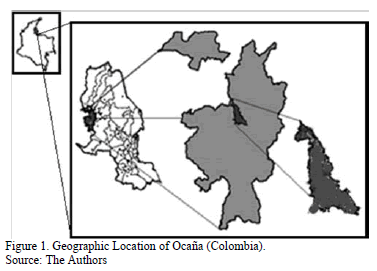
<body><![CDATA[<p><font size="2" face="Verdana, Arial, Helvetica, sans-serif">This criterion is defined by the eq. 7:</font></p>     <p><img src="/img/revistas/dyna/v81n187/v81n187a27eq07.gif"></p>     <p><font size="2" face="Verdana, Arial, Helvetica, sans-serif">Where the Average Daily Transit (ADT) and the time (years)  for which there are accident records are related, estimated as follows (eq. 8):</font></p>     <p><img src="/img/revistas/dyna/v81n187/v81n187a27eq08.gif"></p>     <p><font size="2" face="Verdana, Arial, Helvetica, sans-serif"><b><i>2.3.  Data and  sections studied</i></b></font></p>     <p><font size="2" face="Verdana, Arial, Helvetica, sans-serif">A database was prepared  of the records of accidents that occurred in the urban perimeter of the  municipality of Oca&ntilde;a between January 2007 and August 2013. Based on other  studies, time periods of between 3 and 6 years are suitable for this type of  study &#91;13&#93;. In parallel, and based on prior studies &#91;27&#93; the BM was applied in  15 roads corridors of Oca&ntilde;a. The length of the sections (L) is a variable  identifying each road section. Each section is classified as homogeneous in  terms of geometric and operational characteristics. However, at present the  effects of the length of the identification section on the hotspot are still  not as clear &#91;28&#93;. Some other evidence from the literature shows the variation  in the length of sections of road &#91;28-30&#93;.</font></p>     <p><font size="2" face="Verdana, Arial, Helvetica, sans-serif">Since the BM allows  relating the number of accidents allocated to each section with vehicle  volumes, it was necessary to estimate the ADT for each of the 15 corridors to  be studied. In summary, a total of 1,062 accidents were reported, spread out  among the 15 sections studied. It must be clarified that in countries such as  Colombia (particularly in Oca&ntilde;a), accident records are obtained from the  National Police and other entities, such as the Volunteer Firefighters' Corps  and/or Oca&ntilde;a Civil Defense, which are entities that deal with accidents. This  involves some disadvantages, because there is no linkage and/or agreement  between those reported by medical sources and those from police records,  resulting in underestimates of the records; in addition, records of accidents  with minor injuries, single-vehicle accidents and cyclist accidents are  sometimes not reported &#91;31,32&#93;.</font></p>     <p>&nbsp;</p>     <p><font size="3" face="Verdana, Arial, Helvetica, sans-serif"><b>3.  Study area</b></font></p>     <p><font size="2" face="Verdana, Arial, Helvetica, sans-serif">Oca&ntilde;a  is a city located in the northwestern region of Colombia in the Norte de  Santander department. It is the </font><font size="2" face="Verdana, Arial, Helvetica, sans-serif">second  largest town of the department after C&uacute;cuta, with approximately a population of  100.000 including rural areas. It has elevation relative to sea level of 1202 m  and a land area of 460 km<sup>2</sup>, representing 2,2% of the surface of  department. The geographic location of Oca&ntilde;a is presented in <a href="#fig01">Fig. 1</a>:</font></p>     ]]></body>
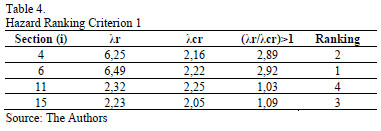
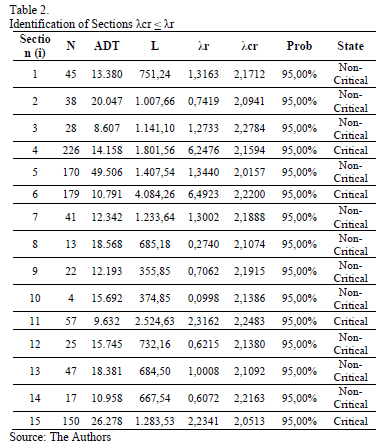
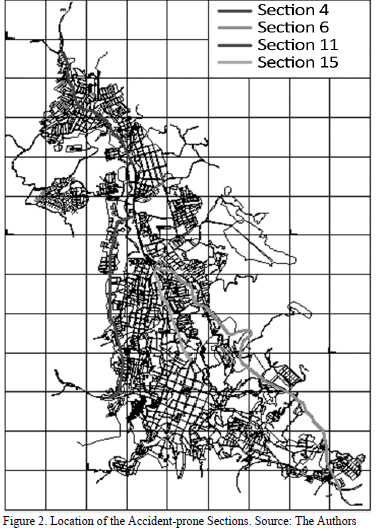
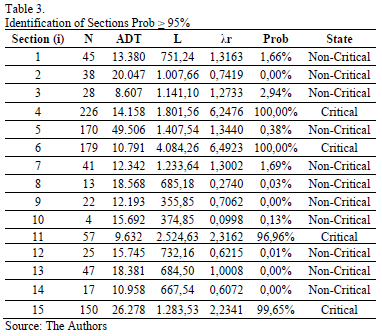
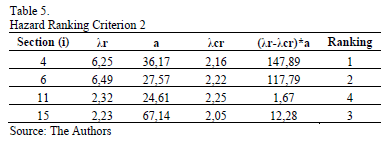
<body><![CDATA[<p align="center"><font size="2" face="Verdana, Arial, Helvetica, sans-serif"><a name="fig01"></a></font><img src="/img/revistas/dyna/v81n187/v81n187a27fig01.gif"></p>     <p>&nbsp;</p>     <p><font size="3" face="Verdana, Arial, Helvetica, sans-serif"><b>4.  Results and discussion</b></font></p>     <p><font size="2" face="Verdana, Arial, Helvetica, sans-serif">As was already mentioned in the previous section, two  types of approximations were used to determine whether or not a section is  accident prone in terms of road safety. Parameters were estimated that allow  for estimating the critical status of the section from the approximation where  it is verified that <font face="Symbol">l</font><sub>cr</sub> &le; <font face="Symbol">l</font><sub>r</sub>. The  evaluation and identification of the accident-prone section and the estimate of  the other parameters can be seen in <a href="#tab02">Table 2</a>.</font></p>     <p align="center"><font size="2" face="Verdana, Arial, Helvetica, sans-serif"><a name="tab02"></a></font><img src="/img/revistas/dyna/v81n187/v81n187a27tab02.gif"></p>     <p><font size="2" face="Verdana, Arial, Helvetica, sans-serif">From the analysis and the estimates made with the first  approximation, it can be observed that four sections were identified as  accident-prone or dangerous sections. The accident-prone sections correspond to  those identified as 4, 6, 11 and 15, which are shown in <a href="#fig02">Fig. 2</a>.</font></p>     <p align="center"><font size="2" face="Verdana, Arial, Helvetica, sans-serif"><a name="fig02"></a></font><img src="/img/revistas/dyna/v81n187/v81n187a27fig02.gif"></p>     <p><font size="2" face="Verdana, Arial, Helvetica, sans-serif">The estimates, presented in <a href="#tab03">Table 3</a>, show the  accident-prone sections to be those given by the second approximation; these  results show that the BM is an accurate and reliable methodology. The BM offers  reductions of 50% in false positives and false negatives as identified by other  methods &#91;13&#93;.</font></p>     <p align="center"><font size="2" face="Verdana, Arial, Helvetica, sans-serif"><a name="tab03"></a></font><img src="/img/revistas/dyna/v81n187/v81n187a27tab03.gif"></p>     <p><font size="2" face="Verdana, Arial, Helvetica, sans-serif">Having identified the four accident-prone sections of the  15 originally defined sections, it is necessary to determine a hazard ranking  of accident-prone sections, given that investments in road safety are very scarce  and the efficiency and optimization of these resources is necessary in order to  maximize their benefits in terms of road safety. The estimated results per  criterion 1 and criterion 2 of the hazard ranking are shown in <a href="#tab04">Table 4</a> and  <a href="#tab05">Table 5</a>. Note that the two analyzed criteria differ. According to criterion 1,  the most dangerous section is 6, followed by 4, while criterion 2 puts section  4 in first place in the ranking and then section 6. This situation may be due  to criterion 2 giving more weight to the parameter associated with the ADT and  its relation to the accidents, thus producing the discrepancy in the ranking of  the described situation; however, to be clear, other sections analyzed have the  same place in the ranking under both criteria. The sections identified as 4 and  6 correspond to the road section between La Ondina until Defensa Civil and  Avenida Circunvalar, respectively.</font></p>     ]]></body>
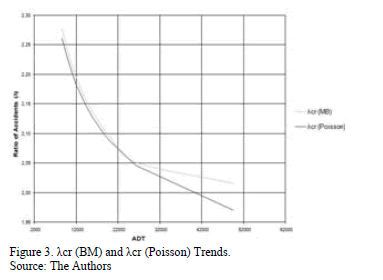
<body><![CDATA[<p align="center"><font size="2" face="Verdana, Arial, Helvetica, sans-serif"><a name="tab04"></a></font><img src="/img/revistas/dyna/v81n187/v81n187a27tab04.gif"></p>     <p align="center"><font size="2" face="Verdana, Arial, Helvetica, sans-serif"><a name="tab05"></a></font><img src="/img/revistas/dyna/v81n187/v81n187a27tab05.gif"></p>     <p><font size="2" face="Verdana, Arial, Helvetica, sans-serif">It was possible to estimate the parameters <font face="Symbol">l</font><sub>cr</sub> following a Poisson-type counting process, which is suitable for this type of analysis.  These values are graphed with the values of <font face="Symbol">l</font><sub>cr</sub> obtained by the  BM. The comparison of both trends is observed in <a href="#fig03">Fig. 3</a>, in which the  adjustment of both curves to a logarithmic model is easily predictable, where  the curve corresponding to <font face="Symbol">l</font><sub>cr</sub> (Poisson) is below the curve  <font face="Symbol">l</font><sub>cr</sub> (BM). This observation has a direct relationship to the  effect of regression towards the mean, thereby producing a more conservative  curve, as is also shown by &#91;24&#93;.</font></p>     <p align="center"><font size="2" face="Verdana, Arial, Helvetica, sans-serif"><a name="fig03"></a></font><img src="/img/revistas/dyna/v81n187/v81n187a27fig03.gif"></p>     <p>&nbsp;</p>     <p><b><font size="3" face="Verdana, Arial, Helvetica, sans-serif">5.  Conclusions</font></b></p>     <p><font size="2" face="Verdana, Arial, Helvetica, sans-serif">It was possible to identify four accident-prone sections  from the application of the approaches used (<font face="Symbol">l</font><sub>cr</sub> &le; <font face="Symbol">l</font><sub>r</sub> and Prob &ge; 95%). The two types of Bayesian approximations were used in  this research in order to identify four accident-prone sites in which similar  results were found, minimizing in this way the identification of false  positives or false negatives that would influence the results of the research  and divert investment of resources to road sections where it is not necessary.  These approximations also allow controlling for the effect of regression  towards the mean, which is very common in this type of modeling. The estimation  results with the MB allow be certain of which are the true accident-prone  sections in the municipality of Oca&ntilde;a.</font></p>     <p><font size="2" face="Verdana, Arial, Helvetica, sans-serif">It was possible to  apply the hazard ranking to the four sections identified as accident prone  using two criteria. Although identical results were not obtained using both  criteria. They are similar, however, and their use is recommended for the  prioritization of investments, the explanation of their importance having  already been provided.</font></p>     <p><font size="2" face="Verdana, Arial, Helvetica, sans-serif">The methodological approach of the MB applied to the urban  area of the municipality of Oca&ntilde;a gives coherent and accurate results,  corroborating that this method contributes to and is suitable for studies of  accident rates, and, more specifically, for the identification of  accident-prone sites.</font></p>     <p><font size="2" face="Verdana, Arial, Helvetica, sans-serif">It must be clarified that accident data were used in this  research, i.e. those that had occurred in the field (not simulated). This is an  advantage, given that when one works with real data it is possible to identify  accident-prone sections, whereas in the use of other approaches uncontrolled  observational environments are evident &#91;23&#93;.</font></p>     ]]></body>
<body><![CDATA[<p><font size="2" face="Verdana, Arial, Helvetica, sans-serif">The parameter  estimation <font face="Symbol">l</font><sub>cr</sub> (Poisson) and <font face="Symbol">l</font><sub>cr</sub> (BM) shows  consistency of results and relevance in the use of the methodology applied; the  behavior of the curve for both approaches was as expected and supports the  results obtained.</font></p>     <p><font size="2" face="Verdana, Arial, Helvetica, sans-serif">Future research may measure the effectiveness of the BM  against other methods such as Quantile Regression, Confidence Intervals or the  Classification Method.</font></p>     <p>&nbsp;</p>     <p><b><font size="3" face="Verdana, Arial, Helvetica, sans-serif">Acknowledgements</font></b></p>     <p><font size="2" face="Verdana, Arial, Helvetica, sans-serif">The authors would like to thank Orlando &Aacute;lvarez, Yenika  Espinel and Darwin Palacios.</font></p>     <p>&nbsp;</p>     <p><b><font size="3" face="Verdana, Arial, Helvetica, sans-serif">References</font></b></p>     <!-- ref --><p><font size="2" face="Verdana, Arial, Helvetica, sans-serif"><b>&#91;1&#93;</b> Instituto  Nacional de Medicina Legal y Ciencias Forenses, Forensis 2012 Datos para la  vida, Bogot&aacute; D.C., 2012.    &nbsp;&nbsp;&nbsp;&nbsp;&nbsp;&nbsp;&nbsp;&nbsp;[&#160;<a href="javascript:void(0);" onclick="javascript: window.open('/scielo.php?script=sci_nlinks&ref=000090&pid=S0012-7353201400050002700001&lng=','','width=640,height=500,resizable=yes,scrollbars=1,menubar=yes,');">Links</a>&#160;]<!-- end-ref --></font></p>     <!-- ref --><p><font size="2" face="Verdana, Arial, Helvetica, sans-serif"><b>&#91;2&#93;</b>    Karlaftis,  M.G. and Golias, I., Effects of road geometry and traffic volumes on rural  roadway accident rates, Accident Analysis and Prevention, 34, pp. 357-365,  2002.    &nbsp;&nbsp;&nbsp;&nbsp;&nbsp;&nbsp;&nbsp;&nbsp;[&#160;<a href="javascript:void(0);" onclick="javascript: window.open('/scielo.php?script=sci_nlinks&ref=000092&pid=S0012-7353201400050002700002&lng=','','width=640,height=500,resizable=yes,scrollbars=1,menubar=yes,');">Links</a>&#160;]<!-- end-ref --></font></p>     <!-- ref --><p><font size="2" face="Verdana, Arial, Helvetica, sans-serif"><b>&#91;3&#93;</b>    Chang, L.Y.,  Analysis of freeway accident frequencies: Negative binomial regression versus  artificial neural network, Safety Science, 43, pp. 541-557, 2005.    &nbsp;&nbsp;&nbsp;&nbsp;&nbsp;&nbsp;&nbsp;&nbsp;[&#160;<a href="javascript:void(0);" onclick="javascript: window.open('/scielo.php?script=sci_nlinks&ref=000094&pid=S0012-7353201400050002700003&lng=','','width=640,height=500,resizable=yes,scrollbars=1,menubar=yes,');">Links</a>&#160;]<!-- end-ref --></font></p>     <!-- ref --><p><font size="2" face="Verdana, Arial, Helvetica, sans-serif"><b>&#91;4&#93;</b> Garc&iacute;a, R.A.,  Delgado, D.E., D&iacute;az, E.E. y Garc&iacute;a, R.E., Caracterizaci&oacute;n de la accidentalidad  vehicular y an&aacute;lisis de las causas en la provincia de Villa Clara, Cuba, DYNA,  79 (175), pp. 191-200, 2012.    &nbsp;&nbsp;&nbsp;&nbsp;&nbsp;&nbsp;&nbsp;&nbsp;[&#160;<a href="javascript:void(0);" onclick="javascript: window.open('/scielo.php?script=sci_nlinks&ref=000096&pid=S0012-7353201400050002700004&lng=','','width=640,height=500,resizable=yes,scrollbars=1,menubar=yes,');">Links</a>&#160;]<!-- end-ref --></font></p>     <!-- ref --><p><font size="2" face="Verdana, Arial, Helvetica, sans-serif"><b>&#91;5&#93;</b> Winslott,  L., Estimating the relationship between accident frequency and homogeneous and  inhomogeneous traffic flows, Accident Analysis and Prevention, 36, pp. 985-992,  2004.    &nbsp;&nbsp;&nbsp;&nbsp;&nbsp;&nbsp;&nbsp;&nbsp;[&#160;<a href="javascript:void(0);" onclick="javascript: window.open('/scielo.php?script=sci_nlinks&ref=000098&pid=S0012-7353201400050002700005&lng=','','width=640,height=500,resizable=yes,scrollbars=1,menubar=yes,');">Links</a>&#160;]<!-- end-ref --></font></p>     <!-- ref --><p><font size="2" face="Verdana, Arial, Helvetica, sans-serif"><b>&#91;6&#93;</b>    Ayati, E.  and Abbasi, E., Investigation on the role of traffic volume in accidents on  urban highways, Journal of Safety Research, 42, 209-214, 2011.    &nbsp;&nbsp;&nbsp;&nbsp;&nbsp;&nbsp;&nbsp;&nbsp;[&#160;<a href="javascript:void(0);" onclick="javascript: window.open('/scielo.php?script=sci_nlinks&ref=000100&pid=S0012-7353201400050002700006&lng=','','width=640,height=500,resizable=yes,scrollbars=1,menubar=yes,');">Links</a>&#160;]<!-- end-ref --></font></p>     <!-- ref --><p><font size="2" face="Verdana, Arial, Helvetica, sans-serif"><b>&#91;7&#93;</b>    Venkataram,  S., Mannering, F. and Barfield, W., Effect of roadway geometrics and  environmental factors on rural freeway accident frequencies, Accident Analysis  and Prevention, 27 (3), pp. 371-389, 1995.    &nbsp;&nbsp;&nbsp;&nbsp;&nbsp;&nbsp;&nbsp;&nbsp;[&#160;<a href="javascript:void(0);" onclick="javascript: window.open('/scielo.php?script=sci_nlinks&ref=000102&pid=S0012-7353201400050002700007&lng=','','width=640,height=500,resizable=yes,scrollbars=1,menubar=yes,');">Links</a>&#160;]<!-- end-ref --></font></p>     <!-- ref --><p><font size="2" face="Verdana, Arial, Helvetica, sans-serif"><b>&#91;8&#93;</b>    Ossiander,  E.M. and Cummings, P., Freeway speed limits and traffic fatalities in  washington state. Accident Analysis and Prevention, 34 (1), pp. 13-18, 2002.    &nbsp;&nbsp;&nbsp;&nbsp;&nbsp;&nbsp;&nbsp;&nbsp;[&#160;<a href="javascript:void(0);" onclick="javascript: window.open('/scielo.php?script=sci_nlinks&ref=000104&pid=S0012-7353201400050002700008&lng=','','width=640,height=500,resizable=yes,scrollbars=1,menubar=yes,');">Links</a>&#160;]<!-- end-ref --></font></p>     <!-- ref --><p><font size="2" face="Verdana, Arial, Helvetica, sans-serif"><b>&#91;9&#93;</b>    Rangel,  T., Vassalloa, J.M. and Herraiz, I., The influence of economic incentives  linked to road safety indicators on accidents: The case of toll concessions in  spain, Accident Analysis and Prevention, 59, pp. 529-536, 2013.    &nbsp;&nbsp;&nbsp;&nbsp;&nbsp;&nbsp;&nbsp;&nbsp;[&#160;<a href="javascript:void(0);" onclick="javascript: window.open('/scielo.php?script=sci_nlinks&ref=000106&pid=S0012-7353201400050002700009&lng=','','width=640,height=500,resizable=yes,scrollbars=1,menubar=yes,');">Links</a>&#160;]<!-- end-ref --></font></p>     <!-- ref --><p><font size="2" face="Verdana, Arial, Helvetica, sans-serif"><b>&#91;10&#93;</b>   Hauer,  E., Harwood, D., Council, F. and Griffith, M., The empirical bayes method for  estimating safety: A tutorial. Transportation Research Record 1784, pp. 126-131,  2002.    &nbsp;&nbsp;&nbsp;&nbsp;&nbsp;&nbsp;&nbsp;&nbsp;[&#160;<a href="javascript:void(0);" onclick="javascript: window.open('/scielo.php?script=sci_nlinks&ref=000108&pid=S0012-7353201400050002700010&lng=','','width=640,height=500,resizable=yes,scrollbars=1,menubar=yes,');">Links</a>&#160;]<!-- end-ref --></font></p>     <!-- ref --><p><font size="2" face="Verdana, Arial, Helvetica, sans-serif"><b>&#91;11&#93;</b> Persaud,  B. and Lyon, C., Empirical Bayes before-after safety studies: Lessons learned  from two decades of experience and future directions, Accident Analysis and  Prevention 39, pp. 546-555, 2007.    &nbsp;&nbsp;&nbsp;&nbsp;&nbsp;&nbsp;&nbsp;&nbsp;[&#160;<a href="javascript:void(0);" onclick="javascript: window.open('/scielo.php?script=sci_nlinks&ref=000110&pid=S0012-7353201400050002700011&lng=','','width=640,height=500,resizable=yes,scrollbars=1,menubar=yes,');">Links</a>&#160;]<!-- end-ref --></font></p>     <!-- ref --><p><font size="2" face="Verdana, Arial, Helvetica, sans-serif"><b>&#91;12&#93;</b> Lan, B.,  Persaud, B., Lyon, C. and Bhim, R., Validation of a full Bayes methodology for  observational before-after road safety studies and application to evaluation of  rural signal conversions. Accident Analysis and Prevention 41, pp. 574-580,  2009.    &nbsp;&nbsp;&nbsp;&nbsp;&nbsp;&nbsp;&nbsp;&nbsp;[&#160;<a href="javascript:void(0);" onclick="javascript: window.open('/scielo.php?script=sci_nlinks&ref=000112&pid=S0012-7353201400050002700012&lng=','','width=640,height=500,resizable=yes,scrollbars=1,menubar=yes,');">Links</a>&#160;]<!-- end-ref --></font></p>     <!-- ref --><p><font size="2" face="Verdana, Arial, Helvetica, sans-serif"><b>&#91;13&#93;</b>   Cheng, W.  and Washington, S.P., Experimental evaluation of hotspot identification  methods, Accident Analysis and Prevention, 37, pp. 870-881. 2005.    &nbsp;&nbsp;&nbsp;&nbsp;&nbsp;&nbsp;&nbsp;&nbsp;[&#160;<a href="javascript:void(0);" onclick="javascript: window.open('/scielo.php?script=sci_nlinks&ref=000114&pid=S0012-7353201400050002700013&lng=','','width=640,height=500,resizable=yes,scrollbars=1,menubar=yes,');">Links</a>&#160;]<!-- end-ref --></font></p>     <!-- ref --><p><font size="2" face="Verdana, Arial, Helvetica, sans-serif"><b>&#91;14&#93;</b> Organizaci&oacute;n  Panamericana de la Salud - OPS, Informe sobre el estado de la seguridad vial en  la Regi&oacute;n de las Am&eacute;ricas, Washington, D.C., 2009.    &nbsp;&nbsp;&nbsp;&nbsp;&nbsp;&nbsp;&nbsp;&nbsp;[&#160;<a href="javascript:void(0);" onclick="javascript: window.open('/scielo.php?script=sci_nlinks&ref=000116&pid=S0012-7353201400050002700014&lng=','','width=640,height=500,resizable=yes,scrollbars=1,menubar=yes,');">Links</a>&#160;]<!-- end-ref --></font></p>     <!-- ref --><p><font size="2" face="Verdana, Arial, Helvetica, sans-serif"><b>&#91;15&#93;</b>   Persaud,  B.N. and Hauer, E., Comparison of two methods for debiasing before and after accident  studies, Transportation Research Record, 975, pp. 43-49. 1984.    &nbsp;&nbsp;&nbsp;&nbsp;&nbsp;&nbsp;&nbsp;&nbsp;[&#160;<a href="javascript:void(0);" onclick="javascript: window.open('/scielo.php?script=sci_nlinks&ref=000118&pid=S0012-7353201400050002700015&lng=','','width=640,height=500,resizable=yes,scrollbars=1,menubar=yes,');">Links</a>&#160;]<!-- end-ref --></font></p>     <!-- ref --><p><font size="2" face="Verdana, Arial, Helvetica, sans-serif"><b>&#91;16&#93;</b>   Persaud,  B.N., Safety migration, the influence of traffic volumes and other issues in  evaluating safety effectiveness. Transportation Research Record, 1086, pp. 33-41,  1986.    &nbsp;&nbsp;&nbsp;&nbsp;&nbsp;&nbsp;&nbsp;&nbsp;[&#160;<a href="javascript:void(0);" onclick="javascript: window.open('/scielo.php?script=sci_nlinks&ref=000120&pid=S0012-7353201400050002700016&lng=','','width=640,height=500,resizable=yes,scrollbars=1,menubar=yes,');">Links</a>&#160;]<!-- end-ref --></font></p>     <!-- ref --><p><font size="2" face="Verdana, Arial, Helvetica, sans-serif"><b>&#91;17&#93;</b> Laughlin,  J. C., Hauer, L. E., Hall, J. W., &amp; Clough, D. NCHPR Report 162: Methods  for Evaluating Highway Safety Improvements. Washington, D.C.: National Research  Council, 1975.    &nbsp;&nbsp;&nbsp;&nbsp;&nbsp;&nbsp;&nbsp;&nbsp;[&#160;<a href="javascript:void(0);" onclick="javascript: window.open('/scielo.php?script=sci_nlinks&ref=000122&pid=S0012-7353201400050002700017&lng=','','width=640,height=500,resizable=yes,scrollbars=1,menubar=yes,');">Links</a>&#160;]<!-- end-ref --></font></p>     <!-- ref --><p><font size="2" face="Verdana, Arial, Helvetica, sans-serif"><b>&#91;18&#93;</b>   Qin, X.,  Ng, M. and Reyes, P.E., Identifying crash-prone locations with quantile regression.  Accident Analysis and Prevention, 42, pp. 1531-1537, 2010.    &nbsp;&nbsp;&nbsp;&nbsp;&nbsp;&nbsp;&nbsp;&nbsp;[&#160;<a href="javascript:void(0);" onclick="javascript: window.open('/scielo.php?script=sci_nlinks&ref=000124&pid=S0012-7353201400050002700018&lng=','','width=640,height=500,resizable=yes,scrollbars=1,menubar=yes,');">Links</a>&#160;]<!-- end-ref --></font></p>     <!-- ref --><p><font size="2" face="Verdana, Arial, Helvetica, sans-serif"><b>&#91;19&#93;</b>   Geurts,  K. and Wets, G., Black spot analysis methods: Literature review. Diepenbeek  (Belgium): Flemish Research Center for Traffic Safety, 2003.    &nbsp;&nbsp;&nbsp;&nbsp;&nbsp;&nbsp;&nbsp;&nbsp;[&#160;<a href="javascript:void(0);" onclick="javascript: window.open('/scielo.php?script=sci_nlinks&ref=000126&pid=S0012-7353201400050002700019&lng=','','width=640,height=500,resizable=yes,scrollbars=1,menubar=yes,');">Links</a>&#160;]<!-- end-ref --></font></p>     <!-- ref --><p><font size="2" face="Verdana, Arial, Helvetica, sans-serif"><b>&#91;20&#93;</b>   Miaoua,  S.P. and Song, J.J., Bayesian ranking of sites for engineering safety  improvements: Decision parameter, treatability concept, statistical criterion  and spatial dependence, Accident Analysis and Prevention, 37, pp. 699-720,  2005.    &nbsp;&nbsp;&nbsp;&nbsp;&nbsp;&nbsp;&nbsp;&nbsp;[&#160;<a href="javascript:void(0);" onclick="javascript: window.open('/scielo.php?script=sci_nlinks&ref=000128&pid=S0012-7353201400050002700020&lng=','','width=640,height=500,resizable=yes,scrollbars=1,menubar=yes,');">Links</a>&#160;]<!-- end-ref --></font></p>     <!-- ref --><p><font size="2" face="Verdana, Arial, Helvetica, sans-serif"><b>&#91;21&#93;</b>   Miranda-Moreno,  L.F., Statistical Models and methods for the identification of hazardous  locations for safety improvements, PhD. Thesis, Department of Civil  Engineering, University of Waterloo, Waterloo, Canada, 2006.    &nbsp;&nbsp;&nbsp;&nbsp;&nbsp;&nbsp;&nbsp;&nbsp;[&#160;<a href="javascript:void(0);" onclick="javascript: window.open('/scielo.php?script=sci_nlinks&ref=000130&pid=S0012-7353201400050002700021&lng=','','width=640,height=500,resizable=yes,scrollbars=1,menubar=yes,');">Links</a>&#160;]<!-- end-ref --></font></p>     <!-- ref --><p><font size="2" face="Verdana, Arial, Helvetica, sans-serif"><b>&#91;22&#93;</b>   Geurts,  K., Wets, G., Brijs, T., Vanhoof, K. and Karlis, D., Ranking and selecting dangerous  crash locations: Correcting for the Number of passengers and Bayesian ranking  plots. Journal of Safety Research, 37, pp. 83-91, 2006.    &nbsp;&nbsp;&nbsp;&nbsp;&nbsp;&nbsp;&nbsp;&nbsp;[&#160;<a href="javascript:void(0);" onclick="javascript: window.open('/scielo.php?script=sci_nlinks&ref=000132&pid=S0012-7353201400050002700022&lng=','','width=640,height=500,resizable=yes,scrollbars=1,menubar=yes,');">Links</a>&#160;]<!-- end-ref --></font></p>     <!-- ref --><p><font size="2" face="Verdana, Arial, Helvetica, sans-serif"><b>&#91;23&#93;</b>   Miranda-Moreno,  L.F., Labbe, A. and Fu, L., Bayesian multiple testing procedures for hotspot  identification. Accident Analysis and Prevention, 39, pp. 1192-1201, 2007.    &nbsp;&nbsp;&nbsp;&nbsp;&nbsp;&nbsp;&nbsp;&nbsp;[&#160;<a href="javascript:void(0);" onclick="javascript: window.open('/scielo.php?script=sci_nlinks&ref=000134&pid=S0012-7353201400050002700023&lng=','','width=640,height=500,resizable=yes,scrollbars=1,menubar=yes,');">Links</a>&#160;]<!-- end-ref --></font></p>     <!-- ref --><p><font size="2" face="Verdana, Arial, Helvetica, sans-serif"><b>&#91;24&#93;</b> Feria-Torres,  R.F. y Timan&aacute;-Rojas, J.A., El m&eacute;todo de Bayes aplicado en la identificaci&oacute;n de  las localizaciones m&aacute;s propensas a sufrir accidentes de tr&aacute;nsito, Revista del  Encuentro Cient&iacute;fico Internacional, 5 (2), pp. 21-26. 2008.    &nbsp;&nbsp;&nbsp;&nbsp;&nbsp;&nbsp;&nbsp;&nbsp;[&#160;<a href="javascript:void(0);" onclick="javascript: window.open('/scielo.php?script=sci_nlinks&ref=000136&pid=S0012-7353201400050002700024&lng=','','width=640,height=500,resizable=yes,scrollbars=1,menubar=yes,');">Links</a>&#160;]<!-- end-ref --></font></p>     <!-- ref --><p><font size="2" face="Verdana, Arial, Helvetica, sans-serif"><b>&#91;25&#93;</b>   Carlin,  B. and Louis, T., Bayes and empirical Bayes methods for data analysis, London,  Chapman and Hall/CRC Press, 2000.    &nbsp;&nbsp;&nbsp;&nbsp;&nbsp;&nbsp;&nbsp;&nbsp;[&#160;<a href="javascript:void(0);" onclick="javascript: window.open('/scielo.php?script=sci_nlinks&ref=000138&pid=S0012-7353201400050002700025&lng=','','width=640,height=500,resizable=yes,scrollbars=1,menubar=yes,');">Links</a>&#160;]<!-- end-ref --></font></p>     <!-- ref --><p><font size="2" face="Verdana, Arial, Helvetica, sans-serif"><b>&#91;26&#93;</b>   Higle, J.  and Witkowski, J., Bayesian identification of hazardous locations, Transportation  Research Records, 1185, pp. 24-36, 1988.    &nbsp;&nbsp;&nbsp;&nbsp;&nbsp;&nbsp;&nbsp;&nbsp;[&#160;<a href="javascript:void(0);" onclick="javascript: window.open('/scielo.php?script=sci_nlinks&ref=000140&pid=S0012-7353201400050002700026&lng=','','width=640,height=500,resizable=yes,scrollbars=1,menubar=yes,');">Links</a>&#160;]<!-- end-ref --></font></p>     <!-- ref --><p><font size="2" face="Verdana, Arial, Helvetica, sans-serif"><b>&#91;27&#93;</b> Guerrero, T.E.,  Gallardo, R.J. and C&oacute;rdoba, J.A., An&aacute;lisis estad&iacute;stico y espacial de corredores  viales cr&iacute;ticos de accidentalidad en Oca&ntilde;a, Colombia, Revista Institucional  Universidad Tecnol&oacute;gica del Choc&oacute;, 2, pp. 103-115, 2012.    &nbsp;&nbsp;&nbsp;&nbsp;&nbsp;&nbsp;&nbsp;&nbsp;[&#160;<a href="javascript:void(0);" onclick="javascript: window.open('/scielo.php?script=sci_nlinks&ref=000142&pid=S0012-7353201400050002700027&lng=','','width=640,height=500,resizable=yes,scrollbars=1,menubar=yes,');">Links</a>&#160;]<!-- end-ref --></font></p>     <!-- ref --><p><font size="2" face="Verdana, Arial, Helvetica, sans-serif"><b>&#91;28&#93;</b>   Yu, H.,  Liu, P., Chen, J. and Wang, H., Comparative analysis of the spatial analysis  methods for hotspot identification, Accident Analysis and Prevention, 66, pp. 80-88,  2014.    &nbsp;&nbsp;&nbsp;&nbsp;&nbsp;&nbsp;&nbsp;&nbsp;[&#160;<a href="javascript:void(0);" onclick="javascript: window.open('/scielo.php?script=sci_nlinks&ref=000144&pid=S0012-7353201400050002700028&lng=','','width=640,height=500,resizable=yes,scrollbars=1,menubar=yes,');">Links</a>&#160;]<!-- end-ref --></font></p>     <!-- ref --><p><font size="2" face="Verdana, Arial, Helvetica, sans-serif"><b>&#91;29&#93;</b>   Washington,  S., Haque, M., Oh, J. and Lee, D., Applying quantile regression for modeling  equivalent property damage only crashes to identify accident blackspots,  Accident Analysis and Prevention, 66, pp. 136-146, 2014.    &nbsp;&nbsp;&nbsp;&nbsp;&nbsp;&nbsp;&nbsp;&nbsp;[&#160;<a href="javascript:void(0);" onclick="javascript: window.open('/scielo.php?script=sci_nlinks&ref=000146&pid=S0012-7353201400050002700029&lng=','','width=640,height=500,resizable=yes,scrollbars=1,menubar=yes,');">Links</a>&#160;]<!-- end-ref --></font></p>     <!-- ref --><p><font size="2" face="Verdana, Arial, Helvetica, sans-serif"><b>&#91;30&#93;</b> Park, B.J.,  Lord, D. and Lee, C., Finite mixture modeling for vehicle crash data with  application to hotspot identification, Accident Analysis and Prevention,  71, pp. 319-326, 2014.    &nbsp;&nbsp;&nbsp;&nbsp;&nbsp;&nbsp;&nbsp;&nbsp;[&#160;<a href="javascript:void(0);" onclick="javascript: window.open('/scielo.php?script=sci_nlinks&ref=000148&pid=S0012-7353201400050002700030&lng=','','width=640,height=500,resizable=yes,scrollbars=1,menubar=yes,');">Links</a>&#160;]<!-- end-ref --></font></p>     <!-- ref --><p><font size="2" face="Verdana, Arial, Helvetica, sans-serif"><b>&#91;31&#93;</b>   Also, J. and  Langley, J., Under reporting of motor vehicle traffic crash victims in new  zealand. Accident Analysis and Prevention, 33, pp. 353-359, 2001.    &nbsp;&nbsp;&nbsp;&nbsp;&nbsp;&nbsp;&nbsp;&nbsp;[&#160;<a href="javascript:void(0);" onclick="javascript: window.open('/scielo.php?script=sci_nlinks&ref=000150&pid=S0012-7353201400050002700031&lng=','','width=640,height=500,resizable=yes,scrollbars=1,menubar=yes,');">Links</a>&#160;]<!-- end-ref --></font></p>     <!-- ref --><p><font size="2" face="Verdana, Arial, Helvetica, sans-serif"><b>&#91;32&#93;</b>   Brenac,  T. and Clabaux, N., The indirect involvement of buses in traffic accident  processes, Safety Science, 43, pp. 835-843, 2005.    &nbsp;&nbsp;&nbsp;&nbsp;&nbsp;&nbsp;&nbsp;&nbsp;[&#160;<a href="javascript:void(0);" onclick="javascript: window.open('/scielo.php?script=sci_nlinks&ref=000152&pid=S0012-7353201400050002700032&lng=','','width=640,height=500,resizable=yes,scrollbars=1,menubar=yes,');">Links</a>&#160;]<!-- end-ref --></font></p>       <p>&nbsp;</p>     <p><font size="2" face="Verdana, Arial, Helvetica, sans-serif"><b>T.E. Guerrero-Barbosa,</b> received the Bs. Eng in Civil Engineering in 2007 from the Universidad   Francisco de Paula Santander, C&uacute;cuta, Colombia; the MSc in Civil Engineering in   2011 from the Universidad del Norte, Barranquilla, Colombia. From 2012 to to   current, he has worked as Auxiliary Professor in the Department of Civil   Engineering at the Universidad Francisco de Paula Santander in Oca&ntilde;a, Colombia.   His research has focused on road safety and transport systems modeling.</font></p>     <p><font size="2" face="Verdana, Arial, Helvetica, sans-serif"><b>G.E.  Amar&iacute;s-Castro,</b> received the Bs. Eng in Civil Engineering in 2013 from the  Universidad Francisco de Paula Santander, Oca&ntilde;a, Colombia; currently MSc. in Civil  Engineering student at Universidad del Norte Barranquilla, Colombia.</font></p>      ]]></body><back>
<ref-list>
<ref id="B1">
<label>1</label><nlm-citation citation-type="">
<collab>Instituto Nacional de Medicina Legal y Ciencias Forenses</collab>
<source><![CDATA[Forensis 2012 Datos para la vida]]></source>
<year>2012</year>
<publisher-loc><![CDATA[Bogotá D.C. ]]></publisher-loc>
</nlm-citation>
</ref>
<ref id="B2">
<label>2</label><nlm-citation citation-type="journal">
<person-group person-group-type="author">
<name>
<surname><![CDATA[Karlaftis]]></surname>
<given-names><![CDATA[M.G.]]></given-names>
</name>
<name>
<surname><![CDATA[Golias]]></surname>
<given-names><![CDATA[I.]]></given-names>
</name>
</person-group>
<article-title xml:lang="en"><![CDATA[Effects of road geometry and traffic volumes on rural roadway accident rates]]></article-title>
<source><![CDATA[Accident Analysis and Prevention]]></source>
<year>2002</year>
<numero>34</numero>
<issue>34</issue>
<page-range>357-365</page-range></nlm-citation>
</ref>
<ref id="B3">
<label>3</label><nlm-citation citation-type="journal">
<person-group person-group-type="author">
<name>
<surname><![CDATA[Chang]]></surname>
<given-names><![CDATA[L.Y.]]></given-names>
</name>
</person-group>
<article-title xml:lang="en"><![CDATA[Analysis of freeway accident frequencies: Negative binomial regression versus artificial neural network]]></article-title>
<source><![CDATA[Safety Science]]></source>
<year>2005</year>
<numero>43</numero>
<issue>43</issue>
<page-range>541-557</page-range></nlm-citation>
</ref>
<ref id="B4">
<label>4</label><nlm-citation citation-type="journal">
<person-group person-group-type="author">
<name>
<surname><![CDATA[García]]></surname>
<given-names><![CDATA[R.A.]]></given-names>
</name>
<name>
<surname><![CDATA[Delgado]]></surname>
<given-names><![CDATA[D.E.]]></given-names>
</name>
<name>
<surname><![CDATA[Díaz]]></surname>
<given-names><![CDATA[E.E.]]></given-names>
</name>
<name>
<surname><![CDATA[García]]></surname>
<given-names><![CDATA[R.E.]]></given-names>
</name>
</person-group>
<article-title xml:lang="es"><![CDATA[Caracterización de la accidentalidad vehicular y análisis de las causas en la provincia de Villa Clara, Cuba]]></article-title>
<source><![CDATA[DYNA]]></source>
<year>2012</year>
<volume>79</volume>
<numero>175</numero>
<issue>175</issue>
<page-range>191-200</page-range></nlm-citation>
</ref>
<ref id="B5">
<label>5</label><nlm-citation citation-type="journal">
<person-group person-group-type="author">
<name>
<surname><![CDATA[Winslott]]></surname>
<given-names><![CDATA[L.]]></given-names>
</name>
</person-group>
<article-title xml:lang="en"><![CDATA[Estimating the relationship between accident frequency and homogeneous and inhomogeneous traffic flows]]></article-title>
<source><![CDATA[Accident Analysis and Prevention]]></source>
<year>2004</year>
<numero>36</numero>
<issue>36</issue>
<page-range>985-992</page-range></nlm-citation>
</ref>
<ref id="B6">
<label>6</label><nlm-citation citation-type="journal">
<person-group person-group-type="author">
<name>
<surname><![CDATA[Ayati]]></surname>
<given-names><![CDATA[E.]]></given-names>
</name>
<name>
<surname><![CDATA[Abbasi]]></surname>
<given-names><![CDATA[E.]]></given-names>
</name>
</person-group>
<article-title xml:lang="en"><![CDATA[Investigation on the role of traffic volume in accidents on urban highways]]></article-title>
<source><![CDATA[Journal of Safety Research]]></source>
<year>2011</year>
<numero>42</numero>
<issue>42</issue>
<page-range>209-214</page-range></nlm-citation>
</ref>
<ref id="B7">
<label>7</label><nlm-citation citation-type="journal">
<person-group person-group-type="author">
<name>
<surname><![CDATA[Venkataram]]></surname>
<given-names><![CDATA[S.]]></given-names>
</name>
<name>
<surname><![CDATA[Mannering]]></surname>
<given-names><![CDATA[F.]]></given-names>
</name>
<name>
<surname><![CDATA[Barfield]]></surname>
<given-names><![CDATA[W.]]></given-names>
</name>
</person-group>
<article-title xml:lang="en"><![CDATA[Effect of roadway geometrics and environmental factors on rural freeway accident frequencies]]></article-title>
<source><![CDATA[Accident Analysis and Prevention]]></source>
<year>1995</year>
<volume>27</volume>
<numero>3</numero>
<issue>3</issue>
<page-range>371-389</page-range></nlm-citation>
</ref>
<ref id="B8">
<label>8</label><nlm-citation citation-type="journal">
<person-group person-group-type="author">
<name>
<surname><![CDATA[Ossiander]]></surname>
<given-names><![CDATA[E.M.]]></given-names>
</name>
<name>
<surname><![CDATA[Cummings]]></surname>
<given-names><![CDATA[P.]]></given-names>
</name>
</person-group>
<article-title xml:lang="en"><![CDATA[Freeway speed limits and traffic fatalities in washington state]]></article-title>
<source><![CDATA[Accident Analysis and Prevention]]></source>
<year>2002</year>
<volume>34</volume>
<numero>1</numero>
<issue>1</issue>
<page-range>13-18</page-range></nlm-citation>
</ref>
<ref id="B9">
<label>9</label><nlm-citation citation-type="journal">
<person-group person-group-type="author">
<name>
<surname><![CDATA[Rangel]]></surname>
<given-names><![CDATA[T.]]></given-names>
</name>
<name>
<surname><![CDATA[Vassalloa]]></surname>
<given-names><![CDATA[J.M.]]></given-names>
</name>
<name>
<surname><![CDATA[Herraiz]]></surname>
<given-names><![CDATA[I.]]></given-names>
</name>
</person-group>
<article-title xml:lang="en"><![CDATA[The influence of economic incentives linked to road safety indicators on accidents: The case of toll concessions in spain]]></article-title>
<source><![CDATA[Accident Analysis and Prevention]]></source>
<year>2013</year>
<numero>59</numero>
<issue>59</issue>
<page-range>529-536</page-range></nlm-citation>
</ref>
<ref id="B10">
<label>10</label><nlm-citation citation-type="journal">
<person-group person-group-type="author">
<name>
<surname><![CDATA[Hauer]]></surname>
<given-names><![CDATA[E.]]></given-names>
</name>
<name>
<surname><![CDATA[Harwood]]></surname>
<given-names><![CDATA[D.]]></given-names>
</name>
<name>
<surname><![CDATA[Council]]></surname>
<given-names><![CDATA[F.]]></given-names>
</name>
<name>
<surname><![CDATA[Griffith]]></surname>
<given-names><![CDATA[M.]]></given-names>
</name>
</person-group>
<article-title xml:lang="en"><![CDATA[The empirical bayes method for estimating safety: A tutorial]]></article-title>
<source><![CDATA[Transportation Research Record]]></source>
<year>2002</year>
<numero>1784</numero>
<issue>1784</issue>
<page-range>126-131</page-range></nlm-citation>
</ref>
<ref id="B11">
<label>11</label><nlm-citation citation-type="journal">
<person-group person-group-type="author">
<name>
<surname><![CDATA[Persaud]]></surname>
<given-names><![CDATA[B.]]></given-names>
</name>
<name>
<surname><![CDATA[Lyon]]></surname>
<given-names><![CDATA[C.]]></given-names>
</name>
</person-group>
<article-title xml:lang="en"><![CDATA[Empirical Bayes before-after safety studies: Lessons learned from two decades of experience and future directions]]></article-title>
<source><![CDATA[Accident Analysis and Prevention]]></source>
<year>2007</year>
<numero>39</numero>
<issue>39</issue>
<page-range>546-555</page-range></nlm-citation>
</ref>
<ref id="B12">
<label>12</label><nlm-citation citation-type="journal">
<person-group person-group-type="author">
<name>
<surname><![CDATA[Lan]]></surname>
<given-names><![CDATA[B.]]></given-names>
</name>
<name>
<surname><![CDATA[Persaud]]></surname>
<given-names><![CDATA[B.]]></given-names>
</name>
<name>
<surname><![CDATA[Lyon]]></surname>
<given-names><![CDATA[C.]]></given-names>
</name>
<name>
<surname><![CDATA[Bhim]]></surname>
<given-names><![CDATA[R.]]></given-names>
</name>
</person-group>
<article-title xml:lang="en"><![CDATA[Validation of a full Bayes methodology for observational before-after road safety studies and application to evaluation of rural signal conversions.]]></article-title>
<source><![CDATA[Accident Analysis and Prevention]]></source>
<year>2009</year>
<numero>41</numero>
<issue>41</issue>
<page-range>574-580</page-range></nlm-citation>
</ref>
<ref id="B13">
<label>13</label><nlm-citation citation-type="journal">
<person-group person-group-type="author">
<name>
<surname><![CDATA[Cheng]]></surname>
<given-names><![CDATA[W.]]></given-names>
</name>
<name>
<surname><![CDATA[Washington]]></surname>
<given-names><![CDATA[S.P.]]></given-names>
</name>
</person-group>
<article-title xml:lang="en"><![CDATA[Experimental evaluation of hotspot identification methods]]></article-title>
<source><![CDATA[Accident Analysis and Prevention]]></source>
<year>2005</year>
<numero>37</numero>
<issue>37</issue>
<page-range>870-881</page-range></nlm-citation>
</ref>
<ref id="B14">
<label>14</label><nlm-citation citation-type="">
<collab>Organización Panamericana de la Salud</collab>
<source><![CDATA[Informe sobre el estado de la seguridad vial en la Región de las Américas]]></source>
<year>2009</year>
<publisher-loc><![CDATA[Washington ]]></publisher-loc>
</nlm-citation>
</ref>
<ref id="B15">
<label>15</label><nlm-citation citation-type="journal">
<person-group person-group-type="author">
<name>
<surname><![CDATA[Persaud]]></surname>
<given-names><![CDATA[B.N.]]></given-names>
</name>
<name>
<surname><![CDATA[Hauer]]></surname>
<given-names><![CDATA[E.]]></given-names>
</name>
</person-group>
<article-title xml:lang="en"><![CDATA[Comparison of two methods for debiasing before and after accident studies]]></article-title>
<source><![CDATA[Transportation Research Record]]></source>
<year>1984</year>
<numero>975</numero>
<issue>975</issue>
<page-range>43-49</page-range></nlm-citation>
</ref>
<ref id="B16">
<label>16</label><nlm-citation citation-type="journal">
<person-group person-group-type="author">
<name>
<surname><![CDATA[Persaud]]></surname>
<given-names><![CDATA[B.N.]]></given-names>
</name>
</person-group>
<article-title xml:lang="en"><![CDATA[Safety migration, the influence of traffic volumes and other issues in evaluating safety effectiveness]]></article-title>
<source><![CDATA[Transportation Research Record]]></source>
<year>1986</year>
<numero>1086</numero>
<issue>1086</issue>
<page-range>33-41</page-range></nlm-citation>
</ref>
<ref id="B17">
<label>17</label><nlm-citation citation-type="book">
<person-group person-group-type="author">
<name>
<surname><![CDATA[Laughlin]]></surname>
<given-names><![CDATA[J. C.]]></given-names>
</name>
<name>
<surname><![CDATA[Hauer]]></surname>
<given-names><![CDATA[L. E.]]></given-names>
</name>
<name>
<surname><![CDATA[Hall]]></surname>
<given-names><![CDATA[J. W.]]></given-names>
</name>
<name>
<surname><![CDATA[Clough]]></surname>
<given-names><![CDATA[D.]]></given-names>
</name>
</person-group>
<source><![CDATA[NCHPR Report 162: Methods for Evaluating Highway Safety Improvements]]></source>
<year>1975</year>
<publisher-loc><![CDATA[Washington ]]></publisher-loc>
<publisher-name><![CDATA[National Research Council]]></publisher-name>
</nlm-citation>
</ref>
<ref id="B18">
<label>18</label><nlm-citation citation-type="journal">
<person-group person-group-type="author">
<name>
<surname><![CDATA[Qin]]></surname>
<given-names><![CDATA[X.]]></given-names>
</name>
<name>
<surname><![CDATA[Ng]]></surname>
<given-names><![CDATA[M.]]></given-names>
</name>
<name>
<surname><![CDATA[Reyes]]></surname>
<given-names><![CDATA[P.E.]]></given-names>
</name>
</person-group>
<article-title xml:lang="en"><![CDATA[Identifying crash-prone locations with quantile regression]]></article-title>
<source><![CDATA[Accident Analysis and Prevention]]></source>
<year>2010</year>
<numero>42</numero>
<issue>42</issue>
<page-range>1531-1537</page-range></nlm-citation>
</ref>
<ref id="B19">
<label>19</label><nlm-citation citation-type="book">
<person-group person-group-type="author">
<name>
<surname><![CDATA[Geurts]]></surname>
<given-names><![CDATA[K.]]></given-names>
</name>
<name>
<surname><![CDATA[Wets]]></surname>
<given-names><![CDATA[G.]]></given-names>
</name>
</person-group>
<source><![CDATA[Black spot analysis methods: Literature review]]></source>
<year>2003</year>
<publisher-name><![CDATA[Flemish Research Center for Traffic Safety]]></publisher-name>
</nlm-citation>
</ref>
<ref id="B20">
<label>20</label><nlm-citation citation-type="journal">
<person-group person-group-type="author">
<name>
<surname><![CDATA[Miaoua]]></surname>
<given-names><![CDATA[S.P.]]></given-names>
</name>
<name>
<surname><![CDATA[Song]]></surname>
<given-names><![CDATA[J.J.]]></given-names>
</name>
</person-group>
<article-title xml:lang="en"><![CDATA[Bayesian ranking of sites for engineering safety improvements: Decision parameter, treatability concept, statistical criterion and spatial dependence]]></article-title>
<source><![CDATA[Accident Analysis and Prevention]]></source>
<year>2005</year>
<numero>37</numero>
<issue>37</issue>
<page-range>699-720</page-range></nlm-citation>
</ref>
<ref id="B21">
<label>21</label><nlm-citation citation-type="">
<person-group person-group-type="author">
<name>
<surname><![CDATA[Miranda-Moreno]]></surname>
<given-names><![CDATA[L.F.]]></given-names>
</name>
</person-group>
<source><![CDATA[Statistical Models and methods for the identification of hazardous locations for safety improvements]]></source>
<year></year>
</nlm-citation>
</ref>
<ref id="B22">
<label>22</label><nlm-citation citation-type="journal">
<person-group person-group-type="author">
<name>
<surname><![CDATA[Geurts]]></surname>
<given-names><![CDATA[K.]]></given-names>
</name>
<name>
<surname><![CDATA[Wets]]></surname>
<given-names><![CDATA[G.]]></given-names>
</name>
<name>
<surname><![CDATA[Brijs]]></surname>
<given-names><![CDATA[T.]]></given-names>
</name>
<name>
<surname><![CDATA[Vanhoof]]></surname>
<given-names><![CDATA[K.]]></given-names>
</name>
<name>
<surname><![CDATA[Karlis]]></surname>
<given-names><![CDATA[D.]]></given-names>
</name>
</person-group>
<article-title xml:lang="en"><![CDATA[Ranking and selecting dangerous crash locations: Correcting for the Number of passengers and Bayesian ranking plots]]></article-title>
<source><![CDATA[Journal of Safety Research]]></source>
<year>2006</year>
<numero>37</numero>
<issue>37</issue>
<page-range>83-91</page-range></nlm-citation>
</ref>
<ref id="B23">
<label>23</label><nlm-citation citation-type="journal">
<person-group person-group-type="author">
<name>
<surname><![CDATA[Miranda-Moreno]]></surname>
<given-names><![CDATA[L.F.]]></given-names>
</name>
<name>
<surname><![CDATA[Labbe]]></surname>
<given-names><![CDATA[A.]]></given-names>
</name>
<name>
<surname><![CDATA[Fu]]></surname>
<given-names><![CDATA[L.]]></given-names>
</name>
</person-group>
<article-title xml:lang="en"><![CDATA[Bayesian multiple testing procedures for hotspot identification]]></article-title>
<source><![CDATA[Accident Analysis and Prevention]]></source>
<year>2007</year>
<numero>39</numero>
<issue>39</issue>
<page-range>1192-1201</page-range></nlm-citation>
</ref>
<ref id="B24">
<label>24</label><nlm-citation citation-type="journal">
<person-group person-group-type="author">
<name>
<surname><![CDATA[Feria-Torres]]></surname>
<given-names><![CDATA[R.F.]]></given-names>
</name>
<name>
<surname><![CDATA[Timaná-Rojas]]></surname>
<given-names><![CDATA[J.A.]]></given-names>
</name>
</person-group>
<article-title xml:lang="es"><![CDATA[El método de Bayes aplicado en la identificación de las localizaciones más propensas a sufrir accidentes de tránsito]]></article-title>
<source><![CDATA[Revista del Encuentro Científico Internacional]]></source>
<year>2008</year>
<volume>5</volume>
<numero>2</numero>
<issue>2</issue>
<page-range>21-26</page-range></nlm-citation>
</ref>
<ref id="B25">
<label>25</label><nlm-citation citation-type="book">
<person-group person-group-type="author">
<name>
<surname><![CDATA[Carlin]]></surname>
<given-names><![CDATA[B.]]></given-names>
</name>
<name>
<surname><![CDATA[Louis]]></surname>
<given-names><![CDATA[T.]]></given-names>
</name>
</person-group>
<source><![CDATA[Bayes and empirical Bayes methods for data analysis]]></source>
<year>2000</year>
<publisher-loc><![CDATA[London ]]></publisher-loc>
<publisher-name><![CDATA[Chapman and Hall/CRC Press]]></publisher-name>
</nlm-citation>
</ref>
<ref id="B26">
<label>26</label><nlm-citation citation-type="journal">
<person-group person-group-type="author">
<name>
<surname><![CDATA[Higle]]></surname>
<given-names><![CDATA[J.]]></given-names>
</name>
<name>
<surname><![CDATA[Witkowski]]></surname>
<given-names><![CDATA[J.]]></given-names>
</name>
</person-group>
<article-title xml:lang="en"><![CDATA[Bayesian identification of hazardous locations]]></article-title>
<source><![CDATA[Transportation Research Records]]></source>
<year>1988</year>
<numero>1185</numero>
<issue>1185</issue>
<page-range>24-36</page-range></nlm-citation>
</ref>
<ref id="B27">
<label>27</label><nlm-citation citation-type="journal">
<person-group person-group-type="author">
<name>
<surname><![CDATA[Guerrero]]></surname>
<given-names><![CDATA[T.E.]]></given-names>
</name>
<name>
<surname><![CDATA[Gallardo]]></surname>
<given-names><![CDATA[R.J.]]></given-names>
</name>
<name>
<surname><![CDATA[Córdoba]]></surname>
<given-names><![CDATA[J.A.]]></given-names>
</name>
</person-group>
<article-title xml:lang="es"><![CDATA[Análisis estadístico y espacial de corredores viales críticos de accidentalidad en Ocaña, Colombia]]></article-title>
<source><![CDATA[Revista Institucional Universidad Tecnológica del Chocó]]></source>
<year>2012</year>
<numero>2</numero>
<issue>2</issue>
<page-range>103-115</page-range></nlm-citation>
</ref>
<ref id="B28">
<label>28</label><nlm-citation citation-type="journal">
<person-group person-group-type="author">
<name>
<surname><![CDATA[Yu]]></surname>
<given-names><![CDATA[H.]]></given-names>
</name>
<name>
<surname><![CDATA[Liu]]></surname>
<given-names><![CDATA[P.]]></given-names>
</name>
<name>
<surname><![CDATA[Chen]]></surname>
<given-names><![CDATA[J.]]></given-names>
</name>
<name>
<surname><![CDATA[Wang]]></surname>
<given-names><![CDATA[H.]]></given-names>
</name>
</person-group>
<article-title xml:lang="en"><![CDATA[Comparative analysis of the spatial analysis methods for hotspot identification]]></article-title>
<source><![CDATA[Accident Analysis and Prevention]]></source>
<year>2014</year>
<numero>66</numero>
<issue>66</issue>
<page-range>80-88</page-range></nlm-citation>
</ref>
<ref id="B29">
<label>29</label><nlm-citation citation-type="journal">
<person-group person-group-type="author">
<name>
<surname><![CDATA[Washington]]></surname>
<given-names><![CDATA[S.]]></given-names>
</name>
<name>
<surname><![CDATA[Haque]]></surname>
<given-names><![CDATA[M.]]></given-names>
</name>
<name>
<surname><![CDATA[Oh]]></surname>
<given-names><![CDATA[J.]]></given-names>
</name>
<name>
<surname><![CDATA[Lee]]></surname>
<given-names><![CDATA[D.]]></given-names>
</name>
</person-group>
<article-title xml:lang="en"><![CDATA[Applying quantile regression for modeling equivalent property damage only crashes to identify accident blackspots]]></article-title>
<source><![CDATA[Accident Analysis and Prevention]]></source>
<year>2014</year>
<numero>66</numero>
<issue>66</issue>
<page-range>136-146</page-range></nlm-citation>
</ref>
<ref id="B30">
<label>30</label><nlm-citation citation-type="journal">
<person-group person-group-type="author">
<name>
<surname><![CDATA[Park]]></surname>
<given-names><![CDATA[B.J.]]></given-names>
</name>
<name>
<surname><![CDATA[Lord]]></surname>
<given-names><![CDATA[D.]]></given-names>
</name>
<name>
<surname><![CDATA[Lee]]></surname>
<given-names><![CDATA[C.]]></given-names>
</name>
</person-group>
<article-title xml:lang="en"><![CDATA[Finite mixture modeling for vehicle crash data with application to hotspot identification]]></article-title>
<source><![CDATA[Accident Analysis and Prevention]]></source>
<year>2014</year>
<numero>71</numero>
<issue>71</issue>
<page-range>319-326</page-range></nlm-citation>
</ref>
<ref id="B31">
<label>31</label><nlm-citation citation-type="journal">
<person-group person-group-type="author">
<name>
<surname><![CDATA[Also]]></surname>
<given-names><![CDATA[J.]]></given-names>
</name>
<name>
<surname><![CDATA[Langley]]></surname>
<given-names><![CDATA[J.]]></given-names>
</name>
</person-group>
<article-title xml:lang="en"><![CDATA[Under reporting of motor vehicle traffic crash victims in new zealand]]></article-title>
<source><![CDATA[Accident Analysis and Prevention]]></source>
<year>2001</year>
<numero>33</numero>
<issue>33</issue>
<page-range>353-359</page-range></nlm-citation>
</ref>
<ref id="B32">
<label>32</label><nlm-citation citation-type="journal">
<person-group person-group-type="author">
<name>
<surname><![CDATA[Brenac]]></surname>
<given-names><![CDATA[T.]]></given-names>
</name>
<name>
<surname><![CDATA[Clabaux]]></surname>
<given-names><![CDATA[N.]]></given-names>
</name>
</person-group>
<article-title xml:lang="en"><![CDATA[The indirect involvement of buses in traffic accident processes]]></article-title>
<source><![CDATA[Safety Science]]></source>
<year>2005</year>
<numero>43</numero>
<issue>43</issue>
<page-range>835-843</page-range></nlm-citation>
</ref>
</ref-list>
</back>
</article>