<?xml version="1.0" encoding="ISO-8859-1"?><article xmlns:mml="http://www.w3.org/1998/Math/MathML" xmlns:xlink="http://www.w3.org/1999/xlink" xmlns:xsi="http://www.w3.org/2001/XMLSchema-instance">
<front>
<journal-meta>
<journal-id>0012-7353</journal-id>
<journal-title><![CDATA[DYNA]]></journal-title>
<abbrev-journal-title><![CDATA[Dyna rev.fac.nac.minas]]></abbrev-journal-title>
<issn>0012-7353</issn>
<publisher>
<publisher-name><![CDATA[Universidad Nacional de Colombia]]></publisher-name>
</publisher>
</journal-meta>
<article-meta>
<article-id>S0012-73532014000600002</article-id>
<article-id pub-id-type="doi">10.15446/dyna.v81n188.38147</article-id>
<title-group>
<article-title xml:lang="en"><![CDATA[Plane geometry drawing tutorial]]></article-title>
<article-title xml:lang="es"><![CDATA[Tutorial de dibujo geométrico]]></article-title>
</title-group>
<contrib-group>
<contrib contrib-type="author">
<name>
<surname><![CDATA[Gutiérrez de Ravé]]></surname>
<given-names><![CDATA[Eduardo]]></given-names>
</name>
<xref ref-type="aff" rid="A01"/>
</contrib>
<contrib contrib-type="author">
<name>
<surname><![CDATA[Jiménez-Hornero]]></surname>
<given-names><![CDATA[Francisco J.]]></given-names>
</name>
<xref ref-type="aff" rid="A01"/>
</contrib>
<contrib contrib-type="author">
<name>
<surname><![CDATA[Ariza-Villaverde]]></surname>
<given-names><![CDATA[Ana B.]]></given-names>
</name>
<xref ref-type="aff" rid="A01"/>
</contrib>
</contrib-group>
<aff id="A01">
<institution><![CDATA[,University of Córdoba Deptartamet of Graphic Engineering ]]></institution>
<addr-line><![CDATA[Córdoba ]]></addr-line>
<country>Spain</country>
</aff>
<pub-date pub-type="pub">
<day>00</day>
<month>12</month>
<year>2014</year>
</pub-date>
<pub-date pub-type="epub">
<day>00</day>
<month>12</month>
<year>2014</year>
</pub-date>
<volume>81</volume>
<numero>188</numero>
<fpage>20</fpage>
<lpage>25</lpage>
<copyright-statement/>
<copyright-year/>
<self-uri xlink:href="http://www.scielo.org.co/scielo.php?script=sci_arttext&amp;pid=S0012-73532014000600002&amp;lng=en&amp;nrm=iso"></self-uri><self-uri xlink:href="http://www.scielo.org.co/scielo.php?script=sci_abstract&amp;pid=S0012-73532014000600002&amp;lng=en&amp;nrm=iso"></self-uri><self-uri xlink:href="http://www.scielo.org.co/scielo.php?script=sci_pdf&amp;pid=S0012-73532014000600002&amp;lng=en&amp;nrm=iso"></self-uri><abstract abstract-type="short" xml:lang="en"><p><![CDATA[A tutorial has been developed with the aim of making geometry drawing teaching easier. It arises as a helpful tool for lecturers and engineering undergraduate students, with the objective of giving support to theoretical and practical lessons in plane geometry drawing. This easy-to-use tutorial provides users with interactivity, practical videos, self-evaluation, fundamental lessons, and "step by step" teaching due to the different levels of conceptual complexity included in its contents.]]></p></abstract>
<abstract abstract-type="short" xml:lang="es"><p><![CDATA[Se ha desarrollado un tutorial para facilitar la docencia del dibujo geométrico. Con la idea de servir de apoyo a las explicaciones teóricas y prácticas de los conceptos correspondientes a los trazados geométricos planos necesarios en la ingeniería. Este tutorial es de fácil manejo y permite interactividad con el usuario, animaciones prácticas, autoevaluaciones, explicaciones amplias del temario y la enseñanza "paso a paso" de los conceptos gracias a los diferentes niveles de complejidad conceptual que incluye en su contenido.]]></p></abstract>
<kwd-group>
<kwd lng="en"><![CDATA[Plane Geometry]]></kwd>
<kwd lng="en"><![CDATA[Geometric Design]]></kwd>
<kwd lng="en"><![CDATA[Geometric constructions]]></kwd>
<kwd lng="en"><![CDATA[CAGD]]></kwd>
<kwd lng="es"><![CDATA[Geometría métrica]]></kwd>
<kwd lng="es"><![CDATA[Diseño Geométrico]]></kwd>
<kwd lng="es"><![CDATA[Construcciones Geométrica]]></kwd>
<kwd lng="es"><![CDATA[CAGD]]></kwd>
</kwd-group>
</article-meta>
</front><body><![CDATA[ <p><font size="2" face="Verdana, Arial, Helvetica, sans-serif"><a href="http://dx.doi.org/10.15446/dyna.v81n188.38147" target="_blank">http://dx.doi.org/10.15446/dyna.v81n188.38147</a></font></p>     <p align="center"><font size="4" face="Verdana, Arial, Helvetica, sans-serif"><b>Plane geometry drawing tutorial</b></font></p>     <p align="center"><i><font size="3"><b><font face="Verdana, Arial, Helvetica, sans-serif">Tutorial de dibujo geom&eacute;trico</font></b></font></i></p>     <p align="center">&nbsp;</p>     <p align="center"><b><font size="2" face="Verdana, Arial, Helvetica, sans-serif">Eduardo Guti&eacute;rrez de Rav&eacute;, Francisco J.   Jim&eacute;nez-Hornero &amp; Ana B. Ariza-Villaverde</font></b><font size="2" face="Verdana, Arial, Helvetica, sans-serif"></font></p>     <p align="center">&nbsp;</p>     <p align="center"><font size="2" face="Verdana, Arial, Helvetica, sans-serif"><i>Deptartamet of   Graphic Engineering, University of C&oacute;rdoba, C&oacute;rdoba, Spain, <a href="mailto:eduardo@uco.es">eduardo@uco.es</a></i></font></p>     <p align="center">&nbsp;</p>     <p align="center"><font size="2" face="Verdana, Arial, Helvetica, sans-serif"><b>Received: May 18<sup>th</sup>, 2013. Received in revised form: June 19<sup>th</sup>, 2013.Accepted: September 25<sup>th</sup>, 2013.</b></font></p>     <p>&nbsp;</p> <hr>     ]]></body>
<body><![CDATA[<p><font size="2" face="Verdana, Arial, Helvetica, sans-serif"><b>Abstract    <br> </b></font><font size="2" face="Verdana, Arial, Helvetica, sans-serif">A tutorial has been developed with the aim of making  geometry drawing teaching easier. It arises as a helpful tool for lecturers and  engineering undergraduate students, with the objective of giving support to  theoretical and practical lessons in plane geometry drawing. This easy-to-use  tutorial provides users with interactivity, practical videos, self-evaluation,  fundamental lessons, and &quot;step by step&quot; teaching due to the different levels of conceptual complexity included in its contents.</font></p>     <p><font size="2" face="Verdana, Arial, Helvetica, sans-serif"><i>Keywords</i>: Plane Geometry, Geometric Design, Geometric constructions, CAGD.</font></p>     <p><font size="2" face="Verdana, Arial, Helvetica, sans-serif"><b>Resumen    <br> </b></font><font size="2" face="Verdana, Arial, Helvetica, sans-serif">Se ha  desarrollado un tutorial para facilitar la docencia del dibujo geom&eacute;trico. Con  la idea de servir de apoyo a las explicaciones te&oacute;ricas y pr&aacute;cticas de los  conceptos correspondientes a los trazados geom&eacute;tricos planos necesarios en la  ingenier&iacute;a. Este tutorial es de f&aacute;cil manejo y permite interactividad con el  usuario, animaciones pr&aacute;cticas, autoevaluaciones, explicaciones amplias del  temario y la ense&ntilde;anza &quot;paso a paso&quot; de los conceptos gracias a los diferentes niveles de complejidad conceptual que incluye en su contenido.</font></p>     <p><font size="2" face="Verdana, Arial, Helvetica, sans-serif"><i>Palabras clave</i>: Geometr&iacute;a m&eacute;trica, Dise&ntilde;o Geom&eacute;trico, Construcciones Geom&eacute;trica, CAGD.</font></p> <hr>     <p>&nbsp;</p>     <p><b><font size="3" face="Verdana, Arial, Helvetica, sans-serif">1. Introduction</font></b></p>     <p><font size="2" face="Verdana, Arial, Helvetica, sans-serif">In technical drawing, geometric construction constitutes  one of the fundamentals for engineering students. Generally, the main goal of  geometry education is to improve spatial skills &#91;1&#93;. Most of this ability is  acquired during elementary and high school courses, but some acquisition is  left for undergraduate studies &#91;2&#93;. In general, geometry is a discipline which  interrelates with other subjects such as computer science, mathematics,  computational geometry, computer-aided design and geometric solid modeling &#91;3&#93;.  Geometry is necessary for work in various fields such as computer graphics, engineering, architecture, and cartography.</font></p>     <p><font size="2" face="Verdana, Arial, Helvetica, sans-serif">Geometry belongs to school curricula. On the other hand,  geometric construction teaching is being abandoned in the training of future  engineers due to the incorporation of Computational Geometry (CG) and Dynamic  Geometry (DG) teaching, that brings in dynamicity to the traditional ruler-and-compass  geometry learning process. During the 1980s several programs were set up for  the purpose of simulating geometric constructions carried out with traditional  methods &#91;4&#93;. Botana &amp; Valcarce (2002) &#91;5&#93; introduced &quot;Discover&quot;, a program  for learning and teaching geometry that permits the replacement of the  traditional ruler-and-compass by electronic substitutes. During the 1990s, DG  has been increasingly used for teaching, mainly in high schools, although the  traditional Euclidean tools are still being replaced by virtual tools in  computers. Current software DG systems, such as Cabri-G&eacute;omètre &#91;6&#93;, SketchPad  &#91;7&#93;, Cinderella &#91;8,9&#93; iGeom &#91;10&#93;, and Geometry Expert &#91;11-13&#93; present web-based  versions, enabling students to use them worldwide through a web browser. Liu et  al. (2007) &#91;14&#93; propose a pen-based intelligent dynamic lecture system for  geometry teachers. Plane Geometry plays an important role in learning, research  and engineering. Pythagoras is a software simulator for dynamic geometry &#91;15&#93;.  The use of Internet and computers can bring great benefits to the teaching of  geometry, choosing or creating appropriate programs and methodologies that take  advantage of the computer's positive characteristics &#91;16&#93;. DG programs have  proven to be an excellent resource for teachers and students &#91;17&#93;. C.a.R. is a dynamic  geometry program simulating compass and ruler constructions on a computer &#91;18&#93;.  However, on a computer, much more is possible, and as Hoyles &amp; Noss (2003)  &#91;19&#93; have shown, Dynamic Geometry systems are ''pedagogic tools finely tuned  for the exploration of a mathematical domain''. DG can be understood as being  an alternative to traditional ruler-and-compass geometry, which produces static  constructions. However, for engineering students and, specifically, mechanical  engineering students (designing manufacturing products) &#91;3&#93; it is necessary to  learn the fundamentals and step-by-step processes in geometrical construction.  Also, they must acquire a knowledge of Geometry and Drawing, which has not been  sufficiently promoted in pre-university or university education during recent  years &#91;2&#93;. The use of tools that explain underlying processes in a  comprehensive way &#91;20&#93; introduces immersive collaborative learning into  geometry education and applies 3D dynamic geometry to make it easier. Some  authors have understood that it is necessary to gain prior knowledge of plane  geometry drawing in order to learn 3D construction, and to improve spatial  skills. Computer-Aided Teaching has been of great benefit to teachers and students &#91;14&#93;.</font></p>     ]]></body>
<body><![CDATA[<p><font size="2" face="Verdana, Arial, Helvetica, sans-serif">In this work, a computer application called PGDT, acronym  of Plane Geometry Drawing Tutorial, has been developed based on computational  and dynamic geometry with the aim of facilitating the teaching and learning of  plane geometry concepts. Thus, the topics included in PGDT are the following  ones: 1. Drawing tools, 2. Elementary Geometric Constructions, 3. Working with  line segments, 4. Angles, 5. Triangles, 6. Regular Polygons, 7. Tangencies, 8. Quadrilaterals, 9. Circles and  connection, 10. Power, 11. Inversive geometry, 12. Scales, 13. Geometric  movements, 14. Homothetic transformation and Similarity (geometry), 15. Affinity. </font></p>     <p><font size="2" face="Verdana, Arial, Helvetica, sans-serif">From a total of 225 methods, 26 of them are explicative  and do not require any data introduction. All the topics considered here are useful for engineering and they are mainly focused on geometric constructions.</font></p>     <p>&nbsp;</p>     <p><font size="3" face="Verdana, Arial, Helvetica, sans-serif"><b>2. Methods</b></font></p>     <p><font size="2" face="Verdana, Arial, Helvetica, sans-serif">PGDT has been developed under the Windows operating system  (WOS) for the purpose of providing the user with a visual, practical and easy-to-use  tool for the execution of different Graphical methods. Although Windows is not  the only operating system offering those features, it has been chosen because  it is one of those most used by students in their personal computers. Delphi is  the programming language selected for implementing the application. It is a  powerful compiler that easily manages windows and icons of work environments running under WOS.</font></p>     <p><font size="2" face="Verdana, Arial, Helvetica, sans-serif">In PGDT, the following relevant aspects have been taken  into account: i) to visualize the parameters of resulting geometric elements  (i.e. coordinates, perimeter, area); ii) to set an error control during the  step by step learning process of geometric constructions iii) to describe basic  mathematic functions and drawing algorithms. These aspects have been developed in the following contents included in PGDT:</font></p> <ol type="a">       <li><font size="2" face="Verdana, Arial, Helvetica, sans-serif">Learning of drawing tool handling by means of     videos that explain step by step the use of the ruler-and-compass. </font></li>       <li><font size="2" face="Verdana, Arial, Helvetica, sans-serif">Theoretical description of each topic: the     on-page program structure allows the user to access at each moment to its     contents. The subject matter is clearly ordered in chapters, sections,     subsections and methods. Each part is explained on the blackboard, where the     user is able to visualize and control the method's execution.</font></li>       <li><font size="2" face="Verdana, Arial, Helvetica, sans-serif">Practices and exercises: These permit the     improvement of theoretical and practical knowledge interactively using a     dynamic data input.</font></li>     </ol>     ]]></body>
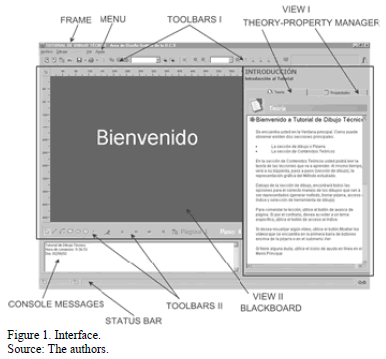
<body><![CDATA[<p><font size="2" face="Verdana, Arial, Helvetica, sans-serif"><b><i>2.1. Application structure</i></b></font></p>     <p><font size="2" face="Verdana, Arial, Helvetica, sans-serif">PGDT has two levels: interface and processing, with three  and two independents units, respectively. Those levels are described as follows:</font></p> <ol type="a">       <li><font size="2" face="Verdana, Arial, Helvetica, sans-serif">Interface level including the following units i) Application management: used     for controlling user operations such as application closing, resizing and     restoring. ii) Lessons index: this shows all the contents and methods of PGDT.     iii) Videos: Tutorial videos.    <br>   </font><font size="2" face="Verdana, Arial, Helvetica, sans-serif">At this level,     three windows are available to the user: main, indexes and video windows. These     are described below.</font></li>       <li><font size="2" face="Verdana, Arial, Helvetica, sans-serif">Processing level consisting of the next units i) Operations: for videos visualization     and lesson-method explanation. ii) Help: On line assessment</font></li>     </ol>     <p><font size="2" face="Verdana, Arial, Helvetica, sans-serif"><b>2.1.1. Interface level</b></font></p>     <p><font size="2" face="Verdana, Arial, Helvetica, sans-serif">(PGDT interface has three windows. User can introduce or select parameters and receive some messages by means of dialog boxes.</font></p>     <p><font size="2" face="Verdana, Arial, Helvetica, sans-serif"><b>Main window.</b></font></p>     <p><font size="2" face="Verdana, Arial, Helvetica, sans-serif">In <a href="#fig01">Fig. 1</a>, the main window components can be observed.  This window is used as a system communication and is divided into two views:  Theory-Property Manager and Blackboard, the first one showing the theoretical  explanation of the selected method as well as input data properties. In the second view, the graphic output of the selected method can be observed.</font></p>     ]]></body>
<body><![CDATA[<p align="center"><font size="2" face="Verdana, Arial, Helvetica, sans-serif"><a name="fig01"></a></font><img src="/img/revistas/dyna/v81n188/v81n188a02fig01.gif"></p>     <p><font size="2" face="Verdana, Arial, Helvetica, sans-serif">The program enables the  creation of geometric objects, such as points, lines, arcs, circumferences,  rectangles, ellipses, by using dynamic measures and the modification of their  properties. In addition, options for saving and printing the theory and the  graphical methodology are provided, as well as graphic tools like zoom,  gridding, rulers or squared patterns. Three colors are used for geometric  object representation on the blackboard, red for input, blue for auxiliary  construction elements and green for solutions Finally, PGDT includes on-line help.</font></p>     <p><font size="2" face="Verdana, Arial, Helvetica, sans-serif">PGDT main windows contain the following items: i) Window  frame, ii) Application menu, iii) Toolbar I, iv) Blackboard, v) Theory and Property manager, vi) Toolbar II, vii) Console message, viii) Status Bar.</font></p> <ul>       <li><font size="2" face="Verdana, Arial, Helvetica, sans-serif">Window     frame. The functions of this application facilitate window handling. It is     composed of: Title Bar, Menu access (maximization, minimization and restoration     of window, movement and resizing and application closing), and fast access to     main functions of WOS menu.</font></li>       <li><font size="2" face="Verdana, Arial, Helvetica, sans-serif">Menu.     Includes the following submenus: File (Print and Save in RTF type for text and     BMP for blackboard graphics), Draw (this allows graphic object selection),     Edition (to copy, cut, paste or delete the graphic objects on the blackboard),     Display (with an index showing all the lessons and methods), Videos, Zoom,     Rules, Grid, Help on-line and References.</font></li>       <li><font size="2" face="Verdana, Arial, Helvetica, sans-serif">Toolbar I. Direct access to: forward and     backward, index, video, saving, printing, copying, pasting, cutting, deleting,     showing grids and rules on the blackboard, graphic object display and zoom     tools.</font></li>       <li><font size="2" face="Verdana, Arial, Helvetica, sans-serif">Blackboard. This is rectangular with the     origin of the coordinates in the top left hand corner. Blackboard is used for     drawing and showing results.</font></li>       <li><font size="2" face="Verdana, Arial, Helvetica, sans-serif">Theory and Property manager. Shows theory     contents related to the selected method and properties of graphic elements on     the blackboard. It is possible to modify properties and geometric parameters of     input graphic elements. Theory shows the text, including explicative steps.     Property shows characteristics of selected graphic objects, coordinates, color     and nomenclature used.</font></li>       <li><font size="2" face="Verdana, Arial, Helvetica, sans-serif">Toolbar II. This is divided into two     sections. In the section on the left the following actions are found: Act/Des,     Line, Arc, Rectangle, Ellipse, Circle, Point. In the right hand section the     following actions are found: blackboard cleaning, starting method, &quot;backward&quot;     and &quot;forward&quot;, and ending method and index.</font></li>       <li><font size="2" face="Verdana, Arial, Helvetica, sans-serif">Console message. This shows messages when     user needs to put data on the blackboard.</font></li>       ]]></body>
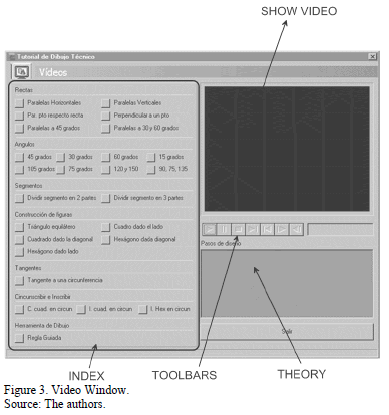
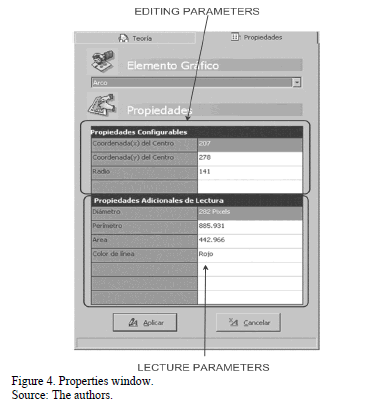
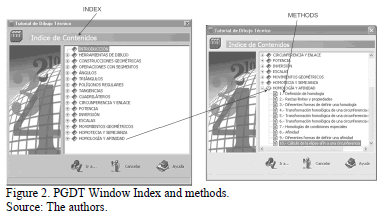
<body><![CDATA[<li><font size="2" face="Verdana, Arial, Helvetica, sans-serif">Status bar. This shows the actions in          progress.</font></li>     </ul>     <p><font size="2" face="Verdana, Arial, Helvetica, sans-serif"><b>Index window    <br> </b></font><font size="2" face="Verdana, Arial, Helvetica, sans-serif">This window allows the selection of lessons included in PGDT, <a href="#fig02">Fig. 2</a>.</font></p>     <p align="center"><font size="2" face="Verdana, Arial, Helvetica, sans-serif"><a name="fig02"></a></font><img src="/img/revistas/dyna/v81n188/v81n188a02fig02.gif"></p>     <p><font size="2" face="Verdana, Arial, Helvetica, sans-serif"><b>Video window    <br> </b></font><font size="2" face="Verdana, Arial, Helvetica, sans-serif">This window shows videos contained in the tutorial (<a href="#fig03">Fig.  3</a>). These videos are focused on geometric constructions by means of rulers (square and bevel).</font></p>     <p align="center"><font size="2" face="Verdana, Arial, Helvetica, sans-serif"><a name="fig03"></a></font><img src="/img/revistas/dyna/v81n188/v81n188a02fig03.gif"></p>     <p><font size="2" face="Verdana, Arial, Helvetica, sans-serif"><b>2.1.2. Processing level</b></font></p>     <p><font size="2" face="Verdana, Arial, Helvetica, sans-serif">In this section, PGDT execution procedure is  explained. Options described are: i) Video showing ii) Selecting topic- method, iii) Explanation of method selected, iv)</font></p>     ]]></body>
<body><![CDATA[<p><font size="2" face="Verdana, Arial, Helvetica, sans-serif">Selecting properties of graphic elements, v) Drawing on the blackboard</font></p> <ol type="i">       <li><font size="2" face="Verdana, Arial, Helvetica, sans-serif">To show a video, the icon access is found     in Toolbar I. Moreover, a voice explaining the method shown can be heard.</font></li>       <li><font size="2" face="Verdana, Arial, Helvetica, sans-serif">Selecting     topic-method, this is activated by pressing icon &quot;Muestra el &Iacute;ndice&quot;. A window     emerges containing 15 tutorial topics and their corresponding methods.</font></li>       <li><font size="2" face="Verdana, Arial, Helvetica, sans-serif">Explanation of the selected method. The icons &quot;backward&quot; and &quot;forward&quot; are in     Toolbar II and permit the user to run through the steps of the method. It is     possible to apply the method by introducing new data through the icon &quot;Limpiar     dibujo&quot;. If the selected method is only a theoretical one, these icons will not     be shown in Toolbar II.</font></li>       <li><font size="2" face="Verdana, Arial, Helvetica, sans-serif">Selecting     properties of graphic objects. This option permits users to choose and change     properties of input graphic objects that will be shown in red on the     blackboard. Only the configurable properties can be modified (<a href="#fig04">Fig. 4</a>)</font></li>       <li><font size="2" face="Verdana, Arial, Helvetica, sans-serif">Drawing on the blackboard, by using the     mouse.</font></li>     </ol>     <p align="center"><font size="2" face="Verdana, Arial, Helvetica, sans-serif"><a name="fig04"></a></font><img src="/img/revistas/dyna/v81n188/v81n188a02fig04.gif"></p>     <p>&nbsp;</p>     <p><font size="3" face="Verdana, Arial, Helvetica, sans-serif"><b>3. Example of application</b></font></p>     ]]></body>
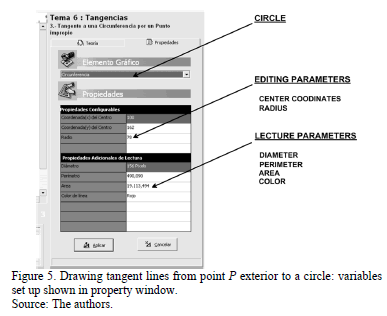
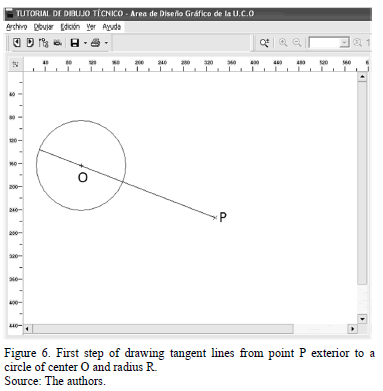
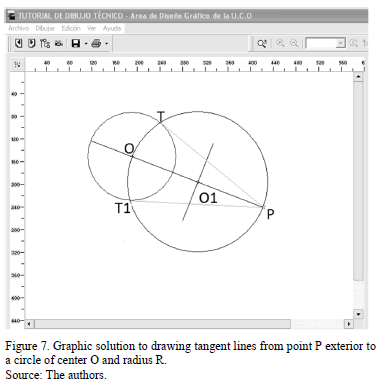
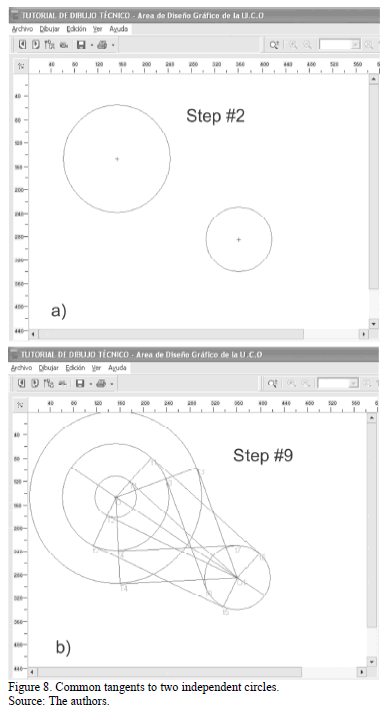
<body><![CDATA[<p><font size="2" face="Verdana, Arial, Helvetica, sans-serif">The background knowledge related to tangency is a relevant  geometry subject in technical design because it is involved in many frequent  systems such as rod-crank and gears. For this reason, the drawings of tangent lines to circles have been chosen as examples of application.</font></p>     <p><font size="2" face="Verdana, Arial, Helvetica, sans-serif">The first example  corresponds to drawing tangent lines from point <i>P</i> exterior to a circle. The proposed method is composed of 6 steps.  The required graphic object inputs are completed in the first two steps and  they are placed on the blackboard. Thus, the circle is introduced by drawing it  on the blackboard. Coordinates of its center and radius can be modified through  the window properties by the keyboard (<a href="#fig05">Fig. 5</a>).</font></p>     <p align="center"><font size="2" face="Verdana, Arial, Helvetica, sans-serif"><a name="fig05"></a></font><img src="/img/revistas/dyna/v81n188/v81n188a02fig05.gif"></p>     <p><font size="2" face="Verdana, Arial, Helvetica, sans-serif">The following steps begin by drawing the line linking  point <i>P</i> and center <i>O</i> (<a href="#fig06">Fig. 6</a>) and finish by calculating the geometric solutions shown in <a href="#fig07">Fig. 7</a>.</font></p>     <p align="center"><font size="2" face="Verdana, Arial, Helvetica, sans-serif"><a name="fig06"></a></font><img src="/img/revistas/dyna/v81n188/v81n188a02fig06.gif"></p>     <p align="center"><font size="2" face="Verdana, Arial, Helvetica, sans-serif"><a name="fig07"></a></font><img src="/img/revistas/dyna/v81n188/v81n188a02fig07.gif"></p>     <p><font size="2" face="Verdana, Arial, Helvetica, sans-serif">The second application example is shown in <a href="#fig08">Fig. 8</a>. It  deals with the calculation of common tangents to two independent circles in 9  steps. <a href="#fig08">Fig. 8a</a> shows the two circles drawn on the board by the user, and <a href="#fig08">Fig.  8b</a> depicts internal and external tangents drawn by the program and the corresponding tangency points</font></p>     <p align="center"><font size="2" face="Verdana, Arial, Helvetica, sans-serif"><a name="fig08"></a></font><img src="/img/revistas/dyna/v81n188/v81n188a02fig08.gif"></p>     <p>&nbsp;</p> <font size="3" face="Verdana, Arial, Helvetica, sans-serif"><b>4. Conclusions</b></font>     <p><font size="2" face="Verdana, Arial, Helvetica, sans-serif">This work introduces an application to be used in graphics   engineering teaching and learning. One of the main difficulties in encouraging   a wider use of DG programs is creating content and evaluating and guiding   students during learning activities. This problem is overcome by using the   proposed computer application due to the dynamic data entry corresponding to   each exercise, and showing the solution step by step. Thereby, teachers can   choose the necessary parameters in an easy way. One way to motivate students to   think about their own mental models is to allow them to manipulate variables,   by changing their values and trying to observe how they behave. It is essential   to fulfil this requirement in this kind of computer tool. The application is   able to run on computers with low-processing capabilities thus facilitating its required diffusion through e-learning platforms or web.</font></p>     ]]></body>
<body><![CDATA[<p>&nbsp;</p>     <p><font size="3" face="Verdana, Arial, Helvetica, sans-serif"><b>References </b></font></p>     <!-- ref --><p><font size="2" face="Verdana, Arial, Helvetica, sans-serif"><b>&#91;1&#93;</b> Kaufmann, H. and Schmalstieg,   D. Mathematics and geometry education with collaborative augmented reality, Computers &amp; Graphics, 27, pp. 339-345, 2003. <a href="http://dx.doi.org/10.1016/S0097-8493(03)00028-1" target="_blank">http://dx.doi.org/10.1016/S0097-8493(03)00028-1</a></font>&nbsp;&nbsp;&nbsp;&nbsp;&nbsp;&nbsp;&nbsp;&nbsp;[&#160;<a href="javascript:void(0);" onclick="javascript: window.open('/scielo.php?script=sci_nlinks&ref=000085&pid=S0012-7353201400060000200001&lng=','','width=640,height=500,resizable=yes,scrollbars=1,menubar=yes,');">Links</a>&#160;]<!-- end-ref --><!-- ref --><p><font size="2" face="Verdana, Arial, Helvetica, sans-serif"><b>&#91;2&#93;</b> Moura, J.G., Branddo, L.   O. and Brandao, A. A. F. A Web-based learning management system with automatic   assessment resources. Proceedings of the 37th Annual Frontiers in Education Conference, pp. 766-771, 2007.    &nbsp;&nbsp;&nbsp;&nbsp;&nbsp;&nbsp;&nbsp;&nbsp;[&#160;<a href="javascript:void(0);" onclick="javascript: window.open('/scielo.php?script=sci_nlinks&ref=000086&pid=S0012-7353201400060000200002&lng=','','width=640,height=500,resizable=yes,scrollbars=1,menubar=yes,');">Links</a>&#160;]<!-- end-ref --></font></p>     <!-- ref --><p><font size="2" face="Verdana, Arial, Helvetica, sans-serif"><b>&#91;3&#93;</b> Lowther, J. L. and   Shene, C. K. Computing with geometry as an undergraduate course: A three-year   experience, Proceedings of the 32nd Technical Symposium on Computer Science Education. SIGCSE Bulletin, 33 (1), pp. 119-123, 2001. <a href="http://dx.doi.org/10.1145/366413.364558" target="_blank">http://dx.doi.org/10.1145/366413.364558</a></font>&nbsp;&nbsp;&nbsp;&nbsp;&nbsp;&nbsp;&nbsp;&nbsp;[&#160;<a href="javascript:void(0);" onclick="javascript: window.open('/scielo.php?script=sci_nlinks&ref=000088&pid=S0012-7353201400060000200003&lng=','','width=640,height=500,resizable=yes,scrollbars=1,menubar=yes,');">Links</a>&#160;]<!-- end-ref --><!-- ref --><p><font size="2" face="Verdana, Arial, Helvetica, sans-serif"><b>&#91;4&#93;</b> Ruthven, K., Hennessy,   S. and Deaney, R. Constructions of dynamic geometry: A study of the   interpretative flexibility of educational software in classroom practice, Computers &amp; Education, 51 (1), pp. 297-317, 2008. <a href="http://dx.doi.org/10.1016/j.compedu.2007.05.013" target="_blank">http://dx.doi.org/10.1016/j.compedu.2007.05.013</a></font>&nbsp;&nbsp;&nbsp;&nbsp;&nbsp;&nbsp;&nbsp;&nbsp;[&#160;<a href="javascript:void(0);" onclick="javascript: window.open('/scielo.php?script=sci_nlinks&ref=000089&pid=S0012-7353201400060000200004&lng=','','width=640,height=500,resizable=yes,scrollbars=1,menubar=yes,');">Links</a>&#160;]<!-- end-ref --><!-- ref --><p><font size="2" face="Verdana, Arial, Helvetica, sans-serif"><b>&#91;5&#93;</b> Botanaa, F. and   Valcarce, J. L. A dynamic-symbolic interface for geometric theorem discovery. Computers &amp; Education, 38 (1-3), pp. 21-35, 2002. <a href="http://dx.doi.org/10.1016/S0360-1315(01)00089-6" target="_blank">http://dx.doi.org/10.1016/S0360-1315(01)00089-6</a></font>&nbsp;&nbsp;&nbsp;&nbsp;&nbsp;&nbsp;&nbsp;&nbsp;[&#160;<a href="javascript:void(0);" onclick="javascript: window.open('/scielo.php?script=sci_nlinks&ref=000090&pid=S0012-7353201400060000200005&lng=','','width=640,height=500,resizable=yes,scrollbars=1,menubar=yes,');">Links</a>&#160;]<!-- end-ref --><!-- ref --><p><font size="2" face="Verdana, Arial, Helvetica, sans-serif"><b>&#91;6&#93;</b> Bellemain, F.   Conception, realisation and experimentation of software for teaching geometry:   Cabri-g&eacute;om&eacute;tre, PhD. dissertation. LSD2-IMAG Laboratory, Grenoble, France, 1992.    &nbsp;&nbsp;&nbsp;&nbsp;&nbsp;&nbsp;&nbsp;&nbsp;[&#160;<a href="javascript:void(0);" onclick="javascript: window.open('/scielo.php?script=sci_nlinks&ref=000091&pid=S0012-7353201400060000200006&lng=','','width=640,height=500,resizable=yes,scrollbars=1,menubar=yes,');">Links</a>&#160;]<!-- end-ref --></font></p>     ]]></body>
<body><![CDATA[<!-- ref --><p><font size="2" face="Verdana, Arial, Helvetica, sans-serif"><b>&#91;7&#93;</b> Jackiw, R. N. and   Finzer, W. F. The geometer's sketchpad: programming by geometry, in Watch what I do: programming by demonstration, Cambridge, MIT Press, 1993. pp. 293-307.    &nbsp;&nbsp;&nbsp;&nbsp;&nbsp;&nbsp;&nbsp;&nbsp;[&#160;<a href="javascript:void(0);" onclick="javascript: window.open('/scielo.php?script=sci_nlinks&ref=000093&pid=S0012-7353201400060000200007&lng=','','width=640,height=500,resizable=yes,scrollbars=1,menubar=yes,');">Links</a>&#160;]<!-- end-ref --></font></p>     <!-- ref --><p><font size="2" face="Verdana, Arial, Helvetica, sans-serif"><b>&#91;8&#93;</b> Kortenkamp, U.   Foundations of Dynamic Geometry, PhD. dissertation, ETH, Institut für Theoretische Informatik, Zurich, Switzerland, 1999.    &nbsp;&nbsp;&nbsp;&nbsp;&nbsp;&nbsp;&nbsp;&nbsp;[&#160;<a href="javascript:void(0);" onclick="javascript: window.open('/scielo.php?script=sci_nlinks&ref=000095&pid=S0012-7353201400060000200008&lng=','','width=640,height=500,resizable=yes,scrollbars=1,menubar=yes,');">Links</a>&#160;]<!-- end-ref --></font></p>     <!-- ref --><p><font size="2" face="Verdana, Arial, Helvetica, sans-serif"><b>&#91;9&#93;</b> Kortenkamp, U.   Foundations of Dynamic Geometry, Journal für Mathematik-Didaktik, 21, pp. 161-162, 2000. <a href="http://dx.doi.org/10.1007/BF03338916" target="_blank">http://dx.doi.org/10.1007/BF03338916</a></font>&nbsp;&nbsp;&nbsp;&nbsp;&nbsp;&nbsp;&nbsp;&nbsp;[&#160;<a href="javascript:void(0);" onclick="javascript: window.open('/scielo.php?script=sci_nlinks&ref=000097&pid=S0012-7353201400060000200009&lng=','','width=640,height=500,resizable=yes,scrollbars=1,menubar=yes,');">Links</a>&#160;]<!-- end-ref --><!-- ref --><p><font size="2" face="Verdana, Arial, Helvetica, sans-serif"><b>&#91;10&#93;</b> Brandão, L. O. iGeom: a   free software for dynamic geometry into the web. International Conference on Sciences and Mathematics Education, Rio de Janeiro, Brazil, 2002.    &nbsp;&nbsp;&nbsp;&nbsp;&nbsp;&nbsp;&nbsp;&nbsp;[&#160;<a href="javascript:void(0);" onclick="javascript: window.open('/scielo.php?script=sci_nlinks&ref=000098&pid=S0012-7353201400060000200010&lng=','','width=640,height=500,resizable=yes,scrollbars=1,menubar=yes,');">Links</a>&#160;]<!-- end-ref --></font></p>     <!-- ref --><p><font size="2" face="Verdana, Arial, Helvetica, sans-serif"><b>&#91;11&#93;</b> Gao, X. S. Building   Dynamic Mathematical Models with Geometry Expert, III. A Geometry Deductive   Database, Proceedings of the fourth Asian Technology Conference in Mathematics, pp. 153-162, 1999.    &nbsp;&nbsp;&nbsp;&nbsp;&nbsp;&nbsp;&nbsp;&nbsp;[&#160;<a href="javascript:void(0);" onclick="javascript: window.open('/scielo.php?script=sci_nlinks&ref=000100&pid=S0012-7353201400060000200011&lng=','','width=640,height=500,resizable=yes,scrollbars=1,menubar=yes,');">Links</a>&#160;]<!-- end-ref --></font></p>     <!-- ref --><p><font size="2" face="Verdana, Arial, Helvetica, sans-serif"><b>&#91;12&#93;</b> Gao, X. S., Zhu, C. C.   and Huang, Y. Building a Dynamic Mathematical Models with Geometry Expert, I.   Geometric Transformations, Functions and Plane Curves, Proceedings of the third Asian Technology Conference in Mathematics, pp. 216-224, 1998.    &nbsp;&nbsp;&nbsp;&nbsp;&nbsp;&nbsp;&nbsp;&nbsp;[&#160;<a href="javascript:void(0);" onclick="javascript: window.open('/scielo.php?script=sci_nlinks&ref=000102&pid=S0012-7353201400060000200012&lng=','','width=640,height=500,resizable=yes,scrollbars=1,menubar=yes,');">Links</a>&#160;]<!-- end-ref --></font></p>     <!-- ref --><p><font size="2" face="Verdana, Arial, Helvetica, sans-serif"><b>&#91;13&#93;</b> Gao, X. S. Zhu, C. C.   and Huang, Y. Building Dynamic Mathematical Models with Geometry Expert, II.   Linkages, Proceedings of the third Asian Technology Conference in Mathematics, pp. 15-22, 1998.    &nbsp;&nbsp;&nbsp;&nbsp;&nbsp;&nbsp;&nbsp;&nbsp;[&#160;<a href="javascript:void(0);" onclick="javascript: window.open('/scielo.php?script=sci_nlinks&ref=000104&pid=S0012-7353201400060000200013&lng=','','width=640,height=500,resizable=yes,scrollbars=1,menubar=yes,');">Links</a>&#160;]<!-- end-ref --></font></p>     <!-- ref --><p><font size="2" face="Verdana, Arial, Helvetica, sans-serif"><b>&#91;14&#93;</b> Liu, Y., Lin, Q. and   Dai, G. PIGP: A Pen-Based Intelligent Dynamic Lecture System for Geometry Teaching in Hui K.-c. et al. Edutainment, LNCS 4469, pp. 381-390, 2007.    &nbsp;&nbsp;&nbsp;&nbsp;&nbsp;&nbsp;&nbsp;&nbsp;[&#160;<a href="javascript:void(0);" onclick="javascript: window.open('/scielo.php?script=sci_nlinks&ref=000106&pid=S0012-7353201400060000200014&lng=','','width=640,height=500,resizable=yes,scrollbars=1,menubar=yes,');">Links</a>&#160;]<!-- end-ref --></font></p>     <!-- ref --><p><font size="2" face="Verdana, Arial, Helvetica, sans-serif"><b>&#91;15&#93;</b> Ciobanu, G. and Rusu, D.   Pythagoras: An interactive environment for plane geometry. Proceedings of the   Intelligent Computer Communication and Processing Conference, pp. 283-286, 2007.    &nbsp;&nbsp;&nbsp;&nbsp;&nbsp;&nbsp;&nbsp;&nbsp;[&#160;<a href="javascript:void(0);" onclick="javascript: window.open('/scielo.php?script=sci_nlinks&ref=000108&pid=S0012-7353201400060000200015&lng=','','width=640,height=500,resizable=yes,scrollbars=1,menubar=yes,');">Links</a>&#160;]<!-- end-ref --></font></p>     <!-- ref --><p><font size="2" face="Verdana, Arial, Helvetica, sans-serif"><b>&#91;16&#93;</b> Isotani, S. and Brandão,   L. O. An algorithm for automatic checking of exercises in a dynamic geometry system: iGeom. Computers &amp; Education., 51, pp. 1283-1303, 2008. <a href="http://dx.doi.org/10.1016/j.compedu.2007.12.004" target="_blank">http://dx.doi.org/10.1016/j.compedu.2007.12.004</a></font>&nbsp;&nbsp;&nbsp;&nbsp;&nbsp;&nbsp;&nbsp;&nbsp;[&#160;<a href="javascript:void(0);" onclick="javascript: window.open('/scielo.php?script=sci_nlinks&ref=000110&pid=S0012-7353201400060000200016&lng=','','width=640,height=500,resizable=yes,scrollbars=1,menubar=yes,');">Links</a>&#160;]<!-- end-ref --><!-- ref --><p><font size="2" face="Verdana, Arial, Helvetica, sans-serif"><b>&#91;17&#93;</b> Sinclair, M. P. Peer   interactions in a computer lab: Reflections on results of a case study   involving web-based dynamic geometry sketches. The Journal of Mathematical Behavior, 24, pp. 89-107, 2005. <a href="http://dx.doi.org/10.1016/j.jmathb.2004.12.003" target="_blank">http://dx.doi.org/10.1016/j.jmathb.2004.12.003</a></font>&nbsp;&nbsp;&nbsp;&nbsp;&nbsp;&nbsp;&nbsp;&nbsp;[&#160;<a href="javascript:void(0);" onclick="javascript: window.open('/scielo.php?script=sci_nlinks&ref=000111&pid=S0012-7353201400060000200017&lng=','','width=640,height=500,resizable=yes,scrollbars=1,menubar=yes,');">Links</a>&#160;]<!-- end-ref --><!-- ref --><p><font size="2" face="Verdana, Arial, Helvetica, sans-serif"><b>&#91;18&#93;</b> Grothman, R. C.a.R.: Compass and Rules, 1999. Available at <a href="http://www.z-u-l.de/doc_en/index.html" target="_blank">http://www.z-u-l.de/doc_en/index.html</a></font>&nbsp;&nbsp;&nbsp;&nbsp;&nbsp;&nbsp;&nbsp;&nbsp;[&#160;<a href="javascript:void(0);" onclick="javascript: window.open('/scielo.php?script=sci_nlinks&ref=000112&pid=S0012-7353201400060000200018&lng=','','width=640,height=500,resizable=yes,scrollbars=1,menubar=yes,');">Links</a>&#160;]<!-- end-ref --><!-- ref --><p><font size="2" face="Verdana, Arial, Helvetica, sans-serif"><b>&#91;19&#93;</b> Hoyles, C. and Noss, R.   What can digital technologies take from and bring to research in mathematics   education? in Bishop, A. J. et al. Second International Handbook of Mathematics Education, 2nd edition, Dordrecht, Kluwer Academic, 2003. pp. 323-349. <a href="http://dx.doi.org/10.1007/978-94-010-0273-8_11" target="_blank">http://dx.doi.org/10.1007/978-94-010-0273-8_11</a></font>&nbsp;&nbsp;&nbsp;&nbsp;&nbsp;&nbsp;&nbsp;&nbsp;[&#160;<a href="javascript:void(0);" onclick="javascript: window.open('/scielo.php?script=sci_nlinks&ref=000113&pid=S0012-7353201400060000200019&lng=','','width=640,height=500,resizable=yes,scrollbars=1,menubar=yes,');">Links</a>&#160;]<!-- end-ref --><!-- ref --><p><font size="2" face="Verdana, Arial, Helvetica, sans-serif"><b>&#91;20&#93;</b> Kaufmann, H. and   Schmalstieg, D. Designing Immersive Virtual Reality for Geometry Education.  Proceedings of the Virtual Reality Conference, pp. 51-58, 2006.    &nbsp;&nbsp;&nbsp;&nbsp;&nbsp;&nbsp;&nbsp;&nbsp;[&#160;<a href="javascript:void(0);" onclick="javascript: window.open('/scielo.php?script=sci_nlinks&ref=000114&pid=S0012-7353201400060000200020&lng=','','width=640,height=500,resizable=yes,scrollbars=1,menubar=yes,');">Links</a>&#160;]<!-- end-ref --></font></p>     <p>&nbsp;</p>     <p><font size="2" face="Verdana, Arial, Helvetica, sans-serif"><b>E. Guti&eacute;rrez de  Rav&eacute;</b> obtained his agronomic engineering PhD (1987) from the University of  C&oacute;rdoba (Spain). He is currently full professor in the Department of Graphic  Engineering and Geomatics at the University of C&oacute;rdoba. His research is focused in computer aided design, curves and surfaces and computer graphics.</font></p>     <p><font size="2" face="Verdana, Arial, Helvetica, sans-serif"><b>F.J. Jim&eacute;nez-Hornero</b> obtained his agronomic engineering PhD (2003) from the University of C&oacute;rdoba  (Spain). He is currently full professor in the Department of Graphic  Engineering and Geomatics at the University of C&oacute;rdoba. His research is focused in computational fluids mechanics, multifractals and computer graphics.</font></p>     <p><font size="2" face="Verdana, Arial, Helvetica, sans-serif"><b>A.B.  Ariza-Villaverde</b> obtained her agronomic engineering PhD (2013) from the  University of C&oacute;rdoba (Spain). She is currently developing her research  activity as grant holder in the Department of Graphic Engineering and Geomatics  at the University of C&oacute;rdoba. Her research lines are GIS, axial maps, multifractals and computer graphics.</font></p>      ]]></body><back>
<ref-list>
<ref id="B1">
<label>1</label><nlm-citation citation-type="journal">
<person-group person-group-type="author">
<name>
<surname><![CDATA[Kaufmann]]></surname>
<given-names><![CDATA[H.]]></given-names>
</name>
<name>
<surname><![CDATA[Schmalstieg]]></surname>
<given-names><![CDATA[D.]]></given-names>
</name>
</person-group>
<article-title xml:lang="en"><![CDATA[Mathematics and geometry education with collaborative augmented reality]]></article-title>
<source><![CDATA[Computers & Graphics]]></source>
<year>2003</year>
<numero>27</numero>
<issue>27</issue>
<page-range>339-345</page-range></nlm-citation>
</ref>
<ref id="B2">
<label>2</label><nlm-citation citation-type="confpro">
<person-group person-group-type="author">
<name>
<surname><![CDATA[Moura]]></surname>
<given-names><![CDATA[J.G.]]></given-names>
</name>
<name>
<surname><![CDATA[Branddo]]></surname>
<given-names><![CDATA[L. O.]]></given-names>
</name>
<name>
<surname><![CDATA[Brandao]]></surname>
<given-names><![CDATA[A. A. F.]]></given-names>
</name>
</person-group>
<article-title xml:lang="en"><![CDATA[A Web-based learning management system with automatic assessment resources]]></article-title>
<source><![CDATA[]]></source>
<year>2007</year>
<conf-name><![CDATA[37th Annual Frontiers in Education Conference]]></conf-name>
<conf-loc> </conf-loc>
<page-range>766-771</page-range></nlm-citation>
</ref>
<ref id="B3">
<label>3</label><nlm-citation citation-type="journal">
<person-group person-group-type="author">
<name>
<surname><![CDATA[Lowther]]></surname>
<given-names><![CDATA[J. L.]]></given-names>
</name>
<name>
<surname><![CDATA[Shene]]></surname>
<given-names><![CDATA[C. K.]]></given-names>
</name>
</person-group>
<article-title xml:lang="en"><![CDATA[Computing with geometry as an undergraduate course: A three-year experience]]></article-title>
<source><![CDATA[SIGCSE Bulletin]]></source>
<year>2001</year>
<volume>33</volume>
<numero>1</numero>
<issue>1</issue>
<page-range>119-123</page-range></nlm-citation>
</ref>
<ref id="B4">
<label>4</label><nlm-citation citation-type="journal">
<person-group person-group-type="author">
<name>
<surname><![CDATA[Ruthven]]></surname>
<given-names><![CDATA[K.]]></given-names>
</name>
<name>
<surname><![CDATA[Hennessy]]></surname>
<given-names><![CDATA[S.]]></given-names>
</name>
<name>
<surname><![CDATA[Deaney]]></surname>
<given-names><![CDATA[R.]]></given-names>
</name>
</person-group>
<article-title xml:lang="en"><![CDATA[Constructions of dynamic geometry: A study of the interpretative flexibility of educational software in classroom practice]]></article-title>
<source><![CDATA[Computers & Education]]></source>
<year>2008</year>
<volume>51</volume>
<numero>1</numero>
<issue>1</issue>
<page-range>297-317</page-range></nlm-citation>
</ref>
<ref id="B5">
<label>5</label><nlm-citation citation-type="journal">
<person-group person-group-type="author">
<name>
<surname><![CDATA[Botanaa]]></surname>
<given-names><![CDATA[F.]]></given-names>
</name>
<name>
<surname><![CDATA[Valcarce]]></surname>
<given-names><![CDATA[J. L.]]></given-names>
</name>
</person-group>
<article-title xml:lang="en"><![CDATA[A dynamic-symbolic interface for geometric theorem discovery]]></article-title>
<source><![CDATA[Computers & Education]]></source>
<year>2002</year>
<volume>38</volume>
<numero>1-3</numero>
<issue>1-3</issue>
<page-range>21-35</page-range></nlm-citation>
</ref>
<ref id="B6">
<label>6</label><nlm-citation citation-type="">
<person-group person-group-type="author">
<name>
<surname><![CDATA[Bellemain]]></surname>
<given-names><![CDATA[F.]]></given-names>
</name>
</person-group>
<source><![CDATA[Conception, realisation and experimentation of software for teaching geometry: Cabri-géométre]]></source>
<year></year>
</nlm-citation>
</ref>
<ref id="B7">
<label>7</label><nlm-citation citation-type="book">
<person-group person-group-type="author">
<name>
<surname><![CDATA[Jackiw]]></surname>
<given-names><![CDATA[R. N.]]></given-names>
</name>
<name>
<surname><![CDATA[Finzer]]></surname>
<given-names><![CDATA[W. F.]]></given-names>
</name>
</person-group>
<source><![CDATA[The geometer's sketchpad: programming by geometry, in Watch what I do: programming by demonstration]]></source>
<year>1993</year>
<page-range>293-307</page-range><publisher-loc><![CDATA[Cambridge ]]></publisher-loc>
<publisher-name><![CDATA[MIT Press]]></publisher-name>
</nlm-citation>
</ref>
<ref id="B8">
<label>8</label><nlm-citation citation-type="">
<person-group person-group-type="author">
<name>
<surname><![CDATA[Kortenkamp]]></surname>
<given-names><![CDATA[U.]]></given-names>
</name>
</person-group>
<source><![CDATA[Foundations of Dynamic Geometry]]></source>
<year></year>
</nlm-citation>
</ref>
<ref id="B9">
<label>9</label><nlm-citation citation-type="journal">
<person-group person-group-type="author">
<name>
<surname><![CDATA[Kortenkamp]]></surname>
<given-names><![CDATA[U.]]></given-names>
</name>
</person-group>
<article-title xml:lang="en"><![CDATA[Foundations of Dynamic Geometry]]></article-title>
<source><![CDATA[Journal für Mathematik-Didaktik]]></source>
<year>2000</year>
<numero>21</numero>
<issue>21</issue>
<page-range>161-162</page-range></nlm-citation>
</ref>
<ref id="B10">
<label>10</label><nlm-citation citation-type="confpro">
<person-group person-group-type="author">
<name>
<surname><![CDATA[Brandão]]></surname>
<given-names><![CDATA[L. O.]]></given-names>
</name>
</person-group>
<article-title xml:lang="en"><![CDATA[iGeom: a free software for dynamic geometry into the web]]></article-title>
<source><![CDATA[]]></source>
<year></year>
<conf-name><![CDATA[ International Conference on Sciences and Mathematics Education]]></conf-name>
<conf-date>2002</conf-date>
<conf-loc>Rio de Janeiro </conf-loc>
</nlm-citation>
</ref>
<ref id="B11">
<label>11</label><nlm-citation citation-type="confpro">
<person-group person-group-type="author">
<name>
<surname><![CDATA[Gao]]></surname>
<given-names><![CDATA[X. S.]]></given-names>
</name>
</person-group>
<article-title xml:lang="en"><![CDATA[Building Dynamic Mathematical Models with Geometry Expert, III: A Geometry Deductive Database]]></article-title>
<source><![CDATA[]]></source>
<year>1999</year>
<conf-name><![CDATA[fourth Asian Technology Conference in Mathematics]]></conf-name>
<conf-loc> </conf-loc>
<page-range>153-162</page-range></nlm-citation>
</ref>
<ref id="B12">
<label>12</label><nlm-citation citation-type="confpro">
<person-group person-group-type="author">
<name>
<surname><![CDATA[Gao]]></surname>
<given-names><![CDATA[X. S.]]></given-names>
</name>
<name>
<surname><![CDATA[Zhu]]></surname>
<given-names><![CDATA[C. C.]]></given-names>
</name>
<name>
<surname><![CDATA[Huang]]></surname>
<given-names><![CDATA[Y.]]></given-names>
</name>
</person-group>
<article-title xml:lang="en"><![CDATA[Building a Dynamic Mathematical Models with Geometry Expert, I: Geometric Transformations, Functions and Plane Curves]]></article-title>
<source><![CDATA[]]></source>
<year>1998</year>
<conf-name><![CDATA[third Asian Technology Conference in Mathematics]]></conf-name>
<conf-loc> </conf-loc>
<page-range>216-224</page-range></nlm-citation>
</ref>
<ref id="B13">
<label>13</label><nlm-citation citation-type="confpro">
<person-group person-group-type="author">
<name>
<surname><![CDATA[Gao]]></surname>
<given-names><![CDATA[X. S.]]></given-names>
</name>
<name>
<surname><![CDATA[Zhu]]></surname>
<given-names><![CDATA[C. C.]]></given-names>
</name>
<name>
<surname><![CDATA[Huang]]></surname>
<given-names><![CDATA[Y.]]></given-names>
</name>
</person-group>
<article-title xml:lang="en"><![CDATA[Building Dynamic Mathematical Models with Geometry Expert, II. Linkages]]></article-title>
<source><![CDATA[]]></source>
<year>1998</year>
<conf-name><![CDATA[third Asian Technology Conference in Mathematics]]></conf-name>
<conf-loc> </conf-loc>
<page-range>15-22</page-range></nlm-citation>
</ref>
<ref id="B14">
<label>14</label><nlm-citation citation-type="book">
<person-group person-group-type="author">
<name>
<surname><![CDATA[Liu]]></surname>
<given-names><![CDATA[Y.]]></given-names>
</name>
<name>
<surname><![CDATA[Lin]]></surname>
<given-names><![CDATA[Q.]]></given-names>
</name>
<name>
<surname><![CDATA[Dai]]></surname>
<given-names><![CDATA[G.]]></given-names>
</name>
</person-group>
<article-title xml:lang="en"><![CDATA[PIGP: A Pen-Based Intelligent Dynamic Lecture System for Geometry Teaching]]></article-title>
<person-group person-group-type="editor">
<name>
<surname><![CDATA[Hui]]></surname>
<given-names><![CDATA[K.-c.]]></given-names>
</name>
</person-group>
<source><![CDATA[Edutainment]]></source>
<year>2007</year>
<page-range>381-390</page-range><publisher-name><![CDATA[LNCS]]></publisher-name>
</nlm-citation>
</ref>
<ref id="B15">
<label>15</label><nlm-citation citation-type="confpro">
<person-group person-group-type="author">
<name>
<surname><![CDATA[Ciobanu]]></surname>
<given-names><![CDATA[G.]]></given-names>
</name>
<name>
<surname><![CDATA[Rusu]]></surname>
<given-names><![CDATA[D.]]></given-names>
</name>
</person-group>
<article-title xml:lang="en"><![CDATA[Pythagoras: An interactive environment for plane geometry]]></article-title>
<source><![CDATA[]]></source>
<year>2007</year>
<conf-name><![CDATA[ Intelligent Computer Communication and Processing Conference]]></conf-name>
<conf-loc> </conf-loc>
<page-range>283-286</page-range></nlm-citation>
</ref>
<ref id="B16">
<label>16</label><nlm-citation citation-type="journal">
<person-group person-group-type="author">
<name>
<surname><![CDATA[Isotani]]></surname>
<given-names><![CDATA[S.]]></given-names>
</name>
<name>
<surname><![CDATA[Brandão]]></surname>
<given-names><![CDATA[L. O.]]></given-names>
</name>
</person-group>
<article-title xml:lang="en"><![CDATA[An algorithm for automatic checking of exercises in a dynamic geometry system: iGeom]]></article-title>
<source><![CDATA[Computers & Education]]></source>
<year>2008</year>
<numero>51</numero>
<issue>51</issue>
<page-range>1283-1303</page-range></nlm-citation>
</ref>
<ref id="B17">
<label>17</label><nlm-citation citation-type="journal">
<person-group person-group-type="author">
<name>
<surname><![CDATA[Sinclair]]></surname>
<given-names><![CDATA[M. P]]></given-names>
</name>
</person-group>
<article-title xml:lang="en"><![CDATA[Peer interactions in a computer lab: Reflections on results of a case study involving web-based dynamic geometry sketches]]></article-title>
<source><![CDATA[The Journal of Mathematical Behavior]]></source>
<year>2005</year>
<numero>24</numero>
<issue>24</issue>
<page-range>89-107</page-range></nlm-citation>
</ref>
<ref id="B18">
<label>18</label><nlm-citation citation-type="">
<person-group person-group-type="author">
<name>
<surname><![CDATA[Grothman]]></surname>
<given-names><![CDATA[R.]]></given-names>
</name>
</person-group>
<source><![CDATA[C.a.R.: Compass and Rules]]></source>
<year>1999</year>
</nlm-citation>
</ref>
<ref id="B19">
<label>19</label><nlm-citation citation-type="book">
<person-group person-group-type="author">
<name>
<surname><![CDATA[Hoyles]]></surname>
<given-names><![CDATA[C.]]></given-names>
</name>
<name>
<surname><![CDATA[Noss]]></surname>
<given-names><![CDATA[R.]]></given-names>
</name>
</person-group>
<article-title xml:lang="en"><![CDATA[What can digital technologies take from and bring to research in mathematics education?]]></article-title>
<person-group person-group-type="editor">
<name>
<surname><![CDATA[Bishop]]></surname>
<given-names><![CDATA[A. J.]]></given-names>
</name>
</person-group>
<source><![CDATA[Second International Handbook of Mathematics Education]]></source>
<year>2003</year>
<edition>2nd</edition>
<page-range>323-349</page-range><publisher-loc><![CDATA[Dordrecht ]]></publisher-loc>
<publisher-name><![CDATA[Kluwer Academic]]></publisher-name>
</nlm-citation>
</ref>
<ref id="B20">
<label>20</label><nlm-citation citation-type="confpro">
<person-group person-group-type="author">
<name>
<surname><![CDATA[Kaufmann]]></surname>
<given-names><![CDATA[H.]]></given-names>
</name>
<name>
<surname><![CDATA[Schmalstieg]]></surname>
<given-names><![CDATA[D.]]></given-names>
</name>
</person-group>
<article-title xml:lang="en"><![CDATA[Designing Immersive Virtual Reality for Geometry Education]]></article-title>
<source><![CDATA[]]></source>
<year>2006</year>
<conf-name><![CDATA[ Proceedings of the Virtual Reality Conference]]></conf-name>
<conf-loc> </conf-loc>
<page-range>51-58</page-range></nlm-citation>
</ref>
</ref-list>
</back>
</article>