<?xml version="1.0" encoding="ISO-8859-1"?><article xmlns:mml="http://www.w3.org/1998/Math/MathML" xmlns:xlink="http://www.w3.org/1999/xlink" xmlns:xsi="http://www.w3.org/2001/XMLSchema-instance">
<front>
<journal-meta>
<journal-id>0012-7353</journal-id>
<journal-title><![CDATA[DYNA]]></journal-title>
<abbrev-journal-title><![CDATA[Dyna rev.fac.nac.minas]]></abbrev-journal-title>
<issn>0012-7353</issn>
<publisher>
<publisher-name><![CDATA[Universidad Nacional de Colombia]]></publisher-name>
</publisher>
</journal-meta>
<article-meta>
<article-id>S0012-73532014000600004</article-id>
<article-id pub-id-type="doi">10.15446/dyna.v81n188.39717</article-id>
<title-group>
<article-title xml:lang="en"><![CDATA[Recycling of agroindustrial solid wastes as additives in brick manufacturing for development of sustainable construction materials]]></article-title>
<article-title xml:lang="es"><![CDATA[Reciclaje de residuos sólidos agroindustriales como aditivos en la fabricación de ladrillos para el desarrollo sostenible de materiales de construcción]]></article-title>
</title-group>
<contrib-group>
<contrib contrib-type="author">
<name>
<surname><![CDATA[Luna-Cañas]]></surname>
<given-names><![CDATA[Lisset Maritza]]></given-names>
</name>
<xref ref-type="aff" rid="A01"/>
</contrib>
<contrib contrib-type="author">
<name>
<surname><![CDATA[Ríos-Reyes]]></surname>
<given-names><![CDATA[Carlos Alberto]]></given-names>
</name>
<xref ref-type="aff" rid="A02"/>
</contrib>
<contrib contrib-type="author">
<name>
<surname><![CDATA[Quintero-Ortíz]]></surname>
<given-names><![CDATA[Luz Amparo]]></given-names>
</name>
<xref ref-type="aff" rid="A03"/>
</contrib>
</contrib-group>
<aff id="A01">
<institution><![CDATA[,Universidad Industrial de Santander Escuela de Geología ]]></institution>
<addr-line><![CDATA[Bucaramanga ]]></addr-line>
<country>Colombia</country>
</aff>
<aff id="A02">
<institution><![CDATA[,Universidad Industrial de Santander Escuela de Geología ]]></institution>
<addr-line><![CDATA[Bucaramanga ]]></addr-line>
<country>Colombia</country>
</aff>
<aff id="A03">
<institution><![CDATA[,Universidad Industrial de Santander Escuela de Ingeniería Metalúrgica y Ciencia de Materiales ]]></institution>
<addr-line><![CDATA[Bucaramanga ]]></addr-line>
<country>Colombia</country>
</aff>
<pub-date pub-type="pub">
<day>00</day>
<month>12</month>
<year>2014</year>
</pub-date>
<pub-date pub-type="epub">
<day>00</day>
<month>12</month>
<year>2014</year>
</pub-date>
<volume>81</volume>
<numero>188</numero>
<fpage>34</fpage>
<lpage>41</lpage>
<copyright-statement/>
<copyright-year/>
<self-uri xlink:href="http://www.scielo.org.co/scielo.php?script=sci_arttext&amp;pid=S0012-73532014000600004&amp;lng=en&amp;nrm=iso"></self-uri><self-uri xlink:href="http://www.scielo.org.co/scielo.php?script=sci_abstract&amp;pid=S0012-73532014000600004&amp;lng=en&amp;nrm=iso"></self-uri><self-uri xlink:href="http://www.scielo.org.co/scielo.php?script=sci_pdf&amp;pid=S0012-73532014000600004&amp;lng=en&amp;nrm=iso"></self-uri><abstract abstract-type="short" xml:lang="en"><p><![CDATA[Accumulation of unmanaged agroindustrial solid wastes especially in developing countries has resulted in an increased environmental concern. Recycling of such wastes as a sustainable construction material appears to be a viable solution not only to the pollution problem but also an economical option to design green buildings. This paper studies the application of several agroindustrial wastes in brick manufacturing, which include cocoa shell, sawdust, rice husk and sugarcane. First, the mineralogical and chemical composition of the wastes and clayey soil were determined. Next, bricks were fabricated with different quantities of waste (5%, 10% and 20%). The effect of adding these wastes on the technological behavior of the brick was assessed by compressive strength, flexural strength and durability tests. Based on the results obtained, the optimum amounts of agroindustrial waste to obtain bricks were mixing 10% of cocoa shell and 90% of clayey soil. These percentages produced bricks whose mechanical properties were suitable for use as secondary raw materials in the brick production.]]></p></abstract>
<abstract abstract-type="short" xml:lang="es"><p><![CDATA[La acumulación de residuos sólidos agroindustriales no administrados especialmente en los países en vías de desarrollo ha dado lugar a una creciente preocupación ambiental. El reciclaje de tales residuos como un material de construcción sostenible parece ser una solución viable no sólo al problema de la contaminación, sino también una opción económica para diseñar edificios verdes. El presente trabajo estudia la aplicación de varios residuos agroindustriales en la fabricación de ladrillos, que incluyen cáscara de cacao, aserrín, cáscara de arroz y caña de azúcar. En primer lugar, se determinó la composición mineralógica y química de los residuos y del suelo arcilloso. A continuación, los ladrillos se fabricaron con diferentes cantidades de residuos (5%, 10% y 20%). El efecto de la adición de estos residuos en el comportamiento tecnológico del ladrillo se evaluó mediante ensayos de resistencia a la compresión, resistencia a la flexión y durabilidad. Con base en los resultados obtenidos, las cantidades óptimas de residuos agroindustriales para obtener ladrillos fueron mezclando 10% de cáscara de cacao y 90% de suelo arcilloso. Estos porcentajes producen ladrillos cuyas propiedades mecánicas eran adecuadas para su uso como materias primas secundarias en la producción de ladrillos.]]></p></abstract>
<kwd-group>
<kwd lng="en"><![CDATA[agroindustrial wastes]]></kwd>
<kwd lng="en"><![CDATA[bricks]]></kwd>
<kwd lng="en"><![CDATA[recycling]]></kwd>
<kwd lng="en"><![CDATA[construction material]]></kwd>
<kwd lng="en"><![CDATA[engineering properties]]></kwd>
<kwd lng="es"><![CDATA[residuos agroindustriales]]></kwd>
<kwd lng="es"><![CDATA[ladrillos]]></kwd>
<kwd lng="es"><![CDATA[reciclaje]]></kwd>
<kwd lng="es"><![CDATA[materiales de construcción]]></kwd>
<kwd lng="es"><![CDATA[propiedades de ingeniería]]></kwd>
</kwd-group>
</article-meta>
</front><body><![CDATA[ <p><font size="2" face="Verdana, Arial, Helvetica, sans-serif"><a href="http://dx.doi.org/10.15446/dyna.v81n188.39717" target="_blank">http://dx.doi.org/10.15446/dyna.v81n188.39717</a></font></p>     <p align="center"><b><font size="4" face="Verdana, Arial, Helvetica, sans-serif">Recycling of agroindustrial solid wastes as additives  in brick manufacturing for development of sustainable construction materials</font></b></p>     <p align="center"><i><font size="3"><b><font face="Verdana, Arial, Helvetica, sans-serif">Reciclaje  de residuos s&oacute;lidos agroindustriales como aditivos en la fabricaci&oacute;n de ladrillos para el desarrollo sostenible de materiales de construcci&oacute;n</font></b></font></i></p>     <p align="center">&nbsp;</p>     <p align="center"><font size="2" face="Verdana, Arial, Helvetica, sans-serif"><b>Lisset Maritza Luna-Ca&ntilde;as <sup>a</sup>, Carlos   Alberto R&iacute;os-Reyes <sup>b</sup> &amp; Luz Amparo Quintero-Ort&iacute;z <sup>c</sup></b></font></p>     <p align="center">&nbsp;</p>     <p align="center"><font size="2" face="Verdana, Arial, Helvetica, sans-serif"><i><sup>a </sup>Escuela de Geolog&iacute;a, Universidad Industrial de  Santander, Bucaramanga, Colombia, <a href="mailto:lissetluna1829@hotmail.com">lissetluna1829@hotmail.com</a>    <br> </i></font><font size="2" face="Verdana, Arial, Helvetica, sans-serif"><i><sup>b</sup> Escuela de Geolog&iacute;a, Universidad Industrial de  Santander, Bucaramanga, Colombia, <a href="mailto:carios@uis.edu.co">carios@uis.edu.co</a>    <br> </i></font><font size="2" face="Verdana, Arial, Helvetica, sans-serif"><i><sup>c </sup>Escuela de Ingenier&iacute;a Metal&uacute;rgica y Ciencia de  Materiales, Universidad Industrial de Santander, Bucaramanga, Colombia,  <a href="mailto:luzquint@uis.edu.co">luzquint@uis.edu.co</a></i></font></p>     <p align="center">&nbsp;</p>     ]]></body>
<body><![CDATA[<p align="center"><font size="2" face="Verdana, Arial, Helvetica, sans-serif"><b>Received: August 31<sup>th</sup>, 2013. Received in revised form:  March 13<sup>th</sup>, 2014. Accepted: October 25<sup>th</sup>, 2014.</b></font></p>     <p align="center">&nbsp;</p> <hr>     <p><font size="2" face="Verdana, Arial, Helvetica, sans-serif"><b>Abstract    <br> </b></font><font size="2" face="Verdana, Arial, Helvetica, sans-serif">Accumulation of unmanaged agroindustrial solid wastes  especially in developing countries has resulted in an increased environmental  concern. Recycling of such wastes as a sustainable construction material  appears to be a viable solution not only to the pollution problem but also an  economical option to design green buildings. This paper studies the application  of several agroindustrial wastes in brick manufacturing, which include cocoa  shell, sawdust, rice husk and sugarcane. First, the mineralogical and chemical  composition of the wastes and clayey soil were determined. Next, bricks were  fabricated with different quantities of waste (5%, 10% and 20%). The effect of  adding these wastes on the technological behavior of the brick was assessed by  compressive strength, flexural strength and durability tests. Based on the  results obtained, the optimum amounts of agroindustrial waste to obtain bricks  were mixing 10% of cocoa shell and 90% of clayey soil. These percentages  produced bricks whose mechanical properties were suitable for use as secondary raw materials in the brick production.</font></p>     <p><font size="2" face="Verdana, Arial, Helvetica, sans-serif"><i>Keywords</i>: agroindustrial  wastes; bricks; recycling; construction material; engineering properties.</font></p>     <p><font size="2" face="Verdana, Arial, Helvetica, sans-serif"><b>Resumen    <br> </b></font><font size="2" face="Verdana, Arial, Helvetica, sans-serif">La acumulaci&oacute;n  de residuos s&oacute;lidos agroindustriales no administrados especialmente en los  pa&iacute;ses en v&iacute;as de desarrollo ha dado lugar a una creciente preocupaci&oacute;n  ambiental. El reciclaje de tales residuos como un material de construcci&oacute;n  sostenible parece ser una soluci&oacute;n viable no s&oacute;lo al problema de la  contaminaci&oacute;n, sino tambi&eacute;n una opci&oacute;n econ&oacute;mica para dise&ntilde;ar edificios verdes.  El presente trabajo estudia la aplicaci&oacute;n de varios residuos agroindustriales  en la fabricaci&oacute;n de ladrillos, que incluyen c&aacute;scara de cacao, aserr&iacute;n, c&aacute;scara  de arroz y ca&ntilde;a de az&uacute;car. En primer lugar, se determin&oacute; la composici&oacute;n  mineral&oacute;gica y qu&iacute;mica de los residuos y del suelo arcilloso. A continuaci&oacute;n,  los ladrillos se fabricaron con diferentes cantidades de residuos (5%, 10% y  20%). El efecto de la adici&oacute;n de estos residuos en el comportamiento  tecnol&oacute;gico del ladrillo se evalu&oacute; mediante ensayos de resistencia a la  compresi&oacute;n, resistencia a la flexi&oacute;n y durabilidad. Con base en los resultados  obtenidos, las cantidades &oacute;ptimas de residuos agroindustriales para obtener  ladrillos fueron mezclando 10% de c&aacute;scara de cacao y 90% de suelo arcilloso.  Estos porcentajes producen ladrillos cuyas propiedades mec&aacute;nicas eran adecuadas para su uso como materias primas secundarias en la producci&oacute;n de ladrillos.</font></p>     <p><font size="2" face="Verdana, Arial, Helvetica, sans-serif"><i>Palabras clave</i>: residuos agroindustriales; ladrillos; reciclaje; materiales de  construcci&oacute;n; propiedades de ingenier&iacute;a.</font></p> <hr>     <p>&nbsp;</p>     <p><font size="3" face="Verdana, Arial, Helvetica, sans-serif"><b>1. Introduction</b></font></p>     ]]></body>
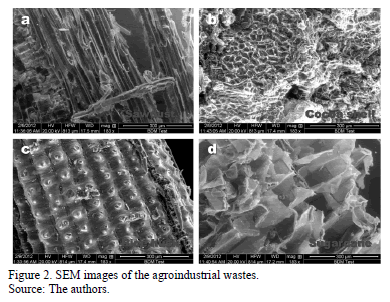
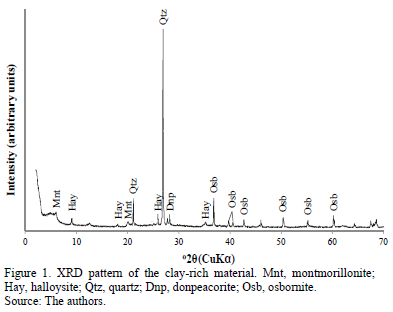
<body><![CDATA[<p><font size="2" face="Verdana, Arial, Helvetica, sans-serif">Agroindustry generates  considerable quantities of solid wastes which are rich in organic matter and  could constitute new materials for value added products. Because of their  biodegradable nature, several agroindustrial residues can be safely disposed of;  however, the amount of discharged residues is expected to increase dramatically  in the future. In Colombia, they are mostly underutilized, untreated and thus  in most cases disposed off by unplanned landfilling. Due to increasing  landfill costs, stricter environmental regulation and current interest in  sustainable development, the effective recycling of agroindustrial residues for  the manufacture of bricks of greater value to mitigate the depletion of  resources and environmental impact has become an increasing concern in recent  years. Traditional construction materials, including bricks, are being produced  from existing natural resources, which is destroying the environment due to  their continuous exploration and depletion. On the other hand, large  concentrations of toxic substances are emitted into the atmosphere during the  manufacturing process of construction materials, which has a strong negative  environmental impact. Consequently, major changes regarding the conservation of  resources and recycling of wastes by proper management are taking place in our  ways of living and working &#91;1&#93;. Many authorities and  investigators are lately working to have the privilege of reusing the wastes in  environmentally and economically sustainable ways &#91;2&#93;. Therefore to satisfy the continuously increasing demand,  researchers are incorporating solid wastes for the manufacturing of novel  construction materials to develop sustainable alternative solutions. From the  standpoint of energy saving and conservation of natural resources, the use of  alternative constituents in construction materials is now a global concern &#91;1&#93;. It well known that almost all the buildings comprise a  structure of reinforced concrete and facade made of brick walls &#91;3&#93;. Attempts have been made to incorporate several industrial  wastes in the manufacturing of bricks, including paper-making pulp &#91;4-5&#93;, cigarette butts &#91;6&#93;, steel slag &#91;7-8&#93;, fly ash &#91;9-10&#93;, water treatment  sludge &#91;11-12&#93;, thin film transistor liquid crystal display optical  glass &#91;13&#93;, processed tea &#91;14&#93;, sawdust &#91;15-16&#93;, cotton waste &#91;17&#93;, polystyrene fabric &#91;18&#93;, rubber &#91;19&#93;, granite sludge &#91;20&#93;, limestone powder waste &#91;15,17&#93; and waste foundry  sands &#91;21&#93;. These studies demonstrated that the use of waste materials  can save energy and enhance brick quality. The purpose of our research was to  develop a comparative study on the use of several agroindustrial wastes (cocoa shell, sawdust, rice  husk and sugarcane) in the manufacturing of  bricks. The experimental study includes a laboratory simulation of the  industrial brick-making process to assess technological feasibility, and  technological trial to validate prior results.</font></p>     <p>&nbsp;</p>     <p><font size="3" face="Verdana, Arial, Helvetica, sans-serif"><b>2. Experimental   procedure</b></font></p>     <p><b><font size="2" face="Verdana, Arial, Helvetica, sans-serif"><i>2.1. Preparation  of the samples</i></font></b></p>     <p><font size="2" face="Verdana, Arial, Helvetica, sans-serif">The materials used for the  manufacture of agroindustrial solid waste-based bricks (ASWBs) consisted of raw  clay-rich material, cocoa shell, sawdust, rice husk and sugarcane. The raw  clay-rich material used in this study was supplied by ERGO Dur&aacute;n &amp; Garc&iacute;a  Brick Company Ltda., from the brick plant in Gir&oacute;n, Santander (Colombia).The  clayey soil is currently used by this company to make fired bricks of different  shapes and sizes with dimensional tolerances that conform to ASTM Standards.  Agroindustrial solid wastes were obtained from the supply and storage center  (Centroabastos), Santander (Colombia). Their use should be promoted as an  appropriate and alternative low cost but high quality building technology.  Calculated amounts of cocoa shell, sawdust, rice husk and sugarcane were added  to the </font></p>     <p><font size="2" face="Verdana, Arial, Helvetica, sans-serif">clayey soil and mixed in a mortar to obtain good  homogenization. To enable comparative results, three samples per series were  prepared for the tests. The necessary amount of water was added to the samples  to obtain adequate plasticity and absence of defects, mainly cracks, during the  semi-dry molding stage, using a mold of 50 x 60 x 90 mm. Agroindustrial solid  waste-free mixtures were also prepared as a control. Therefore, ASWBs with a  cross section of 50x 60 mm and a length of 90 mm were obtained. Samples were  fired in a laboratory furnace at 800 <sup>o</sup>C for 4 h. Samples were then  cooled to room temperature by natural convection inside the furnace. The shaped  samples were designated as C (control) for the bricks without agroindustrial  solid waste and ASWxB for the mixtures, where ASW and x denotes the type of  residue incorporated (CS - cocoa shell; SD - sawdust; RH - rice husk, and SC -  sugarcane) and its content (%) in the clay matrix, respectively. </font></p>     <p><font size="2" face="Verdana, Arial, Helvetica, sans-serif"><b><i>2.2. Properties of  materials</i></b></font></p>     <p><font size="2" face="Verdana, Arial, Helvetica, sans-serif">Qualitative  determination of major crystalline phases present in the clay-rich material was  achieved by using a powder X-ray diffractometer (PhilipsPW1710), operating in  Bragg-Brentano geometry with Cu K <font face="Symbol">a</font> radiation (k = 1.5406 Å), 40 kV and 40  mA, and secondary monochromation. Data was collectedin the 2-70º 2<font face="Symbol">q</font> range  (0.02º step size). The crystalline patterns were compared with the standard  line patterns from the Powder Diffraction File database supplied by the  International Centre for Diffraction Data (ICDD), with the help of the Joint  Committee on Powder Diffraction Standards (JCPDS) files for inorganic  compounds. The major crystalline phases found in the clay-rich material are  quartz, montmorillonite, halloysite, donpeacorite and osbornite (<a href="#fig01">Fig. 1</a>).</font></p>     <p align="center"><font size="2" face="Verdana, Arial, Helvetica, sans-serif"><a name="fig01"></a></font><img src="/img/revistas/dyna/v81n188/v81n188a04fig01.gif"></p>     <p><font size="2" face="Verdana, Arial, Helvetica, sans-serif">The  morphology of the agroindustrial wastes (<a href="#fig02">Fig. 2</a>) was examined by environmental  scanning electron microscopy (ESEM) (FEI Quanta 650), under the following  analytical conditions: magnification = 183x, WD = 17.2-17.5, HV = 20.0 kV, spot  = 3.0, mode SE, detector LFD. </font></p>     ]]></body>
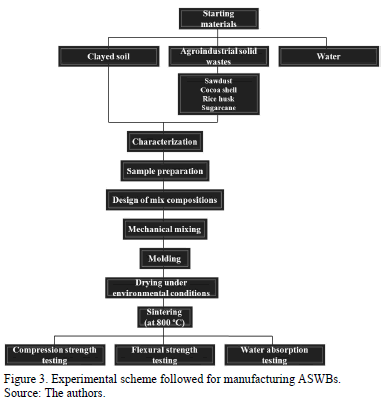
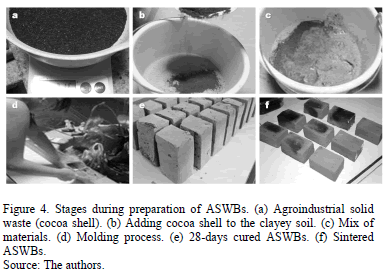
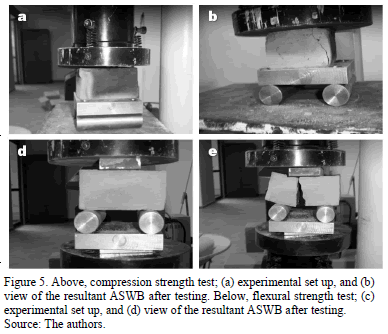
<body><![CDATA[<p align="center"><font size="2" face="Verdana, Arial, Helvetica, sans-serif"><a name="fig02"></a></font><img src="/img/revistas/dyna/v81n188/v81n188a04fig02.gif"></p>     <p><font size="2" face="Verdana, Arial, Helvetica, sans-serif">The particle  size distribution of the clay-rich material was obtained by Ni&ntilde;o et al. &#91;22&#93;,  combining sieve and hydrometer analyses according to the standards ASTM C136-06  &#91;23&#93; and ASTM D1140-00&#91;24&#93;, revealing that it is mainly composed of sand  particles (87.80%), with 13.63% of fine particles and 1.57% of gravel  particles, corresponding to a sandy clay soil. Ni&ntilde;o et al. &#91;22&#93; also reported  the Atterberg's limits of the clay-rich material according to the standard ASTM  D4318-10 &#91;25&#93;, with the following results: liquid limit of 35%, plastic limit  of 17% and plasticity index of 18%.</font></p>     <p><font size="2" face="Verdana, Arial, Helvetica, sans-serif"><b><i>2.3. Sample  preparation, mix compositions and testing</i></b></font></p>     <p><font size="2" face="Verdana, Arial, Helvetica, sans-serif"><a href="#fig03">Fig. 3</a> illustrates a block diagram showing  the methodology followed in the manufacturing of the ASWBs during their study.  The raw clay-rich material was naturally dried during 3 weeks under the  following environmental conditions: average temperature of 24 <sup>o</sup>C and  relative humidity of 83.5%. Then, it was subjected to the following steps:  rough crushing with a Retsch Jaw Crusher BB200 to ~2 mm, milling with a Retsch  RM100 mortar grinder mill to clay particle size and sieving with a 200 mesh  Ro-Tap sieve shaker (using 4, 10, 20, 40, 60, 100 and 200 mesh series). The  agroindustrial residues were dried for 24 hours under the direct sunlight to  remove the excess moisture. Then, they were cut in fragments of different  average dimensions. In order to determine the effect of the addition of  agroindustrial residues on the engineering properties of ASWBs. Different  amounts of ASWBs (5%, 10% and 20%) were chosen for the mix design of the ASWBs. The mix proportions  were prepared based on the dry weights of the ingredients. The quantities of  the dry materials obtained from the mix design were measured in each case with  the aid of a weighing balance. First, the dry materials were mixed by hand with  a spade on a hard surface until they reached a uniform color. Then, water was added  and mixing continued until a homogeneous mixture was obtained. The resultant  mixtures were compacted manually in appropriate molds using predetermined  masses corresponding to the maximum density (found from standard compaction  tests). </font></p>     <p align="center"><font size="2" face="Verdana, Arial, Helvetica, sans-serif"><a name="fig03"></a></font><img src="/img/revistas/dyna/v81n188/v81n188a04fig03.gif"></p>     <p><font size="2" face="Verdana, Arial, Helvetica, sans-serif">The units of ASWBs were manufactured with cuboidal shape and standard  size (60 x 50 x 90 mm).  The specimens were dried at 100 <sup>o</sup>C for 24 hours, removed from the  molds and were fired in a (TERRIGENO) furnace at 800 <sup>o</sup>C. The fired  samples were tested for compressive strength, flexural strength, and Mg<sub>2</sub>SO<sub>4</sub> and H<sub>2</sub>SO<sub>4</sub> attack. All tests were carried out according to  ASTM standards and the results reported are the mean of three values. </font></p>     <p><font size="2" face="Verdana, Arial, Helvetica, sans-serif"><a href="#fig04">Fig. 4</a> illustrates  the preparation of the ASWBs. In order to obtain comparable results, a total of  12 ASWBs (3 for each mixture) were prepared for testing four different series.  The shape and size tolerances have been respected. ASWBs were cured for 28 days  under the following environmental conditions: average temperature of 25 <sup>o</sup>C  and relative humidity of 80%. Too much clay will cause cracks in the blocks  while too much sand will cause the blocks to crumble. The suitable soil must  contain the right proportions of sand, silt, clay and water. </font></p>     <p align="center"><font size="2" face="Verdana, Arial, Helvetica, sans-serif"><a name="fig04"></a></font><img src="/img/revistas/dyna/v81n188/v81n188a04fig04.gif"></p>     <p><font size="2" face="Verdana, Arial, Helvetica, sans-serif">The  swelling/shrinkage behavior of the 28-days cured ASWBs was determined as  follows. Immediately after the fabrication of the ASWBs, their dimensions were  recorded and at the end of the 28-day curing period, a record of their  dimensions was also taken. There was no significant dimensional or volume  increase in any of the ASWBs. No defects such as cracks and bloating were  observed after firing. However, a texture characterized by black cores are  developed after firing, which can be attributed to organic matter that is not  completely burned during firing &#91;26-27&#93;. In general, the color of the fired  samples was reddish, which is similar to that observed in the formulas without  wastes, although somewhat lighter as the proportion of waste increases.  Engineering tests were conducted in a computerized device for mechanical assays  according to the ASTM C67-11 standard &#91;28&#93;. A Universal Testing Machine (MTS  810) with a maximum load of 500000 N was used in the testing procedure, taking  into account its accuracy (0.01), flexibility, high performance, and innovative  standard features; large test space to accommodate standard, medium and large  size specimens, grips, fixtures and environmental subsystem, and environmental  chamber dimension: 500 x 255 x 350 mm. Data were recorded automatically to the  computer system which the user can manipulate the collected results. The  compressive strength test was conducted with a crosshead speed of 0.5 mm/min.  This test was performed according to ASTM D 2166-00e1 &#91;29&#93;. The test was carried  out as follows: ASWBs were placed between two steel bearing plates (on the top  and on the bottom), which were identical (length, width and thickness were  respectively 100 x 40 x 5 mm). The load strain reading at failure was recorded;  it was the maximum load the specimen could carry in compression. The  three-point bending flexural strength test was conducted with a cross head  speed of 0.2 mm/s and a distance between the supports of 90 mm. This test was  performed according to ASTM D 1635-00 &#91;30&#93;. The procedure performed on the  ASWBs was as follows: two cylindrical steel rollers (length of 100 mm and  diameter of 5 mm) were set at a distance of 99-129 mm apart on the bottom steel  support plate (length, width and thickness were respectively100 x 40 x 5 mm). The ASWBs were placed over the bottom steel  support plate, which reduced the frictional forces between the rollers and the ASWBs. A loading steel roller identical to the two described above was  set on top of the ASWBs. The load was applied via a steel roller, identical to  those described above, directly onto the ASWBs. The maximum load until the  occurrence of the first crack was recorded as flexural strength. Upon crack  occurrence, the strength decreased. This test provides values for the modulus  of rupture (<i>MR</i>) of the ASWBs. <i>MR</i> can be calculated according to Varela  et al. &#91;31&#93; using Eq. (1).</font></p>     <p><img src="/img/revistas/dyna/v81n188/v81n188a04eq01.gif"></p>     ]]></body>
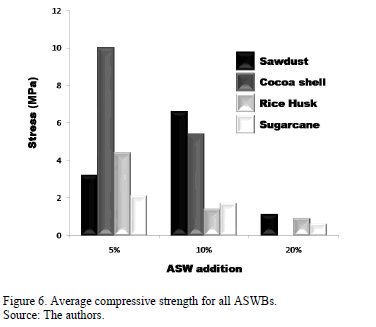
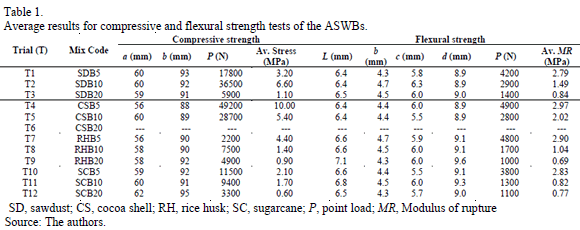
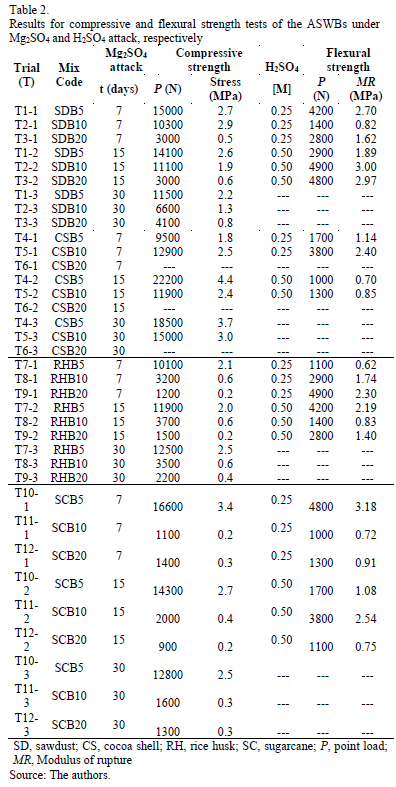
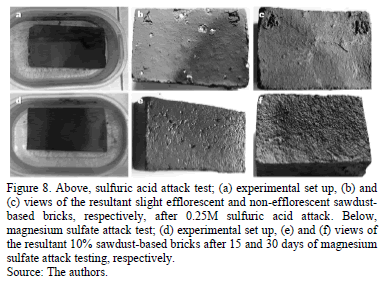
<body><![CDATA[<p><font size="2" face="Verdana, Arial, Helvetica, sans-serif">Where <i>MR</i> is the flexural modulus of rupture  (MPa), P is the maximum applied load (N), a is the distance between line of  fracture and the nearest support (mm), b and d are the width and thickness of  the specimen (mm), respectively. The total water absorption capacity of the  ASWBs established by the water absorption (WA) test. After 28 days of curing  time, the dry specimens were weighed. Then, they were subjected to 24 h  submersion. The water of absorption can be determined from the moist weight of  specimens after submersion according to the standard ASTM C67-11 &#91;28&#93;.</font></p>     <p>&nbsp;</p>     <p><font size="3" face="Verdana, Arial, Helvetica, sans-serif"><b>3.   Results and discussion</b></font></p>     <p><font size="2" face="Verdana, Arial, Helvetica, sans-serif">Some  of the physical and chemical properties of the ASWBs are presented in <a href="#tab01">Tables  1</a>-<a href="#tab02">2</a>. The ASWBs containing residues expanded slightly when fired at 800<sup>o</sup>C,  resulting in a typical behavior of porous bodies. This may be due to the high  content in quartz of the clay that is inert at the studied temperature which  reduces the contraction of the piece, as well as to the increase in porosity  due to the high content in organic matter in the organic residues. All ASWBs  showed a contraction at this temperature. The weight loss experienced by the  samples upon temperature increased with respect to the residue content at 800 <sup>o</sup>C  for all types of wastes. This weight loss could be due to the elimination of  the organic matter from the clay and residue by means of combustion and to the  elimination of water content from clay mineral due to dehydroxylation reactions  in the clay as suggested by Eliche-Quesada et al. &#91;32&#93;.</font></p>     <p align="center"><font size="2" face="Verdana, Arial, Helvetica, sans-serif"><a name="tab01"></a></font><img src="/img/revistas/dyna/v81n188/v81n188a04tab01.gif"></p>     <p align="center"><font size="2" face="Verdana, Arial, Helvetica, sans-serif"><a name="tab02"></a></font><img src="/img/revistas/dyna/v81n188/v81n188a04tab02.gif"></p>     <p><font size="2" face="Verdana, Arial, Helvetica, sans-serif">According to Romero et al. &#91;33&#93;, it is apparent that open  porosity in the ASWBs decreases when the amount of liquid phase tends to  approach the particles. The temperature decreased the porosity of the ASWBs.  The changes in this property were notable with the addition of sawdust, while  the addition of cocoa shell, rice husk and sugarcane produced minor differences  in apparent porosity similar to results obtained by Eliche-Quesada et al. &#91;32&#93;.  The addition of agroindustrial wastes increased the porosity of the ASWBs,  however this effect is expected, since the organic matter of the wastes were  eliminated during the thermal process, leading to an increase in the open  porosity of the ceramic bodies. Water absorption, firing temperature and type  and content of the residue affects the quality of the final material and its  durability significantly &#91;32&#93;. According to Ni&ntilde;o et al. &#91;22&#93;, the clayey soil  showed an average water absorption of 30.21%. The addition of waste should  produce a significant increase in water absorption. However, the combustion of  organic matter acted differently in the formation of interconnected surface  porosity &#91;32&#93;. </font></p>     <p><font size="2" face="Verdana, Arial, Helvetica, sans-serif"><a href="#fig05">Fig. 5</a> illustrates the compressive strength and flexion  strength test and set up.</font></p>     <p align="center"><font size="2" face="Verdana, Arial, Helvetica, sans-serif"><a name="fig05"></a></font><img src="/img/revistas/dyna/v81n188/v81n188a04fig05.gif"></p>     <p><font size="2" face="Verdana, Arial, Helvetica, sans-serif">The typical load and compressive strength test is shown in     <a href="#fig05">Fig. 5a</a>-<a href="#fig05">5b</a>. The average compressive strength of the ASWBs as a function of  waste content is presented in <a href="#fig06">Fig. 6</a> and results are depicted in <a href="#tab01">Table 1</a>. </font></p>     ]]></body>
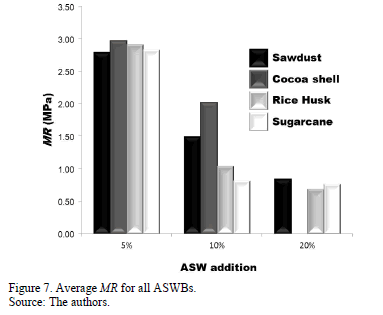
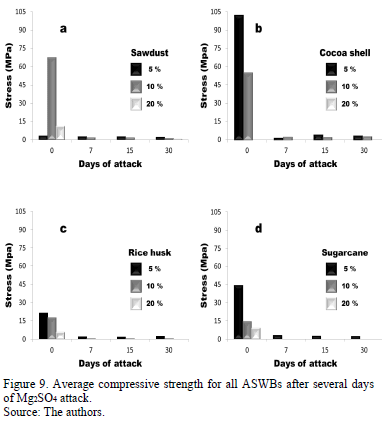
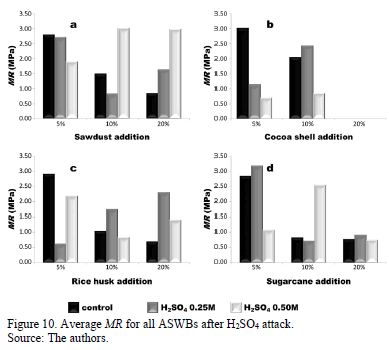
<body><![CDATA[<p align="center"><font size="2" face="Verdana, Arial, Helvetica, sans-serif"><a name="fig06"></a></font><img src="/img/revistas/dyna/v81n188/v81n188a04fig06.gif"></p>     <p><font size="2" face="Verdana, Arial, Helvetica, sans-serif"><a href="#fig06">Fig. 6</a> shows that the compressive strength tends to decrease  with the waste addition except for sawdust-based bricks, which can be related  to the higher apparent porosity than clay bricks without residues. The results  were better for cocoa shell, with a higher compressive strength using 5 wt.% of  cocoa shell, which can be explained by the presence of oil in the waste as  suggested by Eliche-Quesada et al. &#91;32&#93;, oily films form between particles,  acting as lubricants during formation of the clay body and permitting more  efficient packing. This phenomenon would promote an increase in mechanical  properties of ASWBs. However, a greater percentage of cocoa shell (10 and 20  wt.%) may generate oil pockets that result in pores after firing and contribute  to a decrease in compressive strength as reported by Monteiro and Vieira &#91;34&#93;.  Nevertheless, in all ASWBs, including those with higher percentages of waste  addition, compressive strengths are always less than the minimum amount (10  MPa) required by existing regulations, except for the 5 wt.% of cocoa  shell-based bricks, which produced compressive strength values around 10 MPa.</font></p>     <p><font size="2" face="Verdana, Arial, Helvetica, sans-serif">The  typical load and deflection in the beam-flexural test </font><font size="2" face="Verdana, Arial, Helvetica, sans-serif">is shown in <a href="#fig05">Fig. 5c</a>-<a href="#fig05">5d</a> and results  are depicted in <a href="#tab01">Table 1</a>. The  average <i>MR</i> of the ASWBs as a function  of waste content is presented in <a href="#fig07">Fig. 7</a> and results are depicted in <a href="#tab01">Table 1</a>.</font></p>     <p align="center"><font size="2" face="Verdana, Arial, Helvetica, sans-serif"><a name="fig07"></a></font><img src="/img/revistas/dyna/v81n188/v81n188a04fig07.gif"></p>     <p><font size="2" face="Verdana, Arial, Helvetica, sans-serif"><a href="#fig08">Fig. 8</a> illustrates the experimental set up for ASWBs under  Mg<sub>2</sub>SO<sub>4</sub> and H<sub>2</sub>SO<sub>4</sub> attack. </font></p>     <p align="center"><font size="2" face="Verdana, Arial, Helvetica, sans-serif"><a name="fig08"></a></font><img src="/img/revistas/dyna/v81n188/v81n188a04fig08.gif"></p>     <p><font size="2" face="Verdana, Arial, Helvetica, sans-serif"><a href="#fig09">Figs. 9</a>-<a href="#fig10">10</a> illustrate the average compressive strength and <i>MR</i> for all ASWBs attacked by Mg<sub>2</sub>SO<sub>4</sub> and H<sub>2</sub>SO<sub>4</sub>, respectively, and results are depicted in  <a href="#tab02">Table 2</a>.</font></p>     <p align="center"><font size="2" face="Verdana, Arial, Helvetica, sans-serif"><a name="fig09"></a></font><img src="/img/revistas/dyna/v81n188/v81n188a04fig09.gif"></p>     <p align="center"><font size="2" face="Verdana, Arial, Helvetica, sans-serif"><a name="fig10"></a></font><img src="/img/revistas/dyna/v81n188/v81n188a04fig10.gif"></p>     <p><font size="2" face="Verdana, Arial, Helvetica, sans-serif"><a href="#fig09">Fig. 9</a> shows the average compressive strength of ASWBs  with different percentages and type of agroindustrial wastes before and after  Mg<sub>2</sub>SO<sub>4</sub> attack. As can be seen, ASWBs shows a strong  decrease in the compressive strength after Mg<sub>2</sub>SO<sub>4</sub> attack,  with residual values that decreased with days of attack, although with cocoa  shell-based bricks kept slightly higher compressive strength values compared  with the rest of the ASWBs, and the highest compressive strength values after  15 days of Mg<sub>2</sub>SO<sub>4</sub> attack. However, data from 20 wt.%  of cocoa shell addition were not  reported.</font></p>     ]]></body>
<body><![CDATA[<p><font size="2" face="Verdana, Arial, Helvetica, sans-serif"><a href="#fig10">Fig.  10</a> shows the average <i>MR</i> of the ASWBs  with different percentages and type of agroindustrial wastes before and after H<sub>2</sub>SO<sub>4</sub> attack. As can be seen, ASWBs (5 wt.% addition) show lower <i>MRs</i> than bricks made solely with the clayey soil, except for  sugarcane-based bricks, which showed higher <i>MR</i> values after H<sub>2</sub>SO<sub>4</sub> 0.25M attack. On the other hand, the <i>MR</i> decreased with increasing H<sub>2</sub>SO<sub>4</sub> concentration, except for rice husk-based bricks. With 10 wt.% of waste  addition, at low H<sub>2</sub>SO<sub>4</sub> concentration, the <i>MR</i> decreased for sawdust- and  sugarcane-based bricks, and increased for cocoa shell- and rice husk-based  bricks. These results were also obtained at high H<sub>2</sub>SO<sub>4</sub> concentration. However, with increasing H<sub>2</sub>SO<sub>4</sub> concentration, the <i>MR</i> decreased for  cocoa shell- and rice husk-based bricks and </font></p>     <p><font size="2" face="Verdana, Arial, Helvetica, sans-serif">increased for sawdust- and  sugarcane-based bricks. With 20 wt.% of waste addition, at low H<sub>2</sub>SO<sub>4</sub> concentration, the <i>MR</i> increased for  all ASWBs, except for cocoa shell-based bricks (data not reported). These  results were also obtained at high H<sub>2</sub>SO<sub>4</sub> concentration.  However, with increasing H<sub>2</sub>SO<sub>4</sub> concentration, the <i>MR</i> decreased for all ASWBs, except for  sawdust-based bricks. For cocoa shell-based bricks, data were not reported.</font></p>     <p><font size="2" face="Verdana, Arial, Helvetica, sans-serif">After performing durability and strength tests on the  ASWBs, results show that most of them perform below the acceptable level in all  tests, except for the cocoa shell-based bricks.</font></p>     <p>&nbsp;</p>     <p><font size="3" face="Verdana, Arial, Helvetica, sans-serif"><b>4. Conclusions</b></font></p>     <p><font size="2" face="Verdana, Arial, Helvetica, sans-serif">During  different agroindustrial activities, huge quantity of solid wastes can be  generated as by-products, which pose major environmental problems as well as  occupy a large area of land for their storage/disposal. There is a tremendous  scope for setting up secondary industries for recycling and using such huge  quantities of solid wastes such as minerals or resources in the production of  construction materials. Environment-friendly, energy-efficient, and  cost-effective alternative materials produced from solid wastes will show a  good market potential to fulfill people's needs in rural and urban areas. This  study shows that viable bricks can be manufactured with the addition of  different percentages of agroindustrial wastes to the traditional clay mix. At  the temperature investigated, changes occurred in the values of the bulk density,  water absorption and apparent porosity with waste addition, which in turn  caused changes in the porosity. Apparent porosity and water absorption values  increased with the addition of residues. During the sintering process, the  development of a liquid phase caused a decrease in open porosity and water  absorption. This increased the compressive strength by reducing the porosity  content. Because water absorption is related to the durability of bricks and  because the compressive strength of ceramic materials is the most relevant  engineering quality index for building, the cocoa shell-based bricks obtained  at 800 <sup>o</sup>C had the best quality. The results indicated that is  possible to obtain ASWBs mixing 10% of cocoa shell and 90% of clayey soil,  which fulfill the technological standards for traditional bricks and possess  mechanical properties similar to those of clay bricks without this waste. Use  of these residues could have practical implications as a means of recycling and  for achieving cost savings in brick production, since fewer raw materials would  be required.</font></p>     <p>&nbsp;</p>     <p><font size="3" face="Verdana, Arial, Helvetica, sans-serif"><b>Acknowledgments</b></font></p>     <p><font size="2" face="Verdana, Arial, Helvetica, sans-serif">This research forms part of the L.M. Luna's undergraduate  thesis from the Universidad Industrial de Santander. We gratefully acknowledge  the Universidad Industrial de Santander for the use of research facilities  (X-ray diffraction and Microscopy laboratories) and human resources; with  special thanks to Luis Garrido from the Laboratory of Crushing, Milling and  Grinding of the School of Geology (Universidad Industrial de Santander). The authors  also thank the ERGO Dur&aacute;n &amp; Garc&iacute;a Brick Company Ltda. for providing  facilities to study the mining area and to Ing. Luz Torrado and Vicente Paez  from the Concrete and Strength of Materials Laboratory of the Civil Engineering  Program (Universidad Pontificia Bolivariana) for their assistance with  experimental tests. The authors also acknowledge the anonymous referees for  their critical and insightful reading of the manuscript and are most grateful  to the above-named people and institutions for support.</font></p>     <p>&nbsp;</p>     ]]></body>
<body><![CDATA[<p><font size="3" face="Verdana, Arial, Helvetica, sans-serif"><b>References</b></font></p>     <!-- ref --><p><font size="2" face="Verdana, Arial, Helvetica, sans-serif"><b>&#91;1&#93;</b> Safiuddin, Md., Jumaat. M.Z., Salam, M.A., Islam, M.S.  and Hashim, R., Utilization of solid wastes in construction materials. International  Journal of Physics Sciences, 5 (13), pp.  1952-1963, 2010.    &nbsp;&nbsp;&nbsp;&nbsp;&nbsp;&nbsp;&nbsp;&nbsp;[&#160;<a href="javascript:void(0);" onclick="javascript: window.open('/scielo.php?script=sci_nlinks&ref=000074&pid=S0012-7353201400060000400001&lng=','','width=640,height=500,resizable=yes,scrollbars=1,menubar=yes,');">Links</a>&#160;]<!-- end-ref --></font></p>     <!-- ref --><p><font size="2" face="Verdana, Arial, Helvetica, sans-serif"><b>&#91;2&#93;</b> Aubert, J.E., Husson, B. and Sarramone, N., Utilization  of municipal solid waste incineration (MSWI) fly ash in blended cement: Part 1:  Processing and characterization of MSWI fly ash. Journal of Hazardous  Materials, 136, pp. 624-631, 2006. <a href="http://dx.doi.org/10.1016/j.jhazmat.2005.12.041" target="_blank">http://dx.doi.org/10.1016/j.jhazmat.2005.12.041</a></font>&nbsp;&nbsp;&nbsp;&nbsp;&nbsp;&nbsp;&nbsp;&nbsp;[&#160;<a href="javascript:void(0);" onclick="javascript: window.open('/scielo.php?script=sci_nlinks&ref=000076&pid=S0012-7353201400060000400002&lng=','','width=640,height=500,resizable=yes,scrollbars=1,menubar=yes,');">Links</a>&#160;]<!-- end-ref --><!-- ref --><p><font size="2" face="Verdana, Arial, Helvetica, sans-serif"><b>&#91;3&#93;</b> Mart&iacute;nez-Lage, I., V&aacute;zquez-Herrero, C.,  Gonz&aacute;lez-Fonteboa, B. and Mart&iacute;nez-Abella, F., Generation of recycled  aggregates and technical requiremetns for some applications. DYNA, 77 (161),  pp. 89-97, 2010.    &nbsp;&nbsp;&nbsp;&nbsp;&nbsp;&nbsp;&nbsp;&nbsp;[&#160;<a href="javascript:void(0);" onclick="javascript: window.open('/scielo.php?script=sci_nlinks&ref=000077&pid=S0012-7353201400060000400003&lng=','','width=640,height=500,resizable=yes,scrollbars=1,menubar=yes,');">Links</a>&#160;]<!-- end-ref --></font></p>     <!-- ref --><p><font size="2" face="Verdana, Arial, Helvetica, sans-serif"><b>&#91;4&#93;</b> Maschio, S., Furlani, E., Tonello, G., Faraone, N.,  Aneggi, E., Minichelli, D., Fedrizzi, L., Bacchiorrini, A. and Bruckner, S.,  Fast firing of tiles containing paper mill sludge, glass cullet and clay.  Waste Management, 29, pp. 2880-2885, 2009. <a href="http://dx.doi.org/10.1016/j.wasman.2009.06.016" target="_blank">http://dx.doi.org/10.1016/j.wasman.2009.06.016</a></font>&nbsp;&nbsp;&nbsp;&nbsp;&nbsp;&nbsp;&nbsp;&nbsp;[&#160;<a href="javascript:void(0);" onclick="javascript: window.open('/scielo.php?script=sci_nlinks&ref=000079&pid=S0012-7353201400060000400004&lng=','','width=640,height=500,resizable=yes,scrollbars=1,menubar=yes,');">Links</a>&#160;]<!-- end-ref --><!-- ref --><p><font size="2" face="Verdana, Arial, Helvetica, sans-serif"><b>&#91;5&#93;</b> Mucahit, S. and Sedat, A., The use of recycled paper  processing residue in making porous brick with reduced thermal conductivity.  Ceramics International, 35, pp. 2625-2631, 2009. <a href="http://dx.doi.org/10.1016/j.ceramint.2009.02.027" target="_blank">http://dx.doi.org/10.1016/j.ceramint.2009.02.027</a></font>&nbsp;&nbsp;&nbsp;&nbsp;&nbsp;&nbsp;&nbsp;&nbsp;[&#160;<a href="javascript:void(0);" onclick="javascript: window.open('/scielo.php?script=sci_nlinks&ref=000080&pid=S0012-7353201400060000400005&lng=','','width=640,height=500,resizable=yes,scrollbars=1,menubar=yes,');">Links</a>&#160;]<!-- end-ref --><!-- ref --><p><font size="2" face="Verdana, Arial, Helvetica, sans-serif"><b>&#91;6&#93;</b> Aeslina, A.K., Abbas, M., Felicity, R. and John, B.,  Density, strength, thermal conductivity and leachate characteristics of light  weight fired clay bricks incorporating cigarette butts. International  Journal of Environmental Science and Engineering, 2 (4), pp. 179-184, 2010.    &nbsp;&nbsp;&nbsp;&nbsp;&nbsp;&nbsp;&nbsp;&nbsp;[&#160;<a href="javascript:void(0);" onclick="javascript: window.open('/scielo.php?script=sci_nlinks&ref=000081&pid=S0012-7353201400060000400006&lng=','','width=640,height=500,resizable=yes,scrollbars=1,menubar=yes,');">Links</a>&#160;]<!-- end-ref --></font></p>     ]]></body>
<body><![CDATA[<!-- ref --><p><font size="2" face="Verdana, Arial, Helvetica, sans-serif"><b>&#91;7&#93;</b> Shih, P., Wu, Z. and Chiang, H., Characteristics of bricks  made from waste steel slag. Waste Management, 24, pp. 1043-1047, 2004. <a href="http://dx.doi.org/10.1016/j.wasman.2004.08.006" target="_blank">http://dx.doi.org/10.1016/j.wasman.2004.08.006</a></font>&nbsp;&nbsp;&nbsp;&nbsp;&nbsp;&nbsp;&nbsp;&nbsp;[&#160;<a href="javascript:void(0);" onclick="javascript: window.open('/scielo.php?script=sci_nlinks&ref=000083&pid=S0012-7353201400060000400007&lng=','','width=640,height=500,resizable=yes,scrollbars=1,menubar=yes,');">Links</a>&#160;]<!-- end-ref --><!-- ref --><p><font size="2" face="Verdana, Arial, Helvetica, sans-serif"><b>&#91;8&#93;</b> El-Mahllawy, M.S., Characteristics of acid resisting  bricks made from quarry residues and waste steel slag. Construction and  Building Materials, 22, pp. 1887-1896, 2008. <a href="http://dx.doi.org/10.1016/j.conbuildmat.2007.04.007" target="_blank">http://dx.doi.org/10.1016/j.conbuildmat.2007.04.007</a></font>&nbsp;&nbsp;&nbsp;&nbsp;&nbsp;&nbsp;&nbsp;&nbsp;[&#160;<a href="javascript:void(0);" onclick="javascript: window.open('/scielo.php?script=sci_nlinks&ref=000084&pid=S0012-7353201400060000400008&lng=','','width=640,height=500,resizable=yes,scrollbars=1,menubar=yes,');">Links</a>&#160;]<!-- end-ref --><!-- ref --><p><font size="2" face="Verdana, Arial, Helvetica, sans-serif"><b>&#91;9&#93;</b> Sarkar, R., Singh, N. and Das, S.K., Effect of addition  of pond ash and fly ash on properties of ash-clay burnt bricks. Waste  Management Research, 25, pp. 566-571, 2007. <a href="http://dx.doi.org/10.1177/0734242X07080114" target="_blank">http://dx.doi.org/10.1177/0734242X07080114</a></font>&nbsp;&nbsp;&nbsp;&nbsp;&nbsp;&nbsp;&nbsp;&nbsp;[&#160;<a href="javascript:void(0);" onclick="javascript: window.open('/scielo.php?script=sci_nlinks&ref=000085&pid=S0012-7353201400060000400009&lng=','','width=640,height=500,resizable=yes,scrollbars=1,menubar=yes,');">Links</a>&#160;]<!-- end-ref --><!-- ref --><p><font size="2" face="Verdana, Arial, Helvetica, sans-serif"><b>&#91;10&#93;</b> Cultrone, G. and Sebasti&aacute;n, E., Fly ash addition in  clayey materials to improve the quality of solid bricks. Construction and  Building Materials, 23, pp. 1178-1184, 2009. <a href="http://dx.doi.org/10.1016/j.conbuildmat.2008.07.001" target="_blank">http://dx.doi.org/10.1016/j.conbuildmat.2008.07.001</a></font>&nbsp;&nbsp;&nbsp;&nbsp;&nbsp;&nbsp;&nbsp;&nbsp;[&#160;<a href="javascript:void(0);" onclick="javascript: window.open('/scielo.php?script=sci_nlinks&ref=000086&pid=S0012-7353201400060000400010&lng=','','width=640,height=500,resizable=yes,scrollbars=1,menubar=yes,');">Links</a>&#160;]<!-- end-ref --><!-- ref --><p><font size="2" face="Verdana, Arial, Helvetica, sans-serif"><b>&#91;11&#93;</b> Monteiro, S.N., Alexandre, J., Margem, J.I., S&aacute;nchez, R.  and Vieira, C.M.F., Incorporation of sludge waste from water treatment plant  into red ceramic. Construction and Building Materials, 22, pp. 1281-1287,  2008. <a href="http://dx.doi.org/10.1016/j.conbuildmat.2007.01.013" target="_blank">http://dx.doi.org/10.1016/j.conbuildmat.2007.01.013</a></font>&nbsp;&nbsp;&nbsp;&nbsp;&nbsp;&nbsp;&nbsp;&nbsp;[&#160;<a href="javascript:void(0);" onclick="javascript: window.open('/scielo.php?script=sci_nlinks&ref=000087&pid=S0012-7353201400060000400011&lng=','','width=640,height=500,resizable=yes,scrollbars=1,menubar=yes,');">Links</a>&#160;]<!-- end-ref --><!-- ref --><p><font size="2" face="Verdana, Arial, Helvetica, sans-serif"><b>&#91;12&#93;</b> Chiang, K-Y., Chou, P-H., Hua, C-R., Chien, K-L. and  Chesseman, C., Lightweight-bricks manufactured from water treatment sludge and  rice husks. Journal of Hazardous Materials, 171, pp. 76-82, 2009. <a href="http://dx.doi.org/10.1016/j.jhazmat.2009.05.144" target="_blank">http://dx.doi.org/10.1016/j.jhazmat.2009.05.144</a></font>&nbsp;&nbsp;&nbsp;&nbsp;&nbsp;&nbsp;&nbsp;&nbsp;[&#160;<a href="javascript:void(0);" onclick="javascript: window.open('/scielo.php?script=sci_nlinks&ref=000088&pid=S0012-7353201400060000400012&lng=','','width=640,height=500,resizable=yes,scrollbars=1,menubar=yes,');">Links</a>&#160;]<!-- end-ref --><!-- ref --><p><font size="2" face="Verdana, Arial, Helvetica, sans-serif"><b>&#91;13&#93;</b> Dondi, M., Guarini, G., Raimondo, M. and Zanelli, C.,  Recycling PC and TV waste glass in clay bricks and roof tiles. Waste  Management, 29, pp. 1945-1951, 2009. <a href="http://dx.doi.org/10.1016/j.wasman.2008.12.003" target="_blank">http://dx.doi.org/10.1016/j.wasman.2008.12.003</a></font>&nbsp;&nbsp;&nbsp;&nbsp;&nbsp;&nbsp;&nbsp;&nbsp;[&#160;<a href="javascript:void(0);" onclick="javascript: window.open('/scielo.php?script=sci_nlinks&ref=000089&pid=S0012-7353201400060000400013&lng=','','width=640,height=500,resizable=yes,scrollbars=1,menubar=yes,');">Links</a>&#160;]<!-- end-ref --><!-- ref --><p><font size="2" face="Verdana, Arial, Helvetica, sans-serif"><b>&#91;14&#93;</b> Demir, I., An investigation on the production of  construction brick with processed waste tea. Building and Environment, 41, pp.  1274-1278, 2006. <a href="http://dx.doi.org/10.1016/j.buildenv.2005.05.004" target="_blank">http://dx.doi.org/10.1016/j.buildenv.2005.05.004</a></font>&nbsp;&nbsp;&nbsp;&nbsp;&nbsp;&nbsp;&nbsp;&nbsp;[&#160;<a href="javascript:void(0);" onclick="javascript: window.open('/scielo.php?script=sci_nlinks&ref=000090&pid=S0012-7353201400060000400014&lng=','','width=640,height=500,resizable=yes,scrollbars=1,menubar=yes,');">Links</a>&#160;]<!-- end-ref --><!-- ref --><p><font size="2" face="Verdana, Arial, Helvetica, sans-serif"><b>&#91;15&#93;</b> Turgut, P. and Halil, M.A., Limestone dust and wood  sawdust as brick material, Building and Environment, 42, pp. 3399-3403,  2007. <a href="http://dx.doi.org/10.1016/j.buildenv.2006.08.012" target="_blank">http://dx.doi.org/10.1016/j.buildenv.2006.08.012</a></font>&nbsp;&nbsp;&nbsp;&nbsp;&nbsp;&nbsp;&nbsp;&nbsp;[&#160;<a href="javascript:void(0);" onclick="javascript: window.open('/scielo.php?script=sci_nlinks&ref=000091&pid=S0012-7353201400060000400015&lng=','','width=640,height=500,resizable=yes,scrollbars=1,menubar=yes,');">Links</a>&#160;]<!-- end-ref --><!-- ref --><p><font size="2" face="Verdana, Arial, Helvetica, sans-serif"><b>&#91;16&#93;</b> Demir, I., Effect of organic residues addition on the  technological properties of clay bricks, Waste Management, 28, pp. 622-627,  2008. <a href="http://dx.doi.org/10.1016/j.wasman.2007.03.019" target="_blank">http://dx.doi.org/10.1016/j.wasman.2007.03.019</a></font>&nbsp;&nbsp;&nbsp;&nbsp;&nbsp;&nbsp;&nbsp;&nbsp;[&#160;<a href="javascript:void(0);" onclick="javascript: window.open('/scielo.php?script=sci_nlinks&ref=000092&pid=S0012-7353201400060000400016&lng=','','width=640,height=500,resizable=yes,scrollbars=1,menubar=yes,');">Links</a>&#160;]<!-- end-ref --><!-- ref --><p><font size="2" face="Verdana, Arial, Helvetica, sans-serif"><b>&#91;17&#93;</b> Halil, M.A. and Turgut, P., Cotton and limestone powder  waste as brick material, Construction and Building Materials, 22, pp.  1074-1080, 2008. <a href="http://dx.doi.org/10.1016/j.conbuildmat.2007.03.006" target="_blank">http://dx.doi.org/10.1016/j.conbuildmat.2007.03.006</a></font>&nbsp;&nbsp;&nbsp;&nbsp;&nbsp;&nbsp;&nbsp;&nbsp;[&#160;<a href="javascript:void(0);" onclick="javascript: window.open('/scielo.php?script=sci_nlinks&ref=000093&pid=S0012-7353201400060000400017&lng=','','width=640,height=500,resizable=yes,scrollbars=1,menubar=yes,');">Links</a>&#160;]<!-- end-ref --><!-- ref --><p><font size="2" face="Verdana, Arial, Helvetica, sans-serif"><b>&#91;18&#93;</b> Sohrab, V. and Ali, A.Y., The use of polystyrene in  lightweight brick production. Iranian Polymer Journal, 12 (4), pp. 323-329,  2003.    &nbsp;&nbsp;&nbsp;&nbsp;&nbsp;&nbsp;&nbsp;&nbsp;[&#160;<a href="javascript:void(0);" onclick="javascript: window.open('/scielo.php?script=sci_nlinks&ref=000094&pid=S0012-7353201400060000400018&lng=','','width=640,height=500,resizable=yes,scrollbars=1,menubar=yes,');">Links</a>&#160;]<!-- end-ref --></font></p>     <!-- ref --><p><font size="2" face="Verdana, Arial, Helvetica, sans-serif"><b>&#91;19&#93;</b> Turgut, P. and Bulent, Y., Physico-mechanical and  thermal performances of newly develop rubber-added bricks, Energy and  Buildings, 40, pp. 679-688, 2008. <a href="http://dx.doi.org/10.1016/j.enbuild.2007.05.002" target="_blank">http://dx.doi.org/10.1016/j.enbuild.2007.05.002</a></font>&nbsp;&nbsp;&nbsp;&nbsp;&nbsp;&nbsp;&nbsp;&nbsp;[&#160;<a href="javascript:void(0);" onclick="javascript: window.open('/scielo.php?script=sci_nlinks&ref=000096&pid=S0012-7353201400060000400019&lng=','','width=640,height=500,resizable=yes,scrollbars=1,menubar=yes,');">Links</a>&#160;]<!-- end-ref --><!-- ref --><p><font size="2" face="Verdana, Arial, Helvetica, sans-serif"><b>&#91;20&#93;</b> Torres, P., Fernandes, H.R., Olhero, S. and Ferreira,  J.M.F., Incorporation of wastes from granite rock cutting and polishing  industries to produce roof tiles. Journal of European Ceramic Society, 29, pp.  23-30, 2009. <a href="http://dx.doi.org/10.1016/j.jeurceramsoc.2008.05.045" target="_blank">http://dx.doi.org/10.1016/j.jeurceramsoc.2008.05.045</a></font>&nbsp;&nbsp;&nbsp;&nbsp;&nbsp;&nbsp;&nbsp;&nbsp;[&#160;<a href="javascript:void(0);" onclick="javascript: window.open('/scielo.php?script=sci_nlinks&ref=000097&pid=S0012-7353201400060000400020&lng=','','width=640,height=500,resizable=yes,scrollbars=1,menubar=yes,');">Links</a>&#160;]<!-- end-ref --><!-- ref --><p><font size="2" face="Verdana, Arial, Helvetica, sans-serif"><b>&#91;21&#93;</b> Alonso-Santurde, R., Andr&eacute;s, A., Viguri, J.R., Raimondo,  M., Guarini, G., Zanelli, C. and Dondi, M., Technological behaviour and  recycling potential of spent foundry sands in clay bricks. Journal of  Environmental Management, 92 (3), pp. 994-1002, 2011. <a href="http://dx.doi.org/10.1016/j.jenvman.2010.11.004" target="_blank">http://dx.doi.org/10.1016/j.jenvman.2010.11.004</a></font>&nbsp;&nbsp;&nbsp;&nbsp;&nbsp;&nbsp;&nbsp;&nbsp;[&#160;<a href="javascript:void(0);" onclick="javascript: window.open('/scielo.php?script=sci_nlinks&ref=000098&pid=S0012-7353201400060000400021&lng=','','width=640,height=500,resizable=yes,scrollbars=1,menubar=yes,');">Links</a>&#160;]<!-- end-ref --><!-- ref --><p><font size="2" face="Verdana, Arial, Helvetica, sans-serif"><b>&#91;22&#93;</b> Ni&ntilde;o, M.C., Spinosi, V. and R&iacute;os, C.A. and Sandoval, R.,  Effect of the addition of coal-ash and cassava peels on the engineering  properties of compressed earth blocks. Construction and Building Materials, 36,  pp. 276-286, 2012. <a href="http://dx.doi.org/10.1016/j.conbuildmat.2012.04.056" target="_blank">http://dx.doi.org/10.1016/j.conbuildmat.2012.04.056</a></font>&nbsp;&nbsp;&nbsp;&nbsp;&nbsp;&nbsp;&nbsp;&nbsp;[&#160;<a href="javascript:void(0);" onclick="javascript: window.open('/scielo.php?script=sci_nlinks&ref=000099&pid=S0012-7353201400060000400022&lng=','','width=640,height=500,resizable=yes,scrollbars=1,menubar=yes,');">Links</a>&#160;]<!-- end-ref --><!-- ref --><p><font size="2" face="Verdana, Arial, Helvetica, sans-serif"><b>&#91;23&#93;</b> ASTM C136-06, Standard test method for sieve analysis of  fine and coarse aggregates. American Society for Testing and Materials, West  Conshohocken, Pennsylvania, PA 19428, USA; 2006.    &nbsp;&nbsp;&nbsp;&nbsp;&nbsp;&nbsp;&nbsp;&nbsp;[&#160;<a href="javascript:void(0);" onclick="javascript: window.open('/scielo.php?script=sci_nlinks&ref=000100&pid=S0012-7353201400060000400023&lng=','','width=640,height=500,resizable=yes,scrollbars=1,menubar=yes,');">Links</a>&#160;]<!-- end-ref --></font></p>     <!-- ref --><p><font size="2" face="Verdana, Arial, Helvetica, sans-serif"><b>&#91;24&#93;</b> ASTM D1140-00, Standard test methods for amount of  material in soils finer than No. 200 (75-<font face="Symbol">m</font>m) sieve. American Society for  Testing and Materials, West Conshohocken, Pennsylvania, PA 19428, USA; 2006.    &nbsp;&nbsp;&nbsp;&nbsp;&nbsp;&nbsp;&nbsp;&nbsp;[&#160;<a href="javascript:void(0);" onclick="javascript: window.open('/scielo.php?script=sci_nlinks&ref=000102&pid=S0012-7353201400060000400024&lng=','','width=640,height=500,resizable=yes,scrollbars=1,menubar=yes,');">Links</a>&#160;]<!-- end-ref --></font></p>     <!-- ref --><p><font size="2" face="Verdana, Arial, Helvetica, sans-serif"><b>&#91;25&#93;</b> ASTM D4318-10, Standard test methods for liquid limit,  plastic limit, and plasticity index of soils. American Society for Testing and  Materials, West Conshohocken, Pennsylvania, PA 19428, USA; 2010.    &nbsp;&nbsp;&nbsp;&nbsp;&nbsp;&nbsp;&nbsp;&nbsp;[&#160;<a href="javascript:void(0);" onclick="javascript: window.open('/scielo.php?script=sci_nlinks&ref=000104&pid=S0012-7353201400060000400025&lng=','','width=640,height=500,resizable=yes,scrollbars=1,menubar=yes,');">Links</a>&#160;]<!-- end-ref --></font></p>     <!-- ref --><p><font size="2" face="Verdana, Arial, Helvetica, sans-serif"><b>&#91;26&#93;</b> De la Casa, J.A., Lorite, M., Jim&eacute;nez, J. and Castro,  E., Valorisation of wastewater from two-phase olive oil extraction in  fired clay, Journal of Hazardous Materials, 169, pp. 271-278, 2009. <a href="http://dx.doi.org/10.1016/j.jhazmat.2009.03.095" target="_blank">http://dx.doi.org/10.1016/j.jhazmat.2009.03.095</a></font>&nbsp;&nbsp;&nbsp;&nbsp;&nbsp;&nbsp;&nbsp;&nbsp;[&#160;<a href="javascript:void(0);" onclick="javascript: window.open('/scielo.php?script=sci_nlinks&ref=000106&pid=S0012-7353201400060000400026&lng=','','width=640,height=500,resizable=yes,scrollbars=1,menubar=yes,');">Links</a>&#160;]<!-- end-ref --><!-- ref --><p><font size="2" face="Verdana, Arial, Helvetica, sans-serif"><b>&#91;27&#93;</b> Kadir, A.A. and Sarani.  N.A., An Overview of wastes recycling in fired clay bricks. International  Journal of Integrated Engineering, 4 (2), pp. 53-69, 2012.    &nbsp;&nbsp;&nbsp;&nbsp;&nbsp;&nbsp;&nbsp;&nbsp;[&#160;<a href="javascript:void(0);" onclick="javascript: window.open('/scielo.php?script=sci_nlinks&ref=000107&pid=S0012-7353201400060000400027&lng=','','width=640,height=500,resizable=yes,scrollbars=1,menubar=yes,');">Links</a>&#160;]<!-- end-ref --></font></p>     <!-- ref --><p><font size="2" face="Verdana, Arial, Helvetica, sans-serif"><b>&#91;28&#93;</b> ASTM C67-11, Standard  test methods for sampling and testing brick and structural clay tile. American  Society for Testing and Materials, West Conshohocken, Pennsylvania, PA 19428,  USA; 2011.    &nbsp;&nbsp;&nbsp;&nbsp;&nbsp;&nbsp;&nbsp;&nbsp;[&#160;<a href="javascript:void(0);" onclick="javascript: window.open('/scielo.php?script=sci_nlinks&ref=000109&pid=S0012-7353201400060000400028&lng=','','width=640,height=500,resizable=yes,scrollbars=1,menubar=yes,');">Links</a>&#160;]<!-- end-ref --></font></p>     <!-- ref --><p><font size="2" face="Verdana, Arial, Helvetica, sans-serif"><b>&#91;29&#93;</b> ASTM D 2166-00e1,  Standard Test method for unconfined compressive strength of cohesive soils.  American Society for Testing and Materials, West Conshohocken, Pennsylvania, PA  19428, USA; 2004.    &nbsp;&nbsp;&nbsp;&nbsp;&nbsp;&nbsp;&nbsp;&nbsp;[&#160;<a href="javascript:void(0);" onclick="javascript: window.open('/scielo.php?script=sci_nlinks&ref=000111&pid=S0012-7353201400060000400029&lng=','','width=640,height=500,resizable=yes,scrollbars=1,menubar=yes,');">Links</a>&#160;]<!-- end-ref --></font></p>     ]]></body>
<body><![CDATA[<!-- ref --><p><font size="2" face="Verdana, Arial, Helvetica, sans-serif"><b>&#91;30&#93;</b> ASTM D 1635-00, Standard  test method for flexural strength of soil-cement using simple beam with 3rd  point loading. American Society for Testing and Materials, West Conshohocken,  Pennsylvania, PA 19428, USA; 2006.    &nbsp;&nbsp;&nbsp;&nbsp;&nbsp;&nbsp;&nbsp;&nbsp;[&#160;<a href="javascript:void(0);" onclick="javascript: window.open('/scielo.php?script=sci_nlinks&ref=000113&pid=S0012-7353201400060000400030&lng=','','width=640,height=500,resizable=yes,scrollbars=1,menubar=yes,');">Links</a>&#160;]<!-- end-ref --></font></p>     <!-- ref --><p><font size="2" face="Verdana, Arial, Helvetica, sans-serif"><b>&#91;31&#93;</b> Varela, P.G., Cotella, N.G.,  Oviedo, O.E., Radevich, O.A. y Kohl, R.G., Influencia de la velocidad de ensayo  sobre el m&oacute;dulo de ruptura en moldes para fundici&oacute;n de precisi&oacute;n. Jornadas SAM  2000 - IV Coloquio Latinoamericano de Fractura y Fatiga, Neuqu&eacute;n, Argentina,  pp. 101-107, 2000.    &nbsp;&nbsp;&nbsp;&nbsp;&nbsp;&nbsp;&nbsp;&nbsp;[&#160;<a href="javascript:void(0);" onclick="javascript: window.open('/scielo.php?script=sci_nlinks&ref=000115&pid=S0012-7353201400060000400031&lng=','','width=640,height=500,resizable=yes,scrollbars=1,menubar=yes,');">Links</a>&#160;]<!-- end-ref --></font></p>     <!-- ref --><p><font size="2" face="Verdana, Arial, Helvetica, sans-serif"><b>&#91;32&#93;</b> Eliche-Quesada,  D., Corpas-Iglesias, F.A., P&eacute;rez-Villarejo, L. and Iglesias-Godino, F.J.,  Recycling of sawdust, spent earth from oil filtration, compost and marble  residues for brick manufacturing. Construction and Building Materials, 34, pp.  275-284, 2012. <a href="http://dx.doi.org/10.1016/j.conbuildmat.2012.02.079" target="_blank">http://dx.doi.org/10.1016/j.conbuildmat.2012.02.079</a></font>&nbsp;&nbsp;&nbsp;&nbsp;&nbsp;&nbsp;&nbsp;&nbsp;[&#160;<a href="javascript:void(0);" onclick="javascript: window.open('/scielo.php?script=sci_nlinks&ref=000117&pid=S0012-7353201400060000400032&lng=','','width=640,height=500,resizable=yes,scrollbars=1,menubar=yes,');">Links</a>&#160;]<!-- end-ref --><!-- ref --><p><font size="2" face="Verdana, Arial, Helvetica, sans-serif"><b>&#91;33&#93;</b> Romero, M.,  Andr&eacute;s, A., Alonso, R., Viguri, J. and Rinc&oacute;n, J.M., Sintering behavior of  ceramic bodies from contaminated marine sediments. Ceramics International, 34,  pp. 1917-1924, 2008. <a href="http://dx.doi.org/10.1016/j.ceramint.2007.07.002" target="_blank">http://dx.doi.org/10.1016/j.ceramint.2007.07.002</a></font>&nbsp;&nbsp;&nbsp;&nbsp;&nbsp;&nbsp;&nbsp;&nbsp;[&#160;<a href="javascript:void(0);" onclick="javascript: window.open('/scielo.php?script=sci_nlinks&ref=000118&pid=S0012-7353201400060000400033&lng=','','width=640,height=500,resizable=yes,scrollbars=1,menubar=yes,');">Links</a>&#160;]<!-- end-ref --><!-- ref --><p><font size="2" face="Verdana, Arial, Helvetica, sans-serif"><b>&#91;34&#93;</b> Monteiro,  S.N. and Vieira, C.M.F., Effect of oily waste addition to clay ceramic.  Ceramics International, 31, pp. 353-358, 2005. <a href="http://dx.doi.org/10.1016/j.ceramint.2004.05.002" target="_blank">http://dx.doi.org/10.1016/j.ceramint.2004.05.002</a></font>&nbsp;&nbsp;&nbsp;&nbsp;&nbsp;&nbsp;&nbsp;&nbsp;[&#160;<a href="javascript:void(0);" onclick="javascript: window.open('/scielo.php?script=sci_nlinks&ref=000119&pid=S0012-7353201400060000400034&lng=','','width=640,height=500,resizable=yes,scrollbars=1,menubar=yes,');">Links</a>&#160;]<!-- end-ref --><!-- ref --><p><font size="2" face="Verdana, Arial, Helvetica, sans-serif"><b>&#91;35&#93;</b> Masonry Standards Joint Committee (MSJC).  Building Code Requirements for Masonry Structures. ACI 530-08/ASCE 5-08/TMS  402-08, ACI, Farmington Hills, Mich.; ASCE, Reston, Va.; TMS, Boulder,  Colorado, 2008.    &nbsp;&nbsp;&nbsp;&nbsp;&nbsp;&nbsp;&nbsp;&nbsp;[&#160;<a href="javascript:void(0);" onclick="javascript: window.open('/scielo.php?script=sci_nlinks&ref=000120&pid=S0012-7353201400060000400035&lng=','','width=640,height=500,resizable=yes,scrollbars=1,menubar=yes,');">Links</a>&#160;]<!-- end-ref --></font></p>     <p>&nbsp;</p>     ]]></body>
<body><![CDATA[<p><font size="2" face="Verdana, Arial, Helvetica, sans-serif"><b>L. M. Luna-Ca&ntilde;as,</b> received a BSc in Geology in 2012 from the Universidad Industrial de Santander,  Bucaramanga, Colombia. She has worked as Assistant Officer in Ingenier&iacute;a de  Corrosi&oacute;n ICL in 2013, consulting for diagnosis, design and geotechnical  monitoring, as a Geologist in ConstruSuelos Colombia S.A.S. in 2013, conducting  geological exploration of surface and geomorphic units, and is a Junior  Geologist since 2011 in AUX Colombia, applying geotechnical logging in the core  description in situ and logging area.</font></p>     <p><font size="2" face="Verdana, Arial, Helvetica, sans-serif"><b>C.A. R&iacute;os-Reyes,</b> received a BSc in Geology in 1989 and the Post-graduate Diploma in University  Teaching in 1995 from the Universidad Industrial de Santander, Bucaramanga,  Colombia. The Shimane University, Matsue, Jap&oacute;n, conferred him the degree of  MSc in Geology in 1999. The University of Wolverhampton, Wolverhampton,  England, conferred him the degree of PhD in Applied Sciences in 2008. He has  been working as a full-time Lecturer of the School of Geology since 1992, where  he developed his professional experience at a University teaching level during  the last 22 years in the field of Mineralogy and fieldwork on crystalline  basement complexes in different areas of Colombia. During the last 6 years he  has focused his research interests on the use of low-cost raw materials with  potential application in the mitigation of environmental problems. Actually, he  is the director of the Research Group in Basic and Applied Geology at the School  of Geology of the Universidad Industrial de Santander, Colombia and the  director of the Microscopy Laboratory of the Guatiguar&aacute; Technological Park. </font></p>     <p><font size="2" face="Verdana, Arial, Helvetica, sans-serif"><b>L.A.  Quintero-Ort&iacute;z,</b> received a Bs Eng in Metallurgic Engineering in 1983, a  Post-graduate Diploma in University Teaching in 2002, and an MSc degree in  Metallurgic and Material Science Engineering in 2002, from the Universidad  Industrial de Santander, Bucaramanga, Colombia. She has been working as a  full-time Lecturer at the School of Metallurgic and Material Science  Engineering since 1983, when she received her professional degree. Actually,  she is the director of the Research Group in the Development and Technology of  New Materials at the School of Metallurgic and Material Science Engineering of  the Universidad Industrial de Santander, Colombia. Her research interests  include of the improvement of the manufacturing, characterization and  evaluation processes of materials, training human resources to boost the  development of new materials, and developing materials for technological  applications. Her main interests are developing materials for technological  applications, improving and innovating the process of obtaining materials via  casting and performing basic research on materials.</font></p>      ]]></body><back>
<ref-list>
<ref id="B1">
<label>1</label><nlm-citation citation-type="journal">
<person-group person-group-type="author">
<name>
<surname><![CDATA[Safiuddin]]></surname>
<given-names><![CDATA[Md.]]></given-names>
</name>
<name>
<surname><![CDATA[Jumaat]]></surname>
<given-names><![CDATA[M.Z.]]></given-names>
</name>
<name>
<surname><![CDATA[Salam]]></surname>
<given-names><![CDATA[M.A.]]></given-names>
</name>
<name>
<surname><![CDATA[Islam]]></surname>
<given-names><![CDATA[M.S.]]></given-names>
</name>
<name>
<surname><![CDATA[Hashim]]></surname>
<given-names><![CDATA[R.]]></given-names>
</name>
</person-group>
<article-title xml:lang="en"><![CDATA[Utilization of solid wastes in construction materials]]></article-title>
<source><![CDATA[International Journal of Physics Sciences]]></source>
<year>2010</year>
<volume>5</volume>
<numero>13</numero>
<issue>13</issue>
<page-range>1952-1963</page-range></nlm-citation>
</ref>
<ref id="B2">
<label>2</label><nlm-citation citation-type="journal">
<person-group person-group-type="author">
<name>
<surname><![CDATA[Aubert]]></surname>
<given-names><![CDATA[J.E.]]></given-names>
</name>
<name>
<surname><![CDATA[Husson]]></surname>
<given-names><![CDATA[B.]]></given-names>
</name>
<name>
<surname><![CDATA[Sarramone]]></surname>
<given-names><![CDATA[N.]]></given-names>
</name>
</person-group>
<article-title xml:lang="en"><![CDATA[Utilization of municipal solid waste incineration (MSWI) fly ash in blended cement: Part 1: Processing and characterization of MSWI fly ash]]></article-title>
<source><![CDATA[Journal of Hazardous Materials]]></source>
<year>2006</year>
<numero>136</numero>
<issue>136</issue>
<page-range>624-631</page-range></nlm-citation>
</ref>
<ref id="B3">
<label>3</label><nlm-citation citation-type="journal">
<person-group person-group-type="author">
<name>
<surname><![CDATA[Martínez-Lage]]></surname>
<given-names><![CDATA[I.]]></given-names>
</name>
<name>
<surname><![CDATA[Vázquez-Herrero]]></surname>
<given-names><![CDATA[C.]]></given-names>
</name>
<name>
<surname><![CDATA[González-Fonteboa]]></surname>
<given-names><![CDATA[B.]]></given-names>
</name>
<name>
<surname><![CDATA[Martínez-Abella]]></surname>
<given-names><![CDATA[F.]]></given-names>
</name>
</person-group>
<article-title xml:lang="en"><![CDATA[Generation of recycled aggregates and technical requiremetns for some applications]]></article-title>
<source><![CDATA[DYNA]]></source>
<year>2010</year>
<volume>77</volume>
<numero>161</numero>
<issue>161</issue>
<page-range>89-97</page-range></nlm-citation>
</ref>
<ref id="B4">
<label>4</label><nlm-citation citation-type="journal">
<person-group person-group-type="author">
<name>
<surname><![CDATA[Maschio]]></surname>
<given-names><![CDATA[S.]]></given-names>
</name>
<name>
<surname><![CDATA[Furlani]]></surname>
<given-names><![CDATA[E.]]></given-names>
</name>
<name>
<surname><![CDATA[Tonello]]></surname>
<given-names><![CDATA[G.]]></given-names>
</name>
<name>
<surname><![CDATA[Faraone]]></surname>
<given-names><![CDATA[N.]]></given-names>
</name>
<name>
<surname><![CDATA[Aneggi]]></surname>
<given-names><![CDATA[E.]]></given-names>
</name>
<name>
<surname><![CDATA[Minichelli]]></surname>
<given-names><![CDATA[D.]]></given-names>
</name>
<name>
<surname><![CDATA[Fedrizzi]]></surname>
<given-names><![CDATA[L.]]></given-names>
</name>
<name>
<surname><![CDATA[Bacchiorrini]]></surname>
<given-names><![CDATA[A.]]></given-names>
</name>
<name>
<surname><![CDATA[Bruckner]]></surname>
<given-names><![CDATA[S.]]></given-names>
</name>
</person-group>
<article-title xml:lang="en"><![CDATA[Fast firing of tiles containing paper mill sludge, glass cullet and clay]]></article-title>
<source><![CDATA[Waste Management]]></source>
<year>2009</year>
<volume>29</volume>
<page-range>2880-2885</page-range></nlm-citation>
</ref>
<ref id="B5">
<label>5</label><nlm-citation citation-type="journal">
<person-group person-group-type="author">
<name>
<surname><![CDATA[Mucahit]]></surname>
<given-names><![CDATA[S.]]></given-names>
</name>
<name>
<surname><![CDATA[Sedat]]></surname>
<given-names><![CDATA[A.]]></given-names>
</name>
</person-group>
<article-title xml:lang="en"><![CDATA[The use of recycled paper processing residue in making porous brick with reduced thermal conductivity]]></article-title>
<source><![CDATA[Ceramics International]]></source>
<year>2009</year>
<numero>35</numero>
<issue>35</issue>
<page-range>2625-2631</page-range></nlm-citation>
</ref>
<ref id="B6">
<label>6</label><nlm-citation citation-type="journal">
<person-group person-group-type="author">
<name>
<surname><![CDATA[Aeslina]]></surname>
<given-names><![CDATA[A.K.]]></given-names>
</name>
<name>
<surname><![CDATA[Abbas]]></surname>
<given-names><![CDATA[M.]]></given-names>
</name>
<name>
<surname><![CDATA[Felicity]]></surname>
<given-names><![CDATA[R.]]></given-names>
</name>
<name>
<surname><![CDATA[John]]></surname>
<given-names><![CDATA[B.]]></given-names>
</name>
</person-group>
<article-title xml:lang="en"><![CDATA[Density, strength, thermal conductivity and leachate characteristics of light weight fired clay bricks incorporating cigarette butts]]></article-title>
<source><![CDATA[International Journal of Environmental Science and Engineering]]></source>
<year>2010</year>
<volume>2</volume>
<numero>4</numero>
<issue>4</issue>
<page-range>179-184</page-range></nlm-citation>
</ref>
<ref id="B7">
<label>7</label><nlm-citation citation-type="journal">
<person-group person-group-type="author">
<name>
<surname><![CDATA[Shih]]></surname>
<given-names><![CDATA[P.]]></given-names>
</name>
<name>
<surname><![CDATA[Wu]]></surname>
<given-names><![CDATA[Z.]]></given-names>
</name>
<name>
<surname><![CDATA[Chiang]]></surname>
<given-names><![CDATA[H.]]></given-names>
</name>
</person-group>
<article-title xml:lang="en"><![CDATA[Characteristics of bricks made from waste steel slag]]></article-title>
<source><![CDATA[Waste Management]]></source>
<year>2004</year>
<numero>24</numero>
<issue>24</issue>
<page-range>1043-1047</page-range></nlm-citation>
</ref>
<ref id="B8">
<label>8</label><nlm-citation citation-type="journal">
<person-group person-group-type="author">
<name>
<surname><![CDATA[El-Mahllawy]]></surname>
<given-names><![CDATA[M.S.]]></given-names>
</name>
</person-group>
<article-title xml:lang="en"><![CDATA[Characteristics of acid resisting bricks made from quarry residues and waste steel slag]]></article-title>
<source><![CDATA[Construction and Building Materials]]></source>
<year>2008</year>
<numero>22</numero>
<issue>22</issue>
<page-range>1887-1896</page-range></nlm-citation>
</ref>
<ref id="B9">
<label>9</label><nlm-citation citation-type="journal">
<person-group person-group-type="author">
<name>
<surname><![CDATA[Sarkar]]></surname>
<given-names><![CDATA[R.]]></given-names>
</name>
<name>
<surname><![CDATA[Singh]]></surname>
<given-names><![CDATA[N.]]></given-names>
</name>
<name>
<surname><![CDATA[Das]]></surname>
<given-names><![CDATA[S.K.]]></given-names>
</name>
</person-group>
<article-title xml:lang="en"><![CDATA[Effect of addition of pond ash and fly ash on properties of ash-clay burnt bricks]]></article-title>
<source><![CDATA[Waste Management Research]]></source>
<year>2007</year>
<numero>25</numero>
<issue>25</issue>
<page-range>566-571</page-range></nlm-citation>
</ref>
<ref id="B10">
<label>10</label><nlm-citation citation-type="journal">
<person-group person-group-type="author">
<name>
<surname><![CDATA[Cultrone]]></surname>
<given-names><![CDATA[G.]]></given-names>
</name>
<name>
<surname><![CDATA[Sebastián]]></surname>
<given-names><![CDATA[E.]]></given-names>
</name>
</person-group>
<article-title xml:lang="en"><![CDATA[Fly ash addition in clayey materials to improve the quality of solid bricks]]></article-title>
<source><![CDATA[Construction and Building Materials]]></source>
<year>2009</year>
<numero>23</numero>
<issue>23</issue>
<page-range>1178-1184</page-range></nlm-citation>
</ref>
<ref id="B11">
<label>11</label><nlm-citation citation-type="journal">
<person-group person-group-type="author">
<name>
<surname><![CDATA[Monteiro]]></surname>
<given-names><![CDATA[S.N.]]></given-names>
</name>
<name>
<surname><![CDATA[Alexandre]]></surname>
<given-names><![CDATA[J.]]></given-names>
</name>
<name>
<surname><![CDATA[Margem]]></surname>
<given-names><![CDATA[J.I.]]></given-names>
</name>
<name>
<surname><![CDATA[Sánchez]]></surname>
<given-names><![CDATA[R.]]></given-names>
</name>
<name>
<surname><![CDATA[Vieira]]></surname>
<given-names><![CDATA[C.M.F.]]></given-names>
</name>
</person-group>
<article-title xml:lang="en"><![CDATA[Incorporation of sludge waste from water treatment plant into red ceramic]]></article-title>
<source><![CDATA[Construction and Building Materials]]></source>
<year>2008</year>
<numero>22</numero>
<issue>22</issue>
<page-range>1281-1287</page-range></nlm-citation>
</ref>
<ref id="B12">
<label>12</label><nlm-citation citation-type="journal">
<person-group person-group-type="author">
<name>
<surname><![CDATA[Chiang]]></surname>
<given-names><![CDATA[K-Y.]]></given-names>
</name>
<name>
<surname><![CDATA[Chou]]></surname>
<given-names><![CDATA[P-H.]]></given-names>
</name>
<name>
<surname><![CDATA[Hua]]></surname>
<given-names><![CDATA[C-R.]]></given-names>
</name>
<name>
<surname><![CDATA[Chien]]></surname>
<given-names><![CDATA[K-L.]]></given-names>
</name>
<name>
<surname><![CDATA[Chesseman]]></surname>
<given-names><![CDATA[C.]]></given-names>
</name>
</person-group>
<article-title xml:lang="en"><![CDATA[Lightweight-bricks manufactured from water treatment sludge and rice husks]]></article-title>
<source><![CDATA[Journal of Hazardous Materials]]></source>
<year>2009</year>
<numero>171</numero>
<issue>171</issue>
<page-range>76-82</page-range></nlm-citation>
</ref>
<ref id="B13">
<label>13</label><nlm-citation citation-type="journal">
<person-group person-group-type="author">
<name>
<surname><![CDATA[Dondi]]></surname>
<given-names><![CDATA[M.]]></given-names>
</name>
<name>
<surname><![CDATA[Guarini]]></surname>
<given-names><![CDATA[G.]]></given-names>
</name>
<name>
<surname><![CDATA[Raimondo]]></surname>
<given-names><![CDATA[M.]]></given-names>
</name>
<name>
<surname><![CDATA[Zanelli]]></surname>
<given-names><![CDATA[C.]]></given-names>
</name>
</person-group>
<article-title xml:lang="en"><![CDATA[Recycling PC and TV waste glass in clay bricks and roof tiles]]></article-title>
<source><![CDATA[Waste Management]]></source>
<year>2009</year>
<numero>29</numero>
<issue>29</issue>
<page-range>1945-1951</page-range></nlm-citation>
</ref>
<ref id="B14">
<label>14</label><nlm-citation citation-type="journal">
<person-group person-group-type="author">
<name>
<surname><![CDATA[Demir]]></surname>
<given-names><![CDATA[I.]]></given-names>
</name>
</person-group>
<article-title xml:lang="en"><![CDATA[An investigation on the production of construction brick with processed waste tea]]></article-title>
<source><![CDATA[Building and Environment]]></source>
<year>2006</year>
<numero>41</numero>
<issue>41</issue>
<page-range>1274-1278</page-range></nlm-citation>
</ref>
<ref id="B15">
<label>15</label><nlm-citation citation-type="journal">
<person-group person-group-type="author">
<name>
<surname><![CDATA[Turgut]]></surname>
<given-names><![CDATA[P.]]></given-names>
</name>
<name>
<surname><![CDATA[Halil]]></surname>
<given-names><![CDATA[M.A.]]></given-names>
</name>
</person-group>
<article-title xml:lang="en"><![CDATA[Limestone dust and wood sawdust as brick material]]></article-title>
<source><![CDATA[Building and Environment]]></source>
<year>2007</year>
<numero>42</numero>
<issue>42</issue>
<page-range>3399-3403</page-range></nlm-citation>
</ref>
<ref id="B16">
<label>16</label><nlm-citation citation-type="journal">
<person-group person-group-type="author">
<name>
<surname><![CDATA[Demir]]></surname>
<given-names><![CDATA[I.]]></given-names>
</name>
</person-group>
<article-title xml:lang="en"><![CDATA[Effect of organic residues addition on the technological properties of clay bricks]]></article-title>
<source><![CDATA[Waste Management]]></source>
<year>2008</year>
<numero>28</numero>
<issue>28</issue>
<page-range>622-627</page-range></nlm-citation>
</ref>
<ref id="B17">
<label>17</label><nlm-citation citation-type="journal">
<person-group person-group-type="author">
<name>
<surname><![CDATA[Halil]]></surname>
<given-names><![CDATA[M.A.]]></given-names>
</name>
<name>
<surname><![CDATA[Turgut]]></surname>
<given-names><![CDATA[P.]]></given-names>
</name>
</person-group>
<article-title xml:lang="en"><![CDATA[Cotton and limestone powder waste as brick material]]></article-title>
<source><![CDATA[Construction and Building Materials]]></source>
<year>2008</year>
<numero>22</numero>
<issue>22</issue>
<page-range>1074-1080</page-range></nlm-citation>
</ref>
<ref id="B18">
<label>18</label><nlm-citation citation-type="journal">
<person-group person-group-type="author">
<name>
<surname><![CDATA[Sohrab]]></surname>
<given-names><![CDATA[V.]]></given-names>
</name>
<name>
<surname><![CDATA[Ali]]></surname>
<given-names><![CDATA[A.Y.]]></given-names>
</name>
</person-group>
<article-title xml:lang="en"><![CDATA[The use of polystyrene in lightweight brick production]]></article-title>
<source><![CDATA[Iranian Polymer Journal]]></source>
<year>2003</year>
<volume>12</volume>
<numero>4</numero>
<issue>4</issue>
<page-range>323-329</page-range></nlm-citation>
</ref>
<ref id="B19">
<label>19</label><nlm-citation citation-type="journal">
<person-group person-group-type="author">
<name>
<surname><![CDATA[Turgut]]></surname>
<given-names><![CDATA[P.]]></given-names>
</name>
<name>
<surname><![CDATA[Bulent]]></surname>
<given-names><![CDATA[Y.]]></given-names>
</name>
</person-group>
<article-title xml:lang="en"><![CDATA[Physico-mechanical and thermal performances of newly develop rubber-added bricks]]></article-title>
<source><![CDATA[Energy and Buildings]]></source>
<year>2008</year>
<numero>40</numero>
<issue>40</issue>
<page-range>679-688</page-range></nlm-citation>
</ref>
<ref id="B20">
<label>20</label><nlm-citation citation-type="journal">
<person-group person-group-type="author">
<name>
<surname><![CDATA[Torres]]></surname>
<given-names><![CDATA[P.]]></given-names>
</name>
<name>
<surname><![CDATA[Fernandes]]></surname>
<given-names><![CDATA[H.R.]]></given-names>
</name>
<name>
<surname><![CDATA[Olhero]]></surname>
<given-names><![CDATA[S.]]></given-names>
</name>
<name>
<surname><![CDATA[Ferreira]]></surname>
<given-names><![CDATA[J.M.F.]]></given-names>
</name>
</person-group>
<article-title xml:lang="en"><![CDATA[Incorporation of wastes from granite rock cutting and polishing industries to produce roof tiles]]></article-title>
<source><![CDATA[Journal of European Ceramic Society]]></source>
<year>2009</year>
<numero>29</numero>
<issue>29</issue>
<page-range>23-30</page-range></nlm-citation>
</ref>
<ref id="B21">
<label>21</label><nlm-citation citation-type="journal">
<person-group person-group-type="author">
<name>
<surname><![CDATA[Alonso-Santurde]]></surname>
<given-names><![CDATA[R.]]></given-names>
</name>
<name>
<surname><![CDATA[Andrés]]></surname>
<given-names><![CDATA[A.]]></given-names>
</name>
<name>
<surname><![CDATA[Viguri]]></surname>
<given-names><![CDATA[J.R.]]></given-names>
</name>
<name>
<surname><![CDATA[Raimondo]]></surname>
<given-names><![CDATA[M.]]></given-names>
</name>
<name>
<surname><![CDATA[Guarini]]></surname>
<given-names><![CDATA[G.]]></given-names>
</name>
<name>
<surname><![CDATA[Zanelli]]></surname>
<given-names><![CDATA[C.]]></given-names>
</name>
<name>
<surname><![CDATA[Dondi]]></surname>
<given-names><![CDATA[M.]]></given-names>
</name>
</person-group>
<article-title xml:lang="en"><![CDATA[Technological behaviour and recycling potential of spent foundry sands in clay bricks]]></article-title>
<source><![CDATA[Journal of Environmental Management]]></source>
<year>2011</year>
<volume>92</volume>
<numero>3</numero>
<issue>3</issue>
<page-range>994-1002</page-range></nlm-citation>
</ref>
<ref id="B22">
<label>22</label><nlm-citation citation-type="journal">
<person-group person-group-type="author">
<name>
<surname><![CDATA[Niño]]></surname>
<given-names><![CDATA[M.C.]]></given-names>
</name>
<name>
<surname><![CDATA[Spinosi]]></surname>
<given-names><![CDATA[V.]]></given-names>
</name>
<name>
<surname><![CDATA[Ríos]]></surname>
<given-names><![CDATA[C.A.]]></given-names>
</name>
<name>
<surname><![CDATA[Sandoval]]></surname>
<given-names><![CDATA[R.]]></given-names>
</name>
</person-group>
<article-title xml:lang="en"><![CDATA[Effect of the addition of coal-ash and cassava peels on the engineering properties of compressed earth blocks]]></article-title>
<source><![CDATA[Construction and Building Materials]]></source>
<year>2012</year>
<numero>36</numero>
<issue>36</issue>
<page-range>276-286</page-range></nlm-citation>
</ref>
<ref id="B23">
<label>23</label><nlm-citation citation-type="book">
<source><![CDATA[ASTM C136-06: Standard test method for sieve analysis of fine and coarse aggregates]]></source>
<year>2006</year>
<publisher-loc><![CDATA[West Conshohocken^ePennsylvania Pennsylvania]]></publisher-loc>
<publisher-name><![CDATA[American Society for Testing and Materials]]></publisher-name>
</nlm-citation>
</ref>
<ref id="B24">
<label>24</label><nlm-citation citation-type="book">
<source><![CDATA[ASTM D1140-00: Standard test methods for amount of material in soils finer than No. 200 (75-mum) sieve]]></source>
<year>2006</year>
<publisher-loc><![CDATA[West Conshohocken^ePennsylvania Pennsylvania]]></publisher-loc>
<publisher-name><![CDATA[American Society for Testing and Materials]]></publisher-name>
</nlm-citation>
</ref>
<ref id="B25">
<label>25</label><nlm-citation citation-type="book">
<source><![CDATA[ASTM D4318-10: Standard test methods for liquid limit, plastic limit, and plasticity index of soils]]></source>
<year>2010</year>
<publisher-loc><![CDATA[West Conshohocken^ePennsylvania Pennsylvania]]></publisher-loc>
<publisher-name><![CDATA[American Society for Testing and Materials]]></publisher-name>
</nlm-citation>
</ref>
<ref id="B26">
<label>26</label><nlm-citation citation-type="journal">
<person-group person-group-type="author">
<name>
<surname><![CDATA[De la Casa]]></surname>
<given-names><![CDATA[J.A.]]></given-names>
</name>
<name>
<surname><![CDATA[Lorite]]></surname>
<given-names><![CDATA[M.]]></given-names>
</name>
<name>
<surname><![CDATA[Jiménez]]></surname>
<given-names><![CDATA[J.]]></given-names>
</name>
<name>
<surname><![CDATA[Castro]]></surname>
<given-names><![CDATA[E.]]></given-names>
</name>
</person-group>
<article-title xml:lang="en"><![CDATA[Valorisation of wastewater from two-phase olive oil extraction in fired clay]]></article-title>
<source><![CDATA[Journal of Hazardous Materials]]></source>
<year>2009</year>
<numero>169</numero>
<issue>169</issue>
<page-range>271-278</page-range></nlm-citation>
</ref>
<ref id="B27">
<label>27</label><nlm-citation citation-type="journal">
<person-group person-group-type="author">
<name>
<surname><![CDATA[Kadir]]></surname>
<given-names><![CDATA[A.A.]]></given-names>
</name>
<name>
<surname><![CDATA[Sarani]]></surname>
<given-names><![CDATA[N.A.]]></given-names>
</name>
</person-group>
<article-title xml:lang="en"><![CDATA[An Overview of wastes recycling in fired clay bricks]]></article-title>
<source><![CDATA[International Journal of Integrated Engineering]]></source>
<year>2012</year>
<volume>4</volume>
<numero>2</numero>
<issue>2</issue>
<page-range>53-69</page-range></nlm-citation>
</ref>
<ref id="B28">
<label>28</label><nlm-citation citation-type="book">
<source><![CDATA[ASTM C67-11: Standard test methods for sampling and testing brick and structural clay tile]]></source>
<year>2011</year>
<publisher-loc><![CDATA[West Conshohocken^ePennsylvania Pennsylvania]]></publisher-loc>
<publisher-name><![CDATA[American Society for Testing and Materials]]></publisher-name>
</nlm-citation>
</ref>
<ref id="B29">
<label>29</label><nlm-citation citation-type="book">
<source><![CDATA[ASTM D 2166-00e1: Standard Test method for unconfined compressive strength of cohesive soils]]></source>
<year>2004</year>
<publisher-loc><![CDATA[West Conshohocken^ePennsylvania Pennsylvania]]></publisher-loc>
<publisher-name><![CDATA[American Society for Testing and Materials]]></publisher-name>
</nlm-citation>
</ref>
<ref id="B30">
<label>30</label><nlm-citation citation-type="book">
<source><![CDATA[ASTM D 1635-00: Standard test method for flexural strength of soil-cement using simple beam with 3rd point loading]]></source>
<year>2006</year>
<publisher-loc><![CDATA[West Conshohocken^ePennsylvania Pennsylvania]]></publisher-loc>
<publisher-name><![CDATA[American Society for Testing and Materials]]></publisher-name>
</nlm-citation>
</ref>
<ref id="B31">
<label>31</label><nlm-citation citation-type="confpro">
<person-group person-group-type="author">
<name>
<surname><![CDATA[Varela]]></surname>
<given-names><![CDATA[P.G.]]></given-names>
</name>
<name>
<surname><![CDATA[Cotella]]></surname>
<given-names><![CDATA[N.G.]]></given-names>
</name>
<name>
<surname><![CDATA[Oviedo]]></surname>
<given-names><![CDATA[O.E.]]></given-names>
</name>
<name>
<surname><![CDATA[Radevich]]></surname>
<given-names><![CDATA[O.A.]]></given-names>
</name>
<name>
<surname><![CDATA[Kohl]]></surname>
<given-names><![CDATA[R.G.]]></given-names>
</name>
</person-group>
<article-title xml:lang="es"><![CDATA[Influencia de la velocidad de ensayo sobre el módulo de ruptura en moldes para fundición de precisión]]></article-title>
<source><![CDATA[Jornadas SAM 2000]]></source>
<year>2000</year>
<conf-name><![CDATA[IV Coloquio Latinoamericano de Fractura y Fatiga]]></conf-name>
<conf-loc>Neuquén </conf-loc>
<page-range>101-107</page-range></nlm-citation>
</ref>
<ref id="B32">
<label>32</label><nlm-citation citation-type="journal">
<person-group person-group-type="author">
<name>
<surname><![CDATA[Eliche-Quesada]]></surname>
<given-names><![CDATA[D.]]></given-names>
</name>
<name>
<surname><![CDATA[Corpas-Iglesias]]></surname>
<given-names><![CDATA[F.A.]]></given-names>
</name>
<name>
<surname><![CDATA[Pérez-Villarejo]]></surname>
<given-names><![CDATA[L.]]></given-names>
</name>
<name>
<surname><![CDATA[Iglesias-Godino]]></surname>
<given-names><![CDATA[F.J.]]></given-names>
</name>
</person-group>
<article-title xml:lang="en"><![CDATA[Recycling of sawdust, spent earth from oil filtration, compost and marble residues for brick manufacturing]]></article-title>
<source><![CDATA[Construction and Building Materials]]></source>
<year>2012</year>
<numero>34</numero>
<issue>34</issue>
<page-range>275-284</page-range></nlm-citation>
</ref>
<ref id="B33">
<label>33</label><nlm-citation citation-type="journal">
<person-group person-group-type="author">
<name>
<surname><![CDATA[Romero]]></surname>
<given-names><![CDATA[M.]]></given-names>
</name>
<name>
<surname><![CDATA[Andrés]]></surname>
<given-names><![CDATA[A.]]></given-names>
</name>
<name>
<surname><![CDATA[Alonso]]></surname>
<given-names><![CDATA[R.]]></given-names>
</name>
<name>
<surname><![CDATA[Viguri]]></surname>
<given-names><![CDATA[J.]]></given-names>
</name>
<name>
<surname><![CDATA[Rincón]]></surname>
<given-names><![CDATA[J.M.]]></given-names>
</name>
</person-group>
<article-title xml:lang="en"><![CDATA[Sintering behavior of ceramic bodies from contaminated marine sediments]]></article-title>
<source><![CDATA[Ceramics International]]></source>
<year>2008</year>
<numero>34</numero>
<issue>34</issue>
<page-range>1917-1924</page-range></nlm-citation>
</ref>
<ref id="B34">
<label>34</label><nlm-citation citation-type="journal">
<person-group person-group-type="author">
<name>
<surname><![CDATA[Monteiro]]></surname>
<given-names><![CDATA[S.N.]]></given-names>
</name>
<name>
<surname><![CDATA[Vieira]]></surname>
<given-names><![CDATA[C.M.F.]]></given-names>
</name>
</person-group>
<article-title xml:lang="en"><![CDATA[Effect of oily waste addition to clay ceramic.]]></article-title>
<source><![CDATA[Ceramics International]]></source>
<year>2005</year>
<numero>31</numero>
<issue>31</issue>
<page-range>353-358</page-range></nlm-citation>
</ref>
<ref id="B35">
<label>35</label><nlm-citation citation-type="">
<collab>Masonry Standards Joint Committee</collab>
<source><![CDATA[Building Code Requirements for Masonry Structures]]></source>
<year>2008</year>
<publisher-loc><![CDATA[Boulder^eColorado Colorado]]></publisher-loc>
</nlm-citation>
</ref>
</ref-list>
</back>
</article>