<?xml version="1.0" encoding="ISO-8859-1"?><article xmlns:mml="http://www.w3.org/1998/Math/MathML" xmlns:xlink="http://www.w3.org/1999/xlink" xmlns:xsi="http://www.w3.org/2001/XMLSchema-instance">
<front>
<journal-meta>
<journal-id>0012-7353</journal-id>
<journal-title><![CDATA[DYNA]]></journal-title>
<abbrev-journal-title><![CDATA[Dyna rev.fac.nac.minas]]></abbrev-journal-title>
<issn>0012-7353</issn>
<publisher>
<publisher-name><![CDATA[Universidad Nacional de Colombia]]></publisher-name>
</publisher>
</journal-meta>
<article-meta>
<article-id>S0012-73532014000600005</article-id>
<article-id pub-id-type="doi">10.15446/dyna.v81n188.39725</article-id>
<title-group>
<article-title xml:lang="en"><![CDATA[The use of gypsum mining by-product and lime on the engineering properties of compressed earth blocks]]></article-title>
<article-title xml:lang="es"><![CDATA[El uso de residuos de minería de yeso y cal sobre las propiedades de ingeniería de los bloques de tierra comprimida]]></article-title>
</title-group>
<contrib-group>
<contrib contrib-type="author">
<name>
<surname><![CDATA[Jaramillo-Pérez]]></surname>
<given-names><![CDATA[Eliana Rocío]]></given-names>
</name>
<xref ref-type="aff" rid="A01"/>
</contrib>
<contrib contrib-type="author">
<name>
<surname><![CDATA[Plata-Chaves]]></surname>
<given-names><![CDATA[Josue Mauricio]]></given-names>
</name>
<xref ref-type="aff" rid="A02"/>
</contrib>
<contrib contrib-type="author">
<name>
<surname><![CDATA[Ríos-Reyes]]></surname>
<given-names><![CDATA[Carlos Alberto]]></given-names>
</name>
<xref ref-type="aff" rid="A03"/>
</contrib>
</contrib-group>
<aff id="A01">
<institution><![CDATA[,Universidad Industrial de Santander Escuela de Geología ]]></institution>
<addr-line><![CDATA[Bucaramanga ]]></addr-line>
<country>Colombia</country>
</aff>
<aff id="A02">
<institution><![CDATA[,Universidad Industrial de Santander Escuela de Geología ]]></institution>
<addr-line><![CDATA[Bucaramanga ]]></addr-line>
<country>Colombia</country>
</aff>
<aff id="A03">
<institution><![CDATA[,Universidad Industrial de Santander Escuela de Geología ]]></institution>
<addr-line><![CDATA[Bucaramanga ]]></addr-line>
<country>Colombia</country>
</aff>
<pub-date pub-type="pub">
<day>00</day>
<month>12</month>
<year>2014</year>
</pub-date>
<pub-date pub-type="epub">
<day>00</day>
<month>12</month>
<year>2014</year>
</pub-date>
<volume>81</volume>
<numero>188</numero>
<fpage>42</fpage>
<lpage>51</lpage>
<copyright-statement/>
<copyright-year/>
<self-uri xlink:href="http://www.scielo.org.co/scielo.php?script=sci_arttext&amp;pid=S0012-73532014000600005&amp;lng=en&amp;nrm=iso"></self-uri><self-uri xlink:href="http://www.scielo.org.co/scielo.php?script=sci_abstract&amp;pid=S0012-73532014000600005&amp;lng=en&amp;nrm=iso"></self-uri><self-uri xlink:href="http://www.scielo.org.co/scielo.php?script=sci_pdf&amp;pid=S0012-73532014000600005&amp;lng=en&amp;nrm=iso"></self-uri><abstract abstract-type="short" xml:lang="en"><p><![CDATA[Disadvantages of compressed earth blocks are their poor mechanical properties and low resistance to water damage. Therefore, their use is vulnerable to deterioration and require care and maintenance, which depends on the degree of stabilization and compaction of the clay soil. Gypsum mining wastes and lime used as stabilization materials to improve the properties of these construction materials. The compressive and flexural strength, softening in water, drying shrinkage and unit weight determined. Strength values increased with both mining waste additions. Highest resistance against softening in water obtained with a 25% of mining waste. Drying shrinkage reduced with increasing mining waste content. Dry unit weight was not in the recommended standards. Results showed that gypsum mining wastes can be used as alternative materials to stabilize compressed earth blocks.]]></p></abstract>
<abstract abstract-type="short" xml:lang="es"><p><![CDATA[Las desventajas de los bloques de tierra comprimida son sus bajas propiedades mecánicas y resistencia al daño al agua. Por lo tanto, su uso es vulnerable al deterioro y requiere cuidado y mantenimiento, dependiendo del grado de estabilización y compactación del suelo arcilloso. Residuos de minería del yeso y cal se utilizaron como estabilizantes para mejorar las propiedades de estos materiales de construcción. Resistencia a compresión y flexión, ablandamiento en agua, retracción por secado y peso unitario se determinaron. La resistencia aumento con la adición de residuo de minería. La resistencia al ablandamiento en agua fue mayor con 25% de residuo de minería. La contracción por secado disminuyo con el aumento del contenido de residuo de minería. El peso unitario seco no estaba en los estándares recomendados. Los resultados mostraron que los residuos de minería del yeso pueden utilizarse como materiales alternativos en la estabilización de bloques de tierra comprimida.]]></p></abstract>
<kwd-group>
<kwd lng="en"><![CDATA[compressed earth blocks]]></kwd>
<kwd lng="en"><![CDATA[construction materials]]></kwd>
<kwd lng="en"><![CDATA[gypsum mining by-product]]></kwd>
<kwd lng="en"><![CDATA[stabilization]]></kwd>
<kwd lng="en"><![CDATA[environmental]]></kwd>
<kwd lng="es"><![CDATA[bloques de tierra comprimida]]></kwd>
<kwd lng="es"><![CDATA[materiales de construcción]]></kwd>
<kwd lng="es"><![CDATA[residuos de minería del yeso]]></kwd>
<kwd lng="es"><![CDATA[estabilización]]></kwd>
<kwd lng="es"><![CDATA[medio ambiente]]></kwd>
</kwd-group>
</article-meta>
</front><body><![CDATA[ <p><font size="2" face="Verdana, Arial, Helvetica, sans-serif"><a href="http://dx.doi.org/10.15446/dyna.v81n188.39725" target="_blank">http://dx.doi.org/10.15446/dyna.v81n188.39725</a></font></p>     <p align="center"><font size="4" face="Verdana, Arial, Helvetica, sans-serif"><b>The use of gypsum mining by-product and lime on  the engineering properties of compressed earth blocks </b></font></p>     <p align="center"><i><font size="3"><b><font face="Verdana, Arial, Helvetica, sans-serif">El uso   de residuos de miner&iacute;a de yeso y cal sobre las propiedades de ingenier&iacute;a de los  bloques de tierra comprimida</font></b></font></i></p>     <p align="center">&nbsp;</p>     <p align="center"><b><font size="2" face="Verdana, Arial, Helvetica, sans-serif">Eliana Roc&iacute;o Jaramillo-P&eacute;rez <sup>a</sup>,   Josue Mauricio Plata-Chaves <sup>b</sup> &amp; Carlos Alberto R&iacute;os-Reyes <sup>c</sup></font></b><font size="2" face="Verdana, Arial, Helvetica, sans-serif"></font></p>     <p align="center">&nbsp;</p>     <p align="center"><font size="2" face="Verdana, Arial, Helvetica, sans-serif"><sup><i>a </i></sup><i>Escuela de Geolog&iacute;a, Universidad Industrial de Santander,   Bucaramanga, Colombia, <a href="mailto:elijarap@gmail.com">elijarap@gmail.com</a>    <br>   <sup>b </sup>Escuela de Geolog&iacute;a, Universidad Industrial de Santander,     Bucaramanga, Colombia, <a href="mailto:mauriciowhl@gmail.com">mauriciowhl@gmail.com</a>    <br>     <sup>c </sup>Escuela de Geolog&iacute;a, Universidad Industrial de Santander,       Bucaramanga, Colombia, <a href="mailto:carios@uis.edu.co">carios@uis.edu.co</a></i></font></p>     <p align="center">&nbsp;</p>     ]]></body>
<body><![CDATA[<p align="center"><font size="2" face="Verdana, Arial, Helvetica, sans-serif"><b>Received: September 1<sup>th</sup>, 2013. Received in revised form:   March 16<sup>th</sup>, 2014. Accepted: September 25<sup>th</sup>, 2014.</b></font></p>     <p align="center">&nbsp;</p> <hr>     <p><font size="2" face="Verdana, Arial, Helvetica, sans-serif"><b>Abstract    <br> </b></font><font size="2" face="Verdana, Arial, Helvetica, sans-serif">Disadvantages of compressed earth blocks are their poor   mechanical properties and low resistance to water damage. Therefore, their use   is vulnerable to deterioration and require care and maintenance, which depends   on the degree of stabilization and compaction of the clay soil. Gypsum mining   wastes and lime used as stabilization materials to improve the properties of   these construction materials. The compressive and flexural strength, softening   in water, drying shrinkage and unit weight determined. Strength values   increased with both mining waste additions. Highest resistance against   softening in water obtained with a 25% of mining waste. Drying shrinkage   reduced with increasing mining waste content. Dry unit weight was not in the   recommended standards. Results showed that gypsum mining wastes can be used as alternative materials to stabilize compressed earth blocks. </font></p>     <p><font size="2" face="Verdana, Arial, Helvetica, sans-serif"><i>Keywords</i>:   compressed earth blocks; construction materials; gypsum mining by-product;  stabilization; environmental.</font></p>     <p><font size="2" face="Verdana, Arial, Helvetica, sans-serif"><b>Resumen    <br> </b></font><font size="2" face="Verdana, Arial, Helvetica, sans-serif">Las   desventajas de los bloques de tierra comprimida son sus bajas propiedades   mec&aacute;nicas y resistencia al da&ntilde;o al agua. Por lo tanto, su uso es vulnerable al   deterioro y requiere cuidado y mantenimiento, dependiendo del grado de   estabilizaci&oacute;n y compactaci&oacute;n del suelo arcilloso. Residuos de miner&iacute;a del yeso   y cal se utilizaron como estabilizantes para mejorar las propiedades de estos   materiales de construcci&oacute;n. Resistencia a compresi&oacute;n y flexi&oacute;n, ablandamiento   en agua, retracci&oacute;n por secado y peso unitario se determinaron. La resistencia   aumento con la adici&oacute;n de residuo de miner&iacute;a. La resistencia al ablandamiento   en agua fue mayor con 25% de residuo de miner&iacute;a. La contracci&oacute;n por secado   disminuyo con el aumento del contenido de residuo de miner&iacute;a. El peso unitario   seco no estaba en los est&aacute;ndares recomendados. Los resultados mostraron que los   residuos de miner&iacute;a del yeso pueden utilizarse como materiales alternativos en la estabilizaci&oacute;n de bloques de tierra comprimida.</font></p>     <p><font size="2" face="Verdana, Arial, Helvetica, sans-serif"><i>Palabras claves</i>: bloques de tierra comprimida; materiales de  construcci&oacute;n; residuos de miner&iacute;a del yeso; estabilizaci&oacute;n; medio ambiente.</font></p> <hr>     <p>&nbsp;</p>     <p><font size="3" face="Verdana, Arial, Helvetica, sans-serif"><b>1. Introduction</b></font></p>     ]]></body>
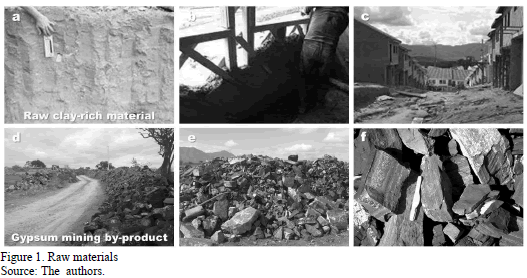
<body><![CDATA[<p><font size="2" face="Verdana, Arial, Helvetica, sans-serif">Compressed earth blocks (CEBs) play a major role in   improving the environmental efficiency and sustainability of buildings and   contributes to worldwide economic prosperity and infrastructural development.   On the other hand, the production processes of construction materials have a   considerable impact on the environment. The utilization of earth in housing   construction is one of the oldest and most common methods used. CEBs are one of   the oldest identifiable man-made building materials which are becoming more   popular due to their simplicity and low cost, relative abundance of materials,   good performance (good thermal and acoustic properties), and at the end of a   building's life the clay material can easily be reused by grinding, wetting or   returned to the ground without any damage to the environment &#91;1&#93;. However,   despite their advances, further studies are needed in order to improve their   durability and mechanical properties, both important quality control measures   for manufacturers and builders. Many additives such as cement, lime, asphalt   emulsions, bituminous materials, and natural and industrial by-products have   been tested to improve the mechanical properties and to enhance the durability   of the compacted blocks &#91;1-6&#93;. Portland cement has been by far the most used   material for soil stabilization &#91;2,5,6&#93;. However, due to the high energy   consumption necessary for its manufacture and the consequent environmental   damage caused by the release of high quantities of greenhouse gases during its   production, the cement industry has been highlighted as one of the major   contributors of anthropogenic CO<sub>2</sub> emissions emitting about 5%   globally &#91;7-8&#93;. In view of the above mentioned, several research activities are   directed towards partial or total substitution of Portland cement by pozzolanic   binders, e.g. lime, fly ash, and natural pozzolans among others. The worldwide   development of mining produces large volumes of mining wastes and their   disposal cause major challenges and serious economic and environmental   problems. Mining of industrial minerals is a special case as far as mining   waste generation is concerned, since they are mostly inert used directly in   restoration work. The problem is the need for integrated management, including   the removal and restoration, rather than the generation of hazardous materials.   Gypsum is mined from Cretaceous sedimentary rocks at various locations in   Colombia. However, the mining wastes produced after the extraction of gypsum is   not used for restoration. Lately, researchers are making efforts to reduce the   amount of waste by finding alternative uses for it. The need to conserve the   traditional building materials that are facing depletion has necessitated the   search for alternative materials &#91;9&#93;. In the 1970s and 1980s a new generation   of manual, mechanical and motor-driven presses appeared, leading to the   emergence today of a genuine market for the production and application of CEBs   &#91;4&#93;. They have excellent insulating properties - reducing heating and cooling   costs. The compressive strengths of the blocks depend on their densities. The   compressive strength of a soil can be increased by chemical stabilization. This   project was designed to prepare locally available soils, make building blocks   with a block press and test them to determine the engineering properties of   CEBs. The objective was to test local soils to see if they could be used for   low housing construction. CEB technology offers an alternative to traditional building practices that is relatively inexpensive,   uses local resources, and in some cases, has been found to last several   millennia &#91;10&#93;. A number of standards have also developed for CEB test   procedures &#91;10-12&#93;. However, unlike other masonry units, there is little   general consensus on test procedure for CEBs. The main objective of this study   is to investigate the effects of the aforementioned types of industrial   residues on the properties of CEBs. Results of experimental studies are also   presented. The compressive strength of blocks measured by different tests is  also compared with other parameters, such as three-point bending strength.</font></p>     <p>&nbsp;</p>     <p><font size="3" face="Verdana, Arial, Helvetica, sans-serif"><b>2. Materials and methods</b></font></p>     <p><font size="2" face="Verdana, Arial, Helvetica, sans-serif"><b>2.1. Materials</b></font></p>     <p><font size="2" face="Verdana, Arial, Helvetica, sans-serif">The materials used for the industrial trial consisted of raw clay-rich  material and gypsum mining waste (<a href="#fig01">Fig. 1</a>), and lime.</font></p>     <p align="center"><font size="2" face="Verdana, Arial, Helvetica, sans-serif"><a name="fig01"></a></font><img src="/img/revistas/dyna/v81n188/v81n188a05fig01.gif"></p>     <p><font size="2" face="Verdana, Arial, Helvetica, sans-serif"><b>2.1.1. Raw  clay-rich material</b></font></p>     <p><font size="2" face="Verdana, Arial, Helvetica, sans-serif">The raw clay-rich material used in this study is extracted   by Polypus of Colombia for the development of the housing project &quot;Prados de   Laurentia&quot; at Floridablanca (Santander), which offers an innovative   construction system. The clay soil forms part of the Quaternary Fine   Member of the Bucaramanga Formation and presents characteristics   suitable for the production of CEBs &#91;13&#93;</b> with dimensional tolerances conform to  ASTM Standards.</font></p>     <p><font size="2" face="Verdana, Arial, Helvetica, sans-serif"><b>2.1.2. Gypsum  mining by-product</b></font></p>     <p><font size="2" face="Verdana, Arial, Helvetica, sans-serif">Gypsum mining wastes,   which are disposed after extraction of gypsum from Cretaceous sedimentary rocks   of the Rosablanca Formation in several mines located around Los Santos   (Santander), was used as a chemical additive to protect CEBs against moisture  decomposition and stabilize them.</font></p>     ]]></body>
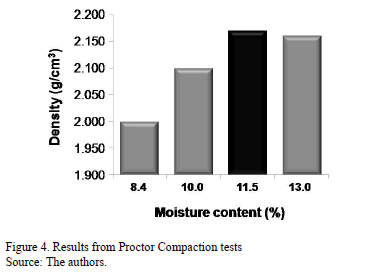
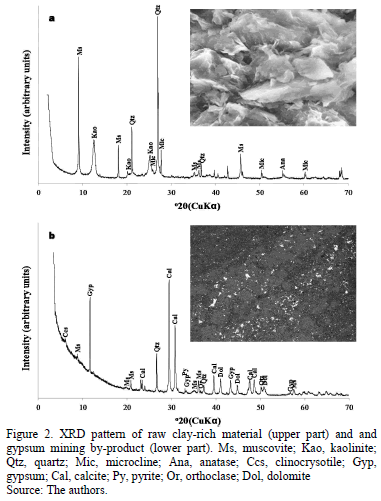
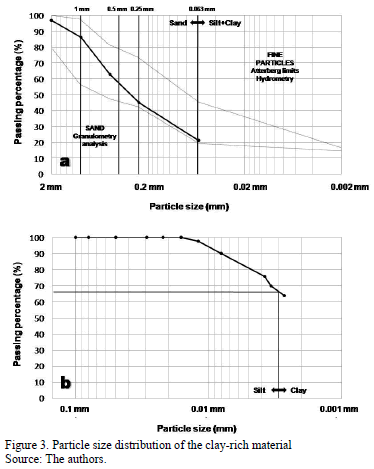
<body><![CDATA[<p><font size="2" face="Verdana, Arial, Helvetica, sans-serif"><b>2.1.3 Lime</b></font></p>     <p><font size="2" face="Verdana, Arial, Helvetica, sans-serif">An industrial lime was also used as a stabilizer.</font></p>     <p><font size="2" face="Verdana, Arial, Helvetica, sans-serif"><b><i>2.2. Properties of  materials</i></b></font></p>     <p><font size="2" face="Verdana, Arial, Helvetica, sans-serif">Qualitative   determination of major crystalline phases of the raw clay-rich material and the   gypsum mining by-product was carried out by using a Siemens D500 X-Ray   Diffractometer, operating in the Bragg-Brentano geometry with CuK<sub>1 </sub>radiation (l=1.5406 Å), at 40 kV and 30 mA, and a graphite monochromator.   Data was collected in the 2-70&deg; 2<font face="Symbol">q</font> range (0.02&deg; step size). The   crystalline patterns were compared with the standard line patterns from the   Powder Diffraction File database supplied by the International Centre for   Diffraction Data (ICDD), with the help of Joint Committee on Powder Diffraction   Standards (JCPDS) files for inorganic compounds. The major crystalline phases   found in the clay-rich material are quartz, microcline, muscovite, anatase and   kaolinite (<a href="#fig02">Fig. 2a</a>). As shown in <a href="#fig02">Fig. 2b</a>, the gypsum mining by-product is   characterized by the occurrence of quartz, clinochlore, gypsum, dolomite,   Mg-calcite and calcite. The chemical composition of this was investigated by   X-ray fluorescence using a Shimazu EDX 800 HS XRF spectrometer to quantify the   elements in the gypsum mining waste using the method of fundamental parameters   (FP) with the software DXP-700E Version 1.00 Rel. 014. The chemical composition   of the gypsum mining waste used in this study was 48.64% CaO, 27.31% SiO<sub>2</sub>,   9.16% MgO, 6.13% SO<sub>3</sub>, 4.81% Al<sub>2</sub>O<sub>3</sub>, 2.41% Fe<sub>2</sub>O<sub>3</sub>,  1.53% K<sub>2</sub>O, 0.47 SrO%, 0.20 MnO, 0.11% BaO and 0.02% CuO. </font></p>     <p align="center"><font size="2" face="Verdana, Arial, Helvetica, sans-serif"><a name="fig02"></a></font><img src="/img/revistas/dyna/v81n188/v81n188a05fig02.gif"></p>     <p><font size="2" face="Verdana, Arial, Helvetica, sans-serif">The particle size   distribution (the relative content of clay, sand and gravel) of the clay-rich   material (<a href="#fig03">Fig. 3</a>) obtained by combined sieve and hydrometer analyses according to the standards ASTM  C136-06 &#91;14&#93;</b> and ASTM D1140-00 &#91;15&#93;.</font></p>     <p align="center"><font size="2" face="Verdana, Arial, Helvetica, sans-serif"><a name="fig03"></a></font><img src="/img/revistas/dyna/v81n188/v81n188a05fig03.gif"></p>     <p><font size="2" face="Verdana, Arial, Helvetica, sans-serif"><a href="#fig03">Fig. 3a</a> reveals that the clay-rich material is within the   recommended limits for the manufacture of CEBs, which according to Houben et   al. &#91;16&#93;, are: gravel (0-40%), sand (25-80%), silt (10-25%) and clay (8-30%).   The fine grained portion (amount of soil to pass a No. 200 mesh) was 21.1%,   which was used in determining the percentages of clay (13.5%) and silt (7.5%)   by the hydrometry test (<a href="#fig03">Fig. 3b</a>). According to Cu&eacute;llar et al. &#91;17&#93;, clay   properties depend on the structural characteristics and particle size (&lt;   2µm). Therefore, this test only measures the clay/silt ratio for the fine  grained portion of the soil and not the entire soil itself. </font></p>     <p><font size="2" face="Verdana, Arial, Helvetica, sans-serif">The Atterberg's   limits of the clay-rich   material determined according to the standard ASTM D4318-10 &#91;18&#93;,   using the plasticity chart with the following results: liquid limit (LL) of 27.3%, plastic limit (PL) of 21.2%   and plasticity index (PI) of 6.1%, with an acceptable correlation (R<sup>2</sup> = 0.739). The clay-rich material can be classified as SM-SC (silty-clayey sand   with low plasticity) using the ASTM D2487-11 &#91;19&#93;. It corresponds to a   coarse-grained (&gt; 50% retained on No. 200 mesh) sandy (&gt; 50% of coarse   fraction is &lt; 4.75 mm (No. 4 mesh)). Similarly, it contains &gt; 12 % of  material passing the No. 200 mesh, LL &lt; 50%, 4 &le; IP &le; 7 and Atterberg's limits on or above the &quot;A&quot; Line. </font></p>     <p><font size="2" face="Verdana, Arial, Helvetica, sans-serif">For   the purpose of sample preparation, dry density and moisture content values were   established. Therefore, Proctor Compaction tests were carried out in accordance   to the standard ASTM D1557-12 &#91;20&#93;</b> in order to establish values of the maximum   dry density and optimum moisture (<a href="#fig04">Fig. 4</a>) for the non-stabilized and stabilized   CEBs. This was to guide the research on the possible range of moisture contents  at which the dry unit weight of the clay-rich soil will   be a maximum and to achieve the best compaction effort. The clay-rich material   used in this study has a natural moisture content (optimum moisture) of 11.5%.   The moisture content of the sample at the point of testing includes this   natural moisture in the clay soil and the water added at the point of mixing.   The clay was used at its natural moisture content because in practice, an oven  drying operation will not be feasible. </font></p>     ]]></body>
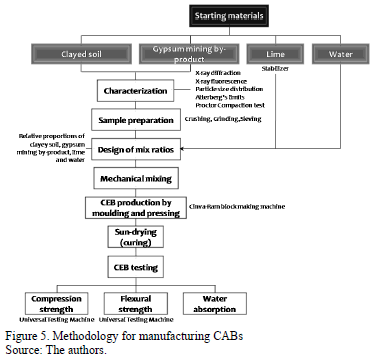
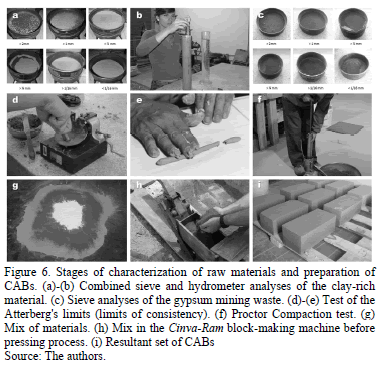
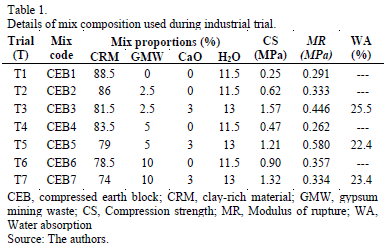
<body><![CDATA[<p align="center"><font size="2" face="Verdana, Arial, Helvetica, sans-serif"><a name="fig04"></a></font><img src="/img/revistas/dyna/v81n188/v81n188a05fig04.gif"></p>     <p><font size="2" face="Verdana, Arial, Helvetica, sans-serif"><b><i>2.3. Sample  preparation, mix compositions and testing</i></b></font></p>     <p><font size="2" face="Verdana, Arial, Helvetica, sans-serif"><a href="#fig05">Fig. 5</a>  illustrates a block diagram showing the methodology followed in the   manufacturing of the CEBs during their study. The raw clay-rich material and   the gypsum mining by-product were naturally dried for three weeks under the   following environmental conditions: average temperature of 24<sup>o</sup>C and   relative humidity of 83.5%. The mining waste subjected to rough crushing with a   Retsch Jaw Crusher BB200 to ~ 2 mm and milling with a Retsch RM100 mortar   grinder mill to clay particle size. Both raw clay-rich material and gypsum   mining by-product sieved with a Ro-Tap sieve shaker (using 4, 10, 20, 40, 60,   100 and 200 mesh series). The mining waste sieved and the <em>particle size</em> below 200 mesh used. In order to evaluate the engineering properties of CEBs, with gypsum   mining by-product as stabilizing agent, several mixtures were prepared for mix design of preparation of CEBs. The mix   proportions were prepared based on the dry weights of the ingredients. The   quantities of materials obtained from the mix design was measured with the aid   of a weighing balance. CEBs were produced with a <em>Cinva</em>-<em>Ram</em> block making machine, a technology that offers   an alternative kind of building construction which is more accessible and of   high quality. For testing, 91 CEBs (13 for each mixture) were prepared. The  cuboidal shape and size (290 x 100 x 140 mm) tolerances of the masonry units respected. </font></p>     <p align="center"><font size="2" face="Verdana, Arial, Helvetica, sans-serif"><a name="fig05"></a></font><img src="/img/revistas/dyna/v81n188/v81n188a05fig05.gif"></p>     <p><font size="2" face="Verdana, Arial, Helvetica, sans-serif"><a href="#fig06">Fig. 6</a> illustrates the preparation of the CEBs. Several   mixtures were loaded into the block making machine. <a href="#tab01">Table 1</a> reports the   details of the mixture compositions and the assessment of the process of  manufacture of CEBs produced during the tests. </font></p>     <p align="center"><font size="2" face="Verdana, Arial, Helvetica, sans-serif"><a name="fig06"></a></font><img src="/img/revistas/dyna/v81n188/v81n188a05fig06.gif"></p>     <p align="center"><font size="2" face="Verdana, Arial, Helvetica, sans-serif"><a name="tab01"></a></font><img src="/img/revistas/dyna/v81n188/v81n188a05tab01.gif"></p>     <p><font size="2" face="Verdana, Arial, Helvetica, sans-serif">To CEBs not stabilized with lime, the water content was  increased by 1.5% compared to 3% lime, as suggested in Perez &amp; Pach&oacute;n &#91;21&#93;  and given the reaction ratio of water/lime which corresponds to 0.5:1. These  authors suggest minimal use of lime, as it can generate a low performance. An  automated hydraulic pump, connected to a mold frame by a hydraulic hose and  cylinder, was used to gradually pressurize the cylinder which in turn applied  pressure to the mixture in the mold. After the pressure was applied for a few  seconds, it was released and a CEB was extruded by the machine onto a conveyor  belt for transfer to storage. In order to obtain comparable results, five  different series of samples were prepared for the tests, a separate series for  each percent material addition. CEBs were kept undisturbed under controlled  environmental conditions (average temperature of 25 <sup>o</sup>C and relative  humidity of 80%) during the curing phase (28 days). No detrimental effects due  to shrinking/swelling, such as cracking, were observed. Engineering tests  conducted in a computerized device for mechanical assays according to the  standard ASTM C67-11 &#91;22&#93;. A Universal Testing Machine (PINZUAR, model  PC-160/116) with a maximum load of 1000kN was used in the testing procedure,  taking into account its accuracy, flexibility, high performance, and innovative  standard features; large test space to accommodate standard, medium and large  size specimens, grips, fixtures and environmental subsystem, and environmental  chamber dimension: 500 x 255 x 350 mm. Data was recorded automatically to the  computer system. All CEBs were subjected to a compressive load at a crosshead  speed of 0.5 mm/min. A test of compressive strength was conducted to  determine the level of deformation of the material. The three-point bending  flexural strength test was conducted with a crosshead speed of 0.2 mm/s and a  distance between the supports of 90 mm. The test provides values for the  modulus of rupture (<i>MR</i>) of the CEBs. <i>MR</i> was calculated using the following  equation:</font></p>     <p><img src="/img/revistas/dyna/v81n188/v81n188a05eq01.gif"></p>     <p><font size="2" face="Verdana, Arial, Helvetica, sans-serif">Where <i>MR</i> is the  flexural modulus of rupture (MPa), <i>P</i> is the maximum applied load (N), <i>a</i> is  the distance between line of fracture and the nearest support (mm), <i>b</i> and <i>d</i> are the width and thickness of the specimen (mm), respectively.</font></p>     ]]></body>

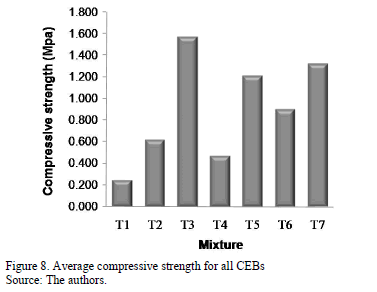
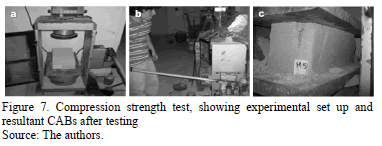
<body><![CDATA[<p><font size="2" face="Verdana, Arial, Helvetica, sans-serif">The durability of the CEBs was assessed as follows: after  28 days of curing time, the CEBs were weighed; then, they were submerged in  water for 24 h and then tested in compression after repeated wetting and drying  on their unconfined compressive strength values. Repeated wetting and drying of  the blocks can alter the soil structure and create concentrated weaknesses  through cracking and the infiltration of water. The total water absorption  capacity of the CEBs was established by the water absorption (<i>WA</i>) test. The water of absorption can be  determined from the moist weight of specimens after submersion according to the  standard ASTM C67-11 &#91;22&#93;. The water absorption during immersion was calculated  using the following equation:</font></p>     <p><img src="/img/revistas/dyna/v81n188/v81n188a05eq02.gif"></p>     <p><font size="2" face="Verdana, Arial, Helvetica, sans-serif">Where <i>W<sub>d</sub></i> is the mass of the dry specimens before submersion (g) and <i>W<sub>w</sub></i> is the wet mass of the specimen after being removed  from the water tank (g).</font></p>     <p>&nbsp;</p>     <p><font size="3" face="Verdana, Arial, Helvetica, sans-serif"><b>3.   Test results and discussion</b></font></p>     <p><font size="2" face="Verdana, Arial, Helvetica, sans-serif"><a href="#tab01">Table 1</a> shows the average values  of results for the compression, flexural and water absorption tests. Each value  represents the average of 5 specimens. The number and series of specimens was  according to ASTM standards and depending on the number of different mixtures  tested, with a minimum of five specimens per batch.</font></p>     <p><font size="2" face="Verdana, Arial, Helvetica, sans-serif"><b><i>3.1. Compressive strength of the CEBs</i></b></font></p>     <p><font size="2" face="Verdana, Arial, Helvetica, sans-serif">The uniaxial compressive stress is reached when the  material fails completely. The compressive strength test determines the  relationship stress vs. strain of the CEBs. <a href="#fg07">Fig. 7</a> shows a representative set  of the experimental test to determine the compressive strength of the CEBs and results  are depicted in <a href="#tab01">Table 1</a>.</font></p>     <p align="center"><font size="2" face="Verdana, Arial, Helvetica, sans-serif"><a name="fg07"></a></font><img src="/img/revistas/dyna/v81n188/v81n188a05fig07.gif"></p>     <p><font size="2" face="Verdana, Arial, Helvetica, sans-serif"><a href="#fig08">Fig. 8</a> illustrates the average compressive strength of the CEBs. It also shows the influence of the gypsum mining  by-product on the compressive strength of specimens obtained after 28 days of curing time under dry  conditions. From trial T1, the simple compression test reached an average value  for 5 units of 0.251 MPa. This value must be taken into account to compare the  results with other trials. CEB1 tends to separate at the ends while the center  remains consistent. From trial T2, the simple compression test reached an  average value for 5 units of 0.624 MPa, higher than that obtained in the trial  T1. CEBs tend to separate at the ends while the center remains consistent. From  trial T3, the simple compression test reached an average value for 5 units of  1.574 MPa, higher than that obtained in trials T1 and T2. CEBs tend to separate  at the ends, with some of them displaying broken side surfaces, while the front  and center remain consistent. From trial T4, the simple compression test  reached an average value for 5 units of 0.466 MPa, slightly higher than that  obtained in the trial T1. Deep cracks were observed on the CEBs although they  did not disintegrate completely. From trial T5, the simple compression test  reached an average value for 5 units of 1.206 MPa, slightly lower than that  obtained in the trial T3. Some CEBs displayed cracks and others tended to  separate in their external surfaces while the center remains consistent.  From trial T6, the simple compression test reached an average value for 5 units  of 0.901 MPa, slightly lower than that obtained in the trial T5. Deep cracks  were observed on the CEBs and they tended to separate in their external  surfaces although they did not disintegrate completely. From trial T7, the  simple compression test reached an average value for 5 units of 1.319 MPa,  which is in the range of values obtained between the trials T3 and T5. CEBs  tend to separate on the sides and front, and some of them were crossed by  cracks along their front. </font></p>     ]]></body>
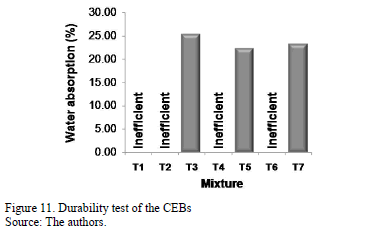
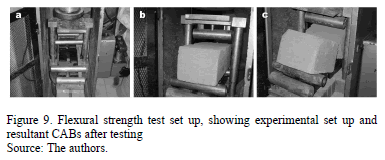
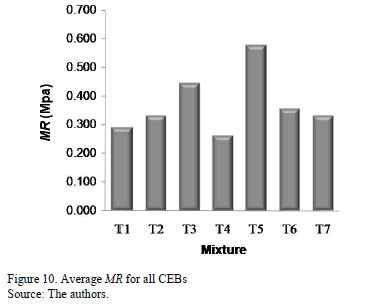
<body><![CDATA[<p align="center"><font size="2" face="Verdana, Arial, Helvetica, sans-serif"><a name="fig08"></a></font><img src="/img/revistas/dyna/v81n188/v81n188a05fig08.gif"></p>     <p><font size="2" face="Verdana, Arial, Helvetica, sans-serif">From <a href="#fig08">Fig. 8</a>, we observe that the behavior of  unstabilized CEBs (trials T1, T2, T4 and T6), lies well below the values  recommended by Colombian technical standards, which suggest a minimum value of  compressive strength of 1.2 MPa. Therefore, it would not be advisable to use  them for the development of individual blocks. The best performances were  obtained in the mixtures stabilized with lime, obtaining the best value for the  mixtures from the trial T3 containing 2.5% gypsum mining waste and 3% lime,  showing an improvement of 52.7% (6 times better) with respect to CEBs obtained  from the trial T1. Increasing the gypsum mining waste content above 2.5%  (trials T5 and T7), promote a increase in the compressive strength but remains  below the value obtained from the trial T3. Using the gypsum mining waste  without the presence of lime, the results showed an improvement of between 150  and 250% (up to 3 times better). For all cases, mixtures stabilized without  using lime showed compressive strength values lower than those obtained from  lime stabilized CEBS.</font></p>     <p><font size="2" face="Verdana, Arial, Helvetica, sans-serif"><b><i>3.2. Flexural strength characteristic of the CEBs</i></b></font></p>     <p><font size="2" face="Verdana, Arial, Helvetica, sans-serif">It is the ability  of a masonry brick, beam or slab to resist failure in bending. The typical load  and deflection from beam-flexural test is shown in <a href="#fig09">Fig. 9</a> and results are  depicted in <a href="#tab01">Table 1</a>. </font></p>     <p align="center"><font size="2" face="Verdana, Arial, Helvetica, sans-serif"><a name="fig09"></a></font><img src="/img/revistas/dyna/v81n188/v81n188a05fig09.gif"></p>     <p><font size="2" face="Verdana, Arial, Helvetica, sans-serif"><a href="#fig10">Fig. 10</a> illustrates the average <i>MR</i> of the CEBs. The  non-stabilized CEBs from the trial T1 have a load carrying capacity of 1133 N.  This mixture achieved a MR in the range of 0.202-0.369 MPa (with an average of  0.291 MPa). The non-stabilized CEBs from the trial T2 containing clay-rich  material (86%) and gypsum mining waste (2.5%) have a load carrying capacity of  1300 N. This mixture achieved a higher MR, in the range of 0.278-0.395 MPa  (with an average of 0.334 MPa). The addition of gypsum mining waste helps to  stabilize the clay-rich material, improving the engineering properties of CEBs.  The stabilized CEBs from the trial T3 containing clay-rich material (81.5%),  gypsum mining waste (2.5%) and lime (3%) have a load carrying capacity of 1767  N, which is higher than the CEBs obtained in the trials T1 and T2, increasing the  stress resistance. This mixture achieved an MR in the range of 0.405-0.505 MPa  (average of 0.446 MPa). The non-stabilized CEBs from the trial T4, containing  clay-rich material (83.5%) and gypsum mining waste (5%), have the lower load  carrying capacity of 1000 N. This mixture achieved an MR in the range of  0.233-0.316 MPa (with an average of 0.262 MPa). The stabilized CEBs from the  trial T5, containing clay-rich material (79%), gypsum mining waste (5%) and  lime (3%), have the higher load carrying capacity of 2233 N. The higher MR  values (0.482-0.758 MPa; an average of 0.580 MPa) obtained in the mixtures with  a 5% of gypsum mining waste. The non-stabilized CEBs from the trial T6,  containing clay-rich material (78.5%) and gypsum mining waste (10%) have a load  carrying capacity of 1433 N. This mixture achieved an MR in the range of  0.328-0.404 MPa (an average of 0.357 MPa). The stabilized CEBs from the trial  T7, containing clay-rich material (74%), gypsum mining waste (10%) and lime  (3%) have a load carrying capacity of 1400 N. This mixture achieved an MR in  the range of 0.301-0.363 MPa (with an average of 0.334 MPa).</font></p>     <p align="center"><font size="2" face="Verdana, Arial, Helvetica, sans-serif"><a name="fig10"></a></font><img src="/img/revistas/dyna/v81n188/v81n188a05fig10.gif"></p>     <p><font size="2" face="Verdana, Arial, Helvetica, sans-serif">These results  show that although the gypsum mining waste meets the expectations and proposals  for the compaction point load strength of the CEBs, doses greater than 5%  strongly affect the mixture. These results confirmed the results obtained  from the compressive strength test. According to the Masonry Standards Joint  Committee (MSJC) &#91;23&#93;, the allowable flexural tensile stress, or modulus  of rupture, for clay and concrete masonry is 0.21 MPa. Using this as the  quality standard, the allowable rupture load could be determined. The CEBs  showed flexural strengths between 0.262 and 0.580 MPa, which is below the  range of 0.5-2 MPa reported in previous studies &#91;24-25&#93;, except for the MR  obtained from the trial T5 (0.580 MPa). From trial T1, the population of data  has a mean of 0.175 MPa and their standard deviation is 0.152. From trial T2,  the population of data has a mean of 0.200 MPa and their standard deviation is  0.168. From trial T3, the population of data has a mean of 0.268 MPa and their  standard deviation is 0.221. From trial T4, the population of data has a mean  of 0.157 MPa and their standard deviation is 0.132. From trial T5, the  population of data has a mean of 0.348 MPa and their standard deviation is  0.300. From trial T6, the population of data has a mean of 0.214 MPa and their  standard deviation is 0.177. From trial T7, the population of data has a mean  of 0.201 MPa and their standard deviation is 0.165. The fourth population has  the smaller standard deviation than the other populations because its values  are mostly close to 0.132. After performing durability and strength tests on  the CEBs, results show that most of them perform at an acceptable level in all  tests. However, gypsum mining waste doses of 10% or more will reduce  workability of the CEBs.</font></p>     <p><font size="2" face="Verdana, Arial, Helvetica, sans-serif"><b><i>3.3. Durability testing of the CEBs</i></b></font></p>     <p><font size="2" face="Verdana, Arial, Helvetica, sans-serif">The durability of the CEBs assessed by determining the  effect of wetting and drying on their compressive strength values, although without the number of saturation cycles  suggested by Krosnowski &#91;25&#93;, which can  alter the soil structure and create concentrated weaknesses through cracking  and the infiltration of water. Results obtained from the water absorption test  give a general idea to assess the behavior of the CEBs under extreme  conditions. In the case of Bucaramanga and its metropolitan area, one of these  extreme conditions is the possibility of a flood, particularly affecting the  CEBs that form the base of a wall, which are more likely to be submerged  completely and should bear the burden of the entire wall. As the density of  soil is increased, its porosity reduced and less water can penetrate it &#91;26&#93;. Water absorption is used as an indicator for  the specimen's resistance to immersion. <a href="#tab01">Table 1</a> and <a href="#fig11">Fig. 11</a> present results  from the durability test. During the saturation, each CEB was carefully  examined for any observable cracking or degradation effects. </font></p>     ]]></body>
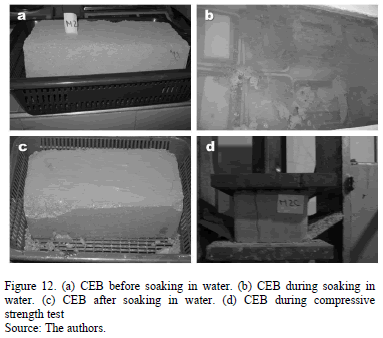
<body><![CDATA[<p align="center"><font size="2" face="Verdana, Arial, Helvetica, sans-serif"><a name="fig11"></a></font><img src="/img/revistas/dyna/v81n188/v81n188a05fig11.gif"></p>     <p><font size="2" face="Verdana, Arial, Helvetica, sans-serif"><a href="#fig12">Fig. 12</a> shows CEBs soaked in water and the  detrimental effects of saturation. The non-stabilized CEBs from the trial T1  showed a loss of consistency, disintegrating completely, and developing a silty  sand mixture. The non-stabilized CEBs from the trial T2 containing clay-rich  material (86%) and gypsum mining waste (2.5%), showed a loss of</font> <font size="2" face="Verdana, Arial, Helvetica, sans-serif">consistency, disintegrating completely, and  developing a silty sand mixture, in which the gypsum mining waste separated and  was easily differentiated from the mixture. The stabilized CEBs from the trial  T3 containing clay-rich material (81.5%), gypsum mining waste (2.5%) and lime  (3%), retained their shape but their size increased from 5 to 10 mm, and  deformation was observed at their edges and corners. The average water  absorption was 25.502%, being the highest from the CEBs that retained their  shape. The compressive strength after water absorption showed an average value  of 0.580 MPa. The non-stabilized CEBs from the trial T4, containing clay-rich  material (83.5%) and gypsum mining waste (5%), showed a similar behavior to  that observed in the trial T2, with CEBs losing consistency, disintegrating  completely, and developing a silty sand mixture, in which the gypsum mining  waste separated and was easily differentiated from the mixture. The stabilized  CEBs from the trial T5, containing clay-rich material (79%), gypsum mining  waste (5%) and lime (3%), retained their shape but their size increased by up  to 5 mm, and deformation was observed at their edges and corners. The average  water absorption was 22.378%, being the lowest from CEBs that retained their  shape. The compressive strength after water absorption showed an average value  of 0.860 Mpa, which is higher when compared with that observed in the trial T3.  The non-stabilized CEBs from the trial T6, containing clay-rich material  (78.5%) and gypsum mining waste (10%), showed a similar behavior to that  observed in trials T2 and T4, with CEBs losing consistency, disintegrating  completely, and developing a silty sand mixture, in which the gypsum mining  waste separated and was easily differentiated from the mixture. The stabilized  CEBs from the trial T7, containing clay-rich material (74%), gypsum mining  waste (10%) and lime (3%), showed a great loss of material to the edges and  corners, which took a rounded shape. The average water absorption was 23.360%,  although this percentage is not representative because possibly could  correspond to the loss of material and not to the degree of water absorption.  Therefore, the compressive strength test after water absorption was not  performed for this trial. The water absorption tests reveal that stabilizing  the mixtures with lime ensures better structural consistency. According to <a href="#fig11">Fig.  11</a>, the results obtained were not satisfactory regarding CEBS from trials T1,  T2, T4 and T6 prepared in the absence of lime, which showed results losing  consistency, disintegrating completely, and developing a silty sand mixture, in  which the gypsum mining waste separated and easily differentiated from the  mixture. Therefore, these mixtures are described as inefficient and their  behavior can be explained due to the presence of sulphates in the gypsum mining  waste that are sensitive to water so that when wetted they may become easily  detached. CEBs from trials T3, T5 and T7 containing 3% lime, kept in shape,  showing deviation in their lengths (~ 5-10 mm) and disintegration at their  edges and corners. Although CEBs from trial T3 holds its shape, CEBs from trial  T5 showed the best consistency, keeping their shape better. CEBs from trial T7  suffered further disintegration, showing a great loss of material to the edges  and corners, which took a rounded shape. Regarding the percentage of moisture  in weight, CEBs from trials T3 and T5 showed values of 25.502% and 22.378%,  respectively; CEBs from the trial T7 showed a percentage of moisture in weight  of 23.036%, although due to the loss of material at the edges, cannot be  considered as representative. These results are considered good considering the  values obtained in previous studies &#91;1,13,27-29&#93;. After water absorption, the  non-stabilized and stabilized CEBs were subjected to simple compression test to  assess the degree of consistency while being subjected to excessive moisture.  Results show that the mixtures have a cohesive behavior when having excess  moisture, with the clay-rich material taking a plastic behavior. Compressive  strength values of 0.593 MPa and 0.885 MPa for CEBs from trials T3 and T5,  respectively, are still sufficient to maintain a standing wall in a building.  According to Krosnowski &#91;25&#93;, a decrease in the compressive strength values  with the number of saturation cycles is expected to occur; however, the rate at  which the compressive strength decreases also appears to decrease as the number  of saturation cycles increases.</font></p>     <p align="center"><font size="2" face="Verdana, Arial, Helvetica, sans-serif"><a name="fig12"></a></font><img src="/img/revistas/dyna/v81n188/v81n188a05fig12.gif"></p>     <p>&nbsp;</p>     <p><font size="3" face="Verdana, Arial, Helvetica, sans-serif"><b>4. Conclusions</b></font></p>     <p><font size="2" face="Verdana, Arial, Helvetica, sans-serif">A laboratory test program conducted to evaluate the  potential use of gypsum mining waste to produce CEBs. The hardened properties  such as compressive strength, flexural strength, and water absorption was  investigated. Subordinately, test results may provide a means to reduce a waste  disposal problem while providing the construction industry with a new, useful,  low cost raw material. Based on the experimental tests conducted on the CEBs,  the following conclusions can be drawn:</font></p>     <p><font size="2" face="Verdana, Arial, Helvetica, sans-serif">The liquid and plastic limits of the clay-rich material  are appropriated for the production of CEBs, although it is advisable to test a  number of natural fibers to increase compressive and flexural  strength and to avoid excessive cracking. </font></p>     <p><font size="2" face="Verdana, Arial, Helvetica, sans-serif">Clay-rich material correspond to a granular soil, with  &gt; 50% of sand and gravel size, but the soil used is a sandy soil because  &gt; 50% of the coarse fraction is &lt; 4.75 mm (No. 4 mesh ASTM). According to  this and the behavior of the fine fraction of the soil, it classified as a clayed  silty sand soil, settling near the boundary line suitable for the preparation  of CEBs.</font></p>     <p><font size="2" face="Verdana, Arial, Helvetica, sans-serif">The chemical composition of the gypsum mining waste  reveals that the elemental content would be suitable in principle for chemical  stabilization, avoiding a waste with high levels of visible gypsum as this  could create adverse conditions for the development of CEBs.</font></p>     <p><font size="2" face="Verdana, Arial, Helvetica, sans-serif">Non-stabilized CEBs showed values of compressive strength  up to 0.251 MPa, which are below recommended limits. However, CEBs from the  trial T3 (2.5% of gypsum mining waste and 3% of lime), the compressive strength  was improved by up to 500% (5 times) reaching values of 1.574 MPa, that is  within the minimum range required by Colombian construction standards. </font></p>     ]]></body>
<body><![CDATA[<p><font size="2" face="Verdana, Arial, Helvetica, sans-serif">Stabilized CEBs showed much better values of modulus of rupture  compared with those obtained from non-stabilized CEBs. CEBs from the trial  T5(5% of gypsum mining waste and 3% of lime), showed the highest values of <i>MR</i>, achieving high levels of rigidity,  although in the compressive strength test they are lower than those obtained  for CEBs from the trial T3.</font></p>     <p><font size="2" face="Verdana, Arial, Helvetica, sans-serif">CEBs containing 10% gypsum mining waste showed compressive  strength values lower than those obtained for CEBs containing 5 or 2.5% gypsum  mining waste.</font></p>     <p><font size="2" face="Verdana, Arial, Helvetica, sans-serif">Non-stabilized CEBs from trials T2, T4 and T6, showed a  slight improvement in the engineering properties with respect to Non-stabilized  CEBs from trials T1, although not as pronounced as observed in lime stabilized  CEBs.</font></p>     <p><font size="2" face="Verdana, Arial, Helvetica, sans-serif">A significant improvement was displayed by lime stabilized  CEBs in extremely humid conditions, retaining their shape after being submerged  in water 24 hours that confirms the activating ability of lime to generate  reactions cementing between the clay-rich material and gypsum mining waste.</font></p>     <p><font size="2" face="Verdana, Arial, Helvetica, sans-serif">Non-stabilized CEBs, containing gypsum mining waste in  several percentages, after water absorption, showed a completely unacceptable  behavior; they completely disintegrated, making them unsuitable in extreme  conditions.</font></p>     <p><font size="2" face="Verdana, Arial, Helvetica, sans-serif">The results of this study reveal that the engineering  properties of the CEBs were not satisfactory in the criterion of authors,  suggesting additional experimental work to improve the engineering properties  of CEBs.</font></p>     <p>&nbsp;</p>     <p><font size="3" face="Verdana, Arial, Helvetica, sans-serif"><b>Acknowledgments</b></font></p>     <p><font size="2" face="Verdana, Arial, Helvetica, sans-serif">This research forms part of the undergraduate thesis of E.  Jaramillo and J. Plata. The authors acknowledge Andina Ingenier&iacute;a Ltda. for  their laboratory facilities and Polypus of Colombia for field work support. We  are indebted to Universidad Industrial de Santander for providing research  facilities. The authors also acknowledge to the anonymous referees for their  critical and insightful reading of the manuscript and are most grateful to the  above-named people and institutions for support.</font></p>     <p>&nbsp;</p>     ]]></body>
<body><![CDATA[<p><font size="3" face="Verdana, Arial, Helvetica, sans-serif"><b>References</b></font></p>     <!-- ref --><p><font size="2" face="Verdana, Arial, Helvetica, sans-serif"><b>&#91;1&#93;</b>  Oti, J.E., Kinuthia, J.M. and Bai, J., Compressive  strength and microstructural analysis of unfired clay masonry bricks. Engineering Geology, 109, pp. 230-240, 2009.  <a href="http://dx.doi.org/10.1016/j.enggeo.2009.08.010" target="_blank">http://dx.doi.org/10.1016/j.enggeo.2009.08.010</a></font>&nbsp;&nbsp;&nbsp;&nbsp;&nbsp;&nbsp;&nbsp;&nbsp;[&#160;<a href="javascript:void(0);" onclick="javascript: window.open('/scielo.php?script=sci_nlinks&ref=000094&pid=S0012-7353201400060000500001&lng=','','width=640,height=500,resizable=yes,scrollbars=1,menubar=yes,');">Links</a>&#160;]<!-- end-ref --><!-- ref --><p><font size="2" face="Verdana, Arial, Helvetica, sans-serif"><b>&#91;2&#93;</b> Yam&iacute;n-Lacouture, L.E.,  Phillips-Bernal, C., Reyes-Ort&iacute;z, J.C. y Ruiz-Valencia, D., Estudio de  vulnerabilidad s&iacute;smica, rehabilitaci&oacute;n y refuerzo de casas de adobe y tapia  pisada a nivel nacional. Centro de Estudios de Desastres y Riesgos (CEDERI),  Universidad de los Andes, Bogot&aacute;, Colombia, 2007.    &nbsp;&nbsp;&nbsp;&nbsp;&nbsp;&nbsp;&nbsp;&nbsp;[&#160;<a href="javascript:void(0);" onclick="javascript: window.open('/scielo.php?script=sci_nlinks&ref=000095&pid=S0012-7353201400060000500002&lng=','','width=640,height=500,resizable=yes,scrollbars=1,menubar=yes,');">Links</a>&#160;]<!-- end-ref --></font></p>     <!-- ref --><p><font size="2" face="Verdana, Arial, Helvetica, sans-serif"><b>&#91;3&#93;</b>  Oti, J.E., Kinuthia,  J.M. and Bai, J., Engineering properties of unfired clay masonry bricks.  Engineering Geology, 107, pp. 130-139, 2009. <a href="http://dx.doi.org/10.1016/j.enggeo.2009.05.002" target="_blank">http://dx.doi.org/10.1016/j.enggeo.2009.05.002</a></font>&nbsp;&nbsp;&nbsp;&nbsp;&nbsp;&nbsp;&nbsp;&nbsp;[&#160;<a href="javascript:void(0);" onclick="javascript: window.open('/scielo.php?script=sci_nlinks&ref=000097&pid=S0012-7353201400060000500003&lng=','','width=640,height=500,resizable=yes,scrollbars=1,menubar=yes,');">Links</a>&#160;]<!-- end-ref --><!-- ref --><p><font size="2" face="Verdana, Arial, Helvetica, sans-serif"><b>&#91;4&#93;</b>  Guillaud, H., Joffroy,  T. and Odul, P., Compressed earth blocks, in: Manual of design and construction  Vol. 2. Eshborn: Vieweg, 1995.    &nbsp;&nbsp;&nbsp;&nbsp;&nbsp;&nbsp;&nbsp;&nbsp;[&#160;<a href="javascript:void(0);" onclick="javascript: window.open('/scielo.php?script=sci_nlinks&ref=000098&pid=S0012-7353201400060000500004&lng=','','width=640,height=500,resizable=yes,scrollbars=1,menubar=yes,');">Links</a>&#160;]<!-- end-ref --></font></p>     <!-- ref --><p><font size="2" face="Verdana, Arial, Helvetica, sans-serif"><b>&#91;5&#93;</b>  Deboucha, S. and Hashim,  R., A review on bricks and stabilized compressed earth blocks. Scientific  Research and Essays, 6 (3), pp. 499-506, 2011.    &nbsp;&nbsp;&nbsp;&nbsp;&nbsp;&nbsp;&nbsp;&nbsp;[&#160;<a href="javascript:void(0);" onclick="javascript: window.open('/scielo.php?script=sci_nlinks&ref=000100&pid=S0012-7353201400060000500005&lng=','','width=640,height=500,resizable=yes,scrollbars=1,menubar=yes,');">Links</a>&#160;]<!-- end-ref --></font></p>     <!-- ref --><p><font size="2" face="Verdana, Arial, Helvetica, sans-serif"><b>&#91;6&#93;</b>  Guettala, A., Houari,  H., Mezghiche, B. and Chebili, R., Durability of lime stabilized earth blocks.  Courrier du Savoir, 2, pp. 61-66, 2002.    &nbsp;&nbsp;&nbsp;&nbsp;&nbsp;&nbsp;&nbsp;&nbsp;[&#160;<a href="javascript:void(0);" onclick="javascript: window.open('/scielo.php?script=sci_nlinks&ref=000102&pid=S0012-7353201400060000500006&lng=','','width=640,height=500,resizable=yes,scrollbars=1,menubar=yes,');">Links</a>&#160;]<!-- end-ref --> </font></p>     <!-- ref --><p><font size="2" face="Verdana, Arial, Helvetica, sans-serif"><b>&#91;7&#93;</b>  Mckinley, J.D., Thomas,  H.R., Williams, K.P. and Reid, J.M. Chemical analysis of contaminated soil  strengthened by the addition of lime. Engineering Geology, 60 (1-4), pp.  181-92, 2011. <a href="http://dx.doi.org/10.1016/S0013-7952(00)00100-9" target="_blank">http://dx.doi.org/10.1016/S0013-7952(00)00100-9</a></font>&nbsp;&nbsp;&nbsp;&nbsp;&nbsp;&nbsp;&nbsp;&nbsp;[&#160;<a href="javascript:void(0);" onclick="javascript: window.open('/scielo.php?script=sci_nlinks&ref=000104&pid=S0012-7353201400060000500007&lng=','','width=640,height=500,resizable=yes,scrollbars=1,menubar=yes,');">Links</a>&#160;]<!-- end-ref --><!-- ref --><p><font size="2" face="Verdana, Arial, Helvetica, sans-serif"><b>&#91;8&#93;</b>  Rao, S.M. and  Shivananda, P., Role of curing temperature in progress of lime-soil reactions.  Geotechnical and Geological Engineering, 23 (1), pp. 79-85, 2005.  <a href="http://dx.doi.org/10.1007/s10706-003-3157-5" target="_blank">http://dx.doi.org/10.1007/s10706-003-3157-5</a></font>&nbsp;&nbsp;&nbsp;&nbsp;&nbsp;&nbsp;&nbsp;&nbsp;[&#160;<a href="javascript:void(0);" onclick="javascript: window.open('/scielo.php?script=sci_nlinks&ref=000105&pid=S0012-7353201400060000500008&lng=','','width=640,height=500,resizable=yes,scrollbars=1,menubar=yes,');">Links</a>&#160;]<!-- end-ref --><!-- ref --><p><font size="2" face="Verdana, Arial, Helvetica, sans-serif"><b>&#91;9&#93;</b>  Chandra, S., Waste  materials used in concrete manufacturing. New Jersey: Noyes Publications  Westwood, 1977.    &nbsp;&nbsp;&nbsp;&nbsp;&nbsp;&nbsp;&nbsp;&nbsp;[&#160;<a href="javascript:void(0);" onclick="javascript: window.open('/scielo.php?script=sci_nlinks&ref=000106&pid=S0012-7353201400060000500009&lng=','','width=640,height=500,resizable=yes,scrollbars=1,menubar=yes,');">Links</a>&#160;]<!-- end-ref --></font></p>     <!-- ref --><p><font size="2" face="Verdana, Arial, Helvetica, sans-serif"><b>&#91;10&#93;</b>  ASTM E2392/M-10.  Standard guide for design of earthen wall building systems. American Society for Testing Materials, West Conshohocken,  Pennsylvania, PA 19428, USA, 2010.    &nbsp;&nbsp;&nbsp;&nbsp;&nbsp;&nbsp;&nbsp;&nbsp;[&#160;<a href="javascript:void(0);" onclick="javascript: window.open('/scielo.php?script=sci_nlinks&ref=000108&pid=S0012-7353201400060000500010&lng=','','width=640,height=500,resizable=yes,scrollbars=1,menubar=yes,');">Links</a>&#160;]<!-- end-ref --></font></p>     <!-- ref --><p><font size="2" face="Verdana, Arial, Helvetica, sans-serif"><b>&#91;11&#93;</b>  Walker, P.,  Specifications for stabilised pressed earth blocks. Masonry International, 10  (1), pp. 1-6, 1996.    &nbsp;&nbsp;&nbsp;&nbsp;&nbsp;&nbsp;&nbsp;&nbsp;[&#160;<a href="javascript:void(0);" onclick="javascript: window.open('/scielo.php?script=sci_nlinks&ref=000110&pid=S0012-7353201400060000500011&lng=','','width=640,height=500,resizable=yes,scrollbars=1,menubar=yes,');">Links</a>&#160;]<!-- end-ref --></font></p>     <!-- ref --><p><font size="2" face="Verdana, Arial, Helvetica, sans-serif"><b>&#91;12&#93;</b>  Centre for the  Development of Enterprise. Compressed earth blocks testing procedures, CDE,  Brussels, Belgium, 2000.    &nbsp;&nbsp;&nbsp;&nbsp;&nbsp;&nbsp;&nbsp;&nbsp;[&#160;<a href="javascript:void(0);" onclick="javascript: window.open('/scielo.php?script=sci_nlinks&ref=000112&pid=S0012-7353201400060000500012&lng=','','width=640,height=500,resizable=yes,scrollbars=1,menubar=yes,');">Links</a>&#160;]<!-- end-ref --> </font></p>     <!-- ref --><p><font size="2" face="Verdana, Arial, Helvetica, sans-serif"><b>&#91;13&#93;</b> Jaramillo, E.R. y Plata, J.M.,  Caracterizaci&oacute;n de geomateriales y evaluaci&oacute;n de su uso en la preparaci&oacute;n de  materiales para la construcci&oacute;n de vivienda sustentable en Bucaramanga. Tesis  de grado, Universidad Industrial de Santander, Bucaramanga, Colombia, 2012.    &nbsp;&nbsp;&nbsp;&nbsp;&nbsp;&nbsp;&nbsp;&nbsp;[&#160;<a href="javascript:void(0);" onclick="javascript: window.open('/scielo.php?script=sci_nlinks&ref=000114&pid=S0012-7353201400060000500013&lng=','','width=640,height=500,resizable=yes,scrollbars=1,menubar=yes,');">Links</a>&#160;]<!-- end-ref --></font></p>     <!-- ref --><p><font size="2" face="Verdana, Arial, Helvetica, sans-serif"><b>&#91;14&#93;</b>  ASTM C136-06. Standard  test method for sieve analysis of fine and coarse aggregates. American Society for Testing Materials, West Conshohocken,  Pennsylvania, PA 19428, USA, 2006.    &nbsp;&nbsp;&nbsp;&nbsp;&nbsp;&nbsp;&nbsp;&nbsp;[&#160;<a href="javascript:void(0);" onclick="javascript: window.open('/scielo.php?script=sci_nlinks&ref=000116&pid=S0012-7353201400060000500014&lng=','','width=640,height=500,resizable=yes,scrollbars=1,menubar=yes,');">Links</a>&#160;]<!-- end-ref --></font></p>     <!-- ref --><p><font size="2" face="Verdana, Arial, Helvetica, sans-serif"><b>&#91;15&#93;</b> ASTM D1140-00. Standard  test methods for amount of material in soils finer than No. 200 (75-<font face="Symbol">m</font>m)  Sieve. American Society for Testing Materials, West  Conshohocken, Pennsylvania, PA 19428, USA, 2006.    &nbsp;&nbsp;&nbsp;&nbsp;&nbsp;&nbsp;&nbsp;&nbsp;[&#160;<a href="javascript:void(0);" onclick="javascript: window.open('/scielo.php?script=sci_nlinks&ref=000118&pid=S0012-7353201400060000500015&lng=','','width=640,height=500,resizable=yes,scrollbars=1,menubar=yes,');">Links</a>&#160;]<!-- end-ref --></font></p>     <!-- ref --><p><font size="2" face="Verdana, Arial, Helvetica, sans-serif"><b>&#91;16&#93;</b>  Houben, H., Rigassi, V.  and Garnier, P., Compressed earth blocks production equipment, CDI and  CRATerre-EAG, Brussels, 1994.    &nbsp;&nbsp;&nbsp;&nbsp;&nbsp;&nbsp;&nbsp;&nbsp;[&#160;<a href="javascript:void(0);" onclick="javascript: window.open('/scielo.php?script=sci_nlinks&ref=000120&pid=S0012-7353201400060000500016&lng=','','width=640,height=500,resizable=yes,scrollbars=1,menubar=yes,');">Links</a>&#160;]<!-- end-ref --></font></p>     <!-- ref --><p><font size="2" face="Verdana, Arial, Helvetica, sans-serif"><b>&#91;17&#93;</b> Cu&eacute;llar, A., Mesa, F.A., Vargas,  C. y Perilla, J.E., Arcillas modificadas y caracterizadas por micro-raman y difracci&oacute;n  de rayos X. DYNA, 77 (164), pp. 39­44, 2010.    &nbsp;&nbsp;&nbsp;&nbsp;&nbsp;&nbsp;&nbsp;&nbsp;[&#160;<a href="javascript:void(0);" onclick="javascript: window.open('/scielo.php?script=sci_nlinks&ref=000122&pid=S0012-7353201400060000500017&lng=','','width=640,height=500,resizable=yes,scrollbars=1,menubar=yes,');">Links</a>&#160;]<!-- end-ref --></font></p>     <!-- ref --><p><font size="2" face="Verdana, Arial, Helvetica, sans-serif"><b>&#91;18&#93;</b>  ASTM D4318-10. Standard  test methods for liquid limit, plastic limit, and plasticity index of soils. American Society for Testing Materials, West Conshohocken,  Pennsylvania, PA 19428, USA, 2010.    &nbsp;&nbsp;&nbsp;&nbsp;&nbsp;&nbsp;&nbsp;&nbsp;[&#160;<a href="javascript:void(0);" onclick="javascript: window.open('/scielo.php?script=sci_nlinks&ref=000124&pid=S0012-7353201400060000500018&lng=','','width=640,height=500,resizable=yes,scrollbars=1,menubar=yes,');">Links</a>&#160;]<!-- end-ref --></font></p>     <!-- ref --><p><font size="2" face="Verdana, Arial, Helvetica, sans-serif"><b>&#91;19&#93;</b>  ASTM D2487-11. Standard  practice for classification of soils for engineering purposes (Unified Soil  Classification System). American Society for Testing  Materials, West Conshohocken, Pennsylvania, PA 19428, USA, 2011.    &nbsp;&nbsp;&nbsp;&nbsp;&nbsp;&nbsp;&nbsp;&nbsp;[&#160;<a href="javascript:void(0);" onclick="javascript: window.open('/scielo.php?script=sci_nlinks&ref=000126&pid=S0012-7353201400060000500019&lng=','','width=640,height=500,resizable=yes,scrollbars=1,menubar=yes,');">Links</a>&#160;]<!-- end-ref --></font></p>     <!-- ref --><p><font size="2" face="Verdana, Arial, Helvetica, sans-serif"><b>&#91;20&#93;</b>  ASTM D1557-12. Standard  test methods for laboratory compaction characteristics of soil using modified  effort (56,000 ft-lbf/ft3 (2,700 kN-m/m3)). American  Society for Testing Materials, West Conshohocken, Pennsylvania, PA 19428, USA,  2012.    &nbsp;&nbsp;&nbsp;&nbsp;&nbsp;&nbsp;&nbsp;&nbsp;[&#160;<a href="javascript:void(0);" onclick="javascript: window.open('/scielo.php?script=sci_nlinks&ref=000128&pid=S0012-7353201400060000500020&lng=','','width=640,height=500,resizable=yes,scrollbars=1,menubar=yes,');">Links</a>&#160;]<!-- end-ref --></font></p>     <!-- ref --><p><font size="2" face="Verdana, Arial, Helvetica, sans-serif"><b>&#91;21&#93;</b> P&eacute;rez, P. y Pach&oacute;n C., Determinaci&oacute;n de los m&oacute;dulos el&aacute;stico, pl&aacute;stico y  de rotura en material para tapia pisada. Tesis de Grado, Universidad  Industrial de Santander, Bucaramanga, Colombia, 98p, 2003.    &nbsp;&nbsp;&nbsp;&nbsp;&nbsp;&nbsp;&nbsp;&nbsp;[&#160;<a href="javascript:void(0);" onclick="javascript: window.open('/scielo.php?script=sci_nlinks&ref=000130&pid=S0012-7353201400060000500021&lng=','','width=640,height=500,resizable=yes,scrollbars=1,menubar=yes,');">Links</a>&#160;]<!-- end-ref --></font></p>     <!-- ref --><p><font size="2" face="Verdana, Arial, Helvetica, sans-serif"><b>&#91;22&#93;</b>  ASTM C67-11. Standard  test methods for sampling and testing brick and structural clay tile. American Society for Testing Materials, West Conshohocken,  Pennsylvania, PA 19428, USA, 2011.    &nbsp;&nbsp;&nbsp;&nbsp;&nbsp;&nbsp;&nbsp;&nbsp;[&#160;<a href="javascript:void(0);" onclick="javascript: window.open('/scielo.php?script=sci_nlinks&ref=000132&pid=S0012-7353201400060000500022&lng=','','width=640,height=500,resizable=yes,scrollbars=1,menubar=yes,');">Links</a>&#160;]<!-- end-ref --></font></p>     <!-- ref --><p><font size="2" face="Verdana, Arial, Helvetica, sans-serif"><b>&#91;23&#93;</b>  Masonry standards joint  committee. &#91;Online&#93;,&#91;date of reference November 25<sup>th</sup> of 2012&#93;.  Available at:  <a href="http://www.acronymfinder.com/Masonry-Standards-Joint-Committee-(ACI)-(MSJC).html" target="_blank">http://www.acronymfinder.com/Masonry-Standards-Joint-Committee-(ACI)-(MSJC).html</a></font>&nbsp;&nbsp;&nbsp;&nbsp;&nbsp;&nbsp;&nbsp;&nbsp;[&#160;<a href="javascript:void(0);" onclick="javascript: window.open('/scielo.php?script=sci_nlinks&ref=000134&pid=S0012-7353201400060000500023&lng=','','width=640,height=500,resizable=yes,scrollbars=1,menubar=yes,');">Links</a>&#160;]<!-- end-ref --><!-- ref --><p><font size="2" face="Verdana, Arial, Helvetica, sans-serif"><b>&#91;24&#93;</b> Gal&aacute;n-Mar&iacute;n, C.,  Rivera-G&oacute;mez, C. and Petric, J., Clay-based composite stabilized with natural  polymer and fibre. Construction and Building Materials, 24 (8), pp. 1462-1468,  1991. <a href="http://dx.doi.org/10.1016/j.conbuildmat.2010.01.008" target="_blank">http://dx.doi.org/10.1016/j.conbuildmat.2010.01.008</a></font>&nbsp;&nbsp;&nbsp;&nbsp;&nbsp;&nbsp;&nbsp;&nbsp;[&#160;<a href="javascript:void(0);" onclick="javascript: window.open('/scielo.php?script=sci_nlinks&ref=000135&pid=S0012-7353201400060000500024&lng=','','width=640,height=500,resizable=yes,scrollbars=1,menubar=yes,');">Links</a>&#160;]<!-- end-ref --><!-- ref --><p><font size="2" face="Verdana, Arial, Helvetica, sans-serif"><b>&#91;25&#93;</b>  Krosnowski, A.D., A  proposed best practice method of defining a standard of care for stabilized  compressed earthen block production. MSc. Thesis, University of Colorado,  Boulder, USA, 2011.    &nbsp;&nbsp;&nbsp;&nbsp;&nbsp;&nbsp;&nbsp;&nbsp;[&#160;<a href="javascript:void(0);" onclick="javascript: window.open('/scielo.php?script=sci_nlinks&ref=000136&pid=S0012-7353201400060000500025&lng=','','width=640,height=500,resizable=yes,scrollbars=1,menubar=yes,');">Links</a>&#160;]<!-- end-ref --> </font></p>     <!-- ref --><p><font size="2" face="Verdana, Arial, Helvetica, sans-serif"><b>&#91;26&#93;</b>  Morel, J.-C., Pkla, A.  and Walker, P., Compressive strength testing of compressed earth blocks.  Construction and Building Materials, 21, pp. 303-309, 2007.  <a href="http://dx.doi.org/10.1016/j.conbuildmat.2005.08.021" target="_blank"> http://dx.doi.org/10.1016/j.conbuildmat.2005.08.021</a></font>&nbsp;&nbsp;&nbsp;&nbsp;&nbsp;&nbsp;&nbsp;&nbsp;[&#160;<a href="javascript:void(0);" onclick="javascript: window.open('/scielo.php?script=sci_nlinks&ref=000138&pid=S0012-7353201400060000500026&lng=','','width=640,height=500,resizable=yes,scrollbars=1,menubar=yes,');">Links</a>&#160;]<!-- end-ref --><!-- ref --><p><font size="2" face="Verdana, Arial, Helvetica, sans-serif"><b>&#91;27&#93;</b>  Demir, I., Effect of organic residues addition on the  technological properties of clay bricks. Waste  Management, 28, pp. 622-627, 2008 <a href="http://dx.doi.org/10.1016/j.wasman.2007.03.019" target="_blank">http://dx.doi.org/10.1016/j.wasman.2007.03.019</a></font>&nbsp;&nbsp;&nbsp;&nbsp;&nbsp;&nbsp;&nbsp;&nbsp;[&#160;<a href="javascript:void(0);" onclick="javascript: window.open('/scielo.php?script=sci_nlinks&ref=000139&pid=S0012-7353201400060000500027&lng=','','width=640,height=500,resizable=yes,scrollbars=1,menubar=yes,');">Links</a>&#160;]<!-- end-ref --><!-- ref --><p><font size="2" face="Verdana, Arial, Helvetica, sans-serif"><b>&#91;28&#93;</b> Ni&ntilde;o, M.C. y Spinosi, V.C., Caracterizaci&oacute;n fisicoqu&iacute;mica y mec&aacute;nica de  suelos residuales utilizados en la construcci&oacute;n de ecoviviendas con tecnolog&iacute;as  sostenibles en el Munipicio de Gir&oacute;n, Santander. Tesis de Grado, Universidad Industrial de  Santander, Bucaramanga, Colombia, 2011.    &nbsp;&nbsp;&nbsp;&nbsp;&nbsp;&nbsp;&nbsp;&nbsp;[&#160;<a href="javascript:void(0);" onclick="javascript: window.open('/scielo.php?script=sci_nlinks&ref=000140&pid=S0012-7353201400060000500028&lng=','','width=640,height=500,resizable=yes,scrollbars=1,menubar=yes,');">Links</a>&#160;]<!-- end-ref --></font></p>     <!-- ref --><p><font size="2" face="Verdana, Arial, Helvetica, sans-serif"><b>&#91;29&#93;</b> Ni&ntilde;o,  M.C., Spinosi, V.C., R&iacute;os, C.A. and Sandoval, R., Effect of the addition of  coal-ash and cassava peels on the engineering properties of compressed earth  blocks. Construction and Building Materials, 36, pp. 276-286, 2012. <a href="http://dx.doi.org/10.1016/j.conbuildmat.2012.04.056" target="_blank">http://dx.doi.org/10.1016/j.conbuildmat.2012.04.056</a></font>&nbsp;&nbsp;&nbsp;&nbsp;&nbsp;&nbsp;&nbsp;&nbsp;[&#160;<a href="javascript:void(0);" onclick="javascript: window.open('/scielo.php?script=sci_nlinks&ref=000142&pid=S0012-7353201400060000500029&lng=','','width=640,height=500,resizable=yes,scrollbars=1,menubar=yes,');">Links</a>&#160;]<!-- end-ref --><p>&nbsp;</p>     <p><font size="2" face="Verdana, Arial, Helvetica, sans-serif"><b>E.R. Jaramillo-P&eacute;rez, </b>received the  BSc in Geology in 2012 from the Universidad Industrial de Santander,  Bucaramanga, Colombia. She has worked since 2012 as a consultant for many  companies within the petroleum industry, particularly with the Instituto  Colombiano del Petr&oacute;leo (ICP), basically oriented to the development and  project management, integration and management of geological information and  sedimentological studies.</font></p>     <p><font size="2" face="Verdana, Arial, Helvetica, sans-serif"><b>J.M. Plata-Chaves,</b> received the BSc in Geology in 2012  from the Universidad Industrial de Santander, Bucaramanga, Colombia. He has  been working as Junior Geologist in Digital Rock Physics Laboratory since 2012,  specifically in the field of TAC and core description applied to sedimentology  and oil industry.</font></p>     <p><font size="2" face="Verdana, Arial, Helvetica, sans-serif"><b>C.A. R&iacute;os-Reyes,</b> received the BSc in Geology in 1989 and the  Post-graduate Diploma in University Teaching in 1995 from the Universidad  Industrial de Santander, Bucaramanga, Colombia. The Shimane University, Matsue,  Japan, conferred on him the degree of MSc in Geology in 1999. The University of  Wolverhampton, Wolverhampton, Inglaterra, conferred him the degree of PhD in  Applied Sciences in 2008. He has been working as a full-time Lecturer of the  School of Geology, in the Universidad Industrial de Santander, Colombia since  1992, where he developed his professional experience at University teaching  level during the last 22 years on the field of Mineralogy, Metamorphic Petrology  and fieldworks on crystalline basement complexes in different areas of  Colombia. Actually, he is the director of the Research Group in Basic and  Applied Geology at the School of Geology of the Universidad Industrial de  Santander and the director of the Microscopy Laboratory of the Guatiguar&aacute;  Technological Park. He is specialist in mineralogy, experimental geology,  petrology and geochemistry of metamorphic rocks and has extensive research  experience in geological mapping, experimental and environmental mineralogy and  metamorphic petrology.</font></p>      ]]></body><back>
<ref-list>
<ref id="B1">
<label>1</label><nlm-citation citation-type="journal">
<person-group person-group-type="author">
<name>
<surname><![CDATA[Oti]]></surname>
<given-names><![CDATA[J.E.]]></given-names>
</name>
<name>
<surname><![CDATA[Kinuthia]]></surname>
<given-names><![CDATA[J.M.]]></given-names>
</name>
<name>
<surname><![CDATA[Bai]]></surname>
<given-names><![CDATA[J.]]></given-names>
</name>
</person-group>
<article-title xml:lang="en"><![CDATA[Compressive strength and microstructural analysis of unfired clay masonry bricks]]></article-title>
<source><![CDATA[Engineering Geology]]></source>
<year>2009</year>
<numero>109</numero>
<issue>109</issue>
<page-range>230-240</page-range></nlm-citation>
</ref>
<ref id="B2">
<label>2</label><nlm-citation citation-type="">
<person-group person-group-type="author">
<name>
<surname><![CDATA[Yamín-Lacouture]]></surname>
<given-names><![CDATA[L.E.]]></given-names>
</name>
<name>
<surname><![CDATA[Phillips-Bernal]]></surname>
<given-names><![CDATA[C.]]></given-names>
</name>
<name>
<surname><![CDATA[Reyes-Ortíz]]></surname>
<given-names><![CDATA[J.C.]]></given-names>
</name>
<name>
<surname><![CDATA[Ruiz-Valencia]]></surname>
<given-names><![CDATA[D.]]></given-names>
</name>
</person-group>
<collab>Universidad de los Andes^dCentro de Estudios de Desastres y Riesgos</collab>
<source><![CDATA[Estudio de vulnerabilidad sísmica, rehabilitación y refuerzo de casas de adobe y tapia pisada a nivel nacional]]></source>
<year>2007</year>
<publisher-loc><![CDATA[Bogotá ]]></publisher-loc>
</nlm-citation>
</ref>
<ref id="B3">
<label>3</label><nlm-citation citation-type="journal">
<person-group person-group-type="author">
<name>
<surname><![CDATA[Oti]]></surname>
<given-names><![CDATA[J.E.]]></given-names>
</name>
<name>
<surname><![CDATA[Kinuthia]]></surname>
<given-names><![CDATA[J.M.]]></given-names>
</name>
<name>
<surname><![CDATA[Bai]]></surname>
<given-names><![CDATA[J.]]></given-names>
</name>
</person-group>
<article-title xml:lang="en"><![CDATA[Engineering properties of unfired clay masonry bricks]]></article-title>
<source><![CDATA[Engineering Geology]]></source>
<year>2009</year>
<numero>107</numero>
<issue>107</issue>
<page-range>130-139</page-range></nlm-citation>
</ref>
<ref id="B4">
<label>4</label><nlm-citation citation-type="book">
<person-group person-group-type="author">
<name>
<surname><![CDATA[Guillaud]]></surname>
<given-names><![CDATA[H.]]></given-names>
</name>
<name>
<surname><![CDATA[Joffroy]]></surname>
<given-names><![CDATA[T.]]></given-names>
</name>
<name>
<surname><![CDATA[Odul]]></surname>
<given-names><![CDATA[P.]]></given-names>
</name>
</person-group>
<article-title xml:lang="en"><![CDATA[Compressed earth blocks]]></article-title>
<source><![CDATA[Manual of design and construction]]></source>
<year>1995</year>
<volume>2</volume>
<publisher-loc><![CDATA[Eshborn ]]></publisher-loc>
<publisher-name><![CDATA[Vieweg]]></publisher-name>
</nlm-citation>
</ref>
<ref id="B5">
<label>5</label><nlm-citation citation-type="journal">
<person-group person-group-type="author">
<name>
<surname><![CDATA[Deboucha]]></surname>
<given-names><![CDATA[S.]]></given-names>
</name>
<name>
<surname><![CDATA[Hashim]]></surname>
<given-names><![CDATA[R.]]></given-names>
</name>
</person-group>
<article-title xml:lang="en"><![CDATA[A review on bricks and stabilized compressed earth blocks]]></article-title>
<source><![CDATA[Scientific Research and Essays]]></source>
<year>2011</year>
<volume>6</volume>
<numero>3</numero>
<issue>3</issue>
<page-range>499-506</page-range></nlm-citation>
</ref>
<ref id="B6">
<label>6</label><nlm-citation citation-type="journal">
<person-group person-group-type="author">
<name>
<surname><![CDATA[Guettala]]></surname>
<given-names><![CDATA[A.]]></given-names>
</name>
<name>
<surname><![CDATA[Houari]]></surname>
<given-names><![CDATA[H.]]></given-names>
</name>
<name>
<surname><![CDATA[Mezghiche]]></surname>
<given-names><![CDATA[B.]]></given-names>
</name>
<name>
<surname><![CDATA[Chebili]]></surname>
<given-names><![CDATA[R.]]></given-names>
</name>
</person-group>
<article-title xml:lang="en"><![CDATA[Durability of lime stabilized earth blocks]]></article-title>
<source><![CDATA[Courrier du Savoir]]></source>
<year>2002</year>
<numero>2</numero>
<issue>2</issue>
<page-range>61-66</page-range></nlm-citation>
</ref>
<ref id="B7">
<label>7</label><nlm-citation citation-type="journal">
<person-group person-group-type="author">
<name>
<surname><![CDATA[Mckinley]]></surname>
<given-names><![CDATA[J.D.]]></given-names>
</name>
<name>
<surname><![CDATA[Thomas]]></surname>
<given-names><![CDATA[H.R.]]></given-names>
</name>
<name>
<surname><![CDATA[Williams]]></surname>
<given-names><![CDATA[K.P.]]></given-names>
</name>
<name>
<surname><![CDATA[Reid]]></surname>
<given-names><![CDATA[J.M.]]></given-names>
</name>
</person-group>
<article-title xml:lang="en"><![CDATA[Chemical analysis of contaminated soil strengthened by the addition of lime]]></article-title>
<source><![CDATA[Engineering Geology]]></source>
<year>2011</year>
<volume>60</volume>
<numero>1-4</numero>
<issue>1-4</issue>
<page-range>181-92</page-range></nlm-citation>
</ref>
<ref id="B8">
<label>8</label><nlm-citation citation-type="journal">
<person-group person-group-type="author">
<name>
<surname><![CDATA[Rao]]></surname>
<given-names><![CDATA[S.M.]]></given-names>
</name>
<name>
<surname><![CDATA[Shivananda]]></surname>
<given-names><![CDATA[P.]]></given-names>
</name>
</person-group>
<article-title xml:lang="en"><![CDATA[Role of curing temperature in progress of lime-soil reactions]]></article-title>
<source><![CDATA[Geotechnical and Geological Engineering]]></source>
<year>2005</year>
<volume>23</volume>
<numero>1</numero>
<issue>1</issue>
<page-range>79-85</page-range></nlm-citation>
</ref>
<ref id="B9">
<label>9</label><nlm-citation citation-type="book">
<person-group person-group-type="author">
<name>
<surname><![CDATA[Chandra]]></surname>
<given-names><![CDATA[S.]]></given-names>
</name>
</person-group>
<source><![CDATA[Waste materials used in concrete manufacturing]]></source>
<year>1977</year>
<publisher-loc><![CDATA[New Jersey ]]></publisher-loc>
<publisher-name><![CDATA[Noyes Publications Westwood]]></publisher-name>
</nlm-citation>
</ref>
<ref id="B10">
<label>10</label><nlm-citation citation-type="book">
<source><![CDATA[ASTM E2392/M-10: Standard guide for design of earthen wall building systems]]></source>
<year>2010</year>
<publisher-loc><![CDATA[West Conshohocken^ePennsylvania Pennsylvania]]></publisher-loc>
<publisher-name><![CDATA[American Society for Testing Materials]]></publisher-name>
</nlm-citation>
</ref>
<ref id="B11">
<label>11</label><nlm-citation citation-type="journal">
<person-group person-group-type="author">
<name>
<surname><![CDATA[Walker]]></surname>
<given-names><![CDATA[P.]]></given-names>
</name>
</person-group>
<article-title xml:lang="en"><![CDATA[Specifications for stabilised pressed earth blocks]]></article-title>
<source><![CDATA[Masonry International]]></source>
<year>1996</year>
<volume>10</volume>
<numero>1</numero>
<issue>1</issue>
<page-range>1-6</page-range></nlm-citation>
</ref>
<ref id="B12">
<label>12</label><nlm-citation citation-type="book">
<collab>Centre for the Development of Enterprise</collab>
<source><![CDATA[Compressed earth blocks testing procedures]]></source>
<year>2000</year>
<publisher-loc><![CDATA[Brussels ]]></publisher-loc>
<publisher-name><![CDATA[CDE]]></publisher-name>
</nlm-citation>
</ref>
<ref id="B13">
<label>13</label><nlm-citation citation-type="">
<person-group person-group-type="author">
<name>
<surname><![CDATA[Jaramillo]]></surname>
<given-names><![CDATA[E.R.]]></given-names>
</name>
<name>
<surname><![CDATA[Plata]]></surname>
<given-names><![CDATA[J.M.]]></given-names>
</name>
</person-group>
<source><![CDATA[Caracterización de geomateriales y evaluación de su uso en la preparación de materiales para la construcción de vivienda sustentable en Bucaramanga]]></source>
<year></year>
</nlm-citation>
</ref>
<ref id="B14">
<label>14</label><nlm-citation citation-type="book">
<source><![CDATA[ASTM C136-06: Standard test method for sieve analysis of fine and coarse aggregates]]></source>
<year>2006</year>
<publisher-loc><![CDATA[West Conshohocken^ePennsylvania Pennsylvania]]></publisher-loc>
<publisher-name><![CDATA[American Society for Testing Materials]]></publisher-name>
</nlm-citation>
</ref>
<ref id="B15">
<label>15</label><nlm-citation citation-type="book">
<source><![CDATA[ASTM D1140-00: Standard test methods for amount of material in soils finer than No. 200 (75-mum) Sieve]]></source>
<year>2006</year>
<publisher-loc><![CDATA[West Conshohocken^ePennsylvania Pennsylvania]]></publisher-loc>
<publisher-name><![CDATA[American Society for Testing Materials]]></publisher-name>
</nlm-citation>
</ref>
<ref id="B16">
<label>16</label><nlm-citation citation-type="book">
<person-group person-group-type="author">
<name>
<surname><![CDATA[Houben]]></surname>
<given-names><![CDATA[H.]]></given-names>
</name>
<name>
<surname><![CDATA[Rigassi]]></surname>
<given-names><![CDATA[V.]]></given-names>
</name>
<name>
<surname><![CDATA[Garnier]]></surname>
<given-names><![CDATA[P.]]></given-names>
</name>
</person-group>
<source><![CDATA[Compressed earth blocks production equipment]]></source>
<year>1994</year>
<publisher-loc><![CDATA[Brussels ]]></publisher-loc>
<publisher-name><![CDATA[CDI and CRATerre-EAG]]></publisher-name>
</nlm-citation>
</ref>
<ref id="B17">
<label>17</label><nlm-citation citation-type="journal">
<person-group person-group-type="author">
<name>
<surname><![CDATA[Cuéllar]]></surname>
<given-names><![CDATA[A.]]></given-names>
</name>
<name>
<surname><![CDATA[Mesa]]></surname>
<given-names><![CDATA[F.A.]]></given-names>
</name>
<name>
<surname><![CDATA[Vargas]]></surname>
<given-names><![CDATA[C.]]></given-names>
</name>
<name>
<surname><![CDATA[Perilla]]></surname>
<given-names><![CDATA[J.E.]]></given-names>
</name>
</person-group>
<article-title xml:lang="es"><![CDATA[Arcillas modificadas y caracterizadas por micro-raman y difracción de rayos X]]></article-title>
<source><![CDATA[DYNA]]></source>
<year>2010</year>
<volume>77</volume>
<numero>164</numero>
<issue>164</issue>
<page-range>39­44</page-range></nlm-citation>
</ref>
<ref id="B18">
<label>18</label><nlm-citation citation-type="book">
<source><![CDATA[ASTM D4318-10.: Standard test methods for liquid limit, plastic limit, and plasticity index of soils]]></source>
<year>2010</year>
<publisher-loc><![CDATA[West Conshohocken^ePennsylvania Pennsylvania]]></publisher-loc>
<publisher-name><![CDATA[American Society for Testing Materials]]></publisher-name>
</nlm-citation>
</ref>
<ref id="B19">
<label>19</label><nlm-citation citation-type="book">
<source><![CDATA[ASTM D2487-11.: Standard practice for classification of soils for engineering purposes (Unified Soil Classification System)]]></source>
<year>2011</year>
<publisher-loc><![CDATA[West Conshohocken^ePennsylvania Pennsylvania]]></publisher-loc>
<publisher-name><![CDATA[American Society for Testing Materials]]></publisher-name>
</nlm-citation>
</ref>
<ref id="B20">
<label>20</label><nlm-citation citation-type="book">
<source><![CDATA[ASTM D1557-12: Standard test methods for laboratory compaction characteristics of soil using modified effort (56,000 ft-lbf/ft3 (2,700 kN-m/m3))]]></source>
<year>2012</year>
<publisher-loc><![CDATA[West Conshohocken^ePennsylvania Pennsylvania]]></publisher-loc>
<publisher-name><![CDATA[American Society for Testing Materials]]></publisher-name>
</nlm-citation>
</ref>
<ref id="B21">
<label>21</label><nlm-citation citation-type="">
<person-group person-group-type="author">
<name>
<surname><![CDATA[Pérez]]></surname>
<given-names><![CDATA[P.]]></given-names>
</name>
<name>
<surname><![CDATA[Pachón]]></surname>
<given-names><![CDATA[C.]]></given-names>
</name>
</person-group>
<source><![CDATA[Determinación de los módulos elástico, plástico y de rotura en material para tapia pisada]]></source>
<year>2003</year>
</nlm-citation>
</ref>
<ref id="B22">
<label>22</label><nlm-citation citation-type="book">
<source><![CDATA[ASTM C67-11.: Standard test methods for sampling and testing brick and structural clay tile]]></source>
<year>2011</year>
<publisher-loc><![CDATA[West Conshohocken^ePennsylvania Pennsylvania]]></publisher-loc>
<publisher-name><![CDATA[American Society for Testing Materials]]></publisher-name>
</nlm-citation>
</ref>
<ref id="B23">
<label>23</label><nlm-citation citation-type="">
<source><![CDATA[Masonry standards joint committee]]></source>
<year></year>
</nlm-citation>
</ref>
<ref id="B24">
<label>24</label><nlm-citation citation-type="journal">
<person-group person-group-type="author">
<name>
<surname><![CDATA[Galán-Marín]]></surname>
<given-names><![CDATA[C.]]></given-names>
</name>
<name>
<surname><![CDATA[Rivera-Gómez]]></surname>
<given-names><![CDATA[C.]]></given-names>
</name>
<name>
<surname><![CDATA[Petric]]></surname>
<given-names><![CDATA[J.]]></given-names>
</name>
</person-group>
<article-title xml:lang="en"><![CDATA[Clay-based composite stabilized with natural polymer and fibre]]></article-title>
<source><![CDATA[Construction and Building Materials]]></source>
<year>1991</year>
<volume>24</volume>
<numero>8</numero>
<issue>8</issue>
<page-range>1462-1468</page-range></nlm-citation>
</ref>
<ref id="B25">
<label>25</label><nlm-citation citation-type="">
<person-group person-group-type="author">
<name>
<surname><![CDATA[Krosnowski]]></surname>
<given-names><![CDATA[A.D.]]></given-names>
</name>
</person-group>
<source><![CDATA[A proposed best practice method of defining a standard of care for stabilized compressed earthen block production]]></source>
<year></year>
</nlm-citation>
</ref>
<ref id="B26">
<label>26</label><nlm-citation citation-type="journal">
<person-group person-group-type="author">
<name>
<surname><![CDATA[Morel]]></surname>
<given-names><![CDATA[J.-C.]]></given-names>
</name>
<name>
<surname><![CDATA[Pkla]]></surname>
<given-names><![CDATA[A.]]></given-names>
</name>
<name>
<surname><![CDATA[Walker]]></surname>
<given-names><![CDATA[P.]]></given-names>
</name>
</person-group>
<article-title xml:lang="en"><![CDATA[Compressive strength testing of compressed earth blocks]]></article-title>
<source><![CDATA[Construction and Building Materials]]></source>
<year>2007</year>
<numero>21</numero>
<issue>21</issue>
<page-range>303-309</page-range></nlm-citation>
</ref>
<ref id="B27">
<label>27</label><nlm-citation citation-type="journal">
<person-group person-group-type="author">
<name>
<surname><![CDATA[Demir]]></surname>
<given-names><![CDATA[I.]]></given-names>
</name>
</person-group>
<article-title xml:lang="en"><![CDATA[Effect of organic residues addition on the technological properties of clay bricks]]></article-title>
<source><![CDATA[Waste Management]]></source>
<year>2008</year>
<numero>28</numero>
<issue>28</issue>
<page-range>622-627</page-range></nlm-citation>
</ref>
<ref id="B28">
<label>28</label><nlm-citation citation-type="">
<person-group person-group-type="author">
<name>
<surname><![CDATA[Niño]]></surname>
<given-names><![CDATA[M.C.]]></given-names>
</name>
<name>
<surname><![CDATA[Spinosi]]></surname>
<given-names><![CDATA[V.C.]]></given-names>
</name>
</person-group>
<source><![CDATA[Caracterización fisicoquímica y mecánica de suelos residuales utilizados en la construcción de ecoviviendas con tecnologías sostenibles en el Munipicio de Girón, Santander]]></source>
<year></year>
</nlm-citation>
</ref>
<ref id="B29">
<label>29</label><nlm-citation citation-type="journal">
<person-group person-group-type="author">
<name>
<surname><![CDATA[Niño]]></surname>
<given-names><![CDATA[M.C.]]></given-names>
</name>
<name>
<surname><![CDATA[Spinosi]]></surname>
<given-names><![CDATA[V.C.]]></given-names>
</name>
<name>
<surname><![CDATA[Ríos]]></surname>
<given-names><![CDATA[C.A.]]></given-names>
</name>
<name>
<surname><![CDATA[Sandoval]]></surname>
<given-names><![CDATA[R.]]></given-names>
</name>
</person-group>
<article-title xml:lang="en"><![CDATA[Effect of the addition of coal-ash and cassava peels on the engineering properties of compressed earth blocks]]></article-title>
<source><![CDATA[Construction and Building Materials]]></source>
<year>2012</year>
<numero>36</numero>
<issue>36</issue>
<page-range>276-286</page-range></nlm-citation>
</ref>
</ref-list>
</back>
</article>