<?xml version="1.0" encoding="ISO-8859-1"?><article xmlns:mml="http://www.w3.org/1998/Math/MathML" xmlns:xlink="http://www.w3.org/1999/xlink" xmlns:xsi="http://www.w3.org/2001/XMLSchema-instance">
<front>
<journal-meta>
<journal-id>0012-7353</journal-id>
<journal-title><![CDATA[DYNA]]></journal-title>
<abbrev-journal-title><![CDATA[Dyna rev.fac.nac.minas]]></abbrev-journal-title>
<issn>0012-7353</issn>
<publisher>
<publisher-name><![CDATA[Universidad Nacional de Colombia]]></publisher-name>
</publisher>
</journal-meta>
<article-meta>
<article-id>S0012-73532014000600018</article-id>
<article-id pub-id-type="doi">10.15446/dyna.v81n188.41321</article-id>
<title-group>
<article-title xml:lang="en"><![CDATA[Influence of osmotic pre-treatment on convective drying of yellow pitahaya]]></article-title>
<article-title xml:lang="es"><![CDATA[Influencia de un pre-tratamiento osmótico sobre el secado convectivo de pitahaya amarilla]]></article-title>
</title-group>
<contrib-group>
<contrib contrib-type="author">
<name>
<surname><![CDATA[Ayala-Aponte]]></surname>
<given-names><![CDATA[Alfredo]]></given-names>
</name>
<xref ref-type="aff" rid="A01"/>
</contrib>
<contrib contrib-type="author">
<name>
<surname><![CDATA[Serna-Cock]]></surname>
<given-names><![CDATA[Liliana]]></given-names>
</name>
<xref ref-type="aff" rid="A02"/>
</contrib>
<contrib contrib-type="author">
<name>
<surname><![CDATA[Libreros-Triana]]></surname>
<given-names><![CDATA[Jimena]]></given-names>
</name>
<xref ref-type="aff" rid="A01"/>
</contrib>
<contrib contrib-type="author">
<name>
<surname><![CDATA[Prieto]]></surname>
<given-names><![CDATA[Claudia]]></given-names>
</name>
<xref ref-type="aff" rid="A01"/>
</contrib>
<contrib contrib-type="author">
<name>
<surname><![CDATA[Di Scala]]></surname>
<given-names><![CDATA[Karina]]></given-names>
</name>
<xref ref-type="aff" rid="A03"/>
</contrib>
</contrib-group>
<aff id="A01">
<institution><![CDATA[,Universidad del Valle School of Food Engineering ]]></institution>
<addr-line><![CDATA[Cali ]]></addr-line>
<country>Colombia</country>
</aff>
<aff id="A02">
<institution><![CDATA[,Universidad Nacional de Colombia Facultad de Ingeniería y Administración ]]></institution>
<addr-line><![CDATA[Palmira ]]></addr-line>
<country>Colombia</country>
</aff>
<aff id="A03">
<institution><![CDATA[,Universidad Nacional de Mar del Plata Food Engineering Research Group ]]></institution>
<addr-line><![CDATA[Buenos Aires ]]></addr-line>
<country>Argentina</country>
</aff>
<aff id="A04">
<institution><![CDATA[,Consejo Nacional de Investigaciones Científicas y Técnicas  ]]></institution>
<addr-line><![CDATA[Buenos Aires ]]></addr-line>
<country>Argentina</country>
</aff>
<pub-date pub-type="pub">
<day>00</day>
<month>12</month>
<year>2014</year>
</pub-date>
<pub-date pub-type="epub">
<day>00</day>
<month>12</month>
<year>2014</year>
</pub-date>
<volume>81</volume>
<numero>188</numero>
<fpage>145</fpage>
<lpage>151</lpage>
<copyright-statement/>
<copyright-year/>
<self-uri xlink:href="http://www.scielo.org.co/scielo.php?script=sci_arttext&amp;pid=S0012-73532014000600018&amp;lng=en&amp;nrm=iso"></self-uri><self-uri xlink:href="http://www.scielo.org.co/scielo.php?script=sci_abstract&amp;pid=S0012-73532014000600018&amp;lng=en&amp;nrm=iso"></self-uri><self-uri xlink:href="http://www.scielo.org.co/scielo.php?script=sci_pdf&amp;pid=S0012-73532014000600018&amp;lng=en&amp;nrm=iso"></self-uri><abstract abstract-type="short" xml:lang="en"><p><![CDATA[Cylinders of pitahayas were osmotically dehydrated in sucrose 55 % (w/w) during 45 minutes as a pretreatment of convective drying. Hot air drying was performed at 50, 60 and 70ºC. Drying kinetics of osmodehydrated samples was compared to untreated samples. Effective moisture diffusion coefficients were determined. Values of activation energy were 29.56 and 16.93 kJ mol-1 for pretreated samples and untreated samples, respectively. Mathematical modeling was applied to simulate the experimental drying curves of pitahayas. Results indicated that the Weibull model could be used to simulate experimental drying data. Furthermore, shrinkage of samples due to changes in volume was more pronounced for fruits dehydrated without pretreatment.]]></p></abstract>
<abstract abstract-type="short" xml:lang="es"><p><![CDATA[Cilindros de pitahayas fueron osmóticamente deshidratados en sacarosa 55 % (p/p) durante 45 minutos como un pre-tratamiento al secado convectivo. El secado por aire caliente se realizó a 50, 60 y 70ºC. Se comparó la cinética de secado de las muestras osmodeshidratadas con las muestras no tratadas. Se determinaron los coeficientes de difusión efectiva. Los valores de la energía de activación fueron 29.56 y 16.93 kJ mol-1 para las muestras pre-tratadas y para las no tratadas, respectivamente. Se aplicó modelado matemático para simular las curvas experimentales de secado de las pitahayas. Los resultados indicaron que el modelo de Weibull podría ser usado para simular los datos de secado experimental. Además, el encogimiento de las muestras debido a cambios en el volumen fue más pronunciado en las muestras sin pretratar]]></p></abstract>
<kwd-group>
<kwd lng="en"><![CDATA[drying kinetics]]></kwd>
<kwd lng="en"><![CDATA[effective diffusion coefficient]]></kwd>
<kwd lng="en"><![CDATA[mathematical modelling]]></kwd>
<kwd lng="en"><![CDATA[shrinkage]]></kwd>
<kwd lng="en"><![CDATA[pitahayas]]></kwd>
<kwd lng="es"><![CDATA[cinética de secado]]></kwd>
<kwd lng="es"><![CDATA[coeficiente efectivo de difusión]]></kwd>
<kwd lng="es"><![CDATA[modelado matemático]]></kwd>
<kwd lng="es"><![CDATA[encogimiento]]></kwd>
<kwd lng="es"><![CDATA[pitahayas]]></kwd>
</kwd-group>
</article-meta>
</front><body><![CDATA[ <p><font size="2" face="Verdana, Arial, Helvetica, sans-serif"><a href="http://dx.doi.org/10.15446/dyna.v81n188.41321" target="_blank">http://dx.doi.org/10.15446/dyna.v81n188.41321</a></font></p>     <p align="center"><font size="4" face="Verdana, Arial, Helvetica, sans-serif"><b>Influence of osmotic pre-treatment on convective  drying of yellow pitahaya </b></font></p>     <p align="center"><i><b><font size="3" face="Verdana, Arial, Helvetica, sans-serif">Influencia  de un pre-tratamiento osm&oacute;tico sobre el secado convectivo de pitahaya amarilla </font></b></i></p>     <p align="center">&nbsp;</p>     <p align="center"><font size="2" face="Verdana, Arial, Helvetica, sans-serif"><b>Alfredo Ayala-Aponte <sup>a</sup>,   Liliana Serna-Cock <sup>b</sup>, Jimena Libreros-Triana <sup>a</sup>, Claudia Prieto <sup>a</sup> &amp; Karina   Di Scala <sup>c,d</sup></b></font></p>     <p align="center">&nbsp;</p>     <p align="center"><font size="2" face="Verdana, Arial, Helvetica, sans-serif"><sup><i>a</i></sup><i> School of Food Engineering. Universidad del Valle.  Cali. Colombia, <a href="mailto:alfredo.ayala@correounivalle.edu.co">alfredo.ayala@correounivalle.edu.co</a>    <br>  <sup>b</sup> Facultad de Ingenier&iacute;a y Administraci&oacute;n. Universidad Nacional de  Colombia, Palmira. Colombia, <a href="mailto:lserna@unal.edu.co">lserna@unal.edu.co</a>    <br>  <sup>c</sup> Food Engineering Research Group. Universidad Nacional de  Mar del Plata, Buenos Aires, Argentina, <a href="mailto:kdiscala@gmail.com">kdiscala@gmail.com</a>    <br>  <sup>d</sup> CONICET - Consejo Nacional de Investigaciones Cient&iacute;ficas y T&eacute;cnicas, Buenos  Aires, Argentina.</i></font></p>     ]]></body>
<body><![CDATA[<p>&nbsp;</p>     <p align="center"><font size="2" face="Verdana, Arial, Helvetica, sans-serif"><b>Received: December 23<sup>th</sup>, 2013. Received in   revised form: September 19<sup>th</sup>, 2014. Accepted: November 6<sup>th</sup>, 2014.</b></font></p>     <p>&nbsp;</p> <hr>     <p><font size="2" face="Verdana, Arial, Helvetica, sans-serif"><b>Abstract    <br> </b></font><font size="2" face="Verdana, Arial, Helvetica, sans-serif">Cylinders of pitahayas were osmotically dehydrated in  sucrose 55 % (w/w) during 45 minutes as a pretreatment of convective drying.  Hot air drying was performed at 50, 60 and 70ºC. Drying kinetics of osmodehydrated samples  was compared to untreated samples. Effective moisture diffusion coefficients  were determined. Values of activation energy were 29.56 and 16.93 kJ mol<sup>-1</sup> for pretreated samples and untreated samples, respectively. Mathematical  modeling was applied to simulate the experimental drying curves of pitahayas.  Results indicated that the Weibull model could be used to simulate experimental  drying data. Furthermore, shrinkage of samples due to changes in volume was more pronounced for fruits dehydrated without pretreatment.</font></p>     <p><font size="2" face="Verdana, Arial, Helvetica, sans-serif"><i>Keywords:</i> drying kinetics; effective  diffusion coefficient; mathematical modelling; shrinkage; pitahayas.</font></p>     <p><font size="2" face="Verdana, Arial, Helvetica, sans-serif"><b>Resumen    <br> </b></font><font size="2" face="Verdana, Arial, Helvetica, sans-serif">Cilindros de  pitahayas fueron osm&oacute;ticamente deshidratados en sacarosa 55 % (p/p) durante 45  minutos como un pre-tratamiento al secado convectivo. El secado por aire  caliente se realiz&oacute; a 50, 60 y 70ºC. Se compar&oacute; la cin&eacute;tica de secado de las  muestras osmodeshidratadas con las muestras no tratadas. Se determinaron los  coeficientes de difusi&oacute;n efectiva. Los valores de la energ&iacute;a de activaci&oacute;n  fueron 29.56 y 16.93 kJ mol<sup>-1</sup> para las muestras pre-tratadas y para  las no tratadas, respectivamente. Se aplic&oacute; modelado matem&aacute;tico para simular  las curvas experimentales de secado de las pitahayas. Los resultados indicaron  que el modelo de Weibull podr&iacute;a ser usado para simular los datos de secado  experimental. Adem&aacute;s, el encogimiento de las muestras debido a cambios en el volumen fue m&aacute;s pronunciado en las muestras sin pretratar.</font></p>     <p><font size="2" face="Verdana, Arial, Helvetica, sans-serif"><i>Palabras clave:</i> cin&eacute;tica de secado;  coeficiente efectivo de difusi&oacute;n; modelado matem&aacute;tico; encogimiento; pitahayas.</font></p> <hr>     <p>&nbsp;</p>     ]]></body>
<body><![CDATA[<p><font size="3" face="Verdana, Arial, Helvetica, sans-serif"><b>1. Introduction</b></font></p>     <p><font size="2" face="Verdana, Arial, Helvetica, sans-serif">Yellow pitahaya (<i>Selenicereus megalanthus</i>) is a  tropical plant native to Central and South America which belongs to the  Cactaceae family. Its fruits have yellow skin  and a sweet and aromatic white flesh with small black seeds &#91;1&#93;. Growing exports in Colombia are driven by  high demand in Europe and the Middle East. Moreover, this pitahaya is a  polyphenol-rich fruit and a good source of antioxidants components, like  phenolic compounds and ascorbic acid. Therefore, its consumption may be  associated with nutraceutical properties due to its antioxidant capacity  generated by their effect on free radicals, reducing the risk of chronic  diseases &#91;2&#93;. In addition, pitahaya is a source of glucose, fructose, dietary  fiber, vitamins, and minerals &#91;3,4&#93;. </font></p>     <p><font size="2" face="Verdana, Arial, Helvetica, sans-serif">Because of its high water content, pitahaya is susceptible  to deterioration, thus stabilization of the fruits requires reducing the moisture content up to certain level, at which microbial spoilage and  chemical reactions deterioration are greatly minimised is desirable for its  preservation &#91;5&#93;. </font></p>     <p><font size="2" face="Verdana, Arial, Helvetica, sans-serif">Conventional air-drying is a simultaneous  heat and mass transfer process and it is a high cost process. Moreover, it brings about substantial reduction  in weight and volume, minimising packing, storage and transportation costs and  enabling storability of the product under ambient temperatures &#91;6&#93;. However, during drying foods undergo physical,  structural, chemical and nutritional changes that cause quality degradation  &#91;7&#93;. </font></p>     <p><font size="2" face="Verdana, Arial, Helvetica, sans-serif">In recent years, osmotic dehydration (OD)  has received increasing attention in the field of fruit preservation in  order to reduce energy consumption and improve quality of fruit product &#91;8,9&#93;. Moreover, the effects of  osmotic pre-treatment on drying rates have been investigated by several authors  and vary according to the raw material used and the drying conditions &#91;10,11&#93;.  Sucrose is considered one of the best osmotic substances, especially when the  OD is employed before drying. Dehydrated fruits have a rapid growing market due to consumer's demands  for high quality dry products &#91;9&#93;. </font></p>     <p><font size="2" face="Verdana, Arial, Helvetica, sans-serif">In order  to control and optimize the drying process, it is necessary to use mathematical  equations to simulate water transport phenomena. Therefore, the purpose of this work was to evaluate the  drying kinetics of pitahaya subjected to osmotic dehydration in sucrose  solution and to compare with the drying kinetics of untreated fruits.  Simulation of drying kinetics by means of mathematical models was evaluated.  Moreover, effective diffusion coefficients were determined and the effects of  drying temperature on kinetics parameters as well as on samples collapse were  also studied. </font></p>     <p>&nbsp;</p>     <p><font size="3" face="Verdana, Arial, Helvetica, sans-serif"><b>2. Materials and   methods</b></font></p>     <p><b><font size="2" face="Verdana, Arial, Helvetica, sans-serif"><i>2.1. Preparation  of raw material</i></font></b></p>     <p><font size="2" face="Verdana, Arial, Helvetica, sans-serif">Yellow pitahayas (<i>Selenicereus megalanthus</i>) from  the Department of Valle del Cauca, Colombia were used. Fruits were harvested at  maturity state level four according to classification of Norma T&eacute;cnica  Colombiana (NTC) 3554 &#91;12&#93;. The fruits were washed with chlorinated water (200 <font face="Symbol">m</font>l/l) and peeled with  stainless steel knifes. Then, they were cut into cylinders of  3 mm of length and 30 mm of diameter using a cutter machine (SKYMSEN, Poli, Brusque,  Brasil) using a  cylindrical stainless steel a cork  borer.</font></p>     ]]></body>
<body><![CDATA[<p><font size="2" face="Verdana, Arial, Helvetica, sans-serif"><b><i>2.2. Physico-chemical analysis </i></b></font></p>     <p><font size="2" face="Verdana, Arial, Helvetica, sans-serif">The moisture content was determined by direct heating in a  drying oven at 105 &deg;C  for 48 h according to the AOAC method 931.04 &#91;13&#93;. Soluble solids (ºBrix) were measured using a refractometer (ABBE, 1T, Tokio, Japan). The  water activity was measured with a  aw-meter (Aqualab, Serie 4TE, Pullman,WA, US) with an accuracy of ± 0.003. The  sample volume (V) was determined using the Eq. (1). A caliper was used for  measuring heights (h) and diameters (D). All measurements were done in triplicate.</font></p>     <p><img src="/img/revistas/dyna/v81n188/v81n188a18eq01.gif"></p>     <p><font size="2" face="Verdana, Arial, Helvetica, sans-serif">Shrinkage of pitahaya during dehydration can be correlated  with the dimensionless moisture content (X<sub>wt</sub>/X<sub>w0</sub>), by  means of empirical polynomial equations according to the work of Mayor &amp;  Sereno, 2004 &#91;14&#93;:</font></p>     <p><img src="/img/revistas/dyna/v81n188/v81n188a18eq02.gif"></p>     <p><b><i><font size="2" face="Verdana, Arial, Helvetica, sans-serif">2.3. Osmotic  dehydration</font></i></b></p>     <p><font size="2" face="Verdana, Arial, Helvetica, sans-serif">The cylinders of  pitahaya were immersed in the osmotic solution of sucrose 55 % (w/w) at 27± 0.2&deg;C during 45 minutes. These osmotic treatment  conditions were selected according to a prior study on kinetics of osmotic dehydration of yellow pitahaya fruit &#91;15&#93;. Experiments  were performed with a constant magnetic agitation of 500 rpm with an agitation  equipment (Kika Labor Technik Pol Co, US). The solution was agitated  continuously with a magnetic stirrer to maintain a uniform temperature throughout  the experiment, thus, enhancing equilibrium conditions. The weight ratio of  osmotic solution to pitahaya was 15:1 to maintain a constant concentration of  the osmotic solution during OD. After 45 minutes, the samples were removed from  the solution, drained, and blotted with absorbent paper to remove the excess  solution. </font></p>     <p><font size="2" face="Verdana, Arial, Helvetica, sans-serif"><b><i>2.4. Convective  dehydration</i></b></font></p>     <p><font size="2" face="Verdana, Arial, Helvetica, sans-serif">The non-treated as  well as the pretreated samples (dehydrated by osmotic dehydration) were put in  a convective lab dryer (Armfield, UOP8, US) at three different air drying  temperatures (50, 60 and 70ºC) employing  a constant air flow of 0.77 m/s (perpendicular direction to samples). This dryer consists in a tunnel with an air  flower. Samples were measured during drying at 10, 20, 30, 40, 50, 60,  80, 100, 130, 160, 190, 230, 270, 320, 370 and 420 min by means of an  electronic balance (Ohaus, Adventurer, NJ,US) with an accuracy of ±0.01 g. Initial and final moisture content  of samples were determined according to AOAC (1990).</font></p>     <p><font size="2" face="Verdana, Arial, Helvetica, sans-serif"><b><i>2.5. Estimation of  water diffusion coefficient </i></b></font></p>     ]]></body>
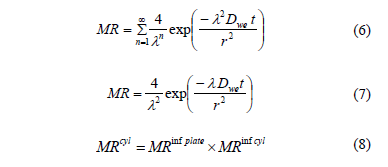
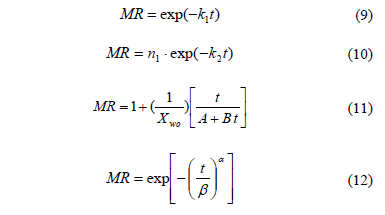
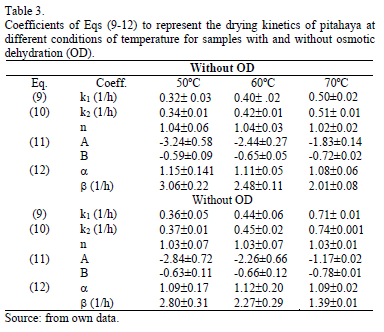
<body><![CDATA[<p><font size="2" face="Verdana, Arial, Helvetica, sans-serif">Fick's  second diffusion law has been widely used to describe drying kinetics and  osmotic drying kinetics for biological materials &#91;7, 16&#93;. In this model, the dependent  variable is the moisture ratio (MR) which relates the sample moisture content  in real time to initial moisture contents Eq. (3). In this study, equilibrium  moisture was assumed to be negligible. When internal mass transfer is the  controlling mechanism and unidimensional transport in a slab or a cylinder with  constant effective diffusivity can be assumed, the solution of the Fick's  second law is given by Eq. (4) and Eq. (6). For sufficiently long drying times,  the first term in the series expansion gives a good estimate of the solutions,  Eq. (5) and Eq. (7) &#91;17&#93;. Based on Eqs. (4) and (6) and applying Newman's rule  for a finite cylinder (Eq.(8)), a relationship between logarithm of  dimensionless moisture content for plate and cylinder and time is obtained,  which can be used to determine water diffusion coefficient (D<sub>we</sub>).</font></p>     <p><img src="/img/revistas/dyna/v81n188/v81n188a18eq03.gif"></p>     <p><font size="2" face="Verdana, Arial, Helvetica, sans-serif">For an infinite slab:</font></p>     <p><img src="/img/revistas/dyna/v81n188/v81n188a18eq04.gif">    <br> <img src="/img/revistas/dyna/v81n188/v81n188a18eq05.gif"></p>     <p><font size="2" face="Verdana, Arial, Helvetica, sans-serif">For an infinite cylinder:</font></p>     <p><img src="/img/revistas/dyna/v81n188/v81n188a18eq0608.gif"></p>     <p><font size="2" face="Verdana, Arial, Helvetica, sans-serif">Where X<sub>wt</sub> is the moisture content (g water g<sup>-1</sup> dry matter), X<sub>wo</sub> is the initial  moisture content (g water g<sup>-1</sup> dry matter), D<sub>we</sub> is the  diffusion coefficient (m<sup>2 </sup>s<sup>-1</sup>), t is the drying time (s),  L is the half-thickness of the slab (m), r is de radius of the cylinder and l=2.405  is the root of Bessel function for n=1.</font></p>     <p><font size="2" face="Verdana, Arial, Helvetica, sans-serif"><b><i>2.6. Modelling of  drying kinetics</i></b></font></p>     <p><font size="2" face="Verdana, Arial, Helvetica, sans-serif">Numerous mathematical models have been proposed to  describe the characteristics of agricultural products during drying &#91;6&#93;. In  this research, four of the more known models were used to fit the drying  experimental data, including Newton (Eq 9), Henderson-Pabis (Eq. 10), Peleg  (Eq. 11) and standardized Weibull model (Eq. 12). Applications of mentioned  models can be found in different previous works &#91;18,19&#93;:</font></p>     ]]></body>
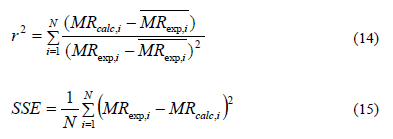
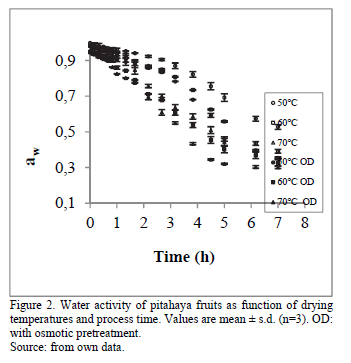
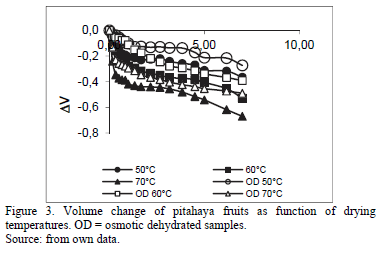
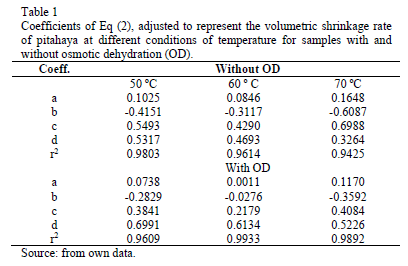
<body><![CDATA[<p><img src="/img/revistas/dyna/v81n188/v81n188a18eq0912.gif"></p>     <p><font size="2" face="Verdana, Arial, Helvetica, sans-serif">Where k<sub>i</sub> is the kinetic parameters (min<sup>-1</sup>),  n<sub>i</sub> (i = 1…3) are the empirical parameters (dimensionless),  <font face="Symbol">a</font> is  the shape parameter (dimensionless) and  <font face="Symbol">b</font> is the scale parameter (min) of  the Weibull model, t is the drying time (min) and i is the number of terms. </font></p>     <p><font size="2" face="Verdana, Arial, Helvetica, sans-serif">In order to determine the influence of the process  temperature on the diffusion coefficient (D<sub>we</sub>) and kinetics  parameters, an Arrhenius-type equation was applied (Eq. 13). </font></p>     <p><img src="/img/revistas/dyna/v81n188/v81n188a18eq13.gif"></p>     <p><font size="2" face="Verdana, Arial, Helvetica, sans-serif">Where R is the universal gas constant (8.314 J K<sup>-1 </sup>mol<sup>-1</sup>) and T is the absolute  temperature (K). Eq. (13) can be linearized by applying natural log at  both sides and a plot of ln Y versus 1/T produce a straight line, from which  the activation energy (E<sub>a</sub>, kJ mol<sup>-1</sup>) can be determined  &#91;20&#93;.</font></p>     <p><font size="2" face="Verdana, Arial, Helvetica, sans-serif"><b><i>2.7. Statistical evaluation of the models </i></b></font></p>     <p><font size="2" face="Verdana, Arial, Helvetica, sans-serif">Fit quality of the proposed models for simulating the  drying kinetics data was evaluated by means of statistical tests including  determination correlation coefficient (r<sup>2</sup>) &#91;Eq. (14)&#93; and sum  squared errors (SSE) &#91;Eq. (15)&#93;.</font></p>     <p><img src="/img/revistas/dyna/v81n188/v81n188a18eq1415.gif"></p>     <p><font size="2" face="Verdana, Arial, Helvetica, sans-serif">Where N  is the number of data values and z is the number of constants. </font></p>     <p><font size="2" face="Verdana, Arial, Helvetica, sans-serif"><em>Coefficients  of Eq.. (2) were estimated by means of mathematical  routines applying the function &quot;lsqcurvefit&quot; of the program Matlab 7.7.</em></font></p>     ]]></body>

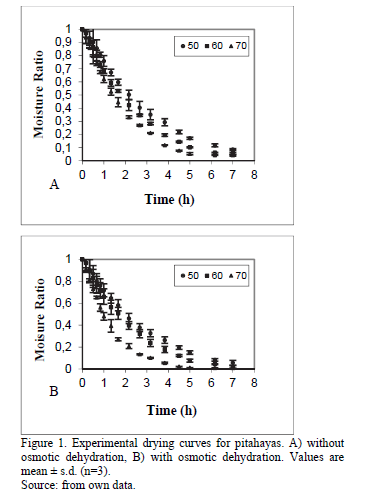
<body><![CDATA[<p>&nbsp;</p>     <p><font size="3" face="Verdana, Arial, Helvetica, sans-serif"><b>3. Results and  discussion</b></font></p>     <p><b><font size="2" face="Verdana, Arial, Helvetica, sans-serif">3.1. Physicochemical properties and  experimental drying curves</font></b></p>     <p><font size="2" face="Verdana, Arial, Helvetica, sans-serif">Moisture content of fresh pitahayas was   evaluated as 2.63± 0.15 kg   water /kg dry matter. Total soluble solids were determined as 21.32±0.25 and   25.92±0.42 &deg;Brix for fresh and   osmo- dried pitahayas, respectively. Small seeds of the fruits were also part   of the insoluble solids fraction (8.18 %).</font></p>     <p><font size="2" face="Verdana, Arial, Helvetica, sans-serif"><a href="#fig01">Fig. 1</a> presents the experimental drying curves of pitahayas with and  without osmotic dehydration. Since osmodehydrated samples have lower initial  moisture content than fresh samples, process times needed to reach final water  content is lower than those correspondents to untreated samples. Moreover,  samples subjected to osmotic dehydration prior to convective drying has modified  their internal structure affecting  the action of different mass transport mechanisms, and thus contributing  to enhance the water transport out of the solid &#91;21&#93;. Comparable results were  reported for different foods subjected to osmotic dehydration like pumpkins  &#91;22&#93; and pineapples  &#91;23&#93;.</font></p>     <p align="center"><font size="2" face="Verdana, Arial, Helvetica, sans-serif"><a name="fig01"></a></font><img src="/img/revistas/dyna/v81n188/v81n188a18fig01.gif"></p>     <p><font size="2" face="Verdana, Arial, Helvetica, sans-serif"><b><i>3.2. Changes in  water activity and volume samples</i></b></font></p>     <p><font size="2" face="Verdana, Arial, Helvetica, sans-serif"><a href="#fig02">Fig. 2</a> and <a href="#fig03">3</a> present the variation of water activity and  volume with process time during air dehydration at different temperatures, for pitahayas fruits  with and without osmotic dehydration. </font></p>     <p align="center"><font size="2" face="Verdana, Arial, Helvetica, sans-serif"><a name="fig02"></a></font><img src="/img/revistas/dyna/v81n188/v81n188a18fig02.gif"></p>     <p align="center"><font size="2" face="Verdana, Arial, Helvetica, sans-serif"><a name="fig03"></a></font><img src="/img/revistas/dyna/v81n188/v81n188a18fig03.gif"></p>     ]]></body>
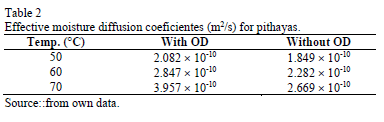
<body><![CDATA[<p><font size="2" face="Verdana, Arial, Helvetica, sans-serif">The measurement and prediction of water activity provide  the best available tool for evaluating the stability of foods. Thus, the end  point of drying is the residual moisture content of the final product  which ensures economic viability and microbiological safety, i.e. a water  activity value lower than 0.60 &#91;24,25&#93;. Therefore, according  to Singh &amp; Heldman &#91;26&#93;, values of water activity among 0.20 and 0.40  ensures the stability of the product storage against browning and  hydrolytically reactions, liquid oxidation and enzymatic activity. Regarding <a href="#fig02">Fig.  2</a>, treated and untreated samples had water activity values between 0.20  and 0.40, except 50 C. </font></p>     <p><font size="2" face="Verdana, Arial, Helvetica, sans-serif"><a href="#fig03">Fig.  3</a> present the fruits volume variation (DV=<sub><img src="/img/revistas/dyna/v81n188/v81n188a18eq040.gif"></sub>) during processing. Both treated and untreated samples  exhibited changes in volume. Shrinkage of foodstuff during drying is  unavoidable because heating and removal of water from the food matrix may cause  stresses in the cellular structure, hence leading to structural collapse,  changes in volume, shape deformation and capillaries contraction &#91;14&#93;.</font></p>     <p><font size="2" face="Verdana, Arial, Helvetica, sans-serif">Fruit with osmotic dehydration showed changes in volume lower that those  only process by convective dehydration. Thus, osmodehydrated samples exhibited  less shrinkage. Volume changes during OD are mainly due to compositional  changes and mechanical stresses associated to mass fluxes &#91;14&#93;. Ideally, it can be considered that the shrinkage of  the material is equal to the volume of the removed water. Therefore, a  mathematical relationship can be obtained that relates the volume shrinkage to  the moisture content of the material. According to Eq. (2), <a href="#tab01">Table 1</a> shows  the parameters related to this equation which showed satisfactory results (r<sup>2</sup>&gt;0.9425). </font></p>     <p align="center"><font size="2" face="Verdana, Arial, Helvetica, sans-serif"><a name="tab01"></a></font><img src="/img/revistas/dyna/v81n188/v81n188a18tab01.gif"></p>     <p><font size="2" face="Verdana, Arial, Helvetica, sans-serif">Simulation of reduction of volume based on Eq.(2)  indicated that shrinkage increases with decreasing moisture content in general,  but shrinkage characteristics vary among drying products and drying methods.  This is probably due to the unique biopolymer structure of individual  agricultural product and the combined effect of process conditions that  determines the type and extent of shrinkage &#91;27&#93;.</font></p>     <p><font size="2" face="Verdana, Arial, Helvetica, sans-serif"><b><i>3.3. Determination  of water diffusion coefficient (D<sub>we</sub>)</i></b></font></p>     <p><font size="2" face="Verdana, Arial, Helvetica, sans-serif">Based on Fick's equation, effective diffusion coefficient  (D<sub>we</sub>) can be calculated from Eqs. (4) and (6) for each work  temperature. Estimated D<sub>we</sub> values are informed in <a href="#tab02">Table 2</a>. </font></p>     <p align="center"><font size="2" face="Verdana, Arial, Helvetica, sans-serif"><a name="tab02" id="tab02"></a></font><img src="/img/revistas/dyna/v81n188/v81n188a18tab02.gif"></p>     <p><font size="2" face="Verdana, Arial, Helvetica, sans-serif">It can be observed that moisture diffusion coefficients  for pitahaya subjected to osmotic dehydration prior convective drying showed  higher values than non-treated samples for all the temperatures under  study. During osmotic dehydration, many  aspects of cell structures are affected such as alteration of cell walls,  splitting of the middle lamella, lysis of membranes, tissue shrinkage which  could strongly influence the transport properties of the product during processing  &#91;28&#93;.</font></p>     <p><font size="2" face="Verdana, Arial, Helvetica, sans-serif">Comparable values were reported by other researchers  related to osmodried fruits and vegetables: carambola &#91;11&#93;, carrot cubes &#91;29&#93;,  West Indian cherry &#91;30&#93;, apricots &#91;16&#93;, apples &#91;31&#93;, pomegranate  arils &#91;32&#93; and Aloe Vera &#91;33&#93;.</font></p>     ]]></body>
<body><![CDATA[<p><font size="2" face="Verdana, Arial, Helvetica, sans-serif">From the relationship of water diffusion coefficients and  drying temperature, activation energy from the inverse slope of the line plot  of ln D<sub>we</sub> versus T<sup>-1</sup> can be obtained. In this research,  activation energy values of 16.94 kJ/mol (r<sup>2</sup>=0.999) and 29.56 kJ/mol  (r<sup>2</sup>=0.995) were obtained for untreated and treated samples,  respectively. The Ea is a measure of dependence of the mass transfer process on  temperature; lager magnitude of Ea is associated with higher temperature  dependence. Higher activation energy therefore implies greater temperature  sensitivity, and a smaller temperature change is needed for the mass transport  to proceed more rapidly. The obtained values are within the range (0-63 kJ/mol)  for diffusion-controlled processes &#91;34&#93;.</font></p>     <p><font size="2" face="Verdana, Arial, Helvetica, sans-serif">Comparable values for activation energy were reported in  previous works for watermelon &#91;35&#93;; mango &#91;34&#93; and pear &#91;36&#93;. </font></p>     <p><font size="2" face="Verdana, Arial, Helvetica, sans-serif"><b><i>3.4. Mathematical modeling of  drying curves</i></b></font></p>     <p><font size="2" face="Verdana, Arial, Helvetica, sans-serif"><a href="#tab03">Tables 3</a> shows the average values and standard deviations  of the kinetic and empirical parameters k<sub>i </sub>(i = 1, 2), n, A, B,   <font face="Symbol">a</font> and  <font face="Symbol">b</font>, obtained for all the proposed models. </font></p>     <p align="center"><font size="2" face="Verdana, Arial, Helvetica, sans-serif"><a name="tab03"></a></font><img src="/img/revistas/dyna/v81n188/v81n188a18tab03.gif"></p>     <p><font size="2" face="Verdana, Arial, Helvetica, sans-serif">Except for de n and a, a tendency with  increasing temperature was observed for each of the rest of the parameters,  since an increase in drying air temperature showed an increase in the  parameters values. </font></p>     <p><font size="2" face="Verdana, Arial, Helvetica, sans-serif">The a-parameter of Weibull is related to the velocity of the  mass transfer at the beginning, e.g., the lower the a value, the faster the  drying rate at the beginning &#91;19&#93;. In addition, parameter b decreases as temperature increases for both untreated and treated samples. Some authors suggested that parameter b represents the time needed to accomplish approximately 63% of the process &#91;37&#93;.  Comparable results were reported in previous works for pepino fruit &#91;6,19&#93;.</font></p>     <p><font size="2" face="Verdana, Arial, Helvetica, sans-serif">Regarding to parameter A for Peleg model, it shows a clear  tendency to increase as temperature increases indicating that the higher the  temperature the higher the water absorption rate. Similar tendencies for this  parameter have been reported for chestnuts &#91;38&#93;.</font></p>     <p><font size="2" face="Verdana, Arial, Helvetica, sans-serif"><b><i>3.5. Statistical  analysis of models</i></b></font></p>     <p><font size="2" face="Verdana, Arial, Helvetica, sans-serif"><a href="#tab04">Table 4</a> shows the results of statistical tests (r<sup>2 </sup>and  SSE) performed to the proposed models. These statistical tests evaluate the  goodness of fit on the experimental data and they have been reported by other  researchers during food drying analysis &#91;19&#93;. All the proposed models showed a  good fit with high values of r<sup>2 </sup>(&gt;0.90) and values close to zero  for SSE. According to these results, the models that best fitted the  experimental data, considering the statistical test applied, were the Peleg model (r<sup>2</sup> = 0.9904; SSE= 0.0011) and Weibull (r<sup>2 </sup>=0.9957; SSE= 0.1040). </font></p>     ]]></body>
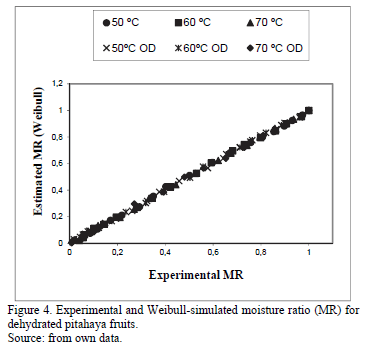
<body><![CDATA[<p align="center"><font size="2" face="Verdana, Arial, Helvetica, sans-serif"><a name="tab04"></a></font><img src="/img/revistas/dyna/v81n188/v81n188a18tab04.gif"></p>     <p><font size="2" face="Verdana, Arial, Helvetica, sans-serif">Therefore, <a href="#fig04">Fig. 4</a> shows the experimental MR versus the  corresponding estimate by the Weibull model to notice the goodness of fit of  this mathematical model for all drying working temperatures, for both samples  with and without osmotic dehydration.  Similar observations were made by Cunha <i>et al.,</i> (2001) modelling water losses during osmotic dehydration of apple &#91;39&#93;,  Corzo et al. (2008) &#91;40&#93; for air drying of coroba  slices and Uribe <i>et al.,</i> &#91;19&#93;, for  convective dehydration of pepino fruits.</font></p>     <p align="center"><font size="2" face="Verdana, Arial, Helvetica, sans-serif"><a name="fig04"></a></font><img src="/img/revistas/dyna/v81n188/v81n188a18fig04.gif"></p>     <p>&nbsp;</p>     <p><font size="3" face="Verdana, Arial, Helvetica, sans-serif"><b>4. Conclusion</b></font></p>     <p><font size="2" face="Verdana, Arial, Helvetica, sans-serif">Osmotic dehydration with sucrose 55 % (w/w) during 45 min  was applied in order to evaluate the influence of pretreatment on convective  drying rates of pitahayas at three different temperatures. Due to modifications  in structure, osmodehydrated samples exhibited increasing drying rates with  effective moisture coefficients greater that non-treated samples. Shrinkage due  to variation in volume samples was more pronounced in untreated samples and was  satisfactorily modeled by means of a polynomial equation. Different  mathematical models were used to simulate experimental drying characteristics.  Based on statistical results, the Peleg and Weibull models can be appropriate  used to simulate experimental drying curves in  the range of drying conditions under studied. Therefore, osmotic  dehydration combined with convective dehydration provides an opportunity to  produce novel shelf stable high quality pitahaya fruits for the local as well  as for export markets. </font></p>     <p>&nbsp;</p>     <p><font size="3" face="Verdana, Arial, Helvetica, sans-serif"><b>Acknowledgements</b></font></p>     <p><font size="2" face="Verdana, Arial, Helvetica, sans-serif">The  authors thank the Ministry of Agriculture and Rural  Development of Colombia for  the support provided to this article. </font></p>     <p>&nbsp;</p>     ]]></body>
<body><![CDATA[<p><font size="3" face="Verdana, Arial, Helvetica, sans-serif"><b>References</b></font></p>     <!-- ref --><p><font size="2" face="Verdana, Arial, Helvetica, sans-serif"><b>&#91;1&#93;</b> Ayala-Aponte, A., Serna Cock, L. and Rodriguez-de la Pava, G., Moisture adsorption in  yellow pitahaya (Selenicereus megalanthus). DYNA, 78 (170), pp.7-14, 2011.    &nbsp;&nbsp;&nbsp;&nbsp;&nbsp;&nbsp;&nbsp;&nbsp;[&#160;<a href="javascript:void(0);" onclick="javascript: window.open('/scielo.php?script=sci_nlinks&ref=000104&pid=S0012-7353201400060001800001&lng=','','width=640,height=500,resizable=yes,scrollbars=1,menubar=yes,');">Links</a>&#160;]<!-- end-ref --></font></p>     <!-- ref --><p><font size="2" face="Verdana, Arial, Helvetica, sans-serif"><b>&#91;2&#93;</b> Beltran, M.C., Oliva-Coba, T.G., Gallardo-Velasquez, T.  and Osorio-Revilla, G., Ascorbic acid, phenolic content and antioxidant  capacity red, cherry, yellow and white types of pitahaya cactus fruit  (Stenocereus stellatus Riccobono). Agrociencia, 43, pp. 153-162, 2009.    &nbsp;&nbsp;&nbsp;&nbsp;&nbsp;&nbsp;&nbsp;&nbsp;[&#160;<a href="javascript:void(0);" onclick="javascript: window.open('/scielo.php?script=sci_nlinks&ref=000106&pid=S0012-7353201400060001800002&lng=','','width=640,height=500,resizable=yes,scrollbars=1,menubar=yes,');">Links</a>&#160;]<!-- end-ref --></font></p>     <!-- ref --><p><font size="2" face="Verdana, Arial, Helvetica, sans-serif"><b>&#91;3&#93;</b> Barbeu, G., The strawberry pear, a new tropical fruit. Fruits,  45, pp. 141-147, 1990.    &nbsp;&nbsp;&nbsp;&nbsp;&nbsp;&nbsp;&nbsp;&nbsp;[&#160;<a href="javascript:void(0);" onclick="javascript: window.open('/scielo.php?script=sci_nlinks&ref=000108&pid=S0012-7353201400060001800003&lng=','','width=640,height=500,resizable=yes,scrollbars=1,menubar=yes,');">Links</a>&#160;]<!-- end-ref --></font></p>     <!-- ref --><p><font size="2" face="Verdana, Arial, Helvetica, sans-serif"><b>&#91;4&#93;</b> Wu, M.C. and Chen, C.S., Variation of sugar content in  various parts of pitahaya fruit. Proceedings of the Florida State Horticultural  Society, 110, pp. 225-227, 1997.    &nbsp;&nbsp;&nbsp;&nbsp;&nbsp;&nbsp;&nbsp;&nbsp;[&#160;<a href="javascript:void(0);" onclick="javascript: window.open('/scielo.php?script=sci_nlinks&ref=000110&pid=S0012-7353201400060001800004&lng=','','width=640,height=500,resizable=yes,scrollbars=1,menubar=yes,');">Links</a>&#160;]<!-- end-ref --></font></p>     <!-- ref --><p><font size="2" face="Verdana, Arial, Helvetica, sans-serif"><b>&#91;5&#93;</b> Sacilik, K. and Elicin, A.K., The thin layer drying  characteristics of organic apple slices. Journal of Food Engineering, 73 (3),  pp. 281-289, 2006. <a href="http://dx.doi.org/10.1016/j.jfoodeng.2005.03.024" target="_blank">http://dx.doi.org/10.1016/j.jfoodeng.2005.03.024</a></font>&nbsp;&nbsp;&nbsp;&nbsp;&nbsp;&nbsp;&nbsp;&nbsp;[&#160;<a href="javascript:void(0);" onclick="javascript: window.open('/scielo.php?script=sci_nlinks&ref=000112&pid=S0012-7353201400060001800005&lng=','','width=640,height=500,resizable=yes,scrollbars=1,menubar=yes,');">Links</a>&#160;]<!-- end-ref --><!-- ref --><p><font size="2" face="Verdana, Arial, Helvetica, sans-serif"><b>&#91;6&#93;</b> Doymaz, I., Convective drying kinetics of strawberry.  Chemical Engineering and Processing, 47 (5), pp. 914-919, 2008. <a href="http://dx.doi.org/10.1016/j.cep.2007.02.003" target="_blank">http://dx.doi.org/10.1016/j.cep.2007.02.003</a></font>&nbsp;&nbsp;&nbsp;&nbsp;&nbsp;&nbsp;&nbsp;&nbsp;[&#160;<a href="javascript:void(0);" onclick="javascript: window.open('/scielo.php?script=sci_nlinks&ref=000113&pid=S0012-7353201400060001800006&lng=','','width=640,height=500,resizable=yes,scrollbars=1,menubar=yes,');">Links</a>&#160;]<!-- end-ref --><!-- ref --><p><font size="2" face="Verdana, Arial, Helvetica, sans-serif"><b>&#91;7&#93;</b> Di  Scala, K. and Crapiste, H., Drying kinetics and quality changes during drying of red pepper. LWT- Food Science and  Technology, 41<i>,</i> pp. 789-795, 2008.    &nbsp;&nbsp;&nbsp;&nbsp;&nbsp;&nbsp;&nbsp;&nbsp;[&#160;<a href="javascript:void(0);" onclick="javascript: window.open('/scielo.php?script=sci_nlinks&ref=000114&pid=S0012-7353201400060001800007&lng=','','width=640,height=500,resizable=yes,scrollbars=1,menubar=yes,');">Links</a>&#160;]<!-- end-ref --></font></p>     <!-- ref --><p><font size="2" face="Verdana, Arial, Helvetica, sans-serif"><b>&#91;8&#93;</b> Gomes, A., Lucena-Barbosa Jr., J., Colato,  A.G. and Xidieh-Murr, F.E., Osmotic dehydration of acerola fruit (Malpighia  punicifolia L.). Journal of Food Engineering 68, pp. 99-103, 2005. <a href="http://dx.doi.org/10.1016/j.jfoodeng.2004.05.042" target="_blank">http://dx.doi.org/10.1016/j.jfoodeng.2004.05.042</a></font>&nbsp;&nbsp;&nbsp;&nbsp;&nbsp;&nbsp;&nbsp;&nbsp;[&#160;<a href="javascript:void(0);" onclick="javascript: window.open('/scielo.php?script=sci_nlinks&ref=000116&pid=S0012-7353201400060001800008&lng=','','width=640,height=500,resizable=yes,scrollbars=1,menubar=yes,');">Links</a>&#160;]<!-- end-ref --><!-- ref --><p><font size="2" face="Verdana, Arial, Helvetica, sans-serif"><b>&#91;9&#93;</b> Pereira-da  Silva, W., Silva-do Amaral, D., Duarte, M., Mata, M., Silva, C., Pinheiro, R.  and Pessoa, T., Description of the osmotic dehydration and convective drying of  coconut (Cocos nucifera L.) Pieces: A three-dimensional approach. Journal of  Food Engineering, 115, pp. 121-131, 2013. <a href="http://dx.doi.org/10.1016/j.jfoodeng.2012.10.007" target="_blank">http://dx.doi.org/10.1016/j.jfoodeng.2012.10.007</a></font>&nbsp;&nbsp;&nbsp;&nbsp;&nbsp;&nbsp;&nbsp;&nbsp;[&#160;<a href="javascript:void(0);" onclick="javascript: window.open('/scielo.php?script=sci_nlinks&ref=000117&pid=S0012-7353201400060001800009&lng=','','width=640,height=500,resizable=yes,scrollbars=1,menubar=yes,');">Links</a>&#160;]<!-- end-ref --><!-- ref --><p><font size="2" face="Verdana, Arial, Helvetica, sans-serif"><b>&#91;10&#93;</b> Ashwini,  N.B., Sowbhagya, H.B. and Rastogi, N.K., Osmotic dehydration assisted  impregnation of curcuminoids in coconut slices. Journal of Food Engineering,  105 (3), pp. 453-459, 2011. <a href="http://dx.doi.org/10.1016/j.jfoodeng.2011.03.002" target="_blank">http://dx.doi.org/10.1016/j.jfoodeng.2011.03.002</a></font>&nbsp;&nbsp;&nbsp;&nbsp;&nbsp;&nbsp;&nbsp;&nbsp;[&#160;<a href="javascript:void(0);" onclick="javascript: window.open('/scielo.php?script=sci_nlinks&ref=000118&pid=S0012-7353201400060001800010&lng=','','width=640,height=500,resizable=yes,scrollbars=1,menubar=yes,');">Links</a>&#160;]<!-- end-ref --><!-- ref --><p><font size="2" face="Verdana, Arial, Helvetica, sans-serif"><b>&#91;11&#93;</b> Ruiz-L&oacute;pez,  I.I., Ruiz-Espinosa, H., Herman-Lara, E. and Z&aacute;rate-Castillo, G., Modeling of  kinetics, equilibrium and distribution data of osmotically dehydrated carambola  (Averrhoa carambola L.) in sugar solutions. Journal of Food Engineering 104,  pp. 218-226, 2011. <a href="http://dx.doi.org/10.1016/j.jfoodeng.2010.12.013" target="_blank">http://dx.doi.org/10.1016/j.jfoodeng.2010.12.013</a></font>&nbsp;&nbsp;&nbsp;&nbsp;&nbsp;&nbsp;&nbsp;&nbsp;[&#160;<a href="javascript:void(0);" onclick="javascript: window.open('/scielo.php?script=sci_nlinks&ref=000119&pid=S0012-7353201400060001800011&lng=','','width=640,height=500,resizable=yes,scrollbars=1,menubar=yes,');">Links</a>&#160;]<!-- end-ref --><!-- ref --><p><font size="2" face="Verdana, Arial, Helvetica, sans-serif"><b>&#91;12&#93;</b> ICONTEC. Norma T&eacute;cnica Colombiana. NTC  3554. Frutas frescas. Pitahaya amarilla. Bogot&aacute;: ICONTEC, pp. 1-14, 1996.    &nbsp;&nbsp;&nbsp;&nbsp;&nbsp;&nbsp;&nbsp;&nbsp;[&#160;<a href="javascript:void(0);" onclick="javascript: window.open('/scielo.php?script=sci_nlinks&ref=000120&pid=S0012-7353201400060001800012&lng=','','width=640,height=500,resizable=yes,scrollbars=1,menubar=yes,');">Links</a>&#160;]<!-- end-ref --></font></p>     <!-- ref --><p><font size="2" face="Verdana, Arial, Helvetica, sans-serif"><b>&#91;13&#93;</b> AOAC. Association  of Official Analytical Chemists. Official method of analysis, Association of  Official Analytical Chemists No. 934.06 (15<sup>th</sup> Ed), Arlington, MA,  Washington, 1990.    &nbsp;&nbsp;&nbsp;&nbsp;&nbsp;&nbsp;&nbsp;&nbsp;[&#160;<a href="javascript:void(0);" onclick="javascript: window.open('/scielo.php?script=sci_nlinks&ref=000122&pid=S0012-7353201400060001800013&lng=','','width=640,height=500,resizable=yes,scrollbars=1,menubar=yes,');">Links</a>&#160;]<!-- end-ref --></font></p>     <!-- ref --><p><font size="2" face="Verdana, Arial, Helvetica, sans-serif"><b>&#91;14&#93;</b> Mayor, L. and Sereno, A.M., Modelling shrinkage during  convective drying of food materials: A review. Journal of Food Engineering,  61(3), pp. 373-386, 2004. <a href="http://dx.doi.org/10.1016/S0260-8774(03)00144-4" target="_blank">http://dx.doi.org/10.1016/S0260-8774(03)00144-4</a></font>&nbsp;&nbsp;&nbsp;&nbsp;&nbsp;&nbsp;&nbsp;&nbsp;[&#160;<a href="javascript:void(0);" onclick="javascript: window.open('/scielo.php?script=sci_nlinks&ref=000124&pid=S0012-7353201400060001800014&lng=','','width=640,height=500,resizable=yes,scrollbars=1,menubar=yes,');">Links</a>&#160;]<!-- end-ref --><!-- ref --><p><font size="2" face="Verdana, Arial, Helvetica, sans-serif"><b>&#91;15&#93;</b> Ayala-Aponte, A., Giraldo, C.J. and Serna-Cock, L.,  Kinetics of osmotic dehydration of yellow pitahaya fruit (Selenicereus  megalanthus). Interciencia, 35, pp. 539-544, 2010.    &nbsp;&nbsp;&nbsp;&nbsp;&nbsp;&nbsp;&nbsp;&nbsp;[&#160;<a href="javascript:void(0);" onclick="javascript: window.open('/scielo.php?script=sci_nlinks&ref=000125&pid=S0012-7353201400060001800015&lng=','','width=640,height=500,resizable=yes,scrollbars=1,menubar=yes,');">Links</a>&#160;]<!-- end-ref --></font></p>     <!-- ref --><p><font size="2" face="Verdana, Arial, Helvetica, sans-serif"><b>&#91;16&#93;</b> Ispir, A. and Togrul, I.T., Osmotic dehydration of  apricot: Kinetics and the effect of process parameters. Chemical Engineering  Research and Design, 87, pp. 166-180, 2009. <a href="http://dx.doi.org/10.1016/j.cherd.2008.07.011" target="_blank">http://dx.doi.org/10.1016/j.cherd.2008.07.011</a></font>&nbsp;&nbsp;&nbsp;&nbsp;&nbsp;&nbsp;&nbsp;&nbsp;[&#160;<a href="javascript:void(0);" onclick="javascript: window.open('/scielo.php?script=sci_nlinks&ref=000127&pid=S0012-7353201400060001800016&lng=','','width=640,height=500,resizable=yes,scrollbars=1,menubar=yes,');">Links</a>&#160;]<!-- end-ref --><!-- ref --><p><font size="2" face="Verdana, Arial, Helvetica, sans-serif"><b>&#91;17&#93;</b> Crank,  J., The mathematics of diffusion, second ed. Oxford University Press, London, UK, 1975.    &nbsp;&nbsp;&nbsp;&nbsp;&nbsp;&nbsp;&nbsp;&nbsp;[&#160;<a href="javascript:void(0);" onclick="javascript: window.open('/scielo.php?script=sci_nlinks&ref=000128&pid=S0012-7353201400060001800017&lng=','','width=640,height=500,resizable=yes,scrollbars=1,menubar=yes,');">Links</a>&#160;]<!-- end-ref --></font></p>     <!-- ref --><p><font size="2" face="Verdana, Arial, Helvetica, sans-serif"><b>&#91;18&#93;</b> Peleg, M., An empirical model for the description of  moisture sorption curves. Journal of Food Science, 53 (4), 1216-1219,  1998. <a href="http://dx.doi.org/10.1111/j.1365-2621.1988.tb13565.x" target="_blank">http://dx.doi.org/10.1111/j.1365-2621.1988.tb13565.x</a></font>&nbsp;&nbsp;&nbsp;&nbsp;&nbsp;&nbsp;&nbsp;&nbsp;[&#160;<a href="javascript:void(0);" onclick="javascript: window.open('/scielo.php?script=sci_nlinks&ref=000130&pid=S0012-7353201400060001800018&lng=','','width=640,height=500,resizable=yes,scrollbars=1,menubar=yes,');">Links</a>&#160;]<!-- end-ref --><!-- ref --><p><font size="2" face="Verdana, Arial, Helvetica, sans-serif"><b>&#91;19&#93;</b> Uribe, E., Vega-G&aacute;lvez, A., Di Scala, K., Oyanadel, R.,  Saavedra, J. and Miranda, M., Characteristics of convective drying of pepino  fruit (Solanum muricatum Ait.): Application of weibull distribution. Food and  Bioprocess Technology, 4, pp. 1349-1356, 2011. <a href="http://dx.doi.org/10.1007/s11947-009-0230-y" target="_blank">http://dx.doi.org/10.1007/s11947-009-0230-y</a></font>&nbsp;&nbsp;&nbsp;&nbsp;&nbsp;&nbsp;&nbsp;&nbsp;[&#160;<a href="javascript:void(0);" onclick="javascript: window.open('/scielo.php?script=sci_nlinks&ref=000131&pid=S0012-7353201400060001800019&lng=','','width=640,height=500,resizable=yes,scrollbars=1,menubar=yes,');">Links</a>&#160;]<!-- end-ref --><!-- ref --><p><font size="2" face="Verdana, Arial, Helvetica, sans-serif"><b>&#91;20&#93;</b> Sharma, G.P. and Prasad, S., Effective moisture  diffusivity of garlic cloves underging microwave-convective drying. Journal of  Food Engineering, 65, pp. 609-617, 2004. <a href="http://dx.doi.org/10.1016/j.jfoodeng.2004.02.027" target="_blank">http://dx.doi.org/10.1016/j.jfoodeng.2004.02.027</a></font>&nbsp;&nbsp;&nbsp;&nbsp;&nbsp;&nbsp;&nbsp;&nbsp;[&#160;<a href="javascript:void(0);" onclick="javascript: window.open('/scielo.php?script=sci_nlinks&ref=000132&pid=S0012-7353201400060001800020&lng=','','width=640,height=500,resizable=yes,scrollbars=1,menubar=yes,');">Links</a>&#160;]<!-- end-ref --><!-- ref --><p><font size="2" face="Verdana, Arial, Helvetica, sans-serif"><b>&#91;21&#93;</b> Chiralt, A. and Fito, P., Transport mechanisms in  osmotic dehydration: The role of the structure. Food Science and Technology  International, 9 (3), pp. 179-186, 2003. <a href="http://dx.doi.org/10.1177/1082013203034757" target="_blank">http://dx.doi.org/10.1177/1082013203034757</a></font>&nbsp;&nbsp;&nbsp;&nbsp;&nbsp;&nbsp;&nbsp;&nbsp;[&#160;<a href="javascript:void(0);" onclick="javascript: window.open('/scielo.php?script=sci_nlinks&ref=000133&pid=S0012-7353201400060001800021&lng=','','width=640,height=500,resizable=yes,scrollbars=1,menubar=yes,');">Links</a>&#160;]<!-- end-ref --><!-- ref --><p><font size="2" face="Verdana, Arial, Helvetica, sans-serif"><b>&#91;22&#93;</b> Garcia, C.C., Mauro, M.A. and Kimura, M. Kinetics of  osmotic dehydration and air-drying of pumpkins (Cucurbita moschata). Journal of  Food Engineering, 82 (3), pp. 284-291, 2007. <a href="http://dx.doi.org/10.1016/j.jfoodeng.2007.02.004" target="_blank">http://dx.doi.org/10.1016/j.jfoodeng.2007.02.004</a></font>&nbsp;&nbsp;&nbsp;&nbsp;&nbsp;&nbsp;&nbsp;&nbsp;[&#160;<a href="javascript:void(0);" onclick="javascript: window.open('/scielo.php?script=sci_nlinks&ref=000134&pid=S0012-7353201400060001800022&lng=','','width=640,height=500,resizable=yes,scrollbars=1,menubar=yes,');">Links</a>&#160;]<!-- end-ref --><!-- ref --><p><font size="2" face="Verdana, Arial, Helvetica, sans-serif"><b>&#91;23&#93;</b> Lombard, G.E., Oliveira, J.C., Fito, P. and  Andr&eacute;, A., Osmotic dehydration of pineapple as a pre-treatment for further  drying. Journal of Food Engineering, 85 (2), pp. 277-284, 2008. <a href="http://dx.doi.org/10.1016/j.jfoodeng.2007.07.009" target="_blank">http://dx.doi.org/10.1016/j.jfoodeng.2007.07.009</a></font>&nbsp;&nbsp;&nbsp;&nbsp;&nbsp;&nbsp;&nbsp;&nbsp;[&#160;<a href="javascript:void(0);" onclick="javascript: window.open('/scielo.php?script=sci_nlinks&ref=000135&pid=S0012-7353201400060001800023&lng=','','width=640,height=500,resizable=yes,scrollbars=1,menubar=yes,');">Links</a>&#160;]<!-- end-ref --><!-- ref --><p><font size="2" face="Verdana, Arial, Helvetica, sans-serif"><b>&#91;24&#93;</b> Manjarres-Pinz&oacute;n, K., Cortes-Rodriguez, M. and Rodr&iacute;guez-Sandoval, E.,  Effect of drying conditions on the physical properties of impregnated orange  peel. Brazilian Journal of Chemical Engineering, 30 (3), pp. 667-676,  2013. <a href="http://dx.doi.org/10.1590/S0104-66322013000300023" target="_blank">http://dx.doi.org/10.1590/S0104-66322013000300023</a></font>&nbsp;&nbsp;&nbsp;&nbsp;&nbsp;&nbsp;&nbsp;&nbsp;[&#160;<a href="javascript:void(0);" onclick="javascript: window.open('/scielo.php?script=sci_nlinks&ref=000136&pid=S0012-7353201400060001800024&lng=','','width=640,height=500,resizable=yes,scrollbars=1,menubar=yes,');">Links</a>&#160;]<!-- end-ref --><!-- ref --><p><font size="2" face="Verdana, Arial, Helvetica, sans-serif"><b>&#91;25&#93;</b> Proton, F. and Ahrn&eacute;, L., Application of the  Guggenheim, Anderson and De Boer model to correlate water activity and moisture  content during osmotic dehydration of apples. Journal of Food Engineering, 61  (3), pp. 467-470, 2004. <a href="http://dx.doi.org/10.1016/S0260-8774(03)00119-5" target="_blank">http://dx.doi.org/10.1016/S0260-8774(03)00119-5</a></font>&nbsp;&nbsp;&nbsp;&nbsp;&nbsp;&nbsp;&nbsp;&nbsp;[&#160;<a href="javascript:void(0);" onclick="javascript: window.open('/scielo.php?script=sci_nlinks&ref=000137&pid=S0012-7353201400060001800025&lng=','','width=640,height=500,resizable=yes,scrollbars=1,menubar=yes,');">Links</a>&#160;]<!-- end-ref --><!-- ref --><p><font size="2" face="Verdana, Arial, Helvetica, sans-serif"><b>&#91;26&#93;</b> Singh, R.P. and Heldman, D.R., Introduction to food engineering, 2nd ed.  Academic Press, Inc., San Diego, pp.139-141, 1993.    &nbsp;&nbsp;&nbsp;&nbsp;&nbsp;&nbsp;&nbsp;&nbsp;[&#160;<a href="javascript:void(0);" onclick="javascript: window.open('/scielo.php?script=sci_nlinks&ref=000138&pid=S0012-7353201400060001800026&lng=','','width=640,height=500,resizable=yes,scrollbars=1,menubar=yes,');">Links</a>&#160;]<!-- end-ref --></font></p>     <!-- ref --><p><font size="2" face="Verdana, Arial, Helvetica, sans-serif"><b>&#91;27&#93;</b> Ong, S.P. and Law, C.L., Hygrothermal properties of various foods,  vegetables and fruits, in drying of foods, vegetables and fruits - Vol. 1, en  Ed. Jangam, S.V., Law, C.L. and Mujumdar, A.S., ISBN - 978-981-08-6759-1,  Published in Singapore, pp. 31-58, 2012.    &nbsp;&nbsp;&nbsp;&nbsp;&nbsp;&nbsp;&nbsp;&nbsp;[&#160;<a href="javascript:void(0);" onclick="javascript: window.open('/scielo.php?script=sci_nlinks&ref=000140&pid=S0012-7353201400060001800027&lng=','','width=640,height=500,resizable=yes,scrollbars=1,menubar=yes,');">Links</a>&#160;]<!-- end-ref --></font></p>     <!-- ref --><p><font size="2" face="Verdana, Arial, Helvetica, sans-serif"><b>&#91;28&#93;</b> Azarpazhooh, E. and Ramaswamy, H., modeling and optimization of microwave osmotic dehydration  of apple cylinders under continuous-flow spray mode processing conditions. Food and Bioprocess  Technology, 5 (5), pp. 1486-1501, 2012. <a href="http://dx.doi.org/10.1007/s11947-010-0471-9" target="_blank">http://dx.doi.org/10.1007/s11947-010-0471-9</a></font>&nbsp;&nbsp;&nbsp;&nbsp;&nbsp;&nbsp;&nbsp;&nbsp;[&#160;<a href="javascript:void(0);" onclick="javascript: window.open('/scielo.php?script=sci_nlinks&ref=000142&pid=S0012-7353201400060001800028&lng=','','width=640,height=500,resizable=yes,scrollbars=1,menubar=yes,');">Links</a>&#160;]<!-- end-ref --><!-- ref --><p><font size="2" face="Verdana, Arial, Helvetica, sans-serif"><b>&#91;29&#93;</b> Singh, B., Kumar, A. and Gupta, A.K., Study of mass transfer kinetics  and effective diffusivity during osmotic  dehydration of carrot cubes. Journal of Food Engineering, 79 (2), pp. 471-480,  2007. <a href="http://dx.doi.org/10.1016/j.jfoodeng.2006.01.074" target="_blank">http://dx.doi.org/10.1016/j.jfoodeng.2006.01.074</a> <a href="http://dx.doi.org/10.1016/j.jfoodeng.2006.01.073" target="_blank">http://dx.doi.org/10.1016/j.jfoodeng.2006.01.073</a></font>&nbsp;&nbsp;&nbsp;&nbsp;&nbsp;&nbsp;&nbsp;&nbsp;[&#160;<a href="javascript:void(0);" onclick="javascript: window.open('/scielo.php?script=sci_nlinks&ref=000143&pid=S0012-7353201400060001800029&lng=','','width=640,height=500,resizable=yes,scrollbars=1,menubar=yes,');">Links</a>&#160;]<!-- end-ref --><!-- ref --><p><font size="2" face="Verdana, Arial, Helvetica, sans-serif"><b>&#91;30&#93;</b> Silva, M., Da Silva, Z., Mariani, V. and Darche, S., Mass transfer  during the osmotic dehydration of West Indian cherry. LWT - Food Science and  Technology, 45(2), pp. 246-252, 2012.    &nbsp;&nbsp;&nbsp;&nbsp;&nbsp;&nbsp;&nbsp;&nbsp;[&#160;<a href="javascript:void(0);" onclick="javascript: window.open('/scielo.php?script=sci_nlinks&ref=000144&pid=S0012-7353201400060001800030&lng=','','width=640,height=500,resizable=yes,scrollbars=1,menubar=yes,');">Links</a>&#160;]<!-- end-ref --></font></p>     <!-- ref --><p><font size="2" face="Verdana, Arial, Helvetica, sans-serif"><b>&#91;31&#93;</b> Souraki, B.A., Ghavami, M. and Tondro, H., Correction of moisture and  sucrose effective diffusivities for shrinkage during osmotic dehydration of  apple in sucrose solution. Food and Bioproducts Processing, 92 (1), pp. 1-8,  2014. <a href="http://dx.doi.org/10.1016/j.fbp.2013.07.002" target="_blank">http://dx.doi.org/10.1016/j.fbp.2013.07.002</a></font>&nbsp;&nbsp;&nbsp;&nbsp;&nbsp;&nbsp;&nbsp;&nbsp;[&#160;<a href="javascript:void(0);" onclick="javascript: window.open('/scielo.php?script=sci_nlinks&ref=000146&pid=S0012-7353201400060001800031&lng=','','width=640,height=500,resizable=yes,scrollbars=1,menubar=yes,');">Links</a>&#160;]<!-- end-ref --><!-- ref --><p><font size="2" face="Verdana, Arial, Helvetica, sans-serif"><b>&#91;32&#93;</b> Mundada, M., Bahadur-Singh, H. and Swati, M., Convective dehydration  kinetics of osmotically pretreated pomegranate arils. Biosystems Engineering, 107, pp. 307-310,  2010. <a href="http://dx.doi.org/10.1016/j.biosystemseng.2010.09.002" target="_blank">http://dx.doi.org/10.1016/j.biosystemseng.2010.09.002</a></font>&nbsp;&nbsp;&nbsp;&nbsp;&nbsp;&nbsp;&nbsp;&nbsp;[&#160;<a href="javascript:void(0);" onclick="javascript: window.open('/scielo.php?script=sci_nlinks&ref=000147&pid=S0012-7353201400060001800032&lng=','','width=640,height=500,resizable=yes,scrollbars=1,menubar=yes,');">Links</a>&#160;]<!-- end-ref --><!-- ref --><p><font size="2" face="Verdana, Arial, Helvetica, sans-serif"><b>&#91;33&#93;</b> Pisalkar, P.S., Jain, N.K. and Jain, S.K., Osmo-air drying of aloe vera  gel cubes. Journal of Food Science and Technology, 48 (2), pp. 183-189,  2011. <a href="http://dx.doi.org/10.1007/s13197-010-0121-2" target="_blank">http://dx.doi.org/10.1007/s13197-010-0121-2</a></font>&nbsp;&nbsp;&nbsp;&nbsp;&nbsp;&nbsp;&nbsp;&nbsp;[&#160;<a href="javascript:void(0);" onclick="javascript: window.open('/scielo.php?script=sci_nlinks&ref=000148&pid=S0012-7353201400060001800033&lng=','','width=640,height=500,resizable=yes,scrollbars=1,menubar=yes,');">Links</a>&#160;]<!-- end-ref --><!-- ref --><p><font size="2" face="Verdana, Arial, Helvetica, sans-serif"><b>&#91;34&#93;</b> Alakali, J.S., Ariahu, C.C. and Nkpa, C.C., Kinetics of osmotic  dehydration of mango. Journal of Food Processing and Preservation, 30, pp.  597-607, 2006. <a href="http://dx.doi.org/10.1111/j.1745-4549.2006.00080.x" target="_blank">http://dx.doi.org/10.1111/j.1745-4549.2006.00080.x</a></font>&nbsp;&nbsp;&nbsp;&nbsp;&nbsp;&nbsp;&nbsp;&nbsp;[&#160;<a href="javascript:void(0);" onclick="javascript: window.open('/scielo.php?script=sci_nlinks&ref=000149&pid=S0012-7353201400060001800034&lng=','','width=640,height=500,resizable=yes,scrollbars=1,menubar=yes,');">Links</a>&#160;]<!-- end-ref --><!-- ref --><p><font size="2" face="Verdana, Arial, Helvetica, sans-serif"><b>&#91;35&#93;</b> Falade, G. and Ayanwuyi, F.A., Kinetics of  mass transfer, and colour changes during osmotic dehydration of watermelon.  Journal of Food Engineering, 80, pp. 979-985, 2007. <a href="http://dx.doi.org/10.1016/j.jfoodeng.2006.06.033" target="_blank">http://dx.doi.org/10.1016/j.jfoodeng.2006.06.033</a></font>&nbsp;&nbsp;&nbsp;&nbsp;&nbsp;&nbsp;&nbsp;&nbsp;[&#160;<a href="javascript:void(0);" onclick="javascript: window.open('/scielo.php?script=sci_nlinks&ref=000150&pid=S0012-7353201400060001800035&lng=','','width=640,height=500,resizable=yes,scrollbars=1,menubar=yes,');">Links</a>&#160;]<!-- end-ref --><!-- ref --><p><font size="2" face="Verdana, Arial, Helvetica, sans-serif"><b>&#91;36&#93;</b> Park, J., Bin, A. and Reis-Brod, F.P., Drying  of pear d'Anjou with and without osmotic dehydration. Journal of Food  Engineering, 56, pp. 97-103 2002. <a href="http://dx.doi.org/10.1016/S0260-8774(02)00152-8" target="_blank">http://dx.doi.org/10.1016/S0260-8774(02)00152-8</a></font>&nbsp;&nbsp;&nbsp;&nbsp;&nbsp;&nbsp;&nbsp;&nbsp;[&#160;<a href="javascript:void(0);" onclick="javascript: window.open('/scielo.php?script=sci_nlinks&ref=000151&pid=S0012-7353201400060001800036&lng=','','width=640,height=500,resizable=yes,scrollbars=1,menubar=yes,');">Links</a>&#160;]<!-- end-ref --><!-- ref --><p><font size="2" face="Verdana, Arial, Helvetica, sans-serif"><b>&#91;37&#93;</b> Marabi, A., Livings, S., Jacobsons, M. and  Saguy, I.S., Normalized weibull distribution for modeling rehydration of food  particulates. European Food Research Technology, 217, pp. 311-318, 2003. <a href="http://dx.doi.org/10.1007/s00217-003-0719-y" target="_blank">http://dx.doi.org/10.1007/s00217-003-0719-y</a></font>&nbsp;&nbsp;&nbsp;&nbsp;&nbsp;&nbsp;&nbsp;&nbsp;[&#160;<a href="javascript:void(0);" onclick="javascript: window.open('/scielo.php?script=sci_nlinks&ref=000152&pid=S0012-7353201400060001800037&lng=','','width=640,height=500,resizable=yes,scrollbars=1,menubar=yes,');">Links</a>&#160;]<!-- end-ref --><!-- ref --><p><font size="2" face="Verdana, Arial, Helvetica, sans-serif"><b>&#91;38&#93;</b> Moreira, R., Chenlo,  F., Torres, M. and V&aacute;zques, G., Effect of stirring in the osmotic dehydration of chestnut using glycerol solutions. Journal of  Food Science and Technology, 5, pp. 1507-1514, 2007.    &nbsp;&nbsp;&nbsp;&nbsp;&nbsp;&nbsp;&nbsp;&nbsp;[&#160;<a href="javascript:void(0);" onclick="javascript: window.open('/scielo.php?script=sci_nlinks&ref=000153&pid=S0012-7353201400060001800038&lng=','','width=640,height=500,resizable=yes,scrollbars=1,menubar=yes,');">Links</a>&#160;]<!-- end-ref --></font></p>     <!-- ref --><p><font size="2" face="Verdana, Arial, Helvetica, sans-serif"><b>&#91;39&#93;</b> Cunha, L.M., Oliveira, F.A.R., Aboim, A.P. and Fr&iacute;as, J.M., Stochastic  approach to the modelling of water losses during osmotic dehydration and  improved parameter estimation. International Journal of Food Science and  Technology, 36, pp. 253-262, 2001. <a href="http://dx.doi.org/10.1046/j.1365-2621.2001.t01-1-00447.x" target="_blank">http://dx.doi.org/10.1046/j.1365-2621.2001.t01-1-00447.x</a></font>&nbsp;&nbsp;&nbsp;&nbsp;&nbsp;&nbsp;&nbsp;&nbsp;[&#160;<a href="javascript:void(0);" onclick="javascript: window.open('/scielo.php?script=sci_nlinks&ref=000155&pid=S0012-7353201400060001800039&lng=','','width=640,height=500,resizable=yes,scrollbars=1,menubar=yes,');">Links</a>&#160;]<!-- end-ref --><!-- ref --><p><font size="2" face="Verdana, Arial, Helvetica, sans-serif"><b>&#91;40&#93;</b> Corzo, O., Bracho, N., Pereira, A. and V&aacute;squez, A., Weibull distribution  for modeling air drying of coroba slices. LWT-Food Science and Technology,  41(10), pp. 2023-2028, 2008. <a href="http://dx.doi.org/10.1016/j.lwt.2008.01.002" target="_blank">http://dx.doi.org/10.1016/j.lwt.2008.01.002</a></font>&nbsp;&nbsp;&nbsp;&nbsp;&nbsp;&nbsp;&nbsp;&nbsp;[&#160;<a href="javascript:void(0);" onclick="javascript: window.open('/scielo.php?script=sci_nlinks&ref=000156&pid=S0012-7353201400060001800040&lng=','','width=640,height=500,resizable=yes,scrollbars=1,menubar=yes,');">Links</a>&#160;]<!-- end-ref --><p>&nbsp;</p>     <p><font size="2" face="Verdana, Arial, Helvetica, sans-serif"><b>A.A. Ayala-Aponte</b>, received the BSc. Eng in Agricultural  Engineering in 1993 from the Universidad del Valle, Cali, Colombia and the PhD  degree in Science and Food Technology in 2011 from the Universidad Polit&eacute;cnica  de Valencia, Espa&ntilde;a. He is a professor in the area of Food Technology and  Engineering, in the Universidad del Valle, Cali, Colombia. His research  interests include: preservation and food  processing.</font></p>     <p><font size="2" face="Verdana, Arial, Helvetica, sans-serif"><b>L. Serna-Cock</b>, received the BSc. in Bacteriology from the  Universidad Cat&oacute;lica de Manizales, Colombia in 1987, and the PhD degree in Food  Engineering from the Universidad del Valle, Cali, Colombia. She is a professor  in the area of Biotechnology in the Universidad Nacional de Colombia, Palmira,  Colombia. Her research interests include: preservation, food processing and  biotechnology.</font></p>     <p><font size="2" face="Verdana, Arial, Helvetica, sans-serif"><b>J. Libreros-Triana</b>, received the BSc. in Food Engineering from  the Universidad del Valle, Cali, Colombia in 2010. She works in the food  industry. Her research interests include: preservation and food processing.</font></p>     <p><font size="2" face="Verdana, Arial, Helvetica, sans-serif"><b>C.M. Prieto,</b> received the BSc. in Food Engineering from  the Universidad del Valle, Cali, Colombia in 2010. She works in the food  industry. Her research interests include: preservation and food processing.</font></p>     <p><font size="2" face="Verdana, Arial, Helvetica, sans-serif"><b>K. Di Scala</b>, received the BSc. Eng in Chemical  Engineering in 1997 from the Universidad Nacional de Mar del Plata, Buenos  Aires, Argentina, and the PhD degree in Chemical Engineering in 2006 from the  Universidad Nacional del Sur, Bah&iacute;a Blanca, Buenos Aires, Argentina. She is an  assistant professor in the area of Food Engineering, in the Universidad  Nacional de Mar del Plata Buenos Aires, Argentina. Her research interests  include: food processing, food quality, and mathematical simulation and optimization  of food processes.</font></p>     ]]></body>
<body><![CDATA[ ]]></body><back>
<ref-list>
<ref id="B1">
<label>1</label><nlm-citation citation-type="journal">
<person-group person-group-type="author">
<name>
<surname><![CDATA[Ayala-Aponte]]></surname>
<given-names><![CDATA[A.]]></given-names>
</name>
<name>
<surname><![CDATA[Serna Cock]]></surname>
<given-names><![CDATA[L.]]></given-names>
</name>
<name>
<surname><![CDATA[Rodriguez-de la Pava]]></surname>
<given-names><![CDATA[G.]]></given-names>
</name>
</person-group>
<article-title xml:lang="en"><![CDATA[Moisture adsorption in yellow pitahaya (Selenicereus megalanthus)]]></article-title>
<source><![CDATA[DYNA]]></source>
<year>2011</year>
<volume>78</volume>
<numero>170</numero>
<issue>170</issue>
<page-range>7-14</page-range></nlm-citation>
</ref>
<ref id="B2">
<label>2</label><nlm-citation citation-type="journal">
<person-group person-group-type="author">
<name>
<surname><![CDATA[Beltran]]></surname>
<given-names><![CDATA[M.C.]]></given-names>
</name>
<name>
<surname><![CDATA[Oliva-Coba]]></surname>
<given-names><![CDATA[T.G.]]></given-names>
</name>
<name>
<surname><![CDATA[Gallardo-Velasquez]]></surname>
<given-names><![CDATA[T.]]></given-names>
</name>
<name>
<surname><![CDATA[Osorio-Revilla]]></surname>
<given-names><![CDATA[G.]]></given-names>
</name>
</person-group>
<article-title xml:lang="en"><![CDATA[Ascorbic acid, phenolic content and antioxidant capacity red, cherry, yellow and white types of pitahaya cactus fruit (Stenocereus stellatus Riccobono)]]></article-title>
<source><![CDATA[Agrociencia]]></source>
<year>2009</year>
<volume>43</volume>
<page-range>153-162</page-range></nlm-citation>
</ref>
<ref id="B3">
<label>3</label><nlm-citation citation-type="journal">
<person-group person-group-type="author">
<name>
<surname><![CDATA[Barbeu]]></surname>
<given-names><![CDATA[G.]]></given-names>
</name>
</person-group>
<article-title xml:lang="en"><![CDATA[The strawberry pear, a new tropical fruit]]></article-title>
<source><![CDATA[Fruits]]></source>
<year>1990</year>
<numero>45</numero>
<issue>45</issue>
<page-range>141-147</page-range></nlm-citation>
</ref>
<ref id="B4">
<label>4</label><nlm-citation citation-type="journal">
<person-group person-group-type="author">
<name>
<surname><![CDATA[Wu]]></surname>
<given-names><![CDATA[M.C.]]></given-names>
</name>
<name>
<surname><![CDATA[Chen]]></surname>
<given-names><![CDATA[C.S.]]></given-names>
</name>
</person-group>
<article-title xml:lang="en"><![CDATA[Variation of sugar content in various parts of pitahaya fruit]]></article-title>
<source><![CDATA[Proceedings of the Florida State Horticultural Society]]></source>
<year>1997</year>
<numero>110</numero>
<issue>110</issue>
<page-range>225-227</page-range></nlm-citation>
</ref>
<ref id="B5">
<label>5</label><nlm-citation citation-type="journal">
<person-group person-group-type="author">
<name>
<surname><![CDATA[Sacilik]]></surname>
<given-names><![CDATA[K.]]></given-names>
</name>
<name>
<surname><![CDATA[Elicin]]></surname>
<given-names><![CDATA[A.K.]]></given-names>
</name>
</person-group>
<article-title xml:lang="en"><![CDATA[The thin layer drying characteristics of organic apple slices]]></article-title>
<source><![CDATA[Journal of Food Engineering]]></source>
<year></year>
<volume>73</volume>
<numero>3</numero>
<issue>3</issue>
<page-range>281-289</page-range></nlm-citation>
</ref>
<ref id="B6">
<label>6</label><nlm-citation citation-type="journal">
<person-group person-group-type="author">
<name>
<surname><![CDATA[Doymaz]]></surname>
<given-names><![CDATA[I.]]></given-names>
</name>
</person-group>
<article-title xml:lang="en"><![CDATA[Convective drying kinetics of strawberry]]></article-title>
<source><![CDATA[Chemical Engineering and Processing]]></source>
<year>2008</year>
<volume>47</volume>
<numero>5</numero>
<issue>5</issue>
<page-range>914-919</page-range></nlm-citation>
</ref>
<ref id="B7">
<label>7</label><nlm-citation citation-type="journal">
<person-group person-group-type="author">
<name>
<surname><![CDATA[Di Scala]]></surname>
<given-names><![CDATA[K.]]></given-names>
</name>
<name>
<surname><![CDATA[Crapiste]]></surname>
<given-names><![CDATA[H.]]></given-names>
</name>
</person-group>
<article-title xml:lang="en"><![CDATA[Drying kinetics and quality changes during drying of red pepper]]></article-title>
<source><![CDATA[LWT- Food Science and Technology]]></source>
<year>2008</year>
<numero>41</numero>
<issue>41</issue>
<page-range>789-795</page-range></nlm-citation>
</ref>
<ref id="B8">
<label>8</label><nlm-citation citation-type="journal">
<person-group person-group-type="author">
<name>
<surname><![CDATA[Gomes]]></surname>
<given-names><![CDATA[A.]]></given-names>
</name>
<name>
<surname><![CDATA[Lucena-Barbosa Jr]]></surname>
<given-names><![CDATA[J.]]></given-names>
</name>
<name>
<surname><![CDATA[Colato]]></surname>
<given-names><![CDATA[A.G.]]></given-names>
</name>
<name>
<surname><![CDATA[Xidieh-Murr]]></surname>
<given-names><![CDATA[F.E.]]></given-names>
</name>
</person-group>
<article-title xml:lang="en"><![CDATA[Osmotic dehydration of acerola fruit (Malpighia punicifolia L.)]]></article-title>
<source><![CDATA[Journal of Food Engineering]]></source>
<year>2005</year>
<numero>68</numero>
<issue>68</issue>
<page-range>99-103</page-range></nlm-citation>
</ref>
<ref id="B9">
<label>9</label><nlm-citation citation-type="journal">
<person-group person-group-type="author">
<name>
<surname><![CDATA[Pereira-da Silva]]></surname>
<given-names><![CDATA[W.]]></given-names>
</name>
<name>
<surname><![CDATA[Silva-do Amaral]]></surname>
<given-names><![CDATA[D.]]></given-names>
</name>
<name>
<surname><![CDATA[Duarte]]></surname>
<given-names><![CDATA[M.]]></given-names>
</name>
<name>
<surname><![CDATA[Mata]]></surname>
<given-names><![CDATA[M.]]></given-names>
</name>
<name>
<surname><![CDATA[Silva]]></surname>
<given-names><![CDATA[C.]]></given-names>
</name>
<name>
<surname><![CDATA[Pinheiro]]></surname>
<given-names><![CDATA[R.]]></given-names>
</name>
<name>
<surname><![CDATA[Pessoa]]></surname>
<given-names><![CDATA[T.]]></given-names>
</name>
</person-group>
<article-title xml:lang="en"><![CDATA[Description of the osmotic dehydration and convective drying of coconut (Cocos nucifera L.) Pieces: A three-dimensional approach]]></article-title>
<source><![CDATA[Journal of Food Engineering]]></source>
<year>2013</year>
<numero>115</numero>
<issue>115</issue>
<page-range>121-131</page-range></nlm-citation>
</ref>
<ref id="B10">
<label>10</label><nlm-citation citation-type="journal">
<person-group person-group-type="author">
<name>
<surname><![CDATA[Ashwini]]></surname>
<given-names><![CDATA[N.B.]]></given-names>
</name>
<name>
<surname><![CDATA[Sowbhagya]]></surname>
<given-names><![CDATA[H.B.]]></given-names>
</name>
<name>
<surname><![CDATA[Rastogi]]></surname>
<given-names><![CDATA[N.K.]]></given-names>
</name>
</person-group>
<article-title xml:lang="en"><![CDATA[Osmotic dehydration assisted impregnation of curcuminoids in coconut slices]]></article-title>
<source><![CDATA[Journal of Food Engineering]]></source>
<year>2011</year>
<volume>105</volume>
<numero>3</numero>
<issue>3</issue>
<page-range>453-459</page-range></nlm-citation>
</ref>
<ref id="B11">
<label>11</label><nlm-citation citation-type="journal">
<person-group person-group-type="author">
<name>
<surname><![CDATA[Ruiz-López]]></surname>
<given-names><![CDATA[I.I.]]></given-names>
</name>
<name>
<surname><![CDATA[Ruiz-Espinosa]]></surname>
<given-names><![CDATA[H.]]></given-names>
</name>
<name>
<surname><![CDATA[Herman-Lara]]></surname>
<given-names><![CDATA[E.]]></given-names>
</name>
<name>
<surname><![CDATA[Zárate-Castillo]]></surname>
<given-names><![CDATA[G.]]></given-names>
</name>
</person-group>
<article-title xml:lang="en"><![CDATA[Modeling of kinetics, equilibrium and distribution data of osmotically dehydrated carambola (Averrhoa carambola L.) in sugar solutions]]></article-title>
<source><![CDATA[Journal of Food Engineering]]></source>
<year>2011</year>
<numero>104</numero>
<issue>104</issue>
<page-range>218-226</page-range></nlm-citation>
</ref>
<ref id="B12">
<label>12</label><nlm-citation citation-type="book">
<collab>ICONTEC</collab>
<source><![CDATA[Norma Técnica Colombiana. NTC 3554: Frutas frescas. Pitahaya amarilla]]></source>
<year>1996</year>
<page-range>1-14</page-range><publisher-loc><![CDATA[Bogotá ]]></publisher-loc>
<publisher-name><![CDATA[ICONTEC]]></publisher-name>
</nlm-citation>
</ref>
<ref id="B13">
<label>13</label><nlm-citation citation-type="">
<collab>Association of Official Analytical Chemists</collab>
<source><![CDATA[Official method of analysis]]></source>
<year>1990</year>
<edition>15</edition>
<publisher-loc><![CDATA[Arlington^eMA MA]]></publisher-loc>
</nlm-citation>
</ref>
<ref id="B14">
<label>14</label><nlm-citation citation-type="journal">
<person-group person-group-type="author">
<name>
<surname><![CDATA[Mayor]]></surname>
<given-names><![CDATA[L.]]></given-names>
</name>
<name>
<surname><![CDATA[Sereno]]></surname>
<given-names><![CDATA[A.M.]]></given-names>
</name>
</person-group>
<article-title xml:lang="en"><![CDATA[Modelling shrinkage during convective drying of food materials: A review]]></article-title>
<source><![CDATA[Journal of Food Engineering]]></source>
<year>2004</year>
<volume>61</volume>
<numero>3</numero>
<issue>3</issue>
<page-range>373-386</page-range></nlm-citation>
</ref>
<ref id="B15">
<label>15</label><nlm-citation citation-type="journal">
<person-group person-group-type="author">
<name>
<surname><![CDATA[Ayala-Aponte]]></surname>
<given-names><![CDATA[A.]]></given-names>
</name>
<name>
<surname><![CDATA[Giraldo]]></surname>
<given-names><![CDATA[C.J.]]></given-names>
</name>
<name>
<surname><![CDATA[Serna-Cock]]></surname>
<given-names><![CDATA[L.]]></given-names>
</name>
</person-group>
<article-title xml:lang="en"><![CDATA[Kinetics of osmotic dehydration of yellow pitahaya fruit (Selenicereus megalanthus)]]></article-title>
<source><![CDATA[Interciencia]]></source>
<year>2010</year>
<numero>35</numero>
<issue>35</issue>
<page-range>539-544</page-range></nlm-citation>
</ref>
<ref id="B16">
<label>16</label><nlm-citation citation-type="journal">
<person-group person-group-type="author">
<name>
<surname><![CDATA[Ispir]]></surname>
<given-names><![CDATA[A.]]></given-names>
</name>
<name>
<surname><![CDATA[Togrul]]></surname>
<given-names><![CDATA[I.T.]]></given-names>
</name>
</person-group>
<article-title xml:lang="en"><![CDATA[Osmotic dehydration of apricot: Kinetics and the effect of process parameters]]></article-title>
<source><![CDATA[Chemical Engineering Research and Design]]></source>
<year>2009</year>
<numero>87</numero>
<issue>87</issue>
<page-range>166-180</page-range></nlm-citation>
</ref>
<ref id="B17">
<label>17</label><nlm-citation citation-type="book">
<person-group person-group-type="author">
<name>
<surname><![CDATA[Crank]]></surname>
<given-names><![CDATA[J.]]></given-names>
</name>
</person-group>
<source><![CDATA[The mathematics of diffusion]]></source>
<year>1975</year>
<edition>second</edition>
<publisher-loc><![CDATA[London ]]></publisher-loc>
<publisher-name><![CDATA[Oxford University Press]]></publisher-name>
</nlm-citation>
</ref>
<ref id="B18">
<label>18</label><nlm-citation citation-type="journal">
<person-group person-group-type="author">
<name>
<surname><![CDATA[Peleg]]></surname>
<given-names><![CDATA[M.]]></given-names>
</name>
</person-group>
<article-title xml:lang="en"><![CDATA[An empirical model for the description of moisture sorption curves]]></article-title>
<source><![CDATA[Journal of Food Science]]></source>
<year>1998</year>
<volume>53</volume>
<numero>4</numero>
<issue>4</issue>
<page-range>1216-1219</page-range></nlm-citation>
</ref>
<ref id="B19">
<label>19</label><nlm-citation citation-type="journal">
<person-group person-group-type="author">
<name>
<surname><![CDATA[Uribe]]></surname>
<given-names><![CDATA[E.]]></given-names>
</name>
<name>
<surname><![CDATA[Vega-Gálvez]]></surname>
<given-names><![CDATA[A.]]></given-names>
</name>
<name>
<surname><![CDATA[Di Scala]]></surname>
<given-names><![CDATA[K.]]></given-names>
</name>
<name>
<surname><![CDATA[Oyanadel]]></surname>
<given-names><![CDATA[R.]]></given-names>
</name>
<name>
<surname><![CDATA[Saavedra]]></surname>
<given-names><![CDATA[J.]]></given-names>
</name>
<name>
<surname><![CDATA[Miranda]]></surname>
<given-names><![CDATA[M.]]></given-names>
</name>
</person-group>
<article-title xml:lang="en"><![CDATA[Characteristics of convective drying of pepino fruit (Solanum muricatum Ait.): Application of weibull distribution]]></article-title>
<source><![CDATA[Food and Bioprocess Technology]]></source>
<year>2011</year>
<numero>4</numero>
<issue>4</issue>
<page-range>1349-1356</page-range></nlm-citation>
</ref>
<ref id="B20">
<label>20</label><nlm-citation citation-type="journal">
<person-group person-group-type="author">
<name>
<surname><![CDATA[Sharma]]></surname>
<given-names><![CDATA[G.P.]]></given-names>
</name>
<name>
<surname><![CDATA[Prasad]]></surname>
<given-names><![CDATA[S.]]></given-names>
</name>
</person-group>
<article-title xml:lang="en"><![CDATA[Effective moisture diffusivity of garlic cloves underging microwave-convective drying]]></article-title>
<source><![CDATA[Journal of Food Engineering]]></source>
<year>2004</year>
<numero>65</numero>
<issue>65</issue>
<page-range>609-617</page-range></nlm-citation>
</ref>
<ref id="B21">
<label>21</label><nlm-citation citation-type="journal">
<person-group person-group-type="author">
<name>
<surname><![CDATA[Chiralt]]></surname>
<given-names><![CDATA[A.]]></given-names>
</name>
<name>
<surname><![CDATA[Fito]]></surname>
<given-names><![CDATA[P.]]></given-names>
</name>
</person-group>
<article-title xml:lang="en"><![CDATA[Transport mechanisms in osmotic dehydration: The role of the structure]]></article-title>
<source><![CDATA[Food Science and Technology International]]></source>
<year>2003</year>
<volume>9</volume>
<numero>3</numero>
<issue>3</issue>
<page-range>179-186</page-range></nlm-citation>
</ref>
<ref id="B22">
<label>22</label><nlm-citation citation-type="journal">
<person-group person-group-type="author">
<name>
<surname><![CDATA[Garcia]]></surname>
<given-names><![CDATA[C.C.]]></given-names>
</name>
<name>
<surname><![CDATA[Mauro]]></surname>
<given-names><![CDATA[M.A.]]></given-names>
</name>
<name>
<surname><![CDATA[Kimura]]></surname>
<given-names><![CDATA[M.]]></given-names>
</name>
</person-group>
<article-title xml:lang="en"><![CDATA[Kinetics of osmotic dehydration and air-drying of pumpkins (Cucurbita moschata)]]></article-title>
<source><![CDATA[Journal of Food Engineering]]></source>
<year>2007</year>
<volume>82</volume>
<numero>3</numero>
<issue>3</issue>
<page-range>284-291</page-range></nlm-citation>
</ref>
<ref id="B23">
<label>23</label><nlm-citation citation-type="journal">
<person-group person-group-type="author">
<name>
<surname><![CDATA[Lombard]]></surname>
<given-names><![CDATA[G.E.]]></given-names>
</name>
<name>
<surname><![CDATA[Oliveira]]></surname>
<given-names><![CDATA[J.C.]]></given-names>
</name>
<name>
<surname><![CDATA[Fito]]></surname>
<given-names><![CDATA[P.]]></given-names>
</name>
<name>
<surname><![CDATA[André]]></surname>
<given-names><![CDATA[A.]]></given-names>
</name>
</person-group>
<article-title xml:lang="en"><![CDATA[Osmotic dehydration of pineapple as a pre-treatment for further drying]]></article-title>
<source><![CDATA[Journal of Food Engineering]]></source>
<year>2008</year>
<volume>85</volume>
<numero>2</numero>
<issue>2</issue>
<page-range>277-284</page-range></nlm-citation>
</ref>
<ref id="B24">
<label>24</label><nlm-citation citation-type="journal">
<person-group person-group-type="author">
<name>
<surname><![CDATA[Manjarres-Pinzón]]></surname>
<given-names><![CDATA[K.]]></given-names>
</name>
<name>
<surname><![CDATA[Cortes-Rodriguez]]></surname>
<given-names><![CDATA[M.]]></given-names>
</name>
<name>
<surname><![CDATA[Rodríguez-Sandoval]]></surname>
<given-names><![CDATA[E.]]></given-names>
</name>
</person-group>
<article-title xml:lang="en"><![CDATA[Effect of drying conditions on the physical properties of impregnated orange peel]]></article-title>
<source><![CDATA[Brazilian Journal of Chemical Engineering]]></source>
<year>2013</year>
<volume>30</volume>
<numero>3</numero>
<issue>3</issue>
<page-range>667-676</page-range></nlm-citation>
</ref>
<ref id="B25">
<label>25</label><nlm-citation citation-type="journal">
<person-group person-group-type="author">
<name>
<surname><![CDATA[Proton]]></surname>
<given-names><![CDATA[F.]]></given-names>
</name>
<name>
<surname><![CDATA[Ahrné]]></surname>
<given-names><![CDATA[L.]]></given-names>
</name>
</person-group>
<article-title xml:lang="en"><![CDATA[Application of the Guggenheim, Anderson and De Boer model to correlate water activity and moisture content during osmotic dehydration of apples]]></article-title>
<source><![CDATA[Journal of Food Engineering]]></source>
<year>2004</year>
<volume>61</volume>
<numero>3</numero>
<issue>3</issue>
<page-range>467-470</page-range></nlm-citation>
</ref>
<ref id="B26">
<label>26</label><nlm-citation citation-type="book">
<person-group person-group-type="author">
<name>
<surname><![CDATA[Singh]]></surname>
<given-names><![CDATA[R.P.]]></given-names>
</name>
<name>
<surname><![CDATA[Heldman]]></surname>
<given-names><![CDATA[D.R.]]></given-names>
</name>
</person-group>
<source><![CDATA[Introduction to food engineering]]></source>
<year>1993</year>
<edition>2nd</edition>
<page-range>139-141</page-range><publisher-loc><![CDATA[San Diego ]]></publisher-loc>
<publisher-name><![CDATA[Academic Press, Inc.]]></publisher-name>
</nlm-citation>
</ref>
<ref id="B27">
<label>27</label><nlm-citation citation-type="">
<person-group person-group-type="author">
<name>
<surname><![CDATA[Ong]]></surname>
<given-names><![CDATA[S.P.]]></given-names>
</name>
<name>
<surname><![CDATA[Law]]></surname>
<given-names><![CDATA[C.L.]]></given-names>
</name>
</person-group>
<article-title xml:lang="en"><![CDATA[Hygrothermal properties of various foods, vegetables and fruits]]></article-title>
<person-group person-group-type="editor">
<name>
<surname><![CDATA[Jangam]]></surname>
<given-names><![CDATA[S.V.]]></given-names>
</name>
<name>
<surname><![CDATA[Law]]></surname>
<given-names><![CDATA[C.L.]]></given-names>
</name>
<name>
<surname><![CDATA[Mujumdar]]></surname>
<given-names><![CDATA[A.S.]]></given-names>
</name>
</person-group>
<source><![CDATA[drying of foods, vegetables and fruits]]></source>
<year>2012</year>
<volume>1</volume>
<page-range>31-58</page-range></nlm-citation>
</ref>
<ref id="B28">
<label>28</label><nlm-citation citation-type="journal">
<person-group person-group-type="author">
<name>
<surname><![CDATA[Azarpazhooh]]></surname>
<given-names><![CDATA[E.]]></given-names>
</name>
<name>
<surname><![CDATA[Ramaswamy]]></surname>
<given-names><![CDATA[H.]]></given-names>
</name>
</person-group>
<article-title xml:lang="en"><![CDATA[modeling and optimization of microwave osmotic dehydration of apple cylinders under continuous-flow spray mode processing conditions]]></article-title>
<source><![CDATA[Food and Bioprocess Technology]]></source>
<year>2012</year>
<volume>5</volume>
<numero>5</numero>
<issue>5</issue>
<page-range>1486-1501</page-range></nlm-citation>
</ref>
<ref id="B29">
<label>29</label><nlm-citation citation-type="journal">
<person-group person-group-type="author">
<name>
<surname><![CDATA[Singh]]></surname>
<given-names><![CDATA[B.]]></given-names>
</name>
<name>
<surname><![CDATA[Kumar]]></surname>
<given-names><![CDATA[A.]]></given-names>
</name>
<name>
<surname><![CDATA[Gupta]]></surname>
<given-names><![CDATA[A.K.]]></given-names>
</name>
</person-group>
<article-title xml:lang="en"><![CDATA[Study of mass transfer kinetics and effective diffusivity during osmotic dehydration of carrot cubes]]></article-title>
<source><![CDATA[Journal of Food Engineering]]></source>
<year>2007</year>
<volume>79</volume>
<numero>2</numero>
<issue>2</issue>
<page-range>471-480</page-range></nlm-citation>
</ref>
<ref id="B30">
<label>30</label><nlm-citation citation-type="journal">
<person-group person-group-type="author">
<name>
<surname><![CDATA[Silva]]></surname>
<given-names><![CDATA[M.]]></given-names>
</name>
<name>
<surname><![CDATA[Da Silva]]></surname>
<given-names><![CDATA[Z.]]></given-names>
</name>
<name>
<surname><![CDATA[Mariani]]></surname>
<given-names><![CDATA[V.]]></given-names>
</name>
<name>
<surname><![CDATA[Darche]]></surname>
<given-names><![CDATA[S.]]></given-names>
</name>
</person-group>
<article-title xml:lang="en"><![CDATA[Mass transfer during the osmotic dehydration of West Indian cherry]]></article-title>
<source><![CDATA[LWT - Food Science and Technology]]></source>
<year>2012</year>
<volume>45</volume>
<numero>2</numero>
<issue>2</issue>
<page-range>246-252</page-range></nlm-citation>
</ref>
<ref id="B31">
<label>31</label><nlm-citation citation-type="journal">
<person-group person-group-type="author">
<name>
<surname><![CDATA[Souraki]]></surname>
<given-names><![CDATA[B.A.]]></given-names>
</name>
<name>
<surname><![CDATA[Ghavami]]></surname>
<given-names><![CDATA[M.]]></given-names>
</name>
<name>
<surname><![CDATA[Tondro]]></surname>
<given-names><![CDATA[H.]]></given-names>
</name>
</person-group>
<article-title xml:lang="en"><![CDATA[Correction of moisture and sucrose effective diffusivities for shrinkage during osmotic dehydration of apple in sucrose solution]]></article-title>
<source><![CDATA[Food and Bioproducts Processing]]></source>
<year>2014</year>
<volume>92</volume>
<numero>1</numero>
<issue>1</issue>
<page-range>1-8</page-range></nlm-citation>
</ref>
<ref id="B32">
<label>32</label><nlm-citation citation-type="journal">
<person-group person-group-type="author">
<name>
<surname><![CDATA[Mundada]]></surname>
<given-names><![CDATA[M.]]></given-names>
</name>
<name>
<surname><![CDATA[Bahadur-Singh]]></surname>
<given-names><![CDATA[H.]]></given-names>
</name>
<name>
<surname><![CDATA[Swati]]></surname>
<given-names><![CDATA[M.]]></given-names>
</name>
</person-group>
<article-title xml:lang="en"><![CDATA[Convective dehydration kinetics of osmotically pretreated pomegranate arils]]></article-title>
<source><![CDATA[Biosystems Engineering]]></source>
<year>2010</year>
<numero>107</numero>
<issue>107</issue>
<page-range>307-310</page-range></nlm-citation>
</ref>
<ref id="B33">
<label>33</label><nlm-citation citation-type="journal">
<person-group person-group-type="author">
<name>
<surname><![CDATA[Pisalkar]]></surname>
<given-names><![CDATA[P.S.]]></given-names>
</name>
<name>
<surname><![CDATA[Jain]]></surname>
<given-names><![CDATA[N.K.]]></given-names>
</name>
<name>
<surname><![CDATA[Jain]]></surname>
<given-names><![CDATA[S.K.]]></given-names>
</name>
</person-group>
<article-title xml:lang="en"><![CDATA[Osmo-air drying of aloe vera gel cubes]]></article-title>
<source><![CDATA[Journal of Food Science and Technology]]></source>
<year>2011</year>
<volume>48</volume>
<numero>2</numero>
<issue>2</issue>
<page-range>183-189</page-range></nlm-citation>
</ref>
<ref id="B34">
<label>34</label><nlm-citation citation-type="journal">
<person-group person-group-type="author">
<name>
<surname><![CDATA[Alakali]]></surname>
<given-names><![CDATA[J.S.]]></given-names>
</name>
<name>
<surname><![CDATA[Ariahu]]></surname>
<given-names><![CDATA[C.C.]]></given-names>
</name>
<name>
<surname><![CDATA[Nkpa]]></surname>
<given-names><![CDATA[C.C.]]></given-names>
</name>
</person-group>
<article-title xml:lang="en"><![CDATA[Kinetics of osmotic dehydration of mango]]></article-title>
<source><![CDATA[Journal of Food Processing and Preservation]]></source>
<year>2006</year>
<numero>30</numero>
<issue>30</issue>
<page-range>597-607</page-range></nlm-citation>
</ref>
<ref id="B35">
<label>35</label><nlm-citation citation-type="journal">
<person-group person-group-type="author">
<name>
<surname><![CDATA[Falade]]></surname>
<given-names><![CDATA[G.]]></given-names>
</name>
<name>
<surname><![CDATA[Ayanwuyi]]></surname>
<given-names><![CDATA[F.A.]]></given-names>
</name>
</person-group>
<article-title xml:lang="en"><![CDATA[Kinetics of mass transfer, and colour changes during osmotic dehydration of watermelon]]></article-title>
<source><![CDATA[Journal of Food Engineering]]></source>
<year>2007</year>
<numero>80</numero>
<issue>80</issue>
<page-range>979-985</page-range></nlm-citation>
</ref>
<ref id="B36">
<label>36</label><nlm-citation citation-type="journal">
<person-group person-group-type="author">
<name>
<surname><![CDATA[Park]]></surname>
<given-names><![CDATA[J.]]></given-names>
</name>
<name>
<surname><![CDATA[Bin]]></surname>
<given-names><![CDATA[A.]]></given-names>
</name>
<name>
<surname><![CDATA[Reis-Brod]]></surname>
<given-names><![CDATA[F.P.]]></given-names>
</name>
</person-group>
<article-title xml:lang="en"><![CDATA[Drying of pear d'Anjou with and without osmotic dehydration]]></article-title>
<source><![CDATA[Journal of Food Engineering]]></source>
<year>2002</year>
<numero>56</numero>
<issue>56</issue>
<page-range>97-103</page-range></nlm-citation>
</ref>
<ref id="B37">
<label>37</label><nlm-citation citation-type="journal">
<person-group person-group-type="author">
<name>
<surname><![CDATA[Marabi]]></surname>
<given-names><![CDATA[A.]]></given-names>
</name>
<name>
<surname><![CDATA[Livings]]></surname>
<given-names><![CDATA[S.]]></given-names>
</name>
<name>
<surname><![CDATA[Jacobsons]]></surname>
<given-names><![CDATA[M.]]></given-names>
</name>
<name>
<surname><![CDATA[Saguy]]></surname>
<given-names><![CDATA[I.S.]]></given-names>
</name>
</person-group>
<article-title xml:lang="en"><![CDATA[Normalized weibull distribution for modeling rehydration of food particulates]]></article-title>
<source><![CDATA[European Food Research Technology]]></source>
<year>2003</year>
<numero>217</numero>
<issue>217</issue>
<page-range>311-318</page-range></nlm-citation>
</ref>
<ref id="B38">
<label>38</label><nlm-citation citation-type="journal">
<person-group person-group-type="author">
<name>
<surname><![CDATA[Moreira]]></surname>
<given-names><![CDATA[R.]]></given-names>
</name>
<name>
<surname><![CDATA[Chenlo]]></surname>
<given-names><![CDATA[F.]]></given-names>
</name>
<name>
<surname><![CDATA[Torres]]></surname>
<given-names><![CDATA[M.]]></given-names>
</name>
<name>
<surname><![CDATA[Vázques]]></surname>
<given-names><![CDATA[G.]]></given-names>
</name>
</person-group>
<article-title xml:lang="en"><![CDATA[Effect of stirring in the osmotic dehydration of chestnut using glycerol solutions]]></article-title>
<source><![CDATA[Journal of Food Science and Technology]]></source>
<year>2007</year>
<numero>5</numero>
<issue>5</issue>
<page-range>1507-1514</page-range></nlm-citation>
</ref>
<ref id="B39">
<label>39</label><nlm-citation citation-type="journal">
<person-group person-group-type="author">
<name>
<surname><![CDATA[Cunha]]></surname>
<given-names><![CDATA[L.M.]]></given-names>
</name>
<name>
<surname><![CDATA[Oliveira]]></surname>
<given-names><![CDATA[F.A.R.]]></given-names>
</name>
<name>
<surname><![CDATA[Aboim]]></surname>
<given-names><![CDATA[A.P.]]></given-names>
</name>
<name>
<surname><![CDATA[Frías]]></surname>
<given-names><![CDATA[J.M.]]></given-names>
</name>
</person-group>
<article-title xml:lang="en"><![CDATA[Stochastic approach to the modelling of water losses during osmotic dehydration and improved parameter estimation]]></article-title>
<source><![CDATA[International Journal of Food Science and Technology]]></source>
<year>2001</year>
<numero>36</numero>
<issue>36</issue>
<page-range>253-262</page-range></nlm-citation>
</ref>
<ref id="B40">
<label>40</label><nlm-citation citation-type="journal">
<person-group person-group-type="author">
<name>
<surname><![CDATA[Corzo]]></surname>
<given-names><![CDATA[O.]]></given-names>
</name>
<name>
<surname><![CDATA[Bracho]]></surname>
<given-names><![CDATA[N.]]></given-names>
</name>
<name>
<surname><![CDATA[Pereira]]></surname>
<given-names><![CDATA[A.]]></given-names>
</name>
<name>
<surname><![CDATA[Vásquez]]></surname>
<given-names><![CDATA[A.]]></given-names>
</name>
</person-group>
<article-title xml:lang="en"><![CDATA[Weibull distribution for modeling air drying of coroba slices]]></article-title>
<source><![CDATA[LWT-Food Science and Technology]]></source>
<year>2008</year>
<volume>41</volume>
<numero>10</numero>
<issue>10</issue>
<page-range>2023-2028</page-range></nlm-citation>
</ref>
</ref-list>
</back>
</article>