<?xml version="1.0" encoding="ISO-8859-1"?><article xmlns:mml="http://www.w3.org/1998/Math/MathML" xmlns:xlink="http://www.w3.org/1999/xlink" xmlns:xsi="http://www.w3.org/2001/XMLSchema-instance">
<front>
<journal-meta>
<journal-id>0012-7353</journal-id>
<journal-title><![CDATA[DYNA]]></journal-title>
<abbrev-journal-title><![CDATA[Dyna rev.fac.nac.minas]]></abbrev-journal-title>
<issn>0012-7353</issn>
<publisher>
<publisher-name><![CDATA[Universidad Nacional de Colombia]]></publisher-name>
</publisher>
</journal-meta>
<article-meta>
<article-id>S0012-73532014000600022</article-id>
<article-id pub-id-type="doi">10.15446/dyna.v81n188.41666</article-id>
<title-group>
<article-title xml:lang="en"><![CDATA[Selecting working fluids in an organic Rankine cycle for power generation from low temperature heat sources]]></article-title>
<article-title xml:lang="es"><![CDATA[Seleccionando fluidos de trabajo en ciclos Rankine para generación de energía a partir de fuentes de calor de baja temperatura]]></article-title>
</title-group>
<contrib-group>
<contrib contrib-type="author">
<name>
<surname><![CDATA[Vélez]]></surname>
<given-names><![CDATA[Fredy]]></given-names>
</name>
<xref ref-type="aff" rid="A01"/>
</contrib>
</contrib-group>
<aff id="A01">
<institution><![CDATA[,Centro Tecnológico CARTIF  ]]></institution>
<addr-line><![CDATA[Valladolid ]]></addr-line>
<country>España</country>
</aff>
<pub-date pub-type="pub">
<day>00</day>
<month>12</month>
<year>2014</year>
</pub-date>
<pub-date pub-type="epub">
<day>00</day>
<month>12</month>
<year>2014</year>
</pub-date>
<volume>81</volume>
<numero>188</numero>
<fpage>173</fpage>
<lpage>180</lpage>
<copyright-statement/>
<copyright-year/>
<self-uri xlink:href="http://www.scielo.org.co/scielo.php?script=sci_arttext&amp;pid=S0012-73532014000600022&amp;lng=en&amp;nrm=iso"></self-uri><self-uri xlink:href="http://www.scielo.org.co/scielo.php?script=sci_abstract&amp;pid=S0012-73532014000600022&amp;lng=en&amp;nrm=iso"></self-uri><self-uri xlink:href="http://www.scielo.org.co/scielo.php?script=sci_pdf&amp;pid=S0012-73532014000600022&amp;lng=en&amp;nrm=iso"></self-uri><abstract abstract-type="short" xml:lang="en"><p><![CDATA[This paper presents a thermodynamic study carried out on the use of low-temperature heat sources for power generation through a subcritical Rankine cycle with organic working fluids. An analysis of the state of the art of this technology shows the selection of the working fluid as an open research line, since until now there is no fluid that can meet all environmental and technical aspects to be considered in these cycles. Hence, we have developed a series of simulations that allow us to study the behavior of the Rankine cycle with different configurations and fluids (wet, dry and isentropic) which has led us to observe the influence on the overall cycle efficiency when we change the type of fluids used (refrigerants, hydrocarbons and water) as well as the conditions of temperature, pressure, flow, etc. With the work realized, the viability of this type of processes is demonstrated for the recovery of heat in industry and/or the use of renewable sources of low and medium temperature for the production of electricity.]]></p></abstract>
<abstract abstract-type="short" xml:lang="es"><p><![CDATA[Este trabajo presenta un estudio termodinámico realizado sobre el uso de fuentes de calor de baja temperatura para la generación de energía a través de un ciclo Rankine subcrítico con fluidos de trabajo orgánicos. Un análisis del estado del arte de esta tecnología muestra como línea de investigación abierta, la selección del fluido de trabajo, pues hasta ahora, no existe un fluido que satisfaga todos los aspectos medioambientales y técnicos a tener en cuenta en estos ciclos. Por ello, se ha desarrollado una serie de simulaciones que permiten estudiar el comportamiento del ciclo Rankine con diferentes configuraciones y fluidos (húmedo, seco e isoentrópico), permitiendo con ello observar de qué manera influyen cambios tanto en esos tipos de fluidos utilizados (refrigerantes, hidrocarburos y agua), como de condiciones de temperatura, presión, flujo, etc., sobre la eficiencia total del ciclo. Con el trabajo realizado se demuestra la viabilidad de este tipo de proceso en la recuperación de calores en la industria y/o aprovechamiento de fuentes renovables de baja y media temperatura para la producción de energía eléctrica.]]></p></abstract>
<kwd-group>
<kwd lng="en"><![CDATA[energy efficiency]]></kwd>
<kwd lng="en"><![CDATA[organic Rankine cycle]]></kwd>
<kwd lng="en"><![CDATA[power generation]]></kwd>
<kwd lng="en"><![CDATA[waste heat]]></kwd>
<kwd lng="en"><![CDATA[renewable energy]]></kwd>
<kwd lng="es"><![CDATA[eficiencia energética]]></kwd>
<kwd lng="es"><![CDATA[ciclo Rankine orgánico]]></kwd>
<kwd lng="es"><![CDATA[generación de energía]]></kwd>
<kwd lng="es"><![CDATA[calor residual]]></kwd>
<kwd lng="es"><![CDATA[energías renovables]]></kwd>
</kwd-group>
</article-meta>
</front><body><![CDATA[ <p><font size="2" face="Verdana, Arial, Helvetica, sans-serif"><a href="http://dx.doi.org/10.15446/dyna.v81n188.41666" target="_blank">http://dx.doi.org/10.15446/dyna.v81n188.41666</a></font></p>     <p align="center"><font size="4" face="Verdana, Arial, Helvetica, sans-serif"><b>Selecting working fluids in an organic Rankine  cycle for power generation from low temperature heat sources</b></font></p>     <p align="center"><i><font size="3"><b><font face="Verdana, Arial, Helvetica, sans-serif">Seleccionando   fluidos de trabajo en ciclos Rankine para generaci&oacute;n de energ&iacute;a a partir de   fuentes de calor de baja temperatura</font></b></font></i></p>     <p align="center">&nbsp;</p>     <p align="center"><b><font size="2" face="Verdana, Arial, Helvetica, sans-serif">Fredy V&eacute;lez</font></b><font size="2" face="Verdana, Arial, Helvetica, sans-serif"></font></p>     <p align="center">&nbsp;</p>     <p align="center"><font size="2" face="Verdana, Arial, Helvetica, sans-serif"><i>Centro Tecnol&oacute;gico CARTIF,   Valladolid, Espa&ntilde;a. <a href="mailto:frevel@cartif.es">frevel@cartif.es</a></i></font></p>     <p align="center">&nbsp;</p>     <p align="center"><font size="2" face="Verdana, Arial, Helvetica, sans-serif"><b>Received: January 21<sup>th</sup>, de 2014. Received in revised form: April 29<sup>th</sup>,  2014. Accepted: May 14<sup>th</sup>, 2014</b></font></p>     <p align="center">&nbsp;</p> <hr>     ]]></body>
<body><![CDATA[<p><font size="2" face="Verdana, Arial, Helvetica, sans-serif"><b>Abstract    <br> </b></font><font size="2" face="Verdana, Arial, Helvetica, sans-serif">This paper  presents a thermodynamic study carried out on the use of low-temperature heat  sources for power generation through a subcritical Rankine cycle with organic  working fluids. An analysis of the state of the art of this technology shows  the selection of the working fluid as an open research line, since until now  there is no fluid that can meet all environmental and technical aspects to be  considered in these cycles. Hence, we have developed a series of simulations  that allow us to study the behavior of the Rankine cycle with different  configurations and fluids (wet, dry and isentropic) which has led us to observe  the influence on the overall cycle efficiency when we change the type of fluids  used (refrigerants, hydrocarbons and water) as well as the conditions of  temperature, pressure, flow, etc. With the work realized, the viability of this  type of processes is demonstrated for the recovery of heat in industry and/or  the use of renewable sources of low and medium temperature for the production of electricity.</font></p>     <p><font size="2" face="Verdana, Arial, Helvetica, sans-serif"><i>Keywords</i>: energy efficiency; organic Rankine  cycle; power generation; waste heat; renewable energy.</font></p>     <p><font size="2" face="Verdana, Arial, Helvetica, sans-serif"><b>Resumen    <br> </b></font><font size="2" face="Verdana, Arial, Helvetica, sans-serif">Este  trabajo presenta un estudio termodin&aacute;mico realizado sobre el uso de fuentes de  calor de baja temperatura para la generaci&oacute;n de energ&iacute;a a trav&eacute;s de un ciclo  Rankine subcr&iacute;tico con fluidos de trabajo org&aacute;nicos. Un an&aacute;lisis del estado del  arte de esta tecnolog&iacute;a muestra como l&iacute;nea de investigaci&oacute;n abierta, la  selecci&oacute;n del fluido de trabajo, pues hasta ahora, no existe un fluido que  satisfaga todos los aspectos medioambientales y t&eacute;cnicos a tener en cuenta en  estos ciclos. Por ello, se ha desarrollado una serie de simulaciones que  permiten estudiar el comportamiento del ciclo Rankine con diferentes  configuraciones y fluidos (h&uacute;medo, seco e isoentr&oacute;pico), permitiendo con ello observar de qu&eacute; manera  influyen cambios tanto en esos tipos de fluidos utilizados (refrigerantes,  hidrocarburos y agua), como de condiciones de temperatura, presi&oacute;n, flujo,  etc., sobre la eficiencia total del ciclo. Con el trabajo realizado se  demuestra la viabilidad de este tipo de proceso en la recuperaci&oacute;n de calores  en la industria y/o aprovechamiento de fuentes renovables de baja y media temperatura para la producci&oacute;n de energ&iacute;a el&eacute;ctrica. </font></p>     <p><font size="2" face="Verdana, Arial, Helvetica, sans-serif"><i>Palabras clave</i>: eficiencia energ&eacute;tica; ciclo Rankine org&aacute;nico; generaci&oacute;n de energ&iacute;a;  calor residual; energ&iacute;as renovables.</font></p> <hr>     <p>&nbsp;</p>     <p><font size="3" face="Verdana, Arial, Helvetica, sans-serif"><b>1. Introduction</b></font></p>     <p><font size="2" face="Verdana, Arial, Helvetica, sans-serif">There is no doubt that  the implementation of projects based on non-conventional technologies for  environment-friendly energy generation, and with occupational health and safety  criteria are essential to ensure social equity and to facilitate economic activities  related to the public service of energy off-grid areas, mainly in  underdeveloped countries where majority of the territory corresponds to  isolated areas with high levels of poverty and without any opportunities for  socio-economic development, which is caused, among others, by the lack of an  adequate energy supply. The use of fossil fuels (e.g., oil and coal) as an  energy source has many negative environmental impacts, such as the release of  pollutants and resource depletion. A high consumption rate of fossil-fuels will  result in an increase of environmental pollution during the next century, due  to the emission of CO<sub>2</sub> and other gases that cause global warming  through what is known as the greenhouse effect &#91;1&#93;. These problems encourage efforts to develop new  technologies that transform renewable energy sources such as solar, biomass,  geothermal, as well as the use of waste and/or low-enthalpy heat now discharged  in the industry (which represents a 50% or more of the heat generated therein)  into electric and/or mechanical energy &#91;2&#93;. However, given that the traditional  Rankine cycle does not present a good performance to recover or use low  temperature heat, it is necessary to analyze other processes such as the  Organic Rankine Cycle (ORC), which allows to leverage different sources of low  temperature to power output as was proposed by &#91;2-6&#93; and many other authors. In  this sense, the ORC is a promising process for the conversion of these low and  medium temperature heat sources from renewable energy and waste heat from  industry into electricity &#91;7-10&#93;. The ORC process works like a conventional  steam Rankine cycle, with the difference that the former uses an organic  compound of low boiling point as the working fluid (refrigerant and  hydrocarbon) instead of water vapor, thereby reducing the evaporation  temperature. In recent years, commercial applications of this technology, with  power ranges from 200-2000 kWe, have increased sharply worldwide. ORMAT,  Barber-Nichols, UTC Power, Turboden, etc, are some of the companies that have  developed plants for using geothermal energy, waste heat in industry, biomass,  etc. </font></p>     <p><font size="2" face="Verdana, Arial, Helvetica, sans-serif">However, lower power  modules are in a prototype stage due to lack of appropriate equipment (mainly  the turbine) and the difficulty in selecting a suitable working fluid &#91;3&#93;. The  latter characteristic has great influence on the design and behavior of the  process &#91;6&#93;, because the fluid must have optimal thermodynamic properties at  low temperatures and pressures and also satisfy many criteria such as being economical,  nontoxic, nonflammable, environmentally friendly, and allow high utilization of  the available energy from the heat source, etc; all depending on the  application, the source and the heat level to use. If all these aspects are  considered, very few fluids can be used &#91;3,11&#93;. In &#91;11&#93;, it is shown that these  working fluid properties are keys in the performance cycle. In addition, the  low temperatures that take advantage of the ORC cause that the efficiency of  the cycle is highly sensitive to inefficiencies in heat transfer, which depends  strongly on the thermodynamic properties of the fluid and the conditions to  which it is operating. A study of 68 potential working fluids conducted in &#91;12&#93;  in 1985, gave the best results only for three of them (R11, R113 and R114)  which are nowadays not recommended by global environmental conservation  policies &#91;13&#93;. In &#91;2&#93;, ORC efficiency was analyzed using azeotropic mixtures of  85-fluorinol, 2-methyl pyridine/water and substances such as benzene, ammonia,  R134a, R113, R11 and R12, achieving greater efficiencies for the last two,  however, they are substances of limited use. Other researchers who have  analyzed the characteristics and outcomes of different fluids for use in ORC  systems are among others &#91;4, 6-12&#93; and &#91;14-16&#93;, of whose research can conclude  that: R245fa and R134a as good candidates in subcritical cycles and CO<sub>2</sub> in transcritical cycles for processes whose heat source is low temperature.  Recent publications such as &#91;17&#93; have studied the behavior of R134a, R123, R227ea,  R245fa, R290, and n-pentane from the point of view of energy production  capacity and component size. They have shown the existence of an optimum  pressure that minimizes the heat exchange area, which obviously depends on the  source and the source temperature. In &#91;11&#93;, a review of thermodynamic  properties, physical stability, environmental impact, safety, cost and  availability of 35 possible fluids to be used in a Rankine cycle for the  conversion of low temperature heat into electricity has been performed.</font></p>      ]]></body>
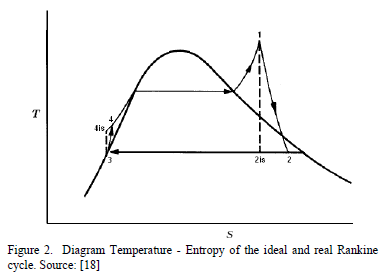
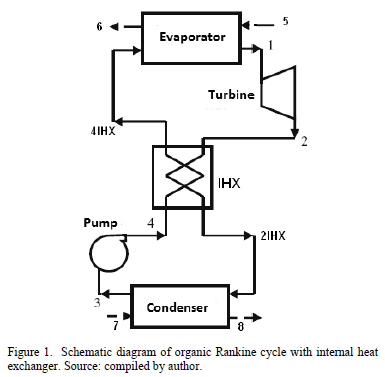
<body><![CDATA[<p><font size="2" face="Verdana, Arial, Helvetica, sans-serif">The present paper analyzes the behavior of working fluids,  such as water and some hydrocarbons and refrigerants in a Rankine cycle in  different configurations and conditions of temperature, pressure and flow, thus  establishing the viability of this type of process in the recovery and/or  utilization of low-temperature energy. </font></p>     <p><font size="2" face="Verdana, Arial, Helvetica, sans-serif">Nowadays, there is no  a unique fluid that fulfills all aspects to be considered to use in ORC cycles.  This study has selected R600, R600a, R113, R718, R425fa and Toluene, trying to  encompass and take into account the optimal physical and thermodynamic  properties, economic, toxicity, flammability, environmental friendly (with null  Ozone Depletion Potential (ODP) and Global Warming Potential (GWP)). Of the  fluids selected, R600a and R600 are hydrocarbons used as refrigerants with zero  potential degradation of the ozone layer and very low global warming potential,  however, they are highly flammable. Toluene is similar in its behavior, with  the drawback of its toxicity. Refrigerant R113 is not flammable, nor toxic, but  has high global warming potential and high destruction potential of the ozone  layer. R245fa is a safe refrigerant, nonflammable, nontoxic, has zero ozone  degradation potential, relatively high molecular weight, good thermophysical  properties, but has a moderate potential for global warming. Finally, water  (R718), as reference fluid to the being the working fluid in the conventional  Rankine cycle.</font></p>     <p><font size="2" face="Verdana, Arial, Helvetica, sans-serif">Additionally, in this study the difference in the type of  fluid has been considered and thus, the results obtained enable to determine  whether the increase in the inlet temperature increases or decreases turbine  cycle performance qualitatively but also, allows to know how this increases or  decreases.</font></p>     <p>&nbsp;</p>     <p><font size="3" face="Verdana, Arial, Helvetica, sans-serif"><b>2. Description of   the cycle</b></font></p>     <p><font size="2" face="Verdana, Arial, Helvetica, sans-serif">The operating principle of the ORC is the same as the  conventional Rankine cycle. A pump pressurizes the liquid fluid, which is  injected into an evaporator to produce a vapor that is expanded in a turbine  connected to a generator. Finally, the steam is condensed and sucked by the  pump, starting the cycle again. It may also include an internal heat exchanger  (IHX) to further exploit the energy of the expanded steam, preheating the fluid  exiting the pump and entering the evaporator, as is shown in <a href="#fig01">Fig. 1</a>. </font></p>     <p align="center"><font size="2" face="Verdana, Arial, Helvetica, sans-serif"><a name="fig01"></a></font><img src="/img/revistas/dyna/v81n188/v81n188a22fig01.gif"></p>     <p><font size="2" face="Verdana, Arial, Helvetica, sans-serif"><a href="#fig02">Figure 2</a> represents  the power cycle on a T-s diagram according to the state points displayed in the  flow diagram of <a href="#fig01">Fig. 1</a>. As an example, an ideal cycle process is shown by the  segments constructed from state points 1, 2<sub>is</sub>, 3 and 4<sub>is</sub>.  Line segment 1-2<sub>is</sub> represents an isentropic expansion with work  production. Heat is extracted from 2<sub>is</sub> to 3, through a constant  subcritical pressure line to subsequently result to ideal compression of the  subcooled liquid from the pressure at state point 3 to state point 4<sub>is</sub>.  Finally, the segment 4<sub>is</sub>-1 corresponds to the heat added to a  constant subcritical pressure up to the highest temperature point in the cycle  in the state point 1.</font></p>     <p align="center"><font size="2" face="Verdana, Arial, Helvetica, sans-serif"><a name="fig02"></a></font><img src="/img/revistas/dyna/v81n188/v81n188a22fig02.gif"></p>     <p><font size="2" face="Verdana, Arial, Helvetica, sans-serif">A cycle, in which both the expansion and the compression  are not ideal, is reproduced by segments in points 1, 2, 3 and 4 of the same  <a href="#fig02">Fig. 2</a>.</font></p>     ]]></body>
<body><![CDATA[<p>&nbsp;</p>     <p><b><font size="3" face="Verdana, Arial, Helvetica, sans-serif">3. Selection of   the working fluid </font></b></p>     <p><font size="2" face="Verdana, Arial, Helvetica, sans-serif">As mentioned  previously, the selection of the working fluid for use in ORC cycles is a  crucial point, because depending on the application, the source and the heat  level to use, the fluid must have optimal thermodynamic properties at lowest  temperatures and pressures and also satisfy several criteria such as being  economical, nontoxic, nonflammable, environmentally friendly, allow a high  utilization of the available energy from the heat source, among others &#91;3&#93;.  This limits the list to only a few fluids when considering all restrictions.</font></p>     <p><font size="2" face="Verdana, Arial, Helvetica, sans-serif">Some of these  limitations are &#91;3&#93;:</font></p>     <p><font size="2" face="Verdana, Arial, Helvetica, sans-serif"><i>Environmental</i>:  Some fluids are restricted by International Agreements depending on their Ozone  Depletion Potential (ODP) defined and limited by Montreal Protocol or Global  Warming Potential (GWP) by Kyoto Protocol, which, intend to prevent the  destruction of the ozone layer and emission of gases that cause the greenhouse  effect, respectively.</font></p>     <p><font size="2" face="Verdana, Arial, Helvetica, sans-serif"><i>Security:</i> The  fluid must be non-toxic (because of the problems that can occur in the case of leaks  in the atmosphere or in handling), non-corrosive (it obviously avoids major maintenance costs and/or  installation damage) and non-flammable. For this, the standard security  classification 34 of ASHRAE is often used as an indicator of the danger level  of fluids.</font></p>     <p><font size="2" face="Verdana, Arial, Helvetica, sans-serif"><i>Stability:</i> The chemical stability of the used fluid limits the heat source temperature.  When fluids are exposed to certain temperatures, they could decompose,  producing substances which could cause a different cycle operation to that  initially designed. Moreover, toxic and irritating compounds could induce  health problems in case leaks occur.</font></p>     <p><font size="2" face="Verdana, Arial, Helvetica, sans-serif"><i>Pressure:</i> A fluid requiring high pressure to achieve an efficient process increases  the cost of equipment due to the greater resistance required, increasing also  the complexity of the plant.</font></p>     <p><font size="2" face="Verdana, Arial, Helvetica, sans-serif"><i>Availability and low cost</i>: A fluid of low availability and/or high  cost limits its use in ORC plants for obvious reasons in the financial  viability of the projects.</font></p>     <p><font size="2" face="Verdana, Arial, Helvetica, sans-serif"><i>Latent heat and molecular weight:</i> With higher molecular weight and the latent  heat of the fluid, more energy from the heat source in the evaporator will be  absorbed and, thus, reducing the size of the installation and use of the pump  due to lower mass flow required.</font></p>     ]]></body>
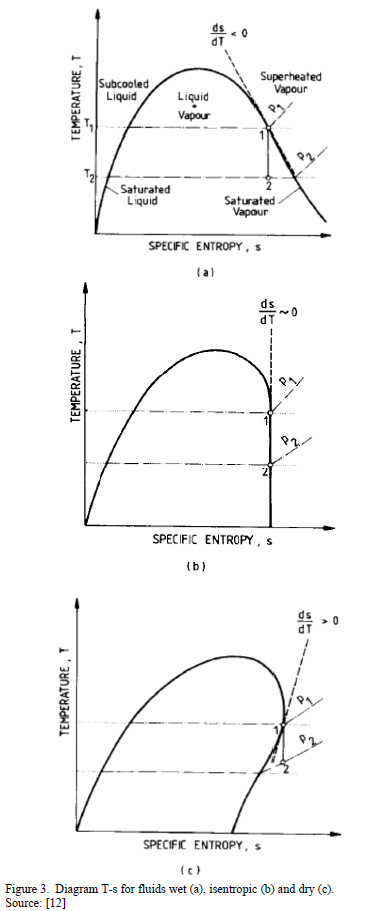
<body><![CDATA[<p><font size="2" face="Verdana, Arial, Helvetica, sans-serif"><i>Low freezing point</i>: The freezing point of the fluid must be  lower than the lowest temperature of the cycle. </font></p>     <p><font size="2" face="Verdana, Arial, Helvetica, sans-serif"><i>Curve of saturation:</i> The thermodynamic properties of the fluid  imply that the slope of the saturation curve thereof is negative, vertical or  positive, which markedly affecting the design and efficiency of the ORC. In     <a href="#fig03">Fig. 3.a</a>, <a href="#fig03">b</a> and <a href="#fig03">c</a>, a schematic diagram is shown of Temperature - Entropy (T-s)  for fluids with a negative saturation curve (a), vertical (b) and positive (c),  called wet, isentropic and dry, respectively. Since the objective of the ORC  focuses on the use of heat of low and medium temperature, the overheating of  steam as in a conventional Rankine cycle is not appropriate. Furthermore, as is  seen in <a href="#fig03">Fig. 3.a</a>, when a wet fluid is expanded without overheating (represented  by the segment of points 1-2), it falls in the liquid/vapor zone causing  damages to the expander and cycle inefficiencies. This happens, among other  reasons, because of the phase shift. </font></p>     <p align="center"><font size="2" face="Verdana, Arial, Helvetica, sans-serif"><a name="fig03"></a></font><img src="/img/revistas/dyna/v81n188/v81n188a22fig03.gif"></p>     <p><font size="2" face="Verdana, Arial, Helvetica, sans-serif">Nevertheless, the  contrary occurs with isentropic and dry fluids which, without any type of  overheating, suffer expansion falling into the saturated vapor zone, <a href="#fig03">Fig. 3.b</a>,  and/or superheated, <a href="#fig03">Fig. 3.c</a>, respectively, and thus, in the latter case, it  could include an internal heat exchanger to the cycle which allows to use even  more the energy from the expanded steam, preheating fluid from the pump to  enter the evaporator, thereby increasing the efficiency of the cycle.</font></p>     <p><font size="2" face="Verdana, Arial, Helvetica, sans-serif">In summary, for an organic Rankine cycle, the ideal  working fluid will be that whose saturated vapor line is parallel to the  expansion of the turbine, ensuring maximum efficiency. In this case, turbine  will be always working in the dry steam area. If both lines converge, the  turbine would operate in the wet steam region. In order to avoid this, it  should superheat the working fluid before the expansion. If, however, the lines  mentioned above were divergent, the output fluid from the turbine would exit  overheated. This would increase significantly the size of the condenser  surface, an aspect that is related to the operating pressure. The major  disadvantage of ORC is its relatively low efficiency (inherent to the thermodynamic  constraints) and the relatively large sizes of heat exchangers equipment.</font></p>     <p>&nbsp;</p>     <p><font size="3" face="Verdana, Arial, Helvetica, sans-serif"><b>4. Modelling of   the process</b></font></p>     <p><font size="2" face="Verdana, Arial, Helvetica, sans-serif">In both cycles,  the equations used for performance calculation assume steady state and constant  efficiencies of 75% for both the pump and the turbine. In addition, there are no  heat or pressure losses in the evaporator, heat exchanger or pipes, and an  overall cycle efficiency (<i><font face="Symbol">h</font></i>) is  considered as: </font></p>     <p><img src="/img/revistas/dyna/v81n188/v81n188a22eq01.gif"></p>     <p><font size="2" face="Verdana, Arial, Helvetica, sans-serif">Where, <sub><img src="/img/revistas/dyna/v81n188/v81n188a22eq014.gif"></sub> is the power,  &quot;t&quot; refers the turbine, &quot;p&quot; to the pump and &quot;e&quot; evaporator. Hence:</font></p>     ]]></body>
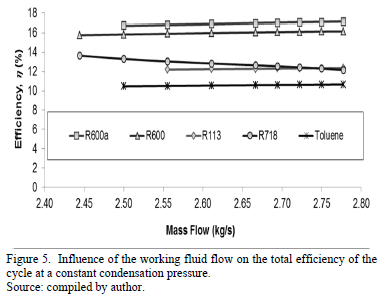
<body><![CDATA[<p><img src="/img/revistas/dyna/v81n188/v81n188a22eq0203.gif"></p>     <p><font size="2" face="Verdana, Arial, Helvetica, sans-serif"><sub><img src="/img/revistas/dyna/v81n188/v81n188a22eq020.gif"></sub>is the mass flow, <sub><img src="/img/revistas/dyna/v81n188/v81n188a22eq022.gif"></sub>is the enthalpy in  the state point &quot;i&quot;.</font></p>     <p><font size="2" face="Verdana, Arial, Helvetica, sans-serif">Whereas <sub><img src="/img/revistas/dyna/v81n188/v81n188a22eq024.gif"></sub> is the heat input in the evaporator defined  as:</font></p>     <p><img src="/img/revistas/dyna/v81n188/v81n188a22eq04.gif"></p>     <p><font size="2" face="Verdana, Arial, Helvetica, sans-serif">Through the  theoretical basis presented in the preceding sections and using the software  HYSYS<sup>®</sup>, a series of simulations has been developed that allows to  study the behavior of the ORC with different configurations and fluids (as  refrigerants, hydrocarbons and even water), thereby observing how the changes  influence the overall cycle efficiency for these types of fluids used varying  conditions of temperature, pressure, flow, etc.,. This simulator is useful for  thermodynamic analysis, especially in steady-state conditions, and it has the  advantage of including fluid properties and optimization tools. Its predictions  have been compared with those of &#91;19&#93; and the results are very similar. The  flow chart of the simulation is the same as it was presented in <a href="#fig01">Fig. 1</a>, and the  method to solve all the components is fully described in &#91;7,10&#93; and &#91;14&#93;.</font></p>     <p>&nbsp;</p>     <p><font size="3" face="Verdana, Arial, Helvetica, sans-serif"><b>5. Results and  discussions</b></font></p>     <p><font size="2" face="Verdana, Arial, Helvetica, sans-serif">The results obtained with the simulations for water,  hydrocarbons R600, R600a, Toluene and refrigerants R113 and R245fa are shown in  this section. </font></p>     <p><font size="2" face="Verdana, Arial, Helvetica, sans-serif"><b><i>5.1. Working Fluids: Water, R600, R600a, Toluene and  R113</i></b></font></p>     <p><b><font size="2" face="Verdana, Arial, Helvetica, sans-serif">5.1.1. Influence of inlet temperature in the turbine on the  overall cycle efficiency</font></b></p>     ]]></body>
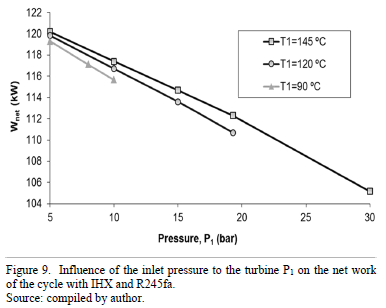
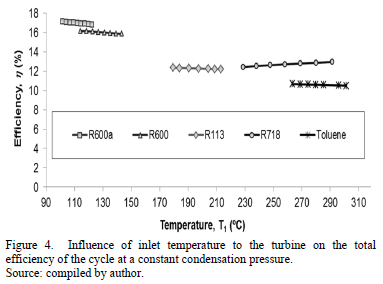
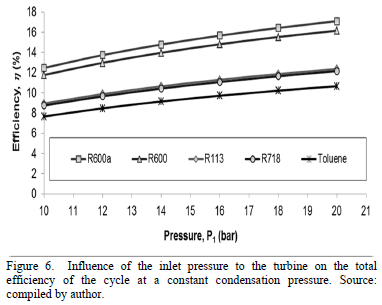
<body><![CDATA[<p><font size="2" face="Verdana, Arial, Helvetica, sans-serif">The  influence of inlet temperature to the turbine on the </font><font size="2" face="Verdana, Arial, Helvetica, sans-serif">overall cycle efficiency is  presented in <a href="#fig04">Fig. 4</a>. Here, conditions of input and output pressure in the  turbine and the fluid flow are kept constant for the five fluids analyzed and  for the different simulations carried out with values of 20 bar,  2 bar and 2.8 kg/s, respectively. It is evident that the efficiency increases  linearly with the inlet temperature to the turbine in the case of R718 (Water).  Unlike this wet fluid, the dry fluids R600, R600a, R113 and Toluene showed a  decrease of efficiency with the increase in inlet temperature to the turbine.</font></p>     <p align="center"><font size="2" face="Verdana, Arial, Helvetica, sans-serif"><a name="fig04"></a></font><img src="/img/revistas/dyna/v81n188/v81n188a22fig04.gif"></p>     <p><font size="2" face="Verdana, Arial, Helvetica, sans-serif">Thus, there is a  big difference in the efficiencies obtained according to the type of fluid  used, the highest efficiency obtained is for the case of R600a, followed by  R600, R718, R113 and Toluene. It is also interesting to note that as <a href="#fig04">Fig. 4</a> shows,  the use of one fluid or another will depend on the heat source that is intended  to be recovered, and the thermophysical properties of the fluid, since there  are fluids which would obtain relatively high efficiencies at relatively low  temperature ranges when compared to other fluids that are useful in other  temperature ranges.</font></p>     <p><font size="2" face="Verdana, Arial, Helvetica, sans-serif"><b>5.1.2. Influence of the working fluid flow on the overall  efficiency of the cycle</b></font></p>     <p><font size="2" face="Verdana, Arial, Helvetica, sans-serif"><a href="#fig05">Fig.  5</a> shows the influence of the working fluid flow on the efficiency of the cycle  with the condensation pressure constant and equal (2 bar) for all the studied  fluids, maintaining constant in addition the inlet pressure to the turbine at  20 bar for the five fluids analyzed and for all simulations realized whereas  the rate of energy supplied to the evaporator is also constant for all  simulations carried out but different for each fluid. Values achieved were 1500  kW, 1650 kW, 7778 kW, 795 kW and 2270 kW for the R600a, R600, R718, R113 and  Toluene, respectively. Thermodynamic properties of each fluid are different,  therefore, for the same state point, different values of enthalpy, entropy,  etc., could be obtained for two or more types of fluids. In addition, the  molecular weight and the vaporization latent heat of a specific fluid,  determines the amount of fluid flow (greater or smaller) that is required to  have to a given power, compared to other fluid. In this sense, to make the flow  values similar, i.e. to keep them in </font></p>     <p align="center"><font size="2" face="Verdana, Arial, Helvetica, sans-serif"><a name="fig05"></a></font><img src="/img/revistas/dyna/v81n188/v81n188a22fig05.gif"></p>     <p><font size="2" face="Verdana, Arial, Helvetica, sans-serif">the same range, the input power to  the evaporator was fixed, for the range of study. In <a href="#fig05">Fig. 5</a>, it is observed  that a slight influence exists of the working fluid on the overall efficiency  of the cycle for the case of R600a, R600, R113 and Toluene, whereas for the  R718, the effect is clear but opposite to that shown previously, i.e, a  decrease of the cycle efficiency when the flow of R718 increases.</font></p>     <p><font size="2" face="Verdana, Arial, Helvetica, sans-serif"><b>5.1.3. Influence of the input pressure to the turbine on  the overall efficiency of the cycle.</b></font></p>     <p><font size="2" face="Verdana, Arial, Helvetica, sans-serif">Based on the results shown in <a href="#fig04">Fig. 4</a> and <a href="#fig06">Fig. 6</a>, the  influence of the input pressure to the turbine on the overall efficiency of the  cycle is analyzed, the fluid flow of 2.8 kg/s was held constant for the five  fluids analyzed and for the different simulations, the rate of energy supplied  to the evaporator is also constant for the different simulations but different  for each fluid and whose values were 1500 kW, 1650 kW, 7778 kW, 795 kW and 2270  kW for R600a, R600, R718, R113 and Toluene, respectively. <a href="#fig06">Fig. 6</a> shows that the  system gains in efficiency with the increase of the input pressure to the  turbine. Results are consistent for all the fluids utilized. Higher input  pressures to the turbine raise the net work that leads to an improvement of the  efficiency. </font></p>     <p align="center"><font size="2" face="Verdana, Arial, Helvetica, sans-serif"><a name="fig06"></a></font><img src="/img/revistas/dyna/v81n188/v81n188a22fig06.gif"></p>     ]]></body>
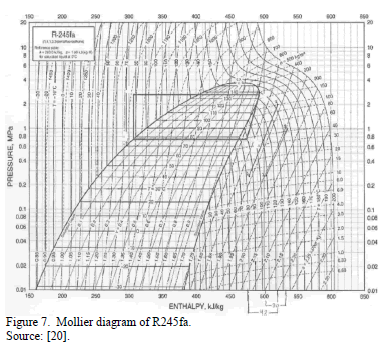
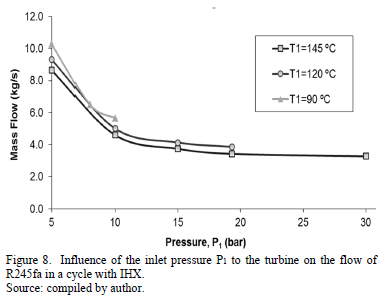
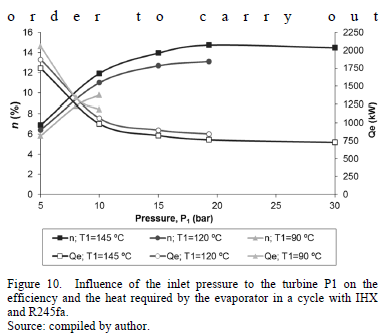
<body><![CDATA[<p><font size="2" face="Verdana, Arial, Helvetica, sans-serif">Although the efficiency of the system also increases when  the pressure of the system rises, this increase of the pressure in the system  is not always feasible for economic reasons since the capital costs for the  waste heat of a boiler and piping systems, as well as the complexity of the  system and the component selection of the materials must also be taken into  account. </font></p>     <p><font size="2" face="Verdana, Arial, Helvetica, sans-serif"><b><i>5.2. Working  fluid: R245fa</i></b></font></p>     <p><font size="2" face="Verdana, Arial, Helvetica, sans-serif">As it was discussed in the introduction to this paper, the  refrigerant R245fa is a very promising working fluid for using in low temperature  ORC because it meets many of the aspects to be considered in these  applications. The R245fa fluid is a safe refrigerant (nonflammable, nontoxic),  has a potential ozone degradation of zero, relatively high molecular weight,  good thermophysical properties (critical temperature and pressure, boiling  point, etc.), has a positive saturation curve, which gives higher yields,  allowing the preheating of the fluid exiting the pump using the steam exiting  the turbine, etc. However, it has a moderate potential for global warming as  its main disadvantage.</font></p>     <p><font size="2" face="Verdana, Arial, Helvetica, sans-serif">For those reasons, the approach  to the thermodynamic study of this fluid has been done differently from that  illustrated in the previous section. In this case, we have analyzed the effect  of inlet pressure and temperature to the turbine on the other parameters  (efficiency, flow, net work and heat supplied to the evaporator) to an ORC with  a fixed output gross power of 125 kWe and an IHX to preheat the liquid fluid  from the pump with the output steam from turbine (see <a href="#fig01">Fig. 1</a>). Simulations  considered a P<sub>2</sub>=2.5 bar and a condensing temperature of the working  fluid (T<sub>3</sub>) of 39.7&deg;C. In addition, the heat required for the  evaporator (<sub><img src="/img/revistas/dyna/v81n188/v81n188a22eq036.gif"></sub>) does not  take into account the efficiency for example from boiler and heat transfer in  the heat exchanger.</font></p>     <p><font size="2" face="Verdana, Arial, Helvetica, sans-serif"><b>5.2.1. Influence of the inlet pressure to the turbine on  the fluid flow in the cycle</b></font></p>     <p><font size="2" face="Verdana, Arial, Helvetica, sans-serif">As in this analysis, the  work produced by the turbine (<sub><img src="/img/revistas/dyna/v81n188/v81n188a22eq038.gif"></sub>) was constant and  equal to 125 kWe for all simulations, it can be stated that: keeping the  condition of turbine discharge constant P<sub>2</sub>=2.5 bar and considering  the fact that the work produced by the turbine is given by the eq. (2), and,  supported by the Mollier diagram of this fluid (<a href="#fig07">Fig. 7</a>), we see that, for any  constant inlet temperature to the turbine (for example, T<sub>1</sub>=145&deg;C),  increasing the inlet pressure to the turbine (P<sub>1</sub>), the delta  enthalpy, <font face="Symbol">D</font><i>h</i>, increases from 30  kJ/kg to 42 kJ/kg (segment 1-2, red and blue colors of this <a href="#fig07">Fig. 7</a>,  respectively) and therefore, the mass flow (<sub><img src="/img/revistas/dyna/v81n188/v81n188a22eq040.gif"></sub>) necessarily decreases  (for any of the three temperatures studied 90&deg;C, 120&deg;C and 145&deg;C), as depicted  in <a href="#fig08">Fig. 8</a> and thus to maintain constant value of the work produced by the  turbine.</font></p>     <p align="center"><font size="2" face="Verdana, Arial, Helvetica, sans-serif"><a name="fig07"></a></font><img src="/img/revistas/dyna/v81n188/v81n188a22fig07.gif"></p>     <p align="center"><font size="2" face="Verdana, Arial, Helvetica, sans-serif"><a name="fig08"></a></font><img src="/img/revistas/dyna/v81n188/v81n188a22fig08.gif"></p>     <p><font size="2" face="Verdana, Arial, Helvetica, sans-serif"><b>5.2.2. Influence of the inlet pressure to the turbine on  the net work of the cycle</b></font></p>     <p><font size="2" face="Verdana, Arial, Helvetica, sans-serif">Likewise, as is shown in <a href="#fig09">Fig. 9</a>,   as inlet pressure increases in the turbine, it causes a decrease in the net   work produced by the system (<sub><img src="/img/revistas/dyna/v81n188/v81n188a22eq048.gif"></sub>), because for the turbine work to be constant with   increasing pressure, the work consumed by the pump is increased for any of the  three temperatures studied 90&deg;C, 120&deg;C and 145&deg;C.</font></p>     ]]></body>

<body><![CDATA[<p align="center"><font size="2" face="Verdana, Arial, Helvetica, sans-serif"><a name="fig09"></a></font><img src="/img/revistas/dyna/v81n188/v81n188a22fig09.gif"></p>     <p><font size="2" face="Verdana, Arial, Helvetica, sans-serif"><b>5.2.3. Influence of the inlet pressure to the turbine on  the efficiency and the heat required in the cycle.</b></font></p>     <p><font size="2" face="Verdana, Arial, Helvetica, sans-serif">Similarly, and despite what was   discussed above, the net work (<sub><img src="/img/revistas/dyna/v81n188/v81n188a22eq050.gif"></sub>) always decreases with increasing inlet pressure to   the turbine P<sub>1</sub>, system efficiency increases, as is shown in <a href="#fig10">Fig. 10</a>.   This occurs because increasing such pressure P<sub>1</sub>, as is seen in <a href="#fig10">Fig.   10</a>, the amount of heat required in the evaporator decreases with a decreasing   mass flow (<a href="#fig08">Fig. 8</a>). This is produced because the mass needed to be heated/evaporated   to maintain the work produced by the turbine constant is less with respect to its  own net work. </font></p>     <p align="center"><font size="2" face="Verdana, Arial, Helvetica, sans-serif"><a name="fig10"></a></font><img src="/img/revistas/dyna/v81n188/v81n188a22fig10.gif"></p>     <p><font size="2" face="Verdana, Arial, Helvetica, sans-serif">The previous situation occurs until that by the own   characteristics of this fluid, there is a specific value for the pressure (the   optimum in efficiency terms), in which an increase of the variable P<sub>1</sub> induces a negligible increase of <font face="Symbol">D</font><i>h</i> (see <a href="#fig07">Fig. 7</a>), and therefore, a lower value of the mass flow, causing the heat   from the evaporator to drop a little but with sufficient value to counteract   the decrease in the net work and therefore maintaining the efficiency nearly   constant. In this case, and according to <a href="#fig08">Figs. 8</a> to <a href="#fig10">10</a>, this optimum inlet   pressure to the turbine is close to 20 bar for the temperature 145&deg;C, 15 bar  for the temperature 120&deg;C and 10 bar for 90&deg;C.</font></p>     <p>&nbsp;</p>     <p><b><font size="3" face="Verdana, Arial, Helvetica, sans-serif">4. Conclusions</font></b></p>     <p><font size="2" face="Verdana, Arial, Helvetica, sans-serif">Based on the   discussed in this paper, ORC technology seems to have an enormous potential   with renewable energy sources such as biomass, solar and geothermal energy as   well as waste heat from industrial processes or other cycle for transforming   low temperature heat sources into electricity. However, the thermophysical   properties, environmental impact, safety and stability as well as its   availability and cost, play a critical role in the selection of the working  fluid in these cycles.</font></p>     <p><font size="2" face="Verdana, Arial, Helvetica, sans-serif">Additionally,   according to research carried out in this work, it can be concluded that using   organic working fluids in Rankine cycles, relatively good efficiencies are   obtained recovering and/or using heats of low/medium temperature to convert  them into electricity.</font></p>     <p>&nbsp;</p>     ]]></body>
<body><![CDATA[<p><font size="3" face="Verdana, Arial, Helvetica, sans-serif"><b>Acknowledgements</b></font></p>     <p><font size="2" face="Verdana, Arial, Helvetica, sans-serif">Fredy V&eacute;lez would like to thank the scholarship   granted by the &quot;Programa Iberoamericano de Ciencia y Tecnolog&iacute;a para el   Desarrollo&quot;, CYTED, CARTIF Technological Center and the University of  Valladolid in order to carry out </font><font size="2" face="Verdana, Arial, Helvetica, sans-serif">his   doctoral thesis, on which this paper is based. In addition, the author   expresses his special gratitude to the Department of Renewable Energy Service   of the Spanish Company Nicol&aacute;s Correa, SA, for all the technical support  provided in the preparation of this research.</font></p>     <p>&nbsp;</p>     <p><font size="3" face="Verdana, Arial, Helvetica, sans-serif"><b>References</b></font></p>     <!-- ref --><p><font size="2" face="Verdana, Arial, Helvetica, sans-serif"><b>&#91;1&#93;</b> Realpe, A. and Diazgranados, J. A. Electricity generation and   wind potential assessment in regions of Colombia. Dyna, 79(171), pp. 116-122,  2012.    &nbsp;&nbsp;&nbsp;&nbsp;&nbsp;&nbsp;&nbsp;&nbsp;[&#160;<a href="javascript:void(0);" onclick="javascript: window.open('/scielo.php?script=sci_nlinks&ref=000097&pid=S0012-7353201400060002200001&lng=','','width=640,height=500,resizable=yes,scrollbars=1,menubar=yes,');">Links</a>&#160;]<!-- end-ref --></font></p>     <!-- ref --><p><font size="2" face="Verdana, Arial, Helvetica, sans-serif"><b>&#91;2&#93;</b> Hung, T. C., Shai, T. Y. and Wang, S. K. A review of organic   Rankine cycles (ORC`s) for the recovery of low-grade waste heat. Energy, vol.  22(7), pp. 661-667, 1997. <a href="http://dx.doi.org/10.1016/S0360-5442(96)00165-X" target="_blank">http://dx.doi.org/10.1016/S0360-5442(96)00165-X</a></font>&nbsp;&nbsp;&nbsp;&nbsp;&nbsp;&nbsp;&nbsp;&nbsp;[&#160;<a href="javascript:void(0);" onclick="javascript: window.open('/scielo.php?script=sci_nlinks&ref=000099&pid=S0012-7353201400060002200002&lng=','','width=640,height=500,resizable=yes,scrollbars=1,menubar=yes,');">Links</a>&#160;]<!-- end-ref --><!-- ref --><p><font size="2" face="Verdana, Arial, Helvetica, sans-serif"><b>&#91;3&#93;</b> V&eacute;lez, F., Segovia, J., Mart&iacute;n, M. C., Antol&iacute;n, G., Chejne, F.   and Quijano A. A Technical, economical and market review of organic rankine   cycles for the conversion of low-grade heat for power generation. Renewable  &amp; Sustainable Energy Reviews, 16(6) pp. 4175- 4189, 2012. <a href="http://dx.doi.org/10.1016/j.rser.2012.03.022" target="_blank">http://dx.doi.org/10.1016/j.rser.2012.03.022</a></font>&nbsp;&nbsp;&nbsp;&nbsp;&nbsp;&nbsp;&nbsp;&nbsp;[&#160;<a href="javascript:void(0);" onclick="javascript: window.open('/scielo.php?script=sci_nlinks&ref=000100&pid=S0012-7353201400060002200003&lng=','','width=640,height=500,resizable=yes,scrollbars=1,menubar=yes,');">Links</a>&#160;]<!-- end-ref --><!-- ref --><p><font size="2" face="Verdana, Arial, Helvetica, sans-serif"><b>&#91;4&#93;</b> Saleh, B., Koglbauer, G.,   Wendland, M. and Fischer, J. Working fluids for low temperature organic Rankine  cycles. Energy, vol. 32(7), pp. 1210-1221, 2007. <a href="http://dx.doi.org/10.1016/j.energy.2006.07.001" target="_blank">http://dx.doi.org/10.1016/j.energy.2006.07.001</a></font>&nbsp;&nbsp;&nbsp;&nbsp;&nbsp;&nbsp;&nbsp;&nbsp;[&#160;<a href="javascript:void(0);" onclick="javascript: window.open('/scielo.php?script=sci_nlinks&ref=000101&pid=S0012-7353201400060002200004&lng=','','width=640,height=500,resizable=yes,scrollbars=1,menubar=yes,');">Links</a>&#160;]<!-- end-ref --><!-- ref --><p><font size="2" face="Verdana, Arial, Helvetica, sans-serif"><b>&#91;5&#93;</b> Quoilin, S., Declaye, S., Tchange, B. F. and Lemort, V. Thermo-economic optimization of waste   heat recovery organic Rankine cycles. Applied Thermal Engineering, 31(14), pp.  2885-2893, 2011. <a href="http://dx.doi.org/10.1016/j.applthermaleng.2011.05.014" target="_blank">http://dx.doi.org/10.1016/j.applthermaleng.2011.05.014</a></font>&nbsp;&nbsp;&nbsp;&nbsp;&nbsp;&nbsp;&nbsp;&nbsp;[&#160;<a href="javascript:void(0);" onclick="javascript: window.open('/scielo.php?script=sci_nlinks&ref=000102&pid=S0012-7353201400060002200005&lng=','','width=640,height=500,resizable=yes,scrollbars=1,menubar=yes,');">Links</a>&#160;]<!-- end-ref --><!-- ref --><p><font size="2" face="Verdana, Arial, Helvetica, sans-serif"><b>&#91;6&#93;</b> Tchange, B.F., Papadakis, G., Lambrinos, G. and Frangoudakis,   A., Fluid selection for a low-temperature solar organic Rankine cycle. Applied  Thermal Engineering, 29(1), pp. 2468-2476, 2009. <a href="http://dx.doi.org/10.1016/j.applthermaleng.2008.12.025" target="_blank">http://dx.doi.org/10.1016/j.applthermaleng.2008.12.025</a></font>&nbsp;&nbsp;&nbsp;&nbsp;&nbsp;&nbsp;&nbsp;&nbsp;[&#160;<a href="javascript:void(0);" onclick="javascript: window.open('/scielo.php?script=sci_nlinks&ref=000103&pid=S0012-7353201400060002200006&lng=','','width=640,height=500,resizable=yes,scrollbars=1,menubar=yes,');">Links</a>&#160;]<!-- end-ref --><!-- ref --><p><font size="2" face="Verdana, Arial, Helvetica, sans-serif"><b>&#91;7&#93;</b> V&eacute;lez, F., Chejne, F., Antol&iacute;n, G. and Quijano, A. Theoretical   analysis of a transcritical power cycle for power generation from waste energy   at low temperature heat source. Energy Conversion and Management, vol. 60,  pp.188-195, 2012. <a href="http://dx.doi.org/10.1016/j.enconman.2012.01.023" target="_blank">http://dx.doi.org/10.1016/j.enconman.2012.01.023</a></font>&nbsp;&nbsp;&nbsp;&nbsp;&nbsp;&nbsp;&nbsp;&nbsp;[&#160;<a href="javascript:void(0);" onclick="javascript: window.open('/scielo.php?script=sci_nlinks&ref=000104&pid=S0012-7353201400060002200007&lng=','','width=640,height=500,resizable=yes,scrollbars=1,menubar=yes,');">Links</a>&#160;]<!-- end-ref --><!-- ref --><p><font size="2" face="Verdana, Arial, Helvetica, sans-serif"><b>&#91;8&#93;</b> Mago, P. J., Chamra, L. M., Srinivasan, K. and Somayaji, C. An   examination of regenerative organic Rankine cycles using dry fluids. Applied  Thermal Engineering, 28(8), pp. 998-1007, 2008. <a href="http://dx.doi.org/10.1016/j.applthermaleng.2007.06.025" target="_blank">http://dx.doi.org/10.1016/j.applthermaleng.2007.06.025</a></font>&nbsp;&nbsp;&nbsp;&nbsp;&nbsp;&nbsp;&nbsp;&nbsp;[&#160;<a href="javascript:void(0);" onclick="javascript: window.open('/scielo.php?script=sci_nlinks&ref=000105&pid=S0012-7353201400060002200008&lng=','','width=640,height=500,resizable=yes,scrollbars=1,menubar=yes,');">Links</a>&#160;]<!-- end-ref --><!-- ref --><p><font size="2" face="Verdana, Arial, Helvetica, sans-serif"><b>&#91;9&#93;</b> Schuster, A., Karellas, S., Kakaras, E. and Spliethoff, H., Energetic and economic   investigation of organic Rankine cycle applications. Applied Thermal  Engineering, 29(8-9), pp. 1809-1817, 2009. <a href="http://dx.doi.org/10.1016/j.applthermaleng.2008.08.016" target="_blank">http://dx.doi.org/10.1016/j.applthermaleng.2008.08.016</a></font>&nbsp;&nbsp;&nbsp;&nbsp;&nbsp;&nbsp;&nbsp;&nbsp;[&#160;<a href="javascript:void(0);" onclick="javascript: window.open('/scielo.php?script=sci_nlinks&ref=000106&pid=S0012-7353201400060002200009&lng=','','width=640,height=500,resizable=yes,scrollbars=1,menubar=yes,');">Links</a>&#160;]<!-- end-ref --><!-- ref --><p><font size="2" face="Verdana, Arial, Helvetica, sans-serif"><b>&#91;10&#93;</b> V&eacute;lez, F., Segovia, J.,   Chejne, F., Antol&iacute;n, G., Quijano, A. and Mart&iacute;n, M.C. Low temperature heat   source for power generation: exhaustive analysis of a carbon dioxide  transcritical power cycle. Energy, 36(9), pp. 5497-5507, 2011. <a href="http://dx.doi.org/10.1016/j.energy.2011.07.027" target="_blank">http://dx.doi.org/10.1016/j.energy.2011.07.027</a></font>&nbsp;&nbsp;&nbsp;&nbsp;&nbsp;&nbsp;&nbsp;&nbsp;[&#160;<a href="javascript:void(0);" onclick="javascript: window.open('/scielo.php?script=sci_nlinks&ref=000107&pid=S0012-7353201400060002200010&lng=','','width=640,height=500,resizable=yes,scrollbars=1,menubar=yes,');">Links</a>&#160;]<!-- end-ref --><!-- ref --><p><font size="2" face="Verdana, Arial, Helvetica, sans-serif"><b>&#91;11&#93;</b> Chen, H., Goswami, Y. and Stefanakos, E. A review of thermodynamic   cycles and working fluids for the conversion of low-grade heat. Renewable and  Sustainable Energy Reviews, 14(9), pp. 3059-3067, 2010. <a href="http://dx.doi.org/10.1016/j.rser.2010.07.006" target="_blank">http://dx.doi.org/10.1016/j.rser.2010.07.006</a></font>&nbsp;&nbsp;&nbsp;&nbsp;&nbsp;&nbsp;&nbsp;&nbsp;[&#160;<a href="javascript:void(0);" onclick="javascript: window.open('/scielo.php?script=sci_nlinks&ref=000108&pid=S0012-7353201400060002200011&lng=','','width=640,height=500,resizable=yes,scrollbars=1,menubar=yes,');">Links</a>&#160;]<!-- end-ref --><!-- ref --><p><font size="2" face="Verdana, Arial, Helvetica, sans-serif"><b>&#91;12&#93;</b> Badr, O., Probert, S. D.   and O'callaghan, P.W., Selecting a working fluid for a Rankine-cycle engine.  Applied Energy, 21(1), pp. 1-42, 1985. <a href="http://dx.doi.org/10.1016/0306-2619(85)90037-6" target="_blank">http://dx.doi.org/10.1016/0306-2619(85)90037-6</a> <a href="http://dx.doi.org/10.1016/0306-2619(85)90072-8" target="_blank">http://dx.doi.org/10.1016/0306-2619(85)90072-8</a> <a href="http://dx.doi.org/10.1016/0306-2619(85)90033-9" target="_blank">http://dx.doi.org/10.1016/0306-2619(85)90033-9</a></font>&nbsp;&nbsp;&nbsp;&nbsp;&nbsp;&nbsp;&nbsp;&nbsp;[&#160;<a href="javascript:void(0);" onclick="javascript: window.open('/scielo.php?script=sci_nlinks&ref=000109&pid=S0012-7353201400060002200012&lng=','','width=640,height=500,resizable=yes,scrollbars=1,menubar=yes,');">Links</a>&#160;]<!-- end-ref --><!-- ref --><p><font size="2" face="Verdana, Arial, Helvetica, sans-serif"><b>&#91;13&#93;</b> U.S. Environmental   Protection Agency. Class I Ozone Depleting Substances. &#91;Online&#93;. &#91;date of reference March 11th of 2013&#93;</b> Available  at: <a href="http://www.epa.gov/ozone/science/ods/classone.html" target="_blank">www.epa.gov/ozone/science/ods/classone.html</a>.    &nbsp;&nbsp;&nbsp;&nbsp;&nbsp;&nbsp;&nbsp;&nbsp;[&#160;<a href="javascript:void(0);" onclick="javascript: window.open('/scielo.php?script=sci_nlinks&ref=000110&pid=S0012-7353201400060002200013&lng=','','width=640,height=500,resizable=yes,scrollbars=1,menubar=yes,');">Links</a>&#160;]<!-- end-ref --></font></p>     <!-- ref --><p><font size="2" face="Verdana, Arial, Helvetica, sans-serif"><b>&#91;14&#93;</b> Velez, F., Segovia, J., Mart&iacute;n, M. C.,   Antol&iacute;n, G., Chejne, F. and Quijano, A. Comparative study of working fluids for   a Rankine cycle operating at low temperature. Fuel Processing Technology, vol.  103, pp. 71-77, 2012. <a href="http://dx.doi.org/10.1016/j.fuproc.2011.09.017" target="_blank">http://dx.doi.org/10.1016/j.fuproc.2011.09.017</a></font>&nbsp;&nbsp;&nbsp;&nbsp;&nbsp;&nbsp;&nbsp;&nbsp;[&#160;<a href="javascript:void(0);" onclick="javascript: window.open('/scielo.php?script=sci_nlinks&ref=000112&pid=S0012-7353201400060002200014&lng=','','width=640,height=500,resizable=yes,scrollbars=1,menubar=yes,');">Links</a>&#160;]<!-- end-ref --><!-- ref --><p><font size="2" face="Verdana, Arial, Helvetica, sans-serif"><b>&#91;15&#93;</b> Yamamoto, T., Furuhata, T., Arai, N. and   Mori, K. Design and testing of the organic Rankine cycle. Energy, 26(3), pp.  239-251, 2001. <a href="http://dx.doi.org/10.1016/S0360-5442(00)00063-3" target="_blank">http://dx.doi.org/10.1016/S0360-5442(00)00063-3</a></font>&nbsp;&nbsp;&nbsp;&nbsp;&nbsp;&nbsp;&nbsp;&nbsp;[&#160;<a href="javascript:void(0);" onclick="javascript: window.open('/scielo.php?script=sci_nlinks&ref=000113&pid=S0012-7353201400060002200015&lng=','','width=640,height=500,resizable=yes,scrollbars=1,menubar=yes,');">Links</a>&#160;]<!-- end-ref --><!-- ref --><p><font size="2" face="Verdana, Arial, Helvetica, sans-serif"><b>&#91;16&#93;</b> Drescher, U. and   Brüggemann, D. Fluid selection for the organic Rankine cycle (ORC) in biomass  power and heat plants. Applied Thermal Engineering, 27(1), pp. 223-228, 2007. <a href="http://dx.doi.org/10.1016/j.applthermaleng.2006.04.024" target="_blank">http://dx.doi.org/10.1016/j.applthermaleng.2006.04.024</a></font>&nbsp;&nbsp;&nbsp;&nbsp;&nbsp;&nbsp;&nbsp;&nbsp;[&#160;<a href="javascript:void(0);" onclick="javascript: window.open('/scielo.php?script=sci_nlinks&ref=000114&pid=S0012-7353201400060002200016&lng=','','width=640,height=500,resizable=yes,scrollbars=1,menubar=yes,');">Links</a>&#160;]<!-- end-ref --><!-- ref --><p><font size="2" face="Verdana, Arial, Helvetica, sans-serif"><b>&#91;17&#93;</b> Lakew, A., Bolland, O.   Working fluids for low temperature heat source. Applied Thermal Engineering,  30(10), pp. 1262-1268, 2010. <a href="http://dx.doi.org/10.1016/j.applthermaleng.2010.02.009" target="_blank">http://dx.doi.org/10.1016/j.applthermaleng.2010.02.009</a></font>&nbsp;&nbsp;&nbsp;&nbsp;&nbsp;&nbsp;&nbsp;&nbsp;[&#160;<a href="javascript:void(0);" onclick="javascript: window.open('/scielo.php?script=sci_nlinks&ref=000115&pid=S0012-7353201400060002200017&lng=','','width=640,height=500,resizable=yes,scrollbars=1,menubar=yes,');">Links</a>&#160;]<!-- end-ref --><!-- ref --><p><font size="2" face="Verdana, Arial, Helvetica, sans-serif"><b>&#91;18&#93;</b> Monsalve, E., Cecchi, P.,   Vidal, A., Zu&ntilde;iga, A. Informe I: Ciclo de Rankine., Departamento de Ingenier&iacute;a  Mec&aacute;nica, Facultad de Ciencias F&iacute;sicas y Matem&aacute;ticas, Universidad de Chile, Santiago de Chile, Chile, 2008.    &nbsp;&nbsp;&nbsp;&nbsp;&nbsp;&nbsp;&nbsp;&nbsp;[&#160;<a href="javascript:void(0);" onclick="javascript: window.open('/scielo.php?script=sci_nlinks&ref=000116&pid=S0012-7353201400060002200018&lng=','','width=640,height=500,resizable=yes,scrollbars=1,menubar=yes,');">Links</a>&#160;]<!-- end-ref --></font></p>     <!-- ref --><p><font size="2" face="Verdana, Arial, Helvetica, sans-serif"><b>&#91;19&#93;</b> Lemmon, E. W., Huber, M.   L. and Mclinden, M. O. Reference fluid thermodynamic and transport properties   (REFPROP). NIST Standard Reference  Database 23, Version 8.0; 2007.    &nbsp;&nbsp;&nbsp;&nbsp;&nbsp;&nbsp;&nbsp;&nbsp;[&#160;<a href="javascript:void(0);" onclick="javascript: window.open('/scielo.php?script=sci_nlinks&ref=000118&pid=S0012-7353201400060002200019&lng=','','width=640,height=500,resizable=yes,scrollbars=1,menubar=yes,');">Links</a>&#160;]<!-- end-ref --></font></p>     <!-- ref --><p><font size="2" face="Verdana, Arial, Helvetica, sans-serif"><b>&#91;20&#93;</b> Organic-rankine-cycle.blogspot. &#91;en l&iacute;nea&#93;   &#91;date of reference January 15<sup>th</sup> of 2014&#93;. Available at:  <a href="http://goo.gl/Oj7sxf" target="_blank">http://goo.gl/Oj7sxf</a>.    &nbsp;&nbsp;&nbsp;&nbsp;&nbsp;&nbsp;&nbsp;&nbsp;[&#160;<a href="javascript:void(0);" onclick="javascript: window.open('/scielo.php?script=sci_nlinks&ref=000120&pid=S0012-7353201400060002200020&lng=','','width=640,height=500,resizable=yes,scrollbars=1,menubar=yes,');">Links</a>&#160;]<!-- end-ref --></font></p>     <p>&nbsp;</p>     ]]></body>
<body><![CDATA[<p><font size="2" face="Verdana, Arial, Helvetica, sans-serif"><b>F. V&eacute;lez,</b> PhD. in Energetic and Fluid-Mechanical Engineering by University of  Valladolid (2011). MSci in Engineering -Emphasis in Chemical Engineering-  (2007) and Chemical Engineering (2004), both by Colombian National University,  where he was also an Associate Professor at the Energy and Process School. He  started to work as researcher in the field of renewable energies in 2004. Since  2007 he is actively working in the Energy Department of CARTIF in RTD projects  about energy efficiency and integration of renewable energy (solar, geothermal,  biomass) for the production of heating and cooling and/or electricity  generation in buildings (to achieve zero emission buildings and near-zero  energy balance) and industrial processes. He has experience in national and  international (European and Latin American) projects, and has published many  papers in peer review and technical journals and contributions in conferences  about these themes. ORCID 0000-0003-0764-1321 </font></p>      ]]></body><back>
<ref-list>
<ref id="B1">
<label>1</label><nlm-citation citation-type="journal">
<person-group person-group-type="author">
<name>
<surname><![CDATA[Realpe]]></surname>
<given-names><![CDATA[A.]]></given-names>
</name>
<name>
<surname><![CDATA[Diazgranados]]></surname>
<given-names><![CDATA[J. A.]]></given-names>
</name>
</person-group>
<article-title xml:lang="en"><![CDATA[Electricity generation and wind potential assessment in regions of Colombia]]></article-title>
<source><![CDATA[Dyna]]></source>
<year>2012</year>
<volume>79</volume>
<numero>171</numero>
<issue>171</issue>
<page-range>116-122</page-range></nlm-citation>
</ref>
<ref id="B2">
<label>2</label><nlm-citation citation-type="journal">
<person-group person-group-type="author">
<name>
<surname><![CDATA[Hung]]></surname>
<given-names><![CDATA[T. C.]]></given-names>
</name>
<name>
<surname><![CDATA[Shai]]></surname>
<given-names><![CDATA[T. Y.]]></given-names>
</name>
<name>
<surname><![CDATA[Wang]]></surname>
<given-names><![CDATA[S. K.]]></given-names>
</name>
</person-group>
<article-title xml:lang="en"><![CDATA[A review of organic Rankine cycles (ORC`s) for the recovery of low-grade waste heat]]></article-title>
<source><![CDATA[Energy]]></source>
<year>1997</year>
<volume>22</volume>
<numero>7</numero>
<issue>7</issue>
<page-range>661-667</page-range></nlm-citation>
</ref>
<ref id="B3">
<label>3</label><nlm-citation citation-type="journal">
<person-group person-group-type="author">
<name>
<surname><![CDATA[Vélez]]></surname>
<given-names><![CDATA[F.]]></given-names>
</name>
<name>
<surname><![CDATA[Segovia]]></surname>
<given-names><![CDATA[J.]]></given-names>
</name>
<name>
<surname><![CDATA[Martín]]></surname>
<given-names><![CDATA[M. C.]]></given-names>
</name>
<name>
<surname><![CDATA[Antolín]]></surname>
<given-names><![CDATA[G.]]></given-names>
</name>
<name>
<surname><![CDATA[Chejne]]></surname>
<given-names><![CDATA[F.]]></given-names>
</name>
<name>
<surname><![CDATA[Quijano]]></surname>
<given-names><![CDATA[A.]]></given-names>
</name>
</person-group>
<article-title xml:lang="en"><![CDATA[A Technical, economical and market review of organic rankine cycles for the conversion of low-grade heat for power generation]]></article-title>
<source><![CDATA[Renewable & Sustainable Energy Reviews]]></source>
<year>2012</year>
<volume>16</volume>
<numero>6</numero>
<issue>6</issue>
<page-range>4175- 4189</page-range></nlm-citation>
</ref>
<ref id="B4">
<label>4</label><nlm-citation citation-type="journal">
<person-group person-group-type="author">
<name>
<surname><![CDATA[Saleh]]></surname>
<given-names><![CDATA[B.]]></given-names>
</name>
<name>
<surname><![CDATA[Koglbauer]]></surname>
<given-names><![CDATA[G.]]></given-names>
</name>
<name>
<surname><![CDATA[Wendland]]></surname>
<given-names><![CDATA[M.]]></given-names>
</name>
<name>
<surname><![CDATA[Fischer]]></surname>
<given-names><![CDATA[J.]]></given-names>
</name>
</person-group>
<article-title xml:lang="en"><![CDATA[Working fluids for low temperature organic Rankine cycles]]></article-title>
<source><![CDATA[Energy]]></source>
<year>2007</year>
<volume>32</volume>
<numero>7</numero>
<issue>7</issue>
<page-range>1210-1221</page-range></nlm-citation>
</ref>
<ref id="B5">
<label>5</label><nlm-citation citation-type="journal">
<person-group person-group-type="author">
<name>
<surname><![CDATA[Quoilin]]></surname>
<given-names><![CDATA[S.]]></given-names>
</name>
<name>
<surname><![CDATA[Declaye]]></surname>
<given-names><![CDATA[S.]]></given-names>
</name>
<name>
<surname><![CDATA[Tchange]]></surname>
<given-names><![CDATA[B. F.]]></given-names>
</name>
<name>
<surname><![CDATA[Lemort]]></surname>
<given-names><![CDATA[V.]]></given-names>
</name>
</person-group>
<article-title xml:lang="en"><![CDATA[Thermo-economic optimization of waste heat recovery organic Rankine cycles]]></article-title>
<source><![CDATA[Applied Thermal Engineering]]></source>
<year>2011</year>
<volume>31</volume>
<numero>14</numero>
<issue>14</issue>
<page-range>2885-2893</page-range></nlm-citation>
</ref>
<ref id="B6">
<label>6</label><nlm-citation citation-type="journal">
<person-group person-group-type="author">
<name>
<surname><![CDATA[Tchange]]></surname>
<given-names><![CDATA[B.F.]]></given-names>
</name>
<name>
<surname><![CDATA[Papadakis]]></surname>
<given-names><![CDATA[G.]]></given-names>
</name>
<name>
<surname><![CDATA[Lambrinos]]></surname>
<given-names><![CDATA[G.]]></given-names>
</name>
<name>
<surname><![CDATA[Frangoudakis]]></surname>
<given-names><![CDATA[A.]]></given-names>
</name>
</person-group>
<article-title xml:lang="en"><![CDATA[Fluid selection for a low-temperature solar organic Rankine cycle]]></article-title>
<source><![CDATA[Applied Thermal Engineering]]></source>
<year>2009</year>
<volume>29</volume>
<numero>1</numero>
<issue>1</issue>
<page-range>2468-2476</page-range></nlm-citation>
</ref>
<ref id="B7">
<label>7</label><nlm-citation citation-type="journal">
<person-group person-group-type="author">
<name>
<surname><![CDATA[Vélez]]></surname>
<given-names><![CDATA[F.]]></given-names>
</name>
<name>
<surname><![CDATA[Chejne]]></surname>
<given-names><![CDATA[F.]]></given-names>
</name>
<name>
<surname><![CDATA[Antolín]]></surname>
<given-names><![CDATA[G.]]></given-names>
</name>
<name>
<surname><![CDATA[Quijano]]></surname>
<given-names><![CDATA[A.]]></given-names>
</name>
</person-group>
<article-title xml:lang="en"><![CDATA[Theoretical analysis of a transcritical power cycle for power generation from waste energy at low temperature heat source]]></article-title>
<source><![CDATA[Energy Conversion and Management]]></source>
<year>2012</year>
<volume>60</volume>
<page-range>188-195</page-range></nlm-citation>
</ref>
<ref id="B8">
<label>8</label><nlm-citation citation-type="journal">
<person-group person-group-type="author">
<name>
<surname><![CDATA[Mago]]></surname>
<given-names><![CDATA[P. J.]]></given-names>
</name>
<name>
<surname><![CDATA[Chamra]]></surname>
<given-names><![CDATA[L. M.]]></given-names>
</name>
<name>
<surname><![CDATA[Srinivasan]]></surname>
<given-names><![CDATA[K.]]></given-names>
</name>
<name>
<surname><![CDATA[Somayaji]]></surname>
<given-names><![CDATA[C.]]></given-names>
</name>
</person-group>
<article-title xml:lang="en"><![CDATA[An examination of regenerative organic Rankine cycles using dry fluids]]></article-title>
<source><![CDATA[Applied Thermal Engineering]]></source>
<year>2008</year>
<volume>28</volume>
<numero>8</numero>
<issue>8</issue>
<page-range>998-1007</page-range></nlm-citation>
</ref>
<ref id="B9">
<label>9</label><nlm-citation citation-type="journal">
<person-group person-group-type="author">
<name>
<surname><![CDATA[Schuster]]></surname>
<given-names><![CDATA[A.]]></given-names>
</name>
<name>
<surname><![CDATA[Karellas]]></surname>
<given-names><![CDATA[S.]]></given-names>
</name>
<name>
<surname><![CDATA[Kakaras]]></surname>
<given-names><![CDATA[E.]]></given-names>
</name>
<name>
<surname><![CDATA[Spliethoff]]></surname>
<given-names><![CDATA[H.]]></given-names>
</name>
</person-group>
<article-title xml:lang="en"><![CDATA[Energetic and economic investigation of organic Rankine cycle applications]]></article-title>
<source><![CDATA[Applied Thermal Engineering]]></source>
<year>2009</year>
<volume>29</volume>
<numero>8-9</numero>
<issue>8-9</issue>
<page-range>1809-1817</page-range></nlm-citation>
</ref>
<ref id="B10">
<label>10</label><nlm-citation citation-type="journal">
<person-group person-group-type="author">
<name>
<surname><![CDATA[Vélez]]></surname>
<given-names><![CDATA[F.]]></given-names>
</name>
<name>
<surname><![CDATA[Segovia]]></surname>
<given-names><![CDATA[J.]]></given-names>
</name>
<name>
<surname><![CDATA[Chejne]]></surname>
<given-names><![CDATA[F.]]></given-names>
</name>
<name>
<surname><![CDATA[Antolín]]></surname>
<given-names><![CDATA[G.]]></given-names>
</name>
<name>
<surname><![CDATA[Quijano]]></surname>
<given-names><![CDATA[A.]]></given-names>
</name>
<name>
<surname><![CDATA[Martín]]></surname>
<given-names><![CDATA[M.C.]]></given-names>
</name>
</person-group>
<article-title xml:lang="en"><![CDATA[Low temperature heat source for power generation: exhaustive analysis of a carbon dioxide transcritical power cycle]]></article-title>
<source><![CDATA[Energy]]></source>
<year>2011</year>
<volume>36</volume>
<numero>9</numero>
<issue>9</issue>
<page-range>5497-5507</page-range></nlm-citation>
</ref>
<ref id="B11">
<label>11</label><nlm-citation citation-type="journal">
<person-group person-group-type="author">
<name>
<surname><![CDATA[Chen]]></surname>
<given-names><![CDATA[H.]]></given-names>
</name>
<name>
<surname><![CDATA[Goswami]]></surname>
<given-names><![CDATA[Y.]]></given-names>
</name>
<name>
<surname><![CDATA[Stefanakos]]></surname>
<given-names><![CDATA[E.]]></given-names>
</name>
</person-group>
<article-title xml:lang="en"><![CDATA[A review of thermodynamic cycles and working fluids for the conversion of low-grade heat]]></article-title>
<source><![CDATA[Renewable and Sustainable Energy Reviews]]></source>
<year>2010</year>
<volume>14</volume>
<numero>9</numero>
<issue>9</issue>
<page-range>3059-3067</page-range></nlm-citation>
</ref>
<ref id="B12">
<label>12</label><nlm-citation citation-type="journal">
<person-group person-group-type="author">
<name>
<surname><![CDATA[Badr]]></surname>
<given-names><![CDATA[O.]]></given-names>
</name>
<name>
<surname><![CDATA[Probert]]></surname>
<given-names><![CDATA[S. D.]]></given-names>
</name>
<name>
<surname><![CDATA[O'callaghan]]></surname>
<given-names><![CDATA[P.W.]]></given-names>
</name>
</person-group>
<article-title xml:lang="en"><![CDATA[Selecting a working fluid for a Rankine-cycle engine]]></article-title>
<source><![CDATA[Applied Energy]]></source>
<year>1985</year>
<volume>21</volume>
<numero>1</numero>
<issue>1</issue>
<page-range>1-42</page-range></nlm-citation>
</ref>
<ref id="B13">
<label>13</label><nlm-citation citation-type="">
<collab>U.S. Environmental Protection Agency</collab>
<source><![CDATA[Class I Ozone Depleting Substances]]></source>
<year></year>
</nlm-citation>
</ref>
<ref id="B14">
<label>14</label><nlm-citation citation-type="journal">
<person-group person-group-type="author">
<name>
<surname><![CDATA[Velez]]></surname>
<given-names><![CDATA[F.]]></given-names>
</name>
<name>
<surname><![CDATA[Segovia]]></surname>
<given-names><![CDATA[J.]]></given-names>
</name>
<name>
<surname><![CDATA[Martín]]></surname>
<given-names><![CDATA[M. C.]]></given-names>
</name>
<name>
<surname><![CDATA[Antolín]]></surname>
<given-names><![CDATA[G.]]></given-names>
</name>
<name>
<surname><![CDATA[Chejne]]></surname>
<given-names><![CDATA[F.]]></given-names>
</name>
<name>
<surname><![CDATA[Quijano]]></surname>
<given-names><![CDATA[A.]]></given-names>
</name>
</person-group>
<article-title xml:lang="en"><![CDATA[Comparative study of working fluids for a Rankine cycle operating at low temperature]]></article-title>
<source><![CDATA[Fuel Processing Technology]]></source>
<year>2012</year>
<volume>103</volume>
<page-range>71-77</page-range></nlm-citation>
</ref>
<ref id="B15">
<label>15</label><nlm-citation citation-type="journal">
<person-group person-group-type="author">
<name>
<surname><![CDATA[Yamamoto]]></surname>
<given-names><![CDATA[T.]]></given-names>
</name>
<name>
<surname><![CDATA[Furuhata]]></surname>
<given-names><![CDATA[T.]]></given-names>
</name>
<name>
<surname><![CDATA[Arai]]></surname>
<given-names><![CDATA[N.]]></given-names>
</name>
<name>
<surname><![CDATA[Mori]]></surname>
<given-names><![CDATA[K.]]></given-names>
</name>
</person-group>
<article-title xml:lang="en"><![CDATA[Design and testing of the organic Rankine cycle]]></article-title>
<source><![CDATA[Energy]]></source>
<year>2001</year>
<volume>26</volume>
<numero>3</numero>
<issue>3</issue>
<page-range>239-251</page-range></nlm-citation>
</ref>
<ref id="B16">
<label>16</label><nlm-citation citation-type="journal">
<person-group person-group-type="author">
<name>
<surname><![CDATA[Drescher]]></surname>
<given-names><![CDATA[U.]]></given-names>
</name>
<name>
<surname><![CDATA[Brüggemann]]></surname>
<given-names><![CDATA[D.]]></given-names>
</name>
</person-group>
<article-title xml:lang="en"><![CDATA[Fluid selection for the organic Rankine cycle (ORC) in biomass power and heat plants]]></article-title>
<source><![CDATA[Applied Thermal Engineering]]></source>
<year>2007</year>
<volume>27</volume>
<numero>1</numero>
<issue>1</issue>
<page-range>223-228</page-range></nlm-citation>
</ref>
<ref id="B17">
<label>17</label><nlm-citation citation-type="journal">
<person-group person-group-type="author">
<name>
<surname><![CDATA[Lakew]]></surname>
<given-names><![CDATA[A.]]></given-names>
</name>
<name>
<surname><![CDATA[Bolland]]></surname>
<given-names><![CDATA[O.]]></given-names>
</name>
</person-group>
<article-title xml:lang="en"><![CDATA[Working fluids for low temperature heat source.]]></article-title>
<source><![CDATA[Applied Thermal Engineering]]></source>
<year>2010</year>
<volume>30</volume>
<numero>10</numero>
<issue>10</issue>
<page-range>1262-1268</page-range></nlm-citation>
</ref>
<ref id="B18">
<label>18</label><nlm-citation citation-type="">
<person-group person-group-type="author">
<name>
<surname><![CDATA[Monsalve]]></surname>
<given-names><![CDATA[E.]]></given-names>
</name>
<name>
<surname><![CDATA[Cecchi]]></surname>
<given-names><![CDATA[P.]]></given-names>
</name>
<name>
<surname><![CDATA[Vidal]]></surname>
<given-names><![CDATA[A.]]></given-names>
</name>
<name>
<surname><![CDATA[Zuñiga]]></surname>
<given-names><![CDATA[A.]]></given-names>
</name>
</person-group>
<collab>Universidad de Chile^dFacultad de Ciencias Físicas y Matemáticas</collab>
<source><![CDATA[Informe I: Ciclo de Rankine]]></source>
<year>2008</year>
<publisher-loc><![CDATA[Santiago de Chile ]]></publisher-loc>
</nlm-citation>
</ref>
<ref id="B19">
<label>19</label><nlm-citation citation-type="">
<person-group person-group-type="author">
<name>
<surname><![CDATA[Lemmon]]></surname>
<given-names><![CDATA[E. W.]]></given-names>
</name>
<name>
<surname><![CDATA[Huber]]></surname>
<given-names><![CDATA[M. L.]]></given-names>
</name>
<name>
<surname><![CDATA[Mclinden]]></surname>
<given-names><![CDATA[M. O.]]></given-names>
</name>
</person-group>
<source><![CDATA[Reference fluid thermodynamic and transport properties (REFPROP): NIST Standard Reference Database 23, Version 8.0]]></source>
<year>2007</year>
</nlm-citation>
</ref>
<ref id="B20">
<label>20</label><nlm-citation citation-type="">
<source><![CDATA[Organic-rankine-cycle.blogspot]]></source>
<year></year>
</nlm-citation>
</ref>
</ref-list>
</back>
</article>