<?xml version="1.0" encoding="ISO-8859-1"?><article xmlns:mml="http://www.w3.org/1998/Math/MathML" xmlns:xlink="http://www.w3.org/1999/xlink" xmlns:xsi="http://www.w3.org/2001/XMLSchema-instance">
<front>
<journal-meta>
<journal-id>0012-7353</journal-id>
<journal-title><![CDATA[DYNA]]></journal-title>
<abbrev-journal-title><![CDATA[Dyna rev.fac.nac.minas]]></abbrev-journal-title>
<issn>0012-7353</issn>
<publisher>
<publisher-name><![CDATA[Universidad Nacional de Colombia]]></publisher-name>
</publisher>
</journal-meta>
<article-meta>
<article-id>S0012-73532014000600025</article-id>
<article-id pub-id-type="doi">10.15446/dyna.v81n188.41800</article-id>
<title-group>
<article-title xml:lang="en"><![CDATA[Design of boundary combined footings of rectangular shape using a new model]]></article-title>
<article-title xml:lang="es"><![CDATA[Diseño de zapatas combinadas de lindero de forma rectangular utilizando un nuevo modelo]]></article-title>
</title-group>
<contrib-group>
<contrib contrib-type="author">
<name>
<surname><![CDATA[Luévanos-Rojas]]></surname>
<given-names><![CDATA[Arnulfo]]></given-names>
</name>
<xref ref-type="aff" rid="A01"/>
</contrib>
</contrib-group>
<aff id="A01">
<institution><![CDATA[,University of Durango State  ]]></institution>
<addr-line><![CDATA[Durango ]]></addr-line>
<country>México</country>
</aff>
<pub-date pub-type="pub">
<day>00</day>
<month>12</month>
<year>2014</year>
</pub-date>
<pub-date pub-type="epub">
<day>00</day>
<month>12</month>
<year>2014</year>
</pub-date>
<volume>81</volume>
<numero>188</numero>
<fpage>199</fpage>
<lpage>208</lpage>
<copyright-statement/>
<copyright-year/>
<self-uri xlink:href="http://www.scielo.org.co/scielo.php?script=sci_arttext&amp;pid=S0012-73532014000600025&amp;lng=en&amp;nrm=iso"></self-uri><self-uri xlink:href="http://www.scielo.org.co/scielo.php?script=sci_abstract&amp;pid=S0012-73532014000600025&amp;lng=en&amp;nrm=iso"></self-uri><self-uri xlink:href="http://www.scielo.org.co/scielo.php?script=sci_pdf&amp;pid=S0012-73532014000600025&amp;lng=en&amp;nrm=iso"></self-uri><abstract abstract-type="short" xml:lang="en"><p><![CDATA[This paper presents the design of boundary combined footings of rectangular shape using a new model to consider real soil pressure acting on the contact surface of the footing; such pressure is presented in terms of an axial load, moment around the "X" axis and moment around the "Y" axis to each column. The classic model considers an axial load and moment around the transverse axis applied in each column, and when the moments in two directions are taken into account, the maximum pressure throughout the contact surface of the footing is considered the same. The main part of this research is that the proposed model considers real soil pressure and the classic model takes into account the maximum pressure and uniform is considered. It is concluded that the proposed model is more suited to the real conditions and is more economical.]]></p></abstract>
<abstract abstract-type="short" xml:lang="es"><p><![CDATA[Este documento presenta el diseño de zapatas combinadas de lindero de forma rectangular utilizando un nuevo modelo para considerar la presión real del suelo que actúan en la superficie de contacto de la zapata, dicha presión se presenta en función de una carga axial, momento alrededor del eje "X" y momento alrededor del eje "Y" de cada columna. El modelo clásico considera una carga axial y un momento alrededor del eje transversal aplicada en cada columna, y cuando los momentos en dos direcciones son tomados en cuenta, la presión máxima en toda la superficie de contacto de la zapata se considera la misma. La parte principal de esta investigación es que el modelo propuesto considera la presión real del suelo y el modelo clásico toma en cuenta la presión máxima y la considera uniforme. Se concluye que el nuevo modelo es el más apropiado, ya que se apega más a las condiciones reales y es más económico.]]></p></abstract>
<kwd-group>
<kwd lng="en"><![CDATA[boundary combined footings]]></kwd>
<kwd lng="en"><![CDATA[resultant force]]></kwd>
<kwd lng="en"><![CDATA[center of gravity]]></kwd>
<kwd lng="en"><![CDATA[bending moment]]></kwd>
<kwd lng="en"><![CDATA[bending shear]]></kwd>
<kwd lng="en"><![CDATA[punching shea]]></kwd>
<kwd lng="es"><![CDATA[zapatas combinadas de lindero]]></kwd>
<kwd lng="es"><![CDATA[Fuerza resultante]]></kwd>
<kwd lng="es"><![CDATA[Centro de gravedad]]></kwd>
<kwd lng="es"><![CDATA[Momento flexionante]]></kwd>
<kwd lng="es"><![CDATA[Fuerza cortante por flexión]]></kwd>
<kwd lng="es"><![CDATA[Fuerza cortante por penetración]]></kwd>
</kwd-group>
</article-meta>
</front><body><![CDATA[ <p><font size="2" face="Verdana, Arial, Helvetica, sans-serif"><a href="http://dx.doi.org/10.15446/dyna.v81n188.41800" target="_blank">http://dx.doi.org/10.15446/dyna.v81n188.41800</a></font></p>     <p align="center"><font size="4" face="Verdana, Arial, Helvetica, sans-serif"><b>Design of boundary combined footings of rectangular shape  using a new model</b></font></p>     <p align="center"><i><font size="3"><b><font face="Verdana, Arial, Helvetica, sans-serif">Dise&ntilde;o de zapatas combinadas de lindero de forma rectangular utilizando un nuevo modelo</font></b></font></i></p>     <p align="center">&nbsp;</p>     <p align="center"><font size="2" face="Verdana, Arial, Helvetica, sans-serif"><b>Arnulfo Lu&eacute;vanos-Rojas</b></font></p>     <p align="center">&nbsp;</p>     <p align="center"><font size="2" face="Verdana, Arial, Helvetica, sans-serif">University of Durango State, G&oacute;mez Palacio, Durango, M&eacute;xico. <a href="mailto:arnulfol_2007@hotmail.com">arnulfol_2007@hotmail.com</a></font></p>     <p align="center">&nbsp;</p>     <p align="center"><font size="2" face="Verdana, Arial, Helvetica, sans-serif"><b>Received: January 28<sup>th</sup>, 2014. Received in revised form:  August 6<sup>th</sup>, 2014. Accepted: August 11<sup>th</sup>, 2014.</b></font></p>     <p align="center">&nbsp;</p> <hr>     ]]></body>
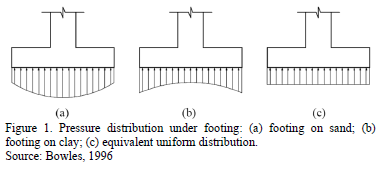
<body><![CDATA[<p><font size="2" face="Verdana, Arial, Helvetica, sans-serif"><b>Abstract</b></font></p>     <p><font size="2" face="Verdana, Arial, Helvetica, sans-serif">This paper presents the design of boundary combined  footings of rectangular shape using a new model to consider real soil pressure  acting on the contact surface of the footing; such pressure is presented in  terms of an axial load, moment around the &quot;X&quot; axis and moment around the &quot;Y&quot;  axis to each column. The classic model considers an axial load and moment  around the transverse axis applied in each column, and when the moments in two  directions are taken into account, the maximum pressure throughout the contact  surface of the footing is considered the same. The main part of this research  is that the proposed model considers real soil pressure and the classic model  takes into account the maximum pressure and uniform is considered. It is  concluded that the proposed model is more suited to the real conditions and is  more economical.</font></p>     <p><font size="2" face="Verdana, Arial, Helvetica, sans-serif"><i>Keywords</i>: boundary  combined footings; resultant force; center of gravity; bending moment; bending shear;  punching shear.</font></p>     <p><font size="2" face="Verdana, Arial, Helvetica, sans-serif"><b>Resumen    <br> </b></font><font size="2" face="Verdana, Arial, Helvetica, sans-serif">Este  documento presenta el dise&ntilde;o de zapatas combinadas de lindero de forma  rectangular utilizando un nuevo modelo para considerar la presi&oacute;n real del  suelo que act&uacute;an en la superficie de contacto de la zapata, dicha presi&oacute;n se  presenta en funci&oacute;n de una carga axial, momento alrededor del eje &quot;X&quot; y momento  alrededor del eje &quot;Y&quot; de cada columna. El modelo cl&aacute;sico considera una carga  axial y un momento alrededor del eje transversal aplicada en cada columna, y  cuando los momentos en dos direcciones son tomados en cuenta, la presi&oacute;n m&aacute;xima  en toda la superficie de contacto de la zapata se considera la misma. La parte  principal de esta investigaci&oacute;n es que el modelo propuesto considera la presi&oacute;n  real del suelo y el modelo cl&aacute;sico toma en cuenta la presi&oacute;n m&aacute;xima y la  considera uniforme. Se concluye que el  nuevo modelo es el m&aacute;s apropiado, ya que se apega m&aacute;s a las condiciones reales y es m&aacute;s econ&oacute;mico.</font></p>     <p><font size="2" face="Verdana, Arial, Helvetica, sans-serif"><i>Palabras clave</i>: zapatas combinadas de lindero; Fuerza resultante; Centro de gravedad;  Momento flexionante; Fuerza cortante por flexi&oacute;n; Fuerza cortante por  penetraci&oacute;n.</font></p> <hr>     <p>&nbsp;</p>     <p><b><font size="3" face="Verdana, Arial, Helvetica, sans-serif">1. Introduction</font></b></p>     <p><font size="2" face="Verdana, Arial, Helvetica, sans-serif">The foundation is the part of the structure which  transmits the loads to the soil. Each building demands the need to solve a  problem of foundation. The foundations are classified into superficial and deep, which have important differences: in  terms of geometry, the behavior of the soil, its structural functionality and  its constructive systems &#91;1,2&#93;. </font></p>     <p><font size="2" face="Verdana, Arial, Helvetica, sans-serif">Superficial foundations may be of various types according  to their function; isolated footing, combined footing, strip footing, or mat  foundation &#91;1-4&#93;. </font></p>     ]]></body>
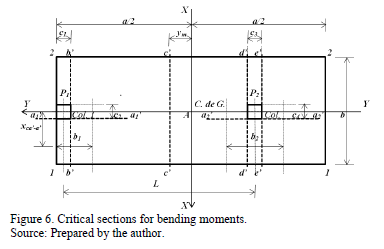
<body><![CDATA[<p><font size="2" face="Verdana, Arial, Helvetica, sans-serif">The  distribution of soil pressure under a footing is a function of the type of  soil, the relative rigidity of the soil and the footing, and the depth of  foundation at level of contact between footing and soil. A concrete footing on  sand will have a pressure distribution similar to Fig. 1(a). When a rigid  footing is resting on sandy soil, the sand near the edges of the footing tends  to displace laterally when the footing is loaded. This tends to decrease in  soil pressure near the edges, whereas soil away from the edges of footing is  relatively confined. On the other hand, the pressure distribution under a footing  on clay is similar to Fig. 1(b). As the footing is loaded, the soil under the  footing deflects in a bowl-shaped depression, relieving the pressure under the  middle of the footing. For design purposes, it is common to assume the soil  pressures are linearly distributed. </font></p>     <p><font size="2" face="Verdana, Arial, Helvetica, sans-serif">The pressure distribution will be  uniform if the centroid of the footing coincides with the resultant of the  applied loads, as shown in <a href="#fig01">Fig. 1(c)</a> &#91;1&#93;.</font></p>     <p align="center"><font size="2" face="Verdana, Arial, Helvetica, sans-serif"><a name="fig01"></a></font><img src="/img/revistas/dyna/v81n188/v81n188a25fig01.gif"></p>     <p><font size="2" face="Verdana, Arial, Helvetica, sans-serif">In the design of superficial foundations, in the specific  case of isolated footings, there are of three types in terms of the application  of loads: 1) The footings subjected to concentric axial load, 2) The footings  subjected to axial load and moment in one direction (unidirectional bending),  3) The footings subjected to axial load and moment in two directions  (bidirectional bending) &#91;1,2,5,6&#93;. </font></p>     <p><font size="2" face="Verdana, Arial, Helvetica, sans-serif">The hypothesis used in the classical model considers the  axial load and moment around an axis transverse to the combined footing for the  geometric proportions and shape are so fixed that the centroid of the footing  area coincides with the resultant of the column loads. This results in uniform  pressure below all the contact area of the footing. Then the equation of the  bidirectional bending is used to obtain the stresses acting on the contact  surface of the combined footings, which must meet the following conditions: 1)  The minimum stress should be equal to or greater than zero, because the soil is  not capable of withstand tensile stresses, 2) The maximum stress must be equal  or less than the allowable capacity that can withstand the soil &#91;1,2,5,6&#93;.</font></p>     <p><font size="2" face="Verdana, Arial, Helvetica, sans-serif">A combined footing is a long footing supporting two or  more columns in (typically two) one row. The combined footing may be  rectangular, trapezoidal or Tee-shaped in plan. Rectangular  footing is provided when one of the projections of the footing is restricted or  the width of the footing is restricted. Trapezoidal footing is provided when  one column load is much more than the other. As a result, both projections of  the footing beyond the faces of the columns will be restricted &#91;7-9&#93;.</font></p>     <p><font size="2" face="Verdana, Arial, Helvetica, sans-serif">Some papers present the use of load testing on  foundations: Non-destructive load test in pilots &#91;10&#93;; Evaluation of the  integrity of deep foundations: analysis and in situ verification &#91;11&#93;; Other, shows the use of static load tests in  the geotechnical design of foundations &#91;12&#93;; Comparison between  resonant-column and bender element test on three types of soils &#91;13&#93;.</font></p>     <p><font size="2" face="Verdana, Arial, Helvetica, sans-serif">Mathematical models have been developed to obtain the  dimensions of rectangular, square and circular isolated footings subjected to  axial load and moments in two directions (bidirectional bending) &#91;14-16&#93;. Also,  a mathematical model was presented for design of isolated footings of  rectangular shape using a new model &#91;17&#93;.</font></p>     <p><font size="2" face="Verdana, Arial, Helvetica, sans-serif">This paper presents a full mathematical model for the  design of boundary combined footings to obtain: 1) Moments around of an axis <i>a<sub>1</sub>'-a<sub>1</sub>'</i> with a  width &quot;<i>b<sub>1</sub></i>&quot; and <i>a<sub>2</sub>'-a<sub>2</sub>'</i> with a  width &quot;<i>b<sub>2</sub></i>&quot; that are  parallel to axis &quot;<i>Y-Y</i>&quot;, and moments  around of an axis <i>b'-b'</i>, <i>c'-c', d'-d' </i>and <i>e'-e' </i>that are parallel to axis &quot;<i>X-X</i>&quot;; 2) Bending shear; 3) Punching shear for footings which  support a boundary column and other inner column subject to axial load and  moment in two directions (bidirectional bending), where pressures are different  in the four corners, these pressures are presented in terms of the mechanical  elements (axial load, moment around the axis &quot;<i>X-X</i>&quot; and moment around the axis &quot;<i>Y-Y</i>&quot;).</font></p>     <p>&nbsp;</p>     ]]></body>
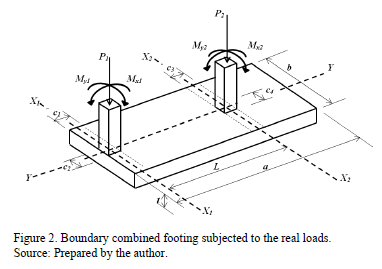
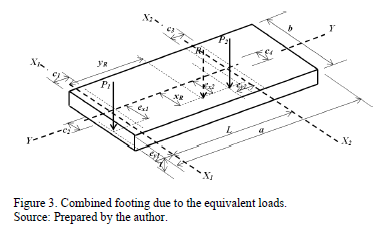
<body><![CDATA[<p><font size="3" face="Verdana, Arial, Helvetica, sans-serif"><b>2. Methodology</b></font></p> <b><font size="2" face="Verdana, Arial, Helvetica, sans-serif">2.2. General conditions </font></b><font size="2" face="Verdana, Arial, Helvetica, sans-serif">     <p>According to Building Code Requirements for Structural   Concrete (ACI 318-13) and Commentary the critical sections are: 1) the maximum   moment is located in face of column, pedestal, or wall, for footings supporting   a concrete column, pedestal, or wall; 2) bending shear is presented at a   distance &quot;<i>d</i>&quot; (distance from extreme   compression fiber to centroid of longitudinal tension reinforcement) shall be   measured from face of column, pedestal, or wall, for footings supporting a   column, pedestal, or wall; 3) punching shear is localized so that its perimeter   &quot;<i>b<sub>o</sub></i>&quot; is a minimum but need   not approach closer   than &quot;<i>d/2</i>&quot; to: (a) Edges or corners   of columns, concentrated loads, or reaction areas; and (b) Changes in slab  thickness such as edges of capitals, drop panels, or shear caps &#91;18&#93;. </p>     <p>The general equation for any type of footings subjected to  bidirectional bending &#91;14-17, 19-21&#93;:</p> </font>     <p><img src="/img/revistas/dyna/v81n188/v81n188a25eq01.gif"></p>     <p><font size="2" face="Verdana, Arial, Helvetica, sans-serif">where: <i><font face="Symbol">s</font></i> is the stress exerted by the soil  on the footing (soil pressure), <i>A</i> is  the contact area of the footing, <i>P</i> is  the axial load applied at the center of gravity of the footing, <i>M<sub>x</sub></i> is the moment around the  axis <i>&quot;X&quot;</i>, <i>M<sub>y</sub></i> is the moment around the axis <i>&quot;Y&quot;</i>, <i>C<sub>x</sub></i> is the  distance in the direction <i>&quot;X&quot;</i> measured from the axis <i>&quot;Y&quot;</i> up to the  farthest end, <i>C<sub>y</sub></i> is the  distance in direction <i>&quot;Y&quot;</i> measured  from the axis <i>&quot;X&quot;</i> up to the farthest  end, <i>I<sub>y</sub></i> is the moment ofinertia around the axis <i>&quot;Y&quot;</i> and <i>I<sub>x</sub></i> is the moment of inertia around the axis <i>&quot;X&quot;</i>.</font></p>     <p><font size="2" face="Verdana, Arial, Helvetica, sans-serif"><b><i>2.2. New model</i></b></font></p>     <p><font size="2" face="Verdana, Arial, Helvetica, sans-serif">Fig. 2 shows a combined footing supporting two rectangular  columns of different dimensions (a boundary column and other inner column) subject  to axial load and moments in two directions in each column.</font></p>     <p><font size="2" face="Verdana, Arial, Helvetica, sans-serif">Fig. 3 presents a combined footing due to the equivalent  loads. The mechanical elements of the components <i>P<sub>1</sub>, M<sub>x1</sub>, M<sub>y1</sub></i> are equivalent to a  normal force &quot;<i>P<sub>1</sub></i>&quot; acting  on the point with coordinates <i>(e<sub>x1</sub>,  e<sub>y1</sub></i>), and for the components of <i>P<sub>2</sub>, M<sub>x2</sub>, M<sub>y2</sub></i> are equivalent to a  normal force &quot;<i>P<sub>2</sub></i>&quot; acting on  the point with coordinates (<i>e<sub>x2</sub>,  e<sub>y2</sub></i>).</font></p>     <p><font size="2" face="Verdana, Arial, Helvetica, sans-serif">The general equation of the bidirectional bending is:</font></p>     <p><img src="/img/revistas/dyna/v81n188/v81n188a25eq02.gif"></p>     ]]></body>
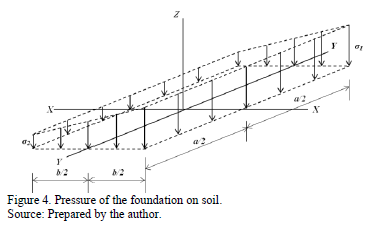
<body><![CDATA[<p><font size="2" face="Verdana, Arial, Helvetica, sans-serif">where: <i><font face="Symbol">s</font><sub>adm</sub></i>is the capacity of available allowable load of the soil, <i>R</i> is the resultant force of the forces, <i>y<sub>c</sub></i> is the distance from the  center of the contact area of the footing in the direction &quot;<i>Y</i>&quot; to the resultant, <i>x<sub>c</sub></i> is the distance from the center of the contact area of the footing in the direction &quot;<i>X</i>&quot; to the resultant.</font></p>     <p align="center"><font size="2" face="Verdana, Arial, Helvetica, sans-serif"><a name="fig02"></a></font><img src="/img/revistas/dyna/v81n188/v81n188a25fig02.gif"></p>     <p align="center"><font size="2" face="Verdana, Arial, Helvetica, sans-serif"><a name="fig03"></a></font><img src="/img/revistas/dyna/v81n188/v81n188a25fig03.gif"></p>     <p><font size="2" face="Verdana, Arial, Helvetica, sans-serif">Now the sum of moments around the axis &quot;<i>X<sub>1</sub></i>&quot; is obtained to find &quot;<i>y<sub>R</sub></i>&quot; and the resultant force  is made to coincide with the gravity center of the area of the footing with the  position of the resultant force in the direction &quot;<i>Y</i>&quot;, therefore there is not moment around the axis &quot;<i>X</i>&quot; and the value of &quot;<i>y<sub>c</sub></i>&quot; is zero, &quot;<i>x<sub>R</sub> = x<sub>c</sub></i>&quot; is the  sum of moments around the axis &quot;<i>Y</i>&quot; divided  by the resultant, which is:</font></p>     <p><img src="/img/revistas/dyna/v81n188/v81n188a25eq03.gif"></p>     <p><font size="2" face="Verdana, Arial, Helvetica, sans-serif">Substituting equation (3) into equation (2) is transformed  into a unidirectional bending system as follows: </font></p>     <p><font size="2" face="Verdana, Arial, Helvetica, sans-serif"><img src="/img/revistas/dyna/v81n188/v81n188a25eq04.gif"></font></p>     <p><font size="2" face="Verdana, Arial, Helvetica, sans-serif">Fig. 4 shows pressure diagram for combined footings  subject to axial load and moment in one direction (unidirectional bending) in  each column, where the pressures are presented at two different corners varying  linearly along the contact surface, because there is not moment around the axis  &quot;<i>X</i>&quot;.</font></p>     <p align="center"><font size="2" face="Verdana, Arial, Helvetica, sans-serif"><a name="fig04"></a></font><img src="/img/revistas/dyna/v81n188/v81n188a25fig04.gif"></p>     <p align="center"><font size="2" face="Verdana, Arial, Helvetica, sans-serif"><a name="fig05"></a></font><img src="/img/revistas/dyna/v81n188/v81n188a25fig05.gif"></p>     ]]></body>

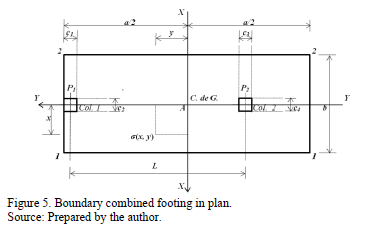
<body><![CDATA[<p><font size="2" face="Verdana, Arial, Helvetica, sans-serif">Fig. 5 presents a boundary combined footing to obtain the  stresses anywhere of the contact surface of the structural member due to the  pressure that is exerted by the soil.</font></p> <ul type=disc>      <li><font size="2" face="Verdana, Arial, Helvetica, sans-serif">In the longitudinal direction:</font></li>     </ul> <img src="/img/revistas/dyna/v81n188/v81n188a25eq05.gif"> <ul type=disc>      <li><font size="2" face="Verdana, Arial, Helvetica, sans-serif">In the transverse direction:</font></li>     </ul>     <p><font size="2" face="Verdana, Arial, Helvetica, sans-serif">v To the boundary column is:</font></p>     <p><img src="/img/revistas/dyna/v81n188/v81n188a25eq06.gif"></p>     <p><font size="2" face="Verdana, Arial, Helvetica, sans-serif">v To the intermediate column is:</font></p>     <p><img src="/img/revistas/dyna/v81n188/v81n188a25eq07.gif"></p>     <p><font size="2" face="Verdana, Arial, Helvetica, sans-serif">where: <i>b<sub>1</sub> = c<sub>1</sub>+d/2</i> is the width of the failure surface, <i>b<sub>2</sub> = c<sub>3</sub>+d</i>.</font></p>     ]]></body>

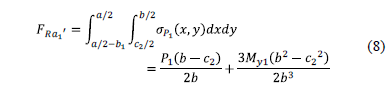
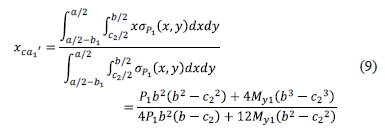
<body><![CDATA[<p><font size="2" face="Verdana, Arial, Helvetica, sans-serif"><b>2.2.1. Model to obtain the bending moments</b></font></p>     <p><font size="2" face="Verdana, Arial, Helvetica, sans-serif">Critical sections for bending moments are shown in Fig. 6,  these are presented in sections <i>a<sub>1</sub>'-a<sub>1</sub>',  a<sub>2</sub>'-a<sub>2</sub>', b'-b', c'-c', d'-d' </i>and<i> e'-e'</i>.</font></p>     <p><font size="2" face="Verdana, Arial, Helvetica, sans-serif"><b>2.2.1.1. Moment  around the axis a<sub>1</sub>'-a<sub>1</sub>'</b></font></p>     <p><font size="2" face="Verdana, Arial, Helvetica, sans-serif">The  resultant force &quot;<i>F<sub>Ra1'</sub></i>&quot; is  found through the volume </font><font size="2" face="Verdana, Arial, Helvetica, sans-serif">of pressure the area formed by the  axis <i>a<sub>1</sub>'-a<sub>1</sub>'</i> with a width &quot;<i>b<sub>1</sub> = c<sub>1</sub>+d/2</i>&quot;  and the free end of the rectangular footing, where the higher pressure is presented:</font></p>     <p align="center"><font size="2" face="Verdana, Arial, Helvetica, sans-serif"><a name="fig06"></a></font><img src="/img/revistas/dyna/v81n188/v81n188a25fig06.gif"></p>     <p><img src="/img/revistas/dyna/v81n188/v81n188a25eq08.gif"></p>     <p><font size="2" face="Verdana, Arial, Helvetica, sans-serif">The center of gravity &quot;<i>x<sub>ca1'</sub></i>&quot;  is obtained by the equation:</font></p>     <p><img src="/img/revistas/dyna/v81n188/v81n188a25eq09.gif"></p>     <p><font size="2" face="Verdana, Arial, Helvetica, sans-serif">The moment around the axis <i>a<sub>1</sub>'-a<sub>1</sub>'</i> is:</font></p>     <p><img src="/img/revistas/dyna/v81n188/v81n188a25eq10.gif"></p>     ]]></body>
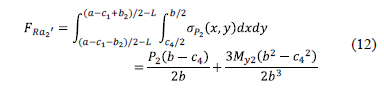
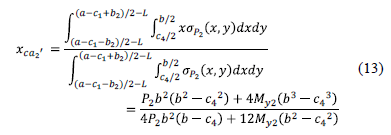
<body><![CDATA[<p><font size="2" face="Verdana, Arial, Helvetica, sans-serif">Substituting the  equation (8) and (9) into equation (10) is obtained:</font></p>     <p><img src="/img/revistas/dyna/v81n188/v81n188a25eq11.gif"></p>     <p><font size="2" face="Verdana, Arial, Helvetica, sans-serif"><b>2.2.1.2. Moment  around the axis a2'-a2'</b></font></p>     <p><font size="2" face="Verdana, Arial, Helvetica, sans-serif">The resultant force &quot;F<sub>Ra2'</sub>'&quot; is obtained  through the volume of pressure the area formed by the axis a<sub>2</sub>'-a<sub>2</sub>'  with a width &quot;b<sub>2</sub> = c<sub>3</sub>+d&quot; and the free end of the  rectangular footing, where the higher pressure is presented:</font></p>     <p><img src="/img/revistas/dyna/v81n188/v81n188a25eq12.gif"></p>     <p><font size="2" face="Verdana, Arial, Helvetica, sans-serif">The center of  gravity &quot;<i>x<sub>ca2'</sub></i>&quot; is  obtained by the equation:</font></p>     <p><img src="/img/revistas/dyna/v81n188/v81n188a25eq13.gif"></p>     <p><font size="2" face="Verdana, Arial, Helvetica, sans-serif">The moment around  the axis <i>a<sub>2</sub>'-a<sub>2</sub>'</i> is:</font></p>     <p><img src="/img/revistas/dyna/v81n188/v81n188a25eq14.gif"></p>     <p><font size="2" face="Verdana, Arial, Helvetica, sans-serif">Substituting the  equation (12) and (13) into equation (14) is obtained:</font></p>     ]]></body>
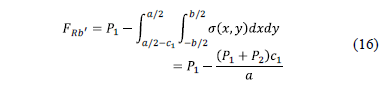
<body><![CDATA[<p><img src="/img/revistas/dyna/v81n188/v81n188a25eq15.gif"></p>     <p><font size="2" face="Verdana, Arial, Helvetica, sans-serif"><b>2.2.1.3. Moment  around the axis b'-b'</b></font></p>     <p><font size="2" face="Verdana, Arial, Helvetica, sans-serif">The resultant force <i>&quot;F<sub>Rb'</sub>&quot;</i> is the force &quot;<i>P<sub>1</sub></i>&quot; acting  on column 1 less the volume of pressure the area formed by the axis <i>b'-b'</i> and the corners 1 and 2 to the  left of the footing, this is presented of the follows:</font></p>     <p><img src="/img/revistas/dyna/v81n188/v81n188a25eq16.gif"></p>     <p><font size="2" face="Verdana, Arial, Helvetica, sans-serif">The center of gravity &quot;<i>y<sub>cb'</sub></i>&quot;  with respect to axis <i>b'-b'</i> is: </font></p>     <p><img src="/img/revistas/dyna/v81n188/v81n188a25eq17.gif"></p>     <p><font size="2" face="Verdana, Arial, Helvetica, sans-serif">The moment around  the axis <i>b'-b' </i>is:</font></p>     <p><img src="/img/revistas/dyna/v81n188/v81n188a25eq18.gif"></p>     <p><font size="2" face="Verdana, Arial, Helvetica, sans-serif">Substituting the  equation (16) and (17) into equation (18) is obtained:</font></p>     <p><img src="/img/revistas/dyna/v81n188/v81n188a25eq19.gif"></p>     ]]></body>
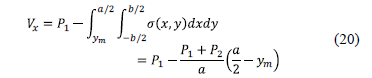
<body><![CDATA[<p><font size="2" face="Verdana, Arial, Helvetica, sans-serif"><b>2.2.1.4. Moment  around the axis c'-c'</b></font></p>     <p><font size="2" face="Verdana, Arial, Helvetica, sans-serif">First, the position of the axis <i>c'-c'</i> must be localized, which is where the maximum moment is  located.</font></p>     <p><font size="2" face="Verdana, Arial, Helvetica, sans-serif">When the shear force is zero, the moment should be the  maximum, then the shear force is presented at a distance &quot;<i>y<sub>m</sub></i>&quot;, this is shown as follows:</font></p>     <p><img src="/img/revistas/dyna/v81n188/v81n188a25eq20.gif"></p>     <p><font size="2" face="Verdana, Arial, Helvetica, sans-serif">Now the equation (20) is equal to zero and we obtain:</font></p>     <p><img src="/img/revistas/dyna/v81n188/v81n188a25eq21.gif"></p>     <p><font size="2" face="Verdana, Arial, Helvetica, sans-serif">Then the maximum moment is obtained as follows:</font></p>     <p><img src="/img/revistas/dyna/v81n188/v81n188a25eq22.gif"></p>     <p><font size="2" face="Verdana, Arial, Helvetica, sans-serif">Substituting the  equation (21) into equation (22) is:</font></p>     <p><img src="/img/revistas/dyna/v81n188/v81n188a25eq23.gif"></p>     ]]></body>
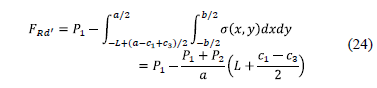
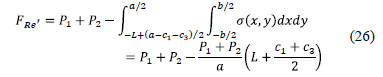
<body><![CDATA[<p><font size="2" face="Verdana, Arial, Helvetica, sans-serif"><b>2.2.1.5. Moment  around the axis d'-d'</b></font></p>     <p><font size="2" face="Verdana, Arial, Helvetica, sans-serif">The resultant  force <i>&quot;F<sub>Rd'</sub>&quot;</i> is the force &quot;<i>P<sub>1</sub></i>&quot; acting on column 1 less  the volume of pressure the area formed by the axis <i>d'-d'</i> and the corners 1 and 2, which is found to the left of the  footing, this is as follows:</font></p>     <p><img src="/img/revistas/dyna/v81n188/v81n188a25eq24.gif"></p>     <p><font size="2" face="Verdana, Arial, Helvetica, sans-serif">The moment around  the axis <i>d'-d' </i>is:</font></p>     <p><img src="/img/revistas/dyna/v81n188/v81n188a25eq25.gif"></p>     <p><font size="2" face="Verdana, Arial, Helvetica, sans-serif"><b>2.2.1.6. Moment  around the axis e'-e'</b></font></p>     <p><font size="2" face="Verdana, Arial, Helvetica, sans-serif">The resultant  force <i>&quot;F<sub>Re'</sub>&quot;</i> is the sum of  the force &quot;<i>P<sub>1</sub></i>&quot; acting on  column 1 and the force &quot;<i>P<sub>2</sub></i>&quot;  acting on column 2 less the volume of pressure the area formed by the axis <i>e'-e'</i> and the corners 1 and 2, which is  found to the left of the footing, this is as follows:</font></p>     <p><img src="/img/revistas/dyna/v81n188/v81n188a25eq26.gif"></p>     <p><font size="2" face="Verdana, Arial, Helvetica, sans-serif">The moment around  the axis <i>e'-e' </i>is:</font></p>     <p><img src="/img/revistas/dyna/v81n188/v81n188a25eq27.gif"></p>     ]]></body>
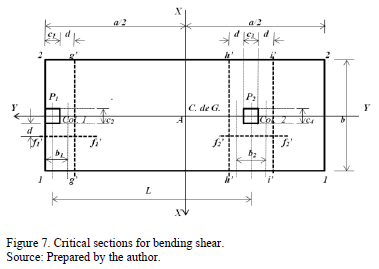
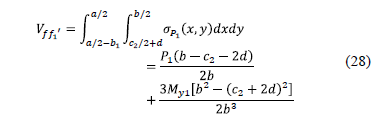
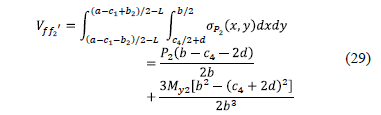
<body><![CDATA[<p><font size="2" face="Verdana, Arial, Helvetica, sans-serif"><b>2.2.2. Model to  obtain the bending shear </b></font></p>     <p><font size="2" face="Verdana, Arial, Helvetica, sans-serif">The critical sections for bending shear are obtained at a  distance <i>&quot;d&quot;</i> starting the junction of  the column with the footing as seen in Fig. 7, these are presented in sections <i>f<sub>1</sub>'-f<sub>1</sub>', f<sub>2</sub>'-f<sub>2</sub>', g'-g', h'-h' </i>and<i> i'-i'.</i></font></p>     <p><font size="2" face="Verdana, Arial, Helvetica, sans-serif"><b>2.2.2.1. Bending  shear in axis f<sub>1</sub>'-f<sub>1</sub>'</b></font></p>     <p><font size="2" face="Verdana, Arial, Helvetica, sans-serif">Bending  shear acting on the axis <i>f<sub>1</sub>'-f<sub>1</sub>'</i> of the footing <i>&quot;V<sub>ff1'</sub>&quot; </i>is obtained through the volume of  pressure the area formed by the axis <i>f<sub>1</sub>'-f<sub>1</sub>' </i>with a width &quot;<i>b<sub>1</sub> = c<sub>1</sub>+d/2</i>&quot;  and the </font><font size="2" face="Verdana, Arial, Helvetica, sans-serif">free end of the rectangular  footing, where the greatest pressure is presented: </font></p>     <p align="center"><font size="2" face="Verdana, Arial, Helvetica, sans-serif"><a name="fig07"></a></font><img src="/img/revistas/dyna/v81n188/v81n188a25fig07.gif"></p>     <p><img src="/img/revistas/dyna/v81n188/v81n188a25eq28.gif"></p>     <p><font size="2" face="Verdana, Arial, Helvetica, sans-serif"><b>2.2.2.2. Bending  shear in axis f<sub>2</sub>'-f<sub>2</sub>'</b></font></p>     <p><font size="2" face="Verdana, Arial, Helvetica, sans-serif">Bending shear acting on the axis <i>f<sub>2</sub>'-f<sub>2</sub>'</i> of the footing <i>&quot;V<sub>ff2'</sub>&quot; </i>is  obtained through the volume of pressure the area formed by the axis <i>f<sub>2</sub>'-f<sub>2</sub>' </i>with a  width &quot;<i>b<sub>2</sub> = c<sub>3</sub>+d</i>&quot;  and the free end of the rectangular footing, where the greatest pressure is  presented: </font></p>     <p><img src="/img/revistas/dyna/v81n188/v81n188a25eq29.gif"></p>     <p><font size="2" face="Verdana, Arial, Helvetica, sans-serif"><b>2.2.2.3. Bending  shear in axis g'-g'</b></font></p>     ]]></body>
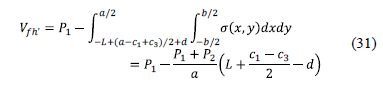
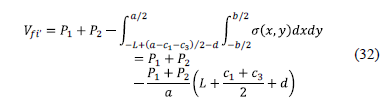
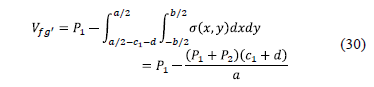
<body><![CDATA[<p><font size="2" face="Verdana, Arial, Helvetica, sans-serif">Bending shear acting on the axis <i>g'-g'</i> of the footing <i>&quot;V<sub>fg'</sub>&quot;</i> is the force &quot;<i>P<sub>1</sub></i>&quot; acting on column 1 less the volume of pressure the  area formed by the axis <i>g'-g'</i> and the  corners 1 and 2 to the left of the footing, this is as follows:</font></p>     <p><img src="/img/revistas/dyna/v81n188/v81n188a25eq30.gif"></p>     <p><font size="2" face="Verdana, Arial, Helvetica, sans-serif"><b>2.2.2.4. Bending  shear in axis h'-h'</b></font></p>     <p><font size="2" face="Verdana, Arial, Helvetica, sans-serif">Bending shear acting on the axis <i>h'-h'</i> of the footing <i>&quot;V<sub>fh'</sub>&quot;</i> is the force &quot;<i>P<sub>1</sub></i>&quot; acting in column 1 less the volume of pressure the  area formed by the axis <i>h'-h'</i> and the  corners 1 and 2, which is found to the left of the footing, this is:</font></p>     <p><img src="/img/revistas/dyna/v81n188/v81n188a25eq31.gif"></p>     <p><font size="2" face="Verdana, Arial, Helvetica, sans-serif"><b>2.2.2.5. Bending  shear in axis i'-i'</b></font></p>     <p><font size="2" face="Verdana, Arial, Helvetica, sans-serif">Bending shear acting on the axis <i>i'-i'</i> of the footing <i>&quot;V<sub>fi'</sub>&quot;</i> is the sum of the force &quot;<i>P<sub>1</sub></i>&quot; acting on column 1 and  the force &quot;<i>P<sub>2</sub></i>&quot; acting on  column 2 less the volume of pressure the area formed by the axis <i>i'-i'</i> and the corners 1 and 2, which is  found to the left of the footing, this:</font></p>     <p><img src="/img/revistas/dyna/v81n188/v81n188a25eq32.gif"></p>     <p><font size="2" face="Verdana, Arial, Helvetica, sans-serif"><b>2.2.3. Model to  obtain the punching shear </b></font></p>     <p><font size="2" face="Verdana, Arial, Helvetica, sans-serif">The critical section for the punching shear appears at a  distance <i>&quot;d/2&quot;</i> starting the junction  of the column with the footing in the two directions.</font></p>     ]]></body>
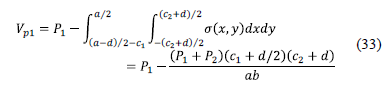
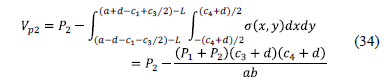
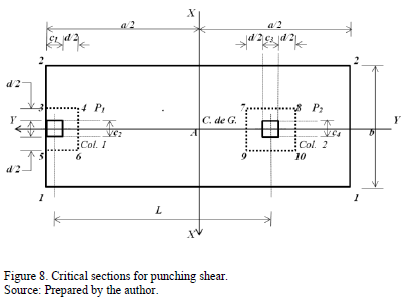
<body><![CDATA[<p><font size="2" face="Verdana, Arial, Helvetica, sans-serif"><b>2.2.3.1. Punching  shear for boundary column </b></font></p>     <p><font size="2" face="Verdana, Arial, Helvetica, sans-serif">The critical section for the punching shear is presented  in rectangular section formed by points 3, 4, 5 and 6, as shown in Fig. 8. Punching  shear acting on the footing &quot;<i>V<sub>p1</sub></i>&quot;  is the force &quot;<i>P<sub>1</sub></i>&quot; which  acting on column 1 less the volume of  pressure the area formed by the points 3, 4, 5 and 6:</font></p>     <p><img src="/img/revistas/dyna/v81n188/v81n188a25eq33.gif"></p>     <p><font size="2" face="Verdana, Arial, Helvetica, sans-serif"><b>2.2.3.2. Punching  shear for inner column</b></font></p>     <p><font size="2" face="Verdana, Arial, Helvetica, sans-serif">The critical section for the punching shear is presented  in rectangular section formed by points 7, 8, 9 and 10, as shown in Fig. 8.  Punching shear acting on the footing &quot;<i>V<sub>p2</sub></i>&quot;  is the force &quot;<i>P<sub>2</sub></i>&quot; which  acting on column 2 less the volume of  pressure the area formed by the points 7, 8, 9 and 10:</font></p>     <p><img src="/img/revistas/dyna/v81n188/v81n188a25eq34.gif"></p>     <p><font size="2" face="Verdana, Arial, Helvetica, sans-serif"><b><i>2.3. Classic model</i></b></font></p>     <p><font size="2" face="Verdana, Arial, Helvetica, sans-serif">This model takes into account only the maximum pressure of  the soil for design of footings and it is considered uniform at all points on  contact area of footings. The maximum pressure is:</font></p>     <p align="center"><font size="2" face="Verdana, Arial, Helvetica, sans-serif"><a name="fig08" id="fig08"></a></font><img src="/img/revistas/dyna/v81n188/v81n188a25fig08.gif"></p> <ul type=disc>      <li><font size="2" face="Verdana, Arial, Helvetica, sans-serif">In the longitudinal direction:</font></li>     ]]></body>
<body><![CDATA[</ul>     <blockquote>       <p><img src="/img/revistas/dyna/v81n188/v81n188a25eq35.gif"></p> </blockquote> <ul type=disc>      <li><font size="2" face="Verdana, Arial, Helvetica, sans-serif">In the transverse direction:</font></li>     </ul>     <p><font size="2" face="Verdana, Arial, Helvetica, sans-serif">v To the boundary column is:</font></p>     <p><img src="/img/revistas/dyna/v81n188/v81n188a25eq36.gif"></p>     <p><font size="2" face="Verdana, Arial, Helvetica, sans-serif">v To the intermediate column is:</font></p>     <blockquote>       <p><img src="/img/revistas/dyna/v81n188/v81n188a25eq37.gif"></p> </blockquote>     ]]></body>
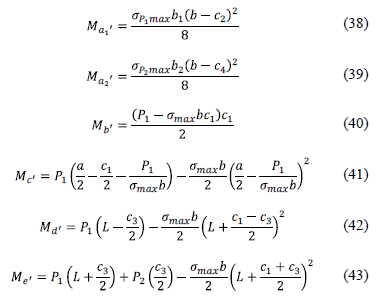
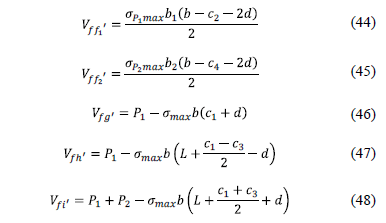
<body><![CDATA[<p><font size="2" face="Verdana, Arial, Helvetica, sans-serif"><b>2.3.1. Model to  obtain the moments</b></font></p>     <p><font size="2" face="Verdana, Arial, Helvetica, sans-serif">Critical sections for bending moments are shown in Fig. 6,  these are presented in sections a<sub>1</sub>'-a<sub>1</sub>', a<sub>2</sub>'-a<sub>2</sub>',  b'-b', c'-c', d'-d' and e'-e'. The bending moment in each section is:</font></p>     <p><img src="/img/revistas/dyna/v81n188/v81n188a25eq3843.gif"></p>     <p><font size="2" face="Verdana, Arial, Helvetica, sans-serif"><b>2.3.2. Model to  obtain the bending shear </b></font></p>     <p><font size="2" face="Verdana, Arial, Helvetica, sans-serif">The critical sections for bending shear (seen in Fig. 7),  these are presented in sections <i>f<sub>1</sub>'-f<sub>1</sub>',  f<sub>2</sub>'-f<sub>2</sub>', g'-g', h'-h' </i>and<i> i'-i'. </i>The bending shear in each section is:</font></p>     <p><img src="/img/revistas/dyna/v81n188/v81n188a25eq4448.gif"></p>     <p><b><font size="2" face="Verdana, Arial, Helvetica, sans-serif">2.3.3. Model to  obtain the punching shear </font></b></p>     <p><font size="2" face="Verdana, Arial, Helvetica, sans-serif">The critical sections for the punching shear are presented in Fig. 8.</font></p>     <p><font size="2" face="Verdana, Arial, Helvetica, sans-serif">v The punching shear for boundary column</font></p>     <p><img src="/img/revistas/dyna/v81n188/v81n188a25eq49.gif"></p>     ]]></body>
<body><![CDATA[<p><font size="2" face="Verdana, Arial, Helvetica, sans-serif">v The punching  shear for inner column</font></p>     <p><img src="/img/revistas/dyna/v81n188/v81n188a25eq50.gif"></p>     <p><b><i><font size="2" face="Verdana, Arial, Helvetica, sans-serif">2.4. Procedure of  design</font></i></b></p>     <p><font size="2" face="Verdana, Arial, Helvetica, sans-serif"><b>Step 1:</b> The  mechanical elements (<i>P, M<sub>x</sub>, M<sub>y</sub></i>)  acting on the footing is obtained by the sum of: the dead loads, live loads and  accidental loads (wind or earthquake) from each of these effects &#91;20,21&#93;.</font></p>     <p><font size="2" face="Verdana, Arial, Helvetica, sans-serif"><b>Step 2:</b> The  available load capacity the soil <i>&quot;<font face="Symbol">s</font><sub>adm</sub>&quot;</i> is &#91;20, 21&#93;:</font></p>     <p><img src="/img/revistas/dyna/v81n188/v81n188a25eq51.gif"></p>     <p><font size="2" face="Verdana, Arial, Helvetica, sans-serif">where: <i>q<sub>a</sub></i> is the allowable load capacity the soil, <i><font face="Symbol">g</font><sub>ppz</sub></i> is the self-weight of the footing, <i><font face="Symbol">g</font><sub>pps</sub></i> is the self-weight the soil fill.</font></p>     <p><font size="2" face="Verdana, Arial, Helvetica, sans-serif"><b>Step 3:</b> The value of <i>&quot;a&quot;</i> is selected according to the  following equation:</font></p>     <p><img src="/img/revistas/dyna/v81n188/v81n188a25eq52.gif"></p>     <p><font size="2" face="Verdana, Arial, Helvetica, sans-serif">where: <i>a</i> is the  dimension of the parallel footing the axis &quot;<i>Y</i>&quot;, <i>R=P<sub>1</sub>+P<sub>2</sub>, M<sub>x</sub>=M<sub>x1</sub>+M<sub>x2</sub></i>.</font></p>     ]]></body>
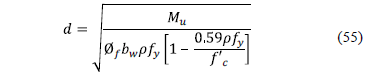
<body><![CDATA[<p><font size="2" face="Verdana, Arial, Helvetica, sans-serif">The value of <i>&quot;b&quot;</i> is:</font></p>     <p><font size="2" face="Verdana, Arial, Helvetica, sans-serif">To <i>x<sub>R</sub> &le; b/6</i>:</font></p>     <p><img src="/img/revistas/dyna/v81n188/v81n188a25eq53.gif"></p>     <p><font size="2" face="Verdana, Arial, Helvetica, sans-serif">To x<sub>R</sub> &ge; b/6:</font></p>     <p><img src="/img/revistas/dyna/v81n188/v81n188a25eq54.gif"></p>     <p><font size="2" face="Verdana, Arial, Helvetica, sans-serif">where: <i>b</i> is the dimension of the parallel  footing the axis &quot;<i>X</i>&quot;, <i>M<sub>y</sub>=M<sub>y1</sub>+M<sub>y2</sub></i>.</font></p>     <p><font size="2" face="Verdana, Arial, Helvetica, sans-serif">Note: if in the  combinations are included the wind and/or the earthquake, the load capacity the  soil should be increased by 33% &#91;18&#93;.</font></p>     <p><font size="2" face="Verdana, Arial, Helvetica, sans-serif"><b>Step 4:</b> The  mechanical elements (<i>P, M<sub>x</sub>, M<sub>y</sub></i>)  acting on the footing are factored &#91;18&#93;.</font></p>     <p><font size="2" face="Verdana, Arial, Helvetica, sans-serif"><b>Step 5:</b> The bending moments acting on the combined  footing are obtained.</font></p>     <p><font size="2" face="Verdana, Arial, Helvetica, sans-serif"><b>Step 6:</b> The  effective depth <i>&quot;d&quot;</i> for the maximum moment is found by  the following expression &#91;18&#93;:</font></p>     ]]></body>
<body><![CDATA[<p><img src="/img/revistas/dyna/v81n188/v81n188a25eq55.gif"></p>     <p><font size="2" face="Verdana, Arial, Helvetica, sans-serif">where: <i>M<sub>u</sub></i> is the factored maximum moment at section  acting on the footing, Ø<i><sub>f</sub></i>is the strength reduction factor by bending and its value is 0.90,<i> b<sub>w</sub></i> is width of analysis in structural member, <i><font face="Symbol">r</font></i> is ratio of <i>&quot;As&quot; </i>to <i>&quot;b<sub>w</sub>d&quot;, f<sub>y</sub></i> is the specified yield strength of  reinforcement of steel, <i>f'<sub>c</sub></i> is the specified compressive strength of concrete at 28 days.</font></p>     <p><font size="2" face="Verdana, Arial, Helvetica, sans-serif"><b>Step 7:</b> Bending shear resisted by the concrete <i>&quot;V<sub>cf</sub>&quot;</i> is &#91;18&#93;:</font></p>     <p><img src="/img/revistas/dyna/v81n188/v81n188a25eq56.gif"></p>     <p><font size="2" face="Verdana, Arial, Helvetica, sans-serif">To bending shear acting on the footing (<i>V<sub>f</sub></i>) is compared vs. bending  shear resisting by concrete (<i>V<sub>cf</sub></i>)  and is &#91;18&#93;: </font></p>     <p><img src="/img/revistas/dyna/v81n188/v81n188a25eq57.gif"></p>     <p><font size="2" face="Verdana, Arial, Helvetica, sans-serif">where: Ø<i><sub>v</sub></i> is the strength reduction factor by shear is  0.85.</font></p>     <p><font size="2" face="Verdana, Arial, Helvetica, sans-serif"><b>Step 8:</b> Punching shear (shear force bidirectional) resisted by the concrete &quot;<i>V<sub>cp</sub></i>&quot; is given &#91;18&#93;:</font></p>     <p><img src="/img/revistas/dyna/v81n188/v81n188a25eq58a.gif"></p>     <p><font size="2" face="Verdana, Arial, Helvetica, sans-serif">where: <i> <font face="Symbol">b</font><sub>c</sub></i> is the ratio of long side to short side of the column and <i>b<sub>0</sub></i> is the perimeter of the critical section.</font></p>     ]]></body>
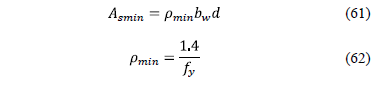
<body><![CDATA[<p><img src="/img/revistas/dyna/v81n188/v81n188a25eq58b.gif"></p>     <p><font size="2" face="Verdana, Arial, Helvetica, sans-serif">where:  <font face="Symbol">a</font>s is 40 for interior columns, 30 for edge  columns, and 20 for corner columns.</font></p>     <p><img src="/img/revistas/dyna/v81n188/v81n188a25eq58c.gif"></p>     <p><font size="2" face="Verdana, Arial, Helvetica, sans-serif">where: Ø<i><sub>v</sub>V<sub>cp</sub></i> must be the value smallest of equations (58<i>a</i>),  (58<i>b</i>) and (58<i>c</i>).</font></p>     <p><font size="2" face="Verdana, Arial, Helvetica, sans-serif">To punching shear acting on the footing (Vp) is compared  vs. punching shear resisting by concrete (Vcp) and must comply with the  following expression &#91;18&#93;:</font></p>     <p><img src="/img/revistas/dyna/v81n188/v81n188a25eq59.gif"></p>     <p><font size="2" face="Verdana, Arial, Helvetica, sans-serif"><b>Step 9:</b> The  main reinforcement steel <i>&quot;A<sub>sp</sub>&quot;</i> is &#91;18&#93;:</font></p>     <p><img src="/img/revistas/dyna/v81n188/v81n188a25eq60.gif"></p>     <p><font size="2" face="Verdana, Arial, Helvetica, sans-serif">where: <i>w</i> is <i>0.85f'<sub>c </sub>/f<sub>y</sub></i>.</font></p>     <p><font size="2" face="Verdana, Arial, Helvetica, sans-serif">The minimum steel <i>&quot;A<sub>smin</sub>&quot;</i> and the minimum percentage &quot;<i><font face="Symbol">r</font><sub>min</sub></i>&quot;  by rule are &#91;18&#93;:</font></p>     ]]></body>
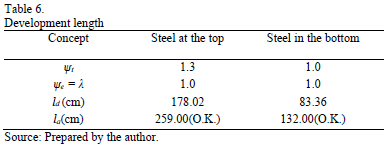
<body><![CDATA[<p><img src="/img/revistas/dyna/v81n188/v81n188a25eq6162.gif"></p>     <p><font size="2" face="Verdana, Arial, Helvetica, sans-serif">The reinforcement steel by temperature is found &#91;18&#93;:</font></p>     <p><img src="/img/revistas/dyna/v81n188/v81n188a25eq63.gif"></p>     <p><font size="2" face="Verdana, Arial, Helvetica, sans-serif">where: <i>t </i>is the total thickness of the footing.</font></p>     <p><font size="2" face="Verdana, Arial, Helvetica, sans-serif"><b>Step 10: </b>The  development length in tension of deformed bars <i>&quot;l<sub>d</sub>&quot;</i> is expressed &#91;18&#93;:</font></p>     <p><font size="2" face="Verdana, Arial, Helvetica, sans-serif">Steel reinforcement in the top:</font></p>     <p><img src="/img/revistas/dyna/v81n188/v81n188a25eq64.gif"></p>     <p><font size="2" face="Verdana, Arial, Helvetica, sans-serif">Steel reinforcement in the bottom:</font></p>     <p><img src="/img/revistas/dyna/v81n188/v81n188a25eq65.gif"></p>     <p><font size="2" face="Verdana, Arial, Helvetica, sans-serif">where: <i><font face="Symbol">y</font><sub>t</sub></i> is the traditional reinforcement location factor to reflect the adverse effects  of the top reinforcement casting position, <i><font face="Symbol">y</font><sub>e</sub></i> is a coating factor reflecting the effects of epoxy coating, <i>d<sub>b</sub></i>is the diameter of the  bars, <font face="Symbol">l</font> is modification factor reflecting the reduced mechanical  properties of lightweight concrete, all relative to normalweight concrete of  the same compressive strength.</font></p>     ]]></body>
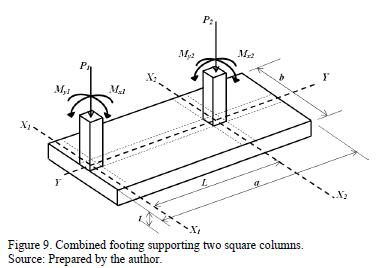
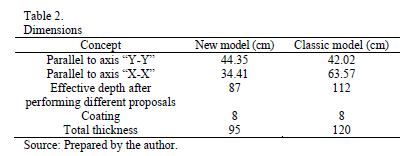
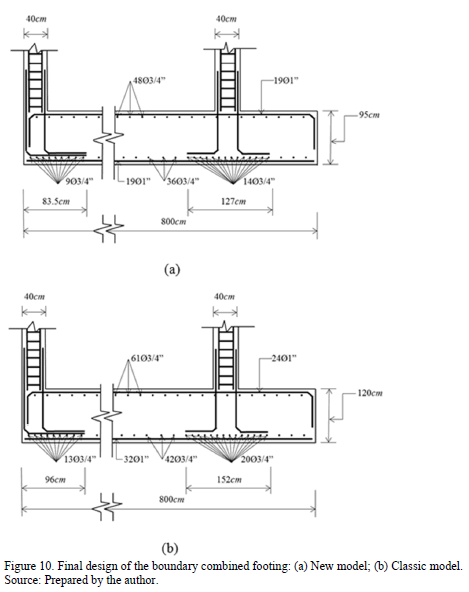
<body><![CDATA[<p><font size="2" face="Verdana, Arial, Helvetica, sans-serif">The development length for deformed bars <i>&quot;l<sub>d</sub>&quot;</i> is compared vs. the  available length of the footing <i>&quot;l<sub>a</sub>&quot;</i> and must comply with the following expression &#91;18&#93;:</font></p>     <p><img src="/img/revistas/dyna/v81n188/v81n188a25eq66.gif"></p>     <p>&nbsp;</p>     <p><b><font size="3" face="Verdana, Arial, Helvetica, sans-serif">3. Application</font></b></p>     <p><font size="2" face="Verdana, Arial, Helvetica, sans-serif">The design of a boundary combined footing  supporting two square columns is presented in Fig. 9, with the basic  information following:<i> c<sub>1</sub> = </i>40x40<i> cm; c<sub>2</sub> = </i>40x40<i> cm; L = </i>6.00<i> m; H = </i>1.5<i> m; M<sub>Dx1</sub> = </i>140<i> kN-m; M<sub>Lx1</sub> = </i>100<i> kN-m; M<sub>Dy1</sub> = </i>120<i> kN-m; M<sub>Ly1</sub> = </i>80<i> kN-m; P<sub>D1</sub> = </i>700<i> kN; P<sub>L1</sub> = </i></font><font size="2" face="Verdana, Arial, Helvetica, sans-serif">500<i> kN; M<sub>Dx2</sub> = </i>280<i> kN-m; M<sub>Lx2</sub> = </i>200<i> kN-m; M<sub>Dy2</sub> = </i>240<i> kN-m; M<sub>Ly2</sub> = </i>160<i> kN-m; P<sub>D2</sub> = </i>1400<i> kN; P<sub>L2</sub> = </i>1000<i> kN; f'<sub>c</sub> = </i>21 <i>MPa; f<sub>y</sub> = </i>420<i> MPa; q<sub>a</sub> = </i>220 <i>kN/m<sup>2</sup>; <font face="Symbol">g</font><sub>ppz</sub> = </i>24 <i>kN/m<sup>3</sup>; <font face="Symbol">g</font><sub>pps</sub> = </i>15<i> kN/m<sup>3</sup>.</i></font></p>     <p align="center"><font size="2" face="Verdana, Arial, Helvetica, sans-serif"><a name="fig09"></a></font><img src="/img/revistas/dyna/v81n188/v81n188a25fig09.gif"></p>     <p><font size="2" face="Verdana, Arial, Helvetica, sans-serif">Where: <i>H</i> is the depth of the footing, <i>P<sub>D</sub></i> is the dead load, <i>P<sub>L</sub></i> is the live load, <i>M<sub>Dx</sub></i> is the moment around the  axis &quot;<i>X-X</i>&quot; of the dead load, <i>M<sub>Lx</sub></i> is the moment around the  axis &quot;<i>X-X</i>&quot; of the live load, <i>M<sub>Dy</sub></i> is the moment around the  axis &quot;<i>Y-Y</i>&quot; of the dead load, <i>M<sub>Ly</sub></i> is the moment around the  axis &quot;<i>Y-Y</i>&quot; of the live load.</font></p>     <p><font size="2" face="Verdana, Arial, Helvetica, sans-serif"><b>Step 1:</b> The  loads and moments acting on soil: <i>P<sub>1</sub> = </i>1200<i> kN; M<sub>x1</sub> = </i>240<i> kN-m; M<sub>y1</sub> = </i>200<i> kN-m; P<sub>2</sub> = </i>2400<i> kN; M<sub>x2</sub> = </i>480<i> kN-m; M<sub>y2</sub> = </i>400<i> kN-m.    <br>  </i><b>Step 2:</b> The available load capacity the  soil: The  thickness <i>&quot;t&quot;</i> of the footing is  proposed, the first proposal is the minimum thickness of 25<i> cm</i> marking regulations, subsequently the thickness is revised to  meet the following conditions: moments, bending shear and punching shear. If  such conditions are not satisfied is proposed a greater thickness until it  fulfills the three conditions mentioned. The thickness of the footing that  fulfills the three conditions listed above is 95 <i>cm </i>for new model and for classic model is 120 <i>cm</i>. Using the  equation (51) is obtained the available  load capacity of the soil &quot;<i><font face="Symbol">s</font><sub>adm</sub></i>&quot; is 188.95<i> kN/m<sup>2 </sup></i>(new  model) and 186.70<i> kN/m<sup>2 </sup></i>(classic  model).    <br>  <b>Step 3:</b> The  value of &quot;<i>a</i>&quot; by equation (52) is  obtained: <i>a = </i>8.00<i> m</i>. The value of &quot;<i>b</i>&quot; by equation (53) is found: <i>b  = </i>3.20<i> m</i>. These values are for  the two models. This value of &quot;<i>b</i>&quot; is  verified to <i>x<sub>R</sub> &le; b/6</i> and meets.    ]]></body>
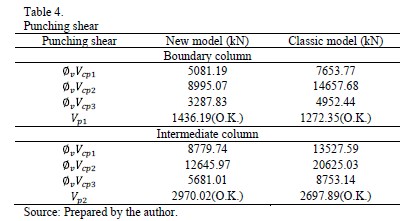
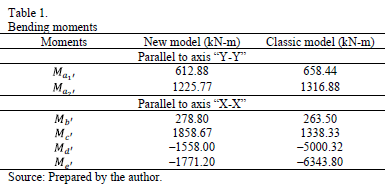
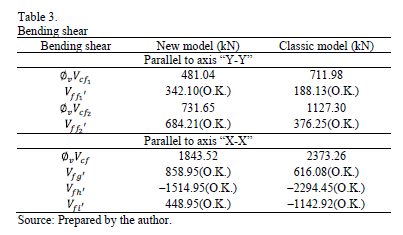
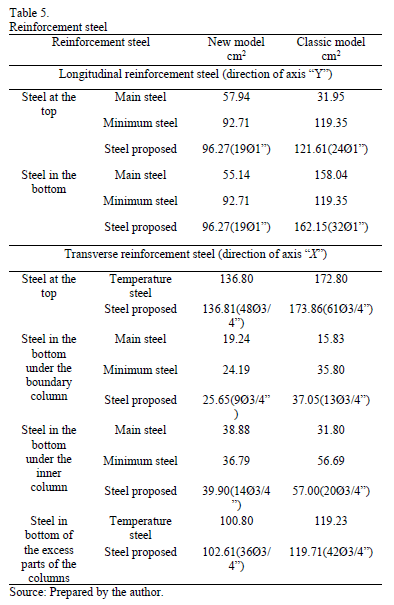
<body><![CDATA[<br>  <b>Step 4:</b> The mechanical elements (<i>P, M<sub>x</sub>,  M<sub>y</sub></i>) acting on the footing is factored: <i>P<sub>u1</sub> = </i>1640<i> kN; M<sub>ux1</sub> = </i>328<i> kN-m; M<sub>uy1</sub> = </i>272<i> kN-m; P<sub>u2</sub> = </i>3280<i> kN; M<sub>ux2</sub> = </i>656<i> kN-m; M<sub>uy2</sub> = </i>544<i> kN-m</i>.    <br>  <b>Step 5:</b> The bending  moments acting on the footing of the two models are presented in <a href="#tab01">Table 1</a>.    <br>  <b>Step 6:</b> The  effective depth for the bending moment is found by equation (55); these are  shown in <a href="#tab02">Table 2</a>.    <br>  <b>Step 7:</b> Bending  shear appear in <a href="#tab03">Table 3</a>.    <br>  <b>Step 8:</b> Punching shear is presented in <a href="#tab04">Table 4</a>.    <br>  <b>Step 9:</b> The  reinforcement steel is shown in <a href="#tab05">Table 5</a>.    <br>  <b>Step 10:</b> The minimum development length for deformed bars appear in <a href="#tab06">Table 6</a>.</font></p>     <p align="center"><font size="2" face="Verdana, Arial, Helvetica, sans-serif"><a name="tab01"></a></font><img src="/img/revistas/dyna/v81n188/v81n188a25tab01.gif"></p>     <p align="center"><font size="2" face="Verdana, Arial, Helvetica, sans-serif"><a name="tab02"></a></font><img src="/img/revistas/dyna/v81n188/v81n188a25tab02.gif"></p>     <p align="center"><font size="2" face="Verdana, Arial, Helvetica, sans-serif"><a name="tab03"></a></font><img src="/img/revistas/dyna/v81n188/v81n188a25tab03.gif"></p>     ]]></body>
<body><![CDATA[<p align="center"><font size="2" face="Verdana, Arial, Helvetica, sans-serif"><a name="tab04"></a></font><img src="/img/revistas/dyna/v81n188/v81n188a25tab04.gif"></p>     <p align="center"><font size="2" face="Verdana, Arial, Helvetica, sans-serif"><a name="tab05"></a></font><img src="/img/revistas/dyna/v81n188/v81n188a25tab05.gif"></p>     <p align="center"><font size="2" face="Verdana, Arial, Helvetica, sans-serif"><a name="tab06"></a></font><img src="/img/revistas/dyna/v81n188/v81n188a25tab06.gif"></p>     <p align="center"><font size="2" face="Verdana, Arial, Helvetica, sans-serif"><a name="fig10"></a></font><img src="/img/revistas/dyna/v81n188/v81n188a25fig10.gif"></p>     <p>&nbsp;</p>     <p><font size="3" face="Verdana, Arial, Helvetica, sans-serif"><b>4. Conclusions </b></font></p>     <p><font size="2" face="Verdana, Arial, Helvetica, sans-serif">The foundation is a part essential of a structure, because  permits the transmission of loads from the structure to the soil. The  mathematical approach suggested in this paper produces results that have a  tangible accuracy for all problems, main part of this research for find the  solution more economical.</font></p>     <p><font size="2" face="Verdana, Arial, Helvetica, sans-serif">The  proposed model presented in this paper for the structural design of boundary  combined footings subjected </font></p>     <p><font size="2" face="Verdana, Arial, Helvetica, sans-serif">to an axial load and moment in two  directions, also it can be applied to others cases: 1) The footings subjected  to a concentric axial load, 2) The footings subjected to a axial load and  moment in one direction.</font></p>     <p><font size="2" face="Verdana, Arial, Helvetica, sans-serif">The model presented in this paper applies only for design  of boundary combined footings, the structural member is assumed to be rigid and  the supporting soil layers elastic, which meet expression of the bidirectional  bending, i.e., the variation of pressure is linear. The suggestions for future  research, when is presented another type of soil, by example in totally  cohesive soils (clay soils) and totally granular soils (sandy soils), the  pressure diagram is not linear and should be treated differently (see <a href="#fig01">Fig. 1</a>).</font></p>     ]]></body>
<body><![CDATA[<p>&nbsp;</p>     <p><font size="3" face="Verdana, Arial, Helvetica, sans-serif"><b>References</b></font></p>     <!-- ref --><p><font face="Verdana, Arial, Helvetica, sans-serif"><b><font size="2">&#91;1&#93;</font></b><font size="2"> Bowles, J.E., Foundation analysis and design,  McGraw-Hill, New York, 1996.    &nbsp;&nbsp;&nbsp;&nbsp;&nbsp;&nbsp;&nbsp;&nbsp;[&#160;<a href="javascript:void(0);" onclick="javascript: window.open('/scielo.php?script=sci_nlinks&ref=000245&pid=S0012-7353201400060002500001&lng=','','width=640,height=500,resizable=yes,scrollbars=1,menubar=yes,');">Links</a>&#160;]<!-- end-ref --></font></font></p>     <!-- ref --><p><font size="2" face="Verdana, Arial, Helvetica, sans-serif"><b>&#91;2&#93;</b> Das,  B.M., Sordo-Zabay, E. and Arrioja-Ju&aacute;rez, R., Principios de ingenier&iacute;a de  cimentaciones, Cengage Learning Latin America, M&eacute;xico, 2006.    &nbsp;&nbsp;&nbsp;&nbsp;&nbsp;&nbsp;&nbsp;&nbsp;[&#160;<a href="javascript:void(0);" onclick="javascript: window.open('/scielo.php?script=sci_nlinks&ref=000247&pid=S0012-7353201400060002500002&lng=','','width=640,height=500,resizable=yes,scrollbars=1,menubar=yes,');">Links</a>&#160;]<!-- end-ref --> </font></p>     <!-- ref --><p><font size="2" face="Verdana, Arial, Helvetica, sans-serif"><b>&#91;3&#93;</b> Calabera-Ruiz,  J., Calculo de estructuras de cimentaci&oacute;n, Intemac Ediciones, M&eacute;xico, 2000.    &nbsp;&nbsp;&nbsp;&nbsp;&nbsp;&nbsp;&nbsp;&nbsp;[&#160;<a href="javascript:void(0);" onclick="javascript: window.open('/scielo.php?script=sci_nlinks&ref=000249&pid=S0012-7353201400060002500003&lng=','','width=640,height=500,resizable=yes,scrollbars=1,menubar=yes,');">Links</a>&#160;]<!-- end-ref --></font></p>     <!-- ref --><p><font size="2" face="Verdana, Arial, Helvetica, sans-serif"><b>&#91;4&#93;</b> Tomlinson,  M.J., Cimentaciones, dise&ntilde;o y construcci&oacute;n, Trillas, M&eacute;xico, 2008.    &nbsp;&nbsp;&nbsp;&nbsp;&nbsp;&nbsp;&nbsp;&nbsp;[&#160;<a href="javascript:void(0);" onclick="javascript: window.open('/scielo.php?script=sci_nlinks&ref=000251&pid=S0012-7353201400060002500004&lng=','','width=640,height=500,resizable=yes,scrollbars=1,menubar=yes,');">Links</a>&#160;]<!-- end-ref --></font></p>     ]]></body>
<body><![CDATA[<!-- ref --><p><font size="2" face="Verdana, Arial, Helvetica, sans-serif"><b>&#91;5&#93;</b> Mosley, W.H., Bungey, J.H. and Hulse, R., Reinforced  concrete design, Palgrave Macmillan, New York, 1999.    &nbsp;&nbsp;&nbsp;&nbsp;&nbsp;&nbsp;&nbsp;&nbsp;[&#160;<a href="javascript:void(0);" onclick="javascript: window.open('/scielo.php?script=sci_nlinks&ref=000253&pid=S0012-7353201400060002500005&lng=','','width=640,height=500,resizable=yes,scrollbars=1,menubar=yes,');">Links</a>&#160;]<!-- end-ref --></font></p>     <!-- ref --><p><font size="2" face="Verdana, Arial, Helvetica, sans-serif"><b>&#91;6&#93;</b> Gambhir, M.L., Fundamentals of reinforced concrete  design, Prentice-Hall, of India Private Limited, 2008.    &nbsp;&nbsp;&nbsp;&nbsp;&nbsp;&nbsp;&nbsp;&nbsp;[&#160;<a href="javascript:void(0);" onclick="javascript: window.open('/scielo.php?script=sci_nlinks&ref=000255&pid=S0012-7353201400060002500006&lng=','','width=640,height=500,resizable=yes,scrollbars=1,menubar=yes,');">Links</a>&#160;]<!-- end-ref --></font></p>     <!-- ref --><p><font size="2" face="Verdana, Arial, Helvetica, sans-serif"><b>&#91;7&#93;</b> Kurian, N.P., Design of foundation systems, Alpha  Science Int'l Ltd., India, 2005.    &nbsp;&nbsp;&nbsp;&nbsp;&nbsp;&nbsp;&nbsp;&nbsp;[&#160;<a href="javascript:void(0);" onclick="javascript: window.open('/scielo.php?script=sci_nlinks&ref=000257&pid=S0012-7353201400060002500007&lng=','','width=640,height=500,resizable=yes,scrollbars=1,menubar=yes,');">Links</a>&#160;]<!-- end-ref --></font></p>     <!-- ref --><p><font size="2" face="Verdana, Arial, Helvetica, sans-serif"><b>&#91;8&#93;</b> Punmia, B.C., Kumar-Jain, A., and Kumar-Jain, A., Limit  state design of reinforced concrete, Laxmi Publications (P) Limited, New Delhi,  India, 2007.    &nbsp;&nbsp;&nbsp;&nbsp;&nbsp;&nbsp;&nbsp;&nbsp;[&#160;<a href="javascript:void(0);" onclick="javascript: window.open('/scielo.php?script=sci_nlinks&ref=000259&pid=S0012-7353201400060002500008&lng=','','width=640,height=500,resizable=yes,scrollbars=1,menubar=yes,');">Links</a>&#160;]<!-- end-ref --></font></p>     <!-- ref --><p><font size="2" face="Verdana, Arial, Helvetica, sans-serif"><b>&#91;9&#93;</b> Varghese, P.C., Design of reinforced concrete  foundations, PHI Learning Pvt. Ltd., New Delhi, India, 2009.    &nbsp;&nbsp;&nbsp;&nbsp;&nbsp;&nbsp;&nbsp;&nbsp;[&#160;<a href="javascript:void(0);" onclick="javascript: window.open('/scielo.php?script=sci_nlinks&ref=000261&pid=S0012-7353201400060002500009&lng=','','width=640,height=500,resizable=yes,scrollbars=1,menubar=yes,');">Links</a>&#160;]<!-- end-ref --></font></p>     ]]></body>
<body><![CDATA[<!-- ref --><p><font size="2" face="Verdana, Arial, Helvetica, sans-serif"><b>&#91;10&#93;</b> Iba&ntilde;ez-Mora,  L., Pruebas de carga no destructivas en pilotes, DYNA, 75 (155), pp. 57-61,  2008.    &nbsp;&nbsp;&nbsp;&nbsp;&nbsp;&nbsp;&nbsp;&nbsp;[&#160;<a href="javascript:void(0);" onclick="javascript: window.open('/scielo.php?script=sci_nlinks&ref=000263&pid=S0012-7353201400060002500010&lng=','','width=640,height=500,resizable=yes,scrollbars=1,menubar=yes,');">Links</a>&#160;]<!-- end-ref --></font></p>     <!-- ref --><p><font size="2" face="Verdana, Arial, Helvetica, sans-serif"><b>&#91;11&#93;</b> Gaviria,  C.A., G&oacute;mez, D. and Thomson, P., Evaluaci&oacute;n de la integridad de cimentaciones  profundas: an&aacute;lisis y verificaci&oacute;n in situ, DYNA, 76 (159), pp. 23-33, 2009.    &nbsp;&nbsp;&nbsp;&nbsp;&nbsp;&nbsp;&nbsp;&nbsp;[&#160;<a href="javascript:void(0);" onclick="javascript: window.open('/scielo.php?script=sci_nlinks&ref=000265&pid=S0012-7353201400060002500011&lng=','','width=640,height=500,resizable=yes,scrollbars=1,menubar=yes,');">Links</a>&#160;]<!-- end-ref --></font></p>     <!-- ref --><p><font size="2" face="Verdana, Arial, Helvetica, sans-serif"><b>&#91;12&#93;</b> Valencia,  Y., Camapum, J. and Lara, L., Aplicaciones adicionales de los resultados de  pruebas de carga est&aacute;ticas en el dise&ntilde;o geot&eacute;cnico de cimentaciones, DYNA, 175,  pp. 182-190, 2012.    &nbsp;&nbsp;&nbsp;&nbsp;&nbsp;&nbsp;&nbsp;&nbsp;[&#160;<a href="javascript:void(0);" onclick="javascript: window.open('/scielo.php?script=sci_nlinks&ref=000267&pid=S0012-7353201400060002500012&lng=','','width=640,height=500,resizable=yes,scrollbars=1,menubar=yes,');">Links</a>&#160;]<!-- end-ref --></font></p>     <!-- ref --><p><font size="2" face="Verdana, Arial, Helvetica, sans-serif"><b>&#91;13&#93;</b> Camacho-Tauta, J.F., Reyes-Ortiz, O.J. and  Jimenez-Alvarez, J.D., Comparison between resonant-column and bender element  test on three types of soils, DYNA, 80 (182), pp. 163-172, 2013.    &nbsp;&nbsp;&nbsp;&nbsp;&nbsp;&nbsp;&nbsp;&nbsp;[&#160;<a href="javascript:void(0);" onclick="javascript: window.open('/scielo.php?script=sci_nlinks&ref=000269&pid=S0012-7353201400060002500013&lng=','','width=640,height=500,resizable=yes,scrollbars=1,menubar=yes,');">Links</a>&#160;]<!-- end-ref --></font></p>     <!-- ref --><p><font size="2" face="Verdana, Arial, Helvetica, sans-serif"><b>&#91;14&#93;</b> Lu&eacute;vanos-Rojas, A., A mathematical model for  dimensioning of footings rectangular, ICIC Express Letters Part B:  Applications, 4, pp.269-274, 2013.    &nbsp;&nbsp;&nbsp;&nbsp;&nbsp;&nbsp;&nbsp;&nbsp;[&#160;<a href="javascript:void(0);" onclick="javascript: window.open('/scielo.php?script=sci_nlinks&ref=000271&pid=S0012-7353201400060002500014&lng=','','width=640,height=500,resizable=yes,scrollbars=1,menubar=yes,');">Links</a>&#160;]<!-- end-ref --></font></p>     ]]></body>
<body><![CDATA[<!-- ref --><p><font size="2" face="Verdana, Arial, Helvetica, sans-serif"><b>&#91;15&#93;</b> Lu&eacute;vanos-Rojas, A., A mathematical model for  dimensioning of footings square, International Review Civil Engineering  (IRECE), 3, pp.346-350, 2012.    &nbsp;&nbsp;&nbsp;&nbsp;&nbsp;&nbsp;&nbsp;&nbsp;[&#160;<a href="javascript:void(0);" onclick="javascript: window.open('/scielo.php?script=sci_nlinks&ref=000273&pid=S0012-7353201400060002500015&lng=','','width=640,height=500,resizable=yes,scrollbars=1,menubar=yes,');">Links</a>&#160;]<!-- end-ref --></font></p>     <!-- ref --><p><font size="2" face="Verdana, Arial, Helvetica, sans-serif"><b>&#91;16&#93;</b> Lu&eacute;vanos-Rojas, A., A mathematical model for the  dimensioning of circular footings, Far East Journal of Mathematical Sciences, 71,  pp. 357-367, 2012.    &nbsp;&nbsp;&nbsp;&nbsp;&nbsp;&nbsp;&nbsp;&nbsp;[&#160;<a href="javascript:void(0);" onclick="javascript: window.open('/scielo.php?script=sci_nlinks&ref=000275&pid=S0012-7353201400060002500016&lng=','','width=640,height=500,resizable=yes,scrollbars=1,menubar=yes,');">Links</a>&#160;]<!-- end-ref --></font></p>     <!-- ref --><p><font size="2" face="Verdana, Arial, Helvetica, sans-serif"><b>&#91;17&#93;</b> Lu&eacute;vanos-Rojas, A., Faudoa-Herrera, J.G., Andrade-Vallejo, R.A. and  Cano-Alvarez, M.A., Design of isolated footings of rectangular form using a new  model, International Journal of Innovative Computing, Information and Control,  9, pp. 4001-4022, 2013.    &nbsp;&nbsp;&nbsp;&nbsp;&nbsp;&nbsp;&nbsp;&nbsp;[&#160;<a href="javascript:void(0);" onclick="javascript: window.open('/scielo.php?script=sci_nlinks&ref=000277&pid=S0012-7353201400060002500017&lng=','','width=640,height=500,resizable=yes,scrollbars=1,menubar=yes,');">Links</a>&#160;]<!-- end-ref --></font></p>     <!-- ref --><p><font size="2" face="Verdana, Arial, Helvetica, sans-serif"><b>&#91;18&#93;</b> ACI 318S-13 (American Concrete Institute), Building  Code Requirements for Structural Concrete and Commentary, Committee 318, 2013.    &nbsp;&nbsp;&nbsp;&nbsp;&nbsp;&nbsp;&nbsp;&nbsp;[&#160;<a href="javascript:void(0);" onclick="javascript: window.open('/scielo.php?script=sci_nlinks&ref=000279&pid=S0012-7353201400060002500018&lng=','','width=640,height=500,resizable=yes,scrollbars=1,menubar=yes,');">Links</a>&#160;]<!-- end-ref --></font></p>     <!-- ref --><p><font size="2" face="Verdana, Arial, Helvetica, sans-serif"><b>&#91;19&#93;</b> Gere, J.M. and Goodo, B.J., Mec&aacute;nica de materiales,  Cengage Learning, M&eacute;xico, 2009.    &nbsp;&nbsp;&nbsp;&nbsp;&nbsp;&nbsp;&nbsp;&nbsp;[&#160;<a href="javascript:void(0);" onclick="javascript: window.open('/scielo.php?script=sci_nlinks&ref=000281&pid=S0012-7353201400060002500019&lng=','','width=640,height=500,resizable=yes,scrollbars=1,menubar=yes,');">Links</a>&#160;]<!-- end-ref --></font></p>     ]]></body>
<body><![CDATA[<!-- ref --><p><font size="2" face="Verdana, Arial, Helvetica, sans-serif"><b>&#91;20&#93;</b> Gonz&aacute;lez-Cuevas,  O.M. and Robles-Fern&aacute;ndez-Villegas, F., Aspectos fundamentales del concreto  reforzado, Limusa, M&eacute;xico, 2005.    &nbsp;&nbsp;&nbsp;&nbsp;&nbsp;&nbsp;&nbsp;&nbsp;[&#160;<a href="javascript:void(0);" onclick="javascript: window.open('/scielo.php?script=sci_nlinks&ref=000283&pid=S0012-7353201400060002500020&lng=','','width=640,height=500,resizable=yes,scrollbars=1,menubar=yes,');">Links</a>&#160;]<!-- end-ref --></font></p>     <!-- ref --><p><font size="2" face="Verdana, Arial, Helvetica, sans-serif"><b>&#91;21&#93;</b> McCormac, J.C. and Brown, R.H., Design of reinforced  concrete, John Wiley &amp; Sons, New York, 2013.    &nbsp;&nbsp;&nbsp;&nbsp;&nbsp;&nbsp;&nbsp;&nbsp;[&#160;<a href="javascript:void(0);" onclick="javascript: window.open('/scielo.php?script=sci_nlinks&ref=000285&pid=S0012-7353201400060002500021&lng=','','width=640,height=500,resizable=yes,scrollbars=1,menubar=yes,');">Links</a>&#160;]<!-- end-ref --></font></p>      <p>&nbsp;</p>     <p><font size="2" face="Verdana, Arial, Helvetica, sans-serif"><b>A.   Lu&eacute;vanos-Rojas, </b>received the BSc. Eng in Civil Engineering in 1981, the MSc   degree in Planneation and Construction in 1996, and the Engineering Dr. degree   in Planneation and Construction in 2009, all of them from the Facultad de Ingenier&iacute;a,   Ciencias y Arquitectura of the Universidad Ju&aacute;rez del Estado de Durango, G&oacute;mez   Palacio, Durango, M&eacute;xico. The MSc degree in Structures in 1983, from the   Escuela Superior de Ingenier&iacute;a y Arquitectura the Instituto Polit&eacute;cnico   Nacional, Distrito Federal, M&eacute;xico. The MSc degree in Administration in 2004,   from the Facultad de Contadur&iacute;a y Administraci&oacute;n of the Universidad Aut&oacute;noma de   Coahuila, Torre&oacute;n, Coahuila, M&eacute;xico. From 1983 to 2009, he is a full time   professor and from 2009 to 2014, he is professor and researcher for the Facultad   de Ingenier&iacute;a, Ciencias y Arquitectura of the Universidad Ju&aacute;rez del Estado de   Durango. His research interests include: mathematical models applied to   structures: methods of structural analysis, members design of concrete and   steel, analysis of non-prismatic members. Also he is Associate Editor the   journal &quot;ICIC Express Letters Part B: Applications&quot;. ORCID:   0000-0002-0198-3614.</font></p>      ]]></body><back>
<ref-list>
<ref id="B1">
<label>1</label><nlm-citation citation-type="book">
<person-group person-group-type="author">
<name>
<surname><![CDATA[Bowles]]></surname>
<given-names><![CDATA[J.E.]]></given-names>
</name>
</person-group>
<source><![CDATA[Foundation analysis and design]]></source>
<year>1996</year>
<publisher-loc><![CDATA[New York ]]></publisher-loc>
<publisher-name><![CDATA[McGraw-Hill]]></publisher-name>
</nlm-citation>
</ref>
<ref id="B2">
<label>2</label><nlm-citation citation-type="book">
<person-group person-group-type="author">
<name>
<surname><![CDATA[Das]]></surname>
<given-names><![CDATA[B.M.]]></given-names>
</name>
<name>
<surname><![CDATA[Sordo-Zabay]]></surname>
<given-names><![CDATA[E.]]></given-names>
</name>
<name>
<surname><![CDATA[Arrioja-Juárez]]></surname>
<given-names><![CDATA[R.]]></given-names>
</name>
</person-group>
<source><![CDATA[Principios de ingeniería de cimentaciones]]></source>
<year>2006</year>
<publisher-name><![CDATA[Cengage Learning Latin America]]></publisher-name>
</nlm-citation>
</ref>
<ref id="B3">
<label>3</label><nlm-citation citation-type="book">
<person-group person-group-type="author">
<name>
<surname><![CDATA[Calabera-Ruiz]]></surname>
<given-names><![CDATA[J.]]></given-names>
</name>
</person-group>
<source><![CDATA[Calculo de estructuras de cimentación]]></source>
<year>2000</year>
<publisher-name><![CDATA[Intemac Ediciones]]></publisher-name>
</nlm-citation>
</ref>
<ref id="B4">
<label>4</label><nlm-citation citation-type="book">
<person-group person-group-type="author">
<name>
<surname><![CDATA[Tomlinson]]></surname>
<given-names><![CDATA[M.J.]]></given-names>
</name>
</person-group>
<source><![CDATA[Cimentaciones, diseño y construcción]]></source>
<year>2008</year>
<publisher-name><![CDATA[Trillas]]></publisher-name>
</nlm-citation>
</ref>
<ref id="B5">
<label>5</label><nlm-citation citation-type="book">
<person-group person-group-type="author">
<name>
<surname><![CDATA[Mosley]]></surname>
<given-names><![CDATA[W.H.]]></given-names>
</name>
<name>
<surname><![CDATA[Bungey]]></surname>
<given-names><![CDATA[J.H.]]></given-names>
</name>
<name>
<surname><![CDATA[Hulse]]></surname>
<given-names><![CDATA[R.]]></given-names>
</name>
</person-group>
<source><![CDATA[Reinforced concrete design]]></source>
<year>1999</year>
<publisher-loc><![CDATA[New York ]]></publisher-loc>
<publisher-name><![CDATA[Palgrave Macmillan]]></publisher-name>
</nlm-citation>
</ref>
<ref id="B6">
<label>6</label><nlm-citation citation-type="book">
<person-group person-group-type="author">
<name>
<surname><![CDATA[Gambhir]]></surname>
<given-names><![CDATA[M.L.]]></given-names>
</name>
</person-group>
<source><![CDATA[Fundamentals of reinforced concrete design]]></source>
<year>2008</year>
<publisher-name><![CDATA[Prentice-Hall]]></publisher-name>
</nlm-citation>
</ref>
<ref id="B7">
<label>7</label><nlm-citation citation-type="book">
<person-group person-group-type="author">
<name>
<surname><![CDATA[Kurian]]></surname>
<given-names><![CDATA[N.P.]]></given-names>
</name>
</person-group>
<source><![CDATA[Design of foundation systems]]></source>
<year>2005</year>
<publisher-name><![CDATA[Alpha Science Int'l Ltd]]></publisher-name>
</nlm-citation>
</ref>
<ref id="B8">
<label>8</label><nlm-citation citation-type="book">
<person-group person-group-type="author">
<name>
<surname><![CDATA[Punmia]]></surname>
<given-names><![CDATA[B.C.]]></given-names>
</name>
<name>
<surname><![CDATA[Kumar-Jain]]></surname>
<given-names><![CDATA[A.]]></given-names>
</name>
<name>
<surname><![CDATA[Kumar-Jain]]></surname>
<given-names><![CDATA[A.]]></given-names>
</name>
</person-group>
<source><![CDATA[Limit state design of reinforced concrete]]></source>
<year>2007</year>
<publisher-loc><![CDATA[New Delhi ]]></publisher-loc>
<publisher-name><![CDATA[Laxmi Publications (P) Limited]]></publisher-name>
</nlm-citation>
</ref>
<ref id="B9">
<label>9</label><nlm-citation citation-type="book">
<person-group person-group-type="author">
<name>
<surname><![CDATA[Varghese]]></surname>
<given-names><![CDATA[P.C.]]></given-names>
</name>
</person-group>
<source><![CDATA[Design of reinforced concrete foundations]]></source>
<year>2009</year>
<publisher-loc><![CDATA[New Delhi ]]></publisher-loc>
<publisher-name><![CDATA[PHI Learning Pvt. Ltd]]></publisher-name>
</nlm-citation>
</ref>
<ref id="B10">
<label>10</label><nlm-citation citation-type="journal">
<person-group person-group-type="author">
<name>
<surname><![CDATA[Ibañez-Mora]]></surname>
<given-names><![CDATA[L.]]></given-names>
</name>
</person-group>
<article-title xml:lang="es"><![CDATA[Pruebas de carga no destructivas en pilotes]]></article-title>
<source><![CDATA[DYNA]]></source>
<year>2008</year>
<volume>75</volume>
<numero>155</numero>
<issue>155</issue>
<page-range>57-61</page-range></nlm-citation>
</ref>
<ref id="B11">
<label>11</label><nlm-citation citation-type="journal">
<person-group person-group-type="author">
<name>
<surname><![CDATA[Gaviria]]></surname>
<given-names><![CDATA[C.A.]]></given-names>
</name>
<name>
<surname><![CDATA[Gómez]]></surname>
<given-names><![CDATA[D.]]></given-names>
</name>
<name>
<surname><![CDATA[Thomson]]></surname>
<given-names><![CDATA[P.]]></given-names>
</name>
</person-group>
<article-title xml:lang="es"><![CDATA[Evaluación de la integridad de cimentaciones profundas: análisis y verificación in situ]]></article-title>
<source><![CDATA[DYNA]]></source>
<year>2009</year>
<volume>76</volume>
<numero>159</numero>
<issue>159</issue>
<page-range>23-33</page-range></nlm-citation>
</ref>
<ref id="B12">
<label>12</label><nlm-citation citation-type="journal">
<person-group person-group-type="author">
<name>
<surname><![CDATA[Valencia]]></surname>
<given-names><![CDATA[Y.]]></given-names>
</name>
<name>
<surname><![CDATA[Camapum]]></surname>
<given-names><![CDATA[J.]]></given-names>
</name>
<name>
<surname><![CDATA[Lara]]></surname>
<given-names><![CDATA[L.]]></given-names>
</name>
</person-group>
<article-title xml:lang="es"><![CDATA[Aplicaciones adicionales de los resultados de pruebas de carga estáticas en el diseño geotécnico de cimentaciones]]></article-title>
<source><![CDATA[DYNA]]></source>
<year>2012</year>
<numero>175</numero>
<issue>175</issue>
<page-range>182-190</page-range></nlm-citation>
</ref>
<ref id="B13">
<label>13</label><nlm-citation citation-type="journal">
<person-group person-group-type="author">
<name>
<surname><![CDATA[Camacho-Tauta]]></surname>
<given-names><![CDATA[J.F.]]></given-names>
</name>
<name>
<surname><![CDATA[Reyes-Ortiz]]></surname>
<given-names><![CDATA[O.J.]]></given-names>
</name>
<name>
<surname><![CDATA[Jimenez-Alvarez]]></surname>
<given-names><![CDATA[J.D.]]></given-names>
</name>
</person-group>
<article-title xml:lang="en"><![CDATA[Comparison between resonant-column and bender element test on three types of soils]]></article-title>
<source><![CDATA[DYNA]]></source>
<year>2013</year>
<volume>80</volume>
<numero>182</numero>
<issue>182</issue>
<page-range>163-172</page-range></nlm-citation>
</ref>
<ref id="B14">
<label>14</label><nlm-citation citation-type="journal">
<person-group person-group-type="author">
<name>
<surname><![CDATA[Luévanos-Rojas]]></surname>
<given-names><![CDATA[A.]]></given-names>
</name>
</person-group>
<article-title xml:lang="en"><![CDATA[A mathematical model for dimensioning of footings rectangular]]></article-title>
<source><![CDATA[ICIC Express Letters Part B: Applications]]></source>
<year>2013</year>
<numero>4</numero>
<issue>4</issue>
<page-range>269-274</page-range></nlm-citation>
</ref>
<ref id="B15">
<label>15</label><nlm-citation citation-type="journal">
<person-group person-group-type="author">
<name>
<surname><![CDATA[Luévanos-Rojas]]></surname>
<given-names><![CDATA[A.]]></given-names>
</name>
</person-group>
<article-title xml:lang="en"><![CDATA[A mathematical model for dimensioning of footings square]]></article-title>
<source><![CDATA[International Review Civil Engineering]]></source>
<year>2012</year>
<numero>3</numero>
<issue>3</issue>
<page-range>346-350</page-range></nlm-citation>
</ref>
<ref id="B16">
<label>16</label><nlm-citation citation-type="journal">
<person-group person-group-type="author">
<name>
<surname><![CDATA[Luévanos-Rojas]]></surname>
<given-names><![CDATA[A.]]></given-names>
</name>
</person-group>
<article-title xml:lang="en"><![CDATA[A mathematical model for the dimensioning of circular footings]]></article-title>
<source><![CDATA[Far East Journal of Mathematical Sciences]]></source>
<year>2012</year>
<numero>71</numero>
<issue>71</issue>
<page-range>357-367</page-range></nlm-citation>
</ref>
<ref id="B17">
<label>17</label><nlm-citation citation-type="journal">
<person-group person-group-type="author">
<name>
<surname><![CDATA[Luévanos-Rojas]]></surname>
<given-names><![CDATA[A.]]></given-names>
</name>
<name>
<surname><![CDATA[Faudoa-Herrera]]></surname>
<given-names><![CDATA[J.G.]]></given-names>
</name>
<name>
<surname><![CDATA[Andrade-Vallejo]]></surname>
<given-names><![CDATA[R.A.]]></given-names>
</name>
<name>
<surname><![CDATA[Cano-Alvarez]]></surname>
<given-names><![CDATA[M.A.]]></given-names>
</name>
</person-group>
<article-title xml:lang="en"><![CDATA[Design of isolated footings of rectangular form using a new model]]></article-title>
<source><![CDATA[International Journal of Innovative Computing, Information and Control]]></source>
<year>2013</year>
<numero>9</numero>
<issue>9</issue>
<page-range>4001-4022</page-range></nlm-citation>
</ref>
<ref id="B18">
<label>18</label><nlm-citation citation-type="">
<source><![CDATA[ACI 318S-13: Building Code Requirements for Structural Concrete and Commentary]]></source>
<year>2013</year>
</nlm-citation>
</ref>
<ref id="B19">
<label>19</label><nlm-citation citation-type="book">
<person-group person-group-type="author">
<name>
<surname><![CDATA[Gere]]></surname>
<given-names><![CDATA[J.M.]]></given-names>
</name>
<name>
<surname><![CDATA[Goodo]]></surname>
<given-names><![CDATA[B.J.]]></given-names>
</name>
</person-group>
<source><![CDATA[Mecánica de materiales]]></source>
<year>2009</year>
<publisher-name><![CDATA[Cengage Learning]]></publisher-name>
</nlm-citation>
</ref>
<ref id="B20">
<label>20</label><nlm-citation citation-type="book">
<person-group person-group-type="author">
<name>
<surname><![CDATA[González-Cuevas]]></surname>
<given-names><![CDATA[O.M.]]></given-names>
</name>
<name>
<surname><![CDATA[Robles-Fernández-Villegas]]></surname>
<given-names><![CDATA[F.]]></given-names>
</name>
</person-group>
<source><![CDATA[Aspectos fundamentales del concreto reforzado]]></source>
<year>2005</year>
<publisher-name><![CDATA[Limusa]]></publisher-name>
</nlm-citation>
</ref>
<ref id="B21">
<label>21</label><nlm-citation citation-type="book">
<person-group person-group-type="author">
<name>
<surname><![CDATA[McCormac]]></surname>
<given-names><![CDATA[J.C.]]></given-names>
</name>
<name>
<surname><![CDATA[Brown]]></surname>
<given-names><![CDATA[R.H.]]></given-names>
</name>
</person-group>
<source><![CDATA[Design of reinforced concrete]]></source>
<year>2013</year>
<publisher-loc><![CDATA[New York ]]></publisher-loc>
<publisher-name><![CDATA[John Wiley & Sons]]></publisher-name>
</nlm-citation>
</ref>
</ref-list>
</back>
</article>