<?xml version="1.0" encoding="ISO-8859-1"?><article xmlns:mml="http://www.w3.org/1998/Math/MathML" xmlns:xlink="http://www.w3.org/1999/xlink" xmlns:xsi="http://www.w3.org/2001/XMLSchema-instance">
<front>
<journal-meta>
<journal-id>0012-7353</journal-id>
<journal-title><![CDATA[DYNA]]></journal-title>
<abbrev-journal-title><![CDATA[Dyna rev.fac.nac.minas]]></abbrev-journal-title>
<issn>0012-7353</issn>
<publisher>
<publisher-name><![CDATA[Universidad Nacional de Colombia]]></publisher-name>
</publisher>
</journal-meta>
<article-meta>
<article-id>S0012-73532015000100004</article-id>
<article-id pub-id-type="doi">10.15446/dyna.v82n189.41963</article-id>
<title-group>
<article-title xml:lang="en"><![CDATA[Insights of asphaltene aggregation mechanism from molecular dynamics simulation]]></article-title>
<article-title xml:lang="es"><![CDATA[Visualización del mecanismo de agregación de asfaltenos usando simulación de dinámica molecular]]></article-title>
</title-group>
<contrib-group>
<contrib contrib-type="author">
<name>
<surname><![CDATA[De León]]></surname>
<given-names><![CDATA[Jennifer]]></given-names>
</name>
<xref ref-type="aff" rid="A01"/>
</contrib>
<contrib contrib-type="author">
<name>
<surname><![CDATA[Hoyos]]></surname>
<given-names><![CDATA[Bibian]]></given-names>
</name>
<xref ref-type="aff" rid="A02"/>
</contrib>
<contrib contrib-type="author">
<name>
<surname><![CDATA[Cañas-Marín]]></surname>
<given-names><![CDATA[Wilson]]></given-names>
</name>
<xref ref-type="aff" rid="A03"/>
</contrib>
</contrib-group>
<aff id="A01">
<institution><![CDATA[,Universidad Nacional de Colombia Facultad de Minas ]]></institution>
<addr-line><![CDATA[Medellín ]]></addr-line>
<country>Colombia</country>
</aff>
<aff id="A02">
<institution><![CDATA[,Universidad Nacional de Colombia Facultad de Minas ]]></institution>
<addr-line><![CDATA[Medellín ]]></addr-line>
<country>Colombia</country>
</aff>
<aff id="A03">
<institution><![CDATA[,ECOPETROL S.A. Instituto Colombiano del Petróleo ]]></institution>
<addr-line><![CDATA[Santander ]]></addr-line>
<country>Colombia</country>
</aff>
<pub-date pub-type="pub">
<day>00</day>
<month>02</month>
<year>2015</year>
</pub-date>
<pub-date pub-type="epub">
<day>00</day>
<month>02</month>
<year>2015</year>
</pub-date>
<volume>82</volume>
<numero>189</numero>
<fpage>39</fpage>
<lpage>44</lpage>
<copyright-statement/>
<copyright-year/>
<self-uri xlink:href="http://www.scielo.org.co/scielo.php?script=sci_arttext&amp;pid=S0012-73532015000100004&amp;lng=en&amp;nrm=iso"></self-uri><self-uri xlink:href="http://www.scielo.org.co/scielo.php?script=sci_abstract&amp;pid=S0012-73532015000100004&amp;lng=en&amp;nrm=iso"></self-uri><self-uri xlink:href="http://www.scielo.org.co/scielo.php?script=sci_pdf&amp;pid=S0012-73532015000100004&amp;lng=en&amp;nrm=iso"></self-uri><abstract abstract-type="short" xml:lang="en"><p><![CDATA[Asphaltene aggregation process was studied using molecular dynamics techniques. Four different structures were used. The first three molecules have a continental structure, with condensed aromatic cores, while the forth has an archipelago structure, with small groups of aromatic rings connected with saturated chains. The molecules were constructed in an atomistic framework, in which atoms are described individually. Interaction forces were calculated at 300 K and 200 atm; Van der Waals and electrostatic interactions were evaluated separately. For all four molecules the solubility parameter was calculated. It was found that Van der Waals interactions due to the presence of aromatic rings and electrostatic forces caused by the presence of heteroatoms such as oxygen, nitrogen and sulfur, are equally relevant in the aggregation of asphaltene molecules. For all molecules it was found asphaltene systems are more stable in aggregation state than in monomeric state. For continental structures, the presence of long ramifications obstructs the formation of asphaltene aggregates. For archipelago structures, the flexibility of the molecules enables the aggregation with other structures. The presence of heteroatoms creates a repulsive force that hinders the aggregation process. The molecular volume and the cohesive energy are also sensitive to the geometric configuration and the composition of the species, which affects the solubility parameter.]]></p></abstract>
<abstract abstract-type="short" xml:lang="es"><p><![CDATA[Se estudió el proceso de agregación de asfaltenos utilizando técnicas de dinámica molecular. Se utilizaron cuatro estructuras diferentes. Las primeras tres moléculas tienen una estructura continental, con núcleos aromáticos condensador, mientras que la cuarta posee una estructura tipo archipiélago, con pequeños grupos de anillos aromáticos conectados con cadenas saturadas. Las moléculas fueron construidas de manera atomística, en la cual cada átomo se describe individualmente. Se calcularon las fuerzas de interacción a 300 K y 200 atm; las fuerzas de Van der Waals y las interacciones electrostáticas fueron evaluadas separadamente. Se calculó el parámetro de solubilidad para las cuatro moléculas. Se encontró que las interacciones de Van der Waals asociadas a los anillos aromáticos y las fuerzas electrostáticas ocasionadas principalmente por la presencia de heteroátomos como oxígeno, azufre y nitrógeno, son igualmente relevantes en la agregación de moléculas de asfalteno. Para todas las moléculas se encontró que los sistemas de asfaltenos tienen menor energía en estado de agregación que en estado monomérico. Para las estructuras continentales, la presencia de largas cadenas obstruye el proceso de formación de agregados. Para las estructuras tipo archipiélago, la flexibilidad de las moléculas facilita la agregación con otras estructuras. La presencia de heteroátomos ocasiona una fuerza repulsiva que dificulta la agregación. El volumen molecular y la energía de cohesión también son sensibles a la configuración geométrica y la composición de las especies, lo cual afecta el parámetro de solubilidad.]]></p></abstract>
<kwd-group>
<kwd lng="en"><![CDATA[asphaltene]]></kwd>
<kwd lng="en"><![CDATA[aggregation]]></kwd>
<kwd lng="en"><![CDATA[molecular simulation]]></kwd>
<kwd lng="en"><![CDATA[solubility parameter]]></kwd>
<kwd lng="es"><![CDATA[asfaltenos]]></kwd>
<kwd lng="es"><![CDATA[agregación]]></kwd>
<kwd lng="es"><![CDATA[simulación molecular]]></kwd>
<kwd lng="es"><![CDATA[parámetro de solubilidad]]></kwd>
</kwd-group>
</article-meta>
</front><body><![CDATA[ <p><font size="2" face="Verdana, Arial, Helvetica, sans-serif"><a href="http://dx.doi.org/10.15446/dyna.v82n189.41963" target="_blank">http://dx.doi.org/10.15446/dyna.v82n189.41963</a></font></p>     <p align="center"><font size="4" face="Verdana, Arial, Helvetica, sans-serif"><b>Insights of asphaltene aggregation mechanism from  molecular dynamics simulation</b></font></p>     <p align="center"><i><font size="3"><b><font face="Verdana, Arial, Helvetica, sans-serif">Visualizaci&oacute;n   del mecanismo de agregaci&oacute;n de asfaltenos usando simulaci&oacute;n de din&aacute;mica   molecular</font></b></font></i></p>     <p align="center">&nbsp;</p>     <p align="center"><b><font size="2" face="Verdana, Arial, Helvetica, sans-serif">Jennifer De Le&oacute;n <i><sup>a</sup></i>, Bibian Hoyos <i><sup>b</sup></i> &amp; Wilson Ca&ntilde;as-Mar&iacute;n <i><sup>c</sup></i></font></b><font size="2" face="Verdana, Arial, Helvetica, sans-serif"></font></p>     <p align="center">&nbsp;</p>     <p align="center"><font size="2" face="Verdana, Arial, Helvetica, sans-serif"><sup><i>a </i></sup><i>Facultad de Minas, Universidad Nacional de Colombia, Medell&iacute;n,   Colombia. <a href="mailto:jde@unal.edu.co">jde@unal.edu.co</a>    <br>   <sup>b </sup>Facultad de Minas, Universidad Nacional de Colombia, Medell&iacute;n,  Colombia. <a href="mailto:bahoyos@unal.edu.co">bahoyos@unal.edu.co</a>    <br>  <sup>c </sup>ECOPETROL S.A., Instituto Colombiano del Petr&oacute;leo (ICP), km 7 via  Piedecuesta, Santander, Colombia, <a href="mailto:wilson.cmarin@ecopetrol.com.co">wilson.cmarin@ecopetrol.com.co</a> </i></font></p>     <p align="center">&nbsp;</p>     ]]></body>
<body><![CDATA[<p align="center"><font size="2" face="Verdana, Arial, Helvetica, sans-serif"><b>Received: February 7<sup>th</sup>, 2014. Received in revised form: September  10<sup>th</sup>, 2014. Accepted: October 1<sup>th</sup>, 2014.</b></font></p>     <p>&nbsp;</p> <hr>     <p><font size="2" face="Verdana, Arial, Helvetica, sans-serif"><b>Abstract    <br> </b></font><font size="2" face="Verdana, Arial, Helvetica, sans-serif">Asphaltene aggregation process was studied using  molecular dynamics techniques. Four different structures were used. The first  three molecules have a continental structure, with condensed aromatic cores,  while the forth has an archipelago structure, with small groups of aromatic  rings connected with saturated chains. The molecules were constructed in an  atomistic framework, in which atoms are described individually. Interaction  forces were calculated at 300 K and 200 atm; Van der Waals and electrostatic  interactions were evaluated separately. For all four molecules the solubility  parameter was calculated. It was found that Van der Waals interactions due to  the presence of aromatic rings and electrostatic forces caused by the presence  of heteroatoms such as oxygen, nitrogen and sulfur, are equally relevant in the  aggregation of asphaltene molecules. For all molecules it was found asphaltene  systems are more stable in aggregation state than in monomeric state. For  continental structures, the presence of long ramifications obstructs the  formation of asphaltene aggregates. For archipelago structures, the flexibility  of the molecules enables the aggregation with other structures. The presence of  heteroatoms creates a repulsive force that hinders the aggregation process. The  molecular volume and the cohesive energy are also sensitive to the geometric  configuration and the composition of the species, which affects the solubility parameter.</font></p>     <p><font size="2" face="Verdana, Arial, Helvetica, sans-serif"><i>Keywords</i>:  asphaltene, aggregation, molecular simulation, solubility parameter.</font></p>     <p><font size="2" face="Verdana, Arial, Helvetica, sans-serif"><b>Resumen    <br> </b></font><font size="2" face="Verdana, Arial, Helvetica, sans-serif">Se estudi&oacute; el  proceso de agregaci&oacute;n de asfaltenos utilizando t&eacute;cnicas de din&aacute;mica molecular.  Se utilizaron cuatro estructuras diferentes. Las primeras tres mol&eacute;culas tienen  una estructura continental, con n&uacute;cleos arom&aacute;ticos condensador, mientras que la  cuarta posee una estructura tipo archipi&eacute;lago, con peque&ntilde;os grupos de anillos  arom&aacute;ticos conectados con cadenas saturadas. Las mol&eacute;culas fueron construidas  de manera atom&iacute;stica, en la cual cada &aacute;tomo se describe individualmente. Se  calcularon las fuerzas de interacci&oacute;n a 300 K y 200 atm; las fuerzas de Van der  Waals y las interacciones electrost&aacute;ticas fueron evaluadas separadamente. Se  calcul&oacute; el par&aacute;metro de solubilidad para las cuatro mol&eacute;culas. Se encontr&oacute; que  las interacciones de Van der Waals asociadas a los anillos arom&aacute;ticos y las  fuerzas electrost&aacute;ticas ocasionadas principalmente por la presencia de  hetero&aacute;tomos como ox&iacute;geno, azufre y nitr&oacute;geno, son igualmente relevantes en la  agregaci&oacute;n de mol&eacute;culas de asfalteno. Para todas las mol&eacute;culas se encontr&oacute; que  los sistemas de asfaltenos tienen menor energ&iacute;a en estado de agregaci&oacute;n que en  estado monom&eacute;rico. Para las estructuras continentales, la presencia de largas  cadenas obstruye el proceso de formaci&oacute;n de agregados. Para las estructuras  tipo archipi&eacute;lago, la flexibilidad de las mol&eacute;culas facilita la agregaci&oacute;n con  otras estructuras. La presencia de hetero&aacute;tomos ocasiona una fuerza repulsiva  que dificulta la agregaci&oacute;n. El volumen molecular y la energ&iacute;a de cohesi&oacute;n  tambi&eacute;n son sensibles a la configuraci&oacute;n geom&eacute;trica y la composici&oacute;n de las especies, lo cual afecta el par&aacute;metro de solubilidad.</font></p>     <p><font size="2" face="Verdana, Arial, Helvetica, sans-serif"><i>Palabras clave</i>: asfaltenos, agregaci&oacute;n, simulaci&oacute;n molecular,  par&aacute;metro de solubilidad.</font></p> <hr>     <p>&nbsp;</p>     <p><font size="3" face="Verdana, Arial, Helvetica, sans-serif"><b>1. Introduction </b></font></p>     ]]></body>
<body><![CDATA[<p><font size="2" face="Verdana, Arial, Helvetica, sans-serif">Asphaltene aggregation  and deposition is one of the biggest sources of production loss, especially in  light oil reservoirs. However, the real mechanism of asphaltene aggregation is  still unclear. Due to the complexity of the system, it is particularly  difficult to design proper experiments in order to determine the exact nature  of the aggregation process.</font></p>     <p><font size="2" face="Verdana, Arial, Helvetica, sans-serif">Molecular simulation techniques appear as an alternative  to experimentation, as these allow, for instance, studying the behavior of  complex systems under extreme conditions of temperature and pressure. In the  literature, it is possible to differentiate three major areas in computer  simulation of asphaltene systems: (1) the development of adequate equations of  state to describe hydrocarbon systems with some contents of asphaltene &#91;1-3&#93;; (2) population balance  models that study the evolution of aggregate size and growth as a function of  some control variable; and (3) molecular models to study the behavior of  asphaltene systems from a molecular or atomistic scale &#91;4-8&#93;. </font></p>     <p><font size="2" face="Verdana, Arial, Helvetica, sans-serif">With the improvements in computer efficiency, molecular  models become an excellent choice for accurately describing the aggregation of  asphaltenes, as this process takes place in a molecular scale. These models are  often based on experimental measurements and theoretical considerations, taking  into account the average composition as a restriction. </font></p>     <p><font size="2" face="Verdana, Arial, Helvetica, sans-serif">Vicente et al. &#91;4&#93; presented a model to  calculate the miscibility of a model asphaltene molecule in different organic  solvents, finding that asphaltenes have more affinity with long-chain  hydrocarbons due to the density of this kind of substances, which agrees with  experimental results. Lu et al. &#91;5&#93; evaluated the aggregation of  asphaltene molecules in different solvents at various temperatures. Results  showed that temperature does not influence aggregation up to 500 K. Frigeiro and Molinari &#91;6&#93; used molecular dynamics to  study aggregation in different solvents and calculated the solubility parameter  of two asphaltene molecules proposed after experimentation and spontaneous  formation of asphaltene clusters was observed. A. N. M. Carauta et al. &#91;7&#93; also used molecular dynamics  to calculate the solubility parameter of an asphaltene molecule and its dimer.  Their results show that the solubility parameter decreases with aggregation  number. More recently, M. Segdhi et al. &#91;8&#93; studied the aggregation of  asphaltenes and the formation of dimers and clusters; their results show the  different states of aggregation and were able to calculate aggregate sizes. All  these results allow concluding that computer simulation is an adequate  technique to describe asphaltene systems and their behavior.</font></p>     <p><font size="2" face="Verdana, Arial, Helvetica, sans-serif">Although it might seem that computer simulation of  asphaltene-petroleum systems holds all the answers in understanding asphaltene  behavior and prediction of macroscopic properties, one important aspect to  consider in using this technique is that they need the molecular description of  asphaltene as input, and several aspects of asphaltene structure and  composition are still in debate. </font></p>     <p><font size="2" face="Verdana, Arial, Helvetica, sans-serif">Asphaltenes are not a single specific molecule, but rather  a set of structures that share solubility behavior and general characteristics.  Traditionally, structural characteristics are determined experimentally, and  average values for atomic content, molecular weight and geometric configuration  are used to propose one structure to represent the different molecules that  coexist in the actual asphaltene system &#91;9,10&#93;. </font></p>     <p><font size="2" face="Verdana, Arial, Helvetica, sans-serif">This representation of asphaltenes as a single average  molecule has recently originated some controversy. Gray et al. &#91;11&#93; have stated that as different  structures exist in the actual system, the asphaltene model should include all  these structures to adequately describe asphaltene aggregation behavior. </font></p>     <p><font size="2" face="Verdana, Arial, Helvetica, sans-serif">In light of this new tendency, four asphaltene molecules  obtained from previous experimental work in Colombian Castilla crude oil were  studied. Since all four molecules were obtained from experimental work, it is  possible that they all coexist in the actual asphaltene-hydrocarbon system. The  aim of this work is to determine the nature of the behavior of these molecules  as they interact with themselves in order to set a foundation in asphaltene  aggregation studies of Colombian asphaltene systems. The molecular volume and  the solubility parameter were also calculated to validate the model with  macroscopic properties.</font></p>     <p>&nbsp;</p>     <p><font size="3" face="Verdana, Arial, Helvetica, sans-serif"><b>2. Model</b></font></p>     ]]></body>
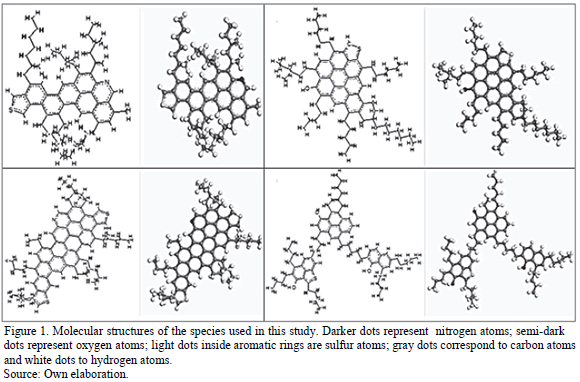
<body><![CDATA[<p><font size="2" face="Verdana, Arial, Helvetica, sans-serif">The asphaltene molecules used in this study were proposed  by Navarro et al. &#91;12&#93; as a result of experimental  analyses conducted on Colombian Castilla crude oil. In the original work  presented by Navarro et al. three molecules were proposed, one asphaltene  macromolecule and two molecules presented as resins. However, the recent  literature on asphaltenes structure and new measurements of properties such as  molecular mass and density for asphaltene monomeric molecules suggest that the  macromolecule initially proposed by Navarro et al. as an asphaltene does not  meet the criteria of an asphaltene molecule &#91;9,10,13&#93;, and the initially proposed  resins can be categorized as asphaltenes. In this work, a decision was made to  divide the macromolecule proposed by Navarro et al. into two molecules, and to  treat the proposed resins as asphaltene molecules. The four proposed asphaltene  molecules are likely to coexist in the actual hydrocarbon system. However, in  this work they are evaluated individually in order to establish the true nature  of their aggregation behavior in absence of external forces.</font></p>     <p><font size="2" face="Verdana, Arial, Helvetica, sans-serif"><a href="#fig01">Fig. 1</a> shows the molecular structure of the species used  in this study. It is seen that the structures shown in Fig. 1a, 1b and 1c have  a continental structure, with a core made of condensed aromatic rings  surrounded by saturated chains of hydrocarbons. The fourth molecule, shown in <a href="#fig01">Fig.  1d</a>, has an archipelago structure, with small groups of rings connected by  saturated chains. Molecule A1 (<a href="#fig01">Fig. 1a</a>) presents a core made of eight aromatic  rings and one atom of sulfur and one atom of nitrogen. Molecule A2 (<a href="#fig01">Fig. 1b</a>)  has a similar structure, but has a larger core made of 15 aromatic rings, and  one more atom of sulfur. Molecule A3 (<a href="#fig01">Fig. 1c</a>) has a condensed core consisting  on nine aromatic rings, but has an oxygen and a sulfur atom, and no nitrogen.  This molecule also has longer saturated ramifications on its structure.  Molecule A4 (<a href="#fig01">Fig. 1d</a>) has three aromatic groups connected with saturated chains  and it also has three oxygen atoms and one sulfur atom, and no nitrogen.</font></p>     <p align="center"><font size="2" face="Verdana, Arial, Helvetica, sans-serif"><a name="fig01"></a></font><img src="/img/revistas/dyna/v82n189/v82n189a04fig01.gif"></p>     <p><font size="2" face="Verdana, Arial, Helvetica, sans-serif">The molecules were represented in an atomistic framework,  in which each atom is considered individually using the LAMMPS package and the  consistent valence force field CVFF &#91;14&#93;. The interaction energy was  evaluated as stated in eq. (1).</font></p>     <p><img src="/img/revistas/dyna/v82n189/v82n189a04eq01.gif"></p>     <p><font size="2" face="Verdana, Arial, Helvetica, sans-serif">Where <font face="Symbol">e</font> and <font face="Symbol">s</font> are the Lennard-Jones potential  parameters, <img src="/img/revistas/dyna/v82n189/v82n189a04eq004.gif"> is the separation distance between atoms, <img src="/img/revistas/dyna/v82n189/v82n189a04eq006.gif"> and <img src="/img/revistas/dyna/v82n189/v82n189a04eq008.gif"> are the atomic charges; <img src="/img/revistas/dyna/v82n189/v82n189a04eq010.gif">, <img src="/img/revistas/dyna/v82n189/v82n189a04eq012.gif"> and <img src="/img/revistas/dyna/v82n189/v82n189a04eq014.gif"> are the angle constant, the angle between each  three atoms and the equilibrium angle, respectively; and <img src="/img/revistas/dyna/v82n189/v82n189a04eq016.gif">, <img src="/img/revistas/dyna/v82n189/v82n189a04eq018.gif"> and <img src="/img/revistas/dyna/v82n189/v82n189a04eq020.gif"> are the bond constant, the bond length between each pair of atoms and the equilibrium bond length, respectively.</font></p>     <p><font size="2" face="Verdana, Arial, Helvetica, sans-serif">Lennard-Jones parameters and bond and angle constants were  assigned considering the nature of the atoms that form the pair, bond or angle,  respectively. Partial charge for each atom was assigned using Equivalent Charge  method &#91;15&#93;.</font></p>     <p><font size="2" face="Verdana, Arial, Helvetica, sans-serif">In order to determine the manner in which asphaltenes form  aggregates, the interaction energy is separated into its different  contributions; only non-bond energy is considered, that is, Van der Waals and  electrostatic energy.</font></p>     <p><font size="2" face="Verdana, Arial, Helvetica, sans-serif">The solubility parameter was calculated using the Scatchard-Hildebrand  formulation, and it is stated in eq. (2).</font></p>     <p>&nbsp;</p>     ]]></body>
<body><![CDATA[<p>&nbsp;</p>     <p><img src="/img/revistas/dyna/v82n189/v82n189a04eq02.gif"></p>     <p><font size="2" face="Verdana, Arial, Helvetica, sans-serif">where <img src="/img/revistas/dyna/v82n189/v82n189a04eq026.gif"> is the cohesive energy of each molecule, and <img src="/img/revistas/dyna/v82n189/v82n189a04eq028.gif"> is its molar volume. The cohesive energy is  the energetic difference between the ideal gas state and the condensed state.  To calculate the cohesive energy, the molecules were simulated under two  conditions. First, the species were isolated to emulate the ideal gas state.  Second, the molecules were surrounded by replicas of themselves in order to  depict the condensed state. Finally, the molecular volume is also calculated  using molecular simulation.</font></p>     <p>&nbsp;</p>     <p><font size="3" face="Verdana, Arial, Helvetica, sans-serif"><b>3. Technical   details</b></font></p>     <p><font size="2" face="Verdana, Arial, Helvetica, sans-serif">In order to replicate the reservoir conditions, and at the  same time compare results with previous work &#91;6,7&#93;, a temperature of 300 K and a  pressure of 200 atm were selected. For each species, a NPT simulation box was  built, so as to maintain the number of particles, the pressure and the  temperature of the system.</font></p>     <p><font size="2" face="Verdana, Arial, Helvetica, sans-serif">The cut radius for each species was selected as the length  of the molecule for guaranteeing adequate distance of interaction between the  molecules. This length was calculated as the distance, in Angstroms, between  the further pair of atoms. The Ewald's summation method was used to evaluate  the long range electrostatic interactions. The SHAKE algorithm was used to  maintain bond length. A complete list of the parameters used in this simulation  can be found in &#91;16&#93;.</font></p>     <p><font size="2" face="Verdana, Arial, Helvetica, sans-serif">For each structure in <a href="#fig01">Fig. 1</a>, an energy minimization was conducted  in order to find the proper geometric configuration in which the molecule had  more stability. This minimization consists on taking the molecule to a  temperature of 0 K and allowing it to relax and finding the most adequate  configuration, using a modification of the conjugate gradient algorithm  available in the LAMMPS package &#91;14&#93;. The tolerance for this  process was set to <img src="/img/revistas/dyna/v82n189/v82n189a04eq030.gif"> kcal/mol. Once the minimum energy state was  achieved; the molecules were taken to the work temperature and pressure. Once this  state was reached, two simulations were conducted; the first one consisted on  simulating ideal gas state, for which each molecule was placed in a simulation  box with reflective walls to avoid interactions outside the molecule itself in  order to calculate the cohesive energy of the isolated monomer. The second  simulation consisted on simulating the condensed state, for which the molecule  is surrounded by twelve replicas of itself and placed in a simulation box with  periodic boundary conditions in all three dimensions. The number of replicas was chosen arbitrarily, considering both the accuracy of the measurement and  maintaining reasonable computing time. This simulation allows calculating the  molecular volume of the monomer and the cohesive energy of the molecules in  condensed state at working pressure and temperature.</font></p>     <p><font size="2" face="Verdana, Arial, Helvetica, sans-serif">Molecular dynamic simulations of at least 10 ns were  conducted, using a timestep of 1 fs. Non-bond energies (Van der Waals and  electrostatic) were evaluated. Molecular volume was estimated and the  solubility parameter was calculated for all four species.</font></p>     <p>&nbsp;</p>     ]]></body>
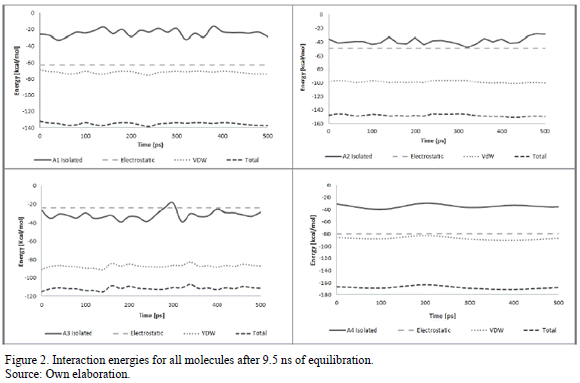
<body><![CDATA[<p><font size="3" face="Verdana, Arial, Helvetica, sans-serif"><b>4. Results and   discussion</b></font></p>     <p><font size="2" face="Verdana, Arial, Helvetica, sans-serif"><a href="#fig02">Fig. 2</a> shows the results for non-bond energy of all  molecules. <a href="#fig02">Fig. 2.a</a> depicts energy results for molecule A1 in isolated  conditions and Van der Waals, electrostatic and total non-bond energy for  periodic conditions after an equilibration period of 9.5 ns. It is also evident  from this figure, the molecule has lower energy when is surrounded by its replicas  than in isolated conditions (i.e., as a monomer). This is quite obvious,  considering the isolated case resembles ideal gas conditions. However, this  results show that the model here proposed is able to replicate the aggregation  behavior observed experimentally in asphaltenes molecules &#91;6&#93;. It is worth noting that,  even though asphaltenes do not exhibit polymeric behavior, the term &quot;monomer&quot;  has gained acceptance in the literature to refer to asphaltenes in a  disaggregated state.</font></p>     <p align="center"><font size="2" face="Verdana, Arial, Helvetica, sans-serif"><a name="fig02"></a></font><img src="/img/revistas/dyna/v82n189/v82n189a04fig02.gif"></p>     <p><font size="2" face="Verdana, Arial, Helvetica, sans-serif">As to the aggregation mechanism, it can also be seen from <a href="#fig02">Fig.  2.a</a> that the Van der Waals energy, associated with the aromatic content of the  molecule, and the electrostatic energy, associated with the presence of  heteroatoms, are comparable in  magnitude, even though for molecule A1 the Van der Waals energy is higher in  magnitude. That is, the effect of the continental structure and the aromatic  core is equally important as the electrostatic effect for presence of  heteroatoms, so neither one can be neglected. </font></p>     <p><font size="2" face="Verdana, Arial, Helvetica, sans-serif"><a href="#fig02">Fig. 2.b</a> shows the energetic results for species A2 after  9.5 ns of equilibration. Again, it can be seen that the molecule has lower  energy in the aggregate state, that is, is more stable. In this case, the Van  der Waals energy has a value that is higher in magnitude than the electrostatic  energy. This can be caused by the fact  that the A2 molecule has more aromatic rings in its structure and fewer  heteroatoms.</font></p>     <p><font size="2" face="Verdana, Arial, Helvetica, sans-serif"><a href="#fig02">Fig. 2.c</a> shows the energetic results for molecule A3 after  9.5 ns of equilibration. Similar to the previous cases, the total energy of the  condensed state is lower than the isolated state, consistent with its tendency  to form aggregates. However, for this molecule the total energy in the  aggregated state (the sum of Van der Waals and electrostatic contributions) is  higher than for the other continental structures. While molecule A3 still has a  continental structure, it also has longer saturated chains, which appear to  create a physical barrier that challenges the aggregation process. For this  particular case, the difference between electrostatic interactions and Van der  Waals interactions is more pronounced. This is associated with the oxygen atom  attached to the continental structure. While the aromatic rings contribute to  the aggregation process, the presence of oxygen, which has a greater partial  charge than nitrogen or sulfur, seems to make it more difficult for the rigid  molecule to balance the charges. However, like in the previous cases, the  electrostatic interaction still has a negative energy value and therefore  contributes to the aggregation process, and should not be neglected. </font></p>     <p><font size="2" face="Verdana, Arial, Helvetica, sans-serif"><a href="#fig02">Fig. 2.d</a> presents the energetic results for molecule A4.  As for all other molecules, these results corroborate the aggregation behavior.  For this monomeric molecule, the Van der Waals and the electrostatic  contributions are similar, probably due to the fact that the presence of  oxygen, with a high partial charge, and the dispersed aromatic cores contribute  in equal manner to the formation of aggregates. Molecule A4 exhibits lower  energy in aggregate conditions than the other molecules, which can be explained  because this molecule has a different, more flexible, structure that allows for  better interaction with other molecules by steric ability.</font></p>     <p><font size="2" face="Verdana, Arial, Helvetica, sans-serif">The  behavior of the difference between Van der Waals and electrostatic energies was  similar for pairs A1-A3 and A2-A4. This was somewhat surprising considering  molecule A4 has an archipelago structure that differs from the other </font><font size="2" face="Verdana, Arial, Helvetica, sans-serif">three continental ones. This is  evidence that not only molecular architecture (island or archipelago) or  heteroatoms content are crucial when defining asphaltene interactions, but the  aliphatic chains also play a definitive role in aggregation.</font></p>     <p><font size="2" face="Verdana, Arial, Helvetica, sans-serif">As an example, <a href="#fig03">Fig. 3</a> shows the final configuration for  the interaction of molecule A2 with itself. As can be seen from the graphic,  the aromatic cores locate in parallel while the side chains locate in the  periphery.</font></p>     <p align="center"><font size="2" face="Verdana, Arial, Helvetica, sans-serif"><a name="fig03"></a></font><img src="/img/revistas/dyna/v82n189/v82n189a04fig03.gif"></p>     ]]></body>
<body><![CDATA[<p><font size="2" face="Verdana, Arial, Helvetica, sans-serif">This is consistent with the behavior observed in the  energy results. Van der Waals interactions, associated with the aromatic core,  and electrostatic interactions, associated with the presence of heteroatoms  mostly, contribute in similar way to the aggregation process, as the molecule  experiences a strong attraction in the aromatic core while balances the charges  attached to the heteroatoms.</font></p>     <p><font size="2" face="Verdana, Arial, Helvetica, sans-serif"><a href="#fig04">Fig. 4</a> contains a snapshot of the final configuration of  the interaction of molecule A3 with itself. This figure illustrates the  behavior of long chains of hydrocarbons in the asphaltene structure as they  suppose an obstacle to the formation of aggregates. This behavior is consistent  with the energy results obtained for molecule A3, as this molecule has higher  energy in aggregated state compared with the other continental structures.</font></p>     <p align="center"><font size="2" face="Verdana, Arial, Helvetica, sans-serif"><a name="fig04"></a></font><img src="/img/revistas/dyna/v82n189/v82n189a04fig04.gif"></p>     <p><font size="2" face="Verdana, Arial, Helvetica, sans-serif"><a href="#tab01">Table 1</a> summarizes the results obtained for molecular  volume, cohesive energy and solubility parameter of all four molecules. The  reported experimental values for asphaltene solubility parameter range between  17.0 and 21.0 MPa<sup>1/2</sup> &#91;6,7,13,17&#93;. It can be seen that the  asphaltenes here presented are within expected values for this parameter. For molecule A3, the solubility parameter is  slightly lower than expected; this is due to the fact that the repulsive forces  derived from the long saturated chains make the energy difference between  isolated and periodic state to be lower in magnitude than for the other  molecules.</font></p>     <p align="center"><font size="2" face="Verdana, Arial, Helvetica, sans-serif"><a name="tab01"></a></font><img src="/img/revistas/dyna/v82n189/v82n189a04tab01.gif"></p>     <p>&nbsp;</p>     <p><font size="3" face="Verdana, Arial, Helvetica, sans-serif"><b>5. Conclusions</b></font></p>     <p><font size="2" face="Verdana, Arial, Helvetica, sans-serif">Asphaltene aggregation is a complex process, influenced by  many factors. Van der Waals interactions due to the presence of aromatic rings  and electrostatic forces caused by the presence of heteroatoms such as oxygen,  nitrogen and sulfur, are equally relevant in the aggregation of asphaltene  molecules. For the molecules here studied, the model successfully reproduced  the expected aggregation behavior, as the lower energy in this state so  indicated. The structure and elemental composition of asphaltene are also  crucial in determining the manner in which asphaltenes aggregate. The presence  and geometrical distribution of heteroatoms with distinct partial charges  influences the formation and stability of the aggregates. For continental  structures, the presence of long ramifications obstructs the formation of  asphaltene aggregates. For archipelago structures, the flexibility of the  molecules enables the aggregation with other structures. The presence of  heteroatoms creates a repulsive force that hinders the aggregation process. The  molecular volume and the cohesive energy are also sensitive to the geometric  configuration and the composition of the species, which affects the solubility  parameter. The solubility parameter was within the accepted range for all  molecules. Finally, the molecular simulation techniques seem to be adequate to  describe asphaltene structure and aggregation behavior. This work is  preliminary in understanding Colombian asphaltene behavior. Further work must  be conducted in search of a more general understanding, simulating asphaltene  aggregation in various solvents and linking results with experimental findings.</font></p>     <p>&nbsp;</p>     <p><font size="3" face="Verdana, Arial, Helvetica, sans-serif"><b>References</b></font></p>     ]]></body>
<body><![CDATA[<!-- ref --><p><font size="2" face="Verdana, Arial, Helvetica, sans-serif"><b>&#91;1&#93;</b> Punnapala,  S. and Vargas, F.M., Revisiting the PC-SAFT characterization procedure for an  improved asphaltene precipitation prediction. Fuel,  108, pp. 417-429, 2013.</font> <font size="2" face="Verdana, Arial, Helvetica, sans-serif"><a href="http://dx.doi.org/10.1016/j.fuel.2012.12.058" target="_blank">http://dx.doi.org/10.1016/j.fuel.2012.12.058</a>.    &nbsp;&nbsp;&nbsp;&nbsp;&nbsp;&nbsp;&nbsp;&nbsp;[&#160;<a href="javascript:void(0);" onclick="javascript: window.open('/scielo.php?script=sci_nlinks&ref=000073&pid=S0012-7353201500010000400001&lng=','','width=640,height=500,resizable=yes,scrollbars=1,menubar=yes,');">Links</a>&#160;]<!-- end-ref --></font></p>     <!-- ref --><p><font size="2" face="Verdana, Arial, Helvetica, sans-serif"><b>&#91;2&#93;</b> Wu, J.,  Prausnitz, J.M. and Firoozabadi, A., Molecular-thermodynamic framework for  asphaltene-oil equilibria. AIChE Journal, 44 (5), pp. 1188-1199, 1998.    &nbsp;&nbsp;&nbsp;&nbsp;&nbsp;&nbsp;&nbsp;&nbsp;[&#160;<a href="javascript:void(0);" onclick="javascript: window.open('/scielo.php?script=sci_nlinks&ref=000075&pid=S0012-7353201500010000400002&lng=','','width=640,height=500,resizable=yes,scrollbars=1,menubar=yes,');">Links</a>&#160;]<!-- end-ref --> </font></p>     <!-- ref --><p><font size="2" face="Verdana, Arial, Helvetica, sans-serif"><b>&#91;3&#93;</b> Artola,  P.A., Pereira, F.E., Adjiman, C.S., Galindo, A., Müller, E.A., Jackson, G. and  Haslam, A.J., Understanding the fluid phase behaviour of crude oil: Asphaltene  precipitation. Fluid Phase Equilbiria. 306 (1), pp. 129-136, 2011.</font> <font size="2" face="Verdana, Arial, Helvetica, sans-serif"><a href="http://dx.doi.org/10.1016/j.fluid.2011.01.024" target="_blank">http://dx.doi.org/10.1016/j.fluid.2011.01.024</a>.    &nbsp;&nbsp;&nbsp;&nbsp;&nbsp;&nbsp;&nbsp;&nbsp;[&#160;<a href="javascript:void(0);" onclick="javascript: window.open('/scielo.php?script=sci_nlinks&ref=000077&pid=S0012-7353201500010000400003&lng=','','width=640,height=500,resizable=yes,scrollbars=1,menubar=yes,');">Links</a>&#160;]<!-- end-ref --></font></p>     <!-- ref --><p><font size="2" face="Verdana, Arial, Helvetica, sans-serif"><b>&#91;4&#93;</b> Vicente,  L., Soto, C., Pacheco-S&aacute;nchez, H., Hern&aacute;ndez-Trujillo, J. and Martinez-Magad&aacute;n,  J.M., Application of molecular simulation to calculate miscibility of a model  asphaltene molecule. Fluid Phase Equilibria. 239 (1), pp. 100-106, 2006.</font> <font size="2" face="Verdana, Arial, Helvetica, sans-serif"><a href="http://dx.doi.org/10.1016/j.fluid.2005.11.001" target="_blank">http://dx.doi.org/10.1016/j.fluid.2005.11.001</a></font>&nbsp;&nbsp;&nbsp;&nbsp;&nbsp;&nbsp;&nbsp;&nbsp;[&#160;<a href="javascript:void(0);" onclick="javascript: window.open('/scielo.php?script=sci_nlinks&ref=000079&pid=S0012-7353201500010000400004&lng=','','width=640,height=500,resizable=yes,scrollbars=1,menubar=yes,');">Links</a>&#160;]<!-- end-ref --><!-- ref --><p><font size="2" face="Verdana, Arial, Helvetica, sans-serif"><b>&#91;5&#93;</b> Lu, G.,  Li, Y., Song, H., Yu, Y. and Wang. C., Micromechanism of petroleum asphaltene  aggregation. Petroleum Exploration and  Development<i>.</i> 35 (1), pp. 67-72, 2008.    &nbsp;&nbsp;&nbsp;&nbsp;&nbsp;&nbsp;&nbsp;&nbsp;[&#160;<a href="javascript:void(0);" onclick="javascript: window.open('/scielo.php?script=sci_nlinks&ref=000080&pid=S0012-7353201500010000400005&lng=','','width=640,height=500,resizable=yes,scrollbars=1,menubar=yes,');">Links</a>&#160;]<!-- end-ref --> </font></p>     <!-- ref --><p><font size="2" face="Verdana, Arial, Helvetica, sans-serif"><b>&#91;6&#93;</b> Frigerio,  F. and Molinari, D., A multiscale approach to the simulation of asphaltenes.  Computational and Theoretical Chemestry. 975, pp. 76-82, 2011.</font> <font size="2" face="Verdana, Arial, Helvetica, sans-serif"><a href="http://dx.doi.org/10.1016/j.comptc.2011.03.013" target="_blank">http://dx.doi.org/10.1016/j.comptc.2011.03.013</a>.    &nbsp;&nbsp;&nbsp;&nbsp;&nbsp;&nbsp;&nbsp;&nbsp;[&#160;<a href="javascript:void(0);" onclick="javascript: window.open('/scielo.php?script=sci_nlinks&ref=000082&pid=S0012-7353201500010000400006&lng=','','width=640,height=500,resizable=yes,scrollbars=1,menubar=yes,');">Links</a>&#160;]<!-- end-ref --></font></p>     <!-- ref --><p><font size="2" face="Verdana, Arial, Helvetica, sans-serif"><b>&#91;7&#93;</b> Carauta-A. N.M., Seidl-P. R. and Correia-J. C.G., Computational Simulation of  Asphaltene, in Mercosur  Congress on Chemical Engineering (2<sup>nd</sup>, 2005, Brasil) Mercosur  Congress on Process Systems Engineering (4<sup>th</sup>, 2005, Brasil).  Enpromer, Rio de Janeiro, Brasil, 2005, pp. 1-6, 2005.    &nbsp;&nbsp;&nbsp;&nbsp;&nbsp;&nbsp;&nbsp;&nbsp;[&#160;<a href="javascript:void(0);" onclick="javascript: window.open('/scielo.php?script=sci_nlinks&ref=000084&pid=S0012-7353201500010000400007&lng=','','width=640,height=500,resizable=yes,scrollbars=1,menubar=yes,');">Links</a>&#160;]<!-- end-ref --></font></p>     <!-- ref --><p><font size="2" face="Verdana, Arial, Helvetica, sans-serif"><b>&#91;8&#93;</b> Sedghi,  M., Goual, L., Welch, W. and Kubelka, J., Effect of asphaltene structure on  association and aggregation using molecular dynamics. The journal of physical  chemestry. B<i>. </i>117 (18), pp. 5765-5776, 2013. <a href="http://dx.doi.org/10.1021/jp401584u" target="_blank">http://dx.doi.org/10.1021/jp401584u</a>.    &nbsp;&nbsp;&nbsp;&nbsp;&nbsp;&nbsp;&nbsp;&nbsp;[&#160;<a href="javascript:void(0);" onclick="javascript: window.open('/scielo.php?script=sci_nlinks&ref=000086&pid=S0012-7353201500010000400008&lng=','','width=640,height=500,resizable=yes,scrollbars=1,menubar=yes,');">Links</a>&#160;]<!-- end-ref --></font></p>     <!-- ref --><p><font size="2" face="Verdana, Arial, Helvetica, sans-serif"><b>&#91;9&#93;</b> Mullins,  O.C., The modified Yen model. Energy &amp; Fuels. 24 (4), pp. 2179-2207,  2010. <a href="http://dx.doi.org/10.1021/ef900975e" target="_blank">http://dx.doi.org/10.1021/ef900975e</a>.    &nbsp;&nbsp;&nbsp;&nbsp;&nbsp;&nbsp;&nbsp;&nbsp;[&#160;<a href="javascript:void(0);" onclick="javascript: window.open('/scielo.php?script=sci_nlinks&ref=000088&pid=S0012-7353201500010000400009&lng=','','width=640,height=500,resizable=yes,scrollbars=1,menubar=yes,');">Links</a>&#160;]<!-- end-ref --></font></p>     <!-- ref --><p><font size="2" face="Verdana, Arial, Helvetica, sans-serif"><b>&#91;10&#93;</b> Mullins,  O.C., Sabbah, H., Pomerantz, A.E., Andrews, A.B., Ruiz-Morales, Y., Mostow, F.,  Mcfarlane, R., Goual, L., Lepkowicz, R., Cooper, T., Orbulescu, J., Leblanc, R.M.,  Edwards, J. and Zare, R.N., Advances in asphaltene science and the Yen -  Mullins model. Energy &amp; Fuels, 26, pp. 3986-4003, 2012. </font> <font size="2" face="Verdana, Arial, Helvetica, sans-serif"><a href="http:// dx.doi.org/10.1021/ef300185p" target="_blank">http:// dx.doi.org/10.1021/ef300185p</a>.    &nbsp;&nbsp;&nbsp;&nbsp;&nbsp;&nbsp;&nbsp;&nbsp;[&#160;<a href="javascript:void(0);" onclick="javascript: window.open('/scielo.php?script=sci_nlinks&ref=000090&pid=S0012-7353201500010000400010&lng=','','width=640,height=500,resizable=yes,scrollbars=1,menubar=yes,');">Links</a>&#160;]<!-- end-ref --></font></p>     <!-- ref --><p><font size="2" face="Verdana, Arial, Helvetica, sans-serif"><b>&#91;11&#93;</b> Gray, M.R.,  Tykwinski, R.R., Stryker, J.M. and Tan, X., Supramolecular assembly model for  aggregation of petroleum asphaltenes. Energy &amp; Fuels, 25 (7) , pp. 3125-3134, 2011. <a href="http://dx.doi.org/10.1021/ef200654p" target="_blank">http://dx.doi.org/10.1021/ef200654p</a>.    &nbsp;&nbsp;&nbsp;&nbsp;&nbsp;&nbsp;&nbsp;&nbsp;[&#160;<a href="javascript:void(0);" onclick="javascript: window.open('/scielo.php?script=sci_nlinks&ref=000092&pid=S0012-7353201500010000400011&lng=','','width=640,height=500,resizable=yes,scrollbars=1,menubar=yes,');">Links</a>&#160;]<!-- end-ref --></font></p>     <!-- ref --><p><font size="2" face="Verdana, Arial, Helvetica, sans-serif"><b>&#91;12&#93;</b> Navarro, L., &Aacute;lvarez, M., Grosso, J.L. y  Navarro, U., Separaci&oacute;n y caracterizaci&oacute;n de resinas y asfaltenos provenientes  del crudo castilla. Evaluaci&oacute;n de su interacci&oacute;n molecular. CT&amp;F  - Ciencia Tecnolog&iacute;a y Futuro, 2 (5), pp. 53-67, 2004.    &nbsp;&nbsp;&nbsp;&nbsp;&nbsp;&nbsp;&nbsp;&nbsp;[&#160;<a href="javascript:void(0);" onclick="javascript: window.open('/scielo.php?script=sci_nlinks&ref=000094&pid=S0012-7353201500010000400012&lng=','','width=640,height=500,resizable=yes,scrollbars=1,menubar=yes,');">Links</a>&#160;]<!-- end-ref --></font></p>     <!-- ref --><p><font size="2" face="Verdana, Arial, Helvetica, sans-serif"><b>&#91;13&#93;</b> Tharanivasan  - A.K., Asphaltene precipitation from crude oil blends , conventional oils, and  oils with emulsified water, Dr. Thesis (in Philosophy), University of Calgary, Canada, 211 P.2012,    &nbsp;&nbsp;&nbsp;&nbsp;&nbsp;&nbsp;&nbsp;&nbsp;[&#160;<a href="javascript:void(0);" onclick="javascript: window.open('/scielo.php?script=sci_nlinks&ref=000096&pid=S0012-7353201500010000400013&lng=','','width=640,height=500,resizable=yes,scrollbars=1,menubar=yes,');">Links</a>&#160;]<!-- end-ref --> </font></p>     <!-- ref --><p><font size="2" face="Verdana, Arial, Helvetica, sans-serif"><b>&#91;14&#93;</b> Plimpton,  S., Fast parallel algorithms for short - range molecular dynamics. Journal of  Computational Physics, 117, pp. 1-19, 1995.    &nbsp;&nbsp;&nbsp;&nbsp;&nbsp;&nbsp;&nbsp;&nbsp;[&#160;<a href="javascript:void(0);" onclick="javascript: window.open('/scielo.php?script=sci_nlinks&ref=000098&pid=S0012-7353201500010000400014&lng=','','width=640,height=500,resizable=yes,scrollbars=1,menubar=yes,');">Links</a>&#160;]<!-- end-ref --></font></p>     <!-- ref --><p><font size="2" face="Verdana, Arial, Helvetica, sans-serif"><b>&#91;15&#93;</b> Rapp&eacute;,  A.K. and Goddard III, W.A., Charge equilibration for molecular dynamics simulations.  The journal of physical chemestry, 95 (8), pp. 3358-3363, 1991.    &nbsp;&nbsp;&nbsp;&nbsp;&nbsp;&nbsp;&nbsp;&nbsp;[&#160;<a href="javascript:void(0);" onclick="javascript: window.open('/scielo.php?script=sci_nlinks&ref=000100&pid=S0012-7353201500010000400015&lng=','','width=640,height=500,resizable=yes,scrollbars=1,menubar=yes,');">Links</a>&#160;]<!-- end-ref --> </font></p>     <!-- ref --><p><font size="2" face="Verdana, Arial, Helvetica, sans-serif"><b>&#91;16&#93;</b> Levitt, M.,  Hirshberg, M., Sharon, R. and Daggett, V., Potential energy function and  parameters for simulations of the molecular dynamics of proteins and nucleic  acids in solution. Computer Physics Communications<i>,</i> 91, pp. 215-231,  1995.    &nbsp;&nbsp;&nbsp;&nbsp;&nbsp;&nbsp;&nbsp;&nbsp;[&#160;<a href="javascript:void(0);" onclick="javascript: window.open('/scielo.php?script=sci_nlinks&ref=000102&pid=S0012-7353201500010000400016&lng=','','width=640,height=500,resizable=yes,scrollbars=1,menubar=yes,');">Links</a>&#160;]<!-- end-ref --> </font></p>     <!-- ref --><p><font size="2" face="Verdana, Arial, Helvetica, sans-serif"><b>&#91;17&#93;</b> Rogel,  E., Simulation of interactions in asphaltene aggregates. Energy  &amp; Fuels, 14, pp. 566-574, 2000. <a href="http://dx.doi.org/10.1021/ef990166p" target="_blank">http://dx.doi.org/10.1021/ef990166p</a>.    &nbsp;&nbsp;&nbsp;&nbsp;&nbsp;&nbsp;&nbsp;&nbsp;[&#160;<a href="javascript:void(0);" onclick="javascript: window.open('/scielo.php?script=sci_nlinks&ref=000104&pid=S0012-7353201500010000400017&lng=','','width=640,height=500,resizable=yes,scrollbars=1,menubar=yes,');">Links</a>&#160;]<!-- end-ref --> </font></p>     <p>&nbsp;</p>     <p><font size="2" face="Verdana, Arial, Helvetica, sans-serif"><b>J. De Le&oacute;n,</b> received the Bsc. in Petroleum  Engineering in 2010 and MSc. in Chemical Engineering in 2014, all of them from  the Universidad Nacional de Colombia. Currently she is pursuing a doctoral  degree in Energy Systems at the same University. Her research interests include  molecular simulation, modeling asphaltene aggregation and viscosity and  molecular representation of hydrocarbon systems.</font></p>     <p><font size="2" face="Verdana, Arial, Helvetica, sans-serif"><b>B. A. Hoyos, </b>received the Bsc. In 1994 and MSc. In 2003  degrees both in Chemical Engineering and the PhD degree in Energy Systems in  2010, all of them from the Universidad Nacional de Colombia, Medell&iacute;n, Colombia. Currently he is a Full Professor in  the Departamento de Procesos y Energ&iacute;a, Facultad de Minas, Universidad Nacional  de Colombia, Medell&iacute;n, Colombia. His research interests include  molecular simulation, modeling asphaltene aggregation and viscosity, modelling  wettability alteration by surfactants and specific adsorption.</font></p>     <p><font size="2" face="Verdana, Arial, Helvetica, sans-serif"><b>W.A.  Ca&ntilde;as-Mar&iacute;n, </b>received the Bsc. In 1997 from the Universidad de Antioquia, Colombia and  MSc. in 2002 degree from the Universidad Industrial de Santander, Colombia, both  in Chemical Engineering. He is currently  a chemical Engineer at the Instituto Colombiano del Petr&oacute;leo-ICP of ECOPETROL,  S.A. His research interests include thermodynamic characterization of reservoir  fluids and phase behavior modeling, effects of external fields on matter,  molecular simulation and flow assurance.</font></p>      ]]></body><back>
<ref-list>
<ref id="B1">
<label>1</label><nlm-citation citation-type="journal">
<person-group person-group-type="author">
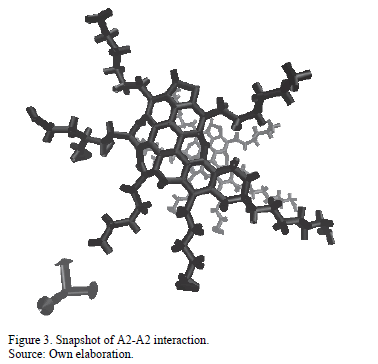
<name>
<surname><![CDATA[Punnapala]]></surname>
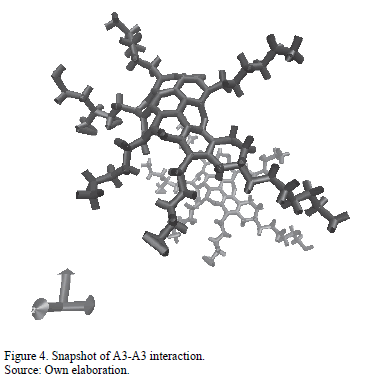
<given-names><![CDATA[S.]]></given-names>
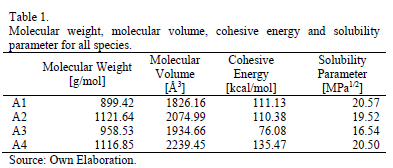
</name>
<name>
<surname><![CDATA[Vargas]]></surname>
<given-names><![CDATA[F.M.]]></given-names>
</name>
</person-group>
<article-title xml:lang="en"><![CDATA[Revisiting the PC-SAFT characterization procedure for an improved asphaltene precipitation prediction]]></article-title>
<source><![CDATA[Fuel]]></source>
<year>2013</year>
<numero>108</numero>
<issue>108</issue>
<page-range>417-429</page-range></nlm-citation>
</ref>
<ref id="B2">
<label>2</label><nlm-citation citation-type="journal">
<person-group person-group-type="author">
<name>
<surname><![CDATA[Wu]]></surname>
<given-names><![CDATA[J.]]></given-names>
</name>
<name>
<surname><![CDATA[Prausnitz]]></surname>
<given-names><![CDATA[J.M.]]></given-names>
</name>
<name>
<surname><![CDATA[Firoozabadi]]></surname>
<given-names><![CDATA[A.]]></given-names>
</name>
</person-group>
<article-title xml:lang="en"><![CDATA[Molecular-thermodynamic framework for asphaltene-oil equilibria]]></article-title>
<source><![CDATA[AIChE Journal]]></source>
<year>1998</year>
<volume>44</volume>
<numero>5</numero>
<issue>5</issue>
<page-range>1188-1199</page-range></nlm-citation>
</ref>
<ref id="B3">
<label>3</label><nlm-citation citation-type="journal">
<person-group person-group-type="author">
<name>
<surname><![CDATA[Artola]]></surname>
<given-names><![CDATA[P.A.]]></given-names>
</name>
<name>
<surname><![CDATA[Pereira]]></surname>
<given-names><![CDATA[F.E.]]></given-names>
</name>
<name>
<surname><![CDATA[Adjiman]]></surname>
<given-names><![CDATA[C.S.]]></given-names>
</name>
<name>
<surname><![CDATA[Galindo]]></surname>
<given-names><![CDATA[A.]]></given-names>
</name>
<name>
<surname><![CDATA[Müller]]></surname>
<given-names><![CDATA[E.A.]]></given-names>
</name>
<name>
<surname><![CDATA[Jackson]]></surname>
<given-names><![CDATA[G.]]></given-names>
</name>
<name>
<surname><![CDATA[Haslam]]></surname>
<given-names><![CDATA[A.J.]]></given-names>
</name>
</person-group>
<article-title xml:lang="en"><![CDATA[Understanding the fluid phase behaviour of crude oil: Asphaltene precipitation]]></article-title>
<source><![CDATA[Fluid Phase Equilbiria]]></source>
<year>2011</year>
<volume>306</volume>
<numero>1</numero>
<issue>1</issue>
<page-range>129-136</page-range></nlm-citation>
</ref>
<ref id="B4">
<label>4</label><nlm-citation citation-type="journal">
<person-group person-group-type="author">
<name>
<surname><![CDATA[Vicente]]></surname>
<given-names><![CDATA[L.]]></given-names>
</name>
<name>
<surname><![CDATA[Soto]]></surname>
<given-names><![CDATA[C.]]></given-names>
</name>
<name>
<surname><![CDATA[Pacheco-Sánchez]]></surname>
<given-names><![CDATA[H.]]></given-names>
</name>
<name>
<surname><![CDATA[Hernández-Trujillo]]></surname>
<given-names><![CDATA[J.]]></given-names>
</name>
<name>
<surname><![CDATA[Martinez-Magadán]]></surname>
<given-names><![CDATA[J.M.]]></given-names>
</name>
</person-group>
<article-title xml:lang="en"><![CDATA[Application of molecular simulation to calculate miscibility of a model asphaltene molecule]]></article-title>
<source><![CDATA[Fluid Phase Equilibria]]></source>
<year>2006</year>
<volume>239</volume>
<numero>1</numero>
<issue>1</issue>
<page-range>100-106</page-range></nlm-citation>
</ref>
<ref id="B5">
<label>5</label><nlm-citation citation-type="journal">
<person-group person-group-type="author">
<name>
<surname><![CDATA[Lu]]></surname>
<given-names><![CDATA[G.]]></given-names>
</name>
<name>
<surname><![CDATA[Li]]></surname>
<given-names><![CDATA[Y.]]></given-names>
</name>
<name>
<surname><![CDATA[Song]]></surname>
<given-names><![CDATA[H.]]></given-names>
</name>
<name>
<surname><![CDATA[Yu]]></surname>
<given-names><![CDATA[Y.]]></given-names>
</name>
<name>
<surname><![CDATA[Wang]]></surname>
<given-names><![CDATA[C.]]></given-names>
</name>
</person-group>
<article-title xml:lang="en"><![CDATA[Micromechanism of petroleum asphaltene aggregation]]></article-title>
<source><![CDATA[Petroleum Exploration and Development]]></source>
<year>2008</year>
<volume>35</volume>
<numero>1</numero>
<issue>1</issue>
<page-range>67-72</page-range></nlm-citation>
</ref>
<ref id="B6">
<label>6</label><nlm-citation citation-type="journal">
<person-group person-group-type="author">
<name>
<surname><![CDATA[Frigerio]]></surname>
<given-names><![CDATA[F.]]></given-names>
</name>
<name>
<surname><![CDATA[Molinari]]></surname>
<given-names><![CDATA[D.]]></given-names>
</name>
</person-group>
<article-title xml:lang="en"><![CDATA[A multiscale approach to the simulation of asphaltenes]]></article-title>
<source><![CDATA[Computational and Theoretical Chemestry]]></source>
<year>2011</year>
<numero>975</numero>
<issue>975</issue>
<page-range>76-82</page-range></nlm-citation>
</ref>
<ref id="B7">
<label>7</label><nlm-citation citation-type="confpro">
<person-group person-group-type="author">
<name>
<surname><![CDATA[Carauta-A.]]></surname>
<given-names><![CDATA[N.M.]]></given-names>
</name>
<name>
<surname><![CDATA[Seidl-P.]]></surname>
<given-names><![CDATA[R.]]></given-names>
</name>
<name>
<surname><![CDATA[Correia-J.]]></surname>
<given-names><![CDATA[C.G.]]></given-names>
</name>
</person-group>
<article-title xml:lang="en"><![CDATA[Computational Simulation of Asphaltene]]></article-title>
<source><![CDATA[]]></source>
<year></year>
<conf-name><![CDATA[ Mercosur Congress on Chemical Engineering (2nd, 2005, Brasil) Mercosur Congress on Process Systems Engineering (4th, 2005, Brasil)]]></conf-name>
<conf-date>2005</conf-date>
<conf-loc>Enpromer Rio de Janeiro</conf-loc>
</nlm-citation>
</ref>
<ref id="B8">
<label>8</label><nlm-citation citation-type="journal">
<person-group person-group-type="author">
<name>
<surname><![CDATA[Sedghi]]></surname>
<given-names><![CDATA[M.]]></given-names>
</name>
<name>
<surname><![CDATA[Goual]]></surname>
<given-names><![CDATA[L.]]></given-names>
</name>
<name>
<surname><![CDATA[Welch]]></surname>
<given-names><![CDATA[W.]]></given-names>
</name>
<name>
<surname><![CDATA[Kubelka]]></surname>
<given-names><![CDATA[J.]]></given-names>
</name>
</person-group>
<article-title xml:lang="en"><![CDATA[Effect of asphaltene structure on association and aggregation using molecular dynamics]]></article-title>
<source><![CDATA[The journal of physical chemestry. B]]></source>
<year>2013</year>
<volume>117</volume>
<numero>18</numero>
<issue>18</issue>
<page-range>5765-5776</page-range></nlm-citation>
</ref>
<ref id="B9">
<label>9</label><nlm-citation citation-type="journal">
<person-group person-group-type="author">
<name>
<surname><![CDATA[Mullins]]></surname>
<given-names><![CDATA[O.C.]]></given-names>
</name>
</person-group>
<article-title xml:lang="en"><![CDATA[The modified Yen model]]></article-title>
<source><![CDATA[Energy & Fuels.]]></source>
<year>2010</year>
<volume>24</volume>
<numero>4</numero>
<issue>4</issue>
<page-range>2179-2207</page-range></nlm-citation>
</ref>
<ref id="B10">
<label>10</label><nlm-citation citation-type="journal">
<person-group person-group-type="author">
<name>
<surname><![CDATA[Mullins]]></surname>
<given-names><![CDATA[O.C.]]></given-names>
</name>
<name>
<surname><![CDATA[Sabbah]]></surname>
<given-names><![CDATA[H.]]></given-names>
</name>
<name>
<surname><![CDATA[Pomerantz]]></surname>
<given-names><![CDATA[A.E.]]></given-names>
</name>
<name>
<surname><![CDATA[Andrews]]></surname>
<given-names><![CDATA[A.B.]]></given-names>
</name>
<name>
<surname><![CDATA[Ruiz-Morales]]></surname>
<given-names><![CDATA[Y.]]></given-names>
</name>
<name>
<surname><![CDATA[Mostow]]></surname>
<given-names><![CDATA[F.]]></given-names>
</name>
<name>
<surname><![CDATA[Mcfarlane]]></surname>
<given-names><![CDATA[R.]]></given-names>
</name>
<name>
<surname><![CDATA[Goual]]></surname>
<given-names><![CDATA[L.]]></given-names>
</name>
<name>
<surname><![CDATA[Lepkowicz]]></surname>
<given-names><![CDATA[R.]]></given-names>
</name>
<name>
<surname><![CDATA[Cooper]]></surname>
<given-names><![CDATA[T.]]></given-names>
</name>
<name>
<surname><![CDATA[Orbulescu]]></surname>
<given-names><![CDATA[J.]]></given-names>
</name>
<name>
<surname><![CDATA[Leblanc]]></surname>
<given-names><![CDATA[R.M.]]></given-names>
</name>
<name>
<surname><![CDATA[Edwards]]></surname>
<given-names><![CDATA[J.]]></given-names>
</name>
<name>
<surname><![CDATA[Zare]]></surname>
<given-names><![CDATA[R.N.]]></given-names>
</name>
</person-group>
<article-title xml:lang="en"><![CDATA[Advances in asphaltene science and the Yen - Mullins model]]></article-title>
<source><![CDATA[Energy & Fuels]]></source>
<year>2012</year>
<volume>26</volume>
<page-range>3986-4003</page-range></nlm-citation>
</ref>
<ref id="B11">
<label>11</label><nlm-citation citation-type="journal">
<person-group person-group-type="author">
<name>
<surname><![CDATA[Gray]]></surname>
<given-names><![CDATA[M.R.]]></given-names>
</name>
<name>
<surname><![CDATA[Tykwinski]]></surname>
<given-names><![CDATA[R.R.]]></given-names>
</name>
<name>
<surname><![CDATA[Stryker]]></surname>
<given-names><![CDATA[J.M.]]></given-names>
</name>
<name>
<surname><![CDATA[Tan]]></surname>
<given-names><![CDATA[X.]]></given-names>
</name>
</person-group>
<article-title xml:lang="en"><![CDATA[Supramolecular assembly model for aggregation of petroleum asphaltenes]]></article-title>
<source><![CDATA[Energy & Fuels]]></source>
<year>2011</year>
<volume>25</volume>
<numero>7</numero>
<issue>7</issue>
<page-range>3125-3134</page-range></nlm-citation>
</ref>
<ref id="B12">
<label>12</label><nlm-citation citation-type="journal">
<person-group person-group-type="author">
<name>
<surname><![CDATA[Navarro]]></surname>
<given-names><![CDATA[L.]]></given-names>
</name>
<name>
<surname><![CDATA[Álvarez]]></surname>
<given-names><![CDATA[M.]]></given-names>
</name>
<name>
<surname><![CDATA[Grosso]]></surname>
<given-names><![CDATA[J.L.]]></given-names>
</name>
<name>
<surname><![CDATA[Navarro]]></surname>
<given-names><![CDATA[U.]]></given-names>
</name>
</person-group>
<article-title xml:lang="es"><![CDATA[Separación y caracterización de resinas y asfaltenos provenientes del crudo castilla: Evaluación de su interacción molecular]]></article-title>
<source><![CDATA[CT & F - Ciencia Tecnología y Futuro]]></source>
<year>2004</year>
<volume>2</volume>
<numero>5</numero>
<issue>5</issue>
<page-range>53-67</page-range></nlm-citation>
</ref>
<ref id="B13">
<label>13</label><nlm-citation citation-type="">
<person-group person-group-type="author">
<name>
<surname><![CDATA[Tharanivasan]]></surname>
<given-names><![CDATA[A.K.]]></given-names>
</name>
</person-group>
<source><![CDATA[Asphaltene precipitation from crude oil blends , conventional oils, and oils with emulsified water]]></source>
<year>2012</year>
</nlm-citation>
</ref>
<ref id="B14">
<label>14</label><nlm-citation citation-type="journal">
<person-group person-group-type="author">
<name>
<surname><![CDATA[Plimpton]]></surname>
<given-names><![CDATA[S.]]></given-names>
</name>
</person-group>
<article-title xml:lang="en"><![CDATA[Fast parallel algorithms for short: range molecular dynamics]]></article-title>
<source><![CDATA[Journal of Computational Physics]]></source>
<year>1995</year>
<numero>117</numero>
<issue>117</issue>
<page-range>1-19</page-range></nlm-citation>
</ref>
<ref id="B15">
<label>15</label><nlm-citation citation-type="journal">
<person-group person-group-type="author">
<name>
<surname><![CDATA[Rappé]]></surname>
<given-names><![CDATA[A.K.]]></given-names>
</name>
<name>
<surname><![CDATA[Goddard III]]></surname>
<given-names><![CDATA[W.A.]]></given-names>
</name>
</person-group>
<article-title xml:lang="en"><![CDATA[Charge equilibration for molecular dynamics simulations]]></article-title>
<source><![CDATA[The journal of physical chemestry]]></source>
<year>1991</year>
<volume>95</volume>
<numero>8</numero>
<issue>8</issue>
<page-range>3358-3363</page-range></nlm-citation>
</ref>
<ref id="B16">
<label>16</label><nlm-citation citation-type="journal">
<person-group person-group-type="author">
<name>
<surname><![CDATA[Levitt]]></surname>
<given-names><![CDATA[M.]]></given-names>
</name>
<name>
<surname><![CDATA[Hirshberg]]></surname>
<given-names><![CDATA[M.]]></given-names>
</name>
<name>
<surname><![CDATA[Sharon]]></surname>
<given-names><![CDATA[R.]]></given-names>
</name>
<name>
<surname><![CDATA[Daggett]]></surname>
<given-names><![CDATA[V.]]></given-names>
</name>
</person-group>
<article-title xml:lang="en"><![CDATA[Potential energy function and parameters for simulations of the molecular dynamics of proteins and nucleic acids in solution]]></article-title>
<source><![CDATA[Computer Physics Communications]]></source>
<year>1995</year>
<numero>91</numero>
<issue>91</issue>
<page-range>215-231</page-range></nlm-citation>
</ref>
<ref id="B17">
<label>17</label><nlm-citation citation-type="journal">
<person-group person-group-type="author">
<name>
<surname><![CDATA[Rogel]]></surname>
<given-names><![CDATA[E.]]></given-names>
</name>
</person-group>
<article-title xml:lang="en"><![CDATA[Simulation of interactions in asphaltene aggregates]]></article-title>
<source><![CDATA[Energy & Fuels]]></source>
<year>2000</year>
<numero>14</numero>
<issue>14</issue>
<page-range>566-574</page-range></nlm-citation>
</ref>
</ref-list>
</back>
</article>