<?xml version="1.0" encoding="ISO-8859-1"?><article xmlns:mml="http://www.w3.org/1998/Math/MathML" xmlns:xlink="http://www.w3.org/1999/xlink" xmlns:xsi="http://www.w3.org/2001/XMLSchema-instance">
<front>
<journal-meta>
<journal-id>0012-7353</journal-id>
<journal-title><![CDATA[DYNA]]></journal-title>
<abbrev-journal-title><![CDATA[Dyna rev.fac.nac.minas]]></abbrev-journal-title>
<issn>0012-7353</issn>
<publisher>
<publisher-name><![CDATA[Universidad Nacional de Colombia]]></publisher-name>
</publisher>
</journal-meta>
<article-meta>
<article-id>S0012-73532015000100012</article-id>
<article-id pub-id-type="doi">10.15446/dyna.v82n189.42162</article-id>
<title-group>
<article-title xml:lang="en"><![CDATA[Geotechnical behavior of a tropical residual soil contaminated with soap solution]]></article-title>
<article-title xml:lang="es"><![CDATA[Comportamiento geotécnico de un suelo residual tropical contaminado con solución de jabón]]></article-title>
</title-group>
<contrib-group>
<contrib contrib-type="author">
<name>
<surname><![CDATA[Valencia-González]]></surname>
<given-names><![CDATA[Yamile]]></given-names>
</name>
<xref ref-type="aff" rid="A01"/>
</contrib>
<contrib contrib-type="author">
<name>
<surname><![CDATA[Echeverri-Ramírez]]></surname>
<given-names><![CDATA[Oscar]]></given-names>
</name>
<xref ref-type="aff" rid="A01"/>
</contrib>
<contrib contrib-type="author">
<name>
<surname><![CDATA[Benavides]]></surname>
<given-names><![CDATA[Monica P.]]></given-names>
</name>
<xref ref-type="aff" rid="A01"/>
</contrib>
<contrib contrib-type="author">
<name>
<surname><![CDATA[Duque-López]]></surname>
<given-names><![CDATA[María A.]]></given-names>
</name>
<xref ref-type="aff" rid="A01"/>
</contrib>
<contrib contrib-type="author">
<name>
<surname><![CDATA[García-Quintero]]></surname>
<given-names><![CDATA[Yessica M.]]></given-names>
</name>
<xref ref-type="aff" rid="A01"/>
</contrib>
<contrib contrib-type="author">
<name>
<surname><![CDATA[Jiménez-Espinosa]]></surname>
<given-names><![CDATA[Estefanía]]></given-names>
</name>
<xref ref-type="aff" rid="A01"/>
</contrib>
<contrib contrib-type="author">
<name>
<surname><![CDATA[Restrepo-Álvarez]]></surname>
<given-names><![CDATA[Juan E.]]></given-names>
</name>
<xref ref-type="aff" rid="A01"/>
</contrib>
<contrib contrib-type="author">
<name>
<surname><![CDATA[Toscano-Patiño]]></surname>
<given-names><![CDATA[Daniel Eduardo]]></given-names>
</name>
<xref ref-type="aff" rid="A01"/>
</contrib>
</contrib-group>
<aff id="A01">
<institution><![CDATA[,Universidad Nacional de Colombia Facultad de Minas ]]></institution>
<addr-line><![CDATA[ ]]></addr-line>
<country>Colombia</country>
</aff>
<aff id="A02">
<institution><![CDATA[,Universidad Nacional de Colombia Facultad de Minas ]]></institution>
<addr-line><![CDATA[ ]]></addr-line>
<country>Colombia</country>
</aff>
<aff id="A03">
<institution><![CDATA[,Universidad Nacional de Colombia Facultad de Minas ]]></institution>
<addr-line><![CDATA[Medellín ]]></addr-line>
<country>Colombia</country>
</aff>
<aff id="A04">
<institution><![CDATA[,Universidad Nacional de Colombia Facultad de Minas ]]></institution>
<addr-line><![CDATA[Medellín ]]></addr-line>
<country>Colombia</country>
</aff>
<aff id="A05">
<institution><![CDATA[,Universidad Nacional de Colombia Facultad de Minas ]]></institution>
<addr-line><![CDATA[Medellín ]]></addr-line>
<country>Colombia</country>
</aff>
<aff id="A06">
<institution><![CDATA[,Universidad Nacional de Colombia Facultad de Minas ]]></institution>
<addr-line><![CDATA[Medellín ]]></addr-line>
<country>Colombia</country>
</aff>
<aff id="A07">
<institution><![CDATA[,Universidad Nacional de Colombia Facultad de Minas ]]></institution>
<addr-line><![CDATA[Medellín ]]></addr-line>
<country>Colombia</country>
</aff>
<aff id="A08">
<institution><![CDATA[,Universidad Nacional de Colombia Facultad de Minas ]]></institution>
<addr-line><![CDATA[Medellín ]]></addr-line>
<country>Colombia</country>
</aff>
<pub-date pub-type="pub">
<day>00</day>
<month>02</month>
<year>2015</year>
</pub-date>
<pub-date pub-type="epub">
<day>00</day>
<month>02</month>
<year>2015</year>
</pub-date>
<volume>82</volume>
<numero>189</numero>
<fpage>96</fpage>
<lpage>102</lpage>
<copyright-statement/>
<copyright-year/>
<self-uri xlink:href="http://www.scielo.org.co/scielo.php?script=sci_arttext&amp;pid=S0012-73532015000100012&amp;lng=en&amp;nrm=iso"></self-uri><self-uri xlink:href="http://www.scielo.org.co/scielo.php?script=sci_abstract&amp;pid=S0012-73532015000100012&amp;lng=en&amp;nrm=iso"></self-uri><self-uri xlink:href="http://www.scielo.org.co/scielo.php?script=sci_pdf&amp;pid=S0012-73532015000100012&amp;lng=en&amp;nrm=iso"></self-uri><abstract abstract-type="short" xml:lang="en"><p><![CDATA[Tropical soils are soils that exhibit physical, chemical, mineralogical and mechanical characteristics that differ from those of temperate zone soils as a result of factors such as weather, humidity and other conditions of the tropics. These characteristics and the anthropogenic contamination of the environment are the subject of the present study, which aims to analyze a soil of tropical residual origin located in the municipality of Guarne - Antioquia (Colombia). Laboratory tests, some of which are more adequate to characterize this type of soil than classical methods (miniature compacted tropical classification, suction, the pinhole test, breakdown, the collapse index, X-ray diffraction, scanning electron microscopy) are performed on samples in their natural state and samples contaminated with a soap solution to establish the differences between the geotechnical characteristics of this soil under both conditions. Subsequently, the influence of the contaminant on the soil's properties is discussed.]]></p></abstract>
<abstract abstract-type="short" xml:lang="es"><p><![CDATA[Los suelos tropicales son aquellos que debido a factores como el clima, la humedad y otras condiciones propias del trópico, poseen características físicas, químicas, mineralógicas y mecánicas diferentes a los suelos de las zonas templadas. Dichas particularidades y la acción contaminante en el medio producida por el hombre, son la motivación del presente artículo, el cual pretende analizar un suelo de origen residual tropical ubicado en el municipio de Guarne - Antioquia (Colombia), mediante la realización de ensayos de laboratorio, algunos de los cuales son más adecuados para caracterizar este tipo de suelos (Clasificación Miniatura Compactado Tropical, Succión, Pinhole Test, Desagregación, Índice de Colapso, Difracción de rayos "X", Microscopía Electrónica de Barrido), a muestras tanto en estado natural como contaminadas con una solución jabonosa, para establecer las diferencias entre las características geotécnicas de dicho suelo en ambas condiciones y posteriormente, discutir la influencia que tiene el contaminante en sus propiedades.]]></p></abstract>
<kwd-group>
<kwd lng="en"><![CDATA[Tropical residual soil]]></kwd>
<kwd lng="en"><![CDATA[Lateritic soil]]></kwd>
<kwd lng="en"><![CDATA[Contamination with soap]]></kwd>
<kwd lng="en"><![CDATA[Soap solution]]></kwd>
<kwd lng="en"><![CDATA[Antioquia batholith]]></kwd>
<kwd lng="es"><![CDATA[Suelo residual tropical]]></kwd>
<kwd lng="es"><![CDATA[Suelo laterítico]]></kwd>
<kwd lng="es"><![CDATA[Contaminación con jabón]]></kwd>
<kwd lng="es"><![CDATA[Solución jabonosa]]></kwd>
<kwd lng="es"><![CDATA[Batolito Antioqueño]]></kwd>
</kwd-group>
</article-meta>
</front><body><![CDATA[ <p><font size="2" face="Verdana, Arial, Helvetica, sans-serif"><a href="http://dx.doi.org/10.15446/dyna.v82n189.42162" target="_blank">http://dx.doi.org/10.15446/dyna.v82n189.42162</a></font></p>     <p align="center"><font size="4" face="Verdana, Arial, Helvetica, sans-serif"><b>Geotechnical behavior of a tropical residual soil  contaminated with soap solution</b></font></p>     <p align="center"><i><b><font size="3" face="Verdana, Arial, Helvetica, sans-serif">Comportamiento geot&eacute;cnico de un suelo residual tropical contaminado con soluci&oacute;n de jab&oacute;n </font></b></i></p>     <p align="center">&nbsp;</p>     <p align="center"><b><font size="2" face="Verdana, Arial, Helvetica, sans-serif">Yamile Valencia-Gonz&aacute;lez <i><sup>a</sup></i>, Oscar Echeverri-Ram&iacute;rez <i><sup>b</sup></i>, Monica P. Benavides <i><sup>c</sup></i>, Mar&iacute;a A. Duque-L&oacute;pez <i><sup>d</sup></i>, Yessica M. Garc&iacute;a-Quintero <i><sup>e</sup></i>, Estefan&iacute;a Jim&eacute;nez-Espinosa <i><sup>f</sup></i>, Juan E. Restrepo-&Aacute;lvarez <i><sup>g</sup></i> &amp; Daniel Eduardo Toscano-Pati&ntilde;o <i><sup>h</sup></i></font></b></p>     <p align="center">&nbsp;</p>     <p align="center"><font size="2" face="Verdana, Arial, Helvetica, sans-serif"><sup><i>a </i></sup><i>Facultad de Minas, Universidad Nacional de Colombia, Medell&iacute;n,  Colombia, <a href="mailto:yvalenc0@unal.edu.co">yvalenc0@unal.edu.co</a>    <br>  <sup>b </sup>Facultad de Minas, Universidad Nacional de Colombia, Medell&iacute;n,  Colombia,  <a href="mailto:oecheve@unal.edu.co">oecheve@unal.edu.co</a>    <br>  <sup>c </sup>Facultad de Minas, Universidad Nacional de Colombia, Medell&iacute;n,  Colombia, <a href="mailto:mpbenavides@unal.edu.co">mpbenavides@unal.edu.co</a>    <br>  <sup>d </sup>Facultad de Minas, Universidad Nacional de Colombia, Medell&iacute;n,  Colombia, <a href="mailto:maduquel@unal.edu.co">maduquel@unal.edu.co</a>    ]]></body>
<body><![CDATA[<br>  <sup>e </sup>Facultad de Minas, Universidad Nacional de Colombia, Medell&iacute;n,  Colombia, <a href="mailto:ymgarciaq@unal.edu.co">ymgarciaq@unal.edu.co</a>    <br>  <sup>f </sup>Facultad de Minas, Universidad Nacional de Colombia, Medell&iacute;n,  Colombia, <a href="mailto:ejimeneze@unal.edu.co">ejimeneze@unal.edu.co</a>    <br>  <sup>g </sup>Facultad de Minas, Universidad Nacional de Colombia, Medell&iacute;n,  Colombia, <a href="mailto:jerestrepoa@unal.edu.co">jerestrepoa@unal.edu.co</a>    <br>  <sup>h </sup>Facultad de Minas, Universidad Nacional de Colombia, Medell&iacute;n,  Colombia, <a href="mailto:detoscanop@unal.edu.co">detoscanop@unal.edu.co</a></i></font></p>     <p align="center">&nbsp;</p>     <p align="center"><font size="2" face="Verdana, Arial, Helvetica, sans-serif"><b>Received: February 19<sup>th</sup>, 2014. Received in   revised form: November 4<sup>th</sup>, 2014. Accepted: Nov 24<sup>th</sup>,   2014.</b></font></p>     <p align="center">&nbsp;</p> <hr>     <p><font size="2" face="Verdana, Arial, Helvetica, sans-serif"><b>Abstract    <br> </b></font><font size="2" face="Verdana, Arial, Helvetica, sans-serif">Tropical soils  are soils that exhibit physical, chemical, mineralogical and mechanical  characteristics that differ from those of temperate zone soils as a result of factors  such as weather, humidity and other conditions of the tropics. These  characteristics and the anthropogenic contamination of the environment are the  subject of the present study, which aims to analyze a soil of tropical residual  origin located in the municipality of Guarne - Antioquia (Colombia).  Laboratory tests, some of which are more adequate to characterize this type of  soil than classical methods (miniature compacted tropical classification,  suction, the pinhole test, breakdown, the collapse index, X-ray diffraction,  scanning electron microscopy) are performed on samples in their natural state  and samples contaminated with a soap solution to establish the differences  between the geotechnical characteristics of this soil under both conditions. Subsequently, the influence of the contaminant on the soil's properties is discussed. </font></p>     <p><font size="2" face="Verdana, Arial, Helvetica, sans-serif"><i>Keywords: </i>Tropical  residual soil, Lateritic soil, Contamination with soap, Soap solution,  Antioquia batholith. </font></p>     ]]></body>
<body><![CDATA[<p><font size="2" face="Verdana, Arial, Helvetica, sans-serif"><b>Resumen    <br> </b></font><font size="2" face="Verdana, Arial, Helvetica, sans-serif">Los suelos  tropicales son aquellos que debido a factores como el clima, la humedad y otras  condiciones propias del tr&oacute;pico, poseen caracter&iacute;sticas f&iacute;sicas, qu&iacute;micas,  mineral&oacute;gicas y mec&aacute;nicas diferentes a los suelos de las zonas templadas.  Dichas particularidades y la acci&oacute;n contaminante en el medio producida por el  hombre, son la motivaci&oacute;n del presente art&iacute;culo, el cual pretende analizar un  suelo de origen residual tropical ubicado en el municipio de Guarne - Antioquia  (Colombia), mediante la realizaci&oacute;n de ensayos de laboratorio, algunos de los  cuales son m&aacute;s adecuados para caracterizar este tipo de suelos (Clasificaci&oacute;n  Miniatura Compactado Tropical, Succi&oacute;n, Pinhole Test, Desagregaci&oacute;n, &Iacute;ndice de  Colapso, Difracci&oacute;n de rayos &quot;X&quot;, Microscop&iacute;a Electr&oacute;nica de Barrido), a  muestras tanto en estado natural como contaminadas con una soluci&oacute;n jabonosa,  para establecer las diferencias entre las caracter&iacute;sticas geot&eacute;cnicas de dicho  suelo en ambas condiciones y posteriormente, discutir la influencia que tiene el contaminante en sus propiedades. </font></p>     <p><font size="2" face="Verdana, Arial, Helvetica, sans-serif"><i>Palabras clave: </i>Suelo residual tropical, Suelo later&iacute;tico,  Contaminaci&oacute;n con jab&oacute;n, Soluci&oacute;n jabonosa, Batolito Antioque&ntilde;o.</font></p> <hr>     <p>&nbsp;</p>     <p><font size="3" face="Verdana, Arial, Helvetica, sans-serif"><b>1. Introduction</b></font></p>     <p><font size="2" face="Verdana, Arial, Helvetica, sans-serif">The existing studies on soil behavior are extensive.  However, the information available on soils that are affected by anthropic  processes is relatively scarce. Generally, it is of special geotechnical  interest when the soil mass interacts with substances that can alter its  properties. In this paper, the effect of a soap solution is evaluated that is  highly likely to be found deposited in the soils of regions that do not possess  an appropriate wastewater disposal system.</font></p>     <p><font size="2" face="Verdana, Arial, Helvetica, sans-serif">In this study, a series of laboratory tests were performed  to compare a residual soil sample from the Antioquia batholith in a natural  state, with a sample of the same type that was contaminated with a soap  solution. For this purpose, in addition to the classical soil mechanics tests  (natural humidity, the specific gravity of solids, granulometry by mesh and  hydrometer, consistency limits, the direct consolidated drained (CD) shear  strength test), tests that accurately describe the characteristics of the  studied soil type soils were performed  (miniature compacted tropical (MCT) rapid classification, suction by filter  paper, the pinhole test, disaggregation, consolidation, double-edometric  assays, X-ray diffraction (XRD), scanning electron microscopy (SEM)).</font></p>     <p>&nbsp;</p>     <p><font size="3" face="Verdana, Arial, Helvetica, sans-serif"><b>2. Study area</b></font></p>     <p><font size="2" face="Verdana, Arial, Helvetica, sans-serif">The study soil is located in the municipality of  Guarne-Antioquia (6°17'55''N and 75°24'20''W). It has a surface of 151 km<sup>2</sup> and is located in eastern Antioquia Department on the Medell&iacute;n-Bogot&aacute; highway 25  km from the city of Medell&iacute;n. The municipal capital is located at approximately  2,150 m.a.s.l. with heights that range from 2,100 to 2,400 m.a.s.l. The average  temperature is 19°C, the average relative humidity is 80% and the average  annual rainfall is between 1,900 and 2400 mm. In the region, two climatic  periods are presented, which correspond to the rainy seasons (April to March  and August to November) and the dry seasons (June to July and December to  March) &#91;1&#93;.</font></p>     ]]></body>
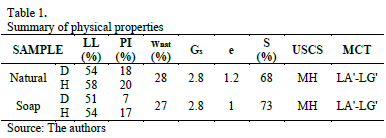
<body><![CDATA[<p><font size="2" face="Verdana, Arial, Helvetica, sans-serif"><b><i>2.1. General  aspects of the geology and geomorphology of the study area </i></b></font></p>     <p><font size="2" face="Verdana, Arial, Helvetica, sans-serif">In the study area, an igneous-metamorphic core is  geologically distinguished, which is located on the east slope of the Cordillera  Central and corresponds to the igneous intrusion of the Antioquia batholith in  the Medell&iacute;n Amphibolite. The Antioquia batholith has a granitic composition  with compositional variations that range from quartz-diorites to tonalities and  with minerals such as, primarily, plagioclase, quartz, hornblende and biotite &#91;2&#93;.</font></p>     <p><font size="2" face="Verdana, Arial, Helvetica, sans-serif">The municipality of Guarne is characterized by three  geomorphological units associated with the Antioquia batholith: moderated to  steep slopes, valleys associated with the La Mosca creek and ridges  characteristic of regions of low hills with medium slopes and that are located  between the valleys and the mountain units &#91;3&#93;. </font></p>     <p><font size="2" face="Verdana, Arial, Helvetica, sans-serif"><b><i>2.2. Description  of the weathering profile</i></b></font></p>     <p><font size="2" face="Verdana, Arial, Helvetica, sans-serif">The weathering profile of the region is described as  follows. In Horizon 1, volcanic  ash from the Ru&iacute;z - Tolima complex is found &#91;4&#93;, which is highly weathered. Horizon 2 is primarily sandy loam with  a high content of quartz and biotite. In this horizon, because of the  characteristics of its location and the horizon's strong reddish color, soils  with signs of lateralization can be expected. Therefore, this study was  performed on this horizon. In Horizon 3,  no structures inherited from the parent rock are observed. This horizon is  predominantly sandy and primarily composed of quartz and plagioclases altered  to clay minerals. Horizon 4 has  a saprolitic soil in which several discontinuities inherited from the parent  rock can be observed. These discontinuities are filled with organic matter with  a spacing of approximately 5 mm. Finally, in Horizon 5, a sign of the intrusion of the Antioquia batholith over  the Amphibolite of Medell&iacute;n is found, which is described in &#91;5&#93; as <i>&quot;Hanging-wall amphibolite assemblages over the Antioquia Batholith&quot;.</i></font></p>     <p>&nbsp;</p>     <p><font size="3" face="Verdana, Arial, Helvetica, sans-serif"><b>3. Method</b></font></p>     <p><font size="2" face="Verdana, Arial, Helvetica, sans-serif">Initially, using the soil samples collected in the study  area, both altered (packed in bags) and unaltered (drawer type), the  contamination of the material with the soap solution was performed in the  Laboratory of Geotechnics and Pavement of the National University of Colombia,  Medell&iacute;n. For this purpose, it was determined that the humidity of the sample  after contamination should exhibit approximately the same value as the soil  natural humidity (27%-29%). Accordingly, a volumetric analysis was performed,  which established the humidity to which the sample had to be decreased (15%) so  that 40% of the initial void ratio (e) would be generated (<a href="#tab01">Table 1</a>) and to  which the sufficient amount of soap solution in a concentration of 10% was then  added to ensure the same initial humidity of the soil after contamination. Once  the sample was contaminated with the soap solution, it was carefully sealed so  the humidity would remain constant. The described process was performed to  control at least one variable in the soil's behavior. To obtain a proper  infiltration of the solution and to facilitate a significant effect on the soil  properties, the soap solution was allowed to act on the soil for 10 days before  the respective tests were begun.</font></p>     <p align="center"><font size="2" face="Verdana, Arial, Helvetica, sans-serif"><a name="tab01"></a></font><img src="/img/revistas/dyna/v82n189/v82n189a12tab01.gif"></p>     <p><font size="2" face="Verdana, Arial, Helvetica, sans-serif">For the case of uncontaminated soil, which facilitated the  respective comparisons, the results of the study &#91;6&#93; were used. </font></p>     ]]></body>
<body><![CDATA[<p><font size="2" face="Verdana, Arial, Helvetica, sans-serif"><b><i>3.1. Physical  characterization</i></b></font></p> <ul>       <li><font size="2" face="Verdana, Arial, Helvetica, sans-serif"> Natural humidity content &#91;7&#93;.</font></li>       <li><font size="2" face="Verdana, Arial, Helvetica, sans-serif"> Specific gravity of solids &#91;8&#93;.</font></li>       <li><font size="2" face="Verdana, Arial, Helvetica, sans-serif"> Granulometry by mesh and hydrometer, with and     without deflocculant &#91;9&#93;. </font></li>       <li><font size="2" face="Verdana, Arial, Helvetica, sans-serif"> Consistency limits &#91;10&#93;. </font></li>       <li><font size="2" face="Verdana, Arial, Helvetica, sans-serif"> MCT rapid classification &#91;11&#93;. This procedure enables the     classification of the study soil using the method proposed by &#91;11&#93;.</font></li>     </ul>     <p><font size="2" face="Verdana, Arial, Helvetica, sans-serif"><b><i>3.2. Mineralogical  characterization </i></b></font></p> <ul>       <li><font size="2" face="Verdana, Arial, Helvetica, sans-serif">XRD &#91;12&#93;. </font></li>       <li><font size="2" face="Verdana, Arial, Helvetica, sans-serif"> SEM &#91;12&#93;.</font></li>     ]]></body>
<body><![CDATA[</ul>     <p><font size="2" face="Verdana, Arial, Helvetica, sans-serif"><b><i>3.3. Chemical  characterization</i></b></font></p>     <p><font size="2" face="Verdana, Arial, Helvetica, sans-serif">Measurement of pH in H2O and KCl &#91;13&#93;. According to &#91;14&#93;, as cited by &#91;15&#93;, if the difference between  the measured values of pH (KCl) and pH (H2O) is positive, this outcome indicates the predominance of  oxides and hydroxides of iron and aluminum in the soil. A negative value is  negative indicates the predominance of clay minerals. </font></p>     <p><font size="2" face="Verdana, Arial, Helvetica, sans-serif"><b><i>3.4. Mechanical characterization</i></b></font></p> <ul>       <li><font size="2" face="Verdana, Arial, Helvetica, sans-serif"> CD shear strength test &#91;16&#93;.</font></li>       <li><font size="2" face="Verdana, Arial, Helvetica, sans-serif"> Double edometry &#91;17&#93;, &#91;18&#93;. This approach consists of     the simultaneous execution of two single-edometric tests, one in natural     humidity conditions and the other in saturated conditions, from which two     compressibility curves of the soil are generated. Based on the differences     between the void ratios, the collapse index is calculated. </font></li>       <li><font size="2" face="Verdana, Arial, Helvetica, sans-serif"> Disaggregation. This test aims to examine the     stability of an undisturbed soil sample immersed in distilled water, which can     be associated with phases of the erosion process &#91;19&#93;.</font></li>       <li><font size="2" face="Verdana, Arial, Helvetica, sans-serif"> Pinhole test &#91;20&#93;: This test attempts to     simulate the piping effect in the soil &#91;19&#93;.</font></li>       <li><font size="2" face="Verdana, Arial, Helvetica, sans-serif"> Suction test by filter paper, mixed trajectory.     This test enables the measurement of the matric and the total suction &#91;21&#93;. </font></li>     </ul>     ]]></body>
<body><![CDATA[<p>&nbsp;</p>     <p><font size="3" face="Verdana, Arial, Helvetica, sans-serif"><b>4. Analysis of   results</b></font></p>     <p><b><font size="2" face="Verdana, Arial, Helvetica, sans-serif"><i>4.1. Index  properties</i></font></b></p>     <p><font size="2" face="Verdana, Arial, Helvetica, sans-serif">Initially, classification tests were performed following  the methods of the Unified Soil Classification System (USCS) and the MCT  classification. These tests were performed on the sample in a natural state and  after contamination with the soap solution on specimens with a natural humidity  content and air-dried samples. <a href="#tab01">Table 1</a> summarizes some of the index properties. </font></p>     <p><font size="2" face="Verdana, Arial, Helvetica, sans-serif">In the case of samples in a humid state, both natural and   contaminated, the limits do not vary significantly. Additionally, although in   the case of samples in a dry state (0% moisture) the plasticity index   decreased, which indicated that the drying process aggregates the particles,   the classification of the material is not affected in any of the cases and   remains a high-compressibility slime (MH). </font></p>     <p><font size="2" face="Verdana, Arial, Helvetica, sans-serif"><b>D: </b>Dry    <br> </font><font size="2" face="Verdana, Arial, Helvetica, sans-serif"><b>H</b>: Humid    <br> </font><font size="2" face="Verdana, Arial, Helvetica, sans-serif"><b>LL:</b> Liquid Limit    <br> </font><font size="2" face="Verdana, Arial, Helvetica, sans-serif"><b>PI</b>: Plasticity Index    <br> </font><font size="2" face="Verdana, Arial, Helvetica, sans-serif"><b>Wnat: </b>Natural humidity content    ]]></body>
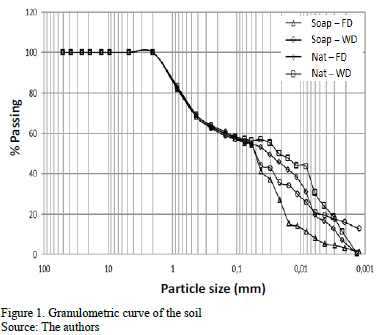
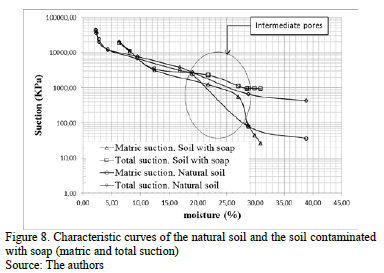
<body><![CDATA[<br> </font><font size="2" face="Verdana, Arial, Helvetica, sans-serif"><b>Gs</b>: Specific Gravity    <br> </font><font size="2" face="Verdana, Arial, Helvetica, sans-serif"><b>e</b>: Void ratio    <br> </font><font size="2" face="Verdana, Arial, Helvetica, sans-serif"><b>S</b>: Saturation    <br> </font><font size="2" face="Verdana, Arial, Helvetica, sans-serif"><b>USCS</b>: Unified Soil Classification System    <br> </font><font size="2" face="Verdana, Arial, Helvetica, sans-serif"><b>MCT:</b> Miniature Compacted Tropical</font></p>     <p><font size="2" face="Verdana, Arial, Helvetica, sans-serif">The soap solution influenced the increase in  intermediate size pores and the decrease in the proportion of macropores in the  soil. However, as shown in the characteristic curve, the void ratio did not  change significantly. </font></p>     <p><font size="2" face="Verdana, Arial, Helvetica, sans-serif"><b><i>4.2. Granulometry</i></b></font></p>     <p><font size="2" face="Verdana, Arial, Helvetica, sans-serif">The results for the natural and the contaminated samples  are shown in <a href="#fig01">Figure</a> .  It can be observed that the percentages of fines is very similar for both  cases, which indicates that the contaminant does not affect the predominant  size of the soil particles. However, the granulometry by hydrometer of both  specimens was performed with (WD) and without deflocculant (FD) to identify the  aggregations present in the soil before and after contamination. The expression  used to determine the stability of the aggregates is defined according to &#91;22&#93;, as cited by &#91;12&#93;: Total aggregates (TA) = % of  clay with deflocculant - % of clay without deflocculant, particles with  diameter less than 0.002 mm. The soil sample contaminated with soap presents  stronger aggregation than the sample in the natural state (contaminated TA,  12%; natural TA, 4%). However, these aggregations are weaker and more unstable  (higher TA indicates less stability, curves with and without deflocculant being  more separated). </font></p>     <p align="center"><font size="2" face="Verdana, Arial, Helvetica, sans-serif"><a name="fig01"></a></font><img src="/img/revistas/dyna/v82n189/v82n189a12fig01.gif"></p>     <p><font size="2" face="Verdana, Arial, Helvetica, sans-serif"><b><i>4.3. MCT rapid  classification</i></b></font></p>     ]]></body>
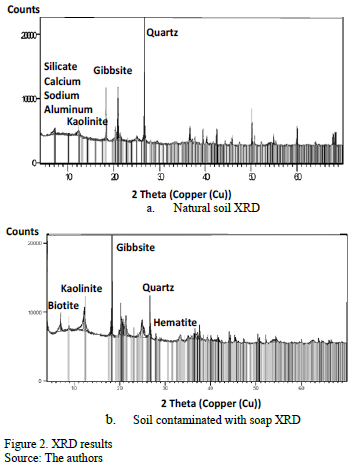
<body><![CDATA[<p><font size="2" face="Verdana, Arial, Helvetica, sans-serif">The MCT classification is a method primarily developed for  tropical soils that enables the to be sorted into two main groups: lateritic  (L) and non-lateritic soils (N) &#91;11&#93;. Additionally, these groups  are divided into subgroups according to their granulometric  characteristics. </font></p>     <p><font size="2" face="Verdana, Arial, Helvetica, sans-serif">The test was performed  on the soil in the natural state and the soil contaminated with soap solution  and determined that the soil under both conditions presents the characteristics  of a tropical soil of subgroups LA' - LG'. Considering the intrinsic characteristics  of these soils, there is a direct relationship to the characteristics of the  study area, specifically for the case of LG', which presents soils of reddish  color, with organic matter at the superficial level and the presence of  sesquioxides. In addition, the soils are resistant to hydraulic erosion when  properly compacted. However, in the natural state, they can collapse by  immersion in water &#91;11&#93; and are susceptible to superficial erosion when  unprotected.</font></p>     <p><font size="2" face="Verdana, Arial, Helvetica, sans-serif">In addition, the relation between previous results and  those obtained using the USCS classification, in which an MH soil was obtained &#91;11&#93;, could be verified.</font></p>     <p><font size="2" face="Verdana, Arial, Helvetica, sans-serif">The results obtained  in the present test are not decisive in themselves and must be complemented  with other tests, such as pH measurement, suction, SEM and XRD, which enable  establishing if the soil is lateritic or under laterization process.</font></p>     <p><font size="2" face="Verdana, Arial, Helvetica, sans-serif">When these results are compared with those obtained for  the natural sample, it is observed that the contamination of the soil did not  affect the MCT classification because it did not present any variation in the  results. </font></p>     <p><font size="2" face="Verdana, Arial, Helvetica, sans-serif"><b><i>4.4. Mineralogical  and structural analysis of the soil </i></b></font></p>     <p><font size="2" face="Verdana, Arial, Helvetica, sans-serif"><b>4.4.1. X-ray  diffraction (XRD)</b></font></p>     <p><font size="2" face="Verdana, Arial, Helvetica, sans-serif">Based on the XRD test results (<b>Error!  Reference source not found.</b>2),  in the analyzed soil (in the natural state and contaminated with soap), there  is a predominance of primary minerals (quartz, plagioclase, biotite).  Additionally, as product of the alteration of these soils, clay minerals  (primarily kaolinites) appear. The presence of iron and aluminum sesquioxides  (gibbsite and hematite in a smaller proportion) was also observed. Regarding  the proportions between the sesquioxides and clay minerals, the first are low,  which enables the inference that the soil is under an initial laterization  process.</font></p>     <p><font size="2" face="Verdana, Arial, Helvetica, sans-serif">As expected, the mineralogy of the two samples did not  vary (the differences found are the result of the sampling and the  heterogeneity of the soil). The time of exposure to the contaminant was too  short to produce a mineralogical change in the soil. </font></p>     <p><font size="2" face="Verdana, Arial, Helvetica, sans-serif"><b>4.4.2. Scanning  Electron Microscopy (SEM)</b></font></p>     ]]></body>
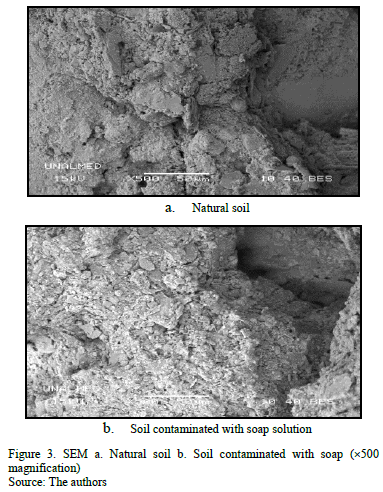
<body><![CDATA[<p><font size="2" face="Verdana, Arial, Helvetica, sans-serif">From this test, images were obtained in which the  structural arrangement of the soil controlled by its mineralogy can be observed  (<a href="#fig03">Fig. 3</a>). </font></p>     <p align="center"><a name="fig02"></a><img src="/img/revistas/dyna/v82n189/v82n189a12fig02.gif"></p>     <p align="center"><font size="2" face="Verdana, Arial, Helvetica, sans-serif"><a name="fig03"></a></font><img src="/img/revistas/dyna/v82n189/v82n189a12fig03.gif"></p>     <p><font size="2" face="Verdana, Arial, Helvetica, sans-serif">In the case of the  natural soil (<a href="#fig03">Fig. 3a</a>), a homogeneous and more compact structure can  be observed with laminar minerals that possibly conform to the presence of  minerals from the micas group (biotite). <a href="#fig03">Fig. 3b</a> shows a more dispersed structure of the soil  grains, with a greater presence of medium size pores and micropores (as it will  be observed in the characteristic curve). The difference between the two images  can be associated with the alteration caused by the soap solution in the soil,  which generated agglomeration between the grains. The agglomeration is  unstable, as can be observed in the double edometric test.</font></p>     <p><font size="2" face="Verdana, Arial, Helvetica, sans-serif"><a href="#fig03">Figs. 3a</a> and <a href="#fig03">3b</a> show small accumulations of material that  can possibly correspond to aggregations caused by iron (Fe) or aluminum (Al)  oxides and hydroxides. These aggregations could indicate the presence of  minerals produced by the initial laterization in the soil of the study slope.  This indication is corroborated by the XRD analysis and with the classification  obtained by the MCT test.</font></p>     <p><font size="2" face="Verdana, Arial, Helvetica, sans-serif"><b><i>4.5. pH  determination</i></b></font></p>     <p><font size="2" face="Verdana, Arial, Helvetica, sans-serif">Negative <font face="Symbol">D</font>pH values were obtained (-2.63 for the  natural soil and -1.72 for the soil altered by the soap), which indicates the  predominance of clay minerals &#91;15&#93; without emphasizing the  presence of iron and aluminum sesquioxides, as was observed in the XRD test.</font></p>     <p><font size="2" face="Verdana, Arial, Helvetica, sans-serif">Regarding the sample altered with soap, the soap solution  increases the soil acidity. Because the <font face="Symbol">D</font>pH remained negative, it was  concluded that the time in which the soap solution was left to act was too  short to expect a change in the soil mineralogy. </font></p>     <p><font size="2" face="Verdana, Arial, Helvetica, sans-serif">According to &#91;23&#93; and &#91;15&#93;, in lateritic tropical  residual soils, the acidity is associated with the presence of sesquioxides in  large proportions, which produces aggregations between the particles and  affects the structural distribution of the voids, regardless whether they are  cemented by oxides or hydroxides of iron (Fe) and aluminum (Al). In this case,  because the soil contaminated with soap solution presented on average an  acidity increase (from 6.8 in the natural state to 5.7 when contaminated), the  observed agglomerations (SEM, granulometry) and the presence of medium-size  pores in the characteristic curve can be associated with this change in the  soil's pH.</font></p>     <p><font size="2" face="Verdana, Arial, Helvetica, sans-serif"><b><i>4.6. Consolidated  drained (CD) shear strength test</i></b></font></p>     ]]></body>
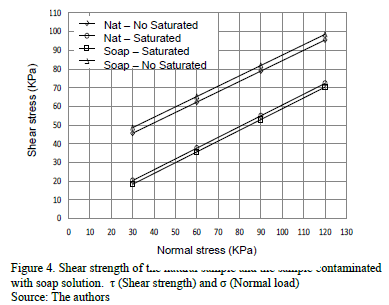
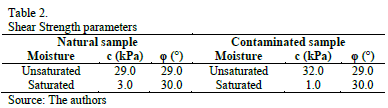
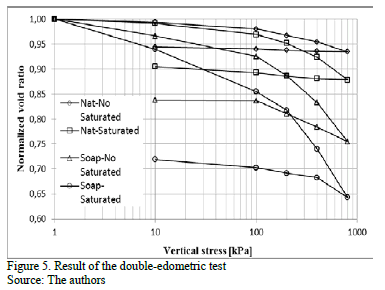
<body><![CDATA[<p><font size="2" face="Verdana, Arial, Helvetica, sans-serif">The primary objective of this test is to determine the  soil shear strength parameters. A CD shear test was performed. The behavior  obtained is presented in <a href="#fig04">Fig. 4</a>.</font></p>     <p align="center"><font size="2" face="Verdana, Arial, Helvetica, sans-serif"><a name="fig04"></a></font><img src="/img/revistas/dyna/v82n189/v82n189a12fig04.gif"></p>     <p><font size="2" face="Verdana, Arial, Helvetica, sans-serif"><a href="#tab02">Table   2</a>  shows the shear strength parameters that correspond to the failure envelopes   represented in the previous figure.</font></p>     <p align="center"><font size="2" face="Verdana, Arial, Helvetica, sans-serif"><a name="tab02"></a></font><img src="/img/revistas/dyna/v82n189/v82n189a12tab02.gif"></p>     <p><font size="2" face="Verdana, Arial, Helvetica, sans-serif">The shear strength  parameters obtained in the present test resemble the typical values of cohesion  (c) and friction angle (<font face="Symbol">j</font>) of the soils from the Antioquia batholith &#91;24&#93;. In addition, the data shown in <a href="#fig04">Fig 4</a> and <a href="#tab02">Table 2</a> demonstrate that the more significant changes in  the shear strength parameters of the soil depend primarily on its saturation  condition and to a lesser extent on whether the soil is natural or  contaminated.</font></p>     <p><font size="2" face="Verdana, Arial, Helvetica, sans-serif">Regarding the presence or absence of the contaminant, it  can be observed that the variation in the resistance is minimal. That is, the  cohesion and the friction angle are not significantly influenced by the action  of the soap solution. </font></p>     <p><font size="2" face="Verdana, Arial, Helvetica, sans-serif">In addition, the previous results are associated with the  characteristic curve, in which for natural humidity the suction value in both  samples is similar (Natural, 800 kPa; Contaminated, 1100 kPa). This outcome is  reflected in the similarity of the shear strength parameters. For the saturated  case, the suction in both cases decreases considerably, which affects those  parameters. </font></p>     <p><font size="2" face="Verdana, Arial, Helvetica, sans-serif"><b><i>4.7. Double  edometric test</i></b></font></p>     <p><font size="2" face="Verdana, Arial, Helvetica, sans-serif">This test enables the determination of the collapse index,  which is obtained after performing the test in saturated and unsaturated  conditions. In this case, this test is developed for specimens in natural  conditions and for specimens contaminated with a soap solution (<a href="#fig05">Fig 5</a>). </font></p>     <p align="center"><font size="2" face="Verdana, Arial, Helvetica, sans-serif"><a name="fig05"></a></font><img src="/img/revistas/dyna/v82n189/v82n189a12fig05.gif"></p>     ]]></body>
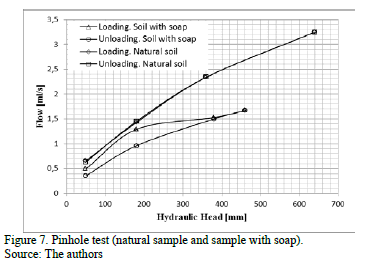
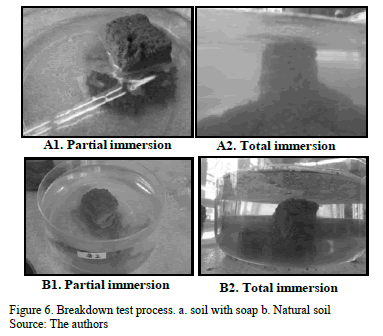
<body><![CDATA[<p><font size="2" face="Verdana, Arial, Helvetica, sans-serif">From  the analysis of <a href="#fig05">Fig 5</a> and the estimation of the collapse indexes by the  method proposed by &#91;25&#93;, the addition of the contaminating agent can  activate the collapse potential of the soil. This statement is supported by  comparing the values of the collapse index, which for the natural sample are  below 3.0% (thus classifies as a <i>moderately  collapsible soil</i>) and for the contaminated sample are above 5.0% for the  last two load increments (400 and 800 kPa) (which groups the soil with <i>problematic collapsible soils</i>). </font></p>     <p><font size="2" face="Verdana, Arial, Helvetica, sans-serif"><b><i>4.8. Erodibility  test </i></b></font></p>     <p><font size="2" face="Verdana, Arial, Helvetica, sans-serif">During the visit to  the study site, a series of erosion events that affected the soil were  observed. These processes are superficial (grooves), which requires the  performance of a series of tests that would allow establishing the degree of  erodibility that the soil can present (disaggregation and the pinhole test).</font></p>     <p><font size="2" face="Verdana, Arial, Helvetica, sans-serif">The erodibility can be defined as the soil's capacity to  resist erosion and depends not only on the soil's intrinsic characteristics  (e.g., mineralogy, texture, structure) but also factors such as wetting and  drying cycles and the chemical composition of the water that affects the soil &#91;19&#93;.</font></p>     <p><font size="2" face="Verdana, Arial, Helvetica, sans-serif"><b>4.8.1. Breakdown</b></font></p>     <p><font size="2" face="Verdana, Arial, Helvetica, sans-serif">The description of the  soil responses for the breakdown test can be found in &#91;19&#93;. At the beginning of the test, for both samples,  an immediate dispersion effect was observed, which can be associated with the  difference in pressure that is generated in the interior of the sample when the  water tries to enter a medium that contains soap solution. A second effect was  a slight fracturing in the upper face of the soil cube, which can be associated  with the osmotic expansion process generated by a chemical effect of the soap  solution in the interior of the sample.</font></p>     <p><font size="2" face="Verdana, Arial, Helvetica, sans-serif">Finally, the process that characterized the test in both  samples was the depletion indicated by the high degree of disintegration  suffered by the samples (<a href="#fig06">Fig. 6</a>). This disintegration occurred because the  aggregations or bonds formed by the soap solution were rapidly diluted when  contact with the water was made. During the test, it was not necessary to  complete the 24-hour observation period. The disaggregation effect was  immediate for both samples.</font></p>     <p align="center"><font size="2" face="Verdana, Arial, Helvetica, sans-serif"><a name="fig06"></a></font><img src="/img/revistas/dyna/v82n189/v82n189a12fig06.gif"></p>     <p><font size="2" face="Verdana, Arial, Helvetica, sans-serif"><b>4.8.1. Pinhole  Test</b></font></p>     <p><font size="2" face="Verdana, Arial, Helvetica, sans-serif">Based on <a href="#fig07">Fig 7</a>, the natural soil does not  present internal erodibility because the load and unload intervals exhibit a linear  behavior. In the sample altered with the soap solution, a marked difference was  observed between the loading and unloading  intervals. In this case, the observed phenomenon was associated with detached  particles caused by the flow of water and the subsequent plugging of the hole  of these particles (unload interval below the load interval).</font></p>     ]]></body>
<body><![CDATA[<p align="center"><font size="2" face="Verdana, Arial, Helvetica, sans-serif"><a name="fig07"></a></font><img src="/img/revistas/dyna/v82n189/v82n189a12fig07.gif"></p>     <p><font size="2" face="Verdana, Arial, Helvetica, sans-serif"><b><i>4.9. Characteristic  curve</i></b></font></p>     <p><font size="2" face="Verdana, Arial, Helvetica, sans-serif">The results are  presented in <a href="#fig08">Fig 8</a>. The curve that corresponds to the natural soil (matric  suction) presents a soft slope, which is characteristic of a soil with  homogenous structure, in agreement with the SEM analysis. In the curve that  corresponds to the matric suction of the soil contaminated with soap, the  presence of intermediate-size pores is observed (which were not so markedly  present in the natural soil), as could be observed using SEM. The presence of  intermediate-size pores can be explained by the agglomeration produced by the  effect of the soap solution on the soil.</font></p>     <p align="center"><font size="2" face="Verdana, Arial, Helvetica, sans-serif"><a name="fig08"></a></font><img src="/img/revistas/dyna/v82n189/v82n189a12fig08.gif"></p>     <p><font size="2" face="Verdana, Arial, Helvetica, sans-serif">Regarding the total suction, generally, the suction values  in the sample contaminated with soap are greater than the values for the  natural sample, which is evidence of the osmotic effect produced by the soap  solution because of the chemical components that are added to the medium. </font></p>     <p>&nbsp;</p>     <p><font size="3" face="Verdana, Arial, Helvetica, sans-serif"><b>5. Conclusions</b></font></p>     <p><font size="2" face="Verdana, Arial, Helvetica, sans-serif">The presence of a  substance such as a soap solution in the soil is common in regions that lack  sewerage systems. Understanding the alterations caused by the percolation of  these contaminating agents is important to improving the design of mitigation  and improvement works and to determining areas a risk of disaster because they  are exposed to such conditions.</font></p>     <p><font size="2" face="Verdana, Arial, Helvetica, sans-serif">Therefore, by studying  in detail the results of the tests performed on samples in natural and  contaminated states, is possible to describe the following tendencies: the  physical characterization does not present significant changes, except for the  granulometric analysis, in which unstable aggregations caused by the binding  action of the soap are observed. The soil contaminated shows a more dispersed  structure of the soil grains, with a greater presence of medium size pores and  micropores. The difference between the two samples (natural and contaminated  states) can be associated with the alteration caused by the soap solution in  the soil, which generated agglomeration between the grains. The agglomeration  is unstable, as can be observed in the double edometric test.</font></p>     <p><font size="2" face="Verdana, Arial, Helvetica, sans-serif">The presence of the  soapy substance influenced the hydromechanical behavior of the soil because  with respect to soil deformability the collapse phenomenon becomes critical:  the soil passes from a problematic to a severe state. In addition,  when evaluating the soil erodibility, both superficial and internal,  deformability becomes a critical condition. </font></p>     ]]></body>
<body><![CDATA[<p><font size="2" face="Verdana, Arial, Helvetica, sans-serif">The composition of the  fluid present in the interstices of a residual soil is decisive when estimating  the geotechnical behavior, which occasionally cannot be fully appreciated using  the classical methods of soil mechanics. Therefore, it is necessary to consider  more specific tests that correspond to the properties that are induced in the  soil mass by the presence of certain clay minerals and sesquioxides, which can  easily be found at regional level from the weathering of the igneous rocks of  the Antioquia batholith. </font></p>     <p><font size="2" face="Verdana, Arial, Helvetica, sans-serif">Finally, it should be  noted that this study is a preliminary geotechnical analysis of a soil that has  to be affected by a contaminant such as soap. However, research should be  further into issues such as the use of other types of soil, another kind of  soap, different concentrations and amounts of soap, and the time of exposure to  the contaminant. This will allow to perform a statistical analysis of the data  and determine a general trend of the effect of a soil contaminated with a soapy  substance, to propose the recovery of these soils &#91;26&#93;.</font></p>     <p>&nbsp;</p>     <p><font size="3" face="Verdana, Arial, Helvetica, sans-serif"><b>References</b></font></p>     <!-- ref --><p><font size="2" face="Verdana, Arial, Helvetica, sans-serif"><b>&#91;1&#93;</b> CONARE,  Capacitaci&oacute;n, planificaci&oacute;n y formulaci&oacute;n del plan de ordenamiento y manejo de  la cuenca La Honda del Municipio de Guarne, Rionegro, 2010.    &nbsp;&nbsp;&nbsp;&nbsp;&nbsp;&nbsp;&nbsp;&nbsp;[&#160;<a href="javascript:void(0);" onclick="javascript: window.open('/scielo.php?script=sci_nlinks&ref=000137&pid=S0012-7353201500010001200001&lng=','','width=640,height=500,resizable=yes,scrollbars=1,menubar=yes,');">Links</a>&#160;]<!-- end-ref --></font></p>     <!-- ref --><p><font size="2" face="Verdana, Arial, Helvetica, sans-serif"><b>&#91;2&#93;</b> Fern&aacute;ndez, F. y Santa, N.,  Estudio general de suelos del Oriente Antioque&ntilde;o, Bogot&aacute;, 1964.    &nbsp;&nbsp;&nbsp;&nbsp;&nbsp;&nbsp;&nbsp;&nbsp;[&#160;<a href="javascript:void(0);" onclick="javascript: window.open('/scielo.php?script=sci_nlinks&ref=000139&pid=S0012-7353201500010001200002&lng=','','width=640,height=500,resizable=yes,scrollbars=1,menubar=yes,');">Links</a>&#160;]<!-- end-ref --></font></p>     <!-- ref --><p><font size="2" face="Verdana, Arial, Helvetica, sans-serif"><b>&#91;3&#93;</b> Colombia. Acuerdo n&uacute;mero  061/2000, de 30 junio. Plan b&aacute;sico de ordenamiento territorial para el  municipio de Guarne. 11 de junio de 2000, 185 P.    &nbsp;&nbsp;&nbsp;&nbsp;&nbsp;&nbsp;&nbsp;&nbsp;[&#160;<a href="javascript:void(0);" onclick="javascript: window.open('/scielo.php?script=sci_nlinks&ref=000141&pid=S0012-7353201500010001200003&lng=','','width=640,height=500,resizable=yes,scrollbars=1,menubar=yes,');">Links</a>&#160;]<!-- end-ref --></font></p>     ]]></body>
<body><![CDATA[<!-- ref --><p><font size="2" face="Verdana, Arial, Helvetica, sans-serif"><b>&#91;4&#93;</b> Hermelin, M., Los suelos del  oriente antioque&ntilde;o un recurso no renovable, Bulletin de l'Institut Français d'Etudes Andines, 21 (1), pp.  25-36, 1992.    &nbsp;&nbsp;&nbsp;&nbsp;&nbsp;&nbsp;&nbsp;&nbsp;[&#160;<a href="javascript:void(0);" onclick="javascript: window.open('/scielo.php?script=sci_nlinks&ref=000143&pid=S0012-7353201500010001200004&lng=','','width=640,height=500,resizable=yes,scrollbars=1,menubar=yes,');">Links</a>&#160;]<!-- end-ref --> </font></p>     <!-- ref --><p><font size="2" face="Verdana, Arial, Helvetica, sans-serif"><b>&#91;5&#93;</b> Botero, G., Contribuci&oacute;n al  conocimiento de la petrograf&iacute;a del Batolito Antioque&ntilde;o, Revista Miner&iacute;a, XX, pp. 9318,9330, 1942.    &nbsp;&nbsp;&nbsp;&nbsp;&nbsp;&nbsp;&nbsp;&nbsp;[&#160;<a href="javascript:void(0);" onclick="javascript: window.open('/scielo.php?script=sci_nlinks&ref=000145&pid=S0012-7353201500010001200005&lng=','','width=640,height=500,resizable=yes,scrollbars=1,menubar=yes,');">Links</a>&#160;]<!-- end-ref --></font></p>     <!-- ref --><p><font size="2" face="Verdana, Arial, Helvetica, sans-serif"><b>&#91;6&#93;</b> Cano, Katherin. et al.,  Estudio geot&eacute;cnico de una suelo tropical para determinar su estado de  meteorizaci&oacute;n y su efecto en las propiedades mec&aacute;nicas. Revista Facultad de Ciencias Universidad Nacional, Sede Medell&iacute;n,  pp.70-83, 2014.    &nbsp;&nbsp;&nbsp;&nbsp;&nbsp;&nbsp;&nbsp;&nbsp;[&#160;<a href="javascript:void(0);" onclick="javascript: window.open('/scielo.php?script=sci_nlinks&ref=000147&pid=S0012-7353201500010001200006&lng=','','width=640,height=500,resizable=yes,scrollbars=1,menubar=yes,');">Links</a>&#160;]<!-- end-ref --></font></p>     <!-- ref --><p><font size="2" face="Verdana, Arial, Helvetica, sans-serif"><b>&#91;7&#93;</b> ASTM, Standard test methods for  laboratory determination of water (moisture) content of soil and rock by mass.  D 2216-10. United States of America, 2010.    &nbsp;&nbsp;&nbsp;&nbsp;&nbsp;&nbsp;&nbsp;&nbsp;[&#160;<a href="javascript:void(0);" onclick="javascript: window.open('/scielo.php?script=sci_nlinks&ref=000149&pid=S0012-7353201500010001200007&lng=','','width=640,height=500,resizable=yes,scrollbars=1,menubar=yes,');">Links</a>&#160;]<!-- end-ref --></font></p>     <!-- ref --><p><font size="2" face="Verdana, Arial, Helvetica, sans-serif"><b>&#91;8&#93;</b> ASTM, Standard test methods for specific  gravity of soil solids by water pycnometer. D 854-10. United States of America,  2010.    &nbsp;&nbsp;&nbsp;&nbsp;&nbsp;&nbsp;&nbsp;&nbsp;[&#160;<a href="javascript:void(0);" onclick="javascript: window.open('/scielo.php?script=sci_nlinks&ref=000151&pid=S0012-7353201500010001200008&lng=','','width=640,height=500,resizable=yes,scrollbars=1,menubar=yes,');">Links</a>&#160;]<!-- end-ref --></font></p>     ]]></body>
<body><![CDATA[<!-- ref --><p><font size="2" face="Verdana, Arial, Helvetica, sans-serif"><b>&#91;9&#93;</b> ASTM, Standard test method for dispersive  characteristics of clay soil by double hydrometer. D4211-11. United States of  America, 2011.    &nbsp;&nbsp;&nbsp;&nbsp;&nbsp;&nbsp;&nbsp;&nbsp;[&#160;<a href="javascript:void(0);" onclick="javascript: window.open('/scielo.php?script=sci_nlinks&ref=000153&pid=S0012-7353201500010001200009&lng=','','width=640,height=500,resizable=yes,scrollbars=1,menubar=yes,');">Links</a>&#160;]<!-- end-ref --></font></p>     <!-- ref --><p><font size="2" face="Verdana, Arial, Helvetica, sans-serif"><b>&#91;10&#93;</b> ASTM, Standard test methods for liquid  limit, plastic limit, and plasticity index of soils. D  4318-10. United States of America, 2010.    &nbsp;&nbsp;&nbsp;&nbsp;&nbsp;&nbsp;&nbsp;&nbsp;[&#160;<a href="javascript:void(0);" onclick="javascript: window.open('/scielo.php?script=sci_nlinks&ref=000155&pid=S0012-7353201500010001200010&lng=','','width=640,height=500,resizable=yes,scrollbars=1,menubar=yes,');">Links</a>&#160;]<!-- end-ref --></font></p>     <!-- ref --><p><font size="2" face="Verdana, Arial, Helvetica, sans-serif"><b>&#91;11&#93;</b> Nogami, J. and Villibor,  D., Pavimentacao de baixo custo com solos later&iacute;ticos, Editora Villibor,  Brasil, 1995.    &nbsp;&nbsp;&nbsp;&nbsp;&nbsp;&nbsp;&nbsp;&nbsp;[&#160;<a href="javascript:void(0);" onclick="javascript: window.open('/scielo.php?script=sci_nlinks&ref=000157&pid=S0012-7353201500010001200011&lng=','','width=640,height=500,resizable=yes,scrollbars=1,menubar=yes,');">Links</a>&#160;]<!-- end-ref --></font></p>     <!-- ref --><p><font size="2" face="Verdana, Arial, Helvetica, sans-serif"><b>&#91;12&#93;</b> Valencia, Y., Influencia  da biomineralização nas propriedades f&iacute;sico - mecânicas de um perfil de solo  tropical afetado por processos erosivos, PhD Thesis, Universidad de Brasilia, Brasilia, Brasil, 2009.    &nbsp;&nbsp;&nbsp;&nbsp;&nbsp;&nbsp;&nbsp;&nbsp;[&#160;<a href="javascript:void(0);" onclick="javascript: window.open('/scielo.php?script=sci_nlinks&ref=000159&pid=S0012-7353201500010001200012&lng=','','width=640,height=500,resizable=yes,scrollbars=1,menubar=yes,');">Links</a>&#160;]<!-- end-ref --></font></p>     <!-- ref --><p><font size="2" face="Verdana, Arial, Helvetica, sans-serif"><b>&#91;13&#93;</b> ASTM, Standart test method for pH of soils.  D 4972-01. United States of America, 2001.    &nbsp;&nbsp;&nbsp;&nbsp;&nbsp;&nbsp;&nbsp;&nbsp;[&#160;<a href="javascript:void(0);" onclick="javascript: window.open('/scielo.php?script=sci_nlinks&ref=000161&pid=S0012-7353201500010001200013&lng=','','width=640,height=500,resizable=yes,scrollbars=1,menubar=yes,');">Links</a>&#160;]<!-- end-ref --></font></p>     ]]></body>
<body><![CDATA[<!-- ref --><p><font size="2" face="Verdana, Arial, Helvetica, sans-serif"><b>&#91;14&#93;</b> Kiehl, E.J,. Manual de Edafologia: Relacoes Solo-Planta,  1st ed, Sao Paulo, Brasil: Editora Agronomica - Ceres Ltda, 1979.    &nbsp;&nbsp;&nbsp;&nbsp;&nbsp;&nbsp;&nbsp;&nbsp;[&#160;<a href="javascript:void(0);" onclick="javascript: window.open('/scielo.php?script=sci_nlinks&ref=000163&pid=S0012-7353201500010001200014&lng=','','width=640,height=500,resizable=yes,scrollbars=1,menubar=yes,');">Links</a>&#160;]<!-- end-ref --></font></p>     <!-- ref --><p><font size="2" face="Verdana, Arial, Helvetica, sans-serif"><b>&#91;15&#93;</b> Lima, M.C., Degradacao  F&iacute;sico-Qu&iacute;mica e Mineral&oacute;gica de Macicos Junto &aacute;s Vocorocas, PhD Thesis, Universidade de Bras&iacute;lia, Bras&iacute;lia, Brasil, 2003.    &nbsp;&nbsp;&nbsp;&nbsp;&nbsp;&nbsp;&nbsp;&nbsp;[&#160;<a href="javascript:void(0);" onclick="javascript: window.open('/scielo.php?script=sci_nlinks&ref=000165&pid=S0012-7353201500010001200015&lng=','','width=640,height=500,resizable=yes,scrollbars=1,menubar=yes,');">Links</a>&#160;]<!-- end-ref --> </font></p>     <!-- ref --><p><font size="2" face="Verdana, Arial, Helvetica, sans-serif"><b>&#91;16&#93;</b> ASTM, Standard test methods for direct  shear test of soils under consolidated drained conditions. D 3080-04. United  States of America, 2004.    &nbsp;&nbsp;&nbsp;&nbsp;&nbsp;&nbsp;&nbsp;&nbsp;[&#160;<a href="javascript:void(0);" onclick="javascript: window.open('/scielo.php?script=sci_nlinks&ref=000167&pid=S0012-7353201500010001200016&lng=','','width=640,height=500,resizable=yes,scrollbars=1,menubar=yes,');">Links</a>&#160;]<!-- end-ref --></font></p>     <!-- ref --><p><font size="2" face="Verdana, Arial, Helvetica, sans-serif"><b>&#91;17&#93;</b> ASTM, Standard test method for measurement  of collapse potencial of soils. D 5333-92 (Reapproved 1996). United States of  America, 1996.    &nbsp;&nbsp;&nbsp;&nbsp;&nbsp;&nbsp;&nbsp;&nbsp;[&#160;<a href="javascript:void(0);" onclick="javascript: window.open('/scielo.php?script=sci_nlinks&ref=000169&pid=S0012-7353201500010001200017&lng=','','width=640,height=500,resizable=yes,scrollbars=1,menubar=yes,');">Links</a>&#160;]<!-- end-ref --></font></p>     <!-- ref --><p><font size="2" face="Verdana, Arial, Helvetica, sans-serif"><b>&#91;18&#93;</b> ASTM, Standard test methods for  one-dimensional consolidation properties of soils using incremental loading. D 4235-11. United States of America, 2011.    &nbsp;&nbsp;&nbsp;&nbsp;&nbsp;&nbsp;&nbsp;&nbsp;[&#160;<a href="javascript:void(0);" onclick="javascript: window.open('/scielo.php?script=sci_nlinks&ref=000171&pid=S0012-7353201500010001200018&lng=','','width=640,height=500,resizable=yes,scrollbars=1,menubar=yes,');">Links</a>&#160;]<!-- end-ref --></font></p>     ]]></body>
<body><![CDATA[<!-- ref --><p><font size="2" face="Verdana, Arial, Helvetica, sans-serif"> <b>&#91;19&#93;</b></b> Camapun de Carvallo, J., Processos Erosivos no Centro- Oestre  Brasileiro, Editora FINATEC, Brasil, 2006, 499 P.    &nbsp;&nbsp;&nbsp;&nbsp;&nbsp;&nbsp;&nbsp;&nbsp;[&#160;<a href="javascript:void(0);" onclick="javascript: window.open('/scielo.php?script=sci_nlinks&ref=000173&pid=S0012-7353201500010001200019&lng=','','width=640,height=500,resizable=yes,scrollbars=1,menubar=yes,');">Links</a>&#160;]<!-- end-ref --></font></p>     <!-- ref --><p><font size="2" face="Verdana, Arial, Helvetica, sans-serif"><b>&#91;20&#93;</b> ASTM, Standard test methods for  identification and classification of dispersive clay soils by the pinhole test.  D 4647-13, United States of America, 2013.    &nbsp;&nbsp;&nbsp;&nbsp;&nbsp;&nbsp;&nbsp;&nbsp;[&#160;<a href="javascript:void(0);" onclick="javascript: window.open('/scielo.php?script=sci_nlinks&ref=000175&pid=S0012-7353201500010001200020&lng=','','width=640,height=500,resizable=yes,scrollbars=1,menubar=yes,');">Links</a>&#160;]<!-- end-ref --></font></p>     <!-- ref --><p><font size="2" face="Verdana, Arial, Helvetica, sans-serif"><b>&#91;21&#93;</b> Fredlund, D.G. and Rahadjo, H., Soil  mechanics for unsaturated soils, Wiley-Interscience, New York, 1993.</font> <font size="2" face="Verdana, Arial, Helvetica, sans-serif"><a href="http://dx.doi.org/10.1002/9780470172759" target="_blank">http://dx.doi.org/10.1002/9780470172759</a></font>&nbsp;&nbsp;&nbsp;&nbsp;&nbsp;&nbsp;&nbsp;&nbsp;[&#160;<a href="javascript:void(0);" onclick="javascript: window.open('/scielo.php?script=sci_nlinks&ref=000177&pid=S0012-7353201500010001200021&lng=','','width=640,height=500,resizable=yes,scrollbars=1,menubar=yes,');">Links</a>&#160;]<!-- end-ref --><!-- ref --><p><font size="2" face="Verdana, Arial, Helvetica, sans-serif"><b>&#91;22&#93;</b> Araki, M., Aspectos  relativos as propriedades dos solos porosos colapsiveis do Distrito Federal,  University of Bras&iacute;lia, College of Technology, 1997.    &nbsp;&nbsp;&nbsp;&nbsp;&nbsp;&nbsp;&nbsp;&nbsp;[&#160;<a href="javascript:void(0);" onclick="javascript: window.open('/scielo.php?script=sci_nlinks&ref=000178&pid=S0012-7353201500010001200022&lng=','','width=640,height=500,resizable=yes,scrollbars=1,menubar=yes,');">Links</a>&#160;]<!-- end-ref --></font></p>     <!-- ref --><p><font size="2" face="Verdana, Arial, Helvetica, sans-serif"><b>&#91;23&#93;</b> Da Fonseca Cardoso, F.B.,  Analise qu&iacute;mica, mineral&oacute;gica e micromorfol&oacute;gica de solos tropicais colaps&iacute;veis  e o estudo da din&aacute;mica do colapso, MSc Thesis, Universidade de Brasilia,  Brasilia, Brasil, 1995.    &nbsp;&nbsp;&nbsp;&nbsp;&nbsp;&nbsp;&nbsp;&nbsp;[&#160;<a href="javascript:void(0);" onclick="javascript: window.open('/scielo.php?script=sci_nlinks&ref=000180&pid=S0012-7353201500010001200023&lng=','','width=640,height=500,resizable=yes,scrollbars=1,menubar=yes,');">Links</a>&#160;]<!-- end-ref --></font></p>     <!-- ref --><p><font size="2" face="Verdana, Arial, Helvetica, sans-serif"><b>&#91;24&#93;</b> Escobar, L. and Valencia, Y.,  An&aacute;lisis de estabilidad y probabilidad de falla de dos taludes de suelo  tropical en la autopista Medell&iacute;n-Bogot&aacute; en el tramo de v&iacute;a entre Marinilla y  Santuario. Bolet&iacute;n  de Ciencias de la Tierra, 31, pp. 51-64, 2012.    &nbsp;&nbsp;&nbsp;&nbsp;&nbsp;&nbsp;&nbsp;&nbsp;[&#160;<a href="javascript:void(0);" onclick="javascript: window.open('/scielo.php?script=sci_nlinks&ref=000182&pid=S0012-7353201500010001200024&lng=','','width=640,height=500,resizable=yes,scrollbars=1,menubar=yes,');">Links</a>&#160;]<!-- end-ref --></font></p>     <!-- ref --><p><font size="2" face="Verdana, Arial, Helvetica, sans-serif"><b>&#91;25&#93;</b> Conference for &Aacute;frica on soils mechanics  and foundation engineering (VI, 1975, Durban). A guide to construction on or  with materials exhibiting additional settlement due to &quot;Collapse&quot; of  grain structure, Durban, Sud&aacute;frica, 1975, pp. 99-105.    &nbsp;&nbsp;&nbsp;&nbsp;&nbsp;&nbsp;&nbsp;&nbsp;[&#160;<a href="javascript:void(0);" onclick="javascript: window.open('/scielo.php?script=sci_nlinks&ref=000184&pid=S0012-7353201500010001200025&lng=','','width=640,height=500,resizable=yes,scrollbars=1,menubar=yes,');">Links</a>&#160;]<!-- end-ref --></font></p>     <!-- ref --><p><font size="2" face="Verdana, Arial, Helvetica, sans-serif"><b>&#91;26&#93;</b> G&oacute;mez, W., Gaviria, J. and  Cardona, S., Evaluaci&oacute;n de la bioestimulaci&oacute;n frente a la atenuaci&oacute;n natural y  la bioaumentaci&oacute;n en un suelo contaminado con una mezcla de gasolina - diesel. DYNA, 76 (160), pp.  83-93, 2009.    &nbsp;&nbsp;&nbsp;&nbsp;&nbsp;&nbsp;&nbsp;&nbsp;[&#160;<a href="javascript:void(0);" onclick="javascript: window.open('/scielo.php?script=sci_nlinks&ref=000186&pid=S0012-7353201500010001200026&lng=','','width=640,height=500,resizable=yes,scrollbars=1,menubar=yes,');">Links</a>&#160;]<!-- end-ref --></font></p>     <p>&nbsp;</p>     <p><font size="2" face="Verdana, Arial, Helvetica, sans-serif"><b>Y. Valencia-Gonzalez, </b>received the BS.  in Civil Engineering in 2001, the MSc. in Civil Engineering-Geotechnical in  2005, both from Universidad Nacional de Colombia, campus Medellin, Colombia. In  2009 received the Dr. in geotechnical follow by a year as postdoctoral fellow,  all of them in the University of Brasilia, Brasil. Currently, she is a full  professor in the Civil Engineering department of the Universidad Nacional de  Colombia, campus Medellin, Colombia. Her research interest includes: tropical  soils, biotechnology, foundations and vibration control.</font></p>     <p><font size="2" face="Verdana, Arial, Helvetica, sans-serif"><b>O.  Echeverri-Ramirez,</b> received the BS. in Civil Engineering in 1980, the MSc.  in Civil Engineering-Geotechnical in 2005, both from Universidad Nacional de  Colombia, campus Medellin, Colombia. Currently, he is a full professor in the  Civil Engineering department of the Universidad Nacional de Colombia, campus  Medellin, Colombia. His research interest includes: geotecnia tropical  environments, biotechnology and slope stability.</font></p>      ]]></body><back>
<ref-list>
<ref id="B1">
<label>1</label><nlm-citation citation-type="">
<collab>CONARE</collab>
<source><![CDATA[Capacitación, planificación y formulación del plan de ordenamiento y manejo de la cuenca La Honda del Municipio de Guarne]]></source>
<year>2010</year>
<publisher-loc><![CDATA[Rionegro ]]></publisher-loc>
</nlm-citation>
</ref>
<ref id="B2">
<label>2</label><nlm-citation citation-type="">
<person-group person-group-type="author">
<name>
<surname><![CDATA[Fernández]]></surname>
<given-names><![CDATA[F.]]></given-names>
</name>
<name>
<surname><![CDATA[Santa]]></surname>
<given-names><![CDATA[N.]]></given-names>
</name>
</person-group>
<source><![CDATA[Estudio general de suelos del Oriente Antioqueño]]></source>
<year>1964</year>
<publisher-loc><![CDATA[Bogotá ]]></publisher-loc>
</nlm-citation>
</ref>
<ref id="B3">
<label>3</label><nlm-citation citation-type="">
<collab>Colombia</collab>
<source><![CDATA[Acuerdo número 061/2000, de 30 junio: Plan básico de ordenamiento territorial para el municipio de Guarne]]></source>
<year></year>
</nlm-citation>
</ref>
<ref id="B4">
<label>4</label><nlm-citation citation-type="journal">
<person-group person-group-type="author">
<name>
<surname><![CDATA[Hermelin]]></surname>
<given-names><![CDATA[M.]]></given-names>
</name>
</person-group>
<article-title xml:lang="es"><![CDATA[Los suelos del oriente antioqueño un recurso no renovable]]></article-title>
<source><![CDATA[Bulletin de l'Institut Français d'Etudes Andines]]></source>
<year>1992</year>
<volume>21</volume>
<numero>1</numero>
<issue>1</issue>
<page-range>25-36</page-range></nlm-citation>
</ref>
<ref id="B5">
<label>5</label><nlm-citation citation-type="journal">
<person-group person-group-type="author">
<name>
<surname><![CDATA[Botero]]></surname>
<given-names><![CDATA[G.]]></given-names>
</name>
</person-group>
<article-title xml:lang="es"><![CDATA[Contribución al conocimiento de la petrografía del Batolito Antioqueño]]></article-title>
<source><![CDATA[Revista Minería]]></source>
<year>1942</year>
<numero>XX</numero>
<issue>XX</issue>
<page-range>9318,9330</page-range></nlm-citation>
</ref>
<ref id="B6">
<label>6</label><nlm-citation citation-type="journal">
<person-group person-group-type="author">
<name>
<surname><![CDATA[Cano]]></surname>
<given-names><![CDATA[Katherin]]></given-names>
</name>
</person-group>
<article-title xml:lang="es"><![CDATA[Estudio geotécnico de una suelo tropical para determinar su estado de meteorización y su efecto en las propiedades mecánicas]]></article-title>
<source><![CDATA[Revista Facultad de Ciencias Universidad Nacional, Sede Medellín]]></source>
<year>2014</year>
<page-range>70-83</page-range></nlm-citation>
</ref>
<ref id="B7">
<label>7</label><nlm-citation citation-type="">
<collab>ASTM</collab>
<source><![CDATA[Standard test methods for laboratory determination of water (moisture) content of soil and rock by mass: D 2216-10]]></source>
<year>2010</year>
</nlm-citation>
</ref>
<ref id="B8">
<label>8</label><nlm-citation citation-type="">
<collab>ASTM</collab>
<source><![CDATA[Standard test methods for specific gravity of soil solids by water pycnometer: D 854-10]]></source>
<year>2010</year>
</nlm-citation>
</ref>
<ref id="B9">
<label>9</label><nlm-citation citation-type="">
<collab>ASTM</collab>
<source><![CDATA[Standard test method for dispersive characteristics of clay soil by double hydrometer: D4211-11]]></source>
<year>2011</year>
</nlm-citation>
</ref>
<ref id="B10">
<label>10</label><nlm-citation citation-type="">
<collab>ASTM</collab>
<source><![CDATA[Standard test methods for liquid limit, plastic limit, and plasticity index of soils: D 4318-10]]></source>
<year>2010</year>
</nlm-citation>
</ref>
<ref id="B11">
<label>11</label><nlm-citation citation-type="book">
<person-group person-group-type="author">
<name>
<surname><![CDATA[Nogami]]></surname>
<given-names><![CDATA[J.]]></given-names>
</name>
<name>
<surname><![CDATA[Villibor]]></surname>
<given-names><![CDATA[D.]]></given-names>
</name>
</person-group>
<source><![CDATA[Pavimentacao de baixo custo com solos lateríticos]]></source>
<year>1995</year>
<publisher-name><![CDATA[Editora Villibor]]></publisher-name>
</nlm-citation>
</ref>
<ref id="B12">
<label>12</label><nlm-citation citation-type="">
<person-group person-group-type="author">
<name>
<surname><![CDATA[Valencia]]></surname>
<given-names><![CDATA[Y.]]></given-names>
</name>
</person-group>
<source><![CDATA[Influencia da biomineralização nas propriedades físico: mecânicas de um perfil de solo tropical afetado por processos erosivos,]]></source>
<year></year>
</nlm-citation>
</ref>
<ref id="B13">
<label>13</label><nlm-citation citation-type="">
<collab>ASTM</collab>
<source><![CDATA[Standart test method for pH of soils: D 4972-01]]></source>
<year>2001</year>
</nlm-citation>
</ref>
<ref id="B14">
<label>14</label><nlm-citation citation-type="book">
<person-group person-group-type="author">
<name>
<surname><![CDATA[Kiehl]]></surname>
<given-names><![CDATA[E.J]]></given-names>
</name>
</person-group>
<source><![CDATA[Manual de Edafologia: Relacoes Solo-Planta]]></source>
<year>1979</year>
<edition>1st</edition>
<publisher-loc><![CDATA[Sao Paulo ]]></publisher-loc>
<publisher-name><![CDATA[Editora Agronomica]]></publisher-name>
</nlm-citation>
</ref>
<ref id="B15">
<label>15</label><nlm-citation citation-type="">
<person-group person-group-type="author">
<name>
<surname><![CDATA[Lima]]></surname>
<given-names><![CDATA[M.C.]]></given-names>
</name>
</person-group>
<source><![CDATA[Degradacao Físico-Química e Mineralógica de Macicos Junto ás Vocorocas]]></source>
<year></year>
</nlm-citation>
</ref>
<ref id="B16">
<label>16</label><nlm-citation citation-type="">
<collab>ASTM</collab>
<source><![CDATA[Standard test methods for direct shear test of soils under consolidated drained conditions: D 3080-04]]></source>
<year>2004</year>
</nlm-citation>
</ref>
<ref id="B17">
<label>17</label><nlm-citation citation-type="">
<collab>ASTM</collab>
<source><![CDATA[Standard test method for measurement of collapse potencial of soils: D 5333-92]]></source>
<year>1996</year>
</nlm-citation>
</ref>
<ref id="B18">
<label>18</label><nlm-citation citation-type="">
<collab>ASTM</collab>
<source><![CDATA[Standard test methods for one-dimensional consolidation properties of soils using incremental loading: D 4235-11]]></source>
<year></year>
</nlm-citation>
</ref>
<ref id="B19">
<label>19</label><nlm-citation citation-type="book">
<person-group person-group-type="author">
<name>
<surname><![CDATA[Camapun de Carvallo]]></surname>
<given-names><![CDATA[J.]]></given-names>
</name>
</person-group>
<source><![CDATA[Processos Erosivos no Centro- Oestre Brasileiro]]></source>
<year>2006</year>
<publisher-name><![CDATA[Editora FINATEC]]></publisher-name>
</nlm-citation>
</ref>
<ref id="B20">
<label>20</label><nlm-citation citation-type="">
<collab>ASTM</collab>
<source><![CDATA[Standard test methods for identification and classification of dispersive clay soils by the pinhole test: D 4647-13]]></source>
<year>2013</year>
</nlm-citation>
</ref>
<ref id="B21">
<label>21</label><nlm-citation citation-type="book">
<person-group person-group-type="author">
<name>
<surname><![CDATA[Fredlund]]></surname>
<given-names><![CDATA[D.G.]]></given-names>
</name>
<name>
<surname><![CDATA[Rahadjo]]></surname>
<given-names><![CDATA[H.]]></given-names>
</name>
</person-group>
<source><![CDATA[Soil mechanics for unsaturated soils]]></source>
<year>1993</year>
<publisher-loc><![CDATA[New York ]]></publisher-loc>
<publisher-name><![CDATA[Wiley-Interscience]]></publisher-name>
</nlm-citation>
</ref>
<ref id="B22">
<label>22</label><nlm-citation citation-type="">
<person-group person-group-type="author">
<name>
<surname><![CDATA[Araki]]></surname>
<given-names><![CDATA[M.]]></given-names>
</name>
</person-group>
<collab>University of Brasília^dCollege of Technology</collab>
<source><![CDATA[Aspectos relativos as propriedades dos solos porosos colapsiveis do Distrito Federal]]></source>
<year>1997</year>
</nlm-citation>
</ref>
<ref id="B23">
<label>23</label><nlm-citation citation-type="">
<person-group person-group-type="author">
<name>
<surname><![CDATA[Da Fonseca Cardoso]]></surname>
<given-names><![CDATA[F.B.]]></given-names>
</name>
</person-group>
<source><![CDATA[Analise química, mineralógica e micromorfológica de solos tropicais colapsíveis e o estudo da dinámica do colapso]]></source>
<year></year>
</nlm-citation>
</ref>
<ref id="B24">
<label>24</label><nlm-citation citation-type="journal">
<person-group person-group-type="author">
<name>
<surname><![CDATA[Escobar]]></surname>
<given-names><![CDATA[L.]]></given-names>
</name>
<name>
<surname><![CDATA[Valencia]]></surname>
<given-names><![CDATA[Y.]]></given-names>
</name>
</person-group>
<article-title xml:lang="es"><![CDATA[Análisis de estabilidad y probabilidad de falla de dos taludes de suelo tropical en la autopista Medellín-Bogotá en el tramo de vía entre Marinilla y Santuario]]></article-title>
<source><![CDATA[Boletín de Ciencias de la Tierra]]></source>
<year>2012</year>
<numero>31</numero>
<issue>31</issue>
<page-range>51-64</page-range></nlm-citation>
</ref>
<ref id="B25">
<label>25</label><nlm-citation citation-type="confpro">
<source><![CDATA[]]></source>
<year></year>
<conf-name><![CDATA[ Conference for África on soils mechanics and foundation engineering (VI, 1975, Durban). A guide to construction on or with materials exhibiting additional settlement due to "Collapse" of grain structure]]></conf-name>
<conf-date>1975</conf-date>
<conf-loc>Durban </conf-loc>
<page-range>99-105</page-range></nlm-citation>
</ref>
<ref id="B26">
<label>26</label><nlm-citation citation-type="journal">
<person-group person-group-type="author">
<name>
<surname><![CDATA[Gómez]]></surname>
<given-names><![CDATA[W.]]></given-names>
</name>
<name>
<surname><![CDATA[Gaviria]]></surname>
<given-names><![CDATA[J.]]></given-names>
</name>
<name>
<surname><![CDATA[Cardona]]></surname>
<given-names><![CDATA[S.]]></given-names>
</name>
</person-group>
<article-title xml:lang="es"><![CDATA[Evaluación de la bioestimulación frente a la atenuación natural y la bioaumentación en un suelo contaminado con una mezcla de gasolina - diesel]]></article-title>
<source><![CDATA[DYNA]]></source>
<year>2009</year>
<volume>76</volume>
<numero>160</numero>
<issue>160</issue>
<page-range>83-93</page-range></nlm-citation>
</ref>
</ref-list>
</back>
</article>