<?xml version="1.0" encoding="ISO-8859-1"?><article xmlns:mml="http://www.w3.org/1998/Math/MathML" xmlns:xlink="http://www.w3.org/1999/xlink" xmlns:xsi="http://www.w3.org/2001/XMLSchema-instance">
<front>
<journal-meta>
<journal-id>0012-7353</journal-id>
<journal-title><![CDATA[DYNA]]></journal-title>
<abbrev-journal-title><![CDATA[Dyna rev.fac.nac.minas]]></abbrev-journal-title>
<issn>0012-7353</issn>
<publisher>
<publisher-name><![CDATA[Universidad Nacional de Colombia]]></publisher-name>
</publisher>
</journal-meta>
<article-meta>
<article-id>S0012-73532015000100013</article-id>
<article-id pub-id-type="doi">10.15446/dyna.v82n189.42222</article-id>
<title-group>
<article-title xml:lang="en"><![CDATA[Elastoplastic behavior of longitudinally stiffened girder webs subjected to patch loading and bending]]></article-title>
<article-title xml:lang="es"><![CDATA[Comportamiento elastoplástico de vigas rigidizadas longitudinalmente sometidas a carga concentrada y momento flector]]></article-title>
</title-group>
<contrib-group>
<contrib contrib-type="author">
<name>
<surname><![CDATA[Graciano]]></surname>
<given-names><![CDATA[Carlos]]></given-names>
</name>
<xref ref-type="aff" rid="A01"/>
</contrib>
<contrib contrib-type="author">
<name>
<surname><![CDATA[Casanova]]></surname>
<given-names><![CDATA[Euro]]></given-names>
</name>
<xref ref-type="aff" rid="A02"/>
</contrib>
<contrib contrib-type="author">
<name>
<surname><![CDATA[Zapata-Medina]]></surname>
<given-names><![CDATA[David G.]]></given-names>
</name>
<xref ref-type="aff" rid="A03"/>
</contrib>
</contrib-group>
<aff id="A01">
<institution><![CDATA[,Universidad Nacional de Colombia Facultad de Minas ]]></institution>
<addr-line><![CDATA[Medellín ]]></addr-line>
<country>Colombia</country>
</aff>
<aff id="A02">
<institution><![CDATA[,Universidad Simón Bolívar División de Ciencias Físicas y Matemáticas ]]></institution>
<addr-line><![CDATA[Caracas ]]></addr-line>
<country>Venezuela</country>
</aff>
<aff id="A03">
<institution><![CDATA[,Universidad Nacional de Colombia Facultad de Minas ]]></institution>
<addr-line><![CDATA[Medellín ]]></addr-line>
<country>Colombia</country>
</aff>
<pub-date pub-type="pub">
<day>00</day>
<month>02</month>
<year>2015</year>
</pub-date>
<pub-date pub-type="epub">
<day>00</day>
<month>02</month>
<year>2015</year>
</pub-date>
<volume>82</volume>
<numero>189</numero>
<fpage>103</fpage>
<lpage>109</lpage>
<copyright-statement/>
<copyright-year/>
<self-uri xlink:href="http://www.scielo.org.co/scielo.php?script=sci_arttext&amp;pid=S0012-73532015000100013&amp;lng=en&amp;nrm=iso"></self-uri><self-uri xlink:href="http://www.scielo.org.co/scielo.php?script=sci_abstract&amp;pid=S0012-73532015000100013&amp;lng=en&amp;nrm=iso"></self-uri><self-uri xlink:href="http://www.scielo.org.co/scielo.php?script=sci_pdf&amp;pid=S0012-73532015000100013&amp;lng=en&amp;nrm=iso"></self-uri><abstract abstract-type="short" xml:lang="en"><p><![CDATA[This paper is aimed at studying the elastoplastic behavior of longitudinally stiffened girder webs subjected to patch loading and bending. The investigation is carried out by means of nonlinear finite element analysis to study the structural behavior of the girder components (flanges, web and stiffener) at ultimate limit state. Initial geometrical imperfections, plastic material behavior and large deflection effects are considered in the model. For the numerical model validation, the computer results from the simulations are compared with experimental results taken from the literature. A parametric study was carried out in order to investigate the influence of the applied bending moment and the relative location of the stiffener on the ultimate strength to patch loading.]]></p></abstract>
<abstract abstract-type="short" xml:lang="es"><p><![CDATA[Este artículo está enfocado en estudiar el comportamiento elastoplástico de vigas rigidizadas longitudinalmente en el alma y sujetas a combinaciones de carga concentrada y momento flector. La investigación se realiza mediante un análisis de elementos finitos no lineal para estudiar el comportamiento estructural de los diferentes componentes de la viga (aletas, alma y rigidizador) bajo el estado límite de carga. El modelo considera los efectos de imperfecciones geométricas iniciales, comportamiento plástico del material y grandes deflexiones. La validación del modelo numérico se hace mediante comparación directa de los resultados numéricos con valores experimentales disponibles en la literatura técnica. Finalmente, se realiza un estudio paramétrico con el objeto de investigar la influencia del momento flector y la localización del rigidizador en la resistencia última de la viga bajo cargas concentradas.]]></p></abstract>
<kwd-group>
<kwd lng="en"><![CDATA[girders]]></kwd>
<kwd lng="en"><![CDATA[structural stability]]></kwd>
<kwd lng="en"><![CDATA[nonlinear finite elements]]></kwd>
<kwd lng="en"><![CDATA[patch loading]]></kwd>
<kwd lng="en"><![CDATA[bending]]></kwd>
<kwd lng="en"><![CDATA[longitudinal stiffeners]]></kwd>
<kwd lng="es"><![CDATA[vigas]]></kwd>
<kwd lng="es"><![CDATA[estabilidad estructural]]></kwd>
<kwd lng="es"><![CDATA[elementos finitos no lineales]]></kwd>
<kwd lng="es"><![CDATA[carga concentrada]]></kwd>
<kwd lng="es"><![CDATA[momento flector]]></kwd>
<kwd lng="es"><![CDATA[rigidizadores longitudinales]]></kwd>
</kwd-group>
</article-meta>
</front><body><![CDATA[ <p><font size="2" face="Verdana, Arial, Helvetica, sans-serif"><a href="http://dx.doi.org/10.15446/dyna.v82n189.42222" target="_blank">http://dx.doi.org/10.15446/dyna.v82n189.42222</a></font></p>     <p align="center"><font size="4" face="Verdana, Arial, Helvetica, sans-serif"><b>Elastoplastic behavior of longitudinally stiffened  girder webs subjected to patch loading and bending</b></font></p>     <p align="center"><i><b><font size="3" face="Verdana, Arial, Helvetica, sans-serif">Comportamiento  elastopl&aacute;stico de vigas rigidizadas longitudinalmente sometidas a carga concentrada y momento flector</font></b></i></p>     <p align="center">&nbsp;</p>     <p align="center"><b><font size="2" face="Verdana, Arial, Helvetica, sans-serif">Carlos Graciano <i><sup>a</sup></i>, Euro Casanova <i><sup>b</sup></i> &amp; David G. Zapata-Medina <i><sup>c</sup></i></font></b><font size="2" face="Verdana, Arial, Helvetica, sans-serif"><i><sup></sup></i></font></p>     <p align="center">&nbsp;</p>     <p align="center"><font size="2" face="Verdana, Arial, Helvetica, sans-serif"><sup><i>a </i></sup><i>Facultad de Minas, Universidad Nacional de Colombia, Medell&iacute;n, Colombia.       <a href="mailto:cagracianog@unal.edu.co">cagracianog@unal.edu.co</a>    <br>   <sup>b </sup>Divisi&oacute;n de Ciencias F&iacute;sicas y Matem&aacute;ticas, Universidad Sim&oacute;n  Bol&iacute;var, Caracas, Venezuela. <a href="mailto:ecasanov@usb.ve">ecasanov@usb.ve</a>    <br>  <sup>a</sup> Facultad de Minas, Universidad Nacional de Colombia, Medell&iacute;n, Colombia.  <a href="mailto:dgzapata@unal.edu.co">dgzapata@unal.edu.co</a></i></font><a href="mailto:dgzapata@unal.edu.co"></a></p>     <p align="center">&nbsp;</p>     ]]></body>
<body><![CDATA[<p align="center"><b><font size="2" face="Verdana, Arial, Helvetica, sans-serif">Received: February 20<sup>th</sup>, 2014. Received in   revised form: September 8<sup>th</sup>, 2014. Accepted: September 16<sup>th</sup>,   2014.</font></b><font size="2" face="Verdana, Arial, Helvetica, sans-serif"></font></p>     <p align="center">&nbsp;</p> <hr>     <p><font size="2" face="Verdana, Arial, Helvetica, sans-serif"><b>Abstract    <br> </b></font><font size="2" face="Verdana, Arial, Helvetica, sans-serif">This paper is aimed at studying the elastoplastic  behavior of longitudinally stiffened girder webs subjected to patch loading and  bending. The investigation is carried  out by means of nonlinear finite element analysis to study the structural  behavior of the girder components (flanges, web and stiffener) at ultimate  limit state. Initial geometrical  imperfections, plastic material behavior and large deflection effects are  considered in the model. For the  numerical model validation, the computer results from the simulations are  compared with experimental results taken from the literature. A parametric study was carried out in order  to investigate the influence of the applied bending moment and the relative location of the stiffener on the ultimate strength to patch loading.</font></p>     <p><font size="2" face="Verdana, Arial, Helvetica, sans-serif"><i>Keywords</i>:  girders; structural stability; nonlinear finite elements; patch loading;  bending; longitudinal stiffeners.</font></p>     <p><font size="2" face="Verdana, Arial, Helvetica, sans-serif"><b>Resumen    <br> </b></font><font size="2" face="Verdana, Arial, Helvetica, sans-serif">Este art&iacute;culo  est&aacute; enfocado en estudiar el comportamiento elastopl&aacute;stico de vigas rigidizadas  longitudinalmente en el alma y sujetas a combinaciones de carga concentrada y  momento flector. La investigaci&oacute;n se  realiza mediante un an&aacute;lisis de elementos finitos no lineal para estudiar el  comportamiento estructural de los diferentes componentes de la viga (aletas,  alma y rigidizador) bajo el estado l&iacute;mite de carga. El modelo considera los efectos de  imperfecciones geom&eacute;tricas iniciales, comportamiento pl&aacute;stico del material y  grandes deflexiones. La validaci&oacute;n del  modelo num&eacute;rico se hace mediante comparaci&oacute;n directa de los resultados  num&eacute;ricos con valores experimentales disponibles en la literatura t&eacute;cnica. Finalmente, se realiza un estudio param&eacute;trico  con el objeto de investigar la influencia del momento flector y la localizaci&oacute;n del rigidizador en la resistencia &uacute;ltima de la viga bajo cargas concentradas.</font></p>     <p><font size="2" face="Verdana, Arial, Helvetica, sans-serif"><i>Palabras clave</i>: vigas; estabilidad estructural; elementos  finitos no lineales; carga concentrada; momento flector; rigidizadores  longitudinales.</font></p> <hr>     <p>&nbsp;</p>     <p><font size="3" face="Verdana, Arial, Helvetica, sans-serif"><b>1. Introduction</b></font></p>     ]]></body>
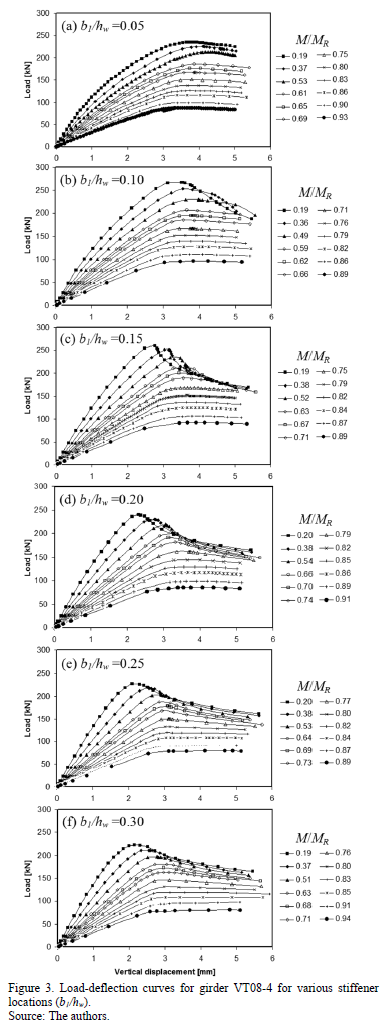
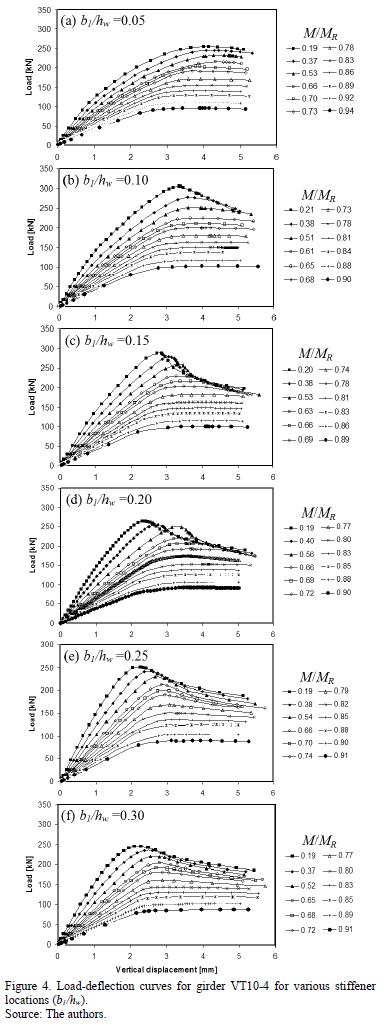
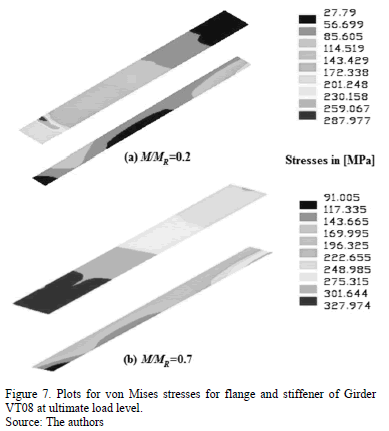
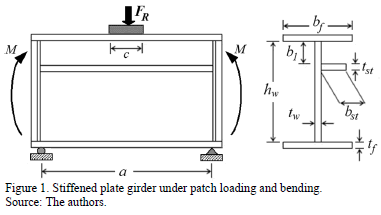
<body><![CDATA[<p><font size="2" face="Verdana, Arial, Helvetica, sans-serif">In current practice, longitudinal stiffeners are primarily  introduced in bridge girder webs in order to increase the resistance to shear  and/or bending. For these two load  types, the influence of longitudinal stiffeners has been extensively investigated  and included in design codes. In order  to account for the interaction between patch loading and bending moments, the  formulae available for unstiffened webs are often used for longitudinally  stiffened girder webs.</font></p>     <p><font size="2" face="Verdana, Arial, Helvetica, sans-serif">Regarding the behavior of longitudinally stiffened girder  webs subjected to combined patch loading and bending only a small number of  tests results is available &#91;1-4&#93;. &#91;1&#93;  showed an increase of 34% in the resistance of stiffened webs with respect to  unstiffened girders. &#91;3&#93; demonstrated  that by using closed section stiffener the increase in ultimate strength can be  of 40%. Similar results were observed by  &#91;4&#93;. Regarding the use of multiple  stiffeners, &#91;2, 4 and 5&#93; showed that the use of two stiffeners placed close to  the loaded flange leads to an increase in patch loading resistance.</font></p>     <p><font size="2" face="Verdana, Arial, Helvetica, sans-serif">Finite element simulations have also been used to gain  more knowledge in this field &#91;4, 6-11&#93;. In particular, the experiments performed recently by &#91;4&#93; were aimed at  investigating the influence of the patch loading length. The results from that investigation showed  that current formulae used for longitudinally stiffened girders underestimate  the patch loading resistance when the patch load length is large. In a similar manner, &#91;9&#93; investigated by mean  of finite element analysis the influence of girder depth and patch load  length. Once again, the results showed  an underestimation of the patch loading resistance when using the current  formulae available in the literature &#91;12&#93;.</font></p>     <p><font size="2" face="Verdana, Arial, Helvetica, sans-serif">A large amount of the research previously mentioned herein  has been aimed at studying the influence of the following parameters: 1)  presence of global bending (ratio between the applied bending moment and the  bending resistance <i>M/M<sub>R</sub></i>);  2) presence of a longitudinal stiffener (unstiffened versus stiffened); 3)  position of a longitudinal stiffener (<i>b<sub>1</sub>/h<sub>w</sub></i>);  and 4) number of longitudinal stiffeners. The main conclusion of the aforementioned research works is that the  presence of global bending reduces the ultimate strength of the webs under  patch loading.</font></p>     <p><font size="2" face="Verdana, Arial, Helvetica, sans-serif">As evaluated by Graciano and Casanova &#91;8&#93;, general  recommendations to estimate the reduction in patch loading resistance due to  the presence of global bending for longitudinally stiffened girders have been  presented in terms of interaction equations. However, the reasons that lead to this reduction are not well  understood. It may be explained by  studying the elastoplastic behavior of the girder components by means of three  variables: 1) the nonlinear load-displacement response, 2) an interaction  surface response, and 3) the plastic strain distribution. In this paper, the girder components are  modelled accounting for elastoplastic material behavior and geometrical  nonlinearities, such as large displacement and initial shape  imperfections. The results obtained from  the FEM simulations are validated against results from full-scale laboratory  experiments. Subsequently, a parametric  study was conducted in order to investigate the influence of the relative  position of the stiffener and the magnitude of the applied bending moment on  the ultimate resistance to patch loading.</font></p>     <p>&nbsp;</p>     <p><font size="3" face="Verdana, Arial, Helvetica, sans-serif"><b>2. Nonlinear   finite element model</b></font></p>     <p><font size="2" face="Verdana, Arial, Helvetica, sans-serif">The nonlinear computations were performed using the finite  element program ANSYS &#91;13&#93;. Shell  elements S181 from the ANSYS element library were used to model the web,  flanges (top and bottom) and the longitudinal stiffener. </font></p>     <p><font size="2" face="Verdana, Arial, Helvetica, sans-serif">This element accounts for finite strain and is suitable  for large strain analysis as well as for complex buckling behavior. For the validation and corresponding  parametric analysis, two girders, namely VT08 and VT10, tested experimentally  &#91;3&#93; were used in the numerical analysis. <a href="#fig01">Fig. 1</a> show the nomenclature used in the analysis, the sub-indexes <i>w</i> and <i>f</i> refer to web and flange, respectively.</font></p>     <p align="center"><font size="2" face="Verdana, Arial, Helvetica, sans-serif"><a name="fig01"></a></font><img src="/img/revistas/dyna/v82n189/v82n189a13fig01.gif"></p>     ]]></body>
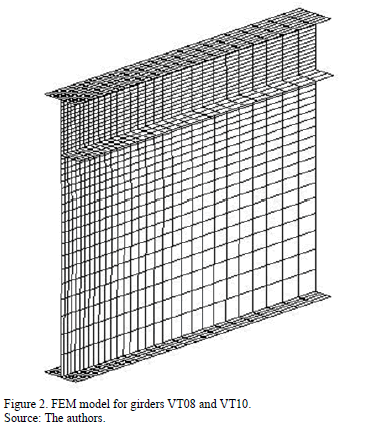
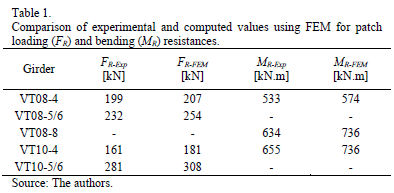
<body><![CDATA[<p><font size="2" face="Verdana, Arial, Helvetica, sans-serif">For Girder VT08 the dimensions were: <i>a </i>=2480 mm; <i>h<sub>w </sub></i>=  1000 mm, <i>t<sub>f </sub></i>= 8.35 mm; <i>b<sub>f </sub></i>= 150 mm, <i>c </i>= 240 mm, <i>b<sub>1 </sub></i>= 200 mm; and the yield strengths for the web and  flanges are <i>f<sub>yw </sub></i>= 358 MPa  and <i>f<sub>yf </sub></i>= 328 MPa. For Girder VT10 the dimensions were basically  the same, except for <i>b<sub>1 </sub></i>=  150 mm; and the material properties <i>f<sub>yw </sub></i>= 380 MPa and <i>f<sub>yf </sub></i>=  275 MPa. When modeling the plate  materials (flange, web and stiffener), these were assumed to have a perfectly  plastic behavior. The Young's modulus  was set to 210 GPa and Poisson's ratio was set to 0.3.</font></p>     <p><font size="2" face="Verdana, Arial, Helvetica, sans-serif">Initially, the FEM model was performed considering only the  patch loading case, thereafter, the combined action of patch loading and  bending were considered. Due to the  symmetry in the geometry, loads and boundary conditions, just one half of each  plate girder was modelled as shown in <a href="#fig02">Fig. 2</a>.</font></p>     <p align="center"><font size="2" face="Verdana, Arial, Helvetica, sans-serif"><a name="fig02"></a></font><img src="/img/revistas/dyna/v82n189/v82n189a13fig02.gif"></p>     <p><font size="2" face="Verdana, Arial, Helvetica, sans-serif">Transverse stiffeners at the end of the plate girder were  modelled by means of rigid body kinematic constraints of the degrees of freedom  located in the corresponding side. &#91;14&#93;  showed that this modeling assumption is only valid for small loading lengths  (i.e., <i>c</i>/<i>a </i>&lt; 0.25). The initial  imperfections were introduced as sine waves in both the longitudinal and  transverse directions, with a maximum amplitude <i>w<sub>o</sub></i> = 7 mm, in agreement with experimentally measured  values reported by &#91;3&#93;. Out-of-plumbness  geometric imperfections &#91;15-16&#93; have not been included in this analysis.</font></p>     <p><font size="2" face="Verdana, Arial, Helvetica, sans-serif">The patch load was transferred into the girder by loading  all the nodes located in the web axis along the loading length <i>c</i>/2 with an equal value force. Displacement constraints were applied to the  loaded nodes in the out-of-plane direction in function of a master node and all  rotations were restrained. This master  node was then displacement controlled in the FE analysis. The nonlinear path of the load-deflection  curve was traced using the modified Riks method &#91;17&#93;.</font></p>     <p><font size="2" face="Verdana, Arial, Helvetica, sans-serif">A convergence analysis was conducted using the ultimate  resistance as parameter to calibrate the model, hence a mesh with 1620 elements  was chosen (see <a href="#fig02">Fig. 2</a>). It is important  to mention that the size of the elements was further reduced in the areas were  the stress gradient was expected to changed. <a href="#tab01">Table 1</a> shows a comparison between  experimental and numerical results for girders VT08 and VT10. Moreover, it can be seen that the difference  in patch loading and bending resistance from the FEM simulations is within 12 %  of the experimentally measured values. It is worth quoting that the bending resistance in this paper is  calculated using FEM simulations of the plate girder subjected to only bending.</font></p>     <p align="center"><font size="2" face="Verdana, Arial, Helvetica, sans-serif"><a name="tab01"></a></font><img src="/img/revistas/dyna/v82n189/v82n189a13tab01.gif"></p>     <p>&nbsp;</p>     <p><font size="3" face="Verdana, Arial, Helvetica, sans-serif"><b>3. Parametric analysis</b></font></p>     <p><font size="2" face="Verdana, Arial, Helvetica, sans-serif">In the previous section the FEM model was validated, and  both the patch loading and bending resistances for girders VT08 and VT10 were  computed numerically. In this section a  parametric analysis is performed to study the influence on the nonlinear  load-displacement response of the relative position of the stiffener (<i>b<sub>1</sub>/h<sub>w</sub></i>), and the magnitude  of the applied bending moment (<i>M/M<sub>R</sub></i>).</font></p>     ]]></body>
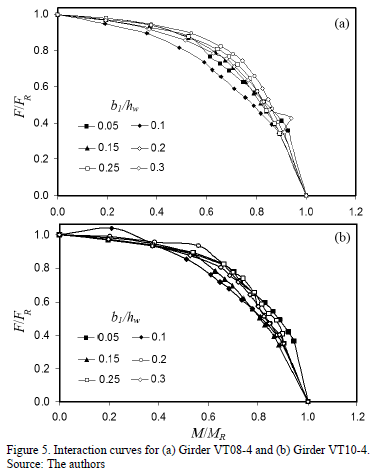
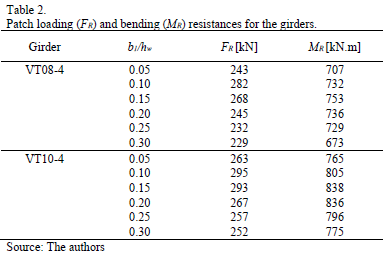
<body><![CDATA[<p><font size="2" face="Verdana, Arial, Helvetica, sans-serif"><b><i>3.1. Influence of  the stiffener position (b<sub>1</sub>/h<sub>w</sub>)</i></b></font></p>     <p><font size="2" face="Verdana, Arial, Helvetica, sans-serif">The relative location of the stiffener was varied from  0.05 <i>h<sub>w</sub></i> to 0.3 <i>h<sub>w</sub></i> for girders VT08 and  VT10. For each location the magnitude of  the applied bending moment was also varied. The nonlinear load-displacement responses of the girders are shown in  <a href="#fig03">Figs. 3</a> and <a href="#fig04">4</a>.</font></p>     <p align="center"><font size="2" face="Verdana, Arial, Helvetica, sans-serif"><a name="fig03"></a></font><img src="/img/revistas/dyna/v82n189/v82n189a13fig03.gif"></p>     <p align="center"><font size="2" face="Verdana, Arial, Helvetica, sans-serif"><a name="fig04"></a></font><img src="/img/revistas/dyna/v82n189/v82n189a13fig04.gif"></p>     <p><font size="2" face="Verdana, Arial, Helvetica, sans-serif">Note that the maximum difference in the load-deflection  curve of the girders for the various stiffener locations is reached at the ultimate  load-state. Also, at the beginning of  loading, the slope of the curves is quite similar. When the stiffener is placed at <i>b<sub>1</sub>/h<sub>w</sub></i> = 0.05  (<a href="#fig03">Figs. 3a</a> and <a href="#fig04">4a</a>) the curves are almost flat in the post-peak range for all the  girders.</font></p>     <p><font size="2" face="Verdana, Arial, Helvetica, sans-serif">For the remaining stiffener locations (0.10 &le; <i>b<sub>1</sub>/h<sub>w </sub></i>&le; 0.30),  once the ultimate strength is achieved, the curves seem to follow a very  similar path, especially in the range 0.19 &le; <i>M/M<sub>R</sub></i> &le; 0.76. After this point the drop in the descending  branch becomes sharper. In addition, for  the stiffeners placed in this range the drop in the load becomes sharper when  the distance <i>b<sub>1</sub></i> from the  loaded flange increases. This is due to  an increase in the sensitivity toward the initial imperfections; <i>i.e.</i> the larger the subpanel formed  between the loaded flange and the stiffener, the greater the influence of the  amplitude of the initial imperfections.</font></p>     <p><font size="2" face="Verdana, Arial, Helvetica, sans-serif">In general, for values of bending moment of <i>M/M<sub>R</sub></i> &ge; 0.76 the curves  are very flat in the post-ultimate range (<a href="#fig03">Figs. 3</a> and <a href="#fig04">4</a>), this behavior is  characteristic of plate girder webs subjected to predominant bending.</font></p>     <p><font size="2" face="Verdana, Arial, Helvetica, sans-serif"><a href="#tab02">Table 2</a> gives a summary of the numerical results of the  patch loading resistance (<i>F<sub>R</sub></i>)  and bending resistance (<i>M<sub>R</sub></i>)  for the various locations of the stiffener. For girders VT08 and VT10 the optimum position  to increase the patch loading resistance is at <i>b<sub>1</sub>/h<sub>w</sub></i> = 0.10. For these girders is important to notice that  the ratio between the patch load length and the girder width (<i>c/a</i>) is equal to 0.1. A wider length makes the buckle under the  loaded flange larger and consequently the crippling area also increases.</font></p>     <p align="center"><font size="2" face="Verdana, Arial, Helvetica, sans-serif"><a name="tab02"></a></font><img src="/img/revistas/dyna/v82n189/v82n189a13tab02.gif"></p> <font size="2" face="Verdana, Arial, Helvetica, sans-serif"><b><i>3.2 Magnitude of the applied bending moment (M/M<sub>R</sub>) </i></b>     <p>The magnitude of the applied bending moment <i>M</i> was varied from 0.19<i> M<sub>R</sub></i> to 0.9<i> M<sub>R</sub></i>. Interaction curves for   Girders VT08 and VT10 subjected to combined patch load and bending moment are   shown in <a href="#fig05">Fig. 5</a> for all the stiffener locations. After analyzing these two figures, the   following conclusions can be drawn: a stiffener placed at <i>b<sub>1</sub>/h<sub>w</sub></i> = 0.20 is better to improve the patch   loading resistance in the presence of global bending in the range <i>M/M<sub>R</sub></i> &le; 0.60   approximately. This position corresponds   also to the optimum of a longitudinal stiffener to increase the critical   buckling load for girders subjected to bending &#91;18&#93;. For larger values of bending the best   location is at <i>b<sub>1</sub>/h<sub>w</sub></i> = 0.05. For this position, the stiffener   is so close to the loaded flange that acts as a very stiff flange composed of  the flange itself, the stiffener and the corresponding subpanel.</p> </font>     ]]></body>
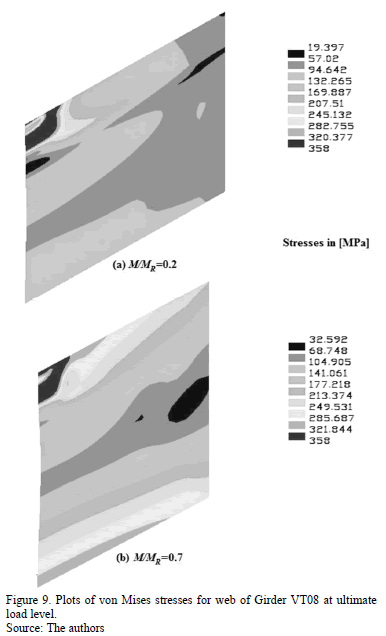
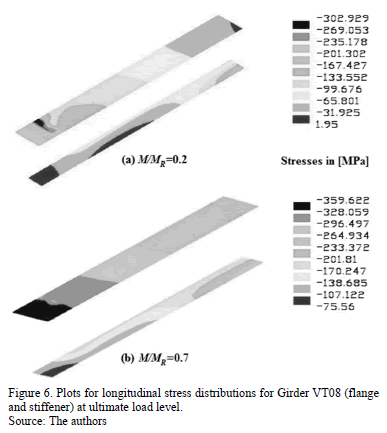
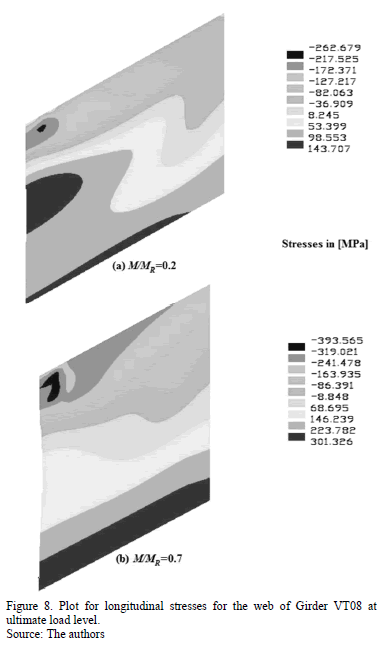
<body><![CDATA[<p align="center"><font size="2" face="Verdana, Arial, Helvetica, sans-serif"><a name="fig05"></a></font><img src="/img/revistas/dyna/v82n189/v82n189a13fig05.gif"></p>     <p>&nbsp;</p>     <p><font size="3" face="Verdana, Arial, Helvetica, sans-serif"><b>4. Numerical   results</b></font></p>     <p><b><font size="2" face="Verdana, Arial, Helvetica, sans-serif"><i>4.1. Structural  behavior of the girder components</i></font></b></p>     <p><font size="2" face="Verdana, Arial, Helvetica, sans-serif">The structural behavior of the girder components can be  better understood by analyzing the contour plots of stress distribution (von Mises  and longitudinal stresses) and plastic strain distribution. The following figures show von Mises stress, longitudinal  stress and plastic strain distributions for girders VT08 and VT10 used for the  parametric analysis. These plots are  calculated for two bending moments (<i>M/M<sub>R</sub></i> = 0.20 and <i>M/M<sub>R</sub></i> = 0.70).</font></p>     <p><font size="2" face="Verdana, Arial, Helvetica, sans-serif"><a href="#fig06">Fig. 6</a> shows the  longitudinal stress distribution for the flange and stiffener of girder VT08 at  ultimate load state at two different levels of bending, 20% and 70% of the  moment resistance <i>M<sub>R</sub></i>.(0.2<i>M<sub>R</sub></i> and 0.7<i>M<sub>R</sub></i>, respectively). As seen in this figure, the maximum  compressive stress in the loaded flange increases of 18%, after increasing the  magnitude of the applied bending moment. A greater increase is observed in minimum stress from 1.95 MPa to -75.56  MPa. Additionally, the stress  distribution is more uniform for the larger bending moment. A similar situation is observed in <a href="#fig07">Fig. 7</a> for  the von Mises stress distribution.</font></p>     <p align="center"><font size="2" face="Verdana, Arial, Helvetica, sans-serif"><a name="fig06"></a></font><img src="/img/revistas/dyna/v82n189/v82n189a13fig06.gif"></p>     <p align="center"><font size="2" face="Verdana, Arial, Helvetica, sans-serif"><a name="fig07"></a></font><img src="/img/revistas/dyna/v82n189/v82n189a13fig07.gif"></p>     <p><font size="2" face="Verdana, Arial, Helvetica, sans-serif">In order to investigate the behavior of the web of girder  VT08, <a href="#fig08">Figs. 8</a> and <a href="#fig09">9</a> show the plots for longitudinal stress and von Mises stress  distributions, respectively. In Fig. 8,  once again the increase in the compressive stresses in the web beneath the  patch load is very large (51%). When the  bending moment increases the stress distribution becomes more uniform with  respect to the neutral axis of the girder, which represents a typical feature  of girder subjected to pure bending. In  Fig. 9, the maximum stress occurs beneath the loaded flange for both cases of  bending. The increase in longitudinal  stresses due to bending is greater in the web than in the flange as observed in  <a href="#fig06">Figs. 6</a> and <a href="#fig08">8</a>.</font></p>     <p align="center"><font size="2" face="Verdana, Arial, Helvetica, sans-serif"><a name="fig08"></a></font><img src="/img/revistas/dyna/v82n189/v82n189a13fig08.gif"></p>     ]]></body>
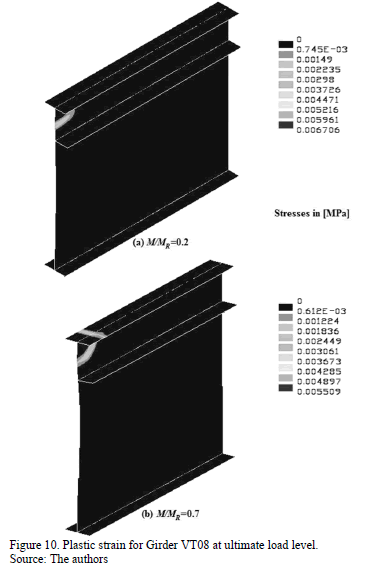
<body><![CDATA[<p align="center"><font size="2" face="Verdana, Arial, Helvetica, sans-serif"><a name="fig09"></a></font><img src="/img/revistas/dyna/v82n189/v82n189a13fig09.gif"></p>     <p><font size="2" face="Verdana, Arial, Helvetica, sans-serif"><a href="#fig10">Fig. 10</a> shows the  plastic strain distribution for the full girder VT08. It is interesting to observe that for the  lower bending moment a yield line appears only in the web (<a href="#fig10">Fig. 10a</a>). For the larger bending moment (<a href="#fig10">Fig. 10b</a>), the  yield lines are fully developed in the web, and also plastic hinges can be  observed in the compression flange.</font></p>     <p align="center"><font size="2" face="Verdana, Arial, Helvetica, sans-serif"><a name="fig10"></a></font><img src="/img/revistas/dyna/v82n189/v82n189a13fig10.gif"></p>     <p><font size="2" face="Verdana, Arial, Helvetica, sans-serif">A similar behavior was  observed for girder VT10. However, the  magnitude of the increase in longitudinal and von Mises stresses was smaller  than for girder VT08. The flange of the  former (t<sub>f</sub> =12mm) is larger than for the latter (t<sub>f</sub> =8mm). Consequently, girder VT10 is able to  withstand effectively the stresses produced by bending.</font></p>     <p><font size="2" face="Verdana, Arial, Helvetica, sans-serif"><a href="#fig10">Fig. 10</a> shows the plastic strain distribution for  girder VT08 at ultimate load level. For  small bending moments (0.2M<sub>R</sub>), the yield lines appear only in the web  plate (<a href="#fig10">Fig. 10a</a>) in the directly loaded subpanel. By increasing the applied bending moment  (0.7M<sub>R</sub>) the plate girder undergoes a larger plastic deformation,  especially in the loaded flange, due mainly to the enhancement in longitudinal  stresses over the compression flange. As  seen in <a href="#fig10">Fig. 10b</a>, a plastic collapse mechanism is fully </font><font size="2" face="Verdana, Arial, Helvetica, sans-serif">developed  in the whole plate girder, i.e. presence of plastic hinges in the loaded flange  and yield lines on the web.</font></p>     <p>&nbsp;</p>     <p><font size="3" face="Verdana, Arial, Helvetica, sans-serif"><b>5. Conclusions</b></font></p>     <p><font size="2" face="Verdana, Arial, Helvetica, sans-serif">The elastoplastic behavior of longitudinally stiffened  girder webs under patch loading and bending was studied herein by means of the  finite element method. The results show  that an increase of the applied bending moment causes an increase in the  magnitude of the longitudinal stresses in the girder components (loaded flange,  web and even the stiffener). This  increase in the longitudinal stresses leads to a reduction in the patch loading  resistance. In the web the stress  distribution becomes more uniform in the presence of bending.</font></p>     <p><font size="2" face="Verdana, Arial, Helvetica, sans-serif">It was demonstrated that, for large bending moments the  best location to increase patch loading resistance of the stiffener is within <i>b<sub>1</sub>/h<sub>w</sub></i> =0.20 and <i>b<sub>1</sub>/h<sub>w</sub></i> =0.25, which  also corresponds to the optimum position of a longitudinal stiffener to  increase the critical buckling load.</font></p>     <p>&nbsp;</p>     ]]></body>
<body><![CDATA[<p><font size="3" face="Verdana, Arial, Helvetica, sans-serif"><b>References</b></font></p>     <!-- ref --><p><font size="2" face="Verdana, Arial, Helvetica, sans-serif"><b>&#91;1&#93;</b> Galea, Y., Godart, B., Radouant, I. and  Raoul, J., Test of buckling of panels subject to in-plane patch loading, Proceedings  of the ECCS Colloquium on Stability of Plate and Shell Structures, Ghent  University, pp. 65-71, 1987.    &nbsp;&nbsp;&nbsp;&nbsp;&nbsp;&nbsp;&nbsp;&nbsp;[&#160;<a href="javascript:void(0);" onclick="javascript: window.open('/scielo.php?script=sci_nlinks&ref=000074&pid=S0012-7353201500010001300001&lng=','','width=640,height=500,resizable=yes,scrollbars=1,menubar=yes,');">Links</a>&#160;]<!-- end-ref --></font></p>     <!-- ref --><p><font size="2" face="Verdana, Arial, Helvetica, sans-serif"><b>&#91;2&#93;</b> Shimizu, S. Belgium,, Yoshida, S. and  Okuhara, H., An experimental study on patch loaded web plates, Proceedings of  the ECCS Colloquium on Stability of Plate and Shell Structures, Ghent  University, Belgium, pp. 85-94, 1987.    &nbsp;&nbsp;&nbsp;&nbsp;&nbsp;&nbsp;&nbsp;&nbsp;[&#160;<a href="javascript:void(0);" onclick="javascript: window.open('/scielo.php?script=sci_nlinks&ref=000076&pid=S0012-7353201500010001300002&lng=','','width=640,height=500,resizable=yes,scrollbars=1,menubar=yes,');">Links</a>&#160;]<!-- end-ref --></font></p>     <!-- ref --><p><font size="2" face="Verdana, Arial, Helvetica, sans-serif"><b>&#91;3&#93;</b> Dubas, P. and Tschamper, H., Stabilit&eacute;  des âmes soumises à une charge concentr&eacute;e et à une flexion globale.  Construction M&eacute;tallique, 2, pp. 25-39, 1990.    &nbsp;&nbsp;&nbsp;&nbsp;&nbsp;&nbsp;&nbsp;&nbsp;[&#160;<a href="javascript:void(0);" onclick="javascript: window.open('/scielo.php?script=sci_nlinks&ref=000078&pid=S0012-7353201500010001300003&lng=','','width=640,height=500,resizable=yes,scrollbars=1,menubar=yes,');">Links</a>&#160;]<!-- end-ref --></font></p>     <!-- ref --><p><font size="2" face="Verdana, Arial, Helvetica, sans-serif"><b>&#91;4&#93;</b> Kuhlmann, U. and Seitz, M.,  Longitudinally stiffened girder webs subjected to patch loading, Proceedings of Steel Bridge - An  International Symposium on Steel Bridges, Millau, France, 2004.    &nbsp;&nbsp;&nbsp;&nbsp;&nbsp;&nbsp;&nbsp;&nbsp;[&#160;<a href="javascript:void(0);" onclick="javascript: window.open('/scielo.php?script=sci_nlinks&ref=000080&pid=S0012-7353201500010001300004&lng=','','width=640,height=500,resizable=yes,scrollbars=1,menubar=yes,');">Links</a>&#160;]<!-- end-ref --></font></p>     <!-- ref --><p><font size="2" face="Verdana, Arial, Helvetica, sans-serif"><b>&#91;5&#93;</b> Benedetti, A. and Dall'Aglio, F., Patch  loading of longitudinally stiffened webs. Bridge maintenance, safety,  management, resilience and sustainability: Proceedings of the Sixth International IABMAS Conference, Stresa,  Lake Maggiore, Italy, pp. 1039-1046, 2012.    &nbsp;&nbsp;&nbsp;&nbsp;&nbsp;&nbsp;&nbsp;&nbsp;[&#160;<a href="javascript:void(0);" onclick="javascript: window.open('/scielo.php?script=sci_nlinks&ref=000082&pid=S0012-7353201500010001300005&lng=','','width=640,height=500,resizable=yes,scrollbars=1,menubar=yes,');">Links</a>&#160;]<!-- end-ref --></font></p>     <!-- ref --><p><font size="2" face="Verdana, Arial, Helvetica, sans-serif"><b>&#91;6&#93;</b> Shimizu, S., The collapse behaviour of  web plates on the launching shoe. Journal of Constructional Steel Research, 31 (1),  pp. 59-72, 1994. <a href="http://dx.doi.org/10.1016/0143-974X(94)90023-X" target="_blank">http://dx.doi.org/10.1016/0143-974X(94)90023-X</a></font>&nbsp;&nbsp;&nbsp;&nbsp;&nbsp;&nbsp;&nbsp;&nbsp;[&#160;<a href="javascript:void(0);" onclick="javascript: window.open('/scielo.php?script=sci_nlinks&ref=000084&pid=S0012-7353201500010001300006&lng=','','width=640,height=500,resizable=yes,scrollbars=1,menubar=yes,');">Links</a>&#160;]<!-- end-ref --><!-- ref --><p><font size="2" face="Verdana, Arial, Helvetica, sans-serif"><b>&#91;7&#93;</b> Dogaki, M., Nishijima, Y. and Yonezawa,  H., Nonlinear behaviour of longitudinally stiffened webs in combined patch  loading and bending, Proceedings of Constructional Steel Design, World Developments, pp. 141-150, 1992.    &nbsp;&nbsp;&nbsp;&nbsp;&nbsp;&nbsp;&nbsp;&nbsp;[&#160;<a href="javascript:void(0);" onclick="javascript: window.open('/scielo.php?script=sci_nlinks&ref=000085&pid=S0012-7353201500010001300007&lng=','','width=640,height=500,resizable=yes,scrollbars=1,menubar=yes,');">Links</a>&#160;]<!-- end-ref --></font></p>     <!-- ref --><p><font size="2" face="Verdana, Arial, Helvetica, sans-serif"><b>&#91;8&#93;</b> Graciano, C. and Casanova, E., Ultimate  strength of longitudinally stiffened I-girder webs subjected to combined patch  loading and bending. <i>Journal of  Constructional Steel Research</i>, vol. 61(1), pp. 93-111, 2005.  <a href="http://dx.doi.org/10.1016/j.jcsr.2004.07.006" target="_blank">http://dx.doi.org/10.1016/j.jcsr.2004.07.006</a></font>&nbsp;&nbsp;&nbsp;&nbsp;&nbsp;&nbsp;&nbsp;&nbsp;[&#160;<a href="javascript:void(0);" onclick="javascript: window.open('/scielo.php?script=sci_nlinks&ref=000087&pid=S0012-7353201500010001300008&lng=','','width=640,height=500,resizable=yes,scrollbars=1,menubar=yes,');">Links</a>&#160;]<!-- end-ref --><!-- ref --><p><font size="2" face="Verdana, Arial, Helvetica, sans-serif"><b>&#91;9&#93;</b> Davaine, L., Raoul, J. and Aribert, J.M.,  Patch load resistance of longitudinally stiffened bridge girders, Proceedings of Steel Bridge - An  International Symposium on Steel Bridges, Millau, France, 2004.    &nbsp;&nbsp;&nbsp;&nbsp;&nbsp;&nbsp;&nbsp;&nbsp;[&#160;<a href="javascript:void(0);" onclick="javascript: window.open('/scielo.php?script=sci_nlinks&ref=000088&pid=S0012-7353201500010001300009&lng=','','width=640,height=500,resizable=yes,scrollbars=1,menubar=yes,');">Links</a>&#160;]<!-- end-ref --></font></p>     <!-- ref --><p><font size="2" face="Verdana, Arial, Helvetica, sans-serif"><b>&#91;10&#93;</b> Seitz, M., Tragverhalten langsversteifter  Blechtrager unter quergerichteter Krafteinleitung, Ph.D. Thesis dissertation,  Stuttgart University, Stuttgart, Germany, 2005.    &nbsp;&nbsp;&nbsp;&nbsp;&nbsp;&nbsp;&nbsp;&nbsp;[&#160;<a href="javascript:void(0);" onclick="javascript: window.open('/scielo.php?script=sci_nlinks&ref=000090&pid=S0012-7353201500010001300010&lng=','','width=640,height=500,resizable=yes,scrollbars=1,menubar=yes,');">Links</a>&#160;]<!-- end-ref --></font></p>     <!-- ref --><p><font size="2" face="Verdana, Arial, Helvetica, sans-serif"><b>&#91;11&#93;</b> Braun, B. and Kuhlmann, U., The interaction  behaviour of steel plates under transverse loading, bending moment and shear  force, Proceedings of SDSS Rio  2010: International Colloquium Stability and Ductility of Steel Structures, Rio  de Janeiro; Brazil, 2, pp. 731-738, 2010.    &nbsp;&nbsp;&nbsp;&nbsp;&nbsp;&nbsp;&nbsp;&nbsp;[&#160;<a href="javascript:void(0);" onclick="javascript: window.open('/scielo.php?script=sci_nlinks&ref=000092&pid=S0012-7353201500010001300011&lng=','','width=640,height=500,resizable=yes,scrollbars=1,menubar=yes,');">Links</a>&#160;]<!-- end-ref --></font></p>     <!-- ref --><p><font size="2" face="Verdana, Arial, Helvetica, sans-serif"><b>&#91;12&#93;</b> Graciano, C., Strength of longitudinally  stiffened webs subjected to concentrated loading. Journal of Structural Engineering,  131 (2), pp. 268-278, 2005.  <a href="http://dx.doi.org/10.1061/(ASCE)0733-9445(2005)131:2(268)" target="_blank">http://dx.doi.org/10.1061/(ASCE)0733-9445(2005)131:2(268)</a></font>&nbsp;&nbsp;&nbsp;&nbsp;&nbsp;&nbsp;&nbsp;&nbsp;[&#160;<a href="javascript:void(0);" onclick="javascript: window.open('/scielo.php?script=sci_nlinks&ref=000094&pid=S0012-7353201500010001300012&lng=','','width=640,height=500,resizable=yes,scrollbars=1,menubar=yes,');">Links</a>&#160;]<!-- end-ref --><!-- ref --><p><font size="2" face="Verdana, Arial, Helvetica, sans-serif"><b>&#91;13&#93;</b> ANSYS, Inc. Elements Reference. Release  12.1. Canonsburg, USA. 2009. pp. 1688.    &nbsp;&nbsp;&nbsp;&nbsp;&nbsp;&nbsp;&nbsp;&nbsp;[&#160;<a href="javascript:void(0);" onclick="javascript: window.open('/scielo.php?script=sci_nlinks&ref=000095&pid=S0012-7353201500010001300013&lng=','','width=640,height=500,resizable=yes,scrollbars=1,menubar=yes,');">Links</a>&#160;]<!-- end-ref --></font></p>     <!-- ref --><p><font size="2" face="Verdana, Arial, Helvetica, sans-serif"><b>&#91;14&#93;</b> Graciano, C., Mendez, J. and Zapata-Medina,  D., Influence of the boundary conditions on FE-modeling of longitudinally  stiff-ened I-girders subjected to concentrated loads. Rev. Fac. Ing. Univ.  Antioquia, 71, pp. 221-229, 2014.    &nbsp;&nbsp;&nbsp;&nbsp;&nbsp;&nbsp;&nbsp;&nbsp;[&#160;<a href="javascript:void(0);" onclick="javascript: window.open('/scielo.php?script=sci_nlinks&ref=000097&pid=S0012-7353201500010001300014&lng=','','width=640,height=500,resizable=yes,scrollbars=1,menubar=yes,');">Links</a>&#160;]<!-- end-ref --></font></p>     <!-- ref --><p><font size="2" face="Verdana, Arial, Helvetica, sans-serif"><b>&#91;15&#93;</b> Aristizabal-Ochoa, J., Induced moments and  lateral deflections in columns with initial imperfections and semirigid  connections: I. Theory. DYNA, 79 (172), pp. 7-17, 2012</font>&nbsp;&nbsp;&nbsp;&nbsp;&nbsp;&nbsp;&nbsp;&nbsp;[&#160;<a href="javascript:void(0);" onclick="javascript: window.open('/scielo.php?script=sci_nlinks&ref=000099&pid=S0012-7353201500010001300015&lng=','','width=640,height=500,resizable=yes,scrollbars=1,menubar=yes,');">Links</a>&#160;]<!-- end-ref --><!-- ref --><p><font size="2" face="Verdana, Arial, Helvetica, sans-serif"><b>&#91;16&#93;</b> Aristizabal-Ochoa, J., Induced moments and  lateral deflections in columns with initial imperfections and semirigid  connections: II. Verification and examples. DYNA, vol. 79 (172), pp. 18-28,  2012</font>&nbsp;&nbsp;&nbsp;&nbsp;&nbsp;&nbsp;&nbsp;&nbsp;[&#160;<a href="javascript:void(0);" onclick="javascript: window.open('/scielo.php?script=sci_nlinks&ref=000100&pid=S0012-7353201500010001300016&lng=','','width=640,height=500,resizable=yes,scrollbars=1,menubar=yes,');">Links</a>&#160;]<!-- end-ref --><!-- ref --><p><font size="2" face="Verdana, Arial, Helvetica, sans-serif"><b>&#91;17&#93;</b> Riks, E., An incremental approach to the  solution of snapping and buckling problems. International Journal of Solids and  Structures, vol. 15(7), pp. 529-551, 1979.  <a href="http://dx.doi.org/10.1016/0020-7683(79)90081-7" target="_blank">http://dx.doi.org/10.1016/0020-7683(79)90081-7</a></font>&nbsp;&nbsp;&nbsp;&nbsp;&nbsp;&nbsp;&nbsp;&nbsp;[&#160;<a href="javascript:void(0);" onclick="javascript: window.open('/scielo.php?script=sci_nlinks&ref=000101&pid=S0012-7353201500010001300017&lng=','','width=640,height=500,resizable=yes,scrollbars=1,menubar=yes,');">Links</a>&#160;]<!-- end-ref --><!-- ref --><p><font size="2" face="Verdana, Arial, Helvetica, sans-serif"><b>&#91;18&#93;</b> Rockey K.C. and Leggett, D.M.A., The  buckling of a plate girder web under pure bending when reinforced by a single  longitudinal stiffener. ICE Proceedings, 21 (1), pp. 161-188, 1962.    &nbsp;&nbsp;&nbsp;&nbsp;&nbsp;&nbsp;&nbsp;&nbsp;[&#160;<a href="javascript:void(0);" onclick="javascript: window.open('/scielo.php?script=sci_nlinks&ref=000102&pid=S0012-7353201500010001300018&lng=','','width=640,height=500,resizable=yes,scrollbars=1,menubar=yes,');">Links</a>&#160;]<!-- end-ref --></font></p>     <p>&nbsp;</p>     <p><font size="2" face="Verdana, Arial, Helvetica, sans-serif"><b>C. Graciano,</b> received Bs. in 1992 and MSc. in 1995, both in Mechanical Engineering from the  Simon Bolivar University, Venezuela. He  later moved to Sweden where he obtained a Licentiate of Engineering in 2001 and  a PhD. in 2002 in Structural Engineering from Chalmers University of Technology  and Luleå University of Technology, Sweden, respectively. From 1997 to 2013, he served as Assistant,  Associate and Full Professor in the Mechanical Engineering Department at the  Simon Bolivar University, Venezuela. Currently,  he is an Associate Professor in the Civil Engineering Department in the Facultad  de Minas at the Universidad Nacional de Colombia, Medellin campus, Colombia. His research interests include: finite element  modeling, structural stability, piping stress analysis and crashworthiness  among others.</font></p>     <p><font size="2" face="Verdana, Arial, Helvetica, sans-serif"><b>E. Casanova,</b> received BS. in 1990 and MS. in 1996, both in Mechanical Engineering from the  Simon Bolivar University, Venezuela. He  later moved to France where he obtained a PhD in 2002 in Numerical modeling in Mechanical  Engineering from Universit&eacute; de Technologie de Compiègne, France. Currently, he is an Associate Professor in  the Mechanical Engineering Department at the Simon Bolivar University,  Venezuela. His research interests  include the study of the influence of uncertainties (i.e., material properties,  geometry, boundary conditions, etc.) on the numerical modeling of different  mechanical systems.</font></p>     <p><font size="2" face="Verdana, Arial, Helvetica, sans-serif"><b>D.G.  Zapata-Medina, </b>received a BS. in 2004 in Civil Engineering from the Universidad  Nacional de Colombia, Medellin campus, Colombia, a MSc. in 2007 in Geotechnical  Engineering from the University of Kentucky, USA and a PhD. in 2012 in  Geotechnics from Northwestern University, USA. Currently, he is an Assistant  Professor in the Civil Engineering Department, in the Facultad de Minas at the Universidad  Nacional de Colombia, Medellin campus, Colombia. His research interests include: soil  characterization and constitutive soil modeling for geotechnical earthquake  engineering applications; field instrumentation, numerical simulation and  performance evaluation of earth retaining structures; and analytical and  numerical solutions to calculate the static and dynamic stability of soil-structure  interaction problems.</font></p>      ]]></body><back>
<ref-list>
<ref id="B1">
<label>1</label><nlm-citation citation-type="confpro">
<person-group person-group-type="author">
<name>
<surname><![CDATA[Galea]]></surname>
<given-names><![CDATA[Y.]]></given-names>
</name>
<name>
<surname><![CDATA[Godart]]></surname>
<given-names><![CDATA[B.]]></given-names>
</name>
<name>
<surname><![CDATA[Radouant]]></surname>
<given-names><![CDATA[I.]]></given-names>
</name>
<name>
<surname><![CDATA[Raoul]]></surname>
<given-names><![CDATA[J.]]></given-names>
</name>
</person-group>
<article-title xml:lang="en"><![CDATA[Test of buckling of panels subject to in-plane patch loading]]></article-title>
<source><![CDATA[]]></source>
<year>1987</year>
<conf-name><![CDATA[ ECCS Colloquium on Stability of Plate and Shell Structures]]></conf-name>
<conf-loc> </conf-loc>
<page-range>65-71</page-range></nlm-citation>
</ref>
<ref id="B2">
<label>2</label><nlm-citation citation-type="confpro">
<person-group person-group-type="author">
<name>
<surname><![CDATA[Shimizu]]></surname>
<given-names><![CDATA[S.]]></given-names>
</name>
<name>
<surname><![CDATA[Belgium]]></surname>
</name>
<name>
<surname><![CDATA[Yoshida]]></surname>
<given-names><![CDATA[S.]]></given-names>
</name>
<name>
<surname><![CDATA[Okuhara]]></surname>
<given-names><![CDATA[H.]]></given-names>
</name>
</person-group>
<article-title xml:lang="en"><![CDATA[An experimental study on patch loaded web plates]]></article-title>
<source><![CDATA[]]></source>
<year>1987</year>
<conf-name><![CDATA[ ECCS Colloquium on Stability of Plate and Shell Structures]]></conf-name>
<conf-loc> </conf-loc>
<page-range>85-94</page-range><publisher-name><![CDATA[Belgium]]></publisher-name>
</nlm-citation>
</ref>
<ref id="B3">
<label>3</label><nlm-citation citation-type="journal">
<person-group person-group-type="author">
<name>
<surname><![CDATA[Dubas]]></surname>
<given-names><![CDATA[P.]]></given-names>
</name>
<name>
<surname><![CDATA[Tschamper]]></surname>
<given-names><![CDATA[H.]]></given-names>
</name>
</person-group>
<article-title xml:lang="fr"><![CDATA[Stabilité des âmes soumises à une charge concentrée et à une flexion globale]]></article-title>
<source><![CDATA[Construction Métallique]]></source>
<year>1990</year>
<numero>2</numero>
<issue>2</issue>
<page-range>25-39</page-range></nlm-citation>
</ref>
<ref id="B4">
<label>4</label><nlm-citation citation-type="confpro">
<person-group person-group-type="author">
<name>
<surname><![CDATA[Kuhlmann]]></surname>
<given-names><![CDATA[U.]]></given-names>
</name>
<name>
<surname><![CDATA[Seitz]]></surname>
<given-names><![CDATA[M.]]></given-names>
</name>
</person-group>
<article-title xml:lang="en"><![CDATA[Longitudinally stiffened girder webs subjected to patch loading]]></article-title>
<source><![CDATA[]]></source>
<year></year>
<conf-name><![CDATA[ Steel Bridge - An International Symposium on Steel Bridges]]></conf-name>
<conf-date>2004</conf-date>
<conf-loc>Millau </conf-loc>
</nlm-citation>
</ref>
<ref id="B5">
<label>5</label><nlm-citation citation-type="confpro">
<person-group person-group-type="author">
<name>
<surname><![CDATA[Benedetti]]></surname>
<given-names><![CDATA[A.]]></given-names>
</name>
<name>
<surname><![CDATA[Dall'Aglio]]></surname>
<given-names><![CDATA[F.]]></given-names>
</name>
</person-group>
<article-title xml:lang="en"><![CDATA[Patch loading of longitudinally stiffened webs: Bridge maintenance, safety, management, resilience and sustainability]]></article-title>
<source><![CDATA[]]></source>
<year>2012</year>
<conf-name><![CDATA[Sixth International IABMAS Conference]]></conf-name>
<conf-loc>Stresa Lake Maggiore</conf-loc>
<page-range>1039-1046</page-range></nlm-citation>
</ref>
<ref id="B6">
<label>6</label><nlm-citation citation-type="journal">
<person-group person-group-type="author">
<name>
<surname><![CDATA[Shimizu]]></surname>
<given-names><![CDATA[S.]]></given-names>
</name>
</person-group>
<article-title xml:lang="en"><![CDATA[The collapse behaviour of web plates on the launching shoe]]></article-title>
<source><![CDATA[Journal of Constructional Steel Research]]></source>
<year>1994</year>
<volume>31</volume>
<numero>1</numero>
<issue>1</issue>
<page-range>59-72</page-range></nlm-citation>
</ref>
<ref id="B7">
<label>7</label><nlm-citation citation-type="confpro">
<person-group person-group-type="author">
<name>
<surname><![CDATA[Dogaki]]></surname>
<given-names><![CDATA[M.]]></given-names>
</name>
<name>
<surname><![CDATA[Nishijima]]></surname>
<given-names><![CDATA[Y.]]></given-names>
</name>
<name>
<surname><![CDATA[Yonezawa]]></surname>
<given-names><![CDATA[H.]]></given-names>
</name>
</person-group>
<article-title xml:lang="en"><![CDATA[Nonlinear behaviour of longitudinally stiffened webs in combined patch loading and bending]]></article-title>
<source><![CDATA[]]></source>
<year>1992</year>
<conf-name><![CDATA[ Constructional Steel Design, World Developments]]></conf-name>
<conf-loc> </conf-loc>
<page-range>141-150</page-range></nlm-citation>
</ref>
<ref id="B8">
<label>8</label><nlm-citation citation-type="journal">
<person-group person-group-type="author">
<name>
<surname><![CDATA[Graciano]]></surname>
<given-names><![CDATA[C.]]></given-names>
</name>
<name>
<surname><![CDATA[Casanova]]></surname>
<given-names><![CDATA[E.]]></given-names>
</name>
</person-group>
<article-title xml:lang="en"><![CDATA[Ultimate strength of longitudinally stiffened I-girder webs subjected to combined patch loading and bending]]></article-title>
<source><![CDATA[Journal of Constructional Steel Research]]></source>
<year>2005</year>
<volume>61</volume>
<numero>1</numero>
<issue>1</issue>
<page-range>93-111</page-range></nlm-citation>
</ref>
<ref id="B9">
<label>9</label><nlm-citation citation-type="confpro">
<person-group person-group-type="author">
<name>
<surname><![CDATA[Davaine]]></surname>
<given-names><![CDATA[L.]]></given-names>
</name>
<name>
<surname><![CDATA[Raoul]]></surname>
<given-names><![CDATA[J.]]></given-names>
</name>
<name>
<surname><![CDATA[Aribert]]></surname>
<given-names><![CDATA[J.M.]]></given-names>
</name>
</person-group>
<article-title xml:lang="en"><![CDATA[Patch load resistance of longitudinally stiffened bridge girders]]></article-title>
<source><![CDATA[]]></source>
<year></year>
<conf-name><![CDATA[ Steel Bridge - An International Symposium on Steel Bridges]]></conf-name>
<conf-date>2004</conf-date>
<conf-loc>Millau </conf-loc>
</nlm-citation>
</ref>
<ref id="B10">
<label>10</label><nlm-citation citation-type="">
<person-group person-group-type="author">
<name>
<surname><![CDATA[Seitz]]></surname>
<given-names><![CDATA[M.]]></given-names>
</name>
</person-group>
<source><![CDATA[Tragverhalten langsversteifter Blechtrager unter quergerichteter Krafteinleitung]]></source>
<year></year>
</nlm-citation>
</ref>
<ref id="B11">
<label>11</label><nlm-citation citation-type="confpro">
<person-group person-group-type="author">
<name>
<surname><![CDATA[Braun]]></surname>
<given-names><![CDATA[B.]]></given-names>
</name>
<name>
<surname><![CDATA[Kuhlmann]]></surname>
<given-names><![CDATA[U.]]></given-names>
</name>
</person-group>
<article-title xml:lang="en"><![CDATA[The interaction behaviour of steel plates under transverse loading, bending moment and shear force]]></article-title>
<source><![CDATA[]]></source>
<year>2010</year>
<volume>2</volume>
<conf-name><![CDATA[ SDSS Rio 2010: International Colloquium Stability and Ductility of Steel Structures]]></conf-name>
<conf-loc>Rio de Janeiro </conf-loc>
<page-range>731-738</page-range></nlm-citation>
</ref>
<ref id="B12">
<label>12</label><nlm-citation citation-type="journal">
<person-group person-group-type="author">
<name>
<surname><![CDATA[Graciano]]></surname>
<given-names><![CDATA[C.]]></given-names>
</name>
</person-group>
<article-title xml:lang="en"><![CDATA[Strength of longitudinally stiffened webs subjected to concentrated loading]]></article-title>
<source><![CDATA[Journal of Structural Engineering]]></source>
<year>2005</year>
<volume>131</volume>
<numero>2</numero>
<issue>2</issue>
<page-range>268-278</page-range></nlm-citation>
</ref>
<ref id="B13">
<label>13</label><nlm-citation citation-type="">
<collab>ANSYS, Inc.</collab>
<source><![CDATA[Elements Reference: Release 12.1]]></source>
<year>2009</year>
<publisher-loc><![CDATA[Canonsburg ]]></publisher-loc>
</nlm-citation>
</ref>
<ref id="B14">
<label>14</label><nlm-citation citation-type="journal">
<person-group person-group-type="author">
<name>
<surname><![CDATA[Graciano]]></surname>
<given-names><![CDATA[C.]]></given-names>
</name>
<name>
<surname><![CDATA[Mendez]]></surname>
<given-names><![CDATA[J.]]></given-names>
</name>
<name>
<surname><![CDATA[Zapata-Medina]]></surname>
<given-names><![CDATA[D.]]></given-names>
</name>
</person-group>
<article-title xml:lang="en"><![CDATA[Influence of the boundary conditions on FE-modeling of longitudinally stiff-ened I-girders subjected to concentrated loads]]></article-title>
<source><![CDATA[Rev. Fac. Ing. Univ. Antioquia]]></source>
<year>2014</year>
<numero>71</numero>
<issue>71</issue>
<page-range>221-229</page-range></nlm-citation>
</ref>
<ref id="B15">
<label>15</label><nlm-citation citation-type="journal">
<person-group person-group-type="author">
<name>
<surname><![CDATA[Aristizabal-Ochoa]]></surname>
<given-names><![CDATA[J.]]></given-names>
</name>
</person-group>
<article-title xml:lang="en"><![CDATA[Induced moments and lateral deflections in columns with initial imperfections and semirigid connections: I. Theory]]></article-title>
<source><![CDATA[DYNA]]></source>
<year>2012</year>
<volume>79</volume>
<numero>172</numero>
<issue>172</issue>
<page-range>7-17</page-range></nlm-citation>
</ref>
<ref id="B16">
<label>16</label><nlm-citation citation-type="journal">
<person-group person-group-type="author">
<name>
<surname><![CDATA[Aristizabal-Ochoa]]></surname>
<given-names><![CDATA[J.]]></given-names>
</name>
</person-group>
<article-title xml:lang="en"><![CDATA[Induced moments and lateral deflections in columns with initial imperfections and semirigid connections: II. Verification and examples]]></article-title>
<source><![CDATA[DYNA]]></source>
<year>2012</year>
<volume>79</volume>
<numero>172</numero>
<issue>172</issue>
<page-range>18-28</page-range></nlm-citation>
</ref>
<ref id="B17">
<label>17</label><nlm-citation citation-type="journal">
<person-group person-group-type="author">
<name>
<surname><![CDATA[Riks]]></surname>
<given-names><![CDATA[E.]]></given-names>
</name>
</person-group>
<article-title xml:lang="en"><![CDATA[An incremental approach to the solution of snapping and buckling problems]]></article-title>
<source><![CDATA[International Journal of Solids and Structures]]></source>
<year>1979</year>
<volume>15</volume>
<numero>7</numero>
<issue>7</issue>
<page-range>529-551</page-range></nlm-citation>
</ref>
<ref id="B18">
<label>18</label><nlm-citation citation-type="journal">
<person-group person-group-type="author">
<name>
<surname><![CDATA[Rockey]]></surname>
<given-names><![CDATA[K.C.]]></given-names>
</name>
<name>
<surname><![CDATA[Leggett]]></surname>
<given-names><![CDATA[D.M.A.]]></given-names>
</name>
</person-group>
<article-title xml:lang="en"><![CDATA[The buckling of a plate girder web under pure bending when reinforced by a single longitudinal stiffener]]></article-title>
<source><![CDATA[ICE Proceedings]]></source>
<year>1962</year>
<volume>21</volume>
<numero>1</numero>
<issue>1</issue>
<page-range>161-188</page-range></nlm-citation>
</ref>
</ref-list>
</back>
</article>