<?xml version="1.0" encoding="ISO-8859-1"?><article xmlns:mml="http://www.w3.org/1998/Math/MathML" xmlns:xlink="http://www.w3.org/1999/xlink" xmlns:xsi="http://www.w3.org/2001/XMLSchema-instance">
<front>
<journal-meta>
<journal-id>0012-7353</journal-id>
<journal-title><![CDATA[DYNA]]></journal-title>
<abbrev-journal-title><![CDATA[Dyna rev.fac.nac.minas]]></abbrev-journal-title>
<issn>0012-7353</issn>
<publisher>
<publisher-name><![CDATA[Universidad Nacional de Colombia]]></publisher-name>
</publisher>
</journal-meta>
<article-meta>
<article-id>S0012-73532015000100016</article-id>
<article-id pub-id-type="doi">10.15446/dyna.v82n189.42461</article-id>
<title-group>
<article-title xml:lang="en"><![CDATA[Analysis of hydrogen production by anaerobic fermentation from urban organic waste]]></article-title>
<article-title xml:lang="es"><![CDATA[Análisis de la producción de hidrógeno por fermentación anaerobia de residuos orgánicos urbanos]]></article-title>
</title-group>
<contrib-group>
<contrib contrib-type="author">
<name>
<surname><![CDATA[Moreno-Cárdenas]]></surname>
<given-names><![CDATA[Edilson León]]></given-names>
</name>
<xref ref-type="aff" rid="A01"/>
</contrib>
<contrib contrib-type="author">
<name>
<surname><![CDATA[Zapata-Zapata]]></surname>
<given-names><![CDATA[Arley David]]></given-names>
</name>
<xref ref-type="aff" rid="A02"/>
</contrib>
<contrib contrib-type="author">
<name>
<surname><![CDATA[Álvarez-Mejía]]></surname>
<given-names><![CDATA[Fernando]]></given-names>
</name>
<xref ref-type="aff" rid="A03"/>
</contrib>
</contrib-group>
<aff id="A01">
<institution><![CDATA[,Universidad Nacional de Colombia Facultad de Ciencias Agrarias ]]></institution>
<addr-line><![CDATA[Medellín ]]></addr-line>
<country>Colombia</country>
</aff>
<aff id="A02">
<institution><![CDATA[,Universidad Nacional de Colombia Facultad de Ciencias ]]></institution>
<addr-line><![CDATA[Medellín ]]></addr-line>
<country>Colombia</country>
</aff>
<aff id="A03">
<institution><![CDATA[,Universidad Nacional de Colombia Facultad de Ciencias Agrarias ]]></institution>
<addr-line><![CDATA[Medellín ]]></addr-line>
<country>Colombia</country>
</aff>
<pub-date pub-type="pub">
<day>00</day>
<month>02</month>
<year>2015</year>
</pub-date>
<pub-date pub-type="epub">
<day>00</day>
<month>02</month>
<year>2015</year>
</pub-date>
<volume>82</volume>
<numero>189</numero>
<fpage>127</fpage>
<lpage>133</lpage>
<copyright-statement/>
<copyright-year/>
<self-uri xlink:href="http://www.scielo.org.co/scielo.php?script=sci_arttext&amp;pid=S0012-73532015000100016&amp;lng=en&amp;nrm=iso"></self-uri><self-uri xlink:href="http://www.scielo.org.co/scielo.php?script=sci_abstract&amp;pid=S0012-73532015000100016&amp;lng=en&amp;nrm=iso"></self-uri><self-uri xlink:href="http://www.scielo.org.co/scielo.php?script=sci_pdf&amp;pid=S0012-73532015000100016&amp;lng=en&amp;nrm=iso"></self-uri><abstract abstract-type="short" xml:lang="en"><p><![CDATA[The production of hydrogen by anaerobic fermentation of urban organic waste from fruits and vegetables was studied. Ten tests were carried out under an incomplete factorial experiment design with four factors and three levels. The factors were: acidification pH, acidification time, operational pH, and organic load. The response variables were: maximum hydrogen content (%) and maximum hydrogen production (L/day). The results were fitted to a quadratic polynomial model. In the case of the maximum hydrogen content, an R² and an R²adjusted of 0.9987 and 0.988 were obtained, respectively. For the maximum production, an R² and an R²adjusted of 0.9815 and 0.833 were obtained, respectively. Three mathematical techniques were used to obtain the maximum values in the response variables. Fuzzy logic showed the best fit between the experimental values and estimated values. In addition, it predicts a maximum hydrogen content of 58.5% and a maximum production of 63.4 L/day.]]></p></abstract>
<abstract abstract-type="short" xml:lang="es"><p><![CDATA[Se estudió la producción de hidrógeno por fermentación anaerobia de residuos orgánicos urbanos de frutas y verduras. Se realizaron 10 ensayos usando un diseño experimental factorial incompleto con cuatro factores y tres niveles. Los factores fueron pH de acidificación, tiempo de acidificación, pH de operación y carga orgánica. Las variables respuesta fueron contenido de hidrógeno máximo (%) y producción máxima de hidrógeno (L/día). Los resultados se ajustaron a un modelo polinomial cuadrático, para el contenido de hidrógeno se obtuvo un R² y un R²ajustado de 0.99 y 0.98 respectivamente. En la producción máxima de hidrógeno, se obtuvo un R² y un R²ajustado de 0.98 y 0.83 respectivamente. Tres técnicas matemáticas fueron usadas para obtener los valores máximos, siendo el modelo con lógica difusa el que presentó mejor ajuste entre los valores experimentales y los estimados, además pronostica un contenido de hidrógeno de 58.8% y una producción máxima de 63.4 L/día.]]></p></abstract>
<kwd-group>
<kwd lng="en"><![CDATA[Hydrogen]]></kwd>
<kwd lng="en"><![CDATA[anaerobic fermentation]]></kwd>
<kwd lng="en"><![CDATA[mathematical model]]></kwd>
<kwd lng="en"><![CDATA[organic waste]]></kwd>
<kwd lng="en"><![CDATA[batch culture]]></kwd>
<kwd lng="es"><![CDATA[Hidrógeno]]></kwd>
<kwd lng="es"><![CDATA[fermentación anaerobia]]></kwd>
<kwd lng="es"><![CDATA[modelo matemático]]></kwd>
<kwd lng="es"><![CDATA[residuos orgánicos]]></kwd>
<kwd lng="es"><![CDATA[cultivo discontinuo]]></kwd>
</kwd-group>
</article-meta>
</front><body><![CDATA[ <p><font size="2" face="Verdana, Arial, Helvetica, sans-serif"><a href="http://dx.doi.org/10.15446/dyna.v82n189.42461" target="_blank">http://dx.doi.org/10.15446/dyna.v82n189.42461</a></font></p>     <p align="center"><font size="4" face="Verdana, Arial, Helvetica, sans-serif"><b>Analysis of hydrogen production by anaerobic  fermentation from urban organic waste</b></font></p>     <p align="center"><i><font size="3"><b><font face="Verdana, Arial, Helvetica, sans-serif">An&aacute;lisis de la producci&oacute;n de hidr&oacute;geno por fermentaci&oacute;n anaerobia de residuos org&aacute;nicos urbanos</font></b></font></i></p>     <p align="center">&nbsp;</p>     <p align="center"><b><font size="2" face="Verdana, Arial, Helvetica, sans-serif">Edilson Le&oacute;n Moreno-C&aacute;rdenas <i><sup>a</sup></i>, Arley David Zapata-Zapata <i><sup>b</sup></i> &amp; Fernando   &Aacute;lvarez-Mej&iacute;a <i><sup>c</sup></i></font></b></p>     <p align="center">&nbsp;</p>     <p align="center"><font size="2" face="Verdana, Arial, Helvetica, sans-serif"><sup><i>a </i></sup><i>Facultad de Ciencias Agrarias, Universidad Nacional de Colombia, Medell&iacute;n,   Colombia. <a href="mailto:elmorenoc@unal.edu.co">elmorenoc@unal.edu.co</a>    <br>   <sup>b </sup>Facultad de Ciencias, Universidad Nacional de Colombia, Medell&iacute;n, Colombia.     <a href="mailto:adzapata@unal.edu.co">adzapata@unal.edu.co</a>    <br>     <sup>c </sup>Facultad de Ciencias Agrarias, Universidad Nacional de Colombia, Medell&iacute;n,       Colombia. <a href="mailto:falvarezme@unal.edu.co">falvarezme@unal.edu.co</a></i></font></p>     <p align="center">&nbsp;</p>     ]]></body>
<body><![CDATA[<p align="center"><font size="2" face="Verdana, Arial, Helvetica, sans-serif"><b>Received: March 6<sup>th</sup>, 2014. Received in revised   form: June 10<sup>th</sup>, 2014. Accepted: July 9<sup>th</sup>, 2014.</b></font></p>     <p align="center">&nbsp;</p> <hr>     <p><font size="2" face="Verdana, Arial, Helvetica, sans-serif"><b>Abstract    <br> </b></font><font size="2" face="Verdana, Arial, Helvetica, sans-serif">The production of hydrogen by anaerobic fermentation of  urban organic waste from fruits and vegetables was studied. Ten tests were  carried out under an incomplete factorial experiment design with four factors  and three levels. The factors were: acidification pH, acidification time,  operational pH, and organic load. The response variables were: maximum hydrogen  content (%) and maximum hydrogen production (L/day). The results were fitted to  a quadratic polynomial model. In the case of the maximum hydrogen content, an R<sup>2</sup> and an R<sup>2</sup><sub>adjusted</sub> of 0.9987 and 0.988 were obtained,  respectively. For the maximum production, an R<sup>2</sup> and an R<sup>2</sup><sub>adjusted</sub> of 0.9815 and 0.833 were obtained, respectively. Three mathematical techniques  were used to obtain the maximum values in the response variables. Fuzzy logic showed  the best fit between the experimental values and estimated values. In addition,  it predicts a maximum hydrogen content of 58.5% and a maximum production of 63.4 L/day.</font></p>     <p><font size="2" face="Verdana, Arial, Helvetica, sans-serif"><i>Keywords</i>: Hydrogen, anaerobic fermentation, mathematical  model, organic waste, batch culture.</font></p>     <p><font size="2" face="Verdana, Arial, Helvetica, sans-serif"><b>Resumen    <br> </b></font><font size="2" face="Verdana, Arial, Helvetica, sans-serif">Se estudi&oacute; la producci&oacute;n de hidr&oacute;geno por fermentaci&oacute;n  anaerobia de residuos org&aacute;nicos urbanos de frutas y verduras. Se realizaron 10  ensayos usando un dise&ntilde;o experimental factorial incompleto con cuatro factores  y tres niveles. Los factores fueron pH de acidificaci&oacute;n, tiempo de  acidificaci&oacute;n, pH de operaci&oacute;n y carga org&aacute;nica. Las variables respuesta fueron  contenido de hidr&oacute;geno m&aacute;ximo (%) y producci&oacute;n m&aacute;xima de hidr&oacute;geno (L/d&iacute;a). Los  resultados se ajustaron a un modelo polinomial cuadr&aacute;tico, para el contenido de  hidr&oacute;geno se obtuvo un R<sup>2</sup> y un R<sup>2</sup><sub>ajustado</sub> de  0.99 y 0.98 respectivamente. En la producci&oacute;n m&aacute;xima de hidr&oacute;geno, se obtuvo un  R<sup>2</sup> y un R<sup>2</sup><sub>ajustado</sub> de 0.98 y 0.83  respectivamente. Tres t&eacute;cnicas matem&aacute;ticas fueron usadas para obtener los  valores m&aacute;ximos, siendo el modelo con l&oacute;gica difusa el que present&oacute; mejor  ajuste entre los valores experimentales y los estimados, adem&aacute;s pronostica un contenido de hidr&oacute;geno de 58.8% y una producci&oacute;n m&aacute;xima de 63.4 L/d&iacute;a. </font></p>     <p><font size="2" face="Verdana, Arial, Helvetica, sans-serif"><i>Palabras clave</i>: Hidr&oacute;geno; fermentaci&oacute;n anaerobia; modelo  matem&aacute;tico; residuos org&aacute;nicos; cultivo discontinuo.</font></p> <hr>     <p>&nbsp;</p>     <p><font size="3" face="Verdana, Arial, Helvetica, sans-serif"><b>1. Introduction </b></font></p>     ]]></body>
<body><![CDATA[<p><font size="2" face="Verdana, Arial, Helvetica, sans-serif">The development of hydrogen technology has been limited due to the low  availability of hydrogen. Although hydrogen is a highly abundant element in  nature, it is not found isolated. Its traditional production is done with  costly chemical processes (reforming hydrocarbons) or with processes with a  negative energetic balance, such as electrolysis &#91;1&#93;.</font></p>     <p><font size="2" face="Verdana, Arial, Helvetica, sans-serif">In recent years, it has been demonstrated that it is possible to  generate hydrogen through the anaerobic fermentation of organic waste  (biohydrogen). The process is characterized as being complex, dynamic and  highly dependent on multiple factors, including the type of substrate,  temperature, pH, nutrient content, agitation, water retention time, bacterial  population, and bioreactor, among others &#91;2&#93;. However, it can be said that high  yields in the production and in the composition of biohydrogen (between 50% and  60% hydrogen) are achieved when substrates that are rich in sugars are used  under thermophilic conditions (temperatures between 45 and 70<sup>o</sup>C) and  a pH of around 6.0 &#91;3&#93;.</font></p>     <p><font size="2" face="Verdana, Arial, Helvetica, sans-serif">Studies have been carried out with the goal of identifying the  combined effects of two variables; pH and substrate content and pressure and  temperature. However, few studies have analyzed the synergistic effect of  multiple variables when the substrates are residues and the culture is mixed  &#91;4&#93;. Perhaps the most used model to describe the evolution of biohydrogen is  Gompertz's model; this empirical approximation is based on three parameters:  the <i>lag</i> phase time, potential  production of H<sub>2</sub>, and H<sub>2</sub> production rate. Experimental  information related to these three parameters must first be obtained in order  to adjust the model; this allows a high correlation between the observed data  and the adjustments to be obtained. The model should not be used for predictions because  it does not take into account high incidence variables in the process, such as  temperature, pH, and substrate type and content &#91;5-8&#93;.</font></p>     <p><font size="2" face="Verdana, Arial, Helvetica, sans-serif">The conventional  kinetic equations of Monod and of Luedeking and Piret have been used to study  the production of biohydrogen. However, multiple rigorous simulations followed  by a series of validations may be required to establish the generality of the  equations and associated parameters. Additionally, a complete understanding of  those models will be achieved when they can be integrated with other complex  bioprocesses, such as hydrolysis and acetogenesis &#91;9&#93;. Other  authors have used kinetic models that are highly successful in the prediction  of methane generation (ADM1, open structure mechanistic model, Anaerobic  Digestion Model1) and adjusted them to describe the production of biohydrogen.  The ADM1 was used to predict the production of hydrogen, the chemical demand of  oxygen and the formation of fatty acids, taking into account temperature,  inoculum, agitation, pH control and pressure. The authors achieved a suitable  prediction for the production of hydrogen with an adjustment of R<sup>2</sup> =  0.91; however, for the chemical demand of oxygen, acetate, butyrate and  propionate, the adjustments were inferior (R<sup>2</sup> = 0.88; R<sup>2</sup> = 0.76; R<sup>2</sup> = 0.75; and R<sup>2</sup> = 0.71, respectively) &#91;10&#93;.</font></p>     <p><font size="2" face="Verdana, Arial, Helvetica, sans-serif">Other models are based on experimental designs where optimal values  can be found through the gradient method or through the superposition of  response surfaces &#91;11-13&#93;. These models provide an adapted approximation for  the optimization of biohydrogen production when variables such as pH, glucose  content, iron sulfate content, hydraulic retention time and inoculum rate have  been analyzed &#91;14,15&#93;. However, many factors can affect optimal  conditions, especially when mixed cultures are used; therefore, these  conventional techniques can be laborious and time consuming and do not always  ensure the determination of optimal conditions. These methods allow for the  maximum possible coverage of cases and detect the key parameters in  multivariate systems rather than provide optimal values &#91;15&#93;.</font></p>     <p><font size="2" face="Verdana, Arial, Helvetica, sans-serif">Nonconventional mathematical techniques such as  genetic algorithms (GA) are being used for modeling and optimizing non-linear  multivariate bioprocesses &#91;16&#93;. Some hybrid models that use Artificial Neural  Networks (ANNs) and GAs have been developed to optimize the production of  hydrogen, using the following variables: initial pH, temperature, mixed  substrate, content and age of the inoculum. The results indicate that after  optimization, it has been possible to increase the hydrogen yields up to 16%  &#91;17&#93;. In general, it has been noted that, in models where an ANN is considered  the objective function of a GA, a high optimization of hydrogen production has  been achieved; higher than the one achieved by conventional techniques,  including the response surface methodology &#91;18,19&#93;.</font></p>     <p><font size="2" face="Verdana, Arial, Helvetica, sans-serif">Alternatively, heuristic models  based on fuzzy logic have been used to predict the production rate of biogas  and methane by anaerobic fermentation with notable results. A model with fuzzy  logic was developed to predict the production of biogas and methane using five  variables: organic load rate, chemical demand of oxygen, removal rate,  alkalinity, and effluent and influent pH &#91;20&#93;. The model based on fuzzy logic  demonstrated a high predictive capacity when compared with the non-linear  regression model. The adjustment with the fuzzy logic model had R<sup>2</sup> = 0.985, and it had R<sup>2</sup> = 0.893 with the  exponential model. The fuzzy logic model did not require the definition of the  complex reactions or their biochemical and mathematical equations; thus a  complex system with high non-linear structure such as anaerobic digestion could  be easily modeled with suitable precision. In the present study, the generation  of hydrogen by anaerobic fermentation from urban organic waste was studied and  two stochastic techniques and one heuristic technique were used to analyze the  percentage of hydrogen from gas and the daily production of hydrogen.</font></p>     <p>&nbsp;</p>     <p><font size="3" face="Verdana, Arial, Helvetica, sans-serif"><b>2. Materials and  methods</b></font></p>     <p><font size="2" face="Verdana, Arial, Helvetica, sans-serif"><b><i>2.1. Location</i></b></font></p>     ]]></body>
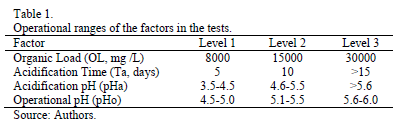
<body><![CDATA[<p><font size="2" face="Verdana, Arial, Helvetica, sans-serif">This study was carried out at the Laboratorio de  Mecanizaci&oacute;n Agr&iacute;cola of the Universidad Nacional de Colombia, Medell&iacute;n campus,  located at 1,488 m.a.s.l., at the coordinates of 6°13'55&quot;N  and 75°34'05&quot;W, with an average annual  temperature of 24°C, relative humidity of 88% and average annual precipitation  of 1,571 mm.</font></p>     <p><font size="2" face="Verdana, Arial, Helvetica, sans-serif"><b><i>2.2. Raw material</i></b></font></p>     <p><font size="2" face="Verdana, Arial, Helvetica, sans-serif">The raw material  consisted of a mixture of organic waste compounds principally from lettuce  leaves, cabbage, orange, lime, papayuela, mango, guava, cucumber, onion,  garlic, pepper and tomato, which were blended in a processor (0.5 Hp, 1,730  rpm, Siemens). The waste was obtained from the Central Mayorista de Antioquia.</font></p>     <p><font size="2" face="Verdana, Arial, Helvetica, sans-serif"><b><i>2.3. Materials</i></b></font></p>     <p><font size="2" face="Verdana, Arial, Helvetica, sans-serif">For the tests,  three cylindrical bioreactors of 2,000 L were used; these were operated in batch  culture mode. The gas production was recorded with a gas meter (Metrex G2.5,  precision of 0.040m³/h and maximum pressure of 40 kPa or 5.8 PSIG). The pH  measurements were carried out daily with a digital pH-meter (Hanna Instruments)  with a precision of ±0.2 (at a  temperature of 20°C).</font></p>     <p><font size="2" face="Verdana, Arial, Helvetica, sans-serif"><b><i>2.4. Methods</i></b></font></p>     <p><font size="2" face="Verdana, Arial, Helvetica, sans-serif">Ten tests were  carried out under an incomplete factorial design with four factors and three  levels. The factors were: acidification pH (pHa), acidification time (Ta),  operational pH (pHo) and organic load (OL). The response variables were:  maximum hydrogen production (PH<sub>2</sub>, L/day) and maximum hydrogen  content (CH<sub>2</sub>, %). The acidification pH corresponded to the pH of the  substrate at the beginning of the test, which permitted the elimination of the  methanogenic bacteria (hydrogen consumers). The acidification time represented  the days in which the test remained with an acidification pH; when this was  completed, agricultural lime was added (CaO 54%) until the operational pH that  corresponded to each test was reached. Finally, the organic load associated  with the chemical demand of oxygen (mg/L) was measured at the beginning of the  tests and its magnitude was a function of the decomposition degree of the  available waste. </font></p>     <p><font size="2" face="Verdana, Arial, Helvetica, sans-serif">The operation  volume of bioreactors was 1,400 L and each test had an average of 550± 20 kg of substrate blended with  water at a proportion of 1:2 &#91;21&#93;; this represented 70% of the bioreactors'  volume. The digestion time was variable according to the acidification time and  all tests were performed without stirring. In tests, an inoculum was not used; the microorganisms were native from the  waste used. In <a href="#tab01">Table 1</a>, the ranges of each factor are presented.</font></p>     <p align="center"><font size="2" face="Verdana, Arial, Helvetica, sans-serif"><a name="tab01"></a></font><img src="/img/revistas/dyna/v82n189/v82n189a16tab01.gif"></p>     <p><font size="2" face="Verdana, Arial, Helvetica, sans-serif"><b>2.4.1. Physicochemical Analysis</b></font></p>     ]]></body>
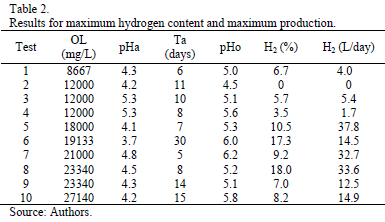
<body><![CDATA[<p><font size="2" face="Verdana, Arial, Helvetica, sans-serif">The physicochemical analyses of COD (Chemical Oxygen  Demand) followed the standardized methods of APHA in the 19 edition of 1995  (standard method 5220-C). To determine the composition of the generated gas,  daily samples were taken using one (1) liter Tedlar bags. The samples were  analyzed with a Perkin Elmer chromatograph, equipped with a thermal  conductivity detector (TCD) and two columns connected in series (CP-5A and  Moliseve CP Porabond Q). Oven  temperatures and detector temperatures of 60 and 253°C, respectively, were  used. The analysis of the gas included the quantification of CO<sub>2</sub>, O<sub>2</sub>,  H<sub>2</sub>, CO, CH<sub>4</sub> and N<sub>2</sub> &#91;22&#93;.</font></p>     <p><font size="2" face="Verdana, Arial, Helvetica, sans-serif"><b>2.4.2. Process Modeling</b></font></p>     <p><font size="2" face="Verdana, Arial, Helvetica, sans-serif"><u>Response  surface and non-linear regression model.</u> Two nonlinear models were constructed by means of nonlinear regression  and adjusted by least squares. For this the <u>NonLinearModel.fit</u> option of  Matlab 2012 was used. A pure quadratic model was employed, which included  independent, linear and quadratic terms. In order to optimize the models, the <i>rstool</i> tool for the multidimensional  statistical analysis of the response surface was used. </font></p>     <p><font size="2" face="Verdana, Arial, Helvetica, sans-serif"><u>Genetic algorithm and non-linear regression model.</u> The aptitude function that was optimized with the genetic algorithm was the  non-linear model obtained with the <i>NonLinearModel.fit </i>option of Matlab 2012. The individuals were composed of four genes, each  one corresponding to a factor, codified in real values. The genetic algorithm  was applied with the <i>optimtool</i> option  of Matlab 2012. The genetics operators were: mutation, cross and replication by  elite (4 individuals).</font></p>     <p><font size="2" face="Verdana, Arial, Helvetica, sans-serif"><u>Heuristic model with fuzzy logic.</u> A model was  created using fuzzy logic, which was integrated with four input variables  corresponding to the four factors of the experiment and two output variables  associated with the response variables. Both the input variables and the output  variables were represented by five trapezoidal fuzzy sets linguistically  labeled very low, low, medium, high, and very high. The employed fuzzy  inference system was Mandani and the operator was the minimum (method And). The  method for transforming the fuzzy results was centroid. The model was  implemented with the <i>Fuzzy Logic</i> tool  of Matlab 2012.</font></p>     <p>&nbsp;</p>     <p><font size="3" face="Verdana, Arial, Helvetica, sans-serif"><b>3. Results</b></font></p>     <p><b><font size="2" face="Verdana, Arial, Helvetica, sans-serif"><i>3.1. Hydrogen  Content and Production</i></font></b></p>     <p><font size="2" face="Verdana, Arial, Helvetica, sans-serif"><a href="#tab02">Table 2</a> presents  the results obtained for maximum hydrogen content and maximum production in ten  tests. The values of the factors remained in the previously defined ranges for  each level. The content and production values correspond to the maximums  achieved in each test. The most outstanding results were obtained for an  organic load over 18,000 mg/L; a pHa between 4.1 and 4.5; a Ta between 7 and 8  days; and a pHo between 5.2 and 5.3 These operation conditions are similar to  those reported by different authors when urban organic waste is used &#91;14&#93;. From  experimental results (see <a href="#tab02">table 2</a>), the maximum hydrogen content obtained was  18% and the maximum production was 37.8 L/day. These values are considered low;  however, it is important to emphasize that in all the tests, the temperature  was in the mesophilic range, an inoculum was not employed, and the fermentation  process was done without stirring.</font></p>     <p align="center"><font size="2" face="Verdana, Arial, Helvetica, sans-serif"><a name="tab02"></a></font><img src="/img/revistas/dyna/v82n189/v82n189a16tab02.gif"></p>     ]]></body>
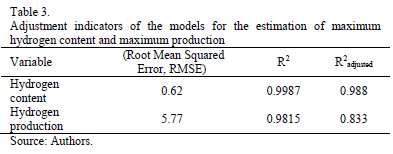
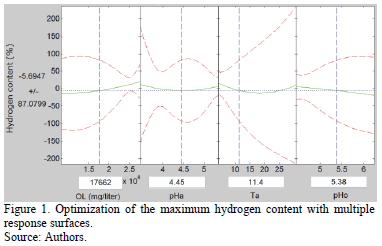
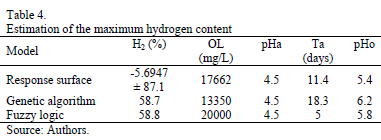
<body><![CDATA[<p><font size="2" face="Verdana, Arial, Helvetica, sans-serif">The results fit a second order polynomial model, both for  the hydrogen content and for the production of hydrogen. The adjustment made  with the NonLinearModel.fit option of Matlab facilitated obtaining equations  with independent, linear, and quadratic terms; when the interaction terms  between the factors were included, it was not possible to carry out the adjustment.  Information related to the adjustment of the models is presented in <a href="#tab03">Table 3</a>.  The obtained models were:</font></p>     <p align="center"><font size="2" face="Verdana, Arial, Helvetica, sans-serif"><a name="tab03"></a></font><img src="/img/revistas/dyna/v82n189/v82n189a16tab03.gif"></p>     <p><font size="2" face="Verdana, Arial, Helvetica, sans-serif">Model for maximum hydrogen content (CH<sub>2</sub>)</font></p>     <p><img src="/img/revistas/dyna/v82n189/v82n189a16eq01.gif"></p>     <p><font size="2" face="Verdana, Arial, Helvetica, sans-serif">Model for maximum hydrogen production (PH<sub>2</sub>)</font></p>     <p><img src="/img/revistas/dyna/v82n189/v82n189a16eq02.gif"></p>     <p><font size="2" face="Verdana, Arial, Helvetica, sans-serif">The model obtained for  the estimation of hydrogen content presented a high fit with an R<sup>2</sup><sub>adjusted</sub> value of 0.988. This means that 98.8% of the variation in the hydrogen content  was attributable to the independent variables of the study. Additionally, the  RMSE value was low (0.62), which indicates a low error between the model  prediction and the experimental information. In the case of hydrogen  production, the adjustment was good, albeit inferior to that of the model for  hydrogen content. Its R<sup>2</sup><sub>adjusted</sub> value was 0.833, which  indicates that 83.3% of the variation in hydrogen production was attributable  to the independent variables.</font></p>     <p><font size="2" face="Verdana, Arial, Helvetica, sans-serif"><b><i>3.2. Hydrogen  content optimization</i></b></font></p>     <p><font size="2" face="Verdana, Arial, Helvetica, sans-serif">The optimization with  the multiple response surfaces methodology was effective with a significance  level of 0.05 (alpha). Despite the use of a model with high fit (see <a href="#tab03">Table 3</a>),  this tool did not produce a suitable optimization because the resulting  prediction was negative in magnitude (-5.6947, an unlikely situation for the  experiment) with a broad interval (± 87.0799). This is attributable to the  broad interval of confidence (red lines in <a href="#fig01">Fig. 1</a>) for each of the factors,  possibly associated with the variability of the experimental information. This  implies weakness in the prediction. The maximum estimation with this tool was  81.4%; a value that is very unlikely to be obtained with a bioprocess like the  one developed in the present study: a batch system without inoculum cells,  without temperature control and without agitation &#91;23,24&#93;. </font></p>     <p align="center"><font size="2" face="Verdana, Arial, Helvetica, sans-serif"><a name="fig01"></a></font><img src="/img/revistas/dyna/v82n189/v82n189a16fig01.gif"></p>     ]]></body>
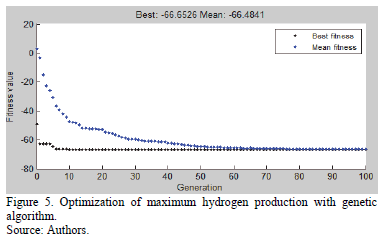
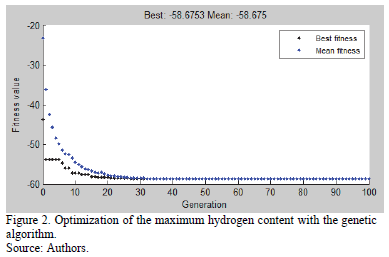
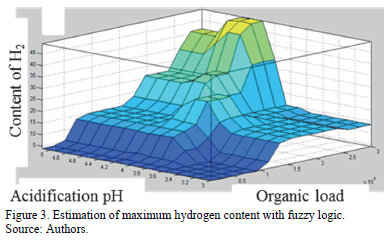
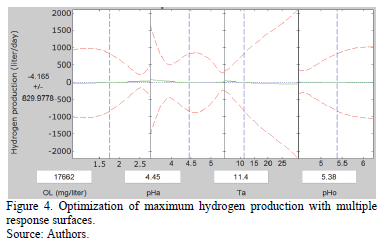
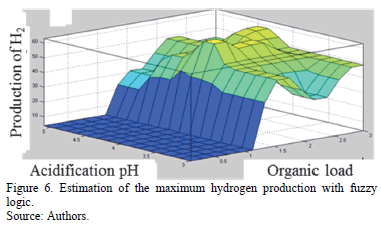
<body><![CDATA[<p><font size="2" face="Verdana, Arial, Helvetica, sans-serif">In the case of the predictions with the genetic algorithm,  100 interactions were required to obtain the results. The maximum hydrogen  content was 58.7%. The initial population size was established at 40  individuals. The function employed for the creation of the initial population  was obtained from a random initial population with a uniform distribution. The <i>shift  linear</i> function was used for the classification of the individuals. The  selection was statistically uniform. An elite population of 4 individuals was  defined for the reproduction and the cross fraction was 0.6. For the mutation,  the <i>adaptive feasible</i> function was  employed. The cross function was <i>intermediate</i>,  and the migration proceeded with a fraction of 0.2. The stopping criterion was  defined by the number of generations. <a href="#fig02">Fig. 2</a> contains the fit behavior of the  genetic algorithm during optimization. Starting at generation number 40, a  convergence can be seen between the mean value and the best value, presenting a  high fit.</font></p>     <p align="center"><font size="2" face="Verdana, Arial, Helvetica, sans-serif"><a name="fig02"></a></font><img src="/img/revistas/dyna/v82n189/v82n189a16fig02.gif"></p>     <p><font size="2" face="Verdana, Arial, Helvetica, sans-serif">The  model, based on fuzzy logic, estimated the maximum hydrogen content at 58.8%, a  value similar to that achieved with the genetic algorithm. This value was  obtained when the organic load was between 20,000 and 25,000 mg/L (see <a href="#fig03">Fig. 3</a>),  the acidification pH was between 4.4 and 4.6, the acidification time was  between 5 and 7 days, and the operational pH was 5.8. In the surfaces obtained  with the fuzzy logic model (<a href="#fig03">Fig. 3</a>), the existence of various maximum values  was observed; however, there was only one global maximum, which  corresponded to the value estimated by the model. This indicates that the model  was able to respond to the dynamic and non-linear behavior of the bioprocess in  a suitable manner.</font></p>     <p align="center"><font size="2" face="Verdana, Arial, Helvetica, sans-serif"><a name="fig03"></a></font><img src="/img/revistas/dyna/v82n189/v82n189a16fig03.gif"></p>     <p><font size="2" face="Verdana, Arial, Helvetica, sans-serif"><a href="#tab04">Table 4</a> presents the optimal values obtained with the  response surfaces and the genetic algorithm, as well as the estimation obtained  with the fuzzy logic model. The latter two provided similar maximums for the  hydrogen content. The genetic algorithm produced an estimation that required a  substrate with a lower organic load as compared to that provided by the fuzzy  logic model; however, the genetic algorithm estimated the acidification time at  18 days while the fuzzy logic model estimated it at 5 days. The acidification  time is an adaptive stage of the substrate in which the hydrogen-consuming  methanogenic bacteria are eliminated. During this time, hydrogen is not  generated, so this time must be made as short as possible.</font></p>     <p align="center"><font size="2" face="Verdana, Arial, Helvetica, sans-serif"><a name="tab04"></a></font><img src="/img/revistas/dyna/v82n189/v82n189a16tab04.gif"></p>     <p><font size="2" face="Verdana, Arial, Helvetica, sans-serif"><b><i>3.3. Hydrogen  production optimization</i></b></font></p>     <p><font size="2" face="Verdana, Arial, Helvetica, sans-serif">Similarly to the optimization of the hydrogen content, the estimation  of the maximum daily production with the multiple response surfaces methodology  was overly high. The achieved prediction was a negative value (-4.165), with a  very broad interval (± 829.9778) associated with the broad confidence interval  (see <a href="#fig04">Fig. 4</a>, especially for the acidification time). This represents low  confidence for the predictions produced by this tool. There was a high  overestimation, with an estimated maximum production of 825.8 L/day, a value  well beyond the maximum experimental value with organic waste in a batch  culture without inoculum cells or agitation and at a mesophilic temperature  &#91;25-27&#93;.</font></p>     <p align="center"><font size="2" face="Verdana, Arial, Helvetica, sans-serif"><a name="fig04"></a></font><img src="/img/revistas/dyna/v82n189/v82n189a16fig04.gif"></p>     <p><font size="2" face="Verdana, Arial, Helvetica, sans-serif">With  the genetic algorithm, the maximum value for hydrogen production was 66.7  liters/day. The size of the initial population was established at 40 individuals,  and it </font><font size="2" face="Verdana, Arial, Helvetica, sans-serif">was created from an initial  randomized population with uniform distribution. The function for the  classification of the individuals was <i>shift  linear</i> with a maximum survival rate of 5. The selection was uniform; the  reproduction was carried out maintaining an elite of 4 individuals with a cross  fraction of 0.6. For the mutation, an <i>adaptive  feasible</i> function was employed; the cross function was <i>intermediate</i>. The migration proceeded with a fraction of 0.2. The  stopping criterion was the number of generations, which was established at 100.  The convergence between the mean value and the best value was achieved at  generation 70 (<a href="#fig05">Fig. 5</a>).</font></p>     ]]></body>
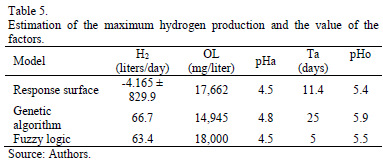
<body><![CDATA[<p align="center"><font size="2" face="Verdana, Arial, Helvetica, sans-serif"><a name="fig05"></a></font><img src="/img/revistas/dyna/v82n189/v82n189a16fig05.gif"></p>     <p><font size="2" face="Verdana, Arial, Helvetica, sans-serif">The  maximum hydrogen production estimated with the fuzzy logic model was 63.4 L/day,  a magnitude slightly lower than the genetic algorithm estimation. The value estimated with fuzzy logic was  obtained with an organic load between 15,000 and 18,000 mg/L (see <a href="#fig06">Fig. 6</a>), an  acidification pH between 4.4 and 4.6, an acidification time between 5 and 7  days and an operational pH of 5.5. Various maximum values can be seen, but with  a unique global maximum, corresponding to the estimated value. The fuzzy logic  model, as with the maximum hydrogen content estimation, responded suitably to  the dynamic and non-linear behavior of the bioprocess &#91;28,29&#93;.</font></p>     <p align="center"><font size="2" face="Verdana, Arial, Helvetica, sans-serif"><a name="fig06"></a></font><img src="/img/revistas/dyna/v82n189/v82n189a16fig06.gif"></p>     <p><font size="2" face="Verdana, Arial, Helvetica, sans-serif">A summary of the results obtained for the maximum hydrogen  production for the three methods is presented in <a href="#tab05">Table 5</a>. Similarly to the  maximum content, the maximum value obtained with fuzzy logic was close to that  of the genetic algorithm estimation, requiring a substrate with a slightly  higher organic load but a much lower acidification time, changing from 25 days  to 5 days. This creates an advantageous situation for the fuzzy logic model  because it is desirable to start hydrogen production as soon as possible. In  addition, the fuzzy logic model gave values of each factor for the hydrogen  content very similar to those values obtained for production. This means that a  gas with high hydrogen content and high production could be produced  simultaneously; a desired situation for use in fuel cell, internal combustion  engine and turbine &#91;30-32&#93;.</font></p>     <p align="center"><font size="2" face="Verdana, Arial, Helvetica, sans-serif"><a name="tab05"></a></font><img src="/img/revistas/dyna/v82n189/v82n189a16tab05.gif"></p>     <p>&nbsp;</p>     <p><font size="3" face="Verdana, Arial, Helvetica, sans-serif"><b>4. Conclusions</b></font></p>     <p><font size="2" face="Verdana, Arial, Helvetica, sans-serif">The production of  hydrogen was possible with the use of 2,000-liter bioreactors, without  agitation, without adding inoculum cells, at ambient temperature (mesophilic,  25°C) and using a substrate of urban waste (fruit and vegetable waste). The  results obtained with the four independent variables and the two dependent  variables allowed for the construction of two models, one for each of the  dependent variables. The results of these variables presented good fit to  polynomial models of degree two. A posterior optimization of both models  involved the use of three mathematical tools: multiple response surfaces,  genetic algorithm, and fuzzy logic; the values obtained after optimization for  both the hydrogen content and the hydrogen production were higher than the  values reached in experimental tests. The fuzzy  logic produced results more in accordance with the expectations; this tool  allowed to increase hydrogen content 3.3 times and hydrogen production 1.7  times. </font></p>     <p><font size="2" face="Verdana, Arial, Helvetica, sans-serif">The values of  independent variables should be between 18,000 and 20,000mg/L for the organic  load; 4.5 for acidification pH; 5 days as the acidification time; and between  5.5 and 5.8 for operational pH. These values were found at levels reported by  various authors in similar conditions of the bioprocess (waste and operation  mode of reactor) &#91;33,34&#93;.</font></p>     <p><font size="2" face="Verdana, Arial, Helvetica, sans-serif">The genetic algorithm model presented estimations that  were very similar to those produced by the fuzzy logic model; however, the  estimated values for the optimization of the hydrogen content and the  production of the gas are associated with an acidification time, notably higher  than the values obtained by the fuzzy logic model: 3.6 times higher. This represents a huge limitation  because the hydrogen production would be delayed without any additional  increase in hydrogen content. In the case of optimization with the  multiple response surfaces, the obtained results were not in accordance with  the experiment tests.</font></p>     ]]></body>
<body><![CDATA[<p>&nbsp;</p>     <p><font size="3" face="Verdana, Arial, Helvetica, sans-serif"><b>5. Acknowledgement</b></font></p>     <p><font size="2" face="Verdana, Arial, Helvetica, sans-serif">The authors wish  to thank Universidad Nacional de Colombia and Central Mayorista de Antioquia for  the support received during the present research. In addition, they wish to  thank Deisy Juliana Cano Quintero for her contribution during the tests.</font></p>     <p>&nbsp;</p>     <p><font size="3" face="Verdana, Arial, Helvetica, sans-serif"><b>References</b></font></p>     <!-- ref --><p><font size="2" face="Verdana, Arial, Helvetica, sans-serif"><b>&#91;1&#93;</b> Ozmihci,  S. and Kargi, F., Effects of starch loading rate on performance of combined  fed-batch fermentation of ground wheat for bio-hydrogen production.  International Journal of Hydrogen Energy, 35 (3), pp. 1106-1111, 2010. <a href="http://dx.doi.org/10.1016/j.ijhydene.2009.11.048" target="_blank">http://dx.doi.org/10.1016/j.ijhydene.2009.11.048</a></font>&nbsp;&nbsp;&nbsp;&nbsp;&nbsp;&nbsp;&nbsp;&nbsp;[&#160;<a href="javascript:void(0);" onclick="javascript: window.open('/scielo.php?script=sci_nlinks&ref=000088&pid=S0012-7353201500010001600001&lng=','','width=640,height=500,resizable=yes,scrollbars=1,menubar=yes,');">Links</a>&#160;]<!-- end-ref --><!-- ref --><p><font size="2" face="Verdana, Arial, Helvetica, sans-serif"><b>&#91;2&#93;</b> Ozmihci,  S., Kargi, F. and Cakir, A., Thermophilic dark fermentation of acid hydrolyzed  waste ground wheat for hydrogen gas production. International Journal of  Hydrogen Energy, 36 (3), pp. 2111-2117, 2011. <a href="http://dx.doi.org/10.1016/j.ijhydene.2010.11.033" target="_blank">http://dx.doi.org/10.1016/j.ijhydene.2010.11.033</a></font>&nbsp;&nbsp;&nbsp;&nbsp;&nbsp;&nbsp;&nbsp;&nbsp;[&#160;<a href="javascript:void(0);" onclick="javascript: window.open('/scielo.php?script=sci_nlinks&ref=000089&pid=S0012-7353201500010001600002&lng=','','width=640,height=500,resizable=yes,scrollbars=1,menubar=yes,');">Links</a>&#160;]<!-- end-ref --><!-- ref --><p><font size="2" face="Verdana, Arial, Helvetica, sans-serif"><b>&#91;3&#93;</b> Obazu,  F.O., Ngoma, L. and Gray, V.M., Interrelationships between bioreactor volume,  effluent recycle rate, temperature, pH, %H2, hydrogen productivity and hydrogen  yield with undefined bacterial cultures. International Journal of Hydrogen Energy, 37 (7), pp. 5579-5590,  2012. <a href="http://dx.doi.org/10.1016/j.ijhydene.2012.01.001" target="_blank">http://dx.doi.org/10.1016/j.ijhydene.2012.01.001</a></font>&nbsp;&nbsp;&nbsp;&nbsp;&nbsp;&nbsp;&nbsp;&nbsp;[&#160;<a href="javascript:void(0);" onclick="javascript: window.open('/scielo.php?script=sci_nlinks&ref=000090&pid=S0012-7353201500010001600003&lng=','','width=640,height=500,resizable=yes,scrollbars=1,menubar=yes,');">Links</a>&#160;]<!-- end-ref --><!-- ref --><p><font size="2" face="Verdana, Arial, Helvetica, sans-serif"><b>&#91;4&#93;</b> Lee,  D.J., Show, K.Y. and Su, A., Dark fermentation on biohydrogen production: Pure  culture. Bioresourse Technology, 102 (18), pp. 8393-8402, 2011. <a href="http://dx.doi.org/10.1016/j.biortech.2011.03.041" target="_blank">http://dx.doi.org/10.1016/j.biortech.2011.03.041</a></font>&nbsp;&nbsp;&nbsp;&nbsp;&nbsp;&nbsp;&nbsp;&nbsp;[&#160;<a href="javascript:void(0);" onclick="javascript: window.open('/scielo.php?script=sci_nlinks&ref=000091&pid=S0012-7353201500010001600004&lng=','','width=640,height=500,resizable=yes,scrollbars=1,menubar=yes,');">Links</a>&#160;]<!-- end-ref --><!-- ref --><p><font size="2" face="Verdana, Arial, Helvetica, sans-serif"><b>&#91;5&#93;</b> Chong,  P.S., Jahim, J.M., Harun, S., Lim, S.S., Mutabil, S., Abd, Hassan, O. and Nor,  M.T.M., Enhancement of batch biohydrogen production from prehydrolysate of acid  treated oil palm empty fruit bunch. International Journal of Hydrogen Energy,  38 (22), pp. 9592-9599, 2013. <a href="http://dx.doi.org/10.1016/j.ijhydene.2013.01.154" target="_blank">http://dx.doi.org/10.1016/j.ijhydene.2013.01.154</a></font>&nbsp;&nbsp;&nbsp;&nbsp;&nbsp;&nbsp;&nbsp;&nbsp;[&#160;<a href="javascript:void(0);" onclick="javascript: window.open('/scielo.php?script=sci_nlinks&ref=000092&pid=S0012-7353201500010001600005&lng=','','width=640,height=500,resizable=yes,scrollbars=1,menubar=yes,');">Links</a>&#160;]<!-- end-ref --><!-- ref --><p><font size="2" face="Verdana, Arial, Helvetica, sans-serif"><b>&#91;6&#93;</b> Khanna,  N., Kotay, S.M., Gilbert, J. and Das, D., Improvement of biohydrogen production  by Enterobarter Cloacae IIT-BT 08 under regulated pH. International Journal of  Hydrogen Energy, 152 (1-2), pp. 9-15, 2011.    &nbsp;&nbsp;&nbsp;&nbsp;&nbsp;&nbsp;&nbsp;&nbsp;[&#160;<a href="javascript:void(0);" onclick="javascript: window.open('/scielo.php?script=sci_nlinks&ref=000093&pid=S0012-7353201500010001600006&lng=','','width=640,height=500,resizable=yes,scrollbars=1,menubar=yes,');">Links</a>&#160;]<!-- end-ref --></font></p>     <!-- ref --><p><font size="2" face="Verdana, Arial, Helvetica, sans-serif"><b>&#91;7&#93;</b> Pekgöz,  G., Gündüz, U., Ero&#287;lu, I., Yücel, M., Kov&aacute;cs, K. and R&aacute;khely, G., Effect  on inactivation of genes involved in ammonium regulation on the biohydrogen  production of Rhodobacter capsulatus. International Journal of Hydrogen Energy,  36 (21), pp. 13536-13546, 2011. <a href="http://dx.doi.org/10.1016/j.ijhydene.2011.07.123" target="_blank">http://dx.doi.org/10.1016/j.ijhydene.2011.07.123</a></font>&nbsp;&nbsp;&nbsp;&nbsp;&nbsp;&nbsp;&nbsp;&nbsp;[&#160;<a href="javascript:void(0);" onclick="javascript: window.open('/scielo.php?script=sci_nlinks&ref=000095&pid=S0012-7353201500010001600007&lng=','','width=640,height=500,resizable=yes,scrollbars=1,menubar=yes,');">Links</a>&#160;]<!-- end-ref --><!-- ref --><p><font size="2" face="Verdana, Arial, Helvetica, sans-serif"><b>&#91;8&#93;</b> Yuan,  X., Shi, X., Zhang, P., Wei, Y., Guo, R. and Wang, L., Anaerobic biohydrogen  production from wheat stalk by mixed microflora: Kinetic model and particle  size influence. Bioresource Technology, 102 (19), pp. 9007-9012, 2011. <a href="http://dx.doi.org/10.1016/j.biortech.2011.06.045" target="_blank">http://dx.doi.org/10.1016/j.biortech.2011.06.045</a></font>&nbsp;&nbsp;&nbsp;&nbsp;&nbsp;&nbsp;&nbsp;&nbsp;[&#160;<a href="javascript:void(0);" onclick="javascript: window.open('/scielo.php?script=sci_nlinks&ref=000096&pid=S0012-7353201500010001600008&lng=','','width=640,height=500,resizable=yes,scrollbars=1,menubar=yes,');">Links</a>&#160;]<!-- end-ref --><!-- ref --><p><font size="2" face="Verdana, Arial, Helvetica, sans-serif"><b>&#91;9&#93;</b> Khanna,  N., Kumar, K., Todi, S. and Das, D., Characteristics of cured and wild strains  of Enterobarter Cloacae IIT-BT 08 for the improvement of biohydrogen  production. International Journal of Hydrogen Energy, 37 (16), pp. 11666-11676,  2012. <a href="http://dx.doi.org/10.1016/j.ijhydene.2012.05.051" target="_blank">http://dx.doi.org/10.1016/j.ijhydene.2012.05.051</a></font>&nbsp;&nbsp;&nbsp;&nbsp;&nbsp;&nbsp;&nbsp;&nbsp;[&#160;<a href="javascript:void(0);" onclick="javascript: window.open('/scielo.php?script=sci_nlinks&ref=000097&pid=S0012-7353201500010001600009&lng=','','width=640,height=500,resizable=yes,scrollbars=1,menubar=yes,');">Links</a>&#160;]<!-- end-ref --><!-- ref --><p><font size="2" face="Verdana, Arial, Helvetica, sans-serif"><b>&#91;10&#93;</b> Gadhamshetty,  V., Arudchelvam, Y., Nirmalakhandan, N. and Johnson, D.C., Modeling dark  fermentation for biohydrogen production: ADM1-based model vs. Gompertz model.  International Journal of Hydrogen Energy, 35 (2), pp. 476-490, 2010. <a href="http://dx.doi.org/10.1016/j.ijhydene.2009.11.007" target="_blank">http://dx.doi.org/10.1016/j.ijhydene.2009.11.007</a></font>&nbsp;&nbsp;&nbsp;&nbsp;&nbsp;&nbsp;&nbsp;&nbsp;[&#160;<a href="javascript:void(0);" onclick="javascript: window.open('/scielo.php?script=sci_nlinks&ref=000098&pid=S0012-7353201500010001600010&lng=','','width=640,height=500,resizable=yes,scrollbars=1,menubar=yes,');">Links</a>&#160;]<!-- end-ref --><!-- ref --><p><font size="2" face="Verdana, Arial, Helvetica, sans-serif"><b>&#91;11&#93;</b> Liu,  Q., Zhang, X., Zhou, Y., Chen, S., Qian, G. and Xu, Z.P., Optimization of  fermentative biohydrogen production by response surface methodology using fresh  leachate as nutrient supplement. Bioresourse Technology, 102 (18), pp.  8661-8668, 2011. <a href="http://dx.doi.org/10.1016/j.biortech.2011.03.002" target="_blank">http://dx.doi.org/10.1016/j.biortech.2011.03.002</a></font>&nbsp;&nbsp;&nbsp;&nbsp;&nbsp;&nbsp;&nbsp;&nbsp;[&#160;<a href="javascript:void(0);" onclick="javascript: window.open('/scielo.php?script=sci_nlinks&ref=000099&pid=S0012-7353201500010001600011&lng=','','width=640,height=500,resizable=yes,scrollbars=1,menubar=yes,');">Links</a>&#160;]<!-- end-ref --><!-- ref --><p><font size="2" face="Verdana, Arial, Helvetica, sans-serif"><b>&#91;12&#93;</b> Bakonyi,  P., Nemest&oacute;thy, N., Lövitusz, &Eacute;. and B&eacute;lafi-Bak&oacute;, K., Application of  Plackett-Burman experimental desing to optimize biohydrogen fermentation by E.  coli (XL1-BLUE). International Journal of Hydrogen Energy, 36 (21), pp.  13946-13954, 2011. <a href="http://dx.doi.org/10.1016/j.ijhydene.2011.03.062" target="_blank">http://dx.doi.org/10.1016/j.ijhydene.2011.03.062</a></font>&nbsp;&nbsp;&nbsp;&nbsp;&nbsp;&nbsp;&nbsp;&nbsp;[&#160;<a href="javascript:void(0);" onclick="javascript: window.open('/scielo.php?script=sci_nlinks&ref=000100&pid=S0012-7353201500010001600012&lng=','','width=640,height=500,resizable=yes,scrollbars=1,menubar=yes,');">Links</a>&#160;]<!-- end-ref --><!-- ref --><p><font size="2" face="Verdana, Arial, Helvetica, sans-serif"><b>&#91;13&#93;</b> Prakasham,  R.S., Sathish, T., Brahmaiah, P., Rao, Ch.S. and Rao, R.S., Biohydrogen  production from renewable agri-waste blend: Optimization using mixer desing.  International Journal of Hydrogen Energy, 34 (15), pp. 6143-6148, 2009. <a href="http://dx.doi.org/10.1016/j.ijhydene.2009.06.016" target="_blank">http://dx.doi.org/10.1016/j.ijhydene.2009.06.016</a></font>&nbsp;&nbsp;&nbsp;&nbsp;&nbsp;&nbsp;&nbsp;&nbsp;[&#160;<a href="javascript:void(0);" onclick="javascript: window.open('/scielo.php?script=sci_nlinks&ref=000101&pid=S0012-7353201500010001600013&lng=','','width=640,height=500,resizable=yes,scrollbars=1,menubar=yes,');">Links</a>&#160;]<!-- end-ref --><!-- ref --><p><font size="2" face="Verdana, Arial, Helvetica, sans-serif"><b>&#91;14&#93;</b> Tenca,  A., Schievano, A., Perazzolo, F., Adani, F. and Oberti, R., Biohydrogen from  thermophilic co-fermentation of swine manure with fruit and vegetable waste:  Maximizing stable production without pH control. Bioresource Technology, 102  (18), pp. 8582-8588, 2011. <a href="http://dx.doi.org/10.1016/j.biortech.2011.03.102" target="_blank">http://dx.doi.org/10.1016/j.biortech.2011.03.102</a></font>&nbsp;&nbsp;&nbsp;&nbsp;&nbsp;&nbsp;&nbsp;&nbsp;[&#160;<a href="javascript:void(0);" onclick="javascript: window.open('/scielo.php?script=sci_nlinks&ref=000102&pid=S0012-7353201500010001600014&lng=','','width=640,height=500,resizable=yes,scrollbars=1,menubar=yes,');">Links</a>&#160;]<!-- end-ref --><!-- ref --><p><font size="2" face="Verdana, Arial, Helvetica, sans-serif"><b>&#91;15&#93;</b> Sun,  Q., Xiao, W., Xi, D., Shi, J., Yan, X. and Zhou, Z., Statistical optimization  of biohydrogen production from sucrose by a co-culture of Clostridium acidisoli  and Rhodobacter sphaeroides. International Journal of Hydrogen Energy, 35 (9),  pp. 4076-4084, 2010. <a href="http://dx.doi.org/10.1016/j.ijhydene.2010.01.145" target="_blank">http://dx.doi.org/10.1016/j.ijhydene.2010.01.145</a></font>&nbsp;&nbsp;&nbsp;&nbsp;&nbsp;&nbsp;&nbsp;&nbsp;[&#160;<a href="javascript:void(0);" onclick="javascript: window.open('/scielo.php?script=sci_nlinks&ref=000103&pid=S0012-7353201500010001600015&lng=','','width=640,height=500,resizable=yes,scrollbars=1,menubar=yes,');">Links</a>&#160;]<!-- end-ref --><!-- ref --><p><font size="2" face="Verdana, Arial, Helvetica, sans-serif"><b>&#91;16&#93;</b> Nath,  K. and Das, D., Modeling and optimization of fermentative hydrogen production.  International Journal of Hydrogen Energy, 102 (18), pp. 8569-8581, 2011.    &nbsp;&nbsp;&nbsp;&nbsp;&nbsp;&nbsp;&nbsp;&nbsp;[&#160;<a href="javascript:void(0);" onclick="javascript: window.open('/scielo.php?script=sci_nlinks&ref=000104&pid=S0012-7353201500010001600016&lng=','','width=640,height=500,resizable=yes,scrollbars=1,menubar=yes,');">Links</a>&#160;]<!-- end-ref --></font></p>     <!-- ref --><p><font size="2" face="Verdana, Arial, Helvetica, sans-serif"><b>&#91;17&#93;</b> Prakasham,  R.S., Sathish, T. and Brahmaiah, P., Imperative role of neural network couple  genetic algorithm on optimization of biohydrogen yiel. International Journal of  Hydrogen Energy, 36 (7), pp. 4332-4339, 2011. <a href="http://dx.doi.org/10.1016/j.ijhydene.2011.01.031" target="_blank">http://dx.doi.org/10.1016/j.ijhydene.2011.01.031</a></font>&nbsp;&nbsp;&nbsp;&nbsp;&nbsp;&nbsp;&nbsp;&nbsp;[&#160;<a href="javascript:void(0);" onclick="javascript: window.open('/scielo.php?script=sci_nlinks&ref=000106&pid=S0012-7353201500010001600017&lng=','','width=640,height=500,resizable=yes,scrollbars=1,menubar=yes,');">Links</a>&#160;]<!-- end-ref --><!-- ref --><p><font size="2" face="Verdana, Arial, Helvetica, sans-serif"><b>&#91;18&#93;</b> Huang,  S.R., Wu, Ch.Ch., Lin, Ch.Y. and Chen, H.T., Parameter optimization of the  biohydrogen real time power generating system using differential evolution  algorithm. International Journal of Hydrogen Energy, 35 (13), pp. 6629-6633,  2010. <a href="http://dx.doi.org/10.1016/j.ijhydene.2010.04.038" target="_blank">http://dx.doi.org/10.1016/j.ijhydene.2010.04.038</a></font>&nbsp;&nbsp;&nbsp;&nbsp;&nbsp;&nbsp;&nbsp;&nbsp;[&#160;<a href="javascript:void(0);" onclick="javascript: window.open('/scielo.php?script=sci_nlinks&ref=000107&pid=S0012-7353201500010001600018&lng=','','width=640,height=500,resizable=yes,scrollbars=1,menubar=yes,');">Links</a>&#160;]<!-- end-ref --><!-- ref --><p><font size="2" face="Verdana, Arial, Helvetica, sans-serif"><b>&#91;19&#93;</b> Wang,  J.L. and Wan, W., Application of desirability function based on neural network  for optimizing biohydrogen production process. International Journal of  Hydrogen Energy, 34 (3), pp. 1253-1259, 2009. <a href="http://dx.doi.org/10.1016/j.ijhydene.2008.11.055" target="_blank">http://dx.doi.org/10.1016/j.ijhydene.2008.11.055</a></font>&nbsp;&nbsp;&nbsp;&nbsp;&nbsp;&nbsp;&nbsp;&nbsp;[&#160;<a href="javascript:void(0);" onclick="javascript: window.open('/scielo.php?script=sci_nlinks&ref=000108&pid=S0012-7353201500010001600019&lng=','','width=640,height=500,resizable=yes,scrollbars=1,menubar=yes,');">Links</a>&#160;]<!-- end-ref --><!-- ref --><p><font size="2" face="Verdana, Arial, Helvetica, sans-serif"><b>&#91;20&#93;</b> Aydinol,  F.T. and Yetilmezsoy, K., A fuzzy-logic model to predict biogas and methane  production rates in a pilot-scale mesophilic UASB reactor treating molasses  wastewater. Journal of Hazardous Materials, 128 (1-3), pp. 460-471, 2010. <a href="http://dx.doi.org/10.1016/j.jhazmat.2010.06.054" target="_blank">http://dx.doi.org/10.1016/j.jhazmat.2010.06.054</a></font>&nbsp;&nbsp;&nbsp;&nbsp;&nbsp;&nbsp;&nbsp;&nbsp;[&#160;<a href="javascript:void(0);" onclick="javascript: window.open('/scielo.php?script=sci_nlinks&ref=000109&pid=S0012-7353201500010001600020&lng=','','width=640,height=500,resizable=yes,scrollbars=1,menubar=yes,');">Links</a>&#160;]<!-- end-ref --><!-- ref --><p><font size="2" face="Verdana, Arial, Helvetica, sans-serif"><b>&#91;21&#93;</b> Moreno,  C.E.L., Cano, Q.D.Y. and Cort&eacute;s, M.E.A., Generation of biohydrogen by anaerobic  fermentation of organics wastes in Colombia, in Zhen F. Liquid, gaseous and  solid biofuels conversion techniques, 1a ed., Croatia, InTech, 2013. pp.  377-400.    &nbsp;&nbsp;&nbsp;&nbsp;&nbsp;&nbsp;&nbsp;&nbsp;[&#160;<a href="javascript:void(0);" onclick="javascript: window.open('/scielo.php?script=sci_nlinks&ref=000110&pid=S0012-7353201500010001600021&lng=','','width=640,height=500,resizable=yes,scrollbars=1,menubar=yes,');">Links</a>&#160;]<!-- end-ref --></font></p>     <!-- ref --><p><font size="2" face="Verdana, Arial, Helvetica, sans-serif"><b>&#91;22&#93;</b> APHA.  Standard method for the examination of water and wastewater. Washington, 1995.    &nbsp;&nbsp;&nbsp;&nbsp;&nbsp;&nbsp;&nbsp;&nbsp;[&#160;<a href="javascript:void(0);" onclick="javascript: window.open('/scielo.php?script=sci_nlinks&ref=000112&pid=S0012-7353201500010001600022&lng=','','width=640,height=500,resizable=yes,scrollbars=1,menubar=yes,');">Links</a>&#160;]<!-- end-ref --></font></p>     <!-- ref --><p><font size="2" face="Verdana, Arial, Helvetica, sans-serif"><b>&#91;23&#93;</b> Reungsang,  A., Sreela-or, Ch. and Plangklandg, P., Non-sterile bio-hydrogen fermentation  from food waste in a continuous stirred tank reactor (CSTR): Performance and  population analysis. International Journal of Hydrogen Energy, 38 (35), pp.  15630-15637, 2013. <a href="http://dx.doi.org/10.1016/j.ijhydene.2013.03.138" target="_blank">http://dx.doi.org/10.1016/j.ijhydene.2013.03.138</a></font>&nbsp;&nbsp;&nbsp;&nbsp;&nbsp;&nbsp;&nbsp;&nbsp;[&#160;<a href="javascript:void(0);" onclick="javascript: window.open('/scielo.php?script=sci_nlinks&ref=000114&pid=S0012-7353201500010001600023&lng=','','width=640,height=500,resizable=yes,scrollbars=1,menubar=yes,');">Links</a>&#160;]<!-- end-ref --><!-- ref --><p><font size="2" face="Verdana, Arial, Helvetica, sans-serif"><b>&#91;24&#93;</b> Pendyala,  B., Chaganti, S.R., Lalman, J.A., Heath, D.D., Shanmugam, S.R. and Veeravalli,  S.S., Using a food and paper -cardboard waste blend as a novel feedstock for  hydrogen production: Influence of key process parameters on microbial diversity.  International Journal of Hydrogen Energy, 38 (15), pp. 6357-6367, 2013. <a href="http://dx.doi.org/10.1016/j.ijhydene.2013.03.003" target="_blank">http://dx.doi.org/10.1016/j.ijhydene.2013.03.003</a></font>&nbsp;&nbsp;&nbsp;&nbsp;&nbsp;&nbsp;&nbsp;&nbsp;[&#160;<a href="javascript:void(0);" onclick="javascript: window.open('/scielo.php?script=sci_nlinks&ref=000115&pid=S0012-7353201500010001600024&lng=','','width=640,height=500,resizable=yes,scrollbars=1,menubar=yes,');">Links</a>&#160;]<!-- end-ref --><!-- ref --><p><font size="2" face="Verdana, Arial, Helvetica, sans-serif"><b>&#91;25&#93;</b> Nathao,  Ch., Sirisukpoka, U. and Pisutpaisal N., Production of hydrogen and methane by  one and two stage fermentation of food waste. International Journal of Hydrogen Energy, 38 (35), pp. 15764-15769,  2013. <a href="http://dx.doi.org/10.1016/j.ijhydene.2013.05.047" target="_blank">http://dx.doi.org/10.1016/j.ijhydene.2013.05.047</a></font>&nbsp;&nbsp;&nbsp;&nbsp;&nbsp;&nbsp;&nbsp;&nbsp;[&#160;<a href="javascript:void(0);" onclick="javascript: window.open('/scielo.php?script=sci_nlinks&ref=000116&pid=S0012-7353201500010001600025&lng=','','width=640,height=500,resizable=yes,scrollbars=1,menubar=yes,');">Links</a>&#160;]<!-- end-ref --><!-- ref --><p><font size="2" face="Verdana, Arial, Helvetica, sans-serif"><b>&#91;26&#93;</b> Wang,  K.S., Chen, J.H., Huang Y.H. and Huang, S.L.. Integrated Taguchi method and  response surface methodology to confirm hydrogen production by anaerobic  fermentation of cow manure. International Journal of Hydrogen Energy, 38 (1),  pp. 45-53, 2013. <a href="http://dx.doi.org/10.1016/j.ijhydene.2012.03.155" target="_blank">http://dx.doi.org/10.1016/j.ijhydene.2012.03.155</a></font>&nbsp;&nbsp;&nbsp;&nbsp;&nbsp;&nbsp;&nbsp;&nbsp;[&#160;<a href="javascript:void(0);" onclick="javascript: window.open('/scielo.php?script=sci_nlinks&ref=000117&pid=S0012-7353201500010001600026&lng=','','width=640,height=500,resizable=yes,scrollbars=1,menubar=yes,');">Links</a>&#160;]<!-- end-ref --><!-- ref --><p><font size="2" face="Verdana, Arial, Helvetica, sans-serif"><b>&#91;27&#93;</b> Zhang,  J. and Wang, Q., Buffering and nutrient effects of white mud from ammonia-soda  process on thermophilic hydrogen fermentation from food waste. International  Journal of Hydrogen Energy, 38 (31), pp. 13564-13571, 2013. <a href="http://dx.doi.org/10.1016/j.ijhydene.2013.08.047" target="_blank">http://dx.doi.org/10.1016/j.ijhydene.2013.08.047</a></font>&nbsp;&nbsp;&nbsp;&nbsp;&nbsp;&nbsp;&nbsp;&nbsp;[&#160;<a href="javascript:void(0);" onclick="javascript: window.open('/scielo.php?script=sci_nlinks&ref=000118&pid=S0012-7353201500010001600027&lng=','','width=640,height=500,resizable=yes,scrollbars=1,menubar=yes,');">Links</a>&#160;]<!-- end-ref --><!-- ref --><p><font size="2" face="Verdana, Arial, Helvetica, sans-serif"><b>&#91;28&#93;</b> Waewsak,  Ch., Nopharatana, A. and Chaiprasen, P., Neural-fuzzy control system  application for monitoring process response and control of anaerobic hybrid  reactor in wastewater treatment and biogas production. Journal of Environmental  Sciences, 22 (12), pp. 1883-1890, 2010. <a href="http://dx.doi.org/10.1016/S1001-0742(09)60334-X" target="_blank">http://dx.doi.org/10.1016/S1001-0742(09)60334-X</a></font>&nbsp;&nbsp;&nbsp;&nbsp;&nbsp;&nbsp;&nbsp;&nbsp;[&#160;<a href="javascript:void(0);" onclick="javascript: window.open('/scielo.php?script=sci_nlinks&ref=000119&pid=S0012-7353201500010001600028&lng=','','width=640,height=500,resizable=yes,scrollbars=1,menubar=yes,');">Links</a>&#160;]<!-- end-ref --><!-- ref --><p><font size="2" face="Verdana, Arial, Helvetica, sans-serif"><b>&#91;29&#93;</b> Gao,  J., Wang, L., Feng, E. and Xiu, Z., Modeling and identification of microbial  batch fermentation using fuzzy expert system. Applied Mathematical Modelling,  37 (16-17), pp. 8079-8090, 2013. <a href="http://dx.doi.org/10.1016/j.apm.2013.02.042" target="_blank">http://dx.doi.org/10.1016/j.apm.2013.02.042</a></font>&nbsp;&nbsp;&nbsp;&nbsp;&nbsp;&nbsp;&nbsp;&nbsp;[&#160;<a href="javascript:void(0);" onclick="javascript: window.open('/scielo.php?script=sci_nlinks&ref=000120&pid=S0012-7353201500010001600029&lng=','','width=640,height=500,resizable=yes,scrollbars=1,menubar=yes,');">Links</a>&#160;]<!-- end-ref --><!-- ref --><p><font size="2" face="Verdana, Arial, Helvetica, sans-serif"><b>&#91;30&#93;</b> Razbani,  O. and Assadi, M., Performance of a biohydrogen solid oxide fuel cell.  International Journal of Hydrogen Energy, 38 (31), pp. 13781-13791, 2013. <a href="http://dx.doi.org/10.1016/j.ijhydene.2013.08.061" target="_blank">http://dx.doi.org/10.1016/j.ijhydene.2013.08.061</a></font>&nbsp;&nbsp;&nbsp;&nbsp;&nbsp;&nbsp;&nbsp;&nbsp;[&#160;<a href="javascript:void(0);" onclick="javascript: window.open('/scielo.php?script=sci_nlinks&ref=000121&pid=S0012-7353201500010001600030&lng=','','width=640,height=500,resizable=yes,scrollbars=1,menubar=yes,');">Links</a>&#160;]<!-- end-ref --><!-- ref --><p><font size="2" face="Verdana, Arial, Helvetica, sans-serif"><b>&#91;31&#93;</b> Lee,  M.C., Seok, S.B., Chung, J.H., Kim, S.M., Joo, Y.J. and Ahn, D.L., Gas turbine  combustion performance test of hydrogen and carbon monoxide synthetic gas.  Fuel, 89 (7), pp. 1485-1491, 2010. <a href="http://dx.doi.org/10.1016/j.fuel.2009.10.004" target="_blank">http://dx.doi.org/10.1016/j.fuel.2009.10.004</a></font>&nbsp;&nbsp;&nbsp;&nbsp;&nbsp;&nbsp;&nbsp;&nbsp;[&#160;<a href="javascript:void(0);" onclick="javascript: window.open('/scielo.php?script=sci_nlinks&ref=000122&pid=S0012-7353201500010001600031&lng=','','width=640,height=500,resizable=yes,scrollbars=1,menubar=yes,');">Links</a>&#160;]<!-- end-ref --><!-- ref --><p><font size="2" face="Verdana, Arial, Helvetica, sans-serif"><b>&#91;32&#93;</b> Klell,  M., Eichlseder, H. and Sartory, M., Mixtures of hydrogen and methane in the  internal combustion engine-Synergies, potential and regulations. International  Journal of Hydrogen Energy, 37 (15), pp. 11531-11540, 2012. <a href="http://dx.doi.org/10.1016/j.ijhydene.2012.03.067" target="_blank">http://dx.doi.org/10.1016/j.ijhydene.2012.03.067</a></font>&nbsp;&nbsp;&nbsp;&nbsp;&nbsp;&nbsp;&nbsp;&nbsp;[&#160;<a href="javascript:void(0);" onclick="javascript: window.open('/scielo.php?script=sci_nlinks&ref=000123&pid=S0012-7353201500010001600032&lng=','','width=640,height=500,resizable=yes,scrollbars=1,menubar=yes,');">Links</a>&#160;]<!-- end-ref --><!-- ref --><p><font size="2" face="Verdana, Arial, Helvetica, sans-serif"><b>&#91;33&#93;</b> Bedoya, A., Castrill&oacute;n, J.C, Ram&iacute;rez, J.E.,  V&aacute;squez, J.E. and Zabala, M.A., Producci&oacute;n biol&oacute;gica de  hidr&oacute;geno: una aproximaci&oacute;n al estado del arte. DYNA, 75 (154), pp. 137-157, 2008.    &nbsp;&nbsp;&nbsp;&nbsp;&nbsp;&nbsp;&nbsp;&nbsp;[&#160;<a href="javascript:void(0);" onclick="javascript: window.open('/scielo.php?script=sci_nlinks&ref=000124&pid=S0012-7353201500010001600033&lng=','','width=640,height=500,resizable=yes,scrollbars=1,menubar=yes,');">Links</a>&#160;]<!-- end-ref --></font></p>     <!-- ref --><p><font size="2" face="Verdana, Arial, Helvetica, sans-serif"><b>&#91;34&#93;</b> De  Gioannis, G., Muntoni, A., Polettini, A. and Pomi, R., A review of dark  fermentative hydrogen production from biodegradable municipal waste fractions.  Waste Management, 33 (6), pp. 1345-1361, 2013. <a href="http://dx.doi.org/10.1016/j.wasman.2013.02.019" target="_blank">http://dx.doi.org/10.1016/j.wasman.2013.02.019</a></font>&nbsp;&nbsp;&nbsp;&nbsp;&nbsp;&nbsp;&nbsp;&nbsp;[&#160;<a href="javascript:void(0);" onclick="javascript: window.open('/scielo.php?script=sci_nlinks&ref=000126&pid=S0012-7353201500010001600034&lng=','','width=640,height=500,resizable=yes,scrollbars=1,menubar=yes,');">Links</a>&#160;]<!-- end-ref --><p>&nbsp;</p>     <p><font size="2" face="Verdana, Arial, Helvetica, sans-serif"><b>E.L. Moreno-C&aacute;rdenas,</b> received a Bs. Eng in Agricultural Engineering in 1998, from the Universidad  Nacional de Colombia, Medellin, Colombia and an MSc. degree in Agricultural Engineering  in 2005, from the Universidad de Concepcion, in Chile. He worked for the  Colombian Coffee growers Federation and since 2009, he has worked for the  Universidad Nacional de Colombia. Currently, he is a Full Professor in the Agricultural  Engineering and Food Department, Facultad de Ciencias Agrarias, Universidad  Nacional de Colombia. His research interests include: renewable energy sources,  agricultural machinery, simulation, modeling and computational intelligence  techniques. ORCID: 0000-0001-5693-4273</font></p>     <p><font size="2" face="Verdana, Arial, Helvetica, sans-serif"><b>A.D. Zapata-Zapata,</b> received a Bs. Eng in Chemical Engineering in 1998, from the Universidad de  Antioquia, Medellin, Colombia. He received an MSc. degree in Biotechnology from  the Universidad Nacional de Colombia, Medellin, Colombia and his PhD. degree in  Sciences 2008, from the Universidad Nacional de la Plata, Argentina. Since the  year 2000 he is a Full Professor at the Universidad Nacional de Colombia, in  the Chemistry Department, Facultad de Ciencias, Universidad Nacional de  Colombia. His research interests include: fermentative and enzymatic process,  bioprocess, modeling and biofuels.</font></p>     <p><font size="2" face="Verdana, Arial, Helvetica, sans-serif"><b>F. &Aacute;lvarez-Mej&iacute;a,</b> received a Bs. Eng in Agricultural Engineering in 1972, from the Universidad  Nacional de Colombia, Medellin, Colombia and an MSc, degree in Agricultural Engineering  in 1982, from the Universidad de Campinas, in Brasil. Since 1978 he is a Full Professor  at the Universidad Nacional de Colombia, in the Agricultural Engineering and  Food Department, Facultad de Ciencias Agrarias, Universidad Nacional de Colombia.  His research interests include: agricultural machinery, agricultural  mechanization, machinery design and modeling.</font></p>      ]]></body><back>
<ref-list>
<ref id="B1">
<label>1</label><nlm-citation citation-type="journal">
<person-group person-group-type="author">
<name>
<surname><![CDATA[Ozmihci]]></surname>
<given-names><![CDATA[S.]]></given-names>
</name>
<name>
<surname><![CDATA[Kargi]]></surname>
<given-names><![CDATA[F.]]></given-names>
</name>
</person-group>
<article-title xml:lang="en"><![CDATA[Effects of starch loading rate on performance of combined fed-batch fermentation of ground wheat for bio-hydrogen production]]></article-title>
<source><![CDATA[International Journal of Hydrogen Energy]]></source>
<year>2010</year>
<volume>35</volume>
<numero>3</numero>
<issue>3</issue>
<page-range>1106-1111</page-range></nlm-citation>
</ref>
<ref id="B2">
<label>2</label><nlm-citation citation-type="journal">
<person-group person-group-type="author">
<name>
<surname><![CDATA[Ozmihci]]></surname>
<given-names><![CDATA[S.]]></given-names>
</name>
<name>
<surname><![CDATA[Kargi]]></surname>
<given-names><![CDATA[F.]]></given-names>
</name>
<name>
<surname><![CDATA[Cakir]]></surname>
<given-names><![CDATA[A.]]></given-names>
</name>
</person-group>
<article-title xml:lang="en"><![CDATA[Thermophilic dark fermentation of acid hydrolyzed waste ground wheat for hydrogen gas production]]></article-title>
<source><![CDATA[International Journal of Hydrogen Energy]]></source>
<year>2011</year>
<volume>36</volume>
<numero>3</numero>
<issue>3</issue>
<page-range>2111-2117</page-range></nlm-citation>
</ref>
<ref id="B3">
<label>3</label><nlm-citation citation-type="journal">
<person-group person-group-type="author">
<name>
<surname><![CDATA[Obazu]]></surname>
<given-names><![CDATA[F.O.]]></given-names>
</name>
<name>
<surname><![CDATA[Ngoma]]></surname>
<given-names><![CDATA[L.]]></given-names>
</name>
<name>
<surname><![CDATA[Gray]]></surname>
<given-names><![CDATA[V.M.]]></given-names>
</name>
</person-group>
<article-title xml:lang="en"><![CDATA[Interrelationships between bioreactor volume, effluent recycle rate, temperature, pH, %H2, hydrogen productivity and hydrogen yield with undefined bacterial cultures]]></article-title>
<source><![CDATA[International Journal of Hydrogen Energy]]></source>
<year>2012</year>
<volume>37</volume>
<numero>7</numero>
<issue>7</issue>
<page-range>5579-5590</page-range></nlm-citation>
</ref>
<ref id="B4">
<label>4</label><nlm-citation citation-type="journal">
<person-group person-group-type="author">
<name>
<surname><![CDATA[Lee]]></surname>
<given-names><![CDATA[D.J.]]></given-names>
</name>
<name>
<surname><![CDATA[Show]]></surname>
<given-names><![CDATA[K.Y.]]></given-names>
</name>
<name>
<surname><![CDATA[Su]]></surname>
<given-names><![CDATA[A.]]></given-names>
</name>
</person-group>
<article-title xml:lang="en"><![CDATA[Dark fermentation on biohydrogen production: Pure culture]]></article-title>
<source><![CDATA[Bioresourse Technology]]></source>
<year>2011</year>
<volume>102</volume>
<numero>18</numero>
<issue>18</issue>
<page-range>8393-8402</page-range></nlm-citation>
</ref>
<ref id="B5">
<label>5</label><nlm-citation citation-type="journal">
<person-group person-group-type="author">
<name>
<surname><![CDATA[Chong]]></surname>
<given-names><![CDATA[P.S.]]></given-names>
</name>
<name>
<surname><![CDATA[Jahim]]></surname>
<given-names><![CDATA[J.M.]]></given-names>
</name>
<name>
<surname><![CDATA[Harun]]></surname>
<given-names><![CDATA[S.]]></given-names>
</name>
<name>
<surname><![CDATA[Lim]]></surname>
<given-names><![CDATA[S.S.]]></given-names>
</name>
<name>
<surname><![CDATA[Mutabil]]></surname>
<given-names><![CDATA[S.]]></given-names>
</name>
<name>
<surname><![CDATA[Abd, Hassan]]></surname>
<given-names><![CDATA[O.]]></given-names>
</name>
<name>
<surname><![CDATA[Nor]]></surname>
<given-names><![CDATA[M.T.M.]]></given-names>
</name>
</person-group>
<article-title xml:lang="en"><![CDATA[Enhancement of batch biohydrogen production from prehydrolysate of acid treated oil palm empty fruit bunch]]></article-title>
<source><![CDATA[International Journal of Hydrogen Energy]]></source>
<year>2013</year>
<volume>38</volume>
<numero>22</numero>
<issue>22</issue>
<page-range>9592-9599</page-range></nlm-citation>
</ref>
<ref id="B6">
<label>6</label><nlm-citation citation-type="journal">
<person-group person-group-type="author">
<name>
<surname><![CDATA[Khanna]]></surname>
<given-names><![CDATA[N.]]></given-names>
</name>
<name>
<surname><![CDATA[Kotay]]></surname>
<given-names><![CDATA[S.M.]]></given-names>
</name>
<name>
<surname><![CDATA[Gilbert]]></surname>
<given-names><![CDATA[J.]]></given-names>
</name>
<name>
<surname><![CDATA[Das]]></surname>
<given-names><![CDATA[D.]]></given-names>
</name>
</person-group>
<article-title xml:lang="en"><![CDATA[Improvement of biohydrogen production by Enterobarter Cloacae IIT-BT 08 under regulated pH]]></article-title>
<source><![CDATA[International Journal of Hydrogen Energy]]></source>
<year>2011</year>
<volume>152</volume>
<numero>1-2</numero>
<issue>1-2</issue>
<page-range>9-15</page-range></nlm-citation>
</ref>
<ref id="B7">
<label>7</label><nlm-citation citation-type="journal">
<person-group person-group-type="author">
<name>
<surname><![CDATA[Pekgöz]]></surname>
<given-names><![CDATA[G.]]></given-names>
</name>
<name>
<surname><![CDATA[Gündüz]]></surname>
<given-names><![CDATA[U.]]></given-names>
</name>
<name>
<surname><![CDATA[Ero&#287;lu]]></surname>
<given-names><![CDATA[I.]]></given-names>
</name>
<name>
<surname><![CDATA[Yücel]]></surname>
<given-names><![CDATA[M.]]></given-names>
</name>
<name>
<surname><![CDATA[Kovács]]></surname>
<given-names><![CDATA[K.]]></given-names>
</name>
<name>
<surname><![CDATA[Rákhely]]></surname>
<given-names><![CDATA[G.]]></given-names>
</name>
</person-group>
<article-title xml:lang="en"><![CDATA[Effect on inactivation of genes involved in ammonium regulation on the biohydrogen production of Rhodobacter capsulatus]]></article-title>
<source><![CDATA[International Journal of Hydrogen Energy]]></source>
<year>2011</year>
<volume>36</volume>
<numero>21</numero>
<issue>21</issue>
<page-range>13536-13546</page-range></nlm-citation>
</ref>
<ref id="B8">
<label>8</label><nlm-citation citation-type="">
<person-group person-group-type="author">
<name>
<surname><![CDATA[Yuan]]></surname>
<given-names><![CDATA[X.]]></given-names>
</name>
<name>
<surname><![CDATA[Shi]]></surname>
<given-names><![CDATA[X.]]></given-names>
</name>
<name>
<surname><![CDATA[Zhang]]></surname>
<given-names><![CDATA[P.]]></given-names>
</name>
<name>
<surname><![CDATA[Wei]]></surname>
<given-names><![CDATA[Y.]]></given-names>
</name>
<name>
<surname><![CDATA[Guo]]></surname>
<given-names><![CDATA[R.]]></given-names>
</name>
<name>
<surname><![CDATA[Wang]]></surname>
<given-names><![CDATA[L.]]></given-names>
</name>
</person-group>
<source><![CDATA[]]></source>
<year></year>
</nlm-citation>
</ref>
<ref id="B9">
<label>9</label><nlm-citation citation-type="journal">
<person-group person-group-type="author">
<name>
<surname><![CDATA[Khanna]]></surname>
<given-names><![CDATA[N.]]></given-names>
</name>
<name>
<surname><![CDATA[Kumar]]></surname>
<given-names><![CDATA[K.]]></given-names>
</name>
<name>
<surname><![CDATA[Todi]]></surname>
<given-names><![CDATA[S.]]></given-names>
</name>
<name>
<surname><![CDATA[Das]]></surname>
<given-names><![CDATA[D.]]></given-names>
</name>
</person-group>
<article-title xml:lang="en"><![CDATA[Characteristics of cured and wild strains of Enterobarter Cloacae IIT-BT 08 for the improvement of biohydrogen production]]></article-title>
<source><![CDATA[International Journal of Hydrogen Energy]]></source>
<year>2012</year>
<volume>37</volume>
<numero>16</numero>
<issue>16</issue>
<page-range>11666-11676</page-range></nlm-citation>
</ref>
<ref id="B10">
<label>10</label><nlm-citation citation-type="journal">
<person-group person-group-type="author">
<name>
<surname><![CDATA[Gadhamshetty]]></surname>
<given-names><![CDATA[V.]]></given-names>
</name>
<name>
<surname><![CDATA[Arudchelvam]]></surname>
<given-names><![CDATA[Y.]]></given-names>
</name>
<name>
<surname><![CDATA[Nirmalakhandan]]></surname>
<given-names><![CDATA[N.]]></given-names>
</name>
<name>
<surname><![CDATA[Johnson]]></surname>
<given-names><![CDATA[D.C.]]></given-names>
</name>
</person-group>
<article-title xml:lang="en"><![CDATA[Modeling dark fermentation for biohydrogen production: ADM1-based model vs. Gompertz model]]></article-title>
<source><![CDATA[International Journal of Hydrogen Energy]]></source>
<year>2010</year>
<volume>35</volume>
<numero>2</numero>
<issue>2</issue>
<page-range>476-490</page-range></nlm-citation>
</ref>
<ref id="B11">
<label>11</label><nlm-citation citation-type="journal">
<person-group person-group-type="author">
<name>
<surname><![CDATA[Liu]]></surname>
<given-names><![CDATA[Q.]]></given-names>
</name>
<name>
<surname><![CDATA[Zhang]]></surname>
<given-names><![CDATA[X.]]></given-names>
</name>
<name>
<surname><![CDATA[Zhou]]></surname>
<given-names><![CDATA[Y.]]></given-names>
</name>
<name>
<surname><![CDATA[Chen]]></surname>
<given-names><![CDATA[S.]]></given-names>
</name>
<name>
<surname><![CDATA[Qian]]></surname>
<given-names><![CDATA[G.]]></given-names>
</name>
<name>
<surname><![CDATA[Xu]]></surname>
<given-names><![CDATA[Z.P.]]></given-names>
</name>
</person-group>
<article-title xml:lang="en"><![CDATA[Optimization of fermentative biohydrogen production by response surface methodology using fresh leachate as nutrient supplement]]></article-title>
<source><![CDATA[Bioresourse Technology]]></source>
<year>2011</year>
<volume>102</volume>
<numero>18</numero>
<issue>18</issue>
<page-range>8661-8668</page-range></nlm-citation>
</ref>
<ref id="B12">
<label>12</label><nlm-citation citation-type="journal">
<person-group person-group-type="author">
<name>
<surname><![CDATA[Bakonyi]]></surname>
<given-names><![CDATA[P.]]></given-names>
</name>
<name>
<surname><![CDATA[Nemestóthy]]></surname>
<given-names><![CDATA[N.]]></given-names>
</name>
<name>
<surname><![CDATA[Lövitusz]]></surname>
<given-names><![CDATA[É.]]></given-names>
</name>
<name>
<surname><![CDATA[Bélafi-Bakó]]></surname>
<given-names><![CDATA[K.]]></given-names>
</name>
</person-group>
<article-title xml:lang="en"><![CDATA[Application of Plackett-Burman experimental desing to optimize biohydrogen fermentation by E. coli (XL1-BLUE)]]></article-title>
<source><![CDATA[International Journal of Hydrogen Energy]]></source>
<year>2011</year>
<volume>36</volume>
<numero>21</numero>
<issue>21</issue>
<page-range>13946-13954</page-range></nlm-citation>
</ref>
<ref id="B13">
<label>13</label><nlm-citation citation-type="journal">
<person-group person-group-type="author">
<name>
<surname><![CDATA[Prakasham]]></surname>
<given-names><![CDATA[R.S.]]></given-names>
</name>
<name>
<surname><![CDATA[Sathish]]></surname>
<given-names><![CDATA[T.]]></given-names>
</name>
<name>
<surname><![CDATA[Brahmaiah]]></surname>
<given-names><![CDATA[P.]]></given-names>
</name>
<name>
<surname><![CDATA[Rao]]></surname>
<given-names><![CDATA[Ch.S.]]></given-names>
</name>
<name>
<surname><![CDATA[Rao]]></surname>
<given-names><![CDATA[R.S.]]></given-names>
</name>
</person-group>
<article-title xml:lang="en"><![CDATA[Biohydrogen production from renewable agri-waste blend: Optimization using mixer desing]]></article-title>
<source><![CDATA[International Journal of Hydrogen Energy]]></source>
<year>2009</year>
<volume>34</volume>
<numero>15</numero>
<issue>15</issue>
<page-range>6143-6148</page-range></nlm-citation>
</ref>
<ref id="B14">
<label>14</label><nlm-citation citation-type="journal">
<person-group person-group-type="author">
<name>
<surname><![CDATA[Tenca]]></surname>
<given-names><![CDATA[A.]]></given-names>
</name>
<name>
<surname><![CDATA[Schievano]]></surname>
<given-names><![CDATA[A.]]></given-names>
</name>
<name>
<surname><![CDATA[Perazzolo]]></surname>
<given-names><![CDATA[F]]></given-names>
</name>
<name>
<surname><![CDATA[Adani]]></surname>
<given-names><![CDATA[F.]]></given-names>
</name>
<name>
<surname><![CDATA[Oberti]]></surname>
<given-names><![CDATA[R.]]></given-names>
</name>
</person-group>
<article-title xml:lang="en"><![CDATA[Biohydrogen from thermophilic co-fermentation of swine manure with fruit and vegetable waste: Maximizing stable production without pH control]]></article-title>
<source><![CDATA[Bioresource Technology]]></source>
<year>2011</year>
<volume>102</volume>
<numero>18</numero>
<issue>18</issue>
<page-range>8582-8588</page-range></nlm-citation>
</ref>
<ref id="B15">
<label>15</label><nlm-citation citation-type="journal">
<person-group person-group-type="author">
<name>
<surname><![CDATA[Sun]]></surname>
<given-names><![CDATA[Q.]]></given-names>
</name>
<name>
<surname><![CDATA[Xiao]]></surname>
<given-names><![CDATA[W.]]></given-names>
</name>
<name>
<surname><![CDATA[Xi]]></surname>
<given-names><![CDATA[D.]]></given-names>
</name>
<name>
<surname><![CDATA[Shi]]></surname>
<given-names><![CDATA[J.]]></given-names>
</name>
<name>
<surname><![CDATA[Yan]]></surname>
<given-names><![CDATA[X.]]></given-names>
</name>
<name>
<surname><![CDATA[Zhou]]></surname>
<given-names><![CDATA[Z.]]></given-names>
</name>
</person-group>
<article-title xml:lang="en"><![CDATA[Statistical optimization of biohydrogen production from sucrose by a co-culture of Clostridium acidisoli and Rhodobacter sphaeroides]]></article-title>
<source><![CDATA[International Journal of Hydrogen Energy]]></source>
<year>2010</year>
<volume>35</volume>
<numero>9</numero>
<issue>9</issue>
<page-range>4076-4084</page-range></nlm-citation>
</ref>
<ref id="B16">
<label>16</label><nlm-citation citation-type="journal">
<person-group person-group-type="author">
<name>
<surname><![CDATA[Nath]]></surname>
<given-names><![CDATA[K.]]></given-names>
</name>
<name>
<surname><![CDATA[Das]]></surname>
<given-names><![CDATA[D.]]></given-names>
</name>
</person-group>
<article-title xml:lang="en"><![CDATA[Modeling and optimization of fermentative hydrogen production]]></article-title>
<source><![CDATA[International Journal of Hydrogen Energy]]></source>
<year>2011</year>
<volume>102</volume>
<numero>18</numero>
<issue>18</issue>
<page-range>8569-8581</page-range></nlm-citation>
</ref>
<ref id="B17">
<label>17</label><nlm-citation citation-type="journal">
<person-group person-group-type="author">
<name>
<surname><![CDATA[Prakasham]]></surname>
<given-names><![CDATA[R.S.]]></given-names>
</name>
<name>
<surname><![CDATA[Sathish]]></surname>
<given-names><![CDATA[T.]]></given-names>
</name>
<name>
<surname><![CDATA[Brahmaiah]]></surname>
<given-names><![CDATA[P.]]></given-names>
</name>
</person-group>
<article-title xml:lang="en"><![CDATA[Imperative role of neural network couple genetic algorithm on optimization of biohydrogen yiel]]></article-title>
<source><![CDATA[International Journal of Hydrogen Energy]]></source>
<year>2011</year>
<volume>36</volume>
<numero>7</numero>
<issue>7</issue>
<page-range>4332-4339</page-range></nlm-citation>
</ref>
<ref id="B18">
<label>18</label><nlm-citation citation-type="journal">
<person-group person-group-type="author">
<name>
<surname><![CDATA[Huang]]></surname>
<given-names><![CDATA[S.R.]]></given-names>
</name>
<name>
<surname><![CDATA[Wu]]></surname>
<given-names><![CDATA[Ch.Ch.]]></given-names>
</name>
<name>
<surname><![CDATA[Lin]]></surname>
<given-names><![CDATA[Ch.Y.]]></given-names>
</name>
<name>
<surname><![CDATA[Chen]]></surname>
<given-names><![CDATA[H.T.]]></given-names>
</name>
</person-group>
<article-title xml:lang="en"><![CDATA[Parameter optimization of the biohydrogen real time power generating system using differential evolution algorithm]]></article-title>
<source><![CDATA[International Journal of Hydrogen Energy]]></source>
<year></year>
<volume>35</volume>
<numero>13</numero>
<issue>13</issue>
<page-range>6629-6633</page-range></nlm-citation>
</ref>
<ref id="B19">
<label>19</label><nlm-citation citation-type="journal">
<person-group person-group-type="author">
<name>
<surname><![CDATA[Wang]]></surname>
<given-names><![CDATA[J.L.]]></given-names>
</name>
<name>
<surname><![CDATA[Wan]]></surname>
<given-names><![CDATA[W.]]></given-names>
</name>
</person-group>
<article-title xml:lang="en"><![CDATA[Application of desirability function based on neural network for optimizing biohydrogen production process]]></article-title>
<source><![CDATA[International Journal of Hydrogen Energy]]></source>
<year>2009</year>
<volume>34</volume>
<numero>3</numero>
<issue>3</issue>
<page-range>1253-1259</page-range></nlm-citation>
</ref>
<ref id="B20">
<label>20</label><nlm-citation citation-type="journal">
<person-group person-group-type="author">
<name>
<surname><![CDATA[Aydinol]]></surname>
<given-names><![CDATA[F.T.]]></given-names>
</name>
<name>
<surname><![CDATA[Yetilmezsoy]]></surname>
<given-names><![CDATA[K.]]></given-names>
</name>
</person-group>
<article-title xml:lang="en"><![CDATA[A fuzzy-logic model to predict biogas and methane production rates in a pilot-scale mesophilic UASB reactor treating molasses wastewater]]></article-title>
<source><![CDATA[Journal of Hazardous Materials]]></source>
<year>2010</year>
<volume>128</volume>
<numero>1-3</numero>
<issue>1-3</issue>
<page-range>460-471</page-range></nlm-citation>
</ref>
<ref id="B21">
<label>21</label><nlm-citation citation-type="book">
<person-group person-group-type="author">
<name>
<surname><![CDATA[Moreno]]></surname>
<given-names><![CDATA[C.E.L.]]></given-names>
</name>
<name>
<surname><![CDATA[Cano]]></surname>
<given-names><![CDATA[Q.D.Y.]]></given-names>
</name>
<name>
<surname><![CDATA[Cortés]]></surname>
<given-names><![CDATA[M.E.A.]]></given-names>
</name>
</person-group>
<article-title xml:lang="en"><![CDATA[Generation of biohydrogen by anaerobic fermentation of organics wastes in Colombia]]></article-title>
<person-group person-group-type="editor">
<name>
<surname><![CDATA[Zhen]]></surname>
<given-names><![CDATA[F.]]></given-names>
</name>
</person-group>
<source><![CDATA[Liquid, gaseous and solid biofuels conversion techniques]]></source>
<year>2013</year>
<edition>1a</edition>
<page-range>377-400</page-range><publisher-name><![CDATA[InTech]]></publisher-name>
</nlm-citation>
</ref>
<ref id="B22">
<label>22</label><nlm-citation citation-type="">
<collab>APHA</collab>
<source><![CDATA[Standard method for the examination of water and wastewater]]></source>
<year>1995</year>
<publisher-loc><![CDATA[Washington ]]></publisher-loc>
</nlm-citation>
</ref>
<ref id="B23">
<label>23</label><nlm-citation citation-type="journal">
<person-group person-group-type="author">
<name>
<surname><![CDATA[Reungsang]]></surname>
<given-names><![CDATA[A.]]></given-names>
</name>
<name>
<surname><![CDATA[Sreela-or]]></surname>
<given-names><![CDATA[Ch.]]></given-names>
</name>
<name>
<surname><![CDATA[Plangklandg]]></surname>
<given-names><![CDATA[P.]]></given-names>
</name>
</person-group>
<article-title xml:lang="en"><![CDATA[Non-sterile bio-hydrogen fermentation from food waste in a continuous stirred tank reactor (CSTR): Performance and population analysis]]></article-title>
<source><![CDATA[International Journal of Hydrogen Energy]]></source>
<year>2013</year>
<volume>38</volume>
<numero>35</numero>
<issue>35</issue>
<page-range>15630-15637</page-range></nlm-citation>
</ref>
<ref id="B24">
<label>24</label><nlm-citation citation-type="journal">
<person-group person-group-type="author">
<name>
<surname><![CDATA[Pendyala]]></surname>
<given-names><![CDATA[B.]]></given-names>
</name>
<name>
<surname><![CDATA[Chaganti]]></surname>
<given-names><![CDATA[S.R.]]></given-names>
</name>
<name>
<surname><![CDATA[Lalman]]></surname>
<given-names><![CDATA[J.A.]]></given-names>
</name>
<name>
<surname><![CDATA[Heath]]></surname>
<given-names><![CDATA[D.D.]]></given-names>
</name>
<name>
<surname><![CDATA[Shanmugam]]></surname>
<given-names><![CDATA[S.R.]]></given-names>
</name>
<name>
<surname><![CDATA[Veeravalli]]></surname>
<given-names><![CDATA[S.S.]]></given-names>
</name>
</person-group>
<article-title xml:lang="en"><![CDATA[Using a food and paper -cardboard waste blend as a novel feedstock for hydrogen production: Influence of key process parameters on microbial diversity]]></article-title>
<source><![CDATA[International Journal of Hydrogen Energy]]></source>
<year>2013</year>
<volume>38</volume>
<numero>15</numero>
<issue>15</issue>
<page-range>6357-6367</page-range></nlm-citation>
</ref>
<ref id="B25">
<label>25</label><nlm-citation citation-type="journal">
<person-group person-group-type="author">
<name>
<surname><![CDATA[Nathao]]></surname>
<given-names><![CDATA[Ch.]]></given-names>
</name>
<name>
<surname><![CDATA[Sirisukpoka]]></surname>
<given-names><![CDATA[U.]]></given-names>
</name>
<name>
<surname><![CDATA[Pisutpaisal]]></surname>
<given-names><![CDATA[N.]]></given-names>
</name>
</person-group>
<article-title xml:lang="en"><![CDATA[Production of hydrogen and methane by one and two stage fermentation of food waste]]></article-title>
<source><![CDATA[International Journal of Hydrogen Energy]]></source>
<year>2013</year>
<volume>38</volume>
<numero>35</numero>
<issue>35</issue>
<page-range>15764-15769</page-range></nlm-citation>
</ref>
<ref id="B26">
<label>26</label><nlm-citation citation-type="journal">
<person-group person-group-type="author">
<name>
<surname><![CDATA[Wang]]></surname>
<given-names><![CDATA[K.S.]]></given-names>
</name>
<name>
<surname><![CDATA[Chen]]></surname>
<given-names><![CDATA[J.H.]]></given-names>
</name>
<name>
<surname><![CDATA[Huang]]></surname>
<given-names><![CDATA[Y.H.]]></given-names>
</name>
<name>
<surname><![CDATA[Huang]]></surname>
<given-names><![CDATA[S.L.]]></given-names>
</name>
</person-group>
<article-title xml:lang="en"><![CDATA[Integrated Taguchi method and response surface methodology to confirm hydrogen production by anaerobic fermentation of cow manure]]></article-title>
<source><![CDATA[International Journal of Hydrogen Energy]]></source>
<year>2013</year>
<volume>38</volume>
<numero>1</numero>
<issue>1</issue>
<page-range>45-53</page-range></nlm-citation>
</ref>
<ref id="B27">
<label>27</label><nlm-citation citation-type="journal">
<person-group person-group-type="author">
<name>
<surname><![CDATA[Zhang]]></surname>
<given-names><![CDATA[J.]]></given-names>
</name>
<name>
<surname><![CDATA[Wang]]></surname>
<given-names><![CDATA[Q.]]></given-names>
</name>
</person-group>
<article-title xml:lang="en"><![CDATA[Buffering and nutrient effects of white mud from ammonia-soda process on thermophilic hydrogen fermentation from food waste]]></article-title>
<source><![CDATA[International Journal of Hydrogen Energy]]></source>
<year>2013</year>
<volume>38</volume>
<numero>31</numero>
<issue>31</issue>
<page-range>13564-13571</page-range></nlm-citation>
</ref>
<ref id="B28">
<label>28</label><nlm-citation citation-type="journal">
<person-group person-group-type="author">
<name>
<surname><![CDATA[Waewsak]]></surname>
<given-names><![CDATA[Ch.]]></given-names>
</name>
<name>
<surname><![CDATA[Nopharatana]]></surname>
<given-names><![CDATA[A.]]></given-names>
</name>
<name>
<surname><![CDATA[Chaiprasen]]></surname>
<given-names><![CDATA[P.]]></given-names>
</name>
</person-group>
<article-title xml:lang="en"><![CDATA[Neural-fuzzy control system application for monitoring process response and control of anaerobic hybrid reactor in wastewater treatment and biogas production]]></article-title>
<source><![CDATA[Journal of Environmental Sciences]]></source>
<year>2010</year>
<volume>22</volume>
<numero>12</numero>
<issue>12</issue>
<page-range>1883-1890</page-range></nlm-citation>
</ref>
<ref id="B29">
<label>29</label><nlm-citation citation-type="journal">
<person-group person-group-type="author">
<name>
<surname><![CDATA[Gao]]></surname>
<given-names><![CDATA[J.]]></given-names>
</name>
<name>
<surname><![CDATA[Wang]]></surname>
<given-names><![CDATA[L.]]></given-names>
</name>
<name>
<surname><![CDATA[Feng]]></surname>
<given-names><![CDATA[E.]]></given-names>
</name>
<name>
<surname><![CDATA[Xiu]]></surname>
<given-names><![CDATA[Z.]]></given-names>
</name>
</person-group>
<article-title xml:lang="en"><![CDATA[Modeling and identification of microbial batch fermentation using fuzzy expert system]]></article-title>
<source><![CDATA[Applied Mathematical Modelling]]></source>
<year>2013</year>
<volume>37</volume>
<numero>16-17</numero>
<issue>16-17</issue>
<page-range>8079-8090</page-range></nlm-citation>
</ref>
<ref id="B30">
<label>30</label><nlm-citation citation-type="journal">
<person-group person-group-type="author">
<name>
<surname><![CDATA[Razbani]]></surname>
<given-names><![CDATA[O.]]></given-names>
</name>
<name>
<surname><![CDATA[Assadi]]></surname>
<given-names><![CDATA[M.]]></given-names>
</name>
</person-group>
<article-title xml:lang="en"><![CDATA[Performance of a biohydrogen solid oxide fuel cell]]></article-title>
<source><![CDATA[International Journal of Hydrogen Energy]]></source>
<year>2013</year>
<volume>38</volume>
<numero>31</numero>
<issue>31</issue>
<page-range>13781-13791</page-range></nlm-citation>
</ref>
<ref id="B31">
<label>31</label><nlm-citation citation-type="journal">
<person-group person-group-type="author">
<name>
<surname><![CDATA[Lee]]></surname>
<given-names><![CDATA[M.C.]]></given-names>
</name>
<name>
<surname><![CDATA[Seok]]></surname>
<given-names><![CDATA[S.B.]]></given-names>
</name>
<name>
<surname><![CDATA[Chung]]></surname>
<given-names><![CDATA[J.H.]]></given-names>
</name>
<name>
<surname><![CDATA[Kim]]></surname>
<given-names><![CDATA[S.M.]]></given-names>
</name>
<name>
<surname><![CDATA[Joo]]></surname>
<given-names><![CDATA[Y.J.]]></given-names>
</name>
<name>
<surname><![CDATA[Ahn]]></surname>
<given-names><![CDATA[D.L.]]></given-names>
</name>
</person-group>
<article-title xml:lang="en"><![CDATA[Gas turbine combustion performance test of hydrogen and carbon monoxide synthetic gas]]></article-title>
<source><![CDATA[Fuel]]></source>
<year>2010</year>
<volume>89</volume>
<numero>7</numero>
<issue>7</issue>
<page-range>1485-1491</page-range></nlm-citation>
</ref>
<ref id="B32">
<label>32</label><nlm-citation citation-type="journal">
<person-group person-group-type="author">
<name>
<surname><![CDATA[Klell]]></surname>
<given-names><![CDATA[M.]]></given-names>
</name>
<name>
<surname><![CDATA[Eichlseder]]></surname>
<given-names><![CDATA[H.]]></given-names>
</name>
<name>
<surname><![CDATA[Sartory]]></surname>
<given-names><![CDATA[M.]]></given-names>
</name>
</person-group>
<article-title xml:lang="en"><![CDATA[Mixtures of hydrogen and methane in the internal combustion engine-Synergies, potential and regulations]]></article-title>
<source><![CDATA[International Journal of Hydrogen Energy]]></source>
<year>2012</year>
<volume>37</volume>
<numero>15</numero>
<issue>15</issue>
<page-range>11531-11540</page-range></nlm-citation>
</ref>
<ref id="B33">
<label>33</label><nlm-citation citation-type="journal">
<person-group person-group-type="author">
<name>
<surname><![CDATA[Bedoya]]></surname>
<given-names><![CDATA[A.]]></given-names>
</name>
<name>
<surname><![CDATA[Castrillón]]></surname>
<given-names><![CDATA[J.C]]></given-names>
</name>
<name>
<surname><![CDATA[Ramírez]]></surname>
<given-names><![CDATA[J.E.]]></given-names>
</name>
<name>
<surname><![CDATA[Vásquez]]></surname>
<given-names><![CDATA[J.E.]]></given-names>
</name>
<name>
<surname><![CDATA[Zabala]]></surname>
<given-names><![CDATA[M.A.]]></given-names>
</name>
</person-group>
<article-title xml:lang="es"><![CDATA[Producción biológica de hidrógeno: una aproximación al estado del arte]]></article-title>
<source><![CDATA[DYNA]]></source>
<year>2008</year>
<volume>75</volume>
<numero>154</numero>
<issue>154</issue>
<page-range>137-157</page-range></nlm-citation>
</ref>
<ref id="B34">
<label>34</label><nlm-citation citation-type="journal">
<person-group person-group-type="author">
<name>
<surname><![CDATA[De Gioannis]]></surname>
<given-names><![CDATA[G.]]></given-names>
</name>
<name>
<surname><![CDATA[Muntoni]]></surname>
<given-names><![CDATA[A.]]></given-names>
</name>
<name>
<surname><![CDATA[Polettini]]></surname>
<given-names><![CDATA[A.]]></given-names>
</name>
<name>
<surname><![CDATA[Pomi]]></surname>
<given-names><![CDATA[R.]]></given-names>
</name>
</person-group>
<article-title xml:lang="en"><![CDATA[A review of dark fermentative hydrogen production from biodegradable municipal waste fractions]]></article-title>
<source><![CDATA[Waste Management]]></source>
<year>2013</year>
<volume>33</volume>
<numero>6</numero>
<issue>6</issue>
<page-range>1345-1361</page-range></nlm-citation>
</ref>
</ref-list>
</back>
</article>