<?xml version="1.0" encoding="ISO-8859-1"?><article xmlns:mml="http://www.w3.org/1998/Math/MathML" xmlns:xlink="http://www.w3.org/1999/xlink" xmlns:xsi="http://www.w3.org/2001/XMLSchema-instance">
<front>
<journal-meta>
<journal-id>0012-7353</journal-id>
<journal-title><![CDATA[DYNA]]></journal-title>
<abbrev-journal-title><![CDATA[Dyna rev.fac.nac.minas]]></abbrev-journal-title>
<issn>0012-7353</issn>
<publisher>
<publisher-name><![CDATA[Universidad Nacional de Colombia]]></publisher-name>
</publisher>
</journal-meta>
<article-meta>
<article-id>S0012-73532015000200002</article-id>
<article-id pub-id-type="doi">10.15446/dyna.v82n190.42016</article-id>
<title-group>
<article-title xml:lang="en"><![CDATA[Review of mathematical models to describe the food salting process]]></article-title>
<article-title xml:lang="es"><![CDATA[Revisión de modelos matemáticos para describir el salado de alimentos]]></article-title>
</title-group>
<contrib-group>
<contrib contrib-type="author">
<name>
<surname><![CDATA[Gómez-Salazar]]></surname>
<given-names><![CDATA[Julián Andrés]]></given-names>
</name>
<xref ref-type="aff" rid="A01"/>
</contrib>
<contrib contrib-type="author">
<name>
<surname><![CDATA[Clemente-Polo]]></surname>
<given-names><![CDATA[Gabriela]]></given-names>
</name>
<xref ref-type="aff" rid="A02"/>
</contrib>
<contrib contrib-type="author">
<name>
<surname><![CDATA[Sanjuán-Pelliccer]]></surname>
<given-names><![CDATA[Neus]]></given-names>
</name>
<xref ref-type="aff" rid="A02"/>
</contrib>
</contrib-group>
<aff id="A01">
<institution><![CDATA[,Universidad de la Salle Bajío Escuela de Agronomía ]]></institution>
<addr-line><![CDATA[ ]]></addr-line>
</aff>
<aff id="A02">
<institution><![CDATA[,Universitat Politècnica de València Departamento de Tecnología de Alimentos ]]></institution>
<addr-line><![CDATA[ ]]></addr-line>
</aff>
<pub-date pub-type="pub">
<day>00</day>
<month>04</month>
<year>2015</year>
</pub-date>
<pub-date pub-type="epub">
<day>00</day>
<month>04</month>
<year>2015</year>
</pub-date>
<volume>82</volume>
<numero>190</numero>
<fpage>23</fpage>
<lpage>30</lpage>
<copyright-statement/>
<copyright-year/>
<self-uri xlink:href="http://www.scielo.org.co/scielo.php?script=sci_arttext&amp;pid=S0012-73532015000200002&amp;lng=en&amp;nrm=iso"></self-uri><self-uri xlink:href="http://www.scielo.org.co/scielo.php?script=sci_abstract&amp;pid=S0012-73532015000200002&amp;lng=en&amp;nrm=iso"></self-uri><self-uri xlink:href="http://www.scielo.org.co/scielo.php?script=sci_pdf&amp;pid=S0012-73532015000200002&amp;lng=en&amp;nrm=iso"></self-uri><abstract abstract-type="short" xml:lang="en"><p><![CDATA[Salting and subsequent curing are part of the traditional processing method used in the meat and fish industry. Different preserving agents (sodium chloride, nitrite, nitrate, among others) are added in this process. Nowadays, more attention is paid to the amount of salts added and the salting time employed. For this reason, it is important to know the factors governing salt penetration and the most convenient process conditions. The transfer mechanism of the salts through the structure is an interesting aspect in meat and fish processing technology. Mathematical models are the best way to discover the factors, which govern this process, which may represent and explain the observed data and predict the behaviour under different conditions. The objective of this review is to describe the use of the mathematical models to simulate meat and fish salting and the benefits derived from their use. Most of the models used to describe the salting process are diffusional, based on Fick's second law, although empirical ones are also used. For modelling purposes a good description of the experimental results should be guaranteed. The complexity of the model will depend on the objective to be reached and will be analysed in each case.]]></p></abstract>
<abstract abstract-type="short" xml:lang="es"><p><![CDATA[El salado y posterior curado forman parte del procesado tradicional de conservación de carne y pescado. En él se añaden diferentes conservantes (cloruro sódico, nitritos, nitratos, entre otros). En la actualidad se está aumentando el control sobre la cantidad de sales añadidas y el tiempo de salado. Por ello es importante conocer los factores que controlan la penetración de sal y las condiciones de proceso más adecuadas. Los mecanismos de transferencia de las sales en el sólido son aspectos muy interesantes a considerar en las industrias de procesado de carne y pescado. Los modelos matemáticos son la mejor manera de conocer los factores controlantes en estos procesos. Éstos representan y explican los datos observados y predicen el comportamiento bajo diferentes condiciones. El objetivo de este trabajo es describir el uso de modelos matemáticos para similar el salado de carne y pescado y los beneficios derivados de su uso. La mayoría de los modelos utilizados para describir el proceso de salado son difusionales, basados en la segunda ley de Fick, aunque también son utilizados los modelos empíricos. Para propósitos de modelización debe ser garantizada una buena descripción de los resultados experimentales. La complejidad del modelo dependerá del objetivo a alcanzar será analizado en cada caso.]]></p></abstract>
<kwd-group>
<kwd lng="en"><![CDATA[meat]]></kwd>
<kwd lng="en"><![CDATA[fish]]></kwd>
<kwd lng="en"><![CDATA[salting]]></kwd>
<kwd lng="en"><![CDATA[curing]]></kwd>
<kwd lng="en"><![CDATA[modelling]]></kwd>
<kwd lng="es"><![CDATA[carne]]></kwd>
<kwd lng="es"><![CDATA[pescado]]></kwd>
<kwd lng="es"><![CDATA[salado]]></kwd>
<kwd lng="es"><![CDATA[curado]]></kwd>
<kwd lng="es"><![CDATA[modelización]]></kwd>
</kwd-group>
</article-meta>
</front><body><![CDATA[ <p><font size="1" face="Verdana, Arial, Helvetica, sans-serif"><b>DOI:</b> <a href="http://dx.doi.org/10.15446/dyna.v82n190.42016" target="_blank">http://dx.doi.org/10.15446/dyna.v82n190.42016</a></font></p>     <p align="center"><font size="4" face="Verdana, Arial, Helvetica, sans-serif"><b>Review of mathematical models to describe the  food salting process</b></font></p>     <p align="center"><i><font size="3"><b><font face="Verdana, Arial, Helvetica, sans-serif">Revisi&oacute;n de modelos matem&aacute;ticos para describir el salado de alimentos</font></b></font></i></p>     <p align="center">&nbsp;</p>     <p align="center"><font size="2" face="Verdana, Arial, Helvetica, sans-serif"><b>Juli&aacute;n Andr&eacute;s G&oacute;mez-Salazar<i><sup> a</sup></i>, Gabriela Clemente-Polo<sup> <i>b</i></sup>, &amp; Neus Sanju&aacute;n-Pelliccer<sup> <i>b</i></sup></b></font></p>     <p align="center">&nbsp;</p>     <p align="center"><font size="2" face="Verdana, Arial, Helvetica, sans-serif"><sup><i>a</i></sup><i> Escuela de Agronomía,  Universidad de la Salle Bajío, Le&oacute;n, M&eacute;xico, <a href="mailto:jgomezs@delasalle.edu.mx">jgomezs@delasalle.edu.mx</a>    <br>  <sup>b</sup> Departamento de Tecnología de  Alimentos, Universitat Politècnica de València, Valencia, Espa&ntilde;a, <a href="mailto:gclemen@tal.upv.es">gclemen@tal.upv.es</a></i></font></p>     <p align="center">&nbsp;</p>     <p align="center"><font size="2" face="Verdana, Arial, Helvetica, sans-serif"><b>Received: February 11<sup>th</sup>,   2014. Received in revised form: January 28<sup>th</sup>, 2014. Accepted:   February 11<sup>th</sup>, 2015.</b></font></p>     ]]></body>
<body><![CDATA[<p align="center">&nbsp;</p>     <p align="center"><font size="1" face="Verdana, Arial, Helvetica, sans-seriff"><b>This work is licensed under a</b> <a rel="license" href="http://creativecommons.org/licenses/by-nc-nd/4.0/">Creative Commons Attribution-NonCommercial-NoDerivatives 4.0 International License</a>.</font><br /><a rel="license" href="http://creativecommons.org/licenses/by-nc-nd/4.0/"><img style="border-width:0" src="https://i.creativecommons.org/l/by-nc-nd/4.0/88x31.png" /></a></p> <hr>     <p><font size="2" face="Verdana, Arial, Helvetica, sans-serif"><b>Abstract    <br> </b></font><font size="2" face="Verdana, Arial, Helvetica, sans-serif">Salting and subsequent curing are part of the traditional  processing method used in the meat and fish industry. Different preserving  agents (sodium chloride, nitrite, nitrate, among others) are  added in this process. Nowadays, more attention is paid to the amount of salts  added and the salting time employed. For this reason, it is  important to know the factors governing salt penetration and the most  convenient process conditions. The transfer mechanism of the salts through the  structure is an interesting aspect in meat and fish processing technology.  Mathematical models are the best way to discover the factors, which govern this  process, which may represent and explain the observed data and predict the  behaviour under different conditions. The objective of this review is to  describe the use of the mathematical models to simulate meat and fish salting  and the benefits derived from their use. Most of the  models used to describe the salting process are diffusional, based on Fick's  second law, although  empirical ones are also used. For  modelling purposes a good description of the experimental results should be  guaranteed. The complexity of the model will depend on the objective to be reached and will be analysed in each case.</font></p>     <p><font size="2" face="Verdana, Arial, Helvetica, sans-serif"><i>Keywords: </i>meat, fish, salting, curing, modelling</font></p>     <p><font size="2" face="Verdana, Arial, Helvetica, sans-serif"><b>Resumen    <br> </b></font><font size="2" face="Verdana, Arial, Helvetica, sans-serif">El salado y  posterior curado forman parte del procesado tradicional de conservaci&oacute;n de  carne y pescado. En &eacute;l se a&ntilde;aden diferentes conservantes (cloruro s&oacute;dico,  nitritos, nitratos, entre otros). En la actualidad se est&aacute; aumentando el  control sobre la cantidad de sales a&ntilde;adidas y el tiempo de salado. Por ello es  importante conocer los factores que controlan la penetraci&oacute;n de sal y las  condiciones de proceso m&aacute;s adecuadas. Los mecanismos de transferencia de las  sales en el s&oacute;lido son aspectos muy interesantes a considerar en las industrias  de procesado de carne y pescado. Los modelos matem&aacute;ticos son la mejor manera de  conocer los factores controlantes en estos procesos. &Eacute;stos representan y  explican los datos observados y predicen el comportamiento bajo diferentes  condiciones. El objetivo de este trabajo es describir el uso de modelos  matem&aacute;ticos para similar el salado de carne y pescado y los beneficios  derivados de su uso. La mayoría de los modelos utilizados para describir el  proceso de salado son difusionales, basados en la segunda ley de Fick, aunque  tambi&eacute;n son utilizados los modelos empíricos. Para prop&oacute;sitos de modelizaci&oacute;n  debe ser garantizada una buena descripci&oacute;n de los resultados experimentales. La  complejidad del modelo depender&aacute; del objetivo a alcanzar ser&aacute; analizado en cada caso.</font></p>     <p><font size="2" face="Verdana, Arial, Helvetica, sans-serif"><i>Palabras clave</i>: carne, pescado,  salado, curado, modelizaci&oacute;n</font></p> <hr>     <p>&nbsp;</p>     <p><font size="3" face="Verdana, Arial, Helvetica, sans-serif"><b>1. Introduction</b></font></p>     ]]></body>
<body><![CDATA[<p><font size="2" face="Verdana, Arial, Helvetica, sans-serif">The process of salting is traditional in the  meat and fish industry. Sodium chloride is an essential ingredient of salting  that provides different functionalities: providing flavour, solubilizing  proteins, dehydrating and altering osmotic pressure so as to inhibit bacterial  growth and subsequent spoilage. Nitrate and nitrites are also added to the meat  in this process. They are basic ingredients in meat products. Nitrates, which  are reduced to nitrites by bacterial action, produce an antimicrobial effect,  while nitrites inhibit the growth of <i>Clostridium   botulinum</i> and, thereby, the formation of the neurotoxic proteins.  Nitrites also contribute to the development of flavour in cured meat products  and are responsible for the formation of the characteristic pink/red colour in  cured and smoked products. Over the last few years, changing consumer demands  and increasing global competition have led the meat sector to embrace new  ingredient systems and new processing technologies. In the case of curing salts,  consumers are demanding healthier products that are low in salt. The use of  salts in meat is seen to be a cause of the increased risk of chronic diseases,  such as obesity, cancer and strokes &#91;1&#93;. In this regard, what has been proposed  is the control of and reduction in the level of salts added to meat  products. Likewise, it is also important to increase knowledge about the  reactions that take place and the process conditions. </font></p>     <p><font size="2" face="Verdana, Arial, Helvetica, sans-serif">It is essential to carry out an exhaustive  control of the salting process in order to develop high quality fish and meat  products. This involves a good distribution of the salts in the  product and an estimation of the salting time. In order to control both  aspects, it is important to know the main factors governing salt penetration.  The transport phenomena involved in salting, defined by salt and water  transfer, are complex and depend on aspects such as brine concentration,  temperature or pH, among other things. One of the best ways to gain knowledge  of the factors governing this process is the use of mathematical models, which  may represent processes, explain the observed data and predict the behaviour of  the process under different conditions &#91;2&#93;.  This paper presents a review of the development and use of mathematical models  describing mass transfer during the salting and curing of meat and fish. </font></p>     <p>&nbsp;</p>     <p><font size="3" face="Verdana, Arial, Helvetica, sans-serif"><b>2. The salting  process </b></font></p>     <p><font size="2" face="Verdana, Arial, Helvetica, sans-serif">Meat and fish are traditionally preserved by being treated  with salts, such as sodium chloride, sodium nitrite and sodium nitrate. Salt  reduces water activity and lends specific organoleptic and sensory  characteristics to the products. The forms of adding salts differ depending on  the final product to be obtained. Salting is performed either by dry, brine or  injection salting or a combination of these methods. </font></p>     <p><font size="2" face="Verdana, Arial, Helvetica, sans-serif">Traditional dry salting consists of covering or rubbing  the raw material with solid salt; this is partially dissolved and drained  during the process by fluid effluent from the product as a consequence of the  osmotic and diffusional mechanisms &#91;3&#93;.</font></p>     <p><font size="2" face="Verdana, Arial, Helvetica, sans-serif">Brine salting is based on the immersion of the meat or  fish pieces in a water and salt solution. In dry and brine salting, counter  current salt and water mass transfer take place between the brine (or dry salt)  and the meat. Barat et al. &#91;3&#93; did not find any significant differences between  these two processes in terms of the physicochemical and sensory parameters, but  noted that dry salting is more favourable to dehydration, while brine salting  favours the entry of salt. However, brine salting has several advantages over  dry salting, including shorter processing times due to higher salt uptake and  higher weight yields due to a better control over the rate of salt uptake and  water loss in the muscle &#91;4-6&#93;. </font></p>     <p><font size="2" face="Verdana, Arial, Helvetica, sans-serif">Injection-salting is a method that also introduces salt  into the muscle tissue, but differently from dry and brine salting. In this  case, the brine is forced to distribute itself into the muscle tissue through  an injection system. Likewise, over the last few years, various technologies  have been tested for the purposes of accelerating the penetration of the salt  in the food, such as massage, ultrasound, centrifugation, vacuum, freezing,  electric current, pressure and alternating pressure and vacuum &#91;7&#93;.</font></p>     <p><font size="2" face="Verdana, Arial, Helvetica, sans-serif">Salting changes the composition and structure of the  tissue and the extent of these changes may affect the mass transfer kinetics  and sensorial properties of the final product. The gradual increase of salt  concentration in the meat muscle leads to changes in its functional properties.  All of the salting procedures bring about the salt saturation of the liquid  phase of the products. Proteins are strongly aggregated at high salt  concentrations, leading to a reduction in the water holding capacity of the  muscle &#91;8&#93;. This implies a strong bond between water and salt and the  concurrent dehydration of the protein &#91;9&#93;. </font></p>     <p><font size="2" face="Verdana, Arial, Helvetica, sans-serif">Two main simultaneous flows are usually generated during  salting, water loss and salt uptake. Salt ions diffuse through the aqueous  phase of the product, which is distributed by means of a complex network of  microscopic channels within the dry matter matrix. At the same time, the liquid  phase of the product does not remain constant when the salt is dissolved in it.  Water molecules migrate outside the product, which causes resistance to  diffusion &#91;10&#93;. </font></p>     ]]></body>
<body><![CDATA[<p><font size="2" face="Verdana, Arial, Helvetica, sans-serif">Salt diffusion is related to the change between the salt  concentration in the interior of the food and that in the external brine  solution, where the mass transfer rates do not cease until equilibrium is  reached. Equilibrium is the end of the diffusion process, that is, when the net  rate of mass transfer is zero. The diffusion rate necessary to reach equilibrium  depends on the concentration gradient (chemical potential) between the brine  and the product. During salting, a marked increase in the concentration of salt  in the muscle may be observed in the first few hours due to the large  concentration gradient at the beginning of the process. Likewise, a great  decrease in moisture in the muscle can be observed &#91;11&#93;. Thereafter, the  diffusion decreases until the equilibrium concentration is reached &#91;12&#93;.</font></p>     <p>&nbsp;</p>     <p><font size="3" face="Verdana, Arial, Helvetica, sans-serif"><b>3. Modelling of  salting process</b></font></p>     <p><font size="2" face="Verdana, Arial, Helvetica, sans-serif">Mathematical modelling has become  a common practice when analysing the salting phenomena due to the cost and time  involved in experimental studies &#91;13-16&#93;.  These models usually contain a food system description and the mechanisms and  rate equations of changes. Models can be used to improve the understanding of  the process dynamics and to develop a control strategy for a new process &#91;13&#93;. The complexity needed in a model depends on  the objective to be reached. In general, the simpler the model, the easier its  mathematical solution. Nevertheless, the model equations must be a good  approximation to the real process &#91;17&#93;. The models  can give realistic representations of a process, explain the observed data and  predict the behaviour under different conditions &#91;18&#93;. These can be used for process  optimization, for example to reduce the cost of the process or the processing  time without the need to carry out experiments. However, models are an  approximation to reality, which may not provide an accurate description of the  system resulting in poor prediction. Moreover, simulation using complex models  can require the use of complex mathematical algorithms, which can increase the  calculation time. Models can be classified as theoretical and empirical.  Theoretical models are developed using the principles of chemistry, physics and  biology. Theoretical models are derived from mass and energy balances. Among  the theoretical models that have been applied to mass transfer, the diffusional  ones are the most widely used. For this reason, they are explained in detail in  section 3.1. In section 3.2, the empirical models are presented. </font></p>     <p><font size="2" face="Verdana, Arial, Helvetica, sans-serif"><b><i>3.1. Diffusional  models</i></b></font></p>     <p><font size="2" face="Verdana, Arial, Helvetica, sans-serif">Diffusion is the predominant transport mechanism involved  in salting. It is a spontaneous phenomenon of mass transfer caused by the  random motion of the molecules under a concentration gradient. For the purposes  of modelling the diffusion in salting processes, authors commonly consider  water diffusion and salt diffusion separately &#91;12,14,15&#93;.</font></p>     <p><font size="2" face="Verdana, Arial, Helvetica, sans-serif">The key equation describing diffusion is Fick's second law  (Equation 1). </font></p>     <p><img src="/img/revistas/dyna/v82n190/v82n190a02eq01.gif"></p>     <p><font size="2" face="Verdana, Arial, Helvetica, sans-serif">Eq. 1 is based on the hypothesis that the transfer rate of  a diffusing substance through a unit area is proportional to the concentration  gradient measured normally to the section &#91;19&#93;. Diffusion alone does not  usually occur. For this reason, the calculation of an effective diffusion  coefficient that covers all real phenomena can be useful &#91;2&#93;.</font></p>     <p><font size="2" face="Verdana, Arial, Helvetica, sans-serif">Effective diffusivity is a property that determines the  velocity of mass propagation through the material. In the case of salting, this  property defines the penetration velocity of salt and water loss in a food  &#91;20&#93;. The estimation of this property allows both the mass flux and the  processing time to be predicted or controlled &#91;9&#93;. </font></p>     ]]></body>

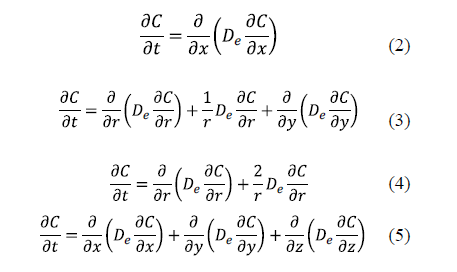
<body><![CDATA[<p><font size="2" face="Verdana, Arial, Helvetica, sans-serif">The analytical solutions of Fick's diffusion equation for  predicting D in salting for classical geometries has been widely used for  different geometries: planar with transport in one direction (Equation 2),  cylindrical (Equation 3), spherical (Equation 4), and parallelepipedic with  multidirectional transport (Equation 5) &#91;11,16,21-32&#93;. </font></p>     <p><img src="/img/revistas/dyna/v82n190/v82n190a02eq0205.gif"></p>     <p><font size="2" face="Verdana, Arial, Helvetica, sans-serif">The solution of these equations depends on the boundary  conditions. The number of boundary conditions required is determined by the  order of the highest derivatives appearing in each independent variable in the  governing differential equations. Thus, a transient process governed by a first  derivative respect to time will require one boundary condition related to this  variable, usually one initial condition. The initial condition refers to the  distribution of salt at the beginning of the salting process. For example, for  a slab geometry it can be expressed as (Eq. 6). </font></p>     <p><img src="/img/revistas/dyna/v82n190/v82n190a02eq06.gif"></p>     <p><font size="2" face="Verdana, Arial, Helvetica, sans-serif">Eq. 6 indicates that at the beginning of the salting  process the total salt concentration in the product is the same and equal to  the initial concentration.</font></p>     <p><font size="2" face="Verdana, Arial, Helvetica, sans-serif">Since the governing equation for each spatial dimension is  of the second order, two boundary conditions are needed for each dimension. A  symmetry condition and a surface condition are usually formulated. For an  infinite slab, the symmetry condition is expressed in equation 7. Generally  speaking, a symmetry condition must be formulated for each spatial dimension.</font></p>     <p><img src="/img/revistas/dyna/v82n190/v82n190a02eq07.gif"></p>     <p><font size="2" face="Verdana, Arial, Helvetica, sans-serif">As regards the surface condition, two considerations can  be made depending on whether the external resistance to mass transfer is  negligible or not. If the external resistance to mass transfer is negligible,  it is assumed that the equilibrium concentration of salt is reached on the  surface of the solid from the beginning of the process. This condition is  expressed by equation 8 for an infinite slab of thickness, 2L. </font></p>     <p><img src="/img/revistas/dyna/v82n190/v82n190a02eq08.gif"></p>     <p><font size="2" face="Verdana, Arial, Helvetica, sans-serif">The industrial salting process is not carried out under  conditions of strong agitation. For that reason, the external resistance to  mass transfer can sometimes be considered. In this case, a mass transfer  coefficient (k<sub>c</sub>) is included in the surface boundary condition.  Equation 9 shows the surface condition under this hypothesis for an infinite  slab of thickness, 2L &#91;25&#93;.</font></p>     ]]></body>


<body><![CDATA[<p><img src="/img/revistas/dyna/v82n190/v82n190a02eq09.gif"></p>     <p><font size="2" face="Verdana, Arial, Helvetica, sans-serif">Previous diffusion equations (Eqs. 2 to 5) took into  account the local concentration of salt in the sample. Since the experimental  values are determined as average concentrations, these equations are integrated  to calculate the average salt content of the sample and to model the average  concentrations in order to compare the experimental and calculated results.</font></p>     <p><font size="2" face="Verdana, Arial, Helvetica, sans-serif">Mass transport phenomena during salting can be assumed as  the diffusion of ionic species in a multicomponent electrolyte solution. Mass  transfer in electrolytic solutions requires a description of the movement of  mobile ionic species, material balances, current flow, electroneutrality and  fluid mechanics. Solutes do not diffuse independently; a diffusion potential is  established and ions interact with it &#91;9&#93;. Thus, the description of the process  by means of the generalized Stefan-Maxwell equation &#91;33&#93; is more rigorous than  that achieved using the previously described Fick equation &#91;34&#93;. </font></p>     <p><font size="2" face="Verdana, Arial, Helvetica, sans-serif">Pinotti et al. &#91;9&#93;  analysed the effect of NaCl concentration on the diffusion coefficients of NaNO<sub>2</sub> and KNO<sub>3</sub> in pork meat. They applied the Stefan-Maxwell theory in  electrolyte solutions to calculate the diffusion coefficients. Costa-Corredor  et al. &#91;34&#93; simulated simultaneous water and salt diffusion in dry fermented  sausage by means of the generalized Stefan-Maxwell theory. They converted this  equation into the multicomponent Fick equation for the simulation. Pakowski et  al. &#91;35&#93; simulated the evolution of water and salt profiles during the dry  curing of Spanish ham in a similar way.</font></p>     <p><font size="2" face="Verdana, Arial, Helvetica, sans-serif"><b>3.1.1. Factors influencing diffusion </b></font></p>     <p><font size="2" face="Verdana, Arial, Helvetica, sans-serif">The diffusion of salt and water in meat is influenced by  several factors. These factors can be used as implicit functions in models  &#91;36&#93;. </font></p>     <p><font size="2" face="Verdana, Arial, Helvetica, sans-serif"><b><i>3.1.1.1. Water  content </i></b></font></p>     <p><font size="2" face="Verdana, Arial, Helvetica, sans-serif">Since water is the main component of meat and fish, the  interaction between water molecules and other macromolecules determines the  water retention capacity &#91;37&#93;. Water retention capacity is an important factor  in the diffusion of salts during the salting process, inasmuch as salts-due to  their high degree of solubility-are mobilized into the aqueous phase of meat  and fish &#91;38&#93;. Thus, the transport rate of salt falls as the water content of  food decreases during processing &#91;20,39&#93;.</font></p>     <p><font size="2" face="Verdana, Arial, Helvetica, sans-serif"><b><i>3.1.1.2. Brine  concentration</i></b></font></p>     <p><font size="2" face="Verdana, Arial, Helvetica, sans-serif">The rates of salt and water diffusion are positively  correlated with the increasing salt concentration of the brine &#91;40&#93;. Different authors have studied the influence  of brine concentration on the salt and water diffusion coefficients in meat  from multiple regression models &#91;41-43&#93;. Corzo  and Bracho &#91;23&#93; modeled the effect of salt concentration and temperature on the  water diffusion coefficient of sardine sheets. They used a multiple linear  regression to fit the diffusion coefficient as a function of absolute temperature  (1/T) and brine concentration (C).</font></p>     ]]></body>
<body><![CDATA[<p><font size="2" face="Verdana, Arial, Helvetica, sans-serif"><i><b>3.1.1.3. Meat fibre direction</b></i></font></p>     <p><font size="2" face="Verdana, Arial, Helvetica, sans-serif">The influence of meat fibre direction on the diffusion of  salt and water in salted products has been widely studied &#91;24, 36, 44-46&#93;. All  of these studies have found that both salt and water diffusion behave in an  anisotropic way in fish and meat muscles. For instance, Gisbert &#91;45&#93; studied  the salting of pork loin and found a higher salt and water diffusivity when the  diffusion occurred parallel to the meat fibres. </font></p>     <p><font size="2" face="Verdana, Arial, Helvetica, sans-serif"><i><b>3.1.1.4</b></i><b>.<i> Operating temperature</i></b></font></p>     <p><font size="2" face="Verdana, Arial, Helvetica, sans-serif">The diffusivity is significantly affected by temperature.  An increase in temperature raises the thermal energy of molecules, leading to  an increase in their diffusion rate. &#91;9,23,28&#93;. Thus, the relationship between  salt and water diffusivity and temperature is generally described by the  Arrhenius equation (Eq. 10). </font></p>     <p><img src="/img/revistas/dyna/v82n190/v82n190a02eq10.gif"></p>     <p><font size="2" face="Verdana, Arial, Helvetica, sans-serif"><b><i>3.1.1.5. Shrinkage</i></b></font></p>     <p><font size="2" face="Verdana, Arial, Helvetica, sans-serif">During salting, moisture loss leads to the tightening of  the solid structure of the product and local shrinkage. Isotropic shrinkage is  when the dimensions of the product change in equal proportions in every  direction. Clemente et al. &#91;47&#93; found a linear relationship between the  quotients &quot;radius/initial radius&quot; and &quot;volume/initial volume&quot; and the moisture  content for the drying of salted pork meat. Other relationships were described  by Comaposada &#91;48&#93; to determine the effect of shrinkage on water diffusion in  the salted muscle of pork ham, and by Corzo and Bracho &#91;49&#93; to determine the  shrinkage of salted sardine sheets.</font></p>     <p><font size="2" face="Verdana, Arial, Helvetica, sans-serif"><b><i>3.1.1.6. pH</i></b></font></p>     <p><font size="2" face="Verdana, Arial, Helvetica, sans-serif">The pH of the meat has a significant effect on the  diffusion of curing salts and water because this factor controls the water  retention capacity. Studies by Cierach and Modzelewska-Kapitula &#91;50&#93; on salted  pork meat, show that meat with low pH values, from 5.4 to 5.5 (PSE meat, Pale  Soft and Exudative), reached a higher concentration and achieved a greater salt  diffusion compared to meat with high pH values of between 6.2 and 6.8 (DFD  meat, Dark, Firm and Dry). Arnau et al. &#91;51&#93; studied the effect of pH on the  salt content in hams obtaining similar results. </font></p>     <p><font size="2" face="Verdana, Arial, Helvetica, sans-serif"><b>3.1.2. Improvement  of diffusional models</b></font></p>     ]]></body>

<body><![CDATA[<p><font size="2" face="Verdana, Arial, Helvetica, sans-serif">Several aspects are  important in the development of better models with which to describe the  salting process. One of them is the precise measurement of the salt and  moisture content at every point of the food and its surroundings during  processing &#91;11&#93;. In this direction, the greatest advances have been made by  using non-destructive testing methods, such as X-ray tomography, ultrasounds  and NMR &#91;31,52-54&#93;. Another aspect is the adequate thermodynamic definition of  the food and its surroundings &#91;55&#93;, identifying the components, phases and  driving forces that exist, both in pile and brine salting processes. In the  same fashion, an adequate resolution of the rigorous equations allows a better  approximation of the models with which to describe the real process. Assuming  constant diffusion coefficients, regardless of the time, distance or food  composition, and that the external resistance to mass transfer is neglected  &#91;25&#93;, facilitates the solution of the model. Nevertheless, sometimes this means  that the model does not provide close fitting results &#91;56&#93;.</font></p>     <p><font size="2" face="Verdana, Arial, Helvetica, sans-serif"><b><i>3.2. Empirical  models</i></b></font></p>     <p><font size="2" face="Verdana, Arial, Helvetica, sans-serif">Empirical models are obtained by fitting experimental  data; thus, these models only describe systems under specific conditions.  Empirical models present some advantages, such as the ability to model water  losses and solid uptake, as well as the physical-chemical and sensory  properties of the food material. These models ignore the internal resistance to  mass transfer, for which reason they are limited to obtaining a general  expression of the mass transport phenomena experienced during the process &#91;57&#93;.  Shi and Le Maguer &#91;58&#93; described some important aspects related to the  application of these models. There are several empirical equations used to  model the mass transfer kinetics during salting, which are useful for the purposes  of optimizing the process itself. Although not derived from any physical laws  or diffusion theories, their application during the study of salting kinetics  has been demonstrated. </font></p>     <p><font size="2" face="Verdana, Arial, Helvetica, sans-serif"><b>3.2.1. Azuara's  model</b></font></p>     <p><font size="2" face="Verdana, Arial, Helvetica, sans-serif">Azuara et al. &#91;59&#93; proposed a model, which avoided the  limitations of Fick's diffusion model for practical purposes, and succeeded in  predicting mass transport during osmotic  dehydration accurately &#91;60&#93;. Both water loss and salt uptake are modelled. This  model can be written as:</font></p>     <p><img src="/img/revistas/dyna/v82n190/v82n190a02eq11.gif"></p>     <p><font size="2" face="Verdana, Arial, Helvetica, sans-serif">Similarly, for solid uptake, it can also be written as:</font></p>     <p><img src="/img/revistas/dyna/v82n190/v82n190a02eq12.gif"></p>     <p><font size="2" face="Verdana, Arial, Helvetica, sans-serif">This model does not consider the size, shape and structure  of the material. Its greatest advantage is that equilibrium does not have to be reached in order to predict water loss and salt gain.</font></p>     <p><font size="2" face="Verdana, Arial, Helvetica, sans-serif"><b>3.2.2. Peleg's  model</b></font></p>     ]]></body>
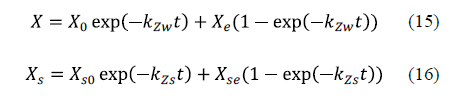
<body><![CDATA[<p><font size="2" face="Verdana, Arial, Helvetica, sans-serif">Peleg's model &#91;61&#93; is a two-parameter model widely used in  food processing. The linearized equation for water loss is:</font></p>     <p><img src="/img/revistas/dyna/v82n190/v82n190a02eq13.gif"></p>     <p><font size="2" face="Verdana, Arial, Helvetica, sans-serif">Similarly, for salt uptake, Peleg's model can also be  written as:</font></p>     <p><img src="/img/revistas/dyna/v82n190/v82n190a02eq14.gif"></p>     <p><font size="2" face="Verdana, Arial, Helvetica, sans-serif">Corzo et al. &#91;60&#93;  applied Peleg's and Azuara's models for the purposes of describing mass  transfer during pile salting of goat meat sheets using different mixtures of  NaCl, KCl, CaCl<sub>2</sub> and MgCl<sub>2</sub>. High coefficients  of determination and low mean relative errors indicated that both models are  able to represent the moisture loss and salt uptake during pile salting. The  equilibrium moisture and salt contents estimated by Peleg's model were lower  than those estimated by Azuara's model. </font></p>     <p><font size="2" face="Verdana, Arial, Helvetica, sans-serif"><b>3.2.3. Zugarramurdi and Lupin's model</b></font></p>     <p><font size="2" face="Verdana, Arial, Helvetica, sans-serif">This mathematical model is an exponential approach to the  equilibrium value of sodium chloride and water concentrations. The  acceptability of the model has been verified through experiments on various  fish species. The authors concluded that the behaviour of the system under  consideration is general and may be applied to any species &#91;62-64&#93;. The  equations for the model are equation 15 for water loss and equation 16 for sodium  chloride uptake.</font></p>     <p><img src="/img/revistas/dyna/v82n190/v82n190a02eq1516.gif"></p>     <p><font size="2" face="Verdana, Arial, Helvetica, sans-serif">Corzo et al. &#91;65&#93;  considered applying Zugarramurdi and Lupin's model during the pile salting of  goat meat sheets in order to study not only the equilibrium, but also the  kinetics of the process. A good agreement between the experimental and  calculated results was obtained. Chabbouh et al. &#91;14&#93; applied both Zugarramundi  and Lupin and Peleg's models for the description of water exudation and salt  uptake by beef meat. Both models displayed a good fit to the experimental data  for sodium chloride uptake and water exudation. Bellagha et al. &#91;62&#93; used  Zugarramundi and Lupin's model in the modelling of the salting kinetics of  sardine. They obtained good agreement between the experimental values and those  calculated by means of the model for both brine and dry salting. </font></p>     <p>&nbsp;</p>     ]]></body>

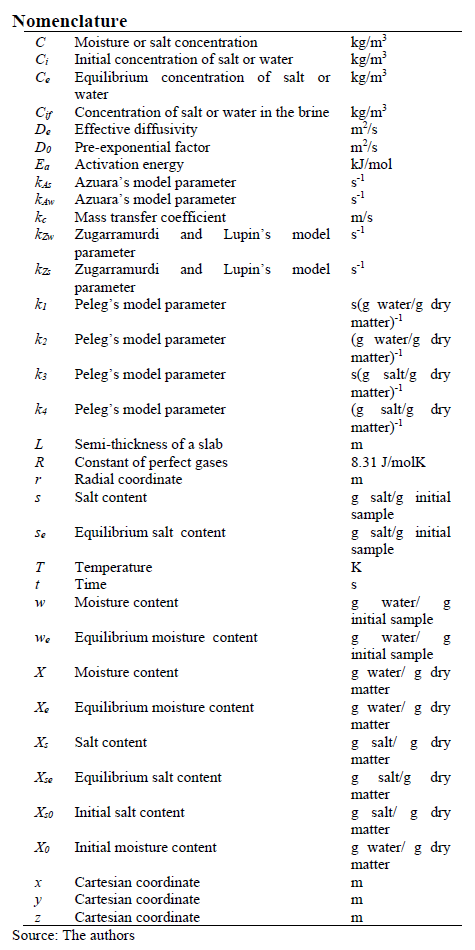
<body><![CDATA[<p><font size="3" face="Verdana, Arial, Helvetica, sans-serif"><b>4. Conclusions</b></font></p>     <p><font size="2" face="Verdana, Arial, Helvetica, sans-serif">Using models to  describe meat and fish salting is highly useful for industrial purposes;  for example, in the prediction of the salting time and the brine concentration  necessary to reach a certain salt concentration in a piece of meat or fish.</font></p>     <p><font size="2" face="Verdana, Arial, Helvetica, sans-serif">The diffusion of salt and water in meat and fish is influenced  by several factors. It is necessary to develop mathematical  equations, which take all of those aspects and the physical properties into  account in order both to improve our  understanding and to describe the  salting kinetics adequately. </font></p>     <p><font size="2" face="Verdana, Arial, Helvetica, sans-serif">Most of the models  used to describe the salting process are diffusional, based on Fick's second  law. In the case of salting, the most commonly applied equations are  diffusional for regular shapes. In order to improve diffusional models,  additional details of the physical and chemical processes that take place  during salting should be incorporated. Other models used for salting are the  empirical ones, such as Azuara's model, Peleg's model and Zugarramurdi and  Lupin's model. </font></p>     <p><font size="2" face="Verdana, Arial, Helvetica, sans-serif">The level of complexity needed in a model depends on the  objective to be reached. In general, the easier the model, the easier is its  solution. Nevertheless, a good description of the experimental results should  be guaranteed. For this reason, the model to be used will be analysed in each  case.</font></p>     <p><img src="/img/revistas/dyna/v82n190/v82n190a02nom01.gif"></p>     <p>&nbsp;</p>     <p><font size="3" face="Verdana, Arial, Helvetica, sans-serif"><b>Acknowledgements</b></font></p>     <p><font size="2" face="Verdana, Arial, Helvetica, sans-serif">The authors of this paper acknowledge the financial  support from CONSOLIDER INGENIO 2010 (CSD2007-00016), Spain.</font></p>     <p>&nbsp;</p>     ]]></body>
<body><![CDATA[<p><font size="3" face="Verdana, Arial, Helvetica, sans-serif"><b>References</b></font></p>     <!-- ref --><p><font size="2" face="Verdana, Arial, Helvetica, sans-serif"><b>&#91;1&#93;</b>    Weiss, J., Gibis, M., Schuh, V. and Salminen, H., Advances  in ingredient and processing systems for meat and meat products,  Meat Science, 86 (1), pp. 196-213, 2010. <a href="http://dx.doi.org/ 10.1016/j.meatsci.2010.05.008" target="_blank">http://dx.doi.org/ 10.1016/j.meatsci.2010.05.008</a></font>&nbsp;&nbsp;&nbsp;&nbsp;&nbsp;&nbsp;&nbsp;&nbsp;[&#160;<a href="javascript:void(0);" onclick="javascript: window.open('/scielo.php?script=sci_nlinks&ref=000104&pid=S0012-7353201500020000200001&lng=','','width=640,height=500,resizable=yes,scrollbars=1,menubar=yes,');">Links</a>&#160;]<!-- end-ref --><!-- ref --><p><font size="2" face="Verdana, Arial, Helvetica, sans-serif"><b>&#91;2&#93;</b>    Mulet, A., Drying modeling and  water diffusivity in carrots and patatoes, Journal of Food Engineering, 22  (1-4), pp. 329-348, 1994. <a href="http://dx.doi.org/10.1016/0260-8774(94)90038-8" target="_blank">http://dx.doi.org/10.1016/0260-8774(94)90038-8</a></font>&nbsp;&nbsp;&nbsp;&nbsp;&nbsp;&nbsp;&nbsp;&nbsp;[&#160;<a href="javascript:void(0);" onclick="javascript: window.open('/scielo.php?script=sci_nlinks&ref=000105&pid=S0012-7353201500020000200002&lng=','','width=640,height=500,resizable=yes,scrollbars=1,menubar=yes,');">Links</a>&#160;]<!-- end-ref --><!-- ref --><p><font size="2" face="Verdana, Arial, Helvetica, sans-serif"><b>&#91;3&#93;</b>    Barat, J.M., Rodriguez-Barona, S., Andres, A. and  Fito, P., Cod salting manufacturing analysis, Food Research International,  36 (5), pp. 447-453, 2003. <a href="http://dx.doi.org/10.1016/S0963-9969(02)00178-3" target="_blank">http://dx.doi.org/10.1016/S0963-9969(02)00178-3</a></font>&nbsp;&nbsp;&nbsp;&nbsp;&nbsp;&nbsp;&nbsp;&nbsp;[&#160;<a href="javascript:void(0);" onclick="javascript: window.open('/scielo.php?script=sci_nlinks&ref=000106&pid=S0012-7353201500020000200003&lng=','','width=640,height=500,resizable=yes,scrollbars=1,menubar=yes,');">Links</a>&#160;]<!-- end-ref --><!-- ref --><p><font size="2" face="Verdana, Arial, Helvetica, sans-serif"><b>&#91;4&#93;</b> Andr&eacute;s, A., Rodríguez-Barona, S., Barat, J. M. and  Fito, P., Salted cod manufacturing: Influence of salting procedure on process  yield and product characteristics, Journal of Food Engineering, 69  (4), pp. 467-471, 2005. <a href="http://dx.doi.org/ 10.1016/j.jfoodeng.2004.08.040" target="_blank">http://dx.doi.org/ 10.1016/j.jfoodeng.2004.08.040</a></font>&nbsp;&nbsp;&nbsp;&nbsp;&nbsp;&nbsp;&nbsp;&nbsp;[&#160;<a href="javascript:void(0);" onclick="javascript: window.open('/scielo.php?script=sci_nlinks&ref=000107&pid=S0012-7353201500020000200004&lng=','','width=640,height=500,resizable=yes,scrollbars=1,menubar=yes,');">Links</a>&#160;]<!-- end-ref --><!-- ref --><p><font size="2" face="Verdana, Arial, Helvetica, sans-serif"><b>&#91;5&#93;</b>    Beraquet, N.J., Iaderoza, M., Jardim, D.C.P. and  Lindo, M.K.K., Salting of mackerel (Scomber japonicas) II.  Comparison between brining and mixed salting in relation to quality and salt  uptake, Coletaneado Instituto de Technologia de Alimentos, 13, pp.  175-198, 1983.    &nbsp;&nbsp;&nbsp;&nbsp;&nbsp;&nbsp;&nbsp;&nbsp;[&#160;<a href="javascript:void(0);" onclick="javascript: window.open('/scielo.php?script=sci_nlinks&ref=000108&pid=S0012-7353201500020000200005&lng=','','width=640,height=500,resizable=yes,scrollbars=1,menubar=yes,');">Links</a>&#160;]<!-- end-ref --></font></p>     <!-- ref --><p><font size="2" face="Verdana, Arial, Helvetica, sans-serif"><b>&#91;6&#93;</b>    Thorarinsdottir, K.A., Arason, S., Bogason, S.G. and  Kristbergsson, K., The effects of various salt concentrations  during brine curing of cod (Gadus morhua), International Journal of  Food Science and Technology, 39 (1), pp. 79-89, 2004. <a href="http://dx.doi.org/ 10.1046/j.0950-5423.2003.00757.x" target="_blank">http://dx.doi.org/ 10.1046/j.0950-5423.2003.00757.x</a></font>&nbsp;&nbsp;&nbsp;&nbsp;&nbsp;&nbsp;&nbsp;&nbsp;[&#160;<a href="javascript:void(0);" onclick="javascript: window.open('/scielo.php?script=sci_nlinks&ref=000110&pid=S0012-7353201500020000200006&lng=','','width=640,height=500,resizable=yes,scrollbars=1,menubar=yes,');">Links</a>&#160;]<!-- end-ref --><!-- ref --><p><font size="2" face="Verdana, Arial, Helvetica, sans-serif"><b>&#91;7&#93;</b> Vandendriessche, F., Tecnologías centroeuropeas de  elaboraci&oacute;n de jam&oacute;n curado. III Congreso Mundial del  Jam&oacute;n. Ed. Consejo Regulador de la Denominaci&oacute;n de Origen &quot;Jam&oacute;n de  Teruel&quot;, pp. 192-212, 2005.    &nbsp;&nbsp;&nbsp;&nbsp;&nbsp;&nbsp;&nbsp;&nbsp;[&#160;<a href="javascript:void(0);" onclick="javascript: window.open('/scielo.php?script=sci_nlinks&ref=000111&pid=S0012-7353201500020000200007&lng=','','width=640,height=500,resizable=yes,scrollbars=1,menubar=yes,');">Links</a>&#160;]<!-- end-ref --></font></p>     ]]></body>
<body><![CDATA[<!-- ref --><p><font size="2" face="Verdana, Arial, Helvetica, sans-serif"><b>&#91;8&#93;</b>    Thorarinsdottir, K.A., Arason, S., Sigurgisladottir,  S., Gunnlaugsson, V.N., Johannsdottir, J. and Tornberg, E., The  effects of salt-curing and salting procedures on the microstructure of cod (Gadus  morhua) muscle, Food Chemistry, 126 (1), pp. 109-115, 2011. <a href="http://dx.doi.org/ 10.1016/j.foodchem.2010.10.085" target="_blank">http://dx.doi.org/ 10.1016/j.foodchem.2010.10.085</a></font>&nbsp;&nbsp;&nbsp;&nbsp;&nbsp;&nbsp;&nbsp;&nbsp;[&#160;<a href="javascript:void(0);" onclick="javascript: window.open('/scielo.php?script=sci_nlinks&ref=000113&pid=S0012-7353201500020000200008&lng=','','width=640,height=500,resizable=yes,scrollbars=1,menubar=yes,');">Links</a>&#160;]<!-- end-ref --><!-- ref --><p><font size="2" face="Verdana, Arial, Helvetica, sans-serif"><b>&#91;9&#93;</b>    Pinotti, A., Graiver, N., Califano, A. and Zaritzky,  N., Diffusion of nitrite and nitrate salts in pork tissue in the  presence of sodium chloride, Journal of Food Science, 67 (6), pp.  2165-2171, 2002. <a href="http://dx.doi.org/10.1111/j.1365-2621.2002.tb09521.x" target="_blank">http://dx.doi.org/10.1111/j.1365-2621.2002.tb09521.x</a></font>&nbsp;&nbsp;&nbsp;&nbsp;&nbsp;&nbsp;&nbsp;&nbsp;[&#160;<a href="javascript:void(0);" onclick="javascript: window.open('/scielo.php?script=sci_nlinks&ref=000114&pid=S0012-7353201500020000200009&lng=','','width=640,height=500,resizable=yes,scrollbars=1,menubar=yes,');">Links</a>&#160;]<!-- end-ref --><!-- ref --><p><font size="2" face="Verdana, Arial, Helvetica, sans-serif"><b>&#91;10&#93;</b> Andr&eacute;s, A.I. y Ruiz J., Tecnología del salazonado del jam&oacute;n  ib&eacute;rico, En cap. VIII de Tecnología del jam&oacute;n ib&eacute;rico, de los sistemas  tradicionales a la explotaci&oacute;n racional del sabor y el aroma&quot;. Coordinador J.  Ventanas. Ediciones Mundi Prensa. Madrid, 2001.    &nbsp;&nbsp;&nbsp;&nbsp;&nbsp;&nbsp;&nbsp;&nbsp;[&#160;<a href="javascript:void(0);" onclick="javascript: window.open('/scielo.php?script=sci_nlinks&ref=000115&pid=S0012-7353201500020000200010&lng=','','width=640,height=500,resizable=yes,scrollbars=1,menubar=yes,');">Links</a>&#160;]<!-- end-ref --> </font></p>     <!-- ref --><p><font size="2" face="Verdana, Arial, Helvetica, sans-serif"><b>&#91;11&#93;</b> Barat, J.M., Baigts, D., Ali&ntilde;o, M., Fernandez, F.J.  and Perez-García, V.M., Kinetics studies during NaCl and  KCl pork meat brining, Journal of Food Engineering, 106 (1), pp. 102-110,  2011. <a href="http://dx.doi.org/10.1016/j.jfoodeng.2011.04.022" target="_blank">http://dx.doi.org/10.1016/j.jfoodeng.2011.04.022</a></font>&nbsp;&nbsp;&nbsp;&nbsp;&nbsp;&nbsp;&nbsp;&nbsp;[&#160;<a href="javascript:void(0);" onclick="javascript: window.open('/scielo.php?script=sci_nlinks&ref=000117&pid=S0012-7353201500020000200011&lng=','','width=640,height=500,resizable=yes,scrollbars=1,menubar=yes,');">Links</a>&#160;]<!-- end-ref --><!-- ref --><p><font size="2" face="Verdana, Arial, Helvetica, sans-serif"><b>&#91;12&#93;</b>   Volpato, G., Michielin, E.M.Z., Ferreira, S.R.S. and  Petrus, J.C.C., Kinetics of the diffusion of sodium chloride in  chicken breast (Pectoralis major) during curing, Journal of Food  Engineering, 79 (3), pp. 779-785, 2007.</font> <font size="2" face="Verdana, Arial, Helvetica, sans-serif"><a href="http://dx.doi.org/10.1016/j.jfoodeng.2006.02.043" target="_blank">http://dx.doi.org/10.1016/j.jfoodeng.2006.02.043</a></font>&nbsp;&nbsp;&nbsp;&nbsp;&nbsp;&nbsp;&nbsp;&nbsp;[&#160;<a href="javascript:void(0);" onclick="javascript: window.open('/scielo.php?script=sci_nlinks&ref=000118&pid=S0012-7353201500020000200012&lng=','','width=640,height=500,resizable=yes,scrollbars=1,menubar=yes,');">Links</a>&#160;]<!-- end-ref --><!-- ref --><p><font size="2" face="Verdana, Arial, Helvetica, sans-serif"><b>&#91;13&#93;</b>   Vodyanova, I.V., Storro,  I., Olsen, A. and Rustad, T., Mathematical modelling of mixing of salt in minced meat by  bowl-cutter, Journal of Food Engineering, 112 (3), pp.  144-151, 2012. <a href="http://dx.doi.org/10.1016/j.jfoodeng.2012.03.020" target="_blank">http://dx.doi.org/10.1016/j.jfoodeng.2012.03.020</a></font>&nbsp;&nbsp;&nbsp;&nbsp;&nbsp;&nbsp;&nbsp;&nbsp;[&#160;<a href="javascript:void(0);" onclick="javascript: window.open('/scielo.php?script=sci_nlinks&ref=000119&pid=S0012-7353201500020000200013&lng=','','width=640,height=500,resizable=yes,scrollbars=1,menubar=yes,');">Links</a>&#160;]<!-- end-ref --><!-- ref --><p><font size="2" face="Verdana, Arial, Helvetica, sans-serif"><b>&#91;14&#93;</b>   Chabbouh, M., Ahmed, S.B.H., Farhat, A., Sahli, A. and  Bellagha, S., Studies  on the salting step of Tunisian kaddid meat: Experimental kinetics, modeling  and quality, Food and Bioprocess  Technology, 5 (5), pp. 1882-1895, 2012. <a href="http://dx.doi.org/10.1007/s11947-011-0635-2" target="_blank">http://dx.doi.org/10.1007/s11947-011-0635-2</a></font>&nbsp;&nbsp;&nbsp;&nbsp;&nbsp;&nbsp;&nbsp;&nbsp;[&#160;<a href="javascript:void(0);" onclick="javascript: window.open('/scielo.php?script=sci_nlinks&ref=000120&pid=S0012-7353201500020000200014&lng=','','width=640,height=500,resizable=yes,scrollbars=1,menubar=yes,');">Links</a>&#160;]<!-- end-ref --><!-- ref --><p><font size="2" face="Verdana, Arial, Helvetica, sans-serif"><b>&#91;15&#93;</b>   Uribe, E., Miranda, M., Vega-Galvez, A., Quispe, I.,  Claveria, R. and Di Scala, K., Mass transfer modelling during osmotic  dehydration of jumbo squid (Dosidicus gigas): Influence of temperature on  diffusion coefficients and kinetic  parameters, Food and  Bioprocess Technology, 4 (2), pp. 320-326, 2011. <a href="http://dx.doi.org/10.1007/s11947-010-0336-2" target="_blank">http://dx.doi.org/10.1007/s11947-010-0336-2</a></font>&nbsp;&nbsp;&nbsp;&nbsp;&nbsp;&nbsp;&nbsp;&nbsp;[&#160;<a href="javascript:void(0);" onclick="javascript: window.open('/scielo.php?script=sci_nlinks&ref=000121&pid=S0012-7353201500020000200015&lng=','','width=640,height=500,resizable=yes,scrollbars=1,menubar=yes,');">Links</a>&#160;]<!-- end-ref --><!-- ref --><p><font size="2" face="Verdana, Arial, Helvetica, sans-serif"><b>&#91;16&#93;</b>   Graiver, N., Pinotti, A., Califano, A. and Zaritzky,  N., Mathematical modeling of the uptake of curing salts in pork meat,  Journal of Food Engineering, 95 (4), pp. 533-540, 2009</font> <font size="2" face="Verdana, Arial, Helvetica, sans-serif"><a href="http://dx.doi.org/10.1016/j.jfoodeng.2009.06.027" target="_blank">http://dx.doi.org/10.1016/j.jfoodeng.2009.06.027</a></font>&nbsp;&nbsp;&nbsp;&nbsp;&nbsp;&nbsp;&nbsp;&nbsp;[&#160;<a href="javascript:void(0);" onclick="javascript: window.open('/scielo.php?script=sci_nlinks&ref=000122&pid=S0012-7353201500020000200016&lng=','','width=640,height=500,resizable=yes,scrollbars=1,menubar=yes,');">Links</a>&#160;]<!-- end-ref --><!-- ref --><p><font size="2" face="Verdana, Arial, Helvetica, sans-serif"><b>&#91;17&#93;</b>   Katekawa, M.E. and Silva, M.A., A review of drying  models including shrinkage effects, Drying Technology, 24 (1), pp.  5-20, 2006. <a href="http://dx.doi.org/10.1080/07373930500538519" target="_blank">http://dx.doi.org/10.1080/07373930500538519</a></font>&nbsp;&nbsp;&nbsp;&nbsp;&nbsp;&nbsp;&nbsp;&nbsp;[&#160;<a href="javascript:void(0);" onclick="javascript: window.open('/scielo.php?script=sci_nlinks&ref=000123&pid=S0012-7353201500020000200017&lng=','','width=640,height=500,resizable=yes,scrollbars=1,menubar=yes,');">Links</a>&#160;]<!-- end-ref --><!-- ref --><p><font size="2" face="Verdana, Arial, Helvetica, sans-serif"><b>&#91;18&#93;</b> G&oacute;mez, J., Sanju&aacute;n, N., Bonb, J., Arnauc, J.,  Clemente, G., Effect of temperature on nitrite and water diffusion  in pork meat, Journal of Food Engineering, 149, pp. 188-194, 2015</font> <font size="2" face="Verdana, Arial, Helvetica, sans-serif"><a href="http://dx.doi.org/10.1016/j.jfoodeng.2014.10.008" target="_blank">http://dx.doi.org/10.1016/j.jfoodeng.2014.10.008</a></font>&nbsp;&nbsp;&nbsp;&nbsp;&nbsp;&nbsp;&nbsp;&nbsp;[&#160;<a href="javascript:void(0);" onclick="javascript: window.open('/scielo.php?script=sci_nlinks&ref=000124&pid=S0012-7353201500020000200018&lng=','','width=640,height=500,resizable=yes,scrollbars=1,menubar=yes,');">Links</a>&#160;]<!-- end-ref --><!-- ref --><p><font size="2" face="Verdana, Arial, Helvetica, sans-serif"><b>&#91;19&#93;</b>   Crank J., The Mathematics of Diffusion. London: Oxford  University Press. 66 P., 1957.    &nbsp;&nbsp;&nbsp;&nbsp;&nbsp;&nbsp;&nbsp;&nbsp;[&#160;<a href="javascript:void(0);" onclick="javascript: window.open('/scielo.php?script=sci_nlinks&ref=000125&pid=S0012-7353201500020000200019&lng=','','width=640,height=500,resizable=yes,scrollbars=1,menubar=yes,');">Links</a>&#160;]<!-- end-ref --> </font></p>     <!-- ref --><p><font size="2" face="Verdana, Arial, Helvetica, sans-serif"><b>&#91;20&#93;</b>   Costa-Corredor, A., Munoz, I., Arnau, J. and Gou, P., Ion uptakes and diffusivities in pork meat brine-salted with  NaCl and K-lactate, LWT-Food Science and Technology, 43 (8), pp. 1226-1233,  2010. <a href="http://dx.doi.org/10.1016/j.lwt.2010.03.018" target="_blank">http://dx.doi.org/10.1016/j.lwt.2010.03.018</a></font>&nbsp;&nbsp;&nbsp;&nbsp;&nbsp;&nbsp;&nbsp;&nbsp;[&#160;<a href="javascript:void(0);" onclick="javascript: window.open('/scielo.php?script=sci_nlinks&ref=000127&pid=S0012-7353201500020000200020&lng=','','width=640,height=500,resizable=yes,scrollbars=1,menubar=yes,');">Links</a>&#160;]<!-- end-ref --><!-- ref --><p><font size="2" face="Verdana, Arial, Helvetica, sans-serif"><b>&#91;21&#93;</b>   Corzo, O. and Bracho, N. Determination  of water effective diffusion coefficient of sardine sheets during vacuum pulse  osmotic dehydration, LWT-Food Science and Technology, 40 (8), pp.  1452-1458, 2007. <a href="http://dx.doi.org/10.1016/j.lwt.2006.04.008" target="_blank">http://dx.doi.org/10.1016/j.lwt.2006.04.008</a></font>&nbsp;&nbsp;&nbsp;&nbsp;&nbsp;&nbsp;&nbsp;&nbsp;[&#160;<a href="javascript:void(0);" onclick="javascript: window.open('/scielo.php?script=sci_nlinks&ref=000128&pid=S0012-7353201500020000200021&lng=','','width=640,height=500,resizable=yes,scrollbars=1,menubar=yes,');">Links</a>&#160;]<!-- end-ref --><!-- ref --><p><font size="2" face="Verdana, Arial, Helvetica, sans-serif"><b>&#91;22&#93;</b> Torregroza-Espinosa, A., Montes-Montes, E.,  &Aacute;vila-G&oacute;mez, A. and Remolina-L&oacute;pez, J., Kinetic modelling of drying of three  varieties of yucca industrial. DYNA, 81 (186), pp. 184-192, 2014. <a href="http://dx.doi.org/10.15446/dyna.v81n186.39923" target="_blank">http://dx.doi.org/10.15446/dyna.v81n186.39923</a></font>&nbsp;&nbsp;&nbsp;&nbsp;&nbsp;&nbsp;&nbsp;&nbsp;[&#160;<a href="javascript:void(0);" onclick="javascript: window.open('/scielo.php?script=sci_nlinks&ref=000129&pid=S0012-7353201500020000200022&lng=','','width=640,height=500,resizable=yes,scrollbars=1,menubar=yes,');">Links</a>&#160;]<!-- end-ref --><!-- ref --><p><font size="2" face="Verdana, Arial, Helvetica, sans-serif"><b>&#91;23&#93;</b>   Corzo, O. and Bracho, N., Water effective diffusion  coefficient of sardine sheets during osmotic dehydration at different brine  concentrations and temperatures, Journal of Food Engineering, 80 (2), pp.  497-502, 2007.</font> <font size="2" face="Verdana, Arial, Helvetica, sans-serif"><a href="http://dx.doi.org/10.1016/j.jfoodeng.2006.06.008" target="_blank">http://dx.doi.org/10.1016/j.jfoodeng.2006.06.008</a></font>&nbsp;&nbsp;&nbsp;&nbsp;&nbsp;&nbsp;&nbsp;&nbsp;[&#160;<a href="javascript:void(0);" onclick="javascript: window.open('/scielo.php?script=sci_nlinks&ref=000130&pid=S0012-7353201500020000200023&lng=','','width=640,height=500,resizable=yes,scrollbars=1,menubar=yes,');">Links</a>&#160;]<!-- end-ref --><!-- ref --><p><font size="2" face="Verdana, Arial, Helvetica, sans-serif"><b>&#91;24&#93;</b> Gou, P., Comaposada, J. and Arnau, J. Meat pH and meat  fibre direction effects on moisture diffusivity in salted ham muscles dried at  5ºC, Meat Science, 61 (1), pp. 25-31, 2002. <a href="http://dx.doi.org/10.1016/j.jfoodeng.2006.06.008" target="_blank">http://dx.doi.org/10.1016/j.jfoodeng.2006.06.008</a></font>&nbsp;&nbsp;&nbsp;&nbsp;&nbsp;&nbsp;&nbsp;&nbsp;[&#160;<a href="javascript:void(0);" onclick="javascript: window.open('/scielo.php?script=sci_nlinks&ref=000131&pid=S0012-7353201500020000200024&lng=','','width=640,height=500,resizable=yes,scrollbars=1,menubar=yes,');">Links</a>&#160;]<!-- end-ref --><!-- ref --><p><font size="2" face="Verdana, Arial, Helvetica, sans-serif"><b>&#91;25&#93;</b>   Gou, P., Comaposada, J. and Arnau, J., NaCl content  and temperature effects on moisture diffusivity in the Gluteus medius muscle of  pork ham, Meat Science, 63 (1), pp. 29-34, 2003. <a href="http://dx.doi.org/10.1016/S0309-1740(01)00158-9" target="_blank">http://dx.doi.org/10.1016/S0309-1740(01)00158-9</a></font>&nbsp;&nbsp;&nbsp;&nbsp;&nbsp;&nbsp;&nbsp;&nbsp;[&#160;<a href="javascript:void(0);" onclick="javascript: window.open('/scielo.php?script=sci_nlinks&ref=000132&pid=S0012-7353201500020000200025&lng=','','width=640,height=500,resizable=yes,scrollbars=1,menubar=yes,');">Links</a>&#160;]<!-- end-ref --><!-- ref --><p><font size="2" face="Verdana, Arial, Helvetica, sans-serif"><b>&#91;26&#93;</b>   Graiver, N., Pinotti, A., Califano, A. and Zaritzky,  N., Diffusion of sodium chrloride in meat pork: Influence on its  microstructure, Scanning, 27 (2), pp. 76-77, 2005.    &nbsp;&nbsp;&nbsp;&nbsp;&nbsp;&nbsp;&nbsp;&nbsp;[&#160;<a href="javascript:void(0);" onclick="javascript: window.open('/scielo.php?script=sci_nlinks&ref=000133&pid=S0012-7353201500020000200026&lng=','','width=640,height=500,resizable=yes,scrollbars=1,menubar=yes,');">Links</a>&#160;]<!-- end-ref --> </font></p>     <!-- ref --><p><font size="2" face="Verdana, Arial, Helvetica, sans-serif"><b>&#91;27&#93;</b>   Graiver, N., Pinotti, A., Califano, A. and Zaritzky,  N., Diffusion of sodium chloride in pork tissue, Journal of Food Engineering,  77 (4), pp. 910-918, 2006. <a href="http://dx.doi.org/10.1016/j.jfoodeng.2005.08.018" target="_blank">http://dx.doi.org/10.1016/j.jfoodeng.2005.08.018</a></font>&nbsp;&nbsp;&nbsp;&nbsp;&nbsp;&nbsp;&nbsp;&nbsp;[&#160;<a href="javascript:void(0);" onclick="javascript: window.open('/scielo.php?script=sci_nlinks&ref=000135&pid=S0012-7353201500020000200027&lng=','','width=640,height=500,resizable=yes,scrollbars=1,menubar=yes,');">Links</a>&#160;]<!-- end-ref --><!-- ref --><p><font size="2" face="Verdana, Arial, Helvetica, sans-serif"><b>&#91;28&#93;</b>   Telis, V.R.N., Romanelli, P.F., Gabas, A.L. and  Telis-Romero, J., Salting kinetics and salt diffusivities in farmed Pantanal  caiman muscle, Pesquisa Agropecuaria Brasileira, 38 (4), pp. 529-535, 2003.  <a href="http://dx.doi.org/10.1590/S0100-204X2003000400012" target="_blank">http://dx.doi.org/10.1590/S0100-204X2003000400012</a></font>&nbsp;&nbsp;&nbsp;&nbsp;&nbsp;&nbsp;&nbsp;&nbsp;[&#160;<a href="javascript:void(0);" onclick="javascript: window.open('/scielo.php?script=sci_nlinks&ref=000136&pid=S0012-7353201500020000200028&lng=','','width=640,height=500,resizable=yes,scrollbars=1,menubar=yes,');">Links</a>&#160;]<!-- end-ref --><!-- ref --><p><font size="2" face="Verdana, Arial, Helvetica, sans-serif"><b>&#91;29&#93;</b>   Van Nguyen, M., Arason, S., Thorarinsdottir, K.A.,  Thorkelsson, G. and Gudmundsdottir, A., Influence of salt concentration on the  salting kinetics of cod loin (Gadus morhua) during brine salting, Journal of  Food Engineering, 100 (2), pp. 225-231, 2010. <a href="http://dx.doi.org/ 10.1016/j.jfoodeng.2010.04.003" target="_blank">http://dx.doi.org/ 10.1016/j.jfoodeng.2010.04.003</a></font>&nbsp;&nbsp;&nbsp;&nbsp;&nbsp;&nbsp;&nbsp;&nbsp;[&#160;<a href="javascript:void(0);" onclick="javascript: window.open('/scielo.php?script=sci_nlinks&ref=000137&pid=S0012-7353201500020000200029&lng=','','width=640,height=500,resizable=yes,scrollbars=1,menubar=yes,');">Links</a>&#160;]<!-- end-ref --><!-- ref --><p><font size="2" face="Verdana, Arial, Helvetica, sans-serif"><b>&#91;30&#93;</b>   Vestergaard, C., Andersen, B.L. and Adler-Nissen, J.,  Sodium diffusion in cured pork determined by 22Na radiology, Meat Science, 76  (2), pp. 258-265, 2007. <a href="http://dx.doi.org/10.1016/j.jfoodeng.2010.04.003" target="_blank">http://dx.doi.org/10.1016/j.jfoodeng.2010.04.003</a> </font>&nbsp;&nbsp;&nbsp;&nbsp;&nbsp;&nbsp;&nbsp;&nbsp;[&#160;<a href="javascript:void(0);" onclick="javascript: window.open('/scielo.php?script=sci_nlinks&ref=000138&pid=S0012-7353201500020000200030&lng=','','width=640,height=500,resizable=yes,scrollbars=1,menubar=yes,');">Links</a>&#160;]<!-- end-ref --><!-- ref --><p><font size="2" face="Verdana, Arial, Helvetica, sans-serif"><b>&#91;31&#93;</b>   Vestergaard, C., Risum, J. and Adler-Nissen, J.,  Quantification of salt concentrations in cured pork by computed tomography,  Meat Science, 68 (1), pp. 107-113, 2004. <a href="http://dx.doi.org/10.1016/j.meatsci.2006.11.007" target="_blank">http://dx.doi.org/10.1016/j.meatsci.2006.11.007</a></font>&nbsp;&nbsp;&nbsp;&nbsp;&nbsp;&nbsp;&nbsp;&nbsp;[&#160;<a href="javascript:void(0);" onclick="javascript: window.open('/scielo.php?script=sci_nlinks&ref=000139&pid=S0012-7353201500020000200031&lng=','','width=640,height=500,resizable=yes,scrollbars=1,menubar=yes,');">Links</a>&#160;]<!-- end-ref --><!-- ref --><p><font size="2" face="Verdana, Arial, Helvetica, sans-serif"><b>&#91;32&#93;</b>   Wang, D.H., Tang, J.M. and Correia, L.R., Salt  diffusivities and salt diffusion in farmed Atlantic salmon muscle as influenced  by rigor mortis, Journal of Food Engineering, 43 (2), pp. 115-123, 2000.  <a href="http://dx.doi.org/10.1016/S0260-8774(99)00140-5" target="_blank">http://dx.doi.org/10.1016/S0260-8774(99)00140-5</a> </font>&nbsp;&nbsp;&nbsp;&nbsp;&nbsp;&nbsp;&nbsp;&nbsp;[&#160;<a href="javascript:void(0);" onclick="javascript: window.open('/scielo.php?script=sci_nlinks&ref=000140&pid=S0012-7353201500020000200032&lng=','','width=640,height=500,resizable=yes,scrollbars=1,menubar=yes,');">Links</a>&#160;]<!-- end-ref --><!-- ref --><p><font size="2" face="Verdana, Arial, Helvetica, sans-serif"><b>&#91;33&#93;</b>   Taylor, R. and Krishna, R., Multicomponent Mass  Transfer. New York: John Wiley and Sons, Inc.P, pp. 37-43, 1983.    &nbsp;&nbsp;&nbsp;&nbsp;&nbsp;&nbsp;&nbsp;&nbsp;[&#160;<a href="javascript:void(0);" onclick="javascript: window.open('/scielo.php?script=sci_nlinks&ref=000141&pid=S0012-7353201500020000200033&lng=','','width=640,height=500,resizable=yes,scrollbars=1,menubar=yes,');">Links</a>&#160;]<!-- end-ref --></font></p>     ]]></body>
<body><![CDATA[<!-- ref --><p><font size="2" face="Verdana, Arial, Helvetica, sans-serif"><b>&#91;34&#93;</b>   Costa-Corredor, A., Pakowski, Z., Lenczewski, T. and  Gou, P., Simulation of simultaneous water and salt diffusion in dry fermented  sausages by the Stefan-Maxwell equation, Journal of Food Engineering, 97 (3),  pp. 311-318, 2010. <a href="http://dx.doi.org/ 10.1016/j.jfoodeng.2009.10.021" target="_blank">http://dx.doi.org/ 10.1016/j.jfoodeng.2009.10.021</a></font>&nbsp;&nbsp;&nbsp;&nbsp;&nbsp;&nbsp;&nbsp;&nbsp;[&#160;<a href="javascript:void(0);" onclick="javascript: window.open('/scielo.php?script=sci_nlinks&ref=000143&pid=S0012-7353201500020000200034&lng=','','width=640,height=500,resizable=yes,scrollbars=1,menubar=yes,');">Links</a>&#160;]<!-- end-ref --><!-- ref --><p><font size="2" face="Verdana, Arial, Helvetica, sans-serif"><b>&#91;35&#93;</b> Pakowski, Z., Gou, P., Comaposada, J. and Arnau, J.,  Simultaneous water and salt diffusion in meat during drying and curing of ham.  Drying 2004 - Proceedings of the 14<sup>th</sup> International Drying Symposium  (IDS 2004). São Paulo, Brazil, 22-25 August 2004, vol. A, pp. 518-525, 2004.    &nbsp;&nbsp;&nbsp;&nbsp;&nbsp;&nbsp;&nbsp;&nbsp;[&#160;<a href="javascript:void(0);" onclick="javascript: window.open('/scielo.php?script=sci_nlinks&ref=000144&pid=S0012-7353201500020000200035&lng=','','width=640,height=500,resizable=yes,scrollbars=1,menubar=yes,');">Links</a>&#160;]<!-- end-ref --></font></p>     <!-- ref --><p><font size="2" face="Verdana, Arial, Helvetica, sans-serif"><b>&#91;36&#93;</b>   Zhang, Q., Xiong, S., Liu, R., Xu, J. and Zhao, S.,  Diffusion kinetics of sodium chloride in Grass carp muscle and its diffusion  anisotropy, Journal of Food Engineering, 107 (3-4), pp.311-318, 2011.  <a href="http://dx.doi.org/10.1016/j.jfoodeng.2011.07.011" target="_blank">http://dx.doi.org/10.1016/j.jfoodeng.2011.07.011</a></font>&nbsp;&nbsp;&nbsp;&nbsp;&nbsp;&nbsp;&nbsp;&nbsp;[&#160;<a href="javascript:void(0);" onclick="javascript: window.open('/scielo.php?script=sci_nlinks&ref=000146&pid=S0012-7353201500020000200036&lng=','','width=640,height=500,resizable=yes,scrollbars=1,menubar=yes,');">Links</a>&#160;]<!-- end-ref --><!-- ref --><p><font size="2" face="Verdana, Arial, Helvetica, sans-serif"><b>&#91;37&#93;</b>   Renou, J.P., Foucat, L., and Bonny, J.M., Magnetic  resonance imaging studies of water interactions in meat, Food Chemistry, 82  (1), pp. 35-39, 2003. <a href="http://dx.doi.org/10.1016/S0308-8146(02)00582-4" target="_blank">http://dx.doi.org/10.1016/S0308-8146(02)00582-4</a> </font>&nbsp;&nbsp;&nbsp;&nbsp;&nbsp;&nbsp;&nbsp;&nbsp;[&#160;<a href="javascript:void(0);" onclick="javascript: window.open('/scielo.php?script=sci_nlinks&ref=000147&pid=S0012-7353201500020000200037&lng=','','width=640,height=500,resizable=yes,scrollbars=1,menubar=yes,');">Links</a>&#160;]<!-- end-ref --><!-- ref --><p><font size="2" face="Verdana, Arial, Helvetica, sans-serif"><b>&#91;38&#93;</b>   Honike, K.O., The use and control of nitrate and  nitrite for the processing of meat products, Meat Science, 78 (1-2), pp. 68-76,  2008. <a href="http://dx.doi.org/10.1016/j.meatsci.2007.05.030" target="_blank">http://dx.doi.org/10.1016/j.meatsci.2007.05.030</a> </font>&nbsp;&nbsp;&nbsp;&nbsp;&nbsp;&nbsp;&nbsp;&nbsp;[&#160;<a href="javascript:void(0);" onclick="javascript: window.open('/scielo.php?script=sci_nlinks&ref=000148&pid=S0012-7353201500020000200038&lng=','','width=640,height=500,resizable=yes,scrollbars=1,menubar=yes,');">Links</a>&#160;]<!-- end-ref --><!-- ref --><p><font size="2" face="Verdana, Arial, Helvetica, sans-serif"><b>&#91;39&#93;</b>   Boudhrioua, N., Bonazzi, C. and Daudin, J.D., Moisture  and salt transfers during constant temperature drying of gelatin gels: Effects  of composition and of water flux intensity, Chemical Engineering Research and  Design, 81 (A9), pp. 1113-1122, 2003.  <a href="http://dx.doi.org/10.1205/026387603770866263" target="_blank">http://dx.doi.org/10.1205/026387603770866263</a></font>&nbsp;&nbsp;&nbsp;&nbsp;&nbsp;&nbsp;&nbsp;&nbsp;[&#160;<a href="javascript:void(0);" onclick="javascript: window.open('/scielo.php?script=sci_nlinks&ref=000149&pid=S0012-7353201500020000200039&lng=','','width=640,height=500,resizable=yes,scrollbars=1,menubar=yes,');">Links</a>&#160;]<!-- end-ref --><!-- ref --><p><font size="2" face="Verdana, Arial, Helvetica, sans-serif"><b>&#91;40&#93;</b>   Offer, G. and Trinick, J., On the mechanism of water  holding in meat: The swelling and shrinking of myofibrils, Meat Science, 8 (4),  pp. 245-281, 1983.    &nbsp;&nbsp;&nbsp;&nbsp;&nbsp;&nbsp;&nbsp;&nbsp;[&#160;<a href="javascript:void(0);" onclick="javascript: window.open('/scielo.php?script=sci_nlinks&ref=000150&pid=S0012-7353201500020000200040&lng=','','width=640,height=500,resizable=yes,scrollbars=1,menubar=yes,');">Links</a>&#160;]<!-- end-ref --> </font></p>     <!-- ref --><p><font size="2" face="Verdana, Arial, Helvetica, sans-serif"><b>&#91;41&#93;</b> Ali&ntilde;o, M., Grau, R., Fern&aacute;ndez-S&aacute;nchez, A., Arnold,  A., and Barat, J.M., Influence of brine concentration on swelling pressure of  pork meat throughout salting, Meat Science, 86 (3), pp. 600-606, 2010. <a href="http://dx.doi.org/10.1016/j.meatsci.2010.04.010" target="_blank">http://dx.doi.org/10.1016/j.meatsci.2010.04.010</a></font>&nbsp;&nbsp;&nbsp;&nbsp;&nbsp;&nbsp;&nbsp;&nbsp;[&#160;<a href="javascript:void(0);" onclick="javascript: window.open('/scielo.php?script=sci_nlinks&ref=000152&pid=S0012-7353201500020000200041&lng=','','width=640,height=500,resizable=yes,scrollbars=1,menubar=yes,');">Links</a>&#160;]<!-- end-ref --><!-- ref --><p><font size="2" face="Verdana, Arial, Helvetica, sans-serif"><b>&#91;42&#93;</b> Ali&ntilde;o, M., Grau, R., Baigts, D. and Barat, J.M.,  Influence of sodium replacement on the salting kinetics of pork loin, Journal  of Food Engineering, 95 (4), pp. 551-557, 2009</font> <font size="2" face="Verdana, Arial, Helvetica, sans-serif"><a href="http://dx.doi.org/10.1016/j.jfoodeng.2009.06.016" target="_blank">http://dx.doi.org/10.1016/j.jfoodeng.2009.06.016</a></font>&nbsp;&nbsp;&nbsp;&nbsp;&nbsp;&nbsp;&nbsp;&nbsp;[&#160;<a href="javascript:void(0);" onclick="javascript: window.open('/scielo.php?script=sci_nlinks&ref=000153&pid=S0012-7353201500020000200042&lng=','','width=640,height=500,resizable=yes,scrollbars=1,menubar=yes,');">Links</a>&#160;]<!-- end-ref --><!-- ref --><p><font size="2" face="Verdana, Arial, Helvetica, sans-serif"><b>&#91;43&#93;</b>   Birkeland, S., Akse, L., Joensen, S., Tobiassen, T.  and Skara, T., Injection-salting of pre rigor fillets of Atlantic salmon (Salmo  salar), Journal of Food Science, 72 (1), 2007. <a href="http://dx.doi.org/10.1111/j.1750-3841.2006.00211.x" target="_blank">http://dx.doi.org/10.1111/j.1750-3841.2006.00211.x</a> </font>&nbsp;&nbsp;&nbsp;&nbsp;&nbsp;&nbsp;&nbsp;&nbsp;[&#160;<a href="javascript:void(0);" onclick="javascript: window.open('/scielo.php?script=sci_nlinks&ref=000154&pid=S0012-7353201500020000200043&lng=','','width=640,height=500,resizable=yes,scrollbars=1,menubar=yes,');">Links</a>&#160;]<!-- end-ref --><!-- ref --><p><font size="2" face="Verdana, Arial, Helvetica, sans-serif"><b>&#91;44&#93;</b>   Foucat, L., Benderbous, S., Bielicki, G., Zanca, M.  and Renou, J.P., Effect of brine injection on water dynamics on postmortem  muscle: Study of T2 and diffusion coefficients by MR microscopy, Magnetic  Resonance Imaging, 13 (2), 1995. <a href="http://dx.doi.org/10.1016/0730-725X(94)00094-J" target="_blank">http://dx.doi.org/10.1016/0730-725X(94)00094-J</a> </font>&nbsp;&nbsp;&nbsp;&nbsp;&nbsp;&nbsp;&nbsp;&nbsp;[&#160;<a href="javascript:void(0);" onclick="javascript: window.open('/scielo.php?script=sci_nlinks&ref=000155&pid=S0012-7353201500020000200044&lng=','','width=640,height=500,resizable=yes,scrollbars=1,menubar=yes,');">Links</a>&#160;]<!-- end-ref --><!-- ref --><p><font size="2" face="Verdana, Arial, Helvetica, sans-serif"><b>&#91;45&#93;</b> Gisbert, M., Influencia  de las variables de proceso en la evoluci&oacute;n físco-química y bioquímica del lomo  embuchado. Tesis Doctoral. Universidad  Polit&eacute;cnica de Valencia, 2001.    &nbsp;&nbsp;&nbsp;&nbsp;&nbsp;&nbsp;&nbsp;&nbsp;[&#160;<a href="javascript:void(0);" onclick="javascript: window.open('/scielo.php?script=sci_nlinks&ref=000156&pid=S0012-7353201500020000200045&lng=','','width=640,height=500,resizable=yes,scrollbars=1,menubar=yes,');">Links</a>&#160;]<!-- end-ref --></font></p>     <!-- ref --><p><font size="2" face="Verdana, Arial, Helvetica, sans-serif"><b>&#91;46&#93;</b>   Hansen, C.L., van der Berg, F., Ringgaard, S.,  Stodkilde-Jorgensen, H. and Karlsson, A.H., Diffusion of NaCl in meat studied  by H-1 and Na-23 magnetic resonance imaging, Meat Science, 80 (3), pp. 851-856,  2008. <a href="http://dx.doi.org/10.1016/j.meatsci.2008.04.003" target="_blank">http://dx.doi.org/10.1016/j.meatsci.2008.04.003</a></font>&nbsp;&nbsp;&nbsp;&nbsp;&nbsp;&nbsp;&nbsp;&nbsp;[&#160;<a href="javascript:void(0);" onclick="javascript: window.open('/scielo.php?script=sci_nlinks&ref=000158&pid=S0012-7353201500020000200046&lng=','','width=640,height=500,resizable=yes,scrollbars=1,menubar=yes,');">Links</a>&#160;]<!-- end-ref --><!-- ref --><p><font size="2" face="Verdana, Arial, Helvetica, sans-serif"><b>&#91;47&#93;</b>   Clemente, G., Bon, J., Sanjuan, N. and Mulet, A.,  Determination of shrinkage function for pork meat drying, Drying Technology, 27  (1), pp. 143-148, 2009. <a href="http://dx.doi.org/10.1080/07373930802566051" target="_blank">http://dx.doi.org/10.1080/07373930802566051</a></font>&nbsp;&nbsp;&nbsp;&nbsp;&nbsp;&nbsp;&nbsp;&nbsp;[&#160;<a href="javascript:void(0);" onclick="javascript: window.open('/scielo.php?script=sci_nlinks&ref=000159&pid=S0012-7353201500020000200047&lng=','','width=640,height=500,resizable=yes,scrollbars=1,menubar=yes,');">Links</a>&#160;]<!-- end-ref --><!-- ref --><p><font size="2" face="Verdana, Arial, Helvetica, sans-serif"><b>&#91;48&#93;</b> Comaposada, J., Sorption isotherms and water  diffusivity in muscles of pork ham at different NaCl contents. PhD Thesis.  Universitat Politècnica de Catalunya, 1999.    &nbsp;&nbsp;&nbsp;&nbsp;&nbsp;&nbsp;&nbsp;&nbsp;[&#160;<a href="javascript:void(0);" onclick="javascript: window.open('/scielo.php?script=sci_nlinks&ref=000160&pid=S0012-7353201500020000200048&lng=','','width=640,height=500,resizable=yes,scrollbars=1,menubar=yes,');">Links</a>&#160;]<!-- end-ref --></font></p>     <!-- ref --><p><font size="2" face="Verdana, Arial, Helvetica, sans-serif"><b>&#91;49&#93;</b>   Corzo, O. and Bracho, N., Shrinkage of osmotically  dehydrated sardine sheets at changing moisture contents, Journal of Food  Engineering, 65(3), 2004. <a href="http://dx.doi.org/10.1016/j.jfoodeng.2004.01.030" target="_blank">http://dx.doi.org/10.1016/j.jfoodeng.2004.01.030</a> </font>&nbsp;&nbsp;&nbsp;&nbsp;&nbsp;&nbsp;&nbsp;&nbsp;[&#160;<a href="javascript:void(0);" onclick="javascript: window.open('/scielo.php?script=sci_nlinks&ref=000162&pid=S0012-7353201500020000200049&lng=','','width=640,height=500,resizable=yes,scrollbars=1,menubar=yes,');">Links</a>&#160;]<!-- end-ref --><!-- ref --><p><font size="2" face="Verdana, Arial, Helvetica, sans-serif"><b>&#91;50&#93;</b>   Cierach, M. and Modzelewska-Kapitula, M., Effects of  pH values and fat content on sodium chloride diffusion rate in pork, Journal of  Food Processing and Preservation, 35 (2), pp. 129-142, 2011. <a href="http://dx.doi.org/10.1111/j.1745-4549.2009.00465.x" target="_blank">http://dx.doi.org/10.1111/j.1745-4549.2009.00465.x</a> </font>&nbsp;&nbsp;&nbsp;&nbsp;&nbsp;&nbsp;&nbsp;&nbsp;[&#160;<a href="javascript:void(0);" onclick="javascript: window.open('/scielo.php?script=sci_nlinks&ref=000163&pid=S0012-7353201500020000200050&lng=','','width=640,height=500,resizable=yes,scrollbars=1,menubar=yes,');">Links</a>&#160;]<!-- end-ref --><!-- ref --><p><font size="2" face="Verdana, Arial, Helvetica, sans-serif"><b>&#91;51&#93;</b>   Arnau, J., Guerrero, L., Casademont, G. and Gou, P.,  Physical and chemical changes in different zones of normal and PSE dry-cured  ham during processing, Food Chemistry, 52 (1), pp. 63-69, 1995.  <a href="http://dx.doi.org/10.1016/0308-8146(94)P4182-F" target="_blank">http://dx.doi.org/10.1016/0308-8146(94)P4182-F</a></font>&nbsp;&nbsp;&nbsp;&nbsp;&nbsp;&nbsp;&nbsp;&nbsp;[&#160;<a href="javascript:void(0);" onclick="javascript: window.open('/scielo.php?script=sci_nlinks&ref=000164&pid=S0012-7353201500020000200051&lng=','','width=640,height=500,resizable=yes,scrollbars=1,menubar=yes,');">Links</a>&#160;]<!-- end-ref --><!-- ref --><p><font size="2" face="Verdana, Arial, Helvetica, sans-serif"><b>&#91;52&#93;</b>   Bertram, H.C., Engelsen, S.B., Busk, H., Karlsson,  A.H. and Andersen, H.J., Water properties during cooking of pork studied by  low-field NMR relaxation: Effects of curing and the RN-gene, Meat Science, 66  (2), pp. 437-446, 2004. <a href="http://dx.doi.org/10.1016/S0309-1740(03)00132-3" target="_blank">http://dx.doi.org/10.1016/S0309-1740(03)00132-3</a></font>&nbsp;&nbsp;&nbsp;&nbsp;&nbsp;&nbsp;&nbsp;&nbsp;[&#160;<a href="javascript:void(0);" onclick="javascript: window.open('/scielo.php?script=sci_nlinks&ref=000165&pid=S0012-7353201500020000200052&lng=','','width=640,height=500,resizable=yes,scrollbars=1,menubar=yes,');">Links</a>&#160;]<!-- end-ref --><!-- ref --><p><font size="2" face="Verdana, Arial, Helvetica, sans-serif"><b>&#91;53&#93;</b>   Fortin, A., Tong, A.K.W., Robertson, W.M., Zawadski,  S.M., Landry, S. . and Robinson, D.J., A novel approach to grading pork  carcasses: Computer vision and ultrasound, Meat Science, 63 (4), pp. 451-462,  2003. <a href="http://dx.doi.org/10.1016/S0309-1740(02)00104-3" target="_blank">http://dx.doi.org/10.1016/S0309-1740(02)00104-3</a></font>&nbsp;&nbsp;&nbsp;&nbsp;&nbsp;&nbsp;&nbsp;&nbsp;[&#160;<a href="javascript:void(0);" onclick="javascript: window.open('/scielo.php?script=sci_nlinks&ref=000166&pid=S0012-7353201500020000200053&lng=','','width=640,height=500,resizable=yes,scrollbars=1,menubar=yes,');">Links</a>&#160;]<!-- end-ref --><!-- ref --><p><font size="2" face="Verdana, Arial, Helvetica, sans-serif"><b>&#91;54&#93;</b>   Kent, M., Peymann, A., Gabriel, C. and Knight, A.,  Determination of added water in pork products using microwave dielectric  spectroscopy, Food Control, 13 (3), pp. 143-149, 2002.  <a href="http://dx.doi.org/10.1016/S0956-7135(01)00066-4" target="_blank">http://dx.doi.org/10.1016/S0956-7135(01)00066-4</a></font>&nbsp;&nbsp;&nbsp;&nbsp;&nbsp;&nbsp;&nbsp;&nbsp;[&#160;<a href="javascript:void(0);" onclick="javascript: window.open('/scielo.php?script=sci_nlinks&ref=000167&pid=S0012-7353201500020000200054&lng=','','width=640,height=500,resizable=yes,scrollbars=1,menubar=yes,');">Links</a>&#160;]<!-- end-ref --><!-- ref --><p><font size="2" face="Verdana, Arial, Helvetica, sans-serif"><b>&#91;55&#93;</b> Barat, J.M., Grau, R.,  Ib&aacute;&ntilde;ez-Company, J.B. y Fito, P., M&eacute;todos de salazonado convencionales e  innovadores, captaci&oacute;n y difusi&oacute;n de la sal, CDrom II Congreso Mundial del  Jam&oacute;n. Coordinador Jes&uacute;s Ventanas. Edita  Universidad de Extremadura, 2003.    &nbsp;&nbsp;&nbsp;&nbsp;&nbsp;&nbsp;&nbsp;&nbsp;[&#160;<a href="javascript:void(0);" onclick="javascript: window.open('/scielo.php?script=sci_nlinks&ref=000168&pid=S0012-7353201500020000200055&lng=','','width=640,height=500,resizable=yes,scrollbars=1,menubar=yes,');">Links</a>&#160;]<!-- end-ref --> </font></p>     <!-- ref --><p><font size="2" face="Verdana, Arial, Helvetica, sans-serif"><b>&#91;56&#93;</b> Clemente, G., Bon, J., Sanju&aacute;n, N. and Mulet, A.,  Drying modelling of defrosted pork meat  under forced convection conditions, Meat Science, 88 (3), 374-378, 2011.</font> <font size="2" face="Verdana, Arial, Helvetica, sans-serif"><a href="http://dx.doi.org/10.1016/j.meatsci.2011.01.012" target="_blank">http://dx.doi.org/10.1016/j.meatsci.2011.01.012</a></font>&nbsp;&nbsp;&nbsp;&nbsp;&nbsp;&nbsp;&nbsp;&nbsp;[&#160;<a href="javascript:void(0);" onclick="javascript: window.open('/scielo.php?script=sci_nlinks&ref=000170&pid=S0012-7353201500020000200056&lng=','','width=640,height=500,resizable=yes,scrollbars=1,menubar=yes,');">Links</a>&#160;]<!-- end-ref --><!-- ref --><p><font size="2" face="Verdana, Arial, Helvetica, sans-serif"><b>&#91;57&#93;</b> Quintero-Ch&aacute;vez, R., Quintero-Ramos, A.,  Jim&eacute;nez-Castro, J., Barnard, J., M&aacute;rquez-Mel&eacute;ndez, R., Zazueta-Morales, J.d.J.  and Balandr&aacute;n-Quintana, R.R., Modeling of total soluble solid and NaCl uptake  during osmotic treatment of bell peppers under different infusion pressures,  Food and Bioprocess Technology, 5 (1), pp. 184-192, 2012. <a href="http://dx.doi.org/10.1007/s11947-010-0358-9" target="_blank">http://dx.doi.org/10.1007/s11947-010-0358-9</a></font>&nbsp;&nbsp;&nbsp;&nbsp;&nbsp;&nbsp;&nbsp;&nbsp;[&#160;<a href="javascript:void(0);" onclick="javascript: window.open('/scielo.php?script=sci_nlinks&ref=000171&pid=S0012-7353201500020000200057&lng=','','width=640,height=500,resizable=yes,scrollbars=1,menubar=yes,');">Links</a>&#160;]<!-- end-ref --><!-- ref --><p><font size="2" face="Verdana, Arial, Helvetica, sans-serif"><b>&#91;58&#93;</b>   Shi, J. and Le Maguer, M., Osmotic dehydration of  foods: Mass transfer and modeling aspects, Food Reviews International, 18 (4),  pp. 305-335, 2002. <a href="http://dx.doi.org/10.1081/FRI-120016208" target="_blank">http://dx.doi.org/10.1081/FRI-120016208</a></font>&nbsp;&nbsp;&nbsp;&nbsp;&nbsp;&nbsp;&nbsp;&nbsp;[&#160;<a href="javascript:void(0);" onclick="javascript: window.open('/scielo.php?script=sci_nlinks&ref=000172&pid=S0012-7353201500020000200058&lng=','','width=640,height=500,resizable=yes,scrollbars=1,menubar=yes,');">Links</a>&#160;]<!-- end-ref --><!-- ref --><p><font size="2" face="Verdana, Arial, Helvetica, sans-serif"><b>&#91;59&#93;</b>   Azuara, E., Cortes, R.,  Garcia, H.S. and Beristain, C.I., Kinetic-model for osmotic dehydration and its  relationship with Fick 2nd law, International Journal of Food Science and  Technology, 27 (4), pp. 409-418, 1992. <a href="http://dx.doi.org/10.1111/j.1365-2621.1992.tb01206.x" target="_blank">http://dx.doi.org/10.1111/j.1365-2621.1992.tb01206.x</a></font>&nbsp;&nbsp;&nbsp;&nbsp;&nbsp;&nbsp;&nbsp;&nbsp;[&#160;<a href="javascript:void(0);" onclick="javascript: window.open('/scielo.php?script=sci_nlinks&ref=000173&pid=S0012-7353201500020000200059&lng=','','width=640,height=500,resizable=yes,scrollbars=1,menubar=yes,');">Links</a>&#160;]<!-- end-ref --><!-- ref --><p><font size="2" face="Verdana, Arial, Helvetica, sans-serif"><b>&#91;60&#93;</b> Corzo, O., Bracho, N. and Rodríguez, J., Comparison of  Peleg and Azuara et al. models in the modeling mass transfer during pile  salting of goat sheets, LWT-Food Science and Technology, 46 (2), pp. 448-452,  2012. <a href="http://dx.doi.org/10.1016/j.lwt.2011.12.002" target="_blank">http://dx.doi.org/10.1016/j.lwt.2011.12.002</a></font>&nbsp;&nbsp;&nbsp;&nbsp;&nbsp;&nbsp;&nbsp;&nbsp;[&#160;<a href="javascript:void(0);" onclick="javascript: window.open('/scielo.php?script=sci_nlinks&ref=000174&pid=S0012-7353201500020000200060&lng=','','width=640,height=500,resizable=yes,scrollbars=1,menubar=yes,');">Links</a>&#160;]<!-- end-ref --><!-- ref --><p><font size="2" face="Verdana, Arial, Helvetica, sans-serif"><b>&#91;61&#93;</b>   Peleg, M., An empirical-model for the description of  moisture sorption curves, Journal of Food Science, 53 (4), pp.1216, 1988.    &nbsp;&nbsp;&nbsp;&nbsp;&nbsp;&nbsp;&nbsp;&nbsp;[&#160;<a href="javascript:void(0);" onclick="javascript: window.open('/scielo.php?script=sci_nlinks&ref=000175&pid=S0012-7353201500020000200061&lng=','','width=640,height=500,resizable=yes,scrollbars=1,menubar=yes,');">Links</a>&#160;]<!-- end-ref --></font></p>     <!-- ref --><p><font size="2" face="Verdana, Arial, Helvetica, sans-serif"><b>&#91;62&#93;</b>   Bellagha, S., Sahli, A., Farhat, A., Kechaou, N. and  Glenza, A., Studies on salting and drying of sardine (Sardinella aurita):  Experimental kinetics and modeling, Journal of Food Engineering, 78 (3), pp.  947-952, 2007.</font> <font size="2" face="Verdana, Arial, Helvetica, sans-serif"><a href="http://dx.doi.org/10.1016/j.jfoodeng.2005.12.008" target="_blank">http://dx.doi.org/10.1016/j.jfoodeng.2005.12.008</a></font>&nbsp;&nbsp;&nbsp;&nbsp;&nbsp;&nbsp;&nbsp;&nbsp;[&#160;<a href="javascript:void(0);" onclick="javascript: window.open('/scielo.php?script=sci_nlinks&ref=000177&pid=S0012-7353201500020000200062&lng=','','width=640,height=500,resizable=yes,scrollbars=1,menubar=yes,');">Links</a>&#160;]<!-- end-ref --><!-- ref --><p><font size="2" face="Verdana, Arial, Helvetica, sans-serif"><b>&#91;63&#93;</b> Corzo, O. and Bracho, N., Osmotic dehydration kinetics  of sardine sheets using Zugarramurdi and Lupin's model. Journal of Food  Engineering, 66, pp. 51-56, 2005.</font> <font size="2" face="Verdana, Arial, Helvetica, sans-serif"><a href="http://dx.doi.org/10.1016/j.jfoodeng.2004.02.033" target="_blank">http://dx.doi.org/10.1016/j.jfoodeng.2004.02.033</a></font>&nbsp;&nbsp;&nbsp;&nbsp;&nbsp;&nbsp;&nbsp;&nbsp;[&#160;<a href="javascript:void(0);" onclick="javascript: window.open('/scielo.php?script=sci_nlinks&ref=000178&pid=S0012-7353201500020000200063&lng=','','width=640,height=500,resizable=yes,scrollbars=1,menubar=yes,');">Links</a>&#160;]<!-- end-ref --><!-- ref --><p><font size="2" face="Verdana, Arial, Helvetica, sans-serif"><b>&#91;64&#93;</b>   Corzo, O. and Bracho, N., Equilibrium water and salt  contents of sardine sheet during osmotic dehydration. LWT-Food Science and  Technology, 39, pp. 357-363, 2006.</font> <font size="2" face="Verdana, Arial, Helvetica, sans-serif"><a href="http://dx.doi.org/10.1016/j.lwt.2005.02.008" target="_blank">http://dx.doi.org/10.1016/j.lwt.2005.02.008</a> </font>&nbsp;&nbsp;&nbsp;&nbsp;&nbsp;&nbsp;&nbsp;&nbsp;[&#160;<a href="javascript:void(0);" onclick="javascript: window.open('/scielo.php?script=sci_nlinks&ref=000179&pid=S0012-7353201500020000200064&lng=','','width=640,height=500,resizable=yes,scrollbars=1,menubar=yes,');">Links</a>&#160;]<!-- end-ref --><!-- ref --><p><font size="2" face="Verdana, Arial, Helvetica, sans-serif"><b>&#91;65&#93;</b>   Corzo, O., Bracho, N. and Rodriguez, J., Pile salting  kinetics of goat sheets using Zugarramurdi and Lupin's model, Journal of Food  Processing and Preservation, 37, pp. 615-620, 2013. <a href="http://dx.doi.org/10.1111/j.1745-4549.2012.00695.x" target="_blank">http://dx.doi.org/10.1111/j.1745-4549.2012.00695.x</a> </font>&nbsp;&nbsp;&nbsp;&nbsp;&nbsp;&nbsp;&nbsp;&nbsp;[&#160;<a href="javascript:void(0);" onclick="javascript: window.open('/scielo.php?script=sci_nlinks&ref=000180&pid=S0012-7353201500020000200065&lng=','','width=640,height=500,resizable=yes,scrollbars=1,menubar=yes,');">Links</a>&#160;]<!-- end-ref --><p>&nbsp;</p>     <p><font size="2" face="Verdana, Arial, Helvetica, sans-serif"><b>J. G&oacute;mez-Salazar,</b> completed a BSc. Eng in Food Engineering in 2006 at Universidad de Caldas, Manizales,  Colombia and a PhD degree in Science and Food Technology in 2013 at Universidad  Polit&eacute;cnica de Valencia, Espa&ntilde;a. He is a professor in the school of Agronomy,  in the Universidad de la Salle Bajío, Le&oacute;n, Guanajuato, and Mexico. His  research interests include: preservation and food processing.</font></p>     ]]></body>
<body><![CDATA[<p><font size="2" face="Verdana, Arial, Helvetica, sans-serif"><b>G. Clemente-Polo </b>completed a BSc. Eng in Agronomy  in 1997 at Universidad Polit&eacute;cnica de Valencia, Valencia, Espa&ntilde;a and a PhD  degree in Science and Food Technology in 2004 at the Universidad Polit&eacute;cnica de  Valencia. She is a professor in the food technology department, in the  Universidad Polit&eacute;cnica de Valencia. Her research interests include:  preservation, food technology and Life cycle analysis (LCA).</font></p>     <p><font size="2" face="Verdana, Arial, Helvetica, sans-serif"><b>N.  Sanju&aacute;n-Pelliccer,</b> completed a BSc. Eng in Agronomy in 1991 at Universidad  Polit&eacute;cnica de Valencia, Valencia, Espa&ntilde;a and a PhD degree in agronomy engineer  in 2008 at Universidad Polit&eacute;cnica de Valencia. She is a professor in the food  technology department, in the Universidad Polit&eacute;cnica de Valencia. Her research  interests include: preservation, food technology and Life cycle analysis (LCA).</font></p>      ]]></body><back>
<ref-list>
<ref id="B1">
<label>1</label><nlm-citation citation-type="journal">
<person-group person-group-type="author">
<name>
<surname><![CDATA[Weiss]]></surname>
<given-names><![CDATA[J.]]></given-names>
</name>
<name>
<surname><![CDATA[Gibis]]></surname>
<given-names><![CDATA[M.]]></given-names>
</name>
<name>
<surname><![CDATA[Schuh]]></surname>
<given-names><![CDATA[V.]]></given-names>
</name>
<name>
<surname><![CDATA[Salminen]]></surname>
<given-names><![CDATA[H.]]></given-names>
</name>
</person-group>
<article-title xml:lang="en"><![CDATA[Advances in ingredient and processing systems for meat and meat products]]></article-title>
<source><![CDATA[Meat Science]]></source>
<year>2010</year>
<volume>86</volume>
<numero>1</numero>
<issue>1</issue>
<page-range>196-213</page-range></nlm-citation>
</ref>
<ref id="B2">
<label>2</label><nlm-citation citation-type="journal">
<person-group person-group-type="author">
<name>
<surname><![CDATA[Mulet]]></surname>
<given-names><![CDATA[A.]]></given-names>
</name>
</person-group>
<article-title xml:lang="en"><![CDATA[Drying modeling and water diffusivity in carrots and patatoes]]></article-title>
<source><![CDATA[Journal of Food Engineering]]></source>
<year>1994</year>
<volume>22</volume>
<numero>1-4</numero>
<issue>1-4</issue>
<page-range>329-348</page-range></nlm-citation>
</ref>
<ref id="B3">
<label>3</label><nlm-citation citation-type="journal">
<person-group person-group-type="author">
<name>
<surname><![CDATA[Barat]]></surname>
<given-names><![CDATA[J.M.]]></given-names>
</name>
<name>
<surname><![CDATA[Rodriguez-Barona]]></surname>
<given-names><![CDATA[S.]]></given-names>
</name>
<name>
<surname><![CDATA[Andres]]></surname>
<given-names><![CDATA[A.]]></given-names>
</name>
<name>
<surname><![CDATA[Fito]]></surname>
<given-names><![CDATA[P.]]></given-names>
</name>
</person-group>
<article-title xml:lang="en"><![CDATA[Cod salting manufacturing analysis]]></article-title>
<source><![CDATA[Food Research International]]></source>
<year>2003</year>
<volume>36</volume>
<numero>5</numero>
<issue>5</issue>
<page-range>447-453</page-range></nlm-citation>
</ref>
<ref id="B4">
<label>4</label><nlm-citation citation-type="journal">
<person-group person-group-type="author">
<name>
<surname><![CDATA[Andrés]]></surname>
<given-names><![CDATA[A.]]></given-names>
</name>
<name>
<surname><![CDATA[Rodríguez-Barona]]></surname>
<given-names><![CDATA[S.]]></given-names>
</name>
<name>
<surname><![CDATA[Barat]]></surname>
<given-names><![CDATA[J. M.]]></given-names>
</name>
<name>
<surname><![CDATA[Fito]]></surname>
<given-names><![CDATA[P.]]></given-names>
</name>
</person-group>
<article-title xml:lang="en"><![CDATA[Salted cod manufacturing: Influence of salting procedure on process yield and product characteristics]]></article-title>
<source><![CDATA[Journal of Food Engineering]]></source>
<year>2005</year>
<volume>69</volume>
<numero>4</numero>
<issue>4</issue>
<page-range>467-471</page-range></nlm-citation>
</ref>
<ref id="B5">
<label>5</label><nlm-citation citation-type="book">
<person-group person-group-type="author">
<name>
<surname><![CDATA[Beraquet]]></surname>
<given-names><![CDATA[N.J.]]></given-names>
</name>
<name>
<surname><![CDATA[Iaderoza]]></surname>
<given-names><![CDATA[M.]]></given-names>
</name>
<name>
<surname><![CDATA[Jardim]]></surname>
<given-names><![CDATA[D.C.P.]]></given-names>
</name>
<name>
<surname><![CDATA[Lindo]]></surname>
<given-names><![CDATA[M.K.K.]]></given-names>
</name>
</person-group>
<source><![CDATA[Salting of mackerel (Scomber japonicas): II. Comparison between brining and mixed salting in relation to quality and salt uptake]]></source>
<year>1983</year>
<page-range>175-198</page-range><publisher-name><![CDATA[Coletaneado Instituto de Technologia de Alimentos]]></publisher-name>
</nlm-citation>
</ref>
<ref id="B6">
<label>6</label><nlm-citation citation-type="journal">
<person-group person-group-type="author">
<name>
<surname><![CDATA[Thorarinsdottir]]></surname>
<given-names><![CDATA[K.A.]]></given-names>
</name>
<name>
<surname><![CDATA[Arason]]></surname>
<given-names><![CDATA[S.]]></given-names>
</name>
<name>
<surname><![CDATA[Bogason]]></surname>
<given-names><![CDATA[S.G.]]></given-names>
</name>
<name>
<surname><![CDATA[Kristbergsson]]></surname>
<given-names><![CDATA[K.]]></given-names>
</name>
</person-group>
<article-title xml:lang="en"><![CDATA[The effects of various salt concentrations during brine curing of cod (Gadus morhua)]]></article-title>
<source><![CDATA[International Journal of Food Science and Technology]]></source>
<year>2004</year>
<volume>39</volume>
<numero>1</numero>
<issue>1</issue>
<page-range>79-89</page-range></nlm-citation>
</ref>
<ref id="B7">
<label>7</label><nlm-citation citation-type="confpro">
<person-group person-group-type="author">
<name>
<surname><![CDATA[Vandendriessche]]></surname>
<given-names><![CDATA[F.]]></given-names>
</name>
</person-group>
<source><![CDATA[Tecnologías centroeuropeas de elaboración de jamón curado]]></source>
<year>2005</year>
<conf-name><![CDATA[III Congreso Mundial del Jamón]]></conf-name>
<conf-loc> </conf-loc>
<page-range>192-212</page-range></nlm-citation>
</ref>
<ref id="B8">
<label>8</label><nlm-citation citation-type="journal">
<person-group person-group-type="author">
<name>
<surname><![CDATA[Thorarinsdottir]]></surname>
<given-names><![CDATA[K.A.]]></given-names>
</name>
<name>
<surname><![CDATA[Arason]]></surname>
<given-names><![CDATA[S.]]></given-names>
</name>
<name>
<surname><![CDATA[Sigurgisladottir]]></surname>
<given-names><![CDATA[S.]]></given-names>
</name>
<name>
<surname><![CDATA[Gunnlaugsson]]></surname>
<given-names><![CDATA[V.N.]]></given-names>
</name>
<name>
<surname><![CDATA[Johannsdottir]]></surname>
<given-names><![CDATA[J.]]></given-names>
</name>
<name>
<surname><![CDATA[Tornberg]]></surname>
<given-names><![CDATA[E.]]></given-names>
</name>
</person-group>
<article-title xml:lang="en"><![CDATA[The effects of salt-curing and salting procedures on the microstructure of cod (Gadus morhua) muscle]]></article-title>
<source><![CDATA[Food Chemistry]]></source>
<year>2011</year>
<volume>126</volume>
<numero>1</numero>
<issue>1</issue>
<page-range>109-115</page-range></nlm-citation>
</ref>
<ref id="B9">
<label>9</label><nlm-citation citation-type="journal">
<person-group person-group-type="author">
<name>
<surname><![CDATA[Pinotti]]></surname>
<given-names><![CDATA[A.]]></given-names>
</name>
<name>
<surname><![CDATA[Graiver]]></surname>
<given-names><![CDATA[N.]]></given-names>
</name>
<name>
<surname><![CDATA[Califano]]></surname>
<given-names><![CDATA[A.]]></given-names>
</name>
<name>
<surname><![CDATA[Zaritzky]]></surname>
<given-names><![CDATA[N.]]></given-names>
</name>
</person-group>
<article-title xml:lang="en"><![CDATA[Diffusion of nitrite and nitrate salts in pork tissue in the presence of sodium chloride]]></article-title>
<source><![CDATA[Journal of Food Science]]></source>
<year>2002</year>
<volume>67</volume>
<numero>6</numero>
<issue>6</issue>
<page-range>2165-2171</page-range></nlm-citation>
</ref>
<ref id="B10">
<label>10</label><nlm-citation citation-type="book">
<person-group person-group-type="author">
<name>
<surname><![CDATA[Andrés]]></surname>
<given-names><![CDATA[A.I.]]></given-names>
</name>
<name>
<surname><![CDATA[Ruiz]]></surname>
<given-names><![CDATA[J.]]></given-names>
</name>
</person-group>
<article-title xml:lang="es"><![CDATA[Tecnología del salazonado del jamón ibérico]]></article-title>
<person-group person-group-type="editor">
<name>
<surname><![CDATA[Ventanas]]></surname>
<given-names><![CDATA[J.]]></given-names>
</name>
</person-group>
<source><![CDATA[Tecnología del jamón ibérico, de los sistemas tradicionales a la explotación racional del sabor y el aroma]]></source>
<year>2001</year>
<publisher-loc><![CDATA[Madrid ]]></publisher-loc>
<publisher-name><![CDATA[Mundi Prensa]]></publisher-name>
</nlm-citation>
</ref>
<ref id="B11">
<label>11</label><nlm-citation citation-type="journal">
<person-group person-group-type="author">
<name>
<surname><![CDATA[Barat]]></surname>
<given-names><![CDATA[J.M.]]></given-names>
</name>
<name>
<surname><![CDATA[Baigts]]></surname>
<given-names><![CDATA[D.]]></given-names>
</name>
<name>
<surname><![CDATA[Aliño]]></surname>
<given-names><![CDATA[M.]]></given-names>
</name>
<name>
<surname><![CDATA[Fernandez]]></surname>
<given-names><![CDATA[F.J.]]></given-names>
</name>
<name>
<surname><![CDATA[Perez-García]]></surname>
<given-names><![CDATA[V.M.]]></given-names>
</name>
</person-group>
<article-title xml:lang="en"><![CDATA[Kinetics studies during NaCl and KCl pork meat brining]]></article-title>
<source><![CDATA[Journal of Food Engineering]]></source>
<year>2011</year>
<volume>106</volume>
<numero>1</numero>
<issue>1</issue>
<page-range>102-110</page-range></nlm-citation>
</ref>
<ref id="B12">
<label>12</label><nlm-citation citation-type="journal">
<person-group person-group-type="author">
<name>
<surname><![CDATA[Volpato]]></surname>
<given-names><![CDATA[G.]]></given-names>
</name>
<name>
<surname><![CDATA[Michielin]]></surname>
<given-names><![CDATA[E.M.Z.]]></given-names>
</name>
<name>
<surname><![CDATA[Ferreira]]></surname>
<given-names><![CDATA[S.R.S.]]></given-names>
</name>
<name>
<surname><![CDATA[Petrus]]></surname>
<given-names><![CDATA[J.C.C.]]></given-names>
</name>
</person-group>
<article-title xml:lang="en"><![CDATA[Kinetics of the diffusion of sodium chloride in chicken breast (Pectoralis major) during curing]]></article-title>
<source><![CDATA[Journal of Food Engineering]]></source>
<year>2007</year>
<volume>79</volume>
<numero>3</numero>
<issue>3</issue>
<page-range>779-785</page-range></nlm-citation>
</ref>
<ref id="B13">
<label>13</label><nlm-citation citation-type="journal">
<person-group person-group-type="author">
<name>
<surname><![CDATA[Vodyanova]]></surname>
<given-names><![CDATA[I.V.]]></given-names>
</name>
<name>
<surname><![CDATA[Storro]]></surname>
<given-names><![CDATA[I.]]></given-names>
</name>
<name>
<surname><![CDATA[Olsen]]></surname>
<given-names><![CDATA[A.]]></given-names>
</name>
<name>
<surname><![CDATA[Rustad]]></surname>
<given-names><![CDATA[T.]]></given-names>
</name>
</person-group>
<article-title xml:lang="en"><![CDATA[Mathematical modelling of mixing of salt in minced meat by bowl-cutter]]></article-title>
<source><![CDATA[Journal of Food Engineering]]></source>
<year>2012</year>
<volume>112</volume>
<numero>3</numero>
<issue>3</issue>
<page-range>144-151</page-range></nlm-citation>
</ref>
<ref id="B14">
<label>14</label><nlm-citation citation-type="journal">
<person-group person-group-type="author">
<name>
<surname><![CDATA[Chabbouh]]></surname>
<given-names><![CDATA[M.]]></given-names>
</name>
<name>
<surname><![CDATA[Ahmed]]></surname>
<given-names><![CDATA[S.B.H.]]></given-names>
</name>
<name>
<surname><![CDATA[Farhat]]></surname>
<given-names><![CDATA[A.]]></given-names>
</name>
<name>
<surname><![CDATA[Sahli]]></surname>
<given-names><![CDATA[A.]]></given-names>
</name>
<name>
<surname><![CDATA[Bellagha]]></surname>
<given-names><![CDATA[S.]]></given-names>
</name>
</person-group>
<article-title xml:lang="en"><![CDATA[Studies on the salting step of Tunisian kaddid meat: Experimental kinetics, modeling and quality]]></article-title>
<source><![CDATA[Food and Bioprocess Technology]]></source>
<year>2012</year>
<volume>5</volume>
<numero>5</numero>
<issue>5</issue>
<page-range>1882-1895</page-range></nlm-citation>
</ref>
<ref id="B15">
<label>15</label><nlm-citation citation-type="journal">
<person-group person-group-type="author">
<name>
<surname><![CDATA[Uribe]]></surname>
<given-names><![CDATA[E.]]></given-names>
</name>
<name>
<surname><![CDATA[Miranda]]></surname>
<given-names><![CDATA[M.]]></given-names>
</name>
<name>
<surname><![CDATA[Vega-Galvez]]></surname>
<given-names><![CDATA[A.]]></given-names>
</name>
<name>
<surname><![CDATA[Quispe]]></surname>
<given-names><![CDATA[I.]]></given-names>
</name>
<name>
<surname><![CDATA[Claveria]]></surname>
<given-names><![CDATA[R.]]></given-names>
</name>
<name>
<surname><![CDATA[Di Scala]]></surname>
<given-names><![CDATA[K.]]></given-names>
</name>
</person-group>
<article-title xml:lang="en"><![CDATA[Mass transfer modelling during osmotic dehydration of jumbo squid (Dosidicus gigas): Influence of temperature on diffusion coefficients and kinetic parameters]]></article-title>
<source><![CDATA[Food and Bioprocess Technology]]></source>
<year>2011</year>
<volume>4</volume>
<numero>2</numero>
<issue>2</issue>
<page-range>320-326</page-range></nlm-citation>
</ref>
<ref id="B16">
<label>16</label><nlm-citation citation-type="journal">
<person-group person-group-type="author">
<name>
<surname><![CDATA[Graiver]]></surname>
<given-names><![CDATA[N.]]></given-names>
</name>
<name>
<surname><![CDATA[Pinotti]]></surname>
<given-names><![CDATA[A.]]></given-names>
</name>
<name>
<surname><![CDATA[Califano]]></surname>
<given-names><![CDATA[A.]]></given-names>
</name>
<name>
<surname><![CDATA[Zaritzky]]></surname>
<given-names><![CDATA[N.]]></given-names>
</name>
</person-group>
<article-title xml:lang="en"><![CDATA[Mathematical modeling of the uptake of curing salts in pork meat]]></article-title>
<source><![CDATA[Journal of Food Engineering]]></source>
<year>2009</year>
<volume>95</volume>
<numero>4</numero>
<issue>4</issue>
<page-range>533-540</page-range></nlm-citation>
</ref>
<ref id="B17">
<label>17</label><nlm-citation citation-type="journal">
<person-group person-group-type="author">
<name>
<surname><![CDATA[Katekawa]]></surname>
<given-names><![CDATA[M.E.]]></given-names>
</name>
<name>
<surname><![CDATA[Silva]]></surname>
<given-names><![CDATA[M.A.]]></given-names>
</name>
</person-group>
<article-title xml:lang="en"><![CDATA[A review of drying models including shrinkage effects]]></article-title>
<source><![CDATA[Drying Technology]]></source>
<year>2006</year>
<volume>24</volume>
<numero>1</numero>
<issue>1</issue>
<page-range>5-20</page-range></nlm-citation>
</ref>
<ref id="B18">
<label>18</label><nlm-citation citation-type="journal">
<person-group person-group-type="author">
<name>
<surname><![CDATA[Gómez]]></surname>
<given-names><![CDATA[J.]]></given-names>
</name>
<name>
<surname><![CDATA[Sanjuán]]></surname>
<given-names><![CDATA[N.]]></given-names>
</name>
<name>
<surname><![CDATA[Bonb]]></surname>
<given-names><![CDATA[J.]]></given-names>
</name>
<name>
<surname><![CDATA[Arnauc]]></surname>
<given-names><![CDATA[J.]]></given-names>
</name>
<name>
<surname><![CDATA[Clemente]]></surname>
<given-names><![CDATA[G.]]></given-names>
</name>
</person-group>
<article-title xml:lang="en"><![CDATA[Effect of temperature on nitrite and water diffusion in pork meat]]></article-title>
<source><![CDATA[Journal of Food Engineering]]></source>
<year>2015</year>
<numero>149</numero>
<issue>149</issue>
<page-range>188-194</page-range></nlm-citation>
</ref>
<ref id="B19">
<label>19</label><nlm-citation citation-type="book">
<person-group person-group-type="author">
<name>
<surname><![CDATA[Crank]]></surname>
<given-names><![CDATA[J.]]></given-names>
</name>
</person-group>
<source><![CDATA[The Mathematics of Diffusion]]></source>
<year>1957</year>
<publisher-loc><![CDATA[London ]]></publisher-loc>
<publisher-name><![CDATA[Oxford University Press]]></publisher-name>
</nlm-citation>
</ref>
<ref id="B20">
<label>20</label><nlm-citation citation-type="journal">
<person-group person-group-type="author">
<name>
<surname><![CDATA[Costa-Corredor]]></surname>
<given-names><![CDATA[A.]]></given-names>
</name>
<name>
<surname><![CDATA[Munoz]]></surname>
<given-names><![CDATA[I.]]></given-names>
</name>
<name>
<surname><![CDATA[Arnau]]></surname>
<given-names><![CDATA[J.]]></given-names>
</name>
<name>
<surname><![CDATA[Gou]]></surname>
<given-names><![CDATA[P.]]></given-names>
</name>
</person-group>
<article-title xml:lang="en"><![CDATA[Ion uptakes and diffusivities in pork meat brine-salted with NaCl and K-lactate]]></article-title>
<source><![CDATA[LWT-Food Science and Technology]]></source>
<year>2010</year>
<volume>43</volume>
<numero>8</numero>
<issue>8</issue>
<page-range>1226-1233</page-range></nlm-citation>
</ref>
<ref id="B21">
<label>21</label><nlm-citation citation-type="journal">
<person-group person-group-type="author">
<name>
<surname><![CDATA[Corzo]]></surname>
<given-names><![CDATA[O.]]></given-names>
</name>
<name>
<surname><![CDATA[Bracho]]></surname>
<given-names><![CDATA[N.]]></given-names>
</name>
</person-group>
<article-title xml:lang="en"><![CDATA[Determination of water effective diffusion coefficient of sardine sheets during vacuum pulse osmotic dehydration]]></article-title>
<source><![CDATA[LWT-Food Science and Technology]]></source>
<year>2007</year>
<volume>40</volume>
<numero>8</numero>
<issue>8</issue>
<page-range>1452-1458</page-range></nlm-citation>
</ref>
<ref id="B22">
<label>22</label><nlm-citation citation-type="journal">
<person-group person-group-type="author">
<name>
<surname><![CDATA[Torregroza-Espinosa]]></surname>
<given-names><![CDATA[A.]]></given-names>
</name>
<name>
<surname><![CDATA[Montes-Montes]]></surname>
<given-names><![CDATA[E.]]></given-names>
</name>
<name>
<surname><![CDATA[Ávila-Gómez]]></surname>
<given-names><![CDATA[A.]]></given-names>
</name>
<name>
<surname><![CDATA[Remolina-López]]></surname>
<given-names><![CDATA[J.]]></given-names>
</name>
</person-group>
<article-title xml:lang="en"><![CDATA[Kinetic modelling of drying of three varieties of yucca industrial]]></article-title>
<source><![CDATA[DYNA]]></source>
<year>2014</year>
<volume>81</volume>
<numero>186</numero>
<issue>186</issue>
<page-range>184-192</page-range></nlm-citation>
</ref>
<ref id="B23">
<label>23</label><nlm-citation citation-type="journal">
<person-group person-group-type="author">
<name>
<surname><![CDATA[Corzo]]></surname>
<given-names><![CDATA[O.]]></given-names>
</name>
<name>
<surname><![CDATA[Bracho]]></surname>
<given-names><![CDATA[N.]]></given-names>
</name>
</person-group>
<article-title xml:lang="en"><![CDATA[Water effective diffusion coefficient of sardine sheets during osmotic dehydration at different brine concentrations and temperatures]]></article-title>
<source><![CDATA[Journal of Food Engineering]]></source>
<year>2007</year>
<volume>80</volume>
<numero>2</numero>
<issue>2</issue>
<page-range>497-502</page-range></nlm-citation>
</ref>
<ref id="B24">
<label>24</label><nlm-citation citation-type="journal">
<person-group person-group-type="author">
<name>
<surname><![CDATA[Gou]]></surname>
<given-names><![CDATA[P.]]></given-names>
</name>
<name>
<surname><![CDATA[Comaposada]]></surname>
<given-names><![CDATA[J.]]></given-names>
</name>
<name>
<surname><![CDATA[Arnau]]></surname>
<given-names><![CDATA[J.]]></given-names>
</name>
</person-group>
<article-title xml:lang="en"><![CDATA[Meat pH and meat fibre direction effects on moisture diffusivity in salted ham muscles dried at 5ºC]]></article-title>
<source><![CDATA[Meat Science]]></source>
<year>2002</year>
<volume>61</volume>
<numero>1</numero>
<issue>1</issue>
<page-range>25-31</page-range></nlm-citation>
</ref>
<ref id="B25">
<label>25</label><nlm-citation citation-type="journal">
<person-group person-group-type="author">
<name>
<surname><![CDATA[Gou]]></surname>
<given-names><![CDATA[P.]]></given-names>
</name>
<name>
<surname><![CDATA[Comaposada]]></surname>
<given-names><![CDATA[J.]]></given-names>
</name>
<name>
<surname><![CDATA[Arnau]]></surname>
<given-names><![CDATA[J.]]></given-names>
</name>
</person-group>
<article-title xml:lang="en"><![CDATA[NaCl content and temperature effects on moisture diffusivity in the Gluteus medius muscle of pork ham]]></article-title>
<source><![CDATA[Meat Science]]></source>
<year>2003</year>
<volume>63</volume>
<numero>1</numero>
<issue>1</issue>
<page-range>29-34</page-range></nlm-citation>
</ref>
<ref id="B26">
<label>26</label><nlm-citation citation-type="journal">
<person-group person-group-type="author">
<name>
<surname><![CDATA[Graiver]]></surname>
<given-names><![CDATA[N.]]></given-names>
</name>
<name>
<surname><![CDATA[Pinotti]]></surname>
<given-names><![CDATA[A.]]></given-names>
</name>
<name>
<surname><![CDATA[Califano]]></surname>
<given-names><![CDATA[A.]]></given-names>
</name>
<name>
<surname><![CDATA[Zaritzky]]></surname>
<given-names><![CDATA[N.]]></given-names>
</name>
</person-group>
<article-title xml:lang="en"><![CDATA[Diffusion of sodium chrloride in meat pork: Influence on its microstructure]]></article-title>
<source><![CDATA[Scanning]]></source>
<year>2005</year>
<volume>27</volume>
<numero>2</numero>
<issue>2</issue>
<page-range>76-77</page-range></nlm-citation>
</ref>
<ref id="B27">
<label>27</label><nlm-citation citation-type="journal">
<person-group person-group-type="author">
<name>
<surname><![CDATA[Graiver]]></surname>
<given-names><![CDATA[N.]]></given-names>
</name>
<name>
<surname><![CDATA[Pinotti]]></surname>
<given-names><![CDATA[A.]]></given-names>
</name>
<name>
<surname><![CDATA[Califano]]></surname>
<given-names><![CDATA[A.]]></given-names>
</name>
<name>
<surname><![CDATA[Zaritzky]]></surname>
<given-names><![CDATA[N.]]></given-names>
</name>
</person-group>
<article-title xml:lang="en"><![CDATA[Diffusion of sodium chloride in pork tissue]]></article-title>
<source><![CDATA[Journal of Food Engineering]]></source>
<year>2006</year>
<volume>77</volume>
<numero>4</numero>
<issue>4</issue>
<page-range>910-918</page-range></nlm-citation>
</ref>
<ref id="B28">
<label>28</label><nlm-citation citation-type="journal">
<person-group person-group-type="author">
<name>
<surname><![CDATA[Telis]]></surname>
<given-names><![CDATA[V.R.N.]]></given-names>
</name>
<name>
<surname><![CDATA[Romanelli]]></surname>
<given-names><![CDATA[P.F.]]></given-names>
</name>
<name>
<surname><![CDATA[Gabas]]></surname>
<given-names><![CDATA[A.L.]]></given-names>
</name>
<name>
<surname><![CDATA[Telis-Romero]]></surname>
<given-names><![CDATA[J.]]></given-names>
</name>
</person-group>
<article-title xml:lang="en"><![CDATA[Salting kinetics and salt diffusivities in farmed Pantanal caiman muscle]]></article-title>
<source><![CDATA[Pesquisa Agropecuaria Brasileira]]></source>
<year>2003</year>
<volume>38</volume>
<numero>4</numero>
<issue>4</issue>
<page-range>529-535</page-range></nlm-citation>
</ref>
<ref id="B29">
<label>29</label><nlm-citation citation-type="journal">
<person-group person-group-type="author">
<name>
<surname><![CDATA[Van Nguyen]]></surname>
<given-names><![CDATA[M.]]></given-names>
</name>
<name>
<surname><![CDATA[Arason]]></surname>
<given-names><![CDATA[S.]]></given-names>
</name>
<name>
<surname><![CDATA[Thorarinsdottir]]></surname>
<given-names><![CDATA[K.A.]]></given-names>
</name>
<name>
<surname><![CDATA[Thorkelsson]]></surname>
<given-names><![CDATA[G.]]></given-names>
</name>
<name>
<surname><![CDATA[Gudmundsdottir]]></surname>
<given-names><![CDATA[A.]]></given-names>
</name>
</person-group>
<article-title xml:lang="en"><![CDATA[Influence of salt concentration on the salting kinetics of cod loin (Gadus morhua) during brine salting]]></article-title>
<source><![CDATA[Journal of Food Engineering]]></source>
<year>2010</year>
<volume>100</volume>
<numero>2</numero>
<issue>2</issue>
<page-range>225-231</page-range></nlm-citation>
</ref>
<ref id="B30">
<label>30</label><nlm-citation citation-type="journal">
<person-group person-group-type="author">
<name>
<surname><![CDATA[Vestergaard]]></surname>
<given-names><![CDATA[C.]]></given-names>
</name>
<name>
<surname><![CDATA[Andersen]]></surname>
<given-names><![CDATA[B.L.]]></given-names>
</name>
<name>
<surname><![CDATA[Adler-Nissen]]></surname>
<given-names><![CDATA[J.]]></given-names>
</name>
</person-group>
<article-title xml:lang="en"><![CDATA[Sodium diffusion in cured pork determined by 22Na radiology]]></article-title>
<source><![CDATA[Meat Science]]></source>
<year>2007</year>
<volume>76</volume>
<numero>2</numero>
<issue>2</issue>
<page-range>258-265</page-range></nlm-citation>
</ref>
<ref id="B31">
<label>31</label><nlm-citation citation-type="journal">
<person-group person-group-type="author">
<name>
<surname><![CDATA[Vestergaard]]></surname>
<given-names><![CDATA[C.]]></given-names>
</name>
<name>
<surname><![CDATA[Risum]]></surname>
<given-names><![CDATA[J.]]></given-names>
</name>
<name>
<surname><![CDATA[Adler-Nissen]]></surname>
<given-names><![CDATA[J.]]></given-names>
</name>
</person-group>
<article-title xml:lang="en"><![CDATA[Quantification of salt concentrations in cured pork by computed tomography]]></article-title>
<source><![CDATA[Meat Science]]></source>
<year>2004</year>
<volume>68</volume>
<numero>1</numero>
<issue>1</issue>
<page-range>107-113</page-range></nlm-citation>
</ref>
<ref id="B32">
<label>32</label><nlm-citation citation-type="journal">
<person-group person-group-type="author">
<name>
<surname><![CDATA[Wang]]></surname>
<given-names><![CDATA[D.H.]]></given-names>
</name>
<name>
<surname><![CDATA[Tang]]></surname>
<given-names><![CDATA[J.M.]]></given-names>
</name>
<name>
<surname><![CDATA[Correia]]></surname>
<given-names><![CDATA[L.R.]]></given-names>
</name>
</person-group>
<article-title xml:lang="en"><![CDATA[Salt diffusivities and salt diffusion in farmed Atlantic salmon muscle as influenced by rigor mortis]]></article-title>
<source><![CDATA[Journal of Food Engineering]]></source>
<year>2000</year>
<volume>43</volume>
<numero>2</numero>
<issue>2</issue>
<page-range>115-123</page-range></nlm-citation>
</ref>
<ref id="B33">
<label>33</label><nlm-citation citation-type="book">
<person-group person-group-type="author">
<name>
<surname><![CDATA[Taylor]]></surname>
<given-names><![CDATA[R.]]></given-names>
</name>
<name>
<surname><![CDATA[Krishna]]></surname>
<given-names><![CDATA[R.]]></given-names>
</name>
</person-group>
<source><![CDATA[Multicomponent Mass Transfer]]></source>
<year>1983</year>
<page-range>37-43</page-range><publisher-loc><![CDATA[New York ]]></publisher-loc>
<publisher-name><![CDATA[John Wiley and Sons, Inc.P]]></publisher-name>
</nlm-citation>
</ref>
<ref id="B34">
<label>34</label><nlm-citation citation-type="journal">
<person-group person-group-type="author">
<name>
<surname><![CDATA[Costa-Corredor]]></surname>
<given-names><![CDATA[A.]]></given-names>
</name>
<name>
<surname><![CDATA[Pakowski]]></surname>
<given-names><![CDATA[Z.]]></given-names>
</name>
<name>
<surname><![CDATA[Lenczewski]]></surname>
<given-names><![CDATA[T.]]></given-names>
</name>
<name>
<surname><![CDATA[Gou]]></surname>
<given-names><![CDATA[P.]]></given-names>
</name>
</person-group>
<article-title xml:lang="en"><![CDATA[Simulation of simultaneous water and salt diffusion in dry fermented sausages by the Stefan-Maxwell equation]]></article-title>
<source><![CDATA[Journal of Food Engineering]]></source>
<year>2010</year>
<volume>97</volume>
<numero>3</numero>
<issue>3</issue>
<page-range>311-318</page-range></nlm-citation>
</ref>
<ref id="B35">
<label>35</label><nlm-citation citation-type="confpro">
<person-group person-group-type="author">
<name>
<surname><![CDATA[Pakowski]]></surname>
<given-names><![CDATA[Z.]]></given-names>
</name>
<name>
<surname><![CDATA[Gou]]></surname>
<given-names><![CDATA[P.]]></given-names>
</name>
<name>
<surname><![CDATA[Comaposada]]></surname>
<given-names><![CDATA[J.]]></given-names>
</name>
<name>
<surname><![CDATA[Arnau]]></surname>
<given-names><![CDATA[J.]]></given-names>
</name>
</person-group>
<article-title xml:lang="en"><![CDATA[Simultaneous water and salt diffusion in meat during drying and curing of ham]]></article-title>
<source><![CDATA[]]></source>
<year>2004</year>
<volume>A</volume>
<conf-name><![CDATA[4th International Drying Symposium (IDS 2004)]]></conf-name>
<conf-date>22-25 August 2004</conf-date>
<conf-loc>São Paulo </conf-loc>
<page-range>518-525</page-range></nlm-citation>
</ref>
<ref id="B36">
<label>36</label><nlm-citation citation-type="journal">
<person-group person-group-type="author">
<name>
<surname><![CDATA[Zhang]]></surname>
<given-names><![CDATA[Q.]]></given-names>
</name>
<name>
<surname><![CDATA[Xiong]]></surname>
<given-names><![CDATA[S.]]></given-names>
</name>
<name>
<surname><![CDATA[Liu]]></surname>
<given-names><![CDATA[R.]]></given-names>
</name>
<name>
<surname><![CDATA[Xu]]></surname>
<given-names><![CDATA[J.]]></given-names>
</name>
<name>
<surname><![CDATA[Zhao]]></surname>
<given-names><![CDATA[S.]]></given-names>
</name>
</person-group>
<article-title xml:lang="en"><![CDATA[Diffusion kinetics of sodium chloride in Grass carp muscle and its diffusion anisotropy]]></article-title>
<source><![CDATA[Journal of Food Engineering]]></source>
<year>2011</year>
<volume>107</volume>
<numero>3-4</numero>
<issue>3-4</issue>
<page-range>311-318</page-range></nlm-citation>
</ref>
<ref id="B37">
<label>37</label><nlm-citation citation-type="journal">
<person-group person-group-type="author">
<name>
<surname><![CDATA[Renou]]></surname>
<given-names><![CDATA[J.P.]]></given-names>
</name>
<name>
<surname><![CDATA[Foucat]]></surname>
<given-names><![CDATA[L.]]></given-names>
</name>
<name>
<surname><![CDATA[Bonny]]></surname>
<given-names><![CDATA[J.M.]]></given-names>
</name>
</person-group>
<article-title xml:lang="en"><![CDATA[Magnetic resonance imaging studies of water interactions in meat]]></article-title>
<source><![CDATA[Food Chemistry]]></source>
<year>2003</year>
<volume>82</volume>
<numero>1</numero>
<issue>1</issue>
<page-range>35-39</page-range></nlm-citation>
</ref>
<ref id="B38">
<label>38</label><nlm-citation citation-type="journal">
<person-group person-group-type="author">
<name>
<surname><![CDATA[Honike]]></surname>
<given-names><![CDATA[K.O.]]></given-names>
</name>
</person-group>
<article-title xml:lang="en"><![CDATA[The use and control of nitrate and nitrite for the processing of meat products]]></article-title>
<source><![CDATA[Meat Science]]></source>
<year>2008</year>
<volume>78</volume>
<numero>1-2</numero>
<issue>1-2</issue>
<page-range>68-76</page-range></nlm-citation>
</ref>
<ref id="B39">
<label>39</label><nlm-citation citation-type="journal">
<person-group person-group-type="author">
<name>
<surname><![CDATA[Boudhrioua]]></surname>
<given-names><![CDATA[N.]]></given-names>
</name>
<name>
<surname><![CDATA[Bonazzi]]></surname>
<given-names><![CDATA[C.]]></given-names>
</name>
<name>
<surname><![CDATA[Daudin]]></surname>
<given-names><![CDATA[J.D.]]></given-names>
</name>
</person-group>
<article-title xml:lang="en"><![CDATA[Moisture and salt transfers during constant temperature drying of gelatin gels: Effects of composition and of water flux intensity]]></article-title>
<source><![CDATA[Chemical Engineering Research and Design]]></source>
<year>2003</year>
<volume>81</volume>
<numero>A9</numero>
<issue>A9</issue>
<page-range>1113-1122</page-range></nlm-citation>
</ref>
<ref id="B40">
<label>40</label><nlm-citation citation-type="journal">
<person-group person-group-type="author">
<name>
<surname><![CDATA[Offer]]></surname>
<given-names><![CDATA[G.]]></given-names>
</name>
<name>
<surname><![CDATA[Trinick]]></surname>
<given-names><![CDATA[J.]]></given-names>
</name>
</person-group>
<article-title xml:lang="en"><![CDATA[On the mechanism of water holding in meat: The swelling and shrinking of myofibrils]]></article-title>
<source><![CDATA[Meat Science]]></source>
<year>1983</year>
<volume>8</volume>
<numero>4</numero>
<issue>4</issue>
<page-range>245-281</page-range></nlm-citation>
</ref>
<ref id="B41">
<label>41</label><nlm-citation citation-type="journal">
<person-group person-group-type="author">
<name>
<surname><![CDATA[Aliño]]></surname>
<given-names><![CDATA[M.]]></given-names>
</name>
<name>
<surname><![CDATA[Grau]]></surname>
<given-names><![CDATA[R.]]></given-names>
</name>
<name>
<surname><![CDATA[Fernández-Sánchez]]></surname>
<given-names><![CDATA[A.]]></given-names>
</name>
<name>
<surname><![CDATA[Arnold]]></surname>
<given-names><![CDATA[A.]]></given-names>
</name>
<name>
<surname><![CDATA[Barat]]></surname>
<given-names><![CDATA[J.M.]]></given-names>
</name>
</person-group>
<article-title xml:lang="en"><![CDATA[Influence of brine concentration on swelling pressure of pork meat throughout salting]]></article-title>
<source><![CDATA[Meat Science]]></source>
<year>2010</year>
<volume>86</volume>
<numero>3</numero>
<issue>3</issue>
<page-range>600-606</page-range></nlm-citation>
</ref>
<ref id="B42">
<label>42</label><nlm-citation citation-type="journal">
<person-group person-group-type="author">
<name>
<surname><![CDATA[Aliño]]></surname>
<given-names><![CDATA[M.]]></given-names>
</name>
<name>
<surname><![CDATA[Grau]]></surname>
<given-names><![CDATA[R.]]></given-names>
</name>
<name>
<surname><![CDATA[Baigts]]></surname>
<given-names><![CDATA[D.]]></given-names>
</name>
<name>
<surname><![CDATA[Barat]]></surname>
<given-names><![CDATA[J.M.]]></given-names>
</name>
</person-group>
<article-title xml:lang="en"><![CDATA[Influence of sodium replacement on the salting kinetics of pork loin]]></article-title>
<source><![CDATA[Journal of Food Engineering]]></source>
<year>2009</year>
<volume>95</volume>
<numero>4</numero>
<issue>4</issue>
<page-range>551-557</page-range></nlm-citation>
</ref>
<ref id="B43">
<label>43</label><nlm-citation citation-type="journal">
<person-group person-group-type="author">
<name>
<surname><![CDATA[Birkeland]]></surname>
<given-names><![CDATA[S.]]></given-names>
</name>
<name>
<surname><![CDATA[Akse]]></surname>
<given-names><![CDATA[L.]]></given-names>
</name>
<name>
<surname><![CDATA[Joensen]]></surname>
<given-names><![CDATA[S.]]></given-names>
</name>
<name>
<surname><![CDATA[Tobiassen]]></surname>
<given-names><![CDATA[T.]]></given-names>
</name>
<name>
<surname><![CDATA[Skara]]></surname>
<given-names><![CDATA[T.]]></given-names>
</name>
</person-group>
<article-title xml:lang="en"><![CDATA[Injection-salting of pre rigor fillets of Atlantic salmon (Salmo salar)]]></article-title>
<source><![CDATA[Journal of Food Science]]></source>
<year>2007</year>
<volume>72</volume>
<numero>1</numero>
<issue>1</issue>
</nlm-citation>
</ref>
<ref id="B44">
<label>44</label><nlm-citation citation-type="journal">
<person-group person-group-type="author">
<name>
<surname><![CDATA[Foucat]]></surname>
<given-names><![CDATA[L.]]></given-names>
</name>
<name>
<surname><![CDATA[Benderbous]]></surname>
<given-names><![CDATA[S.]]></given-names>
</name>
<name>
<surname><![CDATA[Bielicki]]></surname>
<given-names><![CDATA[G.]]></given-names>
</name>
<name>
<surname><![CDATA[Zanca]]></surname>
<given-names><![CDATA[M.]]></given-names>
</name>
<name>
<surname><![CDATA[Renou]]></surname>
<given-names><![CDATA[J.P.]]></given-names>
</name>
</person-group>
<article-title xml:lang="en"><![CDATA[Effect of brine injection on water dynamics on postmortem muscle: Study of T2 and diffusion coefficients by MR microscopy]]></article-title>
<source><![CDATA[Magnetic Resonance Imaging]]></source>
<year>1995</year>
<volume>13</volume>
<numero>2</numero>
<issue>2</issue>
</nlm-citation>
</ref>
<ref id="B45">
<label>45</label><nlm-citation citation-type="">
<person-group person-group-type="author">
<name>
<surname><![CDATA[Gisbert]]></surname>
<given-names><![CDATA[M.]]></given-names>
</name>
</person-group>
<source><![CDATA[Influencia de las variables de proceso en la evolución físco-química y bioquímica del lomo embuchado]]></source>
<year></year>
</nlm-citation>
</ref>
<ref id="B46">
<label>46</label><nlm-citation citation-type="journal">
<person-group person-group-type="author">
<name>
<surname><![CDATA[Hansen]]></surname>
<given-names><![CDATA[C.L.]]></given-names>
</name>
<name>
<surname><![CDATA[van der Berg]]></surname>
<given-names><![CDATA[F.]]></given-names>
</name>
<name>
<surname><![CDATA[Ringgaard]]></surname>
<given-names><![CDATA[S.]]></given-names>
</name>
<name>
<surname><![CDATA[Stodkilde-Jorgensen]]></surname>
<given-names><![CDATA[H.]]></given-names>
</name>
<name>
<surname><![CDATA[Karlsson]]></surname>
<given-names><![CDATA[A.H.]]></given-names>
</name>
</person-group>
<article-title xml:lang="en"><![CDATA[Diffusion of NaCl in meat studied by H-1 and Na-23 magnetic resonance imaging]]></article-title>
<source><![CDATA[Meat Science]]></source>
<year>2008</year>
<volume>80</volume>
<numero>3</numero>
<issue>3</issue>
<page-range>851-856</page-range></nlm-citation>
</ref>
<ref id="B47">
<label>47</label><nlm-citation citation-type="">
<person-group person-group-type="author">
<name>
<surname><![CDATA[Clemente]]></surname>
<given-names><![CDATA[G.]]></given-names>
</name>
<name>
<surname><![CDATA[Bon]]></surname>
<given-names><![CDATA[J.]]></given-names>
</name>
<name>
<surname><![CDATA[Sanjuan]]></surname>
<given-names><![CDATA[N.]]></given-names>
</name>
<name>
<surname><![CDATA[Mulet]]></surname>
<given-names><![CDATA[A.]]></given-names>
</name>
</person-group>
<source><![CDATA[]]></source>
<year></year>
</nlm-citation>
</ref>
<ref id="B48">
<label>48</label><nlm-citation citation-type="">
<person-group person-group-type="author">
<name>
<surname><![CDATA[Comaposada]]></surname>
<given-names><![CDATA[J.]]></given-names>
</name>
</person-group>
<source><![CDATA[Sorption isotherms and water diffusivity in muscles of pork ham at different NaCl contents]]></source>
<year></year>
</nlm-citation>
</ref>
<ref id="B49">
<label>49</label><nlm-citation citation-type="journal">
<person-group person-group-type="author">
<name>
<surname><![CDATA[Corzo]]></surname>
<given-names><![CDATA[O.]]></given-names>
</name>
<name>
<surname><![CDATA[Bracho]]></surname>
<given-names><![CDATA[N.]]></given-names>
</name>
</person-group>
<article-title xml:lang="en"><![CDATA[Shrinkage of osmotically dehydrated sardine sheets at changing moisture contents]]></article-title>
<source><![CDATA[Journal of Food Engineering]]></source>
<year>2004</year>
<volume>65</volume>
<numero>3</numero>
<issue>3</issue>
</nlm-citation>
</ref>
<ref id="B50">
<label>50</label><nlm-citation citation-type="journal">
<person-group person-group-type="author">
<name>
<surname><![CDATA[Cierach]]></surname>
<given-names><![CDATA[M.]]></given-names>
</name>
<name>
<surname><![CDATA[Modzelewska-Kapitula]]></surname>
<given-names><![CDATA[M.]]></given-names>
</name>
</person-group>
<article-title xml:lang="en"><![CDATA[Effects of pH values and fat content on sodium chloride diffusion rate in pork]]></article-title>
<source><![CDATA[Journal of Food Processing and Preservation]]></source>
<year>2011</year>
<volume>35</volume>
<numero>2</numero>
<issue>2</issue>
<page-range>129-142</page-range></nlm-citation>
</ref>
<ref id="B51">
<label>51</label><nlm-citation citation-type="journal">
<person-group person-group-type="author">
<name>
<surname><![CDATA[Arnau]]></surname>
<given-names><![CDATA[J.]]></given-names>
</name>
<name>
<surname><![CDATA[Guerrero]]></surname>
<given-names><![CDATA[L.]]></given-names>
</name>
<name>
<surname><![CDATA[Casademont]]></surname>
<given-names><![CDATA[G.]]></given-names>
</name>
<name>
<surname><![CDATA[Gou]]></surname>
<given-names><![CDATA[P.]]></given-names>
</name>
</person-group>
<article-title xml:lang="en"><![CDATA[Physical and chemical changes in different zones of normal and PSE dry-cured ham during processing]]></article-title>
<source><![CDATA[Food Chemistry]]></source>
<year>1995</year>
<volume>52</volume>
<numero>1</numero>
<issue>1</issue>
<page-range>63-69</page-range></nlm-citation>
</ref>
<ref id="B52">
<label>52</label><nlm-citation citation-type="journal">
<person-group person-group-type="author">
<name>
<surname><![CDATA[Bertram]]></surname>
<given-names><![CDATA[H.C.]]></given-names>
</name>
<name>
<surname><![CDATA[Engelsen]]></surname>
<given-names><![CDATA[S.B.]]></given-names>
</name>
<name>
<surname><![CDATA[Busk]]></surname>
<given-names><![CDATA[H.]]></given-names>
</name>
<name>
<surname><![CDATA[Karlsson]]></surname>
<given-names><![CDATA[A.H.]]></given-names>
</name>
<name>
<surname><![CDATA[Andersen]]></surname>
<given-names><![CDATA[H.J.]]></given-names>
</name>
</person-group>
<article-title xml:lang="en"><![CDATA[Water properties during cooking of pork studied by low-field NMR relaxation: Effects of curing and the RN-gene]]></article-title>
<source><![CDATA[Meat Science]]></source>
<year>2004</year>
<volume>66</volume>
<numero>2</numero>
<issue>2</issue>
<page-range>437-446</page-range></nlm-citation>
</ref>
<ref id="B53">
<label>53</label><nlm-citation citation-type="journal">
<person-group person-group-type="author">
<name>
<surname><![CDATA[Fortin]]></surname>
<given-names><![CDATA[A.]]></given-names>
</name>
<name>
<surname><![CDATA[Tong]]></surname>
<given-names><![CDATA[A.K.W.]]></given-names>
</name>
<name>
<surname><![CDATA[Robertson]]></surname>
<given-names><![CDATA[W.M.]]></given-names>
</name>
<name>
<surname><![CDATA[Zawadski]]></surname>
<given-names><![CDATA[S.M.]]></given-names>
</name>
<name>
<surname><![CDATA[Landry]]></surname>
<given-names><![CDATA[S.]]></given-names>
</name>
<name>
<surname><![CDATA[Robinson]]></surname>
<given-names><![CDATA[D.J.]]></given-names>
</name>
</person-group>
<article-title xml:lang="en"><![CDATA[A novel approach to grading pork carcasses: Computer vision and ultrasound]]></article-title>
<source><![CDATA[Meat Science]]></source>
<year>2003</year>
<volume>63</volume>
<numero>4</numero>
<issue>4</issue>
<page-range>451-462</page-range></nlm-citation>
</ref>
<ref id="B54">
<label>54</label><nlm-citation citation-type="journal">
<person-group person-group-type="author">
<name>
<surname><![CDATA[Kent]]></surname>
<given-names><![CDATA[M.]]></given-names>
</name>
<name>
<surname><![CDATA[Peymann]]></surname>
<given-names><![CDATA[A.]]></given-names>
</name>
<name>
<surname><![CDATA[Gabriel]]></surname>
<given-names><![CDATA[C.]]></given-names>
</name>
<name>
<surname><![CDATA[Knight]]></surname>
<given-names><![CDATA[A.]]></given-names>
</name>
</person-group>
<article-title xml:lang="en"><![CDATA[Determination of added water in pork products using microwave dielectric spectroscopy]]></article-title>
<source><![CDATA[Food Control]]></source>
<year>2002</year>
<volume>13</volume>
<numero>3</numero>
<issue>3</issue>
<page-range>143-149</page-range></nlm-citation>
</ref>
<ref id="B55">
<label>55</label><nlm-citation citation-type="confpro">
<person-group person-group-type="author">
<name>
<surname><![CDATA[Barat]]></surname>
<given-names><![CDATA[J.M.]]></given-names>
</name>
<name>
<surname><![CDATA[Grau]]></surname>
<given-names><![CDATA[R.]]></given-names>
</name>
<name>
<surname><![CDATA[Ibáñez-Company]]></surname>
<given-names><![CDATA[J.B.]]></given-names>
</name>
<name>
<surname><![CDATA[Fito]]></surname>
<given-names><![CDATA[P.]]></given-names>
</name>
<name>
<surname><![CDATA[Ventanas]]></surname>
<given-names><![CDATA[Jesús]]></given-names>
</name>
</person-group>
<source><![CDATA[Métodos de salazonado convencionales e innovadores, captación y difusión de la sal]]></source>
<year>2003</year>
<conf-name><![CDATA[II Congreso Mundial del Jamón]]></conf-name>
<conf-loc> </conf-loc>
<publisher-name><![CDATA[Universidad de Extremadura]]></publisher-name>
</nlm-citation>
</ref>
<ref id="B56">
<label>56</label><nlm-citation citation-type="journal">
<person-group person-group-type="author">
<name>
<surname><![CDATA[Clemente]]></surname>
<given-names><![CDATA[G.]]></given-names>
</name>
<name>
<surname><![CDATA[Bon]]></surname>
<given-names><![CDATA[J.]]></given-names>
</name>
<name>
<surname><![CDATA[Sanjuán]]></surname>
<given-names><![CDATA[N.]]></given-names>
</name>
<name>
<surname><![CDATA[Mulet]]></surname>
<given-names><![CDATA[A.]]></given-names>
</name>
</person-group>
<article-title xml:lang="en"><![CDATA[Drying modelling of defrosted pork meat under forced convection conditions]]></article-title>
<source><![CDATA[Meat Science]]></source>
<year>2011</year>
<volume>88</volume>
<numero>3</numero>
<issue>3</issue>
<page-range>374-378</page-range></nlm-citation>
</ref>
<ref id="B57">
<label>57</label><nlm-citation citation-type="journal">
<person-group person-group-type="author">
<name>
<surname><![CDATA[Quintero-Chávez]]></surname>
<given-names><![CDATA[R.]]></given-names>
</name>
<name>
<surname><![CDATA[Quintero-Ramos]]></surname>
<given-names><![CDATA[A.]]></given-names>
</name>
<name>
<surname><![CDATA[Jiménez-Castro]]></surname>
<given-names><![CDATA[J.]]></given-names>
</name>
<name>
<surname><![CDATA[Barnard]]></surname>
<given-names><![CDATA[J.]]></given-names>
</name>
<name>
<surname><![CDATA[Márquez-Meléndez]]></surname>
<given-names><![CDATA[R.]]></given-names>
</name>
<name>
<surname><![CDATA[Zazueta-Morales]]></surname>
<given-names><![CDATA[J.d.J.]]></given-names>
</name>
<name>
<surname><![CDATA[Balandrán-Quintana]]></surname>
<given-names><![CDATA[R.R.]]></given-names>
</name>
</person-group>
<article-title xml:lang="en"><![CDATA[Modeling of total soluble solid and NaCl uptake during osmotic treatment of bell peppers under different infusion pressures]]></article-title>
<source><![CDATA[Food and Bioprocess Technology]]></source>
<year>2012</year>
<volume>5</volume>
<numero>1</numero>
<issue>1</issue>
<page-range>184-192</page-range></nlm-citation>
</ref>
<ref id="B58">
<label>58</label><nlm-citation citation-type="journal">
<person-group person-group-type="author">
<name>
<surname><![CDATA[Shi]]></surname>
<given-names><![CDATA[J.]]></given-names>
</name>
<name>
<surname><![CDATA[Le Maguer]]></surname>
<given-names><![CDATA[M.]]></given-names>
</name>
</person-group>
<article-title xml:lang="en"><![CDATA[Osmotic dehydration of foods: Mass transfer and modeling aspects]]></article-title>
<source><![CDATA[Food Reviews International]]></source>
<year>2002</year>
<volume>18</volume>
<numero>4</numero>
<issue>4</issue>
<page-range>305-335</page-range></nlm-citation>
</ref>
<ref id="B59">
<label>59</label><nlm-citation citation-type="journal">
<person-group person-group-type="author">
<name>
<surname><![CDATA[Azuara]]></surname>
<given-names><![CDATA[E.]]></given-names>
</name>
<name>
<surname><![CDATA[Cortes]]></surname>
<given-names><![CDATA[R.]]></given-names>
</name>
<name>
<surname><![CDATA[Garcia]]></surname>
<given-names><![CDATA[H.S.]]></given-names>
</name>
<name>
<surname><![CDATA[Beristain]]></surname>
<given-names><![CDATA[C.I.]]></given-names>
</name>
</person-group>
<article-title xml:lang="en"><![CDATA[Kinetic-model for osmotic dehydration and its relationship with Fick 2nd law]]></article-title>
<source><![CDATA[International Journal of Food Science and Technology]]></source>
<year>1992</year>
<volume>27</volume>
<numero>4</numero>
<issue>4</issue>
<page-range>409-418</page-range></nlm-citation>
</ref>
<ref id="B60">
<label>60</label><nlm-citation citation-type="journal">
<person-group person-group-type="author">
<name>
<surname><![CDATA[Corzo]]></surname>
<given-names><![CDATA[O.]]></given-names>
</name>
<name>
<surname><![CDATA[Bracho]]></surname>
<given-names><![CDATA[N.]]></given-names>
</name>
<name>
<surname><![CDATA[Rodríguez]]></surname>
<given-names><![CDATA[J.]]></given-names>
</name>
</person-group>
<article-title xml:lang="en"><![CDATA[Comparison of Peleg and Azuara et al. models in the modeling mass transfer during pile salting of goat sheets]]></article-title>
<source><![CDATA[LWT-Food Science and Technology]]></source>
<year>2012</year>
<volume>46</volume>
<numero>2</numero>
<issue>2</issue>
<page-range>448-452</page-range></nlm-citation>
</ref>
<ref id="B61">
<label>61</label><nlm-citation citation-type="journal">
<person-group person-group-type="author">
<name>
<surname><![CDATA[Peleg]]></surname>
<given-names><![CDATA[M.]]></given-names>
</name>
</person-group>
<article-title xml:lang="en"><![CDATA[An empirical-model for the description of moisture sorption curves]]></article-title>
<source><![CDATA[Journal of Food Science]]></source>
<year>1988</year>
<volume>53</volume>
<numero>4</numero>
<issue>4</issue>
<page-range>1216</page-range></nlm-citation>
</ref>
<ref id="B62">
<label>62</label><nlm-citation citation-type="journal">
<person-group person-group-type="author">
<name>
<surname><![CDATA[Bellagha]]></surname>
<given-names><![CDATA[S.]]></given-names>
</name>
<name>
<surname><![CDATA[Sahli]]></surname>
<given-names><![CDATA[A.]]></given-names>
</name>
<name>
<surname><![CDATA[Farhat]]></surname>
<given-names><![CDATA[A.]]></given-names>
</name>
<name>
<surname><![CDATA[Kechaou]]></surname>
<given-names><![CDATA[N.]]></given-names>
</name>
<name>
<surname><![CDATA[Glenza]]></surname>
<given-names><![CDATA[A.]]></given-names>
</name>
</person-group>
<article-title xml:lang="en"><![CDATA[Studies on salting and drying of sardine (Sardinella aurita): Experimental kinetics and modeling]]></article-title>
<source><![CDATA[Journal of Food Engineering]]></source>
<year>2007</year>
<volume>78</volume>
<numero>3</numero>
<issue>3</issue>
<page-range>947-952</page-range></nlm-citation>
</ref>
<ref id="B63">
<label>63</label><nlm-citation citation-type="journal">
<person-group person-group-type="author">
<name>
<surname><![CDATA[Corzo]]></surname>
<given-names><![CDATA[O.]]></given-names>
</name>
<name>
<surname><![CDATA[Bracho]]></surname>
<given-names><![CDATA[N.]]></given-names>
</name>
</person-group>
<article-title xml:lang="en"><![CDATA[Osmotic dehydration kinetics of sardine sheets using Zugarramurdi and Lupin's model]]></article-title>
<source><![CDATA[Journal of Food Engineering]]></source>
<year>2005</year>
<volume>66</volume>
<page-range>51-56</page-range></nlm-citation>
</ref>
<ref id="B64">
<label>64</label><nlm-citation citation-type="journal">
<person-group person-group-type="author">
<name>
<surname><![CDATA[Corzo]]></surname>
<given-names><![CDATA[O.]]></given-names>
</name>
<name>
<surname><![CDATA[Bracho]]></surname>
<given-names><![CDATA[N.]]></given-names>
</name>
</person-group>
<article-title xml:lang="en"><![CDATA[Equilibrium water and salt contents of sardine sheet during osmotic dehydration]]></article-title>
<source><![CDATA[LWT-Food Science and Technology]]></source>
<year>2006</year>
<numero>39</numero>
<issue>39</issue>
<page-range>357-363</page-range></nlm-citation>
</ref>
<ref id="B65">
<label>65</label><nlm-citation citation-type="journal">
<person-group person-group-type="author">
<name>
<surname><![CDATA[Corzo]]></surname>
<given-names><![CDATA[O.]]></given-names>
</name>
<name>
<surname><![CDATA[Bracho]]></surname>
<given-names><![CDATA[N.]]></given-names>
</name>
<name>
<surname><![CDATA[Rodriguez]]></surname>
<given-names><![CDATA[J.]]></given-names>
</name>
</person-group>
<article-title xml:lang="en"><![CDATA[Pile salting kinetics of goat sheets using Zugarramurdi and Lupin's model]]></article-title>
<source><![CDATA[Journal of Food Processing and Preservation]]></source>
<year>2013</year>
<numero>37</numero>
<issue>37</issue>
<page-range>615-620</page-range></nlm-citation>
</ref>
</ref-list>
</back>
</article>