<?xml version="1.0" encoding="ISO-8859-1"?><article xmlns:mml="http://www.w3.org/1998/Math/MathML" xmlns:xlink="http://www.w3.org/1999/xlink" xmlns:xsi="http://www.w3.org/2001/XMLSchema-instance">
<front>
<journal-meta>
<journal-id>0012-7353</journal-id>
<journal-title><![CDATA[DYNA]]></journal-title>
<abbrev-journal-title><![CDATA[Dyna rev.fac.nac.minas]]></abbrev-journal-title>
<issn>0012-7353</issn>
<publisher>
<publisher-name><![CDATA[Universidad Nacional de Colombia]]></publisher-name>
</publisher>
</journal-meta>
<article-meta>
<article-id>S0012-73532015000200003</article-id>
<article-id pub-id-type="doi">10.15446/dyna.v82n190.42161</article-id>
<title-group>
<article-title xml:lang="en"><![CDATA[Geotechnical behavior of a tropical residual soil contaminated with gasoline]]></article-title>
<article-title xml:lang="es"><![CDATA[Comportamiento geotécnico de un suelo residual tropical contaminado con gasolina]]></article-title>
</title-group>
<contrib-group>
<contrib contrib-type="author">
<name>
<surname><![CDATA[Echeverri-Ramírez]]></surname>
<given-names><![CDATA[Óscar]]></given-names>
</name>
<xref ref-type="aff" rid="A01"/>
</contrib>
<contrib contrib-type="author">
<name>
<surname><![CDATA[Valencia-González]]></surname>
<given-names><![CDATA[Yamile]]></given-names>
</name>
<xref ref-type="aff" rid="A02"/>
</contrib>
<contrib contrib-type="author">
<name>
<surname><![CDATA[Toscano-Patiño]]></surname>
<given-names><![CDATA[Daniel Eduardo]]></given-names>
</name>
<xref ref-type="aff" rid="A03"/>
</contrib>
<contrib contrib-type="author">
<name>
<surname><![CDATA[Ordoñez-Muñoz]]></surname>
<given-names><![CDATA[Francisco A.]]></given-names>
</name>
<xref ref-type="aff" rid="A04"/>
</contrib>
<contrib contrib-type="author">
<name>
<surname><![CDATA[Arango-Salas]]></surname>
<given-names><![CDATA[Cristina]]></given-names>
</name>
<xref ref-type="aff" rid="A05"/>
</contrib>
<contrib contrib-type="author">
<name>
<surname><![CDATA[Osorio-Torres]]></surname>
<given-names><![CDATA[Santiago]]></given-names>
</name>
<xref ref-type="aff" rid="A06"/>
</contrib>
</contrib-group>
<aff id="A01">
<institution><![CDATA[,Universidad Nacional de Colombia Facultad de Minas ]]></institution>
<addr-line><![CDATA[Medellín ]]></addr-line>
<country>Colombia</country>
</aff>
<aff id="A02">
<institution><![CDATA[,Universidad Nacional de Colombia Facultad de Minas ]]></institution>
<addr-line><![CDATA[Medellín ]]></addr-line>
<country>Colombia</country>
</aff>
<aff id="A03">
<institution><![CDATA[,Universidad Nacional de Colombia Facultad de Minas ]]></institution>
<addr-line><![CDATA[Medellín ]]></addr-line>
<country>Colombia</country>
</aff>
<aff id="A04">
<institution><![CDATA[,Universidad Nacional de Colombia Facultad de Minas ]]></institution>
<addr-line><![CDATA[Medellín ]]></addr-line>
<country>Colombia</country>
</aff>
<aff id="A05">
<institution><![CDATA[,Universidad Nacional de Colombia Facultad de Minas ]]></institution>
<addr-line><![CDATA[Medellín ]]></addr-line>
<country>Colombia</country>
</aff>
<aff id="A06">
<institution><![CDATA[,Universidad Nacional de Colombia Facultad de Minas ]]></institution>
<addr-line><![CDATA[Medellín ]]></addr-line>
<country>Colombia</country>
</aff>
<pub-date pub-type="pub">
<day>00</day>
<month>04</month>
<year>2015</year>
</pub-date>
<pub-date pub-type="epub">
<day>00</day>
<month>04</month>
<year>2015</year>
</pub-date>
<volume>82</volume>
<numero>190</numero>
<fpage>31</fpage>
<lpage>37</lpage>
<copyright-statement/>
<copyright-year/>
<self-uri xlink:href="http://www.scielo.org.co/scielo.php?script=sci_arttext&amp;pid=S0012-73532015000200003&amp;lng=en&amp;nrm=iso"></self-uri><self-uri xlink:href="http://www.scielo.org.co/scielo.php?script=sci_abstract&amp;pid=S0012-73532015000200003&amp;lng=en&amp;nrm=iso"></self-uri><self-uri xlink:href="http://www.scielo.org.co/scielo.php?script=sci_pdf&amp;pid=S0012-73532015000200003&amp;lng=en&amp;nrm=iso"></self-uri><abstract abstract-type="short" xml:lang="en"><p><![CDATA[The infrastructure for hydrocarbon transportation has grown significantly to supply the needs of a greater number of settlements; however, due to problems in the supply networks, accidental spills or leaks can contaminate the underlying soils. This paper addresses soils contaminated with gasoline, and it analyzes the changes that occur in a tropical residual soil after contamination. Analysis was carried out by using specific laboratory tests to characterize the type of soil (Miniature Compacted Tropical Classification, Suction, Pinhole Test, Collapse Potential, X-ray Diffraction, Scanning Electron Microscopy, pH determination) and by performing traditional tests (natural humidity, specific gravity, granulometry, Atterberg limits, direct shear, etc.). These tests were conducted with samples in their natural state, as well as contaminated samples, in order to elucidate possible variations in the mechanical characteristics of the material.]]></p></abstract>
<abstract abstract-type="short" xml:lang="es"><p><![CDATA[La infraestructura para transporte de hidrocarburos ha crecido de manera importante debido a la necesidad de abastecer la mayor cantidad de poblaciones; sin embargo por problemas en las redes de suministro, se presentan derrames accidentales que contaminan los suelos bajo los cuales se apoyan estas estructuras. Los suelos contaminados, en este caso particular con gasolina, son la motivación del presente artículo, el cual pretende analizar los cambios que ocurren en un suelo de origen residual tropical al ser contaminado con éste; mediante pruebas de laboratorio específicos para caracterizar este tipo de suelos (Clasificación Miniatura Compactado Tropical, Succión, Pinhole Test, Índice de Colapso, Difracción de rayos "X", Microscopía Electrónica de Barrido, determinación de pH) y de ensayos tradicionales (humedad natural, gravedad específica, granulometría, límites de Atterberg, corte directo, etc), tanto con muestras en estado natural como contaminadas que permitan percibir las posibles variaciones en las características mecánicas del material.]]></p></abstract>
<kwd-group>
<kwd lng="en"><![CDATA[Tropical residual soil]]></kwd>
<kwd lng="en"><![CDATA[Soil contaminations by gasoline]]></kwd>
<kwd lng="en"><![CDATA[Antioquia Batholith]]></kwd>
<kwd lng="es"><![CDATA[Suelo residual tropical]]></kwd>
<kwd lng="es"><![CDATA[Contaminación de suelo con gasolina]]></kwd>
<kwd lng="es"><![CDATA[Batolito Antioqueño]]></kwd>
</kwd-group>
</article-meta>
</front><body><![CDATA[ <p><font size="1" face="Verdana, Arial, Helvetica, sans-serif"><b>DOI:</b> <a href="http://dx.doi.org/10.15446/dyna.v82n190.42161" target="_blank">http://dx.doi.org/10.15446/dyna.v82n190.42161</a></font></p>     <p align="center"><font size="4" face="Verdana, Arial, Helvetica, sans-serif"><b>Geotechnical behavior of a tropical residual soil  contaminated with gasoline</b></font></p>     <p align="center"><i><font size="3"><b><font face="Verdana, Arial, Helvetica, sans-serif">Comportamiento geot&eacute;cnico de un suelo residual tropical contaminado con gasolina</font></b></font></i></p>     <p align="center">&nbsp;</p>     <p align="center"><font size="2" face="Verdana, Arial, Helvetica, sans-serif"><b>&Oacute;scar Echeverri-Ramírez <i><sup>a</sup></i>, Yamile Valencia-Gonz&aacute;lez <i><sup>b</sup></i>, Daniel Eduardo Toscano-Pati&ntilde;o <i><sup>c</sup></i>,  Francisco A. Ordo&ntilde;ez-Mu&ntilde;oz <i><sup>d</sup></i>,  Cristina Arango-Salas <i><sup>e</sup></i> &amp; Santiago Osorio-Torres <i><sup>f</sup></i></b></font></p>     <p>&nbsp;</p>     <p align=center><font size="2" face="Verdana, Arial, Helvetica, sans-serif"><i><sup>a </sup>Facultad de Minas, Universidad  Nacional de Colombia, Medellín, Colombia, <a href="mailto:oecheve@unal.edu.co">oecheve@unal.edu.co</a>    <br> </i></font><font size="2" face="Verdana, Arial, Helvetica, sans-serif"><i><sup>b </sup>Facultad de Minas, Universidad  Nacional de Colombia, Medellín, Colombia, <a href="mailto:yvalenc0@unal.edu.co">yvalenc0@unal.edu.co</a>    <br> </i></font><font size="2" face="Verdana, Arial, Helvetica, sans-serif"><i><sup>c </sup>Facultad de Minas, Universidad  Nacional de Colombia, Medellín, Colombia, <a href="mailto:detoscanop@unal.edu.co">detoscanop@unal.edu.co</a>    <br> </i></font><font size="2" face="Verdana, Arial, Helvetica, sans-serif"><i><sup>d </sup>Facultad de Minas, Universidad  Nacional de Colombia, Medellín, Colombia, <a href="mailto:fraordonezmu@unal.edu.co">fraordonezmu@unal.edu.co</a>    ]]></body>
<body><![CDATA[<br> </i></font><font size="2" face="Verdana, Arial, Helvetica, sans-serif"><i><sup>e </sup>Facultad de Minas, Universidad  Nacional de Colombia, Medellín, Colombia, <a href="mailto:sosoriot@unal.edu.co">sosoriot@unal.edu.co</a>    <br> </i></font><font size="2" face="Verdana, Arial, Helvetica, sans-serif"><i><sup>f </sup>Facultad de Minas, Universidad  Nacional de Colombia, Medellín, Colombia, <a href="mailto:carangos@unal.edu.co">carangos@unal.edu.co</a></i></font></p>     <p>&nbsp;</p>     <p align="center"><font size="2" face="Verdana, Arial, Helvetica, sans-serif"><b>Received: February 19<sup>th</sup>, 2014. Received in revised form: January   26<sup>th</sup>, 2015. Accepted: February 12<sup>th</sup>, 2015.</b></font></p>     <p align="center">&nbsp;</p>     <p align="center"><font size="1" face="Verdana, Arial, Helvetica, sans-seriff"><b>This work is licensed under a</b> <a rel="license" href="http://creativecommons.org/licenses/by-nc-nd/4.0/">Creative Commons Attribution-NonCommercial-NoDerivatives 4.0 International License</a>.</font><br /><a rel="license" href="http://creativecommons.org/licenses/by-nc-nd/4.0/"><img style="border-width:0" src="https://i.creativecommons.org/l/by-nc-nd/4.0/88x31.png" /></a></p> <hr>     <p><font size="2" face="Verdana, Arial, Helvetica, sans-serif"><b>Abstract    <br>   </b></font><font size="2" face="Verdana, Arial, Helvetica, sans-serif">The infrastructure for hydrocarbon transportation has     grown significantly to supply the needs of a greater number of settlements;     however, due to problems in the supply networks, accidental spills or leaks can     contaminate the underlying soils. This paper addresses soils contaminated with     gasoline, and it analyzes the changes that occur in a tropical residual soil     after contamination. Analysis was carried out by using specific laboratory     tests to characterize the type of soil (Miniature Compacted Tropical     Classification, Suction, Pinhole Test, Collapse Potential, X-ray Diffraction,     Scanning Electron Microscopy, pH determination) and by performing traditional     tests (natural humidity, specific gravity, granulometry, Atterberg limits,     direct shear, etc.). These tests were conducted with samples in their natural     state, as well as contaminated samples, in order to elucidate possible     variations in the mechanical characteristics of the material.</font></p>     <p><font size="2" face="Verdana, Arial, Helvetica, sans-serif"><i>Keywords:</i> Tropical residual soil, Soil contaminations by gasoline, Antioquia Batholith.</font></p>     <p><font size="2" face="Verdana, Arial, Helvetica, sans-serif"><b>Resumen    ]]></body>
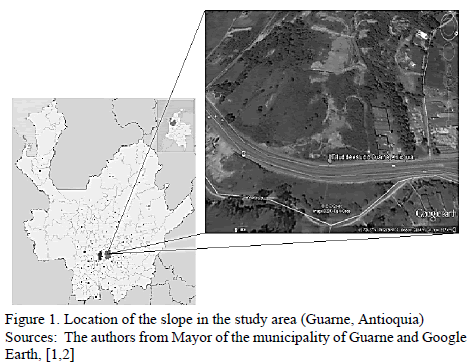
<body><![CDATA[<br> </b></font><font size="2" face="Verdana, Arial, Helvetica, sans-serif">La  infraestructura para transporte de hidrocarburos ha crecido de manera  importante debido a la necesidad de abastecer la mayor cantidad de poblaciones;  sin embargo por problemas en las redes de suministro, se presentan derrames  accidentales que contaminan los suelos bajo los cuales se apoyan estas  estructuras. Los suelos contaminados, en este caso particular con gasolina, son  la motivaci&oacute;n del presente artículo, el cual pretende analizar los cambios que  ocurren en un suelo de origen residual tropical al ser contaminado con &eacute;ste;  mediante pruebas de laboratorio específicos para caracterizar este tipo de  suelos (Clasificaci&oacute;n Miniatura Compactado Tropical, Succi&oacute;n, Pinhole Test,  &Iacute;ndice de Colapso, Difracci&oacute;n de rayos &quot;X&quot;, Microscopía Electr&oacute;nica de Barrido,  determinaci&oacute;n de pH) y de ensayos tradicionales (humedad natural, gravedad  específica, granulometría, límites de Atterberg, corte directo, etc), tanto con  muestras en estado natural como contaminadas que permitan percibir las posibles variaciones en las características mec&aacute;nicas del material.</font></p>     <p><font size="2" face="Verdana, Arial, Helvetica, sans-serif"><i>Palabras clave:</i> Suelo residual tropical, Contaminaci&oacute;n de suelo  con gasolina, Batolito Antioque&ntilde;o.</font></p> <hr>     <p>&nbsp;</p>     <p><font size="3" face="Verdana, Arial, Helvetica, sans-serif"><b>1. Introduction</b></font></p>     <p><font size="2" face="Verdana, Arial, Helvetica, sans-serif">There are few studies on the alterations produced by the  interactions of soil contaminants and the effects they have on the geotechnical  properties of the soil. In this case, gasoline was evaluated as the  contaminating agent due to the problems that commonly occur around Colombia,  e.g., leaks originating from gas stations and oil pipelines due to illegal  connections and damage.</font></p>     <p><font size="2" face="Verdana, Arial, Helvetica, sans-serif">In  order to identify the alterations produced by the fuel in the characteristics  of the region's soils, a contamination process with gasoline was simulated in a  sample of residual </font><font size="2" face="Verdana, Arial, Helvetica, sans-serif">soil in the Antioquia Batholith. A  series of laboratory tests were subsequently carried out. These were tests used  in soil mechanics, i.e., natural humidity, specific gravity of solids, granulometry,  Atterberg limits, double-edometric,  direct shear, pH determination, filter paper suction, pinhole test, X-ray  diffraction, scanning electron microscopy and miniature compacted tropical  classification, which provide a closer approximation of the corresponding  characteristics of the soil in the region.</font></p>     <p>&nbsp;</p>     <p><font size="3" face="Verdana, Arial, Helvetica, sans-serif"><b>2. Characteristics   of the study area</b></font></p>     <p><font size="2" face="Verdana, Arial, Helvetica, sans-serif">The study area is located near the town of Guarne, on the  west side of the Department of Antioquia, on the right margin of the  Medellín-Bogot&aacute; Highway, at an elevation of 2,157 m.a.s.l., with coordinates  N=1.188.043 and E=847.616 (Datum Bogot&aacute;)(<a href="#fig01">Figure  1</a>).</font></p>     <p align="center"><font size="2" face="Verdana, Arial, Helvetica, sans-serif"><a name="fig01"></a></font><img src="/img/revistas/dyna/v82n190/v82n190a03fig01.gif"></p>     ]]></body>
<body><![CDATA[<p><font size="2" face="Verdana, Arial, Helvetica, sans-serif">The study site corresponds to a 19-meter slope, which  currently exhibits a modified morphology due to excavations carried out at the  site. The excavations have produced vertical slopes (escarpments), which are  apparently stable, as well as more gradual slopes, on which erosion processes  occur. For example, furrows caused by surface runoff can be observed on the  gradual slopes. </font></p>     <p><font size="2" face="Verdana, Arial, Helvetica, sans-serif">The municipality is located at approximately 2,150 m.a.s.l.  Its average temperature is 17°C, with day to night variations between 27°C and  8°C. The average relative humidity is 80%, and the median annual precipitation  is between 1800 and 2800 mm. Two climatic periods are observed in the area,  which correspond to the rainy season (April to May and August to November) and  the dry season (June to July and December to March) &#91;3&#93;. In terms of the plant  life present in the study area, the environment can be classified mainly as a  Low Mountain Humid Forest (bh-MB) &#91;4&#93;. The principal drainage from the area is  from the La Mosca and Lomeríos creeks.</font></p>     <p>&nbsp;</p>     <p><font size="3" face="Verdana, Arial, Helvetica, sans-serif"><b>3. Geological and  geomorphological features</b></font></p>     <p><font size="2" face="Verdana, Arial, Helvetica, sans-serif">Regionally speaking, the study area is  made up of the geological units known as Neis de la Ceja (PRlnc), Medellín  Amphibolites (PRam), Antioquia Batholith (K2ta), Drainage Basin Deposits (Q2v)  and Alluvial Deposits (Q2al)<b> &#91;5&#93;</b>.</font></p>     <p><font size="2" face="Verdana, Arial, Helvetica, sans-serif">The slope under study exhibits the Medellín Amphibolites  (PRam), which are amphibolite bodies of varying dimensions that extend over the  Antioquia Batholith. They display an intrusive relationship; the mineral  composition is essentially hornblende and plagioclase. In turn, the predominant  facies in the Antioquia Batholith (K2ta) in the study area exhibit a tonalite  to granodiorite composition, with more maphic border facies and more  felsiclocal facies. The predominant minerals are quartz, potassium feldspar,  plagioclase, biotite, hornblende, orthopyroxenes and some accessory  minerals. </font></p>     <p><font size="2" face="Verdana, Arial, Helvetica, sans-serif">The Antioquia Batholith rocks and the weathering and  erosion processes they undergo generate short, round, semi-hilly  geo-formations, in which the forces of material transport shape the landscape  and contribute to the formation of short drainage basins in narrow valleys,  with dendritic drainage resulting from runoff processes. This makes it possible  to uncover the deep saprolitic material exposed on the surface, which is then  easily remobilized by erosive processes.</font></p>     <p>&nbsp;</p>     <p><font size="3" face="Verdana, Arial, Helvetica, sans-serif"><b>4. Weathering   profile</b></font></p>     <p><font size="2" face="Verdana, Arial, Helvetica, sans-serif">During the visits to the study site, a stratigraphic  profile of the slope was defined, and samples were taken within the profile.  Based on the (visual) preliminary description of the field of materials found,  a brief description of each layer is presented next. </font></p>     ]]></body>
<body><![CDATA[<p><font size="2" face="Verdana, Arial, Helvetica, sans-serif"><b>Organic soil: </b>Silty soil, dark brown in color, with medium  humidity and low plasticity, of soft consistency and with a high root content.  This soil displays a very distinctive color. </font></p>     <p><font size="2" face="Verdana, Arial, Helvetica, sans-serif"><b>Volcanic ash: </b>Clayey-silt with a light brown to gray to  beige color, porous, of medium to high humidity and high plasticity, of soft  consistency, with some small quartz crystals.</font></p>     <p><font size="2" face="Verdana, Arial, Helvetica, sans-serif"><b>Residual soil contaminated with ash: </b>Clayey-silt soil with some sand,  homogeneous, of yellow to orange color, medium to high humidity, medium  plasticity and firm consistency, does not exhibit structures inherited from the  parent rock, only small quartz crystals can be observed.</font></p>     <p><font size="2" face="Verdana, Arial, Helvetica, sans-serif"><b>Residual soil of the Antioquia Batholith: </b>Clayey-silt soil, with some sand, of orange  to reddish color, medium to high humidity and low to null plasticity. This soil  does not exhibit a specific structure, but it contains some quartz and mica  crystals.</font></p>     <p><font size="2" face="Verdana, Arial, Helvetica, sans-serif"><b>Saprolite of the  Antioquia Batholith</b>: Sandy-silt soil, white with black, orange and pink blotches, with low  cohesion (it is easily disaggregated in one's hands), medium humidity and low  to null plasticity. The granite structure of the parent rock is easily  observed, as well as some discontinuities filled with manganese oxides. This  soil exhibits a high content of quartz crystals and some mica crystals.</font></p>     <p>&nbsp;</p>     <p><font size="3" face="Verdana, Arial, Helvetica, sans-serif"><b>5. Methodology</b></font></p>     <p><font size="2" face="Verdana, Arial, Helvetica, sans-serif">Soil samples were taken from the study area as both  altered (packed into bags) and unaltered (box type) samples. Initially, samples  were contaminated with gasoline in the Geotechnical and Pavement Engineering  Laboratory of the National University of Colombia, Medellín Campus. This  contamination process consisted of getting both groups of samples, those  contaminated and those in their natural state, to exhibit the same humidity  level, between 27% and 30%, with the goal of at least having the humidity  parameter controlled to the same value for all tests. To that end, a  gravimetric analysis was carried out, in which the humidity of the sample was  reduced to a value of 15%. Then, enough gasoline was added to reach the desired  gravimetric water content of uncontaminated samples. Additionally, upon  contamination, the liquid phase was allowed to occupy 60% of the air voids in  the soil.</font></p>     <p><font size="2" face="Verdana, Arial, Helvetica, sans-serif">The soil was contaminated with gasoline by drip; the  gasoline was allowed to incubate in the soil for 7 days before the tests were  started, in order to allow adequate infiltration of the fuel and to allow it to  interact with the soil.</font></p>     <p><font size="2" face="Verdana, Arial, Helvetica, sans-serif">Finally, the minimum number of geotechnical  characterization tests for the contaminated and uncontaminated soils was two  tests to verify repeatability. For the uncontaminated soil, the results of  tests developed by students in the Geotechnical Behavior of Tropical Soils  course at the National University of Colombia, Medellín Campus, were used,  enabling comparison of both states &#91;6&#93;.</font></p>     ]]></body>
<body><![CDATA[<p><font size="2" face="Verdana, Arial, Helvetica, sans-serif"><b><i>5.1. Physical  characterization</i></b></font></p>     <p><font size="2" face="Verdana, Arial, Helvetica, sans-serif">To undertake the physical  characterization of contaminated and uncontaminated samples, the following  tests were executed:</font></p> <ul>       <li><font size="2" face="Verdana, Arial, Helvetica, sans-serif">     Natural water content &#91;7&#93;.</font></li>       <li><font size="2" face="Verdana, Arial, Helvetica, sans-serif">     Specific gravity of solids &#91;8&#93;.</font></li>       <li><font size="2" face="Verdana, Arial, Helvetica, sans-serif">     Granulometry using sieves and a hydrometer, with     and without deflocculant &#91;9&#93;.</font></li>       <li><font size="2" face="Verdana, Arial, Helvetica, sans-serif">     Atterberg limits &#91;10&#93;.</font></li>       <li><font size="2" face="Verdana, Arial, Helvetica, sans-serif">MCT rapid Classification, Miniature Compacted     Tropical &#91;11&#93;.</font></li>     </ul>     <p><font size="2" face="Verdana, Arial, Helvetica, sans-serif"><b><i>5.2. Mineralogical  characterization</i></b></font></p> <ul>       <li><font size="2" face="Verdana, Arial, Helvetica, sans-serif">X-ray diffraction: This test generates a     diffractogram that makes it possible to identify the minerals present in the     soil &#91;12&#93;.</font></li>       ]]></body>
<body><![CDATA[<li><font size="2" face="Verdana, Arial, Helvetica, sans-serif">Scanning Electron Microscopy (SEM): This test     enables examination of the microstructure and chemical composition of the soil,     and it makes it possible to confirm the presence of specific minerals based on     detailed images &#91;12&#93;.</font></li>       <li><font size="2" face="Verdana, Arial, Helvetica, sans-serif"><b><i>5.3. Chemical     characterization</i></b></font></li>       <li><font size="2" face="Verdana, Arial, Helvetica, sans-serif">Measurement of the pH in H2O and in KCl: Two     solutions are used in this test, and the pH measured in KCl is subtracted from     the pH measured in water. If the difference between the pH values is positive (DpH),     then iron and aluminum oxides and hydroxides are predominant in the soil. If     the value is negative, clay minerals are predominant &#91;13-15&#93;.</font></li>     </ul>     <p><font size="2" face="Verdana, Arial, Helvetica, sans-serif"><b><i>5.4. Mechanical  characterization </i></b></font></p> <ul>       <li><font size="2" face="Verdana, Arial, Helvetica, sans-serif">     Consolidated drained (CD) direct shear test: The     purpose of the test is to calculate the friction angle and cohesion parameter     &#91;16&#93;.</font></li>       <li><font size="2" face="Verdana, Arial, Helvetica, sans-serif">     Double-edometric test: two simultaneous simple     edometric tests are performed, one in natural humidity conditions and the other     in saturated conditions. Based on the test, two compressibility curves are     generated for the soil. The differences between the void ratios are used to     calculate the collapse potential &#91;17,18&#93;.</font></li>       <li><font size="2" face="Verdana, Arial, Helvetica, sans-serif">     Pinhole test: this test is intended to determine     whether the contaminated soil is susceptible to the internal erosion processes     &#91;19,20&#93;.</font></li>       <li><font size="2" face="Verdana, Arial, Helvetica, sans-serif">     Test of suction through filter paper with mixed     trajectory: this test allows for the measurement of both matrix suction and     total suction in the soil &#91;21,22&#93;.</font></li>     </ul>     ]]></body>
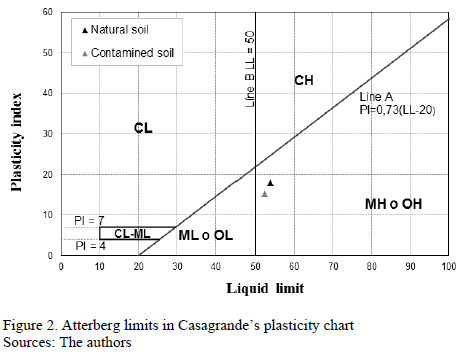
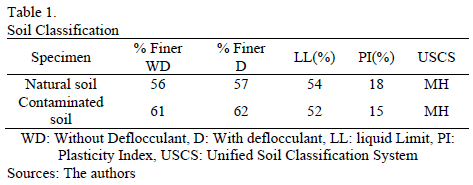
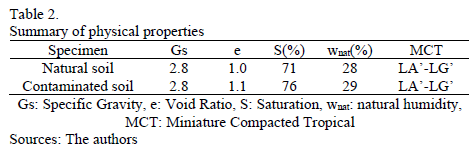
<body><![CDATA[<p>&nbsp;</p>     <p><font size="3" face="Verdana, Arial, Helvetica, sans-serif"><b>6. Analysis of  results</b></font></p>     <p><font size="2" face="Verdana, Arial, Helvetica, sans-serif"><b><i>6.1. Index  properties</i></b></font></p>     <p><font size="2" face="Verdana, Arial, Helvetica, sans-serif">In order to characterize the  material on the site, classification tests were carried out following the  Unified Soil Classification System and MCT (Miniature Compacted Tropical  classification). These tests were performed on the sample in its natural state  and on a sample contaminated with gasoline, both in a humid state and in a dry  state. </font></p>     <p><font size="2" face="Verdana, Arial, Helvetica, sans-serif"><a href="#fig02">Figure 2</a> shows the Atterberg limits, and <a href="#tab01">Table 1</a> and <a href="#tagb02">2</a> show the results obtained.</font></p>     <p align="center"><font size="2" face="Verdana, Arial, Helvetica, sans-serif"><a name="fig02"></a></font><img src="/img/revistas/dyna/v82n190/v82n190a03fig02.gif"></p>     <p align="center"><font size="2" face="Verdana, Arial, Helvetica, sans-serif"><a name="tab01"></a></font><img src="/img/revistas/dyna/v82n190/v82n190a03tab01.gif"></p>     <p align="center"><font size="2" face="Verdana, Arial, Helvetica, sans-serif"><a name="tagb02"></a></font><img src="/img/revistas/dyna/v82n190/v82n190a03tab02.gif"></p>     <p><font size="2" face="Verdana, Arial, Helvetica, sans-serif">It can be seen that for both contaminated and natural  samples, the plasticity index is low, which indicates aggregation of particles  or presence of clay minerals with low activity. The classification of the  material, which corresponds to high-compressibility silt (MH), isn't affected  by the contamination.</font></p>     <p><font size="2" face="Verdana, Arial, Helvetica, sans-serif"><b><i>6.2. Granulometry</i></b></font></p>     ]]></body>
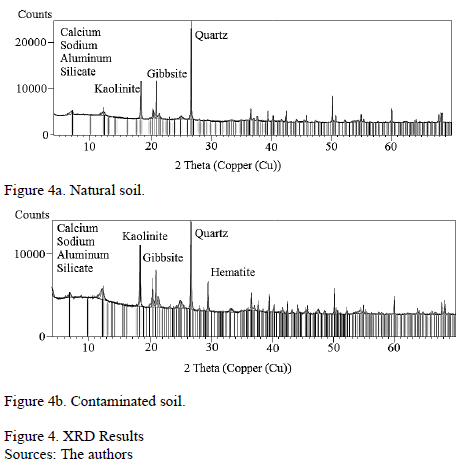
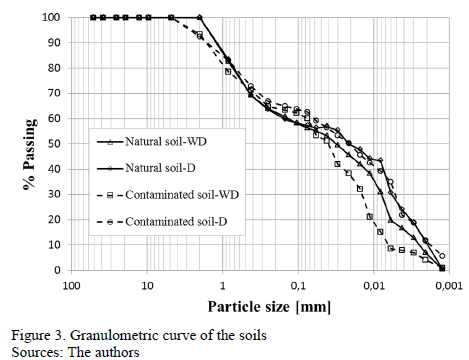
<body><![CDATA[<p><font size="2" face="Verdana, Arial, Helvetica, sans-serif">To observe the  aggregations present in the soil before and after contamination, granulometry  was performed by using a hydrometer on both samples with and without a  deflocculant. The results for both the natural and contaminated samples are  shown in <a href="#fig03">Figure  3</a>. It can be seen in the figure that the fine  material percentage is very similar for both cases without deflocculant, which  indicates that the contaminant does not affect the size of the particles in the  soil. Taking into account <a href="#fig03">Figure 3</a>, the stability of aggregates was determined by  calculating the difference between clay percentages with and without  deflocculant &#91;12&#93;. The sample contaminated with gasoline exhibits greater aggregation  than the natural sample. However, the stability of such aggregations is lower  for the contaminated sample than for the natural one, with values of 8% and 4%,  respectively. Thus, one can infer that gasoline generates larger aggregations.  However, the stability of such aggregations is not very strong.</font></p>     <p align="center"><font size="2" face="Verdana, Arial, Helvetica, sans-serif"><a name="fig03"></a></font><img src="/img/revistas/dyna/v82n190/v82n190a03fig03.gif"></p>     <p>&nbsp;</p>     <p><font size="2" face="Verdana, Arial, Helvetica, sans-serif"><b><i>6.3. MCT Rapid   Classification (Miniature, Compacted, Tropical)</i></b></font></p>     <p><font size="2" face="Verdana, Arial, Helvetica, sans-serif">The MCT classification  is a method developed especially for tropical soils, which allows them to be  sorted into two principal groups: lateritic soils (L) and non-lateritic soils  (N). These are in turn divided into seven subgroups &#91;12&#93;. The test was  performed on 10 samples, 5 in their natural state and 5 contaminated with  gasoline, and it was found that the soil in both conditions exhibits the  characteristics of a tropical soil belonging to the groups LA' (lateritic  clayey sands) and LG' (clays, silty clays and lateritic sandy clays).</font></p>     <p><font size="2" face="Verdana, Arial, Helvetica, sans-serif">For the study area, the  classification exhibited by the soil, LA' and LG', is in agreement with the  characteristics of the materials in the region. These materials have a high  degree of stability despite the steep slopes. Reddish soils are predominant,  and there is organic material at a superficial level. There is also a high  sesquioxide content. In addition, these materials can be easily collapsed due  to water immersion &#91;11&#93;.</font></p>     <p><font size="2" face="Verdana, Arial, Helvetica, sans-serif">It is worth clarifying that the MCT classification for the  soil studied is not definitive and should be complemented with other tests that  corroborate or fail to corroborate its results. Other tests will make it  possible to establish the degree of weathering in the soil.</font></p>     <p><font size="2" face="Verdana, Arial, Helvetica, sans-serif"><b><i>6.4. Mineralogical  and structural analyses of the soil</i></b></font></p>     <p><font size="2" face="Verdana, Arial, Helvetica, sans-serif"><b>6.4.1. X-Ray  Diffraction (XRD)</b></font></p>     <p><font size="2" face="Verdana, Arial, Helvetica, sans-serif">The results of the XRD test (<a href="#fig04">Figure  4</a>)  show that both the natural soil and the soil contaminated with gasoline show a  mineralogical predominance of quartz and plagioclases. As a result of the  alteration of the latter, clay minerals were generated (mainly kaolinite). The  presence of gibbsite, to a lesser degree, can also be observed.</font></p>     ]]></body>
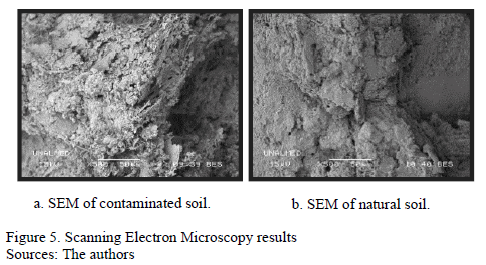
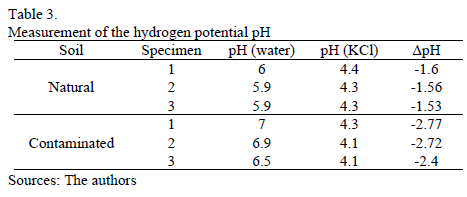
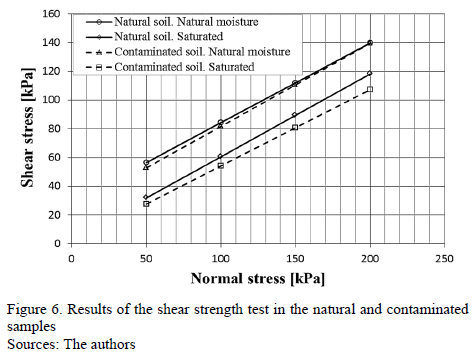
<body><![CDATA[<p align="center"><font size="2" face="Verdana, Arial, Helvetica, sans-serif"><a name="fig04"></a></font><img src="/img/revistas/dyna/v82n190/v82n190a03fig04.gif"></p>     <p><font size="2" face="Verdana, Arial, Helvetica, sans-serif">For the contaminated material, gasoline does not alter the  mineralogy of the soil. The interaction period of the contaminant in the soil  was too short to produce changes in the chemical composition of the minerals.  In addition, this test was affected by sampling. Therefore, observing small  changes in percentage points is common for the mineralogical components.</font></p>     <p><font size="2" face="Verdana, Arial, Helvetica, sans-serif"><b>6.4.2. Scanning  Electron Microscopy (SEM)</b></font></p>     <p><font size="2" face="Verdana, Arial, Helvetica, sans-serif">Some of the images captured through the scanning electron  microscope are shown in <a href="#fig05">Figure  5</a>.  Based on these images, one can infer that for the sample contaminated with  gasoline, the particles are more aggregated compared to the natural sample. For  that reason, more pores are visible than on the natural sample. These  observations are of a qualitative character and are directly related with the  sample of material analyzed, which is a small fraction of the total sample.  However, the results coincide with the granulometry as measured by the  hydrometer test, which found that weak aggregations can be observed in the  contaminated sample.</font></p>     <p align="center"><font size="2" face="Verdana, Arial, Helvetica, sans-serif"><a name="fig05"></a></font><img src="/img/revistas/dyna/v82n190/v82n190a03fig05.gif"></p>     <p><font size="2" face="Verdana, Arial, Helvetica, sans-serif"><b><i>6.5. Determination  of pH</i></b></font></p>     <p><font size="2" face="Verdana, Arial, Helvetica, sans-serif">The results in <a href="#tab03">Table  3</a> show that the levels of iron and aluminum oxides and hydroxides are very low.  Thus, we can state that the soil is in an early stage of weathering (incipient  laterization). With respect to the sample contaminated with gasoline, an  increase of approximately 13% in the acidity of the soil can be observed  compared to the natural soil. The pH of the contaminated soil is within the  optimum range for most soil bacteria, which may be optimal for use in  bioremediation &#91;23&#93;.</font></p>     <p align="center"><font size="2" face="Verdana, Arial, Helvetica, sans-serif"><a name="tab03"></a></font><img src="/img/revistas/dyna/v82n190/v82n190a03tab03.gif"></p>     <p><font size="2" face="Verdana, Arial, Helvetica, sans-serif">On the other hand, the trend toward negative values of  <font face="Symbol">D</font>pH persists, which is expected given that the time during which the soil  was exposed to the contaminant was too short to produce a change in the  mineralogy of the soil. </font></p>     <p><font size="2" face="Verdana, Arial, Helvetica, sans-serif"><b><i>6.6. Consolidated  drained (CD) direct shear test</i></b></font></p>     ]]></body>
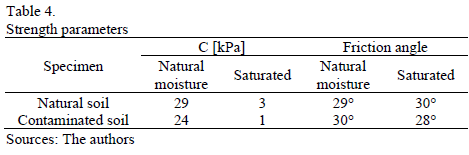
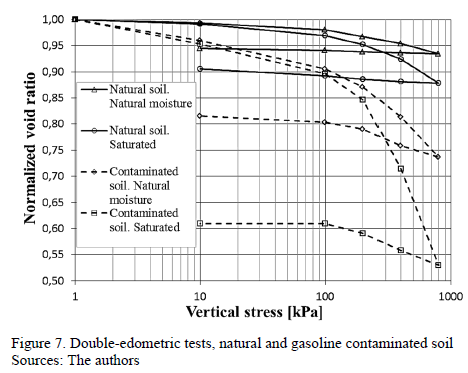
<body><![CDATA[<p><font size="2" face="Verdana, Arial, Helvetica, sans-serif">The main objective of this test is to determine the strength parameters of the  soil. The shear test performed </font></p>     <p><font size="2" face="Verdana, Arial, Helvetica, sans-serif">The strength parameters corresponding to the failure  envelopes represented in <a href="#fig06">Figure 6</a> are shown in <a href="#tab04">Table 4</a>.</font></p>     <p align="center"><font size="2" face="Verdana, Arial, Helvetica, sans-serif"><a name="fig06"></a></font><img src="/img/revistas/dyna/v82n190/v82n190a03fig06.gif"></p>     <p align="center"><font size="2" face="Verdana, Arial, Helvetica, sans-serif"><a name="tab04"></a></font><img src="/img/revistas/dyna/v82n190/v82n190a03tab04.gif"></p>     <p><font size="2" face="Verdana, Arial, Helvetica, sans-serif">Was of type CD  (consolidated and drained), which avoids the development of pore pressures in  the samples. The results are shown in <a href="#fig06">Figure 6</a>.</font></p>     <p><font size="2" face="Verdana, Arial, Helvetica, sans-serif">The strength parameters obtained in the shear strength test are  similar to the typical values of cohesion (C) and friction angle of soils  coming from the Antioquia Batholith &#91;3&#93;. In addition, the data shown in <a href="#fig06">Figure 6</a> and <a href="#fig06">Table 4</a> represent the most significant changes  in the strength parameters of the soil, which are directly related to its  saturation condition.</font></p>     <p><font size="2" face="Verdana, Arial, Helvetica, sans-serif">Based on these  results, we can observe that the unsaturated samples have greater strength than  the saturated samples. This corresponds to the most critical condition of the  soil because water directly affects the mechanical properties of the soil. The  influence of the presence of the contaminant is not representative, given that  the variation in strength is minimal. In other words, neither the cohesion nor  the friction angles are significantly influenced by the interaction with  gasoline.</font></p>     <p><font size="2" face="Verdana, Arial, Helvetica, sans-serif"><b><i>6.7. Double-edometric test</i></b></font></p>     <p><font size="2" face="Verdana, Arial, Helvetica, sans-serif">Based on <a href="#fig07">Figure 7</a> and the estimation of collapse potential,  we can state that the gasoline removes the connections that keep the grains of  the structure together, which promotes collapse &#91;18&#93;. This phenomenon becomes clear when  comparing the values of the collapse potential, which in the case of the  natural sample are below 3.0%. These low values correspond to classification of  the soil as moderately collapsible. In the case of the contaminated samples, the values are between 10% and 20% for the  last</font></p>     <p align="center"><font size="2" face="Verdana, Arial, Helvetica, sans-serif"><a name="fig07"></a></font><img src="/img/revistas/dyna/v82n190/v82n190a03fig07.gif"></p>     ]]></body>
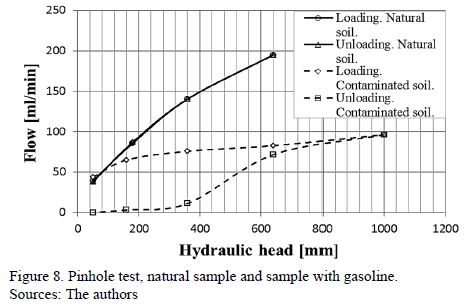
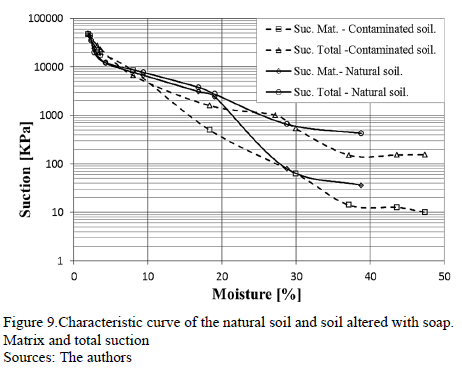
<body><![CDATA[<p><font size="2" face="Verdana, Arial, Helvetica, sans-serif">load increment, and the problem can be considered serious. In addition,  when considering the most unfavorable scenario, comparing the contaminated  saturated sample with the natural sample, we obtain a potential of 20.9%, which  qualifies the problem as very serious. This is in agreement with what was  observed in the SEM. The SEM images showed that the contaminated sample has a  more open structure.</font></p>     <p><font size="2" face="Verdana, Arial, Helvetica, sans-serif"><b><i>6.8. Erodibility tests</i></b></font></p>     <p><font size="2" face="Verdana, Arial, Helvetica, sans-serif">A series of erosive processes were observed during the  visit to the study area. These erosive processes have affected the soil, and  they reveal the degree of erodibility that can be reached. Such processes are  superficial (furrows). This means that it is necessary to verify, to a certain  degree, the degree of erodibility the soil can exhibit, both in its natural  state and when it is contaminated (Pinhole Test) &#91;20&#93;. </font></p>     <p><font size="2" face="Verdana, Arial, Helvetica, sans-serif"><b>6.8.1. Pinhole  Test</b></font></p>     <p><font size="2" face="Verdana, Arial, Helvetica, sans-serif">We can observe from <a href="#fig08">Figure 8</a> that for the natural sample, the stages of loading and unloading overlap. In  other words, for a given head, the flow rates in the stage of loading and  unloading are the same, which indicates that the natural soil does not show any  erodibility. In contrast, the sample altered by gasoline exhibits a high degree  of erodibility, given that there is a marked difference between the loading  stage and the unloading stage, which is associated with the separation of  certain particles due to the flow of water and the subsequent blockage of the  hole (stage of unloading below the stage of loading).</font></p>     <p align="center"><font size="2" face="Verdana, Arial, Helvetica, sans-serif"><a name="fig08"></a></font><img src="/img/revistas/dyna/v82n190/v82n190a03fig08.gif"></p>     <p><font size="2" face="Verdana, Arial, Helvetica, sans-serif"><b><i>6.9. Suction</i></b></font></p>     <p><font size="2" face="Verdana, Arial, Helvetica, sans-serif">There  was a difference between the matrix suction and total suction, both for the  sample in its natural state and for the contaminated sample (<a href="#fig09">Figure  9</a>).  This difference is due to the contribution of osmotic suction from each of the  samples, which is greater in the sample contaminated with gasoline at humidities below 27%.  For greater humidities, the chemical effect is approximately the same as that  exhibited by the natural sample. This indicates that the reduction in total  suction caused by the contaminant in the soil is mainly observed in the matrix  suction component.</font></p>     <p align=center><font size="2" face="Verdana, Arial, Helvetica, sans-serif"><a name="fig09"></a></font><img src="/img/revistas/dyna/v82n190/v82n190a03fig09.gif"></p>     <p><font size="2" face="Verdana, Arial, Helvetica, sans-serif">Taking this into account, one can say that the reduction  in matrix suction observed in the contaminated soil is caused by a change in  its structure (see SEM test). It is worth highlighting that the reduction in  matrix suction can also occur because of a reduction in surface tension caused  by the gasoline. The surface tension of water is approximately 72.3(10<sup>-3</sup>)  N/ml, whereas the surface tension of gasoline is 21.60 (10<sup>-3</sup>) N/ml  &#91;24&#93;. Thus, the surface tension of gasoline is 50% less than that of water, and  when these substances are combined, the resulting surface tension of the  mixture should be lower.</font></p>     ]]></body>
<body><![CDATA[<p>&nbsp;</p>     <p><font size="3" face="Verdana, Arial, Helvetica, sans-serif"><b>7. Conclusions</b></font></p>     <p><font size="2" face="Verdana, Arial, Helvetica, sans-serif">It is important to consider the effects of certain liquid  contaminants present in the soil, given that these may alter some of the soil's  geotechnical properties. Contaminants may modify the initial stability  conditions of the soil. This is demonstrated by using laboratory tests  performed on samples contaminated with gasoline.</font></p>     <p><font size="2" face="Verdana, Arial, Helvetica, sans-serif">In terms of the principal volumetric and gravimetric  relationships, such as the void ratio, degree of saturation, and specific  gravity of solids, one can observe insignificant variations due to the presence  of gasoline, which is related to the short period of action of the contaminant  in the soil. Similarly, the general characteristics of the soil, such as the  predominant size of the particles and the plasticity of the soil, are also not  affected considerably.</font></p>     <p><font size="2" face="Verdana, Arial, Helvetica, sans-serif">Regarding the XRD tests, the MCT classification and the pH  test, can state that studied soil exhibits a significantly advanced process of  laterization. In addition, it can be inferred that gasoline does not influence  the mineralogical composition of the soil, given that the results for the  natural sample were very similar to those of the contaminated sample. </font></p>     <p><font size="2" face="Verdana, Arial, Helvetica, sans-serif">Considering the hydro-mechanical behavior, no significant  changes were observed in the shear strength parameters. On the other hand, gasoline  considerably increases the probability of collapse and increases the internal  erodibility of the soils. The most notable of these impacts is the increase in  the probability of collapse. In the worst-case scenario, the stability problem  would change from moderate to very serious, which would indicate that this  contaminant is capable of removing the support that holds the grains of the  soil structure together. </font></p>     <p><font size="2" face="Verdana, Arial, Helvetica, sans-serif">Finally, it is important to take the contamination  scenarios for soils into account during the design and planning of projects  that involve the processing, storage and transportation of hydrocarbons. Taking  such contamination into consideration will help to prevent possible events that  can affect the stability and behavior of soils.</font></p>     <p>&nbsp;</p>     <p><font size="3" face="Verdana, Arial, Helvetica, sans-serif"><b>References</b></font></p>     <!-- ref --><p><font size="2" face="Verdana, Arial, Helvetica, sans-serif"><b>&#91;1&#93;</b> Alcaldía de Guarne - Antioquia - Colombia &#91;Online&#93;,  &#91;date of reference May 11th of 2013&#93;. Available at: <a href="http://www.guarne-antioquia.gov.co/index.shtml#3" target="_blank">http://www.guarne-antioquia.gov.co/index.shtml#3</a>.    &nbsp;&nbsp;&nbsp;&nbsp;&nbsp;&nbsp;&nbsp;&nbsp;[&#160;<a href="javascript:void(0);" onclick="javascript: window.open('/scielo.php?script=sci_nlinks&ref=000132&pid=S0012-7353201500020000300001&lng=','','width=640,height=500,resizable=yes,scrollbars=1,menubar=yes,');">Links</a>&#160;]<!-- end-ref --> </font></p>     <!-- ref --><p><font size="2" face="Verdana, Arial, Helvetica, sans-serif"><b>&#91;2&#93;</b> Google Earth. Colombia - Antioquia - Guarne, &#91;date of  reference: May 11th of 2013&#93;    &nbsp;&nbsp;&nbsp;&nbsp;&nbsp;&nbsp;&nbsp;&nbsp;[&#160;<a href="javascript:void(0);" onclick="javascript: window.open('/scielo.php?script=sci_nlinks&ref=000134&pid=S0012-7353201500020000300002&lng=','','width=640,height=500,resizable=yes,scrollbars=1,menubar=yes,');">Links</a>&#160;]<!-- end-ref -->.</font></p>     <!-- ref --><p><font size="2" face="Verdana, Arial, Helvetica, sans-serif"><b>&#91;3&#93;</b> Escobar, L.  and Valencia, Y., An&aacute;lisis de estabilidad y probabilidad de falla de dos  taludes de suelo tropical en la autopista Medellín-Bogot&aacute; en el tramo de vía  entre Marinilla y Santuario. Boletín de Ciencias de la Tierra, 31, pp.  51-64, 2012.    &nbsp;&nbsp;&nbsp;&nbsp;&nbsp;&nbsp;&nbsp;&nbsp;[&#160;<a href="javascript:void(0);" onclick="javascript: window.open('/scielo.php?script=sci_nlinks&ref=000136&pid=S0012-7353201500020000300003&lng=','','width=640,height=500,resizable=yes,scrollbars=1,menubar=yes,');">Links</a>&#160;]<!-- end-ref --></font></p>     <!-- ref --><p><font size="2" face="Verdana, Arial, Helvetica, sans-serif"><b>&#91;4&#93;</b> INSTITUTO GEOGR&Aacute;FICO AGUST&Iacute;N CODAZZI, Mapa  de Formaciones Vegetales de Colombia 1:500.000, Bogot&aacute;, 1977.    &nbsp;&nbsp;&nbsp;&nbsp;&nbsp;&nbsp;&nbsp;&nbsp;[&#160;<a href="javascript:void(0);" onclick="javascript: window.open('/scielo.php?script=sci_nlinks&ref=000138&pid=S0012-7353201500020000300004&lng=','','width=640,height=500,resizable=yes,scrollbars=1,menubar=yes,');">Links</a>&#160;]<!-- end-ref --></font></p>     <!-- ref --><p><font size="2" face="Verdana, Arial, Helvetica, sans-serif"><b>&#91;5&#93;</b> INGEOMINAS, Explicaci&oacute;n del mapa geol&oacute;gico  1:500.000, Medellín, 2005.    &nbsp;&nbsp;&nbsp;&nbsp;&nbsp;&nbsp;&nbsp;&nbsp;[&#160;<a href="javascript:void(0);" onclick="javascript: window.open('/scielo.php?script=sci_nlinks&ref=000140&pid=S0012-7353201500020000300005&lng=','','width=640,height=500,resizable=yes,scrollbars=1,menubar=yes,');">Links</a>&#160;]<!-- end-ref --></font></p>     <!-- ref --><p><font size="2" face="Verdana, Arial, Helvetica, sans-serif"><b>&#91;6&#93;</b> Cano, K. et  al., Comportamiento geot&eacute;cnico de un suelo residual tropical del batolito  antioque&ntilde;o. Informe in&eacute;dito. 2013.    &nbsp;&nbsp;&nbsp;&nbsp;&nbsp;&nbsp;&nbsp;&nbsp;[&#160;<a href="javascript:void(0);" onclick="javascript: window.open('/scielo.php?script=sci_nlinks&ref=000142&pid=S0012-7353201500020000300006&lng=','','width=640,height=500,resizable=yes,scrollbars=1,menubar=yes,');">Links</a>&#160;]<!-- end-ref --></font></p>     <!-- ref --><p><font size="2" face="Verdana, Arial, Helvetica, sans-serif"><b>&#91;7&#93;</b>    ASTM. Standard test methods for laboratory  determination of water (moisture) content of soil and rock by mass. D2216-05.  United States of America: ASTM. 2005.    &nbsp;&nbsp;&nbsp;&nbsp;&nbsp;&nbsp;&nbsp;&nbsp;[&#160;<a href="javascript:void(0);" onclick="javascript: window.open('/scielo.php?script=sci_nlinks&ref=000144&pid=S0012-7353201500020000300007&lng=','','width=640,height=500,resizable=yes,scrollbars=1,menubar=yes,');">Links</a>&#160;]<!-- end-ref --></font></p>     <!-- ref --><p><font size="2" face="Verdana, Arial, Helvetica, sans-serif"><b>&#91;8&#93;</b>    ASTM. Standard test method for specific gravity of  soils by water pycnometer. D854-06. United States of America: ASTM. 2006.    &nbsp;&nbsp;&nbsp;&nbsp;&nbsp;&nbsp;&nbsp;&nbsp;[&#160;<a href="javascript:void(0);" onclick="javascript: window.open('/scielo.php?script=sci_nlinks&ref=000146&pid=S0012-7353201500020000300008&lng=','','width=640,height=500,resizable=yes,scrollbars=1,menubar=yes,');">Links</a>&#160;]<!-- end-ref --></font></p>     <!-- ref --><p><font size="2" face="Verdana, Arial, Helvetica, sans-serif"><b>&#91;9&#93;</b>    ASTM. Standard test method for dispersive  characteristics of clay soil by double hydrometer. D4221-11. United States of  America: ASTM. 2011.    &nbsp;&nbsp;&nbsp;&nbsp;&nbsp;&nbsp;&nbsp;&nbsp;[&#160;<a href="javascript:void(0);" onclick="javascript: window.open('/scielo.php?script=sci_nlinks&ref=000148&pid=S0012-7353201500020000300009&lng=','','width=640,height=500,resizable=yes,scrollbars=1,menubar=yes,');">Links</a>&#160;]<!-- end-ref --></font></p>     <!-- ref --><p><font size="2" face="Verdana, Arial, Helvetica, sans-serif"><b>&#91;10&#93;</b>   ASTM. Standard test methods for liquid limit, plastic  limit, and plasticity index soils. D4318-05. United States of America: ASTM.  2005.    &nbsp;&nbsp;&nbsp;&nbsp;&nbsp;&nbsp;&nbsp;&nbsp;[&#160;<a href="javascript:void(0);" onclick="javascript: window.open('/scielo.php?script=sci_nlinks&ref=000150&pid=S0012-7353201500020000300010&lng=','','width=640,height=500,resizable=yes,scrollbars=1,menubar=yes,');">Links</a>&#160;]<!-- end-ref --></font></p>     <!-- ref --><p><font size="2" face="Verdana, Arial, Helvetica, sans-serif"><b>&#91;11&#93;</b> Nogami, J.  and Villibor, D., Pavimentacao de baixo custo com solos lateríticos. Editora  Villibor, Brasil, 1995.    &nbsp;&nbsp;&nbsp;&nbsp;&nbsp;&nbsp;&nbsp;&nbsp;[&#160;<a href="javascript:void(0);" onclick="javascript: window.open('/scielo.php?script=sci_nlinks&ref=000152&pid=S0012-7353201500020000300011&lng=','','width=640,height=500,resizable=yes,scrollbars=1,menubar=yes,');">Links</a>&#160;]<!-- end-ref --></font></p>     <!-- ref --><p><font size="2" face="Verdana, Arial, Helvetica, sans-serif"><b>&#91;12&#93;</b> Valencia,  Y., Influencia da mineralização nas propriedades fisico - mecânicas de um  perfil de solo tropical afetado por processos erosivos, PhD Thesis,  Universidade de Brasilia, Brasilia, Brasil. 2009.    &nbsp;&nbsp;&nbsp;&nbsp;&nbsp;&nbsp;&nbsp;&nbsp;[&#160;<a href="javascript:void(0);" onclick="javascript: window.open('/scielo.php?script=sci_nlinks&ref=000154&pid=S0012-7353201500020000300012&lng=','','width=640,height=500,resizable=yes,scrollbars=1,menubar=yes,');">Links</a>&#160;]<!-- end-ref --></font></p>     <!-- ref --><p><font size="2" face="Verdana, Arial, Helvetica, sans-serif"><b>&#91;13&#93;</b>   ASTM. Standard test method for pH of soil. D4972-01.  United States of America: ASTM. 2001.    &nbsp;&nbsp;&nbsp;&nbsp;&nbsp;&nbsp;&nbsp;&nbsp;[&#160;<a href="javascript:void(0);" onclick="javascript: window.open('/scielo.php?script=sci_nlinks&ref=000156&pid=S0012-7353201500020000300013&lng=','','width=640,height=500,resizable=yes,scrollbars=1,menubar=yes,');">Links</a>&#160;]<!-- end-ref --></font></p>     <!-- ref --><p><font size="2" face="Verdana, Arial, Helvetica, sans-serif"><b>&#91;14&#93;</b> Lima, M.C., Degradacao Fisico - Quimica e  Mineral&oacute;gica de Macicos Junto &aacute;s Vocorocas, PhD Thesis, Universidade de  Brasilia, Brasilia, Brasil, 2003.    &nbsp;&nbsp;&nbsp;&nbsp;&nbsp;&nbsp;&nbsp;&nbsp;[&#160;<a href="javascript:void(0);" onclick="javascript: window.open('/scielo.php?script=sci_nlinks&ref=000158&pid=S0012-7353201500020000300014&lng=','','width=640,height=500,resizable=yes,scrollbars=1,menubar=yes,');">Links</a>&#160;]<!-- end-ref --></font></p>     <!-- ref --><p><font size="2" face="Verdana, Arial, Helvetica, sans-serif"><b>&#91;15&#93;</b> Da Fonseca Cardoso, F.B., Analise química,  mineralogica e micromorfol&oacute;gica de solos tropicais colapsíveis e o estudo da  din&aacute;mica do colapso, MSc Thesis, Universidade de Brasilia, Brasilia, Brasil,  1995.    &nbsp;&nbsp;&nbsp;&nbsp;&nbsp;&nbsp;&nbsp;&nbsp;[&#160;<a href="javascript:void(0);" onclick="javascript: window.open('/scielo.php?script=sci_nlinks&ref=000160&pid=S0012-7353201500020000300015&lng=','','width=640,height=500,resizable=yes,scrollbars=1,menubar=yes,');">Links</a>&#160;]<!-- end-ref --></font></p>     <!-- ref --><p><font size="2" face="Verdana, Arial, Helvetica, sans-serif"><b>&#91;16&#93;</b>   ASTM. Standard test methods for direct shear test of  soils under consolidated drained conditions. D3080-04. United States of  America: ASTM. 2004.    &nbsp;&nbsp;&nbsp;&nbsp;&nbsp;&nbsp;&nbsp;&nbsp;[&#160;<a href="javascript:void(0);" onclick="javascript: window.open('/scielo.php?script=sci_nlinks&ref=000162&pid=S0012-7353201500020000300016&lng=','','width=640,height=500,resizable=yes,scrollbars=1,menubar=yes,');">Links</a>&#160;]<!-- end-ref --></font></p>     <!-- ref --><p><font size="2" face="Verdana, Arial, Helvetica, sans-serif"><b>&#91;17&#93;</b>   ASTM. Standard test methods for one dimensional  consolidation properties of soils using incremental loading. D2435-04. United  States of America: ASTM. 2004.    &nbsp;&nbsp;&nbsp;&nbsp;&nbsp;&nbsp;&nbsp;&nbsp;[&#160;<a href="javascript:void(0);" onclick="javascript: window.open('/scielo.php?script=sci_nlinks&ref=000164&pid=S0012-7353201500020000300017&lng=','','width=640,height=500,resizable=yes,scrollbars=1,menubar=yes,');">Links</a>&#160;]<!-- end-ref --></font></p>     <!-- ref --><p><font size="2" face="Verdana, Arial, Helvetica, sans-serif"><b>&#91;18&#93;</b> Conference for Africa on Soils mechanics and  Foundations Engineering (VI, 1975, Durban). A guide to construction on or with  materials exhibiting additional settlement due to &quot;Collapse&quot; of grain  structure, Durban, Sud&aacute;frica, 1975, pp. 99-105.    &nbsp;&nbsp;&nbsp;&nbsp;&nbsp;&nbsp;&nbsp;&nbsp;[&#160;<a href="javascript:void(0);" onclick="javascript: window.open('/scielo.php?script=sci_nlinks&ref=000166&pid=S0012-7353201500020000300018&lng=','','width=640,height=500,resizable=yes,scrollbars=1,menubar=yes,');">Links</a>&#160;]<!-- end-ref --></font></p>     <!-- ref --><p><font size="2" face="Verdana, Arial, Helvetica, sans-serif"><b>&#91;19&#93;</b> Camapun de Carvallo, J., Processos  Erosivos no Centro - Oeste Brasileiro, Editora FINATEC, Brasil, 2006.    &nbsp;&nbsp;&nbsp;&nbsp;&nbsp;&nbsp;&nbsp;&nbsp;[&#160;<a href="javascript:void(0);" onclick="javascript: window.open('/scielo.php?script=sci_nlinks&ref=000168&pid=S0012-7353201500020000300019&lng=','','width=640,height=500,resizable=yes,scrollbars=1,menubar=yes,');">Links</a>&#160;]<!-- end-ref --></font></p>     <!-- ref --><p><font size="2" face="Verdana, Arial, Helvetica, sans-serif"><b>&#91;20&#93;</b> ABNT. Solos  argilosos dispersivos - identificacao e classificacao por meio do ensaio do  furo e agulha (Pinhole test). NBR 14114/98. Brasil: ABNT. 1998.    &nbsp;&nbsp;&nbsp;&nbsp;&nbsp;&nbsp;&nbsp;&nbsp;[&#160;<a href="javascript:void(0);" onclick="javascript: window.open('/scielo.php?script=sci_nlinks&ref=000170&pid=S0012-7353201500020000300020&lng=','','width=640,height=500,resizable=yes,scrollbars=1,menubar=yes,');">Links</a>&#160;]<!-- end-ref --></font></p>     <!-- ref --><p><font size="2" face="Verdana, Arial, Helvetica, sans-serif"><b>&#91;21&#93;</b>   ASTM. Standard test methods for measurement of soil  potential (suction) using filter paper. D5298-03. United States of America:  ASTM. 2003.    &nbsp;&nbsp;&nbsp;&nbsp;&nbsp;&nbsp;&nbsp;&nbsp;[&#160;<a href="javascript:void(0);" onclick="javascript: window.open('/scielo.php?script=sci_nlinks&ref=000172&pid=S0012-7353201500020000300021&lng=','','width=640,height=500,resizable=yes,scrollbars=1,menubar=yes,');">Links</a>&#160;]<!-- end-ref --></font></p>     <!-- ref --><p><font size="2" face="Verdana, Arial, Helvetica, sans-serif"><b>&#91;22&#93;</b>   Fredlund, D.G. and Rahadjo, H., Soil mechanics for  unsaturated soils, Wiley-Interscience, New York, 1993. <a href="http://dx.doi.org/10.1002/9780470172759" target="_blank">http://dx.doi.org/10.1002/9780470172759</a></font>&nbsp;&nbsp;&nbsp;&nbsp;&nbsp;&nbsp;&nbsp;&nbsp;[&#160;<a href="javascript:void(0);" onclick="javascript: window.open('/scielo.php?script=sci_nlinks&ref=000174&pid=S0012-7353201500020000300022&lng=','','width=640,height=500,resizable=yes,scrollbars=1,menubar=yes,');">Links</a>&#160;]<!-- end-ref --><!-- ref --><p><font size="2" face="Verdana, Arial, Helvetica, sans-serif"><b>&#91;23&#93;</b> G&oacute;mez, W.,  Gaviria, J. and Cardona, S., Evaluaci&oacute;n de la bioestimulaci&oacute;n frente a la  atenuaci&oacute;n natural y la bioaumentaci&oacute;n en un suelo contaminado con una mezcla  de gasoline - diesel. DYNA, 76 (160), pp. 83-93, 2009.    &nbsp;&nbsp;&nbsp;&nbsp;&nbsp;&nbsp;&nbsp;&nbsp;[&#160;<a href="javascript:void(0);" onclick="javascript: window.open('/scielo.php?script=sci_nlinks&ref=000175&pid=S0012-7353201500020000300023&lng=','','width=640,height=500,resizable=yes,scrollbars=1,menubar=yes,');">Links</a>&#160;]<!-- end-ref --></font></p>     <!-- ref --><p><font size="2" face="Verdana, Arial, Helvetica, sans-serif"><b>&#91;24&#93;</b> Fengkun, W. et al., Surface tensions of mistures of  diesel oil or gasoline and dimethyl carbonate, or ethanol, Energy &amp; Fuels,  20, pp. 2471-2474, 2006.    &nbsp;&nbsp;&nbsp;&nbsp;&nbsp;&nbsp;&nbsp;&nbsp;[&#160;<a href="javascript:void(0);" onclick="javascript: window.open('/scielo.php?script=sci_nlinks&ref=000177&pid=S0012-7353201500020000300024&lng=','','width=640,height=500,resizable=yes,scrollbars=1,menubar=yes,');">Links</a>&#160;]<!-- end-ref --></font></p>     <p>&nbsp;</p>     <p><font size="2" face="Verdana, Arial, Helvetica, sans-serif"><b>O.   Echeverri-Ramirez</b>, completed his BS. in Civil Engineering in 1980, the MSc.   in Civil Engineering-Geotechnical in 2005, both from Universidad Nacional de   Colombia, campus Medellin, Colombia. Currently, he is a full professor at the   Civil Engineering Department at Universidad Nacional de Colombia, Medellin campus,   Colombia. His research interests include geotecnia tropical environments, biotechnology   and slope stability.</font></p>     <p><font size="2" face="Verdana, Arial, Helvetica, sans-serif"><b>Y.  Valencia-Gonzalez</b>, completed her BS. in Civil Engineering in 2001, her MSc.  in Civil Engineering-Geotechnical in 2005, both at Universidad Nacional de  Colombia, Medellin campus, Colombia. In 2009, she completed her PhD in Geotechnology  followed by a year as a postdoctoral fellow, all of them at the University of  Brasilia, Brasil. Currently, she is a full professor at the Civil Engineering Department  at Universidad Nacional de Colombia, Medellin campus, Colombia. Her research  interests include: tropical soils, biotechnology, foundations and vibration  control.</font></p>      ]]></body><back>
<ref-list>
<ref id="B1">
<label>1</label><nlm-citation citation-type="">
<collab>Alcaldía de Guarne</collab>
<source><![CDATA[]]></source>
<year></year>
</nlm-citation>
</ref>
<ref id="B2">
<label>2</label><nlm-citation citation-type="">
<source><![CDATA[Google Earth: Colombia - Antioquia - Guarne]]></source>
<year></year>
</nlm-citation>
</ref>
<ref id="B3">
<label>3</label><nlm-citation citation-type="journal">
<person-group person-group-type="author">
<name>
<surname><![CDATA[Escobar]]></surname>
<given-names><![CDATA[L.]]></given-names>
</name>
<name>
<surname><![CDATA[Valencia]]></surname>
<given-names><![CDATA[Y.]]></given-names>
</name>
</person-group>
<article-title xml:lang="es"><![CDATA[Análisis de estabilidad y probabilidad de falla de dos taludes de suelo tropical en la autopista Medellín-Bogotá en el tramo de vía entre Marinilla y Santuario]]></article-title>
<source><![CDATA[Boletín de Ciencias de la Tierra]]></source>
<year>2012</year>
<numero>31</numero>
<issue>31</issue>
<page-range>51-64</page-range></nlm-citation>
</ref>
<ref id="B4">
<label>4</label><nlm-citation citation-type="">
<collab>INSTITUTO GEOGRÁFICO AGUSTÍN CODAZZI</collab>
<source><![CDATA[Mapa de Formaciones Vegetales de Colombia 1:500.000]]></source>
<year>1977</year>
<publisher-loc><![CDATA[Bogotá ]]></publisher-loc>
</nlm-citation>
</ref>
<ref id="B5">
<label>5</label><nlm-citation citation-type="">
<collab>INGEOMINAS</collab>
<source><![CDATA[Explicación del mapa geológico 1:500.000]]></source>
<year>2005</year>
<publisher-loc><![CDATA[Medellín ]]></publisher-loc>
</nlm-citation>
</ref>
<ref id="B6">
<label>6</label><nlm-citation citation-type="">
<person-group person-group-type="author">
<name>
<surname><![CDATA[Cano]]></surname>
<given-names><![CDATA[K.]]></given-names>
</name>
</person-group>
<article-title xml:lang="es"><![CDATA[Comportamiento geotécnico de un suelo residual tropical del batolito antioqueño]]></article-title>
<source><![CDATA[]]></source>
<year>2013</year>
</nlm-citation>
</ref>
<ref id="B7">
<label>7</label><nlm-citation citation-type="book">
<collab>ASTM</collab>
<source><![CDATA[Standard test methods for laboratory determination of water (moisture) content of soil and rock by mass. D2216-05.]]></source>
<year>2005</year>
<publisher-name><![CDATA[ASTM]]></publisher-name>
</nlm-citation>
</ref>
<ref id="B8">
<label>8</label><nlm-citation citation-type="book">
<collab>ASTM</collab>
<source><![CDATA[Standard test method for specific gravity of soils by water pycnometer. D854-06]]></source>
<year>2006</year>
<publisher-name><![CDATA[ASTM]]></publisher-name>
</nlm-citation>
</ref>
<ref id="B9">
<label>9</label><nlm-citation citation-type="book">
<collab>ASTM</collab>
<source><![CDATA[Standard test method for dispersive characteristics of clay soil by double hydrometer. D4221-11]]></source>
<year>2011</year>
<publisher-name><![CDATA[ASTM]]></publisher-name>
</nlm-citation>
</ref>
<ref id="B10">
<label>10</label><nlm-citation citation-type="book">
<collab>ASTM</collab>
<source><![CDATA[Standard test methods for liquid limit, plastic limit, and plasticity index soils. D4318-05]]></source>
<year>2005</year>
<publisher-name><![CDATA[ASTM]]></publisher-name>
</nlm-citation>
</ref>
<ref id="B11">
<label>11</label><nlm-citation citation-type="book">
<person-group person-group-type="author">
<name>
<surname><![CDATA[Nogami]]></surname>
<given-names><![CDATA[J.]]></given-names>
</name>
<name>
<surname><![CDATA[Villibor]]></surname>
<given-names><![CDATA[D.]]></given-names>
</name>
</person-group>
<source><![CDATA[Pavimentacao de baixo custo com solos lateríticos.]]></source>
<year>1995</year>
<publisher-name><![CDATA[Editora Villibor]]></publisher-name>
</nlm-citation>
</ref>
<ref id="B12">
<label>12</label><nlm-citation citation-type="">
<person-group person-group-type="author">
<name>
<surname><![CDATA[Valencia]]></surname>
<given-names><![CDATA[Y.]]></given-names>
</name>
</person-group>
<source><![CDATA[Influencia da mineralização nas propriedades fisico: mecânicas de um perfil de solo tropical afetado por processos erosivos]]></source>
<year></year>
</nlm-citation>
</ref>
<ref id="B13">
<label>13</label><nlm-citation citation-type="book">
<collab>ASTM</collab>
<source><![CDATA[Standard test method for pH of soil. D4972-01.]]></source>
<year>2001</year>
<publisher-name><![CDATA[ASTM]]></publisher-name>
</nlm-citation>
</ref>
<ref id="B14">
<label>14</label><nlm-citation citation-type="">
<person-group person-group-type="author">
<name>
<surname><![CDATA[Lima]]></surname>
<given-names><![CDATA[M.C.]]></given-names>
</name>
</person-group>
<source><![CDATA[Degradacao Fisico - Quimica e Mineralógica de Macicos Junto ás Vocorocas]]></source>
<year></year>
</nlm-citation>
</ref>
<ref id="B15">
<label>15</label><nlm-citation citation-type="">
<person-group person-group-type="author">
<name>
<surname><![CDATA[Da Fonseca Cardoso]]></surname>
<given-names><![CDATA[F.B.]]></given-names>
</name>
</person-group>
<source><![CDATA[Analise química, mineralogica e micromorfológica de solos tropicais colapsíveis e o estudo da dinámica do colapso]]></source>
<year></year>
</nlm-citation>
</ref>
<ref id="B16">
<label>16</label><nlm-citation citation-type="book">
<collab>ASTM</collab>
<source><![CDATA[Standard test methods for direct shear test of soils under consolidated drained conditions. D3080-04]]></source>
<year>2004</year>
<publisher-name><![CDATA[ASTM]]></publisher-name>
</nlm-citation>
</ref>
<ref id="B17">
<label>17</label><nlm-citation citation-type="book">
<collab>ASTM</collab>
<source><![CDATA[Standard test methods for one dimensional consolidation properties of soils using incremental loading. D2435-04]]></source>
<year>2004</year>
<publisher-name><![CDATA[ASTM]]></publisher-name>
</nlm-citation>
</ref>
<ref id="B18">
<label>18</label><nlm-citation citation-type="">
<article-title xml:lang="en"><![CDATA[A guide to construction on or with materials exhibiting additional settlement due to "Collapse" of grain structure, Durban, Sudáfrica]]></article-title>
<source><![CDATA[]]></source>
<year>1975</year>
<page-range>99-105</page-range></nlm-citation>
</ref>
<ref id="B19">
<label>19</label><nlm-citation citation-type="book">
<person-group person-group-type="author">
<name>
<surname><![CDATA[Camapun de Carvallo]]></surname>
<given-names><![CDATA[J.]]></given-names>
</name>
</person-group>
<source><![CDATA[Processos Erosivos no Centro - Oeste Brasileiro]]></source>
<year>2006</year>
<publisher-name><![CDATA[FINATEC]]></publisher-name>
</nlm-citation>
</ref>
<ref id="B20">
<label>20</label><nlm-citation citation-type="book">
<collab>ABNT</collab>
<source><![CDATA[Solos argilosos dispersivos - identificacao e classificacao por meio do ensaio do furo e agulha (Pinhole test)]]></source>
<year>1998</year>
<publisher-name><![CDATA[ABNT]]></publisher-name>
</nlm-citation>
</ref>
<ref id="B21">
<label>21</label><nlm-citation citation-type="book">
<collab>ASTM</collab>
<source><![CDATA[Standard test methods for measurement of soil potential (suction) using filter paper. D5298-03]]></source>
<year>2003</year>
<publisher-name><![CDATA[ASTM]]></publisher-name>
</nlm-citation>
</ref>
<ref id="B22">
<label>22</label><nlm-citation citation-type="book">
<person-group person-group-type="author">
<name>
<surname><![CDATA[Fredlund]]></surname>
<given-names><![CDATA[D.G.]]></given-names>
</name>
<name>
<surname><![CDATA[Rahadjo]]></surname>
<given-names><![CDATA[H.]]></given-names>
</name>
</person-group>
<source><![CDATA[Soil mechanics for unsaturated soils]]></source>
<year>1993</year>
<publisher-loc><![CDATA[New York ]]></publisher-loc>
<publisher-name><![CDATA[Wiley-Interscience]]></publisher-name>
</nlm-citation>
</ref>
<ref id="B23">
<label>23</label><nlm-citation citation-type="journal">
<person-group person-group-type="author">
<name>
<surname><![CDATA[Gómez]]></surname>
<given-names><![CDATA[W.]]></given-names>
</name>
<name>
<surname><![CDATA[Gaviria]]></surname>
<given-names><![CDATA[J.]]></given-names>
</name>
<name>
<surname><![CDATA[Cardona]]></surname>
<given-names><![CDATA[S.]]></given-names>
</name>
</person-group>
<article-title xml:lang="es"><![CDATA[Evaluación de la bioestimulación frente a la atenuación natural y la bioaumentación en un suelo contaminado con una mezcla de gasoline - diesel]]></article-title>
<source><![CDATA[DYNA]]></source>
<year>2009</year>
<volume>76</volume>
<numero>160</numero>
<issue>160</issue>
<page-range>83-93</page-range></nlm-citation>
</ref>
<ref id="B24">
<label>24</label><nlm-citation citation-type="journal">
<person-group person-group-type="author">
<name>
<surname><![CDATA[Fengkun]]></surname>
<given-names><![CDATA[W.]]></given-names>
</name>
</person-group>
<article-title xml:lang="en"><![CDATA[Surface tensions of mistures of diesel oil or gasoline and dimethyl carbonate, or ethanol]]></article-title>
<source><![CDATA[Energy & Fuels]]></source>
<year>2006</year>
<numero>20</numero>
<issue>20</issue>
<page-range>2471-2474</page-range></nlm-citation>
</ref>
</ref-list>
</back>
</article>