<?xml version="1.0" encoding="ISO-8859-1"?><article xmlns:mml="http://www.w3.org/1998/Math/MathML" xmlns:xlink="http://www.w3.org/1999/xlink" xmlns:xsi="http://www.w3.org/2001/XMLSchema-instance">
<front>
<journal-meta>
<journal-id>0012-7353</journal-id>
<journal-title><![CDATA[DYNA]]></journal-title>
<abbrev-journal-title><![CDATA[Dyna rev.fac.nac.minas]]></abbrev-journal-title>
<issn>0012-7353</issn>
<publisher>
<publisher-name><![CDATA[Universidad Nacional de Colombia]]></publisher-name>
</publisher>
</journal-meta>
<article-meta>
<article-id>S0012-73532015000200006</article-id>
<article-id pub-id-type="doi">10.15446/dyna.v82n190.42718</article-id>
<title-group>
<article-title xml:lang="en"><![CDATA[Synthesis and characterization of polymers based on citric acid and glycerol: Its application in non-biodegradable polymers]]></article-title>
<article-title xml:lang="es"><![CDATA[Síntesis y caracterización de polímeros a base de ácido cítrico y glicerol: Su aplicación en polímeros no biodegradables]]></article-title>
</title-group>
<contrib-group>
<contrib contrib-type="author">
<name>
<surname><![CDATA[Mariano-Torres]]></surname>
<given-names><![CDATA[Jaime Alfredo]]></given-names>
</name>
<xref ref-type="aff" rid="A01"/>
</contrib>
<contrib contrib-type="author">
<name>
<surname><![CDATA[López-Marure]]></surname>
<given-names><![CDATA[Arturo]]></given-names>
</name>
<xref ref-type="aff" rid="A02"/>
</contrib>
<contrib contrib-type="author">
<name>
<surname><![CDATA[Domiguez-Sánchez]]></surname>
<given-names><![CDATA[Miguel Ángel]]></given-names>
</name>
<xref ref-type="aff" rid="A03"/>
</contrib>
</contrib-group>
<aff id="A01">
<institution><![CDATA[,Research Center for Applied Science and Advanced Technology  ]]></institution>
<addr-line><![CDATA[Altamira ]]></addr-line>
<country>Mexico</country>
</aff>
<aff id="A02">
<institution><![CDATA[,Research Center for Applied Science and Advanced Technology  ]]></institution>
<addr-line><![CDATA[Altamira ]]></addr-line>
<country>Mexico</country>
</aff>
<aff id="A03">
<institution><![CDATA[,Research Center for Applied Science and Advanced Technology  ]]></institution>
<addr-line><![CDATA[Altamira ]]></addr-line>
<country>Mexico</country>
</aff>
<pub-date pub-type="pub">
<day>00</day>
<month>04</month>
<year>2015</year>
</pub-date>
<pub-date pub-type="epub">
<day>00</day>
<month>04</month>
<year>2015</year>
</pub-date>
<volume>82</volume>
<numero>190</numero>
<fpage>53</fpage>
<lpage>59</lpage>
<copyright-statement/>
<copyright-year/>
<self-uri xlink:href="http://www.scielo.org.co/scielo.php?script=sci_arttext&amp;pid=S0012-73532015000200006&amp;lng=en&amp;nrm=iso"></self-uri><self-uri xlink:href="http://www.scielo.org.co/scielo.php?script=sci_abstract&amp;pid=S0012-73532015000200006&amp;lng=en&amp;nrm=iso"></self-uri><self-uri xlink:href="http://www.scielo.org.co/scielo.php?script=sci_pdf&amp;pid=S0012-73532015000200006&amp;lng=en&amp;nrm=iso"></self-uri><abstract abstract-type="short" xml:lang="en"><p><![CDATA[The notable increase in global consumption of plastics and their long residence time in the atmosphere show the great need for biodegradable products. In this project, we developed biodegradable polymers based on citric acid and glycerol. Their synthesis was carried out at different conditions of constant temperature and concentration and they were synthesized using an economically viable method. Characterization was undertaken using: Acid number, FTIR spectroscopy, refractive index, viscosity, impact analysis, tensile test, hardness, calorimetry, the % humidity (oven method with recirculating air), and density determination, along with qualitative evidence to corroborate their biodegradability. These elaborated polymers were mixed with medical grade PVC formulation, obtaining a hybrid polymer, showing their mechanical properties were changed.]]></p></abstract>
<abstract abstract-type="short" xml:lang="es"><p><![CDATA[El notable incremento mundial en el consumo de plásticos y su largo tiempo de residencia en el ambiente muestran la gran necesidad de productos con características biodegradables. En este proyecto fueron desarrollados polímeros biodegradables a base del ácido cítrico y del glicerol. La síntesis de estos se lleva a cabo a diferentes condiciones de concentración y a temperatura constante. Se desarrollaron mediante un proceso económicamente viable. Se caracterizaron por medio de las siguientes técnicas: Numero ácido, espectroscopia infrarroja FTIR, índice de refracción, viscosidad, análisis de impacto, ensayo de tensión, dureza, calorimetría, el % de Humedad (método de la estufa con recirculación de aire), determinación de densidad, además de pruebas cualitativas para corroborar su biodegradabilidad. Los polímeros elaborados fueron mezclados con una formulación de PVC grado médico, obteniendo un polímero hibrido y se pudo observar que modifica sus propiedades mecánicas.]]></p></abstract>
<kwd-group>
<kwd lng="en"><![CDATA[polymers]]></kwd>
<kwd lng="en"><![CDATA[biodegradability]]></kwd>
<kwd lng="en"><![CDATA[citric acid]]></kwd>
<kwd lng="en"><![CDATA[glycerol]]></kwd>
<kwd lng="en"><![CDATA[hybrid]]></kwd>
<kwd lng="es"><![CDATA[polímeros]]></kwd>
<kwd lng="es"><![CDATA[biodegradabilidad]]></kwd>
<kwd lng="es"><![CDATA[ácido cítrico]]></kwd>
<kwd lng="es"><![CDATA[glicerol]]></kwd>
<kwd lng="es"><![CDATA[hibrido]]></kwd>
</kwd-group>
</article-meta>
</front><body><![CDATA[ <p><font size="1" face="Verdana, Arial, Helvetica, sans-serif"><b>DOI:</b> <a href="http://dx.doi.org/10.15446/dyna.v82n190.42718" target="_blank">http://dx.doi.org/10.15446/dyna.v82n190.42718</a></font></p>     <p align="center"><font size="4" face="Verdana, Arial, Helvetica, sans-serif"><b>Synthesis and characterization of polymers based  on citric acid and glycerol: Its application in non-biodegradable polymers </b></font></p>     <p align="center"><i><font size="3"><b><font face="Verdana, Arial, Helvetica, sans-serif">S&iacute;ntesis   y caracterizaci&oacute;n de pol&iacute;meros a base de &aacute;cido c&iacute;trico y glicerol: Su   aplicaci&oacute;n en pol&iacute;meros no biodegradables</font></b></font></i></p>     <p align="center">&nbsp;</p>     <p align="center"><b><font size="2" face="Verdana, Arial, Helvetica, sans-serif">Jaime  Alfredo Mariano-Torres <i><sup>a</sup></i>,  Arturo L&oacute;pez-Marure <i><sup>b </sup></i>&amp;  Miguel &Aacute;ngel Domiguez-S&aacute;nchez <i><sup>c</sup></i></font></b><font size="2" face="Verdana, Arial, Helvetica, sans-serif"></font></p>     <p align="center">&nbsp;</p>     <p align="center"><font size="2" face="Verdana, Arial, Helvetica, sans-serif"><sup><i>a </i></sup><i>Research Center for Applied Science and   Advanced Technology. IPN. Altamira. Mexico. <a href="mailto:jmarianot1400@alumno.ipn.mx">jmarianot1400@alumno.ipn.mx</a>    <br>   <sup>b </sup>Research Center for Applied Science and  Advanced Technology. IPN. Altamira. Mexico. <a href="mailto:arlopezm@ipn.mx">arlopezm@ipn.mx</a>    <br>  <sup>c </sup>Research Center for Applied Science and  Advanced Technology. IPN.  Altamira. Mexico. <a href="mailto:madominguezs@ipn.mx">madominguezs@ipn.mx</a></i></font><a href="mailto:madominguezs@ipn.mx"></a></p>     <p align="center">&nbsp;</p>     ]]></body>
<body><![CDATA[<p align="center"><font size="2" face="Verdana, Arial, Helvetica, sans-serif"><b>Received: March 30<sup>th</sup>, 2014. Received in revised   form: November 19<sup>th</sup>, 2014. Accepted: December 1<sup>st</sup>, 2014.</b></font></p>     <p align="center">&nbsp;</p>     <p align="center"><font size="1" face="Verdana, Arial, Helvetica, sans-seriff"><b>This work is licensed under a</b> <a rel="license" href="http://creativecommons.org/licenses/by-nc-nd/4.0/">Creative Commons Attribution-NonCommercial-NoDerivatives 4.0 International License</a>.</font><br /><a rel="license" href="http://creativecommons.org/licenses/by-nc-nd/4.0/"><img style="border-width:0" src="https://i.creativecommons.org/l/by-nc-nd/4.0/88x31.png" /></a></p> <hr>     <p><font size="2" face="Verdana, Arial, Helvetica, sans-serif"><b>Abstract    <br> </b></font><font size="2" face="Verdana, Arial, Helvetica, sans-serif">The notable increase in global consumption of plastics  and their long residence time in the atmosphere show the great need for  biodegradable products. In this project, we developed biodegradable polymers  based on citric acid and glycerol. Their synthesis was carried out at different  conditions of constant temperature and concentration and they were synthesized  using an economically viable method. Characterization was undertaken using:  Acid number, FTIR spectroscopy, refractive index, viscosity, impact analysis,  tensile test, hardness, calorimetry, the % humidity (oven method with  recirculating air), and density determination, along with qualitative evidence  to corroborate their biodegradability. These elaborated polymers were mixed  with medical grade PVC formulation, obtaining a hybrid polymer, showing their mechanical properties were changed.</font></p>     <p><font size="2" face="Verdana, Arial, Helvetica, sans-serif"><i>Keywords:</i> polymers; biodegradability; citric acid; glycerol; hybrid.</font></p>     <p><font size="2" face="Verdana, Arial, Helvetica, sans-serif"><b>Resumen    <br> </b></font><font size="2" face="Verdana, Arial, Helvetica, sans-serif">El  notable incremento mundial en el consumo de pl&aacute;sticos y su largo tiempo de  residencia en el ambiente muestran la gran necesidad de productos con  características biodegradables. En este proyecto fueron desarrollados polímeros  biodegradables a base del &aacute;cido cítrico y del glicerol. La síntesis de estos se  lleva a cabo a diferentes condiciones de concentraci&oacute;n y a temperatura  constante. Se desarrollaron mediante un proceso econ&oacute;micamente viable. Se caracterizaron por medio de las siguientes  t&eacute;cnicas: Numero &aacute;cido, espectroscopia infrarroja FTIR, índice de refracci&oacute;n,  viscosidad, an&aacute;lisis de impacto, ensayo de tensi&oacute;n, dureza, calorimetría, el %  de Humedad (m&eacute;todo de la estufa con recirculaci&oacute;n de aire), determinaci&oacute;n de  densidad, adem&aacute;s de pruebas cualitativas para corroborar su biodegradabilidad. Los  polímeros elaborados fueron mezclados con una formulaci&oacute;n de PVC grado m&eacute;dico, obteniendo un polímero hibrido y se pudo observar que modifica sus propiedades mec&aacute;nicas.</font></p>     <p><font size="2" face="Verdana, Arial, Helvetica, sans-serif"><i>Palabras clave</i>: polímeros; biodegradabilidad; &aacute;cido  cítrico; glicerol; hibrido.</font></p> <hr>     <p>&nbsp;</p>     ]]></body>
<body><![CDATA[<p><font size="3" face="Verdana, Arial, Helvetica, sans-serif"><b>1. Introduction</b></font></p>     <p><font size="2" face="Verdana, Arial, Helvetica, sans-serif">Degradation of synthetic plastics is very slow and can  take up to 500 years. The &quot;degradation&quot; of these plastic particles  generates smaller plastics, which despite no longer being evident, they  accumulate in ecosystems in great quantities. Biodegradable polymers are plastics  with similar properties but with a shorter degradation time, which could be  used to offset this problem.</font></p>     <p><font size="2" face="Verdana, Arial, Helvetica, sans-serif">The biodegradable polymer developed in this work was produced  using a poly condensation method and is part of polyester family. &#91;1&#93; It is  important to know that polyesters are an important group of polymers with ester  bonds (-co-o-) in the backbone. These  polymers are interesting as biomaterials because the ester groups are  hydrolytically degradable, so that, in contrast to polyamides, polyesters do  not exhibit strong intermolecular forces. Therefore, their properties are more  sensitive to their structure. &#91;4&#93;</font></p>     <p><font size="2" face="Verdana, Arial, Helvetica, sans-serif">Biodegradable materials combined with non-biodegradable  materials are referred to as hybrid materials and have a significantly higher  number of properties than each material separately.</font></p>     <p><font size="2" face="Verdana, Arial, Helvetica, sans-serif">The main properties that allow these polymers to compete  with other materials such as glass and metals are their chemical, physical and  mechanical strengths. Based on these, the researches in this field have always  been designed to increase the life of certain polymers. However, longevity can  lead to problems. In recent years, synthetic polymer wastes have increased  their percentage of the total solid waste. As a result, scientists have changed  direction, and shifted towards the synthesis of degradable polymers, either by  the effect of temperature (thermal  degradation) due to contact with water (hydrolytic degradation), or by  environmental effects such as sunlight (photo degradation) or organisms  (biodegradation). &#91;8&#93;.</font></p>     <p><font size="2" face="Verdana, Arial, Helvetica, sans-serif">In DIN FNK 103.2, it was found that plastic materials are  called biodegradable if all their organic compounds undergo complete  biodegradation processes. Environmental conditions and biodegradation rates are  to be determined by standardized test methods.</font></p>     <p><font size="2" face="Verdana, Arial, Helvetica, sans-serif">Biodegradation is a process caused by biological activity  leading to a change in the chemical structure of naturally occurring metabolic  products.</font></p>     <p><font size="2" face="Verdana, Arial, Helvetica, sans-serif">In the ASTM Subcommittee D20.96 it arose that a  biodegradable polymer is a degradable plastic in which the degradation results  from the action of naturally occurring microorganisms such as bacteria, fungi  and algae.</font></p>     <p><font size="2" face="Verdana, Arial, Helvetica, sans-serif">ISO 472 provides for biodegradable plastics: A plastic  designed to undergo a significant change in its chemical structure under  specific environmental conditions resulting in a loss of some properties that  may vary as measured by standard test methods appropriate to the plastic and  the application in a period of time that determines its classification. The  change in the chemical structure results from the action of naturally occurring  microorganisms. &#91;9&#93;</font></p>     <p><font size="2" face="Verdana, Arial, Helvetica, sans-serif">It is possible to consider biodegradation as a  microorganism attack against a material; small fragments are obtained due to  the rupture of bonds in its backbone. The biodegradation of plastics is  generally a complex process. Due to the molecular size of polymers and their  lack of solubility in water, the microorganisms are not capable of delivering  the polymeric material to the cells where most biochemical processes take  place, so they initially excrete enzymes that depolymerize extracellular material  outside cells. The final products of this metabolic process are water, carbon  dioxide, methane (anaerobic biodegradation) and organic matter &#91;11&#93;.</font></p>     ]]></body>
<body><![CDATA[<p>&nbsp;</p>     <p><font size="3" face="Verdana, Arial, Helvetica, sans-serif"><b>2. Methodology</b></font></p>     <p><b><font size="2" face="Verdana, Arial, Helvetica, sans-serif"><i>2.1. Materials</i></font></b></p>     <p><b><font size="2" face="Verdana, Arial, Helvetica, sans-serif">2.1.1.  Citric  acid</font></b></p>     <p><font size="2" face="Verdana, Arial, Helvetica, sans-serif">Anhydrous citric acid  is produced in the form of translucent crystals and an odorless crystalline  white powder with a strong acidic taste. It is very soluble in water and  alcohol. It should be stored in airtight containers away from heat and moisture  (at 24ºC and 55% relative humidity). </font></p>     <p><font size="2" face="Verdana, Arial, Helvetica, sans-serif">Typical features of a  commercial anhydrous citric acid are: </font></p> <ul>       <li><font size="2" face="Verdana, Arial, Helvetica, sans-serif">   Molecular     Weight: 192.13 g/mol</font></li>       <li><font size="2" face="Verdana, Arial, Helvetica, sans-serif">   Solubility     in water: 162 g/100 mL at 25 ° C. </font></li>       <li><font size="2" face="Verdana, Arial, Helvetica, sans-serif">   Purity:     99%</font></li>       <li><font size="2" face="Verdana, Arial, Helvetica, sans-serif">   Humidity:     0.3% max. </font></li>       ]]></body>
<body><![CDATA[<li><font size="2" face="Verdana, Arial, Helvetica, sans-serif">   Melting     point: 153 ° C </font></li>       <li><font size="2" face="Verdana, Arial, Helvetica, sans-serif">   Color:     White </font></li>       <li><font size="2" face="Verdana, Arial, Helvetica, sans-serif">   Appearance:     Crystals.</font></li>     </ul>     <p><font size="2" face="Verdana, Arial, Helvetica, sans-serif"><b>2.1.2.  Glycerol</b></font></p>     <p><font size="2" face="Verdana, Arial, Helvetica, sans-serif">Glycerin (also glycerol, 1, 2, 3-propanetriol, 1, 2, 3-Trihydroxypropane,  molecular formula C<sub>3</sub>H<sub>8</sub>O<sub>3</sub> and molecular mass  92.09 g/mol), is a colorless, viscous, hygroscopic liquid, which is very  soluble in water but not in most other organic solvents. </font></p>     <p><font size="2" face="Verdana, Arial, Helvetica, sans-serif">The typical characteristics of glycerin are </font></p> <ul>       <li><font size="2" face="Verdana, Arial, Helvetica, sans-serif">    Physical state:     Dense liquid </font></li>       <li><font size="2" face="Verdana, Arial, Helvetica, sans-serif">    Color: Colorless. </font></li>       <li><font size="2" face="Verdana, Arial, Helvetica, sans-serif">    Boiling point: 290 º     C </font></li>       ]]></body>
<body><![CDATA[<li><font size="2" face="Verdana, Arial, Helvetica, sans-serif">    Fusion point: 18 º C </font></li>       <li><font size="2" face="Verdana, Arial, Helvetica, sans-serif">    pH: Neutral </font></li>       <li><font size="2" face="Verdana, Arial, Helvetica, sans-serif">    Relative density:     1.25 g/cm3 </font></li>       <li><font size="2" face="Verdana, Arial, Helvetica, sans-serif">    Solubility: Soluble     in water and alcohol. Insoluble in ether, benzene, chloroform, fixed and volatile     oils. &#91;3&#93;</font></li>     </ul>     <p><font size="2" face="Verdana, Arial, Helvetica, sans-serif"><b><i>2.2. Synthesis</i></b></font></p>     <p><font size="2" face="Verdana, Arial, Helvetica, sans-serif">The biodegradable polymer was made essentially in three  stages: Sample preparation, pre- polymerization and polymerization. Synthesis  was carried in a simple and inexpensive way, in a short time and autocatalytically.</font></p>     <p><font size="2" face="Verdana, Arial, Helvetica, sans-serif"><b>2.2.1.  Sample  preparation</b></font></p>     <p><font size="2" face="Verdana, Arial, Helvetica, sans-serif">Citric acid was dried at 105° C for one hour and glycerin  was heated to 80° C with a vacuum of 5 psi to dry. In this project, three  concentrations were handled, 1:1 (1 citric acid mole, 1 glycerol mole), 1:2 (1  citric acid mole, 2 glycerol mole), 1:3 (1 citric acid mole, 3 glycerol mole).</font></p>     <p><font size="2" face="Verdana, Arial, Helvetica, sans-serif"><b>2.2.2.  Prepolymerization</b></font></p>     ]]></body>
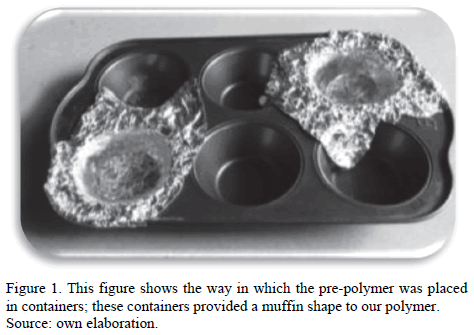
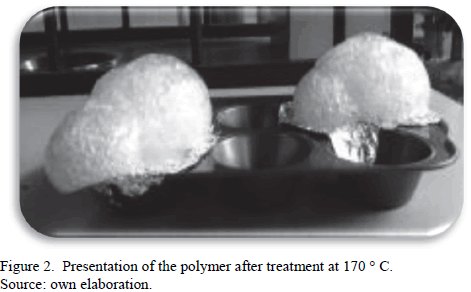
<body><![CDATA[<p><font size="2" face="Verdana, Arial, Helvetica, sans-serif">During this stage, the homogeneous mixture was slowly  heated to a temperature of 150° C, and stirred continuously with a constant  speed. The reactor was jacketed in order to conserve heat. During the increase  of temperature, it was possible to observe how the mixture became more  homogeneous and transparent.</font></p>     <p><font size="2" face="Verdana, Arial, Helvetica, sans-serif">Half an hour after starting the reaction, it began to  generate water steam, since water is the byproduct of low molecular weight that  is generated in this reaction of poly condensation. Within minutes water steam  was observed leaving the reactor and moving to the condenser to achieve a steady  drip of water. The water generated was stored and counted. This reaction was  monitored by means of acidity, samples were taken every twenty minutes and the  acid number was estimated, making it possible to know the efficiency of the  reaction. The reaction had reached equilibrium and the reaction was stopped when  very similar numbers were obtained.</font></p>     <p><font size="2" face="Verdana, Arial, Helvetica, sans-serif"><b>2.2.3. Polymerization </b></font></p>     <p><font size="2" face="Verdana, Arial, Helvetica, sans-serif">During this stage the prepolymer was placed in a metal  container and introduced in an oven at 170 °C for one hour to achieve a higher  degree of polymerization. <a href="#fig01">Fig. 1</a> shows the container with the prepolymer.  (These parameters were used based on decomposition temperatures, bringing the  sample to the limit, the time was established by the FTIR, samples were taken  every 10 minutes and were characterized, and after 60 minutes, no changes in  the intensities of peaks of spectra were seen). </font></p>     <p align="center"><font size="2" face="Verdana, Arial, Helvetica, sans-serif"><a name="fig01"></a></font><img src="/img/revistas/dyna/v82n190/v82n190a06fig01.gif"></p>     <p align="center"><font size="2" face="Verdana, Arial, Helvetica, sans-serif"><a name="fig02"></a></font><img src="/img/revistas/dyna/v82n190/v82n190a06fig02.gif"></p>     <p><font size="2" face="Verdana, Arial, Helvetica, sans-serif"> the  polymerization time ended, the polymer was left in the oven until reaching room  temperature, in order to avoid a sudden change in temperature. After the curing  time, the polymer was removed from the oven, was packaged and labeled and then  taken to different characterizations.</font></p>     <p><font size="2" face="Verdana, Arial, Helvetica, sans-serif"><b><i>2.3. Characterization</i></b></font></p> <ul>       <li><font size="2" face="Verdana, Arial, Helvetica, sans-serif">     Fourier transform infrared spectroscopy.     Spectrum One computer was used. Attenuated total reflectance (ZnSe) was used.     The elaborated polymers were analyzed by transmission, preparing the specimen     with the Potassium Bromide (KBr) disc technique. Scan type: sample. Unit:     %T. Scan number: 10. Scan time: 1 min     Resolution 4cm-1 and interval of 650 to 400 cm-</font></li>       <li><font size="2" face="Verdana, Arial, Helvetica, sans-serif">     Refractometer (Refractive index). Atago Abbe     refractometer was used at 25-26ºC.</font></li>       ]]></body>
<body><![CDATA[<li><font size="2" face="Verdana, Arial, Helvetica, sans-serif">     Acidity. For this determination, the volumetric     method was used. Employing KOH and phenolphthalein as reactive and indicator     respectively for this analysis. </font></li>       <li><font size="2" face="Verdana, Arial, Helvetica, sans-serif">     Determination of humidity. A binder stove was     used at 105ºC for 1 a hour.</font></li>       <li><font size="2" face="Verdana, Arial, Helvetica, sans-serif">     Calorimetry. Thermal analyses were carried out     on a differential scanning calorimeter DSC Perkin-Elmer Pyris-1. Nitrogen gas was used. Temperature program:     Holded for 1.0 min at 30ºC. Heated from 30ºC to 400ºC at 40ºC/min. Sample     weight 1 mg</font></li>       <li><font size="2" face="Verdana, Arial, Helvetica, sans-serif">     Determination of density. Density was determined     through a buoyancy method using scales equipped with a Metter Toledo brand density     determination kit. </font></li>     </ul>     <p><font size="2" face="Verdana, Arial, Helvetica, sans-serif"><i><b>2.4. Mechanical Testing </b></i></font></p> <ul>       <li><font size="2" face="Verdana, Arial, Helvetica, sans-serif">    Tensile     tests. INSTRON Equipment was used for this test. </font></li>       <li><font size="2" face="Verdana, Arial, Helvetica, sans-serif">    Impact test. The impact test was     performed on a computer CEAST ® Resil impactor by IZOD method. </font></li>       <li><font size="2" face="Verdana, Arial, Helvetica, sans-serif">    Hardness Test. Complex Shore D     Durometer was used with ASTM D2240-00.</font></li>     </ul>     ]]></body>
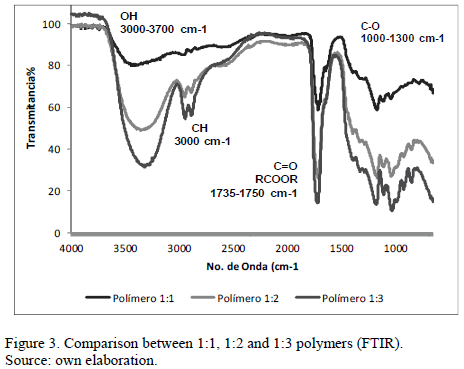
<body><![CDATA[<p><font size="2" face="Verdana, Arial, Helvetica, sans-serif"><i><b>2.5.  Biodegradation test</b></i></font></p>     <p><font size="2" face="Verdana, Arial, Helvetica, sans-serif">During these tests, the polymers were studied to different  conditions, it is noteworthy that these tests gave us qualitative results and  were considered a field test.</font></p>     <p><font size="2" face="Verdana, Arial, Helvetica, sans-serif">The first test  consisted in keeping the polymer completely weatherproof, meaning a piece of our  polymer was placed in a specific place in which to be exposed to different  climatic factors, like the sun, rain, air, insects, microorganisms, etc., in  order to observe their behavior in a time range. </font></p>     <p><font size="2" face="Verdana, Arial, Helvetica, sans-serif">The second test consisted in immerse our polymer in water  (50 ml) to allow us to observe whether a hydrolytic degradation was occurring  by the passing of time.</font></p>     <p><font size="2" face="Verdana, Arial, Helvetica, sans-serif">The third test was to keep the piece of polymer in  controlled conditions at a temperature of 22°C, and in closed containers free  of humidity and atmospheric pressure. This allowed us to compare the three  exhibits.</font></p>     <p><font size="2" face="Verdana, Arial, Helvetica, sans-serif">It is noteworthy that the three samples correspond to the  same polymer.</font></p>     <p>&nbsp;</p>     <p><font size="3" face="Verdana, Arial, Helvetica, sans-serif"><b>3. Results</b></font></p>     <p><b><font size="2" face="Verdana, Arial, Helvetica, sans-serif">3.1. Fourier  transform infrared spectroscopy</font></b></p>     <p><font size="2" face="Verdana, Arial, Helvetica, sans-serif">This technique allowed us to observe the functional groups  present in our samples. The first sample analyzed was called 1:1. In spectrum 1,  we observed the presence of certain characteristic functional groups of the  polyesters of which our polymer is part, mainly OH groups, CH, C=O, RCOOR, CO.</font></p>     ]]></body>
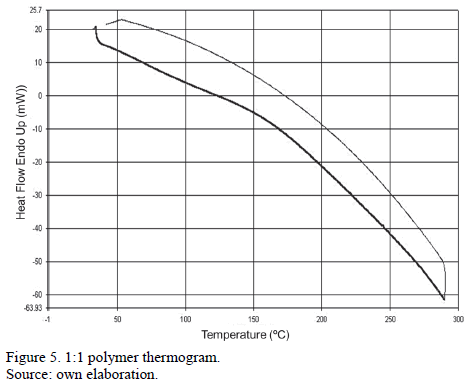
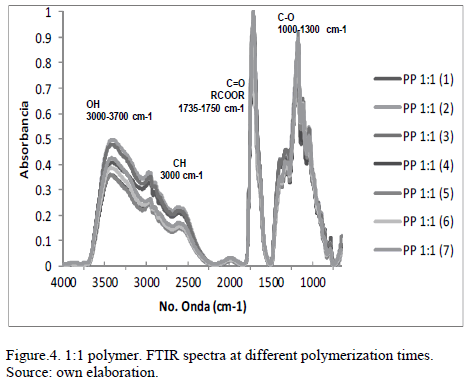
<body><![CDATA[<p><font size="2" face="Verdana, Arial, Helvetica, sans-serif">In the case of 1:2 prepolymer, we basically observed the  same groups with varying intensities. Mainly observed were OH groups, CH, C=O,  RCOOR, CO.</font></p>     <p><font size="2" face="Verdana, Arial, Helvetica, sans-serif">In the case of the 1-3 polymers, the same groups were  observed again, and again, with varying intensities. Those mainly observed were  OH, CH, C = O, RCOOR, CO</font></p>     <p><font size="2" face="Verdana, Arial, Helvetica, sans-serif"><a href="#fig03">Fig. 3</a> shows the spectrum of the three different polymers  together. It is possible to observe that they have the same line, i.e., it  shows the presence of the same functional groups, all three show the formation  of ester groups. It is important to note that in the OH functional group, the  intensity of this polymer is greater in 1:3. This is because this polymer has a  higher concentration of glycerol, which has three hydroxides (OH) in its structure.  The least intense is 1:1 as this has a lower concentration of glycerin. </font></p>     <p align="center"><font size="2" face="Verdana, Arial, Helvetica, sans-serif"><a name="fig03"></a></font><img src="/img/revistas/dyna/v82n190/v82n190a06fig03.gif"></p>     <p><font size="2" face="Verdana, Arial, Helvetica, sans-serif">The OH groups can also be indicative of the presence of  water in the polymer since water is a by-product in our reaction and this could  be reflected in the spectrum.</font></p>     <p><font size="2" face="Verdana, Arial, Helvetica, sans-serif"><a href="#fig04">Fig. 4</a> shows a spectrum of seven lines representing 7  different polymerization times. The specters were taken every twenty minutes,  and showed the following trend: The intensity of the line representing the OH  and CH did decrease the polymerization step. This indicates that water is being  generated. The line that represents the C=O and CO showed greater intensity  with the passing of the polymerization, this indicates an increase of ester  groups, which is typical in these types of polymers.</font></p>     <p align="center"><font size="2" face="Verdana, Arial, Helvetica, sans-serif"><a name="fig04"></a></font><img src="/img/revistas/dyna/v82n190/v82n190a06fig04.gif"></p>     <p align="center"><font size="2" face="Verdana, Arial, Helvetica, sans-serif"><a name="tab01"></a></font><img src="/img/revistas/dyna/v82n190/v82n190a06tab01.gif"></p>     <p><font size="2" face="Verdana, Arial, Helvetica, sans-serif"><b><i>3.2. Refractometry  (refractive index)</i></b></font></p>     <p><font size="2" face="Verdana, Arial, Helvetica, sans-serif">The refractive index is an optical property of materials.  The values shown below are the average of several tests undertaken at the same  temperature. It is noteworthy that these tests were performed following the  ISO-17025-2006 standard. </font></p>     ]]></body>
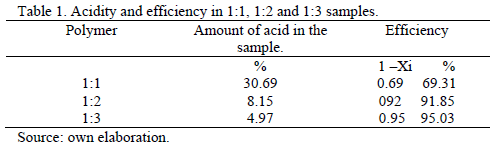
<body><![CDATA[<p><font size="2" face="Verdana, Arial, Helvetica, sans-serif">Refractive index of the three types of polymer Citrate:  1:1, 1:2 and 1:3. </font></p>     <blockquote>       <p><font size="2" face="Verdana, Arial, Helvetica, sans-serif">1:1 prepolymer 1.50  (25 ° C)    <br> </font><font size="2" face="Verdana, Arial, Helvetica, sans-serif">1:2 prepolymer 1.50  (26 ° C)    <br> </font><font size="2" face="Verdana, Arial, Helvetica, sans-serif">1:3 prepolymer 1.495 (26 ° C)</font></p> </blockquote>     <p><font size="2" face="Verdana, Arial, Helvetica, sans-serif"><b><i>3.3. Acidity</i></b></font></p>     <p><font size="2" face="Verdana, Arial, Helvetica, sans-serif">Acidity was an important parameter when reactions were  taking place, using this parameter controlled the equilibrium of the reaction.  With the acid number, it was possible to calculate the amount of acid present  in the sample and also the efficiency with which the reaction took place.</font></p>     <p><font size="2" face="Verdana, Arial, Helvetica, sans-serif"><b><i>3.4. Humidity  determination. (Method of recirculating air oven)</i></b></font></p>     <p><font size="2" face="Verdana, Arial, Helvetica, sans-serif">Mass loss as a percentage of the original mass of the  sample is calculated using eq. 1: </font></p>     <p><img src="/img/revistas/dyna/v82n190/v82n190a06eq01.gif"></p>     ]]></body>

<body><![CDATA[<p><font size="2" face="Verdana, Arial, Helvetica, sans-serif">Where: </font></p> <ul>       <li><font size="2" face="Verdana, Arial, Helvetica, sans-serif"> m1 is the mass of the capsule = 22 316 g </font></li>       <li><font size="2" face="Verdana, Arial, Helvetica, sans-serif"> m2 is the mass of the capsule + sample before drying  = 27.036 g </font></li>       <li><font size="2" face="Verdana, Arial, Helvetica, sans-serif">- m3 is the mass of the capsule + sample after drying  = 26.927 g</font></li>     </ul>     <p><img src="/img/revistas/dyna/v82n190/v82n190a06eq02.gif"></p>     <p><font size="2" face="Verdana, Arial, Helvetica, sans-serif"><i><b>3.5. Calorimetry</b></i></font></p>     <p><font size="2" face="Verdana, Arial, Helvetica, sans-serif">In the following DSC curve, a temperature change at 168° C  was observed. This indicates a possible transition to a glassy amorphous state.</font></p>     <p><font size="2" face="Verdana, Arial, Helvetica, sans-serif"><b><i>3.6. Determination  of density</i></b></font></p>     <p><font size="2" face="Verdana, Arial, Helvetica, sans-serif">This  test was performed with an analytical balance with a kit for obtaining density  data. This data was important for </font><font size="2" face="Verdana, Arial, Helvetica, sans-serif">the realization of the mechanical  tests, given that by using the volume and mass data to provide density, it was  possible to calculate the grams of polymer needed to fill the frames and plates  for performing this test. &#91;5&#93;</font></p>     ]]></body>
<body><![CDATA[<p align="center"><font size="2" face="Verdana, Arial, Helvetica, sans-serif"><a name="fig05"></a></font><img src="/img/revistas/dyna/v82n190/v82n190a06fig05.gif"></p>     <p align="center"><font size="2" face="Verdana, Arial, Helvetica, sans-serif"><a name="tab02"></a></font><img src="/img/revistas/dyna/v82n190/v82n190a06tab02.gif"></p>     <p align="center"><font size="2" face="Verdana, Arial, Helvetica, sans-serif"><a name="tab03"></a></font><img src="/img/revistas/dyna/v82n190/v82n190a06tab03.gif"></p>     <p><font size="2" face="Verdana, Arial, Helvetica, sans-serif">The density data were obtained only for the 1:1 polymer as  the equipment used only handles solid samples.</font></p>     <p><font size="2" face="Verdana, Arial, Helvetica, sans-serif"><font face="Symbol">d</font> 1:1 polymer= 1.3 g/cm3</font></p>     <p><font size="2" face="Verdana, Arial, Helvetica, sans-serif"><b><i>3.7. Tensile test </i></b></font></p>     <p><font size="2" face="Verdana, Arial, Helvetica, sans-serif">This test was performed to analyze the tensile strength  and elongation behavior. Values shown in the table are very poor, given that, as  mentioned above, it was not possible to undertake mechanical tests 1:2 and 1:3  &#91;7&#93;.</font></p>     <p><font size="2" face="Verdana, Arial, Helvetica, sans-serif">The properties of reference polymer (Crystal polystyrene  PS) are attractive for CD cases. </font></p>     <p><font size="2" face="Verdana, Arial, Helvetica, sans-serif"><b><i>3.8. Impact test.  IZOD </i></b></font></p>     <p><font size="2" face="Verdana, Arial, Helvetica, sans-serif">This test was performed to observe the impact strength of  the IZOD method. The values shown in the table are very low, meaning that the  polymer is very fragile. As mentioned above, it was not possible to perform  mechanical tests 1:2 and 1:3 &#91;6&#93;.</font></p>     ]]></body>
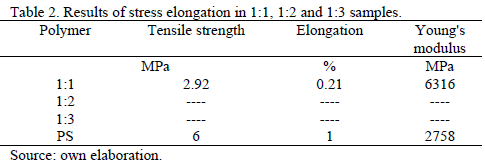
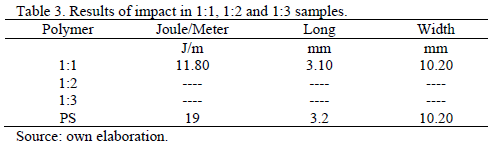
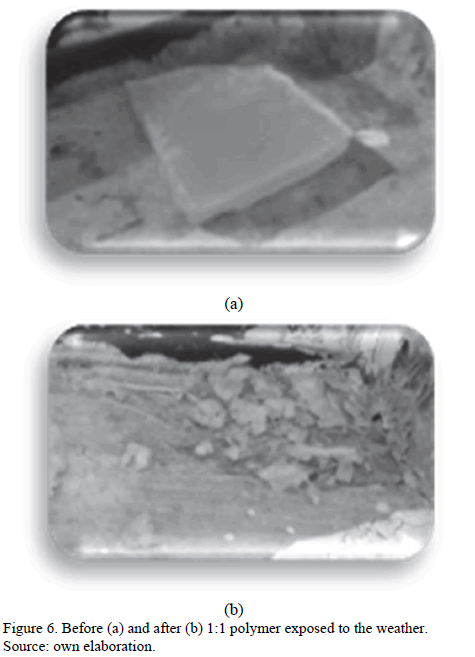
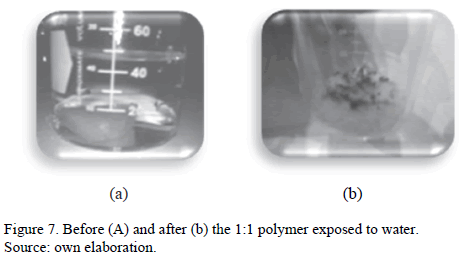
<body><![CDATA[<p><font size="2" face="Verdana, Arial, Helvetica, sans-serif"><b><i>3.9. Hardness Test </i></b></font></p>     <p><font size="2" face="Verdana, Arial, Helvetica, sans-serif">This test could only be performed for polymer 1:1. The results  tell us that it is a hard polymer when compared to PS, so it is possible to  imagine the harshness of this material. The implementation of this test did not  present complications. </font></p>     <p><font size="2" face="Verdana, Arial, Helvetica, sans-serif">1:1 polymer: 83.9 Shore D    <br> </font><font size="2" face="Verdana, Arial, Helvetica, sans-serif">Polystyrene: 85 to 90 Shore D</font></p>     <p><font size="2" face="Verdana, Arial, Helvetica, sans-serif"><b><i>3.10. Biodegradation  test</i></b></font></p>     <p><font size="2" face="Verdana, Arial, Helvetica, sans-serif">The first test was to put a piece of the polymer outdoors.  This showed that the polymer is degradable, given that after a short period of  time, it decreased in weight. This was clearly visible, and it was possible to  observe how time affected surface degradation over the entire polymer. Affecting  factors in this test were mainly sunlight, humidity, air, temperature and  insects.</font></p>     <p><font size="2" face="Verdana, Arial, Helvetica, sans-serif">In the second test in which the polymer was left in water,  the hydrolytic properties of the polymer were tested. We observed how the  polymer swelled and the growth of fungi and microorganisms.</font></p>     <p align="center"><font size="2" face="Verdana, Arial, Helvetica, sans-serif"><a name="fig06"></a></font><img src="/img/revistas/dyna/v82n190/v82n190a06fig06.gif"></p>     <p align="center"><font size="2" face="Verdana, Arial, Helvetica, sans-serif"><a name="fig07"></a></font><img src="/img/revistas/dyna/v82n190/v82n190a06fig07.gif"></p>     <p align="center"><font size="2" face="Verdana, Arial, Helvetica, sans-serif"><a name="fig08"></a></font><img src="/img/revistas/dyna/v82n190/v82n190a06fig08.gif"></p>     ]]></body>
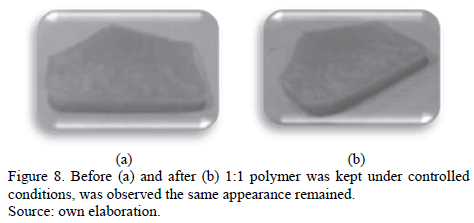
<body><![CDATA[<p><font size="2" face="Verdana, Arial, Helvetica, sans-serif">The third test which was to keep a piece of polymer  citrate in controlled conditions allowed us to observe how the polymer manages  to stay in good condition, maintaining the same visual characteristics. By  touching the polymer, we were able to observe that it had lost strength but  gained flexibility. By this, we deduced that there is a molecular rearrangement  after molding. </font></p>     <p>&nbsp;</p>     <p><font size="3" face="Verdana, Arial, Helvetica, sans-serif"><b>4. Discussion</b></font></p>     <p><font size="2" face="Verdana, Arial, Helvetica, sans-serif">The Fourier transform infrared spectroscopy for sample 1:1  showed the presence of the characteristic functional groups of polyesters; the  presence of OH, CH, C = O, RCOOR, CO groups was observed in all three samples  (1:1, 1:2, 1:3). Importantly, the intensity of OH functional group was stronger  in the 1:3 polymer. This is because this polymer has a higher concentration of  glycerol, which has in its structure three OH. 1:1 showed the least intensity  since it had a lower concentration of glycerol.</font></p>     <p><font size="2" face="Verdana, Arial, Helvetica, sans-serif">From the above, it follows that the difference in  intensity of the line of the OH groups is that the polymers contain different  amounts of glycerol, higher glycerol generated less viscous polymers and a  higher efficiency reaction, and managed to saturate more citric acid protons.  The presence of OH groups present may also indicate the presence of water in  the polymer since water is a byproduct in this reaction and this could be  reflected in the spectrum.</font></p>     <p><font size="2" face="Verdana, Arial, Helvetica, sans-serif">Moreover, the line representing the C = O and CO, showed  greater intensity with the polymerization step, this indicates an increase of  ester groups, which is typical in these types of polymers.</font></p>     <p><font size="2" face="Verdana, Arial, Helvetica, sans-serif">Acidity allowed us to calculate the amount of acid present  in the sample and also the efficiency with which the reaction took place,  indicating whether the reaction had reached equilibrium.</font></p>     <p><font size="2" face="Verdana, Arial, Helvetica, sans-serif">DSC results showed a thermal change at 168°C indicating a  transition to its glassy state.</font></p>     <p><font size="2" face="Verdana, Arial, Helvetica, sans-serif">With respect to mechanical properties evaluated, tensile  and impact assay showed a fragile behavior; with high levels of hardness (Shore  D); however, there was a significant improvement in tensile strength at 100%  out the polymerization at a temperature of 170°C.</font></p>     <p><font size="2" face="Verdana, Arial, Helvetica, sans-serif">Degradation tests showed a gradual surface degradation,  but over time, the entire polymer was affected; in aqueous medium, the  hydrolytic properties of the polymer were observed, and the formation of fungi  and microorganisms with the passage of time was observed.</font></p>     ]]></body>
<body><![CDATA[<p><font size="2" face="Verdana, Arial, Helvetica, sans-serif">Based on the functional properties obtained, the fact that  they are hydrolytically degradable is of great interest in the field of  biomaterials.</font></p>     <p><font size="2" face="Verdana, Arial, Helvetica, sans-serif">A hybrid polymer was achieved for sample 1:1, whereby  hardness increased when the concentration of citric acid was increased. In the  case of the other two samples, low viscosity impeded further mechanical tests.</font></p>     <p><font size="2" face="Verdana, Arial, Helvetica, sans-serif">Immediate applications are compostable bags and packaging,  and due to its high rate of degradation in water, it could be a good candidate  for drug delivery systems. </font></p>     <p><font size="2" face="Verdana, Arial, Helvetica, sans-serif"> By undertaking tests  at a temperature of 170°C, at which polymerization takes place, we also found  that it can serve as an adhesive for glass and ceramics.</font></p>     <p>&nbsp;</p>     <p><font size="3" face="Verdana, Arial, Helvetica, sans-serif"><b>5. Conclusions</b></font></p>     <p><font size="2" face="Verdana, Arial, Helvetica, sans-serif">A novel method was developed to obtain polyesters based on  citric acid and glycerol. </font></p>     <p><font size="2" face="Verdana, Arial, Helvetica, sans-serif">This work demonstrated that longer synthesis times  generate a longer and higher crosslinking polymerization, which provides more  water resistance to this polymer. It was also possible to confirm Halpern's  conclusion about crosslinking behavior &#91;10&#93;.</font></p>     <p><font size="2" face="Verdana, Arial, Helvetica, sans-serif">This polymer (1:1) after molding at room temperature is  hard, very inflexible and fragile; however, after a week, the polymer becomes flexible  and loses its hardness. This is due to the increase in humidity present in the  polymer days after molding. </font></p>     <p><font size="2" face="Verdana, Arial, Helvetica, sans-serif">The polymer is obtained by autocatalizable synthesis,  which is one factor that makes our reaction inexpensive as well as the fact  that the materials for producing this polymer are cheap. In other works, a  catalyst was used. </font></p>     ]]></body>
<body><![CDATA[<p><font size="2" face="Verdana, Arial, Helvetica, sans-serif">The three types of prepolymer and polymer obtained have  different physical, chemical and mechanical properties, which allow a greater spectrum  of applications for this family of polymers.</font></p>     <p><font size="2" face="Verdana, Arial, Helvetica, sans-serif">Biodegradation tests indicate that the 1:1 polymer is a  biodegradable polymer, which exhibits hydrolytic properties, which means that  it degrades rapidly in the presence of water.</font></p>     <p><font size="2" face="Verdana, Arial, Helvetica, sans-serif">It was also observed that polymer 1:1 first presented a  partial biodegradation in which a surface degradation was observed, which then  led to total degradation. This behavior was explained in 2003 by Gonzalez. &#91;4&#93;</font></p>     <p><font size="2" face="Verdana, Arial, Helvetica, sans-serif">These polymers (1:1, 1:2 and 1:3) have ester groups, which  tend to be biodegradable and it is known that their bonds are hydrolyzed by the  action of microorganisms. It is known that carbon-carbon bonds presented in our  polymer are biodegraded by oxidation; the first degradation occurs with the  hydroxyl groups and the second in the carbon chain.</font></p>     <p><font size="2" face="Verdana, Arial, Helvetica, sans-serif">This family of polymers has a heteroatom (oxygen) in its  backbone carbon atoms, which acts as a potential attack point for enzymatic  hydrolysis and oxidative breakdown.</font></p>     <p>&nbsp;</p>     <p><font size="3" face="Verdana, Arial, Helvetica, sans-serif"><b>5. References</b></font></p>     <!-- ref --><p><font size="2" face="Verdana, Arial, Helvetica, sans-serif"><b>&#91;1&#93;</b> Callister, W.D., Introducci&oacute;n a la ciencia  e ingeniería de los materiales, Vol. 2, Nueva York, USA, Reverte. , 1996, pp. 601-604 </font>&nbsp;&nbsp;&nbsp;&nbsp;&nbsp;&nbsp;&nbsp;&nbsp;[&#160;<a href="javascript:void(0);" onclick="javascript: window.open('/scielo.php?script=sci_nlinks&ref=000170&pid=S0012-7353201500020000600001&lng=','','width=640,height=500,resizable=yes,scrollbars=1,menubar=yes,');">Links</a>&#160;]<!-- end-ref --><!-- ref --><p><font size="2" face="Verdana, Arial, Helvetica, sans-serif"><b>&#91;2&#93;</b> Rivada-N&uacute;&ntilde;ez,  F.J., Planta industrial de producci&oacute;n de &aacute;cido cítrico a partir de mezclas de  remolacha. C&aacute;diz, Universidad de C&aacute;diz, Espa&ntilde;a, 2008.    &nbsp;&nbsp;&nbsp;&nbsp;&nbsp;&nbsp;&nbsp;&nbsp;[&#160;<a href="javascript:void(0);" onclick="javascript: window.open('/scielo.php?script=sci_nlinks&ref=000171&pid=S0012-7353201500020000600002&lng=','','width=640,height=500,resizable=yes,scrollbars=1,menubar=yes,');">Links</a>&#160;]<!-- end-ref --></font></p>     ]]></body>
<body><![CDATA[<!-- ref --><p><font size="2" face="Verdana, Arial, Helvetica, sans-serif"><b>&#91;3&#93;</b> Ferrero, A. J., Rosa, I. M., Veneciano, E.  Proceso de purificaci&oacute;n de la glicerina obtenida del biodiesel a peque&ntilde;a  escala. Centro de Investigaci&oacute;n en Tecnología Lactoc&aacute;rnica. Universidad  Tecnol&oacute;gica Nacional/Facultad Regional Villa Maria, Argentina, 2010.    &nbsp;&nbsp;&nbsp;&nbsp;&nbsp;&nbsp;&nbsp;&nbsp;[&#160;<a href="javascript:void(0);" onclick="javascript: window.open('/scielo.php?script=sci_nlinks&ref=000173&pid=S0012-7353201500020000600003&lng=','','width=640,height=500,resizable=yes,scrollbars=1,menubar=yes,');">Links</a>&#160;]<!-- end-ref --></font></p>     <!-- ref --><p><font size="2" face="Verdana, Arial, Helvetica, sans-serif"><b>&#91;4&#93;</b> Gonz&aacute;lez,  C., Anexo C: Polímeros biodegradables con aplicaciones en suturas quir&uacute;rgicas. 2004,  32 P.    &nbsp;&nbsp;&nbsp;&nbsp;&nbsp;&nbsp;&nbsp;&nbsp;[&#160;<a href="javascript:void(0);" onclick="javascript: window.open('/scielo.php?script=sci_nlinks&ref=000175&pid=S0012-7353201500020000600004&lng=','','width=640,height=500,resizable=yes,scrollbars=1,menubar=yes,');">Links</a>&#160;]<!-- end-ref --></font></p>     <!-- ref --><p><font size="2" face="Verdana, Arial, Helvetica, sans-serif"><b>&#91;5&#93;</b> Toledo, M., Balanzas analíticas. 2013.    &nbsp;&nbsp;&nbsp;&nbsp;&nbsp;&nbsp;&nbsp;&nbsp;[&#160;<a href="javascript:void(0);" onclick="javascript: window.open('/scielo.php?script=sci_nlinks&ref=000177&pid=S0012-7353201500020000600005&lng=','','width=640,height=500,resizable=yes,scrollbars=1,menubar=yes,');">Links</a>&#160;]<!-- end-ref --></font></p>     <!-- ref --><p><font size="2" face="Verdana, Arial, Helvetica, sans-serif"><b>&#91;6&#93;</b> Colombiana,  E.D., M&aacute;quina de Impacto (Manual). Laboratorio de Producci&oacute;n. Facultad de  Ingeniería Industrial. Escuela Colombiana de Ingeniería Julio Gravito.  Bogot&aacute;, Colombia, 2008.    &nbsp;&nbsp;&nbsp;&nbsp;&nbsp;&nbsp;&nbsp;&nbsp;[&#160;<a href="javascript:void(0);" onclick="javascript: window.open('/scielo.php?script=sci_nlinks&ref=000179&pid=S0012-7353201500020000600006&lng=','','width=640,height=500,resizable=yes,scrollbars=1,menubar=yes,');">Links</a>&#160;]<!-- end-ref --></font></p>     <!-- ref --><p><font size="2" face="Verdana, Arial, Helvetica, sans-serif"><b>&#91;7&#93;</b> Propiedades  mec&aacute;nicas de los materiales: Ensayos est&aacute;ticos y din&aacute;mico. 2010.    &nbsp;&nbsp;&nbsp;&nbsp;&nbsp;&nbsp;&nbsp;&nbsp;[&#160;<a href="javascript:void(0);" onclick="javascript: window.open('/scielo.php?script=sci_nlinks&ref=000181&pid=S0012-7353201500020000600007&lng=','','width=640,height=500,resizable=yes,scrollbars=1,menubar=yes,');">Links</a>&#160;]<!-- end-ref --></font></p>     ]]></body>
<body><![CDATA[<!-- ref --><p><font size="2" face="Verdana, Arial, Helvetica, sans-serif"><b>&#91;8&#93;</b> Escudero-Castej&oacute;n, L., Moreno Grau J.M.,  Biodegradabilidad y toxicidad de materiales pl&aacute;sticos, aplicaci&oacute;n de las normas  UNE-EN ISO 14852 y 11348-3, Bs. Tesis, Departamento de Ingeniería Industrial,  Universidad Polit&eacute;cnica de Cartagena, Cartagena, Colombia, 2011.    &nbsp;&nbsp;&nbsp;&nbsp;&nbsp;&nbsp;&nbsp;&nbsp;[&#160;<a href="javascript:void(0);" onclick="javascript: window.open('/scielo.php?script=sci_nlinks&ref=000183&pid=S0012-7353201500020000600008&lng=','','width=640,height=500,resizable=yes,scrollbars=1,menubar=yes,');">Links</a>&#160;]<!-- end-ref --></font></p>     <!-- ref --><p><font size="2" face="Verdana, Arial, Helvetica, sans-serif"><b>&#91;9&#93;</b> Müller, R.J., Biodegradability of polymers: Regulations  and methods for testing, in Steinbuchel A, Biopolymers Vol. 10, Wiley VCH, pp.  365-392. <a href="http://dx.doi.org/10.1002/3527600035.bpola012" target="_blank">http://dx.doi.org/10.1002/3527600035.bpola012</a></font>&nbsp;&nbsp;&nbsp;&nbsp;&nbsp;&nbsp;&nbsp;&nbsp;[&#160;<a href="javascript:void(0);" onclick="javascript: window.open('/scielo.php?script=sci_nlinks&ref=000185&pid=S0012-7353201500020000600009&lng=','','width=640,height=500,resizable=yes,scrollbars=1,menubar=yes,');">Links</a>&#160;]<!-- end-ref --><!-- ref --><p><font size="2" face="Verdana, Arial, Helvetica, sans-serif"><b>&#91;10&#93;</b>   Halpern, J., Urbanski, R., Weinstock, A., Iwing, D.,  Mathers, R. and Von Recum, H., A biodegradable thermoset polymer made by  esterification of citric acid and glycerol. Society for Biomaterials. 5 (102),  pp. 1467-1477, 2013 <a href="http://dx.doi.org/10.1002/jbm.a.34821" target="_blank">http://dx.doi.org/10.1002/jbm.a.34821</a></font>&nbsp;&nbsp;&nbsp;&nbsp;&nbsp;&nbsp;&nbsp;&nbsp;[&#160;<a href="javascript:void(0);" onclick="javascript: window.open('/scielo.php?script=sci_nlinks&ref=000186&pid=S0012-7353201500020000600010&lng=','','width=640,height=500,resizable=yes,scrollbars=1,menubar=yes,');">Links</a>&#160;]<!-- end-ref --><!-- ref --><p><font size="2" face="Verdana, Arial, Helvetica, sans-serif"><b>&#91;11&#93;</b> Valero-Valdivieso, M.F. and Orteg&oacute;n, Y., Biopolymers: Progress and prospects, DYNA, 80  (181), pp. 171-180, 2013.    &nbsp;&nbsp;&nbsp;&nbsp;&nbsp;&nbsp;&nbsp;&nbsp;[&#160;<a href="javascript:void(0);" onclick="javascript: window.open('/scielo.php?script=sci_nlinks&ref=000187&pid=S0012-7353201500020000600011&lng=','','width=640,height=500,resizable=yes,scrollbars=1,menubar=yes,');">Links</a>&#160;]<!-- end-ref --></font></p>     <p>&nbsp;</p>     <p><font size="2" face="Verdana, Arial, Helvetica, sans-serif"><b>J.A.  Mariano-Torres</b>, received his Bs. degree in Chemical Engineering in 2007  from Instituto Tecnol&oacute;gico de Ciudad Madero, Mexico and a MSc. degree in  Advanced Technology in 2013 from Instituto Polit&eacute;cnico Nacional in Mexico.  Currently, he is a PhD student from Instituto Polit&eacute;cnico Nacional and works as  professor in Universidad del Noreste. His research focuses on biodegradable  polymers and their applications.</font></p>     <p><font size="2" face="Verdana, Arial, Helvetica, sans-serif"><b>A. L&oacute;pez-Marure,</b> received his Bs. degree in Metallurgy Engineering in 1994 from the Instituto  Polit&eacute;cnico Nacional in Madero Mexico, a MSc. degree in Metallurgy extractive  in 1996 from Instituto Polit&eacute;cnico Nacional in Mexico, a MSc. degree in  Material Science in 1997 from INPG in France, and a PhD degree in Inorganic  Chemistry in 1999 from UCB Lyon, France. He has worked on projects in the  aerospatial, petrol and mining fields, emphasizing on new materials. He is a  full professor in the Materials Department, CICATA Altamira, Instituto Politecnico  Nacional, Mexico.</font></p>     <p><font size="2" face="Verdana, Arial, Helvetica, sans-serif"><b>M.A.  Dominguez-S&aacute;nchez,</b> received his Bs. degree in Chemical Engineering, and a  MSc. degree in Polymers from Instituto Polit&eacute;cnico Nacional in Mexico. He has  worked on the analysis of materials in the petrochemical industry, and is a  Professor in the Polymers Department, CICATA Altamira, Instituto Politecnico  Nacional, Mexico.</font></p>     ]]></body>
<body><![CDATA[ ]]></body><back>
<ref-list>
<ref id="B1">
<label>1</label><nlm-citation citation-type="book">
<person-group person-group-type="author">
<name>
<surname><![CDATA[Callister]]></surname>
<given-names><![CDATA[W.D.]]></given-names>
</name>
</person-group>
<source><![CDATA[Introducción a la ciencia e ingeniería de los materiales]]></source>
<year>1996</year>
<volume>2</volume>
<page-range>601-604</page-range><publisher-loc><![CDATA[Nueva York ]]></publisher-loc>
<publisher-name><![CDATA[Reverte]]></publisher-name>
</nlm-citation>
</ref>
<ref id="B2">
<label>2</label><nlm-citation citation-type="book">
<person-group person-group-type="author">
<name>
<surname><![CDATA[Rivada-Núñez]]></surname>
<given-names><![CDATA[F.J.]]></given-names>
</name>
</person-group>
<source><![CDATA[Planta industrial de producción de ácido cítrico a partir de mezclas de remolacha]]></source>
<year>2008</year>
<publisher-loc><![CDATA[Cádiz ]]></publisher-loc>
<publisher-name><![CDATA[Universidad de Cádiz]]></publisher-name>
</nlm-citation>
</ref>
<ref id="B3">
<label>3</label><nlm-citation citation-type="book">
<person-group person-group-type="author">
<name>
<surname><![CDATA[Ferrero]]></surname>
<given-names><![CDATA[A. J.]]></given-names>
</name>
<name>
<surname><![CDATA[Rosa]]></surname>
<given-names><![CDATA[I. M.]]></given-names>
</name>
<name>
<surname><![CDATA[Veneciano]]></surname>
<given-names><![CDATA[E.]]></given-names>
</name>
</person-group>
<collab>Universidad Tecnológica Nacional^dFacultad Regional Villa Maria</collab>
<source><![CDATA[Proceso de purificación de la glicerina obtenida del biodiesel a pequeña escala]]></source>
<year>2010</year>
<publisher-name><![CDATA[Centro de Investigación en Tecnología Lactocárnica]]></publisher-name>
</nlm-citation>
</ref>
<ref id="B4">
<label>4</label><nlm-citation citation-type="">
<person-group person-group-type="author">
<name>
<surname><![CDATA[González]]></surname>
<given-names><![CDATA[C.]]></given-names>
</name>
</person-group>
<source><![CDATA[Anexo C: Polímeros biodegradables con aplicaciones en suturas quirúrgicas]]></source>
<year>2004</year>
</nlm-citation>
</ref>
<ref id="B5">
<label>5</label><nlm-citation citation-type="">
<person-group person-group-type="author">
<name>
<surname><![CDATA[Toledo]]></surname>
<given-names><![CDATA[M.]]></given-names>
</name>
</person-group>
<source><![CDATA[Balanzas analíticas]]></source>
<year>2013</year>
</nlm-citation>
</ref>
<ref id="B6">
<label>6</label><nlm-citation citation-type="book">
<person-group person-group-type="author">
<name>
<surname><![CDATA[Colombiana]]></surname>
<given-names><![CDATA[E.D.]]></given-names>
</name>
</person-group>
<collab>Escuela Colombiana de Ingeniería Julio Gravito^dFacultad de Ingeniería Industrial</collab>
<source><![CDATA[Máquina de Impacto]]></source>
<year>2008</year>
<publisher-loc><![CDATA[Bogotá ]]></publisher-loc>
<publisher-name><![CDATA[Laboratorio de Producción]]></publisher-name>
</nlm-citation>
</ref>
<ref id="B7">
<label>7</label><nlm-citation citation-type="">
<source><![CDATA[Propiedades mecánicas de los materiales: Ensayos estáticos y dinámico]]></source>
<year>2010</year>
</nlm-citation>
</ref>
<ref id="B8">
<label>8</label><nlm-citation citation-type="">
<person-group person-group-type="author">
<name>
<surname><![CDATA[Escudero-Castejón]]></surname>
<given-names><![CDATA[L.]]></given-names>
</name>
<name>
<surname><![CDATA[Moreno Grau]]></surname>
<given-names><![CDATA[J.M.]]></given-names>
</name>
</person-group>
<source><![CDATA[Biodegradabilidad y toxicidad de materiales plásticos, aplicación de las normas UNE-EN ISO 14852 y 11348-3]]></source>
<year></year>
</nlm-citation>
</ref>
<ref id="B9">
<label>9</label><nlm-citation citation-type="book">
<person-group person-group-type="author">
<name>
<surname><![CDATA[Müller]]></surname>
<given-names><![CDATA[R.J.]]></given-names>
</name>
</person-group>
<article-title xml:lang="en"><![CDATA[Biodegradability of polymers: Regulations and methods for testing]]></article-title>
<person-group person-group-type="editor">
<name>
<surname><![CDATA[Steinbuchel]]></surname>
<given-names><![CDATA[A]]></given-names>
</name>
</person-group>
<source><![CDATA[Biopolymers]]></source>
<year></year>
<volume>10</volume>
<page-range>365-392</page-range><publisher-name><![CDATA[Wiley VCH]]></publisher-name>
</nlm-citation>
</ref>
<ref id="B10">
<label>10</label><nlm-citation citation-type="journal">
<person-group person-group-type="author">
<name>
<surname><![CDATA[Halpern]]></surname>
<given-names><![CDATA[J.]]></given-names>
</name>
<name>
<surname><![CDATA[Urbanski]]></surname>
<given-names><![CDATA[R.]]></given-names>
</name>
<name>
<surname><![CDATA[Weinstock]]></surname>
<given-names><![CDATA[A.]]></given-names>
</name>
<name>
<surname><![CDATA[Iwing]]></surname>
<given-names><![CDATA[D.]]></given-names>
</name>
<name>
<surname><![CDATA[Mathers]]></surname>
<given-names><![CDATA[R.]]></given-names>
</name>
<name>
<surname><![CDATA[Von Recum]]></surname>
<given-names><![CDATA[H.]]></given-names>
</name>
</person-group>
<article-title xml:lang="en"><![CDATA[A biodegradable thermoset polymer made by esterification of citric acid and glycerol]]></article-title>
<source><![CDATA[Society for Biomaterials.]]></source>
<year>2013</year>
<volume>5</volume>
<numero>102</numero>
<issue>102</issue>
<page-range>1467-1477</page-range></nlm-citation>
</ref>
<ref id="B11">
<label>11</label><nlm-citation citation-type="journal">
<person-group person-group-type="author">
<name>
<surname><![CDATA[Valero-Valdivieso]]></surname>
<given-names><![CDATA[M.F.]]></given-names>
</name>
<name>
<surname><![CDATA[Ortegón]]></surname>
<given-names><![CDATA[Y.]]></given-names>
</name>
</person-group>
<article-title xml:lang="en"><![CDATA[Biopolymers: Progress and prospects]]></article-title>
<source><![CDATA[DYNA]]></source>
<year>2013</year>
<volume>80</volume>
<numero>181</numero>
<issue>181</issue>
<page-range>171-180</page-range></nlm-citation>
</ref>
</ref-list>
</back>
</article>