<?xml version="1.0" encoding="ISO-8859-1"?><article xmlns:mml="http://www.w3.org/1998/Math/MathML" xmlns:xlink="http://www.w3.org/1999/xlink" xmlns:xsi="http://www.w3.org/2001/XMLSchema-instance">
<front>
<journal-meta>
<journal-id>0012-7353</journal-id>
<journal-title><![CDATA[DYNA]]></journal-title>
<abbrev-journal-title><![CDATA[Dyna rev.fac.nac.minas]]></abbrev-journal-title>
<issn>0012-7353</issn>
<publisher>
<publisher-name><![CDATA[Universidad Nacional de Colombia]]></publisher-name>
</publisher>
</journal-meta>
<article-meta>
<article-id>S0012-73532015000200008</article-id>
<article-id pub-id-type="doi">10.15446/dyna.v82n190.42915</article-id>
<title-group>
<article-title xml:lang="en"><![CDATA[Encryption using circular harmonic key]]></article-title>
<article-title xml:lang="es"><![CDATA[Encriptación usando una llave en armónicos circulares]]></article-title>
</title-group>
<contrib-group>
<contrib contrib-type="author">
<name>
<surname><![CDATA[Rueda-Parada]]></surname>
<given-names><![CDATA[Jorge Enrique]]></given-names>
</name>
<xref ref-type="aff" rid="A01"/>
</contrib>
</contrib-group>
<aff id="A01">
<institution><![CDATA[,Universidad de Pamplona Facultad de Ciencias Básicas Grupo Óptica Moderna]]></institution>
<addr-line><![CDATA[ ]]></addr-line>
</aff>
<pub-date pub-type="pub">
<day>00</day>
<month>04</month>
<year>2015</year>
</pub-date>
<pub-date pub-type="epub">
<day>00</day>
<month>04</month>
<year>2015</year>
</pub-date>
<volume>82</volume>
<numero>190</numero>
<fpage>70</fpage>
<lpage>73</lpage>
<copyright-statement/>
<copyright-year/>
<self-uri xlink:href="http://www.scielo.org.co/scielo.php?script=sci_arttext&amp;pid=S0012-73532015000200008&amp;lng=en&amp;nrm=iso"></self-uri><self-uri xlink:href="http://www.scielo.org.co/scielo.php?script=sci_abstract&amp;pid=S0012-73532015000200008&amp;lng=en&amp;nrm=iso"></self-uri><self-uri xlink:href="http://www.scielo.org.co/scielo.php?script=sci_pdf&amp;pid=S0012-73532015000200008&amp;lng=en&amp;nrm=iso"></self-uri><abstract abstract-type="short" xml:lang="en"><p><![CDATA[This work presents a study of variance to rotation key encryption processors based on the Fourier transform. It was determined that the key in rectangular coordinates allows a tolerance level of less than 0.2 degrees of rotation of the key in the decryption process. Thus, the solution is to build the key in polar coordinates, by means of circular harmonics expansion; in this way, the tolerance threshold rises to about 40 degrees of rotation of the key in the decryption process. This solution is an added value for optical encryption processors. I have developed a computational tool for simulations and results obtained in this study.]]></p></abstract>
<abstract abstract-type="short" xml:lang="es"><p><![CDATA[En este trabajo presento un estudio sobre la varianza a la rotación de la llave del procesador de encriptación basado en la transformada de Fourier. Determiné que la llave en coordenadas rectangulares permite un nivel de tolerancia inferior a 0.2 grados de rotación de la llave en el proceso de decriptación. Entonces la solución es construir la llave en coordenadas polares, por medio de una expansión en armónicos circulares. De esta manera, el umbral de tolerancia aumenta aproximadamente hasta 40 grados de rotación de la llave en el proceso de decriptación. Esta solución es un valor agregado para el procesador de encriptación óptico. He desarrollado una herramienta computacional para las simulaciones y resultados obtenidos en este estudio.]]></p></abstract>
<kwd-group>
<kwd lng="en"><![CDATA[Cryptography]]></kwd>
<kwd lng="en"><![CDATA[Circular harmonics]]></kwd>
<kwd lng="en"><![CDATA[Fourier optics]]></kwd>
<kwd lng="es"><![CDATA[Criptografía]]></kwd>
<kwd lng="es"><![CDATA[Armónicos Circulares]]></kwd>
<kwd lng="es"><![CDATA[Óptica de Fourier]]></kwd>
</kwd-group>
</article-meta>
</front><body><![CDATA[ <p><font size="1" face="Verdana, Arial, Helvetica, sans-serif"><b>DOI:</b> <a href="http://dx.doi.org/10.15446/dyna.v82n190.42915" target="_blank">http://dx.doi.org/10.15446/dyna.v82n190.42915</a></font></p>     <p align="center"><font size="4" face="Verdana, Arial, Helvetica, sans-serif"><b>Encryption  using circular harmonic key</b></font></p>     <p align="center"><i><b><font size="3" face="Verdana, Arial, Helvetica, sans-serif">Encriptaci&oacute;n usando una llave en arm&oacute;nicos circulares</font></b></i></p>     <p align="center">&nbsp;</p>     <p align="center"><b><font size="2" face="Verdana, Arial, Helvetica, sans-serif">Jorge Enrique Rueda-Parada</font></b><font size="2" face="Verdana, Arial, Helvetica, sans-serif"></font></p>     <p align="center">&nbsp;</p>     <p align="center"><font size="2" face="Verdana, Arial, Helvetica, sans-serif"><i>Grupo &Oacute;ptica Moderna, Facultad de   Ciencias B&aacute;sicas, Universidad de Pamplona, Pamplona, Colombia.   <a href="mailto:jorgeenriquerueda@gmail.com">jorgeenriquerueda@gmail.com</a> </i></font></p>     <p align="center">&nbsp;</p>     <p align="center"><font size="2" face="Verdana, Arial, Helvetica, sans-serif"><b>Received: April 2<sup>th</sup>,  2014. Received in revised form:  February 2<sup>th</sup>, 2015. Accepted: February 20<sup>th</sup>, 2015</b></font></p>     <p align="center">&nbsp;</p>     ]]></body>
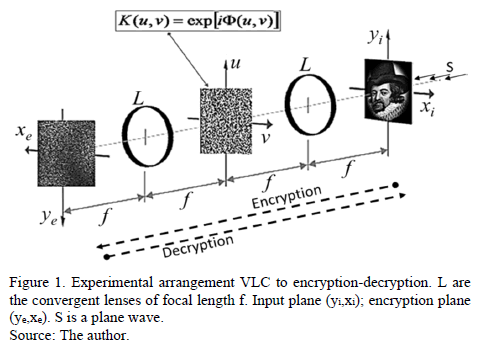
<body><![CDATA[<p align="center"><font size="1" face="Verdana, Arial, Helvetica, sans-seriff"><b>This work is licensed under a</b> <a rel="license" href="http://creativecommons.org/licenses/by-nc-nd/4.0/">Creative Commons Attribution-NonCommercial-NoDerivatives 4.0 International License</a>.</font><br /><a rel="license" href="http://creativecommons.org/licenses/by-nc-nd/4.0/"><img style="border-width:0" src="https://i.creativecommons.org/l/by-nc-nd/4.0/88x31.png" /></a></p> <hr>     <p><font size="2" face="Verdana, Arial, Helvetica, sans-serif"><b>Abstract    <br> </b></font><font size="2" face="Verdana, Arial, Helvetica, sans-serif">This work presents a study of variance to rotation key  encryption processors based on the Fourier transform. It was determined that  the key in rectangular coordinates allows a tolerance level of less than 0.2  degrees of rotation of the key in the decryption process. Thus, the solution is  to build the key in polar coordinates, by means of circular harmonics expansion;  in this way, the tolerance threshold rises to about 40 degrees of rotation of  the key in the decryption process. This solution is an added value for optical  encryption processors. I have developed a computational tool for simulations and results obtained in this study.</font></p>     <p><font size="2" face="Verdana, Arial, Helvetica, sans-serif"><i>Keywords</i>: Cryptography,  Circular harmonics, Fourier optics.</font></p>     <p><font size="2" face="Verdana, Arial, Helvetica, sans-serif"><b>Resumen    <br> </b></font><font size="2" face="Verdana, Arial, Helvetica, sans-serif">En este  trabajo presento un estudio sobre la varianza a la rotaci&oacute;n de la llave del  procesador de encriptaci&oacute;n basado en la transformada de Fourier. Determin&eacute; que  la llave en coordenadas rectangulares permite un nivel de tolerancia inferior a  0.2 grados de rotaci&oacute;n de la llave en el proceso de decriptaci&oacute;n. Entonces la soluci&oacute;n es construir la llave en  coordenadas polares, por medio de una expansi&oacute;n en arm&oacute;nicos circulares. De  esta manera, el umbral de tolerancia aumenta aproximadamente hasta 40 grados de  rotaci&oacute;n de la llave en el proceso de decriptaci&oacute;n. Esta  soluci&oacute;n es un valor agregado para el procesador de encriptaci&oacute;n &oacute;ptico. He  desarrollado una herramienta computacional para las simulaciones y resultados obtenidos en este estudio.</font></p>     <p><font size="2" face="Verdana, Arial, Helvetica, sans-serif"><i>Palabras clave</i>: Criptografía, Arm&oacute;nicos Circulares, &Oacute;ptica de  Fourier.</font></p> <hr>     <p>&nbsp;</p> <font size="3" face="Verdana, Arial, Helvetica, sans-serif"><b>1. Introduction</b></font>     <p><font size="2" face="Verdana, Arial, Helvetica, sans-serif">Using optical processor encryption based on the Vander   Lugt Correlator (VLC) &#91;1&#93;, the image is encrypted due to the encryption key   located on Fourier plane &#91;2,4,5,6,9,10&#93;. This processor uses a phase only key with   random spatial distribution of the phase. <a href="#fig01">Fig. 1</a> shows the optical arrangement  encryption-decryption based on the VLC. </font></p>     <p align="center"><font size="2" face="Verdana, Arial, Helvetica, sans-serif"><a name="fig01"></a></font><img src="/img/revistas/dyna/v82n190/v82n190a08fig01.gif"></p>     ]]></body>
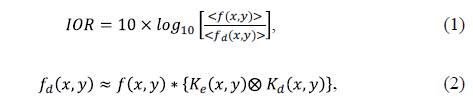
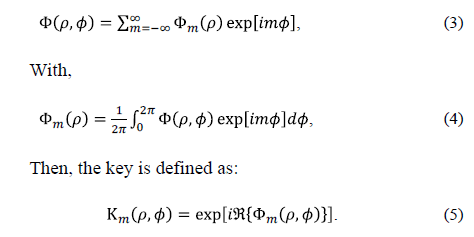
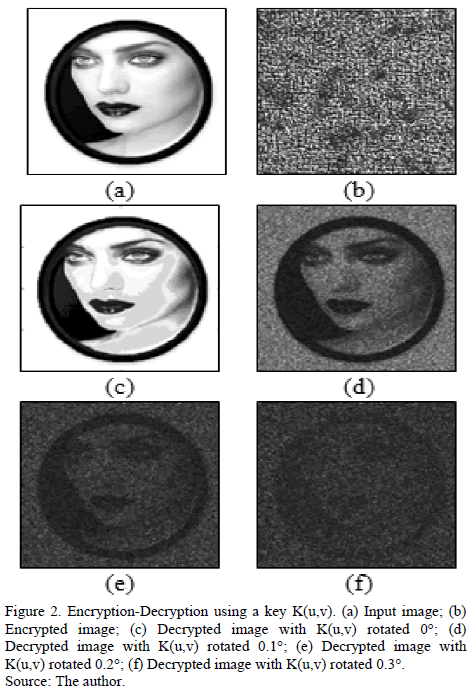
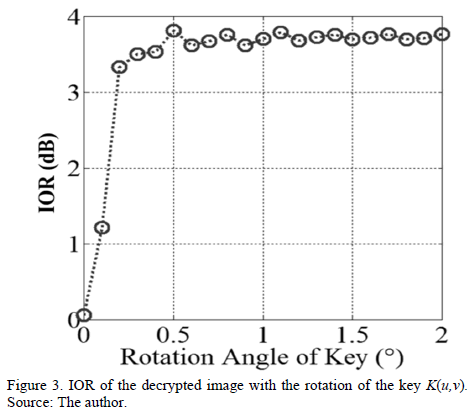
<body><![CDATA[<p><font size="2" face="Verdana, Arial, Helvetica, sans-serif">Encryption techniques   should have two equally important features: 1) resistance to attacks on the   encrypted information, and 2) they should allow recipient to decrypt the   information without difficulty. In previous works &#91;6&#93;, we implemented this type   of encryption arrangement using the encryption-keys in rectangular coordinates<sub><img src="/img/revistas/dyna/v82n190/v82n190a08eq002.gif"></sub>. Then, we observed that the decryption is a variant   operation with the rotation of the key. In practice, this variance is a problem   that needs to be solved. I propose a solution to the problem using a  decomposition of the key in circular harmonics. </font></p>     <p><font size="2" face="Verdana, Arial, Helvetica, sans-serif"><a href="#fig02">Fig. 2</a> shows a result of variance of the decryption   operation with the rotation of a key in rectangular coordinates. A rotational   variance encryption processor, due to rotation of the key may be measured in  terms of the IOR parameter given by eq.(1):</font></p>     <p><img src="/img/revistas/dyna/v82n190/v82n190a08eq0102.gif"></p>     <p><font size="2" face="Verdana, Arial, Helvetica, sans-serif">Where, <img src="/img/revistas/dyna/v82n190/v82n190a08eq010.gif">is   the input image and <img src="/img/revistas/dyna/v82n190/v82n190a08eq012.gif"> is the decrypted image, <img src="/img/revistas/dyna/v82n190/v82n190a08eq014.gif">is   the encryption key, and <img src="/img/revistas/dyna/v82n190/v82n190a08eq016.gif"> is the decryption key. * is the convolution   operator and <img src="/img/revistas/dyna/v82n190/v82n190a08eq018.gif"> is the correlation operator. If <i>IOR</i> = 0 dB, meaning that the output image<img src="/img/revistas/dyna/v82n190/v82n190a08eq020.gif">is   approximately equal to the input image. Analyzing eq.(2), the system will   decrypt only if <img src="/img/revistas/dyna/v82n190/v82n190a08eq022.gif">,   then the operation <img src="/img/revistas/dyna/v82n190/v82n190a08eq024.gif"> generates an autocorrelation peak that does   not distort the image<img src="/img/revistas/dyna/v82n190/v82n190a08eq012.gif">.   But if we rotate the key <img src="/img/revistas/dyna/v82n190/v82n190a08eq016.gif">,   then the result of the <img src="/img/revistas/dyna/v82n190/v82n190a08eq024.gif"> correlation will be a noise, which is   convolved with the image <img src="/img/revistas/dyna/v82n190/v82n190a08eq026.gif">,   and therefore the result is a distorted image. In this work, it was determined   that the level of this distortion depends on the angle of rotation of the   decryption key<img src="/img/revistas/dyna/v82n190/v82n190a08eq028.gif">.  This occurs because the correlation product is variant with rotation functions. </font></p>     <p align="center"><font size="2" face="Verdana, Arial, Helvetica, sans-serif"><a name="fig02"></a></font><img src="/img/revistas/dyna/v82n190/v82n190a08fig02.gif"></p>     <p><font size="2" face="Verdana, Arial, Helvetica, sans-serif">The results shown in <a href="#fig02">Fig. 2</a> correspond to a key in   rectangular coordinates, and <a href="#fig03">Fig. 3</a> is the corresponding calculation of IOR vs   the rotation angle of the same key. Note that rotation of 0.2 degrees,   corresponds to a value of IOR = 1.25dB, which corresponds to the image in <a href="#fig02">Fig.   2</a>(e), and here it is observed that <img src="/img/revistas/dyna/v82n190/v82n190a08eq030.gif"> is highly  distorted. Now,</font><font size="2" face="Verdana, Arial, Helvetica, sans-serif"> for   angles greater than 0.2 degrees, the level of distortion is such that there is   no decrypted image, as with the result in <a href="#fig02">Fig. 2</a>(f). The solution is   then decomposed into harmonic circular key, and thus the operation of   decryption increases tolerance to rotation of the key <img src="/img/revistas/dyna/v82n190/v82n190a08eq016.gif">.   Furthermore, we can use IOR as a relative measure of the level of distortion of   the decrypted image. Thus, we can see in <a href="#fig03">Fig. 3</a> that as we increase the angle   of rotation of the <img src="/img/revistas/dyna/v82n190/v82n190a08eq038.gif">key,  the value of IOR increases.</font></p>     <p align="center"><font size="2" face="Verdana, Arial, Helvetica, sans-serif"><a name="fig03"></a></font><img src="/img/revistas/dyna/v82n190/v82n190a08fig03.gif"></p>     <p>&nbsp;</p>     <p><font size="3" face="Verdana, Arial, Helvetica, sans-serif"><b>2. Encryption with  circular harmonic key</b></font></p>     <p><font size="2" face="Verdana, Arial, Helvetica, sans-serif">An image can be expressed in polar coordinates for   circular harmonic components &#91;7,8&#93;. Then we can consider the key in polar   coordinates, so the key takes the form<img src="/img/revistas/dyna/v82n190/v82n190a08eq040.gif">,   where F must contain a distribution of random values. Thus, the key can be decomposed  into harmonic circular, as follows:</font></p>     ]]></body>


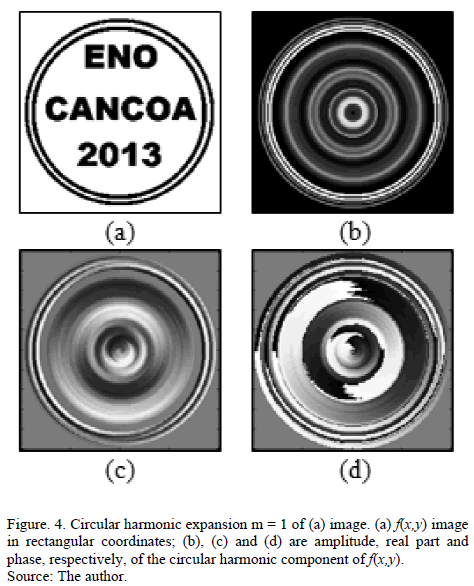
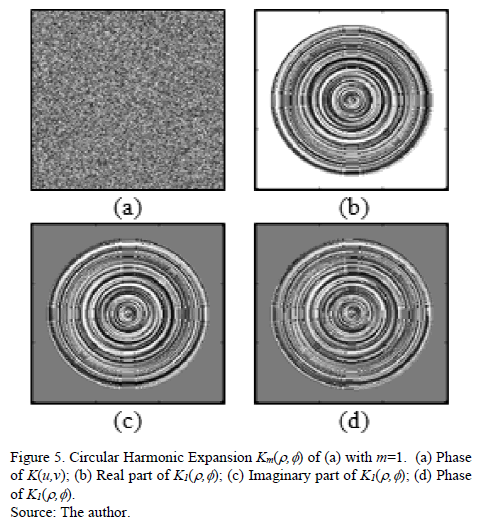
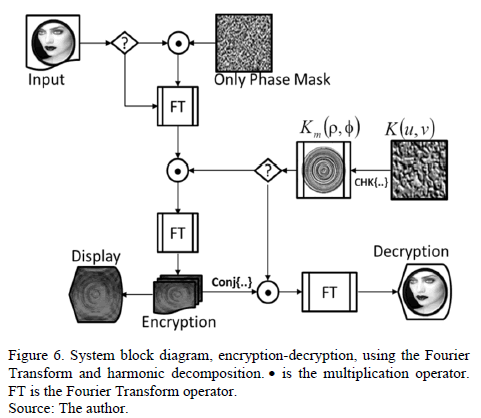
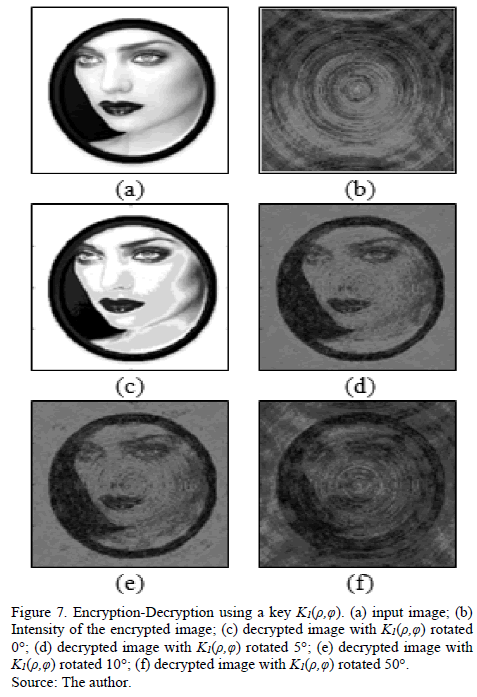
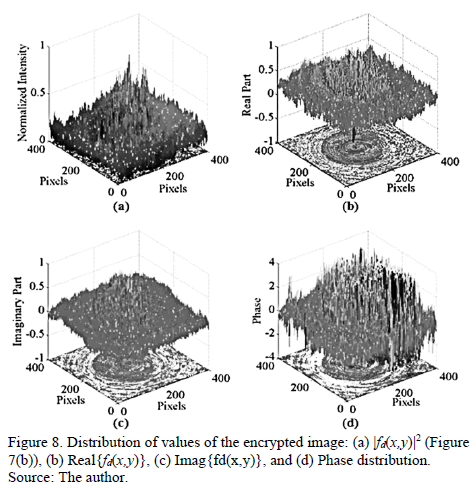
<body><![CDATA[<p><img src="/img/revistas/dyna/v82n190/v82n190a08eq0305.gif"></p>     <p><font size="2" face="Verdana, Arial, Helvetica, sans-serif">Where Â{-} is the real part of F<i><sub>m</sub></i>. <a href="#fig04">Fig. 4</a> is an example of decomposition into circular   harmonics of m=1 order. <a href="#fig05">Fig. 5</a> shows the decomposition of m=1 order, of an  encryption key given in rectangular coordinates in <a href="#fig05">Fig. 5</a>(a).</font></p>     <p align="center"><font size="2" face="Verdana, Arial, Helvetica, sans-serif"><a name="fig04"></a></font><img src="/img/revistas/dyna/v82n190/v82n190a08fig04.gif"></p>     <p align="center"><font size="2" face="Verdana, Arial, Helvetica, sans-serif"><a name="fig05"></a></font><img src="/img/revistas/dyna/v82n190/v82n190a08fig05.gif"></p>     <p><font size="2" face="Verdana, Arial, Helvetica, sans-serif"><b><i>2.1. Encryption-Decryption results with circular  harmonics key</i></b></font></p>     <p><font size="2" face="Verdana, Arial, Helvetica, sans-serif">The block diagram   of the cryptography system (<a href="#fig06">Fig. 6</a>) was implemented in Matlab(R2012b).   <a href="#fig07">Fig. 7</a> is a result of encryption-decryption using a key <i>K<sub>m</sub></i>(<i>r</i>,<i>f</i>) (<a href="#fig05">Fig. 5</a>). These results indicate that the   decryption operation increased the level of tolerance with respect to the case  of the key in rectangular coordinates.</font></p>     <p align="center"><font size="2" face="Verdana, Arial, Helvetica, sans-serif"><a name="fig06"></a></font><img src="/img/revistas/dyna/v82n190/v82n190a08fig06.gif"></p>     <p align="center"><font size="2" face="Verdana, Arial, Helvetica, sans-serif"><a name="fig07"></a></font><img src="/img/revistas/dyna/v82n190/v82n190a08fig07.gif"></p>     <p><font size="2" face="Verdana, Arial, Helvetica, sans-serif"><a href="#fig07">Fig.   7</a>(b) shows the intensity of the encrypted image. Note that the intensity of the   encrypted image has the appearance of a deterministic image. However, the  values are totally random (see <a href="#fig08">Fig. 8</a>). The output of the processor delivers an array of complex   values. So the encrypted image is composed of three parts: a real values  matrix, an imaginary values matrix and a phase values matrix.</font></p>     <p align="center"><font size="2" face="Verdana, Arial, Helvetica, sans-serif"><a name="fig08"></a></font><img src="/img/revistas/dyna/v82n190/v82n190a08fig08.gif"></p>     ]]></body>
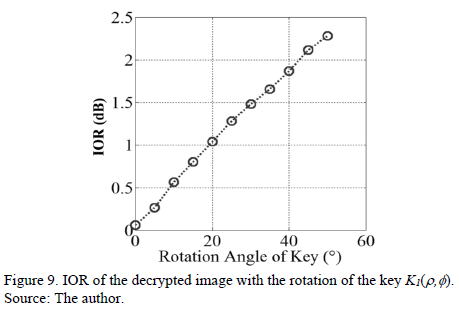
<body><![CDATA[<p><font size="2" face="Verdana, Arial, Helvetica, sans-serif"><a href="#fig09">Fig. 9</a> is the   relationship IOR between rotation angles of the decryption key. This analysis   corresponds to <a href="#fig07">Figs. 7</a>(c)-(f). Note that for an output of IOR = 2dB, a rotation   of the key » 41 degrees is necessary. Thus, tolerance   decryption operation is much higher with respect to the key in case of   rectangular coordinates. So then encryption with keys in polar coordinates is a   solution to the problem of variance in the decryption of the optical  arrangements, and is also useful for fully digital encryption. </font></p>     <p align="center"><font size="2" face="Verdana, Arial, Helvetica, sans-serif"><a name="fig09"></a></font><img src="/img/revistas/dyna/v82n190/v82n190a08fig09.gif"></p>     <p><font size="2" face="Verdana, Arial, Helvetica, sans-serif">The order of the harmonic decomposition can be handled as   an additional variable that increases the difficulty of breaking the encryption  information.</font></p>     <p>&nbsp;</p>     <p><font size="3" face="Verdana, Arial, Helvetica, sans-serif"><b>3. Conclusions</b></font></p>     <p><font size="2" face="Verdana, Arial, Helvetica, sans-serif">In sum, this study show that the encryption processor   based on the Fourier transform   is a variant with key rotation. It was demonstrated that a solution to this   variance is to expand the key into circular harmonics. The proposed technique   increases the tolerance of the processor with the rotation of the key. The key   in rectangular coordinates allows a tolerance to rotation of about 0.2 degrees,   while with the key in circular harmonics, tolerance increases to about 40   degrees. Thus, the decomposition of the key circular harmonics solves the   particular problem of optical encryption processor based on the phenomenon of   diffraction, because the decryption key must be physically positioned with high   accuracy, as can be concluded from the simulation results presented in this  report.</font></p>     <p><font size="2" face="Verdana, Arial, Helvetica, sans-serif">Furthermore, the   proposed technique can also be used in digital encryption algorithms,   considering that the encrypted image is not deterministic, as it appears to be   if only the appearance of the encrypted image is observe. If we analyze the   distribution of values of the amplitude and phase of the encrypted image, we   find that these are really random. Failing that, the quality of the image   encrypted with the key in circular harmonics can be an element of distraction  to break the code attacks.</font></p>     <p>&nbsp;</p>     <p><font size="3" face="Verdana, Arial, Helvetica, sans-serif"><b>References</b></font></p>     <!-- ref --><p><font size="2" face="Verdana, Arial, Helvetica, sans-serif"><b>&#91;1&#93;</b>    Vanderlugt,  A., Signal detection by complex spatial filter, IEEE IT-10, pp.139-146, 1964.    &nbsp;&nbsp;&nbsp;&nbsp;&nbsp;&nbsp;&nbsp;&nbsp;[&#160;<a href="javascript:void(0);" onclick="javascript: window.open('/scielo.php?script=sci_nlinks&ref=000052&pid=S0012-7353201500020000800001&lng=','','width=640,height=500,resizable=yes,scrollbars=1,menubar=yes,');">Links</a>&#160;]<!-- end-ref --> </font></p>     <!-- ref --><p><font size="2" face="Verdana, Arial, Helvetica, sans-serif"><b>&#91;2&#93;</b>    Refregier,   P. and Javidi, B., Optical image encryption based on input plane and Fourier   plane random encoding, Opt. Lett. 20 (7), pp.767-769, 1995.  <a href="http://dx.doi.org/10.1364/OL.20.000767" target="_blank">http://dx.doi.org/10.1364/OL.20.000767</a></font>&nbsp;&nbsp;&nbsp;&nbsp;&nbsp;&nbsp;&nbsp;&nbsp;[&#160;<a href="javascript:void(0);" onclick="javascript: window.open('/scielo.php?script=sci_nlinks&ref=000054&pid=S0012-7353201500020000800002&lng=','','width=640,height=500,resizable=yes,scrollbars=1,menubar=yes,');">Links</a>&#160;]<!-- end-ref --><!-- ref --><p><font size="2" face="Verdana, Arial, Helvetica, sans-serif"><b>&#91;3&#93;</b>    Matoba,   O. and Javidi, B., Encrypted optical storage with angular multiplexing, Appl.   Opt. 38 (35), pp.7288-7293,  1999. <a href="http://dx.doi.org/10.1364/AO.38.007288" target="_blank">http://dx.doi.org/10.1364/AO.38.007288</a>.    &nbsp;&nbsp;&nbsp;&nbsp;&nbsp;&nbsp;&nbsp;&nbsp;[&#160;<a href="javascript:void(0);" onclick="javascript: window.open('/scielo.php?script=sci_nlinks&ref=000055&pid=S0012-7353201500020000800003&lng=','','width=640,height=500,resizable=yes,scrollbars=1,menubar=yes,');">Links</a>&#160;]<!-- end-ref --> </font></p>     <!-- ref --><p><font size="2" face="Verdana, Arial, Helvetica, sans-serif"><b>&#91;4&#93;</b>    Lin,   C., Shen, X., Tang, R. and Zou, X., Multiple images encryption based on Fourier  transform hologram, Opt. Commun. 285 (6), pp.1023-1028, 2012.  DOI: 10.1016/j.optcom.2011.10.046</font>&nbsp;&nbsp;&nbsp;&nbsp;&nbsp;&nbsp;&nbsp;&nbsp;[&#160;<a href="javascript:void(0);" onclick="javascript: window.open('/scielo.php?script=sci_nlinks&ref=000057&pid=S0012-7353201500020000800004&lng=','','width=640,height=500,resizable=yes,scrollbars=1,menubar=yes,');">Links</a>&#160;]<!-- end-ref --><!-- ref --><p><font size="2" face="Verdana, Arial, Helvetica, sans-serif"><b>&#91;5&#93;</b>    Tebaldi,   M., Furlan W.D., Torroba, R. and Bolognini, N., Optical-data storage-readout   technique based on fractal encrypting masks, Opt. Lett. 34 (3), pp. 316-318,  2009. <a href="http://dx.doi.org/10.1364/OL.34.000316" target="_blank">http://dx.doi.org/10.1364/OL.34.000316</a></font>&nbsp;&nbsp;&nbsp;&nbsp;&nbsp;&nbsp;&nbsp;&nbsp;[&#160;<a href="javascript:void(0);" onclick="javascript: window.open('/scielo.php?script=sci_nlinks&ref=000058&pid=S0012-7353201500020000800005&lng=','','width=640,height=500,resizable=yes,scrollbars=1,menubar=yes,');">Links</a>&#160;]<!-- end-ref --><!-- ref --><p><font size="2" face="Verdana, Arial, Helvetica, sans-serif"><b>&#91;6&#93;</b> Rueda,   J.E. and Romero, A.L., Optical cryptography using Fresnel diffraction and phase   conjugation, Revista DYNA. Facultad de Minas, Universidad  Nacional de Colombia, Sede Medellín, Colombia, 80 (181), pp. 25-30, 2013.    &nbsp;&nbsp;&nbsp;&nbsp;&nbsp;&nbsp;&nbsp;&nbsp;[&#160;<a href="javascript:void(0);" onclick="javascript: window.open('/scielo.php?script=sci_nlinks&ref=000059&pid=S0012-7353201500020000800006&lng=','','width=640,height=500,resizable=yes,scrollbars=1,menubar=yes,');">Links</a>&#160;]<!-- end-ref --> </font></p>     <!-- ref --><p><font size="2" face="Verdana, Arial, Helvetica, sans-serif"><b>&#91;7&#93;</b>    Hsu,   Y.N., Arsenault, H.H. and April, G., Rotation-invariant digital patter  recognition using circular harmonic expansion, Appl. Opt. 21(22), pp. 4012-4015, 1982. <a href="http://dx.doi.org/10.1364/AO.21.004012" target="_blank">http://dx.doi.org/10.1364/AO.21.004012</a></font>&nbsp;&nbsp;&nbsp;&nbsp;&nbsp;&nbsp;&nbsp;&nbsp;[&#160;<a href="javascript:void(0);" onclick="javascript: window.open('/scielo.php?script=sci_nlinks&ref=000061&pid=S0012-7353201500020000800007&lng=','','width=640,height=500,resizable=yes,scrollbars=1,menubar=yes,');">Links</a>&#160;]<!-- end-ref --><!-- ref --><p><font size="2" face="Verdana, Arial, Helvetica, sans-serif"><b>&#91;8&#93;</b>    Gualdron   O. and Arsenault H.H., Phase dirived circular harmonic filter, Opt. Commun.   104(1-3), pp.32-34,  1993. DOI: 10.1016/0030-4018(93)90100-J</font>&nbsp;&nbsp;&nbsp;&nbsp;&nbsp;&nbsp;&nbsp;&nbsp;[&#160;<a href="javascript:void(0);" onclick="javascript: window.open('/scielo.php?script=sci_nlinks&ref=000062&pid=S0012-7353201500020000800008&lng=','','width=640,height=500,resizable=yes,scrollbars=1,menubar=yes,');">Links</a>&#160;]<!-- end-ref --><!-- ref --><p><font size="2" face="Verdana, Arial, Helvetica, sans-serif"><b>&#91;9&#93;</b>    Hennelly, B. and Sheridan, J.T. Optical image   encryption by random shifting in fractional Fourier domains. Optics Letters   28(4), pp.269-271,  2003. <a href="http://dx.doi.org/10.1364/OL.28.000269" target="_blank">http://dx.doi.org/10.1364/OL.28.000269</a> </font>&nbsp;&nbsp;&nbsp;&nbsp;&nbsp;&nbsp;&nbsp;&nbsp;[&#160;<a href="javascript:void(0);" onclick="javascript: window.open('/scielo.php?script=sci_nlinks&ref=000063&pid=S0012-7353201500020000800009&lng=','','width=640,height=500,resizable=yes,scrollbars=1,menubar=yes,');">Links</a>&#160;]<!-- end-ref --><!-- ref --><p><font size="2" face="Verdana, Arial, Helvetica, sans-serif"><b>&#91;10&#93;</b> Salazar, A., Rueda, J.E. and   Lasprilla, M., Encriptaci&oacute;n por conjugaci&oacute;n de fase en un BSO utilizando   se&ntilde;ales &oacute;pticas de baja potencia, Revista Colombiana de Física 34 (2), pp.636-640,  2002.    &nbsp;&nbsp;&nbsp;&nbsp;&nbsp;&nbsp;&nbsp;&nbsp;[&#160;<a href="javascript:void(0);" onclick="javascript: window.open('/scielo.php?script=sci_nlinks&ref=000064&pid=S0012-7353201500020000800010&lng=','','width=640,height=500,resizable=yes,scrollbars=1,menubar=yes,');">Links</a>&#160;]<!-- end-ref --></font></p>     <p>&nbsp;</p>     <p><font size="2" face="Verdana, Arial, Helvetica, sans-serif"><b>J.E. Rueda-Parada,</b> completed his BSc in Physics in 1993, an MSc Physics in 1996, and a PhD Physics   in 2002, all of them from the Universidad Industrial de Santander, Colombia. He   finished his postdoctoral studies in February 2015, at the Institute of Physics   of São Carlos, University of São Paulo, Brazil. Currently, he is a full Professor   at the Physics Department, Faculty of Basic Sciences, Universidad de Pamplona,   Colombia. His research interests include: growth of mono-crystalline fibers,   photorefractive optics, holography, wave mixing, and optical encryption and  digital image processing.</font></p>      ]]></body><back>
<ref-list>
<ref id="B1">
<label>1</label><nlm-citation citation-type="">
<person-group person-group-type="author">
<name>
<surname><![CDATA[Vanderlugt]]></surname>
<given-names><![CDATA[A.]]></given-names>
</name>
</person-group>
<source><![CDATA[Signal detection by complex spatial filter]]></source>
<year>1964</year>
<page-range>139-146</page-range></nlm-citation>
</ref>
<ref id="B2">
<label>2</label><nlm-citation citation-type="journal">
<person-group person-group-type="author">
<name>
<surname><![CDATA[Refregier]]></surname>
<given-names><![CDATA[P.]]></given-names>
</name>
<name>
<surname><![CDATA[Javidi]]></surname>
<given-names><![CDATA[B.]]></given-names>
</name>
</person-group>
<article-title xml:lang="en"><![CDATA[Optical image encryption based on input plane and Fourier plane random encoding]]></article-title>
<source><![CDATA[Opt. Lett.]]></source>
<year>1995</year>
<volume>20</volume>
<numero>7</numero>
<issue>7</issue>
<page-range>767-769</page-range></nlm-citation>
</ref>
<ref id="B3">
<label>3</label><nlm-citation citation-type="journal">
<person-group person-group-type="author">
<name>
<surname><![CDATA[Matoba]]></surname>
<given-names><![CDATA[O.]]></given-names>
</name>
<name>
<surname><![CDATA[Javidi]]></surname>
<given-names><![CDATA[B.]]></given-names>
</name>
</person-group>
<article-title xml:lang="en"><![CDATA[Encrypted optical storage with angular multiplexing]]></article-title>
<source><![CDATA[Appl. Opt.]]></source>
<year>1999</year>
<volume>38</volume>
<numero>35</numero>
<issue>35</issue>
<page-range>7288-7293</page-range></nlm-citation>
</ref>
<ref id="B4">
<label>4</label><nlm-citation citation-type="journal">
<person-group person-group-type="author">
<name>
<surname><![CDATA[Lin]]></surname>
<given-names><![CDATA[C.]]></given-names>
</name>
<name>
<surname><![CDATA[Shen]]></surname>
<given-names><![CDATA[X.]]></given-names>
</name>
<name>
<surname><![CDATA[Tang]]></surname>
<given-names><![CDATA[R.]]></given-names>
</name>
<name>
<surname><![CDATA[Zou]]></surname>
<given-names><![CDATA[X.]]></given-names>
</name>
</person-group>
<article-title xml:lang="en"><![CDATA[Multiple images encryption based on Fourier transform hologram]]></article-title>
<source><![CDATA[Opt. Commun.]]></source>
<year>2012</year>
<volume>285</volume>
<numero>6</numero>
<issue>6</issue>
<page-range>1023-1028</page-range></nlm-citation>
</ref>
<ref id="B5">
<label>5</label><nlm-citation citation-type="journal">
<person-group person-group-type="author">
<name>
<surname><![CDATA[Tebaldi]]></surname>
<given-names><![CDATA[M.]]></given-names>
</name>
<name>
<surname><![CDATA[Furlan]]></surname>
<given-names><![CDATA[W.D.]]></given-names>
</name>
<name>
<surname><![CDATA[Torroba]]></surname>
<given-names><![CDATA[R.]]></given-names>
</name>
<name>
<surname><![CDATA[Bolognini]]></surname>
<given-names><![CDATA[N.]]></given-names>
</name>
</person-group>
<article-title xml:lang="en"><![CDATA[Optical-data storage-readout technique based on fractal encrypting masks]]></article-title>
<source><![CDATA[Opt. Lett.]]></source>
<year>2009</year>
<volume>34</volume>
<numero>3</numero>
<issue>3</issue>
<page-range>316-318</page-range></nlm-citation>
</ref>
<ref id="B6">
<label>6</label><nlm-citation citation-type="journal">
<person-group person-group-type="author">
<name>
<surname><![CDATA[Rueda]]></surname>
<given-names><![CDATA[J.E.]]></given-names>
</name>
<name>
<surname><![CDATA[Romero]]></surname>
<given-names><![CDATA[A.L.]]></given-names>
</name>
</person-group>
<article-title xml:lang="en"><![CDATA[Optical cryptography using Fresnel diffraction and phase conjugation]]></article-title>
<source><![CDATA[Revista DYNA]]></source>
<year>2013</year>
<volume>80</volume>
<numero>181</numero>
<issue>181</issue>
<page-range>25-30</page-range></nlm-citation>
</ref>
<ref id="B7">
<label>7</label><nlm-citation citation-type="journal">
<person-group person-group-type="author">
<name>
<surname><![CDATA[Hsu]]></surname>
<given-names><![CDATA[Y.N.]]></given-names>
</name>
<name>
<surname><![CDATA[Arsenault]]></surname>
<given-names><![CDATA[H.H.]]></given-names>
</name>
<name>
<surname><![CDATA[April]]></surname>
<given-names><![CDATA[G.]]></given-names>
</name>
</person-group>
<article-title xml:lang="en"><![CDATA[Rotation-invariant digital patter recognition using circular harmonic expansion]]></article-title>
<source><![CDATA[Appl. Opt.]]></source>
<year>1982</year>
<volume>21</volume>
<numero>22</numero>
<issue>22</issue>
<page-range>4012-4015</page-range></nlm-citation>
</ref>
<ref id="B8">
<label>8</label><nlm-citation citation-type="journal">
<person-group person-group-type="author">
<name>
<surname><![CDATA[Gualdron]]></surname>
<given-names><![CDATA[O.]]></given-names>
</name>
<name>
<surname><![CDATA[Arsenault]]></surname>
<given-names><![CDATA[H.H.]]></given-names>
</name>
</person-group>
<article-title xml:lang="en"><![CDATA[Phase dirived circular harmonic filter]]></article-title>
<source><![CDATA[Opt. Commun.]]></source>
<year>1993</year>
<volume>104</volume>
<numero>1-3</numero>
<issue>1-3</issue>
<page-range>32-34</page-range></nlm-citation>
</ref>
<ref id="B9">
<label>9</label><nlm-citation citation-type="journal">
<person-group person-group-type="author">
<name>
<surname><![CDATA[Hennelly]]></surname>
<given-names><![CDATA[B.]]></given-names>
</name>
<name>
<surname><![CDATA[Sheridan]]></surname>
<given-names><![CDATA[J.T.]]></given-names>
</name>
</person-group>
<article-title xml:lang="en"><![CDATA[Optical image encryption by random shifting in fractional Fourier domains]]></article-title>
<source><![CDATA[Optics Letters]]></source>
<year>2003</year>
<volume>28</volume>
<numero>4</numero>
<issue>4</issue>
<page-range>269-271</page-range></nlm-citation>
</ref>
<ref id="B10">
<label>10</label><nlm-citation citation-type="journal">
<person-group person-group-type="author">
<name>
<surname><![CDATA[Salazar]]></surname>
<given-names><![CDATA[A.]]></given-names>
</name>
<name>
<surname><![CDATA[Rueda]]></surname>
<given-names><![CDATA[J.E.]]></given-names>
</name>
<name>
<surname><![CDATA[Lasprilla]]></surname>
<given-names><![CDATA[M.]]></given-names>
</name>
</person-group>
<article-title xml:lang="es"><![CDATA[Encriptación por conjugación de fase en un BSO utilizando señales ópticas de baja potencia]]></article-title>
<source><![CDATA[Revista Colombiana de Física]]></source>
<year>2002</year>
<volume>34</volume>
<numero>2</numero>
<issue>2</issue>
<page-range>636-640</page-range></nlm-citation>
</ref>
</ref-list>
</back>
</article>