<?xml version="1.0" encoding="ISO-8859-1"?><article xmlns:mml="http://www.w3.org/1998/Math/MathML" xmlns:xlink="http://www.w3.org/1999/xlink" xmlns:xsi="http://www.w3.org/2001/XMLSchema-instance">
<front>
<journal-meta>
<journal-id>0012-7353</journal-id>
<journal-title><![CDATA[DYNA]]></journal-title>
<abbrev-journal-title><![CDATA[Dyna rev.fac.nac.minas]]></abbrev-journal-title>
<issn>0012-7353</issn>
<publisher>
<publisher-name><![CDATA[Universidad Nacional de Colombia]]></publisher-name>
</publisher>
</journal-meta>
<article-meta>
<article-id>S0012-73532015000200010</article-id>
<article-id pub-id-type="doi">10.15446/dyna.v82n190.43137</article-id>
<title-group>
<article-title xml:lang="en"><![CDATA[A hybrid genetic algorithm for ROADEF'05-like complex production problems]]></article-title>
<article-title xml:lang="es"><![CDATA[Algoritmo genético híbrido para problemas complejos de producción tipo ROADEF'05]]></article-title>
</title-group>
<contrib-group>
<contrib contrib-type="author">
<name>
<surname><![CDATA[Frutos]]></surname>
<given-names><![CDATA[Mariano]]></given-names>
</name>
<xref ref-type="aff" rid="A01"/>
</contrib>
<contrib contrib-type="author">
<name>
<surname><![CDATA[Olivera]]></surname>
<given-names><![CDATA[Ana Carolina]]></given-names>
</name>
<xref ref-type="aff" rid="A02"/>
</contrib>
<contrib contrib-type="author">
<name>
<surname><![CDATA[Tohmé]]></surname>
<given-names><![CDATA[Fernando]]></given-names>
</name>
<xref ref-type="aff" rid="A03"/>
</contrib>
</contrib-group>
<aff id="A01">
<institution><![CDATA[,Universidad Nacional del Sur Department of Engineering ]]></institution>
<addr-line><![CDATA[Bahía Blanca ]]></addr-line>
<country>Argentina</country>
</aff>
<aff id="A02">
<institution><![CDATA[,Universidad Nacional de la Patagonia Austral Department of Exact and Natural Sciences ]]></institution>
<addr-line><![CDATA[Comodoro Rivadavia ]]></addr-line>
<country>Argentina</country>
</aff>
<aff id="A03">
<institution><![CDATA[,Universidad Nacional del Sur Department of Economics ]]></institution>
<addr-line><![CDATA[Bahía Blanca ]]></addr-line>
<country>Argentina</country>
</aff>
<pub-date pub-type="pub">
<day>00</day>
<month>04</month>
<year>2015</year>
</pub-date>
<pub-date pub-type="epub">
<day>00</day>
<month>04</month>
<year>2015</year>
</pub-date>
<volume>82</volume>
<numero>190</numero>
<fpage>82</fpage>
<lpage>88</lpage>
<copyright-statement/>
<copyright-year/>
<self-uri xlink:href="http://www.scielo.org.co/scielo.php?script=sci_arttext&amp;pid=S0012-73532015000200010&amp;lng=en&amp;nrm=iso"></self-uri><self-uri xlink:href="http://www.scielo.org.co/scielo.php?script=sci_abstract&amp;pid=S0012-73532015000200010&amp;lng=en&amp;nrm=iso"></self-uri><self-uri xlink:href="http://www.scielo.org.co/scielo.php?script=sci_pdf&amp;pid=S0012-73532015000200010&amp;lng=en&amp;nrm=iso"></self-uri><abstract abstract-type="short" xml:lang="en"><p><![CDATA[In this work, we present a hybrid technique that combines a Genetic Algorithm with meta-heuristics to solve a problem in RENAULT France's production plants. The method starts with an initial solution obtained by means of a GRASP (Greedy Randomized Adaptive Search Procedure) used as an input for a Genetic Algorithm complemented by a Simulated Annealing procedure of population improvement. We establish a comparison point among the different techniques used in the method. Their performances are evaluated as well as that of the entire method. The conclusion is that hybrid methods have clear advantages for the treatment of production planning problems.]]></p></abstract>
<abstract abstract-type="short" xml:lang="es"><p><![CDATA[En este trabajo se presenta una técnica híbrida que combina un Algoritmo Genético con meta-heurísticas para la resolución de un problema en las plantas productivas de RENAULT Francia. El método comienza con una solución inicial por medio de GRASP (Greedy Randomized Adaptive Search Procedure), que es utilizada como entrada por un Algoritmo Genético complementado por un procedimiento de Simulated Annealing para mejorar las poblaciones. Se establece un punto de comparación entre las diferentes técnicas. El desempeño de las mismas es evaluado así como el de todo el método. La conclusión es que los métodos híbridos tienen claras ventajas para el tratamiento de problemas de planificación de la producción.]]></p></abstract>
<kwd-group>
<kwd lng="en"><![CDATA[multi-objective optimization]]></kwd>
<kwd lng="en"><![CDATA[hybrid algorithms]]></kwd>
<kwd lng="en"><![CDATA[car sequencing]]></kwd>
<kwd lng="es"><![CDATA[optimización multi-objetivo]]></kwd>
<kwd lng="es"><![CDATA[algoritmos híbridos]]></kwd>
<kwd lng="es"><![CDATA[secuenciamiento de vehículos]]></kwd>
</kwd-group>
</article-meta>
</front><body><![CDATA[ <p><font size="1" face="Verdana, Arial, Helvetica, sans-serif"><b>DOI:</b> <a href="http://dx.doi.org/10.15446/dyna.v82n190.43137" target="_blank">http://dx.doi.org/10.15446/dyna.v82n190.43137</a></font></p>     <p align="center"><font size="4" face="Verdana, Arial, Helvetica, sans-serif"><b>A hybrid genetic algorithm for ROADEF'05-like  complex production problems</b></font></p>     <p align="center"><i><font size="3"><b><font face="Verdana, Arial, Helvetica, sans-serif">Algoritmo gen&eacute;tico h&iacute;brido para problemas complejos de  producci&oacute;n tipo ROADEF'05</font></b></font></i></p>     <p align="center">&nbsp;</p>     <p align="center"><font size="2" face="Verdana, Arial, Helvetica, sans-serif"><b>Mariano Frutos <i><sup>a</sup></i>,   Ana Carolina Olivera <i><sup>b </sup></i>&amp;   Fernando Tohm&eacute; <i><sup>c</sup></i></b></font></p>     <p align="center">&nbsp;</p>     <p align="center"><font size="2" face="Verdana, Arial, Helvetica, sans-serif"><sup><i>a </i></sup><i>Department of Engineering, Universidad   Nacional del Sur and CONICET, Bahía Blanca, Argentina. <a href="mailto:mfrutos@uns.edu.ar">mfrutos@uns.edu.ar</a>    <br>   <sup>b </sup>Department of Exact and Natural Sciences, Universidad  Nacional de la Patagonia Austral and CONICET, Comodoro Rivadavia, Argentina.   <a href="mailto:aco@cs.uns.edu.ar">aco@cs.uns.edu.ar</a>    <br>  <sup>c</sup> Department of Economics, Universidad Nacional del Sur and  CONICET, Bahía Blanca, Argentina. <a href="mailto:ftohme@criba.edu.ar">ftohme@criba.edu.ar</a></i></font></p>     <p align="center">&nbsp;</p>     ]]></body>
<body><![CDATA[<p align="center"><font size="2" face="Verdana, Arial, Helvetica, sans-serif"><b>Received: April 25<sup>th</sup>, de 2014. Received in revised form: October 30<sup>th</sup>,   2014. Accepted: November 13<sup>th</sup>, 2014</b></font></p>     <p align="center">&nbsp;</p>     <p align="center"><font size="1" face="Verdana, Arial, Helvetica, sans-seriff"><b>This work is licensed under a</b> <a rel="license" href="http://creativecommons.org/licenses/by-nc-nd/4.0/">Creative Commons Attribution-NonCommercial-NoDerivatives 4.0 International License</a>.</font><br /><a rel="license" href="http://creativecommons.org/licenses/by-nc-nd/4.0/"><img style="border-width:0" src="https://i.creativecommons.org/l/by-nc-nd/4.0/88x31.png" /></a></p> <hr>     <p><font size="2" face="Verdana, Arial, Helvetica, sans-serif"><b>Abstract    <br> </b></font><font size="2" face="Verdana, Arial, Helvetica, sans-serif">In this work, we present a hybrid technique that combines  a Genetic Algorithm with meta-heuristics to solve a problem in RENAULT France's  production plants. The method starts with an initial solution obtained by means  of a GRASP (Greedy Randomized Adaptive Search Procedure) used as an input for a  Genetic Algorithm complemented by a Simulated Annealing procedure of population  improvement. We establish a comparison point among the different techniques  used in the method. Their performances are evaluated as well as that of the  entire method. The conclusion is that hybrid methods have clear advantages for the treatment of production planning problems.</font></p>     <p><font size="2" face="Verdana, Arial, Helvetica, sans-serif"><i>Keywords</i>: multi-objective  optimization, hybrid algorithms, car sequencing.</font></p>     <p><font size="2" face="Verdana, Arial, Helvetica, sans-serif"><b>Resumen    <br> </b></font><font size="2" face="Verdana, Arial, Helvetica, sans-serif">En este trabajo se presenta una t&eacute;cnica híbrida que  combina un Algoritmo Gen&eacute;tico con meta-heurísticas para la resoluci&oacute;n de un  problema en las plantas productivas de RENAULT Francia. El m&eacute;todo comienza con  una soluci&oacute;n inicial por medio de GRASP (Greedy Randomized Adaptive Search  Procedure), que es utilizada como entrada por un Algoritmo Gen&eacute;tico  complementado por un procedimiento de Simulated Annealing para mejorar las  poblaciones. Se establece un punto de comparaci&oacute;n entre las diferentes  t&eacute;cnicas. El desempe&ntilde;o de las mismas es evaluado así como el de todo el m&eacute;todo.  La conclusi&oacute;n es que los m&eacute;todos híbridos tienen claras ventajas para el tratamiento de problemas de planificaci&oacute;n de la producci&oacute;n.</font></p>     <p><font size="2" face="Verdana, Arial, Helvetica, sans-serif"><i>Palabras clave</i>:  optimizaci&oacute;n multi-objetivo, algoritmos híbridos, secuenciamiento de vehículos.</font></p> <hr>     <p>&nbsp;</p>     ]]></body>
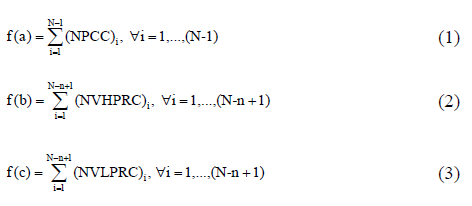
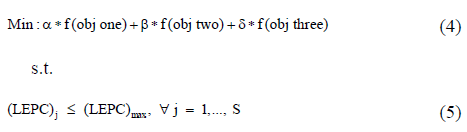
<body><![CDATA[<p><font size="3" face="Verdana, Arial, Helvetica, sans-serif"><b>1 Introduction</b></font></p>     <p><font size="2" face="Verdana, Arial, Helvetica, sans-serif">Scheduling and programming problems at the core of the  SFROAD (Soci&eacute;t&eacute; Française de Recherche Op&eacute;rationnelle et d'Aide à la D&eacute;cision)  2005 focus on the problems that have arisen at the RENAULT, France production  plants. They present ROADEF'05 with the challenge of finding a solution to a  real world extension of the classical car sequencing problem &#91;1&#93;, the goal of  which is to schedule cars along an assembly line while satisfying several  capacity constraints. The particular problem addressed by SFROAD differs from  the standard one since, besides capacity constraints imposed by the assembly  shop, it introduces paint batching constraints involving the minimization of  the consumption of solvents in the paint shop. Our analysis focuses on the  phase of arrangement of daily sequences in production problems &#91;2&#93;. Here it is  necessary to take into account different, even conflicting factors. The main  goal is to develop a hybrid technique to tackle this problem and evaluate its  performance compared to other traditionally used methods. Usual techniques  intended to find approximate optimal solutions to similar problems are, greedy  search &#91;3&#93;, GRASP &#91;4&#93;, GISMOO Algorithm &#91;5&#93;, local search &#91;6,7&#93;, hybrid  variable neighborhood search &#91;8&#93;, among others. The Hybrid Genetic Algorithm  (HGA) presented in this work amalgamates constructive procedures like the  Greedy Randomized Adaptive Search Procedure (GRASP) &#91;9&#93;, and Genetic Algorithms  (GAs) &#91;10&#93; with search methods like Simulated Annealing (SA) &#91;11&#93;. </font></p>     <p><font size="2" face="Verdana, Arial, Helvetica, sans-serif">The paper is structured as follows: First, the ROADEF'05  problem is introduced. Then, the proposed Hybrid Genetic Algorithm (HGA) is  described in detail. Then, comparisons between the HGA and other methods are  presented. Finally, we analyze the results of running the HGA and present the  conclusions.</font></p>     <p>&nbsp;</p>     <p><font size="3" face="Verdana, Arial, Helvetica, sans-serif"><b>2. ROADEF'05</b></font></p>     <p><font size="2" face="Verdana, Arial, Helvetica, sans-serif">The problem consists in determining the scheduling order  of vehicles in a production day that best satisfies the assembly line and paint  shop requirements &#91;1&#93;. The paint shop goal is to minimize the consumption of  paint solvent. Therefore, it requires grouping vehicles according to their  colors as well as minimizing the number of spray gun washes, i.e. to schedule  the longest paint color batches that are possible. Paint color batches have a  limitation on the upper batch size due to the need for frequent washing of the  spray guns even when there is no need for paint color changes. This limitation  constitutes a hard constraint. </font></p>     <p><font size="2" face="Verdana, Arial, Helvetica, sans-serif">In order to lighten the workload in the assembly line,  vehicles that require special assembling operations have to be evenly  distributed throughout the total processed cars.  These vehicles are considered to be &quot;hard to assemble&quot;. There are two classes  of ratio constraints, high priority level and low priority level ones. High  priority level ratio constraints ensue from car characteristics that require  heavy workloads in the assembly line. Low priority level ratio constraints,  instead, result from car features that cause small inconveniences in the  production process. </font></p>     <p><font size="2" face="Verdana, Arial, Helvetica, sans-serif">Given the heterogeneities involved in the problem,  multi-objective optimization constitutes a natural approach to the problem &#91;12-14&#93;.  The objectives are, from the highest to the lowest priority level with no  compensation between them: (a) the minimization of paint color changes (eq. 1);  (b) minimization of the number of violations of high priority level ratio  constraints (eq. 2); (c) the minimization of violations of low priority level  ratio constraints (eq. 3).</font></p>     <p><img src="/img/revistas/dyna/v82n190/v82n190a10eq0102.gif"></p>     <p><font size="2" face="Verdana, Arial, Helvetica, sans-serif">Here NPCCi is the number of paint color changes in the sequence  i, NVHPRCi and NVLPRCi are the number of violations of high priority ratio  constrains and low priority ratio constrains, respectively in sequence i. On  the other hand, N is the number of sequences and n the number of sub-sequences.  The fitness (f) is defined for each of the three objectives. In what follows,  we assume that the values of a, b and d are given (a=1.000.000, b=1.000 y d=1) and that the full model is  captured by eq. (4) and eq. (5). In eq. (4), objective one (<i>obj one</i>) corresponds with (a) or (b),  objective two (<i>obj two</i>) is (a), (b)  or (c), and objective three (<i>obj three</i>)  is (a) or (c). Of course, the &quot;or&quot; in the definition of the objectives are  exclusive, i.e. only one of the alternatives will be the case. In this way eq. (4)  is directly related to the possible scenarios that frame the problem. Eq. 5  restricts the number of vehicles of the same color in each sub-sequence. </font></p>     ]]></body>
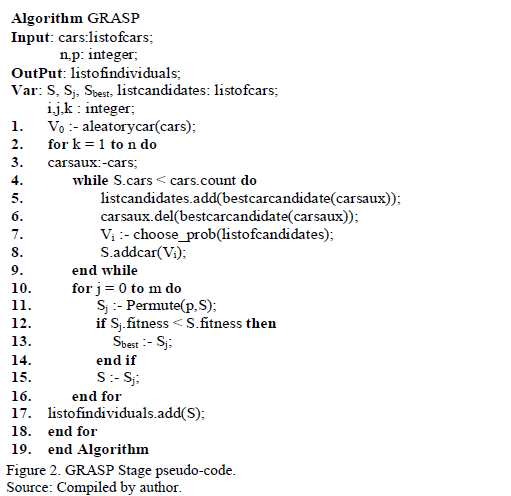
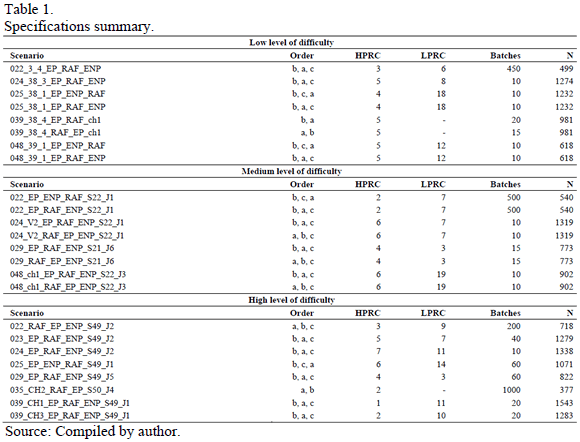
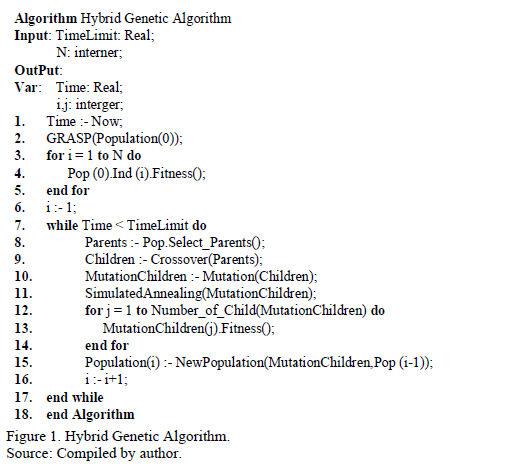
<body><![CDATA[<p><img src="/img/revistas/dyna/v82n190/v82n190a10eq0405.gif"></p>     <p><font size="2" face="Verdana, Arial, Helvetica, sans-serif">Here LEPC<sub>j</sub> is the amount of cars of the same  color in the sub-sequence j, LEPC<sub>max</sub> is the maximum allowable number  of cars of the same color and S is the number of sub-sequences of equal color. </font></p>     <p><font size="2" face="Verdana, Arial, Helvetica, sans-serif"><a href="#tab01">Table 1</a> specifies the level of complexity, scenario,  number of high priority level constraints (HPRC), number of low priority level  constraints (LPRC), limit of paint color batches (batches) and number of  vehicles in a production day (N). The priorities of the objectives (a), (b) and  (c) are shown in the Order column.</font></p>     <p align="center"><font size="2" face="Verdana, Arial, Helvetica, sans-serif"><a name="tab01"></a></font><img src="/img/revistas/dyna/v82n190/v82n190a10tab01.gif"></p>     <p>&nbsp;</p> <font size="3" face="Verdana, Arial, Helvetica, sans-serif"><b>3. Hybrid   Genetic Algorithm</b></font>     <p><font size="2" face="Verdana, Arial, Helvetica, sans-serif">The Hybrid Genetic Algorithm (HGA) presented here has two   main stages, each with a different clear objective: the first one constructs an   initial solution set with GRASP &#91;9,15&#93;, while the second one, using it, follows   the evolution of the population by means of the Genetic Algorithm (GA) &#91;10,16&#93; combined   with Simulated Annealing (SA) &#91;11&#93;. In the GA stage, the SA module is  introduced to improve the children from one generation to the other. <a href="#fig01">Fig. 1</a> shows the layout of the Hybrid Genetic Algorithm.</font></p>     <p align="center"><font size="2" face="Verdana, Arial, Helvetica, sans-serif"><a name="fig01"></a></font><img src="/img/revistas/dyna/v82n190/v82n190a10fig01.gif"></p>     <p><font size="2" face="Verdana, Arial, Helvetica, sans-serif"><b><i>3.1. Greedy Randomized Adaptive Search Procedures</i></b></font></p>     <p><font size="2" face="Verdana, Arial, Helvetica, sans-serif">The GRASP algorithm is, in turn, structured in two phases:   a constructive one whose product is a good but not necessarily locally optimal   solution; and a local search procedure that examines solution neighborhoods   until a local optimum is found. The procedure begins by taking a random vehicle   as the first element in the sequence. While not all vehicles are in the   sequence, the closest match for place i is chosen. Each element of the   candidate list is assigned a probability to be chosen. These probabilities are weighed with respect to a partial fitness value.</font></p>     <p><font size="2" face="Verdana, Arial, Helvetica, sans-serif">When the sequence is   complete, an n permutation of vehicle-pairs is repeated m times. The objective   is to look for a local optimum in the neighborhood of the solution. The values   of m and n are input parameters of the algorithm. In <a href="#fig02">Fig. 2</a> the layout of the   GRASP algorithm is observed. <a href="#tab02">Tables 2</a> (Solution: 17 5 4 10 9 8   2 6 3) and 3 (Solution: 1 7 5 4 10 9 8 3 2 6) show the construction of a feasible and a non feasible solution with the GRASP.</font></p>     ]]></body>
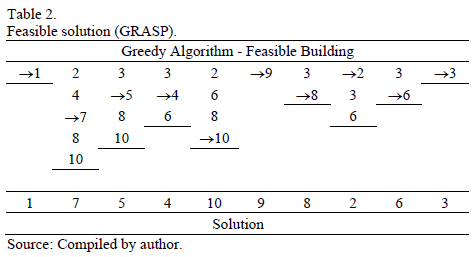
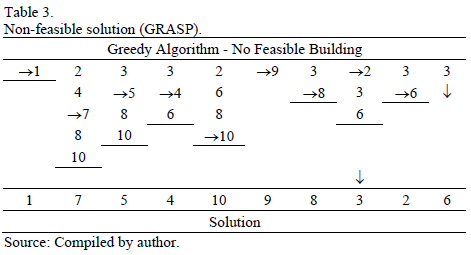
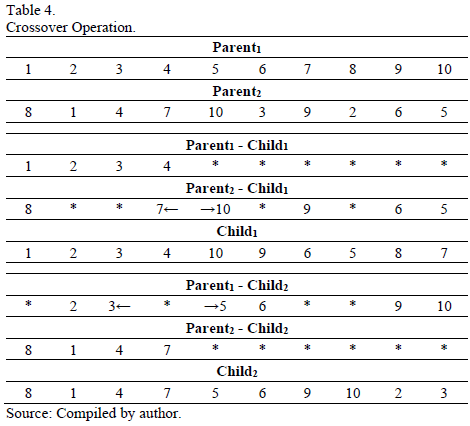
<body><![CDATA[<p align="center"><font size="2" face="Verdana, Arial, Helvetica, sans-serif"><a name="fig02"></a></font><img src="/img/revistas/dyna/v82n190/v82n190a10fig02.gif"></p>     <p align="center"><font size="2" face="Verdana, Arial, Helvetica, sans-serif"><a name="tab02"></a></font><img src="/img/revistas/dyna/v82n190/v82n190a10tab02.gif"></p>     <p><font size="2" face="Verdana, Arial, Helvetica, sans-serif"><b><i>3.2. Genetic Algorithm Stage</i></b></font></p>     <p><font size="2" face="Verdana, Arial, Helvetica, sans-serif">The   genetic stage works on the basis of the individuals produced by the GRASP stage. Each individual is a list of </font><font size="2" face="Verdana, Arial, Helvetica, sans-serif">integers that represents the order   in sequence of production. An individual in the population is a chain of integers. Each integer represents a vehicle.</font></p>     <p align="center"><font size="2" face="Verdana, Arial, Helvetica, sans-serif"><a name="tab03"></a></font><img src="/img/revistas/dyna/v82n190/v82n190a10tab03.gif"></p>     <p><font size="2" face="Verdana, Arial, Helvetica, sans-serif">The chromosome of the individual indicates the order of   production sequence, in one day of work, from left to right. The initial   population is a set of solutions received from the GRASP stage. Ranking   selection is used to choose the parents that will construct the next   population. An empirical analysis allows us to conclude that a population of  between 90 and 100 individuals constitute a large enough sample. </font></p>     <p><font size="2" face="Verdana, Arial, Helvetica, sans-serif"><b>3.2.1. Crossover</b></font></p>     <p><font size="2" face="Verdana, Arial, Helvetica, sans-serif">The GA is implemented with one point crossover. The   operator randomly chooses a point to cross the parents. The simple crossover is   applied here. <a href="#tab04">Table 4</a> shows the crossover between Parent<sub>1</sub> = (1 2 3 4  5 6 7 8 9 10) and Parent<sub>2</sub> = (8 1 4 7 10 3 9 2 6 5) to obtain Child<sub>1</sub> = (1 2 3 4 10 9 6 5 8 7) and Child<sub>2</sub> = (8 1 4 7 5 6 9 10 2 3).</font></p>     <p><font size="2" face="Verdana, Arial, Helvetica, sans-serif">As an example, let us   start from parents Parent<sub>1</sub> = (1 2 3 4 / 5 6 7 8 9 10) and Parent<sub>2</sub> = (8 1 4 7 / 10 3 9 2 6 5), where the slashes are split points. First, we   obtain Child<sub>1</sub> = (1 2 3 4 * * * * * *) and Child<sub>2</sub> = (8 1 4   7 * * * * * *), preserving the first sub sequence of the respective split point   for Parent<sub>1</sub> and Parent<sub>2</sub>. Then, starting from the split   point, the vehicles in Parent<sub>2</sub> that are not in Child<sub>1</sub> are   used to complete the vehicles in Child<sub>1</sub>. In this case, the list of   vehicles in Parent<sub>2</sub> starting from the second split point is: (10 3 9   2 6 5), but when the vehicles that belong already to Child<sub>1</sub> (i. e.,   3 2) are eliminated, the sub-sequence becomes (10 9 6 5 8 7). These vehicles   are added to Child<sub>1</sub>, starting from the split point. When the end is  reached, the remaining cars are added at the initial part of Child<sub>1</sub>.</font></p>     <p align="center"><font size="2" face="Verdana, Arial, Helvetica, sans-serif"><a name="tab04"></a></font><img src="/img/revistas/dyna/v82n190/v82n190a10tab04.gif"></p>     ]]></body>
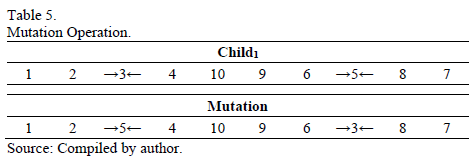
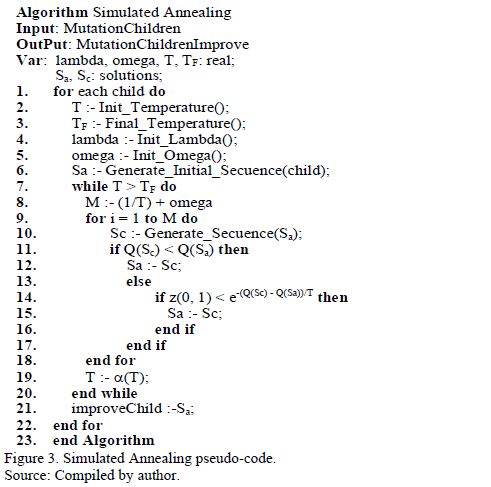
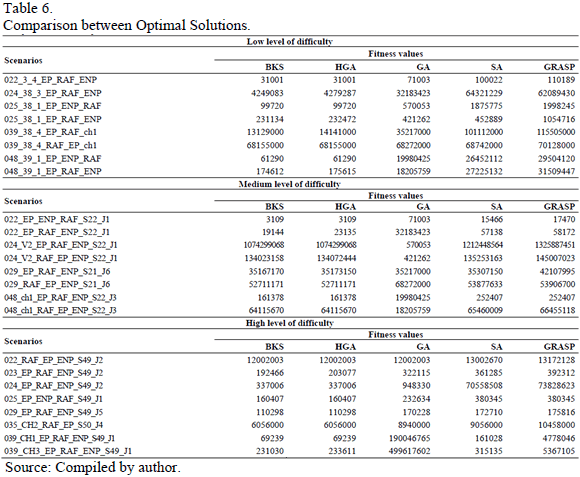
<body><![CDATA[<p><font size="2" face="Verdana, Arial, Helvetica, sans-serif"><b>3.2.2. Mutation</b></font></p>     <p><font size="2" face="Verdana, Arial, Helvetica, sans-serif">The mutation operator generates one value for each vehicle   in an individual solution. This value indicates whether the vehicle must change   its position in the sequence. If this is the case, a new value is generated.   The new number indicates the new position of the vehicle in the sequence. <a href="#tab05">Table   5</a> (Child<sub>1</sub>: 1 2 3 4 10 9 6 5 8 7, Mutation: 1 2 5 4 10 9 6 3 8 7)  shows an example of a child mutation.</font></p>     <p align="center"><font size="2" face="Verdana, Arial, Helvetica, sans-serif"><a name="tab05"></a></font><img src="/img/revistas/dyna/v82n190/v82n190a10tab05.gif"></p>     <p><font size="2" face="Verdana, Arial, Helvetica, sans-serif"><b>3.2.3. Simulated  Annealing</b></font></p>     <p><font size="2" face="Verdana, Arial, Helvetica, sans-serif">The goal of a   &quot;simulated annealing phase&quot; is to improve the quality of children between   generations. The key factor consists in defining an initial parameter l, the initial temperature (T<sub>i</sub>), a   cooling speed (w), the number of iterations (M) for each temperature (T), and the final   temperature (T<sub>f</sub>). For all children ch in a generation we select ch   for the initialization of S<sub>a</sub> and given T<sub>i</sub>, greater than T<sub>f</sub> , Simulated Annealing runs through two nested cycles. The first cycle is   associated with T. The second is related to M, which varies depending on the   actual state of T and parameter w. The second cycle generates the new sequence S<sub>c</sub>.   S<sub>c</sub> is constructed taking into account the pair permutations of   vehicles in S<sub>a</sub>. If f(S<sub>c</sub>) &lt; f(S<sub>a</sub>), S<sub>c</sub> replaces S<sub>a</sub>. Otherwise, it is associated a probability of accepting   to S<sub>c</sub>. The objective is to escape from a local optimum. When the   nested cycle terminates, T is actualized considering a and initial parameter l. The algorithm returns S<sub>a</sub>, the last  sequence of vehicles found. In <a href="#fig03">Fig. 3</a> we show the layout of SA.</font></p>     <p align="center"><font size="2" face="Verdana, Arial, Helvetica, sans-serif"><a name="fig03"></a></font><img src="/img/revistas/dyna/v82n190/v82n190a10fig03.gif"></p>     <p>&nbsp;</p>     <p><font size="3" face="Verdana, Arial, Helvetica, sans-serif"><b>4. Experiments</b></font></p>     <p><font size="2" face="Verdana, Arial, Helvetica, sans-serif">Preliminary essays   lead to the adoption of the following parameters: Size of the Population: 250,   Number of Generations: 500, Probability of Crossing: 0.80, Probability of   Mutation: 0.01, Initial Temperature for SA: 850, Final Temperature for SA:   0.01, Cooling Factor for SA: 0.95, CPU: 3.00 GHZ, RAM: 4.00 GB. Each algorithm   had 30 runs. <a href="#tab06">Table 6</a> shows the best known solution for each problem (BKS) and the  best results reached with each meta-heuristic &#91;9-11&#93;.</font></p>     <p align="center"><font size="2" face="Verdana, Arial, Helvetica, sans-serif"><a name="tab06"></a></font><img src="/img/revistas/dyna/v82n190/v82n190a10tab06.gif"></p>     ]]></body>
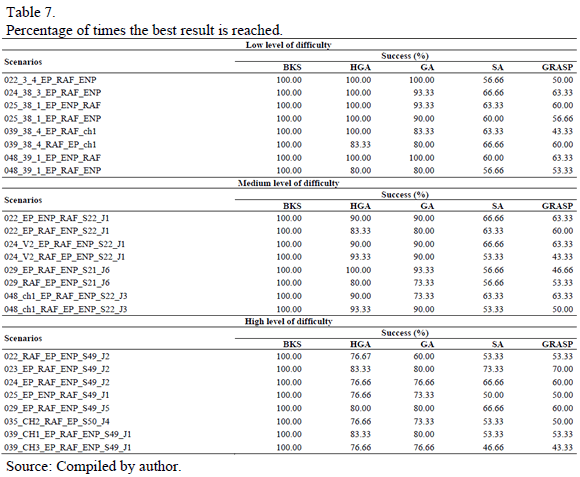
<body><![CDATA[<p><font size="2" face="Verdana, Arial, Helvetica, sans-serif">In addition, the third   column in <a href="#tab06">Table 6</a> presents the best results per HGA. <a href="#tab07">Table 7</a> shows the   proportion of the 30 runs in which the best result was reached (Success (%)).   Running times were always short of 300 seconds. Taking the average running time   for HGA, GA took 21.2% less time than that, SA 38.5% less, while GRASP ran for  62.8% less time. </font></p>     <p align="center"><font size="2" face="Verdana, Arial, Helvetica, sans-serif"><a name="tab07"></a></font><img src="/img/revistas/dyna/v82n190/v82n190a10tab07.gif"></p>     <p><font size="2" face="Verdana, Arial, Helvetica, sans-serif">For   the problems pertaining to low levels of difficulty, HGA reaches the best   result (on average) 95.4% of runs, while GA, SA and GRASP reach the best   results at 89,9%, 61,6% and 56,2%, of the runs, respectively. On problems pertaining   to medium levels of difficulty, HGA achieves the best results at an average of  89.9% of its runs, while GA, </font><font size="2" face="Verdana, Arial, Helvetica, sans-serif">SA and GRASP achieve them at 84,9%, 59,9% and 55,4% of the   runs, respectively. Finally, in terms of   high levels of difficulty problems, HGA reaches optimum results  at a n average of 78.7% of its runs, while GA, SA and GRASP achieve them at 74,9%,  57,9% and 54,9% of their corresponding runs.</font></p>     <p>&nbsp;</p>     <p><font size="3" face="Verdana, Arial, Helvetica, sans-serif"><b>5. Conclusions</b></font></p>     <p><font size="2" face="Verdana, Arial, Helvetica, sans-serif">In this work we presented a novel approach to the solution   of ROADEF'05, combining different procedures. They were adapted on the basis of   the structure, number of variables and complexity of each scenario. Individual   analyses of the Greedy Randomized Adaptive   Search Procedure (GRASP), a Genetic Algorithm (GA) and Simulated Annealing (SA)   returned satisfactory results. Moreover, in most scenarios GRASP and SA   generated solutions with similar features. However, GA converges to better   quality results than SA and GRASP. It is interesting to note that GA reaches   superior results when the initial individual population is obtained by means of   the GRASP. In this context, the Hybrid Genetic Algorithm (HGA) efficiently   amalgamates the desirable characteristics of the three meta-heuristics, GRASP,   GAs and SA. The experiments sustain this claim since the results achieved with   the hybrid technique are better than those obtained by each technique by  itself.</font></p>     <p>&nbsp;</p>     <p><font size="3" face="Verdana, Arial, Helvetica, sans-serif"><b>Acknowledgments</b></font></p>     <p><font size="2" face="Verdana, Arial, Helvetica, sans-serif">This work was   funded by two research grants: PICT-2011-0396 of the Fondo para la   Investigaci&oacute;n Científica y Tecnol&oacute;gica (FONCyT) of the Agencia Nacional de   Promoci&oacute;n Científica y Tecnol&oacute;gica (AGENCIA) and PGI 24/J056 of the Universidad  Nacional del Sur.</font></p>     <p>&nbsp;</p>     ]]></body>
<body><![CDATA[<p><font size="3" face="Verdana, Arial, Helvetica, sans-serif"><b>References</b></font></p>     <!-- ref --><p><font size="2" face="Verdana, Arial, Helvetica, sans-serif"><b>&#91;1&#93;</b>    Solnon, C., Cung, V.D., Nguyen A. and Artigues   C., The car sequencing problem: Overview of state-of-the-art methods and   industrial case-study of the ROADEF'2005 challenge problem. European Journal of   Operational Research, 191 (3), pp. 912-927, 2008.  DOI: 10.1016/j.ejor.2007.04.033.    &nbsp;&nbsp;&nbsp;&nbsp;&nbsp;&nbsp;&nbsp;&nbsp;[&#160;<a href="javascript:void(0);" onclick="javascript: window.open('/scielo.php?script=sci_nlinks&ref=000074&pid=S0012-7353201500020001000001&lng=','','width=640,height=500,resizable=yes,scrollbars=1,menubar=yes,');">Links</a>&#160;]<!-- end-ref --></font></p>     <!-- ref --><p><font size="2" face="Verdana, Arial, Helvetica, sans-serif"><b>&#91;2&#93;</b>    Gagne, C. and Zinflou, A., An hybrid algorithm for the industrial car sequecing problem.  Proceedings of IEEE Congress on Evolutionary Computation, 1, (1-8), 2012. DOI: 10.1109/CEC.2012.6256122.    &nbsp;&nbsp;&nbsp;&nbsp;&nbsp;&nbsp;&nbsp;&nbsp;[&#160;<a href="javascript:void(0);" onclick="javascript: window.open('/scielo.php?script=sci_nlinks&ref=000076&pid=S0012-7353201500020001000002&lng=','','width=640,height=500,resizable=yes,scrollbars=1,menubar=yes,');">Links</a>&#160;]<!-- end-ref --></font></p>     <!-- ref --><p><font size="2" face="Verdana, Arial, Helvetica, sans-serif"><b>&#91;3&#93;</b>    Briant, O., Naddef, D. and Mouni, G., Greedy   approach and multi-criteria simulated annealing for the car sequencing problem.   European Journal of Operational Research, 191 (3), pp. 993-1003, 2008.  DOI: 10.1016/j.ejor.2007.04.052.    &nbsp;&nbsp;&nbsp;&nbsp;&nbsp;&nbsp;&nbsp;&nbsp;[&#160;<a href="javascript:void(0);" onclick="javascript: window.open('/scielo.php?script=sci_nlinks&ref=000078&pid=S0012-7353201500020001000003&lng=','','width=640,height=500,resizable=yes,scrollbars=1,menubar=yes,');">Links</a>&#160;]<!-- end-ref --></font></p>     <!-- ref --><p><font size="2" face="Verdana, Arial, Helvetica, sans-serif"><b>&#91;4&#93;</b> Bautista, J., Pereira, J. and Adenso-Díaz, B.,   A GRASP approach for the extended car sequencing problem. Journal of  Scheduling, 11, pp. 3-16, 2008. DOI: 10.1007/s10951-007-0046-4.    &nbsp;&nbsp;&nbsp;&nbsp;&nbsp;&nbsp;&nbsp;&nbsp;[&#160;<a href="javascript:void(0);" onclick="javascript: window.open('/scielo.php?script=sci_nlinks&ref=000080&pid=S0012-7353201500020001000004&lng=','','width=640,height=500,resizable=yes,scrollbars=1,menubar=yes,');">Links</a>&#160;]<!-- end-ref --></font></p>     <!-- ref --><p><font size="2" face="Verdana, Arial, Helvetica, sans-serif"><b>&#91;5&#93;</b> Zinflou, A. and Gagn&eacute;, C., Tackling the   industrial car sequencing problem using GISMOO algorithm. In assembly line -   theory and practice, W. Grzechca, Ed., Ed: I-Tech Education and Publishing, pp.  85-106, 2011.DOI: 10.5772/21113.    &nbsp;&nbsp;&nbsp;&nbsp;&nbsp;&nbsp;&nbsp;&nbsp;[&#160;<a href="javascript:void(0);" onclick="javascript: window.open('/scielo.php?script=sci_nlinks&ref=000082&pid=S0012-7353201500020001000005&lng=','','width=640,height=500,resizable=yes,scrollbars=1,menubar=yes,');">Links</a>&#160;]<!-- end-ref --></font></p>     <!-- ref --><p><font size="2" face="Verdana, Arial, Helvetica, sans-serif"><b>&#91;6&#93;</b>    Estellon, B., Gardi, F. and Nouioua, K., Two local   search approaches for solving real-life car sequencing problems. European   Journal of Operational Research, 191 (3), pp. 928-944, 2008. DOI:  10.1016/j.ejor.2007.04.043.    &nbsp;&nbsp;&nbsp;&nbsp;&nbsp;&nbsp;&nbsp;&nbsp;[&#160;<a href="javascript:void(0);" onclick="javascript: window.open('/scielo.php?script=sci_nlinks&ref=000084&pid=S0012-7353201500020001000006&lng=','','width=640,height=500,resizable=yes,scrollbars=1,menubar=yes,');">Links</a>&#160;]<!-- end-ref --></font></p>     <!-- ref --><p><font size="2" face="Verdana, Arial, Helvetica, sans-serif"><b>&#91;7&#93;</b>    Gavranovic, H., Local search and suffix tree   for car-sequencing problem with colors. European Journal of Operational  Research, 191 (3), pp. 972-980, 2008. DOI: 10.1016/j.ejor.2007.04.051.    &nbsp;&nbsp;&nbsp;&nbsp;&nbsp;&nbsp;&nbsp;&nbsp;[&#160;<a href="javascript:void(0);" onclick="javascript: window.open('/scielo.php?script=sci_nlinks&ref=000086&pid=S0012-7353201500020001000007&lng=','','width=640,height=500,resizable=yes,scrollbars=1,menubar=yes,');">Links</a>&#160;]<!-- end-ref --></font></p>     <!-- ref --><p><font size="2" face="Verdana, Arial, Helvetica, sans-serif"><b>&#91;8&#93;</b>    Prandtstetter, M. and Raidl, G.R., An integer   linear programming approach and a hybrid variable neighborhood search for the   car sequencing problem. European Journal of Operational Research, 191 (3), pp.  1004-1022, 2008. DOI: 10.1016/j.ejor.2007.04.044.    &nbsp;&nbsp;&nbsp;&nbsp;&nbsp;&nbsp;&nbsp;&nbsp;[&#160;<a href="javascript:void(0);" onclick="javascript: window.open('/scielo.php?script=sci_nlinks&ref=000088&pid=S0012-7353201500020001000008&lng=','','width=640,height=500,resizable=yes,scrollbars=1,menubar=yes,');">Links</a>&#160;]<!-- end-ref --></font></p>     <!-- ref --><p><font size="2" face="Verdana, Arial, Helvetica, sans-serif"><b>&#91;9&#93;</b> Frutos, M.,   Olivera, A.C. y Casal, R., Estudio sobre distintas estrategias utilizadas para   establecer secuencias detalladas en entornos productivos. Proceedings of XII International Conference on   Industrial Engineering and Operations Management, XXVI Encuentro Nacional  Engenharia de Produção 1, pp. 136, 2006.    &nbsp;&nbsp;&nbsp;&nbsp;&nbsp;&nbsp;&nbsp;&nbsp;[&#160;<a href="javascript:void(0);" onclick="javascript: window.open('/scielo.php?script=sci_nlinks&ref=000090&pid=S0012-7353201500020001000009&lng=','','width=640,height=500,resizable=yes,scrollbars=1,menubar=yes,');">Links</a>&#160;]<!-- end-ref --> </font></p>     <!-- ref --><p><font size="2" face="Verdana, Arial, Helvetica, sans-serif"><b>&#91;10&#93;</b> Olivera, A.C., Frutos, M. y Casal, R., Algoritmos   Gen&eacute;ticos: Una estrategia clave para abordar problemas de secuenciamiento en   gran escala. Proceedings of XXXIV Jornadas Argentinas de Inform&aacute;tica e  Investigaci&oacute;n Operativa, pp 1-9, 2006.    &nbsp;&nbsp;&nbsp;&nbsp;&nbsp;&nbsp;&nbsp;&nbsp;[&#160;<a href="javascript:void(0);" onclick="javascript: window.open('/scielo.php?script=sci_nlinks&ref=000092&pid=S0012-7353201500020001000010&lng=','','width=640,height=500,resizable=yes,scrollbars=1,menubar=yes,');">Links</a>&#160;]<!-- end-ref --></font></p>     <!-- ref --><p><font size="2" face="Verdana, Arial, Helvetica, sans-serif"><b>&#91;11&#93;</b> Olivera, A.C., Frutos, M. and Casal R., M&eacute;todos para   determinar secuencias de producci&oacute;n en un ambiente productivo complejo.   Proceedings of XIII Congreso Latino-Iberoamericano de Investigaci&oacute;n Operativa,  pp.1-6, 2006.    &nbsp;&nbsp;&nbsp;&nbsp;&nbsp;&nbsp;&nbsp;&nbsp;[&#160;<a href="javascript:void(0);" onclick="javascript: window.open('/scielo.php?script=sci_nlinks&ref=000094&pid=S0012-7353201500020001000011&lng=','','width=640,height=500,resizable=yes,scrollbars=1,menubar=yes,');">Links</a>&#160;]<!-- end-ref --></font></p>     <!-- ref --><p><font size="2" face="Verdana, Arial, Helvetica, sans-serif"><b>&#91;12&#93;</b>   Fonseca, C.M. and Fleming, P.J., Overview of   evolutionary algorithms in multiobjective optimization. Evolutionary  Computation, 3 (1), pp. 1-16, 1995. DOI: 10.    &nbsp;&nbsp;&nbsp;&nbsp;&nbsp;&nbsp;&nbsp;&nbsp;[&#160;<a href="javascript:void(0);" onclick="javascript: window.open('/scielo.php?script=sci_nlinks&ref=000096&pid=S0012-7353201500020001000012&lng=','','width=640,height=500,resizable=yes,scrollbars=1,menubar=yes,');">Links</a>&#160;]<!-- end-ref -->1162/evco.1995.3.1.1.</font></p>     <!-- ref --><p><font size="2" face="Verdana, Arial, Helvetica, sans-serif"><b>&#91;13&#93;</b>   Hanne, T., Global multiobjective optimization   using evolutionary algorithms. Journal of Heuristics, 6 (3), pp. 347-360, 2000.  DOI: 10.1023/A:1009630531634.    &nbsp;&nbsp;&nbsp;&nbsp;&nbsp;&nbsp;&nbsp;&nbsp;[&#160;<a href="javascript:void(0);" onclick="javascript: window.open('/scielo.php?script=sci_nlinks&ref=000098&pid=S0012-7353201500020001000013&lng=','','width=640,height=500,resizable=yes,scrollbars=1,menubar=yes,');">Links</a>&#160;]<!-- end-ref --></font></p>     <!-- ref --><p><font size="2" face="Verdana, Arial, Helvetica, sans-serif"><b>&#91;14&#93;</b>   Ribeiro, C.C., Aloise, D., Noronha, T.F.,   Rocha, C. and Urrutia, S., A hybrid heuristic for a multi-objective real-life   car sequencing problem with painting and assembly line constraints. European   Journal of Operational Research, 191 (3), pp. 981-992, 2008. DOI:  10.1016/j.ejor.2007.04.034.    &nbsp;&nbsp;&nbsp;&nbsp;&nbsp;&nbsp;&nbsp;&nbsp;[&#160;<a href="javascript:void(0);" onclick="javascript: window.open('/scielo.php?script=sci_nlinks&ref=000100&pid=S0012-7353201500020001000014&lng=','','width=640,height=500,resizable=yes,scrollbars=1,menubar=yes,');">Links</a>&#160;]<!-- end-ref --></font></p>     <!-- ref --><p><font size="2" face="Verdana, Arial, Helvetica, sans-serif"><b>&#91;15&#93;</b> Resende, M. and   Gonz&aacute;lez Velarde, J.L,. GRASP: Procedimientos de b&uacute;squeda miopes aleatorizados   y adaptativos. Revista  Iberoamericana de Inteligencia Artificial, 19, pp. 61-76, 2003.    &nbsp;&nbsp;&nbsp;&nbsp;&nbsp;&nbsp;&nbsp;&nbsp;[&#160;<a href="javascript:void(0);" onclick="javascript: window.open('/scielo.php?script=sci_nlinks&ref=000102&pid=S0012-7353201500020001000015&lng=','','width=640,height=500,resizable=yes,scrollbars=1,menubar=yes,');">Links</a>&#160;]<!-- end-ref --></font></p>     <!-- ref --><p><font size="2" face="Verdana, Arial, Helvetica, sans-serif"><b>&#91;16&#93;</b>   Goldberg, D.E., Genetic algorithms in search,   Optimization and machine learning. Addison Wesley Publishing Company, Inc,  1989.    &nbsp;&nbsp;&nbsp;&nbsp;&nbsp;&nbsp;&nbsp;&nbsp;[&#160;<a href="javascript:void(0);" onclick="javascript: window.open('/scielo.php?script=sci_nlinks&ref=000104&pid=S0012-7353201500020001000016&lng=','','width=640,height=500,resizable=yes,scrollbars=1,menubar=yes,');">Links</a>&#160;]<!-- end-ref --></font></p>     <p>&nbsp;</p>     <p><font size="2" face="Verdana, Arial, Helvetica, sans-serif"><b>M. Frutos,</b> is an Assistant Researcher of CONICET (National Research Council of Argentina)   and Teaching Assistant at the Department of Engineering of the Universidad   Nacional del Sur, in Bahía Blanca, Argentina. He completed his undergraduate   degree in Industrial Engineering and MSc and PhD in Engineering at his home   university. His research focuses on scheduling problems in production and their   treatment through metaheuristic methods. He has published in Operational   Research, Annals of Operations Research, Dyna, and American Journal of   Operations Research among others. He participates actively in the Operations   Research community in Latin America.</font></p>     <p><font size="2" face="Verdana, Arial, Helvetica, sans-serif"><b>A.C. Olivera,</b> is an Assistant Researcher of CONICET (National Research Council of Argentina)   stationed at the Department of Exact and Natural Sciences of the Universidad   Nacional de la Patagonia Austral, Comodoro Rivadavia, Argentina. She has a PhD   in Computer Science from the Universidad Nacional del Sur, Bahía Blanca,   Argentina and held a post-doctoral position at the University of Malaga, Malaga,   Spain. Her research focuses on urban traffic and production chain optimization   problems using bio-inspired algorithms. She has published book chapters and several   papers in indexed journals and proceedings of refereed international  conferences.</font></p>     <p><font size="2" face="Verdana, Arial, Helvetica, sans-serif"><b>F. Tohm&eacute;,</b> is   a Principal Researcher of CONICET (National Research Council of Argentina) and   Full Professor at the Department of Economics of the Universidad Nacional del   Sur, in Bahía Blanca, Argentina. A former Fulbright Scholar, he held visiting   positions at U.C. Berkeley, Washington University in St. Louis and Endicott   College, USA. He holds an undergraduate degree in Mathematics and a PhD in   Economics. His research has focused on decision problems, game theory and   optimization in the socio-economic settings. He has published in Theory and   Decision, Mathematics of Social Sciences, Artificial Intelligence, Mathematical  and Computational Modeling, and Annals of Operations Research among others.</font></p>      ]]></body><back>
<ref-list>
<ref id="B1">
<label>1</label><nlm-citation citation-type="journal">
<person-group person-group-type="author">
<name>
<surname><![CDATA[Solnon]]></surname>
<given-names><![CDATA[C.]]></given-names>
</name>
<name>
<surname><![CDATA[Cung]]></surname>
<given-names><![CDATA[V.D.]]></given-names>
</name>
<name>
<surname><![CDATA[Nguyen]]></surname>
<given-names><![CDATA[A.]]></given-names>
</name>
<name>
<surname><![CDATA[Artigues]]></surname>
<given-names><![CDATA[C.]]></given-names>
</name>
</person-group>
<article-title xml:lang="en"><![CDATA[The car sequencing problem: Overview of state-of-the-art methods and industrial case-study of the ROADEF'2005 challenge problem]]></article-title>
<source><![CDATA[European Journal of Operational Research]]></source>
<year>2008</year>
<volume>191</volume>
<numero>3</numero>
<issue>3</issue>
<page-range>912-927</page-range></nlm-citation>
</ref>
<ref id="B2">
<label>2</label><nlm-citation citation-type="confpro">
<person-group person-group-type="author">
<name>
<surname><![CDATA[Gagne]]></surname>
<given-names><![CDATA[C.]]></given-names>
</name>
<name>
<surname><![CDATA[Zinflou]]></surname>
<given-names><![CDATA[A.]]></given-names>
</name>
</person-group>
<article-title xml:lang="en"><![CDATA[An hybrid algorithm for the industrial car sequecing problem]]></article-title>
<source><![CDATA[]]></source>
<year>2012</year>
<edition>1</edition>
<conf-name><![CDATA[ IEEE Congress on Evolutionary Computation]]></conf-name>
<conf-loc> </conf-loc>
</nlm-citation>
</ref>
<ref id="B3">
<label>3</label><nlm-citation citation-type="journal">
<person-group person-group-type="author">
<name>
<surname><![CDATA[Briant]]></surname>
<given-names><![CDATA[O.]]></given-names>
</name>
<name>
<surname><![CDATA[Naddef]]></surname>
<given-names><![CDATA[D.]]></given-names>
</name>
<name>
<surname><![CDATA[Mouni]]></surname>
<given-names><![CDATA[G.]]></given-names>
</name>
</person-group>
<article-title xml:lang="en"><![CDATA[Greedy approach and multi-criteria simulated annealing for the car sequencing problem]]></article-title>
<source><![CDATA[European Journal of Operational Research]]></source>
<year>2008</year>
<volume>191</volume>
<numero>3</numero>
<issue>3</issue>
<page-range>993-1003</page-range></nlm-citation>
</ref>
<ref id="B4">
<label>4</label><nlm-citation citation-type="journal">
<person-group person-group-type="author">
<name>
<surname><![CDATA[Bautista]]></surname>
<given-names><![CDATA[J.]]></given-names>
</name>
<name>
<surname><![CDATA[Pereira]]></surname>
<given-names><![CDATA[J.]]></given-names>
</name>
<name>
<surname><![CDATA[Adenso-Díaz]]></surname>
<given-names><![CDATA[B.]]></given-names>
</name>
</person-group>
<article-title xml:lang="en"><![CDATA[A GRASP approach for the extended car sequencing problem]]></article-title>
<source><![CDATA[Journal of Scheduling]]></source>
<year>2008</year>
<numero>11</numero>
<issue>11</issue>
<page-range>3-16</page-range></nlm-citation>
</ref>
<ref id="B5">
<label>5</label><nlm-citation citation-type="book">
<person-group person-group-type="author">
<name>
<surname><![CDATA[Zinflou]]></surname>
<given-names><![CDATA[A.]]></given-names>
</name>
<name>
<surname><![CDATA[Gagné]]></surname>
<given-names><![CDATA[C.]]></given-names>
</name>
</person-group>
<article-title xml:lang="en"><![CDATA[Tackling the industrial car sequencing problem using GISMOO algorithm]]></article-title>
<person-group person-group-type="editor">
<name>
<surname><![CDATA[Grzechca]]></surname>
<given-names><![CDATA[W.]]></given-names>
</name>
</person-group>
<source><![CDATA[assembly line: theory and practice]]></source>
<year>2011</year>
<page-range>85-106</page-range><publisher-name><![CDATA[I-Tech Education and Publishing]]></publisher-name>
</nlm-citation>
</ref>
<ref id="B6">
<label>6</label><nlm-citation citation-type="journal">
<person-group person-group-type="author">
<name>
<surname><![CDATA[Estellon]]></surname>
<given-names><![CDATA[B.]]></given-names>
</name>
<name>
<surname><![CDATA[Gardi]]></surname>
<given-names><![CDATA[F.]]></given-names>
</name>
<name>
<surname><![CDATA[Nouioua]]></surname>
<given-names><![CDATA[K.]]></given-names>
</name>
</person-group>
<article-title xml:lang="en"><![CDATA[Two local search approaches for solving real-life car sequencing problems]]></article-title>
<source><![CDATA[European Journal of Operational Research]]></source>
<year>2008</year>
<volume>191</volume>
<numero>3</numero>
<issue>3</issue>
<page-range>928-944</page-range></nlm-citation>
</ref>
<ref id="B7">
<label>7</label><nlm-citation citation-type="journal">
<person-group person-group-type="author">
<name>
<surname><![CDATA[Gavranovic]]></surname>
<given-names><![CDATA[H.]]></given-names>
</name>
</person-group>
<article-title xml:lang="en"><![CDATA[Local search and suffix tree for car-sequencing problem with colors]]></article-title>
<source><![CDATA[European Journal of Operational Research]]></source>
<year>2008</year>
<volume>191</volume>
<numero>3</numero>
<issue>3</issue>
<page-range>972-980</page-range></nlm-citation>
</ref>
<ref id="B8">
<label>8</label><nlm-citation citation-type="journal">
<person-group person-group-type="author">
<name>
<surname><![CDATA[Prandtstetter]]></surname>
<given-names><![CDATA[M.]]></given-names>
</name>
<name>
<surname><![CDATA[Raidl]]></surname>
<given-names><![CDATA[G.R.]]></given-names>
</name>
</person-group>
<article-title xml:lang="en"><![CDATA[An integer linear programming approach and a hybrid variable neighborhood search for the car sequencing problem]]></article-title>
<source><![CDATA[European Journal of Operational Research]]></source>
<year>2008</year>
<volume>191</volume>
<numero>3</numero>
<issue>3</issue>
<page-range>1004-1022</page-range></nlm-citation>
</ref>
<ref id="B9">
<label>9</label><nlm-citation citation-type="confpro">
<person-group person-group-type="author">
<name>
<surname><![CDATA[Frutos]]></surname>
<given-names><![CDATA[M.]]></given-names>
</name>
<name>
<surname><![CDATA[Olivera]]></surname>
<given-names><![CDATA[A.C.]]></given-names>
</name>
<name>
<surname><![CDATA[Casal]]></surname>
<given-names><![CDATA[R.]]></given-names>
</name>
</person-group>
<article-title xml:lang="es"><![CDATA[Estudio sobre distintas estrategias utilizadas para establecer secuencias detalladas en entornos productivos]]></article-title>
<source><![CDATA[]]></source>
<year></year>
<conf-name><![CDATA[XIIXXVI International Conference on Industrial Engineering and Operations ManagementEncuentro Nacional Engenharia de Produção]]></conf-name>
<conf-date>2006</conf-date>
<conf-loc> </conf-loc>
</nlm-citation>
</ref>
<ref id="B10">
<label>10</label><nlm-citation citation-type="confpro">
<person-group person-group-type="author">
<name>
<surname><![CDATA[Olivera]]></surname>
<given-names><![CDATA[A.C.]]></given-names>
</name>
<name>
<surname><![CDATA[Frutos]]></surname>
<given-names><![CDATA[M.]]></given-names>
</name>
<name>
<surname><![CDATA[Casal]]></surname>
<given-names><![CDATA[R.]]></given-names>
</name>
</person-group>
<article-title xml:lang="es"><![CDATA[Algoritmos Genéticos: Una estrategia clave para abordar problemas de secuenciamiento en gran escala]]></article-title>
<source><![CDATA[]]></source>
<year></year>
<conf-name><![CDATA[XXXIV Jornadas Argentinas de Informática e Investigación Operativa]]></conf-name>
<conf-date>2006</conf-date>
<conf-loc> </conf-loc>
</nlm-citation>
</ref>
<ref id="B11">
<label>11</label><nlm-citation citation-type="confpro">
<person-group person-group-type="author">
<name>
<surname><![CDATA[Olivera]]></surname>
<given-names><![CDATA[A.C.]]></given-names>
</name>
<name>
<surname><![CDATA[Frutos]]></surname>
<given-names><![CDATA[M.]]></given-names>
</name>
<name>
<surname><![CDATA[Casal]]></surname>
<given-names><![CDATA[R.]]></given-names>
</name>
</person-group>
<article-title xml:lang="es"><![CDATA[Métodos para determinar secuencias de producción en un ambiente productivo complejo]]></article-title>
<source><![CDATA[]]></source>
<year></year>
<conf-name><![CDATA[XIII Congreso Latino-Iberoamericano de Investigación Operativa]]></conf-name>
<conf-date>2006</conf-date>
<conf-loc> </conf-loc>
</nlm-citation>
</ref>
<ref id="B12">
<label>12</label><nlm-citation citation-type="journal">
<person-group person-group-type="author">
<name>
<surname><![CDATA[Fonseca]]></surname>
<given-names><![CDATA[C.M.]]></given-names>
</name>
<name>
<surname><![CDATA[Fleming]]></surname>
<given-names><![CDATA[P.J.]]></given-names>
</name>
</person-group>
<article-title xml:lang="en"><![CDATA[Overview of evolutionary algorithms in multiobjective optimization]]></article-title>
<source><![CDATA[Evolutionary Computation]]></source>
<year>1995</year>
<volume>3</volume>
<numero>1</numero>
<issue>1</issue>
<page-range>1-16</page-range></nlm-citation>
</ref>
<ref id="B13">
<label>13</label><nlm-citation citation-type="journal">
<person-group person-group-type="author">
<name>
<surname><![CDATA[Hanne]]></surname>
<given-names><![CDATA[T.]]></given-names>
</name>
</person-group>
<article-title xml:lang="en"><![CDATA[Global multiobjective optimization using evolutionary algorithms]]></article-title>
<source><![CDATA[Journal of Heuristics]]></source>
<year>2000</year>
<volume>6</volume>
<numero>3</numero>
<issue>3</issue>
<page-range>347-360</page-range></nlm-citation>
</ref>
<ref id="B14">
<label>14</label><nlm-citation citation-type="journal">
<person-group person-group-type="author">
<name>
<surname><![CDATA[Ribeiro]]></surname>
<given-names><![CDATA[C.C.]]></given-names>
</name>
<name>
<surname><![CDATA[Aloise]]></surname>
<given-names><![CDATA[D.]]></given-names>
</name>
<name>
<surname><![CDATA[Noronha]]></surname>
<given-names><![CDATA[T.F.]]></given-names>
</name>
<name>
<surname><![CDATA[Rocha]]></surname>
<given-names><![CDATA[C.]]></given-names>
</name>
<name>
<surname><![CDATA[Urrutia]]></surname>
<given-names><![CDATA[S.]]></given-names>
</name>
</person-group>
<article-title xml:lang="en"><![CDATA[A hybrid heuristic for a multi-objective real-life car sequencing problem with painting and assembly line constraints]]></article-title>
<source><![CDATA[European Journal of Operational Research]]></source>
<year>2008</year>
<volume>191</volume>
<numero>3</numero>
<issue>3</issue>
<page-range>981-992</page-range></nlm-citation>
</ref>
<ref id="B15">
<label>15</label><nlm-citation citation-type="journal">
<person-group person-group-type="author">
<name>
<surname><![CDATA[Resende]]></surname>
<given-names><![CDATA[M.]]></given-names>
</name>
<name>
<surname><![CDATA[González Velarde]]></surname>
<given-names><![CDATA[J.L]]></given-names>
</name>
</person-group>
<article-title xml:lang="en"><![CDATA[GRASP: Procedimientos de búsqueda miopes aleatorizados y adaptativos]]></article-title>
<source><![CDATA[Revista Iberoamericana de Inteligencia Artificial]]></source>
<year>2003</year>
<numero>19</numero>
<issue>19</issue>
<page-range>61-76</page-range></nlm-citation>
</ref>
<ref id="B16">
<label>16</label><nlm-citation citation-type="book">
<person-group person-group-type="author">
<name>
<surname><![CDATA[Goldberg]]></surname>
<given-names><![CDATA[D.E.]]></given-names>
</name>
</person-group>
<source><![CDATA[Genetic algorithms in search: Optimization and machine learning]]></source>
<year>1989</year>
<publisher-name><![CDATA[Addison Wesley Publishing Company, Inc]]></publisher-name>
</nlm-citation>
</ref>
</ref-list>
</back>
</article>