<?xml version="1.0" encoding="ISO-8859-1"?><article xmlns:mml="http://www.w3.org/1998/Math/MathML" xmlns:xlink="http://www.w3.org/1999/xlink" xmlns:xsi="http://www.w3.org/2001/XMLSchema-instance">
<front>
<journal-meta>
<journal-id>0012-7353</journal-id>
<journal-title><![CDATA[DYNA]]></journal-title>
<abbrev-journal-title><![CDATA[Dyna rev.fac.nac.minas]]></abbrev-journal-title>
<issn>0012-7353</issn>
<publisher>
<publisher-name><![CDATA[Universidad Nacional de Colombia]]></publisher-name>
</publisher>
</journal-meta>
<article-meta>
<article-id>S0012-73532015000200016</article-id>
<article-id pub-id-type="doi">10.15446/dyna.v82n190.46256</article-id>
<title-group>
<article-title xml:lang="en"><![CDATA[Atmospheric corrosivity in Bogota as a very high-altitude metropolis questions international standards]]></article-title>
<article-title xml:lang="es"><![CDATA[Corrosividad atmosférica en Bogotá como metrópolis a una gran altitud, inquietudes a normas internacionales]]></article-title>
</title-group>
<contrib-group>
<contrib contrib-type="author">
<name>
<surname><![CDATA[Ríos-Rojas]]></surname>
<given-names><![CDATA[John Fredy]]></given-names>
</name>
<xref ref-type="aff" rid="A01"/>
</contrib>
<contrib contrib-type="author">
<name>
<surname><![CDATA[Escobar-Ocampo]]></surname>
<given-names><![CDATA[Diego]]></given-names>
</name>
<xref ref-type="aff" rid="A02"/>
</contrib>
<contrib contrib-type="author">
<name>
<surname><![CDATA[Hernández-García]]></surname>
<given-names><![CDATA[Edwin Arbey]]></given-names>
</name>
<xref ref-type="aff" rid="A03"/>
</contrib>
<contrib contrib-type="author">
<name>
<surname><![CDATA[Arroyave]]></surname>
<given-names><![CDATA[Carlos]]></given-names>
</name>
<xref ref-type="aff" rid="A04"/>
</contrib>
</contrib-group>
<aff id="A01">
<institution><![CDATA[,Universidad Antonio Nariño Facultad de Ingeniería Mecánica ]]></institution>
<addr-line><![CDATA[ ]]></addr-line>
</aff>
<aff id="A02">
<institution><![CDATA[,Ministerio de Ambiente y Desarrollo Sostenible  ]]></institution>
<addr-line><![CDATA[ ]]></addr-line>
</aff>
<aff id="A03">
<institution><![CDATA[,Universidad Antonio Nariño Facultad de Comercio Internacional y Economía ]]></institution>
<addr-line><![CDATA[ ]]></addr-line>
</aff>
<aff id="A04">
<institution><![CDATA[,Universidad Antonio Nariño Vicerrectoría de Ciencia, Tecnología e Innovación ]]></institution>
<addr-line><![CDATA[ ]]></addr-line>
</aff>
<pub-date pub-type="pub">
<day>00</day>
<month>04</month>
<year>2015</year>
</pub-date>
<pub-date pub-type="epub">
<day>00</day>
<month>04</month>
<year>2015</year>
</pub-date>
<volume>82</volume>
<numero>190</numero>
<fpage>128</fpage>
<lpage>137</lpage>
<copyright-statement/>
<copyright-year/>
<self-uri xlink:href="http://www.scielo.org.co/scielo.php?script=sci_arttext&amp;pid=S0012-73532015000200016&amp;lng=en&amp;nrm=iso"></self-uri><self-uri xlink:href="http://www.scielo.org.co/scielo.php?script=sci_abstract&amp;pid=S0012-73532015000200016&amp;lng=en&amp;nrm=iso"></self-uri><self-uri xlink:href="http://www.scielo.org.co/scielo.php?script=sci_pdf&amp;pid=S0012-73532015000200016&amp;lng=en&amp;nrm=iso"></self-uri><abstract abstract-type="short" xml:lang="en"><p><![CDATA[This paper presents the first systematic atmospheric corrosion assessment in Bogota. Main facts about the study are related with special characteristics of the City, such as population (more than eight million inhabitants), and altitude (2600 m over the sea level). Relative humidity, temperature, and sulphate dioxide (SO2) concentration were measured. Simultaneously, corrosion rate of AISI-SAE 1006 plain steel was measured throughout a year. Results show that atmospheric corrosion is between low and medium levels, C2-C3, according to the ISO 9223 standard. Nevertheless, estimations from meteorological parameters produce lower corrosivity and, taking into account SO2 concentrations, corrosivity in places with higher relative humidity, are higher than corrosivity measured on steel coupons. In general, the main pollution problem is particulate matter, but higher corrosion rates were directly associated with SO2 levels. Gaps between found results and international estimation methodologies are evident. Some relative explanations are proposed.]]></p></abstract>
<abstract abstract-type="short" xml:lang="es"><p><![CDATA[Se presentan resultados del primer estudio sistemático sobre la corrosividad atmosférica de Bogotá, donde se tienen características especiales como una población superior a ocho millones de personas y 2600 m sobre el nivel del mar. Se midieron humedad relativa, temperatura, concentración de dióxido de azufre (SO2) y velocidad de corrosión de acero al carbono AISI/SAE 1006. La corrosividad encontrada se ubica entre los niveles bajo y medio, C2-C3, según la norma ISO 9223. No obstante, los valores estimados a partir de los parámetros meteorológicos dan resultados menores y, de acuerdo a la concentración del SO2, las corrosividades en los sitios con mayor humedad relativa son mayores que las medidas en platinas de acero. El principal problema de contaminación es material particulado, pero las mayores tasas de corrosión estuvieron asociadas con los niveles de SO2. Diferencias entre los valores medidos y estimados son evidentes, proponiendo algunas explicaciones acerca de ello.]]></p></abstract>
<kwd-group>
<kwd lng="en"><![CDATA[Brook's Index]]></kwd>
<kwd lng="en"><![CDATA[ISO 9223 Standard]]></kwd>
<kwd lng="en"><![CDATA[relative humidity (Rh)]]></kwd>
<kwd lng="en"><![CDATA[time of wetness (TOW)]]></kwd>
<kwd lng="en"><![CDATA[plain carbon steel]]></kwd>
<kwd lng="en"><![CDATA[atmospheric pollutants]]></kwd>
<kwd lng="es"><![CDATA[Índice de Brooks]]></kwd>
<kwd lng="es"><![CDATA[norma ISO 9223]]></kwd>
<kwd lng="es"><![CDATA[humedad relativa]]></kwd>
<kwd lng="es"><![CDATA[tiempo de humectación]]></kwd>
<kwd lng="es"><![CDATA[acero de bajo carbono]]></kwd>
<kwd lng="es"><![CDATA[contaminantes atmosféricos]]></kwd>
</kwd-group>
</article-meta>
</front><body><![CDATA[ <p><font size="1" face="Verdana, Arial, Helvetica, sans-serif"><b>DOI:</b> <a href="http://dx.doi.org/10.15446/dyna.v82n190.46256" target="_blank">http://dx.doi.org/10.15446/dyna.v82n190.46256</a></font></p>     <p align="center"><font size="4" face="Verdana, Arial, Helvetica, sans-serif"><b>Atmospheric  corrosivity in Bogota as a very high-altitude metropolis questions  international standards</b></font></p>     <p align="center"><i><font size="3"><b><font face="Verdana, Arial, Helvetica, sans-serif">Corrosividad   atmosf&eacute;rica en Bogot&aacute; como metr&oacute;polis a una gran altitud, inquietudes a normas   internacionales</font></b></font></i></p>     <p align="center">&nbsp;</p>     <p align="center"><font size="2" face="Verdana, Arial, Helvetica, sans-serif"><b>John Fredy Ríos-Rojas<sup> <i>a</i></sup>, Diego Escobar-Ocampo<sup> <i>b</i></sup>, Edwin Arbey Hern&aacute;ndez-García<sup> <i>c</i></sup> &amp; Carlos Arroyave<i><sup> d</sup></i></b></font></p>     <p align="center">&nbsp;</p>     <p align="center"><font size="2" face="Verdana, Arial, Helvetica, sans-serif"><sup><i>a</i></sup><i> Facultad de Ingeniería Mec&aacute;nica, Universidad Antonio Nari&ntilde;o, Bogot&aacute;,   Colombia. <a href="mailto:johnri@uan.edu.co">johnri@uan.edu.co</a>    <br>   <sup>b</sup> Ministerio de Ambiente y Desarrollo Sostenible, Bogot&aacute;, Colombia.   <a href="mailto:diescobar@minambiente.gov.co">diescobar@minambiente.gov.co</a>    <br>   <sup>c</sup> Facultad de Comercio Internacional y Economía, Universidad  Antonio Nari&ntilde;o, Bogot&aacute;, Colombia. <a href="mailto:edwinh@uan.edu.co">edwinh@uan.edu.co</a>    <br>   <sup>d</sup> Vicerrectoría de Ciencia, Tecnología e Innovaci&oacute;n, Universidad  Antonio Nari&ntilde;o, Bogot&aacute;,Colombia. <a href="mailto:vicerrector.cti@uan.edu.co">vicerrector.cti@uan.edu.co</a></i></font></p>     ]]></body>
<body><![CDATA[<p align="center">&nbsp;</p>     <p align="center"><font size="2" face="Verdana, Arial, Helvetica, sans-serif"><b>Received: October   15<sup>th</sup>, de 2014. Received in revised form: January 21<sup>th</sup>,   2015. Accepted: February 6<sup>th</sup>, 2015</b></font></p>     <p align="center">&nbsp;</p>     <p align="center"><font size="1" face="Verdana, Arial, Helvetica, sans-seriff"><b>This work is licensed under a</b> <a rel="license" href="http://creativecommons.org/licenses/by-nc-nd/4.0/">Creative Commons Attribution-NonCommercial-NoDerivatives 4.0 International License</a>.</font><br /><a rel="license" href="http://creativecommons.org/licenses/by-nc-nd/4.0/"><img style="border-width:0" src="https://i.creativecommons.org/l/by-nc-nd/4.0/88x31.png" /></a></p> <hr>     <p><font size="2" face="Verdana, Arial, Helvetica, sans-serif"><b>Abstract    <br> </b></font><font size="2" face="Verdana, Arial, Helvetica, sans-serif">This paper presents the first systematic atmospheric  corrosion assessment in Bogota. Main facts about the study are related with  special characteristics of the City, such as population (more than eight  million inhabitants), and altitude (2600 m over the sea level). Relative  humidity, temperature, and sulphate dioxide (SO<sub>2</sub>) concentration were  measured. Simultaneously, corrosion rate of AISI-SAE 1006 plain steel was  measured throughout a year. Results show that atmospheric corrosion is between  low and medium levels, C<sub>2</sub>-C<sub>3</sub>, according to the ISO 9223  standard. Nevertheless, estimations from meteorological parameters produce  lower corrosivity and, taking into account SO2 concentrations, corrosivity in  places with higher relative humidity, are higher than corrosivity measured on  steel coupons. In general, the main pollution problem is particulate matter,  but higher corrosion rates were directly associated with SO<sub>2</sub> levels.  Gaps between found results and international estimation methodologies are evident. Some relative explanations are proposed.</font></p>     <p><font size="2" face="Verdana, Arial, Helvetica, sans-serif"><i>Keywords:</i> Brook's Index; ISO 9223 Standard; relative humidity (<i>Rh</i>); time of wetness (TOW); plain carbon steel; atmospheric  pollutants.</font></p>     <p><font size="2" face="Verdana, Arial, Helvetica, sans-serif"><b>Resumen    <br> </b></font><font size="2" face="Verdana, Arial, Helvetica, sans-serif">Se presentan  resultados del primer estudio sistem&aacute;tico sobre la corrosividad atmosf&eacute;rica de  Bogot&aacute;, donde se tienen características especiales como una poblaci&oacute;n superior  a ocho millones de personas y 2600 m sobre el nivel del mar. Se midieron  humedad relativa, temperatura, concentraci&oacute;n de di&oacute;xido de azufre (SO<sub>2</sub>)  y velocidad de corrosi&oacute;n de acero al carbono AISI/SAE 1006. La corrosividad  encontrada se ubica entre los niveles bajo y medio, C<sub>2</sub>-C<sub>3</sub>,  seg&uacute;n la norma ISO 9223. No obstante, los valores estimados a partir de los  par&aacute;metros meteorol&oacute;gicos dan resultados menores y, de acuerdo a la  concentraci&oacute;n del SO<sub>2</sub>, las corrosividades en los sitios con mayor  humedad relativa son mayores que las medidas en platinas de acero. El principal  problema de contaminaci&oacute;n es material particulado, pero las mayores tasas de  corrosi&oacute;n estuvieron asociadas con los niveles de SO<sub>2</sub>. Diferencias  entre los valores medidos y estimados son evidentes, proponiendo algunas explicaciones acerca de ello.</font></p>     <p><font size="2" face="Verdana, Arial, Helvetica, sans-serif"><i>Palabras claves</i>: &Iacute;ndice de Brooks; norma ISO 9223; humedad  relativa; tiempo de humectaci&oacute;n; acero de bajo carbono; contaminantes  atmosf&eacute;ricos.</font></p> <hr>     ]]></body>
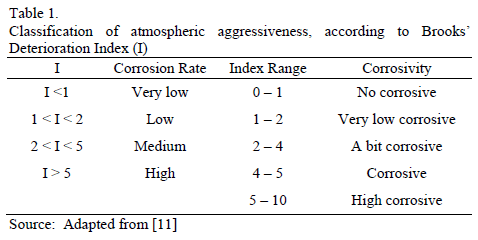
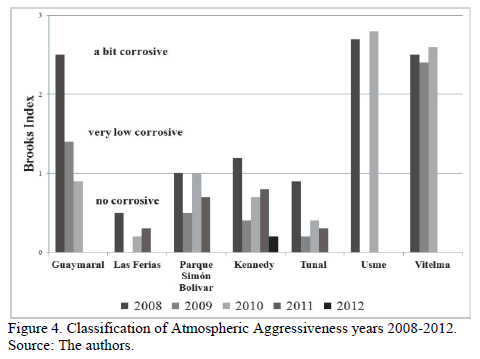
<body><![CDATA[<p>&nbsp;</p>     <p><font size="3" face="Verdana, Arial, Helvetica, sans-serif"><b>1. Introduction</b></font></p>     <p><font size="2" face="Verdana, Arial, Helvetica, sans-serif">The stability of  materials used in building the infrastructure that supports the development of  society is one of the big challenges of engineering since aspects such as  health and people's safety need to be assured. Also necessary is the  optimization of the use of resources (their quantity, costs, maintenance  requirements and necessary replacements). In this sense, one the most  significant problems is the stability of materials exposed to the atmosphere of  big cities, where pollutants are normally found. Pollutants tend to accelerate  the deterioration of different types of materials used to build cities, such as  metals, ceramics, polymers or combinations of these materials. In this respect,  each city and each place has particular characteristics that can influence the  loss of material properties. Studies on atmospheric corrosion performed in many  cities have allowed for the conclusion that the nature of atmospheric  pollutants and their level of concentration play an important role in the  service life of different engineering materials &#91;1-3&#93;.</font></p>     <p><font size="2" face="Verdana, Arial, Helvetica, sans-serif">Bogota's natural barriers are the mountains in the east of  the City and the Bogota River in the west. Bogota is characterized by having a  bimodal rainfall and a temperature range of between 7 and 18°C &#91;4&#93;. The city  extends around 380 km<sup>2</sup> and hosts a population estimated at more than  eight million inhabitants, with a growth rate that places it in sixth place  among the big cities in the world. The greatest growth rate is estimated for  between 2010 and 2025 &#91;5&#93;. The average elevation of the city is 2600 meters  above sea level. Such elevation provides the city with some particular  characteristics compared to previous studies in other latitudes. Additionally,  no systematic studies on loss of integrity of the materials exposed to the  atmosphere have been undertaken in Bogota. The quantity of structural materials  used in urban infrastructure and their direct interaction with the atmosphere  that may cause significant aggresivity (average temperature values (T)  and relative humidity (<i>Rh</i>) are 14°C  and 70%, respectively; along with the concerning atmospheric pollution) lead to  one thinking beforehand that there is significant deterioration of the  materials used to build the City.</font></p>     <p><font size="2" face="Verdana, Arial, Helvetica, sans-serif">To make it clear, costs caused by corrosion, including material  deterioration, maintenance, replacement, problems generated because of outages  and delays, penalties, as well as prevention and control measures are really  significant. It has been established that direct costs generated by corrosion  in a country, account for five percent of the GDP. Additionally, due to the  fact that around 80 per cent of the materials are exposed to the atmosphere,  costs of atmospheric corrosion can be 30 to 50 percent of the total costs of  corrosion. As a consequence, in the case of Bogota, with a high urban  concentration, it can be estimated that direct costs annually generated by  atmospheric corrosion can be around two to three percent of its GDP (It was USD  $92.917 million in 2012 - &#91;6&#93;), which would mean costs generated by atmospheric  corrosion, for the same year, were USD $1.858 and USD $2.788 million).</font></p>     <p><font size="2" face="Verdana, Arial, Helvetica, sans-serif">Weather plays an important role when assessing  atmospheric aggression in a particular area. Factors such as T, <i>Rh</i>, precipitation and air pollution,  among others, can determine the magnitude of atmospheric corrosion of metallic  elements exposed to such conditions &#91;7&#93;. The meteorological parameters that are  most associated with atmospheric corrosion are T and <i>Rh</i>. Based on chemistry principles, it is known that an increase in  T tends to stimulate the attack since there is a speedy increase of  electrochemical reactions and diffusion processes. However, taking into account  the electrochemical mechanisms of atmospheric corrosion, the same increase of T  can contribute to the reduction of the humidity layer on the surface of the  material. As a consequence, there is a reduction in the attack; thus, the  process turns into something very complex since many factors-which act  simultaneously, sometimes stimulating, sometimes inhibiting the attack  process-can be identified. Among those factors, some pollutants, which tend to  significantly accelerate the attack, and thus, have led to several studies, can  be highlighted; in particular, the presence of sulfur dioxide (SO<sub>2</sub>)  in urban and industrial atmospheres and chlorides in areas influenced by the  sea &#91;8&#93;.</font></p>     <p><font size="2" face="Verdana, Arial, Helvetica, sans-serif">A great number of variables that intervene in  weather conditions make corrosive assessment of the atmosphere a complex issue,  which is difficult to measure. In real life, different approaches have been  used to estimate the behavior of a material in a given atmosphere. These  include: a) direct measurement of atmospheric corrosion through detailed follow  up of simple behaviors of materials of interest; b) estimation of atmospheric  corrosion from environmental data and corrosivity experimentation; and c)  application of dose-response functions or damage function, which have been  found to be associated with the degree of deterioration of similar materials in  equivalent microclimates &#91;9,10&#93;.</font></p>     <p><font size="2" face="Verdana, Arial, Helvetica, sans-serif">To this end, some methodologies have been developed; they  aim at facilitating estimations, and, as a consequence, foreseeing behaviors.  These are: i) calculation of Brooks' index, which estimates the degree of  deterioration taken from the <i>Rh</i> and T  average annual values &#91;11&#93;; ii) the application of the ISO 9223 standard, based  on environmental parameters and field sample exposure (ISO 9223) and, iii)  through the application of a function to predict annual damage caused by  atmospheric corrosion. Details of these methodologies will be presented below.</font></p>     <p><font size="2" face="Verdana, Arial, Helvetica, sans-serif"><b><i>1.1. Brooks' Index of atmospheric aggressiveness</i></b></font></p>     <p><font size="2" face="Verdana, Arial, Helvetica, sans-serif">The equation that  allows for the determination of the Brooks' Deterioration index relates the  potential risk of atmospheric corrosion correlated to the deterioration index  (I), which is determined through the eq. (1) &#91;11&#93;:</font></p>     ]]></body>
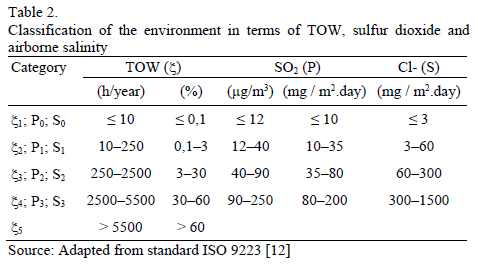
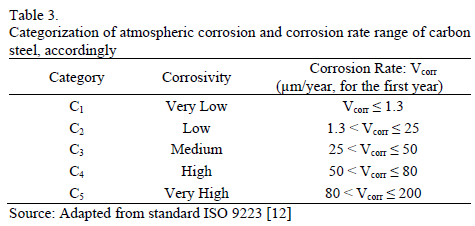
<body><![CDATA[<p>       <font size="2" face="Verdana, Arial, Helvetica, sans-serif">  <v:shapetype id="_x0000_t75" coordsize="21600,21600" o:spt="75"  o:preferrelative="t" path="m@4@5l@4@11@9@11@9@5xe" filled="f" stroked="f">    <v:stroke joinstyle="miter"/>    <v:formulas>      <v:f eqn="if lineDrawn pixelLineWidth 0"/>      <v:f eqn="sum @0 1 0"/>      <v:f eqn="sum 0 0 @1"/>      <v:f eqn="prod @2 1 2"/>      <v:f eqn="prod @3 21600 pixelWidth"/>      <v:f eqn="prod @3 21600 pixelHeight"/>      <v:f eqn="sum @0 0 1"/>      <v:f eqn="prod @6 1 2"/>      <v:f eqn="prod @7 21600 pixelWidth"/>      <v:f eqn="sum @8 21600 0"/>      <v:f eqn="prod @7 21600 pixelHeight"/>      <v:f eqn="sum @10 21600 0"/>    </v:formulas>    <v:path o:extrusionok="f" gradientshapeok="t" o:connecttype="rect"/>    <o:lock v:ext="edit" aspectratio="t"/>  </v:shapetype>  <v:imagedata src="v82n190a16_archivos/image001.png" o:title="" chromakey="white"/>   </font><img src="/img/revistas/dyna/v82n190/v82n190a16eq01.gif"></p>     <p><font size="2" face="Verdana, Arial, Helvetica, sans-serif"><i>Rh</i> is the average relative humidity and <i>Pv</i> is the saturation pressure of vapor  at average temperature expressed in mbar, given that <i>Rh</i> is the quotient between the quantity of water vapor present in  the air and the maximum quantity of vapor that may be present in air for  specific <i>T</i> and pressure (<i>P</i>).</font></p>     <p><font size="2" face="Verdana, Arial, Helvetica, sans-serif">Once the average  annual values of <i>Rh</i> and <i>T</i> are obtained, the <i>Pv</i> values are estimated to determine the deterioration index (I)  through eq. (1). The values obtained allow us to make approximations of the  corrosion rate of metallic materials exposed to such conditions and,  additionally, scoring the degree of corrosion in the atmosphere assessed, as  shown in <a href="#tab01">Table 1</a>.</font></p>     <p align="center"><font size="2" face="Verdana, Arial, Helvetica, sans-serif"><a name="tab01"></a></font><img src="/img/revistas/dyna/v82n190/v82n190a16tab01.gif"></p>     <p><font size="2" face="Verdana, Arial, Helvetica, sans-serif">Without a doubt,  this methodology aims at indirectly estimating the impact of the thickness of  the electrolyte layer built on the surface of the material. There, the  electrochemical phenomenon of metal atmospheric corrosion is developed to a  greater or lesser extent. Effects such as those held by microclimatic factors,  i.e. atmospheric pollutant concentration with potential impact on nature and  the extension of reactions happening within the electrolyte are not being taken  into consideration. </font></p>     <p><font size="2" face="Verdana, Arial, Helvetica, sans-serif"><b><i>1.2. Atmospheric corrosivity according to ISO 9223</i></b></font></p>     <p><font size="2" face="Verdana, Arial, Helvetica, sans-serif">The international standard ISO 9223 &#91;12&#93; is a  more realistic approximation, which takes into account the presence of the most  relevant atmospheric pollutants, and uses meteorological and environmental  parameters, as well as direct measurement of the corrosion rate of test  specimens. Thus, it is possible to determine atmospheric corrosion in a  specific place by calculating the time of wetness (TOW), and level of  deposition of SO<sub>2 </sub>and chlorides (Cl<sup>-</sup>). TOW refers to the time in which a metallic  surface presents a water layer sufficiently thick for the electrolyte to act,  thus, corrosion takes place. Such time is estimated as the yearly number of  hours in which <i>Rh</i> exceeds 80% and T  has been above 0°C. The categories presented in <a href="#tab02">Table 2</a> are established using  TOW and average levels of SO<sub>2</sub> and Cl.</font></p>     <p align="center"><font size="2" face="Verdana, Arial, Helvetica, sans-serif"><a name="tab02"></a></font><img src="/img/revistas/dyna/v82n190/v82n190a16tab02.gif"></p>     <p><font size="2" face="Verdana, Arial, Helvetica, sans-serif">Once time of  wetness and pollutant categorization has been performed, atmosphere is  classified from the point of view of corrosiveness, based on the tables  available in the ISO 9223 standard for some base materials. It is then  associated to the five attack rate categories. Regarding steel, for instance,  the corrosion rate range is shown in <a href="#tab03">Table 3</a>. </font></p>     <p align="center"><font size="2" face="Verdana, Arial, Helvetica, sans-serif"><a name="tab03"></a></font><img src="/img/revistas/dyna/v82n190/v82n190a16tab03.gif"></p>     ]]></body>
<body><![CDATA[<p><font size="2" face="Verdana, Arial, Helvetica, sans-serif">When one has  corrosion rate values, directly measured on carbon steel specimens,  categorization of atmospheric corrosion is established from the range where the data obtained is located. </font></p>     <p><font size="2" face="Verdana, Arial, Helvetica, sans-serif"><b><i>1.3. Estimations  according to a corrosion damage function </i></b></font></p>     <p><font size="2" face="Verdana, Arial, Helvetica, sans-serif">A great number of  damage functions or dose-response equations, which are compared to the  corrosion of some materials with environmental parameters, have been determined  in several studies. Among some of the most significant results worth mentioning  is the establishment of an equation from data resulting from corrosion of  carbon steel, obtained in a great number of areas, which are distributed in  different countries in order to apply it globally &#91;13&#93;; or dose-response  functions that are aimed at collecting the impact of a significant number of  pollutants simultaneously &#91;14&#93;, and dose-response functions that have been  established to set international standards such as ISO.</font></p>     <p><font size="2" face="Verdana, Arial, Helvetica, sans-serif">One of the most  widely recognized results is eq. (2) &#91;1&#93;,</font></p>     <p>       <font size="2" face="Verdana, Arial, Helvetica, sans-serif">   <v:imagedata src="v82n190a16_archivos/image002.png" o:title="" chromakey="white"/>   </font><img src="/img/revistas/dyna/v82n190/v82n190a16eq02.gif"></p>     <p><font size="2" face="Verdana, Arial, Helvetica, sans-serif">Where: C stands  for the corrosion rate for carbon steel, in <font face="Symbol">m</font>m.yr<sup>-1</sup>. D<sub>SO2</sub> is the annual average SO<sub>2</sub> deposition in mg SO<sub>2</sub>.m<sup>-2</sup>.d<sup>-1</sup> and D<sub>Cl</sub> is the annual average of chloride deposition in mg Cl.m<sup>-2</sup>.d<sup>-1</sup>.  In this sense, the attack rate of metal in the atmosphere can be determined by  knowing the pollutant concentration. This equation is similar to others that  have been developed to achieve global validity. &#91;13&#93;.</font></p>     <p><font size="2" face="Verdana, Arial, Helvetica, sans-serif">On the other  hand, the dose-response function presented as eq. (3) compares the annual  corrosion rate of carbon steel in <font face="Symbol">m</font>m.yr<sup>-1</sup>, using values of T, <i>Rh</i>, SO<sub>2</sub> and Cl<sup>-</sup>,  without taking into account TOW, and it was developed to improve the ISO  classification system &#91;15&#93;:</font></p>     <p>   <font size="2" face="Verdana, Arial, Helvetica, sans-serif">   <v:imagedata src="v82n190a16_archivos/image003.png" o:title="" chromakey="white"/>   </font><img src="/img/revistas/dyna/v82n190/v82n190a16eq03.gif"></p>     <p><font size="2" face="Verdana, Arial, Helvetica, sans-serif"><b><i>1.4. Field tests</i></b></font></p>     <p><font size="2" face="Verdana, Arial, Helvetica, sans-serif">Determination of  the corrosion rate of carbon steel can be carried out directly through exposure  of samples of such material in the specific points of interest. In order to carry this out, structures called <i>exposure racks</i> are located according  to the ASTM G-50 &#91;16&#93; standard, which specifies position, and height for  locating the test specimens and other details related to the location of  samples. Subsequently, the structures are removed after certain exposure times,  with differences of months in the beginning and normally years at the end.</font></p>     ]]></body>
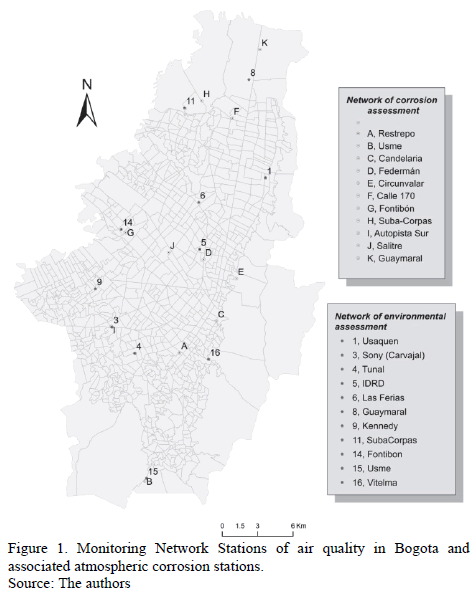
<body><![CDATA[<p><font size="2" face="Verdana, Arial, Helvetica, sans-serif">As far as we  know, no research has been undertaken that performs a systematic analysis of  the atmospheric corrosion problems in Bogota and, even less so to analyze  different behavior in different parts of the city which can be classified  according to microclimates identified based on meteorological and pollutant  concentration data that have been collected over several years. Obviously, it  was of great importance to collect  relevant information and analyze it according to internationally recommended  procedures to identify how atmospheric corrosion is distributed throughout the  City. Subsequently, such information can be used for design, where it is very  important to estimate the life service of structures, optimize the choice of  materials to use or in decision making when a specific material requires  protection from a corrosive attack.</font></p>     <p><font size="2" face="Verdana, Arial, Helvetica, sans-serif">Therefore, the  current study was aimed at assessing general atmospheric corrosion conditions  for Bogota city, applying Brooks' indexes methodology and determining risk of  metallic material deterioration, following the methodology established by ISO  9223 standard, through application of damage expressions of annual atmospheric  corrosion and, determination of corrosion rated of standard specimens.</font></p>     <p>&nbsp;</p>     <p><font size="3" face="Verdana, Arial, Helvetica, sans-serif"><b>2. Methods and materials</b></font></p>     <p><b><font size="2" face="Verdana, Arial, Helvetica, sans-serif"><i>2.1. Meteorological and atmospheric pollution data</i></font></b></p>     <p><font size="2" face="Verdana, Arial, Helvetica, sans-serif">Average data for <i>Rh</i>, T and &#91;SO<sub>2</sub>&#93; were taken  from the records captured every hour in different network stations monitoring  the quality of air in the city from 2008 to 2012. <a href="#fig01">Fig. 1</a> shows the locations of  monitoring stations distributed throughout Bogota, according to the  recommendations of international standards on the subject &#91;17&#93;. Two stations  only worked half the time, and others did not record all parameters.</font></p>     <p align="center"><font size="2" face="Verdana, Arial, Helvetica, sans-serif"><a name="fig01"></a></font><img src="/img/revistas/dyna/v82n190/v82n190a16fig01.gif"></p>     <p><font size="2" face="Verdana, Arial, Helvetica, sans-serif">SO<sub>2 </sub>average  annual concentration values received as ppb were converted into µg/m<sup>3</sup>,  using the eq. (4):</font></p>     <p>   <font size="2" face="Verdana, Arial, Helvetica, sans-serif">   <v:imagedata src="v82n190a16_archivos/image004.png" o:title="" chromakey="white"/>   </font><img src="/img/revistas/dyna/v82n190/v82n190a16eq04.gif"></p>     <p><font size="2" face="Verdana, Arial, Helvetica, sans-serif">Where <i>ppb</i> corresponds to the &#91;SO<sub>2</sub>&#93;  value reported by the network, P<i>M</i> is  SO<sub>2 </sub>molecular weight, and the constant 31.98 corresponds to molar  volume of an ideal gas for T and P average conditions in Bogota. </font></p>     ]]></body>
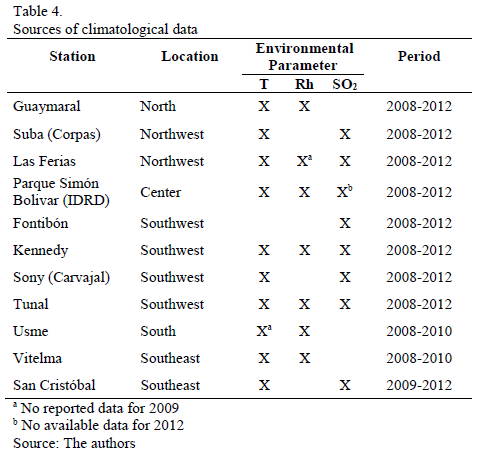
<body><![CDATA[<p><font size="2" face="Verdana, Arial, Helvetica, sans-serif">Since Bogota is a  completely Mediterranean city, more than 1000 km away from any sea, Cl<sup>- </sup>concentration  data is not usually recorded. Nevertheless, there are recent reports that present a deposition of less  than 3 mg.m<sup>-2</sup>.d<sup>-1</sup> &#91;10,8&#93;; therefore, in this paper, it is  assumed that chloride concentration does not represent a significant value.</font></p>     <p><font size="2" face="Verdana, Arial, Helvetica, sans-serif"><b><i>2.2. Materials</i></b></font></p>     <p><font size="2" face="Verdana, Arial, Helvetica, sans-serif">AISI/SAE 1006  Carbon steel plates (0.061% C, 0.008% S, 0.180% Mn, 0.019% Cu, 0.040% Al), of  100 mm x 150 mm, previously degreased, rinsed with alcohol, dried with hot air  and weighed, were exposed in triplicate in each site for a year beginning in  the first six months of 2012 and ending in the first six months of 2013.  Samples were exposed at atmospheric corrosion stations, which were built  following the guidelines of ASTM G50 standard and located in different sites of  the city. Location of the test specimens  was defined following recommendations of standards for sampling of total  sulfating activity, as well as criteria of network design for monitoring air  quality. &#91;17,19&#93;. Subsequently, after exposure, samples were taken to the  laboratory to determine loss of mass, after chemical cleaning procedure. &#91;20&#93;</font></p>     <p><font size="2" face="Verdana, Arial, Helvetica, sans-serif"><b><i>2.3. Exposure sites</i></b></font></p>     <p><font size="2" face="Verdana, Arial, Helvetica, sans-serif">Exposure sites  were chosen taking into account climatological data reported by the City's monitoring  network. In general, it was sought to install corrosive stations near the  environmental network stations, which were characteristic of microclimates of  interest. Distribution of measurement corrosion sites was: two stations in the  north (N), one in the Northwest (NW), two in the Eastern Center (EC), three in  the Southwest (SW) and three in the South (S). Location sites of these  atmospheric corrosion stations are shown in <a href="#fig01">Fig. 1</a>.</font></p>     <p>&nbsp;</p>     <p><font size="3" face="Verdana, Arial, Helvetica, sans-serif"><b>3. Results and  discussion</b></font></p>     <p><font size="2" face="Verdana, Arial, Helvetica, sans-serif"><a href="#tab04">Table 4</a> presents a list of environmental monitoring  network stations, which were used as reference for locating corrosion stations  and, therefore, provided sources for climatological data, associable to  corrosion data. Parameters recorded and periods in which those parameters were  measured are detailed in the Table as well. </font></p>     <p align="center"><font size="2" face="Verdana, Arial, Helvetica, sans-serif"><a name="tab04"></a></font><img src="/img/revistas/dyna/v82n190/v82n190a16tab04.gif"></p>     <p><font size="2" face="Verdana, Arial, Helvetica, sans-serif"><b><i>3.1. Climatological  data of reference</i></b></font></p>     ]]></body>
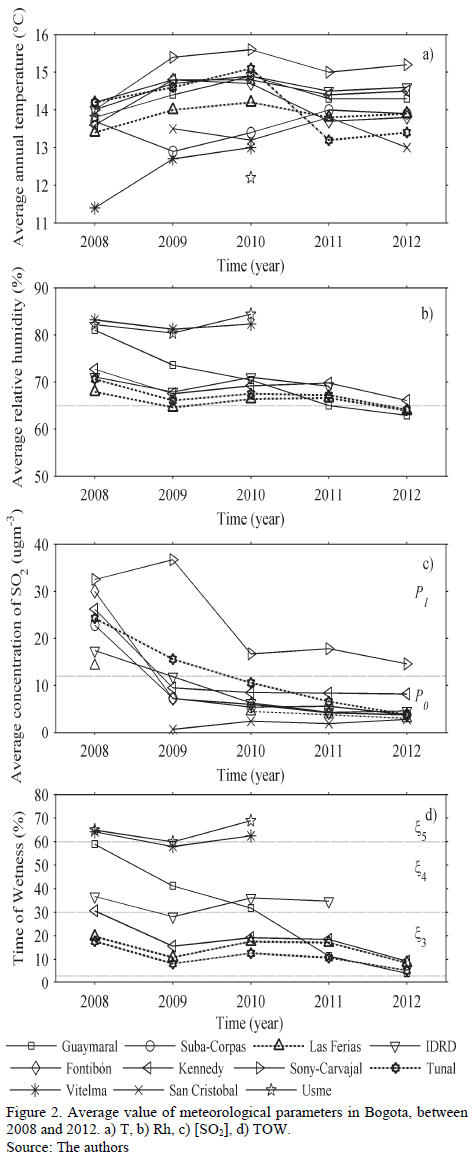
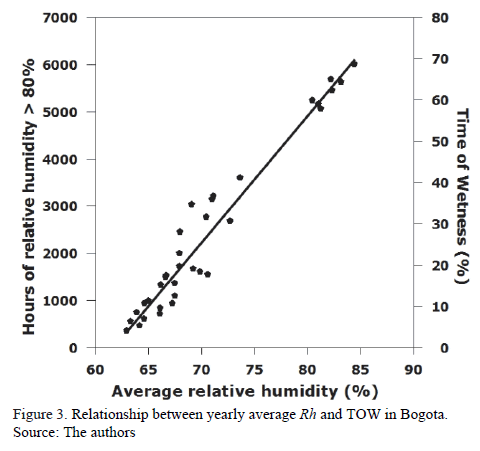
<body><![CDATA[<p><font size="2" face="Verdana, Arial, Helvetica, sans-serif">Annual average T and <i>Rh</i> measured in reference stations are detailed in <a href="#fig02">Figs. 2a</a>, <a href="#fig02">2b</a>. Annual average T  observed in different sites of the city is between 11 and 16°C, presenting the  lowest values in the south of the city. Correspondingly, <i>Rh</i> is higher in these zones; a similar situation is shown with this  latter variable, in the Northern zone (Guaymaral Station), during 2008 and  2009.</font></p>     <p align="center"><font size="2" face="Verdana, Arial, Helvetica, sans-serif"><a name="fig02"></a></font><img src="/img/revistas/dyna/v82n190/v82n190a16fig02.gif"></p>     <p><font size="2" face="Verdana, Arial, Helvetica, sans-serif">The SO<sub>2</sub> average annual concentration is shown in <a href="#fig02">Fig. 2c</a>, which indicates that values  have been declining substantially during the last few years in almost all of  the sites (global trend in most cities thanks to worldwide efforts to minimize  emission of pollutants from fossil fuels). Additionally, the highest pollution was present in the Southwest zone  (Carvajal station, followed by Kennedy station). The other stations report very  low &#91;SO<sub>2</sub>&#93; over the last few years. Thus, SO<sub>2 </sub>volumetric  concentration in Bogota corresponds to low or minimum levels, which would allow  for classifying its atmosphere in categories ISO <i>P<sub>0</sub></i> and <i>P<sub>1</sub></i>.</font></p>     <p><font size="2" face="Verdana, Arial, Helvetica, sans-serif"><a href="#fig02">Fig. 2d</a> is a histogram of TOW evolution estimated for each  station, per year. In general, this parameter is located in category ISO x<sub>3</sub>, except for Parque Sim&oacute;n Bolívar station  (great green lung in the central area of the city) located in category ISO x<sub>4</sub>, and stations Usme and Vitelma located in  category ISO x<sub>5</sub>, both  associated to rural or semirural microclimates. There are still no satisfactory  explanations about time of wetness reduction in Guaymaral station.</font></p>     <p><font size="2" face="Verdana, Arial, Helvetica, sans-serif"><b><i>3.2. Relationship  between Rh and TOW</i></b></font></p>     <p><font size="2" face="Verdana, Arial, Helvetica, sans-serif">Average annual <i>Rh</i> and annual hours in which the value of said parameter was higher than 80%  (which allows for deducting TOW indirectly)-obtained in an established time  window (2008-2012)-present good lineal correlation. <a href="#fig03">Fig. 3</a> illustrates this  relation. It can be said, and suggested in the literature &#91;21&#93;, that in Bogota  for instance, TOW can be deduced directly from average annual <i>Rh</i>.</font></p>     <p align="center"><font size="2" face="Verdana, Arial, Helvetica, sans-serif"><a name="fig03"></a></font><img src="/img/revistas/dyna/v82n190/v82n190a16fig03.gif"></p>     <p><font size="2" face="Verdana, Arial, Helvetica, sans-serif">The model proposed to estimate the relation is represented  in Eq. (5):</font></p>     <p>   <font size="2" face="Verdana, Arial, Helvetica, sans-serif">   <v:imagedata src="v82n190a16_archivos/image006.png" o:title="" chromakey="white"/>   </font><img src="/img/revistas/dyna/v82n190/v82n190a16eq05.gif"></p>     <p><font size="2" face="Verdana, Arial, Helvetica, sans-serif">According with the model, eq. (6) and (7) were estimated  for determining the relationship between the Time Of Wetness and Humidity  Relative in Bogota:</font></p>     ]]></body>
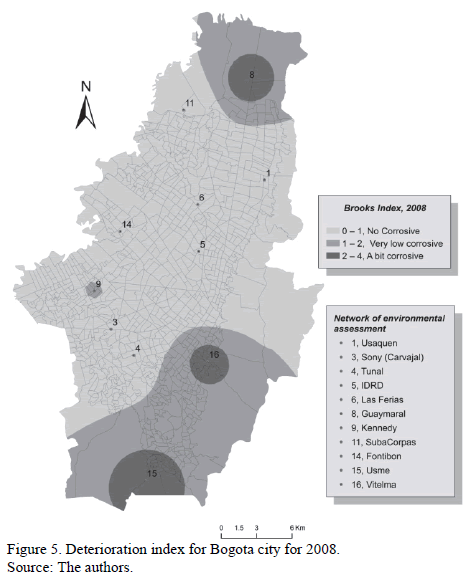
<body><![CDATA[<p><img src="/img/revistas/dyna/v82n190/v82n190a16eq0607.gif"></p>     <p><font size="2" face="Verdana, Arial, Helvetica, sans-serif">It is important to  point out that there is an optimum fit for both models. In both cases, R<sup>2</sup> is approximately equal to 95%. Both the model and individual parameters are  globally relevant for any level of significance. This means that the null  hypothesis, when the coefficients are statistically equal to zero, are rejected  and therefore the estimated model is good &#91;22&#93;.</font></p>     <p><font size="2" face="Verdana, Arial, Helvetica, sans-serif"><b><i>3.3. Corrosivity estimation from meteorological  parameters: Brooks Index</i></b></font></p>     <p><font size="2" face="Verdana, Arial, Helvetica, sans-serif">Deterioration indexes in eight stations are obtained by  taking data from <a href="#fig03">Fig. 3</a> and using eq. (1): Guaymaral, Las Ferias, Parque Sim&oacute;n Bolívar, Kennedy, Tunal, Usme  and Vitelma. Deterioration indexes obtained for each station and for  each study period, as well as corresponding classification are shown in <a href="#fig04">Fig. 4</a>.</font></p>     <p><font size="2" face="Verdana, Arial, Helvetica, sans-serif">Results obtained according to Brooks' equation become the  first approximation of potential risks of atmospheric corrosion in Bogota city,  compared to weather conditions described exclusively through <i>Rh</i> and <i>Pv</i> variables assuming a corrosive pollutant free atmosphere.</font></p>     <p align="center"><font size="2" face="Verdana, Arial, Helvetica, sans-serif"><a name="fig04"></a></font><img src="/img/revistas/dyna/v82n190/v82n190a16fig04.gif"></p>     <p><font size="2" face="Verdana, Arial, Helvetica, sans-serif">It can be said, according to the values obtained (<a href="#fig04">Fig. 4</a>)  that in 2008 conditions of higher aggressiveness took place since, in general, <i>Rh</i> values were higher.</font></p>     <p><font size="2" face="Verdana, Arial, Helvetica, sans-serif">The Map in <a href="#fig05">Fig. 5</a> presents, comprehensively and  synthetically, all the data associated to aggressiveness of different  microclimates according to Brooks Indexes for 2008. The building of the map as  well as management and handling of geographic data was performed using Arcmap  10 tool of the Geoestatistical Analyst software. </font></p>     <p align="center"><font size="2" face="Verdana, Arial, Helvetica, sans-serif"><a name="fig05"></a></font><img src="/img/revistas/dyna/v82n190/v82n190a16fig05.gif"></p>     <p><font size="2" face="Verdana, Arial, Helvetica, sans-serif">The map allows us to score the Usme, Ciudad Bolívar, Suba  and Usaqu&eacute;n microclimates as the most aggressive. Nevertheless, Usme along with  Guaymaral and Vitelma can be identified as little aggressive while Tunal and  Las Ferias can be identified as non-aggressive. </font></p>     ]]></body>
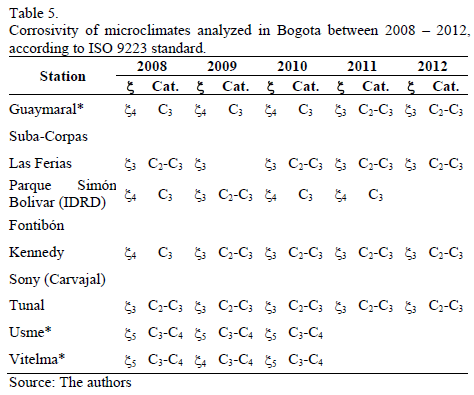
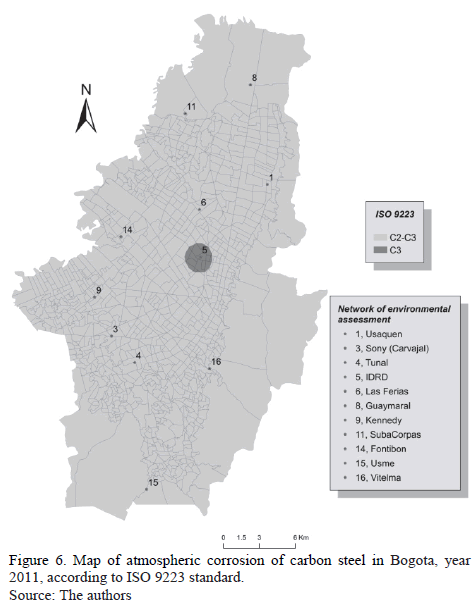
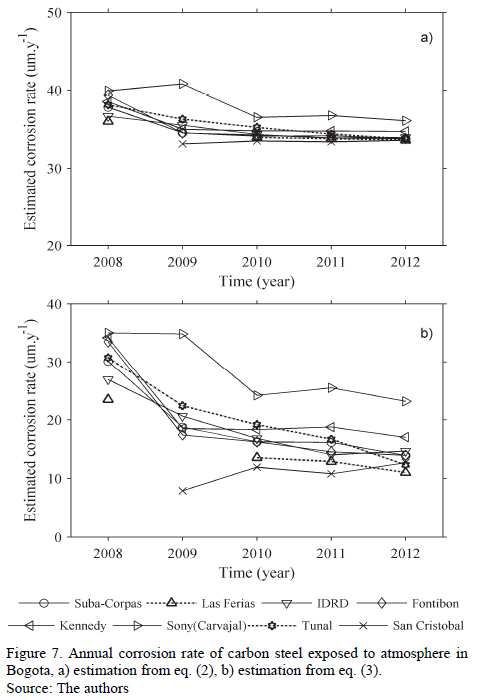
<body><![CDATA[<p><font size="2" face="Verdana, Arial, Helvetica, sans-serif">In the subsequent years (<a href="#fig04">Fig. 4</a>), Vitelma and Usme  stations kept their little aggressive nature while the rest have shown a  tendency to become non-aggressive.</font></p>     <p><font size="2" face="Verdana, Arial, Helvetica, sans-serif">Finally, it can be said that Brooks' Indexes associated to  corrosive and high corrosive categories were not present in any of the cases.  Therefore, it can be deduced that from an <i>Rh </i>perspective, Bogota's atmosphere does not present conditions that can be  considered highly corrosive. </font></p>     <p><font size="2" face="Verdana, Arial, Helvetica, sans-serif"><b><i>3.4. Atmospheric corrosivity according to pollutant  concentrations: ISO standard 9223</i></b></font></p>     <p><font size="2" face="Verdana, Arial, Helvetica, sans-serif">As  it has already been stated, a way to estimate atmospheric aggressiveness takes  into account TOW and SO<sub>2</sub> and Cl<sup>- </sup>concentrations; the  latter is not significant in the case of Bogota. Likewise, it is reiterated  that the average concentration of SO<sub>2</sub> in Bogota is low since it has  always shown annual values lower than 40 <font face="Symbol">m</font>g.m<sup>-3</sup>. On the other  hand, according to <a href="#tab02">Table 2</a>, it can be inferred that wetting percentage can be  associated principally to categories 3 and 4. Therefore, and taking into  account the ISO 9223 standard, it can be concluded that Bogota's atmosphere  exhibits corrosivity of carbon steel which can be classified between low and  average (C<sub>2</sub> - C<sub>3</sub>). In other words, typical corrosion  rates fluctuate between 1.3 and 50 <font face="Symbol">m</font>m.yr<sup>-1</sup>. Additionally,  particularly in the Usme and Vitelma stations, with higher <i>Rh</i> values and, therefore higher values in TOW, </font><font size="2" face="Verdana, Arial, Helvetica, sans-serif">greater corrosion is determined  associated to categories C<sub>3</sub>-C<sub>4</sub>, which, according to <a href="#tab02">Table  2</a>, correspond to corrosion rates of between 25 and 80 <font face="Symbol">m</font>m.yr<sup>-1</sup>.  A set of results from the different stations taken into account is collected in  <a href="#tab05">Table 5</a>.</font></p>     <p align="center"><font size="2" face="Verdana, Arial, Helvetica, sans-serif"><a name="tab05"></a></font><img src="/img/revistas/dyna/v82n190/v82n190a16tab05.gif"></p>     <p><font size="2" face="Verdana, Arial, Helvetica, sans-serif">A map of atmospheric corrosion in Bogota, shown in <a href="#fig06">Fig. 6</a>,  was built using the same data estimated by the application of the ISO 9223 standard for 2011.</font></p>     <p align="center"><font size="2" face="Verdana, Arial, Helvetica, sans-serif"><a name="fig06"></a></font><img src="/img/revistas/dyna/v82n190/v82n190a16fig06.gif"></p>     <p><font size="2" face="Verdana, Arial, Helvetica, sans-serif">The following fact is reconfirmed: in general,  aggressiveness is classified as mild-in the C<sub>2</sub>-C<sub>3</sub> range,  with some emphasis on the upper limit in the center of the City-and it can be  associated to higher TOW.</font></p>     <p><font size="2" face="Verdana, Arial, Helvetica, sans-serif"><b><i>3.5. Corrosion  rates according to dose-response functions. </i></b></font></p>     <p><font size="2" face="Verdana, Arial, Helvetica, sans-serif">The SO<sub>2 </sub>Volumetric concentration data (<font face="Symbol">m</font>g.m<sup>-3</sup>)  reported by the monitoring network was converted to deposition rates (mg of SO<sub>2.</sub>m<sup>-2</sup>.d<sup>-1</sup>),  in such a way that the carbon steel corrosion rate could be estimated through  eq. (2). Such conversion was undertaken  using eq. (8) &#91;12&#93;:</font></p>     ]]></body>
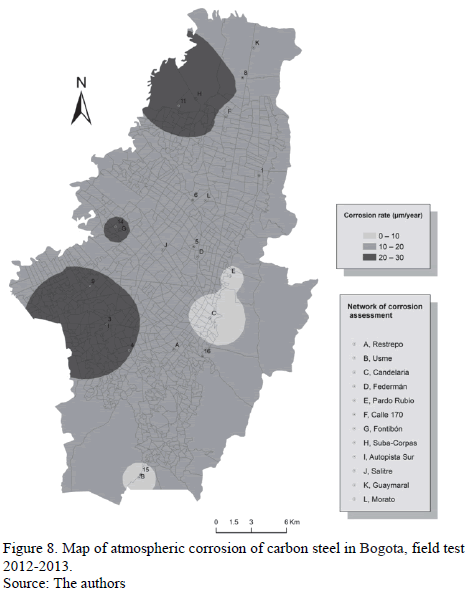
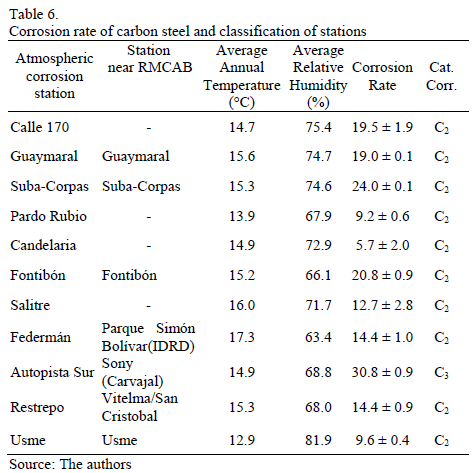
<body><![CDATA[<p><img src="/img/revistas/dyna/v82n190/v82n190a16eq08.gif"></p>     <p><font size="2" face="Verdana, Arial, Helvetica, sans-serif">As it has already been stated, given the atmospheric  conditions being studied, reconfirmed with some previous baseline data, it was  feasible to disregard any possible impacts of chloride ions.</font></p>     <p><font size="2" face="Verdana, Arial, Helvetica, sans-serif">In <a href="#fig07">Fig. 7a</a>, corrosion rates estimated during the years  taken into account were compensated. In <a href="#fig07">Fig. 7a</a>, a tendency of reduction in  corrosion rate is shown between 2008 and 2010, followed by relative stabilization.  Obviously, since these rates depend directly on &#91;SO<sub>2</sub>&#93;, <a href="#fig07">Fig. 7a</a> and  <a href="#fig02">2c</a> are analog. Regarding the significance of the corrosion rate, always above  33 <font face="Symbol">m</font>m.yr<sup>-1</sup>, it is important to remember a constant impact in  eq. (2), which does not allow for observing direct proportionality between  pollutant concentration and deterioration grade at low &#91;SO<sub>2</sub>&#93;.</font></p>     <p align="center"><font size="2" face="Verdana, Arial, Helvetica, sans-serif"><a name="fig07"></a></font><img src="/img/revistas/dyna/v82n190/v82n190a16fig07.gif"></p>     <p>&nbsp;</p>     <p><font size="2" face="Verdana, Arial, Helvetica, sans-serif">As an alternative, eq. (3) can be applied. In the cases  where actual <i>Rh</i> data was not  available, 70% was assumed to make the calculations, since that is the average  recorded value with high frequency during the last few years in several zones  of the City. Resulting corrosion rates were compensated in time and represented  in <a href="#fig07">Fig. 7b</a>.</font></p>     <p><font size="2" face="Verdana, Arial, Helvetica, sans-serif">These last calculations support the trend of a reduction  in aggressiveness in the 2008-2010 triennium, and the relative stabilization in  the subsequent period. Additionally, Carvajal and Kennedy Southwestern  stations, which correspond to microclimates of high industrial activity, stand  out due to their higher corrosion rates. In any case, corrosion rates can still  be classified as mild, in category C<sub>2</sub> to C<sub>3</sub>, according to  ISO classification. As a consequence, it can be stated that in measuring  aggressiveness in Bogota's atmosphere, the Brooks Index methodology and ISO  methodology give equivalent results and suggest that, in general, there are  microclimates with corrosion that goes from low to medium.</font></p>     <p><font size="2" face="Verdana, Arial, Helvetica, sans-serif"><b><i>3.6. Direct  corrosion rate measurements</i></b></font></p>     <p><font size="2" face="Verdana, Arial, Helvetica, sans-serif">The corrosion  rate values of carbon steel test specimens which were exposed in the different study  sites for a year are presented in <a href="#tab06">Table 6</a>. The map of the atmospheric corrosion  of carbon steel in Bogota derived from these data is shown in <a href="#fig08">Fig. 8</a>.</font></p>     <p align="center"><font size="2" face="Verdana, Arial, Helvetica, sans-serif"><a name="tab06"></a></font><img src="/img/revistas/dyna/v82n190/v82n190a16tab06.gif"></p>     ]]></body>
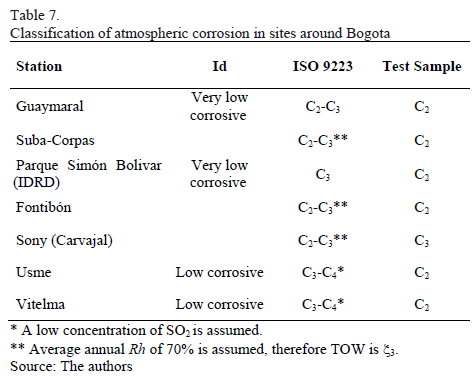
<body><![CDATA[<p align="center"><font size="2" face="Verdana, Arial, Helvetica, sans-serif"><a name="fig08"></a></font><img src="/img/revistas/dyna/v82n190/v82n190a16fig08.gif"></p>     <p><font size="2" face="Verdana, Arial, Helvetica, sans-serif">As we can see in <a href="#tab06">Table 6</a>, the corrosion rates of carbon  steel, during the first year of exposure in different microclimates in Bogota,  are lower than 32 <font face="Symbol">m</font>m.yr<sup>-1</sup>. This proves that, in fact,  aggressiveness in the city's atmosphere is low or medium. Only Carvajal  station, with an industrial microclimate and evidently higher &#91;SO<sub>2</sub>&#93;,  presents corrosion rates associated to category C<sub>3</sub>. The predominant  role of SO<sub>2 </sub>as the main atmospheric pollutant is reconfirmed from  the point of view of material stability, in non-marine environments &#91;23&#93;.</font></p>     <p><font size="2" face="Verdana, Arial, Helvetica, sans-serif">In the case of Suba, Fontib&oacute;n and Autopista Sur stations,  it is interesting to observe that the annual rates of atmospheric corrosion  differ only between 25 and 40 percent compared to values estimated when  applying eq. (3). However, corrosion rates measured in Federm&aacute;n and Restrepo  stations show differences lower than 15 percent compared to rates calculated  with the same eq. (3). A striking difference between the two groups of stations  is associated to the strong differences in the homogeneity of the environment  of the first three stations because of the assumed value <i>Rh</i> for the first three stations and the homogeneity of the  environment in climatological and corrosion stations of the last two stations.</font></p>     <p><font size="2" face="Verdana, Arial, Helvetica, sans-serif">On the other hand, Usme and Pardo Rubio stations, with the  lowest pollution levels, show very low corrosion rates. In the first station,  the rural nature of the area is reaffirmed. In the case of Pardo Rubio, the  impact of a particular topography is clear. Despite being inside the city, the  station is located on top of a mountain, delimiting its Eastern edge and 150m  above the rest of the city. In those stations, their corrosivity, type C<sub>2</sub>,  is lower than the corrosivity estimated from environmental parameters.  Therefore, the limitation of ISO 9223 standard, which has been also identified  by other authors &#91;13, 24&#93;, is reaffirmed in cases whereby even if there are  high <i>Rh</i> and high TOW, pollution  levels are low.</font></p>     <p><font size="2" face="Verdana, Arial, Helvetica, sans-serif">To conclude, atmospheric corrosion of carbon steel in the  city corresponds to low-to-medium corrosivity, according to the results  presented above and listed in <a href="#tab07">table 7</a> using three different methodologies.</font></p>     <p align="center"><font size="2" face="Verdana, Arial, Helvetica, sans-serif"><a name="tab07"></a></font><img src="/img/revistas/dyna/v82n190/v82n190a16tab07.gif"></p>     <p><font size="2" face="Verdana, Arial, Helvetica, sans-serif">Estimations made using Brooks aggressiveness index and ISO  standard, in terms of wetting and pollutant levels, allow us to obtain  approximations of corrosiveness. However, estimations can be undervalued when  they are performed in areas of high relative humidity, such as in the case of  Usme and Vitelma stations. This was stated above.</font></p>     <p>&nbsp;</p>     <p><font size="3" face="Verdana, Arial, Helvetica, sans-serif"><b>4. Conclusions</b></font></p>     <p><font size="2" face="Verdana, Arial, Helvetica, sans-serif">The reported results correspond to the first systematic  study about atmospheric deterioration of materials exposed in Bogota's  atmosphere. Some of the combined peculiarities, mainly high anthropogenic  activity, plus high altitude (closely related with meteorological parameters  such as solar radiation and relative humidity) influence the behavior of  materials and, consequently, expected standard deterioration rates are not  obtained.</font></p>     ]]></body>
<body><![CDATA[<p><font size="2" face="Verdana, Arial, Helvetica, sans-serif">In this sense, corrosion rates estimated according to  Brooks' Index are lower than field measurements. Furthermore, atmospheric  corrosivity estimated according to the ISO 9223 standard, in sites with low  pollution levels and high relative humidity, are higher than the measured ones.  Both cases could be related to the deviation of the standards, due to the atmospheric  peculiarities.</font></p>     <p><font size="2" face="Verdana, Arial, Helvetica, sans-serif">An average atmospheric corrosivity on plain carbon steel,  in Bogota, could range between low and medium levels. The highest values are  usually associated with higher <sub>SO2</sub> levels, and closely to the higher  population and industrial plant concentrations. However, factors such as the  city's geometry could be another influencing factor.</font></p>     <p><font size="2" face="Verdana, Arial, Helvetica, sans-serif">There is a good correlation between the measured  corrosion rates and the dose-response function proposed by Mikhailov.  Consequently, this equation is proposed as a first </font><font size="2" face="Verdana, Arial, Helvetica, sans-serif">step to approach any estimation about life expectation on plain carbon steel  structures used in Bogota.</font></p>     <p><font size="2" face="Verdana, Arial, Helvetica, sans-serif">Low concentrations of well-known pollutants such as SO<sub>2</sub> are not sufficient guarantee of stability for steel or any other material  exposed to an atmosphere like the one studied here. Many other negligible  pollutants could be taking part in complex chemical reactions happening on  material surfaces.</font></p>     <p>&nbsp;</p>     <p><font size="3" face="Verdana, Arial, Helvetica, sans-serif"><b>Acknowledgements</b></font></p>     <p><font size="2" face="Verdana, Arial, Helvetica, sans-serif">The authors acknowledge Antonio Nari&ntilde;o University for the  support given for the development of project No. 2010257. Likewise, the authors  express their gratitude to <i>Secretaría de   Ambiente de Bogota</i> (Bogota Environmental Protection Agency) for providing  meteorological data and pollution levels used in this paper. The authors also  acknowledge the following institutions and companies for allowing them to  locate stations in their facilities: Hilandería Fontib&oacute;n, Almacenes MAKRO,  Hyundai de Colombia, Museo Interactivo MALOKA and CIEDI School.</font></p>     <p>&nbsp;</p>     <p><font size="3" face="Verdana, Arial, Helvetica, sans-serif"><b>References</b></font></p>     <!-- ref --><p><font size="2" face="Verdana, Arial, Helvetica, sans-serif"><b>&#91;1&#93;</b> Feliu, S., Morcillo, M. and Feliu Jr, S. The prediction  of atmospheric corrosion from meteorological and pollution parameters - I.  Annual corrosion. Corrosion Science,  34 (3), pp. 403-414, 1993. <a href="http://dx.doi.org/10.1016/0010-938X(93)90112-T" target="_blank">http://dx.doi.org/10.1016/0010-938X(93)90112-T</a></font>&nbsp;&nbsp;&nbsp;&nbsp;&nbsp;&nbsp;&nbsp;&nbsp;[&#160;<a href="javascript:void(0);" onclick="javascript: window.open('/scielo.php?script=sci_nlinks&ref=000132&pid=S0012-7353201500020001600001&lng=','','width=640,height=500,resizable=yes,scrollbars=1,menubar=yes,');">Links</a>&#160;]<!-- end-ref --><!-- ref --><p><font size="2" face="Verdana, Arial, Helvetica, sans-serif"><b>&#91;2&#93;</b> Kucera, V. Reduction of air pollutants - A tool  for control of atmospheric corrosion. Revista  de Metalurgia (Madrid), (SPEC.VOLUME),  pp. 55-61, 2003. <a href="http://dx.doi.org/10.3989/revmetalm.2003.v39.iExtra.1097" target="_blank">http://dx.doi.org/10.3989/revmetalm.2003.v39.iExtra.1097</a></font>&nbsp;&nbsp;&nbsp;&nbsp;&nbsp;&nbsp;&nbsp;&nbsp;[&#160;<a href="javascript:void(0);" onclick="javascript: window.open('/scielo.php?script=sci_nlinks&ref=000133&pid=S0012-7353201500020001600002&lng=','','width=640,height=500,resizable=yes,scrollbars=1,menubar=yes,');">Links</a>&#160;]<!-- end-ref --><!-- ref --><p><font size="2" face="Verdana, Arial, Helvetica, sans-serif"><b>&#91;3&#93;</b> De la Fuente, D., Vega, J.M., Viejo, F., Díaz, I. and  Morcillo, M. Mapping air pollution effects on atmospheric degradation of  cultural heritage. Journal of  Cultural Heritage, 14 (2), pp. 138-145, 2013.  <a href="http://dx.doi.org/10.1016/j.culher.2012.05.002" target="_blank">http://dx.doi.org/10.1016/j.culher.2012.05.002</a></font>&nbsp;&nbsp;&nbsp;&nbsp;&nbsp;&nbsp;&nbsp;&nbsp;[&#160;<a href="javascript:void(0);" onclick="javascript: window.open('/scielo.php?script=sci_nlinks&ref=000134&pid=S0012-7353201500020001600003&lng=','','width=640,height=500,resizable=yes,scrollbars=1,menubar=yes,');">Links</a>&#160;]<!-- end-ref --><!-- ref --><p><font size="2" face="Verdana, Arial, Helvetica, sans-serif"><b>&#91;4&#93;</b> Vargas, A., Santos, A., C&aacute;rdenas, E.  and Obreg&oacute;n N. An&aacute;lisis de la distribuci&oacute;n e interpolaci&oacute;n espacial de las  lluvias en Bogot&aacute;, Colombia. Revista DYNA, 78 (167), pp. 151-159. 2011.    &nbsp;&nbsp;&nbsp;&nbsp;&nbsp;&nbsp;&nbsp;&nbsp;[&#160;<a href="javascript:void(0);" onclick="javascript: window.open('/scielo.php?script=sci_nlinks&ref=000135&pid=S0012-7353201500020001600004&lng=','','width=640,height=500,resizable=yes,scrollbars=1,menubar=yes,');">Links</a>&#160;]<!-- end-ref --></font></p>     <!-- ref --><p><font size="2" face="Verdana, Arial, Helvetica, sans-serif"><b>&#91;5&#93;</b> N.A.  The century of the city. Nature, 467, pp. 900-901, 2010.  DOI: 10.1038/467900a</font>&nbsp;&nbsp;&nbsp;&nbsp;&nbsp;&nbsp;&nbsp;&nbsp;[&#160;<a href="javascript:void(0);" onclick="javascript: window.open('/scielo.php?script=sci_nlinks&ref=000137&pid=S0012-7353201500020001600005&lng=','','width=640,height=500,resizable=yes,scrollbars=1,menubar=yes,');">Links</a>&#160;]<!-- end-ref --><!-- ref --><p><font size="2" face="Verdana, Arial, Helvetica, sans-serif"><b>&#91;6&#93;</b>    Pineda, S., <i>et. al.</i> Ranking de Ciudades Latinoamericanas para la  Atracci&oacute;n de Inversiones, Informe Oficial. Bogot&aacute;, Universidad del  Rosario - Inteligencia de Negocios, 2012, 49 pp.    &nbsp;&nbsp;&nbsp;&nbsp;&nbsp;&nbsp;&nbsp;&nbsp;[&#160;<a href="javascript:void(0);" onclick="javascript: window.open('/scielo.php?script=sci_nlinks&ref=000138&pid=S0012-7353201500020001600006&lng=','','width=640,height=500,resizable=yes,scrollbars=1,menubar=yes,');">Links</a>&#160;]<!-- end-ref --></font></p>     <!-- ref --><p><font size="2" face="Verdana, Arial, Helvetica, sans-serif"><b>&#91;7&#93;</b>    Oesch, S. The effect of SO<sub>2</sub>, NO<sub>2</sub>,  NO and O<sub>3</sub> on the corrosion of unalloyed carbon steel and weathering  steel - the results of laboratory exposures. Corrosion Science, 38, pp. 1357-1368, 1996. <a href="http://dx.doi.org/10.1016/0010-938X(96)00025-X" target="_blank">http://dx.doi.org/10.1016/0010-938X(96)00025-X</a></font>&nbsp;&nbsp;&nbsp;&nbsp;&nbsp;&nbsp;&nbsp;&nbsp;[&#160;<a href="javascript:void(0);" onclick="javascript: window.open('/scielo.php?script=sci_nlinks&ref=000140&pid=S0012-7353201500020001600007&lng=','','width=640,height=500,resizable=yes,scrollbars=1,menubar=yes,');">Links</a>&#160;]<!-- end-ref --><!-- ref --><p><font size="2" face="Verdana, Arial, Helvetica, sans-serif"><b>&#91;8&#93;</b> Mendoza, A.R. and Corvo, F., Outdoor and indoor  atmospheric corrosion of carbon steel. Corrosion  Science, 41 (1), pp. 75-86, 1999.  <a href="http://dx.doi.org/10.1016/S0010-938X(98)00081-X" target="_blank">http://dx.doi.org/10.1016/S0010-938X(98)00081-X</a></font>&nbsp;&nbsp;&nbsp;&nbsp;&nbsp;&nbsp;&nbsp;&nbsp;[&#160;<a href="javascript:void(0);" onclick="javascript: window.open('/scielo.php?script=sci_nlinks&ref=000141&pid=S0012-7353201500020001600008&lng=','','width=640,height=500,resizable=yes,scrollbars=1,menubar=yes,');">Links</a>&#160;]<!-- end-ref --><!-- ref --><p><font size="2" face="Verdana, Arial, Helvetica, sans-serif"><b>&#91;9&#93;</b> Johan Tidblad, Vladimir Kucera, Alexandre A. Mikhailov,  Jan Henriksen, Katerina Kreislova, Tim Yates, Bruno Stöckle and Manfred  Schreiner. UN ECE ICP Materials: Dose-response functions on dry and wet acid  deposition effects after 8 years of exposure. Water, Air, and Soil Pollution,  130(1-4), pp. 1457-1462, 2001. <a href="http://dx.doi.org/10.1023/a:1013965030909" target="_blank">http://dx.doi.org/10.1023/a:1013965030909</a></font>&nbsp;&nbsp;&nbsp;&nbsp;&nbsp;&nbsp;&nbsp;&nbsp;[&#160;<a href="javascript:void(0);" onclick="javascript: window.open('/scielo.php?script=sci_nlinks&ref=000142&pid=S0012-7353201500020001600009&lng=','','width=640,height=500,resizable=yes,scrollbars=1,menubar=yes,');">Links</a>&#160;]<!-- end-ref --><!-- ref --><p><font size="2" face="Verdana, Arial, Helvetica, sans-serif"><b>&#91;10&#93;</b> Botero  Vega, C.A. Evaluaci&oacute;n de la corrosividad de atm&oacute;sferas colombianas y su impacto  sobre el deterioro de algunos materiales empleados en el sector el&eacute;ctrico,  Medellin, Universidad de Antioquia, 2008, pp. 166.    &nbsp;&nbsp;&nbsp;&nbsp;&nbsp;&nbsp;&nbsp;&nbsp;[&#160;<a href="javascript:void(0);" onclick="javascript: window.open('/scielo.php?script=sci_nlinks&ref=000143&pid=S0012-7353201500020001600010&lng=','','width=640,height=500,resizable=yes,scrollbars=1,menubar=yes,');">Links</a>&#160;]<!-- end-ref --></font></p>     <!-- ref --><p><font size="2" face="Verdana, Arial, Helvetica, sans-serif"><b>&#91;11&#93;</b>   Brooks, C.E.P., Climate in everyday life, Dent,  Londres, 1950.    &nbsp;&nbsp;&nbsp;&nbsp;&nbsp;&nbsp;&nbsp;&nbsp;[&#160;<a href="javascript:void(0);" onclick="javascript: window.open('/scielo.php?script=sci_nlinks&ref=000145&pid=S0012-7353201500020001600011&lng=','','width=640,height=500,resizable=yes,scrollbars=1,menubar=yes,');">Links</a>&#160;]<!-- end-ref --> </font></p>     <!-- ref --><p><font size="2" face="Verdana, Arial, Helvetica, sans-serif"><b>&#91;12&#93;</b>   ISO 9223, Corrosion of metals and alloys, Corrosivity  of atmospheres, Classification, ISO, Geneve, Switzerland, pp. 14, 1992.    &nbsp;&nbsp;&nbsp;&nbsp;&nbsp;&nbsp;&nbsp;&nbsp;[&#160;<a href="javascript:void(0);" onclick="javascript: window.open('/scielo.php?script=sci_nlinks&ref=000147&pid=S0012-7353201500020001600012&lng=','','width=640,height=500,resizable=yes,scrollbars=1,menubar=yes,');">Links</a>&#160;]<!-- end-ref --></font></p>     <!-- ref --><p><font size="2" face="Verdana, Arial, Helvetica, sans-serif"><b>&#91;13&#93;</b> Morcillo, M., Almeida, M.E., M.,  R.B., Uruchurtu, J. and Marrocos, M., Corrosi&oacute;n y Protecci&oacute;n de Metales en las  Atm&oacute;sferas de Iberoam&eacute;rica. Parte  I: Mapa Iberoamericano de Corrosividad Atmosf&eacute;rica, Madrid, 1999.    &nbsp;&nbsp;&nbsp;&nbsp;&nbsp;&nbsp;&nbsp;&nbsp;[&#160;<a href="javascript:void(0);" onclick="javascript: window.open('/scielo.php?script=sci_nlinks&ref=000149&pid=S0012-7353201500020001600013&lng=','','width=640,height=500,resizable=yes,scrollbars=1,menubar=yes,');">Links</a>&#160;]<!-- end-ref --> </font></p>     <!-- ref --><p><font size="2" face="Verdana, Arial, Helvetica, sans-serif"><b>&#91;14&#93;</b>   Tidblad, J., Kucera, V. and Mikhailov, A.A.,  Statistical analysis of 8 year materials exposure and acceptable deterioration  and pollution levels, INSTITUTE, S.C., 1998, pp. 49.    &nbsp;&nbsp;&nbsp;&nbsp;&nbsp;&nbsp;&nbsp;&nbsp;[&#160;<a href="javascript:void(0);" onclick="javascript: window.open('/scielo.php?script=sci_nlinks&ref=000151&pid=S0012-7353201500020001600014&lng=','','width=640,height=500,resizable=yes,scrollbars=1,menubar=yes,');">Links</a>&#160;]<!-- end-ref --></font></p>     ]]></body>
<body><![CDATA[<!-- ref --><p><font size="2" face="Verdana, Arial, Helvetica, sans-serif"><b>&#91;15&#93;</b> Mikhailov, A.A., Tidblad, J. and Kucera, V. The  classification system of ISO 9223 standard and the dose-response functions  assessing the corrosivity of outdoor atmospheres. Protection of Metals, 40 pp. 541-550, 2004.</font> <a href="http://dx.doi.org/10.1023/B:PROM.0000049517.14101.68" target="_blank"><font size="2" face="Verdana, Arial, Helvetica, sans-serif">http://dx.doi.org/10.1023/B:PROM.0000049517.14101.68</font></a>&nbsp;&nbsp;&nbsp;&nbsp;&nbsp;&nbsp;&nbsp;&nbsp;[&#160;<a href="javascript:void(0);" onclick="javascript: window.open('/scielo.php?script=sci_nlinks&ref=000153&pid=S0012-7353201500020001600015&lng=','','width=640,height=500,resizable=yes,scrollbars=1,menubar=yes,');">Links</a>&#160;]<!-- end-ref --><!-- ref --><p><font size="2" face="Verdana, Arial, Helvetica, sans-serif"><b>&#91;16&#93;</b>   ASTM G50, Standard Practice for Conducting Atmospheric  Corrosion Tests on Metals, American Society for Testing and Materials, West  Conshohocken, United States, pp. 5, 2003.    &nbsp;&nbsp;&nbsp;&nbsp;&nbsp;&nbsp;&nbsp;&nbsp;[&#160;<a href="javascript:void(0);" onclick="javascript: window.open('/scielo.php?script=sci_nlinks&ref=000154&pid=S0012-7353201500020001600016&lng=','','width=640,height=500,resizable=yes,scrollbars=1,menubar=yes,');">Links</a>&#160;]<!-- end-ref --></font></p>     <!-- ref --><p><font size="2" face="Verdana, Arial, Helvetica, sans-serif"><b>&#91;17&#93;</b>   EPA. Revisions to Ambient Air Monitoring Regulations,  Final rule. Environmental Protection Agency, Federal Register, 71 (200) pp.  61236-61328, 2006. &#91;Consulta, march 21 of 2011&#93;. Available at:  <a href="http://www.gpo.gov/fdsys/pkg/FR-2006-10-17/pdf/06-8478.pdf" target="_blank">http://www.gpo.gov/fdsys/pkg/FR-2006-10-17/pdf/06-8478.pdf</a></font>&nbsp;&nbsp;&nbsp;&nbsp;&nbsp;&nbsp;&nbsp;&nbsp;[&#160;<a href="javascript:void(0);" onclick="javascript: window.open('/scielo.php?script=sci_nlinks&ref=000156&pid=S0012-7353201500020001600017&lng=','','width=640,height=500,resizable=yes,scrollbars=1,menubar=yes,');">Links</a>&#160;]<!-- end-ref --><!-- ref --><p><font size="2" face="Verdana, Arial, Helvetica, sans-serif"><b>&#91;18&#93;</b> Casta&ntilde;o, J.G., Botero, C.A., Restrepo, A.H., Agudelo,  E.A., Correa, E. and Echeverría, F. Atmospheric corrosion of carbon steel in  Colombia. Corrosion Science, 52 (1),  pp. 216-223, 2010. <a href="http://dx.doi.org/10.1016/j.corsci.2009.09.006" target="_blank">http://dx.doi.org/10.1016/j.corsci.2009.09.006</a></font>&nbsp;&nbsp;&nbsp;&nbsp;&nbsp;&nbsp;&nbsp;&nbsp;[&#160;<a href="javascript:void(0);" onclick="javascript: window.open('/scielo.php?script=sci_nlinks&ref=000157&pid=S0012-7353201500020001600018&lng=','','width=640,height=500,resizable=yes,scrollbars=1,menubar=yes,');">Links</a>&#160;]<!-- end-ref --><!-- ref --><p><font size="2" face="Verdana, Arial, Helvetica, sans-serif"><b>&#91;19&#93;</b>   ASTM D2010, Standard Test Methods for Evaluation of  Total Sulfation Activity in the Atmosphere by the Lead Dioxide Technique,  American Society for Testing and Materials, Pensylvania, United States, pp.  2004.    &nbsp;&nbsp;&nbsp;&nbsp;&nbsp;&nbsp;&nbsp;&nbsp;[&#160;<a href="javascript:void(0);" onclick="javascript: window.open('/scielo.php?script=sci_nlinks&ref=000158&pid=S0012-7353201500020001600019&lng=','','width=640,height=500,resizable=yes,scrollbars=1,menubar=yes,');">Links</a>&#160;]<!-- end-ref --></font></p>     <!-- ref --><p><font size="2" face="Verdana, Arial, Helvetica, sans-serif"><b>&#91;20&#93;</b>   ASTM G1, Standard Practice for Preparing, Cleaning, and  Evaluation Corrosion Test Specimens, American Society for Testing and  Materials, Pensylvania, United States, pp. 5, 1999.    &nbsp;&nbsp;&nbsp;&nbsp;&nbsp;&nbsp;&nbsp;&nbsp;[&#160;<a href="javascript:void(0);" onclick="javascript: window.open('/scielo.php?script=sci_nlinks&ref=000160&pid=S0012-7353201500020001600020&lng=','','width=640,height=500,resizable=yes,scrollbars=1,menubar=yes,');">Links</a>&#160;]<!-- end-ref --></font></p>     <!-- ref --><p><font size="2" face="Verdana, Arial, Helvetica, sans-serif"><b>&#91;21&#93;</b> Feliu,  S. and Morcillo, M. La meteorología en Espa&ntilde;a. An&aacute;lisis de los principales  par&aacute;metros meteorol&oacute;gicos con influencia en los fen&oacute;menos de corrosi&oacute;n, en  Feliu, S. y Morcillo, M., Mapas de Espa&ntilde;a de corrosividad atmosf&eacute;rica, Madrid,  Morcillo, M y Feliu, S, 1993, pp. 11-30.    &nbsp;&nbsp;&nbsp;&nbsp;&nbsp;&nbsp;&nbsp;&nbsp;[&#160;<a href="javascript:void(0);" onclick="javascript: window.open('/scielo.php?script=sci_nlinks&ref=000162&pid=S0012-7353201500020001600021&lng=','','width=640,height=500,resizable=yes,scrollbars=1,menubar=yes,');">Links</a>&#160;]<!-- end-ref --></font></p>     <!-- ref --><p><font size="2" face="Verdana, Arial, Helvetica, sans-serif"><b>&#91;22&#93;</b>   Gujarati, D.N. and Porter, D.C., Basic econometrics,  Fifth edition, McGraw-Hill, 2009, pp. 946.    &nbsp;&nbsp;&nbsp;&nbsp;&nbsp;&nbsp;&nbsp;&nbsp;[&#160;<a href="javascript:void(0);" onclick="javascript: window.open('/scielo.php?script=sci_nlinks&ref=000164&pid=S0012-7353201500020001600022&lng=','','width=640,height=500,resizable=yes,scrollbars=1,menubar=yes,');">Links</a>&#160;]<!-- end-ref --></font></p>     <!-- ref --><p><font size="2" face="Verdana, Arial, Helvetica, sans-serif"><b>&#91;23&#93;</b>   Matsushima, I. Carbon Steel - Atmospheric Corrosion, in  R. Winston Revie (Editor), Uhlig's Corrosion Handbook, 2<sup>nd</sup> edition,  New Jersey, John Wiley &amp; Sons, Inc., 2000, pp. 515-528.    &nbsp;&nbsp;&nbsp;&nbsp;&nbsp;&nbsp;&nbsp;&nbsp;[&#160;<a href="javascript:void(0);" onclick="javascript: window.open('/scielo.php?script=sci_nlinks&ref=000166&pid=S0012-7353201500020001600023&lng=','','width=640,height=500,resizable=yes,scrollbars=1,menubar=yes,');">Links</a>&#160;]<!-- end-ref --></font></p>     <!-- ref --><p><font size="2" face="Verdana, Arial, Helvetica, sans-serif"><b>&#91;24&#93;</b> Santana Rodríguez, J.J., Santana Hern&aacute;ndez, F.J. and  Gonz&aacute;lez Gonz&aacute;lez, J.E. The effect of environmental and meteorological  variables on atmospheric corrosion of carbon steel, copper, zinc and aluminium  in a limited geographic zone with different types of environment. Corrosion Science, 45, pp. 799-815,  2003. <a href="http://dx.doi.org/10.1016/S0010-938X(02)00081-1" target="_blank">http://dx.doi.org/10.1016/S0010-938X(02)00081-1</a></font>&nbsp;&nbsp;&nbsp;&nbsp;&nbsp;&nbsp;&nbsp;&nbsp;[&#160;<a href="javascript:void(0);" onclick="javascript: window.open('/scielo.php?script=sci_nlinks&ref=000168&pid=S0012-7353201500020001600024&lng=','','width=640,height=500,resizable=yes,scrollbars=1,menubar=yes,');">Links</a>&#160;]<!-- end-ref --><p>&nbsp;</p>     <p><font size="2" face="Verdana, Arial, Helvetica, sans-serif"><b>J. F. Ríos-Rojas</b> graduated as a Chemical Engineer in 2004 and completed his PhD degree in  Engineering in 2012, both from the Universidad de Antioquia, in Medellín -  Colombia. Currently, he is an Assistant Professor in the Mechanical Engineering  School and researcher in the Group of Research in Energy and Materials at  Universidad Antonio Nari&ntilde;o (Bogot&aacute; - Colombia). His main subjects of interests  in R&amp;D are atmospheric corrosion, aqueous corrosion and protective  coatings.</font></p>     <p><font size="2" face="Verdana, Arial, Helvetica, sans-serif"><b>D.  Escobar-Ocampo,</b> Environmental and Sanitary Engineer from La Salle  University, Specialist in Geographic Information Systems from the Francisco  Jos&eacute; de Caldas University and candidate to a master in Engineering from the  National University of Colombia. Currently serves as a specialized professional  with the chemicals, hazardous waste and ozone technical unit (OTU) at the  Environment and Development Ministry in Colombia. </font></p>     <p><font size="2" face="Verdana, Arial, Helvetica, sans-serif"><b>E. A.  Hern&aacute;ndez-Garcia,</b> graduated as an  Economist and is candidate to a Master of Science Applied Mathematics, both  from the National University in Bogot&aacute; - Colombia. Since 2010, he has been an  Assistant Professor and researcher at the Universidad Antonio Nari&ntilde;o. </font></p>     ]]></body>
<body><![CDATA[<p><font size="2" face="Verdana, Arial, Helvetica, sans-serif"><b>C. Arroyave </b>graduated  as a Metallurgical Engineer from the Universidad de Antioquia, in Medellin  (Colombia, 1979). He obtained a M.Sc. in Metallurgical Engineering and  Materials Science (1989) from the Universidade Federal do Rio de Janeiro  (Brazil); and has a Ph.D. in Chemical Science (1995) from the Universidad Complutense  de Madrid (Spain). He spent a postdoctoral stay from 2001 to 2002 at the  Swedish Corrosion Institute. He was member of the faculty of the Department of  Metallurgical Engineering from 1979 to 2008, and Dean of the School of  Engineering of the Universidad de Antioquia, from 2004 to 2007. He was  distinguished as Titular and Emeritus Professor of the Universidad de  Antioquia. Since 2010, he has been the Vice-Chancellor for Science, Technology  and Innovation of the Antonio Nari&ntilde;o University. His main subjects of interests  in R&amp;D are atmospheric corrosion, protective coatings, weathering steels,  and iron oxides.</font></p>      ]]></body><back>
<ref-list>
<ref id="B1">
<label>1</label><nlm-citation citation-type="journal">
<person-group person-group-type="author">
<name>
<surname><![CDATA[Feliu]]></surname>
<given-names><![CDATA[S.]]></given-names>
</name>
<name>
<surname><![CDATA[Morcillo]]></surname>
<given-names><![CDATA[M.]]></given-names>
</name>
<name>
<surname><![CDATA[Feliu Jr]]></surname>
<given-names><![CDATA[S.]]></given-names>
</name>
</person-group>
<article-title xml:lang="en"><![CDATA[The prediction of atmospheric corrosion from meteorological and pollution parameters - I]]></article-title>
<source><![CDATA[Annual corrosion. Corrosion Science]]></source>
<year>1993</year>
<volume>34</volume>
<numero>3</numero>
<issue>3</issue>
<page-range>403-414</page-range></nlm-citation>
</ref>
<ref id="B2">
<label>2</label><nlm-citation citation-type="journal">
<person-group person-group-type="author">
<name>
<surname><![CDATA[Kucera]]></surname>
<given-names><![CDATA[V.]]></given-names>
</name>
</person-group>
<article-title xml:lang="en"><![CDATA[Reduction of air pollutants: A tool for control of atmospheric corrosion]]></article-title>
<source><![CDATA[Revista de Metalurgia]]></source>
<year>2003</year>
<page-range>55-61</page-range></nlm-citation>
</ref>
<ref id="B3">
<label>3</label><nlm-citation citation-type="journal">
<person-group person-group-type="author">
<name>
<surname><![CDATA[De la Fuente]]></surname>
<given-names><![CDATA[D.]]></given-names>
</name>
<name>
<surname><![CDATA[Vega]]></surname>
<given-names><![CDATA[J.M.]]></given-names>
</name>
<name>
<surname><![CDATA[Viejo]]></surname>
<given-names><![CDATA[F.]]></given-names>
</name>
<name>
<surname><![CDATA[Díaz]]></surname>
<given-names><![CDATA[I.]]></given-names>
</name>
<name>
<surname><![CDATA[Morcillo]]></surname>
<given-names><![CDATA[M.]]></given-names>
</name>
</person-group>
<article-title xml:lang="en"><![CDATA[Mapping air pollution effects on atmospheric degradation of cultural heritage]]></article-title>
<source><![CDATA[Journal of Cultural Heritage]]></source>
<year>2013</year>
<volume>14</volume>
<numero>2</numero>
<issue>2</issue>
<page-range>138-145</page-range></nlm-citation>
</ref>
<ref id="B4">
<label>4</label><nlm-citation citation-type="journal">
<person-group person-group-type="author">
<name>
<surname><![CDATA[Vargas]]></surname>
<given-names><![CDATA[A.]]></given-names>
</name>
<name>
<surname><![CDATA[Santos]]></surname>
<given-names><![CDATA[A.]]></given-names>
</name>
<name>
<surname><![CDATA[Cárdenas]]></surname>
<given-names><![CDATA[E.]]></given-names>
</name>
<name>
<surname><![CDATA[Obregón]]></surname>
<given-names><![CDATA[N.]]></given-names>
</name>
</person-group>
<article-title xml:lang="es"><![CDATA[Análisis de la distribución e interpolación espacial de las lluvias en Bogotá, Colombia]]></article-title>
<source><![CDATA[Revista DYNA]]></source>
<year>2011</year>
<volume>78</volume>
<numero>167</numero>
<issue>167</issue>
<page-range>151-159</page-range></nlm-citation>
</ref>
<ref id="B5">
<label>5</label><nlm-citation citation-type="journal">
<article-title xml:lang="en"><![CDATA[The century of the city]]></article-title>
<source><![CDATA[Nature]]></source>
<year>2010</year>
<numero>467</numero>
<issue>467</issue>
<page-range>900-901</page-range></nlm-citation>
</ref>
<ref id="B6">
<label>6</label><nlm-citation citation-type="book">
<person-group person-group-type="author">
<name>
<surname><![CDATA[Pineda]]></surname>
<given-names><![CDATA[S.]]></given-names>
</name>
</person-group>
<source><![CDATA[Ranking de Ciudades Latinoamericanas para la Atracción de Inversiones: Informe Oficial]]></source>
<year>2012</year>
<publisher-loc><![CDATA[Bogotá ]]></publisher-loc>
<publisher-name><![CDATA[Universidad del Rosario]]></publisher-name>
</nlm-citation>
</ref>
<ref id="B7">
<label>7</label><nlm-citation citation-type="journal">
<person-group person-group-type="author">
<name>
<surname><![CDATA[Oesch]]></surname>
<given-names><![CDATA[S.]]></given-names>
</name>
</person-group>
<article-title xml:lang="en"><![CDATA[The effect of SO2, NO2, NO and O3 on the corrosion of unalloyed carbon steel and weathering steel: the results of laboratory exposures]]></article-title>
<source><![CDATA[Corrosion Science]]></source>
<year>1996</year>
<numero>38</numero>
<issue>38</issue>
<page-range>1357-1368</page-range></nlm-citation>
</ref>
<ref id="B8">
<label>8</label><nlm-citation citation-type="journal">
<person-group person-group-type="author">
<name>
<surname><![CDATA[Mendoza]]></surname>
<given-names><![CDATA[A.R.]]></given-names>
</name>
<name>
<surname><![CDATA[Corvo]]></surname>
<given-names><![CDATA[F.]]></given-names>
</name>
</person-group>
<article-title xml:lang="en"><![CDATA[Outdoor and indoor atmospheric corrosion of carbon steel]]></article-title>
<source><![CDATA[Corrosion Science]]></source>
<year>1999</year>
<volume>41</volume>
<numero>1</numero>
<issue>1</issue>
<page-range>75-86</page-range></nlm-citation>
</ref>
<ref id="B9">
<label>9</label><nlm-citation citation-type="journal">
<person-group person-group-type="author">
<name>
<surname><![CDATA[Tidblad]]></surname>
<given-names><![CDATA[Johan]]></given-names>
</name>
<name>
<surname><![CDATA[Kucera]]></surname>
<given-names><![CDATA[Vladimir]]></given-names>
</name>
<name>
<surname><![CDATA[Mikhailov]]></surname>
<given-names><![CDATA[Alexandre A.]]></given-names>
</name>
<name>
<surname><![CDATA[Henriksen]]></surname>
<given-names><![CDATA[Jan]]></given-names>
</name>
<name>
<surname><![CDATA[Kreislova]]></surname>
<given-names><![CDATA[Katerina]]></given-names>
</name>
<name>
<surname><![CDATA[Yates]]></surname>
<given-names><![CDATA[Tim]]></given-names>
</name>
<name>
<surname><![CDATA[Stöckle]]></surname>
<given-names><![CDATA[Bruno]]></given-names>
</name>
<name>
<surname><![CDATA[Schreiner]]></surname>
<given-names><![CDATA[Manfred]]></given-names>
</name>
</person-group>
<article-title xml:lang="en"><![CDATA[UN ECE ICP Materials: Dose-response functions on dry and wet acid deposition effects after 8 years of exposure]]></article-title>
<source><![CDATA[Water, Air, and Soil Pollution]]></source>
<year>2001</year>
<volume>130</volume>
<numero>1-4</numero>
<issue>1-4</issue>
<page-range>1457-1462</page-range></nlm-citation>
</ref>
<ref id="B10">
<label>10</label><nlm-citation citation-type="book">
<person-group person-group-type="author">
<name>
<surname><![CDATA[Botero Vega]]></surname>
<given-names><![CDATA[C.A.]]></given-names>
</name>
</person-group>
<source><![CDATA[Evaluación de la corrosividad de atmósferas colombianas y su impacto sobre el deterioro de algunos materiales empleados en el sector eléctrico]]></source>
<year>2008</year>
<publisher-loc><![CDATA[Medellin ]]></publisher-loc>
<publisher-name><![CDATA[Universidad de Antioquia]]></publisher-name>
</nlm-citation>
</ref>
<ref id="B11">
<label>11</label><nlm-citation citation-type="book">
<person-group person-group-type="author">
<name>
<surname><![CDATA[Brooks]]></surname>
<given-names><![CDATA[C.E.P.]]></given-names>
</name>
</person-group>
<source><![CDATA[Climate in everyday life]]></source>
<year>1950</year>
<publisher-loc><![CDATA[Londres ]]></publisher-loc>
<publisher-name><![CDATA[Dent]]></publisher-name>
</nlm-citation>
</ref>
<ref id="B12">
<label>12</label><nlm-citation citation-type="book">
<source><![CDATA[ISO 9223: Corrosion of metals and alloys, Corrosivity of atmospheres, Classification]]></source>
<year>1992</year>
<publisher-loc><![CDATA[Geneve ]]></publisher-loc>
<publisher-name><![CDATA[ISO]]></publisher-name>
</nlm-citation>
</ref>
<ref id="B13">
<label>13</label><nlm-citation citation-type="">
<person-group person-group-type="author">
<name>
<surname><![CDATA[Morcillo]]></surname>
<given-names><![CDATA[M.]]></given-names>
</name>
<name>
<surname><![CDATA[Almeida]]></surname>
<given-names><![CDATA[M.E.]]></given-names>
</name>
<name>
<surname><![CDATA[Uruchurtu]]></surname>
<given-names><![CDATA[J.]]></given-names>
</name>
<name>
<surname><![CDATA[Marrocos]]></surname>
<given-names><![CDATA[M.]]></given-names>
</name>
</person-group>
<source><![CDATA[Corrosión y Protección de Metales en las Atmósferas de Iberoamérica: Parte I: Mapa Iberoamericano de Corrosividad Atmosférica]]></source>
<year>1999</year>
<publisher-loc><![CDATA[Madrid ]]></publisher-loc>
</nlm-citation>
</ref>
<ref id="B14">
<label>14</label><nlm-citation citation-type="book">
<person-group person-group-type="author">
<name>
<surname><![CDATA[Tidblad]]></surname>
<given-names><![CDATA[J.]]></given-names>
</name>
<name>
<surname><![CDATA[Kucera]]></surname>
<given-names><![CDATA[V.]]></given-names>
</name>
<name>
<surname><![CDATA[Mikhailov]]></surname>
<given-names><![CDATA[A.A.]]></given-names>
</name>
</person-group>
<source><![CDATA[Statistical analysis of 8 year materials exposure and acceptable deterioration and pollution levels]]></source>
<year>1998</year>
<publisher-name><![CDATA[INSTITUTE]]></publisher-name>
</nlm-citation>
</ref>
<ref id="B15">
<label>15</label><nlm-citation citation-type="journal">
<person-group person-group-type="author">
<name>
<surname><![CDATA[Mikhailov]]></surname>
<given-names><![CDATA[A.A.]]></given-names>
</name>
<name>
<surname><![CDATA[Tidblad]]></surname>
<given-names><![CDATA[J.]]></given-names>
</name>
<name>
<surname><![CDATA[Kucera]]></surname>
<given-names><![CDATA[V.]]></given-names>
</name>
</person-group>
<article-title xml:lang="en"><![CDATA[The classification system of ISO 9223 standard and the dose-response functions assessing the corrosivity of outdoor atmospheres]]></article-title>
<source><![CDATA[Protection of Metals]]></source>
<year>2004</year>
<numero>40</numero>
<issue>40</issue>
<page-range>541-550</page-range></nlm-citation>
</ref>
<ref id="B16">
<label>16</label><nlm-citation citation-type="book">
<source><![CDATA[ASTM G50: Standard Practice for Conducting Atmospheric Corrosion Tests on Metals]]></source>
<year>2003</year>
<publisher-loc><![CDATA[West Conshohocken ]]></publisher-loc>
<publisher-name><![CDATA[American Society for Testing and Materials]]></publisher-name>
</nlm-citation>
</ref>
<ref id="B17">
<label>17</label><nlm-citation citation-type="">
<collab>EPA</collab>
<collab>Environmental Protection Agency</collab>
<source><![CDATA[Revisions to Ambient Air Monitoring Regulations: Final rule]]></source>
<year>2006</year>
<page-range>61236-61328</page-range></nlm-citation>
</ref>
<ref id="B18">
<label>18</label><nlm-citation citation-type="journal">
<person-group person-group-type="author">
<name>
<surname><![CDATA[Castaño]]></surname>
<given-names><![CDATA[J.G.]]></given-names>
</name>
<name>
<surname><![CDATA[Botero]]></surname>
<given-names><![CDATA[C.A.]]></given-names>
</name>
<name>
<surname><![CDATA[Restrepo]]></surname>
<given-names><![CDATA[A.H.]]></given-names>
</name>
<name>
<surname><![CDATA[Agudelo]]></surname>
<given-names><![CDATA[E.A.]]></given-names>
</name>
<name>
<surname><![CDATA[Correa]]></surname>
<given-names><![CDATA[E.]]></given-names>
</name>
<name>
<surname><![CDATA[Echeverría]]></surname>
<given-names><![CDATA[F.]]></given-names>
</name>
</person-group>
<article-title xml:lang="en"><![CDATA[Atmospheric corrosion of carbon steel in Colombia]]></article-title>
<source><![CDATA[Corrosion Science]]></source>
<year>2010</year>
<volume>52</volume>
<numero>1</numero>
<issue>1</issue>
<page-range>216-223</page-range></nlm-citation>
</ref>
<ref id="B19">
<label>19</label><nlm-citation citation-type="book">
<source><![CDATA[ASTM D2010: Standard Test Methods for Evaluation of Total Sulfation Activity in the Atmosphere by the Lead Dioxide Technique]]></source>
<year>2004</year>
<publisher-loc><![CDATA[Pensylvania ]]></publisher-loc>
<publisher-name><![CDATA[American Society for Testing and MaterialsUnited States]]></publisher-name>
</nlm-citation>
</ref>
<ref id="B20">
<label>20</label><nlm-citation citation-type="book">
<source><![CDATA[ASTM G1: Standard Practice for Preparing, Cleaning, and Evaluation Corrosion Test Specimens]]></source>
<year>1999</year>
<publisher-loc><![CDATA[Pensylvania ]]></publisher-loc>
<publisher-name><![CDATA[American Society for Testing and Materials]]></publisher-name>
</nlm-citation>
</ref>
<ref id="B21">
<label>21</label><nlm-citation citation-type="">
<person-group person-group-type="author">
<name>
<surname><![CDATA[Feliu]]></surname>
<given-names><![CDATA[S.]]></given-names>
</name>
<name>
<surname><![CDATA[Morcillo]]></surname>
<given-names><![CDATA[M.]]></given-names>
</name>
</person-group>
<article-title xml:lang="es"><![CDATA[La meteorología en España: Análisis de los principales parámetros meteorológicos con influencia en los fenómenos de corrosión]]></article-title>
<person-group person-group-type="editor">
<name>
<surname><![CDATA[Feliu]]></surname>
<given-names><![CDATA[S.]]></given-names>
</name>
<name>
<surname><![CDATA[Morcillo]]></surname>
<given-names><![CDATA[M.]]></given-names>
</name>
</person-group>
<source><![CDATA[Mapas de España de corrosividad atmosférica]]></source>
<year>1993</year>
<page-range>11-30</page-range></nlm-citation>
</ref>
<ref id="B22">
<label>22</label><nlm-citation citation-type="book">
<person-group person-group-type="author">
<name>
<surname><![CDATA[Gujarati]]></surname>
<given-names><![CDATA[D.N.]]></given-names>
</name>
<name>
<surname><![CDATA[Porter]]></surname>
<given-names><![CDATA[D.C.]]></given-names>
</name>
</person-group>
<source><![CDATA[Basic econometrics]]></source>
<year>2009</year>
<edition>Fifth</edition>
<publisher-name><![CDATA[McGraw-Hill]]></publisher-name>
</nlm-citation>
</ref>
<ref id="B23">
<label>23</label><nlm-citation citation-type="book">
<person-group person-group-type="author">
<name>
<surname><![CDATA[Matsushima]]></surname>
<given-names><![CDATA[I.]]></given-names>
</name>
</person-group>
<article-title xml:lang="en"><![CDATA[Carbon Steel: Atmospheric Corrosion]]></article-title>
<person-group person-group-type="editor">
<name>
<surname><![CDATA[Winston Revie]]></surname>
<given-names><![CDATA[R.]]></given-names>
</name>
</person-group>
<source><![CDATA[Uhlig's Corrosion Handbook]]></source>
<year>2000</year>
<edition>2nd</edition>
<page-range>515-528</page-range><publisher-loc><![CDATA[New Jersey ]]></publisher-loc>
<publisher-name><![CDATA[John Wiley & Sons, Inc.]]></publisher-name>
</nlm-citation>
</ref>
<ref id="B24">
<label>24</label><nlm-citation citation-type="journal">
<person-group person-group-type="author">
<name>
<surname><![CDATA[Santana Rodríguez]]></surname>
<given-names><![CDATA[J.J.]]></given-names>
</name>
<name>
<surname><![CDATA[Santana Hernández]]></surname>
<given-names><![CDATA[F.J.]]></given-names>
</name>
<name>
<surname><![CDATA[González González]]></surname>
<given-names><![CDATA[J.E.]]></given-names>
</name>
</person-group>
<article-title xml:lang="en"><![CDATA[The effect of environmental and meteorological variables on atmospheric corrosion of carbon steel, copper, zinc and aluminium in a limited geographic zone with different types of environment]]></article-title>
<source><![CDATA[Corrosion Science]]></source>
<year>2003</year>
<numero>45</numero>
<issue>45</issue>
<page-range>799-815</page-range></nlm-citation>
</ref>
</ref-list>
</back>
</article>