<?xml version="1.0" encoding="ISO-8859-1"?><article xmlns:mml="http://www.w3.org/1998/Math/MathML" xmlns:xlink="http://www.w3.org/1999/xlink" xmlns:xsi="http://www.w3.org/2001/XMLSchema-instance">
<front>
<journal-meta>
<journal-id>0012-7353</journal-id>
<journal-title><![CDATA[DYNA]]></journal-title>
<abbrev-journal-title><![CDATA[Dyna rev.fac.nac.minas]]></abbrev-journal-title>
<issn>0012-7353</issn>
<publisher>
<publisher-name><![CDATA[Universidad Nacional de Colombia]]></publisher-name>
</publisher>
</journal-meta>
<article-meta>
<article-id>S0012-73532015000200017</article-id>
<article-id pub-id-type="doi">10.15446/dyna.v82n190.43652</article-id>
<title-group>
<article-title xml:lang="en"><![CDATA[Electricity consumption forecasting using singular spectrum analysis]]></article-title>
<article-title xml:lang="es"><![CDATA[Previsión del consumo de electricidad mediante análisis espectral singular]]></article-title>
</title-group>
<contrib-group>
<contrib contrib-type="author">
<name>
<surname><![CDATA[Lima de Menezes]]></surname>
<given-names><![CDATA[Moisés]]></given-names>
</name>
<xref ref-type="aff" rid="A01"/>
</contrib>
<contrib contrib-type="author">
<name>
<surname><![CDATA[Castro Souza]]></surname>
<given-names><![CDATA[Reinaldo]]></given-names>
</name>
<xref ref-type="aff" rid="A02"/>
</contrib>
<contrib contrib-type="author">
<name>
<surname><![CDATA[Moreira Pessanha]]></surname>
<given-names><![CDATA[José Francisco]]></given-names>
</name>
<xref ref-type="aff" rid="A03"/>
</contrib>
</contrib-group>
<aff id="A01">
<institution><![CDATA[,Fluminense Federal University Statistics Dept ]]></institution>
<addr-line><![CDATA[Niterói ]]></addr-line>
<country>Brazil</country>
</aff>
<aff id="A02">
<institution><![CDATA[,Pontifical Catholic University of Rio de Janeiro Electrical Engineering Dept ]]></institution>
<addr-line><![CDATA[Rio de Janeiro ]]></addr-line>
<country>Brazil</country>
</aff>
<aff id="A03">
<institution><![CDATA[,State University of Rio de Janeiro Institute of Mathematics and Statistics ]]></institution>
<addr-line><![CDATA[Rio de Janeiro ]]></addr-line>
<country>Brazil</country>
</aff>
<pub-date pub-type="pub">
<day>00</day>
<month>04</month>
<year>2015</year>
</pub-date>
<pub-date pub-type="epub">
<day>00</day>
<month>04</month>
<year>2015</year>
</pub-date>
<volume>82</volume>
<numero>190</numero>
<fpage>138</fpage>
<lpage>146</lpage>
<copyright-statement/>
<copyright-year/>
<self-uri xlink:href="http://www.scielo.org.co/scielo.php?script=sci_arttext&amp;pid=S0012-73532015000200017&amp;lng=en&amp;nrm=iso"></self-uri><self-uri xlink:href="http://www.scielo.org.co/scielo.php?script=sci_abstract&amp;pid=S0012-73532015000200017&amp;lng=en&amp;nrm=iso"></self-uri><self-uri xlink:href="http://www.scielo.org.co/scielo.php?script=sci_pdf&amp;pid=S0012-73532015000200017&amp;lng=en&amp;nrm=iso"></self-uri><abstract abstract-type="short" xml:lang="en"><p><![CDATA[Singular Spectrum Analysis (SSA) is a non-parametric technique that allows the decomposition of a time series into signal and noise. Thus, it is a useful technique to trend extraction, smooth and filter a time series. The effect on performance of both Box and Jenkins' and Holt-Winters models when applied to the time series filtered by SSA is investigated in this paper. Three different methodologies are evaluated in the SSA approach: Principal Component Analysis (PCA), Cluster Analysis and Graphical Analysis of Singular Vectors. In order to illustrate and compare the methodologies, in this paper, we also present the main results of a computational experiment with the monthly residential consumption of electricity in Brazil.]]></p></abstract>
<abstract abstract-type="short" xml:lang="es"><p><![CDATA[El Análisis Espectral Singular (AES) es una técnica no paramétrica que permite la descomposición de una serie de tiempo en una componente de señal y otra de ruido. De este modo, AES es una técnica útil para la extracción de la tendencia, la suavización y el filtro una serie de tiempo. En este artículo se investiga el efecto sobre el desempeño los modelos de Holt-Winters y de Box & Jenkins al ser aplicados a una serie de tiempo filtrada por AES. Tres diferentes metodologías son evaluadas con el enfoque de AES: Análisis de Componentes Principales (ACP), análisis de conglomerados y análisis gráfico de vectores singulares. Con el fin de ilustrar y comparar dichas metodologías, en este trabajo también se presentaron los principales resultados de un experimento computacional para el consumo residencial mensual de electricidad en Brasil.]]></p></abstract>
<kwd-group>
<kwd lng="en"><![CDATA[electricity consumption forecasting]]></kwd>
<kwd lng="en"><![CDATA[singular spectrum analysis]]></kwd>
<kwd lng="en"><![CDATA[time series]]></kwd>
<kwd lng="en"><![CDATA[power system planning]]></kwd>
<kwd lng="es"><![CDATA[pronóstico del consumo de electricidad]]></kwd>
<kwd lng="es"><![CDATA[análisis espectral singular]]></kwd>
<kwd lng="es"><![CDATA[serie de tiempo]]></kwd>
<kwd lng="es"><![CDATA[planeamiento del sistema eléctrico]]></kwd>
</kwd-group>
</article-meta>
</front><body><![CDATA[ <p><font size="1" face="Verdana, Arial, Helvetica, sans-serif"><b>DOI:</b> <a href="http://dx.doi.org/10.15446/dyna.v82n190.43652" target="_blank">http://dx.doi.org/10.15446/dyna.v82n190.43652</a></font></p>     <p align="center"><font size="4" face="Verdana, Arial, Helvetica, sans-serif"><b>Electricity consumption forecasting using singular  spectrum analysis</b></font></p>     <p align="center"><i><font size="3"><b><font face="Verdana, Arial, Helvetica, sans-serif">Previsi&oacute;n del consumo de electricidad mediante an&aacute;lisis espectral singular</font></b></font></i></p>     <p align="center">&nbsp;</p>     <p align="center"><b><font size="2" face="Verdana, Arial, Helvetica, sans-serif">Mois&eacute;s   Lima de Menezes <i><sup>a</sup></i>,   Reinaldo Castro Souza <i><sup>b</sup></i> &amp; Jos&eacute; Francisco Moreira Pessanha <i><sup>c</sup></i></font></b></p>     <p align="center">&nbsp;</p>     <p align="center"><font size="2" face="Verdana, Arial, Helvetica, sans-serif"><sup><i>a </i></sup><i>Statistics Dept, Fluminense Federal University,   Niter&oacute;i, Brazil. <a href="mailto:moises_lima@msn.com">moises_lima@msn.com</a>    <br>   <sup>b </sup>Electrical  Engineering Dept, Pontifical Catholic University of Rio de Janeiro, Rio de  Janeiro, Brazil. <a href="mailto:Reinaldo@ele.puc-rio.br">Reinaldo@ele.puc-rio.br</a>    <br>  <sup>c </sup>Institute of  Mathematics and Statistics, State University of Rio de Janeiro, Rio de Janeiro,  Brazil. <a href="mailto: professorjfmp@hotmail.com">professorjfmp@hotmail.com</a></i></font></p>     <p align="center">&nbsp;</p>     ]]></body>
<body><![CDATA[<p align="center"><font size="2" face="Verdana, Arial, Helvetica, sans-serif"><b>Received: May 24<sup>th</sup>, 2014. Received in revised  form: December 1<sup>st</sup>, 2014. Accepted: December 12<sup>th</sup>, 2014.</b></font></p>     <p align="center">&nbsp;</p>     <p align="center"><font size="1" face="Verdana, Arial, Helvetica, sans-seriff"><b>This work is licensed under a</b> <a rel="license" href="http://creativecommons.org/licenses/by-nc-nd/4.0/">Creative Commons Attribution-NonCommercial-NoDerivatives 4.0 International License</a>.</font><br /><a rel="license" href="http://creativecommons.org/licenses/by-nc-nd/4.0/"><img style="border-width:0" src="https://i.creativecommons.org/l/by-nc-nd/4.0/88x31.png" /></a></p> <hr>     <p><font size="2" face="Verdana, Arial, Helvetica, sans-serif"><b>Abstract    <br> </b></font><font size="2" face="Verdana, Arial, Helvetica, sans-serif">Singular Spectrum  Analysis (SSA) is a non-parametric technique that allows the decomposition of a  time series into signal and noise. Thus, it is a useful technique to trend  extraction, smooth and filter a time series. The effect on performance of both  Box and Jenkins' and Holt-Winters models when applied to the time series  filtered by SSA is investigated in this paper. Three different methodologies are evaluated in the SSA approach: Principal Component Analysis (PCA), Cluster Analysis and Graphical  Analysis of Singular Vectors. In order to illustrate and compare the methodologies, in  this paper, we also present the  main results of a computational experiment with the monthly residential consumption of electricity in Brazil.</font></p>     <p><font size="2" face="Verdana, Arial, Helvetica, sans-serif"><i>Keywords</i>: electricity  consumption forecasting, singular spectrum analysis, time series, power system  planning.</font></p>     <p><font size="2" face="Verdana, Arial, Helvetica, sans-serif"><b>Resumen    <br> </b></font><font size="2" face="Verdana, Arial, Helvetica, sans-serif">El An&aacute;lisis Espectral Singular (AES) es una t&eacute;cnica no param&eacute;trica que  permite la descomposici&oacute;n de una serie de tiempo en una componente de se&ntilde;al y  otra de ruido. De este modo, AES es una t&eacute;cnica &uacute;til para la extracci&oacute;n de la  tendencia, la suavizaci&oacute;n y el filtro una serie de tiempo. En este artículo se  investiga el efecto sobre el desempe&ntilde;o los modelos de Holt-Winters y de Box  &amp; Jenkins al ser aplicados a una serie de tiempo filtrada por AES. Tres  diferentes metodologías son evaluadas con el enfoque de AES: An&aacute;lisis de  Componentes Principales (ACP), an&aacute;lisis de conglomerados y an&aacute;lisis gr&aacute;fico de  vectores singulares. Con el fin de ilustrar y comparar dichas metodologías, en  este trabajo tambi&eacute;n se presentaron los principales resultados de un  experimento computacional para el consumo residencial mensual de electricidad en Brasil.</font></p>     <p><font size="2" face="Verdana, Arial, Helvetica, sans-serif"><i>Palabras clave</i>: pron&oacute;stico del consumo de electricidad, an&aacute;lisis  espectral singular, serie de tiempo, planeamiento del sistema el&eacute;ctrico.</font></p> <hr>     <p>&nbsp;</p>     ]]></body>
<body><![CDATA[<p><font size="3" face="Verdana, Arial, Helvetica, sans-serif"><b>1. Introduction</b></font></p>     <p><font size="2" face="Verdana, Arial, Helvetica, sans-serif">Load forecast is a  requisite to all decision-making processes in the power systems operation and  planning &#91;1&#93;. Traditionally, the load forecasts are classified in three time  periods: short-term (usually half-hourly, hourly and daily forecasts up to 1  month ahead), mid-term (1 month - 5 years ahead) and long-term (5 years  onwards). The short-term load forecasting &#91;2,3&#93; is important for the daily  operation (unit commitment). The mid-term load forecasting is essential to the  maintenance scheduling, hydro resources management, schedule fuel purchases,  tariff setting and energy trading &#91;4&#93;. The long-term load forecasting signals  the need to expand the capacity of the generation and transmission systems &#91;1&#93;. </font></p>     <p><font size="2" face="Verdana, Arial, Helvetica, sans-serif">In the Brazilian  electricity market, energy trading is realized through auctions where the  generators compete in order to meet the demand growth at the lowest price. The  auctions procedure starts with the mid/long-term monthly demand forecasts  provided by the distribution utilities and ends with the energy contracts  agreed between all distributors and each generator that wins the auction &#91;5&#93;.  The energy contracting occurs one, three or five years before supply starts  with contracts lasting from five to thirty years &#91;6&#93;. Therefore, the mid-term  electricity consumption forecasts play a fundamental role in the energy  auctions. The demand for electricity can be divided into several groups:  residential, commercial, industrial, rural and miscellaneous. These groups grow  at different rates, thus each group must be forecast separately &#91;1&#93;.</font></p>     <p><font size="2" face="Verdana, Arial, Helvetica, sans-serif">Traditionally, Box &amp; Jenkins and the multiple linear  regression models have been considered in mid-term electricity consumption  forecasting &#91;1,4,7&#93;. Despite the good results obtained by these methods,  efforts have been made to improve them &#91;4,8, 9&#93;. One way to improve the  performance of the mid-term forecasting methods consists in filtering the time  series data &#91;4,10&#93;. Among the available methods able to extract the signal  component from a time series, the Singular Spectrum Analysis (SSA) has been  successfully applied in several scientific fields &#91;11,12&#93;.</font></p>     <p><font size="2" face="Verdana, Arial, Helvetica, sans-serif">SSA decomposes a time series into a sum of a small number  of independent components interpretable as trend, oscillatory components and  noise. SSA is a method for signal processing that can be used, among other  applications, for example, in smoothing and filtering &#91;12,13&#93;. One of the  advantages of SSA is its nonparametric nature, i.e., it is not necessary to  know or specify a parametric model for the time series under study. A detailed description  of the theoretical and practical foundations of the SSA technique can be found  in &#91;11,12&#93;.</font></p>     <p><font size="2" face="Verdana, Arial, Helvetica, sans-serif">A good example of the benefits provided by SSA filtering  can be found in &#91;14&#93;, where forecasts are provided for the industrial  production in Europe. In the context of the electric power system, &#91;15&#93;  presents the use of SSA in the monthly affluent flow forecast, essential  information to the hydropower system operation and &#91;16&#93; presents a geometric  combination approach to forecasting residential electricity consumption. In  another example, &#91;17&#93; proposes a model-free approach for day-ahead electricity  price forecasting based on SSA and &#91;18&#93; presents a hybrid model combining  periodic autoregressive models (PAR(p)) and SSA.</font></p>     <p><font size="2" face="Verdana, Arial, Helvetica, sans-serif">In &#91;4&#93; the Spanish peninsular monthly electric consumption  time series is split into two components: the trend and the fluctuation around  it. After that, a neural network is trained to forecast each component  separately. These predictions are added up to obtain an overall forecasting.  The authors show that the results obtained are better than those reached when  only one neural network was used to forecast the original consumption series.</font></p>     <p><font size="2" face="Verdana, Arial, Helvetica, sans-serif">This paper investigates the use of SSA in mid-term  forecasting of the monthly electricity consumption for the residential class.  In Brazil, the residential class is responsible for approximately 26% of the  total electricity consumption and represents 85% of the consumers. This paper shows  similar results related to &#91;14&#93;, but considering three approaches in SSA before  fitting the ARIMA and Holt-Winters models. Both results confirm that SSA  improves the accuracy of forecasting. </font></p>     <p><font size="2" face="Verdana, Arial, Helvetica, sans-serif">The remainder of this article is organized as follows: Section  2 has a description of the SSA methods, while the traditional predictive  methods are presented in Section 3. The computational experiment is presented  in Section 4 and the results and discussion are reported in Section 5. Finally,  in section 6 the main conclusions are drawn.</font></p>     <p>&nbsp;</p>     ]]></body>
<body><![CDATA[<p><font size="3" face="Verdana, Arial, Helvetica, sans-serif"><b>2. Singular  spectrum analysis</b></font></p>     <p><font size="2" face="Verdana, Arial, Helvetica, sans-serif">The basic version of the SSA method has  two steps: decomposition and reconstruction.</font></p>     <p><font size="2" face="Verdana, Arial, Helvetica, sans-serif"><b><i>2.1. Decomposition </i></b></font></p>     <p><font size="2" face="Verdana, Arial, Helvetica, sans-serif">The decomposition step involves two stages: embedding and  singular value decomposition (SVD).</font></p>     <p><font size="2" face="Verdana, Arial, Helvetica, sans-serif">Embedding is a procedure in  which a time series <img src="/img/revistas/dyna/v82n190/v82n190a17eq002.gif"> is mapped into a sequence of lagged vectors <img src="/img/revistas/dyna/v82n190/v82n190a17eq004.gif">,  in which <img src="/img/revistas/dyna/v82n190/v82n190a17eq006.gif">,  for all <img src="/img/revistas/dyna/v82n190/v82n190a17eq008.gif">,  where <img src="/img/revistas/dyna/v82n190/v82n190a17eq010.gif"> and <i>L </i>takes  any integer value in the range <img src="/img/revistas/dyna/v82n190/v82n190a17eq012.gif">.</font></p>     <p><font size="2" face="Verdana, Arial, Helvetica, sans-serif">The matrix <img src="/img/revistas/dyna/v82n190/v82n190a17eq014.gif"> is known as trajectory matrix &#91;14&#93; and the  parameter <i>L</i> is the window length of  the trajectory matrix &#91;11&#93;. </font></p>     <p><font size="2" face="Verdana, Arial, Helvetica, sans-serif">The trajectory matrix <b>X</b> can be expanded via singular value decomposition as (1):</font></p>     <p><img src="/img/revistas/dyna/v82n190/v82n190a17eq01.gif"></p>     <p><font size="2" face="Verdana, Arial, Helvetica, sans-serif">where<img src="/img/revistas/dyna/v82n190/v82n190a17eq018.gif">,  and the set <img src="/img/revistas/dyna/v82n190/v82n190a17eq020.gif"> correspond to the eigenvalues of the positive  semidefinite matrix <img src="/img/revistas/dyna/v82n190/v82n190a17eq022.gif"> taken in order of magnitude and <img src="/img/revistas/dyna/v82n190/v82n190a17eq024.gif"> denotes the respective eigenvectors. According  to &#91;12&#93;,<img src="/img/revistas/dyna/v82n190/v82n190a17eq026.gif">.</font></p>     <p><font size="2" face="Verdana, Arial, Helvetica, sans-serif">Let <i>d</i> be the rank of the trajectory matrix <b>X</b>(i.e., the number of  nonzero eigenvalues), then the identity described in (1) can  be rewritten as:</font></p>     ]]></body>

<body><![CDATA[<p><img src="/img/revistas/dyna/v82n190/v82n190a17eq02.gif"></p>     <p><font size="2" face="Verdana, Arial, Helvetica, sans-serif">where <img src="/img/revistas/dyna/v82n190/v82n190a17eq030.gif"></font></p>     <p><font size="2" face="Verdana, Arial, Helvetica, sans-serif">The collection <img src="/img/revistas/dyna/v82n190/v82n190a17eq032.gif"> is called<i> eigentriple</i> of SVD of the trajectory matrix <b>X</b><i>.</i> The contribution of  each component in (1) can be measured by the ratio of singular values, given by <img src="/img/revistas/dyna/v82n190/v82n190a17eq034.gif"> for each <i>l</i>. </font></p>     <p><font size="2" face="Verdana, Arial, Helvetica, sans-serif"><b><i>2.2. Reconstruction</i></b></font></p>     <p><font size="2" face="Verdana, Arial, Helvetica, sans-serif">The reconstruction step also has two stages: grouping and  diagonal averaging.</font></p>     <p><font size="2" face="Verdana, Arial, Helvetica, sans-serif">Grouping is a procedure that  groups the elementary matrices into <img src="/img/revistas/dyna/v82n190/v82n190a17eq036.gif"> disjoint groups and adding the matrices within  each group. Let <img src="/img/revistas/dyna/v82n190/v82n190a17eq038.gif"> be the set of indices of the <img src="/img/revistas/dyna/v82n190/v82n190a17eq040.gif"> elementary matrices classified in a same group  i. Then the matrix corresponding to the group i is defined as: <img src="/img/revistas/dyna/v82n190/v82n190a17eq042.gif"> , so the identity (2) can be rewritten as:</font></p>     <p><img src="/img/revistas/dyna/v82n190/v82n190a17eq03.gif"></p>     <p><font size="2" face="Verdana, Arial, Helvetica, sans-serif">The contribution of the component <img src="/img/revistas/dyna/v82n190/v82n190a17eq046.gif"> can be measured by the ratio of singular  values given by: </font></p>     <p><img src="/img/revistas/dyna/v82n190/v82n190a17eq04.gif"></p>     <p><font size="2" face="Verdana, Arial, Helvetica, sans-serif">Consider the trajectory matrix <img src="/img/revistas/dyna/v82n190/v82n190a17eq014.gif"> and assume that <img src="/img/revistas/dyna/v82n190/v82n190a17eq050.gif"> and<img src="/img/revistas/dyna/v82n190/v82n190a17eq052.gif">. Consider that <img src="/img/revistas/dyna/v82n190/v82n190a17eq054.gif"> is an  element in the line <img src="/img/revistas/dyna/v82n190/v82n190a17eq056.gif"> and column <img src="/img/revistas/dyna/v82n190/v82n190a17eq058.gif"> of matrix <img src="/img/revistas/dyna/v82n190/v82n190a17eq046.gif">. The element <img src="/img/revistas/dyna/v82n190/v82n190a17eq060.gif"> of SSA  component <img src="/img/revistas/dyna/v82n190/v82n190a17eq062.gif"> is  computed by the <i>Diagonal Averaging</i> procedure applied to the matrix <img src="/img/revistas/dyna/v82n190/v82n190a17eq064.gif">.</font></p>     ]]></body>




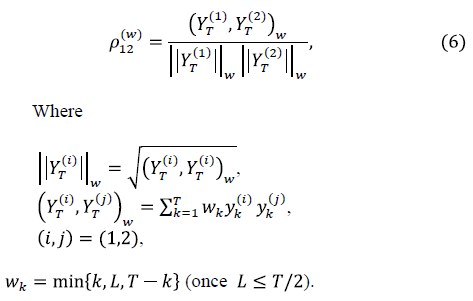
<body><![CDATA[<p><img src="/img/revistas/dyna/v82n190/v82n190a17eq05.gif"></p>     <p><font size="2" face="Verdana, Arial, Helvetica, sans-serif">Each  SSA component <img src="/img/revistas/dyna/v82n190/v82n190a17eq062.gif"> concentrates part of the energy of the  original series <img src="/img/revistas/dyna/v82n190/v82n190a17eq068.gif"> which can  be measured by the ratio of singular values (4). According to &#91;12&#93;, the SSA  component <img src="/img/revistas/dyna/v82n190/v82n190a17eq062.gif"> can be  classified into three categories: trend, harmonic components (cycle and  seasonality) and noise.</font></p>     <p><font size="2" face="Verdana, Arial, Helvetica, sans-serif"><b><i>2.3. Separability</i></b></font></p>     <p><font size="2" face="Verdana, Arial, Helvetica, sans-serif">Separability is one of the leading concepts in SSA &#91;20&#93;.  This property characterizes how well the different components are separated  from each other. A good measure of separability is the weighted correlation  (w-correlation), a function that quantifies the linear dependence between two  SSA components <img src="/img/revistas/dyna/v82n190/v82n190a17eq070.gif"> and <img src="/img/revistas/dyna/v82n190/v82n190a17eq072.gif">:</font></p>     <p><img src="/img/revistas/dyna/v82n190/v82n190a17eq06.gif"></p>     <p><font size="2" face="Verdana, Arial, Helvetica, sans-serif">The separability allows for a statistical check of  whether two SSA components are well  separated in terms of linear dependence. The matrix containing the absolute  values of the w-correlations corresponding to the full decomposition can  provide useful information for grouping the eigentriples &#91;17&#93;. If the absolute  value of w-correlation is small, so the SSA components are classified as  w-orthogonal (or quasi w-orthogonal) otherwise, they are said to be poorly  separated. It is a useful concept in the SSA grouping stage &#91;17&#93;.</font></p>     <p><font size="2" face="Verdana, Arial, Helvetica, sans-serif"><b><i>2.4. Choice of  optimal value of L </i></b></font></p>     <p><font size="2" face="Verdana, Arial, Helvetica, sans-serif">The question of the optimal value of <img src="/img/revistas/dyna/v82n190/v82n190a17eq086.gif"> remains open. &#91;19&#93;, illustrates a long  discussion about the ideal value of window length assuming that this value can  be fixed or variable. In several cases, the general recommendation is to choose  the window length at slightly less than half the size of the series: <img src="/img/revistas/dyna/v82n190/v82n190a17eq088.gif">.  In &#91;20&#93;, the suitable value of L is <img src="/img/revistas/dyna/v82n190/v82n190a17eq090.gif"> According to &#91;21&#93;, the choice of <img src="/img/revistas/dyna/v82n190/v82n190a17eq086.gif"> depends on several criteria including  complexity of the data, the aim of the analysis and the forecasting horizon. In  &#91;21&#93;, the authors show a new bound of <img src="/img/revistas/dyna/v82n190/v82n190a17eq086.gif"> for the multivariate case and study the  optimum value for the number of eigenvalues <img src="/img/revistas/dyna/v82n190/v82n190a17eq092.gif"> to choose. By selecting <img src="/img/revistas/dyna/v82n190/v82n190a17eq092.gif"> smaller than the true number of eigenvalues,  some parts of the signal(s) will be lost, and then the reconstructed series  becomes less accurate. However, if one takes <img src="/img/revistas/dyna/v82n190/v82n190a17eq092.gif"> greater than the value that it should be, then  noise is included in the reconstructed series. Although, considerable attempts  have been made and various techniques considered for selecting the optimal  values of <img src="/img/revistas/dyna/v82n190/v82n190a17eq086.gif"> and <img src="/img/revistas/dyna/v82n190/v82n190a17eq092.gif"> in SSA, there is not enough theoretical  justification for choosing these parameters. In addition, if the series has a  seasonal behavior with monthly periodicity, it is advisable to choose  reasonably large values of <img src="/img/revistas/dyna/v82n190/v82n190a17eq086.gif"> (but smaller than <img src="/img/revistas/dyna/v82n190/v82n190a17eq094.gif">.  In this paper the optimum value of <img src="/img/revistas/dyna/v82n190/v82n190a17eq086.gif"> is obtained by testing values from <img src="/img/revistas/dyna/v82n190/v82n190a17eq096.gif"> to <img src="/img/revistas/dyna/v82n190/v82n190a17eq098.gif"> and performing the BDS test &#91;22&#93; applied to  the noise series after decomposition.</font></p>     <p>&nbsp;</p>     <p><font size="3" face="Verdana, Arial, Helvetica, sans-serif"><b>3. Predictive  methods</b></font></p>     ]]></body>

<body><![CDATA[<p><font size="2" face="Verdana, Arial, Helvetica, sans-serif">This section presents  the Holt-Winters and ARIMA models; both traditionally used in mid-term  consumption prediction.</font></p>     <p><font size="2" face="Verdana, Arial, Helvetica, sans-serif"><b><i>3.1. Holt-Winters  models</i></b></font></p>     <p><font size="2" face="Verdana, Arial, Helvetica, sans-serif">According to &#91;23&#93;, exponential  smoothing methods are based on the assumption that the data are weighted  differently. Usually, recent observations contain more relevant information  than older ones, so that the weighting of the data (time series) decreases exponentially  as the observation becomes older. A particular case of exponential smoothing  method is the multiplicative Holt-Winters method, which performs modeling  dynamically (i.e. with time-varying parameters) its components: level<img src="/img/revistas/dyna/v82n190/v82n190a17eq100.gif">,  trend<img src="/img/revistas/dyna/v82n190/v82n190a17eq102.gif">)  and seasonality<img src="/img/revistas/dyna/v82n190/v82n190a17eq104.gif">:</font></p>     <p><img src="/img/revistas/dyna/v82n190/v82n190a17eq07.gif"></p>     <p><font size="2" face="Verdana, Arial, Helvetica, sans-serif">where <img src="/img/revistas/dyna/v82n190/v82n190a17eq108.gif"> is a  stochastic error, <img src="/img/revistas/dyna/v82n190/v82n190a17eq110.gif"> is the  observed value at time <img src="/img/revistas/dyna/v82n190/v82n190a17eq112.gif">  and <img src="/img/revistas/dyna/v82n190/v82n190a17eq114.gif"> is the  seasonal factor in <img src="/img/revistas/dyna/v82n190/v82n190a17eq112.gif"> relative to  month <i>m</i>. The family <img src="/img/revistas/dyna/v82n190/v82n190a17eq116.gif"> of seasonal  factors, where <img src="/img/revistas/dyna/v82n190/v82n190a17eq118.gif"> is the set  of months of the year that satisfy the constraint<img src="/img/revistas/dyna/v82n190/v82n190a17eq120.gif">, where <img src="/img/revistas/dyna/v82n190/v82n190a17eq122.gif"> is the size  of the seasonal cycle. In the process of estimating the parameters of equation  (7), three hyperparameters (time invariant quantities) are used, denoted by  <font face="Symbol">a</font>, &#946; and <font face="Symbol">l</font> which are associated, respectively, to the estimates  of level, trend and seasonality and whose optimal values are in the cube<img src="/img/revistas/dyna/v82n190/v82n190a17eq124.gif">. Recently, &#91;24&#93; has compared the forecasts for  the exponential smoothing and neural networks and removed trend and seasonality  using seasonal differentiation.</font></p>     <p><font size="2" face="Verdana, Arial, Helvetica, sans-serif"><b><i>3.2. Box-Jenkins  models</i></b></font></p>     <p><font size="2" face="Verdana, Arial, Helvetica, sans-serif">A second order stationary stochastic process is defined as  a family <img src="/img/revistas/dyna/v82n190/v82n190a17eq126.gif"> of random variables whose moments (mean,  variance and covariance) are time invariants for all t. Consider the sequence <img src="/img/revistas/dyna/v82n190/v82n190a17eq128.gif"> as a realization of <img src="/img/revistas/dyna/v82n190/v82n190a17eq126.gif">.  Box &amp; Jenkins &#91;23&#93; proposes the following linear equation for <img src="/img/revistas/dyna/v82n190/v82n190a17eq128.gif">.</font></p>     <p><img src="/img/revistas/dyna/v82n190/v82n190a17eq08.gif"></p>     <p><font size="2" face="Verdana, Arial, Helvetica, sans-serif">where <img src="/img/revistas/dyna/v82n190/v82n190a17eq132.gif"> is a stochastic error and <img src="/img/revistas/dyna/v82n190/v82n190a17eq134.gif"> is the observed value in <img src="/img/revistas/dyna/v82n190/v82n190a17eq136.gif">.  For seasonal time series, the following formulation is used:</font></p>     <p><img src="/img/revistas/dyna/v82n190/v82n190a17eq09.gif"></p>     ]]></body>

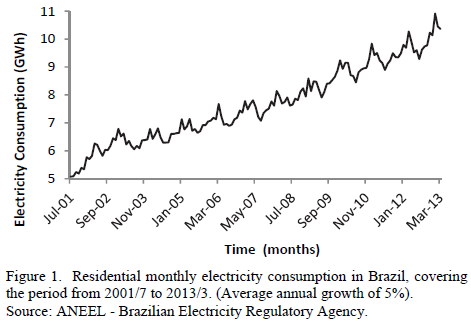
<body><![CDATA[<p><font size="2" face="Verdana, Arial, Helvetica, sans-serif">The fitting of such SARIMA model to monthly seasonal time  series is carried out in four stages; structural identification, parameters estimation, goodness of fit tests and forecasting. For details, see &#91;23&#93;.</font></p>     <p>&nbsp;</p>     <p><font size="3" face="Verdana, Arial, Helvetica, sans-serif"><b>4. Case study</b></font></p>     <p><font size="2" face="Verdana, Arial, Helvetica, sans-serif">For the computational experiment, we considered the  monthly time series of the residential electricity consumption in Brazil shown  in <a href="#fig01">Fig. 1</a>. The time series covers the period from July 2001 to March 2013 (141  observations). In this period, the series experienced an average growth of  approximately 5%. The length of the in sample period is 129 and the out of  sample is 12. The computational implementation was carried out with different  software: MATLAB, for the SSA approach via principal component analysis in the  SVD; Caterpillar SSA &#91;25&#93;, for detailed verification of SSA filtering via  graphical analysis of singular vectors via their scatter plots and the  periodogram analysis; E-Views, for the analyzes of BDS tests (independence)  &#91;26&#93; and ARIMA models &#91;27&#93;; Forecast Pro for Windows for Holt-Winters modeling;  R, to apply SSA using hierarchical clustering &#91;28&#93;, and Microsoft Excel to  generate graphs.</font></p>     <p align="center"><font size="2" face="Verdana, Arial, Helvetica, sans-serif"><a name="fig01"></a></font><img src="/img/revistas/dyna/v82n190/v82n190a17fig01.gif"></p>     <p><font size="3" face="Verdana, Arial, Helvetica, sans-serif"><b>5. Results and  discussions</b></font></p>     <p><font size="2" face="Verdana, Arial, Helvetica, sans-serif">In this study, three SSA filtering approaches were  applied: principal component analysis under SVD (PCA-SVD) &#91;28&#93;, cluster  analysis integrated with PCA-SVD &#91;29&#93; and graphical analysis of singular  vectors of SVD &#91;30&#93;. Each filtering approach generated a smoothed time series  of</font> <font size="2" face="Verdana, Arial, Helvetica, sans-serif">the monthly residential  electricity consumption which was modeled by two predictive methods: ARIMA and  Multiplicative Holt-Winters.</font></p>     <p><font size="2" face="Verdana, Arial, Helvetica, sans-serif"><b><i>5.1. Principal  component analysis under SVD (PCA-SVD)</i></b></font></p>     <p><font size="2" face="Verdana, Arial, Helvetica, sans-serif">In the PCA-SVD approach, an optimal window length <i>L</i> is defined for trajectory matrix <b>X</b> and an integer <i>N </i>such that the  SVD can be rewritten as:</font></p>     <p><img src="/img/revistas/dyna/v82n190/v82n190a17eq10.gif"></p>     ]]></body>
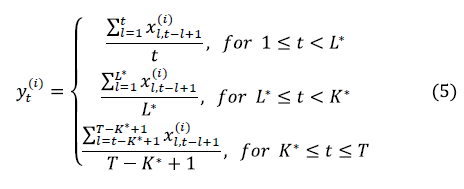
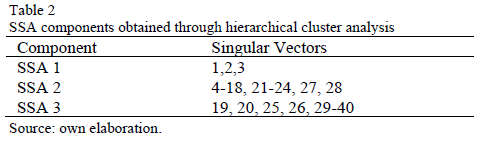
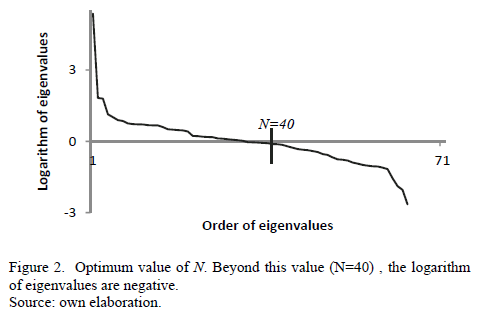
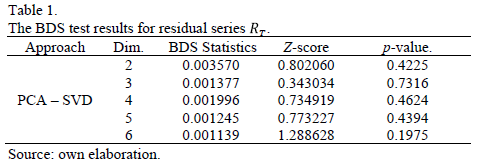
<body><![CDATA[<p><font size="2" face="Verdana, Arial, Helvetica, sans-serif">Through diagonal averaging procedure, these sequences of  elementary matrices in (10) generate <img src="/img/revistas/dyna/v82n190/v82n190a17eq146.gif"> (less noisy than the original series <img src="/img/revistas/dyna/v82n190/v82n190a17eq148.gif">)  and <img src="/img/revistas/dyna/v82n190/v82n190a17eq150.gif"> (the noise), respectively, such that the  original time series <img src="/img/revistas/dyna/v82n190/v82n190a17eq148.gif"> can be written as: </font></p>     <p><img src="/img/revistas/dyna/v82n190/v82n190a17eq11.gif"></p>     <p><font size="2" face="Verdana, Arial, Helvetica, sans-serif">The goal of this approach is to obtain a smoothed time  series <img src="/img/revistas/dyna/v82n190/v82n190a17eq154.gif"> less noisy than the original time series <img src="/img/revistas/dyna/v82n190/v82n190a17eq148.gif"> &#91;23&#93;.</font></p>     <p><font size="2" face="Verdana, Arial, Helvetica, sans-serif">In &#91;31&#93;, the best values of <i>L</i> and <i>N</i> using this approach were obtained following the completion of many rounds  of BDS testing for several values of these parameter. In this paper, the  optimum values using the same procedure are 71 and 40 respectively. <a href="#fig02">Fig. 2</a> shows the logarithm of the 71 eigenvalues arranged in a decreasing partial  order and the point defined by the optimal value of <i>N.</i></font></p>     <p align="center"><font size="2" face="Verdana, Arial, Helvetica, sans-serif"><a name="fig02"></a></font><img src="/img/revistas/dyna/v82n190/v82n190a17fig02.gif"></p>     <p><font size="2" face="Verdana, Arial, Helvetica, sans-serif">In the PCA-SVD, the first 40 eigenvectors cover the signal <img src="/img/revistas/dyna/v82n190/v82n190a17eq146.gif"> and the last 31 remaining eigenvectors, the  noise<img src="/img/revistas/dyna/v82n190/v82n190a17eq156.gif">.  Removing <img src="/img/revistas/dyna/v82n190/v82n190a17eq150.gif"> in (11), one obtains the filtered series <img src="/img/revistas/dyna/v82n190/v82n190a17eq154.gif"> generated by the approach PCA-SVD such that<img src="/img/revistas/dyna/v82n190/v82n190a17eq158.gif">.  <a href="#tab01">Table 1</a> shows the results of the BDS test applied to<img src="/img/revistas/dyna/v82n190/v82n190a17eq156.gif">. </font></p>     <p align="center"><font size="2" face="Verdana, Arial, Helvetica, sans-serif"><a name="tab01"></a></font><img src="/img/revistas/dyna/v82n190/v82n190a17tab01.gif"></p>     <p><font size="2" face="Verdana, Arial, Helvetica, sans-serif">In <a href="#tab01">Table 1</a>, one can see that the null hypothesis of  independence of the BDS test is not rejected at the 5% level. So there is no  empirical evidence that the time series noise <img src="/img/revistas/dyna/v82n190/v82n190a17eq150.gif"> has any structure of temporal dependence.  Based on the BDS test, one can see that the Brazilian residential electricity  consumption time series can be smoothed by <img src="/img/revistas/dyna/v82n190/v82n190a17eq154.gif">.</font></p>     <p><font size="2" face="Verdana, Arial, Helvetica, sans-serif"><b><i>5.2. Cluster  Analysis </i></b></font></p>     <p><font size="2" face="Verdana, Arial, Helvetica, sans-serif">As before, in the  first step, the trajectory matrix <b>X</b> is obtained from <img src="/img/revistas/dyna/v82n190/v82n190a17eq148.gif"> through  embedding with optimum window length equal to 71. In this way, 71 singular  vectors are obtained and the 31 less significant singular vectors were  classified as noise, based on the BDS test using a 5% significance level, and  were removed. Next, the 40 remaining singular vectors were grouped into 3 SSA  components by hierarchical clustering analysis, as seen in <a href="#tab02">Table 2</a>. The  implementation of this method was carried out by the general agglomerative  hierarchical clustering in a R package called RSSA &#91;32&#93;. Initially, a matrix of  dissimilarities for the <img src="/img/revistas/dyna/v82n190/v82n190a17eq086.gif"> eigentriples of SVD was generated. Next, each  object was assigned to its own cluster and then the algorithm proceeded  iteratively, joining, at each stage, the two most similar clusters, continuing  until three clusters were obtained. At each stage, Euclidean distances between  clusters were recomputed using the Lance-Williams dissimilarity update formula  &#91;33&#93;.</font></p>     ]]></body>
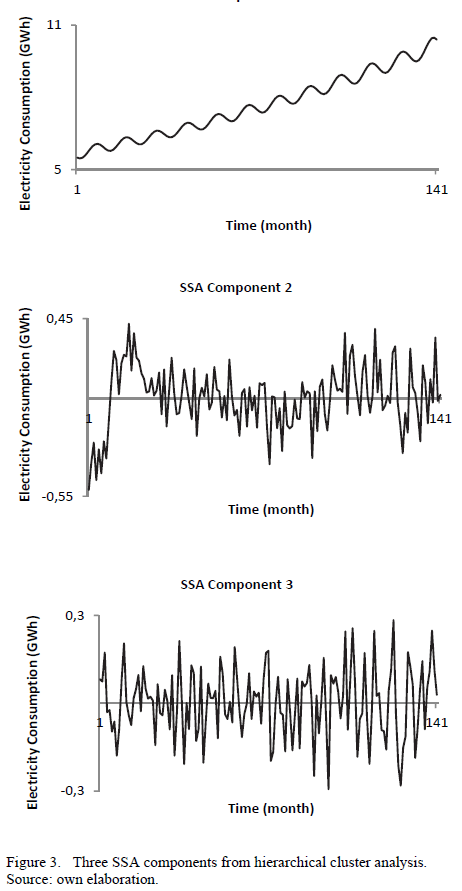
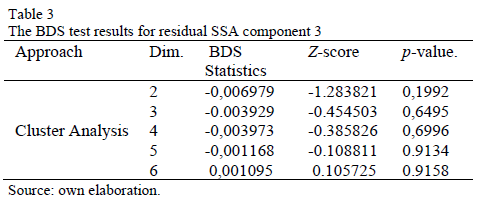
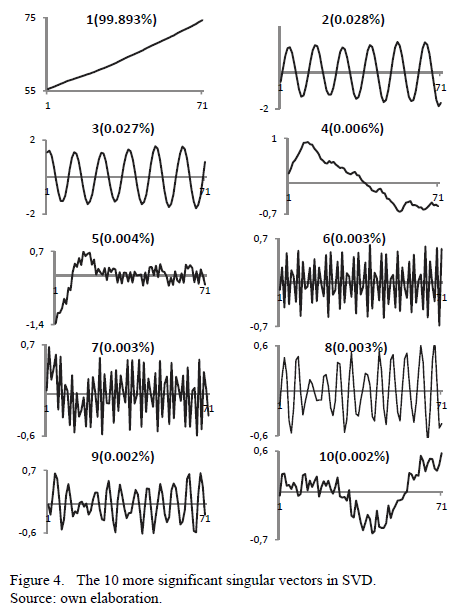
<body><![CDATA[<p align="center"><font size="2" face="Verdana, Arial, Helvetica, sans-serif"><a name="tab02"></a></font><img src="/img/revistas/dyna/v82n190/v82n190a17tab02.gif"></p>     <p><font size="2" face="Verdana, Arial, Helvetica, sans-serif"><a href="#fig03">Fig. 3</a> shows the plot of three SSA components obtained  from the three clusters. The BDS test is applied to each SSA component in order  to identify the noisy component. The aim of this approach is to obtain a less  noisy time series<img src="/img/revistas/dyna/v82n190/v82n190a17eq162.gif">,  by removing the noisy component.</font></p>     <p align="center"><font size="2" face="Verdana, Arial, Helvetica, sans-serif"><a name="fig03"></a></font><img src="/img/revistas/dyna/v82n190/v82n190a17fig03.gif"></p>     <p><font size="2" face="Verdana, Arial, Helvetica, sans-serif">According to the BDS test in <a href="#tab03">Table 3</a>, the SSA component 3  is classified as a noisy component. </font></p>     <p align="center"><font size="2" face="Verdana, Arial, Helvetica, sans-serif"><a name="tab03"></a></font><img src="/img/revistas/dyna/v82n190/v82n190a17tab03.gif"></p>     <p><font size="2" face="Verdana, Arial, Helvetica, sans-serif"><b><i>5.3. Graphical  analysis of singular vectors </i></b></font></p>     <p><font size="2" face="Verdana, Arial, Helvetica, sans-serif">Analysis  of time series coordinates on the basis defined by the singular vectors  resulting from SVD identifies the components of trend, seasonality and noise  present in a time series<img src="/img/revistas/dyna/v82n190/v82n190a17eq164.gif">.  The general problem consists in identifying and separating the oscillatory  components from those that are part of the trend. According to &#91;12&#93;, the  graphical analysis</font> <font size="2" face="Verdana, Arial, Helvetica, sans-serif">of such coordinates in pairs  allows us to visually identify the harmonic components of the series.</font></p>     <p><font size="2" face="Verdana, Arial, Helvetica, sans-serif">Similarly to the computational experiments above, the  optimal window length was considered as <img src="/img/revistas/dyna/v82n190/v82n190a17eq172.gif">,  but with an optimal truncation <img src="/img/revistas/dyna/v82n190/v82n190a17eq174.gif">,  generating 50 singular vectors. The software used for this approach was  Caterpillar SSA &#91;25&#93;. Through graphical analysis of pairs of singular vectors  it is possible to classify them according to their behavior. Consider a pure  harmonic with frequency equal to <img src="/img/revistas/dyna/v82n190/v82n190a17eq176.gif">,  phase equal to <img src="/img/revistas/dyna/v82n190/v82n190a17eq178.gif">,  amplitude equal to <img src="/img/revistas/dyna/v82n190/v82n190a17eq180.gif"> and period <img src="/img/revistas/dyna/v82n190/v82n190a17eq182.gif"> defined as a divisor of window length <i>L</i> and <i>K</i>. If the parameter <img src="/img/revistas/dyna/v82n190/v82n190a17eq184.gif"> assumes an integer value, then <img src="/img/revistas/dyna/v82n190/v82n190a17eq184.gif"> is classified as a harmonic period &#91;14&#93;. The  sine and cosine functions having equal frequencies, amplitudes and phases  generate a scatter plot, which displays a circular pattern &#91;12&#93;. Thus, the  scatter diagram shows a regular polygon with <img src="/img/revistas/dyna/v82n190/v82n190a17eq184.gif"> vertices. For a frequency <img src="/img/revistas/dyna/v82n190/v82n190a17eq186.gif">with <i>m</i> and <i>n</i> integers and primes, the points are vertices of a regular polygon  of <i>n</i> vertices &#91;12&#93;. Thus, the  identification of components that are generated by a harmonic analysis can be  performed by the pictorial analysis of the patterns determined by different  pairs of components.</font></p>     <p><font size="2" face="Verdana, Arial, Helvetica, sans-serif"><a href="#fig04">Fig. 4</a> shows the ten first singular vectors. One can see  that components 1, 4, 5 and 10 correspond to the trend. It is possible to  identify that components 2, 3, 6 - 9 are harmonic components. </font></p>     <p align="center"><font size="2" face="Verdana, Arial, Helvetica, sans-serif"><a name="fig04"></a></font><img src="/img/revistas/dyna/v82n190/v82n190a17fig04.gif"></p>     ]]></body>
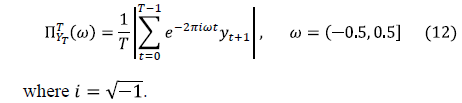
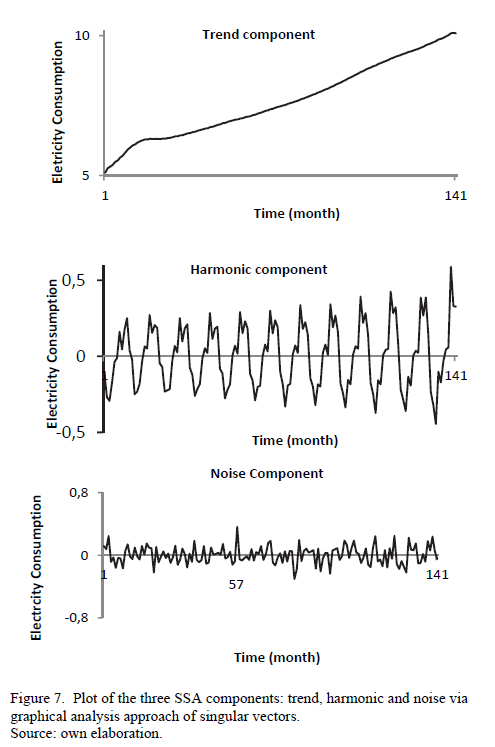
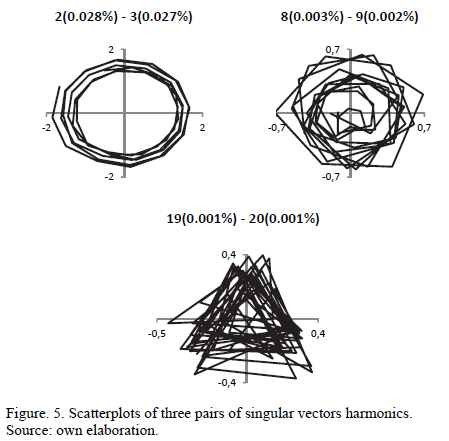
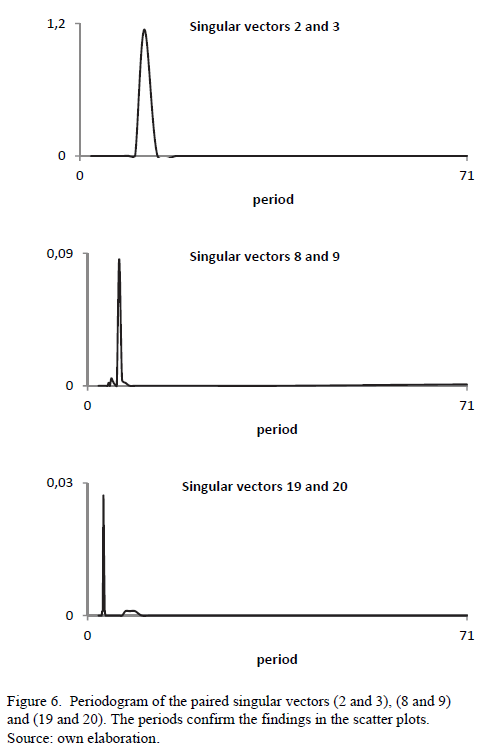
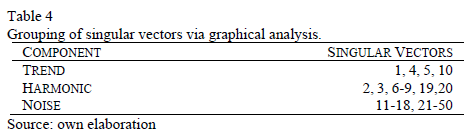
<body><![CDATA[<p><font size="2" face="Verdana, Arial, Helvetica, sans-serif">For the other components in <a href="#fig04">Fig. 4</a>, there is no need  for a deeper analysis. The first component (trend) accounts for nearly all the  variability present in the time series. The domain of the trend component can  be explained by the growth of the Brazilian population and the respective  growth of the number of households &#91;34&#93;. Additionally, Brazil has experienced  an improvement in income distribution, which allowed greater diffusion of home  appliances, as well as the efforts to meet the universal access to electricity,  expected for the year 2015. The result of classical decomposition of this  series presents similar values of trend (95.83%), seasonal (2.77%) and noise  (1.40%).</font></p>     <p><font size="2" face="Verdana, Arial, Helvetica, sans-serif"><a href="#fig05">Fig. 5</a> shows three pairs of singular vectors, it is  found that the singular vectors 2 and 3 are harmonic components with period  equal to 12 months, while the singular vectors 8 and 9 are harmonic components  with period equal to 6 months. In turn, the singular vectors 19 and 20 are  harmonic components with period equal to 3 months.</font></p>     <p align="center"><font size="2" face="Verdana, Arial, Helvetica, sans-serif"><a name="fig05"></a></font><img src="/img/revistas/dyna/v82n190/v82n190a17fig05.gif"></p>     <p><font size="2" face="Verdana, Arial, Helvetica, sans-serif">The periodogram  analysis helps in the identification of a general harmonic component. The  periodogram of the singular vector of each eigentriple provides information  about the periodic behavior of the component and frequency (period) of the  oscillations. Therefore, proper grouping can be made with the help of the  periodogram analysis. For the series<img src="/img/revistas/dyna/v82n190/v82n190a17eq214.gif">, the periodogram <img src="/img/revistas/dyna/v82n190/v82n190a17eq216.gif"> is defined  as</font></p>     <p><img src="/img/revistas/dyna/v82n190/v82n190a17eq12.gif"></p>     <p><font size="2" face="Verdana, Arial, Helvetica, sans-serif">For the periodic components, the periodogram has sharp  spikes around the component's frequency (period). Hence the visual  identification is straightforward. <a href="#fig06">Fig. 6</a> shows the respective periodogram  associated to scatterplots of <a href="#fig05">Fig. 5</a>:</font></p>     <p align=center><font size="2" face="Verdana, Arial, Helvetica, sans-serif"><a name="fig06"></a></font><img src="/img/revistas/dyna/v82n190/v82n190a17fig06.gif"></p>     <p><font size="2" face="Verdana, Arial, Helvetica, sans-serif">By exclusion, the singular vectors that are not classified  as trend component or harmonic component via graphical analysis are classified  as noise. After graphical analysis of the 50 singular vectors of the SVD, the  classification shown in <a href="#tab04">Table 4</a> was obtained.</font></p>     <p align="center"><font size="2" face="Verdana, Arial, Helvetica, sans-serif"><a name="tab04"></a></font><img src="/img/revistas/dyna/v82n190/v82n190a17tab04.gif"></p>     <p><font size="2" face="Verdana, Arial, Helvetica, sans-serif"><a href="#fig07">Fig. 7</a> shows the plot of the three SSA components  obtained by graphical analysis in the reconstruction phase where the elementary  matrices are grouped into three groups generating the components in SVD. Note  that the trend component captures a slight change in trend after 15 months and  the noisy component captures the highest difference between the original time  series and the smoothed times series at the 57th month. </font></p>     ]]></body>

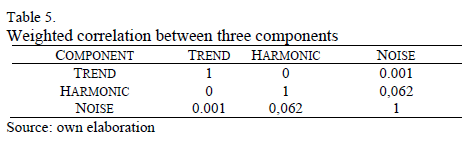
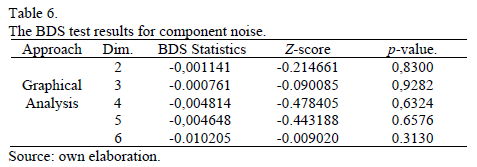
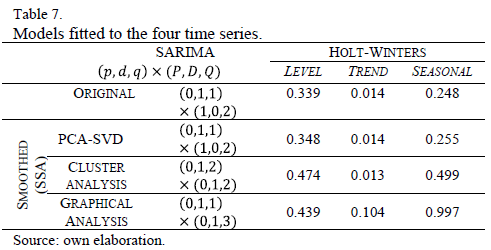
<body><![CDATA[<p align="center"><font size="2" face="Verdana, Arial, Helvetica, sans-serif"><a name="fig07"></a></font><img src="/img/revistas/dyna/v82n190/v82n190a17fig07.gif"></p>     <p><font size="2" face="Verdana, Arial, Helvetica, sans-serif"><a href="#tab05">Table 5</a> shows the weighted correlation matrix among the  three components identified by graphical analysis of the singular vectors.  According to the figures presented in <a href="#tab05">Table 5</a>, the three components look well  separable.</font></p>     <p align="center"><font size="2" face="Verdana, Arial, Helvetica, sans-serif"><a name="tab05"></a></font><img src="/img/revistas/dyna/v82n190/v82n190a17tab05.gif"></p>     <p><font size="2" face="Verdana, Arial, Helvetica, sans-serif">According to the BDS test in <a href="#tab06">Table 6</a>, one can see that  the noisy component does not present time dependence structure. Therefore, this  component can be classified as a noise.</font></p>     <p align="center"><font size="2" face="Verdana, Arial, Helvetica, sans-serif"><a name="tab06"></a></font><img src="/img/revistas/dyna/v82n190/v82n190a17tab06.gif"></p>     <p><font size="2" face="Verdana, Arial, Helvetica, sans-serif">In the PCA-SVD method (equation 11), the components aren't  separated in trend, harmonic and noise, but rather in signal and noise. In this  approach many noisy components are still part of the signal. In <a href="#tab02">Table 2</a> obtained by the cluster analysis, one can see that the eigentriples 2 and 3 are  added to the trend component, but the periodogram analysis (<a href="#fig06">Fig. 6</a>) shows that  these eigentriples are part of a harmonic component. Similarly, the cluster  analysis classifies the eigenvectors 11 - 18 as harmonic component, but they  are noise components (see <a href="#tab04">Table 4</a>) obtained by graphical analysis of the  singular vectors. The results above show that the graphical analysis of a  singular vector is a more effective method to classify SSA eigentriples.</font></p>     <p><font size="2" face="Verdana, Arial, Helvetica, sans-serif"><b><i>5.4. Forecasting  models </i></b></font></p>     <p><font size="2" face="Verdana, Arial, Helvetica, sans-serif">After identifying the noisy components by the three  methods under study (PCA-SVD, Cluster Analysis and Graphical Analysis of  Singular Vectors), these components are extracted from the original time series  resulting in smoothed time series. Thus, there are four time series to be  modeled: the original and three filtered time series via SSA. </font></p>     <p><font size="2" face="Verdana, Arial, Helvetica, sans-serif">In the specification of the <img src="/img/revistas/dyna/v82n190/v82n190a17eq234.gif"> model with<img src="/img/revistas/dyna/v82n190/v82n190a17eq236.gif">,  it is necessary to choose the lags <img src="/img/revistas/dyna/v82n190/v82n190a17eq238.gif"> the degree of differencing <i>d</i> and <i>D.</i> It is considered that the best SARIMA model minimizes the  Bayesian Information Criterion (BIC) &#91;35&#93;. The best Holt-Winters' model (HW)  also minimizes the BIC with linear trend and multiplicative seasonality. The  models are shown in <a href="#tab07">Table 7</a>. </font></p>     <p align="center"><font size="2" face="Verdana, Arial, Helvetica, sans-serif"><a name="tab07"></a></font><img src="/img/revistas/dyna/v82n190/v82n190a17tab07.gif"></p>     ]]></body>
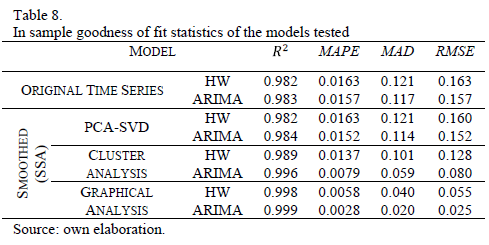
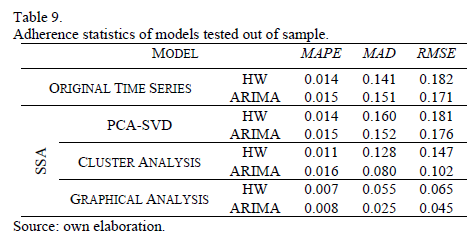
<body><![CDATA[<p><font size="2" face="Verdana, Arial, Helvetica, sans-serif">To check the predictive power of the SSA approach applied  to the electricity consumption time series, <a href="#tab08">Table 8</a> shows the in sample results  of the goodness of fit statistics: <img src="/img/revistas/dyna/v82n190/v82n190a17eq240.gif">,  mean absolute percentage error (<i>MAPE</i>),  mean absolute deviation (<i>MAD</i>), and  root-mean-square error (<i>RMSE</i>)<i>.</i> One can see that the values of <i>MAPE, MAD, </i>and <i>RMSE</i> using the SSA approach are lesser than these values for the  original time series. </font></p>     <p align="center"><font size="2" face="Verdana, Arial, Helvetica, sans-serif"><a name="tab08"></a></font><img src="/img/revistas/dyna/v82n190/v82n190a17tab08.gif"></p>     <p><font size="2" face="Verdana, Arial, Helvetica, sans-serif">The out of sample 1-step ahead error statistics are shown  in <a href="#tab09">Table 9</a>. Note that the graphic analysis is also the best approach of SSA  filtering.</font></p>     <p align="center"><font size="2" face="Verdana, Arial, Helvetica, sans-serif"><a name="tab09"></a></font><img src="/img/revistas/dyna/v82n190/v82n190a17tab09.gif"></p>     <p>&nbsp;</p>     <p><font size="3" face="Verdana, Arial, Helvetica, sans-serif"><b>6. Conclusions</b></font></p>     <p><font size="2" face="Verdana, Arial, Helvetica, sans-serif">Three alternatives  to remove the noisy component of a time series by SSA method were proposed in  this paper. The method was applied to a real time series corresponding  to monthly residential electricity consumption in Brazil. Among the three  alternatives evaluated the graphical analysis of singular vector is the more  effective method to remove the noisy component. In the sequence, the  Holt-Winters and Box- Jenkins were applied to the original and filtered time  series obtained by SSA. The in-sample and out-of-sample goodness of fit  statistics (MAPE, MAD and RMSE) obtained for the eight fitted models, show that  the SSA method with graphical analysis of singular vectors also provided the  more accurate forecasts. This approach provides a more detailed analysis of the  components, thus, the results tend to be better. In addition, the best value of <img src="/img/revistas/dyna/v82n190/v82n190a17eq086.gif"> corresponds to <img src="/img/revistas/dyna/v82n190/v82n190a17eq252.gif"> and the BDS test proved effective in  identifying the noise components.</font></p>     <p>&nbsp;</p>     <p><font size="3" face="Verdana, Arial, Helvetica, sans-serif"><b>References</b></font></p>     <!-- ref --><p><font size="2" face="Verdana, Arial, Helvetica, sans-serif"><b>&#91;1&#93;</b>    Wang, X. and McDonald, J.R., Modern power  system planning. McGraw Hill, 1994.    &nbsp;&nbsp;&nbsp;&nbsp;&nbsp;&nbsp;&nbsp;&nbsp;[&#160;<a href="javascript:void(0);" onclick="javascript: window.open('/scielo.php?script=sci_nlinks&ref=000132&pid=S0012-7353201500020001700001&lng=','','width=640,height=500,resizable=yes,scrollbars=1,menubar=yes,');">Links</a>&#160;]<!-- end-ref --></font></p>     <!-- ref --><p><font size="2" face="Verdana, Arial, Helvetica, sans-serif"><b>&#91;2&#93;</b>    Gross, G. and Galiana, F., Short-term load  forecasting. Proceedings of the IEEE. 75 (12), pp. 1558-1573, 1987. DOI: 10.1109/PROC.1987.13927.    &nbsp;&nbsp;&nbsp;&nbsp;&nbsp;&nbsp;&nbsp;&nbsp;[&#160;<a href="javascript:void(0);" onclick="javascript: window.open('/scielo.php?script=sci_nlinks&ref=000134&pid=S0012-7353201500020001700002&lng=','','width=640,height=500,resizable=yes,scrollbars=1,menubar=yes,');">Links</a>&#160;]<!-- end-ref --></font></p>     <!-- ref --><p><font size="2" face="Verdana, Arial, Helvetica, sans-serif"><b>&#91;3&#93;</b>    Santos, P.J., Martins, A., Pires, A.,  Martins, J., and Mendes, R., Short-term load forecast using trend information. International  Journal of Energy Research, 30 (10), pp. 811-822, 2006. DOI: 10.1002/er.1187.    &nbsp;&nbsp;&nbsp;&nbsp;&nbsp;&nbsp;&nbsp;&nbsp;[&#160;<a href="javascript:void(0);" onclick="javascript: window.open('/scielo.php?script=sci_nlinks&ref=000136&pid=S0012-7353201500020001700003&lng=','','width=640,height=500,resizable=yes,scrollbars=1,menubar=yes,');">Links</a>&#160;]<!-- end-ref --></font></p>     <!-- ref --><p><font size="2" face="Verdana, Arial, Helvetica, sans-serif"><b>&#91;4&#93;</b> Gonzalez-Romera, E., Jaramillo-Mor&aacute;n, M.A.,  and Carmona-Fernandez, D., Monthly electric energy demand forecasting based on  trend extraction. IEEE Transactions on power systems, 21 (4), pp. 1946-1953,  2006. DOI: 10.1109/TPWRS.2006.883666.    &nbsp;&nbsp;&nbsp;&nbsp;&nbsp;&nbsp;&nbsp;&nbsp;[&#160;<a href="javascript:void(0);" onclick="javascript: window.open('/scielo.php?script=sci_nlinks&ref=000138&pid=S0012-7353201500020001700004&lng=','','width=640,height=500,resizable=yes,scrollbars=1,menubar=yes,');">Links</a>&#160;]<!-- end-ref --></font></p>     <!-- ref --><p><font size="2" face="Verdana, Arial, Helvetica, sans-serif"><b>&#91;5&#93;</b>    Barroso, L.A., Street, A., Granville, S.,  and Bezerra, B., Bidding strategies in auctions for long-term electricity  supply contracts for new capacity.  Power and Energy Society General Meeting - Conversion and Delivery of  Electrical Energy in the 21<sup>th</sup> Century, Pittsburgh, 2008.    &nbsp;&nbsp;&nbsp;&nbsp;&nbsp;&nbsp;&nbsp;&nbsp;[&#160;<a href="javascript:void(0);" onclick="javascript: window.open('/scielo.php?script=sci_nlinks&ref=000140&pid=S0012-7353201500020001700005&lng=','','width=640,height=500,resizable=yes,scrollbars=1,menubar=yes,');">Links</a>&#160;]<!-- end-ref --></font></p>     <!-- ref --><p><font size="2" face="Verdana, Arial, Helvetica, sans-serif"><b>&#91;6&#93;</b>    Castro,  C.M.B., Marcato, A.L.M., Silva, I.C.S., Dias, B.H., Silva Jr, G.E., and  Oliveira, E.J., Brazilian energy auctions analysis based on evolutionary  algorithms. IEEE Bucharest Power Tech Conference, Bucharest, Rumania, 2009.    &nbsp;&nbsp;&nbsp;&nbsp;&nbsp;&nbsp;&nbsp;&nbsp;[&#160;<a href="javascript:void(0);" onclick="javascript: window.open('/scielo.php?script=sci_nlinks&ref=000142&pid=S0012-7353201500020001700006&lng=','','width=640,height=500,resizable=yes,scrollbars=1,menubar=yes,');">Links</a>&#160;]<!-- end-ref --></font></p>     <!-- ref --><p><font size="2" face="Verdana, Arial, Helvetica, sans-serif"><b>&#91;7&#93;</b>    Abdel-Al, R.E. and Al-Garni, A.Z., Forecasting  monthly electric energy consumption in Eastern Saudi Arabia using univariate  time-series analysis. Energy, 22 (11), pp. 1059-1069,  1997. DOI: 10.1016/S0360-5442(97)00032-7.    &nbsp;&nbsp;&nbsp;&nbsp;&nbsp;&nbsp;&nbsp;&nbsp;[&#160;<a href="javascript:void(0);" onclick="javascript: window.open('/scielo.php?script=sci_nlinks&ref=000144&pid=S0012-7353201500020001700007&lng=','','width=640,height=500,resizable=yes,scrollbars=1,menubar=yes,');">Links</a>&#160;]<!-- end-ref --></font></p>     <!-- ref --><p><font size="2" face="Verdana, Arial, Helvetica, sans-serif"><b>&#91;8&#93;</b>    Falvo, M.C., Lamedica, R., Pierazzo, S.,  and Prudenzi, A., A knowledge based system for medium term load forecasting, transmission  and distribution Conference and Exhibition, IEEE PES, Dallas, USA, 2006.    &nbsp;&nbsp;&nbsp;&nbsp;&nbsp;&nbsp;&nbsp;&nbsp;[&#160;<a href="javascript:void(0);" onclick="javascript: window.open('/scielo.php?script=sci_nlinks&ref=000146&pid=S0012-7353201500020001700008&lng=','','width=640,height=500,resizable=yes,scrollbars=1,menubar=yes,');">Links</a>&#160;]<!-- end-ref --></font></p>     <!-- ref --><p><font size="2" face="Verdana, Arial, Helvetica, sans-serif"><b>&#91;9&#93;</b>    Borlea, I., Buta, A. and Lustrea, B.,  Some aspects concerning mid-term monthly load forecasting using ANN, EUROCON  2005 - The International Conference on 'Computer as a Tool', Belgrade, Serbia, 2005.    &nbsp;&nbsp;&nbsp;&nbsp;&nbsp;&nbsp;&nbsp;&nbsp;[&#160;<a href="javascript:void(0);" onclick="javascript: window.open('/scielo.php?script=sci_nlinks&ref=000148&pid=S0012-7353201500020001700009&lng=','','width=640,height=500,resizable=yes,scrollbars=1,menubar=yes,');">Links</a>&#160;]<!-- end-ref --></font></p>     <!-- ref --><p><font size="2" face="Verdana, Arial, Helvetica, sans-serif"><b>&#91;10&#93;</b>   Broomhead,  D.S. and King, G.P., Extracting qualitative dynamics from exponential data<i>. </i>Physica D. 20 (2-3), pp. 217-236, 1986. DOI: 10.1016/0167-2789(86)90031-X.    &nbsp;&nbsp;&nbsp;&nbsp;&nbsp;&nbsp;&nbsp;&nbsp;[&#160;<a href="javascript:void(0);" onclick="javascript: window.open('/scielo.php?script=sci_nlinks&ref=000150&pid=S0012-7353201500020001700010&lng=','','width=640,height=500,resizable=yes,scrollbars=1,menubar=yes,');">Links</a>&#160;]<!-- end-ref --></font></p>     <!-- ref --><p><font size="2" face="Verdana, Arial, Helvetica, sans-serif"><b>&#91;11&#93;</b>   Elsner,  J.B. and Tsonis, A.A., Singular spectrum analysis. A new tool in time series  analysis. Plenum Press, 1996.    &nbsp;&nbsp;&nbsp;&nbsp;&nbsp;&nbsp;&nbsp;&nbsp;[&#160;<a href="javascript:void(0);" onclick="javascript: window.open('/scielo.php?script=sci_nlinks&ref=000152&pid=S0012-7353201500020001700011&lng=','','width=640,height=500,resizable=yes,scrollbars=1,menubar=yes,');">Links</a>&#160;]<!-- end-ref --></font></p>     <!-- ref --><p><font size="2" face="Verdana, Arial, Helvetica, sans-serif"><b>&#91;12&#93;</b> Golyandina,  N., Nekrutkin, V. and Zhigljavsky, A. ,Analysis of time series structure: SSA  and related techniques. Chapman &amp; Hall/CRC New York, 2001.    &nbsp;&nbsp;&nbsp;&nbsp;&nbsp;&nbsp;&nbsp;&nbsp;[&#160;<a href="javascript:void(0);" onclick="javascript: window.open('/scielo.php?script=sci_nlinks&ref=000154&pid=S0012-7353201500020001700012&lng=','','width=640,height=500,resizable=yes,scrollbars=1,menubar=yes,');">Links</a>&#160;]<!-- end-ref --></font></p>     <!-- ref --><p><font size="2" face="Verdana, Arial, Helvetica, sans-serif"><b>&#91;13&#93;</b>   Hassani, H., Heravi, S. and Zhigljavsky, A., Forecasting UK industrial  production with multivariate singular spectrum analysis, in The 2012  International Conference on the Singular Spectrum Analysis and its  Applications, Beijing, China, 2012.    &nbsp;&nbsp;&nbsp;&nbsp;&nbsp;&nbsp;&nbsp;&nbsp;[&#160;<a href="javascript:void(0);" onclick="javascript: window.open('/scielo.php?script=sci_nlinks&ref=000156&pid=S0012-7353201500020001700013&lng=','','width=640,height=500,resizable=yes,scrollbars=1,menubar=yes,');">Links</a>&#160;]<!-- end-ref --></font></p>     <!-- ref --><p><font size="2" face="Verdana, Arial, Helvetica, sans-serif"><b>&#91;14&#93;</b>   Hassani, H., Heravi, S. and Zhigljavsky, A., Forecasting European  industrial production with singular spectrum analysis. International Journal of  Forecasting. 25 (1), pp. 103-118, 2009. DOI: 10.1016/j.ijforecast.2008.09.007.    &nbsp;&nbsp;&nbsp;&nbsp;&nbsp;&nbsp;&nbsp;&nbsp;[&#160;<a href="javascript:void(0);" onclick="javascript: window.open('/scielo.php?script=sci_nlinks&ref=000158&pid=S0012-7353201500020001700014&lng=','','width=640,height=500,resizable=yes,scrollbars=1,menubar=yes,');">Links</a>&#160;]<!-- end-ref --></font></p>     <!-- ref --><p><font size="2" face="Verdana, Arial, Helvetica, sans-serif"><b>&#91;15&#93;</b>   Cassiano,  K.M., Junior, L.A.T, Souza, R.M., Menezes, M.L., Pessanha J.F.M. and Souza, R.C.,  Hydroelectric energy forecast. International Journal of Energy and Statistics,  1 (3), pp. 205-214, 2013. DOI: 10.1142/S2335680413500142.    &nbsp;&nbsp;&nbsp;&nbsp;&nbsp;&nbsp;&nbsp;&nbsp;[&#160;<a href="javascript:void(0);" onclick="javascript: window.open('/scielo.php?script=sci_nlinks&ref=000160&pid=S0012-7353201500020001700015&lng=','','width=640,height=500,resizable=yes,scrollbars=1,menubar=yes,');">Links</a>&#160;]<!-- end-ref --></font></p>     <!-- ref --><p><font size="2" face="Verdana, Arial, Helvetica, sans-serif"><b>&#91;16&#93;</b>   Junior  , L.A.T., Menezes, M.L., Cassiano, K.M., Pessanha, J.F.M. and Souza, R.C., Residential  electricity consumption forecasting using a geometric combination approach. International  Journal of Energy and Statistics, 1 (2), pp.  113-125, 2013. DOI: 10.1142/S2335680413500087.    &nbsp;&nbsp;&nbsp;&nbsp;&nbsp;&nbsp;&nbsp;&nbsp;[&#160;<a href="javascript:void(0);" onclick="javascript: window.open('/scielo.php?script=sci_nlinks&ref=000162&pid=S0012-7353201500020001700016&lng=','','width=640,height=500,resizable=yes,scrollbars=1,menubar=yes,');">Links</a>&#160;]<!-- end-ref --></font></p>     <!-- ref --><p><font size="2" face="Verdana, Arial, Helvetica, sans-serif"><b>&#91;17&#93;</b> Miranian,  A., Abdollahzade, M. and Hassani H., Day-ahead electricity price analysis and  forecasting by singular spectrum analysis. IET Generation, Transmission &amp;  Distribution, 7 (4), pp. 337-346, 2013. DOI: 10.1049/iet-gtd.2012.0263.    &nbsp;&nbsp;&nbsp;&nbsp;&nbsp;&nbsp;&nbsp;&nbsp;[&#160;<a href="javascript:void(0);" onclick="javascript: window.open('/scielo.php?script=sci_nlinks&ref=000164&pid=S0012-7353201500020001700017&lng=','','width=640,height=500,resizable=yes,scrollbars=1,menubar=yes,');">Links</a>&#160;]<!-- end-ref --></font></p>     <!-- ref --><p><font size="2" face="Verdana, Arial, Helvetica, sans-serif"><b>&#91;18&#93;</b>   Menezes,  M.L., Souza, R.C., and Pessanha, J.F.M., Combining singular spectrum analysis  and PAR(p) structures to model wind  speed time series. Journal of Systems Science and Complexity, 27 (1), pp.  29-46, 2014. DOI: 10.1007/s11424-014-3301-8.    &nbsp;&nbsp;&nbsp;&nbsp;&nbsp;&nbsp;&nbsp;&nbsp;[&#160;<a href="javascript:void(0);" onclick="javascript: window.open('/scielo.php?script=sci_nlinks&ref=000166&pid=S0012-7353201500020001700018&lng=','','width=640,height=500,resizable=yes,scrollbars=1,menubar=yes,');">Links</a>&#160;]<!-- end-ref --></font></p>     <!-- ref --><p><font size="2" face="Verdana, Arial, Helvetica, sans-serif"><b>&#91;19&#93;</b>   Golyandina,  N., On the choice of parameters in singular spectrum analysis and related  subspace-based methods. Statistics and Its Interface, 3, pp. 259-279, 2010.    &nbsp;&nbsp;&nbsp;&nbsp;&nbsp;&nbsp;&nbsp;&nbsp;[&#160;<a href="javascript:void(0);" onclick="javascript: window.open('/scielo.php?script=sci_nlinks&ref=000168&pid=S0012-7353201500020001700019&lng=','','width=640,height=500,resizable=yes,scrollbars=1,menubar=yes,');">Links</a>&#160;]<!-- end-ref --></font></p>     <!-- ref --><p><font size="2" face="Verdana, Arial, Helvetica, sans-serif"><b>&#91;20&#93;</b>   Golyandina,  N. and Vlassieva, E,. First-order SSA-errors for long time series: Model  examples of simple noisy signals. In Proceedings of 6<sup>th</sup> St.  Petersburg Workshop on Simulation, 1, St. Petersbusg State University, St.  Petersburg, Rusia, pp. 314-319, 2009.    &nbsp;&nbsp;&nbsp;&nbsp;&nbsp;&nbsp;&nbsp;&nbsp;[&#160;<a href="javascript:void(0);" onclick="javascript: window.open('/scielo.php?script=sci_nlinks&ref=000170&pid=S0012-7353201500020001700020&lng=','','width=640,height=500,resizable=yes,scrollbars=1,menubar=yes,');">Links</a>&#160;]<!-- end-ref --></font></p>     <!-- ref --><p><font size="2" face="Verdana, Arial, Helvetica, sans-serif"><b>&#91;21&#93;</b>   Hassani,  H., Mahmoudvand, R. and Zokaei, M., Separability and window length in singular  spectrum analysis. Comptes Rendus Mathematique, 349 (17-18), pp. 987-990, 2011. DOI: 10.1016/j.crma.2011.07.012.    &nbsp;&nbsp;&nbsp;&nbsp;&nbsp;&nbsp;&nbsp;&nbsp;[&#160;<a href="javascript:void(0);" onclick="javascript: window.open('/scielo.php?script=sci_nlinks&ref=000172&pid=S0012-7353201500020001700021&lng=','','width=640,height=500,resizable=yes,scrollbars=1,menubar=yes,');">Links</a>&#160;]<!-- end-ref --></font></p>     <!-- ref --><p><font size="2" face="Verdana, Arial, Helvetica, sans-serif"><b>&#91;22&#93;</b>   Brock, W.A., Dechert, W., Scheinkman, J.  and LeBaron, B., A test  for independence based on the correlation dimension. Econometric reviews, 15  (3), pp. 197-235, 1996.    &nbsp;&nbsp;&nbsp;&nbsp;&nbsp;&nbsp;&nbsp;&nbsp;[&#160;<a href="javascript:void(0);" onclick="javascript: window.open('/scielo.php?script=sci_nlinks&ref=000174&pid=S0012-7353201500020001700022&lng=','','width=640,height=500,resizable=yes,scrollbars=1,menubar=yes,');">Links</a>&#160;]<!-- end-ref --></font></p>     <!-- ref --><p><font size="2" face="Verdana, Arial, Helvetica, sans-serif"><b>&#91;23&#93;</b>   Box,  G.E.P. and Jenkins, G.M., Time series analysis: Forecasting and control. Holden-Day,  1970.    &nbsp;&nbsp;&nbsp;&nbsp;&nbsp;&nbsp;&nbsp;&nbsp;[&#160;<a href="javascript:void(0);" onclick="javascript: window.open('/scielo.php?script=sci_nlinks&ref=000176&pid=S0012-7353201500020001700023&lng=','','width=640,height=500,resizable=yes,scrollbars=1,menubar=yes,');">Links</a>&#160;]<!-- end-ref --></font></p>     <!-- ref --><p><font size="2" face="Verdana, Arial, Helvetica, sans-serif"><b>&#91;24&#93;</b> Vel&aacute;squez-Henao,  J.D., Zambrano-Perez, C.O. and Franco-Cardona, C.J., A comparison of  exponential smoothing and neural networks in time series prediction. DYNA, 80  (182), pp. 66-73, 2013.    &nbsp;&nbsp;&nbsp;&nbsp;&nbsp;&nbsp;&nbsp;&nbsp;[&#160;<a href="javascript:void(0);" onclick="javascript: window.open('/scielo.php?script=sci_nlinks&ref=000178&pid=S0012-7353201500020001700024&lng=','','width=640,height=500,resizable=yes,scrollbars=1,menubar=yes,');">Links</a>&#160;]<!-- end-ref --></font></p>     <!-- ref --><p><font size="2" face="Verdana, Arial, Helvetica, sans-serif"><b>&#91;25&#93;</b>   Gistat  Group. Caterpillar SSA. Petersburg University, Department of Mathematics,  Russia, 2010. &#91;Online&#93;. Available at: <a href="http://www.gistatgroup.com/cat/index.html" target="_blank">http://www.gistatgroup.com/cat/index.html</a></font>&nbsp;&nbsp;&nbsp;&nbsp;&nbsp;&nbsp;&nbsp;&nbsp;[&#160;<a href="javascript:void(0);" onclick="javascript: window.open('/scielo.php?script=sci_nlinks&ref=000180&pid=S0012-7353201500020001700025&lng=','','width=640,height=500,resizable=yes,scrollbars=1,menubar=yes,');">Links</a>&#160;]<!-- end-ref --><!-- ref --><p><font size="2" face="Verdana, Arial, Helvetica, sans-serif"><b>&#91;26&#93;</b>   Lin,  K., The ABC's of BDS. Journal of computational intelligence in finance, 97  (jul/Aug.). pp. 23-26, 1997.    &nbsp;&nbsp;&nbsp;&nbsp;&nbsp;&nbsp;&nbsp;&nbsp;[&#160;<a href="javascript:void(0);" onclick="javascript: window.open('/scielo.php?script=sci_nlinks&ref=000181&pid=S0012-7353201500020001700026&lng=','','width=640,height=500,resizable=yes,scrollbars=1,menubar=yes,');">Links</a>&#160;]<!-- end-ref --></font></p>     ]]></body>
<body><![CDATA[<!-- ref --><p><font size="2" face="Verdana, Arial, Helvetica, sans-serif"><b>&#91;27&#93;</b>   Chatfield,  C., The Analysis of time series: An introduction, 6<sup>th</sup> ed., Chapman  &amp; Hall/CRC, 2003.    &nbsp;&nbsp;&nbsp;&nbsp;&nbsp;&nbsp;&nbsp;&nbsp;[&#160;<a href="javascript:void(0);" onclick="javascript: window.open('/scielo.php?script=sci_nlinks&ref=000183&pid=S0012-7353201500020001700027&lng=','','width=640,height=500,resizable=yes,scrollbars=1,menubar=yes,');">Links</a>&#160;]<!-- end-ref --></font></p>     <!-- ref --><p><font size="2" face="Verdana, Arial, Helvetica, sans-serif"><b>&#91;28&#93;</b>   Danilov,  D. and Zhigljavsky, A., Principal components of time series: The caterpillar  method. University of St. Petersburg Press, Rusia 1997.    &nbsp;&nbsp;&nbsp;&nbsp;&nbsp;&nbsp;&nbsp;&nbsp;[&#160;<a href="javascript:void(0);" onclick="javascript: window.open('/scielo.php?script=sci_nlinks&ref=000185&pid=S0012-7353201500020001700028&lng=','','width=640,height=500,resizable=yes,scrollbars=1,menubar=yes,');">Links</a>&#160;]<!-- end-ref --> </font></p>     <!-- ref --><p><font size="2" face="Verdana, Arial, Helvetica, sans-serif"><b>&#91;29&#93;</b>   Aldenderfer,  M.S. and Blashfield, R.K., Cluster analysis. Sage publications, California,  USA, 1984.    &nbsp;&nbsp;&nbsp;&nbsp;&nbsp;&nbsp;&nbsp;&nbsp;[&#160;<a href="javascript:void(0);" onclick="javascript: window.open('/scielo.php?script=sci_nlinks&ref=000187&pid=S0012-7353201500020001700029&lng=','','width=640,height=500,resizable=yes,scrollbars=1,menubar=yes,');">Links</a>&#160;]<!-- end-ref --></font></p>     <!-- ref --><p><font size="2" face="Verdana, Arial, Helvetica, sans-serif"><b>&#91;30&#93;</b>   Hassani,  H. and Mahmoudvand, R., Multivariate singular spectrum analysis: A general view  and new vector forecasting approach. International Journal of Energy and  Statistics, 1 (1), pp. 55-83. 2013. DOI: 10.1142/S2335680413500051.    &nbsp;&nbsp;&nbsp;&nbsp;&nbsp;&nbsp;&nbsp;&nbsp;[&#160;<a href="javascript:void(0);" onclick="javascript: window.open('/scielo.php?script=sci_nlinks&ref=000189&pid=S0012-7353201500020001700030&lng=','','width=640,height=500,resizable=yes,scrollbars=1,menubar=yes,');">Links</a>&#160;]<!-- end-ref --> </font></p>     <!-- ref --><p><font size="2" face="Verdana, Arial, Helvetica, sans-serif"><b>&#91;31&#93;</b> Hassani,  H., Singular spectrum analysis: Methodology and comparison. Journal of Data Science, 5, pp. 239-257, 2007.    &nbsp;&nbsp;&nbsp;&nbsp;&nbsp;&nbsp;&nbsp;&nbsp;[&#160;<a href="javascript:void(0);" onclick="javascript: window.open('/scielo.php?script=sci_nlinks&ref=000191&pid=S0012-7353201500020001700031&lng=','','width=640,height=500,resizable=yes,scrollbars=1,menubar=yes,');">Links</a>&#160;]<!-- end-ref --></font></p>     ]]></body>
<body><![CDATA[<!-- ref --><p><font size="2" face="Verdana, Arial, Helvetica, sans-serif"><b>&#91;32&#93;</b> Golyandina, N. and Korobeynikov, A., Basic  singular spectrum analysis and forecasting with R. Computational Statistics &amp; Data Analysis, 71, pp.  934-954, 2014.    &nbsp;&nbsp;&nbsp;&nbsp;&nbsp;&nbsp;&nbsp;&nbsp;[&#160;<a href="javascript:void(0);" onclick="javascript: window.open('/scielo.php?script=sci_nlinks&ref=000193&pid=S0012-7353201500020001700032&lng=','','width=640,height=500,resizable=yes,scrollbars=1,menubar=yes,');">Links</a>&#160;]<!-- end-ref --></font></p>     <!-- ref --><p><font size="2" face="Verdana, Arial, Helvetica, sans-serif"><b>&#91;33&#93;</b>   Lance,  G.N. and Williams, W.T., A general theory of classificatory sorting strategies,  I. Hierarchical Systems. Computer J. 9, pp. 373-380, 1966.    &nbsp;&nbsp;&nbsp;&nbsp;&nbsp;&nbsp;&nbsp;&nbsp;[&#160;<a href="javascript:void(0);" onclick="javascript: window.open('/scielo.php?script=sci_nlinks&ref=000195&pid=S0012-7353201500020001700033&lng=','','width=640,height=500,resizable=yes,scrollbars=1,menubar=yes,');">Links</a>&#160;]<!-- end-ref --></font></p>     <!-- ref --><p><font size="2" face="Verdana, Arial, Helvetica, sans-serif"><b>&#91;34&#93;</b>   Pessanha,  J.F.M. and Leon N., Long-term forecasting of household and residential electric  customers in Brazil. IEEE Latin America Transactions, 10 (2), pp. 1537-1543, 2012.    &nbsp;&nbsp;&nbsp;&nbsp;&nbsp;&nbsp;&nbsp;&nbsp;[&#160;<a href="javascript:void(0);" onclick="javascript: window.open('/scielo.php?script=sci_nlinks&ref=000197&pid=S0012-7353201500020001700034&lng=','','width=640,height=500,resizable=yes,scrollbars=1,menubar=yes,');">Links</a>&#160;]<!-- end-ref --></font></p>     <!-- ref --><p><font size="2" face="Verdana, Arial, Helvetica, sans-serif"><b>&#91;35&#93;</b>   Schwarz,  G., Estimating the dimension of a model. The Annals of Statistics, 6 (2), pp.  461-464. March, 1978.    &nbsp;&nbsp;&nbsp;&nbsp;&nbsp;&nbsp;&nbsp;&nbsp;[&#160;<a href="javascript:void(0);" onclick="javascript: window.open('/scielo.php?script=sci_nlinks&ref=000199&pid=S0012-7353201500020001700035&lng=','','width=640,height=500,resizable=yes,scrollbars=1,menubar=yes,');">Links</a>&#160;]<!-- end-ref --></font></p>     <p>&nbsp;</p>     <p><font size="2" face="Verdana, Arial, Helvetica, sans-serif"><b>M.L. Menezes, </b>received  a Dr in Electrical Engineering from Pontifical Catholic University of Rio de  Janeiro (PUC-Rio), Brazil. He is a professor of Statistics at Fluminense  Federal University (UFF), Brazil and his research interests are in time series  analysis, singular spectrum analysis and applied statistics. ORCID: 0000-0002-2233-0137.</font></p>     ]]></body>
<body><![CDATA[<p><font size="2" face="Verdana, Arial, Helvetica, sans-serif"><b>R.C. Souza </b>received a PhD in Bayesian forecasting from  Warwick University, UK. Presently, he is a full professor in statistics and time series analysis at  Pontifical Catholic University of Rio de Janeiro (PUC-Rio), Brazil and his  research interests are in the area of forecasting with applications to the  energy market.</font></p>     <p><font size="2" face="Verdana, Arial, Helvetica, sans-serif"><b>J.F.M. Pessanha, </b>received a Dr degree in Electrical Engineering from Pontifical Catholic  University of Rio de Janeiro (PUC-Rio), Brazil. He is a professor at State  University of Rio de Janeiro (UERJ) Brazil and teaches courses on statistics,  econometrics and multivariate data analysis. As a researcher, his interests  include the application of statistical and optimization methods in power  systems economics, power system reliability; short and long term electrical  load forecasting.</font></p>      ]]></body><back>
<ref-list>
<ref id="B1">
<label>1</label><nlm-citation citation-type="book">
<person-group person-group-type="author">
<name>
<surname><![CDATA[Wang]]></surname>
<given-names><![CDATA[X.]]></given-names>
</name>
<name>
<surname><![CDATA[McDonald]]></surname>
<given-names><![CDATA[J.R.]]></given-names>
</name>
</person-group>
<source><![CDATA[Modern power system planning]]></source>
<year>1994</year>
<publisher-name><![CDATA[McGraw Hill]]></publisher-name>
</nlm-citation>
</ref>
<ref id="B2">
<label>2</label><nlm-citation citation-type="journal">
<person-group person-group-type="author">
<name>
<surname><![CDATA[Gross]]></surname>
<given-names><![CDATA[G.]]></given-names>
</name>
<name>
<surname><![CDATA[Galiana]]></surname>
<given-names><![CDATA[F.]]></given-names>
</name>
</person-group>
<article-title xml:lang="en"><![CDATA[Short-term load forecasting]]></article-title>
<source><![CDATA[Proceedings of the IEEE]]></source>
<year>1987</year>
<volume>75</volume>
<numero>12</numero>
<issue>12</issue>
<page-range>1558-1573</page-range></nlm-citation>
</ref>
<ref id="B3">
<label>3</label><nlm-citation citation-type="journal">
<person-group person-group-type="author">
<name>
<surname><![CDATA[Santos]]></surname>
<given-names><![CDATA[P.J.]]></given-names>
</name>
<name>
<surname><![CDATA[Martins]]></surname>
<given-names><![CDATA[A.]]></given-names>
</name>
<name>
<surname><![CDATA[Pires]]></surname>
<given-names><![CDATA[A.]]></given-names>
</name>
<name>
<surname><![CDATA[Martins]]></surname>
<given-names><![CDATA[J.]]></given-names>
</name>
<name>
<surname><![CDATA[Mendes]]></surname>
<given-names><![CDATA[R.]]></given-names>
</name>
</person-group>
<article-title xml:lang="en"><![CDATA[Short-term load forecast using trend information.]]></article-title>
<source><![CDATA[International Journal of Energy Research]]></source>
<year>2006</year>
<volume>30</volume>
<numero>10</numero>
<issue>10</issue>
<page-range>811-822</page-range></nlm-citation>
</ref>
<ref id="B4">
<label>4</label><nlm-citation citation-type="journal">
<person-group person-group-type="author">
<name>
<surname><![CDATA[Gonzalez-Romera]]></surname>
<given-names><![CDATA[E.]]></given-names>
</name>
<name>
<surname><![CDATA[Jaramillo-Morán]]></surname>
<given-names><![CDATA[M.A.]]></given-names>
</name>
<name>
<surname><![CDATA[Carmona-Fernandez]]></surname>
<given-names><![CDATA[D.]]></given-names>
</name>
</person-group>
<article-title xml:lang="en"><![CDATA[Monthly electric energy demand forecasting based on trend extraction]]></article-title>
<source><![CDATA[IEEE Transactions on power systems]]></source>
<year>2006</year>
<volume>21</volume>
<numero>4</numero>
<issue>4</issue>
<page-range>1946-1953</page-range></nlm-citation>
</ref>
<ref id="B5">
<label>5</label><nlm-citation citation-type="confpro">
<person-group person-group-type="author">
<name>
<surname><![CDATA[Barroso]]></surname>
<given-names><![CDATA[L.A.]]></given-names>
</name>
<name>
<surname><![CDATA[Street]]></surname>
<given-names><![CDATA[A.]]></given-names>
</name>
<name>
<surname><![CDATA[Granville]]></surname>
<given-names><![CDATA[S.]]></given-names>
</name>
<name>
<surname><![CDATA[Bezerra]]></surname>
<given-names><![CDATA[B.]]></given-names>
</name>
</person-group>
<article-title xml:lang="en"><![CDATA[Bidding strategies in auctions for long-term electricity supply contracts for new capacity]]></article-title>
<source><![CDATA[]]></source>
<year></year>
<conf-name><![CDATA[ Power and Energy Society General Meeting - Conversion and Delivery of Electrical Energy in the 21th Century]]></conf-name>
<conf-date>2008</conf-date>
<conf-loc>Pittsburgh </conf-loc>
</nlm-citation>
</ref>
<ref id="B6">
<label>6</label><nlm-citation citation-type="confpro">
<person-group person-group-type="author">
<name>
<surname><![CDATA[Castro]]></surname>
<given-names><![CDATA[C.M.B.]]></given-names>
</name>
<name>
<surname><![CDATA[Marcato]]></surname>
<given-names><![CDATA[A.L.M.]]></given-names>
</name>
<name>
<surname><![CDATA[Silva]]></surname>
<given-names><![CDATA[I.C.S.]]></given-names>
</name>
<name>
<surname><![CDATA[Dias]]></surname>
<given-names><![CDATA[B.H.]]></given-names>
</name>
<name>
<surname><![CDATA[Silva Jr]]></surname>
<given-names><![CDATA[G.E.]]></given-names>
</name>
<name>
<surname><![CDATA[Oliveira]]></surname>
<given-names><![CDATA[E.J.]]></given-names>
</name>
</person-group>
<article-title xml:lang="en"><![CDATA[Brazilian energy auctions analysis based on evolutionary algorithms]]></article-title>
<source><![CDATA[]]></source>
<year></year>
<conf-name><![CDATA[ IEEE Bucharest Power Tech Conference]]></conf-name>
<conf-date>2009</conf-date>
<conf-loc>Bucharest </conf-loc>
</nlm-citation>
</ref>
<ref id="B7">
<label>7</label><nlm-citation citation-type="journal">
<person-group person-group-type="author">
<name>
<surname><![CDATA[Abdel-Al]]></surname>
<given-names><![CDATA[R.E.]]></given-names>
</name>
<name>
<surname><![CDATA[Al-Garni]]></surname>
<given-names><![CDATA[A.Z.]]></given-names>
</name>
</person-group>
<article-title xml:lang="en"><![CDATA[Forecasting monthly electric energy consumption in Eastern Saudi Arabia using univariate time-series analysis]]></article-title>
<source><![CDATA[Energy]]></source>
<year>1997</year>
<volume>22</volume>
<numero>11</numero>
<issue>11</issue>
<page-range>1059-1069</page-range></nlm-citation>
</ref>
<ref id="B8">
<label>8</label><nlm-citation citation-type="confpro">
<person-group person-group-type="author">
<name>
<surname><![CDATA[Falvo]]></surname>
<given-names><![CDATA[M.C.]]></given-names>
</name>
<name>
<surname><![CDATA[Lamedica]]></surname>
<given-names><![CDATA[R.]]></given-names>
</name>
<name>
<surname><![CDATA[Pierazzo]]></surname>
<given-names><![CDATA[S.]]></given-names>
</name>
<name>
<surname><![CDATA[Prudenzi]]></surname>
<given-names><![CDATA[A.]]></given-names>
</name>
</person-group>
<article-title xml:lang="en"><![CDATA[A knowledge based system for medium term load forecasting, transmission and distribution]]></article-title>
<source><![CDATA[]]></source>
<year></year>
<conf-name><![CDATA[ Conference and Exhibition, IEEE PES]]></conf-name>
<conf-date>2006</conf-date>
<conf-loc>Dallas </conf-loc>
</nlm-citation>
</ref>
<ref id="B9">
<label>9</label><nlm-citation citation-type="confpro">
<person-group person-group-type="author">
<name>
<surname><![CDATA[Borlea]]></surname>
<given-names><![CDATA[I.]]></given-names>
</name>
<name>
<surname><![CDATA[Buta]]></surname>
<given-names><![CDATA[A.]]></given-names>
</name>
<name>
<surname><![CDATA[Lustrea]]></surname>
<given-names><![CDATA[B.]]></given-names>
</name>
</person-group>
<article-title xml:lang="en"><![CDATA[Some aspects concerning mid-term monthly load forecasting using ANN]]></article-title>
<source><![CDATA[]]></source>
<year></year>
<conf-name><![CDATA[ EUROCON 2005 - The International Conference on 'Computer as a Tool']]></conf-name>
<conf-date>2005</conf-date>
<conf-loc>Belgrade </conf-loc>
</nlm-citation>
</ref>
<ref id="B10">
<label>10</label><nlm-citation citation-type="journal">
<person-group person-group-type="author">
<name>
<surname><![CDATA[Broomhead]]></surname>
<given-names><![CDATA[D.S.]]></given-names>
</name>
<name>
<surname><![CDATA[King]]></surname>
<given-names><![CDATA[G.P.]]></given-names>
</name>
</person-group>
<article-title xml:lang="en"><![CDATA[Extracting qualitative dynamics from exponential data]]></article-title>
<source><![CDATA[Physica D.]]></source>
<year>1986</year>
<volume>20</volume>
<numero>2-3</numero>
<issue>2-3</issue>
<page-range>217-236</page-range></nlm-citation>
</ref>
<ref id="B11">
<label>11</label><nlm-citation citation-type="book">
<person-group person-group-type="author">
<name>
<surname><![CDATA[Elsner]]></surname>
<given-names><![CDATA[J.B.]]></given-names>
</name>
<name>
<surname><![CDATA[Tsonis]]></surname>
<given-names><![CDATA[A.A.]]></given-names>
</name>
</person-group>
<source><![CDATA[Singular spectrum analysis: A new tool in time series analysis]]></source>
<year>1996</year>
<publisher-name><![CDATA[Plenum Press]]></publisher-name>
</nlm-citation>
</ref>
<ref id="B12">
<label>12</label><nlm-citation citation-type="book">
<person-group person-group-type="author">
<name>
<surname><![CDATA[Golyandina]]></surname>
<given-names><![CDATA[N.]]></given-names>
</name>
<name>
<surname><![CDATA[Nekrutkin]]></surname>
<given-names><![CDATA[V.]]></given-names>
</name>
<name>
<surname><![CDATA[Zhigljavsky]]></surname>
<given-names><![CDATA[A.]]></given-names>
</name>
</person-group>
<source><![CDATA[Analysis of time series structure: SSA and related techniques]]></source>
<year>2001</year>
<publisher-loc><![CDATA[New York ]]></publisher-loc>
<publisher-name><![CDATA[Chapman & Hall/CRC]]></publisher-name>
</nlm-citation>
</ref>
<ref id="B13">
<label>13</label><nlm-citation citation-type="confpro">
<person-group person-group-type="author">
<name>
<surname><![CDATA[Hassani]]></surname>
<given-names><![CDATA[H.]]></given-names>
</name>
<name>
<surname><![CDATA[Heravi]]></surname>
<given-names><![CDATA[S.]]></given-names>
</name>
<name>
<surname><![CDATA[Zhigljavsky]]></surname>
<given-names><![CDATA[A.]]></given-names>
</name>
</person-group>
<article-title xml:lang="en"><![CDATA[Forecasting UK industrial production with multivariate singular spectrum analysis]]></article-title>
<source><![CDATA[]]></source>
<year></year>
<conf-name><![CDATA[ 2012 International Conference on the Singular Spectrum Analysis and its Applications]]></conf-name>
<conf-date>2012</conf-date>
<conf-loc>Beijing </conf-loc>
</nlm-citation>
</ref>
<ref id="B14">
<label>14</label><nlm-citation citation-type="journal">
<person-group person-group-type="author">
<name>
<surname><![CDATA[Hassani]]></surname>
<given-names><![CDATA[H.]]></given-names>
</name>
<name>
<surname><![CDATA[Heravi]]></surname>
<given-names><![CDATA[S.]]></given-names>
</name>
<name>
<surname><![CDATA[Zhigljavsky]]></surname>
<given-names><![CDATA[A.]]></given-names>
</name>
</person-group>
<article-title xml:lang="en"><![CDATA[Forecasting European industrial production with singular spectrum analysis]]></article-title>
<source><![CDATA[International Journal of Forecasting]]></source>
<year>2009</year>
<volume>25</volume>
<numero>1</numero>
<issue>1</issue>
<page-range>103-118</page-range></nlm-citation>
</ref>
<ref id="B15">
<label>15</label><nlm-citation citation-type="journal">
<person-group person-group-type="author">
<name>
<surname><![CDATA[Cassiano]]></surname>
<given-names><![CDATA[K.M.]]></given-names>
</name>
<name>
<surname><![CDATA[Junior]]></surname>
<given-names><![CDATA[L.A.T]]></given-names>
</name>
<name>
<surname><![CDATA[Souza]]></surname>
<given-names><![CDATA[R.M.]]></given-names>
</name>
<name>
<surname><![CDATA[Menezes]]></surname>
<given-names><![CDATA[M.L.]]></given-names>
</name>
<name>
<surname><![CDATA[Pessanha]]></surname>
<given-names><![CDATA[J.F.M.]]></given-names>
</name>
<name>
<surname><![CDATA[Souza]]></surname>
<given-names><![CDATA[R.C.]]></given-names>
</name>
</person-group>
<article-title xml:lang="en"><![CDATA[Hydroelectric energy forecast]]></article-title>
<source><![CDATA[International Journal of Energy and Statistics]]></source>
<year>2013</year>
<volume>1</volume>
<numero>3</numero>
<issue>3</issue>
<page-range>205-214</page-range></nlm-citation>
</ref>
<ref id="B16">
<label>16</label><nlm-citation citation-type="journal">
<person-group person-group-type="author">
<name>
<surname><![CDATA[Junior]]></surname>
<given-names><![CDATA[L.A.T.]]></given-names>
</name>
<name>
<surname><![CDATA[Menezes]]></surname>
<given-names><![CDATA[M.L.]]></given-names>
</name>
<name>
<surname><![CDATA[Cassiano]]></surname>
<given-names><![CDATA[K.M.]]></given-names>
</name>
<name>
<surname><![CDATA[Pessanha]]></surname>
<given-names><![CDATA[J.F.M.]]></given-names>
</name>
<name>
<surname><![CDATA[Souza]]></surname>
<given-names><![CDATA[R.C.]]></given-names>
</name>
</person-group>
<article-title xml:lang="en"><![CDATA[Residential electricity consumption forecasting using a geometric combination approach]]></article-title>
<source><![CDATA[International Journal of Energy and Statistics]]></source>
<year>2013</year>
<volume>1</volume>
<numero>2</numero>
<issue>2</issue>
<page-range>113-125</page-range></nlm-citation>
</ref>
<ref id="B17">
<label>17</label><nlm-citation citation-type="journal">
<person-group person-group-type="author">
<name>
<surname><![CDATA[Miranian]]></surname>
<given-names><![CDATA[A.]]></given-names>
</name>
<name>
<surname><![CDATA[Abdollahzade]]></surname>
<given-names><![CDATA[M.]]></given-names>
</name>
<name>
<surname><![CDATA[Hassani]]></surname>
<given-names><![CDATA[H.]]></given-names>
</name>
</person-group>
<article-title xml:lang="en"><![CDATA[Day-ahead electricity price analysis and forecasting by singular spectrum analysis]]></article-title>
<source><![CDATA[IET Generation, Transmission & Distribution]]></source>
<year>2013</year>
<volume>7</volume>
<numero>4</numero>
<issue>4</issue>
<page-range>337-346</page-range></nlm-citation>
</ref>
<ref id="B18">
<label>18</label><nlm-citation citation-type="journal">
<person-group person-group-type="author">
<name>
<surname><![CDATA[Menezes]]></surname>
<given-names><![CDATA[M.L.]]></given-names>
</name>
<name>
<surname><![CDATA[Souza]]></surname>
<given-names><![CDATA[R.C.]]></given-names>
</name>
<name>
<surname><![CDATA[Pessanha]]></surname>
<given-names><![CDATA[J.F.M.]]></given-names>
</name>
</person-group>
<article-title xml:lang="en"><![CDATA[Combining singular spectrum analysis and PAR(p) structures to model wind speed time series]]></article-title>
<source><![CDATA[Journal of Systems Science and Complexity]]></source>
<year>2014</year>
<volume>27</volume>
<numero>1</numero>
<issue>1</issue>
<page-range>29-46</page-range></nlm-citation>
</ref>
<ref id="B19">
<label>19</label><nlm-citation citation-type="journal">
<person-group person-group-type="author">
<name>
<surname><![CDATA[Golyandina]]></surname>
<given-names><![CDATA[N.]]></given-names>
</name>
</person-group>
<article-title xml:lang="en"><![CDATA[On the choice of parameters in singular spectrum analysis and related subspace-based methods]]></article-title>
<source><![CDATA[Statistics and Its Interface]]></source>
<year>2010</year>
<numero>3</numero>
<issue>3</issue>
<page-range>259-279</page-range></nlm-citation>
</ref>
<ref id="B20">
<label>20</label><nlm-citation citation-type="confpro">
<person-group person-group-type="author">
<name>
<surname><![CDATA[Golyandina]]></surname>
<given-names><![CDATA[N.]]></given-names>
</name>
<name>
<surname><![CDATA[Vlassieva]]></surname>
<given-names><![CDATA[E]]></given-names>
</name>
</person-group>
<article-title xml:lang="en"><![CDATA[First-order SSA-errors for long time series: Model examples of simple noisy signals]]></article-title>
<source><![CDATA[]]></source>
<year>2009</year>
<conf-name><![CDATA[6th Petersburg Workshop on Simulation]]></conf-name>
<conf-loc>St. Petersburg </conf-loc>
<page-range>314-319</page-range></nlm-citation>
</ref>
<ref id="B21">
<label>21</label><nlm-citation citation-type="journal">
<person-group person-group-type="author">
<name>
<surname><![CDATA[Hassani]]></surname>
<given-names><![CDATA[H.]]></given-names>
</name>
<name>
<surname><![CDATA[Mahmoudvand]]></surname>
<given-names><![CDATA[R.]]></given-names>
</name>
<name>
<surname><![CDATA[Zokaei]]></surname>
<given-names><![CDATA[M.]]></given-names>
</name>
</person-group>
<article-title xml:lang="en"><![CDATA[Separability and window length in singular spectrum analysis]]></article-title>
<source><![CDATA[Comptes Rendus Mathematique]]></source>
<year>2011</year>
<volume>349</volume>
<numero>17-18</numero>
<issue>17-18</issue>
<page-range>987-990</page-range></nlm-citation>
</ref>
<ref id="B22">
<label>22</label><nlm-citation citation-type="journal">
<person-group person-group-type="author">
<name>
<surname><![CDATA[Brock]]></surname>
<given-names><![CDATA[W.A.]]></given-names>
</name>
<name>
<surname><![CDATA[Dechert]]></surname>
<given-names><![CDATA[W.]]></given-names>
</name>
<name>
<surname><![CDATA[Scheinkman]]></surname>
<given-names><![CDATA[J.]]></given-names>
</name>
<name>
<surname><![CDATA[LeBaron]]></surname>
<given-names><![CDATA[B.]]></given-names>
</name>
</person-group>
<article-title xml:lang="en"><![CDATA[A test for independence based on the correlation dimension]]></article-title>
<source><![CDATA[Econometric reviews]]></source>
<year>1996</year>
<volume>15</volume>
<numero>3</numero>
<issue>3</issue>
<page-range>197-235</page-range></nlm-citation>
</ref>
<ref id="B23">
<label>23</label><nlm-citation citation-type="">
<person-group person-group-type="author">
<name>
<surname><![CDATA[Box]]></surname>
<given-names><![CDATA[G.E.P.]]></given-names>
</name>
<name>
<surname><![CDATA[Jenkins]]></surname>
<given-names><![CDATA[G.M.]]></given-names>
</name>
</person-group>
<source><![CDATA[Time series analysis: Forecasting and control]]></source>
<year>1970</year>
</nlm-citation>
</ref>
<ref id="B24">
<label>24</label><nlm-citation citation-type="journal">
<person-group person-group-type="author">
<name>
<surname><![CDATA[Velásquez-Henao]]></surname>
<given-names><![CDATA[J.D.]]></given-names>
</name>
<name>
<surname><![CDATA[Zambrano-Perez]]></surname>
<given-names><![CDATA[C.O.]]></given-names>
</name>
<name>
<surname><![CDATA[Franco-Cardona]]></surname>
<given-names><![CDATA[C.J.]]></given-names>
</name>
</person-group>
<article-title xml:lang="en"><![CDATA[A comparison of exponential smoothing and neural networks in time series prediction]]></article-title>
<source><![CDATA[DYNA]]></source>
<year>2013</year>
<volume>80</volume>
<numero>182</numero>
<issue>182</issue>
<page-range>66-73</page-range></nlm-citation>
</ref>
<ref id="B25">
<label>25</label><nlm-citation citation-type="book">
<collab>Gistat Group</collab>
<source><![CDATA[Caterpillar SSA.]]></source>
<year>2010</year>
<publisher-name><![CDATA[Petersburg University]]></publisher-name>
</nlm-citation>
</ref>
<ref id="B26">
<label>26</label><nlm-citation citation-type="journal">
<person-group person-group-type="author">
<name>
<surname><![CDATA[Lin]]></surname>
<given-names><![CDATA[K.]]></given-names>
</name>
</person-group>
<article-title xml:lang="en"><![CDATA[The ABC's of BDS]]></article-title>
<source><![CDATA[Journal of computational intelligence in finance]]></source>
<year>1997</year>
<volume>97</volume>
<page-range>23-26</page-range></nlm-citation>
</ref>
<ref id="B27">
<label>27</label><nlm-citation citation-type="book">
<person-group person-group-type="author">
<name>
<surname><![CDATA[Chatfield]]></surname>
<given-names><![CDATA[C.]]></given-names>
</name>
</person-group>
<source><![CDATA[The Analysis of time series: An introduction]]></source>
<year>2003</year>
<edition>6th</edition>
<publisher-name><![CDATA[Chapman & Hall/CRC]]></publisher-name>
</nlm-citation>
</ref>
<ref id="B28">
<label>28</label><nlm-citation citation-type="book">
<person-group person-group-type="author">
<name>
<surname><![CDATA[Danilov]]></surname>
<given-names><![CDATA[D.]]></given-names>
</name>
<name>
<surname><![CDATA[Zhigljavsky]]></surname>
<given-names><![CDATA[A.]]></given-names>
</name>
</person-group>
<source><![CDATA[Principal components of time series: The caterpillar method]]></source>
<year>1997</year>
<publisher-name><![CDATA[University of St. Petersburg Press]]></publisher-name>
</nlm-citation>
</ref>
<ref id="B29">
<label>29</label><nlm-citation citation-type="book">
<person-group person-group-type="author">
<name>
<surname><![CDATA[Aldenderfer]]></surname>
<given-names><![CDATA[M.S.]]></given-names>
</name>
<name>
<surname><![CDATA[Blashfield]]></surname>
<given-names><![CDATA[R.K.]]></given-names>
</name>
</person-group>
<source><![CDATA[Cluster analysis]]></source>
<year>1984</year>
<publisher-loc><![CDATA[California ]]></publisher-loc>
<publisher-name><![CDATA[Sage publications]]></publisher-name>
</nlm-citation>
</ref>
<ref id="B30">
<label>30</label><nlm-citation citation-type="journal">
<person-group person-group-type="author">
<name>
<surname><![CDATA[Hassani]]></surname>
<given-names><![CDATA[H.]]></given-names>
</name>
<name>
<surname><![CDATA[Mahmoudvand]]></surname>
<given-names><![CDATA[R.]]></given-names>
</name>
</person-group>
<article-title xml:lang="en"><![CDATA[Multivariate singular spectrum analysis: A general view and new vector forecasting approach]]></article-title>
<source><![CDATA[International Journal of Energy and Statistics]]></source>
<year>2013</year>
<volume>1</volume>
<numero>1</numero>
<issue>1</issue>
<page-range>55-83</page-range></nlm-citation>
</ref>
<ref id="B31">
<label>31</label><nlm-citation citation-type="journal">
<person-group person-group-type="author">
<name>
<surname><![CDATA[Hassani]]></surname>
<given-names><![CDATA[H.]]></given-names>
</name>
</person-group>
<article-title xml:lang="en"><![CDATA[Singular spectrum analysis: Methodology and comparison]]></article-title>
<source><![CDATA[Journal of Data Science]]></source>
<year>2007</year>
<numero>5</numero>
<issue>5</issue>
<page-range>239-257</page-range></nlm-citation>
</ref>
<ref id="B32">
<label>32</label><nlm-citation citation-type="journal">
<person-group person-group-type="author">
<name>
<surname><![CDATA[Golyandina]]></surname>
<given-names><![CDATA[N.]]></given-names>
</name>
<name>
<surname><![CDATA[Korobeynikov]]></surname>
<given-names><![CDATA[A.]]></given-names>
</name>
</person-group>
<article-title xml:lang="en"><![CDATA[Basic singular spectrum analysis and forecasting with R.]]></article-title>
<source><![CDATA[Computational Statistics & Data Analysis]]></source>
<year>2014</year>
<numero>71</numero>
<issue>71</issue>
<page-range>934-954</page-range></nlm-citation>
</ref>
<ref id="B33">
<label>33</label><nlm-citation citation-type="journal">
<person-group person-group-type="author">
<name>
<surname><![CDATA[Lance]]></surname>
<given-names><![CDATA[G.N.]]></given-names>
</name>
<name>
<surname><![CDATA[Williams]]></surname>
<given-names><![CDATA[W.T.]]></given-names>
</name>
</person-group>
<article-title xml:lang="en"><![CDATA[A general theory of classificatory sorting strategies]]></article-title>
<source><![CDATA[I. Hierarchical Systems. Computer J.]]></source>
<year>1966</year>
<numero>9</numero>
<issue>9</issue>
<page-range>373-380</page-range></nlm-citation>
</ref>
<ref id="B34">
<label>34</label><nlm-citation citation-type="journal">
<person-group person-group-type="author">
<name>
<surname><![CDATA[Pessanha]]></surname>
<given-names><![CDATA[J.F.M.]]></given-names>
</name>
<name>
<surname><![CDATA[Leon]]></surname>
<given-names><![CDATA[N.]]></given-names>
</name>
</person-group>
<article-title xml:lang="en"><![CDATA[Long-term forecasting of household and residential electric customers in Brazil]]></article-title>
<source><![CDATA[IEEE Latin America Transactions]]></source>
<year>2012</year>
<volume>10</volume>
<numero>2</numero>
<issue>2</issue>
<page-range>1537-1543</page-range></nlm-citation>
</ref>
<ref id="B35">
<label>35</label><nlm-citation citation-type="journal">
<person-group person-group-type="author">
<name>
<surname><![CDATA[Schwarz]]></surname>
<given-names><![CDATA[G.]]></given-names>
</name>
</person-group>
<article-title xml:lang="en"><![CDATA[Estimating the dimension of a model]]></article-title>
<source><![CDATA[The Annals of Statistics]]></source>
<year>Marc</year>
<month>h,</month>
<day> 1</day>
<volume>6</volume>
<numero>2</numero>
<issue>2</issue>
<page-range>461-464</page-range></nlm-citation>
</ref>
</ref-list>
</back>
</article>