<?xml version="1.0" encoding="ISO-8859-1"?><article xmlns:mml="http://www.w3.org/1998/Math/MathML" xmlns:xlink="http://www.w3.org/1999/xlink" xmlns:xsi="http://www.w3.org/2001/XMLSchema-instance">
<front>
<journal-meta>
<journal-id>0012-7353</journal-id>
<journal-title><![CDATA[DYNA]]></journal-title>
<abbrev-journal-title><![CDATA[Dyna rev.fac.nac.minas]]></abbrev-journal-title>
<issn>0012-7353</issn>
<publisher>
<publisher-name><![CDATA[Universidad Nacional de Colombia]]></publisher-name>
</publisher>
</journal-meta>
<article-meta>
<article-id>S0012-73532015000200018</article-id>
<article-id pub-id-type="doi">10.15446/dyna.v82n190.43678</article-id>
<title-group>
<article-title xml:lang="en"><![CDATA[Computational simulation of a diesel generator consuming vegetable oil "in nature" and air enriched with hydrogen]]></article-title>
<article-title xml:lang="es"><![CDATA[Simulación de un grupo generador diesel consumiendo aceite vegetal "in natura" y aire enriquecido con hidrógeno]]></article-title>
</title-group>
<contrib-group>
<contrib contrib-type="author">
<name>
<surname><![CDATA[Seawright-de Campos]]></surname>
<given-names><![CDATA[Ricardo Augusto]]></given-names>
</name>
<xref ref-type="aff" rid="A01"/>
</contrib>
<contrib contrib-type="author">
<name>
<surname><![CDATA[Martins-Nogueira]]></surname>
<given-names><![CDATA[Manoel Fernandes]]></given-names>
</name>
<xref ref-type="aff" rid="A02"/>
</contrib>
<contrib contrib-type="author">
<name>
<surname><![CDATA[de Lima-Tostes]]></surname>
<given-names><![CDATA[Maria Emília]]></given-names>
</name>
<xref ref-type="aff" rid="A03"/>
</contrib>
</contrib-group>
<aff id="A01">
<institution><![CDATA[,Federal University of Para Faculty of Electrical Engineering ]]></institution>
<addr-line><![CDATA[Belém ]]></addr-line>
<country>Brazil</country>
</aff>
<aff id="A02">
<institution><![CDATA[,Federal University of Para Faculty of Electrical Engineering ]]></institution>
<addr-line><![CDATA[Belém ]]></addr-line>
<country>Brazil</country>
</aff>
<aff id="A03">
<institution><![CDATA[,Federal University of Para Faculty of Electrical Engineering ]]></institution>
<addr-line><![CDATA[Belém ]]></addr-line>
<country>Brazil</country>
</aff>
<pub-date pub-type="pub">
<day>00</day>
<month>04</month>
<year>2015</year>
</pub-date>
<pub-date pub-type="epub">
<day>00</day>
<month>04</month>
<year>2015</year>
</pub-date>
<volume>82</volume>
<numero>190</numero>
<fpage>147</fpage>
<lpage>152</lpage>
<copyright-statement/>
<copyright-year/>
<self-uri xlink:href="http://www.scielo.org.co/scielo.php?script=sci_arttext&amp;pid=S0012-73532015000200018&amp;lng=en&amp;nrm=iso"></self-uri><self-uri xlink:href="http://www.scielo.org.co/scielo.php?script=sci_abstract&amp;pid=S0012-73532015000200018&amp;lng=en&amp;nrm=iso"></self-uri><self-uri xlink:href="http://www.scielo.org.co/scielo.php?script=sci_pdf&amp;pid=S0012-73532015000200018&amp;lng=en&amp;nrm=iso"></self-uri><abstract abstract-type="short" xml:lang="en"><p><![CDATA[A diesel generator was simulated operating with palm oil as fuel and hydrogen doping the inlet air. The objective was to investigate how the addition of hydrogen can accelerate the end of vegetable oil combustion, and consequently improve the electrical efficiency of the generator set up, for the same mass flow rate of fuel. The simulations were performed using AVL BOOST software and validated with experimental data. The generator was simulated operating with 75%, 80% and 100% of the nominal load using palm oil in nature, and hydrogen being injected at the intake manifold in parcels of 5% to a maximum of 20% in energy content by replacing the main fuel. The simulations showed increase in electrical power, reduction in specific fuel consumption, improving the overall efficiency of the generator set with 100% load. Good results were obtained with operation at 75% of the nominal load.]]></p></abstract>
<abstract abstract-type="short" xml:lang="es"><p><![CDATA[Simulamos un generador diesel para operar con aceite de palma e hidrógeno como combustibles. El objetivo era investigar cómo la adición de hidrógeno puede acelerar el final de la combustión de aceite vegetal, y en consecuencia mejorar la eficiencia eléctrica del generador, para la misma tasa de flujo de masa de combustible. Las simulaciones fueron realizadas utilizando el software AVL BOOST y validadas con datos experimentales. El generador fue simulado para operar con 75%, 80% y 100% de la carga utilizando aceite de palma natural, y el hidrógeno comenzó a ser inyectado en el colector de admisión en porciones de 5% a 20% que substituían el combustible principal. Las simulaciones mostraron aumento de la potencia eléctrica, reducción en el consumo específico de combustible y mejora de la eficiencia global de la operación del conjunto generador a una carga de 100%. Resultados satisfactorios de funcionamiento se obtuvieron con carga del 75%.]]></p></abstract>
<kwd-group>
<kwd lng="en"><![CDATA[Combustion]]></kwd>
<kwd lng="en"><![CDATA[Palm Oil]]></kwd>
<kwd lng="en"><![CDATA[Hydrogen]]></kwd>
<kwd lng="en"><![CDATA[Diesel Generator]]></kwd>
<kwd lng="en"><![CDATA[AVL BOOST]]></kwd>
<kwd lng="es"><![CDATA[Combustión]]></kwd>
<kwd lng="es"><![CDATA[Aceite de Palma]]></kwd>
<kwd lng="es"><![CDATA[Hidrógeno]]></kwd>
<kwd lng="es"><![CDATA[Generador Diesel]]></kwd>
<kwd lng="es"><![CDATA[AVL BOOST]]></kwd>
</kwd-group>
</article-meta>
</front><body><![CDATA[ <p><font size="1" face="Verdana, Arial, Helvetica, sans-serif"><b>DOI:</b> <a href="http://dx.doi.org/10.15446/dyna.v82n190.43678" target="_blank">http://dx.doi.org/10.15446/dyna.v82n190.43678</a></font></p>     <p align="center"><font size="4" face="Verdana, Arial, Helvetica, sans-serif"><b>Computational simulation of a diesel generator  consuming vegetable oil &quot;in nature&quot; and air enriched with hydrogen</b></font></p>     <p align="center"><i><font size="3"><b><font face="Verdana, Arial, Helvetica, sans-serif">Simulaci&oacute;n   de un grupo generador diesel consumiendo aceite vegetal &quot;in natura&quot; y aire   enriquecido con hidr&oacute;geno</font></b></font></i></p>     <p align="center">&nbsp;</p>     <p align="center"><font size="2" face="Verdana, Arial, Helvetica, sans-serif"><b>Ricardo Augusto Seawright-de Campos <i><sup>a</sup></i>, Manoel Fernandes Martins-Nogueira <i><sup>b</sup></i> &amp; Maria Emília de Lima-Tostes <i><sup>c</sup></i></b></font></p>     <p align="center">&nbsp;</p>     <p align="center"><font size="2" face="Verdana, Arial, Helvetica, sans-serif"><sup><i>a </i></sup><i>Faculty of Electrical Engineering, Federal   University of Para, Bel&eacute;m, Brazil, <a href="mailto:camposras@gmail.com">camposras@gmail.com</a>    <br> </i></font><i><font size="2" face="Verdana, Arial, Helvetica, sans-serif"><sup>b </sup>Faculty of Mechanical Engineering, Federal  University of Para, Bel&eacute;m, Brazil, <a href="mailto:mfmn@ufpa.br">mfmn@ufpa.br</a>    <br> </font></i><i><font size="2" face="Verdana, Arial, Helvetica, sans-serif"><sup>c </sup>Faculty of Electrical Engineering, Federal  University of Para, Bel&eacute;m, Brazil, <a href="mailto:tostes@ufpa.br">tostes@ufpa.br</a></font></i></p>     <p align="center">&nbsp;</p>     ]]></body>
<body><![CDATA[<p align="center"><font size="2" face="Verdana, Arial, Helvetica, sans-serif"><b>Received: May 26<sup>th</sup>, de 2014. Received in revised form:   September 9<sup>th</sup>, 2014. Accepted: September 19<sup>th</sup>, 2014</b></font></p>     <p align="center">&nbsp;</p>     <p align="center"><font size="1" face="Verdana, Arial, Helvetica, sans-seriff"><b>This work is licensed under a</b> <a rel="license" href="http://creativecommons.org/licenses/by-nc-nd/4.0/">Creative Commons Attribution-NonCommercial-NoDerivatives 4.0 International License</a>.</font><br /><a rel="license" href="http://creativecommons.org/licenses/by-nc-nd/4.0/"><img style="border-width:0" src="https://i.creativecommons.org/l/by-nc-nd/4.0/88x31.png" /></a></p> <hr>     <p><font size="2" face="Verdana, Arial, Helvetica, sans-serif"><b>Abstract    <br> </b></font><font size="2" face="Verdana, Arial, Helvetica, sans-serif">A diesel generator was simulated operating with palm oil  as fuel and hydrogen doping the inlet air. The objective was to investigate how  the addition of hydrogen can accelerate the end of vegetable oil combustion,  and consequently improve the electrical efficiency of the generator set up, for  the same mass flow rate of fuel. The simulations were performed using AVL BOOST  software and validated with experimental data. The generator was simulated  operating with 75%, 80% and 100% of the nominal load using palm oil in nature,  and hydrogen being injected at the intake manifold in parcels of 5% to a  maximum of 20% in energy content by replacing the main fuel. The simulations  showed increase in electrical power, reduction in specific fuel consumption,  improving the overall efficiency of the generator set with 100% load. Good results were obtained with operation at 75% of the nominal load.</font></p>     <p><font size="2" face="Verdana, Arial, Helvetica, sans-serif"><i>Keywords:</i> Combustion;  Palm Oil; Hydrogen; Diesel Generator; AVL BOOST. </font></p>     <p><font size="2" face="Verdana, Arial, Helvetica, sans-serif"><b>Resumen    <br> </b></font><font size="2" face="Verdana, Arial, Helvetica, sans-serif">Simulamos un  generador diesel para operar con aceite de palma e hidr&oacute;geno como combustibles.  El objetivo era investigar c&oacute;mo la adici&oacute;n de hidr&oacute;geno puede acelerar el final  de la combusti&oacute;n de aceite vegetal, y en consecuencia mejorar la eficiencia  el&eacute;ctrica del generador, para la misma tasa de flujo de masa de combustible.  Las simulaciones fueron realizadas utilizando el software AVL BOOST y validadas  con datos experimentales. El generador fue simulado para operar con 75%, 80% y  100% de la carga utilizando aceite de palma natural, y el hidr&oacute;geno comenz&oacute; a ser inyectado en el colector de  admisi&oacute;n en porciones de 5% a 20% que substituían el combustible principal. Las  simulaciones mostraron aumento de la potencia el&eacute;ctrica, reducci&oacute;n en el consumo específico de  combustible y mejora de la eficiencia  global de la operaci&oacute;n del conjunto generador a una carga de 100%. Resultados satisfactorios de funcionamiento se obtuvieron con carga del 75%.</font></p>     <p><font size="2" face="Verdana, Arial, Helvetica, sans-serif"><i>Palabras clave:</i> Combusti&oacute;n; Aceite de Palma; Hidr&oacute;geno; Generador  Diesel; AVL BOOST.</font></p> <hr>     <p>&nbsp;</p>     ]]></body>
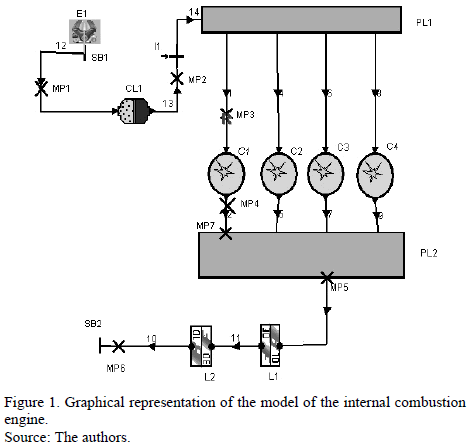
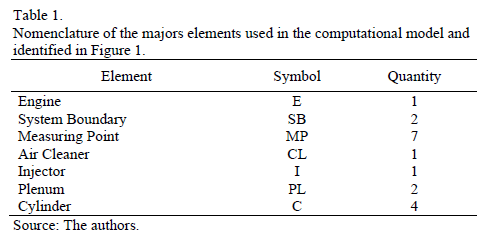
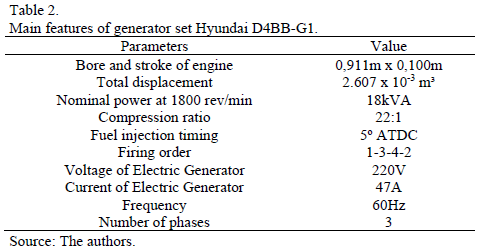
<body><![CDATA[<p><font size="3" face="Verdana, Arial, Helvetica, sans-serif"><b>1. Introduction</b></font></p>     <p><font size="2" face="Verdana, Arial, Helvetica, sans-serif">The regions of the  humid tropics, especially the Amazon, are rich in oil palms that produce  vegetable oils, many without a commercial value. These same regions are  dependent on petroleum for their energy supply, either to generate electricity,  heat or land and fluvial transportation, where the logistics to guarantee the  supply of fossil fuels are complex and expensive. According to &#91;1&#93;, &quot;the  challenge for any country or region is the implementation of processes of  production based on feedstock, with local availability.&quot; For the author,  &quot;these processes should be optimized with the goal of getting biofuels  with competitive production costs and an appropriate quality.&quot; An example  of this is that vegetable oils are capable of being used as hydrocarbon fuel  with the advantage of being renewable and promote local economies. Research  with this focus is required as an alternative to decreasing dependence on  fossil fuels, mainly oil, natural gas and coal, whose total primary energy  consumption grew by 1.8% in 2012 relative to 2011 &#91;2&#93;. In this context, the use  of vegetable oil <i>in natura </i>(VO), that  is filtered and degummed only, in internal combustion engines (ICE) as a viable  alternative in complete or partial replacement to fossil fuels has been  investigated. However, the use of VO in unmodified diesel engines leads to a  reduction of thermal efficiency and increased levels of soot &#91;3&#93;. As a proposal  to make the use of VO feasible, researchers are introducing other types of  fuels as an additive to vegetable oil. &#91;3&#93; carried out performance experiments  in a compression ignition engine using vegetable oil from Jatropha plus small  quantities of hydrogen (H<sub>2</sub>) as the main fuel, which led to an  improvement in the performance of this engine. One of the major advantages to  using H<sub>2</sub> as fuel is the absence of carbon in its chemical  composition, which means that it has a very high burning rate and, thus,  combustion is very fast and its wide range of flammable limits allows use  equivalence ratio in the range of 0.1 to 7.1 &#91;4&#93;. The wide flammability of H<sub>2</sub> allows the engines that use it as a fuel to operate with very lean mixtures  resulting in greater fuel savings and more complete combustion &#91;5&#93;. Variations in both the injected amount of H<sub>2</sub> as  the types of vegetable oil used has been studied. &#91;6&#93; investigated the use of rubber seed oil, methyl-ester rubber seed oil and  diesel as main fuels, and H<sub>2</sub> as an inductor, and concluded that  there was a decrease in peak pressure in the cylinder with the addition of H<sub>2</sub>,  in addition to an increase in the rate of combustion due to an improvement in  the rate of heat release. Following this line of research, this study  aimed to simulate the operation of a diesel generator, which occurred without  changes in the ICE geometry, and only varying their operational parameters,  using palm oil <i>in natura</i> as the main  fuel and the addition of small amounts H<sub>2</sub> by the intake manifold.  The commercial software used was the AVL BOOST, employed by several authors  such as &#91;7&#93;, &#91;8&#93;, &#91;9&#93; and &#91;10&#93;, which confers reliability and speed and  guarantees that results are achieved.</font></p>     <p>&nbsp;</p>     <p><font size="3" face="Verdana, Arial, Helvetica, sans-serif"><b>2. Numerical  Methodology</b></font></p>     <p><font size="2" face="Verdana, Arial, Helvetica, sans-serif">The software adopted for the  simulation was the AVL BOOST version 2011.2, which provides a graphical user  interface (GUI) composed of icons that represent components of ICE. Once  selected and interconnected, the icons allow to open windows through which the  geometrical and operational data of the engine, as well as the mathematical  models that make up the simulation are inserted &#91;11&#93;. The numerical model  created to represent the ICE is shown in <a href="#fig01">Fig. 1</a>.</font></p>     <p align="center"><font size="2" face="Verdana, Arial, Helvetica, sans-serif"><a name="fig01"></a></font><img src="/img/revistas/dyna/v82n190/v82n190a18fig01.gif"></p>     <p><a href="#ta01"><font size="2" face="Verdana, Arial, Helvetica, sans-serif">Table 1</font></a><font size="2" face="Verdana, Arial, Helvetica, sans-serif"> shows the nomenclature of the majors elements used  in the computational model and identified in <a href="#fig01">Fig. 1</a>.</font></p>     <p align=center><font size="2" face="Verdana, Arial, Helvetica, sans-serif"><a name="ta01"></a></font><img src="/img/revistas/dyna/v82n190/v82n190a18tab01.gif"></p>     <p><font size="2" face="Verdana, Arial, Helvetica, sans-serif">Geometric and operational  parameters used to create the computational model were obtained from a Hyundai,  Model D4BB-G1 generator, with maximum power of 20kVA, consisting of a diesel internal combustion engine, naturally  aspirated, four-cylinder and indirect injection. The main characteristics of  the engine and generator are shown in <a href="#tab02">Table 2</a>.</font></p>     <p align="center"><font size="2" face="Verdana, Arial, Helvetica, sans-serif"><a name="tab02"></a></font><img src="/img/revistas/dyna/v82n190/v82n190a18tab02.gif"></p>     ]]></body>
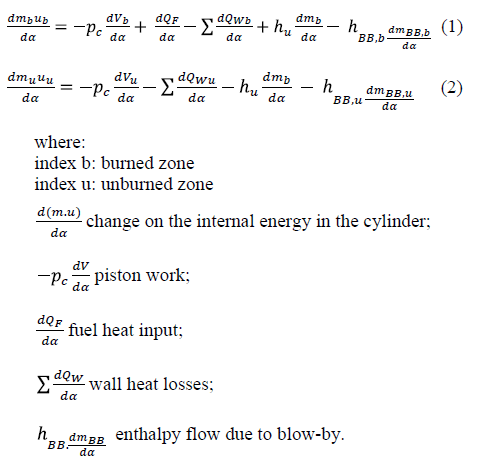
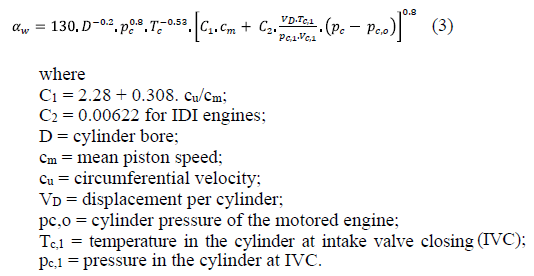
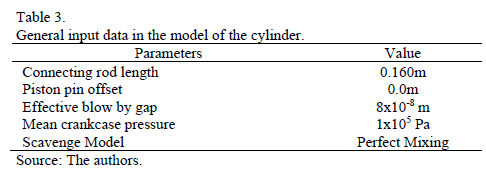
<body><![CDATA[<p><font size="2" face="Verdana, Arial, Helvetica, sans-serif"><b><i>2.1. Combustion Model</i></b></font></p>     <p><font size="2" face="Verdana, Arial, Helvetica, sans-serif">The combustion model considered was Vibe 2 Zone, which specifies  the rate of heat release, considering the burned and unburned mass fractions.  Thus, the calculation of the thermodynamic state of the cylinder is based on  the 1<sup>st</sup> Law of Thermodynamics, as shown below:</font></p>     <p><img src="/img/revistas/dyna/v82n190/v82n190a18eq0102.gif"></p>     <p><font size="2" face="Verdana, Arial, Helvetica, sans-serif">and the term <img src="/img/revistas/dyna/v82n190/v82n190a18eq018.gif"> covers the enthalpy flow from the unburned to  the burned zone due to the conversion of a fresh charge to combustion products &#91;12&#93;.</font></p>     <p><font size="2" face="Verdana, Arial, Helvetica, sans-serif"><b><i>2.2. Scavenging Model</i></b></font></p>     <p><font size="2" face="Verdana, Arial, Helvetica, sans-serif">The scavenging model  considers the scavenging efficiency which is defined as the volume of fresh air  in the cylinder related to the total cylinder volume, and the delivery ratio  which is defined as the total volume of air which entered the cylinder related  to the total cylinder volume. In choosing this model, data were entered as  shown in <a href="#tab03">Table 3</a>.</font></p>     <p align="center"><font size="2" face="Verdana, Arial, Helvetica, sans-serif"><a name="tab03"></a></font><img src="/img/revistas/dyna/v82n190/v82n190a18tab03.gif"></p>     <p><font size="2" face="Verdana, Arial, Helvetica, sans-serif">For the scavenging model the standard adopted by AVL BOOST  for four-stroke engines was maintained, which is Perfect Mixing model, which  considers that the gas entering into a cylinder is immediately mixed with the  contents of the cylinder, and the gas leaving a cylinder has the same  composition as the mixture of the cylinder &#91;11&#93;.</font></p>     <p><font size="2" face="Verdana, Arial, Helvetica, sans-serif"><b><i>2.3. Heat Transfer  Model</i></b></font></p>     <p><font size="2" face="Verdana, Arial, Helvetica, sans-serif">The model chosen for heat transfer from the cylinder to  walls of the combustion chamber was Woschni (1978), represented by the  following equation &#91;12&#93;:</font></p>     ]]></body>
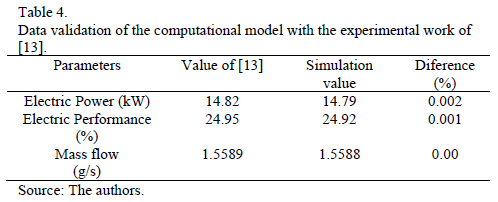
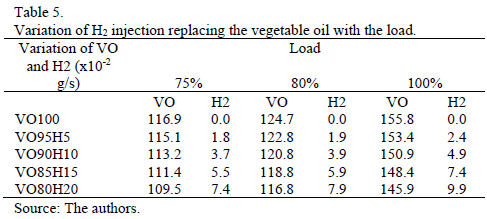
<body><![CDATA[<p><img src="/img/revistas/dyna/v82n190/v82n190a18eq03.gif"></p>     <p><font size="2" face="Verdana, Arial, Helvetica, sans-serif"><b><i>2.4. Pollutants Models</i></b></font></p>     <p><font size="2" face="Verdana, Arial, Helvetica, sans-serif">For the calculation of NOx, CO and soot formation standard  models were used implemented in AVL BOOST &#91;12&#93;. The NOx formation model is  based on Pattas and Häfner model and takes into account 6 elementary reactions  based on the Zeldovich mechanism, utilizing 8 species. The CO formation model  is based on the Onorati et al. model and takes into account 2 elementary  reactions, utilizing 6 species. The soot formation model is based on the Schubiger  et al. model and taken into account 2 elementary reactions: one of formation  and another of oxidation.</font></p>     <p><font size="2" face="Verdana, Arial, Helvetica, sans-serif"><b><i>2.5. Validation  and Simulation Methodology</i></b></font></p>     <p><font size="2" face="Verdana, Arial, Helvetica, sans-serif">After creating the model in AVL BOOST, it was validated  with the experimental work &#91;13&#93;, with some validation data presented in <a href="#tab04">Table  4</a>. </font></p>     <p align=center><font size="2" face="Verdana, Arial, Helvetica, sans-serif"><a name="tab04"></a></font><img src="/img/revistas/dyna/v82n190/v82n190a18tab04.gif"></p>     <p><font size="2" face="Verdana, Arial, Helvetica, sans-serif"><a href="#tab04">Table 4</a> shows that in the validation between simulation  and experimental works &#91;13&#93;, no significant differences were obtained for Electric  Power, Electric Performance and mass flow. Thus, loads were adopted in a generator  similar to those used by &#91;13&#93;; that is, 75%, 80% and 100% of full load capacity  of the generator. As the combustion in diesel engines occurs by diffuse flame,  the combustion occurs at stoichiometric condition. The values adopted for the  fuel Lower Heating Value were 38,085 kJ/kg for the VO and 120,043 kJ/kg for the  H<sub>2</sub>. At first, the simulation occurred only with vegetable oil <i>in natura</i> (VO100) as fuel being kept  constant its inlet mass flow rate at 1.558 g/s that means genset operating at  its full load. After that, the addition of H<sub>2</sub> at the entrance of the  intake manifold through an injector was simulated.</font></p>     <p><font size="2" face="Verdana, Arial, Helvetica, sans-serif">Similar  to &#91;14&#93;, this simulation varied the H<sub>2</sub> concentration from zero to  20% with steps of 5%. This implies VO reduction of the same amount (in energy  basis). As a Lower Heating Value of H<sub>2</sub> is greater than the one for  VO, the amount of VO energy replaced for H<sub>2</sub> was the </font><font size="2" face="Verdana, Arial, Helvetica, sans-serif">same, but the amount of mass of H<sub>2</sub> that replaced the mass of VO was obviously smaller for each of the simulated  cases, as shown in <a href="#tab05">Table 5</a>. The notation adopted for each amount of H<sub>2</sub> injected replacing VO were VO95H5 (5% H<sub>2</sub>), VO90H10 (10% H<sub>2</sub>),  VO85H15 (15% H<sub>2</sub>) and VO80H20 (20% H<sub>2</sub>).</font></p>     <p align=center><font size="2" face="Verdana, Arial, Helvetica, sans-serif"><a name="tab05"></a></font><img src="/img/revistas/dyna/v82n190/v82n190a18tab05.gif"></p>     <p>&nbsp;</p>     ]]></body>
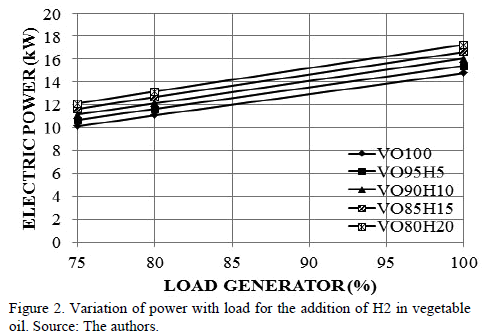
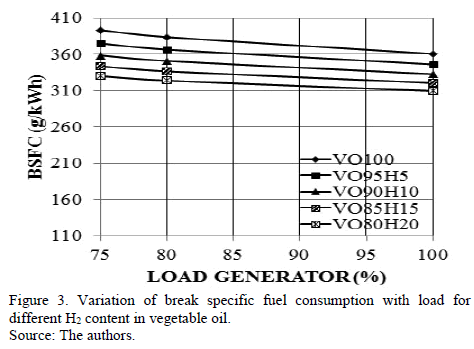
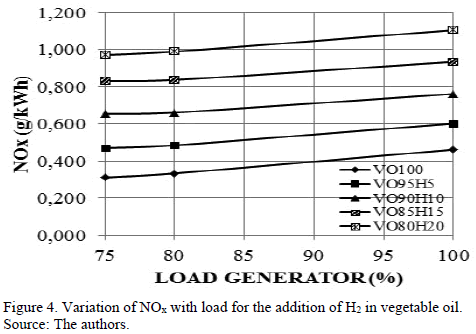
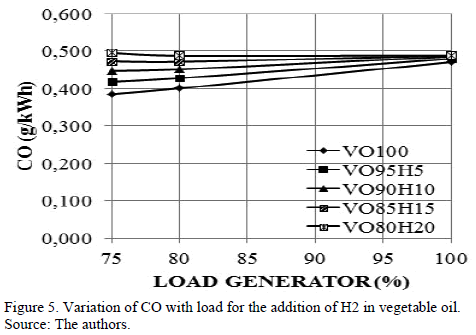
<body><![CDATA[<p><font size="3" face="Verdana, Arial, Helvetica, sans-serif"><b>3. results and Discussion</b></font></p>     <p><font size="2" face="Verdana, Arial, Helvetica, sans-serif"><a href="#fig02">Fig. 2</a> shows variations of the genset output electric  power varying the generator load and H<sub>2</sub>/VO ratio. The simulation  showed that there was a linear increase in electrical power provided by the  generator, when the H<sub>2</sub> content was increased. The output increased  16% at 75% of the nominal load and 14% at full load.</font></p>     <p align="center"><font size="2" face="Verdana, Arial, Helvetica, sans-serif"><a name="fig02"></a></font><img src="/img/revistas/dyna/v82n190/v82n190a18fig02.gif"></p>     <p><font size="2" face="Verdana, Arial, Helvetica, sans-serif"><a href="#fig03">Fig. 3</a> shows the variation of brake specific fuel  consumption (BSFC) with the generator load and H<sub>2</sub> concentration.  Increasing H<sub>2</sub> content, BSFC decreased by 14.2% for operation for  full load and decreased by 16.1% with the genset operating with 75% of the  generator nominal load. The simulation suggested that the lowest value for the  BSFC occurs when the genset run with 20% of H<sub>2</sub> and full load. In  this case, the specific consumption is 309.13 g/kWh.</font></p>     <p align="center"><font size="2" face="Verdana, Arial, Helvetica, sans-serif"><a name="fig03"></a></font><img src="/img/revistas/dyna/v82n190/v82n190a18fig03.gif"></p>     <p><font size="2" face="Verdana, Arial, Helvetica, sans-serif"><a href="#fig04">Fig. 4</a> shows NO<sub>x</sub> concentration in the eluded  gases changing the generator load for a different H<sub>2</sub>/VO ratio. As  expected, there was a significant increase in NO<sub>x</sub> concentration with  increasing H<sub>2</sub>/VO ratio. At full load and 20% H<sub>2</sub>, the NO<sub>x</sub> concentration increased 58%. Running under full load and 20% of H<sub>2</sub>,  genset electric power increased from 14.8kW to 17.2kW. This is a consequence of  replacing the vegetable oil-air mixture causing a reduction in the amount of  air and, therefore, on the amount of N<sub>2</sub> raising the mixture's adiabatic  flame temperature. As the Zeldovich mechanism is very sensitive to the reactant  temperature, the rate of NO<sub>x</sub> production increases exponentially with  gas elevation. As the combustion chamber has excess oxygen and plenty of  nitrogen, it results in a greater concentration of NO<sub>x</sub> on the  exhaustion gases in the case of H<sub>2</sub> doping.</font></p>     <p align="center"><font size="2" face="Verdana, Arial, Helvetica, sans-serif"><a name="fig04"></a></font><img src="/img/revistas/dyna/v82n190/v82n190a18fig04.gif"></p>     <p><font size="2" face="Verdana, Arial, Helvetica, sans-serif"><a href="#fig05">Fig. 5</a> shows the variation of CO concentration varying the  generator load and H<sub>2</sub>/VO ratio.</font></p>     <p align="center"><font size="2" face="Verdana, Arial, Helvetica, sans-serif"><a name="fig05"></a></font><img src="/img/revistas/dyna/v82n190/v82n190a18fig05.gif"></p>     <p><font size="2" face="Verdana, Arial, Helvetica, sans-serif">Increasing  H<sub>2</sub> content raised the CO concentration in exhaust gas by 28.3% when  operating at 75% of the nominal load. However, if the H<sub>2</sub> content is  20%, the CO concentration stays almost constant independently of the generator  load. This fact is very positive, mainly for genset operating in off-grid  conditions and required to follow the load. In this case, doping the inlet air  with 20% of H<sub>2</sub> will </font><font size="2" face="Verdana, Arial, Helvetica, sans-serif">cause the CO concentration in the  exhaustion gases to be kept constant and independent of the fuel flow rate.</font></p>     ]]></body>
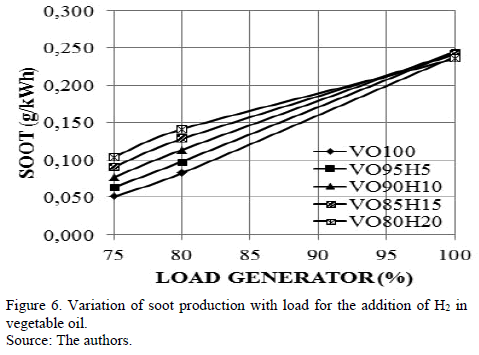
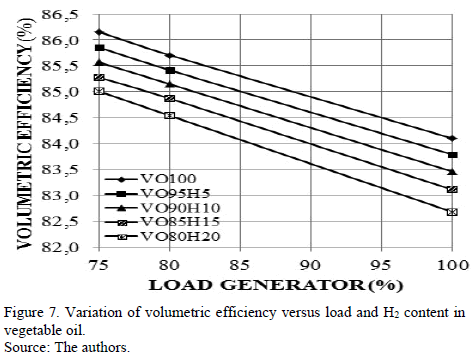
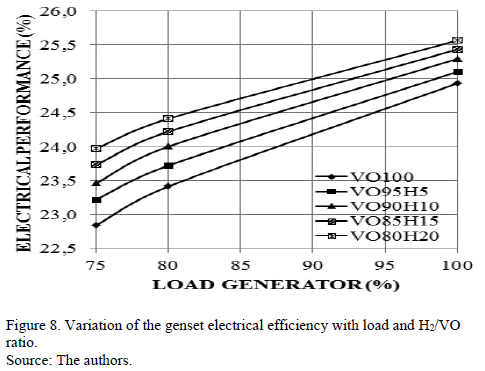
<body><![CDATA[<p><font size="2" face="Verdana, Arial, Helvetica, sans-serif"><a href="#fig06">Fig. 6</a> shows how soot formation varies with the generator  load and H<sub>2</sub>/VO ratio. Raising the load increases soot concentration.  At 75% of the nominal load, the amount of soot doubles if the H<sub>2</sub> varies from 0 to 20%. On the other hand, at full load the amount of soot  produced was almost constant and nearby 0.24 g/kWh. The minimum amounts of soot  obtained was for VO100 and reached 0.051 g/kWh. Hydrogen competes for oxygen  with carbon. At high load, much more carbon is injected for the same available  amount of oxygen, therefore more soot is formed. At 75% load, the competition  between carbon and hydrogen is more visible. Once more hydrogen is added, there  is an oxygen shortage that promotes soot formation. <a href="#fig07">Fig. 7</a> shows the volumetric  efficiency versus load and H<sub>2</sub>/VO ratio.</font></p>     <p align="center"><font size="2" face="Verdana, Arial, Helvetica, sans-serif"><a name="fig06"></a></font><img src="/img/revistas/dyna/v82n190/v82n190a18fig06.gif"></p>     <p align="center"><font size="2" face="Verdana, Arial, Helvetica, sans-serif"><a name="fig07"></a></font><img src="/img/revistas/dyna/v82n190/v82n190a18fig07.gif"></p>     <p><font size="2" face="Verdana, Arial, Helvetica, sans-serif">Increasing the generator load and H<sub>2</sub> content,  the simulation showed a decrease in engine volumetric efficiency of 1.4% at  generator load of 75% of the nominal load, and 1.7% when operating at full  load. The simulation showed that for full load and 20% in H<sub>2</sub> content, volumetric efficiency can fall to 82.6%. This can happen because  larger loads will require higher power  (<a href="#fig02">Fig. 2</a>), which will increase the average temperature in the combustion chamber  and increase the engine wall temperature. Then, engine walls will transfer heat  to air in the intake system, reducing the air density, thereby reducing  volumetric efficiency. </font></p>     <p><font size="2" face="Verdana, Arial, Helvetica, sans-serif"><a href="#fig08">Fig. 8</a> shows the genset electrical performance versus load  and H<sub>2</sub>/VO ratio. </font></p>     <p align=center><font size="2" face="Verdana, Arial, Helvetica, sans-serif"><a name="fig08"></a></font><img src="/img/revistas/dyna/v82n190/v82n190a18fig08.gif"></p>     <p><font size="2" face="Verdana, Arial, Helvetica, sans-serif">At the lowest load, there was a gain of nearly 5% in performance,  and a 2.5% gain operating at full load. The simulation showed that the  generator can reach values above 25.5% in performance with 20% H<sub>2</sub> in  vegetable oil.</font></p>     <p>&nbsp;</p>     <p><font size="3" face="Verdana, Arial, Helvetica, sans-serif"><b>4. conclusions </b></font></p>     <p><font size="2" face="Verdana, Arial, Helvetica, sans-serif">The results showed  significant improvements in the genset electric power and a decrease in brake  specific fuel consumption with increasing hydrogen doping. The overall genset  electrical efficiency improved as the hydrogen concentration was raised. The CO  production remained constant with the maximum amount of simulated hydrogen for  demanded medium and high loads on equipment. The values of NO<sub>x</sub> and  volumetric efficiency show the best levels with the use of vegetable oil <i>in nature</i> than with the introduction of  hydrogen, while soot formation was increased but remained at a level close to  0.24 g/kWh, for any amount of tested hydrogen concentration when the genset  operates at 100% load. The simulation showed that with the generator operating  at medium load (75%), good results were achieved for the brake specific fuel  consumption, which remained close to 329 g/kWh. The electrical efficiency of  the genset at 75% load was 24%, close to the operation at full load, which was  25.5%. The general conclusion obtained from this simulation is that using  hydrogen doping promotes a faster combustion of palm oil, improving its  performance and CO emissions remain constant. These findings deserve to be  investigated experimentally in gensets operating at medium loads or high loads,  especially in regions with complex and expensive logistics, from the point of  view of petroleum based fuels supply, such as the Amazon region.</font></p>     ]]></body>
<body><![CDATA[<p>&nbsp;</p>     <p><font size="3" face="Verdana, Arial, Helvetica, sans-serif"><b>Acknowledgements</b></font></p>     <p><font size="2" face="Verdana, Arial, Helvetica, sans-serif">To AVL-AST  License Extension University Partnership Program - Federal University of Para  and grant of use of AVL BOOST software.</font></p>     <p>&nbsp;</p>     <p><font size="3" face="Verdana, Arial, Helvetica, sans-serif"><b>References </b></font></p>     <!-- ref --><p><font size="2" face="Verdana, Arial, Helvetica, sans-serif"><b>&#91;1&#93;</b>    Benavides, A., Benjumea, P. y Pashova, V.,  El biodiesel de aceite de higuerilla como combustible alternativo para motores  diesel. DYNA, 74 (153), pp. 141-150, 2007.    &nbsp;&nbsp;&nbsp;&nbsp;&nbsp;&nbsp;&nbsp;&nbsp;[&#160;<a href="javascript:void(0);" onclick="javascript: window.open('/scielo.php?script=sci_nlinks&ref=000078&pid=S0012-7353201500020001800001&lng=','','width=640,height=500,resizable=yes,scrollbars=1,menubar=yes,');">Links</a>&#160;]<!-- end-ref --></font></p>     <!-- ref --><p><font size="2" face="Verdana, Arial, Helvetica, sans-serif"><b>&#91;2&#93;</b>    BP Statistical Review of World Energy. &#91;on line&#93;</b> June  2013. &#91;Consulted April 7<sup>th</sup> of 2014&#93;. Available at: <a href="http://www.bp.com" target="_blank">http://www.bp.com</a> </font>&nbsp;&nbsp;&nbsp;&nbsp;&nbsp;&nbsp;&nbsp;&nbsp;[&#160;<a href="javascript:void(0);" onclick="javascript: window.open('/scielo.php?script=sci_nlinks&ref=000080&pid=S0012-7353201500020001800002&lng=','','width=640,height=500,resizable=yes,scrollbars=1,menubar=yes,');">Links</a>&#160;]<!-- end-ref --><!-- ref --><p><font size="2" face="Verdana, Arial, Helvetica, sans-serif"><b>&#91;3&#93;</b>    Kumar,  M.S., Ramesh, A. and Nagalingam, B.,  Use of hydrogen to enhance the performance of a vegetable oil fuelled compression  ignition engine. International Journal of Hydrogen Energy, 28 (10), pp.  1143-1154, 2003. DOI: 10.1016/S0360-3199(02)00234-3</font>&nbsp;&nbsp;&nbsp;&nbsp;&nbsp;&nbsp;&nbsp;&nbsp;[&#160;<a href="javascript:void(0);" onclick="javascript: window.open('/scielo.php?script=sci_nlinks&ref=000081&pid=S0012-7353201500020001800003&lng=','','width=640,height=500,resizable=yes,scrollbars=1,menubar=yes,');">Links</a>&#160;]<!-- end-ref --><!-- ref --><p><font size="2" face="Verdana, Arial, Helvetica, sans-serif"><b>&#91;4&#93;</b>    Yilmar, A.C., Uludamar, E. and Aydin,  K., Effect of hydroxy (HHO) gas  addition on performance and exhaust emissions in compression ignition engines.  International Journal of Hydrogen Energy, 35  (20), pp. 11366-11372, 2010.</font> <font size="2" face="Verdana, Arial, Helvetica, sans-serif"><a href="http://dx.doi.org/10.1016/j.ijhydene.2010.07.040" target="_blank">http://dx.doi.org/10.1016/j.ijhydene.2010.07.040</a></font>&nbsp;&nbsp;&nbsp;&nbsp;&nbsp;&nbsp;&nbsp;&nbsp;[&#160;<a href="javascript:void(0);" onclick="javascript: window.open('/scielo.php?script=sci_nlinks&ref=000082&pid=S0012-7353201500020001800004&lng=','','width=640,height=500,resizable=yes,scrollbars=1,menubar=yes,');">Links</a>&#160;]<!-- end-ref --><!-- ref --><p><font size="2" face="Verdana, Arial, Helvetica, sans-serif"><b>&#91;5&#93;</b>    Zhou, J.H., Cheung, C.S. and  Leung, C.W., Combustion,  performance and emissions of ULSD, PME and B50 fueled multi-cylinder diesel  engine with naturally aspirated hydrogen. International Journal of Hydrogen  Energy, 38 (34), pp. 14837-14848, 2013. <a href="http://dx.doi.org/10.1016/j.ijhydene.2013.08.128" target="_blank">http://dx.doi.org/10.1016/j.ijhydene.2013.08.128</a></font>&nbsp;&nbsp;&nbsp;&nbsp;&nbsp;&nbsp;&nbsp;&nbsp;[&#160;<a href="javascript:void(0);" onclick="javascript: window.open('/scielo.php?script=sci_nlinks&ref=000083&pid=S0012-7353201500020001800005&lng=','','width=640,height=500,resizable=yes,scrollbars=1,menubar=yes,');">Links</a>&#160;]<!-- end-ref --><!-- ref --><p><font size="2" face="Verdana, Arial, Helvetica, sans-serif"><b>&#91;6&#93;</b>    Edwin-Geo, V., Nagarajan, B. and  Nagalingam, B., Studies on dual  fuel operation of rubber seed oil and its bio-diesel with hydrogen as the  inducted fuel. International Journal of Hydrogen Energy, 33 (21), pp.  6357-6367, 2008. <a href="http://dx.doi.org/10.1016/j.ijhydene.2008.06.021" target="_blank">http://dx.doi.org/10.1016/j.ijhydene.2008.06.021</a></font>&nbsp;&nbsp;&nbsp;&nbsp;&nbsp;&nbsp;&nbsp;&nbsp;[&#160;<a href="javascript:void(0);" onclick="javascript: window.open('/scielo.php?script=sci_nlinks&ref=000084&pid=S0012-7353201500020001800006&lng=','','width=640,height=500,resizable=yes,scrollbars=1,menubar=yes,');">Links</a>&#160;]<!-- end-ref --><!-- ref --><p><font size="2" face="Verdana, Arial, Helvetica, sans-serif"><b>&#91;7&#93;</b> Carvalho, L.O., Cruz, M.E. C. and Leiroz, A.J.K., Integração de simuladores de processos e de  motores para a an&aacute;lise exerg&eacute;tica de plantas de potência, VI National Congress of Mechanical Engineering  (CONEM), pp. 1-10, 2010.    &nbsp;&nbsp;&nbsp;&nbsp;&nbsp;&nbsp;&nbsp;&nbsp;[&#160;<a href="javascript:void(0);" onclick="javascript: window.open('/scielo.php?script=sci_nlinks&ref=000085&pid=S0012-7353201500020001800007&lng=','','width=640,height=500,resizable=yes,scrollbars=1,menubar=yes,');">Links</a>&#160;]<!-- end-ref --></font></p>     <!-- ref --><p><font size="2" face="Verdana, Arial, Helvetica, sans-serif"><b>&#91;8&#93;</b> Almeida, V.T.P., Simulação computacional  de emissões e desempenho de um motor diesel operando com &oacute;leo diesel e  hidrogênio, MSc. Thesis, Pontifícia Universidade Cat&oacute;lica de Minas Gerais,  Minas Gerais, Brazil, 2012.    &nbsp;&nbsp;&nbsp;&nbsp;&nbsp;&nbsp;&nbsp;&nbsp;[&#160;<a href="javascript:void(0);" onclick="javascript: window.open('/scielo.php?script=sci_nlinks&ref=000087&pid=S0012-7353201500020001800008&lng=','','width=640,height=500,resizable=yes,scrollbars=1,menubar=yes,');">Links</a>&#160;]<!-- end-ref --></font></p>     <!-- ref --><p><font size="2" face="Verdana, Arial, Helvetica, sans-serif"><b>&#91;9&#93;</b> Melo, T.C., An&aacute;lise experimental e  simulação computacional de um motor flex operando com diferentes misturas de  etanol hidratado na gasolina, Thesis, Universidade Federal do Rio de Janeiro,  Rio de Janeiro, Brazil, 2012.    &nbsp;&nbsp;&nbsp;&nbsp;&nbsp;&nbsp;&nbsp;&nbsp;[&#160;<a href="javascript:void(0);" onclick="javascript: window.open('/scielo.php?script=sci_nlinks&ref=000089&pid=S0012-7353201500020001800009&lng=','','width=640,height=500,resizable=yes,scrollbars=1,menubar=yes,');">Links</a>&#160;]<!-- end-ref --> </font></p>     <!-- ref --><p><font size="2" face="Verdana, Arial, Helvetica, sans-serif"><b>&#91;10&#93;</b> Ferreira,  I.A., Sodr&eacute;, J.R. and Linke, P., Numerical study on injection timing for reduced  emissions from an engine operating with diesel oil and hydrogen, 22<sup>nd </sup>International Congress of  Mechanical Engineering (COBEM), pp. 540-546, 2013.    &nbsp;&nbsp;&nbsp;&nbsp;&nbsp;&nbsp;&nbsp;&nbsp;[&#160;<a href="javascript:void(0);" onclick="javascript: window.open('/scielo.php?script=sci_nlinks&ref=000091&pid=S0012-7353201500020001800010&lng=','','width=640,height=500,resizable=yes,scrollbars=1,menubar=yes,');">Links</a>&#160;]<!-- end-ref --> </font></p>     ]]></body>
<body><![CDATA[<!-- ref --><p><font size="2" face="Verdana, Arial, Helvetica, sans-serif"><b>&#91;11&#93;</b>   AVL. AVL BOOST Version 2011.2 Users Guide. Austria:  2011.    &nbsp;&nbsp;&nbsp;&nbsp;&nbsp;&nbsp;&nbsp;&nbsp;[&#160;<a href="javascript:void(0);" onclick="javascript: window.open('/scielo.php?script=sci_nlinks&ref=000093&pid=S0012-7353201500020001800011&lng=','','width=640,height=500,resizable=yes,scrollbars=1,menubar=yes,');">Links</a>&#160;]<!-- end-ref --></font></p>     <!-- ref --><p><font size="2" face="Verdana, Arial, Helvetica, sans-serif"><b>&#91;12&#93;</b>   AVL. AVL BOOST Version 2011.2 Theory Guide. Austria:  2011.    &nbsp;&nbsp;&nbsp;&nbsp;&nbsp;&nbsp;&nbsp;&nbsp;[&#160;<a href="javascript:void(0);" onclick="javascript: window.open('/scielo.php?script=sci_nlinks&ref=000095&pid=S0012-7353201500020001800012&lng=','','width=640,height=500,resizable=yes,scrollbars=1,menubar=yes,');">Links</a>&#160;]<!-- end-ref --></font></p>     <!-- ref --><p><font size="2" face="Verdana, Arial, Helvetica, sans-serif"><b>&#91;13&#93;</b>   Pereira, R.S., Nogueira, M.F.M. and Tostes, M.E.L., Evaluating  indirect injection diesel engine performance fueled with palm oil, 14<sup>th</sup> Brazilian Congress of Thermal  Sciences and Engineering (ENCIT), 143, 2012.    &nbsp;&nbsp;&nbsp;&nbsp;&nbsp;&nbsp;&nbsp;&nbsp;[&#160;<a href="javascript:void(0);" onclick="javascript: window.open('/scielo.php?script=sci_nlinks&ref=000097&pid=S0012-7353201500020001800013&lng=','','width=640,height=500,resizable=yes,scrollbars=1,menubar=yes,');">Links</a>&#160;]<!-- end-ref --></font></p>     <!-- ref --><p><font size="2" face="Verdana, Arial, Helvetica, sans-serif"><b>&#91;14&#93;</b> Morais, A.M., Justino, M.A.M., Valente,  O.S., Hanriot, S.M. and Sodr&eacute;, J.R., Hydrogen impacts on performance and CO<sub>2</sub>  emissions from a diesel power generator. International Journal of Hydrogen  Energy, 38 (16), pp. 6857-6864, 2013. <a href="http://dx.doi.org/10.1016/j.ijhydene.2013.03.119" target="_blank">http://dx.doi.org/10.1016/j.ijhydene.2013.03.119</a></font>&nbsp;&nbsp;&nbsp;&nbsp;&nbsp;&nbsp;&nbsp;&nbsp;[&#160;<a href="javascript:void(0);" onclick="javascript: window.open('/scielo.php?script=sci_nlinks&ref=000099&pid=S0012-7353201500020001800014&lng=','','width=640,height=500,resizable=yes,scrollbars=1,menubar=yes,');">Links</a>&#160;]<!-- end-ref --><p>&nbsp;</p>     <p><font size="2" face="Verdana, Arial, Helvetica, sans-serif"><b>R.A. Seawright-de Campos,</b> graduated in Mechanical Engineering in 1987, from the  Federal University of Par&aacute; - UFPA - Brazil and obtained a MSc in Mechanical  Engineering in 2004, from the Federal University of Par&aacute; - UFPA - Brazil.  Currently, he is currently working on his PhD. in Electrical Engineering at  UFPA. He is a professor at the Federal Institute of Education, Science and  Technology of Par&aacute; - IFPA - Brazil and his area of interest includes modeling  and simulation of thermal systems and energy efficiency.</font></p>     <p><font size="2" face="Verdana, Arial, Helvetica, sans-serif"><b>M.F.  Martins-Nogueira,</b> graduated in Mechanical Engineering in 1980, from  the Federal University of Par&aacute;, Brazil, has a MSc in Mechanical Engineering in  1984, from the Federal University of Itajub&aacute;, Brazil, and a PhD in 2001, in  Combustion from Cornell University, USA. He is an expert on studies, design and  construction of SHP from Unifei/Eletrobras. He was Coordinator of Technology at  the Ministry of Mines and Energy of Brazil. He is currently an associate  professor at the Federal University of Par&aacute; and consultant to the IDB and  Thermoelectric as well as Hydro Power Plants. He has experience in power  generation, with emphasis on water resources, combustion and gasification,  acting on the following topics: turbo machinery, study, design, construction and  commissioning of hydroelectric and thermoelectric plants, cyclonic combustor,  biomass combustion, biomass gasification and use of biofuels in internal  combustion engines.</font></p>     ]]></body>
<body><![CDATA[<p><font size="2" face="Verdana, Arial, Helvetica, sans-serif"><b>M.E. de Lima-Tostes, </b>graduated  in Electrical Engineering from the Federal University of Par&aacute; (UFPA), Brazil. Obtained  MSc and PhD in Electrical Power Systems all of them from the Federal University  of Par&aacute;, Brazil. She is a professor at the Federal University of Par&aacute; and her main research  interests are: power quality issues and energy efficiency.</font></p>      ]]></body><back>
<ref-list>
<ref id="B1">
<label>1</label><nlm-citation citation-type="journal">
<person-group person-group-type="author">
<name>
<surname><![CDATA[Benavides]]></surname>
<given-names><![CDATA[A.]]></given-names>
</name>
<name>
<surname><![CDATA[Benjumea]]></surname>
<given-names><![CDATA[P.]]></given-names>
</name>
<name>
<surname><![CDATA[Pashova]]></surname>
<given-names><![CDATA[V.]]></given-names>
</name>
</person-group>
<article-title xml:lang="es"><![CDATA[El biodiesel de aceite de higuerilla como combustible alternativo para motores diesel]]></article-title>
<source><![CDATA[DYNA]]></source>
<year>2007</year>
<volume>74</volume>
<numero>153</numero>
<issue>153</issue>
<page-range>141-150</page-range></nlm-citation>
</ref>
<ref id="B2">
<label>2</label><nlm-citation citation-type="">
<collab>BP</collab>
<source><![CDATA[Statistical Review of World Energy]]></source>
<year>June</year>
<month> 2</month>
<day>01</day>
</nlm-citation>
</ref>
<ref id="B3">
<label>3</label><nlm-citation citation-type="journal">
<person-group person-group-type="author">
<name>
<surname><![CDATA[Kumar]]></surname>
<given-names><![CDATA[M.S.]]></given-names>
</name>
<name>
<surname><![CDATA[Ramesh]]></surname>
<given-names><![CDATA[A.]]></given-names>
</name>
<name>
<surname><![CDATA[Nagalingam]]></surname>
<given-names><![CDATA[B.]]></given-names>
</name>
</person-group>
<article-title xml:lang="en"><![CDATA[Use of hydrogen to enhance the performance of a vegetable oil fuelled compression ignition engine]]></article-title>
<source><![CDATA[International Journal of Hydrogen Energy]]></source>
<year>2003</year>
<volume>28</volume>
<numero>10</numero>
<issue>10</issue>
<page-range>1143-1154</page-range></nlm-citation>
</ref>
<ref id="B4">
<label>4</label><nlm-citation citation-type="journal">
<person-group person-group-type="author">
<name>
<surname><![CDATA[Yilmar]]></surname>
<given-names><![CDATA[A.C.]]></given-names>
</name>
<name>
<surname><![CDATA[Uludamar]]></surname>
<given-names><![CDATA[E.]]></given-names>
</name>
<name>
<surname><![CDATA[Aydin]]></surname>
<given-names><![CDATA[K.]]></given-names>
</name>
</person-group>
<article-title xml:lang="en"><![CDATA[Effect of hydroxy (HHO) gas addition on performance and exhaust emissions in compression ignition engines]]></article-title>
<source><![CDATA[International Journal of Hydrogen Energy]]></source>
<year>2010</year>
<volume>35</volume>
<numero>20</numero>
<issue>20</issue>
<page-range>11366-11372</page-range></nlm-citation>
</ref>
<ref id="B5">
<label>5</label><nlm-citation citation-type="journal">
<person-group person-group-type="author">
<name>
<surname><![CDATA[Zhou]]></surname>
<given-names><![CDATA[J.H.]]></given-names>
</name>
<name>
<surname><![CDATA[Cheung]]></surname>
<given-names><![CDATA[C.S.]]></given-names>
</name>
<name>
<surname><![CDATA[Leung]]></surname>
<given-names><![CDATA[C.W.]]></given-names>
</name>
</person-group>
<article-title xml:lang="en"><![CDATA[Combustion, performance and emissions of ULSD, PME and B50 fueled multi-cylinder diesel engine with naturally aspirated hydrogen]]></article-title>
<source><![CDATA[International Journal of Hydrogen Energy]]></source>
<year>2013</year>
<volume>38</volume>
<numero>34</numero>
<issue>34</issue>
<page-range>14837-14848</page-range></nlm-citation>
</ref>
<ref id="B6">
<label>6</label><nlm-citation citation-type="journal">
<person-group person-group-type="author">
<name>
<surname><![CDATA[Edwin-Geo]]></surname>
<given-names><![CDATA[V.]]></given-names>
</name>
<name>
<surname><![CDATA[Nagarajan]]></surname>
<given-names><![CDATA[B.]]></given-names>
</name>
<name>
<surname><![CDATA[Nagalingam]]></surname>
<given-names><![CDATA[B.]]></given-names>
</name>
</person-group>
<article-title xml:lang="en"><![CDATA[Studies on dual fuel operation of rubber seed oil and its bio-diesel with hydrogen as the inducted fuel]]></article-title>
<source><![CDATA[International Journal of Hydrogen Energy]]></source>
<year>2008</year>
<volume>33</volume>
<numero>21</numero>
<issue>21</issue>
<page-range>6357-6367</page-range></nlm-citation>
</ref>
<ref id="B7">
<label>7</label><nlm-citation citation-type="confpro">
<person-group person-group-type="author">
<name>
<surname><![CDATA[Carvalho]]></surname>
<given-names><![CDATA[L.O.]]></given-names>
</name>
<name>
<surname><![CDATA[Cruz]]></surname>
<given-names><![CDATA[M.E. C.]]></given-names>
</name>
<name>
<surname><![CDATA[Leiroz]]></surname>
<given-names><![CDATA[A.J.K.]]></given-names>
</name>
</person-group>
<article-title xml:lang="pt"><![CDATA[Integração de simuladores de processos e de motores para a análise exergética de plantas de potência]]></article-title>
<source><![CDATA[]]></source>
<year></year>
<conf-name><![CDATA[VI National Congress of Mechanical Engineering]]></conf-name>
<conf-date>2010</conf-date>
<conf-loc> </conf-loc>
</nlm-citation>
</ref>
<ref id="B8">
<label>8</label><nlm-citation citation-type="">
<person-group person-group-type="author">
<name>
<surname><![CDATA[Almeida]]></surname>
<given-names><![CDATA[V.T.P.]]></given-names>
</name>
</person-group>
<source><![CDATA[Simulação computacional de emissões e desempenho de um motor diesel operando com óleo diesel e hidrogênio]]></source>
<year></year>
</nlm-citation>
</ref>
<ref id="B9">
<label>9</label><nlm-citation citation-type="">
<person-group person-group-type="author">
<name>
<surname><![CDATA[Melo]]></surname>
<given-names><![CDATA[T.C.]]></given-names>
</name>
</person-group>
<source><![CDATA[Análise experimental e simulação computacional de um motor flex operando com diferentes misturas de etanol hidratado na gasolina]]></source>
<year></year>
</nlm-citation>
</ref>
<ref id="B10">
<label>10</label><nlm-citation citation-type="confpro">
<person-group person-group-type="author">
<name>
<surname><![CDATA[Ferreira]]></surname>
<given-names><![CDATA[I.A.]]></given-names>
</name>
<name>
<surname><![CDATA[Sodré]]></surname>
<given-names><![CDATA[J.R.]]></given-names>
</name>
<name>
<surname><![CDATA[Linke]]></surname>
<given-names><![CDATA[P.]]></given-names>
</name>
</person-group>
<article-title xml:lang="en"><![CDATA[Numerical study on injection timing for reduced emissions from an engine operating with diesel oil and hydrogen]]></article-title>
<source><![CDATA[]]></source>
<year></year>
<conf-name><![CDATA[22nd International Congress of Mechanical Engineering]]></conf-name>
<conf-date>2013</conf-date>
<conf-loc> </conf-loc>
</nlm-citation>
</ref>
<ref id="B11">
<label>11</label><nlm-citation citation-type="">
<collab>AVL</collab>
<source><![CDATA[AVL BOOST Version 2011.2 Users Guide]]></source>
<year>2011</year>
</nlm-citation>
</ref>
<ref id="B12">
<label>12</label><nlm-citation citation-type="">
<collab>AVL</collab>
<source><![CDATA[AVL BOOST Version 2011.2 Theory Guide]]></source>
<year>2011</year>
</nlm-citation>
</ref>
<ref id="B13">
<label>13</label><nlm-citation citation-type="confpro">
<person-group person-group-type="author">
<name>
<surname><![CDATA[Pereira]]></surname>
<given-names><![CDATA[R.S.]]></given-names>
</name>
<name>
<surname><![CDATA[Nogueira]]></surname>
<given-names><![CDATA[M.F.M.]]></given-names>
</name>
<name>
<surname><![CDATA[Tostes]]></surname>
<given-names><![CDATA[M.E.L.]]></given-names>
</name>
</person-group>
<article-title xml:lang="en"><![CDATA[Evaluating indirect injection diesel engine performance fueled with palm oil]]></article-title>
<source><![CDATA[]]></source>
<year></year>
<conf-name><![CDATA[14th Brazilian Congress of Thermal Sciences and Engineering]]></conf-name>
<conf-date>2012</conf-date>
<conf-loc> </conf-loc>
</nlm-citation>
</ref>
<ref id="B14">
<label>14</label><nlm-citation citation-type="journal">
<person-group person-group-type="author">
<name>
<surname><![CDATA[Morais]]></surname>
<given-names><![CDATA[A.M.]]></given-names>
</name>
<name>
<surname><![CDATA[Justino]]></surname>
<given-names><![CDATA[M.A.M.]]></given-names>
</name>
<name>
<surname><![CDATA[Valente]]></surname>
<given-names><![CDATA[O.S.]]></given-names>
</name>
<name>
<surname><![CDATA[Hanriot]]></surname>
<given-names><![CDATA[S.M.]]></given-names>
</name>
<name>
<surname><![CDATA[Sodré]]></surname>
<given-names><![CDATA[J.R.]]></given-names>
</name>
</person-group>
<article-title xml:lang="en"><![CDATA[Hydrogen impacts on performance and CO2 emissions from a diesel power generator]]></article-title>
<source><![CDATA[International Journal of Hydrogen Energy]]></source>
<year>2013</year>
<volume>38</volume>
<numero>16</numero>
<issue>16</issue>
<page-range>6857-6864</page-range></nlm-citation>
</ref>
</ref-list>
</back>
</article>