<?xml version="1.0" encoding="ISO-8859-1"?><article xmlns:mml="http://www.w3.org/1998/Math/MathML" xmlns:xlink="http://www.w3.org/1999/xlink" xmlns:xsi="http://www.w3.org/2001/XMLSchema-instance">
<front>
<journal-meta>
<journal-id>0012-7353</journal-id>
<journal-title><![CDATA[DYNA]]></journal-title>
<abbrev-journal-title><![CDATA[Dyna rev.fac.nac.minas]]></abbrev-journal-title>
<issn>0012-7353</issn>
<publisher>
<publisher-name><![CDATA[Universidad Nacional de Colombia]]></publisher-name>
</publisher>
</journal-meta>
<article-meta>
<article-id>S0012-73532015000200028</article-id>
<article-id pub-id-type="doi">10.15446/dyna.v82n190.43913</article-id>
<title-group>
<article-title xml:lang="en"><![CDATA[Inspection of radiant heating floor applying non-destructive testing techniques: GPR AND IRT]]></article-title>
<article-title xml:lang="es"><![CDATA[Inspección de suelos radiantes mediante técnicas no destructivas: GPR Y IRT]]></article-title>
</title-group>
<contrib-group>
<contrib contrib-type="author">
<name>
<surname><![CDATA[Lagüela-López]]></surname>
<given-names><![CDATA[Susana]]></given-names>
</name>
<xref ref-type="aff" rid="A01"/>
</contrib>
<contrib contrib-type="author">
<name>
<surname><![CDATA[Solla-Carracelas]]></surname>
<given-names><![CDATA[Mercedes]]></given-names>
</name>
<xref ref-type="aff" rid="A02"/>
</contrib>
<contrib contrib-type="author">
<name>
<surname><![CDATA[Díaz-Vilariño]]></surname>
<given-names><![CDATA[Lucía]]></given-names>
</name>
<xref ref-type="aff" rid="A01"/>
</contrib>
<contrib contrib-type="author">
<name>
<surname><![CDATA[Armesto-González]]></surname>
<given-names><![CDATA[Julia]]></given-names>
</name>
<xref ref-type="aff" rid="A01"/>
</contrib>
</contrib-group>
<aff id="A01">
<institution><![CDATA[,University of Vigo Mining Engineering School ]]></institution>
<addr-line><![CDATA[Vigo ]]></addr-line>
<country>Spain</country>
</aff>
<aff id="A02">
<institution><![CDATA[,Spanish Naval Academy Defense University Center ]]></institution>
<addr-line><![CDATA[Vigo ]]></addr-line>
<country>Spain</country>
</aff>
<pub-date pub-type="pub">
<day>00</day>
<month>04</month>
<year>2015</year>
</pub-date>
<pub-date pub-type="epub">
<day>00</day>
<month>04</month>
<year>2015</year>
</pub-date>
<volume>82</volume>
<numero>190</numero>
<fpage>221</fpage>
<lpage>226</lpage>
<copyright-statement/>
<copyright-year/>
<self-uri xlink:href="http://www.scielo.org.co/scielo.php?script=sci_arttext&amp;pid=S0012-73532015000200028&amp;lng=en&amp;nrm=iso"></self-uri><self-uri xlink:href="http://www.scielo.org.co/scielo.php?script=sci_abstract&amp;pid=S0012-73532015000200028&amp;lng=en&amp;nrm=iso"></self-uri><self-uri xlink:href="http://www.scielo.org.co/scielo.php?script=sci_pdf&amp;pid=S0012-73532015000200028&amp;lng=en&amp;nrm=iso"></self-uri><abstract abstract-type="short" xml:lang="en"><p><![CDATA[The inspection of radiant heating floors requires the use of non-destructive techniques, trying to minimize inspection impact, time and cost, and maximize the information acquired so that the best possible diagnosis is given. With this goal, we propose the application of infrared thermography (IRT) and ground penetrating radar (GPR) for the inspection of radiant heating floors with different floor coatings, in order to evaluate the capabilities and information acquirable with each technique. Specifically, two common floor coatings have been inspected: ceramic tiles and parquet flooring. Results show that each technique provides different information: condition of the pipelines (IRT), geometry and configuration (GPR), concluding that the optimal inspection is constituted by the combination of the two techniques.]]></p></abstract>
<abstract abstract-type="short" xml:lang="es"><p><![CDATA[La inspección de suelos radiantes requiere el uso de técnicas no destructivas, tratando de minimizar el impacto de la inspección, así como el tiempo y el coste, además de maximizar la información adquirida de cara al mejor diagnóstico posible. Con este objetivo, la aplicación de termografía infrarroja (IRT) y georradar (GPR) se propone para la inspección de suelos radiantes con cobertura de diferentes materiales, para evaluar las capacidades y la información adquirible con cada técnica. Los resultados muestran que cada técnica proporciona diferentes tipos de información: estado de las tuberías (IRT), geometría y configuración (GPR); concluyendo que la inspección óptima está formada por la combinación de ambas técnicas.]]></p></abstract>
<kwd-group>
<kwd lng="en"><![CDATA[NDT]]></kwd>
<kwd lng="en"><![CDATA[infrared thermography]]></kwd>
<kwd lng="en"><![CDATA[ground penetrating radar]]></kwd>
<kwd lng="en"><![CDATA[radiant heating floor]]></kwd>
<kwd lng="es"><![CDATA[NDT]]></kwd>
<kwd lng="es"><![CDATA[termografía infrarroja]]></kwd>
<kwd lng="es"><![CDATA[georradar]]></kwd>
<kwd lng="es"><![CDATA[suelo radiante]]></kwd>
</kwd-group>
</article-meta>
</front><body><![CDATA[ <p><font size="1" face="Verdana, Arial, Helvetica, sans-serif"><b>DOI:</b> <a href="http://dx.doi.org/10.15446/dyna.v82n190.43913" target="_blank">http://dx.doi.org/10.15446/dyna.v82n190.43913</a></font></p>     <p align="center"><font size="4" face="Verdana, Arial, Helvetica, sans-serif"><b>Inspection of radiant heating floor applying non-destructive testing techniques: GPR AND IRT</b></font></p>     <p align="center"><i><font size="3"><b><font face="Verdana, Arial, Helvetica, sans-serif">Inspecci&oacute;n de suelos radiantes mediante t&eacute;cnicas no destructivas: GPR Y IRT</font></b></font></i></p>     <p align="center">&nbsp;</p>     <p align="center"><font size="2" face="Verdana, Arial, Helvetica, sans-serif"><b>Susana Lagüela-L&oacute;pez <i><sup>a</sup></i>, Mercedes Solla-Carracelas <i><sup>b</sup></i>, Lucía Díaz-Vilari&ntilde;o <i><sup>a</sup></i> &amp; Julia Armesto-Gonz&aacute;lez <i><sup>a</sup></i></b></font></p>     <p align="center">&nbsp;</p>     <p align="center"><font size="2" face="Verdana, Arial, Helvetica, sans-serif"><sup><i>a </i></sup><i>Mining Engineering School, University of Vigo, Vigo, Spain, <a href="mailto:susiminas@uvigo.es">susiminas@uvigo.es</a>; <a href="mailto:lucia@uvigo.es">lucia@uvigo.es</a>; <a href="mailto:julia@uvigo.es">julia@uvigo.es</a>    <br> <sup>b</sup> Defense University Center, Spanish Naval Academy, Vigo, Spain, <a href="mailto:merchisolla@cud.uvigo.es">merchisolla@cud.uvigo.es</a></i></font></p>     <p align="center">&nbsp;</p>     <p align="center"><font size="2" face="Verdana, Arial, Helvetica, sans-serif"><b>Received: June 15<sup>th</sup>,   de 2014. Received in revised form: October 7<sup>th</sup>, 2014. Accepted:   November 25<sup>th</sup>, 2014</b></font></p>     ]]></body>
<body><![CDATA[<p align="center">&nbsp;</p>     <p align="center"><font size="1" face="Verdana, Arial, Helvetica, sans-seriff"><b>This work is licensed under a</b> <a rel="license" href="http://creativecommons.org/licenses/by-nc-nd/4.0/">Creative Commons Attribution-NonCommercial-NoDerivatives 4.0 International License</a>.</font><br /><a rel="license" href="http://creativecommons.org/licenses/by-nc-nd/4.0/"><img style="border-width:0" src="https://i.creativecommons.org/l/by-nc-nd/4.0/88x31.png" /></a></p> <hr>     <p><font size="2" face="Verdana, Arial, Helvetica, sans-serif"><b>Abstract    <br>   </b></font><font size="2" face="Verdana, Arial, Helvetica, sans-serif">The inspection of radiant heating floors requires the use     of non-destructive techniques, trying to minimize inspection impact, time and     cost, and maximize the information acquired so that the best possible diagnosis     is given. With this goal, we propose the application of infrared thermography     (IRT) and ground penetrating radar (GPR) for the inspection of radiant heating     floors with different floor coatings, in order to evaluate the capabilities and     information acquirable with each technique. Specifically, two common floor     coatings have been inspected: ceramic tiles and parquet flooring. Results show     that each technique provides different information: condition of the pipelines     (IRT), geometry and configuration (GPR), concluding that the optimal inspection     is constituted by the combination of the two techniques.</font></p>     <p><font size="2" face="Verdana, Arial, Helvetica, sans-serif"><i>Keywords</i>: NDT; infrared thermography; ground penetrating radar; radiant heating floor.</font></p>     <p><font size="2" face="Verdana, Arial, Helvetica, sans-serif"><b>Resumen    <br> </b></font><font size="2" face="Verdana, Arial, Helvetica, sans-serif">La  inspecci&oacute;n de suelos radiantes requiere el uso de t&eacute;cnicas no destructivas,  tratando de minimizar el impacto de la inspecci&oacute;n, así como el tiempo y el  coste, adem&aacute;s de maximizar la informaci&oacute;n adquirida de cara al mejor  diagn&oacute;stico posible. Con este objetivo, la aplicaci&oacute;n de termografía infrarroja  (IRT) y georradar (GPR) se propone para la inspecci&oacute;n de suelos radiantes con  cobertura de diferentes materiales, para evaluar las capacidades y la  informaci&oacute;n adquirible con cada t&eacute;cnica. Los resultados muestran que cada  t&eacute;cnica proporciona diferentes tipos de informaci&oacute;n: estado de las tuberías  (IRT), geometría y configuraci&oacute;n (GPR); concluyendo que la inspecci&oacute;n &oacute;ptima est&aacute; formada por la combinaci&oacute;n de ambas t&eacute;cnicas.</font></p>     <p><font size="2" face="Verdana, Arial, Helvetica, sans-serif"><i>Palabras clave</i>: NDT, termografía infrarroja, georradar, suelo radiante.</font></p> <hr>     <p>&nbsp;</p>     <p><font size="3" face="Verdana, Arial, Helvetica, sans-serif"><b>1. Introduction</b></font></p>     ]]></body>
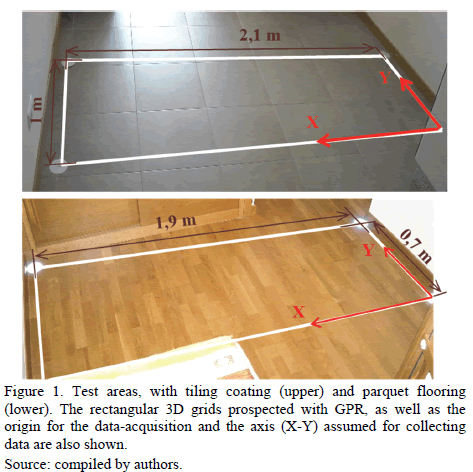
<body><![CDATA[<p><font size="2" face="Verdana, Arial, Helvetica, sans-serif">The inspection of  radiant heating floors is a key aspect given the influence of their  installation in the building. On the one hand, the radiant heating floor  determines the temperature of both the room and the floor, with the subsequent  determination of the thermal comfort and well-being of the users &#91;1&#93;. On the  other hand, radiant technologies are low-temperature heating technologies,  which are believed to reduce energy consumption in the building sector, and  consequently the determination of the expenses destined to heating the building is also possible &#91;2&#93;.</font></p>     <p><font size="2" face="Verdana, Arial, Helvetica, sans-serif">Since this paper deals with the inspection of  installations in-use, all actions must be based on the use of non-destructive  techniques in order to minimize the impact on the users and the building.  Currently, the most widely used technique for the inspection of radiant heating  floors is infrared thermography (IRT). In fact, infrared devices can be used in  general, from non-contact thermometers &#91;3&#93; to cameras &#91;1&#93;, to analyze the heat  transfer phenomena and their influential parameters. If we focus on the  inspection itself, infrared cameras have been used to detect both small-scale  defects on electric radiant heaters &#91;4&#93; and large-scale ones in water pipelines  &#91;5&#93;. The application of this technique allows the reduction of maintenance  tasks thanks to the recognition of the exact failure spot, its classification  and severity evaluation. The main limitation of the technique is the  measurement of highly reflective materials (i.e., with an emissivity value of under 0.8; that is, a reflectivity value of  over 0.2), where the temperature measured is the reflected temperature from the  surrounding objects and not the temperature of the inspected object itself.</font>     <p><font size="2" face="Verdana, Arial, Helvetica, sans-serif">Ground penetrating radar (GPR) is a geophysical technique  that allows the detection of buried objects thanks to their different  dielectric response due to their shape and especially to their material. It has  been widely used for the detection of rebar in concrete &#91;6,7&#93;, but there are,  to date, few published studies about its specific performance in the detection of heating pipelines in buildings, with some notable exceptions &#91;8,9&#93;.</font></p>     <p><font size="2" face="Verdana, Arial, Helvetica, sans-serif">This article presents a methodology for the evaluation and  characterization of thermal floors in as-built buildings by means of both IRT  and GPR techniques. Section 2 explains the processes of data acquisition and  data processing followed for each technique. Section 3 presents the results  obtained from the proposed methodologies applied to two different test areas.  Finally, Section 4 includes the conclusions reached after the analysis of the  application of the different non-destructive methods to radiant heating floors, and the parameters measurable with each technique.</font></p>     <p>&nbsp;</p>     <p><font size="3" face="Verdana, Arial, Helvetica, sans-serif"><b>2. Materials and Methods</b></font></p>     <p><font size="2" face="Verdana, Arial, Helvetica, sans-serif">This section includes a description of the areas used for testing the techniques, and the procedure followed with each of them.</font></p>     <p><font size="2" face="Verdana, Arial, Helvetica, sans-serif"><b><i>2.1. Test areas</i></b></font></p>     <p><font size="2" face="Verdana, Arial, Helvetica, sans-serif">Given the high diversity of building configurations that  can nowadays be equipped with radiant floor heating, two rooms of different use  and floor coating have been chosen for testing (<a href="#fig01">Fig. 1</a>). The first test scene  is a busy space such as a joint kitchen and living room, with low-reflectivity  ceramic tiles as floor coating; while the second scene is a room used as a  bedroom, with parquet flooring in brick pattern. These areas were chosen mainly  due to their uses, which imply the presence of users for long periods and  usually in relaxation or rest situations. Thus, the importance of thermal comfort in these rooms is greater than in rooms destined for other uses.</font></p>     <p align="center"><font size="2" face="Verdana, Arial, Helvetica, sans-serif"><a name="fig01"></a></font><img src="/img/revistas/dyna/v82n190/v82n190a28fig01.gif"></p>     ]]></body>
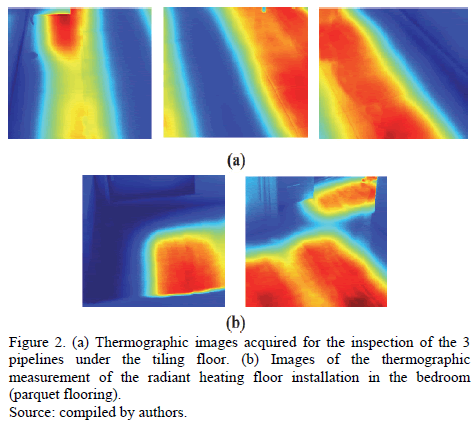
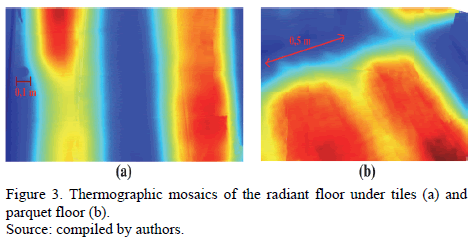
<body><![CDATA[<p><font size="2" face="Verdana, Arial, Helvetica, sans-serif">What is more, both floor configurations of ceramic tiling  and parquet flooring are common in residential buildings, so the analysis of  the performance of the GPR and IRT techniques in them covers the majority of possibilities.</font></p>     <p><font size="2" face="Verdana, Arial, Helvetica, sans-serif">Regarding the radiant heating installation, the  kitchen-living room was equipped with 3 pipelines, 1 of which was damaged, whereas the bedroom was covered by 2 pipelines, both working.</font></p>     <p><font size="2" face="Verdana, Arial, Helvetica, sans-serif"><b><i>2.2. Infrared thermography</i></b></font></p>     <p><font size="2" face="Verdana, Arial, Helvetica, sans-serif">Infrared  thermography is the technique which receives the infrared radiation emitted by  the bodies as a function of their temperature; thermograms appear as images of this radiation &#91;10&#93;. Several parameters affect the thermographic </font><font size="2" face="Verdana, Arial, Helvetica, sans-serif">measurement, such as emissivity of  the material (or its opposite parameter, reflectivity), presence of  reflections, and environmental conditions (ambient temperature and relative  humidity) &#91;11&#93;. Regarding the latter, the application of IRT requires the  existence of a temperature difference between an object and its surrounding  environment in order to distinguish the object from the background; as a  consequence, the thermographic inspection of a radiant heating floor must be  performed with the installation working. In this case, the installation was  turned on 5 hours before the inspection in order to reach a 5-10&ordm;C temperature  difference between the pipelines and the background, sufficient time in advance  so that the installation reaches steady state. This last issue is important in  order to ensure that thermal anomalies are due to defects in the installation, and not to inhomogeneities in the starting process. </font></p>     <p><font size="2" face="Verdana, Arial, Helvetica, sans-serif">Lights were turned off during the inspection in order to  avoid reflections. Finally, given that the purpose of the study is the analysis  of the capabilities of the technique for the inspection of radiant heating  floors and not the quantification of the temperature values of the floor, its emissivity value is not calculated.</font></p>     <p><font size="2" face="Verdana, Arial, Helvetica, sans-serif">The thermographic inspection was performed using a NEC  TH9260 camera with a 640*480UFPA sensor, 0.06ºC resolution and ±2ºC accuracy.  Given that the camera's field of view was 21.7º (Horizontal) x 16.4º  (Vertical), a single image could not cover the dimensions of the room.  Therefore, several thermographic images had to be taken for each test area  (<a href="#fig02">Fig. 2</a>). Since the spatial distribution of the temperatures measured within  the images is required for correct interpretation of the installation; for  example, to detect the presence of defects or malfunctions, images are  mosaicked in order to work with only one image per installation. Within this  image, the defects detected can be spatially located, and therefore reparation actions can be performed in the right place directly.</font></p>     <p align="center"><font size="2" face="Verdana, Arial, Helvetica, sans-serif"><a name="fig02"></a></font><img src="/img/revistas/dyna/v82n190/v82n190a28fig02.gif"></p>     <p><font size="2" face="Verdana, Arial, Helvetica, sans-serif">The next step was the generation of a thermographic mosaic  for each case so that the installation could be completely inspected with one  single image. The registration of each thermographic image in its position in  space was performed using a self-proprietary algorithm developed in Matlab®.  First, the distortion (both radial and tangential) introduced in the images by  the lens was corrected. This step was possible thanks to the geometric  calibration of the camera prior the inspection, following the procedure  explained in &#91;12&#93;. Once images were corrected, the software extracted  characteristic points from each image using SIFT &#91;13&#93;, and obtained their  correspondence between images through the computation of the correlation value, as in &#91;14&#93;. <a href="#fig03">Fig. 3</a> shows the final mosaics.</font></p>     <p align="center"><font size="2" face="Verdana, Arial, Helvetica, sans-serif"><a name="fig03"></a></font><img src="/img/revistas/dyna/v82n190/v82n190a28fig03.gif"></p>     <p><font size="2" face="Verdana, Arial, Helvetica, sans-serif"><b><i>2.3. Ground Penetrating Radar</i></b></font></p>     ]]></body>
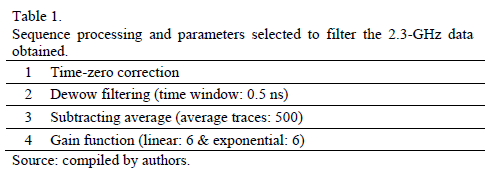
<body><![CDATA[<p><font size="2" face="Verdana, Arial, Helvetica, sans-serif">With the GPR method, when surveying with a bistatic  antenna, a transmitting dipole emits an electromagnetic pulse into the ground  that is partly reflected when it encounters media with different dielectric  properties and partly transmitted into deeper layers. Next, a receiving dipole  records the reflected signal. Using the common-offset-mode (CO), the antenna is  moved over the surface in a specific direction while a constant distance is  maintained between the transmitting and receiving dipoles. This allows us to  obtain an image of the shallow subsurface under the displacement line. These  two-dimensional images, called radargrams, are XZ graphic representations of  the reflections detected. The X-axis represents antenna displacement along the  survey line and the Z-axis represents the two-way travel time of the pulse  emitted (in terms of nanoseconds). Additional information on the basic principles of GPR can be found in &#91;15,16&#93;.</font></p>     <p><font size="2" face="Verdana, Arial, Helvetica, sans-serif">If the time required by the signal to travel from the  transmitting dipole to the reflector and return to the receiving dipole is  measured and the velocity of this radar-wave in the subsurface medium is known, then the position, or depth, of the reflector (d) can be determined from: </font></p>     <p><img src="/img/revistas/dyna/v82n190/v82n190a28eq01.gif"></p>     <p><font size="2" face="Verdana, Arial, Helvetica, sans-serif">where; </font></p>     <blockquote>       <p><font size="2" face="Verdana, Arial, Helvetica, sans-serif">d is the distance travelled by the wave, v is the     radar-wave velocity of propagation in medium, and twt is the travel-time     distance to and from the reflection. </font></p> </blockquote>     <p><font size="2" face="Verdana, Arial, Helvetica, sans-serif">In this work, the MALÅ ProEx system was used, with a  central frequency of 2.3 GHz. In this case, the most influencing parameter that  determines the effectiveness of the method is the vertical resolution. This  spatial resolution, which mainly depends on the central frequency of the antenna  and the radar-wave velocity, allows for the differentiation of two adjacent  signals in depth like different events. Heating installations are placed in the  near subsurface, usually not deeper than 10-20 cm, to ensure proper heat  transfer and, therefore, lower vertical resolutions are required to avoid the  influence of near-field antenna coupling induction effects to facilitate  detection. If the depth of the target is less than the vertical resolution, the  reflection from the object is combined with the direct coupling signal and is  not identified. The 2.3-GHz frequency was selected since it provides signal  penetration to a depth of approximately 40 cm (under optimal conditions) and vertical resolution about 1-2 cm &#91;17&#93;.</font></p>     <p><font size="2" face="Verdana, Arial, Helvetica, sans-serif">The GPR survey was carried out using the CO mode with the  antenna polarization perpendicular to the direction of data collection  (X-direction in <a href="#fig01">Fig. 1</a>), and the survey parameters selected were 2 cm spatial  sampling with a 12 ns total time window and 512 samples per trace. Based on Equation  1, this time window was set to guarantee the signal penetration needed to  detect the target, while to avoid possible energy decay or signal attenuation  by the presence of some kind of conductive material in coatings like soil  cement. The conversion of travel-time  distance into depth was made using Equation 1, and the radar-wave velocity was  assumed from the published literature &#91;16&#93; by considering a concrete floor below coating.</font></p>     <p><font size="2" face="Verdana, Arial, Helvetica, sans-serif">An encoder-based wheel was attached to the back of the  antenna serving as a distance measurement instrument (DMI) to measure the  profile lengths, as well as to control the 2 cm spatial sampling, or &quot;trace-distance&quot; interval, along each GPR profile. </font></p>     <p><font size="2" face="Verdana, Arial, Helvetica, sans-serif">Three-dimensional  (3D) GPR methodologies were performed in order to obtain an optimal  visualization and improve the interpretation of the acquired data. This methodology consisted in the acquisition of equidistant </font> <font size="2" face="Verdana, Arial, Helvetica, sans-serif">parallel 2D-lines in the Y-direction (<a href="#fig01">Fig. 1</a>), at regular intervals of 5 cm.</font></p>     ]]></body>

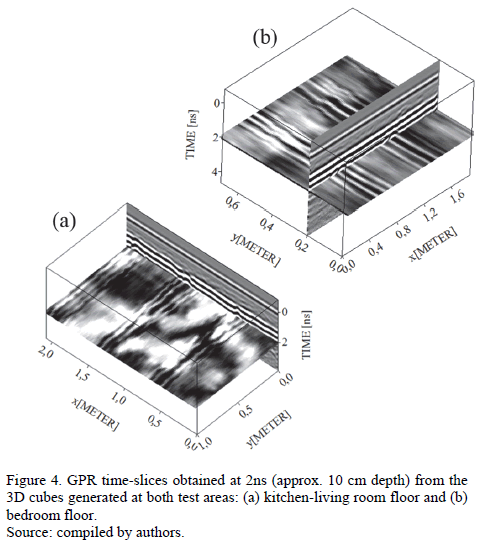
<body><![CDATA[<p><font size="2" face="Verdana, Arial, Helvetica, sans-serif">ReflexW v.6.1 software &#91;18&#93; was used to process all the  profiles collected, applying the following processing sequence: time-zero  correction, temporal (<i>dewow</i>) and  spatial (<i>background removal</i>)  filtering, as well as gain application (<i>gain   function</i> with linear and exponential components). The objective of the  sequence was to correct the down-shifting of the signal due to the air-ground  interface, as well as to remove both low and high-frequency noises in the  vertical and horizontal directions (temporal and spatial filters,  respectively), and to amplify the received signal. <a href="#tab01">Table 1</a> shows the parameters selected for filtering. </font></p>     <p align="center"><font size="2" face="Verdana, Arial, Helvetica, sans-serif"><a name="tab01"></a></font><img src="/img/revistas/dyna/v82n190/v82n190a28tab01.gif"></p>     <p><font size="2" face="Verdana, Arial, Helvetica, sans-serif">Once processed, the 2D data were exported to the 3D-data  interpretation module of the same software for its interpolating in a 3D cube.     <a href="#fig04">Fig. 4</a> shows the time-slices obtained at 2 ns depth (in time) from the 3D cubes generated for the kitchen-living room floor (a) and bedroom floor (b). </font></p>     <p align="center"><font size="2" face="Verdana, Arial, Helvetica, sans-serif"><a name="fig04"></a></font><img src="/img/revistas/dyna/v82n190/v82n190a28fig04.gif"></p>     <p>&nbsp;</p>     <p><font size="3" face="Verdana, Arial, Helvetica, sans-serif"><b>3. Results and   discussions</b></font></p>     <p><font size="2" face="Verdana, Arial, Helvetica, sans-serif">Regarding infrared thermography, the resulting mosaics  show the high capacity of the technique for the inspection of radiant heating  floors installed under low-reflectivity coatings (i.e., with an emissivity  value of over 0.8; that is, a reflectivity value of under 0.2) such as parquet  and matte ceramic tiling. As we can see in <a href="#fig03">Fig. 3</a>, the thermal print of each  pipe can be perfectly distinguished, allowing the evaluation of their  performance. In the case of the radiant floor of the kitchen-living room (<a href="#fig03">Fig.  3</a>(a)), a non-working pipe can be detected in the middle of the installation,  where the floor is at the lowest temperature (represented in blue). The  conclusion of its malfunction is extracted from the knowledge of its existence  thanks to the GPR inspection; otherwise, the thermographic inspection alone  would lead to the conclusion of the non-existence of a pipe in the area. What  is more, the pipe on the left does not work properly, which can be directly  detected in the thermographic mosaic by the much lower temperature in its first  half compared to its second half. In the case of the bedroom, the two pipes  present an adequate performance, being at similar temperatures: straight  pipelines present higher temperatures in the middle, where the pipe is closer to  the surface of the floor, and lower temperatures at the sides, where the  influence of the hot fluid in the pipe diminishes. The lowest temperature areas correspond to the middle axis between adjacent pipes.</font></p>     <p><font size="2" face="Verdana, Arial, Helvetica, sans-serif">With respect to ground  penetrating radar, the results obtained demonstrate the capabilities of the technique to detect</font> <font size="2" face="Verdana, Arial, Helvetica, sans-serif">and  map heating pipelines. Their identification was possible because of the large  dielectric contrast between the installation and the surrounding backfill. <a href="#fig04">Fig.  4</a>(a) presents the 3D data generated, showing the existence of 3 pipelines, even  the non-working one centered at 1.5 meters in the X-axis, in the kitchen-living  room test area. The results obtained for the bedroom test area (<a href="#fig04">Fig. 4</a>(b))  illustrate the presence of two heating pipes. In addition, the 3D images  provide the geometry and distribution of these pipes in the floor. What is  more, assuming an estimated velocity of 10 cm/ns for the radar-wave propagation  throughout medium, the depth of such pipes was determined at approximately 10 cm. </font></p>     <p>&nbsp;</p>     <p><font size="3" face="Verdana, Arial, Helvetica, sans-serif"><b>4. Conclusions</b></font></p>     ]]></body>
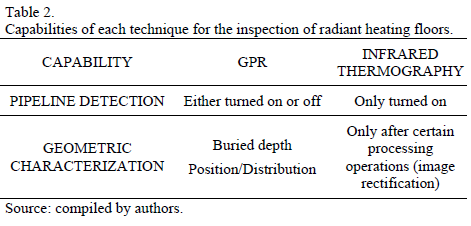
<body><![CDATA[<p><font size="2" face="Verdana, Arial, Helvetica, sans-serif">This paper proposes the use of two non-destructive  techniques: ground penetrating radar and infrared thermography for the  inspection of radiant heating floor with different floor coatings. The capabilities of each of them for this task are analyzed in <a href="#tab02">Table 2</a>.</font></p>     <p align="center"><font size="2" face="Verdana, Arial, Helvetica, sans-serif"><a name="tab02"></a></font><img src="/img/revistas/dyna/v82n190/v82n190a28tab02.gif"></p>     <p><font size="2" face="Verdana, Arial, Helvetica, sans-serif">After the analysis of the results, we can see that  infrared thermography can be mainly applied to the inspection of the  performance of each pipeline, detecting also those that do not work and those  that present faults that lead to thermal anomalies, such as overloading, obstructions,  water leaks, among others. The first is possible in the case the configuration  of the installation is known, so the inspector knows the number of pipelines  installed, and consequently the number of thermal prints appearing if they are  all working properly. The only requirement of the thermographic technique is  that the installation must be on at the time of the thermographic inspection.  The ground penetrating radar can detect the presence of any pipeline, whether  they are working or not, so it is the adequate technique for the surveying of  unknown installations, giving information about the number of pipelines,  distribution, and depth under the floor. This conclusion is illustrated in <a href="#fig05">Fig.  5</a>, where the radargram shows the existence of 3 pipelines (<a href="#fig05">Fig. 5a</a>) whereas the  thermographic mosaic only shows the thermal patterns of 2 pipelines (<a href="#fig05">Fig. 5b</a>).  The spatial correspondence between radargram and thermographic mosaic leads to  the conclusion that the central pipeline is not working. What is more, the different  thermal print between the pipelines on the left and those on the right shows  the malfunction of the pipeline on the left, given its colder temperature distribution.</font></p>     <p align="center"><font size="2" face="Verdana, Arial, Helvetica, sans-serif"><a name="fig05"></a></font><img src="/img/revistas/dyna/v82n190/v82n190a28fig05.gif"></p>     <p><font size="2" face="Verdana, Arial, Helvetica, sans-serif">Consequently, the combination of both techniques is  optimal for the inspection of radiant heating floors in buildings where the  installation is unknown because of the age of the building, the loss of the  design plans or because the current owner does not know, as well as to monitor quality control.</font></p>     <p><font size="2" face="Verdana, Arial, Helvetica, sans-serif">Future studies will  deal with the different parameters of influence in both the GPR and IRT  measurements (floor coating, depth of the installation, heating temperature) towards</font><font size="2" face="Verdana, Arial, Helvetica, sans-serif"> a parameterization of the  inspection and the direct quantification of the energy efficiency of the installation. </font></p>     <p>&nbsp;</p>     <p><font size="3" face="Verdana, Arial, Helvetica, sans-serif"><b>Acknowledgments</b></font></p>     <p><font size="2" face="Verdana, Arial, Helvetica, sans-serif">The authors would like to thank the Consellería de  Economía e Industria (Xunta de Galicia), Ministerio de Economía y  Competitividad and CDTI (Gobierno de Espa&ntilde;a) for the financial support given  through human resources grants (FPU AP2009-1144, FPU AP2010-2969) and projects  (IPT2012-1092-120000, ENE2013-48015-C3-1-R, and ITC-20133033). Additionally,  this study is a contribution to the EU funded COST Action TU-1208 &quot;Civil Engineering Applications of Ground Penetrating Radar&quot;.</font></p>     <p>&nbsp;</p>     ]]></body>
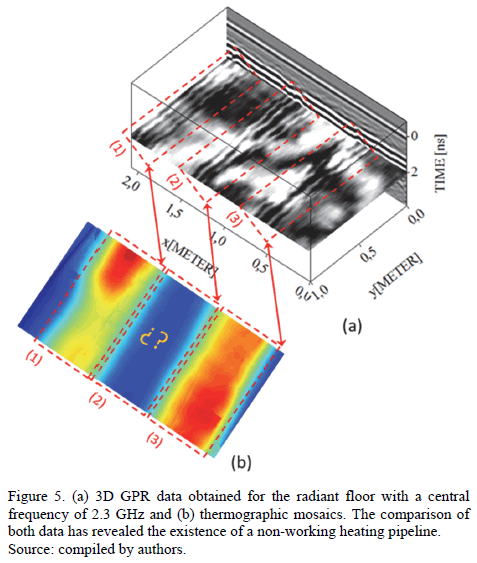
<body><![CDATA[<p><font size="3" face="Verdana, Arial, Helvetica, sans-serif"><b>References</b></font></p>     <!-- ref --><p><font size="2" face="Verdana, Arial, Helvetica, sans-serif"><b>&#91;1&#93;</b>    Barreira, E. and Freitas, V., Evaluation of building  materials using infrared thermography, Construction and Building Materials, 21  (1), pp. 218-224, 2007. doi: 10.1016/j.conbuildmat.2005.06.049</font>&nbsp;&nbsp;&nbsp;&nbsp;&nbsp;&nbsp;&nbsp;&nbsp;[&#160;<a href="javascript:void(0);" onclick="javascript: window.open('/scielo.php?script=sci_nlinks&ref=000074&pid=S0012-7353201500020002800001&lng=','','width=640,height=500,resizable=yes,scrollbars=1,menubar=yes,');">Links</a>&#160;]<!-- end-ref --><!-- ref --><p><font size="2" face="Verdana, Arial, Helvetica, sans-serif"><b>&#91;2&#93;</b>    Khanna, A., Development and demonstration of a  performance test protocol for radiant floor heating systems, MsC Thesis, Virginia Polytechnic Institute, USA, 2006.    &nbsp;&nbsp;&nbsp;&nbsp;&nbsp;&nbsp;&nbsp;&nbsp;[&#160;<a href="javascript:void(0);" onclick="javascript: window.open('/scielo.php?script=sci_nlinks&ref=000075&pid=S0012-7353201500020002800002&lng=','','width=640,height=500,resizable=yes,scrollbars=1,menubar=yes,');">Links</a>&#160;]<!-- end-ref --></font></p>     <!-- ref --><p><font size="2" face="Verdana, Arial, Helvetica, sans-serif"><b>&#91;3&#93;</b>    Rahimi, M. and Sabernaeemi, A., Experimental study of  radiation and free convection in an enclosure with a radiant ceiling heating system, Energy and Buildings, 42 (11), pp. 2077-2082, 2010. doi: 10.1016/j.enbuild.2010.06.017</font>&nbsp;&nbsp;&nbsp;&nbsp;&nbsp;&nbsp;&nbsp;&nbsp;[&#160;<a href="javascript:void(0);" onclick="javascript: window.open('/scielo.php?script=sci_nlinks&ref=000077&pid=S0012-7353201500020002800003&lng=','','width=640,height=500,resizable=yes,scrollbars=1,menubar=yes,');">Links</a>&#160;]<!-- end-ref --><!-- ref --><p><font size="2" face="Verdana, Arial, Helvetica, sans-serif"><b>&#91;4&#93;</b> Gonz&aacute;lez, D., Madruga, F., Quintela, M. and  L&oacute;pez-Higuera, J., Defect assessment on radiant heaters using infrared thermography, NDT&amp;E International, 38 (6), pp. 428-432, 2005. doi: 10.1016/j.ndteint.2004.11.006</font>&nbsp;&nbsp;&nbsp;&nbsp;&nbsp;&nbsp;&nbsp;&nbsp;[&#160;<a href="javascript:void(0);" onclick="javascript: window.open('/scielo.php?script=sci_nlinks&ref=000078&pid=S0012-7353201500020002800004&lng=','','width=640,height=500,resizable=yes,scrollbars=1,menubar=yes,');">Links</a>&#160;]<!-- end-ref --><!-- ref --><p><font size="2" face="Verdana, Arial, Helvetica, sans-serif"><b>&#91;5&#93;</b>    Wu, G., Song, F. and Li, D., Infrared temperature  measurement and simulation of temperature field on buried pipeline leakage, ICPTT 2009, pp. 203-209.    &nbsp;&nbsp;&nbsp;&nbsp;&nbsp;&nbsp;&nbsp;&nbsp;[&#160;<a href="javascript:void(0);" onclick="javascript: window.open('/scielo.php?script=sci_nlinks&ref=000079&pid=S0012-7353201500020002800005&lng=','','width=640,height=500,resizable=yes,scrollbars=1,menubar=yes,');">Links</a>&#160;]<!-- end-ref --></font></p>     <!-- ref --><p><font size="2" face="Verdana, Arial, Helvetica, sans-serif"><b>&#91;6&#93;</b> Barrile, V. and Pucinotti, R., Application of radar  technology to reinforced concrete structures: a case study, NDT&amp;E International, 38 (7), pp. 596-604, 2005. doi: 10.1016/j.ndteint.2005.02.003</font>&nbsp;&nbsp;&nbsp;&nbsp;&nbsp;&nbsp;&nbsp;&nbsp;[&#160;<a href="javascript:void(0);" onclick="javascript: window.open('/scielo.php?script=sci_nlinks&ref=000081&pid=S0012-7353201500020002800006&lng=','','width=640,height=500,resizable=yes,scrollbars=1,menubar=yes,');">Links</a>&#160;]<!-- end-ref --><!-- ref --><p><font size="2" face="Verdana, Arial, Helvetica, sans-serif"><b>&#91;7&#93;</b> Soldovieri, F., Persico, R., Utsi, E. and Utsi, V., The  application of inverse scattering techniques with ground penetrating radar to  the problem of rebar location in concrete, NDT&amp;E International, 39 (7), pp. 602-607, 2006. doi: 10.1016/j.ndteint.2005.12.005</font>&nbsp;&nbsp;&nbsp;&nbsp;&nbsp;&nbsp;&nbsp;&nbsp;[&#160;<a href="javascript:void(0);" onclick="javascript: window.open('/scielo.php?script=sci_nlinks&ref=000082&pid=S0012-7353201500020002800007&lng=','','width=640,height=500,resizable=yes,scrollbars=1,menubar=yes,');">Links</a>&#160;]<!-- end-ref --><!-- ref --><p><font size="2" face="Verdana, Arial, Helvetica, sans-serif"><b>&#91;8&#93;</b>    Boryssenko, A., Boryssenko, O., Lishchenko, A. and  Prokhorenko, V., Inspection of internal structure of walls by subsurface radar. Aerospace and Electronic Systems Magazine, IEEE, 21 (10), pp. 28-31, 2006. doi: 10.1109/MAES.2006.275303</font>&nbsp;&nbsp;&nbsp;&nbsp;&nbsp;&nbsp;&nbsp;&nbsp;[&#160;<a href="javascript:void(0);" onclick="javascript: window.open('/scielo.php?script=sci_nlinks&ref=000083&pid=S0012-7353201500020002800008&lng=','','width=640,height=500,resizable=yes,scrollbars=1,menubar=yes,');">Links</a>&#160;]<!-- end-ref --><!-- ref --><p><font size="2" face="Verdana, Arial, Helvetica, sans-serif"><b>&#91;9&#93;</b>    Razevig, V.V., Ivashov, S.I., Vasiliev, I.A.,  Zhuravlev, A.V., Bechtel, T., Capineri, L. and Falorni, P., Rascan holographic  radars as means for non-destructive testing of buildings and edificial structures, Proceedings of the Structural Faults and Repair, 2010.    &nbsp;&nbsp;&nbsp;&nbsp;&nbsp;&nbsp;&nbsp;&nbsp;[&#160;<a href="javascript:void(0);" onclick="javascript: window.open('/scielo.php?script=sci_nlinks&ref=000084&pid=S0012-7353201500020002800009&lng=','','width=640,height=500,resizable=yes,scrollbars=1,menubar=yes,');">Links</a>&#160;]<!-- end-ref --></font></p>     <!-- ref --><p><font size="2" face="Verdana, Arial, Helvetica, sans-serif"><b>&#91;10&#93;</b>   Vavilov, V., Thermal NDT: Historical milestones,  state-of-the-art and trends, Quantitative InfraRed Thermography Journal, 11 (1), pp. 66-83, 2014. doi: 10.1080/17686733.2014.897016</font>&nbsp;&nbsp;&nbsp;&nbsp;&nbsp;&nbsp;&nbsp;&nbsp;[&#160;<a href="javascript:void(0);" onclick="javascript: window.open('/scielo.php?script=sci_nlinks&ref=000086&pid=S0012-7353201500020002800010&lng=','','width=640,height=500,resizable=yes,scrollbars=1,menubar=yes,');">Links</a>&#160;]<!-- end-ref --><!-- ref --><p><font size="2" face="Verdana, Arial, Helvetica, sans-serif"><b>&#91;11&#93;</b>   Clausting, T., What you really need to know to begin using infrared cameras, Materials Evaluation, 64 (5), pp. 465-470, 2006.    &nbsp;&nbsp;&nbsp;&nbsp;&nbsp;&nbsp;&nbsp;&nbsp;[&#160;<a href="javascript:void(0);" onclick="javascript: window.open('/scielo.php?script=sci_nlinks&ref=000087&pid=S0012-7353201500020002800011&lng=','','width=640,height=500,resizable=yes,scrollbars=1,menubar=yes,');">Links</a>&#160;]<!-- end-ref --></font></p>     <!-- ref --><p><font size="2" face="Verdana, Arial, Helvetica, sans-serif"><b>&#91;12&#93;</b> Lagüela, S., Gonz&aacute;lez-Jorge, H., Armesto, J. and  Herr&aacute;ez, J., High performance grid for the metric calibration of thermographic cameras, Measurement Science and Technology, 23 (1), pp 015402, 2012. doi: 10.1088/0957-0233/23/1/015402</font>&nbsp;&nbsp;&nbsp;&nbsp;&nbsp;&nbsp;&nbsp;&nbsp;[&#160;<a href="javascript:void(0);" onclick="javascript: window.open('/scielo.php?script=sci_nlinks&ref=000089&pid=S0012-7353201500020002800012&lng=','','width=640,height=500,resizable=yes,scrollbars=1,menubar=yes,');">Links</a>&#160;]<!-- end-ref --><!-- ref --><p><font size="2" face="Verdana, Arial, Helvetica, sans-serif"><b>&#91;13&#93;</b>   Lowe, D., Object recognition from local scale-invariant features, Proceedings of the International Conference on Computer Vision, 1999.    &nbsp;&nbsp;&nbsp;&nbsp;&nbsp;&nbsp;&nbsp;&nbsp;[&#160;<a href="javascript:void(0);" onclick="javascript: window.open('/scielo.php?script=sci_nlinks&ref=000090&pid=S0012-7353201500020002800013&lng=','','width=640,height=500,resizable=yes,scrollbars=1,menubar=yes,');">Links</a>&#160;]<!-- end-ref --></font></p>     <!-- ref --><p><font size="2" face="Verdana, Arial, Helvetica, sans-serif"><b>&#91;14&#93;</b> Lagüela, S., Armesto, J., Arias, P. and Herr&aacute;ez, J.,  Automation of thermographic 3D modeling through image fusion and image matching techniques, Automation in Construction, 27, pp. 24-31, 2012. doi: 10.1016/j.autcon.2012.05.011</font>&nbsp;&nbsp;&nbsp;&nbsp;&nbsp;&nbsp;&nbsp;&nbsp;[&#160;<a href="javascript:void(0);" onclick="javascript: window.open('/scielo.php?script=sci_nlinks&ref=000092&pid=S0012-7353201500020002800014&lng=','','width=640,height=500,resizable=yes,scrollbars=1,menubar=yes,');">Links</a>&#160;]<!-- end-ref --><!-- ref --><p><font size="2" face="Verdana, Arial, Helvetica, sans-serif"><b>&#91;15&#93;</b>   Annan, P., GPR Principles procedures and applications, Sensors and Software Inc., 2003.    &nbsp;&nbsp;&nbsp;&nbsp;&nbsp;&nbsp;&nbsp;&nbsp;[&#160;<a href="javascript:void(0);" onclick="javascript: window.open('/scielo.php?script=sci_nlinks&ref=000093&pid=S0012-7353201500020002800015&lng=','','width=640,height=500,resizable=yes,scrollbars=1,menubar=yes,');">Links</a>&#160;]<!-- end-ref --></font></p>     <!-- ref --><p><font size="2" face="Verdana, Arial, Helvetica, sans-serif"><b>&#91;16&#93;</b>   Daniels, D.J., Ground penetrating radar, Institution of Electrical Engineering, London, 2004.    &nbsp;&nbsp;&nbsp;&nbsp;&nbsp;&nbsp;&nbsp;&nbsp;[&#160;<a href="javascript:void(0);" onclick="javascript: window.open('/scielo.php?script=sci_nlinks&ref=000095&pid=S0012-7353201500020002800016&lng=','','width=640,height=500,resizable=yes,scrollbars=1,menubar=yes,');">Links</a>&#160;]<!-- end-ref --></font></p>     <!-- ref --><p><font size="2" face="Verdana, Arial, Helvetica, sans-serif"><b>&#91;17&#93;</b>   Rial, F.I., Pereira, M., Lorenzo, H., Arias, P. and  Novo, A., Resolution of GPR bowtie antennas: An experimental approach, Journal of Applied Geophysics, 67, pp. 367-373, 2009. doi: 10.1016/j.jappgeo.2008.05.003</font>&nbsp;&nbsp;&nbsp;&nbsp;&nbsp;&nbsp;&nbsp;&nbsp;[&#160;<a href="javascript:void(0);" onclick="javascript: window.open('/scielo.php?script=sci_nlinks&ref=000097&pid=S0012-7353201500020002800017&lng=','','width=640,height=500,resizable=yes,scrollbars=1,menubar=yes,');">Links</a>&#160;]<!-- end-ref --><!-- ref --><p><font size="2" face="Verdana, Arial, Helvetica, sans-serif"><b>&#91;18&#93;</b>   Sandmeier, K.J., ReflexW Manual v.6.1. &#91;on line&#93;.  Available at: <a href="http://www.sandmeier-geo.de" target="_blank">www.sandmeier-geo.de</a></font>&nbsp;&nbsp;&nbsp;&nbsp;&nbsp;&nbsp;&nbsp;&nbsp;[&#160;<a href="javascript:void(0);" onclick="javascript: window.open('/scielo.php?script=sci_nlinks&ref=000098&pid=S0012-7353201500020002800018&lng=','','width=640,height=500,resizable=yes,scrollbars=1,menubar=yes,');">Links</a>&#160;]<!-- end-ref --><p>&nbsp;</p>     <p><font size="2" face="Verdana, Arial, Helvetica, sans-serif"><b>S.  Lagüela-L&oacute;pez,</b> received a PhD in 3D Thermography in 2014 from the  University of Vigo, Spain. She was a visiting researcher at ETH Zurich in 2004,  ITC-CNR Padova, in 2012, University of California, Berkeley in 2011 and  Polytechnic University in Valencia in 2010. Author of more than 20 scientific  articles and 12 conference papers, she received the &quot;Ermanno Grinzato&quot; Paper  Award in the international conference AITA2013, and the Prize to Young  Researches in New Technologies from the Council of Pontevedra in 2011. She is  currently associate editor for the &quot;Journal of Daylighting,&quot; and a member of  the scientific committee of the workshop on thermography in the QCAV2014  conference. Her current research interests are quantitative thermography and the application of thermography to contamination in water and land uses.</font></p>     <p><font size="2" face="Verdana, Arial, Helvetica, sans-serif"><b>M. Solla-</b> <b>Carracelas,</b> received a PhD degree in GPR Applications in 2010 from  the University of Vigo, Spain, PhD thesis award. She was a visiting researcher  at the University of Edinburgh in 2009 and at Edinburgh Parallel Computer  Centre in 2012. Since 2012, she has been a collaborator of the Superior Centre  of Scientific Research in Spain (CSIC), working on projects about archaeology  and volcanology. She is an active management committee member of the COST  Action TU-1208 &quot;Civil Engineering Applications of Ground Penetrating Radar&quot; and  vice-chair of the WG-4 &quot;Different applications of GPR and other NDT  technologies in civil engineering.&quot; Author of more than 30 scientific articles  and more than 50 conference papers, both Spanish and International. She is a  member of the scientific committee of international conferences on GPR (2012,  2014) and a guest editor in the Remote Sensing journal. Her current research  interests focus on the use of GPR in civil engineering and in UXOs detection and underground military spaces.</font></p>     <p><font size="2" face="Verdana, Arial, Helvetica, sans-serif"><b>L.  Díaz-Vilari&ntilde;o,</b> received a MSc degree in Energy and Sustainable Development  in 2011 from the University of Santiago de Compostela, Spain. She is currently  a PhD candidate at the University of Vigo, Spain. She was a visiting researcher  in IFP Germany in 2014, ITC Netherlands in 2013 and UPB Colombia in 2012.  Author of 6 scientific articles and participant in 8 international Conferences.  Her current research interests are 3D modelling, Building Information Models and 3D Geographical Information Systems. </font></p>     ]]></body>
<body><![CDATA[<p><font size="2" face="Verdana, Arial, Helvetica, sans-serif"><b>J. Armesto-</b> <b>Gonz&aacute;lez,</b> received a PhD degree in image processing in 2004 from  the University of Santiago de Compostela, Spain, PhD thesis award by the USC,  he is assistant professor at the University of Vigo since 2011. Author of more  than 60 scientific articles (Scopus h-index 12). She has received five patents  for inventions related to terrestrial photogrammetry, indoor mapping and 3D  thermography. She received the ISPRS Best Paper Award 2013. Her current research  interests are 3D indoor mapping, building information modelling, 3D thermography, UAV mapping.</font></p>      ]]></body><back>
<ref-list>
<ref id="B1">
<label>1</label><nlm-citation citation-type="journal">
<person-group person-group-type="author">
<name>
<surname><![CDATA[Barreira]]></surname>
<given-names><![CDATA[E.]]></given-names>
</name>
<name>
<surname><![CDATA[Freitas]]></surname>
<given-names><![CDATA[V.]]></given-names>
</name>
</person-group>
<article-title xml:lang="en"><![CDATA[Evaluation of building materials using infrared thermography]]></article-title>
<source><![CDATA[Construction and Building Materials]]></source>
<year>2007</year>
<volume>21</volume>
<numero>1</numero>
<issue>1</issue>
<page-range>218-224</page-range></nlm-citation>
</ref>
<ref id="B2">
<label>2</label><nlm-citation citation-type="">
<person-group person-group-type="author">
<name>
<surname><![CDATA[Khanna]]></surname>
<given-names><![CDATA[A.]]></given-names>
</name>
</person-group>
<source><![CDATA[Development and demonstration of a performance test protocol for radiant floor heating systems]]></source>
<year></year>
</nlm-citation>
</ref>
<ref id="B3">
<label>3</label><nlm-citation citation-type="journal">
<person-group person-group-type="author">
<name>
<surname><![CDATA[Rahimi]]></surname>
<given-names><![CDATA[M.]]></given-names>
</name>
<name>
<surname><![CDATA[Sabernaeemi]]></surname>
<given-names><![CDATA[A.]]></given-names>
</name>
</person-group>
<article-title xml:lang="en"><![CDATA[Experimental study of radiation and free convection in an enclosure with a radiant ceiling heating system]]></article-title>
<source><![CDATA[Energy and Buildings]]></source>
<year>2010</year>
<volume>42</volume>
<numero>11</numero>
<issue>11</issue>
<page-range>2077-2082</page-range></nlm-citation>
</ref>
<ref id="B4">
<label>4</label><nlm-citation citation-type="journal">
<person-group person-group-type="author">
<name>
<surname><![CDATA[González]]></surname>
<given-names><![CDATA[D.]]></given-names>
</name>
<name>
<surname><![CDATA[Madruga]]></surname>
<given-names><![CDATA[F.]]></given-names>
</name>
<name>
<surname><![CDATA[Quintela]]></surname>
<given-names><![CDATA[M.]]></given-names>
</name>
<name>
<surname><![CDATA[López-Higuera]]></surname>
<given-names><![CDATA[J.]]></given-names>
</name>
</person-group>
<article-title xml:lang="en"><![CDATA[Defect assessment on radiant heaters using infrared thermography]]></article-title>
<source><![CDATA[NDT & E International]]></source>
<year>2005</year>
<volume>38</volume>
<numero>6</numero>
<issue>6</issue>
<page-range>428-432</page-range></nlm-citation>
</ref>
<ref id="B5">
<label>5</label><nlm-citation citation-type="confpro">
<person-group person-group-type="author">
<name>
<surname><![CDATA[Wu]]></surname>
<given-names><![CDATA[G.]]></given-names>
</name>
<name>
<surname><![CDATA[Song]]></surname>
<given-names><![CDATA[F.]]></given-names>
</name>
<name>
<surname><![CDATA[Li]]></surname>
<given-names><![CDATA[D.]]></given-names>
</name>
</person-group>
<source><![CDATA[Infrared temperature measurement and simulation of temperature field on buried pipeline leakage]]></source>
<year></year>
<conf-name><![CDATA[ ICPTT]]></conf-name>
<conf-date>2009</conf-date>
<conf-loc> </conf-loc>
<page-range>203-209</page-range></nlm-citation>
</ref>
<ref id="B6">
<label>6</label><nlm-citation citation-type="journal">
<person-group person-group-type="author">
<name>
<surname><![CDATA[Barrile]]></surname>
<given-names><![CDATA[V.]]></given-names>
</name>
<name>
<surname><![CDATA[Pucinotti]]></surname>
<given-names><![CDATA[R.]]></given-names>
</name>
</person-group>
<article-title xml:lang="en"><![CDATA[Application of radar technology to reinforced concrete structures: a case study]]></article-title>
<source><![CDATA[NDT & E International]]></source>
<year>2005</year>
<volume>38</volume>
<numero>7</numero>
<issue>7</issue>
<page-range>596-604</page-range></nlm-citation>
</ref>
<ref id="B7">
<label>7</label><nlm-citation citation-type="journal">
<person-group person-group-type="author">
<name>
<surname><![CDATA[Soldovieri]]></surname>
<given-names><![CDATA[F.]]></given-names>
</name>
<name>
<surname><![CDATA[Persico]]></surname>
<given-names><![CDATA[R.]]></given-names>
</name>
<name>
<surname><![CDATA[Utsi]]></surname>
<given-names><![CDATA[E.]]></given-names>
</name>
<name>
<surname><![CDATA[Utsi]]></surname>
<given-names><![CDATA[V.]]></given-names>
</name>
</person-group>
<article-title xml:lang="en"><![CDATA[The application of inverse scattering techniques with ground penetrating radar to the problem of rebar location in concrete]]></article-title>
<source><![CDATA[NDT & E International]]></source>
<year>2006</year>
<volume>39</volume>
<numero>7</numero>
<issue>7</issue>
<page-range>602-607</page-range></nlm-citation>
</ref>
<ref id="B8">
<label>8</label><nlm-citation citation-type="journal">
<person-group person-group-type="author">
<name>
<surname><![CDATA[Boryssenko]]></surname>
<given-names><![CDATA[A.]]></given-names>
</name>
<name>
<surname><![CDATA[Boryssenko]]></surname>
<given-names><![CDATA[O.]]></given-names>
</name>
<name>
<surname><![CDATA[Lishchenko]]></surname>
<given-names><![CDATA[A.]]></given-names>
</name>
<name>
<surname><![CDATA[Prokhorenko]]></surname>
<given-names><![CDATA[V.]]></given-names>
</name>
</person-group>
<article-title xml:lang="en"><![CDATA[Inspection of internal structure of walls by subsurface radar]]></article-title>
<source><![CDATA[Aerospace and Electronic Systems Magazine]]></source>
<year>2006</year>
<volume>21</volume>
<numero>10</numero>
<issue>10</issue>
<page-range>28-31</page-range><publisher-name><![CDATA[IEEE]]></publisher-name>
</nlm-citation>
</ref>
<ref id="B9">
<label>9</label><nlm-citation citation-type="confpro">
<person-group person-group-type="author">
<name>
<surname><![CDATA[Razevig]]></surname>
<given-names><![CDATA[V.V.]]></given-names>
</name>
<name>
<surname><![CDATA[Ivashov]]></surname>
<given-names><![CDATA[S.I.]]></given-names>
</name>
<name>
<surname><![CDATA[Vasiliev]]></surname>
<given-names><![CDATA[I.A.]]></given-names>
</name>
<name>
<surname><![CDATA[Zhuravlev]]></surname>
<given-names><![CDATA[A.V.]]></given-names>
</name>
<name>
<surname><![CDATA[Bechtel]]></surname>
<given-names><![CDATA[T.]]></given-names>
</name>
<name>
<surname><![CDATA[Capineri]]></surname>
<given-names><![CDATA[L.]]></given-names>
</name>
<name>
<surname><![CDATA[Falorni]]></surname>
<given-names><![CDATA[P.]]></given-names>
</name>
</person-group>
<article-title xml:lang="en"><![CDATA[Rascan holographic radars as means for non-destructive testing of buildings and edificial structures]]></article-title>
<source><![CDATA[]]></source>
<year></year>
<conf-name><![CDATA[ Proceedings of the Structural Faults and Repair]]></conf-name>
<conf-date>2010</conf-date>
<conf-loc> </conf-loc>
</nlm-citation>
</ref>
<ref id="B10">
<label>10</label><nlm-citation citation-type="journal">
<person-group person-group-type="author">
<name>
<surname><![CDATA[Vavilov]]></surname>
<given-names><![CDATA[V.]]></given-names>
</name>
</person-group>
<article-title xml:lang="en"><![CDATA[Thermal NDT: Historical milestones, state-of-the-art and trends]]></article-title>
<source><![CDATA[Quantitative InfraRed Thermography Journal]]></source>
<year>2014</year>
<volume>11</volume>
<numero>1</numero>
<issue>1</issue>
<page-range>66-83</page-range></nlm-citation>
</ref>
<ref id="B11">
<label>11</label><nlm-citation citation-type="journal">
<person-group person-group-type="author">
<name>
<surname><![CDATA[Clausting]]></surname>
<given-names><![CDATA[T.]]></given-names>
</name>
</person-group>
<article-title xml:lang="en"><![CDATA[What you really need to know to begin using infrared cameras]]></article-title>
<source><![CDATA[Materials Evaluation]]></source>
<year>2006</year>
<volume>64</volume>
<numero>5</numero>
<issue>5</issue>
<page-range>465-470</page-range></nlm-citation>
</ref>
<ref id="B12">
<label>12</label><nlm-citation citation-type="journal">
<person-group person-group-type="author">
<name>
<surname><![CDATA[Lagüela]]></surname>
<given-names><![CDATA[S.]]></given-names>
</name>
<name>
<surname><![CDATA[González-Jorge]]></surname>
<given-names><![CDATA[H.]]></given-names>
</name>
<name>
<surname><![CDATA[Armesto]]></surname>
<given-names><![CDATA[J.]]></given-names>
</name>
<name>
<surname><![CDATA[Herráez]]></surname>
<given-names><![CDATA[J.]]></given-names>
</name>
</person-group>
<article-title xml:lang="en"><![CDATA[High performance grid for the metric calibration of thermographic cameras]]></article-title>
<source><![CDATA[Measurement Science and Technology]]></source>
<year>2012</year>
<volume>23</volume>
<numero>1</numero>
<issue>1</issue>
<page-range>015402</page-range></nlm-citation>
</ref>
<ref id="B13">
<label>13</label><nlm-citation citation-type="confpro">
<person-group person-group-type="author">
<name>
<surname><![CDATA[Lowe]]></surname>
<given-names><![CDATA[D.]]></given-names>
</name>
</person-group>
<article-title xml:lang="en"><![CDATA[Object recognition from local scale-invariant features]]></article-title>
<source><![CDATA[]]></source>
<year></year>
<conf-name><![CDATA[ Proceedings of the International Conference on Computer Vision]]></conf-name>
<conf-date>1999</conf-date>
<conf-loc> </conf-loc>
</nlm-citation>
</ref>
<ref id="B14">
<label>14</label><nlm-citation citation-type="journal">
<person-group person-group-type="author">
<name>
<surname><![CDATA[Lagüela]]></surname>
<given-names><![CDATA[S.]]></given-names>
</name>
<name>
<surname><![CDATA[Armesto]]></surname>
<given-names><![CDATA[J.]]></given-names>
</name>
<name>
<surname><![CDATA[Arias]]></surname>
<given-names><![CDATA[P.]]></given-names>
</name>
<name>
<surname><![CDATA[Herráez]]></surname>
<given-names><![CDATA[J.]]></given-names>
</name>
</person-group>
<article-title xml:lang="en"><![CDATA[Automation of thermographic 3D modeling through image fusion and image matching techniques]]></article-title>
<source><![CDATA[Automation in Construction]]></source>
<year>2012</year>
<numero>27</numero>
<issue>27</issue>
<page-range>24-31</page-range></nlm-citation>
</ref>
<ref id="B15">
<label>15</label><nlm-citation citation-type="book">
<person-group person-group-type="author">
<name>
<surname><![CDATA[Annan]]></surname>
<given-names><![CDATA[P.]]></given-names>
</name>
</person-group>
<source><![CDATA[GPR Principles procedures and applications]]></source>
<year>2003</year>
<publisher-name><![CDATA[Sensors and Software Inc.]]></publisher-name>
</nlm-citation>
</ref>
<ref id="B16">
<label>16</label><nlm-citation citation-type="book">
<person-group person-group-type="author">
<name>
<surname><![CDATA[Daniels]]></surname>
<given-names><![CDATA[D.J.]]></given-names>
</name>
</person-group>
<source><![CDATA[Ground penetrating radar]]></source>
<year>2004</year>
<publisher-loc><![CDATA[London ]]></publisher-loc>
<publisher-name><![CDATA[Institution of Electrical Engineering]]></publisher-name>
</nlm-citation>
</ref>
<ref id="B17">
<label>17</label><nlm-citation citation-type="journal">
<person-group person-group-type="author">
<name>
<surname><![CDATA[Rial]]></surname>
<given-names><![CDATA[F.I.]]></given-names>
</name>
<name>
<surname><![CDATA[Pereira]]></surname>
<given-names><![CDATA[M.]]></given-names>
</name>
<name>
<surname><![CDATA[Lorenzo]]></surname>
<given-names><![CDATA[H.]]></given-names>
</name>
<name>
<surname><![CDATA[Arias]]></surname>
<given-names><![CDATA[P.]]></given-names>
</name>
<name>
<surname><![CDATA[Novo]]></surname>
<given-names><![CDATA[A.]]></given-names>
</name>
</person-group>
<article-title xml:lang="en"><![CDATA[Resolution of GPR bowtie antennas: An experimental approach]]></article-title>
<source><![CDATA[Journal of Applied Geophysics]]></source>
<year>2009</year>
<numero>67</numero>
<issue>67</issue>
<page-range>367-373</page-range></nlm-citation>
</ref>
<ref id="B18">
<label>18</label><nlm-citation citation-type="">
<person-group person-group-type="author">
<name>
<surname><![CDATA[Sandmeier]]></surname>
<given-names><![CDATA[K.J.]]></given-names>
</name>
</person-group>
<source><![CDATA[ReflexW Manual v.6.1.]]></source>
<year></year>
</nlm-citation>
</ref>
</ref-list>
</back>
</article>