<?xml version="1.0" encoding="ISO-8859-1"?><article xmlns:mml="http://www.w3.org/1998/Math/MathML" xmlns:xlink="http://www.w3.org/1999/xlink" xmlns:xsi="http://www.w3.org/2001/XMLSchema-instance">
<front>
<journal-meta>
<journal-id>0012-7353</journal-id>
<journal-title><![CDATA[DYNA]]></journal-title>
<abbrev-journal-title><![CDATA[Dyna rev.fac.nac.minas]]></abbrev-journal-title>
<issn>0012-7353</issn>
<publisher>
<publisher-name><![CDATA[Universidad Nacional de Colombia]]></publisher-name>
</publisher>
</journal-meta>
<article-meta>
<article-id>S0012-73532015000300002</article-id>
<article-id pub-id-type="doi">10.15446/dyna.v82n191.51141</article-id>
<title-group>
<article-title xml:lang="en"><![CDATA[Capacitated vehicle routing problem for PSS uses based on ubiquitous computing: An emerging markets approach]]></article-title>
<article-title xml:lang="es"><![CDATA[Problema de enrutamiento de vehículos basado en su capacidad para SPS utilizando cómputo ubicuo: Un enfoque de mercados emergentes]]></article-title>
</title-group>
<contrib-group>
<contrib contrib-type="author">
<name>
<surname><![CDATA[Ochoa-Ortíz]]></surname>
<given-names><![CDATA[Alberto]]></given-names>
</name>
<xref ref-type="aff" rid="A01"/>
</contrib>
<contrib contrib-type="author">
<name>
<surname><![CDATA[Ornelas-Zapata]]></surname>
<given-names><![CDATA[Francisco]]></given-names>
</name>
<xref ref-type="aff" rid="A02"/>
</contrib>
<contrib contrib-type="author">
<name>
<surname><![CDATA[Margain-Fuentes]]></surname>
<given-names><![CDATA[Lourdes]]></given-names>
</name>
<xref ref-type="aff" rid="A02"/>
</contrib>
<contrib contrib-type="author">
<name>
<surname><![CDATA[Cedillo-Campos]]></surname>
<given-names><![CDATA[Miguel Gastón]]></given-names>
</name>
<xref ref-type="aff" rid="A03"/>
</contrib>
<contrib contrib-type="author">
<name>
<surname><![CDATA[Sánchez-Aguilar]]></surname>
<given-names><![CDATA[Jöns]]></given-names>
</name>
<xref ref-type="aff" rid="A04"/>
</contrib>
<contrib contrib-type="author">
<name>
<surname><![CDATA[Jaramillo-Vacio]]></surname>
<given-names><![CDATA[Rubén]]></given-names>
</name>
<xref ref-type="aff" rid="A05"/>
</contrib>
<contrib contrib-type="author">
<name>
<surname><![CDATA[Ávila]]></surname>
<given-names><![CDATA[Isabel]]></given-names>
</name>
<xref ref-type="aff" rid="A01"/>
</contrib>
</contrib-group>
<aff id="A01">
<institution><![CDATA[,Universidad Autónoma de Ciudad Juárez  ]]></institution>
<addr-line><![CDATA[Ciudad Juárez ]]></addr-line>
<country>México</country>
</aff>
<aff id="A02">
<institution><![CDATA[,Universidad Politécnica de Aguascalientes  ]]></institution>
<addr-line><![CDATA[Aguascalientes ]]></addr-line>
<country>México</country>
</aff>
<aff id="A">
<institution><![CDATA[,lourde.margain@upa.edu.mx  ]]></institution>
<addr-line><![CDATA[ ]]></addr-line>
</aff>
<aff id="A">
<institution><![CDATA[,mc140002@alumnos.upa.edu.mx  ]]></institution>
<addr-line><![CDATA[ ]]></addr-line>
</aff>
<aff id="A03">
<institution><![CDATA[,Instituto Mexicano del Transporte  ]]></institution>
<addr-line><![CDATA[Salfandia Querétato]]></addr-line>
<country>México</country>
</aff>
<aff id="A04">
<institution><![CDATA[,Instituto Tecnológico de Querétaro  ]]></institution>
<addr-line><![CDATA[Querétaro ]]></addr-line>
<country>México</country>
</aff>
<aff id="A05">
<institution><![CDATA[,CIATEC  ]]></institution>
<addr-line><![CDATA[Guanajuato ]]></addr-line>
<country>México</country>
</aff>
<pub-date pub-type="pub">
<day>00</day>
<month>06</month>
<year>2015</year>
</pub-date>
<pub-date pub-type="epub">
<day>00</day>
<month>06</month>
<year>2015</year>
</pub-date>
<volume>82</volume>
<numero>191</numero>
<fpage>20</fpage>
<lpage>26</lpage>
<copyright-statement/>
<copyright-year/>
<self-uri xlink:href="http://www.scielo.org.co/scielo.php?script=sci_arttext&amp;pid=S0012-73532015000300002&amp;lng=en&amp;nrm=iso"></self-uri><self-uri xlink:href="http://www.scielo.org.co/scielo.php?script=sci_abstract&amp;pid=S0012-73532015000300002&amp;lng=en&amp;nrm=iso"></self-uri><self-uri xlink:href="http://www.scielo.org.co/scielo.php?script=sci_pdf&amp;pid=S0012-73532015000300002&amp;lng=en&amp;nrm=iso"></self-uri><abstract abstract-type="short" xml:lang="en"><p><![CDATA[The vehicle routing problem under capacity constraints based on ubiquitous computing in a perspective of deploying PSS (Product-Service Systems) configurations for urban goods transport, is addressed. It takes into account the specificities of city logistics under an emerging markets context. In this case, it involved: i) low logistical capabilities of decision makers; ii) limited availability of data; and iii) restricted access to high performance technology to compute optimal transportation routes. Therefore, the use of free download software providing inexpensive solutions (time and resources) is proposed. The paper shows the implementation of results to a software tool based on Graph Theory used to analyze and solve a CVRP (Capacitated Vehicle Routing Problem). The case of a local food delivery company located in a large city in Mexico was used. Based on small fleet vehicles with the same technical specifications and comparable load capacity.]]></p></abstract>
<abstract abstract-type="short" xml:lang="es"><p><![CDATA[El problema de ruteo de vehículos bajo las limitaciones de capacidad y basado en computación ubicua desde una perspectiva relacionada con PSS (Producto-Servicio de Sistemas) para desarrollar configuraciones para el transporte urbano de mercancías es abordado. Éste trabajo considera las especificidades de la logística urbana bajo un contexto de mercados emergentes. En este caso, involucra: i) bajas competencias logísticas de los tomadores de decisiones; ii) la limitada disponibilidad de datos; y iii) restringido acceso a tecnología de alto desempeño para calcular rutas de transporte óptimas. Por lo tanto, se propone el uso de un software libre que proporciona soluciones de bajo costo (en tiempo y recursos). El artículo muestra la aplicación de los resultados de una herramienta de software basado en la Teoría de Grafos utilizado para analizar y resolver un CVRP (Capacitated Vehicle Routing Problem). Se utilizó el caso de una empresa local de distribución de alimentos situada en una gran ciudad de México. Sobre la base de una flora de vehículos pequeños, todos con las mismas especificaciones técnicas y una capacidad de carga comparable]]></p></abstract>
<kwd-group>
<kwd lng="en"><![CDATA[Graph theory]]></kwd>
<kwd lng="en"><![CDATA[vehicle routing]]></kwd>
<kwd lng="en"><![CDATA[city logistics]]></kwd>
<kwd lng="en"><![CDATA[ubiquitous computing and product-service system]]></kwd>
<kwd lng="es"><![CDATA[Teoría de grafos]]></kwd>
<kwd lng="es"><![CDATA[rutas de vehículos]]></kwd>
<kwd lng="es"><![CDATA[logística de la ciudad]]></kwd>
<kwd lng="es"><![CDATA[computación ubicua y el sistema producto - servicio]]></kwd>
</kwd-group>
</article-meta>
</front><body><![CDATA[ <p><font size="1" face="Verdana, Arial, Helvetica, sans-serif"><b>DOI: </b><a href="http://dx.doi.org/10.15446/dyna.v82n191.51141" target="_blank">http://dx.doi.org/10.15446/dyna.v82n191.51141</a></font></p>     <p align="center"><font size="4" face="Verdana, Arial, Helvetica, sans-serif"><b>Capacitated vehicle routing problem for PSS uses   based on ubiquitous computing: An emerging markets approach</b></font></p>     <p align="center"><i><b><font size="3" face="Verdana, Arial, Helvetica, sans-serif">Problema de enrutamiento de   veh&iacute;culos basado en su capacidad para SPS utilizando c&oacute;mputo ubicuo: Un enfoque   de mercados emergentes</font></b></i></p>     <p align="center">&nbsp;</p>     <p align="center"><b><font size="2" face="Verdana, Arial, Helvetica, sans-serif">Alberto   Ochoa-Ort&iacute;z <i><sup>a</sup>,</i> Francisco   Ornelas-Zapata <i><sup>b</sup>, </i>Lourdes   Margain-Fuentes <i><sup>b</sup>, </i>Miguel Gast&oacute;n Cedillo-Campos <i><sup>c</sup></i>,   Jöns S&aacute;nchez-Aguilar <sup>d</sup>, Rub&eacute;n Jaramillo-Vacio <i><sup>e </sup></i>&amp; Isabel &Aacute;vila <i><sup>a</sup></i></font></b></p>     <p align="center">&nbsp;</p>     <p align="center"><font size="2" face="Verdana, Arial, Helvetica, sans-serif"><sup><i>a</i></sup><i> Universidad   Aut&oacute;noma de Ciudad Ju&aacute;rez, Ciudad Ju&aacute;rez, M&eacute;xico. <a href="mailto:alberto.ochoa@uacj.mx">alberto.ochoa@uacj.mx</a>    <br>   <sup>b </sup>Universidad Polit&eacute;cnica de Aguascalientes, Aguascalientes,   M&eacute;xico. <a href="mailto:francisco.ornelas@upa.edu.mx">francisco.ornelas@upa.edu.mx</a>, <a href="mailto:lourde.margain@upa.edu.mx">lourde.margain@upa.edu.mx</a>, <a href="mailto:mc140002@alumnos.upa.edu.mx">mc140002@alumnos.upa.edu.mx</a>    <br>   <sup>c </sup>Instituto Mexicano del Transporte, Salfandia, Quer&eacute;tato; M&eacute;xico. <a href="mailto:gaston.cedillo@imt.com">gaston.cedillo@imt.com</a>    <br>   <sup>d </sup>Instituto Tecnol&oacute;gico de Quer&eacute;taro, Quer&eacute;taro, M&eacute;xico. <a href="mailto:jonssanchez@gmail.com">jonssanchez@gmail.com</a>    ]]></body>
<body><![CDATA[<br>   <sup>e</sup> CIATEC, Guanajuato, M&eacute;xico. <a href="mailto:ruben.jaramillo@cfe.gob.mx">ruben.jaramillo@cfe.gob.mx</a></i></font></p>     <p align="center">&nbsp;</p>     <p align="center"><font size="2" face="Verdana, Arial, Helvetica, sans-serif"><b>Received: January 28<sup>th</sup>, 2015. Received in   revised form: March 26<sup>th</sup>, 2015. Accepted: April 30<sup>th</sup>,   2015.</b></font></p>     <p>&nbsp;</p>     <p align="center"><font size="1" face="Verdana, Arial, Helvetica, sans-seriff"><b>This work is licensed under a</b> <a rel="license" href="http://creativecommons.org/licenses/by-nc-nd/4.0/">Creative Commons Attribution-NonCommercial-NoDerivatives 4.0 International License</a>.</font><br />   <a rel="license" href="http://creativecommons.org/licenses/by-nc-nd/4.0/"><img style="border-width:0" src="https://i.creativecommons.org/l/by-nc-nd/4.0/88x31.png" /></a></p> <hr>     <p><font size="2" face="Verdana, Arial, Helvetica, sans-serif"><b>Abstract    <br>   </b></font><font size="2" face="Verdana, Arial, Helvetica, sans-serif">The vehicle routing problem under capacity constraints   based on ubiquitous computing in a perspective of deploying PSS (Product-Service   Systems) configurations for urban goods transport, is addressed. It takes into   account the specificities of city logistics under an emerging markets context.   In this case, it involved: i) low logistical capabilities of decision makers;   ii) limited availability of data; and iii) restricted access to high   performance technology to compute optimal transportation routes. Therefore, the   use of free download software providing inexpensive solutions (time and resources)   is proposed. The paper shows the implementation of results to a software tool   based on Graph Theory used to analyze and solve a CVRP (Capacitated Vehicle   Routing Problem). The case of a local food delivery company located in a large   city in Mexico was used. Based on small fleet vehicles with the same technical   specifications and comparable load capacity. </font></p>     <p><font size="2" face="Verdana, Arial, Helvetica, sans-serif"><i>Keywords</i>: Graph   theory; vehicle routing; city logistics; ubiquitous computing and   product-service system.</font></p>     <p><font size="2" face="Verdana, Arial, Helvetica, sans-serif"><b>Resumen    <br>   </b></font><font size="2" face="Verdana, Arial, Helvetica, sans-serif">El problema de ruteo de veh&iacute;culos bajo las limitaciones de capacidad y   basado en computaci&oacute;n ubicua desde una perspectiva relacionada con PSS   (Producto-Servicio de Sistemas) para desarrollar configuraciones para el   transporte urbano de mercanc&iacute;as es abordado. &Eacute;ste trabajo considera las   especificidades de la log&iacute;stica urbana bajo un contexto de mercados emergentes.   En este caso, involucra: i) bajas competencias log&iacute;sticas de los tomadores de   decisiones; ii) la limitada disponibilidad de datos; y iii) restringido acceso   a tecnolog&iacute;a de alto desempe&ntilde;o para calcular rutas de transporte &oacute;ptimas. Por   lo tanto, se propone el uso de un software libre que proporciona soluciones de   bajo costo (en tiempo y recursos). El art&iacute;culo muestra la aplicaci&oacute;n de los   resultados de una herramienta de software basado en la Teor&iacute;a de Grafos   utilizado para analizar y resolver un CVRP (Capacitated Vehicle Routing Problem). Se utiliz&oacute; el caso de una empresa local de   distribuci&oacute;n de alimentos situada en una gran ciudad de M&eacute;xico. Sobre la base   de una flora de veh&iacute;culos peque&ntilde;os, todos con las mismas especificaciones   t&eacute;cnicas y una capacidad de carga comparable</font></p>     ]]></body>
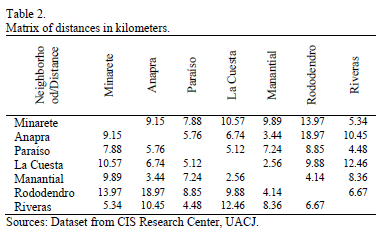
<body><![CDATA[<p><font size="2" face="Verdana, Arial, Helvetica, sans-serif"><i>Palabras clave</i>: Teor&iacute;a de grafos; rutas de veh&iacute;culos; log&iacute;stica de   la ciudad; computaci&oacute;n ubicua y el sistema producto - servicio. </font></p> <hr>     <p>&nbsp;</p>     <p><font size="3" face="Verdana, Arial, Helvetica, sans-serif"><b>1. Introduction</b></font></p>     <p><font size="2" face="Verdana, Arial, Helvetica, sans-serif">For companies operating in emerging markets, the   continuous upgrades in client's requests are result from a challenging   continuous improvement process. First, because they need to propose the right   level of satisfaction to their clients, and second, because they are   constrained to achieve the financial goals required to maintain their   operations in spite of the infrastructure faults and other external components   reducing their logistics performance &#91;1&#93;.   However, because of the important market opportunities to PSS, companies are   concerned to improve their processes and capabilities. Under a dynamic   competition environment, to increase logistics capabilities has become even   more urgent, especially due to the costs of allocating clients to routes and   the distribution expenses included then in the total cost &#91;2&#93;.   This can be done with the help of new technologies (ICT, ITS), which seem   necessary mainly for final distribution of goods to urban areas &#91;3&#93;.   Moreover, the access to new technologies, already difficult in developed   economies, is extremely expensive for new economies, so compensation of those   costs by a better possibility of optimization can be a lever to the deployment   of those technologies. This can be done via the implementation of   Product-Service-Systems (PSS). PSS is defined by as <i>&quot;a system of products, services, networks of players and supporting   infrastructure that continuously strives to be competitive, satisfy customer   needs and have lower environmental impact than traditional business models&quot; </i>&#91;4&#93;.   In this way, the quantity of materials consumed in the product's entire life   can be reduced &#91;5&#93;,   but also the service component can be an important complement to the product   itself &#91;6&#93;.   This can be then an argument to deploy driving support devices that would be   interfaced to a central server where the entire route sets of the company are   optimized, GPS-based devices that propose route optimization for drivers or   other ICT and ITS devices (product) that include route optimization solutions   (service) for drivers or companies. Those services will then be based on vehicle   routing.</font></p>     <p><font size="2" face="Verdana, Arial, Helvetica, sans-serif">Vehicle routing is not a new problem; its study arose in   the mid-20th century with the model of the traveling salesman problem (TSP). In   fact, a lot of research has been entirely devoted to these problems &#91;7&#93;&#91;8&#93;&#91;9&#93;&#91;10&#93;.   In the last few decades the development of software tools for solving vehicle   routing problems has increased, essentially based on conceptual models inspired   by biological systems, artificial intelligence (data mining, bio inspired   algorithms and augmented reality), mathematical theories, among others &#91;11&#93;.   However, this specialized knowledge is out of reach for decision makers in   emerging markets where logistics business is continuously growing. Moreover,   software is in general developed in a &quot;service&quot; perspective, without taking   into account the &quot;product&quot; that will be associated to this service. Thus, based   on the regional case of a third party logistics company located in Ciudad   Juarez (State of Chihuahua, Mexico), the objective of this paper is to expose   the results of an implementation of a software tool to analyze and solve CVRP   (Capacitated Vehicle Routing Problem). At the same time, based on ubiquitous   computing, a friendly-user platform running on an intelligent device was   developed. Coupling the device to the vehicle fleet optimization service   provided by the CVRP algorithm with ubiquitous computing is then a possible PSS   configuration that is here tested. The paper is then adapting advanced   techniques of optimization to a real case with the aim of testing a possible   PSS configuration.</font></p>     <p><font size="2" face="Verdana, Arial, Helvetica, sans-serif">This paper is organized as follows. In Section 2, a   conceptual revision of graph theory and CVRP, as well as a brief description of   free-download software is described. In Section 3, the problems to be solved as   well as detailed explanations related to solution procedure are shown. In   Section 4, the computational results are presented and a discussion thereof is   made. Finally, in Section 5, as conclusion, the importance of technology-based   product-services more adapted to challenges that enterprises face when   operating in emerging markets, as well as future research are presented. </font></p>     <p>&nbsp;</p>     <p><font size="3" face="Verdana, Arial, Helvetica, sans-serif"><b>2. Background</b></font></p>     <p><b><font size="2" face="Verdana, Arial, Helvetica, sans-serif"><i>2.1.  Graph Theory</i></font></b></p>     <p><font size="2" face="Verdana, Arial, Helvetica, sans-serif">Graph theory is a powerful tool to solve vehicle routing   problems. As well as distribution routes, graphs are discrete structures   composed by vertices, which are connected by arcs. Thus, a directed graph is   denoted by G = (V,A), where V is an empty set of elements called vertices and A   is a set of arcs. Each <font face="Symbol">a</font> e A has two vertices of V, i, j, i&ne;j associated,   where i is the initial point of the arc, and j is the terminal point. The arc <font face="Symbol">a</font> is also denoted by (i, j), thus referring to the source vertex to the   destination vertex and arc &#91;12&#93;.</font></p>     ]]></body>
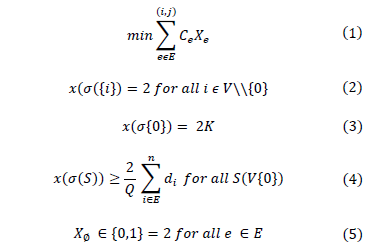
<body><![CDATA[<p><font size="2" face="Verdana, Arial, Helvetica, sans-serif"><b><i>2.2. Vehicle   routing problems with capacity constraints (CVRP) </i></b></font></p>     <p><font size="2" face="Verdana, Arial, Helvetica, sans-serif">The CVRP is a fundamental combinatorial problem with   applications in logistics optimization. In the last two decades, because of   innovative algorithms, and increased capabilities of computer equipment, major   advances in solution techniques have been achieved &#91;2&#93;. From a general point   of view, in the CVRP, a finite set of cities and the costs of travels between   them are given. Thus, a specific node is identified as the vehicle depot and   the rest as clients. Each client corresponds to a location where an amount of a   single product is delivered. The amounts required by customers are   predetermined and cannot be divided. In other words, they have to be delivered   by one vehicle at a time. In the simplest version it is assumed that vehicles   are homogeneous and therefore, have the same maximum capacity &#91;12&#93;. Based on the graph   theory, CVRP is formulated as a complete graph G = (V, E) where V = {0, 1, ...,   n} is considered to be the set of vertices and E a set of edges between two   vertices. In this paper, vertex corresponding to vehicles is noted as 0, and   vertices {1,..., n} are different customers. At the same time, for an arc e =   &#91;i, j&#93;, <i>c<sub>e</sub></i> is the cost of   going from node <i>i</i> to node <i>j</i>. Furthermore, a fleet of K vehicles is   supposed, each of capacity Q. Finally, customer demands <i>i</i> are denoted by <i>d<sub>i</sub></i>.   In fact, <i>d</i> is defined as the distance   between two nodes, while, <i>i</i> is   defined as the quantity of product or service to be delivered to the customer.   A binary variable <i>x<sub>e</sub></i> indicates whether edge <i>e</i> is on the   path of a vehicle or not &#91;12&#93;&#91;13&#93;.   The mathematical formulation is expressed as follows:</font></p>     <p><img src="/img/revistas/dyna/v82n191/v82n191a02eq0105.gif"></p>     <p><font size="2" face="Verdana, Arial, Helvetica, sans-serif">Thus, equation (2) states   that each client is visited exactly once by a vehicle. Equation (3) states that   the depot's capacity is 2K. Furthermore, when inequalities in (4) and (5) are   done, it drives a bi-connectivity of the entire solution. As a result, the   number of customers to be served exceeds the maximum capacity (Q), and the same   vehicle cannot visit them &#91;14&#93;.   However, the range of models for solving vehicle routing problems is extensive.   This is caused by the large diversity of variables of every specific problem   and the uncertainty involved in &#91;7&#93;,   &#91;15&#93; and &#91;16&#93;.</font></p>     <p><font size="2" face="Verdana, Arial, Helvetica, sans-serif"><b><i>2.3. Software   tool </i></b></font></p>     <p><font size="2" face="Verdana, Arial, Helvetica, sans-serif">Due to complexity when   solving CVRP, our research approach took into account the specific   characteristics of city logistics operations under an emerging markets context   that in this case involved: i) low logistical capabilities of decision makers;   ii) limited availability of data; and iii) restricted access to high   performance technology to compute optimal transportation routes. Thus, since   the use of software is a powerful tool to improve logistics competitiveness   when logistics capabilities of decision makers are low, the opportunity to use   a friendly-user and low-cost software was identified. &quot;<i>Graphs</i>&quot; is a free software tool for building, editing and analyzing   graphs. It is also useful for teaching, learning, and practicing graph theory   as well as related disciplines such as operations research, network design,   industrial engineering, and logistics systems, among others. It incorporates   algorithms and functions that allow analyzing real problems &#91;17&#93;. The process of software development as modules   has an interface for building and editing graphs (*.dll). The user can freely   draw a selected graph to analyze it without worrying about the solving process   used later. This software displays a signal if a particular analysis is not   feasible. However, due to the freedom provided by the software to the user in   designing graphs, if decided, any scenario could be taken into account (including   not feasible solutions). It clearly implies a great computational complexity to   the software. &quot;<i>Graphs</i>&quot; allows   building both directed graphs as undirected. The user decides the distribution   of the graph, although the program can support him with other utilities that   automatically draw the graph (tree format, radial, organic force directed flow,   random, among others). The user can also import or export the coordinates of   the nodes, with the possibility of adding a map as part of the graph's background   layer &#91;19&#93;&#91;20&#93;&#91;21&#93;. It can also calculate the distance between   nodes and enter this value automatically (or as a proportional cost) in the   edges of the graph. Thus, based on the information associated to every node, it   identifies the shortest path, and then, it defines the next node to be reach.</font></p>     <p>&nbsp;</p>     <p><font size="3" face="Verdana, Arial, Helvetica, sans-serif"><b>3. Real   world applications</b></font></p>     <p><font size="2" face="Verdana, Arial, Helvetica, sans-serif">For third party logistics companies operating in emerging   markets, especially small and medium enterprises (SME), vehicle routing   problems are frequently solved without a strong scientific basis. In fact, most   of the SME companies design their logistics solutions based on the so-called &quot;<i>expert judgment</i>&quot;. In that context, the   most usual problems in decision-making are to reduce transportation costs, and   at the same time, to improve customer service by finding the best routes that   minimize the total distance or transit time. However, in SME companies running   operations in emerging markets, modern software tools are frequently seen as   expensive and complex tools to design logistics solutions. Consequently, free   download software as &quot;<i>Graphs</i>&quot;   represents a useful first step to improve solving capabilities in logistics.</font></p>     <p><font size="2" face="Verdana, Arial, Helvetica, sans-serif"><b><i>3.1. Case   description </i></b></font></p>     ]]></body>
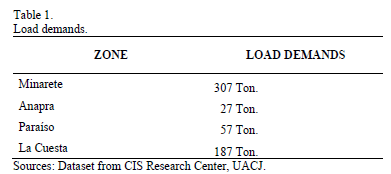
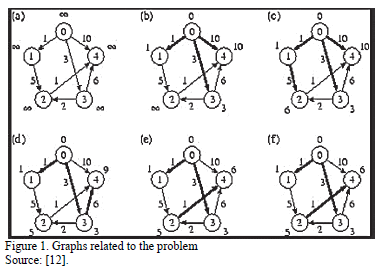
<body><![CDATA[<p><font size="2" face="Verdana, Arial, Helvetica, sans-serif">The information here analyzed was provided for a third   party logistics company with operations in ciudad Juarez (State of Chihuahua,   Mexico). Due to the complexity when analyzing all its logistics operations, a   more specific case concerning the distribution of perishable food was created.   A fleet of 17 vehicles with the same technical specifications and similar load   capacity (15 tons) composed this case. Juarez City and its Metropolitan Area   were defined as the geographical zone for this analysis. Destinations are   concentrated on four zones of the city: i) Minarete ii) Anapra; iii) Para&iacute;so;   and iV) La Cuesta. The load demands are presented in <a href="#tab01">Table 1</a>.</font></p>     <p align="center"><font size="2" face="Verdana, Arial, Helvetica, sans-serif"><a name="tab01"></a></font><img src="/img/revistas/dyna/v82n191/v82n191a02tab01.gif"></p>     <p><font size="2" face="Verdana, Arial, Helvetica, sans-serif">To design a CVRP solution   using the software &quot;<i>Graphs</i>&quot;, the   three steps suggested by Rodr&iacute;guez &#91;20&#93;were   used: i) to build the matrix of distances between cities; ii) to state all the   nodes with their respective supply and demand of load and constraints; iii) to   establish the operational variables of vehicles.</font></p>     <p><font size="2" face="Verdana, Arial, Helvetica, sans-serif"><b><i>3.2. Matrix   of distances </i></b></font></p>     <p><font size="2" face="Verdana, Arial, Helvetica, sans-serif">First, taking into   account the distances between origin and destination nodes, the matrix of   distances was built (see <a href="#tab02">Table 2</a>) and all the data were programed into the   software.</font></p>     <p align="center"><font size="2" face="Verdana, Arial, Helvetica, sans-serif"><a name="tab02"></a></font><img src="/img/revistas/dyna/v82n191/v82n191a02tab02.gif"></p>     <p><font size="2" face="Verdana, Arial, Helvetica, sans-serif"><b><i>3.3. Stating   the nodes </i></b></font></p>     <p><font size="2" face="Verdana, Arial, Helvetica, sans-serif">Second, based on the matrix of distances and demand loads,   a set of nodes Origin-Destination for each neighborhood was stated. As a   result, the critical graphs related to the problem were identified (see <a href="#fig01">Fig.   1</a>).</font></p>     <p align="center"><font size="2" face="Verdana, Arial, Helvetica, sans-serif"><a name="fig01"></a></font><img src="/img/revistas/dyna/v82n191/v82n191a02fig01.gif"></p>     <p><font size="2" face="Verdana, Arial, Helvetica, sans-serif"><b><i>3.4. Operational   constraints</i></b></font></p>     ]]></body>
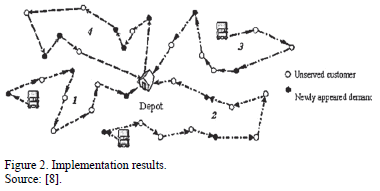
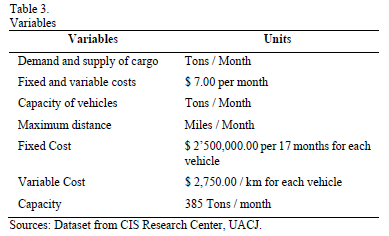
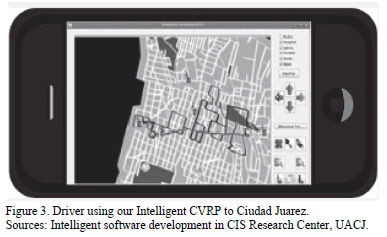
<body><![CDATA[<p><font size="2" face="Verdana, Arial, Helvetica, sans-serif">Third, the vehicle constraints were given by the company's   business context. In fact, legal, financial, and operational aspects of the   operational context were analyzed. These constraints were calculated taking   into account several specific company's operational policies as:</font></p> <ol type="i">       <li><font size="2" face="Verdana, Arial, Helvetica, sans-serif">a vehicle runs operations 10 hours a day;</font></li>       <li><font size="2" face="Verdana, Arial, Helvetica, sans-serif"> it runs 6 days a week;</font></li>       <li><font size="2" face="Verdana, Arial, Helvetica, sans-serif"> it operates 4 weeks per month;</font></li>       <li><font size="2" face="Verdana, Arial, Helvetica, sans-serif">the average operational speed is 60 km/hr; and</font></li>       <li><font size="2" face="Verdana, Arial, Helvetica, sans-serif">maximum distance for all the programmed trips     were 1,485 km/per month. </font></li>     </ol>     <p><font size="2" face="Verdana, Arial, Helvetica, sans-serif">Other variables are exposed in <a href="#tab03">Table 3</a>.</font></p>     <p align="center"><font size="2" face="Verdana, Arial, Helvetica, sans-serif"><a name="tab03"></a></font><img src="/img/revistas/dyna/v82n191/v82n191a02tab03.gif"></p>     <p><font size="2" face="Verdana, Arial, Helvetica, sans-serif"><a href="#fig02">Figs.2</a> and <a href="#fig03">3</a> present how different nodes were generated as   well as possible graphs related to the implementation of an optimal route for   each journey. The model here presented considered the weather implications,   which are considered as difficult 4 months a year</font></p>     ]]></body>
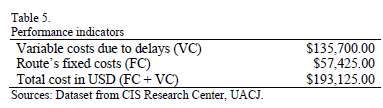
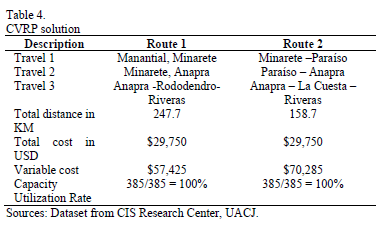
<body><![CDATA[<p align="center"><font size="2" face="Verdana, Arial, Helvetica, sans-serif"><a name="fig02"></a></font><img src="/img/revistas/dyna/v82n191/v82n191a02fig02.gif"></p>     <p align="center"><font size="2" face="Verdana, Arial, Helvetica, sans-serif"><a name="fig03"></a></font><img src="/img/revistas/dyna/v82n191/v82n191a02fig03.gif"></p>     <p><font size="2" face="Verdana, Arial, Helvetica, sans-serif">More specifically, the model here proposed adjusts the   optimal values of each node. As a result, it was the sixth iteration that   showed the optimal route by taking into account: i) time restrictions; ii)   weather conditions; and iii) waiting time to load and unload.</font></p>     <p><font size="2" face="Verdana, Arial, Helvetica, sans-serif"><b><i>3.5. Ubiquitous   computing</i></b></font></p>     <p><font size="2" face="Verdana, Arial, Helvetica, sans-serif">Since a user could   move from one computing environment to another, ubiquitous computing poses a   number of challenges in designing software architecture. Thus, to design user   interfaces for mobile devices should take into account a number of constraints.   Indeed the limited screen is to show the information. Since there is nowadays a   wide range of screen sizes and resolutions, an interface should be designed to be used on most of   devises available on the market. For this project, the proposed model was   developed in Android API, and the programming interface was in XML. Data Server   Communication is the most important component because it communicates to the   server that allows the devise to send the GPS position obtained by receiving   the processed image and location map (see <a href="#fig03">Fig. 3</a>).</font></p>     <p>&nbsp;</p>     <p><font size="3" face="Verdana, Arial, Helvetica, sans-serif"><b>4. Results</b></font></p>     <p><font size="2" face="Verdana, Arial, Helvetica, sans-serif">Because of the restrictions related to each route, our tool defines   additional routes feasible solution scenarios. Each scenario analysed considers   possible changes in the route depending on the vales generated and assessed by   Djikstra algorithm. This enables us to solve dynamically the CVRP. The results   obtained are presented in <a href="#tab04">Table 4</a>.</font></p>     <p align="center"><font size="2" face="Verdana, Arial, Helvetica, sans-serif"><a name="tab04"></a></font><img src="/img/revistas/dyna/v82n191/v82n191a02tab04.gif"></p>     <p><font size="2" face="Verdana, Arial, Helvetica, sans-serif">Route 1 is covered by a vehicle with a capacity utilization of 100%   (385 tons per month). Likewise, Route 2 is covered by a vehicle with a capacity   utilization of 100% (385 tons / month) as shown in <a href="#tab05">Table 5</a>. </font></p>     ]]></body>
<body><![CDATA[<p align="center"><font size="2" face="Verdana, Arial, Helvetica, sans-serif"><a name="tab05"></a></font><img src="/img/revistas/dyna/v82n191/v82n191a02tab05.gif"></p>     <p><font size="2" face="Verdana, Arial, Helvetica, sans-serif">The results obtained   using the software &quot;Graphs&quot; to solve the proposed CVRP problem were implemented   by the third party logistics company with an improvement of 27% in their   operations. Since vehicle routing problems were frequently solved based on the   so-called &quot;expert judgment&quot;, the proposed model and the informatics tool   developed based on the ubiquitous computing approach, significantly improved   their logistics capabilities. They both reduced transportation costs, and at   the same time, improved the capacity utilization rate of the vehicle fleet.   Furthermore, ubiquitous computing solution is allowed company to improve   customer service, and can be associated to ICT products and solutions like   mobile phones or vehicle devices (GPS, driving support tools, etc.). It is now   offering superior logistics services that other local logistics providers, with   limited technological exposure, cannot provide. Since differentiating customer   service is critical in the current competitive world, this tool could improve   company's profitability.</font></p>     <p>&nbsp;</p>     <p><font size="3" face="Verdana, Arial, Helvetica, sans-serif"><b>5. Conclusions</b></font></p>     <p><font size="2" face="Verdana, Arial, Helvetica, sans-serif">In an emerging   market business context where most of local companies do not have a clear   logistics strategy. Operational issues are driven by a dynamic competition to   provide the right level of satisfaction to clients, and constrained by external   difficulties (infrastructure inefficiencies, legal framework, etc.) to achieve   their financial goals. Nevertheless, favorable market opportunities to PSS   provide an incentive to improve their processes.</font></p>     <p><font size="2" face="Verdana, Arial, Helvetica, sans-serif">Thus,   since most of the local practitioners do not have enough logistics   capabilities, the use of free download software to solve complex logistics   problems, is the first step to increase logistics competitiveness. In fact, the   results achieved with this implementation convinced the company about the   importance of the software technology to improve their logistics operations. </font></p>     <p><font size="2" face="Verdana, Arial, Helvetica, sans-serif">The   results proved that this approach optimizes costs and consequently, provides a   competitive advantage to a company running operations under high operational   costs &#91;11&#93;. Clearly, setting the restrictions for modeling vehicle routing   problems plays an important role in obtaining an optimal and practical   solution. In these cases, it is critical to balance theoretical approaches with   a proper planning of routes to avoid, for example, movements of empty vehicles.</font></p>     <p><font size="2" face="Verdana, Arial, Helvetica, sans-serif">Technology-based   product-services more adapted to challenges that enterprises face when   operating in emerging markets could be a competitive advantage. Our work   offered a tool that considered solution scenarios to design routes in emerging   markets cities, where logistic abilities are low. Possible product-service   systems applications of VRP-based solving tools that can be examined in future   include vehicles (leasing services with fleet optimization based on CVRP),   mobile devices (the Android application can be associated to mobile phone   offers for distribution companies), GPS-based vehicle devices or   vehicle-sharing systems, among others.</font></p>     <p><font size="2" face="Verdana, Arial, Helvetica, sans-serif">The   proposed model provides useful information to decision makers to define and   reduce waiting times when distributing perishable goods in metropolitan zones.   Results highlight the quantitative benefits achieved when technological tools   are implemented taking into account the specific needs of the operational   context. In addition, the importance of tools more adapted to logistical   challenges that enterprises face when operating in emerging markets is   highlighted. Finally, as future research, from a theoretical perspective, the   solution here proposed will be improved by the use of estimation of   distribution algorithm &#91;21&#93;&#91;22&#93;&#91;23&#93;&#91;24&#93;.</font></p>     <p>&nbsp;</p>     ]]></body>
<body><![CDATA[<p><font size="3" face="Verdana, Arial, Helvetica, sans-serif"><b>Acknowledgments</b></font></p>     <p><font size="2" face="Verdana, Arial, Helvetica, sans-serif">The authors thank Flora Hammer for comments and   suggestions that improved this paper. </font></p>     <p>&nbsp;</p>     <p><font size="3" face="Verdana, Arial, Helvetica, sans-serif"><b>Funding</b></font></p>     <p><font size="2" face="Verdana, Arial, Helvetica, sans-serif">As part of the National Research Network &quot;Sistemas de   Transporte y Log&iacute;stica&quot;, the authors acknowledge all the support provided by   the National Council of Science and Technology of Mexico (CONACYT) through the   research program &quot;Redes Tem&aacute;ticas de Investigaci&oacute;n&quot;. At the same time, we   acknowledge the determination and effort performed by the Mexican Logistics and   Supply Chain Association (AML) and the Mexican Institute of Transportation   (IMT) for providing us an internationally recognized collaboration platform,   the International Congress on Logistics and Supply Chain &#91;CiLOG&#93;.</font></p>     <p>&nbsp;</p>     <p><font size="3" face="Verdana, Arial, Helvetica, sans-serif"><b>References</b></font></p>     <!-- ref --><p><font size="2" face="Verdana, Arial, Helvetica, sans-serif"><b>&#91;1&#93;</b> Cedillo-Campos   M. and Sanchez-Ram&iacute;rez, C., Dynamic self-assessment of supply chains   performance: An emerging market approach. Journal of Applied Research &amp;   Technology, JART, 11(3); 2013. pp. 338-347. DOI: 10.1016/S1665-6423(13)71544-X</font>&nbsp;&nbsp;&nbsp;&nbsp;&nbsp;&nbsp;&nbsp;&nbsp;[&#160;<a href="javascript:void(0);" onclick="javascript: window.open('/scielo.php?script=sci_nlinks&ref=000090&pid=S0012-7353201500030000200001&lng=','','width=640,height=500,resizable=yes,scrollbars=1,menubar=yes,');">Links</a>&#160;]<!-- end-ref --><!-- ref --><p><font size="2" face="Verdana, Arial, Helvetica, sans-serif"><b>&#91;2&#93;</b> Velarde,   M., Cedillo-Campos, M. and Litvinchev, I., Design of territories and vehicle   routing: an integrated solution approach. International Congress on Logistics   and Supply Chain (CiLOG 2014), Mexican Logistics &amp; Supply Chain Assoc.   (AML); pp. 160-176, 2014.    &nbsp;&nbsp;&nbsp;&nbsp;&nbsp;&nbsp;&nbsp;&nbsp;[&#160;<a href="javascript:void(0);" onclick="javascript: window.open('/scielo.php?script=sci_nlinks&ref=000091&pid=S0012-7353201500030000200002&lng=','','width=640,height=500,resizable=yes,scrollbars=1,menubar=yes,');">Links</a>&#160;]<!-- end-ref --></font></p>     ]]></body>
<body><![CDATA[<!-- ref --><p><font size="2" face="Verdana, Arial, Helvetica, sans-serif"><b>&#91;3&#93;</b> Gonzalez-Feliu,   J., Semet, F. and Routhier, J.L., Sustainable urban logistics: Concepts,   methods and information systems. Heidelberg: Springer; 2014. DOI: 10.1007/978-3-642-31788-0</font>&nbsp;&nbsp;&nbsp;&nbsp;&nbsp;&nbsp;&nbsp;&nbsp;[&#160;<a href="javascript:void(0);" onclick="javascript: window.open('/scielo.php?script=sci_nlinks&ref=000093&pid=S0012-7353201500030000200003&lng=','','width=640,height=500,resizable=yes,scrollbars=1,menubar=yes,');">Links</a>&#160;]<!-- end-ref --><!-- ref --><p><font size="2" face="Verdana, Arial, Helvetica, sans-serif"><b>&#91;4&#93;</b> Goedkoop, M.J., van Halen, C.J.G., te   Riele. H.R.M. and Rommens, P.J.M., Product service systems,   ecological and economic basics. Report for Dutch Ministries of Environment   (VROM) and Economic Affairs (EZ); 1999.    &nbsp;&nbsp;&nbsp;&nbsp;&nbsp;&nbsp;&nbsp;&nbsp;[&#160;<a href="javascript:void(0);" onclick="javascript: window.open('/scielo.php?script=sci_nlinks&ref=000094&pid=S0012-7353201500030000200004&lng=','','width=640,height=500,resizable=yes,scrollbars=1,menubar=yes,');">Links</a>&#160;]<!-- end-ref --></font></p>     <!-- ref --><p><font size="2" face="Verdana, Arial, Helvetica, sans-serif"><b>&#91;5&#93;</b> Beuren, F.H., Gomes-Ferreira, M.G. and Cauchick-Miguel,   P.A., Product-service systems: A literature review on integrated products and   services. Journal of Cleaner   Production, 47, pp.   222-231, 2013. DOI: 10.1016/j.jclepro.2012.12.028</font>&nbsp;&nbsp;&nbsp;&nbsp;&nbsp;&nbsp;&nbsp;&nbsp;[&#160;<a href="javascript:void(0);" onclick="javascript: window.open('/scielo.php?script=sci_nlinks&ref=000096&pid=S0012-7353201500030000200005&lng=','','width=640,height=500,resizable=yes,scrollbars=1,menubar=yes,');">Links</a>&#160;]<!-- end-ref --><!-- ref --><p><font size="2" face="Verdana, Arial, Helvetica, sans-serif"><b>&#91;6&#93;</b> Baines,   T.S., Lightfoot, H.W., Evans, S., Neely, A., Greenough, R., Peppard, J. and Wilson,   H., State-of-the-art in product-service systems. Proceedings of the Institution of Mechanical Engineers, Part B: Journal   of Engineering Manufacture, 221 (10), pp. 1543-1552. 2007. DOI: 10.1243/09544054JEM858.    &nbsp;&nbsp;&nbsp;&nbsp;&nbsp;&nbsp;&nbsp;&nbsp;[&#160;<a href="javascript:void(0);" onclick="javascript: window.open('/scielo.php?script=sci_nlinks&ref=000097&pid=S0012-7353201500030000200006&lng=','','width=640,height=500,resizable=yes,scrollbars=1,menubar=yes,');">Links</a>&#160;]<!-- end-ref --></font></p>     <!-- ref --><p><font size="2" face="Verdana, Arial, Helvetica, sans-serif"><b>&#91;7&#93;</b> Toth, P. and Vigo, D., The vehicle routing problem,   Philadelphia: SIAM; 2002. DOI: 10.1137/1.9780899718515.    &nbsp;&nbsp;&nbsp;&nbsp;&nbsp;&nbsp;&nbsp;&nbsp;[&#160;<a href="javascript:void(0);" onclick="javascript: window.open('/scielo.php?script=sci_nlinks&ref=000099&pid=S0012-7353201500030000200007&lng=','','width=640,height=500,resizable=yes,scrollbars=1,menubar=yes,');">Links</a>&#160;]<!-- end-ref -->,</font></p>     <!-- ref --><p><font size="2" face="Verdana, Arial, Helvetica, sans-serif"><b>&#91;8&#93;</b> Cordeau, J.F., Laporte, G., Savelsbergh, M.W. and Vigo,   D., Vehicle routing. In Transportation. Handbooks in operations research and   management science, 14. Elsevier, pp. 367-428, 2006.    &nbsp;&nbsp;&nbsp;&nbsp;&nbsp;&nbsp;&nbsp;&nbsp;[&#160;<a href="javascript:void(0);" onclick="javascript: window.open('/scielo.php?script=sci_nlinks&ref=000101&pid=S0012-7353201500030000200008&lng=','','width=640,height=500,resizable=yes,scrollbars=1,menubar=yes,');">Links</a>&#160;]<!-- end-ref --></font></p>     ]]></body>
<body><![CDATA[<!-- ref --><p><font size="2" face="Verdana, Arial, Helvetica, sans-serif"><b>&#91;9&#93;</b> Golden, B., Raghavan, S. and Wasil, E., The vehicle   routing problem: Latest advances and new challenges. Berlin: Springer; 2008. DOI: 10.1007/978-0-387-77778-8.    &nbsp;&nbsp;&nbsp;&nbsp;&nbsp;&nbsp;&nbsp;&nbsp;[&#160;<a href="javascript:void(0);" onclick="javascript: window.open('/scielo.php?script=sci_nlinks&ref=000103&pid=S0012-7353201500030000200009&lng=','','width=640,height=500,resizable=yes,scrollbars=1,menubar=yes,');">Links</a>&#160;]<!-- end-ref --></font></p>     <!-- ref --><p><font size="2" face="Verdana, Arial, Helvetica, sans-serif"><b>&#91;10&#93;</b> Cattaruzza, D., Absi, N., Feillet, D. and   Gonzalez-Feliu, J., Vehicle routing problems for city logistics, EURO Journal   of Transportation and Logistics; 2015. DOI: 10.1007/s13676-014-0074-0.    &nbsp;&nbsp;&nbsp;&nbsp;&nbsp;&nbsp;&nbsp;&nbsp;[&#160;<a href="javascript:void(0);" onclick="javascript: window.open('/scielo.php?script=sci_nlinks&ref=000105&pid=S0012-7353201500030000200010&lng=','','width=640,height=500,resizable=yes,scrollbars=1,menubar=yes,');">Links</a>&#160;]<!-- end-ref --></font></p>     <!-- ref --><p><font size="2" face="Verdana, Arial, Helvetica, sans-serif"><b>&#91;11&#93;</b> Partyka, J.   and Hall, R., On the road to connectivity. OR/MS Today, 37 (1),   pp. 42-49, 2010.    &nbsp;&nbsp;&nbsp;&nbsp;&nbsp;&nbsp;&nbsp;&nbsp;[&#160;<a href="javascript:void(0);" onclick="javascript: window.open('/scielo.php?script=sci_nlinks&ref=000107&pid=S0012-7353201500030000200011&lng=','','width=640,height=500,resizable=yes,scrollbars=1,menubar=yes,');">Links</a>&#160;]<!-- end-ref --></font></p>     <!-- ref --><p><font size="2" face="Verdana, Arial, Helvetica, sans-serif"><b>&#91;12&#93;</b> Diestel, R., Graph theory. Second edition. New York,   Springer; 2000. DOI: 10.1007/978-3-642-14279-6.    &nbsp;&nbsp;&nbsp;&nbsp;&nbsp;&nbsp;&nbsp;&nbsp;[&#160;<a href="javascript:void(0);" onclick="javascript: window.open('/scielo.php?script=sci_nlinks&ref=000109&pid=S0012-7353201500030000200012&lng=','','width=640,height=500,resizable=yes,scrollbars=1,menubar=yes,');">Links</a>&#160;]<!-- end-ref --></font></p>     <!-- ref --><p><font size="2" face="Verdana, Arial, Helvetica, sans-serif"><b>&#91;13&#93;</b> Chandran, B. and Raghavan, S., Modelling and solving   the capacitated vehicle routing problem on trees. In: Golden, B.L., Raghavan,   S., Wasil, E.A. (Eds.) The vehicle routing problem: Latest advances and new   challenges, New York: Springer, pp. 239-274, 2008.   DOI: 10.1007/978-0-387-77778-8_11.    &nbsp;&nbsp;&nbsp;&nbsp;&nbsp;&nbsp;&nbsp;&nbsp;[&#160;<a href="javascript:void(0);" onclick="javascript: window.open('/scielo.php?script=sci_nlinks&ref=000111&pid=S0012-7353201500030000200013&lng=','','width=640,height=500,resizable=yes,scrollbars=1,menubar=yes,');">Links</a>&#160;]<!-- end-ref --></font></p>     ]]></body>
<body><![CDATA[<!-- ref --><p><font size="2" face="Verdana, Arial, Helvetica, sans-serif"><b>&#91;14&#93;</b> Hern&aacute;ndez,   H., Procedimientos exactos y heur&iacute;sticos para resolver problemas de rutas con   recogida y entrega de mercanc&iacute;a. Ph.D. Thesis. Universidad de la   Laguna, Facultad de Matem&aacute;ticas. Departamento de Estad&iacute;stica,   Investigaci&oacute;n Operativa y Computaci&oacute;n, Espa&ntilde;a, 2004.    &nbsp;&nbsp;&nbsp;&nbsp;&nbsp;&nbsp;&nbsp;&nbsp;[&#160;<a href="javascript:void(0);" onclick="javascript: window.open('/scielo.php?script=sci_nlinks&ref=000113&pid=S0012-7353201500030000200014&lng=','','width=640,height=500,resizable=yes,scrollbars=1,menubar=yes,');">Links</a>&#160;]<!-- end-ref --></font></p>     <!-- ref --><p><font size="2" face="Verdana, Arial, Helvetica, sans-serif"><b>&#91;15&#93;</b> Golumbic, M., Algorithmic graph theory and perfect   graphs. Second edition. London: Elsevier, 2004.    &nbsp;&nbsp;&nbsp;&nbsp;&nbsp;&nbsp;&nbsp;&nbsp;[&#160;<a href="javascript:void(0);" onclick="javascript: window.open('/scielo.php?script=sci_nlinks&ref=000115&pid=S0012-7353201500030000200015&lng=','','width=640,height=500,resizable=yes,scrollbars=1,menubar=yes,');">Links</a>&#160;]<!-- end-ref --></font></p>     <!-- ref --><p><font size="2" face="Verdana, Arial, Helvetica, sans-serif"><b>&#91;16&#93;</b> Baldacci, R., Toth, P. and Vigo, D., Recent advances in   vehicle routing exact algorithms. 4OR, 5 (4), pp. 269-298, 2007. DOI: 10.1007/s10288-007-0063-3.    &nbsp;&nbsp;&nbsp;&nbsp;&nbsp;&nbsp;&nbsp;&nbsp;[&#160;<a href="javascript:void(0);" onclick="javascript: window.open('/scielo.php?script=sci_nlinks&ref=000117&pid=S0012-7353201500030000200016&lng=','','width=640,height=500,resizable=yes,scrollbars=1,menubar=yes,');">Links</a>&#160;]<!-- end-ref --></font></p>     <!-- ref --><p><font size="2" face="Verdana, Arial, Helvetica, sans-serif"><b>&#91;17&#93;</b> Baldacci, R., Mingozzi, A. and Roberti, R., Recent   exact algorithms for solving the vehicle routing problem under capacity and   time window constraints. European Journal of Operational Research, 218 (1), pp.   1-6, 2012. DOI: 10.1016/j.ejor.2011.07.037.    &nbsp;&nbsp;&nbsp;&nbsp;&nbsp;&nbsp;&nbsp;&nbsp;[&#160;<a href="javascript:void(0);" onclick="javascript: window.open('/scielo.php?script=sci_nlinks&ref=000119&pid=S0012-7353201500030000200017&lng=','','width=640,height=500,resizable=yes,scrollbars=1,menubar=yes,');">Links</a>&#160;]<!-- end-ref --></font></p>     <!-- ref --><p><font size="2" face="Verdana, Arial, Helvetica, sans-serif"><b>&#91;18&#93;</b> Pintea, C., Petrica, C. and Camelia, C., The   generalized traveling salesman problem solved with ant algorithms. Journal of   Universal Computer Science, 13 (7), pp. 1065-1075, 2007.    &nbsp;&nbsp;&nbsp;&nbsp;&nbsp;&nbsp;&nbsp;&nbsp;[&#160;<a href="javascript:void(0);" onclick="javascript: window.open('/scielo.php?script=sci_nlinks&ref=000121&pid=S0012-7353201500030000200018&lng=','','width=640,height=500,resizable=yes,scrollbars=1,menubar=yes,');">Links</a>&#160;]<!-- end-ref --> </font></p>     ]]></body>
<body><![CDATA[<!-- ref --><p><font size="2" face="Verdana, Arial, Helvetica, sans-serif"><b>&#91;19&#93;</b> Rodr&iacute;guez, A., Grafos. &#91;On Line&#93;. &#91;date of reference: December   2<sup>nd</sup>, 2014&#93;. Available on: <a href="http://personales.upv.es/arodrigu/grafos/" target="_blank">http://personales.upv.es/arodrigu/grafos/</a>.    &nbsp;&nbsp;&nbsp;&nbsp;&nbsp;&nbsp;&nbsp;&nbsp;[&#160;<a href="javascript:void(0);" onclick="javascript: window.open('/scielo.php?script=sci_nlinks&ref=000123&pid=S0012-7353201500030000200019&lng=','','width=640,height=500,resizable=yes,scrollbars=1,menubar=yes,');">Links</a>&#160;]<!-- end-ref --></font></p>     <!-- ref --><p><font size="2" face="Verdana, Arial, Helvetica, sans-serif"><b>&#91;20&#93;</b> Rodr&iacute;guez, A., Grafos: Herramienta   inform&aacute;tica para el aprendizaje y resoluci&oacute;n de problemas reales de teor&iacute;a de   grafos. X Congreso de Ingenier&iacute;a de Organizaci&oacute;n, Valencia: Universidad   Polit&eacute;cnica de Valencia, pp. 1-8, 2006. DOI: 10.1016/j.eswa.2008.01.072</font>&nbsp;&nbsp;&nbsp;&nbsp;&nbsp;&nbsp;&nbsp;&nbsp;[&#160;<a href="javascript:void(0);" onclick="javascript: window.open('/scielo.php?script=sci_nlinks&ref=000125&pid=S0012-7353201500030000200020&lng=','','width=640,height=500,resizable=yes,scrollbars=1,menubar=yes,');">Links</a>&#160;]<!-- end-ref --><!-- ref --><p><font size="2" face="Verdana, Arial, Helvetica, sans-serif"><b>&#91;21&#93;</b> Paredes, C., An&aacute;lisis del software   Grafos. Universidad Polit&eacute;cnica de   Catalu&ntilde;a, 2008.    &nbsp;&nbsp;&nbsp;&nbsp;&nbsp;&nbsp;&nbsp;&nbsp;[&#160;<a href="javascript:void(0);" onclick="javascript: window.open('/scielo.php?script=sci_nlinks&ref=000126&pid=S0012-7353201500030000200021&lng=','','width=640,height=500,resizable=yes,scrollbars=1,menubar=yes,');">Links</a>&#160;]<!-- end-ref --></font></p>     <!-- ref --><p><font size="2" face="Verdana, Arial, Helvetica, sans-serif"><b>&#91;22&#93;</b> Wang, C. and Lu, J., A hybrid genetic algorithm that   optimizes capacities related with vehicle routing problems. Expert Systems with   Applications, 36, pp. 2921-2936, 2009.    &nbsp;&nbsp;&nbsp;&nbsp;&nbsp;&nbsp;&nbsp;&nbsp;[&#160;<a href="javascript:void(0);" onclick="javascript: window.open('/scielo.php?script=sci_nlinks&ref=000128&pid=S0012-7353201500030000200022&lng=','','width=640,height=500,resizable=yes,scrollbars=1,menubar=yes,');">Links</a>&#160;]<!-- end-ref --> </font></p>     <!-- ref --><p><font size="2" face="Verdana, Arial, Helvetica, sans-serif"><b>&#91;23&#93;</b> P&eacute;rez, R., Sanchez, J., Hern&aacute;ndez, A. y   Ochoa, C., Un algoritmo de estimaci&oacute;n de distribuciones para resolver un   problema real de programaci&oacute;n de tareas en configuraci&oacute;n jobshop. Un enfoque alternativo para la programaci&oacute;n de tareas. Komputer   Sapiens - Revista de Divulgaci&oacute;n de la Sociedad Mexicana de Inteligencia   Artificial, 1, pp. 23-36, 2014.    &nbsp;&nbsp;&nbsp;&nbsp;&nbsp;&nbsp;&nbsp;&nbsp;[&#160;<a href="javascript:void(0);" onclick="javascript: window.open('/scielo.php?script=sci_nlinks&ref=000130&pid=S0012-7353201500030000200023&lng=','','width=640,height=500,resizable=yes,scrollbars=1,menubar=yes,');">Links</a>&#160;]<!-- end-ref --> </font></p>     <!-- ref --><p><font size="2" face="Verdana, Arial, Helvetica, sans-serif"><b>&#91;24&#93;</b> P&eacute;rez-Rodr&iacute;guez, R., Sanchez, J., Hern&aacute;ndez-Aguirre, A.   and Ochoa, C., Simulation optimization for a flexible jobshop scheduling   problem using an estimation of distribution algorithm. The International   Journal of Advanced Manufacturing Technology, 7 (4), pp. 3-21, 2014.   DOI: 10.1007/s00170-014-5759-x.    &nbsp;&nbsp;&nbsp;&nbsp;&nbsp;&nbsp;&nbsp;&nbsp;[&#160;<a href="javascript:void(0);" onclick="javascript: window.open('/scielo.php?script=sci_nlinks&ref=000132&pid=S0012-7353201500030000200024&lng=','','width=640,height=500,resizable=yes,scrollbars=1,menubar=yes,');">Links</a>&#160;]<!-- end-ref --></font></p>     <p>&nbsp;</p>     <p><font size="2" face="Verdana, Arial, Helvetica, sans-serif"><b>C.A. Ochoa-Ortiz,</b> B.S. '94, Eng. Master '00,   Ph.D. '04, Postdoctoral Researcher,'06, and Industrial Postdoctoral Research   '09. He joined the Juarez City University in 2008. He has 7 BOOK, and 27   chapters in books related with AI. He has supervised 37 Ph.D. theses, 47 M.Sc.   theses and 49 undergraduate theses. He participated in the organization of several   International Conferences. His research interests include evolutionary   computation, natural processing language, anthropometrics characterization and   Social Data Mining. In his second Postdoctoral Research participated in an   internship in ISTC-CNR in Rome, Italy. He collaborates with researchers from   Ir&aacute;n, Kyrguist&aacute;n and Cyprus. Dr. Ochoa   is National Researcher (National Council of Science and Technology of Mexico -   CONACYT) during eight years.</font></p>     <p><font size="2" face="Verdana, Arial, Helvetica, sans-serif"><b>F.J. Ornelas-Zapata,</b> received the Bs. Degree in Informatics (2001); Master in Computer Science   (2007); PhD in Computer Science (2010). He is currently a research professor at   the Polytechnic University of Aguascalientes and the Autonomous University of   Aguascalientes. Her research area is Artificial Intelligence. Her research is   on vehicle routing problems and parallel computing. He has 4 chapters in books related   whit AI. He participated in the COMCEV'2007, COMCEV'2008, HIS'2009, MICAI'2010,   CILOG'2014. </font></p>     <p><font size="2" face="Verdana, Arial, Helvetica, sans-serif"><b>M.L.Y.   Margain-Fuentes, </b>inspired by the Software Engineering and Quality Systems   Standards, begins her Mastery on Informatics and Information Technology in the   Aguascalientes Autonomous University and finishes in the Windsor University in   Ontario, Canada. Through the Doctor's degree in Computation Sciences she gets   the interest in researching Learning Objects and e-learning. She has outstand   for her professional experience in the industry and government. She has worked   as professor in bachelors and master's degree. She has imparted several   international conferences. She has participated in multiple software projects   as assessor. She was for six years as Director of the Information Strategic   Systems career and Software Engineering and for the last two year is a Director   of Research and Postgraduate Department in the Aguascalientes Polytechnic   University.</font></p>     <p><font size="2" face="Verdana, Arial, Helvetica, sans-serif"><b>M.G. Cedillo-Campos</b>, is a Professor in Logistics Systems Dynamics   and Founding Chairman of the Mexican Logistics and Supply Chain Association   (AML). Dr. Cedillo is National Researcher (National Council of Science and   Technology of Mexico - CONACYT), Innovation Award 2012 (UANL-FIME) and National   Logistics Award 2012. In 2004, he received with honors a Ph.D. in Logistics   Systems Dynamics from the University of Paris, France. Recently, he collaborated   as Visiting Researcher at Zaragoza Logistics Center as well as a keynote   speaker at Georgia Tech Panama. He works in logistics systems analysis and   modeling, risk analysis, and supply chain management, which are the subjects he   teaches and researches in different prestigious universities in Mexico and   abroad. Dr. Cedillo is the Scientific Chairman of the International Congress on   Logistics and Supply Chain (CiLOG) organized by the Mexican Logistics and   Supply Chain Association (AML), and coordinator of the National Logistics   Research Network in Mexico supported by the program &quot;<i>Redes Tem&aacute;ticas de Investigaci&oacute;n</i>&quot; of CONACYT.</font></p>     <p><font size="2" face="Verdana, Arial, Helvetica, sans-serif"><b>J. Sanchez-Aguilar,</b> Bs. Electrical Engineer; Master of Industrial Engineering; PhD in Industrial   Engineering and Manufacturing; Currently works at the Technological Institute   of Queretaro; He has published over 38 articles in refereed journals and international   dissemination, IMPI awarded him five titles patents, has directed more than 10   graduate theses, and is a founding member of the Mexican Association of   Logistics. Currently belongs to the National System of Researchers.</font></p>     <p><font size="2" face="Verdana, Arial, Helvetica, sans-serif"><b>R. Jaramillo-Vacio, </b>Has received BSc (2002), Master in Electrical Engineering (2005), Master in   Management Engineering and Quality (2010). He has joint CIATEC (Conacyt   Research Center) in 2010 to carry out his PhD research in the Industrial   Engineering and Manufacturing. Since   2005 he is Test Engineer in CFE-LAPEM in dielectric test, partial discharge   diagnosis at power cables. He is an author and coauthor of numerous published   works, including book chapters, and over 27 articles related to his research.   His main research interest includes partial discharge diagnosis, intelligence   artificial, data mining, learning theory and neural networks.</font></p>     <p><font size="2" face="Verdana, Arial, Helvetica, sans-serif"><b>L. I, &Aacute;vila, </b>Bs.   Industrial Engineering; Masters of Science in Engineering Student. His research   is on vehicle routing problem used bio-inspired algorithms. She participated in   CILOG'2014.</font></p>      ]]></body><back>
<ref-list>
<ref id="B1">
<label>1</label><nlm-citation citation-type="journal">
<person-group person-group-type="author">
<name>
<surname><![CDATA[Cedillo-Campos]]></surname>
<given-names><![CDATA[M.]]></given-names>
</name>
<name>
<surname><![CDATA[Sanchez-Ramírez]]></surname>
<given-names><![CDATA[C.]]></given-names>
</name>
</person-group>
<article-title xml:lang="en"><![CDATA[Dynamic self-assessment of supply chains performance: An emerging market approach]]></article-title>
<source><![CDATA[Journal of Applied Research & Technology]]></source>
<year>2013</year>
<volume>11</volume>
<numero>3</numero>
<issue>3</issue>
<page-range>338-347</page-range></nlm-citation>
</ref>
<ref id="B2">
<label>2</label><nlm-citation citation-type="confpro">
<person-group person-group-type="author">
<name>
<surname><![CDATA[Velarde]]></surname>
<given-names><![CDATA[M.]]></given-names>
</name>
<name>
<surname><![CDATA[Cedillo-Campos]]></surname>
<given-names><![CDATA[M.]]></given-names>
</name>
<name>
<surname><![CDATA[Litvinchev]]></surname>
<given-names><![CDATA[I.]]></given-names>
</name>
</person-group>
<article-title xml:lang="en"><![CDATA[Design of territories and vehicle routing: an integrated solution approach]]></article-title>
<source><![CDATA[]]></source>
<year>2014</year>
<conf-name><![CDATA[ International Congress on Logistics and Supply Chain]]></conf-name>
<conf-loc> </conf-loc>
<page-range>160-176</page-range></nlm-citation>
</ref>
<ref id="B3">
<label>3</label><nlm-citation citation-type="book">
<person-group person-group-type="author">
<name>
<surname><![CDATA[Gonzalez-Feliu]]></surname>
<given-names><![CDATA[J.]]></given-names>
</name>
<name>
<surname><![CDATA[Semet]]></surname>
<given-names><![CDATA[F.]]></given-names>
</name>
<name>
<surname><![CDATA[Routhier]]></surname>
<given-names><![CDATA[J.L.]]></given-names>
</name>
</person-group>
<source><![CDATA[Sustainable urban logistics: Concepts, methods and information systems]]></source>
<year>2014</year>
<publisher-loc><![CDATA[Heidelberg ]]></publisher-loc>
<publisher-name><![CDATA[Springer]]></publisher-name>
</nlm-citation>
</ref>
<ref id="B4">
<label>4</label><nlm-citation citation-type="">
<person-group person-group-type="author">
<name>
<surname><![CDATA[Goedkoop]]></surname>
<given-names><![CDATA[M.J.]]></given-names>
</name>
<name>
<surname><![CDATA[van Halen]]></surname>
<given-names><![CDATA[C.J.G.]]></given-names>
</name>
<name>
<surname><![CDATA[te Riele.]]></surname>
<given-names><![CDATA[H.R.M.]]></given-names>
</name>
<name>
<surname><![CDATA[Rommens]]></surname>
<given-names><![CDATA[P.J.M.]]></given-names>
</name>
</person-group>
<source><![CDATA[Product service systems, ecological and economic basics]]></source>
<year>1999</year>
</nlm-citation>
</ref>
<ref id="B5">
<label>5</label><nlm-citation citation-type="journal">
<person-group person-group-type="author">
<name>
<surname><![CDATA[Beuren]]></surname>
<given-names><![CDATA[F.H.]]></given-names>
</name>
<name>
<surname><![CDATA[Gomes-Ferreira]]></surname>
<given-names><![CDATA[M.G.]]></given-names>
</name>
<name>
<surname><![CDATA[Cauchick-Miguel]]></surname>
<given-names><![CDATA[P.A.]]></given-names>
</name>
</person-group>
<article-title xml:lang="en"><![CDATA[Product-service systems: A literature review on integrated products and services]]></article-title>
<source><![CDATA[Journal of Cleaner Production]]></source>
<year>2013</year>
<numero>47</numero>
<issue>47</issue>
<page-range>222-231</page-range></nlm-citation>
</ref>
<ref id="B6">
<label>6</label><nlm-citation citation-type="journal">
<person-group person-group-type="author">
<name>
<surname><![CDATA[Baines]]></surname>
<given-names><![CDATA[T.S.]]></given-names>
</name>
<name>
<surname><![CDATA[Lightfoot]]></surname>
<given-names><![CDATA[H.W.]]></given-names>
</name>
<name>
<surname><![CDATA[Evans]]></surname>
<given-names><![CDATA[S.]]></given-names>
</name>
<name>
<surname><![CDATA[Neely]]></surname>
<given-names><![CDATA[A.]]></given-names>
</name>
<name>
<surname><![CDATA[Greenough]]></surname>
<given-names><![CDATA[R.]]></given-names>
</name>
<name>
<surname><![CDATA[Peppard]]></surname>
<given-names><![CDATA[J.]]></given-names>
</name>
<name>
<surname><![CDATA[Wilson]]></surname>
<given-names><![CDATA[H.]]></given-names>
</name>
</person-group>
<article-title xml:lang="en"><![CDATA[State-of-the-art in product-service systems]]></article-title>
<source><![CDATA[Proceedings of the Institution of Mechanical Engineers, Part B: Journal of Engineering Manufacture]]></source>
<year>2007</year>
<volume>221</volume>
<numero>10</numero>
<issue>10</issue>
<page-range>1543-1552</page-range></nlm-citation>
</ref>
<ref id="B7">
<label>7</label><nlm-citation citation-type="book">
<person-group person-group-type="author">
<name>
<surname><![CDATA[Toth]]></surname>
<given-names><![CDATA[P.]]></given-names>
</name>
<name>
<surname><![CDATA[Vigo]]></surname>
<given-names><![CDATA[D.]]></given-names>
</name>
</person-group>
<source><![CDATA[The vehicle routing problem]]></source>
<year>2002</year>
<publisher-loc><![CDATA[Philadelphia ]]></publisher-loc>
<publisher-name><![CDATA[SIAM]]></publisher-name>
</nlm-citation>
</ref>
<ref id="B8">
<label>8</label><nlm-citation citation-type="book">
<person-group person-group-type="author">
<name>
<surname><![CDATA[Cordeau]]></surname>
<given-names><![CDATA[J.F.]]></given-names>
</name>
<name>
<surname><![CDATA[Laporte]]></surname>
<given-names><![CDATA[G.]]></given-names>
</name>
<name>
<surname><![CDATA[Savelsbergh]]></surname>
<given-names><![CDATA[M.W.]]></given-names>
</name>
<name>
<surname><![CDATA[Vigo]]></surname>
<given-names><![CDATA[D.]]></given-names>
</name>
</person-group>
<article-title xml:lang="en"><![CDATA[Vehicle routing]]></article-title>
<source><![CDATA[Transportation. Handbooks in operations research and management science]]></source>
<year>2006</year>
<edition>14</edition>
<page-range>367-428</page-range><publisher-name><![CDATA[Elsevier]]></publisher-name>
</nlm-citation>
</ref>
<ref id="B9">
<label>9</label><nlm-citation citation-type="book">
<person-group person-group-type="author">
<name>
<surname><![CDATA[Golden]]></surname>
<given-names><![CDATA[B.]]></given-names>
</name>
<name>
<surname><![CDATA[Raghavan]]></surname>
<given-names><![CDATA[S.]]></given-names>
</name>
<name>
<surname><![CDATA[Wasil]]></surname>
<given-names><![CDATA[E.]]></given-names>
</name>
</person-group>
<source><![CDATA[The vehicle routing problem: Latest advances and new challenges]]></source>
<year>2008</year>
<publisher-loc><![CDATA[Berlin ]]></publisher-loc>
<publisher-name><![CDATA[Springer]]></publisher-name>
</nlm-citation>
</ref>
<ref id="B10">
<label>10</label><nlm-citation citation-type="journal">
<person-group person-group-type="author">
<name>
<surname><![CDATA[Cattaruzza]]></surname>
<given-names><![CDATA[D.]]></given-names>
</name>
<name>
<surname><![CDATA[Absi]]></surname>
<given-names><![CDATA[N.]]></given-names>
</name>
<name>
<surname><![CDATA[Feillet]]></surname>
<given-names><![CDATA[D.]]></given-names>
</name>
<name>
<surname><![CDATA[Gonzalez-Feliu]]></surname>
<given-names><![CDATA[J.]]></given-names>
</name>
</person-group>
<article-title xml:lang="en"><![CDATA[Vehicle routing problems for city logistics]]></article-title>
<source><![CDATA[EURO Journal of Transportation and Logistics]]></source>
<year>2015</year>
</nlm-citation>
</ref>
<ref id="B11">
<label>11</label><nlm-citation citation-type="journal">
<person-group person-group-type="author">
<name>
<surname><![CDATA[Partyka]]></surname>
<given-names><![CDATA[J.]]></given-names>
</name>
<name>
<surname><![CDATA[Hall]]></surname>
<given-names><![CDATA[R.]]></given-names>
</name>
</person-group>
<article-title xml:lang="en"><![CDATA[On the road to connectivity]]></article-title>
<source><![CDATA[OR/MS Today]]></source>
<year>2010</year>
<volume>37</volume>
<numero>1</numero>
<issue>1</issue>
<page-range>42-49</page-range></nlm-citation>
</ref>
<ref id="B12">
<label>12</label><nlm-citation citation-type="book">
<person-group person-group-type="author">
<name>
<surname><![CDATA[Diestel]]></surname>
<given-names><![CDATA[R.]]></given-names>
</name>
</person-group>
<source><![CDATA[Graph theory]]></source>
<year>2000</year>
<edition>Second</edition>
<publisher-loc><![CDATA[New York ]]></publisher-loc>
<publisher-name><![CDATA[Springer]]></publisher-name>
</nlm-citation>
</ref>
<ref id="B13">
<label>13</label><nlm-citation citation-type="book">
<person-group person-group-type="author">
<name>
<surname><![CDATA[Chandran]]></surname>
<given-names><![CDATA[B.]]></given-names>
</name>
<name>
<surname><![CDATA[Raghavan]]></surname>
<given-names><![CDATA[S.]]></given-names>
</name>
</person-group>
<article-title xml:lang="en"><![CDATA[Modelling and solving the capacitated vehicle routing problem on trees]]></article-title>
<person-group person-group-type="editor">
<name>
<surname><![CDATA[Golden]]></surname>
<given-names><![CDATA[B.]]></given-names>
</name>
<name>
<surname><![CDATA[Raghavan]]></surname>
<given-names><![CDATA[S.]]></given-names>
</name>
<name>
<surname><![CDATA[Wasil]]></surname>
<given-names><![CDATA[E.]]></given-names>
</name>
</person-group>
<source><![CDATA[The vehicle routing problem: Latest advances and new challenges]]></source>
<year>2008</year>
<page-range>239-274</page-range><publisher-loc><![CDATA[New York ]]></publisher-loc>
<publisher-name><![CDATA[Springer]]></publisher-name>
</nlm-citation>
</ref>
<ref id="B14">
<label>14</label><nlm-citation citation-type="">
<person-group person-group-type="author">
<name>
<surname><![CDATA[Hernández]]></surname>
<given-names><![CDATA[H.]]></given-names>
</name>
</person-group>
<source><![CDATA[Procedimientos exactos y heurísticos para resolver problemas de rutas con recogida y entrega de mercancía.]]></source>
<year></year>
</nlm-citation>
</ref>
<ref id="B15">
<label>15</label><nlm-citation citation-type="book">
<person-group person-group-type="author">
<name>
<surname><![CDATA[Golumbic]]></surname>
<given-names><![CDATA[M.]]></given-names>
</name>
</person-group>
<source><![CDATA[Algorithmic graph theory and perfect graphs]]></source>
<year>2004</year>
<edition>Second</edition>
<publisher-loc><![CDATA[London ]]></publisher-loc>
<publisher-name><![CDATA[Elsevier]]></publisher-name>
</nlm-citation>
</ref>
<ref id="B16">
<label>16</label><nlm-citation citation-type="journal">
<person-group person-group-type="author">
<name>
<surname><![CDATA[Baldacci]]></surname>
<given-names><![CDATA[R.]]></given-names>
</name>
<name>
<surname><![CDATA[Toth]]></surname>
<given-names><![CDATA[P.]]></given-names>
</name>
<name>
<surname><![CDATA[Vigo]]></surname>
<given-names><![CDATA[D.]]></given-names>
</name>
</person-group>
<article-title xml:lang="en"><![CDATA[Recent advances in vehicle routing exact algorithms]]></article-title>
<source><![CDATA[4OR]]></source>
<year>2007</year>
<volume>5</volume>
<numero>4</numero>
<issue>4</issue>
<page-range>269-298</page-range></nlm-citation>
</ref>
<ref id="B17">
<label>17</label><nlm-citation citation-type="journal">
<person-group person-group-type="author">
<name>
<surname><![CDATA[Baldacci]]></surname>
<given-names><![CDATA[R.]]></given-names>
</name>
<name>
<surname><![CDATA[Mingozzi]]></surname>
<given-names><![CDATA[A.]]></given-names>
</name>
<name>
<surname><![CDATA[Roberti]]></surname>
<given-names><![CDATA[R.]]></given-names>
</name>
</person-group>
<article-title xml:lang="en"><![CDATA[Recent exact algorithms for solving the vehicle routing problem under capacity and time window constraints]]></article-title>
<source><![CDATA[European Journal of Operational Research]]></source>
<year>2012</year>
<volume>218</volume>
<numero>1</numero>
<issue>1</issue>
<page-range>1-6</page-range></nlm-citation>
</ref>
<ref id="B18">
<label>18</label><nlm-citation citation-type="journal">
<person-group person-group-type="author">
<name>
<surname><![CDATA[Pintea]]></surname>
<given-names><![CDATA[C.]]></given-names>
</name>
<name>
<surname><![CDATA[Petrica]]></surname>
<given-names><![CDATA[C.]]></given-names>
</name>
<name>
<surname><![CDATA[Camelia]]></surname>
<given-names><![CDATA[C.]]></given-names>
</name>
</person-group>
<article-title xml:lang="en"><![CDATA[The generalized traveling salesman problem solved with ant algorithms]]></article-title>
<source><![CDATA[Journal of Universal Computer Science]]></source>
<year>2007</year>
<volume>13</volume>
<numero>7</numero>
<issue>7</issue>
<page-range>1065-1075</page-range></nlm-citation>
</ref>
<ref id="B19">
<label>19</label><nlm-citation citation-type="">
<person-group person-group-type="author">
<name>
<surname><![CDATA[Rodríguez]]></surname>
<given-names><![CDATA[A.]]></given-names>
</name>
</person-group>
<source><![CDATA[Grafos]]></source>
<year></year>
</nlm-citation>
</ref>
<ref id="B20">
<label>20</label><nlm-citation citation-type="confpro">
<person-group person-group-type="author">
<name>
<surname><![CDATA[Rodríguez]]></surname>
<given-names><![CDATA[A.]]></given-names>
</name>
</person-group>
<article-title xml:lang="es"><![CDATA[Grafos: Herramienta informática para el aprendizaje y resolución de problemas reales de teoría de grafos]]></article-title>
<source><![CDATA[]]></source>
<year>2006</year>
<conf-name><![CDATA[X Congreso de Ingeniería de Organización]]></conf-name>
<conf-loc>Valencia </conf-loc>
<page-range>1-8</page-range></nlm-citation>
</ref>
<ref id="B21">
<label>21</label><nlm-citation citation-type="book">
<person-group person-group-type="author">
<name>
<surname><![CDATA[Paredes]]></surname>
<given-names><![CDATA[C.]]></given-names>
</name>
</person-group>
<source><![CDATA[Análisis del software Grafos]]></source>
<year>2008</year>
<publisher-name><![CDATA[Universidad Politécnica de Cataluña]]></publisher-name>
</nlm-citation>
</ref>
<ref id="B22">
<label>22</label><nlm-citation citation-type="journal">
<person-group person-group-type="author">
<name>
<surname><![CDATA[Wang]]></surname>
<given-names><![CDATA[C.]]></given-names>
</name>
<name>
<surname><![CDATA[Lu]]></surname>
<given-names><![CDATA[J.]]></given-names>
</name>
</person-group>
<article-title xml:lang="en"><![CDATA[A hybrid genetic algorithm that optimizes capacities related with vehicle routing problems]]></article-title>
<source><![CDATA[Expert Systems with Applications]]></source>
<year>2009</year>
<numero>36</numero>
<issue>36</issue>
<page-range>2921-2936</page-range></nlm-citation>
</ref>
<ref id="B23">
<label>23</label><nlm-citation citation-type="journal">
<person-group person-group-type="author">
<name>
<surname><![CDATA[Pérez]]></surname>
<given-names><![CDATA[R.]]></given-names>
</name>
<name>
<surname><![CDATA[Sanchez]]></surname>
<given-names><![CDATA[J.]]></given-names>
</name>
<name>
<surname><![CDATA[Hernández]]></surname>
<given-names><![CDATA[A.]]></given-names>
</name>
<name>
<surname><![CDATA[Ochoa]]></surname>
<given-names><![CDATA[C.]]></given-names>
</name>
</person-group>
<article-title xml:lang="es"><![CDATA[Un algoritmo de estimación de distribuciones para resolver un problema real de programación de tareas en configuración jobshop: Un enfoque alternativo para la programación de tareas]]></article-title>
<source><![CDATA[Komputer Sapiens - Revista de Divulgación de la Sociedad Mexicana de Inteligencia Artificial]]></source>
<year>2014</year>
<numero>1</numero>
<issue>1</issue>
<page-range>23-36</page-range></nlm-citation>
</ref>
<ref id="B24">
<label>24</label><nlm-citation citation-type="journal">
<person-group person-group-type="author">
<name>
<surname><![CDATA[Pérez-Rodríguez]]></surname>
<given-names><![CDATA[R.]]></given-names>
</name>
<name>
<surname><![CDATA[Sanchez]]></surname>
<given-names><![CDATA[J.]]></given-names>
</name>
<name>
<surname><![CDATA[Hernández-Aguirre]]></surname>
<given-names><![CDATA[A.]]></given-names>
</name>
<name>
<surname><![CDATA[Ochoa]]></surname>
<given-names><![CDATA[C.]]></given-names>
</name>
</person-group>
<article-title xml:lang="en"><![CDATA[Simulation optimization for a flexible jobshop scheduling problem using an estimation of distribution algorithm]]></article-title>
<source><![CDATA[The International Journal of Advanced Manufacturing Technology]]></source>
<year>2014</year>
<volume>7</volume>
<numero>4</numero>
<issue>4</issue>
<page-range>3-21</page-range></nlm-citation>
</ref>
</ref-list>
</back>
</article>