<?xml version="1.0" encoding="ISO-8859-1"?><article xmlns:mml="http://www.w3.org/1998/Math/MathML" xmlns:xlink="http://www.w3.org/1999/xlink" xmlns:xsi="http://www.w3.org/2001/XMLSchema-instance">
<front>
<journal-meta>
<journal-id>0012-7353</journal-id>
<journal-title><![CDATA[DYNA]]></journal-title>
<abbrev-journal-title><![CDATA[Dyna rev.fac.nac.minas]]></abbrev-journal-title>
<issn>0012-7353</issn>
<publisher>
<publisher-name><![CDATA[Universidad Nacional de Colombia]]></publisher-name>
</publisher>
</journal-meta>
<article-meta>
<article-id>S0012-73532015000300006</article-id>
<article-id pub-id-type="doi">10.15446/dyna.v82n191.51146</article-id>
<title-group>
<article-title xml:lang="en"><![CDATA[A genetic algorithm to solve a three-echelon capacitated location problem for a distribution center within a solid waste management system in the northern region of Veracruz, Mexico]]></article-title>
<article-title xml:lang="es"><![CDATA[Algoritmo genético para resolver el problema de localización de instalaciones capacitado en una cadena de tres eslabones para un centro de distribución dentro de un sistema de gestión de residuos sólidos en la región norte de Veracruz, México]]></article-title>
</title-group>
<contrib-group>
<contrib contrib-type="author">
<name>
<surname><![CDATA[Pérez-Salazar]]></surname>
<given-names><![CDATA[María del Rosario]]></given-names>
</name>
<xref ref-type="aff" rid="A01"/>
</contrib>
<contrib contrib-type="author">
<name>
<surname><![CDATA[Mateo-Díaz]]></surname>
<given-names><![CDATA[Nicolás Francisco]]></given-names>
</name>
<xref ref-type="aff" rid="A02"/>
</contrib>
<contrib contrib-type="author">
<name>
<surname><![CDATA[García-Rodríguez]]></surname>
<given-names><![CDATA[Rogelio]]></given-names>
</name>
<xref ref-type="aff" rid="A03"/>
</contrib>
<contrib contrib-type="author">
<name>
<surname><![CDATA[Mar-Orozco]]></surname>
<given-names><![CDATA[Carlos Eusebio]]></given-names>
</name>
<xref ref-type="aff" rid="A04"/>
</contrib>
<contrib contrib-type="author">
<name>
<surname><![CDATA[Cruz-Rivero]]></surname>
<given-names><![CDATA[Lidilia]]></given-names>
</name>
<xref ref-type="aff" rid="A05"/>
</contrib>
</contrib-group>
<aff id="A01">
<institution><![CDATA[,Instituto Tecnológico Superior de Tantoyuca División de Posgrado e Investigación ]]></institution>
<addr-line><![CDATA[Veracruz ]]></addr-line>
<country>México</country>
</aff>
<aff id="A02">
<institution><![CDATA[,Instituto Tecnológico Superior de Tantoyuca División de Ingeniería en Gestión Empresarial ]]></institution>
<addr-line><![CDATA[Veracruz ]]></addr-line>
<country>México</country>
</aff>
<aff id="A03">
<institution><![CDATA[,Instituto Tecnológico Superior de Tantoyuca División de Ingeniería en Sistemas Computacionales ]]></institution>
<addr-line><![CDATA[Veracruz ]]></addr-line>
<country>México</country>
</aff>
<aff id="A04">
<institution><![CDATA[,Instituto Tecnológico Superior de Tantoyuca División de Posgrado e Investigación ]]></institution>
<addr-line><![CDATA[Veracruz ]]></addr-line>
<country>México</country>
</aff>
<aff id="A05">
<institution><![CDATA[,Instituto Tecnológico Superior de Tantoyuca División de Posgrado e Investigación ]]></institution>
<addr-line><![CDATA[Veracruz ]]></addr-line>
<country>México</country>
</aff>
<pub-date pub-type="pub">
<day>00</day>
<month>06</month>
<year>2015</year>
</pub-date>
<pub-date pub-type="epub">
<day>00</day>
<month>06</month>
<year>2015</year>
</pub-date>
<volume>82</volume>
<numero>191</numero>
<fpage>51</fpage>
<lpage>57</lpage>
<copyright-statement/>
<copyright-year/>
<self-uri xlink:href="http://www.scielo.org.co/scielo.php?script=sci_arttext&amp;pid=S0012-73532015000300006&amp;lng=en&amp;nrm=iso"></self-uri><self-uri xlink:href="http://www.scielo.org.co/scielo.php?script=sci_abstract&amp;pid=S0012-73532015000300006&amp;lng=en&amp;nrm=iso"></self-uri><self-uri xlink:href="http://www.scielo.org.co/scielo.php?script=sci_pdf&amp;pid=S0012-73532015000300006&amp;lng=en&amp;nrm=iso"></self-uri><abstract abstract-type="short" xml:lang="en"><p><![CDATA[Mexico is the world's third largest consumer of Polyethylene Terephthalate (PET), only preceded by the United States and China. PET is commonly used in plastic containers such as beverage bottles and food packaging. It can be argued that the main problem regarding pollution generated by PET waste lies in the lack of appropriate solid waste management. The decision regarding facility location is the central issue in solid waste management. A mixed integer linear programming model of the capacitated facility location problem is proposed and then a genetic algorithm is designed to optimize the model. The problem is described as follows: given the quantities of PET generated in the northern region of Veracruz, Mexico, by considering five cities and each as a single generation source, a collection center has to be selected among a set of pre-identified locations in the town of Tempoal, Veracruz; in order to serve a set of demand points in the re-use market; demands are assumed to be uncertain. The aim is to minimize the system's overall cost.]]></p></abstract>
<abstract abstract-type="short" xml:lang="es"><p><![CDATA[México es el tercer consumidor mundial de Tereftalato de Polietileno (PET), sólo después de Estados Unidos y China. El PET es utilizado comúnmente para fabricar recipientes de plástico tales como botellas para bebidas y empaques para alimentos. Se puede argumentar que el principal problema con respecto a la contaminación generada por los residuos de PET radica en una inadecuada gestión de residuos sólidos. Proponemos un modelo de programación entera mixta del problema de localización de instalaciones capacitado y luego un algoritmo genético es desarrollado para optimizar este modelo. El problema se describe de la siguiente manera: dada la cantidad de PET generado en la región norte de Veracruz, México, considerando cinco ciudades y cada una como una fuente de generación única, un centro de recolección tiene que ser seleccionado entre un conjunto de lugares previamente determinados en la ciudad de Tempoal, Veracruz; con el fin de servir a un conjunto de puntos de demanda en el mercado re-uso; se asume que las demandas como parámetros de incertidumbre. El objetivo es minimizar el costo total del sistema.]]></p></abstract>
<kwd-group>
<kwd lng="en"><![CDATA[genetic algorithm]]></kwd>
<kwd lng="en"><![CDATA[solid waste management]]></kwd>
<kwd lng="en"><![CDATA[capacitated location problem]]></kwd>
<kwd lng="es"><![CDATA[algoritmo genético]]></kwd>
<kwd lng="es"><![CDATA[gestión de residuos sólido]]></kwd>
<kwd lng="es"><![CDATA[problema de localización capacitado]]></kwd>
</kwd-group>
</article-meta>
</front><body><![CDATA[ <p><font size="1" face="Verdana, Arial, Helvetica, sans-serif"><b>DOI: </b><a href="http://dx.doi.org/10.15446/dyna.v82n191.51146" target="_blank">http://dx.doi.org/10.15446/dyna.v82n191.51146</a></font></p>     <p align="center"><font size="4" face="Verdana, Arial, Helvetica, sans-serif"><b>A genetic algorithm to solve a three-echelon   capacitated location problem for a distribution center within a solid waste   management system in the northern region of Veracruz, Mexico</b></font></p>     <p align="center"><i><font size="3"><b><font face="Verdana, Arial, Helvetica, sans-serif">Algoritmo   gen&eacute;tico para resolver el problema de localizaci&oacute;n de instalaciones capacitado   en una cadena de tres eslabones para un centro de distribuci&oacute;n dentro de un   sistema de gesti&oacute;n de residuos s&oacute;lidos en la regi&oacute;n norte de Veracruz, M&eacute;xico</font></b></font></i></p>     <p align="center">&nbsp;</p>     <p align="center"><b><font size="2" face="Verdana, Arial, Helvetica, sans-serif">Mar&iacute;a del Rosario P&eacute;rez-Salazar<i> <sup>a</sup></i>, Nicol&aacute;s Francisco Mateo-D&iacute;az<i> <sup>b</sup></i>, Rogelio Garc&iacute;a-Rodr&iacute;guez <i><sup>c</sup></i>, Carlos Eusebio Mar-Orozco <i><sup>d</sup></i> &amp; Lidilia Cruz-Rivero<i> <sup>e</sup></i></font></b></p>     <p align="center">&nbsp;</p>     <p align="center"><font size="2" face="Verdana, Arial, Helvetica, sans-serif"><sup><i>a</i></sup><i> Divisi&oacute;n de Posgrado e Investigaci&oacute;n, Instituto Tecnol&oacute;gico   Superior de Tantoyuca Veracruz, M&eacute;xico, <a href="mailto:rosario.perez.salazar@gmail.com">rosario.perez.salazar@gmail.com</a>    <br>   <sup>b</sup> Divisi&oacute;n de Ingenier&iacute;a en Gesti&oacute;n Empresarial, Instituto   Tecnol&oacute;gico Superior de Tantoyuca Veracruz, M&eacute;xico, <a href="mailto:pacomatthew06@gmail.com">pacomatthew06@gmail.com</a>    <br>   <sup>c</sup> Divisi&oacute;n de Ingenier&iacute;a en Sistemas Computacionales, Instituto   Tecnol&oacute;gico Superior de Tantoyuca Veracruz, M&eacute;xico, <a href="mailto:rgarciardz@gmail.com">rgarciardz@gmail.com</a>    <br>   <sup>d</sup> Divisi&oacute;n de Posgrado e Investigaci&oacute;n, Instituto Tecnol&oacute;gico   Superior de Tantoyuca Veracruz, M&eacute;xico, <a href="mailto:carlos.mar.orozco@gmail.com">carlos.mar.orozco@gmail.com</a>    ]]></body>
<body><![CDATA[<br>   <sup>e</sup> Divisi&oacute;n de Posgrado e Investigaci&oacute;n, Instituto Tecnol&oacute;gico   Superior de Tantoyuca Veracruz, M&eacute;xico, <a href="mailto:lilirivero@gmail.com">lilirivero@gmail.com</a></i></font></p>     <p align="center">&nbsp;</p>     <p align="center"><font size="2" face="Verdana, Arial, Helvetica, sans-serif"><b>Received: January 28<sup>th</sup>, 2015. Received in   revised form: March 26<sup>th</sup>, 2015. Accepted: April 30<sup>th</sup>,   2015.</b></font></p>     <p align="center">&nbsp;</p>     <p align="center"><font size="1" face="Verdana, Arial, Helvetica, sans-seriff"><b>This work is licensed under a</b> <a rel="license" href="http://creativecommons.org/licenses/by-nc-nd/4.0/">Creative Commons Attribution-NonCommercial-NoDerivatives 4.0 International License</a>.</font><br />   <a rel="license" href="http://creativecommons.org/licenses/by-nc-nd/4.0/"><img style="border-width:0" src="https://i.creativecommons.org/l/by-nc-nd/4.0/88x31.png" /></a></p> <hr>     <p><font size="2" face="Verdana, Arial, Helvetica, sans-serif"><b>Abstract    <br>   </b></font><font size="2" face="Verdana, Arial, Helvetica, sans-serif">Mexico is the world's   third largest consumer of Polyethylene Terephthalate (PET), only preceded by   the United States and China. PET is commonly used in plastic containers such as   beverage bottles and food packaging. It can be argued that the main problem regarding   pollution generated by PET waste lies in the lack of appropriate solid waste   management. The decision regarding facility location is the central issue in   solid waste management. A mixed integer linear programming model of the   capacitated facility location problem is proposed and then a genetic algorithm   is designed to optimize the model. The problem is described as follows: given   the quantities of PET generated in the northern region of Veracruz, Mexico, by   considering five cities and each as a single generation source, a collection   center has to be selected among a set of pre-identified locations in the town   of Tempoal, Veracruz; in order to serve a set of demand points in the re-use   market; demands are assumed to be uncertain. The aim is to minimize the   system's overall cost.</font></p>     <p><font size="2" face="Verdana, Arial, Helvetica, sans-serif"><i>Keywords</i>:   genetic algorithm, solid waste management; capacitated location problem.</font></p>     <p><font size="2" face="Verdana, Arial, Helvetica, sans-serif"><b>Resumen    <br>   </b></font><font size="2" face="Verdana, Arial, Helvetica, sans-serif">M&eacute;xico es el tercer consumidor mundial de Tereftalato de Polietileno (PET),   s&oacute;lo despu&eacute;s de Estados Unidos y China. El PET es utilizado com&uacute;nmente para   fabricar recipientes de pl&aacute;stico tales como botellas para bebidas y empaques   para alimentos. Se puede argumentar que el principal problema con respecto a la   contaminaci&oacute;n generada por los residuos de PET radica en una inadecuada gesti&oacute;n   de residuos s&oacute;lidos. Proponemos un modelo de programaci&oacute;n entera mixta del   problema de localizaci&oacute;n de instalaciones capacitado y luego un algoritmo   gen&eacute;tico es desarrollado para optimizar este modelo. El problema se describe de   la siguiente manera: dada la cantidad de PET generado en la regi&oacute;n norte de   Veracruz, M&eacute;xico, considerando cinco ciudades y cada una como una fuente de   generaci&oacute;n &uacute;nica, un centro de recolecci&oacute;n tiene que ser seleccionado entre un   conjunto de lugares previamente determinados en la ciudad de Tempoal, Veracruz;   con el fin de servir a un conjunto de puntos de demanda en el mercado re-uso;   se asume que las demandas como par&aacute;metros de incertidumbre. El objetivo es   minimizar el costo total del sistema.</font></p>     ]]></body>
<body><![CDATA[<p><font size="2" face="Verdana, Arial, Helvetica, sans-serif"><i>Palabras clave: </i>algoritmo gen&eacute;tico; gesti&oacute;n de residuos s&oacute;lido;   problema de localizaci&oacute;n capacitado.</font></p> <hr>     <p>&nbsp;</p>     <p><font size="3" face="Verdana, Arial, Helvetica, sans-serif"><b>1. Deciding the location of solid waste system   facilities</b></font></p>     <p><font size="2" face="Verdana, Arial, Helvetica, sans-serif">Decisions regarding the location of facilities can be   considered as a strategic issue with an inherent risk for almost every company.   The problem of locating facilities establishes alternatives in order to   evaluate the conditions for the proper management of transportation and   inventory levels, considering the company's ability to manufacture and market its   products.</font></p>     <p><font size="2" face="Verdana, Arial, Helvetica, sans-serif">The capacitated facility location problem (CFLP) is a   well-known variant of the FLP, and has been studied by several authors.   According to the list above we can find multiple examples in scientific   literature regarding CFLP; discrete &#91;24&#93; and continuous &#91;4&#93;, multi-facility &#91;6,   30&#93;, multi-echelon &#91;13,28&#93;, single source &#91;3,23&#93; and multi- source &#91;1&#93;,   multi-commodity &#91;24&#93;, and dynamic &#91;9, 27&#93;.</font></p>     <p><font size="2" face="Verdana, Arial, Helvetica, sans-serif">The modeling process that requires the facility location   decisions has to consider the fluctuation and inherent stochastic nature of the   parameters involved in the problem analysis &#91;12,24&#93;. Costs, demands, travel   times, supplies, and other inputs to classical facility location models may be   highly uncertain; these input data are based on a forecast that results in   taking into account uncertain parameters whose values are governed by   probability distributions that are known by the decision maker, and, hence, are   likely to be more realistic. Otherwise, if input data is assumed to be known   with certainty, deterministic models are considered &#91;24,25&#93;. The random   parameters can be either continuous, in which case they are generally assumed   to be statistically independent of one another, or described by discrete   scenarios, each with a fixed probability &#91;17,20,24,29,31&#93;.</font></p>     <p><font size="2" face="Verdana, Arial, Helvetica, sans-serif">There are different   methods to find the optimal solution to the problem regarding the location of   facilities within network design, such as multi-criteria programming, branch   and bound algorithm, dynamic programming, among others, mixed integer linear programming   (MIP) being one of the most popular methods used in commercial location models   &#91;2&#93;. Linear programming based techniques have been applied successfully to   uncapacitated facility locations problems to obtain constant factor   approximation algorithms for these problems; however, linear programming based   techniques have not been successful when dealing with capacitated FLP.   Continuing with this analysis of the type of solution methodology that has been   used for solving the FLP, many variants of this problem have been studied   extensively from the perspective of approximation algorithms, one of the most   recently proposed is heuristics &#91;1,4,8,22,28&#93;.</font></p>     <p><font size="2" face="Verdana, Arial, Helvetica, sans-serif">Regarding   multicriteria analysis and optimization, a combined methodology based on   multicriteria decision analysis and optimization for the distribution centers   location problem, this model provides a set of relevant quantitative and   qualitative attributes used for the decision of locating distribution centers   &#91;32&#93;.</font></p>     <p><font size="2" face="Verdana, Arial, Helvetica, sans-serif">A waste is something   that has no value of use. Solid waste (SW), commonly known as trash or garbage   consists of everyday items such as product packaging, grass clippings,   furniture, clothing, bottles, food scraps, newspapers, appliances, paint and   batteries &#91;10&#93;. A solid waste collection system is concerned with the   collection of waste from sources, routing to trucks within the region, the   frequency of collection, crew size, truck sizes, number of operating trucks,   transportation of collected waste to a transfer station, an intermediate   processing facility or a landfill and a host of other problems &#91;14&#93;.</font></p>     <p><font size="2" face="Verdana, Arial, Helvetica, sans-serif">Within solid waste   management (SWM), we can identify some key activities such as the selection of   the number and locations of transfer stations, intermediate processing   facilities, landfill sites, their capacities, capacity expansion strategies and   routing of the waste across point sources (district or counties within the   region) and routing of the waste through the facilities to ultimate disposal on   a macroscopic level. Regarding these two routing choices, we recognize two   perspectives in SWM, regional and by district &#91;14&#93;. Limited suitable land area   and resources, growing public opposition, and deterioration of environmental   conditions are invariably the main constraints for the proper functioning of an   SWM. In this context, SWM has often been viewed from the narrow perspective of   counties or districts rather than a regional perspective &#91;18&#93;. Some   applications and examples have been observed in literature &#91;10&#93;.</font></p>     ]]></body>
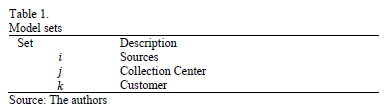
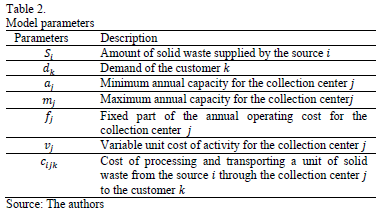
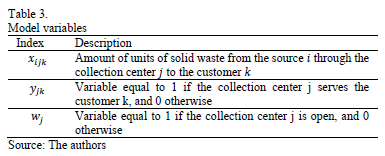
<body><![CDATA[<p><font size="2" face="Verdana, Arial, Helvetica, sans-serif">The phases of SWM can be divided into four distinct phases   &#91;12&#93;: pre-collection, collection, transportation and treatment. The   pre-collection is the proper storage, handling, sorting and presentation of   waste suitable for collection and transfer conditions. This phase is essential   for the accurate functioning of the following stages. Collection and   transportation stages are often the most costly and hence require careful   planning. Fifty to 70 % of the transport and disposal of solid waste was spent   on the collection phase &#91;19&#93;. Waste is   compacted and transported directly to the points of treatment or transfer   plants. Treatment includes disposal operations or use of the materials   contained in the waste.</font></p>     <p><font size="2" face="Verdana, Arial, Helvetica, sans-serif">One of the main issues in SWM involves facility capacity   location, where a related optimization analysis will typically require the use   of integer variables to carry out the decision process of locating a particular   facility development or expansion options to be used. Thus, MIP techniques are   useful for this purpose &#91;15&#93;.</font></p>     <p><font size="2" face="Verdana, Arial, Helvetica, sans-serif">Uncertainty is an   important issue to discuss in SWM, primarily in waste generation and economic   criteria. Waste generation is a function of population distribution and growth,   and per capita waste generation rates, while economic estimates are a function   of the technology used, economies of scale, land availability, and local labor   and equipment prices. Deterministic and stochastic mathematical programming   models have been applied for SWM &#91;18&#93;. Some of the approaches concerning   deterministic models are linear programming, MIP, dynamic programming, and   multi - objective programming; in contrast, techniques used for stochastic   models involve probability, fuzzy and grey system theory &#91;5&#93;. A probabilistic   approach is also presented in an algorithm for probabilistic analysis of   unbalanced three-phase weakly-meshed distribution systems is presented; this   algorithm uses the technique of Two-Point Estimate Method for calculating the   probabilistic behavior of the system random variables &#91;33&#93;.</font></p>     <p><font size="2" face="Verdana, Arial, Helvetica, sans-serif">Regarding MIP techniques and incorporating stochastic parameters, a MSW   capacity planning problem formulation has been proposed to be solved in three   main stages &#91;18&#93;; first the formulation of a MIP model for the given MSW   management planning problem providing the optimal solutions as bases for   decision making, then a modeling for generating alternative methods was used   for generating a near-optimal alternative, and finally a simulation technique   was used for incorporating random waste generation in order to compare optimal solutions and simulation results. </font></p>     <p>&nbsp;</p>     <p><font size="3" face="Verdana, Arial, Helvetica, sans-serif"><b>2. Model   formulation</b></font></p>     <p><font size="2" face="Verdana, Arial, Helvetica, sans-serif">Model formulation for the multiple-source, capacitated   facility location problem is described as follow: given a number of sources   that generate quantities of SW, a collection center has to be selected among a   set of locations, in order to serve a set of demand points. The objective is to   locate the collection center that minimizes the fixed and variable cost of   handling and transport products through the selected network. The index,   parameters and variables of this model are shown in <a href="#tab01">Table 1</a>, <a href="#tab02">Table 2</a> and <a href="#tab03">Table   3</a>.</font></p>     <p align="center"><font size="2" face="Verdana, Arial, Helvetica, sans-serif"><a name="tab01"></a></font><img src="/img/revistas/dyna/v82n191/v82n191a06tab01.gif"></p>     <p align="center"><font size="2" face="Verdana, Arial, Helvetica, sans-serif"><a name="tab02"></a></font><img src="/img/revistas/dyna/v82n191/v82n191a06tab02.gif"></p>     <p align="center"><font size="2" face="Verdana, Arial, Helvetica, sans-serif"><a name="tab03"></a></font><img src="/img/revistas/dyna/v82n191/v82n191a06tab03.gif"></p>     ]]></body>
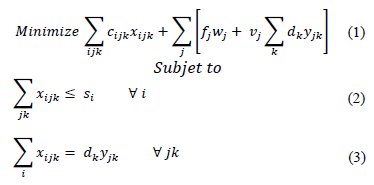
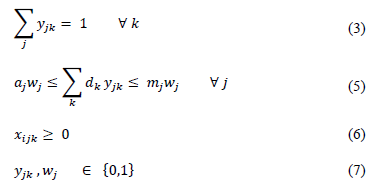
<body><![CDATA[<p></p>     <p><font size="2" face="Verdana, Arial, Helvetica, sans-serif">The mathematical formulation is as follows:</font></p>     <p><img src="/img/revistas/dyna/v82n191/v82n191a06eq0103.gif"></p>     <p><img src="/img/revistas/dyna/v82n191/v82n191a06eq0307.gif"></p>     <p><font size="2" face="Verdana, Arial, Helvetica, sans-serif">The objective function (1) aims to minimize fixed costs   and variable costs. The supply constraint states that available supply cannot   be exceeded (2), and the demand of all demands points (3) must be satisfied.   Regarding operability of the collection center, each customer must be served   only by one collection center (4). Also, for each collection center there   should be a minimal activity in order to begin operation and a maximum activity   as well, set by the established capacity (5).</font></p>     <p>&nbsp;</p>     <p><font size="3" face="Verdana, Arial, Helvetica, sans-serif"><b>3. Situations   description</b></font></p>     <p><font size="2" face="Verdana, Arial, Helvetica, sans-serif">Mexico is the world's third largest consumer of   Polyethylene Terephthalate (PET), only preceded by the United States and China.   PET is commonly used in plastic containers such as beverage bottles and food   packaging. In Mexico, every person uses an average of 225 bottles per year,   additionally around 800 thousand tons of PET is consumed per year, with an   annual growth of 13%. Due to the problem of SW and PET contamination, new   public policies have been created in the country; for example, in Veracruz, the   program for the prevention and integrated waste management uses the public policy   in addition to good management. Approximately 4451 tons of SW is collected on a   daily basis in the state of Veracruz, which represents 5% of the national   collection. The country houses 241 collection centers and in Veracruz, there   are only 5 towns with such centers. To supply the demand for PET bottles in   Mexico, there are 5 manufacturing plants and about 190 bottling plants, serving   nearly one million outlets &#91;4&#93;. The generation of SW has increased over the   past few years growing by 25% between 2003 and 2011. In 2011, Veracruz was the   fourth largest producer of SW, nationwide, with 5.5%, just after Estado de   Mexico (16%), Distrito Federal (12%) and Jalisco (7%), and Nuevo Leon (5%).</font></p>     <p><font size="2" face="Verdana, Arial, Helvetica, sans-serif">For this work, a basic generic supply chain network is   considered. The source echelon is represented by five towns, the next echelon   is denoted by the three pre-determined locations for the collection center   selection, and finally the customer echelon consists of three identified demand   points. <a href="#fig01">Fig. 1</a> depicts a three echelon supply chain network. </font></p>     <p align="center"><font size="2" face="Verdana, Arial, Helvetica, sans-serif"><a name="fig01"></a></font><img src="/img/revistas/dyna/v82n191/v82n191a06fig01.gif"></p>     ]]></body>
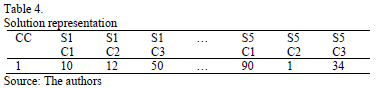
<body><![CDATA[<p><font size="2" face="Verdana, Arial, Helvetica, sans-serif">Due   to the fact that the evaluation zone for this project is developed in the north   of Veracruz, specifically in the town of Tempoal, we considered five towns as   possible sources: el Higo (S1), Tantoyuca (S2), Plat&oacute;n S&aacute;nchez (S3), Huejutla   (S4) and Tempoal (S5). The productions per town are 4000, 18300, 4400, 32920   and 7700 tons per year, respectively. From these amounts only 2% from each town   corresponds to </font><font size="2" face="Verdana, Arial, Helvetica, sans-serif">PET and other plastics &#91;4&#93;; hence,   the amounts to be considered as parameter the &quot;Amount of solid waste   supplied by each source,&quot; which for this case are 80, 366, 88, 658, 154   tons per year, respectively. These amounts increase by 13% per year &#91;3&#93;; thus,   the increase was calculated over a period of 5 years.</font></p>     <p><font size="2" face="Verdana, Arial, Helvetica, sans-serif">To determine the cost of transportation from source to the   collection center, the distance between the two points is determined, and then   divided between the performance of vehicle 1 to be used, and then multiplied by   the current cost of gasoline.&#91;1&#93; ($12.9 liter) and finally is multiplied   by 2, which represents the back and forth of the vehicle from alternative 1   (A1) to the sources of the waste, similarly we determined the cost for each   source (S1, S2, S3, S4 and S5) and alternative (A1, A2 and A3). Considering an   increase of gasoline of $ 0.11 per month, the transportation costs were   obtained from the source to the collection center and from the distribution   center to the customer annually with a 5 year projection. Unlike other models   of storage location or facilities, whereby the location is chosen according to   the sources of supply, the model for this research takes into account three   previously established potential sites by which the nature of the problem is   which alternative to choose between these three possible locations for storage   centers: two outside the town of Tempoal (A1 and A2), Veracruz, and the third   in the town of Huejutla, Hidalgo (A3). To determine the fixed costs of each   collection center the following concepts were observed: Initial investment,   labor, electricity, water, telephone, whose amounts were A1 = $ 2, 668,000 A2 =   $ 3, 173,000 and A3 = 4, 176,000, of these amounts, annual operating costs are   A1 = 168,000, A2 = 173,000 and A3 = 176,000, where the capacity of each of the   collection centers are 7,000, 17,000, 34,000 tons per year, respectively. Thus   the variable costs per ton of material handled within the distribution center   are $ 381.14, $ 186.64, $ 122.82, respectively.</font></p>     <p><font size="2" face="Verdana, Arial, Helvetica, sans-serif">Three potential customers for the re-use of PET were   established taking into account the volume of purchase (demand), the cost of   transportation, cost of processing, storage capacity and fixed costs. For this   case, a customer located in the city of Tampico (C1), another in the city of   Madero (C2), and the third in Altamira (C3) in the state of Tamaulipas were   selected. The demand data were collected through a field study in which random   customers were taken in the state of Tamaulipas, specifically in the towns of   Tampico and Altamira. The data obtained were analyzed and it was observed that   the three sets of data follow a normal distribution. These parameters allowed   us to obtain the annual growth rate, which was estimated by calculating the   percentage change for each year and then taking absolute values averaged when   they showed a decrease in demand. In this way, the percentages estimated   regarding the demand growth rates per customer are: C1 = 13.99%, C2 = 13.72%   and C3 = 14.27%, these values allowed us to calculate the increase in demand   over a period of 5 years. The same procedure is used to determine the cost of   transport from source to the collection center and from the collection center   to the customer, in this case from A1, A2, and A3 to C1, C2, and C3.</font></p>     <p>&nbsp;</p>     <p><font size="3" face="Verdana, Arial, Helvetica, sans-serif"><b>4. Genetic   algorithm principles</b></font></p>     <p><font size="2" face="Verdana, Arial, Helvetica, sans-serif">Genetic algorithms (GAs) are mathematical optimization   techniques that simulate a natural evolution process. GAs constitute one of the   artificial intelligence exhaustive searching techniques; they are stochastic   algorithms whose search methods model some natural phenomena: genetic   inheritance and Darwin strife for survival &#91;27&#93;. Their search procedure   consists of maintaining a population of potential solutions while conducting a   parallel investigation for non-dominated solutions &#91;22&#93;. Considering network strategy design, which   contemplates the logistic chain network problem formulated by a MIP model, GAs   have been applied as an alternative procedure for generating optimal or near-optimal solutions   to location problems &#91;7,16,26&#93;.</font></p>     <p><font size="2" face="Verdana, Arial, Helvetica, sans-serif">The GA implemented in this study uses quite common genetic   operators. The proposed GA procedure implies the following steps:</font></p>     <p><font size="2" face="Verdana, Arial, Helvetica, sans-serif">Encoding of solutions. Solutions were encoded by dividing   the chromosome, i.e. a complete set of coded variables, into two parts. The   first part represents the continuous variables represented by the trailers   assignment percentage at six locations proposed in the case study. The second   part of the chromosome represents the assignment of trailers (crates and cages)   to planned destinations.</font></p>     <p><font size="2" face="Verdana, Arial, Helvetica, sans-serif">Initial population creation. The procedure of creating the   initial population corresponds to random sampling of each decision variable   within its specific range of variation. This strategy guarantees a population   various enough to explore large zones of the search area. </font></p>     <p><font size="2" face="Verdana, Arial, Helvetica, sans-serif">Fitness Evaluation. The criteria for each optimization   model are to minimize total cost. If one restriction isn't satisfied, the   solution is marked as not feasible. </font></p>     ]]></body>
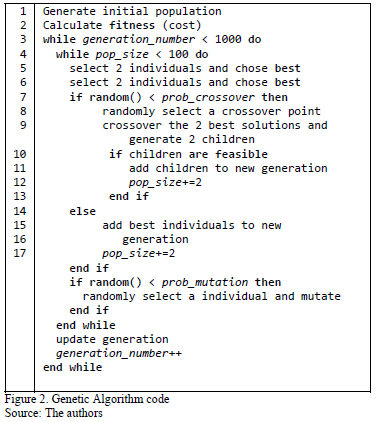
<body><![CDATA[<p><font size="2" face="Verdana, Arial, Helvetica, sans-serif">Selection Procedure: The selection procedure consists of   random sampling of pairs of individuals in the roulette wheel, one individual   at a time. Individuals presenting higher fitness values have larger probability   of propagating to next generation.</font></p>     <p><font size="2" face="Verdana, Arial, Helvetica, sans-serif">Crossover: Two selected parents are submitted to the   crossover operator to produce two children. The crossover is carried out with   an assigned probability, which is generally rather high. If a number randomly   sampled is superior to the probability, the crossover is performed. Otherwise,   the children are copies of the parents. In case of a discrete variable, this is copied for the parents. For   continuous variables, the child takes the value of both parents; the first   child takes 80% of parent one and 20% of parent two, and the second child takes   20% of parent one and 80% of parent two.</font></p>     <p><font size="2" face="Verdana, Arial, Helvetica, sans-serif">Mutation: The genetic mutation introduces diversity in the   population by an occasional random replacement of the individuals. The mutation   is performed on the basis of an assigned probability. A random number is used   to determine whether a new individual will be produced to substitute the one   generated by crossover. The mutation procedure consists of replacing one of the   decision variable values of an individual, while keeping the remaining   variables unchanged. The replaced variable is randomly chosen, and its new   value is calculated by randomly sampling within its specific range. The new   value is determined adjusting the old value; the adjustment is a low percentage   of the old value that never causes an infeasible individual.</font></p>     <p><font size="2" face="Verdana, Arial, Helvetica, sans-serif">The encoding solution is an array of values that describes   one solution to the problem. The first value represents the location selected   for the collection center. The subsequent values indicate the amount of units   of SW from sources to customer.</font></p>     <p><font size="2" face="Verdana, Arial, Helvetica, sans-serif"><a href="#tab04">Table 4</a> shows one solution of the GA. The solution   indicates that the best location for the collection center is A1. Moreover, the   solution indicates that the amount of units of SW from source 1 to customer 1   is 10. It can be noted that transporting units of SW from S1 to C2 is more   suitable than transport units from S5 to C2.</font></p>     <p align="center"><font size="2" face="Verdana, Arial, Helvetica, sans-serif"><a name="tab04"></a></font><img src="/img/revistas/dyna/v82n191/v82n191a06tab04.gif"></p>     <p><font size="2" face="Verdana, Arial, Helvetica, sans-serif">Each   instance of the problem consists of a file with all the information described   in section 4, such as the number of sources, number of customers and   corresponding demand; and in reference to the collection center locations   information such as the initial investment for construction, annual operating   cost, and minimum and maximum capacity. Each file represents one year of the 5   year planning horizon.</font></p>     <p><font size="2" face="Verdana, Arial, Helvetica, sans-serif">Initially, instances are considered without uncertainty.   Customer demand is known and doesn't change over time. Each instance of the   problem was executed 30 times with the GA, and the solutions were compared with   the results obtained by GAMS. GAMS (General Algebraic Modeling System) is a   high-level software tool for modeling and solving optimization problems and   mathematical programming. The comparative process was used to tune the GA.   Population size and percentage of mutation was set to 100 and 1%. A tournament   selection process was carried out. <a href="#fig02">Fig 2</a> shows the code of the genetic   algorithm. </font></p>     <p align="center"><font size="2" face="Verdana, Arial, Helvetica, sans-serif"><a name="fig02"></a></font><img src="/img/revistas/dyna/v82n191/v82n191a06fig02.gif"></p>     <p><font size="2" face="Verdana, Arial, Helvetica, sans-serif">The runtime in all cases was less than 1.5 seconds and it   is noted that runtime was not relevant in finding the best solution.</font></p>     ]]></body>
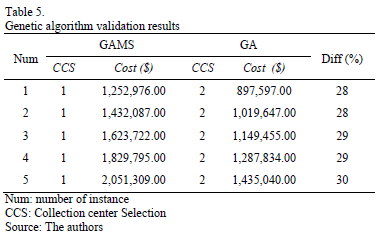
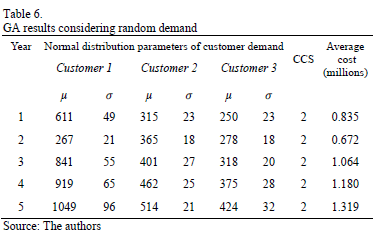
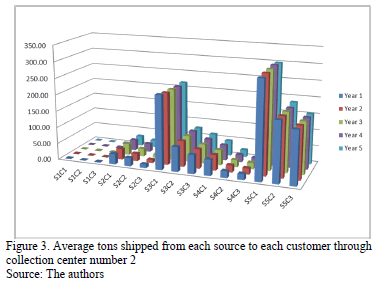
<body><![CDATA[<p><font size="2" face="Verdana, Arial, Helvetica, sans-serif">The second group of   instances included uncertainty regarding customer demand, represented by a   normal distribution. The second group of instances includes uncertainty   regarding customer demand, represented by a normal distribution. In order to   obtain the parameters of the probability distribution, goodness of fit tests   were executed. </font></p>     <p>&nbsp;</p>     <p><font size="3" face="Verdana, Arial, Helvetica, sans-serif"><b>5. Results</b></font></p>     <p><font size="2" face="Verdana, Arial, Helvetica, sans-serif"><a href="#tab05">Table 5</a> shows the execution results along with the number   set of the collection center selected to be open. GAMS results indicate to open   the collection center in A1, while the GA proposed to open the collection   center in A2. The average cost for each instance is presented. Analyzing the outcome, we can see that in all   5 instances of the problem, the GA gives better results than GAMS decreasing up   to 30% in the overall cost, thus validating the GA.</font></p>     <p align="center"><font size="2" face="Verdana, Arial, Helvetica, sans-serif"><a name="tab05"></a></font><img src="/img/revistas/dyna/v82n191/v82n191a06tab05.gif"></p>     <p><font size="2" face="Verdana, Arial, Helvetica, sans-serif">Then, 30 iterations of the GA were executed for every year   considered in the planning horizon, taking into account the uncertainty   representing the variation of the 3 demand points modeled by normal probability   distribution (see <a href="#tab06">Table 6</a>) along with the number set of the collection center   selected to be open and the average cost. </font></p>     <p align="center"><font size="2" face="Verdana, Arial, Helvetica, sans-serif"><a name="tab06"></a></font><img src="/img/revistas/dyna/v82n191/v82n191a06tab06.gif"></p>     <p><font size="2" face="Verdana, Arial, Helvetica, sans-serif">Also, the GA gives the average amount of units to be   shipped from sources to customers for each year. <a href="#fig03">Fig 3</a> shows the average tons   shipped from each source to each customer through the selected collection center   that represents lower cost. We can infer important decisions based on this   graph; for example, that we should not ship units from S1 to C1, but that it is   convenient to ship units from S5 to C1.</font></p>     <p align="center"><font size="2" face="Verdana, Arial, Helvetica, sans-serif"><a name="fig03"></a></font><img src="/img/revistas/dyna/v82n191/v82n191a06fig03.gif"></p>     <p><font size="2" face="Verdana, Arial, Helvetica, sans-serif">The mathematical model is optimized through genetic algorithm   presented in this section. The optimization is performed subject to random   demand to determine which collection center to open and the corresponding   calculations of cost.</font></p>     ]]></body>
<body><![CDATA[<p><font size="2" face="Verdana, Arial, Helvetica, sans-serif">6. Conclusions</font></p>     <p><font size="2" face="Verdana, Arial, Helvetica, sans-serif">Within the Mexican environmental context, a priority issue   is that of creating solid waste treatment facilities due to the considerable   increase in waste in recent years. There are several techniques regarding   decisions on the location of solid waste system facilities.</font></p>     <p><font size="2" face="Verdana, Arial, Helvetica, sans-serif">The overall objective of the work presented in this paper   was to develop a facility location problem to assist decision makers in the   selection of a collection center among three pre-identified locations given by   the local government. Considering the overall cost of the network, we identify   a three-echelon, multi-source, capacitated facility location problem for the   consideration of transferring PET waste generation in five towns in the   northern region of Veracruz through the selected collection center to meet   three demand points in the re-use market. The facility location problem was   modeled using a mixed integer programming technique. The mathematical model is optimized through   genetic algorithm. The optimization is performed subject to random demand to   determine which collection center to open and the corresponding calculations of   cost.</font></p>     <p>&nbsp;</p>     <p><font size="3" face="Verdana, Arial, Helvetica, sans-serif"><b>References</b></font></p>     <!-- ref --><p><font size="2" face="Verdana, Arial, Helvetica, sans-serif"><b>&#91;1&#93;</b> Avella, P. and Boccia, M., A cutting plane   algorithm for the capacitated facility   location problem. Computational Optimization and Applications, 43 (1), pp.   39-65, 2009. DOI: 10.1007/s10589-007-9125-x</font>&nbsp;&nbsp;&nbsp;&nbsp;&nbsp;&nbsp;&nbsp;&nbsp;[&#160;<a href="javascript:void(0);" onclick="javascript: window.open('/scielo.php?script=sci_nlinks&ref=000088&pid=S0012-7353201500030000600001&lng=','','width=640,height=500,resizable=yes,scrollbars=1,menubar=yes,');">Links</a>&#160;]<!-- end-ref --><!-- ref --><p><font size="2" face="Verdana, Arial, Helvetica, sans-serif"><b>&#91;2&#93;</b> Ballou, R.H., Log&iacute;stica: administraci&oacute;n de la cadena de   suministro. Pearson Educaci&oacute;n, 2004.    &nbsp;&nbsp;&nbsp;&nbsp;&nbsp;&nbsp;&nbsp;&nbsp;[&#160;<a href="javascript:void(0);" onclick="javascript: window.open('/scielo.php?script=sci_nlinks&ref=000089&pid=S0012-7353201500030000600002&lng=','','width=640,height=500,resizable=yes,scrollbars=1,menubar=yes,');">Links</a>&#160;]<!-- end-ref --></font></p>     <!-- ref --><p><font size="2" face="Verdana, Arial, Helvetica, sans-serif"><b>&#91;3&#93;</b> Cabrera, G.,   Cabrera, E., Soto, R., Rubio, L., Crawford, B. and Paredes, F., A hybrid   approach using an artificial bee algorithm with mixed integer programming   applied to a large-scale capacitated facility location problem. Mathematical   Problems in Engineering, 2012. DOI: 10.1155/2012/954249</font>&nbsp;&nbsp;&nbsp;&nbsp;&nbsp;&nbsp;&nbsp;&nbsp;[&#160;<a href="javascript:void(0);" onclick="javascript: window.open('/scielo.php?script=sci_nlinks&ref=000091&pid=S0012-7353201500030000600003&lng=','','width=640,height=500,resizable=yes,scrollbars=1,menubar=yes,');">Links</a>&#160;]<!-- end-ref --><!-- ref --><p><font size="2" face="Verdana, Arial, Helvetica, sans-serif"><b>&#91;4&#93;</b> Carlo, H.J.,   Aldarondo, F., Saavedra, P.M. and Torres, S.N., Capacitated continuous facility   location problem with unknown number of facilities. Engineering Management   Journal, 24 (3), pp. 24-31, 2012. DOI: 10.1080/10429247.2012.11431944</font>&nbsp;&nbsp;&nbsp;&nbsp;&nbsp;&nbsp;&nbsp;&nbsp;[&#160;<a href="javascript:void(0);" onclick="javascript: window.open('/scielo.php?script=sci_nlinks&ref=000092&pid=S0012-7353201500030000600004&lng=','','width=640,height=500,resizable=yes,scrollbars=1,menubar=yes,');">Links</a>&#160;]<!-- end-ref --><!-- ref --><p><font size="2" face="Verdana, Arial, Helvetica, sans-serif"><b>&#91;5&#93;</b> Chi, G.,   Integrated planning of a solid waste management system in the City of Regina.   Doctoral Thesis, University of Regina, Canad&aacute; 1997.    &nbsp;&nbsp;&nbsp;&nbsp;&nbsp;&nbsp;&nbsp;&nbsp;[&#160;<a href="javascript:void(0);" onclick="javascript: window.open('/scielo.php?script=sci_nlinks&ref=000093&pid=S0012-7353201500030000600005&lng=','','width=640,height=500,resizable=yes,scrollbars=1,menubar=yes,');">Links</a>&#160;]<!-- end-ref --></font></p>     <!-- ref --><p><font size="2" face="Verdana, Arial, Helvetica, sans-serif"><b>&#91;6&#93;</b> Chudak, F.A.   and Williamson, D.P., Improved approximation algorithms for capacitated   facility location problems. In Integer programming and combinatorial   optimization, Springer Berlin Heidelberg, 1999, pp. 99-113. DOI: 10.1007/3-540-48777-8_8</font>&nbsp;&nbsp;&nbsp;&nbsp;&nbsp;&nbsp;&nbsp;&nbsp;[&#160;<a href="javascript:void(0);" onclick="javascript: window.open('/scielo.php?script=sci_nlinks&ref=000095&pid=S0012-7353201500030000600006&lng=','','width=640,height=500,resizable=yes,scrollbars=1,menubar=yes,');">Links</a>&#160;]<!-- end-ref --><!-- ref --><p><font size="2" face="Verdana, Arial, Helvetica, sans-serif"><b>&#91;7&#93;</b> Correa, E.S.,   Steiner, M.T., Freitas, A.A. and Carnieri, C., A genetic algorithm for solving   a capacitated p-median problem. Numerical Algorithms, 35 (2-4), pp. 373-388,   2004. DOI: 10.1023/B:NUMA.0000021767.42899.31</font>&nbsp;&nbsp;&nbsp;&nbsp;&nbsp;&nbsp;&nbsp;&nbsp;[&#160;<a href="javascript:void(0);" onclick="javascript: window.open('/scielo.php?script=sci_nlinks&ref=000096&pid=S0012-7353201500030000600007&lng=','','width=640,height=500,resizable=yes,scrollbars=1,menubar=yes,');">Links</a>&#160;]<!-- end-ref --><!-- ref --><p><font size="2" face="Verdana, Arial, Helvetica, sans-serif"><b>&#91;8&#93;</b> Dias, J.M.,   Captivo, M.E. and Cl&iacute;maco, J., Dynamic location problems with discrete   expansion and reduction sizes of available capacities. InvestigaçãoOperacional,   27 (2), pp. 107-130, 2007.    &nbsp;&nbsp;&nbsp;&nbsp;&nbsp;&nbsp;&nbsp;&nbsp;[&#160;<a href="javascript:void(0);" onclick="javascript: window.open('/scielo.php?script=sci_nlinks&ref=000097&pid=S0012-7353201500030000600008&lng=','','width=640,height=500,resizable=yes,scrollbars=1,menubar=yes,');">Links</a>&#160;]<!-- end-ref --> </font></p>     <!-- ref --><p><font size="2" face="Verdana, Arial, Helvetica, sans-serif"><b>&#91;9&#93;</b> Dias, J.M.,   Captivo, M.E. and Cl&iacute;maco, J., Capacitated dynamic location problems with   opening, closure and reopening of facilities. IMA Journal of Management   Mathematics, 17 (4), 317-348, 2006. DOI: 10.1093/imaman/dpl003</font>&nbsp;&nbsp;&nbsp;&nbsp;&nbsp;&nbsp;&nbsp;&nbsp;[&#160;<a href="javascript:void(0);" onclick="javascript: window.open('/scielo.php?script=sci_nlinks&ref=000099&pid=S0012-7353201500030000600009&lng=','','width=640,height=500,resizable=yes,scrollbars=1,menubar=yes,');">Links</a>&#160;]<!-- end-ref --><!-- ref --><p><font size="2" face="Verdana, Arial, Helvetica, sans-serif"><b>&#91;10&#93;</b> Erkut, E.,   Karagiannidis, A., Perkoulidis, G. and Tjandra, S.A., A multicriteria facility   location model for municipal solid waste management in North Greece. European   Journal of Operational Research, 187 (3), pp. 1402-1421, 2008. DOI: 10.1016/j.ejor.2006.09.021</font>&nbsp;&nbsp;&nbsp;&nbsp;&nbsp;&nbsp;&nbsp;&nbsp;[&#160;<a href="javascript:void(0);" onclick="javascript: window.open('/scielo.php?script=sci_nlinks&ref=000100&pid=S0012-7353201500030000600010&lng=','','width=640,height=500,resizable=yes,scrollbars=1,menubar=yes,');">Links</a>&#160;]<!-- end-ref --><!-- ref --><p><font size="2" face="Verdana, Arial, Helvetica, sans-serif"><b>&#91;11&#93;</b> Farahani,   R.Z., SteadieSeifi, M. and Asgari, N., Multiple criteria facility location   problems: A survey. Applied Mathematical Modelling, 34 (7), pp. 1689-1709,   2010. DOI: 10.1016/j.apm.2009.10.005</font>&nbsp;&nbsp;&nbsp;&nbsp;&nbsp;&nbsp;&nbsp;&nbsp;[&#160;<a href="javascript:void(0);" onclick="javascript: window.open('/scielo.php?script=sci_nlinks&ref=000101&pid=S0012-7353201500030000600011&lng=','','width=640,height=500,resizable=yes,scrollbars=1,menubar=yes,');">Links</a>&#160;]<!-- end-ref --><!-- ref --><p><font size="2" face="Verdana, Arial, Helvetica, sans-serif"><b>&#91;12&#93;</b> Garc&iacute;a, F.J.A. and Tena, C., Gesti&oacute;n de residuos s&oacute;lidos   urbanos: An&aacute;lisis econ&oacute;mico y pol&iacute;ticas p&uacute;blicas. Cuadernos Econ&oacute;micos de ICE, (71), pp. 71-91,   2006.    &nbsp;&nbsp;&nbsp;&nbsp;&nbsp;&nbsp;&nbsp;&nbsp;[&#160;<a href="javascript:void(0);" onclick="javascript: window.open('/scielo.php?script=sci_nlinks&ref=000102&pid=S0012-7353201500030000600012&lng=','','width=640,height=500,resizable=yes,scrollbars=1,menubar=yes,');">Links</a>&#160;]<!-- end-ref --></font></p>     <!-- ref --><p><font size="2" face="Verdana, Arial, Helvetica, sans-serif"><b>&#91;13&#93;</b> Gendron, B.,   and Semet, F., Formulations and relaxations for a multi-echelon capacitated   location-distribution problem. Computers &amp; Operations Research, 36 (5), pp.   1335-1355, 2009. DOI: 10.1016/j.cor.2008.02.009</font>&nbsp;&nbsp;&nbsp;&nbsp;&nbsp;&nbsp;&nbsp;&nbsp;[&#160;<a href="javascript:void(0);" onclick="javascript: window.open('/scielo.php?script=sci_nlinks&ref=000104&pid=S0012-7353201500030000600013&lng=','','width=640,height=500,resizable=yes,scrollbars=1,menubar=yes,');">Links</a>&#160;]<!-- end-ref --><!-- ref --><p><font size="2" face="Verdana, Arial, Helvetica, sans-serif"><b>&#91;14&#93;</b> Gottinger,   H.W., A computational model for solid waste management with application.   European Journal of Operational Research, 35 (3), pp. 350-364, 1998. DOI: 10.1016/0377-2217(88)90225-1</font>&nbsp;&nbsp;&nbsp;&nbsp;&nbsp;&nbsp;&nbsp;&nbsp;[&#160;<a href="javascript:void(0);" onclick="javascript: window.open('/scielo.php?script=sci_nlinks&ref=000105&pid=S0012-7353201500030000600014&lng=','','width=640,height=500,resizable=yes,scrollbars=1,menubar=yes,');">Links</a>&#160;]<!-- end-ref --><!-- ref --><p><font size="2" face="Verdana, Arial, Helvetica, sans-serif"><b>&#91;15&#93;</b> Huang,   G.G.H., Huaicheng, G. and Guangming, Z., A mixed integer linear programming   approach for municipal solid waste management. Journal of enviromanetal   sciences China-English Edition, 9, pp. 431-445, 1997.    &nbsp;&nbsp;&nbsp;&nbsp;&nbsp;&nbsp;&nbsp;&nbsp;[&#160;<a href="javascript:void(0);" onclick="javascript: window.open('/scielo.php?script=sci_nlinks&ref=000106&pid=S0012-7353201500030000600015&lng=','','width=640,height=500,resizable=yes,scrollbars=1,menubar=yes,');">Links</a>&#160;]<!-- end-ref --></font></p>     <!-- ref --><p><font size="2" face="Verdana, Arial, Helvetica, sans-serif"><b>&#91;16&#93;</b> Kratica, J.,   Tošic, D., Filipovi&#263;, V. and Ljubi&#263;, I., Solving the simple plant location problem by   genetic algorithm. RAIRO-Operations Research, 35 (01), pp. 127-142, 2001. DOI: 10.1051/ro:2001107</font>&nbsp;&nbsp;&nbsp;&nbsp;&nbsp;&nbsp;&nbsp;&nbsp;[&#160;<a href="javascript:void(0);" onclick="javascript: window.open('/scielo.php?script=sci_nlinks&ref=000108&pid=S0012-7353201500030000600016&lng=','','width=640,height=500,resizable=yes,scrollbars=1,menubar=yes,');">Links</a>&#160;]<!-- end-ref --><!-- ref --><p><font size="2" face="Verdana, Arial, Helvetica, sans-serif"><b>&#91;17&#93;</b> Liste&#351;,   O. and Dekker, R., A stochastic approach to a case study for product recovery   network design. European Journal of Operational Research, 160 (1), pp. 268-287,   2005. DOI: 10.1016/j.ejor.2001.12.001</font>&nbsp;&nbsp;&nbsp;&nbsp;&nbsp;&nbsp;&nbsp;&nbsp;[&#160;<a href="javascript:void(0);" onclick="javascript: window.open('/scielo.php?script=sci_nlinks&ref=000109&pid=S0012-7353201500030000600017&lng=','','width=640,height=500,resizable=yes,scrollbars=1,menubar=yes,');">Links</a>&#160;]<!-- end-ref --><!-- ref --><p><font size="2" face="Verdana, Arial, Helvetica, sans-serif"><b>&#91;18&#93;</b> Najm, M.A.,   El-Fadel, M., Ayoub, G., El-Taha, M. and Al-Awar, F., An optimization model for   regional integrated solid waste management I. Model formulation. Waste   management &amp; research, 20 (1), pp. 37-45, 2002. DOI: 10.1177/0734242X0202000105</font>&nbsp;&nbsp;&nbsp;&nbsp;&nbsp;&nbsp;&nbsp;&nbsp;[&#160;<a href="javascript:void(0);" onclick="javascript: window.open('/scielo.php?script=sci_nlinks&ref=000110&pid=S0012-7353201500030000600018&lng=','','width=640,height=500,resizable=yes,scrollbars=1,menubar=yes,');">Links</a>&#160;]<!-- end-ref --><!-- ref --><p><font size="2" face="Verdana, Arial, Helvetica, sans-serif"><b>&#91;19&#93;</b> Noche, B.,   Rhoma, F.A., Chinakupt, T. and Jawale, M., Optimization model for solid waste   management system network design case study. In Computer and Automation   Engineering (ICCAE) The 2nd International Conferenceon 5, pp. 230-236, IEEE,   2010.    &nbsp;&nbsp;&nbsp;&nbsp;&nbsp;&nbsp;&nbsp;&nbsp;[&#160;<a href="javascript:void(0);" onclick="javascript: window.open('/scielo.php?script=sci_nlinks&ref=000111&pid=S0012-7353201500030000600019&lng=','','width=640,height=500,resizable=yes,scrollbars=1,menubar=yes,');">Links</a>&#160;]<!-- end-ref --></font></p>     ]]></body>
<body><![CDATA[<!-- ref --><p><font size="2" face="Verdana, Arial, Helvetica, sans-serif"><b>&#91;20&#93;</b> Shafia, M.A.,   Rahmaniani, R., Rezai, A. and Rahmaniani, M., Robust optimization model for the   capacitated facility location and transportation network design problem.   International Conference on Industrial Engineering and Operations Management,   Istanbul, 2012.    &nbsp;&nbsp;&nbsp;&nbsp;&nbsp;&nbsp;&nbsp;&nbsp;[&#160;<a href="javascript:void(0);" onclick="javascript: window.open('/scielo.php?script=sci_nlinks&ref=000113&pid=S0012-7353201500030000600020&lng=','','width=640,height=500,resizable=yes,scrollbars=1,menubar=yes,');">Links</a>&#160;]<!-- end-ref --></font></p>     <!-- ref --><p><font size="2" face="Verdana, Arial, Helvetica, sans-serif"><b>&#91;21&#93;</b> Shepherd, S.   and Sumalee, A., A genetic algorithm based approach to optimal toll level and   location problems. Networks and Spatial Economics, 4 (2), pp. 161-179, 2004.   DOI: 10.1023/B:NETS.0000027771.13826.3a</font>&nbsp;&nbsp;&nbsp;&nbsp;&nbsp;&nbsp;&nbsp;&nbsp;[&#160;<a href="javascript:void(0);" onclick="javascript: window.open('/scielo.php?script=sci_nlinks&ref=000115&pid=S0012-7353201500030000600021&lng=','','width=640,height=500,resizable=yes,scrollbars=1,menubar=yes,');">Links</a>&#160;]<!-- end-ref --><!-- ref --><p><font size="2" face="Verdana, Arial, Helvetica, sans-serif"><b>&#91;22&#93;</b> Silva, C.M.   and Biscaia, E.C., Genetic algorithm development for multi-objetive optimization   of Batch Free radical polymerization reactors. Computers &amp; Chemical   Engineering, 27, pp 1329-1344, 2003. DOI: 10.1016/S0098-1354(03)00056-5</font>&nbsp;&nbsp;&nbsp;&nbsp;&nbsp;&nbsp;&nbsp;&nbsp;[&#160;<a href="javascript:void(0);" onclick="javascript: window.open('/scielo.php?script=sci_nlinks&ref=000116&pid=S0012-7353201500030000600022&lng=','','width=640,height=500,resizable=yes,scrollbars=1,menubar=yes,');">Links</a>&#160;]<!-- end-ref --><!-- ref --><p><font size="2" face="Verdana, Arial, Helvetica, sans-serif"><b>&#91;23&#93;</b> Silva, F.J.F.   and De la Figuera, D.S., A capacitated facility location problem with   constrained backlogging probabilities. International journal of production   research, 45 (21), pp. 5117-5134, 2007. DOI: 10.1080/00207540600823195</font>&nbsp;&nbsp;&nbsp;&nbsp;&nbsp;&nbsp;&nbsp;&nbsp;[&#160;<a href="javascript:void(0);" onclick="javascript: window.open('/scielo.php?script=sci_nlinks&ref=000117&pid=S0012-7353201500030000600023&lng=','','width=640,height=500,resizable=yes,scrollbars=1,menubar=yes,');">Links</a>&#160;]<!-- end-ref --><!-- ref --><p><font size="2" face="Verdana, Arial, Helvetica, sans-serif"><b>&#91;24&#93;</b> Snyder, L.V.   Facility location under uncertainty: A review. IIE Transactions, 38 (7), pp.   547-564, 2006. DOI: 10.1080/07408170500216480</font>&nbsp;&nbsp;&nbsp;&nbsp;&nbsp;&nbsp;&nbsp;&nbsp;[&#160;<a href="javascript:void(0);" onclick="javascript: window.open('/scielo.php?script=sci_nlinks&ref=000118&pid=S0012-7353201500030000600024&lng=','','width=640,height=500,resizable=yes,scrollbars=1,menubar=yes,');">Links</a>&#160;]<!-- end-ref --><!-- ref --><p><font size="2" face="Verdana, Arial, Helvetica, sans-serif"><b>&#91;25&#93;</b> Snyder, L.V.,   Daskin, M.S. and Teo, C.P., The stochastic location model with risk pooling.   European Journal of Operational Research, 179 (3), pp.1221-1238, 2007. DOI: 10.1016/j.ejor.2005.03.076</font>&nbsp;&nbsp;&nbsp;&nbsp;&nbsp;&nbsp;&nbsp;&nbsp;[&#160;<a href="javascript:void(0);" onclick="javascript: window.open('/scielo.php?script=sci_nlinks&ref=000119&pid=S0012-7353201500030000600025&lng=','','width=640,height=500,resizable=yes,scrollbars=1,menubar=yes,');">Links</a>&#160;]<!-- end-ref --><!-- ref --><p><font size="2" face="Verdana, Arial, Helvetica, sans-serif"><b>&#91;26&#93;</b> Syarif, A.,   Yun, Y. and Gen, M., Study on   multi-stage logistic chain network: A spanning tree-based genetic algorithm   approach. Computers &amp; Industrial Engineering, 43 (1), pp. 299-314, 2002.   DOI: 10.1016/S0360-8352(02)00076-1</font>&nbsp;&nbsp;&nbsp;&nbsp;&nbsp;&nbsp;&nbsp;&nbsp;[&#160;<a href="javascript:void(0);" onclick="javascript: window.open('/scielo.php?script=sci_nlinks&ref=000120&pid=S0012-7353201500030000600026&lng=','','width=640,height=500,resizable=yes,scrollbars=1,menubar=yes,');">Links</a>&#160;]<!-- end-ref --><!-- ref --><p><font size="2" face="Verdana, Arial, Helvetica, sans-serif"><b>&#91;27&#93;</b> Torres-Soto,   J.E. and Üster, H., Dynamic-demand capacitated facility location problems with   and without relocation. International Journal of Production Research, 49 (13),   pp. 3979-4005, 2011. DOI: 10.1080/00207543.2010.505588</font>&nbsp;&nbsp;&nbsp;&nbsp;&nbsp;&nbsp;&nbsp;&nbsp;[&#160;<a href="javascript:void(0);" onclick="javascript: window.open('/scielo.php?script=sci_nlinks&ref=000121&pid=S0012-7353201500030000600027&lng=','','width=640,height=500,resizable=yes,scrollbars=1,menubar=yes,');">Links</a>&#160;]<!-- end-ref --><!-- ref --><p><font size="2" face="Verdana, Arial, Helvetica, sans-serif"><b>&#91;28&#93;</b> Tragantalerngsak,   S., Holt, J. and Rönnqvist, M., An exact method for the two-echelon,   single-source, capacitated facility location problem. European Journal of Operational   Research, 123 (3), pp. 473-489, 2000. DOI: 10.1016/S0377-2217(99)00105-8</font>&nbsp;&nbsp;&nbsp;&nbsp;&nbsp;&nbsp;&nbsp;&nbsp;[&#160;<a href="javascript:void(0);" onclick="javascript: window.open('/scielo.php?script=sci_nlinks&ref=000122&pid=S0012-7353201500030000600028&lng=','','width=640,height=500,resizable=yes,scrollbars=1,menubar=yes,');">Links</a>&#160;]<!-- end-ref --><!-- ref --><p><font size="2" face="Verdana, Arial, Helvetica, sans-serif"><b>&#91;29&#93;</b> Wagner, M.R.,   Bhadury, J. and Peng, S., Risk management in uncapacitated facility location   models with random demands. Computers &amp; Operations Research, 36 (4), pp.   1002-1011, 2009. DOI: 10.1016/j.cor.2007.12.008</font>&nbsp;&nbsp;&nbsp;&nbsp;&nbsp;&nbsp;&nbsp;&nbsp;[&#160;<a href="javascript:void(0);" onclick="javascript: window.open('/scielo.php?script=sci_nlinks&ref=000123&pid=S0012-7353201500030000600029&lng=','','width=640,height=500,resizable=yes,scrollbars=1,menubar=yes,');">Links</a>&#160;]<!-- end-ref --><!-- ref --><p><font size="2" face="Verdana, Arial, Helvetica, sans-serif"><b>&#91;30&#93;</b> Wu, L.Y.,   Zhang X.S. and Zhang, J.L., Capacitated facility location problem with general   setup cost. Computers &amp; Operations Research, 33 (5), pp. 1226-1241, 2006.   DOI: 10.1016/j.cor.2004.09.012</font>&nbsp;&nbsp;&nbsp;&nbsp;&nbsp;&nbsp;&nbsp;&nbsp;[&#160;<a href="javascript:void(0);" onclick="javascript: window.open('/scielo.php?script=sci_nlinks&ref=000124&pid=S0012-7353201500030000600030&lng=','','width=640,height=500,resizable=yes,scrollbars=1,menubar=yes,');">Links</a>&#160;]<!-- end-ref --><!-- ref --><p><font size="2" face="Verdana, Arial, Helvetica, sans-serif"><b>&#91;31&#93;</b> Zhou, J. and   Liu, B., New stochastic models for capacitated location-allocation problem.   Computers &amp; industrial engineering, 45 (1), pp. 111-125, 2003. DOI: 10.1016/S0360-8352(03)00021-4</font>&nbsp;&nbsp;&nbsp;&nbsp;&nbsp;&nbsp;&nbsp;&nbsp;[&#160;<a href="javascript:void(0);" onclick="javascript: window.open('/scielo.php?script=sci_nlinks&ref=000125&pid=S0012-7353201500030000600031&lng=','','width=640,height=500,resizable=yes,scrollbars=1,menubar=yes,');">Links</a>&#160;]<!-- end-ref --><!-- ref --><p><font size="2" face="Verdana, Arial, Helvetica, sans-serif"><b>&#91;32&#93;</b> Soto-de la   Vega, D., Vidal-Vieira, J.G. and Vitor-Toso, E.A., Methodology for distribution   centers location through multicriteria analysis and optimization. DYNA &#91;on   line&#93;. 81 (184), pp. 28-35, 2014. Available at: <a href="http://dyna.medellin.unal.edu.co/en/ediciones/184/articulos/v81n184a03/v81n184a03.pdf" target="_blank">http://dyna.medellin.unal.edu.co/en/ediciones/184/articulos/v81n184a03/v81n184a03.pdf</a></font>&nbsp;&nbsp;&nbsp;&nbsp;&nbsp;&nbsp;&nbsp;&nbsp;[&#160;<a href="javascript:void(0);" onclick="javascript: window.open('/scielo.php?script=sci_nlinks&ref=000126&pid=S0012-7353201500030000600032&lng=','','width=640,height=500,resizable=yes,scrollbars=1,menubar=yes,');">Links</a>&#160;]<!-- end-ref --><!-- ref --><p><font size="2" face="Verdana, Arial, Helvetica, sans-serif"><b>&#91;33&#93;</b> Pe&ntilde;uela, C.,   Granada, M. and Sanches, J.R., Algorithm for probabilistic analysis of   distribution systems with distributed generation. DYNA, &#91;on line&#93;. 78 (169),   pp. 79-87, 2011. Available at: <a href="http://dyna.medellin.unal.edu.co/en/ediciones/169/articulos/a09v78n169/a09v78n169.pdf" target="_blank">http://dyna.medellin.unal.edu.co/en/ediciones/169/articulos/a09v78n169/a09v78n169.pdf</a></font>&nbsp;&nbsp;&nbsp;&nbsp;&nbsp;&nbsp;&nbsp;&nbsp;[&#160;<a href="javascript:void(0);" onclick="javascript: window.open('/scielo.php?script=sci_nlinks&ref=000127&pid=S0012-7353201500030000600033&lng=','','width=640,height=500,resizable=yes,scrollbars=1,menubar=yes,');">Links</a>&#160;]<!-- end-ref --><p>&nbsp;</p>     <p><font size="2" face="Verdana, Arial, Helvetica, sans-serif"><b>M. del R.   P&eacute;rez-Salazar,</b> completed her BSc Eng in Electronic Engineering in 2007 at   the Instituto Tecnol&oacute;gico de Puebla and her MSc   degree in Industrial Engineering in 2011 at the Instituto Polit&eacute;cnico Nacional,   from which she gratuated with honors. From 2009 to 2010, she was a member of   the Instituto Polit&eacute;cnico Nacional Institutional Research Training Program.   Since 2011, she has been a Full Professor at the Industrial Engineering   Department, Instituto Tecnol&oacute;gico Superior de Tantoyuca. She is currently the   coordinator of the Industrial Engineering Graduate Program, Instituto   Tecnol&oacute;gico Superior de Tantoyuca. Her research interests include discrete   event simulation, supply chain mamagement, enterprise information systems,   artificial intelligence applied to risk analysis and decision making.</font></p>     <p><font size="2" face="Verdana, Arial, Helvetica, sans-serif"><b>N.F. Mateo-D&iacute;az</b>, completed his BSc Eng in Industrial   Engineering in 2009, his MSc degree in Industrial Engineering in 2013, both at   the Instituto Tecnol&oacute;gico Superior de Tantoyuca. He worked on projects   regarding finacial investment modeling, wining third place at the Second Latin   American Financial Modeling contest using Risk Simulator software in 2013.   Currently, he is a Full Professor at the Industrial Engineering Department,   Instituto Tecnol&oacute;gico Superior de Tantoyuca.</font></p>     <p><font size="2" face="Verdana, Arial, Helvetica, sans-serif"><b>R. Garc&iacute;a-Rodr&iacute;guez</b>,   completed his BSc. Eng in Computer Systems Engineering in 2005, his MSc degree   in Computer Science in 2010, both at the Instituto Tecnol&oacute;gico de Ciudad   Madero. Since 2011, he has been a Full Professor at the Computer Systems   Department, Instituto Tecnol&oacute;gico Superior de Tantoyuca. His research interests   include software engineering, intelligent optimization and mathematical   modeling.</font></p>     <p><font size="2" face="Verdana, Arial, Helvetica, sans-serif"><b>C.E. Mar-Orozco</b>, completed his BSc Eng in Industrial   Engineering in 2009 at the Instituto Tecnol&oacute;gico de Ciudad Madero and his MSc   degree in Industrial Management in 2012 at the Universidad Autonoma de   Tamaulipas. His work experience includes both, manufacturing and services   organizations. He has won several prizes in investment projects contests.   Currently, he is a Full Professor at the Industrial Engineering Department,   Instituto Tecnol&oacute;gico Superior de Tantoyuca.</font></p>     ]]></body>
<body><![CDATA[<p><font size="2" face="Verdana, Arial, Helvetica, sans-serif"><b>L. Cruz-Rivero</b>, completed her BSc Eng in Industrial   Engineering in 2002 at the Instituto Tecnol&oacute;gico de Ciudad Madero and her MSc   degree in Business Administration in 2008 at the Universidad   Valle del Bravo Campus Tampico, graduated Magna Cum Laude. She collaborated   with the petrochemical sector in Petrocel-Temex as an assistant in the   maintenance project to improve productivity. Since 2011, she has been a Full   Professor at the Industrial Engineering Department, Instituto Tecnol&oacute;gico   Superior de Tantoyuca. Her research area is design and development of products   and services as a TRIZ practitioner by Altshuller Institute.</font></p>      ]]></body><back>
<ref-list>
<ref id="B1">
<label>1</label><nlm-citation citation-type="journal">
<person-group person-group-type="author">
<name>
<surname><![CDATA[Avella]]></surname>
<given-names><![CDATA[P.]]></given-names>
</name>
<name>
<surname><![CDATA[Boccia]]></surname>
<given-names><![CDATA[M.]]></given-names>
</name>
</person-group>
<article-title xml:lang="en"><![CDATA[A cutting plane algorithm for the capacitated facility location problem]]></article-title>
<source><![CDATA[Computational Optimization and Applications]]></source>
<year>2009</year>
<volume>43</volume>
<numero>1</numero>
<issue>1</issue>
<page-range>39-65</page-range></nlm-citation>
</ref>
<ref id="B2">
<label>2</label><nlm-citation citation-type="book">
<person-group person-group-type="author">
<name>
<surname><![CDATA[Ballou]]></surname>
<given-names><![CDATA[R.H.]]></given-names>
</name>
</person-group>
<source><![CDATA[Logística: administración de la cadena de suministro]]></source>
<year>2004</year>
<publisher-name><![CDATA[Pearson Educación]]></publisher-name>
</nlm-citation>
</ref>
<ref id="B3">
<label>3</label><nlm-citation citation-type="journal">
<person-group person-group-type="author">
<name>
<surname><![CDATA[Cabrera]]></surname>
<given-names><![CDATA[G.]]></given-names>
</name>
<name>
<surname><![CDATA[Cabrera]]></surname>
<given-names><![CDATA[E.]]></given-names>
</name>
<name>
<surname><![CDATA[Soto]]></surname>
<given-names><![CDATA[R.]]></given-names>
</name>
<name>
<surname><![CDATA[Rubio]]></surname>
<given-names><![CDATA[L.]]></given-names>
</name>
<name>
<surname><![CDATA[Crawford]]></surname>
<given-names><![CDATA[B.]]></given-names>
</name>
<name>
<surname><![CDATA[Paredes]]></surname>
<given-names><![CDATA[F.]]></given-names>
</name>
</person-group>
<article-title xml:lang="en"><![CDATA[A hybrid approach using an artificial bee algorithm with mixed integer programming applied to a large-scale capacitated facility location problem]]></article-title>
<source><![CDATA[Mathematical Problems in Engineering]]></source>
<year>2012</year>
</nlm-citation>
</ref>
<ref id="B4">
<label>4</label><nlm-citation citation-type="journal">
<person-group person-group-type="author">
<name>
<surname><![CDATA[Carlo]]></surname>
<given-names><![CDATA[H.J.]]></given-names>
</name>
<name>
<surname><![CDATA[Aldarondo]]></surname>
<given-names><![CDATA[F.]]></given-names>
</name>
<name>
<surname><![CDATA[Saavedra]]></surname>
<given-names><![CDATA[P.M.]]></given-names>
</name>
<name>
<surname><![CDATA[Torres]]></surname>
<given-names><![CDATA[S.N.]]></given-names>
</name>
</person-group>
<article-title xml:lang="en"><![CDATA[Capacitated continuous facility location problem with unknown number of facilities]]></article-title>
<source><![CDATA[Engineering Management Journal]]></source>
<year>2012</year>
<volume>24</volume>
<numero>3</numero>
<issue>3</issue>
<page-range>24-31</page-range></nlm-citation>
</ref>
<ref id="B5">
<label>5</label><nlm-citation citation-type="">
<person-group person-group-type="author">
<name>
<surname><![CDATA[Chi]]></surname>
<given-names><![CDATA[G.]]></given-names>
</name>
</person-group>
<source><![CDATA[Integrated planning of a solid waste management system in the City of Regina]]></source>
<year></year>
</nlm-citation>
</ref>
<ref id="B6">
<label>6</label><nlm-citation citation-type="book">
<person-group person-group-type="author">
<name>
<surname><![CDATA[Chudak]]></surname>
<given-names><![CDATA[F.A.]]></given-names>
</name>
<name>
<surname><![CDATA[Williamson]]></surname>
<given-names><![CDATA[D.P.]]></given-names>
</name>
</person-group>
<article-title xml:lang="en"><![CDATA[Improved approximation algorithms for capacitated facility location problems]]></article-title>
<source><![CDATA[Integer programming and combinatorial optimization]]></source>
<year>1999</year>
<page-range>99-113</page-range><publisher-name><![CDATA[Springer Berlin Heidelberg]]></publisher-name>
</nlm-citation>
</ref>
<ref id="B7">
<label>7</label><nlm-citation citation-type="journal">
<person-group person-group-type="author">
<name>
<surname><![CDATA[Correa]]></surname>
<given-names><![CDATA[E.S.]]></given-names>
</name>
<name>
<surname><![CDATA[Steiner]]></surname>
<given-names><![CDATA[M.T.]]></given-names>
</name>
<name>
<surname><![CDATA[Freitas]]></surname>
<given-names><![CDATA[A.A.]]></given-names>
</name>
<name>
<surname><![CDATA[Carnieri]]></surname>
<given-names><![CDATA[C.]]></given-names>
</name>
</person-group>
<article-title xml:lang="en"><![CDATA[A genetic algorithm for solving a capacitated p-median problem]]></article-title>
<source><![CDATA[Numerical Algorithms]]></source>
<year>2004</year>
<volume>35</volume>
<numero>2-4</numero>
<issue>2-4</issue>
<page-range>373-388</page-range></nlm-citation>
</ref>
<ref id="B8">
<label>8</label><nlm-citation citation-type="journal">
<person-group person-group-type="author">
<name>
<surname><![CDATA[Dias]]></surname>
<given-names><![CDATA[J.M.]]></given-names>
</name>
<name>
<surname><![CDATA[Captivo]]></surname>
<given-names><![CDATA[M.E.]]></given-names>
</name>
<name>
<surname><![CDATA[Clímaco]]></surname>
<given-names><![CDATA[J.]]></given-names>
</name>
</person-group>
<article-title xml:lang="en"><![CDATA[Dynamic location problems with discrete expansion and reduction sizes of available capacities]]></article-title>
<source><![CDATA[InvestigaçãoOperacional]]></source>
<year>2007</year>
<volume>27</volume>
<numero>2</numero>
<issue>2</issue>
<page-range>107-130</page-range></nlm-citation>
</ref>
<ref id="B9">
<label>9</label><nlm-citation citation-type="journal">
<person-group person-group-type="author">
<name>
<surname><![CDATA[Dias]]></surname>
<given-names><![CDATA[J.M.]]></given-names>
</name>
<name>
<surname><![CDATA[Captivo]]></surname>
<given-names><![CDATA[M.E.]]></given-names>
</name>
<name>
<surname><![CDATA[Clímaco]]></surname>
<given-names><![CDATA[J.]]></given-names>
</name>
</person-group>
<article-title xml:lang="en"><![CDATA[Capacitated dynamic location problems with opening, closure and reopening of facilities]]></article-title>
<source><![CDATA[IMA Journal of Management Mathematics]]></source>
<year>2006</year>
<volume>17</volume>
<numero>4</numero>
<issue>4</issue>
<page-range>317-348</page-range></nlm-citation>
</ref>
<ref id="B10">
<label>10</label><nlm-citation citation-type="journal">
<person-group person-group-type="author">
<name>
<surname><![CDATA[Erkut]]></surname>
<given-names><![CDATA[E.]]></given-names>
</name>
<name>
<surname><![CDATA[Karagiannidis]]></surname>
<given-names><![CDATA[A.]]></given-names>
</name>
<name>
<surname><![CDATA[Perkoulidis]]></surname>
<given-names><![CDATA[G.]]></given-names>
</name>
<name>
<surname><![CDATA[Tjandra]]></surname>
<given-names><![CDATA[S.A.]]></given-names>
</name>
</person-group>
<article-title xml:lang="en"><![CDATA[A multicriteria facility location model for municipal solid waste management in North Greece]]></article-title>
<source><![CDATA[European Journal of Operational Research]]></source>
<year>2008</year>
<volume>187</volume>
<numero>3</numero>
<issue>3</issue>
<page-range>1402-1421</page-range></nlm-citation>
</ref>
<ref id="B11">
<label>11</label><nlm-citation citation-type="journal">
<person-group person-group-type="author">
<name>
<surname><![CDATA[Farahani]]></surname>
<given-names><![CDATA[R.Z.]]></given-names>
</name>
<name>
<surname><![CDATA[SteadieSeifi]]></surname>
<given-names><![CDATA[M.]]></given-names>
</name>
<name>
<surname><![CDATA[Asgari]]></surname>
<given-names><![CDATA[N.]]></given-names>
</name>
</person-group>
<article-title xml:lang="en"><![CDATA[Multiple criteria facility location problems: A survey]]></article-title>
<source><![CDATA[Applied Mathematical Modelling]]></source>
<year>2010</year>
<volume>34</volume>
<numero>7</numero>
<issue>7</issue>
<page-range>1689-1709</page-range></nlm-citation>
</ref>
<ref id="B12">
<label>12</label><nlm-citation citation-type="journal">
<person-group person-group-type="author">
<name>
<surname><![CDATA[García]]></surname>
<given-names><![CDATA[F.J.A.]]></given-names>
</name>
<name>
<surname><![CDATA[Tena]]></surname>
<given-names><![CDATA[C.]]></given-names>
</name>
</person-group>
<article-title xml:lang="es"><![CDATA[Gestión de residuos sólidos urbanos: Análisis económico y políticas públicas]]></article-title>
<source><![CDATA[Cuadernos Económicos de ICE]]></source>
<year>2006</year>
<numero>71</numero>
<issue>71</issue>
<page-range>71-91</page-range></nlm-citation>
</ref>
<ref id="B13">
<label>13</label><nlm-citation citation-type="journal">
<person-group person-group-type="author">
<name>
<surname><![CDATA[Gendron]]></surname>
<given-names><![CDATA[B.]]></given-names>
</name>
<name>
<surname><![CDATA[Semet]]></surname>
<given-names><![CDATA[F.]]></given-names>
</name>
</person-group>
<article-title xml:lang="en"><![CDATA[Formulations and relaxations for a multi-echelon capacitated location-distribution problem]]></article-title>
<source><![CDATA[Computers & Operations Research]]></source>
<year>2009</year>
<volume>36</volume>
<numero>5</numero>
<issue>5</issue>
<page-range>1335-1355</page-range></nlm-citation>
</ref>
<ref id="B14">
<label>14</label><nlm-citation citation-type="journal">
<person-group person-group-type="author">
<name>
<surname><![CDATA[Gottinger]]></surname>
<given-names><![CDATA[H.W.]]></given-names>
</name>
</person-group>
<article-title xml:lang="en"><![CDATA[A computational model for solid waste management with application]]></article-title>
<source><![CDATA[European Journal of Operational Research]]></source>
<year>1998</year>
<volume>35</volume>
<numero>3</numero>
<issue>3</issue>
<page-range>350-364</page-range></nlm-citation>
</ref>
<ref id="B15">
<label>15</label><nlm-citation citation-type="journal">
<person-group person-group-type="author">
<name>
<surname><![CDATA[Huang]]></surname>
<given-names><![CDATA[G.G.H.]]></given-names>
</name>
<name>
<surname><![CDATA[Huaicheng]]></surname>
<given-names><![CDATA[G.]]></given-names>
</name>
<name>
<surname><![CDATA[Guangming]]></surname>
<given-names><![CDATA[Z.]]></given-names>
</name>
</person-group>
<article-title xml:lang="en"><![CDATA[A mixed integer linear programming approach for municipal solid waste management]]></article-title>
<source><![CDATA[Journal of enviromanetal sciences China]]></source>
<year>1997</year>
<numero>9</numero>
<issue>9</issue>
<page-range>431-445</page-range></nlm-citation>
</ref>
<ref id="B16">
<label>16</label><nlm-citation citation-type="journal">
<person-group person-group-type="author">
<name>
<surname><![CDATA[Kratica]]></surname>
<given-names><![CDATA[J.]]></given-names>
</name>
<name>
<surname><![CDATA[Tošic]]></surname>
<given-names><![CDATA[D.]]></given-names>
</name>
<name>
<surname><![CDATA[Filipovi&#263;]]></surname>
<given-names><![CDATA[V.]]></given-names>
</name>
<name>
<surname><![CDATA[Ljubi&#263;]]></surname>
<given-names><![CDATA[I.]]></given-names>
</name>
</person-group>
<article-title xml:lang="en"><![CDATA[Solving the simple plant location problem by genetic algorithm]]></article-title>
<source><![CDATA[RAIRO-Operations Research]]></source>
<year>2001</year>
<volume>35</volume>
<numero>01</numero>
<issue>01</issue>
<page-range>127-142</page-range></nlm-citation>
</ref>
<ref id="B17">
<label>17</label><nlm-citation citation-type="journal">
<person-group person-group-type="author">
<name>
<surname><![CDATA[Liste&#351;]]></surname>
<given-names><![CDATA[O.]]></given-names>
</name>
<name>
<surname><![CDATA[Dekker]]></surname>
<given-names><![CDATA[R.]]></given-names>
</name>
</person-group>
<article-title xml:lang="en"><![CDATA[A stochastic approach to a case study for product recovery network design]]></article-title>
<source><![CDATA[European Journal of Operational Research]]></source>
<year>2005</year>
<volume>160</volume>
<numero>1</numero>
<issue>1</issue>
<page-range>268-287</page-range></nlm-citation>
</ref>
<ref id="B18">
<label>18</label><nlm-citation citation-type="journal">
<person-group person-group-type="author">
<name>
<surname><![CDATA[Najm]]></surname>
<given-names><![CDATA[M.A.]]></given-names>
</name>
<name>
<surname><![CDATA[El-Fadel]]></surname>
<given-names><![CDATA[M.]]></given-names>
</name>
<name>
<surname><![CDATA[Ayoub]]></surname>
<given-names><![CDATA[G.]]></given-names>
</name>
<name>
<surname><![CDATA[El-Taha]]></surname>
<given-names><![CDATA[M.]]></given-names>
</name>
<name>
<surname><![CDATA[Al-Awar]]></surname>
<given-names><![CDATA[F.]]></given-names>
</name>
</person-group>
<article-title xml:lang="en"><![CDATA[An optimization model for regional integrated solid waste management I. Model formulation.]]></article-title>
<source><![CDATA[Waste management & research]]></source>
<year>2002</year>
<volume>20</volume>
<numero>1</numero>
<issue>1</issue>
<page-range>37-45</page-range></nlm-citation>
</ref>
<ref id="B19">
<label>19</label><nlm-citation citation-type="confpro">
<person-group person-group-type="author">
<name>
<surname><![CDATA[Noche]]></surname>
<given-names><![CDATA[B.]]></given-names>
</name>
<name>
<surname><![CDATA[Rhoma]]></surname>
<given-names><![CDATA[F.A.]]></given-names>
</name>
<name>
<surname><![CDATA[Chinakupt]]></surname>
<given-names><![CDATA[T.]]></given-names>
</name>
<name>
<surname><![CDATA[Jawale]]></surname>
<given-names><![CDATA[M.]]></given-names>
</name>
</person-group>
<article-title xml:lang="en"><![CDATA[Optimization model for solid waste management system network design case study]]></article-title>
<source><![CDATA[]]></source>
<year>2010</year>
<conf-name><![CDATA[2nd Computer and Automation Engineering]]></conf-name>
<conf-loc> </conf-loc>
<page-range>230-236</page-range><publisher-name><![CDATA[IEEE]]></publisher-name>
</nlm-citation>
</ref>
<ref id="B20">
<label>20</label><nlm-citation citation-type="confpro">
<person-group person-group-type="author">
<name>
<surname><![CDATA[Shafia]]></surname>
<given-names><![CDATA[M.A.]]></given-names>
</name>
<name>
<surname><![CDATA[Rahmaniani]]></surname>
<given-names><![CDATA[R.]]></given-names>
</name>
<name>
<surname><![CDATA[Rezai]]></surname>
<given-names><![CDATA[A.]]></given-names>
</name>
<name>
<surname><![CDATA[Rahmaniani]]></surname>
<given-names><![CDATA[M.]]></given-names>
</name>
</person-group>
<article-title xml:lang="en"><![CDATA[Robust optimization model for the capacitated facility location and transportation network design problem]]></article-title>
<source><![CDATA[]]></source>
<year></year>
<conf-name><![CDATA[ International Conference on Industrial Engineering and Operations Management]]></conf-name>
<conf-date>2012</conf-date>
<conf-loc>Istanbul </conf-loc>
</nlm-citation>
</ref>
<ref id="B21">
<label>21</label><nlm-citation citation-type="journal">
<person-group person-group-type="author">
<name>
<surname><![CDATA[Shepherd]]></surname>
<given-names><![CDATA[S.]]></given-names>
</name>
<name>
<surname><![CDATA[Sumalee]]></surname>
<given-names><![CDATA[A.]]></given-names>
</name>
</person-group>
<article-title xml:lang="en"><![CDATA[A genetic algorithm based approach to optimal toll level and location problems]]></article-title>
<source><![CDATA[Networks and Spatial Economics]]></source>
<year>2004</year>
<volume>4</volume>
<numero>2</numero>
<issue>2</issue>
<page-range>161-179</page-range></nlm-citation>
</ref>
<ref id="B22">
<label>22</label><nlm-citation citation-type="journal">
<person-group person-group-type="author">
<name>
<surname><![CDATA[Silva]]></surname>
<given-names><![CDATA[C.M.]]></given-names>
</name>
<name>
<surname><![CDATA[Biscaia]]></surname>
<given-names><![CDATA[E.C.]]></given-names>
</name>
</person-group>
<article-title xml:lang="en"><![CDATA[Genetic algorithm development for multi-objetive optimization of Batch Free radical polymerization reactors]]></article-title>
<source><![CDATA[Computers & Chemical Engineering]]></source>
<year>2003</year>
<numero>27</numero>
<issue>27</issue>
<page-range>1329-1344</page-range></nlm-citation>
</ref>
<ref id="B23">
<label>23</label><nlm-citation citation-type="journal">
<person-group person-group-type="author">
<name>
<surname><![CDATA[Silva]]></surname>
<given-names><![CDATA[F.J.F.]]></given-names>
</name>
<name>
<surname><![CDATA[De la Figuera]]></surname>
<given-names><![CDATA[D.S.]]></given-names>
</name>
</person-group>
<article-title xml:lang="en"><![CDATA[A capacitated facility location problem with constrained backlogging probabilities]]></article-title>
<source><![CDATA[International journal of production research]]></source>
<year>2007</year>
<volume>45</volume>
<numero>21</numero>
<issue>21</issue>
<page-range>5117-5134</page-range></nlm-citation>
</ref>
<ref id="B24">
<label>24</label><nlm-citation citation-type="journal">
<person-group person-group-type="author">
<name>
<surname><![CDATA[Snyder]]></surname>
<given-names><![CDATA[L.V.]]></given-names>
</name>
</person-group>
<article-title xml:lang="en"><![CDATA[Facility location under uncertainty: A review]]></article-title>
<source><![CDATA[IIE Transactions]]></source>
<year>2006</year>
<volume>38</volume>
<numero>7</numero>
<issue>7</issue>
<page-range>547-564</page-range></nlm-citation>
</ref>
<ref id="B25">
<label>25</label><nlm-citation citation-type="journal">
<person-group person-group-type="author">
<name>
<surname><![CDATA[Snyder]]></surname>
<given-names><![CDATA[L.V.]]></given-names>
</name>
<name>
<surname><![CDATA[Daskin]]></surname>
<given-names><![CDATA[M.S.]]></given-names>
</name>
<name>
<surname><![CDATA[Teo]]></surname>
<given-names><![CDATA[C.P.]]></given-names>
</name>
</person-group>
<article-title xml:lang="en"><![CDATA[The stochastic location model with risk pooling]]></article-title>
<source><![CDATA[European Journal of Operational Research]]></source>
<year>2007</year>
<volume>179</volume>
<numero>3</numero>
<issue>3</issue>
<page-range>1221-1238</page-range></nlm-citation>
</ref>
<ref id="B26">
<label>26</label><nlm-citation citation-type="journal">
<person-group person-group-type="author">
<name>
<surname><![CDATA[Syarif]]></surname>
<given-names><![CDATA[A.]]></given-names>
</name>
<name>
<surname><![CDATA[Yun]]></surname>
<given-names><![CDATA[Y.]]></given-names>
</name>
<name>
<surname><![CDATA[Gen]]></surname>
<given-names><![CDATA[M.]]></given-names>
</name>
</person-group>
<article-title xml:lang="en"><![CDATA[Study on multi-stage logistic chain network: A spanning tree-based genetic algorithm approach]]></article-title>
<source><![CDATA[Computers & Industrial Engineering]]></source>
<year>2002</year>
<volume>43</volume>
<numero>1</numero>
<issue>1</issue>
<page-range>299-314</page-range></nlm-citation>
</ref>
<ref id="B27">
<label>27</label><nlm-citation citation-type="journal">
<person-group person-group-type="author">
<name>
<surname><![CDATA[Torres-Soto]]></surname>
<given-names><![CDATA[J.E.]]></given-names>
</name>
<name>
<surname><![CDATA[Üster]]></surname>
<given-names><![CDATA[H.]]></given-names>
</name>
</person-group>
<article-title xml:lang="en"><![CDATA[Dynamic-demand capacitated facility location problems with and without relocation]]></article-title>
<source><![CDATA[International Journal of Production Research]]></source>
<year>2011</year>
<volume>49</volume>
<numero>13</numero>
<issue>13</issue>
<page-range>3979-4005</page-range></nlm-citation>
</ref>
<ref id="B28">
<label>28</label><nlm-citation citation-type="journal">
<person-group person-group-type="author">
<name>
<surname><![CDATA[Tragantalerngsak]]></surname>
<given-names><![CDATA[S.]]></given-names>
</name>
<name>
<surname><![CDATA[Holt]]></surname>
<given-names><![CDATA[J.]]></given-names>
</name>
<name>
<surname><![CDATA[Rönnqvist]]></surname>
<given-names><![CDATA[M.]]></given-names>
</name>
</person-group>
<article-title xml:lang="en"><![CDATA[An exact method for the two-echelon, single-source, capacitated facility location problem]]></article-title>
<source><![CDATA[European Journal of Operational Research]]></source>
<year>2000</year>
<volume>123</volume>
<numero>3</numero>
<issue>3</issue>
<page-range>473-489</page-range></nlm-citation>
</ref>
<ref id="B29">
<label>29</label><nlm-citation citation-type="journal">
<person-group person-group-type="author">
<name>
<surname><![CDATA[Wagner]]></surname>
<given-names><![CDATA[M.R.]]></given-names>
</name>
<name>
<surname><![CDATA[Bhadury]]></surname>
<given-names><![CDATA[J.]]></given-names>
</name>
<name>
<surname><![CDATA[Peng]]></surname>
<given-names><![CDATA[S.]]></given-names>
</name>
</person-group>
<article-title xml:lang="en"><![CDATA[Risk management in uncapacitated facility location models with random demands]]></article-title>
<source><![CDATA[Computers & Operations Research]]></source>
<year>2009</year>
<volume>36</volume>
<numero>4</numero>
<issue>4</issue>
<page-range>1002-1011</page-range></nlm-citation>
</ref>
<ref id="B30">
<label>30</label><nlm-citation citation-type="journal">
<person-group person-group-type="author">
<name>
<surname><![CDATA[Wu]]></surname>
<given-names><![CDATA[L.Y.]]></given-names>
</name>
<name>
<surname><![CDATA[Zhang]]></surname>
<given-names><![CDATA[X.S.]]></given-names>
</name>
<name>
<surname><![CDATA[Zhang]]></surname>
<given-names><![CDATA[J.L.]]></given-names>
</name>
</person-group>
<article-title xml:lang="en"><![CDATA[Capacitated facility location problem with general setup cost]]></article-title>
<source><![CDATA[Computers & Operations Research]]></source>
<year>2006</year>
<volume>33</volume>
<numero>^s5</numero>
<issue>^s5</issue>
<supplement>5</supplement>
<page-range>1226-1241</page-range></nlm-citation>
</ref>
<ref id="B31">
<label>31</label><nlm-citation citation-type="journal">
<person-group person-group-type="author">
<name>
<surname><![CDATA[Zhou]]></surname>
<given-names><![CDATA[J.]]></given-names>
</name>
<name>
<surname><![CDATA[Liu]]></surname>
<given-names><![CDATA[B.]]></given-names>
</name>
</person-group>
<article-title xml:lang="en"><![CDATA[New stochastic models for capacitated location-allocation problem]]></article-title>
<source><![CDATA[Computers & industrial engineering]]></source>
<year>2003</year>
<volume>45</volume>
<numero>1</numero>
<issue>1</issue>
<page-range>111-125</page-range></nlm-citation>
</ref>
<ref id="B32">
<label>32</label><nlm-citation citation-type="journal">
<person-group person-group-type="author">
<name>
<surname><![CDATA[Soto-de la Vega]]></surname>
<given-names><![CDATA[D.]]></given-names>
</name>
<name>
<surname><![CDATA[Vidal-Vieira]]></surname>
<given-names><![CDATA[J.G.]]></given-names>
</name>
<name>
<surname><![CDATA[Vitor-Toso]]></surname>
<given-names><![CDATA[E.A.]]></given-names>
</name>
</person-group>
<article-title xml:lang="en"><![CDATA[Methodology for distribution centers location through multicriteria analysis and optimization]]></article-title>
<source><![CDATA[DYNA]]></source>
<year>2014</year>
<volume>81</volume>
<numero>184</numero>
<issue>184</issue>
<page-range>28-35</page-range></nlm-citation>
</ref>
<ref id="B33">
<label>33</label><nlm-citation citation-type="journal">
<person-group person-group-type="author">
<name>
<surname><![CDATA[Peñuela]]></surname>
<given-names><![CDATA[C.]]></given-names>
</name>
<name>
<surname><![CDATA[Granada]]></surname>
<given-names><![CDATA[M.]]></given-names>
</name>
<name>
<surname><![CDATA[Sanches]]></surname>
<given-names><![CDATA[J.R.]]></given-names>
</name>
</person-group>
<article-title xml:lang="en"><![CDATA[Algorithm for probabilistic analysis of distribution systems with distributed generation]]></article-title>
<source><![CDATA[DYNA]]></source>
<year>2011</year>
<volume>78</volume>
<numero>169</numero>
<issue>169</issue>
<page-range>79-87</page-range></nlm-citation>
</ref>
</ref-list>
</back>
</article>