<?xml version="1.0" encoding="ISO-8859-1"?><article xmlns:mml="http://www.w3.org/1998/Math/MathML" xmlns:xlink="http://www.w3.org/1999/xlink" xmlns:xsi="http://www.w3.org/2001/XMLSchema-instance">
<front>
<journal-meta>
<journal-id>0012-7353</journal-id>
<journal-title><![CDATA[DYNA]]></journal-title>
<abbrev-journal-title><![CDATA[Dyna rev.fac.nac.minas]]></abbrev-journal-title>
<issn>0012-7353</issn>
<publisher>
<publisher-name><![CDATA[Universidad Nacional de Colombia]]></publisher-name>
</publisher>
</journal-meta>
<article-meta>
<article-id>S0012-73532015000300008</article-id>
<title-group>
<article-title xml:lang="en"><![CDATA[Technical efficiency of thermal power units through a stochastic frontier]]></article-title>
<article-title xml:lang="es"><![CDATA[Eficiencia técnica de unidades de generación termoeléctrica mediante una frontera estocástica]]></article-title>
</title-group>
<contrib-group>
<contrib contrib-type="author">
<name>
<surname><![CDATA[Marmolejo-Saucedo]]></surname>
<given-names><![CDATA[José Antonio]]></given-names>
</name>
<xref ref-type="aff" rid="A01"/>
</contrib>
<contrib contrib-type="author">
<name>
<surname><![CDATA[Rodríguez-Aguilar]]></surname>
<given-names><![CDATA[Román]]></given-names>
</name>
<xref ref-type="aff" rid="A02"/>
</contrib>
<contrib contrib-type="author">
<name>
<surname><![CDATA[Cedillo-Campos]]></surname>
<given-names><![CDATA[Miguel Gastón]]></given-names>
</name>
<xref ref-type="aff" rid="A03"/>
</contrib>
<contrib contrib-type="author">
<name>
<surname><![CDATA[Salazar-Martínez]]></surname>
<given-names><![CDATA[María Soledad]]></given-names>
</name>
<xref ref-type="aff" rid="A04"/>
</contrib>
</contrib-group>
<aff id="A01">
<institution><![CDATA[,Universidad Anáhuac México Norte Facultad de Ingeniería ]]></institution>
<addr-line><![CDATA[México D.F. ]]></addr-line>
<country>México</country>
</aff>
<aff id="A02">
<institution><![CDATA[,Instituto Politécnico Nacional Escuela Superior de Economía ]]></institution>
<addr-line><![CDATA[México D.F. ]]></addr-line>
<country>México</country>
</aff>
<aff id="A03">
<institution><![CDATA[,Instituto Mexicano del Transporte  ]]></institution>
<addr-line><![CDATA[Querétaro ]]></addr-line>
<country>México</country>
</aff>
<aff id="A04">
<institution><![CDATA[,Universidad Nacional Autónoma de México  ]]></institution>
<addr-line><![CDATA[México D.F. ]]></addr-line>
<country>México</country>
</aff>
<pub-date pub-type="pub">
<day>00</day>
<month>06</month>
<year>2015</year>
</pub-date>
<pub-date pub-type="epub">
<day>00</day>
<month>06</month>
<year>2015</year>
</pub-date>
<volume>82</volume>
<numero>191</numero>
<fpage>63</fpage>
<lpage>68</lpage>
<copyright-statement/>
<copyright-year/>
<self-uri xlink:href="http://www.scielo.org.co/scielo.php?script=sci_arttext&amp;pid=S0012-73532015000300008&amp;lng=en&amp;nrm=iso"></self-uri><self-uri xlink:href="http://www.scielo.org.co/scielo.php?script=sci_abstract&amp;pid=S0012-73532015000300008&amp;lng=en&amp;nrm=iso"></self-uri><self-uri xlink:href="http://www.scielo.org.co/scielo.php?script=sci_pdf&amp;pid=S0012-73532015000300008&amp;lng=en&amp;nrm=iso"></self-uri><abstract abstract-type="short" xml:lang="en"><p><![CDATA[This work presents a model to obtain a stochastic frontier production function of a Mexican power generation company. The stochastic frontier allows us to evaluate the technical efficiency of an energy producer according of the level of inputs. Electricity generation based on thermal generation is highly expensive due to operational inefficiency of thermal power plants. At the moment, in Mexico, technical efficiency of thermal power units has not been studied for the national electricity system. Therefore, in order to know the productivity levels of thermal generation, an empirical application of the stochastic frontier model is obtained using a panel data of thermoelectric units from the Mexican electricity system for the 2009-2013 period.]]></p></abstract>
<abstract abstract-type="short" xml:lang="es"><p><![CDATA[Este trabajo presenta un modelo para obtener la frontera estocástica de la función de producción de una empresa mexicana de generación eléctrica. La frontera estocástica permite evaluar los niveles de eficiencia técnica del productor de energía respecto de los insumos utilizados. La generación eléctrica obtenida mediante generación térmica es muy costosa debido a la ineficiencia operativa de las centrales termoeléctricas. Hasta el momento, en México, la eficiencia técnica de las centrales termoeléctricas no ha sido estudiada para el Sistema Eléctrico Nacional. Por lo tanto, con la finalidad de conocer los niveles de productividad de la generación térmica, se realizó una aplicación de un modelo de frontera estocástica utilizando datos de panel de las centrales termoeléctricas del Sistema Eléctrico Mexicano para el periodo 2009-2013.]]></p></abstract>
<kwd-group>
<kwd lng="en"><![CDATA[Stochastic frontier]]></kwd>
<kwd lng="en"><![CDATA[thermal generation]]></kwd>
<kwd lng="en"><![CDATA[technical efficiency]]></kwd>
<kwd lng="es"><![CDATA[Frontera estocástica]]></kwd>
<kwd lng="es"><![CDATA[generación térmica]]></kwd>
<kwd lng="es"><![CDATA[eficiencia técnica]]></kwd>
</kwd-group>
</article-meta>
</front><body><![CDATA[ <p><font size="1" face="Verdana, Arial, Helvetica, sans-serif"><b>DOI: </b><a href="http://dx.doi.org/10.15446/dyna.v82n191.51152" target="_blank">http://dx.doi.org/10.15446/dyna.v82n191.51152</a></font></p>     <p align="center"><font size="4" face="Verdana, Arial, Helvetica, sans-serif"><b>Technical efficiency of thermal power units   through a stochastic frontier</b></font></p>     <p align="center"><font size="3"><b><font face="Verdana, Arial, Helvetica, sans-serif"><i>Eficiencia   t&eacute;cnica de unidades de generaci&oacute;n termoel&eacute;ctrica mediante una frontera   estoc&aacute;stica</i></font></b></font></p>     <p align="center">&nbsp;</p>     <p align="center"><b><font size="2" face="Verdana, Arial, Helvetica, sans-serif">Jos&eacute; Antonio Marmolejo-Saucedo <i><sup>a</sup></i>, Rom&aacute;n Rodr&iacute;guez-Aguilar <i><sup>b</sup></i>, Miguel Gast&oacute;n   Cedillo-Campos <i><sup>c </sup></i>&amp; Mar&iacute;a Soledad Salazar-Mart&iacute;nez <i><sup>d</sup></i></font></b></p>     <p align="center">&nbsp;</p>     <p align="center"><font size="2" face="Verdana, Arial, Helvetica, sans-serif"><sup><i>a </i></sup><i>Facultad de Ingenier&iacute;a, Universidad An&aacute;huac M&eacute;xico Norte, M&eacute;xico   D.F., M&eacute;xico. <a href="mailto:jose.marmolejo@anahuac.mx">jose.marmolejo@anahuac.mx</a>    <br>   <sup>b </sup>Escuela Superior de Econom&iacute;a, Instituto Polit&eacute;cnico Nacional,   M&eacute;xico D.F., M&eacute;xico. <a href="mailto:roman.rodriguez@ipn.mx">roman.rodriguez@ipn.mx</a>    <br>   <sup>c </sup>Instituto Mexicano del Transporte, Quer&eacute;taro, M&eacute;xico. <a href="mailto:gaston.cedillo@imt.mx">gaston.cedillo@imt.mx</a>    <br>   <sup>d </sup>Universidad Nacional Aut&oacute;noma de M&eacute;xico, M&eacute;xico D.F., M&eacute;xico. <a href="mailto:s.salazar@unam.mx">s.salazar@unam.mx</a></i></font></p>     ]]></body>
<body><![CDATA[<p align="center">&nbsp;</p>     <p align="center"><font size="2" face="Verdana, Arial, Helvetica, sans-serif"><b>Received: January 28<sup>th</sup>, 2015. Received in   revised form: March 26<sup>th</sup>, 2015. Accepted: April 30<sup>th</sup>,   2015.</b></font></p>     <p align="center">&nbsp;</p>     <p align="center"><font size="1" face="Verdana, Arial, Helvetica, sans-seriff"><b>This work is licensed under a</b> <a rel="license" href="http://creativecommons.org/licenses/by-nc-nd/4.0/">Creative Commons Attribution-NonCommercial-NoDerivatives 4.0 International License</a>.</font><br />   <a rel="license" href="http://creativecommons.org/licenses/by-nc-nd/4.0/"><img style="border-width:0" src="https://i.creativecommons.org/l/by-nc-nd/4.0/88x31.png" /></a></p> <hr>     <p><font size="2" face="Verdana, Arial, Helvetica, sans-serif"><b>Abstract    <br>   </b></font><font size="2" face="Verdana, Arial, Helvetica, sans-serif">This work presents a model to obtain a stochastic   frontier production function of a Mexican power generation company. The   stochastic frontier allows us to evaluate the technical efficiency of an energy   producer according of the level of inputs. Electricity generation based on   thermal generation is highly expensive due to operational inefficiency of   thermal power plants. At the moment, in Mexico, technical efficiency of thermal   power units has not been studied for the national electricity system.   Therefore, in order to know the productivity levels of thermal generation, an   empirical application of the stochastic frontier model is obtained using a   panel data of thermoelectric units from the Mexican electricity system for the   2009-2013 period.</font></p>     <p><font size="2" face="Verdana, Arial, Helvetica, sans-serif"><i>Keywords</i>:   Stochastic frontier; thermal generation; technical efficiency.</font></p>     <p><font size="2" face="Verdana, Arial, Helvetica, sans-serif"><b>Resumen    <br>   </b></font><font size="2" face="Verdana, Arial, Helvetica, sans-serif">Este trabajo presenta un modelo para obtener la frontera   estoc&aacute;stica de la funci&oacute;n de producci&oacute;n de una empresa mexicana de generaci&oacute;n   el&eacute;ctrica. La frontera estoc&aacute;stica permite evaluar los niveles de eficiencia   t&eacute;cnica del productor de energ&iacute;a respecto de los insumos utilizados. La   generaci&oacute;n el&eacute;ctrica obtenida mediante generaci&oacute;n t&eacute;rmica es muy costosa debido   a la ineficiencia operativa de las centrales termoel&eacute;ctricas. Hasta el momento,   en M&eacute;xico, la eficiencia t&eacute;cnica de las centrales termoel&eacute;ctricas no ha sido   estudiada para el Sistema El&eacute;ctrico Nacional. Por lo tanto, con la finalidad de   conocer los niveles de productividad de la generaci&oacute;n t&eacute;rmica, se realiz&oacute; una   aplicaci&oacute;n de un modelo de frontera estoc&aacute;stica utilizando datos de panel de   las centrales termoel&eacute;ctricas del Sistema El&eacute;ctrico Mexicano para el periodo   2009-2013.</font></p>     <p><font size="2" face="Verdana, Arial, Helvetica, sans-serif"><i>Palabras clave</i>: Frontera   estoc&aacute;stica; generaci&oacute;n t&eacute;rmica; eficiencia t&eacute;cnica.</font></p> <hr>     ]]></body>
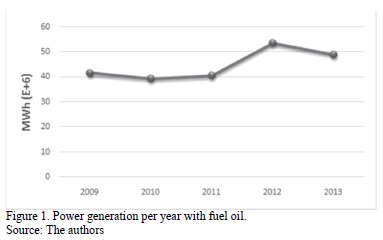
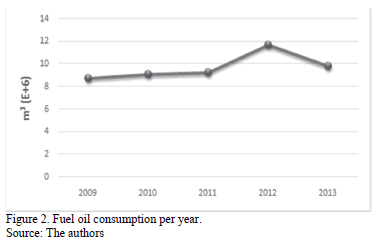
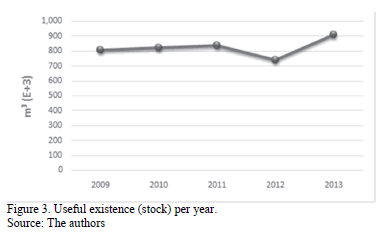
<body><![CDATA[<p>&nbsp;</p>     <p><font size="3" face="Verdana, Arial, Helvetica, sans-serif"><b>1. Power   generation: the case of the Mexican electricity system</b></font></p>     <p><font size="2" face="Verdana, Arial, Helvetica, sans-serif">The generation of electricity using fossil fuels in Mexico   is a process with broad participation; in 2011, the plants that only used   fossil fuels accounted for 72.6% of the total electricity produced and are   expected to remain broad in participation to meet the future electricity demand   &#91;1&#93;.</font></p>     <p><font size="2" face="Verdana, Arial, Helvetica, sans-serif">The use of fossil fuels for power generation has been   severely questioned as the production of carbon dioxide (<img src="/img/revistas/dyna/v82n191/v82n191a08eq002.gif">)   contributes to the accumulation of greenhouse gases (GHGs) emitted into the   atmosphere.</font></p>     <p><font size="2" face="Verdana, Arial, Helvetica, sans-serif">Therefore, there are two prospective scenarios of capacity   expansion for the 2013-2027 period. The first is the planned expansion of the   public power generation companies with a share of 31.9% with the use of clean   technologies in 2027. An 18.4% of hydro capacity, 4.1 % wind power, nuclear   1.8% and a remaining 2.4% with geothermal, solar and biogas capacity. In the   alternative scenario, the expansion program is aligned to the goals set in   local laws, seeking to increase its generation with non-fossil sources to a 35   % in 2027 &#91;2&#93;. </font></p>     <p><font size="2" face="Verdana, Arial, Helvetica, sans-serif">This means that, although fossil fuel generation will be   reduced, its use will be located in the worst case at 65% in 2027 &#91;3&#93;.   Therefore, the total elimination of fossil fuels for power generation is nearly   impossible, because it still represents one of the economic lower cost options   in Mexico.</font></p>     <p><font size="2" face="Verdana, Arial, Helvetica, sans-serif"><a href="#fig01">Figs. 1</a>, <a href="#fig02">2</a> and, <a href="#fig03">3</a> show the behavior of thermal power   generation, fuel oil consumption, and useful existence (stock of fuel oil) from   2009 to 2013.</font></p>     <p align="center"><font size="2" face="Verdana, Arial, Helvetica, sans-serif"><a name="fig01"></a></font><img src="/img/revistas/dyna/v82n191/v82n191a08fig01.gif"></p>     <p align="center"><font size="2" face="Verdana, Arial, Helvetica, sans-serif"><a name="fig02"></a></font><img src="/img/revistas/dyna/v82n191/v82n191a08fig02.gif"></p>     <p align="center"><font size="2" face="Verdana, Arial, Helvetica, sans-serif"><a name="fig03"></a></font><img src="/img/revistas/dyna/v82n191/v82n191a08fig03.gif"></p>     ]]></body>
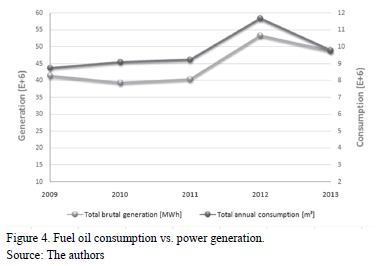
<body><![CDATA[<p><font size="2" face="Verdana, Arial, Helvetica, sans-serif"><a href="#fig04">Fig. 4</a> shows that the behavior of the fuel oil consumption   of power plants over time is directly related to the behavior of generation;   i.e. power generation is a function of the consumption.</font></p>     <p align="center"><font size="2" face="Verdana, Arial, Helvetica, sans-serif"><a name="fig04"></a></font><img src="/img/revistas/dyna/v82n191/v82n191a08fig04.gif"></p>     <p><font size="2" face="Verdana, Arial, Helvetica, sans-serif">Both behaviors follow   the same trend but they do not match on the same points throughout the   timeline. For example, there are differences between consumption and generation   since in some years, the points almost coincide and the graphical difference is   very low, but in other years this difference increases and the points are apart   from each other.</font></p>     <p><font size="2" face="Verdana, Arial, Helvetica, sans-serif">It could be concluded that when the points of consumption   and generation are far apart, we have a period of technical inefficiency.</font></p>     <p><font size="2" face="Verdana, Arial, Helvetica, sans-serif">In 2013, the production of generation per unit volume (m<sup>3</sup>)   increased. It is the lowest difference that can be seen. A total of 4.9 MWh/m<sup>3</sup> was generated in 2013; while in 2010, it was of 4.3 MWh/m<sup>3</sup>. </font></p>     <p><font size="2" face="Verdana, Arial, Helvetica, sans-serif">Ideally, the points must coincide throughout the timeline,   i.e. 100% of technical efficiency.</font></p>     <p><font size="2" face="Verdana, Arial, Helvetica, sans-serif">Regarding the level of fuel oil inventory (useful   existence), we can mention that it is a policy concerning the reduction of the   risk of not meeting the demand of electricity.</font></p>     <p><font size="2" face="Verdana, Arial, Helvetica, sans-serif">Indeed, the public power generation company must ensure at   all times that the fuel oil supply to the thermal plants is guaranteed for any   contingency.</font></p>     <p>&nbsp;</p>     <p><font size="3" face="Verdana, Arial, Helvetica, sans-serif"><b>2. Technical   efficiency </b></font></p>     ]]></body>
<body><![CDATA[<p><font size="2" face="Verdana, Arial, Helvetica, sans-serif">The efficiency analysis is based on microeconomic   analysis, through maximizing a given production function using a set of inputs   and technology. There are two approaches to the optimization of a production   function either through the maximization of production or cost minimization   given a certain level of production.</font></p>     <p><font size="2" face="Verdana, Arial, Helvetica, sans-serif">In &#91;4&#93;, two conceptual visions of economic efficiency were   proposed:</font></p> <ul>       <li><font size="2" face="Verdana, Arial, Helvetica, sans-serif"> Technical efficiency: The ability of a     production unit to obtain the highest level of product, a given level of inputs     and technology.</font></li>       <li><font size="2" face="Verdana, Arial, Helvetica, sans-serif"> Allocative efficiency: The ability of a     production unit to use the inputs in optimal proportions, given a price level     and technological level.</font></li>     </ul>     <p><font size="2" face="Verdana, Arial, Helvetica, sans-serif">The usefulness of technical efficiency lies in generating   information to improve the management capacity of the production units, and to   know the information of input used and generation of production over to define   optimal strategies for improvement. There are several methods of estimating   technical efficiency: parametric, non-parametric, deterministic, and   stochastic.</font></p> <ul>       <li><font size="2" face="Verdana, Arial, Helvetica, sans-serif"> Parametric: Assume a functional form of the     production function.</font></li>       <li><font size="2" face="Verdana, Arial, Helvetica, sans-serif"> Nonparametric: Do not assume any functional form     of the production function.</font></li>       <li><font size="2" face="Verdana, Arial, Helvetica, sans-serif"> Deterministic: Part of the approach that all     distance between the border of production and production value observed for a     productive unit corresponds to technical inefficiency.</font></li>       <li><font size="2" face="Verdana, Arial, Helvetica, sans-serif"> Stochastic: The production has a random     component representing the technical efficiency as part of the deviation from     the optimum production units.</font></li>     ]]></body>
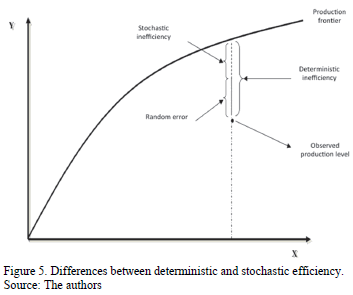
<body><![CDATA[</ul>     <p><font size="2" face="Verdana, Arial, Helvetica, sans-serif">Techniques for estimating technical efficiency according   to the adopted approach can be classified among the primal and dual approaches.   In the case of primal approach, technical efficiency is estimated based on   maximizing production or minimizing function costs. In the case of a dual   approach, technical efficiency for both functions is estimated &#91;16-18&#93;. Models   can also be categorized in terms of temporality, in cross section or panel data   models.</font></p>     <p><font size="2" face="Verdana, Arial, Helvetica, sans-serif">The nonparametric models generally used are estimates   based on Data Envelopment Analysis (DEA) methodologies based on mathematical   programming. The great advantage of using DEA methodologies is that a specific   functional form of the production function is not required. On the other hand,   the main disadvantage is that they are deterministic models that can be   affected by the number of inputs used as well as by the presence of outliers   &#91;14, 15&#93;.</font></p>     <p><font size="2" face="Verdana, Arial, Helvetica, sans-serif"><b><i>2.1. Stochastic   frontier</i></b></font></p>     <p><font size="2" face="Verdana, Arial, Helvetica, sans-serif">In 1977, &#91;5,6&#93;   simultaneously proposed a stochastic frontier. The initial specification was a   cross-sectional model with an error term composed of two factors: one that   measured the random effect and another that measured the technical   inefficiency. &#91;7-10&#93; present developments of stochastic frontier models in   various applications. In &#91;11&#93;, a model was proposed for the inefficiency   effects of the stochastic frontier production function. This model is applied   in the analysis of data on electricity generation during different time   periods.</font></p>     <p><font size="2" face="Verdana, Arial, Helvetica, sans-serif">The most important thing in terms of the methodology of estimation   of stochastic frontiers is that the treatment of error terms does not assume   that all errors are attributable to a random factor, and that a segment of   these is attributable to technical inefficiency. <a href="#fig05">Fig. 5</a> shows the comparison   between deterministic and stochastic methods for estimating technical   inefficiency for a production function. </font></p>     <p align="center"><font size="2" face="Verdana, Arial, Helvetica, sans-serif"><a name="fig05"></a></font><img src="/img/revistas/dyna/v82n191/v82n191a08fig05.gif"></p>     <p><font size="2" face="Verdana, Arial, Helvetica, sans-serif">A number of empirical studies have estimated stochastic   frontiers and predicted firm level efficiencies using these estimated functions   and then regressed the predicted efficiencies upon firm specific variables in   an attempt to identify some of the reasons for differences in predicted   efficiencies between firms in an industry.</font></p>     <p><font size="2" face="Verdana, Arial, Helvetica, sans-serif">The two stages estimation procedure is inconsistent in its   assumptions regarding the independence of the inefficiency effects in the two   estimation stages. This estimation procedure is unlikely to provide estimates   that are as efficient as those that could be obtained using as single stage   estimation procedure.</font></p>     <p><font size="2" face="Verdana, Arial, Helvetica, sans-serif">This issue was   addressed in &#91;11,12&#93; where the authors proposed stochastic frontier models in   which the inefficiency effects are expressed as an explicit function of a   vector of firm specific variables and a random error. &#91;13,14&#93; proposed a model,   which is equivalent to the &#91;12&#93; specification, with the exceptions that   allocative efficiency is imposed, the first order profit maximizing conditions   is removed, and panel data is permitted. The model specification may be   expressed as: </font></p>     ]]></body>
<body><![CDATA[<p><img src="/img/revistas/dyna/v82n191/v82n191a08eq01.gif"></p>     <p><font size="2" face="Verdana, Arial, Helvetica, sans-serif">Where:</font></p>     <blockquote>       <p><font size="2" face="Verdana, Arial, Helvetica, sans-serif"><img src="/img/revistas/dyna/v82n191/v82n191a08eq016.gif"> is a logarithm of the production of the i-th     firm in the t-th time period    <br>     </font><font size="2" face="Verdana, Arial, Helvetica, sans-serif"><img src="/img/revistas/dyna/v82n191/v82n191a08eq018.gif">is     a kx1 vector of transformation of the input quantities for the i-th firm in the     t-th time period    <br>     </font><font size="2" face="Verdana, Arial, Helvetica, sans-serif"><img src="/img/revistas/dyna/v82n191/v82n191a08eq020.gif"> is a vector of unknown parameters    <br>     </font><font size="2" face="Verdana, Arial, Helvetica, sans-serif"><img src="/img/revistas/dyna/v82n191/v82n191a08eq022.gif"> is a random variable which is assumed to be     iid <img src="/img/revistas/dyna/v82n191/v82n191a08eq024.gif">)    <br>     </font><font size="2" face="Verdana, Arial, Helvetica, sans-serif"><img src="/img/revistas/dyna/v82n191/v82n191a08eq026.gif"> is a non negative random variable assumed to     account for technical inefficiency in production and to be independently     distributed as truncations at zero of the <img src="/img/revistas/dyna/v82n191/v82n191a08eq028.gif">    <br>     </font><font size="2" face="Verdana, Arial, Helvetica, sans-serif"><img src="/img/revistas/dyna/v82n191/v82n191a08eq030.gif">    <br>     </font><font size="2" face="Verdana, Arial, Helvetica, sans-serif"><img src="/img/revistas/dyna/v82n191/v82n191a08eq032.gif"> is a px1 vector of variables which influences     the efficiency of a firm and <img src="/img/revistas/dyna/v82n191/v82n191a08eq034.gif"> is an 1xp vector of parameters to be     estimated. </font></p> </blockquote>     ]]></body>
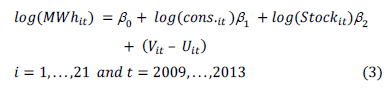
<body><![CDATA[<p><font size="2" face="Verdana, Arial, Helvetica, sans-serif"><b><i>2.2. Efficiency   predictions</i></b></font></p>     <p><font size="2" face="Verdana, Arial, Helvetica, sans-serif">The measures of technical efficiency relative to the   production frontier are defined as:</font></p>     <p><img src="/img/revistas/dyna/v82n191/v82n191a08eq02.gif"></p>     <p><font size="2" face="Verdana, Arial, Helvetica, sans-serif">Where <img src="/img/revistas/dyna/v82n191/v82n191a08eq038.gif"> is the production of the i-th firm, which will   be equal to <img src="/img/revistas/dyna/v82n191/v82n191a08eq040.gif"> when the dependent variable is in original   units and will be equal to exp (<img src="/img/revistas/dyna/v82n191/v82n191a08eq042.gif"> when the independent variable is in   logarithms. In the case of a production frontier, <img src="/img/revistas/dyna/v82n191/v82n191a08eq044.gif"> will take a value between zero and one, while   it will take a value between one and infinity in the cost function case.</font></p>     <p>&nbsp;</p>     <p><font size="3" face="Verdana, Arial, Helvetica, sans-serif"><b>3. Stochastic   frontier model to measure efficiency in Mexican power Generation Company</b></font></p>     <p><font size="2" face="Verdana, Arial, Helvetica, sans-serif">The study includes data   for a group of 21 thermoelectric units. Annual average gross electricity   generation, level of consumption, and useful existence of fuel oil are   analyzed. A balanced panel data for 21   thermoelectric units was built for the 2009-2013 period. The useful existence and   consumption of fuel oil are expressed as an annual average in cubic meters and   annual average gross generation of electrical energy in MWh.</font></p>     <p><font size="2" face="Verdana, Arial, Helvetica, sans-serif">The objective of measuring technical efficiency in the   production of electrical energy is to assess whether levels of consumption and   useful existence correspond with the level of production of each   thermoelectric, assuming a given technology.</font></p>     <p><font size="2" face="Verdana, Arial, Helvetica, sans-serif">The goal is to evaluate   the interaction between the inputs to generate electric power and congruence of   results. Two specifications of production function were tested:   Trans-logarithmic and Cobb-Douglas. The Cobb-Douglas production function was   chosen because it generates better estimates, so all variables are expressed in   logarithmic fashion.</font></p>     <p><font size="2" face="Verdana, Arial, Helvetica, sans-serif">The advantage of having a series of panel data is that   this allows the evaluation of the technical efficiency of thermoelectric units   over time to capture the dynamic performance of each production unit. The   functional form of the model is presented in equation (3).</font></p>     ]]></body>
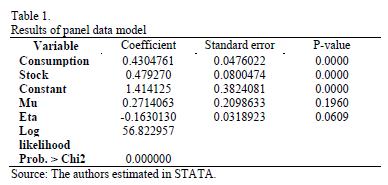
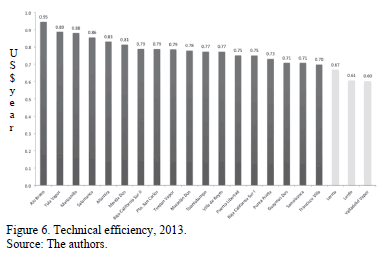
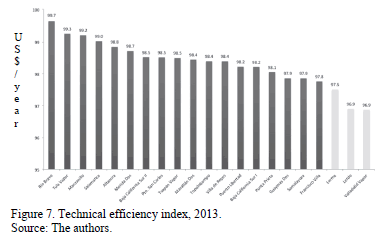
<body><![CDATA[<p><img src="/img/revistas/dyna/v82n191/v82n191a08eq03.gif"></p>     <p><font size="2" face="Verdana, Arial, Helvetica, sans-serif">A fixed effects model was estimated by the maximum   likelihood method, considering fuel oil consumption and useful existence as   independent variables and power generation as dependent variable. Technical   efficiency was considered a variable over time. The results obtained for the   proposed model are presented in <a href="#tab01">Table 1</a>.</font></p>     <p align="center"><font size="2" face="Verdana, Arial, Helvetica, sans-serif"><a name="tab01"></a></font><img src="/img/revistas/dyna/v82n191/v82n191a08tab01.gif"></p>     <p><font size="2" face="Verdana, Arial, Helvetica, sans-serif">The model results show that general model and the inputs   considered are statistically significant. The values of the estimated   parameters of inputs considered are consistent with expectations, i.e. both   inputs positively involved in the generation of electricity.</font></p>     <p><font size="2" face="Verdana, Arial, Helvetica, sans-serif">The first test (Mu) states that the average truncated   normal is zero. It can be seen that at the 5% significance level the null   hypothesis is not rejected. The null hypothesis of the second test is that   inefficiency is time invariant (Eta). The values of the null hypothesis are   located at the limit to 95% significance. The hypothesis that inefficiency is   time invariant is rejected to 90% significance, and shall be deemed   inefficiency dynamic over time.</font></p>     <p><font size="2" face="Verdana, Arial, Helvetica, sans-serif">Based on the model parameters estimated, we calculated the   level of efficiency according to equation (2). The level of technical   efficiency estimated is between 0 and 1, where 1 means that the production unit   is efficient and values below 1 indicate that the unit is inefficient. When the   distance from 1 is greater, it means the unit presents greater inefficiency.</font></p>     <p><font size="2" face="Verdana, Arial, Helvetica, sans-serif"><a href="#fig06">Fig. 6</a> shows the estimation of efficiency for 2013 of all   thermoelectric units considered in the analysis. It is noted that Rio Bravo,   Tula Steam and Manzanillo are the most efficient thermoelectric units. By   contrast Lerma, Lerdo and Valladolid Vapor are the worst performers in terms of   thermoelectric units.</font></p>     <p align="center"><font size="2" face="Verdana, Arial, Helvetica, sans-serif"><a name="fig06"></a></font><font size="2" face="Verdana, Arial, Helvetica, sans-serif"><img src="/img/revistas/dyna/v82n191/v82n191a08fig06.gif"></font></p>     <p><font size="2" face="Verdana, Arial, Helvetica, sans-serif">Of the 21 thermoelectric units analyzed, only four have an   efficiency of 90%, ten have an efficiency of 80% and seven shows an efficiency   level below 70%. It is noteworthy that only four thermoelectric units show   efficiency levels of around 90%. This implies that strictly speaking 81% of the   thermoelectric units operate inefficiently.</font></p>     <p><font size="2" face="Verdana, Arial, Helvetica, sans-serif">An efficiency rating   was calculated based on estimates of efficiency technical for each   thermoelectric in the period of analysis, using 2009 as base year. The index   shows the evolution of efficiency for each thermoelectric in time. Values   greater than 100 indicate that the efficiency has been improved, and values   below 100 indicate that the efficiency is worse.</font></p>     ]]></body>
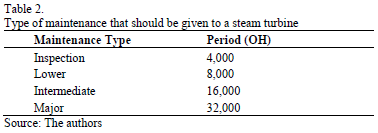
<body><![CDATA[<p><font size="2" face="Verdana, Arial, Helvetica, sans-serif"><a href="#fig07">Fig. 7</a> shows the evolution of efficiency index of each   unit analyzed for 2013. It is noted that in general the level of efficiency of   all units has decreased since 2009. Especially for the three thermoelectric   units with worst performance, their level of inefficiency has fallen on average   by 3% in the period of analysis.</font></p>     <p align="center"><font size="2" face="Verdana, Arial, Helvetica, sans-serif"><a name="fig07"></a></font><img src="/img/revistas/dyna/v82n191/v82n191a08fig07.gif"></p>     <p><font size="2" face="Verdana, Arial, Helvetica, sans-serif">The results show that 81% of the thermoelectric units are   inefficient, considering threshold efficiency values of at least 90%, observing   the evolution of efficiency in time, all thermoelectric units have decreased   levels of efficiency.</font></p>     <p><font size="2" face="Verdana, Arial, Helvetica, sans-serif">The estimated level of efficiency is an indicator to   analyze in more detail the operation of thermoelectric units with lower levels   of efficiency. It is also useful to evaluate overall performance of the electric   power sector. These results show the need to assess in more detail the   operation of 81% of the thermoelectric plants in Mexico.</font></p>     <p><font size="2" face="Verdana, Arial, Helvetica, sans-serif"><b><i>3.1. Cause   analysis of inefficiency</i></b></font></p>     <p><font size="2" face="Verdana, Arial, Helvetica, sans-serif">There are several factors that affect the productivity of   the systems; for example, technical efficiency, which can be incorporated in   the stochastic frontier. One of the reasons for technical efficiency to show a   downward trend in all thermoelectric plants, could be the wear and tear of the   generating units, given that in many cases the right kind of maintenance   determined by the number of operation hours (inspection, minor, intermediate   and major) is not given, mainly due to limited budget or other political   factors.</font></p>     <p><font size="2" face="Verdana, Arial, Helvetica, sans-serif">The diagnosis of the   operation of an energy system is to discover and interpret the signs of   malfunction of equipment that compose and quantify their effects in terms of   additional consumption of resources; i.e. where, how and how much the overall   consumption of resources can be saved, holding constant the quantity and product   specifications of the system.</font></p>     <p><font size="2" face="Verdana, Arial, Helvetica, sans-serif">For thermoelectric plants a malfunction of certain   equipment such as boilers, will have a major economic impact, even for small   deviations in their performance with respect to what is expected by design.</font></p>     <p><font size="2" face="Verdana, Arial, Helvetica, sans-serif">A good diagnosis of the operation   must be preceded by a conceptual development that explains the origin of the   increase. </font></p>     <p align="center"><font size="2" face="Verdana, Arial, Helvetica, sans-serif"><a name="tab02"></a></font><img src="/img/revistas/dyna/v82n191/v82n191a08tab02.gif"></p>     ]]></body>
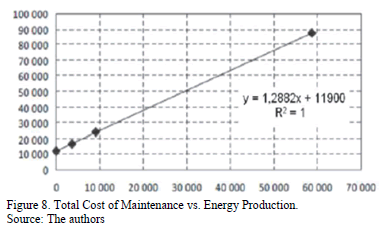
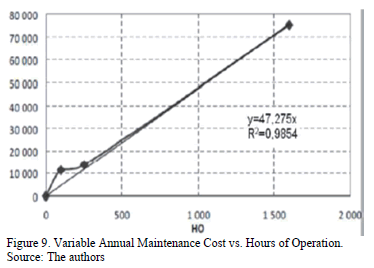
<body><![CDATA[<p><font size="2" face="Verdana, Arial, Helvetica, sans-serif">In <a href="#fig08">Figs. 8</a> and <a href="#fig09">9</a> we see an example of the relationship   between the total cost of maintenance per year and the relationship between the   Variable Annual Maintenance Cost (CVM) and the operation time (HO),   respectively.</font></p>     <p align="center"><font size="2" face="Verdana, Arial, Helvetica, sans-serif"><a name="fig08"></a></font><img src="/img/revistas/dyna/v82n191/v82n191a08fig08.gif"></p>     <p align="center"><font size="2" face="Verdana, Arial, Helvetica, sans-serif"><a name="fig09"></a></font><img src="/img/revistas/dyna/v82n191/v82n191a08fig09.gif"></p>     <p><font size="2" face="Verdana, Arial, Helvetica, sans-serif">Thus, considering the age of most power plants, the   maintenance represents a considerable budget, which often cannot be covered in   a timely manner, minimizing technical efficiency.</font></p>     <p>&nbsp;</p>     <p><font size="3" face="Verdana, Arial, Helvetica, sans-serif"><b>4. Conclusions</b></font></p>     <p><font size="2" face="Verdana, Arial, Helvetica, sans-serif">The stochastic frontier of production function shown in   this work allows an efficiency study of different thermal generation plants.   Additionally, the analysis of panel data allows the evaluation of the variation   in time of the technical inefficiency of electrical production.</font></p>     <p><font size="2" face="Verdana, Arial, Helvetica, sans-serif">In general, 81% of the thermoelectric units are   technically inefficient in their operation; one reason for this technical   inefficiency is related to maintenance levels. </font></p>     <p><font size="2" face="Verdana, Arial, Helvetica, sans-serif">The evaluation of technical efficiency is a useful   indicator for monitoring the operation of thermoelectric units and evaluating   their performance, in order to identify which units require particular attention   to achieve maximum performance in their operation. Therefore, it is important   to conduct a proper diagnosis with (conventional, energy simulation and   thermoeconomics) existing methods for the proper functioning of the energy   system.</font></p>     <p>&nbsp;</p>     ]]></body>
<body><![CDATA[<p><font size="3" face="Verdana, Arial, Helvetica, sans-serif"><b>Acknowledgements</b></font></p>     <p><font size="2" face="Verdana, Arial, Helvetica, sans-serif">The authors thank Flora Hammer for comments and   suggestions that improved this paper. At the same time, we acknowledge all the   support provided by the National Council of Science and Technology of Mexico   (CONACYT) throughout the research program &quot;<i>Redes   Tem&aacute;ticas de Investigaci&oacute;n,</i>&quot; as well as by the Mexican Logistics and Supply   Chain Association (AML) and the Mexican Institute of Transportation (IMT).</font></p>     <p>&nbsp;</p>     <p><font size="3" face="Verdana, Arial, Helvetica, sans-serif"><b>References</b></font></p>     <!-- ref --><p><font size="2" face="Verdana, Arial, Helvetica, sans-serif"><b>&#91;1&#93;</b> Salazar, M.S., Una estrategia para mejorar   la administraci&oacute;n de los inventarios de diesel en las centrales   termoel&eacute;ctricas: un estudio de caso, MSc. Thesis, Engineering Systems   Department, National Autonomous University of Mexico, Mexico, 100 P, 2015.    &nbsp;&nbsp;&nbsp;&nbsp;&nbsp;&nbsp;&nbsp;&nbsp;[&#160;<a href="javascript:void(0);" onclick="javascript: window.open('/scielo.php?script=sci_nlinks&ref=000117&pid=S0012-7353201500030000800001&lng=','','width=640,height=500,resizable=yes,scrollbars=1,menubar=yes,');">Links</a>&#160;]<!-- end-ref --></font></p>     <!-- ref --><p><font size="2" face="Verdana, Arial, Helvetica, sans-serif"><b>&#91;2&#93;</b> Secretar&iacute;a   de Energ&iacute;a. Prospectiva del sector el&eacute;ctrico   2013-2027, Mexico, 2013. &#91;Online&#93;, &#91;date   of reference December 19<sup>th</sup> of 2014&#93;. Available at: <a href="http://sener.gob.mx/res/PE_y_DT/pub/2013/Prospectiva_del_Sector_Electrico_2013-2027.pdf" target="_blank">http://sener.gob.mx/res/PE_y_DT/pub/2013/Prospectiva_del_Sector_Electrico_2013-2027.pdf</a></font>&nbsp;&nbsp;&nbsp;&nbsp;&nbsp;&nbsp;&nbsp;&nbsp;[&#160;<a href="javascript:void(0);" onclick="javascript: window.open('/scielo.php?script=sci_nlinks&ref=000119&pid=S0012-7353201500030000800002&lng=','','width=640,height=500,resizable=yes,scrollbars=1,menubar=yes,');">Links</a>&#160;]<!-- end-ref --><!-- ref --><p><font size="2" face="Verdana, Arial, Helvetica, sans-serif"><b>&#91;3&#93;</b> Gonz&aacute;lez-Santal&oacute;, J.M., La generaci&oacute;n   el&eacute;ctrica a partir de combustibles f&oacute;siles. Boletin IIE. Octubre-diciembre 2009. &#91;Online&#93;, &#91;date of   reference December 19<sup>th</sup> of   2014&#93;. Available at: <a href="http://www.iie.org.mx/boletin042009/divulga.pdf" target="_blank">http://www.iie.org.mx/boletin042009/divulga.pdf</a></font>&nbsp;&nbsp;&nbsp;&nbsp;&nbsp;&nbsp;&nbsp;&nbsp;[&#160;<a href="javascript:void(0);" onclick="javascript: window.open('/scielo.php?script=sci_nlinks&ref=000120&pid=S0012-7353201500030000800003&lng=','','width=640,height=500,resizable=yes,scrollbars=1,menubar=yes,');">Links</a>&#160;]<!-- end-ref --><!-- ref --><p><font size="2" face="Verdana, Arial, Helvetica, sans-serif"><b>&#91;4&#93;</b> Farrell,   M., The measurement of productive efficiency. Journal of the Royal Statistical   Society, 120 (3), pp. 253-290, 1957. DOI: 10.2307/2343100</font>&nbsp;&nbsp;&nbsp;&nbsp;&nbsp;&nbsp;&nbsp;&nbsp;[&#160;<a href="javascript:void(0);" onclick="javascript: window.open('/scielo.php?script=sci_nlinks&ref=000121&pid=S0012-7353201500030000800004&lng=','','width=640,height=500,resizable=yes,scrollbars=1,menubar=yes,');">Links</a>&#160;]<!-- end-ref --><!-- ref --><p><font size="2" face="Verdana, Arial, Helvetica, sans-serif"><b>&#91;5&#93;</b> Meeusen,   W. and Van den Broeck, J., Efficiency estimation from Cobb-Douglas production   functions with composed error. International Economic Review, 18, pp. 435-444,   1977. DOI: 10.2307/2525757</font>&nbsp;&nbsp;&nbsp;&nbsp;&nbsp;&nbsp;&nbsp;&nbsp;[&#160;<a href="javascript:void(0);" onclick="javascript: window.open('/scielo.php?script=sci_nlinks&ref=000122&pid=S0012-7353201500030000800005&lng=','','width=640,height=500,resizable=yes,scrollbars=1,menubar=yes,');">Links</a>&#160;]<!-- end-ref --><!-- ref --><p><font size="2" face="Verdana, Arial, Helvetica, sans-serif"><b>&#91;6&#93;</b> Aigner   D., Lovell C., and Schmidt, P., Formulation and estimation of stochastic   frontier production function models. Journal of Econometrics, 6, pp. 21-37,   1977. DOI: 10.1016/0304-4076(77)90052-5</font>&nbsp;&nbsp;&nbsp;&nbsp;&nbsp;&nbsp;&nbsp;&nbsp;[&#160;<a href="javascript:void(0);" onclick="javascript: window.open('/scielo.php?script=sci_nlinks&ref=000123&pid=S0012-7353201500030000800006&lng=','','width=640,height=500,resizable=yes,scrollbars=1,menubar=yes,');">Links</a>&#160;]<!-- end-ref --><!-- ref --><p><font size="2" face="Verdana, Arial, Helvetica, sans-serif"><b>&#91;7&#93;</b> Forsund,   F., Lovell, C. and Schmidt, P., A survey of frontier production functions and   of their relationship to efficiency measurement. Journal of Econometrics, 13,   pp.5-25, 1980. DOI: 10.1016/0304-4076(80)90040-8</font>&nbsp;&nbsp;&nbsp;&nbsp;&nbsp;&nbsp;&nbsp;&nbsp;[&#160;<a href="javascript:void(0);" onclick="javascript: window.open('/scielo.php?script=sci_nlinks&ref=000124&pid=S0012-7353201500030000800007&lng=','','width=640,height=500,resizable=yes,scrollbars=1,menubar=yes,');">Links</a>&#160;]<!-- end-ref --><!-- ref --><p><font size="2" face="Verdana, Arial, Helvetica, sans-serif"><b>&#91;8&#93;</b> Schmidt,   P., Frontier production functions. Econometric Reviews, 4, pp. 289-328, 1986.   DOI: 10.1080/07474938608800089</font>&nbsp;&nbsp;&nbsp;&nbsp;&nbsp;&nbsp;&nbsp;&nbsp;[&#160;<a href="javascript:void(0);" onclick="javascript: window.open('/scielo.php?script=sci_nlinks&ref=000125&pid=S0012-7353201500030000800008&lng=','','width=640,height=500,resizable=yes,scrollbars=1,menubar=yes,');">Links</a>&#160;]<!-- end-ref --><!-- ref --><p><font size="2" face="Verdana, Arial, Helvetica, sans-serif"><b>&#91;9&#93;</b> Bauer,   P., Recent developments in the econometric estimation of frontiers. Journal of   Econometrics, 46, pp.36-56, 1990. DOI: 10.1016/0304-4076(90)90046-V</font>&nbsp;&nbsp;&nbsp;&nbsp;&nbsp;&nbsp;&nbsp;&nbsp;[&#160;<a href="javascript:void(0);" onclick="javascript: window.open('/scielo.php?script=sci_nlinks&ref=000126&pid=S0012-7353201500030000800009&lng=','','width=640,height=500,resizable=yes,scrollbars=1,menubar=yes,');">Links</a>&#160;]<!-- end-ref --><!-- ref --><p><font size="2" face="Verdana, Arial, Helvetica, sans-serif"><b>&#91;10&#93;</b> Greene,   W., The econometric approach to efficiency analysis. In H. Fried, Lovell, C.   and Schmidt, S (Eds.), The Measurement of Productive Efficiency. New York:   Oxford University Press, 1993.    &nbsp;&nbsp;&nbsp;&nbsp;&nbsp;&nbsp;&nbsp;&nbsp;[&#160;<a href="javascript:void(0);" onclick="javascript: window.open('/scielo.php?script=sci_nlinks&ref=000127&pid=S0012-7353201500030000800010&lng=','','width=640,height=500,resizable=yes,scrollbars=1,menubar=yes,');">Links</a>&#160;]<!-- end-ref --></font></p>     <!-- ref --><p><font size="2" face="Verdana, Arial, Helvetica, sans-serif"><b>&#91;11&#93;</b> Reifschneider, D. and   Stevenson, R., Systematic departures from the frontier: A framework for the   analysis of firm inefficiency. International Economic Review, 32 (3),   pp.715-23, 1991. DOI: 10.2307/2527115</font>&nbsp;&nbsp;&nbsp;&nbsp;&nbsp;&nbsp;&nbsp;&nbsp;[&#160;<a href="javascript:void(0);" onclick="javascript: window.open('/scielo.php?script=sci_nlinks&ref=000129&pid=S0012-7353201500030000800011&lng=','','width=640,height=500,resizable=yes,scrollbars=1,menubar=yes,');">Links</a>&#160;]<!-- end-ref --><!-- ref --><p><font size="2" face="Verdana, Arial, Helvetica, sans-serif"><b>&#91;12&#93;</b> Battese, G. and Coelli,   T., A stochastic frontier production function incorporating a model for   technical inefficiency effects. Working Papers in Econometrics and Applied   Statistics. Department of Econometrics, University of New England, 69, pp. 1-22,   1995.    &nbsp;&nbsp;&nbsp;&nbsp;&nbsp;&nbsp;&nbsp;&nbsp;[&#160;<a href="javascript:void(0);" onclick="javascript: window.open('/scielo.php?script=sci_nlinks&ref=000130&pid=S0012-7353201500030000800012&lng=','','width=640,height=500,resizable=yes,scrollbars=1,menubar=yes,');">Links</a>&#160;]<!-- end-ref --></font></p>     <!-- ref --><p><font size="2" face="Verdana, Arial, Helvetica, sans-serif"><b>&#91;13&#93;</b> Battese, G. and   Coelli, T., A Model for Technical Inefficiency Effects in a Stochastic Frontier   Production Function for Panel Data. Empirical Economics, 20, pp. 325-332, 1995.   DOI: 0.1007/BF01205442</font>&nbsp;&nbsp;&nbsp;&nbsp;&nbsp;&nbsp;&nbsp;&nbsp;[&#160;<a href="javascript:void(0);" onclick="javascript: window.open('/scielo.php?script=sci_nlinks&ref=000132&pid=S0012-7353201500030000800013&lng=','','width=640,height=500,resizable=yes,scrollbars=1,menubar=yes,');">Links</a>&#160;]<!-- end-ref --><!-- ref --><p><font size="2" face="Verdana, Arial, Helvetica, sans-serif"><b>&#91;14&#93;</b> Berndt, E.R. and Wood,   D.O., Technology, prices and the derived demand for energy, Econ. Statist. 57,   pp. 259-268, 1975. DOI: 10.2307/1923910</font>&nbsp;&nbsp;&nbsp;&nbsp;&nbsp;&nbsp;&nbsp;&nbsp;[&#160;<a href="javascript:void(0);" onclick="javascript: window.open('/scielo.php?script=sci_nlinks&ref=000133&pid=S0012-7353201500030000800014&lng=','','width=640,height=500,resizable=yes,scrollbars=1,menubar=yes,');">Links</a>&#160;]<!-- end-ref --><!-- ref --><p><font size="2" face="Verdana, Arial, Helvetica, sans-serif"><b>&#91;15&#93;</b> D&iacute;az-Serna, F.J., Optimizaci&oacute;n de la operaci&oacute;n y evaluaci&oacute;n de la   eficiencia t&eacute;cnica de una empresa de generaci&oacute;n hidroel&eacute;ctrica en mercados de   corto plazo. PhD Thesis, Universidad Nacional   de Colombia. Medell&iacute;n, 186 P, 2011. &#91;Online&#93;, &#91;date of reference December 19<sup>th</sup> of 2014&#93;. Available at: <a href="http://www.bdigital.unal.edu.co/3683/#sthash.KcLJiF0R.dpuf" target="_blank">http://www.bdigital.unal.edu.co/3683/#sthash.KcLJiF0R.dpuf</a></font>&nbsp;&nbsp;&nbsp;&nbsp;&nbsp;&nbsp;&nbsp;&nbsp;[&#160;<a href="javascript:void(0);" onclick="javascript: window.open('/scielo.php?script=sci_nlinks&ref=000134&pid=S0012-7353201500030000800015&lng=','','width=640,height=500,resizable=yes,scrollbars=1,menubar=yes,');">Links</a>&#160;]<!-- end-ref --><!-- ref --><p><font size="2" face="Verdana, Arial, Helvetica, sans-serif"><b>&#91;16&#93;</b> Garz&oacute;n, P. and   Pellicer, E., Organizational efficiency of consulting engineering firms:   Proposal of a performance indicator. DYNA, 76 (160), pp. 17-26, 2010. &#91;Online&#93;, &#91;date of reference December 19<sup>th</sup> of 2014&#93;. Available at: <a href="http://www.revistas.unal.edu.co/index.php/dyna/article/view/13463/14365" target="_blank">http://www.revistas.unal.edu.co/index.php/dyna/article/view/13463/14365</a></font>&nbsp;&nbsp;&nbsp;&nbsp;&nbsp;&nbsp;&nbsp;&nbsp;[&#160;<a href="javascript:void(0);" onclick="javascript: window.open('/scielo.php?script=sci_nlinks&ref=000135&pid=S0012-7353201500030000800016&lng=','','width=640,height=500,resizable=yes,scrollbars=1,menubar=yes,');">Links</a>&#160;]<!-- end-ref --><!-- ref --><p><font size="2" face="Verdana, Arial, Helvetica, sans-serif"><b>&#91;17&#93;</b> Calderero-Gutierrez, A., Fernandez-Macho J., Kuittinen H. et al.,   Innovacion en las regiones europeas. Una   alternativa metodologica y actualizada del Ris. DYNA, 84 (6), pp.501-516, 2009.    &nbsp;&nbsp;&nbsp;&nbsp;&nbsp;&nbsp;&nbsp;&nbsp;[&#160;<a href="javascript:void(0);" onclick="javascript: window.open('/scielo.php?script=sci_nlinks&ref=000136&pid=S0012-7353201500030000800017&lng=','','width=640,height=500,resizable=yes,scrollbars=1,menubar=yes,');">Links</a>&#160;]<!-- end-ref --></font></p>     <!-- ref --><p><font size="2" face="Verdana, Arial, Helvetica, sans-serif"><b>&#91;18&#93;</b> Diaz, J., La eficiencia t&eacute;cnica como un nuevo criterio de optimizaci&oacute;n para   la generaci&oacute;n hidroel&eacute;ctrica a corto plazo. DYNA,   76 (157), pp. 91-100, 2009. &#91;Online&#93;, &#91;date   of reference December 19<sup>th</sup> of 2014&#93;. Available at: <a href="http://www.scielo.org.co/scielo.php?script=sci_arttext&pid=S0012-73532009000100009&lng=es&nrm=iso" target="_blank">http://www.scielo.org.co/scielo.php?script=sci_arttext&amp;pid=S0012-73532009000100009&amp;lng=es&amp;nrm=iso</a></font>&nbsp;&nbsp;&nbsp;&nbsp;&nbsp;&nbsp;&nbsp;&nbsp;[&#160;<a href="javascript:void(0);" onclick="javascript: window.open('/scielo.php?script=sci_nlinks&ref=000138&pid=S0012-7353201500030000800018&lng=','','width=640,height=500,resizable=yes,scrollbars=1,menubar=yes,');">Links</a>&#160;]<!-- end-ref --><p>&nbsp;</p>     <p><font size="2" face="Verdana, Arial, Helvetica, sans-serif"><b>J.A.   Marmolejo-Saucedo, </b>is professor in the Faculty of Engineering at   Universidad Anahuac Mexico Norte, Mexico. He has a PhD. in Engineering with a   specialization in Operations Research from the National Autonomous University   of Mexico (UNAM), Mexico and is currently a member of the National System of   Researchers of the National Council of Science and Technology (CONACYT) of   Mexico. He is on the Board of the Mexican Society of Operations Research, and   member of the Scientific Committee of the International Congress on Logistics   and Supply Chain (CiLOG) organized by the Mexican Logistics and Supply Chain   Association (AML). His areas of interest are large-scale optimization and   mathematical modeling in power systems and logistical problems in the supply   chain.</font></p>     <p><font size="2" face="Verdana, Arial, Helvetica, sans-serif"><b>R.   Rodriguez-Aguilar,</b> is PhD. in   Economics with a specialization in mathematical finance from the School of   Economics at the National Polytechnic Institute, Mexico. He has a MSc. degree   in Engineering and Statistics granted by the National Autonomous University of   Mexico, a MSc. degree in Public Policy Institute of Technology and Research   superiors of Monterrey, Mexico. Dr. Rodriguez is a member of the Mexican   Mathematical Society, the National Association of Economists and Economic   Modeling Network EcoMod. His areas of interest are stochastic optimization,   mathematical finance and econometrics. </font></p>     <p><font size="2" face="Verdana, Arial, Helvetica, sans-serif"><b>M.G.   Cedillo-Campos</b>, is a Professor in Logistics Systems Dynamics and Founding   Chairman of the Mexican Logistics and Supply Chain Association (AML), Mexico.   Dr. Cedillo is National Researcher (National Council of Science and Technology   of Mexico - CONACYT), Innovation Award 2012 (UANL-FIME) and National Logistics   Award 2012. In 2004, he received with honors a PhD. in Logistics Systems   Dynamics from the University of Paris, France. Recently, he collaborated as a   Visiting Researcher at Zaragoza Logistics Center as well as Georgia Tech   Panama. He works in logistics systems analysis and modeling, risk analysis, and   supply chain management, which are the subjects he teaches and researches in   different prestigious universities in Mexico and abroad. Dr. Cedillo is the   Scientific Chairman of the International Congress on Logistics and Supply Chain   (CiLOG) organized by the Mexican Logistics and Supply Chain Association (AML),   and coordinator of the National Logistics Research Network in Mexico supported   by CONACYT.</font></p>     ]]></body>
<body><![CDATA[<p><font size="2" face="Verdana, Arial, Helvetica, sans-serif"><b>M.S.   Salazar-Mart&iacute;nez,</b> has a degree in Electrical Electronic Engineering from   the National Autonomous University of Mexico. Currently, she is working in the   Federal Electricity Commission in Mexico. Her functions include planning and   supply of diesel and fuel oil-fired to power thermoelectric plants to the   National Electric Network by forecasting methods. Her areas of interest are   modeling problems using advanced techniques of planning systems.</font></p>      ]]></body><back>
<ref-list>
<ref id="B1">
<label>1</label><nlm-citation citation-type="">
<person-group person-group-type="author">
<name>
<surname><![CDATA[Salazar]]></surname>
<given-names><![CDATA[M.S.]]></given-names>
</name>
</person-group>
<source><![CDATA[Una estrategia para mejorar la administración de los inventarios de diesel en las centrales termoeléctricas: un estudio de caso]]></source>
<year>2015</year>
</nlm-citation>
</ref>
<ref id="B2">
<label>2</label><nlm-citation citation-type="">
<collab>Secretaría de Energía</collab>
<source><![CDATA[Prospectiva del sector eléctrico 2013-2027, Mexico]]></source>
<year>2013</year>
</nlm-citation>
</ref>
<ref id="B3">
<label>3</label><nlm-citation citation-type="journal">
<person-group person-group-type="author">
<name>
<surname><![CDATA[González-Santaló]]></surname>
<given-names><![CDATA[J.M.]]></given-names>
</name>
</person-group>
<article-title xml:lang="es"><![CDATA[La generación eléctrica a partir de combustibles fósiles]]></article-title>
<source><![CDATA[Boletin IIE]]></source>
<year>Octu</year>
<month>br</month>
<day>e-</day>
</nlm-citation>
</ref>
<ref id="B4">
<label>4</label><nlm-citation citation-type="journal">
<person-group person-group-type="author">
<name>
<surname><![CDATA[Farrell]]></surname>
<given-names><![CDATA[M.]]></given-names>
</name>
</person-group>
<article-title xml:lang="en"><![CDATA[The measurement of productive efficiency]]></article-title>
<source><![CDATA[Journal of the Royal Statistical Society]]></source>
<year>1957</year>
<volume>120</volume>
<numero>3</numero>
<issue>3</issue>
<page-range>253-290</page-range></nlm-citation>
</ref>
<ref id="B5">
<label>5</label><nlm-citation citation-type="journal">
<person-group person-group-type="author">
<name>
<surname><![CDATA[Meeusen]]></surname>
<given-names><![CDATA[W.]]></given-names>
</name>
<name>
<surname><![CDATA[Van den Broeck]]></surname>
<given-names><![CDATA[J.]]></given-names>
</name>
</person-group>
<article-title xml:lang="en"><![CDATA[Efficiency estimation from Cobb-Douglas production functions with composed error]]></article-title>
<source><![CDATA[International Economic Review]]></source>
<year>1977</year>
<numero>18</numero>
<issue>18</issue>
<page-range>435-444</page-range></nlm-citation>
</ref>
<ref id="B6">
<label>6</label><nlm-citation citation-type="journal">
<person-group person-group-type="author">
<name>
<surname><![CDATA[Aigner]]></surname>
<given-names><![CDATA[D.]]></given-names>
</name>
<name>
<surname><![CDATA[Lovell]]></surname>
<given-names><![CDATA[C.]]></given-names>
</name>
<name>
<surname><![CDATA[Schmidt]]></surname>
<given-names><![CDATA[P.]]></given-names>
</name>
</person-group>
<article-title xml:lang="en"><![CDATA[Formulation and estimation of stochastic frontier production function models]]></article-title>
<source><![CDATA[Journal of Econometrics]]></source>
<year>1977</year>
<numero>6</numero>
<issue>6</issue>
<page-range>21-37</page-range></nlm-citation>
</ref>
<ref id="B7">
<label>7</label><nlm-citation citation-type="journal">
<person-group person-group-type="author">
<name>
<surname><![CDATA[Forsund]]></surname>
<given-names><![CDATA[F.]]></given-names>
</name>
<name>
<surname><![CDATA[Lovell]]></surname>
<given-names><![CDATA[C.]]></given-names>
</name>
<name>
<surname><![CDATA[Schmidt]]></surname>
<given-names><![CDATA[P.]]></given-names>
</name>
</person-group>
<article-title xml:lang="en"><![CDATA[A survey of frontier production functions and of their relationship to efficiency measurement]]></article-title>
<source><![CDATA[Journal of Econometrics]]></source>
<year>1980</year>
<page-range>5-25</page-range></nlm-citation>
</ref>
<ref id="B8">
<label>8</label><nlm-citation citation-type="journal">
<person-group person-group-type="author">
<name>
<surname><![CDATA[Schmidt]]></surname>
<given-names><![CDATA[P.]]></given-names>
</name>
</person-group>
<article-title xml:lang="en"><![CDATA[Frontier production functions]]></article-title>
<source><![CDATA[Econometric Reviews]]></source>
<year>1986</year>
<numero>4</numero>
<issue>4</issue>
<page-range>289-328</page-range></nlm-citation>
</ref>
<ref id="B9">
<label>9</label><nlm-citation citation-type="journal">
<person-group person-group-type="author">
<name>
<surname><![CDATA[Bauer]]></surname>
<given-names><![CDATA[P.]]></given-names>
</name>
</person-group>
<article-title xml:lang="en"><![CDATA[Recent developments in the econometric estimation of frontiers]]></article-title>
<source><![CDATA[Journal of Econometrics]]></source>
<year>1990</year>
<numero>46</numero>
<issue>46</issue>
<page-range>36-56</page-range></nlm-citation>
</ref>
<ref id="B10">
<label>10</label><nlm-citation citation-type="book">
<person-group person-group-type="author">
<name>
<surname><![CDATA[Greene]]></surname>
<given-names><![CDATA[W.]]></given-names>
</name>
</person-group>
<article-title xml:lang="en"><![CDATA[The econometric approach to efficiency analysis]]></article-title>
<person-group person-group-type="editor">
<name>
<surname><![CDATA[Fried]]></surname>
<given-names><![CDATA[H.]]></given-names>
</name>
<name>
<surname><![CDATA[Lovell]]></surname>
<given-names><![CDATA[C.]]></given-names>
</name>
<name>
<surname><![CDATA[Schmidt]]></surname>
<given-names><![CDATA[S]]></given-names>
</name>
</person-group>
<source><![CDATA[The Measurement of Productive Efficiency.]]></source>
<year>1993</year>
<publisher-loc><![CDATA[New York ]]></publisher-loc>
<publisher-name><![CDATA[Oxford University Press]]></publisher-name>
</nlm-citation>
</ref>
<ref id="B11">
<label>11</label><nlm-citation citation-type="journal">
<person-group person-group-type="author">
<name>
<surname><![CDATA[Reifschneider]]></surname>
<given-names><![CDATA[D.]]></given-names>
</name>
<name>
<surname><![CDATA[Stevenson]]></surname>
<given-names><![CDATA[R.]]></given-names>
</name>
</person-group>
<article-title xml:lang="en"><![CDATA[Systematic departures from the frontier: A framework for the analysis of firm inefficiency]]></article-title>
<source><![CDATA[International Economic Review]]></source>
<year>1991</year>
<volume>32</volume>
<numero>3</numero>
<issue>3</issue>
<page-range>715-23</page-range></nlm-citation>
</ref>
<ref id="B12">
<label>12</label><nlm-citation citation-type="">
<person-group person-group-type="author">
<name>
<surname><![CDATA[Battese]]></surname>
<given-names><![CDATA[G.]]></given-names>
</name>
<name>
<surname><![CDATA[Coelli]]></surname>
<given-names><![CDATA[T.]]></given-names>
</name>
</person-group>
<collab>University of New England^dDepartment of Econometrics</collab>
<source><![CDATA[A stochastic frontier production function incorporating a model for technical inefficiency effects]]></source>
<year>1995</year>
<page-range>1-22</page-range></nlm-citation>
</ref>
<ref id="B13">
<label>13</label><nlm-citation citation-type="journal">
<person-group person-group-type="author">
<name>
<surname><![CDATA[Battese]]></surname>
<given-names><![CDATA[G.]]></given-names>
</name>
<name>
<surname><![CDATA[Coelli]]></surname>
<given-names><![CDATA[T.]]></given-names>
</name>
</person-group>
<article-title xml:lang="en"><![CDATA[A Model for Technical Inefficiency Effects in a Stochastic Frontier Production Function for Panel Data]]></article-title>
<source><![CDATA[Empirical Economics]]></source>
<year>1995</year>
<numero>20</numero>
<issue>20</issue>
<page-range>325-332</page-range></nlm-citation>
</ref>
<ref id="B14">
<label>14</label><nlm-citation citation-type="journal">
<person-group person-group-type="author">
<name>
<surname><![CDATA[Berndt]]></surname>
<given-names><![CDATA[E.R.]]></given-names>
</name>
<name>
<surname><![CDATA[Wood]]></surname>
<given-names><![CDATA[D.O.]]></given-names>
</name>
</person-group>
<article-title xml:lang="en"><![CDATA[Technology, prices and the derived demand for energy]]></article-title>
<source><![CDATA[Econ. Statist.]]></source>
<year>1975</year>
<numero>57</numero>
<issue>57</issue>
<page-range>259-268</page-range></nlm-citation>
</ref>
<ref id="B15">
<label>15</label><nlm-citation citation-type="">
<person-group person-group-type="author">
<name>
<surname><![CDATA[Díaz-Serna]]></surname>
<given-names><![CDATA[F.J.]]></given-names>
</name>
</person-group>
<source><![CDATA[Optimización de la operación y evaluación de la eficiencia técnica de una empresa de generación hidroeléctrica en mercados de corto plazo.]]></source>
<year>2011</year>
</nlm-citation>
</ref>
<ref id="B16">
<label>16</label><nlm-citation citation-type="journal">
<person-group person-group-type="author">
<name>
<surname><![CDATA[Garzón]]></surname>
<given-names><![CDATA[P.]]></given-names>
</name>
<name>
<surname><![CDATA[Pellicer]]></surname>
<given-names><![CDATA[E.]]></given-names>
</name>
</person-group>
<article-title xml:lang="en"><![CDATA[Organizational efficiency of consulting engineering firms: Proposal of a performance indicator]]></article-title>
<source><![CDATA[DYNA]]></source>
<year>2010</year>
<volume>76</volume>
<numero>160</numero>
<issue>160</issue>
<page-range>17-26</page-range></nlm-citation>
</ref>
<ref id="B17">
<label>17</label><nlm-citation citation-type="journal">
<person-group person-group-type="author">
<name>
<surname><![CDATA[Calderero-Gutierrez]]></surname>
<given-names><![CDATA[A.]]></given-names>
</name>
</person-group>
<article-title xml:lang="es"><![CDATA[Innovacion en las regiones europeas. Una alternativa metodologica y actualizada del Ris]]></article-title>
<source><![CDATA[DYNA]]></source>
<year>2009</year>
<volume>84</volume>
<numero>6</numero>
<issue>6</issue>
<page-range>501-516</page-range></nlm-citation>
</ref>
<ref id="B18">
<label>18</label><nlm-citation citation-type="journal">
<person-group person-group-type="author">
<name>
<surname><![CDATA[Diaz]]></surname>
<given-names><![CDATA[J.]]></given-names>
</name>
</person-group>
<article-title xml:lang="es"><![CDATA[La eficiencia técnica como un nuevo criterio de optimización para la generación hidroeléctrica a corto plazo.]]></article-title>
<source><![CDATA[DYNA]]></source>
<year>2009</year>
<volume>76</volume>
<numero>157</numero>
<issue>157</issue>
<page-range>91-100</page-range></nlm-citation>
</ref>
</ref-list>
</back>
</article>