<?xml version="1.0" encoding="ISO-8859-1"?><article xmlns:mml="http://www.w3.org/1998/Math/MathML" xmlns:xlink="http://www.w3.org/1999/xlink" xmlns:xsi="http://www.w3.org/2001/XMLSchema-instance">
<front>
<journal-meta>
<journal-id>0012-7353</journal-id>
<journal-title><![CDATA[DYNA]]></journal-title>
<abbrev-journal-title><![CDATA[Dyna rev.fac.nac.minas]]></abbrev-journal-title>
<issn>0012-7353</issn>
<publisher>
<publisher-name><![CDATA[Universidad Nacional de Colombia]]></publisher-name>
</publisher>
</journal-meta>
<article-meta>
<article-id>S0012-73532015000300009</article-id>
<article-id pub-id-type="doi">10.15446/dyna.v82n191.51153</article-id>
<title-group>
<article-title xml:lang="en"><![CDATA[Optimization of the distribution of steel pipes using a mathematical model]]></article-title>
<article-title xml:lang="es"><![CDATA[Optimización de la distribución de tubería de acero mediante un modelo matemático]]></article-title>
</title-group>
<contrib-group>
<contrib contrib-type="author">
<name>
<surname><![CDATA[Mata-Pérez]]></surname>
<given-names><![CDATA[Miguel]]></given-names>
</name>
<xref ref-type="aff" rid="A01"/>
</contrib>
<contrib contrib-type="author">
<name>
<surname><![CDATA[Saucedo-Martínez]]></surname>
<given-names><![CDATA[Jania Astrid]]></given-names>
</name>
<xref ref-type="aff" rid="A02"/>
</contrib>
</contrib-group>
<aff id="A01">
<institution><![CDATA[,Universidad Autónoma de Nuevo León Posgrado en Logística y Cadena de Suministro ]]></institution>
<addr-line><![CDATA[ ]]></addr-line>
<country>México</country>
</aff>
<aff id="A02">
<institution><![CDATA[,Universidad Autónoma de Nuevo León Posgrado en Logística y Cadena de Suministro ]]></institution>
<addr-line><![CDATA[ ]]></addr-line>
<country>México</country>
</aff>
<pub-date pub-type="pub">
<day>00</day>
<month>06</month>
<year>2015</year>
</pub-date>
<pub-date pub-type="epub">
<day>00</day>
<month>06</month>
<year>2015</year>
</pub-date>
<volume>82</volume>
<numero>191</numero>
<fpage>69</fpage>
<lpage>75</lpage>
<copyright-statement/>
<copyright-year/>
<self-uri xlink:href="http://www.scielo.org.co/scielo.php?script=sci_arttext&amp;pid=S0012-73532015000300009&amp;lng=en&amp;nrm=iso"></self-uri><self-uri xlink:href="http://www.scielo.org.co/scielo.php?script=sci_abstract&amp;pid=S0012-73532015000300009&amp;lng=en&amp;nrm=iso"></self-uri><self-uri xlink:href="http://www.scielo.org.co/scielo.php?script=sci_pdf&amp;pid=S0012-73532015000300009&amp;lng=en&amp;nrm=iso"></self-uri><abstract abstract-type="short" xml:lang="en"><p><![CDATA[Distribution is one of the most important processes in a supply chain, given that it represents up to two thirds of company logistics costs and up to 20% of the total cost of products. For that reason, it is essential to optimize the costs of distribution. A steel producer located in Monterrey distributes their products to different parts of Mexico. Currently, the distribution is carried out through empirical knowledge, underusing resources and generating unnecessary costs. The aim is to undertake the distribution process more efficiently. This paper presents an optimization model based on vehicle routing problem (VRP), for the distribution of heavy pipes taking into account the company's own characteristics, such as: rented heterogeneous fleet, multiple shipments of products, split deliveries and open cycles (meaning that the routes may not necessarily end in the depot).]]></p></abstract>
<abstract abstract-type="short" xml:lang="es"><p><![CDATA[El proceso de distribución suele representar más de dos terceras partes de los costos logísticos de la compañía y más del 20% del costo total de los bienes transportados. Es por ello que es vital para la empresa optimizar dicho costo. Una empresa productora de aceros ubicada en Monterrey, debe distribuir sus productos a múltiples clientes localizados a lo largo del país. En la actualidad dicha actividad es realizada mediante conocimientos empíricos, ocasionando que se subutilicen los recursos y generando altos costos de distribución. La empresa requiere realizar dicho proceso en forma más eficiente. Este artículo presenta un modelo de optimización basado en el problema de ruteo de vehículos (VRP), para la distribución de tubería pesada tomando en cuenta las características propias de la empresa, tales como: flota heterogénea y rentada, embarque de múltiples productos, entregas divididas y ciclos abiertos (las rutas no necesariamente terminan en el depósito).]]></p></abstract>
<kwd-group>
<kwd lng="en"><![CDATA[Vehicle Routing Problem]]></kwd>
<kwd lng="en"><![CDATA[combinatorial optimization]]></kwd>
<kwd lng="en"><![CDATA[distribution of heavy pipes]]></kwd>
<kwd lng="es"><![CDATA[Problema de ruteo de vehículos]]></kwd>
<kwd lng="es"><![CDATA[optimización combinatoria]]></kwd>
<kwd lng="es"><![CDATA[distribución de tubería pesada]]></kwd>
</kwd-group>
</article-meta>
</front><body><![CDATA[ <p><font size="1" face="Verdana, Arial, Helvetica, sans-serif"><b>DOI: </b><a href="http://dx.doi.org/10.15446/dyna.v82n191.51153" target="_blank">http://dx.doi.org/10.15446/dyna.v82n191.51153</a></font></p>     <p align="center"><font size="4" face="Verdana, Arial, Helvetica, sans-serif"><b>Optimization of   the distribution of steel pipes using a mathematical model</b></font></p>     <p align="center"><i><b><font size="3" face="Verdana, Arial, Helvetica, sans-serif">Optimizaci&oacute;n   de la distribuci&oacute;n de tuber&iacute;a de acero mediante un modelo matem&aacute;tico</font></b></i></p>     <p align="center">&nbsp;</p>     <p align="center"><font size="2" face="Verdana, Arial, Helvetica, sans-serif"><b>Miguel Mata-P&eacute;rez <i><sup>a</sup></i> &amp; Jania Astrid Saucedo-Mart&iacute;nez <i><sup>b</sup></i></b></font></p>     <p align="center">&nbsp;</p>     <p align="center"><font size="2" face="Verdana, Arial, Helvetica, sans-serif"><sup><i>a</i></sup><i> Posgrado en Log&iacute;stica y Cadena de Suministro, Universidad   Aut&oacute;noma de Nuevo Le&oacute;n, M&eacute;xico. <a href="mailto:miguel.matapr@uanl.edu.mx">miguel.matapr@uanl.edu.mx</a>    <br>   <sup>b</sup> Posgrado en Log&iacute;stica y Cadena de Suministro, Universidad   Aut&oacute;noma de Nuevo Le&oacute;n, M&eacute;xico. <a href="mailto:jania.saucedomrt@uanl.edu.mx">jania.saucedomrt@uanl.edu.mx</a></i></font></p>     <p align="center">&nbsp;</p>     <p align="center"><font size="2" face="Verdana, Arial, Helvetica, sans-serif"><b>Received: January 28<sup>th</sup>, 2015. Received in   revised form: March 26<sup>th</sup>, 2015. Accepted: April 30<sup>th</sup>,   2015.</b></font></p>     ]]></body>
<body><![CDATA[<p align="center">&nbsp;</p>     <p align="center"><font size="1" face="Verdana, Arial, Helvetica, sans-seriff"><b>This work is licensed under a</b> <a rel="license" href="http://creativecommons.org/licenses/by-nc-nd/4.0/">Creative Commons Attribution-NonCommercial-NoDerivatives 4.0 International License</a>.</font><br />   <a rel="license" href="http://creativecommons.org/licenses/by-nc-nd/4.0/"><img style="border-width:0" src="https://i.creativecommons.org/l/by-nc-nd/4.0/88x31.png" /></a></p> <hr>     <p><font size="2" face="Verdana, Arial, Helvetica, sans-serif"><b>Abstract    <br>   </b></font><font size="2" face="Verdana, Arial, Helvetica, sans-serif">Distribution is one of the most important processes in a   supply chain, given that it represents up to two thirds of company logistics   costs and up to 20% of the total cost of products. For that reason, it is   essential to optimize the costs of distribution. A steel producer located in Monterrey   distributes their products to different parts of Mexico. Currently, the   distribution is carried out through empirical knowledge, underusing resources   and generating unnecessary costs. The aim is to undertake the distribution   process more efficiently. This paper   presents an optimization model based on vehicle routing problem (VRP), for the   distribution of heavy pipes taking into account the company's own   characteristics, such as: rented heterogeneous fleet, multiple shipments of   products, split deliveries and open cycles (meaning that the routes may not   necessarily end in the depot).</font></p>     <p><font size="2" face="Verdana, Arial, Helvetica, sans-serif"><i>Keywords:</i> Vehicle Routing Problem (VRP); combinatorial optimization; distribution of   heavy pipes.</font></p>     <p><font size="2" face="Verdana, Arial, Helvetica, sans-serif"><b>Resumen    <br>   </b></font><font size="2" face="Verdana, Arial, Helvetica, sans-serif">El proceso de   distribuci&oacute;n suele representar m&aacute;s de dos terceras partes de los costos   log&iacute;sticos de la compa&ntilde;&iacute;a y m&aacute;s del 20% del costo total de los bienes   transportados. Es por ello que es vital para la empresa optimizar dicho   costo. Una empresa productora de aceros   ubicada en Monterrey, debe distribuir sus productos a m&uacute;ltiples clientes   localizados a lo largo del pa&iacute;s. En la actualidad dicha actividad es realizada   mediante conocimientos emp&iacute;ricos, ocasionando que se subutilicen los recursos y   generando altos costos de distribuci&oacute;n. La empresa requiere realizar dicho   proceso en forma m&aacute;s eficiente. Este   art&iacute;culo presenta un modelo de optimizaci&oacute;n basado en el problema de ruteo de   veh&iacute;culos (VRP), para la distribuci&oacute;n de tuber&iacute;a pesada tomando en cuenta las   caracter&iacute;sticas propias de la empresa, tales como: flota heterog&eacute;nea y rentada,   embarque de m&uacute;ltiples productos, entregas divididas y ciclos abiertos (las   rutas no necesariamente terminan en el dep&oacute;sito).</font></p>     <p><font size="2" face="Verdana, Arial, Helvetica, sans-serif"><i>Palabras clave:</i> Problema de ruteo de veh&iacute;culos (VRP);   optimizaci&oacute;n combinatoria; distribuci&oacute;n de tuber&iacute;a pesada.</font></p> <hr>     <p>&nbsp;</p>     <p><font size="3" face="Verdana, Arial, Helvetica, sans-serif"><b>1. Introduction</b></font></p>     ]]></body>
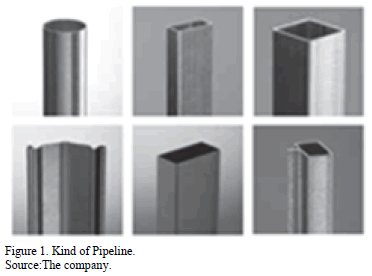
<body><![CDATA[<p><font size="2" face="Verdana, Arial, Helvetica, sans-serif">Transport operations and product distribution represent up   to two-thirds of company logistics costs &#91;2&#93; and up to 20% of the total cost of   transported products &#91;13&#93;. In many cases, the transport networks are too stiff   and unable to absorb market variations in demand &#91;2&#93;. This has prompted   outsourcing to transportation and distribution businesses, offering greater   flexibility and more efficient deliveries management at competitive prices. </font></p>     <p><font size="2" face="Verdana, Arial, Helvetica, sans-serif">Given a set of products   and of customers with well-defined demands, the distribution process consist in   the company having to decide whether the deliveries can be complete or whether   they need to be split, the best times for the deliveries, the kinds of vehicles   to be used, the complete supply path, among other possible decisions. The   distribution process of every company usually entails special characteristics   in accordance with the individual features of each company.</font></p>     <p><font size="2" face="Verdana, Arial, Helvetica, sans-serif">It is important to note that the optimal distribution   configuration is affected by variety configuration for the distribution, which,   in turn, is affected by the variety of destinations, the diversity of products   offered, and demand variability. Hence, it is common in practice to find   problems such as underuse of transport, inefficient routes, and extra costs for   loading and unloading.</font></p>     <p><font size="2" face="Verdana, Arial, Helvetica, sans-serif">Therefore, route planning is one of the main problems in   the optimization of transport logistics operations, whose main objective is to   find the appropriate balance between the cost of this activity and its   contribution to the level of service specified by the company.</font></p>     <p><font size="2" face="Verdana, Arial, Helvetica, sans-serif">In this work, we present a combinatorial optimization   model based on VRP for optimization in a real distribution company that   supplies its products all over the country.</font></p>     <p>&nbsp;</p>     <p><font size="3" face="Verdana, Arial, Helvetica, sans-serif"><b>2. Description of   the problem</b></font></p>     <p><font size="2" face="Verdana, Arial, Helvetica, sans-serif">A steel producer located in Monterrey-which distributes   its products nationally-welds pipes from hot or cold rolled steel sheet, with   different thicknesses and hardnesses to provide different products such as   mechanical tubing, driving, conduit, oil, thin wall, etc. (See <a href="#fig01">Fig. 1</a>).</font></p>     <p align="center"><font size="2" face="Verdana, Arial, Helvetica, sans-serif"><a name="fig01"></a></font><img src="/img/revistas/dyna/v82n191/v82n191a09fig01.gif"></p>     <p><font size="2" face="Verdana, Arial, Helvetica, sans-serif">The company focuses its operations in a plant. In this   paper, we focus on the distribution of the steel pipe all over the country, so   that all the vehicles used must start their routes in this plant. </font></p>     ]]></body>
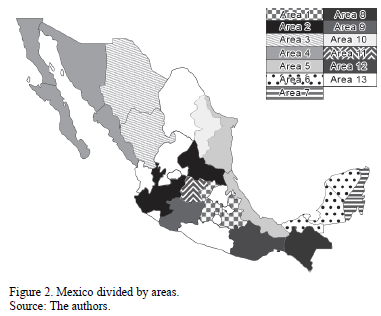
<body><![CDATA[<p><font size="2" face="Verdana, Arial, Helvetica, sans-serif">By company policies, Mexico is divided into thirteen   areas, each composed of one or more states (see <a href="#fig02">Fig. 2</a>). According to these   areas, the route for each vehicle must not go beyond a single zone.</font></p>     <p align="center"><font size="2" face="Verdana, Arial, Helvetica, sans-serif"><a name="fig02"></a></font><img src="/img/revistas/dyna/v82n191/v82n191a09fig02.gif"></p>     <p><font size="2" face="Verdana, Arial, Helvetica, sans-serif">The company does not have a fleet for distribution;   instead they rent the necessary vehicles from several freight companies. This   presupposes that the availability of vehicles is unlimited. Since the vehicles   are not company property, they have no obligation to return to the plant once   they finish their routes.</font></p>     <p><font size="2" face="Verdana, Arial, Helvetica, sans-serif">Another   important feature of the fleet of vehicles is that they have different load   capacities (9 vehicle types each with a capacity of 3.5, 6, 15, 22, 27, 28, 30,   32 and 36 Tons respectively). It must also be taken into account that some </font></p>     <p><font size="2" face="Verdana, Arial, Helvetica, sans-serif">vehicles cannot visit certain   areas due transport authority regulations regarding the kind of road or due to   physical restrictions a customer may present to receiving a certain kind of   vehicle on their premises.</font></p>     <p><font size="2" face="Verdana, Arial, Helvetica, sans-serif">One of the features of our problem is that the company   does not stick to delivery schedules and simplifies the solution by discarding   penalties for partial or late deliveries. This also allows each customer order   to be carried on more than one vehicle regardless of its characteristics. This   is known as a &quot;split delivery.&quot; </font></p>     <p><font size="2" face="Verdana, Arial, Helvetica, sans-serif">The fixed cost per trip includes three deliveries;   however, the same vehicle can make more than three deliveries, incurring an   additional cost for each one.</font></p>     <p><font size="2" face="Verdana, Arial, Helvetica, sans-serif">Pipelines being very heavy, it is important to maximize   the load capacity of each vehicle in terms of weight, whereas the volume of the   material is not a restriction for the arrangement inside the vehicle.</font></p>     <p>&nbsp;</p>     <p><font size="3" face="Verdana, Arial, Helvetica, sans-serif"><b>3. Background</b></font></p>     ]]></body>
<body><![CDATA[<p><font size="2" face="Verdana, Arial, Helvetica, sans-serif">Transportation problems are a diverse set of cases that   some authors have attempted to group according to the most important   characteristics; this allows the formulation of mathematical models to   facilitate decision-making in companies that use a kind of transport.   Furthermore, by adopting models, their solution usually has a significant   impact on the cost and the level of customer service.</font></p>     <p><font size="2" face="Verdana, Arial, Helvetica, sans-serif">The transportation problems consist basically in assigning   routes to vehicles to deliver or pick up products. The well-known Vehicle   Routing Problem (VRP) generalizes a large set of problems concerning the   distribution of products or services to a set of clients located in specific   points.</font></p>     <p><font size="2" face="Verdana, Arial, Helvetica, sans-serif">The VRP has been studied extensively in the literature.   For a deeper review of VRP, see &#91;9,10&#93;.</font></p>     <p><font size="2" face="Verdana, Arial, Helvetica, sans-serif">It is important to mention that the VRP is NP-Hard &#91;9&#93;.   There are many exact methods &#91;11&#93; for solving the VRP and an increasing number   of heuristics methods for approximate the optimal solution &#91;8,12&#93;.</font></p>     <p><font size="2" face="Verdana, Arial, Helvetica, sans-serif">All VRPs are determined by the functional constraints that   must be satisfied by the vehicles and the conditions and operating standards of   the enterprises. Depending on their characteristics, &#91;4, 6&#93; introduces the   following VRP types:</font></p> <ul>       <li><font size="2" face="Verdana, Arial, Helvetica, sans-serif"> Size of fleet: a single vehicle or a limited or     unlimited number of vehicles.</font></li>       <li><font size="2" face="Verdana, Arial, Helvetica, sans-serif"> Demand: stochastic, deterministic, dynamic,     partially satisfied, fixed for all clients or variable depending on the client.</font></li>       <li><font size="2" face="Verdana, Arial, Helvetica, sans-serif"> Multiple products or a single product type.</font></li>       <li><font size="2" face="Verdana, Arial, Helvetica, sans-serif"> Schedule: unrestricted, with time windows (just     beginning, end only, beginning and end, flexible, multiple).</font></li>       <li><font size="2" face="Verdana, Arial, Helvetica, sans-serif"> Fleet Type: homogeneous or heterogeneous.</font></li>       ]]></body>
<body><![CDATA[<li><font size="2" face="Verdana, Arial, Helvetica, sans-serif"> Depots: single, multiple, replenishment     intermediate.</font></li>       <li><font size="2" face="Verdana, Arial, Helvetica, sans-serif"> End of route: return to the depot (closed cycle)     or not (open cycle).</font></li>       <li><font size="2" face="Verdana, Arial, Helvetica, sans-serif"> Network communication: if there is a direct path     between two clients, or whether these should be considered different routes.</font></li>       <li><font size="2" face="Verdana, Arial, Helvetica, sans-serif"> Costs: fixed or variable.</font></li>       <li><font size="2" face="Verdana, Arial, Helvetica, sans-serif"> Capacity of vehicles: limited and singular,     limited and different, and unlimited.</font></li>       <li><font size="2" face="Verdana, Arial, Helvetica, sans-serif"> Number of routes per vehicle: limited to a     single route, limited to a certain number, and unlimited.</font></li>       <li><font size="2" face="Verdana, Arial, Helvetica, sans-serif"> Objective: minimize costs, minimize number of     vehicles, minimizing distance traveled and minimize time.</font></li>     </ul>     <p><font size="2" face="Verdana, Arial, Helvetica, sans-serif">Thus, the combination of different characteristics   determines an appropriate model for any possible specific situation. The study   of the basic models has allowed the development of techniques that are   applicable to cases that are increasingly complex.</font></p>     <p><font size="2" face="Verdana, Arial, Helvetica, sans-serif">For their historical significance, below is a summary of   some of the most important routing problems. One of the first studies that   treated this problem dates back to 1959 and it treated a problem involving   dispatch service trucks applied to fuel distribution stations &#91;5&#93;.</font></p>     ]]></body>
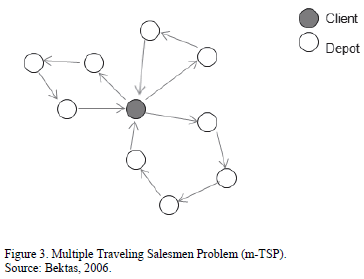
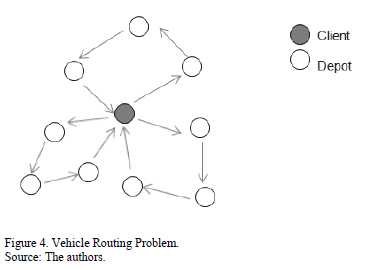
<body><![CDATA[<p><font size="2" face="Verdana, Arial, Helvetica, sans-serif">One of the best known is the Traveling Salesman Problem   (TSP), in which a salesman must visit a particular number of customers once,   and then return to where he started his trip &#91;1&#93;. Later, a variant appeared,   known as m-TSP (Multiple Traveling Salesmen Problem), in which there are m   sellers who must attend a certain number of clients that can be visited only   once, and each seller must return to the starting point when her or his trip is   finished &#91;3&#93;. See an illustration of the m-TSP in <a href="#fig03">Fig. 3</a>.</font></p>     <p align="center"><font size="2" face="Verdana, Arial, Helvetica, sans-serif"><a name="fig03"></a></font><img src="/img/revistas/dyna/v82n191/v82n191a09fig03.gif"></p>     <p><font size="2" face="Verdana, Arial, Helvetica, sans-serif">The Vehicle Routing Problem (VRP) is a generalization of   the m-TSP, where a demand is associated for each customer and a capacity is   defined for each vehicle. In the easier VRP, there exists a fleet of identical   vehicles to make deliveries to customers from a single depot (See <a href="#fig04">Fig. 4</a>).</font></p>     <p align="center"><font size="2" face="Verdana, Arial, Helvetica, sans-serif"><a name="fig04"></a></font><img src="/img/revistas/dyna/v82n191/v82n191a09fig04.gif"></p>     <p><font size="2" face="Verdana, Arial, Helvetica, sans-serif">The following list presents some of the highlights of the   VRP problems. For a more comprehensive list see &#91;14&#93;.</font></p> <ul>       <li><font size="2" face="Verdana, Arial, Helvetica, sans-serif"> Asymmetric Vehicle Routing Problem (AVRP): The     duration of the trip or the distance between two points depends on the     direction of the path.</font></li>       <li><font size="2" face="Verdana, Arial, Helvetica, sans-serif"> Capacitated Vehicle Routing Problem (CVRP): The     vehicle has a carrying capacity that must not be exceeded.</font></li>       <li><font size="2" face="Verdana, Arial, Helvetica, sans-serif"> Fleet Size and Mix Vehicle Routing Problem     (FSMVRP): Handling fixed costs depending on the type of vehicle. The variable     costs are the same for all vehicles. The problem does not impose restrictions     on the number of vehicles.</font></li>       <li><font size="2" face="Verdana, Arial, Helvetica, sans-serif"> Vehicle Routing Problem with Heterogeneous Fleet     (VRPHE): Fixed costs and dependent variables of the vehicle type. The problem     does not impose restrictions on the number of vehicles.</font></li>       <li><font size="2" face="Verdana, Arial, Helvetica, sans-serif"> Pickup and Delivery Problem (PDP): The same vehicle     must pick up and carry the goods from one place to another network.</font></li>       ]]></body>
<body><![CDATA[<li><font size="2" face="Verdana, Arial, Helvetica, sans-serif"> Min-max Vehicle Routing Problem (VRP Min-max):     Try to minimize the length of the longest path.</font></li>       <li><font size="2" face="Verdana, Arial, Helvetica, sans-serif"> Vehicle Routing Problem with Precedence     Constraints (VRPPC): Before visiting a particular client, the vehicle must     visit a previous set of them.</font></li>       <li><font size="2" face="Verdana, Arial, Helvetica, sans-serif"> Multiple Depot Vehicle Routing Problem (MDVRP):     There are several depots, from which the vehicles assigned to them depart and     return.</font></li>       <li><font size="2" face="Verdana, Arial, Helvetica, sans-serif"> Open Vehicle Routing Problem (OVRP): When     transportation is outsourced, the vehicles have no reason to return to the     plant.</font></li>       <li><font size="2" face="Verdana, Arial, Helvetica, sans-serif"> Dynamic Vehicle Routing Problem (DVRP): Set of     problems where some parameters depend on the time variable.</font></li>       <li><font size="2" face="Verdana, Arial, Helvetica, sans-serif"> Stochastic Vehicle Routing Problem (SVRP): Set     of problems where some parameters have some uncertainty.</font></li>       <li><font size="2" face="Verdana, Arial, Helvetica, sans-serif"> Vehicle Routing Problem with Multiple Use of     Vehicles (VRPM): Each vehicle can take more than one route over a period of     time.</font></li>       <li><font size="2" face="Verdana, Arial, Helvetica, sans-serif"> Vehicle Routing Problem with Split Delivery     (VRPSDV): A client's demand can be covered by several vehicles.</font></li>       <li><font size="2" face="Verdana, Arial, Helvetica, sans-serif"> Vehicle     Routing Problem with Time Windows (VRPTW): Every customer has a distribution or     delivery schedule. Schedules are also presented in the plants.</font></li>     </ul>     ]]></body>
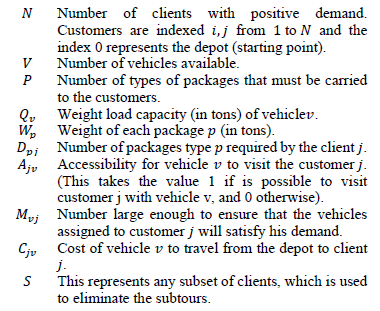
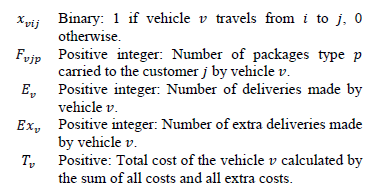
<body><![CDATA[<p><font size="2" face="Verdana, Arial, Helvetica, sans-serif">Concerning our problem, in the literature we found   similarities with other VRP that have already been formulated; however, none of   them include all of the company characteristics. That is why a custom   mathematical model is required.</font></p>     <p><font size="2" face="Verdana, Arial, Helvetica, sans-serif">Our problem presents a heterogeneous fleet, because the   company rents different kinds of vehicles according to its needs. The deliveries   can be split due to the fact that it is not uncommon for the demands to exceed   vehicle capacity. The company offers multiple products, and because the fleet   is hired, it is not necessary for the vehicles to return to the depot (open   cycles).</font></p>     <p>&nbsp;</p>     <p><font size="3" face="Verdana, Arial, Helvetica, sans-serif"><b>4. Mathematical   model proposed</b></font></p>     <p><font size="2" face="Verdana, Arial, Helvetica, sans-serif">Imitating the terminology from classical models (see, for   example &#91;7&#93;), we called our proposed model Open Vehicle Routing Problem with   Heterogeneous Fleet, Split Deliveries and Multiple Products (OVRPHFSDMP). </font></p>     <p><font size="2" face="Verdana, Arial, Helvetica, sans-serif">It will be assumed that all data are integers and not   negative numbers. The mathematical model for the OVRPHFSDMP is as follows.</font></p>     <p><font size="2" face="Verdana, Arial, Helvetica, sans-serif"><b><i>4.1. Parameters</i></b></font></p>     <p><img src="/img/revistas/dyna/v82n191/v82n191a09par01.gif"></p>     <p><font size="2" face="Verdana, Arial, Helvetica, sans-serif"><b><i>4.2. Variables</i></b></font></p>     <p><img src="/img/revistas/dyna/v82n191/v82n191a09var01.gif"></p>     ]]></body>
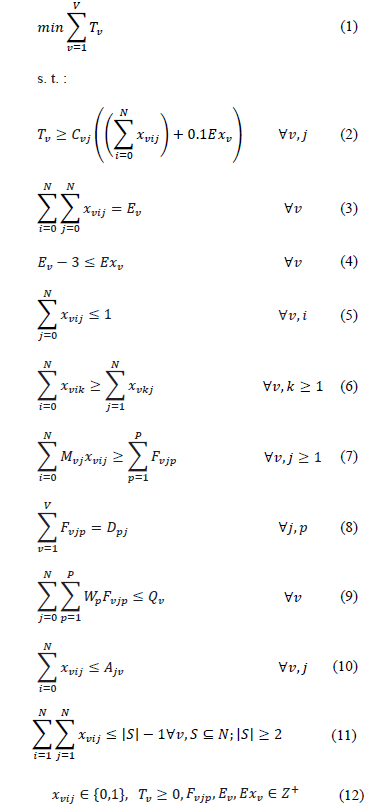
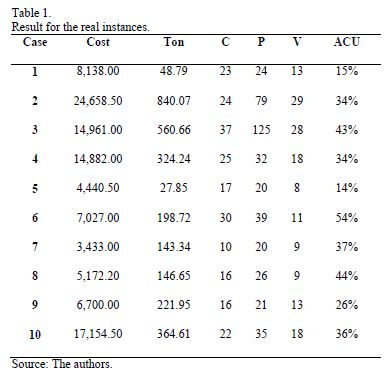
<body><![CDATA[<p><font size="2" face="Verdana, Arial, Helvetica, sans-serif"><b><i>4.2. Model</i></b></font></p>     <p><img src="/img/revistas/dyna/v82n191/v82n191a09eq0112.gif"></p>     <p><font size="2" face="Verdana, Arial, Helvetica, sans-serif">Eq. (1) represents the objective function that minimizes   the sum of the total cost for all used vehicles. The constraint represented for   eq. (2) calculates the price that the company needs to pay to use the vehicle   from the plant to the farthest destination taking into account the fixed costs   and the extra costs. Eq. (3) estimates the number of customers that the vehicle   must visit, and eq. (4) calculates the number of extra deliveries <img src="/img/revistas/dyna/v82n191/v82n191a09eq102.gif"> when the vehicle visits more than three   clients. Eq. (5) ensures that all vehicles used start their routes at the plant   but do not need to return to it as well as ensuring that each customer is   visited at most once by the same vehicle. Eq. (6) allows the entry and exit of   vehicles from a point <i>k</i> on the   condition that a trip is not made from a place that has not been previously   visited. Eq. (7) assigns packages on the vehicles that will be used. Eq. (8)   ensures that customer demand is satisfied. Eq. (9) ensures that the weight   carried on a vehicle does not exceed its capacity. Eq. (10) states that the   vehicles will be assigned only to customers that the vehicles can access (i.e.   due to infrastructure or transport authority regulations). Eq. (11) ensures that vehicles do not perform   cycles.</font></p>     <p>&nbsp;</p>     <p><font size="3" face="Verdana, Arial, Helvetica, sans-serif"><b>5. Computational   experimentation</b></font></p>     <p><font size="2" face="Verdana, Arial, Helvetica, sans-serif">To test the model, 60 test cases have been proposed, 10 of   them were from the history of the company and 50 others were probabilistically   generated taking into account the behavior of real case studies.</font></p>     <p><font size="2" face="Verdana, Arial, Helvetica, sans-serif">To solve all the cases, we used GAMS (version 23.7.3)   running on a Precision R5400 Rack Workstation Dell computer with 2 Quad Core   Xeon Processor E5420 2.50 GHz and RAM 4 GB.</font></p>     <p><font size="2" face="Verdana, Arial, Helvetica, sans-serif">It is important to remember that the company has divided   the country into thirteen different areas to facilitate the distribution, so   that, if in one day all the areas are addressed, we split the problem into 13   independent problems and then integrate the results.</font></p>     <p><font size="2" face="Verdana, Arial, Helvetica, sans-serif">For reasons of confidentiality, we were not able to use   the actual prices of the vehicles, instead assigning rates that behave   similarly (variation between the vehicle costs).</font></p>     <p><font size="2" face="Verdana, Arial, Helvetica, sans-serif">In <a href="#tab01">Table 1</a>, we present the results for the real cases. The   first column represents the number of cases, the second shows the total costs   obtained, the third column presents the total tonnes to be sent, the fourth,   fifth and sixth columns represent the number of customers, packages and   vehicles involved in the case respectively, and the seventh column shows the   average capacity used (ACU) of the vehicles in the solution.</font></p>     ]]></body>
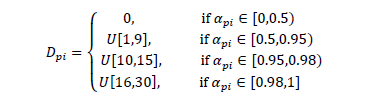
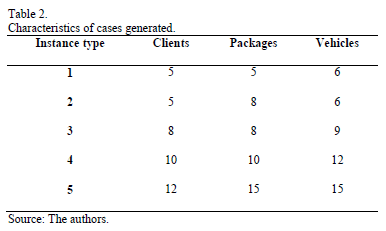
<body><![CDATA[<p align="center"><font size="2" face="Verdana, Arial, Helvetica, sans-serif"> <a name="tab01"></a></font><img src="/img/revistas/dyna/v82n191/v82n191a09tab01.gif"></p>     <p><font size="2" face="Verdana, Arial, Helvetica, sans-serif">Usually   when the company receives an order, it sends a vehicle to satisfy the demand   regardless of the size of the order or the average vehicle capacity. Although   for such cases, we do not have the   company routing at our disposal,</font> <font size="2" face="Verdana, Arial, Helvetica, sans-serif">we know that the ACU in the   historic data is around 30%, meaning that the routing that model offers,   represents an improvement of around 4% in ACU. </font></p>     <p><font size="2" face="Verdana, Arial, Helvetica, sans-serif">Therefore, based on these results, we proposed that the   company consolidate its orders due to the fact that the ACU was low. This is   possible given that the customers do not penalize the company for deliveries   delayed up to one week. In the simulated cases, we suppose that the orders can   be consolidated, that is why the ACU is significantly improved.</font></p>     <p><font size="2" face="Verdana, Arial, Helvetica, sans-serif">We created a random   generator of cases based on data from real cases to determine the demand by   probability functions. </font></p>     <p><font size="2" face="Verdana, Arial, Helvetica, sans-serif">For each client and   each type package a random real number is generated <img src="/img/revistas/dyna/v82n191/v82n191a09eq104.gif">. Then the demand <img src="/img/revistas/dyna/v82n191/v82n191a09eq106.gif"> is assigned   as follow:</font></p>     <p><img src="/img/revistas/dyna/v82n191/v82n191a09eq01121.gif"></p>     <p><font size="2" face="Verdana, Arial, Helvetica, sans-serif">Where:</font></p>     <blockquote>       <p><font size="2" face="Verdana, Arial, Helvetica, sans-serif"><img src="/img/revistas/dyna/v82n191/v82n191a09eq110.gif"> is a random integer number between a and b.</font></p> </blockquote>     <p><font size="2" face="Verdana, Arial, Helvetica, sans-serif">The quantities for the demands and the threshold for the   partitioning in demands have been selected imitating the frequencies found in   practice.</font></p>     ]]></body>
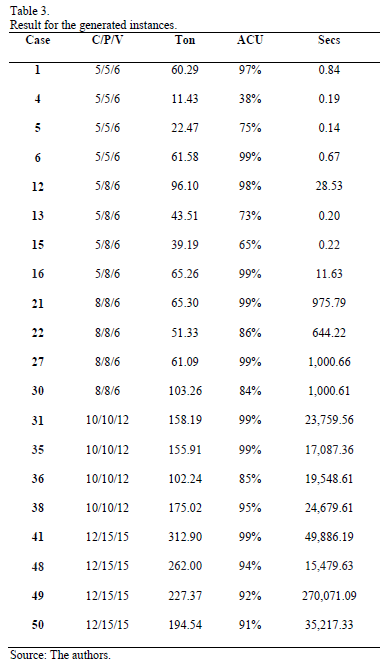
<body><![CDATA[<p><font size="2" face="Verdana, Arial, Helvetica, sans-serif">We proposed five types of cases, gradually varying the   number of clients, packages and vehicles, (see <a href="#tab02">Table 2</a>).</font></p>     <p align="center"><font size="2" face="Verdana, Arial, Helvetica, sans-serif"><a name="tab02"></a></font><img src="/img/revistas/dyna/v82n191/v82n191a09tab02.gif"></p>     <p><a href="#tab03"><font size="2" face="Verdana, Arial, Helvetica, sans-serif">Table 3</font></a><font size="2" face="Verdana, Arial, Helvetica, sans-serif"> shows twenty representative cases (four of each   kind). The first column represents the case number; the second column shows the   size of case (Clients/Package/Vehicles); the third column indicates the total   weight to be sent; the fifth column shows the average capacity used in the   solution; finally, the fifth column present the computation time in seconds to   solve each case.</font></p>     <p align="center"><font size="2" face="Verdana, Arial, Helvetica, sans-serif"><a name="tab03"></a></font><img src="/img/revistas/dyna/v82n191/v82n191a09tab03.gif"></p>     <p><font size="2" face="Verdana, Arial, Helvetica, sans-serif">We expected the time to increase according to the number   of the clients, kind of package and vehicles used, but with respect to the ACU   we were not able to determine anything.</font></p>     <p><font size="2" face="Verdana, Arial, Helvetica, sans-serif">Note that all the solutions (<a href="#tab03">Table 3</a>.) found for the 50   cases are optimal but, as can also be seen, the computation time increases   exponentially as the size of the case increases.</font></p>     <p>&nbsp;</p>     <p><font size="3" face="Verdana, Arial, Helvetica, sans-serif"><b>6. Conclusions </b></font></p>     <p><font size="2" face="Verdana, Arial, Helvetica, sans-serif">The problem studied in this work has great practical   significance because the distribution process is one of the principal   components of any supply chain, and because it is directly related to costs,   productivity and business performance in enterprises.</font></p>     <p><font size="2" face="Verdana, Arial, Helvetica, sans-serif">The main contribution of this work is the creation of a   mathematical model that helps the decision maker to adapt to different   scenarios investing less time and producing better solutions. The mathematical   tool developed is a model of mixed integer linear programming for solving   vehicle routing problems with heterogeneous fleet not belonging of the company,   split deliveries and multiple products (OVRPHFSDMP for Open Vehicle Routing   Problem with Heterogeneous Fleet, Split Deliveries and Multiple Products).</font></p>     ]]></body>
<body><![CDATA[<p><font size="2" face="Verdana, Arial, Helvetica, sans-serif">The model has been tested in real cases, in an important   company, which produces and distributes steel pipes across the country,   demonstrating that it adequately simulates reality, offering effective   solutions and a plausible profit in the distribution costs for the company.</font></p>     <p>&nbsp;</p>     <p><font size="3" face="Verdana, Arial, Helvetica, sans-serif"><b>References</b></font></p>     <!-- ref --><p><font size="2" face="Verdana, Arial, Helvetica, sans-serif"><b>&#91;1&#93;</b> Applegate,   D.L., Bixby, R.M., Chv&aacute;tal, V. and Cook, W.J.. The traveling salesman problem.   Journal of Computer and System Sciences, 72 (4), pp. 509-546, 2006.    &nbsp;&nbsp;&nbsp;&nbsp;&nbsp;&nbsp;&nbsp;&nbsp;[&#160;<a href="javascript:void(0);" onclick="javascript: window.open('/scielo.php?script=sci_nlinks&ref=000126&pid=S0012-7353201500030000900001&lng=','','width=640,height=500,resizable=yes,scrollbars=1,menubar=yes,');">Links</a>&#160;]<!-- end-ref --></font></p>     <!-- ref --><p><font size="2" face="Verdana, Arial, Helvetica, sans-serif"><b>&#91;2&#93;</b> Ballou,   R., Business logistics management: Supply chain management. Planning, Organizing,   and Controlling the Supply Chain. Weatherhead, United Kingdom: Prentice-Hall   International, 2004.    &nbsp;&nbsp;&nbsp;&nbsp;&nbsp;&nbsp;&nbsp;&nbsp;[&#160;<a href="javascript:void(0);" onclick="javascript: window.open('/scielo.php?script=sci_nlinks&ref=000128&pid=S0012-7353201500030000900002&lng=','','width=640,height=500,resizable=yes,scrollbars=1,menubar=yes,');">Links</a>&#160;]<!-- end-ref --></font></p>     <!-- ref --><p><font size="2" face="Verdana, Arial, Helvetica, sans-serif"><b>&#91;3&#93;</b> Bektas,   T., The multiple traveling salesman problem: An overview of formulations and   solution procedures. Omega, 34, pp. 209-219, 2006. DOI: 10.1016/j.omega.2004.10.004</font>&nbsp;&nbsp;&nbsp;&nbsp;&nbsp;&nbsp;&nbsp;&nbsp;[&#160;<a href="javascript:void(0);" onclick="javascript: window.open('/scielo.php?script=sci_nlinks&ref=000130&pid=S0012-7353201500030000900003&lng=','','width=640,height=500,resizable=yes,scrollbars=1,menubar=yes,');">Links</a>&#160;]<!-- end-ref --><!-- ref --><p><font size="2" face="Verdana, Arial, Helvetica, sans-serif"><b>&#91;4&#93;</b> Bodin,   L. and Golden, B., Routing and scheduling: Classification in vehicle routing   and scheduling. Networks, 11, pp. 97-108, 1981. DOI: 10.1002/net.3230110204</font>&nbsp;&nbsp;&nbsp;&nbsp;&nbsp;&nbsp;&nbsp;&nbsp;[&#160;<a href="javascript:void(0);" onclick="javascript: window.open('/scielo.php?script=sci_nlinks&ref=000131&pid=S0012-7353201500030000900004&lng=','','width=640,height=500,resizable=yes,scrollbars=1,menubar=yes,');">Links</a>&#160;]<!-- end-ref --><!-- ref --><p><font size="2" face="Verdana, Arial, Helvetica, sans-serif"><b>&#91;5&#93;</b> Dantzig,   G.B. and Ramser, J.H., The truck dispatching problem. Management Science, 6   (1), pp. 80-91, 1959. DOI: 10.1287/mnsc.6.1.80</font>&nbsp;&nbsp;&nbsp;&nbsp;&nbsp;&nbsp;&nbsp;&nbsp;[&#160;<a href="javascript:void(0);" onclick="javascript: window.open('/scielo.php?script=sci_nlinks&ref=000132&pid=S0012-7353201500030000900005&lng=','','width=640,height=500,resizable=yes,scrollbars=1,menubar=yes,');">Links</a>&#160;]<!-- end-ref --><!-- ref --><p><font size="2" face="Verdana, Arial, Helvetica, sans-serif"><b>&#91;6&#93;</b> Desrochers,   M., Lenstra, J.K. and Savelsbergh, M.W.P., A classification scheme for vehicle   routing and scheduling problems. European Journal of Operational Research, 47,   pp.75-85, 1990. DOI: 10.1016/0377-2217(90)90007-x</font>&nbsp;&nbsp;&nbsp;&nbsp;&nbsp;&nbsp;&nbsp;&nbsp;[&#160;<a href="javascript:void(0);" onclick="javascript: window.open('/scielo.php?script=sci_nlinks&ref=000133&pid=S0012-7353201500030000900006&lng=','','width=640,height=500,resizable=yes,scrollbars=1,menubar=yes,');">Links</a>&#160;]<!-- end-ref --><!-- ref --><p><font size="2" face="Verdana, Arial, Helvetica, sans-serif"><b>&#91;7&#93;</b> Dror,   M. and Trudeau, P., Split delivery routing. Naval Research Logistics, 37, pp.   383-402. 1990. DOI: 10.1002/nav.3800370304</font>&nbsp;&nbsp;&nbsp;&nbsp;&nbsp;&nbsp;&nbsp;&nbsp;[&#160;<a href="javascript:void(0);" onclick="javascript: window.open('/scielo.php?script=sci_nlinks&ref=000134&pid=S0012-7353201500030000900007&lng=','','width=640,height=500,resizable=yes,scrollbars=1,menubar=yes,');">Links</a>&#160;]<!-- end-ref --><!-- ref --><p><font size="2" face="Verdana, Arial, Helvetica, sans-serif"><b>&#91;8&#93;</b> Galv&aacute;n, S., Arias, J. y Lamos H.,   Optimizaci&oacute;n por simulaci&oacute;n basado en EPSO para el problema de ruteo de   veh&iacute;culos con demandas estoc&aacute;sticas. DYNA, 80 (179), pp. 60-69, 2013.    &nbsp;&nbsp;&nbsp;&nbsp;&nbsp;&nbsp;&nbsp;&nbsp;[&#160;<a href="javascript:void(0);" onclick="javascript: window.open('/scielo.php?script=sci_nlinks&ref=000135&pid=S0012-7353201500030000900008&lng=','','width=640,height=500,resizable=yes,scrollbars=1,menubar=yes,');">Links</a>&#160;]<!-- end-ref --></font></p>     <!-- ref --><p><font size="2" face="Verdana, Arial, Helvetica, sans-serif"><b>&#91;9&#93;</b> Laporte,   G., Fifty years of vehicle routing. Journal of Transportation Science, 43 (4),   pp. 408-416, 2009. DOI: 10.1287/trsc.1090.0301</font>&nbsp;&nbsp;&nbsp;&nbsp;&nbsp;&nbsp;&nbsp;&nbsp;[&#160;<a href="javascript:void(0);" onclick="javascript: window.open('/scielo.php?script=sci_nlinks&ref=000137&pid=S0012-7353201500030000900009&lng=','','width=640,height=500,resizable=yes,scrollbars=1,menubar=yes,');">Links</a>&#160;]<!-- end-ref --><!-- ref --><p><font size="2" face="Verdana, Arial, Helvetica, sans-serif"><b>&#91;10&#93;</b> Laporte,   G. The vehicle routing problem: An overview of exact and approximate   algorithms. European Journal of Operational Research 59, pp. 345-358, 1992. DOI: 10.1016/0377-2217(92)90192-C</font>&nbsp;&nbsp;&nbsp;&nbsp;&nbsp;&nbsp;&nbsp;&nbsp;[&#160;<a href="javascript:void(0);" onclick="javascript: window.open('/scielo.php?script=sci_nlinks&ref=000138&pid=S0012-7353201500030000900010&lng=','','width=640,height=500,resizable=yes,scrollbars=1,menubar=yes,');">Links</a>&#160;]<!-- end-ref --><!-- ref --><p><font size="2" face="Verdana, Arial, Helvetica, sans-serif"><b>&#91;11&#93;</b> Laporte,   G. and Nobert, Y., Exact algorithms for the vehicle routing problem. Annals of   Discrete Mathematics 31, pp. 147-184, 1987. DOI: 10.1016/s0304-0208(08)73235-3</font>&nbsp;&nbsp;&nbsp;&nbsp;&nbsp;&nbsp;&nbsp;&nbsp;[&#160;<a href="javascript:void(0);" onclick="javascript: window.open('/scielo.php?script=sci_nlinks&ref=000139&pid=S0012-7353201500030000900011&lng=','','width=640,height=500,resizable=yes,scrollbars=1,menubar=yes,');">Links</a>&#160;]<!-- end-ref --><!-- ref --><p><font size="2" face="Verdana, Arial, Helvetica, sans-serif"><b>&#91;12&#93;</b> Sep&uacute;lveda,   J, Escobar, J.W. and Adarme-Jaimes, W., An algorithm for the routing problem   with split deliveries and time windows (SDVRPTW) applied on retail SME   distribution activities. DYNA, 81 (187), pp. 223-231, 2014. DOI: 10.15446/dyna.v81n187.46104</font>&nbsp;&nbsp;&nbsp;&nbsp;&nbsp;&nbsp;&nbsp;&nbsp;[&#160;<a href="javascript:void(0);" onclick="javascript: window.open('/scielo.php?script=sci_nlinks&ref=000140&pid=S0012-7353201500030000900012&lng=','','width=640,height=500,resizable=yes,scrollbars=1,menubar=yes,');">Links</a>&#160;]<!-- end-ref --><!-- ref --><p><font size="2" face="Verdana, Arial, Helvetica, sans-serif"><b>&#91;13&#93;</b> Toth   P. and Vigo D., Models, relaxations and exact approaches for the capacitated   vehicle routing. Bologna: Ediciones SIAM, 2002.    &nbsp;&nbsp;&nbsp;&nbsp;&nbsp;&nbsp;&nbsp;&nbsp;[&#160;<a href="javascript:void(0);" onclick="javascript: window.open('/scielo.php?script=sci_nlinks&ref=000141&pid=S0012-7353201500030000900013&lng=','','width=640,height=500,resizable=yes,scrollbars=1,menubar=yes,');">Links</a>&#160;]<!-- end-ref --></font></p>     ]]></body>
<body><![CDATA[<!-- ref --><p><font size="2" face="Verdana, Arial, Helvetica, sans-serif"><b>&#91;14&#93;</b> Yepes, V., Las redes de distribuci&oacute;n como   elementos de ventaja competitiva. Qualitas Hodie 76, pp. 30-33, 2002.    &nbsp;&nbsp;&nbsp;&nbsp;&nbsp;&nbsp;&nbsp;&nbsp;[&#160;<a href="javascript:void(0);" onclick="javascript: window.open('/scielo.php?script=sci_nlinks&ref=000143&pid=S0012-7353201500030000900014&lng=','','width=640,height=500,resizable=yes,scrollbars=1,menubar=yes,');">Links</a>&#160;]<!-- end-ref --></font></p>     <p>&nbsp;</p>     <p><font size="2" face="Verdana, Arial, Helvetica, sans-serif"><b>M. Mata-P&eacute;rez,</b> completed a BSc in Applied Mathematics at UAQ, Mexico in 2002, and a MSc.   degree and PhD. in Engineering Systems at the UANL, Mexico. He is an expert in   mathematical modeling and optimization of large-scale systems. He is currently   a full professor in the Logistics and Supply Chain Program of UANL, Mexico.</font></p>     <p><font size="2" face="Verdana, Arial, Helvetica, sans-serif"><b>J.A.   Saucedo-Mart&iacute;nez,</b> completed her BSc. In Mathematics at UANL, Mexico in   2005, a MSc. degree in Engineering Systems at UANL, Mexico, and a PhD in   Applied Mathematics at UNESP, Brazil, in 2012. She is an expert in mathematical   modeling and optimization of large-scale systems. She is full professor in the   Logistics and Supply Chain Program at UANL, Mexico.</font></p>      ]]></body><back>
<ref-list>
<ref id="B1">
<label>1</label><nlm-citation citation-type="journal">
<person-group person-group-type="author">
<name>
<surname><![CDATA[Applegate]]></surname>
<given-names><![CDATA[D.L.]]></given-names>
</name>
<name>
<surname><![CDATA[Bixby]]></surname>
<given-names><![CDATA[R.M.]]></given-names>
</name>
<name>
<surname><![CDATA[Chvátal]]></surname>
<given-names><![CDATA[V.]]></given-names>
</name>
<name>
<surname><![CDATA[Cook]]></surname>
<given-names><![CDATA[W.J.]]></given-names>
</name>
</person-group>
<article-title xml:lang="en"><![CDATA[The traveling salesman problem]]></article-title>
<source><![CDATA[Journal of Computer and System Sciences]]></source>
<year>2006</year>
<volume>72</volume>
<numero>4</numero>
<issue>4</issue>
<page-range>509-546</page-range></nlm-citation>
</ref>
<ref id="B2">
<label>2</label><nlm-citation citation-type="book">
<person-group person-group-type="author">
<name>
<surname><![CDATA[Ballou]]></surname>
<given-names><![CDATA[R.]]></given-names>
</name>
</person-group>
<source><![CDATA[Business logistics management: Supply chain management. Planning, Organizing, and Controlling the Supply Chain]]></source>
<year>2004</year>
<publisher-loc><![CDATA[Weatherhead ]]></publisher-loc>
<publisher-name><![CDATA[Prentice-Hall International]]></publisher-name>
</nlm-citation>
</ref>
<ref id="B3">
<label>3</label><nlm-citation citation-type="journal">
<person-group person-group-type="author">
<name>
<surname><![CDATA[Bektas]]></surname>
<given-names><![CDATA[T.]]></given-names>
</name>
</person-group>
<article-title xml:lang="en"><![CDATA[The multiple traveling salesman problem: An overview of formulations and solution procedures]]></article-title>
<source><![CDATA[Omega]]></source>
<year>2006</year>
<numero>34</numero>
<issue>34</issue>
<page-range>209-219</page-range></nlm-citation>
</ref>
<ref id="B4">
<label>4</label><nlm-citation citation-type="journal">
<person-group person-group-type="author">
<name>
<surname><![CDATA[Bodin]]></surname>
<given-names><![CDATA[L.]]></given-names>
</name>
<name>
<surname><![CDATA[Golden]]></surname>
<given-names><![CDATA[B.]]></given-names>
</name>
</person-group>
<article-title xml:lang="en"><![CDATA[Routing and scheduling: Classification in vehicle routing and scheduling]]></article-title>
<source><![CDATA[Networks]]></source>
<year>1981</year>
<numero>11</numero>
<issue>11</issue>
<page-range>97-108</page-range></nlm-citation>
</ref>
<ref id="B5">
<label>5</label><nlm-citation citation-type="journal">
<person-group person-group-type="author">
<name>
<surname><![CDATA[Dantzig]]></surname>
<given-names><![CDATA[G.B.]]></given-names>
</name>
<name>
<surname><![CDATA[Ramser]]></surname>
<given-names><![CDATA[J.H.]]></given-names>
</name>
</person-group>
<article-title xml:lang="en"><![CDATA[The truck dispatching problem.]]></article-title>
<source><![CDATA[Management Science]]></source>
<year>1959</year>
<volume>6</volume>
<numero>1</numero>
<issue>1</issue>
<page-range>80-91</page-range></nlm-citation>
</ref>
<ref id="B6">
<label>6</label><nlm-citation citation-type="journal">
<person-group person-group-type="author">
<name>
<surname><![CDATA[Desrochers]]></surname>
<given-names><![CDATA[M.]]></given-names>
</name>
<name>
<surname><![CDATA[Lenstra]]></surname>
<given-names><![CDATA[J.K.]]></given-names>
</name>
<name>
<surname><![CDATA[Savelsbergh]]></surname>
<given-names><![CDATA[M.W.P.]]></given-names>
</name>
</person-group>
<article-title xml:lang="en"><![CDATA[A classification scheme for vehicle routing and scheduling problems]]></article-title>
<source><![CDATA[European Journal of Operational Research]]></source>
<year>1990</year>
<numero>47</numero>
<issue>47</issue>
<page-range>75-85</page-range></nlm-citation>
</ref>
<ref id="B7">
<label>7</label><nlm-citation citation-type="journal">
<person-group person-group-type="author">
<name>
<surname><![CDATA[Dror]]></surname>
<given-names><![CDATA[M.]]></given-names>
</name>
<name>
<surname><![CDATA[Trudeau]]></surname>
<given-names><![CDATA[P.]]></given-names>
</name>
</person-group>
<article-title xml:lang="en"><![CDATA[Split delivery routing]]></article-title>
<source><![CDATA[Naval Research Logistics]]></source>
<year>1990</year>
<numero>37</numero>
<issue>37</issue>
<page-range>383-402</page-range></nlm-citation>
</ref>
<ref id="B8">
<label>8</label><nlm-citation citation-type="journal">
<person-group person-group-type="author">
<name>
<surname><![CDATA[Galván]]></surname>
<given-names><![CDATA[S.]]></given-names>
</name>
<name>
<surname><![CDATA[Arias]]></surname>
<given-names><![CDATA[J.]]></given-names>
</name>
<name>
<surname><![CDATA[Lamos]]></surname>
<given-names><![CDATA[H.]]></given-names>
</name>
</person-group>
<article-title xml:lang="es"><![CDATA[Optimización por simulación basado en EPSO para el problema de ruteo de vehículos con demandas estocásticas]]></article-title>
<source><![CDATA[DYNA]]></source>
<year>2013</year>
<volume>80</volume>
<numero>179</numero>
<issue>179</issue>
<page-range>60-69</page-range></nlm-citation>
</ref>
<ref id="B9">
<label>9</label><nlm-citation citation-type="journal">
<person-group person-group-type="author">
<name>
<surname><![CDATA[Laporte]]></surname>
<given-names><![CDATA[G.]]></given-names>
</name>
</person-group>
<article-title xml:lang="en"><![CDATA[Fifty years of vehicle routing]]></article-title>
<source><![CDATA[Journal of Transportation Science]]></source>
<year>2009</year>
<volume>43</volume>
<numero>4</numero>
<issue>4</issue>
<page-range>408-416</page-range></nlm-citation>
</ref>
<ref id="B10">
<label>10</label><nlm-citation citation-type="journal">
<person-group person-group-type="author">
<name>
<surname><![CDATA[Laporte]]></surname>
<given-names><![CDATA[G.]]></given-names>
</name>
</person-group>
<article-title xml:lang="en"><![CDATA[The vehicle routing problem: An overview of exact and approximate algorithms]]></article-title>
<source><![CDATA[European Journal of Operational Research]]></source>
<year>1992</year>
<numero>59</numero>
<issue>59</issue>
<page-range>345-358</page-range></nlm-citation>
</ref>
<ref id="B11">
<label>11</label><nlm-citation citation-type="journal">
<person-group person-group-type="author">
<name>
<surname><![CDATA[Laporte]]></surname>
<given-names><![CDATA[G.]]></given-names>
</name>
<name>
<surname><![CDATA[Nobert]]></surname>
<given-names><![CDATA[Y.]]></given-names>
</name>
</person-group>
<article-title xml:lang="en"><![CDATA[Exact algorithms for the vehicle routing problem]]></article-title>
<source><![CDATA[Annals of Discrete Mathematics]]></source>
<year>1987</year>
<numero>31</numero>
<issue>31</issue>
<page-range>147-184</page-range></nlm-citation>
</ref>
<ref id="B12">
<label>12</label><nlm-citation citation-type="journal">
<person-group person-group-type="author">
<name>
<surname><![CDATA[Sepúlveda]]></surname>
<given-names><![CDATA[J]]></given-names>
</name>
<name>
<surname><![CDATA[Escobar]]></surname>
<given-names><![CDATA[J.W.]]></given-names>
</name>
<name>
<surname><![CDATA[Adarme-Jaimes]]></surname>
<given-names><![CDATA[W.]]></given-names>
</name>
</person-group>
<article-title xml:lang="en"><![CDATA[An algorithm for the routing problem with split deliveries and time windows (SDVRPTW) applied on retail SME distribution activities]]></article-title>
<source><![CDATA[DYNA]]></source>
<year>2014</year>
<volume>81</volume>
<numero>187</numero>
<issue>187</issue>
<page-range>223-231</page-range></nlm-citation>
</ref>
<ref id="B13">
<label>13</label><nlm-citation citation-type="book">
<person-group person-group-type="author">
<name>
<surname><![CDATA[Toth]]></surname>
<given-names><![CDATA[P.]]></given-names>
</name>
<name>
<surname><![CDATA[Vigo]]></surname>
<given-names><![CDATA[D.]]></given-names>
</name>
</person-group>
<source><![CDATA[Models, relaxations and exact approaches for the capacitated vehicle routing]]></source>
<year>2002</year>
<publisher-loc><![CDATA[Bologna ]]></publisher-loc>
<publisher-name><![CDATA[Ediciones SIAM]]></publisher-name>
</nlm-citation>
</ref>
<ref id="B14">
<label>14</label><nlm-citation citation-type="journal">
<person-group person-group-type="author">
<name>
<surname><![CDATA[Yepes]]></surname>
<given-names><![CDATA[V.]]></given-names>
</name>
</person-group>
<article-title xml:lang="es"><![CDATA[Las redes de distribución como elementos de ventaja competitiva]]></article-title>
<source><![CDATA[Qualitas Hodie]]></source>
<year>2002</year>
<numero>76</numero>
<issue>76</issue>
<page-range>30-33</page-range></nlm-citation>
</ref>
</ref-list>
</back>
</article>