<?xml version="1.0" encoding="ISO-8859-1"?><article xmlns:mml="http://www.w3.org/1998/Math/MathML" xmlns:xlink="http://www.w3.org/1999/xlink" xmlns:xsi="http://www.w3.org/2001/XMLSchema-instance">
<front>
<journal-meta>
<journal-id>0012-7353</journal-id>
<journal-title><![CDATA[DYNA]]></journal-title>
<abbrev-journal-title><![CDATA[Dyna rev.fac.nac.minas]]></abbrev-journal-title>
<issn>0012-7353</issn>
<publisher>
<publisher-name><![CDATA[Universidad Nacional de Colombia]]></publisher-name>
</publisher>
</journal-meta>
<article-meta>
<article-id>S0012-73532015000300010</article-id>
<article-id pub-id-type="doi">10.15446/dyna.v82n191.51157</article-id>
<title-group>
<article-title xml:lang="en"><![CDATA[Effects of management commitment and organization of work teams on the benefits of Kaizen: Planning stage]]></article-title>
<article-title xml:lang="es"><![CDATA[Efectos del compromiso gerencial y organización de equipos de trabajo en los beneficios del Kaizen: Etapa de planeación]]></article-title>
</title-group>
<contrib-group>
<contrib contrib-type="author">
<name>
<surname><![CDATA[Oropesa-Vento]]></surname>
<given-names><![CDATA[Midiala]]></given-names>
</name>
<xref ref-type="aff" rid="A01"/>
</contrib>
<contrib contrib-type="author">
<name>
<surname><![CDATA[García-Alcaraz]]></surname>
<given-names><![CDATA[Jorge Luis]]></given-names>
</name>
<xref ref-type="aff" rid="A02"/>
</contrib>
<contrib contrib-type="author">
<name>
<surname><![CDATA[Rivera]]></surname>
<given-names><![CDATA[Leonardo]]></given-names>
</name>
<xref ref-type="aff" rid="A03"/>
</contrib>
<contrib contrib-type="author">
<name>
<surname><![CDATA[Manotas]]></surname>
<given-names><![CDATA[Diego F.]]></given-names>
</name>
<xref ref-type="aff" rid="A03"/>
</contrib>
</contrib-group>
<aff id="A01">
<institution><![CDATA[,Universidad Autónoma de Ciudad Juárez Instituto de Ingeniería y Tecnología ]]></institution>
<addr-line><![CDATA[ ]]></addr-line>
<country>México</country>
</aff>
<aff id="A02">
<institution><![CDATA[,Universidad Autónoma de Ciudad Juárez Instituto de Ingeniería y Tecnología ]]></institution>
<addr-line><![CDATA[ ]]></addr-line>
<country>México</country>
</aff>
<aff id="A03">
<institution><![CDATA[,Universidad del Valle Escuela de Ingeniería Industrial ]]></institution>
<addr-line><![CDATA[ ]]></addr-line>
<country>Colombia</country>
</aff>
<aff id="A">
<institution><![CDATA[,diego.manotas@correounivalle.edu.co  ]]></institution>
<addr-line><![CDATA[ ]]></addr-line>
</aff>
<pub-date pub-type="pub">
<day>00</day>
<month>06</month>
<year>2015</year>
</pub-date>
<pub-date pub-type="epub">
<day>00</day>
<month>06</month>
<year>2015</year>
</pub-date>
<volume>82</volume>
<numero>191</numero>
<fpage>76</fpage>
<lpage>84</lpage>
<copyright-statement/>
<copyright-year/>
<self-uri xlink:href="http://www.scielo.org.co/scielo.php?script=sci_arttext&amp;pid=S0012-73532015000300010&amp;lng=en&amp;nrm=iso"></self-uri><self-uri xlink:href="http://www.scielo.org.co/scielo.php?script=sci_abstract&amp;pid=S0012-73532015000300010&amp;lng=en&amp;nrm=iso"></self-uri><self-uri xlink:href="http://www.scielo.org.co/scielo.php?script=sci_pdf&amp;pid=S0012-73532015000300010&amp;lng=en&amp;nrm=iso"></self-uri><abstract abstract-type="short" xml:lang="en"><p><![CDATA[This paper presents an analysis of the effects of management commitment and organization of work teams in the benefits of implementing Kaizen in industrial enterprises during planning stages. To gather information, 200 questionnaires were applied to 68 companies distributed in the states of Tabasco, Sinaloa and Chihuahua in Mexico and in the province of Camagüey, Cuba. We used the methodology of least partial squares with the WarpPLS 4.0 software to develop a model of structural equations that explains such effects. The results show that when there is a high level of managerial commitment, this impacts the profits and competitiveness of companies positively. We also found that the organization of work teams has positive impacts on competitive benefits and these, in turn, on economic benefits. As a result of this study, we present the impact of certain critical success factors of Kaizen on the benefits of its implementation, which is a key factor in its sustainability over time.]]></p></abstract>
<abstract abstract-type="short" xml:lang="es"><p><![CDATA[Este trabajo presenta un análisis de los efectos que tienen el compromiso gerencial y la organización de equipos de trabajo en los beneficios de la implementación del kaizen en las empresas industriales durante su etapa de planeación. Para buscar la información se aplicaron 200 cuestionarios a 68 empresas distribuidas en los estados de Tabasco, Sinaloa y Chihuahua en México y también en la provincia de Camagüey. Cuba. Para obtener un modelo de ecuaciones estructurales explicativo de los efectos, se utilizó la metodología de mínimos cuadrados parciales usando WarpPLS 4.0. Los resultados obtenidos muestran que cuando existe un alto compromiso gerencial se tiene impactos positivos en los beneficios económicos y competitivos de las empresas. Asimismo, la organización de equipos de trabajo tiene impactos positivos sobre los beneficios competitivos y estos a su vez sobre los beneficios económicos obtenidos. Como resultado de este estudio se muestra el impacto que tienen determinados factores críticos de éxito del Kaizen, en los beneficios de implementación del mismo, elemento primordial para su sostenibilidad en el tiempo.]]></p></abstract>
<kwd-group>
<kwd lng="en"><![CDATA[kaizen]]></kwd>
<kwd lng="en"><![CDATA[management commitment]]></kwd>
<kwd lng="en"><![CDATA[coordination of teams]]></kwd>
<kwd lng="en"><![CDATA[partial least squares]]></kwd>
<kwd lng="es"><![CDATA[kaizen]]></kwd>
<kwd lng="es"><![CDATA[compromiso gerencial]]></kwd>
<kwd lng="es"><![CDATA[organización de equipos de trabajo]]></kwd>
<kwd lng="es"><![CDATA[mínimos cuadrados parciales]]></kwd>
</kwd-group>
</article-meta>
</front><body><![CDATA[ <p><font size="1" face="Verdana, Arial, Helvetica, sans-serif"><b>DOI: </b><a href="http://dx.doi.org/10.15446/dyna.v82n191.51157" target="_blank">http://dx.doi.org/10.15446/dyna.v82n191.51157</a></font></p>     <p align="center"><font size="4" face="Verdana, Arial, Helvetica, sans-serif"><b>Effects of management commitment and organization   of work teams on the benefits of Kaizen: Planning stage</b></font></p>     <p align="center"><i><b><font size="3" face="Verdana, Arial, Helvetica, sans-serif">Efectos   del compromiso gerencial y organizaci&oacute;n de equipos de trabajo en los beneficios   del Kaizen: Etapa de planeaci&oacute;n</font></b></i></p>     <p align="center">&nbsp;</p>     <p align="center"><b><font size="2" face="Verdana, Arial, Helvetica, sans-serif">Midiala Oropesa-Vento <i><sup>a</sup></i> Jorge Luis Garc&iacute;a-Alcaraz <i><sup> b</sup></i> Leonardo Rivera <i><sup>c</sup></i> &amp; Diego F. Manotas <i><sup>d</sup></i></font></b></p>     <p align="center">&nbsp;</p>     <p align="center"><font size="2" face="Verdana, Arial, Helvetica, sans-serif"><sup><i>a </i></sup><i>Instituto de Ingenier&iacute;a y Tecnolog&iacute;a, Universidad Aut&oacute;noma de   Ciudad Ju&aacute;rez, M&eacute;xico. <a href="mailto:al132804@alumnos.uacj.mx">al132804@alumnos.uacj.mx</a>    <br>   <sup>b</sup> Instituto de Ingenier&iacute;a y Tecnolog&iacute;a, Universidad Aut&oacute;noma de   Ciudad Ju&aacute;rez, M&eacute;xico. <a href="mailto:jorge.garcia@uacj.mx">jorge.garcia@uacj.mx</a>    <br>   <sup>c,d </sup>Escuela de Ingenier&iacute;a   Industrial. Universidad del Valle, Colombia. <a href="mailto:leonardo.rivera.c@correounivalle.edu.co">leonardo.rivera.c@correounivalle.edu.co</a>; <a href="mailto:diego.manotas@correounivalle.edu.co">diego.manotas@correounivalle.edu.co</a></i></font></p>     <p align="center">&nbsp;</p>     ]]></body>
<body><![CDATA[<p align="center"><font size="2" face="Verdana, Arial, Helvetica, sans-serif"><b>Received: January 28<sup>th</sup>, 2015. Received in revised form: March 26<sup>th</sup>, 2015. Accepted: April 30<sup>th</sup>, 2015.</b></font></p>     <p align="center">&nbsp;</p>     <p align="center"><font size="1" face="Verdana, Arial, Helvetica, sans-seriff"><b>This work is licensed under a</b> <a rel="license" href="http://creativecommons.org/licenses/by-nc-nd/4.0/">Creative Commons Attribution-NonCommercial-NoDerivatives 4.0 International License</a>.</font><br />   <a rel="license" href="http://creativecommons.org/licenses/by-nc-nd/4.0/"><img style="border-width:0" src="https://i.creativecommons.org/l/by-nc-nd/4.0/88x31.png" /></a></p> <hr>     <p><font size="2" face="Verdana, Arial, Helvetica, sans-serif"><b>Abstract    <br>   </b></font><font size="2" face="Verdana, Arial, Helvetica, sans-serif">This paper presents an analysis of the effects of   management commitment and organization of work teams in the benefits of   implementing Kaizen in industrial enterprises during planning stages. To gather   information, 200 questionnaires were applied to 68 companies distributed in the   states of Tabasco, Sinaloa and Chihuahua in Mexico and in the province of   Camagüey, Cuba. We used the methodology of least partial squares with the   WarpPLS 4.0 software to develop a model of structural equations that explains   such effects. The results show that when there is a high level of managerial   commitment, this impacts the profits and competitiveness of companies   positively. We also found that the organization of work teams has positive   impacts on competitive benefits and these, in turn, on economic benefits. As a   result of this study, we present the impact of certain critical success factors   of Kaizen on the benefits of its implementation, which is a key factor in its   sustainability over time.</font></p>     <p><font size="2" face="Verdana, Arial, Helvetica, sans-serif"><i>Keywords:</i> kaizen, management commitment, coordination of teams, partial least squares   (PLS).</font></p>     <p><font size="2" face="Verdana, Arial, Helvetica, sans-serif"><b>Resumen    <br>   </b></font><font size="2" face="Verdana, Arial, Helvetica, sans-serif">Este   trabajo presenta un an&aacute;lisis de los efectos que tienen el compromiso gerencial   y la organizaci&oacute;n de equipos de trabajo en los beneficios de la implementaci&oacute;n   del kaizen en las empresas industriales durante su etapa de planeaci&oacute;n. Para buscar la informaci&oacute;n se aplicaron 200   cuestionarios a 68 empresas distribuidas en los estados de Tabasco, Sinaloa y   Chihuahua en M&eacute;xico y tambi&eacute;n en la provincia de Camagüey. Cuba. Para obtener   un modelo de ecuaciones estructurales explicativo de los efectos, se utiliz&oacute; la   metodolog&iacute;a de m&iacute;nimos cuadrados parciales usando WarpPLS 4.0. Los resultados   obtenidos muestran que cuando existe un alto compromiso gerencial se tiene   impactos positivos en los beneficios econ&oacute;micos y competitivos de las empresas.   Asimismo, la organizaci&oacute;n de equipos de trabajo tiene impactos positivos sobre   los beneficios competitivos y estos a su vez sobre los beneficios econ&oacute;micos   obtenidos. Como resultado de este estudio se muestra el impacto que tienen   determinados factores cr&iacute;ticos de &eacute;xito del Kaizen, en los beneficios de   implementaci&oacute;n del mismo, elemento primordial para su sostenibilidad en el   tiempo. </font></p>     <p><font size="2" face="Verdana, Arial, Helvetica, sans-serif"><i>Palabras clave</i>: kaizen, compromiso gerencial, organizaci&oacute;n de   equipos de trabajo, m&iacute;nimos cuadrados parciales (PLS).</font></p> <hr>     <p>&nbsp;</p>     ]]></body>
<body><![CDATA[<p><font size="3" face="Verdana, Arial, Helvetica, sans-serif"><b>1. Introduction</b></font></p>     <p><font size="2" face="Verdana, Arial, Helvetica, sans-serif">Over the years,   Western industries have managed their businesses pursuing short-term goals.   This practice prevents them from seeing beyond their immediate needs, and holds   them in short-term planning processes. This is short-sighted and limits the   levels of quality and profitability they can reach. According to the management   teams of Japanese companies, the secret of the most successful companies in the   world lies in having high quality standards for their products, processes,   services and employees; Therefore, quality is a philosophy that should be   applied at all levels in an organization, and this requires a continuous   improvement process that should have no end &#91;1-3&#93;. This process enables   companies to view a wider horizon, to maintain a permanent pursuit of   excellence and innovation, to increase their competitiveness and reduce costs,   guiding their efforts to meet the needs and expectations of customers, both   internal and external. </font></p>     <p><font size="2" face="Verdana, Arial, Helvetica, sans-serif">Furthermore, this   process of continuous improvement requires that the manager behave like a true   leader in the organization, ensuring the participation of all the employees,   and getting involved in all the processes of the supply chain. To do this, he   must commit deeply to this work, since he is responsible for implementing the   process and the most important driving force of the company. </font></p>     <p><font size="2" face="Verdana, Arial, Helvetica, sans-serif">To carry out this   process of continuous improvement, both in a particular department and across   the company, it should be taken into consideration that this process should be:   economic (it should require less effort than the benefits it brings), and   cumulative, in that each improvement realized will open the possibility of   successive improvements while taking full advantage of the new level of   performance.</font></p>     <p><font size="2" face="Verdana, Arial, Helvetica, sans-serif">This paper   analyzes the impact that managerial commitment and teamwork have on the   benefits of continuous improvement systems from the perspective of Kaizen. We   also measure the perception of many people at managerial levels around the   issues of continuous improvement, and with this, we validate the hypotheses   enunciated in the paper.</font></p>     <p><font size="2" face="Verdana, Arial, Helvetica, sans-serif">The paper is   organized into 5 sections. After the introduction, Section 2 presents a review   of literature associated with Kaizen, in Section 3 we present the design of   this research, Section 4 shows the results, and finally Section 5 presents   conclusions, limitations and future research.</font></p>     <p>&nbsp;</p>     <p><font size="3" face="Verdana, Arial, Helvetica, sans-serif"><b>2. Literature Review</b></font></p>     <p><font size="2" face="Verdana, Arial, Helvetica, sans-serif"><b><i>2.1. Kaizen in industry</i></b></font></p>     <p><font size="2" face="Verdana, Arial, Helvetica, sans-serif">Companies can   obtain significant competitive advantages by successfully implementing Kaizen.   The elements that made Kaizen successful in the Toyota Production System are   still valid. We could even argue that these elements make Kaizen even more   relevant today than in the 70s and 80s, in a competitive environment where   speed and efficiency are crucial &#91;1,2&#93;.</font></p>     ]]></body>
<body><![CDATA[<p><font size="2" face="Verdana, Arial, Helvetica, sans-serif">Kaizen is   reported to lead to higher quality and productivity. Kaizen also helps to   improve accountability and employee commitment &#91;2, 3&#93;. These results have kept   Kaizen as a popular topic in companies around the world &#91;3&#93; and a staple in the   scientific literature &#91;3-11&#93;. </font></p>     <p><font size="2" face="Verdana, Arial, Helvetica, sans-serif">In today's   agitated and uncertain economic environment, in which we are still feeling the   aftermath of the financial crisis of 2008 and 2009, many Mexican industrial   companies have initiated or increased their efforts to improve their   operations. These companies have noticed that the sole reduction of their   headcount is not enough, providing fertile ground for the application of   philosophies such as Lean Manufacturing and Kaizen &#91;12,13&#93;. </font></p>     <p><font size="2" face="Verdana, Arial, Helvetica, sans-serif">The success of   Kaizen in companies is due to the fact that it involves every employee in the   continuous improvement effort, taking advantage of their contributions to   achieve small and gradual changes &#91;14,15&#93;. In this manner, Kaizen centers in   the identification of problems, their root causes, the solutions that must be   implemented and the change in standards and operational methods required to   ensure that the problem does not occur again &#91;16&#93;. </font></p>     <p><font size="2" face="Verdana, Arial, Helvetica, sans-serif">There are reports   in the literature that state that in established Kaizen programs, each employee   submits between 25 and 30 suggestions every year, and that around 90% of them   are implemented. Toyota is recognized as a leading company in the application   of Kaizen. In 1999, one of the Toyota manufacturing facilities located in the   United Stated reported that 7,000 employees submitted over 75,000 suggestions,   out of which about 99% was implemented &#91;15&#93;. </font></p>     <p><font size="2" face="Verdana, Arial, Helvetica, sans-serif">By measuring the   sustainability of Kaizen, the research has tended to emphasize the critical   success factors to measure its impact on the economic and competitive benefits   of a company. Because the sustainability of Kaizen is measured by attributes or   parameters that generate information, it requires all participants to be   involved and committed to focusing on common customer satisfaction goals to be   effective, allowing them to become more competitive. Therefore, it is essential   to have clear and standardized attributes that enable the organization to know   which factors have a greater impact on certain benefits, some of which are   discussed below. </font></p>     <p><font size="2" face="Verdana, Arial, Helvetica, sans-serif"><b><i>2.2. Management commitment and organization of work   teams in the implementation of Kaizen</i></b></font></p>     <p><font size="2" face="Verdana, Arial, Helvetica, sans-serif">People in   management positions show no apparent concern for the development of   relationships between the management level and the members of the organization,   through which the manager may have some positive influence on their behavior   &#91;17&#93;. </font></p>     <p><font size="2" face="Verdana, Arial, Helvetica, sans-serif">The strategic   process, including the development, implementation and monitoring of strategies   in the business, reflects the characteristics of the style of leadership in the   company. Managers need to implement organizational changes to face new   challenges, to ensure that the company adapts to and copes with new   circumstances. However, the company and its individuals resist such changes in   many ways &#91;18&#93;.</font></p>     <p><font size="2" face="Verdana, Arial, Helvetica, sans-serif">Most managers   tend to consider several factors such as: company profile, top management   orientation, goals and objectives, internal variables, external variables and   other factors that appear to be key to determining the success or failure of   strategies in the organization. However, issues related to human factors are   not considered, such as the development of management skills aimed at creating   relationships between managers and people at lower levels to persuade and   motivate members of the organization, whose participation is essential for the   successful development of the strategy &#91;19&#93;. </font></p>     <p><font size="2" face="Verdana, Arial, Helvetica, sans-serif">Consequently, one   of the main problems in large and medium industrial enterprises is the lack of   leadership in those who have the responsibility to manage the company. Every   industrialist has shown a certain degree of leadership, because they have   created companies in the market conditions at the time &#91;20&#93;. But these people   unfortunately do not view leadership as a quality through which they can   influence human factor towards achieving the goals in the company &#91;21&#93;.</font></p>     ]]></body>
<body><![CDATA[<p><font size="2" face="Verdana, Arial, Helvetica, sans-serif">The prevailing   approach to leadership in senior management is to apply those policies and   procedures that were useful for the company in the past and assume that they   will be useful in the near future. This approach is guided by the idea that the   manager can act as a leader exerting power in his managerial position &#91;22&#93;.   Other employees do not present their points of view because they perceive this   as a high-risk attitude that they are not willing to take &#91;23&#93;. </font></p>     <p><font size="2" face="Verdana, Arial, Helvetica, sans-serif">In the current   study, activities related to management commitment and work teams and their   impact on company profits in implementing the Kaizen are determined, since this   commitment from the members of the organization to the goals of a particular   strategy in the business, is affected by the lack of motivation to achieve   them. Management does not pay attention from to the personal interests of   individuals &#91;3,5,20,22&#93;. </font></p>     <p><font size="2" face="Verdana, Arial, Helvetica, sans-serif">The type of   managerial thinking that is based on rigid patterns considers economic,   financial, production, technology and other factors as crucial, relegating to   the background concerning the relations that should exist between the different   levels of the organization. This issue is the subject of lengthy debates, but   limited or no action is taken if it affects the social and economic world of   managers and company owners &#91;24,25&#93;. </font></p>     <p><font size="2" face="Verdana, Arial, Helvetica, sans-serif">The change in the   mindset of managers in these organizations should start with a new approach to   leadership in the direction that leads to a change in their philosophical   outlook. Thus, the manager will move from a traditional conception of leadership   to a new vision that will generate a wider and more accurate perspective of the   environment in which the company works. </font></p>     <p><font size="2" face="Verdana, Arial, Helvetica, sans-serif">This new approach   to leadership also requires the active and effective participation of the human   factor, making the position of the group relevant for the company. This is an   important variable because of the effect it has on the process of generating and   executing strategies &#91;19,21,23&#93;. </font></p>     <p><font size="2" face="Verdana, Arial, Helvetica, sans-serif">The adoption of   new managerial behavior, with a new and broader perspective of the organization   towards the future, on one hand, and a greater shift towards a sustained   relationship with the people who make up the company, on the other; is   presented as a management tool, where the greater closeness and trust between   people at management level and the other hierarchical levels will increase the   level of commitment of the members of the company towards the goals of a particular   strategy &#91;26,27,28&#93;. </font></p>     <p><font size="2" face="Verdana, Arial, Helvetica, sans-serif">The increase in   the level of commitment will be attained when it is understood that people are   part of the organization, improving a sense of belonging. Employees will show   more interest and effort not by compulsion but by a sincere desire to   contribute to achieving the company objectives (developing the sense of   belonging) &#91;29, 30, 31&#93;. </font></p>     <p><font size="2" face="Verdana, Arial, Helvetica, sans-serif">There are many   critical success factors of Kaizen presented in the literature. An in-depth   literature search found 235 articles where authors identified 51 critical   success factors pertaining to the implementation of Kaizen and 41 types of   benefits to do with its implementation. On this basis, we set out to   investigate how these critical success factors create an impact on the profits   of the company and thus provide solutions that can ensure greater   sustainability of Kaizen over time.</font></p>     <p><font size="2" face="Verdana, Arial, Helvetica, sans-serif">To identify the   impact of the critical success factors of Kaizen on benefits, in its planning   stage, we first took into account two variables for measurement because of the   complexity of the model as a whole. The selected variables are management   commitment and organization of teams. </font></p>     <p><font size="2" face="Verdana, Arial, Helvetica, sans-serif">On the other   hand, is also very important to identify the benefits, and in this sense, the   study provides insight into the impact of the two selected variables on company   profits.</font></p>     ]]></body>
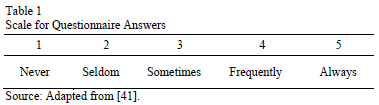
<body><![CDATA[<p>&nbsp;</p>     <p><font size="3" face="Verdana, Arial, Helvetica, sans-serif"><b>3. Research   Design</b></font></p>     <p><b><font size="2" face="Verdana, Arial, Helvetica, sans-serif"><i>3.1. Design of the questionnaire</i></font></b></p>     <p><font size="2" face="Verdana, Arial, Helvetica, sans-serif">As a basis for   this research, we built a questionnaire taking into account the literature   related to the critical success factors for implementation of Kaizen, and the   benefits for both customers and businesses. This research was conducted in   electronic databases such as Elsevier, Scirus, JSTOR, ScienceDirect, Web of   Science, Ebscohost, Ingenta, Springer, Google Scholar, and academic textbooks. </font></p>     <p><font size="2" face="Verdana, Arial, Helvetica, sans-serif">The questionnaire   was validated by four experts, two academics and three engineers in the area of   continuous improvement and Lean Manufacturing. All of them independently   assessed the relevance, consistency, adequacy, clarity, content, knowledge and   structure of the written items. Subsequently, a pilot test was conducted   applying the questionnaire to 30 engineers working in manufacturing industries   in Ciudad Juarez and Los Mochis, in areas of continuous improvement and lean   manufacturing. </font></p>     <p><font size="2" face="Verdana, Arial, Helvetica, sans-serif">The questionnaire   was divided into three sections, with a total of 51 questions related to   Critical Success Factors in the three stages of Kaizen: Thirteen items in the   Planning Stage, 22 items for the Execution Stage, and 16 items for the Control   Stage.</font></p>     <p><font size="2" face="Verdana, Arial, Helvetica, sans-serif">There are 41   questions related to benefits, with 14 questions for economic benefits, 12 for   competitive benefits and 13 for human resources benefits. Also, five questions   related to demographic aspects were included. </font></p>     <p><font size="2" face="Verdana, Arial, Helvetica, sans-serif">The questionnaire   should be answered on a Likert scale, with values between 1 and 5. <a href="#tab01">Table 1</a> presents the scale used in the questionnaire, answering the general question   &quot;Degree of implementation of the following activities&quot; &#91;32-40&#93;.</font></p>     <p align="center"><font size="2" face="Verdana, Arial, Helvetica, sans-serif"><a name="tab01"></a></font><img src="/img/revistas/dyna/v82n191/v82n191a10tab01.gif"></p>     <p><font size="2" face="Verdana, Arial, Helvetica, sans-serif">We chose four   variables for this study: Two related to management commitment and organization   of work teams and 2 more related to the economic and competitive benefits for   the Company. These variables or dimensions have 37 items in total, which are   shown in the following list: </font></p>     ]]></body>
<body><![CDATA[<p><font size="2" face="Verdana, Arial, Helvetica, sans-serif">Dimension 1: Management Commitment (CompGer)</font></p> <ol>       <li><font size="2" face="Verdana, Arial, Helvetica, sans-serif"> Management     plans the acquisition of the resources required for improvement programs     (financial resources, physical spaces, time)</font></li>       <li><font size="2" face="Verdana, Arial, Helvetica, sans-serif"> Policies,     objectives and structure of Kaizen events are established.</font></li>       <li><font size="2" face="Verdana, Arial, Helvetica, sans-serif"> The     opinions of company customers are taken into account to make changes at work. </font></li>       <li><font size="2" face="Verdana, Arial, Helvetica, sans-serif"> A     culture of continuous improvement is developed. </font></li>       <li><font size="2" face="Verdana, Arial, Helvetica, sans-serif"> A     structure is developed to determine faults. </font></li>     </ol>     <p><font size="2" face="Verdana, Arial, Helvetica, sans-serif">Dimension 2:   Organization of Work Equipment (OrgEqT).</font></p> <ol>       <li><font size="2" face="Verdana, Arial, Helvetica, sans-serif"> Groups     are organized to propose suggestions for improvement of products, processes or     to solve problems: quality circles, suggestion programs in groups, etc. </font></li>       <li><font size="2" face="Verdana, Arial, Helvetica, sans-serif"> Commitment     and motivation in the team are generated. </font></li>       ]]></body>
<body><![CDATA[<li><font size="2" face="Verdana, Arial, Helvetica, sans-serif"> Support     teams for running Kaizen are organized. </font></li>       <li><font size="2" face="Verdana, Arial, Helvetica, sans-serif"> Heterogeneity     of improvement teams. </font></li>     </ol>     <p><font size="2" face="Verdana, Arial, Helvetica, sans-serif">Dimension 3:   Economic Benefits (BenefEc) </font></p> <ol>       <li><font size="2" face="Verdana, Arial, Helvetica, sans-serif"> Reduction     of the percentage of defective products </font></li>       <li><font size="2" face="Verdana, Arial, Helvetica, sans-serif"> Decreases     in unit manufacturing costs </font></li>       <li><font size="2" face="Verdana, Arial, Helvetica, sans-serif"> Reduction     in the time elapsed between the reception of the order and the delivery to the     customer as much as possible. </font></li>       <li><font size="2" face="Verdana, Arial, Helvetica, sans-serif"> Increased     productivity. </font></li>       <li><font size="2" face="Verdana, Arial, Helvetica, sans-serif"> The     company meets deadlines and quantities as promised. </font></li>       <li><font size="2" face="Verdana, Arial, Helvetica, sans-serif"> Reduction     of material handling distance. </font></li>       ]]></body>
<body><![CDATA[<li><font size="2" face="Verdana, Arial, Helvetica, sans-serif"> Reduction     of waste in areas such as inventories, waiting times, transport and movement of     workers. </font></li>       <li><font size="2" face="Verdana, Arial, Helvetica, sans-serif"> Reduction     of steps in the production process. </font></li>       <li><font size="2" face="Verdana, Arial, Helvetica, sans-serif"> Profit     maximization.</font></li>       <li><font size="2" face="Verdana, Arial, Helvetica, sans-serif"> Decrease in failures of equipment and tools.</font></li>       <li><font size="2" face="Verdana, Arial, Helvetica, sans-serif"> High productivity increases.</font></li>       <li><font size="2" face="Verdana, Arial, Helvetica, sans-serif"> Reductions in design and operational cycles.</font></li>       <li><font size="2" face="Verdana, Arial, Helvetica, sans-serif"> Improved cash flows. </font></li>       <li><font size="2" face="Verdana, Arial, Helvetica, sans-serif"> Better economic balance. </font></li>     </ol>     <p><font size="2" face="Verdana, Arial, Helvetica, sans-serif">Dimension 4: Competitive   Benefits (BenefCo) </font></p> <ol>       ]]></body>
<body><![CDATA[<li><font size="2" face="Verdana, Arial, Helvetica, sans-serif"> The     company responds to customer needs.</font></li>       <li><font size="2" face="Verdana, Arial, Helvetica, sans-serif"> IAn increased     rate of introduction of new products is perceived.</font></li>       <li><font size="2" face="Verdana, Arial, Helvetica, sans-serif"> Improved     product quality.</font></li>       <li><font size="2" face="Verdana, Arial, Helvetica, sans-serif"> The     company responds to customer needs.</font></li>       <li><font size="2" face="Verdana, Arial, Helvetica, sans-serif"> Employee     skills are improved.</font></li>       <li><font size="2" face="Verdana, Arial, Helvetica, sans-serif"> Reduction     in machine setup times.</font></li>       <li><font size="2" face="Verdana, Arial, Helvetica, sans-serif"> A     systemic view of the organization is provided.</font></li>       <li><font size="2" face="Verdana, Arial, Helvetica, sans-serif"> Process-oriented     thinking is encouraged.</font></li>       <li><font size="2" face="Verdana, Arial, Helvetica, sans-serif"> Improved     product design is perceived.</font></li>       <li><font size="2" face="Verdana, Arial, Helvetica, sans-serif"> Increased ability to compete in globalized     markets and to continuously adapt to sudden market changes.</font></li>       ]]></body>
<body><![CDATA[<li><font size="2" face="Verdana, Arial, Helvetica, sans-serif"> Strategic advantage over its competitors.</font></li>       <li><font size="2" face="Verdana, Arial, Helvetica, sans-serif"> Accumulated knowledge and experiences that     are applicable to organizational processes.</font></li>       <li><font size="2" face="Verdana, Arial, Helvetica, sans-serif"> Internal barriers are easily knocked down,     thereby allowing powerful and authentic teamwork. </font></li>       <li><font size="2" face="Verdana, Arial, Helvetica, sans-serif"> Capacity to adapt continuously to sudden     changes in the market (related to social, cultural, economic, and political     factors). </font></li>     </ol>     <p><font size="2" face="Verdana, Arial, Helvetica, sans-serif"><b><i>3.2. Data   collection process</i></b></font></p>     <p><font size="2" face="Verdana, Arial, Helvetica, sans-serif">The final   questionnaire was administered in print and electronically via the tool Survey   Monkey. We sent it to 68 industrial enterprises in the regions of Villahermosa   in Tabasco, Los Mochis in Sinaloa, Ciudad Juarez in Chihuahua, and also in   Camagüey, Cuba. The aim of the survey was explained and the enterprises were   invited to participate in the research. Suitable candidates to answer the questionnaire   were: directors, managers, supervisors, engineers and technicians. </font></p>     <p><font size="2" face="Verdana, Arial, Helvetica, sans-serif"><b><i>3.3. Information   analysis and validation</i></b></font></p>     <p><font size="2" face="Verdana, Arial, Helvetica, sans-serif">A database was designed using the SPSS 21.0® software for descriptive   analysis of the information. First, for validation purposes, a rational   validity was considered, according to &#91;42&#93;. Subsequently, tests for detecting   missing values were performed and given that the data came from an ordinal   scale (Likert), they were replaced by the median. Similarly, a test was   performed to identify outliers, by standardizing the data, considering in the   analysis standardized absolute values below 3.3. In addition, a statistical   validation of the dimensions was performed by calculating the Cronbach Alpha   Index (IAC) to determine the internal consistency of the items. When the IAC   has values greater than or equal to 0.70 the dimension is considered important   &#91;44-50&#93;. </font></p>     <p><font size="2" face="Verdana, Arial, Helvetica, sans-serif">In this   validation process, we also used the average extracted variance (VME), used to   assess the discriminant and convergent validity between items. We also analyzed   the combined cross-factorial loadings to assess the discriminant validity for   each dimension. At this stage it was considered that the point of acceptable   cut off for the factor loadings of the items should be 0.50, also evaluating the   significance of the P-value of the item in the dimension.</font></p>     ]]></body>
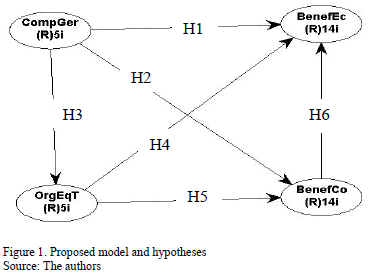
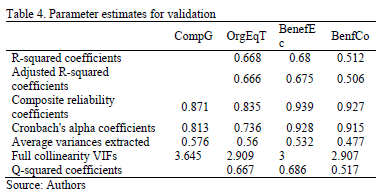
<body><![CDATA[<p><font size="2" face="Verdana, Arial, Helvetica, sans-serif">To evaluate the   presence of collinearity between latent variables, we considered the index of   inflation of variance (VIF) and we used values less than 10 as cut-off points,   or having the coefficient of correlation between the dimensions <i>(r-value)</i>with   a value of less than 0.90. Because of the nature of the questionnaire items   presented in ordinal scale, we used the Q<sup>2</sup>ratio as a nonparametric   measure of predictive validity. Q<sup>2</sup>must be greater than zero to be   considered as an acceptable prediction of the model. </font></p>     <p><font size="2" face="Verdana, Arial, Helvetica, sans-serif"><b><i>3.4. Structural equation model</i></b></font></p>     <p><font size="2" face="Verdana, Arial, Helvetica, sans-serif">Structural   Equation Models (Structural Equation Modeling, SEM) provide a general framework   for statistical analysis of the relationships between several variables.   Techniques such as factor analysis and multiple regression can be considered   specific categories in the application of structural equation models. </font></p>     <p><font size="2" face="Verdana, Arial, Helvetica, sans-serif">The measured   variables, also called observed variables or indicators, are variables that can   be observed and measured directly. Latent variables cannot be observed   directly, and must be inferred from their effects on the observed variables.   The latent variables are also called constructs, factors (factor analysis) or   unobserved variables. </font></p>     <p><font size="2" face="Verdana, Arial, Helvetica, sans-serif">In structural equation models, one of the most interesting features is   that they allow the estimation of the indirect and total effect one variable   can have on another, not only the direct impact as in linear regression. There   are three types of effects &#91;51&#93;. </font></p>     <p><font size="2" face="Verdana, Arial, Helvetica, sans-serif">The proposed   model and hypotheses that reference the dimensions described above are shown in <a href="#fig01">Fig. 1</a>. For their modeling and validation we used WarpPLS 4.0 ® software, whose   algorithms used to calculate the estimators of the relationships between   variables are based on <i>Partial Least Squares</i> (PLS). We chose this   technique given that when modeling with PLS we require less demanding   assumptions about sample size and data distribution. The WarpPLS4 algorithm   uses a resampling method <i>(bootstrapping)</i> to reduce the effects of   convergence. </font></p>     <p align="center"><font size="2" face="Verdana, Arial, Helvetica, sans-serif"><a name="fig01"></a></font><img src="/img/revistas/dyna/v82n191/v82n191a10fig01.gif"></p>     <p><font size="2" face="Verdana, Arial, Helvetica, sans-serif">The model in <a href="#fig01">Fig.   1</a> proposes the direct effects of CompG (management commitment) on OrgEqt   (organizing teams), the BenefEc (economic benefits) and BenefCo(competitive   benefits) a, as well as the   direct effects of OrgEqt(organization of teams) with BenefEc (economic   benefits) and BenefCo (competitive benefits). </font></p>     <p><font size="2" face="Verdana, Arial, Helvetica, sans-serif">These   relationships are proposed based on experience and the study of literature,   that say that what any company ultimately pursues is economic benefit, so that   the relationships between its variables are aimed in that direction.</font></p>     <p><font size="2" face="Verdana, Arial, Helvetica, sans-serif">We will consider   that a relationship is valid when each segment or line joining two latent   variables shows a beta value and P value of less than 0.05.</font></p>     ]]></body>
<body><![CDATA[<p><font size="2" face="Verdana, Arial, Helvetica, sans-serif">To evaluate the   fit of the model, the hypotheses must be validated considering the P-value of   the estimated value in each intended effect. </font></p>     <p><font size="2" face="Verdana, Arial, Helvetica, sans-serif">The hypotheses   are: </font></p>     <blockquote>       <p><font size="2" face="Verdana, Arial, Helvetica, sans-serif">H1 The management commitment will have a     direct and positive impact on the economic benefits of the company.    <br>     </font><font size="2" face="Verdana, Arial, Helvetica, sans-serif">H2 The management commitment will have a     direct and positive effect on the competitive benefits of the company.    <br>     </font><font size="2" face="Verdana, Arial, Helvetica, sans-serif">H3 The management commitment will have a     direct and positive impact on the organization of work teams in the company.    <br>     </font><font size="2" face="Verdana, Arial, Helvetica, sans-serif">H4 The organization of     work teams will have a direct and positive impact on the economic benefits of     the company.    <br>     </font><font size="2" face="Verdana, Arial, Helvetica, sans-serif">H5 The organization of work teams will have     a direct and positive effect on the competitive benefits of the company.    <br>     </font><font size="2" face="Verdana, Arial, Helvetica, sans-serif">H6 The     economic benefits will have a direct and positive </font><font size="2" face="Verdana, Arial, Helvetica, sans-serif">effect with the competitive benefits of     Kaizen.</font></p> </blockquote>     <p>&nbsp;</p>     ]]></body>
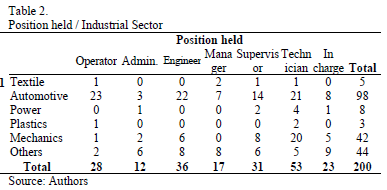
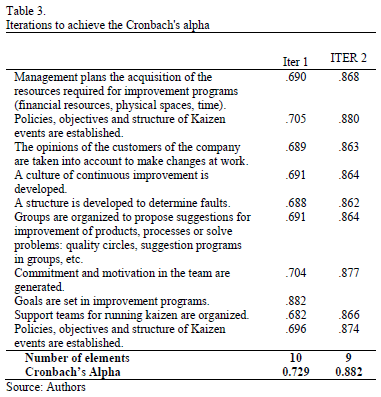
<body><![CDATA[<p><font size="3" face="Verdana, Arial, Helvetica, sans-serif"><b>4. Results</b></font></p>     <p><font size="2" face="Verdana, Arial, Helvetica, sans-serif"><b><i>4.1. Description of the sample</i></b></font></p>     <p><font size="2" face="Verdana, Arial, Helvetica, sans-serif">A total of 200   completed questionnaires were collected. Of these, 57 were through the   electronic tool Survey Monkey and 143 through paper surveys. </font></p>     <p><font size="2" face="Verdana, Arial, Helvetica, sans-serif">Of the collected   surveys, 134 were answered by men and 66 by women. <a href="#tab02">Table 2</a> presents a   descriptive analysis of the sample, with the industrial sector and the position   held by respondents. We can observe that 36 of the respondents are engineers   focused on working on continuous improvement processes, 53 are technical   assistants, 28 are operators with extensive experience in the implementation of   Kaizen, 31 supervisors and 17 managers, among others. </font></p>     <p align="center"><font size="2" face="Verdana, Arial, Helvetica, sans-serif"><a name="tab02"></a></font><img src="/img/revistas/dyna/v82n191/v82n191a10tab02.gif"></p>     <p><font size="2" face="Verdana, Arial, Helvetica, sans-serif">Furthermore, 98   respondents were employed in the automotive sector, while 42 belong to the   mechanical industry</font></p>     <p><font size="2" face="Verdana, Arial, Helvetica, sans-serif"><b><i>4.2. Validation   of the instrument</i></b></font></p>     <p><font size="2" face="Verdana, Arial, Helvetica, sans-serif">The statistical   validation of the reliability of the instrument was performed by calculating   the Cronbach Alpha index. </font></p>     <p><font size="2" face="Verdana, Arial, Helvetica, sans-serif">To find the   consistency and correlation among items the Cronbach's Alpha index was   calculated, as shown in <a href="#tab03">Table 3</a>. This analysis considered primarily a total of   10 items related to the study variables; management commitment and organization   of teams. </font></p>     <p align="center"><font size="2" face="Verdana, Arial, Helvetica, sans-serif"><a name="tab03" id="tab03"></a></font><img src="/img/revistas/dyna/v82n191/v82n191a10tab03.gif"></p>     ]]></body>
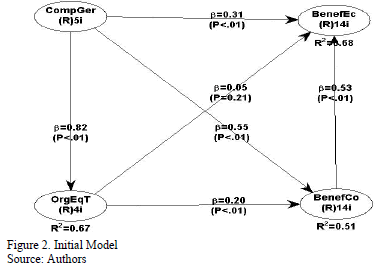
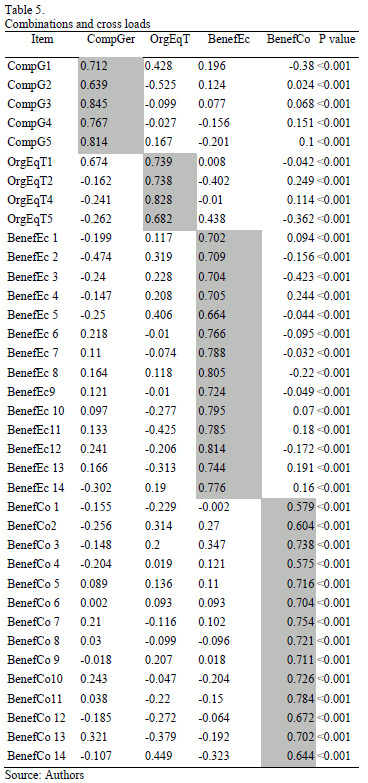
<body><![CDATA[<p><font size="2" face="Verdana, Arial, Helvetica, sans-serif">When calculating   Cronbach's Alpha, a score of 0.729 is obtained, and we found that we could   increase the reliability by eliminating an item, number 8 &quot;goals are set   in improvement programs,&quot; leaving a total of 9 items and a Cronbach's   alpha of 0.882. </font></p>     <p><font size="2" face="Verdana, Arial, Helvetica, sans-serif">It is also   observed in <a href="#tab03">Table 3</a> that all values are greater than 0.7; thus, representing   that the instrument has good consistency &#91;52&#93;. </font></p>     <p><font size="2" face="Verdana, Arial, Helvetica, sans-serif">In <a href="#tab04">Table 4</a>, we can see the estimation of the parameters for the   validation. It is observed that the average values of the extracted variance   (AVE) are greater than 0.5, this indicates that the questionnaire is convergent   and has discriminant validity. Considering the R<sup>2</sup> for the latent   variables, we found acceptable values. When evaluating the VIF index we   observed values below 3.3, indicating independence between the latent   variables.</font></p>     <p align="center"><font size="2" face="Verdana, Arial, Helvetica, sans-serif"><a name="tab04"></a></font><img src="/img/revistas/dyna/v82n191/v82n191a10tab04.gif"></p>     <p><font size="2" face="Verdana, Arial, Helvetica, sans-serif">Regarding Q<sup>2</sup>, we observed values greater than zero,   indicating a good predictive model. <a href="#tab05">Table 5</a> shows the combined and crossed   factorial loadings of the items to evaluate the saturation of each dimension,   considering that they must have values greater than 0.50 in the corresponding   variable and lower on the crossed factorial loadings (another variable). It is   noted that the P-value is significant (&lt;0.05) for all items, confirming the   convergent validity of the questionnaire &#91;53&#93;.</font></p>     <p align="center"><font size="2" face="Verdana, Arial, Helvetica, sans-serif"><a name="tab05"></a></font><img src="/img/revistas/dyna/v82n191/v82n191a10tab05.gif"></p>     <p><font size="2" face="Verdana, Arial, Helvetica, sans-serif"><b><i>4.3. Structural equation model</i></b></font></p>     <p><font size="2" face="Verdana, Arial, Helvetica, sans-serif">In the modeling   undertaken using WarpPLS 4.0®, three effects were analyzed: i) the direct   effects to test the hypotheses; ii) indirect effects; and iii) the total   effects.</font></p>     <p><font size="2" face="Verdana, Arial, Helvetica, sans-serif"><b>4.3.1. Direct effects</b></font></p>     <p><font size="2" face="Verdana, Arial, Helvetica, sans-serif">The direct   effects of the model are presented in <a href="#fig02">Fig. 2</a>, for each relationship between   dimensions, we present a measurement value for dependence expressed by <font face="Symbol">b</font> and in brackets the P-value for each hypothesis test. </font></p>     ]]></body>
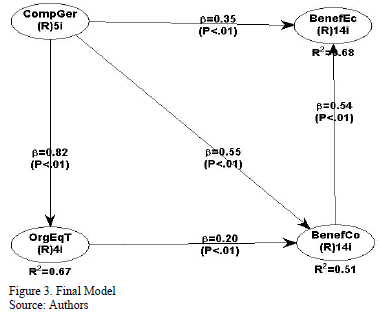
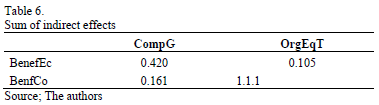
<body><![CDATA[<p align="center"><font size="2" face="Verdana, Arial, Helvetica, sans-serif"><a name="fig02"></a></font><img src="/img/revistas/dyna/v82n191/v82n191a10fig02.gif"></p>     <p><font size="2" face="Verdana, Arial, Helvetica, sans-serif">The initial model   proposed was assessed, based on the hypotheses displayed in <a href="#fig02">Fig. 2</a>. The test   presented an R<sup>2 </sup>value of 68 for the economic benefits variable and   an R<sup>2</sup> of 51 for the competitive benefits. In this model, we observe   significant relationships with values of less than 0.05; however, there is one   exception: The relationship between OrgEqT (organization of work teams) and   BenefEc (economic benefits), which presents a P-value greater than 0.05, which   generates the need to modify the model as initially proposed.</font></p>     <p><font size="2" face="Verdana, Arial, Helvetica, sans-serif">Once we developed   the model, we removed non-significant relationships, those with values above   0.05, and proceeded to remove them iteratively. We removed the relationship   between CompG (management commitment) and BenefEc (economic benefits) because   it has a P-value of 0.21 and a beta close to zero. The model without this   relationship is presented in <a href="#fig03">Fig. 3</a>. </font></p>     <p align="center"><font size="2" face="Verdana, Arial, Helvetica, sans-serif"><a name="fig03"></a></font><img src="/img/revistas/dyna/v82n191/v82n191a10fig03.gif"></p>     <p><font size="2" face="Verdana, Arial, Helvetica, sans-serif">For this new   model, we can observe that all relationships are significant, with P-values   smaller than 0.05. For example, the relationship linking the CompG (management   commitment) to BenefCo (competitive benefits) has a <font face="Symbol">b</font> = 0.55 and P   &lt;0.01, which means that when the standard deviation of the first dimension   increases by one unit, the second dimension increases its standard deviation by   0.55. This also represents its measure of dependence. </font></p>     <p><font size="2" face="Verdana, Arial, Helvetica, sans-serif">The same   interpretation is applicable to other relationships. It is important to notice   that the highest dependence (according to the value of <font face="Symbol">b</font>) is observed   between CompG (management commitment) and OrgEqT (organization of work teams)   with <font face="Symbol">b</font> = 0.82. </font></p>     <p><font size="2" face="Verdana, Arial, Helvetica, sans-serif"><b>4.3.2. Indirect effects</b></font></p>     <p><font size="2" face="Verdana, Arial, Helvetica, sans-serif"><a href="#tab06">Table 6</a> shows the sum of indirect effects.   It is important to note that all effects between dimensions are significant,   since their P-values were less than 0.05. For example, although there is no   direct relationship between OrgEqT and BenefEc, there is an indirect effect of   0.105, indicating that when the standard deviation of the first dimension is   increased by in one unit, the standard deviation of the second dimension   increases by 0.105. The highest indirect effects are those between CompG and   BenefEc with a value of 0.420.</font></p>     <p align="center"><font size="2" face="Verdana, Arial, Helvetica, sans-serif"><a name="tab06"></a></font><img src="/img/revistas/dyna/v82n191/v82n191a10tab06.gif"></p>     <p><font size="2" face="Verdana, Arial, Helvetica, sans-serif"><b>.3.3. The total effects</b></font></p>     ]]></body>
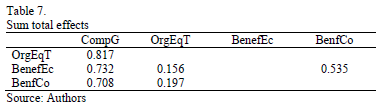
<body><![CDATA[<p><font size="2" face="Verdana, Arial, Helvetica, sans-serif"><a href="#tab07">Table 7</a> presents   the sum of the direct effects and the sum of indirect effects that comprise the   total effects. The total effect between competitive benefits and economic   benefits is 0.535, i.e. when the standard deviation of the first variable   increases by one unit, the standard deviation of the second one goes up by   0.535 units.</font></p>     <p align="center"><font size="2" face="Verdana, Arial, Helvetica, sans-serif"><a name="tab07"></a></font><img src="/img/revistas/dyna/v82n191/v82n191a10tab07.gif"></p>     <p>&nbsp;</p>     <p><font size="3" face="Verdana, Arial, Helvetica, sans-serif"><b>5. Conclusions</b></font></p>     <p><font size="2" face="Verdana, Arial, Helvetica, sans-serif"><b><i>5.1. Conclusion on hypothesis stage planning</i></b></font></p>     <p><font size="2" face="Verdana, Arial, Helvetica, sans-serif">Based on the   hypotheses we proposed, presented in <a href="#fig01">Fig. 1</a>, we have the following conclusions: </font></p>     <p><font size="2" face="Verdana, Arial, Helvetica, sans-serif">H<sub>1</sub> There is enough statistical evidence to say that management commitment has a   positive direct effect on the economic benefits for the company, because when   the first latent variable increases by one standard deviation, the standard   deviation of the second variable increases by 0.35 units. </font></p>     <p><font size="2" face="Verdana, Arial, Helvetica, sans-serif">H<sub>2</sub> There is enough statistical evidence to say that management commitment will   have a direct and positive effect on the competitive benefits of the company,   because when the first latent variable increases by one standard deviation, the   second one increases by 0.55 units. </font></p>     <p><font size="2" face="Verdana, Arial, Helvetica, sans-serif">H<sub>3</sub> There is enough statistical evidence to say that management commitment has a   positive direct effect on the organization of teams, because when the first   latent variable or dimension increases by one standard deviation increase by   0.82-second units. </font></p>     <p><font size="2" face="Verdana, Arial, Helvetica, sans-serif">H<sub>4</sub> There is enough statistical evidence to say that the organization of work teams   does not have a direct positive impact on the economic benefits of the company,   because when the first latent variable increases by one standard deviation, the   second one increases by 0.05 units. However, there is evidence to say that the organization   of work teams has a positive indirect effect on the economic benefits for the   company by 0.105. </font></p>     ]]></body>
<body><![CDATA[<p><font size="2" face="Verdana, Arial, Helvetica, sans-serif">H<sub>5</sub> There is enough statistical evidence to say that the organization of work teams   has a positive direct effect on the competitive benefits of the company,   because when the first latent variable increases by one standard deviation, the   second one increases by 0.20 units. </font></p>     <p><font size="2" face="Verdana, Arial, Helvetica, sans-serif">H<sub>6</sub> There is enough statistical evidence to say that competitive benefits have a   direct and positive impact on the economic benefits of the company, because   when the first latent variable increases by one standard deviation, the second   one increases by 0.54 units.</font></p>     <p><font size="2" face="Verdana, Arial, Helvetica, sans-serif"><b><i>5.2. Industrial implications of the results</i></b></font></p>     <p><font size="2" face="Verdana, Arial, Helvetica, sans-serif">The results   contribute to the identification of critical success factors and benefits of   Kaizen and the features that are most strongly related to the sustainability   and results of Kaizen. </font></p>     <p><font size="2" face="Verdana, Arial, Helvetica, sans-serif">For the authors,   this is the first study that tests the causal relationships between   sustainability performance and the critical success factors of Kaizen.</font></p>     <p><font size="2" face="Verdana, Arial, Helvetica, sans-serif">Such   understanding will increase the likelihood that the results of Kaizen   implementations are sustained, eliminating wasted efforts and supporting   improvement in the organization. </font></p>     <p><font size="2" face="Verdana, Arial, Helvetica, sans-serif">All this leads to   an economic contribution, given by the reduction in failures of equipment and   tools, reduced machinery setup times, increased levels of customer satisfaction   and consumers, increased levels of inventory turnover, significant drop in   levels of faults and errors, lower levels of waste and an overall better   financial balance.</font></p>     <p><font size="2" face="Verdana, Arial, Helvetica, sans-serif"><b><i>5.3. Limitations of the study</i></b></font></p>     <p><font size="2" face="Verdana, Arial, Helvetica, sans-serif">This work focused   on assessing the impacts of management commitment and organization of work   teams on company benefits in the regions of Tabasco, Sinaloa, Juarez, Chihuahua   in Mexico and Camagüey, Cuba. However, extending the study to other regions   will enable researchers to find comparative models supporting the validity of   analysis reported here.</font></p>     <p><font size="2" face="Verdana, Arial, Helvetica, sans-serif"><b><i>5.4. Future Research</i></b></font></p>     ]]></body>
<body><![CDATA[<p><font size="2" face="Verdana, Arial, Helvetica, sans-serif">We recommend that   the same questionnaire be applied to other regions, both inside and outside of   Mexico, to extrapolate and find better answers with respect to the impact of   the critical success factors of Kaizen on company benefits. </font></p>     <p><font size="2" face="Verdana, Arial, Helvetica, sans-serif">It would be also   advisable to consider other types of businesses and industries in order to   analyze these effects and compare the results from another perspective. </font></p>     <p>&nbsp;</p>     <p><font size="3" face="Verdana, Arial, Helvetica, sans-serif"><b>References </b></font></p>     <!-- ref --><p><font size="2" face="Verdana, Arial, Helvetica, sans-serif"><b>&#91;1&#93;</b> Kumar, S. and Harms, R., Improving business   processes for increased operational efficiency: A case study, Journal of   Manufacturing Technology Management, 15 (7), pp. 662-674, 2004. DOI: 10.1108/17410380410555907</font>&nbsp;&nbsp;&nbsp;&nbsp;&nbsp;&nbsp;&nbsp;&nbsp;[&#160;<a href="javascript:void(0);" onclick="javascript: window.open('/scielo.php?script=sci_nlinks&ref=000187&pid=S0012-7353201500030001000001&lng=','','width=640,height=500,resizable=yes,scrollbars=1,menubar=yes,');">Links</a>&#160;]<!-- end-ref --><!-- ref --><p><font size="2" face="Verdana, Arial, Helvetica, sans-serif"><b>&#91;2&#93;</b> Ramadani, V. and Gerguri, S., Theoretical   framework of innovation and competitiveness and innovation program in   Macedonia. European Journal of Social Sciences, 23 (2), pp. 268-276, 2011.    &nbsp;&nbsp;&nbsp;&nbsp;&nbsp;&nbsp;&nbsp;&nbsp;[&#160;<a href="javascript:void(0);" onclick="javascript: window.open('/scielo.php?script=sci_nlinks&ref=000188&pid=S0012-7353201500030001000002&lng=','','width=640,height=500,resizable=yes,scrollbars=1,menubar=yes,');">Links</a>&#160;]<!-- end-ref --></font></p>     <!-- ref --><p><font size="2" face="Verdana, Arial, Helvetica, sans-serif"><b>&#91;3&#93;</b> Medina, C. and Espinosa, M., Innovation in   modern organizations. Management and Strategy, 5, pp. 85-102, 1994.    &nbsp;&nbsp;&nbsp;&nbsp;&nbsp;&nbsp;&nbsp;&nbsp;[&#160;<a href="javascript:void(0);" onclick="javascript: window.open('/scielo.php?script=sci_nlinks&ref=000190&pid=S0012-7353201500030001000003&lng=','','width=640,height=500,resizable=yes,scrollbars=1,menubar=yes,');">Links</a>&#160;]<!-- end-ref --></font></p>     <!-- ref --><p><font size="2" face="Verdana, Arial, Helvetica, sans-serif"><b>&#91;4&#93;</b> Cooney, R. and Sohal, A., Teamwork and total   quality management: A durable partnership. Total Quality Management &amp;   Business Excellence, 15 (8), pp. 1131 - 1142, 2004. DOI: 10.1080/1478336042000255442</font>&nbsp;&nbsp;&nbsp;&nbsp;&nbsp;&nbsp;&nbsp;&nbsp;[&#160;<a href="javascript:void(0);" onclick="javascript: window.open('/scielo.php?script=sci_nlinks&ref=000192&pid=S0012-7353201500030001000004&lng=','','width=640,height=500,resizable=yes,scrollbars=1,menubar=yes,');">Links</a>&#160;]<!-- end-ref --><!-- ref --><p><font size="2" face="Verdana, Arial, Helvetica, sans-serif"><b>&#91;5&#93;</b> Gondhalekar, S., Babu, S. and Godrej, N.,   Towards using Kaizen process dynamics: A case study. International Journal of   Quality &amp; Reliability Management, 12 (9), pp. 192-209, 1995. DOI: 10.1108/02656719510101286</font>&nbsp;&nbsp;&nbsp;&nbsp;&nbsp;&nbsp;&nbsp;&nbsp;[&#160;<a href="javascript:void(0);" onclick="javascript: window.open('/scielo.php?script=sci_nlinks&ref=000193&pid=S0012-7353201500030001000005&lng=','','width=640,height=500,resizable=yes,scrollbars=1,menubar=yes,');">Links</a>&#160;]<!-- end-ref --><!-- ref --><p><font size="2" face="Verdana, Arial, Helvetica, sans-serif"><b>&#91;6&#93;</b> Bateman, N., Sustainability: The elusive   element of process improvement. International Journal of Operations &amp;   Production Management, 25 (3), pp. 261-276, 2005. DOI: 10.1108/01443570510581862</font>&nbsp;&nbsp;&nbsp;&nbsp;&nbsp;&nbsp;&nbsp;&nbsp;[&#160;<a href="javascript:void(0);" onclick="javascript: window.open('/scielo.php?script=sci_nlinks&ref=000194&pid=S0012-7353201500030001000006&lng=','','width=640,height=500,resizable=yes,scrollbars=1,menubar=yes,');">Links</a>&#160;]<!-- end-ref --><!-- ref --><p><font size="2" face="Verdana, Arial, Helvetica, sans-serif"><b>&#91;7&#93;</b> Van de Ven, A., Central problems in the   management of innovation. Management Science 32 (5), pp. 590-607, 1996. DOI: 10.1287/mnsc.32.5.590</font>&nbsp;&nbsp;&nbsp;&nbsp;&nbsp;&nbsp;&nbsp;&nbsp;[&#160;<a href="javascript:void(0);" onclick="javascript: window.open('/scielo.php?script=sci_nlinks&ref=000195&pid=S0012-7353201500030001000007&lng=','','width=640,height=500,resizable=yes,scrollbars=1,menubar=yes,');">Links</a>&#160;]<!-- end-ref --><!-- ref --><p><font size="2" face="Verdana, Arial, Helvetica, sans-serif"><b>&#91;8&#93;</b> Burch, M.K, Lean Kaizen events and longevity   determinants of sustainable improvement, Doctoral Dissertation, University of   Massachusetts, Amherst, USA, 2008.    &nbsp;&nbsp;&nbsp;&nbsp;&nbsp;&nbsp;&nbsp;&nbsp;[&#160;<a href="javascript:void(0);" onclick="javascript: window.open('/scielo.php?script=sci_nlinks&ref=000196&pid=S0012-7353201500030001000008&lng=','','width=640,height=500,resizable=yes,scrollbars=1,menubar=yes,');">Links</a>&#160;]<!-- end-ref --></font></p>     <!-- ref --><p><font size="2" face="Verdana, Arial, Helvetica, sans-serif"><b>&#91;9&#93;</b> Sheridan, J.H., A new attitude. Industry   Week, 249 (10), pp.16, 2000.    &nbsp;&nbsp;&nbsp;&nbsp;&nbsp;&nbsp;&nbsp;&nbsp;[&#160;<a href="javascript:void(0);" onclick="javascript: window.open('/scielo.php?script=sci_nlinks&ref=000198&pid=S0012-7353201500030001000009&lng=','','width=640,height=500,resizable=yes,scrollbars=1,menubar=yes,');">Links</a>&#160;]<!-- end-ref --></font></p>     <!-- ref --><p><font size="2" face="Verdana, Arial, Helvetica, sans-serif"><b>&#91;10&#93;</b> Daniel, D., Management information crisis.   Harvard Business Review, 39, pp. 110-121, 1961.    &nbsp;&nbsp;&nbsp;&nbsp;&nbsp;&nbsp;&nbsp;&nbsp;[&#160;<a href="javascript:void(0);" onclick="javascript: window.open('/scielo.php?script=sci_nlinks&ref=000200&pid=S0012-7353201500030001000010&lng=','','width=640,height=500,resizable=yes,scrollbars=1,menubar=yes,');">Links</a>&#160;]<!-- end-ref --></font></p>     <!-- ref --><p><font size="2" face="Verdana, Arial, Helvetica, sans-serif"><b>&#91;11&#93;</b> Terziovski, M. and Sohal, A.S., The adoption   of continuous improvement and innovation strategies in Australian manufacturing   firms Lithuania. Technovation, 20 (10) pp. 539-550, 2000. DOI: 10.1016/S0166-4972(99)00173-X</font>&nbsp;&nbsp;&nbsp;&nbsp;&nbsp;&nbsp;&nbsp;&nbsp;[&#160;<a href="javascript:void(0);" onclick="javascript: window.open('/scielo.php?script=sci_nlinks&ref=000202&pid=S0012-7353201500030001000011&lng=','','width=640,height=500,resizable=yes,scrollbars=1,menubar=yes,');">Links</a>&#160;]<!-- end-ref --><!-- ref --><p><font size="2" face="Verdana, Arial, Helvetica, sans-serif"><b>&#91;12&#93;</b> Juran, J., Juran on leadership for quality.   A manual for managers. Madrid, Spain: D&iacute;az Santos, 1990</font>&nbsp;&nbsp;&nbsp;&nbsp;&nbsp;&nbsp;&nbsp;&nbsp;[&#160;<a href="javascript:void(0);" onclick="javascript: window.open('/scielo.php?script=sci_nlinks&ref=000203&pid=S0012-7353201500030001000012&lng=','','width=640,height=500,resizable=yes,scrollbars=1,menubar=yes,');">Links</a>&#160;]<!-- end-ref --><!-- ref --><p><font size="2" face="Verdana, Arial, Helvetica, sans-serif"><b>&#91;13&#93;</b> Suarez, B. and Miguel, J., In search of an   area of sustainability: An empirical study of the implementation of the   Continuous Improvement Process in Spanish Town Councils. INNOVATE Journal of   Administrative and Social Sciences, 19 (35), pp. 47-64, 2009.    &nbsp;&nbsp;&nbsp;&nbsp;&nbsp;&nbsp;&nbsp;&nbsp;[&#160;<a href="javascript:void(0);" onclick="javascript: window.open('/scielo.php?script=sci_nlinks&ref=000204&pid=S0012-7353201500030001000013&lng=','','width=640,height=500,resizable=yes,scrollbars=1,menubar=yes,');">Links</a>&#160;]<!-- end-ref --></font></p>     <!-- ref --><p><font size="2" face="Verdana, Arial, Helvetica, sans-serif"><b>&#91;14&#93;</b> Barraza, M.F., Smith, T. and Dahlgaard-Park,   S.M., Lean Kaizen public service: An empirical approach in Spanish local   governments, The TQM Journal, 21 82) pp.143-167, 2009.    &nbsp;&nbsp;&nbsp;&nbsp;&nbsp;&nbsp;&nbsp;&nbsp;[&#160;<a href="javascript:void(0);" onclick="javascript: window.open('/scielo.php?script=sci_nlinks&ref=000206&pid=S0012-7353201500030001000014&lng=','','width=640,height=500,resizable=yes,scrollbars=1,menubar=yes,');">Links</a>&#160;]<!-- end-ref --></font></p>     <!-- ref --><p><font size="2" face="Verdana, Arial, Helvetica, sans-serif"><b>&#91;15&#93;</b> Lefcovich, M., Advantages and benefits of   Kaizen. &#91;on line&#93;, 2007. &#91;date of reference: September 10<sup>th</sup> of 2011&#93;.   Available at: <a href="http://www.tuobra.unam.mx/published/040816180352.html" target="_blank">http://www.tuobra.unam.mx/published/040816180352.html</a></font>&nbsp;&nbsp;&nbsp;&nbsp;&nbsp;&nbsp;&nbsp;&nbsp;[&#160;<a href="javascript:void(0);" onclick="javascript: window.open('/scielo.php?script=sci_nlinks&ref=000208&pid=S0012-7353201500030001000015&lng=','','width=640,height=500,resizable=yes,scrollbars=1,menubar=yes,');">Links</a>&#160;]<!-- end-ref --><!-- ref --><p><font size="2" face="Verdana, Arial, Helvetica, sans-serif"><b>&#91;16&#93;</b> Vonk, J., Business process improvement   through Kaizen permits, Spectrum, 78 (2), pp. 33-34, 2005.    &nbsp;&nbsp;&nbsp;&nbsp;&nbsp;&nbsp;&nbsp;&nbsp;[&#160;<a href="javascript:void(0);" onclick="javascript: window.open('/scielo.php?script=sci_nlinks&ref=000209&pid=S0012-7353201500030001000016&lng=','','width=640,height=500,resizable=yes,scrollbars=1,menubar=yes,');">Links</a>&#160;]<!-- end-ref --></font></p>     <!-- ref --><p><font size="2" face="Verdana, Arial, Helvetica, sans-serif"><b>&#91;17&#93;</b> Watson, L., Striving for continuous   improvement with fewer resources. Kaizen, Marshall Star, pp. 1-5, 2002.    &nbsp;&nbsp;&nbsp;&nbsp;&nbsp;&nbsp;&nbsp;&nbsp;[&#160;<a href="javascript:void(0);" onclick="javascript: window.open('/scielo.php?script=sci_nlinks&ref=000211&pid=S0012-7353201500030001000017&lng=','','width=640,height=500,resizable=yes,scrollbars=1,menubar=yes,');">Links</a>&#160;]<!-- end-ref --></font></p>     ]]></body>
<body><![CDATA[<!-- ref --><p><font size="2" face="Verdana, Arial, Helvetica, sans-serif"><b>&#91;18&#93;</b> Wheatley, B., Innovation, ISO registration,   CMA, 72 (5), pp.23-23, 1998.    &nbsp;&nbsp;&nbsp;&nbsp;&nbsp;&nbsp;&nbsp;&nbsp;[&#160;<a href="javascript:void(0);" onclick="javascript: window.open('/scielo.php?script=sci_nlinks&ref=000213&pid=S0012-7353201500030001000018&lng=','','width=640,height=500,resizable=yes,scrollbars=1,menubar=yes,');">Links</a>&#160;]<!-- end-ref --></font></p>     <!-- ref --><p><font size="2" face="Verdana, Arial, Helvetica, sans-serif"><b>&#91;19&#93;</b> Tenenhaus, M., Component-based structural   equation modelling. Total Quality Management &amp; Business Excellence. 19   (7-8), pp 87-886, 2008. DOI: 10.1080/14783360802159543</font>&nbsp;&nbsp;&nbsp;&nbsp;&nbsp;&nbsp;&nbsp;&nbsp;[&#160;<a href="javascript:void(0);" onclick="javascript: window.open('/scielo.php?script=sci_nlinks&ref=000215&pid=S0012-7353201500030001000019&lng=','','width=640,height=500,resizable=yes,scrollbars=1,menubar=yes,');">Links</a>&#160;]<!-- end-ref --><!-- ref --><p><font size="2" face="Verdana, Arial, Helvetica, sans-serif"><b>&#91;20&#93;</b> Woodman, R., Saweyr, J. and Griffin, R.,   Toward a theory of organizational creativity. Academy of Management Review 18   (2), pp. 293-321, 1993. DOI: 10.2307/258761, 10.5465/AMR.1993.3997517</font>&nbsp;&nbsp;&nbsp;&nbsp;&nbsp;&nbsp;&nbsp;&nbsp;[&#160;<a href="javascript:void(0);" onclick="javascript: window.open('/scielo.php?script=sci_nlinks&ref=000216&pid=S0012-7353201500030001000020&lng=','','width=640,height=500,resizable=yes,scrollbars=1,menubar=yes,');">Links</a>&#160;]<!-- end-ref --><!-- ref --><p><font size="2" face="Verdana, Arial, Helvetica, sans-serif"><b>&#91;21&#93;</b> Bhatnagar, R. and Sohal, A.S., Supply chain   competitiveness: Measuring the impact of location factors, uncertainty and   manufacturing practices. Technovation, 25 (5), pp. 443-456, 2005. DOI: 10.1016/j.technovation.2003.09.012, 10.1016/S0166-4972(03)00172-X</font>&nbsp;&nbsp;&nbsp;&nbsp;&nbsp;&nbsp;&nbsp;&nbsp;[&#160;<a href="javascript:void(0);" onclick="javascript: window.open('/scielo.php?script=sci_nlinks&ref=000217&pid=S0012-7353201500030001000021&lng=','','width=640,height=500,resizable=yes,scrollbars=1,menubar=yes,');">Links</a>&#160;]<!-- end-ref --><!-- ref --><p><font size="2" face="Verdana, Arial, Helvetica, sans-serif"><b>&#91;22&#93;</b> Romero, R., Noriega, S., Escobar, C. and Avila,   D., Critical success factors: A competitiveness strategy. CULCYT, 6 (31), pp. 5-14,   2009.    &nbsp;&nbsp;&nbsp;&nbsp;&nbsp;&nbsp;&nbsp;&nbsp;[&#160;<a href="javascript:void(0);" onclick="javascript: window.open('/scielo.php?script=sci_nlinks&ref=000218&pid=S0012-7353201500030001000022&lng=','','width=640,height=500,resizable=yes,scrollbars=1,menubar=yes,');">Links</a>&#160;]<!-- end-ref --></font></p>     <!-- ref --><p><font size="2" face="Verdana, Arial, Helvetica, sans-serif"><b>&#91;23&#93;</b> Nordgaard, A., Ansell, R., Jaeger, L. and   Drotz, W., Ordinal scales of conclusions for the value of evidence. Science and   Justice, 50 (1), pp. 31-31, 2010. DOI: 10.1016/j.scijus.2009.11.025</font>&nbsp;&nbsp;&nbsp;&nbsp;&nbsp;&nbsp;&nbsp;&nbsp;[&#160;<a href="javascript:void(0);" onclick="javascript: window.open('/scielo.php?script=sci_nlinks&ref=000220&pid=S0012-7353201500030001000023&lng=','','width=640,height=500,resizable=yes,scrollbars=1,menubar=yes,');">Links</a>&#160;]<!-- end-ref --><!-- ref --><p><font size="2" face="Verdana, Arial, Helvetica, sans-serif"><b>&#91;24&#93;</b> Hair, J.F., Ringle, C.M. and Sarstedt, M.,   PLS-SEM: Indeed a silver bullet. Journal of Marketing Theory and Practice, 19   (2), pp. 139-151, 2011. DOI: 10.2753/MTP1069-6679190202</font>&nbsp;&nbsp;&nbsp;&nbsp;&nbsp;&nbsp;&nbsp;&nbsp;[&#160;<a href="javascript:void(0);" onclick="javascript: window.open('/scielo.php?script=sci_nlinks&ref=000221&pid=S0012-7353201500030001000024&lng=','','width=640,height=500,resizable=yes,scrollbars=1,menubar=yes,');">Links</a>&#160;]<!-- end-ref --><!-- ref --><p><font size="2" face="Verdana, Arial, Helvetica, sans-serif"><b>&#91;25&#93;</b> Rigdon, E.E., Rethinking partial least   squares path modeling: In praise of simpler methods. Long Range Planning, 45   (5,6), pp. 341-358, 2011.    &nbsp;&nbsp;&nbsp;&nbsp;&nbsp;&nbsp;&nbsp;&nbsp;[&#160;<a href="javascript:void(0);" onclick="javascript: window.open('/scielo.php?script=sci_nlinks&ref=000222&pid=S0012-7353201500030001000025&lng=','','width=640,height=500,resizable=yes,scrollbars=1,menubar=yes,');">Links</a>&#160;]<!-- end-ref --></font></p>     <!-- ref --><p><font size="2" face="Verdana, Arial, Helvetica, sans-serif"><b>&#91;26&#93;</b> Yuan, K. and Bentler, P., New developments   and techniques in structural equation modeling. New Jersey, Lawrence Erlbaum      Associates, Publishers. USA. 2001.    &nbsp;&nbsp;&nbsp;&nbsp;&nbsp;&nbsp;&nbsp;&nbsp;[&#160;<a href="javascript:void(0);" onclick="javascript: window.open('/scielo.php?script=sci_nlinks&ref=000224&pid=S0012-7353201500030001000026&lng=','','width=640,height=500,resizable=yes,scrollbars=1,menubar=yes,');">Links</a>&#160;]<!-- end-ref --></font></p>     <!-- ref --><p><font size="2" face="Verdana, Arial, Helvetica, sans-serif"><b>&#91;27&#93;</b> Dale, B., Boaden, R., Willcox, M. and   McQuater, R., Sustaining total quality management: What are the key issues. TQM   Magazine, 9 (2), pp. 372-380, 1997. DOI: 10.1108/09544789710178668</font>&nbsp;&nbsp;&nbsp;&nbsp;&nbsp;&nbsp;&nbsp;&nbsp;[&#160;<a href="javascript:void(0);" onclick="javascript: window.open('/scielo.php?script=sci_nlinks&ref=000226&pid=S0012-7353201500030001000027&lng=','','width=640,height=500,resizable=yes,scrollbars=1,menubar=yes,');">Links</a>&#160;]<!-- end-ref --><!-- ref --><p><font size="2" face="Verdana, Arial, Helvetica, sans-serif"><b>&#91;28&#93;</b> Suarez, B., Michael, J. and Castillo, I.,   The implementation of Kaizen in Mexican organizations. An empirical study. GCG,   5 (4), pp. 60-74. 2011.    &nbsp;&nbsp;&nbsp;&nbsp;&nbsp;&nbsp;&nbsp;&nbsp;[&#160;<a href="javascript:void(0);" onclick="javascript: window.open('/scielo.php?script=sci_nlinks&ref=000227&pid=S0012-7353201500030001000028&lng=','','width=640,height=500,resizable=yes,scrollbars=1,menubar=yes,');">Links</a>&#160;]<!-- end-ref --></font></p>     <!-- ref --><p><font size="2" face="Verdana, Arial, Helvetica, sans-serif"><b>&#91;29&#93;</b> Han, S.B., The effects of ISO 9000   registration efforts on total quality management practices and business   performance. PhD. Thesis, University of Rhode Island, Rhode Island, United   States, 151 P., 2000.    &nbsp;&nbsp;&nbsp;&nbsp;&nbsp;&nbsp;&nbsp;&nbsp;[&#160;<a href="javascript:void(0);" onclick="javascript: window.open('/scielo.php?script=sci_nlinks&ref=000229&pid=S0012-7353201500030001000029&lng=','','width=640,height=500,resizable=yes,scrollbars=1,menubar=yes,');">Links</a>&#160;]<!-- end-ref --></font></p>     <!-- ref --><p><font size="2" face="Verdana, Arial, Helvetica, sans-serif"><b>&#91;30&#93;</b> Swamidass, P.M., A comparison of the plant   location strategies of foreign and domestic manufacturers in the U.S., Journal   of International Business Studies, 21 (2), pp. 310-316, 1998.    &nbsp;&nbsp;&nbsp;&nbsp;&nbsp;&nbsp;&nbsp;&nbsp;[&#160;<a href="javascript:void(0);" onclick="javascript: window.open('/scielo.php?script=sci_nlinks&ref=000231&pid=S0012-7353201500030001000030&lng=','','width=640,height=500,resizable=yes,scrollbars=1,menubar=yes,');">Links</a>&#160;]<!-- end-ref --></font></p>     ]]></body>
<body><![CDATA[<!-- ref --><p><font size="2" face="Verdana, Arial, Helvetica, sans-serif"><b>&#91;31&#93;</b> Martin, K.. Kaizen-White collar: Events   rapid improvement office, services and technical processes, IIE Annual   Conference and Exhibition, Nashville, TN, May 22, 2007.    &nbsp;&nbsp;&nbsp;&nbsp;&nbsp;&nbsp;&nbsp;&nbsp;[&#160;<a href="javascript:void(0);" onclick="javascript: window.open('/scielo.php?script=sci_nlinks&ref=000233&pid=S0012-7353201500030001000031&lng=','','width=640,height=500,resizable=yes,scrollbars=1,menubar=yes,');">Links</a>&#160;]<!-- end-ref --></font></p>     <!-- ref --><p><font size="2" face="Verdana, Arial, Helvetica, sans-serif"><b>&#91;32&#93;</b> Ortiz, C., All out Kaizen: A continuous   improvement plan delivers change to the production floor and dollars to the   bottom line. Industrial Engineer, 38 (4), pp.30-30, 2006.    &nbsp;&nbsp;&nbsp;&nbsp;&nbsp;&nbsp;&nbsp;&nbsp;[&#160;<a href="javascript:void(0);" onclick="javascript: window.open('/scielo.php?script=sci_nlinks&ref=000235&pid=S0012-7353201500030001000032&lng=','','width=640,height=500,resizable=yes,scrollbars=1,menubar=yes,');">Links</a>&#160;]<!-- end-ref --></font></p>     <!-- ref --><p><font size="2" face="Verdana, Arial, Helvetica, sans-serif"><b>&#91;33&#93;</b> Bicheno, J., Kaizen and Kaikaku.   Manufacturing operations and supply chain management: The LEAN approach, in: Taylor,   D., and Brunt, D., eds, London, UK. Thomson Learning, pp. 175-184. 2001.    &nbsp;&nbsp;&nbsp;&nbsp;&nbsp;&nbsp;&nbsp;&nbsp;[&#160;<a href="javascript:void(0);" onclick="javascript: window.open('/scielo.php?script=sci_nlinks&ref=000237&pid=S0012-7353201500030001000033&lng=','','width=640,height=500,resizable=yes,scrollbars=1,menubar=yes,');">Links</a>&#160;]<!-- end-ref --></font></p>     <!-- ref --><p><font size="2" face="Verdana, Arial, Helvetica, sans-serif"><b>&#91;34&#93;</b> Terziovski, M. and Sohal, A.S., The adoption   of continuous improvement and innovation strategies in Australian manufacturing   firms Lithuania. Technovation, 20 (10) pp. 539-550, 2000. DOI: 10.1016/S0166-4972(99)00173-X</font>&nbsp;&nbsp;&nbsp;&nbsp;&nbsp;&nbsp;&nbsp;&nbsp;[&#160;<a href="javascript:void(0);" onclick="javascript: window.open('/scielo.php?script=sci_nlinks&ref=000239&pid=S0012-7353201500030001000034&lng=','','width=640,height=500,resizable=yes,scrollbars=1,menubar=yes,');">Links</a>&#160;]<!-- end-ref --><!-- ref --><p><font size="2" face="Verdana, Arial, Helvetica, sans-serif"><b>&#91;35&#93;</b> Shumacker, R.E. and Lomax, R.G., A   Beginner's guide to structural equation modeling. 3A. Ed., LLC Inc. New York,   Taylor and Francis Group, 2010, 2 P.    &nbsp;&nbsp;&nbsp;&nbsp;&nbsp;&nbsp;&nbsp;&nbsp;[&#160;<a href="javascript:void(0);" onclick="javascript: window.open('/scielo.php?script=sci_nlinks&ref=000240&pid=S0012-7353201500030001000035&lng=','','width=640,height=500,resizable=yes,scrollbars=1,menubar=yes,');">Links</a>&#160;]<!-- end-ref --> </font></p>     <!-- ref --><p><font size="2" face="Verdana, Arial, Helvetica, sans-serif"><b>&#91;36&#93;</b> Khurana, A. and Talbot, B., The   internationalization process model-through the lens of the global color picture   tube industry. Journal of Operations Management, 16 (2-3), pp.215-239, 1998. DOI: 10.1016/S0272-6963(97)00039-9</font>&nbsp;&nbsp;&nbsp;&nbsp;&nbsp;&nbsp;&nbsp;&nbsp;[&#160;<a href="javascript:void(0);" onclick="javascript: window.open('/scielo.php?script=sci_nlinks&ref=000242&pid=S0012-7353201500030001000036&lng=','','width=640,height=500,resizable=yes,scrollbars=1,menubar=yes,');">Links</a>&#160;]<!-- end-ref --><!-- ref --><p><font size="2" face="Verdana, Arial, Helvetica, sans-serif"><b>&#91;37&#93;</b> Lionnet, P., Innovation: The Process, ESA   Training Workshop. Lisbon, 2003.    &nbsp;&nbsp;&nbsp;&nbsp;&nbsp;&nbsp;&nbsp;&nbsp;[&#160;<a href="javascript:void(0);" onclick="javascript: window.open('/scielo.php?script=sci_nlinks&ref=000243&pid=S0012-7353201500030001000037&lng=','','width=640,height=500,resizable=yes,scrollbars=1,menubar=yes,');">Links</a>&#160;]<!-- end-ref --></font></p>     <!-- ref --><p><font size="2" face="Verdana, Arial, Helvetica, sans-serif"><b>&#91;38&#93;</b> Olaya, A. The economics of innovation and   technological change: A theoretical approach from the Schumpeterian thought.   Strategic Sciences Journal, 16 (20), pp. 237-246, 2008.    &nbsp;&nbsp;&nbsp;&nbsp;&nbsp;&nbsp;&nbsp;&nbsp;[&#160;<a href="javascript:void(0);" onclick="javascript: window.open('/scielo.php?script=sci_nlinks&ref=000245&pid=S0012-7353201500030001000038&lng=','','width=640,height=500,resizable=yes,scrollbars=1,menubar=yes,');">Links</a>&#160;]<!-- end-ref --></font></p>     <!-- ref --><p><font size="2" face="Verdana, Arial, Helvetica, sans-serif"><b>&#91;39&#93;</b> Sheridan, J.H., Kaizen Blitz, Industry Week,   246 (16), pp.18-27, 1997.    &nbsp;&nbsp;&nbsp;&nbsp;&nbsp;&nbsp;&nbsp;&nbsp;[&#160;<a href="javascript:void(0);" onclick="javascript: window.open('/scielo.php?script=sci_nlinks&ref=000247&pid=S0012-7353201500030001000039&lng=','','width=640,height=500,resizable=yes,scrollbars=1,menubar=yes,');">Links</a>&#160;]<!-- end-ref --></font></p>     <!-- ref --><p><font size="2" face="Verdana, Arial, Helvetica, sans-serif"><b>&#91;40&#93;</b> Sabatini, J., Turning Japanese, Automotive   Manufacturing &amp; Production, 112 (10), pp. 66-69, 2000.    &nbsp;&nbsp;&nbsp;&nbsp;&nbsp;&nbsp;&nbsp;&nbsp;[&#160;<a href="javascript:void(0);" onclick="javascript: window.open('/scielo.php?script=sci_nlinks&ref=000249&pid=S0012-7353201500030001000040&lng=','','width=640,height=500,resizable=yes,scrollbars=1,menubar=yes,');">Links</a>&#160;]<!-- end-ref --></font></p>     <!-- ref --><p><font size="2" face="Verdana, Arial, Helvetica, sans-serif"><b>&#91;41&#93;</b> Rigdon, E.E., Rethinking partial least   squares path modeling: in praise of simpler methods. Long Range Planning, 45   (5,6), pp. 341-358, 2011.    &nbsp;&nbsp;&nbsp;&nbsp;&nbsp;&nbsp;&nbsp;&nbsp;[&#160;<a href="javascript:void(0);" onclick="javascript: window.open('/scielo.php?script=sci_nlinks&ref=000251&pid=S0012-7353201500030001000041&lng=','','width=640,height=500,resizable=yes,scrollbars=1,menubar=yes,');">Links</a>&#160;]<!-- end-ref --></font></p>     ]]></body>
<body><![CDATA[<!-- ref --><p><font size="2" face="Verdana, Arial, Helvetica, sans-serif"><b>&#91;42&#93;</b> Correa-E., A. and G&oacute;mez-M., R.A.,   Information technologies in the supply chain. DYNA, 76 (157), pp.37-48, 2009.    &nbsp;&nbsp;&nbsp;&nbsp;&nbsp;&nbsp;&nbsp;&nbsp;[&#160;<a href="javascript:void(0);" onclick="javascript: window.open('/scielo.php?script=sci_nlinks&ref=000253&pid=S0012-7353201500030001000042&lng=','','width=640,height=500,resizable=yes,scrollbars=1,menubar=yes,');">Links</a>&#160;]<!-- end-ref --></font></p>     <!-- ref --><p><font size="2" face="Verdana, Arial, Helvetica, sans-serif"><b>&#91;43&#93;</b> Creswell, J., America's Elite Factories,   Fortune, 144 (4), pp. 206A-206L, 2001.    &nbsp;&nbsp;&nbsp;&nbsp;&nbsp;&nbsp;&nbsp;&nbsp;[&#160;<a href="javascript:void(0);" onclick="javascript: window.open('/scielo.php?script=sci_nlinks&ref=000255&pid=S0012-7353201500030001000043&lng=','','width=640,height=500,resizable=yes,scrollbars=1,menubar=yes,');">Links</a>&#160;]<!-- end-ref --></font></p>     <!-- ref --><p><font size="2" face="Verdana, Arial, Helvetica, sans-serif"><b>&#91;44&#93;</b> Tabachnick, B.G. and Fidell, L.S., Using   multivariate statistics. 4th Ed., Allyn &amp; Bacon, Boston, 2001, P. 77.    &nbsp;&nbsp;&nbsp;&nbsp;&nbsp;&nbsp;&nbsp;&nbsp;[&#160;<a href="javascript:void(0);" onclick="javascript: window.open('/scielo.php?script=sci_nlinks&ref=000257&pid=S0012-7353201500030001000044&lng=','','width=640,height=500,resizable=yes,scrollbars=1,menubar=yes,');">Links</a>&#160;]<!-- end-ref --></font></p>     <!-- ref --><p><font size="2" face="Verdana, Arial, Helvetica, sans-serif"><b>&#91;45&#93;</b> Nemoto, M., Total quality control for   management. Strategies and techniques from Toyota and Toyoda Gosei. New Jersey:   Prentice Hall.Inc., 1987.    &nbsp;&nbsp;&nbsp;&nbsp;&nbsp;&nbsp;&nbsp;&nbsp;[&#160;<a href="javascript:void(0);" onclick="javascript: window.open('/scielo.php?script=sci_nlinks&ref=000259&pid=S0012-7353201500030001000045&lng=','','width=640,height=500,resizable=yes,scrollbars=1,menubar=yes,');">Links</a>&#160;]<!-- end-ref --></font></p>     <!-- ref --><p><font size="2" face="Verdana, Arial, Helvetica, sans-serif"><b>&#91;46&#93;</b> Brown, M., Guide to data analysis. Madrid:   McGraw-Hill, 2002.    &nbsp;&nbsp;&nbsp;&nbsp;&nbsp;&nbsp;&nbsp;&nbsp;[&#160;<a href="javascript:void(0);" onclick="javascript: window.open('/scielo.php?script=sci_nlinks&ref=000261&pid=S0012-7353201500030001000046&lng=','','width=640,height=500,resizable=yes,scrollbars=1,menubar=yes,');">Links</a>&#160;]<!-- end-ref --></font></p>     ]]></body>
<body><![CDATA[<!-- ref --><p><font size="2" face="Verdana, Arial, Helvetica, sans-serif"><b>&#91;47&#93;</b> Garza, E., Kaizen continuous improvement.   Redalyc.Org, 8 (3), pp. 330-333, 2005.    &nbsp;&nbsp;&nbsp;&nbsp;&nbsp;&nbsp;&nbsp;&nbsp;[&#160;<a href="javascript:void(0);" onclick="javascript: window.open('/scielo.php?script=sci_nlinks&ref=000263&pid=S0012-7353201500030001000047&lng=','','width=640,height=500,resizable=yes,scrollbars=1,menubar=yes,');">Links</a>&#160;]<!-- end-ref --></font></p>     <!-- ref --><p><font size="2" face="Verdana, Arial, Helvetica, sans-serif"><b>&#91;48&#93;</b> Martinez, A.C.L., Self-report reading   strategy used among Spanish university students of English. RESLA, 21, pp.   161-179, 2008.    &nbsp;&nbsp;&nbsp;&nbsp;&nbsp;&nbsp;&nbsp;&nbsp;[&#160;<a href="javascript:void(0);" onclick="javascript: window.open('/scielo.php?script=sci_nlinks&ref=000265&pid=S0012-7353201500030001000048&lng=','','width=640,height=500,resizable=yes,scrollbars=1,menubar=yes,');">Links</a>&#160;]<!-- end-ref --></font></p>     <!-- ref --><p><font size="2" face="Verdana, Arial, Helvetica, sans-serif"><b>&#91;49&#93;</b> Hern&aacute;ndez, R., Fernandez, C. and Baptista,   P., Research methodology. McGraw-Hill Publishing, Mexico, 1991.    &nbsp;&nbsp;&nbsp;&nbsp;&nbsp;&nbsp;&nbsp;&nbsp;[&#160;<a href="javascript:void(0);" onclick="javascript: window.open('/scielo.php?script=sci_nlinks&ref=000267&pid=S0012-7353201500030001000049&lng=','','width=640,height=500,resizable=yes,scrollbars=1,menubar=yes,');">Links</a>&#160;]<!-- end-ref --></font></p>     <!-- ref --><p><font size="2" face="Verdana, Arial, Helvetica, sans-serif"><b>&#91;50&#93;</b> Manos, A., Lean Kaizen: A simplified   approach to process improvement. ASQ Quality Press, pp. 47-49, 2006.    &nbsp;&nbsp;&nbsp;&nbsp;&nbsp;&nbsp;&nbsp;&nbsp;[&#160;<a href="javascript:void(0);" onclick="javascript: window.open('/scielo.php?script=sci_nlinks&ref=000269&pid=S0012-7353201500030001000050&lng=','','width=640,height=500,resizable=yes,scrollbars=1,menubar=yes,');">Links</a>&#160;]<!-- end-ref --></font></p>     <!-- ref --><p><font size="2" face="Verdana, Arial, Helvetica, sans-serif"><b>&#91;51&#93;</b> Avelar-Sosa,   L., Garc&iacute;a-Alcaraz, J.L., Cedillo-Campos, M.G. and Adarme-Jaimes, W., DYNA, 81   (186), pp. 208-217, 2014. DOI: 10.15446/dyna.v81n186.39958</font>&nbsp;&nbsp;&nbsp;&nbsp;&nbsp;&nbsp;&nbsp;&nbsp;[&#160;<a href="javascript:void(0);" onclick="javascript: window.open('/scielo.php?script=sci_nlinks&ref=000271&pid=S0012-7353201500030001000051&lng=','','width=640,height=500,resizable=yes,scrollbars=1,menubar=yes,');">Links</a>&#160;]<!-- end-ref --><!-- ref --><p><font size="2" face="Verdana, Arial, Helvetica, sans-serif"><b>&#91;52&#93;</b> Cronbach, L.J., Coefficient alpha and the   internal structure of tests. Psychometrika, 16 (3), pp.297-334, 1951. DOI: 10.1007/BF02310555</font>&nbsp;&nbsp;&nbsp;&nbsp;&nbsp;&nbsp;&nbsp;&nbsp;[&#160;<a href="javascript:void(0);" onclick="javascript: window.open('/scielo.php?script=sci_nlinks&ref=000272&pid=S0012-7353201500030001000052&lng=','','width=640,height=500,resizable=yes,scrollbars=1,menubar=yes,');">Links</a>&#160;]<!-- end-ref --><!-- ref --><p><font size="2" face="Verdana, Arial, Helvetica, sans-serif"><b>&#91;53&#93;</b> Garc&iacute;a-Rivera J.L., Iniesta, D.G., Alvarado,   A., Critical success factors for Kaizen implementation in manufacturing   industries in Mexico. The International Journal of Advanced Manufacturing   Technology, 68 (1-4) pp. 537-545, 2013. DOI: 10.1007/s00170-013-4750-2.    &nbsp;&nbsp;&nbsp;&nbsp;&nbsp;&nbsp;&nbsp;&nbsp;[&#160;<a href="javascript:void(0);" onclick="javascript: window.open('/scielo.php?script=sci_nlinks&ref=000273&pid=S0012-7353201500030001000053&lng=','','width=640,height=500,resizable=yes,scrollbars=1,menubar=yes,');">Links</a>&#160;]<!-- end-ref --></font></p>     <p>&nbsp;</p>     <p><font size="2" face="Verdana, Arial, Helvetica, sans-serif"><b>M.   Oropesa-Vento,</b> is a student   of the Doctoral program in Engineering at Universidad Aut&oacute;noma de Ciudad   Ju&aacute;rez, M&eacute;xico. She is a professor of engineering in the area of quality   systems at Universidad Aut&oacute;noma Ind&iacute;gena of Mexico. She has worked on projects   in the area of Lean and Continuous Improvement (Kaizen) in manufacturing   companies and has published several works in scientific journals and at   international conferences. She is currently is a researcher recognized by the   National Council for Science and Technology of Mexico (CONACYT). She received   her MBA from the University of Camagüey (Cuba). Her main research areas are   related to total quality management, continuous improvement, decision-making   and modeling applied to production processes.</font></p>     <p><font size="2" face="Verdana, Arial, Helvetica, sans-serif"><b>J.L.   Garc&iacute;a-Alcaraz,</b> is a   Research Professor in the Department of Industrial Engineering at the   Universidad Aut&oacute;noma de Ciudad Ju&aacute;rez in M&eacute;xico. He is a founding member of the   Mexican Society of Operations Research and an active member of the Mexican   Academy of Engineering. Dr. Garcia is a researcher recognized by the National   Council of Science and Technology of Mexico (CONACYT) through the National   System of Researchers at level 1. He received an M.S. in Industrial Engineering   from the Instituto Tecnol&oacute;gico de Colima (Mexico), a PhD. in Industrial   Engineering from the Instituto Tecnol&oacute;gico de Ciudad Ju&aacute;rez (Mexico) and a   Post-Doctorate at Universidad de La Rioja (Spain). His main research areas are   related to multi-criteria decision making and modeling applied to production   processes. He is a co-author of over 100 articles published in journals,   conferences and congresses.</font></p>     <p><font size="2" face="Verdana, Arial, Helvetica, sans-serif"><b>L. Rivera,</b> is an Assistant Professor at the School of Industrial Engineering,   Universidad del Valle, in Cali, Colombia. He holds a B.S. in Industrial   Engineering from Universidad del Valle, an M.S.I.E. from the Georgia Institute   of Technology and a PhD. in Industrial and Systems Engineering from Virginia   Polytechnic Institute and State University. His research interests include   Logistics, Operations Research, Lean Manufacturing and the Economic impact of   operational decisions.</font></p>     <p><font size="2" face="Verdana, Arial, Helvetica, sans-serif"><b>D.F. Manotas,</b> is an Associate Professor at the School of   Industrial Engineering, Universidad del Valle, in Cali, Colombia. He holds a   B.S. in Industrial Engineering from Universidad del Valle, an M.S. in Finance   from Universidad de Chile and a PhD. in Engineering from Universidad del Valle.   His research interests include the financial impact of operational and   logistics decisions, multi-criteria decision methodologies, and operational and   financial risk in supply chains.</font></p>      ]]></body><back>
<ref-list>
<ref id="B1">
<label>1</label><nlm-citation citation-type="journal">
<person-group person-group-type="author">
<name>
<surname><![CDATA[Kumar]]></surname>
<given-names><![CDATA[S.]]></given-names>
</name>
<name>
<surname><![CDATA[Harms]]></surname>
<given-names><![CDATA[R.]]></given-names>
</name>
</person-group>
<article-title xml:lang="en"><![CDATA[Improving business processes for increased operational efficiency: A case study]]></article-title>
<source><![CDATA[Journal of Manufacturing Technology Management]]></source>
<year>2004</year>
<volume>15</volume>
<numero>7</numero>
<issue>7</issue>
<page-range>662-674</page-range></nlm-citation>
</ref>
<ref id="B2">
<label>2</label><nlm-citation citation-type="journal">
<person-group person-group-type="author">
<name>
<surname><![CDATA[Ramadani]]></surname>
<given-names><![CDATA[V.]]></given-names>
</name>
<name>
<surname><![CDATA[Gerguri]]></surname>
<given-names><![CDATA[S.]]></given-names>
</name>
</person-group>
<article-title xml:lang="en"><![CDATA[Theoretical framework of innovation and competitiveness and innovation program in Macedonia]]></article-title>
<source><![CDATA[European Journal of Social Sciences]]></source>
<year>2011</year>
<volume>23</volume>
<numero>2</numero>
<issue>2</issue>
<page-range>268-276</page-range></nlm-citation>
</ref>
<ref id="B3">
<label>3</label><nlm-citation citation-type="journal">
<person-group person-group-type="author">
<name>
<surname><![CDATA[Medina]]></surname>
<given-names><![CDATA[C.]]></given-names>
</name>
<name>
<surname><![CDATA[Espinosa]]></surname>
<given-names><![CDATA[M.]]></given-names>
</name>
</person-group>
<article-title xml:lang="en"><![CDATA[Innovation in modern organizations.]]></article-title>
<source><![CDATA[Management and Strategy]]></source>
<year>1994</year>
<numero>5</numero>
<issue>5</issue>
<page-range>85-102</page-range></nlm-citation>
</ref>
<ref id="B4">
<label>4</label><nlm-citation citation-type="journal">
<person-group person-group-type="author">
<name>
<surname><![CDATA[Cooney]]></surname>
<given-names><![CDATA[R.]]></given-names>
</name>
<name>
<surname><![CDATA[Sohal]]></surname>
<given-names><![CDATA[A.]]></given-names>
</name>
</person-group>
<article-title xml:lang="en"><![CDATA[Teamwork and total quality management: A durable partnership]]></article-title>
<source><![CDATA[Total Quality Management & Business Excellence]]></source>
<year>2004</year>
<volume>15</volume>
<numero>8</numero>
<issue>8</issue>
<page-range>1131 - 1142</page-range></nlm-citation>
</ref>
<ref id="B5">
<label>5</label><nlm-citation citation-type="journal">
<person-group person-group-type="author">
<name>
<surname><![CDATA[Gondhalekar]]></surname>
<given-names><![CDATA[S.]]></given-names>
</name>
<name>
<surname><![CDATA[Babu]]></surname>
<given-names><![CDATA[S.]]></given-names>
</name>
<name>
<surname><![CDATA[Godrej]]></surname>
<given-names><![CDATA[N.]]></given-names>
</name>
</person-group>
<article-title xml:lang="en"><![CDATA[Towards using Kaizen process dynamics: A case study]]></article-title>
<source><![CDATA[International Journal of Quality & Reliability Management]]></source>
<year>1995</year>
<volume>12</volume>
<numero>9</numero>
<issue>9</issue>
<page-range>192-209</page-range></nlm-citation>
</ref>
<ref id="B6">
<label>6</label><nlm-citation citation-type="journal">
<person-group person-group-type="author">
<name>
<surname><![CDATA[Bateman]]></surname>
<given-names><![CDATA[N.]]></given-names>
</name>
</person-group>
<article-title xml:lang="en"><![CDATA[Sustainability: The elusive element of process improvement]]></article-title>
<source><![CDATA[International Journal of Operations & Production Management]]></source>
<year>2005</year>
<volume>25</volume>
<numero>3</numero>
<issue>3</issue>
<page-range>261-276</page-range></nlm-citation>
</ref>
<ref id="B7">
<label>7</label><nlm-citation citation-type="journal">
<person-group person-group-type="author">
<name>
<surname><![CDATA[Van de Ven]]></surname>
<given-names><![CDATA[A.]]></given-names>
</name>
</person-group>
<article-title xml:lang="en"><![CDATA[Central problems in the management of innovation]]></article-title>
<source><![CDATA[Management Science]]></source>
<year>1996</year>
<volume>32</volume>
<numero>5</numero>
<issue>5</issue>
<page-range>590-607</page-range></nlm-citation>
</ref>
<ref id="B8">
<label>8</label><nlm-citation citation-type="">
<person-group person-group-type="author">
<name>
<surname><![CDATA[Burch]]></surname>
<given-names><![CDATA[M.K]]></given-names>
</name>
</person-group>
<source><![CDATA[Lean Kaizen events and longevity determinants of sustainable improvement]]></source>
<year></year>
</nlm-citation>
</ref>
<ref id="B9">
<label>9</label><nlm-citation citation-type="journal">
<person-group person-group-type="author">
<name>
<surname><![CDATA[Sheridan]]></surname>
<given-names><![CDATA[J.H.]]></given-names>
</name>
</person-group>
<article-title xml:lang="en"><![CDATA[A new attitude]]></article-title>
<source><![CDATA[Industry Week]]></source>
<year>2000</year>
<volume>249</volume>
<numero>10</numero>
<issue>10</issue>
</nlm-citation>
</ref>
<ref id="B10">
<label>10</label><nlm-citation citation-type="journal">
<person-group person-group-type="author">
<name>
<surname><![CDATA[Daniel]]></surname>
<given-names><![CDATA[D.]]></given-names>
</name>
</person-group>
<article-title xml:lang="en"><![CDATA[Management information crisis]]></article-title>
<source><![CDATA[Harvard Business Review]]></source>
<year>1961</year>
<numero>39</numero>
<issue>39</issue>
<page-range>110-121</page-range></nlm-citation>
</ref>
<ref id="B11">
<label>11</label><nlm-citation citation-type="journal">
<person-group person-group-type="author">
<name>
<surname><![CDATA[Terziovski]]></surname>
<given-names><![CDATA[M.]]></given-names>
</name>
<name>
<surname><![CDATA[Sohal]]></surname>
<given-names><![CDATA[A. S.]]></given-names>
</name>
</person-group>
<article-title xml:lang="en"><![CDATA[The adoption of continuous improvement and innovation strategies in Australian manufacturing firms Lithuania]]></article-title>
<source><![CDATA[Technovation]]></source>
<year>2000</year>
<volume>20</volume>
<numero>10</numero>
<issue>10</issue>
<page-range>539-550</page-range></nlm-citation>
</ref>
<ref id="B12">
<label>12</label><nlm-citation citation-type="book">
<person-group person-group-type="author">
<name>
<surname><![CDATA[Juran]]></surname>
<given-names><![CDATA[J.]]></given-names>
</name>
</person-group>
<source><![CDATA[Juran on leadership for quality: A manual for managers]]></source>
<year>1990</year>
<publisher-loc><![CDATA[Madrid ]]></publisher-loc>
<publisher-name><![CDATA[Díaz Santos]]></publisher-name>
</nlm-citation>
</ref>
<ref id="B13">
<label>13</label><nlm-citation citation-type="journal">
<person-group person-group-type="author">
<name>
<surname><![CDATA[Suarez]]></surname>
<given-names><![CDATA[B.]]></given-names>
</name>
<name>
<surname><![CDATA[Miguel]]></surname>
<given-names><![CDATA[J.]]></given-names>
</name>
</person-group>
<article-title xml:lang="en"><![CDATA[In search of an area of sustainability: An empirical study of the implementation of the Continuous Improvement Process in Spanish Town Councils]]></article-title>
<source><![CDATA[INNOVATE Journal of Administrative and Social Sciences]]></source>
<year>2009</year>
<volume>19</volume>
<numero>35</numero>
<issue>35</issue>
<page-range>47-64</page-range></nlm-citation>
</ref>
<ref id="B14">
<label>14</label><nlm-citation citation-type="journal">
<person-group person-group-type="author">
<name>
<surname><![CDATA[Barraza]]></surname>
<given-names><![CDATA[M.F.]]></given-names>
</name>
<name>
<surname><![CDATA[Smith]]></surname>
<given-names><![CDATA[T.]]></given-names>
</name>
<name>
<surname><![CDATA[Dahlgaard-Park]]></surname>
<given-names><![CDATA[S.M.]]></given-names>
</name>
</person-group>
<article-title xml:lang="en"><![CDATA[Lean Kaizen public service: An empirical approach in Spanish local governments]]></article-title>
<source><![CDATA[The TQM Journal]]></source>
<year>2009</year>
<volume>21</volume>
<numero>82</numero>
<issue>82</issue>
<page-range>143-167</page-range></nlm-citation>
</ref>
<ref id="B15">
<label>15</label><nlm-citation citation-type="">
<person-group person-group-type="author">
<name>
<surname><![CDATA[Lefcovich]]></surname>
<given-names><![CDATA[M.]]></given-names>
</name>
</person-group>
<source><![CDATA[Advantages and benefits of Kaizen]]></source>
<year></year>
</nlm-citation>
</ref>
<ref id="B16">
<label>16</label><nlm-citation citation-type="journal">
<person-group person-group-type="author">
<name>
<surname><![CDATA[Vonk]]></surname>
<given-names><![CDATA[J.]]></given-names>
</name>
</person-group>
<article-title xml:lang="en"><![CDATA[Business process improvement through Kaizen permits]]></article-title>
<source><![CDATA[Spectrum]]></source>
<year>2005</year>
<volume>78</volume>
<numero>2</numero>
<issue>2</issue>
<page-range>33-34</page-range></nlm-citation>
</ref>
<ref id="B17">
<label>17</label><nlm-citation citation-type="journal">
<person-group person-group-type="author">
<name>
<surname><![CDATA[Watson]]></surname>
<given-names><![CDATA[L.]]></given-names>
</name>
</person-group>
<article-title xml:lang="en"><![CDATA[Striving for continuous improvement with fewer resources]]></article-title>
<source><![CDATA[Kaizen, Marshall Star]]></source>
<year>2002</year>
<page-range>1-5</page-range></nlm-citation>
</ref>
<ref id="B18">
<label>18</label><nlm-citation citation-type="journal">
<person-group person-group-type="author">
<name>
<surname><![CDATA[Wheatley]]></surname>
<given-names><![CDATA[B.]]></given-names>
</name>
</person-group>
<article-title xml:lang="en"><![CDATA[Innovation]]></article-title>
<source><![CDATA[ISO registration, CMA]]></source>
<year>1998</year>
<volume>72</volume>
<numero>5</numero>
<issue>5</issue>
<page-range>23-23</page-range></nlm-citation>
</ref>
<ref id="B19">
<label>19</label><nlm-citation citation-type="journal">
<person-group person-group-type="author">
<name>
<surname><![CDATA[Tenenhaus]]></surname>
<given-names><![CDATA[M.]]></given-names>
</name>
</person-group>
<article-title xml:lang="en"><![CDATA[Component-based structural equation modelling]]></article-title>
<source><![CDATA[Total Quality Management & Business Excellence]]></source>
<year>2008</year>
<volume>19</volume>
<numero>7-8</numero>
<issue>7-8</issue>
<page-range>87-886</page-range></nlm-citation>
</ref>
<ref id="B20">
<label>20</label><nlm-citation citation-type="">
<person-group person-group-type="author">
<name>
<surname><![CDATA[Woodman]]></surname>
<given-names><![CDATA[R.]]></given-names>
</name>
</person-group>
<source><![CDATA[]]></source>
<year></year>
</nlm-citation>
</ref>
<ref id="B21">
<label>21</label><nlm-citation citation-type="journal">
<person-group person-group-type="author">
<name>
<surname><![CDATA[Bhatnagar]]></surname>
<given-names><![CDATA[R.]]></given-names>
</name>
<name>
<surname><![CDATA[Sohal]]></surname>
<given-names><![CDATA[A. S.]]></given-names>
</name>
</person-group>
<article-title xml:lang="en"><![CDATA[Supply chain competitiveness: Measuring the impact of location factors, uncertainty and manufacturing practices]]></article-title>
<source><![CDATA[Technovation]]></source>
<year>2005</year>
<volume>25</volume>
<numero>5</numero>
<issue>5</issue>
<page-range>443-456</page-range></nlm-citation>
</ref>
<ref id="B22">
<label>22</label><nlm-citation citation-type="journal">
<person-group person-group-type="author">
<name>
<surname><![CDATA[Romero]]></surname>
<given-names><![CDATA[R.]]></given-names>
</name>
<name>
<surname><![CDATA[Noriega]]></surname>
<given-names><![CDATA[S.]]></given-names>
</name>
<name>
<surname><![CDATA[Escobar]]></surname>
<given-names><![CDATA[C.]]></given-names>
</name>
<name>
<surname><![CDATA[Avila]]></surname>
<given-names><![CDATA[D.]]></given-names>
</name>
</person-group>
<article-title xml:lang="en"><![CDATA[Critical success factors: A competitiveness strategy]]></article-title>
<source><![CDATA[CULCYT]]></source>
<year>2009</year>
<volume>6</volume>
<numero>31</numero>
<issue>31</issue>
<page-range>5-14</page-range></nlm-citation>
</ref>
<ref id="B23">
<label>23</label><nlm-citation citation-type="">
<person-group person-group-type="author">
<name>
<surname><![CDATA[Nordgaard]]></surname>
<given-names><![CDATA[A.]]></given-names>
</name>
<name>
<surname><![CDATA[Ansell]]></surname>
<given-names><![CDATA[R.]]></given-names>
</name>
<name>
<surname><![CDATA[Jaeger]]></surname>
<given-names><![CDATA[L.]]></given-names>
</name>
<name>
<surname><![CDATA[Drotz]]></surname>
<given-names><![CDATA[W.]]></given-names>
</name>
</person-group>
<article-title xml:lang="en"><![CDATA[Ordinal scales of conclusions for the value of evidence]]></article-title>
<source><![CDATA[]]></source>
<year></year>
</nlm-citation>
</ref>
<ref id="B24">
<label>24</label><nlm-citation citation-type="journal">
<person-group person-group-type="author">
<name>
<surname><![CDATA[Hair]]></surname>
<given-names><![CDATA[J.F.]]></given-names>
</name>
<name>
<surname><![CDATA[Ringle]]></surname>
<given-names><![CDATA[C.M.]]></given-names>
</name>
<name>
<surname><![CDATA[Sarstedt]]></surname>
<given-names><![CDATA[M.]]></given-names>
</name>
</person-group>
<article-title xml:lang="en"><![CDATA[PLS-SEM: Indeed a silver bullet]]></article-title>
<source><![CDATA[Journal of Marketing Theory and Practice]]></source>
<year>2011</year>
<volume>19</volume>
<numero>2</numero>
<issue>2</issue>
<page-range>139-151</page-range></nlm-citation>
</ref>
<ref id="B25">
<label>25</label><nlm-citation citation-type="journal">
<person-group person-group-type="author">
<name>
<surname><![CDATA[Rigdon]]></surname>
<given-names><![CDATA[E.E.]]></given-names>
</name>
</person-group>
<article-title xml:lang="en"><![CDATA[Rethinking partial least squares path modeling: In praise of simpler methods]]></article-title>
<source><![CDATA[Long Range Planning]]></source>
<year>2011</year>
<volume>45</volume>
<numero>5,6</numero>
<issue>5,6</issue>
<page-range>341-358</page-range></nlm-citation>
</ref>
<ref id="B26">
<label>26</label><nlm-citation citation-type="book">
<person-group person-group-type="author">
<name>
<surname><![CDATA[Yuan]]></surname>
<given-names><![CDATA[K.]]></given-names>
</name>
<name>
<surname><![CDATA[Bentler]]></surname>
<given-names><![CDATA[P.]]></given-names>
</name>
</person-group>
<source><![CDATA[New developments and techniques in structural equation modeling]]></source>
<year>2001</year>
<publisher-loc><![CDATA[New Jersey ]]></publisher-loc>
<publisher-name><![CDATA[Lawrence Erlbaum Associates]]></publisher-name>
</nlm-citation>
</ref>
<ref id="B27">
<label>27</label><nlm-citation citation-type="journal">
<person-group person-group-type="author">
<name>
<surname><![CDATA[Dale]]></surname>
<given-names><![CDATA[B.]]></given-names>
</name>
<name>
<surname><![CDATA[Boaden]]></surname>
<given-names><![CDATA[R.]]></given-names>
</name>
<name>
<surname><![CDATA[Willcox]]></surname>
<given-names><![CDATA[M.]]></given-names>
</name>
<name>
<surname><![CDATA[McQuater]]></surname>
<given-names><![CDATA[R.]]></given-names>
</name>
</person-group>
<article-title xml:lang="en"><![CDATA[Sustaining total quality management: What are the key issues]]></article-title>
<source><![CDATA[TQM Magazine]]></source>
<year>1997</year>
<volume>9</volume>
<numero>2</numero>
<issue>2</issue>
<page-range>372-380</page-range></nlm-citation>
</ref>
<ref id="B28">
<label>28</label><nlm-citation citation-type="journal">
<person-group person-group-type="author">
<name>
<surname><![CDATA[Suarez]]></surname>
<given-names><![CDATA[B.]]></given-names>
</name>
<name>
<surname><![CDATA[Michael]]></surname>
<given-names><![CDATA[J.]]></given-names>
</name>
<name>
<surname><![CDATA[Castillo]]></surname>
<given-names><![CDATA[I.]]></given-names>
</name>
</person-group>
<article-title xml:lang="en"><![CDATA[The implementation of Kaizen in Mexican organizations. An empirical study]]></article-title>
<source><![CDATA[GCG]]></source>
<year>2011</year>
<volume>5</volume>
<numero>4</numero>
<issue>4</issue>
<page-range>60-74</page-range></nlm-citation>
</ref>
<ref id="B29">
<label>29</label><nlm-citation citation-type="">
<person-group person-group-type="author">
<name>
<surname><![CDATA[Han]]></surname>
<given-names><![CDATA[S.B.]]></given-names>
</name>
</person-group>
<source><![CDATA[The effects of ISO 9000 registration efforts on total quality management practices and business performance.]]></source>
<year>2000</year>
</nlm-citation>
</ref>
<ref id="B30">
<label>30</label><nlm-citation citation-type="journal">
<person-group person-group-type="author">
<name>
<surname><![CDATA[Swamidass]]></surname>
<given-names><![CDATA[P.M.]]></given-names>
</name>
</person-group>
<article-title xml:lang="en"><![CDATA[A comparison of the plant location strategies of foreign and domestic manufacturers in the U.S.]]></article-title>
<source><![CDATA[Journal of International Business Studies]]></source>
<year>1998</year>
<volume>21</volume>
<numero>2</numero>
<issue>2</issue>
<page-range>310-316</page-range></nlm-citation>
</ref>
<ref id="B31">
<label>31</label><nlm-citation citation-type="confpro">
<person-group person-group-type="author">
<name>
<surname><![CDATA[Martin]]></surname>
<given-names><![CDATA[K.]]></given-names>
</name>
</person-group>
<article-title xml:lang="en"><![CDATA[Kaizen-White collar: Events rapid improvement office, services and technical processes]]></article-title>
<source><![CDATA[]]></source>
<year></year>
<conf-name><![CDATA[ IIE Annual Conference and Exhibition]]></conf-name>
<conf-date>May 22, 2007</conf-date>
<conf-loc>Nashville TN</conf-loc>
</nlm-citation>
</ref>
<ref id="B32">
<label>32</label><nlm-citation citation-type="journal">
<person-group person-group-type="author">
<name>
<surname><![CDATA[Ortiz]]></surname>
<given-names><![CDATA[C.]]></given-names>
</name>
</person-group>
<article-title xml:lang="en"><![CDATA[All out Kaizen: A continuous improvement plan delivers change to the production floor and dollars to the bottom line]]></article-title>
<source><![CDATA[Industrial Engineer]]></source>
<year>2006</year>
<volume>38</volume>
<numero>4</numero>
<issue>4</issue>
<page-range>30-30</page-range></nlm-citation>
</ref>
<ref id="B33">
<label>33</label><nlm-citation citation-type="book">
<person-group person-group-type="author">
<name>
<surname><![CDATA[Bicheno]]></surname>
<given-names><![CDATA[J.]]></given-names>
</name>
<name>
<surname><![CDATA[Kaizen]]></surname>
</name>
<name>
<surname><![CDATA[Kaikaku]]></surname>
</name>
</person-group>
<article-title xml:lang="en"><![CDATA[Manufacturing operations and supply chain management: The LEAN approach]]></article-title>
<person-group person-group-type="editor">
<name>
<surname><![CDATA[Taylor]]></surname>
<given-names><![CDATA[D.]]></given-names>
</name>
<name>
<surname><![CDATA[Brunt]]></surname>
<given-names><![CDATA[D.]]></given-names>
</name>
</person-group>
<source><![CDATA[]]></source>
<year>2001</year>
<page-range>175-184</page-range><publisher-loc><![CDATA[London ]]></publisher-loc>
<publisher-name><![CDATA[Thomson Learning]]></publisher-name>
</nlm-citation>
</ref>
<ref id="B34">
<label>34</label><nlm-citation citation-type="journal">
<person-group person-group-type="author">
<name>
<surname><![CDATA[Terziovski]]></surname>
<given-names><![CDATA[M.]]></given-names>
</name>
<name>
<surname><![CDATA[Sohal]]></surname>
<given-names><![CDATA[A. S.]]></given-names>
</name>
</person-group>
<article-title xml:lang="en"><![CDATA[The adoption of continuous improvement and innovation strategies in Australian manufacturing firms Lithuania]]></article-title>
<source><![CDATA[Technovation]]></source>
<year>2000</year>
<volume>20</volume>
<numero>10</numero>
<issue>10</issue>
<page-range>539-550</page-range></nlm-citation>
</ref>
<ref id="B35">
<label>35</label><nlm-citation citation-type="book">
<person-group person-group-type="author">
<name>
<surname><![CDATA[Shumacker]]></surname>
<given-names><![CDATA[R.E.]]></given-names>
</name>
<name>
<surname><![CDATA[Lomax]]></surname>
<given-names><![CDATA[R.G.]]></given-names>
</name>
</person-group>
<source><![CDATA[A Beginner's guide to structural equation modeling]]></source>
<year>2010</year>
<edition>3A</edition>
<publisher-loc><![CDATA[New York ]]></publisher-loc>
<publisher-name><![CDATA[Taylor and Francis Group]]></publisher-name>
</nlm-citation>
</ref>
<ref id="B36">
<label>36</label><nlm-citation citation-type="journal">
<person-group person-group-type="author">
<name>
<surname><![CDATA[Khurana]]></surname>
<given-names><![CDATA[A.]]></given-names>
</name>
<name>
<surname><![CDATA[Talbot]]></surname>
<given-names><![CDATA[B.]]></given-names>
</name>
</person-group>
<article-title xml:lang="en"><![CDATA[The internationalization process model-through the lens of the global color picture tube industry]]></article-title>
<source><![CDATA[Journal of Operations Management]]></source>
<year>1998</year>
<volume>16</volume>
<numero>2-3</numero>
<issue>2-3</issue>
<page-range>215-239</page-range></nlm-citation>
</ref>
<ref id="B37">
<label>37</label><nlm-citation citation-type="">
<person-group person-group-type="author">
<name>
<surname><![CDATA[Lionnet]]></surname>
<given-names><![CDATA[P.]]></given-names>
</name>
</person-group>
<source><![CDATA[Innovation: The Process]]></source>
<year>2003</year>
<publisher-loc><![CDATA[Lisbon ]]></publisher-loc>
</nlm-citation>
</ref>
<ref id="B38">
<label>38</label><nlm-citation citation-type="journal">
<person-group person-group-type="author">
<name>
<surname><![CDATA[Olaya]]></surname>
<given-names><![CDATA[A.]]></given-names>
</name>
</person-group>
<article-title xml:lang="en"><![CDATA[The economics of innovation and technological change: A theoretical approach from the Schumpeterian thought]]></article-title>
<source><![CDATA[Strategic Sciences Journal]]></source>
<year>2008</year>
<volume>16</volume>
<numero>20</numero>
<issue>20</issue>
<page-range>237-246</page-range></nlm-citation>
</ref>
<ref id="B39">
<label>39</label><nlm-citation citation-type="journal">
<person-group person-group-type="author">
<name>
<surname><![CDATA[Sheridan]]></surname>
<given-names><![CDATA[J.H.]]></given-names>
</name>
</person-group>
<article-title xml:lang="en"><![CDATA[Kaizen Blitz]]></article-title>
<source><![CDATA[Industry Week]]></source>
<year>1997</year>
<volume>246</volume>
<numero>16</numero>
<issue>16</issue>
<page-range>18-27</page-range></nlm-citation>
</ref>
<ref id="B40">
<label>40</label><nlm-citation citation-type="journal">
<person-group person-group-type="author">
<name>
<surname><![CDATA[Sabatini]]></surname>
<given-names><![CDATA[J.]]></given-names>
</name>
</person-group>
<article-title xml:lang="en"><![CDATA[Turning Japanese]]></article-title>
<source><![CDATA[Automotive Manufacturing & Production]]></source>
<year>2000</year>
<volume>112</volume>
<numero>10</numero>
<issue>10</issue>
<page-range>66-69</page-range></nlm-citation>
</ref>
<ref id="B41">
<label>41</label><nlm-citation citation-type="journal">
<person-group person-group-type="author">
<name>
<surname><![CDATA[Rigdon]]></surname>
<given-names><![CDATA[E.E.]]></given-names>
</name>
</person-group>
<article-title xml:lang="en"><![CDATA[Rethinking partial least squares path modeling: in praise of simpler methods]]></article-title>
<source><![CDATA[Long Range Planning]]></source>
<year>2011</year>
<volume>45</volume>
<numero>5,6</numero>
<issue>5,6</issue>
<page-range>341-358</page-range></nlm-citation>
</ref>
<ref id="B42">
<label>42</label><nlm-citation citation-type="journal">
<person-group person-group-type="author">
<name>
<surname><![CDATA[Correa-E.]]></surname>
<given-names><![CDATA[A.]]></given-names>
</name>
<name>
<surname><![CDATA[Gómez-M.]]></surname>
<given-names><![CDATA[R.A.]]></given-names>
</name>
</person-group>
<article-title xml:lang="en"><![CDATA[Information technologies in the supply chain]]></article-title>
<source><![CDATA[DYNA]]></source>
<year>2009</year>
<volume>76</volume>
<numero>157</numero>
<issue>157</issue>
<page-range>37-48</page-range></nlm-citation>
</ref>
<ref id="B43">
<label>43</label><nlm-citation citation-type="journal">
<person-group person-group-type="author">
<name>
<surname><![CDATA[Creswell]]></surname>
<given-names><![CDATA[J.]]></given-names>
</name>
</person-group>
<article-title xml:lang="en"><![CDATA[America's Elite Factories]]></article-title>
<source><![CDATA[Fortune]]></source>
<year>2001</year>
<volume>144</volume>
<numero>4</numero>
<issue>4</issue>
<page-range>206A-206L</page-range></nlm-citation>
</ref>
<ref id="B44">
<label>44</label><nlm-citation citation-type="book">
<person-group person-group-type="author">
<name>
<surname><![CDATA[Tabachnick]]></surname>
<given-names><![CDATA[B.G.]]></given-names>
</name>
<name>
<surname><![CDATA[Fidell]]></surname>
<given-names><![CDATA[L.S.]]></given-names>
</name>
</person-group>
<source><![CDATA[Using multivariate statistics]]></source>
<year>2001</year>
<edition>4th</edition>
<publisher-loc><![CDATA[Boston ]]></publisher-loc>
<publisher-name><![CDATA[Ed., Allyn & Bacon]]></publisher-name>
</nlm-citation>
</ref>
<ref id="B45">
<label>45</label><nlm-citation citation-type="book">
<person-group person-group-type="author">
<name>
<surname><![CDATA[Nemoto]]></surname>
<given-names><![CDATA[M.]]></given-names>
</name>
</person-group>
<source><![CDATA[Total quality control for management: Strategies and techniques from Toyota and Toyoda Gosei]]></source>
<year>1987</year>
<publisher-loc><![CDATA[New Jersey ]]></publisher-loc>
<publisher-name><![CDATA[Prentice Hall.Inc.]]></publisher-name>
</nlm-citation>
</ref>
<ref id="B46">
<label>46</label><nlm-citation citation-type="book">
<person-group person-group-type="author">
<name>
<surname><![CDATA[Brown]]></surname>
<given-names><![CDATA[M.]]></given-names>
</name>
</person-group>
<source><![CDATA[Guide to data analysis]]></source>
<year>2002</year>
<publisher-loc><![CDATA[Madrid ]]></publisher-loc>
<publisher-name><![CDATA[McGraw-Hill]]></publisher-name>
</nlm-citation>
</ref>
<ref id="B47">
<label>47</label><nlm-citation citation-type="journal">
<person-group person-group-type="author">
<name>
<surname><![CDATA[Garza]]></surname>
<given-names><![CDATA[E.]]></given-names>
</name>
</person-group>
<article-title xml:lang="en"><![CDATA[Kaizen continuous improvement]]></article-title>
<source><![CDATA[Redalyc.Org]]></source>
<year>2005</year>
<volume>8</volume>
<numero>3</numero>
<issue>3</issue>
<page-range>330-333</page-range></nlm-citation>
</ref>
<ref id="B48">
<label>48</label><nlm-citation citation-type="journal">
<person-group person-group-type="author">
<name>
<surname><![CDATA[Martinez]]></surname>
<given-names><![CDATA[A.C.L.]]></given-names>
</name>
</person-group>
<article-title xml:lang="en"><![CDATA[Self-report reading strategy used among Spanish university students of English]]></article-title>
<source><![CDATA[RESLA]]></source>
<year>2008</year>
<numero>21</numero>
<issue>21</issue>
<page-range>161-179</page-range></nlm-citation>
</ref>
<ref id="B49">
<label>49</label><nlm-citation citation-type="book">
<person-group person-group-type="author">
<name>
<surname><![CDATA[Hernández]]></surname>
<given-names><![CDATA[R.]]></given-names>
</name>
<name>
<surname><![CDATA[Fernandez]]></surname>
<given-names><![CDATA[C.]]></given-names>
</name>
<name>
<surname><![CDATA[Baptista]]></surname>
<given-names><![CDATA[P.]]></given-names>
</name>
</person-group>
<source><![CDATA[Research methodology]]></source>
<year>1991</year>
<publisher-name><![CDATA[McGraw-Hill Publishing]]></publisher-name>
</nlm-citation>
</ref>
<ref id="B50">
<label>50</label><nlm-citation citation-type="book">
<person-group person-group-type="author">
<name>
<surname><![CDATA[Manos]]></surname>
<given-names><![CDATA[A.]]></given-names>
</name>
</person-group>
<source><![CDATA[Lean: Kaizen A simplified approach to process improvement]]></source>
<year>2006</year>
<page-range>47-49</page-range><publisher-name><![CDATA[ASQ Quality Press]]></publisher-name>
</nlm-citation>
</ref>
<ref id="B51">
<label>51</label><nlm-citation citation-type="journal">
<person-group person-group-type="author">
<name>
<surname><![CDATA[Avelar-Sosa]]></surname>
<given-names><![CDATA[L.]]></given-names>
</name>
<name>
<surname><![CDATA[García-Alcaraz]]></surname>
<given-names><![CDATA[J.L.]]></given-names>
</name>
<name>
<surname><![CDATA[Cedillo-Campos]]></surname>
<given-names><![CDATA[M.G.]]></given-names>
</name>
<name>
<surname><![CDATA[Adarme-Jaimes]]></surname>
<given-names><![CDATA[W.]]></given-names>
</name>
</person-group>
<source><![CDATA[DYNA]]></source>
<year>2014</year>
<volume>81</volume>
<numero>186</numero>
<issue>186</issue>
<page-range>208-217</page-range></nlm-citation>
</ref>
<ref id="B52">
<label>52</label><nlm-citation citation-type="journal">
<person-group person-group-type="author">
<name>
<surname><![CDATA[Cronbach]]></surname>
<given-names><![CDATA[L.J.]]></given-names>
</name>
</person-group>
<article-title xml:lang="en"><![CDATA[Coefficient alpha and the internal structure of tests]]></article-title>
<source><![CDATA[Psychometrika]]></source>
<year>1951</year>
<volume>16</volume>
<numero>3</numero>
<issue>3</issue>
<page-range>297-334</page-range></nlm-citation>
</ref>
<ref id="B53">
<label>53</label><nlm-citation citation-type="journal">
<person-group person-group-type="author">
<name>
<surname><![CDATA[García-Rivera]]></surname>
<given-names><![CDATA[J.L.]]></given-names>
</name>
<name>
<surname><![CDATA[Iniesta]]></surname>
<given-names><![CDATA[D.G.]]></given-names>
</name>
<name>
<surname><![CDATA[Alvarado]]></surname>
<given-names><![CDATA[A.]]></given-names>
</name>
</person-group>
<article-title xml:lang="en"><![CDATA[Critical success factors for Kaizen implementation in manufacturing industries in Mexico]]></article-title>
<source><![CDATA[The International Journal of Advanced Manufacturing Technology]]></source>
<year>2013</year>
<volume>68</volume>
<numero>1-4</numero>
<issue>1-4</issue>
<page-range>537-545</page-range></nlm-citation>
</ref>
</ref-list>
</back>
</article>