<?xml version="1.0" encoding="ISO-8859-1"?><article xmlns:mml="http://www.w3.org/1998/Math/MathML" xmlns:xlink="http://www.w3.org/1999/xlink" xmlns:xsi="http://www.w3.org/2001/XMLSchema-instance">
<front>
<journal-meta>
<journal-id>0012-7353</journal-id>
<journal-title><![CDATA[DYNA]]></journal-title>
<abbrev-journal-title><![CDATA[Dyna rev.fac.nac.minas]]></abbrev-journal-title>
<issn>0012-7353</issn>
<publisher>
<publisher-name><![CDATA[Universidad Nacional de Colombia]]></publisher-name>
</publisher>
</journal-meta>
<article-meta>
<article-id>S0012-73532015000300011</article-id>
<article-id pub-id-type="doi">10.15446/dyna.v82n191.51158</article-id>
<title-group>
<article-title xml:lang="en"><![CDATA[A framework to evaluate over-costs in natural resources logistics chains]]></article-title>
<article-title xml:lang="es"><![CDATA[Un marco de referencia para evaluar los extra-costos en cadenas logísticas de recursos naturales]]></article-title>
</title-group>
<contrib-group>
<contrib contrib-type="author">
<name>
<surname><![CDATA[Pérez-Salas]]></surname>
<given-names><![CDATA[Gabriel]]></given-names>
</name>
<xref ref-type="aff" rid="A01"/>
</contrib>
<contrib contrib-type="author">
<name>
<surname><![CDATA[González-Ramírez]]></surname>
<given-names><![CDATA[Rosa G.]]></given-names>
</name>
<xref ref-type="aff" rid="A02"/>
</contrib>
<contrib contrib-type="author">
<name>
<surname><![CDATA[Cedillo-Campos]]></surname>
<given-names><![CDATA[Miguel Gastón]]></given-names>
</name>
<xref ref-type="aff" rid="A03"/>
</contrib>
</contrib-group>
<aff id="A01">
<institution><![CDATA[,CEPAL División de Recursos Naturales e Infraestructura ]]></institution>
<addr-line><![CDATA[Santiago de Chile ]]></addr-line>
<country>Chile</country>
</aff>
<aff id="A02">
<institution><![CDATA[,Pontificia Universidad Católica de Valparaiso Escuela de Ingeniería Industrial ]]></institution>
<addr-line><![CDATA[ ]]></addr-line>
<country>Chile</country>
</aff>
<aff id="A03">
<institution><![CDATA[,Instituto Mexicano de Transporte  ]]></institution>
<addr-line><![CDATA[Querétaro ]]></addr-line>
<country>México</country>
</aff>
<pub-date pub-type="pub">
<day>00</day>
<month>06</month>
<year>2015</year>
</pub-date>
<pub-date pub-type="epub">
<day>00</day>
<month>06</month>
<year>2015</year>
</pub-date>
<volume>82</volume>
<numero>191</numero>
<fpage>85</fpage>
<lpage>92</lpage>
<copyright-statement/>
<copyright-year/>
<self-uri xlink:href="http://www.scielo.org.co/scielo.php?script=sci_arttext&amp;pid=S0012-73532015000300011&amp;lng=en&amp;nrm=iso"></self-uri><self-uri xlink:href="http://www.scielo.org.co/scielo.php?script=sci_abstract&amp;pid=S0012-73532015000300011&amp;lng=en&amp;nrm=iso"></self-uri><self-uri xlink:href="http://www.scielo.org.co/scielo.php?script=sci_pdf&amp;pid=S0012-73532015000300011&amp;lng=en&amp;nrm=iso"></self-uri><abstract abstract-type="short" xml:lang="en"><p><![CDATA[Foreign trade barriers and duties have been significantly reduced by multilateral agreements and integration mechanisms among nations. Logistics costs represent a significant proportion of the final price of the items, especially of the commodities. For this reason, minimizing logistics costs is an important challenge for nations in order to enhance competiveness of foreign trade and in particular to take advantage of natural resources rents. In this article, we propose a holistic framework for estimating logistics costs, focused on determining over costs that result from inefficient procedures and a lack of adequate public policies and regulations of the public entities. These issues have not been considered in the literature, and this article fills this gap. As a case study, we present the application of the framework to estimate over costs in some natural resources logistics chains of Bolivia. A discussion of the results found is presented together with recommendations for further research.]]></p></abstract>
<abstract abstract-type="short" xml:lang="es"><p><![CDATA[Las barreras y aranceles al comercio exterior han disminuido significativamente gracias a los acuerdos multilaterales y los mecanismos de integración entre las naciones. Los costos logísticos representan una proporción significativa del precio final de los artículos, especialmente de los commodities. Por esta razón, minimizar los costos logísticos es un desafío importante para las naciones para fomentar la competitividad del comercio exterior y en particular para aprovechar la renta de los recursos naturales. En este artículo, proponemos un marco de referencia integral para la medición de costos logísticos, enfocado en determinar los extra-costos que resultan por procedimientos ineficientes y la falta de políticas públicas y regulaciones de las entidades públicas. Estos elementos no han sido considerados en la literatura, y este artículo aborda esta brecha. Como caso de estudio, presentamos la aplicación del marco de referencia para estimar los extra-costos en algunas cadenas logísticas de recursos naturales en Bolivia. Se presenta una discusión de los resultados encontrados, así como recomendaciones para trabajo futuro.]]></p></abstract>
<kwd-group>
<kwd lng="en"><![CDATA[Natural Resources]]></kwd>
<kwd lng="en"><![CDATA[Logistics chains]]></kwd>
<kwd lng="en"><![CDATA[International trade]]></kwd>
<kwd lng="es"><![CDATA[Recursos Naturales]]></kwd>
<kwd lng="es"><![CDATA[Cadenas logísticas]]></kwd>
<kwd lng="es"><![CDATA[Comercio exterior]]></kwd>
</kwd-group>
</article-meta>
</front><body><![CDATA[ <p><font size="1" face="Verdana, Arial, Helvetica, sans-serif"><b>DOI: </b><a href="http://dx.doi.org/10.15446/dyna.v82n191.51158" target="_blank">http://dx.doi.org/10.15446/dyna.v82n191.51158</a></font></p>     <p align="center"><font size="4" face="Verdana, Arial, Helvetica, sans-serif"><b>A framework to evaluate over-costs in natural   resources logistics chains</b></font></p>     <p align="center"><i><font size="3"><b><font face="Verdana, Arial, Helvetica, sans-serif">Un   marco de referencia para evaluar los extra-costos en cadenas log&iacute;sticas de   recursos naturales</font></b></font></i></p>     <p align="center">&nbsp;</p>     <p align="center"><font size="2" face="Verdana, Arial, Helvetica, sans-serif"><b>Gabriel P&eacute;rez-Salas <i><sup>a</sup>,</i> Rosa G. Gonz&aacute;lez-Ram&iacute;rez <i><sup>b </sup></i>&amp; Miguel Gast&oacute;n Cedillo-Campos <i><sup>c</sup></i></b></font></p>     <p align="center">&nbsp;</p>     <p align="center"><font size="2" face="Verdana, Arial, Helvetica, sans-serif"><sup><i>a </i></sup><i>Divisi&oacute;n de Recursos Naturales e Infraestructura, CEPAL - Naciones   Unidas, Santiago de Chile, Chile. <a href="mailto:Gabriel.PEREZ@cepal.org">Gabriel.PEREZ@cepal.org</a>    <br>   </i></font><i><font size="2" face="Verdana, Arial, Helvetica, sans-serif"><sup>b </sup>Escuela de Ingenier&iacute;a Industrial, Pontificia Universidad Cat&oacute;lica   de Valparaiso, Chile. <a href="mailto:rosa.gonzalez@ucv.cl">rosa.gonzalez@ucv.cl</a>    <br>   </font></i><i><font size="2" face="Verdana, Arial, Helvetica, sans-serif"><sup>c </sup>Instituto Mexicano de Transporte,   Quer&eacute;taro, M&eacute;xico. <a href="mailto:gaston.cedillo@mexico-logistico.org">gaston.cedillo@mexico-logistico.org</a></font></i></p>     <p align="center">&nbsp;</p>     ]]></body>
<body><![CDATA[<p align="center"><font size="2" face="Verdana, Arial, Helvetica, sans-serif"><b>Received: January 28<sup>th</sup>, 2015. Received in   revised form: March 26<sup>th</sup>, 2015. Accepted: April 30<sup>th</sup>,   2015.</b></font></p>     <p align="center">&nbsp;</p>     <p align="center"><font size="1" face="Verdana, Arial, Helvetica, sans-seriff"><b>This work is licensed under a</b> <a rel="license" href="http://creativecommons.org/licenses/by-nc-nd/4.0/">Creative Commons Attribution-NonCommercial-NoDerivatives 4.0 International License</a>.</font><br />   <a rel="license" href="http://creativecommons.org/licenses/by-nc-nd/4.0/"><img style="border-width:0" src="https://i.creativecommons.org/l/by-nc-nd/4.0/88x31.png" /></a></p> <hr>     <p><font size="2" face="Verdana, Arial, Helvetica, sans-serif"><b>Abstract    <br>   </b></font><font size="2" face="Verdana, Arial, Helvetica, sans-serif">Foreign trade barriers and duties have been significantly   reduced by multilateral agreements and integration mechanisms among nations.   Logistics costs represent a significant proportion of the final price of the   items, especially of the commodities. For this reason, minimizing logistics   costs is an important challenge for nations in order to enhance competiveness   of foreign trade and in particular to take advantage of natural resources   rents. In this article, we propose a holistic framework for estimating   logistics costs, focused on determining over costs that result from inefficient   procedures and a lack of adequate public policies and regulations of the public   entities. These issues have not been considered in the literature, and this   article fills this gap. As a case study, we present the application of the   framework to estimate over costs in some natural resources logistics chains of   Bolivia. A discussion of the results found is presented together with recommendations   for further research.</font></p>     <p><font size="2" face="Verdana, Arial, Helvetica, sans-serif"><i>Keywords</i>:   Natural Resources; Logistics chains; International trade</font></p>     <p><font size="2" face="Verdana, Arial, Helvetica, sans-serif"><b>Resumen    <br>   </b></font><font size="2" face="Verdana, Arial, Helvetica, sans-serif">Las   barreras y aranceles al comercio exterior han disminuido significativamente   gracias a los acuerdos multilaterales y los mecanismos de integraci&oacute;n entre las   naciones. Los costos log&iacute;sticos representan una proporci&oacute;n significativa del   precio final de los art&iacute;culos, especialmente de los commodities. Por esta   raz&oacute;n, minimizar los costos log&iacute;sticos es un desaf&iacute;o importante para las   naciones para fomentar la competitividad del comercio exterior y en particular   para aprovechar la renta de los recursos naturales. En este art&iacute;culo,   proponemos un marco de referencia integral para la medici&oacute;n de costos   log&iacute;sticos, enfocado en determinar los extra-costos que resultan por   procedimientos ineficientes y la falta de pol&iacute;ticas p&uacute;blicas y regulaciones de   las entidades p&uacute;blicas. Estos elementos no han sido considerados en la   literatura, y este art&iacute;culo aborda esta brecha. Como caso de estudio,   presentamos la aplicaci&oacute;n del marco de referencia para estimar los extra-costos   en algunas cadenas log&iacute;sticas de recursos naturales en Bolivia. Se presenta una   discusi&oacute;n de los resultados encontrados, as&iacute; como recomendaciones para trabajo   futuro. </font></p>     <p><font size="2" face="Verdana, Arial, Helvetica, sans-serif"><i>Palabras clave</i>: Recursos Naturales; Cadenas log&iacute;sticas;   Comercio exterior</font></p> <hr>     <p>&nbsp;</p>     ]]></body>
<body><![CDATA[<p><font size="3" face="Verdana, Arial, Helvetica, sans-serif"><b>1. Introduction</b></font></p>     <p><font size="2" face="Verdana, Arial, Helvetica, sans-serif">Free trade agreements and the current geographical   fragmentation of production worldwide are positioning logistics costs as a key   element of the total cost of a product, in particular commodities. Hence,   logistics costs present an important challenge for companies and nations in   order to compete in the current markets &#91;1&#93;.</font></p>     <p><font size="2" face="Verdana, Arial, Helvetica, sans-serif">Foreign trade competitiveness relies on the efficiency and   effectiveness of the export and import logistics chains, where a significant   number of private and public parties interact. Efficiency at seaports, airports   and borders (nodes of the global network) are critical. International   experience shows that an adequate coordination of the different parties   involved in the logistics chain, generates important economic, social and   environmental benefits, reducing operational costs and enhancing national   connectivity and regional integration. </font></p>     <p><font size="2" face="Verdana, Arial, Helvetica, sans-serif">Latin American countries face important challenges in   terms of logistic performance with respect to OECD countries and other emerging   countries. To reduce this gap, it is necessary to promote public policies that   enhance infrastructure development, trade facilitation including customs   procedures, an adequate market regulation, supply chain security and the   efficiency of logistic services &#91;2&#93;.</font></p>     <p><font size="2" face="Verdana, Arial, Helvetica, sans-serif"> In the literature,   it is possible to find several studies that show the importance of transport   costs with respect to trade costs, as well as the importance of a good level of   infrastructure. Avelar-Sosa et al. &#91;3&#93; present a study in which the results   show that a good degree of the regional infrastructure has a positive impact on   logistics services, and as a consequence, on the costs. In &#91;4,5&#93; an analysis of   the determinants of transport costs and their impact on foreign trade in Spain   is presented. In &#91;6-8&#93; the impact of transport costs for foreign trade is   analyzed for intra-trade and containerized trade in Latin America. The impact   of port efficiency as a determinant in maritime transport costs is analyzed in   &#91;9&#93;, and the importance of connectivity measures for maritime transport is   discussed in &#91;10&#93;. </font></p>     <p><font size="2" face="Verdana, Arial, Helvetica, sans-serif">Integral and sustainable logistics policies have been   promoted by the Unit of Infrastructure Services at ECLAC (Economic Commission   for Latin American and Caribbean), with the aim to integrate the different   stakeholders that participate at the national and international logistics   chains &#91;11,12&#93;. This article presents a holistic framework for measuring   logistics cost in natural resources logistics chains incorporating ECLAC's   integral vision recommendations. This incorporates the role of the State,   taking into account those public entities that directly participate in   different links of the global logistics chains (e.g. Customs, Agricultural and   Livestock services, among others). </font></p>     <p><font size="2" face="Verdana, Arial, Helvetica, sans-serif">In addition, the proposed framework considers not only the   costs incurred under normal operations, but also over costs that are generated   as a result of the lack of coordination and inefficiencies in the export and   import processes, and the lack of adequate State public policies and   regulations. As it will be further described, methodologies that have been   proposed in the literature do not incorporate this vision, which is the main   contribution of this work. </font></p>     <p><font size="2" face="Verdana, Arial, Helvetica, sans-serif">The manuscript is structured as follows. Section 2   presents a brief literature review where the main contributions on the subject   are described. Section 3 presents the methodological proposal. Section 4   presents the case study of Bolivia and section 5 presents some conclusions and   recommendations for further research.</font></p>     <p>&nbsp;</p>     <p><font size="3" face="Verdana, Arial, Helvetica, sans-serif"><b>2. Literature   review</b></font></p>     ]]></body>
<body><![CDATA[<p><font size="2" face="Verdana, Arial, Helvetica, sans-serif">Logistics costs are defined as those resources required to   perform the activities related to moving, storing and distributing goods from   its origin to the point of consumption. Hence, logistics costs involve a   spatial dimension associated to transport and warehouse activities, as well as   a temporal dimension associated to the process involved, where inventory costs,   dead times for loading and unloading operations, stock out costs, and the   variability on the lead times are the main variables that represent total   logistics costs. </font></p>     <p><font size="2" face="Verdana, Arial, Helvetica, sans-serif">There are two main approaches in the literature to measure   logistics costs: macro and micro economic perspectives, of which the   contributions to the literature are presented in section 2.1 and 2.2   respectively. Section 2.3 presents some case studies that employ a combination   of macro and micro approaches. A more detailed review can be found in &#91;13&#93;.</font></p>     <p><font size="2" face="Verdana, Arial, Helvetica, sans-serif"><b><i>2.1. Macro   methodologies for logistics cost estimation</i></b></font></p>     <p><font size="2" face="Verdana, Arial, Helvetica, sans-serif">Macroeconomic methodologies aim to determine the logistics   performance of a country, based on the global estimation of its logistics   systems and its relative importance with respect to the productivity of the   country and its competitiveness. Measuring the efficiency of a nation's   logistic system is important for the private and public sector. For the public   sector, it supports the design of public policies and investment decisions. For   the private sector it also provides information that may be an input for   strategic decision making such as investments and others. </font></p>     <p><font size="2" face="Verdana, Arial, Helvetica, sans-serif">Macroeconomic methodologies are mainly based on   descriptive tools and econometric methods, where the variables do not   necessarily comprise total logistics costs but represent estimations of the   country's logistics costs. For this, primary and secondary information sources   are employed. </font></p>     <p><font size="2" face="Verdana, Arial, Helvetica, sans-serif">Particularly for the Latin American case, in &#91;14&#93; a study   to determine logistics costs is presented and evidence of the impacts on the   competitiveness, development and poverty indexes is provided for the economies   of the region. The main trade barriers that were identified are the   infrastructure, logistics and trade facilitation. A key finding with respect to   infrastructure barriers is that simultaneous improvements in road and rail   infrastructure imply bigger impacts than investments in road infrastructure   itself. This highlighted the need for integral public policies for transport   infrastructure that enhances sustainability and efficiency, promoting the   complementarity in transport modes (co-modality).</font></p>     <p><font size="2" face="Verdana, Arial, Helvetica, sans-serif">These types of estimations turned out to be critical to   the establishment of public policies or projects related to improving the   logistics performance of a country. In global terms, macro-economic   methodologies can be classified according to four main approaches:</font></p> <ol type="i">       <li><font size="2" face="Verdana, Arial, Helvetica, sans-serif"> The first approach refers to the measurement of global     indicators such as the GDP or the CIF value of the cargo. This type of     indicator is frequently used in the annual reports related to logistics in     United States. </font></li>       <li><font size="2" face="Verdana, Arial, Helvetica, sans-serif"> The second approach is related to the effect on time     and its implications in foreign trade, specifically in terms of reliability of     the supply chain measured as the time variance of the in transit inventories.     This type of methodology has been used by &#91;15-17&#93;, that consider transport,     warehousing, management and information systems costs. In &#91;18&#93;, an analysis of     the relationship between import and export times, logistics services and     foreign trade is presented. The incidence of the time factor and the     probability of a foreign trade transaction between two nations occurring is also     analyzed. </font></li>       <li><font size="2" face="Verdana, Arial, Helvetica, sans-serif"> The third approach relies on the causes and effects of     logistics costs, where the main estimator of logistics costs is the inventories     levels. In &#91;19-21&#93;, these topics are addressed, with a special focus on the     time variable, considering the impact of lead times variability and its     reliability. This approach is very commonly employed for the private sector.     Tongzon &#91;22&#93; propose a set of determinants for logistics competitiveness, from     which operational effectiveness, adaptability to customer demand and     cooperation and the fostering of alliances are highlighted. </font></li>       ]]></body>
<body><![CDATA[<li><font size="2" face="Verdana, Arial, Helvetica, sans-serif"> Finally, the last approach corresponds to the indexes     computed by the World Bank such as the Logistics Performance Index (LPI) and     Doing Business that are useful tools for benchmarking analysis, given that they     are periodic evaluations including a significant sample of countries.</font></li>     </ol>     <p><font size="2" face="Verdana, Arial, Helvetica, sans-serif">One of the main advantages that the macroeconomic method   offers is the availability of indicators that support decisions making in   preliminary stages of public policy planning. It also supports the evaluation   of different stakeholders and institutions both public and private that   participate in the logistics chain. Furthermore, these types of indicators also   enhance the implementation of measures and policies required to improve the   competitiveness of a nation.</font></p>     <p><font size="2" face="Verdana, Arial, Helvetica, sans-serif">Macroeconomic approaches previously mentioned, deal with   aggregated data and, in general, the variable time is not a focus. The first   approach does not consider this variable and the second approach, partially   analyzes it. The third approach estimates logistics costs based on the levels   of inventory, without considering other costs such as transport and management,   or the interaction with variables associated to process facilitation and the   performance of the public organisms involved in the logistics chain. In the   case of global indicators such as the LPI, these are based on perceptions of   logistics operations by the people working in a country and do not measure the   performance and total cost components of logistics activities. Furthermore, the   logistics performance index is estimated based on the average values for the   Likert type variables, and hence special statistical treatment of data is   required &#91;23&#93;. </font></p>     <p><font size="2" face="Verdana, Arial, Helvetica, sans-serif">An important gap for this type of methodology is that   results are not product specific and they deal with aggregated data, which can   lead to important distortions with respect to the real operation costs and   times, due to the lack of differentiation between products and their own   requirements (bulk products, perishable items, dangerous cargo, etc.). For this   reason, additional information related to logistics costs and its deployment is   needed, and this is provided by the microeconomic approaches.</font></p>     <p><font size="2" face="Verdana, Arial, Helvetica, sans-serif"><b><i>2.2. Micro   methodologies for logistics cost estimation</i></b></font></p>     <p><font size="2" face="Verdana, Arial, Helvetica, sans-serif">Microeconomic approaches support decision making for the   enterprises based on logistics costs as criterion. According to &#91;24&#93;, logistics   costs are a compound of the costs involved in four activities: transport,   inventory management, warehousing and order processing. Some other authors   present different classifications, considering warehousing and inventory   management as a single component &#91;25&#93;, whereas others incorporate other   administrative costs. None of these approaches explicitly, consider those involved   in the inspections and activities of public organisms as part of the cost (i.e.   Customs, Agricultural and Livestock, etc.). </font></p>     <p><font size="2" face="Verdana, Arial, Helvetica, sans-serif">We can find different approaches in the literature   regarding those decisions in which logistics cost is the main objective to optimize:   inventory policies, transport mode selection (multimodal), location policies   and supply chain policies among others. Three main methodologies are identified   and further described:</font></p> <ol type="i">       <li><font size="2" face="Verdana, Arial, Helvetica, sans-serif"> The first methodology relies on the estimation of the     private logistics costs incurred, with a special focus on the lead times and     variability in the inventory levels. It is important to point out that the     variable &quot;time&quot; does not only depend on the transport mode configuration of the     supply chain, but also on the characteristics of the demand for the product. In     this regard, Zinn et al. &#91;26&#93; study the effect of the demand patterns in time,     and how these affect security inventories and hence, inventory costs. On the     other hand, Haartveit, &#91;27&#93; propose a method for computing logistics costs     based on a time study, and Vernimmen et al. &#91;28&#93; address the effects of     variability in service times of maritime shipping companies with respect to the     inland logistics chain. On the other hand, Evaraert &#91;29&#93; analyzes the     particular case of logistics costs for a wholesale distributor where costs are     handled as a function of production amounts, using the ABC costing to determine     the resources consumption of each activity in the logistics chain that the     wholesaler administrates. Haartveit et al. &#91;30&#93; emphasize the variable time to     measure logistics costs of a multi-item chain of a particular enterprise.     Lamban et al. &#91;31&#93; propose a logistic index to determining the storage costs of     a product for a supply chain. </font></li>       <li><font size="2" face="Verdana, Arial, Helvetica, sans-serif"> A     second approach is related to the relationship between logistics costs for     decision making. Under this perspective, logistics costs determine inventory     policies, transport mode selection, location policies and supply chain     policies. For inventory policies, there exist three types of decisions that are     taken such that logistics costs are minimized: order size, number of orders to     place and the frequency for the orders. Such decisions are modeled either     theoretically or for specific case studies. </font></li>       ]]></body>
<body><![CDATA[<li><font size="2" face="Verdana, Arial, Helvetica, sans-serif"> The     last approach is related to more integral supply chain management policies.     Roorda et al. &#91;32&#93; propose an integrated model where logistics costs are     combined with other variables such that outsourcing of logistic services, other     industrial sectors development, and the impact on new logistics chains in the     market. </font></li>     </ol>     <p><font size="2" face="Verdana, Arial, Helvetica, sans-serif">Microeconomic methods provide more details regarding   logistics costs, either for a product level, group of products, firms industry   or a cluster. These methods provide a more integral vision of the logistics   costs, incorporating the costs associated to the time dimension (safety stock   and stock out) traditional transport, warehousing and management costs.</font></p>     <p><font size="2" face="Verdana, Arial, Helvetica, sans-serif">Conceptually, the literature focuses on the private   vision, which is the traditional perspective for logistics costs estimation. It   refers to those costs incurred by a private company to transport goods from the   point of origin to the point of consumption, without considering those costs in   which the public sector is involved. Such costs include those of process   facilitation, inspections and regulation. The methodology proposed herein,   fills this gap by including these costs in the analysis, with a holistic or   integral vision of the global logistics chains. </font></p>     <p><font size="2" face="Verdana, Arial, Helvetica, sans-serif"><b><i>2.3. Combined   macro and micro case studies</i></b></font></p>     <p><font size="2" face="Verdana, Arial, Helvetica, sans-serif">In order to illustrate two practical applications,   UN-ESCAP &#91;33&#93; presents two case studies: United States and Korea. These two   countries were chosen as they present periodic national logistics costs   reports. In the United States, the company Cass Logistic Systems Inc. publishes   national logistics costs statistics every year, considering three key   components: transportation, inventory carrying and administrative costs. The   Korea Transport Institute, on the other hand, developed a methodology for   estimating logistics costs in order to evaluate the efficiency of the national   logistic system. </font></p>     <p><font size="2" face="Verdana, Arial, Helvetica, sans-serif">Several logistics cost factors were considered such as   transportation costs, inventory holding costs, packing costs, stevedoring   costs, information costs and administration costs. In both cases, public sector   activities are not considered directly, and only the costs generated by the   operations of the private stakeholders are considered, without including the   externalities and over costs caused by the public sector and inefficiencies   that occur at different echelons of the global logistics chain. This is the gap   that the present document is addressing.</font></p>     <p>&nbsp;</p>     <p><font size="3" face="Verdana, Arial, Helvetica, sans-serif"><b>3. Framework for   logistics costs estimation</b></font></p>     <p><font size="2" face="Verdana, Arial, Helvetica, sans-serif">As pointed out in the previous section, traditional   approaches for logistics costs assessment found in the literature present   important gaps. From a macroeconomic perspective, particular information of the   logistics chains is not considered to obtain global performance indicators that   are employed for national benchmarking purposes, while from a microeconomic perspective,   causes analysis or more detailed computation of logistics costs is not   prioritized. Furthermore, the costs related to public entities and the state   institutions are not considered. </font></p>     ]]></body>
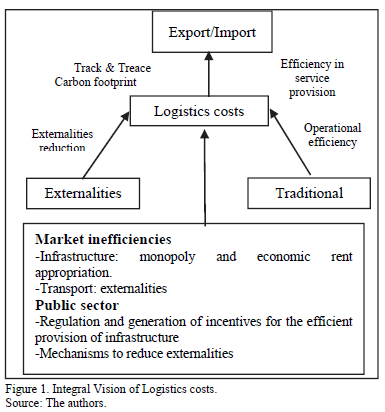
<body><![CDATA[<p><font size="2" face="Verdana, Arial, Helvetica, sans-serif">The following subsections present the integral vision of   logistics costs with respect to the traditional vision. Then, the main   determinants of logistics costs are analyzed and finally, the proposed   reference model is described.</font></p>     <p><font size="2" face="Verdana, Arial, Helvetica, sans-serif"><b><i>3.1. Traditional   and integral vision of logistics costs</i></b></font></p>     <p><font size="2" face="Verdana, Arial, Helvetica, sans-serif">Traditional   approaches for logistics costs assessment do not consider those costs related   to inefficiencies brought about by inadequate provision of infrastructure   services by the State, (e.g. inspections, trade facilitation) as well as those   related to the externalities that are generated by the community and the   environment. For this reason, ECLAC promotes an integral framework for the   analysis of each of </font><font size="2" face="Verdana, Arial, Helvetica, sans-serif">the trade processes, identifying   the potential inefficiencies, in terms of time and costs involved,   independently of the transport mode and the stage of the supply chain,   considering both public and private stakeholders. </font></p>     <p><font size="2" face="Verdana, Arial, Helvetica, sans-serif"><a href="#fig01">Fig. 1</a> presents a diagram of the integral vision of   logistics costs assessment. The diagram considers both traditional logistics   costs, which are those incurred by the private company to move goods from one   point to another, as well as those externalities and over costs that resulted   from the inefficiencies in the provision of logistic services involving the   State and public entities, mainly related to transport and infrastructure. </font></p>     <p align="center"><font size="2" face="Verdana, Arial, Helvetica, sans-serif"><a name="fig01"></a></font><img src="/img/revistas/dyna/v82n191/v82n191a11fig01.gif"></p>     <p><font size="2" face="Verdana, Arial, Helvetica, sans-serif">Logistics over costs could be incurred, for instance, due   to the lack of adequate regulations in monopolies and economic rent   appropriation. Furthermore, over costs can be generated due to the lack of an   efficient service provision at the different echelons of the logistic chain.   This can generate additional storage days or fees due to the non-fulfillment of   a time window that is required by a certain facility (e.g. a late arrival fee   imposed by the port terminal for the reception of cargo). Another example are   truck delays and waiting times at the port terminals due to the lack of   efficient coordination in terms of landside operations. </font></p>     <p><font size="2" face="Verdana, Arial, Helvetica, sans-serif">Externalities are those impacts that the society has to   assume, as a result of logistic activities, such as congestion, pollution and   road accidents among others. The aim of identifying and incorporating them when   it comes to computing logistics costs is to enhance more sustainable logistics. </font></p>     <p><font size="2" face="Verdana, Arial, Helvetica, sans-serif">The role of the public sector is crucial to identify and   correct those market failures by an adequate regulation and facilitation, both   in the transport and logistics sector. In terms of infrastructure provision,   the State should enhance mechanisms that prevent monopolistic markets but also   ensure an adequate economic rent appropriation by the private operators.</font></p>     <p><font size="2" face="Verdana, Arial, Helvetica, sans-serif"><b><i>3.2. Determinants   of total logistics costs</i></b></font></p>     <p><font size="2" face="Verdana, Arial, Helvetica, sans-serif">To identify the relative importance of each component of   the total logistics costs is crucial. The components of logistics costs are not   necessarily the same or have the same impact on all products. Literature   provides a set of factors that may determine logistics costs such as:   infrastructure, human resources competences, technology, legal and regulatory   aspects, facilitation of administrative procedures, as well as those elements   related to the industrial organization or the market structure. Another   important factor is related to the institutional and regulatory stability and   maturity. </font></p>     ]]></body>
<body><![CDATA[<p><font size="2" face="Verdana, Arial, Helvetica, sans-serif">Measuring each of the components of the logistics costs   and establishing causal relationships among the components and determinants is   important for estimating logistics costs. For this, variables that affect total   logistics costs can be classified as endogenous and exogenous. Endogenous   variables correspond to those logistic activities such as transport,   loading/unloading, management and order processing, warehousing, etc., that are   performed by the private operator at the domestic and international stages of   the total logistics chain. </font></p>     <p><font size="2" face="Verdana, Arial, Helvetica, sans-serif">Given that these type of costs have a financial and a time   dimension, those variables associated to time and its variability should be   considered, as well as those related to the costs of service and the cost of   inventories incurred by the inspections and regulatory activities of Customs   and other governmental agencies (i.e. Agricultural and Livestock Services,   Health and Aquiculture services, among others), or those procedures related to   health and safety that include administrative and order processing costs, costs   for transporting the cargo to be inspected, loading and unloading,   packing/unpacking and inventory costs. Such costs are commonly not considered   in the approaches found in the literature.</font></p>     <p><font size="2" face="Verdana, Arial, Helvetica, sans-serif">Exogenous variables are those that indirectly affect   logistics costs or the efficiency of the logistics chain as a whole. This   category includes national institutions, infrastructure, human resources   involved in public services, information systems and technology that support   public services, legal aspects and the institutionalism of the public sector   that can impact any of the endogenous variables both private and public, as   well as those costs related to externalities and those resulting from the   market failures. </font></p>     <p><font size="2" face="Verdana, Arial, Helvetica, sans-serif">According to &#91;34&#93;, exogenous factors that drive logistics   costs have not been addressed as extensively as endogenous factors in the   literature. Hence, they use a path analysis to examine six institutional   constructs on logistics performance and found that all of them have a direct or   indirect impact. The methodology proposed herein aims to incorporate both   exogenous and endogenous factors.</font></p>     <p><font size="2" face="Verdana, Arial, Helvetica, sans-serif"><b><i>3.3. Proposed   framework for logistics costs estimation</i></b></font></p>     <p><font size="2" face="Verdana, Arial, Helvetica, sans-serif">The framework is structured in three steps that are   further described.</font></p>     <p><font size="2" face="Verdana, Arial, Helvetica, sans-serif"><b>3.3.1. Step 1: Definition of the scope of the study and   selection of the logistics chains</b></font></p>     <p><font size="2" face="Verdana, Arial, Helvetica, sans-serif">a) <i>Mapping the most relevant logistics chains</i></font></p>     <p><font size="2" face="Verdana, Arial, Helvetica, sans-serif">This activity consists   in the analysis of the export and import transactions of the country in question   in order to determine a set of representative logistics chains to be included   in the study. This considers the identification of logistics chains and   modeling the main process and stakeholders involved, as well as the main   transport corridors used to transport cargo. The basis of the analysis is the   historical data of trade volumes and the coverage of the transport modes that   are most frequently used for each logistics chain. </font></p>     <p><font size="2" face="Verdana, Arial, Helvetica, sans-serif">For the export transaction, the analysis should consider   those logistics costs from the origin of the product (i.e. at the farm) to the   point of consumption in the country of destination. For import transactions,   the analysis should consider the costs from the moment the product arrives at   the point of origin until it reaches the warehouse of the importer. </font></p>     ]]></body>
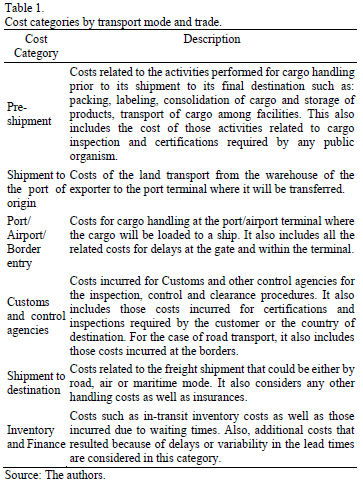
<body><![CDATA[<p><font size="2" face="Verdana, Arial, Helvetica, sans-serif"><i>b) Selection of   logistics chains</i></font></p>     <p><font size="2" face="Verdana, Arial, Helvetica, sans-serif">This consists in the   identification and selection of the main logistics chains based on a   multicriteria analysis. For this, a pre-selection of the most relevant   logistics chains is performed as a first step. Then, criteria to select a set   of logistics chains are defined. Criteria to be considered could be the   relative importance of each productive sector with respect to trade volumes,   value of the cargo, innovation opportunities, among other criterion that may be   important to consider. Finally, based on the relative importance of each   criterion, the pre-selected logistics chains are evaluated and those with a   higher score are selected. </font></p>     <p><font size="2" face="Verdana, Arial, Helvetica, sans-serif"><i>c) Definition of   costs categories </i></font></p>     <p><font size="2" face="Verdana, Arial, Helvetica, sans-serif">Costs have to be   categorized in order to be measured. <a href="#tab01">Table 1</a> presents a general categorization   of costs that may be used and should be adapted to the specific considerations   of each case study.</font></p>     <p align="center"><font size="2" face="Verdana, Arial, Helvetica, sans-serif"><a name="tab01"></a></font><img src="/img/revistas/dyna/v82n191/v82n191a11tab01.gif"></p>     <p><font size="2" face="Verdana, Arial, Helvetica, sans-serif"><i>d) Identification of   the sources of information</i></font></p>     <p><font size="2" face="Verdana, Arial, Helvetica, sans-serif">This consists in the identification of the main sources of   information both primary and secondary for data gathering. Primary sources of   information consider those relevant stakeholders involved in the process either   of export or import of each logistics chain. An agenda should be planned, with   the dates for interviews and focus group. </font></p>     <p><font size="2" face="Verdana, Arial, Helvetica, sans-serif"><b>3.3.2. Step 2:   Costs, over costs and processes analysis </b></font></p>     <p><font size="2" face="Verdana, Arial, Helvetica, sans-serif"><i>a) Development of   logistics processes mapping</i></font></p>     <p><font size="2" face="Verdana, Arial, Helvetica, sans-serif">This activity consists in the analysis of the export and   import processes of each logistics chain under study, with the aim of   determining potential impacts that these factors and their regulation have with   respect to the efficiency of the logistics chains. For this, in-depth   interviews should be performed with those stakeholders previously selected form   each logistics chain. With the information gathered during the interviews and   the secondary information obtained, a logistic processes map should be   designed, such that the main physical and information flows are identified with   their corresponding costs. Other techniques such as Business Process Analysis   (BPA) to model the process could also be used.</font></p>     ]]></body>
<body><![CDATA[<p><font size="2" face="Verdana, Arial, Helvetica, sans-serif"><i>b) Costs and over   costs analysis</i></font></p>     <p><font size="2" face="Verdana, Arial, Helvetica, sans-serif">A diagnostic of the current situation of each logistics   chain may be elaborated, based on the logistic process mapping. The costs and   over costs incurred at each stage of each logistics chain must be identified.   For this, a base scenario is determined first, whereby the costs of the   logistics chain are identified under &quot;normal&quot; operation. </font></p>     <p><font size="2" face="Verdana, Arial, Helvetica, sans-serif">Then, the over costs are determined considering other   scenarios that can occur (based on in-field observations and interviews) in   which inefficient operations occur that result in additional costs (i.e. a late   arrival of export cargo for the stacking period at a port that result in an   additional fee for the exporter), as well as costs associated to waiting times   or delays in each of the stages of the logistics chain (i.e. waiting times at   the gate of the port or at an empty container park). This estimation may be   computed according to average observations or occurrence probabilities. </font></p>     <p><font size="2" face="Verdana, Arial, Helvetica, sans-serif"><i>c) Logistic   inefficiencies analysis, its sectorial impact and national competitiveness </i></font></p>     <p><font size="2" face="Verdana, Arial, Helvetica, sans-serif">This activity aims to provide a general analysis of the   most relevant inefficiencies observed for the logistics chains under study, and   current gaps with respect to other economies and best practices. Impacts on the   competitiveness of foreign trade at a macro level of those gaps and potential   benefits obtained by the reduction or elimination of those over costs observed   should be estimated. </font></p>     <p><font size="2" face="Verdana, Arial, Helvetica, sans-serif">Recommendations to reduce those gaps identified should be   provided and analyzed with the stakeholders involved in the processes in order   to prioritize them and generate a roadmap of the specific actions required to   significantly reduce those over costs per product and corridor. This process is   not proportional to the scale economies of the potential solutions recommended,   and is actually a complex process in which political and social variables may   also be considered. </font></p>     <p><font size="2" face="Verdana, Arial, Helvetica, sans-serif"><b>3.3.3. Step 3:   Recommendations and proposals for public policies </b></font></p>     <p><font size="2" face="Verdana, Arial, Helvetica, sans-serif"><i>a) Analysis and   recommendations</i></font></p>     <p><font size="2" face="Verdana, Arial, Helvetica, sans-serif">A summary of the recommendations to improve current export   and import processes as well as public policies recommendations should be   reported based on the results obtained with the logistics costs analysis, as   well as the priorities defined for the specific projects to be implemented and   its impacts on national productivity and competitiveness.</font></p>     <p>&nbsp;</p>     ]]></body>
<body><![CDATA[<p><font size="3" face="Verdana, Arial, Helvetica, sans-serif"><b>4. The Bolivian, case   study of cost logistics estimation</b></font></p>     <p><font size="2" face="Verdana, Arial, Helvetica, sans-serif">The Natural Resources and Infrastructure Division of ECLAC   has recently analyzed the challenges of the transport systems in landlocked   South American countries. In this section, we present the results of the   analysis related to estimating logistics costs of a number of representative   mineral natural resources logistics chains in Bolivia &#91;35&#93;.</font></p>     <p><font size="2" face="Verdana, Arial, Helvetica, sans-serif">The logistics chain of zinc concentrate via rail and sea   transport in the pre-shipment stage are first sent by road from the mine to the   plant (10 km) and from there to the Avaroa railway station (15 km). In the   event that the plant has a branch rail line, the road segment runs only from   the mine to the plant. Then the concentrate is transported by rail via Ollagüe   (on the Bolivian border) to the ports of Mejillones or Antofagasta (Chile), a   journey of 650 km. Sea transport then follows from one of these Chilean ports   to a port in Japan or the Republic of Korea, lasting between 30 and 35 days.   The inefficiencies in shipping operations in this corridor account for 5.3 per   cent of the value. </font></p>     <p><font size="2" face="Verdana, Arial, Helvetica, sans-serif">Inefficiencies in   customs processing are the most significant contributing factor here,   accounting for 2.8 per cent of the total identified; these inefficiencies are   the result of delays at border crossings and the significant cost of the   certificate of quality issued by the National Service for the Registration and   Control of the Sale of Minerals and Metals (SENARECOM), which is equal to 0.5   per cent of the gross value. </font></p>     <p><font size="2" face="Verdana, Arial, Helvetica, sans-serif">The second factor, accounting for 1.5 per cent, is   associated with the pre-shipment phase, essentially as a result of the poor   condition of secondary roads. The third factor, accounting for 0.6 per cent,   involves rail transport and is due to the change of locomotives at the border.   The collection process shows cost overruns equal to 0.4 per cent as a result of   delays in the settlement of payments (bank transfers) attributable to the time   required for the exchange of documents between the seller and the buyer. </font></p>     <p><font size="2" face="Verdana, Arial, Helvetica, sans-serif">In the case of logistics chains that use road transport in   combination with sea transport, there is a road segment from the mine to the   plant in Potos&iacute; and from there to the port of departure (Arica, Chile),   covering a distance of 806 km, which takes between 2 and 2.5 days. Sea transport   then follows from Arica to a port in Japan or the Republic of Korea, which is a   trip lasting between 30 and 35 days. In this case, the inefficiencies   identified account for 19.1 per cent. </font></p>     <p><font size="2" face="Verdana, Arial, Helvetica, sans-serif">Road transport accounts for 13.4 per cent, which is due to   delays resulting from the poor road conditions from the plant to the asphalt   road. This segment covers a distance of approximately 50 km. There are further   delays at the port of Arica because trucks have to wait in line to offload   their cargo, due to the lack of proper planning and scheduling of operations at   the port, as well as coordination mechanisms. The rest of the links in the   chain contribute in a way that is similar to rail transport.</font></p>     <p>&nbsp;</p>     <p><font size="3" face="Verdana, Arial, Helvetica, sans-serif"><b>5. Discussion and   recommendations</b></font></p>     <p><font size="2" face="Verdana, Arial, Helvetica, sans-serif">Implementation of systemic approaches for an efficient   supply chain management has become one of the main challenges to take advantage   of insofar as the business opportunities presented by globalization. In this   regard, logistics costs represent the main challenge and play a key role specifically   for developing economies, and especially when areas are remotely located, given   that distance has historically been one of the main limitations to allowing   countries to be integrated into global markets. </font></p>     ]]></body>
<body><![CDATA[<p><font size="2" face="Verdana, Arial, Helvetica, sans-serif">Logistics costs   currently account for a bigger percentage of the total cost of a product with   respect to duties and tariffs. This is influenced by the successful   implementation of free trade agreements among countries and more open economic   policies. </font></p>     <p><font size="2" face="Verdana, Arial, Helvetica, sans-serif">This document presents a framework for logistics costs   assessment based on an integral vision that differs from the traditional   approaches found in the literature in that State participation, the resulting   costs of an inadequate provision of services, and the public entities involved   are also taken into consideration. The framework proposed considers a   sequential analysis of the foreign trade processes to identify inefficiencies   and over costs. Furthermore, a temporal dimension is also incorporated into the   analysis. A systematization of the framework proposed in the long term can be   the basis for econometric studies that may be further implemented to validate   results. </font></p>     <p><font size="2" face="Verdana, Arial, Helvetica, sans-serif">As further research,   we propose the application of the methodology proposed to several case studies   and the undertaking of benchmark analysis for different countries in order to   provide recommendations that may enhance the competitiveness of foreign trade.   For instance, it is possible to consider those supply chains that have been   characterized in the literature in detail such as the &quot;Cocoa supply chain&quot; in   Colombia &#91;36&#93; or the &quot;Apple supply chain&quot; in Chile &#91;37&#93;, extending the   preliminary analysis to incorporate the estimation of logistics costs. </font></p>     <p><font size="2" face="Verdana, Arial, Helvetica, sans-serif">Another research avenue is the analysis of logistics costs   with respect to trade barriers and duties in order to demonstrate the need to   improve current foreign trade processes and take greater advantage of the   multilateral and bilateral agreements signed between two or more nations. </font></p>     <p>&nbsp;</p>     <p><font size="3" face="Verdana, Arial, Helvetica, sans-serif"><b>Acknowledgments </b></font></p>     <p><font size="2" face="Verdana, Arial, Helvetica, sans-serif">The authors would like to thank Erik Leal for his valuable   contributions to this work. As part of the National Research Network   &quot;Sistemas de Transporte y Log&iacute;stica,&quot; the authors acknowledge all the   support provided by the National Council of Science and Technology of Mexico   (CONACYT) through the research program &quot;Redes Tem&aacute;ticas de Investigaci&oacute;n.&quot; At   the same time, we acknowledge the determination and effort of the Mexican   Logistics and Supply Chain Association (AML) and the Mexican Institute of   Transportation (IMT) for providing us an internationally recognized   collaboration platform, the International Congress on Logistics and Supply   Chain &#91;CiLOG&#93;.</font></p>     <p>&nbsp;</p>     <p><font size="3" face="Verdana, Arial, Helvetica, sans-serif"><b>References</b></font></p>     <!-- ref --><p><font size="2" face="Verdana, Arial, Helvetica, sans-serif"><b>&#91;1&#93;</b> ECLAC,   IDB, World Bank., Como reducir las brechas de integraci&oacute;n. Infraestructura   f&iacute;sica y costos en el comercio intrarregional. Tercera Reuni&oacute;n de Ministros de   Hacienda de Am&eacute;rica y el Caribe, Lima, Per&uacute;, 2010.    &nbsp;&nbsp;&nbsp;&nbsp;&nbsp;&nbsp;&nbsp;&nbsp;[&#160;<a href="javascript:void(0);" onclick="javascript: window.open('/scielo.php?script=sci_nlinks&ref=000122&pid=S0012-7353201500030001100001&lng=','','width=640,height=500,resizable=yes,scrollbars=1,menubar=yes,');">Links</a>&#160;]<!-- end-ref --></font></p>     <!-- ref --><p><font size="2" face="Verdana, Arial, Helvetica, sans-serif"><b>&#91;2&#93;</b> NU.   CEPAL, OCDE., Perspectivas econ&oacute;micas de Am&eacute;rica Latina. Log&iacute;stica y   competitividad para el desarrollo, &#91;on line&#93;</b> OCDE-CEPAL, Chile, 2013. &#91;Consulta: 20 de Agosto de 2014&#93;. Disponible en: <a href="http://repositorio.cepal.org/bitstream/handle/11362/1504/LCG2575_es.pdf?sequence=1" target="_blank">http://repositorio.cepal.org/bitstream/handle/11362/1504/LCG2575_es.pdf?sequence=1</a></font>&nbsp;&nbsp;&nbsp;&nbsp;&nbsp;&nbsp;&nbsp;&nbsp;[&#160;<a href="javascript:void(0);" onclick="javascript: window.open('/scielo.php?script=sci_nlinks&ref=000124&pid=S0012-7353201500030001100002&lng=','','width=640,height=500,resizable=yes,scrollbars=1,menubar=yes,');">Links</a>&#160;]<!-- end-ref --><!-- ref --><p><font size="2" face="Verdana, Arial, Helvetica, sans-serif"><b>&#91;3&#93;</b> Avelar-Sosa, L., Garc&iacute;a-Alcaraz, J.L., Cedillo-Campos,   M.G. and Adarme-Jaime, W., Effects of regional infrastructure and offered   services in the supply chains performance: Case Ciudad Juarez, DYNA, 81 (186),   pp. 208-217, 2014.    &nbsp;&nbsp;&nbsp;&nbsp;&nbsp;&nbsp;&nbsp;&nbsp;[&#160;<a href="javascript:void(0);" onclick="javascript: window.open('/scielo.php?script=sci_nlinks&ref=000125&pid=S0012-7353201500030001100003&lng=','','width=640,height=500,resizable=yes,scrollbars=1,menubar=yes,');">Links</a>&#160;]<!-- end-ref --> </font></p>     <!-- ref --><p><font size="2" face="Verdana, Arial, Helvetica, sans-serif"><b>&#91;4&#93;</b> M&aacute;rquez-Ramos,   L., Mart&iacute;nez-Zarzoso, I., P&eacute;rez-Garc&iacute;a, E. and Wilmsmeier, G., Determinantes de los costes de transporte   mar&iacute;timos. El caso de las exportaciones espa&ntilde;olas, Espa&ntilde;a, ICE Comercio   Internacional y Costes de Transporte, No. 834, 2007.    &nbsp;&nbsp;&nbsp;&nbsp;&nbsp;&nbsp;&nbsp;&nbsp;[&#160;<a href="javascript:void(0);" onclick="javascript: window.open('/scielo.php?script=sci_nlinks&ref=000127&pid=S0012-7353201500030001100004&lng=','','width=640,height=500,resizable=yes,scrollbars=1,menubar=yes,');">Links</a>&#160;]<!-- end-ref --></font></p>     <!-- ref --><p><font size="2" face="Verdana, Arial, Helvetica, sans-serif"><b>&#91;5&#93;</b> M&aacute;rquez-Ramos,   L., Mart&iacute;nez-Zarzoso, I., P&eacute;rez-Garc&iacute;a, E. and Wilmsmeier, G.,Transporte Mar&iacute;timo: Costes de transporte y   conectividad en el comercio exterior espa&ntilde;ol, en: Gonz&aacute;lez-Laxe,   S&aacute;nchez, Lecciones de Econom&iacute;a Mar&iacute;tima, Spain, Netbiblo, 2007, pp. 105-144.    &nbsp;&nbsp;&nbsp;&nbsp;&nbsp;&nbsp;&nbsp;&nbsp;[&#160;<a href="javascript:void(0);" onclick="javascript: window.open('/scielo.php?script=sci_nlinks&ref=000129&pid=S0012-7353201500030001100005&lng=','','width=640,height=500,resizable=yes,scrollbars=1,menubar=yes,');">Links</a>&#160;]<!-- end-ref --></font></p>     <!-- ref --><p><font size="2" face="Verdana, Arial, Helvetica, sans-serif"><b>&#91;6&#93;</b> Martinez-Zarzoso, I. and Wilmsmeier, G., Trade responses to freight rates: The case of   intra Latin-American maritime trade, in: Fosgerau, de Palma, Marcucci,   Niskanen andVerhoef, Special Issue: Transport and Urban Economics, of the 4th   Kuhmo-Nectar Conference, Copenhagen 48, pp. 24-46, 2011.    &nbsp;&nbsp;&nbsp;&nbsp;&nbsp;&nbsp;&nbsp;&nbsp;[&#160;<a href="javascript:void(0);" onclick="javascript: window.open('/scielo.php?script=sci_nlinks&ref=000131&pid=S0012-7353201500030001100006&lng=','','width=640,height=500,resizable=yes,scrollbars=1,menubar=yes,');">Links</a>&#160;]<!-- end-ref --></font></p>     ]]></body>
<body><![CDATA[<!-- ref --><p><font size="2" face="Verdana, Arial, Helvetica, sans-serif"><b>&#91;7&#93;</b> Mart&iacute;nez-Zarzoso, I. and Wilmsmeier, G., International   transport costs and the margins of intra-Latin American maritime trade.   Aussenwirtschaft, 65 (1), pp. 49-72, 2010.    &nbsp;&nbsp;&nbsp;&nbsp;&nbsp;&nbsp;&nbsp;&nbsp;[&#160;<a href="javascript:void(0);" onclick="javascript: window.open('/scielo.php?script=sci_nlinks&ref=000133&pid=S0012-7353201500030001100007&lng=','','width=640,height=500,resizable=yes,scrollbars=1,menubar=yes,');">Links</a>&#160;]<!-- end-ref --></font></p>     <!-- ref --><p><font size="2" face="Verdana, Arial, Helvetica, sans-serif"><b>&#91;8&#93;</b> Wilmsmeier, G. and Mart&iacute;nez-Zarzoso, I., Determinants of maritime transport costs - A   panel data analysis for Latin American Containerised Trade. Transportation   Planning and Technology, 33 (1), pp. 105-121, 2010. DOI: 10.1080/03081060903429447</font>&nbsp;&nbsp;&nbsp;&nbsp;&nbsp;&nbsp;&nbsp;&nbsp;[&#160;<a href="javascript:void(0);" onclick="javascript: window.open('/scielo.php?script=sci_nlinks&ref=000135&pid=S0012-7353201500030001100008&lng=','','width=640,height=500,resizable=yes,scrollbars=1,menubar=yes,');">Links</a>&#160;]<!-- end-ref --><!-- ref --><p><font size="2" face="Verdana, Arial, Helvetica, sans-serif"><b>&#91;9&#93;</b> S&aacute;nchez,   R.J., Hoffmann, J., Micco, A., Pizzolotti, G., Sgut, M. and Wilmsmeier,   G., Port efficiency and international trade: Port efficiency as a determinant   of maritime transport cost. Maritime Economics and Logistics, 5 (2), pp.   199-218, 2003. DOI: 10.1057/palgrave.mel.9100073.    &nbsp;&nbsp;&nbsp;&nbsp;&nbsp;&nbsp;&nbsp;&nbsp;[&#160;<a href="javascript:void(0);" onclick="javascript: window.open('/scielo.php?script=sci_nlinks&ref=000136&pid=S0012-7353201500030001100009&lng=','','width=640,height=500,resizable=yes,scrollbars=1,menubar=yes,');">Links</a>&#160;]<!-- end-ref --></font></p>     <!-- ref --><p><font size="2" face="Verdana, Arial, Helvetica, sans-serif"><b>&#91;10&#93;</b> M&aacute;rquez-Ramos, L., Mart&iacute;nez-Zarzoso, I.,   P&eacute;rez-Garc&iacute;a, E. and Wilmsmeier, G., Maritime transport costs: Importance of   connectivity measures, Ingenier&iacute;a y Desarrollo, 2006.    &nbsp;&nbsp;&nbsp;&nbsp;&nbsp;&nbsp;&nbsp;&nbsp;[&#160;<a href="javascript:void(0);" onclick="javascript: window.open('/scielo.php?script=sci_nlinks&ref=000138&pid=S0012-7353201500030001100010&lng=','','width=640,height=500,resizable=yes,scrollbars=1,menubar=yes,');">Links</a>&#160;]<!-- end-ref --></font></p>     <!-- ref --><p><font size="2" face="Verdana, Arial, Helvetica, sans-serif"><b>&#91;11&#93;</b> Cipoletta-Tomassian.,   G., P&eacute;rez-Salas., G. and S&aacute;nchez, R.J., Pol&iacute;ticas integradas de   infraestructura, transporte y log&iacute;stica: Experiencias internacionales y   propuestas iniciales. Serie Recursos Naturales e Infraestructura, 50,   CEPAL, 2010.    &nbsp;&nbsp;&nbsp;&nbsp;&nbsp;&nbsp;&nbsp;&nbsp;[&#160;<a href="javascript:void(0);" onclick="javascript: window.open('/scielo.php?script=sci_nlinks&ref=000140&pid=S0012-7353201500030001100011&lng=','','width=640,height=500,resizable=yes,scrollbars=1,menubar=yes,');">Links</a>&#160;]<!-- end-ref --> </font></p>     <!-- ref --><p><font size="2" face="Verdana, Arial, Helvetica, sans-serif"><b>&#91;12&#93;</b> Lupano J., Developing integrated and sustainable   policies on infrastructure, logistics and mobility in Mesoamerica. Boletin FAL   319 (3), 2013.    &nbsp;&nbsp;&nbsp;&nbsp;&nbsp;&nbsp;&nbsp;&nbsp;[&#160;<a href="javascript:void(0);" onclick="javascript: window.open('/scielo.php?script=sci_nlinks&ref=000142&pid=S0012-7353201500030001100012&lng=','','width=640,height=500,resizable=yes,scrollbars=1,menubar=yes,');">Links</a>&#160;]<!-- end-ref --> </font></p>     <!-- ref --><p><font size="2" face="Verdana, Arial, Helvetica, sans-serif"><b>&#91;13&#93;</b> Leal,   E., Costos log&iacute;sticos: Revisi&oacute;n de literatura y propuesta metodol&oacute;gica para su   c&aacute;lculo en cadenas exportadoras. Working Paper.    &nbsp;&nbsp;&nbsp;&nbsp;&nbsp;&nbsp;&nbsp;&nbsp;[&#160;<a href="javascript:void(0);" onclick="javascript: window.open('/scielo.php?script=sci_nlinks&ref=000144&pid=S0012-7353201500030001100013&lng=','','width=640,height=500,resizable=yes,scrollbars=1,menubar=yes,');">Links</a>&#160;]<!-- end-ref --></font></p>     <!-- ref --><p><font size="2" face="Verdana, Arial, Helvetica, sans-serif"><b>&#91;14&#93;</b> Gonz&aacute;lez, J.A., Guash, J.L. and Srebrisky, T.,   Improving logistics costs for transportation and trade facilitation. Policy and   research working paper 4558, Washington D.C., The World Bank, Latin America and   Caribbean Region, Sustainable Development Department, 2008.    &nbsp;&nbsp;&nbsp;&nbsp;&nbsp;&nbsp;&nbsp;&nbsp;[&#160;<a href="javascript:void(0);" onclick="javascript: window.open('/scielo.php?script=sci_nlinks&ref=000146&pid=S0012-7353201500030001100014&lng=','','width=640,height=500,resizable=yes,scrollbars=1,menubar=yes,');">Links</a>&#160;]<!-- end-ref --></font></p>     <!-- ref --><p><font size="2" face="Verdana, Arial, Helvetica, sans-serif"><b>&#91;15&#93;</b> Bowersox D.J. and Calantone R.J., Global   Logistics. Journal of International Marketing, 6 (4), pp. 83-93, 1998.    &nbsp;&nbsp;&nbsp;&nbsp;&nbsp;&nbsp;&nbsp;&nbsp;[&#160;<a href="javascript:void(0);" onclick="javascript: window.open('/scielo.php?script=sci_nlinks&ref=000148&pid=S0012-7353201500030001100015&lng=','','width=640,height=500,resizable=yes,scrollbars=1,menubar=yes,');">Links</a>&#160;]<!-- end-ref --></font></p>     <!-- ref --><p><font size="2" face="Verdana, Arial, Helvetica, sans-serif"><b>&#91;16&#93;</b> Bowersox, D.J., Calantone, R.J. and Rodrigues,   A.M., Estimation of global logistics expenditures using neural networks.   Journal of Business Logistics 24 (2), pp. 21 -36, 2003. DOI: 10.1002/j.2158-1592.2003.tb00044.x</font>&nbsp;&nbsp;&nbsp;&nbsp;&nbsp;&nbsp;&nbsp;&nbsp;[&#160;<a href="javascript:void(0);" onclick="javascript: window.open('/scielo.php?script=sci_nlinks&ref=000150&pid=S0012-7353201500030001100016&lng=','','width=640,height=500,resizable=yes,scrollbars=1,menubar=yes,');">Links</a>&#160;]<!-- end-ref --><!-- ref --><p><font size="2" face="Verdana, Arial, Helvetica, sans-serif"><b>&#91;17&#93;</b> Rodrigues, A.M., Bowersox, D.J. and Calantone,   R.J., Estimation of global and national logistic expenditures: 2002 data   update, Journal of Business Logistics 26 (2), pp. 1-15, 2005. DOI: 10.1002/j.2158-1592.2005.tb00202.x</font>&nbsp;&nbsp;&nbsp;&nbsp;&nbsp;&nbsp;&nbsp;&nbsp;[&#160;<a href="javascript:void(0);" onclick="javascript: window.open('/scielo.php?script=sci_nlinks&ref=000151&pid=S0012-7353201500030001100017&lng=','','width=640,height=500,resizable=yes,scrollbars=1,menubar=yes,');">Links</a>&#160;]<!-- end-ref --><!-- ref --><p><font size="2" face="Verdana, Arial, Helvetica, sans-serif"><b>&#91;18&#93;</b> Nordås,   H.K., Pinali, E. and Geloso-Grosso, M., Logistics and time as a trade barrier,   OECD Trade Policy Working Papers, OECD Publishing &#91;Online&#93;, No. 35, 2006 &#91;date   of reference: November 12th of 2014&#93;. Available at: <a href="http://www.oecd-ilibrary.org/trade/logistics-and-time-as-a-trade-barrier_664220308873" target="_blank">http://www.oecd-ilibrary.org/trade/logistics-and-time-as-a-trade-barrier_664220308873</a>.   DOI: 10.1787/664220308873.    &nbsp;&nbsp;&nbsp;&nbsp;&nbsp;&nbsp;&nbsp;&nbsp;[&#160;<a href="javascript:void(0);" onclick="javascript: window.open('/scielo.php?script=sci_nlinks&ref=000152&pid=S0012-7353201500030001100018&lng=','','width=640,height=500,resizable=yes,scrollbars=1,menubar=yes,');">Links</a>&#160;]<!-- end-ref --></font></p>     <!-- ref --><p><font size="2" face="Verdana, Arial, Helvetica, sans-serif"><b>&#91;19&#93;</b> Hausman, W.H., Lee, H.L. and Subramanian, U.,   Global logistics indicators, supply chain metrics and bilateral trade patterns.   Fifth draft, The World Bank, 2005. DOI: 10.1596/1813-9450-3773</font>&nbsp;&nbsp;&nbsp;&nbsp;&nbsp;&nbsp;&nbsp;&nbsp;[&#160;<a href="javascript:void(0);" onclick="javascript: window.open('/scielo.php?script=sci_nlinks&ref=000154&pid=S0012-7353201500030001100019&lng=','','width=640,height=500,resizable=yes,scrollbars=1,menubar=yes,');">Links</a>&#160;]<!-- end-ref --><!-- ref --><p><font size="2" face="Verdana, Arial, Helvetica, sans-serif"><b>&#91;20&#93;</b> Hummels, D., Time as trade barrier, Thesis, Purdue   University, USA 2001.    &nbsp;&nbsp;&nbsp;&nbsp;&nbsp;&nbsp;&nbsp;&nbsp;[&#160;<a href="javascript:void(0);" onclick="javascript: window.open('/scielo.php?script=sci_nlinks&ref=000155&pid=S0012-7353201500030001100020&lng=','','width=640,height=500,resizable=yes,scrollbars=1,menubar=yes,');">Links</a>&#160;]<!-- end-ref --></font></p>     <!-- ref --><p><font size="2" face="Verdana, Arial, Helvetica, sans-serif"><b>&#91;21&#93;</b> Djankov, S., Freund, C. and Pham, C. ,Trading on   time. The World Bank, 2006. DOI: 10.1596/1813-9450-3909</font>&nbsp;&nbsp;&nbsp;&nbsp;&nbsp;&nbsp;&nbsp;&nbsp;[&#160;<a href="javascript:void(0);" onclick="javascript: window.open('/scielo.php?script=sci_nlinks&ref=000157&pid=S0012-7353201500030001100021&lng=','','width=640,height=500,resizable=yes,scrollbars=1,menubar=yes,');">Links</a>&#160;]<!-- end-ref --><!-- ref --><p><font size="2" face="Verdana, Arial, Helvetica, sans-serif"><b>&#91;22&#93;</b> Tongzon, J., Determinants of competitiveness in   logistics: Implications for the ASEAN Region. Maritime Economics &amp;   Logistics, 9, pp. 67-83, 2007. DOI: 10.1057/palgrave.mel.9100172</font>&nbsp;&nbsp;&nbsp;&nbsp;&nbsp;&nbsp;&nbsp;&nbsp;[&#160;<a href="javascript:void(0);" onclick="javascript: window.open('/scielo.php?script=sci_nlinks&ref=000158&pid=S0012-7353201500030001100022&lng=','','width=640,height=500,resizable=yes,scrollbars=1,menubar=yes,');">Links</a>&#160;]<!-- end-ref --><!-- ref --><p><font size="2" face="Verdana, Arial, Helvetica, sans-serif"><b>&#91;23&#93;</b> Jöreskog, K. and Moustaki, I., Factor analysis   of ordinal variables with full information maximum likelihood, &#91;Online&#93;, 2006.   &#91;date of reference November 12<sup>th</sup> of 2014&#93;. Available at: <a href="http://www.ssicentral.com/lisrel/techdocs/orfiml.pdf" target="_blank">http://www.ssicentral.com/lisrel/techdocs/orfiml.pdf</a> </font>&nbsp;&nbsp;&nbsp;&nbsp;&nbsp;&nbsp;&nbsp;&nbsp;[&#160;<a href="javascript:void(0);" onclick="javascript: window.open('/scielo.php?script=sci_nlinks&ref=000159&pid=S0012-7353201500030001100023&lng=','','width=640,height=500,resizable=yes,scrollbars=1,menubar=yes,');">Links</a>&#160;]<!-- end-ref --><!-- ref --><p><font size="2" face="Verdana, Arial, Helvetica, sans-serif"><b>&#91;24&#93;</b> Heskett, J.L., Business logistics, physical   distribution and materials management. 2nd ed. New York: Ronald Press Co, 1973.    &nbsp;&nbsp;&nbsp;&nbsp;&nbsp;&nbsp;&nbsp;&nbsp;[&#160;<a href="javascript:void(0);" onclick="javascript: window.open('/scielo.php?script=sci_nlinks&ref=000160&pid=S0012-7353201500030001100024&lng=','','width=640,height=500,resizable=yes,scrollbars=1,menubar=yes,');">Links</a>&#160;]<!-- end-ref --></font></p>     <!-- ref --><p><font size="2" face="Verdana, Arial, Helvetica, sans-serif"><b>&#91;25&#93;</b> Wilson, R., 22<sup>nd</sup> Annual state of   logistics report. Cass Information Systems, Inc, 2011.    &nbsp;&nbsp;&nbsp;&nbsp;&nbsp;&nbsp;&nbsp;&nbsp;[&#160;<a href="javascript:void(0);" onclick="javascript: window.open('/scielo.php?script=sci_nlinks&ref=000162&pid=S0012-7353201500030001100025&lng=','','width=640,height=500,resizable=yes,scrollbars=1,menubar=yes,');">Links</a>&#160;]<!-- end-ref --></font></p>     <!-- ref --><p><font size="2" face="Verdana, Arial, Helvetica, sans-serif"><b>&#91;26&#93;</b> Zinn, W., Marmorstein, H. and Charnes, J., The   effect of autocorrelated demand on customer service. Journal of Business   Logistics, 13 (1), pp. 173- 192, 1992.    &nbsp;&nbsp;&nbsp;&nbsp;&nbsp;&nbsp;&nbsp;&nbsp;[&#160;<a href="javascript:void(0);" onclick="javascript: window.open('/scielo.php?script=sci_nlinks&ref=000164&pid=S0012-7353201500030001100026&lng=','','width=640,height=500,resizable=yes,scrollbars=1,menubar=yes,');">Links</a>&#160;]<!-- end-ref --></font></p>     <!-- ref --><p><font size="2" face="Verdana, Arial, Helvetica, sans-serif"><b>&#91;27&#93;</b> Haartveit, E.Y., Kjøstelsen, L. and Jacobsen,   B.S., Time is money - Quantifying logistics cost by measuring time. The   Norwegian Forest and Landscape Institute, Norway, 2007.    &nbsp;&nbsp;&nbsp;&nbsp;&nbsp;&nbsp;&nbsp;&nbsp;[&#160;<a href="javascript:void(0);" onclick="javascript: window.open('/scielo.php?script=sci_nlinks&ref=000166&pid=S0012-7353201500030001100027&lng=','','width=640,height=500,resizable=yes,scrollbars=1,menubar=yes,');">Links</a>&#160;]<!-- end-ref --></font></p>     <!-- ref --><p><font size="2" face="Verdana, Arial, Helvetica, sans-serif"><b>&#91;28&#93;</b> Vernimmen, B., Dullaert, W. and Engelen, S.,   Schedule unreliability in liner shipping: Origins and consequences for the   hinterland supply chain. Maritime Economics &amp; Logistics, 9, pp. 193-213,   2007. DOI: 10.1057/palgrave.mel.9100182</font>&nbsp;&nbsp;&nbsp;&nbsp;&nbsp;&nbsp;&nbsp;&nbsp;[&#160;<a href="javascript:void(0);" onclick="javascript: window.open('/scielo.php?script=sci_nlinks&ref=000168&pid=S0012-7353201500030001100028&lng=','','width=640,height=500,resizable=yes,scrollbars=1,menubar=yes,');">Links</a>&#160;]<!-- end-ref --><!-- ref --><p><font size="2" face="Verdana, Arial, Helvetica, sans-serif"><b>&#91;29&#93;</b> Everaert, P., Bruggeman, W., Sarens, G.,   Anderson, S.R. and Levant, Y., Cost modeling in logistics using time-driven   ABC: Experiences from a wholesaler. International Journal of Physical   Distribution &amp; Logistics Management, 38 (3), pp. 172-191, 2008. DOI: 10.1108/09600030810866977</font>&nbsp;&nbsp;&nbsp;&nbsp;&nbsp;&nbsp;&nbsp;&nbsp;[&#160;<a href="javascript:void(0);" onclick="javascript: window.open('/scielo.php?script=sci_nlinks&ref=000169&pid=S0012-7353201500030001100029&lng=','','width=640,height=500,resizable=yes,scrollbars=1,menubar=yes,');">Links</a>&#160;]<!-- end-ref --><!-- ref --><p><font size="2" face="Verdana, Arial, Helvetica, sans-serif"><b>&#91;30&#93;</b> Roorda, M.J., Cavalcante, R., McCabe, S. and   Kwan, H., A conceptual framework for agent-based modelling of logistics   services. Transportation Research: Part E: Logistics and Transportation Review,   46 (1), pp. 18-31, 2010. DOI: 10.1016/j.tre.2009.06.002</font>&nbsp;&nbsp;&nbsp;&nbsp;&nbsp;&nbsp;&nbsp;&nbsp;[&#160;<a href="javascript:void(0);" onclick="javascript: window.open('/scielo.php?script=sci_nlinks&ref=000170&pid=S0012-7353201500030001100030&lng=','','width=640,height=500,resizable=yes,scrollbars=1,menubar=yes,');">Links</a>&#160;]<!-- end-ref --><!-- ref --><p><font size="2" face="Verdana, Arial, Helvetica, sans-serif"><b>&#91;31&#93;</b> Haartveit, E.Y., Kjøstelsen, L. and Jacobsen,   B.S., Time is Money - Quantifying logistics cost by measuring time. The   Norwegian Forest and Landscape Institute, 2007.    &nbsp;&nbsp;&nbsp;&nbsp;&nbsp;&nbsp;&nbsp;&nbsp;[&#160;<a href="javascript:void(0);" onclick="javascript: window.open('/scielo.php?script=sci_nlinks&ref=000171&pid=S0012-7353201500030001100031&lng=','','width=640,height=500,resizable=yes,scrollbars=1,menubar=yes,');">Links</a>&#160;]<!-- end-ref --></font></p>     ]]></body>
<body><![CDATA[<!-- ref --><p><font size="2" face="Verdana, Arial, Helvetica, sans-serif"><b>&#91;32&#93;</b> Lamb&aacute;n,   M.P., Royo, J., Valencia, J., Berges, L. and Galar, D., Modelo para el c&aacute;lculo   del costo de almacenamiento de un producto: caso de estudio en un entorno   log&iacute;stico, DYNA, 80 (179), pp. 23-32, 2013.    &nbsp;&nbsp;&nbsp;&nbsp;&nbsp;&nbsp;&nbsp;&nbsp;[&#160;<a href="javascript:void(0);" onclick="javascript: window.open('/scielo.php?script=sci_nlinks&ref=000173&pid=S0012-7353201500030001100032&lng=','','width=640,height=500,resizable=yes,scrollbars=1,menubar=yes,');">Links</a>&#160;]<!-- end-ref --></font></p>     <!-- ref --><p><font size="2" face="Verdana, Arial, Helvetica, sans-serif"><b>&#91;33&#93;</b> UN-ESCAP. Study on commercial development of   regional ports as logistics centres, 2003.    &nbsp;&nbsp;&nbsp;&nbsp;&nbsp;&nbsp;&nbsp;&nbsp;[&#160;<a href="javascript:void(0);" onclick="javascript: window.open('/scielo.php?script=sci_nlinks&ref=000175&pid=S0012-7353201500030001100033&lng=','','width=640,height=500,resizable=yes,scrollbars=1,menubar=yes,');">Links</a>&#160;]<!-- end-ref --></font></p>     <!-- ref --><p><font size="2" face="Verdana, Arial, Helvetica, sans-serif"><b>&#91;34&#93;</b> Lee, S.-H., van Wyk, J., National institutions   and logistic performance: a path analysis, Service Business, Article in Press. DOI: 10.1007/s11628-014-0254-x</font>&nbsp;&nbsp;&nbsp;&nbsp;&nbsp;&nbsp;&nbsp;&nbsp;[&#160;<a href="javascript:void(0);" onclick="javascript: window.open('/scielo.php?script=sci_nlinks&ref=000177&pid=S0012-7353201500030001100034&lng=','','width=640,height=500,resizable=yes,scrollbars=1,menubar=yes,');">Links</a>&#160;]<!-- end-ref --><!-- ref --><p><font size="2" face="Verdana, Arial, Helvetica, sans-serif"><b>&#91;35&#93;</b> P&eacute;rez-Salas, G., S&aacute;nches, R.J. and Wilsmeier, G.,   Status of implementation of the almaty programme of action in South America,   ECLAC, Natural Resources and Infrastructure, &#91;Online&#93;, Series No. 167, 2014,   &#91;date of reference November 12th of 2014&#93;. Available at: <a href="http://www.cepal.org/publicaciones/xml/0/53920/StatusofImplementation.pdf" target="_blank">http://www.cepal.org/publicaciones/xml/0/53920/StatusofImplementation.pdf</a></font>&nbsp;&nbsp;&nbsp;&nbsp;&nbsp;&nbsp;&nbsp;&nbsp;[&#160;<a href="javascript:void(0);" onclick="javascript: window.open('/scielo.php?script=sci_nlinks&ref=000178&pid=S0012-7353201500030001100035&lng=','','width=640,height=500,resizable=yes,scrollbars=1,menubar=yes,');">Links</a>&#160;]<!-- end-ref --><!-- ref --><p><font size="2" face="Verdana, Arial, Helvetica, sans-serif"><b>&#91;36&#93;</b> Garc&iacute;a-C&aacute;ceres, R.G., Perdomo, A., Ortiz, O.,   Beltr&aacute;n, P. and L&oacute;pez, K., Characterization of the supply and value chains of   Colombian cocoa, DYNA, 81 (187), pp. 30-40, 2014. DOI: 10.15446/dyna.v81n187.39555</font>&nbsp;&nbsp;&nbsp;&nbsp;&nbsp;&nbsp;&nbsp;&nbsp;[&#160;<a href="javascript:void(0);" onclick="javascript: window.open('/scielo.php?script=sci_nlinks&ref=000179&pid=S0012-7353201500030001100036&lng=','','width=640,height=500,resizable=yes,scrollbars=1,menubar=yes,');">Links</a>&#160;]<!-- end-ref --><!-- ref --><p><font size="2" face="Verdana, Arial, Helvetica, sans-serif"><b>&#91;37&#93;</b> Lopez-Campos,   M., Bearzotti, L., Gonz&aacute;lez-Ram&iacute;rez, R.G. and Cannellla, S., Modelado y   an&aacute;lisis de la cadena log&iacute;stica de exportaci&oacute;n de manzanas chilenas. Proceedings   of the XVII ALIO-SMIO Conference on Operations Research, 2014.    &nbsp;&nbsp;&nbsp;&nbsp;&nbsp;&nbsp;&nbsp;&nbsp;[&#160;<a href="javascript:void(0);" onclick="javascript: window.open('/scielo.php?script=sci_nlinks&ref=000180&pid=S0012-7353201500030001100037&lng=','','width=640,height=500,resizable=yes,scrollbars=1,menubar=yes,');">Links</a>&#160;]<!-- end-ref --></font></p>     <p>&nbsp;</p>     ]]></body>
<body><![CDATA[<p><font size="2" face="Verdana, Arial, Helvetica, sans-serif"><b>G. P&eacute;rez-Salas</b>,   is an Economic Affairs Officer in the Natural Resources and Infrastructure   Diviosn at the Economic Comission for Latin American and Caribbean of United   Nations (ECLAC). He is an Informatics Civil Engineer with a MSc. degree in   Maritime and Port Management. He has over 14 years of experience in the United   Nations System. Since 2008, he has been working for the Infrastructure Services   Unit in UNECLAC in the strengthening of the technical and institutional   capacity of Latin American and Caribbean countries to foster a sustainable   management of infrastructure services. In particular in the areas of logistics,   surface transport, urban movility, road safety and ports management. He has   published 49 studies, including 3 book chapters, 8 papers in referred   proceedings, 6 institutional working papers, 28 articles in specialized maganizes   and 4 ocassional papers all of them related to infrastructure services issues.   Ten of these publications are in English and the rest in Spanish, and they were   published in countries as Argentina, Chile, Colombia, Ecuador, Mexico, United   States of America, Spain and United Kingdom. He has participated in more than   50 technical cooperation assistance, multi-agency and intergovernmental   meetings and technical seminars.</font></p>     <p><font size="2" face="Verdana, Arial, Helvetica, sans-serif"><b>R.G.   Gonz&aacute;lez-Ram&iacute;rez, </b>is a Professor-Researcher in the Industrial Engineering   School of the Pontificia Universidad Catolica de Valpara&iacute;so in Chile. She holds   a BSc degree in Industrial Engineering from the Technologic Institute of   Morelia, Mexico, a MSc. degree in Industrial Engineering from Arizona State   University, USA, a MSc. degree in Quality and Productivity Systems and a PhD in   Engineering Sciences from Monterrey Tech, Mexico. She is currently part of the   National Research System in Mexico. Her research areas are related to supply   chain management and port logistics, including optimization models and   algorithms, as well as trade facilitation, competitiveness studies and   sustainability issues including social corporate responsibility and port-city   relationships. Other research areas include supply chain network design,   districting and territory design, lot sizing, metaheuristics and mathematical   programming. For the past 5 years, she has been working on applied research   projects with several grants from the Chilean government. She is the author of   several scientific publications in indexed journals, specialized magazines,   book chapters and has participated in several seminars and international   conferences. </font></p>     <p><font size="2" face="Verdana, Arial, Helvetica, sans-serif"><b>M.G.   Cedillo-Campos</b>, is a Professor-Researcher in Logistics Systems Dynamics at   the Mexican Institute of Transportation (IMT), Mexico. He is the Founder and   President of the Mexican Logistics and Supply Chain Association (AML). Dr.   Cedillo-Campos is acknowledged as a National Researcher level 1 by the National   Council of Science and Technology in Mexico (CONACYT). In 2004, he received a   PhD. in Logistics Systems Dynamics from the University of Paris, France. In   2012, he was acknowledged by the Autonomous University of Nuevo Leon (UANL),   Mexico with the Innovation Award. In 2012, he collaborated as speaker at   Georgia Tech Panama. Dr. Cedillo is member of the Mexican Academy of Systems   Sciences and the Scientific Chairman of the International Congress on Logistics   and Supply Chain (CiLOG) organized by the AML. He is the author of several   scientific publications in top journals as Transportation Research Part E:   logistics and Transportation Review, Simulation, Computers and Industrial   Engineering, Applied Energy, Computers in Industry, Journal of Applied Research   and Technology, among others.</font></p>      ]]></body><back>
<ref-list>
<ref id="B1">
<label>1</label><nlm-citation citation-type="confpro">
<collab>ECLAC</collab>
<collab>IDB</collab>
<collab>World Bank</collab>
<article-title xml:lang="es"><![CDATA[Como reducir las brechas de integración]]></article-title>
<source><![CDATA[]]></source>
<year></year>
<conf-name><![CDATA[Tercera Infraestructura física y costos en el comercio intrarregional]]></conf-name>
<conf-date>2010</conf-date>
<conf-loc>Lima </conf-loc>
</nlm-citation>
</ref>
<ref id="B2">
<label>2</label><nlm-citation citation-type="book">
<collab>NU</collab>
<collab>CEPAL</collab>
<collab>OCDE</collab>
<source><![CDATA[Perspectivas económicas de América Latina. Logística y competitividad para el desarrollo]]></source>
<year>2013</year>
<publisher-name><![CDATA[OCDE-CEPAL]]></publisher-name>
</nlm-citation>
</ref>
<ref id="B3">
<label>3</label><nlm-citation citation-type="journal">
<person-group person-group-type="author">
<name>
<surname><![CDATA[Avelar-Sosa]]></surname>
<given-names><![CDATA[L.]]></given-names>
</name>
<name>
<surname><![CDATA[García-Alcaraz]]></surname>
<given-names><![CDATA[J.L.]]></given-names>
</name>
<name>
<surname><![CDATA[Cedillo-Campos]]></surname>
<given-names><![CDATA[M.G.]]></given-names>
</name>
<name>
<surname><![CDATA[Adarme-Jaime]]></surname>
<given-names><![CDATA[W.]]></given-names>
</name>
</person-group>
<article-title xml:lang="en"><![CDATA[Effects of regional infrastructure and offered services in the supply chains performance: Case Ciudad Juarez]]></article-title>
<source><![CDATA[DYNA]]></source>
<year>2014</year>
<volume>81</volume>
<numero>186</numero>
<issue>186</issue>
<page-range>208-217</page-range></nlm-citation>
</ref>
<ref id="B4">
<label>4</label><nlm-citation citation-type="journal">
<person-group person-group-type="author">
<name>
<surname><![CDATA[Márquez-Ramos]]></surname>
<given-names><![CDATA[L.]]></given-names>
</name>
<name>
<surname><![CDATA[Martínez-Zarzoso]]></surname>
<given-names><![CDATA[I.]]></given-names>
</name>
<name>
<surname><![CDATA[Pérez-García]]></surname>
<given-names><![CDATA[E.]]></given-names>
</name>
<name>
<surname><![CDATA[Wilmsmeier]]></surname>
<given-names><![CDATA[G.]]></given-names>
</name>
</person-group>
<article-title xml:lang="es"><![CDATA[Determinantes de los costes de transporte marítimos: El caso de las exportaciones españolas, España]]></article-title>
<source><![CDATA[ICE Comercio Internacional y Costes de Transporte]]></source>
<year></year>
<numero>834</numero>
<issue>834</issue>
<page-range>2007</page-range></nlm-citation>
</ref>
<ref id="B5">
<label>5</label><nlm-citation citation-type="book">
<person-group person-group-type="author">
<name>
<surname><![CDATA[Márquez-Ramos]]></surname>
<given-names><![CDATA[L.]]></given-names>
</name>
<name>
<surname><![CDATA[Martínez-Zarzoso]]></surname>
<given-names><![CDATA[I.]]></given-names>
</name>
<name>
<surname><![CDATA[Pérez-García]]></surname>
<given-names><![CDATA[E.]]></given-names>
</name>
<name>
<surname><![CDATA[Wilmsmeier]]></surname>
<given-names><![CDATA[G.]]></given-names>
</name>
</person-group>
<article-title xml:lang="es"><![CDATA[Transporte Marítimo: Costes de transporte y conectividad en el comercio exterior español]]></article-title>
<person-group person-group-type="editor">
<name>
<surname><![CDATA[González-Laxe]]></surname>
</name>
<name>
<surname><![CDATA[Sánchez]]></surname>
</name>
</person-group>
<source><![CDATA[Lecciones de Economía Marítima]]></source>
<year>2007</year>
<page-range>105-144</page-range><publisher-name><![CDATA[Netbiblo]]></publisher-name>
</nlm-citation>
</ref>
<ref id="B6">
<label>6</label><nlm-citation citation-type="confpro">
<person-group person-group-type="author">
<name>
<surname><![CDATA[Martinez-Zarzoso]]></surname>
<given-names><![CDATA[I.]]></given-names>
</name>
<name>
<surname><![CDATA[Wilmsmeier]]></surname>
<given-names><![CDATA[G.]]></given-names>
</name>
</person-group>
<article-title xml:lang="en"><![CDATA[Trade responses to freight rates: The case of intra Latin-American maritime trade]]></article-title>
<person-group person-group-type="editor">
<name>
<surname><![CDATA[Fosgerau]]></surname>
<given-names><![CDATA[de Palma]]></given-names>
</name>
<name>
<surname><![CDATA[Marcucci]]></surname>
<given-names><![CDATA[Niskanen]]></given-names>
</name>
<name>
<surname><![CDATA[Verhoef]]></surname>
</name>
</person-group>
<source><![CDATA[Transport and Urban Economics]]></source>
<year>2011</year>
<edition>48</edition>
<conf-name><![CDATA[4th Kuhmo-Nectar Conference]]></conf-name>
<conf-loc>Copenhagen </conf-loc>
<page-range>24-46</page-range></nlm-citation>
</ref>
<ref id="B7">
<label>7</label><nlm-citation citation-type="journal">
<person-group person-group-type="author">
<name>
<surname><![CDATA[Martínez-Zarzoso]]></surname>
<given-names><![CDATA[I.]]></given-names>
</name>
<name>
<surname><![CDATA[Wilmsmeier]]></surname>
<given-names><![CDATA[G.]]></given-names>
</name>
</person-group>
<article-title xml:lang="en"><![CDATA[International transport costs and the margins of intra-Latin American maritime trade]]></article-title>
<source><![CDATA[Aussenwirtschaft]]></source>
<year>2010</year>
<volume>65</volume>
<numero>1</numero>
<issue>1</issue>
<page-range>49-72</page-range></nlm-citation>
</ref>
<ref id="B8">
<label>8</label><nlm-citation citation-type="journal">
<person-group person-group-type="author">
<name>
<surname><![CDATA[Wilmsmeier]]></surname>
<given-names><![CDATA[G.]]></given-names>
</name>
<name>
<surname><![CDATA[Martínez-Zarzoso]]></surname>
<given-names><![CDATA[I.]]></given-names>
</name>
</person-group>
<article-title xml:lang="en"><![CDATA[Determinants of maritime transport costs: A panel data analysis for Latin American Containerised Trade]]></article-title>
<source><![CDATA[Transportation Planning and Technology]]></source>
<year>2010</year>
<volume>33</volume>
<numero>1</numero>
<issue>1</issue>
<page-range>105-121</page-range></nlm-citation>
</ref>
<ref id="B9">
<label>9</label><nlm-citation citation-type="journal">
<person-group person-group-type="author">
<name>
<surname><![CDATA[Sánchez]]></surname>
<given-names><![CDATA[R.J.]]></given-names>
</name>
<name>
<surname><![CDATA[Hoffmann]]></surname>
<given-names><![CDATA[J.]]></given-names>
</name>
<name>
<surname><![CDATA[Micco]]></surname>
<given-names><![CDATA[A.]]></given-names>
</name>
<name>
<surname><![CDATA[Pizzolotti]]></surname>
<given-names><![CDATA[G.]]></given-names>
</name>
<name>
<surname><![CDATA[Sgut]]></surname>
<given-names><![CDATA[M.]]></given-names>
</name>
<name>
<surname><![CDATA[Wilmsmeier]]></surname>
<given-names><![CDATA[G.]]></given-names>
</name>
</person-group>
<article-title xml:lang="en"><![CDATA[Port efficiency and international trade: Port efficiency as a determinant of maritime transport cost]]></article-title>
<source><![CDATA[Maritime Economics and Logistics]]></source>
<year>2003</year>
<volume>5</volume>
<numero>2</numero>
<issue>2</issue>
<page-range>199-218</page-range></nlm-citation>
</ref>
<ref id="B10">
<label>10</label><nlm-citation citation-type="journal">
<person-group person-group-type="author">
<name>
<surname><![CDATA[Márquez-Ramos]]></surname>
<given-names><![CDATA[L.]]></given-names>
</name>
<name>
<surname><![CDATA[Martínez-Zarzoso]]></surname>
<given-names><![CDATA[I.]]></given-names>
</name>
<name>
<surname><![CDATA[Pérez-García]]></surname>
<given-names><![CDATA[E.]]></given-names>
</name>
<name>
<surname><![CDATA[Wilmsmeier]]></surname>
<given-names><![CDATA[G.]]></given-names>
</name>
</person-group>
<article-title xml:lang="en"><![CDATA[Maritime transport costs: Importance of connectivity measures]]></article-title>
<source><![CDATA[Ingeniería y Desarrollo]]></source>
<year>2006</year>
</nlm-citation>
</ref>
<ref id="B11">
<label>11</label><nlm-citation citation-type="book">
<person-group person-group-type="author">
<name>
<surname><![CDATA[Cipoletta-Tomassian.]]></surname>
<given-names><![CDATA[G.]]></given-names>
</name>
<name>
<surname><![CDATA[Pérez-Salas.]]></surname>
<given-names><![CDATA[G.]]></given-names>
</name>
<name>
<surname><![CDATA[Sánchez]]></surname>
<given-names><![CDATA[R.J.]]></given-names>
</name>
</person-group>
<source><![CDATA[Políticas integradas de infraestructura, transporte y logística: Experiencias internacionales y propuestas iniciales]]></source>
<year>2010</year>
<edition>50</edition>
<publisher-name><![CDATA[CEPAL]]></publisher-name>
</nlm-citation>
</ref>
<ref id="B12">
<label>12</label><nlm-citation citation-type="journal">
<person-group person-group-type="author">
<name>
<surname><![CDATA[Lupano]]></surname>
<given-names><![CDATA[J.]]></given-names>
</name>
</person-group>
<article-title xml:lang="en"><![CDATA[Developing integrated and sustainable policies on infrastructure, logistics and mobility in Mesoamerica]]></article-title>
<source><![CDATA[Boletin FAL]]></source>
<year>2013</year>
<volume>319</volume>
<numero>3</numero>
<issue>3</issue>
</nlm-citation>
</ref>
<ref id="B13">
<label>13</label><nlm-citation citation-type="">
<person-group person-group-type="author">
<name>
<surname><![CDATA[Leal]]></surname>
<given-names><![CDATA[E.]]></given-names>
</name>
</person-group>
<article-title xml:lang="es"><![CDATA[Costos logísticos: Revisión de literatura y propuesta metodológica para su cálculo en cadenas exportadoras]]></article-title>
<source><![CDATA[]]></source>
<year></year>
</nlm-citation>
</ref>
<ref id="B14">
<label>14</label><nlm-citation citation-type="book">
<person-group person-group-type="author">
<name>
<surname><![CDATA[González]]></surname>
<given-names><![CDATA[J.A.]]></given-names>
</name>
<name>
<surname><![CDATA[Guash]]></surname>
<given-names><![CDATA[J.L.]]></given-names>
</name>
<name>
<surname><![CDATA[Srebrisky]]></surname>
<given-names><![CDATA[T.]]></given-names>
</name>
</person-group>
<collab>The World Bank^dLatin America and Caribbean Region</collab>
<source><![CDATA[Improving logistics costs for transportation and trade facilitation: Policy and research working paper 4558]]></source>
<year>2008</year>
<publisher-loc><![CDATA[Washington ]]></publisher-loc>
<publisher-name><![CDATA[Sustainable Development Department]]></publisher-name>
</nlm-citation>
</ref>
<ref id="B15">
<label>15</label><nlm-citation citation-type="journal">
<person-group person-group-type="author">
<name>
<surname><![CDATA[Bowersox]]></surname>
<given-names><![CDATA[D.J.]]></given-names>
</name>
<name>
<surname><![CDATA[Calantone]]></surname>
<given-names><![CDATA[R.J.]]></given-names>
</name>
</person-group>
<article-title xml:lang="en"><![CDATA[Global Logistics]]></article-title>
<source><![CDATA[Journal of International Marketing]]></source>
<year>1998</year>
<volume>6</volume>
<numero>4</numero>
<issue>4</issue>
<page-range>83-93</page-range></nlm-citation>
</ref>
<ref id="B16">
<label>16</label><nlm-citation citation-type="journal">
<person-group person-group-type="author">
<name>
<surname><![CDATA[Bowersox]]></surname>
<given-names><![CDATA[D.J.]]></given-names>
</name>
<name>
<surname><![CDATA[Calantone]]></surname>
<given-names><![CDATA[R.J.]]></given-names>
</name>
<name>
<surname><![CDATA[Rodrigues]]></surname>
<given-names><![CDATA[A.M.]]></given-names>
</name>
</person-group>
<article-title xml:lang="en"><![CDATA[Estimation of global logistics expenditures using neural networks]]></article-title>
<source><![CDATA[Journal of Business Logistics]]></source>
<year>2003</year>
<volume>24</volume>
<numero>2</numero>
<issue>2</issue>
<page-range>21 -36</page-range></nlm-citation>
</ref>
<ref id="B17">
<label>17</label><nlm-citation citation-type="journal">
<person-group person-group-type="author">
<name>
<surname><![CDATA[Rodrigues]]></surname>
<given-names><![CDATA[A.M.]]></given-names>
</name>
<name>
<surname><![CDATA[Bowersox]]></surname>
<given-names><![CDATA[D.J.]]></given-names>
</name>
<name>
<surname><![CDATA[Calantone]]></surname>
<given-names><![CDATA[R.J.]]></given-names>
</name>
</person-group>
<article-title xml:lang="en"><![CDATA[Estimation of global and national logistic expenditures: 2002 data update]]></article-title>
<source><![CDATA[Journal of Business Logistics]]></source>
<year>2005</year>
<volume>26</volume>
<numero>2</numero>
<issue>2</issue>
<page-range>1-15</page-range></nlm-citation>
</ref>
<ref id="B18">
<label>18</label><nlm-citation citation-type="book">
<person-group person-group-type="author">
<name>
<surname><![CDATA[Nordås]]></surname>
<given-names><![CDATA[H.K.]]></given-names>
</name>
<name>
<surname><![CDATA[Pinali]]></surname>
<given-names><![CDATA[E.]]></given-names>
</name>
<name>
<surname><![CDATA[Geloso-Grosso]]></surname>
<given-names><![CDATA[M.]]></given-names>
</name>
</person-group>
<source><![CDATA[Logistics and time as a trade barrier, OECD Trade Policy Working Papers]]></source>
<year></year>
<publisher-name><![CDATA[OECD Publishing]]></publisher-name>
</nlm-citation>
</ref>
<ref id="B19">
<label>19</label><nlm-citation citation-type="book">
<person-group person-group-type="author">
<name>
<surname><![CDATA[Hausman]]></surname>
<given-names><![CDATA[W.H.]]></given-names>
</name>
<name>
<surname><![CDATA[Lee]]></surname>
<given-names><![CDATA[H.L.]]></given-names>
</name>
<name>
<surname><![CDATA[Subramanian]]></surname>
<given-names><![CDATA[U.]]></given-names>
</name>
</person-group>
<source><![CDATA[Global logistics indicators, supply chain metrics and bilateral trade patterns]]></source>
<year>2005</year>
<publisher-name><![CDATA[The World Bank]]></publisher-name>
</nlm-citation>
</ref>
<ref id="B20">
<label>20</label><nlm-citation citation-type="">
<person-group person-group-type="author">
<name>
<surname><![CDATA[Hummels]]></surname>
<given-names><![CDATA[D.]]></given-names>
</name>
</person-group>
<source><![CDATA[Time as trade barrier]]></source>
<year></year>
</nlm-citation>
</ref>
<ref id="B21">
<label>21</label><nlm-citation citation-type="book">
<person-group person-group-type="author">
<name>
<surname><![CDATA[Djankov]]></surname>
<given-names><![CDATA[S.]]></given-names>
</name>
<name>
<surname><![CDATA[Freund]]></surname>
<given-names><![CDATA[C.]]></given-names>
</name>
<name>
<surname><![CDATA[Pham]]></surname>
<given-names><![CDATA[C.]]></given-names>
</name>
</person-group>
<source><![CDATA[Trading on time]]></source>
<year>2006</year>
<publisher-name><![CDATA[The World Bank]]></publisher-name>
</nlm-citation>
</ref>
<ref id="B22">
<label>22</label><nlm-citation citation-type="journal">
<person-group person-group-type="author">
<name>
<surname><![CDATA[Tongzon]]></surname>
<given-names><![CDATA[J.]]></given-names>
</name>
</person-group>
<article-title xml:lang="en"><![CDATA[Determinants of competitiveness in logistics: Implications for the ASEAN Region]]></article-title>
<source><![CDATA[Maritime Economics & Logistics]]></source>
<year>2007</year>
<numero>9</numero>
<issue>9</issue>
<page-range>67-83</page-range></nlm-citation>
</ref>
<ref id="B23">
<label>23</label><nlm-citation citation-type="">
<person-group person-group-type="author">
<name>
<surname><![CDATA[Jöreskog]]></surname>
<given-names><![CDATA[K.]]></given-names>
</name>
<name>
<surname><![CDATA[Moustaki]]></surname>
<given-names><![CDATA[I.]]></given-names>
</name>
</person-group>
<source><![CDATA[Factor analysis of ordinal variables with full information maximum likelihood]]></source>
<year></year>
</nlm-citation>
</ref>
<ref id="B24">
<label>24</label><nlm-citation citation-type="book">
<person-group person-group-type="author">
<name>
<surname><![CDATA[Heskett]]></surname>
<given-names><![CDATA[J.L.]]></given-names>
</name>
</person-group>
<source><![CDATA[Business logistics, physical distribution and materials management]]></source>
<year>1973</year>
<edition>2nd</edition>
<publisher-loc><![CDATA[New York ]]></publisher-loc>
<publisher-name><![CDATA[Ronald Press Co]]></publisher-name>
</nlm-citation>
</ref>
<ref id="B25">
<label>25</label><nlm-citation citation-type="book">
<person-group person-group-type="author">
<name>
<surname><![CDATA[Wilson]]></surname>
<given-names><![CDATA[R.]]></given-names>
</name>
</person-group>
<source><![CDATA[]]></source>
<year>2011</year>
<publisher-name><![CDATA[Cass Information Systems, Inc]]></publisher-name>
</nlm-citation>
</ref>
<ref id="B26">
<label>26</label><nlm-citation citation-type="journal">
<person-group person-group-type="author">
<name>
<surname><![CDATA[Zinn]]></surname>
<given-names><![CDATA[W.]]></given-names>
</name>
<name>
<surname><![CDATA[Marmorstein]]></surname>
<given-names><![CDATA[H.]]></given-names>
</name>
<name>
<surname><![CDATA[Charnes]]></surname>
<given-names><![CDATA[J.]]></given-names>
</name>
</person-group>
<article-title xml:lang="en"><![CDATA[The effect of autocorrelated demand on customer service]]></article-title>
<source><![CDATA[Journal of Business Logistics]]></source>
<year>1992</year>
<volume>13</volume>
<numero>1</numero>
<issue>1</issue>
<page-range>173- 192</page-range></nlm-citation>
</ref>
<ref id="B27">
<label>27</label><nlm-citation citation-type="book">
<person-group person-group-type="author">
<name>
<surname><![CDATA[Haartveit]]></surname>
<given-names><![CDATA[E.Y.]]></given-names>
</name>
<name>
<surname><![CDATA[Kjøstelsen]]></surname>
<given-names><![CDATA[L.]]></given-names>
</name>
<name>
<surname><![CDATA[Jacobsen]]></surname>
<given-names><![CDATA[B.S.]]></given-names>
</name>
</person-group>
<source><![CDATA[Time is money: Quantifying logistics cost by measuring time]]></source>
<year>2007</year>
<publisher-loc><![CDATA[Norway ]]></publisher-loc>
<publisher-name><![CDATA[The Norwegian Forest and Landscape Institute]]></publisher-name>
</nlm-citation>
</ref>
<ref id="B28">
<label>28</label><nlm-citation citation-type="journal">
<person-group person-group-type="author">
<name>
<surname><![CDATA[Vernimmen]]></surname>
<given-names><![CDATA[B.]]></given-names>
</name>
<name>
<surname><![CDATA[Dullaert]]></surname>
<given-names><![CDATA[W.]]></given-names>
</name>
<name>
<surname><![CDATA[Engelen]]></surname>
<given-names><![CDATA[S.]]></given-names>
</name>
</person-group>
<article-title xml:lang="en"><![CDATA[Schedule unreliability in liner shipping: Origins and consequences for the hinterland supply chain]]></article-title>
<source><![CDATA[Maritime Economics & Logistics]]></source>
<year>2007</year>
<numero>9</numero>
<issue>9</issue>
<page-range>193-213</page-range></nlm-citation>
</ref>
<ref id="B29">
<label>29</label><nlm-citation citation-type="journal">
<person-group person-group-type="author">
<name>
<surname><![CDATA[Everaert]]></surname>
<given-names><![CDATA[P.]]></given-names>
</name>
<name>
<surname><![CDATA[Bruggeman]]></surname>
<given-names><![CDATA[W.]]></given-names>
</name>
<name>
<surname><![CDATA[Sarens]]></surname>
<given-names><![CDATA[G.]]></given-names>
</name>
<name>
<surname><![CDATA[Anderson]]></surname>
<given-names><![CDATA[S.R.]]></given-names>
</name>
<name>
<surname><![CDATA[Levant]]></surname>
<given-names><![CDATA[Y.]]></given-names>
</name>
</person-group>
<article-title xml:lang="en"><![CDATA[Cost modeling in logistics using time-driven ABC: Experiences from a wholesaler]]></article-title>
<source><![CDATA[International Journal of Physical Distribution & Logistics Management]]></source>
<year>2008</year>
<volume>38</volume>
<numero>3</numero>
<issue>3</issue>
<page-range>172-191</page-range></nlm-citation>
</ref>
<ref id="B30">
<label>30</label><nlm-citation citation-type="journal">
<person-group person-group-type="author">
<name>
<surname><![CDATA[Roorda]]></surname>
<given-names><![CDATA[M.J.]]></given-names>
</name>
<name>
<surname><![CDATA[Cavalcante]]></surname>
<given-names><![CDATA[R.]]></given-names>
</name>
<name>
<surname><![CDATA[McCabe]]></surname>
<given-names><![CDATA[S.]]></given-names>
</name>
<name>
<surname><![CDATA[Kwan]]></surname>
<given-names><![CDATA[H.]]></given-names>
</name>
</person-group>
<article-title xml:lang="en"><![CDATA[A conceptual framework for agent-based modelling of logistics services]]></article-title>
<source><![CDATA[Transportation Research: Part E: Logistics and Transportation Review]]></source>
<year>2010</year>
<volume>46</volume>
<numero>1</numero>
<issue>1</issue>
<page-range>18-31</page-range></nlm-citation>
</ref>
<ref id="B31">
<label>31</label><nlm-citation citation-type="book">
<person-group person-group-type="author">
<name>
<surname><![CDATA[Haartveit]]></surname>
<given-names><![CDATA[E.Y.]]></given-names>
</name>
<name>
<surname><![CDATA[Kjøstelsen]]></surname>
<given-names><![CDATA[L.]]></given-names>
</name>
<name>
<surname><![CDATA[Jacobsen]]></surname>
<given-names><![CDATA[B.S.]]></given-names>
</name>
</person-group>
<source><![CDATA[Time is Money: Quantifying logistics cost by measuring time]]></source>
<year>2007</year>
<publisher-name><![CDATA[The Norwegian Forest and Landscape Institute]]></publisher-name>
</nlm-citation>
</ref>
<ref id="B32">
<label>32</label><nlm-citation citation-type="journal">
<person-group person-group-type="author">
<name>
<surname><![CDATA[Lambán]]></surname>
<given-names><![CDATA[M.P.]]></given-names>
</name>
<name>
<surname><![CDATA[Royo]]></surname>
<given-names><![CDATA[J.]]></given-names>
</name>
<name>
<surname><![CDATA[Valencia]]></surname>
<given-names><![CDATA[J.]]></given-names>
</name>
<name>
<surname><![CDATA[Berges]]></surname>
<given-names><![CDATA[L.]]></given-names>
</name>
<name>
<surname><![CDATA[Galar]]></surname>
<given-names><![CDATA[D.]]></given-names>
</name>
</person-group>
<article-title xml:lang="es"><![CDATA[Modelo para el cálculo del costo de almacenamiento de un producto: caso de estudio en un entorno logístico]]></article-title>
<source><![CDATA[DYNA]]></source>
<year>2013</year>
<volume>80</volume>
<numero>179</numero>
<issue>179</issue>
<page-range>23-32</page-range></nlm-citation>
</ref>
<ref id="B33">
<label>33</label><nlm-citation citation-type="">
<collab>UN-ESCAP</collab>
<source><![CDATA[Study on commercial development of regional ports as logistics centres]]></source>
<year>2003</year>
</nlm-citation>
</ref>
<ref id="B34">
<label>34</label><nlm-citation citation-type="journal">
<person-group person-group-type="author">
<name>
<surname><![CDATA[Lee]]></surname>
<given-names><![CDATA[S.-H.]]></given-names>
</name>
<name>
<surname><![CDATA[van Wyk]]></surname>
<given-names><![CDATA[J.]]></given-names>
</name>
</person-group>
<article-title xml:lang="en"><![CDATA[National institutions and logistic performance: a path analysis]]></article-title>
<source><![CDATA[Service Business]]></source>
<year></year>
</nlm-citation>
</ref>
<ref id="B35">
<label>35</label><nlm-citation citation-type="">
<person-group person-group-type="author">
<name>
<surname><![CDATA[Pérez-Salas]]></surname>
<given-names><![CDATA[G.]]></given-names>
</name>
<name>
<surname><![CDATA[Sánches]]></surname>
<given-names><![CDATA[R.J.]]></given-names>
</name>
<name>
<surname><![CDATA[Wilsmeier]]></surname>
<given-names><![CDATA[G.]]></given-names>
</name>
</person-group>
<source><![CDATA[Status of implementation of the almaty programme of action in South America]]></source>
<year>2014</year>
</nlm-citation>
</ref>
<ref id="B36">
<label>36</label><nlm-citation citation-type="journal">
<person-group person-group-type="author">
<name>
<surname><![CDATA[García-Cáceres]]></surname>
<given-names><![CDATA[R.G.]]></given-names>
</name>
<name>
<surname><![CDATA[Perdomo]]></surname>
<given-names><![CDATA[A.]]></given-names>
</name>
<name>
<surname><![CDATA[Ortiz]]></surname>
<given-names><![CDATA[O.]]></given-names>
</name>
<name>
<surname><![CDATA[Beltrán]]></surname>
<given-names><![CDATA[P.]]></given-names>
</name>
<name>
<surname><![CDATA[López]]></surname>
<given-names><![CDATA[K.]]></given-names>
</name>
</person-group>
<article-title xml:lang="en"><![CDATA[Characterization of the supply and value chains of Colombian cocoa]]></article-title>
<source><![CDATA[DYNA]]></source>
<year>2014</year>
<volume>81</volume>
<numero>187</numero>
<issue>187</issue>
<page-range>30-40</page-range></nlm-citation>
</ref>
<ref id="B37">
<label>37</label><nlm-citation citation-type="confpro">
<person-group person-group-type="author">
<name>
<surname><![CDATA[Lopez-Campos]]></surname>
<given-names><![CDATA[M.]]></given-names>
</name>
<name>
<surname><![CDATA[Bearzotti]]></surname>
<given-names><![CDATA[L.]]></given-names>
</name>
<name>
<surname><![CDATA[González-Ramírez]]></surname>
<given-names><![CDATA[R.G.]]></given-names>
</name>
<name>
<surname><![CDATA[Cannellla]]></surname>
<given-names><![CDATA[S.]]></given-names>
</name>
</person-group>
<article-title xml:lang="es"><![CDATA[Modelado y análisis de la cadena logística de exportación de manzanas chilenas]]></article-title>
<source><![CDATA[]]></source>
<year></year>
<conf-name><![CDATA[XVII ALIO-SMIO Conference on Operations Research]]></conf-name>
<conf-date>2014</conf-date>
<conf-loc> </conf-loc>
</nlm-citation>
</ref>
</ref-list>
</back>
</article>