<?xml version="1.0" encoding="ISO-8859-1"?><article xmlns:mml="http://www.w3.org/1998/Math/MathML" xmlns:xlink="http://www.w3.org/1999/xlink" xmlns:xsi="http://www.w3.org/2001/XMLSchema-instance">
<front>
<journal-meta>
<journal-id>0012-7353</journal-id>
<journal-title><![CDATA[DYNA]]></journal-title>
<abbrev-journal-title><![CDATA[Dyna rev.fac.nac.minas]]></abbrev-journal-title>
<issn>0012-7353</issn>
<publisher>
<publisher-name><![CDATA[Universidad Nacional de Colombia]]></publisher-name>
</publisher>
</journal-meta>
<article-meta>
<article-id>S0012-73532015000300013</article-id>
<article-id pub-id-type="doi">10.15446/dyna.v82n191.42308</article-id>
<title-group>
<article-title xml:lang="en"><![CDATA[Modeling of CO2 vapor-liquid equilibrium in Colombian heavy oil using SARA analysis]]></article-title>
<article-title xml:lang="es"><![CDATA[Modelado del equilibrio líquido-vapor CO2-crudo pesado colombiano con análisis SARA]]></article-title>
</title-group>
<contrib-group>
<contrib contrib-type="author">
<name>
<surname><![CDATA[Ramirez]]></surname>
<given-names><![CDATA[Oscar]]></given-names>
</name>
<xref ref-type="aff" rid="A01"/>
</contrib>
<contrib contrib-type="author">
<name>
<surname><![CDATA[Betancur]]></surname>
<given-names><![CDATA[Carolina]]></given-names>
</name>
<xref ref-type="aff" rid="A02"/>
</contrib>
<contrib contrib-type="author">
<name>
<surname><![CDATA[Hoyos]]></surname>
<given-names><![CDATA[Bibian]]></given-names>
</name>
<xref ref-type="aff" rid="A03"/>
</contrib>
<contrib contrib-type="author">
<name>
<surname><![CDATA[Naranjo]]></surname>
<given-names><![CDATA[Carlos]]></given-names>
</name>
<xref ref-type="aff" rid="A04"/>
</contrib>
</contrib-group>
<aff id="A01">
<institution><![CDATA[,Universidad Nacional de Colombia Facultad de Minas ]]></institution>
<addr-line><![CDATA[Medellín ]]></addr-line>
<country>Colombia</country>
</aff>
<aff id="A02">
<institution><![CDATA[,Universidad Nacional de Colombia Facultad de Minas ]]></institution>
<addr-line><![CDATA[Medellín ]]></addr-line>
<country>Colombia</country>
</aff>
<aff id="A03">
<institution><![CDATA[,Universidad Nacional de Colombia Facultad de Minas ]]></institution>
<addr-line><![CDATA[Medellín ]]></addr-line>
<country>Colombia</country>
</aff>
<aff id="A04">
<institution><![CDATA[,Ecopetrol S.A. Instituto Colombiano del Petróleo ]]></institution>
<addr-line><![CDATA[Bogotá ]]></addr-line>
<country>Colombia</country>
</aff>
<pub-date pub-type="pub">
<day>00</day>
<month>06</month>
<year>2015</year>
</pub-date>
<pub-date pub-type="epub">
<day>00</day>
<month>06</month>
<year>2015</year>
</pub-date>
<volume>82</volume>
<numero>191</numero>
<fpage>103</fpage>
<lpage>108</lpage>
<copyright-statement/>
<copyright-year/>
<self-uri xlink:href="http://www.scielo.org.co/scielo.php?script=sci_arttext&amp;pid=S0012-73532015000300013&amp;lng=en&amp;nrm=iso"></self-uri><self-uri xlink:href="http://www.scielo.org.co/scielo.php?script=sci_abstract&amp;pid=S0012-73532015000300013&amp;lng=en&amp;nrm=iso"></self-uri><self-uri xlink:href="http://www.scielo.org.co/scielo.php?script=sci_pdf&amp;pid=S0012-73532015000300013&amp;lng=en&amp;nrm=iso"></self-uri><abstract abstract-type="short" xml:lang="en"><p><![CDATA[The solubility of CO2 in Colombian heavy oil was calculated using the Peng-Robinson cubic equation of state and the Lee-Kesler correlations. The crude was represented as a mixture of pseudo-components and for each one of them, the thermodynamic and critical properties were estimated. The results obtained in representing the oil with four, five and six pseudo-components show that all these representations produce similar results and therefore the use of four pseudo-components is sufficient and has a lower computational cost. Excellent results were obtained by comparing the experimental and calculated data. For this system, it is enough to have a complete characterization of the SARA analysis and to use four pseudo-components to adequately model the vapor-liquid equilibrium of CO2 -heavy oil.]]></p></abstract>
<abstract abstract-type="short" xml:lang="es"><p><![CDATA[La solubilidad del CO2 en un crudo pesado colombiano fue calculada usando la ecuación cúbica de estado de Peng-Robinson y la correlación de Lee-Kesler. El crudo fue representado como una mezcla de pseudo-componentes y para cada uno de ellos se calcularon las propiedades termodinámicas y críticas. Los resultados obtenidos en la representación del crudo con cuatro, cinco y seis pseudo-componentes muestran que todas las representaciones producen resultados similares y por lo tanto el uso de cuatro pseudo-componentes es suficiente y tiene un costo computacional más bajo. Fueron obtenidos excelentes resultados al comparar los datos experimentales y calculados. Para este sistema es suficiente tener una completa caracterización del análisis SARA y usar cuatro pseudo-componentes para modelar adecuadamente el equilibrio líquido-vapor de CO2-crudo pesado.]]></p></abstract>
<kwd-group>
<kwd lng="en"><![CDATA[Equation of state]]></kwd>
<kwd lng="en"><![CDATA[pseudo-component]]></kwd>
<kwd lng="en"><![CDATA[SARA analysis]]></kwd>
<kwd lng="en"><![CDATA[crude]]></kwd>
<kwd lng="en"><![CDATA[solvent]]></kwd>
<kwd lng="en"><![CDATA[phase equilibrium]]></kwd>
<kwd lng="es"><![CDATA[Ecuación de estado]]></kwd>
<kwd lng="es"><![CDATA[pseudo-componente]]></kwd>
<kwd lng="es"><![CDATA[análisis SARA]]></kwd>
<kwd lng="es"><![CDATA[crudo]]></kwd>
<kwd lng="es"><![CDATA[solvente]]></kwd>
<kwd lng="es"><![CDATA[equilibrio de fases]]></kwd>
</kwd-group>
</article-meta>
</front><body><![CDATA[ <p><font size="1" face="Verdana, Arial, Helvetica, sans-serif"><b>DOI: </b><a href="http://dx.doi.org/10.15446/dyna.v82n191.42308" target="_blank">http://dx.doi.org/10.15446/dyna.v82n191.42308</a></font></p>     <p align="center"><font size="4" face="Verdana, Arial, Helvetica, sans-serif"><b>Modeling of CO<sub>2</sub> vapor-liquid equilibrium in   Colombian heavy oil using SARA analysis</b></font></p>     <p align="center"><font size="3"><b><font face="Verdana, Arial, Helvetica, sans-serif"><i>Modelado   del equilibrio l&iacute;quido-vapor CO<sub>2</sub>-crudo pesado colombiano con an&aacute;lisis SARA</i></font></b></font></p>     <p align="center">&nbsp;</p>     <p align="center"><font size="2" face="Verdana, Arial, Helvetica, sans-serif"><b>Oscar   Ramirez <i><sup>a</sup></i>, Carolina Betancur <i><sup>b</sup></i>, Bibian Hoyos <i><sup>c</sup></i> &amp; Carlos Naranjo <i><sup>d</sup></i></b></font></p>     <p align="center">&nbsp;</p>     <p align="center"><font size="2" face="Verdana, Arial, Helvetica, sans-serif"><sup><i>a </i></sup><i>Facultad de Minas, Universidad Nacional de Colombia, Medell&iacute;n,   Colombia. <a href="mailto:ojramirezo@unal.edu.co">ojramirezo@unal.edu.co</a>    <br>   </i></font><i><font size="2" face="Verdana, Arial, Helvetica, sans-serif"><sup>b</sup> Facultad de Minas, Universidad Nacional de Colombia, Medell&iacute;n,   Colombia. <a href="mailto:cbetancurg@unal.edu.co">cbetancurg@unal.edu.co</a>    <br>   </font></i><i><font size="2" face="Verdana, Arial, Helvetica, sans-serif"><sup>c</sup> Facultad de Minas, Universidad Nacional de Colombia, Medell&iacute;n, Colombia. <a href="mailto:bahoyos@unal.edu.co">bahoyos@unal.edu.co</a>    <br>   </font></i><i><font size="2" face="Verdana, Arial, Helvetica, sans-serif"><sup>d</sup> Instituto Colombiano del Petr&oacute;leo, Ecopetrol S.A., Bogot&aacute;, Colombia. <a href="mailto:carlosed.naranjo@ecopetrol.com.co">carlosed.naranjo@ecopetrol.com.co</a></font></i></p>     ]]></body>
<body><![CDATA[<p align="center">&nbsp;</p>     <p align="center"><font size="2" face="Verdana, Arial, Helvetica, sans-serif"><b>Received:   February 26<sup>th</sup>, 2014. Received in revised form: October 30<sup>th</sup>,   2014. Accepted: November 15<sup>th</sup>, 2015</b></font></p>     <p align="center">&nbsp;</p>     <p align="center"><font size="1" face="Verdana, Arial, Helvetica, sans-seriff"><b>This work is licensed under a</b> <a rel="license" href="http://creativecommons.org/licenses/by-nc-nd/4.0/">Creative Commons Attribution-NonCommercial-NoDerivatives 4.0 International License</a>.</font><br />   <a rel="license" href="http://creativecommons.org/licenses/by-nc-nd/4.0/"><img style="border-width:0" src="https://i.creativecommons.org/l/by-nc-nd/4.0/88x31.png" /></a></p> <hr>     <p><font size="2" face="Verdana, Arial, Helvetica, sans-serif"><b>Abstract    <br>   </b></font><font size="2" face="Verdana, Arial, Helvetica, sans-serif">The solubility of CO<sub>2</sub> in Colombian heavy oil was calculated using the Peng-Robinson   cubic equation of state and the Lee-Kesler correlations. The crude was represented as a mixture of   pseudo-components and for each one of them, the thermodynamic and critical   properties were estimated. The results obtained in representing the oil with   four, five and six pseudo-components show that   all these representations produce similar results and therefore the use of four pseudo-components is   sufficient and has a lower computational cost. Excellent   results were obtained by comparing the experimental and calculated data. For   this system, it is enough to have a complete characterization of the SARA   analysis and to use four pseudo-components to adequately model the vapor-liquid   equilibrium of CO<sub>2 </sub>-heavy oil.</font></p>     <p><font size="2" face="Verdana, Arial, Helvetica, sans-serif"><i>Keywords</i>: Equation of state;   pseudo-component; SARA analysis; crude; solvent; phase equilibrium.</font></p>     <p><font size="2" face="Verdana, Arial, Helvetica, sans-serif"><b>Resumen    <br>   </b></font><font size="2" face="Verdana, Arial, Helvetica, sans-serif">La   solubilidad del CO<sub>2</sub> en un crudo pesado colombiano fue calculada   usando la ecuaci&oacute;n c&uacute;bica de estado de Peng-Robinson y la correlaci&oacute;n de   Lee-Kesler. El crudo fue representado como una mezcla de pseudo-componentes y   para cada uno de ellos se calcularon las propiedades termodin&aacute;micas y cr&iacute;ticas.   Los resultados obtenidos en la representaci&oacute;n del crudo con cuatro, cinco y   seis pseudo-componentes muestran que todas las representaciones producen   resultados similares y por lo tanto el uso de cuatro pseudo-componentes es   suficiente y tiene un costo computacional m&aacute;s bajo. Fueron obtenidos excelentes   resultados al comparar los datos experimentales y calculados. Para este sistema   es suficiente tener una completa caracterizaci&oacute;n del an&aacute;lisis SARA y usar   cuatro pseudo-componentes para modelar adecuadamente el equilibrio   l&iacute;quido-vapor de CO<sub>2</sub>-crudo pesado.</font></p>     <p><font size="2" face="Verdana, Arial, Helvetica, sans-serif"><i>Palabras clave</i>:   Ecuaci&oacute;n de estado; pseudo-componente; an&aacute;lisis SARA; crudo; solvente; equilibrio de fases.</font></p> <hr>     ]]></body>
<body><![CDATA[<p>&nbsp;</p>     <p><font size="3" face="Verdana, Arial, Helvetica, sans-serif"><b>1. Introduction</b></font></p>     <p><font size="2" face="Verdana, Arial, Helvetica, sans-serif">Oil is a complex mixture   of hydrocarbons produced from sedimentary   rocks in gas form (natural gas), liquid (crude oil), semisolid (bitumen) or solids (wax or asphaltite) &#91;1&#93;.</font></p>     <p><font size="2" face="Verdana, Arial, Helvetica, sans-serif">Most of the world's oil resources correspond   to viscous and heavy hydrocarbons, which are difficult and   expensive to produce and refine. Heavy   oil, extra heavy oil and bitumen make up 70%   of the world's total oil resources oscillating between 9 and13 trillion barrels &#91;2&#93;.</font></p>     <p><font size="2" face="Verdana, Arial, Helvetica, sans-serif">A significant number of laboratory studies have been   undertaken to identify technologies that can be applied as a solution to the   phenomena that negatively affect the performance of implemented secondary   recovery processes. These methods focus mainly on increasing oil mobility and   thus increase the production thereof. The goal is to reduce its viscosity so   that oil can flow easily. Enhanced Oil Recovery (EOR) can be achieved through   technologies such as gas injection, chemical injection, microbial injection, or   thermal recovery &#91;3&#93;.</font></p>     <p><font size="2" face="Verdana, Arial, Helvetica, sans-serif">The implementation of EOR methods plays a key role as a   technology to increase the recovery factor of Colombian fields, and to   refurbish them in the implementation of other technologies designed to increase   well productivity &#91;4&#93;.</font></p>     <p><font size="2" face="Verdana, Arial, Helvetica, sans-serif">The main advantage of gas injection is its microscopic sweep. The gases   used to EOR are mostly methane, butane, propane, nitrogen and carbon dioxide.   Many of the aforementioned gases have the advantage of being produced in-situ,   i.e. large volumes are available in the wellbore for injection. The choice of a   particular gas is strongly linked to its availability and to the increased   recovery generated. Thus, CO<sub>2</sub> appears as one of the most promising   gases for use in EOR.</font></p>     <p><font size="2" face="Verdana, Arial, Helvetica, sans-serif">It is therefore important to have a thermodynamic model to adequately   characterize the phase behavior of CO<sub>2 </sub>- heavy oil mixtures. Such   models can provide judgment elements for decision-making regarding production,   transportation, refining and upgrading oil.</font></p>     <p><font size="2" face="Verdana, Arial, Helvetica, sans-serif">The experimental data reported in the literature to characterize the   phase equilibrium for CO<sub>2 </sub>- heavy oil systems are generally few and   so the difficulties in establishing appropriate thermodynamic models are high.   Therefore, tools allowing phase equilibrium calculations of such systems with   little experimental data are required.</font></p>     <p><font size="2" face="Verdana, Arial, Helvetica, sans-serif">The aim of this work is to   develop a model for the calculation of vapor-liquid equilibrium for CO<sub>2 </sub>-   Colombian heavy oil (called here UnalMed), using the representation of   pseudo-components and to estimate the critical and thermodynamic properties of   those components. Additionally, we seek here to establish the right number of   components to be used for a good representation of the system, with little   experimental information and at low computational cost. This information may be   useful for developing appropriate thermodynamic models for the Colombian oil industry. To our knowledge, data on thermodynamic   properties of pseudo-components to represent Colombian heavy oils have not been   previously published.</font></p>     ]]></body>
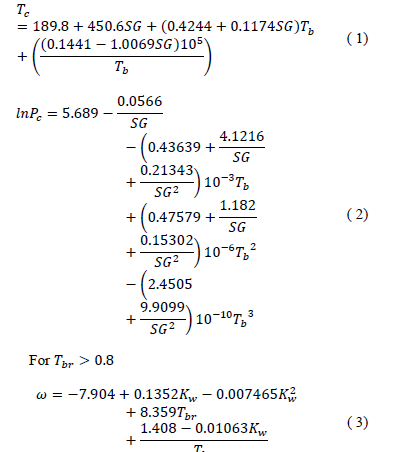
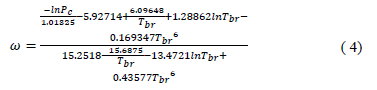
<body><![CDATA[<p>&nbsp;</p>     <p><font size="3" face="Verdana, Arial, Helvetica, sans-serif"><b>2. Model</b></font></p>     <p><font size="2" face="Verdana, Arial, Helvetica, sans-serif">Based on the nature of the mixture of oil, there are   several ways to express its composition. Some of the most important types of   composition &#91;1,5,6&#93; are PONA analysis (paraffins, olefins, aromatics and   Naphthenes), PNA (paraffins, Naphthenes and Aromatics), PIONA (paraffins,   Isoparaffins, Olefins, Naphthenes and Aromatics), elemental (C, H, S, N, O) and   SARA analysis (Saturates, Aromatics, Resins and Asphaltenes) &#91;7&#93;.</font></p>     <p><font size="2" face="Verdana, Arial, Helvetica, sans-serif">PNA and PINA analyses are useful for petroleum products in   a range of low boiling temperatures, such as distillates of atmospheric   distillation units for crude. However, the SARA analysis is useful for heavy   oil fractions, residues and fossil fuels (i.e., coal liquids) that have a high   content of aromatics, resins and asphaltenes.</font></p>     <p><font size="2" face="Verdana, Arial, Helvetica, sans-serif">The above analyses are ways to represent oil as a mixture   of pseudo components (several components represented in a single fraction),   given the complexity of the composition of this. With SARA analysis, for   example, oil can be represented in four pseudo components, which are the   saturates, aromatics, resins and asphaltenes, and each of them has its   properties such as the boiling point, specific gravity, density, molecular   weight, among others. In addition, each pseudo component can be modeled as a   pure substance.</font></p>     <p><font size="2" face="Verdana, Arial, Helvetica, sans-serif">The critical properties, molecular weight and acentric   factor of each pseudo component can be calculated by correlations reported in   the literature for heavy oil fractions.</font></p>     <p><font size="2" face="Verdana, Arial, Helvetica, sans-serif">In this work, the critical temperature, critical pressure   and acentric factor of each pseudo component were calculated using the   Lee-Kesler correlations &#91;8&#93;, as shown in (eq.1-6); the molecular weight was   calculated with the Daubert-Riazi correlation (eq. 7) and the critical volume   with the Hall-Yarborough correlation (eq. 8). These correlations were selected   by considering the good results that have been obtained with respect to   experimental data along its applications &#91;9,10&#93;. The input parameters of these   correlations are the boiling point (T<sub>b</sub>) and the specific gravity   (SG).</font></p>     <p><img src="/img/revistas/dyna/v82n191/v82n191a13eq0103.gif"></p>     <p><font size="2" face="Verdana, Arial, Helvetica, sans-serif">Kesler and Lee &#91;11&#93; proposed the following correlation for <img src="/img/revistas/dyna/v82n191/v82n191a13eq010.gif"></font></p>     <p><img src="/img/revistas/dyna/v82n191/v82n191a13eq04.gif"></p>     ]]></body>
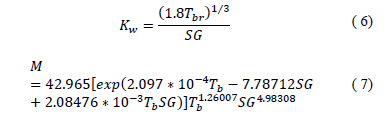
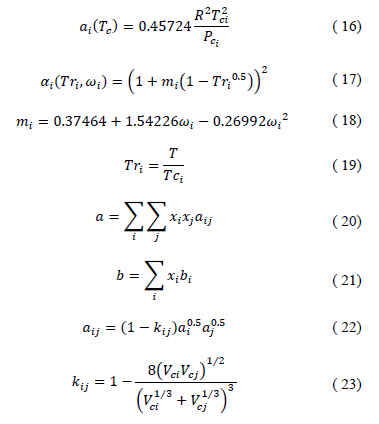
<body><![CDATA[<p><font size="2" face="Verdana, Arial, Helvetica, sans-serif">Where <img src="/img/revistas/dyna/v82n191/v82n191a13eq014.gif"> y <img src="/img/revistas/dyna/v82n191/v82n191a13eq016.gif"> are in K and <img src="/img/revistas/dyna/v82n191/v82n191a13eq018.gif"> in bar and <img src="/img/revistas/dyna/v82n191/v82n191a13eq020.gif"> is the reduced boiling point defined as,</font></p>     <p><img src="/img/revistas/dyna/v82n191/v82n191a13eq05.gif"></p>     <p><font size="2" face="Verdana, Arial, Helvetica, sans-serif"><img src="/img/revistas/dyna/v82n191/v82n191a13eq024.gif"> is the Watson characterization factor   &#91;1&#93;, given by</font></p>     <p><img src="/img/revistas/dyna/v82n191/v82n191a13eq0607.gif"></p>     <p><font size="2" face="Verdana, Arial, Helvetica, sans-serif">Where <img src="/img/revistas/dyna/v82n191/v82n191a13eq016.gif"> is in Kelvin and the molecular weight, <img src="/img/revistas/dyna/v82n191/v82n191a13eq030.gif"> is in g/mol.</font></p>     <p><img src="/img/revistas/dyna/v82n191/v82n191a13eq08.gif"></p>     <p><font size="2" face="Verdana, Arial, Helvetica, sans-serif">In 1976, Peng and Robinson proposed a modification to the   Soave-Redlich-Kwong equation of state (EOS) that has been well received   internationally &#91;26&#93;. This equation of state is well accepted in technical   publications, research and simulators to predict the behavior of natural   hydrocarbon systems. PVT variables are related to predict the thermodynamic   behavior of a system &#91;12-14&#93;.</font></p>     <p><img src="/img/revistas/dyna/v82n191/v82n191a13eq09.gif"></p>     <p><font size="2" face="Verdana, Arial, Helvetica, sans-serif">Where <img src="/img/revistas/dyna/v82n191/v82n191a13eq036.gif"> is the system pressure, <img src="/img/revistas/dyna/v82n191/v82n191a13eq038.gif"> is the system temperature, <img src="/img/revistas/dyna/v82n191/v82n191a13eq040.gif"> is a   parameter of attraction, <img src="/img/revistas/dyna/v82n191/v82n191a13eq042.gif"> is a parameter of repulsion, <img src="/img/revistas/dyna/v82n191/v82n191a13eq044.gif"> is the molar volume and R is the ideal gas   constant. </font></p>     <p><font size="2" face="Verdana, Arial, Helvetica, sans-serif">In terms of the compressibility factor,</font></p>     ]]></body>
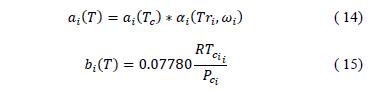
<body><![CDATA[<p><img src="/img/revistas/dyna/v82n191/v82n191a13eq10.gif"></p>     <p><font size="2" face="Verdana, Arial, Helvetica, sans-serif">Where </font></p>     <p><img src="/img/revistas/dyna/v82n191/v82n191a13eq1113.gif"></p>     <p><font size="2" face="Verdana, Arial, Helvetica, sans-serif">The constants <img src="/img/revistas/dyna/v82n191/v82n191a13eq054.gif"> and b are related to the critical pressure,   critical temperature and acentric factor by:</font></p>     <p><img src="/img/revistas/dyna/v82n191/v82n191a13eq1415.gif"></p>     <p><font size="2" face="Verdana, Arial, Helvetica, sans-serif">Where, </font></p>     <p><img src="/img/revistas/dyna/v82n191/v82n191a13eq1623.gif"></p>     <p><font size="2" face="Verdana, Arial, Helvetica, sans-serif"><img src="/img/revistas/dyna/v82n191/v82n191a13eq076.gif"> is the interaction coefficient between   components <i>i </i>and <i>j</i>. These parameters have no theoretical basis but are empirical,   and their role is to help overcome the deficiencies of the theorem of   corresponding states &#91;15&#93;.</font></p>     <p><font size="2" face="Verdana, Arial, Helvetica, sans-serif">The fugacity coefficient can be   calculated from EOS (eq. 9) &#91;13&#93;,</font></p>     <p><img src="/img/revistas/dyna/v82n191/v82n191a13eq24.gif"></p>     ]]></body>
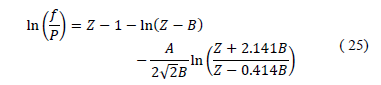
<body><![CDATA[<p><font size="2" face="Verdana, Arial, Helvetica, sans-serif">In this manner, the expression for the   fugacity coefficient of a pure component is:</font></p>     <p><img src="/img/revistas/dyna/v82n191/v82n191a13eq25.gif"></p>     <p><font size="2" face="Verdana, Arial, Helvetica, sans-serif">The functional form of <img src="/img/revistas/dyna/v82n191/v82n191a13eq082.gif"> was determined by using the values of vapor   pressure in the literature and the Newton method to find the values of <font face="Symbol">a</font> to be used in (eq. 10, 25) in a way that the equilibrium condition</font></p>     <p><img src="/img/revistas/dyna/v82n191/v82n191a13eq26.gif"></p>     <p><font size="2" face="Verdana, Arial, Helvetica, sans-serif">is satisfied along the curve of vapor   pressure &#91;13&#93;. Where <img src="/img/revistas/dyna/v82n191/v82n191a13eq086.gif"> y <img src="/img/revistas/dyna/v82n191/v82n191a13eq088.gif"> are the fugacity in the liquid and vapor   phase, respectively.</font></p>     <p><font size="2" face="Verdana, Arial, Helvetica, sans-serif">The fugacity coefficient of a <i>k</i> component in a mixture can be   calculated by:</font></p>     <p><img src="/img/revistas/dyna/v82n191/v82n191a13eq27.gif"></p>     <p><font size="2" face="Verdana, Arial, Helvetica, sans-serif">Calculating fugacity coefficients for   each component in both, liquid and gas phase with (eq. 27), the vapor-liquid   distribution ratio <img src="/img/revistas/dyna/v82n191/v82n191a13eq092.gif"> can be calculated by (eq. 28):</font></p>     <p><img src="/img/revistas/dyna/v82n191/v82n191a13eq28.gif"></p>     <p><font size="2" face="Verdana, Arial, Helvetica, sans-serif">The relationships described by (eq. 28)   (one for each pseudo component) provide the main equations for VLE calculations   using EOS. </font></p>     ]]></body>
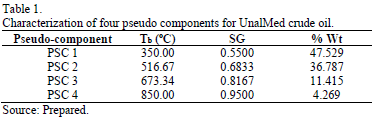
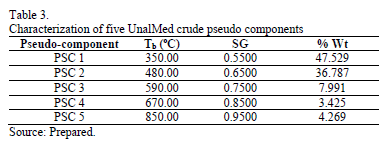
<body><![CDATA[<p><font size="2" face="Verdana, Arial, Helvetica, sans-serif">For the development of this work, the   heavy oil (UnalMed) was modeled with three different fractions groups: four,   five and six pseudo components and CO<sub>2 </sub>solubility with UnalMed oil   was calculated, in order to determine the amount of pseudo components that   should be used to obtain an acceptable thermodynamic model.</font></p>     <p>&nbsp;</p>     <p><font size="3" face="Verdana, Arial, Helvetica, sans-serif"><b>3. Results</b></font></p>     <p><font size="2" face="Verdana, Arial, Helvetica, sans-serif">To model the CO<sub>2 </sub>- UnalMed oil   system, the crude was initially characterized with four pseudo components,   using the SARA analysis. The initial parameters for the calculation of the   solubility of CO<sub>2</sub> in oil at different conditions, such as boiling   temperature (T<sub>b</sub>) and specific gravity (SG) were assumed following   some tips outlined in the work of Kariznovi <i>et   al</i>., &#91;9&#93;:</font></p> <ul>       <li><font size="2" face="Verdana, Arial, Helvetica, sans-serif"> Boiling temperature of the distillable     fraction (saturates and aromatics) is less than 600 °C.</font></li>       <li><font size="2" face="Verdana, Arial, Helvetica, sans-serif"> Boiling temperature of the     non-distillable fraction (resins) is greater than 600 °C.</font></li>       <li><font size="2" face="Verdana, Arial, Helvetica, sans-serif"> Boiling temperature of the asphaltenes is     greater than the boiling temperature of the non-distillable fraction.</font></li>     </ul>     <p><font size="2" face="Verdana, Arial, Helvetica, sans-serif"><a href="#tab01">Table 1</a> shows the final parameters for   each input of pseudo components that compose the UnalMed crude. These   parameters were calculated iteratively within the developed algorithm.</font></p>     <p align="center"><font size="2" face="Verdana, Arial, Helvetica, sans-serif"><a name="tab01"></a></font><img src="/img/revistas/dyna/v82n191/v82n191a13tab01.gif"></p>     ]]></body>
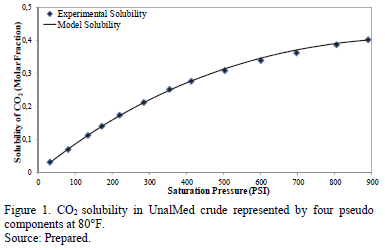
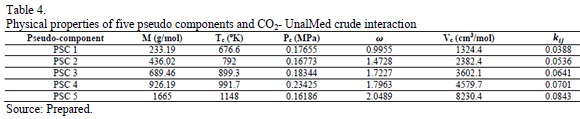
<body><![CDATA[<p><font size="2" face="Verdana, Arial, Helvetica, sans-serif">UnalMed crude characterization shown in <a href="#tab01">Table 1</a> is described by the following order: the first pseudo component   corresponds to saturate fraction, aromatics is represented by PSC 2, the third   and fourth pseudo components correspond to resins and asphaltenes,   respectively. UnalMed oil composition and CO<sub>2</sub> solubility curve   derived from experimental measurements performed by the Colombian Petroleum   Institute (ICP).</font></p>     <p><font size="2" face="Verdana, Arial, Helvetica, sans-serif"><a href="#tab02">Table   2</a> shows the properties of the four pseudo components calculated using   correlations presented in Section 2. The binary interaction coefficients   between CO<sub>2</sub></font> <font size="2" face="Verdana, Arial, Helvetica, sans-serif">and UnalMed crude were   tuned to give a closer approximation to the experimental data.</font></p>     <p align="center"><font size="2" face="Verdana, Arial, Helvetica, sans-serif"><a name="tab02"></a></font><img src="/img/revistas/dyna/v82n191/v82n191a13tab02.gif"></p>     <p><font size="2" face="Verdana, Arial, Helvetica, sans-serif"><a href="#fig01">Fig. 1</a> shows the results obtained by   applying four pseudo components to the model. This figure shows the solubility   of CO<sub>2</sub> in the crude at 80°F and different pressures, the <i>x</i>-axis corresponds to the saturation   pressure and the <i>y</i>-axis corresponds   to the molar composition of the solvent in terms of mole fraction of CO<sub>2</sub>.   It can be seen that having a relatively low operating temperature, and   increasing the saturation pressure, CO<sub>2</sub> is more highly compressed,   increasing its solubility in UnalMed crude.</font></p>     <p align="center"><font size="2" face="Verdana, Arial, Helvetica, sans-serif"><a name="fig01"></a></font><img src="/img/revistas/dyna/v82n191/v82n191a13fig01.gif"></p>     <p><font size="2" face="Verdana, Arial, Helvetica, sans-serif">For oil represented   by five pseudo components, the same methodology as for the crude representation   with four pseudo components was used. The additional pseudo component results   from separation of the non-distillable oil fraction, namely resins, as these resins   were separated into the asphaltene-free and resins containing asphaltenes. With   this as mentioned, the order of pseudo components is as follows: the first two   pseudo components represent UnalMed crude distillable fraction, third and   fourth represent the non-distillable fraction of resins (resins 1 and 2), and   the fifth pseudo component represents asphaltenes.</font></p>     <p><font size="2" face="Verdana, Arial, Helvetica, sans-serif"><a href="#tab03">Table 3</a> shows the final input parameters   of UnalMed crude represented by five pseudo components.</font></p>     <p align="center"><font size="2" face="Verdana, Arial, Helvetica, sans-serif"><a name="tab03"></a></font><img src="/img/revistas/dyna/v82n191/v82n191a13tab03.gif"></p>     <p><font size="2" face="Verdana, Arial, Helvetica, sans-serif"><a href="#tab04">Table 4</a> presents the properties of the five   pseudo components calculated by the model, as well as the binary interaction   coefficient between CO<sub>2</sub> and UnalMed crude, which were tuned to   provide a closer approximation to the experimental data.</font></p>     <p align="center"><font size="2" face="Verdana, Arial, Helvetica, sans-serif"><a name="tab04"></a></font><img src="/img/revistas/dyna/v82n191/v82n191a13tab04.gif"></p>     ]]></body>
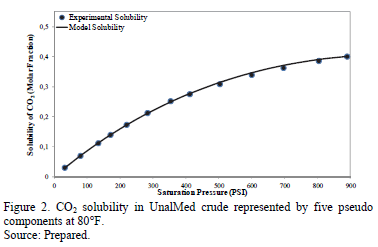
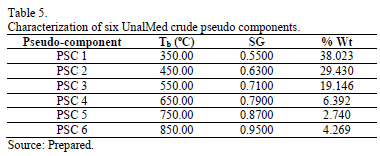
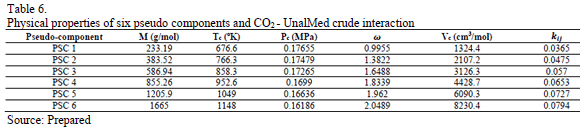
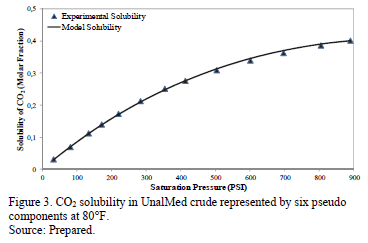
<body><![CDATA[<p><font size="2" face="Verdana, Arial, Helvetica, sans-serif"><a href="#fig02">Fig. 2</a> shows the results obtained by   applying the model of VLE of CO<sub>2</sub> - UnalMed crude represented with   five pseudo components. This figure shows the solubility of CO<sub>2</sub> in   the oil at 80 ° F and different pressures.</font></p>     <p align="center"><font size="2" face="Verdana, Arial, Helvetica, sans-serif"><a name="fig02"></a></font><img src="/img/revistas/dyna/v82n191/v82n191a13fig02.gif"></p>     <p><font size="2" face="Verdana, Arial, Helvetica, sans-serif">The results are practically the same to   those shown in <a href="#fig01">Fig. 1</a>, which is an indication that modelling the CO<sub>2</sub> - UnalMed crude VLE with four pseudo components is appropriate.</font></p>     <p><font size="2" face="Verdana, Arial, Helvetica, sans-serif">Now, for oil   represented by six pseudo components, the same methodology as for the four and   five pseudo components was used. In this case, the additional pseudo component   represents a portion of the non-distillable fraction with a portion of the   asphaltenes fraction, i.e. the resins and asphaltenes. This pseudo component is   called transition pseudo component. The pseudo components order is as follows:   The first two represent the distillable fraction, the third and fourth pseudo   components represent the non-distillable fraction (resins 1 and 2), the fifth   represents the transition between the resins and asphaltenes and the sixth   pseudo component corresponds to asphaltenes.</font></p>     <p><font size="2" face="Verdana, Arial, Helvetica, sans-serif"><a href="#fig05">Table 5</a> shows the final input parameters   of UnalMed crude represented by six pseudo components, and <a href="#tab06">Table 6</a> shows the   properties calculated for the six pseudo components as well as the binary   interaction coefficients between CO<sub>2</sub> and UnalMed crude.</font></p>     <p align="center"><font size="2" face="Verdana, Arial, Helvetica, sans-serif"><a name="tab05"></a></font><img src="/img/revistas/dyna/v82n191/v82n191a13tab05.gif"></p>     <p align="center"><font size="2" face="Verdana, Arial, Helvetica, sans-serif"><a name="tab06"></a></font><img src="/img/revistas/dyna/v82n191/v82n191a13tab06.gif"></p>     <p><font size="2" face="Verdana, Arial, Helvetica, sans-serif"><a href="#fig03">Fig. 3</a> shows again the same behavior as shown in Fig. 1,   2. In general, results show a high level of agreement with the UnalMed crude   experimental data, which indicates that it is possible to model the CO<sub>2</sub> - UnalMed crude VLE through four pseudo components, which can be commonly   obtained with SARA analysis.</font></p>     <p align="center"><font size="2" face="Verdana, Arial, Helvetica, sans-serif"><a name="fig03"></a></font><img src="/img/revistas/dyna/v82n191/v82n191a13fig03.gif"></p>     <p>&nbsp;</p>     ]]></body>
<body><![CDATA[<p><font size="3" face="Verdana, Arial, Helvetica, sans-serif"><b>4. Conclusions</b></font></p>     <p><font size="2" face="Verdana, Arial, Helvetica, sans-serif">For the calculation of CO<sub>2 </sub>- UnalMed   crude VLE, the crude representation was tested with different amounts of pseudo   components to compare the model results with experimental data. </font></p>     <p><font size="2" face="Verdana, Arial, Helvetica, sans-serif">All crude representations showed very   similar results and it is important to note that it is sufficient to have a   complete characterization of the SARA analysis and use these four pseudo   components to model the VLE. </font></p>     <p><font size="2" face="Verdana, Arial, Helvetica, sans-serif">Having specific data, such as boiling   point and specific gravity of each pseudo component, is useful for further   reducing the uncertainty of the results.</font></p>     <p><font size="2" face="Verdana, Arial, Helvetica, sans-serif">Binary interaction coefficients, required   in the parameters of the cubic EOS are a key element in the study of the   solubility of CO<sub>2</sub> in the oil, because the saturation pressure proved   to be highly sensitive to the values of binary interaction parameters,   thus had to be tuned to obtain a better approximation of the experimental data.</font></p>     <p><font size="2" face="Verdana, Arial, Helvetica, sans-serif">We observed that with a relatively low   operating temperature, the solubility of CO<sub>2</sub> in the oil is favored   when the system is at high pressures, which is an important factor in the   recovery of oil, because this could decrease the viscosity thereof without   needing too much energy to heat the contents of the fields.</font></p>     <p><font size="2" face="Verdana, Arial, Helvetica, sans-serif">Crude representation using four pseudo   components and the model used were suitable for the analysis of phase behavior   in these kinds of systems.</font></p>     <p>&nbsp;</p>     <p><font size="3" face="Verdana, Arial, Helvetica, sans-serif"><b> References</b></font></p>     <!-- ref --><p><font size="2" face="Verdana, Arial, Helvetica, sans-serif"><b>&#91;1&#93;</b> Riazi,   M.R., Characterization and properties of petroleum fractions, ASTM   International, Philadelphia, 2005. DOI: 10.1520/Mnl50_1st-Eb</font>&nbsp;&nbsp;&nbsp;&nbsp;&nbsp;&nbsp;&nbsp;&nbsp;[&#160;<a href="javascript:void(0);" onclick="javascript: window.open('/scielo.php?script=sci_nlinks&ref=000112&pid=S0012-7353201500030001300001&lng=','','width=640,height=500,resizable=yes,scrollbars=1,menubar=yes,');">Links</a>&#160;]<!-- end-ref --><!-- ref --><p><font size="2" face="Verdana, Arial, Helvetica, sans-serif"><b>&#91;2&#93;</b> Alboudwarej,   H., Felix, J., Taylor, S., Badry, R., Bremner, C., Brough, B., Skeates, C.,   Baker, A., Palmer, D., Pattison, K.., Beshry, M., Krawchuk, P., Brown, G.,   Calvo, R., Ca&ntilde;as Triana, J. A., Hathcock, R., Koerner, K., Hughes, T., Kundu,   D., L&oacute;pez de C&aacute;rdenas, J., and West, C., La importancia del petr&oacute;leo pesado,   Oilfield Review, 18, pp. 38-59, 2006.    &nbsp;&nbsp;&nbsp;&nbsp;&nbsp;&nbsp;&nbsp;&nbsp;[&#160;<a href="javascript:void(0);" onclick="javascript: window.open('/scielo.php?script=sci_nlinks&ref=000113&pid=S0012-7353201500030001300002&lng=','','width=640,height=500,resizable=yes,scrollbars=1,menubar=yes,');">Links</a>&#160;]<!-- end-ref --></font></p>     <!-- ref --><p><font size="2" face="Verdana, Arial, Helvetica, sans-serif"><b>&#91;3&#93;</b> Al-Mjeni,   R., Arora, S., Cherukupalli, P., Van Wunnik, J., Edwards, J., Jean-Felber, B.,   Gurpinar, O., Hirasaki, G. J., Miller, C.A., Jackson, C., Kristensen, M.R.,   Lim, F. y Ramamoorthy, R., ¿Lleg&oacute; el momento para la tecnolog&iacute;a EOR?, Oilfield Review, 22, pp. 16-35, 2010.    &nbsp;&nbsp;&nbsp;&nbsp;&nbsp;&nbsp;&nbsp;&nbsp;[&#160;<a href="javascript:void(0);" onclick="javascript: window.open('/scielo.php?script=sci_nlinks&ref=000115&pid=S0012-7353201500030001300003&lng=','','width=640,height=500,resizable=yes,scrollbars=1,menubar=yes,');">Links</a>&#160;]<!-- end-ref --></font></p>     <!-- ref --><p><font size="2" face="Verdana, Arial, Helvetica, sans-serif"><b>&#91;4&#93;</b> Maya, G., Castro, R., Lobo, A., Ordo&ntilde;ez,   A., Sandoval, J., Mercado, D., Trujillo, M., Soto, C. y P&eacute;rez, H.H., Estatus de   la Recuperaci&oacute;n Mejorada de Petr&oacute;leo en Colombia. 2010.    &nbsp;&nbsp;&nbsp;&nbsp;&nbsp;&nbsp;&nbsp;&nbsp;[&#160;<a href="javascript:void(0);" onclick="javascript: window.open('/scielo.php?script=sci_nlinks&ref=000117&pid=S0012-7353201500030001300004&lng=','','width=640,height=500,resizable=yes,scrollbars=1,menubar=yes,');">Links</a>&#160;]<!-- end-ref --></font></p>     <!-- ref --><p><font size="2" face="Verdana, Arial, Helvetica, sans-serif"><b>&#91;5&#93;</b> Ahmed,   T., Equations of state and PVT   analysis: Applications for improved reservoir modeling, Gulf Publishing   Company, United States of America, 2007.    &nbsp;&nbsp;&nbsp;&nbsp;&nbsp;&nbsp;&nbsp;&nbsp;[&#160;<a href="javascript:void(0);" onclick="javascript: window.open('/scielo.php?script=sci_nlinks&ref=000119&pid=S0012-7353201500030001300005&lng=','','width=640,height=500,resizable=yes,scrollbars=1,menubar=yes,');">Links</a>&#160;]<!-- end-ref --></font></p>     <!-- ref --><p><font size="2" face="Verdana, Arial, Helvetica, sans-serif"><b>&#91;6&#93;</b> Nji,   G.N.-T., Characterization of heavy oils and bitumens, PhD. Thesis, University   of Calgary, Calgary, Canada, 2010.    &nbsp;&nbsp;&nbsp;&nbsp;&nbsp;&nbsp;&nbsp;&nbsp;[&#160;<a href="javascript:void(0);" onclick="javascript: window.open('/scielo.php?script=sci_nlinks&ref=000121&pid=S0012-7353201500030001300006&lng=','','width=640,height=500,resizable=yes,scrollbars=1,menubar=yes,');">Links</a>&#160;]<!-- end-ref --></font></p>     ]]></body>
<body><![CDATA[<!-- ref --><p><font size="2" face="Verdana, Arial, Helvetica, sans-serif"><b>&#91;7&#93;</b> Lache-Garc&iacute;a,   A., Mel&eacute;ndez-Correa, L.V., Orrego, J.A., Mej&iacute;a-Ospino, E. Pach&oacute;n, Z. y Cabanzo,   R., Predicci&oacute;n del an&aacute;lisis Sara de crudos colombianos por m&eacute;todos   quimiom&eacute;tricos utilizando espectroscop&iacute;a infrarroja-ATR, Revista Colombiana de   F&iacute;sica, 43 (3), pp. 643-647, 2011.    &nbsp;&nbsp;&nbsp;&nbsp;&nbsp;&nbsp;&nbsp;&nbsp;[&#160;<a href="javascript:void(0);" onclick="javascript: window.open('/scielo.php?script=sci_nlinks&ref=000123&pid=S0012-7353201500030001300007&lng=','','width=640,height=500,resizable=yes,scrollbars=1,menubar=yes,');">Links</a>&#160;]<!-- end-ref --></font></p>     <!-- ref --><p><font size="2" face="Verdana, Arial, Helvetica, sans-serif"><b>&#91;8&#93;</b> Kesler,   M.G. and Lee, B.I., Improve prediction of enthalpy of fractions, Hydrocarbon Processing, 55, pp. 153-158,   1976.    &nbsp;&nbsp;&nbsp;&nbsp;&nbsp;&nbsp;&nbsp;&nbsp;[&#160;<a href="javascript:void(0);" onclick="javascript: window.open('/scielo.php?script=sci_nlinks&ref=000125&pid=S0012-7353201500030001300008&lng=','','width=640,height=500,resizable=yes,scrollbars=1,menubar=yes,');">Links</a>&#160;]<!-- end-ref --></font></p>     <!-- ref --><p><font size="2" face="Verdana, Arial, Helvetica, sans-serif"><b>&#91;9&#93;</b> Kariznovi,   M., Nourozieh, H. and Abedi, J., Bitumen characterization and pseudocomponents   determination for equation of state modeling, Energy &amp; Fuels, 24 (1), pp. 624-633, 2010. DOI: 10.1021/ef900886e</font>&nbsp;&nbsp;&nbsp;&nbsp;&nbsp;&nbsp;&nbsp;&nbsp;[&#160;<a href="javascript:void(0);" onclick="javascript: window.open('/scielo.php?script=sci_nlinks&ref=000127&pid=S0012-7353201500030001300009&lng=','','width=640,height=500,resizable=yes,scrollbars=1,menubar=yes,');">Links</a>&#160;]<!-- end-ref --><!-- ref --><p><font size="2" face="Verdana, Arial, Helvetica, sans-serif"><b>&#91;10&#93;</b> Boozarjomehry,   R.B., Abdolahi, F. and Moosavian, M.A., Characterization of basic properties   for pure substances and petroleum fractions by neural network. Fluid   Phase Equilibria, 231   (2), pp. 188-196, 2005. DOI: 10.1016/j.fluid.2005.02.002</font>&nbsp;&nbsp;&nbsp;&nbsp;&nbsp;&nbsp;&nbsp;&nbsp;[&#160;<a href="javascript:void(0);" onclick="javascript: window.open('/scielo.php?script=sci_nlinks&ref=000128&pid=S0012-7353201500030001300010&lng=','','width=640,height=500,resizable=yes,scrollbars=1,menubar=yes,');">Links</a>&#160;]<!-- end-ref --><!-- ref --><p><font size="2" face="Verdana, Arial, Helvetica, sans-serif"><b>&#91;11&#93;</b> Lee,   B.I. and Kesler, M.G., A generalized thermodynamic correlation based on   three-parameter corresponding states, AIChE   Journal, 21 (3), pp. 510-527, 1975. DOI: 10.1002/aic.690210313</font>&nbsp;&nbsp;&nbsp;&nbsp;&nbsp;&nbsp;&nbsp;&nbsp;[&#160;<a href="javascript:void(0);" onclick="javascript: window.open('/scielo.php?script=sci_nlinks&ref=000129&pid=S0012-7353201500030001300011&lng=','','width=640,height=500,resizable=yes,scrollbars=1,menubar=yes,');">Links</a>&#160;]<!-- end-ref --><!-- ref --><p><font size="2" face="Verdana, Arial, Helvetica, sans-serif"><b>&#91;12&#93;</b> Maldonado-Luis,   D.A., Modelaci&oacute;n del proceso de separaci&oacute;n de gas-crudo en la industria   petrolera, Tesis, Istmo University, Tehuantepec, Santo Domingo, 2010.    &nbsp;&nbsp;&nbsp;&nbsp;&nbsp;&nbsp;&nbsp;&nbsp;[&#160;<a href="javascript:void(0);" onclick="javascript: window.open('/scielo.php?script=sci_nlinks&ref=000130&pid=S0012-7353201500030001300012&lng=','','width=640,height=500,resizable=yes,scrollbars=1,menubar=yes,');">Links</a>&#160;]<!-- end-ref --></font></p>     <!-- ref --><p><font size="2" face="Verdana, Arial, Helvetica, sans-serif"><b>&#91;13&#93;</b> Peng,   D.Y. and Robinson, D.B., A new two-constant equation of state. Ind. Eng. Chem.   Fundam., 15 (1), pp. 59-64, 1976. DOI: 10.1021/i160057a011</font>&nbsp;&nbsp;&nbsp;&nbsp;&nbsp;&nbsp;&nbsp;&nbsp;[&#160;<a href="javascript:void(0);" onclick="javascript: window.open('/scielo.php?script=sci_nlinks&ref=000132&pid=S0012-7353201500030001300013&lng=','','width=640,height=500,resizable=yes,scrollbars=1,menubar=yes,');">Links</a>&#160;]<!-- end-ref --><!-- ref --><p><font size="2" face="Verdana, Arial, Helvetica, sans-serif"><b>&#91;14&#93;</b> Smith,   J.M. Van Ness, H.C. y Abbott, M.M.,   Introducci&oacute;n a la Termodin&aacute;mica en Ingenier&iacute;a Qu&iacute;mica. McGraw-Hill 7th ed, Mexico, 2007.    &nbsp;&nbsp;&nbsp;&nbsp;&nbsp;&nbsp;&nbsp;&nbsp;[&#160;<a href="javascript:void(0);" onclick="javascript: window.open('/scielo.php?script=sci_nlinks&ref=000133&pid=S0012-7353201500030001300014&lng=','','width=640,height=500,resizable=yes,scrollbars=1,menubar=yes,');">Links</a>&#160;]<!-- end-ref --></font></p>     <!-- ref --><p><font size="2" face="Verdana, Arial, Helvetica, sans-serif"><b>&#91;15&#93;</b> Reid,   R.C., Prausnitz, J.M. and Poling, B.E., The properties of gases and liquids. McGraw-Hill   4th ed, United States of America, 1987. DOI: 10.1036/0070116822</font>&nbsp;&nbsp;&nbsp;&nbsp;&nbsp;&nbsp;&nbsp;&nbsp;[&#160;<a href="javascript:void(0);" onclick="javascript: window.open('/scielo.php?script=sci_nlinks&ref=000135&pid=S0012-7353201500030001300015&lng=','','width=640,height=500,resizable=yes,scrollbars=1,menubar=yes,');">Links</a>&#160;]<!-- end-ref --><p>&nbsp;</p>     <p><font size="2" face="Verdana, Arial, Helvetica, sans-serif"><b>O.J. Ramirez,</b> completed a BSc. degree in Chemical Engineering in 2013 from the Universidad   Nacional de Colombia and worked in Process Safety in Ecopetrol S.A during the traineeship.</font></p>     <p><font size="2" face="Verdana, Arial, Helvetica, sans-serif"><b>C. Betancur,</b> completed a BSc. degree in Chemical Engineering in 2013 from the Universidad   Nacional de Colombia and worked in Process Technology in Ecopetrol S.A during   the traineeship.</font></p>     <p><font size="2" face="Verdana, Arial, Helvetica, sans-serif"><b>B.A. Hoyos, </b>completed BSc. in 1994 and MSc. in 2003 degrees both in   Chemical Engineering and a PhD degree in Energy Systems in 2010, all of them   from the Universidad Nacional de Colombia campus Medell&iacute;n, Colombia. Currently he is a full   professor in the Departamento de Procesos y Energ&iacute;a, Facultad de Minas,   Universidad Nacional de Colombia, campus Medell&iacute;n, Colombia. His research interests include molecular simulation, modeling asphaltene   aggregation and viscosity, modelling wettability alteration by surfactants and   specific adsorption<b>.</b></font></p>     <p><font size="2" face="Verdana, Arial, Helvetica, sans-serif"><b>C. E. Naranjo</b>,   completed a BSc. degree in Petroleum Engineering in 1993 from the Universidad   Industrial de Santander, Colombia and a MSc. degree in Hydrocarbon Engineering   in 2010. He has over fourteen years of experience as a reservoir engineer in   the area of secondary and Enhanced Oil Recovery with emphasis on water   injection and thermal recovery processes. Two (2) applications for invention   patents in Republic of Colombia, coauthor of six (6) Declaration technology   products in Ecopetrol S.A., co-directed research projects through Labor and   Jobs Master's Degree, and several academic and national and international technical   recognitions and achievements.</font></p>      ]]></body><back>
<ref-list>
<ref id="B1">
<label>1</label><nlm-citation citation-type="book">
<person-group person-group-type="author">
<name>
<surname><![CDATA[Riazi]]></surname>
<given-names><![CDATA[M.R.]]></given-names>
</name>
</person-group>
<source><![CDATA[Characterization and properties of petroleum fractions]]></source>
<year>2005</year>
<publisher-loc><![CDATA[Philadelphia ]]></publisher-loc>
<publisher-name><![CDATA[ASTM International]]></publisher-name>
</nlm-citation>
</ref>
<ref id="B2">
<label>2</label><nlm-citation citation-type="journal">
<person-group person-group-type="author">
<name>
<surname><![CDATA[Alboudwarej]]></surname>
<given-names><![CDATA[H.]]></given-names>
</name>
<name>
<surname><![CDATA[Felix]]></surname>
<given-names><![CDATA[J.]]></given-names>
</name>
<name>
<surname><![CDATA[Taylor]]></surname>
<given-names><![CDATA[S.]]></given-names>
</name>
<name>
<surname><![CDATA[Badry]]></surname>
<given-names><![CDATA[R.]]></given-names>
</name>
<name>
<surname><![CDATA[Bremner]]></surname>
<given-names><![CDATA[C.]]></given-names>
</name>
<name>
<surname><![CDATA[Brough]]></surname>
<given-names><![CDATA[B.]]></given-names>
</name>
<name>
<surname><![CDATA[Skeates]]></surname>
<given-names><![CDATA[C.]]></given-names>
</name>
<name>
<surname><![CDATA[Baker]]></surname>
<given-names><![CDATA[A.]]></given-names>
</name>
<name>
<surname><![CDATA[Palmer]]></surname>
<given-names><![CDATA[D.]]></given-names>
</name>
<name>
<surname><![CDATA[Pattison]]></surname>
<given-names><![CDATA[K.]]></given-names>
</name>
<name>
<surname><![CDATA[Beshry]]></surname>
<given-names><![CDATA[M.]]></given-names>
</name>
<name>
<surname><![CDATA[Krawchuk]]></surname>
<given-names><![CDATA[P.]]></given-names>
</name>
<name>
<surname><![CDATA[Brown]]></surname>
<given-names><![CDATA[G.]]></given-names>
</name>
<name>
<surname><![CDATA[Calvo]]></surname>
<given-names><![CDATA[R.]]></given-names>
</name>
<name>
<surname><![CDATA[Cañas Triana]]></surname>
<given-names><![CDATA[J. A.]]></given-names>
</name>
<name>
<surname><![CDATA[Hathcock]]></surname>
<given-names><![CDATA[R.]]></given-names>
</name>
<name>
<surname><![CDATA[Koerner]]></surname>
<given-names><![CDATA[K.]]></given-names>
</name>
<name>
<surname><![CDATA[Hughes]]></surname>
<given-names><![CDATA[T.]]></given-names>
</name>
<name>
<surname><![CDATA[Kundu]]></surname>
<given-names><![CDATA[D.]]></given-names>
</name>
<name>
<surname><![CDATA[López de Cárdenas]]></surname>
<given-names><![CDATA[J.]]></given-names>
</name>
<name>
<surname><![CDATA[West]]></surname>
<given-names><![CDATA[C.]]></given-names>
</name>
</person-group>
<article-title xml:lang="es"><![CDATA[La importancia del petróleo pesado]]></article-title>
<source><![CDATA[Oilfield Review]]></source>
<year>2006</year>
<numero>18</numero>
<issue>18</issue>
<page-range>38-59</page-range></nlm-citation>
</ref>
<ref id="B3">
<label>3</label><nlm-citation citation-type="journal">
<person-group person-group-type="author">
<name>
<surname><![CDATA[Al-Mjeni]]></surname>
<given-names><![CDATA[R.]]></given-names>
</name>
<name>
<surname><![CDATA[Arora]]></surname>
<given-names><![CDATA[S.]]></given-names>
</name>
<name>
<surname><![CDATA[Cherukupalli]]></surname>
<given-names><![CDATA[P.]]></given-names>
</name>
<name>
<surname><![CDATA[Van Wunnik]]></surname>
<given-names><![CDATA[J.]]></given-names>
</name>
<name>
<surname><![CDATA[Edwards]]></surname>
<given-names><![CDATA[J.]]></given-names>
</name>
<name>
<surname><![CDATA[Jean-Felber]]></surname>
<given-names><![CDATA[B.]]></given-names>
</name>
<name>
<surname><![CDATA[Gurpinar]]></surname>
<given-names><![CDATA[O.]]></given-names>
</name>
<name>
<surname><![CDATA[Hirasaki]]></surname>
<given-names><![CDATA[G. J.]]></given-names>
</name>
<name>
<surname><![CDATA[Miller]]></surname>
<given-names><![CDATA[C.A.]]></given-names>
</name>
<name>
<surname><![CDATA[Jackson]]></surname>
<given-names><![CDATA[C.]]></given-names>
</name>
<name>
<surname><![CDATA[Kristensen]]></surname>
<given-names><![CDATA[M.R.]]></given-names>
</name>
<name>
<surname><![CDATA[Lim]]></surname>
<given-names><![CDATA[F.]]></given-names>
</name>
<name>
<surname><![CDATA[Ramamoorthy]]></surname>
<given-names><![CDATA[R.]]></given-names>
</name>
</person-group>
<article-title xml:lang="es"><![CDATA[¿Llegó el momento para la tecnología EOR?]]></article-title>
<source><![CDATA[Oilfield Review]]></source>
<year>2010</year>
<numero>22</numero>
<issue>22</issue>
<page-range>16-35</page-range></nlm-citation>
</ref>
<ref id="B4">
<label>4</label><nlm-citation citation-type="">
<person-group person-group-type="author">
<name>
<surname><![CDATA[Maya]]></surname>
<given-names><![CDATA[G.]]></given-names>
</name>
<name>
<surname><![CDATA[Castro]]></surname>
<given-names><![CDATA[R.]]></given-names>
</name>
<name>
<surname><![CDATA[Lobo]]></surname>
<given-names><![CDATA[A.]]></given-names>
</name>
<name>
<surname><![CDATA[Ordoñez]]></surname>
<given-names><![CDATA[A.]]></given-names>
</name>
<name>
<surname><![CDATA[Sandoval]]></surname>
<given-names><![CDATA[J.]]></given-names>
</name>
<name>
<surname><![CDATA[Mercado]]></surname>
<given-names><![CDATA[D.]]></given-names>
</name>
<name>
<surname><![CDATA[Trujillo]]></surname>
<given-names><![CDATA[M.]]></given-names>
</name>
<name>
<surname><![CDATA[Soto]]></surname>
<given-names><![CDATA[C.]]></given-names>
</name>
<name>
<surname><![CDATA[Pérez]]></surname>
<given-names><![CDATA[H.H.]]></given-names>
</name>
</person-group>
<source><![CDATA[Estatus de la Recuperación Mejorada de Petróleo en Colombia]]></source>
<year>2010</year>
</nlm-citation>
</ref>
<ref id="B5">
<label>5</label><nlm-citation citation-type="book">
<person-group person-group-type="author">
<name>
<surname><![CDATA[Ahmed]]></surname>
<given-names><![CDATA[T.]]></given-names>
</name>
</person-group>
<source><![CDATA[Equations of state and PVT analysis: Applications for improved reservoir modeling]]></source>
<year>2007</year>
<publisher-name><![CDATA[Gulf Publishing Company]]></publisher-name>
</nlm-citation>
</ref>
<ref id="B6">
<label>6</label><nlm-citation citation-type="">
<person-group person-group-type="author">
<name>
<surname><![CDATA[Nji]]></surname>
<given-names><![CDATA[G.N.-T.]]></given-names>
</name>
</person-group>
<source><![CDATA[Characterization of heavy oils and bitumens]]></source>
<year></year>
</nlm-citation>
</ref>
<ref id="B7">
<label>7</label><nlm-citation citation-type="journal">
<person-group person-group-type="author">
<name>
<surname><![CDATA[Lache-García]]></surname>
<given-names><![CDATA[A.]]></given-names>
</name>
<name>
<surname><![CDATA[Meléndez-Correa]]></surname>
<given-names><![CDATA[L.V.]]></given-names>
</name>
<name>
<surname><![CDATA[Orrego]]></surname>
<given-names><![CDATA[J.A.]]></given-names>
</name>
<name>
<surname><![CDATA[Mejía-Ospino]]></surname>
<given-names><![CDATA[E.]]></given-names>
</name>
<name>
<surname><![CDATA[Pachón]]></surname>
<given-names><![CDATA[Z.]]></given-names>
</name>
<name>
<surname><![CDATA[Cabanzo]]></surname>
<given-names><![CDATA[R.]]></given-names>
</name>
</person-group>
<article-title xml:lang="es"><![CDATA[Predicción del análisis Sara de crudos colombianos por métodos quimiométricos utilizando espectroscopía infrarroja-ATR]]></article-title>
<source><![CDATA[Revista Colombiana de Física]]></source>
<year>2011</year>
<volume>43</volume>
<numero>3</numero>
<issue>3</issue>
<page-range>643-647</page-range></nlm-citation>
</ref>
<ref id="B8">
<label>8</label><nlm-citation citation-type="journal">
<person-group person-group-type="author">
<name>
<surname><![CDATA[Kesler]]></surname>
<given-names><![CDATA[M.G.]]></given-names>
</name>
<name>
<surname><![CDATA[Lee]]></surname>
<given-names><![CDATA[B.I.]]></given-names>
</name>
</person-group>
<article-title xml:lang="en"><![CDATA[Improve prediction of enthalpy of fractions]]></article-title>
<source><![CDATA[Hydrocarbon Processing]]></source>
<year>1976</year>
<numero>55</numero>
<issue>55</issue>
<page-range>153-158</page-range></nlm-citation>
</ref>
<ref id="B9">
<label>9</label><nlm-citation citation-type="journal">
<person-group person-group-type="author">
<name>
<surname><![CDATA[Kariznovi]]></surname>
<given-names><![CDATA[M.]]></given-names>
</name>
<name>
<surname><![CDATA[Nourozieh]]></surname>
<given-names><![CDATA[H.]]></given-names>
</name>
<name>
<surname><![CDATA[Abedi]]></surname>
<given-names><![CDATA[J.]]></given-names>
</name>
</person-group>
<article-title xml:lang="en"><![CDATA[Bitumen characterization and pseudocomponents determination for equation of state modeling]]></article-title>
<source><![CDATA[Energy & Fuels]]></source>
<year>2010</year>
<volume>24</volume>
<numero>1</numero>
<issue>1</issue>
<page-range>624-633</page-range></nlm-citation>
</ref>
<ref id="B10">
<label>10</label><nlm-citation citation-type="journal">
<person-group person-group-type="author">
<name>
<surname><![CDATA[Boozarjomehry]]></surname>
<given-names><![CDATA[R.B.]]></given-names>
</name>
<name>
<surname><![CDATA[Abdolahi]]></surname>
<given-names><![CDATA[F.]]></given-names>
</name>
<name>
<surname><![CDATA[Moosavian]]></surname>
<given-names><![CDATA[M.A.]]></given-names>
</name>
</person-group>
<article-title xml:lang="en"><![CDATA[Characterization of basic properties for pure substances and petroleum fractions by neural network]]></article-title>
<source><![CDATA[Fluid Phase Equilibria]]></source>
<year>2005</year>
<volume>231</volume>
<numero>2</numero>
<issue>2</issue>
<page-range>188-196</page-range></nlm-citation>
</ref>
<ref id="B11">
<label>11</label><nlm-citation citation-type="journal">
<person-group person-group-type="author">
<name>
<surname><![CDATA[Lee]]></surname>
<given-names><![CDATA[B.I.]]></given-names>
</name>
<name>
<surname><![CDATA[Kesler]]></surname>
<given-names><![CDATA[M.G.]]></given-names>
</name>
</person-group>
<article-title xml:lang="en"><![CDATA[A generalized thermodynamic correlation based on three-parameter corresponding states]]></article-title>
<source><![CDATA[AIChE Journal]]></source>
<year>1975</year>
<volume>21</volume>
<numero>3</numero>
<issue>3</issue>
<page-range>510-527</page-range></nlm-citation>
</ref>
<ref id="B12">
<label>12</label><nlm-citation citation-type="">
<person-group person-group-type="author">
<name>
<surname><![CDATA[Maldonado-Luis]]></surname>
<given-names><![CDATA[D.A.]]></given-names>
</name>
</person-group>
<source><![CDATA[Modelación del proceso de separación de gas-crudo en la industria petrolera]]></source>
<year></year>
</nlm-citation>
</ref>
<ref id="B13">
<label>13</label><nlm-citation citation-type="journal">
<person-group person-group-type="author">
<name>
<surname><![CDATA[Peng]]></surname>
<given-names><![CDATA[D.Y.]]></given-names>
</name>
<name>
<surname><![CDATA[Robinson]]></surname>
<given-names><![CDATA[D.B.]]></given-names>
</name>
</person-group>
<article-title xml:lang="en"><![CDATA[A new two-constant equation of state]]></article-title>
<source><![CDATA[Ind. Eng. Chem. Fundam]]></source>
<year>1976</year>
<volume>15</volume>
<numero>1</numero>
<issue>1</issue>
<page-range>59-64</page-range></nlm-citation>
</ref>
<ref id="B14">
<label>14</label><nlm-citation citation-type="book">
<person-group person-group-type="author">
<name>
<surname><![CDATA[Smith]]></surname>
<given-names><![CDATA[J.M.]]></given-names>
</name>
<name>
<surname><![CDATA[Van Ness]]></surname>
<given-names><![CDATA[H.C.]]></given-names>
</name>
<name>
<surname><![CDATA[Abbott]]></surname>
<given-names><![CDATA[M.M.]]></given-names>
</name>
</person-group>
<source><![CDATA[Introducción a la Termodinámica en Ingeniería Química]]></source>
<year>2007</year>
<edition>7th</edition>
<publisher-name><![CDATA[McGraw-Hill]]></publisher-name>
</nlm-citation>
</ref>
<ref id="B15">
<label>15</label><nlm-citation citation-type="book">
<person-group person-group-type="author">
<name>
<surname><![CDATA[Reid]]></surname>
<given-names><![CDATA[R.C.]]></given-names>
</name>
<name>
<surname><![CDATA[Prausnitz]]></surname>
<given-names><![CDATA[J.M.]]></given-names>
</name>
<name>
<surname><![CDATA[Poling]]></surname>
<given-names><![CDATA[B.E.]]></given-names>
</name>
</person-group>
<source><![CDATA[The properties of gases and liquids.]]></source>
<year>1987</year>
<edition>4th</edition>
<publisher-name><![CDATA[McGraw-Hill]]></publisher-name>
</nlm-citation>
</ref>
</ref-list>
</back>
</article>