<?xml version="1.0" encoding="ISO-8859-1"?><article xmlns:mml="http://www.w3.org/1998/Math/MathML" xmlns:xlink="http://www.w3.org/1999/xlink" xmlns:xsi="http://www.w3.org/2001/XMLSchema-instance">
<front>
<journal-meta>
<journal-id>0012-7353</journal-id>
<journal-title><![CDATA[DYNA]]></journal-title>
<abbrev-journal-title><![CDATA[Dyna rev.fac.nac.minas]]></abbrev-journal-title>
<issn>0012-7353</issn>
<publisher>
<publisher-name><![CDATA[Universidad Nacional de Colombia]]></publisher-name>
</publisher>
</journal-meta>
<article-meta>
<article-id>S0012-73532015000300017</article-id>
<article-id pub-id-type="doi">10.15446/dyna.v82n191.43263</article-id>
<title-group>
<article-title xml:lang="en"><![CDATA[MGE2: A framework for cradle-to-cradle design]]></article-title>
<article-title xml:lang="es"><![CDATA[MGE2: Un marco de referencia para el diseño de la cuna a la cuna]]></article-title>
</title-group>
<contrib-group>
<contrib contrib-type="author">
<name>
<surname><![CDATA[Peralta-Álvarez]]></surname>
<given-names><![CDATA[María-Estela]]></given-names>
</name>
<xref ref-type="aff" rid="A01"/>
</contrib>
<contrib contrib-type="author">
<name>
<surname><![CDATA[Aguayo-González]]></surname>
<given-names><![CDATA[Francisco]]></given-names>
</name>
<xref ref-type="aff" rid="A02"/>
</contrib>
<contrib contrib-type="author">
<name>
<surname><![CDATA[Lama-Ruiz]]></surname>
<given-names><![CDATA[Juan-Ramón]]></given-names>
</name>
<xref ref-type="aff" rid="A03"/>
</contrib>
<contrib contrib-type="author">
<name>
<surname><![CDATA[Ávila-Gutiérrez]]></surname>
<given-names><![CDATA[María Jesús]]></given-names>
</name>
<xref ref-type="aff" rid="A04"/>
</contrib>
</contrib-group>
<aff id="A01">
<institution><![CDATA[,University of Seville Engineering Design Department ]]></institution>
<addr-line><![CDATA[Seville ]]></addr-line>
<country>Spain</country>
</aff>
<aff id="A02">
<institution><![CDATA[,University of Seville Engineering Design Department ]]></institution>
<addr-line><![CDATA[Seville ]]></addr-line>
<country>Spain</country>
</aff>
<aff id="A03">
<institution><![CDATA[,University of Seville Engineering Design Department ]]></institution>
<addr-line><![CDATA[Seville ]]></addr-line>
<country>Spain</country>
</aff>
<aff id="A04">
<institution><![CDATA[,University of Seville Engineering Design Department ]]></institution>
<addr-line><![CDATA[Seville ]]></addr-line>
<country>Spain</country>
</aff>
<pub-date pub-type="pub">
<day>00</day>
<month>06</month>
<year>2015</year>
</pub-date>
<pub-date pub-type="epub">
<day>00</day>
<month>06</month>
<year>2015</year>
</pub-date>
<volume>82</volume>
<numero>191</numero>
<fpage>137</fpage>
<lpage>146</lpage>
<copyright-statement/>
<copyright-year/>
<self-uri xlink:href="http://www.scielo.org.co/scielo.php?script=sci_arttext&amp;pid=S0012-73532015000300017&amp;lng=en&amp;nrm=iso"></self-uri><self-uri xlink:href="http://www.scielo.org.co/scielo.php?script=sci_abstract&amp;pid=S0012-73532015000300017&amp;lng=en&amp;nrm=iso"></self-uri><self-uri xlink:href="http://www.scielo.org.co/scielo.php?script=sci_pdf&amp;pid=S0012-73532015000300017&amp;lng=en&amp;nrm=iso"></self-uri><abstract abstract-type="short" xml:lang="en"><p><![CDATA[Design and ecology are critical issues in the industrial sector. Products are subject to constant review and optimization for survival in the market, and limited by their impact on the planet. Decisions about a new product affect its life cycle, consumers, and especially the environment. In order to achieve quality solutions, eco-effectiveness must be considered, therefore, in the design of a process, its product development and associated system. An orderly methodology is essential to help towards creating products that meet both user needs and current environmental requirements, under paradigms that create environmental value. To date, the industry has developed techniques in an attempt to address these expectations under Cradle-to-Cradle (C2C), which is loosely structured around the conceptual frameworks and design techniques. The present work describes a new framework that encompasses all stages of design, and enables interaction under a set of principles developed for C2C. Under this innovative new paradigm emerges the Genomic Model of Eco-innovation and Eco-design, proposed as a methodology for designing products that meet individual and collective needs, and which enables the design of eco-friendly products, by integrating them into the framework of the ISO standards of Life Cycle Assessment (LCA), eco-design, eco-labeling, and C2C certification.]]></p></abstract>
<abstract abstract-type="short" xml:lang="es"><p><![CDATA[El diseño y la ecología son temas cruciales en el sector industrial. Los productos están sometidos a revisiones constantes para sobrevivir en el mercado y a optimizaciones que los mantienen bajo los límites de impacto sobre el planeta. Las decisiones acerca de un nuevo producto afectan su ciclo de vida, los consumidores, y sobre todo el medio ambiente. Con el fin de lograr soluciones de calidad, Eco - eficacia debe considerarse, por lo tanto, en el diseño de un proceso, su desarrollo de productos y el sistema asociado. Una metodología ordenada es esencial para ayudar a la creación de productos que satisfagan tanto las necesidades de los usuarios y los requisitos medioambientales actuales, bajo los paradigmas que crean valor ambiental. Hasta la fecha, la industria ha desarrollado técnicas en un intento de abordar estas expectativas bajo la cuna a la cuna (C2C), que está vagamente estructurada alrededor de los marcos conceptuales y técnicas de diseño. El presente trabajo describe un nuevo marco que abarca todas las etapas de diseño, y permite la interacción bajo un conjunto de principios desarrollados por C2C. En virtud de este nuevo e innovador paradigma surge el Modelo de Genómica de Eco- innovación y el diseño ecológico, propuesto como una metodología para el diseño de productos que satisfagan las necesidades individuales y colectivas, y que permite el diseño de productos respetuosos del medio ambiente, mediante su integración en el marco de las normas ISO de Análisis de Ciclo de vida (ACV), el ecodiseño, ecoetiquetado y la certificación C2C.]]></p></abstract>
<kwd-group>
<kwd lng="en"><![CDATA[design]]></kwd>
<kwd lng="en"><![CDATA[Sustainability]]></kwd>
<kwd lng="en"><![CDATA[Industrial Ecology]]></kwd>
<kwd lng="en"><![CDATA[Life Cycle Assessment]]></kwd>
<kwd lng="en"><![CDATA[Eco-effectiveness]]></kwd>
<kwd lng="en"><![CDATA[Eco-innovation]]></kwd>
<kwd lng="es"><![CDATA[Ecodiseño]]></kwd>
<kwd lng="es"><![CDATA[Sostenibilidad]]></kwd>
<kwd lng="es"><![CDATA[Ecología Industrial]]></kwd>
<kwd lng="es"><![CDATA[Análisis de ciclo de vida]]></kwd>
<kwd lng="es"><![CDATA[Eco-efectividad]]></kwd>
<kwd lng="es"><![CDATA[Eco-innovación]]></kwd>
</kwd-group>
</article-meta>
</front><body><![CDATA[ <p><font size="1" face="Verdana, Arial, Helvetica, sans-serif"><b>DOI: </b><a href="http://dx.doi.org/10.15446/dyna.v82n191.43263" target="_blank">http://dx.doi.org/10.15446/dyna.v82n191.43263</a></font></p>     <p align="center"><font size="4" face="Verdana, Arial, Helvetica, sans-serif"><b>MGE2: A framework for cradle-to-cradle design</b></font></p>     <p align="center"><i><font size="3"><b><font face="Verdana, Arial, Helvetica, sans-serif">MGE2:   Un marco de referencia para el dise&ntilde;o de la cuna a la cuna</font></b></font></i></p>     <p align="center">&nbsp;</p>     <p align="center"><b><font size="2" face="Verdana, Arial, Helvetica, sans-serif">Mar&iacute;a-Estela   Peralta-&Aacute;lvarez <i><sup>a</sup>, </i>Francisco   Aguayo-Gonz&aacute;lez <i><sup>b</sup></i>, Juan-Ram&oacute;n   Lama-Ruiz <i><sup>c </sup></i>&amp; Mar&iacute;a Jes&uacute;s &Aacute;vila-Guti&eacute;rrez <i><sup>d</sup></i></font></b></p>     <p align="center">&nbsp;</p>     <p align="center"><font size="2" face="Verdana, Arial, Helvetica, sans-serif"><sup><i>a </i></sup><i> Engineering Design Department, University of   Seville, Seville, Spain. <a href="mailto:mperalta1@us.es">mperalta1@us.es</a>    <br>   <sup>b</sup> Engineering Design Department, University of   Seville, Seville, Spain. <a href="mailto:faguayo@us.es">faguayo@us.es</a>    <br>   <sup>c</sup> Engineering Design Department, University   of Seville, Seville, Spain. <a href="mailto:jrlama@us.es">jrlama@us.es</a>    <br>   <sup>d</sup> Engineering Design Department, University of   Seville, Seville, Spain. <a href="mailto:mavila@us.es">mavila@us.es</a></i></font></p>     ]]></body>
<body><![CDATA[<p align="center">&nbsp;</p>     <p align="center"><font size="2" face="Verdana, Arial, Helvetica, sans-serif"><b>Received: May 2<sup>th</sup>, 2014. Received in revised   form: December 1<sup>th</sup>, 2014. Accepted: December 17<sup>th</sup>, 2014.</b></font></p>     <p>&nbsp;</p>     <p align="center"><font size="1" face="Verdana, Arial, Helvetica, sans-seriff"><b>This work is licensed under a</b> <a rel="license" href="http://creativecommons.org/licenses/by-nc-nd/4.0/">Creative Commons Attribution-NonCommercial-NoDerivatives 4.0 International License</a>.</font><br />   <a rel="license" href="http://creativecommons.org/licenses/by-nc-nd/4.0/"><img style="border-width:0" src="https://i.creativecommons.org/l/by-nc-nd/4.0/88x31.png" /></a></p> <hr>     <p><font size="2" face="Verdana, Arial, Helvetica, sans-serif"><b>Abstract    <br>   </b></font><font size="2" face="Verdana, Arial, Helvetica, sans-serif">Design and ecology are critical issues in the industrial   sector. Products are subject to constant review and optimization for survival   in the market, and limited by their impact on the planet. Decisions about a new   product affect its life cycle, consumers, and especially the environment. In   order to achieve quality solutions, eco-effectiveness must be considered,   therefore, in the design of a process, its product development and associated   system. An orderly methodology is essential to help towards creating products   that meet both user needs and current environmental requirements, under   paradigms that create environmental value. To date, the industry has developed   techniques in an attempt to address these expectations under Cradle-to-Cradle   (C2C), which is loosely structured around the conceptual frameworks and design   techniques. The present work describes a new framework that encompasses all   stages of design, and enables interaction under a set of principles developed   for C2C. Under this innovative new paradigm emerges the Genomic Model of   Eco-innovation and Eco-design, proposed as a methodology for designing products   that meet individual and collective needs, and which enables the design of   eco-friendly products, by integrating them into the framework of the ISO   standards of Life Cycle Assessment (LCA), eco-design, eco-labeling, and C2C   certification.</font></p>     <p><font size="2" face="Verdana, Arial, Helvetica, sans-serif"><i>Keywords</i>: Eco-design, Sustainability, Industrial   Ecology, Life Cycle Assessment, Eco-effectiveness, Eco-innovation</font></p>     <p><font size="2" face="Verdana, Arial, Helvetica, sans-serif"><b>Resumen    <br>   </b></font><font size="2" face="Verdana, Arial, Helvetica, sans-serif">El dise&ntilde;o y la   ecolog&iacute;a son temas cruciales en el sector industrial. Los productos est&aacute;n   sometidos a revisiones constantes para sobrevivir en el mercado y a   optimizaciones que los mantienen bajo los l&iacute;mites de impacto sobre el planeta.   Las decisiones acerca de un nuevo producto afectan su ciclo de vida, los   consumidores, y sobre todo el medio ambiente. Con el fin de lograr soluciones   de calidad, Eco - eficacia debe considerarse, por lo tanto, en el dise&ntilde;o de un   proceso, su desarrollo de productos y el sistema asociado. Una metodolog&iacute;a   ordenada es esencial para ayudar a la creaci&oacute;n de productos que satisfagan   tanto las necesidades de los usuarios y los requisitos medioambientales   actuales, bajo los paradigmas que crean valor ambiental. Hasta la fecha, la   industria ha desarrollado t&eacute;cnicas en un intento de abordar estas expectativas   bajo la cuna a la cuna (C2C), que est&aacute; vagamente estructurada alrededor de los   marcos conceptuales y t&eacute;cnicas de dise&ntilde;o. El presente trabajo describe un nuevo   marco que abarca todas las etapas de dise&ntilde;o, y permite la interacci&oacute;n bajo un   conjunto de principios desarrollados por C2C. En virtud de este nuevo e   innovador paradigma surge el Modelo de Gen&oacute;mica de Eco- innovaci&oacute;n y el dise&ntilde;o   ecol&oacute;gico, propuesto como una metodolog&iacute;a para el dise&ntilde;o de productos que   satisfagan las necesidades individuales y colectivas, y que permite el dise&ntilde;o   de productos respetuosos del medio ambiente, mediante su integraci&oacute;n en el   marco de las normas ISO de An&aacute;lisis de Ciclo de vida (ACV), el ecodise&ntilde;o,   ecoetiquetado y la certificaci&oacute;n C2C.</font></p>     <p><font size="2" face="Verdana, Arial, Helvetica, sans-serif"><i>Palabras clave</i>: Ecodise&ntilde;o, Sostenibilidad, Ecolog&iacute;a Industrial, An&aacute;lisis   de ciclo de vida, Eco-efectividad, Eco-innovaci&oacute;n.</font></p> <hr>     ]]></body>
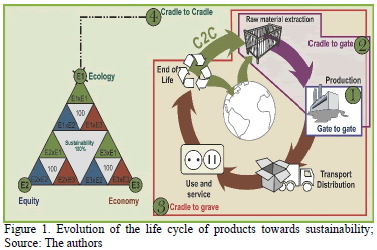
<body><![CDATA[<p>&nbsp;</p>     <p><font size="3" face="Verdana, Arial, Helvetica, sans-serif"><b>1. Introduction</b></font></p>     <p><font size="2" face="Verdana, Arial, Helvetica, sans-serif"><i>To meet present needs without compromising the   ability of future generations to meet their needs </i>is the most widely used definition of   sustainability. This concept has   become highly relevant, now recognised as the basis of industrial, business, economic,   governmental or social activity. Sustainability is built on three vectors that define   and develop &quot;3E&quot; sustainable strategy: Economy, Equity and Ecology &#91;1&#93;. Over recent   decades, these vectors have occupied various positions, both while being aimed at   reaching their full interaction, and in industrial activities considered to be sustainable.   These dimensions or vectors of sustainability are deployed sequentially in order   to attain business goals, forming a pyramid whose economic base needed guaranteeing   before taking into account any social and ecological criteria. Through innovation   and constant attempts and proposals for change towards sustainable development &#91;2&#93;,   the industry has built various frameworks (paradigms in the design), all based on   a group of principles, techniques and tools, among which the most significant are   Natural Capitalism, the Natural Step, Cradle-to-Cradle (C2C), and Permaculture.   These approaches all lay out a new distribution of the three vectors of 3E sustainability,   arranged at the vertices of a triangular mesh where sustainability is addressed   equally from any point of view. By taking the innovative cradle-to-cradle (C2C)   paradigm &#91;3&#93; as the origin, and by considering it as the most significant framework   for the advancement of sustainability in the context of engineering projects in   view of its operational and eco-systematic   character, this paper presents a new model of design and development of industrial   products (MGE2). Our principal goal is the realization of theoretical contributions,   by establishing the foundations and principles of bio-inspired C2C; followed by   our goal to develop a specific and practical methodological proposal of bionic design   which can be supported by Concurrent Engineering and PLM (Product Life Management)   environments &#91;4&#93;, whilst taking into account a continuous review based on Life-Cycle   Assessment. In this proposal, new ideas of the C2C perspective are coordinated,   thereby constituting a way to implement the basic principles of this new paradigm,   which reflect the lessons learned from the eco-efficiency and eco-innovation approaches. In this new perspective of eco-efficiency, the   model can support all the ISO standards requirements introduced to date, it can   extend the range of solutions in order to improve the performance of impact minimization,   and it can help to resolve, through the design of sustainable products, the environmental   problem that current industry is causing on the planet.</font></p>     <p>&nbsp;</p>     <p><font size="3" face="Verdana, Arial, Helvetica, sans-serif"><b>2. Material </b></font></p>     <p><font size="2" face="Verdana, Arial, Helvetica, sans-serif">Sustainable design involves a strategy that encompasses technological,   economic, cultural, social, technical-productive, aesthetic, and environmental factors.   The consideration of this set of issues within design implies that those industrial   organizations that carry out eco-design projects obtain a set of benefits as a consequence   of the introduction of an innovative factor in their business policy.</font></p>     <p><font size="2" face="Verdana, Arial, Helvetica, sans-serif">To date, design for sustainability and environmental management   in industry have evolved into the following stages:</font></p> <ol type="a">       <li><font size="2" face="Verdana, Arial, Helvetica, sans-serif">Reactivity:     Knowledge and reaction. Mass production in industry has marked the future of the     planet through its high consumption of resources and excessive pollution. Faced     with this situation, and with the alarm raised by experts and environmental groups,     governments began to take measures and to demand certain actions from heads of industry.     Society began to become aware of the problem.</font></li>       <li><font size="2" face="Verdana, Arial, Helvetica, sans-serif">Gate to     Gate: End-of-pipe technologies (1). After this first period of awareness, public     administration introduced the first legislation that demanded pollution control,     for which they began to implement the End-of-pipe technologies, based on pollution-control     (once it is triggered) at the end of the production line. This involved an additional     demand for energy, materials and specialized equipment.</font></li>       <li><font size="2" face="Verdana, Arial, Helvetica, sans-serif">Cradle     to Gate: Optimization (2). The eco-efficiency idea was extended when the industry     realized that the optimization of activities and processes was the next best option.     To this end, the vision of preventing pollution rather than fighting it was incorporated,     and focused mainly on the manufacturing phase and on the reduction of raw materials.</font></li>       ]]></body>
<body><![CDATA[<li><font size="2" face="Verdana, Arial, Helvetica, sans-serif">Cradle     to Grave: Eco-efficiency (3). A step beyond     optimization, the idea of eco-efficiency as a basis for industrial strategy was     expanded, and was developed not only in the manufacturing phase, but also to cover     all stages of the life cycle, from the extraction of materials to the end of the     life of products. This involved comprehensive supervision and action in all stages     of the life cycle of the product based on ISO 14000 standards, the implementation     of legislation and BREFs, Best Available Techniques and optimization of technologies,     in order to improve the control process and pollution prevention.</font></li>     </ol>     <p><font size="2" face="Verdana, Arial, Helvetica, sans-serif">Cradle to Cradle: Eco-effectiveness (4). As the latest advance,   the C2C perspective is under development. Its aim is not only to ensure the efficiency   of processes throughout the life-cycle stages, but also involves a thorough study   of material flow, essential for the end of the useful life of products, since they   can be reused or recycled (without entailing reduced quality). This would eliminate   the current system of waste landfill or pollution of the atmosphere by means of   the many existing recovery systems.</font></p>     <p><font size="2" face="Verdana, Arial, Helvetica, sans-serif">The first noteworthy mention   of C2C was with the publication of <i>&quot;Cradle to Cradle: redesigning the way   we do things,&quot; </i>written by Michael Braungart and William.</font></p>     <p align="center"><font size="2" face="Verdana, Arial, Helvetica, sans-serif"><a name="fig01"></a></font><img src="/img/revistas/dyna/v82n191/v82n191a17fig01.gif"></p>     <p><font size="2" face="Verdana, Arial, Helvetica, sans-serif">McDonough &#91;1&#93;, which introduced the   first foundations of a new paradigm for ecological industry. The authors considered   this innovative perspective as the start of the &quot;next industrial revolution.&quot;   Thanks to the consideration of the design of products and systems under the perspective   of sustainability during their whole life cycle, an architecture is conceived of   the product and associated systems (manufacturing processes, use and disposal),   seamlessly integrated with the flows of matter and energy of the natural ecosystem   (naturesphere) and technical ecosystem (technosphere). The three aforementioned   dimensions of sustainability are available through C2C, simultaneously articulated   and under a fractal design &#91;1&#93;. Sustainability is placed in a triangular domain   where none of the three concepts (economy, ecology, equity) is trivial, since all   three are considered as equal in size, value and interest, thereby constituting   the sustainable methodology of welfare economics. When tackling the design of a   new product, each vertex of the fractal triangle and the interaction of each concept   with the other two vertices are taken into account, without forgetting any of the   qualities that will fully satisfy (thanks to the product) the overall needs that   society demands (present or future), the environment, or project viability. This   approach eliminates the following situations of unsustainability: </font></p> <ol>       <li><font size="2" face="Verdana, Arial, Helvetica, sans-serif">An     economic and financial capital outlook, suitable only for product profit (capitalism):     based exclusively on profits without considering environmental and social aspects.</font></li>       <li><font size="2" face="Verdana, Arial, Helvetica, sans-serif">A     vision of equity and of social capital, with attention paid to the market sectors     of disadvantaged groups and to cultural sustainability. This approach fails to consider     both economic and environmental aspects.</font></li>       <li><font size="2" face="Verdana, Arial, Helvetica, sans-serif">An     ecological and natural capital perspective for the sustainable integration of the     product into the environment without considering social and economic criteria.</font></li>     </ol>     ]]></body>
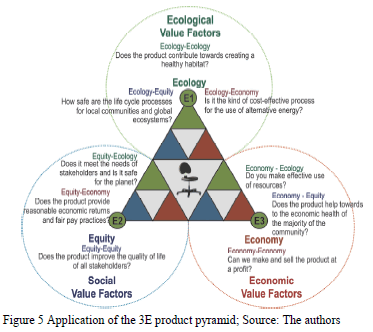
<body><![CDATA[<p><font size="2" face="Verdana, Arial, Helvetica, sans-serif">This new strand of   research is currently under development, with high expectations of its full   implementation in the future, whereby it will set a new paradigm for design,   and will develop products and industrial systems based on the search for   eco-efficient solutions (quality) with a closed life cycle. This situation is   supported by the European project <i>Cradle to Cradle Network</i> (C2CN) &#91;23&#93;,   approved in February 2010 for the development of the C2C paradigm and its   distribution in Europe, within the INTERREG IVG (Innovation and Environment   Regions of Europe Sharing Solutions). The C2C framework is insufficiently   developed for the further incorporation into the product design requirements   that the products can also be regenerated at the end of their useful life, and   that they generate environmental value within their life cycle. This determines   the need for the design and development of products, which, in addition to   conceiving sustainability in a systemic manner, also integrate life-cycle   analysis (LCA), cleaner production and industrial ecology, and eco-efficiency   and eco-effectiveness &#91;5&#93;, all within the framework of Best Available   Techniques. To this end, we propose and develop the &quot;Genomic Model of   Eco-Innovation and Eco-design, MGE2.&quot; This is a new process for the design and   development of products that converts C2C into a practical and applicable   technique.</font></p>     <p>&nbsp;</p>     <p><font size="3" face="Verdana, Arial, Helvetica, sans-serif"><b>3. Methodology</b></font></p>     <p><b><font size="2" face="Verdana, Arial, Helvetica, sans-serif"><i>3.1. Cradle to Cradle   - C2C</i></font></b></p>     <p><font size="2" face="Verdana, Arial, Helvetica, sans-serif">The core of the C2C   paradigm &#91;1&#93; consists of eco-innovative design solutions inspired by nature, in   their closed cycles of materials and eco-efficient industrial metabolism (in   the absence of xenobiotic substances). The objective is to incorporate   eco-efficient solutions that add value in order to help minimize the use of   natural resources, by placing value on resources manufactured in successive   cycles, which involve a parallel reduction of environmental degradation. To   this end, the methodology must be designed in such a way that nature is seen as: a model (through imitation of forms, processes, flows, interactions   and systems); units of measure (via comparison of designs with natural   references and verification of whether the solutions are as effective,   efficient, simple, and sustainable as those found in nature); and mentor   (through the acceptance that human activity and industrial practice is part of   nature, and acting accordingly). Approaches that arise in relation to the   concept of eco-effectiveness in C2C &#91;26&#93;, provide the search for quality   solutions, by doing &quot;more with less&quot; without slowing down the environmental   problem (which does not just minimize resource consumption, emissions and   waste, but actually eliminates them), all according to the concept of   Biomimicry, otherwise known as Innovation inspired by nature &#91;6&#93;.The authors of   this idea &#91;3&#93; propose a series of ideas that we have organized into nine   practical principles, (Pi), which ensure products are obtained that incorporate closed loops, no waste   generation, and recovery of all materials without any loss of quality, thereby   keeping the natural capital of the planet in line with the character of a   system that is open in energy and closed in materials.</font></p>     <p><font size="2" face="Verdana, Arial, Helvetica, sans-serif"><b>P1. Proactive refocus (positive impacts).</b> As opposed to the reactive approach   of environmentalists to &quot;reduce, reutilize and reuse&quot; that only slows   down degradation without resolving the problem, this principle proposes proactive   action before the generation of impacts. It rejects the assumption that the industry   must inevitably destroy the environment, and it recognizes the potential for innovation,   ingenuity, creativity and prudence, and   imagines systems which purify water, air and soil, thereby helping to regenerate   the environmental value lost in recent decades.</font></p>     <p><font size="2" face="Verdana, Arial, Helvetica, sans-serif"><b>P2. Systemic and integrated conception of product   metabolism (systemic approach).</b> This   principle includes a systemic perspective of the lifecycle of products by   introducing closed metabolic processes for technical and biological nutrients   of the naturesphere and technosphere. This setup of closed cycles converts the   output into input (waste = food).</font></p>     <p><font size="2" face="Verdana, Arial, Helvetica, sans-serif"><b>P3. Fractalization of sustainability (eco-innovation). </b>The 3E strategy transforms the problem-resolution   process and obtains solutions based on opportunities of values with a triple calculation   of results (economic, social, and ecological).</font></p>     <p><font size="2" face="Verdana, Arial, Helvetica, sans-serif"><b>P4. Bio-inspired eco-innovation (biomimicry).</b> The search for quality solutions based on   effective bio-inspired innovations&#91;6&#93;. This will rule out ineffective solutions   (such as continuous optimization which minimizes but fails to eliminate the   problem of eco-efficiency), by endowing products and industrial systems with   added environmental value, and by helping reduce the use of natural resources   and reduce environmental degradation, which directly or indirectly contributes   towards the minimization of environmental impact.</font></p>     <p><font size="2" face="Verdana, Arial, Helvetica, sans-serif"><b>P5. The product as a living being and its system,   associated as an ecosystem (environmentally friendly).</b> Products are considered and developed as the   metaphor of a living being with its complex relationships with the environment,   whose metabolic flows of biological and technical nutrients are included within   closed cycles without any loss of value and without damage to the environment.</font></p>     ]]></body>
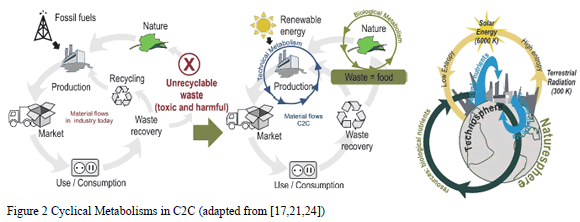
<body><![CDATA[<p><font size="2" face="Verdana, Arial, Helvetica, sans-serif"><b>P6. Eco-intelligence (maximization of the natural   value)</b>. Ecological intelligence is the concept that   describes the ability to design and develop sustainable products or services.   From the initial conception of the design, the carrying capacity of the   ecosystems associated to its life cycle is considered, and hence the network of   interactions is rendered environmentally friendly and beneficial to the   environment and the agents involved. In this way, the lost environmental value   on the planet can be regenerated.</font></p>     <p><font size="2" face="Verdana, Arial, Helvetica, sans-serif"><b>P7. Respect for and promotion of diversity   (resilient design)</b> Diversity   (genes, organisms, populations, ecosystems) promotes resilience and robustness   of the product and associated systems, thereby ensuring security in a changing   world. Therefore, the variety belonging to the natural environment, and that of   the technosphere, which is influenced by the manufacture, use and disposal of   products, should not be adversely affected. This implies respecting and   enhancing natural and technical diversity, and the avoidance of xenobiotic   products and substances &#91;27&#93;.</font></p>     <p><font size="2" face="Verdana, Arial, Helvetica, sans-serif"><b>P8. Eco-effectiveness versus eco-efficiency   (quality solutions).</b> Eco-effectiveness is associated with quality solutions and directly addresses   the concept of maintaining (or improving) the quality of resources and productivity   through closed cycles. Rather than eliminating waste, we advocate a cyclic   metabolism or a complete closure of material cycles (refuse is non existent)   where waste of one system becomes a nutrient for other systems. This idea is   taken from nature, where there is no waste and therefore all technical or   biological cycles are closed (waste = nutrient).</font></p>     <p><font size="2" face="Verdana, Arial, Helvetica, sans-serif"><b>P9. Use of renewable energy (Exergy approach).</b> The energy to sustain the metabolism of the food   chains of biologicaland technical nutrients should preferably be obtained from renewable sources, rather than through the exploitation of resources that   provide energy from fossil fuels, which, for millennia, has devastated the   areas where these materials have been processed &#91;28&#93;.</font></p>     <p><font size="2" face="Verdana, Arial, Helvetica, sans-serif"><b><i>3.2. Material Flow   Analysis (MFA) and Substance Flow Analysis (SFA)</i></b></font></p>     <p><font size="2" face="Verdana, Arial, Helvetica, sans-serif">The paragraphs above   state that the design of a product within the C2C context must deal with the   concept of closed flows of materials and substances. This implies including an   eco-systemic perspective in the design and development process where we will   define new rules that convert waste materials into nutrients, in such a way   that they are allowed to flow within two metabolic cycles, as shown in <a href="#fig02">Fig. 2</a> (the biological cycle, associated with the naturesphere, and the technical   cycle, associated with the technosphere). This is made possible thanks to MFA   (material flow analysis) and SFA (substance flow analysis) with which we can   simulate the principle of conservation of matter carried out by nature, where   the flow of material, substance and energy is constant &#91;7&#93;. With these two   methods, all flows within the life cycle of the product can be taken into   account through Material Flow Accounting, (MFA). Interest in these two types of   analyses due to their different trophic levels and to their associated energy,   appears the moment when the aim becomes that of converting the flows generated   by the industry into the metaphor of the trophic chain which is followed by   natural ecosystems. To this end,   materials must coexist exclusively in the two metabolic routes to achieve the   closed nature of the cycles of flows (hence the name, from cradle to cradle).   This eliminates the concept of waste, and renewable energy resources are chosen   for the metabolic reactions. Within the C2C design, the following types of   metabolism associated with the product have been established:</font></p>     <p align="center"><font size="2" face="Verdana, Arial, Helvetica, sans-serif"><a name="fig02"></a></font><img src="/img/revistas/dyna/v82n191/v82n191a17fig02.gif"></p>     <p><font size="2" face="Verdana, Arial, Helvetica, sans-serif"><b>Metabolism associated to Naturesphere.</b> These are   a result of processes linked to biological nutrients or biodegradable materials   that could be metabolized and regenerated by nature. In this cycle, the   material may return to the biosphere (lithosphere, hydrosphere and atmosphere)   only as organic material (neither synthetic nor toxic). Discarding a chair made   entirely from wood is one example. This metabolism is represented in <a href="#fig02">Fig. 2</a>,   BN.</font></p>     <p><font size="2" face="Verdana, Arial, Helvetica, sans-serif"><b>a. Metabolism associated to the Technosphere.</b> This consists of technical materials and   processes related with product life cycle, forming the set of technical   nutrients to be metabolized by the Technosphere (in <a href="#fig02">Fig. 2</a>, TN), divided into: B1- Downcycling is the path where the materials   lose quality and value. With use, their elimination or disposal is only   postponed, and their destructive cycle is extended, for example, the   manufacture of sheets for thermoformed, plastic lumber, pallets or thermal   fillers from PET (polyethylene terephthalate) bottles. These having fulfilled   their initial goal are incorporated into a process where they suffer a loss of   certain properties, and can be exploited if they are used in the manufacture of   only those products that do not require the features offered by the primary   material. And B2 - Upcycling transforms the unused material or product,   otherwise destined to become waste, into another material or product of equal   or greater utility or value. These paths lead to materials of greater value,   through being transformed into preferential materials in the eco-design of   products and industrial ecology. An example can be found in the car industry   &#91;8&#93;, where once each vehicle becomes obsolete, many engine parts could easily   be reused in other applications. Both the MFA and the SFA are carried out   through the study of flow diagrams, material balance, and simulation processes   of the values of environmental impact &#91;9&#93;. Their use enables us to also   understand the metabolic flows described above and the energy inherent in the   processes, the toxic substances and their flows within every phase of the life   cycle (extraction, manufacturing, use, withdrawal, and end of life), currently   included in the field of study of ecotoxicity. </font></p>     <p><font size="2" face="Verdana, Arial, Helvetica, sans-serif">Clearly, the purpose of   the design with C2C is to improve flows associated with the product in relation   to the metabolic capacity of the planet: the Naturesphere and Technosphere. The   C2C paradigm also describes the need to improve the metabolism of the   Technosphere, through the implementation of industrial ecology systems within   which the effective management of nutrients is carried out. Sets of intelligent   materials are formed that enable upcycling, thereby leaving downcycling as   obsolete, depending on the technology available and the development of new   materials. For the preservation of metabolic routes in closed loop cycles,   maintenance from energy flows is needed, which in turn requires a surplus of   resource consumption and pollution generation for their production. In order to   minimize this impact, the replacement of fossil fuels by renewable energy   sources has become a priority.</font></p>     ]]></body>
<body><![CDATA[<p><font size="2" face="Verdana, Arial, Helvetica, sans-serif"><b><i>3.3. Industrial ecology   and cleaner production</i></b></font></p>     <p><font size="2" face="Verdana, Arial, Helvetica, sans-serif">There are three types of industrial systems &#91;10&#93;,   which co-exist today. Type I is the conventional and unsustainable system that   was born in the industrial revolution and is about to become extinct. Those   companies and organizations that have begun to become aware of sustainable   development and environmental care are matched to type II. Finally, type III is   not still considered by many systems (although some are running currently, such   as the Eco-industrial Park in Kalundborg, or are under development, such as the   Eco-industrial Park in Dallas Texas). There are many studies and research projects   about industrial ecology's dynamic and models through which projects are being   proposed to create industrial ecosystems and eco-industrial parks. Adopting   this system with its characteristics offers companies the ability to minimize   the environment impact and reduce production costs through an energy and   resources efficiency plan. Its application prevents contamination, allows   resource recovery and reconstruction of damaged resources in degraded   ecosystems. Industrial ecosystems are a powerful economic tool, both for   industry and close communities that may achieve benefit from park's clean   management .</font></p>     <p><font size="2" face="Verdana, Arial, Helvetica, sans-serif">This has been made possible thanks to MGE2, which guides planning and productive   industrial activity in order to achieve sustainability in manufacturing processes.   MGE2 allows industrial plants to manage inflows and outflows efficiently. Good planning   will optimize the manufacturing phase where industrial system quality will be strengthened. </font></p>     <p><font size="2" face="Verdana, Arial, Helvetica, sans-serif"><b><i>3.4. Application Tools</i></b></font></p>     <p><font size="2" face="Verdana, Arial, Helvetica, sans-serif">The C2C paradigm and framework have developed a set of techniques and   individual tools, which have yet to be integrated into a model of product   design and development. From among other survey techniques, possible applications   could be found for biodegradable materials, analysis and assessment of material   flows (MFA), substance flow analysis (SFA) &#91;25&#93;, life cycle analysis (LCA),   Sankey diagrams of energy balances, a study of biological and technical   metabolic routes, the design of a closed nutrient cycle, exergy analysis,   design and development of metabolisms of the product, product disassembly   trees, chemical design, triple E strategy (or fractal pyramid), X-list,   gray-list, P-list, eco-effectiveness, the rediscovery of environmental   concepts, the five stages of redesign (no use of harmful pollutants, monitoring   reports, positive passive list, active positive active list, and rediscovery or   innovation), and bio-inspired design &#91;11&#93;. The stages of product design and development are complex, non-intuitive,   and fail to guarantee good environmental performance, all due to this situation   of isolated techniques with no specific establishment for the way in which they   should be applied. Based on C2C, a new design model (MGE2) is proposed in order   to integrate paradigm principles and techniques in the design and development   process.</font></p>     <p><font size="2" face="Verdana, Arial, Helvetica, sans-serif"><b><i>3.5. Genomic Model   of Eco-innovation and Eco-design - MGE2.</i></b></font></p>     <p><font size="2" face="Verdana, Arial, Helvetica, sans-serif">The aim of the proposal for the genomic model of   design and development is to integrate the C2C paradigm, the material and substance   flow analyses together with all aspects present in the analysis of the life   cycle of products. To this end and through the achievement of a flow of   adequate nutrients (simulating the trophic chains that living beings follow in   their ecosystems), the objective is the incorporation into the products of a   series of characteristics that designate their sustainability during   manufacture and use, and at the end of their useful life, where they repeatedly   restart the process as technical nutrients, thereby rendering them autopoietic   &#91;12&#93;, and self-healing.. The design requirements that MGE2 incorporates into   products are defined in order to ensure eco-compatibility, by enabling   integration of the nutrients into successive redesigns (new generations of products),   while taking into account the evolution of the associated ecosystem product   (market, Technosphere, Naturesphere, etc). The model reflects the requirements   of complexity and flexibility of the new environments of the development   known as PLM - Product Life Management &#91;4&#93;, and is configurable in response to   the complexity of the product, thereby forming an open reference architecture   for concurrent, collaborative, and distributed engineering environments.   Bearing these aspects in mind, the following dimensions are proposed for the   characterization of the products:</font></p>     <p><font size="2" face="Verdana, Arial, Helvetica, sans-serif"><u>Static dimension</u>, which incorporates a sustainable character into the product   (self-compatible) defined as:</font></p> <ul>       <li><font size="2" face="Verdana, Arial, Helvetica, sans-serif"> Autopoietic     (self-regenerating): the product regenerates itself.</font></li>       <li><font size="2" face="Verdana, Arial, Helvetica, sans-serif"> Environmentally friendly: the different solutions     are designed based on the capacity of the receiving environment.</font></li>       ]]></body>
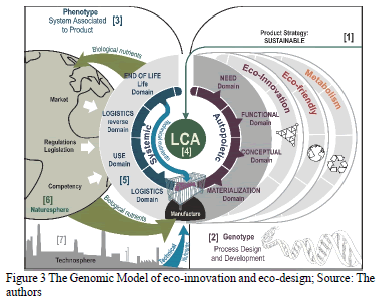
<body><![CDATA[<li><font size="2" face="Verdana, Arial, Helvetica, sans-serif"> Metabolizable: the flows of substances and materials     are designed in response to biological and technical metabolic processes.</font></li>       <li><font size="2" face="Verdana, Arial, Helvetica, sans-serif"> Systemic (holistic): different projective scenarios,     cyclic interactions of the product, and metabolic flows generated in its life cycle     are all studied, for both biological and technical nutrients.</font></li>     </ul>     <p><font size="2" face="Verdana, Arial, Helvetica, sans-serif"><u>Dynamic dimension,</u> which determines the variations in the different   generations of products, endowing them with an evolutionary character   (resilient and robust), differentiated by:</font></p> <ul>       <li><font size="2" face="Verdana, Arial, Helvetica, sans-serif"> Natural selection (environmental pressure):     resulting from the interaction of the genome (internal characteristics of the     product) with the environment (which selects the best adapted) leading to the     phenotype. This constitutes the learning factor between generations of the     product.</font></li>       <li><font size="2" face="Verdana, Arial, Helvetica, sans-serif"> Recombination     and mutation (the combination of two different genotypes): both correspond to     the random processes of genetic transmission between generations and to     strategies of hybridization between products in the company's portfolio.</font></li>     </ul>     <p><font size="2" face="Verdana, Arial, Helvetica, sans-serif">In   order to correctly analyse and synthesize these dimensions of the sustainable   product with the appropriate connotations, a series of steps is defined that guide   th</font> <font size="2" face="Verdana, Arial, Helvetica, sans-serif">whole design and development process   and which render the product sustainable. </font></p>     <p align="center"><font size="2" face="Verdana, Arial, Helvetica, sans-serif"><a name="fig03"></a></font><img src="/img/revistas/dyna/v82n191/v82n191a17fig03.gif"></p>     <p><font size="2" face="Verdana, Arial, Helvetica, sans-serif">Taking the states and   evolution of natural systems as a reference, the process is divided into two   sections: genotype, the stage of gestation of the product (design and   development); and phenotype, which defines the associated system of the product   (manufacturing, use, withdrawal and end of life, market, policy, legislation,   and competence). The terms &quot;genotype&quot; and &quot;phenotype&quot; are characteristic of   genetics, where the duality of organisms is represented. These have been chosen   as an analogy to describe the internal characteristics of a product, or its   &quot;genes&quot; (genotype) and its expression or interaction in a certain environment   or &quot;ecosystem&quot; (phenotype). The two processes (genotype and   phenotype) need a strategy (sustainable) that determines their evolution, and   require constant analysis and interaction management, achieved with a   Life-Cycle Analysis &#91;13&#93;. Hence the MGE2 has a five-fold structure:</font></p>     ]]></body>
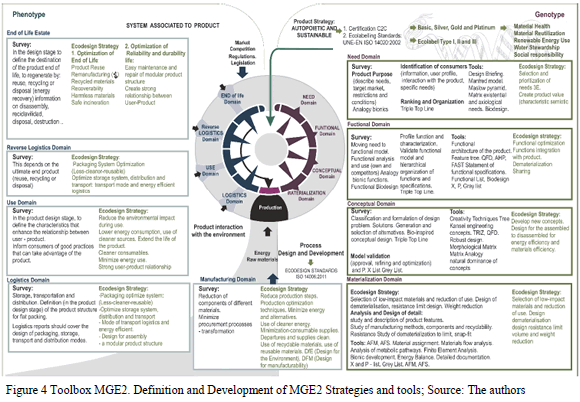
<body><![CDATA[<p><font size="2" face="Verdana, Arial, Helvetica, sans-serif">&lt;MGE2&gt;= &lt;&lt;ProductStrategy&gt;&lt;Genotype&gt;&lt;FoodChain&gt;&lt;Phenotype&gt;&lt;LifeCycle   Analysis&gt;&gt;</font></p>     <p align="center"><font size="2" face="Verdana, Arial, Helvetica, sans-serif"><a name="fig04"></a></font><img src="/img/revistas/dyna/v82n191/v82n191a17fig04.gif"></p>     <p><font size="2" face="Verdana, Arial, Helvetica, sans-serif">&lt; Product Strategy &gt; (1) In this stage, the objectives   are defined under C2C principles, which design or redesign a new product and manage   its life cycle. These aims establish the product strategy of a systemic, autopoietic,   eco-innovative, eco-friendly, and metabolizable character.</font></p>     <p><font size="2" face="Verdana, Arial, Helvetica, sans-serif">&lt;Genotype&gt; (2)   Based on product strategy, various techniques and design tools associated with   C2C are applied in order to establish the &quot;genes&quot; that define the   materials (nutrients), metabolic routes, and the types of energy (possibly   renewable) which will sustain the products from cradle to cradle. The genomic   design of the product establishes the domains of needs, functions and concepts,   and materialization. In these domains there is a series of techniques to ensure   eco-innovation, eco-compatibility and metabolism &#91;14&#93;. The main tool for the   assessment of design solutions that establish these &quot;genes&quot; consists   of the basic strategies of eco-design,   supported by biomimetic design strategies oriented towards eco-effectiveness,   all with the intention of obtaining the closed-loop cycle characteristics of   the C2C perspective which are to be applied in each domain (view <a href="#fig05">Fig. 5</a>).</font></p>     <p align="center"><font size="2" face="Verdana, Arial, Helvetica, sans-serif"><a name="fig05"></a></font><img src="/img/revistas/dyna/v82n191/v82n191a17fig05.gif"></p>     <p><font size="2" face="Verdana, Arial, Helvetica, sans-serif">&lt;Food Chain&gt; (3) After defining the   &quot;genes&quot; that characterize the product, the product begins its phase   of growth and development, that is to say that it is ready to be manufactured   and that it will later become part of its associated system. At this stage, the   work of other actors begins that will render the rest of their life cycles   eco-effective, with decisions on logistics or management of the end of life.   These stages, considered in the design (genomics phase), can be completed and   optimized at this point. Hence, in the design stage, certain decisions are made   that ease this work and help to minimize the environmental impact once the   network of relationships, which ensures the eco-compatibility and metabolism,   are established.</font></p>     <p><font size="2" face="Verdana, Arial, Helvetica, sans-serif">Therefore, it is   necessary to conduct a study of possible interactions by considering two key   elements: Naturesphere (6), which constitutes the environment where the   industry extracted the natural resources and where the biological nutrients are   returned; and Technosphere (7), as a means of attaining the flow of technical   nutrients, which must be taken into account for the material flow analysis   (MFA) and substance flow analysis (SFA).</font></p>     <p><font size="2" face="Verdana, Arial, Helvetica, sans-serif">&lt;Phenotype&gt; (4). This phase constitutes the   development of the analysis of the real and potential interactions of the   product with the environment as an expression of its genes (genotype +   environmental interactions = phenotype). The expected outcome of the product on   the market (environment) is determined. This stage takes into account market   analysis, legislation, user analysis, material resources available, traditions,   forward and reverse logistics, stakeholder analysis, processes of the end of   useful life, etc. The required performance of the product is analyzed under the   C2C sustainability criteria, based on data obtained from the system into which   the product will be integrated and associated.</font></p>     <p><font size="2" face="Verdana, Arial, Helvetica, sans-serif">&lt;Life Cycle Analysis&gt; (5). The objective of LCA is   to determine the environmental impact that is associated with the phenotype of   a product or with its new design (genotype), so that the impact can be   considered within the product.</font></p>     <p><font size="2" face="Verdana, Arial, Helvetica, sans-serif">&lt;Strategy: This tool is particularly significant in the   model proposed since it pursues the qualitative and quantitative knowledge of   the flows of materials, energy, emissions, and effluents and of their impact on   the environment. LCA can be applied at various stages (on the phenotype -   product to be redesigned - or on the genomic - design of a new product. </font></p>     ]]></body>
<body><![CDATA[<p>&nbsp;</p>     <p><font size="3" face="Verdana, Arial, Helvetica, sans-serif"><b>4. Verification and   Recognition</b></font></p>     <p><font size="2" face="Verdana, Arial, Helvetica, sans-serif">The MGE2 model is designed to be applied in all those design projects and   product development with sustainability goals under C2C. Once the design and development   process is completed, then verification and recognition of the work is performed   by some of the existing eco-labels, with which the added environmental value is   awarded to the products &#91;13&#93;. Thanks to the structure of the proposed model, the   criteria demanded by eco-labelling schemes are included in the product once they   have undergone the design stages. Together with the current ISO eco-labelling programs   &#91;15&#93;, a new certification system associated with C2C eco-effectiveness   &#91;16&#93; has been developed, administered by the authors of this new perspective and   which differentiates products according to the sustainable objectives achieved,   into qualifications of <i>platinum, gold, silver,</i> and<i> basic</i>. The criteria for the achievement   of these labels range from the basic level (where the product inventory and strategy   is valued), through to the silver level (achieved with a product of at least 50%   reusable materials), via the C2C gold level (products consisting of 65% clean materials,   production and energy), and finally reaching the Platinum level (which includes   all the above requirements and also attains good water management in the life cycle).   The structure of MGE2 allows all aspects required for the implementation of the   C2C-certified products to be taken into account, once the necessary tools to enable   the estimated requirements to be met are incorporated.</font></p>     <p>&nbsp;</p>     <p><font size="3" face="Verdana, Arial, Helvetica, sans-serif"><b>5. Case study: implementation   of MGE2 in the redesign of office chair</b></font></p>     <p><font size="2" face="Verdana, Arial, Helvetica, sans-serif">The implementation of MGE2 is flexible, and varies according   to the type of project, product complexity, and the proposed objectives. Therefore,   the industry can either redesign an existing product or design a new one, adapting   to different operating modes in the different stages of the model. That is to say, the MGE2 model offers flexibility   of application and flexibility in the choice of techniques and tools destined for   the attainment of C2C projects. The exact nature of this methodology is applied   by way of an illustration, and defines the strategy and steps to follow in the redesign   of an office chair &#91;17,18&#93;</font></p>     <p><font size="2" face="Verdana, Arial, Helvetica, sans-serif"><b>STAGE 1: Life cycle analysis of existing products: </b>Life Cycle Analysis is an   objective process for the evaluation of the environmental impact associated   with a product, process or industrial activity by identifying and quantifying   not only the use of material and energy, but also the emissions to the   environment, both in order to determine the impact of resource use and   emissions, and to evaluate and implement environmental improvement strategies   &#91;19&#93;. The study covers the entire life cycle, taking into account all stages   from the cradle to the grave of the product involved. For this case study, by   following MGE2 and thanks to the study of material and substance flow, this LCA   now covers the life cycle from the cradle to the cradle. The main objective of   this tool within the model is to determine the environmental impact of product   performance in relation to the 3E vectors. From this stage, improvements are   established that determine the product strategy. The LCA results obtained are   shown in Fig. 8 in the final section.</font></p>     <p><font size="2" face="Verdana, Arial, Helvetica, sans-serif"><b>STAGE 2:   Establishment of product strategy under C2C:</b> Once the LCA data and possible applicable improvements are known, then   a systemic, autopoietic, environmentally</font></p>     <p><font size="2" face="Verdana, Arial, Helvetica, sans-serif">compatible   and metabolizable strategy of the product is established through the   exploration of the value and innovation of the 3E pyramid, which constitutes   the basic tool for eco-innovation. The generation of the set of 3E values   enables the establishment of the premise that defines the product strategy;   this situation in turn enables the parameterization of the environment of the   generic design, through techniques and tools for this particular project. This   strategy focuses on: (1) Systemic (or holistic) integration for bio-inspired   design; the different scenarios of the chair throughout its life cycle are   considered in this phase with the aim of promoting and equitably integrating   all three aspects of the 3E pyramid. (2) Sustainable and eco-friendly.   Improvement of the metabolism by decreasing the ratios of environmental impact   on the Naturesphere, in order to minimize the impact on the environment (or   rendering the ecological footprint assimilable). This is achieved by increasing   the flows of material on the Technosphere by means of upcycling (minimizing   those flows related to infra-recycling as much as possible), eliminating   possible toxic or polluting substances with the incorporation of innovations   from green or sustainable chemicals. Finally, features that are cooperative   with Naturesphere are incorporated, thereby creating environmental value. (3)   An autopoietic character is obtained by taking the concept of &quot;genetic   intelligence&quot; into account and by supplying it to the product with the aim   of facilitating tasks of use, manufacturing,   logistics (forward and reverse), and of its regeneration at the end of the life   cycle. In a particular way, this intelligence incorporates innovation into   phenotypic interactions, thereby enabling regeneration, reuse, and recovery in   successive generations of products.</font></p>     <p><font size="2" face="Verdana, Arial, Helvetica, sans-serif"><b>STAGE 3: Design and Development of the product   genotype.</b> Study of the   Phenotype and associated criteria: Once the data of LCA, the phenotype required, and the product strategy are all determined, then   the redesign is performed under the principles of C2C. To this end, the genomic   design is carried out, with the detailed study of each domain, (need, functional,   conceptual, and materialization), and in the fields of Eco-innovation, Eco-compatibility,   and Metabolization &#91;20&#93;. In each domain, a series of individual eco-design strategies   is applied, as are the tools necessary for the definition of all the requirements   that render the product sustainable.</font></p>     ]]></body>
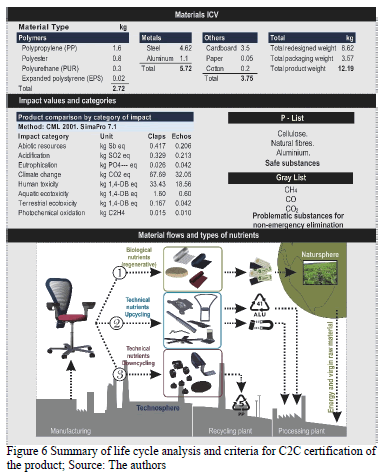
<body><![CDATA[<p><font size="2" face="Verdana, Arial, Helvetica, sans-serif"><b>STAGE 4: Validation of genotype and phenotype   optimization:</b> Concurrent   with the previous stage, the verification and validation of the genomic design of   the product is performed based on the requirement demanded by the system that it   be associated with the life cycle of the product, which in turn determines the procedures   for interaction of the genome with the environment. This results in the initial   phenotype which develops and optimizes over   the life cycle and those of successive generations of products. The stages of manufacture   and of the end of useful life hold special interest, since the metabolic pathways   and biological and technical nutrients are investigated and defined, and fix the   associated processes from the disassembly diagram of the genotype. The final solution   is the ECOS office chair &#91;17,18&#93;.</font></p>     <p><font size="2" face="Verdana, Arial, Helvetica, sans-serif"><b>STAGE 5: New LCA of the product with the objective   of Environmental Product Declaration C2C. </b>The last stage in the implementation of the MGE2 model corresponds to the   completion of a new LCA of the redesign of the product. The objective of this   analysis is the confirmation of the proposed improvements in the design   process and the knowledge of all the   information necessary in order to obtain an eco-label for the product from any   of the existing certification programs (including C2C certification). In the   case study carried out, the second application of LCA verifies whether the   product meets the criteria to qualify for C2C certification &#91;16&#93;. The results   awarded a GOLD eco-label to the chair. All the information is collected for the   writing of the Environmental Product Declaration in which the environmental   information of the chair is presented. It is also quantified throughout its   life cycle to allow for its comparison with other products that fulfil the same   function, all of which cause a greater impact on the environment.</font></p>     <p>&nbsp;</p>     <p><font size="3" face="Verdana, Arial, Helvetica, sans-serif"><b>6. Results and Discussion</b></font></p>     <p><font size="2" face="Verdana, Arial, Helvetica, sans-serif"><a href="#fig06">Fig. 6</a> presents the   results of the MFA, SFA, and LCA, as well as the properties and characteristics   of the flows of materials, together with a comparison where the results and   impact reduction are described. The final synthesis is summarized in this figure,   which reflects the characteristics that render the product sustainable under   the C2C paradigm, since they fit the criteria required to achieve the   aforementioned certification.The MGE2 model can be used for the design and   development of any product and system; data relating to genotype and phenotype,   i.e., all that is required are the inputs and outputs of each processes   involved in the life cycle stages, properly defined in the system limits of LCA   process. The MGE2 model provides an appropriate structure for design and   product development from C2C paradigm, unlike other models proposed in the   literature which do not contemplate an organization of actuation from the   Triple Bottom Line perspective and do not integrate quantitative tools and   methodologies that facilitate the application of the C2C principles, such as   the Material Flow Analysis (MFA), Substance Flow Analysis (SFA) or life cycle assessment (LCA). Furthermore, the   MGE2 model considers the different routes of product certifications. The MGE2   model is currently under validation, conducted by the company <i>ESINOR Instalaciones</i> for energy system   design and development. Intellectual exploitation rights were given up in order   to verify its application in the industrial sector. </font></p>     <p align="center"><font size="2" face="Verdana, Arial, Helvetica, sans-serif"> <a name="fig06"></a></font><img src="/img/revistas/dyna/v82n191/v82n191a17fig06.gif"></p>     <p><font size="2" face="Verdana, Arial, Helvetica, sans-serif">The development of the entire life cycle stage is a   specific framework to achieve sustainable integration in the design and product   development from 3E perspective (economic, ecological and social). For this   reason, the scope of this model is open to future updates. We are currently   working on the detailed design process of individual product life cycle stages.   It is in the manufacturing stage that different methods of design and   development of sustainable manufacturing processes are being considered, from   new paradigms such as Green manufacturing or Clean Production &#91;29&#93; or the   Materialization Domain that is being completed with the study of industrial   product metabolism.</font></p>     <p>&nbsp;</p>     <p><font size="3" face="Verdana, Arial, Helvetica, sans-serif"><b>7. Conclusion</b></font></p>     <p><font size="2" face="Verdana, Arial, Helvetica, sans-serif">The work presented provides previously unexplored joint epistemological   ideas of the C2C perspective and a model of design and development which introduces   an articulated form of implementing the basics of this new design paradigm. By compiling   lessons learned from the approach of eco-efficiency and eco-innovation, we develop   a new bio-inspired architecture for the process of eco-efficient design and development   under the C2C principles, known as MGE2. This model can support all regulatory requirements   to date, and can extend the range of solutions in order to improve the performance   of the minimization of impact and to solve the current environmental problems caused   by industry worldwide. Future work is aimed at developing design and development   environments with PLM tools and CAD systems that provide computational support of   the MGE2 model, by validating and verifying information and offering feedback. This   work proposes a methodology to design sustainable   products and systems within the C2C paradigm. Its main objective is to optimize   any system interactions with the environment, taking into account the Three Sustainable   Dimensions: economic, ecological and equity (3E). The Genomic Model of Eco-innovation and Eco-design is a methodology for   sustainable product design and development. It can help engineers and their products,   systems or activities to have an internal operation in line with its associated   system. The model guides decision making processes with both qualitative and quantitative   assessments within a set of strategies included in the best available techniques,   combining new and eco-innovative methodologies with traditional experienced technologies,   obtaining broad effectiveness to manage product lifecycles.</font></p>     ]]></body>
<body><![CDATA[<p>&nbsp;</p>     <p><font size="3" face="Verdana, Arial, Helvetica, sans-serif"><b>References</b></font></p>     <!-- ref --><p><font size="2" face="Verdana, Arial, Helvetica, sans-serif"><b>&#91;1&#93;</b> McDonough,   W. and Braungart, M., Cradle to Cradle: Remarking the way we make things. North   Point Press, New York, 2002.    &nbsp;&nbsp;&nbsp;&nbsp;&nbsp;&nbsp;&nbsp;&nbsp;[&#160;<a href="javascript:void(0);" onclick="javascript: window.open('/scielo.php?script=sci_nlinks&ref=000115&pid=S0012-7353201500030001700001&lng=','','width=640,height=500,resizable=yes,scrollbars=1,menubar=yes,');">Links</a>&#160;]<!-- end-ref --></font></p>     <!-- ref --><p><font size="2" face="Verdana, Arial, Helvetica, sans-serif"><b>&#91;2&#93;</b> Beskow,   C. and Ritz&eacute;n, S., Performing Changes in Product Development: A Framework with   Keys for Industrial Application. Res Eng Des 3, pp. 172-190, 2000. DOI   10.1007/s001630050032</font>&nbsp;&nbsp;&nbsp;&nbsp;&nbsp;&nbsp;&nbsp;&nbsp;[&#160;<a href="javascript:void(0);" onclick="javascript: window.open('/scielo.php?script=sci_nlinks&ref=000117&pid=S0012-7353201500030001700002&lng=','','width=640,height=500,resizable=yes,scrollbars=1,menubar=yes,');">Links</a>&#160;]<!-- end-ref --><!-- ref --><p><font size="2" face="Verdana, Arial, Helvetica, sans-serif"><b>&#91;3&#93;</b> McDonough,   W., Braungart, M., Anastas, MT. and Zimmerman, JB., Applying the principles   engineering of green to Cradle to Cradle design. Environ Science &amp; Tech.   37: 434A-441A, 2003. DOI: 10.1021/es0326322</font>&nbsp;&nbsp;&nbsp;&nbsp;&nbsp;&nbsp;&nbsp;&nbsp;[&#160;<a href="javascript:void(0);" onclick="javascript: window.open('/scielo.php?script=sci_nlinks&ref=000118&pid=S0012-7353201500030001700003&lng=','','width=640,height=500,resizable=yes,scrollbars=1,menubar=yes,');">Links</a>&#160;]<!-- end-ref --><!-- ref --><p><font size="2" face="Verdana, Arial, Helvetica, sans-serif"><b>&#91;4&#93;</b> Sudarsan,   R., Fenves, S.J., Sriram, R.D. and Wang, F., A product information modeling   framework for product lifecycle management. Computer-Aided Design, 37 (13) pp.   1399-1411, 2005. DOI: 10.1016/j.cad.2005.02.010</font>&nbsp;&nbsp;&nbsp;&nbsp;&nbsp;&nbsp;&nbsp;&nbsp;[&#160;<a href="javascript:void(0);" onclick="javascript: window.open('/scielo.php?script=sci_nlinks&ref=000119&pid=S0012-7353201500030001700004&lng=','','width=640,height=500,resizable=yes,scrollbars=1,menubar=yes,');">Links</a>&#160;]<!-- end-ref --><!-- ref --><p><font size="2" face="Verdana, Arial, Helvetica, sans-serif"><b>&#91;5&#93;</b> Braungart   M., McDonough, W. and Bollinger, A., C2C design: creating healthy emissions - a strategy for eco-effective   product and 10.1016/j.jclepro.2006.08.003</font>&nbsp;&nbsp;&nbsp;&nbsp;&nbsp;&nbsp;&nbsp;&nbsp;[&#160;<a href="javascript:void(0);" onclick="javascript: window.open('/scielo.php?script=sci_nlinks&ref=000120&pid=S0012-7353201500030001700005&lng=','','width=640,height=500,resizable=yes,scrollbars=1,menubar=yes,');">Links</a>&#160;]<!-- end-ref --><!-- ref --><p><font size="2" face="Verdana, Arial, Helvetica, sans-serif"><b>&#91;6&#93;</b> Benyus,   J.M., Biomimicry, innovation inspired by nature. Perennial Harpercollins, New   York, 2002.    &nbsp;&nbsp;&nbsp;&nbsp;&nbsp;&nbsp;&nbsp;&nbsp;[&#160;<a href="javascript:void(0);" onclick="javascript: window.open('/scielo.php?script=sci_nlinks&ref=000121&pid=S0012-7353201500030001700006&lng=','','width=640,height=500,resizable=yes,scrollbars=1,menubar=yes,');">Links</a>&#160;]<!-- end-ref --></font></p>     ]]></body>
<body><![CDATA[<!-- ref --><p><font size="2" face="Verdana, Arial, Helvetica, sans-serif"><b>&#91;7&#93;</b> Bouman,   M., Heijungs, R., Voet, E., Bergh, J. and Huppes, G., Material flows and   economic models: an analytical comparison of SFA, LCA and partial equilibrium   models. Ecological Economics, 32 (2), pp. 195-216, 2000.   DOI: 10.1016/S0921-8009(99)00091-9</font>&nbsp;&nbsp;&nbsp;&nbsp;&nbsp;&nbsp;&nbsp;&nbsp;[&#160;<a href="javascript:void(0);" onclick="javascript: window.open('/scielo.php?script=sci_nlinks&ref=000123&pid=S0012-7353201500030001700007&lng=','','width=640,height=500,resizable=yes,scrollbars=1,menubar=yes,');">Links</a>&#160;]<!-- end-ref --><!-- ref --><p><font size="2" face="Verdana, Arial, Helvetica, sans-serif"><b>&#91;8&#93;</b> Brissauda,   D. and Mathieuxa, F., End-of-life product-specific material flow analysis.   Application to alum coming from end-of-life commercial vehicles in Eur, 55 (2),   pp. 92-105, 2010. DOI: 10.1016/j.resconrec.2010.07.006</font>&nbsp;&nbsp;&nbsp;&nbsp;&nbsp;&nbsp;&nbsp;&nbsp;[&#160;<a href="javascript:void(0);" onclick="javascript: window.open('/scielo.php?script=sci_nlinks&ref=000124&pid=S0012-7353201500030001700008&lng=','','width=640,height=500,resizable=yes,scrollbars=1,menubar=yes,');">Links</a>&#160;]<!-- end-ref --><!-- ref --><p><font size="2" face="Verdana, Arial, Helvetica, sans-serif"><b>&#91;9&#93;</b> El-Haggar,   S., Sustainable industrial design and waste management. Cradle-to-Cradle for   sustainable development. Elservier Academic Press, London, 2007.    &nbsp;&nbsp;&nbsp;&nbsp;&nbsp;&nbsp;&nbsp;&nbsp;[&#160;<a href="javascript:void(0);" onclick="javascript: window.open('/scielo.php?script=sci_nlinks&ref=000125&pid=S0012-7353201500030001700009&lng=','','width=640,height=500,resizable=yes,scrollbars=1,menubar=yes,');">Links</a>&#160;]<!-- end-ref --></font></p>     <!-- ref --><p><font size="2" face="Verdana, Arial, Helvetica, sans-serif"><b>&#91;10&#93;</b> Themelis,   N.J., E4001:001 - Industrial Ecology of Earth Resources. Columbia University.   2000.    &nbsp;&nbsp;&nbsp;&nbsp;&nbsp;&nbsp;&nbsp;&nbsp;[&#160;<a href="javascript:void(0);" onclick="javascript: window.open('/scielo.php?script=sci_nlinks&ref=000127&pid=S0012-7353201500030001700010&lng=','','width=640,height=500,resizable=yes,scrollbars=1,menubar=yes,');">Links</a>&#160;]<!-- end-ref --></font></p>     <!-- ref --><p><font size="2" face="Verdana, Arial, Helvetica, sans-serif"><b>&#91;11&#93;</b> Byggeth,   S. and Hochschorner, E., Handling trade-offs in ecodesign tools for sustainable   product development and procurement. J Clean Production, 14 (15-16), pp.   1420-1430, 2006. DOI: 10.1016/j.jclepro.2005.03.024</font>&nbsp;&nbsp;&nbsp;&nbsp;&nbsp;&nbsp;&nbsp;&nbsp;[&#160;<a href="javascript:void(0);" onclick="javascript: window.open('/scielo.php?script=sci_nlinks&ref=000129&pid=S0012-7353201500030001700011&lng=','','width=640,height=500,resizable=yes,scrollbars=1,menubar=yes,');">Links</a>&#160;]<!-- end-ref --><!-- ref --><p><font size="2" face="Verdana, Arial, Helvetica, sans-serif"><b>&#91;12&#93;</b> Varela,   F.G., Maturana, HR. and Uribe, R., Autopoiesis: The organization of   livingsystems, its characterization and a model. BioSystems, 5 (4), pp.   187-196, 1974. DOI: 10.1016/0303-2647(74)90031-8</font>&nbsp;&nbsp;&nbsp;&nbsp;&nbsp;&nbsp;&nbsp;&nbsp;[&#160;<a href="javascript:void(0);" onclick="javascript: window.open('/scielo.php?script=sci_nlinks&ref=000130&pid=S0012-7353201500030001700012&lng=','','width=640,height=500,resizable=yes,scrollbars=1,menubar=yes,');">Links</a>&#160;]<!-- end-ref --><!-- ref --><p><font size="2" face="Verdana, Arial, Helvetica, sans-serif"><b>&#91;13&#93;</b> Finster,   M., Eagan, P. and Hussey, D., Linking industrial ecology with business   strategy. Creating value for green product design. J Industrial Ecology, 5 (3),   pp. 107-125, 2002. DOI: 10.1162/108819801760049495</font>&nbsp;&nbsp;&nbsp;&nbsp;&nbsp;&nbsp;&nbsp;&nbsp;[&#160;<a href="javascript:void(0);" onclick="javascript: window.open('/scielo.php?script=sci_nlinks&ref=000131&pid=S0012-7353201500030001700013&lng=','','width=640,height=500,resizable=yes,scrollbars=1,menubar=yes,');">Links</a>&#160;]<!-- end-ref --><!-- ref --><p><font size="2" face="Verdana, Arial, Helvetica, sans-serif"><b>&#91;14&#93;</b> Lofthouse,   V., Ecodesign tools for designers: Defining the requirements. J Clean   Production, 14 (15-16), pp. 386-1395, 2006. DOI: 10.1016/j.jclepro.2005.11.013</font>&nbsp;&nbsp;&nbsp;&nbsp;&nbsp;&nbsp;&nbsp;&nbsp;[&#160;<a href="javascript:void(0);" onclick="javascript: window.open('/scielo.php?script=sci_nlinks&ref=000132&pid=S0012-7353201500030001700014&lng=','','width=640,height=500,resizable=yes,scrollbars=1,menubar=yes,');">Links</a>&#160;]<!-- end-ref --><!-- ref --><p><font size="2" face="Verdana, Arial, Helvetica, sans-serif"><b>&#91;15&#93;</b> Ball,   J., Can ISO 14000 and eco-labelling turn the construction industry green? Build   and Environ, 37 (4), pp. 421-428, 2002. DOI: 10.1016/S0360-1323(01)00031-2</font>&nbsp;&nbsp;&nbsp;&nbsp;&nbsp;&nbsp;&nbsp;&nbsp;[&#160;<a href="javascript:void(0);" onclick="javascript: window.open('/scielo.php?script=sci_nlinks&ref=000133&pid=S0012-7353201500030001700015&lng=','','width=640,height=500,resizable=yes,scrollbars=1,menubar=yes,');">Links</a>&#160;]<!-- end-ref --><!-- ref --><p><font size="2" face="Verdana, Arial, Helvetica, sans-serif"><b>&#91;16&#93;</b> MBDC.,   Certification. &#91;on line&#93;, &#91;date of reference July of 2014&#93;, Available at: <a href="http://www.mbdc.com/detail.aspx?linkid=2&sublink=8" target="_blank">www.mbdc.com/detail.aspx?linkid=2&amp;sublink=8</a>.    &nbsp;&nbsp;&nbsp;&nbsp;&nbsp;&nbsp;&nbsp;&nbsp;[&#160;<a href="javascript:void(0);" onclick="javascript: window.open('/scielo.php?script=sci_nlinks&ref=000134&pid=S0012-7353201500030001700016&lng=','','width=640,height=500,resizable=yes,scrollbars=1,menubar=yes,');">Links</a>&#160;]<!-- end-ref --></font></p>     <!-- ref --><p><font size="2" face="Verdana, Arial, Helvetica, sans-serif"><b>&#91;17&#93;</b> Aguayo, F., Peralta, M.E., Lama, J.R. and   Soltero, V., Ecodise&ntilde;o: Ingenier&iacute;a sostenible de la cuna a la cuna . RCLibros,   2011.    &nbsp;&nbsp;&nbsp;&nbsp;&nbsp;&nbsp;&nbsp;&nbsp;[&#160;<a href="javascript:void(0);" onclick="javascript: window.open('/scielo.php?script=sci_nlinks&ref=000136&pid=S0012-7353201500030001700017&lng=','','width=640,height=500,resizable=yes,scrollbars=1,menubar=yes,');">Links</a>&#160;]<!-- end-ref --></font></p>     <!-- ref --><p><font size="2" face="Verdana, Arial, Helvetica, sans-serif"><b>&#91;18&#93;</b> Peralta,   ME., Aguayo, F. and Lama, J.R., Sustainable engineering based on cradle to   cradle model. An open architectural reference for a C2C design. Dyna Ingenier&iacute;a   e Industria, 86 (2), pp. 199-211, 2011. DOI: 10.6036/3873</font>&nbsp;&nbsp;&nbsp;&nbsp;&nbsp;&nbsp;&nbsp;&nbsp;[&#160;<a href="javascript:void(0);" onclick="javascript: window.open('/scielo.php?script=sci_nlinks&ref=000138&pid=S0012-7353201500030001700018&lng=','','width=640,height=500,resizable=yes,scrollbars=1,menubar=yes,');">Links</a>&#160;]<!-- end-ref --><!-- ref --><p><font size="2" face="Verdana, Arial, Helvetica, sans-serif"><b>&#91;19&#93;</b> Heijungs,   R., Huppes G. and Guin&eacute;e, JB., Life cycle assessment and sustainability   analysis of products, materials and technologies. Toward a scientific framework   for sustainability life cycle analysis. Polym Degrad and Stab, 95 (3), pp.   422-428, 2010. DOI: 10.1016/j.polymdegradstab.2009.11.010</font>&nbsp;&nbsp;&nbsp;&nbsp;&nbsp;&nbsp;&nbsp;&nbsp;[&#160;<a href="javascript:void(0);" onclick="javascript: window.open('/scielo.php?script=sci_nlinks&ref=000139&pid=S0012-7353201500030001700019&lng=','','width=640,height=500,resizable=yes,scrollbars=1,menubar=yes,');">Links</a>&#160;]<!-- end-ref --><!-- ref --><p><font size="2" face="Verdana, Arial, Helvetica, sans-serif"><b>&#91;20&#93;</b> Luttropp,   C. and Lagerstedt, J., EcoDesign and the ten golden rules: Generic advice for   merging environmental aspects into product development. J. of Clean Production,   14(15-16), pp. 1396-1408, 2006. DOI: 10.1016/j.jclepro.2005.11.022</font>&nbsp;&nbsp;&nbsp;&nbsp;&nbsp;&nbsp;&nbsp;&nbsp;[&#160;<a href="javascript:void(0);" onclick="javascript: window.open('/scielo.php?script=sci_nlinks&ref=000140&pid=S0012-7353201500030001700020&lng=','','width=640,height=500,resizable=yes,scrollbars=1,menubar=yes,');">Links</a>&#160;]<!-- end-ref --><!-- ref --><p><font size="2" face="Verdana, Arial, Helvetica, sans-serif"><b>&#91;21&#93;</b> Laan,   T.K., Cradle to Cradle as a sustainable building strategy for Schiphol Real   Estate. Ph.D. Thesis, Delft University of Technology Netherlands, 2009.    &nbsp;&nbsp;&nbsp;&nbsp;&nbsp;&nbsp;&nbsp;&nbsp;[&#160;<a href="javascript:void(0);" onclick="javascript: window.open('/scielo.php?script=sci_nlinks&ref=000141&pid=S0012-7353201500030001700021&lng=','','width=640,height=500,resizable=yes,scrollbars=1,menubar=yes,');">Links</a>&#160;]<!-- end-ref --></font></p>     ]]></body>
<body><![CDATA[<!-- ref --><p><font size="2" face="Verdana, Arial, Helvetica, sans-serif"><b>&#91;22&#93;</b> Bollinger,   LA., Growing cradle-to-cradle metal flow systems: An application of agent-based   modeling and system dynamics to the study of global flows of metals in mobile   phones. Ph.D. Thesis Delft University of Technology Netherlands, 2010.    &nbsp;&nbsp;&nbsp;&nbsp;&nbsp;&nbsp;&nbsp;&nbsp;[&#160;<a href="javascript:void(0);" onclick="javascript: window.open('/scielo.php?script=sci_nlinks&ref=000143&pid=S0012-7353201500030001700022&lng=','','width=640,height=500,resizable=yes,scrollbars=1,menubar=yes,');">Links</a>&#160;]<!-- end-ref --></font></p>     <!-- ref --><p><font size="2" face="Verdana, Arial, Helvetica, sans-serif"><b>&#91;23&#93;</b> European   Regional Development Fund, &#91;on line&#93;, &#91;date of reference September of 2013&#93;.   Available at: <a href="http://www.c2cn.eu" target="_blank">www.c2cn.eu</a>.    &nbsp;&nbsp;&nbsp;&nbsp;&nbsp;&nbsp;&nbsp;&nbsp;[&#160;<a href="javascript:void(0);" onclick="javascript: window.open('/scielo.php?script=sci_nlinks&ref=000145&pid=S0012-7353201500030001700023&lng=','','width=640,height=500,resizable=yes,scrollbars=1,menubar=yes,');">Links</a>&#160;]<!-- end-ref --></font></p>     <!-- ref --><p><font size="2" face="Verdana, Arial, Helvetica, sans-serif"><b>&#91;24&#93;</b> Geldermans,   R.J., Cradle to Cradibility: Two material cycles and the challenges of   closed-loops in Construction. Ph.D. Thesis Delft University of Technology   Netherlands, 2009.    &nbsp;&nbsp;&nbsp;&nbsp;&nbsp;&nbsp;&nbsp;&nbsp;[&#160;<a href="javascript:void(0);" onclick="javascript: window.open('/scielo.php?script=sci_nlinks&ref=000147&pid=S0012-7353201500030001700024&lng=','','width=640,height=500,resizable=yes,scrollbars=1,menubar=yes,');">Links</a>&#160;]<!-- end-ref --></font></p>     <!-- ref --><p><font size="2" face="Verdana, Arial, Helvetica, sans-serif"><b>&#91;25&#93;</b> Hansen,   E. and Lassen, C., Experience with the use of substance flow analysis in   Denmark. J of Industrial Ecology, 6 (3-4), pp. 201-219, 2003. DOI:    10.1162/108819802766269601</font>&nbsp;&nbsp;&nbsp;&nbsp;&nbsp;&nbsp;&nbsp;&nbsp;[&#160;<a href="javascript:void(0);" onclick="javascript: window.open('/scielo.php?script=sci_nlinks&ref=000149&pid=S0012-7353201500030001700025&lng=','','width=640,height=500,resizable=yes,scrollbars=1,menubar=yes,');">Links</a>&#160;]<!-- end-ref --><!-- ref --><p><font size="2" face="Verdana, Arial, Helvetica, sans-serif"><b>&#91;26&#93;</b> McDonough,   W. and Braungart, M., Design for the triple top line: New tools for sustainable   commerce. Corporate Environmetal Strategy, 9 (3), pp. 251-258, 2002. DOI:    10.1016/S1066-7938(02)00069-6</font>&nbsp;&nbsp;&nbsp;&nbsp;&nbsp;&nbsp;&nbsp;&nbsp;[&#160;<a href="javascript:void(0);" onclick="javascript: window.open('/scielo.php?script=sci_nlinks&ref=000150&pid=S0012-7353201500030001700026&lng=','','width=640,height=500,resizable=yes,scrollbars=1,menubar=yes,');">Links</a>&#160;]<!-- end-ref --><!-- ref --><p><font size="2" face="Verdana, Arial, Helvetica, sans-serif"><b>&#91;27&#93;</b> Fraguela,   J.A., Carral, L., Iglesias, G. and S&aacute;nchez, M., The path to excellence: A   management strategy based on people. 2013. DYNA, 77 (161), pp. 21­29, 2010. ISSN 0012­7353 </font>&nbsp;&nbsp;&nbsp;&nbsp;&nbsp;&nbsp;&nbsp;&nbsp;[&#160;<a href="javascript:void(0);" onclick="javascript: window.open('/scielo.php?script=sci_nlinks&ref=000151&pid=S0012-7353201500030001700027&lng=','','width=640,height=500,resizable=yes,scrollbars=1,menubar=yes,');">Links</a>&#160;]<!-- end-ref --><!-- ref --><p><font size="2" face="Verdana, Arial, Helvetica, sans-serif"><b>&#91;28&#93;</b> Espi,   J.A. and Alan, S., The scarcity - abundance relationship of mineral resources   introducing some table aspects. DYNA, 77 (161), pp. 21­29, 2010. ISSN   0012­7353 </font>&nbsp;&nbsp;&nbsp;&nbsp;&nbsp;&nbsp;&nbsp;&nbsp;[&#160;<a href="javascript:void(0);" onclick="javascript: window.open('/scielo.php?script=sci_nlinks&ref=000152&pid=S0012-7353201500030001700028&lng=','','width=640,height=500,resizable=yes,scrollbars=1,menubar=yes,');">Links</a>&#160;]<!-- end-ref --><!-- ref --><p><font size="2" face="Verdana, Arial, Helvetica, sans-serif"><b>&#91;29&#93;</b> Peralta,   M.E., Marcos, M. and Aguayo, F., Sostenibilidad en la fabricaci&oacute;n industrial:   Horizonte 2020 para los sistemas de   fabricaci&oacute;n inteligente. Jornadas predoctorales, Universidad de C&aacute;diz, Espa&ntilde;a. Diciembre 2013.    &nbsp;&nbsp;&nbsp;&nbsp;&nbsp;&nbsp;&nbsp;&nbsp;[&#160;<a href="javascript:void(0);" onclick="javascript: window.open('/scielo.php?script=sci_nlinks&ref=000153&pid=S0012-7353201500030001700029&lng=','','width=640,height=500,resizable=yes,scrollbars=1,menubar=yes,');">Links</a>&#160;]<!-- end-ref --></font></p>     <p>&nbsp;</p>     <p><font size="2" face="Verdana, Arial, Helvetica, sans-serif"><b>M.E. Peralta-&Aacute;lvarez, </b>is a BSc<i>. </i><em>Eng Industrial Design, MSc. Environmental   Engineering</em><i>, </i>and PhD.   Student in Manufacturing and Environmental Engineering. She works as a professor   in the Department of Design Engineering, Engineering Project, at University of   Seville, Spain.</font></p>     <p><font size="2" face="Verdana, Arial, Helvetica, sans-serif"><b>F. Aguayo-Gonz&aacute;lez,</b> is a BSc. <em>Industrial Eng, Engineer and PhD Industrial   Engineering,</em> BSc. Psychology, Computer Science Engineering,   MSc. Quality, Environment, Security and Health. He is a professor in the Department   of Design Engineering, Engineering Project, at University of Seville, Spain.,   His field of knowledge: Engineering Project. He worked as a Project Manager of Eng.   project.</font></p>     <p><font size="2" face="Verdana, Arial, Helvetica, sans-serif"><b>J.R. Lama-Ruiz,</b> is a <em>BSc. Eng and MSc. Electronic Eng. and </em>PhD. Student in Manufacturing Egineering. He worked   as a project manager in industrial automation and intelligent system. He is a professor in   the Department of Design Engineering, Engineering Project, at University of   Seville, Spain.</font></p>     <p><font size="2" face="Verdana, Arial, Helvetica, sans-serif"><b>M.J. &Aacute;vila-Guti&eacute;rrez,</b> is a Bs. Eng. in Industrial Design and MSc. in Design and Development of Products   and Industrial Installations. PhD. Student in Holonic architecture in manufacturing systems.   She worked for consulting companies within the aeronautical sectors. She works as a professor in the Department of Design Engineering, Engineering Project,   at University of Seville, Spain.</font></p>      ]]></body><back>
<ref-list>
<ref id="B1">
<label>1</label><nlm-citation citation-type="book">
<person-group person-group-type="author">
<name>
<surname><![CDATA[McDonough]]></surname>
<given-names><![CDATA[W.]]></given-names>
</name>
<name>
<surname><![CDATA[Braungart]]></surname>
<given-names><![CDATA[M.]]></given-names>
</name>
</person-group>
<source><![CDATA[Cradle to Cradle: Remarking the way we make things]]></source>
<year>2002</year>
<publisher-loc><![CDATA[New York ]]></publisher-loc>
<publisher-name><![CDATA[North Point Press]]></publisher-name>
</nlm-citation>
</ref>
<ref id="B2">
<label>2</label><nlm-citation citation-type="journal">
<person-group person-group-type="author">
<name>
<surname><![CDATA[Beskow]]></surname>
<given-names><![CDATA[C.]]></given-names>
</name>
<name>
<surname><![CDATA[Ritzén]]></surname>
<given-names><![CDATA[S.]]></given-names>
</name>
</person-group>
<article-title xml:lang="en"><![CDATA[Performing Changes in Product Development: A Framework with Keys for Industrial Application]]></article-title>
<source><![CDATA[Res Eng Des]]></source>
<year>2000</year>
<numero>3</numero>
<issue>3</issue>
<page-range>172-190</page-range></nlm-citation>
</ref>
<ref id="B3">
<label>3</label><nlm-citation citation-type="journal">
<person-group person-group-type="author">
<name>
<surname><![CDATA[McDonough]]></surname>
<given-names><![CDATA[W.]]></given-names>
</name>
<name>
<surname><![CDATA[Braungart]]></surname>
<given-names><![CDATA[M.]]></given-names>
</name>
<name>
<surname><![CDATA[Anastas]]></surname>
<given-names><![CDATA[MT.]]></given-names>
</name>
<name>
<surname><![CDATA[Zimmerman]]></surname>
<given-names><![CDATA[JB.]]></given-names>
</name>
</person-group>
<article-title xml:lang="en"><![CDATA[Applying the principles engineering of green to Cradle to Cradle design]]></article-title>
<source><![CDATA[Environ Science & Tech.]]></source>
<year>2003</year>
<numero>37</numero>
<issue>37</issue>
<page-range>434A-441A</page-range></nlm-citation>
</ref>
<ref id="B4">
<label>4</label><nlm-citation citation-type="journal">
<person-group person-group-type="author">
<name>
<surname><![CDATA[Sudarsan]]></surname>
<given-names><![CDATA[R.]]></given-names>
</name>
<name>
<surname><![CDATA[Fenves]]></surname>
<given-names><![CDATA[S.J.]]></given-names>
</name>
<name>
<surname><![CDATA[Sriram]]></surname>
<given-names><![CDATA[R.D.]]></given-names>
</name>
<name>
<surname><![CDATA[Wang]]></surname>
<given-names><![CDATA[F.]]></given-names>
</name>
</person-group>
<article-title xml:lang="en"><![CDATA[A product information modeling framework for product lifecycle management]]></article-title>
<source><![CDATA[Computer-Aided Design]]></source>
<year>2005</year>
<volume>37</volume>
<numero>13</numero>
<issue>13</issue>
<page-range>1399-1411</page-range></nlm-citation>
</ref>
<ref id="B5">
<label>5</label><nlm-citation citation-type="">
<person-group person-group-type="author">
<name>
<surname><![CDATA[Braungart]]></surname>
<given-names><![CDATA[M.]]></given-names>
</name>
<name>
<surname><![CDATA[McDonough]]></surname>
<given-names><![CDATA[W.]]></given-names>
</name>
<name>
<surname><![CDATA[Bollinger]]></surname>
<given-names><![CDATA[A.]]></given-names>
</name>
</person-group>
<article-title xml:lang="en"><![CDATA[C2C design: creating healthy emissions]]></article-title>
<source><![CDATA[]]></source>
<year></year>
</nlm-citation>
</ref>
<ref id="B6">
<label>6</label><nlm-citation citation-type="book">
<person-group person-group-type="author">
<name>
<surname><![CDATA[Benyus]]></surname>
<given-names><![CDATA[J.M.]]></given-names>
</name>
</person-group>
<source><![CDATA[Biomimicry, innovation inspired by nature]]></source>
<year>2002</year>
<publisher-loc><![CDATA[New York ]]></publisher-loc>
<publisher-name><![CDATA[Perennial Harpercollins]]></publisher-name>
</nlm-citation>
</ref>
<ref id="B7">
<label>7</label><nlm-citation citation-type="journal">
<person-group person-group-type="author">
<name>
<surname><![CDATA[Bouman]]></surname>
<given-names><![CDATA[M.]]></given-names>
</name>
<name>
<surname><![CDATA[Heijungs]]></surname>
<given-names><![CDATA[R.]]></given-names>
</name>
<name>
<surname><![CDATA[Voet]]></surname>
<given-names><![CDATA[E.]]></given-names>
</name>
<name>
<surname><![CDATA[Bergh]]></surname>
<given-names><![CDATA[J.]]></given-names>
</name>
<name>
<surname><![CDATA[Huppes]]></surname>
<given-names><![CDATA[G.]]></given-names>
</name>
</person-group>
<article-title xml:lang="en"><![CDATA[Material flows and economic models: an analytical comparison of SFA, LCA and partial equilibrium models]]></article-title>
<source><![CDATA[Ecological Economics]]></source>
<year>2000</year>
<volume>32</volume>
<numero>2</numero>
<issue>2</issue>
<page-range>195-216</page-range></nlm-citation>
</ref>
<ref id="B8">
<label>8</label><nlm-citation citation-type="journal">
<person-group person-group-type="author">
<name>
<surname><![CDATA[Brissauda]]></surname>
<given-names><![CDATA[D.]]></given-names>
</name>
<name>
<surname><![CDATA[Mathieuxa]]></surname>
<given-names><![CDATA[F.]]></given-names>
</name>
</person-group>
<article-title xml:lang="en"><![CDATA[End-of-life product-specific material flow analysis]]></article-title>
<source><![CDATA[Application to alum coming from end-of-life commercial vehicles in Eur]]></source>
<year>2010</year>
<volume>55</volume>
<numero>2</numero>
<issue>2</issue>
<page-range>92-105</page-range></nlm-citation>
</ref>
<ref id="B9">
<label>9</label><nlm-citation citation-type="book">
<person-group person-group-type="author">
<name>
<surname><![CDATA[El-Haggar]]></surname>
<given-names><![CDATA[S.]]></given-names>
</name>
</person-group>
<source><![CDATA[Sustainable industrial design and waste management.: Cradle-to-Cradle for sustainable development]]></source>
<year>2007</year>
<publisher-loc><![CDATA[London ]]></publisher-loc>
<publisher-name><![CDATA[Elservier Academic Press]]></publisher-name>
</nlm-citation>
</ref>
<ref id="B10">
<label>10</label><nlm-citation citation-type="book">
<person-group person-group-type="author">
<name>
<surname><![CDATA[Themelis]]></surname>
<given-names><![CDATA[N.J.]]></given-names>
</name>
</person-group>
<source><![CDATA[E4001:001: Industrial Ecology of Earth Resources]]></source>
<year>2000</year>
<publisher-name><![CDATA[Columbia University]]></publisher-name>
</nlm-citation>
</ref>
<ref id="B11">
<label>11</label><nlm-citation citation-type="journal">
<person-group person-group-type="author">
<name>
<surname><![CDATA[Byggeth]]></surname>
<given-names><![CDATA[S.]]></given-names>
</name>
<name>
<surname><![CDATA[Hochschorner]]></surname>
<given-names><![CDATA[E.]]></given-names>
</name>
</person-group>
<article-title xml:lang="en"><![CDATA[Handling trade-offs in ecodesign tools for sustainable product development and procurement.]]></article-title>
<source><![CDATA[J Clean Production]]></source>
<year>2006</year>
<volume>14</volume>
<page-range>15-16</page-range><page-range>1420-1430</page-range></nlm-citation>
</ref>
<ref id="B12">
<label>12</label><nlm-citation citation-type="journal">
<person-group person-group-type="author">
<name>
<surname><![CDATA[Varela]]></surname>
<given-names><![CDATA[F.G.]]></given-names>
</name>
<name>
<surname><![CDATA[Maturana]]></surname>
<given-names><![CDATA[HR.]]></given-names>
</name>
<name>
<surname><![CDATA[Uribe]]></surname>
<given-names><![CDATA[R.]]></given-names>
</name>
</person-group>
<article-title xml:lang="en"><![CDATA[Autopoiesis: The organization of livingsystems, its characterization and a model]]></article-title>
<source><![CDATA[BioSystems]]></source>
<year>1974</year>
<volume>5</volume>
<numero>4</numero>
<issue>4</issue>
<page-range>187-196</page-range></nlm-citation>
</ref>
<ref id="B13">
<label>13</label><nlm-citation citation-type="journal">
<person-group person-group-type="author">
<name>
<surname><![CDATA[Finster]]></surname>
<given-names><![CDATA[M.]]></given-names>
</name>
<name>
<surname><![CDATA[Eagan]]></surname>
<given-names><![CDATA[P.]]></given-names>
</name>
<name>
<surname><![CDATA[Hussey]]></surname>
<given-names><![CDATA[D.]]></given-names>
</name>
</person-group>
<article-title xml:lang="en"><![CDATA[Linking industrial ecology with business strategy: Creating value for green product design]]></article-title>
<source><![CDATA[J Industrial Ecology]]></source>
<year>2002</year>
<volume>5</volume>
<numero>3</numero>
<issue>3</issue>
<page-range>107-125</page-range></nlm-citation>
</ref>
<ref id="B14">
<label>14</label><nlm-citation citation-type="journal">
<person-group person-group-type="author">
<name>
<surname><![CDATA[Lofthouse]]></surname>
<given-names><![CDATA[V.]]></given-names>
</name>
</person-group>
<article-title xml:lang="en"><![CDATA[Ecodesign tools for designers: Defining the requirements]]></article-title>
<source><![CDATA[J Clean Production]]></source>
<year>2006</year>
<volume>14</volume>
<numero>15-16</numero>
<issue>15-16</issue>
<page-range>386-1395</page-range></nlm-citation>
</ref>
<ref id="B15">
<label>15</label><nlm-citation citation-type="journal">
<person-group person-group-type="author">
<name>
<surname><![CDATA[Ball]]></surname>
<given-names><![CDATA[J.]]></given-names>
</name>
</person-group>
<article-title xml:lang="en"><![CDATA[Can ISO 14000 and eco-labelling turn the construction industry green?]]></article-title>
<source><![CDATA[Build and Environ]]></source>
<year>2002</year>
<volume>37</volume>
<numero>4</numero>
<issue>4</issue>
<page-range>421-428</page-range></nlm-citation>
</ref>
<ref id="B16">
<label>16</label><nlm-citation citation-type="">
<collab>MBDC</collab>
<source><![CDATA[Certification]]></source>
<year></year>
</nlm-citation>
</ref>
<ref id="B17">
<label>17</label><nlm-citation citation-type="book">
<person-group person-group-type="author">
<name>
<surname><![CDATA[Aguayo]]></surname>
<given-names><![CDATA[F.]]></given-names>
</name>
<name>
<surname><![CDATA[Peralta]]></surname>
<given-names><![CDATA[M.E.]]></given-names>
</name>
<name>
<surname><![CDATA[Lama]]></surname>
<given-names><![CDATA[J.R.]]></given-names>
</name>
<name>
<surname><![CDATA[Soltero]]></surname>
<given-names><![CDATA[V.]]></given-names>
</name>
</person-group>
<source><![CDATA[Ecodiseño: Ingeniería sostenible de la cuna a la cuna]]></source>
<year>2011</year>
<publisher-name><![CDATA[RCLibros]]></publisher-name>
</nlm-citation>
</ref>
<ref id="B18">
<label>18</label><nlm-citation citation-type="journal">
<person-group person-group-type="author">
<name>
<surname><![CDATA[Peralta]]></surname>
<given-names><![CDATA[ME.]]></given-names>
</name>
<name>
<surname><![CDATA[Aguayo]]></surname>
<given-names><![CDATA[F.]]></given-names>
</name>
<name>
<surname><![CDATA[Lama]]></surname>
<given-names><![CDATA[J.R.]]></given-names>
</name>
</person-group>
<article-title xml:lang="en"><![CDATA[Sustainable engineering based on cradle to cradle model: An open architectural reference for a C2C design]]></article-title>
<source><![CDATA[Dyna Ingeniería e Industria]]></source>
<year>2011</year>
<volume>86</volume>
<numero>2</numero>
<issue>2</issue>
<page-range>199-211</page-range></nlm-citation>
</ref>
<ref id="B19">
<label>19</label><nlm-citation citation-type="journal">
<person-group person-group-type="author">
<name>
<surname><![CDATA[Heijungs]]></surname>
<given-names><![CDATA[R.]]></given-names>
</name>
<name>
<surname><![CDATA[Huppes]]></surname>
<given-names><![CDATA[G.]]></given-names>
</name>
<name>
<surname><![CDATA[Guinée]]></surname>
<given-names><![CDATA[JB.]]></given-names>
</name>
</person-group>
<article-title xml:lang="en"><![CDATA[Life cycle assessment and sustainability analysis of products, materials and technologies: Toward a scientific framework for sustainability life cycle analysis]]></article-title>
<source><![CDATA[Polym Degrad and Stab]]></source>
<year>2010</year>
<volume>95</volume>
<numero>3</numero>
<issue>3</issue>
<page-range>422-428</page-range></nlm-citation>
</ref>
<ref id="B20">
<label>20</label><nlm-citation citation-type="journal">
<person-group person-group-type="author">
<name>
<surname><![CDATA[Luttropp]]></surname>
<given-names><![CDATA[C.]]></given-names>
</name>
<name>
<surname><![CDATA[Lagerstedt]]></surname>
<given-names><![CDATA[J.]]></given-names>
</name>
</person-group>
<article-title xml:lang="en"><![CDATA[EcoDesign and the ten golden rules: Generic advice for merging environmental aspects into product development]]></article-title>
<source><![CDATA[J. of Clean Production]]></source>
<year>2006</year>
<volume>14</volume>
<numero>15-16</numero>
<issue>15-16</issue>
<page-range>1396-1408</page-range></nlm-citation>
</ref>
<ref id="B21">
<label>21</label><nlm-citation citation-type="">
<person-group person-group-type="author">
<name>
<surname><![CDATA[Laan]]></surname>
<given-names><![CDATA[T.K.]]></given-names>
</name>
</person-group>
<source><![CDATA[Cradle to Cradle as a sustainable building strategy for Schiphol Real Estate]]></source>
<year></year>
</nlm-citation>
</ref>
<ref id="B22">
<label>22</label><nlm-citation citation-type="">
<person-group person-group-type="author">
<name>
<surname><![CDATA[Bollinger]]></surname>
<given-names><![CDATA[LA.]]></given-names>
</name>
</person-group>
<source><![CDATA[Growing cradle-to-cradle metal flow systems: An application of agent-based modeling and system dynamics to the study of global flows of metals in mobile phones.]]></source>
<year></year>
</nlm-citation>
</ref>
<ref id="B23">
<label>23</label><nlm-citation citation-type="">
<collab>European Regional Development Fund</collab>
<source><![CDATA[]]></source>
<year></year>
</nlm-citation>
</ref>
<ref id="B24">
<label>24</label><nlm-citation citation-type="">
<person-group person-group-type="author">
<name>
<surname><![CDATA[Geldermans]]></surname>
<given-names><![CDATA[R.J.]]></given-names>
</name>
</person-group>
<source><![CDATA[Cradle to Cradibility: Two material cycles and the challenges of closed-loops in Construction]]></source>
<year></year>
</nlm-citation>
</ref>
<ref id="B25">
<label>25</label><nlm-citation citation-type="journal">
<person-group person-group-type="author">
<name>
<surname><![CDATA[Hansen]]></surname>
<given-names><![CDATA[E.]]></given-names>
</name>
<name>
<surname><![CDATA[Lassen]]></surname>
<given-names><![CDATA[C.]]></given-names>
</name>
</person-group>
<article-title xml:lang="en"><![CDATA[Experience with the use of substance flow analysis in Denmark]]></article-title>
<source><![CDATA[J of Industrial Ecology]]></source>
<year>2003</year>
<volume>6</volume>
<numero>3-4</numero>
<issue>3-4</issue>
<page-range>201-219</page-range></nlm-citation>
</ref>
<ref id="B26">
<label>26</label><nlm-citation citation-type="journal">
<person-group person-group-type="author">
<name>
<surname><![CDATA[McDonough]]></surname>
<given-names><![CDATA[W.]]></given-names>
</name>
<name>
<surname><![CDATA[Braungart]]></surname>
<given-names><![CDATA[M.]]></given-names>
</name>
</person-group>
<article-title xml:lang="en"><![CDATA[Design for the triple top line: New tools for sustainable commerce]]></article-title>
<source><![CDATA[Corporate Environmetal Strategy]]></source>
<year>2002</year>
<volume>9</volume>
<numero>3</numero>
<issue>3</issue>
<page-range>251-258</page-range></nlm-citation>
</ref>
<ref id="B27">
<label>27</label><nlm-citation citation-type="journal">
<person-group person-group-type="author">
<name>
<surname><![CDATA[Fraguela]]></surname>
<given-names><![CDATA[J.A.]]></given-names>
</name>
<name>
<surname><![CDATA[Carral]]></surname>
<given-names><![CDATA[L.]]></given-names>
</name>
<name>
<surname><![CDATA[Iglesias]]></surname>
<given-names><![CDATA[G.]]></given-names>
</name>
<name>
<surname><![CDATA[Sánchez]]></surname>
<given-names><![CDATA[M.]]></given-names>
</name>
</person-group>
<article-title xml:lang="en"><![CDATA[The path to excellence: A management strategy based on people]]></article-title>
<source><![CDATA[DYNA]]></source>
<year>2013</year>
<volume>77</volume>
<numero>161</numero>
<issue>161</issue>
<page-range>21­29, 2010</page-range></nlm-citation>
</ref>
<ref id="B28">
<label>28</label><nlm-citation citation-type="journal">
<person-group person-group-type="author">
<name>
<surname><![CDATA[Espi]]></surname>
<given-names><![CDATA[J.A.]]></given-names>
</name>
<name>
<surname><![CDATA[Alan]]></surname>
<given-names><![CDATA[S.]]></given-names>
</name>
</person-group>
<article-title xml:lang="en"><![CDATA[The scarcity: abundance relationship of mineral resources introducing some table aspects]]></article-title>
<source><![CDATA[DYNA]]></source>
<year>2010</year>
<volume>77</volume>
<numero>161</numero>
<issue>161</issue>
<page-range>21­29</page-range></nlm-citation>
</ref>
<ref id="B29">
<label>29</label><nlm-citation citation-type="confpro">
<person-group person-group-type="author">
<name>
<surname><![CDATA[Peralta]]></surname>
<given-names><![CDATA[M.E.]]></given-names>
</name>
<name>
<surname><![CDATA[Marcos]]></surname>
<given-names><![CDATA[M.]]></given-names>
</name>
<name>
<surname><![CDATA[Aguayo]]></surname>
<given-names><![CDATA[F.]]></given-names>
</name>
</person-group>
<article-title xml:lang="es"><![CDATA[Sostenibilidad en la fabricación industrial: Horizonte 2020 para los sistemas de fabricación inteligente]]></article-title>
<source><![CDATA[]]></source>
<year></year>
<conf-name><![CDATA[ Jornadas predoctorales]]></conf-name>
<conf-date>Diciembre 2013</conf-date>
<conf-loc> </conf-loc>
</nlm-citation>
</ref>
</ref-list>
</back>
</article>