<?xml version="1.0" encoding="ISO-8859-1"?><article xmlns:mml="http://www.w3.org/1998/Math/MathML" xmlns:xlink="http://www.w3.org/1999/xlink" xmlns:xsi="http://www.w3.org/2001/XMLSchema-instance">
<front>
<journal-meta>
<journal-id>0012-7353</journal-id>
<journal-title><![CDATA[DYNA]]></journal-title>
<abbrev-journal-title><![CDATA[Dyna rev.fac.nac.minas]]></abbrev-journal-title>
<issn>0012-7353</issn>
<publisher>
<publisher-name><![CDATA[Universidad Nacional de Colombia]]></publisher-name>
</publisher>
</journal-meta>
<article-meta>
<article-id>S0012-73532015000300024</article-id>
<article-id pub-id-type="doi">10.15446/dyna.v82n191.44700</article-id>
<title-group>
<article-title xml:lang="en"><![CDATA[Comfort perception assessment in persons with transfemoral amputation]]></article-title>
<article-title xml:lang="es"><![CDATA[Valoración de la percepción de confort en personas con amputación transfemoral]]></article-title>
</title-group>
<contrib-group>
<contrib contrib-type="author">
<name>
<surname><![CDATA[Ramírez-Patiño]]></surname>
<given-names><![CDATA[Juan Fernando]]></given-names>
</name>
<xref ref-type="aff" rid="A01"/>
</contrib>
<contrib contrib-type="author">
<name>
<surname><![CDATA[Gutiérrez-Rôa]]></surname>
<given-names><![CDATA[Derly Faviana]]></given-names>
</name>
<xref ref-type="aff" rid="A02"/>
</contrib>
<contrib contrib-type="author">
<name>
<surname><![CDATA[Correa-Espinal]]></surname>
<given-names><![CDATA[Alexander Alberto]]></given-names>
</name>
<xref ref-type="aff" rid="A03"/>
</contrib>
</contrib-group>
<aff id="A01">
<institution><![CDATA[,Universidad Nacional de Colombia Facultad de Minas ]]></institution>
<addr-line><![CDATA[Medellín ]]></addr-line>
<country>Colombia</country>
</aff>
<aff id="A02">
<institution><![CDATA[,Universidad Nacional de Colombia Facultad de Minas ]]></institution>
<addr-line><![CDATA[Medellín ]]></addr-line>
<country>Colombia</country>
</aff>
<aff id="A03">
<institution><![CDATA[,Universidad Nacional de Colombia Facultad de Minas ]]></institution>
<addr-line><![CDATA[Medellín ]]></addr-line>
<country>Colombia</country>
</aff>
<pub-date pub-type="pub">
<day>00</day>
<month>06</month>
<year>2015</year>
</pub-date>
<pub-date pub-type="epub">
<day>00</day>
<month>06</month>
<year>2015</year>
</pub-date>
<volume>82</volume>
<numero>191</numero>
<fpage>194</fpage>
<lpage>202</lpage>
<copyright-statement/>
<copyright-year/>
<self-uri xlink:href="http://www.scielo.org.co/scielo.php?script=sci_arttext&amp;pid=S0012-73532015000300024&amp;lng=en&amp;nrm=iso"></self-uri><self-uri xlink:href="http://www.scielo.org.co/scielo.php?script=sci_abstract&amp;pid=S0012-73532015000300024&amp;lng=en&amp;nrm=iso"></self-uri><self-uri xlink:href="http://www.scielo.org.co/scielo.php?script=sci_pdf&amp;pid=S0012-73532015000300024&amp;lng=en&amp;nrm=iso"></self-uri><abstract abstract-type="short" xml:lang="en"><p><![CDATA[Historically, the design and fitting of prostheses had to rely on a slow process of trial and error, depending on the expertise of the prosthetist. Therefore, a clear definition of the concept of comfort and clear knowledge of its contributing factors are important when designing comfortable prostheses. However, there are currently no standardized methods to adequately measure prosthesis-related comfort. The aim of this study is to identify the factors that underlie the concept of comfort with prosthesis use in transfemoral amputees. Forty-one transfemoral amputees completed a questionnaire to evaluate the perception of comfort and to analyze the influence of six factors. It found a significant model that correctly classifies 84.9% of the cases. It can predict whether the patient feels comfort while using the prosthesis. Although all of the factors were significant, the factors with the greatest influence on the perception of comfort were functionality and pain.]]></p></abstract>
<abstract abstract-type="short" xml:lang="es"><p><![CDATA[Históricamente, el diseño y ajuste de prótesis es un proceso lento de ensayo y error que depende de la experiencia del protesista. Por lo tanto, una definición clara del concepto de confort es importante para diseñar prótesis cómodas y para el conocimiento de los factores que le contribuyen. Sin embargo, actualmente no existen métodos estandarizados para medir adecuadamente el confort cuando se usan prótesis. Este estudio identifica los factores que subyacen en el concepto de confort al usar prótesis. 41personas con amputación transfemoral completaron un cuestionario para evaluar la percepción de confort y analizar la influencia de seis factores. Se encontró un modelo significativo que clasifica correctamente el 84,9 % de los casos, lo que permite predecir si el paciente siente confort durante el uso de la prótesis. Aunque todos los factores fueron significativos, los factores que más influyen en la percepción de confort fueron funcionalidad y dolor.]]></p></abstract>
<kwd-group>
<kwd lng="en"><![CDATA[rehabilitation]]></kwd>
<kwd lng="en"><![CDATA[trans-femoral amputees]]></kwd>
<kwd lng="en"><![CDATA[prostheses]]></kwd>
<kwd lng="en"><![CDATA[comfort]]></kwd>
<kwd lng="es"><![CDATA[rehabilitación]]></kwd>
<kwd lng="es"><![CDATA[amputados transfemorales]]></kwd>
<kwd lng="es"><![CDATA[prótesis]]></kwd>
<kwd lng="es"><![CDATA[confort]]></kwd>
</kwd-group>
</article-meta>
</front><body><![CDATA[ <p><font size="1" face="Verdana, Arial, Helvetica, sans-serif"><b>DOI: </b><a href="http://dx.doi.org/10.15446/dyna.v82n191.44700" target="_blank">http://dx.doi.org/10.15446/dyna.v82n191.44700</a></font></p>     <p align="center"><font size="4" face="Verdana, Arial, Helvetica, sans-serif"><b>Comfort perception assessment in persons with transfemoral   amputation</b></font></p>     <p align="center"><i><b><font size="3" face="Verdana, Arial, Helvetica, sans-serif">Valoraci&oacute;n   de la percepci&oacute;n de confort en personas con amputaci&oacute;n transfemoral</font></b></i></p>     <p align="center">&nbsp;</p>     <p align="center"><b><font size="2" face="Verdana, Arial, Helvetica, sans-serif">Juan   Fernando Ram&iacute;rez-Pati&ntilde;o <i><sup>a</sup>, </i>Derly Faviana Guti&eacute;rrez-Rôa <i><sup>b</sup></i> &amp; Alexander Alberto   Correa-Espinal <i><sup>c</sup></i></font></b></p>     <p align="center">&nbsp;</p>     <p align="center"><font size="2" face="Verdana, Arial, Helvetica, sans-serif"><sup><i>a </i></sup><i>Facultad de Minas, Universidad Nacional de Colombia, Medell&iacute;n, Colombia. <a href="mailto:jframirp@unal.edu.co">jframirp@unal.edu.co</a>    <br>   <sup>b</sup> Facultad de Minas, Universidad Nacional de   Colombia, Medell&iacute;n, Colombia. <a href="mailto:dfgutierrezr@unal.edu.co">dfgutierrezr@unal.edu.co</a>    <br>   <sup>c</sup> Facultad de Minas, Universidad Nacional de   Colombia, Medell&iacute;n, Colombia. <a href="mailto:alcorrea@unal.edu.co">alcorrea@unal.edu.co</a></i></font></p>     <p align="center">&nbsp;</p>     ]]></body>
<body><![CDATA[<p align="center"><font size="2" face="Verdana, Arial, Helvetica, sans-serif"><b>Received:   July 30<sup>th</sup>, 2014. Received in revised form: November 14<sup>th</sup> 2014. Accepted: April 30<sup>th</sup>, 2015.</b></font></p>     <p align="center">&nbsp;</p>     <p align="center"><font size="1" face="Verdana, Arial, Helvetica, sans-seriff"><b>This work is licensed under a</b> <a rel="license" href="http://creativecommons.org/licenses/by-nc-nd/4.0/">Creative Commons Attribution-NonCommercial-NoDerivatives 4.0 International License</a>.</font><br />   <a rel="license" href="http://creativecommons.org/licenses/by-nc-nd/4.0/"><img style="border-width:0" src="https://i.creativecommons.org/l/by-nc-nd/4.0/88x31.png" /></a></p> <hr>     <p><font size="2" face="Verdana, Arial, Helvetica, sans-serif"><b>Abstract    <br>   </b></font><font size="2" face="Verdana, Arial, Helvetica, sans-serif">Historically, the   design and fitting of prostheses had to rely on a slow process of trial and   error, depending on the expertise of the prosthetist. Therefore, a clear   definition of the concept of comfort and clear knowledge of its contributing   factors are important when designing comfortable prostheses. However, there are   currently no standardized methods to adequately measure prosthesis-related   comfort. The aim of this study is to identify the factors that underlie the   concept of comfort with prosthesis use in transfemoral amputees. Forty-one transfemoral   amputees completed a questionnaire to evaluate the perception of comfort and to   analyze the influence of six factors. It found a significant model that   correctly classifies 84.9% of the cases. It can predict whether the patient   feels comfort while using the prosthesis. Although all of the factors were significant,   the factors with the greatest influence on the perception of comfort were   functionality and pain.</font></p>     <p><font size="2" face="Verdana, Arial, Helvetica, sans-serif"><i>Keywords</i>: rehabilitation; trans-femoral amputees;   prostheses; comfort.</font></p>     <p><font size="2" face="Verdana, Arial, Helvetica, sans-serif"><b>Resumen</b></font></p>     <p><font size="2" face="Verdana, Arial, Helvetica, sans-serif">Hist&oacute;ricamente,   el dise&ntilde;o y ajuste de pr&oacute;tesis es un proceso lento de ensayo y error que   depende de la experiencia del protesista. Por lo tanto, una definici&oacute;n clara   del concepto de confort es importante para dise&ntilde;ar pr&oacute;tesis c&oacute;modas y para el   conocimiento de los factores que le contribuyen. Sin embargo, actualmente no   existen m&eacute;todos estandarizados para medir adecuadamente el confort cuando se   usan pr&oacute;tesis. Este estudio identifica los factores que subyacen en el concepto   de confort al usar pr&oacute;tesis. 41personas con amputaci&oacute;n transfemoral completaron   un cuestionario para evaluar la percepci&oacute;n de confort y analizar la influencia   de seis factores. Se encontr&oacute; un modelo significativo que clasifica   correctamente el 84,9 % de los casos, lo que permite predecir si el paciente   siente confort durante el uso de la pr&oacute;tesis. Aunque todos los factores fueron   significativos, los factores que m&aacute;s influyen en la percepci&oacute;n de confort   fueron funcionalidad y dolor.</font></p>     <p><font size="2" face="Verdana, Arial, Helvetica, sans-serif"><i>Palabras clave</i>: rehabilitaci&oacute;n; amputados transfemorales;   pr&oacute;tesis; confort.</font></p> <hr>     <p>&nbsp;</p>     ]]></body>
<body><![CDATA[<p><font size="3" face="Verdana, Arial, Helvetica, sans-serif"><b>1. Background</b></font></p>     <p><font size="2" face="Verdana, Arial, Helvetica, sans-serif">Despite the frequent use of the term, there is no widely   accepted definition of comfort. In transfemoral amputees, the term &quot;comfort&quot; is   used in reference to two groups: the rehabilitation of the patient and the   interactions with the residual limb and prosthetic socket.</font></p>     <p><font size="2" face="Verdana, Arial, Helvetica, sans-serif">For the first group, comfort is a subscale of the physical   and social well-being of the individual's quality of life, which is represented   by the degree of rehabilitation and is measured as the independence of the   individual to perform daily activities &#91;1&#93;. Because no universal   consensus exists regarding the optimal instrument, several questionnaires have   been developed to assess the rehabilitation treatment &#91;2&#93; or prosthesis-related quality   of life of transfemoral amputees &#91;3-10&#93;. In these instruments,   mobility is commonly regarded as an important factor &#91;11-13&#93; together with pain.</font></p>     <p><font size="2" face="Verdana, Arial, Helvetica, sans-serif">When evaluating   comfort, such as the interaction between the socket and the residual limb, the   ability to perform common daily activities is directly related to both fit and   discomfort &#91;6,14-16&#93;. Comfort may also be defined as a constitutive   aspect of the satisfaction with the use of the prosthesis &#91;8&#93;. Pain sensations may be associated with   discomfort, although pain and discomfort are not necessarily correlated because   other factors may lead to discomfort &#91;15,17&#93;. The static and dynamic alignment of the   prosthetic system during adaptation and the subsequent transmission and   distribution of pressure determine the comfort of the amputee's gait &#91;18&#93;. In the measurement of comfort within the   socket, several authors agree on the absence of a measurable scale of comfort &#91;6,15,17,19,20&#93;. In the literature, only one study attempted to   directly measure the level of comfort felt by the amputee in the socket. That   study offered the hypothesis that pain and comfort are subjective perceptions   and adapted a numerical scale, initially used to measure pain &#91;6&#93;.</font></p>     <p><font size="2" face="Verdana, Arial, Helvetica, sans-serif">The vast majority of studies that investigate the effects   of prosthesis design on the amputee's performance have compared the   biomechanical and physiological effects of different prostheses. Other studies   have referenced the mechanical properties of the prosthesis that directly   influence the comfort and performance of the amputee &#91;21&#93;. Unfortunately, currently, there   are no standardized, well-accepted methods to adequately measure   prosthesis-related comfort either for research or for clinical use.</font></p>     <p><font size="2" face="Verdana, Arial, Helvetica, sans-serif">Incorrect measures of comfort cause delays in the   adjustment of the socket by the prosthetic technicians, who must rely on a slow   process of trial and error &#91;16,18&#93;. Historically, the design,   construction, and fitting of prostheses have been an art, depending on the   accumulated expertise of the practitioner &#91;22&#93;. This situation requires the   use of non-standardized descriptive terms to express comfort, which must be   explained to the patient, the practitioner and the prosthetic technician.   Efforts should be directed at improving communication between patients and   practitioners, to improve the quality of care provided to the growing numbers   of persons with limb loss &#91;23&#93;. The non-standardized terms   prevent the implementation of accurate clinical measurements of the patient's   perception of comfort. Furthermore, each patient has a different way of   assessing his/her perception of comfort &#91;17&#93;, which may vary over time &#91;24,25&#93; and increases the difficulty   of developing a standardized scale.</font></p>     <p><font size="2" face="Verdana, Arial, Helvetica, sans-serif">In the comfort theories based on studies on comfort in   sitting, some issues are generally accepted &#91;26&#93;: (1) comfort is a construct   of a subjectively defined personal nature; (2) comfort is affected by factors   of various natures (physical, physiological, psychological); and (3) comfort is   a reaction to the environment.</font></p>     <p><font size="2" face="Verdana, Arial, Helvetica, sans-serif">Therefore, a clear definition of the concept of comfort is   important to the rehabilitation practitioners and researchers, as is knowledge   about which factors contribute to the comfort with prosthesis use, and their   relative importance. However, there is a lack of knowledge about comfort in   persons with transfemoral amputation. Until now, relatively few studies have   analyzed the factors that influence quality of life &#91;27&#93; in transfemoral amputees, but   their relationships with the patient's comfort experience are generally   unknown.</font></p>     <p><font size="2" face="Verdana, Arial, Helvetica, sans-serif">The aim of this research was to identify the factors that   underlie the concept of comfort with prosthesis use in transfemoral amputees.   In order to achieve this goal, whether there are significant differences   between the persons with transfemoral amputation who feel comfort and persons   who feel discomfort when using prosthesis, was determined through a modified   scale.</font></p>     <p>&nbsp;</p>     ]]></body>
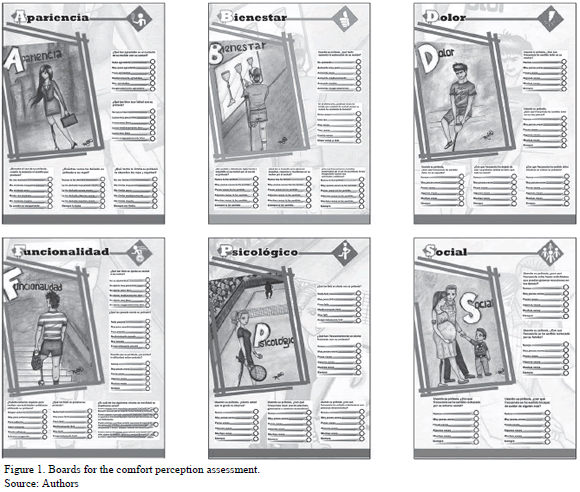
<body><![CDATA[<p><font size="3" face="Verdana, Arial, Helvetica, sans-serif"><b>2 Methods</b></font></p>     <p><font size="2" face="Verdana, Arial, Helvetica, sans-serif"><b><i>2.1 Participants</i></b></font></p>     <p><font size="2" face="Verdana, Arial, Helvetica, sans-serif">The participants were invited by telephone using databases   from organizations involved with disabled individuals. The study region was   limited to Antioquia, Colombia, and the study included persons with unilateral   transfemoral amputations and who used prosthesis for ambulation with or without   an additional mobility aid. </font></p>     <p><font size="2" face="Verdana, Arial, Helvetica, sans-serif">The Universidad Nacional de Colombia ethics committee granted ethical approval for the study. After   written consent, the subjects were asked to complete a questionnaire.</font></p>     <p><font size="2" face="Verdana, Arial, Helvetica, sans-serif"><b><i>2.2 Questionnaire</i></b></font></p>     <p><font size="2" face="Verdana, Arial, Helvetica, sans-serif">To determine the factors that underlie the concept of   comfort in transfemoral amputees, we prepared a questionnaire with 30 questions   organized into the following six scales or factors: appearance, well-being,   pain, functionality, psychological health and social health. These were based   on the Prosthesis Evaluation Questionnaire (PEQ) for psychometric properties.   Because the factors were not dependent on one another, only the factors   relevant to the research question were used. The following questions were added   to the PEQ: &quot;Do you feel comfort when using your prosthesis?&quot; &quot;Which of these   factors improves your comfort?&quot; and &quot;Which of these factors reduces your   comfort?&quot; The questionnaire was available in Spanish.</font></p>     <p><font size="2" face="Verdana, Arial, Helvetica, sans-serif">The original scale uses a 100 mm Visual Analog Scale   (VAS), but for the purposes of the present study, we decided to change it   because it has been reported in the literature that older and less educated   patients experienced difficulty understanding the VAS response format, and the   instructions of the questionnaire needed to be explained carefully &#91;25,28,29&#93;. Similar observations were   reported by Guyatt et al. &#91;30&#93;, who found subjects had fewer   problems and required less training, by using a numerically based Likert scale   as opposed to a VAS. The Italian validation of the PEQ suggests the need for   simplifying the questionnaire format to be feasible for widespread clinical use &#91;29,31&#93;. The PEQ uses a VAS because   the questions cover a wide variety of response types; however, the VAS is not   necessarily more accurate than multiple-choice responses &#91;32&#93;.</font></p>     <p><font size="2" face="Verdana, Arial, Helvetica, sans-serif">Responding to a 30 question survey can be tedious,   especially when it is related to a sensitive topic. The PEQ design requires an   instrument that captures the participants' attention, encourages reading, and   is easy to answer. Therefore, we designed six boards measuring 43 x 28   centimeters, with one board for each factor (<a href="#fig01">Fig. 1</a>). The verbal scales of the   six categories were adapted to the content </font><font size="2" face="Verdana, Arial, Helvetica, sans-serif">of   each question to allow a minimum and maximum response to each question. The   final survey included 24 direct questions and 6 indirect questions. The final   survey included 24 direct questions and 6 indirect questions (Appendix 1).   Several distinguishing characteristics were used to define each factor to   convey the concept it represented. Each board was named and was given a color,   an image and a different pictogram to reinforce the concept of each factor on   each board.A moderator was trained in the use of the instrument. The original   questionnaire has an inclusion criterion that patients are able to read because   it is a self-administered questionnaire. The literacy requirement could be a   limitation to the widespread use of the instrument in clinical practice because   a percentage of patients, especially older and less educated patients, have   difficulty understanding written language or are visually impaired.</font></p>     <p align="center"><font size="2" face="Verdana, Arial, Helvetica, sans-serif"><a name="fig01"></a></font><img src="/img/revistas/dyna/v82n191/v82n191a24fig01.gif"></p>     <p><font size="2" face="Verdana, Arial, Helvetica, sans-serif"><b><i>2.3   Conducting the analytical survey</i></b></font></p>     ]]></body>
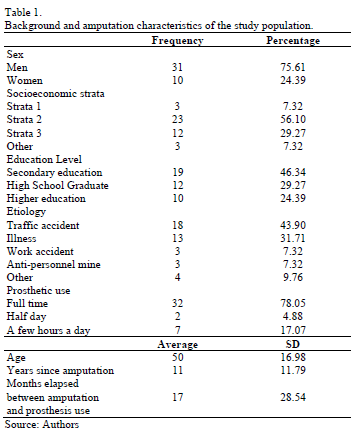
<body><![CDATA[<p><font size="2" face="Verdana, Arial, Helvetica, sans-serif">Without defining &quot;comfort,&quot; the moderator asked whether   the participant felt comfort while using the prosthesis. Then, the participant   answered the questions using the six boards. When necessary, the moderator read   the questions and multiple-choice responses without further clarification.   Finally, the moderator introduced all of the boards to the participant and   asked the following questions twice, independently: &quot;Which of these factors   improves your comfort?&quot; and &quot;Which of these factors reduces your comfort?&quot;   There was no compensation for participation.</font></p>     <p><font size="2" face="Verdana, Arial, Helvetica, sans-serif"><b><i>2.4   Statistical analyses</i></b></font></p>     <p><font size="2" face="Verdana, Arial, Helvetica, sans-serif">The statistical   analysis used in the PEQ was factor analysis, which is a descriptive method   that provides a direct view of the interrelationships between the variables,   and allows information reduction. After finding the underlying structure among   a number of variables, it is important to determine the relationships between   the independent and dependent variables. The most appropriate statistical   technique is logistic regression because it only requires data concerning   whether an event occurred (e.g., whether the patient feels comfort or not) as a   dependent variable for predicting the probability that the event may or may not   take place. Logistic regression does not require any assumptions of normality,   linearity or homogeneity of variance for the independent variables.</font></p>     <p>&nbsp;</p>     <p><font size="3" face="Verdana, Arial, Helvetica, sans-serif"><b>3. Results</b></font></p>     <p><font size="2" face="Verdana, Arial, Helvetica, sans-serif"><b><i>3.1. Participants' profile</i></b></font></p>     <p><font size="2" face="Verdana, Arial, Helvetica, sans-serif">Although 85 individuals   were invited, surveys were conducted with 41 participants. <a href="#tab01">Table 1</a> provides   detailed data regarding the study sample. The participants were 75.61% male and   mainly belonged to socioeconomic strata 2 and 3, which are areas with many   economic constraints. In Colombia, households are classified into six strata,   with strata 1 identified as the poorest. The participants exhibited a low level   of education: 46.34% of the participants did not complete high school, and only   24.39% of the participants obtained technical degrees or higher. Of the 41   surveys conducted, three were eliminated because of contradictions in the   participants' answers.</font></p>     <p align="center"><font size="2" face="Verdana, Arial, Helvetica, sans-serif"><a name="tab01"></a></font><img src="/img/revistas/dyna/v82n191/v82n191a24tab01.gif"></p>     <p><font size="2" face="Verdana, Arial, Helvetica, sans-serif"><b><i>3.2. Constructing dummy variables</i></b></font></p>     <p><font size="2" face="Verdana, Arial, Helvetica, sans-serif">The   participants' answers were coded for the statistical analysis using dummy   variables based on a scale of zero to five depending on the direction of the   question (direct or indirect). The highest score corresponded to the most   positive response, and the lowest score corresponded to the most negative   response.</font></p>     ]]></body>
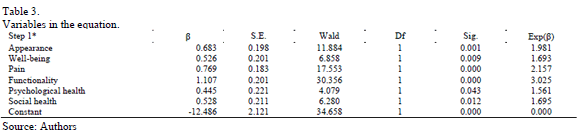
<body><![CDATA[<p><font size="2" face="Verdana, Arial, Helvetica, sans-serif"><b><i>3.3. Sample size and division of the sample</i></b></font></p>     <p><font size="2" face="Verdana, Arial, Helvetica, sans-serif">The logistic regression technique is sensitive to the   relationship between sample size and the number of predictor variables. At   least five observations per each predictor variable should be used, and the   sample size of each group should be considered. The smallest group must be   larger than the number of independent variables. The technique requires that   the sample is split into two sub-samples: one sample is used to estimate the   model, and the other sample is used for validation. However, the study did not   properly split the sample, and it was constructed from the responses obtained   from participants, owing to the sample size.</font></p>     <p><font size="2" face="Verdana, Arial, Helvetica, sans-serif"><b>3.3.1. Sample for validation</b></font></p>     <p><font size="2" face="Verdana, Arial, Helvetica, sans-serif">The coded responses of the same factor were averaged to   obtain the values of the independent variables. The dependent variable was   obtained from the answer to the question, &quot;Do you feel comfort when using your   prosthesis?&quot; The validation sample has a size of 38 data points.</font></p>     <p><font size="2" face="Verdana, Arial, Helvetica, sans-serif"><b>3.3.2. Sample for estimating model</b></font></p>     <p><font size="2" face="Verdana, Arial, Helvetica, sans-serif">As in the validation sample, the coded responses of the   same factor were averaged to obtain the values of each factor. The sample was   extended until it was four times the initial size (<img src="/img/revistas/dyna/v82n191/v82n191a24eq004.gif">).   For the first 38 data points, the first factor that was chosen by the participant   as enhancing comfort was replaced by 5, and the other values remained constant.   For the next 38 data points, the second factor was treated the same way. For   the first group (<img src="/img/revistas/dyna/v82n191/v82n191a24eq006.gif">),   the dependent variable was converted to 1, which corresponded to comfort. The   following 76 data points were treated in the same manner, except that the   factors that reduce comfort were set to 0, and the dependent variable   corresponding with discomfort was set to 0, which was used as the second group.   All of the processes for the first participant are shown in <a href="#tab02">Table 2</a>.</font></p>     <p align="center"><font size="2" face="Verdana, Arial, Helvetica, sans-serif"><a name="tab02"></a></font><img src="/img/revistas/dyna/v82n191/v82n191a24tab02.gif"></p>     <p><font size="2" face="Verdana, Arial, Helvetica, sans-serif"><b><i>3.4. Regression model</i></b></font></p>     <p><font size="2" face="Verdana, Arial, Helvetica, sans-serif">The model was estimated using SPSS Version 15 and the   backward stepwise method with the Wald statistic as contrast. The <img src="/img/revistas/dyna/v82n191/v82n191a24eq008.gif"> of the model is significant at <img src="/img/revistas/dyna/v82n191/v82n191a24eq010.gif"> and the independent variables describing the   dependent variable significantly differ with a Nagelkerke's R-Square of 0.654,   which correctly classifies 84.9% of the cases.</font></p>     <p><font size="2" face="Verdana, Arial, Helvetica, sans-serif"><a href="#tab03">Table 3</a> presents the variables in the equation. The Wald   statistic of the coefficients <img src="/img/revistas/dyna/v82n191/v82n191a24eq012.gif"> is significant for all of the factors (<img src="/img/revistas/dyna/v82n191/v82n191a24eq014.gif">).   The <img src="/img/revistas/dyna/v82n191/v82n191a24eq016.gif"> value represents the extent to which raising   the corresponding measure by one unit influences the odds. Larger values belong   to the functionality and pain factors. Then, eq. (1) shows the probability   equation that was used to evaluate whether a transfemoral amputee feels comfort   with the use of the prosthesis.</font></p>     ]]></body>
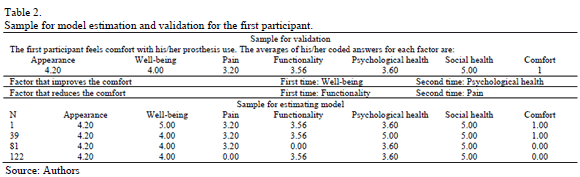
<body><![CDATA[<p align="center"><font size="2" face="Verdana, Arial, Helvetica, sans-serif"><a name="tab03"></a></font><img src="/img/revistas/dyna/v82n191/v82n191a24tab03.gif"></p>     <p><font size="2" face="Verdana, Arial, Helvetica, sans-serif">The validation process using the corresponding sample   showed that the estimated model classified 73.17% of cases.</font></p>     <p><img src="/img/revistas/dyna/v82n191/v82n191a24eq01.gif"></p>     <p>&nbsp;</p>     <p><font size="3" face="Verdana, Arial, Helvetica, sans-serif"><b>4. Discussion</b></font></p>     <p><font size="2" face="Verdana, Arial, Helvetica, sans-serif">The aim of this study was to find the underlying factors   of comfort with prosthesis use in persons with transfemoral amputation, through   the modification of a previously validated questionnaire, which allows   practitioners to overcome the implementation difficulties reported in the   literature. Forty-one transfemoral amputees who used prosthesis and varied by   age, sex, reason for amputation and years since amputation, completed a   questionnaire using audio plugs to select their answers. Only persons with   bilateral lower limb amputations were not included in this study.</font></p>     <p><font size="2" face="Verdana, Arial, Helvetica, sans-serif">The conducted empirical application detects the existence   of statistically significant differences between patients who feel comfort or   discomfort with the prosthesis. Therefore, it was possible to identify the   factors that underlie the concept of comfort with prosthesis use in   transfemoral amputees. The factors analyzed in this study were appearance,   well-being, pain, functionality, psychological health and social health.   Although all of the factors analyzed were significant, the factors with the   greatest influence on the perception of comfort were functionality and pain, as   in previous studies about factors related to quality of life &#91;3&#93;.</font></p>     <p><font size="2" face="Verdana, Arial, Helvetica, sans-serif">In the literature, two main approaches to quality of life   measurement can be found; functionalist and needs-based. The authors argued   that human needs are the foundations for quality of life and that quality of   life is the degree of satisfaction of those needs &#91;33&#93;. This is reminiscent of   Maslow's hierarchy of need in which five levels of needs were identified and   postulated that they are satisfied in strict sequence. Physiological needs are   the physical requirements for human survival. If these requirements are not   met, the human body cannot function properly, and will ultimately fail.   Physiological needs are thought to be the most important; they should be met   first. With their physical needs relatively satisfied, the individuals' safety   needs take precedence and dominate behavior. Safety needs include health and   well-being, safety net against accidents or illness and their adverse impacts.</font></p>     <p><font size="2" face="Verdana, Arial, Helvetica, sans-serif">This study concurs with these findings, because the   functionality factor focuses on the ease, usefulness, convenience and mobility   using the prosthesis. The influence of this factor may be due to the economic   situation of the sample studied. Low-income patients may have difficulties   acquiring more technologically advanced prosthetic systems, which would allow   them to move more easily. A patient's desire to acquire a prosthetic system to   meet all his/her functional needs may be a basic requirement to perceive   comfort. After the basic necessities of functionality are covered, patients do   not want the prosthesis to cause pain, which is an adverse impact of an   illness. </font></p>     <p><font size="2" face="Verdana, Arial, Helvetica, sans-serif">It is, however, noteworthy that appearance, the third most   important factor, differs from the third need: love and belonging. This can be   explained by the high degree of vanity that culturally exists among Colombians.   It is also evidenced that there are potential differences between the patients'   and clinicians' goals, such as restoring the walking function versus   appearance. The practitioner is primarily interested in subjective and   objective measures relating to function and sometimes forgets the significant   differences between the rehabilitation expectations of the patients, whereas   the patient is often more interested in communicating their subjective personal   impressions &#91;19&#93;. The organization into a   hierarchy factors, will help researchers and designers to focus on specific   therapeutic solutions for these patients.</font></p>     ]]></body>
<body><![CDATA[<p><font size="2" face="Verdana, Arial, Helvetica, sans-serif">Additionally, this finding provides tools to determine   whether the patient experiences comfort with the use of the prosthesis, which   are quick and easy to set up, administer, and analyze. This prediction will   improve the communication between the patient, the doctor and the prosthetic   technician. Practitioners will know when a person has actually become   accommodated to a new prosthesis or a new prosthetic component. This will in   turn avoid delays that could cause deterioration of the soft tissues of the   residual limb, abnormal gait patterns of the amputee, decreased productive   capacity and social reintegration of disabled patients and complexes such as   depression after a traumatic loss of a limb &#91;8&#93; that result in personal and   social losses given that most amputees in developing countries are young   working people &#91;34&#93;. Most of the innovations made   throughout the years have been aimed at helping amputees to return to their   working lives &#91;35&#93;.</font></p>     <p><font size="2" face="Verdana, Arial, Helvetica, sans-serif">For future applications of the instrument, the authors   believe that the patient can complete the questionnaire without the presence of   the moderator. In clinical practice, the patient could answer the questions   using the boards in the waiting room without making a doctor's appointment. In   future studies, the boards could be answered by the patient at home if the   patient exhibits a sufficient education level and then mailed.</font></p>     <p><font size="2" face="Verdana, Arial, Helvetica, sans-serif">Because the PEQ was modified for the purpose of the   present study, further testing is required to compare the PEQ's use,   reliability, and responsiveness by using different response options.</font></p>     <p><font size="2" face="Verdana, Arial, Helvetica, sans-serif">In this study, we calculated summary scores for each   scale. This approach assumes equality between the different levels of the   response categories. Additional research, by using techniques such as Rasch   Analysis, should be conducted to test this assumption.</font></p>     <p>&nbsp;</p>     <p><font size="3" face="Verdana, Arial, Helvetica, sans-serif"><b>5. Conclusions</b></font></p>     <p><font size="2" face="Verdana, Arial, Helvetica, sans-serif">The conducted empirical application detects the existence   of statistically significant differences between patients who feel comfort or   discomfort with the prosthesis.</font></p>     <p><font size="2" face="Verdana, Arial, Helvetica, sans-serif">Comfort for transfemoral amputees is determined by   interactions among the following factors: functionality, pain, appearance,   well-being, psychological health and social health. The degree of influence for   each factor on the construct is similar to Maslow's hierarchy of needs.</font></p>     <p>&nbsp;</p>     <p><font size="3" face="Verdana, Arial, Helvetica, sans-serif"><b>Acknowledgments</b></font></p>     ]]></body>
<body><![CDATA[<p><font size="2" face="Verdana, Arial, Helvetica, sans-serif">We are grateful to all of the study participants. We   express our deepest gratitude to Orthopraxis, the moderators, Robinson Chica   for designing images for the boards, Francisco Restrepo for the layout of the   boards, and all of the people who contributed directly and indirectly to this   research.</font></p>     <p>&nbsp;</p>     <p><font size="3" face="Verdana, Arial, Helvetica, sans-serif"><b>References</b></font></p>     <!-- ref --><p><font size="2" face="Verdana, Arial, Helvetica, sans-serif"><b>&#91;1&#93;</b> Bosmans, J., Suurmeijer, T., Hulsink, M., van der   Schans, C., Geertzen, J. and Dijkstra, P., Amputation, phantom pain and   subjective well-being: a qualitative study. International Journal of   Rehabilitation Research, 30 (1), pp.1-8, 2007. DOI: 10.1097/MRR.0b013e328012c953</font>&nbsp;&nbsp;&nbsp;&nbsp;&nbsp;&nbsp;&nbsp;&nbsp;[&#160;<a href="javascript:void(0);" onclick="javascript: window.open('/scielo.php?script=sci_nlinks&ref=000086&pid=S0012-7353201500030002400001&lng=','','width=640,height=500,resizable=yes,scrollbars=1,menubar=yes,');">Links</a>&#160;]<!-- end-ref --><!-- ref --><p><font size="2" face="Verdana, Arial, Helvetica, sans-serif"><b>&#91;2&#93;</b> Kent, R. and   Fyfe, N., Effectiveness of rehabilitation following amputation. Clinical   Rehabilitation, 13 (1), pp<i>. </i>43-50, 1999. DOI: 10.1191/026921599676538002 </font>&nbsp;&nbsp;&nbsp;&nbsp;&nbsp;&nbsp;&nbsp;&nbsp;[&#160;<a href="javascript:void(0);" onclick="javascript: window.open('/scielo.php?script=sci_nlinks&ref=000087&pid=S0012-7353201500030002400002&lng=','','width=640,height=500,resizable=yes,scrollbars=1,menubar=yes,');">Links</a>&#160;]<!-- end-ref --><!-- ref --><p><font size="2" face="Verdana, Arial, Helvetica, sans-serif"><b>&#91;3&#93;</b> Demet, K.,   Martinet, N., Guillemin, F., Paysant, J. and Andr&eacute;, J-M., Health related   quality of life and related factors in 539 persons with amputation of upper and   lower limb. Disability and Rehabilitation, 25 (9), pp. 480-486,   2003.DOI: 10.1080/0963828031000090434</font>&nbsp;&nbsp;&nbsp;&nbsp;&nbsp;&nbsp;&nbsp;&nbsp;[&#160;<a href="javascript:void(0);" onclick="javascript: window.open('/scielo.php?script=sci_nlinks&ref=000088&pid=S0012-7353201500030002400003&lng=','','width=640,height=500,resizable=yes,scrollbars=1,menubar=yes,');">Links</a>&#160;]<!-- end-ref --><!-- ref --><p><font size="2" face="Verdana, Arial, Helvetica, sans-serif"><b>&#91;4&#93;</b> Gallagher, P.,   Franchignoni, F., Giordano, A. and MacLachlan, M., Trinity amputation and   prosthesis experience scales: A psychometric assessment using classical test   theory and rasch analysis. American Journal of Physical Medicine   Rehabilitation, 89 (6), pp. 487-496, 2010. DOI:    10.1097/PHM.0b013e3181dd8cf1</font>&nbsp;&nbsp;&nbsp;&nbsp;&nbsp;&nbsp;&nbsp;&nbsp;[&#160;<a href="javascript:void(0);" onclick="javascript: window.open('/scielo.php?script=sci_nlinks&ref=000089&pid=S0012-7353201500030002400004&lng=','','width=640,height=500,resizable=yes,scrollbars=1,menubar=yes,');">Links</a>&#160;]<!-- end-ref --><!-- ref --><p><font size="2" face="Verdana, Arial, Helvetica, sans-serif"><b>&#91;5&#93;</b> Hagberg, K.,   Brånemark, R. and Hägg, O. Questionnaire for Persons with a Transfemoral   Amputation (Q-TFA): initial validity and reliability of a new outcome measure. Journal   of Rehabilitation Research and Development, 41 (5), pp. 695-706, 2004. doi: 10.1682/JRRD.2003.11.0167 </font>&nbsp;&nbsp;&nbsp;&nbsp;&nbsp;&nbsp;&nbsp;&nbsp;[&#160;<a href="javascript:void(0);" onclick="javascript: window.open('/scielo.php?script=sci_nlinks&ref=000090&pid=S0012-7353201500030002400005&lng=','','width=640,height=500,resizable=yes,scrollbars=1,menubar=yes,');">Links</a>&#160;]<!-- end-ref --><!-- ref --><p><font size="2" face="Verdana, Arial, Helvetica, sans-serif"><b>&#91;6&#93;</b> Hanspal, R.,   Fisher, K. and Nieveen, R., Prosthetic socket fit comfort score. Disability   and Rehabilitation, 25 (22), pp. 1278-1280, 2003. DOI: 10.1080/09638280310001603983 </font>&nbsp;&nbsp;&nbsp;&nbsp;&nbsp;&nbsp;&nbsp;&nbsp;[&#160;<a href="javascript:void(0);" onclick="javascript: window.open('/scielo.php?script=sci_nlinks&ref=000091&pid=S0012-7353201500030002400006&lng=','','width=640,height=500,resizable=yes,scrollbars=1,menubar=yes,');">Links</a>&#160;]<!-- end-ref --><!-- ref --><p><font size="2" face="Verdana, Arial, Helvetica, sans-serif"><b>&#91;7&#93;</b> Legro, M.,   Reiber, G., Smith, D., del Aguila, M., Larsen, J. and Boone, D., Prosthesis   evaluation questionnaire for persons with lower limb amputations: Assessing   prosthesis-related quality of life. Archives of Physical Medicine and   Rehabilitation, 79 (8), pp. 931-938, 1998. DOI: 10.1016/S0003-9993(98)90090-9</font>&nbsp;&nbsp;&nbsp;&nbsp;&nbsp;&nbsp;&nbsp;&nbsp;[&#160;<a href="javascript:void(0);" onclick="javascript: window.open('/scielo.php?script=sci_nlinks&ref=000092&pid=S0012-7353201500030002400007&lng=','','width=640,height=500,resizable=yes,scrollbars=1,menubar=yes,');">Links</a>&#160;]<!-- end-ref --><!-- ref --><p><font size="2" face="Verdana, Arial, Helvetica, sans-serif"><b>&#91;8&#93;</b> Rybarczyk, B.,   Nyenhuis, D., Nicholas, J., Schulz, R., Alioto R, Blair C., Social discomfort   and depression in a sample of adults with leg amputations. Archives of   Physical Medicine and Rehabilitation &#91;Online&#93;. 73 (12), pp. 1169-1173, 1992. &#91;date of reference July 27<sup>th</sup> of   2010&#93;. Available at: <a href="http://www.archives-pmr.org/article/0003-9993(92)90116-E/pdf" target="_blank">http://www.archives-pmr.org/article/0003-9993(92)90116-E/pdf</a></font>&nbsp;&nbsp;&nbsp;&nbsp;&nbsp;&nbsp;&nbsp;&nbsp;[&#160;<a href="javascript:void(0);" onclick="javascript: window.open('/scielo.php?script=sci_nlinks&ref=000093&pid=S0012-7353201500030002400008&lng=','','width=640,height=500,resizable=yes,scrollbars=1,menubar=yes,');">Links</a>&#160;]<!-- end-ref --><!-- ref --><p><font size="2" face="Verdana, Arial, Helvetica, sans-serif"><b>&#91;9&#93;</b> Ware, J.,   Kosinski, M. and Keller, S., A 12-Item short-form health survey: Construction   of scales and preliminary tests of reliability and validity. Medical   Care &#91;Online&#93;. 3 (34), pp. 220-233, 1996. &#91;date   of reference July 26<sup>th</sup> of 2010&#93;. Available at: <a href="http://www.jstor.org/stable/3766749" target="_blank">http://www.jstor.org/stable/3766749</a></font>&nbsp;&nbsp;&nbsp;&nbsp;&nbsp;&nbsp;&nbsp;&nbsp;[&#160;<a href="javascript:void(0);" onclick="javascript: window.open('/scielo.php?script=sci_nlinks&ref=000094&pid=S0012-7353201500030002400009&lng=','','width=640,height=500,resizable=yes,scrollbars=1,menubar=yes,');">Links</a>&#160;]<!-- end-ref --><!-- ref --><p><font size="2" face="Verdana, Arial, Helvetica, sans-serif"><b>&#91;10&#93;</b> Ware, J. and   Sherbourne, C., The MOS 36-item short-form health survey (SF-36): I. Conceptual   framework and item selection. Medical Care, 6 (30), pp. 473-483, 1992.   DOI: 10.1097/00005650-199206000-00002</font>&nbsp;&nbsp;&nbsp;&nbsp;&nbsp;&nbsp;&nbsp;&nbsp;[&#160;<a href="javascript:void(0);" onclick="javascript: window.open('/scielo.php?script=sci_nlinks&ref=000095&pid=S0012-7353201500030002400010&lng=','','width=640,height=500,resizable=yes,scrollbars=1,menubar=yes,');">Links</a>&#160;]<!-- end-ref --><!-- ref --><p><font size="2" face="Verdana, Arial, Helvetica, sans-serif"><b>&#91;11&#93;</b> Franchignoni, F.,   Orlandini, D., Ferriero, G. and Moscato, T., Reliability, validity, and   responsiveness of the locomotor capabilities index in adults with lower-limb   amputation undergoing prosthetic training. Archives of Physical Medicine   and Rehabilitation, 85 (5), pp. 743-748, 2004. DOI: 10.1016/j.apmr.2003.06.010</font>&nbsp;&nbsp;&nbsp;&nbsp;&nbsp;&nbsp;&nbsp;&nbsp;[&#160;<a href="javascript:void(0);" onclick="javascript: window.open('/scielo.php?script=sci_nlinks&ref=000096&pid=S0012-7353201500030002400011&lng=','','width=640,height=500,resizable=yes,scrollbars=1,menubar=yes,');">Links</a>&#160;]<!-- end-ref --><!-- ref --><p><font size="2" face="Verdana, Arial, Helvetica, sans-serif"><b>&#91;12&#93;</b> Rommers, G., Vos,   L., Groothoff, J. and Eisma, W., Mobility of people with lower limb amputations,   scales and questionnaires: A review. Clinical Rehabilitation, 15 (1),   pp. 92-102, 2001. DOI: 10.1191/026921501677990187</font>&nbsp;&nbsp;&nbsp;&nbsp;&nbsp;&nbsp;&nbsp;&nbsp;[&#160;<a href="javascript:void(0);" onclick="javascript: window.open('/scielo.php?script=sci_nlinks&ref=000097&pid=S0012-7353201500030002400012&lng=','','width=640,height=500,resizable=yes,scrollbars=1,menubar=yes,');">Links</a>&#160;]<!-- end-ref --><!-- ref --><p><font size="2" face="Verdana, Arial, Helvetica, sans-serif"><b>&#91;13&#93;</b> Treweek, S. and   Condie, M., Three measures of functional outcome for lower limb amputees: a   retrospective review. Prosthetis and Orthotics International, 22 (3),   pp. 178-185, 1998. DOI: 10.3109/03093649809164482</font>&nbsp;&nbsp;&nbsp;&nbsp;&nbsp;&nbsp;&nbsp;&nbsp;[&#160;<a href="javascript:void(0);" onclick="javascript: window.open('/scielo.php?script=sci_nlinks&ref=000098&pid=S0012-7353201500030002400013&lng=','','width=640,height=500,resizable=yes,scrollbars=1,menubar=yes,');">Links</a>&#160;]<!-- end-ref --><!-- ref --><p><font size="2" face="Verdana, Arial, Helvetica, sans-serif"><b>&#91;14&#93;</b> Van de Meent, H.,   Hopman, M. and Frölke, J., Walking ability and quality of life in subjects with   transfemoral amputation: A comparison of osseointegration with socket   prostheses. Archives of Physical Medicine and Rehabilitation, 94 (11),   pp. 2174-2178, 2013. DOI: 10.1016/j.apmr.2013.05.020</font>&nbsp;&nbsp;&nbsp;&nbsp;&nbsp;&nbsp;&nbsp;&nbsp;[&#160;<a href="javascript:void(0);" onclick="javascript: window.open('/scielo.php?script=sci_nlinks&ref=000099&pid=S0012-7353201500030002400014&lng=','','width=640,height=500,resizable=yes,scrollbars=1,menubar=yes,');">Links</a>&#160;]<!-- end-ref --><!-- ref --><p><font size="2" face="Verdana, Arial, Helvetica, sans-serif"><b>&#91;15&#93;</b> Neumann, E.,   Measurement of socket discomfort-part I: Pressure sensation. Journal of   Prosthetics and Orthotics, 13 (4), pp. 99-110, 1992. DOI: 10.1097/00008526-200112000-00010</font>&nbsp;&nbsp;&nbsp;&nbsp;&nbsp;&nbsp;&nbsp;&nbsp;[&#160;<a href="javascript:void(0);" onclick="javascript: window.open('/scielo.php?script=sci_nlinks&ref=000100&pid=S0012-7353201500030002400015&lng=','','width=640,height=500,resizable=yes,scrollbars=1,menubar=yes,');">Links</a>&#160;]<!-- end-ref --><!-- ref --><p><font size="2" face="Verdana, Arial, Helvetica, sans-serif"><b>&#91;16&#93;</b> Zheng, Y., Mak,   A. and Leung, K., State-of-the-art methods for geometric and biomechanical   assessments of residual limbs: a review. Journal of Rehabilitation   Research and Development &#91;Online&#93;. 38 (5), pp. 487-504, 2001. &#91;date of   reference June 28t<sup>h</sup> of 2010&#93;. Available at: <a href="http://www.rehab.research.va.gov/jour/01/38/5/pdf/zheng.pdf" target="_blank">http://www.rehab.research.va.gov/jour/01/38/5/pdf/zheng.pdf</a></font>&nbsp;&nbsp;&nbsp;&nbsp;&nbsp;&nbsp;&nbsp;&nbsp;[&#160;<a href="javascript:void(0);" onclick="javascript: window.open('/scielo.php?script=sci_nlinks&ref=000101&pid=S0012-7353201500030002400016&lng=','','width=640,height=500,resizable=yes,scrollbars=1,menubar=yes,');">Links</a>&#160;]<!-- end-ref --><!-- ref --><p><font size="2" face="Verdana, Arial, Helvetica, sans-serif"><b>&#91;17&#93;</b> Harms-Ringdahl K,   Brodin H, Eklund L, Borg G., Discomfort and pain from loaded passive joint   structures. Scandinavian Journal of Rehabilitation Medicine &#91;Online&#93;. 15   (4), pp. 205-211, 1983. &#91;date of reference June 26<sup>th</sup> of 2010&#93;.   Available at: <a href="http://www.ncbi.nlm.nih.gov/pubmed/6648392" target="_blank">http://www.ncbi.nlm.nih.gov/pubmed/6648392</a></font>&nbsp;&nbsp;&nbsp;&nbsp;&nbsp;&nbsp;&nbsp;&nbsp;[&#160;<a href="javascript:void(0);" onclick="javascript: window.open('/scielo.php?script=sci_nlinks&ref=000102&pid=S0012-7353201500030002400017&lng=','','width=640,height=500,resizable=yes,scrollbars=1,menubar=yes,');">Links</a>&#160;]<!-- end-ref --><!-- ref --><p><font size="2" face="Verdana, Arial, Helvetica, sans-serif"><b>&#91;18&#93;</b> Meier, R. 3<sup>rd</sup>,   Meeks, E. and Herman, R., Stump-socket fit of below-knee prostheses: Comparison   of three methods of measurement. Archives of Physical Medicine and   Rehabilitation &#91;Online&#93;. 54 (12), pp. 553-558, 1973. &#91;date of reference July 10<sup>th</sup> of 2010&#93;. Available at: <a href="http://www.ncbi.nlm.nih.gov/pubmed/4759446" target="_blank">http://www.ncbi.nlm.nih.gov/pubmed/4759446</a></font>&nbsp;&nbsp;&nbsp;&nbsp;&nbsp;&nbsp;&nbsp;&nbsp;[&#160;<a href="javascript:void(0);" onclick="javascript: window.open('/scielo.php?script=sci_nlinks&ref=000103&pid=S0012-7353201500030002400018&lng=','','width=640,height=500,resizable=yes,scrollbars=1,menubar=yes,');">Links</a>&#160;]<!-- end-ref --><!-- ref --><p><font size="2" face="Verdana, Arial, Helvetica, sans-serif"><b>&#91;19&#93;</b> Miller, L. and   McCay, J., Summary and conclusions from the academy's sixth   state-of-the-science conference on lower limb prosthetic outcome measures.   Journal of Prosthetics and Orthotics &#91;Online&#93;. 18 (1s), pp. 2-7, 2006. &#91;date   of reference July 12t<sup>h</sup> of 2010&#93;. Available at: <a href="http://www.oandp.org/jpo/library/2006_01S_002.asp" target="_blank">http://www.oandp.org/jpo/library/2006_01S_002.asp</a></font>&nbsp;&nbsp;&nbsp;&nbsp;&nbsp;&nbsp;&nbsp;&nbsp;[&#160;<a href="javascript:void(0);" onclick="javascript: window.open('/scielo.php?script=sci_nlinks&ref=000104&pid=S0012-7353201500030002400019&lng=','','width=640,height=500,resizable=yes,scrollbars=1,menubar=yes,');">Links</a>&#160;]<!-- end-ref --><!-- ref --><p><font size="2" face="Verdana, Arial, Helvetica, sans-serif"><b>&#91;20&#93;</b> Smith, D.,   Special challenges in outcome studies for amputation surgery and prosthetic   rehabilitation. Journal of Prosthetics and Orthotics &#91;Online&#93;. 18 (1s), pp.   116-118, 2006. &#91;date of reference July 12<sup>th</sup> of 2010&#93;.   Available at: <a href="http://www.oandp.org/jpo/library/2006_01S_116.asp" target="_blank">http://www.oandp.org/jpo/library/2006_01S_116.asp</a></font>&nbsp;&nbsp;&nbsp;&nbsp;&nbsp;&nbsp;&nbsp;&nbsp;[&#160;<a href="javascript:void(0);" onclick="javascript: window.open('/scielo.php?script=sci_nlinks&ref=000105&pid=S0012-7353201500030002400020&lng=','','width=640,height=500,resizable=yes,scrollbars=1,menubar=yes,');">Links</a>&#160;]<!-- end-ref --><!-- ref --><p><font size="2" face="Verdana, Arial, Helvetica, sans-serif"><b>&#91;21&#93;</b> Major, M.,   Twiste, M., Kenney, L. and Howard, D., Amputee independent prosthesis   properties-a new model for description and measurement. Journal of   Biomechanics, 44 (14), pp. 2572-2575, 2011. DOI: 10.1016/j.jbiomech.2011.07.016</font>&nbsp;&nbsp;&nbsp;&nbsp;&nbsp;&nbsp;&nbsp;&nbsp;[&#160;<a href="javascript:void(0);" onclick="javascript: window.open('/scielo.php?script=sci_nlinks&ref=000106&pid=S0012-7353201500030002400021&lng=','','width=640,height=500,resizable=yes,scrollbars=1,menubar=yes,');">Links</a>&#160;]<!-- end-ref --><!-- ref --><p><font size="2" face="Verdana, Arial, Helvetica, sans-serif"><b>&#91;22&#93;</b> Papaioannou, G.,   Mitrogiannis, C., Nianios, G. and Fiedler, G., Assessment of amputee   socket-stump-residual bone kinematics during strenuous activities using Dynamic   Roentgen Stereogrammetric Analysis. Journal of Biomechanics, 43 (5), pp.   871-878, 2010. DOI: 10.1016/j.jbiomech.2009.11.013</font>&nbsp;&nbsp;&nbsp;&nbsp;&nbsp;&nbsp;&nbsp;&nbsp;[&#160;<a href="javascript:void(0);" onclick="javascript: window.open('/scielo.php?script=sci_nlinks&ref=000107&pid=S0012-7353201500030002400022&lng=','','width=640,height=500,resizable=yes,scrollbars=1,menubar=yes,');">Links</a>&#160;]<!-- end-ref --><!-- ref --><p><font size="2" face="Verdana, Arial, Helvetica, sans-serif"><b>&#91;23&#93;</b> Pezzin, L.,   Dillingham, T., MacKenzie, E., Ephraim, P. and Rossbach, P., Use and   satisfaction with prosthetic limb devices and related services. Archives   of Physical Medicine and Rehabilitation, 85 (5), pp. 723-9, 2004. DOI: 10.1016/j.apmr.2003.06.002</font>&nbsp;&nbsp;&nbsp;&nbsp;&nbsp;&nbsp;&nbsp;&nbsp;[&#160;<a href="javascript:void(0);" onclick="javascript: window.open('/scielo.php?script=sci_nlinks&ref=000108&pid=S0012-7353201500030002400023&lng=','','width=640,height=500,resizable=yes,scrollbars=1,menubar=yes,');">Links</a>&#160;]<!-- end-ref --><!-- ref --><p><font size="2" face="Verdana, Arial, Helvetica, sans-serif"><b>&#91;24&#93;</b> Neumann, E.,   Measurement of socket discomfort-part II: Signal detection. Journal of   Prosthetics and Orthotics, 13 (4), pp. 111-122, 2001. doi: 10.1097/00008526-200112000-00011</font>&nbsp;&nbsp;&nbsp;&nbsp;&nbsp;&nbsp;&nbsp;&nbsp;[&#160;<a href="javascript:void(0);" onclick="javascript: window.open('/scielo.php?script=sci_nlinks&ref=000109&pid=S0012-7353201500030002400024&lng=','','width=640,height=500,resizable=yes,scrollbars=1,menubar=yes,');">Links</a>&#160;]<!-- end-ref --><!-- ref --><p><font size="2" face="Verdana, Arial, Helvetica, sans-serif"><b>&#91;25&#93;</b> Zidarov, D.,   Swaine, B. and Gauthier-Gagnon, C., Quality of life of persons with lower-limb   amputation during rehabilitation and at 3-month follow-up. Archives of   Physical Medicine and Rehabilitation, 90 (4), pp. 634-645, 2009. DOI:    10.1016/j.apmr.2008.11.003</font>&nbsp;&nbsp;&nbsp;&nbsp;&nbsp;&nbsp;&nbsp;&nbsp;[&#160;<a href="javascript:void(0);" onclick="javascript: window.open('/scielo.php?script=sci_nlinks&ref=000110&pid=S0012-7353201500030002400025&lng=','','width=640,height=500,resizable=yes,scrollbars=1,menubar=yes,');">Links</a>&#160;]<!-- end-ref --><!-- ref --><p><font size="2" face="Verdana, Arial, Helvetica, sans-serif"><b>&#91;26&#93;</b> De Looze, M.,   Kuijt-Evers, L. and van Dieën J., Sitting comfort and discomfort and the   relationships with objective measures. Ergonomics, 46 (10), pp. 985-997, 2003. DOI:    10.1080/0014013031000121977</font>&nbsp;&nbsp;&nbsp;&nbsp;&nbsp;&nbsp;&nbsp;&nbsp;[&#160;<a href="javascript:void(0);" onclick="javascript: window.open('/scielo.php?script=sci_nlinks&ref=000111&pid=S0012-7353201500030002400026&lng=','','width=640,height=500,resizable=yes,scrollbars=1,menubar=yes,');">Links</a>&#160;]<!-- end-ref --><!-- ref --><p><font size="2" face="Verdana, Arial, Helvetica, sans-serif"><b>&#91;27&#93;</b> Sinha, R., van   den Heuvel, W. and Arokiasamy, P., Factors affecting quality of life in lower   limb amputees. Prosthetis and Orthotics International, 35 (1), pp. 90-96, 2011. DOI: 10.1177/0309364610397087</font>&nbsp;&nbsp;&nbsp;&nbsp;&nbsp;&nbsp;&nbsp;&nbsp;[&#160;<a href="javascript:void(0);" onclick="javascript: window.open('/scielo.php?script=sci_nlinks&ref=000112&pid=S0012-7353201500030002400027&lng=','','width=640,height=500,resizable=yes,scrollbars=1,menubar=yes,');">Links</a>&#160;]<!-- end-ref --><!-- ref --><p><font size="2" face="Verdana, Arial, Helvetica, sans-serif"><b>&#91;28&#93;</b> Ferrand-Ferri,   P., Rodr&iacute;guez-Pi&ntilde;ero Dur&aacute;n, M., Echevarr&iacute;a-Ruiz de Vargas, C. and   Zarco-Peri&ntilde;&aacute;n, M.J., Versi&oacute;n espa&ntilde;ola del   Prosthesis Evaluation Questionnaire (PEQ): Parte inicial de su adaptaci&oacute;n   transcultural. Rehabilitaci&oacute;n, 41 (3), pp. 101-107, 2007. DOI:    10.1016/S0048-7120(07)75496-8 </font>&nbsp;&nbsp;&nbsp;&nbsp;&nbsp;&nbsp;&nbsp;&nbsp;[&#160;<a href="javascript:void(0);" onclick="javascript: window.open('/scielo.php?script=sci_nlinks&ref=000113&pid=S0012-7353201500030002400028&lng=','','width=640,height=500,resizable=yes,scrollbars=1,menubar=yes,');">Links</a>&#160;]<!-- end-ref --><!-- ref --><p><font size="2" face="Verdana, Arial, Helvetica, sans-serif"><b>&#91;29&#93;</b> Miller, W., Deathe,   A. and Speechley, M., Lower extremity prosthetic mobility: a comparison of 3   self-report scales. Archives of Physical Medicine and Rehabilitation, 82   (10), pp. 1432-1440, 2001. DOI: 10.1053/apmr.2001.25987</font>&nbsp;&nbsp;&nbsp;&nbsp;&nbsp;&nbsp;&nbsp;&nbsp;[&#160;<a href="javascript:void(0);" onclick="javascript: window.open('/scielo.php?script=sci_nlinks&ref=000114&pid=S0012-7353201500030002400029&lng=','','width=640,height=500,resizable=yes,scrollbars=1,menubar=yes,');">Links</a>&#160;]<!-- end-ref --><!-- ref --><p><font size="2" face="Verdana, Arial, Helvetica, sans-serif"><b>&#91;30&#93;</b> Guyatt, G.,   Townsend, M., Berman, L. and Keller, J., A comparison of Likert and visual   analogue scales for measuring change in function. Journal of Chronic   Diseases, 40 (12), pp. 1129-1133, 1987. DOI:    10.1016/0021-9681(87)90080-4 </font>&nbsp;&nbsp;&nbsp;&nbsp;&nbsp;&nbsp;&nbsp;&nbsp;[&#160;<a href="javascript:void(0);" onclick="javascript: window.open('/scielo.php?script=sci_nlinks&ref=000115&pid=S0012-7353201500030002400030&lng=','','width=640,height=500,resizable=yes,scrollbars=1,menubar=yes,');">Links</a>&#160;]<!-- end-ref --><!-- ref --><p><font size="2" face="Verdana, Arial, Helvetica, sans-serif"><b>&#91;31&#93;</b> Ferriero, G.,   Dughi, D., Orlandini, D., Moscato, T., Nicita, D. and Franchignoni, F.,   Measuring long-term outcome in people with lower limb amputation:   Cross-validation of the Italian versions of the prosthetic profile of the   amputee and prosthesis evaluation questionnaire. Europa Medicophysica   &#91;Online&#93;. 1 (41), pp. 1-6, 2005. &#91;date of reference September 24<sup>th</sup> of 2010&#93;. Available at: <a href="http://www.researchgate.net/profile/Franco_Franchignoni" target="_blank">http://www.researchgate.net/profile/Franco_Franchignoni</a></font>&nbsp;&nbsp;&nbsp;&nbsp;&nbsp;&nbsp;&nbsp;&nbsp;[&#160;<a href="javascript:void(0);" onclick="javascript: window.open('/scielo.php?script=sci_nlinks&ref=000116&pid=S0012-7353201500030002400031&lng=','','width=640,height=500,resizable=yes,scrollbars=1,menubar=yes,');">Links</a>&#160;]<!-- end-ref --><!-- ref --><p><font size="2" face="Verdana, Arial, Helvetica, sans-serif"><b>&#91;32&#93;</b> Fitzpatrick, R.,   Davey, C., Buxton, M. and Jones, D., Evaluating patient-based outcome measures   for use in clinical trials. Health Technology Assessment. &#91;Online&#93;. 2 (14), pp. 1-74, 1998. &#91;date of reference June 25<sup>th</sup> of 2010&#93;. Available at: <a href="http://www.soton.ac.uk/~hta" target="_blank">http://www.soton.ac.uk/~hta</a></font>&nbsp;&nbsp;&nbsp;&nbsp;&nbsp;&nbsp;&nbsp;&nbsp;[&#160;<a href="javascript:void(0);" onclick="javascript: window.open('/scielo.php?script=sci_nlinks&ref=000117&pid=S0012-7353201500030002400032&lng=','','width=640,height=500,resizable=yes,scrollbars=1,menubar=yes,');">Links</a>&#160;]<!-- end-ref --><!-- ref --><p><font size="2" face="Verdana, Arial, Helvetica, sans-serif"><b>&#91;33&#93;</b> Hörnquist, J.,   The concept of quality of life. Scandinavian Journal of Social Medicine,   10 (2), pp. 57-61, 1982. DOI: 10.1177/140349489001800111</font>&nbsp;&nbsp;&nbsp;&nbsp;&nbsp;&nbsp;&nbsp;&nbsp;[&#160;<a href="javascript:void(0);" onclick="javascript: window.open('/scielo.php?script=sci_nlinks&ref=000118&pid=S0012-7353201500030002400033&lng=','','width=640,height=500,resizable=yes,scrollbars=1,menubar=yes,');">Links</a>&#160;]<!-- end-ref --><!-- ref --><p><font size="2" face="Verdana, Arial, Helvetica, sans-serif"><b>&#91;34&#93;</b> Restoration.   From surgery to community reintegration. Disability and Rehabilitation,   26 (14-15), pp. 8318-36, 2004. DOI: 10.1080/09638280410001708850 </font>&nbsp;&nbsp;&nbsp;&nbsp;&nbsp;&nbsp;&nbsp;&nbsp;[&#160;<a href="javascript:void(0);" onclick="javascript: window.open('/scielo.php?script=sci_nlinks&ref=000119&pid=S0012-7353201500030002400034&lng=','','width=640,height=500,resizable=yes,scrollbars=1,menubar=yes,');">Links</a>&#160;]<!-- end-ref --><!-- ref --><p><font size="2" face="Verdana, Arial, Helvetica, sans-serif"><b>&#91;35&#93;</b> Loaiza, J. and Arzola, N., Evoluci&oacute;n y tendencias en el desarrollo de   pr&oacute;tesis de mano, DYNA &#91;Online&#93;. 78 (169), pp   191-200, 2011. &#91;date of reference July 25t<sup>h</sup> of 2013&#93;.   Available at: <a href="http://www.scielo.org.co/scielo.php?script=sci_arttext&pid=S0012-73532011000500022&lng=en&nrm=iso" target="_blank">http://www.scielo.org.co/scielo.php?script=sci_arttext&amp;pid=S0012-73532011000500022&amp;lng=en&amp;nrm=iso</a></font>&nbsp;&nbsp;&nbsp;&nbsp;&nbsp;&nbsp;&nbsp;&nbsp;[&#160;<a href="javascript:void(0);" onclick="javascript: window.open('/scielo.php?script=sci_nlinks&ref=000120&pid=S0012-7353201500030002400035&lng=','','width=640,height=500,resizable=yes,scrollbars=1,menubar=yes,');">Links</a>&#160;]<!-- end-ref --><p>&nbsp;</p>     <p><font size="2" face="Verdana, Arial, Helvetica, sans-serif"><b>J.F. Ram&iacute;rez-Pati&ntilde;o</b>, graduado de Ing. Mec&aacute;nico de la Universidad   Nacional de Colombia en 1999, MSc en Ingenier&iacute;a Mec&aacute;nica de la Universidad   Sim&oacute;n Bol&iacute;var, Venezuela en 2002 y Dr. en Ingenier&iacute;a de la Universidad Nacional   de Colombia en 2011. Profesor de tiempo completo del Departamento de Ingenier&iacute;a   Mec&aacute;nica, Facultad de Minas, Universidad Nacional de Colombia.</font></p>     ]]></body>
<body><![CDATA[<p><font size="2" face="Verdana, Arial, Helvetica, sans-serif"><b>D.F. Guti&eacute;rrez-Rôa</b>, graduada de Ing. Industrial de la Universidad   Mayor de San Sim&oacute;n, Bolivia en 2004, Esp. en Sistemas de Gesti&oacute;n de Calidad en   2006 y MSc en Ingenier&iacute;a Administrativa de la Universidad Nacional de Colombia   en 2010. </font></p>     <p><font size="2" face="Verdana, Arial, Helvetica, sans-serif"><b>A.A. Correa-Espinal</b>, graduado de Ing. Industrial de la Universidad   Nacional de Colombia en 1995, MSc en Ingenier&iacute;a Industrial de la Universidad de   los Andes, Colombia en 1999 y Dr en Estad&iacute;stica e Investigaci&oacute;n Operativa de la   Universidad Polit&eacute;cnica de Catalu&ntilde;a, Espa&ntilde;a en 2007. Profesor de tiempo   completo del Departamento de Ingenier&iacute;a de la Organizaci&oacute;n, Facultad de Minas,   Universidad Nacional de Colombia.</font></p>     <p>&nbsp;</p>     <p><font size="3" face="Verdana, Arial, Helvetica, sans-serif"><b>Appendix   1</b></font></p>     <p><font size="2" face="Verdana, Arial, Helvetica, sans-serif">Factors, questions   and multiple answers for assessment the perception of comfort in persons with   transfemoral amputation:</font></p>     <p><font size="2" face="Verdana, Arial, Helvetica, sans-serif"><i>Apariencia</i></font></p>     <p><font size="2" face="Verdana, Arial, Helvetica, sans-serif">1. ¿Qu&eacute; tan agradable es el   contacto de su mu&ntilde;&oacute;n con su socket?</font></p> <ul>       <li><font size="2" face="Verdana, Arial, Helvetica, sans-serif">Nada     agradable</font></li>       <li><font size="2" face="Verdana, Arial, Helvetica, sans-serif">Muy     poco agradable</font></li>       <li><font size="2" face="Verdana, Arial, Helvetica, sans-serif">Poco     agradable</font></li>       ]]></body>
<body><![CDATA[<li><font size="2" face="Verdana, Arial, Helvetica, sans-serif">Medianamente     agradable</font></li>       <li><font size="2" face="Verdana, Arial, Helvetica, sans-serif">Muy     agradable</font></li>       <li><font size="2" face="Verdana, Arial, Helvetica, sans-serif">Exageradamente     agradable</font></li>     </ul>     <p><font size="2" face="Verdana, Arial, Helvetica, sans-serif">2. ¿Qu&eacute; tan bien luce Usted con   su pr&oacute;tesis?</font></p> <ul>       <li><font size="2" face="Verdana, Arial, Helvetica, sans-serif">No     luzco bien</font></li>       <li><font size="2" face="Verdana, Arial, Helvetica, sans-serif">Luzco     muy poco bien</font></li>       <li><font size="2" face="Verdana, Arial, Helvetica, sans-serif">Luzco     poco bien</font></li>       <li><font size="2" face="Verdana, Arial, Helvetica, sans-serif">Luzco     medianamente bien</font></li>       <li><font size="2" face="Verdana, Arial, Helvetica, sans-serif">Luzco     muy bien</font></li>       ]]></body>
<body><![CDATA[<li><font size="2" face="Verdana, Arial, Helvetica, sans-serif">Luzco     exageradamente bien</font></li>     </ul>     <p><font size="2" face="Verdana, Arial, Helvetica, sans-serif">3. ¿Durante el uso de su   pr&oacute;tesis, cu&aacute;nto le molesta el sonido que produce?</font></p> <ul>       <li><font size="2" face="Verdana, Arial, Helvetica, sans-serif">No me     molesta</font></li>       <li><font size="2" face="Verdana, Arial, Helvetica, sans-serif">Me     molesta muy poco</font></li>       <li><font size="2" face="Verdana, Arial, Helvetica, sans-serif">Me     molesta poco</font></li>       <li><font size="2" face="Verdana, Arial, Helvetica, sans-serif">Medio     me molesta</font></li>       <li><font size="2" face="Verdana, Arial, Helvetica, sans-serif">Me     molesta mucho</font></li>       <li><font size="2" face="Verdana, Arial, Helvetica, sans-serif">Su     sonido es insoportable</font></li>     </ul>     ]]></body>
<body><![CDATA[<p><font size="2" face="Verdana, Arial, Helvetica, sans-serif">4. ¿Cu&aacute;ntas veces ha da&ntilde;ado su   pr&oacute;tesis a su ropa?</font></p> <ul>       <li><font size="2" face="Verdana, Arial, Helvetica, sans-serif">Nunca     la ha da&ntilde;ado</font></li>       <li><font size="2" face="Verdana, Arial, Helvetica, sans-serif">La ha da&ntilde;ado     muy pocas veces</font></li>       <li><font size="2" face="Verdana, Arial, Helvetica, sans-serif">La ha     da&ntilde;ado pocas veces</font></li>       <li><font size="2" face="Verdana, Arial, Helvetica, sans-serif">La ha     da&ntilde;ado algunas veces</font></li>       <li><font size="2" face="Verdana, Arial, Helvetica, sans-serif">La ha     da&ntilde;ado muchas veces</font></li>       <li><font size="2" face="Verdana, Arial, Helvetica, sans-serif">Siempre     la da&ntilde;a</font></li>     </ul>     <p><font size="2" face="Verdana, Arial, Helvetica, sans-serif">5. ¿Qu&eacute; tanto le limita su   pr&oacute;tesis la elecci&oacute;n de ropa y zapatos?</font></p> <ul>       <li><font size="2" face="Verdana, Arial, Helvetica, sans-serif">No me     limita</font></li>       ]]></body>
<body><![CDATA[<li><font size="2" face="Verdana, Arial, Helvetica, sans-serif">Me     limita muy poco</font></li>       <li><font size="2" face="Verdana, Arial, Helvetica, sans-serif">Me     limita poco</font></li>       <li><font size="2" face="Verdana, Arial, Helvetica, sans-serif">Me     limita medianamente</font></li>       <li><font size="2" face="Verdana, Arial, Helvetica, sans-serif">Me     limita mucho</font></li>       <li><font size="2" face="Verdana, Arial, Helvetica, sans-serif">Siempre     me limita</font></li>     </ul>     <p><font size="2" face="Verdana, Arial, Helvetica, sans-serif"><i>Bienestar</i></font></p>     <p><font size="2" face="Verdana, Arial, Helvetica, sans-serif">6. Usando su pr&oacute;tesis, ¿qu&eacute;   tanto aumenta la sudoraci&oacute;n de su mu&ntilde;&oacute;n?</font></p> <ul>       <li><font size="2" face="Verdana, Arial, Helvetica, sans-serif">No     aumenta</font></li>       <li><font size="2" face="Verdana, Arial, Helvetica, sans-serif">Aumenta     muy poco</font></li>       ]]></body>
<body><![CDATA[<li><font size="2" face="Verdana, Arial, Helvetica, sans-serif">Aumenta     poco</font></li>       <li><font size="2" face="Verdana, Arial, Helvetica, sans-serif">Aumenta     medianamente</font></li>       <li><font size="2" face="Verdana, Arial, Helvetica, sans-serif">Aumenta     mucho</font></li>       <li><font size="2" face="Verdana, Arial, Helvetica, sans-serif">Aumenta     exageradamente</font></li>     </ul>     <p><font size="2" face="Verdana, Arial, Helvetica, sans-serif">7. En el &uacute;ltimo a&ntilde;o, ¿cu&aacute;ntas   veces ha tenido que cambiar de socket porque su mu&ntilde;&oacute;n ha cambiado de tama&ntilde;o?</font></p> <ul>       <li><font size="2" face="Verdana, Arial, Helvetica, sans-serif">Cero     veces</font></li>       <li><font size="2" face="Verdana, Arial, Helvetica, sans-serif">Una vez</font></li>       <li><font size="2" face="Verdana, Arial, Helvetica, sans-serif">Dos     veces</font></li>       <li><font size="2" face="Verdana, Arial, Helvetica, sans-serif">Tres     veces</font></li>       ]]></body>
<body><![CDATA[<li><font size="2" face="Verdana, Arial, Helvetica, sans-serif">Cuatro     veces</font></li>       <li><font size="2" face="Verdana, Arial, Helvetica, sans-serif">Cinco     veces o m&aacute;s</font></li>     </ul>     <p><font size="2" face="Verdana, Arial, Helvetica, sans-serif">8. ¿Ha sentido o detectado alg&uacute;n   brote o salpullido en su mu&ntilde;&oacute;n por el uso de su pr&oacute;tesis?</font></p> <ul>       <li><font size="2" face="Verdana, Arial, Helvetica, sans-serif">Nunca     lo he sentido</font></li>       <li><font size="2" face="Verdana, Arial, Helvetica, sans-serif">Muy     pocas veces lo he sentido</font></li>       <li><font size="2" face="Verdana, Arial, Helvetica, sans-serif">Pocas     veces lo he sentido</font></li>       <li><font size="2" face="Verdana, Arial, Helvetica, sans-serif">Algunas     veces lo he sentido</font></li>       <li><font size="2" face="Verdana, Arial, Helvetica, sans-serif">Muchas     veces lo he sentido</font></li>       <li><font size="2" face="Verdana, Arial, Helvetica, sans-serif">Siempre     lo he sentido</font></li>     ]]></body>
<body><![CDATA[</ul>     <p><font size="2" face="Verdana, Arial, Helvetica, sans-serif">9. ¿Qu&eacute; tan a menudo se le   generan ampollas, raspones o moretones en su mu&ntilde;&oacute;n por el socket?</font></p> <ul>       <li><font size="2" face="Verdana, Arial, Helvetica, sans-serif">Nunca     los he tenido</font></li>       <li><font size="2" face="Verdana, Arial, Helvetica, sans-serif">Muy     pocas veces los he tenido</font></li>       <li><font size="2" face="Verdana, Arial, Helvetica, sans-serif">Pocas     veces los he tenido</font></li>       <li><font size="2" face="Verdana, Arial, Helvetica, sans-serif">Algunas     veces los he tenido</font></li>       <li><font size="2" face="Verdana, Arial, Helvetica, sans-serif">Muchas     veces los he tenido</font></li>       <li><font size="2" face="Verdana, Arial, Helvetica, sans-serif">Siempre     los he tenido</font></li>     </ul>     <p><font size="2" face="Verdana, Arial, Helvetica, sans-serif">10. ¿Con qu&eacute; frecuencia las   molestias ocasionadas por el uso de su pr&oacute;tesis, le han incapacitado realizar   sus actividades cotidianas?</font></p> <ul>       ]]></body>
<body><![CDATA[<li><font size="2" face="Verdana, Arial, Helvetica, sans-serif">Nunca</font></li>       <li><font size="2" face="Verdana, Arial, Helvetica, sans-serif">Muy pocas     veces</font></li>       <li><font size="2" face="Verdana, Arial, Helvetica, sans-serif">Pocas     veces</font></li>       <li><font size="2" face="Verdana, Arial, Helvetica, sans-serif">Algunas     veces</font></li>       <li><font size="2" face="Verdana, Arial, Helvetica, sans-serif">Muchas     veces</font></li>       <li><font size="2" face="Verdana, Arial, Helvetica, sans-serif">Siempre</font></li>     </ul>     <p><font size="2" face="Verdana, Arial, Helvetica, sans-serif"><i>Dolor</i></font></p>     <p><font size="2" face="Verdana, Arial, Helvetica, sans-serif">11. Usando la pr&oacute;tesis, ¿Con que   frecuencia ha sentido dolor en su mu&ntilde;&oacute;n?</font></p> <ul>       <li><font size="2" face="Verdana, Arial, Helvetica, sans-serif">Nunca</font></li>       ]]></body>
<body><![CDATA[<li><font size="2" face="Verdana, Arial, Helvetica, sans-serif">Muy     pocas veces</font></li>       <li><font size="2" face="Verdana, Arial, Helvetica, sans-serif">Pocas     veces</font></li>       <li><font size="2" face="Verdana, Arial, Helvetica, sans-serif">Algunas     veces</font></li>       <li><font size="2" face="Verdana, Arial, Helvetica, sans-serif">Muchas     veces</font></li>       <li><font size="2" face="Verdana, Arial, Helvetica, sans-serif">Siempre</font></li>     </ul>     <p><font size="2" face="Verdana, Arial, Helvetica, sans-serif">12. Usando su pr&oacute;tesis, ¿Con que   frecuencia ha sentido dolor en su otra pierna?</font></p> <ul>       <li><font size="2" face="Verdana, Arial, Helvetica, sans-serif">Nunca</font></li>       <li><font size="2" face="Verdana, Arial, Helvetica, sans-serif">Muy     pocas veces</font></li>       <li><font size="2" face="Verdana, Arial, Helvetica, sans-serif">Pocas     veces</font></li>       ]]></body>
<body><![CDATA[<li><font size="2" face="Verdana, Arial, Helvetica, sans-serif">Algunas     veces</font></li>       <li><font size="2" face="Verdana, Arial, Helvetica, sans-serif">Muchas     veces</font></li>       <li><font size="2" face="Verdana, Arial, Helvetica, sans-serif">Siempre</font></li>     </ul>     <p><font size="2" face="Verdana, Arial, Helvetica, sans-serif">13. Usando su pr&oacute;tesis, ¿Con que   frecuencia ha sentido dolor en su espalda?</font></p> <ul>       <li><font size="2" face="Verdana, Arial, Helvetica, sans-serif">Nunca</font></li>       <li><font size="2" face="Verdana, Arial, Helvetica, sans-serif">Muy     pocas veces</font></li>       <li><font size="2" face="Verdana, Arial, Helvetica, sans-serif">Pocas     veces</font></li>       <li><font size="2" face="Verdana, Arial, Helvetica, sans-serif">Algunas     veces</font></li>       <li><font size="2" face="Verdana, Arial, Helvetica, sans-serif">Muchas     veces</font></li>       ]]></body>
<body><![CDATA[<li><font size="2" face="Verdana, Arial, Helvetica, sans-serif">Siempre</font></li>     </ul>     <p><font size="2" face="Verdana, Arial, Helvetica, sans-serif">14. ¿Con que frecuencia ha   dejado de usar su pr&oacute;tesis debido al dolor que &eacute;sta le causa?</font></p> <ul>       <li><font size="2" face="Verdana, Arial, Helvetica, sans-serif">Nunca</font></li>       <li><font size="2" face="Verdana, Arial, Helvetica, sans-serif">Muy     pocas veces</font></li>       <li><font size="2" face="Verdana, Arial, Helvetica, sans-serif">Pocas     veces</font></li>       <li><font size="2" face="Verdana, Arial, Helvetica, sans-serif">Algunas     veces</font></li>       <li><font size="2" face="Verdana, Arial, Helvetica, sans-serif">Muchas     veces</font></li>       <li><font size="2" face="Verdana, Arial, Helvetica, sans-serif">Siempre</font></li>     </ul>     ]]></body>
<body><![CDATA[<p><font size="2" face="Verdana, Arial, Helvetica, sans-serif">15. ¿Con que frecuencia ha   sentido dolor mientras se coloca su pr&oacute;tesis?</font></p> <ul>       <li><font size="2" face="Verdana, Arial, Helvetica, sans-serif">Nunca</font></li>       <li><font size="2" face="Verdana, Arial, Helvetica, sans-serif">Muy     pocas veces</font></li>       <li><font size="2" face="Verdana, Arial, Helvetica, sans-serif">Pocas     veces</font></li>       <li><font size="2" face="Verdana, Arial, Helvetica, sans-serif">Algunas     veces</font></li>       <li><font size="2" face="Verdana, Arial, Helvetica, sans-serif">Muchas     veces</font></li>       <li><font size="2" face="Verdana, Arial, Helvetica, sans-serif">Siempre</font></li>     </ul>     <p><font size="2" face="Verdana, Arial, Helvetica, sans-serif"><i>Funcionalidad</i></font></p>     <p><font size="2" face="Verdana, Arial, Helvetica, sans-serif">16. ¿Qu&eacute; tan bien se ajusta su   socket a su mu&ntilde;&oacute;n?</font></p> <ul>       ]]></body>
<body><![CDATA[<li><font size="2" face="Verdana, Arial, Helvetica, sans-serif">No se     ajusta bien</font></li>       <li><font size="2" face="Verdana, Arial, Helvetica, sans-serif">Se     ajusta muy poco bien</font></li>       <li><font size="2" face="Verdana, Arial, Helvetica, sans-serif">Se     ajusta poco bien</font></li>       <li><font size="2" face="Verdana, Arial, Helvetica, sans-serif">Se     ajusta medianamente bien</font></li>       <li><font size="2" face="Verdana, Arial, Helvetica, sans-serif">Se     ajusta muy bien</font></li>       <li><font size="2" face="Verdana, Arial, Helvetica, sans-serif">Se     ajusta exageradamente bien</font></li>     </ul>     <p><font size="2" face="Verdana, Arial, Helvetica, sans-serif">17. ¿Qu&eacute; tan pesada siente su   pr&oacute;tesis?</font></p> <ul>       <li><font size="2" face="Verdana, Arial, Helvetica, sans-serif">Nada     pesada</font></li>       <li><font size="2" face="Verdana, Arial, Helvetica, sans-serif">Muy     poco pesada</font></li>       ]]></body>
<body><![CDATA[<li><font size="2" face="Verdana, Arial, Helvetica, sans-serif">Poco     pesada</font></li>       <li><font size="2" face="Verdana, Arial, Helvetica, sans-serif">Medianamente     pesada</font></li>       <li><font size="2" face="Verdana, Arial, Helvetica, sans-serif">Muy     pesada</font></li>       <li><font size="2" face="Verdana, Arial, Helvetica, sans-serif">Exageradamente     pesada</font></li>     </ul>     <p><font size="2" face="Verdana, Arial, Helvetica, sans-serif">18. Cuando usa su pr&oacute;tesis, ¿su   socket le dificultad estar sentado?</font></p> <ul>       <li><font size="2" face="Verdana, Arial, Helvetica, sans-serif">Nunca</font></li>       <li><font size="2" face="Verdana, Arial, Helvetica, sans-serif">Muy     pocas veces</font></li>       <li><font size="2" face="Verdana, Arial, Helvetica, sans-serif">Pocas     veces</font></li>       <li><font size="2" face="Verdana, Arial, Helvetica, sans-serif">Algunas     veces</font></li>       ]]></body>
<body><![CDATA[<li><font size="2" face="Verdana, Arial, Helvetica, sans-serif">Muchas     veces</font></li>       <li><font size="2" face="Verdana, Arial, Helvetica, sans-serif">Siempre</font></li>     </ul>     <p><font size="2" face="Verdana, Arial, Helvetica, sans-serif">19. ¿Cu&aacute;nto esfuerzo requiere   para realizar sus actividades cotidianas utilizando su pr&oacute;tesis?</font></p> <ul>       <li><font size="2" face="Verdana, Arial, Helvetica, sans-serif">Ning&uacute;n     esfuerzo</font></li>       <li><font size="2" face="Verdana, Arial, Helvetica, sans-serif">Muy     poco esfuerzo</font></li>       <li><font size="2" face="Verdana, Arial, Helvetica, sans-serif">Poco     esfuerzo</font></li>       <li><font size="2" face="Verdana, Arial, Helvetica, sans-serif">Alg&uacute;n     esfuerzo</font></li>       <li><font size="2" face="Verdana, Arial, Helvetica, sans-serif">Mucho     esfuerzo</font></li>       <li><font size="2" face="Verdana, Arial, Helvetica, sans-serif">Esfuerzo     exagerado</font></li>     ]]></body>
<body><![CDATA[</ul>     <p><font size="2" face="Verdana, Arial, Helvetica, sans-serif">20. ¿Qu&eacute; tan f&aacute;cil es ponerse su   pr&oacute;tesis?</font></p> <ul>       <li><font size="2" face="Verdana, Arial, Helvetica, sans-serif">Nada     f&aacute;cil</font></li>       <li><font size="2" face="Verdana, Arial, Helvetica, sans-serif">Muy     poco f&aacute;cil</font></li>       <li><font size="2" face="Verdana, Arial, Helvetica, sans-serif">Poco     f&aacute;cil</font></li>       <li><font size="2" face="Verdana, Arial, Helvetica, sans-serif">Medianamente     f&aacute;cil</font></li>       <li><font size="2" face="Verdana, Arial, Helvetica, sans-serif">Muy     f&aacute;cil</font></li>       <li><font size="2" face="Verdana, Arial, Helvetica, sans-serif">Exageradamente     f&aacute;cil</font></li>     </ul>     <p><font size="2" face="Verdana, Arial, Helvetica, sans-serif">21. ¿En cu&aacute;l de los siguientes   niveles de movilidad se clasificar&iacute;a usted?</font></p> <ul>       ]]></body>
<body><![CDATA[<li><font size="2" face="Verdana, Arial, Helvetica, sans-serif">Puede     caminar a un ritmo fijo</font></li>       <li><font size="2" face="Verdana, Arial, Helvetica, sans-serif">Puede     caminar sobre obst&aacute;culos</font></li>       <li><font size="2" face="Verdana, Arial, Helvetica, sans-serif">Puede     caminar a un ritmo variable</font></li>       <li><font size="2" face="Verdana, Arial, Helvetica, sans-serif">Puede     caminar libremente</font></li>     </ul>     <p><font size="2" face="Verdana, Arial, Helvetica, sans-serif"><i>Psicol&oacute;gico</i></font></p>     <p><font size="2" face="Verdana, Arial, Helvetica, sans-serif">22. ¿Qu&eacute; tan feliz se siente con   su pr&oacute;tesis?</font></p> <ul>       <li><font size="2" face="Verdana, Arial, Helvetica, sans-serif">Nada     feliz</font></li>       <li><font size="2" face="Verdana, Arial, Helvetica, sans-serif">Muy     poco feliz</font></li>       <li><font size="2" face="Verdana, Arial, Helvetica, sans-serif">Poco     feliz</font></li>       ]]></body>
<body><![CDATA[<li><font size="2" face="Verdana, Arial, Helvetica, sans-serif">Medianamente     feliz</font></li>       <li><font size="2" face="Verdana, Arial, Helvetica, sans-serif">Muy     feliz</font></li>       <li><font size="2" face="Verdana, Arial, Helvetica, sans-serif">Exageradamente     feliz</font></li>     </ul>     <p><font size="2" face="Verdana, Arial, Helvetica, sans-serif">23. ¿Qu&eacute; tan frecuentemente se   siente frustrado con su pr&oacute;tesis?</font></p> <ul>       <li><font size="2" face="Verdana, Arial, Helvetica, sans-serif">Nunca</font></li>       <li><font size="2" face="Verdana, Arial, Helvetica, sans-serif">Muy     pocas veces</font></li>       <li><font size="2" face="Verdana, Arial, Helvetica, sans-serif">Pocas     veces</font></li>       <li><font size="2" face="Verdana, Arial, Helvetica, sans-serif">Algunas     veces</font></li>       <li><font size="2" face="Verdana, Arial, Helvetica, sans-serif">Muchas     veces</font></li>       ]]></body>
<body><![CDATA[<li><font size="2" face="Verdana, Arial, Helvetica, sans-serif">Siempre</font></li>     </ul>     <p><font size="2" face="Verdana, Arial, Helvetica, sans-serif">24. Usando su pr&oacute;tesis, ¿siente   usted que la gente la observa?</font></p> <ul>       <li><font size="2" face="Verdana, Arial, Helvetica, sans-serif">Nunca</font></li>       <li><font size="2" face="Verdana, Arial, Helvetica, sans-serif">Muy     pocas veces</font></li>       <li><font size="2" face="Verdana, Arial, Helvetica, sans-serif">Pocas     veces</font></li>       <li><font size="2" face="Verdana, Arial, Helvetica, sans-serif">Algunas     veces</font></li>       <li><font size="2" face="Verdana, Arial, Helvetica, sans-serif">Muchas     veces</font></li>       <li><font size="2" face="Verdana, Arial, Helvetica, sans-serif">Siempre</font></li>     </ul>     ]]></body>
<body><![CDATA[<p><font size="2" face="Verdana, Arial, Helvetica, sans-serif">25. Usando su pr&oacute;tesis, ¿con qu&eacute;   frecuencia hace uso de piscinas, gimnasios o centros recreativos?</font></p> <ul>       <li><font size="2" face="Verdana, Arial, Helvetica, sans-serif">Nunca</font></li>       <li><font size="2" face="Verdana, Arial, Helvetica, sans-serif">Muy     pocas veces</font></li>       <li><font size="2" face="Verdana, Arial, Helvetica, sans-serif">Pocas     veces</font></li>       <li><font size="2" face="Verdana, Arial, Helvetica, sans-serif">Algunas     veces</font></li>       <li><font size="2" face="Verdana, Arial, Helvetica, sans-serif">Muchas     veces</font></li>       <li><font size="2" face="Verdana, Arial, Helvetica, sans-serif">Siempre</font></li>     </ul>     <p><font size="2" face="Verdana, Arial, Helvetica, sans-serif">26. Usando su pr&oacute;tesis, ¿con qu&eacute;   frecuencia ha evitado relacionarse con personas desconocidas?</font></p> <ul>       <li><font size="2" face="Verdana, Arial, Helvetica, sans-serif">Nunca</font></li>       ]]></body>
<body><![CDATA[<li><font size="2" face="Verdana, Arial, Helvetica, sans-serif">Muy     pocas veces</font></li>       <li><font size="2" face="Verdana, Arial, Helvetica, sans-serif">Pocas     veces</font></li>       <li><font size="2" face="Verdana, Arial, Helvetica, sans-serif">Algunas     veces</font></li>       <li><font size="2" face="Verdana, Arial, Helvetica, sans-serif">Muchas     veces</font></li>       <li><font size="2" face="Verdana, Arial, Helvetica, sans-serif">Siempre</font></li>     </ul>     <p><font size="2" face="Verdana, Arial, Helvetica, sans-serif"><i>Social</i></font></p>     <p><font size="2" face="Verdana, Arial, Helvetica, sans-serif">27. Usando su pr&oacute;tesis, ¿con qu&eacute;   frecuencia evita hacer actividades que puedan generar reacciones en los dem&aacute;s?</font></p> <ul>       <li><font size="2" face="Verdana, Arial, Helvetica, sans-serif">Nunca</font></li>       <li><font size="2" face="Verdana, Arial, Helvetica, sans-serif">Muy     pocas veces</font></li>       ]]></body>
<body><![CDATA[<li><font size="2" face="Verdana, Arial, Helvetica, sans-serif">Pocas     veces</font></li>       <li><font size="2" face="Verdana, Arial, Helvetica, sans-serif">Algunas     veces</font></li>       <li><font size="2" face="Verdana, Arial, Helvetica, sans-serif">Muchas     veces</font></li>       <li><font size="2" face="Verdana, Arial, Helvetica, sans-serif">Siempre</font></li>     </ul>     <p><font size="2" face="Verdana, Arial, Helvetica, sans-serif">28. Usando su pr&oacute;tesis, ¿Con qu&eacute;   frecuencia se ha sentido rechazado por su familia?</font></p> <ul>       <li><font size="2" face="Verdana, Arial, Helvetica, sans-serif">Nunca</font></li>       <li><font size="2" face="Verdana, Arial, Helvetica, sans-serif">Muy     pocas veces</font></li>       <li><font size="2" face="Verdana, Arial, Helvetica, sans-serif">Pocas     veces</font></li>       <li><font size="2" face="Verdana, Arial, Helvetica, sans-serif">Algunas     veces</font></li>       ]]></body>
<body><![CDATA[<li><font size="2" face="Verdana, Arial, Helvetica, sans-serif">Muchas     veces</font></li>       <li><font size="2" face="Verdana, Arial, Helvetica, sans-serif">Siempre</font></li>     </ul>     <p><font size="2" face="Verdana, Arial, Helvetica, sans-serif">29. Usando su pr&oacute;tesis, ¿Con qu&eacute;   frecuencia se ha sentido rechazado por su entorno social?</font></p> <ul>       <li><font size="2" face="Verdana, Arial, Helvetica, sans-serif">Nunca</font></li>       <li><font size="2" face="Verdana, Arial, Helvetica, sans-serif">Muy     pocas veces</font></li>       <li><font size="2" face="Verdana, Arial, Helvetica, sans-serif">Pocas     veces</font></li>       <li><font size="2" face="Verdana, Arial, Helvetica, sans-serif">Algunas     veces</font></li>       <li><font size="2" face="Verdana, Arial, Helvetica, sans-serif">Muchas     veces</font></li>       <li><font size="2" face="Verdana, Arial, Helvetica, sans-serif">Siempre</font></li>     ]]></body>
<body><![CDATA[</ul>     <p><font size="2" face="Verdana, Arial, Helvetica, sans-serif">30. Usando su pr&oacute;tesis, ¿con qu&eacute;   frecuencia se ha sentido incapaz de cuidar de alguien m&aacute;s?</font></p> <ul>       <li><font size="2" face="Verdana, Arial, Helvetica, sans-serif">Nunca</font></li>       <li><font size="2" face="Verdana, Arial, Helvetica, sans-serif">Muy     pocas veces</font></li>       <li><font size="2" face="Verdana, Arial, Helvetica, sans-serif">Pocas     veces</font></li>       <li><font size="2" face="Verdana, Arial, Helvetica, sans-serif">Algunas     veces</font></li>       <li><font size="2" face="Verdana, Arial, Helvetica, sans-serif">Muchas     veces</font></li>       <li><font size="2" face="Verdana, Arial, Helvetica, sans-serif">Siempre</font></li>     </ul>      ]]></body><back>
<ref-list>
<ref id="B1">
<label>1</label><nlm-citation citation-type="journal">
<person-group person-group-type="author">
<name>
<surname><![CDATA[Bosmans]]></surname>
<given-names><![CDATA[J.]]></given-names>
</name>
<name>
<surname><![CDATA[Suurmeijer]]></surname>
<given-names><![CDATA[T.]]></given-names>
</name>
<name>
<surname><![CDATA[Hulsink]]></surname>
<given-names><![CDATA[M.]]></given-names>
</name>
<name>
<surname><![CDATA[van der Schans]]></surname>
<given-names><![CDATA[C.]]></given-names>
</name>
<name>
<surname><![CDATA[Geertzen]]></surname>
<given-names><![CDATA[J.]]></given-names>
</name>
<name>
<surname><![CDATA[Dijkstra]]></surname>
<given-names><![CDATA[P.]]></given-names>
</name>
</person-group>
<article-title xml:lang="en"><![CDATA[Amputation, phantom pain and subjective well-being: a qualitative study]]></article-title>
<source><![CDATA[International Journal of Rehabilitation Research]]></source>
<year>2007</year>
<volume>30</volume>
<numero>1</numero>
<issue>1</issue>
<page-range>1-8</page-range></nlm-citation>
</ref>
<ref id="B2">
<label>2</label><nlm-citation citation-type="journal">
<person-group person-group-type="author">
<name>
<surname><![CDATA[Kent]]></surname>
<given-names><![CDATA[R.]]></given-names>
</name>
<name>
<surname><![CDATA[Fyfe]]></surname>
<given-names><![CDATA[N.]]></given-names>
</name>
</person-group>
<article-title xml:lang="en"><![CDATA[Effectiveness of rehabilitation following amputation]]></article-title>
<source><![CDATA[Clinical Rehabilitation]]></source>
<year>1999</year>
<volume>13</volume>
<numero>1</numero>
<issue>1</issue>
<page-range>43-50</page-range></nlm-citation>
</ref>
<ref id="B3">
<label>3</label><nlm-citation citation-type="journal">
<person-group person-group-type="author">
<name>
<surname><![CDATA[Demet]]></surname>
<given-names><![CDATA[K.]]></given-names>
</name>
<name>
<surname><![CDATA[Martinet]]></surname>
<given-names><![CDATA[N.]]></given-names>
</name>
<name>
<surname><![CDATA[Guillemin]]></surname>
<given-names><![CDATA[F.]]></given-names>
</name>
<name>
<surname><![CDATA[Paysant]]></surname>
<given-names><![CDATA[J.]]></given-names>
</name>
<name>
<surname><![CDATA[André]]></surname>
<given-names><![CDATA[J-M.]]></given-names>
</name>
</person-group>
<article-title xml:lang="en"><![CDATA[Health related quality of life and related factors in 539 persons with amputation of upper and lower limb]]></article-title>
<source><![CDATA[Disability and Rehabilitation]]></source>
<year>2003</year>
<volume>25</volume>
<numero>9</numero>
<issue>9</issue>
<page-range>480-486</page-range></nlm-citation>
</ref>
<ref id="B4">
<label>4</label><nlm-citation citation-type="journal">
<person-group person-group-type="author">
<name>
<surname><![CDATA[Gallagher]]></surname>
<given-names><![CDATA[P.]]></given-names>
</name>
<name>
<surname><![CDATA[Franchignoni]]></surname>
<given-names><![CDATA[F.]]></given-names>
</name>
<name>
<surname><![CDATA[Giordano]]></surname>
<given-names><![CDATA[A.]]></given-names>
</name>
<name>
<surname><![CDATA[MacLachlan]]></surname>
<given-names><![CDATA[M.]]></given-names>
</name>
</person-group>
<article-title xml:lang="en"><![CDATA[Trinity amputation and prosthesis experience scales: A psychometric assessment using classical test theory and rasch analysis]]></article-title>
<source><![CDATA[American Journal of Physical Medicine Rehabilitation]]></source>
<year>2010</year>
<volume>89</volume>
<numero>6</numero>
<issue>6</issue>
<page-range>487-496</page-range></nlm-citation>
</ref>
<ref id="B5">
<label>5</label><nlm-citation citation-type="journal">
<person-group person-group-type="author">
<name>
<surname><![CDATA[Hagberg]]></surname>
<given-names><![CDATA[K.]]></given-names>
</name>
<name>
<surname><![CDATA[Brånemark]]></surname>
<given-names><![CDATA[R.]]></given-names>
</name>
<name>
<surname><![CDATA[Hägg]]></surname>
<given-names><![CDATA[O.]]></given-names>
</name>
</person-group>
<article-title xml:lang="en"><![CDATA[Questionnaire for Persons with a Transfemoral Amputation (Q-TFA): initial validity and reliability of a new outcome measure.]]></article-title>
<source><![CDATA[Journal of Rehabilitation Research and Development]]></source>
<year>2004</year>
<volume>41</volume>
<numero>5</numero>
<issue>5</issue>
<page-range>695-706</page-range></nlm-citation>
</ref>
<ref id="B6">
<label>6</label><nlm-citation citation-type="journal">
<person-group person-group-type="author">
<name>
<surname><![CDATA[Hanspal]]></surname>
<given-names><![CDATA[R.]]></given-names>
</name>
<name>
<surname><![CDATA[Fisher]]></surname>
<given-names><![CDATA[K.]]></given-names>
</name>
<name>
<surname><![CDATA[Nieveen]]></surname>
<given-names><![CDATA[R.]]></given-names>
</name>
</person-group>
<article-title xml:lang="en"><![CDATA[Prosthetic socket fit comfort score]]></article-title>
<source><![CDATA[Disability and Rehabilitation]]></source>
<year>2003</year>
<volume>25</volume>
<numero>22</numero>
<issue>22</issue>
<page-range>1278-1280</page-range></nlm-citation>
</ref>
<ref id="B7">
<label>7</label><nlm-citation citation-type="journal">
<person-group person-group-type="author">
<name>
<surname><![CDATA[Legro]]></surname>
<given-names><![CDATA[M.]]></given-names>
</name>
<name>
<surname><![CDATA[Reiber]]></surname>
<given-names><![CDATA[G.]]></given-names>
</name>
<name>
<surname><![CDATA[Smith]]></surname>
<given-names><![CDATA[D.]]></given-names>
</name>
<name>
<surname><![CDATA[del Aguila]]></surname>
<given-names><![CDATA[M.]]></given-names>
</name>
<name>
<surname><![CDATA[Larsen]]></surname>
<given-names><![CDATA[J.]]></given-names>
</name>
<name>
<surname><![CDATA[Boone]]></surname>
<given-names><![CDATA[D.]]></given-names>
</name>
</person-group>
<article-title xml:lang="en"><![CDATA[Prosthesis evaluation questionnaire for persons with lower limb amputations: Assessing prosthesis-related quality of life]]></article-title>
<source><![CDATA[Archives of Physical Medicine and Rehabilitation]]></source>
<year>1998</year>
<volume>79</volume>
<numero>8</numero>
<issue>8</issue>
<page-range>931-938</page-range></nlm-citation>
</ref>
<ref id="B8">
<label>8</label><nlm-citation citation-type="journal">
<person-group person-group-type="author">
<name>
<surname><![CDATA[Rybarczyk]]></surname>
<given-names><![CDATA[B.]]></given-names>
</name>
<name>
<surname><![CDATA[Nyenhuis]]></surname>
<given-names><![CDATA[D.]]></given-names>
</name>
<name>
<surname><![CDATA[Nicholas]]></surname>
<given-names><![CDATA[J.]]></given-names>
</name>
<name>
<surname><![CDATA[Schulz]]></surname>
<given-names><![CDATA[R.]]></given-names>
</name>
<name>
<surname><![CDATA[Alioto]]></surname>
<given-names><![CDATA[R]]></given-names>
</name>
<name>
<surname><![CDATA[Blair]]></surname>
<given-names><![CDATA[C.]]></given-names>
</name>
</person-group>
<article-title xml:lang="en"><![CDATA[Social discomfort and depression in a sample of adults with leg amputations]]></article-title>
<source><![CDATA[Archives of Physical Medicine and Rehabilitation]]></source>
<year>1992</year>
<volume>73</volume>
<numero>12</numero>
<issue>12</issue>
<page-range>1169-1173</page-range></nlm-citation>
</ref>
<ref id="B9">
<label>9</label><nlm-citation citation-type="journal">
<person-group person-group-type="author">
<name>
<surname><![CDATA[Ware]]></surname>
<given-names><![CDATA[J.]]></given-names>
</name>
<name>
<surname><![CDATA[Kosinski]]></surname>
<given-names><![CDATA[M.]]></given-names>
</name>
<name>
<surname><![CDATA[Keller]]></surname>
<given-names><![CDATA[S.]]></given-names>
</name>
</person-group>
<article-title xml:lang="en"><![CDATA[A 12-Item short-form health survey: Construction of scales and preliminary tests of reliability and validity]]></article-title>
<source><![CDATA[Medical Care]]></source>
<year>1996</year>
<volume>3</volume>
<numero>34</numero>
<issue>34</issue>
<page-range>220-233</page-range></nlm-citation>
</ref>
<ref id="B10">
<label>10</label><nlm-citation citation-type="journal">
<person-group person-group-type="author">
<name>
<surname><![CDATA[Ware]]></surname>
<given-names><![CDATA[J.]]></given-names>
</name>
<name>
<surname><![CDATA[Sherbourne]]></surname>
<given-names><![CDATA[C.]]></given-names>
</name>
</person-group>
<article-title xml:lang="en"><![CDATA[The MOS 36-item short-form health survey (SF-36): I. Conceptual framework and item selection]]></article-title>
<source><![CDATA[Medical Care]]></source>
<year>1992</year>
<volume>6</volume>
<numero>30</numero>
<issue>30</issue>
<page-range>473-483</page-range></nlm-citation>
</ref>
<ref id="B11">
<label>11</label><nlm-citation citation-type="journal">
<person-group person-group-type="author">
<name>
<surname><![CDATA[Franchignoni]]></surname>
<given-names><![CDATA[F.]]></given-names>
</name>
<name>
<surname><![CDATA[Orlandini]]></surname>
<given-names><![CDATA[D.]]></given-names>
</name>
<name>
<surname><![CDATA[Ferriero]]></surname>
<given-names><![CDATA[G.]]></given-names>
</name>
<name>
<surname><![CDATA[Moscato]]></surname>
<given-names><![CDATA[T.]]></given-names>
</name>
</person-group>
<article-title xml:lang="en"><![CDATA[Reliability, validity, and responsiveness of the locomotor capabilities index in adults with lower-limb amputation undergoing prosthetic training]]></article-title>
<source><![CDATA[Archives of Physical Medicine and Rehabilitation]]></source>
<year>2004</year>
<volume>85</volume>
<numero>5</numero>
<issue>5</issue>
<page-range>743-748</page-range></nlm-citation>
</ref>
<ref id="B12">
<label>12</label><nlm-citation citation-type="journal">
<person-group person-group-type="author">
<name>
<surname><![CDATA[Rommers]]></surname>
<given-names><![CDATA[G.]]></given-names>
</name>
<name>
<surname><![CDATA[Vos]]></surname>
<given-names><![CDATA[L.]]></given-names>
</name>
<name>
<surname><![CDATA[Groothoff]]></surname>
<given-names><![CDATA[J.]]></given-names>
</name>
<name>
<surname><![CDATA[Eisma]]></surname>
<given-names><![CDATA[W.]]></given-names>
</name>
</person-group>
<article-title xml:lang="en"><![CDATA[Mobility of people with lower limb amputations, scales and questionnaires: A review]]></article-title>
<source><![CDATA[Clinical Rehabilitation]]></source>
<year>2001</year>
<volume>15</volume>
<numero>1</numero>
<issue>1</issue>
<page-range>92-102</page-range></nlm-citation>
</ref>
<ref id="B13">
<label>13</label><nlm-citation citation-type="journal">
<person-group person-group-type="author">
<name>
<surname><![CDATA[Treweek]]></surname>
<given-names><![CDATA[S.]]></given-names>
</name>
<name>
<surname><![CDATA[Condie]]></surname>
<given-names><![CDATA[M.]]></given-names>
</name>
</person-group>
<article-title xml:lang="en"><![CDATA[Three measures of functional outcome for lower limb amputees: a retrospective review]]></article-title>
<source><![CDATA[Prosthetis and Orthotics International]]></source>
<year>1998</year>
<volume>22</volume>
<numero>3</numero>
<issue>3</issue>
<page-range>178-185</page-range></nlm-citation>
</ref>
<ref id="B14">
<label>14</label><nlm-citation citation-type="journal">
<person-group person-group-type="author">
<name>
<surname><![CDATA[Van de Meent]]></surname>
<given-names><![CDATA[H.]]></given-names>
</name>
<name>
<surname><![CDATA[Hopman]]></surname>
<given-names><![CDATA[M.]]></given-names>
</name>
<name>
<surname><![CDATA[Frölke]]></surname>
<given-names><![CDATA[J.]]></given-names>
</name>
</person-group>
<article-title xml:lang="en"><![CDATA[Walking ability and quality of life in subjects with transfemoral amputation: A comparison of osseointegration with socket prostheses]]></article-title>
<source><![CDATA[Archives of Physical Medicine and Rehabilitation]]></source>
<year>2013</year>
<volume>94</volume>
<numero>11</numero>
<issue>11</issue>
<page-range>2174-2178</page-range></nlm-citation>
</ref>
<ref id="B15">
<label>15</label><nlm-citation citation-type="journal">
<person-group person-group-type="author">
<name>
<surname><![CDATA[Neumann]]></surname>
<given-names><![CDATA[E.]]></given-names>
</name>
</person-group>
<article-title xml:lang="en"><![CDATA[Measurement of socket discomfort-part I: Pressure sensation]]></article-title>
<source><![CDATA[Journal of Prosthetics and Orthotics]]></source>
<year>1992</year>
<volume>13</volume>
<numero>4</numero>
<issue>4</issue>
<page-range>99-110</page-range></nlm-citation>
</ref>
<ref id="B16">
<label>16</label><nlm-citation citation-type="journal">
<person-group person-group-type="author">
<name>
<surname><![CDATA[Zheng]]></surname>
<given-names><![CDATA[Y.]]></given-names>
</name>
<name>
<surname><![CDATA[Mak]]></surname>
<given-names><![CDATA[A.]]></given-names>
</name>
<name>
<surname><![CDATA[Leung]]></surname>
<given-names><![CDATA[K.]]></given-names>
</name>
</person-group>
<article-title xml:lang="en"><![CDATA[State-of-the-art methods for geometric and biomechanical assessments of residual limbs: a review]]></article-title>
<source><![CDATA[Journal of Rehabilitation Research and Development]]></source>
<year>2001</year>
<volume>38</volume>
<numero>5</numero>
<issue>5</issue>
<page-range>487-504</page-range></nlm-citation>
</ref>
<ref id="B17">
<label>17</label><nlm-citation citation-type="journal">
<person-group person-group-type="author">
<name>
<surname><![CDATA[Harms-Ringdahl]]></surname>
<given-names><![CDATA[K]]></given-names>
</name>
<name>
<surname><![CDATA[Brodin]]></surname>
<given-names><![CDATA[H]]></given-names>
</name>
<name>
<surname><![CDATA[Eklund]]></surname>
<given-names><![CDATA[L]]></given-names>
</name>
<name>
<surname><![CDATA[Borg]]></surname>
<given-names><![CDATA[G.]]></given-names>
</name>
</person-group>
<article-title xml:lang="en"><![CDATA[Discomfort and pain from loaded passive joint structures]]></article-title>
<source><![CDATA[Scandinavian Journal of Rehabilitation Medicine]]></source>
<year>1983</year>
<volume>15</volume>
<numero>4</numero>
<issue>4</issue>
<page-range>205-211</page-range></nlm-citation>
</ref>
<ref id="B18">
<label>18</label><nlm-citation citation-type="journal">
<person-group person-group-type="author">
<name>
<surname><![CDATA[Meier]]></surname>
<given-names><![CDATA[R.]]></given-names>
</name>
<name>
<surname><![CDATA[Meeks]]></surname>
<given-names><![CDATA[E.]]></given-names>
</name>
<name>
<surname><![CDATA[Herman]]></surname>
<given-names><![CDATA[R.]]></given-names>
</name>
</person-group>
<article-title xml:lang="en"><![CDATA[Stump-socket fit of below-knee prostheses: Comparison of three methods of measurement]]></article-title>
<source><![CDATA[Archives of Physical Medicine and Rehabilitation]]></source>
<year>1973</year>
<volume>54</volume>
<numero>12</numero>
<issue>12</issue>
<page-range>553-558</page-range></nlm-citation>
</ref>
<ref id="B19">
<label>19</label><nlm-citation citation-type="journal">
<person-group person-group-type="author">
<name>
<surname><![CDATA[Miller]]></surname>
<given-names><![CDATA[L.]]></given-names>
</name>
<name>
<surname><![CDATA[McCay]]></surname>
<given-names><![CDATA[J.]]></given-names>
</name>
</person-group>
<article-title xml:lang="en"><![CDATA[Summary and conclusions from the academy's sixth state-of-the-science conference on lower limb prosthetic outcome measures]]></article-title>
<source><![CDATA[Journal of Prosthetics and Orthotics]]></source>
<year>2006</year>
<volume>18</volume>
<numero>1s</numero>
<issue>1s</issue>
<page-range>2-7</page-range></nlm-citation>
</ref>
<ref id="B20">
<label>20</label><nlm-citation citation-type="journal">
<person-group person-group-type="author">
<name>
<surname><![CDATA[Smith]]></surname>
<given-names><![CDATA[D.]]></given-names>
</name>
</person-group>
<article-title xml:lang="en"><![CDATA[Special challenges in outcome studies for amputation surgery and prosthetic rehabilitation]]></article-title>
<source><![CDATA[Journal of Prosthetics and Orthotics]]></source>
<year>2006</year>
<volume>18</volume>
<numero>1s</numero>
<issue>1s</issue>
<page-range>116-118</page-range></nlm-citation>
</ref>
<ref id="B21">
<label>21</label><nlm-citation citation-type="journal">
<person-group person-group-type="author">
<name>
<surname><![CDATA[Major]]></surname>
<given-names><![CDATA[M.]]></given-names>
</name>
<name>
<surname><![CDATA[Twiste]]></surname>
<given-names><![CDATA[M.]]></given-names>
</name>
<name>
<surname><![CDATA[Kenney]]></surname>
<given-names><![CDATA[L.]]></given-names>
</name>
<name>
<surname><![CDATA[Howard]]></surname>
<given-names><![CDATA[D.]]></given-names>
</name>
</person-group>
<article-title xml:lang="en"><![CDATA[Amputee independent prosthesis properties-a new model for description and measurement.]]></article-title>
<source><![CDATA[Journal of Biomechanics]]></source>
<year>2011</year>
<volume>44</volume>
<numero>14</numero>
<issue>14</issue>
<page-range>2572-2575</page-range></nlm-citation>
</ref>
<ref id="B22">
<label>22</label><nlm-citation citation-type="journal">
<person-group person-group-type="author">
<name>
<surname><![CDATA[Papaioannou]]></surname>
<given-names><![CDATA[G.]]></given-names>
</name>
<name>
<surname><![CDATA[Mitrogiannis]]></surname>
<given-names><![CDATA[C.]]></given-names>
</name>
<name>
<surname><![CDATA[Nianios]]></surname>
<given-names><![CDATA[G.]]></given-names>
</name>
<name>
<surname><![CDATA[Fiedler]]></surname>
<given-names><![CDATA[G.]]></given-names>
</name>
</person-group>
<article-title xml:lang="en"><![CDATA[Assessment of amputee socket-stump-residual bone kinematics during strenuous activities using Dynamic Roentgen Stereogrammetric Analysis]]></article-title>
<source><![CDATA[Journal of Biomechanics]]></source>
<year>2010</year>
<volume>43</volume>
<numero>5</numero>
<issue>5</issue>
<page-range>871-878</page-range></nlm-citation>
</ref>
<ref id="B23">
<label>23</label><nlm-citation citation-type="journal">
<person-group person-group-type="author">
<name>
<surname><![CDATA[Pezzin]]></surname>
<given-names><![CDATA[L.]]></given-names>
</name>
<name>
<surname><![CDATA[Dillingham]]></surname>
<given-names><![CDATA[T.]]></given-names>
</name>
<name>
<surname><![CDATA[MacKenzie]]></surname>
<given-names><![CDATA[E.]]></given-names>
</name>
<name>
<surname><![CDATA[Ephraim]]></surname>
<given-names><![CDATA[P.]]></given-names>
</name>
<name>
<surname><![CDATA[Rossbach]]></surname>
<given-names><![CDATA[P.]]></given-names>
</name>
</person-group>
<article-title xml:lang="en"><![CDATA[Use and satisfaction with prosthetic limb devices and related services.]]></article-title>
<source><![CDATA[Archives of Physical Medicine and Rehabilitation]]></source>
<year>2004</year>
<volume>85</volume>
<numero>5</numero>
<issue>5</issue>
<page-range>723-9</page-range></nlm-citation>
</ref>
<ref id="B24">
<label>24</label><nlm-citation citation-type="journal">
<person-group person-group-type="author">
<name>
<surname><![CDATA[Neumann]]></surname>
<given-names><![CDATA[E.]]></given-names>
</name>
</person-group>
<article-title xml:lang="en"><![CDATA[Measurement of socket discomfort-part II: Signal detection]]></article-title>
<source><![CDATA[Journal of Prosthetics and Orthotics]]></source>
<year>2001</year>
<volume>13</volume>
<numero>4</numero>
<issue>4</issue>
<page-range>111-122</page-range></nlm-citation>
</ref>
<ref id="B25">
<label>25</label><nlm-citation citation-type="journal">
<person-group person-group-type="author">
<name>
<surname><![CDATA[Zidarov]]></surname>
<given-names><![CDATA[D.]]></given-names>
</name>
<name>
<surname><![CDATA[Swaine]]></surname>
<given-names><![CDATA[B.]]></given-names>
</name>
<name>
<surname><![CDATA[Gauthier-Gagnon]]></surname>
<given-names><![CDATA[C.]]></given-names>
</name>
</person-group>
<article-title xml:lang="en"><![CDATA[Quality of life of persons with lower-limb amputation during rehabilitation and at 3-month follow-up]]></article-title>
<source><![CDATA[Archives of Physical Medicine and Rehabilitation]]></source>
<year>2009</year>
<volume>90</volume>
<numero>4</numero>
<issue>4</issue>
<page-range>634-645</page-range></nlm-citation>
</ref>
<ref id="B26">
<label>26</label><nlm-citation citation-type="journal">
<person-group person-group-type="author">
<name>
<surname><![CDATA[De Looze]]></surname>
<given-names><![CDATA[M.]]></given-names>
</name>
<name>
<surname><![CDATA[Kuijt-Evers]]></surname>
<given-names><![CDATA[L.]]></given-names>
</name>
<name>
<surname><![CDATA[van Dieën]]></surname>
<given-names><![CDATA[J.]]></given-names>
</name>
</person-group>
<article-title xml:lang="en"><![CDATA[Sitting comfort and discomfort and the relationships with objective measures]]></article-title>
<source><![CDATA[Ergonomics]]></source>
<year>2003</year>
<volume>46</volume>
<numero>10</numero>
<issue>10</issue>
<page-range>985-997</page-range></nlm-citation>
</ref>
<ref id="B27">
<label>27</label><nlm-citation citation-type="journal">
<person-group person-group-type="author">
<name>
<surname><![CDATA[Sinha]]></surname>
<given-names><![CDATA[R.]]></given-names>
</name>
<name>
<surname><![CDATA[van den Heuvel]]></surname>
<given-names><![CDATA[W.]]></given-names>
</name>
<name>
<surname><![CDATA[Arokiasamy]]></surname>
<given-names><![CDATA[P.]]></given-names>
</name>
</person-group>
<article-title xml:lang="en"><![CDATA[Factors affecting quality of life in lower limb amputees]]></article-title>
<source><![CDATA[Prosthetis and Orthotics International]]></source>
<year>2011</year>
<volume>35</volume>
<numero>1</numero>
<issue>1</issue>
<page-range>90-96</page-range></nlm-citation>
</ref>
<ref id="B28">
<label>28</label><nlm-citation citation-type="journal">
<person-group person-group-type="author">
<name>
<surname><![CDATA[Ferrand-Ferri]]></surname>
<given-names><![CDATA[P.]]></given-names>
</name>
<name>
<surname><![CDATA[Rodríguez-Piñero Durán]]></surname>
<given-names><![CDATA[M.]]></given-names>
</name>
<name>
<surname><![CDATA[Echevarría-Ruiz de Vargas]]></surname>
<given-names><![CDATA[C.]]></given-names>
</name>
<name>
<surname><![CDATA[Zarco-Periñán]]></surname>
<given-names><![CDATA[M.J.]]></given-names>
</name>
</person-group>
<article-title xml:lang="en"><![CDATA[Versión española del Prosthesis Evaluation Questionnaire (PEQ): Parte inicial de su adaptación transcultural]]></article-title>
<source><![CDATA[Rehabilitación]]></source>
<year>2007</year>
<volume>41</volume>
<numero>3</numero>
<issue>3</issue>
<page-range>101-107</page-range></nlm-citation>
</ref>
<ref id="B29">
<label>29</label><nlm-citation citation-type="journal">
<person-group person-group-type="author">
<name>
<surname><![CDATA[Miller]]></surname>
<given-names><![CDATA[W.]]></given-names>
</name>
<name>
<surname><![CDATA[Deathe]]></surname>
<given-names><![CDATA[A.]]></given-names>
</name>
<name>
<surname><![CDATA[Speechley]]></surname>
<given-names><![CDATA[M.]]></given-names>
</name>
</person-group>
<article-title xml:lang="en"><![CDATA[Lower extremity prosthetic mobility: a comparison of 3 self-report scales]]></article-title>
<source><![CDATA[Archives of Physical Medicine and Rehabilitation]]></source>
<year>2001</year>
<volume>82</volume>
<numero>10</numero>
<issue>10</issue>
<page-range>1432-1440</page-range></nlm-citation>
</ref>
<ref id="B30">
<label>30</label><nlm-citation citation-type="journal">
<person-group person-group-type="author">
<name>
<surname><![CDATA[Guyatt]]></surname>
<given-names><![CDATA[G.]]></given-names>
</name>
<name>
<surname><![CDATA[Townsend]]></surname>
<given-names><![CDATA[M.]]></given-names>
</name>
<name>
<surname><![CDATA[Berman]]></surname>
<given-names><![CDATA[L.]]></given-names>
</name>
<name>
<surname><![CDATA[Keller]]></surname>
<given-names><![CDATA[J.]]></given-names>
</name>
</person-group>
<article-title xml:lang="en"><![CDATA[A comparison of Likert and visual analogue scales for measuring change in function.]]></article-title>
<source><![CDATA[Journal of Chronic Diseases]]></source>
<year>1987</year>
<volume>40</volume>
<numero>12</numero>
<issue>12</issue>
<page-range>1129-1133</page-range></nlm-citation>
</ref>
<ref id="B31">
<label>31</label><nlm-citation citation-type="journal">
<person-group person-group-type="author">
<name>
<surname><![CDATA[Ferriero]]></surname>
<given-names><![CDATA[G.]]></given-names>
</name>
<name>
<surname><![CDATA[Dughi]]></surname>
<given-names><![CDATA[D.]]></given-names>
</name>
<name>
<surname><![CDATA[Orlandini]]></surname>
<given-names><![CDATA[D.]]></given-names>
</name>
<name>
<surname><![CDATA[Moscato]]></surname>
<given-names><![CDATA[T.]]></given-names>
</name>
<name>
<surname><![CDATA[Nicita]]></surname>
<given-names><![CDATA[D.]]></given-names>
</name>
<name>
<surname><![CDATA[Franchignoni]]></surname>
<given-names><![CDATA[F.]]></given-names>
</name>
</person-group>
<article-title xml:lang="en"><![CDATA[Measuring long-term outcome in people with lower limb amputation: Cross-validation of the Italian versions of the prosthetic profile of the amputee and prosthesis evaluation questionnaire.]]></article-title>
<source><![CDATA[Europa Medicophysica]]></source>
<year>2005</year>
<volume>1</volume>
<numero>41</numero>
<issue>41</issue>
<page-range>1-6</page-range></nlm-citation>
</ref>
<ref id="B32">
<label>32</label><nlm-citation citation-type="journal">
<person-group person-group-type="author">
<name>
<surname><![CDATA[Fitzpatrick]]></surname>
<given-names><![CDATA[R.]]></given-names>
</name>
<name>
<surname><![CDATA[Davey]]></surname>
<given-names><![CDATA[C.]]></given-names>
</name>
<name>
<surname><![CDATA[Buxton]]></surname>
<given-names><![CDATA[M.]]></given-names>
</name>
<name>
<surname><![CDATA[Jones]]></surname>
<given-names><![CDATA[D.]]></given-names>
</name>
</person-group>
<article-title xml:lang="en"><![CDATA[Evaluating patient-based outcome measures for use in clinical trials]]></article-title>
<source><![CDATA[Health Technology Assessment]]></source>
<year>1998</year>
<volume>2</volume>
<numero>14</numero>
<issue>14</issue>
<page-range>1-74</page-range></nlm-citation>
</ref>
<ref id="B33">
<label>33</label><nlm-citation citation-type="journal">
<person-group person-group-type="author">
<name>
<surname><![CDATA[Hörnquist]]></surname>
<given-names><![CDATA[J.]]></given-names>
</name>
</person-group>
<article-title xml:lang="en"><![CDATA[The concept of quality of life]]></article-title>
<source><![CDATA[Scandinavian Journal of Social Medicine]]></source>
<year>1982</year>
<volume>10</volume>
<numero>2</numero>
<issue>2</issue>
<page-range>57-61</page-range></nlm-citation>
</ref>
<ref id="B34">
<label>34</label><nlm-citation citation-type="journal">
<article-title xml:lang="en"><![CDATA[Restoration: From surgery to community reintegration]]></article-title>
<source><![CDATA[Disability and Rehabilitation]]></source>
<year>2004</year>
<volume>26</volume>
<numero>14-15</numero>
<issue>14-15</issue>
<page-range>8318-36</page-range></nlm-citation>
</ref>
<ref id="B35">
<label>35</label><nlm-citation citation-type="journal">
<person-group person-group-type="author">
<name>
<surname><![CDATA[Loaiza]]></surname>
<given-names><![CDATA[J.]]></given-names>
</name>
<name>
<surname><![CDATA[Arzola]]></surname>
<given-names><![CDATA[N.]]></given-names>
</name>
</person-group>
<article-title xml:lang="es"><![CDATA[Evolución y tendencias en el desarrollo de prótesis de mano]]></article-title>
<source><![CDATA[DYNA]]></source>
<year>2011</year>
<volume>78</volume>
<numero>169</numero>
<issue>169</issue>
<page-range>191-200</page-range></nlm-citation>
</ref>
</ref-list>
</back>
</article>