<?xml version="1.0" encoding="ISO-8859-1"?><article xmlns:mml="http://www.w3.org/1998/Math/MathML" xmlns:xlink="http://www.w3.org/1999/xlink" xmlns:xsi="http://www.w3.org/2001/XMLSchema-instance">
<front>
<journal-meta>
<journal-id>0012-7353</journal-id>
<journal-title><![CDATA[DYNA]]></journal-title>
<abbrev-journal-title><![CDATA[Dyna rev.fac.nac.minas]]></abbrev-journal-title>
<issn>0012-7353</issn>
<publisher>
<publisher-name><![CDATA[Universidad Nacional de Colombia]]></publisher-name>
</publisher>
</journal-meta>
<article-meta>
<article-id>S0012-73532015000400009</article-id>
<article-id pub-id-type="doi">10.15446/dyna.v82n192.48578</article-id>
<title-group>
<article-title xml:lang="en"><![CDATA[Vulnerability assessment of power systems to intentional attacks using a specialized genetic algorithm]]></article-title>
<article-title xml:lang="es"><![CDATA[Valoración de la vulnerabilidad de sistemas de potencia ante ataques intencionales usando un algoritmo genético especializado]]></article-title>
</title-group>
<contrib-group>
<contrib contrib-type="author">
<name>
<surname><![CDATA[Agudelo]]></surname>
<given-names><![CDATA[Laura]]></given-names>
</name>
<xref ref-type="aff" rid="A01"/>
</contrib>
<contrib contrib-type="author">
<name>
<surname><![CDATA[López-Lezama]]></surname>
<given-names><![CDATA[Jesús María]]></given-names>
</name>
<xref ref-type="aff" rid="A02"/>
</contrib>
<contrib contrib-type="author">
<name>
<surname><![CDATA[Muñoz-Galeano]]></surname>
<given-names><![CDATA[Nicolás]]></given-names>
</name>
<xref ref-type="aff" rid="A02"/>
</contrib>
</contrib-group>
<aff id="A01">
<institution><![CDATA[,Interconexión Eléctrica S.A  ]]></institution>
<addr-line><![CDATA[ ]]></addr-line>
</aff>
<aff id="A02">
<institution><![CDATA[,Universidad de Antioquia Facultad de Ingeniería Departamento de Ingeniería Eléctrica]]></institution>
<addr-line><![CDATA[ ]]></addr-line>
</aff>
<pub-date pub-type="pub">
<day>00</day>
<month>08</month>
<year>2015</year>
</pub-date>
<pub-date pub-type="epub">
<day>00</day>
<month>08</month>
<year>2015</year>
</pub-date>
<volume>82</volume>
<numero>192</numero>
<fpage>78</fpage>
<lpage>84</lpage>
<copyright-statement/>
<copyright-year/>
<self-uri xlink:href="http://www.scielo.org.co/scielo.php?script=sci_arttext&amp;pid=S0012-73532015000400009&amp;lng=en&amp;nrm=iso"></self-uri><self-uri xlink:href="http://www.scielo.org.co/scielo.php?script=sci_abstract&amp;pid=S0012-73532015000400009&amp;lng=en&amp;nrm=iso"></self-uri><self-uri xlink:href="http://www.scielo.org.co/scielo.php?script=sci_pdf&amp;pid=S0012-73532015000400009&amp;lng=en&amp;nrm=iso"></self-uri><abstract abstract-type="short" xml:lang="en"><p><![CDATA[A specialized genetic algorithm applied to the solution of the electric grid interdiction problem is presented in this paper. This problem consists in the interaction of a disruptive agent who aims at maximizing damage of the power system (measured as load shed), and the system operator, who implements corrective actions to minimize system load shed. This problem, also known as "the terrorist threat problem", is formulated in a bi-level programming structure and solved by means of a genetic algorithm. The solution identifies the most vulnerable links of the network in terms of a terrorist attack, providing signals for future reinforcement of the network or more strict surveillance of critical elements. The proposed approach has been tested on three case studies: a didactic five-bus power system, a prototype of the Colombian power system and the IEEE Reliability Test System. Results show the robustness and applicability of the proposed approach.]]></p></abstract>
<abstract abstract-type="short" xml:lang="es"><p><![CDATA[En este artículo se presenta un algoritmo genético especializado aplicado a la solución del problema de interdicción. Este problema consiste en la interacción de un agente disruptivo que pretende maximizar el daño al sistema de potencia (medido en deslastre de carga), y el operador del sistema que implementa acciones correctivas para minimizar el deslastre de carga. Este problema, también conocido como "el problema del terrorista," es formulado en una estructura de programación binivel y solucionado mediante un algoritmo genético. La solución identifica los corredores más vulnerables de la red en términos de un ataque terrorista, suministrando señales para futuros refuerzos de la red o vigilancia más estricta de activos críticos. El enfoque propuesto ha sido probado en tres casos de estudio: un sistema didáctico de 5 barras, un prototipo del sistema colombiano y el sistema de pruebas de confiabilidad IEEE. Los resultados muestran la robustez y aplicabilidad de la metodología propuesta.]]></p></abstract>
<kwd-group>
<kwd lng="en"><![CDATA[bilevel programming]]></kwd>
<kwd lng="en"><![CDATA[power system vulnerability]]></kwd>
<kwd lng="en"><![CDATA[genetic algorithms]]></kwd>
<kwd lng="en"><![CDATA[intentional attacks]]></kwd>
<kwd lng="es"><![CDATA[programación binivel]]></kwd>
<kwd lng="es"><![CDATA[vulnerabilidad de sistemas de potencia]]></kwd>
<kwd lng="es"><![CDATA[algoritmos genéticos]]></kwd>
<kwd lng="es"><![CDATA[ataques intencionales]]></kwd>
</kwd-group>
</article-meta>
</front><body><![CDATA[ <p><font size="1" face="Verdana, Arial, Helvetica, sans-serif"><b>DOI:</b> <a href="http://dx.doi.org/10.15446/dyna.v82n192.48578" target="_blank">http://dx.doi.org/10.15446/dyna.v82n192.48578</a></font></p>     <p align="center"><font size="4" face="Verdana, Arial, Helvetica, sans-serif"><b>Vulnerability assessment of power systems to   intentional attacks using a specialized genetic algorithm</b></font></p>     <p align="center"><b><font size="3" face="Verdana, Arial, Helvetica, sans-serif"><i>Valoraci&oacute;n de la vulnerabilidad de sistemas   de potencia ante ataques intencionales usando un algoritmo gen&eacute;tico   especializado </i></font></b></p>     <p align="center"> </p>     <p align="center"><b><font size="2" face="Verdana, Arial, Helvetica, sans-serif">Laura Agudelo <i><sup>a</sup></i>, Jes&uacute;s   Mar&iacute;a L&oacute;pez-Lezama <i><sup>b</sup></i> &amp; Nicol&aacute;s Mu&ntilde;oz-Galeano <i><sup>b</sup></i></font></b><font size="2" face="Verdana, Arial, Helvetica, sans-serif"><i><sup></sup></i></font></p>     <p align="center"> </p>     <p align="center"><font size="2" face="Verdana, Arial, Helvetica, sans-serif"><sup><i>a </i></sup><i>Interconexi&oacute;n El&eacute;ctrica S.A (ISA), Medell&iacute;n, Colombia. <a href="mailto:laura.agudelo@gmail.com">laura.agudelo@gmail.com</a>    <br>   <sup>b </sup> Departamento de Ingenier&iacute;a El&eacute;ctrica, Facultad de Ingenier&iacute;a,   Universidad de Antioquia, Medell&iacute;n, Colombia <a href="mailto:jmaria.lopez@udea.edu.co">jmaria.lopez@udea.edu.co</a>; <a href="mailto:micolas.munoz@udea.edu.co">micolas.munoz@udea.edu.co</a></i></font></p>     <p align="center"> </p>     <p align="center"><font size="2" face="Verdana, Arial, Helvetica, sans-serif"><b>Received: April 29<sup>th</sup>, 2014. Received in revised   form: February 17<sup>th</sup>, 2015. Accepted: July 10<sup>th</sup>, 2015.</b></font></p>     ]]></body>
<body><![CDATA[<p align="center"> </p>     <p align="center"><font size="1" face="Verdana, Arial, Helvetica, sans-seriff"><b>This work is licensed under a</b> <a rel="license" href="http://creativecommons.org/licenses/by-nc-nd/4.0/">Creative Commons Attribution-NonCommercial-NoDerivatives 4.0 International License</a>.</font><br />   <a rel="license" href="http://creativecommons.org/licenses/by-nc-nd/4.0/"><img style="border-width:0" src="https://i.creativecommons.org/l/by-nc-nd/4.0/88x31.png" /></a></p> <hr>     <p><font size="2" face="Verdana, Arial, Helvetica, sans-serif"><b>Abstract    <br>   </b></font><font size="2" face="Verdana, Arial, Helvetica, sans-serif">A specialized genetic algorithm applied to the solution   of the electric grid interdiction problem is presented in this paper. This   problem consists in the interaction of a disruptive agent who aims at   maximizing damage of the power system (measured as load shed), and the system   operator, who implements corrective actions to minimize system load shed. This   problem, also known as &quot;the terrorist threat problem&quot;, is formulated in a   bi-level programming structure and solved by means of a genetic algorithm. The   solution identifies the most vulnerable links of the network in terms of a   terrorist attack, providing signals for future reinforcement of the network or   more strict surveillance of critical elements. The proposed approach has been   tested on three case studies: a didactic five-bus power system, a prototype of   the Colombian power system and the IEEE Reliability Test System. Results show   the robustness and applicability of the proposed approach.</font></p>     <p><font size="2" face="Verdana, Arial, Helvetica, sans-serif"><i>Keywords</i>: bilevel programming; power system   vulnerability; genetic algorithms, intentional attacks.</font></p>     <p><font size="2" face="Verdana, Arial, Helvetica, sans-serif"><b>Resumen    <br>   </b></font><font size="2" face="Verdana, Arial, Helvetica, sans-serif">En este art&iacute;culo se presenta un algoritmo   gen&eacute;tico especializado aplicado a la soluci&oacute;n del problema de interdicci&oacute;n.   Este problema consiste en la interacci&oacute;n de un agente disruptivo que pretende   maximizar el da&ntilde;o al sistema de potencia (medido en deslastre de carga), y el   operador del sistema que implementa acciones correctivas para minimizar el   deslastre de carga. Este problema, tambi&eacute;n conocido como &quot;el problema del   terrorista,&quot; es formulado en una estructura de programaci&oacute;n binivel y   solucionado mediante un algoritmo gen&eacute;tico. La soluci&oacute;n identifica los   corredores m&aacute;s vulnerables de la red en t&eacute;rminos de un ataque terrorista,   suministrando se&ntilde;ales para futuros refuerzos de la red o vigilancia m&aacute;s   estricta de activos cr&iacute;ticos. El enfoque propuesto ha sido probado en tres   casos de estudio: un sistema did&aacute;ctico de 5 barras, un prototipo del sistema   colombiano y el sistema de pruebas de confiabilidad IEEE. Los resultados   muestran la robustez y aplicabilidad de la metodolog&iacute;a propuesta. </font></p>     <p><font size="2" face="Verdana, Arial, Helvetica, sans-serif"><i>Palabras clave</i>:   programaci&oacute;n binivel; vulnerabilidad de sistemas de potencia; algoritmos   gen&eacute;ticos; ataques intencionales.</font></p> <hr>     <p> </p>     <p><font size="3" face="Verdana, Arial, Helvetica, sans-serif"><b>1. Introduction</b></font></p>     ]]></body>
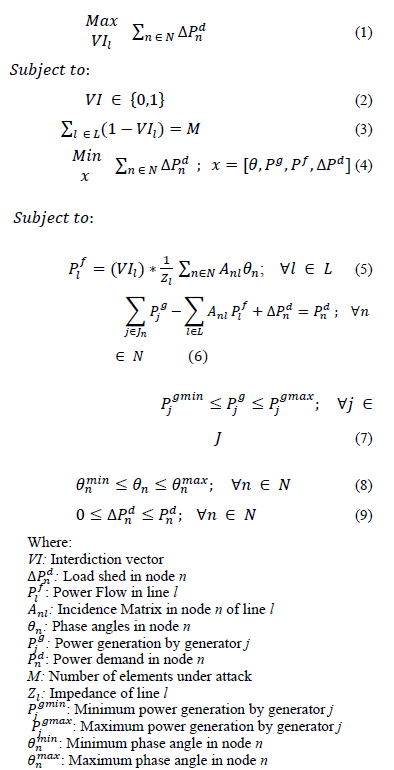
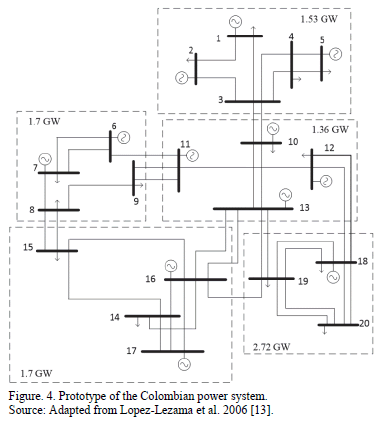
<body><![CDATA[<p><font size="2" face="Verdana, Arial, Helvetica, sans-serif">The constant growth of power demand, along with stronger   environmental regulation, that in most cases delay the building of new   transmission lines, have forced most power systems in industrialized countries   to operate near their static and dynamic limits. Under this scenario, electric   power systems are more vulnerable to intentional attacks &#91;1&#93;. Some of the most   important effects of such attacks include load shedding and higher operational   costs associated to repairing towers and transmission lines &#91;2&#93;. </font></p>     <p><font size="2" face="Verdana, Arial, Helvetica, sans-serif">The traditional approach for power system vulnerability is   based on the study of credible contingencies (N-1 and N-2 criteria) &#91;3&#93;-&#91;4&#93;.   However, such studies require exhaustive simulation and therefore, they are   associated with a high computational burden; on the other hand, only   natural-occurring outages are taken into account. Currently, it is well known   that electric power systems are exposed not only to natural random phenomena,   but also to malicious attacks. That is the case of the Colombian interconnected   power system which has undergone the effects of terrorist attacks for several   decades. As a matter of fact, only between 1999 and 2010 the National   Interconnected System (NIS) faced as many as 200 terrorist attacks per year   &#91;2&#93;. </font></p>     <p><font size="2" face="Verdana, Arial, Helvetica, sans-serif"> The electric grid interdiction   problem, also known as the &quot;terrorist threat problem&quot; has been the focus of   several studies in the last decade. This problem was first formulated in &#91;5&#93; as   a max-min attacker-defender model. In such models the terrorist maximizes load   shedding, while the system operator minimizes it. In &#91;6&#93; and &#91;7&#93; this problem   is solved by using linearization and applying duality properties. First, the   nonlinear expressions were recast as linear constraints; then, the inner   optimization problem was replaced by its dual, turning the max-min bi-level   optimization problem into a max-max bi-level optimization problem. Such a model   is equivalent to a single-level maximization problem solvable via branch and   cut methods. In &#91;8&#93; Arroyo and Galiana generalized the terrorist threat problem   proposed by Salmeron, Wood and Baldick in &#91;5&#93;. The modeling approach of the   problem proposed in &#91;8&#93; allows defining different objective functions for the   terrorist and system operator. Also, it permits the imposition of new   constraints in the outer optimization problem that might depend on both, inner   and outer variables. As regards the terrorist's interests, different objectives   can be considered. For example: <i>i)</i> to minimize the number of system   components to be attacked, in order to achieve a given load shed, or <i>ii)</i> to maximize the load shed for a given number of system components that can be   attacked. </font></p>     <p><font size="2" face="Verdana, Arial, Helvetica, sans-serif">In &#91;9&#93; the authors present a Mixed Integer Linear   Programming approach for the analysis of the electric grid interdiction   problem. In this case the bi-level programming problem is first turned into a   one-level mixed-integer nonlinear programming program by using the fundamental   duality theorem of linear programming &#91;10&#93;; then, disjunctive constraints are   used to eliminate the nonlinearities of the problem. The resulting problem can   be solved by using commercially available software. In &#91;11&#93; a worst-case interdiction   analysis of the terrorist threat problem is performed by a generalization of   Benders decomposition. In &#91;12&#93; the electric grid interdiction problem is   formulated including line switching, which means that, after a terrorist   attack, the system operator has also the option of switching some lines in   order to reduce load shedding. </font></p>     <p><font size="2" face="Verdana, Arial, Helvetica, sans-serif">In this paper the authors propose a novel Genetic   Algorithm (GA) approach to address the electric grid interdiction problem.   Instead of turning the model into a one-level mixed-integer linear programming   problem, the problem is solved in its original form as a mixed-integer   non-linear programming problem. Results of the proposed algorithm are validated   with studies reported in the specialized literature, showing its capability to   attain globally optimal or near-optimal solutions.</font></p>     <p> </p>     <p><font size="3" face="Verdana, Arial, Helvetica, sans-serif"><b>2. Mathematical Formulation</b></font></p>     <p><font size="2" face="Verdana, Arial, Helvetica, sans-serif">The mathematical formulation of the electric grid   interdiction problem is provided in equations (1) to (9) &#91;8&#93;. In this case the   objective of the disruptive agent consists on maximizing the total load   shedding that can be attained given a fixed number of elements (lines or   transformers) under attack.</font></p>     <p><img src="/img/revistas/dyna/v82n192/v82n192a09eq0109.gif"></p>     <p><font size="2" face="Verdana, Arial, Helvetica, sans-serif">The interdiction vector consists of a binary array in   which every position indicates the state of the element. If the position is   equal to one it indicates an element on service; conversely, if the position is   zero it indicates an element out of service (under attack). Equations (1) to   (3) represent the upper level optimization problem (disruptive agent problem).   For a given number of system components that could be attacked (<i>M</i>), the   disruptive agent must maximize the load shedding of the system. Such a problem   is at the same time restricted by the reaction of the system operator   (equations (4) to (9)). For a given interdiction vector, the system operator   must perform a re-dispatch of generation in order to minimize load shedding.    Note that equations (4) to (9) correspond to an optimal DC power flow;   furthermore, for a given interdiction vector, the inner optimization problem is   a linear programming problem.</font></p>     ]]></body>
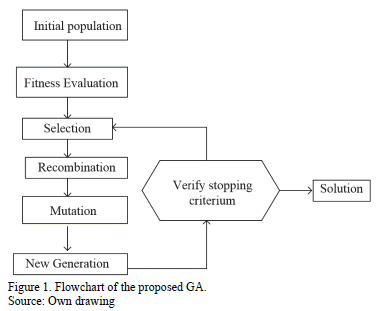
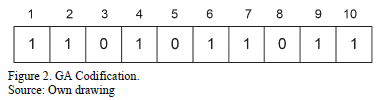
<body><![CDATA[<p> </p>     <p><font size="3" face="Verdana, Arial, Helvetica, sans-serif"><b>3. Specialized Genetic Algorithm</b></font></p>     <p><font size="2" face="Verdana, Arial, Helvetica, sans-serif">The strategy proposed in this paper to approach the   electric grid interdiction problem consists of using a Genetic Algorithm (GA);   however, any other metaheursistic technique could be applied. The methodology   proposed in this paper takes advantage of the fact that, for a given   interdiction vector, the equivalent problem is a DC optimal power flow. In this   case, a number of interdiction vectors are randomly generated as initial   candidate solutions and are modified in each generation according to the GA's   rules. The objective of the GA is to find the maximum load shedding if a fixed   number of elements are under attack. The flowchart of the proposed algorithm is   presented in <a href="#fig01">Fig. 1</a>.</font></p>     <p align="center"><font size="2" face="Verdana, Arial, Helvetica, sans-serif"><a name="fig01"></a></font><img src="/img/revistas/dyna/v82n192/v82n192a09fig01.gif"></p>     <p><font size="2" face="Verdana, Arial, Helvetica, sans-serif"><b><i>3.1. Problem codification</i></b></font></p>     <p><font size="2" face="Verdana, Arial, Helvetica, sans-serif">As stated above, every   solution candidate of the GA consists of a binary chain representing the   interdiction vector. <a href="#fig02">Fig. 2</a> illustrates an interdiction vector for a power   system of 10 elements over which the elements 3, 5 and 8 are under attack.</font></p>     <p align="center"><font size="2" face="Verdana, Arial, Helvetica, sans-serif"><a name="fig02"></a></font><img src="/img/revistas/dyna/v82n192/v82n192a09fig02.gif"></p>     <p><font size="2" face="Verdana, Arial, Helvetica, sans-serif"><b><i>3.2. Initial Population</i></b></font></p>     <p><font size="2" face="Verdana, Arial, Helvetica, sans-serif">The initial population is randomly generated and consists   of a set of different interdiction vectors (every interdiction vector must have   the same number of elements under attack). For each interdiction vector a DC   optimal power flow is run in order to determine the load shedding (which is the   fitness function of the GA). With such information the individuals are ready to   proceed for the next GA steps.</font></p>     <p><font size="2" face="Verdana, Arial, Helvetica, sans-serif"><b><i>3.2. GA's Operators</i></b></font></p>     ]]></body>
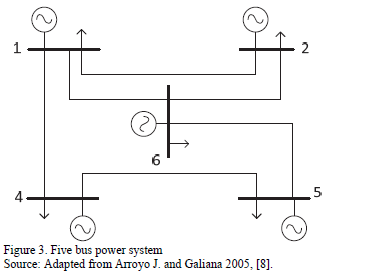
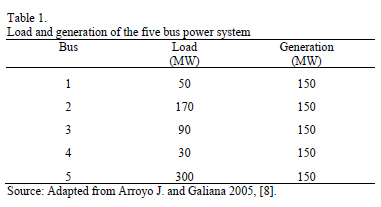
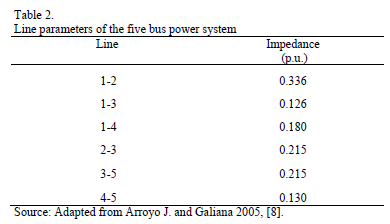
<body><![CDATA[<p><font size="2" face="Verdana, Arial, Helvetica, sans-serif"> The selection   operator of the GA is performed by choosing the best solutions after applying a   series of tournaments with a given number of elements. In this case, the number   of candidates selected for the next step (recombination) is the same number of   parents. The recombination is performed at a single point randomly selected.   Every individual generates two new ones; in this stage two times the initial   population is created. The mutation makes a minimal change in some of the   individuals. The mutation is performed using a mutation factor (with a low   probability) with every bit of the interdiction vector. If mutation or recombination   leads to non feasible candidates, such candidates are penalized in the   objective function. Finally, to keep the number of candidate solutions   constant, only the best solutions are kept in each iteration.</font></p>     <p> </p>     <p><font size="3" face="Verdana, Arial, Helvetica, sans-serif"><b>4. Test and Results</b></font></p>     <p><font size="2" face="Verdana, Arial, Helvetica, sans-serif">The   proposed methodology was tested using three different power systems: a didactic   5 bus power system, the solution of which has already been provided in &#91;8&#93;, a   prototype of the Colombian power system and the IEEE Reliability Test System. </font></p>     <p><font size="2" face="Verdana, Arial, Helvetica, sans-serif"><b><i>4.1. Case A. Five bus Power System</i></b></font></p>     <p><font size="2" face="Verdana, Arial, Helvetica, sans-serif">The first   test is performed with the 5 bus power system illustrated in <a href="#fig03">Fig. 3</a>. This   system has been used only for comparison purposes, and to illustrate that the   proposed GA is able to reach global optimal solutions. The data for this system   is provided in <a href="#tab01">Tables 1</a> and <a href="#tab02">2</a>.</font></p>     <p align="center"><font size="2" face="Verdana, Arial, Helvetica, sans-serif"><a name="fig03"></a></font><img src="/img/revistas/dyna/v82n192/v82n192a09fig03.gif"></p>     <p align="center"><font size="2" face="Verdana, Arial, Helvetica, sans-serif"><a name="tab01"></a></font><img src="/img/revistas/dyna/v82n192/v82n192a09tab01.gif"></p>     <p align="center"><font size="2" face="Verdana, Arial, Helvetica, sans-serif"><a name="tab02"></a></font><img src="/img/revistas/dyna/v82n192/v82n192a09tab02.gif"></p>     <p align="center"><font size="2" face="Verdana, Arial, Helvetica, sans-serif"><a name="tab03"></a></font><img src="/img/revistas/dyna/v82n192/v82n192a09tab03.gif"></p>     ]]></body>
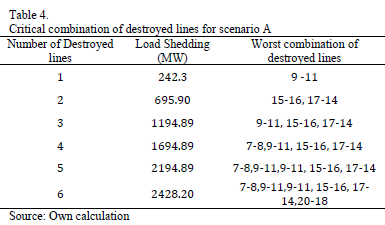
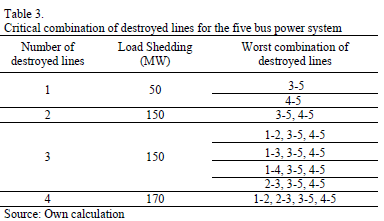
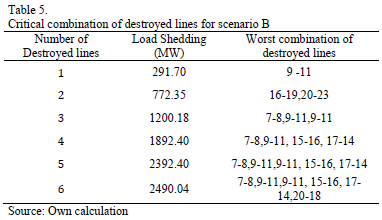
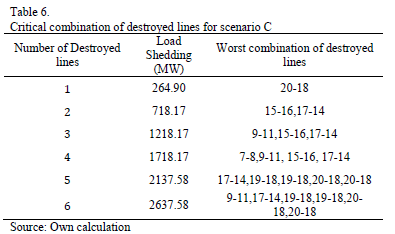
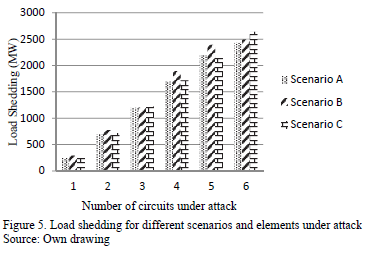
<body><![CDATA[<p><font size="2" face="Verdana, Arial, Helvetica, sans-serif">It can be observed that for a single line under attack,   the maximum load shedding obtained is 50 MW. In this case the line under attack   must be either line 3-5 or line 4-5. Any other single attacked line would not   result in load shedding. On the other hand, for two lines under attack there is   only one strategy to obtain maximum load shedding (attacking lines 3-5 and 4-5   simultaneously). For a maximum of three lines under attack there are three   possible interdiction vectors that would render a maximum load shedding of 150   MW. Finally, if only 4 lines could be taken down simultaneously, the maximum   load shedding would be 170 MW.</font></p>     <p><font size="2" face="Verdana, Arial, Helvetica, sans-serif"><b><i>4.2. Case B. Prototype of the Colombian Power System</i></b></font></p>     <p><font size="2" face="Verdana, Arial, Helvetica, sans-serif">To show the applicability of the proposed approach in real   power systems, a prototype of the Colombian power system was considered. Due to   security reasons, a real </font></p>     <p><font size="2" face="Verdana, Arial, Helvetica, sans-serif">Colombian system with actual data cannot be displayed. <a href="#fig04">Fig. 4</a> illustrates the system under study. This system has 20 nodes and 40   lines and is distributed in 5 sub-areas. The total demand of the system is 9010   MW and the installed capacity is 12850 MW. Specific line, load and generation   data for this system can be consulted in &#91;13&#93;. Three different scneraios were   considered:</font></p> <ul>       <li><font size="2" face="Verdana, Arial, Helvetica, sans-serif"> Scennario A: Considering all generation units available.</font></li>       <li><font size="2" face="Verdana, Arial, Helvetica, sans-serif"> Scenario B: Limiting generation in sub-area 5. The generation     availabe in node 18 was reduced to 42% (1500MW).</font></li>       <li><font size="2" face="Verdana, Arial, Helvetica, sans-serif"> Scenario C: Limiting generation in sub-area 3. The generation     available in node 13 was reduced to 25% (500 MW).</font></li>     </ul>     <p align="center"><font size="2" face="Verdana, Arial, Helvetica, sans-serif"><a name="fig04"></a></font><img src="/img/revistas/dyna/v82n192/v82n192a09fig04.gif"></p>     <p><font size="2" face="Verdana, Arial, Helvetica, sans-serif">Several tests were   performed in each scenario, for different numbers of circuits under attack, to   find the worst combination of destroyed lines. The GA was developed in Matlab   and was run in a computer with CORE I3 processor and 2Gb of RAM memory. The   mutation rate was set to 5% and 100 parents were used in the initial   population. The best results were found in only ten generations and around 300   seconds. Results are shown in <a href="#tab04">Tables 4</a>, <a href="#tab05">5</a> and <a href="#tab06">6</a>. </font></p>     ]]></body>
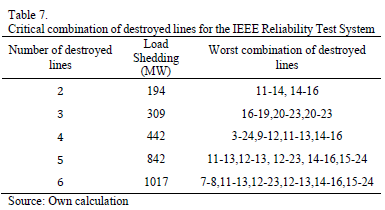
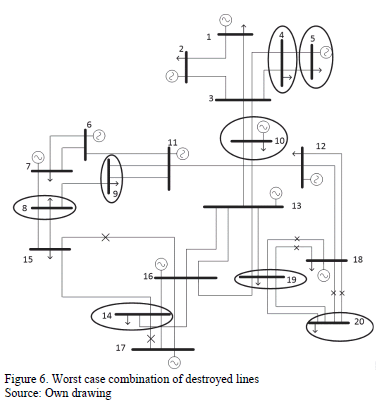
<body><![CDATA[<p align="center"><font size="2" face="Verdana, Arial, Helvetica, sans-serif"><a name="tab04"></a></font><img src="/img/revistas/dyna/v82n192/v82n192a09tab04.gif"></p>     <p align="center"><font size="2" face="Verdana, Arial, Helvetica, sans-serif"><a name="tab05"></a></font><img src="/img/revistas/dyna/v82n192/v82n192a09tab05.gif"></p>     <p align="center"><font size="2" face="Verdana, Arial, Helvetica, sans-serif"><a name="tab06"></a></font><img src="/img/revistas/dyna/v82n192/v82n192a09tab06.gif"></p>     <p><font size="2" face="Verdana, Arial, Helvetica, sans-serif">Results show that   Scenario C with 6 destroyed lines is the worst possible case in terms of load   shedding. It causes 2637.58 MW of load shed, 29.27% of the total system demand.   This attack would cause a bottling up of energy in bus 18 and load shedding in   buses 4, 5, 8, 9, 10, 14, 19 and 20. <a href="#fig06">Fig. 6</a> illustrates the lines and buses   affected. </font></p>     <p align="center"><font size="2" face="Verdana, Arial, Helvetica, sans-serif"><a name="fig05"></a></font><img src="/img/revistas/dyna/v82n192/v82n192a09fig05.gif"></p>     <p align="center"><font size="2" face="Verdana, Arial, Helvetica, sans-serif"><a name="fig06"></a></font><img src="/img/revistas/dyna/v82n192/v82n192a09fig06.gif"></p>     <p><font size="2" face="Verdana, Arial, Helvetica, sans-serif">The tests also revealed that sub-area 4 is the most   sensitive to load shedding, especially buses 14 and 15. This is due to the fact   that in this area the load is higher than the installed generation.   Furthermore, such generation is mainly thermal which is the most expensive.</font></p>     <p><font size="2" face="Verdana, Arial, Helvetica, sans-serif"><b><i>4.2. Case C. IEEE Reliability Test System</i></b></font></p>     <p><font size="2" face="Verdana, Arial, Helvetica, sans-serif">Several tests were also performed with the 24 bus IEEE   Reliability Test System &#91;14&#93;. This test system is composed of 24 buses, 38   lines, 32 generators and 17 loads. The load profile selected for this study corresponds   to a winter weekday at 6:00 pm (2850 MW). </font></p>     <p><font size="2" face="Verdana, Arial, Helvetica, sans-serif">For the sake of simplicity, and without loss of   generality, lines in the same corridor are treated independently; which means   that the failure of a line does not necessarily imply the unavailability of the   remaining lines in the same corridor. Several tests were performed with the GA,   considering an increasing number of destroyed lines. <a href="#tab07">Table 7</a> shows the worst   combination of destroyed lines and the corresponding load shedding for this   system. It can be observed that the simultaneous attack of 6 lines results in   the loss of 1017 MW that represents 35.7% of the total demand. However,   attacking a single line does not result in any loss of load.</font></p>     ]]></body>
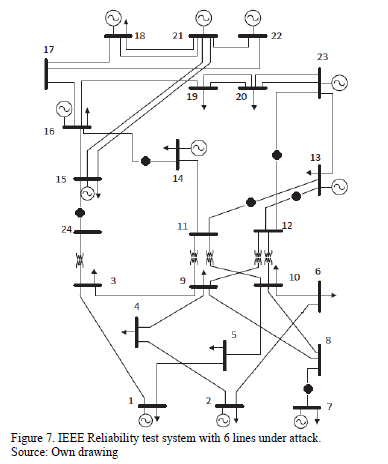
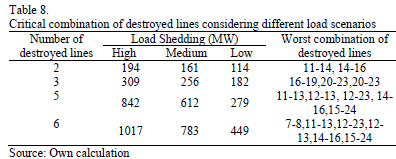
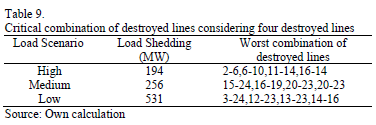
<body><![CDATA[<p align="center"><font size="2" face="Verdana, Arial, Helvetica, sans-serif"><a name="tab07"></a></font><img src="/img/revistas/dyna/v82n192/v82n192a09tab07.gif"></p>     <p><font size="2" face="Verdana, Arial, Helvetica, sans-serif">In the IEEE   Reliability Test System most of the generation is located in the upper part of   the network, while most of the load is distributed in the nodes of the lower   part of the system. As a consequence, the simultaneous attack of 5 or 6 lines   focusses on dividing the system in two islands, separating generation from   load. <a href="#fig07">Fig. 7</a> depicts the simultaneous attack of 6 lines (marked with blackened   circles). As a consequence of this attack the system is split into two islands   i) the upper area with excess of generation capacity and no load shedding and   ii) the lower area with deficit of generation and all the loss of load. </font></p>     <p align="center"><font size="2" face="Verdana, Arial, Helvetica, sans-serif"><a name="fig07"></a></font><img src="/img/revistas/dyna/v82n192/v82n192a09fig07.gif"></p>     <p><font size="2" face="Verdana, Arial, Helvetica, sans-serif"><a href="#tab08">Table 8</a> shows the results obtained considering high,   medium and low load scenarios. For the high load scenario the previously   defined demand of 2850 MW was considered; for the medium load scenario a winter   weekday at 9:00 pm with a total load of 2365 MW was considered; and finally for   the low load scenario a summer weekday at 5:00 am with a total demand of 1653   MW was taken into account.</font></p>     <p align="center"><font size="2" face="Verdana, Arial, Helvetica, sans-serif"><a name="tab08"></a></font><img src="/img/revistas/dyna/v82n192/v82n192a09tab08.gif"></p>     <p><font size="2" face="Verdana, Arial, Helvetica, sans-serif">As is expected, the load shedding is significantly less in   the low load scenario when compared with the medium and high load scenarios. It   was also found that the worst combination of destroyed lines is the same for 2,   3, 5 and 6 destroyed lines; however, with 4 lines under attack there is a   different solution for each of the load scenarios. The worst combination of   destroyed lines, considering 4 circuits is presented in <a href="#tab09">Table 9</a>.</font></p>     <p align="center"><font size="2" face="Verdana, Arial, Helvetica, sans-serif"><a name="tab09"></a></font><img src="/img/revistas/dyna/v82n192/v82n192a09tab09.gif"></p>     <p> </p>     <p><font size="3" face="Verdana, Arial, Helvetica, sans-serif"><b>5. Conclusions</b></font></p>     <p><font size="2" face="Verdana, Arial, Helvetica, sans-serif">A specialized genetic algorithm for vulnerability   assessment of power systems to intentional attacks was presented in this paper.   The proposed approach is robust and efficient and can be applied to real power   systems. The tests carried out with a prototype of the Colombian power system   and the IEEE reliability test system allows the most vulnerable lines in terms   of terrorist attacks to be identified. </font></p>     ]]></body>
<body><![CDATA[<p><font size="2" face="Verdana, Arial, Helvetica, sans-serif">The main advantage of using a GA for solving the electric   grid interdiction problem is the possibility of having a set of high quality   solutions instead of a single one solution. This gives the system operator more   information about its most vulnerable elements and provides signals for future   reinforcements of the network or more strict surveillance on critical elements.</font></p>     <p><font size="2" face="Verdana, Arial, Helvetica, sans-serif">With the use of a GA instead of classical mathematical   programming, there is no need to bring into play duality theory or   linearization schemes to transform the electric grid interdiction problem into   a single-level optimization problem. This opens the possibility to approach the   interdiction problem with a more accurate modeling of the network, such as an   AC optimal power flow. This will be the focus of further work.</font></p>     <p> </p>     <p><font size="3" face="Verdana, Arial, Helvetica, sans-serif"><b>Acknowledgments</b></font></p>     <p><font size="2" face="Verdana, Arial, Helvetica, sans-serif">The authors would like to thank the Sustainability Program   2014-2015 of the University of Antioquia for financial support.</font></p>     <p> </p>     <p><font size="3" face="Verdana, Arial, Helvetica, sans-serif"><b>References</b></font></p>     <!-- ref --><p><font size="2" face="Verdana, Arial, Helvetica, sans-serif"><b>&#91;1&#93;</b> Leffler   L., The NERC program for the electricity sector critical Infrastructure   protection, Proceedings of Power Engineering Society Winter Meeting, pp. 95-97,   2001. DOI: 10.1109/pesw.2001.916871</font>&nbsp;&nbsp;&nbsp;&nbsp;&nbsp;&nbsp;&nbsp;&nbsp;[&#160;<a href="javascript:void(0);" onclick="javascript: window.open('/scielo.php?script=sci_nlinks&ref=000090&pid=S0012-7353201500040000900001&lng=','','width=640,height=500,resizable=yes,scrollbars=1,menubar=yes,');">Links</a>&#160;]<!-- end-ref --><!-- ref --><p><font size="2" face="Verdana, Arial, Helvetica, sans-serif"><b>&#91;2&#93;</b> Corredor,   P. and Ruiz, M., Against all odds. IEEE Power &amp; Energy Magazine,   9 (2), pp. 59-66, 2011.    &nbsp;&nbsp;&nbsp;&nbsp;&nbsp;&nbsp;&nbsp;&nbsp;[&#160;<a href="javascript:void(0);" onclick="javascript: window.open('/scielo.php?script=sci_nlinks&ref=000091&pid=S0012-7353201500040000900002&lng=','','width=640,height=500,resizable=yes,scrollbars=1,menubar=yes,');">Links</a>&#160;]<!-- end-ref --></font></p>     ]]></body>
<body><![CDATA[<!-- ref --><p><font size="2" face="Verdana, Arial, Helvetica, sans-serif"><b>&#91;3&#93;</b> Arragada, G., Evaluaci&oacute;n de confiabilidad en   sistemas el&eacute;ctricos de distribuci&oacute;n, M.S. Thesis, Department of Electrical   Engineering, Pontificia Universidad Cat&oacute;lica de Chile, Santiago de Chile, 1994.    &nbsp;&nbsp;&nbsp;&nbsp;&nbsp;&nbsp;&nbsp;&nbsp;[&#160;<a href="javascript:void(0);" onclick="javascript: window.open('/scielo.php?script=sci_nlinks&ref=000093&pid=S0012-7353201500040000900003&lng=','','width=640,height=500,resizable=yes,scrollbars=1,menubar=yes,');">Links</a>&#160;]<!-- end-ref --></font></p>     <!-- ref --><p><font size="2" face="Verdana, Arial, Helvetica, sans-serif"><b>&#91;4&#93;</b> Kinney   R., Crucitti P., Albert, R. and Latora, V., Modeling cascading failures in the   North American power grid. The European Physical Journal, 46 (1), pp. 101-107, 2005.    DOI: 10.1140/epjb/e2005-00237-9</font>&nbsp;&nbsp;&nbsp;&nbsp;&nbsp;&nbsp;&nbsp;&nbsp;[&#160;<a href="javascript:void(0);" onclick="javascript: window.open('/scielo.php?script=sci_nlinks&ref=000095&pid=S0012-7353201500040000900004&lng=','','width=640,height=500,resizable=yes,scrollbars=1,menubar=yes,');">Links</a>&#160;]<!-- end-ref --><!-- ref --><p><font size="2" face="Verdana, Arial, Helvetica, sans-serif"><b>&#91;5&#93;</b> Salmeron, J., Wood, K. and Baldick, R., Analysis of electric grid   security under terrorist threat. IEEE Transactions on Power Systems, 19 (2), pp.   905-912, 2004. DOI: 10.1109/TPWRS.2004.825888</font>&nbsp;&nbsp;&nbsp;&nbsp;&nbsp;&nbsp;&nbsp;&nbsp;[&#160;<a href="javascript:void(0);" onclick="javascript: window.open('/scielo.php?script=sci_nlinks&ref=000096&pid=S0012-7353201500040000900005&lng=','','width=640,height=500,resizable=yes,scrollbars=1,menubar=yes,');">Links</a>&#160;]<!-- end-ref --><!-- ref --><p><font size="2" face="Verdana, Arial, Helvetica, sans-serif"><b>&#91;6&#93;</b> &Aacute;lvarez, R. E., Interdicting electrical power grids, MSc. Thesis,   Naval Posgraduate School, Monterey, C.A, Mexico, 2004.    &nbsp;&nbsp;&nbsp;&nbsp;&nbsp;&nbsp;&nbsp;&nbsp;[&#160;<a href="javascript:void(0);" onclick="javascript: window.open('/scielo.php?script=sci_nlinks&ref=000097&pid=S0012-7353201500040000900006&lng=','','width=640,height=500,resizable=yes,scrollbars=1,menubar=yes,');">Links</a>&#160;]<!-- end-ref --></font></p>     <!-- ref --><p><font size="2" face="Verdana, Arial, Helvetica, sans-serif"><b>&#91;7&#93;</b> Salmer&oacute;n,   J., Wood, K., and Baldick, R., Optimizing electric grid design under asymmetric   threat (II), Tech. Rep. Naval Postgraduate School, Monterey, C.A., 2004.    &nbsp;&nbsp;&nbsp;&nbsp;&nbsp;&nbsp;&nbsp;&nbsp;[&#160;<a href="javascript:void(0);" onclick="javascript: window.open('/scielo.php?script=sci_nlinks&ref=000099&pid=S0012-7353201500040000900007&lng=','','width=640,height=500,resizable=yes,scrollbars=1,menubar=yes,');">Links</a>&#160;]<!-- end-ref --></font></p>     <!-- ref --><p><font size="2" face="Verdana, Arial, Helvetica, sans-serif"><b>&#91;8&#93;</b> Arroyo,   J. and Galiana, F., On the solution of the bilevel programming formulation of   the terrorist threat problem. IEEE Transactions on Power Systems, 20 (2), pp.   789-797, 2005. DOI: 10.1109/TPWRS.2005.846198</font>&nbsp;&nbsp;&nbsp;&nbsp;&nbsp;&nbsp;&nbsp;&nbsp;[&#160;<a href="javascript:void(0);" onclick="javascript: window.open('/scielo.php?script=sci_nlinks&ref=000101&pid=S0012-7353201500040000900008&lng=','','width=640,height=500,resizable=yes,scrollbars=1,menubar=yes,');">Links</a>&#160;]<!-- end-ref --><!-- ref --><p><font size="2" face="Verdana, Arial, Helvetica, sans-serif"><b>&#91;9&#93;</b> Motto, L.,   Arroyo, J. and Galiana, F., A mixed-integer LP procedure for the analysis of   electric grid security under disruptive threat. IEEE Transactions on Power   Systems, 20 (3), pp. 1357-1365, 2005. DOI: 10.1109/TPWRS.2005.851942</font>&nbsp;&nbsp;&nbsp;&nbsp;&nbsp;&nbsp;&nbsp;&nbsp;[&#160;<a href="javascript:void(0);" onclick="javascript: window.open('/scielo.php?script=sci_nlinks&ref=000102&pid=S0012-7353201500040000900009&lng=','','width=640,height=500,resizable=yes,scrollbars=1,menubar=yes,');">Links</a>&#160;]<!-- end-ref --><!-- ref --><p><font size="2" face="Verdana, Arial, Helvetica, sans-serif"><b>&#91;10&#93;</b> Bertsimas,   D. and Tsitsiklis, J., Introduction to Linear Optimization Belmont, MA: Athena   Scientific, 1997.    &nbsp;&nbsp;&nbsp;&nbsp;&nbsp;&nbsp;&nbsp;&nbsp;[&#160;<a href="javascript:void(0);" onclick="javascript: window.open('/scielo.php?script=sci_nlinks&ref=000103&pid=S0012-7353201500040000900010&lng=','','width=640,height=500,resizable=yes,scrollbars=1,menubar=yes,');">Links</a>&#160;]<!-- end-ref --> </font></p>     <!-- ref --><p><font size="2" face="Verdana, Arial, Helvetica, sans-serif"><b>&#91;11&#93;</b> Salmeron,   J., Wood, K. and Baldick, R., Worst-case interdiction analysis of large-scale   electric power grids, IEEE Transactions on Power Systems, 24 (1), pp. 96-104,   2009. DOI: 10.1109/TPWRS.2008.2004825</font>&nbsp;&nbsp;&nbsp;&nbsp;&nbsp;&nbsp;&nbsp;&nbsp;[&#160;<a href="javascript:void(0);" onclick="javascript: window.open('/scielo.php?script=sci_nlinks&ref=000105&pid=S0012-7353201500040000900011&lng=','','width=640,height=500,resizable=yes,scrollbars=1,menubar=yes,');">Links</a>&#160;]<!-- end-ref --><!-- ref --><p><font size="2" face="Verdana, Arial, Helvetica, sans-serif"><b>&#91;12&#93;</b> Arroyo, M.   and Fernandez, J.F., A genetic algorithm approach for the analysis of electric   grid interdiction with line switching, Proceedings of the 15<sup>th</sup> International Conference on Intelligent System Applications to Power Systems   (ISAP), Curitiba, Brazil, Nov. 2009. DOI: 10.1109/isap.2009.5352849</font>&nbsp;&nbsp;&nbsp;&nbsp;&nbsp;&nbsp;&nbsp;&nbsp;[&#160;<a href="javascript:void(0);" onclick="javascript: window.open('/scielo.php?script=sci_nlinks&ref=000106&pid=S0012-7353201500040000900012&lng=','','width=640,height=500,resizable=yes,scrollbars=1,menubar=yes,');">Links</a>&#160;]<!-- end-ref --><!-- ref --><p><font size="2" face="Verdana, Arial, Helvetica, sans-serif"><b>&#91;13&#93;</b> L&oacute;pez-Lezama,   J.M., Murillo-Sanchez, C.E., Zuluaga L.J. and Gutierrez-Gomez, J.F., A   contingency-based security-constraint optimal power flow model for revealing   the marginal cost of a blackout risk equalizing policy in the Colombian energy   market, Proceedings of the IEEE PES Transmission and Distribution Conference   and Exposition, Caracas, Venezuela, 2006.    &nbsp;&nbsp;&nbsp;&nbsp;&nbsp;&nbsp;&nbsp;&nbsp;[&#160;<a href="javascript:void(0);" onclick="javascript: window.open('/scielo.php?script=sci_nlinks&ref=000107&pid=S0012-7353201500040000900013&lng=','','width=640,height=500,resizable=yes,scrollbars=1,menubar=yes,');">Links</a>&#160;]<!-- end-ref --></font></p>     <!-- ref --><p><font size="2" face="Verdana, Arial, Helvetica, sans-serif"><b>&#91;14&#93;</b> Grigg C.,   Wong P., Albrecht P., Allan R., Bhavaraju M., Billinton R., Chen Q., Fong C.,   Haddat S., Kuruganty S., Li W., Mukerji R., Patton D., Rau N., Reppen D.,   Schneider A., Shahidehpour M., and Singh C., The IEEE Reliability Test   System-1996. IEEE Transactions on Power Systems, 14 (3), pp.1010-1020, 1999.    DOI: 10.1109/59.780914</font>&nbsp;&nbsp;&nbsp;&nbsp;&nbsp;&nbsp;&nbsp;&nbsp;[&#160;<a href="javascript:void(0);" onclick="javascript: window.open('/scielo.php?script=sci_nlinks&ref=000109&pid=S0012-7353201500040000900014&lng=','','width=640,height=500,resizable=yes,scrollbars=1,menubar=yes,');">Links</a>&#160;]<!-- end-ref --><p> </p>     <p><font size="2" face="Verdana, Arial, Helvetica, sans-serif"><b>L.   Agudelo, </b>studied electrical   engineering and currently she is studying a Masters in Engineering at the Universidad   de Antioquia, Medell&iacute;n, Colombia. She works in the operation department at   Interconexi&oacute;n El&eacute;ctrica S.A. Utility (ISA) in Medellin, Colombia. Her interests   include power systems optimization and real time operation.</font></p>     <p><font size="2" face="Verdana, Arial, Helvetica, sans-serif"><b>J.M.   Lop&eacute;z-Lezama,</b> studied electrical   engineering at Universidad Nacional de Colombia, Medellin, Colombia, where he   also obtained a MSc. Degree. He obtained a PhD. degree from the UNESP in Sao   Paulo, Brazil. Currently he works at the Department of Electrical Engineering   in the Universidad of Antioquia in Medellin, Colombia. His interests include   power systems optimization and distributed generation. </font></p>     ]]></body>
<body><![CDATA[<p><font size="2" face="Verdana, Arial, Helvetica, sans-serif"><b>N. Mu&ntilde;oz-Galeano,</b> studied electrical engineering at the Universidad de   Antioquia in Medell&iacute;n, Colombia. He obtained a PhD degree from the Universidad   Polit&eacute;cnica de Valencia. Currently he works as an Assistant professor at the   Department of Electrical Engineering in the Universidad de Antioquia in   Medellin, Colombia. His interests include power system electronics and   electrical machines.</font></p>      ]]></body><back>
<ref-list>
<ref id="B1">
<label>1</label><nlm-citation citation-type="confpro">
<person-group person-group-type="author">
<name>
<surname><![CDATA[Leffler]]></surname>
<given-names><![CDATA[L.]]></given-names>
</name>
</person-group>
<article-title xml:lang="en"><![CDATA[The NERC program for the electricity sector critical Infrastructure protection]]></article-title>
<source><![CDATA[]]></source>
<year>2001</year>
<conf-name><![CDATA[ Power Engineering Society Winter Meeting]]></conf-name>
<conf-loc> </conf-loc>
<page-range>95-97</page-range></nlm-citation>
</ref>
<ref id="B2">
<label>2</label><nlm-citation citation-type="journal">
<person-group person-group-type="author">
<name>
<surname><![CDATA[Corredor]]></surname>
<given-names><![CDATA[P.]]></given-names>
</name>
<name>
<surname><![CDATA[Ruiz]]></surname>
<given-names><![CDATA[M.]]></given-names>
</name>
</person-group>
<article-title xml:lang="en"><![CDATA[Against all odds]]></article-title>
<source><![CDATA[IEEE Power & Energy Magazine]]></source>
<year>2011</year>
<volume>9</volume>
<numero>2</numero>
<issue>2</issue>
<page-range>59-66</page-range></nlm-citation>
</ref>
<ref id="B3">
<label>3</label><nlm-citation citation-type="">
<person-group person-group-type="author">
<name>
<surname><![CDATA[Arragada]]></surname>
<given-names><![CDATA[G.]]></given-names>
</name>
</person-group>
<source><![CDATA[Evaluación de confiabilidad en sistemas eléctricos de distribución]]></source>
<year></year>
</nlm-citation>
</ref>
<ref id="B4">
<label>4</label><nlm-citation citation-type="journal">
<person-group person-group-type="author">
<name>
<surname><![CDATA[Kinney]]></surname>
<given-names><![CDATA[R.]]></given-names>
</name>
<name>
<surname><![CDATA[Crucitti]]></surname>
<given-names><![CDATA[P.]]></given-names>
</name>
<name>
<surname><![CDATA[Albert]]></surname>
<given-names><![CDATA[R.]]></given-names>
</name>
<name>
<surname><![CDATA[Latora]]></surname>
<given-names><![CDATA[V.]]></given-names>
</name>
</person-group>
<article-title xml:lang="en"><![CDATA[Modeling cascading failures in the North American power grid]]></article-title>
<source><![CDATA[The European Physical Journal]]></source>
<year>2005</year>
<volume>46</volume>
<numero>1</numero>
<issue>1</issue>
<page-range>101-107</page-range></nlm-citation>
</ref>
<ref id="B5">
<label>5</label><nlm-citation citation-type="journal">
<person-group person-group-type="author">
<name>
<surname><![CDATA[Salmeron]]></surname>
<given-names><![CDATA[J.]]></given-names>
</name>
<name>
<surname><![CDATA[Wood]]></surname>
<given-names><![CDATA[K.]]></given-names>
</name>
<name>
<surname><![CDATA[Baldick]]></surname>
<given-names><![CDATA[R.]]></given-names>
</name>
</person-group>
<article-title xml:lang="en"><![CDATA[Analysis of electric grid security under terrorist threat.]]></article-title>
<source><![CDATA[IEEE Transactions on Power Systems]]></source>
<year>2004</year>
<volume>19</volume>
<numero>2</numero>
<issue>2</issue>
<page-range>905-912</page-range></nlm-citation>
</ref>
<ref id="B6">
<label>6</label><nlm-citation citation-type="">
<person-group person-group-type="author">
<name>
<surname><![CDATA[Álvarez]]></surname>
<given-names><![CDATA[R. E.]]></given-names>
</name>
</person-group>
<source><![CDATA[Interdicting electrical power grids]]></source>
<year></year>
</nlm-citation>
</ref>
<ref id="B7">
<label>7</label><nlm-citation citation-type="book">
<person-group person-group-type="author">
<name>
<surname><![CDATA[Salmerón]]></surname>
<given-names><![CDATA[J.]]></given-names>
</name>
<name>
<surname><![CDATA[Wood]]></surname>
<given-names><![CDATA[K.]]></given-names>
</name>
<name>
<surname><![CDATA[Baldick]]></surname>
<given-names><![CDATA[R.]]></given-names>
</name>
</person-group>
<source><![CDATA[Optimizing electric grid design under asymmetric threat (II)]]></source>
<year>2004</year>
<publisher-loc><![CDATA[Monterey^eC.A. C.A.]]></publisher-loc>
<publisher-name><![CDATA[Tech. Rep. Naval Postgraduate School]]></publisher-name>
</nlm-citation>
</ref>
<ref id="B8">
<label>8</label><nlm-citation citation-type="journal">
<person-group person-group-type="author">
<name>
<surname><![CDATA[Arroyo]]></surname>
<given-names><![CDATA[J.]]></given-names>
</name>
<name>
<surname><![CDATA[Galiana]]></surname>
<given-names><![CDATA[F.]]></given-names>
</name>
</person-group>
<article-title xml:lang="en"><![CDATA[On the solution of the bilevel programming formulation of the terrorist threat problem]]></article-title>
<source><![CDATA[IEEE Transactions on Power Systems]]></source>
<year>2005</year>
<volume>20</volume>
<numero>2</numero>
<issue>2</issue>
<page-range>789-797</page-range></nlm-citation>
</ref>
<ref id="B9">
<label>9</label><nlm-citation citation-type="journal">
<person-group person-group-type="author">
<name>
<surname><![CDATA[Motto]]></surname>
<given-names><![CDATA[L.]]></given-names>
</name>
<name>
<surname><![CDATA[Arroyo]]></surname>
<given-names><![CDATA[J.]]></given-names>
</name>
<name>
<surname><![CDATA[Galiana]]></surname>
<given-names><![CDATA[F.]]></given-names>
</name>
</person-group>
<article-title xml:lang="en"><![CDATA[A mixed-integer LP procedure for the analysis of electric grid security under disruptive threat]]></article-title>
<source><![CDATA[IEEE Transactions on Power Systems]]></source>
<year>2005</year>
<volume>20</volume>
<numero>3</numero>
<issue>3</issue>
<page-range>1357-1365</page-range></nlm-citation>
</ref>
<ref id="B10">
<label>10</label><nlm-citation citation-type="book">
<person-group person-group-type="author">
<name>
<surname><![CDATA[Bertsimas]]></surname>
<given-names><![CDATA[D.]]></given-names>
</name>
<name>
<surname><![CDATA[Tsitsiklis]]></surname>
<given-names><![CDATA[J.]]></given-names>
</name>
</person-group>
<source><![CDATA[Introduction to Linear Optimization Belmont]]></source>
<year>1997</year>
<publisher-loc><![CDATA[^eMA MA]]></publisher-loc>
<publisher-name><![CDATA[Athena Scientific]]></publisher-name>
</nlm-citation>
</ref>
<ref id="B11">
<label>11</label><nlm-citation citation-type="journal">
<person-group person-group-type="author">
<name>
<surname><![CDATA[Salmeron]]></surname>
<given-names><![CDATA[J.]]></given-names>
</name>
<name>
<surname><![CDATA[Wood]]></surname>
<given-names><![CDATA[K.]]></given-names>
</name>
<name>
<surname><![CDATA[Baldick]]></surname>
<given-names><![CDATA[R.]]></given-names>
</name>
</person-group>
<article-title xml:lang="en"><![CDATA[Worst-case interdiction analysis of large-scale electric power grids]]></article-title>
<source><![CDATA[IEEE Transactions on Power Systems]]></source>
<year>2009</year>
<volume>24</volume>
<numero>1</numero>
<issue>1</issue>
<page-range>96-104</page-range></nlm-citation>
</ref>
<ref id="B12">
<label>12</label><nlm-citation citation-type="confpro">
<person-group person-group-type="author">
<name>
<surname><![CDATA[Arroyo]]></surname>
<given-names><![CDATA[M.]]></given-names>
</name>
<name>
<surname><![CDATA[Fernandez]]></surname>
<given-names><![CDATA[J.F.]]></given-names>
</name>
</person-group>
<article-title xml:lang="en"><![CDATA[A genetic algorithm approach for the analysis of electric grid interdiction with line switching]]></article-title>
<source><![CDATA[]]></source>
<year></year>
<conf-name><![CDATA[15th International Conference on Intelligent System Applications to Power Systems (ISAP)]]></conf-name>
<conf-date>Nov. 2009</conf-date>
<conf-loc>Curitiba </conf-loc>
</nlm-citation>
</ref>
<ref id="B13">
<label>13</label><nlm-citation citation-type="confpro">
<person-group person-group-type="author">
<name>
<surname><![CDATA[López-Lezama]]></surname>
<given-names><![CDATA[J.M.]]></given-names>
</name>
<name>
<surname><![CDATA[Murillo-Sanchez]]></surname>
<given-names><![CDATA[C.E.]]></given-names>
</name>
<name>
<surname><![CDATA[Zuluaga]]></surname>
<given-names><![CDATA[L.J.]]></given-names>
</name>
<name>
<surname><![CDATA[Gutierrez-Gomez]]></surname>
<given-names><![CDATA[J.F.]]></given-names>
</name>
</person-group>
<article-title xml:lang="en"><![CDATA[A contingency-based security-constraint optimal power flow model for revealing the marginal cost of a blackout risk equalizing policy in the Colombian energy market]]></article-title>
<source><![CDATA[]]></source>
<year></year>
<conf-name><![CDATA[ IEEE PES Transmission and Distribution Conference and Exposition]]></conf-name>
<conf-date>2006</conf-date>
<conf-loc>Caracas </conf-loc>
</nlm-citation>
</ref>
<ref id="B14">
<label>14</label><nlm-citation citation-type="journal">
<person-group person-group-type="author">
<name>
<surname><![CDATA[Grigg]]></surname>
<given-names><![CDATA[C.]]></given-names>
</name>
<name>
<surname><![CDATA[Wong]]></surname>
<given-names><![CDATA[P.]]></given-names>
</name>
<name>
<surname><![CDATA[Albrecht]]></surname>
<given-names><![CDATA[P.]]></given-names>
</name>
<name>
<surname><![CDATA[Allan]]></surname>
<given-names><![CDATA[R.]]></given-names>
</name>
<name>
<surname><![CDATA[Bhavaraju]]></surname>
<given-names><![CDATA[M.]]></given-names>
</name>
<name>
<surname><![CDATA[Billinton]]></surname>
<given-names><![CDATA[R.]]></given-names>
</name>
<name>
<surname><![CDATA[Chen]]></surname>
<given-names><![CDATA[Q.]]></given-names>
</name>
<name>
<surname><![CDATA[Fong]]></surname>
<given-names><![CDATA[C.]]></given-names>
</name>
<name>
<surname><![CDATA[Haddat]]></surname>
<given-names><![CDATA[S.]]></given-names>
</name>
<name>
<surname><![CDATA[Kuruganty]]></surname>
<given-names><![CDATA[S.]]></given-names>
</name>
<name>
<surname><![CDATA[Li]]></surname>
<given-names><![CDATA[W.]]></given-names>
</name>
<name>
<surname><![CDATA[Mukerji]]></surname>
<given-names><![CDATA[R.]]></given-names>
</name>
<name>
<surname><![CDATA[Patton]]></surname>
<given-names><![CDATA[D.]]></given-names>
</name>
<name>
<surname><![CDATA[Rau]]></surname>
<given-names><![CDATA[N.]]></given-names>
</name>
<name>
<surname><![CDATA[Reppen]]></surname>
<given-names><![CDATA[D.]]></given-names>
</name>
<name>
<surname><![CDATA[Schneider]]></surname>
<given-names><![CDATA[A.]]></given-names>
</name>
<name>
<surname><![CDATA[Shahidehpour]]></surname>
<given-names><![CDATA[M.]]></given-names>
</name>
<name>
<surname><![CDATA[Singh]]></surname>
<given-names><![CDATA[C.]]></given-names>
</name>
</person-group>
<article-title xml:lang="en"><![CDATA[The IEEE Reliability Test System-1996]]></article-title>
<source><![CDATA[IEEE Transactions on Power Systems]]></source>
<year>1999</year>
<volume>14</volume>
<numero>3</numero>
<issue>3</issue>
<page-range>1010-1020</page-range></nlm-citation>
</ref>
</ref-list>
</back>
</article>