<?xml version="1.0" encoding="ISO-8859-1"?><article xmlns:mml="http://www.w3.org/1998/Math/MathML" xmlns:xlink="http://www.w3.org/1999/xlink" xmlns:xsi="http://www.w3.org/2001/XMLSchema-instance">
<front>
<journal-meta>
<journal-id>0012-7353</journal-id>
<journal-title><![CDATA[DYNA]]></journal-title>
<abbrev-journal-title><![CDATA[Dyna rev.fac.nac.minas]]></abbrev-journal-title>
<issn>0012-7353</issn>
<publisher>
<publisher-name><![CDATA[Universidad Nacional de Colombia]]></publisher-name>
</publisher>
</journal-meta>
<article-meta>
<article-id>S0012-73532015000400013</article-id>
<article-id pub-id-type="doi">10.15446/dyna.v82n192.48586</article-id>
<title-group>
<article-title xml:lang="en"><![CDATA[Generalities about design and operation of microgrids]]></article-title>
<article-title xml:lang="es"><![CDATA[Generalidades sobre diseño y operación de micro-redes]]></article-title>
</title-group>
<contrib-group>
<contrib contrib-type="author">
<name>
<surname><![CDATA[Rey-López]]></surname>
<given-names><![CDATA[Juan Manuel]]></given-names>
</name>
<xref ref-type="aff" rid="A01"/>
</contrib>
<contrib contrib-type="author">
<name>
<surname><![CDATA[Vergara-Barrios]]></surname>
<given-names><![CDATA[Pedro Pablo]]></given-names>
</name>
<xref ref-type="aff" rid="A02"/>
</contrib>
<contrib contrib-type="author">
<name>
<surname><![CDATA[Osma-Pinto]]></surname>
<given-names><![CDATA[Germán Alfonso]]></given-names>
</name>
<xref ref-type="aff" rid="A03"/>
</contrib>
<contrib contrib-type="author">
<name>
<surname><![CDATA[Ordóñez-Plata]]></surname>
<given-names><![CDATA[Gabriel]]></given-names>
</name>
<xref ref-type="aff" rid="A04"/>
</contrib>
</contrib-group>
<aff id="A01">
<institution><![CDATA[,Universidad Industrial de Santander Esc. de Ingenierías Eléctrica, Electrónica y de Telecomunicaciones ]]></institution>
<addr-line><![CDATA[Bucaramanga ]]></addr-line>
<country>Colombia</country>
</aff>
<aff id="A02">
<institution><![CDATA[,Universidad Industrial de Santander Esc. de Ingenierías Eléctrica, Electrónica y de Telecomunicaciones ]]></institution>
<addr-line><![CDATA[Bucaramanga ]]></addr-line>
<country>Colombia</country>
</aff>
<aff id="A03">
<institution><![CDATA[,Universidad Industrial de Santander Esc. de Ingenierías Eléctrica, Electrónica y de Telecomunicaciones ]]></institution>
<addr-line><![CDATA[Bucaramanga ]]></addr-line>
<country>Colombia</country>
</aff>
<aff id="A04">
<institution><![CDATA[,Universidad Industrial de Santander Esc. de Ingenierías Eléctrica, Electrónica y de Telecomunicaciones ]]></institution>
<addr-line><![CDATA[Bucaramanga ]]></addr-line>
<country>Colombia</country>
</aff>
<pub-date pub-type="pub">
<day>00</day>
<month>08</month>
<year>2015</year>
</pub-date>
<pub-date pub-type="epub">
<day>00</day>
<month>08</month>
<year>2015</year>
</pub-date>
<volume>82</volume>
<numero>192</numero>
<fpage>109</fpage>
<lpage>119</lpage>
<copyright-statement/>
<copyright-year/>
<self-uri xlink:href="http://www.scielo.org.co/scielo.php?script=sci_arttext&amp;pid=S0012-73532015000400013&amp;lng=en&amp;nrm=iso"></self-uri><self-uri xlink:href="http://www.scielo.org.co/scielo.php?script=sci_abstract&amp;pid=S0012-73532015000400013&amp;lng=en&amp;nrm=iso"></self-uri><self-uri xlink:href="http://www.scielo.org.co/scielo.php?script=sci_pdf&amp;pid=S0012-73532015000400013&amp;lng=en&amp;nrm=iso"></self-uri><abstract abstract-type="short" xml:lang="en"><p><![CDATA[The need for new generation systems has motivated the development of microgrids. This new concept may provide significant benefits such as losses reduction, high degree of efficiency and reliability to the transmission and distribution networks. This paper presents generalities about microgrids, including general structure and different topologies. Also an original methodology for facilitating its design and evaluation is proposed. Finally, the microgrid located at the Parque Tecnológíco de Guatiguará at the Universidad Industrial de Santander, is analyzed and an operation analysis is included for different operations stages of loads and generation, the performance of operation of storage systems, the interaction with the grid and an energy balance for all the system.]]></p></abstract>
<abstract abstract-type="short" xml:lang="es"><p><![CDATA[La necesidad de nuevos sistemas de generación ha motivado el desarrollo de las micro-redes. Este nuevo concepto traerá consigo significantes beneficios a las redes de transmisión y distribución como reducción de pérdidas, mayor grado de eficiencia y confiabilidad. Este artículo presenta generalidades sobre las micro-redes, incluyendo su estructura general y diferentes topologías; además se propone una metodología original para facilitar su diseño y evaluación. Finalmente, se analiza el diseño de la micro-red localizada en el Parque Tecnológico de Guatiguará de la Universidad Industrial de Santander, incluyendo un análisis de operación para diferentes escenarios de operación y carga, la operación del sistema de almacenamiento, la interacción con la red eléctrica y un balance energético para todo el sistema.]]></p></abstract>
<kwd-group>
<kwd lng="en"><![CDATA[energy design]]></kwd>
<kwd lng="en"><![CDATA[energy implementation]]></kwd>
<kwd lng="en"><![CDATA[energy simulation]]></kwd>
<kwd lng="en"><![CDATA[microgrids]]></kwd>
<kwd lng="en"><![CDATA[photovoltaic]]></kwd>
<kwd lng="en"><![CDATA[wind system]]></kwd>
<kwd lng="es"><![CDATA[diseño energético]]></kwd>
<kwd lng="es"><![CDATA[implementación energética]]></kwd>
<kwd lng="es"><![CDATA[simulación energética]]></kwd>
<kwd lng="es"><![CDATA[micro-redes]]></kwd>
<kwd lng="es"><![CDATA[sistema fotovoltaico]]></kwd>
<kwd lng="es"><![CDATA[eólico]]></kwd>
</kwd-group>
</article-meta>
</front><body><![CDATA[ <p><font size="1" face="Verdana, Arial, Helvetica, sans-serif"><b>DOI:</b> <a href="http://dx.doi.org/10.15446/dyna.v82n192.48586" target="_blank">http://dx.doi.org/10.15446/dyna.v82n192.48586</a></font></p>     <p align="center"><font size="4" face="Verdana, Arial, Helvetica, sans-serif"><b>Generalities   about design and operation of microgrids </b></font></p>     <p align="center"><b><font size="3" face="Verdana, Arial, Helvetica, sans-serif"><i>Generalidades sobre dise&ntilde;o y   operaci&oacute;n de micro-redes </i></font></b></p>     <p align="center"> </p>     <p align="center"><b><font size="2" face="Verdana, Arial, Helvetica, sans-serif">Juan Manuel   Rey-L&oacute;pez <i><sup>a</sup></i>, Pedro Pablo Vergara-Barrios <i><sup>b</sup></i>,   Germ&aacute;n Alfonso Osma-Pinto <i><sup>c</sup></i> &amp; Gabriel Ord&oacute;&ntilde;ez-Plata <i><sup>d</sup></i></font></b></p>     <p align="center"> </p>     <p align="center"><font size="2" face="Verdana, Arial, Helvetica, sans-serif"><sup><i>a </i></sup><i>Esc. de Ingenier&iacute;as El&eacute;ctrica,   Electr&oacute;nica y de Telecomunicaciones, Universidad Industrial de Santander,   Bucaramanga, Colombia. <a href="mailto:juanmrey@uis.edu.co">juanmrey@uis.edu.co</a>    <br>   <sup>b </sup>Esc. de Ingenier&iacute;as El&eacute;ctrica,   Electr&oacute;nica y de Telecomunicaciones, Universidad Industrial de Santander,   Bucaramanga, Colombia. <a href="mailto:pvergarabarrios@gmail.com">pvergarabarrios@gmail.com</a>    <br>   <sup>c </sup>Esc. de Ingenier&iacute;as El&eacute;ctrica,   Electr&oacute;nica y de Telecomunicaciones, Universidad Industrial de Santander,   Bucaramanga, Colombia. <a href="mailto:german.osma@gmail.com">german.osma@gmail.com</a>    <br>   <sup>d </sup>Esc.de Ingenier&iacute;as El&eacute;ctrica, Electr&oacute;nica y de Telecomunicaciones,   Universidad Industrial de Santander, Bucaramanga, Colombia. <a href="mailto:gaby@uis.edu.co">gaby@uis.edu.co</a></i></font></p>     ]]></body>
<body><![CDATA[<p align="center"> </p>     <p align="center"><font size="2" face="Verdana, Arial, Helvetica, sans-serif"><b>Received: March 23<sup>th</sup>, 2014. Received in revised   form: February 17<sup>th</sup>, 2015. Accepted: July 14<sup>th</sup>, 2015.</b></font></p>     <p> </p>     <p align="center"><font size="1" face="Verdana, Arial, Helvetica, sans-seriff"><b>This work is licensed under a</b> <a rel="license" href="http://creativecommons.org/licenses/by-nc-nd/4.0/">Creative Commons Attribution-NonCommercial-NoDerivatives 4.0 International License</a>.</font><br />   <a rel="license" href="http://creativecommons.org/licenses/by-nc-nd/4.0/"><img style="border-width:0" src="https://i.creativecommons.org/l/by-nc-nd/4.0/88x31.png" /></a></p> <hr>     <p><font size="2" face="Verdana, Arial, Helvetica, sans-serif"><b>Abstract    <br>   </b></font><font size="2" face="Verdana, Arial, Helvetica, sans-serif">The need for new generation systems has motivated the   development of microgrids. This new concept may provide significant benefits   such as losses reduction, high degree of efficiency and reliability to the   transmission and distribution networks. This paper presents generalities about   microgrids, including general structure and different topologies. Also an   original methodology for facilitating its design and evaluation is proposed.   Finally, the microgrid located at the <i>Parque Tecnol&oacute;g&iacute;co de Guatiguar&aacute;</i> at the <i>Universidad Industrial de Santander</i>, is analyzed and an operation   analysis is included for different operations stages of loads and generation,   the performance of operation of storage systems, the interaction with the grid   and an energy balance for all the system.</font></p>     <p><font size="2" face="Verdana, Arial, Helvetica, sans-serif"><i>Keywords</i>: energy design; energy implementation;   energy simulation; microgrids; photovoltaic and wind system.</font></p>     <p><font size="2" face="Verdana, Arial, Helvetica, sans-serif"><b>Resumen    <br>   </b></font><font size="2" face="Verdana, Arial, Helvetica, sans-serif">La necesidad   de nuevos sistemas de generaci&oacute;n ha motivado el desarrollo de las micro-redes.   Este nuevo concepto traer&aacute; consigo significantes beneficios a las redes de   transmisi&oacute;n y distribuci&oacute;n como reducci&oacute;n de p&eacute;rdidas, mayor grado de   eficiencia y confiabilidad. Este art&iacute;culo presenta generalidades sobre las   micro-redes, incluyendo su estructura general y diferentes topolog&iacute;as; adem&aacute;s   se propone una metodolog&iacute;a original para facilitar su dise&ntilde;o y evaluaci&oacute;n.   Finalmente, se analiza el dise&ntilde;o de la micro-red localizada en el Parque   Tecnol&oacute;gico de Guatiguar&aacute; de la Universidad Industrial de Santander, incluyendo   un an&aacute;lisis de operaci&oacute;n para diferentes escenarios de operaci&oacute;n y carga, la   operaci&oacute;n del sistema de almacenamiento, la interacci&oacute;n con la red el&eacute;ctrica y   un balance energ&eacute;tico para todo el sistema. </font></p>     <p><font size="2" face="Verdana, Arial, Helvetica, sans-serif"><i>Palabras clave</i>:   dise&ntilde;o energ&eacute;tico; implementaci&oacute;n energ&eacute;tica; simulaci&oacute;n energ&eacute;tica;   micro-redes, sistema fotovoltaico y e&oacute;lico.</font></p> <hr>     ]]></body>
<body><![CDATA[<p> </p>     <p><font size="3" face="Verdana, Arial, Helvetica, sans-serif"><b>1. Introduction</b></font></p>     <p><font size="2" face="Verdana, Arial, Helvetica, sans-serif">The electric energy generation industry is headed towards   reducing its dependence on fossil fuels through the integration of technologies   that are friendlier to the environment.</font></p>     <p><font size="2" face="Verdana, Arial, Helvetica, sans-serif">This is due, in part,   to the integration of distributed systems based on renewable energy sources.   This strategy seeks to address new requirements of generation, operation and   energy supply, and provoke the modification of the current structure of the   transmission and distribution system, in order to change it from a centralized   to a decentralized structure &#91;1&#93;.</font></p>     <p><font size="2" face="Verdana, Arial, Helvetica, sans-serif">A particular case of   these systems is the smart electrical microgrids, where a consumer with in situ   generation can also act as a small-scale generator due to bidirectional power   flow. </font></p>     <p><font size="2" face="Verdana, Arial, Helvetica, sans-serif">The microgrids are characterized by a scheme of electric   energy supply based on multiple sources of energy, known as hybrid generation.</font></p>     <p><font size="2" face="Verdana, Arial, Helvetica, sans-serif">The selection of energy generation systems depends on   geographical and climatic conditions, availability of conventional energy   sources at the site, as well as the overall financial characteristics of the   project.</font></p>     <p><font size="2" face="Verdana, Arial, Helvetica, sans-serif">Its operation is based on energy supply management from   monitoring the demand and generation, which allows: the mitigation of the   impact on the environment by prioritizing renewable generation over   conventional generation, the reduction of the energy consumption peaks of the   grid by making use of local generation, and the increasing of the reliability   of energy supply to avoid the effect of interruptions in transmission grids   &#91;2&#93;, among others.</font></p>     <p><font size="2" face="Verdana, Arial, Helvetica, sans-serif">For the design of an electric microgrid, information about   the demand to be supplied and the energy potential for in situ generation is   required. Then, the system configuration is set, from which the dimensioning of   the components and electrical installations is made, and finally, the energy   and financial analysis can be done.</font></p>     <p><font size="2" face="Verdana, Arial, Helvetica, sans-serif">Unfortunately, the development of the steps mentioned   above can be confusing, since there is not a sequential approach that takes   into detailed account various guidelines for the proper design of a microgrid.</font></p>     ]]></body>
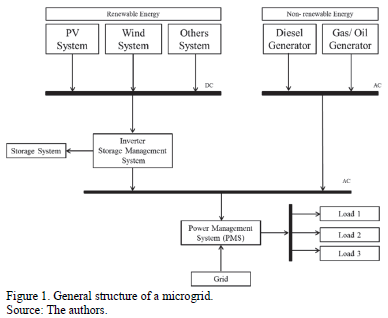
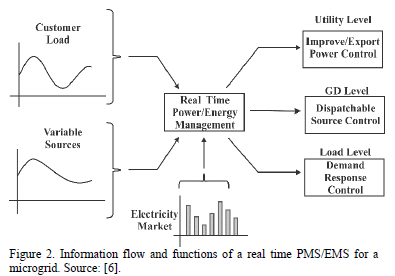
<body><![CDATA[<p><font size="2" face="Verdana, Arial, Helvetica, sans-serif">For this reason, the aim of this work is to meet the   manifest need. In order to achieve this, the paper begins with the generalities   and types of microgrids. Next, the proposed design methodology and additional   technical considerations are presented. Based on this, we proceed to show the   operation of a microgrid to be located in university facilities, in order to facilitate the understanding of the   microgrid operation, for which we considered various generation and load   scenarios. Finally, the conclusions of the work are presented.</font></p>     <p> </p>     <p><font size="3" face="Verdana, Arial, Helvetica, sans-serif"><b>2. General structure of a microgrid</b></font></p>     <p><font size="2" face="Verdana, Arial, Helvetica, sans-serif">A microgrid is defined as a system consisting of   generation sources, storage equipment, and electrically connected loads, to   meet a determined energy demand. It can operate connected to the main grid in   medium voltage or low voltage, or isolated from the same &#91;2&#93;.</font></p>     <p><font size="2" face="Verdana, Arial, Helvetica, sans-serif">Energy sources in a microgrid can be renewable (e.g.   photovoltaic, wind, thermal and geothermal generation, biomass, tidal and   cogeneration, etc.), conventional in situ (e.g. diesel thermal plants) or the   same electric grid &#91;3&#93;.</font></p>     <p><font size="2" face="Verdana, Arial, Helvetica, sans-serif">The current trend focuses on the use of renewable energies   in the majority of cases, leaving conventional generation for exceptional   cases, such as &#91;4&#93; details.</font></p>     <p><font size="2" face="Verdana, Arial, Helvetica, sans-serif"><a href="#fig091">Fig. 1</a> shows the general structure of a microgrid, formed   by different energy generation systems (conventional and unconventional),   energy storage system, and power management units (e.g. converter, grid-tied   inverter, pure inverter, regulator &#91;5&#93;) for the system operation and the   possible connection to the grid.</font></p>     <p align="center"><font size="2" face="Verdana, Arial, Helvetica, sans-serif"><a name="fig091"></a></font><img src="/img/revistas/dyna/v82n192/v82n192a13fig01.gif"></p>     <p><font size="2" face="Verdana, Arial, Helvetica, sans-serif">The most advanced   microgrids have a power management strategy (PMS) and an energy management   strategy (EMS) &#91;6&#93;, which are described in the information flow diagram (<a href="#fig02">Fig.   2</a>). These management functions require a communication infrastructure   consisting of smart metering equipment &#91;4,7&#93;.</font></p>     <p align="center"><font size="2" face="Verdana, Arial, Helvetica, sans-serif"><a name="fig02"></a></font><img src="/img/revistas/dyna/v82n192/v82n192a13fig02.gif"></p>     ]]></body>
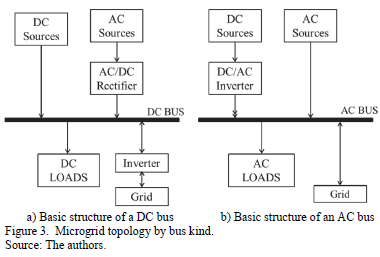
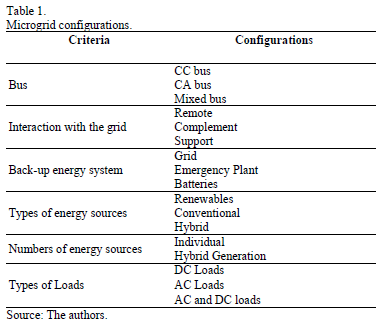
<body><![CDATA[<p><font size="2" face="Verdana, Arial, Helvetica, sans-serif">The information is analyzed in real time to determine the   load, to prioritize the renewable generation, calculate the power flow, make   connections to the grid, operate conventional generators, as well as storing   energy and using it according to the criteria of operation.</font></p>     <p><font size="2" face="Verdana, Arial, Helvetica, sans-serif">Although storage systems increase the investment of the   project, the implementation ensures a continuous flow in the load supply.</font></p>     <p> </p>     <p><font size="3" face="Verdana, Arial, Helvetica, sans-serif"><b>3. Microgrids topologies</b></font></p>     <p><font size="2" face="Verdana, Arial, Helvetica, sans-serif">To set the proper   design of a microgrid, it is necessary to determine its configuration according   to the needs to be satisfied.</font></p>     <p><font size="2" face="Verdana, Arial, Helvetica, sans-serif">Microgrids can be designed according to criteria such as   connection with the grid, support, relations with types and number of energy   sources and according to load. The most common configurations are shown in <a href="#tab01">Table 1</a>. The following are the first two classes.</font></p>     <p align="center"><font size="2" face="Verdana, Arial, Helvetica, sans-serif"><a name="tab01"></a></font><img src="/img/revistas/dyna/v82n192/v82n192a13tab01.gif"></p>     <p><font size="2" face="Verdana, Arial, Helvetica, sans-serif"><b><i>3.1. According to the type of bus</i></b></font></p>     <p><font size="2" face="Verdana, Arial, Helvetica, sans-serif">The microgrids can be classified according to the type of   bus through which the energy exchange happens: direct current (DC), alternating   current (AC) or mixed &#91;2&#93;, which depends on the load.</font></p>     <p><font size="2" face="Verdana, Arial, Helvetica, sans-serif"><a href="#fig03">Fig. 3.a)</a> shows the basic structure of a microgrid with AC   source that requires a rectifier to supply power. Similarly, <a href="#fig03">Fig. 3b)</a> shows a   microgrid with DC load that requires and inverter to charge the AC loads. Both   types of microgrids can be connected to the grid, taking into account the   signal conversion required to charge loads.</font></p>     ]]></body>
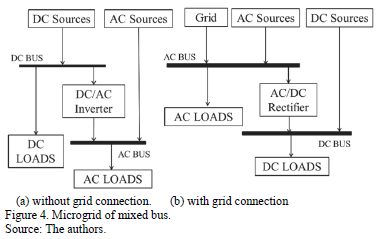
<body><![CDATA[<p align="center"><font size="2" face="Verdana, Arial, Helvetica, sans-serif"> <a name="fig03"></a></font><img src="/img/revistas/dyna/v82n192/v82n192a13fig03.gif"></p>     <p><font size="2" face="Verdana, Arial, Helvetica, sans-serif"><a href="#fig04">Fig. 4</a> shows examples of microgrids of mixed bus, which   describe configurations for AC and DC loads.</font></p>     <p align="center"><font size="2" face="Verdana, Arial, Helvetica, sans-serif"><a name="fig04"></a></font><img src="/img/revistas/dyna/v82n192/v82n192a13fig04.gif"></p>     <p><font size="2" face="Verdana, Arial, Helvetica, sans-serif"><b><i>3.2. According to the level of interaction with the grid</i></b></font></p>     <p><font size="2" face="Verdana, Arial, Helvetica, sans-serif">The interaction of a microgrid with the main grid and the   loads allows classifying microgrids into three types: remote microgrids,   complementary microgrids and support microgrids &#91;8&#93;.</font></p>     <p><font size="2" face="Verdana, Arial, Helvetica, sans-serif">The remote microgrids are those that are located in   distant areas or islands where it is too expensive to make the interconnection   to the main grid. Natural gas, diesel, biomass or renewable resources available   in the area are often used.</font></p>     <p><font size="2" face="Verdana, Arial, Helvetica, sans-serif">The microgrids connected to the grid of particular or   complementary applications are those that are used to meet a given load, and   that from its connection to the grid, increase the reliability of the energy   supply.</font></p>     <p><font size="2" face="Verdana, Arial, Helvetica, sans-serif">The support microgrids are also connected, although they   generate a considerable percentage of energy. Its installation is ideal in   areas with limited availability of fossil fuels.</font></p>     <p> </p>     <p><font size="3" face="Verdana, Arial, Helvetica, sans-serif"><b>4. Methodology for the design of microgrids</b></font></p>     ]]></body>
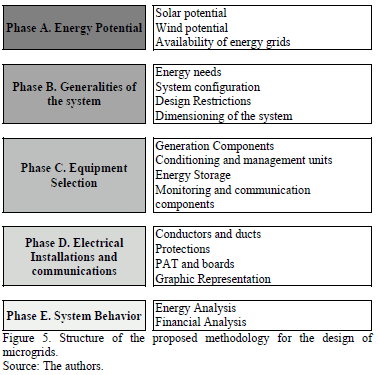
<body><![CDATA[<p><font size="2" face="Verdana, Arial, Helvetica, sans-serif">The design of a microgrid is complex due to factors   related to the renewable and conventional generation, the system configuration,   the dimensioning and components selection, and the analysis of the operation.</font></p>     <p><font size="2" face="Verdana, Arial, Helvetica, sans-serif">Most of the guidelines required for the design of   generation systems, energy management and integration with the grid associated   with a microgrid are scattered around in different places, while the technical   requirements of the electrical installations are found in codes, standards   and/or regulations of general application &#91;9,10&#93;.</font></p>     <p><font size="2" face="Verdana, Arial, Helvetica, sans-serif">Additionally, the financial viability analysis of the microgrid   must be given to the designer &#91;9,10&#93;.</font></p>     <p><font size="2" face="Verdana, Arial, Helvetica, sans-serif">Therefore, it was considered necessary to establish a   sequential approach as a tool for the assisted design of microgrids that   explains the most important considerations about it. This methodology consists   of five phases and is presented in <a href="#fig05">Fig. 5</a>.</font></p>     <p align="center"><font size="2" face="Verdana, Arial, Helvetica, sans-serif"><a name="fig05"></a></font><img src="/img/revistas/dyna/v82n192/v82n192a13fig05.gif"></p>     <p><font size="2" face="Verdana, Arial, Helvetica, sans-serif">This methodological approach is based on the design   experience of three (3) microgrids to be implemented in the central campus and   the Parque Tecnol&oacute;gico Guatiguar&aacute; (PTG) of the <i>Universidad Industrial de   Santander</i>, based on research carried out by Osma &#91;9&#93;, Rey and Vergara &#91;10&#93;.</font></p>     <p><font size="2" face="Verdana, Arial, Helvetica, sans-serif"><b><i>4.1. Energy potential</i></b></font></p>     <p><font size="2" face="Verdana, Arial, Helvetica, sans-serif">A microgrid can incorporate both renewable energy sources   (e.g. photovoltaic, wind, biomass) and conventional sources (e.g. diesel fuel,   gasoline), and also, have support from electric and natural gas networks.</font></p>     <p><font size="2" face="Verdana, Arial, Helvetica, sans-serif"><b>4.1.1. Solar potential</b></font></p>     <p><font size="2" face="Verdana, Arial, Helvetica, sans-serif">The historical global solar radiation must be quantified;   either by consulting solar maps or by monitoring in the site.</font></p>     ]]></body>
<body><![CDATA[<p><font size="2" face="Verdana, Arial, Helvetica, sans-serif">These data allow analyzing typical and extreme conditions   of operation of photovoltaic panels as well as the potential benefit of solar   static or dynamic tracking.</font></p>     <p><font size="2" face="Verdana, Arial, Helvetica, sans-serif"><b>4.1.2. Wind potential</b></font></p>     <p><font size="2" face="Verdana, Arial, Helvetica, sans-serif">Regarding the wind   potential, it must be set from monitoring the speed and direction of the wind,   is expressed using a wind rose and a histogram of the frequency of the wind   speed.</font></p>     <p><font size="2" face="Verdana, Arial, Helvetica, sans-serif">Data analysis allows the energy potential per square meter   to be established and the utility that this resource could offer, either for   energy generation or natural ventilation.</font></p>     <p><font size="2" face="Verdana, Arial, Helvetica, sans-serif"><b>4.1.3. Availability of other   energy sources </b></font></p>     <p><font size="2" face="Verdana, Arial, Helvetica, sans-serif">The access to biomass, natural gas, diesel fuel and   gasoline, among others must be studied. It is important to note that these   sources involve thermal processes and, consequently, generate greenhouse gases.</font></p>     <p><font size="2" face="Verdana, Arial, Helvetica, sans-serif"><b><i>4.2. Generalities of the microgrid</i></b></font></p>     <p><font size="2" face="Verdana, Arial, Helvetica, sans-serif">In this phase, the dimensioning of the system based on the   study of energy demand, the configuration of the microgrid required and the   design restrictions is made.</font></p>     <p><font size="2" face="Verdana, Arial, Helvetica, sans-serif"><b>4.2.1. Energy needs</b></font></p>     <p><font size="2" face="Verdana, Arial, Helvetica, sans-serif">The   quantification of the demand is made based on load monitoring and the desired   technical characteristics of the microgrid (e.g. autonomy and reliability).</font></p>     ]]></body>
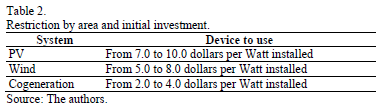
<body><![CDATA[<p><font size="2" face="Verdana, Arial, Helvetica, sans-serif"><b>4.2.2. Microgrid configuration</b></font></p>     <p><font size="2" face="Verdana, Arial, Helvetica, sans-serif">The configuration of a microgrid is defined primarily   according to energy needs and energy sources available on site.</font></p>     <p><font size="2" face="Verdana, Arial, Helvetica, sans-serif"><b>4.2.3. Design restrictions</b></font></p>     <p><font size="2" face="Verdana, Arial, Helvetica, sans-serif">The maximum installed capacity (<i>CIMax</i>) of each   generation systems can be restricted according to the energy demand on site,   the initial investment and the area.</font></p>     <p><img src="/img/revistas/dyna/v82n192/v82n192a13eq01.gif"></p>     <p><font size="2" face="Verdana, Arial, Helvetica, sans-serif">Based on the energy needs to be met, the installed </font><font size="2" face="Verdana, Arial, Helvetica, sans-serif">capacity for energy demand (<i>CID</i>)   for generation systems is established.</font></p>     <p><font size="2" face="Verdana, Arial, Helvetica, sans-serif">The installed capacity   according to the initial investment (<i>CIII</i>) is calculated based on the   value per Watt installed. <a href="#tab02">Table 2</a> presents the cost associated in Colombia for   three types of systems as an example.</font></p>     <p align="center"><font size="2" face="Verdana, Arial, Helvetica, sans-serif"> <a name="tab02"></a></font><img src="/img/revistas/dyna/v82n192/v82n192a13tab02.gif"></p>     <p><font size="2" face="Verdana, Arial, Helvetica, sans-serif">Regarding the boundary area of the project, an analysis   should be undertaken by a generation system. For example, according to &#91;9&#93;, the   maximum installed capacity due to the area available (<i>CIA</i>) for a   photovoltaic system can be expressed by (2) where A is the area in square   meters.</font></p>     <p><img src="/img/revistas/dyna/v82n192/v82n192a13eq02.gif"></p>     ]]></body>
<body><![CDATA[<p><font size="2" face="Verdana, Arial, Helvetica, sans-serif"><b>4.2.4. Dimensioning of the system</b></font></p>     <p><font size="2" face="Verdana, Arial, Helvetica, sans-serif">The next step is to proceed to do the dimensioning of   generation systems, as is shown in &#91;9,10&#93;, thereby establishing a block diagram   of the microgrid to associate the electrical characteristics (power, voltage   and current) of each component and system flow. For batteries, additionally   takes into account the desired autonomy time.</font></p>     <p><font size="2" face="Verdana, Arial, Helvetica, sans-serif">Finally, the normal operating values and the system ends   and of each component are related in the block diagram, in order to provide the   necessary information for the selection of the equipment to be used.</font></p>     <p><font size="2" face="Verdana, Arial, Helvetica, sans-serif"><b><i>4.3. Equipment selection</i></b></font></p>     <p><font size="2" face="Verdana, Arial, Helvetica, sans-serif">Below are technical considerations for equipment   selection. The financial factor can also be included in the analysis.</font></p>     <p><font size="2" face="Verdana, Arial, Helvetica, sans-serif"><b>4.3.1. Generation components</b></font></p>     <p><font size="2" face="Verdana, Arial, Helvetica, sans-serif">Photovoltaic panels   should be selected according to the operating voltage level settings. They will   be on-grid type for a grid-tied system or off-grid type for the case of   stand-alone systems.</font></p>     <p><font size="2" face="Verdana, Arial, Helvetica, sans-serif">On the other hand, if there's no area restriction, one   must look for photovoltaic panels the price for which, per installed Watt, is   less than USD 2.5/W, which is typical for panels with an efficiency of   approximately 14%. The panels are responsible for 60% of the cost of a   generation system.</font></p>     <p><font size="2" face="Verdana, Arial, Helvetica, sans-serif">The selection of micro wind turbines should be based on an   analysis of the power generated by the power curve, characteristics of this and   the site wind resource; in addition, the noise level of the units should be   considered.</font></p>     <p><font size="2" face="Verdana, Arial, Helvetica, sans-serif">The wind turbines for micro-generation (&lt;3 kW) available   on the market are equipped with a power conditioning stage, so they only   require a simple connection to a barrage of operation or 24 VDC or 48 VDC.</font></p>     ]]></body>
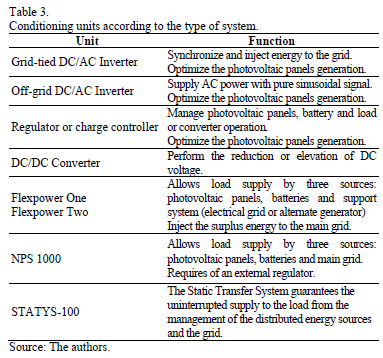
<body><![CDATA[<p><font size="2" face="Verdana, Arial, Helvetica, sans-serif">In the case of small-scale cogeneration, it is recognized   that Capstone units are the best choice.</font></p>     <p><font size="2" face="Verdana, Arial, Helvetica, sans-serif">Regarding conventional thermal generation, look for plants   of high efficiency and low noise.</font></p>     <p><font size="2" face="Verdana, Arial, Helvetica, sans-serif"><b>4.3.2. Conditioning and management   units</b></font></p>     <p><font size="2" face="Verdana, Arial, Helvetica, sans-serif">These units allow the successful use of the energy   generated, the voltage level adjustment, the interaction with other units and   with the load. Selection must be made according to the configuration of the   microgrid and power generation sources.</font></p>     <p><font size="2" face="Verdana, Arial, Helvetica, sans-serif">Some of these units are described in <a href="#tab03">Table 3</a>. The most relevant   parameters to be evaluated can be found in &#91;9,10&#93;.</font></p>     <p align="center"><font size="2" face="Verdana, Arial, Helvetica, sans-serif"><a name="tab03"></a></font><img src="/img/revistas/dyna/v82n192/v82n192a13tab03.gif"></p>     <p><font size="2" face="Verdana, Arial, Helvetica, sans-serif"><b>4.3.3. Energy storage (batteries)</b></font></p>     <p><font size="2" face="Verdana, Arial, Helvetica, sans-serif">The storage system configuration depends on the nominal   system voltage (<i>V<sub>syst</sub>)</i> of the battery voltage and the nominal   operating current required.</font></p>     <p><font size="2" face="Verdana, Arial, Helvetica, sans-serif">The capacity of the battery bank (<i>C<sub>bb</sub></i>)   is set with the higher value of two requirements: maximum load current (<i>CB<sub>charge</sub></i>)   and maximum discharge current (<i>CB<sub>discharge</sub></i>).</font></p>     <p><font size="2" face="Verdana, Arial, Helvetica, sans-serif">Because the charging process must be done at a rate no   greater than 20% of the nominal battery capacity, CB<sub>charge</sub> can be   calculated according to &#91;9&#93; as expressed in (3).</font></p>     ]]></body>
<body><![CDATA[<p><img src="/img/revistas/dyna/v82n192/v82n192a13eq03.gif"></p>     <p><font size="2" face="Verdana, Arial, Helvetica, sans-serif">Nominal discharge capacity is determined according to &#91;9&#93;,   taken from (4), and considers compensation for quick discharge (FCDR), the   depth of discharge (PD) and the system efficiency (<font face="Symbol">h</font>).</font></p>     <p><font size="2" face="Verdana, Arial, Helvetica, sans-serif"><img src="/img/revistas/dyna/v82n192/v82n192a13eq04.gif"> </font></p>     <p><font size="2" face="Verdana, Arial, Helvetica, sans-serif"><b>4.3.4. Monitoring and   communication components</b></font></p>     <p><font size="2" face="Verdana, Arial, Helvetica, sans-serif">These components are intended   to facilitate the tracking and control of the operation of the system, as well   as providing sufficient data for its energy analysis. Some management units   have these functions integrated, which reduces the required infrastructure.</font></p>     <p><font size="2" face="Verdana, Arial, Helvetica, sans-serif">It is recommended that   information be provided in an open format, to facilitate the development of an   analysis and visualization application.</font></p>     <p><font size="2" face="Verdana, Arial, Helvetica, sans-serif"><b><i>4.4. Electrical and complimentary Installations</i></b></font></p>     <p><font size="2" face="Verdana, Arial, Helvetica, sans-serif">This phase includes the dimensioning of conductors, ducts,   protection and earthing system.</font></p>     <p><font size="2" face="Verdana, Arial, Helvetica, sans-serif"><b>4.4.1. Conductors and ducts</b></font></p>     <p><font size="2" face="Verdana, Arial, Helvetica, sans-serif">In Colombia, what is indicated in NTC 2050 should be applied,   particularly sections 220 and 310. For DC areas of the microgrid the   indications of Section 690 can be used. This requires the use of unipolar   cables type SE, UF and USE.</font></p>     ]]></body>
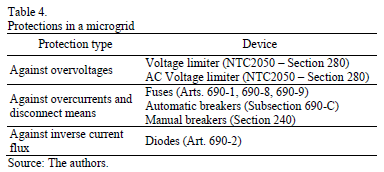
<body><![CDATA[<p><font size="2" face="Verdana, Arial, Helvetica, sans-serif">The use of flexible cable is recommended when mobile parts   exist such as photovoltaic trackers, in order to withstand the mechanical   stress (see section 400 of the NTC-2050).</font></p>     <p><font size="2" face="Verdana, Arial, Helvetica, sans-serif">In terms of regulation between the feeder and the final   load, you must comply with the literal 210-19d).</font></p>     <p><font size="2" face="Verdana, Arial, Helvetica, sans-serif"><b>4.4.2. Protections</b></font></p>     <p><font size="2" face="Verdana, Arial, Helvetica, sans-serif">A microgrid must have different means to safeguard the   lives of individuals and the integrity of its components, as presented in <a href="#tab04">Table   4</a>.</font></p>     <p align="center"><font size="2" face="Verdana, Arial, Helvetica, sans-serif"><a name="tab04"></a></font> <img src="/img/revistas/dyna/v82n192/v82n192a13tab04.gif"></p>     <p><font size="2" face="Verdana, Arial, Helvetica, sans-serif"><b>4.4.3. Earthing system and boards</b></font></p>     <p><font size="2" face="Verdana, Arial, Helvetica, sans-serif">The earthing system should be in accordance with NTC-2050   (section 250 and subsection 690-E). System boards must comply with the   discussion in section 370, 373 and 384 and Article 110-16 of the NTC-2050.</font></p>     <p><font size="2" face="Verdana, Arial, Helvetica, sans-serif"><b>4.4.4. Graphic representation </b></font></p>     <p><font size="2" face="Verdana, Arial, Helvetica, sans-serif">This consists of block   diagrams of the microgrid and it aims to describe the system components and the   technical characteristics. Additionally, it involves the process of elaborating   plant electrical drawings, details and line diagrams.</font></p>     <p><font size="2" face="Verdana, Arial, Helvetica, sans-serif"><b><i>4.5. System behavior</i></b></font></p>     ]]></body>
<body><![CDATA[<p><font size="2" face="Verdana, Arial, Helvetica, sans-serif">The system behavior can be described from examining the   energy analysis and financial analysis.</font></p>     <p><font size="2" face="Verdana, Arial, Helvetica, sans-serif"><b>4.5.1. Energy analysis</b></font></p>     <p><font size="2" face="Verdana, Arial, Helvetica, sans-serif">The energy analysis   refers to understanding what, how, where, and how much is consumed. The   quantification must be made from the modeling of the microgrid as a system   based on a graph, described in interrelated blocks (components) &#91;9&#93;.</font></p>     <p><font size="2" face="Verdana, Arial, Helvetica, sans-serif">The modeling can be exhaustive, when the mathematical   formulation is based on the detailed operation of each component, or simplified   if considering efficiency ratios between output and input variable.</font></p>     <p><font size="2" face="Verdana, Arial, Helvetica, sans-serif">Subsequently, with monitoring data of operation, the   energy analysis can be made directly.</font></p>     <p><font size="2" face="Verdana, Arial, Helvetica, sans-serif"><b>4.5.2. Financial analysis</b></font></p>     <p><font size="2" face="Verdana, Arial, Helvetica, sans-serif">In case of interest,   regarding the financial viability of the microgrid, it can be analyzed as an   investment project, for which the projection of cash flow during its lifetime   and the determination of indicators such as net present value (NPV) and   internal rate of return (IRR) are required to be contemplated.</font></p>     <p> </p>     <p><font size="3" face="Verdana, Arial, Helvetica, sans-serif"><b>5. Complimentary technical considerations </b></font></p>     <p><font size="2" face="Verdana, Arial, Helvetica, sans-serif">The proposed methodology considered the design of the   microgrid under general conditions; if it is of interest to the designer to   establish a system with a more technical level, it is necessary to address the   following issues.</font></p>     ]]></body>
<body><![CDATA[<p><font size="2" face="Verdana, Arial, Helvetica, sans-serif"><b><i>5.1. Solar tracking</i></b></font></p>     <p><font size="2" face="Verdana, Arial, Helvetica, sans-serif">Solar trackers are devices that serve to increase the   generation of a photovoltaic system, allowing a better uptake of solar   radiation to the same area &#91;11&#93;. They can be static or dynamic. The latter can   operate passively (absence of electrical and/or mechanical elements) or   actively, for example with servomotors &#91;12-14&#93;.</font></p>     <p><font size="2" face="Verdana, Arial, Helvetica, sans-serif">Static solar tracking is maximized when considering an   inclination close to the latitude and with an orientation opposite to the   direction of this.</font></p>     <p><font size="2" face="Verdana, Arial, Helvetica, sans-serif">For Colombia, this increment is less than 2% due to its   proximity to the equator &#91;9&#93;. With respect to the dynamic monitoring, the solar   radiation increment for Colombia is between 20% and 30%.</font></p>     <p><font size="2" face="Verdana, Arial, Helvetica, sans-serif"><b><i>5.2. Temperature effect on photovoltaic generation</i></b></font></p>     <p><font size="2" face="Verdana, Arial, Helvetica, sans-serif">The operation of the photovoltaic panels in a tropical   environment is significantly different to what is described in the technical   specification sheets, due to the increasing operating temperature of the   semiconductor material &#91;9&#93;.</font></p>     <p><font size="2" face="Verdana, Arial, Helvetica, sans-serif">This produces   variations in the values of current and voltage operations of the panel to the   point of reducing the power generation by up to 15%, mainly because the voltage   decreases. Due to such variations one should adjust for the system operation   values and the dimensioning of the components.</font></p>     <p><font size="2" face="Verdana, Arial, Helvetica, sans-serif">The effect of temperature on the generation of a specific   PV panel can be analyzed as stated in &#91;9,10&#93;.</font></p>     <p><font size="2" face="Verdana, Arial, Helvetica, sans-serif"><b><i>5.3. Limitations of the DC current supply</i></b></font></p>     <p><font size="2" face="Verdana, Arial, Helvetica, sans-serif">The microgrids with DC loads involve a higher level of   efficiency due to the omission of the inversion and rectification processes.   However, the inflexibility in the voltage ranges of some devices and the lower   performance of these compared to their AC counterparts mean that, at the   moment, their use does not represent minor energy losses &#91;9&#93;.</font></p>     ]]></body>
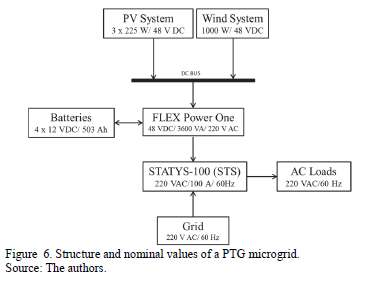
<body><![CDATA[<p><font size="2" face="Verdana, Arial, Helvetica, sans-serif"><b><i>5.4. Wind potential for low wind speeds</i></b></font></p>     <p><font size="2" face="Verdana, Arial, Helvetica, sans-serif">It is recommended to avoid the use of micro wind turbines   when the wind potential is less than 40 kWh/m<sup>2</sup> per year (typical of   places where the wind speed is below 2 m/s), since most wind turbines do not   operate in such conditions &#91;9&#93;.</font></p>     <p> </p>     <p><font size="3" face="Verdana, Arial, Helvetica, sans-serif"><b>6. Considerations for microgrid's operation </b></font></p>     <p><font size="2" face="Verdana, Arial, Helvetica, sans-serif">In order to describe   the possible energy behavior of a microgrid, an analysis is undertaken for the   case of the microgrid of the Energy Integration Laboratory (EIL) located on the   PTG &#91;10&#93; in Piedecuesta, Santander. The general structure of this microgrid can   be seen in <a href="#fig06">Fig. 6</a>, which also shows the nominal values of the equipment for the   proposed design.</font></p>     <p align="center"><font size="2" face="Verdana, Arial, Helvetica, sans-serif"><a name="fig06"></a></font><img src="/img/revistas/dyna/v82n192/v82n192a13fig06.gif"></p>     <p><font size="2" face="Verdana, Arial, Helvetica, sans-serif">This experimental   microgrid aims to appropriate technology and to study operation scenarios to   support teacher training and future research, which is why it has been   considered a battery bank despite having a stable connection to the grid.</font></p>     <p><font size="2" face="Verdana, Arial, Helvetica, sans-serif">Below are considerations on the modeling of the microgrid   components in order to establish its performance in real time, using MATLAB ®   to do so.</font></p>     <p><font size="2" face="Verdana, Arial, Helvetica, sans-serif"><b><i>6.1. Behavior of the solar radiation and wind</i></b></font></p>     <p><font size="2" face="Verdana, Arial, Helvetica, sans-serif">The weather station   installed has allowed for it to be concluded that the average daily solar   radiation in the PTG is 4.27 kWh/m<sup>2</sup>. It is observed that the average   peak value is equal to 678 W/m<sup>2</sup> and the maximum peak value is 994   W/m<sup>2</sup>.</font></p>     ]]></body>
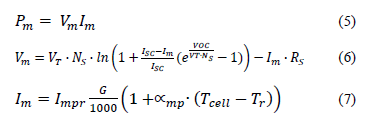
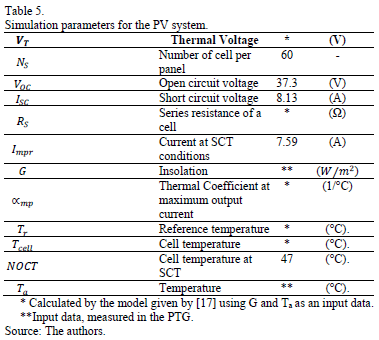
<body><![CDATA[<p><font size="2" face="Verdana, Arial, Helvetica, sans-serif">Furthermore, it is observed that the wind potential is   low, since almost 60% of the time the speed is between 0 and 1 m/s. While only   20% of the time the speed exceeds 3 m/s, values that have greater potential for   power generation.</font></p>     <p><font size="2" face="Verdana, Arial, Helvetica, sans-serif"><b><i>6.2. Photovoltaic array and MPPT regulator model</i></b></font></p>     <p><font size="2" face="Verdana, Arial, Helvetica, sans-serif">The PV panel model considers radiation and temperature as an   input to establish the values of voltage and current of the panel operation. In <a href="#fig07">Fig. 7</a> one can see the characteristic curve of the selected panel for different   values of radiation. The maximum power value is obtained for a radiation of 1   000 W/m<sup>2</sup> at 25°C (SCT conditions).</font></p>     <p align="center"><font size="2" face="Verdana, Arial, Helvetica, sans-serif"><a name="fig07"></a></font><img src="/img/revistas/dyna/v82n192/v82n192a13fig07.gif"></p>     <p><font size="2" face="Verdana, Arial, Helvetica, sans-serif">The maximum operating condition for a panel of solar   radiation and ambient temperature given is calculated from (5), depending on   the maximum power voltage <img src="/img/revistas/dyna/v82n192/v82n192a13eq011.gif"> given by (6) and the maximum   power current <img src="/img/revistas/dyna/v82n192/v82n192a13eq012.gif"> given by (7) &#91;16&#93;.</font></p>     <p><img src="/img/revistas/dyna/v82n192/v82n192a13eq0507.gif"></p>     <p><font size="2" face="Verdana, Arial, Helvetica, sans-serif"><a href="#tab05">Table 5</a> summarizes the values used for the simulation of   the photovoltaic system.</font></p>     <p align="center"><font size="2" face="Verdana, Arial, Helvetica, sans-serif"><a name="tab05"></a></font><img src="/img/revistas/dyna/v82n192/v82n192a13tab05.gif"></p>     <p><font size="2" face="Verdana, Arial, Helvetica, sans-serif">As the photovoltaic system of the microgrid consists of   three panels in parallel, the output power is three times the value of <img src="/img/revistas/dyna/v82n192/v82n192a13eq016.gif">, given by (8).</font></p>     <p><img src="/img/revistas/dyna/v82n192/v82n192a13eq08.gif"></p>     ]]></body>
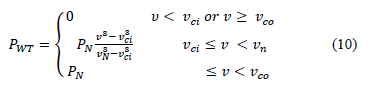
<body><![CDATA[<p><font size="2" face="Verdana, Arial, Helvetica, sans-serif">To ensure the operation of the photovoltaic system under   maximum power, a MPPT regulator is connected &#91;17&#93;. The output power of the   regulator <img src="/img/revistas/dyna/v82n192/v82n192a13eq018.gif"> is given by (9):</font></p>     <p><img src="/img/revistas/dyna/v82n192/v82n192a13eq09.gif"></p>     <p><font size="2" face="Verdana, Arial, Helvetica, sans-serif">Where, <img src="/img/revistas/dyna/v82n192/v82n192a13eq020.gif"> corresponds to the power of the   array (W), and <img src="/img/revistas/dyna/v82n192/v82n192a13eq021.gif"> corresponds to the efficiency of   equipment, specified </font></p>     <p><font size="2" face="Verdana, Arial, Helvetica, sans-serif">by   the manufacturer at 99%. It is important to note that this is valid as long as   the input voltage of the array is within the operating voltage range of the   regulator and the output current does not exceed the maximum limit specified in   the equipment's operation.</font></p>     <p><font size="2" face="Verdana, Arial, Helvetica, sans-serif"><b><i>6.3. Wind turbine model</i></b></font></p>     <p><font size="2" face="Verdana, Arial, Helvetica, sans-serif">The wind turbine model considers the instantaneous wind   speed &#91;7&#93; as input data. Therefore, the power output of the wind turbine <img src="/img/revistas/dyna/v82n192/v82n192a13eq035.gif"> is given by (10).</font></p>     <p><img src="/img/revistas/dyna/v82n192/v82n192a13eq10.gif"></p>     <p><font size="2" face="Verdana, Arial, Helvetica, sans-serif">Where <font face="Symbol">u</font> is the   wind speed (m/s), <img src="/img/revistas/dyna/v82n192/v82n192a13eq037.gif"> is   the initial speed (m/s) equal to 0.5 m/s, <img src="/img/revistas/dyna/v82n192/v82n192a13eq038.gif">;   the cutting speed (m/s) is equal to 5 m/s, <img src="/img/revistas/dyna/v82n192/v82n192a13eq039.gif">,   which corresponds to the nominal speed (m/s) which is equal to 2.5 m/s, <img src="/img/revistas/dyna/v82n192/v82n192a13eq040.gif"> which   is the nominal power of the equipment (W) equal to 1000 W, according to the   manufacturer's data.</font></p>     <p><font size="2" face="Verdana, Arial, Helvetica, sans-serif"><b><i>6.4. Inverter model</i></b></font></p>     <p><font size="2" face="Verdana, Arial, Helvetica, sans-serif">Under the assumptions made for   the simulation, the output power of the inverter <img src="/img/revistas/dyna/v82n192/v82n192a13eq041.gif"> is modeled according to &#91;15&#93; as   shown in (11), based on the input power <img src="/img/revistas/dyna/v82n192/v82n192a13eq042.gif">and the efficiency <font face="Symbol">h</font> in   function of the normalized input power or operating point where <img src="/img/revistas/dyna/v82n192/v82n192a13eq040.gif"> is the nominal power of the   equipment, which corresponds to 3.6 kW.</font></p>     ]]></body>
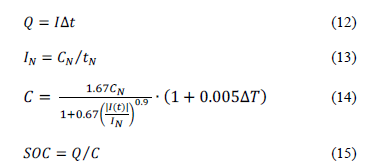
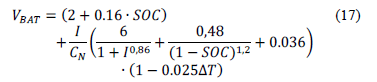
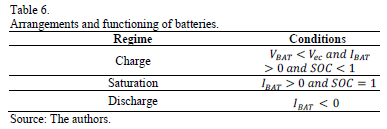
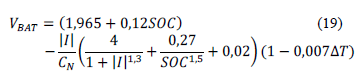
<body><![CDATA[<p><img src="/img/revistas/dyna/v82n192/v82n192a13eq11.gif"></p>     <p><font size="2" face="Verdana, Arial, Helvetica, sans-serif"><b><i>6.5. Battery model</i></b></font></p>     <p><font size="2" face="Verdana, Arial, Helvetica, sans-serif">To   describe the process of charging and discharging of the batteries the model   presented in &#91;18&#93; and &#91;19&#93; is </font><font size="2" face="Verdana, Arial, Helvetica, sans-serif">considered, which is set by the   expressions of the load (12), the nominal current (13), the load in a given   case (14) and the state of charge (15).</font></p>     <p><img src="/img/revistas/dyna/v82n192/v82n192a13eq1215.gif"></p>     <p><font size="2" face="Verdana, Arial, Helvetica, sans-serif">Where <img src="/img/revistas/dyna/v82n192/v82n192a13eq051.gif"> is the quantity of battery   charge (A-h), <img src="/img/revistas/dyna/v82n192/v82n192a13eq052.gif"> is the current of the battery   (A),<img src="/img/revistas/dyna/v82n192/v82n192a13eq053.gif"> is the time in which the battery   acquires the charge (h), <img src="/img/revistas/dyna/v82n192/v82n192a13eq054.gif"> is the nominal current (A), <img src="/img/revistas/dyna/v82n192/v82n192a13eq055.gif"> is the nominal storage capacity   (A-h),<img src="/img/revistas/dyna/v82n192/v82n192a13eq056.gif">is the nominal regime of charge   and discharge of the battery (h) , <img src="/img/revistas/dyna/v82n192/v82n192a13eq057.gif"> is the accumulator heating   (presumably identical for all elements) in comparison with the ambient   temperature (oC) and <img src="/img/revistas/dyna/v82n192/v82n192a13eq058.gif"> is the state of charge.</font></p>     <p><font size="2" face="Verdana, Arial, Helvetica, sans-serif">Three states are considered: charging, saturation and   discharging, from the ranges described in <a href="#tab06">Table 6</a>.</font></p>     <p align="center"><font size="2" face="Verdana, Arial, Helvetica, sans-serif"><a name="tab06"></a></font><img src="/img/revistas/dyna/v82n192/v82n192a13tab06.gif"></p>     <p><font size="2" face="Verdana, Arial, Helvetica, sans-serif">Where <img src="/img/revistas/dyna/v82n192/v82n192a13eq059.gif"> is the ending charge (V) and is   given by (16).</font></p>     <p><img src="/img/revistas/dyna/v82n192/v82n192a13eq16.gif"></p>     <p><font size="2" face="Verdana, Arial, Helvetica, sans-serif">The expressions describing the voltage in the batteries   during different intervals are shown in (17), (18) and (19).</font></p>     ]]></body>
<body><![CDATA[<p><img src="/img/revistas/dyna/v82n192/v82n192a13eq17.gif"></p>     <p><font size="2" face="Verdana, Arial, Helvetica, sans-serif">Model of the voltage of the battery for saturation regime:</font></p>     <p><img src="/img/revistas/dyna/v82n192/v82n192a13eq18.gif"></p>     <p><font size="2" face="Verdana, Arial, Helvetica, sans-serif">Model of the voltage of a battery for discharge regime: </font></p>     <p><img src="/img/revistas/dyna/v82n192/v82n192a13eq19.gif"></p>     <p><font size="2" face="Verdana, Arial, Helvetica, sans-serif">The model can generate a discontinuity in the battery   voltage between the saturation and discharge zone. To ensure continuity to the   function it is possible to linearize an interval that allows connecting the   discontinuous points of the function &#91;20&#93;.</font></p>     <p><font size="2" face="Verdana, Arial, Helvetica, sans-serif"><b><i>6.6. Charge controller</i></b></font></p>     <p><font size="2" face="Verdana, Arial, Helvetica, sans-serif">The main function of   the charge controller is to ensure the charging and discharging processes of   the batteries as well as to prevent deep overcharges and overdischarges that   limit its lifetime.</font></p>     <p><font size="2" face="Verdana, Arial, Helvetica, sans-serif">This equipment can be modeled as in (20), and will have an   efficiency value <img src="/img/revistas/dyna/v82n192/v82n192a13eq066.gif">equal to 97.5%, according to the   manufacturer.</font></p>     <p><img src="/img/revistas/dyna/v82n192/v82n192a13eq20.gif"></p>     ]]></body>
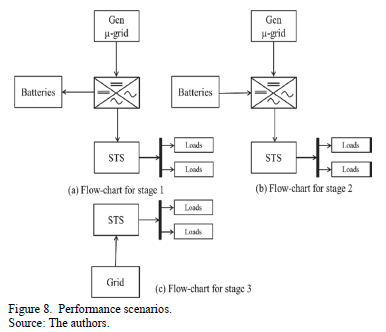
<body><![CDATA[<p><font size="2" face="Verdana, Arial, Helvetica, sans-serif"><b><i>6.7. Static transfer switch - STS</i></b></font></p>     <p><font size="2" face="Verdana, Arial, Helvetica, sans-serif">The main function of the STS is to allow transfer between   the generation of the microgrid and the public grid, to meet the different   charge conditions. This transfer depends on the availability of power   generation systems and storage, and allows an increase in the reliability of   the power supply.</font></p>     <p><font size="2" face="Verdana, Arial, Helvetica, sans-serif">The modeling can be done from (21), and the efficiency   value <img src="/img/revistas/dyna/v82n192/v82n192a13eq068.gif"> will be equal to 98.7%,   according to the manufacturer. </font></p>     <p><img src="/img/revistas/dyna/v82n192/v82n192a13eq21.gif"></p>     <p><font size="2" face="Verdana, Arial, Helvetica, sans-serif"><b><i>6.8. Operation analysis</i></b></font></p>     <p><font size="2" face="Verdana, Arial, Helvetica, sans-serif">This analysis allows the operation of scenarios to be   established and calculates the power flows associated with them, and thus   efficiency values, charging limits of the battery and interaction with the   grid.</font></p>     <p><font size="2" face="Verdana, Arial, Helvetica, sans-serif"><a href="#fig08">Fig. 8</a> shows the flow   diagrams corresponding to three scenarios of the experimental microgrid, (a) in   situ generation of the microgrid is greater than load, (b) the load must be   served by in situ generation and batteries, and (c) the grid supplies the load   because the generation in situ and from batteries is not enough.</font></p>     <p align="center"><font size="2" face="Verdana, Arial, Helvetica, sans-serif"><a name="fig08"></a></font><img src="/img/revistas/dyna/v82n192/v82n192a13fig08.gif"></p>     <p> </p>     <p><font size="3" face="Verdana, Arial, Helvetica, sans-serif"><b>7. Study results</b></font></p>     ]]></body>

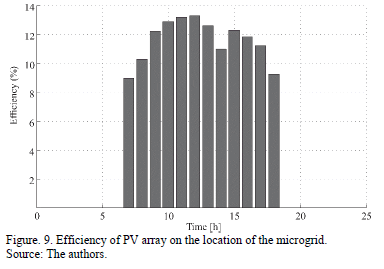
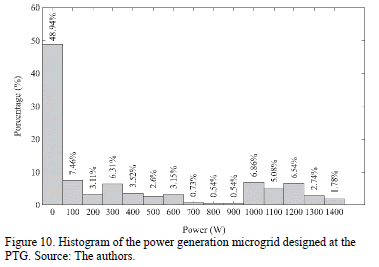
<body><![CDATA[<p><font size="2" face="Verdana, Arial, Helvetica, sans-serif">Below the   simulation results on generation, storage and energy balance of the microgrid,   located in the PTG are presented.</font></p>     <p><font size="2" face="Verdana, Arial, Helvetica, sans-serif"><b><i>7.1. Energy generation</i></b></font></p>     <p><font size="2" face="Verdana, Arial, Helvetica, sans-serif">The analysis of the solar resource allowed it to be determined   that the photovoltaic generation is very favorable, since radiation values   close to 1000 W/m<sup>2</sup> were reached during the day.</font></p>     <p><font size="2" face="Verdana, Arial, Helvetica, sans-serif">It was also found that the wind potential of the PTG is   not significant, as the average wind speed is in the order of 1 m/s; however,   it's possible to use micro-generators.</font></p>     <p><font size="2" face="Verdana, Arial, Helvetica, sans-serif"><a href="#fig09">Fig. 9</a> shows the variation of the efficiency of the PV   array. The maximum efficiency achieved is 13.37%, allowing a maximum generation   of 668 W. Under these conditions it is estimated that   the average generation of the array is within 2.60 kWh.</font></p>     <p align="center"><font size="2" face="Verdana, Arial, Helvetica, sans-serif"><a name="fig09"></a></font><img src="/img/revistas/dyna/v82n192/v82n192a13fig09.gif"></p>     <p><font size="2" face="Verdana, Arial, Helvetica, sans-serif">It was found that the photovoltaic system injects energy   into the system only when solar radiation exceeds 15 <img src="/img/revistas/dyna/v82n192/v82n192a13eq074.gif">, since the minimum operation   voltage of the regulator is achieved only under this condition.</font></p>     <p><font size="2" face="Verdana, Arial, Helvetica, sans-serif">Because the PV generator only operates 12 hours a day, only   the wind system will be available during the remaining time. <a href="#fig10">Fig. 10</a> shows the   histogram of total renewable generation for the total hours measured as part of   this study. It is observed that for 48.94%, the power generated by the   microgrid is negligible. This is because the photovoltaic system only operates   for 12 hours a day, and over 41.3% of annual wind hours a speed of 0.5 m/s was   not exceeded &#91;10&#93;.</font></p>     <p align="center"><font size="2" face="Verdana, Arial, Helvetica, sans-serif"><a name="fig10"></a></font><img src="/img/revistas/dyna/v82n192/v82n192a13fig10.gif"></p>     <p><font size="2" face="Verdana, Arial, Helvetica, sans-serif">However, during the day   it is possible to reach maximums of 1340.2 W. To increase the generation   capacity of the microgrid, it is possible to evaluate the PV system expansion   or to use conventional generation systems that supply the load when the generation   systems of renewable sources cannot provide the required energy. For the   proposed design of the microgrid in EIL, a 6 kW diesel generator is included,   which can operate when unconventional generation systems cannot provide the   power required by the load. The energy analysis presented in this paper does   not include the above-mentioned equipment.</font></p>     ]]></body>
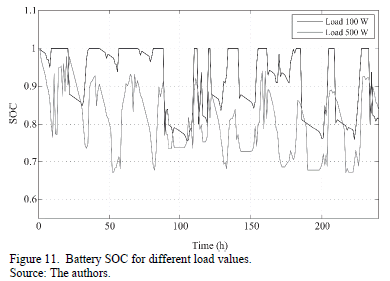
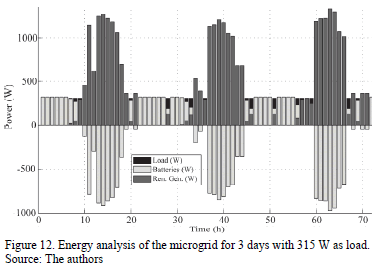
<body><![CDATA[<p><font size="2" face="Verdana, Arial, Helvetica, sans-serif"><b><i>7.1. Storage</i></b></font></p>     <p><font size="2" face="Verdana, Arial, Helvetica, sans-serif">With regard to the storage system, <a href="#fig11">Fig. 11</a> shows the   behavior of the batteries SOC for a constant load of 100 W and 500 W.</font></p>     <p align="center"><font size="2" face="Verdana, Arial, Helvetica, sans-serif"><a name="fig11"></a></font><img src="/img/revistas/dyna/v82n192/v82n192a13fig11.gif"></p>     <p><font size="2" face="Verdana, Arial, Helvetica, sans-serif">The charging process occurs because the excess power   generated by the microgrid sources with respect to the load is stored by the   batteries. They supply power to the load when the sources do not generate   enough energy, and they store surpluses that accumulate during each daily cycle.</font></p>     <p><font size="2" face="Verdana, Arial, Helvetica, sans-serif">It is observed that the SOC reaches a value of 100% in all   daily cycles for a load of 100 W, while in discharge processes it remains above   75%.</font></p>     <p><font size="2" face="Verdana, Arial, Helvetica, sans-serif">For the case of the load of 500 W, the SOC never becomes   100%, and it does not drop to the lowest possible value of SOC (60%). The   latter occurs because the STS unit states that the combined supply of renewable   generation and batteries is not sufficient to supply the load, thus it   transfers to the grid.</font></p>     <p><font size="2" face="Verdana, Arial, Helvetica, sans-serif"><b><i>7.2. Energy balance</i></b></font></p>     <p><font size="2" face="Verdana, Arial, Helvetica, sans-serif"><a href="#fig12">Fig. 12</a> shows the power values of the sources and the   batteries of the microgrid for a period of 72 hours when the load has a   constant value of 315 W.</font></p>     <p align="center"><font size="2" face="Verdana, Arial, Helvetica, sans-serif"><a name="fig12"></a></font><img src="/img/revistas/dyna/v82n192/v82n192a13fig12.gif"></p>     <p><font size="2" face="Verdana, Arial, Helvetica, sans-serif">Generation behavior is due to generation models as well as   solar radiation and wind on site. The behavior of the stored power (negative)   and delivered (positive) of the batteries, is due to an excess or shortage of   generated power.</font></p>     ]]></body>
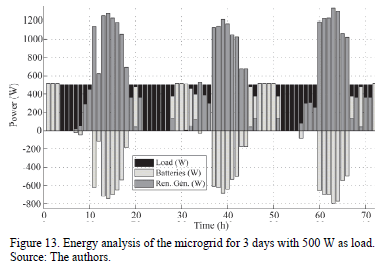
<body><![CDATA[<p><font size="2" face="Verdana, Arial, Helvetica, sans-serif">From the simulation it was found that for loads of less   than 315 W, the storage system has the ability to provide the energy required   by the load, so the STS does not need to make a generation transfer to the   grid. This type of analysis allows the power provided by the grid to be   estimated as well as an idea of seeing under what conditions the microgrid is   not capable of providing the required power.</font></p>     <p><font size="2" face="Verdana, Arial, Helvetica, sans-serif"><a href="#fig13">Fig. 13</a> shows the power   behavior of the microgrid for a load of 500 W. Because the value of the charge   is considerably high to allow battery charging in all cycles, the STS does the   commutation, allowing supply directly from the grid.</font></p>     <p align="center"><font size="2" face="Verdana, Arial, Helvetica, sans-serif"><a name="fig13"></a></font><img src="/img/revistas/dyna/v82n192/v82n192a13fig13.gif"></p>     <p><font size="2" face="Verdana, Arial, Helvetica, sans-serif">If, within the design   and operation conditions of the microgrid, power consumption of the grid is   being minimized, though a similar analysis it is possible to determine the   generation</font> <font size="2" face="Verdana, Arial, Helvetica, sans-serif">capacity of the generation   systems, the storage characteristics of the batteries and other operation   aspects to satisfy this requirement.</font></p>     <p> </p>     <p><font size="3" face="Verdana, Arial, Helvetica, sans-serif"><b>8. Conclusions </b></font></p>     <p><font size="2" face="Verdana, Arial, Helvetica, sans-serif">The study of microgrids can have an important impact if there   is a focus on solving problems such as the supply to non-interconnected zones,   since they can use the in-situ energy potential and require a low investment in   comparison with the interconnection infrastructure with the grid. </font></p>     <p><font size="2" face="Verdana, Arial, Helvetica, sans-serif">The design and implementation of pilot microgrid projects   in universities favors the technological appropriation in these applications,   especially for environmental conditions of its social influence. </font></p>     <p><font size="2" face="Verdana, Arial, Helvetica, sans-serif">In general, the design of a microgrid depends on the   designer's expertise in the interpretation of information such as energy needs   and available energy potential, as well as the level of his technical   appropriation of topics such as renewable energy systems and energy management   for such applications.</font></p>     <p><font size="2" face="Verdana, Arial, Helvetica, sans-serif">The design methodology presented is a first effort to better   establish the design of the scheme and the dimensioning of microgrids. </font></p>     ]]></body>
<body><![CDATA[<p><font size="2" face="Verdana, Arial, Helvetica, sans-serif">This methodological approach can be improved when it is   implemented by using an assisted design computer tool for optimization, which   will mean a lower financial cost and a better energetic use of the system, taking   into consideration both energy and financial analysis. In addition, this tool   could automatically perform the dimension of the electric installations.</font></p>     <p><font size="2" face="Verdana, Arial, Helvetica, sans-serif">The ad-hoc applications on energy behavior based on a modular   approach and simplified modeling of the components of a microgrid, allow the   realization of energy analysis for different scenarios of load and generation,   as was the case presented in this document. </font></p>     <p><font size="2" face="Verdana, Arial, Helvetica, sans-serif">In order to facilitate and standardize the analysis of   microgrid energy, behavior requires the development of applications that   incorporate graphical interfaces to set the desired configuration and display   results. Preliminary, it should define the generation and load analysis   scenarios, and also the relevant indicators about the quality of a microgrid. </font></p>     <p> </p>     <p><font size="3" face="Verdana, Arial, Helvetica, sans-serif"><b>References</b></font></p>     <!-- ref --><p><font size="2" face="Verdana, Arial, Helvetica, sans-serif"><b>&#91;1&#93;</b> Hamidi,V., Smith, K.S. and Wilson, R.C., Smart grid technology review within the transmission   and distribution sector, in 2010 IEEE PES Innovative Smart Grid Technologies   Conference Europe (ISGT Europe), 2010, pp. 1-8. DOI: 10.1109/ISGTEUROPE.2010.5638950</font>&nbsp;&nbsp;&nbsp;&nbsp;&nbsp;&nbsp;&nbsp;&nbsp;[&#160;<a href="javascript:void(0);" onclick="javascript: window.open('/scielo.php?script=sci_nlinks&ref=000248&pid=S0012-7353201500040001300001&lng=','','width=640,height=500,resizable=yes,scrollbars=1,menubar=yes,');">Links</a>&#160;]<!-- end-ref --><!-- ref --><p><font size="2" face="Verdana, Arial, Helvetica, sans-serif"><b>&#91;2&#93;</b> Alfonso, J., Microredes, una alternativa micro para   un mundo cada vez mas macro, Energias Renovables Magazine, Madrid, Espa&ntilde;a, pp.   18-22, 2009.    &nbsp;&nbsp;&nbsp;&nbsp;&nbsp;&nbsp;&nbsp;&nbsp;[&#160;<a href="javascript:void(0);" onclick="javascript: window.open('/scielo.php?script=sci_nlinks&ref=000249&pid=S0012-7353201500040001300002&lng=','','width=640,height=500,resizable=yes,scrollbars=1,menubar=yes,');">Links</a>&#160;]<!-- end-ref --></font></p>     <!-- ref --><p><font size="2" face="Verdana, Arial, Helvetica, sans-serif"><b>&#91;3&#93;</b> Basak,   P., Chowdhury, S., Chowdhury, S.P., Member, S. and Dey, S.H., Simulation of   microgrid in the perspective of integration of distributed energy resources,   2011.    &nbsp;&nbsp;&nbsp;&nbsp;&nbsp;&nbsp;&nbsp;&nbsp;[&#160;<a href="javascript:void(0);" onclick="javascript: window.open('/scielo.php?script=sci_nlinks&ref=000251&pid=S0012-7353201500040001300003&lng=','','width=640,height=500,resizable=yes,scrollbars=1,menubar=yes,');">Links</a>&#160;]<!-- end-ref --></font></p>     ]]></body>
<body><![CDATA[<!-- ref --><p><font size="2" face="Verdana, Arial, Helvetica, sans-serif"><b>&#91;4&#93;</b> Fossati, J.P., Revisi&oacute;n bibliogr&aacute;fica sobre   microredes inteligentes, Memoria de trabajos de difusi&oacute;n cientifica y t&eacute;cnica,   9, pp. 13-20, 2011.    &nbsp;&nbsp;&nbsp;&nbsp;&nbsp;&nbsp;&nbsp;&nbsp;[&#160;<a href="javascript:void(0);" onclick="javascript: window.open('/scielo.php?script=sci_nlinks&ref=000253&pid=S0012-7353201500040001300004&lng=','','width=640,height=500,resizable=yes,scrollbars=1,menubar=yes,');">Links</a>&#160;]<!-- end-ref --></font></p>     <!-- ref --><p><font size="2" face="Verdana, Arial, Helvetica, sans-serif"><b>&#91;5&#93;</b> Jamil, M., Hussain, B., Abu-Sara, M., Boltryk, R.J. and   Sharkh, S.M., Microgrid power electronic converters: State of the art and   future challenges, Universities Power Engineering Conference (UPEC), 2009   Proceedings of the 44th International, pp.1-5, 1,4 Sept. 2009</font>&nbsp;&nbsp;&nbsp;&nbsp;&nbsp;&nbsp;&nbsp;&nbsp;[&#160;<a href="javascript:void(0);" onclick="javascript: window.open('/scielo.php?script=sci_nlinks&ref=000255&pid=S0012-7353201500040001300005&lng=','','width=640,height=500,resizable=yes,scrollbars=1,menubar=yes,');">Links</a>&#160;]<!-- end-ref --><!-- ref --><p><font size="2" face="Verdana, Arial, Helvetica, sans-serif"><b>&#91;6&#93;</b> Katiraei,   F., Iravani, R., Hatziargyriou, N. and Dimeas, A., Microgrids management, IEEE   Power and Energy Magazine, 6 (3), pp. 54-65, 2008. DOI: 10.1109/MPE.2008.918702</font>&nbsp;&nbsp;&nbsp;&nbsp;&nbsp;&nbsp;&nbsp;&nbsp;[&#160;<a href="javascript:void(0);" onclick="javascript: window.open('/scielo.php?script=sci_nlinks&ref=000256&pid=S0012-7353201500040001300006&lng=','','width=640,height=500,resizable=yes,scrollbars=1,menubar=yes,');">Links</a>&#160;]<!-- end-ref --><!-- ref --><p><font size="2" face="Verdana, Arial, Helvetica, sans-serif"><b>&#91;7&#93;</b> Meiqin,   M., Shujuan, S. and Chang, L., Economic analysis of the microgrid with   multi-energy and electric vehicles, in 8th International Conference on Power   Electronics - ECCE Asia, 2011, pp. 2067-2072.    &nbsp;&nbsp;&nbsp;&nbsp;&nbsp;&nbsp;&nbsp;&nbsp;[&#160;<a href="javascript:void(0);" onclick="javascript: window.open('/scielo.php?script=sci_nlinks&ref=000257&pid=S0012-7353201500040001300007&lng=','','width=640,height=500,resizable=yes,scrollbars=1,menubar=yes,');">Links</a>&#160;]<!-- end-ref --></font></p>     <!-- ref --><p><font size="2" face="Verdana, Arial, Helvetica, sans-serif"><b>&#91;8&#93;</b> Ma,   C. and Hou, Y., Classified overview of microgrids and development in China, in IEEE   International Conference Energy Tech 2012, pp. 1-6.    &nbsp;&nbsp;&nbsp;&nbsp;&nbsp;&nbsp;&nbsp;&nbsp;[&#160;<a href="javascript:void(0);" onclick="javascript: window.open('/scielo.php?script=sci_nlinks&ref=000259&pid=S0012-7353201500040001300008&lng=','','width=640,height=500,resizable=yes,scrollbars=1,menubar=yes,');">Links</a>&#160;]<!-- end-ref --></font></p>     <!-- ref --><p><font size="2" face="Verdana, Arial, Helvetica, sans-serif"><b>&#91;9&#93;</b> Osma, G., Uso racional de la energ&iacute;a a partir del   dise&ntilde;o de aplicaciones sostenibles en el Edificio El&eacute;ctrica II de la   Universidad Industrial de Santander, M.S. Thesis, Electric, Electronic and   Telecomunications School, Universidad Industrial de Santander, Colombia 2011.    &nbsp;&nbsp;&nbsp;&nbsp;&nbsp;&nbsp;&nbsp;&nbsp;[&#160;<a href="javascript:void(0);" onclick="javascript: window.open('/scielo.php?script=sci_nlinks&ref=000261&pid=S0012-7353201500040001300009&lng=','','width=640,height=500,resizable=yes,scrollbars=1,menubar=yes,');">Links</a>&#160;]<!-- end-ref --></font></p>     ]]></body>
<body><![CDATA[<!-- ref --><p><font size="2" face="Verdana, Arial, Helvetica, sans-serif"><b>&#91;10&#93;</b> Rey, J. and Vergara, P., Dise&ntilde;o de una microred de   baja tensi&oacute;n para el Laboratorio de Integraci&oacute;n Energ&eacute;tica del Parque   Tecnol&oacute;gico de Guatiguar&aacute;, B.S. Thesis, Electric, Electronic and   Telecomunications School, Universidad Industrial de Santander,Colombia, 2012.    &nbsp;&nbsp;&nbsp;&nbsp;&nbsp;&nbsp;&nbsp;&nbsp;[&#160;<a href="javascript:void(0);" onclick="javascript: window.open('/scielo.php?script=sci_nlinks&ref=000263&pid=S0012-7353201500040001300010&lng=','','width=640,height=500,resizable=yes,scrollbars=1,menubar=yes,');">Links</a>&#160;]<!-- end-ref --></font></p>     <!-- ref --><p><font size="2" face="Verdana, Arial, Helvetica, sans-serif"><b>&#91;11&#93;</b> Rosiek, S.   and Batlles, F.J., Integration of the solar thermal energy in the construction:   Analysis of the solar-assisted air-conditioning system installed in CIESOL   building, Renewable Energy, 34 (6), pp. 1423-1431, 2009. DOI: 10.1016/j.renene.2008.11.021</font>&nbsp;&nbsp;&nbsp;&nbsp;&nbsp;&nbsp;&nbsp;&nbsp;[&#160;<a href="javascript:void(0);" onclick="javascript: window.open('/scielo.php?script=sci_nlinks&ref=000265&pid=S0012-7353201500040001300011&lng=','','width=640,height=500,resizable=yes,scrollbars=1,menubar=yes,');">Links</a>&#160;]<!-- end-ref --><!-- ref --><p><font size="2" face="Verdana, Arial, Helvetica, sans-serif"><b>&#91;12&#93;</b> Sungur,   C., Multi-axes sun-tracking system with PLC control for photovoltaic panels in   Turkey, Renewable Energy, 34 (4), pp. 1119-1125, 2009. DOI: 10.1016/j.renene.2008.06.020</font>&nbsp;&nbsp;&nbsp;&nbsp;&nbsp;&nbsp;&nbsp;&nbsp;[&#160;<a href="javascript:void(0);" onclick="javascript: window.open('/scielo.php?script=sci_nlinks&ref=000266&pid=S0012-7353201500040001300012&lng=','','width=640,height=500,resizable=yes,scrollbars=1,menubar=yes,');">Links</a>&#160;]<!-- end-ref --><!-- ref --><p><font size="2" face="Verdana, Arial, Helvetica, sans-serif"><b>&#91;13&#93;</b> Sefa,   &#304;., Demirtas, M., and Çolak, &#304;., Application of one-axis sun tracking   system, Energy Conversion and Management, 50 (11), pp. 2709-2718, 2009. DOI: 10.1016/j.enconman.2009.06.018</font>&nbsp;&nbsp;&nbsp;&nbsp;&nbsp;&nbsp;&nbsp;&nbsp;[&#160;<a href="javascript:void(0);" onclick="javascript: window.open('/scielo.php?script=sci_nlinks&ref=000267&pid=S0012-7353201500040001300013&lng=','','width=640,height=500,resizable=yes,scrollbars=1,menubar=yes,');">Links</a>&#160;]<!-- end-ref --><!-- ref --><p><font size="2" face="Verdana, Arial, Helvetica, sans-serif"><b>&#91;14&#93;</b> Alata, M.,   Alnimr, M. and Qaroush, Y., Developing a multipurpose sun tracking system using   fuzzy control, Energy Conversion and Management, 46 (7-8), pp. 1229-1245,   2005. DOI: 10.1016/j.enconman.2004.06.013</font>&nbsp;&nbsp;&nbsp;&nbsp;&nbsp;&nbsp;&nbsp;&nbsp;[&#160;<a href="javascript:void(0);" onclick="javascript: window.open('/scielo.php?script=sci_nlinks&ref=000268&pid=S0012-7353201500040001300014&lng=','','width=640,height=500,resizable=yes,scrollbars=1,menubar=yes,');">Links</a>&#160;]<!-- end-ref --><!-- ref --><p><font size="2" face="Verdana, Arial, Helvetica, sans-serif"><b>&#91;15&#93;</b> Biczel, P.   and Michalski, L., Simulink models of power electronic converters for DC   microgrid simulation, 2009 Compatability and Power Electronics, pp. 161-165,   2009.    &nbsp;&nbsp;&nbsp;&nbsp;&nbsp;&nbsp;&nbsp;&nbsp;[&#160;<a href="javascript:void(0);" onclick="javascript: window.open('/scielo.php?script=sci_nlinks&ref=000269&pid=S0012-7353201500040001300015&lng=','','width=640,height=500,resizable=yes,scrollbars=1,menubar=yes,');">Links</a>&#160;]<!-- end-ref --></font></p>     <!-- ref --><p><font size="2" face="Verdana, Arial, Helvetica, sans-serif"><b>&#91;16&#93;</b> Zerhouni,   F.Z., Zerhouni, M.H., Benmessaoud, M.T., Stambouli, A.B. and Naouer, O.E.M.,   Proposed methods to increase the output efficiency of a photovoltaic system, Acta   Polytechnica Hungarica, 7 (2), pp. 55-70, 2010.    &nbsp;&nbsp;&nbsp;&nbsp;&nbsp;&nbsp;&nbsp;&nbsp;[&#160;<a href="javascript:void(0);" onclick="javascript: window.open('/scielo.php?script=sci_nlinks&ref=000271&pid=S0012-7353201500040001300016&lng=','','width=640,height=500,resizable=yes,scrollbars=1,menubar=yes,');">Links</a>&#160;]<!-- end-ref --></font></p>     ]]></body>
<body><![CDATA[<!-- ref --><p><font size="2" face="Verdana, Arial, Helvetica, sans-serif"><b>&#91;17&#93;</b> Cai, W.,   Ren, H., Jiao, Y., Cai, M. and Cheng, X., Analysis and simulation for grid-connected   photovoltaic system based on MATLAB, in 2011 International Conference on   Electrical and Control Engineering, 2011, 1, pp. 63-66. DOI: 10.1109/ICECENG.2011.6056813</font>&nbsp;&nbsp;&nbsp;&nbsp;&nbsp;&nbsp;&nbsp;&nbsp;[&#160;<a href="javascript:void(0);" onclick="javascript: window.open('/scielo.php?script=sci_nlinks&ref=000273&pid=S0012-7353201500040001300017&lng=','','width=640,height=500,resizable=yes,scrollbars=1,menubar=yes,');">Links</a>&#160;]<!-- end-ref --><!-- ref --><p><font size="2" face="Verdana, Arial, Helvetica, sans-serif"><b>&#91;18&#93;</b> Copeti,   J.B., Lorenzo, E. and Chenlo, F., A general baterry model for PV system   Simulation, Progres in photovoltaics: Research and Apllications, I, pp. 283-292,      1993.    &nbsp;&nbsp;&nbsp;&nbsp;&nbsp;&nbsp;&nbsp;&nbsp;[&#160;<a href="javascript:void(0);" onclick="javascript: window.open('/scielo.php?script=sci_nlinks&ref=000274&pid=S0012-7353201500040001300018&lng=','','width=640,height=500,resizable=yes,scrollbars=1,menubar=yes,');">Links</a>&#160;]<!-- end-ref --></font></p>     <!-- ref --><p><font size="2" face="Verdana, Arial, Helvetica, sans-serif"><b>&#91;19&#93;</b> Gergaud,   O., Robin, G., Multon, B. and B.A.H., Energy modeling of a lead-acid battery   within hybrid wind-photovoltaic systems, in 2003 European Power Electronic   Conference, 2003, pp. 1-10.    &nbsp;&nbsp;&nbsp;&nbsp;&nbsp;&nbsp;&nbsp;&nbsp;[&#160;<a href="javascript:void(0);" onclick="javascript: window.open('/scielo.php?script=sci_nlinks&ref=000276&pid=S0012-7353201500040001300019&lng=','','width=640,height=500,resizable=yes,scrollbars=1,menubar=yes,');">Links</a>&#160;]<!-- end-ref --></font></p>     <!-- ref --><p><font size="2" face="Verdana, Arial, Helvetica, sans-serif"><b>&#91;20&#93;</b> Murillo, D.G.,   Modeling and analysis of photovoltaic system, Ph.D. Thesis, Deparment of   Telematic Engineering, Universidad Politecnica de Catalu&ntilde;a, Espa&ntilde;a, 2003.    &nbsp;&nbsp;&nbsp;&nbsp;&nbsp;&nbsp;&nbsp;&nbsp;[&#160;<a href="javascript:void(0);" onclick="javascript: window.open('/scielo.php?script=sci_nlinks&ref=000278&pid=S0012-7353201500040001300020&lng=','','width=640,height=500,resizable=yes,scrollbars=1,menubar=yes,');">Links</a>&#160;]<!-- end-ref --> </font></p>     <p> </p>     <p><font size="2" face="Verdana, Arial, Helvetica, sans-serif"><b>J.M. Rey-L&oacute;pez, </b>received his BSc. Eng in   Electrical Engineering in 2012, from the Universidad Industrial de Santander   (UIS), Bucaramanga, Colombia. From 2012 to 2013, he was a lecturer at the   Universidad Industrial de Santander. Currently, he is an   assistant professor at the Escuela de Ingenier&iacute;as El&eacute;ctrica, Electr&oacute;nica y de   Telecomunicaciones, UIS, Bucaramanga, Colombia. His research interests include:   simulation, modeling, design and operations of microgrids and power electronics   applications.</font></p>     <p><font size="2" face="Verdana, Arial, Helvetica, sans-serif"><b>P.P. Vergara-Barrios</b>, received his BSc. Eng in   Electronic Engineering in 2012 from the Universidad Industrial de Santander,   Bucaramanga, Colombia. From 2012 to 2013, he was a professor and junior   researcher in Engineering at the Escuela de Ingenier&iacute;as El&eacute;ctrica, Electr&oacute;nica   y de Telecomunicaciones, UIS. His research interests include: simulation,   modeling, design and operations of microgrids, solar and wind systems. </font></p>     ]]></body>
<body><![CDATA[<p><font size="2" face="Verdana, Arial, Helvetica, sans-serif"><b>G.A. Osma-Pinto, </b>received his BSc. in Electrical   Engineering in 2007, and his MSc. in Electrical Engineering in 2011 from the   Universidad Industrial de Santander (UIS), Bucaramanga, Colombia. He is   currently a PhD candidate at this university and a researcher at the Escuela de   Ingenier&iacute;as El&eacute;ctrica, Electr&oacute;nica y de Telecomunicaciones, UIS. His research   interests include: green buildings, optimization of energy application,   automation, energy, and microgrids.</font></p>     <p><font size="2" face="Verdana, Arial, Helvetica, sans-serif"><b>G. Ord&oacute;&ntilde;ez-Plata, </b>received his BSc. degree in   electrical engineering from the Universidad Industrial de Santander (UIS),   Bucaramanga, Colombia, in 1985. He received his PhD in Industrial Engineering   from the Universidad Pontificia Comillas, Madrid, Spain, in 1993. Currently, he is a professor at the Escuela de Ingenier&iacute;as El&eacute;ctrica,   Electr&oacute;nica y de Telecomunicaciones at the UIS-Colombia. His research   interests include: electrical measurements, power quality, smart grids, smart   metering, and education based on competences.</font></p>      ]]></body><back>
<ref-list>
<ref id="B1">
<label>1</label><nlm-citation citation-type="confpro">
<person-group person-group-type="author">
<name>
<surname><![CDATA[Hamidi]]></surname>
<given-names><![CDATA[V.]]></given-names>
</name>
<name>
<surname><![CDATA[Smith]]></surname>
<given-names><![CDATA[K.S.]]></given-names>
</name>
<name>
<surname><![CDATA[Wilson]]></surname>
<given-names><![CDATA[R.C.]]></given-names>
</name>
</person-group>
<article-title xml:lang="en"><![CDATA[Smart grid technology review within the transmission and distribution sector]]></article-title>
<source><![CDATA[]]></source>
<year></year>
<conf-name><![CDATA[ 2010 IEEE PES Innovative Smart Grid Technologies Conference Europe (ISGT Europe)]]></conf-name>
<conf-date>2010</conf-date>
<conf-loc> </conf-loc>
<page-range>1-8</page-range></nlm-citation>
</ref>
<ref id="B2">
<label>2</label><nlm-citation citation-type="journal">
<person-group person-group-type="author">
<name>
<surname><![CDATA[Alfonso]]></surname>
<given-names><![CDATA[J.]]></given-names>
</name>
</person-group>
<article-title xml:lang="es"><![CDATA[Microredes, una alternativa micro para un mundo cada vez mas macro]]></article-title>
<source><![CDATA[Energias Renovables Magazine]]></source>
<year>2009</year>
<page-range>18-22</page-range><publisher-loc><![CDATA[Madrid ]]></publisher-loc>
</nlm-citation>
</ref>
<ref id="B3">
<label>3</label><nlm-citation citation-type="">
<person-group person-group-type="author">
<name>
<surname><![CDATA[Basak]]></surname>
<given-names><![CDATA[P.]]></given-names>
</name>
<name>
<surname><![CDATA[Chowdhury]]></surname>
<given-names><![CDATA[S.]]></given-names>
</name>
<name>
<surname><![CDATA[Chowdhury]]></surname>
<given-names><![CDATA[S.P.]]></given-names>
</name>
<name>
<surname><![CDATA[Member]]></surname>
<given-names><![CDATA[S.]]></given-names>
</name>
<name>
<surname><![CDATA[Dey]]></surname>
<given-names><![CDATA[S.H.]]></given-names>
</name>
</person-group>
<source><![CDATA[Simulation of microgrid in the perspective of integration of distributed energy resources]]></source>
<year>2011</year>
</nlm-citation>
</ref>
<ref id="B4">
<label>4</label><nlm-citation citation-type="confpro">
<person-group person-group-type="author">
<name>
<surname><![CDATA[Fossati]]></surname>
<given-names><![CDATA[J.P.]]></given-names>
</name>
</person-group>
<article-title xml:lang="es"><![CDATA[Revisión bibliográfica sobre microredes inteligentes]]></article-title>
<source><![CDATA[]]></source>
<year>2011</year>
<volume>9</volume>
<conf-name><![CDATA[ Memoria de trabajos de difusión cientifica y técnica]]></conf-name>
<conf-loc> </conf-loc>
<page-range>13-20</page-range></nlm-citation>
</ref>
<ref id="B5">
<label>5</label><nlm-citation citation-type="confpro">
<person-group person-group-type="author">
<name>
<surname><![CDATA[Jamil]]></surname>
<given-names><![CDATA[M.]]></given-names>
</name>
<name>
<surname><![CDATA[Hussain]]></surname>
<given-names><![CDATA[B.]]></given-names>
</name>
<name>
<surname><![CDATA[Abu-Sara]]></surname>
<given-names><![CDATA[M.]]></given-names>
</name>
<name>
<surname><![CDATA[Boltryk]]></surname>
<given-names><![CDATA[R.J.]]></given-names>
</name>
<name>
<surname><![CDATA[Sharkh]]></surname>
<given-names><![CDATA[S.M.]]></given-names>
</name>
</person-group>
<article-title xml:lang="en"><![CDATA[Microgrid power electronic converters: State of the art and future challenges]]></article-title>
<source><![CDATA[]]></source>
<year>1,4 </year>
<month>Se</month>
<day>pt</day>
<conf-name><![CDATA[44th Universities Power Engineering Conference (UPEC)]]></conf-name>
<conf-loc> </conf-loc>
<page-range>1-5</page-range></nlm-citation>
</ref>
<ref id="B6">
<label>6</label><nlm-citation citation-type="journal">
<person-group person-group-type="author">
<name>
<surname><![CDATA[Katiraei]]></surname>
<given-names><![CDATA[F.]]></given-names>
</name>
<name>
<surname><![CDATA[Iravani]]></surname>
<given-names><![CDATA[R.]]></given-names>
</name>
<name>
<surname><![CDATA[Hatziargyriou]]></surname>
<given-names><![CDATA[N.]]></given-names>
</name>
<name>
<surname><![CDATA[Dimeas]]></surname>
<given-names><![CDATA[A.]]></given-names>
</name>
</person-group>
<article-title xml:lang="en"><![CDATA[Microgrids management]]></article-title>
<source><![CDATA[IEEE Power and Energy Magazine]]></source>
<year>2008</year>
<volume>6</volume>
<numero>3</numero>
<issue>3</issue>
<page-range>54-65</page-range></nlm-citation>
</ref>
<ref id="B7">
<label>7</label><nlm-citation citation-type="confpro">
<person-group person-group-type="author">
<name>
<surname><![CDATA[Meiqin]]></surname>
<given-names><![CDATA[M.]]></given-names>
</name>
<name>
<surname><![CDATA[Shujuan]]></surname>
<given-names><![CDATA[S.]]></given-names>
</name>
<name>
<surname><![CDATA[Chang]]></surname>
<given-names><![CDATA[L.]]></given-names>
</name>
</person-group>
<article-title xml:lang="en"><![CDATA[Economic analysis of the microgrid with multi-energy and electric vehicles]]></article-title>
<source><![CDATA[]]></source>
<year></year>
<conf-name><![CDATA[ 8th International Conference on Power Electronics - ECCE Asia]]></conf-name>
<conf-date>2011</conf-date>
<conf-loc> </conf-loc>
<page-range>2067-2072</page-range></nlm-citation>
</ref>
<ref id="B8">
<label>8</label><nlm-citation citation-type="confpro">
<person-group person-group-type="author">
<name>
<surname><![CDATA[Ma]]></surname>
<given-names><![CDATA[C.]]></given-names>
</name>
<name>
<surname><![CDATA[Hou]]></surname>
<given-names><![CDATA[Y.]]></given-names>
</name>
</person-group>
<article-title xml:lang="en"><![CDATA[Classified overview of microgrids and development in China]]></article-title>
<source><![CDATA[]]></source>
<year></year>
<conf-name><![CDATA[ IEEE International Conference Energy Tech]]></conf-name>
<conf-date>2012</conf-date>
<conf-loc> </conf-loc>
<page-range>1-6</page-range></nlm-citation>
</ref>
<ref id="B9">
<label>9</label><nlm-citation citation-type="">
<person-group person-group-type="author">
<name>
<surname><![CDATA[Osma]]></surname>
<given-names><![CDATA[G.]]></given-names>
</name>
</person-group>
<source><![CDATA[Uso racional de la energía a partir del diseño de aplicaciones sostenibles en el Edificio Eléctrica II de la Universidad Industrial de Santander]]></source>
<year></year>
</nlm-citation>
</ref>
<ref id="B10">
<label>10</label><nlm-citation citation-type="">
<person-group person-group-type="author">
<name>
<surname><![CDATA[Rey]]></surname>
<given-names><![CDATA[J.]]></given-names>
</name>
<name>
<surname><![CDATA[Vergara]]></surname>
<given-names><![CDATA[P.]]></given-names>
</name>
</person-group>
<source><![CDATA[Diseño de una microred de baja tensión para el Laboratorio de Integración Energética del Parque Tecnológico de Guatiguará]]></source>
<year></year>
</nlm-citation>
</ref>
<ref id="B11">
<label>11</label><nlm-citation citation-type="journal">
<person-group person-group-type="author">
<name>
<surname><![CDATA[Rosiek]]></surname>
<given-names><![CDATA[S.]]></given-names>
</name>
<name>
<surname><![CDATA[Batlles]]></surname>
<given-names><![CDATA[F.J.]]></given-names>
</name>
</person-group>
<article-title xml:lang="en"><![CDATA[Integration of the solar thermal energy in the construction: Analysis of the solar-assisted air-conditioning system installed in CIESOL building]]></article-title>
<source><![CDATA[Renewable Energy]]></source>
<year>2009</year>
<volume>34</volume>
<numero>6</numero>
<issue>6</issue>
<page-range>1423-1431</page-range></nlm-citation>
</ref>
<ref id="B12">
<label>12</label><nlm-citation citation-type="journal">
<person-group person-group-type="author">
<name>
<surname><![CDATA[Sungur]]></surname>
<given-names><![CDATA[C.]]></given-names>
</name>
</person-group>
<article-title xml:lang="en"><![CDATA[Multi-axes sun-tracking system with PLC control for photovoltaic panels in Turkey]]></article-title>
<source><![CDATA[Renewable Energy]]></source>
<year>2009</year>
<volume>34</volume>
<numero>4</numero>
<issue>4</issue>
<page-range>1119-1125</page-range></nlm-citation>
</ref>
<ref id="B13">
<label>13</label><nlm-citation citation-type="journal">
<person-group person-group-type="author">
<name>
<surname><![CDATA[Sefa]]></surname>
<given-names><![CDATA[&#304;.]]></given-names>
</name>
<name>
<surname><![CDATA[Demirtas]]></surname>
<given-names><![CDATA[M.]]></given-names>
</name>
<name>
<surname><![CDATA[Çolak]]></surname>
<given-names><![CDATA[&#304;.]]></given-names>
</name>
</person-group>
<article-title xml:lang="en"><![CDATA[Application of one-axis sun tracking system]]></article-title>
<source><![CDATA[Energy Conversion and Management]]></source>
<year>2009</year>
<volume>50</volume>
<numero>11</numero>
<issue>11</issue>
<page-range>2709-2718</page-range></nlm-citation>
</ref>
<ref id="B14">
<label>14</label><nlm-citation citation-type="journal">
<person-group person-group-type="author">
<name>
<surname><![CDATA[Alata]]></surname>
<given-names><![CDATA[M.]]></given-names>
</name>
<name>
<surname><![CDATA[Alnimr]]></surname>
<given-names><![CDATA[M.]]></given-names>
</name>
<name>
<surname><![CDATA[Qaroush]]></surname>
<given-names><![CDATA[Y.]]></given-names>
</name>
</person-group>
<article-title xml:lang="en"><![CDATA[Developing a multipurpose sun tracking system using fuzzy control]]></article-title>
<source><![CDATA[Energy Conversion and Management]]></source>
<year>2005</year>
<volume>46</volume>
<numero>7-8</numero>
<issue>7-8</issue>
<page-range>1229-1245</page-range></nlm-citation>
</ref>
<ref id="B15">
<label>15</label><nlm-citation citation-type="">
<person-group person-group-type="author">
<name>
<surname><![CDATA[Biczel]]></surname>
<given-names><![CDATA[P.]]></given-names>
</name>
<name>
<surname><![CDATA[Michalski]]></surname>
<given-names><![CDATA[L.]]></given-names>
</name>
</person-group>
<article-title xml:lang="en"><![CDATA[Simulink models of power electronic converters for DC microgrid simulation]]></article-title>
<source><![CDATA[Compatability and Power Electronics]]></source>
<year>2009</year>
<page-range>161-165</page-range></nlm-citation>
</ref>
<ref id="B16">
<label>16</label><nlm-citation citation-type="journal">
<person-group person-group-type="author">
<name>
<surname><![CDATA[Zerhouni]]></surname>
<given-names><![CDATA[F.Z.]]></given-names>
</name>
<name>
<surname><![CDATA[Zerhouni]]></surname>
<given-names><![CDATA[M.H.]]></given-names>
</name>
<name>
<surname><![CDATA[Benmessaoud]]></surname>
<given-names><![CDATA[M.T.]]></given-names>
</name>
<name>
<surname><![CDATA[Stambouli]]></surname>
<given-names><![CDATA[A.B.]]></given-names>
</name>
<name>
<surname><![CDATA[Naouer]]></surname>
<given-names><![CDATA[O.E.M.]]></given-names>
</name>
</person-group>
<article-title xml:lang="en"><![CDATA[Proposed methods to increase the output efficiency of a photovoltaic system]]></article-title>
<source><![CDATA[Acta Polytechnica Hungarica]]></source>
<year>2010</year>
<volume>7</volume>
<numero>2</numero>
<issue>2</issue>
<page-range>55-70</page-range></nlm-citation>
</ref>
<ref id="B17">
<label>17</label><nlm-citation citation-type="confpro">
<person-group person-group-type="author">
<name>
<surname><![CDATA[Cai]]></surname>
<given-names><![CDATA[W.]]></given-names>
</name>
<name>
<surname><![CDATA[Ren]]></surname>
<given-names><![CDATA[H.]]></given-names>
</name>
<name>
<surname><![CDATA[Jiao]]></surname>
<given-names><![CDATA[Y.]]></given-names>
</name>
<name>
<surname><![CDATA[Cai]]></surname>
<given-names><![CDATA[M.]]></given-names>
</name>
<name>
<surname><![CDATA[Cheng]]></surname>
<given-names><![CDATA[X.]]></given-names>
</name>
</person-group>
<article-title xml:lang="en"><![CDATA[Analysis and simulation for grid-connected photovoltaic system based on MATLAB]]></article-title>
<source><![CDATA[]]></source>
<year>2011</year>
<volume>1</volume>
<conf-name><![CDATA[ International Conference on Electrical and Control Engineering]]></conf-name>
<conf-date>2011</conf-date>
<conf-loc> </conf-loc>
<page-range>63-66</page-range></nlm-citation>
</ref>
<ref id="B18">
<label>18</label><nlm-citation citation-type="">
<person-group person-group-type="author">
<name>
<surname><![CDATA[Copeti]]></surname>
<given-names><![CDATA[J.B.]]></given-names>
</name>
<name>
<surname><![CDATA[Lorenzo]]></surname>
<given-names><![CDATA[E.]]></given-names>
</name>
<name>
<surname><![CDATA[Chenlo]]></surname>
<given-names><![CDATA[F.]]></given-names>
</name>
</person-group>
<article-title xml:lang="en"><![CDATA[A general baterry model for PV system Simulation]]></article-title>
<source><![CDATA[Progres in photovoltaics: Research and Apllications]]></source>
<year>1993</year>
<volume>I</volume>
<page-range>283-292</page-range></nlm-citation>
</ref>
<ref id="B19">
<label>19</label><nlm-citation citation-type="confpro">
<person-group person-group-type="author">
<name>
<surname><![CDATA[Gergaud]]></surname>
<given-names><![CDATA[O.]]></given-names>
</name>
<name>
<surname><![CDATA[Robin]]></surname>
<given-names><![CDATA[G.]]></given-names>
</name>
<name>
<surname><![CDATA[Multon]]></surname>
<given-names><![CDATA[B.]]></given-names>
</name>
</person-group>
<article-title xml:lang="en"><![CDATA[Energy modeling of a lead-acid battery within hybrid wind-photovoltaic systems]]></article-title>
<source><![CDATA[]]></source>
<year></year>
<conf-name><![CDATA[ 2003 European Power Electronic Conference]]></conf-name>
<conf-date>2003</conf-date>
<conf-loc> </conf-loc>
</nlm-citation>
</ref>
<ref id="B20">
<label>20</label><nlm-citation citation-type="">
<person-group person-group-type="author">
<name>
<surname><![CDATA[Murillo]]></surname>
<given-names><![CDATA[D.G.]]></given-names>
</name>
</person-group>
<source><![CDATA[Modeling and analysis of photovoltaic system]]></source>
<year></year>
</nlm-citation>
</ref>
</ref-list>
</back>
</article>