<?xml version="1.0" encoding="ISO-8859-1"?><article xmlns:mml="http://www.w3.org/1998/Math/MathML" xmlns:xlink="http://www.w3.org/1999/xlink" xmlns:xsi="http://www.w3.org/2001/XMLSchema-instance">
<front>
<journal-meta>
<journal-id>0012-7353</journal-id>
<journal-title><![CDATA[DYNA]]></journal-title>
<abbrev-journal-title><![CDATA[Dyna rev.fac.nac.minas]]></abbrev-journal-title>
<issn>0012-7353</issn>
<publisher>
<publisher-name><![CDATA[Universidad Nacional de Colombia]]></publisher-name>
</publisher>
</journal-meta>
<article-meta>
<article-id>S0012-73532015000400018</article-id>
<article-id pub-id-type="doi">10.15446/dyna.v82n192.48611</article-id>
<title-group>
<article-title xml:lang="en"><![CDATA[Design and construction of a reduced scale model to measure lightning induced voltages over inclined terrain]]></article-title>
<article-title xml:lang="es"><![CDATA[Diseño y construcción de un modelo a escala reducida para medición de tensiones inducidas en un terreno inclinado]]></article-title>
</title-group>
<contrib-group>
<contrib contrib-type="author">
<name>
<surname><![CDATA[Soto-Ríos]]></surname>
<given-names><![CDATA[Edison]]></given-names>
</name>
<xref ref-type="aff" rid="A01"/>
</contrib>
<contrib contrib-type="author">
<name>
<surname><![CDATA[Pérez-González]]></surname>
<given-names><![CDATA[Ernesto]]></given-names>
</name>
<xref ref-type="aff" rid="A02"/>
</contrib>
<contrib contrib-type="author">
<name>
<surname><![CDATA[Herrera-Murcia]]></surname>
<given-names><![CDATA[Javier]]></given-names>
</name>
<xref ref-type="aff" rid="A03"/>
</contrib>
</contrib-group>
<aff id="A01">
<institution><![CDATA[,Universidad Nacional de Colombia Facultad de Ingeniería y Arquitectura ]]></institution>
<addr-line><![CDATA[Manizales ]]></addr-line>
<country>Colombia</country>
</aff>
<aff id="A02">
<institution><![CDATA[,Universidad Nacional de Colombia Facultad de Minas ]]></institution>
<addr-line><![CDATA[Medellín ]]></addr-line>
<country>Colombia</country>
</aff>
<aff id="A03">
<institution><![CDATA[,Universidad Nacional de Colombia Facultad de Minas ]]></institution>
<addr-line><![CDATA[Medellín ]]></addr-line>
<country>Colombia</country>
</aff>
<pub-date pub-type="pub">
<day>00</day>
<month>08</month>
<year>2015</year>
</pub-date>
<pub-date pub-type="epub">
<day>00</day>
<month>08</month>
<year>2015</year>
</pub-date>
<volume>82</volume>
<numero>192</numero>
<fpage>160</fpage>
<lpage>167</lpage>
<copyright-statement/>
<copyright-year/>
<self-uri xlink:href="http://www.scielo.org.co/scielo.php?script=sci_arttext&amp;pid=S0012-73532015000400018&amp;lng=en&amp;nrm=iso"></self-uri><self-uri xlink:href="http://www.scielo.org.co/scielo.php?script=sci_abstract&amp;pid=S0012-73532015000400018&amp;lng=en&amp;nrm=iso"></self-uri><self-uri xlink:href="http://www.scielo.org.co/scielo.php?script=sci_pdf&amp;pid=S0012-73532015000400018&amp;lng=en&amp;nrm=iso"></self-uri><abstract abstract-type="short" xml:lang="en"><p><![CDATA[In this paper the design and construction of a reduced scale model indented to be used for measuring lightning induced voltages on overhead lines placed over inclined terrain is presented. The paper includes details about the voltage impulse source developed and used in obtaining fast front current surges along the reduced scale lightning channel. The experiment, although, it is only a first approximation of the phenomenon, is useful to validate exact expressions and simulation results obtained from several numerical methods. Additionally, several simulations are made by means of the FDTD method, which have the aim of showing the expected measurements of the reduced scale model.]]></p></abstract>
<abstract abstract-type="short" xml:lang="es"><p><![CDATA[En este artículo se presenta el diseño y la construcción de un modelo a escala para medir tensiones inducidas en líneas aéreas ubicadas sobre terrenos inclinados. En este artículo se muestra los detalles de desarrollo de la fuente de tensión creada para producir impulsos rápidos que representen un rayo. El experimento, aunque, es una primera aproximación del fenómeno es útil para validar métodos numéricos que son más flexibles para desarrollar configuraciones más complejas. Adicionalmente se presentan las simulaciones hechas por medio de la metodología de Diferencias finitas para mostrar los resultados esperados por el modelo a escala.]]></p></abstract>
<kwd-group>
<kwd lng="en"><![CDATA[induced voltage]]></kwd>
<kwd lng="en"><![CDATA[reduce scale model]]></kwd>
<kwd lng="en"><![CDATA[electromagnetic]]></kwd>
<kwd lng="en"><![CDATA[lightning]]></kwd>
<kwd lng="en"><![CDATA[non-flat terrain]]></kwd>
<kwd lng="en"><![CDATA[overhead lines]]></kwd>
<kwd lng="en"><![CDATA[distribution lines]]></kwd>
<kwd lng="es"><![CDATA[tensiones inducidas]]></kwd>
<kwd lng="es"><![CDATA[modelo a escala]]></kwd>
<kwd lng="es"><![CDATA[electromagnetismo]]></kwd>
<kwd lng="es"><![CDATA[rayo]]></kwd>
<kwd lng="es"><![CDATA[descargas eléctricas atmosféricas]]></kwd>
<kwd lng="es"><![CDATA[terreno no plano]]></kwd>
<kwd lng="es"><![CDATA[líneas aéreas]]></kwd>
<kwd lng="es"><![CDATA[líneas de distribución]]></kwd>
</kwd-group>
</article-meta>
</front><body><![CDATA[ <p><font size="1" face="Verdana, Arial, Helvetica, sans-serif"><b>DOI:</b> <a href="http://dx.doi.org/10.15446/dyna.v82n192.48611" target="_blank">http://dx.doi.org/10.15446/dyna.v82n192.48611</a></font></p>     <p align="center"><font size="4" face="Verdana, Arial, Helvetica, sans-serif"><b>Design and construction of a reduced scale model   to measure lightning induced voltages over inclined terrain</b></font></p>     <p align="center"><b><i><font size="3" face="Verdana, Arial, Helvetica, sans-serif">Dise&ntilde;o y construcci&oacute;n de un modelo a   escala reducida para medici&oacute;n de tensiones inducidas en un terreno inclinado</font></i></b></p>     <p align="center"> </p>     <p align="center"><font size="2" face="Verdana, Arial, Helvetica, sans-serif"><b>Edison Soto-R&iacute;os <i><sup>a</sup></i>,   Ernesto P&eacute;rez-Gonz&aacute;lez<i><sup> b</sup></i> &amp; Javier Herrera-Murcia <i><sup>c</sup></i></b></font></p>     <p align="center"> </p>     <p align="center"><font size="2" face="Verdana, Arial, Helvetica, sans-serif"><sup><i>a </i></sup><i>Facultad de Ingenier&iacute;a y Arquitectura, Universidad Nacional de   Colombia, Manizales, Colombia. <a href="mailto:easotor@unal.edu.co">easotor@unal.edu.co</a>    <br>   <sup>b </sup>Facultad de Minas, Universidad Nacional de Colombia, Medell&iacute;n,   Colombia. <a href="mailto:eperezg@unal.edu.co">eperezg@unal.edu.co</a>    <br>   <sup>c </sup>Facultad de Minas, Universidad Nacional de Colombia, Medell&iacute;n,   Colombia. <a href="mailto:jherreram@unal.edu.co">jherreram@unal.edu.co</a></i></font></p>     <p align="center"> </p>     ]]></body>
<body><![CDATA[<p align="center"><font size="2" face="Verdana, Arial, Helvetica, sans-serif"><b>Received: October 7<sup>th</sup>, 2014. Received in   revised form: February 11<sup>th</sup>, 2015. Accepted: July 17<sup>th</sup>,   2015.</b></font></p>     <p align="center"> </p>     <p align="center"><font size="1" face="Verdana, Arial, Helvetica, sans-seriff"><b>This work is licensed under a</b> <a rel="license" href="http://creativecommons.org/licenses/by-nc-nd/4.0/">Creative Commons Attribution-NonCommercial-NoDerivatives 4.0 International License</a>.</font><br />   <a rel="license" href="http://creativecommons.org/licenses/by-nc-nd/4.0/"><img style="border-width:0" src="https://i.creativecommons.org/l/by-nc-nd/4.0/88x31.png" /></a></p> <hr>     <p><font size="2" face="Verdana, Arial, Helvetica, sans-serif"><b>Abstract    <br>   </b></font><font size="2" face="Verdana, Arial, Helvetica, sans-serif">In this paper the   design and construction of a reduced scale model indented to be used for   measuring lightning induced voltages on overhead lines placed over inclined   terrain is presented. The paper includes details about the voltage impulse   source developed and used in obtaining fast front current surges along the   reduced scale lightning channel. The experiment, although, it is only a first   approximation of the phenomenon, is useful to validate exact expressions and   simulation results obtained from several numerical methods. Additionally,   several simulations are made by means of the FDTD method, which have the aim of   showing the expected measurements of the reduced scale model.</font></p>     <p><font size="2" face="Verdana, Arial, Helvetica, sans-serif"><i>Keywords</i>: induced voltage, reduce scale model,   electromagnetic, lightning, non-flat terrain, overhead lines, distribution   lines.</font></p>     <p><font size="2" face="Verdana, Arial, Helvetica, sans-serif"><b>Resumen    <br>   </b></font><font size="2" face="Verdana, Arial, Helvetica, sans-serif">En este art&iacute;culo se presenta el dise&ntilde;o y la   construcci&oacute;n de un modelo a escala para medir tensiones inducidas en l&iacute;neas   a&eacute;reas ubicadas sobre terrenos inclinados. En este art&iacute;culo se muestra los   detalles de desarrollo de la fuente de tensi&oacute;n creada para producir impulsos   r&aacute;pidos que representen un rayo. El experimento, aunque, es una primera   aproximaci&oacute;n del fen&oacute;meno es &uacute;til para validar m&eacute;todos num&eacute;ricos que son m&aacute;s   flexibles para desarrollar configuraciones m&aacute;s complejas. Adicionalmente se   presentan las simulaciones hechas por medio de la metodolog&iacute;a de Diferencias   finitas para mostrar los resultados esperados por el modelo a escala.</font></p>     <p><font size="2" face="Verdana, Arial, Helvetica, sans-serif"><i>Palabras clave</i>:   tensiones inducidas, modelo a escala, electromagnetismo, rayo, descargas   el&eacute;ctricas atmosf&eacute;ricas, terreno no plano, l&iacute;neas a&eacute;reas, l&iacute;neas de   distribuci&oacute;n.</font></p> <hr>     <p> </p>     ]]></body>
<body><![CDATA[<p><font size="3" face="Verdana, Arial, Helvetica, sans-serif"><b>1. Introduction</b></font></p>     <p><font size="2" face="Verdana, Arial, Helvetica, sans-serif">The lightning electromagnetic field causes and important   effect on exposed transmission and distribution lines, phone lines and other   electrical systems that are close by &#91;1-3&#93;.   There is an important influence of the electromagnetic field in the amplitude   and wave shape of the lightning induced voltages. In general, lightning   electromagnetic fields have usually been calculated when considering only flat   terrains &#91;1,3-5&#93;.   Nevertheless, many of these lines are placed on mountainous regions such as the   Andean and the Alps regions, which are surrounded by mountains and where the   flat terrain approximation is not reasonable. </font></p>     <p><font size="2" face="Verdana, Arial, Helvetica, sans-serif">For this reason, it is important to calculate and to   measure lightning electric fields and induced voltages over non-flat terrains.</font></p>     <p><font size="2" face="Verdana, Arial, Helvetica, sans-serif">Lightning electromagnetic pulse (LEMP) has been studied   worldwide and many theoretical studies have been undertaken. One of the most   classical approaches has been made using analytical expressions based on dipole   technique &#91;6-8&#93;,   considering lightning as a straight vertical antenna over a perfectly   conducting ground plane. In order to include the ground conductivity it is   possible to use the so-called Sommerfeld integrals &#91;9,10&#93;.   However do to its complexity, some other approaches have been made such as   Cooray-Rubinstein &#91;11-13&#93;   who derived a formula for calculating the horizontal electric field over   non-perfect soil. Nevertheless, these approaches, in general use a flat   terrain.</font></p>     <p><font size="2" face="Verdana, Arial, Helvetica, sans-serif">Several numerical approaches have been used to solve   Maxwell equations and include more complex configurations with non-homogeneous   propagation media. For example, for LEMP calculations Finite Element Method   (FEM) &#91;14,15&#93;,   method of moments &#91;2,16&#93;,   and the Finite Difference have been used. The Time Domain method (FDTD) &#91;17-21&#93;   will be used in this paper.</font></p>     <p><font size="2" face="Verdana, Arial, Helvetica, sans-serif">The FDTD for solving Maxwell equations, was introduced by   Yee &#91;22,23&#93;   and has become popular for calculating electromagnetic fields &#91;24&#93;.   Several applications from this method have been presented to calculate   lightning electromagnetic fields &#91;17-20&#93;,   in general, all considering flat terrain.</font></p>     <p><font size="2" face="Verdana, Arial, Helvetica, sans-serif">In the case of lighting induced voltages calculation, both   analytical equations in Uman et al. &#91;8&#93;   or solutions based on numerical methods &#91;1-4,25&#93;   have been considered the existence of flat terrain.</font></p>     <p><font size="2" face="Verdana, Arial, Helvetica, sans-serif">Although numerical or analytical approximations can be   useful in many cases, a few models have been developed to calculate   electromagnetic fields and lightning induced voltages over non-flat terrains. &#91;26,27&#93;.   For this reason, some measurements need to be done in order to obtain real   behavior of the phenomena. In this paper, we measure those fields and induced   voltages by means of a reduced scale model, based on the experience of   construction of scale models by authors like Yokoyama &#91;28&#93;,   Paolone &#91;29&#93;,   Piantini &#91;30&#93;   and Boaventura &#91;31&#93;.   Although those experiments were made considering flat terrain, they were   adapted to the measurement of lightning electric fields above a flat and   non-flat terrain configuration, over a perfect soil. The performance of the   reduced scale model is simulated by means of the FDTD-3D method linked with the   Agrawal et al. coupling model &#91;32&#93;.</font></p>     <p><font size="2" face="Verdana, Arial, Helvetica, sans-serif">The knowledge generated in this work, allows for the   improvement of overhead line indirect lightning performance and lightning   location systems, which are both related to the improvement of power quality.</font></p>     <p> </p>     ]]></body>
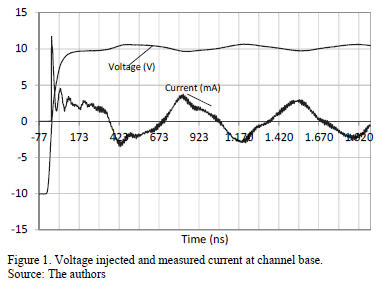
<body><![CDATA[<p><font size="3" face="Verdana, Arial, Helvetica, sans-serif"><b>2. Reduced Scale Model</b></font></p>     <p><font size="2" face="Verdana, Arial, Helvetica, sans-serif">A reduced scale model   is important for a) the validation of numerical codes that calculate induced   voltages produced by lightning electromagnetic pulse (LEMP) and b) the   prediction of the Lightning-induced voltages for those cases which, due to   their extreme complexity, cannot be simulated with the existing version of   these codes &#91;30&#93;.    The scale factors can be derived by applying Maxwell's equations to the real   system and the reduced-scale model and, and then, by relating the quantities of   interest in both systems &#91;30&#93;.   The scale factors obtained when the medium is air are shown in <a href="#tab01">Table 1</a>, where <i>p</i> is the ratio between the quantities in the model and in the full-scale system   and a is the relation between electric and magnetic   fields in the model and in the full scale system. </font></p>     <p align="center"><font size="2" face="Verdana, Arial, Helvetica, sans-serif"><a name="tab01"></a></font><img src="/img/revistas/dyna/v82n192/v82n192a18tab01.gif"></p>     <p><font size="2" face="Verdana, Arial, Helvetica, sans-serif">The choice of length scale factor depends on the available   space and the minimal wave front that can be generated and measured &#91;30,31&#93;.   The scale factor achieved for this case was p=a=1:200.   The reduced scale model was composed by the following components &#91;30,31&#93;.</font></p>     <p><font size="2" face="Verdana, Arial, Helvetica, sans-serif"><b><i>2.1. Ground Plane</i></b></font></p>     <p><font size="2" face="Verdana, Arial, Helvetica, sans-serif">The ground plane consisted in a rectangular plane 3x10 <img src="/img/revistas/dyna/v82n192/v82n192a18eq001.gif"> was composed of interconnected   aluminum plates (corresponding to 600x2000 <img src="/img/revistas/dyna/v82n192/v82n192a18eq001.gif"> in the full-scale system). Due   to scale factor of conductivity shown in <a href="#tab01">Table 1</a>, the aluminum plates can be   considered as perfect electric conductors in the full-scale model. The   aluminum plates were placed over an iron structure 0.8 m in height. The metallic   structure was inclined at a suitable angle to verify the influence of the   inclined terrain on lightning induced voltages calculation.</font></p>     <p><font size="2" face="Verdana, Arial, Helvetica, sans-serif"><b><i>2.2. Return Stroke Channel</i></b></font></p>     <p><font size="2" face="Verdana, Arial, Helvetica, sans-serif">The return stroke channel consists of a cooper coil with a   1.5 cm diameter with a PVC core to give mechanical strength. The copper   conductor has a 0.5mm radius. The height of the total rod is 6 m, although due   to local restrictions, it was limited to 5m. The injection of a step voltage   at rod base has a current response as <a href="#fig01">Fig. 1</a> shows.</font></p>     <p align="center"><font size="2" face="Verdana, Arial, Helvetica, sans-serif"><a name="fig01"></a></font><img src="/img/revistas/dyna/v82n192/v82n192a18fig01.gif"></p>     <p><font size="2" face="Verdana, Arial, Helvetica, sans-serif">According to <a href="#fig01">Fig. 1</a>, the travel time of the wave from the   bottom of the channel and back again is approximately 400 ns. The return   stroke velocity is equal to:</font></p>     ]]></body>
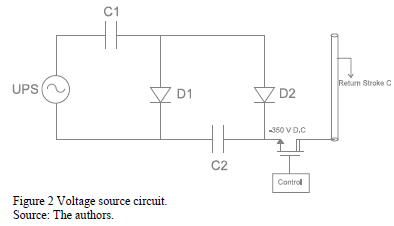
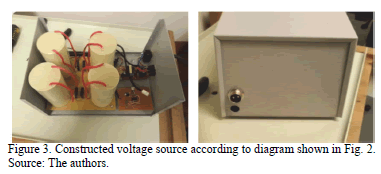
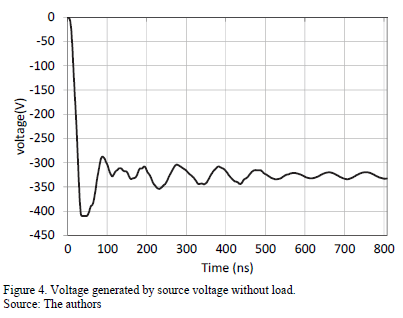
<body><![CDATA[<p><img src="/img/revistas/dyna/v82n192/v82n192a18eq01.gif"></p>     <p><font size="2" face="Verdana, Arial, Helvetica, sans-serif">The velocity measured along the channel is approximately <img src="/img/revistas/dyna/v82n192/v82n192a18eq004.gif"> of that of the speed of light in   free space. The surge impedance can be obtained dividing the voltage and the   current measured in the first 400 ns.</font></p>     <p><img src="/img/revistas/dyna/v82n192/v82n192a18eq02.gif"></p>     <p><font size="2" face="Verdana, Arial, Helvetica, sans-serif"><b><i>2.3. Impulse Current Generator</i></b></font></p>     <p><font size="2" face="Verdana, Arial, Helvetica, sans-serif">The current is generated when a voltage source is injected   into the base of the lightning channel. The voltage source circuit is shown in <a href="#fig02">Fig. 2</a>. It is composed by an alternating voltage source through an   uninterruptible power supply (UPS), and a voltage multiplier circuit of 2 steps   that generates a total voltage of -350 V D.C. (The negative polarity value does   not affect the measurements made of lightning induced voltages). The stored   voltage in capacitors is discharged to the lightning channel by means of a very   fast switching electronic device (MOSFET STD2NK100Z). A control circuit of the   MOSFET is composed by an oscillator 555 that generates a pulsed voltage with a   frequency of 1 Hz and a width pulse of 4ms (enough time for the expected duration of measurements -approximately 200ns).   The discharge is repetitive and has the aim of reducing noise in measurements.    The constructed voltage source is shown in <a href="#fig03">Fig. 3</a>.</font></p>     <p align="center"><font size="2" face="Verdana, Arial, Helvetica, sans-serif"><a name="fig02" id="fig02"></a></font><img src="/img/revistas/dyna/v82n192/v82n192a18fig02.gif"></p>     <p align="center"><font size="2" face="Verdana, Arial, Helvetica, sans-serif"><a name="fig03"></a></font><img src="/img/revistas/dyna/v82n192/v82n192a18fig03.gif"></p>     <p><font size="2" face="Verdana, Arial, Helvetica, sans-serif">The voltage generated by the source without load is shown   in <a href="#fig04">Fig. 4</a>. It is possible to see an approximately front time of 40 ns,   equivalent to 8 us in a full-scale system.</font></p>     <p align="center"><font size="2" face="Verdana, Arial, Helvetica, sans-serif"><a name="fig04"></a></font><img src="/img/revistas/dyna/v82n192/v82n192a18fig04.gif"></p>     <p><font size="2" face="Verdana, Arial, Helvetica, sans-serif"><b><i>2.4. Overhead distribution line</i></b></font></p>     ]]></body>
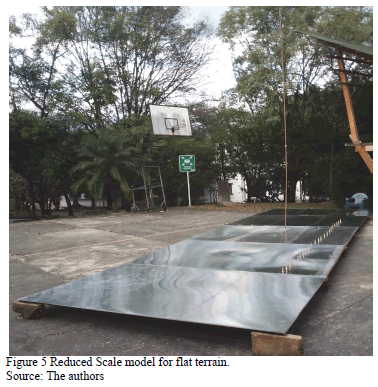
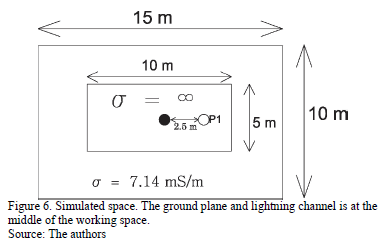
<body><![CDATA[<p><font size="2" face="Verdana, Arial, Helvetica, sans-serif">The line is a copper conductor, 5m long, 5 cm high and   with a radius of 0.46 mm. The line at full-scale will be equivalent to a 1km   line, 10 m height and 80 mm radius.</font></p>     <p><font size="2" face="Verdana, Arial, Helvetica, sans-serif"><b><i>2.5. Measuring System</i></b></font></p>     <p><font size="2" face="Verdana, Arial, Helvetica, sans-serif">The electric field is measured by means of a ring,   concentric with the return stroke channel. The measured voltage at this ring   is proportional to electric field &#91;30&#93;.   The induced voltage is measured at the beginning and at the end of the line by   means of an oscilloscope Tektronix with a bandwidth of 100 MHz, 1GS/s and 1   mV/div.</font></p>     <p> </p>     <p><font size="3" face="Verdana, Arial, Helvetica, sans-serif"><b>3. Methodology for calculating lightning electromagnetic   fields and lightning induced voltages</b></font></p>     <p><font size="2" face="Verdana, Arial, Helvetica, sans-serif">In order to simulate the reduced scale model, the finite   difference time domain method (FDTD) was employed in the 3-D Cartesian   coordinates system &#91;23&#93;.    It was simulated by using a metallic plate 3 x 10 m<sup>2</sup> with a very   high conductivity (s=1e8), which was   surrounded by a concrete space (corresponding to the soccer field where the   model was placed, see <a href="#fig05">Fig. 5</a>). The concrete conductivity was assumed to be s=7.14 mS/m.</font></p>     <p align="center"><font size="2" face="Verdana, Arial, Helvetica, sans-serif"><a name="fig05"></a></font><img src="/img/revistas/dyna/v82n192/v82n192a18fig05.gif"></p>     <p><font size="2" face="Verdana, Arial, Helvetica, sans-serif">The grid dimensions were 15 (in <i>x</i>) ' 10 (in <i>y</i>) ' 6 (in <i>z</i>) m<sup>3</sup> (see <a href="#fig06">Fig.   6</a>) and the space step was set as <img src="/img/revistas/dyna/v82n192/v82n192a18eq009.gif">, due to the available   computational capability. The inclined terrains were represented by staircases   in 3D &#91;23&#93;.</font></p>     <p align="center"><font size="2" face="Verdana, Arial, Helvetica, sans-serif"><a name="fig06"></a></font><img src="/img/revistas/dyna/v82n192/v82n192a18fig06.gif"></p>     <p><font size="2" face="Verdana, Arial, Helvetica, sans-serif">A lightning channel was simulated with a base current,   characterized by a peak value of 170 mA and a front time of 20 ns,   corresponding approximately to the initial estimated values of the channel base   current obtained from the reduced scale model measurements. It can be represented   by a Heidler</font> <font size="2" face="Verdana, Arial, Helvetica, sans-serif">function &#91;19&#93;,   with the following parameters: <img src="/img/revistas/dyna/v82n192/v82n192a18eq014.gif"> =160 mA, <img src="/img/revistas/dyna/v82n192/v82n192a18eq015.gif"> = 4.47 ns,<img src="/img/revistas/dyna/v82n192/v82n192a18eq016.gif"> =200 <i>ns</i>. The lightning   channel was placed at the middle of the working space. For simplicity, a TL   model was used to represent the return stroke current along the channel &#91;8,33&#93;.    The height of the constructed channel (5 m) was simulated, and the return   stroke velocity was measured (30 m/<img src="/img/revistas/dyna/v82n192/v82n192a18eq017.gif">s) at this channel (See   Section 0).</font></p>     ]]></body>
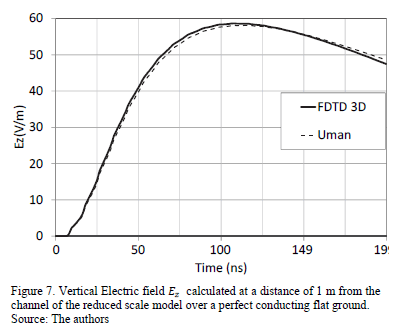
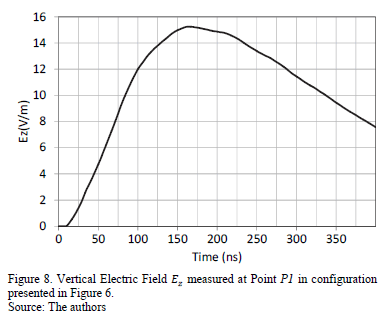
<body><![CDATA[<p><font size="2" face="Verdana, Arial, Helvetica, sans-serif">The electromagnetic field obtained by FDTD code &#91;22&#93;   was validated by comparing the electric field calculated by the 3D-FDTD   methodology with the analytical expressions derived by Uman &#91;8&#93;   for LEMP calculation. The vertical electric field is calculated at a distance   of 1 m from the lightning channel at ground level over perfectly conducting   flat terrain, as shown in <a href="#fig07">Fig. 7</a>. It is possible to see good agreement between   the two methods.</font></p>     <p align="center"><font size="2" face="Verdana, Arial, Helvetica, sans-serif"><a name="fig07"></a></font><img src="/img/revistas/dyna/v82n192/v82n192a18fig07.gif"></p>     <p><font size="2" face="Verdana, Arial, Helvetica, sans-serif">The Agrawal et al.   coupling model &#91;32&#93; will be used throughout this paper in order to calculate the lightning induced   voltages on overhead lines. This model is implemented in the YalukDraw   software &#91;34,35&#93;,   that was developed by the first two authors. It is software that allows the   lightning performance of overhead distribution networks to be calculated, and   it is based in a previous piece of software called Yaluk, linked with ATP by   means of foreign MODELS. This was done thanks to the collaboration of the Power   Systems research group from the University of Bologna. For non-flat terrain,   the Yaluk Draw has been modified to be used as input for the electric fields,   calculated by means of the 3D-FDTD method. Due to the fact that the TEM   approximation is used (derived of the transmission line theory), the electric   and magnetic fields can be related and it is not necessary get the magnetic   field into the program. </font></p>     <p><font size="2" face="Verdana, Arial, Helvetica, sans-serif">In order to fulfill the conditions of the coupling model   for evaluating the lightning induced voltages, it is necessary to make some   considerations regarding the horizontal and vertical electric fields calculated   on the FDTD grid. In all cases, the electric field parallel to the line <i>E<sub>l</sub></i>,   and the average vertical electric field <i>E<sub>v</sub></i> perpendicular to   the terrain were obtained &#91;36&#93;   at the beginning and at the end of line end, as shown in the <a href="#fig04">Fig. 4</a>. Although,   for flat terrain the vertical electric field is approximately constant below   the line, the vertical electric field in the soil can be considered as an input   parameter for the coupling model. For non-flat terrain there is a great   variability on the fields below the line, and for this reason it is preferable   to calculate the average vertical electric field.</font></p>     <p> </p>     <p><font size="3" face="Verdana, Arial, Helvetica, sans-serif"><b>4. Simulated Electric fields on the reduced scale model</b></font></p>     <p><font size="2" face="Verdana, Arial, Helvetica, sans-serif">Two configurations are simulated according to the   arrangements to be implemented in the reduced scale model, as shown below:</font></p>     <p><font size="2" face="Verdana, Arial, Helvetica, sans-serif"><b><i>4.1. Flat ground</i></b></font></p>     <p><font size="2" face="Verdana, Arial, Helvetica, sans-serif">The first is the configuration described in <a href="#fig06">Fig.   6</a>, where a ground plane is placed in the middle of a working volume with a soil   of concrete. The vertical electric field <img src="/img/revistas/dyna/v82n192/v82n192a18eq018.gif">, measured at point P1 is seen in <a href="#fig08">Fig. 8</a>.</font></p>     <p align="center"><font size="2" face="Verdana, Arial, Helvetica, sans-serif"><a name="fig08"></a></font><img src="/img/revistas/dyna/v82n192/v82n192a18fig08.gif"></p>     ]]></body>
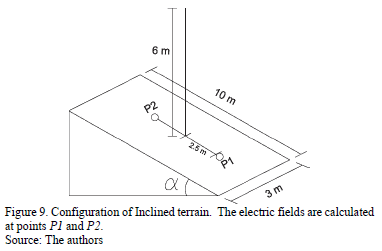
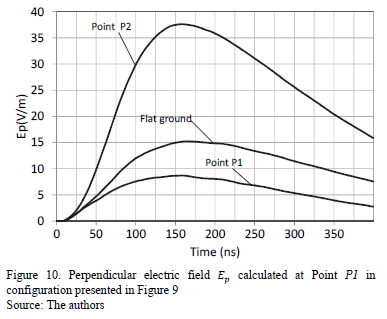
<body><![CDATA[<p><font size="2" face="Verdana, Arial, Helvetica, sans-serif"><b><i>4.2. Inclined terrain</i></b></font></p>     <p><font size="2" face="Verdana, Arial, Helvetica, sans-serif">The second configuration is the result of inclining the   ground plane of the previous configuration, at an angle a of 30° as shown in <a href="#fig09">Fig. 9</a>. With the aim of being able to make   a comparison, The normal component of the electric field Ep was calculated in   each simulation (for flat terrain the perpendicular electric field <img src="/img/revistas/dyna/v82n192/v82n192a18eq021.gif"> is equal to vertical electric   field <img src="/img/revistas/dyna/v82n192/v82n192a18eq018.gif">). </font></p>     <p align="center"><font size="2" face="Verdana, Arial, Helvetica, sans-serif"><a name="fig09"></a></font><img src="/img/revistas/dyna/v82n192/v82n192a18fig09.gif"></p>     <p><font size="2" face="Verdana, Arial, Helvetica, sans-serif">In <a href="#fig10">Fig. 10</a> the perpendicular electric field <img src="/img/revistas/dyna/v82n192/v82n192a18eq021.gif">,   obtained at points P1 and P2 compared with the vertical electric field for flat   terrain is presented. The electric field at Point <i>P2</i> is enhanced in   magnitude compared with the case of flat terrain. This is explained by the   closeness between the lightning channel and measurement point <i>P2</i>. The   perpendicular electric field <img src="/img/revistas/dyna/v82n192/v82n192a18eq021.gif"> at   point <i>P1</i> is decreased in magnitude compared with the case of flat   terrain. This can be explained due to that fact that the lightning channel is   farther from the measurement point <i>P1</i>. The tendency of the results   presented previously in <a href="#fig10">Fig. 10</a>,   match the inclined lightning channel studies previously published &#91;16,37&#93; It is explained because according to the method of images, an inclined   lightning channel is equivalent to vertical lightning that strikes inclined   terrain &#91;25&#93;.</font></p>     <p align="center"><font size="2" face="Verdana, Arial, Helvetica, sans-serif"><a name="fig10"></a></font><img src="/img/revistas/dyna/v82n192/v82n192a18fig10.gif"></p>     <p><font size="2" face="Verdana, Arial, Helvetica, sans-serif">The trend presented above is applicable to points located   aside lightning channels (according to other simulations not here presented).    It implies that a line placed over inclined terrain has a vertical electric   profile highly variable from that obtained for flat terrain (due symmetry of   the fields). For this reason, a different magnitude and wave-shape of   lightning induced voltages are expected.</font></p>     <p> </p>     <p><font size="3" face="Verdana, Arial, Helvetica, sans-serif"><b>5. Simulated induced   Voltages on the reduced scale model</b></font></p>     <p><font size="2" face="Verdana, Arial, Helvetica, sans-serif">In order to obtain the expected measurements of induced   voltages on the reduced scale model, the previous configurations were slightly   modified with the aim to adapt the results found in the reduced scale model   constructed. In this case the simulated peak current was 88 mA with a front   time of 40 ns. The current was represented by a <i>Heidler</i> function &#91;19&#93;   with the following parameters:<img src="/img/revistas/dyna/v82n192/v82n192a18eq024.gif">, <img src="/img/revistas/dyna/v82n192/v82n192a18eq025.gif"> <img src="/img/revistas/dyna/v82n192/v82n192a18eq026.gif"></font></p>     <p><font size="2" face="Verdana, Arial, Helvetica, sans-serif"><b><i>5.1. Flat ground</i></b></font></p>     ]]></body>
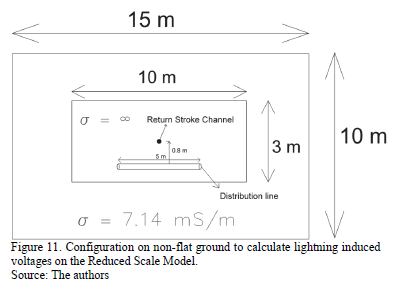
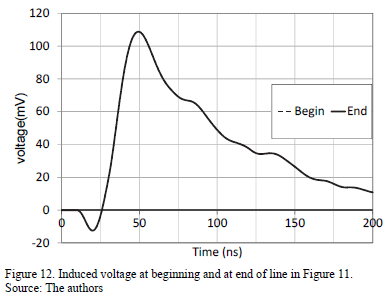
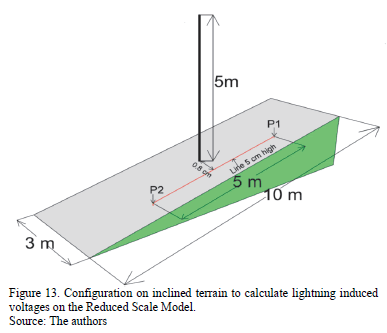
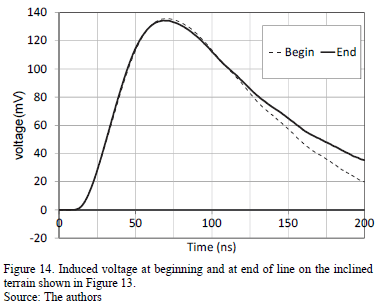
<body><![CDATA[<p><font size="2" face="Verdana, Arial, Helvetica, sans-serif">The distribution line simulated in flat terrain is shown   in <a href="#fig11">Fig. 11</a>. It is 5m long, 5cm high and is located 0.8 m from the return   stroke channel, as described in Section 0.   The induced voltages calculated at both extremities of the line are shown in <a href="#fig12">Fig.   12</a>. Some reflections and a double polarity are seen as the result of the   presence of the concrete terrain that surrounds the experimental setup.</font></p>     <p align="center"><font size="2" face="Verdana, Arial, Helvetica, sans-serif"><a name="fig11"></a></font><img src="/img/revistas/dyna/v82n192/v82n192a18fig11.gif"></p>     <p align="center"><font size="2" face="Verdana, Arial, Helvetica, sans-serif"><a name="fig12"></a></font><img src="/img/revistas/dyna/v82n192/v82n192a18fig12.gif"></p>     <p><font size="2" face="Verdana, Arial, Helvetica, sans-serif"><b><i>5.2. Inclined terrain</i></b></font></p>     <p><font size="2" face="Verdana, Arial, Helvetica, sans-serif">The configuration of   inclined terrain to be simulated is shown in <a href="#fig13">Fig. 13</a>.    Essentially, it is the result of rotating the system shown in <a href="#fig11">Fig. 11</a> at an angle of 30°. The distribution line is 5m long, placed parallel to the   terrain. The induced voltage calculated at both extremities of the line is   shown in <a href="#fig14">Fig. 14</a>.   It is possible to see a slight increment of the induced voltage compared with   the flat terrain case. Following the tendency of the electric field, the   induced voltage is increased at point <i>P2</i> (end of line), while it is   decreased at Point <i>P1</i> (beginning of line).</font></p>     <p align="center"><font size="2" face="Verdana, Arial, Helvetica, sans-serif"><a name="fig13"></a></font><img src="/img/revistas/dyna/v82n192/v82n192a18fig13.gif"></p>     <p align="center"><font size="2" face="Verdana, Arial, Helvetica, sans-serif"><a name="fig14"></a></font><img src="/img/revistas/dyna/v82n192/v82n192a18fig14.gif"></p>     <p> </p>     <p><font size="3" face="Verdana, Arial, Helvetica, sans-serif"><b>6. Conclusions</b></font></p>     <p><font size="2" face="Verdana, Arial, Helvetica, sans-serif">The design of a reduced scale model to measure the   electric field over an inclined terrain has been presented. The results of   this experiment serve as validation of numerical codes previously developed to   determine the influence of the orography on lightning electromagnetic fields.    This knowledge is useful for the improvement of lightning location systems and   lightning induced voltages calculation.</font></p>     ]]></body>
<body><![CDATA[<p><font size="2" face="Verdana, Arial, Helvetica, sans-serif">A modeling of the   reduced scale model has been presented. The model was composed by a highly   conductive ground plane inclined <font face="Symbol">a</font> degrees with respect to a flat ground   surface. The lightning channel was modeled by means of a vertical antenna   excited by a voltage impulse source developed from an electronic voltage   multiplier system. Measurements   of the normal component of the electric field and of induced voltages on an   overhead line were taken from the experimental setup and then compared to   simulation results obtained from a FDTD representation of the measurement   scenario.</font></p>     <p><font size="2" face="Verdana, Arial, Helvetica, sans-serif">The electric field above an inclined terrain results show   a significant difference with respect to the case of flat terrain. The   electric field calculated at point P1 decreases its value with respect the flat   terrain case, because the farness of the point to the lightning channel, while   at point P2 the electric field increase its magnitude as a result of the   closeness with the lightning channel.</font></p>     <p><font size="2" face="Verdana, Arial, Helvetica, sans-serif">The induced voltages calculated on the reduced scale model   show a little increase when compared to the flat terrain case and the same   tendency of the electric fields. </font></p>     <p><font size="2" face="Verdana, Arial, Helvetica, sans-serif">It is expected that the results obtained by using the   Finite Difference time domain method in 3-D Cartesian coordinates system could   be validated by the constructed reduced scale model, so as the reliable and   real data could be used to improve the performance of distribution networks   placed over non-flat terrain.</font></p>     <p> </p>     <p><font size="3" face="Verdana, Arial, Helvetica, sans-serif"><b>Acknowledgments</b></font></p>     <p><font size="2" face="Verdana, Arial, Helvetica, sans-serif">he authors would like to thank to the Colombian   Administrative Department of Science and Technology - COLCIENCIAS for their   support of this research, and the Universidad de Antioquia for their support   with the measurement devices used in this experiment.</font></p>     <p> </p>     <p><font size="3" face="Verdana, Arial, Helvetica, sans-serif"><b>References</b></font></p>     <!-- ref --><p><font size="2" face="Verdana, Arial, Helvetica, sans-serif"><b>&#91;1&#93;</b> Nucci, C.A., Rachidi, F. and Ianoz, M.V., Lightning induced voltages on overhead lines,   IEEE Trans Electromagn Compat, 35 (1), pp. 75-86, 1993. DOI: 10.1109/15.249398</font>&nbsp;&nbsp;&nbsp;&nbsp;&nbsp;&nbsp;&nbsp;&nbsp;[&#160;<a href="javascript:void(0);" onclick="javascript: window.open('/scielo.php?script=sci_nlinks&ref=000102&pid=S0012-7353201500040001800001&lng=','','width=640,height=500,resizable=yes,scrollbars=1,menubar=yes,');">Links</a>&#160;]<!-- end-ref --><!-- ref --><p><font size="2" face="Verdana, Arial, Helvetica, sans-serif"><b>&#91;2&#93;</b> Baba,   Y. and Rakov, V.A., Voltages induced on an overhead wire by lightning strikes   to a nearby tall grounded object, IEEE Trans Electromagn Compat, 48 (1), pp.   212-224, 2006. DOI: 10.1109/TEMC.2006.870807</font>&nbsp;&nbsp;&nbsp;&nbsp;&nbsp;&nbsp;&nbsp;&nbsp;[&#160;<a href="javascript:void(0);" onclick="javascript: window.open('/scielo.php?script=sci_nlinks&ref=000103&pid=S0012-7353201500040001800002&lng=','','width=640,height=500,resizable=yes,scrollbars=1,menubar=yes,');">Links</a>&#160;]<!-- end-ref --><!-- ref --><p><font size="2" face="Verdana, Arial, Helvetica, sans-serif"><b>&#91;3&#93;</b> Cooray,   V. and Scuka, V., Lightning-Induced overvoltages in power lines:   Validity of various approximations made in overvoltage calculations, IEEE Trans   Electromagn Compat, 40, pp. 355-363, 1998. DOI: 10.1109/15.736222</font>&nbsp;&nbsp;&nbsp;&nbsp;&nbsp;&nbsp;&nbsp;&nbsp;[&#160;<a href="javascript:void(0);" onclick="javascript: window.open('/scielo.php?script=sci_nlinks&ref=000104&pid=S0012-7353201500040001800003&lng=','','width=640,height=500,resizable=yes,scrollbars=1,menubar=yes,');">Links</a>&#160;]<!-- end-ref --><!-- ref --><p><font size="2" face="Verdana, Arial, Helvetica, sans-serif"><b>&#91;4&#93;</b> Borghetti,   A., Nucci, C.A. and Paolone, M., An improved procedure for the assessment of   overhead line indirect lightning performance and its comparison with the IEEE   Std. 1410 Method, IEEE Trans. Power Deliv., 22 (1), pp. 684-692, 2007. DOI: 10.1109/TPWRD.2006.881463</font>&nbsp;&nbsp;&nbsp;&nbsp;&nbsp;&nbsp;&nbsp;&nbsp;[&#160;<a href="javascript:void(0);" onclick="javascript: window.open('/scielo.php?script=sci_nlinks&ref=000105&pid=S0012-7353201500040001800004&lng=','','width=640,height=500,resizable=yes,scrollbars=1,menubar=yes,');">Links</a>&#160;]<!-- end-ref --><!-- ref --><p><font size="2" face="Verdana, Arial, Helvetica, sans-serif"><b>&#91;5&#93;</b> Yutthagowith,   P., Ametani, A., Nagaoka, N. and Yoshihiro, B., Lightning-Induced voltage over   lossy ground by a hybrid electromagnetic circuit model method with Cooray -   Rubinstein formula, 51, pp. 975-985, 2009.    &nbsp;&nbsp;&nbsp;&nbsp;&nbsp;&nbsp;&nbsp;&nbsp;[&#160;<a href="javascript:void(0);" onclick="javascript: window.open('/scielo.php?script=sci_nlinks&ref=000106&pid=S0012-7353201500040001800005&lng=','','width=640,height=500,resizable=yes,scrollbars=1,menubar=yes,');">Links</a>&#160;]<!-- end-ref --></font></p>     <!-- ref --><p><font size="2" face="Verdana, Arial, Helvetica, sans-serif"><b>&#91;6&#93;</b> Master,   M.J. and Uman, M.A., Transient electric and magnetic fields associated   with establishing a finite electrostatic dipole, Am. J. Phys., 51 pp.   118-126, 1983. DOI: 10.1119/1.13310</font>&nbsp;&nbsp;&nbsp;&nbsp;&nbsp;&nbsp;&nbsp;&nbsp;[&#160;<a href="javascript:void(0);" onclick="javascript: window.open('/scielo.php?script=sci_nlinks&ref=000108&pid=S0012-7353201500040001800006&lng=','','width=640,height=500,resizable=yes,scrollbars=1,menubar=yes,');">Links</a>&#160;]<!-- end-ref --><!-- ref --><p><font size="2" face="Verdana, Arial, Helvetica, sans-serif"><b>&#91;7&#93;</b> Rubinstein,   M., Methods for calculating electromagnetic fields from a known source   distribution: Application to lightning, IEEE Trans. Electromagn. Compat., 31 (2),   pp. 183-189, 1989. DOI: 10.1109/15.18788</font>&nbsp;&nbsp;&nbsp;&nbsp;&nbsp;&nbsp;&nbsp;&nbsp;[&#160;<a href="javascript:void(0);" onclick="javascript: window.open('/scielo.php?script=sci_nlinks&ref=000109&pid=S0012-7353201500040001800007&lng=','','width=640,height=500,resizable=yes,scrollbars=1,menubar=yes,');">Links</a>&#160;]<!-- end-ref --><!-- ref --><p><font size="2" face="Verdana, Arial, Helvetica, sans-serif"><b>&#91;8&#93;</b> Uman,   M.A. and Krider, E.P., The electromagnetic radiation from a finite antenna, Am.   J. Phys., 43, pp. 33-38, 1975. DOI: 10.1119/1.10027</font>&nbsp;&nbsp;&nbsp;&nbsp;&nbsp;&nbsp;&nbsp;&nbsp;[&#160;<a href="javascript:void(0);" onclick="javascript: window.open('/scielo.php?script=sci_nlinks&ref=000110&pid=S0012-7353201500040001800008&lng=','','width=640,height=500,resizable=yes,scrollbars=1,menubar=yes,');">Links</a>&#160;]<!-- end-ref --><!-- ref --><p><font size="2" face="Verdana, Arial, Helvetica, sans-serif"><b>&#91;9&#93;</b> Sommerfeld,   A., Uber die ausbreitung der wellen in der drahtlosen telegraphie, Ann. Phys., 4   (28), pp. 665-736, 1909. DOI: 10.1002/andp.19093330402</font>&nbsp;&nbsp;&nbsp;&nbsp;&nbsp;&nbsp;&nbsp;&nbsp;[&#160;<a href="javascript:void(0);" onclick="javascript: window.open('/scielo.php?script=sci_nlinks&ref=000111&pid=S0012-7353201500040001800009&lng=','','width=640,height=500,resizable=yes,scrollbars=1,menubar=yes,');">Links</a>&#160;]<!-- end-ref --><!-- ref --><p><font size="2" face="Verdana, Arial, Helvetica, sans-serif"><b>&#91;10&#93;</b> Delfino,   F., Procopio, R. and Rossi, M., Lightning return stroke current radiation in   presence of a conducting ground: 1. Theory and numerical evaluation of the electromagnetic   fields, J. Geophys. Res. Atmospheres, 113 (D5), pp. 1-10, 2008. DOI: 10.1029/2007JD008553.    &nbsp;&nbsp;&nbsp;&nbsp;&nbsp;&nbsp;&nbsp;&nbsp;[&#160;<a href="javascript:void(0);" onclick="javascript: window.open('/scielo.php?script=sci_nlinks&ref=000112&pid=S0012-7353201500040001800010&lng=','','width=640,height=500,resizable=yes,scrollbars=1,menubar=yes,');">Links</a>&#160;]<!-- end-ref --></font></p>     <!-- ref --><p><font size="2" face="Verdana, Arial, Helvetica, sans-serif"><b>&#91;11&#93;</b> Cooray,   V., Horizontal field generated by return strokes, Radio Sci., 27 (5), pp.   529-537, 1992. DOI: 10.1029/91RS02918</font>&nbsp;&nbsp;&nbsp;&nbsp;&nbsp;&nbsp;&nbsp;&nbsp;[&#160;<a href="javascript:void(0);" onclick="javascript: window.open('/scielo.php?script=sci_nlinks&ref=000114&pid=S0012-7353201500040001800011&lng=','','width=640,height=500,resizable=yes,scrollbars=1,menubar=yes,');">Links</a>&#160;]<!-- end-ref --><!-- ref --><p><font size="2" face="Verdana, Arial, Helvetica, sans-serif"><b>&#91;12&#93;</b> Rubinstein,   M., An approximate formula for the calculation of the horizontal electric field   from lightning at close, intermediate, and long range, IEEE Trans. Electromagn.   Compat., 38 (3), pp. 531-535, 1996. DOI: 10.1109/15.536087</font>&nbsp;&nbsp;&nbsp;&nbsp;&nbsp;&nbsp;&nbsp;&nbsp;[&#160;<a href="javascript:void(0);" onclick="javascript: window.open('/scielo.php?script=sci_nlinks&ref=000115&pid=S0012-7353201500040001800012&lng=','','width=640,height=500,resizable=yes,scrollbars=1,menubar=yes,');">Links</a>&#160;]<!-- end-ref --><!-- ref --><p><font size="2" face="Verdana, Arial, Helvetica, sans-serif"><b>&#91;13&#93;</b> Cooray,   V., Some considerations on the 'Cooray-Rubinstein' approximation used in   deriving the horizontal electric field over finitely conducting   ground, IEEE Trans. Electromagn. Compat., 44 (4), pp. 560-566, 2002. DOI: 10.1109/TEMC.2002.804774</font>&nbsp;&nbsp;&nbsp;&nbsp;&nbsp;&nbsp;&nbsp;&nbsp;[&#160;<a href="javascript:void(0);" onclick="javascript: window.open('/scielo.php?script=sci_nlinks&ref=000116&pid=S0012-7353201500040001800013&lng=','','width=640,height=500,resizable=yes,scrollbars=1,menubar=yes,');">Links</a>&#160;]<!-- end-ref --><!-- ref --><p><font size="2" face="Verdana, Arial, Helvetica, sans-serif"><b>&#91;14&#93;</b> Jin,   D.J.R.J.M., Finite element analysis of antenna and arrays , 2009. John Wiley   &amp; Sons In, Hoboken, 2009.    &nbsp;&nbsp;&nbsp;&nbsp;&nbsp;&nbsp;&nbsp;&nbsp;[&#160;<a href="javascript:void(0);" onclick="javascript: window.open('/scielo.php?script=sci_nlinks&ref=000117&pid=S0012-7353201500040001800014&lng=','','width=640,height=500,resizable=yes,scrollbars=1,menubar=yes,');">Links</a>&#160;]<!-- end-ref --></font></p>     <!-- ref --><p><font size="2" face="Verdana, Arial, Helvetica, sans-serif"><b>&#91;15&#93;</b> Napolitano,   F., Borghetti, A., Nucci, C., Rachidi, F. and Paolone, M., Use of the full-wave   finite element method for the numerical electromagnetic analysis of LEMP and   its coupling to overhead lines, Proc. of the 7th Asia-Pacific International   Conference on Lightning, Nov. 1-4, 2011, Chengdu, China. DOI: 10.1109/apl.2011.6110132    DOI: 10.1016/j.epsr.2012.05.002</font>&nbsp;&nbsp;&nbsp;&nbsp;&nbsp;&nbsp;&nbsp;&nbsp;[&#160;<a href="javascript:void(0);" onclick="javascript: window.open('/scielo.php?script=sci_nlinks&ref=000119&pid=S0012-7353201500040001800015&lng=','','width=640,height=500,resizable=yes,scrollbars=1,menubar=yes,');">Links</a>&#160;]<!-- end-ref --><!-- ref --><p><font size="2" face="Verdana, Arial, Helvetica, sans-serif"><b>&#91;16&#93;</b> Moini, R.,   Sadeghi, S.H.H., Kordi, B. and Rachidi, F., An antenna-theory approach for   modeling inclined lightning return stroke channels, Electr. Power Syst. Res., 76   (1), pp. 945-952, 2006. DOI: 10.1016/j.epsr.2005.10.016</font>&nbsp;&nbsp;&nbsp;&nbsp;&nbsp;&nbsp;&nbsp;&nbsp;[&#160;<a href="javascript:void(0);" onclick="javascript: window.open('/scielo.php?script=sci_nlinks&ref=000120&pid=S0012-7353201500040001800016&lng=','','width=640,height=500,resizable=yes,scrollbars=1,menubar=yes,');">Links</a>&#160;]<!-- end-ref --><!-- ref --><p><font size="2" face="Verdana, Arial, Helvetica, sans-serif"><b>&#91;17&#93;</b> Cardoso,   J.R. and Sartori, C.A.F., An analytical-FDTD method for near LEMP calculation,   IEEE Trans. Magn., 36 (4), pp. 1631-1634, 2000. DOI: 10.1109/20.877754</font>&nbsp;&nbsp;&nbsp;&nbsp;&nbsp;&nbsp;&nbsp;&nbsp;[&#160;<a href="javascript:void(0);" onclick="javascript: window.open('/scielo.php?script=sci_nlinks&ref=000121&pid=S0012-7353201500040001800017&lng=','','width=640,height=500,resizable=yes,scrollbars=1,menubar=yes,');">Links</a>&#160;]<!-- end-ref --><!-- ref --><p><font size="2" face="Verdana, Arial, Helvetica, sans-serif"><b>&#91;18&#93;</b> Yang, C.   and Zhou, B., Calculation methods of electromagnetic fields very close to   lightning, IEEE Trans. Electromagn. Compat., 46 (1), pp. 133-141, 2004. DOI: 10.1109/TEMC.2004.823626</font>&nbsp;&nbsp;&nbsp;&nbsp;&nbsp;&nbsp;&nbsp;&nbsp;[&#160;<a href="javascript:void(0);" onclick="javascript: window.open('/scielo.php?script=sci_nlinks&ref=000122&pid=S0012-7353201500040001800018&lng=','','width=640,height=500,resizable=yes,scrollbars=1,menubar=yes,');">Links</a>&#160;]<!-- end-ref --><!-- ref --><p><font size="2" face="Verdana, Arial, Helvetica, sans-serif"><b>&#91;19&#93;</b> Heidler,   F., Cvetic, J. and Stanic, B.V., Calculation of lightning current parameters, IEEE   Trans. Electromagn. Compat., 14 (2), pp. 399-404, 1999. DOI: 10.1109/61.754080</font>&nbsp;&nbsp;&nbsp;&nbsp;&nbsp;&nbsp;&nbsp;&nbsp;[&#160;<a href="javascript:void(0);" onclick="javascript: window.open('/scielo.php?script=sci_nlinks&ref=000123&pid=S0012-7353201500040001800019&lng=','','width=640,height=500,resizable=yes,scrollbars=1,menubar=yes,');">Links</a>&#160;]<!-- end-ref --><!-- ref --><p><font size="2" face="Verdana, Arial, Helvetica, sans-serif"><b>&#91;20&#93;</b> Mimouni,   A., Rachidi, F. and Azzouz, Z., Electromagnetic environment in the inmediate   vicinity of a lightning return stroke, J. Light. Res., 2, pp. 64-75, 2007.    &nbsp;&nbsp;&nbsp;&nbsp;&nbsp;&nbsp;&nbsp;&nbsp;[&#160;<a href="javascript:void(0);" onclick="javascript: window.open('/scielo.php?script=sci_nlinks&ref=000124&pid=S0012-7353201500040001800020&lng=','','width=640,height=500,resizable=yes,scrollbars=1,menubar=yes,');">Links</a>&#160;]<!-- end-ref --></font></p>     <!-- ref --><p><font size="2" face="Verdana, Arial, Helvetica, sans-serif"><b>&#91;21&#93;</b> Baba, Y.   and Rakov, V.A., Influence of strike object grounding on close lightning   electric fields, J. Geophys. Res., 113 (D12), pp. n/a. 2008. DOI: 10.1029/2008JD009811.    &nbsp;&nbsp;&nbsp;&nbsp;&nbsp;&nbsp;&nbsp;&nbsp;[&#160;<a href="javascript:void(0);" onclick="javascript: window.open('/scielo.php?script=sci_nlinks&ref=000126&pid=S0012-7353201500040001800021&lng=','','width=640,height=500,resizable=yes,scrollbars=1,menubar=yes,');">Links</a>&#160;]<!-- end-ref --></font></p>     <!-- ref --><p><font size="2" face="Verdana, Arial, Helvetica, sans-serif"><b>&#91;22&#93;</b> Yee, K.S.,   Numerical solution of initial boundary value problems involving Maxwell's   equations in isotropic media, IEEE Trans. Antennas Propag., Ap-14, pp. 302-307,   1966.    &nbsp;&nbsp;&nbsp;&nbsp;&nbsp;&nbsp;&nbsp;&nbsp;[&#160;<a href="javascript:void(0);" onclick="javascript: window.open('/scielo.php?script=sci_nlinks&ref=000128&pid=S0012-7353201500040001800022&lng=','','width=640,height=500,resizable=yes,scrollbars=1,menubar=yes,');">Links</a>&#160;]<!-- end-ref --></font></p>     <!-- ref --><p><font size="2" face="Verdana, Arial, Helvetica, sans-serif"><b>&#91;23&#93;</b> Taflove,   A. and Hagness, S.C., Computational Electrodynamics: the finite-difference   time-domain method, 3rd edition. Artech House, 2005.    &nbsp;&nbsp;&nbsp;&nbsp;&nbsp;&nbsp;&nbsp;&nbsp;[&#160;<a href="javascript:void(0);" onclick="javascript: window.open('/scielo.php?script=sci_nlinks&ref=000130&pid=S0012-7353201500040001800023&lng=','','width=640,height=500,resizable=yes,scrollbars=1,menubar=yes,');">Links</a>&#160;]<!-- end-ref --></font></p>     <!-- ref --><p><font size="2" face="Verdana, Arial, Helvetica, sans-serif"><b>&#91;24&#93;</b> Wilson, On   some determinations of the sign and magnitude of electric discharges in   lightning flashes, Proc Roy Soc, pp. 555-574, 1916.    &nbsp;&nbsp;&nbsp;&nbsp;&nbsp;&nbsp;&nbsp;&nbsp;[&#160;<a href="javascript:void(0);" onclick="javascript: window.open('/scielo.php?script=sci_nlinks&ref=000132&pid=S0012-7353201500040001800024&lng=','','width=640,height=500,resizable=yes,scrollbars=1,menubar=yes,');">Links</a>&#160;]<!-- end-ref --></font></p>     <!-- ref --><p><font size="2" face="Verdana, Arial, Helvetica, sans-serif"><b>&#91;25&#93;</b> De Conti,   A., Perez, E., Soto, E., Silveira, F.H., Visacro, S. and Torres, H.,   Calculation of lightning-induced voltages on overhead distribution lines   including insulation breakdown, IEEE Trans. Power Deliv., 25 (4), pp. 3078-3084,   2010. DOI: 10.1109/TPWRD.2010.2059050</font>&nbsp;&nbsp;&nbsp;&nbsp;&nbsp;&nbsp;&nbsp;&nbsp;[&#160;<a href="javascript:void(0);" onclick="javascript: window.open('/scielo.php?script=sci_nlinks&ref=000134&pid=S0012-7353201500040001800025&lng=','','width=640,height=500,resizable=yes,scrollbars=1,menubar=yes,');">Links</a>&#160;]<!-- end-ref --><!-- ref --><p><font size="2" face="Verdana, Arial, Helvetica, sans-serif"><b>&#91;26&#93;</b> Soto, E.,   Perez, E. and Herrera, J., Electromagnetic field due to lightning striking on   top of a cone-shaped mountain using the FDTD, IEEE Trans. Electromagn. Compat.,   56 (5), pp. 1112-1120, 2014. DOI: 10.1109/TEMC.2014.2301138</font>&nbsp;&nbsp;&nbsp;&nbsp;&nbsp;&nbsp;&nbsp;&nbsp;[&#160;<a href="javascript:void(0);" onclick="javascript: window.open('/scielo.php?script=sci_nlinks&ref=000135&pid=S0012-7353201500040001800026&lng=','','width=640,height=500,resizable=yes,scrollbars=1,menubar=yes,');">Links</a>&#160;]<!-- end-ref --><!-- ref --><p><font size="2" face="Verdana, Arial, Helvetica, sans-serif"><b>&#91;27&#93;</b> Soto, E.,   Perez, E. and Younes, C., Influence of non-flat terrain on lightning induced   voltages on distribution networks, Electr. Power Syst. Res., 113, pp. 115-120,   2014. DOI: 10.1016/j.epsr.2014.02.034</font>&nbsp;&nbsp;&nbsp;&nbsp;&nbsp;&nbsp;&nbsp;&nbsp;[&#160;<a href="javascript:void(0);" onclick="javascript: window.open('/scielo.php?script=sci_nlinks&ref=000136&pid=S0012-7353201500040001800027&lng=','','width=640,height=500,resizable=yes,scrollbars=1,menubar=yes,');">Links</a>&#160;]<!-- end-ref --><!-- ref --><p><font size="2" face="Verdana, Arial, Helvetica, sans-serif"><b>&#91;28&#93;</b> Yokoyama,   S., Calculation of lightning induced voltages on overhead multiconductor lines,   IEEE Trans. Power Appar. Syst., 103 (1), pp. 100-108, 1984. DOI: 10.1109/TPAS.1984.318583</font>&nbsp;&nbsp;&nbsp;&nbsp;&nbsp;&nbsp;&nbsp;&nbsp;[&#160;<a href="javascript:void(0);" onclick="javascript: window.open('/scielo.php?script=sci_nlinks&ref=000137&pid=S0012-7353201500040001800028&lng=','','width=640,height=500,resizable=yes,scrollbars=1,menubar=yes,');">Links</a>&#160;]<!-- end-ref --><!-- ref --><p><font size="2" face="Verdana, Arial, Helvetica, sans-serif"><b>&#91;29&#93;</b> Paolone,   M., Nucci, C.A. and Petrache, E., Mitigation of lightning-induced overvoltages   in medium voltage distribution lines by means of periodical grounding of   shielding wires and of surge arresters: Modeling and experimental   validation, 19 (1), pp. 423-431, 2004.    &nbsp;&nbsp;&nbsp;&nbsp;&nbsp;&nbsp;&nbsp;&nbsp;[&#160;<a href="javascript:void(0);" onclick="javascript: window.open('/scielo.php?script=sci_nlinks&ref=000138&pid=S0012-7353201500040001800029&lng=','','width=640,height=500,resizable=yes,scrollbars=1,menubar=yes,');">Links</a>&#160;]<!-- end-ref --></font></p>     <!-- ref --><p><font size="2" face="Verdana, Arial, Helvetica, sans-serif"><b>&#91;30&#93;</b> Piantini,   A., Member, S., Janiszewski, J.M., Borghetti, A., Nucci, C.A. and Paolone, M.,   A scale model for the study of the LEMP response of complex power distribution   networks, IEEE Trans Power Deliv., 22 (1), pp. 710-720, 2007. DOI: 10.1109/TPWRD.2006.881410</font>&nbsp;&nbsp;&nbsp;&nbsp;&nbsp;&nbsp;&nbsp;&nbsp;[&#160;<a href="javascript:void(0);" onclick="javascript: window.open('/scielo.php?script=sci_nlinks&ref=000140&pid=S0012-7353201500040001800030&lng=','','width=640,height=500,resizable=yes,scrollbars=1,menubar=yes,');">Links</a>&#160;]<!-- end-ref --><!-- ref --><p><font size="2" face="Verdana, Arial, Helvetica, sans-serif"><b>&#91;31&#93;</b> Boaventura, W. do C., Estudo da tensão induzida   &eacute;m lihnas a&eacute;reas por descargas atmosf&eacute;ricas utilizando t&eacute;cnicas de modelo   reduzido, 1990.    &nbsp;&nbsp;&nbsp;&nbsp;&nbsp;&nbsp;&nbsp;&nbsp;[&#160;<a href="javascript:void(0);" onclick="javascript: window.open('/scielo.php?script=sci_nlinks&ref=000141&pid=S0012-7353201500040001800031&lng=','','width=640,height=500,resizable=yes,scrollbars=1,menubar=yes,');">Links</a>&#160;]<!-- end-ref --></font></p>     ]]></body>
<body><![CDATA[<!-- ref --><p><font size="2" face="Verdana, Arial, Helvetica, sans-serif"><b>&#91;32&#93;</b> Agrawal,   A., Price, H. and Gurbaxani, S., Transient response of multiconductor   transmission lines excited by a nonuniform electromagnetic field, IEEE Trans. Electromagn.   Compat., 22 (2), pp. 119-129, 1980. DOI: 10.1109/TEMC.1980.303824</font>&nbsp;&nbsp;&nbsp;&nbsp;&nbsp;&nbsp;&nbsp;&nbsp;[&#160;<a href="javascript:void(0);" onclick="javascript: window.open('/scielo.php?script=sci_nlinks&ref=000143&pid=S0012-7353201500040001800032&lng=','','width=640,height=500,resizable=yes,scrollbars=1,menubar=yes,');">Links</a>&#160;]<!-- end-ref --><!-- ref --><p><font size="2" face="Verdana, Arial, Helvetica, sans-serif"><b>&#91;33&#93;</b> Uman, M.A. and Mclain, D., Calculations of lightning return   stroke models, J. Geophys. Res., 85, pp.   1571 -1583, 1985.    &nbsp;&nbsp;&nbsp;&nbsp;&nbsp;&nbsp;&nbsp;&nbsp;[&#160;<a href="javascript:void(0);" onclick="javascript: window.open('/scielo.php?script=sci_nlinks&ref=000144&pid=S0012-7353201500040001800033&lng=','','width=640,height=500,resizable=yes,scrollbars=1,menubar=yes,');">Links</a>&#160;]<!-- end-ref --></font></p>     <!-- ref --><p><font size="2" face="Verdana, Arial, Helvetica, sans-serif"><b>&#91;34&#93;</b> Perez, E. y Torres, H., Modelado y   experimentaci&oacute;n de tensiones Arquitectura, Universidad Nacional de Colombia,   2010.    &nbsp;&nbsp;&nbsp;&nbsp;&nbsp;&nbsp;&nbsp;&nbsp;[&#160;<a href="javascript:void(0);" onclick="javascript: window.open('/scielo.php?script=sci_nlinks&ref=000146&pid=S0012-7353201500040001800034&lng=','','width=640,height=500,resizable=yes,scrollbars=1,menubar=yes,');">Links</a>&#160;]<!-- end-ref --></font></p>     <!-- ref --><p><font size="2" face="Verdana, Arial, Helvetica, sans-serif"><b>&#91;35&#93;</b> Perez, E. y Soto, E., Yaluk draw: Software   especializado para an&aacute;lisis del desempe&ntilde;o de l&iacute;neas de distribuci&oacute;n ante   impacto de rayos, Avances en Ingenier&iacute;a El&eacute;ctrica, 4 (1), pp. 1-8, 2013.    &nbsp;&nbsp;&nbsp;&nbsp;&nbsp;&nbsp;&nbsp;&nbsp;[&#160;<a href="javascript:void(0);" onclick="javascript: window.open('/scielo.php?script=sci_nlinks&ref=000148&pid=S0012-7353201500040001800035&lng=','','width=640,height=500,resizable=yes,scrollbars=1,menubar=yes,');">Links</a>&#160;]<!-- end-ref --></font></p>     <!-- ref --><p><font size="2" face="Verdana, Arial, Helvetica, sans-serif"><b>&#91;36&#93;</b> Soto, E.,   Perez, E. and Herrera, J., Electromagnetic field due to lightning striking on   top of a cone-shaped mountain using the FDTD, IEEE Trans. Electromagn. Compat.,   73, &#91;Online&#93;, 2014.    &nbsp;&nbsp;&nbsp;&nbsp;&nbsp;&nbsp;&nbsp;&nbsp;[&#160;<a href="javascript:void(0);" onclick="javascript: window.open('/scielo.php?script=sci_nlinks&ref=000150&pid=S0012-7353201500040001800036&lng=','','width=640,height=500,resizable=yes,scrollbars=1,menubar=yes,');">Links</a>&#160;]<!-- end-ref --></font></p>     <!-- ref --><p><font size="2" face="Verdana, Arial, Helvetica, sans-serif"><b>&#91;37&#93;</b> Rameli,   N., Kadir, M.Z.A.A., Izadi, M., Gomes, C. and Jasni, J., On the influence of   inclined lightning channel on lightning induced voltage evaluation evaluation   of coupling, in: International Conference on Lightning Protection (ICLP),      Vienna, Austria, 2012. DOI: 10.1109/ICLP.2012.6344250</font>&nbsp;&nbsp;&nbsp;&nbsp;&nbsp;&nbsp;&nbsp;&nbsp;[&#160;<a href="javascript:void(0);" onclick="javascript: window.open('/scielo.php?script=sci_nlinks&ref=000152&pid=S0012-7353201500040001800037&lng=','','width=640,height=500,resizable=yes,scrollbars=1,menubar=yes,');">Links</a>&#160;]<!-- end-ref --><p> </p>     <p><font size="2" face="Verdana, Arial, Helvetica, sans-serif"><b>E. Soto-R&iacute;os,</b> was born in Manizales, Colombia, South America on   April 29<sup>th</sup>, 1986. He received his BSc. in 2008 and MSc. in 2011 in   Electrical Engineering, both from the Universidad Nacional de Colombia. At   present he is a PhD. Electrical Engineering Student at the Universidad Nacional   de Colombia, Manizales, Colombia. His areas of interest are electromagnetic   compatibility, lightning protection and lightning induced voltages.</font></p>     <p><font size="2" face="Verdana, Arial, Helvetica, sans-serif"><b>E. Perez-Gonz&aacute;lez,</b> was born in Bogota, Colombia, South America on   November 21<sup>st</sup>, 1976. He received his BSc. in 1999, MSc. in 2002 and   PhD. in 2006 all of them from the Universidad Nacional de Colombia in   Electrical Engineering and High Voltage Studies. He worked for one year with   the Power System research group at the University of Bologna - Italy, working   on lightning induced voltage. He has been working with the research group   PAAS-UN in Colombia since 1998. He is has been an associate professor since   2006 in the Universidad Nacional de Colombia, Medellin, Colombia. His special   fields of interest include lightning phenomena analysis and power system   protection.</font></p>     <p><font size="2" face="Verdana, Arial, Helvetica, sans-serif"><b>J. Herrera-Murcia,</b> was born in Bogota, Colombia,   on July 28, 1976. He received his BSc. in 1999, MSc. in 2002 and PhD. in 2006,   all of them from the Universidad Nacional de Colombia in Electrical Engineering   and High Voltage Studies. He has been involved with lightning protection   systems and power systems transients with emphasis on lightning-induced   voltages. He has been an associate professor since 2006 in the Universidad   Nacional de Colombia, Medellin, Colombia.</font></p>      ]]></body><back>
<ref-list>
<ref id="B1">
<label>1</label><nlm-citation citation-type="journal">
<person-group person-group-type="author">
<name>
<surname><![CDATA[Nucci]]></surname>
<given-names><![CDATA[C.A.]]></given-names>
</name>
<name>
<surname><![CDATA[Rachidi]]></surname>
<given-names><![CDATA[F.]]></given-names>
</name>
<name>
<surname><![CDATA[Ianoz]]></surname>
<given-names><![CDATA[M.V.]]></given-names>
</name>
</person-group>
<article-title xml:lang="en"><![CDATA[Lightning induced voltages on overhead lines]]></article-title>
<source><![CDATA[IEEE Trans Electromagn Compat]]></source>
<year>1993</year>
<volume>35</volume>
<numero>1</numero>
<issue>1</issue>
<page-range>75-86</page-range></nlm-citation>
</ref>
<ref id="B2">
<label>2</label><nlm-citation citation-type="journal">
<person-group person-group-type="author">
<name>
<surname><![CDATA[Baba]]></surname>
<given-names><![CDATA[Y.]]></given-names>
</name>
<name>
<surname><![CDATA[Rakov]]></surname>
<given-names><![CDATA[V.A.]]></given-names>
</name>
</person-group>
<article-title xml:lang="en"><![CDATA[Voltages induced on an overhead wire by lightning strikes to a nearby tall grounded object]]></article-title>
<source><![CDATA[IEEE Trans Electromagn Compat]]></source>
<year>2006</year>
<volume>48</volume>
<numero>1</numero>
<issue>1</issue>
<page-range>212-224</page-range></nlm-citation>
</ref>
<ref id="B3">
<label>3</label><nlm-citation citation-type="journal">
<person-group person-group-type="author">
<name>
<surname><![CDATA[Cooray]]></surname>
<given-names><![CDATA[V.]]></given-names>
</name>
<name>
<surname><![CDATA[Scuka]]></surname>
<given-names><![CDATA[V.]]></given-names>
</name>
</person-group>
<article-title xml:lang="en"><![CDATA[Lightning-Induced overvoltages in power lines: Validity of various approximations made in overvoltage calculations]]></article-title>
<source><![CDATA[IEEE Trans Electromagn Compat]]></source>
<year>1998</year>
<numero>40</numero>
<issue>40</issue>
<page-range>355-363</page-range></nlm-citation>
</ref>
<ref id="B4">
<label>4</label><nlm-citation citation-type="journal">
<person-group person-group-type="author">
<name>
<surname><![CDATA[Borghetti]]></surname>
<given-names><![CDATA[A.]]></given-names>
</name>
<name>
<surname><![CDATA[Nucci]]></surname>
<given-names><![CDATA[C.A.]]></given-names>
</name>
<name>
<surname><![CDATA[Paolone]]></surname>
<given-names><![CDATA[M.]]></given-names>
</name>
</person-group>
<article-title xml:lang="en"><![CDATA[An improved procedure for the assessment of overhead line indirect lightning performance and its comparison with the IEEE Std. 1410 Method]]></article-title>
<source><![CDATA[IEEE Trans. Power Deliv.]]></source>
<year>2007</year>
<volume>22</volume>
<numero>1</numero>
<issue>1</issue>
<page-range>684-692</page-range></nlm-citation>
</ref>
<ref id="B5">
<label>5</label><nlm-citation citation-type="">
<person-group person-group-type="author">
<name>
<surname><![CDATA[Yutthagowith]]></surname>
<given-names><![CDATA[P.]]></given-names>
</name>
<name>
<surname><![CDATA[Ametani]]></surname>
<given-names><![CDATA[A.]]></given-names>
</name>
<name>
<surname><![CDATA[Nagaoka]]></surname>
<given-names><![CDATA[N.]]></given-names>
</name>
<name>
<surname><![CDATA[Yoshihiro]]></surname>
<given-names><![CDATA[B.]]></given-names>
</name>
</person-group>
<article-title xml:lang="en"><![CDATA[Lightning-Induced voltage over lossy ground by a hybrid electromagnetic circuit model method with Cooray: Rubinstein formula]]></article-title>
<source><![CDATA[]]></source>
<year></year>
</nlm-citation>
</ref>
<ref id="B6">
<label>6</label><nlm-citation citation-type="journal">
<person-group person-group-type="author">
<name>
<surname><![CDATA[Master]]></surname>
<given-names><![CDATA[M.J.]]></given-names>
</name>
<name>
<surname><![CDATA[Uman]]></surname>
<given-names><![CDATA[M.A.]]></given-names>
</name>
</person-group>
<article-title xml:lang="en"><![CDATA[Transient electric and magnetic fields associated with establishing a finite electrostatic dipole]]></article-title>
<source><![CDATA[Am. J. Phys.]]></source>
<year>1983</year>
<numero>51</numero>
<issue>51</issue>
<page-range>118-126</page-range></nlm-citation>
</ref>
<ref id="B7">
<label>7</label><nlm-citation citation-type="journal">
<person-group person-group-type="author">
<name>
<surname><![CDATA[Rubinstein]]></surname>
<given-names><![CDATA[M.]]></given-names>
</name>
</person-group>
<article-title xml:lang="en"><![CDATA[Methods for calculating electromagnetic fields from a known source distribution: Application to lightning]]></article-title>
<source><![CDATA[IEEE Trans. Electromagn. Compat.]]></source>
<year>1989</year>
<volume>31</volume>
<numero>2</numero>
<issue>2</issue>
<page-range>183-189</page-range></nlm-citation>
</ref>
<ref id="B8">
<label>8</label><nlm-citation citation-type="journal">
<person-group person-group-type="author">
<name>
<surname><![CDATA[Uman]]></surname>
<given-names><![CDATA[M.A.]]></given-names>
</name>
<name>
<surname><![CDATA[Krider]]></surname>
<given-names><![CDATA[E.P.]]></given-names>
</name>
</person-group>
<article-title xml:lang="en"><![CDATA[The electromagnetic radiation from a finite antenna]]></article-title>
<source><![CDATA[Am. J. Phys.]]></source>
<year>1975</year>
<numero>43</numero>
<issue>43</issue>
<page-range>33-38</page-range></nlm-citation>
</ref>
<ref id="B9">
<label>9</label><nlm-citation citation-type="journal">
<person-group person-group-type="author">
<name>
<surname><![CDATA[Sommerfeld]]></surname>
<given-names><![CDATA[A.]]></given-names>
</name>
</person-group>
<article-title xml:lang="de"><![CDATA[Uber die ausbreitung der wellen in der drahtlosen telegraphie]]></article-title>
<source><![CDATA[Ann. Phys.]]></source>
<year>1909</year>
<volume>4</volume>
<numero>28</numero>
<issue>28</issue>
<page-range>665-736</page-range></nlm-citation>
</ref>
<ref id="B10">
<label>10</label><nlm-citation citation-type="journal">
<person-group person-group-type="author">
<name>
<surname><![CDATA[Delfino]]></surname>
<given-names><![CDATA[F.]]></given-names>
</name>
<name>
<surname><![CDATA[Procopio]]></surname>
<given-names><![CDATA[R.]]></given-names>
</name>
<name>
<surname><![CDATA[Rossi]]></surname>
<given-names><![CDATA[M.]]></given-names>
</name>
</person-group>
<article-title xml:lang="en"><![CDATA[Lightning return stroke current radiation in presence of a conducting ground: 1. Theory and numerical evaluation of the electromagnetic fields]]></article-title>
<source><![CDATA[J. Geophys. Res. Atmospheres]]></source>
<year>2008</year>
<volume>113</volume>
<numero>D5</numero>
<issue>D5</issue>
<page-range>1-10</page-range></nlm-citation>
</ref>
<ref id="B11">
<label>11</label><nlm-citation citation-type="journal">
<person-group person-group-type="author">
<name>
<surname><![CDATA[Cooray]]></surname>
<given-names><![CDATA[V.]]></given-names>
</name>
</person-group>
<article-title xml:lang="en"><![CDATA[Horizontal field generated by return strokes]]></article-title>
<source><![CDATA[Radio Sci.]]></source>
<year>1992</year>
<volume>27</volume>
<numero>5</numero>
<issue>5</issue>
<page-range>529-537</page-range></nlm-citation>
</ref>
<ref id="B12">
<label>12</label><nlm-citation citation-type="journal">
<person-group person-group-type="author">
<name>
<surname><![CDATA[Rubinstein]]></surname>
<given-names><![CDATA[M.]]></given-names>
</name>
</person-group>
<article-title xml:lang="en"><![CDATA[An approximate formula for the calculation of the horizontal electric field from lightning at close, intermediate, and long range]]></article-title>
<source><![CDATA[IEEE Trans. Electromagn. Compat.]]></source>
<year>1996</year>
<volume>38</volume>
<numero>3</numero>
<issue>3</issue>
<page-range>531-535</page-range></nlm-citation>
</ref>
<ref id="B13">
<label>13</label><nlm-citation citation-type="journal">
<person-group person-group-type="author">
<name>
<surname><![CDATA[Cooray]]></surname>
<given-names><![CDATA[V.]]></given-names>
</name>
</person-group>
<article-title xml:lang="en"><![CDATA[Some considerations on the 'Cooray-Rubinstein' approximation used in deriving the horizontal electric field over finitely conducting ground]]></article-title>
<source><![CDATA[IEEE Trans. Electromagn. Compat.]]></source>
<year>2002</year>
<volume>44</volume>
<numero>4</numero>
<issue>4</issue>
<page-range>560-566</page-range></nlm-citation>
</ref>
<ref id="B14">
<label>14</label><nlm-citation citation-type="book">
<person-group person-group-type="author">
<name>
<surname><![CDATA[Jin]]></surname>
<given-names><![CDATA[D.J.R.J.M.]]></given-names>
</name>
</person-group>
<source><![CDATA[Finite element analysis of antenna and arrays]]></source>
<year>2009</year>
<month>20</month>
<day>09</day>
<publisher-loc><![CDATA[Hoboken ]]></publisher-loc>
<publisher-name><![CDATA[John Wiley & Sons In]]></publisher-name>
</nlm-citation>
</ref>
<ref id="B15">
<label>15</label><nlm-citation citation-type="confpro">
<person-group person-group-type="author">
<name>
<surname><![CDATA[Napolitano]]></surname>
<given-names><![CDATA[F.]]></given-names>
</name>
<name>
<surname><![CDATA[Borghetti]]></surname>
<given-names><![CDATA[A.]]></given-names>
</name>
<name>
<surname><![CDATA[Nucci]]></surname>
<given-names><![CDATA[C.]]></given-names>
</name>
<name>
<surname><![CDATA[Rachidi]]></surname>
<given-names><![CDATA[F.]]></given-names>
</name>
<name>
<surname><![CDATA[Paolone]]></surname>
<given-names><![CDATA[M.]]></given-names>
</name>
</person-group>
<article-title xml:lang="en"><![CDATA[Use of the full-wave finite element method for the numerical electromagnetic analysis of LEMP and its coupling to overhead lines]]></article-title>
<source><![CDATA[]]></source>
<year></year>
<conf-name><![CDATA[7th Asia-Pacific International Conference on Lightning]]></conf-name>
<conf-date>Nov. 1-4, 2011</conf-date>
<conf-loc>Chengdu </conf-loc>
</nlm-citation>
</ref>
<ref id="B16">
<label>16</label><nlm-citation citation-type="journal">
<person-group person-group-type="author">
<name>
<surname><![CDATA[Moini]]></surname>
<given-names><![CDATA[R.]]></given-names>
</name>
<name>
<surname><![CDATA[Sadeghi]]></surname>
<given-names><![CDATA[S.H.H.]]></given-names>
</name>
<name>
<surname><![CDATA[Kordi]]></surname>
<given-names><![CDATA[B.]]></given-names>
</name>
<name>
<surname><![CDATA[Rachidi]]></surname>
<given-names><![CDATA[F.]]></given-names>
</name>
</person-group>
<article-title xml:lang="en"><![CDATA[An antenna-theory approach for modeling inclined lightning return stroke channels]]></article-title>
<source><![CDATA[Electr. Power Syst. Res.]]></source>
<year>2006</year>
<volume>76</volume>
<numero>1</numero>
<issue>1</issue>
<page-range>945-952</page-range></nlm-citation>
</ref>
<ref id="B17">
<label>17</label><nlm-citation citation-type="journal">
<person-group person-group-type="author">
<name>
<surname><![CDATA[Cardoso]]></surname>
<given-names><![CDATA[J.R.]]></given-names>
</name>
<name>
<surname><![CDATA[Sartori]]></surname>
<given-names><![CDATA[C.A.F.]]></given-names>
</name>
</person-group>
<article-title xml:lang="en"><![CDATA[An analytical-FDTD method for near LEMP calculation]]></article-title>
<source><![CDATA[IEEE Trans. Magn.]]></source>
<year>2000</year>
<volume>36</volume>
<numero>4</numero>
<issue>4</issue>
<page-range>1631-1634</page-range></nlm-citation>
</ref>
<ref id="B18">
<label>18</label><nlm-citation citation-type="journal">
<person-group person-group-type="author">
<name>
<surname><![CDATA[Yang]]></surname>
<given-names><![CDATA[C.]]></given-names>
</name>
<name>
<surname><![CDATA[Zhou]]></surname>
<given-names><![CDATA[B.]]></given-names>
</name>
</person-group>
<article-title xml:lang="en"><![CDATA[Calculation methods of electromagnetic fields very close to lightning]]></article-title>
<source><![CDATA[IEEE Trans. Electromagn. Compat.]]></source>
<year>2004</year>
<volume>46</volume>
<numero>1</numero>
<issue>1</issue>
<page-range>133-141</page-range></nlm-citation>
</ref>
<ref id="B19">
<label>19</label><nlm-citation citation-type="journal">
<person-group person-group-type="author">
<name>
<surname><![CDATA[Heidler]]></surname>
<given-names><![CDATA[F.]]></given-names>
</name>
<name>
<surname><![CDATA[Cvetic]]></surname>
<given-names><![CDATA[J.]]></given-names>
</name>
<name>
<surname><![CDATA[Stanic]]></surname>
<given-names><![CDATA[B.V.]]></given-names>
</name>
</person-group>
<article-title xml:lang="en"><![CDATA[Calculation of lightning current parameters]]></article-title>
<source><![CDATA[IEEE Trans. Electromagn. Compat.]]></source>
<year>1999</year>
<volume>14</volume>
<numero>2</numero>
<issue>2</issue>
<page-range>399-404</page-range></nlm-citation>
</ref>
<ref id="B20">
<label>20</label><nlm-citation citation-type="journal">
<person-group person-group-type="author">
<name>
<surname><![CDATA[Mimouni]]></surname>
<given-names><![CDATA[A.]]></given-names>
</name>
<name>
<surname><![CDATA[Rachidi]]></surname>
<given-names><![CDATA[F.]]></given-names>
</name>
<name>
<surname><![CDATA[Azzouz]]></surname>
<given-names><![CDATA[Z.]]></given-names>
</name>
</person-group>
<article-title xml:lang="en"><![CDATA[Electromagnetic environment in the inmediate vicinity of a lightning return stroke]]></article-title>
<source><![CDATA[J. Light. Res.]]></source>
<year>2007</year>
<numero>2</numero>
<issue>2</issue>
<page-range>64-75</page-range></nlm-citation>
</ref>
<ref id="B21">
<label>21</label><nlm-citation citation-type="journal">
<person-group person-group-type="author">
<name>
<surname><![CDATA[Baba]]></surname>
<given-names><![CDATA[Y.]]></given-names>
</name>
<name>
<surname><![CDATA[Rakov]]></surname>
<given-names><![CDATA[V.A.]]></given-names>
</name>
</person-group>
<article-title xml:lang="en"><![CDATA[Influence of strike object grounding on close lightning electric fields]]></article-title>
<source><![CDATA[J. Geophys. Res.]]></source>
<year>2008</year>
<volume>113</volume>
<numero>D12</numero>
<issue>D12</issue>
</nlm-citation>
</ref>
<ref id="B22">
<label>22</label><nlm-citation citation-type="journal">
<person-group person-group-type="author">
<name>
<surname><![CDATA[Yee]]></surname>
<given-names><![CDATA[K.S.]]></given-names>
</name>
</person-group>
<article-title xml:lang="en"><![CDATA[Numerical solution of initial boundary value problems involving Maxwell's equations in isotropic media]]></article-title>
<source><![CDATA[IEEE Trans. Antennas Propag.]]></source>
<year>1966</year>
<numero>Ap-14</numero>
<issue>Ap-14</issue>
<page-range>302-307</page-range></nlm-citation>
</ref>
<ref id="B23">
<label>23</label><nlm-citation citation-type="book">
<person-group person-group-type="author">
<name>
<surname><![CDATA[Taflove]]></surname>
<given-names><![CDATA[A.]]></given-names>
</name>
<name>
<surname><![CDATA[Hagness]]></surname>
<given-names><![CDATA[S.C.]]></given-names>
</name>
</person-group>
<source><![CDATA[Computational Electrodynamics: the finite-difference time-domain method]]></source>
<year>2005</year>
<edition>3rd</edition>
<publisher-name><![CDATA[Artech House]]></publisher-name>
</nlm-citation>
</ref>
<ref id="B24">
<label>24</label><nlm-citation citation-type="journal">
<person-group person-group-type="author">
<name>
<surname><![CDATA[Wilson]]></surname>
</name>
</person-group>
<article-title xml:lang="en"><![CDATA[On some determinations of the sign and magnitude of electric discharges in lightning flashes]]></article-title>
<source><![CDATA[Proc Roy Soc]]></source>
<year>1916</year>
<page-range>555-574</page-range></nlm-citation>
</ref>
<ref id="B25">
<label>25</label><nlm-citation citation-type="journal">
<person-group person-group-type="author">
<name>
<surname><![CDATA[De Conti]]></surname>
<given-names><![CDATA[A.]]></given-names>
</name>
<name>
<surname><![CDATA[Perez]]></surname>
<given-names><![CDATA[E.]]></given-names>
</name>
<name>
<surname><![CDATA[Soto]]></surname>
<given-names><![CDATA[E.]]></given-names>
</name>
<name>
<surname><![CDATA[Silveira]]></surname>
<given-names><![CDATA[F.H.]]></given-names>
</name>
<name>
<surname><![CDATA[Visacro]]></surname>
<given-names><![CDATA[S.]]></given-names>
</name>
<name>
<surname><![CDATA[Torres]]></surname>
<given-names><![CDATA[H.]]></given-names>
</name>
</person-group>
<article-title xml:lang="en"><![CDATA[Calculation of lightning-induced voltages on overhead distribution lines including insulation breakdown]]></article-title>
<source><![CDATA[IEEE Trans. Power Deliv.]]></source>
<year>2010</year>
<volume>25</volume>
<numero>4</numero>
<issue>4</issue>
<page-range>3078-3084</page-range></nlm-citation>
</ref>
<ref id="B26">
<label>26</label><nlm-citation citation-type="journal">
<person-group person-group-type="author">
<name>
<surname><![CDATA[Soto]]></surname>
<given-names><![CDATA[E.]]></given-names>
</name>
<name>
<surname><![CDATA[Perez]]></surname>
<given-names><![CDATA[E.]]></given-names>
</name>
<name>
<surname><![CDATA[Herrera]]></surname>
<given-names><![CDATA[J.]]></given-names>
</name>
</person-group>
<article-title xml:lang="en"><![CDATA[Electromagnetic field due to lightning striking on top of a cone-shaped mountain using the FDTD]]></article-title>
<source><![CDATA[IEEE Trans. Electromagn. Compat.]]></source>
<year>2014</year>
<volume>56</volume>
<numero>5</numero>
<issue>5</issue>
<page-range>1112-1120</page-range></nlm-citation>
</ref>
<ref id="B27">
<label>27</label><nlm-citation citation-type="journal">
<person-group person-group-type="author">
<name>
<surname><![CDATA[Soto]]></surname>
<given-names><![CDATA[E.]]></given-names>
</name>
<name>
<surname><![CDATA[Perez]]></surname>
<given-names><![CDATA[E.]]></given-names>
</name>
<name>
<surname><![CDATA[Younes]]></surname>
<given-names><![CDATA[C.]]></given-names>
</name>
</person-group>
<article-title xml:lang="en"><![CDATA[Influence of non-flat terrain on lightning induced voltages on distribution networks]]></article-title>
<source><![CDATA[Electr. Power Syst. Res.]]></source>
<year>2014</year>
<numero>113</numero>
<issue>113</issue>
<page-range>115-120</page-range></nlm-citation>
</ref>
<ref id="B28">
<label>28</label><nlm-citation citation-type="journal">
<person-group person-group-type="author">
<name>
<surname><![CDATA[Yokoyama]]></surname>
<given-names><![CDATA[S.]]></given-names>
</name>
</person-group>
<article-title xml:lang="en"><![CDATA[Calculation of lightning induced voltages on overhead multiconductor lines]]></article-title>
<source><![CDATA[IEEE Trans. Power Appar. Syst.]]></source>
<year>1984</year>
<volume>103</volume>
<numero>1</numero>
<issue>1</issue>
<page-range>100-108</page-range></nlm-citation>
</ref>
<ref id="B29">
<label>29</label><nlm-citation citation-type="">
<person-group person-group-type="author">
<name>
<surname><![CDATA[Paolone]]></surname>
<given-names><![CDATA[M.]]></given-names>
</name>
<name>
<surname><![CDATA[Nucci]]></surname>
<given-names><![CDATA[C.A.]]></given-names>
</name>
<name>
<surname><![CDATA[Petrache]]></surname>
<given-names><![CDATA[E.]]></given-names>
</name>
</person-group>
<article-title xml:lang="en"><![CDATA[Mitigation of lightning-induced overvoltages in medium voltage distribution lines by means of periodical grounding of shielding wires and of surge arresters: Modeling and experimental validation]]></article-title>
<source><![CDATA[]]></source>
<year></year>
</nlm-citation>
</ref>
<ref id="B30">
<label>30</label><nlm-citation citation-type="journal">
<person-group person-group-type="author">
<name>
<surname><![CDATA[Piantini]]></surname>
<given-names><![CDATA[A.]]></given-names>
</name>
<name>
<surname><![CDATA[Member]]></surname>
<given-names><![CDATA[S.]]></given-names>
</name>
<name>
<surname><![CDATA[Janiszewski]]></surname>
<given-names><![CDATA[J.M.]]></given-names>
</name>
<name>
<surname><![CDATA[Borghetti]]></surname>
<given-names><![CDATA[A.]]></given-names>
</name>
<name>
<surname><![CDATA[Nucci]]></surname>
<given-names><![CDATA[C.A.]]></given-names>
</name>
<name>
<surname><![CDATA[Paolone]]></surname>
<given-names><![CDATA[M.]]></given-names>
</name>
</person-group>
<article-title xml:lang="en"><![CDATA[A scale model for the study of the LEMP response of complex power distribution networks]]></article-title>
<source><![CDATA[IEEE Trans Power Deliv.]]></source>
<year>2007</year>
<volume>22</volume>
<numero>1</numero>
<issue>1</issue>
<page-range>710-720</page-range></nlm-citation>
</ref>
<ref id="B31">
<label>31</label><nlm-citation citation-type="">
<person-group person-group-type="author">
<name>
<surname><![CDATA[Boaventura]]></surname>
<given-names><![CDATA[W. do C.]]></given-names>
</name>
</person-group>
<source><![CDATA[Estudo da tensão induzida ém lihnas aéreas por descargas atmosféricas utilizando técnicas de modelo reduzido]]></source>
<year>1990</year>
</nlm-citation>
</ref>
<ref id="B32">
<label>32</label><nlm-citation citation-type="journal">
<person-group person-group-type="author">
<name>
<surname><![CDATA[Agrawal]]></surname>
<given-names><![CDATA[A.]]></given-names>
</name>
<name>
<surname><![CDATA[Price]]></surname>
<given-names><![CDATA[H.]]></given-names>
</name>
<name>
<surname><![CDATA[Gurbaxani]]></surname>
<given-names><![CDATA[S.]]></given-names>
</name>
</person-group>
<article-title xml:lang="en"><![CDATA[Transient response of multiconductor transmission lines excited by a nonuniform electromagnetic field]]></article-title>
<source><![CDATA[IEEE Trans. Electromagn. Compat.]]></source>
<year>1980</year>
<volume>22</volume>
<numero>2</numero>
<issue>2</issue>
<page-range>119-129</page-range></nlm-citation>
</ref>
<ref id="B33">
<label>33</label><nlm-citation citation-type="journal">
<person-group person-group-type="author">
<name>
<surname><![CDATA[Uman]]></surname>
<given-names><![CDATA[M.A.]]></given-names>
</name>
<name>
<surname><![CDATA[Mclain]]></surname>
<given-names><![CDATA[D.]]></given-names>
</name>
</person-group>
<article-title xml:lang="en"><![CDATA[Calculations of lightning return stroke models]]></article-title>
<source><![CDATA[J. Geophys. Res.]]></source>
<year>1985</year>
<numero>85</numero>
<issue>85</issue>
<page-range>1571 -1583</page-range></nlm-citation>
</ref>
<ref id="B34">
<label>34</label><nlm-citation citation-type="book">
<person-group person-group-type="author">
<name>
<surname><![CDATA[Perez]]></surname>
<given-names><![CDATA[E.]]></given-names>
</name>
<name>
<surname><![CDATA[Torres]]></surname>
<given-names><![CDATA[H.]]></given-names>
</name>
</person-group>
<source><![CDATA[Modelado y experimentación de tensiones Arquitectura]]></source>
<year>2010</year>
<publisher-name><![CDATA[Universidad Nacional de Colombia]]></publisher-name>
</nlm-citation>
</ref>
<ref id="B35">
<label>35</label><nlm-citation citation-type="journal">
<person-group person-group-type="author">
<name>
<surname><![CDATA[Perez]]></surname>
<given-names><![CDATA[E.]]></given-names>
</name>
<name>
<surname><![CDATA[Soto]]></surname>
<given-names><![CDATA[E.]]></given-names>
</name>
</person-group>
<article-title xml:lang="es"><![CDATA[Yaluk draw: Software especializado para análisis del desempeño de líneas de distribución ante impacto de rayos]]></article-title>
<source><![CDATA[Avances en Ingeniería Eléctrica]]></source>
<year>2013</year>
<volume>4</volume>
<numero>1</numero>
<issue>1</issue>
<page-range>1-8</page-range></nlm-citation>
</ref>
<ref id="B36">
<label>36</label><nlm-citation citation-type="journal">
<person-group person-group-type="author">
<name>
<surname><![CDATA[Soto]]></surname>
<given-names><![CDATA[E.]]></given-names>
</name>
<name>
<surname><![CDATA[Perez]]></surname>
<given-names><![CDATA[E.]]></given-names>
</name>
<name>
<surname><![CDATA[Herrera]]></surname>
<given-names><![CDATA[J.]]></given-names>
</name>
</person-group>
<article-title xml:lang="en"><![CDATA[Electromagnetic field due to lightning striking on top of a cone-shaped mountain using the FDTD]]></article-title>
<source><![CDATA[IEEE Trans. Electromagn. Compat.]]></source>
<year>2014</year>
<numero>73</numero>
<issue>73</issue>
</nlm-citation>
</ref>
<ref id="B37">
<label>37</label><nlm-citation citation-type="confpro">
<person-group person-group-type="author">
<name>
<surname><![CDATA[Rameli]]></surname>
<given-names><![CDATA[N.]]></given-names>
</name>
<name>
<surname><![CDATA[Kadir]]></surname>
<given-names><![CDATA[M.Z.A.A.]]></given-names>
</name>
<name>
<surname><![CDATA[Izadi]]></surname>
<given-names><![CDATA[M.]]></given-names>
</name>
<name>
<surname><![CDATA[Gomes]]></surname>
<given-names><![CDATA[C.]]></given-names>
</name>
<name>
<surname><![CDATA[Jasni]]></surname>
<given-names><![CDATA[J.]]></given-names>
</name>
</person-group>
<article-title xml:lang="en"><![CDATA[On the influence of inclined lightning channel on lightning induced voltage evaluation evaluation of coupling]]></article-title>
<source><![CDATA[]]></source>
<year></year>
<conf-name><![CDATA[ International Conference on Lightning Protection]]></conf-name>
<conf-date>2012</conf-date>
<conf-loc>Vienna </conf-loc>
</nlm-citation>
</ref>
</ref-list>
</back>
</article>