<?xml version="1.0" encoding="ISO-8859-1"?><article xmlns:mml="http://www.w3.org/1998/Math/MathML" xmlns:xlink="http://www.w3.org/1999/xlink" xmlns:xsi="http://www.w3.org/2001/XMLSchema-instance">
<front>
<journal-meta>
<journal-id>0012-7353</journal-id>
<journal-title><![CDATA[DYNA]]></journal-title>
<abbrev-journal-title><![CDATA[Dyna rev.fac.nac.minas]]></abbrev-journal-title>
<issn>0012-7353</issn>
<publisher>
<publisher-name><![CDATA[Universidad Nacional de Colombia]]></publisher-name>
</publisher>
</journal-meta>
<article-meta>
<article-id>S0012-73532015000400022</article-id>
<article-id pub-id-type="doi">10.15446/dyna.v82n192.42441</article-id>
<title-group>
<article-title xml:lang="en"><![CDATA[Water quality modeling of the Medellin river in the Aburrá Valley]]></article-title>
<article-title xml:lang="es"><![CDATA[Modelación de la calidad de agua del Río Medellín en el Valle de Aburrá]]></article-title>
</title-group>
<contrib-group>
<contrib contrib-type="author">
<name>
<surname><![CDATA[Giraldo-B.]]></surname>
<given-names><![CDATA[Lina Claudia]]></given-names>
</name>
<xref ref-type="aff" rid="A01"/>
</contrib>
<contrib contrib-type="author">
<name>
<surname><![CDATA[Palacio]]></surname>
<given-names><![CDATA[Carlos Alberto]]></given-names>
</name>
<xref ref-type="aff" rid="A02"/>
</contrib>
<contrib contrib-type="author">
<name>
<surname><![CDATA[Molina]]></surname>
<given-names><![CDATA[Rubén]]></given-names>
</name>
<xref ref-type="aff" rid="A03"/>
</contrib>
<contrib contrib-type="author">
<name>
<surname><![CDATA[Agudelo]]></surname>
<given-names><![CDATA[Rubén Alberto]]></given-names>
</name>
<xref ref-type="aff" rid="A04"/>
</contrib>
</contrib-group>
<aff id="A01">
<institution><![CDATA[,Universidad de Antioquia Facultad de Ingeniería ]]></institution>
<addr-line><![CDATA[Medellín ]]></addr-line>
<country>Colombia</country>
</aff>
<aff id="A02">
<institution><![CDATA[,Universidad de Antioquia Facultad de Ingeniería ]]></institution>
<addr-line><![CDATA[Medellín ]]></addr-line>
<country>Colombia</country>
</aff>
<aff id="A03">
<institution><![CDATA[,Universidad de Antioquia Facultad de Ingeniería ]]></institution>
<addr-line><![CDATA[Medellín ]]></addr-line>
<country>Colombia</country>
</aff>
<aff id="A04">
<institution><![CDATA[,Universidad de Antioquia Facultad de Ingeniería ]]></institution>
<addr-line><![CDATA[Medellín ]]></addr-line>
<country>Colombia</country>
</aff>
<pub-date pub-type="pub">
<day>00</day>
<month>08</month>
<year>2015</year>
</pub-date>
<pub-date pub-type="epub">
<day>00</day>
<month>08</month>
<year>2015</year>
</pub-date>
<volume>82</volume>
<numero>192</numero>
<fpage>195</fpage>
<lpage>202</lpage>
<copyright-statement/>
<copyright-year/>
<self-uri xlink:href="http://www.scielo.org.co/scielo.php?script=sci_arttext&amp;pid=S0012-73532015000400022&amp;lng=en&amp;nrm=iso"></self-uri><self-uri xlink:href="http://www.scielo.org.co/scielo.php?script=sci_abstract&amp;pid=S0012-73532015000400022&amp;lng=en&amp;nrm=iso"></self-uri><self-uri xlink:href="http://www.scielo.org.co/scielo.php?script=sci_pdf&amp;pid=S0012-73532015000400022&amp;lng=en&amp;nrm=iso"></self-uri><abstract abstract-type="short" xml:lang="en"><p><![CDATA[Water quality modeling intends to represent a water body in order to assess their status and project the effects of different measures taken for their protection. This paper presents the results obtained from the Qual2kw model implementation in the first 50 kilometers of the Aburrá-Medellín River, in their most critical conditions of water quality, which correspond to low flow rates. After the model calibration, three recovery scenarios (short-term, medium-term and long-term) were evaluated. In the first scenario the sanitation only improved in some streams, in accordance with the Plan of Sanitation and Management of Discharges that was considered. Medium and long-term scenarios, with the operation of the new Water Waste Treatment Plant (WWTP) of the Bello municipality and an increase in the sewage collection, were considered. The obtained results show the positive impact of the operation of the WWTP of Bello in the balance of BOD5, dissolved oxygen and nitrogen.]]></p></abstract>
<abstract abstract-type="short" xml:lang="es"><p><![CDATA[La modelación de la calidad del agua busca representar un cuerpo de agua con el fin de evaluar su estado y proyectar los efectos de diferentes medidas que se tomen para su protección. En este artículo se presentan los resultados obtenidos a partir de la implementación del modelo Qual2Kw en los primeros 50 kilómetros del río Aburrá-Medellín, en sus condiciones más críticas de calidad de agua, que corresponden a caudales bajos. Una vez obtenido el modelo calibrado, se evaluaron tres escenarios de recuperación (corto-2años, mediano-5años y largo plazo-10años). En el primer escenario sólo se consideraron mejoras en el saneamiento de algunas quebradas de acuerdo con el Plan de Saneamiento y Manejo de Vertimientos (PSMV), mientras que los escenarios a mediano y largo plazo consideraron la operación de la Planta de Tratamiento de Aguas Residuales (PTAR) de Bello y un aumento en la colección de aguas residuales. Los resultados obtenidos evidencian el impacto positivo del funcionamiento de la PTAR de Bello en los balances de DBO5, oxígeno disuelto y Nitrógeno]]></p></abstract>
<kwd-group>
<kwd lng="en"><![CDATA[water quality modeling]]></kwd>
<kwd lng="en"><![CDATA[Aburrá-Medellín River]]></kwd>
<kwd lng="es"><![CDATA[modelación de calidad del agua]]></kwd>
<kwd lng="es"><![CDATA[río Aburrá-Medellín]]></kwd>
</kwd-group>
</article-meta>
</front><body><![CDATA[ <p><font size="1" face="Verdana, Arial, Helvetica, sans-serif"><b>DOI:</b> <a href="http://dx.doi.org/10.15446/dyna.v82n192.42441" target="_blank">http://dx.doi.org/10.15446/dyna.v82n192.42441</a></font></p>     <p align="center"><font size="4" face="Verdana, Arial, Helvetica, sans-serif"><b>Water quality modeling of the Medellin river in   the Aburr&aacute; Valley</b></font></p>     <p align="center"><i><font size="3"><b><font face="Verdana, Arial, Helvetica, sans-serif">Modelaci&oacute;n de la calidad de agua del   R&iacute;o Medell&iacute;n en el Valle de Aburr&aacute;</font></b></font></i></p>     <p align="center"> </p>     <p align="center"><font size="2" face="Verdana, Arial, Helvetica, sans-serif"><b>Lina Claudia Giraldo-B.<i><sup>a</sup>, </i>Carlos   Alberto Palacio <i><sup>b</sup></i>, Rub&eacute;n Molina <sup>c</sup> &amp; Rub&eacute;n   Alberto Agudelo <i><sup>d</sup></i></b></font></p>     <p align="center"> </p>     <p align="center"><font size="2" face="Verdana, Arial, Helvetica, sans-serif"><sup><i>a </i></sup><i>Facultad de Ingenier&iacute;a, Universidad de Antioquia, Medell&iacute;n,   Colombia. <a href="mailto:lina.giraldo@udea.edu.co">lina.giraldo@udea.edu.co</a>    <br>   <sup>b</sup> Facultad de Ingenier&iacute;a, Universidad de Antioquia, Medell&iacute;n,   Colombia. <a href="mailto:carlos.palacio@udea.edu.co">carlos.palacio@udea.edu.co</a>    <br>   <sup>c</sup> Facultad de Ingenier&iacute;a, Universidad de Antioquia, Medell&iacute;n,   Colombia. <a href="mailto:ruben.molina@udea.edu.co">ruben.molina@udea.edu.co</a>    <br>   <sup>d</sup> Facultad de Ingenier&iacute;a, Universidad de Antioquia, Medell&iacute;n,   Colombia. <a href="mailto:ruben.agudelo@udea.edu.co">ruben.agudelo@udea.edu.co</a></i></font></p>     ]]></body>
<body><![CDATA[<p align="center"> </p>     <p align="center"><font size="2" face="Verdana, Arial, Helvetica, sans-serif"><b>Received: March 4<sup>th</sup>, 2014. Received in revised   form: February 17<sup>th</sup>, 2015. Accepted: July 10<sup>th</sup>, 2015.</b></font></p>     <p align="center"> </p>     <p align="center"><font size="1" face="Verdana, Arial, Helvetica, sans-seriff"><b>This work is licensed under a</b> <a rel="license" href="http://creativecommons.org/licenses/by-nc-nd/4.0/">Creative Commons Attribution-NonCommercial-NoDerivatives 4.0 International License</a>.</font><br />   <a rel="license" href="http://creativecommons.org/licenses/by-nc-nd/4.0/"><img style="border-width:0" src="https://i.creativecommons.org/l/by-nc-nd/4.0/88x31.png" /></a></p> <hr>     <p><font size="2" face="Verdana, Arial, Helvetica, sans-serif"><b>Abstract    <br>   </b></font><font size="2" face="Verdana, Arial, Helvetica, sans-serif">Water quality modeling intends to represent a water body   in order to assess their status and project the effects of different measures   taken for their protection. This paper presents the results obtained from the   Qual2kw model implementation in the first 50 kilometers of the Aburr&aacute;-Medell&iacute;n   River, in their most critical conditions of water quality, which correspond to   low flow rates. After the model calibration, three recovery scenarios   (short-term, medium-term and long-term) were evaluated. In the first scenario   the sanitation only improved in some streams, in accordance with the Plan of   Sanitation and Management of Discharges that was considered. Medium and   long-term scenarios, with the operation of the new Water Waste Treatment Plant   (WWTP) of the Bello municipality and an increase in the sewage collection, were   considered. The obtained results show the positive impact of the operation of   the WWTP of Bello in the balance of BOD5, dissolved oxygen and nitrogen.</font></p>     <p><font size="2" face="Verdana, Arial, Helvetica, sans-serif"><i>Keywords</i>: water quality modeling; Aburr&aacute;-Medell&iacute;n   River.</font></p>     <p><font size="2" face="Verdana, Arial, Helvetica, sans-serif"><b>Resumen    <br>   </b></font><font size="2" face="Verdana, Arial, Helvetica, sans-serif">La modelaci&oacute;n de la calidad del agua busca   representar un cuerpo de agua con el fin de evaluar su estado y proyectar los   efectos de diferentes medidas que se tomen para su protecci&oacute;n. En este art&iacute;culo   se presentan los resultados obtenidos a partir de la implementaci&oacute;n del modelo   Qual2Kw en los primeros 50 kil&oacute;metros del r&iacute;o Aburr&aacute;-Medell&iacute;n, en sus   condiciones m&aacute;s cr&iacute;ticas de calidad de agua, que corresponden a caudales bajos.   Una vez obtenido el modelo calibrado, se evaluaron tres escenarios de   recuperaci&oacute;n (corto-2a&ntilde;os, mediano-5a&ntilde;os y largo plazo-10a&ntilde;os). En el primer   escenario s&oacute;lo se consideraron mejoras en el saneamiento de algunas quebradas   de acuerdo con el Plan de Saneamiento y Manejo de Vertimientos (PSMV), mientras   que los escenarios a mediano y largo plazo consideraron la operaci&oacute;n de la   Planta de Tratamiento de Aguas Residuales (PTAR) de Bello y un aumento en la   colecci&oacute;n de aguas residuales. Los resultados obtenidos evidencian el impacto   positivo del funcionamiento de la PTAR de Bello en los balances de DBO5,   ox&iacute;geno disuelto y Nitr&oacute;geno</font></p>     <p><font size="2" face="Verdana, Arial, Helvetica, sans-serif"><i>Palabras clave</i>: modelaci&oacute;n de calidad del agua, r&iacute;o Aburr&aacute;-Medell&iacute;n.</font></p> <hr>     ]]></body>
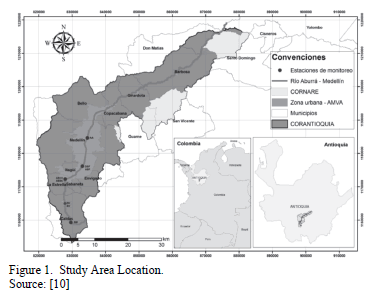
<body><![CDATA[<p> </p>     <p><font size="3" face="Verdana, Arial, Helvetica, sans-serif"><b>1. Introduction</b></font></p>     <p><font size="2" face="Verdana, Arial, Helvetica, sans-serif">Surface water bodies,   especially those that travel along great cities, when they do not have a   complete sanitation system are exposed to receive discharges of several   sources. These discharges can alter the balance of the ecosystem, leading to a   loss of diversity and to an alteration of the abundance of organisms and   deterioration in the physical and chemical quality, which ultimately results in   limiting the potential uses of the water. As a tool, in order to evaluate   different scenarios to recover the water quality, it the implementation of   numerical methods is widely used.</font></p>     <p><font size="2" face="Verdana, Arial, Helvetica, sans-serif">Numerical models for   water quality and transportation can reproduce the hydraulic, chemical and   biological processes that occur in water bodies by using mathematical   expressions that represent these phenomena of interest. These mathematical   expressions are approximations, or a simplified version, of the real system,   which consider its most important characteristics &#91;1,2&#93;. Therefore, the models   are valuable tools for assessing the impact of the implementation of strategies   and / or measures that seek to improve water quality &#91;3,4,5&#93;.</font></p>     <p><font size="2" face="Verdana, Arial, Helvetica, sans-serif">The first water   quality models applied to the Aburra-Medell&iacute;n River that can be found in   literature, were conducted by Empresas Publicas de Medell&iacute;n (EPM) as support   models for several projects related with the sanitation of the river. Recently,   the environmental authority in the basin of this river (Area Metropolitana del   Valle de Aburr&aacute;), through its &quot;RedRio&quot; project performed a water quality   modeling using the QUAL2K modeling software, in order to evaluate 14 different   sanitation scenarios, in other words, to estimate the impact of chemical   pollutants in the water body.</font></p>     <p><font size="2" face="Verdana, Arial, Helvetica, sans-serif">The results of the   research presented in this paper began with the selection of the water quality   model, looking for a model that best represents, or fits, the main   characteristics of the river and the modeling needs. The model to be selected   should be able to adequately represent the transport phenomena of a highly   affected river with continuous discharges of organic matter; the model should   also have an adequate mathematical formulation of the physical-chemical   processes of interest in the research. Finally, the model should be consistent   with the technical and economic capacities available in this research, to   acquire the data required by the selected model (both: quality and discharges   data). Taking into consideration the reasons above mentioned and having in mind   that the main goal is to have a model capable to be used as a decision tool in   the river, the QUAL2Kw model, an updated version of the QUAL2K model &#91;5,6,7&#93;,   was implemented.</font></p>     <p> </p>     <p><font size="3" face="Verdana, Arial, Helvetica, sans-serif"><b>2. Theoretical background</b></font></p>     <p><font size="2" face="Verdana, Arial, Helvetica, sans-serif">The QUAL2Kw model   splits the river into segments which are then divided into small subsections   known as computational elements. For each element hydrological, thermal and   mass balances for each constituent (equation 1) are performed. For each element   in the model, a gain or loss of mass can be computed due to the transportation   phenomena (advection and dispersion), loads or extractions of external sources   (water intakes, wastewater discharges, among others) or internal sources   (benthic oxygen demand and biochemical transformations, among others) &#91;7&#93;. The   general formula to compute a mass balance of a constituent in water, ci, in   section i, is as follows:</font></p>     <p><img src="/img/revistas/dyna/v82n192/v82n192a22eq01.gif"></p>     ]]></body>
<body><![CDATA[<p><font size="2" face="Verdana, Arial, Helvetica, sans-serif">Eq. 1. Mass balance equation for constituent I, in section   i. &#91;4&#93;.</font></p>     <p><font size="2" face="Verdana, Arial, Helvetica, sans-serif">Where Qi: discharge in   section i (L/day), Qab,i: water intake in section i (L/day), Vi: volume in   section i (L), Wi: external load of constituent in segment i (mg/day), Si:   sources and discharges of constituent due to reactions and mechanisms of mass   transfer (mg/L/day), Ei: dispersion coefficient between sections (L/day),   Ei-1,Ei dispersion coefficient between segments i-1, i and i+1 (L/day), ci:   constituent concentration in section i (mg/L) and t: time (day).</font></p>     <p><font size="2" face="Verdana, Arial, Helvetica, sans-serif">Mass balance equations are solved under steady state and   under uniform flow, using a finite difference method. The final products of the   modeling process are curves, which show the variation of the modeled parameters   along the streams. The main difference between Qual2Kw and Qual2K is that the   first one has incorporated a genetic algorithm to find the optimal values of   the kinetic parameters. The genetic algorithm tries to optimize the adjustment   rate of the model compared to the observed data. The final software users can   choose between a manual input of the values for each parameter to be used in   the model or an auto-calibration functionality &#91;8&#93;.</font></p>     <p> </p>     <p><font size="3" face="Verdana, Arial, Helvetica, sans-serif"><b>3. Materials and methods</b></font></p>     <p><b><font size="2" face="Verdana, Arial, Helvetica, sans-serif"><i>3.1. Study area description</i></font></b></p>     <p><font size="2" face="Verdana, Arial, Helvetica, sans-serif">Aburr&aacute; Valley is located in the center-south of the   Department of Antioquia (State) in Colombia. It is situated in the middle of   the Central Andes mountain range. Its relative importance is that the city of   Medellin is part of it, which is the second largest city in the country as well   as the second most important. Nine other municipalities are part   of this Metropolitan area (Barbosa, Girardota, Copacabana, Bello, Itagü&iacute;,   Sabaneta, Caldas, La Estrella y Envigado). The combined population of   these cities is around 3 million inhabitants. The Aburr&aacute;-Medell&iacute;n River crosses   the valley from south to north. This river crosses the ten municipalities mentioned   above, and has become a hub for the historical development of the region &#91;9&#93;.</font></p>     <p><font size="2" face="Verdana, Arial, Helvetica, sans-serif">The topography of   Aburr&aacute; Valley is irregular along its extension. The altitude is between 1300   and 2890 m a.s.l. Medell&iacute;n, which is the most developed urban core, is located   in the central part of the valley within an extension of 8 km &#91;10&#93;.</font></p>     <p><font size="2" face="Verdana, Arial, Helvetica, sans-serif">Most of the surface streams and the natural drains of the   Aburr&aacute; Valley are highly polluted due to direct wastewater discharges, mainly   in the central part of the valley. This situation leads to a reduction in the   dissolve oxygen levels and to an increase in the levels of organic matter,   inorganic matter, and toxic substances &#91;11&#93;. Water quality decreases   substantially and with it the quality of life for the people around it.</font></p>     <p><font size="2" face="Verdana, Arial, Helvetica, sans-serif">The Aburr&aacute;-Medell&iacute;n River integrates the municipalities of   this valley. It receives about 254 tributaries of a different magnitude, along   its 100 kilometer length, from its source point in the top basin, in a place   known as Alto de San Miguel (municipality of Caldas), to its confluence with   the Rio Grande. The tributaries are relatively short, with steep slopes, deep   and narrow channels, high speeds and large sediment transport capacity, which   correlate with the high erosive powers &#91;12&#93;. </font></p>     ]]></body>
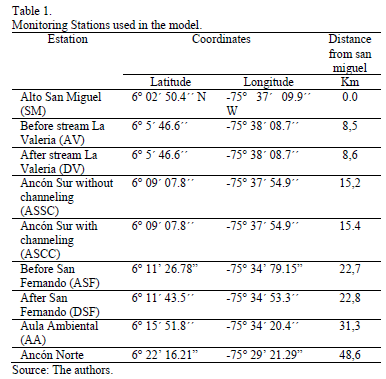
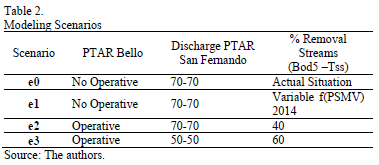
<body><![CDATA[<p><font size="2" face="Verdana, Arial, Helvetica, sans-serif"><b><i>Monitoring stations</i></b>, the monitoring stations   selected in this research to be incorporated into the model are: San Miguel   -E1, Before Valeria-E2, After Valer&iacute;a-E3, Anc&oacute;n Sur without channeling -E4,   Anc&oacute;n Sur with channeling -E5, Before San Fernando-E6, After San Fernando-E7, Aula   Ambiental-E8, Anc&oacute;n Norte -E9 (<a href="#fig01">Fig. 1</a>, <a href="#tab01">Table 1</a>).</font></p>     <p align="center"><font size="2" face="Verdana, Arial, Helvetica, sans-serif"><a name="fig01"></a></font><img src="/img/revistas/dyna/v82n192/v82n192a22fig01.gif"></p>     <p align="center"><font size="2" face="Verdana, Arial, Helvetica, sans-serif"><a name="tab01"></a></font><img src="/img/revistas/dyna/v82n192/v82n192a22tab01.gif"></p>     <p><font size="2" face="Verdana, Arial, Helvetica, sans-serif">After model selection,   according to its easy handling and required information &#91;13&#93;, historic records   from low flows in the river, since the year 2004, were used to run the model   &#91;12&#93;, since they are related to the most critical conditions of water quality   in a flow receiving different types of discharges &#91;14&#93;.</font></p>     <p><font size="2" face="Verdana, Arial, Helvetica, sans-serif"><b><i>Input Data into   Qual2Kw model.</i></b> As a first   step the border conditions were set up in the monitoring station (San Miguel).   Hydraulic data, temperature, water quality and low flow data were also set up   in the other monitoring stations along the river located downstream of the   initial station. The model was set up in such a way that the sections in which   the river is splitted were adjusted to concur with the sections that were   defined by the environmental authority &#91;15&#93; as the most important monitoring   stations, because they allow a quick view of the state of the river. Domestic   and industrial discharges, as well as tributary streams, were modeled as point   sources in the model. Since there are some distributed discharges along the   river, which are very difficult to locate and to characterize, and since they   have a significant impact on the water, these distributed discharges were   included in the model as unmonitored tributaries and the quality was assumed to   be the typical composition for residential waste water &#91;16&#93; and for the mass   balance.</font></p>     <p><font size="2" face="Verdana, Arial, Helvetica, sans-serif"><b><i>Model   Implementation.</i></b> The model   was set up with low flow data. The time step used to calculate was fixed on   11.25 minutes to avoid numerical instabilities. The numerical methods used were   Euler and Newton-Raphson &#91;17&#93;. Level 1 was chosen in order to model the   exchanges in the hypothetic zone, because it includes zero and one-order   equations for BOD oxidation.</font></p>     <p><font size="2" face="Verdana, Arial, Helvetica, sans-serif"><b><i>Model   Calibration.</i></b> The algorithm   used by the model to calibrate the model constants consists in a genetic   searching technique, which involves a set of operators that allows its   convergence into an optimal solution &#91;2, 7&#93;. In order to find the set of   parameters that better represent the reality of the river, the model was run in   such a way that the objective function (weighted squared error) was minimized.   The genetic parameters were set as: 125 model runs in a population and 126   evolutive generations.</font></p>     <p><font size="2" face="Verdana, Arial, Helvetica, sans-serif"><b><i>Water quality   scenarios,</i></b> according with   the progress of the Sanitation Master Plan and Discharges Management (PSMV for   its acronym in Spanish). Three scenarios were considered in this research,   according with the law 3930 of 2010 &#91;18&#93;. In which is formulated, among others,   the need to have formulated a management plan of water resources and these   management plans must be formulated by the environmental authority, considering   during the formulation of the plan different projections for the short, medium   and long term (2, 5 and 10 years). The first scenario was simulated by having   the discharge of the interceptors of wastewater directly into the river, but   assuming a better collection of wastewater in the tributaries according with   the goals of the PSMV for the year 2014. Scenarios 2 and 3 were simulated under   the assumption of the construction of the south and north interceptor as well   as the construction of the wastewater treatment plant of Bello, all of them   fully functional. <a href="#tab02">Table 2</a> presents the summary of the simulated scenarios.</font></p>     <p align="center"><font size="2" face="Verdana, Arial, Helvetica, sans-serif"><a name="tab02"></a></font><img src="/img/revistas/dyna/v82n192/v82n192a22tab02.gif"></p>     <p><font size="2" face="Verdana, Arial, Helvetica, sans-serif">Among the assumptions   that were considered in the simulations, the actual discharge of the waste   water treatment plant (WWTP), San Fernando, 70-70 and 50-50, means that it is   expected that the discharge of the WWTP does not exceed 70 70 mg/L of BOD5 and 70   mg/L of TSS, and so on.</font></p>     ]]></body>
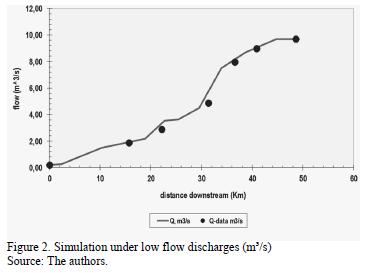
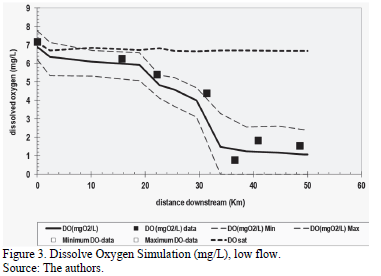
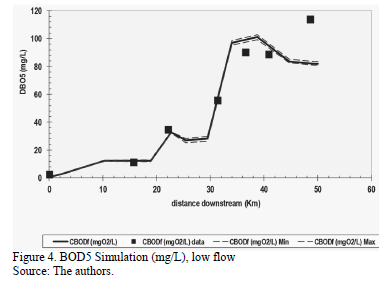
<body><![CDATA[<p><font size="2" face="Verdana, Arial, Helvetica, sans-serif">In scenarios 2 and 3,   which consider the WWTP of Bello, it is worth mentioning that the percentages   in the collection of waste water in the tributaries that still do not have   proper sanitation is 40% and 60%. Additionally, in scenario 3 a 5% improvement   was assumed by the streams that today have proper sanitation with the   implementation of construction works that improve the collection of wastewater.</font></p>     <p><font size="2" face="Verdana, Arial, Helvetica, sans-serif"><b><i>Obtaining the   equation for the BMWP/Col (Biological Monitoring Working Party in Colombia).</i></b> According to the actual water quality conditions   observed in the river it is not possible for the macro invertebrates to   colonize the river. For this reason, it was decided to not include in the   computation the growth and decay rates, but a variation of the model was used which   tried to better represent the specific situation described above in the   Aburr&aacute;-Medell&iacute;n River. The BMWP/col is computed by using a piece of code in an   Excel Macro that automatically calculates it after the physicochemical variables   are computed in the software. To obtain the equation, a matrix was structured   with the data collected under low flow periods. The Electrical Conductivity   parameter plays a major role in determining the processes related with water   quality in this river and for this reason an equation to calculate the BMWP/col   must be in terms of this parameter. To be able to include the effects of   conductivity in the BMWP/col a regression using dichotomous variables and to   validate its representativity it was necessary to evaluate the assumptions that   were made; the latter was done with Eviews &#91;19&#93;.</font></p>     <p> </p>     <p><font size="3" face="Verdana, Arial, Helvetica, sans-serif"><b>4. Results</b></font></p>     <p><b><font size="2" face="Verdana, Arial, Helvetica, sans-serif"><i>4.1. BMWP/col equation</i></font></b></p>     <p><font size="2" face="Verdana, Arial, Helvetica, sans-serif">When performing a test of hypothesis testing, the p-value   of the explanatory variable (for electrical conductivity variable) was 0.104   with a confidence level of 89.9 %. With these values, it is possible to   conclude that conductivity does have a significant effect on the BMWP/Col.   Additionally, p-values of all dichotomous variables tend to zero, which   indicates that they are significant and must be considered when using the   equation in each section of the river</font></p>     <p><font size="2" face="Verdana, Arial, Helvetica, sans-serif"><b><i>4.2. The obtained equation is shown below:</i></b></font></p>     <p><img src="/img/revistas/dyna/v82n192/v82n192a22eq02.gif"></p>     <p><font size="2" face="Verdana, Arial, Helvetica, sans-serif"><b><i>4.3. Calibrated Model</i></b></font></p>     <p><font size="2" face="Verdana, Arial, Helvetica, sans-serif">In the <a href="#fig02">Figs. 2</a>, <a href="#fig03">3</a> and <a href="#fig04">4</a> it is possible to compare the   results along the river for the modeled parameters (continuous line) against   field measurements in the monitoring stations (scattered points) under low flow   scenarios.</font></p>     ]]></body>
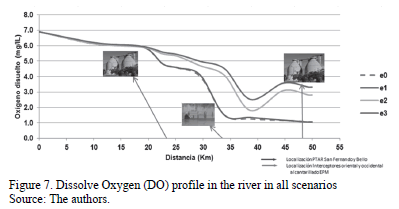
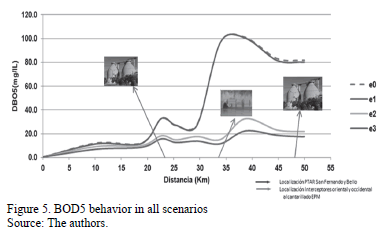
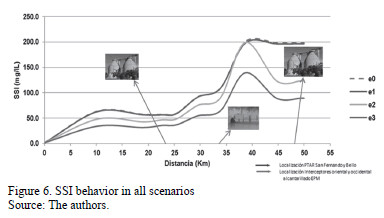
<body><![CDATA[<p align="center"><font size="2" face="Verdana, Arial, Helvetica, sans-serif"><a name="fig02"></a></font><img src="/img/revistas/dyna/v82n192/v82n192a22fig02.gif"></p>     <p align="center"><font size="2" face="Verdana, Arial, Helvetica, sans-serif"><a name="fig03"></a></font><img src="/img/revistas/dyna/v82n192/v82n192a22fig03.gif"></p>     <p align="center"><font size="2" face="Verdana, Arial, Helvetica, sans-serif"><a name="fig04"></a></font><img src="/img/revistas/dyna/v82n192/v82n192a22fig04.gif"></p>     <p><font size="2" face="Verdana, Arial, Helvetica, sans-serif"><b><i>4.4. Evaluation of scenarios</i></b></font></p>     <p><font size="2" face="Verdana, Arial, Helvetica, sans-serif">Once the model was properly calibrated, the following   alternatives were evaluated: scenario &quot;e0&quot; actual water quality conditions in   the Aburr&aacute; - Medell&iacute;n River; scenario &quot;e1&quot; corresponds to the expectations of   the water quality conditions in a period of two years. For the input data of   this scenario, in some of the tributaries the percentage of sanitation   according with the sanitation works projected in the PSMV for the year 2014   were assumed. Scenario &quot;e2&quot; represents the expectations in water quality in a   five-year period. Scenario &quot;e3&quot; represents the expectations in water quality over   a ten-year period. The percentage of sanitation in the tributaries used in   scenario &quot;e2&quot; was 40% and 60% in scenario &quot;e3&quot;. Discharges from the San   Fernando WWTP were set up as 70-70 and 50-50 for scenarios &quot;e2&quot; and &quot;e3&quot;   respectively assuming the future WWTP of Bello was fully functional. From these   scenarios, it was possible to obtain the behavior of water quality.</font></p>     <p><font size="2" face="Verdana, Arial, Helvetica, sans-serif"><a href="#fig05">Fig. 5</a> shows the variation for the BDO5 along the river   for the future scenarios that were run (2, 5 and 10 years) assuming pollutant   load removal in scenarios 2 and 3 and also with the WWTP of Bello operating. In   the same graph, the actual scenario is presented. By   comparing these scenarios, a notorious recovery in the water quality of the   river is observed once the WWTP enters into operation. From this analysis it is   clear the importance that the WWTP plays in the Sanitation Plan of the river to   help in the recovery of the physicochemical water quality of it.</font></p>     <p align="center"><font size="2" face="Verdana, Arial, Helvetica, sans-serif"><a name="fig05"></a></font><img src="/img/revistas/dyna/v82n192/v82n192a22fig05.gif"></p>     <p><font size="2" face="Verdana, Arial, Helvetica, sans-serif"><a href="#fig06">Fig. 6</a> shows the variation of inorganic suspended solids   (ISS) along the Medellin-Aburr&aacute; River according to the predictions of the   modeling. It can be seen that in terms of ISS in the river the recovery is not   as significant as the one modeled for the BOD. Which can be explained with the   large contribution of ISS that is being received from the tributaries and in   many of them the origin is not from the domestic wastewater, but from mining in   the tributaries and deforestation processes in their upper parts, so despite   its removal in the proposed scenarios, concentrations remain high.</font></p>     <p align="center"><font size="2" face="Verdana, Arial, Helvetica, sans-serif"><a name="fig06"></a></font><img src="/img/revistas/dyna/v82n192/v82n192a22fig06.gif"></p>     <p><font size="2" face="Verdana, Arial, Helvetica, sans-serif">For the evaluated scenarios OD profile along the river,   is shown in <a href="#fig07">Fig. 7</a>. In this graph it is possible to see a recovery near to the Moravia   sector (Kilometer 34), this is due to the closure of the interceptors located   in this point of the river and the startup of the WWTP of Bello. This situation   is more evident in scenarios 2 and 3 (i.e., projections at 5 and 10 years).</font></p>     ]]></body>
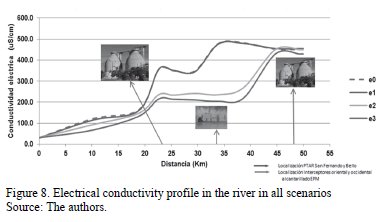
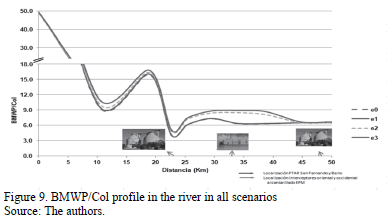
<body><![CDATA[<p align="center"><font size="2" face="Verdana, Arial, Helvetica, sans-serif"><a name="fig07"></a></font><img src="/img/revistas/dyna/v82n192/v82n192a22fig07.gif"></p>     <p><font size="2" face="Verdana, Arial, Helvetica, sans-serif"><a href="#fig08">Fig. 8</a> shows the   results for electrical conductivity for the different scenarios simulated. The   highest values of conductivity correspond to scenarios e0 and e1 (current and   year two) due to the low remotion rates. The lowest values of conductivity were   in scenarios e2 and e3 (years five and ten) where the WWTP of Bello is   operating. The discharge of the future WWTP in Bello causes the conductivity to   increases and moves northwards.</font></p>     <p align="center"><font size="2" face="Verdana, Arial, Helvetica, sans-serif"><a name="fig08"></a></font><img src="/img/revistas/dyna/v82n192/v82n192a22fig08.gif"></p>     <p><font size="2" face="Verdana, Arial, Helvetica, sans-serif">Like the ISS   parameter, there is not a significant recovery in conductivity, as it was   obtained for BOD near to km 48 of the river. This is due to the lack of real   data about removal percentages for this variable with the WWTP of Bello   operating.</font></p>     <p><font size="2" face="Verdana, Arial, Helvetica, sans-serif"><a href="#fig09">Fig. 9</a>, shows the results from the model for BMWP/Col in   the different scenarios. From this graph, a marked deterioration in km 10 is   observed, which corresponds with the place where the tributaries Chuscala, La   Miel y La Valeria enters into the river, then a recovery is achieved near km   15. In km 23, BMWP/Col reduces again; in these kilometers is located the   discharge of WWTP San Fernando. From this point the biological component that   represents this BMWP/Col, shows a slight improvement until km 33 where the   parameter decreases again due to the discharge of &quot;K-33 Interceptors&quot; of waste   water at this point for scenarios 0 and 1 (current and 2 year scenarios). From   this point, there is a constant trend in this variable in the more critical   stretch of the river. </font></p>     <p align="center"><font size="2" face="Verdana, Arial, Helvetica, sans-serif"><a name="fig09"></a><img src="/img/revistas/dyna/v82n192/v82n192a22fig09.gif"></font></p>     <p> </p>     <p><font size="3" face="Verdana, Arial, Helvetica, sans-serif"><b>5. Discussion</b></font></p>     <p><font size="2" face="Verdana, Arial, Helvetica, sans-serif">In terms of BOD5, in the first 19 km, there are no   significant changes in the behavior of this parameter between the current and   proposed future scenarios, with a slight peak near Km 10, where tributaries La   Miel, La Valeria and La Chuscala enter the river (<a href="#fig05">Fig. 5</a>). La Chuscala   tributary receives the discharge of a collector of wastewater in the Mandaly   neighborhood (municipality of Caldas), which has a high concentration of   organic matter as a product of the agricultural and domestic activities that   occur in this watershed. By comparing scenarios e1, e2 and e3 with the actual   scenario it is evident that BOD5 concentration has variations in the first   kilometers with removal percentages between 40% and 60%, respectively.   Therefore, all the efforts in these kilometers should be directed towards the   completion of the collectors of domestic wastewater &#91;3&#93;, which are planned by   the municipality of Caldas and with actions focused on water resource   protection.</font></p>     <p><font size="2" face="Verdana, Arial, Helvetica, sans-serif">Future scenarios show a significant decrease in the   concentrations of BOD5, compared with the current conditions scenario e0.</font></p>     ]]></body>
<body><![CDATA[<p><font size="2" face="Verdana, Arial, Helvetica, sans-serif">It is remarkable the reduction that is observe between km   33 and km 48, as a result of the connection of the sewer interceptors of EPM   with the projected WWTP of Bello. Also, with the removal of load in terms of   BOD5 in some tributaries such as La Rosa, La Madera, El Hato, La Garcia, La   Se&ntilde;orita, Rodas and Piedras Blancas, which are located in this section of the   river.</font></p>     <p><font size="2" face="Verdana, Arial, Helvetica, sans-serif">The results support the need to continue with the works to   collect the wastewater and with the construction of the WWTP Bello, in order to   reduce the load in terms of BOD5, and to continue with the cleaning of the   tributaries, to collect wastewater and to prevent direct discharge to the water   source, similar effects are presented by Holgu&iacute;n for the Cauca River in the   city of Cali &#91;20&#93;.</font></p>     <p><font size="2" face="Verdana, Arial, Helvetica, sans-serif">The increase in solids that occurs around km 10, can be   explained as a result of the arrival into the river of the tributaries La   Minita, La Miel, La Valeria and The Chuscala (<a href="#fig06">Fig. 6</a>). These tributaries introduce   large amounts of suspended solids into the water as a result of erosive   processes generated in the upper parts of these watersheds and from the direct   input of wastewater from the municipality of Caldas through collectors, which   are still disconnected from the WWTP in San Fernando.</font></p>     <p><font size="2" face="Verdana, Arial, Helvetica, sans-serif">The increase in the Inorganic Suspended Solids (ISS),   close to km 29, is a response of the tributaries that arrive in this section of   the river, such as Altavista, La Picacha and La Hueso, which are very important   tributaries in terms of distributing solid loads into the river. The high   content of solids in these tributaries is not only due to erosive phenomena in   the streams but is also related with poor land planning as well as soil uses in   the catchments, also in these tributaries the mining to extract construction   materials is high. In Km 33, the simulation for future scenarios (specially e3)   shows a clear reduction in the load of solids. This reduction can be the result   of the connection of the interceptors to the future WWTP of Bello and therefore   a reduction of the direct discharges into the Aburr&aacute;-Medell&iacute;n River. In   addition, the reduction can be explained due to the significant reductions in   discharges in the tributaries. In the base scenario (e0), there is no change in   the model for the amount of solids in the river. For scenarios e2 and e3, there   is an increment in the solids concentration, basically for the arrival of some   tributaries to the river: El Hato, La Garc&iacute;a and la Madera. In these   tributaries, despite the fact they are modeled with a reduction in pollutants,   the reduction is not enough to make a significant change in the water quality,   due to the high concentrations of solids that they have. Such concentrations   are not mainly associated to the domestic wastewater, but with the mining in   order to extract construction materials.</font></p>     <p><font size="2" face="Verdana, Arial, Helvetica, sans-serif">Despite discharges of wastewater from the municipality of   Caldas, dissolved oxygen is presented in the river until km 15 (Fig. 7). This   is because the slope of the river in this segment promotes the oxygenation of   the water body. Later, in the river a reduction in the oxygen concentration is   observed, with the lowest concentrations around the location of the discharges   of the interceptors, which transports much of the wastewater of the region near   km 33 (Metro's Caribe Station). From that point, a slight recovery occurs and   then decreases again due to an increased load that does not allow   re-oxygenation, despite the fact that the slope at this point is still   significant and the presence of hydraulic jumps in this part of the river.   Between km 33 and km 48 the most critical section of the river is located,   which is consistent with the behavior of BOD5 and solids, reflecting the impact   of the income of wastewaters into the water body, which deteriorates its quality   &#91;17,21&#93;. It is necessary to remark on the fact that despite the improvement of   sanitation in the tributaries as it was set up in the model for scenarios e2 and   e3, a significant recovery for future values of dissolved oxygen in the   critical section of the river is not seen. Aiming to find an ideal scenario, in   which the levels of DO were acceptable in the critical section, it was found   that it is necessary to collect a minimum of 80% of the wastewater to achieve   this goal.</font></p>     <p><font size="2" face="Verdana, Arial, Helvetica, sans-serif">Scenarios e0 and e1 return the highest values of electric   conductivity along the river, due to the low removal percentages for this   variable (Fig. 8). These results show a sustained increase in the concentration   value that occurs from km 15 to km 33 near the location of the interceptors.   Results that can be associated in large part to the city domestic discharges ,   which are not yet transported into a WWTP. It is also important to note that   the electrical conductivity is a dynamic parameter with a different peak in   time for each monitoring station depending on the time of day and it is closely   related to human activity in the city. Scenarios e2 and e3 show a decrease in   electrical conductivity, due to the projected connection of the interceptors to   the WWTP of Bello, demonstrating the recovery that the river would have in this   segment with the implementation of the PSMV. However, for these two scenarios,   the most critical conditions are given by the discharge of the WWTP of Bello,   which because of the significant volume of water to be discharged in this plant   generates a significant impact on the river.</font></p>     <p><font size="2" face="Verdana, Arial, Helvetica, sans-serif">Overall, the impact of the more significant tributaries of   the river on the macro invertebrate community were observed, highlighting the   variable BMWP/Col as an indicator to complement the physicochemical analysis of   the river (Fig. 9). To recover the diversity and abundance of macro   invertebrates (biological quality) in the channelized segment of the river, it   is necessary not only to recover the water quality of the river and its tributaries,   it is also necessary to implement other strategies associated with the   hydraulics of the channel &#91;22,23&#93;. Measurements such as the reduction of the   water velocity (a variable that was not considered in the calculations due to   the lack of information) must be implemented. What is concluded here is that   despite the operation of the WWTP there is still a missing component to improve   and it is the availability of natural habitats and colonization substrates and   to have structures to protect them &#91;24&#93;.</font></p>     <p> </p>     <p><font size="3" face="Verdana, Arial, Helvetica, sans-serif"><b>6. Conclusions </b></font></p>     <p><font size="2" face="Verdana, Arial, Helvetica, sans-serif">Analyzing the results of the model in terms of BOD5, the   reduction of this parameter is clear, the highest reductions are achieved when   the interceptors were simulated to be connected to the future WWTP in Bello,   this was done in scenarios 2 and 3. Scenario 1 only presents a small reduction   in concentration of BOD5 due to the sanitation in the tributaries according to   the PSMV until the year 2014. This reflects the right decision of EPM to   prioritize investment to the construction of the treatment plant to improve the   quality of the river. This action is suggested in Colombia due to the limited   resources available for reorganizing current and / or treatment wastewater   plants &#91;25&#93;.</font></p>     ]]></body>
<body><![CDATA[<p><font size="2" face="Verdana, Arial, Helvetica, sans-serif">In terms of suspended solids, alternatives e2 and e3 allow   reductions in the concentration of this parameter, mainly due to the proposed   reduction in the tributaries. Scenario e1 is the worst scenario in terms of   solids due to the low reductions assumed on it. It is important to remark that   the most critical section of the river for water quality in terms of BOD5 and   ISS is located from km 29 to km 48. This situation has a direct relation with   the arrival of some main tributaries on the river such as: La Hueso, La Iguan&aacute;,   Santa Elena, La Rosa, La Madera, El Hato, La Garc&iacute;a, La Se&ntilde;orita y La Seca,   among others. Even though, in the simulated scenarios a certain removal of   pollutants was assumed for the sanitation in these tributaries, the assumed   percentage was not enough to fully recover the river, especially in terms of   ISS. These results show that despite all the efforts that can be made in terms   of infrastructure to collect and to treat wastewater, simultaneously, it is   essential to initiate actions focusing on environmental education and culture   &#91;26&#93;, regulatory/incentive policies, proper management of quarries and mining,   prevention and mitigation works to avoid erosion and also a suitable land use   scheme &#91;27&#93;.</font></p>     <p><font size="2" face="Verdana, Arial, Helvetica, sans-serif">Finally, according to the variation obtained from BMWP/Col   River's profile in the different scenarios modeled, it is difficult to reach   values higher than 15 in the urbanized section, which allow the classification   to change from &quot;heavily contaminated (&lt;15)&quot; to &quot;very polluted   (16-35)&quot; (ranges established in the biotic index) &#91;28,29&#93;. From the   results of the model for the different scenarios it was observed that even   though the improvement in water quality on the river and its tributaries and   the interconnection of the interceptor with the future WWTP of Bello, the   increase in BMWP/col index is minimum. This situation leads to the conclusion   that parallel to the improvement in water quality of the tributaries, changes are   also required in the hydraulic of the river to create proper conditions that   favor the development of the entire life cycle of organisms. So, it is   necessary to improve the availability of natural substrates of colonization and   structures that enhance its protection.</font></p>     <p> </p>     <p><font size="3" face="Verdana, Arial, Helvetica, sans-serif"><b>Acknowledgments</b></font></p>     <p><font size="2" face="Verdana, Arial, Helvetica, sans-serif">We want to express our   acknowledgments to the University of Antioquia, to the research group GIGA, to   the environmental authority (&Aacute;rea Metropolitana del Valle de Aburr&aacute;) and to the   engineers Yaneth Daza and James Londo&ntilde;o for their support, advice and   contributions to this experimental work.</font></p>     <p> </p>     <p><font size="3" face="Verdana, Arial, Helvetica, sans-serif"><b>References</b></font></p>     <!-- ref --><p><font size="2" face="Verdana, Arial, Helvetica, sans-serif"><b>&#91;1&#93;</b> Camacho and D&iacute;az, Metodolog&iacute;a para la obtenci&oacute;n de   un modelo predictivo de transporte de solutos y de calidad del agua en r&iacute;os -   Caso r&iacute;o Bogot&aacute;, Seminario Internacional La Hidroinform&aacute;tica en la Gesti&oacute;n   Integrada de los Recursos H&iacute;dricos, Universidad del Valle - Instituto Cinara,   2003.    &nbsp;&nbsp;&nbsp;&nbsp;&nbsp;&nbsp;&nbsp;&nbsp;[&#160;<a href="javascript:void(0);" onclick="javascript: window.open('/scielo.php?script=sci_nlinks&ref=000100&pid=S0012-7353201500040002200001&lng=','','width=640,height=500,resizable=yes,scrollbars=1,menubar=yes,');">Links</a>&#160;]<!-- end-ref --></font></p>     <!-- ref --><p><font size="2" face="Verdana, Arial, Helvetica, sans-serif"><b>&#91;2&#93;</b> Vera, I. and Lara, J., Discusi&oacute;n de operadores involucrados en un   proceso de calibraci&oacute;n mediante algoritmos gen&eacute;ticos para un modelo de calidad   del agua de corrientes superficiales trabajando con la herramienta Qual2Kw. Rev.   Fac. Ing., Univ. Antioquia 50, pp. 77-86, 2009.    &nbsp;&nbsp;&nbsp;&nbsp;&nbsp;&nbsp;&nbsp;&nbsp;[&#160;<a href="javascript:void(0);" onclick="javascript: window.open('/scielo.php?script=sci_nlinks&ref=000102&pid=S0012-7353201500040002200002&lng=','','width=640,height=500,resizable=yes,scrollbars=1,menubar=yes,');">Links</a>&#160;]<!-- end-ref --></font></p>     <!-- ref --><p><font size="2" face="Verdana, Arial, Helvetica, sans-serif"><b>&#91;3&#93;</b> Rodr&iacute;guez,   J.P., D&iacute;az-Granados, M., Camacho, L.A., Raciny, I.C., Maksimovic, C. and   McIntyre, N., Bogot&aacute;'s urban drainage system: Context, research activities and   perspectives. BHS 10<sup>th</sup> National Hydrology Symposium, Exeter, 2008.    &nbsp;&nbsp;&nbsp;&nbsp;&nbsp;&nbsp;&nbsp;&nbsp;[&#160;<a href="javascript:void(0);" onclick="javascript: window.open('/scielo.php?script=sci_nlinks&ref=000104&pid=S0012-7353201500040002200003&lng=','','width=640,height=500,resizable=yes,scrollbars=1,menubar=yes,');">Links</a>&#160;]<!-- end-ref --></font></p>     <!-- ref --><p><font size="2" face="Verdana, Arial, Helvetica, sans-serif"><b>&#91;4&#93;</b> Chapra,   S.C., Surface water-quality modeling. Waveland Press, 2008.    &nbsp;&nbsp;&nbsp;&nbsp;&nbsp;&nbsp;&nbsp;&nbsp;[&#160;<a href="javascript:void(0);" onclick="javascript: window.open('/scielo.php?script=sci_nlinks&ref=000106&pid=S0012-7353201500040002200004&lng=','','width=640,height=500,resizable=yes,scrollbars=1,menubar=yes,');">Links</a>&#160;]<!-- end-ref --></font></p>     <!-- ref --><p><font size="2" face="Verdana, Arial, Helvetica, sans-serif"><b>&#91;5&#93;</b> Chapra,   S.C., Pelletier, G.J. and Tao, H., QUAL2K: A modeling framework for simulating   river and stream water quality, (Version 2.11): Documentation and users manual.   Civil and Environmental Engineering Dept., Tufts University, Medford, MA., pp. 1-109,   2008.    &nbsp;&nbsp;&nbsp;&nbsp;&nbsp;&nbsp;&nbsp;&nbsp;[&#160;<a href="javascript:void(0);" onclick="javascript: window.open('/scielo.php?script=sci_nlinks&ref=000108&pid=S0012-7353201500040002200005&lng=','','width=640,height=500,resizable=yes,scrollbars=1,menubar=yes,');">Links</a>&#160;]<!-- end-ref --></font></p>     <!-- ref --><p><font size="2" face="Verdana, Arial, Helvetica, sans-serif"><b>&#91;6&#93;</b> Chapra,   S.C. and Pelletier, G.J., QUAL2K: A modeling framework for simulating river and   stream water quality: Documentation and user manual. Civil and Environmental   Engineering Dept., Tufts University, Medford, M. A., 2003.    &nbsp;&nbsp;&nbsp;&nbsp;&nbsp;&nbsp;&nbsp;&nbsp;[&#160;<a href="javascript:void(0);" onclick="javascript: window.open('/scielo.php?script=sci_nlinks&ref=000110&pid=S0012-7353201500040002200006&lng=','','width=640,height=500,resizable=yes,scrollbars=1,menubar=yes,');">Links</a>&#160;]<!-- end-ref --></font></p>     <!-- ref --><p><font size="2" face="Verdana, Arial, Helvetica, sans-serif"><b>&#91;7&#93;</b> Pelletier,   G.J., Chapra, S.C. and Tao, H., QUAL2Kw - A framework for modeling w&aacute;ter   quality in streams and rivers using a genetic algorithm for calibration.   Environmental Modelling &amp; Software 21, pp. 419-425. 2006. DOI: 10.1016/j.envsoft.2005.07.002</font>&nbsp;&nbsp;&nbsp;&nbsp;&nbsp;&nbsp;&nbsp;&nbsp;[&#160;<a href="javascript:void(0);" onclick="javascript: window.open('/scielo.php?script=sci_nlinks&ref=000112&pid=S0012-7353201500040002200007&lng=','','width=640,height=500,resizable=yes,scrollbars=1,menubar=yes,');">Links</a>&#160;]<!-- end-ref --><!-- ref --><p><font size="2" face="Verdana, Arial, Helvetica, sans-serif"><b>&#91;8&#93;</b> Hossain,   M.A., Sujaul, I.M. and Nasly, M.A., Application of QUAL2Kw for water quality   modeling in the Tunggak River, Kuantan, Pahang, Malaysia. Research Journal of   Recent Sciences 3 (6), pp. 6-14, 2014.    &nbsp;&nbsp;&nbsp;&nbsp;&nbsp;&nbsp;&nbsp;&nbsp;[&#160;<a href="javascript:void(0);" onclick="javascript: window.open('/scielo.php?script=sci_nlinks&ref=000113&pid=S0012-7353201500040002200008&lng=','','width=640,height=500,resizable=yes,scrollbars=1,menubar=yes,');">Links</a>&#160;]<!-- end-ref --></font></p>     <!-- ref --><p><font size="2" face="Verdana, Arial, Helvetica, sans-serif"><b>&#91;9&#93;</b> Giraldo,   L., Agudelo, R. and Palacio, C., Spatial and temporal variation of nitrogen in   the Medell&iacute;n river. DYNA, 77 (63), pp 124-131, 2010.    &nbsp;&nbsp;&nbsp;&nbsp;&nbsp;&nbsp;&nbsp;&nbsp;[&#160;<a href="javascript:void(0);" onclick="javascript: window.open('/scielo.php?script=sci_nlinks&ref=000115&pid=S0012-7353201500040002200009&lng=','','width=640,height=500,resizable=yes,scrollbars=1,menubar=yes,');">Links</a>&#160;]<!-- end-ref --></font></p>     <!-- ref --><p><font size="2" face="Verdana, Arial, Helvetica, sans-serif"><b>&#91;10&#93;</b> &Aacute;rea Metropolitana del Valle de Aburr&aacute;,   Corantioquia, Cornare y Universidad Nacional de Colombia - Sede Medell&iacute;n, Plan   de ordenaci&oacute;n y manejo de la cuenca del r&iacute;o Aburr&aacute;, Medell&iacute;n, 2007.    &nbsp;&nbsp;&nbsp;&nbsp;&nbsp;&nbsp;&nbsp;&nbsp;[&#160;<a href="javascript:void(0);" onclick="javascript: window.open('/scielo.php?script=sci_nlinks&ref=000117&pid=S0012-7353201500040002200010&lng=','','width=640,height=500,resizable=yes,scrollbars=1,menubar=yes,');">Links</a>&#160;]<!-- end-ref --></font></p>     <!-- ref --><p><font size="2" face="Verdana, Arial, Helvetica, sans-serif"><b>&#91;11&#93;</b> Rivera, J.,   Evaluation of organic matter in the cold river supported in qual2K version 2.07.   DYNA 78 (169), pp. 131-139, 2011.    &nbsp;&nbsp;&nbsp;&nbsp;&nbsp;&nbsp;&nbsp;&nbsp;[&#160;<a href="javascript:void(0);" onclick="javascript: window.open('/scielo.php?script=sci_nlinks&ref=000119&pid=S0012-7353201500040002200011&lng=','','width=640,height=500,resizable=yes,scrollbars=1,menubar=yes,');">Links</a>&#160;]<!-- end-ref --></font></p>     <!-- ref --><p><font size="2" face="Verdana, Arial, Helvetica, sans-serif"><b>&#91;12&#93;</b> &Aacute;rea Metropolitana del Valle de Aburr&aacute;, Universidad de Antioquia,   Universidad Nacional de Colombia - Sede Medell&iacute;n, Universidad Pontificia   Bolivarian y Universidad de Medell&iacute;n, Red de Monitoreo Ambiental en la cuenca   hidrogr&aacute;fica del r&iacute;o Aburr&aacute;-Medell&iacute;n en jurisdicci&oacute;n del &Aacute;rea   Metropolitana-Fase III. Medell&iacute;n, 2011.    &nbsp;&nbsp;&nbsp;&nbsp;&nbsp;&nbsp;&nbsp;&nbsp;[&#160;<a href="javascript:void(0);" onclick="javascript: window.open('/scielo.php?script=sci_nlinks&ref=000121&pid=S0012-7353201500040002200012&lng=','','width=640,height=500,resizable=yes,scrollbars=1,menubar=yes,');">Links</a>&#160;]<!-- end-ref --></font></p>     ]]></body>
<body><![CDATA[<!-- ref --><p><font size="2" face="Verdana, Arial, Helvetica, sans-serif"><b>&#91;13&#93;</b> Fan, C.,   Ko, C. and Wang, W., An innovative modeling approach using Qual2K and HEC-RAS   integration to assess the impact to tidal effect on River Water quality   simulation, Journal of Environmental Management, 90, pp. 1824-1832, 2009. DOI: 10.1016/j.jenvman.2008.11.011</font>&nbsp;&nbsp;&nbsp;&nbsp;&nbsp;&nbsp;&nbsp;&nbsp;[&#160;<a href="javascript:void(0);" onclick="javascript: window.open('/scielo.php?script=sci_nlinks&ref=000123&pid=S0012-7353201500040002200013&lng=','','width=640,height=500,resizable=yes,scrollbars=1,menubar=yes,');">Links</a>&#160;]<!-- end-ref --><!-- ref --><p><font size="2" face="Verdana, Arial, Helvetica, sans-serif"><b>&#91;14&#93;</b> Chang, F.,   Tsai, Y., Chen, P., Coynel, A. and Vachaud, G., Modelling water quality in an   urban river using hydrological factors - Data driven approaches. Journal of   Environmental Management, 151, pp. 87-96, 2015. DOI: 10.1016/j.jenvman.2014.12.014</font>&nbsp;&nbsp;&nbsp;&nbsp;&nbsp;&nbsp;&nbsp;&nbsp;[&#160;<a href="javascript:void(0);" onclick="javascript: window.open('/scielo.php?script=sci_nlinks&ref=000124&pid=S0012-7353201500040002200014&lng=','','width=640,height=500,resizable=yes,scrollbars=1,menubar=yes,');">Links</a>&#160;]<!-- end-ref --><!-- ref --><p><font size="2" face="Verdana, Arial, Helvetica, sans-serif"><b>&#91;15&#93;</b> &Aacute;rea Metropolitana del Valle de Aburr&aacute;., Universidad de Antioquia,   Universidad Nacional de Colombia - Sede Medell&iacute;n, Universidad Pontificia   Bolivariana y Universidad de Medell&iacute;n, Red de monitoreo ambiental en la cuenca   hidrogr&aacute;fica del r&iacute;o Aburr&aacute;-Medell&iacute;n en jurisdicci&oacute;n del &Aacute;rea Metropolitana-   Fase II. Medell&iacute;n, 2007.    &nbsp;&nbsp;&nbsp;&nbsp;&nbsp;&nbsp;&nbsp;&nbsp;[&#160;<a href="javascript:void(0);" onclick="javascript: window.open('/scielo.php?script=sci_nlinks&ref=000125&pid=S0012-7353201500040002200015&lng=','','width=640,height=500,resizable=yes,scrollbars=1,menubar=yes,');">Links</a>&#160;]<!-- end-ref --></font></p>     <!-- ref --><p><font size="2" face="Verdana, Arial, Helvetica, sans-serif"><b>&#91;16&#93;</b> Metcalf, and Eddy, Ingenier&iacute;a de aguas residuales, tratamiento, vertido   y reutilizaci&oacute;n. Editorial Mc. Graw Hill, 1998.    &nbsp;&nbsp;&nbsp;&nbsp;&nbsp;&nbsp;&nbsp;&nbsp;[&#160;<a href="javascript:void(0);" onclick="javascript: window.open('/scielo.php?script=sci_nlinks&ref=000127&pid=S0012-7353201500040002200016&lng=','','width=640,height=500,resizable=yes,scrollbars=1,menubar=yes,');">Links</a>&#160;]<!-- end-ref --></font></p>     <!-- ref --><p><font size="2" face="Verdana, Arial, Helvetica, sans-serif"><b>&#91;17&#93;</b> Kannel,   P.R., Lee, S., Lee, Y.S., Kanel, S.R. and Pelletier. G.P., Application of   automated QUAL2Kw for water quality modeling and management in the Bagmati   river, Nepal, Ecological Modelling 202, pp. 503-517, 2007. DOI: 10.1016/j.ecolmodel.2006.12.033</font>&nbsp;&nbsp;&nbsp;&nbsp;&nbsp;&nbsp;&nbsp;&nbsp;[&#160;<a href="javascript:void(0);" onclick="javascript: window.open('/scielo.php?script=sci_nlinks&ref=000129&pid=S0012-7353201500040002200017&lng=','','width=640,height=500,resizable=yes,scrollbars=1,menubar=yes,');">Links</a>&#160;]<!-- end-ref --><!-- ref --><p><font size="2" face="Verdana, Arial, Helvetica, sans-serif"><b>&#91;18&#93;</b> Ministerio de Ambiente, Vivienda y Desarrollo Territorial. Decreto   3930 de 2010, Colombia.    &nbsp;&nbsp;&nbsp;&nbsp;&nbsp;&nbsp;&nbsp;&nbsp;[&#160;<a href="javascript:void(0);" onclick="javascript: window.open('/scielo.php?script=sci_nlinks&ref=000130&pid=S0012-7353201500040002200018&lng=','','width=640,height=500,resizable=yes,scrollbars=1,menubar=yes,');">Links</a>&#160;]<!-- end-ref --></font></p>     <!-- ref --><p><font size="2" face="Verdana, Arial, Helvetica, sans-serif"><b>&#91;19&#93;</b> Gujarati, D., Econometr&iacute;a, Mc GRAW-HILL, Mexico,   2003.    &nbsp;&nbsp;&nbsp;&nbsp;&nbsp;&nbsp;&nbsp;&nbsp;[&#160;<a href="javascript:void(0);" onclick="javascript: window.open('/scielo.php?script=sci_nlinks&ref=000132&pid=S0012-7353201500040002200019&lng=','','width=640,height=500,resizable=yes,scrollbars=1,menubar=yes,');">Links</a>&#160;]<!-- end-ref --></font></p>     <!-- ref --><p><font size="2" face="Verdana, Arial, Helvetica, sans-serif"><b>&#91;20&#93;</b> Holguin,   J., Everaert, G., Boets, P., Galvis, A. and Goethals, P., Development and   application of an integrated ecological modelling framework to analyze the   impact of wastewater discharges on the ecological water quality of rivers.   Environmental Modelling &amp; Software, 48, pp. pp. 27-39, 2013.    &nbsp;&nbsp;&nbsp;&nbsp;&nbsp;&nbsp;&nbsp;&nbsp;[&#160;<a href="javascript:void(0);" onclick="javascript: window.open('/scielo.php?script=sci_nlinks&ref=000134&pid=S0012-7353201500040002200020&lng=','','width=640,height=500,resizable=yes,scrollbars=1,menubar=yes,');">Links</a>&#160;]<!-- end-ref --></font></p>     <!-- ref --><p><font size="2" face="Verdana, Arial, Helvetica, sans-serif"><b>&#91;21&#93;</b> Kuzniar,   A., Kowalczk, A. and Kostuch, M., Long term water quality monitoring of a   transboundary river. Pol. J. Environ Stud, 23 (3), pp. 1009-1015, 2015.    &nbsp;&nbsp;&nbsp;&nbsp;&nbsp;&nbsp;&nbsp;&nbsp;[&#160;<a href="javascript:void(0);" onclick="javascript: window.open('/scielo.php?script=sci_nlinks&ref=000136&pid=S0012-7353201500040002200021&lng=','','width=640,height=500,resizable=yes,scrollbars=1,menubar=yes,');">Links</a>&#160;]<!-- end-ref --></font></p>     <!-- ref --><p><font size="2" face="Verdana, Arial, Helvetica, sans-serif"><b>&#91;22&#93;</b> Steinman,   A. and McIntire, D., Effects of current velocity and light energy of the   structure of periphyton assemplages in laboratory stream, Journal of Phycology,   22 (3), pp.352-361, 1986. DOI: 10.1111/j.1529-8817.1986.tb00035.x</font>&nbsp;&nbsp;&nbsp;&nbsp;&nbsp;&nbsp;&nbsp;&nbsp;[&#160;<a href="javascript:void(0);" onclick="javascript: window.open('/scielo.php?script=sci_nlinks&ref=000138&pid=S0012-7353201500040002200022&lng=','','width=640,height=500,resizable=yes,scrollbars=1,menubar=yes,');">Links</a>&#160;]<!-- end-ref --><!-- ref --><p><font size="2" face="Verdana, Arial, Helvetica, sans-serif"><b>&#91;23&#93;</b> Oscoz, J. and Escala, M., Efecto de la   contaminaci&oacute;n y regulaci&oacute;n del caudal sobre la comunidad de macroinvertebrados   bent&oacute;nicos del tramo bajo del r&iacute;o Larraun (norte de Espa&ntilde;a), Ecologia, 20, pp.   245-256, 2006.    &nbsp;&nbsp;&nbsp;&nbsp;&nbsp;&nbsp;&nbsp;&nbsp;[&#160;<a href="javascript:void(0);" onclick="javascript: window.open('/scielo.php?script=sci_nlinks&ref=000139&pid=S0012-7353201500040002200023&lng=','','width=640,height=500,resizable=yes,scrollbars=1,menubar=yes,');">Links</a>&#160;]<!-- end-ref --> </font></p>     <!-- ref --><p><font size="2" face="Verdana, Arial, Helvetica, sans-serif"><b>&#91;24&#93;</b> G&oacute;mez, N.,   Sierra, M.V., Cortelezzi, A. and Rodrigues, C.A., Effects of discharges from   the textile industry on the biotic integrity of benthic assemblages. Ecotoxicology   and Environmental Safety, 69, pp. 472-479, 2007. DOI: 10.1016/j.ecoenv.2007.03.007</font>&nbsp;&nbsp;&nbsp;&nbsp;&nbsp;&nbsp;&nbsp;&nbsp;[&#160;<a href="javascript:void(0);" onclick="javascript: window.open('/scielo.php?script=sci_nlinks&ref=000141&pid=S0012-7353201500040002200024&lng=','','width=640,height=500,resizable=yes,scrollbars=1,menubar=yes,');">Links</a>&#160;]<!-- end-ref --><!-- ref --><p><font size="2" face="Verdana, Arial, Helvetica, sans-serif"><b>&#91;25&#93;</b> Camacho, L. y Cantor, M., Calibraci&oacute;n y an&aacute;lisis de la capacidad   predictiva de modelos de transporte de solutos en un r&iacute;o de monta&ntilde;a colombiano. Avances en Recursos Hidr&aacute;ulicos, 14, pp. 39-51, 2006.    &nbsp;&nbsp;&nbsp;&nbsp;&nbsp;&nbsp;&nbsp;&nbsp;[&#160;<a href="javascript:void(0);" onclick="javascript: window.open('/scielo.php?script=sci_nlinks&ref=000142&pid=S0012-7353201500040002200025&lng=','','width=640,height=500,resizable=yes,scrollbars=1,menubar=yes,');">Links</a>&#160;]<!-- end-ref --></font></p>     <!-- ref --><p><font size="2" face="Verdana, Arial, Helvetica, sans-serif"><b>&#91;26&#93;</b> Espinosa, E. y Reynoso, E., La importancia de la educaci&oacute;n no formal   para el desarrollo humano sustentable en M&eacute;xico, Revista Iberoamericana de   Educaci&oacute;n Superior, 5 (12), pp. 137-155, 2014. DOI: 10.1016/S2007-2872(14)71947-X</font>&nbsp;&nbsp;&nbsp;&nbsp;&nbsp;&nbsp;&nbsp;&nbsp;[&#160;<a href="javascript:void(0);" onclick="javascript: window.open('/scielo.php?script=sci_nlinks&ref=000144&pid=S0012-7353201500040002200026&lng=','','width=640,height=500,resizable=yes,scrollbars=1,menubar=yes,');">Links</a>&#160;]<!-- end-ref --><!-- ref --><p><font size="2" face="Verdana, Arial, Helvetica, sans-serif"><b>&#91;27&#93;</b> Erola, A.   and Randhir, T., Watershed ecosystem modeling of land-use impacts on water   quality, Ecological Modelling, 270, pp. 54-63, 2013. DOI: 10.1016/j.ecolmodel.2013.09.005</font>&nbsp;&nbsp;&nbsp;&nbsp;&nbsp;&nbsp;&nbsp;&nbsp;[&#160;<a href="javascript:void(0);" onclick="javascript: window.open('/scielo.php?script=sci_nlinks&ref=000145&pid=S0012-7353201500040002200027&lng=','','width=640,height=500,resizable=yes,scrollbars=1,menubar=yes,');">Links</a>&#160;]<!-- end-ref --><!-- ref --><p><font size="2" face="Verdana, Arial, Helvetica, sans-serif"><b>&#91;28&#93;</b> Alba-Tercedor, J., Macroinvertebrados acu&aacute;ticos y   calidad de las aguas de los r&iacute;os. IV Simposio del agua en Andaluc&iacute;a (SIAGA).   Almer&iacute;a., Espa&ntilde;a, 2, pp. 203-213, 1996.    &nbsp;&nbsp;&nbsp;&nbsp;&nbsp;&nbsp;&nbsp;&nbsp;[&#160;<a href="javascript:void(0);" onclick="javascript: window.open('/scielo.php?script=sci_nlinks&ref=000146&pid=S0012-7353201500040002200028&lng=','','width=640,height=500,resizable=yes,scrollbars=1,menubar=yes,');">Links</a>&#160;]<!-- end-ref --></font></p>     <!-- ref --><p><font size="2" face="Verdana, Arial, Helvetica, sans-serif"><b>&#91;29&#93;</b> Roldan, G., Bioindicaci&oacute;n de la calidad del agua en Colombia. Uso del   m&eacute;todo BMWP/Col. Editorial Universidad de Antioquia. Medell&iacute;n, 2003.    &nbsp;&nbsp;&nbsp;&nbsp;&nbsp;&nbsp;&nbsp;&nbsp;[&#160;<a href="javascript:void(0);" onclick="javascript: window.open('/scielo.php?script=sci_nlinks&ref=000148&pid=S0012-7353201500040002200029&lng=','','width=640,height=500,resizable=yes,scrollbars=1,menubar=yes,');">Links</a>&#160;]<!-- end-ref --></font></p>     <p> </p>     <p><font size="2" face="Verdana, Arial, Helvetica, sans-serif"><b>L.C. Giraldo-Buitrago,</b> received the BSc. degree in   Sanitary Engineering in 1999, the MSc. degree in Envonmental Engineering in   2004, and the PhD. degree in Engineering in 2013, all of them from the   Universidad de Antioquia, Medellin, Colombia. Currently, she is a full   professor in the Sanitary in Engineering Department, Facultad de Ingenier&iacute;a,   Universidad de Antioquia, Medell&iacute;n, Colombia His research interests include:   water quiality, water modeling and solid waste.</font></p>     <p><font size="2" face="Verdana, Arial, Helvetica, sans-serif"><b>R.A. Agudelo-Garc&iacute;a,</b> received the BSc. degree in   Sanitary Engineering in 1984, the MSc. degree in Envonmental Engineering in   1994, both from the Universidad de Antioquia, Medellin, Colombia and the MSc.   degree in urban and regional studies in 1998. Currently, he is a full professor   in the Sanitary Engineering in Department, Facultad de Ingenier&iacute;a, Universidad   de Antioquia, Medellin, Colombia. His research interests include: water quality,   solid waste and planning.</font></p>     ]]></body>
<body><![CDATA[<p><font size="2" face="Verdana, Arial, Helvetica, sans-serif"><b>R.D. Molina,</b> received the BSc. degree in Sanitary   Engineering in 2006, the MSc. degree in Environmental Engineering in 2009, both   from the Universidad de Antioquia, Medellin, Colombia. Currently, he is a   professor in the Sanitary Engineering in Department, Facultad de Ingenier&iacute;a,   Universidad de Antioquia, Medellin, Colombia. His research interests include:   water quality and programming.</font></p>     <p><font size="2" face="Verdana, Arial, Helvetica, sans-serif"><b>C.P. Tobon, </b>received the BSc. degree in Civil   Engineering in 1994 from Universidad Nacional de Colombia, Medell&iacute;n Colombia.   The MSc. degree in Civil Engineering in 1996 from Universidad de Los Andes.   Bogot&aacute;, Colombia, and the PhD. degree in Engineering in 2002 from a   &quot;sandwich program&quot; between National Universidad Nacional de Colombia,   Medell&iacute;n Colombia and University of Kiel, Germany. He is a full professor in   the Department, Facultad de Ingenier&iacute;a of the Universidad de Antioquia, Medellin,   Colombia. His research interests include: hydrodynamic models for simulation   of flow in coastal, rivers, groundwater and atmospheric. Oil spill and water   quality modelling. Design of hydraulic structures, hydrologic studies, design   of water supply and sewage pipes.</font></p>      ]]></body><back>
<ref-list>
<ref id="B1">
<label>1</label><nlm-citation citation-type="confpro">
<person-group person-group-type="author">
<name>
<surname><![CDATA[Camacho]]></surname>
</name>
<name>
<surname><![CDATA[Díaz]]></surname>
</name>
</person-group>
<article-title xml:lang="es"><![CDATA[Metodología para la obtención de un modelo predictivo de transporte de solutos y de calidad del agua en ríos - Caso río Bogotá]]></article-title>
<source><![CDATA[]]></source>
<year></year>
<conf-name><![CDATA[ Seminario Internacional La Hidroinformática en la Gestión Integrada de los Recursos Hídricos]]></conf-name>
<conf-date>2003</conf-date>
<conf-loc> </conf-loc>
</nlm-citation>
</ref>
<ref id="B2">
<label>2</label><nlm-citation citation-type="journal">
<person-group person-group-type="author">
<name>
<surname><![CDATA[Vera]]></surname>
<given-names><![CDATA[I.]]></given-names>
</name>
<name>
<surname><![CDATA[Lara]]></surname>
<given-names><![CDATA[J.]]></given-names>
</name>
</person-group>
<article-title xml:lang="es"><![CDATA[Discusión de operadores involucrados en un proceso de calibración mediante algoritmos genéticos para un modelo de calidad del agua de corrientes superficiales trabajando con la herramienta Qual2Kw.]]></article-title>
<source><![CDATA[Rev. Fac. Ing., Univ. Antioquia]]></source>
<year>2009</year>
<numero>50</numero>
<issue>50</issue>
<page-range>77-86</page-range></nlm-citation>
</ref>
<ref id="B3">
<label>3</label><nlm-citation citation-type="confpro">
<person-group person-group-type="author">
<name>
<surname><![CDATA[Rodríguez]]></surname>
<given-names><![CDATA[J.P.]]></given-names>
</name>
<name>
<surname><![CDATA[Díaz-Granados]]></surname>
<given-names><![CDATA[M.]]></given-names>
</name>
<name>
<surname><![CDATA[Camacho]]></surname>
<given-names><![CDATA[L.A.]]></given-names>
</name>
<name>
<surname><![CDATA[Raciny]]></surname>
<given-names><![CDATA[I.C.]]></given-names>
</name>
<name>
<surname><![CDATA[Maksimovic]]></surname>
<given-names><![CDATA[C.]]></given-names>
</name>
<name>
<surname><![CDATA[McIntyre]]></surname>
<given-names><![CDATA[N.]]></given-names>
</name>
</person-group>
<article-title xml:lang="en"><![CDATA[Bogotá's urban drainage system: Context, research activities and perspectives]]></article-title>
<source><![CDATA[]]></source>
<year></year>
<conf-name><![CDATA[10th National Hydrology Symposium]]></conf-name>
<conf-date>2008</conf-date>
<conf-loc>Exeter </conf-loc>
</nlm-citation>
</ref>
<ref id="B4">
<label>4</label><nlm-citation citation-type="book">
<person-group person-group-type="author">
<name>
<surname><![CDATA[Chapra]]></surname>
<given-names><![CDATA[S.C.]]></given-names>
</name>
</person-group>
<source><![CDATA[Surface water-quality modeling]]></source>
<year>2008</year>
<publisher-name><![CDATA[Waveland Press]]></publisher-name>
</nlm-citation>
</ref>
<ref id="B5">
<label>5</label><nlm-citation citation-type="">
<person-group person-group-type="author">
<name>
<surname><![CDATA[Chapra]]></surname>
<given-names><![CDATA[S.C.]]></given-names>
</name>
<name>
<surname><![CDATA[Pelletier]]></surname>
<given-names><![CDATA[G.J.]]></given-names>
</name>
<name>
<surname><![CDATA[Tao]]></surname>
<given-names><![CDATA[H.]]></given-names>
</name>
</person-group>
<collab>Tufts University^dCivil and Environmental Engineering Dept.</collab>
<source><![CDATA[QUAL2K: A modeling framework for simulating river and stream water quality]]></source>
<year>2008</year>
<page-range>1-109</page-range><publisher-loc><![CDATA[Medford^eMA MA]]></publisher-loc>
</nlm-citation>
</ref>
<ref id="B6">
<label>6</label><nlm-citation citation-type="">
<person-group person-group-type="author">
<name>
<surname><![CDATA[Chapra]]></surname>
<given-names><![CDATA[S.C.]]></given-names>
</name>
<name>
<surname><![CDATA[Pelletier]]></surname>
<given-names><![CDATA[G.J.]]></given-names>
</name>
</person-group>
<collab>Tufts University^dCivil and Environmental Engineering Dept.</collab>
<source><![CDATA[QUAL2K: A modeling framework for simulating river and stream water quality: Documentation and user manual]]></source>
<year>2003</year>
<publisher-loc><![CDATA[Medford^eM. A. M. A.]]></publisher-loc>
</nlm-citation>
</ref>
<ref id="B7">
<label>7</label><nlm-citation citation-type="journal">
<person-group person-group-type="author">
<name>
<surname><![CDATA[Pelletier]]></surname>
<given-names><![CDATA[G.J.]]></given-names>
</name>
<name>
<surname><![CDATA[Chapra]]></surname>
<given-names><![CDATA[S.C.]]></given-names>
</name>
<name>
<surname><![CDATA[Tao]]></surname>
<given-names><![CDATA[H.]]></given-names>
</name>
</person-group>
<article-title xml:lang="en"><![CDATA[QUAL2Kw: A framework for modeling wáter quality in streams and rivers using a genetic algorithm for calibration]]></article-title>
<source><![CDATA[Environmental Modelling & Software]]></source>
<year>2006</year>
<numero>21</numero>
<issue>21</issue>
<page-range>419-425</page-range></nlm-citation>
</ref>
<ref id="B8">
<label>8</label><nlm-citation citation-type="journal">
<person-group person-group-type="author">
<name>
<surname><![CDATA[Hossain]]></surname>
<given-names><![CDATA[M.A.]]></given-names>
</name>
<name>
<surname><![CDATA[Sujaul]]></surname>
<given-names><![CDATA[I.M.]]></given-names>
</name>
<name>
<surname><![CDATA[Nasly]]></surname>
<given-names><![CDATA[M.A.]]></given-names>
</name>
</person-group>
<article-title xml:lang="en"><![CDATA[Application of QUAL2Kw for water quality modeling in the Tunggak River, Kuantan, Pahang, Malaysia]]></article-title>
<source><![CDATA[Research Journal of Recent Sciences]]></source>
<year>2014</year>
<volume>3</volume>
<numero>6</numero>
<issue>6</issue>
<page-range>6-14</page-range></nlm-citation>
</ref>
<ref id="B9">
<label>9</label><nlm-citation citation-type="journal">
<person-group person-group-type="author">
<name>
<surname><![CDATA[Giraldo]]></surname>
<given-names><![CDATA[L.]]></given-names>
</name>
<name>
<surname><![CDATA[Agudelo]]></surname>
<given-names><![CDATA[R.]]></given-names>
</name>
<name>
<surname><![CDATA[Palacio]]></surname>
<given-names><![CDATA[C.]]></given-names>
</name>
</person-group>
<article-title xml:lang="en"><![CDATA[Spatial and temporal variation of nitrogen in the Medellín river]]></article-title>
<source><![CDATA[DYNA]]></source>
<year>2010</year>
<volume>77</volume>
<numero>63</numero>
<issue>63</issue>
<page-range>124-131</page-range></nlm-citation>
</ref>
<ref id="B10">
<label>10</label><nlm-citation citation-type="">
<collab>Área Metropolitana del Valle de Aburrá</collab>
<collab>Corantioquia</collab>
<collab>Cornare</collab>
<collab>Universidad Nacional de Colombia^dSede Medellín</collab>
<source><![CDATA[Plan de ordenación y manejo de la cuenca del río Aburrá]]></source>
<year>2007</year>
<publisher-loc><![CDATA[Medellín ]]></publisher-loc>
</nlm-citation>
</ref>
<ref id="B11">
<label>11</label><nlm-citation citation-type="journal">
<person-group person-group-type="author">
<name>
<surname><![CDATA[Rivera]]></surname>
<given-names><![CDATA[J.]]></given-names>
</name>
</person-group>
<article-title xml:lang="en"><![CDATA[Evaluation of organic matter in the cold river supported in qual2K version 2.07]]></article-title>
<source><![CDATA[DYNA]]></source>
<year>2011</year>
<volume>78</volume>
<numero>169</numero>
<issue>169</issue>
<page-range>131-139</page-range></nlm-citation>
</ref>
<ref id="B12">
<label>12</label><nlm-citation citation-type="">
<collab>Área Metropolitana del Valle de Aburrá</collab>
<collab>Universidad de Antioquia</collab>
<collab>Universidad Nacional de Colombia^dSede Medellín</collab>
<collab>Universidad Pontificia Bolivarian</collab>
<collab>Universidad de Medellín</collab>
<source><![CDATA[Red de Monitoreo Ambiental en la cuenca hidrográfica del río Aburrá-Medellín en jurisdicción del Área Metropolitana-Fase III]]></source>
<year>2011</year>
<publisher-loc><![CDATA[Medellín ]]></publisher-loc>
</nlm-citation>
</ref>
<ref id="B13">
<label>13</label><nlm-citation citation-type="journal">
<person-group person-group-type="author">
<name>
<surname><![CDATA[Fan]]></surname>
<given-names><![CDATA[C.]]></given-names>
</name>
<name>
<surname><![CDATA[Ko]]></surname>
<given-names><![CDATA[C.]]></given-names>
</name>
<name>
<surname><![CDATA[Wang]]></surname>
<given-names><![CDATA[W.]]></given-names>
</name>
</person-group>
<article-title xml:lang="en"><![CDATA[An innovative modeling approach using Qual2K and HEC-RAS integration to assess the impact to tidal effect on River Water quality simulation]]></article-title>
<source><![CDATA[Journal of Environmental Management]]></source>
<year>2009</year>
<numero>90</numero>
<issue>90</issue>
<page-range>1824-1832</page-range></nlm-citation>
</ref>
<ref id="B14">
<label>14</label><nlm-citation citation-type="journal">
<person-group person-group-type="author">
<name>
<surname><![CDATA[Chang]]></surname>
<given-names><![CDATA[F.]]></given-names>
</name>
<name>
<surname><![CDATA[Tsai]]></surname>
<given-names><![CDATA[Y.]]></given-names>
</name>
<name>
<surname><![CDATA[Chen]]></surname>
<given-names><![CDATA[P.]]></given-names>
</name>
<name>
<surname><![CDATA[Coynel]]></surname>
<given-names><![CDATA[A.]]></given-names>
</name>
<name>
<surname><![CDATA[Vachaud]]></surname>
<given-names><![CDATA[G.]]></given-names>
</name>
</person-group>
<article-title xml:lang="en"><![CDATA[Modelling water quality in an urban river using hydrological factors - Data driven approaches]]></article-title>
<source><![CDATA[Journal of Environmental Management]]></source>
<year>2015</year>
<numero>151</numero>
<issue>151</issue>
<page-range>87-96</page-range></nlm-citation>
</ref>
<ref id="B15">
<label>15</label><nlm-citation citation-type="">
<collab>Área Metropolitana del Valle de Aburrá</collab>
<collab>Universidad de Antioquia</collab>
<collab>Universidad Nacional de Colombia^dSede Medellín</collab>
<collab>Universidad Pontificia Bolivariana</collab>
<collab>Universidad de Medellín</collab>
<source><![CDATA[Red de monitoreo ambiental en la cuenca hidrográfica del río Aburrá-Medellín en jurisdicción del Área Metropolitana- Fase II]]></source>
<year>2007</year>
<publisher-loc><![CDATA[Medellín ]]></publisher-loc>
</nlm-citation>
</ref>
<ref id="B16">
<label>16</label><nlm-citation citation-type="book">
<person-group person-group-type="author">
<name>
<surname><![CDATA[Metcalf]]></surname>
</name>
<name>
<surname><![CDATA[Eddy]]></surname>
</name>
</person-group>
<source><![CDATA[Ingeniería de aguas residuales, tratamiento, vertido y reutilización.]]></source>
<year>1998</year>
<publisher-name><![CDATA[Editorial Mc. Graw Hill]]></publisher-name>
</nlm-citation>
</ref>
<ref id="B17">
<label>17</label><nlm-citation citation-type="journal">
<person-group person-group-type="author">
<name>
<surname><![CDATA[Kannel]]></surname>
<given-names><![CDATA[P.R.]]></given-names>
</name>
<name>
<surname><![CDATA[Lee]]></surname>
<given-names><![CDATA[S.]]></given-names>
</name>
<name>
<surname><![CDATA[Lee]]></surname>
<given-names><![CDATA[Y.S.]]></given-names>
</name>
<name>
<surname><![CDATA[Kanel]]></surname>
<given-names><![CDATA[S.R.]]></given-names>
</name>
<name>
<surname><![CDATA[Pelletier.]]></surname>
<given-names><![CDATA[G.P.]]></given-names>
</name>
</person-group>
<article-title xml:lang="en"><![CDATA[Application of automated QUAL2Kw for water quality modeling and management in the Bagmati river, Nepal]]></article-title>
<source><![CDATA[Ecological Modelling]]></source>
<year>2007</year>
<numero>202</numero>
<issue>202</issue>
<page-range>503-517</page-range></nlm-citation>
</ref>
<ref id="B18">
<label>18</label><nlm-citation citation-type="">
<collab>Ministerio de Ambiente, Vivienda y Desarrollo Territorial</collab>
<source><![CDATA[Decreto 3930 de 2010]]></source>
<year></year>
</nlm-citation>
</ref>
<ref id="B19">
<label>19</label><nlm-citation citation-type="book">
<person-group person-group-type="author">
<name>
<surname><![CDATA[Gujarati]]></surname>
<given-names><![CDATA[D.]]></given-names>
</name>
</person-group>
<source><![CDATA[Econometría]]></source>
<year>2003</year>
<publisher-loc><![CDATA[Mexico ]]></publisher-loc>
<publisher-name><![CDATA[Mc GRAW-HILL]]></publisher-name>
</nlm-citation>
</ref>
<ref id="B20">
<label>20</label><nlm-citation citation-type="journal">
<person-group person-group-type="author">
<name>
<surname><![CDATA[Holguin]]></surname>
<given-names><![CDATA[J.]]></given-names>
</name>
<name>
<surname><![CDATA[Everaert]]></surname>
<given-names><![CDATA[G.]]></given-names>
</name>
<name>
<surname><![CDATA[Boets]]></surname>
<given-names><![CDATA[P.]]></given-names>
</name>
<name>
<surname><![CDATA[Galvis]]></surname>
<given-names><![CDATA[A.]]></given-names>
</name>
<name>
<surname><![CDATA[Goethals]]></surname>
<given-names><![CDATA[P.]]></given-names>
</name>
</person-group>
<article-title xml:lang="en"><![CDATA[Development and application of an integrated ecological modelling framework to analyze the impact of wastewater discharges on the ecological water quality of rivers]]></article-title>
<source><![CDATA[Environmental Modelling & Software]]></source>
<year>2013</year>
<numero>48</numero>
<issue>48</issue>
<page-range>27-39</page-range></nlm-citation>
</ref>
<ref id="B21">
<label>21</label><nlm-citation citation-type="journal">
<person-group person-group-type="author">
<name>
<surname><![CDATA[Kuzniar]]></surname>
<given-names><![CDATA[A.]]></given-names>
</name>
<name>
<surname><![CDATA[Kowalczk]]></surname>
<given-names><![CDATA[A.]]></given-names>
</name>
<name>
<surname><![CDATA[Kostuch]]></surname>
<given-names><![CDATA[M.]]></given-names>
</name>
</person-group>
<article-title xml:lang="en"><![CDATA[Long term water quality monitoring of a transboundary river]]></article-title>
<source><![CDATA[Pol. J. Environ Stud]]></source>
<year>2015</year>
<volume>23</volume>
<numero>3</numero>
<issue>3</issue>
<page-range>1009-1015</page-range></nlm-citation>
</ref>
<ref id="B22">
<label>22</label><nlm-citation citation-type="journal">
<person-group person-group-type="author">
<name>
<surname><![CDATA[Steinman]]></surname>
<given-names><![CDATA[A.]]></given-names>
</name>
<name>
<surname><![CDATA[McIntire]]></surname>
<given-names><![CDATA[D.]]></given-names>
</name>
</person-group>
<article-title xml:lang="en"><![CDATA[Effects of current velocity and light energy of the structure of periphyton assemplages in laboratory stream]]></article-title>
<source><![CDATA[Journal of Phycology]]></source>
<year>1986</year>
<volume>22</volume>
<numero>3</numero>
<issue>3</issue>
<page-range>352-361</page-range></nlm-citation>
</ref>
<ref id="B23">
<label>23</label><nlm-citation citation-type="journal">
<person-group person-group-type="author">
<name>
<surname><![CDATA[Oscoz]]></surname>
<given-names><![CDATA[J.]]></given-names>
</name>
<name>
<surname><![CDATA[Escala]]></surname>
<given-names><![CDATA[M.]]></given-names>
</name>
</person-group>
<article-title xml:lang="es"><![CDATA[Efecto de la contaminación y regulación del caudal sobre la comunidad de macroinvertebrados bentónicos del tramo bajo del río Larraun (norte de España)]]></article-title>
<source><![CDATA[Ecologia]]></source>
<year>2006</year>
<numero>20</numero>
<issue>20</issue>
<page-range>245-256</page-range></nlm-citation>
</ref>
<ref id="B24">
<label>24</label><nlm-citation citation-type="journal">
<person-group person-group-type="author">
<name>
<surname><![CDATA[Gómez]]></surname>
<given-names><![CDATA[N.]]></given-names>
</name>
<name>
<surname><![CDATA[Sierra]]></surname>
<given-names><![CDATA[M.V.]]></given-names>
</name>
<name>
<surname><![CDATA[Cortelezzi]]></surname>
<given-names><![CDATA[A.]]></given-names>
</name>
<name>
<surname><![CDATA[Rodrigues]]></surname>
<given-names><![CDATA[C.A.]]></given-names>
</name>
</person-group>
<article-title xml:lang="en"><![CDATA[Effects of discharges from the textile industry on the biotic integrity of benthic assemblages]]></article-title>
<source><![CDATA[Ecotoxicology and Environmental Safety]]></source>
<year>2007</year>
<numero>69</numero>
<issue>69</issue>
<page-range>472-479</page-range></nlm-citation>
</ref>
<ref id="B25">
<label>25</label><nlm-citation citation-type="journal">
<person-group person-group-type="author">
<name>
<surname><![CDATA[Camacho]]></surname>
<given-names><![CDATA[L.]]></given-names>
</name>
<name>
<surname><![CDATA[Cantor]]></surname>
<given-names><![CDATA[M.]]></given-names>
</name>
</person-group>
<article-title xml:lang="es"><![CDATA[Calibración y análisis de la capacidad predictiva de modelos de transporte de solutos en un río de montaña colombiano.]]></article-title>
<source><![CDATA[Avances en Recursos Hidráulicos]]></source>
<year>2006</year>
<numero>14</numero>
<issue>14</issue>
<page-range>39-51</page-range></nlm-citation>
</ref>
<ref id="B26">
<label>26</label><nlm-citation citation-type="journal">
<person-group person-group-type="author">
<name>
<surname><![CDATA[Espinosa]]></surname>
<given-names><![CDATA[E.]]></given-names>
</name>
<name>
<surname><![CDATA[Reynoso]]></surname>
<given-names><![CDATA[E.]]></given-names>
</name>
</person-group>
<article-title xml:lang="es"><![CDATA[La importancia de la educación no formal para el desarrollo humano sustentable en México]]></article-title>
<source><![CDATA[Revista Iberoamericana de Educación Superior]]></source>
<year>2014</year>
<volume>5</volume>
<numero>12</numero>
<issue>12</issue>
<page-range>137-155,</page-range></nlm-citation>
</ref>
<ref id="B27">
<label>27</label><nlm-citation citation-type="journal">
<person-group person-group-type="author">
<name>
<surname><![CDATA[Erola]]></surname>
<given-names><![CDATA[A.]]></given-names>
</name>
<name>
<surname><![CDATA[Randhir]]></surname>
<given-names><![CDATA[T.]]></given-names>
</name>
</person-group>
<article-title xml:lang="en"><![CDATA[Watershed ecosystem modeling of land-use impacts on water quality]]></article-title>
<source><![CDATA[Ecological Modelling]]></source>
<year>2013</year>
<numero>270</numero>
<issue>270</issue>
<page-range>54-63</page-range></nlm-citation>
</ref>
<ref id="B28">
<label>28</label><nlm-citation citation-type="confpro">
<person-group person-group-type="author">
<name>
<surname><![CDATA[Alba-Tercedor]]></surname>
<given-names><![CDATA[J.]]></given-names>
</name>
</person-group>
<article-title xml:lang="es"><![CDATA[Macroinvertebrados acuáticos y calidad de las aguas de los ríos]]></article-title>
<source><![CDATA[]]></source>
<year>1996</year>
<volume>2</volume>
<conf-name><![CDATA[IV Simposio del agua en Andalucía (SIAGA)]]></conf-name>
<conf-loc>Almería </conf-loc>
<page-range>203-213</page-range></nlm-citation>
</ref>
<ref id="B29">
<label>29</label><nlm-citation citation-type="book">
<person-group person-group-type="author">
<name>
<surname><![CDATA[Roldan]]></surname>
<given-names><![CDATA[G.]]></given-names>
</name>
</person-group>
<source><![CDATA[Bioindicación de la calidad del agua en Colombia.: Uso del método BMWP/Col.]]></source>
<year>2003</year>
<publisher-loc><![CDATA[Medellín ]]></publisher-loc>
<publisher-name><![CDATA[Editorial Universidad de Antioquia]]></publisher-name>
</nlm-citation>
</ref>
</ref-list>
</back>
</article>