<?xml version="1.0" encoding="ISO-8859-1"?><article xmlns:mml="http://www.w3.org/1998/Math/MathML" xmlns:xlink="http://www.w3.org/1999/xlink" xmlns:xsi="http://www.w3.org/2001/XMLSchema-instance">
<front>
<journal-meta>
<journal-id>0012-7353</journal-id>
<journal-title><![CDATA[DYNA]]></journal-title>
<abbrev-journal-title><![CDATA[Dyna rev.fac.nac.minas]]></abbrev-journal-title>
<issn>0012-7353</issn>
<publisher>
<publisher-name><![CDATA[Universidad Nacional de Colombia]]></publisher-name>
</publisher>
</journal-meta>
<article-meta>
<article-id>S0012-73532015000400024</article-id>
<article-id pub-id-type="doi">10.15446/dyna.v82n192.47752</article-id>
<title-group>
<article-title xml:lang="en"><![CDATA[Settlement analysis of friction piles in consolidating soft soils]]></article-title>
<article-title xml:lang="es"><![CDATA[Análisis de asentamientos de pilas de fricción en suelos blandos compresibles]]></article-title>
</title-group>
<contrib-group>
<contrib contrib-type="author">
<name>
<surname><![CDATA[Rodríguez-Rebolledo]]></surname>
<given-names><![CDATA[Juan F.]]></given-names>
</name>
<xref ref-type="aff" rid="A01"/>
</contrib>
<contrib contrib-type="author">
<name>
<surname><![CDATA[Auvinet-Guichard]]></surname>
<given-names><![CDATA[Gabriel Y.]]></given-names>
</name>
<xref ref-type="aff" rid="A02"/>
</contrib>
<contrib contrib-type="author">
<name>
<surname><![CDATA[Martínez-Carvajal]]></surname>
<given-names><![CDATA[Hernán E.]]></given-names>
</name>
<xref ref-type="aff" rid="A03"/>
</contrib>
</contrib-group>
<aff id="A01">
<institution><![CDATA[,University of Brasilia Department of Civil & Environmental Engineering ]]></institution>
<addr-line><![CDATA[ ]]></addr-line>
<country>Brazil</country>
</aff>
<aff id="A02">
<institution><![CDATA[,Universidad Nacional Autónoma de México Instituto de Ingeniería ]]></institution>
<addr-line><![CDATA[ ]]></addr-line>
<country>Mexico</country>
</aff>
<aff id="A03">
<institution><![CDATA[,Universidad Nacional de Colombia Sede Medellín Facultad de Minas]]></institution>
<addr-line><![CDATA[Medellín ]]></addr-line>
<country>Colombia</country>
</aff>
<pub-date pub-type="pub">
<day>00</day>
<month>08</month>
<year>2015</year>
</pub-date>
<pub-date pub-type="epub">
<day>00</day>
<month>08</month>
<year>2015</year>
</pub-date>
<volume>82</volume>
<numero>192</numero>
<fpage>211</fpage>
<lpage>220</lpage>
<copyright-statement/>
<copyright-year/>
<self-uri xlink:href="http://www.scielo.org.co/scielo.php?script=sci_arttext&amp;pid=S0012-73532015000400024&amp;lng=en&amp;nrm=iso"></self-uri><self-uri xlink:href="http://www.scielo.org.co/scielo.php?script=sci_abstract&amp;pid=S0012-73532015000400024&amp;lng=en&amp;nrm=iso"></self-uri><self-uri xlink:href="http://www.scielo.org.co/scielo.php?script=sci_pdf&amp;pid=S0012-73532015000400024&amp;lng=en&amp;nrm=iso"></self-uri><abstract abstract-type="short" xml:lang="en"><p><![CDATA[The paper shows how axisymmetric finite element numerical models can be used to optimize the design of friction piles foundations in an environment that is prone to regional subsidence. The study considers friction piles in typical Mexico City soft clays, that are subjected to external loads and soil consolidation due to variations in piezometric conditions. The constitutive models used to numerically simulate the behavior of the clays vary from a basic elastic perfectly-plastic model to a critical state model that is able to account for the anisotropic yielding behavior of Mexico City clay. The simulations consider the long term behavior of the internal piles within a large pile group.]]></p></abstract>
<abstract abstract-type="short" xml:lang="es"><p><![CDATA[Este artículo muestra como el uso de modelos axisimétricos implementados en códigos de elementos finitos pueden ser usados para optimizar el diseño de cimentaciones con pilotes de fricción en ambientes susceptibles a hundimiento regional. El estudio considera pilotes de fricción instalados en el suelo blando de la Ciudad de México, sometidos a cargas externas y a la consolidación del suelo debida a variaciones en las condiciones piezométricas. Los modelos constitutivos empleados para simular el comportamiento del suelo compresible varían desde un elástico-plástico perfecto hasta uno basado en la teoría del estado crítico que toma en cuenta la plastificación anisotrópica de las arcillas de la Ciudad de México. Las simulaciones consideran el comportamiento a largo plazo de un grupo de pilotes supuesto infinito.]]></p></abstract>
<kwd-group>
<kwd lng="en"><![CDATA[friction piles]]></kwd>
<kwd lng="en"><![CDATA[pile group]]></kwd>
<kwd lng="en"><![CDATA[regional subsidence]]></kwd>
<kwd lng="en"><![CDATA[numerical modeling]]></kwd>
<kwd lng="en"><![CDATA[anisotropy]]></kwd>
<kwd lng="en"><![CDATA[constitutive models]]></kwd>
<kwd lng="en"><![CDATA[Mexico City clay]]></kwd>
<kwd lng="es"><![CDATA[pilotes de fricción]]></kwd>
<kwd lng="es"><![CDATA[grupos de pilotes]]></kwd>
<kwd lng="es"><![CDATA[hundimiento regional]]></kwd>
<kwd lng="es"><![CDATA[modelado numérico]]></kwd>
<kwd lng="es"><![CDATA[anisotropía]]></kwd>
<kwd lng="es"><![CDATA[modelos constitutivos]]></kwd>
<kwd lng="es"><![CDATA[arcilla de la Ciudad de México]]></kwd>
</kwd-group>
</article-meta>
</front><body><![CDATA[ <p><font size="1" face="Verdana, Arial, Helvetica, sans-serif"><b>DOI:</b> <a href="http://dx.doi.org/10.15446/dyna.v82n192.47752" target="_blank">http://dx.doi.org/10.15446/dyna.v82n192.47752</a></font></p>     <p align="center"><font size="4" face="Verdana, Arial, Helvetica, sans-serif"><b>Settlement analysis of friction piles in   consolidating soft soils</b></font></p>     <p align="center"><i><b><font size="3" face="Verdana, Arial, Helvetica, sans-serif">An&aacute;lisis de asentamientos de pilas   de fricci&oacute;n en suelos blandos compresibles</font></b></i></p>     <p align="center"> </p>     <p align="center"><font size="2" face="Verdana, Arial, Helvetica, sans-serif"><b>Juan F. Rodr&iacute;guez-Rebolledo <i><sup>a</sup>, </i>Gabriel Y. Auvinet-Guichard<i><sup> b</sup></i> &amp; Hern&aacute;n E.   Mart&iacute;nez-Carvajal <i><sup>a,c</sup></i></b></font></p>     <p align="center"> </p>     <p align="center"><font size="2" face="Verdana, Arial, Helvetica, sans-serif"><sup><i>a </i></sup><i>Department of Civil &amp; Environmental   Engineering, University of Brasilia, Brazil. <a href="mailto:jrodriguezr72@hotmail.com">jrodriguezr72@hotmail.com</a>    <br>   </i></font><i><font size="2" face="Verdana, Arial, Helvetica, sans-serif"><sup>b</sup> Instituto de Ingenier&iacute;a, Universidad Nacional Aut&oacute;noma de M&eacute;xico, Mexico. <a href="mailto:gauvinetg@iingen.unam.mx">gauvinetg@iingen.unam.mx</a>.    <br>   </font></i><i><font size="2" face="Verdana, Arial, Helvetica, sans-serif"><sup>c</sup> Facultad de Minas, Universidad Nacional de Colombia, Sede Medell&iacute;n, Medell&iacute;n,   Colombia. <a href="mailto:hmartinezc30@gmail.com">hmartinezc30@gmail.com</a></font></i></p>     <p align="center"> </p>     ]]></body>
<body><![CDATA[<p align="center"><font size="2" face="Verdana, Arial, Helvetica, sans-serif"><b>Received: December 8<sup>th</sup>, 2014. Received in   revised form: April 10<sup>th</sup>, 2015. Accepted: Abril 30<sup>th</sup>,   2015.</b></font></p>     <p> </p>     <p align="center"><font size="1" face="Verdana, Arial, Helvetica, sans-seriff"><b>This work is licensed under a</b> <a rel="license" href="http://creativecommons.org/licenses/by-nc-nd/4.0/">Creative Commons Attribution-NonCommercial-NoDerivatives 4.0 International License</a>.</font><br />   <a rel="license" href="http://creativecommons.org/licenses/by-nc-nd/4.0/"><img style="border-width:0" src="https://i.creativecommons.org/l/by-nc-nd/4.0/88x31.png" /></a></p> <hr>     <p><font size="2" face="Verdana, Arial, Helvetica, sans-serif"><b>Abstract    <br>   </b></font><font size="2" face="Verdana, Arial, Helvetica, sans-serif">The paper shows how axisymmetric finite element numerical   models can be used to optimize the design of friction piles foundations in an   environment that is prone to regional subsidence. The study considers friction   piles in typical Mexico City soft clays, that are subjected to external loads   and soil consolidation due to variations in piezometric conditions. The   constitutive models used to numerically simulate the behavior of the clays vary   from a basic elastic perfectly-plastic model to a critical state model that is   able to account for the anisotropic yielding behavior of Mexico City clay. The   simulations consider the long term behavior of the internal piles within a   large pile group.</font></p>     <p><font size="2" face="Verdana, Arial, Helvetica, sans-serif"><i>Keywords</i>: friction piles; pile group; regional   subsidence; numerical modeling; anisotropy; constitutive models, Mexico City   clay.</font></p>     <p><font size="2" face="Verdana, Arial, Helvetica, sans-serif"><b>Resumen    <br>   </b></font><font size="2" face="Verdana, Arial, Helvetica, sans-serif">Este art&iacute;culo   muestra como el uso de modelos axisim&eacute;tricos implementados en c&oacute;digos de   elementos finitos pueden ser usados para optimizar el dise&ntilde;o de cimentaciones   con pilotes de fricci&oacute;n en ambientes susceptibles a hundimiento regional. El   estudio considera pilotes de fricci&oacute;n instalados en el suelo blando de la   Ciudad de M&eacute;xico, sometidos a cargas externas y a la consolidaci&oacute;n del suelo   debida a variaciones en las condiciones piezom&eacute;tricas. Los modelos   constitutivos empleados para simular el comportamiento del suelo compresible   var&iacute;an desde un el&aacute;stico-pl&aacute;stico perfecto hasta uno basado en la teor&iacute;a del   estado cr&iacute;tico que toma en cuenta la plastificaci&oacute;n anisotr&oacute;pica de las   arcillas de la Ciudad de M&eacute;xico. Las simulaciones consideran el comportamiento   a largo plazo de un grupo de pilotes supuesto infinito.</font></p>     <p><font size="2" face="Verdana, Arial, Helvetica, sans-serif"><i>Palabras clave:</i> pilotes de fricci&oacute;n, grupos de pilotes, hundimiento regional, modelado   num&eacute;rico, anisotrop&iacute;a, modelos constitutivos, arcilla de la Ciudad de M&eacute;xico.</font></p> <hr>     <p> </p>     ]]></body>
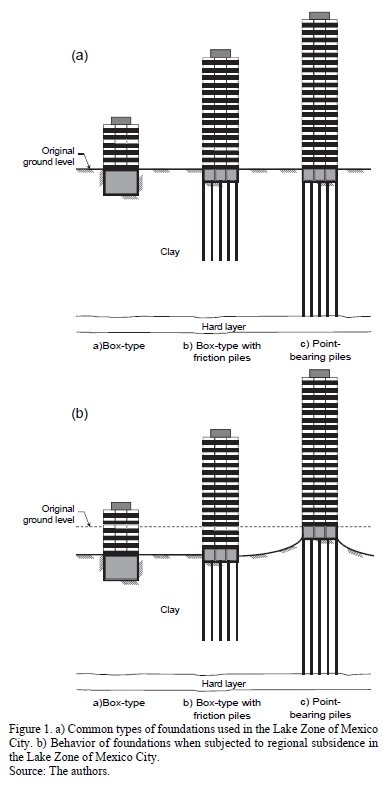
<body><![CDATA[<p><font size="3" face="Verdana, Arial, Helvetica, sans-serif"><b>1. Introduction</b></font></p>     <p><font size="2" face="Verdana, Arial, Helvetica, sans-serif">Commonly, three main types of foundations (<a href="#fig01">Fig. 1a</a>) are   used in the lacustrine zone of Mexico City &#91;1&#93;: box-type shallow foundation for   small buildings, box-type foundation with friction piles for intermediate   height buildings &#91;2,3&#93; and point-bearing piles for very tall or heavy   structures. Friction piles transfer most of their load to the soil through skin   friction. In the soft soils of Mexico City, friction piles are mainly used as a   complement to box-type foundations to reduce settlements. Infrequently, they   have been used to ensure the overall foundation stability (bearing capacity   design). In all cases, a complex interaction between soil, piles and structure   can be expected, because the foundations are submitted to the effects of a   double process of consolidation: firstly due to the load of the structure and,   secondly, due to pore pressure drawdown associated to intense pumping of water   from the subsoil in the urban area.</font></p>     <p align="center"><font size="2" face="Verdana, Arial, Helvetica, sans-serif"><a name="fig01"></a></font><img src="/img/revistas/dyna/v82n192/v82n192a24fig01.gif"/></p>     <p><font size="2" face="Verdana, Arial, Helvetica, sans-serif">Since the end of the 19<sup>th</sup> century, Mexico City   Lake Zone has suffered a regional subsidence, which, in some areas, has   exceeded 10m. In such conditions, point-bearing piles foundations can lead to   apparent protrusion of the structure, as shown in <a href="#fig01">Fig. 1b</a>, with loss of   confinement of the upper part of the piles and damage to neighboring   structures. On the other hand, when not properly designed, friction pile   foundations can either settle excessively or, on the contrary, protrude from   the subsiding surrounding soil (<a href="#fig02">Fig. 2</a>).</font></p>     <p align="center"><font size="2" face="Verdana, Arial, Helvetica, sans-serif"><a name="fig02"></a></font><img src="/img/revistas/dyna/v82n192/v82n192a24fig02.gif"/></p>     <p><font size="2" face="Verdana, Arial, Helvetica, sans-serif">Some field tests were conducted on piles in a </font> <font size="2" face="Verdana, Arial, Helvetica, sans-serif">consolidating soil subjected to pore pressure drawdown &#91;4-7&#93;, but only a few of   them involve friction piles. Analytical methods for the design of friction pile   foundation in these difficult conditions have been proposed &#91;2,3,8&#93;. The finite   element method (FEM) has been increasingly used for the analysis and design of   pile foundations subjected to negative skin friction &#91;9-14&#93;. Numerical modeling   allows soil behavior complexities and soil-structure interaction, to be taken   into account as well as changes in pore pressure regime.</font>     <p><font size="2" face="Verdana, Arial, Helvetica, sans-serif">The aim of this paper is to demonstrate how 2D finite   element analyses can be used to optimize the design of friction piles in an   environment that is prone to regional subsidence. Firstly, some background   information regarding</font> <font size="2" face="Verdana, Arial, Helvetica, sans-serif">typical   Mexico City soil conditions and regional subsidence is provided. Next,   parametric analyses on the behavior of friction piles subjected to external   loads and soil consolidation due to variations in piezometric conditions are   presented. The constitutive models used, vary from a basic elastic   perfectly-plastic Mohr Coulomb model to S-CLAY1, a critical state model with   plastic anisotropy &#91;15,29,30&#93;. The principles of numerical modeling and the   constitutive models used are briefly described, followed by numerical analyses   and discussion of the results.</font></p>     <p> </p>     <p><font size="3" face="Verdana, Arial, Helvetica, sans-serif"><b>2. Background</b></font></p>     <p><font size="2" face="Verdana, Arial, Helvetica, sans-serif"><b><i>2.1. Typical soil conditions</i></b></font></p>     ]]></body>
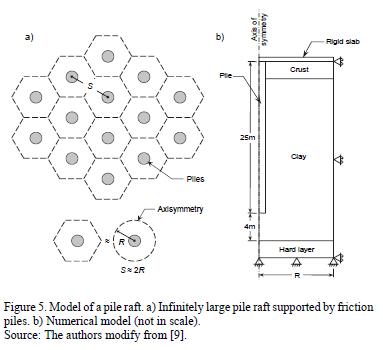
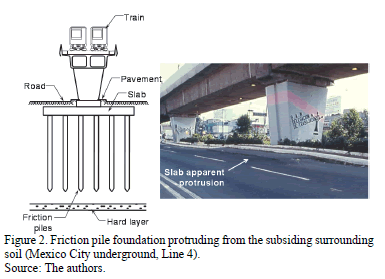
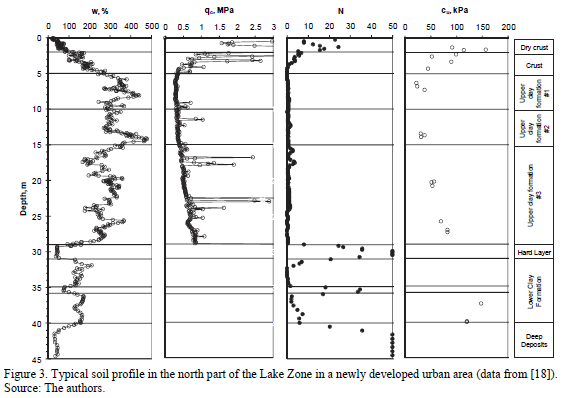
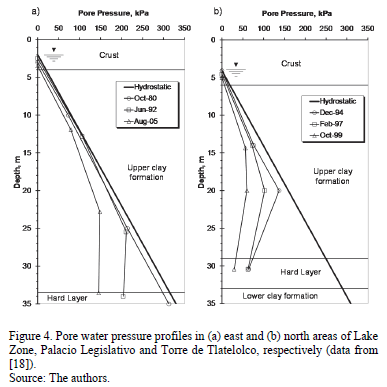
<body><![CDATA[<p><font size="2" face="Verdana, Arial, Helvetica, sans-serif">The urban area of   Mexico City can be divided in three geotechnical zones &#91;17&#93;: Foothills (Zone   I), Transition (Zone II) and Lake (Zone III), as defined in the present   building code &#91;1&#93;. In the Foothills Zone, very compact and heterogeneous   volcanic soils and lava fluxes are found. These materials contrast with the   highly compressible soft soils of the Lake Zone. Generally, in between, a   Transition Zone is found where clayey layers of lacustrine origin alternate   with erratically distributed sandy alluvial deposits. The main difficulties for   foundations of high buildings are encountered in the Lake and Transition zones.</font></p>     <p><font size="2" face="Verdana, Arial, Helvetica, sans-serif">Until the end of the 18<sup>th</sup> century, the valley of Mexico was a closed basin with a number of shallow   lakes, including the Texcoco and Xaltocan lakes. The valley became an open basin   when the Nochistongo cut, a channel 7 km long and up to 50 m deep (dug by hand   between 1637 and 1789) was completed. Progressively, the lakes were drained,   mainly through the Tequisquiac and Deep Drainage (Emisor Central) tunnels, and   practically disappeared. A large part of the city was built on lacustrine   sediments, which are highly plastic soft clays interbedded with layers of silt,   sand and sandy gravels of alluvial origin. In <a href="#fig03">Fig. 3</a>, a typical Lake Zone soil   profile is presented, which was   obtained from the SIG &#91;18&#93;. Three main clayey layers are referred to as   Upper Clay Formation (UCF), Lower Clay Formation (LCF) and Deep Deposits (DD).   The clays of the Upper Clay Formation are separated from the Lower Clay   Formation by the Hard Layer (HL), a sandy silt or clay stratum, between 2 and 3   m thick, lying typically at a depth of from 29 to 35 m. Generally, a dry crust   of desiccated soils and/or anthropic </font><font size="2" face="Verdana, Arial, Helvetica, sans-serif">fill, several meters thick, is   found above the Upper Clay Formation layer, which has been influenced by drying   and wetting cycles due to historic fluctuations of the water table.As seen in <a href="#fig03">Fig.   3</a>, Mexico City clay has a very high water content (corresponding to a void   ratio as high as 10), a low cone resistance in the CPT and practically a nil   blow count in an SPT test. Undrained shear strength increases with depth, with   values of around 20 kPa in the upper part of the UCF and 80 kPa in the contact   with HL. This slightly overconsolidated material (overconsolitation ratio   varies from 1 to 1.3 &#91;18&#93;) is highly compressible.</font></p>     <p align="center"><font size="2" face="Verdana, Arial, Helvetica, sans-serif"><a name="fig03"></a></font><img src="/img/revistas/dyna/v82n192/v82n192a24fig03.gif"/></p>     <p><font size="2" face="Verdana, Arial, Helvetica, sans-serif"><b><i>2.2. Regional subsidence</i></b></font></p>     <p><font size="2" face="Verdana, Arial, Helvetica, sans-serif">Due mainly to   exploitation of ground-water to supply the growing population through pumping   wells, Mexico City has suffered regional subsidence that in some locations   exceeds 10 m. Recent data shows that the rate of subsidence tends to decrease   in certain areas. However, in newly developed urban zones, such as the eastern   and western parts of Texcoco Lake and the former Xochimilco and Chalco lakes,   the consolidation process is only in its first stage and the rate of subsidence   can be as high as 0.4m/year. Pore pressure drawdown due to the pumping of water   in deep pervious strata (Hard Layer and Deep Deposits) leads to the typical   piezometric profiles that are shown on <a href="#fig04">Fig. 4</a>. The resulting settlements of the   Upper Clay Formation soil considerably affect the behavior of pile foundations.</font></p>     <p align="center"><font size="2" face="Verdana, Arial, Helvetica, sans-serif"><a name="fig04"></a></font><img src="/img/revistas/dyna/v82n192/v82n192a24fig04.gif"/></p>     <p> </p>     <p><font size="3" face="Verdana, Arial, Helvetica, sans-serif"><b>3. Numerical modeling</b></font></p>     <p><font size="2" face="Verdana, Arial, Helvetica, sans-serif"><b><i>3.1. General considerations</i></b></font></p>     <p><font size="2" face="Verdana, Arial, Helvetica, sans-serif">A group of friction   piles, connected to an infinitely large rigid slab is considered (<a href="#fig05">Fig. 5a</a>). The   simulations deal with the long term behavior of the internal piles. The tributary   area &#91;19&#93; of each internal pile is hexagonal, but it can be idealized as a   circular unit cell (<a href="#fig05">Fig. 5a</a>). The radius of the tributary area is then equal to   half of the center-to-center spacing between piles. The problem can then be   modeled as axisymmetric (<a href="#fig05">Fig. 5b</a>). Given that the main interaction between   piles and soil takes place within the Upper Clay Formation, the less   compressible layers below the Hard Layer have not been included in the   analyses. The problem was discretized using a finite element mesh with more   than 2,500 fifteen-node triangular elements (total density about 55 elements/m<sup>2</sup>).   A mesh densification (from 350 to 750 elements/m<sup>2</sup>) along the pile   shaft and below the rigid slab and the pile cap had to be considered &#91;31&#93;.   Lateral boundaries were fixed in the horizontal direction, and the bottom   boundary in both directions (<a href="#fig05">Fig. 5b</a>). Sensitivity studies showed that the mesh   was dense enough to give accurate results and that it was not necessary to use interface elements at the   soil-pile contact.</font></p>     ]]></body>
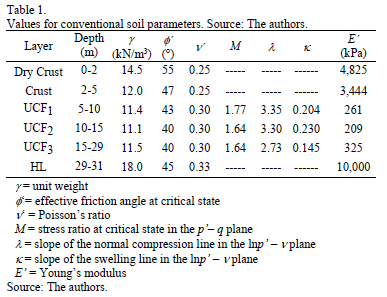
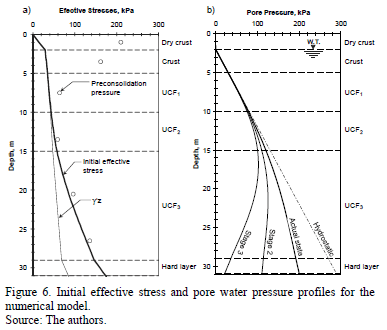
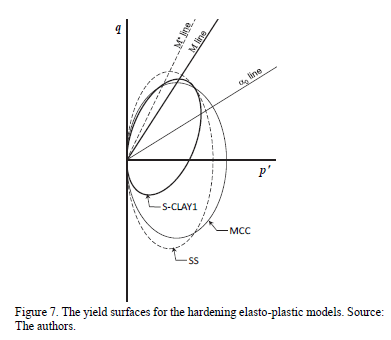
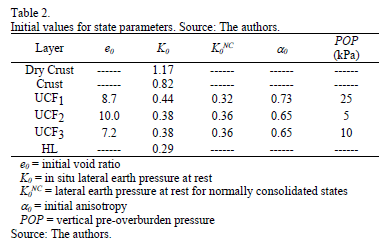
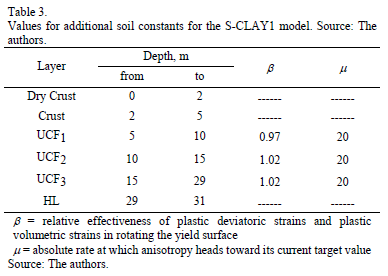
<body><![CDATA[<p align="center"><font size="2" face="Verdana, Arial, Helvetica, sans-serif"><a name="fig05"></a></font><img src="/img/revistas/dyna/v82n192/v82n192a24fig05.gif"/></p>     <p><font size="2" face="Verdana, Arial, Helvetica, sans-serif">Parametric studies were performed for a foundation slab on   friction piles, which were assumed to be 25 m long (finishing 4 m above of the   Hard Layer) and 0.5 m in diameter. The weight of a typical five to ten floor   building was considered by applying a load of 75 kPa directly to the rigid   slab. The analyses were developed in three stages. In Stage 1, pile was placed   (no installation effects were considered, only the pile weight as discussed   below) and the 75 kPa load was applied on the slab; in Stage 2 the first pore   pressure drawdown was introduced (<a href="#fig06">Fig. 6</a>), simulating typical future   piezometric conditions (<a href="#fig04">Fig. 4.a</a>); and in Stage 3 a second pore pressure   drawdown was considered (<a href="#fig06">Fig. 6</a>), representing an extreme, but possible, future   piezometric condition in Mexico City (<a href="#fig04">Fig. 4.b</a>). The conditions at the end of   each stage of the analysis, after the excess pore pressure due to the applied   load and pore pressure drawdown having been completely dissipated, were   assessed.</font></p>     <p align="center"><font size="2" face="Verdana, Arial, Helvetica, sans-serif"><a name="fig06"></a></font><img src="/img/revistas/dyna/v82n192/v82n192a24fig06.gif"/></p>     <p><font size="2" face="Verdana, Arial, Helvetica, sans-serif">Pile driving in very soft soils results in soil   disturbance: changes in soil structure and excess pore pressures around the   piles. These effects are difficult to model with finite element analyses, due   to the excessive mesh distortions, and are hence ignored. However, given that   the combined pile weight and the frictional force at soil-pile interface far   exceed the buoyancy force, the system is not in equilibrium after pile driving   and thus additional deformations occur simply due to pile weight. These   deformations are not negligible in Mexico City Clay, as demonstrated by Auvinet   and Hanel &#91;7&#93; by means of field observations. Therefore, the effect of pile   weight has been taken into account in the numerical analyses as part of Stage   1. In general, the displacements induced by installation are almost </font><font size="2" face="Verdana, Arial, Helvetica, sans-serif">negligible   in comparison with long-term displacements in Mexico City due to the regional   subsidence.</font></p>     <p><font size="2" face="Verdana, Arial, Helvetica, sans-serif"><b><i>3.2. Constitutive models</i></b></font></p>     <p><font size="2" face="Verdana, Arial, Helvetica, sans-serif">For simulation of the clay behavior (Upper Clay   Formation), elastic perfectly-plastic and hardening elasto-plastic constitutive   models were used. The elastic perfectly-plastic model is the Mohr-Coulomb (MC)   model commonly used in industry. The hardening elasto-plastic models include   two isotropic models: Modified Cam-Clay &#91;20&#93; and the Soft Soil (SS) model. The   Soft Soil model, available in the commercial version of PLAXIS finite element   code, has been inspired by the MCC model, but the yield surface and failure   surface have been decoupled in order to have a proper <i>K<sub>0</sub></i> prediction at normally consolidated states. Hence, the ellipsoidal yield   surface is much steeper than the ellipse of the MCC model (see <a href="#fig07">Fig. 7</a>) and the   shape is defined by the input of estimated <i>K<sub>0</sub><sup>NC</sup></i> (used for calculating the value for shape parameter <i>M</i>*). According to Ovando-Shelley   et al. &#91;21&#93;, <i>K<sub>0</sub><sup>NC</sup></i> for Mexico City clay has been   measured to correspond to Jaky's <i>K<sub>0</sub></i>. The failure condition in   the SS model can be described by a Mohr Coulomb failure line, and consequently   on the 'dry' side of failure line, the model reverts to a non-linear   elastic-perfectly plastic model with zero dilatancy. On the 'wet' side of the   failure line, the SS model predicts volumetric hardening similarly to the MCC   model, but this is expressed in terms of modified compression and swelling   indices, and hence at large strains the results will deviate from those of the   MCC model.</font></p>     <p align="center"><font size="2" face="Verdana, Arial, Helvetica, sans-serif"><a name="fig07"></a></font><img src="/img/revistas/dyna/v82n192/v82n192a24fig07.gif"/></p>     <p><font size="2" face="Verdana, Arial, Helvetica, sans-serif">The S-CLAY1 &#91;15&#93; model is a critical state model, which   accounts for initial and plastic strain induced anisotropy through an inclined   initial yield surface and a rotational hardening law that describes the   evolution of anisotropy as a function of plastic strains. Based on data by Diaz-Rodr&iacute;guez   et al. &#91;16&#93;, S-CLAY1 is able to accurately represent the extremely high   anisotropy at yielding that Mexico City clay exhibits &#91;15&#93;.</font></p>     <p><font size="2" face="Verdana, Arial, Helvetica, sans-serif"><b><i>3.3. Soil properties</i></b></font></p>     <p><font size="2" face="Verdana, Arial, Helvetica, sans-serif">The soil conditions correspond to a relatively new   residential area, near the former Texcoco Lake. This is practically virgin   terrain with no previous loading history. A notable amount of ground   investigation data were available from &#91;18&#93; database, including cone   penetration tests, standard penetration tests mixed with Shelby sampling,   piezometric measurements and laboratory triaxial and consolidation tests. <a href="#fig03">Fig.   3</a> shows the considered soil profile, and <a href="#tab01">Tables 1</a> to <a href="#tab03">3</a> present the values of   soil constants and state parameters of the materials considered in the analyses   based on ground investigation data and laboratory testing. Due to natural   variability, there was some scatter in the values, and for each layer   representative mean values have been chosen.</font></p>     ]]></body>
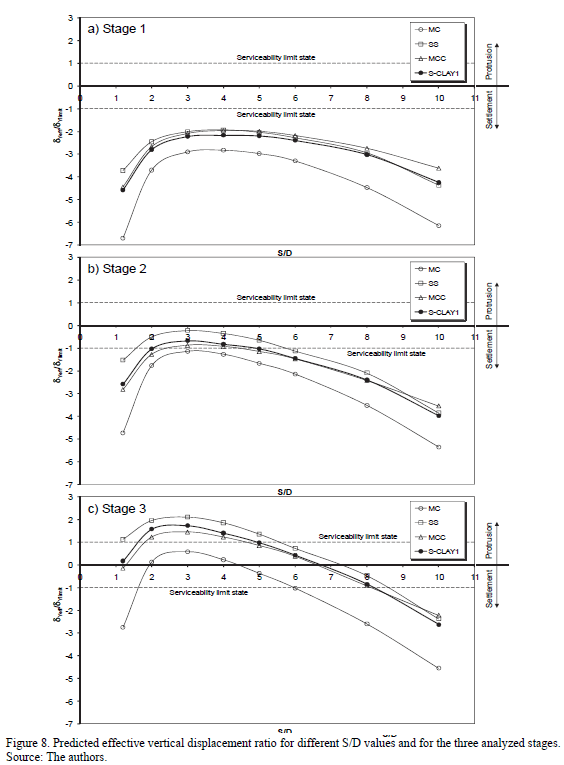
<body><![CDATA[<p align="center"><font size="2" face="Verdana, Arial, Helvetica, sans-serif"><a name="tab01"></a></font><img src="/img/revistas/dyna/v82n192/v82n192a24tab01.gif"/></p>     <p align="center"><font size="2" face="Verdana, Arial, Helvetica, sans-serif"><a name="tab02"></a></font><img src="/img/revistas/dyna/v82n192/v82n192a24tab02.gif"/></p>     <p align="center"><font size="2" face="Verdana, Arial, Helvetica, sans-serif"><a name="tab03"></a></font><img src="/img/revistas/dyna/v82n192/v82n192a24tab03.gif"/></p>     <p><font size="2" face="Verdana, Arial, Helvetica, sans-serif">The values for <i>f' </i>and <i>M</i> were deduced   from CD and CU triaxial tests published by Marsal and Mazari, Marsal and   Salazar, Lo, Alberro and Hiriart and Villa &#91;17,22-25&#93;, and the values for <i>e<sub>0</sub></i>, <i>l</i>, <i>k</i>, <i>E' </i>and   the vertical pre-overburden pressure POP have been obtained from   one-dimensional consolidation tests and calibrated with triaxial consolidation   results published by Villa and Diaz-Rodr&iacute;guez et al. &#91;25,16&#93;. The values for <i>K<sub>0</sub><sup>NC</sup></i> for the input of the Soft Soil model have been estimated from Jaky's formula   &#91;26&#93;. The in situ values of <i>K<sub>0</sub></i> were derived from the equation   presented by Mayne and Kulhawy &#91;27&#93;. As explained by Wheeler et al. &#91;15&#93;, the   values for the initial inclination of the yield surface (<i>a<sub>0</sub></i>)   and the soil constant <i>b</i> can be theoretically   derived based on the value of friction angle at critical state (<i>f'</i>). The value for <i>m</i> has been taken as the smallest value reported by   &#91;15&#93;, given experimental results that would enable the optimization of the   value are not available. As shown by Wheeler et al. &#91;15&#93;, S-CLAY1 model   predictions are not particularly sensitive to this value. The soil constant <i>m</i> controls the absolute rate at which the   inclination of the yield surface <i>a</i> heads   toward its current target value, and <i>b</i> controls   the relative effectiveness of plastic deviatoric strains and plastic volumetric   strains in rotating the yield surface.</font></p>     <p><font size="2" face="Verdana, Arial, Helvetica, sans-serif"><a href="#fig06">Fig. 6</a> shows the initial effective vertical stress and   pore-water pressure profiles that are assumed in the numerical analyses. The   actual state of the pore water pressure (<a href="#fig06">Fig. 6b</a>) has been obtained from   piezometers installed in thin sandy layers within Upper Clay Formation and Hard   Layer. The water table is assumed to, be at a depth of 2 m, and to stay   constant. A significant pressure reduction, of about 90 kPa with respect to the   hydrostatic distribution, was observed in the Hard Layer due to groundwater extraction.   With these values and with the measured soil density of each layer, the initial   effective stresses were evaluated (<a href="#fig06">Fig. 6a</a>). The preconsolidation pressure was   estimated from 1-D consolidation tests (experimental results are shown with   open circles). Due to historical wet-dry cycles, the dry crust, which   geologically is part of Upper Clay formation, shows evidence of significant   overconsolidation and its behavior may be simulated by using Mohr Coulomb   model. The Upper Clay Formation exhibits evident overconsolidation because of   water table variations with depth during dry and rainy seasons. <a href="#fig06">Fig. 6b</a> also   shows the pore pressure distributions considered for Stages 2 and 3 of the   analyses. The future pore pressure drawdown considered in each stage was assumed   to be equal to the difference between the actual and the assumed profiles. This   assumption results in a consolidation of UCF of about 5 cm/year, for a 20 and   40 year period, for Stages 2 and 3 respectively due to regional subsidence.   This is consistent with the consolidation rates measured based on superficial   and deep settlement benchmarks installed in the Lake Zone of Mexico City.</font></p>     <p><font size="2" face="Verdana, Arial, Helvetica, sans-serif"><b><i>3.4. Results of numerical analysis</i></b></font></p>     <p><font size="2" face="Verdana, Arial, Helvetica, sans-serif"><a href="#fig08">Fig. 8</a> presents the predicted effective vertical   displacement ratio<i>, d<sub>Yeff</sub>/d<sub>Ylimit</sub></i> for different   normalized pile spacing (S/D), for the three stages of the analysis. The   variable <i>d<sub>Yeff</sub></i>refers   to the vertical effective displacement predicted for the piled raft, which is   defined as:</font></p>     <p><img src="/img/revistas/dyna/v82n192/v82n192a24eq01.gif"></p>     <p><font size="2" face="Verdana, Arial, Helvetica, sans-serif">where <i>d<sub>Ysub</sub></i>is the superficial subsidence induced by pore pressure drawdown (in absence   of piles) and <i>d<sub>Ytotal</sub></i> is the total vertical displacement predicted for the piled raft. The variable <i>d<sub>Ylimit</sub></i>refers to the Mexico   City Code serviceability limit state for isolated structures. Negative values   of <i>d<sub>Yeff</sub></i> mean that   the piled raft is settling and positive values correspond to apparent   protruding.</font></p>     <p align="center"><font size="2" face="Verdana, Arial, Helvetica, sans-serif"><a name="fig08"></a></font><img src="/img/revistas/dyna/v82n192/v82n192a24fig08.gif"/></p>     ]]></body>
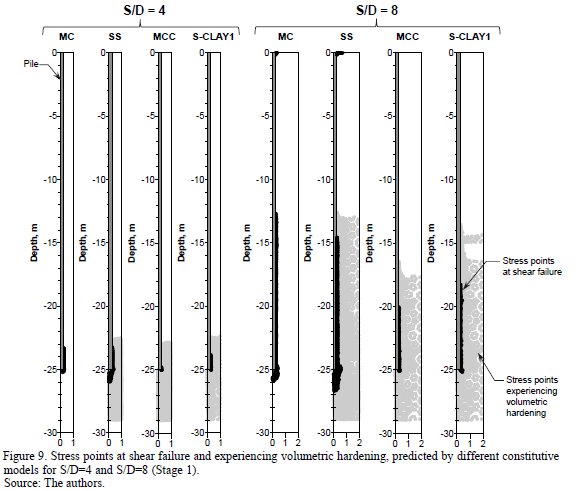
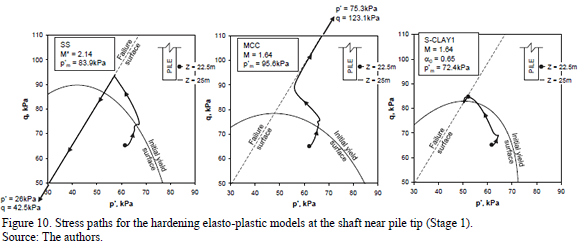
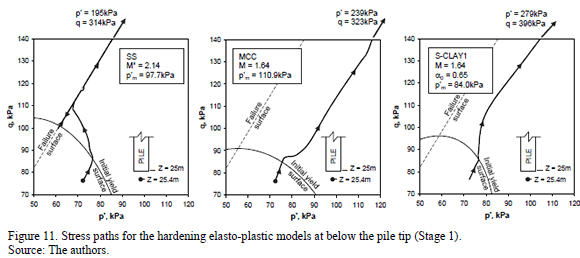
<body><![CDATA[<p><font size="2" face="Verdana, Arial, Helvetica, sans-serif">For the first stage of the analysis (i.e. the load of the   building and pile weight), <i>d<sub>Ysub</sub></i>=0; therefore, the effective displacement is the same as the total one, <i>d<sub>Yeff</sub></i> = <i>d<sub>Ytotal</sub></i>. It was observed that   all models exhibit the same trend and the predicted settlements ratios exceed   the serviceability limit state. For S/D &lt; 3, the settlement increases due to   the effect of the pile weight, since the unit weight of the soil (mean value of   11.5 kN/m<sup>3</sup> for Upper Clay Formation) is partially substituted by the   unit weight of the pile (24 kN/m<sup>3</sup>). The smallest settlements are   observed for relative spacing ratio S/D in the 3-5 range. The Mohr-Coulomb   model predicts the largest settlement ratio (<a href="#fig08">Fig. 8</a>). This type of model can   hardly be considered as realistic since a constant value for elastic stiffness   parameters is assumed, independently of the stress level and the evolution of   the stress path. </font></p>     <p><font size="2" face="Verdana, Arial, Helvetica, sans-serif">As shown in <a href="#fig09">Fig. 9</a>, the increase in the settlements   predicted by the different constitutive models for S/D&gt;5 is due to the   increase in the number of stress points at shear failure and undergoing   volumetric hardening. The Mohr-Coulomb and the Soft Soil models predict a   localized zone of failure below the pile tip, not detected by the critical   state models (MCC and S-CLAY1S), and the predicted extent of full mobilization   of friction along the shaft varies depending on the different models.</font></p>     <p align="center"><font size="2" face="Verdana, Arial, Helvetica, sans-serif"><a name="fig09"></a></font><img src="/img/revistas/dyna/v82n192/v82n192a24fig09.gif"/></p>     <p><font size="2" face="Verdana, Arial, Helvetica, sans-serif">For center-to-center spacing smaller than 5D, the results   obtained with all hardening elasto-plastic models are almost identical (<a href="#fig08">Fig.   8</a>), which demonstrates that the input values have been consistently calibrated.   Beyond this point, some differences between the models can be seen. The Soft   Soil (SS) model predicts a much larger plastic zone than the MCC and S-CLAY1   models (<a href="#fig09">Fig. 9</a>). This is due to the differences in the predicted stress paths   during the loading process. To illustrate this, two stress points have been selected   for inspection of relative pile spacing of S/D= 8: one next to the pile shaft   near the tip (<a href="#fig10">Fig. 10</a>) and one just beneath the pile tip (Fig. 11). In addition   to the stress paths, the yield and failure surfaces have been outlined.</font></p>     <p align="center"><font size="2" face="Verdana, Arial, Helvetica, sans-serif"><a name="fig10"></a></font><img src="/img/revistas/dyna/v82n192/v82n192a24fig10.gif"/></p>     <p><font size="2" face="Verdana, Arial, Helvetica, sans-serif"><a href="#fig10">Fig. 10</a> shows that the isotropic SS and MCC models predict   totally different stress path directions when reaching failure/critical state.   This is due to the assumption of Mohr-Coulomb failure adopted in the SS model.   For the S-CLAY1 model prediction, most of the stress path remains within the   elastic region, but ultimately the critical state is reached, followed by some   softening due to the effect of anisotropy.</font></p>     <p><font size="2" face="Verdana, Arial, Helvetica, sans-serif"><a href="#fig11">Fig. 11</a> shows that for   the point situated at a depth of 0.8D beneath the pile tip, failure is   predicted only by the SS model, as would be expected based on <a href="#fig11">Fig. 9</a>. The MCC   model predicts an unrealistically high <i>K<sub>0</sub><sup>NC</sup></i> value   (<a href="#fig11">Fig. 11</a>), whilst S-CLAY1 prediction is consistent with measurements of Mexico   City clay &#91;21&#93;. Despite the notable differences in the predicted stress paths   in the soil near the pile shaft and tip, the differences in the predicted   general behavior are not particularly significant (<a href="#fig11">Fig. 8</a>). It is concluded   that for long-term analyses the compressibility behavior of the reinforced soil   mass is more relevant than the pile-soil interaction. This explains why in this   analysis soil-pile interface elements are not required, although they could   actually be required for bearing capacity simulations.</font></p>     <p align="center"><font size="2" face="Verdana, Arial, Helvetica, sans-serif"><a name="fig11"></a></font><img src="/img/revistas/dyna/v82n192/v82n192a24fig11.gif"/></p>     <p><font size="2" face="Verdana, Arial, Helvetica, sans-serif"><a href="#fig08">Fig. 8.b</a> shows the   predicted displacements ratio for Stage 2 of the analyses (i.e. when the first   pore pressure drawdown was introduced). Again, all models show the same trend,   and the values of <i>d<sub>Yeff</sub></i> / <i>d<sub>Ylimit</sub></i> are closer to zero and to the serviceability   limit state than those obtained for the first stage. This is because the soil   has been reinforced with piles, and consequently the settlements due to the   pressure drawdown are smaller in the reinforced area than in the surrounding   soil. The optimum pile center-to-center spacing, corresponding to predictions   that are closest to the serviceability limit state, is within the 2D to 4D   spacing range.</font></p>     <p><font size="2" face="Verdana, Arial, Helvetica, sans-serif">Further regional subsidence due to an additional decrease   in pore water pressure (Stage 3 of the analyses), induces a substantial change   in the predicted behavior of the pile foundation, as shown in <a href="#fig08">Fig. 8.c</a>. For   example, the Soft Soil model suggests that for a pile spacing of 3D, the   foundation protrudes from the surrounding soil and is more than twice as high   as <i>d<sub>Ylimit</sub></i>. On the   other hand, for S/D=10, <i>d<sub>Yeff</sub></i> = <i>d<sub>Ylimit</sub></i> equals to -2.3;   the foundation settles and exceeds 2.3 times the <i>d<sub>Ylimit</sub></i>. An optimum solution would be reached   with -1&lt;<i> d<sub>Yeff</sub></i> / <i>d<sub>Ylimit</sub></i>&lt;1. Overall the   results by the hardening elasto-</font><font size="2" face="Verdana, Arial, Helvetica, sans-serif">plastic models suggest that the   optimum pile spacing corresponds to values of S/D between 5.5 and 8, while the   Mohr-Coulomb model suggests a range of considerably lower values, between 3 and   6.</font></p>     ]]></body>
<body><![CDATA[<p><font size="2" face="Verdana, Arial, Helvetica, sans-serif">In   addition, the results presented in <a href="#fig08">Fig. 8</a> indicate that in order to reach an   optimum foundation design in a subsiding environment it is important to make an   accurate prediction of the future pore pressure drawdown at the site.   Unfortunately, it is difficult to develop a reliable estimation of the future   piezometric condition at the site due to the changing requirements of Mexico   City's water supply. Therefore, design should be based on an intermediate   solution, which minimizes the inconveniences of both settlement and apparent   protrusion. In the example presented, according to the S-CLAY1 model, a   relative spacing of S/D=5 appears to be adequate, since no protrusion or   settlement greater than <i>d<sub>Ylimit</sub></i> was predicted for Stages 2 and 3. The choice of   constitutive model has an equally important role for a realistic optimum foundation   design. Given the non-linearity of soft soil response, the Mohr Coulomb model   is unlikely to give accurate predictions. In areas prone to regional subsidence   due to groundwater extraction accounting for stress-dependent stiffness is   extremely important.</font></p>     <p><font size="2" face="Verdana, Arial, Helvetica, sans-serif">Some differences   between the hardening elasto-plastic model predictions can be observed for   Stages 2 and 3. The magnitude of the total displacements is becoming larger,   and hence the minor differences between the models in terms of stress-strain   calculations become more significant, such as the slightly different   considerations for computing volumetric strains implicit in the Soft Soil model   as compared to MCC and S-CLAY1 (namely the use of <i>l*</i> instead of <i>l</i>). The shape of the yield surface is another   factor (<a href="#fig07">Fig 7</a>). The Soft Soil model predicts the smallest displacements (i.e.   the largest protrusion) because it has the largest elastic domain in the region   of interest, i.e. between <i>K<sub>0</sub></i> line and critical state/failure   line (<a href="#fig07">Fig. 7</a>). The sizes of the yield surfaces coincide initially at a stress   ratio corresponding to one-dimensional loading (defined by Jaky's <i>K<sub>0</sub></i>)   in order to predict yield with the same value of vertical effective stress. The   MCC and the S-CLAY1 models show some differences in the predictions because   anisotropy influences the calculation of horizontal stresses &#91;30&#93;.</font></p>     <p> </p>     <p><font size="3" face="Verdana, Arial, Helvetica, sans-serif"><b>4. Conclusions</b></font></p>     <p><font size="2" face="Verdana, Arial, Helvetica, sans-serif">The behavior of friction pile foundations in typical   Mexico City soft clays that are subjected to external loads and soil   consolidation due to variations in piezometric conditions was studied using   numerical analyses. Vertical displacements of the foundation for different   relative spacing S/D (center-to-center spacing vs. pile diameter) were   predicted using different constitutive models: an elastic-perfectly plastic   Mohr-Coulomb model, and three hardening elasto-plastic models. The Modified Cam   Clay and Soft Soil models are isotropic models and the S-CLAY1 model is an   anisotropic model that is able to account for the high anisotropy in yielding   that is typical for Mexico City clay. </font></p>     <p><font size="2" face="Verdana, Arial, Helvetica, sans-serif">For the three stages of analyses, all hardening   elasto-plastic models exhibit the same trend. The Mohr-Coulomb model predicts   however notably larger settlements than the other models, but these predictions   are unlikely to be realistic as a constant Young's modulus has to be assumed.</font></p>     <p><font size="2" face="Verdana, Arial, Helvetica, sans-serif">Some differences between the predictions by the hardening   elasto-plastic models were observed when pore pressure drawdown was included,   triggering regional subsidence. This is because when the magnitude of the total   displacements is large, the differences between the models become significant.   Specific considerations in each model for computing volumetric strains, the   shape of the yield surface and the effect of initial anisotropy can explain   these differences.</font></p>     <p><font size="2" face="Verdana, Arial, Helvetica, sans-serif">The models show that due to soil consolidation, a neutral   level separating positive skin friction from negative skin friction develops on   the pile shaft. The position of this level depends more on pile spacing than on   the magnitude of the pore pressure drawdown. For close pile spacing, the   neutral level is near the pile tip and the piles can protrude from the   consolidating surrounding soil as a result of regional subsidence. </font></p>     <p><font size="2" face="Verdana, Arial, Helvetica, sans-serif">According to the results obtained, to reach an optimum   foundation design in a subsiding environment, it is important to make an   accurate prediction of the future pore pressure drawdown at the site.   Unfortunately, due to changing hydrogeological conditions, it is difficult to   develop a reliable estimation. Therefore, an optimum foundation design should   be based on an intermediate solution minimizing inconveniences of both settlement   and protrusion, and using a constitutive model which is a most representative   idealization of the soil behavior. However, for further studies, a coupling   between hydrogeological and soil mechanics numerical models could be envisioned   to improve foundation design. These could be achieved by advanced   hydrogeological research in order to improve long-term pore-pressure drawdown   predictions.</font></p>     <p><font size="2" face="Verdana, Arial, Helvetica, sans-serif">It is shown that axisymmetric finite element numerical   models can be used to optimize the design of friction piles foundations in an   environment that is prone to regional subsidence.</font></p>     ]]></body>
<body><![CDATA[<p> </p>     <p><font size="3" face="Verdana, Arial, Helvetica, sans-serif"><b>References</b></font></p>     <!-- ref --><p><font size="2" face="Verdana, Arial, Helvetica, sans-serif"><b>&#91;1&#93;</b> Gobierno del Distrito Federal, Normas t&eacute;cnicas   complementarias para dise&ntilde;o y construcci&oacute;n de cimentaciones, Gaceta Oficial del   Distrito Federal, 6th October, VII, N 103-BIS, Mexico City, 2004, pp. 11-3.    &nbsp;&nbsp;&nbsp;&nbsp;&nbsp;&nbsp;&nbsp;&nbsp;[&#160;<a href="javascript:void(0);" onclick="javascript: window.open('/scielo.php?script=sci_nlinks&ref=000085&pid=S0012-7353201500040002400001&lng=','','width=640,height=500,resizable=yes,scrollbars=1,menubar=yes,');">Links</a>&#160;]<!-- end-ref --></font></p>     <!-- ref --><p><font size="2" face="Verdana, Arial, Helvetica, sans-serif"><b>&#91;2&#93;</b> Zeevaert,   L., Compensated friction-pile foundation to reduce the settlements of buildings   on the highly compressible volcanic clay of Mexico City, Proc. 4th ICSMFE,   London, 2, pp. 81-86, 1957.    &nbsp;&nbsp;&nbsp;&nbsp;&nbsp;&nbsp;&nbsp;&nbsp;[&#160;<a href="javascript:void(0);" onclick="javascript: window.open('/scielo.php?script=sci_nlinks&ref=000087&pid=S0012-7353201500040002400002&lng=','','width=640,height=500,resizable=yes,scrollbars=1,menubar=yes,');">Links</a>&#160;]<!-- end-ref --></font></p>     <!-- ref --><p><font size="2" face="Verdana, Arial, Helvetica, sans-serif"><b>&#91;3&#93;</b> Zeevaert,   L., Foundations problems related to ground surface subsidence in Mexico City,   ASTM (STP), 322, pp. 57-66, 1963.    &nbsp;&nbsp;&nbsp;&nbsp;&nbsp;&nbsp;&nbsp;&nbsp;[&#160;<a href="javascript:void(0);" onclick="javascript: window.open('/scielo.php?script=sci_nlinks&ref=000089&pid=S0012-7353201500040002400003&lng=','','width=640,height=500,resizable=yes,scrollbars=1,menubar=yes,');">Links</a>&#160;]<!-- end-ref --></font></p>     <!-- ref --><p><font size="2" face="Verdana, Arial, Helvetica, sans-serif"><b>&#91;4&#93;</b> Plomp,   A. and Mierlo, W.C., Special problems, effects of drainage by well points on   pile foundations, Proc. 2nd ICSMFE, Rotterdam, 4, pp. 141-148, 1948.    &nbsp;&nbsp;&nbsp;&nbsp;&nbsp;&nbsp;&nbsp;&nbsp;[&#160;<a href="javascript:void(0);" onclick="javascript: window.open('/scielo.php?script=sci_nlinks&ref=000091&pid=S0012-7353201500040002400004&lng=','','width=640,height=500,resizable=yes,scrollbars=1,menubar=yes,');">Links</a>&#160;]<!-- end-ref --></font></p>     ]]></body>
<body><![CDATA[<!-- ref --><p><font size="2" face="Verdana, Arial, Helvetica, sans-serif"><b>&#91;5&#93;</b> Endo,   M., Minou, A., Kawasaki, T. and Shibata, T., Negative skin friction acting on   steel pipe pile in clay, Proc. 7th ICSMFE, Mexico City, 2, pp. 85-92, 1969.    &nbsp;&nbsp;&nbsp;&nbsp;&nbsp;&nbsp;&nbsp;&nbsp;[&#160;<a href="javascript:void(0);" onclick="javascript: window.open('/scielo.php?script=sci_nlinks&ref=000093&pid=S0012-7353201500040002400005&lng=','','width=640,height=500,resizable=yes,scrollbars=1,menubar=yes,');">Links</a>&#160;]<!-- end-ref --></font></p>     <!-- ref --><p><font size="2" face="Verdana, Arial, Helvetica, sans-serif"><b>&#91;6&#93;</b> Fellenius,   B.H. and Broms, B.B., Negative skin friction for long piles driven in clay,   Proc. 7th ICSMFE, Mexico City, 2, pp. 93-98, 1969.    &nbsp;&nbsp;&nbsp;&nbsp;&nbsp;&nbsp;&nbsp;&nbsp;[&#160;<a href="javascript:void(0);" onclick="javascript: window.open('/scielo.php?script=sci_nlinks&ref=000095&pid=S0012-7353201500040002400006&lng=','','width=640,height=500,resizable=yes,scrollbars=1,menubar=yes,');">Links</a>&#160;]<!-- end-ref --></font></p>     <!-- ref --><p><font size="2" face="Verdana, Arial, Helvetica, sans-serif"><b>&#91;7&#93;</b> Auvinet,   G. and Hanel, J.J., Negative skin friction on piles in Mexico City clay, Proc.   10th ICSMFE, Stockholm, 2, pp. 599-604, 1981.    &nbsp;&nbsp;&nbsp;&nbsp;&nbsp;&nbsp;&nbsp;&nbsp;[&#160;<a href="javascript:void(0);" onclick="javascript: window.open('/scielo.php?script=sci_nlinks&ref=000097&pid=S0012-7353201500040002400007&lng=','','width=640,height=500,resizable=yes,scrollbars=1,menubar=yes,');">Links</a>&#160;]<!-- end-ref --></font></p>     <!-- ref --><p><font size="2" face="Verdana, Arial, Helvetica, sans-serif"><b>&#91;8&#93;</b> Res&eacute;ndiz,   D. and Auvinet, G., Analysis of pile foundations in consolidating soils, Proc.   8th ICSMFE, Moscow, 2, pp. 211-218, 1973.    &nbsp;&nbsp;&nbsp;&nbsp;&nbsp;&nbsp;&nbsp;&nbsp;[&#160;<a href="javascript:void(0);" onclick="javascript: window.open('/scielo.php?script=sci_nlinks&ref=000099&pid=S0012-7353201500040002400008&lng=','','width=640,height=500,resizable=yes,scrollbars=1,menubar=yes,');">Links</a>&#160;]<!-- end-ref --></font></p>     <!-- ref --><p><font size="2" face="Verdana, Arial, Helvetica, sans-serif"><b>&#91;9&#93;</b> Auvinet,   G. and Rodr&iacute;guez, J.F., Friction piles in consolidating soils, Proc. 15th   ICSMGE, Istanbul, 2, pp. 843-846, 2001.    &nbsp;&nbsp;&nbsp;&nbsp;&nbsp;&nbsp;&nbsp;&nbsp;[&#160;<a href="javascript:void(0);" onclick="javascript: window.open('/scielo.php?script=sci_nlinks&ref=000101&pid=S0012-7353201500040002400009&lng=','','width=640,height=500,resizable=yes,scrollbars=1,menubar=yes,');">Links</a>&#160;]<!-- end-ref --></font></p>     ]]></body>
<body><![CDATA[<!-- ref --><p><font size="2" face="Verdana, Arial, Helvetica, sans-serif"><b>&#91;10&#93;</b> Auvinet,   G. and Rodr&iacute;guez, J.F., Modeling of friction piles in consolidating soils,   Proc. Int. Deep Found. Cong., ASCE, Orlando, USA, pp. 224-235, 2002.    &nbsp;&nbsp;&nbsp;&nbsp;&nbsp;&nbsp;&nbsp;&nbsp;[&#160;<a href="javascript:void(0);" onclick="javascript: window.open('/scielo.php?script=sci_nlinks&ref=000103&pid=S0012-7353201500040002400010&lng=','','width=640,height=500,resizable=yes,scrollbars=1,menubar=yes,');">Links</a>&#160;]<!-- end-ref --></font></p>     <!-- ref --><p><font size="2" face="Verdana, Arial, Helvetica, sans-serif"><b>&#91;11&#93;</b> Comodromos,   E.M. and Bareka, S.V., Evaluation of negative skin friction effects in pile   foundations using 3D nonlinear analysis. Comp. and Geotech. J., 32, pp.   210-221, 2005. DOI: 10.1016/j.compgeo.2005.01.006</font>&nbsp;&nbsp;&nbsp;&nbsp;&nbsp;&nbsp;&nbsp;&nbsp;[&#160;<a href="javascript:void(0);" onclick="javascript: window.open('/scielo.php?script=sci_nlinks&ref=000105&pid=S0012-7353201500040002400011&lng=','','width=640,height=500,resizable=yes,scrollbars=1,menubar=yes,');">Links</a>&#160;]<!-- end-ref --><!-- ref --><p><font size="2" face="Verdana, Arial, Helvetica, sans-serif"><b>&#91;12&#93;</b> Jeong, S.,   Kim, S. and Briaud, J.L., Analysis of downdrag on pile groups by the finite   element method. Comp. and Geotech. J., 21 (2), pp. 143-161, 1997. DOI:   10.1016/S0266-352X(97)00018-9</font>&nbsp;&nbsp;&nbsp;&nbsp;&nbsp;&nbsp;&nbsp;&nbsp;[&#160;<a href="javascript:void(0);" onclick="javascript: window.open('/scielo.php?script=sci_nlinks&ref=000106&pid=S0012-7353201500040002400012&lng=','','width=640,height=500,resizable=yes,scrollbars=1,menubar=yes,');">Links</a>&#160;]<!-- end-ref --><!-- ref --><p><font size="2" face="Verdana, Arial, Helvetica, sans-serif"><b>&#91;13&#93;</b> Jeong, S.,   Lee, J. and Lee, C.J., Slip effect at the pile-soil interface on dragload.   Comp. and Geotech. J., 31, pp. 115-126, 2004. DOI:   10.1016/j.compgeo.2004.01.009.    &nbsp;&nbsp;&nbsp;&nbsp;&nbsp;&nbsp;&nbsp;&nbsp;[&#160;<a href="javascript:void(0);" onclick="javascript: window.open('/scielo.php?script=sci_nlinks&ref=000107&pid=S0012-7353201500040002400013&lng=','','width=640,height=500,resizable=yes,scrollbars=1,menubar=yes,');">Links</a>&#160;]<!-- end-ref --> </font></p>     <!-- ref --><p><font size="2" face="Verdana, Arial, Helvetica, sans-serif"><b>&#91;14&#93;</b> Lee, C.J.   and Charles, W.W., Development of downdrag on piles and pile groups in   consolidating soil. J. Geotech. and Geoenv. Engng., 130 (9), pp. 905-914, 2004.   DOI: 10.1061/(ASCE)1090-0241(2004)130:9(905)</font>&nbsp;&nbsp;&nbsp;&nbsp;&nbsp;&nbsp;&nbsp;&nbsp;[&#160;<a href="javascript:void(0);" onclick="javascript: window.open('/scielo.php?script=sci_nlinks&ref=000109&pid=S0012-7353201500040002400014&lng=','','width=640,height=500,resizable=yes,scrollbars=1,menubar=yes,');">Links</a>&#160;]<!-- end-ref --><!-- ref --><p><font size="2" face="Verdana, Arial, Helvetica, sans-serif"><b>&#91;15&#93;</b> Wheeler,   S.J., Näätänen, A., Karstunen, M. and Lojander, M., An anisotropic   elastoplastic model for soft clays. Can. Geotech. J., 40, pp. 403-418, 2003.   DOI: 10.1139/t02-119</font>&nbsp;&nbsp;&nbsp;&nbsp;&nbsp;&nbsp;&nbsp;&nbsp;[&#160;<a href="javascript:void(0);" onclick="javascript: window.open('/scielo.php?script=sci_nlinks&ref=000110&pid=S0012-7353201500040002400015&lng=','','width=640,height=500,resizable=yes,scrollbars=1,menubar=yes,');">Links</a>&#160;]<!-- end-ref --><!-- ref --><p><font size="2" face="Verdana, Arial, Helvetica, sans-serif"><b>&#91;16&#93;</b> Diaz-Rodr&iacute;guez,   J.A., Leroueil, S. and Aleman, J.D., Yielding of Mexico City clay and other   natural clays. J. Geotech. Engng. ASCE, 118 (7), pp. 981-995, 1992. DOI:   10.1061/(ASCE)0733-9410(1992)118:7(981)</font>&nbsp;&nbsp;&nbsp;&nbsp;&nbsp;&nbsp;&nbsp;&nbsp;[&#160;<a href="javascript:void(0);" onclick="javascript: window.open('/scielo.php?script=sci_nlinks&ref=000111&pid=S0012-7353201500040002400016&lng=','','width=640,height=500,resizable=yes,scrollbars=1,menubar=yes,');">Links</a>&#160;]<!-- end-ref --><!-- ref --><p><font size="2" face="Verdana, Arial, Helvetica, sans-serif"><b>&#91;17&#93;</b> Marsal, R.J. and Mazari, M., El subsuelo de la   Ciudad de M&eacute;xico, Tesis, Facultad de Ingenier&iacute;a, UNAM, Mexico, 1959.    &nbsp;&nbsp;&nbsp;&nbsp;&nbsp;&nbsp;&nbsp;&nbsp;[&#160;<a href="javascript:void(0);" onclick="javascript: window.open('/scielo.php?script=sci_nlinks&ref=000112&pid=S0012-7353201500040002400017&lng=','','width=640,height=500,resizable=yes,scrollbars=1,menubar=yes,');">Links</a>&#160;]<!-- end-ref --></font></p>     <!-- ref --><p><font size="2" face="Verdana, Arial, Helvetica, sans-serif"><b>&#91;18&#93;</b> SIG. Sistema de Informaci&oacute;n Geogr&aacute;fica. Laboratorio de Geoinform&aacute;tica,   Instituto de Ingenier&iacute;a, UNAM, &#91;Önline&#93;. 2012. Available at: <a href="http://sitios.iingen.unam.mx/geoinformatica/" target="_blank">http://sitios.iingen.unam.mx/geoinformatica/</a>.    &nbsp;&nbsp;&nbsp;&nbsp;&nbsp;&nbsp;&nbsp;&nbsp;[&#160;<a href="javascript:void(0);" onclick="javascript: window.open('/scielo.php?script=sci_nlinks&ref=000114&pid=S0012-7353201500040002400018&lng=','','width=640,height=500,resizable=yes,scrollbars=1,menubar=yes,');">Links</a>&#160;]<!-- end-ref --></font></p>     <!-- ref --><p><font size="2" face="Verdana, Arial, Helvetica, sans-serif"><b>&#91;19&#93;</b> Schlosser,   F., Jacobsen, H.M. and Juran, I., Le renforcement des sols (1). Revue Française   de G&eacute;otechnique, 29, pp. 7-32, 1984.    &nbsp;&nbsp;&nbsp;&nbsp;&nbsp;&nbsp;&nbsp;&nbsp;[&#160;<a href="javascript:void(0);" onclick="javascript: window.open('/scielo.php?script=sci_nlinks&ref=000116&pid=S0012-7353201500040002400019&lng=','','width=640,height=500,resizable=yes,scrollbars=1,menubar=yes,');">Links</a>&#160;]<!-- end-ref --></font></p>     <!-- ref --><p><font size="2" face="Verdana, Arial, Helvetica, sans-serif"><b>&#91;20&#93;</b> Roscoe,   K.H. and Burland, J.B., On the generalized stress-strain behavior of &quot;wet&quot;   clay. Engineering Plasticity, in: Heyman, J. and Leckie, F.A. eds., Cambridge   University Press, pp. 535-609, 1968.    &nbsp;&nbsp;&nbsp;&nbsp;&nbsp;&nbsp;&nbsp;&nbsp;[&#160;<a href="javascript:void(0);" onclick="javascript: window.open('/scielo.php?script=sci_nlinks&ref=000118&pid=S0012-7353201500040002400020&lng=','','width=640,height=500,resizable=yes,scrollbars=1,menubar=yes,');">Links</a>&#160;]<!-- end-ref --></font></p>     <!-- ref --><p><font size="2" face="Verdana, Arial, Helvetica, sans-serif"><b>&#91;21&#93;</b> Ovando-Shelley,   E., Trigo, M. and L&oacute;pez-Vel&aacute;zquez, O., The value of K0 in Mexico City clay from   laboratory and field tests. Proc. 11th PCSMFE, Foz de Iguaz&uacute;, Brasil, pp   433-439, 1999.    &nbsp;&nbsp;&nbsp;&nbsp;&nbsp;&nbsp;&nbsp;&nbsp;[&#160;<a href="javascript:void(0);" onclick="javascript: window.open('/scielo.php?script=sci_nlinks&ref=000120&pid=S0012-7353201500040002400021&lng=','','width=640,height=500,resizable=yes,scrollbars=1,menubar=yes,');">Links</a>&#160;]<!-- end-ref --></font></p>     <!-- ref --><p><font size="2" face="Verdana, Arial, Helvetica, sans-serif"><b>&#91;22&#93;</b> Marsal,   R.J. and Salazar, J., Pore pressure and volumetric measurement in triaxial   compression tests, Proc. Research Conference on Shear Strength on Cohesive   Soils, ASCE, Boulder, Colorado, pp. 965-983, 1960.    &nbsp;&nbsp;&nbsp;&nbsp;&nbsp;&nbsp;&nbsp;&nbsp;[&#160;<a href="javascript:void(0);" onclick="javascript: window.open('/scielo.php?script=sci_nlinks&ref=000122&pid=S0012-7353201500040002400022&lng=','','width=640,height=500,resizable=yes,scrollbars=1,menubar=yes,');">Links</a>&#160;]<!-- end-ref --></font></p>     <!-- ref --><p><font size="2" face="Verdana, Arial, Helvetica, sans-serif"><b>&#91;23&#93;</b> Lo, K.Y.,   Shear strength properties of a sample of volcanic material of the Valley of   Mexico. Geotechnique, 12, pp. 303-319, 1962. DOI: 10.1680/geot.1962.12.4.303</font>&nbsp;&nbsp;&nbsp;&nbsp;&nbsp;&nbsp;&nbsp;&nbsp;[&#160;<a href="javascript:void(0);" onclick="javascript: window.open('/scielo.php?script=sci_nlinks&ref=000124&pid=S0012-7353201500040002400023&lng=','','width=640,height=500,resizable=yes,scrollbars=1,menubar=yes,');">Links</a>&#160;]<!-- end-ref --><!-- ref --><p><font size="2" face="Verdana, Arial, Helvetica, sans-serif"><b>&#91;24&#93;</b> Alberro, J. and Hiriart, G., Resistencia a largo plazo de las arcillas   del Valle de M&eacute;xico. Instituto de Ingenier&iacute;a Series, UNAM, No. 317,   1973.    &nbsp;&nbsp;&nbsp;&nbsp;&nbsp;&nbsp;&nbsp;&nbsp;[&#160;<a href="javascript:void(0);" onclick="javascript: window.open('/scielo.php?script=sci_nlinks&ref=000125&pid=S0012-7353201500040002400024&lng=','','width=640,height=500,resizable=yes,scrollbars=1,menubar=yes,');">Links</a>&#160;]<!-- end-ref --></font></p>     <!-- ref --><p><font size="2" face="Verdana, Arial, Helvetica, sans-serif"><b>&#91;25&#93;</b> Villa, R., Aplicaci&oacute;n del principio de   proporcionalidad natural para describir el comportamiento esfuerzo-deformaci&oacute;n   de la arcilla del Valle de M&eacute;xico sometida a ensayes de compresi&oacute;n triaxial   drenados y no drenados, en estado preconsolidado. MSc. Eng. Thesis, Programa de   Maestr&iacute;a y Doctorado en Ingenier&iacute;a, UNAM, Mexico, 2004.    &nbsp;&nbsp;&nbsp;&nbsp;&nbsp;&nbsp;&nbsp;&nbsp;[&#160;<a href="javascript:void(0);" onclick="javascript: window.open('/scielo.php?script=sci_nlinks&ref=000127&pid=S0012-7353201500040002400025&lng=','','width=640,height=500,resizable=yes,scrollbars=1,menubar=yes,');">Links</a>&#160;]<!-- end-ref --></font></p>     <!-- ref --><p><font size="2" face="Verdana, Arial, Helvetica, sans-serif"><b>&#91;26&#93;</b> Jaky, J.,   The coefficient of earth pressure at rest. J. Society Hungarian Arch. and Eng.,   pp. 355-358, 1944.    &nbsp;&nbsp;&nbsp;&nbsp;&nbsp;&nbsp;&nbsp;&nbsp;[&#160;<a href="javascript:void(0);" onclick="javascript: window.open('/scielo.php?script=sci_nlinks&ref=000129&pid=S0012-7353201500040002400026&lng=','','width=640,height=500,resizable=yes,scrollbars=1,menubar=yes,');">Links</a>&#160;]<!-- end-ref --></font></p>     <!-- ref --><p><font size="2" face="Verdana, Arial, Helvetica, sans-serif"><b>&#91;27&#93;</b> Mayne,   P.W. and Kulhawy, F.H., K0-OCR relationships in soil. J. Geotech. Engng. ASCE,   108 (GT6), pp. 851-872, 1982.    &nbsp;&nbsp;&nbsp;&nbsp;&nbsp;&nbsp;&nbsp;&nbsp;[&#160;<a href="javascript:void(0);" onclick="javascript: window.open('/scielo.php?script=sci_nlinks&ref=000131&pid=S0012-7353201500040002400027&lng=','','width=640,height=500,resizable=yes,scrollbars=1,menubar=yes,');">Links</a>&#160;]<!-- end-ref --></font></p>     ]]></body>
<body><![CDATA[<!-- ref --><p><font size="2" face="Verdana, Arial, Helvetica, sans-serif"><b>&#91;28&#93;</b> Auvinet, G. and D&iacute;az-Mora, C., Programa de   computadora para predecir movimientos verticales de cimentaciones, Instituto de   Ingenier&iacute;a Series, UNAM, No. 438, 1981.    &nbsp;&nbsp;&nbsp;&nbsp;&nbsp;&nbsp;&nbsp;&nbsp;[&#160;<a href="javascript:void(0);" onclick="javascript: window.open('/scielo.php?script=sci_nlinks&ref=000133&pid=S0012-7353201500040002400028&lng=','','width=640,height=500,resizable=yes,scrollbars=1,menubar=yes,');">Links</a>&#160;]<!-- end-ref --></font></p>     <!-- ref --><p><font size="2" face="Verdana, Arial, Helvetica, sans-serif"><b>&#91;29&#93;</b> Karstunen,   M. and Koskinen, M., Plastic anisotropy of soft reconstituted clays. Can.   Geotech. J., 45, pp. 314-328, 2008. DOI: 10.1139/T07-073</font>&nbsp;&nbsp;&nbsp;&nbsp;&nbsp;&nbsp;&nbsp;&nbsp;[&#160;<a href="javascript:void(0);" onclick="javascript: window.open('/scielo.php?script=sci_nlinks&ref=000135&pid=S0012-7353201500040002400029&lng=','','width=640,height=500,resizable=yes,scrollbars=1,menubar=yes,');">Links</a>&#160;]<!-- end-ref --><!-- ref --><p><font size="2" face="Verdana, Arial, Helvetica, sans-serif"><b>&#91;30&#93;</b> Karstunen,   M., Krenn, H., Wheeler, S.J., Koskinen, M., and Zentar, R., The effect of   anisotropy and destructuration on the behaviour of Murro test embankment. Int.   J. of Geomech., 5, pp. 87-97, 2005. DOI: 10.1061/(ASCE)1532-3641(2005)5:2(87)</font>&nbsp;&nbsp;&nbsp;&nbsp;&nbsp;&nbsp;&nbsp;&nbsp;[&#160;<a href="javascript:void(0);" onclick="javascript: window.open('/scielo.php?script=sci_nlinks&ref=000136&pid=S0012-7353201500040002400030&lng=','','width=640,height=500,resizable=yes,scrollbars=1,menubar=yes,');">Links</a>&#160;]<!-- end-ref --><!-- ref --><p><font size="2" face="Verdana, Arial, Helvetica, sans-serif"><b>&#91;31&#93;</b> Diaz-Segura, E.G., M&eacute;todo simplificado para la   estimaci&oacute;n de la carga &uacute;ltima de pilotes sometidos a carga vertical axial en   arenas, DYNA, 80 (179), pp. 109-115, 2013.    &nbsp;&nbsp;&nbsp;&nbsp;&nbsp;&nbsp;&nbsp;&nbsp;[&#160;<a href="javascript:void(0);" onclick="javascript: window.open('/scielo.php?script=sci_nlinks&ref=000137&pid=S0012-7353201500040002400031&lng=','','width=640,height=500,resizable=yes,scrollbars=1,menubar=yes,');">Links</a>&#160;]<!-- end-ref --></font></p>     <p> </p>     <p><font size="2" face="Verdana, Arial, Helvetica, sans-serif"><b>J.F. Rodriguez Rebolledo, </b>is graduated BSc. in   Civil Engineering in 1996, an MSc. degree in Soil Mechanics in 2001, and a PhD   degree (with honors) in Civil Engineering in 2011, all from the Universidad   Nacional Aut&oacute;noma de Mexico - UNAM, Mexico. As part of his PhD project, in   2008, he undertook a one-year academic placement in the University of   Strathclyde, Scotland, U.K. From 1995 to 2013, he worked for the UNAM in   geotechnical research projects related to numerical modeling, deep foundations   and tunnels. From 1997 to 2013 he participated as geotechnical consultant in   civil engineering projects across the country (Mexico). Currently, he is an   associated professor at the Department of Civil and Environmental Engineering   of the Universidade de Brasilia, Brasil. From 2008 to 2013, he participated in   international research projects founded by the European Commission. ORCID.ORG/0000-0003-2929-7381</font></p>     <p><font size="2" face="Verdana, Arial, Helvetica, sans-serif"><b>G.Y. Auvinet-Guichard,</b> is graduated in 1964 from   Ecole Sp&eacute;ciale des Travaux Publics de Paris, France. He received his PhD degree   in Engineering in 1986, from Universidad Nacional Aut&oacute;noma de M&eacute;xico - UNAM,   Mexico. He is a faculty member of UNAM Engineering School Postgraduate Division   and head of the Geotechnical Computing Laboratory of the Institute of   Engineering, UNAM, Mexico. He has dedicated his research to the solution of   geotechnical problems with emphasis on deep foundations in consolidating soft   soils and on application of probabilistic and geostatistical methods to Civil Engineering.   He has been President of Mexican National Society for Soil Mechanics   (1991-1992) and Vice-President for North America of the International Society   for Soil Mechanics and Geotechnical Engineering (2009-2013). ORCID.ORG/0000-0003-4674-1659</font></p>     <p><font size="2" face="Verdana, Arial, Helvetica, sans-serif"><b>H.E. Martinez-Carvajal</b>, received a BSc. Eng. in   Geological Engineering in 1995 from the Universidad Nacional de Colombia in   Medellin, Colombia, an MSc. degree in Soil Mechanics in 1999 from the   Universidad Nacional Autonoma de Mexico - UNAM, Mexico and the Dr. degree in Geotechnics   in 2006 from the University of Brasilia, Brazil. From 1993 to 1999 he worked   for civil engineering consulting companies as a geologist. He is currently an associated professor in the Civil and Environmental Engineering   Department at the University of Brasilia and professor at the Facultad de Minas   of the Universidad Nacional de Colombia in Medellin, Colombia. ORCID.ORG/0000-0001-7966-1466</font></p>     ]]></body>
<body><![CDATA[ ]]></body><back>
<ref-list>
<ref id="B1">
<label>1</label><nlm-citation citation-type="journal">
<collab>Gobierno del Distrito Federal</collab>
<article-title xml:lang="es"><![CDATA[Normas técnicas complementarias para diseño y construcción de cimentaciones]]></article-title>
<source><![CDATA[Gaceta Oficial del Distrito Federal]]></source>
<year>2004</year>
<numero>6th</numero>
<issue>6th</issue>
<page-range>11-3</page-range><publisher-loc><![CDATA[Mexico ]]></publisher-loc>
</nlm-citation>
</ref>
<ref id="B2">
<label>2</label><nlm-citation citation-type="confpro">
<person-group person-group-type="author">
<name>
<surname><![CDATA[Zeevaert]]></surname>
<given-names><![CDATA[L.]]></given-names>
</name>
</person-group>
<article-title xml:lang="en"><![CDATA[Compensated friction-pile foundation to reduce the settlements of buildings on the highly compressible volcanic clay of Mexico City]]></article-title>
<source><![CDATA[]]></source>
<year></year>
<conf-name><![CDATA[4th ICSMFE]]></conf-name>
<conf-loc>London </conf-loc>
</nlm-citation>
</ref>
<ref id="B3">
<label>3</label><nlm-citation citation-type="journal">
<person-group person-group-type="author">
<name>
<surname><![CDATA[Zeevaert]]></surname>
<given-names><![CDATA[L.]]></given-names>
</name>
</person-group>
<article-title xml:lang="en"><![CDATA[Foundations problems related to ground surface subsidence in Mexico City]]></article-title>
<source><![CDATA[ASTM]]></source>
<year>1963</year>
<numero>322</numero>
<issue>322</issue>
<page-range>57-66</page-range></nlm-citation>
</ref>
<ref id="B4">
<label>4</label><nlm-citation citation-type="confpro">
<person-group person-group-type="author">
<name>
<surname><![CDATA[Plomp]]></surname>
<given-names><![CDATA[A.]]></given-names>
</name>
<name>
<surname><![CDATA[Mierlo]]></surname>
<given-names><![CDATA[W.C.]]></given-names>
</name>
</person-group>
<article-title xml:lang="en"><![CDATA[Special problems, effects of drainage by well points on pile foundations]]></article-title>
<source><![CDATA[]]></source>
<year>1948</year>
<volume>4</volume>
<conf-name><![CDATA[2nd ICSMFE]]></conf-name>
<conf-loc>Rotterdam </conf-loc>
<page-range>141-148</page-range></nlm-citation>
</ref>
<ref id="B5">
<label>5</label><nlm-citation citation-type="confpro">
<person-group person-group-type="author">
<name>
<surname><![CDATA[Endo]]></surname>
<given-names><![CDATA[M.]]></given-names>
</name>
<name>
<surname><![CDATA[Minou]]></surname>
<given-names><![CDATA[A.]]></given-names>
</name>
<name>
<surname><![CDATA[Kawasaki]]></surname>
<given-names><![CDATA[T.]]></given-names>
</name>
<name>
<surname><![CDATA[Shibata]]></surname>
<given-names><![CDATA[T.]]></given-names>
</name>
</person-group>
<article-title xml:lang="en"><![CDATA[Negative skin friction acting on steel pipe pile in clay]]></article-title>
<source><![CDATA[]]></source>
<year>1969</year>
<conf-name><![CDATA[7th ICSMFE]]></conf-name>
<conf-loc>Mexico </conf-loc>
<page-range>85-92</page-range></nlm-citation>
</ref>
<ref id="B6">
<label>6</label><nlm-citation citation-type="confpro">
<person-group person-group-type="author">
<name>
<surname><![CDATA[Fellenius]]></surname>
<given-names><![CDATA[B.H.]]></given-names>
</name>
<name>
<surname><![CDATA[Broms]]></surname>
<given-names><![CDATA[B.B.]]></given-names>
</name>
</person-group>
<article-title xml:lang="en"><![CDATA[Negative skin friction for long piles driven in clay]]></article-title>
<source><![CDATA[]]></source>
<year>1969</year>
<volume>2</volume>
<conf-name><![CDATA[7th ICSMFE]]></conf-name>
<conf-loc>Mexico </conf-loc>
<page-range>93-98</page-range></nlm-citation>
</ref>
<ref id="B7">
<label>7</label><nlm-citation citation-type="confpro">
<person-group person-group-type="author">
<name>
<surname><![CDATA[Auvinet]]></surname>
<given-names><![CDATA[G.]]></given-names>
</name>
<name>
<surname><![CDATA[Hanel]]></surname>
<given-names><![CDATA[J.J.]]></given-names>
</name>
</person-group>
<article-title xml:lang="en"><![CDATA[Negative skin friction on piles in Mexico City clay]]></article-title>
<source><![CDATA[]]></source>
<year>1981</year>
<volume>2</volume>
<conf-name><![CDATA[10th ICSMFE]]></conf-name>
<conf-loc>Stockholm </conf-loc>
<page-range>599-604</page-range></nlm-citation>
</ref>
<ref id="B8">
<label>8</label><nlm-citation citation-type="confpro">
<person-group person-group-type="author">
<name>
<surname><![CDATA[Reséndiz]]></surname>
<given-names><![CDATA[D.]]></given-names>
</name>
<name>
<surname><![CDATA[Auvinet]]></surname>
<given-names><![CDATA[G.]]></given-names>
</name>
</person-group>
<article-title xml:lang="en"><![CDATA[Analysis of pile foundations in consolidating soils]]></article-title>
<source><![CDATA[]]></source>
<year>1973</year>
<volume>2</volume>
<conf-name><![CDATA[8th ICSMFE]]></conf-name>
<conf-loc>Moscow </conf-loc>
<page-range>211-218</page-range></nlm-citation>
</ref>
<ref id="B9">
<label>9</label><nlm-citation citation-type="confpro">
<person-group person-group-type="author">
<name>
<surname><![CDATA[Auvinet]]></surname>
<given-names><![CDATA[G.]]></given-names>
</name>
<name>
<surname><![CDATA[Rodríguez]]></surname>
<given-names><![CDATA[J.F.]]></given-names>
</name>
</person-group>
<article-title xml:lang="en"><![CDATA[Friction piles in consolidating soils]]></article-title>
<source><![CDATA[]]></source>
<year>2001</year>
<volume>2</volume>
<conf-name><![CDATA[15th ICSMGE]]></conf-name>
<conf-loc>Istanbul </conf-loc>
<page-range>843-846</page-range></nlm-citation>
</ref>
<ref id="B10">
<label>10</label><nlm-citation citation-type="confpro">
<person-group person-group-type="author">
<name>
<surname><![CDATA[Auvinet]]></surname>
<given-names><![CDATA[G.]]></given-names>
</name>
<name>
<surname><![CDATA[Rodríguez]]></surname>
<given-names><![CDATA[J.F.]]></given-names>
</name>
</person-group>
<article-title xml:lang="en"><![CDATA[Modeling of friction piles in consolidating soils]]></article-title>
<source><![CDATA[]]></source>
<year>2002</year>
<conf-name><![CDATA[ Int. Deep Found. Cong., ASCE]]></conf-name>
<conf-loc>Orlando </conf-loc>
<page-range>224-235</page-range></nlm-citation>
</ref>
<ref id="B11">
<label>11</label><nlm-citation citation-type="journal">
<person-group person-group-type="author">
<name>
<surname><![CDATA[Comodromos]]></surname>
<given-names><![CDATA[E.M.]]></given-names>
</name>
<name>
<surname><![CDATA[Bareka]]></surname>
<given-names><![CDATA[S.V.]]></given-names>
</name>
</person-group>
<article-title xml:lang="en"><![CDATA[Evaluation of negative skin friction effects in pile foundations using 3D nonlinear analysis]]></article-title>
<source><![CDATA[Comp. and Geotech. J.]]></source>
<year>2005</year>
<numero>32</numero>
<issue>32</issue>
<page-range>210-221</page-range></nlm-citation>
</ref>
<ref id="B12">
<label>12</label><nlm-citation citation-type="journal">
<person-group person-group-type="author">
<name>
<surname><![CDATA[Jeong]]></surname>
<given-names><![CDATA[S.]]></given-names>
</name>
<name>
<surname><![CDATA[Kim]]></surname>
<given-names><![CDATA[S.]]></given-names>
</name>
<name>
<surname><![CDATA[Briaud]]></surname>
<given-names><![CDATA[J.L.]]></given-names>
</name>
</person-group>
<article-title xml:lang="en"><![CDATA[Analysis of downdrag on pile groups by the finite element method]]></article-title>
<source><![CDATA[Comp. and Geotech. J.]]></source>
<year>1997</year>
<volume>21</volume>
<numero>2</numero>
<issue>2</issue>
<page-range>143-161</page-range></nlm-citation>
</ref>
<ref id="B13">
<label>13</label><nlm-citation citation-type="journal">
<person-group person-group-type="author">
<name>
<surname><![CDATA[Jeong]]></surname>
<given-names><![CDATA[S.]]></given-names>
</name>
<name>
<surname><![CDATA[Lee]]></surname>
<given-names><![CDATA[J.]]></given-names>
</name>
<name>
<surname><![CDATA[Lee]]></surname>
<given-names><![CDATA[C.J.]]></given-names>
</name>
</person-group>
<article-title xml:lang="en"><![CDATA[Slip effect at the pile-soil interface on dragload]]></article-title>
<source><![CDATA[Comp. and Geotech. J.]]></source>
<year>2004</year>
<numero>31</numero>
<issue>31</issue>
<page-range>115-126</page-range></nlm-citation>
</ref>
<ref id="B14">
<label>14</label><nlm-citation citation-type="journal">
<person-group person-group-type="author">
<name>
<surname><![CDATA[Lee]]></surname>
<given-names><![CDATA[C.J.]]></given-names>
</name>
<name>
<surname><![CDATA[Charles]]></surname>
<given-names><![CDATA[W.W.]]></given-names>
</name>
</person-group>
<article-title xml:lang="en"><![CDATA[Development of downdrag on piles and pile groups in consolidating soil]]></article-title>
<source><![CDATA[J. Geotech. and Geoenv. Engng.]]></source>
<year>2004</year>
<volume>130</volume>
<numero>9</numero>
<issue>9</issue>
<page-range>905-914</page-range></nlm-citation>
</ref>
<ref id="B15">
<label>15</label><nlm-citation citation-type="journal">
<person-group person-group-type="author">
<name>
<surname><![CDATA[Wheeler]]></surname>
<given-names><![CDATA[S.J.]]></given-names>
</name>
<name>
<surname><![CDATA[Näätänen]]></surname>
<given-names><![CDATA[A.]]></given-names>
</name>
<name>
<surname><![CDATA[Karstunen]]></surname>
<given-names><![CDATA[M.]]></given-names>
</name>
<name>
<surname><![CDATA[Lojander]]></surname>
<given-names><![CDATA[M.]]></given-names>
</name>
</person-group>
<article-title xml:lang="en"><![CDATA[An anisotropic elastoplastic model for soft clays.]]></article-title>
<source><![CDATA[Can. Geotech. J.]]></source>
<year>2003</year>
<numero>40</numero>
<issue>40</issue>
<page-range>403-418</page-range></nlm-citation>
</ref>
<ref id="B16">
<label>16</label><nlm-citation citation-type="journal">
<person-group person-group-type="author">
<name>
<surname><![CDATA[Diaz-Rodríguez]]></surname>
<given-names><![CDATA[J.A.]]></given-names>
</name>
<name>
<surname><![CDATA[Leroueil]]></surname>
<given-names><![CDATA[S.]]></given-names>
</name>
<name>
<surname><![CDATA[Aleman]]></surname>
<given-names><![CDATA[J.D.]]></given-names>
</name>
</person-group>
<article-title xml:lang="en"><![CDATA[Yielding of Mexico City clay and other natural clays]]></article-title>
<source><![CDATA[J. Geotech. Engng. ASCE]]></source>
<year>1992</year>
<volume>118</volume>
<numero>7</numero>
<issue>7</issue>
<page-range>981-995</page-range></nlm-citation>
</ref>
<ref id="B17">
<label>17</label><nlm-citation citation-type="">
<person-group person-group-type="author">
<name>
<surname><![CDATA[Marsal]]></surname>
<given-names><![CDATA[R.J.]]></given-names>
</name>
<name>
<surname><![CDATA[Mazari]]></surname>
<given-names><![CDATA[M.]]></given-names>
</name>
</person-group>
<source><![CDATA[El subsuelo de la Ciudad de México]]></source>
<year></year>
</nlm-citation>
</ref>
<ref id="B18">
<label>18</label><nlm-citation citation-type="">
<collab>UNAM^dInstituto de Ingeniería</collab>
<source><![CDATA[Sistema de Información Geográfica]]></source>
<year>2012</year>
</nlm-citation>
</ref>
<ref id="B19">
<label>19</label><nlm-citation citation-type="journal">
<person-group person-group-type="author">
<name>
<surname><![CDATA[Schlosser]]></surname>
<given-names><![CDATA[F.]]></given-names>
</name>
<name>
<surname><![CDATA[Jacobsen]]></surname>
<given-names><![CDATA[H.M.]]></given-names>
</name>
<name>
<surname><![CDATA[Juran]]></surname>
<given-names><![CDATA[I.]]></given-names>
</name>
</person-group>
<article-title xml:lang="fr"><![CDATA[Le renforcement des sols]]></article-title>
<source><![CDATA[Revue Française de Géotechnique]]></source>
<year>1984</year>
<numero>29</numero>
<issue>29</issue>
<page-range>7-32</page-range></nlm-citation>
</ref>
<ref id="B20">
<label>20</label><nlm-citation citation-type="book">
<person-group person-group-type="author">
<name>
<surname><![CDATA[Roscoe]]></surname>
<given-names><![CDATA[K.H.]]></given-names>
</name>
<name>
<surname><![CDATA[Burland]]></surname>
<given-names><![CDATA[J.B.]]></given-names>
</name>
</person-group>
<article-title xml:lang="en"><![CDATA[On the generalized stress-strain behavior of "wet" clay]]></article-title>
<person-group person-group-type="editor">
<name>
<surname><![CDATA[Heyman]]></surname>
<given-names><![CDATA[J.]]></given-names>
</name>
<name>
<surname><![CDATA[Leckie]]></surname>
<given-names><![CDATA[F.A.]]></given-names>
</name>
</person-group>
<source><![CDATA[Engineering Plasticity]]></source>
<year>1968</year>
<page-range>535-609</page-range><publisher-name><![CDATA[Cambridge University Press]]></publisher-name>
</nlm-citation>
</ref>
<ref id="B21">
<label>21</label><nlm-citation citation-type="confpro">
<person-group person-group-type="author">
<name>
<surname><![CDATA[Ovando-Shelley]]></surname>
<given-names><![CDATA[E.]]></given-names>
</name>
<name>
<surname><![CDATA[Trigo]]></surname>
<given-names><![CDATA[M.]]></given-names>
</name>
<name>
<surname><![CDATA[López-Velázquez]]></surname>
<given-names><![CDATA[O.]]></given-names>
</name>
</person-group>
<article-title xml:lang="en"><![CDATA[The value of K0 in Mexico City clay from laboratory and field tests]]></article-title>
<source><![CDATA[]]></source>
<year>1999</year>
<conf-name><![CDATA[11th PCSMFE]]></conf-name>
<conf-loc>Foz de Iguazú </conf-loc>
<page-range>433-439</page-range></nlm-citation>
</ref>
<ref id="B22">
<label>22</label><nlm-citation citation-type="confpro">
<person-group person-group-type="author">
<name>
<surname><![CDATA[Marsal]]></surname>
<given-names><![CDATA[R.J.]]></given-names>
</name>
<name>
<surname><![CDATA[Salazar]]></surname>
<given-names><![CDATA[J.]]></given-names>
</name>
</person-group>
<article-title xml:lang="en"><![CDATA[Pore pressure and volumetric measurement in triaxial compression tests]]></article-title>
<source><![CDATA[]]></source>
<year>1960</year>
<conf-name><![CDATA[ Research Conference on Shear Strength on Cohesive Soils, ASCE]]></conf-name>
<conf-loc>Boulder Colorado</conf-loc>
<page-range>965-983</page-range></nlm-citation>
</ref>
<ref id="B23">
<label>23</label><nlm-citation citation-type="journal">
<person-group person-group-type="author">
<name>
<surname><![CDATA[Lo]]></surname>
<given-names><![CDATA[K.Y.]]></given-names>
</name>
</person-group>
<article-title xml:lang="en"><![CDATA[Shear strength properties of a sample of volcanic material of the Valley of Mexico]]></article-title>
<source><![CDATA[Geotechnique]]></source>
<year>1962</year>
<numero>12</numero>
<issue>12</issue>
<page-range>303-319</page-range></nlm-citation>
</ref>
<ref id="B24">
<label>24</label><nlm-citation citation-type="book">
<person-group person-group-type="author">
<name>
<surname><![CDATA[Alberro]]></surname>
<given-names><![CDATA[J.]]></given-names>
</name>
<name>
<surname><![CDATA[Hiriart]]></surname>
<given-names><![CDATA[G.]]></given-names>
</name>
</person-group>
<source><![CDATA[Resistencia a largo plazo de las arcillas del Valle de México]]></source>
<year>1973</year>
<publisher-name><![CDATA[UNAM]]></publisher-name>
</nlm-citation>
</ref>
<ref id="B25">
<label>25</label><nlm-citation citation-type="">
<person-group person-group-type="author">
<name>
<surname><![CDATA[Villa]]></surname>
<given-names><![CDATA[R.]]></given-names>
</name>
</person-group>
<source><![CDATA[Aplicación del principio de proporcionalidad natural para describir el comportamiento esfuerzo-deformación de la arcilla del Valle de México sometida a ensayes de compresión triaxial drenados y no drenados, en estado preconsolidado]]></source>
<year></year>
</nlm-citation>
</ref>
<ref id="B26">
<label>26</label><nlm-citation citation-type="journal">
<person-group person-group-type="author">
<name>
<surname><![CDATA[Jaky]]></surname>
<given-names><![CDATA[J.]]></given-names>
</name>
</person-group>
<article-title xml:lang="en"><![CDATA[The coefficient of earth pressure at rest]]></article-title>
<source><![CDATA[J. Society Hungarian Arch. and Eng.]]></source>
<year>1944</year>
<page-range>355-358</page-range></nlm-citation>
</ref>
<ref id="B27">
<label>27</label><nlm-citation citation-type="journal">
<person-group person-group-type="author">
<name>
<surname><![CDATA[Mayne]]></surname>
<given-names><![CDATA[P.W.]]></given-names>
</name>
<name>
<surname><![CDATA[Kulhawy]]></surname>
<given-names><![CDATA[F.H.]]></given-names>
</name>
</person-group>
<article-title xml:lang="en"><![CDATA[K0-OCR relationships in soil.]]></article-title>
<source><![CDATA[J. Geotech. Engng. ASCE]]></source>
<year>1982</year>
<volume>108</volume>
<numero>GT6</numero>
<issue>GT6</issue>
<page-range>851-872</page-range></nlm-citation>
</ref>
<ref id="B28">
<label>28</label><nlm-citation citation-type="book">
<person-group person-group-type="author">
<name>
<surname><![CDATA[Auvinet]]></surname>
<given-names><![CDATA[G.]]></given-names>
</name>
<name>
<surname><![CDATA[Díaz-Mora]]></surname>
<given-names><![CDATA[C.]]></given-names>
</name>
</person-group>
<source><![CDATA[Programa de computadora para predecir movimientos verticales de cimentaciones]]></source>
<year>1981</year>
<publisher-name><![CDATA[UNAM]]></publisher-name>
</nlm-citation>
</ref>
<ref id="B29">
<label>29</label><nlm-citation citation-type="journal">
<person-group person-group-type="author">
<name>
<surname><![CDATA[Karstunen]]></surname>
<given-names><![CDATA[M.]]></given-names>
</name>
<name>
<surname><![CDATA[Koskinen]]></surname>
<given-names><![CDATA[M.]]></given-names>
</name>
</person-group>
<article-title xml:lang="en"><![CDATA[Plastic anisotropy of soft reconstituted clays.]]></article-title>
<source><![CDATA[Can. Geotech. J.]]></source>
<year>2008</year>
<numero>45</numero>
<issue>45</issue>
<page-range>314-328</page-range></nlm-citation>
</ref>
<ref id="B30">
<label>30</label><nlm-citation citation-type="journal">
<person-group person-group-type="author">
<name>
<surname><![CDATA[Karstunen]]></surname>
<given-names><![CDATA[M.]]></given-names>
</name>
<name>
<surname><![CDATA[Wheeler]]></surname>
<given-names><![CDATA[S.J.]]></given-names>
</name>
<name>
<surname><![CDATA[Koskinen]]></surname>
<given-names><![CDATA[M.]]></given-names>
</name>
<name>
<surname><![CDATA[Zentar]]></surname>
<given-names><![CDATA[R.]]></given-names>
</name>
</person-group>
<article-title xml:lang="en"><![CDATA[The effect of anisotropy and destructuration on the behaviour of Murro test embankment.]]></article-title>
<source><![CDATA[Int. J. of Geomech.]]></source>
<year>2005</year>
<numero>5</numero>
<issue>5</issue>
<page-range>87-97</page-range></nlm-citation>
</ref>
<ref id="B31">
<label>31</label><nlm-citation citation-type="journal">
<person-group person-group-type="author">
<name>
<surname><![CDATA[Diaz-Segura]]></surname>
<given-names><![CDATA[E.G.]]></given-names>
</name>
</person-group>
<article-title xml:lang="es"><![CDATA[Método simplificado para la estimación de la carga última de pilotes sometidos a carga vertical axial en arenas]]></article-title>
<source><![CDATA[DYNA]]></source>
<year>2013</year>
<volume>80</volume>
<numero>179</numero>
<issue>179</issue>
<page-range>109-115</page-range></nlm-citation>
</ref>
</ref-list>
</back>
</article>