<?xml version="1.0" encoding="ISO-8859-1"?><article xmlns:mml="http://www.w3.org/1998/Math/MathML" xmlns:xlink="http://www.w3.org/1999/xlink" xmlns:xsi="http://www.w3.org/2001/XMLSchema-instance">
<front>
<journal-meta>
<journal-id>0012-7353</journal-id>
<journal-title><![CDATA[DYNA]]></journal-title>
<abbrev-journal-title><![CDATA[Dyna rev.fac.nac.minas]]></abbrev-journal-title>
<issn>0012-7353</issn>
<publisher>
<publisher-name><![CDATA[Universidad Nacional de Colombia]]></publisher-name>
</publisher>
</journal-meta>
<article-meta>
<article-id>S0012-73532015000400025</article-id>
<article-id pub-id-type="doi">10.15446/dyna.v82n192.42942</article-id>
<title-group>
<article-title xml:lang="en"><![CDATA[Influence of biomineralization on a profile of a tropical soil affected by erosive processes]]></article-title>
<article-title xml:lang="es"><![CDATA[Influencia de la biomineralización en un perfil de suelo tropical afectado por procesos erosivos]]></article-title>
</title-group>
<contrib-group>
<contrib contrib-type="author">
<name>
<surname><![CDATA[Valencia-González]]></surname>
<given-names><![CDATA[Yamile]]></given-names>
</name>
<xref ref-type="aff" rid="A01"/>
</contrib>
<contrib contrib-type="author">
<name>
<surname><![CDATA[Carvalho-Camapum]]></surname>
<given-names><![CDATA[José de]]></given-names>
</name>
<xref ref-type="aff" rid="A02"/>
</contrib>
<contrib contrib-type="author">
<name>
<surname><![CDATA[Lara-Valencia]]></surname>
<given-names><![CDATA[Luis Augusto]]></given-names>
</name>
<xref ref-type="aff" rid="A03"/>
</contrib>
</contrib-group>
<aff id="A01">
<institution><![CDATA[,Universidad Nacional de Colombia Facultad de Minas ]]></institution>
<addr-line><![CDATA[Medellín ]]></addr-line>
<country>Colombia</country>
</aff>
<aff id="A02">
<institution><![CDATA[,Universidade de Brasília Faculdade de Tecnologia ]]></institution>
<addr-line><![CDATA[Brasília ]]></addr-line>
<country>Brasil</country>
</aff>
<aff id="A03">
<institution><![CDATA[,Universidad Nacional de Colombia Facultad de Minas ]]></institution>
<addr-line><![CDATA[Medellín ]]></addr-line>
<country>Colombia</country>
</aff>
<pub-date pub-type="pub">
<day>00</day>
<month>08</month>
<year>2015</year>
</pub-date>
<pub-date pub-type="epub">
<day>00</day>
<month>08</month>
<year>2015</year>
</pub-date>
<volume>82</volume>
<numero>192</numero>
<fpage>221</fpage>
<lpage>229</lpage>
<copyright-statement/>
<copyright-year/>
<self-uri xlink:href="http://www.scielo.org.co/scielo.php?script=sci_arttext&amp;pid=S0012-73532015000400025&amp;lng=en&amp;nrm=iso"></self-uri><self-uri xlink:href="http://www.scielo.org.co/scielo.php?script=sci_abstract&amp;pid=S0012-73532015000400025&amp;lng=en&amp;nrm=iso"></self-uri><self-uri xlink:href="http://www.scielo.org.co/scielo.php?script=sci_pdf&amp;pid=S0012-73532015000400025&amp;lng=en&amp;nrm=iso"></self-uri><abstract abstract-type="short" xml:lang="en"><p><![CDATA[Most of the soils of tropical countries, especially those in South America and Africa, are affected by erosion processes. As a result, researchers in the field of geotechnical engineering, specifically in the context of "biotechnology" or "bioengineering", have been investigating the use of microorganisms to improve the geotechnical properties and stability of soils. Using this approach, this work was developed to analyze the effects of the implementation of a calcium carbonate precipitating nutrient in native microbiota on the mitigation of erosion processes in a tropical soil profile. The methodology used in this research consisted of collecting undisturbed samples in a soil profile located in an area affected by erosion processes. In such samples, the native bacteria were identified, and it was determined that the nutrient B4 induced the precipitation of calcium carbonate. Subsequently, soil samples were characterized physically, chemically, mineralogically and mechanically in their natural state and after the addition of the nutrient. The tests were performed at least fifteen days after treatment with the nutrient. It was concluded that the use of the nutrient B4 enabled the native bacteria present in the soil to precipitate calcium carbonate, resulting in improvements in the physical, chemical, mineralogical and mechanical properties of the soil, which allowed for the mitigation of erosion processes that characterize the soil profile studied. The conclusions derived from the study apply not only to other tropical soil profiles subjected to erosion but also to improvements of the geotechnical behavior of soils in general.]]></p></abstract>
<abstract abstract-type="short" xml:lang="es"><p><![CDATA[Grande parte de los suelos de países de clima tropical, en especial de América del Sur y de África, son afectados por procesos erosivos. Pero son pocas las investigaciones en el área de geotecnia, específicamente, en el ámbito de la "biotecnología" o "bioingeniería", que buscan, a partir de la utilización de microrganismos, mejorar las propiedades geotécnicas y de estabilidad de los suelos. Con ese enfoque, fue desarrollada esta investigación, buscando analizar el efecto que tiene la aplicación de un nutriente precipitador de carbonato de calcio, sobre la microbiota nativa en la mitigación de procesos erosivos en un perfil de suelo tropical. La metodología usada en este trabajo consistió en la toma de muestras alteradas e inalteradas de un perfil de suelo localizado en una zona afectada por procesos erosivos. En tales muestras fueron identificadas las bacterias nativas y, se determinó si el nutriente B4 induce la precipitación de carbonato de calcio. Posteriormente, fueron caracterizadas física, química, mineralógica y mecánicamente las muestras de suelo en estado natural y después de la adición del medio nutritivo. En este caso, los ensayos fueron realizados en un mínimo de quince días después del tratamiento con el nutriente. Se concluyó, que el uso del nutriente B4 posibilita a las bacterias nativas presentes en el suelo a precipitar carbonato de calcio causando una mejoría en las propiedades físicas, químicas, mineralógicas y mecánicas de los suelos estudiados, posibilitando, por tanto, en términos generales, la mitigación de los procesos erosivos que marcan el perfil de suelo estudiado. Las conclusiones originadas de este estudio se aplican no solo a otros perfiles de suelos tropicales sometidos a procesos erosivos, como a la mejoría del comportamiento geotécnico de suelos de un modo general.]]></p></abstract>
<kwd-group>
<kwd lng="en"><![CDATA[Biomineralization]]></kwd>
<kwd lng="en"><![CDATA[erosion processes]]></kwd>
<kwd lng="en"><![CDATA[tropical soil]]></kwd>
<kwd lng="en"><![CDATA[calcium carbonate]]></kwd>
<kwd lng="es"><![CDATA[Biomineralización]]></kwd>
<kwd lng="es"><![CDATA[proceso erosivo]]></kwd>
<kwd lng="es"><![CDATA[suelo tropical]]></kwd>
<kwd lng="es"><![CDATA[carbonato de calcio]]></kwd>
</kwd-group>
</article-meta>
</front><body><![CDATA[ <p><font size="1" face="Verdana, Arial, Helvetica, sans-serif"><b>DOI:</b> <a href="http://dx.doi.org/10.15446/dyna.v82n192.42942" target="_blank">http://dx.doi.org/10.15446/dyna.v82n192.42942</a></font></p>     <p align="center"><font size="4" face="Verdana, Arial, Helvetica, sans-serif"><b>Influence of   biomineralization on a profile of a tropical soil affected by erosive processes</b></font></p>     <p align="center"><i><b><font size="3" face="Verdana, Arial, Helvetica, sans-serif">Influencia de la   biomineralizaci&oacute;n en un perfil de suelo tropical afectado por procesos erosivos</font></b></i></p>     <p align="center"> </p>     <p align="center"><b><font size="2" face="Verdana, Arial, Helvetica, sans-serif">Yamile Valencia-Gonz&aacute;lez <i><sup>a</sup>, </i>Jos&eacute; de Carvalho-Camapum <i><sup>b</sup></i> &amp; Luis Augusto Lara-Valencia <i><sup>c</sup></i></font></b><font size="2" face="Verdana, Arial, Helvetica, sans-serif"></font></p>     <p align="center"> </p>     <p align="center"><font size="2" face="Verdana, Arial, Helvetica, sans-serif"><sup><i>a </i></sup><i>Facultad de Minas, Universidad Nacional de Colombia, Medell&iacute;n, Colombia. <a href="mailto:yvalenc0@unal.edu.co">yvalenc0@unal.edu.co</a>    <br>   </i></font><i><font size="2" face="Verdana, Arial, Helvetica, sans-serif"><sup>b </sup>Faculdade   de Tecnologia, Universidade de Bras&iacute;lia, Bras&iacute;lia, Brasil. <a href="mailto:camapu@unb.br">camapu@unb.br</a>    <br>   </font></i><i><font size="2" face="Verdana, Arial, Helvetica, sans-serif"><sup>c </sup>Facultad de Minas, Universidad Nacional de Colombia, Medell&iacute;n, Colombia. <a href="mailto:lualarava@unal.edu.co">lualarava@unal.edu.co</a></font></i><a href="mailto:lualarava@unal.edu.co"></a></p>     <p align="center"> </p>     ]]></body>
<body><![CDATA[<p align="center"><font size="2" face="Verdana, Arial, Helvetica, sans-serif"><b>Received: April 3<sup>rd</sup>, 2014. Received in revised   form: February 16<sup>th</sup>, 2015. Accepted: March 4<sup>th</sup>, 2015.</b></font></p>     <p align="center"> </p>     <p align="center"><font size="1" face="Verdana, Arial, Helvetica, sans-seriff"><b>This work is licensed under a</b> <a rel="license" href="http://creativecommons.org/licenses/by-nc-nd/4.0/">Creative Commons Attribution-NonCommercial-NoDerivatives 4.0 International License</a>.</font><br />   <a rel="license" href="http://creativecommons.org/licenses/by-nc-nd/4.0/"><img style="border-width:0" src="https://i.creativecommons.org/l/by-nc-nd/4.0/88x31.png" /></a></p> <hr>     <p><font size="2" face="Verdana, Arial, Helvetica, sans-serif"><b>Abstract    <br>   </b></font><font size="2" face="Verdana, Arial, Helvetica, sans-serif">Most of the soils of   tropical countries, especially those in South America and Africa, are affected   by erosion processes. As a result, researchers in the field of geotechnical   engineering, specifically in the context of &quot;biotechnology&quot; or   &quot;bioengineering&quot;, have been investigating the use of microorganisms   to improve the geotechnical properties and stability of soils. Using this   approach, this work was developed to analyze the effects of the implementation   of a calcium carbonate precipitating nutrient in native microbiota on the   mitigation of erosion processes in a tropical soil profile. The methodology   used in this research consisted of collecting undisturbed samples in a soil   profile located in an area affected by erosion processes. In such samples, the   native bacteria were identified, and it was determined that the nutrient B4   induced the precipitation of calcium carbonate. Subsequently, soil samples were   characterized physically, chemically, mineralogically and mechanically in their   natural state and after the addition of the nutrient. The tests were performed   at least fifteen days after treatment with the nutrient. It was concluded that   the use of the nutrient B4 enabled the native bacteria present in the soil to   precipitate calcium carbonate, resulting in improvements in the physical,   chemical, mineralogical and mechanical properties of the soil, which allowed   for the mitigation of erosion processes that characterize the soil profile   studied. The conclusions derived from the study apply not only to other   tropical soil profiles subjected to erosion but also to improvements of the   geotechnical behavior of soils in general.</font></p>     <p><font size="2" face="Verdana, Arial, Helvetica, sans-serif"><i>Keywords</i>: Biomineralization, erosion processes,   tropical soil, calcium carbonate.</font></p>     <p><font size="2" face="Verdana, Arial, Helvetica, sans-serif"><b>Resumen    <br>   </b></font><font size="2" face="Verdana, Arial, Helvetica, sans-serif">Grande   parte de los suelos de pa&iacute;ses de clima tropical, en especial de Am&eacute;rica del Sur   y de &Aacute;frica, son afectados por procesos erosivos. Pero son pocas las   investigaciones en el &aacute;rea de geotecnia, espec&iacute;ficamente, en el &aacute;mbito de la   &quot;biotecnolog&iacute;a&quot; o &quot;bioingenier&iacute;a&quot;, que buscan, a partir de la utilizaci&oacute;n de   microrganismos, mejorar las propiedades geot&eacute;cnicas y de estabilidad de los   suelos. Con ese enfoque, fue desarrollada esta investigaci&oacute;n, buscando analizar   el efecto que tiene la aplicaci&oacute;n de un nutriente precipitador de carbonato de   calcio, sobre la microbiota nativa en la mitigaci&oacute;n de procesos erosivos en un   perfil de suelo tropical. La metodolog&iacute;a usada en este trabajo consisti&oacute; en la   toma de muestras alteradas e inalteradas de un perfil de suelo localizado en   una zona afectada por procesos erosivos. En tales muestras fueron identificadas   las bacterias nativas y, se determin&oacute; si el nutriente B4 induce la   precipitaci&oacute;n de carbonato de calcio. Posteriormente, fueron caracterizadas   f&iacute;sica, qu&iacute;mica, mineral&oacute;gica y mec&aacute;nicamente las muestras de suelo en estado   natural y despu&eacute;s de la adici&oacute;n del medio nutritivo. En este caso, los ensayos fueron realizados en un   m&iacute;nimo de quince d&iacute;as despu&eacute;s del tratamiento con el nutriente. Se concluy&oacute;,   que el uso del nutriente B4 posibilita a las bacterias nativas presentes en el   suelo a precipitar carbonato de calcio causando una mejor&iacute;a en las propiedades   f&iacute;sicas, qu&iacute;micas, mineral&oacute;gicas y mec&aacute;nicas de los suelos estudiados,   posibilitando, por tanto, en t&eacute;rminos generales, la mitigaci&oacute;n de los procesos   erosivos que marcan el perfil de suelo estudiado. Las conclusiones originadas   de este estudio se aplican no solo a otros perfiles de suelos tropicales   sometidos a procesos erosivos, como a la mejor&iacute;a del comportamiento geot&eacute;cnico   de suelos de un modo general.</font></p>     <p><font size="2" face="Verdana, Arial, Helvetica, sans-serif"><i>Palabras clave</i>: Biomineralizaci&oacute;n, proceso erosivo, suelo tropical, carbonato de   calcio.</font></p> <hr>     <p> </p>     ]]></body>
<body><![CDATA[<p><font size="3" face="Verdana, Arial, Helvetica, sans-serif"><b>1. Introduction</b></font></p>     <p><font size="2" face="Verdana, Arial, Helvetica, sans-serif">Tropical soils are   influenced by climate, geology, hydrology and human action &#91;1&#93;, generating a   wide variety of profiles with significant differences in their geological and   geotechnical properties, which favor erosion. As a result, researchers in geotechnical   engineering, in the context of &quot;biotechnology&quot; or   &quot;bioengineering&quot;, have investigated the use of microorganisms in   improving the geotechnical properties and stability of soils. Most studies in   biotechnology have been directed toward understanding the behavior of bacteria,   their interaction with many of the minerals found in nature or their   application in the decontamination of soils and water resources and the   restoration of sculptures &#91;2&#93;. However, in general, there have been few studies   focused on the influence of bacteria on soil behavior and engineering   properties &#91;3&#93;. In this study, we applied knowledge acquired in other areas   related to bacteria to provide solutions to engineering problems using the   technique of biomineralization. This technique consists of stimulating   microorganisms using a nutrient to precipitate chemical compounds, thus forming   minerals. In the present study, the precipitation of calcium carbonate by   native bacteria in the soil, aimed to improve the physical properties, mechanical   parameters and structural stability of soil against erosion processes, was   examined. This study represents an advance in the development of biotechnology   applications to solving engineering problems, specifically those of erosion,   resulting in a significant economic and environmental impact. In most cases, to   prevent, stop or restore areas affected by erosion, controls are used, which   often have high costs and/or have an environmental impact that is not always   negligible in other areas.</font></p>     <p> </p>     <p><font size="3" face="Verdana, Arial, Helvetica, sans-serif"><b>2. Soil microbiology</b></font></p>     <p><font size="2" face="Verdana, Arial, Helvetica, sans-serif">Research with   microorganisms began in 1673 with Van Leeuwenheek but, according &#91;4&#93;, only   gained momentum in 1857 with the studies of Louis Pasteur. However, soil   microbiology had its first major contribution in the late nineteenth century,   with the isolation of rhizobia.</font></p>     <p><font size="2" face="Verdana, Arial, Helvetica, sans-serif">The study of soil   microbes is vast and unknown as soil is an unusual habitat in relation to other   terrestrial habitats, due to its heterogeneous, complex and dynamic nature.   Within this complex habitat, five main groups of microorganisms exist:   bacteria, actinomycetes, fungi, algae and protozoa. The bacteria are notable   because they form the group of microorganisms of greatest abundance and   diversity among species. The bacterial community is estimated at approximately   108 to 109 (CFU) per gram of soil &#91;5&#93;.</font></p>     <p><font size="2" face="Verdana, Arial, Helvetica, sans-serif">Many variables   influence soil bacteria, such as moisture, aeration, temperature, organic   matter, acidity and the presence of inorganic nutrients. Other variables, such   as crops, the season and depth, have relevance, yet their combination makes   them determinant &#91;6&#93;.</font></p>     <p><font size="2" face="Verdana, Arial, Helvetica, sans-serif">The activity that   microorganisms play in the soil may be closely related to the soil structure.   Due to the similar size of microorganisms and soil components, particularly   bacterial cells and clay particles, there is the possibility of accession or   linking of microbial cells to clay particles. The nature of this adhesion is   mainly chemical and mediated by cement substances. The rate of adherence of   microorganisms to soil mineral particles is often quite considerable and may   reach 90% of the population. This adhesion depends on the diameter of the   particles: the smaller the diameter, the stronger the adhesion. Adhesion also   depends on the nature of the microorganism and the type of clay mineral. For   example, Gram-positive bacteria more easily adhere to clay minerals, such as   kaolinite, which have predominantly negative surface charges, because   Gram-negative bacteria are fixed on positively charged minerals, such as   gibbsite &#91;5&#93;.</font></p>     <p> </p>     <p><font size="3" face="Verdana, Arial, Helvetica, sans-serif"><b>3. Biomineralization</b></font></p>     ]]></body>
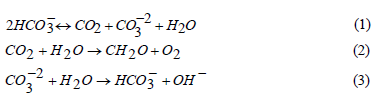
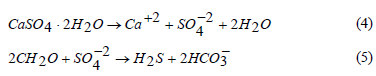
<body><![CDATA[<p><font size="2" face="Verdana, Arial, Helvetica, sans-serif">Biomineralization is a   common process in nature by which living organisms form precipitated   crystalline or amorphous minerals &#91;7&#93;. Biomineralization occurs through   chemical reactions between specific ions or compounds as a result of metabolic   activities of an organism under certain environmental conditions. The   &quot;carbonate-geneses&quot; is a good example of biomineralization, in which   it precipitates carbonates &#91;8&#93;.</font></p>     <p><font size="2" face="Verdana, Arial, Helvetica, sans-serif">Photosynthesis is the   most common form of carbonate microbial precipitation &#91;9&#93;. This process is   based on the metabolic utilization of dissolved CO<sub>2</sub>, which equilibrates   with HCO and CO (eq. 1) around the bacterium. This reaction induces a shift in   the balance of bicarbonate and, subsequently, an increase in the pH in most of   media (eq. 2 and 3).</font></p>     <p><img src="/img/revistas/dyna/v82n192/v82n192a25eq0103.gif"></p>     <p><font size="2" face="Verdana, Arial, Helvetica, sans-serif">Another type of process that precipitates carbonates is   the sulfur cycle, specifically the reduction of sulfate. The reaction begins   with the dissolution of gypsum (CaSO<sub>4</sub>.2H<sub>2</sub>O/CaSO<sub>4</sub>,   eq. 4). In these circumstances, the organic matter can be consumed by   sulfate-reducing bacteria, and sulphide and metabolic CO<sub>2</sub> is   released (eq. 5).</font></p>     <p><img src="/img/revistas/dyna/v82n192/v82n192a25eq0405.gif"></p>     <p><font size="2" face="Verdana, Arial, Helvetica, sans-serif">The removal of sulfur produced from hydrogen (H<sub>2</sub>S)   and the result of the increase in pH are prerequisite to the precipitation of   carbonates &#91;10&#93;.</font></p>     <p><font size="2" face="Verdana, Arial, Helvetica, sans-serif">Another form of precipitation involves the nitrogen cycle   and, more specifically, the ammonification of amino acids, nitrate reduction   and degradation of urea &#91;11&#93;. These three mechanisms have in common the   production of metabolic CO<sub>2</sub> and ammonia (NH<sub>3</sub>), which, in   the presence of calcium ions, results in precipitation of ammonium ions and the   release of carbonate. The reaction takes place according to eq. 6 and 7:</font></p>     <p><img src="/img/revistas/dyna/v82n192/v82n192a25eq0607.gif"></p>     <p><font size="2" face="Verdana, Arial, Helvetica, sans-serif">In complex natural environments, different metabolisms can   combine to produce precipitation.</font></p>     <p><font size="2" face="Verdana, Arial, Helvetica, sans-serif">Under such conditions, precipitation of calcium carbonate (CaCO<sub>3</sub>)   can occur from the equilibrium reaction shown in eq. 8 if soluble calcium ions   (Ca<sup>+2</sup>) are present.</font></p>     ]]></body>
<body><![CDATA[<p><img src="/img/revistas/dyna/v82n192/v82n192a25eq08.gif"></p>     <p><font size="2" face="Verdana, Arial, Helvetica, sans-serif">It is noteworthy that the production of CO3-2 from   bicarbonate (HCO<sub>3</sub><sup>-1</sup>) in water is highly dependent on pH   and that growth occurs under alkaline conditions. In summary, the precipitation   of calcium carbonate occurs easily in alkaline environments abundant in calcium   (Ca<sup>2 +</sup>) and carbonate ions (CO<sub>3</sub><sup>-2</sup>) &#91;8&#93;.</font></p>     <p><font size="2" face="Verdana, Arial, Helvetica, sans-serif">The main role of bacteria in the process has been linked   to their ability to create alkaline environments and to increase the   concentration dissolved inorganic carbon (DIC) through various physiological   activities &#91;9&#93;.</font></p>     <p><font size="2" face="Verdana, Arial, Helvetica, sans-serif">Specific species of bacteria are capable of producing   different amounts, forms and types of crystals of carbonate (e.g., calcite,   aragonite and dolomite) from the same synthetic medium &#91;9&#93;.</font></p>     <p><font size="2" face="Verdana, Arial, Helvetica, sans-serif">The study of the bioprecipitation process by   microorganisms, especially of calcium carbonate, began at the end of the   nineteenth century by Nadson (1899-1903). Several genera and species of   bacteria were isolated from the environment and systematically studied,   contributing to our knowledge of the bioprecipitation processes in the   production of calcium carbonate. </font></p>     <p><font size="2" face="Verdana, Arial, Helvetica, sans-serif">The research conducted in &#91;8&#93; and &#91;12&#93; showed that   bacteria such as Bacillus have the ability to precipitate CaCO<sub>3</sub> when   incubated in B4, which is a nutrient composed of yeast extract, glucose and   calcium acetate, at a pH of 8 and incubation temperatures of 25 to 30°C. The   precipitation begins to occur after 15 days. Upon observation of the   precipitates for 25 days, the number and size of crystals were found to   increase with time.</font></p>     <p><font size="2" face="Verdana, Arial, Helvetica, sans-serif">The first study of the applicability of the process of   calcium carbonate bioprecipitation, called &quot;bioremediation&quot;, was   based on protection against deterioration of materials used in construction,   such as ornamental stones and concrete, using a nutrient medium containing   bacteria &#91;8&#93;. Subsequent techniques, such as &quot;bio-induration&quot; or   &quot;bio-sealing&quot;, have consisted of sealing or plugging the pores of the   soil through the application of nutrients and microorganisms capable of   producing a biofilm, which were used to reduce the permeability of soils   &#91;13,14&#93;. Finally, the technique of &quot;biostabilization&quot; improves soil   properties through the addition of microorganisms and nutrients &#91;15&#93;.</font></p>     <p><font size="2" face="Verdana, Arial, Helvetica, sans-serif">In this study, instead   of adding microorganisms to the material as has been done previously, we   stimulate the native microorganisms present in the tropical soil to precipitate   calcium carbonate minerals from the addition of only one nutrient. This   technique has a reduced environmental impact as compared to other techniques   commonly used to prevent, halt or reclaim areas affected by erosion.</font></p>     <p> </p>     <p><font size="3" face="Verdana, Arial, Helvetica, sans-serif"><b>4. Materials and methods</b></font></p>     ]]></body>
<body><![CDATA[<p><font size="2" face="Verdana, Arial, Helvetica, sans-serif">The search region was   in a location affected by erosion, specifically, in the gullies. The selected   profile was located 20 m from the left edge of a gully in the town of Santa   Maria, Bras&iacute;lia, Federal District - Brazil.</font></p>     <p><font size="2" face="Verdana, Arial, Helvetica, sans-serif">The study was limited to 6 m deep, with profiles of five   soil layers: 0 to 1.5 m, 1.5 m to 2.5 m, 2.5 m to 3.5 m, 3.5 m to 4.5 m and 4.5   m to 6.0 m. According to &#91;1&#93;, this profile is located in the geological unit   &quot;Sandy Metarritmito&quot; from the Parano&aacute; group. The &quot;Sandy Metarritmito&quot;   is composed of fine to medium interbedded quartzite, siltstones and slates. The   maximum thickness of this structure can reach 150 m &#91;16&#93;. The gully   geomorphologically lies within the &quot;Contagem Plateau&quot;. This plateau is the   highest in the Federal District with an average elevation of more than 1200 m.   The area has a climate with temperatures below 18°C in the coldest month and   greater than 22°C in the warmest month. The average annual relative humidity is   60%.</font></p>     <p><font size="2" face="Verdana, Arial, Helvetica, sans-serif"><b><i>4.1. Microbiological analyses</i></b></font></p>     <p><font size="2" face="Verdana, Arial, Helvetica, sans-serif">For the   microbiological identification of bacteria present in the soil profile, first,   a 10 g sample of each layer was taken and placed in a plastic sterile container   with 90 mL of peptone water to make a 1:10 dilution. Then, from this mixture, 1   ml was taken and homogenized with 9 ml of 0.1% buffered water to obtain a   dilution of 1:100. Each dilution was incubated in a bacteriological incubator   under 25°C for 24 hours and distributed to the respective dilutions, in the   form of stripes with a platinum handle on plates containing agar and 5% sheep   blood, for the growth and isolation of the bacterial population.</font></p>     <p><font size="2" face="Verdana, Arial, Helvetica, sans-serif">The identification of   bacterial colonies was carried out through various biochemical tests: GRAM   test, 3% KOH test, catalase test, oxidase test, TSI test,   oxidation/fermentation test, indole test, urease test, mannitol fermentation,   nitrate reduction test, production of desidrolase and decarboxylases of amino   acids, gelatin hydrolysis test, Methyl Red test, Voges-Proskauer test,   utilization of citrate, motility test, fermentation of lactose, sucrose, glucose,   maltose, arabinose and trehalose and hydrolysis of Esculin.</font></p>     <p><font size="2" face="Verdana, Arial, Helvetica, sans-serif">After the bacteria in   the soil were identified, the samples were placed on plates containing the   nutrient medium B4, which induces the precipitation of calcium carbonate. The   medium components were 15 g calcium acetate, 4 g stratum yeast, 5 g glucose and   12 g agar in 1 L of distilled water. In order for the bacteria to promote the   precipitation of calcium carbonate, it was important to maintain the pH at   about 8. To achieve this pH, NaOH was incorporated into the described solution &#91;8&#93;.   The plates with the bacteria in B4 medium were incubated for at least 15 days   at 25°C &#91;12&#93;.</font></p>     <p><font size="2" face="Verdana, Arial, Helvetica, sans-serif">The precipitates were   observed using a scanning electron microscope (SEM) to determine whether they   contained the calcium element. After verification of the mechanism of   precipitation from the bacteria found in soil, the nutrient was added to blocks   of undisturbed soil, for the precipitation to occur in locus.</font></p>     <p><font size="2" face="Verdana, Arial, Helvetica, sans-serif">The blocks of   undisturbed soil from each layer were placed inside a container, which, at the   time of the nutrient addition, did not crumble. At the top of the blocks, holes   were made, about 0.4 cm in diameter and 2 cm deep with a 10 cm spacing. The   nutrient was introduced in the holes with the use of a syringe. The nutrient   filled 60% of the empty spaces present in each block of undisturbed soil.   Subsequently, the blocks were kept for a minimum of 15 days within a   &quot;moisture chamber&quot; (25°C and relative humidity 60%), similar to the   average conditions of the erosion site selected for the study.</font></p>     <p><font size="2" face="Verdana, Arial, Helvetica, sans-serif">The influence of the   treatment on the properties of the soil was evidenced by running physical,   chemical, mineralogical and mechanical sample tests with and without the   addition of the nutrient. These tests were performed according to the   methodologies proposed by the Brazilian Association of Technical Standards   (ABNT) and in their absence, according to the American Standard Test Method   (ASTM).</font></p>     <p><font size="2" face="Verdana, Arial, Helvetica, sans-serif"><b><i>4.2. Physical properties</i></b></font></p>     ]]></body>
<body><![CDATA[<p><font size="2" face="Verdana, Arial, Helvetica, sans-serif">For the physical characterization of the soil profile, tests   were carried out to determine the moisture, specific weight of grains,   Atterberg limits and grain size with and without dispersant, and tests MCT   (Miniature Compressed Tropical) of tropical soils expedite classification &#91;17&#93;.   Voids and the degree of saturation were determined from the soil samples.</font></p>     <p><font size="2" face="Verdana, Arial, Helvetica, sans-serif"><b><i>4.3. Chemical analyses</i></b></font></p>     <p><font size="2" face="Verdana, Arial, Helvetica, sans-serif">These tests consisted of measurements of the pH in water   and KCl solution at a ratio of 10:25 (soil: water/solution) and determining   levels of calcium (Ca), sodium (Na), potassium (K), magnesium (Mg), H + Al   (total acidity), organic matter (OM), organic carbon (C), nitrogen (N),   phosphorus (P) and sulfur (S), as well as the cation exchange capacity (CEC),   base saturation and aluminum saturation. These tests were performed according to   EMBRAPA standards &#91;18&#93;.</font></p>     <p><font size="2" face="Verdana, Arial, Helvetica, sans-serif"><b><i>4.4. Mineralogical analyses</i></b></font></p>     <p><font size="2" face="Verdana, Arial, Helvetica, sans-serif">The mineralogical   characterization was limited to the identification of minerals in layers of   soil profiled by X-ray diffraction, complemented with semi-qualitative chemical   analysis obtained by energy dispersive spectroscopy (EDS) using SEM.</font></p>     <p><font size="2" face="Verdana, Arial, Helvetica, sans-serif"><b><i>4.5. Structure definition</i></b></font></p>     <p><font size="2" face="Verdana, Arial, Helvetica, sans-serif">Deeply weathered tropical soils, such as those used in   this study, cannot be thought of as individual soil particles because the   particles are grouped together, forming aggregates that directly influence the   physical properties and mechanical and hydraulic behavior of the soil. However,   the chemical additives can affect the structural stability of these aggregates,   but the biomineralization may give them greater stability providing structural   changes in the ground. The structural changes caused by biomineralization may   explain certain behavior in soil.</font></p>     <p><font size="2" face="Verdana, Arial, Helvetica, sans-serif">Structural   characterization of the soil was made from the visual analysis of images   obtained from SEM.</font></p>     <p><font size="2" face="Verdana, Arial, Helvetica, sans-serif"><b><i>4.6. Mechanical behavior</i></b></font></p>     <p><font size="2" face="Verdana, Arial, Helvetica, sans-serif">Analyzing the mechanical behavior of soils is very   important in defining the influence of biomineralization in the erosion   stabilization of slopes. For its determination, the following parameters were   determined: compressive strength, indirect tensile strength, resistance to   direct shear, total matrix suction, dual-oedometer densification and   permeability. Tests were also conducted to estimate the susceptibility to   erosion, such as the pinhole test and the test of disaggregation.</font></p>     ]]></body>
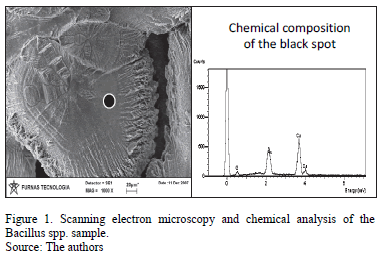
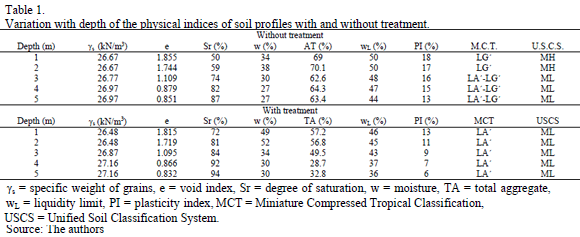
<body><![CDATA[<p><font size="3" face="Verdana, Arial, Helvetica, sans-serif"><b>5. Results</b></font></p>     <p><font size="2" face="Verdana, Arial, Helvetica, sans-serif"><b><i>5.1. Microbiological characterization</i></b></font></p>     <p><font size="2" face="Verdana, Arial, Helvetica, sans-serif">From different   biochemical tests of the entire profile, a total of 43 types of isolated   bacteria were identified: among them were <i>Bacillus</i> spp., <i>Pasteurella</i> spp., <i>Actinobacillus</i> spp., <i>Pseudomonas</i> spp., <i>Staphylococcus </i>spp., <i>Alcaligenes</i> spp., <i>Rhodococus</i> spp., <i>Corynebacterium</i> spp., <i>Rhodococus   quei</i>, <i>Francisella tularensis</i> and <i>Enterobacter cloacae</i>; with   the <i>Bacillus</i> spp. as the most common bacteria.</font></p>     <p><font size="2" face="Verdana, Arial, Helvetica, sans-serif">In the microbiological analysis, it was found that the   amount of bacteria present increased with depth. This may be linked to   increases in water pH with the depth of soil (1 m: 5.6, 2 m: 5.8, 3 m: 5.9, 4   m: 6.1 and 5 m: 5.9). According to &#91;19&#93;, the environment most favored by   bacteria is one in which the pH is close to 8. </font></p>     <p><font size="2" face="Verdana, Arial, Helvetica, sans-serif">The precipitation occurred in Petri dishes containing the   B4 medium. Then, the samples coated with gold were pasted onto a sample holder   (hence the presence of the gold peak in the determined chemical composition),   and observed by SEM, which confirmed the presence of calcium in all of the   samples (black spot in <a href="#fig01">Fig. 1</a>). </font></p>     <p align="center"><font size="2" face="Verdana, Arial, Helvetica, sans-serif"><a name="fig01"></a></font><img src="/img/revistas/dyna/v82n192/v82n192a25fig01.gif"></p>     <p><font size="2" face="Verdana, Arial, Helvetica, sans-serif">Importantly, when <i>Bacillus</i> was present, the   greatest precipitation of calcium was generated (larger precipitates in the   Petri dishes), which confirms that <i>Bacillus</i>-type bacteria are excellent   for the process of biomineralization &#91;12&#93;.</font></p>     <p><font size="2" face="Verdana, Arial, Helvetica, sans-serif"><b><i>5.2. Physical characterization</i></b></font></p>     <p><font size="2" face="Verdana, Arial, Helvetica, sans-serif">The results of physical characterization tests for the   five layers of natural soil profiles are presented in <a href="#tab01">Table 1</a>, together with   the results obtained for the soil treated with the B4 nutrient, which allows   for an evaluation of the influence of the addition of B4 to the medium on the   physical properties after a minimum of 15 days.</font></p>     <p align="center"><font size="2" face="Verdana, Arial, Helvetica, sans-serif"><a name="tab01"></a></font><img src="/img/revistas/dyna/v82n192/v82n192a25tab01.gif"></p>     ]]></body>
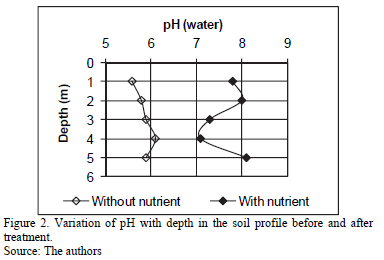
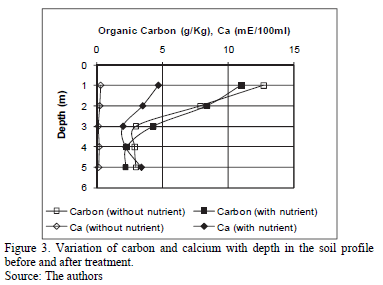
<body><![CDATA[<p><font size="2" face="Verdana, Arial, Helvetica, sans-serif">The results in <a href="#tab01">Table 1</a> show that the void index decreased   slightly with the addition of nutrients because the precipitates formed with   little intensity or very fine fibers.</font></p>     <p><font size="2" face="Verdana, Arial, Helvetica, sans-serif">To evaluate the stability of micro-concretions that were   present in the soil profile, the expression given by &#91;20&#93; for the total   aggregate (TA = % clay size with dispersant - % clay size without dispersant)   was used. When the nutrient was used, the TA values were lower, indicating   greater stability of the micro-concretions.</font></p>     <p><font size="2" face="Verdana, Arial, Helvetica, sans-serif">Using the liquidity limit (w<sub>L</sub>) and plasticity   index (Ip), it was observed that the plasticity of a clay, in general, may   decrease as the number of cations and calcium increases &#91;21&#93;. In addition, the   treatment helped to maintain soil aggregation by making it more granular, which   generally favors the reduction of plasticity.</font></p>     <p><font size="2" face="Verdana, Arial, Helvetica, sans-serif">The treatment gave   stability to the aggregates, which according to the MCT system, classifies the   soil as sand. However, based on the USCS, due to the reduced plasticity, the   soil is classified as having low plasticity. The fact that no changes were   observed in the classification of any of the layers does not necessarily mean   that the treatment did not influence the behavior of the soil. However, it indicates   a low sensitivity of classification methods to assess levels of change   experienced by the soil.</font></p>     <p><font size="2" face="Verdana, Arial, Helvetica, sans-serif"><b><i>5.3. Chemical characterization</i></b></font></p>     <p><font size="2" face="Verdana, Arial, Helvetica, sans-serif"><a href="#fig02">Fig. 2</a> shows that, by adding the nutrient to the samples,   the pH increased from slightly acidic to slightly basic, with basic being   greater than pH 7 in water. An alkaline pH is needed to generate an environment   favorable for bacteria to precipitate calcium carbonate &#91;22&#93;.</font></p>     <p align="center"><font size="2" face="Verdana, Arial, Helvetica, sans-serif"><a name="fig02"></a></font><img src="/img/revistas/dyna/v82n192/v82n192a25fig02.gif"></p>     <p><font size="2" face="Verdana, Arial, Helvetica, sans-serif">The generation of calcium carbonate is contingent on the   existence of carbon and calcium, hence the importance of the relationship that   exists between the organic carbon content and calcium content (<a href="#fig03">Fig. 3</a>). Samples   with nutrient, at depths less than 3 m, showed a reduction in the amounts of   calcium and carbon, with a higher rate of reduction of carbon than of calcium.   Beyond 3 m, the reduction of carbon continued, but the calcium increased and in   larger quantities than carbon, implying that not all of the calcium </font><font size="2" face="Verdana, Arial, Helvetica, sans-serif">forms calcite at these depths and   that part of the calcium must be available associated with minerals or as   chemical complexes. Moreover, in the first 3 m, there was a surplus of carbon,   meaning that there may be more additions of calcium because the relationship of   these elements in calcite is 1:1.</font></p>     <p align="center"><font size="2" face="Verdana, Arial, Helvetica, sans-serif"><a name="fig03"></a></font><img src="/img/revistas/dyna/v82n192/v82n192a25fig03.gif"></p>     <p><font size="2" face="Verdana, Arial, Helvetica, sans-serif"><b><i>5.4. Mineralogical characterization</i></b></font></p>     ]]></body>
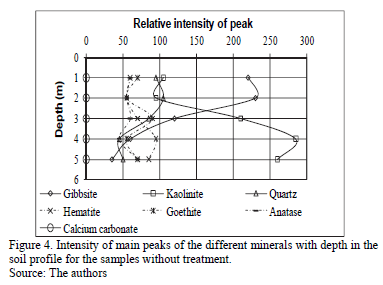
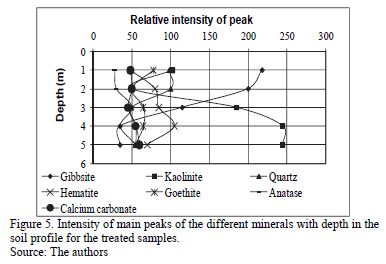
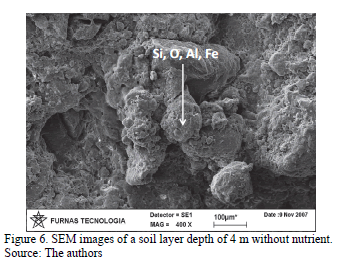
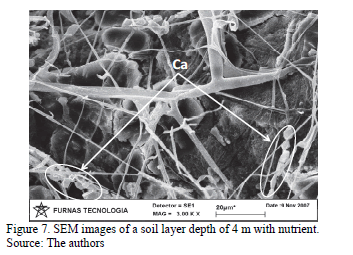
<body><![CDATA[<p><font size="2" face="Verdana, Arial, Helvetica, sans-serif"><a href="#fig04">Figs. 4</a> and <a href="#fig05">5</a> show that the original minerals were   preserved when comparing the samples without nutrient to samples with nutrient,   i.e., the treatment does not affect the initial mineralogical composition.   There is, however, in <a href="#fig05">Fig. 5</a>, the appearance of mineral calcium carbonate   (calcite, 1 m, 2 m, 4 m and 5 m and wilkeita at 3 m), thus confirming, even in   small amounts, the precipitation generated by bacterial activity with the   treatment.</font></p>     <p align="center"><font size="2" face="Verdana, Arial, Helvetica, sans-serif"><a name="fig04"></a></font><img src="/img/revistas/dyna/v82n192/v82n192a25fig04.gif"></p>     <p align="center"><font size="2" face="Verdana, Arial, Helvetica, sans-serif"><a name="fig05"></a></font><img src="/img/revistas/dyna/v82n192/v82n192a25fig05.gif"></p>     <p><font size="2" face="Verdana, Arial, Helvetica, sans-serif">It should be noted that   the amount of kaolinite present in the soil was related to the adherence of   Gram-positive bacteria, which, in the presence of nutrient, present   precipitation of calcium carbonate as already shown in the initial studies for   the bacterial characterization on Petri dishes.</font></p>     <p><font size="2" face="Verdana, Arial, Helvetica, sans-serif">To confirm the formation of calcium carbonate,   hydrochloric acid (HCl) was poured on the soil samples with and without   nutrient. All treated soil samples showed effervescence, confirming the   presence of carbonates.</font></p>     <p><font size="2" face="Verdana, Arial, Helvetica, sans-serif"><b><i>5.5. Structure characterization</i></b></font></p>     <p><font size="2" face="Verdana, Arial, Helvetica, sans-serif">When   the nutrient was not added to the chemical analysis, the SEM images illustrated   common elements of </font><font size="2" face="Verdana, Arial, Helvetica, sans-serif">tropical soils (<a href="#fig06">Fig. 6</a>). In soils   with the nutrient, the presence of fibrous precipitates containing calcium that   bind soil grains or crystals of different fibers, called &quot;globular or   botryoidal habit&quot; (<a href="#fig07">Fig. 7</a>), were observed at all depths.</font></p>     <p align="center"><font size="2" face="Verdana, Arial, Helvetica, sans-serif"> <a name="fig06"></a></font><img src="/img/revistas/dyna/v82n192/v82n192a25fig06.gif"></p>     <p align="center"><font size="2" face="Verdana, Arial, Helvetica, sans-serif"><a name="fig07"></a></font><img src="/img/revistas/dyna/v82n192/v82n192a25fig07.gif"></p>     <p><font size="2" face="Verdana, Arial, Helvetica, sans-serif"><b><i>5.6 Mechanical characterization</i></b></font></p>     ]]></body>
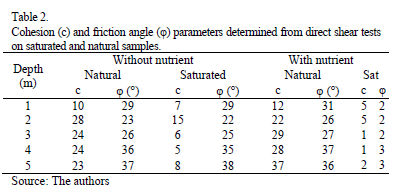
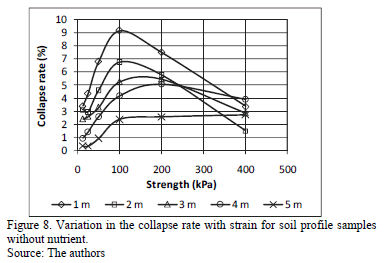
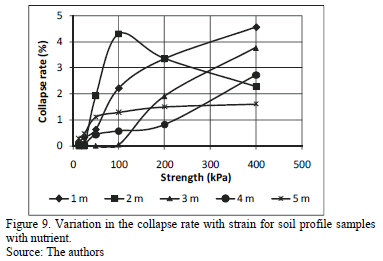
<body><![CDATA[<p><font size="2" face="Verdana, Arial, Helvetica, sans-serif"><b>5.6.1. Direct shear strength of saturated and natural   soil</b></font></p>     <p><font size="2" face="Verdana, Arial, Helvetica, sans-serif">To analyze the   influence of nutrient addition on the shear strength, the parameters of   cohesion and friction angle in isolated form were examined (<a href="#tab02">Table 2</a>).</font></p>     <p align="center"><font size="2" face="Verdana, Arial, Helvetica, sans-serif"><a name="tab02"></a></font><img src="/img/revistas/dyna/v82n192/v82n192a25tab02.gif"></p>     <p><font size="2" face="Verdana, Arial, Helvetica, sans-serif">In almost all cases,   the friction angles and cohesion in natural and immersed states increased when   passing from untreated soil to treated soil, which confirms that the generated</font> <font size="2" face="Verdana, Arial, Helvetica, sans-serif">precipitate acted as cement for   the soil profile studied. The increase of friction angles and cohesion from the   treatment was reflected in the increase in shear strength.</font></p>     <p><font size="2" face="Verdana, Arial, Helvetica, sans-serif">The resistance increases to the depths of 1m and 2m were   the lowest. This may be related to the fact that at these depths the initial   moisture content of the samples was the highest, or may also be due to the fact   that at these depths the amount of kaolinite is less, resulting in a lower   adhesion of Gram-positive bacteria type Bacillus spp., and consequently,   causing a smaller amount of precipitates &#91;22&#93;.</font></p>     <p><font size="2" face="Verdana, Arial, Helvetica, sans-serif"><b>5.6.2. Dual-oedometer density</b></font></p>     <p><font size="2" face="Verdana, Arial, Helvetica, sans-serif">Soil samples were   assayed in their natural state and in a saturated state to determine the   structural collapse inundation <i>(Collapse   rate %)</i>. There is a clear   reduction in the collapse potential of the treated soils (<a href="#fig09">Fig. 9</a>) as compared to   those obtained at the same depths for the untreated soils (<a href="#fig08">Fig. 8</a>).</font></p>     <p align="center"><font size="2" face="Verdana, Arial, Helvetica, sans-serif"> <a name="fig08"></a></font><img src="/img/revistas/dyna/v82n192/v82n192a25fig08.gif"></p>     <p align="center"><font size="2" face="Verdana, Arial, Helvetica, sans-serif"><a name="fig09"></a></font><img src="/img/revistas/dyna/v82n192/v82n192a25fig09.gif"></p>     <p><font size="2" face="Verdana, Arial, Helvetica, sans-serif"><b>5.6.3. Total suction and matrix suction</b></font></p>     ]]></body>
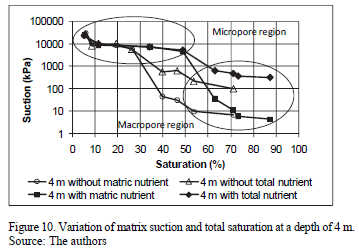
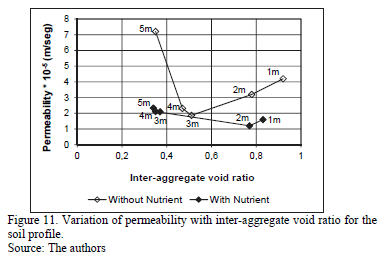
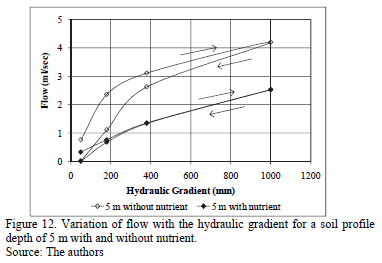
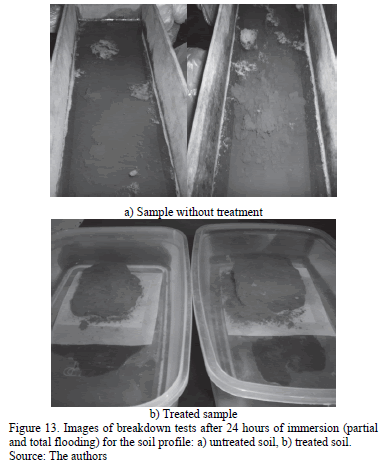
<body><![CDATA[<p><font size="2" face="Verdana, Arial, Helvetica, sans-serif"><a href="#fig10">Fig. 10</a> shows a plot for the soil layer at a depth of 4 m   as an example of the general behavior of the total and matrix suction observed   for all of the layers. The treatment increased the total suction in the macropore   region. Despite the difficulty that arises in identifying a unique behavior and </font></p>     <p align="center"><font size="2" face="Verdana, Arial, Helvetica, sans-serif"><a name="fig10"></a></font><img src="/img/revistas/dyna/v82n192/v82n192a25fig10.gif"></p>     <p><font size="2" face="Verdana, Arial, Helvetica, sans-serif">the influence of treatment on the   behavior for the matrix suction, it is worth noting the shift to the right of   the point of entry of air in the micropores registered for the curves depending   on the degree of saturation during the treatment. This shift indicates a   reduction in macroporosity.</font></p>     <p><font size="2" face="Verdana, Arial, Helvetica, sans-serif"><b><i>5.6.4. Permeability</i></b></font></p>     <p><font size="2" face="Verdana, Arial, Helvetica, sans-serif">By examining the permeability as a function of the   inter-aggregated void ratio of soil, which represents voids in which water   circulates and the carbonates precipitated, at all depths, it was found that the   nutrient caused a decrease in permeability (<a href="#fig11">Fig. 11</a>).</font></p>     <p align="center"><font size="2" face="Verdana, Arial, Helvetica, sans-serif"><a name="fig11"></a></font><img src="/img/revistas/dyna/v82n192/v82n192a25fig11.gif"></p>     <p><font size="2" face="Verdana, Arial, Helvetica, sans-serif"><b>5.6.5. Pinhole test</b></font></p>     <p><font size="2" face="Verdana, Arial, Helvetica, sans-serif"><a href="#fig12">Fig. 12</a> presents the behavior before the internal erosion   of the soil layer at a depth of 5 m. For all depths, the treatment indicated a   greater closure of the pores due to the precipitation of calcium carbonate and   greater structural stability as the curves obtained with treatment were   quasi-linear, with little difference between the phases of loading (&rarr;)   and unloading (&larr;) and the outflows for the same gradients were lower than   in the untreated soil.</font></p>     <p align="center"><font size="2" face="Verdana, Arial, Helvetica, sans-serif"> <a name="fig12"></a></font><img src="/img/revistas/dyna/v82n192/v82n192a25fig12.gif"></p>     <p><font size="2" face="Verdana, Arial, Helvetica, sans-serif"><b>5.6.6. Breakdown</b></font></p>     ]]></body>
<body><![CDATA[<p><font size="2" face="Verdana, Arial, Helvetica, sans-serif">The results of the   breakdown test clearly illustrated the improvement of the structural stability   of the soils when partially or totally inundated with water. Little or no   breakdown was observed for the treated soils immersed in water. <a href="#fig13">Fig. 13</a> shows   the sample images to a depth of 3 m with and without treatment. The performance   was generally the same for all depths.</font></p>     <p align="center"><font size="2" face="Verdana, Arial, Helvetica, sans-serif"><a name="fig13"></a></font><img src="/img/revistas/dyna/v82n192/v82n192a25fig13.gif"></p>     <p><font size="2" face="Verdana, Arial, Helvetica, sans-serif">The pinhole and breakdown tests were used to   qualitatively investigate the eroded soils. The results of these experiments   showed that the biomineralization caused by the treatment reduced the potential   erodibility of the soils.</font></p>     <p> </p>     <p><font size="3" face="Verdana, Arial, Helvetica, sans-serif"><b>6. Conclusions</b></font></p> <ul>       <li><font size="2" face="Verdana, Arial, Helvetica, sans-serif"> The technique used in this work creates new possibilities for     soil improvements, allowing for an advance in biotechnology development and     reducing the possibility of environmental impact in comparison to other     techniques commonly used to combat erosion and to stabilize soils.</font></li>       <li><font size="2" face="Verdana, Arial, Helvetica, sans-serif"> The use of biomineralization in geotechnical engineering requires     the integration of professionals from different fields (e.g., microbiologists,     geologists, engineers), combining the knowledge of related areas, to obtain a     more suitable proposal for resolving the problem.</font></li>       <li><font size="2" face="Verdana, Arial, Helvetica, sans-serif"> In conclusion, in the tropical soil profile studied, the native     bacteria effectively used the B4 nutrient to precipitate calcium carbonate. The     calcium carbonate generated by the treatment provided variations in the     physical, chemical and mineralogical properties of the soil and improved the     mechanical and hydraulic behavior of the soil. Changes were observed in the     reduction of the void index, liquidity limit, plasticity index, permeability,     collapse index and erodibility, in addition to increased suction and shear     strength. The effect of these changes was reflected by a greater structural     stability of the grains, better performance of the aggregates and lower deformability     of the soil mass, thus pointing to the possibility of using the technique of     biomineralization in erosion process control.</font></li>     </ul>     <p> </p>     ]]></body>
<body><![CDATA[<p><font size="3" face="Verdana, Arial, Helvetica, sans-serif"><b>Aknowledgements</b></font></p>     <p><font size="2" face="Verdana, Arial, Helvetica, sans-serif">&quot;Programa Bolsista da CAPES/CNPq - IEL Nacional - Brasil&quot;   and &quot;Universidad Nacional de Colombia&quot;.</font></p>     <p> </p>     <p><font size="3" face="Verdana, Arial, Helvetica, sans-serif"><b>References</b></font></p>     <!-- ref --><p><font size="2" face="Verdana, Arial, Helvetica, sans-serif"><b>&#91;1&#93;</b> Lima,   M., Degradação f&iacute;sico-qu&iacute;mica e mineral&oacute;gica de maciços junto às voçorocas,   Tese de Doutorado, Departamento de engenharia civil e ambiental, Universidade   de Bras&iacute;lia, Bras&iacute;lia, Brasil, 2003.    &nbsp;&nbsp;&nbsp;&nbsp;&nbsp;&nbsp;&nbsp;&nbsp;[&#160;<a href="javascript:void(0);" onclick="javascript: window.open('/scielo.php?script=sci_nlinks&ref=000137&pid=S0012-7353201500040002500001&lng=','','width=640,height=500,resizable=yes,scrollbars=1,menubar=yes,');">Links</a>&#160;]<!-- end-ref --></font></p>     <!-- ref --><p><font size="2" face="Verdana, Arial, Helvetica, sans-serif"><b>&#91;2&#93;</b> Tiano,   P., Biagiotti, L. and Mastromei, G., Bacterial bio-mediated calcite   precipitation for monumental stones conservation: methods of evaluation. Journal of Microbiological Methods,   36, pp. 139-145, 1999. DOI: 10.1016/S0167-7012(99)00019-6</font>&nbsp;&nbsp;&nbsp;&nbsp;&nbsp;&nbsp;&nbsp;&nbsp;[&#160;<a href="javascript:void(0);" onclick="javascript: window.open('/scielo.php?script=sci_nlinks&ref=000139&pid=S0012-7353201500040002500002&lng=','','width=640,height=500,resizable=yes,scrollbars=1,menubar=yes,');">Links</a>&#160;]<!-- end-ref --><!-- ref --><p><font size="2" face="Verdana, Arial, Helvetica, sans-serif"><b>&#91;3&#93;</b> Mart&iacute;nez, G., Maya, L., Rueda, D. and Sierra, G., Aplicaciones estructurales de bacterias en la   construcci&oacute;n de nuevas obras de infraestructura -Estabilizaci&oacute;n de suelos-, Trabajo   de grado, Departamento de Ingenier&iacute;a Civil, Universidad Nacional de Colombia,   Medell&iacute;n, Colombia, 2003.    &nbsp;&nbsp;&nbsp;&nbsp;&nbsp;&nbsp;&nbsp;&nbsp;[&#160;<a href="javascript:void(0);" onclick="javascript: window.open('/scielo.php?script=sci_nlinks&ref=000140&pid=S0012-7353201500040002500003&lng=','','width=640,height=500,resizable=yes,scrollbars=1,menubar=yes,');">Links</a>&#160;]<!-- end-ref --></font></p>     <!-- ref --><p><font size="2" face="Verdana, Arial, Helvetica, sans-serif"><b>&#91;4&#93;</b> Zilli,   J., Gouvea, N., da Costa, H. and Prata, M.C., Diversidade Microbiana como indicador   da qualidade do solo. Cadernos de Ciência &amp; Tecnologia, Bras&iacute;lia, 20 (3), pp.   391-411, 2003.    &nbsp;&nbsp;&nbsp;&nbsp;&nbsp;&nbsp;&nbsp;&nbsp;[&#160;<a href="javascript:void(0);" onclick="javascript: window.open('/scielo.php?script=sci_nlinks&ref=000142&pid=S0012-7353201500040002500004&lng=','','width=640,height=500,resizable=yes,scrollbars=1,menubar=yes,');">Links</a>&#160;]<!-- end-ref --></font></p>     <!-- ref --><p><font size="2" face="Verdana, Arial, Helvetica, sans-serif"><b>&#91;5&#93;</b> Cardoso,   E., Tsai, S. and Neves, M.C., Microbiologia do solo, Brasil, Sociedade   Brasileira de ciência do solo, 1992.    &nbsp;&nbsp;&nbsp;&nbsp;&nbsp;&nbsp;&nbsp;&nbsp;[&#160;<a href="javascript:void(0);" onclick="javascript: window.open('/scielo.php?script=sci_nlinks&ref=000144&pid=S0012-7353201500040002500005&lng=','','width=640,height=500,resizable=yes,scrollbars=1,menubar=yes,');">Links</a>&#160;]<!-- end-ref --></font></p>     <!-- ref --><p><font size="2" face="Verdana, Arial, Helvetica, sans-serif"><b>&#91;6&#93;</b> Pe&ntilde;a, J.J., Introducci&oacute;n a la microbiolog&iacute;a del   suelo, M&eacute;xico, Libros y editoriales S.A., 1980.    &nbsp;&nbsp;&nbsp;&nbsp;&nbsp;&nbsp;&nbsp;&nbsp;[&#160;<a href="javascript:void(0);" onclick="javascript: window.open('/scielo.php?script=sci_nlinks&ref=000146&pid=S0012-7353201500040002500006&lng=','','width=640,height=500,resizable=yes,scrollbars=1,menubar=yes,');">Links</a>&#160;]<!-- end-ref --></font></p>     <!-- ref --><p><font size="2" face="Verdana, Arial, Helvetica, sans-serif"><b>&#91;7&#93;</b> Soto, A., Introducci&oacute;n a los biominerales y   biomateriales, Chile, Universidad de Chile, 2003.    &nbsp;&nbsp;&nbsp;&nbsp;&nbsp;&nbsp;&nbsp;&nbsp;[&#160;<a href="javascript:void(0);" onclick="javascript: window.open('/scielo.php?script=sci_nlinks&ref=000148&pid=S0012-7353201500040002500007&lng=','','width=640,height=500,resizable=yes,scrollbars=1,menubar=yes,');">Links</a>&#160;]<!-- end-ref --></font></p>     <!-- ref --><p><font size="2" face="Verdana, Arial, Helvetica, sans-serif"><b>&#91;8&#93;</b> Lee,   Y.N., Calcite prodution by bacillus amyloliquefacies CMB01. Journal of   Microbiology, 41 (4), pp. 345-348, 2003.    &nbsp;&nbsp;&nbsp;&nbsp;&nbsp;&nbsp;&nbsp;&nbsp;[&#160;<a href="javascript:void(0);" onclick="javascript: window.open('/scielo.php?script=sci_nlinks&ref=000150&pid=S0012-7353201500040002500008&lng=','','width=640,height=500,resizable=yes,scrollbars=1,menubar=yes,');">Links</a>&#160;]<!-- end-ref --></font></p>     <!-- ref --><p><font size="2" face="Verdana, Arial, Helvetica, sans-serif"><b>&#91;9&#93;</b> Hammes,   F. and Verstraete, W., Key roles and calcium metabolism in microbial carbonate   precipitation. Environmental Science &amp; Bio/Technology, 1, pp. 3-7, 2002.    &nbsp;&nbsp;&nbsp;&nbsp;&nbsp;&nbsp;&nbsp;&nbsp;[&#160;<a href="javascript:void(0);" onclick="javascript: window.open('/scielo.php?script=sci_nlinks&ref=000152&pid=S0012-7353201500040002500009&lng=','','width=640,height=500,resizable=yes,scrollbars=1,menubar=yes,');">Links</a>&#160;]<!-- end-ref --></font></p>     <!-- ref --><p><font size="2" face="Verdana, Arial, Helvetica, sans-serif"><b>&#91;10&#93;</b> Castanier,   S., Gaële Le, M. and Perthuisot, J.P., Ca-carbonates precipitation and limestone   genesis - the microbiogeologist point of view. Sedimentary Geology, 126 (1-4),   pp. 9-23, 1999. DOI: 10.1016/S0037-0738(98)00144-4    DOI: 10.1016/S0037-0738(99)00028-7</font>&nbsp;&nbsp;&nbsp;&nbsp;&nbsp;&nbsp;&nbsp;&nbsp;[&#160;<a href="javascript:void(0);" onclick="javascript: window.open('/scielo.php?script=sci_nlinks&ref=000154&pid=S0012-7353201500040002500010&lng=','','width=640,height=500,resizable=yes,scrollbars=1,menubar=yes,');">Links</a>&#160;]<!-- end-ref --><!-- ref --><p><font size="2" face="Verdana, Arial, Helvetica, sans-serif"><b>&#91;11&#93;</b> Hammes,   F., Boon, N., Villiers, J., Verstraete, W. and Siciliano, D., Strain-Specific   Ureolytic Microbial Calcium Carbonate Precipitation. Appl Environ Microbiol.,   69(8), pp. 4901-4909, 2003. DOI: 10.1128/AEM.69.8.4901-4909.2003</font>&nbsp;&nbsp;&nbsp;&nbsp;&nbsp;&nbsp;&nbsp;&nbsp;[&#160;<a href="javascript:void(0);" onclick="javascript: window.open('/scielo.php?script=sci_nlinks&ref=000155&pid=S0012-7353201500040002500011&lng=','','width=640,height=500,resizable=yes,scrollbars=1,menubar=yes,');">Links</a>&#160;]<!-- end-ref --><!-- ref --><p><font size="2" face="Verdana, Arial, Helvetica, sans-serif"><b>&#91;12&#93;</b> Baskar,   S., Baskar, R., Mauclaire, L. and McKenzie, J.A., Microbially induced calcite   precipitation in culture experiments: Possible origin for stalactites in   Sahastradhara caves, Dehradun, India Current Science, 90 (1), pp. 58-64, 2006.    &nbsp;&nbsp;&nbsp;&nbsp;&nbsp;&nbsp;&nbsp;&nbsp;[&#160;<a href="javascript:void(0);" onclick="javascript: window.open('/scielo.php?script=sci_nlinks&ref=000156&pid=S0012-7353201500040002500012&lng=','','width=640,height=500,resizable=yes,scrollbars=1,menubar=yes,');">Links</a>&#160;]<!-- end-ref --></font></p>     <!-- ref --><p><font size="2" face="Verdana, Arial, Helvetica, sans-serif"><b>&#91;13&#93;</b> Cardona, F. y Usta, M., Un estudio de la   reducci&oacute;n de permeabilidad por la depositaci&oacute;n de finos y bacterias en medios   porosos, Trabajo de grado, Departamento de Ingenier&iacute;a Civil, Universidad   Nacional de Colombia, Medell&iacute;n, Colombia, 2002.    &nbsp;&nbsp;&nbsp;&nbsp;&nbsp;&nbsp;&nbsp;&nbsp;[&#160;<a href="javascript:void(0);" onclick="javascript: window.open('/scielo.php?script=sci_nlinks&ref=000158&pid=S0012-7353201500040002500013&lng=','','width=640,height=500,resizable=yes,scrollbars=1,menubar=yes,');">Links</a>&#160;]<!-- end-ref --></font></p>     <!-- ref --><p><font size="2" face="Verdana, Arial, Helvetica, sans-serif"><b>&#91;14&#93;</b> Whiffin,   V., Lambert, J., Dert F. and Van ree, C. Biogrout and Biosealing. Pore space   engineering with bacteria. American Society of Civil Engineers, vol 5 (5), pp.   13-36, 2005.    &nbsp;&nbsp;&nbsp;&nbsp;&nbsp;&nbsp;&nbsp;&nbsp;[&#160;<a href="javascript:void(0);" onclick="javascript: window.open('/scielo.php?script=sci_nlinks&ref=000160&pid=S0012-7353201500040002500014&lng=','','width=640,height=500,resizable=yes,scrollbars=1,menubar=yes,');">Links</a>&#160;]<!-- end-ref --></font></p>     <!-- ref --><p><font size="2" face="Verdana, Arial, Helvetica, sans-serif"><b>&#91;15&#93;</b> G&oacute;mez, E. Evaluaci&oacute;n de las propiedades   geot&eacute;cnicas de suelos arenosos tratados con bacterias calcificantes. Tesis de   Maestr&iacute;a, Departamento de ingenier&iacute;a civil, Universidad Nacional de Colombia,   Medell&iacute;n, Colombia, 2006.    &nbsp;&nbsp;&nbsp;&nbsp;&nbsp;&nbsp;&nbsp;&nbsp;[&#160;<a href="javascript:void(0);" onclick="javascript: window.open('/scielo.php?script=sci_nlinks&ref=000162&pid=S0012-7353201500040002500015&lng=','','width=640,height=500,resizable=yes,scrollbars=1,menubar=yes,');">Links</a>&#160;]<!-- end-ref --></font></p>     <!-- ref --><p><font size="2" face="Verdana, Arial, Helvetica, sans-serif"><b>&#91;16&#93;</b> Souza, &Eacute;.R.A.,   Ab&iacute;lio-de Carvalho, O. and Fontes, R., Evolução geomorfol&oacute;gica do Distrito   Federal, EMBRAPA, documentos 122, Brasil, 2004, 56 P.    &nbsp;&nbsp;&nbsp;&nbsp;&nbsp;&nbsp;&nbsp;&nbsp;[&#160;<a href="javascript:void(0);" onclick="javascript: window.open('/scielo.php?script=sci_nlinks&ref=000164&pid=S0012-7353201500040002500016&lng=','','width=640,height=500,resizable=yes,scrollbars=1,menubar=yes,');">Links</a>&#160;]<!-- end-ref --></font></p>     <!-- ref --><p><font size="2" face="Verdana, Arial, Helvetica, sans-serif"><b>&#91;17&#93;</b> Nogami, J.   and Villibor, D., Pavimentação de baixo custo com solos later&iacute;ticos, Brasil,   Ed. Vilibor, 1995.    &nbsp;&nbsp;&nbsp;&nbsp;&nbsp;&nbsp;&nbsp;&nbsp;[&#160;<a href="javascript:void(0);" onclick="javascript: window.open('/scielo.php?script=sci_nlinks&ref=000166&pid=S0012-7353201500040002500017&lng=','','width=640,height=500,resizable=yes,scrollbars=1,menubar=yes,');">Links</a>&#160;]<!-- end-ref --></font></p>     <!-- ref --><p><font size="2" face="Verdana, Arial, Helvetica, sans-serif"><b>&#91;18&#93;</b> Empresa   Brasileira de Pesquisa Agropecu&aacute;ria - EMBRAPA. Manual de M&eacute;todos de An&aacute;lise de   Solo, 2a edição, Brasil, Centro Nacional de Pesquisa do Solo, 1997.    &nbsp;&nbsp;&nbsp;&nbsp;&nbsp;&nbsp;&nbsp;&nbsp;[&#160;<a href="javascript:void(0);" onclick="javascript: window.open('/scielo.php?script=sci_nlinks&ref=000168&pid=S0012-7353201500040002500018&lng=','','width=640,height=500,resizable=yes,scrollbars=1,menubar=yes,');">Links</a>&#160;]<!-- end-ref --></font></p>     <!-- ref --><p><font size="2" face="Verdana, Arial, Helvetica, sans-serif"><b>&#91;19&#93;</b> Brandy, N.C.,   Natureza e propriedades dos solos. Tradução de Antonio B. Neiva Figueiredo Filh),   5<sup>ta </sup>edição, Brasil, Freitas Bastos, 1979.    &nbsp;&nbsp;&nbsp;&nbsp;&nbsp;&nbsp;&nbsp;&nbsp;[&#160;<a href="javascript:void(0);" onclick="javascript: window.open('/scielo.php?script=sci_nlinks&ref=000170&pid=S0012-7353201500040002500019&lng=','','width=640,height=500,resizable=yes,scrollbars=1,menubar=yes,');">Links</a>&#160;]<!-- end-ref --></font></p>     <!-- ref --><p><font size="2" face="Verdana, Arial, Helvetica, sans-serif"><b>&#91;20&#93;</b> Araki, M.S.,   Aspectos relativos às propriedades dos solos porosos colaps&iacute;veis do distrito   federal, Dissertação de Mestrado, Departamento de Engenharia Civil e Ambiental,   Universidade de Bras&iacute;lia, Bras&iacute;lia, Brasil, 1997.    &nbsp;&nbsp;&nbsp;&nbsp;&nbsp;&nbsp;&nbsp;&nbsp;[&#160;<a href="javascript:void(0);" onclick="javascript: window.open('/scielo.php?script=sci_nlinks&ref=000172&pid=S0012-7353201500040002500020&lng=','','width=640,height=500,resizable=yes,scrollbars=1,menubar=yes,');">Links</a>&#160;]<!-- end-ref --></font></p>     <!-- ref --><p><font size="2" face="Verdana, Arial, Helvetica, sans-serif"><b>&#91;21&#93;</b> Santos P.S.,   Tecnologia de argilas aplicada às argilas brasileiras vol. 1 Fundamentos,   Brasil, Edgard Blucher ltda and Universidade de São Paulo, 1975.    &nbsp;&nbsp;&nbsp;&nbsp;&nbsp;&nbsp;&nbsp;&nbsp;[&#160;<a href="javascript:void(0);" onclick="javascript: window.open('/scielo.php?script=sci_nlinks&ref=000174&pid=S0012-7353201500040002500021&lng=','','width=640,height=500,resizable=yes,scrollbars=1,menubar=yes,');">Links</a>&#160;]<!-- end-ref --></font></p>     <!-- ref --><p><font size="2" face="Verdana, Arial, Helvetica, sans-serif"><b>&#91;22&#93;</b> G&oacute;mez, W., Gaviria, J. y Cardona, S., Evaluaci&oacute;n de la   bioestimulaci&oacute;n frente a la atenuaci&oacute;n natural y la bioaumentaci&oacute;n en un suelo   contaminado con una mezcla de gasoline - diesel. Revista DYNA, 76 (160),   pp. 83-93, 2009.    &nbsp;&nbsp;&nbsp;&nbsp;&nbsp;&nbsp;&nbsp;&nbsp;[&#160;<a href="javascript:void(0);" onclick="javascript: window.open('/scielo.php?script=sci_nlinks&ref=000176&pid=S0012-7353201500040002500022&lng=','','width=640,height=500,resizable=yes,scrollbars=1,menubar=yes,');">Links</a>&#160;]<!-- end-ref --></font></p>     <p> </p>     <p><font size="2" face="Verdana, Arial, Helvetica, sans-serif"><b>Y. Valencia-Gonzalez,</b> received the BSc. in Civil   Engineering in 2001, the MSc. in Civil Engineering-Geotechnical in 2005, both   from Universidad Nacional de Colombia, Medellin campus, Colombia. In 2009   received the Dr. in Geotechnical follow by a year as postdoctoral fellow, all   of them in the University of Brasilia, Brazil. Currently, she is a full   professor in the Civil Engineering department of the Universidad Nacional de   Colombia, Medellin, Colombia. Her research interest includes: tropical soils,   biotechnology, foundations and vibration control.</font></p>     <p><font size="2" face="Verdana, Arial, Helvetica, sans-serif"><b>J. Camapum de Carvalho</b>, received the BSc. in   Civil Engineering in 1978 from University of Brasilia, Brazil, in 1981 received   the MSc. degree in geotechnical from the University Federal of Paraiba, Brazil.   In 1985 received the Dr. degree in Civil Engineering (Geotechnical) from Institut   National des Sciences Appliqu&eacute;es in Toulouse, France. He also made a   postdoctoral research in Universit&eacute; Laval in Quebec, Canada, in 1999.   Currently, he is Professor in the civil and environmental engineering   department of the University of Brasilia, Brazil where he works since 1986. His   research interest includes: Properties and behavior of tropical soils,   influence of suction on soil-structure interaction, alternative materials for   base course pavement, collapsible porous soils and control and prevention of   erosive process.</font></p>     <p><font size="2" face="Verdana, Arial, Helvetica, sans-serif"><b>L.A. Lara-Valencia,</b> received the BSc. in Civil   Engineering in 2005 from Universidad Nacional de Colombia, campus Medellin,   Colombia the MSc. and Dr. degrees in Structures and Civil Construction in 2007   and 2011, respectively, from the University of Brasilia, Brazil. Currently, he   is a full professor in the Civil Engineering department of the Universidad   Nacional de Colombia, campus Medellin, Colombia. His research interest   includes: vibration control of structures, dynamics of structures, linear and   nonlinear finite elements modeling, foundations and tropical soils.</font></p>      ]]></body><back>
<ref-list>
<ref id="B1">
<label>1</label><nlm-citation citation-type="">
<person-group person-group-type="author">
<name>
<surname><![CDATA[Lima]]></surname>
<given-names><![CDATA[M.]]></given-names>
</name>
</person-group>
<source><![CDATA[Degradação físico-química e mineralógica de maciços junto às voçorocas]]></source>
<year></year>
</nlm-citation>
</ref>
<ref id="B2">
<label>2</label><nlm-citation citation-type="journal">
<person-group person-group-type="author">
<name>
<surname><![CDATA[Tiano]]></surname>
<given-names><![CDATA[P.]]></given-names>
</name>
<name>
<surname><![CDATA[Biagiotti]]></surname>
<given-names><![CDATA[L.]]></given-names>
</name>
<name>
<surname><![CDATA[Mastromei]]></surname>
<given-names><![CDATA[G.]]></given-names>
</name>
</person-group>
<article-title xml:lang="en"><![CDATA[Bacterial bio-mediated calcite precipitation for monumental stones conservation: methods of evaluation]]></article-title>
<source><![CDATA[Journal of Microbiological Methods]]></source>
<year>1999</year>
<numero>36</numero>
<issue>36</issue>
<page-range>139-145</page-range></nlm-citation>
</ref>
<ref id="B3">
<label>3</label><nlm-citation citation-type="">
<person-group person-group-type="author">
<name>
<surname><![CDATA[Martínez]]></surname>
<given-names><![CDATA[G.]]></given-names>
</name>
<name>
<surname><![CDATA[Maya]]></surname>
<given-names><![CDATA[L.]]></given-names>
</name>
<name>
<surname><![CDATA[Rueda]]></surname>
<given-names><![CDATA[D.]]></given-names>
</name>
<name>
<surname><![CDATA[Sierra]]></surname>
<given-names><![CDATA[G.]]></given-names>
</name>
</person-group>
<source><![CDATA[Aplicaciones estructurales de bacterias en la construcción de nuevas obras de infraestructura: Estabilización de suelos]]></source>
<year></year>
</nlm-citation>
</ref>
<ref id="B4">
<label>4</label><nlm-citation citation-type="journal">
<person-group person-group-type="author">
<name>
<surname><![CDATA[Zilli]]></surname>
<given-names><![CDATA[J.]]></given-names>
</name>
<name>
<surname><![CDATA[Gouvea]]></surname>
<given-names><![CDATA[N.]]></given-names>
</name>
<name>
<surname><![CDATA[da Costa]]></surname>
<given-names><![CDATA[H.]]></given-names>
</name>
<name>
<surname><![CDATA[Prata]]></surname>
<given-names><![CDATA[M.C.]]></given-names>
</name>
</person-group>
<article-title xml:lang="pt"><![CDATA[Diversidade Microbiana como indicador da qualidade do solo]]></article-title>
<source><![CDATA[Cadernos de Ciência & Tecnologia]]></source>
<year>2003</year>
<volume>20</volume>
<numero>3</numero>
<issue>3</issue>
<page-range>391-411</page-range><publisher-loc><![CDATA[Brasília ]]></publisher-loc>
</nlm-citation>
</ref>
<ref id="B5">
<label>5</label><nlm-citation citation-type="book">
<person-group person-group-type="author">
<name>
<surname><![CDATA[Cardoso]]></surname>
<given-names><![CDATA[E.]]></given-names>
</name>
<name>
<surname><![CDATA[Tsai]]></surname>
<given-names><![CDATA[S.]]></given-names>
</name>
<name>
<surname><![CDATA[Neves]]></surname>
<given-names><![CDATA[M.C.]]></given-names>
</name>
</person-group>
<source><![CDATA[Microbiologia do solo]]></source>
<year>1992</year>
<publisher-name><![CDATA[Sociedade Brasileira de ciência do solo]]></publisher-name>
</nlm-citation>
</ref>
<ref id="B6">
<label>6</label><nlm-citation citation-type="book">
<person-group person-group-type="author">
<name>
<surname><![CDATA[Peña]]></surname>
<given-names><![CDATA[J.J.]]></given-names>
</name>
</person-group>
<source><![CDATA[Introducción a la microbiología del suelo]]></source>
<year>1980</year>
<publisher-name><![CDATA[Libros y editoriales S.A.]]></publisher-name>
</nlm-citation>
</ref>
<ref id="B7">
<label>7</label><nlm-citation citation-type="book">
<person-group person-group-type="author">
<name>
<surname><![CDATA[Soto]]></surname>
<given-names><![CDATA[A.]]></given-names>
</name>
</person-group>
<source><![CDATA[Introducción a los biominerales y biomateriales]]></source>
<year>2003</year>
<publisher-name><![CDATA[Universidad de Chile]]></publisher-name>
</nlm-citation>
</ref>
<ref id="B8">
<label>8</label><nlm-citation citation-type="journal">
<person-group person-group-type="author">
<name>
<surname><![CDATA[Lee]]></surname>
<given-names><![CDATA[Y.N.]]></given-names>
</name>
</person-group>
<article-title xml:lang="en"><![CDATA[Calcite prodution by bacillus amyloliquefacies CMB01]]></article-title>
<source><![CDATA[Journal of Microbiology]]></source>
<year>2003</year>
<volume>41</volume>
<numero>4</numero>
<issue>4</issue>
<page-range>345-348</page-range></nlm-citation>
</ref>
<ref id="B9">
<label>9</label><nlm-citation citation-type="journal">
<person-group person-group-type="author">
<name>
<surname><![CDATA[Hammes]]></surname>
<given-names><![CDATA[F.]]></given-names>
</name>
<name>
<surname><![CDATA[Verstraete]]></surname>
<given-names><![CDATA[W.]]></given-names>
</name>
</person-group>
<article-title xml:lang="en"><![CDATA[Key roles and calcium metabolism in microbial carbonate precipitation]]></article-title>
<source><![CDATA[Environmental Science & Bio/Technology]]></source>
<year>2002</year>
<numero>1</numero>
<issue>1</issue>
<page-range>3-7</page-range></nlm-citation>
</ref>
<ref id="B10">
<label>10</label><nlm-citation citation-type="journal">
<person-group person-group-type="author">
<name>
<surname><![CDATA[Castanier]]></surname>
<given-names><![CDATA[S.]]></given-names>
</name>
<name>
<surname><![CDATA[Gaële Le]]></surname>
<given-names><![CDATA[M.]]></given-names>
</name>
<name>
<surname><![CDATA[Perthuisot]]></surname>
<given-names><![CDATA[J.P.]]></given-names>
</name>
</person-group>
<article-title xml:lang="en"><![CDATA[Ca-carbonates precipitation and limestone genesis - the microbiogeologist point of view]]></article-title>
<source><![CDATA[Sedimentary Geology]]></source>
<year>1999</year>
<volume>126</volume>
<numero>1-4</numero>
<issue>1-4</issue>
<page-range>9-23</page-range></nlm-citation>
</ref>
<ref id="B11">
<label>11</label><nlm-citation citation-type="journal">
<person-group person-group-type="author">
<name>
<surname><![CDATA[Hammes]]></surname>
<given-names><![CDATA[F.]]></given-names>
</name>
<name>
<surname><![CDATA[Boon]]></surname>
<given-names><![CDATA[N.]]></given-names>
</name>
<name>
<surname><![CDATA[Villiers]]></surname>
<given-names><![CDATA[J.]]></given-names>
</name>
<name>
<surname><![CDATA[Verstraete]]></surname>
<given-names><![CDATA[W.]]></given-names>
</name>
<name>
<surname><![CDATA[Siciliano]]></surname>
<given-names><![CDATA[D.]]></given-names>
</name>
</person-group>
<article-title xml:lang="en"><![CDATA[Strain-Specific Ureolytic Microbial Calcium Carbonate Precipitation]]></article-title>
<source><![CDATA[Appl Environ Microbiol.]]></source>
<year>2003</year>
<volume>69</volume>
<numero>8</numero>
<issue>8</issue>
<page-range>4901-4909</page-range></nlm-citation>
</ref>
<ref id="B12">
<label>12</label><nlm-citation citation-type="journal">
<person-group person-group-type="author">
<name>
<surname><![CDATA[Baskar]]></surname>
<given-names><![CDATA[S.]]></given-names>
</name>
<name>
<surname><![CDATA[Baskar]]></surname>
<given-names><![CDATA[R.]]></given-names>
</name>
<name>
<surname><![CDATA[Mauclaire]]></surname>
<given-names><![CDATA[L.]]></given-names>
</name>
<name>
<surname><![CDATA[McKenzie]]></surname>
<given-names><![CDATA[J.A.]]></given-names>
</name>
</person-group>
<article-title xml:lang="en"><![CDATA[Microbially induced calcite precipitation in culture experiments: Possible origin for stalactites in Sahastradhara caves, Dehradun]]></article-title>
<source><![CDATA[India Current Science]]></source>
<year>2006</year>
<volume>90</volume>
<numero>1</numero>
<issue>1</issue>
<page-range>58-64</page-range></nlm-citation>
</ref>
<ref id="B13">
<label>13</label><nlm-citation citation-type="">
<person-group person-group-type="author">
<name>
<surname><![CDATA[Cardona]]></surname>
<given-names><![CDATA[F.]]></given-names>
</name>
<name>
<surname><![CDATA[Usta]]></surname>
<given-names><![CDATA[M.]]></given-names>
</name>
</person-group>
<source><![CDATA[Un estudio de la reducción de permeabilidad por la depositación de finos y bacterias en medios porosos]]></source>
<year></year>
</nlm-citation>
</ref>
<ref id="B14">
<label>14</label><nlm-citation citation-type="journal">
<person-group person-group-type="author">
<name>
<surname><![CDATA[Whiffin]]></surname>
<given-names><![CDATA[V.]]></given-names>
</name>
<name>
<surname><![CDATA[Lambert]]></surname>
<given-names><![CDATA[J.]]></given-names>
</name>
<name>
<surname><![CDATA[Dert]]></surname>
<given-names><![CDATA[F.]]></given-names>
</name>
<name>
<surname><![CDATA[Van ree]]></surname>
<given-names><![CDATA[C.]]></given-names>
</name>
</person-group>
<article-title xml:lang="es"><![CDATA[Biogrout and Biosealing: Pore space engineering with bacteria]]></article-title>
<source><![CDATA[American Society of Civil Engineers]]></source>
<year>2005</year>
<volume>5</volume>
<numero>5</numero>
<issue>5</issue>
<page-range>13-36</page-range></nlm-citation>
</ref>
<ref id="B15">
<label>15</label><nlm-citation citation-type="">
<person-group person-group-type="author">
<name>
<surname><![CDATA[Gómez]]></surname>
<given-names><![CDATA[E.]]></given-names>
</name>
</person-group>
<source><![CDATA[Evaluación de las propiedades geotécnicas de suelos arenosos tratados con bacterias calcificantes.]]></source>
<year></year>
</nlm-citation>
</ref>
<ref id="B16">
<label>16</label><nlm-citation citation-type="book">
<person-group person-group-type="author">
<name>
<surname><![CDATA[Souza]]></surname>
<given-names><![CDATA[É.R.A.]]></given-names>
</name>
<name>
<surname><![CDATA[Abílio-de Carvalho]]></surname>
<given-names><![CDATA[O.]]></given-names>
</name>
<name>
<surname><![CDATA[Fontes]]></surname>
<given-names><![CDATA[R.]]></given-names>
</name>
</person-group>
<source><![CDATA[Evolução geomorfológica do Distrito Federal]]></source>
<year>2004</year>
<publisher-name><![CDATA[EMBRAPA]]></publisher-name>
</nlm-citation>
</ref>
<ref id="B17">
<label>17</label><nlm-citation citation-type="book">
<person-group person-group-type="author">
<name>
<surname><![CDATA[Nogami]]></surname>
<given-names><![CDATA[J.]]></given-names>
</name>
<name>
<surname><![CDATA[Villibor]]></surname>
<given-names><![CDATA[D.]]></given-names>
</name>
</person-group>
<source><![CDATA[Pavimentação de baixo custo com solos lateríticos]]></source>
<year>1995</year>
<publisher-name><![CDATA[Ed. Vilibor]]></publisher-name>
</nlm-citation>
</ref>
<ref id="B18">
<label>18</label><nlm-citation citation-type="book">
<collab>Empresa Brasileira de Pesquisa Agropecuária</collab>
<source><![CDATA[Manual de Métodos de Análise de Solo]]></source>
<year>1997</year>
<edition>2a</edition>
<publisher-name><![CDATA[Centro Nacional de Pesquisa do Solo]]></publisher-name>
</nlm-citation>
</ref>
<ref id="B19">
<label>19</label><nlm-citation citation-type="">
<person-group person-group-type="author">
<name>
<surname><![CDATA[Brandy]]></surname>
<given-names><![CDATA[N.C.]]></given-names>
</name>
</person-group>
<source><![CDATA[Natureza e propriedades dos solos.]]></source>
<year>1979</year>
<edition>5ta</edition>
</nlm-citation>
</ref>
<ref id="B20">
<label>20</label><nlm-citation citation-type="">
<person-group person-group-type="author">
<name>
<surname><![CDATA[Araki]]></surname>
<given-names><![CDATA[M.S.]]></given-names>
</name>
</person-group>
<source><![CDATA[Aspectos relativos às propriedades dos solos porosos colapsíveis do distrito federal]]></source>
<year></year>
</nlm-citation>
</ref>
<ref id="B21">
<label>21</label><nlm-citation citation-type="book">
<person-group person-group-type="author">
<name>
<surname><![CDATA[Santos]]></surname>
<given-names><![CDATA[P.S.]]></given-names>
</name>
</person-group>
<source><![CDATA[Tecnologia de argilas aplicada às argilas brasileiras]]></source>
<year>1975</year>
<volume>1</volume>
<publisher-name><![CDATA[Edgard Blucher ltdaUniversidade de São Paulo]]></publisher-name>
</nlm-citation>
</ref>
<ref id="B22">
<label>22</label><nlm-citation citation-type="journal">
<person-group person-group-type="author">
<name>
<surname><![CDATA[Gómez]]></surname>
<given-names><![CDATA[W.]]></given-names>
</name>
<name>
<surname><![CDATA[Gaviria]]></surname>
<given-names><![CDATA[J.]]></given-names>
</name>
<name>
<surname><![CDATA[Cardona]]></surname>
<given-names><![CDATA[S.]]></given-names>
</name>
</person-group>
<article-title xml:lang="es"><![CDATA[Evaluación de la bioestimulación frente a la atenuación natural y la bioaumentación en un suelo contaminado con una mezcla de gasoline - diesel]]></article-title>
<source><![CDATA[Revista DYNA]]></source>
<year>2009</year>
<volume>76</volume>
<numero>160</numero>
<issue>160</issue>
<page-range>83-93</page-range></nlm-citation>
</ref>
</ref-list>
</back>
</article>