<?xml version="1.0" encoding="ISO-8859-1"?><article xmlns:mml="http://www.w3.org/1998/Math/MathML" xmlns:xlink="http://www.w3.org/1999/xlink" xmlns:xsi="http://www.w3.org/2001/XMLSchema-instance">
<front>
<journal-meta>
<journal-id>0012-7353</journal-id>
<journal-title><![CDATA[DYNA]]></journal-title>
<abbrev-journal-title><![CDATA[Dyna rev.fac.nac.minas]]></abbrev-journal-title>
<issn>0012-7353</issn>
<publisher>
<publisher-name><![CDATA[Universidad Nacional de Colombia]]></publisher-name>
</publisher>
</journal-meta>
<article-meta>
<article-id>S0012-73532015000400030</article-id>
<article-id pub-id-type="doi">10.15446/dyna.v82n192.43366</article-id>
<title-group>
<article-title xml:lang="en"><![CDATA[Cost estimation in software engineering projects with web components development]]></article-title>
<article-title xml:lang="es"><![CDATA[Estimación de costes en proyectos de ingeniería software con desarrollo de componentes web]]></article-title>
</title-group>
<contrib-group>
<contrib contrib-type="author">
<name>
<surname><![CDATA[Andrés]]></surname>
<given-names><![CDATA[Javier de]]></given-names>
</name>
<xref ref-type="aff" rid="A01"/>
</contrib>
<contrib contrib-type="author">
<name>
<surname><![CDATA[Fernández-Lanvin]]></surname>
<given-names><![CDATA[Daniel]]></given-names>
</name>
<xref ref-type="aff" rid="A02"/>
</contrib>
<contrib contrib-type="author">
<name>
<surname><![CDATA[Lorca]]></surname>
<given-names><![CDATA[Pedro]]></given-names>
</name>
<xref ref-type="aff" rid="A03"/>
</contrib>
</contrib-group>
<aff id="A01">
<institution><![CDATA[,University of Oviedo Accounting Department ]]></institution>
<addr-line><![CDATA[Asturias ]]></addr-line>
<country>España</country>
</aff>
<aff id="A02">
<institution><![CDATA[,University of Oviedo Department of Computer Sciences ]]></institution>
<addr-line><![CDATA[Asturias ]]></addr-line>
<country>España</country>
</aff>
<aff id="A03">
<institution><![CDATA[,University of Oviedo Accounting Department ]]></institution>
<addr-line><![CDATA[Asturias ]]></addr-line>
<country>España</country>
</aff>
<pub-date pub-type="pub">
<day>00</day>
<month>08</month>
<year>2015</year>
</pub-date>
<pub-date pub-type="epub">
<day>00</day>
<month>08</month>
<year>2015</year>
</pub-date>
<volume>82</volume>
<numero>192</numero>
<fpage>266</fpage>
<lpage>275</lpage>
<copyright-statement/>
<copyright-year/>
<self-uri xlink:href="http://www.scielo.org.co/scielo.php?script=sci_arttext&amp;pid=S0012-73532015000400030&amp;lng=en&amp;nrm=iso"></self-uri><self-uri xlink:href="http://www.scielo.org.co/scielo.php?script=sci_abstract&amp;pid=S0012-73532015000400030&amp;lng=en&amp;nrm=iso"></self-uri><self-uri xlink:href="http://www.scielo.org.co/scielo.php?script=sci_pdf&amp;pid=S0012-73532015000400030&amp;lng=en&amp;nrm=iso"></self-uri><abstract abstract-type="short" xml:lang="en"><p><![CDATA[A variety of models for the prediction of effort costs in software projects have been developed, including some that are specific for Web applications. In this research we tried to determine if the use of specific models is justified by comparing the cost behavior of Web and no-Web projects. We focused on two aspects of the cost calculation: the diseconomies of scale in software development and the impact of some project features that are used as cost drivers. We hypothesized that for these kinds of projects, diseconomies of scale are higher but the cost-increasing effect of the cost drivers is mitigated. We tested such hypotheses using a set of real projects. Our results suggest that both hypotheses hold. Thus, the present research's main contribution to the literature is that the development of specific models for the estimation of effort costs for the case of Web developments is justified.]]></p></abstract>
<abstract abstract-type="short" xml:lang="es"><p><![CDATA[Existen multitud de modelos propuestos para la predicción de costes en proyectos de software, algunos orientados específicamente para proyectos Web. Este trabajo analiza si los modelos específicos para proyectos Web están justificados, examinando el comportamiento diferencial de los costes entre proyectos de desarrollo software Web y no Web. Se analizan dos aspectos del cálculo de costes: las deseconomías de escala, y el impacto de algunas características de estos proyectos que son utilizadas como cost drivers. Se enuncian dos hipótesis: (a) en estos proyectos las deseconomías de escala son mayores y (b) el incremento de coste que provocan los cost drivers es menor para los proyectos Web. Se contrastaron estas hipótesis analizando un conjunto de proyectos reales. Los resultados sugieren que ambas hipótesis se cumplen. Por lo tanto, la principal contribución a la literatura de esta investigación es que el desarrollo de modelos específicos para los proyectos Web está justificado.]]></p></abstract>
<kwd-group>
<kwd lng="en"><![CDATA[software projects]]></kwd>
<kwd lng="en"><![CDATA[Web]]></kwd>
<kwd lng="en"><![CDATA[costs]]></kwd>
<kwd lng="en"><![CDATA[estimation]]></kwd>
<kwd lng="es"><![CDATA[proyectos software]]></kwd>
<kwd lng="es"><![CDATA[Web]]></kwd>
<kwd lng="es"><![CDATA[costes]]></kwd>
<kwd lng="es"><![CDATA[estimación]]></kwd>
</kwd-group>
</article-meta>
</front><body><![CDATA[ <p><font size="1" face="Verdana, Arial, Helvetica, sans-serif"><b>DOI:</b> <a href="http://dx.doi.org/10.15446/dyna.v82n192.43366" target="_blank">http://dx.doi.org/10.15446/dyna.v82n192.43366</a></font></p>     <p align="center"><font size="4" face="Verdana, Arial, Helvetica, sans-serif"><b>Cost estimation in software engineering projects   with web components development</b></font></p>     <p align="center"><i><b><font size="3" face="Verdana, Arial, Helvetica, sans-serif">Estimaci&oacute;n de costes en proyectos de   ingenier&iacute;a software con desarrollo de componentes web</font></b></i></p>     <p align="center"> </p>     <p align="center"><b><font size="2" face="Verdana, Arial, Helvetica, sans-serif">Javier de Andr&eacute;s <i><sup>a</sup></i>,   Daniel Fern&aacute;ndez-Lanvin <i><sup>b</sup></i> &amp; Pedro Lorca <i><sup>c</sup></i></font></b><font size="2" face="Verdana, Arial, Helvetica, sans-serif"><i><sup></sup></i></font></p>     <p align="center"> </p>     <p align="center"><font size="2" face="Verdana, Arial, Helvetica, sans-serif"><sup><i>a</i></sup><i> Accounting Department, University of   Oviedo, Asturias, Espa&ntilde;a <a href="mailto:jdandres@uniovi.es">jdandres@uniovi.es</a>    <br>   <sup>b</sup> Department of Computer Sciences,   University of Oviedo, Asturias, Espa&ntilde;a <a href="mailto:dflanvin@uniovi.es">dflanvin@uniovi.es</a>    <br>   <sup>c</sup> Accounting Department, University of   Oviedo, Asturias, Espa&ntilde;a <a href="mailto:plorca@uniovi.es">plorca@uniovi.es</a></i></font></p>     <p align="center"> </p>     ]]></body>
<body><![CDATA[<p align="center"><font size="2" face="Verdana, Arial, Helvetica, sans-serif"><b>Received: May 7<sup>th</sup>, 2014. Received in revised   form: April 16<sup>th</sup>, 2015. Accepted: May 4<sup>th</sup>, 2015.</b></font></p>     <p align="center"> </p>     <p align="center"><font size="1" face="Verdana, Arial, Helvetica, sans-seriff"><b>This work is licensed under a</b> <a rel="license" href="http://creativecommons.org/licenses/by-nc-nd/4.0/">Creative Commons Attribution-NonCommercial-NoDerivatives 4.0 International License</a>.</font><br />   <a rel="license" href="http://creativecommons.org/licenses/by-nc-nd/4.0/"><img style="border-width:0" src="https://i.creativecommons.org/l/by-nc-nd/4.0/88x31.png" /></a></p> <hr>     <p><font size="2" face="Verdana, Arial, Helvetica, sans-serif"><b>Abstract    <br>   </b></font><font size="2" face="Verdana, Arial, Helvetica, sans-serif">A variety of models for the prediction of effort costs in   software projects have been developed, including some that are specific for Web   applications. In this research we tried to determine if the use of specific   models is justified by comparing the cost behavior of Web and no-Web projects.   We focused on two aspects of the cost calculation: the diseconomies of scale in   software development and the impact of some project features that are used as   cost drivers. We hypothesized that for these kinds of projects, diseconomies of   scale are higher but the cost-increasing effect of the cost drivers is   mitigated. We tested such hypotheses using a set of real projects. Our results   suggest that both hypotheses hold. Thus, the present research's main   contribution to the literature is that the development of specific models for   the estimation of effort costs for the case of Web developments is justified.</font></p>     <p><font size="2" face="Verdana, Arial, Helvetica, sans-serif"><i>Keywords</i>: software projects; Web; costs;   estimation.</font></p>     <p><font size="2" face="Verdana, Arial, Helvetica, sans-serif"><b>Resumen    <br>   </b></font><font size="2" face="Verdana, Arial, Helvetica, sans-serif">Existen multitud de modelos propuestos para   la predicci&oacute;n de costes en proyectos de software, algunos orientados   espec&iacute;ficamente para proyectos Web. Este trabajo analiza si los modelos   espec&iacute;ficos para proyectos Web est&aacute;n justificados, examinando el comportamiento   diferencial de los costes entre proyectos de desarrollo software Web y no Web.   Se analizan dos aspectos del c&aacute;lculo de costes: las deseconom&iacute;as de escala, y   el impacto de algunas caracter&iacute;sticas de estos proyectos que son utilizadas como   cost drivers. Se enuncian dos hip&oacute;tesis: (a) en estos proyectos las   deseconom&iacute;as de escala son mayores y (b) el incremento de coste que provocan   los cost drivers es menor para los proyectos Web. Se contrastaron estas   hip&oacute;tesis analizando un conjunto de proyectos reales. Los resultados sugieren   que ambas hip&oacute;tesis se cumplen. Por lo tanto, la principal contribuci&oacute;n a la   literatura de esta investigaci&oacute;n es que el desarrollo de modelos espec&iacute;ficos   para los proyectos Web est&aacute; justificado.</font></p>     <p><font size="2" face="Verdana, Arial, Helvetica, sans-serif"><i>Palabras clave</i>:   proyectos software; Web; costes; estimaci&oacute;n.</font></p> <hr>     <p> </p>     ]]></body>
<body><![CDATA[<p><font size="3" face="Verdana, Arial, Helvetica, sans-serif"><b>1. Introduction</b></font></p>     <p><font size="2" face="Verdana, Arial, Helvetica, sans-serif">The research question   we try to address in the present paper is whether Web projects behave in a   different way than non-Web software projects with respect to certain issues   that have an impact on effort costs. Effort costs are the costs for paying   software engineers, and they are harder to assess in the earlier stages of a   project &#91;1&#93;. An   interesting avenue of research is devoted to the development of models for the   estimation of effort costs. Some models use expert judgments. Some others rely   on the use of heuristic procedures based on statistical/machine learning methods.   Lastly, others imply theoretical assumptions, for example those that stem from   econometric theory. Despite these different approaches, most of the models do   not take into consideration the specific features of the different types of   projects.</font></p>     <p><font size="2" face="Verdana, Arial, Helvetica, sans-serif">In this regard, the development of a Web application has   specific features caused by both technical and social/cultural reasons. So,   several specific measures have been proposed by different authors to design   accurate effort estimations, specifically in Web projects. These authors   propose and compare estimation techniques for Web applications development   using industrial and student-based datasets &#91;2-11&#93;.   All these methods are based on the assumption that the effort costs of Web   development projects follow patterns that are certainly different from those of   traditional software developments &#91;12&#93;   and, hence, require differently tailored measures for accurate effort   estimation &#91;6,13-16&#93;.   We try to shed some light on whether such assumption is true.</font></p>     <p><font size="2" face="Verdana, Arial, Helvetica, sans-serif">This question is   important because if the behavior of Web projects is not significantly   different from that of non-Web projects, then the development of methods that   are Web-specific is unadvisable because these models are developed using only a   subset of the available data. This will lead to less accurate models. </font></p>     <p><font size="2" face="Verdana, Arial, Helvetica, sans-serif">Accuracy of cost estimations when managing software   projects is extremely important because good effort estimates lead to projects   finished on time and within budget &#91;17&#93;.   An estimate of the costs is desired even during the earlier stages of the   development &#91;1&#93;.   Hu et al. in &#91;18&#93;   indicate that a 200 to 300 percent cost overrun and a 100 percent schedule   slippage would not be unusual in large software systems development projects.   Millions of dollars have been wasted in projects that are abandoned because of   severe cost overruns and schedule slippages &#91;19&#93;.</font></p>     <p><font size="2" face="Verdana, Arial, Helvetica, sans-serif">Furthermore, the study of the specific case of Web   projects is important because, during the last several years, Web developments   have been representing an increasing share of software projects. This has been   caused by the diffusion of the Internet, and has generated a market and   therefore a demand for Web applications.</font></p>     <p><font size="2" face="Verdana, Arial, Helvetica, sans-serif">We undertook a   comparative analysis on a massive database which is made up of both Web and   non-Web projects. Specifically, we assessed the effect of the Web nature of a   project on a) economies/diseconomies of scale, and b) the effect on effort   costs of multipliers usually considered in cost models such as those capturing   the product, hardware, personnel and project attributes. We conducted a series   of regression analysis by means of which we tried to assess if the coefficients   defining the impact of such factors on costs are significantly different for   Web and no-Web projects.</font></p>     <p><font size="2" face="Verdana, Arial, Helvetica, sans-serif">Our results indicate that a) the diseconomies of scale are   significantly higher for the case of Web developments, and b) the specific   features of Web developments have an influence on the aggregate effect of the   cost drivers, which cause the cost of projects to be significantly lower. Thus,   the main contribution of the present research to the literature is that we   provide evidence that the development of specific models for the case of Web   projects is clearly justified. This opens further avenues of research, such as   the study of the effect of the Web nature of projects on each one of the cost   drivers defining the features of a software project.</font></p>     <p><font size="2" face="Verdana, Arial, Helvetica, sans-serif">The remainder of this paper is structured as follows:   Section 2 discusses why Web projects are different; Section 3 analyzes the   effort implications of the specific features of Web projects; Section 4 is   devoted to the design of the analysis; and Section 5 outlines the main results.   Finally, a summary, conclusions and future avenues of research are detailed in   section 6.</font></p>     <p> </p>     ]]></body>
<body><![CDATA[<p><font size="3" face="Verdana, Arial, Helvetica, sans-serif"><b>2. Web development is different</b></font></p>     <p><font size="2" face="Verdana, Arial, Helvetica, sans-serif">Practical experience in web development shows that there   are significant differences between traditional software applications and web   applications &#91;9&#93;.   There are many factors that differentiate a web development from common software   development projects. The most evident are the strong requirements that are   imposed by the technical environment. The use of HTTP protocol, the complexity   of web user interfaces with regard to the user experience, or the heterogeneous      pool of components, frameworks and protocols present in a common web   application &#91;16,20&#93;   are just some of the factors that determine the complexity of the development.   Furthermore, social and cultural factors must also be taken into account while   estimating these kind of projects: the usual skills of web developers, the kind   of projects and their features and many others that can also have influence in   the final cost of the project.</font></p>     <p><font size="2" face="Verdana, Arial, Helvetica, sans-serif">Regarding the project management, Web developments are   characterized by having a very fluidic scope &#91;21,22&#93;.   The development teams are small (from three to seven developers) &#91;13,20,22,23&#93;   and they usually work intensively &#91;24&#93;   and under a high pressure &#91;14&#93;.   Their members are mostly inexperienced novice young programmers &#91;16,20,23&#93;.   Another problematic aspect is related to the software requirements, given that   in Web projects are very volatile &#91;14,23&#93;   and that the development of web applications is characterized by the fact that   their requirements generally cannot be estimated beforehand, which means that   project size and cost cannot be anticipated either. </font></p>     <p><font size="2" face="Verdana, Arial, Helvetica, sans-serif">In relation to the development processes, these are   usually ad-hoc or heuristic, although some organizations are starting to look   into the use of agile methods &#91;25&#93;   like Scrum or Extreme Programming (XP). This agile approach suits the unstable   requirement environment that was previously pointed out &#91;26&#93;,   given that agile methods are based on the assumption that software processes   should be based of adaptation to changes in the requirements, as these changes   will happen from time to time &#91;27&#93;.</font></p>     <p><font size="2" face="Verdana, Arial, Helvetica, sans-serif">From a more technical point of view, the diversity of   technologies in these developments is high compared with the rest of software   projects. They are usually highly component oriented (mashups, frameworks,   application servers, etc.), and can be created using diverse technologies such   as several varieties of Java (Java, servlets, Enterprise java Beans, applets,   and Java Server Pages), HTML, JavaScript, XML, XSL, etc. &#91;16,20&#93;.   These two aspects can have positive and negative influences on the cost of the   project. Integrating third-party tested components and elements can save a lot   of resources since we can expect them to work adequately, waiving the cost of not   only the building, but also the testing of these parts of the product. However,   the integration can be complicated, and finding developers with the required   skills is usually difficult.</font></p>     <p> </p>     <p><font size="3" face="Verdana, Arial, Helvetica, sans-serif"><b>3. Different features of the   techniques proposed for cost and effort estimation.</b></font></p>     <p><font size="2" face="Verdana, Arial, Helvetica, sans-serif">The features previously   presented differentiate Web developments from the rest of software projects.   But, how do they determine the cost of the project? It will now be analyzed   what can be expected if any of the popular software estimation cost strategies   were applied. The different techniques proposed for cost and effort estimation   over the last 30 years fall into three general categories &#91;16&#93;: (i)   expert judgment, (ii) machine learning and (iii) algorithmic theory-based   models (AM). The latter is, to date, the most popular in the literature, and   they attempt to represent the relationship between effort and one or more   project characteristics. The main &quot;cost driver&quot; used in such a model is usually   taken to be some notion of software size (e.g. the number of lines of source   code, number of pages, number of links, functional points) &#91;28&#93;.   Algorithmic models need calibration or adjustment to local circumstances.</font></p>     <p><font size="2" face="Verdana, Arial, Helvetica, sans-serif">The most popular representative of the AM is the   Constructive Cost Model (COCOMO), developed by Boehm et al. &#91;29&#93;.   COCOMO has three increasing detailed and accurate forms. The basic form   estimates effort using the following exponential function:</font></p>     <p><img src="/img/revistas/dyna/v82n192/v82n192a30eq01.gif"></p>     ]]></body>
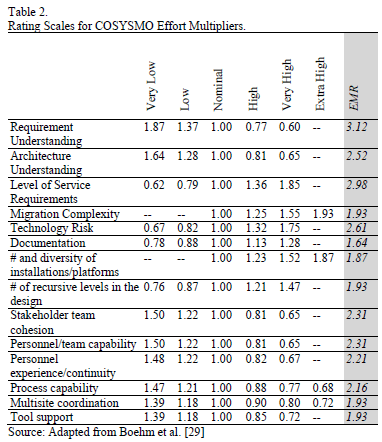
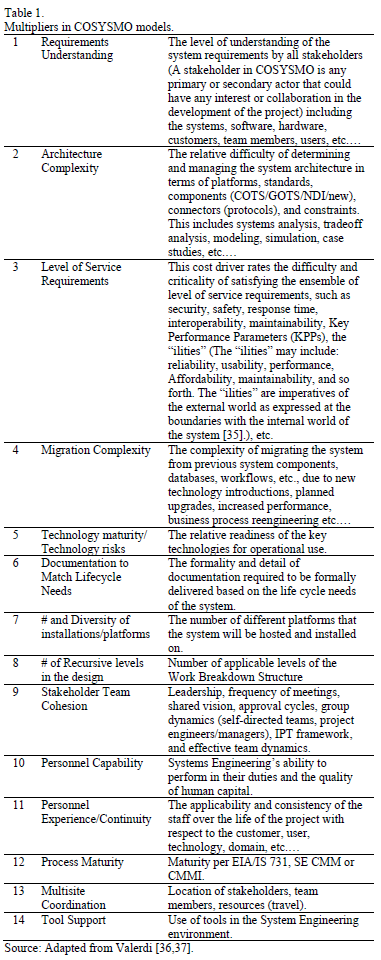
<body><![CDATA[<p><font size="2" face="Verdana, Arial, Helvetica, sans-serif">Where <i>Y</i> is the effort in person-months, <i>KLOC</i> is the software size measured in terms of thousands of lines of code, and <i>a</i> and <i>q</i> are constants determined by the environment and the complexity of   the application to be developed. Intermediate and detailed versions of COCOMO   incorporate an adjustment multiplicative factor that depends on a subjective   assessment of product, hardware, personnel and project attributes, which are   understood as cost drivers.</font></p>     <p><font size="2" face="Verdana, Arial, Helvetica, sans-serif">It is interesting to highlight that COCOMO establishes an   exponential relationship between software size and effort. Such an exponential   relationship allows for the modeling of economies and diseconomies of scale.   However, in COCOMO <i>q</i> is always bigger than 1, so it always hypothesizes   diseconomies of scale in the software development process.</font></p>     <p><font size="2" face="Verdana, Arial, Helvetica, sans-serif">The exponential   approach has later been used in other models such as COCOMO II &#91;30&#93; (and its multiple adaptations like the proposal of Patil et al. &#91;31&#93;)   and Constructive Systems Engineering Cost Model (COSYSMO) &#91;32&#93;.   The main difference between COCOMO, COCOMO II and COSYSMO is the way they   calculate the size of the project and the factors that we must consider to   calibrate the adjustment.</font></p>     <p><font size="2" face="Verdana, Arial, Helvetica, sans-serif">In this research we will consider COSYSMO to explain the   behavior that Web development projects would play when we apply an algorithmic   model to estimate the costs. This is because in COSYSMO the assessment of the   cost drivers resembles the current circumstances in software development in a   more accurate way. COSYSMO uses the following exponential function:</font></p>     <p><img src="/img/revistas/dyna/v82n192/v82n192a30eq02.gif"></p>     <p><font size="2" face="Verdana, Arial, Helvetica, sans-serif">Where <i>PM<sub>NS</sub></i> is the effort in   person-months, <i>A </i>is a calibration constant derived from historical   project data, <i>E</i> represents diseconomies of scale and <i>EM</i> is an   effort multiplier for each cost driver (the geometric product results in an   overall effort adjustment factor to the nominal effort).</font></p>     <p><font size="2" face="Verdana, Arial, Helvetica, sans-serif">The parameter <i>E</i> determines the behavior of the cost   in relation to the size of the project. Typical determining factors are   learning effect (the bigger the project is, the longer the time that developers   have to adapt to the technology, environment, etc.) and coordination costs.   Regarding this, we could expect an important weight of the learning effect. </font></p>     <p><font size="2" face="Verdana, Arial, Helvetica, sans-serif">Working with novice developers, immature and heterogeneous   technologies lead us to expect an important period of developer adaptation to   the project in which productivity would not be as high. This adaptation period   does not depend of the functional size of the project, so its pernicious   influence would be smaller the bigger the project is, and this would be   reflected with an economic effect in the estimation. Furthermore, the fact that   Web developments are usually driven by ad-hoc and agile methods with small   teams will probably have the opposite effect. Even their promoters state that   agile methods perfectly suit small projects with small teams &#91;33&#93;.   Part of their agility is based on the simplification of the coordination tasks,   something possible when we have small teams, but that can be risky when these   are bigger. For instance, Scrum suggests groups no bigger than nine people &#91;34&#93;,   while XP suggests that the smaller is the team, the better &#91;27&#93;.   Consequently, we could expect increasing coordination problems as long as the   project size grows. This may cause diseconomies of scale to be more relevant   for the case of Web projects.</font></p>     <p><font size="2" face="Verdana, Arial, Helvetica, sans-serif">In relation with the multipliers, <a href="#tab01">Table 1</a> summarizes the   factors considered in COSYSMO, and <a href="#tab02">Table 2</a> shows the rating scales to be   applied once the subjective assessment of the factors has been made. Some of   these factors have a direct relationship with the effort required, while for   others the relationship is inverse. The bigger the requirements and   architecture understanding, the stakeholder and team cohesion, team's   capability and experience, process capability, multisite coordination or tool   support are, the smaller the cost of the project will be. However, level of   service requirements, migration complexity, technology diversity and risks,   documentation and recursive levels in the design exert a direct influence in   the cost of the project. It will now be considered how the facts that were   previously discussed regarding Web projects can be determined. At first sight,   these features will probably lead to a higher cost of Web developments. The   volatility of requirements involves a low level of requirement understanding   (1), and will probably also determine the architecture understanding (2). The   high technological complexity and heterogeneity of Web projects is directly   represented in the diversity of installation and platforms factor (7),   increases the migration complexity factor (4) and the technology risk/maturity   (5). The latter is also determined by the experience of the developers. Novice   developers will not be able to anticipate technological problems (like for   example, integration) derived from the combination of different tools and   standards. This fact also has an influence on the team capability and   experience factors (9 and 10).</font></p>     <p align="center"><font size="2" face="Verdana, Arial, Helvetica, sans-serif"><a name="tab01"></a></font><img src="/img/revistas/dyna/v82n192/v82n192a30tab01.gif"></p>     ]]></body>
<body><![CDATA[<p align="center"><font size="2" face="Verdana, Arial, Helvetica, sans-serif"><a name="tab02"></a></font><img src="/img/revistas/dyna/v82n192/v82n192a30tab02.gif"></p>     <p><font size="2" face="Verdana, Arial, Helvetica, sans-serif">Furthermore, some features of Web development such as the   more frequent use of agile methods or the intensive component oriented   development level may mitigate the impact of some of the factors on the total   cost. For instance, the pernicious effect of a low understanding of the   requirements is not a problem in Scrum or XP, since both are designed for this   kind of scenarios. The way these methods organize the project encourage the team   to have straight communication between developers and stakeholders (factor 8),   as well as their physical organization (factor 12). For example, XP and Scrum   state that customers and developers should work together and meet continuously throughout   the project. Another determining use of agile methods is the simplicity of the   deliverables, reducing the documentation to the minimum (factor 6). Finally,   the generalized use of frameworks, third party components and specially the   deployment over application servers that provide an important part of the logic   already implemented suppose a high tool support (13) that should reduce the   cost of the project.</font></p>     <p><font size="2" face="Verdana, Arial, Helvetica, sans-serif">In summary, the specific features of Web developments have   both positive and negative effects on the cost estimation. However, given the   growing adoption of agile methods have in the industry &#91;38&#93;,   and the mitigation effect they have in the penalizing effects, we think that   there are reasons to suppose that the cost-reducing features of Web projects   outweigh the cost-increasing ones.</font></p>     <p> </p>     <p><font size="3" face="Verdana, Arial, Helvetica, sans-serif"><b>4. Hypotheses</b></font></p>     <p><font size="2" face="Verdana, Arial, Helvetica, sans-serif">According to what was discussed in Section 0,   we can formulate two different hypotheses. On one hand, the literature points   out that Web projects are mainly undertaken by small teams that do not require   advanced coordination mechanisms, which makes them vulnerable to any increment   in the size of the project. This leads us to formulate the following   hypothesis:</font></p>     <p><font size="2" face="Verdana, Arial, Helvetica, sans-serif">H1: The diseconomies of scale are significantly higher for   the case of Web developments.</font></p>     <p><font size="2" face="Verdana, Arial, Helvetica, sans-serif">Moreover, even when some of the specific features of Web   development would involve a negative effect in the cost, others features like   the adoption of agile development methods in these projects can have a   mitigation effect over the former. Thus, a second hypothesis can be formulated:</font></p>     <p><font size="2" face="Verdana, Arial, Helvetica, sans-serif">H2: The specific features of Web developments have an   influence on the aggregate effect of the cost drivers that cause the cost of   projects to be significantly lower.</font></p>     <p> </p>     ]]></body>
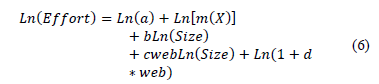
<body><![CDATA[<p><font size="3" face="Verdana, Arial, Helvetica, sans-serif"><b>5. Methodology</b></font></p>     <p><font size="2" face="Verdana, Arial, Helvetica, sans-serif">In this section we explain the empirical model we used to   test our hypothesis and we provide a description of the database we used.</font></p>     <p><font size="2" face="Verdana, Arial, Helvetica, sans-serif"><b><i>5.1. The model</i></b></font></p>     <p><font size="2" face="Verdana, Arial, Helvetica, sans-serif">As we have previously noted the COSYSMO model proposes an   exponential equation for the computation of the effort. This equation can be   summarized as:</font></p>     <p><img src="/img/revistas/dyna/v82n192/v82n192a30eq03.gif"></p>     <p><font size="2" face="Verdana, Arial, Helvetica, sans-serif">Where <i>b</i> represents the diseconomies of scale and <i>m(X)</i> is the aggregate effect of the multiplier factors which act as cost drivers. In   order to test H1 and H2, which state that for the case of Web applications both   the scale effects and the aggregate effect of the multipliers are significantly   different, we formulate a modified version of (3) which takes the following   form:</font></p>     <p><img src="/img/revistas/dyna/v82n192/v82n192a30eq04.gif"></p>     <p><font size="2" face="Verdana, Arial, Helvetica, sans-serif">Where<i> web</i> is a dummy that equals 1 for web projects   and 0 otherwise. If <i>c</i> and <i>d</i> are significantly different from zero   and, respectively, positive and negative then H1 and H2 hold. If these parameters are not significantly different from zero then the Web nature of a project   should have no influence on the cost estimation process.</font></p>     <p><font size="2" face="Verdana, Arial, Helvetica, sans-serif">Equation 4 can be transformed into a linear equation by considering it in   logarithmic form:</font></p>     <p><img src="/img/revistas/dyna/v82n192/v82n192a30eq05.gif"></p>     ]]></body>
<body><![CDATA[<p><font size="2" face="Verdana, Arial, Helvetica, sans-serif">Rearranging the terms in (5) we obtain:</font></p>     <p><img src="/img/revistas/dyna/v82n192/v82n192a30eq06.gif"></p>     <p><font size="2" face="Verdana, Arial, Helvetica, sans-serif">If <i>d</i>=0, then <i>Ln(1+d*web)</i>=0. Otherwise, the   value of <i>Ln(1+d*web)</i> depends on <i>web</i>, that is, on whether or not   the considered project is a Web application. In order to reach an expression   which can be estimated through linear regression we replace <i>Ln(1+d*web)</i> by <i>Kweb</i>, where <i>K</i> is a continuous variable to be estimated. If <i>K</i> is significantly different from zero then <i>d</i> is also significantly   different from zero, so <i>K</i> can be used to test H2.</font></p>     <p><font size="2" face="Verdana, Arial, Helvetica, sans-serif">As is detailed below, the database used for empirical   testing does not have information on the specific assessment of the individual   cost drivers for each project. So, we consider the effect of such cost drivers   on a fixed form. In other words, in our model they form a constant. Then, we   can add it to the prior constant in the model and define a new intercept term   in the equation which takes the form <i>Intercept</i> = <i>Ln(a)</i> <i>+</i> <i>Ln&#91;m(X)&#93;</i>.   So, the final equation to be estimated is:</font></p>     <p><img src="/img/revistas/dyna/v82n192/v82n192a30eq07.gif"></p>     <p><font size="2" face="Verdana, Arial, Helvetica, sans-serif">In equation 7 the parameters to be estimated are:   Intercept<i>, b, c, K</i>. As indicated above, <i>c</i> and <i>K</i> are the   parameters of interest for the H1 and H2 tests, respectively.</font></p>     <p><font size="2" face="Verdana, Arial, Helvetica, sans-serif"><b><i>5.2. The database</i></b></font></p>     <p><font size="2" face="Verdana, Arial, Helvetica, sans-serif">For the test of our model we used the ISBSG (International   Software Benchmarking Standards Group) Development &amp; Enhancement Repository,   dated June 2009. This is a huge database that comprises of 5052 projects from   twenty-four countries. The ISBSG Repository is a consolidated data set in the   field of software metrics (Further details can be found at   http://www.isbsg.org/). It has been used in many papers which deal with the   issue of effort estimation &#91;39-42&#93;.   It has also been used for the study of other topics related to software   metrics, such as software defect prediction, &#91;43&#93;   the determination of the optimum development team size &#91;44&#93;   and the determination of the priorities of the Capability Maturity Model   Integration (CMMI) process areas &#91;45&#93;.</font></p>     <p><font size="2" face="Verdana, Arial, Helvetica, sans-serif">It is noticeable that   the ISBSG Repository does not contain information on the values of the factors   used as cost drivers in COCOMO, COSYSMO and others. As we indicated above, in   our equation such factors are aggregated and included into the intercept term.   So, in our study we are limited to assess the impact of the Web nature of a   project on the global effect of all the multipliers. However, there are two   reasons that prevented us from considering databases containing the assessment   of cost drivers for each of the individual projects:</font></p>     <p><font size="2" face="Verdana, Arial, Helvetica, sans-serif">a) Such databases do not contain information on whether   the software projects are Web applications or not. In most cases they are old   databases containing projects which were developed in years prior to the   popularization of the Internet.</font></p>     ]]></body>
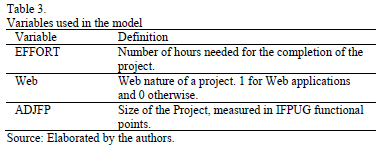
<body><![CDATA[<p><font size="2" face="Verdana, Arial, Helvetica, sans-serif">b) The size of most databases is too small and does not   allow an accurate estimation of the parameters of individual cost drivers. Is   interesting to remember that COSYSMO uses 14 cost drivers, and if we want to   capture the differential effect of the Web nature of the project we need 14   additional coefficients. Modeling the intercept term and the diseconomies of   scale requires another three parameters. So, 31 variables are needed for the   development of a detailed model. This, under the usual standards, requires a   sample size of 300 or more for an accurate estimation of the parameter (some   databases used for the development of effort estimation models can be found on   the PROMISE Software Engineering Repository), which is publicly available at &#91;46&#93;.   Examples of databases in this repository which have one or more of the   mentioned features that make them unsuitable for our study are COCOMO 81,   COCOMO NASA, COCOMO NASA 2 and Desharnais Software cost estimation dataset).</font></p>     <p><font size="2" face="Verdana, Arial, Helvetica, sans-serif">An additional advantage of the ISBSG Repository is that it   contains information on the quality of the data gathered on each project. A   rating code from A to D is assigned to each project depending on the quality of   the data. The submission is fundamentally sound only for the projects that are   A or B-rated. So, in order to ensure high reliability in our results we discard   projects with a C or D rating code. This procedure is in accordance with prior   studies that used the ISBSG Repository (see, e.g., Pendharkar et al.,&#91;47&#93;,   among others).</font></p>     <p><font size="2" face="Verdana, Arial, Helvetica, sans-serif">Another issue which may bias the research results is the   measurement of software size. The ISBSG repository provides information of the   functional sizing of each project, as other measures such as the lines of code   can be influenced by the language used and the programmer's characteristics.   However, there are different approaches for the measurement of the functional   size: that proposed by the International Function Point Users Group (IFPUG),   the functional sizing of the Common Software Measurement International   Consortium (COSMIC), that of the Netherlands Software Metrics Association   (NESMA) and the MK II method by the UK Software Metrics Association, among   others.</font></p>     <p><font size="2" face="Verdana, Arial, Helvetica, sans-serif">Many prior papers on   effort estimation pool all the projects in the same database no matter the   method used for effort estimation. This is a source of bias, since different   methods generate not equivalent estimations, even restricting the study to   those covered in the ISO/IEC 14143-1:2007 (IFPUG, COSMIC, NESMA and MKII). In   fact, particular attention over the past several years has been devoted to   finding a mathematical function for converting IFPUG functional size units to   the newer COSMIC ones &#91;48&#93;.   So, we decided to restrict the study to those projects for which IFPUG   functional sizing -the most popular one- was available.</font></p>     <p><font size="2" face="Verdana, Arial, Helvetica, sans-serif">Furthermore, the temporal scope considered for our study   was the period 1999-2009. The reason for this selection is to make the   comparison between Web and non-Web projects on a homogeneous basis, as Web   technologies are of recent development. Web developments previous to 1999 are   mainly implemented using now deprecated technologies like CGI or the older   versions of PHP. The roughness of these technologies strongly determined the   development projects. In the same way, considering non-Web projects from years   prior to the popularization of the Web could cause significant biases in our   research. After this last filter, the final sample consists of 588 projects. </font></p>     <p><font size="2" face="Verdana, Arial, Helvetica, sans-serif">With regard to the rest of the variables (apart from   software sizing) used to test our model, first we defined which projects are   considered as Web developments. We only considered as Web projects those that   were developed in a language using a virtual machine (Java, Java/similar, J2EE,   C#, .Net.). We discarded other kinds of projects such as web page design or   similar because they cannot be considered as Web application developments and   therefore, they are beyond the scope of this research. As indicated in the   prior subsection, the Web nature of the projects was represented through a dummy variable that equals 1 for Web applications and 0   otherwise.</font></p>     <p><font size="2" face="Verdana, Arial, Helvetica, sans-serif">With respect to the effort, it was measured through the   Summary Work Effort field of the ISBSG repository. This variable provides the   total effort in hours recorded against the project. <a href="#tab03">Table   3</a> provides a summary of the variables used in our model and their codification   hereafter.</font></p>     <p align="center"><font size="2" face="Verdana, Arial, Helvetica, sans-serif"><a name="tab03"></a></font><img src="/img/revistas/dyna/v82n192/v82n192a30tab03.gif"></p>     <p> </p>     <p><font size="3" face="Verdana, Arial, Helvetica, sans-serif"><b>6. Results</b></font></p>     ]]></body>
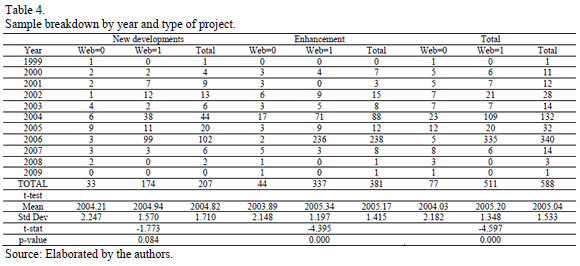
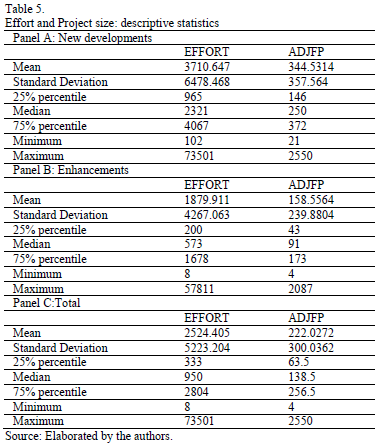
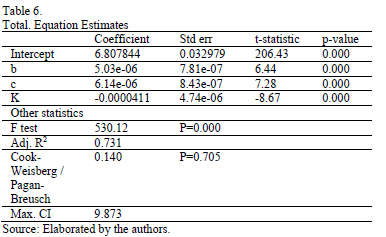
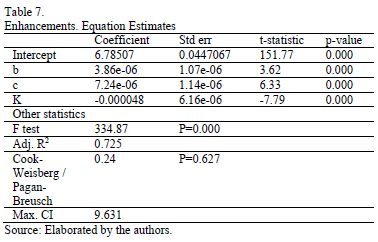
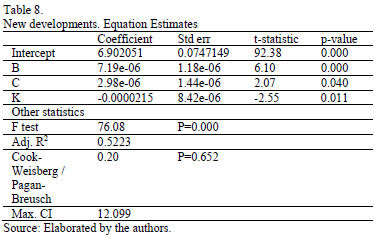
<body><![CDATA[<p><font size="2" face="Verdana, Arial, Helvetica, sans-serif">As the database and the   variables have been defined, we must indicate that we carried out three   separate analyses: one for the total sample, another one considering only   enhancement projects and another in which only projects which consisted of the   development of new software were included. The reason for this is that   enhancement projects can involve different circumstances for example lack of   documentation, refactoring requirements and legacy systems compatibility   restrictions, that could strongly determine the cost effort required by the   project beyond the web or non-web condition.</font></p>     <p><font size="2" face="Verdana, Arial, Helvetica, sans-serif"><a href="#tab04">Table 4</a> shows the sample breakdown by year and type of   project. We also included the results of a t-test of the difference of means,   for Web and non-Web projects, for the year of the completion of the project. </font></p>     <p align="center"><font size="2" face="Verdana, Arial, Helvetica, sans-serif"><a name="tab04"></a></font><img src="/img/revistas/dyna/v82n192/v82n192a30tab04.gif"></p>     <p><font size="2" face="Verdana, Arial, Helvetica, sans-serif">It is noticeable that the majority of the projects are Web   developments, both in the new developments and in the enhancement subsamples.   Most of the projects are from the 2004-2006 period. The results of the t-tests   evidence that for the case of new developments Web projects are not   significantly older than non-Web ones. For enhancements and for the total   sample non-Web projects are significantly older. This can be a source of bias   and poses a limitation on the research results. However, the majority of the   prior research papers have not paid attention to this issue.</font></p>     <p><font size="2" face="Verdana, Arial, Helvetica, sans-serif"><a href="#tab05">Table 5</a> contains   the main descriptive statistics for the effort and for software size   indicators. We emphasize that new development projects are bigger than   enhancements.</font></p>     <p align="center"><font size="2" face="Verdana, Arial, Helvetica, sans-serif"><a name="tab05"></a></font><img src="/img/revistas/dyna/v82n192/v82n192a30tab05.gif"></p>     <p><font size="2" face="Verdana, Arial, Helvetica, sans-serif">In this Section we show the results of the proposed model. <a href="#tab06">Table 6</a> provides the parameter estimation for all projects, while <a href="#tab07">Tables 7</a> and <a href="#tab08">8</a> show the results for enhancements   and new developments, respectively. In each of the tables we provide the   parameter estimates of the equation, the adjusted R2, the results of the F-test   and the Cook-Weisberg / Pagan-Breusch test for heteroskedasticity and the   maximum of the condition indices (Max. CI), which we used to test the   multicollinearity of the models.</font></p>     <p align="center"><font size="2" face="Verdana, Arial, Helvetica, sans-serif"><a name="tab06"></a></font><img src="/img/revistas/dyna/v82n192/v82n192a30tab06.gif"></p>     <p align="center"><font size="2" face="Verdana, Arial, Helvetica, sans-serif"><a name="tab07"></a></font><img src="/img/revistas/dyna/v82n192/v82n192a30tab07.gif"></p>     <p align="center"><font size="2" face="Verdana, Arial, Helvetica, sans-serif"><a name="tab08"></a></font><img src="/img/revistas/dyna/v82n192/v82n192a30tab08.gif"></p>     ]]></body>
<body><![CDATA[<p> </p>     <p><font size="3" face="Verdana, Arial, Helvetica, sans-serif"><b>7. Discussion</b></font></p>     <p><font size="2" face="Verdana, Arial, Helvetica, sans-serif">It is noticeable that none of the models show a   significant amount of heteroskedasticity or multicollinearity. According to the   Cook-Weisberg / Pagan-Breusch test, heteroskedasticity is rejected in all cases.   Condition indices are always below 15, which, according to Netter et al. &#91;49&#93;,   is a sensible threshold for multicollinearity.</font></p>     <p><font size="2" face="Verdana, Arial, Helvetica, sans-serif">With regard to the parameter estimation, it is evidenced   that consistently across all samples, c and K are, respectively, significantly   negative and positive. This suggests that both H1 and H2 hold. That is, for the   case of Web projects the diseconomies of scale are higher than for non-Web   ones. Also, the specific features of Web developments have an influence on the   aggregate effect of the cost drivers. This makes the cost of a Web project to   be significantly lower than that of a non-Web project with the same features   (cost drivers).</font></p>     <p><font size="2" face="Verdana, Arial, Helvetica, sans-serif">Then, we can assert that the development of effort   prediction models which are specifically designed for Web applications is   clearly justified. Another important issue which stems from our results is that   the features of a project have an influence on its cost patterns, both on the   intensity of the diseconomies of scale and on the influence of each one of the   cost drivers on the total cost of the project.</font></p>     <p><font size="2" face="Verdana, Arial, Helvetica, sans-serif">Our results suggest that cost estimation in software   engineering projects requires that projects are grouped with similar   characteristics. In the present research the evidence that diseconomies of   scale are greater in web projects is shown. Nevertheless, this result is   unobservable when the costs of all projects (without splitting) are considered   and therefore the project costs of Web developments may be underestimated. This   could be the reason for high cost overrun that Hu et al. indicate &#91;18&#93;.</font></p>     <p><font size="2" face="Verdana, Arial, Helvetica, sans-serif">We should note that in this paper the limitations of the   ISBSG Repository are present. These limitations are common to other papers as   Fern&aacute;ndez-Gonz&aacute;lez and Ladr&oacute;n de Guevara &#91;50&#93;   have shown: (i) in ISBSG the best projects have been selected and the dataset   is likely subject to biases, (ii) the ISBSG data is collected from various   worldwide organizations with dissimilar backgrounds, business cultures, levels   of personnel experience, and development maturity, (iii) a multi-company   dataset such as ISBSG also suffers from the presence of more outliers in   comparison to a single-company dataset.</font></p>     <p> </p>     <p><font size="3" face="Verdana, Arial, Helvetica, sans-serif"><b>8. Conclusions</b></font></p>     <p><font size="2" face="Verdana, Arial, Helvetica, sans-serif">In the present research we tested the hypothesis of   whether the cost behavior of Web developments is significantly different. We   focused on two aspects of effort cost </font></p>     ]]></body>
<body><![CDATA[<p> </p>     <p><font size="3" face="Verdana, Arial, Helvetica, sans-serif"><b>Acknowledgments</b></font></p>     <p><font size="2" face="Verdana, Arial, Helvetica, sans-serif">This work has been funded by the European Union, through   the European Regional Development Funds (ERDF); and the Principality of   Asturias, through its Science, Technology and Innovation Plan (grant   GRUPIN14-100).</font></p>     <p> </p>     <p><font size="3" face="Verdana, Arial, Helvetica, sans-serif"><b>References</b></font></p>     <!-- ref --><p><font size="2" face="Verdana, Arial, Helvetica, sans-serif"><b>&#91;1&#93;</b> Shepperd, M., Cost prediction and software project management. In: Ruhe, G, Wohlin, C,   eds. Softw. Proj. Manag. a Chang. World, Berlin, Heidelberg: Springer Berlin   Heidelberg; 2014, pp. 51-71. DOI: 10.1007/978-3-642-55035-5.    &nbsp;&nbsp;&nbsp;&nbsp;&nbsp;&nbsp;&nbsp;&nbsp;[&#160;<a href="javascript:void(0);" onclick="javascript: window.open('/scielo.php?script=sci_nlinks&ref=000118&pid=S0012-7353201500040003000001&lng=','','width=640,height=500,resizable=yes,scrollbars=1,menubar=yes,');">Links</a>&#160;]<!-- end-ref --></font></p>     <!-- ref --><p><font size="2" face="Verdana, Arial, Helvetica, sans-serif"><b>&#91;2&#93;</b> Morisio,   M., Stamelos, I., Spahos, V., Romano, D. and Torino, P., Measuring   functionality and productivity in web-based applications: a Case study. Proc. Sixth Int. Softw. Metrics Symp.   (Cat. No.PR00403), IEEE Comput. Soc; pp. 111-118. 1999. DOI: 10.1109/METRIC.1999.809732.    &nbsp;&nbsp;&nbsp;&nbsp;&nbsp;&nbsp;&nbsp;&nbsp;[&#160;<a href="javascript:void(0);" onclick="javascript: window.open('/scielo.php?script=sci_nlinks&ref=000120&pid=S0012-7353201500040003000002&lng=','','width=640,height=500,resizable=yes,scrollbars=1,menubar=yes,');">Links</a>&#160;]<!-- end-ref --></font></p>     <!-- ref --><p><font size="2" face="Verdana, Arial, Helvetica, sans-serif"><b>&#91;3&#93;</b> Fewster,   R., Mendes, E,. Measurement, prediction and risk analysis for Web applications.   Proc. Seventh Int. Softw. Metrics Symp,, IEEE Comput.   Soc; 2001, pp. 338-348. DOI: 10.1109/METRIC.2001.915541.    &nbsp;&nbsp;&nbsp;&nbsp;&nbsp;&nbsp;&nbsp;&nbsp;[&#160;<a href="javascript:void(0);" onclick="javascript: window.open('/scielo.php?script=sci_nlinks&ref=000122&pid=S0012-7353201500040003000003&lng=','','width=640,height=500,resizable=yes,scrollbars=1,menubar=yes,');">Links</a>&#160;]<!-- end-ref --></font></p>     <!-- ref --><p><font size="2" face="Verdana, Arial, Helvetica, sans-serif"><b>&#91;4&#93;</b> Mendes.,   E., Counsell, S. and Mosley, N., Measurement and effort prediction for Web   applications. In: Murugesan, S. and Deshpande, Y., eds. Web Eng., vol. 2016,   Berlin, Heidelberg: Springer, Berlin, Heidelberg, pp. 295-310, 2001. DOI: 10.1007/3-540-45144-7.    &nbsp;&nbsp;&nbsp;&nbsp;&nbsp;&nbsp;&nbsp;&nbsp;[&#160;<a href="javascript:void(0);" onclick="javascript: window.open('/scielo.php?script=sci_nlinks&ref=000124&pid=S0012-7353201500040003000004&lng=','','width=640,height=500,resizable=yes,scrollbars=1,menubar=yes,');">Links</a>&#160;]<!-- end-ref --></font></p>     <!-- ref --><p><font size="2" face="Verdana, Arial, Helvetica, sans-serif"><b>&#91;5&#93;</b> Mendes,   E., Mosley, N. and Counsell, S., Web metrics - estimating design and authoring   effort. IEEE Multimed, 8, pp. 50-57. 2001. DOI: 10.1109/93.923953.    &nbsp;&nbsp;&nbsp;&nbsp;&nbsp;&nbsp;&nbsp;&nbsp;[&#160;<a href="javascript:void(0);" onclick="javascript: window.open('/scielo.php?script=sci_nlinks&ref=000126&pid=S0012-7353201500040003000005&lng=','','width=640,height=500,resizable=yes,scrollbars=1,menubar=yes,');">Links</a>&#160;]<!-- end-ref --></font></p>     <!-- ref --><p><font size="2" face="Verdana, Arial, Helvetica, sans-serif"><b>&#91;6&#93;</b> Mendes,   E., Mosley, N. and Counsell, S., The application of case-based reasoning to   early Web project cost estimation. Proc 26<sup>th</sup> Annual Int Comput Softw   Appl. pp. 393-398, 2002. DOI: 10.1109/CMPSAC.2002.1045034.    &nbsp;&nbsp;&nbsp;&nbsp;&nbsp;&nbsp;&nbsp;&nbsp;[&#160;<a href="javascript:void(0);" onclick="javascript: window.open('/scielo.php?script=sci_nlinks&ref=000128&pid=S0012-7353201500040003000006&lng=','','width=640,height=500,resizable=yes,scrollbars=1,menubar=yes,');">Links</a>&#160;]<!-- end-ref --></font></p>     <!-- ref --><p><font size="2" face="Verdana, Arial, Helvetica, sans-serif"><b>&#91;7&#93;</b> Mendes,   E., Watson, I., Triggs, C., Mosley, N., Counsell, S., Street, S., et al., A   comparison of development effort estimation techniques for Web hypermedia   applications. Proc. Eighth IEEE Symp. Softw. Metrics, IEEE Comput. Soc; pp.   131-140, 2002. DOI: 10.1109/METRIC.2002.1011332.    &nbsp;&nbsp;&nbsp;&nbsp;&nbsp;&nbsp;&nbsp;&nbsp;[&#160;<a href="javascript:void(0);" onclick="javascript: window.open('/scielo.php?script=sci_nlinks&ref=000130&pid=S0012-7353201500040003000007&lng=','','width=640,height=500,resizable=yes,scrollbars=1,menubar=yes,');">Links</a>&#160;]<!-- end-ref --></font></p>     <!-- ref --><p><font size="2" face="Verdana, Arial, Helvetica, sans-serif"><b>&#91;8&#93;</b> Mendes,   E., Mosley, N. and Counsell, S., Do adaptation rules improve web cost   estimation?, Proc. fourteenth ACM Conf. Hypertext hypermedia - HYPERTEXT '03,   New York, New York, USA: ACM Press, 2003, 173 P., DOI: 10.1145/900051.900091.    &nbsp;&nbsp;&nbsp;&nbsp;&nbsp;&nbsp;&nbsp;&nbsp;[&#160;<a href="javascript:void(0);" onclick="javascript: window.open('/scielo.php?script=sci_nlinks&ref=000132&pid=S0012-7353201500040003000008&lng=','','width=640,height=500,resizable=yes,scrollbars=1,menubar=yes,');">Links</a>&#160;]<!-- end-ref --></font></p>     <!-- ref --><p><font size="2" face="Verdana, Arial, Helvetica, sans-serif"><b>&#91;9&#93;</b> Baresi,   L., Morasca, S. and Paolini, P., Estimating the design effort of Web   applications. Proceedings. 5<sup>th </sup>Int. Work. Enterp. Netw. Comput.   Healthc. Ind. (IEEE Cat. No.03EX717), IEEE Comput. Soc; pp. 62-72, 2003. DOI: 10.1109/METRIC.2003.1232456.    &nbsp;&nbsp;&nbsp;&nbsp;&nbsp;&nbsp;&nbsp;&nbsp;[&#160;<a href="javascript:void(0);" onclick="javascript: window.open('/scielo.php?script=sci_nlinks&ref=000134&pid=S0012-7353201500040003000009&lng=','','width=640,height=500,resizable=yes,scrollbars=1,menubar=yes,');">Links</a>&#160;]<!-- end-ref --></font></p>     <!-- ref --><p><font size="2" face="Verdana, Arial, Helvetica, sans-serif"><b>&#91;10&#93;</b> Ruhe, M.,   Jeffery, R. and Wieczorek, I., Cost estimation for Web applications. 25<sup>th</sup> Int. Conf. Softw. Eng. 2003. Proceedings, IEEE; 6, pp. 285-294, 2003. DOI: 10.1109/ICSE.2003.1201208.    &nbsp;&nbsp;&nbsp;&nbsp;&nbsp;&nbsp;&nbsp;&nbsp;[&#160;<a href="javascript:void(0);" onclick="javascript: window.open('/scielo.php?script=sci_nlinks&ref=000136&pid=S0012-7353201500040003000010&lng=','','width=640,height=500,resizable=yes,scrollbars=1,menubar=yes,');">Links</a>&#160;]<!-- end-ref --></font></p>     <!-- ref --><p><font size="2" face="Verdana, Arial, Helvetica, sans-serif"><b>&#91;11&#93;</b> Ruhe, M.,   Jeffery, R. and Wieczorek, I., Cost estimation for Web applications. 25<sup>th</sup> Int. Conf. Softw. Eng. 2003. Proceedings., IEEE, pp. 285-294, 2003. DOI: 10.1109/ICSE.2003.1201208.    &nbsp;&nbsp;&nbsp;&nbsp;&nbsp;&nbsp;&nbsp;&nbsp;[&#160;<a href="javascript:void(0);" onclick="javascript: window.open('/scielo.php?script=sci_nlinks&ref=000138&pid=S0012-7353201500040003000011&lng=','','width=640,height=500,resizable=yes,scrollbars=1,menubar=yes,');">Links</a>&#160;]<!-- end-ref --></font></p>     <!-- ref --><p><font size="2" face="Verdana, Arial, Helvetica, sans-serif"><b>&#91;12&#93;</b> Srivastava,   S.K., Prasad, P. and Varma, S.P. Evolving predictor variable estimation model   for Web engineering projects. In: Rajesh, R. and Ranjan, P., eds. Comput. Sci.   Eng., New Dehli: Narosa Publishing House, 2015, pp. 68-89.    &nbsp;&nbsp;&nbsp;&nbsp;&nbsp;&nbsp;&nbsp;&nbsp;[&#160;<a href="javascript:void(0);" onclick="javascript: window.open('/scielo.php?script=sci_nlinks&ref=000140&pid=S0012-7353201500040003000012&lng=','','width=640,height=500,resizable=yes,scrollbars=1,menubar=yes,');">Links</a>&#160;]<!-- end-ref --></font></p>     <!-- ref --><p><font size="2" face="Verdana, Arial, Helvetica, sans-serif"><b>&#91;13&#93;</b> Reifer, D.J.,   Web development: Estimating quick-to-market software. IEEE Softw, 17, pp. 57-64,   2000. DOI: 10.1109/52.895169.    &nbsp;&nbsp;&nbsp;&nbsp;&nbsp;&nbsp;&nbsp;&nbsp;[&#160;<a href="javascript:void(0);" onclick="javascript: window.open('/scielo.php?script=sci_nlinks&ref=000142&pid=S0012-7353201500040003000013&lng=','','width=640,height=500,resizable=yes,scrollbars=1,menubar=yes,');">Links</a>&#160;]<!-- end-ref --></font></p>     <!-- ref --><p><font size="2" face="Verdana, Arial, Helvetica, sans-serif"><b>&#91;14&#93;</b> Ruhe, M.,   Jeffery, R. and Wieczorek, I., Using Web objects for estimating software   development effort for Web applications. Proceedings 5<sup>th</sup> Int Work   Enterp Netw Comput Healthc Ind (IEEE Cat No03EX717), pp. 30-7, 2003, DOI: 10.1109/METRIC.2003.1232453.    &nbsp;&nbsp;&nbsp;&nbsp;&nbsp;&nbsp;&nbsp;&nbsp;[&#160;<a href="javascript:void(0);" onclick="javascript: window.open('/scielo.php?script=sci_nlinks&ref=000144&pid=S0012-7353201500040003000014&lng=','','width=640,height=500,resizable=yes,scrollbars=1,menubar=yes,');">Links</a>&#160;]<!-- end-ref --></font></p>     <!-- ref --><p><font size="2" face="Verdana, Arial, Helvetica, sans-serif"><b>&#91;15&#93;</b> Mendes, E.   and Mosley, N., Bayesian network models for Web Effort prediction: A   comparative study. IEEE Trans Softw Eng., 34, pp.723-737, 2008. DOI: 10.1109/TSE.2008.64.    &nbsp;&nbsp;&nbsp;&nbsp;&nbsp;&nbsp;&nbsp;&nbsp;[&#160;<a href="javascript:void(0);" onclick="javascript: window.open('/scielo.php?script=sci_nlinks&ref=000146&pid=S0012-7353201500040003000015&lng=','','width=640,height=500,resizable=yes,scrollbars=1,menubar=yes,');">Links</a>&#160;]<!-- end-ref --></font></p>     <!-- ref --><p><font size="2" face="Verdana, Arial, Helvetica, sans-serif"><b>&#91;16&#93;</b> Mendes, E.,   A comparative study of cost estimation models for Web hypermedia applications.   Empir Softw Eng., 8, pp.163-196. 2003. DOI: 10.1023/A:1023062629183.    &nbsp;&nbsp;&nbsp;&nbsp;&nbsp;&nbsp;&nbsp;&nbsp;[&#160;<a href="javascript:void(0);" onclick="javascript: window.open('/scielo.php?script=sci_nlinks&ref=000148&pid=S0012-7353201500040003000016&lng=','','width=640,height=500,resizable=yes,scrollbars=1,menubar=yes,');">Links</a>&#160;]<!-- end-ref --></font></p>     <!-- ref --><p><font size="2" face="Verdana, Arial, Helvetica, sans-serif"><b>&#91;17&#93;</b> Lagerström,   R., von Würtemberg, L.M., Holm, H. and Luczak, O., Identifying factors   affecting software development cost and productivity. Softw Qual Journal, 20,   pp. 395-417, 2011. DOI: 10.1007/s11219-011-9137-8.    &nbsp;&nbsp;&nbsp;&nbsp;&nbsp;&nbsp;&nbsp;&nbsp;[&#160;<a href="javascript:void(0);" onclick="javascript: window.open('/scielo.php?script=sci_nlinks&ref=000150&pid=S0012-7353201500040003000017&lng=','','width=640,height=500,resizable=yes,scrollbars=1,menubar=yes,');">Links</a>&#160;]<!-- end-ref --></font></p>     <!-- ref --><p><font size="2" face="Verdana, Arial, Helvetica, sans-serif"><b>&#91;18&#93;</b> Hu, Q.,   Plant, R.T. and Hertz, D.B., Software cost estimation using economic production   models. J. Manag Inf Syst., 15, pp. 143-163, 1998.    &nbsp;&nbsp;&nbsp;&nbsp;&nbsp;&nbsp;&nbsp;&nbsp;[&#160;<a href="javascript:void(0);" onclick="javascript: window.open('/scielo.php?script=sci_nlinks&ref=000152&pid=S0012-7353201500040003000018&lng=','','width=640,height=500,resizable=yes,scrollbars=1,menubar=yes,');">Links</a>&#160;]<!-- end-ref --></font></p>     <!-- ref --><p><font size="2" face="Verdana, Arial, Helvetica, sans-serif"><b>&#91;19&#93;</b> Sankhwar,   S. and Pandey, D., Software project risk analysis and assessment: A survey.   Global Journal of Multidisciplinary Studies, 3 (5), pp. 144-160, 2014.    &nbsp;&nbsp;&nbsp;&nbsp;&nbsp;&nbsp;&nbsp;&nbsp;[&#160;<a href="javascript:void(0);" onclick="javascript: window.open('/scielo.php?script=sci_nlinks&ref=000154&pid=S0012-7353201500040003000019&lng=','','width=640,height=500,resizable=yes,scrollbars=1,menubar=yes,');">Links</a>&#160;]<!-- end-ref --></font></p>     <!-- ref --><p><font size="2" face="Verdana, Arial, Helvetica, sans-serif"><b>&#91;20&#93;</b> Mendes, E.,   Mosley, N. and Counsell, S., Early Web size measures and effort prediction for   Web costimation. Proceedings 5<sup>th</sup> Int Work Enterp Netw Comput Healthc   Ind (IEEE Cat No03EX717), 2003, pp. 18-39. DOI: 10.1109/METRIC.2003.1232452.    &nbsp;&nbsp;&nbsp;&nbsp;&nbsp;&nbsp;&nbsp;&nbsp;[&#160;<a href="javascript:void(0);" onclick="javascript: window.open('/scielo.php?script=sci_nlinks&ref=000156&pid=S0012-7353201500040003000020&lng=','','width=640,height=500,resizable=yes,scrollbars=1,menubar=yes,');">Links</a>&#160;]<!-- end-ref --></font></p>     <!-- ref --><p><font size="2" face="Verdana, Arial, Helvetica, sans-serif"><b>&#91;21&#93;</b> Mendes, E.   and Mosley, N., Further investigation into the use of CBR and stepwise   regression to predict development effort for Web hypermedia applications. Proc.   Int. Symp. Empir. Softw. Eng., 2002, pp. 79-90. DOI: 10.1109/ISESE.2002.1166928.    &nbsp;&nbsp;&nbsp;&nbsp;&nbsp;&nbsp;&nbsp;&nbsp;[&#160;<a href="javascript:void(0);" onclick="javascript: window.open('/scielo.php?script=sci_nlinks&ref=000158&pid=S0012-7353201500040003000021&lng=','','width=640,height=500,resizable=yes,scrollbars=1,menubar=yes,');">Links</a>&#160;]<!-- end-ref --></font></p>     <!-- ref --><p><font size="2" face="Verdana, Arial, Helvetica, sans-serif"><b>&#91;22&#93;</b> Pressman,   R.S., What a tangled Web we weave &#91;Web engineering&#93;. IEEE Software., 17 (1),   pp.18-21, 2000. DOI: 10.1109/52.819962.    &nbsp;&nbsp;&nbsp;&nbsp;&nbsp;&nbsp;&nbsp;&nbsp;[&#160;<a href="javascript:void(0);" onclick="javascript: window.open('/scielo.php?script=sci_nlinks&ref=000160&pid=S0012-7353201500040003000022&lng=','','width=640,height=500,resizable=yes,scrollbars=1,menubar=yes,');">Links</a>&#160;]<!-- end-ref --></font></p>     <!-- ref --><p><font size="2" face="Verdana, Arial, Helvetica, sans-serif"><b>&#91;23&#93;</b> Reifer, D.,   Ten deadly risks in Internet and intranet software development. IEEE Software,   19 (2), pp. 12-14. 2002. DOI: 10.1109/52.991324.    &nbsp;&nbsp;&nbsp;&nbsp;&nbsp;&nbsp;&nbsp;&nbsp;[&#160;<a href="javascript:void(0);" onclick="javascript: window.open('/scielo.php?script=sci_nlinks&ref=000162&pid=S0012-7353201500040003000023&lng=','','width=640,height=500,resizable=yes,scrollbars=1,menubar=yes,');">Links</a>&#160;]<!-- end-ref --></font></p>     <!-- ref --><p><font size="2" face="Verdana, Arial, Helvetica, sans-serif"><b>&#91;24&#93;</b> Ochoa, S.F.S.F.,   Bastarrica, M.C.C., Parra, G., Estimating the development effort of Web   projects in Chile, in: Web Congress, 2003. Proceedings. First Latin American, pp.   114-122, 2003. DOI: 10.1109/LAWEB.2003.1250289.    &nbsp;&nbsp;&nbsp;&nbsp;&nbsp;&nbsp;&nbsp;&nbsp;[&#160;<a href="javascript:void(0);" onclick="javascript: window.open('/scielo.php?script=sci_nlinks&ref=000164&pid=S0012-7353201500040003000024&lng=','','width=640,height=500,resizable=yes,scrollbars=1,menubar=yes,');">Links</a>&#160;]<!-- end-ref --></font></p>     <!-- ref --><p><font size="2" face="Verdana, Arial, Helvetica, sans-serif"><b>&#91;25&#93;</b> Ambler, S.W.,   Lessons in agility from Internet-based development. IEEE Software, 19 (2) , pp.   66-73, 2002. DOI: 10.1109/52.991334.    &nbsp;&nbsp;&nbsp;&nbsp;&nbsp;&nbsp;&nbsp;&nbsp;[&#160;<a href="javascript:void(0);" onclick="javascript: window.open('/scielo.php?script=sci_nlinks&ref=000166&pid=S0012-7353201500040003000025&lng=','','width=640,height=500,resizable=yes,scrollbars=1,menubar=yes,');">Links</a>&#160;]<!-- end-ref --></font></p>     <!-- ref --><p><font size="2" face="Verdana, Arial, Helvetica, sans-serif"><b>&#91;26&#93;</b> Pardo, C.,   Hurtado, J.A. and Collazos, C.A., Agil software process improvement with agile   spi - process, DYNA, 77 (164), pp. 251-263, 2010.    &nbsp;&nbsp;&nbsp;&nbsp;&nbsp;&nbsp;&nbsp;&nbsp;[&#160;<a href="javascript:void(0);" onclick="javascript: window.open('/scielo.php?script=sci_nlinks&ref=000168&pid=S0012-7353201500040003000026&lng=','','width=640,height=500,resizable=yes,scrollbars=1,menubar=yes,');">Links</a>&#160;]<!-- end-ref --></font></p>     <!-- ref --><p><font size="2" face="Verdana, Arial, Helvetica, sans-serif"><b>&#91;27&#93;</b> Beck, K.,   Extreme programming explained: Embrace change. addison-wesley professional,   2000.    &nbsp;&nbsp;&nbsp;&nbsp;&nbsp;&nbsp;&nbsp;&nbsp;[&#160;<a href="javascript:void(0);" onclick="javascript: window.open('/scielo.php?script=sci_nlinks&ref=000170&pid=S0012-7353201500040003000027&lng=','','width=640,height=500,resizable=yes,scrollbars=1,menubar=yes,');">Links</a>&#160;]<!-- end-ref --></font></p>     <!-- ref --><p><font size="2" face="Verdana, Arial, Helvetica, sans-serif"><b>&#91;28&#93;</b> (Dick)-Fairley,   R.E. The influence of COCOMO on software engineering education and training. Journal   of Systems and Software, 80 (7), pp. 1201-1208. 2007. DOI: 10.1016/j.jss.2006.09.044.    &nbsp;&nbsp;&nbsp;&nbsp;&nbsp;&nbsp;&nbsp;&nbsp;[&#160;<a href="javascript:void(0);" onclick="javascript: window.open('/scielo.php?script=sci_nlinks&ref=000172&pid=S0012-7353201500040003000028&lng=','','width=640,height=500,resizable=yes,scrollbars=1,menubar=yes,');">Links</a>&#160;]<!-- end-ref --></font></p>     <!-- ref --><p><font size="2" face="Verdana, Arial, Helvetica, sans-serif"><b>&#91;29&#93;</b> Boehm, B.W.,   Software engineering economics. 1<sup>st</sup> ed. Prentice Hall; 1981.    &nbsp;&nbsp;&nbsp;&nbsp;&nbsp;&nbsp;&nbsp;&nbsp;[&#160;<a href="javascript:void(0);" onclick="javascript: window.open('/scielo.php?script=sci_nlinks&ref=000174&pid=S0012-7353201500040003000029&lng=','','width=640,height=500,resizable=yes,scrollbars=1,menubar=yes,');">Links</a>&#160;]<!-- end-ref --></font></p>     <!-- ref --><p><font size="2" face="Verdana, Arial, Helvetica, sans-serif"><b>&#91;30&#93;</b> Boehm, B.,   Clark, B., Horowitz, E., Westland, C., Madachy, R. and Selby, R., Cost models   for future software life cycle processes: COCOMO 2.0. Ann Softw Eng., 1, pp. 57-94,   1995. DOI: 10.1007/BF02249046.    &nbsp;&nbsp;&nbsp;&nbsp;&nbsp;&nbsp;&nbsp;&nbsp;[&#160;<a href="javascript:void(0);" onclick="javascript: window.open('/scielo.php?script=sci_nlinks&ref=000176&pid=S0012-7353201500040003000030&lng=','','width=640,height=500,resizable=yes,scrollbars=1,menubar=yes,');">Links</a>&#160;]<!-- end-ref --></font></p>     <!-- ref --><p><font size="2" face="Verdana, Arial, Helvetica, sans-serif"><b>&#91;31&#93;</b> Patil, L.V.,   Waghmode, R.M., Joshi, S.D. and Khanna, V., Generic model of software cost   estimation: A hybrid approach. 2014 IEEE Int. Adv. Comput. Conf., IEEE, pp.   1379-1384, 2014. DOI: 10.1109/IAdCC.2014.6779528.    &nbsp;&nbsp;&nbsp;&nbsp;&nbsp;&nbsp;&nbsp;&nbsp;[&#160;<a href="javascript:void(0);" onclick="javascript: window.open('/scielo.php?script=sci_nlinks&ref=000178&pid=S0012-7353201500040003000031&lng=','','width=640,height=500,resizable=yes,scrollbars=1,menubar=yes,');">Links</a>&#160;]<!-- end-ref --></font></p>     <!-- ref --><p><font size="2" face="Verdana, Arial, Helvetica, sans-serif"><b>&#91;32&#93;</b> Patil, P.K.,   A review on calibration factors in empirical software cost estimation (SCE)   models. Int. J. Softw. Eng. Res. Pract., 3, pp. 1-7, 2014.    &nbsp;&nbsp;&nbsp;&nbsp;&nbsp;&nbsp;&nbsp;&nbsp;[&#160;<a href="javascript:void(0);" onclick="javascript: window.open('/scielo.php?script=sci_nlinks&ref=000180&pid=S0012-7353201500040003000032&lng=','','width=640,height=500,resizable=yes,scrollbars=1,menubar=yes,');">Links</a>&#160;]<!-- end-ref --></font></p>     <!-- ref --><p><font size="2" face="Verdana, Arial, Helvetica, sans-serif"><b>&#91;33&#93;</b> Paulk, N.C.,   Extreme programming from a CMM perspective. IEEE Softw., 18 (6), pp. 19-26,   2001. DOI: 10.1109/52.965798.    &nbsp;&nbsp;&nbsp;&nbsp;&nbsp;&nbsp;&nbsp;&nbsp;[&#160;<a href="javascript:void(0);" onclick="javascript: window.open('/scielo.php?script=sci_nlinks&ref=000182&pid=S0012-7353201500040003000033&lng=','','width=640,height=500,resizable=yes,scrollbars=1,menubar=yes,');">Links</a>&#160;]<!-- end-ref --></font></p>     <!-- ref --><p><font size="2" face="Verdana, Arial, Helvetica, sans-serif"><b>&#91;34&#93;</b> Schwaber,   K. and Beedle, M., Agile software development with scrum. Prentice Hall, 2002.    &nbsp;&nbsp;&nbsp;&nbsp;&nbsp;&nbsp;&nbsp;&nbsp;[&#160;<a href="javascript:void(0);" onclick="javascript: window.open('/scielo.php?script=sci_nlinks&ref=000184&pid=S0012-7353201500040003000034&lng=','','width=640,height=500,resizable=yes,scrollbars=1,menubar=yes,');">Links</a>&#160;]<!-- end-ref --></font></p>     <!-- ref --><p><font size="2" face="Verdana, Arial, Helvetica, sans-serif"><b>&#91;35&#93;</b> Rechtin,   E., Systems architecting: Creating and building complex systems, Prentice Hall,   1991.    &nbsp;&nbsp;&nbsp;&nbsp;&nbsp;&nbsp;&nbsp;&nbsp;[&#160;<a href="javascript:void(0);" onclick="javascript: window.open('/scielo.php?script=sci_nlinks&ref=000186&pid=S0012-7353201500040003000035&lng=','','width=640,height=500,resizable=yes,scrollbars=1,menubar=yes,');">Links</a>&#160;]<!-- end-ref --></font></p>     <!-- ref --><p><font size="2" face="Verdana, Arial, Helvetica, sans-serif"><b>&#91;36&#93;</b> Valerdi,   R., The constructive systems engineering cost model (Cosysmo): Quantifying the   costs of systems engineering effort in complex systems, VDM Publishing, 2008.    &nbsp;&nbsp;&nbsp;&nbsp;&nbsp;&nbsp;&nbsp;&nbsp;[&#160;<a href="javascript:void(0);" onclick="javascript: window.open('/scielo.php?script=sci_nlinks&ref=000188&pid=S0012-7353201500040003000036&lng=','','width=640,height=500,resizable=yes,scrollbars=1,menubar=yes,');">Links</a>&#160;]<!-- end-ref --></font></p>     <!-- ref --><p><font size="2" face="Verdana, Arial, Helvetica, sans-serif"><b>&#91;37&#93;</b> Valerdi,   R., Heuristics for systems engineering cost estimation. IEEE Syst. J., 5, pp. 91-98,   2011. DOI: 10.1109/JSYST.2010.2065131.    &nbsp;&nbsp;&nbsp;&nbsp;&nbsp;&nbsp;&nbsp;&nbsp;[&#160;<a href="javascript:void(0);" onclick="javascript: window.open('/scielo.php?script=sci_nlinks&ref=000190&pid=S0012-7353201500040003000037&lng=','','width=640,height=500,resizable=yes,scrollbars=1,menubar=yes,');">Links</a>&#160;]<!-- end-ref --></font></p>     <!-- ref --><p><font size="2" face="Verdana, Arial, Helvetica, sans-serif"><b>&#91;38&#93;</b> Coram, M.   and Bohner, S., The impact of agile methods on software project management. 12<sup>th</sup> IEEE Int. Conf. Work. Eng. Comput. Syst., IEEE; pp. 363-370, 2005. DOI: 10.1109/ECBS.2005.68.    &nbsp;&nbsp;&nbsp;&nbsp;&nbsp;&nbsp;&nbsp;&nbsp;[&#160;<a href="javascript:void(0);" onclick="javascript: window.open('/scielo.php?script=sci_nlinks&ref=000192&pid=S0012-7353201500040003000038&lng=','','width=640,height=500,resizable=yes,scrollbars=1,menubar=yes,');">Links</a>&#160;]<!-- end-ref --></font></p>     <!-- ref --><p><font size="2" face="Verdana, Arial, Helvetica, sans-serif"><b>&#91;39&#93;</b> Cuadrado,   J., Sicilia, M., Garre, M. and Rodriguez, D., An empirical study of   process-related attributes in segmented software cost-estimation relationships.   Journal of Systems and Software, 73 (3), pp. 353- 361, 2006.   DOI: 10.1016/j.jss.2005.04.040.    &nbsp;&nbsp;&nbsp;&nbsp;&nbsp;&nbsp;&nbsp;&nbsp;[&#160;<a href="javascript:void(0);" onclick="javascript: window.open('/scielo.php?script=sci_nlinks&ref=000194&pid=S0012-7353201500040003000039&lng=','','width=640,height=500,resizable=yes,scrollbars=1,menubar=yes,');">Links</a>&#160;]<!-- end-ref --></font></p>     <!-- ref --><p><font size="2" face="Verdana, Arial, Helvetica, sans-serif"><b>&#91;40&#93;</b> Aroba, J.,   Cuadrado-Gallego, J.J., Sicilia, M.-&Aacute;., Ramos, I. and Garc&iacute;a-Barriocanal, E.,   Segmented software cost estimation models based on fuzzy clustering. J, Syst,   Softw., 81, pp. 1944-1950, 2008. DOI: 10.1016/j.jss.2008.01.016.    &nbsp;&nbsp;&nbsp;&nbsp;&nbsp;&nbsp;&nbsp;&nbsp;[&#160;<a href="javascript:void(0);" onclick="javascript: window.open('/scielo.php?script=sci_nlinks&ref=000196&pid=S0012-7353201500040003000040&lng=','','width=640,height=500,resizable=yes,scrollbars=1,menubar=yes,');">Links</a>&#160;]<!-- end-ref --></font></p>     <!-- ref --><p><font size="2" face="Verdana, Arial, Helvetica, sans-serif"><b>&#91;41&#93;</b> Song, Q.   and Shepperd, M., A new imputation method for small software project data sets.   J. Syst. Softw., 80, pp. 51-62, 2007. DOI: 10.1016/j.jss.2006.05.003.    &nbsp;&nbsp;&nbsp;&nbsp;&nbsp;&nbsp;&nbsp;&nbsp;[&#160;<a href="javascript:void(0);" onclick="javascript: window.open('/scielo.php?script=sci_nlinks&ref=000198&pid=S0012-7353201500040003000041&lng=','','width=640,height=500,resizable=yes,scrollbars=1,menubar=yes,');">Links</a>&#160;]<!-- end-ref --></font></p>     <!-- ref --><p><font size="2" face="Verdana, Arial, Helvetica, sans-serif"><b>&#91;42&#93;</b> Rodr&iacute;guez,   D., Sicilia, M.A., Garc&iacute;a, E. and Harrison, R., Empirical findings on team size   and productivity in software development. J. Syst. Softw., 85, pp. 562-570, 2012.   DOI: 10.1016/j.jss.2011.09.009.    &nbsp;&nbsp;&nbsp;&nbsp;&nbsp;&nbsp;&nbsp;&nbsp;[&#160;<a href="javascript:void(0);" onclick="javascript: window.open('/scielo.php?script=sci_nlinks&ref=000200&pid=S0012-7353201500040003000042&lng=','','width=640,height=500,resizable=yes,scrollbars=1,menubar=yes,');">Links</a>&#160;]<!-- end-ref --></font></p>     <!-- ref --><p><font size="2" face="Verdana, Arial, Helvetica, sans-serif"><b>&#91;43&#93;</b> Bibi, S.,   Tsoumakas, G., Stamelos, I. and Vlahavas, I., Regression via classification   applied on software defect estimation. Expert. Syst. Appl., 34, pp. 2091-2101, 2008.   DOI: 10.1016/j.eswa.2007.02.012.    &nbsp;&nbsp;&nbsp;&nbsp;&nbsp;&nbsp;&nbsp;&nbsp;[&#160;<a href="javascript:void(0);" onclick="javascript: window.open('/scielo.php?script=sci_nlinks&ref=000202&pid=S0012-7353201500040003000043&lng=','','width=640,height=500,resizable=yes,scrollbars=1,menubar=yes,');">Links</a>&#160;]<!-- end-ref --></font></p>     <!-- ref --><p><font size="2" face="Verdana, Arial, Helvetica, sans-serif"><b>&#91;44&#93;</b> Heri&#269;ko,   M., Živkovi&#269;, A. and Rozman, I., An approach to optimizing software   development team size. Inf. Process Lett., 108, pp. 101106, 2008. DOI: 10.1016/j.ipl.2008.04.014.    &nbsp;&nbsp;&nbsp;&nbsp;&nbsp;&nbsp;&nbsp;&nbsp;[&#160;<a href="javascript:void(0);" onclick="javascript: window.open('/scielo.php?script=sci_nlinks&ref=000204&pid=S0012-7353201500040003000044&lng=','','width=640,height=500,resizable=yes,scrollbars=1,menubar=yes,');">Links</a>&#160;]<!-- end-ref --></font></p>     <!-- ref --><p><font size="2" face="Verdana, Arial, Helvetica, sans-serif"><b>&#91;45&#93;</b> Huang, S.-J.   and Han, W.-M., Selection priority of process areas based on CMMI continuous   representation. Inf. Manag., 43, pp. 297-307. 2006. DOI: 10.1016/j.im.2005.08.003.    &nbsp;&nbsp;&nbsp;&nbsp;&nbsp;&nbsp;&nbsp;&nbsp;[&#160;<a href="javascript:void(0);" onclick="javascript: window.open('/scielo.php?script=sci_nlinks&ref=000206&pid=S0012-7353201500040003000045&lng=','','width=640,height=500,resizable=yes,scrollbars=1,menubar=yes,');">Links</a>&#160;]<!-- end-ref --></font></p>     <!-- ref --><p><font size="2" face="Verdana, Arial, Helvetica, sans-serif"><b>&#91;46&#93;</b> Sayyad-Shirabad,   J. and Menzies, T.J., The PROMISE Repository of software engineering databases.   Thesis, School of Information Technology and Engineering. Univ Ottawa, Canada,   2005. Available at: <a href="http://promise.site.uottawa.ca/SERepository" target="_blank">http://promise.site.uottawa.ca/SERepository</a>.    &nbsp;&nbsp;&nbsp;&nbsp;&nbsp;&nbsp;&nbsp;&nbsp;[&#160;<a href="javascript:void(0);" onclick="javascript: window.open('/scielo.php?script=sci_nlinks&ref=000208&pid=S0012-7353201500040003000046&lng=','','width=640,height=500,resizable=yes,scrollbars=1,menubar=yes,');">Links</a>&#160;]<!-- end-ref --></font></p>     <!-- ref --><p><font size="2" face="Verdana, Arial, Helvetica, sans-serif"><b>&#91;47&#93;</b> Pendharkar,   P.C. and Rodger, J.A,, Subramanian GH. An empirical study of the Cobb-Douglas   production function properties of software development effort. Inf. Softw.   Technol., 50, pp. 1181-1188, 2008. DOI: 10.1016/j.infsof.2007.10.019.    &nbsp;&nbsp;&nbsp;&nbsp;&nbsp;&nbsp;&nbsp;&nbsp;[&#160;<a href="javascript:void(0);" onclick="javascript: window.open('/scielo.php?script=sci_nlinks&ref=000210&pid=S0012-7353201500040003000047&lng=','','width=640,height=500,resizable=yes,scrollbars=1,menubar=yes,');">Links</a>&#160;]<!-- end-ref --></font></p>     <!-- ref --><p><font size="2" face="Verdana, Arial, Helvetica, sans-serif"><b>&#91;48&#93;</b> Vogelezang,   F. and Lesterhuis A., Applicability of COSMIC full function points in an   administrative environment: Experiences of an early adopter. Proc. 13<sup>th</sup> Int. Work. Softw. Meas. - IWSM, Verlag, pp. 23-25, 2003.    &nbsp;&nbsp;&nbsp;&nbsp;&nbsp;&nbsp;&nbsp;&nbsp;[&#160;<a href="javascript:void(0);" onclick="javascript: window.open('/scielo.php?script=sci_nlinks&ref=000212&pid=S0012-7353201500040003000048&lng=','','width=640,height=500,resizable=yes,scrollbars=1,menubar=yes,');">Links</a>&#160;]<!-- end-ref --></font></p>     <!-- ref --><p><font size="2" face="Verdana, Arial, Helvetica, sans-serif"><b>&#91;49&#93;</b> Kutner, M.,   Nachtsheim, C., Neter, J. and Li, W., Applied linear statistical models, Vol.   1., 5<sup>th</sup> ed.. McGraw-Hill/Irwin, 2004.    &nbsp;&nbsp;&nbsp;&nbsp;&nbsp;&nbsp;&nbsp;&nbsp;[&#160;<a href="javascript:void(0);" onclick="javascript: window.open('/scielo.php?script=sci_nlinks&ref=000214&pid=S0012-7353201500040003000049&lng=','','width=640,height=500,resizable=yes,scrollbars=1,menubar=yes,');">Links</a>&#160;]<!-- end-ref --></font></p>     <!-- ref --><p><font size="2" face="Verdana, Arial, Helvetica, sans-serif"><b>&#91;50&#93;</b> Fern&aacute;ndez-Diego,   M. and Gonz&aacute;lez-Ladr&oacute;n-de-Guevara, F., Potential and limitations of the ISBSG   dataset in enhancing software engineering research: A mapping review. Inf.   Softw. Technol., 56, pp. 527-544, 2014. DOI: 10.1016/j.infsof.2014.01.003.    &nbsp;&nbsp;&nbsp;&nbsp;&nbsp;&nbsp;&nbsp;&nbsp;[&#160;<a href="javascript:void(0);" onclick="javascript: window.open('/scielo.php?script=sci_nlinks&ref=000216&pid=S0012-7353201500040003000050&lng=','','width=640,height=500,resizable=yes,scrollbars=1,menubar=yes,');">Links</a>&#160;]<!-- end-ref --> </font></p>     <p> </p>     <p><font size="2" face="Verdana, Arial, Helvetica, sans-serif"><b>J. de Andr&eacute;s</b>, received his BBA in 1993 and his   PhD in 1998, both of them from the Universidad de Oviedo, Spain. He is an   associate professor of Accounting and Finance at the University of Oviedo, Spain.   His research interests include artificial intelligence applied to business   organizations and technology management. Dr. De Andr&eacute;s has published over 60   articles in journals and refereed proceedings. He is Vice Dean of the School of   Computer Science of the University of Oviedo. ORCID: orcid.org/0000-0001-6887-4087</font></p>     <p><font size="2" face="Verdana, Arial, Helvetica, sans-serif"><b>D. Fern&aacute;ndez-Lanv&iacute;n,</b> received his BSc. in   Computing in 1998, his MSc. in Computing in 2002, and his PhD degree in 2007,   all of them from the Universidad de Oviedo, Spain. From 1998 to 2003 he worked   as software engineer in several companies, developing mainly web applications.   Since 2003 he has worked as an associate professor in the Department of   Computing of the University of Oviedo, Spain. His research interests are Web   development, HCI and project management. ORCID: orcid.org/0000-0002-5666-9809</font></p>     <p><font size="2" face="Verdana, Arial, Helvetica, sans-serif"><b>P. Lorca,</b> received his BBA in 1993   and his PhD in 2000, both from the Universidad de Oviedo, Spain. He is an   associate professor of accounting and finance at the University of Oviedo,   Spain. His research interests include ERP systems and technology management.   Dr. Lorca has published over 50 articles in journals and refereed proceedings.   He is a member of the Standing Committee on New Technologies and Accounting of   the Spanish Association of Accounting and Business Administration. ORCID: orcid.org/0000-0002-7640-8286</font></p>      ]]></body><back>
<ref-list>
<ref id="B1">
<label>1</label><nlm-citation citation-type="book">
<person-group person-group-type="author">
<name>
<surname><![CDATA[Shepperd]]></surname>
<given-names><![CDATA[M.]]></given-names>
</name>
</person-group>
<article-title xml:lang="en"><![CDATA[Cost prediction and software project management]]></article-title>
<person-group person-group-type="editor">
<name>
<surname><![CDATA[Ruhe]]></surname>
<given-names><![CDATA[G]]></given-names>
</name>
<name>
<surname><![CDATA[Wohlin]]></surname>
<given-names><![CDATA[C]]></given-names>
</name>
</person-group>
<source><![CDATA[Softw. Proj. Manag. a Chang. World]]></source>
<year>2014</year>
<page-range>51-71</page-range><publisher-loc><![CDATA[Berlin^eHeidelberg Heidelberg]]></publisher-loc>
<publisher-name><![CDATA[Springer Berlin Heidelberg]]></publisher-name>
</nlm-citation>
</ref>
<ref id="B2">
<label>2</label><nlm-citation citation-type="confpro">
<person-group person-group-type="author">
<name>
<surname><![CDATA[Morisio]]></surname>
<given-names><![CDATA[M.]]></given-names>
</name>
<name>
<surname><![CDATA[Stamelos]]></surname>
<given-names><![CDATA[I.]]></given-names>
</name>
<name>
<surname><![CDATA[Spahos]]></surname>
<given-names><![CDATA[V.]]></given-names>
</name>
<name>
<surname><![CDATA[Romano]]></surname>
<given-names><![CDATA[D.]]></given-names>
</name>
<name>
<surname><![CDATA[Torino]]></surname>
<given-names><![CDATA[P.]]></given-names>
</name>
</person-group>
<article-title xml:lang="en"><![CDATA[Measuring functionality and productivity in web-based applications: a Case study]]></article-title>
<source><![CDATA[]]></source>
<year>1999</year>
<conf-name><![CDATA[Sixth Int. Softw. Metrics Symp.]]></conf-name>
<conf-loc> </conf-loc>
<page-range>111-118</page-range><publisher-name><![CDATA[IEEE Comput. Soc]]></publisher-name>
</nlm-citation>
</ref>
<ref id="B3">
<label>3</label><nlm-citation citation-type="confpro">
<person-group person-group-type="author">
<name>
<surname><![CDATA[Fewster]]></surname>
<given-names><![CDATA[R.]]></given-names>
</name>
<name>
<surname><![CDATA[Mendes]]></surname>
<given-names><![CDATA[E,]]></given-names>
</name>
</person-group>
<article-title xml:lang="en"><![CDATA[Measurement, prediction and risk analysis for Web applications]]></article-title>
<source><![CDATA[]]></source>
<year>2001</year>
<conf-name><![CDATA[Seventh Int. Softw. Metrics Symp]]></conf-name>
<conf-loc> </conf-loc>
<page-range>338-348</page-range><publisher-name><![CDATA[IEEE Comput. Soc]]></publisher-name>
</nlm-citation>
</ref>
<ref id="B4">
<label>4</label><nlm-citation citation-type="book">
<person-group person-group-type="author">
<name>
<surname><![CDATA[Mendes.]]></surname>
<given-names><![CDATA[E.]]></given-names>
</name>
<name>
<surname><![CDATA[Counsell]]></surname>
<given-names><![CDATA[S.]]></given-names>
</name>
<name>
<surname><![CDATA[Mosley]]></surname>
<given-names><![CDATA[N.]]></given-names>
</name>
</person-group>
<article-title xml:lang="en"><![CDATA[Measurement and effort prediction for Web applications.]]></article-title>
<person-group person-group-type="editor">
<name>
<surname><![CDATA[Murugesan]]></surname>
<given-names><![CDATA[S.]]></given-names>
</name>
<name>
<surname><![CDATA[Deshpande]]></surname>
<given-names><![CDATA[Y.]]></given-names>
</name>
</person-group>
<source><![CDATA[Web Eng.]]></source>
<year>2001</year>
<volume>2016</volume>
<page-range>295-310</page-range><publisher-loc><![CDATA[Berlin^eHeidelberg Heidelberg]]></publisher-loc>
<publisher-name><![CDATA[Springer]]></publisher-name>
</nlm-citation>
</ref>
<ref id="B5">
<label>5</label><nlm-citation citation-type="journal">
<person-group person-group-type="author">
<name>
<surname><![CDATA[Mendes]]></surname>
<given-names><![CDATA[E.]]></given-names>
</name>
<name>
<surname><![CDATA[Mosley]]></surname>
<given-names><![CDATA[N.]]></given-names>
</name>
<name>
<surname><![CDATA[Counsell]]></surname>
<given-names><![CDATA[S.]]></given-names>
</name>
</person-group>
<article-title xml:lang="en"><![CDATA[Web metrics - estimating design and authoring effort]]></article-title>
<source><![CDATA[IEEE Multimed]]></source>
<year>2001</year>
<numero>8</numero>
<issue>8</issue>
<page-range>50-57</page-range></nlm-citation>
</ref>
<ref id="B6">
<label>6</label><nlm-citation citation-type="confpro">
<person-group person-group-type="author">
<name>
<surname><![CDATA[Mendes]]></surname>
<given-names><![CDATA[E.]]></given-names>
</name>
<name>
<surname><![CDATA[Mosley]]></surname>
<given-names><![CDATA[N.]]></given-names>
</name>
<name>
<surname><![CDATA[Counsell]]></surname>
<given-names><![CDATA[S.]]></given-names>
</name>
</person-group>
<article-title xml:lang="en"><![CDATA[The application of case-based reasoning to early Web project cost estimation]]></article-title>
<source><![CDATA[]]></source>
<year>2002</year>
<conf-name><![CDATA[26th Annual Int Comput Softw Appl.]]></conf-name>
<conf-loc> </conf-loc>
<page-range>393-398</page-range></nlm-citation>
</ref>
<ref id="B7">
<label>7</label><nlm-citation citation-type="confpro">
<person-group person-group-type="author">
<name>
<surname><![CDATA[Mendes]]></surname>
<given-names><![CDATA[E.]]></given-names>
</name>
<name>
<surname><![CDATA[Watson]]></surname>
<given-names><![CDATA[I.]]></given-names>
</name>
<name>
<surname><![CDATA[Triggs]]></surname>
<given-names><![CDATA[C.]]></given-names>
</name>
<name>
<surname><![CDATA[Mosley]]></surname>
<given-names><![CDATA[N.]]></given-names>
</name>
<name>
<surname><![CDATA[Counsell]]></surname>
<given-names><![CDATA[S.]]></given-names>
</name>
<name>
<surname><![CDATA[Street]]></surname>
<given-names><![CDATA[S.]]></given-names>
</name>
</person-group>
<article-title xml:lang="en"><![CDATA[A comparison of development effort estimation techniques for Web hypermedia applications]]></article-title>
<source><![CDATA[]]></source>
<year>2002</year>
<conf-name><![CDATA[Eighth IEEE Symp. Softw. Metrics]]></conf-name>
<conf-loc> </conf-loc>
<page-range>131-140</page-range><publisher-name><![CDATA[IEEE Comput. Soc]]></publisher-name>
</nlm-citation>
</ref>
<ref id="B8">
<label>8</label><nlm-citation citation-type="confpro">
<person-group person-group-type="author">
<name>
<surname><![CDATA[Mendes]]></surname>
<given-names><![CDATA[E.]]></given-names>
</name>
<name>
<surname><![CDATA[Mosley]]></surname>
<given-names><![CDATA[N.]]></given-names>
</name>
<name>
<surname><![CDATA[Counsell]]></surname>
<given-names><![CDATA[S.]]></given-names>
</name>
</person-group>
<article-title xml:lang="en"><![CDATA[Do adaptation rules improve web cost estimation?]]></article-title>
<source><![CDATA[]]></source>
<year>2003</year>
<conf-name><![CDATA[fourteenth ACM Conf. Hypertext hypermedia - HYPERTEXT '03]]></conf-name>
<conf-loc>New York New York</conf-loc>
<publisher-name><![CDATA[ACM Press]]></publisher-name>
</nlm-citation>
</ref>
<ref id="B9">
<label>9</label><nlm-citation citation-type="confpro">
<person-group person-group-type="author">
<name>
<surname><![CDATA[Baresi]]></surname>
<given-names><![CDATA[L.]]></given-names>
</name>
<name>
<surname><![CDATA[Morasca]]></surname>
<given-names><![CDATA[S.]]></given-names>
</name>
<name>
<surname><![CDATA[Paolini]]></surname>
<given-names><![CDATA[P.]]></given-names>
</name>
</person-group>
<article-title xml:lang="en"><![CDATA[Estimating the design effort of Web applications]]></article-title>
<source><![CDATA[]]></source>
<year>2003</year>
<conf-name><![CDATA[5th Int. Work. Enterp. Netw. Comput. Healthc. Ind.]]></conf-name>
<conf-loc> </conf-loc>
<page-range>62-72</page-range><publisher-name><![CDATA[IEEE Comput. Soc]]></publisher-name>
</nlm-citation>
</ref>
<ref id="B10">
<label>10</label><nlm-citation citation-type="confpro">
<person-group person-group-type="author">
<name>
<surname><![CDATA[Ruhe]]></surname>
<given-names><![CDATA[M.]]></given-names>
</name>
<name>
<surname><![CDATA[Jeffery]]></surname>
<given-names><![CDATA[R.]]></given-names>
</name>
<name>
<surname><![CDATA[Wieczorek]]></surname>
<given-names><![CDATA[I.]]></given-names>
</name>
</person-group>
<article-title xml:lang="en"><![CDATA[Cost estimation for Web applications]]></article-title>
<source><![CDATA[]]></source>
<year>2003</year>
<volume>6</volume>
<conf-name><![CDATA[25th Int. Conf. Softw. Eng.]]></conf-name>
<conf-date>2003</conf-date>
<conf-loc> </conf-loc>
<page-range>285-294</page-range><publisher-name><![CDATA[IEEE]]></publisher-name>
</nlm-citation>
</ref>
<ref id="B11">
<label>11</label><nlm-citation citation-type="confpro">
<person-group person-group-type="author">
<name>
<surname><![CDATA[Ruhe]]></surname>
<given-names><![CDATA[M.]]></given-names>
</name>
<name>
<surname><![CDATA[Jeffery]]></surname>
<given-names><![CDATA[R.]]></given-names>
</name>
<name>
<surname><![CDATA[Wieczorek]]></surname>
<given-names><![CDATA[I.]]></given-names>
</name>
</person-group>
<article-title xml:lang="en"><![CDATA[Cost estimation for Web applications]]></article-title>
<source><![CDATA[]]></source>
<year>2003</year>
<conf-name><![CDATA[25th Int. Conf. Softw. Eng.]]></conf-name>
<conf-date>2003</conf-date>
<conf-loc> </conf-loc>
<page-range>285-294</page-range><publisher-name><![CDATA[IEEE]]></publisher-name>
</nlm-citation>
</ref>
<ref id="B12">
<label>12</label><nlm-citation citation-type="book">
<person-group person-group-type="author">
<name>
<surname><![CDATA[Srivastava]]></surname>
<given-names><![CDATA[S.K.]]></given-names>
</name>
<name>
<surname><![CDATA[Prasad]]></surname>
<given-names><![CDATA[P.]]></given-names>
</name>
<name>
<surname><![CDATA[Varma]]></surname>
<given-names><![CDATA[S.P.]]></given-names>
</name>
</person-group>
<article-title xml:lang="en"><![CDATA[Evolving predictor variable estimation model for Web engineering projects]]></article-title>
<person-group person-group-type="editor">
<name>
<surname><![CDATA[Rajesh]]></surname>
<given-names><![CDATA[R.]]></given-names>
</name>
<name>
<surname><![CDATA[Ranjan]]></surname>
<given-names><![CDATA[P.]]></given-names>
</name>
</person-group>
<source><![CDATA[Comput. Sci. Eng., New Dehli]]></source>
<year>2015</year>
<page-range>68-89</page-range><publisher-name><![CDATA[Narosa Publishing House]]></publisher-name>
</nlm-citation>
</ref>
<ref id="B13">
<label>13</label><nlm-citation citation-type="book">
<person-group person-group-type="author">
<name>
<surname><![CDATA[Reifer]]></surname>
<given-names><![CDATA[D.J.]]></given-names>
</name>
</person-group>
<source><![CDATA[Web development: Estimating quick-to-market software]]></source>
<year>2000</year>
<volume>17</volume>
<page-range>57-64</page-range><publisher-name><![CDATA[IEEE Softw,]]></publisher-name>
</nlm-citation>
</ref>
<ref id="B14">
<label>14</label><nlm-citation citation-type="confpro">
<person-group person-group-type="author">
<name>
<surname><![CDATA[Ruhe]]></surname>
<given-names><![CDATA[M.]]></given-names>
</name>
<name>
<surname><![CDATA[Jeffery]]></surname>
<given-names><![CDATA[R.]]></given-names>
</name>
<name>
<surname><![CDATA[Wieczorek]]></surname>
<given-names><![CDATA[I.]]></given-names>
</name>
</person-group>
<article-title xml:lang="en"><![CDATA[Using Web objects for estimating software development effort for Web applications]]></article-title>
<source><![CDATA[]]></source>
<year>2003</year>
<conf-name><![CDATA[5th Int Work Enterp Netw Comput Healthc Ind]]></conf-name>
<conf-loc> </conf-loc>
<page-range>30-7</page-range></nlm-citation>
</ref>
<ref id="B15">
<label>15</label><nlm-citation citation-type="journal">
<person-group person-group-type="author">
<name>
<surname><![CDATA[Mendes]]></surname>
<given-names><![CDATA[E.]]></given-names>
</name>
<name>
<surname><![CDATA[Mosley]]></surname>
<given-names><![CDATA[N.]]></given-names>
</name>
</person-group>
<article-title xml:lang="en"><![CDATA[Bayesian network models for Web Effort prediction: A comparative study]]></article-title>
<source><![CDATA[IEEE Trans Softw Eng.]]></source>
<year>2008</year>
<numero>34</numero>
<issue>34</issue>
<page-range>723-737</page-range></nlm-citation>
</ref>
<ref id="B16">
<label>16</label><nlm-citation citation-type="journal">
<person-group person-group-type="author">
<name>
<surname><![CDATA[Mendes]]></surname>
<given-names><![CDATA[E.]]></given-names>
</name>
</person-group>
<article-title xml:lang="en"><![CDATA[A comparative study of cost estimation models for Web hypermedia applications]]></article-title>
<source><![CDATA[Empir Softw Eng.]]></source>
<year>2003</year>
<numero>8</numero>
<issue>8</issue>
<page-range>163-196</page-range></nlm-citation>
</ref>
<ref id="B17">
<label>17</label><nlm-citation citation-type="journal">
<person-group person-group-type="author">
<name>
<surname><![CDATA[Lagerström]]></surname>
<given-names><![CDATA[R.]]></given-names>
</name>
<name>
<surname><![CDATA[von Würtemberg]]></surname>
<given-names><![CDATA[L.M.]]></given-names>
</name>
<name>
<surname><![CDATA[Holm]]></surname>
<given-names><![CDATA[H.]]></given-names>
</name>
<name>
<surname><![CDATA[Luczak]]></surname>
<given-names><![CDATA[O.]]></given-names>
</name>
</person-group>
<article-title xml:lang="en"><![CDATA[Identifying factors affecting software development cost and productivity]]></article-title>
<source><![CDATA[Softw Qual Journal]]></source>
<year>2011</year>
<numero>20</numero>
<issue>20</issue>
<page-range>395-417</page-range></nlm-citation>
</ref>
<ref id="B18">
<label>18</label><nlm-citation citation-type="journal">
<person-group person-group-type="author">
<name>
<surname><![CDATA[Hu]]></surname>
<given-names><![CDATA[Q.]]></given-names>
</name>
<name>
<surname><![CDATA[Plant]]></surname>
<given-names><![CDATA[R.T.]]></given-names>
</name>
<name>
<surname><![CDATA[Hertz]]></surname>
<given-names><![CDATA[D.B.]]></given-names>
</name>
</person-group>
<article-title xml:lang="en"><![CDATA[Software cost estimation using economic production models]]></article-title>
<source><![CDATA[J. Manag Inf Syst.]]></source>
<year>1998</year>
<numero>15</numero>
<issue>15</issue>
<page-range>143-163</page-range></nlm-citation>
</ref>
<ref id="B19">
<label>19</label><nlm-citation citation-type="journal">
<person-group person-group-type="author">
<name>
<surname><![CDATA[Sankhwar]]></surname>
<given-names><![CDATA[S.]]></given-names>
</name>
<name>
<surname><![CDATA[Pandey]]></surname>
<given-names><![CDATA[D.]]></given-names>
</name>
</person-group>
<article-title xml:lang="en"><![CDATA[Software project risk analysis and assessment: A survey]]></article-title>
<source><![CDATA[Global Journal of Multidisciplinary Studies]]></source>
<year>2014</year>
<volume>3</volume>
<numero>5</numero>
<issue>5</issue>
<page-range>144-160</page-range></nlm-citation>
</ref>
<ref id="B20">
<label>20</label><nlm-citation citation-type="confpro">
<person-group person-group-type="author">
<name>
<surname><![CDATA[Mendes]]></surname>
<given-names><![CDATA[E.]]></given-names>
</name>
<name>
<surname><![CDATA[Mosley]]></surname>
<given-names><![CDATA[N.]]></given-names>
</name>
<name>
<surname><![CDATA[Counsell]]></surname>
<given-names><![CDATA[S.]]></given-names>
</name>
</person-group>
<article-title xml:lang="en"><![CDATA[Early Web size measures and effort prediction for Web costimation]]></article-title>
<source><![CDATA[]]></source>
<year></year>
<conf-name><![CDATA[5th Int Work Enterp Netw Comput Healthc Ind]]></conf-name>
<conf-date>2003</conf-date>
<conf-loc> </conf-loc>
<page-range>18-39</page-range></nlm-citation>
</ref>
<ref id="B21">
<label>21</label><nlm-citation citation-type="confpro">
<person-group person-group-type="author">
<name>
<surname><![CDATA[Mendes]]></surname>
<given-names><![CDATA[E.]]></given-names>
</name>
<name>
<surname><![CDATA[Mosley]]></surname>
<given-names><![CDATA[N.]]></given-names>
</name>
</person-group>
<article-title xml:lang="en"><![CDATA[Further investigation into the use of CBR and stepwise regression to predict development effort for Web hypermedia applications]]></article-title>
<source><![CDATA[]]></source>
<year></year>
<conf-name><![CDATA[ Proc. Int. Symp. Empir. Softw. Eng.]]></conf-name>
<conf-date>2002</conf-date>
<conf-loc> </conf-loc>
<page-range>79-90</page-range></nlm-citation>
</ref>
<ref id="B22">
<label>22</label><nlm-citation citation-type="journal">
<person-group person-group-type="author">
<name>
<surname><![CDATA[Pressman]]></surname>
<given-names><![CDATA[R.S.]]></given-names>
</name>
</person-group>
<article-title xml:lang="en"><![CDATA[What a tangled Web we weave]]></article-title>
<source><![CDATA[IEEE Software.]]></source>
<year>2000</year>
<volume>17</volume>
<numero>1</numero>
<issue>1</issue>
<page-range>18-21</page-range></nlm-citation>
</ref>
<ref id="B23">
<label>23</label><nlm-citation citation-type="journal">
<person-group person-group-type="author">
<name>
<surname><![CDATA[Reifer]]></surname>
<given-names><![CDATA[D.]]></given-names>
</name>
</person-group>
<article-title xml:lang="en"><![CDATA[Ten deadly risks in Internet and intranet software development]]></article-title>
<source><![CDATA[IEEE Software]]></source>
<year>2002</year>
<volume>19</volume>
<numero>2</numero>
<issue>2</issue>
<page-range>12-14</page-range></nlm-citation>
</ref>
<ref id="B24">
<label>24</label><nlm-citation citation-type="confpro">
<person-group person-group-type="author">
<name>
<surname><![CDATA[Ochoa]]></surname>
<given-names><![CDATA[S.F.S.F.]]></given-names>
</name>
<name>
<surname><![CDATA[Bastarrica]]></surname>
<given-names><![CDATA[M.C.C.]]></given-names>
</name>
<name>
<surname><![CDATA[Parra]]></surname>
<given-names><![CDATA[G.]]></given-names>
</name>
</person-group>
<article-title xml:lang="en"><![CDATA[Estimating the development effort of Web projects in Chile]]></article-title>
<source><![CDATA[Web Congress]]></source>
<year>2003</year>
<month>20</month>
<day>03</day>
<conf-name><![CDATA[First Latin American]]></conf-name>
<conf-loc> </conf-loc>
<page-range>114-122</page-range></nlm-citation>
</ref>
<ref id="B25">
<label>25</label><nlm-citation citation-type="journal">
<person-group person-group-type="author">
<name>
<surname><![CDATA[Ambler]]></surname>
<given-names><![CDATA[S.W.]]></given-names>
</name>
</person-group>
<article-title xml:lang="en"><![CDATA[Lessons in agility from Internet-based development]]></article-title>
<source><![CDATA[IEEE Software]]></source>
<year>2002</year>
<volume>19</volume>
<numero>2</numero>
<issue>2</issue>
<page-range>66-73</page-range></nlm-citation>
</ref>
<ref id="B26">
<label>26</label><nlm-citation citation-type="journal">
<person-group person-group-type="author">
<name>
<surname><![CDATA[Pardo]]></surname>
<given-names><![CDATA[C.]]></given-names>
</name>
<name>
<surname><![CDATA[Hurtado]]></surname>
<given-names><![CDATA[J.A.]]></given-names>
</name>
<name>
<surname><![CDATA[Collazos]]></surname>
<given-names><![CDATA[C.A.]]></given-names>
</name>
</person-group>
<article-title xml:lang="en"><![CDATA[Agil software process improvement with agile spi - process]]></article-title>
<source><![CDATA[DYNA]]></source>
<year>2010</year>
<volume>77</volume>
<numero>164</numero>
<issue>164</issue>
<page-range>251-263</page-range></nlm-citation>
</ref>
<ref id="B27">
<label>27</label><nlm-citation citation-type="book">
<person-group person-group-type="author">
<name>
<surname><![CDATA[Beck]]></surname>
<given-names><![CDATA[K.]]></given-names>
</name>
</person-group>
<source><![CDATA[Extreme programming explained: Embrace change]]></source>
<year>2000</year>
<publisher-name><![CDATA[addison-wesley professional]]></publisher-name>
</nlm-citation>
</ref>
<ref id="B28">
<label>28</label><nlm-citation citation-type="journal">
<person-group person-group-type="author">
<name>
<surname><![CDATA[Fairley]]></surname>
<given-names><![CDATA[R.E.]]></given-names>
</name>
</person-group>
<article-title xml:lang="en"><![CDATA[The influence of COCOMO on software engineering education and training]]></article-title>
<source><![CDATA[Journal of Systems and Software]]></source>
<year>2007</year>
<volume>80</volume>
<numero>7</numero>
<issue>7</issue>
<page-range>1201-1208</page-range></nlm-citation>
</ref>
<ref id="B29">
<label>29</label><nlm-citation citation-type="book">
<person-group person-group-type="author">
<name>
<surname><![CDATA[Boehm]]></surname>
<given-names><![CDATA[B.W.]]></given-names>
</name>
</person-group>
<source><![CDATA[Software engineering economics]]></source>
<year>1981</year>
<edition>1st</edition>
<publisher-name><![CDATA[Prentice Hall]]></publisher-name>
</nlm-citation>
</ref>
<ref id="B30">
<label>30</label><nlm-citation citation-type="journal">
<person-group person-group-type="author">
<name>
<surname><![CDATA[Boehm]]></surname>
<given-names><![CDATA[B.]]></given-names>
</name>
<name>
<surname><![CDATA[Clark]]></surname>
<given-names><![CDATA[B.]]></given-names>
</name>
<name>
<surname><![CDATA[Horowitz]]></surname>
<given-names><![CDATA[E.]]></given-names>
</name>
<name>
<surname><![CDATA[Westland]]></surname>
<given-names><![CDATA[C.]]></given-names>
</name>
<name>
<surname><![CDATA[Madachy]]></surname>
<given-names><![CDATA[R.]]></given-names>
</name>
<name>
<surname><![CDATA[Selby]]></surname>
<given-names><![CDATA[R.]]></given-names>
</name>
</person-group>
<article-title xml:lang="en"><![CDATA[Cost models for future software life cycle processes: COCOMO 2.0]]></article-title>
<source><![CDATA[Ann Softw Eng.]]></source>
<year>1995</year>
<numero>1</numero>
<issue>1</issue>
<page-range>57-94</page-range></nlm-citation>
</ref>
<ref id="B31">
<label>31</label><nlm-citation citation-type="confpro">
<person-group person-group-type="author">
<name>
<surname><![CDATA[Patil]]></surname>
<given-names><![CDATA[L.V.]]></given-names>
</name>
<name>
<surname><![CDATA[Waghmode]]></surname>
<given-names><![CDATA[R.M.]]></given-names>
</name>
<name>
<surname><![CDATA[Joshi]]></surname>
<given-names><![CDATA[S.D.]]></given-names>
</name>
<name>
<surname><![CDATA[Khanna]]></surname>
<given-names><![CDATA[V.]]></given-names>
</name>
</person-group>
<article-title xml:lang="en"><![CDATA[Generic model of software cost estimation: A hybrid approach]]></article-title>
<source><![CDATA[]]></source>
<year>2014</year>
<conf-name><![CDATA[ IEEE Int. Adv. Comput. Conf.]]></conf-name>
<conf-date>2014</conf-date>
<conf-loc> </conf-loc>
<page-range>1379-1384</page-range></nlm-citation>
</ref>
<ref id="B32">
<label>32</label><nlm-citation citation-type="journal">
<person-group person-group-type="author">
<name>
<surname><![CDATA[Patil]]></surname>
<given-names><![CDATA[P.K.]]></given-names>
</name>
</person-group>
<article-title xml:lang="en"><![CDATA[A review on calibration factors in empirical software cost estimation (SCE) models]]></article-title>
<source><![CDATA[Int. J. Softw. Eng. Res. Pract.]]></source>
<year>2014</year>
<numero>3</numero>
<issue>3</issue>
<page-range>1-7</page-range></nlm-citation>
</ref>
<ref id="B33">
<label>33</label><nlm-citation citation-type="journal">
<person-group person-group-type="author">
<name>
<surname><![CDATA[Paulk]]></surname>
<given-names><![CDATA[N.C.]]></given-names>
</name>
</person-group>
<article-title xml:lang="en"><![CDATA[Extreme programming from a CMM perspective]]></article-title>
<source><![CDATA[IEEE Softw.]]></source>
<year>2001</year>
<volume>18</volume>
<numero>6</numero>
<issue>6</issue>
<page-range>19-26</page-range></nlm-citation>
</ref>
<ref id="B34">
<label>34</label><nlm-citation citation-type="book">
<person-group person-group-type="author">
<name>
<surname><![CDATA[Schwaber]]></surname>
<given-names><![CDATA[K.]]></given-names>
</name>
<name>
<surname><![CDATA[Beedle]]></surname>
<given-names><![CDATA[M.]]></given-names>
</name>
</person-group>
<source><![CDATA[Agile software development with scrum.]]></source>
<year>2002</year>
<publisher-name><![CDATA[Prentice Hall]]></publisher-name>
</nlm-citation>
</ref>
<ref id="B35">
<label>35</label><nlm-citation citation-type="book">
<person-group person-group-type="author">
<name>
<surname><![CDATA[Rechtin]]></surname>
<given-names><![CDATA[E.]]></given-names>
</name>
</person-group>
<source><![CDATA[Systems architecting: Creating and building complex systems]]></source>
<year>1991</year>
<publisher-name><![CDATA[Prentice Hall]]></publisher-name>
</nlm-citation>
</ref>
<ref id="B36">
<label>36</label><nlm-citation citation-type="book">
<person-group person-group-type="author">
<name>
<surname><![CDATA[Valerdi]]></surname>
<given-names><![CDATA[R.]]></given-names>
</name>
</person-group>
<source><![CDATA[The constructive systems engineering cost model (Cosysmo): Quantifying the costs of systems engineering effort in complex systems]]></source>
<year>2008</year>
<publisher-name><![CDATA[VDM Publishing]]></publisher-name>
</nlm-citation>
</ref>
<ref id="B37">
<label>37</label><nlm-citation citation-type="journal">
<person-group person-group-type="author">
<name>
<surname><![CDATA[Valerdi]]></surname>
<given-names><![CDATA[R.]]></given-names>
</name>
</person-group>
<article-title xml:lang="en"><![CDATA[Heuristics for systems engineering cost estimation]]></article-title>
<source><![CDATA[IEEE Syst. J.]]></source>
<year>2011</year>
<numero>5</numero>
<issue>5</issue>
<page-range>91-98</page-range></nlm-citation>
</ref>
<ref id="B38">
<label>38</label><nlm-citation citation-type="confpro">
<person-group person-group-type="author">
<name>
<surname><![CDATA[Coram]]></surname>
<given-names><![CDATA[M.]]></given-names>
</name>
<name>
<surname><![CDATA[Bohner]]></surname>
<given-names><![CDATA[S.]]></given-names>
</name>
</person-group>
<article-title xml:lang="en"><![CDATA[The impact of agile methods on software project management]]></article-title>
<source><![CDATA[]]></source>
<year>2005</year>
<conf-name><![CDATA[12th IEEE Int. Conf. Work. Eng. Comput. Syst.]]></conf-name>
<conf-loc> </conf-loc>
<page-range>363-370</page-range></nlm-citation>
</ref>
<ref id="B39">
<label>39</label><nlm-citation citation-type="journal">
<person-group person-group-type="author">
<name>
<surname><![CDATA[Cuadrado]]></surname>
<given-names><![CDATA[J.]]></given-names>
</name>
<name>
<surname><![CDATA[Sicilia]]></surname>
<given-names><![CDATA[M.]]></given-names>
</name>
<name>
<surname><![CDATA[Garre]]></surname>
<given-names><![CDATA[M.]]></given-names>
</name>
<name>
<surname><![CDATA[Rodriguez]]></surname>
<given-names><![CDATA[D.]]></given-names>
</name>
</person-group>
<article-title xml:lang="en"><![CDATA[An empirical study of process-related attributes in segmented software cost-estimation relationships]]></article-title>
<source><![CDATA[Journal of Systems and Software]]></source>
<year>2006</year>
<volume>73</volume>
<numero>3</numero>
<issue>3</issue>
<page-range>353- 361</page-range></nlm-citation>
</ref>
<ref id="B40">
<label>40</label><nlm-citation citation-type="journal">
<person-group person-group-type="author">
<name>
<surname><![CDATA[Aroba]]></surname>
<given-names><![CDATA[J.]]></given-names>
</name>
<name>
<surname><![CDATA[Cuadrado-Gallego]]></surname>
<given-names><![CDATA[J.J.]]></given-names>
</name>
<name>
<surname><![CDATA[Sicilia]]></surname>
<given-names><![CDATA[M.-Á.]]></given-names>
</name>
<name>
<surname><![CDATA[Ramos]]></surname>
<given-names><![CDATA[I.]]></given-names>
</name>
<name>
<surname><![CDATA[García-Barriocanal]]></surname>
<given-names><![CDATA[E.]]></given-names>
</name>
</person-group>
<article-title xml:lang="en"><![CDATA[Segmented software cost estimation models based on fuzzy clustering]]></article-title>
<source><![CDATA[J, Syst, Softw.]]></source>
<year>2008</year>
<numero>81</numero>
<issue>81</issue>
<page-range>1944-1950</page-range></nlm-citation>
</ref>
<ref id="B41">
<label>41</label><nlm-citation citation-type="journal">
<person-group person-group-type="author">
<name>
<surname><![CDATA[Song]]></surname>
<given-names><![CDATA[Q.]]></given-names>
</name>
<name>
<surname><![CDATA[Shepperd]]></surname>
<given-names><![CDATA[M.]]></given-names>
</name>
</person-group>
<article-title xml:lang="en"><![CDATA[A new imputation method for small software project data sets]]></article-title>
<source><![CDATA[J. Syst. Softw.]]></source>
<year>2007</year>
<numero>80</numero>
<issue>80</issue>
<page-range>51-62</page-range></nlm-citation>
</ref>
<ref id="B42">
<label>42</label><nlm-citation citation-type="journal">
<person-group person-group-type="author">
<name>
<surname><![CDATA[Rodríguez]]></surname>
<given-names><![CDATA[D.]]></given-names>
</name>
<name>
<surname><![CDATA[Sicilia]]></surname>
<given-names><![CDATA[M.A.]]></given-names>
</name>
<name>
<surname><![CDATA[García]]></surname>
<given-names><![CDATA[E.]]></given-names>
</name>
<name>
<surname><![CDATA[Harrison]]></surname>
<given-names><![CDATA[R.]]></given-names>
</name>
</person-group>
<article-title xml:lang="en"><![CDATA[Empirical findings on team size and productivity in software development]]></article-title>
<source><![CDATA[J. Syst. Softw.]]></source>
<year>2012</year>
<numero>85</numero>
<issue>85</issue>
<page-range>562-570</page-range></nlm-citation>
</ref>
<ref id="B43">
<label>43</label><nlm-citation citation-type="journal">
<person-group person-group-type="author">
<name>
<surname><![CDATA[Bibi]]></surname>
<given-names><![CDATA[S.]]></given-names>
</name>
<name>
<surname><![CDATA[Tsoumakas]]></surname>
<given-names><![CDATA[G.]]></given-names>
</name>
<name>
<surname><![CDATA[Stamelos]]></surname>
<given-names><![CDATA[I.]]></given-names>
</name>
<name>
<surname><![CDATA[Vlahavas]]></surname>
<given-names><![CDATA[I.]]></given-names>
</name>
</person-group>
<article-title xml:lang="en"><![CDATA[Regression via classification applied on software defect estimation]]></article-title>
<source><![CDATA[Expert. Syst. Appl.]]></source>
<year>2008</year>
<numero>34</numero>
<issue>34</issue>
<page-range>2091-2101</page-range></nlm-citation>
</ref>
<ref id="B44">
<label>44</label><nlm-citation citation-type="journal">
<person-group person-group-type="author">
<name>
<surname><![CDATA[Heri&#269;ko]]></surname>
<given-names><![CDATA[M.]]></given-names>
</name>
<name>
<surname><![CDATA[Živkovi&#269;]]></surname>
<given-names><![CDATA[A.]]></given-names>
</name>
<name>
<surname><![CDATA[Rozman]]></surname>
<given-names><![CDATA[I.]]></given-names>
</name>
</person-group>
<article-title xml:lang="en"><![CDATA[An approach to optimizing software development team size]]></article-title>
<source><![CDATA[Inf. Process Lett.]]></source>
<year>2008</year>
<numero>108</numero>
<issue>108</issue>
<page-range>101106</page-range></nlm-citation>
</ref>
<ref id="B45">
<label>45</label><nlm-citation citation-type="journal">
<person-group person-group-type="author">
<name>
<surname><![CDATA[Huang]]></surname>
<given-names><![CDATA[S.-J.]]></given-names>
</name>
<name>
<surname><![CDATA[Han]]></surname>
<given-names><![CDATA[W.-M.]]></given-names>
</name>
</person-group>
<article-title xml:lang="en"><![CDATA[Selection priority of process areas based on CMMI continuous representation]]></article-title>
<source><![CDATA[Inf. Manag.]]></source>
<year>2006</year>
<numero>43</numero>
<issue>43</issue>
<page-range>297-307</page-range></nlm-citation>
</ref>
<ref id="B46">
<label>46</label><nlm-citation citation-type="">
<person-group person-group-type="author">
<name>
<surname><![CDATA[Sayyad-Shirabad]]></surname>
<given-names><![CDATA[J.]]></given-names>
</name>
<name>
<surname><![CDATA[Menzies]]></surname>
<given-names><![CDATA[T.J.]]></given-names>
</name>
</person-group>
<source><![CDATA[The PROMISE Repository of software engineering databases.]]></source>
<year></year>
</nlm-citation>
</ref>
<ref id="B47">
<label>47</label><nlm-citation citation-type="journal">
<person-group person-group-type="author">
<name>
<surname><![CDATA[Pendharkar]]></surname>
<given-names><![CDATA[P.C.]]></given-names>
</name>
<name>
<surname><![CDATA[Rodger]]></surname>
<given-names><![CDATA[J.A,]]></given-names>
</name>
<name>
<surname><![CDATA[Subramanian]]></surname>
<given-names><![CDATA[GH.]]></given-names>
</name>
</person-group>
<article-title xml:lang="en"><![CDATA[An empirical study of the Cobb-Douglas production function properties of software development effort]]></article-title>
<source><![CDATA[Inf. Softw. Technol.]]></source>
<year>2008</year>
<numero>50</numero>
<issue>50</issue>
<page-range>1181-1188</page-range></nlm-citation>
</ref>
<ref id="B48">
<label>48</label><nlm-citation citation-type="confpro">
<person-group person-group-type="author">
<name>
<surname><![CDATA[Vogelezang]]></surname>
<given-names><![CDATA[F.]]></given-names>
</name>
<name>
<surname><![CDATA[Lesterhuis]]></surname>
<given-names><![CDATA[A.]]></given-names>
</name>
</person-group>
<article-title xml:lang="en"><![CDATA[Applicability of COSMIC full function points in an administrative environment: Experiences of an early adopter]]></article-title>
<source><![CDATA[]]></source>
<year>2003</year>
<conf-name><![CDATA[13th Int. Work. Softw. Meas. - IWSM]]></conf-name>
<conf-loc> </conf-loc>
<page-range>23-25</page-range><publisher-loc><![CDATA[^eVerlag Verlag]]></publisher-loc>
</nlm-citation>
</ref>
<ref id="B49">
<label>49</label><nlm-citation citation-type="book">
<person-group person-group-type="author">
<name>
<surname><![CDATA[Kutner]]></surname>
<given-names><![CDATA[M.]]></given-names>
</name>
<name>
<surname><![CDATA[Nachtsheim]]></surname>
<given-names><![CDATA[C.]]></given-names>
</name>
<name>
<surname><![CDATA[Neter]]></surname>
<given-names><![CDATA[J.]]></given-names>
</name>
<name>
<surname><![CDATA[Li]]></surname>
<given-names><![CDATA[W.]]></given-names>
</name>
</person-group>
<source><![CDATA[Applied linear statistical models]]></source>
<year>2004</year>
<volume>1</volume>
<edition>5th</edition>
<publisher-name><![CDATA[McGraw-Hill/Irwin]]></publisher-name>
</nlm-citation>
</ref>
<ref id="B50">
<label>50</label><nlm-citation citation-type="journal">
<person-group person-group-type="author">
<name>
<surname><![CDATA[Fernández-Diego]]></surname>
<given-names><![CDATA[M.]]></given-names>
</name>
<name>
<surname><![CDATA[González-Ladrón-de-Guevara]]></surname>
<given-names><![CDATA[F.]]></given-names>
</name>
</person-group>
<article-title xml:lang="en"><![CDATA[Potential and limitations of the ISBSG dataset in enhancing software engineering research: A mapping review]]></article-title>
<source><![CDATA[Inf. Softw. Technol.]]></source>
<year>2014</year>
<numero>56</numero>
<issue>56</issue>
<page-range>527-544</page-range></nlm-citation>
</ref>
</ref-list>
</back>
</article>